The NGA released an issue brief on January
2015, titled “The Expanding Role of Pharma-
cists in a Transformed
Health Care System.”
The report acknowl-
edges that the scope of
practice as allowed by
state laws restrict
pharmacist from serv-
ing at the full extent of
their training and license and encourages
states and private entities to maximize phar-
macy services by classifying them as health
care providers with the state insurance code,
state employee health plans, health infor-
mation exchanges, and Medicaid.
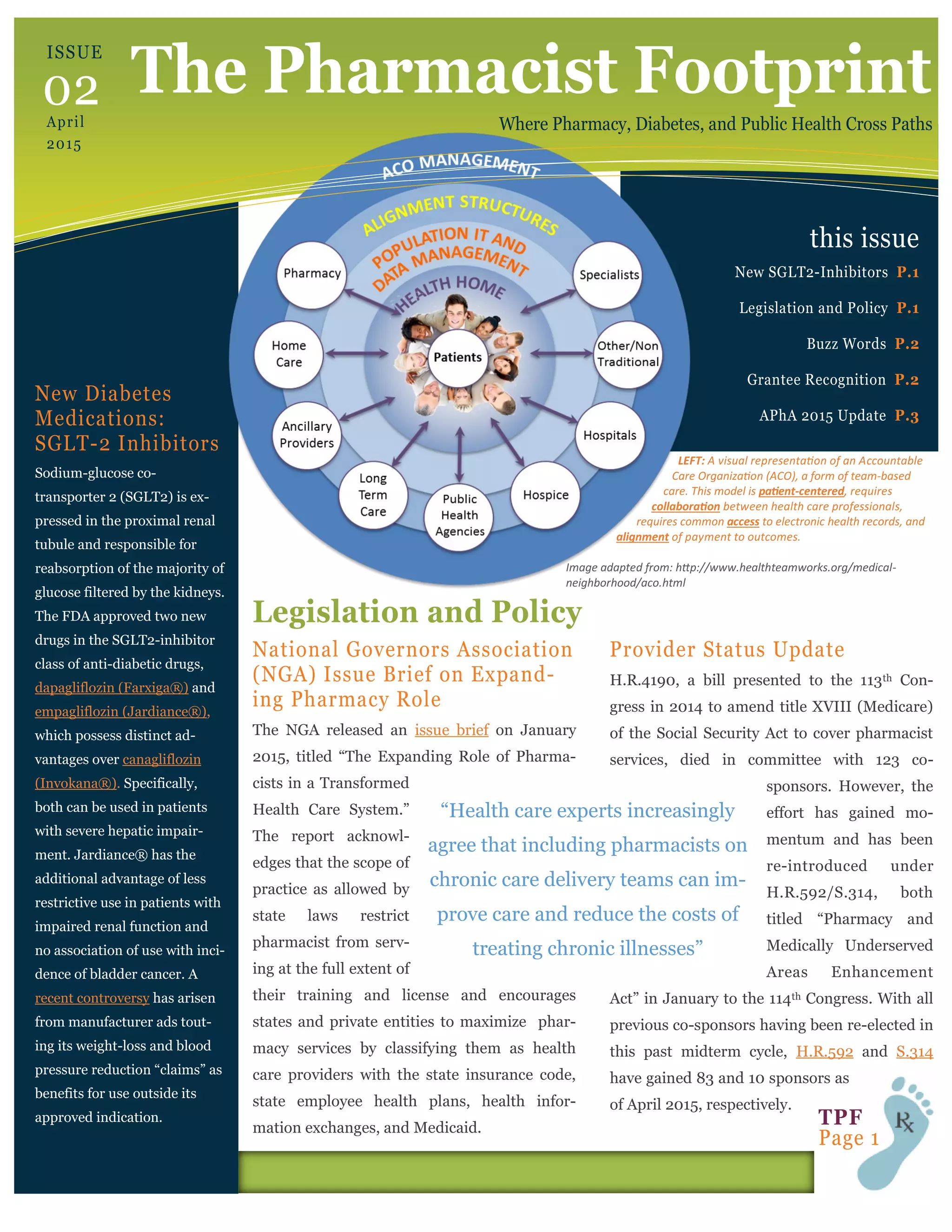
LEFT: A visual representation of an Accountable
Care Organization (ACO), a form of team-based
care. This model is patient-centered, requires
collaboration between health care professionals,
requires common access to electronic health records, and
alignment of payment to outcomes.
Image adapted from: http://www.healthteamworks.org/medical-
neighborhood/aco.html
Sodium-glucose co-
transporter 2 (SGLT2) is ex-
pressed in the proximal renal
tubule and responsible for
reabsorption of the majority of
glucose filtered by the kidneys.
The FDA approved two new
drugs in the SGLT2-inhibitor
class of anti-diabetic drugs,
dapagliflozin (Farxiga®) and
empagliflozin (Jardiance®),
which possess distinct ad-
vantages over canagliflozin
(Invokana®). Specifically,
both can be used in patients
with severe hepatic impair-
ment. Jardiance® has the
additional advantage of less
restrictive use in patients with
impaired renal function and
no association of use with inci-
dence of bladder cancer. A
recent controversy has arisen
from manufacturer ads tout-
ing its weight-loss and blood
pressure reduction “claims” as
benefits for use outside its
approved indication.
H.R.4190, a bill presented to the 113th Con-
gress in 2014 to amend title XVIII (Medicare)
of the Social Security Act to cover pharmacist
services, died in committee with 123 co-
sponsors. However, the
effort has gained mo-
mentum and has been
re-introduced under
H.R.592/S.314, both
titled “Pharmacy and
Medically Underserved
Areas Enhancement
Act” in January to the 114th Congress. With all
previous co-sponsors having been re-elected in
this past midterm cycle, H.R.592 and S.314
have gained 83 and 10 sponsors as
of April 2015, respectively.
“Health care experts increasingly
agree that including pharmacists on
chronic care delivery teams can im-
prove care and reduce the costs of
treating chronic illnesses”
FOA 1305, the State Public
Health Actions to Prevent and
Control Diabetes, Heart Dis-
ease, Obesity and Associated
Risk Factors and Promote
School Health, is a cooperative
agreement that is familiar to us
all. We often find ourselves
wondering whether the grants
are being appropriated to sub-
awardees that are of quality and
ability to execute on the desired
deliverables. Two state partners
were recognized at the Ameri-
can Pharmacists Association
(APhA) 2015 Annual Meeting in
San Diego, CA.
Todd D. Sorenson, PharmD
FAPhA (pictured below)
and Baeteena M. Black, DPh
(pictured above) of Minnesota
and Tennessee, respectively,
received national awards for
their excellence in practice and
contribution to the profession
of pharmacy.
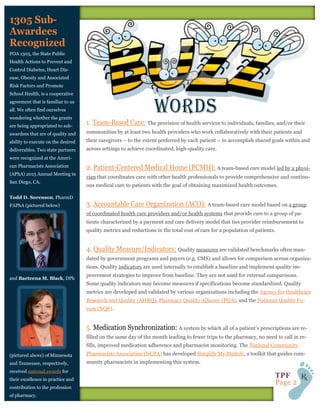
The provision of health services to individuals, families, and/or their
communities by at least two health providers who work collaboratively with their patients and
their caregivers – to the extent preferred by each patient – to accomplish shared goals within and
across settings to achieve coordinated, high-quality care.
A team-based care model led by a physi-
cian that coordinates care with other health professionals to provide comprehensive and continu-
ous medical care to patients with the goal of obtaining maximized health outcomes.
A team-based care model based on a group
of coordinated health care providers and/or health systems that provide care to a group of pa-
tients characterized by a payment and care delivery model that ties provider reimbursement to
quality metrics and reductions in the total cost of care for a population of patients.
Quality measures are validated benchmarks often man-
dated by government programs and payers (e.g. CMS) and allows for comparison across organiza-
tions. Quality indicators are used internally to establish a baseline and implement quality im-
provement strategies to improve from baseline. They are not used for external comparisons.
Some quality indicators may become measures if specifications become standardized. Quality
metrics are developed and validated by various organizations including the Agency for Healthcare
Research and Quality (AHRQ), Pharmacy Quality Alliance (PQA), and the National Quality Fo-
rum (NQF).
A system by which all of a patient’s prescriptions are re-
filled on the same day of the month leading to fewer trips to the pharmacy, no need to call in re-
fills, improved medication adherence and pharmacist monitoring. The National Community
Pharmacists Association (NCPA) has developed Simplify My Meds®, a toolkit that guides com-
munity pharmacists in implementing this system.
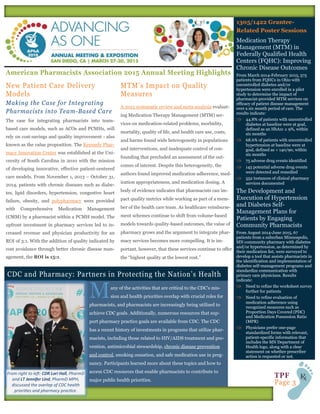
Many of the activities that are critical to the CDC's mis-
sion and health priorities overlap with crucial roles for
pharmacists, and pharmacists are increasingly being utilized to
achieve CDC goals. Additionally, numerous resources that sup-
port pharmacy practice goals are available from CDC. The CDC
has a recent history of investments in programs that utilize phar-
macists, including those related to HIV/AIDS treatment and pre-
vention, antimicrobial stewardship, chronic disease prevention
and control, smoking cessation, and safe medication use in preg-
nancy. Participants learned more about these topics and how to
access CDC resources that enable pharmacists to contribute to
major public health priorities.
From right to left: CDR Lori Hall, PharmD
and LT Jennifer Lind, PharmD MPH,
discussed the overlap of CDC health
priorities and pharmacy practice.
The case for integrating pharmacists into team-
based care models, such as ACOs and PCMHs, will
rely on cost-savings and quality improvement - also
known as the value proposition. The Kennedy Phar-
macy Innovation Center was established at the Uni-
versity of South Carolina in 2010 with the mission
of developing innovative, effective patient-centered
care models. From November 1, 2013 – October 31,
2014, patients with chronic diseases such as diabe-
tes, lipid disorders, hypertension, congestive heart
failure, obesity, and polypharmacy were provided
with Comprehensive Medication Management
(CMM) by a pharmacist within a PCMH model. The
upfront investment in pharmacy services led to in-
creased revenue and physician productivity for an
ROI of 3:1. With the addition of quality indicated by
cost avoidance through better chronic disease man-
agement, the ROI is 15:1.
A 2015 systematic review and meta-analysis evaluat-
ing Medication Therapy Management (MTM) ser-
vices on medication-related problems, morbidity,
mortality, quality of life, and health care use, costs,
and harms found wide heterogeneity in populations
and interventions, and inadequate control of con-
founding that precluded an assessment of the out-
comes of interest. Despite this heterogeneity, the
authors found improved medication adherence, med-
ication appropriateness, and medication dosing. A
body of evidence indicates that pharmacists can im-
pact quality metrics while working as part of a mem-
ber of the health care team. As healthcare reimburse-
ment schemes continue to shift from volume-based
models towards quality-based outcomes, the value of
pharmacy grows and the argument to integrate phar-
macy services becomes more compelling. It is im-
portant, however, that these services continue to offer
the “highest quality at the lowest cost.”
1305/1422 Grantee-
Related Poster Sessions
Medication Therapy
Management (MTM) in
Federally Qualified Health
Centers (FQHC): Improving
Chronic Disease Outcomes
From March 2014-February 2015, 375
patients from FQHCs in Ohio with
uncontrolled diabetes and/or
hypertension were enrolled in a pilot
study to determine the impact of
pharmacist-provided MTM services on
efficacy of patient disease management
over a six month period of care. The
results indicate:
 44.8% of patients with uncontrolled
diabetes at baseline were at goal,
defined as an HbA1c ≤ 9%, within
six months
 68.6% of patients with uncontrolled
hypertension at baseline were at
goal, defined as < 140/90, within
six months
 75 adverse drug events identified
 145 potential adverse drug events
were detected and remedied
 552 instances of clinical pharmacy
services documented
The Development and
Execution of Hypertension
and Diabetes Self-
Management Plans for
Patients by Engaging
Community Pharmacists
From August 2014-June 2015, 67
patients from a suburban Minneapolis,
MN community pharmacy with diabetes
and/or hypertension, as determined by
their medication list, were surveyed to
develop a tool that assists pharmacists in
the identification and implementation of
diabetes self-management programs and
standardize communication with
primary care physicians. Results
indicate:
 Need to refine the worksheet survey
further for patients
 Need to refine evaluation of
medication adherence using
recognized measures such as
Proportion Days Covered (PDC)
and Medication Possession Ratio
(MPR)
 Physicians prefer one-page
standardized forms with relevant,
patient-specific information that
includes the MN Department of
Health logo, along with a clear
statement on whether prescriber
action is requested or not.
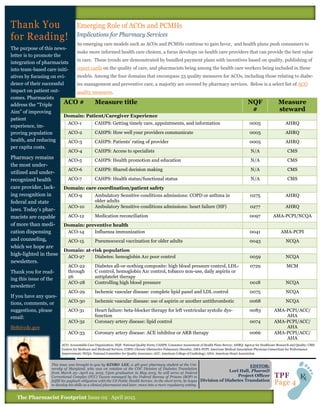
As emerging care models such as ACOs and PCMHs continue to gain favor, and health plans push consumers to
make more informed health care choices, a focus develops on health care providers that can provide the best value
in care. These trends are demonstrated by bundled payment plans with incentives based on quality, publishing of
report cards on the quality of care, and pharmacists being among the health care workers being included in these
models. Among the four domains that encompass 33 quality measures for ACOs, including those relating to diabe-
tes management and preventive care, a majority are covered by pharmacy services. Below is a select list of ACO
quality measures.
The purpose of this news-
letter is to promote the
integration of pharmacists
into team-based care initi-
atives by focusing on evi-
dence of their successful
impact on patient out-
comes. Pharmacists
address the “Triple
Aim” of improving
patient
experience, im-
proving population
health, and reducing
per capita costs.
Pharmacy remains
the most under-
utilized and under-
recognized health
care provider, lack-
ing recognition in
federal and state
laws. Today’s phar-
macists are capable
of more than medi-
cation dispensing
and counseling,
which we hope are
high-lighted in these
newsletters.
Thank you for read-
ing this issue of the
newsletter!
If you have any ques-
tions, comments, or
suggestions, please
email:
lfe8@cdc.gov
ACO # Measure title NQF
#
Measure
steward
Domain: Patient/Caregiver Experience
ACO-1 CAHPS: Getting timely care, appointments, and information 0005 AHRQ
ACO-2 CAHPS: How well your providers communicate 0005 AHRQ
ACO-3 CAHPS: Patients' rating of provider 0005 AHRQ
ACO-4 CAHPS: Access to specialists N/A CMS
ACO-5 CAHPS: Health promotion and education N/A CMS
ACO-6 CAHPS: Shared decision making N/A CMS
ACO-7 CAHPS: Health status/functional status N/A CMS
Domain: care coordination/patient safety
ACO-9 Ambulatory Sensitive conditions admissions: COPD or asthma in
older adults
0275 AHRQ
ACO-10 Ambulatory Sensitive conditions admissions: heart failure (HF) 0277 AHRQ
ACO-12 Medication reconciliation 0097 AMA-PCPI/NCQA
Domain: preventive health
ACO-14 Influenza immunization 0041 AMA-PCPI
ACO-15 Pneumococcal vaccination for older adults 0043 NCQA
Domain: at-risk population
ACO-27 Diabetes: hemoglobin A1c poor control 0059 NCQA
ACO-22
through
26
Diabetes all-or-nothing composite: high blood pressure control, LDL-
C control, hemoglobin A1c control, tobacco non-use, daily aspirin or
antiplatelet therapy
0729 MCM
ACO-28 Controlling high blood pressure 0018 NCQA
ACO-29 Ischemic vascular disease: complete lipid panel and LDL control 0075 NCQA
ACO-30 Ischemic vascular disease: use of aspirin or another antithrombotic 0068 NCQA
ACO-31 Heart failure: beta-blocker therapy for left ventricular systolic dys-
function
0083 AMA-PCPI/ACC/
AHA
ACO-32 Coronary artery disease: lipid control 0074 AMA-PCPI/ACC/
AHA
ACO-33 Coronary artery disease: ACE inhibitor or ARB therapy 0066 AMA-PCPI/ACC/
AHA
ACO: Accountable Care Organization; NQF: National Quality Form; CAHPS: Consumer Assessment of Health Plans Survey; AHRQ: Agency for Healthcare Research and Quality; CMS:
Centers for Medicare and Medicaid Services; COPD: Chronic Obstructive Pulmonary Disorder; AMA-PCPI: American Medical Association-Physician Consortium for Performance
Improvement; NCQA: National Committee for Quality Assurance; ACC: American College of Cardiology; AHA: American Heart Association
This issue was brought to you by KINBO LEE, a 4th year pharmacy student at the Uni-
versity of Maryland, who was on rotation at the CDC Division of Diabetes Translation
from March 23—April 24, 2015. Upon graduation in May 2015, he will serve at Federal
Correctional Complex (FCC) Tucson managed by the Federal Bureau of Prisons (BOP) to
fulfill his payback obligation with the US Public Health Service. In the short term, he hopes
to develop his skills as a clinical pharmacist and later, move into a more regulatory setting.
The Pharmacist Footprint Issue 02 April 2015
EDITOR:
Lori Hall, PharmD
Project Officer
Division of Diabetes Translation

TPF - Issue 2

  • 1.
    The NGA releasedan issue brief on January 2015, titled “The Expanding Role of Pharma- cists in a Transformed Health Care System.” The report acknowl- edges that the scope of practice as allowed by state laws restrict pharmacist from serv- ing at the full extent of their training and license and encourages states and private entities to maximize phar- macy services by classifying them as health care providers with the state insurance code, state employee health plans, health infor- mation exchanges, and Medicaid. LEFT: A visual representation of an Accountable Care Organization (ACO), a form of team-based care. This model is patient-centered, requires collaboration between health care professionals, requires common access to electronic health records, and alignment of payment to outcomes. Image adapted from: http://www.healthteamworks.org/medical- neighborhood/aco.html Sodium-glucose co- transporter 2 (SGLT2) is ex- pressed in the proximal renal tubule and responsible for reabsorption of the majority of glucose filtered by the kidneys. The FDA approved two new drugs in the SGLT2-inhibitor class of anti-diabetic drugs, dapagliflozin (Farxiga®) and empagliflozin (Jardiance®), which possess distinct ad- vantages over canagliflozin (Invokana®). Specifically, both can be used in patients with severe hepatic impair- ment. Jardiance® has the additional advantage of less restrictive use in patients with impaired renal function and no association of use with inci- dence of bladder cancer. A recent controversy has arisen from manufacturer ads tout- ing its weight-loss and blood pressure reduction “claims” as benefits for use outside its approved indication. H.R.4190, a bill presented to the 113th Con- gress in 2014 to amend title XVIII (Medicare) of the Social Security Act to cover pharmacist services, died in committee with 123 co- sponsors. However, the effort has gained mo- mentum and has been re-introduced under H.R.592/S.314, both titled “Pharmacy and Medically Underserved Areas Enhancement Act” in January to the 114th Congress. With all previous co-sponsors having been re-elected in this past midterm cycle, H.R.592 and S.314 have gained 83 and 10 sponsors as of April 2015, respectively. “Health care experts increasingly agree that including pharmacists on chronic care delivery teams can im- prove care and reduce the costs of treating chronic illnesses”
  • 2.
    FOA 1305, theState Public Health Actions to Prevent and Control Diabetes, Heart Dis- ease, Obesity and Associated Risk Factors and Promote School Health, is a cooperative agreement that is familiar to us all. We often find ourselves wondering whether the grants are being appropriated to sub- awardees that are of quality and ability to execute on the desired deliverables. Two state partners were recognized at the Ameri- can Pharmacists Association (APhA) 2015 Annual Meeting in San Diego, CA. Todd D. Sorenson, PharmD FAPhA (pictured below) and Baeteena M. Black, DPh (pictured above) of Minnesota and Tennessee, respectively, received national awards for their excellence in practice and contribution to the profession of pharmacy. The provision of health services to individuals, families, and/or their communities by at least two health providers who work collaboratively with their patients and their caregivers – to the extent preferred by each patient – to accomplish shared goals within and across settings to achieve coordinated, high-quality care. A team-based care model led by a physi- cian that coordinates care with other health professionals to provide comprehensive and continu- ous medical care to patients with the goal of obtaining maximized health outcomes. A team-based care model based on a group of coordinated health care providers and/or health systems that provide care to a group of pa- tients characterized by a payment and care delivery model that ties provider reimbursement to quality metrics and reductions in the total cost of care for a population of patients. Quality measures are validated benchmarks often man- dated by government programs and payers (e.g. CMS) and allows for comparison across organiza- tions. Quality indicators are used internally to establish a baseline and implement quality im- provement strategies to improve from baseline. They are not used for external comparisons. Some quality indicators may become measures if specifications become standardized. Quality metrics are developed and validated by various organizations including the Agency for Healthcare Research and Quality (AHRQ), Pharmacy Quality Alliance (PQA), and the National Quality Fo- rum (NQF). A system by which all of a patient’s prescriptions are re- filled on the same day of the month leading to fewer trips to the pharmacy, no need to call in re- fills, improved medication adherence and pharmacist monitoring. The National Community Pharmacists Association (NCPA) has developed Simplify My Meds®, a toolkit that guides com- munity pharmacists in implementing this system.
  • 3.
    Many of theactivities that are critical to the CDC's mis- sion and health priorities overlap with crucial roles for pharmacists, and pharmacists are increasingly being utilized to achieve CDC goals. Additionally, numerous resources that sup- port pharmacy practice goals are available from CDC. The CDC has a recent history of investments in programs that utilize phar- macists, including those related to HIV/AIDS treatment and pre- vention, antimicrobial stewardship, chronic disease prevention and control, smoking cessation, and safe medication use in preg- nancy. Participants learned more about these topics and how to access CDC resources that enable pharmacists to contribute to major public health priorities. From right to left: CDR Lori Hall, PharmD and LT Jennifer Lind, PharmD MPH, discussed the overlap of CDC health priorities and pharmacy practice. The case for integrating pharmacists into team- based care models, such as ACOs and PCMHs, will rely on cost-savings and quality improvement - also known as the value proposition. The Kennedy Phar- macy Innovation Center was established at the Uni- versity of South Carolina in 2010 with the mission of developing innovative, effective patient-centered care models. From November 1, 2013 – October 31, 2014, patients with chronic diseases such as diabe- tes, lipid disorders, hypertension, congestive heart failure, obesity, and polypharmacy were provided with Comprehensive Medication Management (CMM) by a pharmacist within a PCMH model. The upfront investment in pharmacy services led to in- creased revenue and physician productivity for an ROI of 3:1. With the addition of quality indicated by cost avoidance through better chronic disease man- agement, the ROI is 15:1. A 2015 systematic review and meta-analysis evaluat- ing Medication Therapy Management (MTM) ser- vices on medication-related problems, morbidity, mortality, quality of life, and health care use, costs, and harms found wide heterogeneity in populations and interventions, and inadequate control of con- founding that precluded an assessment of the out- comes of interest. Despite this heterogeneity, the authors found improved medication adherence, med- ication appropriateness, and medication dosing. A body of evidence indicates that pharmacists can im- pact quality metrics while working as part of a mem- ber of the health care team. As healthcare reimburse- ment schemes continue to shift from volume-based models towards quality-based outcomes, the value of pharmacy grows and the argument to integrate phar- macy services becomes more compelling. It is im- portant, however, that these services continue to offer the “highest quality at the lowest cost.” 1305/1422 Grantee- Related Poster Sessions Medication Therapy Management (MTM) in Federally Qualified Health Centers (FQHC): Improving Chronic Disease Outcomes From March 2014-February 2015, 375 patients from FQHCs in Ohio with uncontrolled diabetes and/or hypertension were enrolled in a pilot study to determine the impact of pharmacist-provided MTM services on efficacy of patient disease management over a six month period of care. The results indicate:  44.8% of patients with uncontrolled diabetes at baseline were at goal, defined as an HbA1c ≤ 9%, within six months  68.6% of patients with uncontrolled hypertension at baseline were at goal, defined as < 140/90, within six months  75 adverse drug events identified  145 potential adverse drug events were detected and remedied  552 instances of clinical pharmacy services documented The Development and Execution of Hypertension and Diabetes Self- Management Plans for Patients by Engaging Community Pharmacists From August 2014-June 2015, 67 patients from a suburban Minneapolis, MN community pharmacy with diabetes and/or hypertension, as determined by their medication list, were surveyed to develop a tool that assists pharmacists in the identification and implementation of diabetes self-management programs and standardize communication with primary care physicians. Results indicate:  Need to refine the worksheet survey further for patients  Need to refine evaluation of medication adherence using recognized measures such as Proportion Days Covered (PDC) and Medication Possession Ratio (MPR)  Physicians prefer one-page standardized forms with relevant, patient-specific information that includes the MN Department of Health logo, along with a clear statement on whether prescriber action is requested or not.
  • 4.
    As emerging caremodels such as ACOs and PCMHs continue to gain favor, and health plans push consumers to make more informed health care choices, a focus develops on health care providers that can provide the best value in care. These trends are demonstrated by bundled payment plans with incentives based on quality, publishing of report cards on the quality of care, and pharmacists being among the health care workers being included in these models. Among the four domains that encompass 33 quality measures for ACOs, including those relating to diabe- tes management and preventive care, a majority are covered by pharmacy services. Below is a select list of ACO quality measures. The purpose of this news- letter is to promote the integration of pharmacists into team-based care initi- atives by focusing on evi- dence of their successful impact on patient out- comes. Pharmacists address the “Triple Aim” of improving patient experience, im- proving population health, and reducing per capita costs. Pharmacy remains the most under- utilized and under- recognized health care provider, lack- ing recognition in federal and state laws. Today’s phar- macists are capable of more than medi- cation dispensing and counseling, which we hope are high-lighted in these newsletters. Thank you for read- ing this issue of the newsletter! If you have any ques- tions, comments, or suggestions, please email: lfe8@cdc.gov ACO # Measure title NQF # Measure steward Domain: Patient/Caregiver Experience ACO-1 CAHPS: Getting timely care, appointments, and information 0005 AHRQ ACO-2 CAHPS: How well your providers communicate 0005 AHRQ ACO-3 CAHPS: Patients' rating of provider 0005 AHRQ ACO-4 CAHPS: Access to specialists N/A CMS ACO-5 CAHPS: Health promotion and education N/A CMS ACO-6 CAHPS: Shared decision making N/A CMS ACO-7 CAHPS: Health status/functional status N/A CMS Domain: care coordination/patient safety ACO-9 Ambulatory Sensitive conditions admissions: COPD or asthma in older adults 0275 AHRQ ACO-10 Ambulatory Sensitive conditions admissions: heart failure (HF) 0277 AHRQ ACO-12 Medication reconciliation 0097 AMA-PCPI/NCQA Domain: preventive health ACO-14 Influenza immunization 0041 AMA-PCPI ACO-15 Pneumococcal vaccination for older adults 0043 NCQA Domain: at-risk population ACO-27 Diabetes: hemoglobin A1c poor control 0059 NCQA ACO-22 through 26 Diabetes all-or-nothing composite: high blood pressure control, LDL- C control, hemoglobin A1c control, tobacco non-use, daily aspirin or antiplatelet therapy 0729 MCM ACO-28 Controlling high blood pressure 0018 NCQA ACO-29 Ischemic vascular disease: complete lipid panel and LDL control 0075 NCQA ACO-30 Ischemic vascular disease: use of aspirin or another antithrombotic 0068 NCQA ACO-31 Heart failure: beta-blocker therapy for left ventricular systolic dys- function 0083 AMA-PCPI/ACC/ AHA ACO-32 Coronary artery disease: lipid control 0074 AMA-PCPI/ACC/ AHA ACO-33 Coronary artery disease: ACE inhibitor or ARB therapy 0066 AMA-PCPI/ACC/ AHA ACO: Accountable Care Organization; NQF: National Quality Form; CAHPS: Consumer Assessment of Health Plans Survey; AHRQ: Agency for Healthcare Research and Quality; CMS: Centers for Medicare and Medicaid Services; COPD: Chronic Obstructive Pulmonary Disorder; AMA-PCPI: American Medical Association-Physician Consortium for Performance Improvement; NCQA: National Committee for Quality Assurance; ACC: American College of Cardiology; AHA: American Heart Association This issue was brought to you by KINBO LEE, a 4th year pharmacy student at the Uni- versity of Maryland, who was on rotation at the CDC Division of Diabetes Translation from March 23—April 24, 2015. Upon graduation in May 2015, he will serve at Federal Correctional Complex (FCC) Tucson managed by the Federal Bureau of Prisons (BOP) to fulfill his payback obligation with the US Public Health Service. In the short term, he hopes to develop his skills as a clinical pharmacist and later, move into a more regulatory setting. The Pharmacist Footprint Issue 02 April 2015 EDITOR: Lori Hall, PharmD Project Officer Division of Diabetes Translation