Lessons Learned as an Entrepreneur
2
Agenda


       A little about Rocky and past experiences

       Some facts about start-ups

       Axela Today

       Product Life cycle

       Tools I have found useful over the years

       Axela early days

       How we transitioned

       Lessons learned


                                                    3
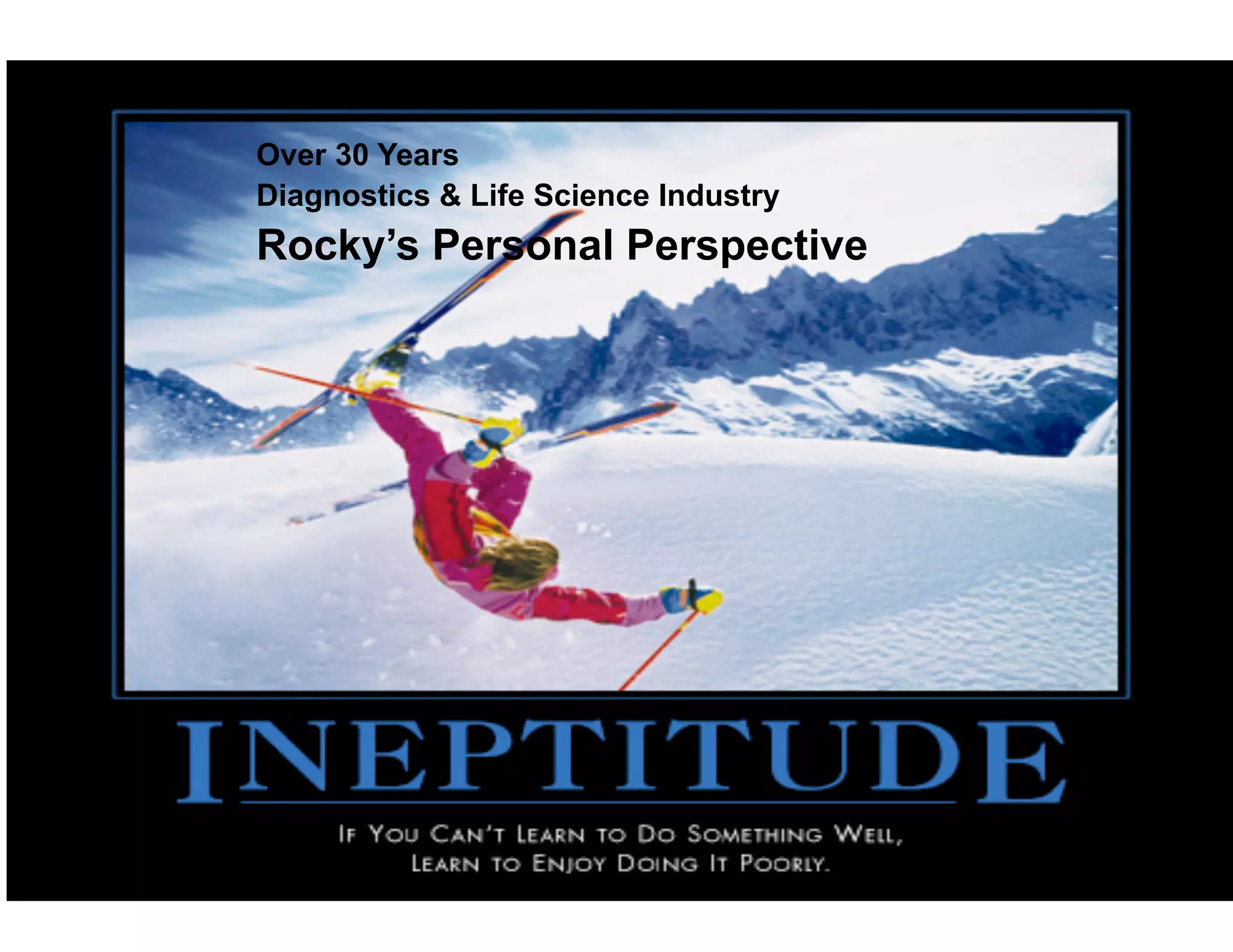
Over 30 Years
Diagnostics & Life Science Industry
Rocky’s Personal Perspective


                                      4
Rocky’s History


 • Technicon Labs
 • Becton Dickinson
 • Third Wave Technologies (TWTI)
 • Genomic Utilities Inc
 • Axela Inc


                                    5
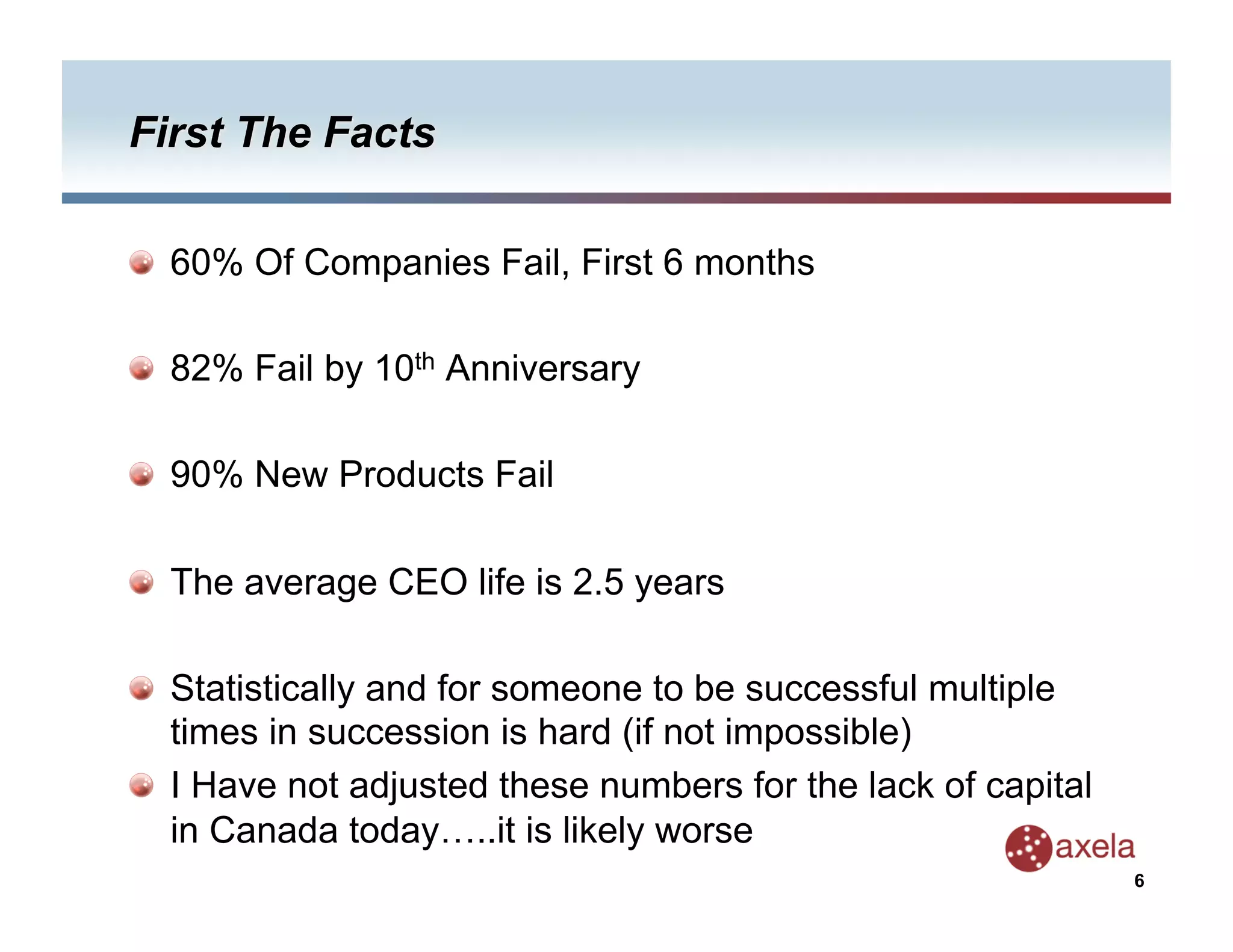
  60% Of Companies Fail, First 6 months


   82% Fail by 10th Anniversary


   90% New Products Fail


   The average CEO life is 2.5 years


   Statistically and for someone to be successful multiple
    times in succession is hard (if not impossible)

   I Have not adjusted these numbers for the lack of capital
    in Canada today…..it is likely worse
                                                                6
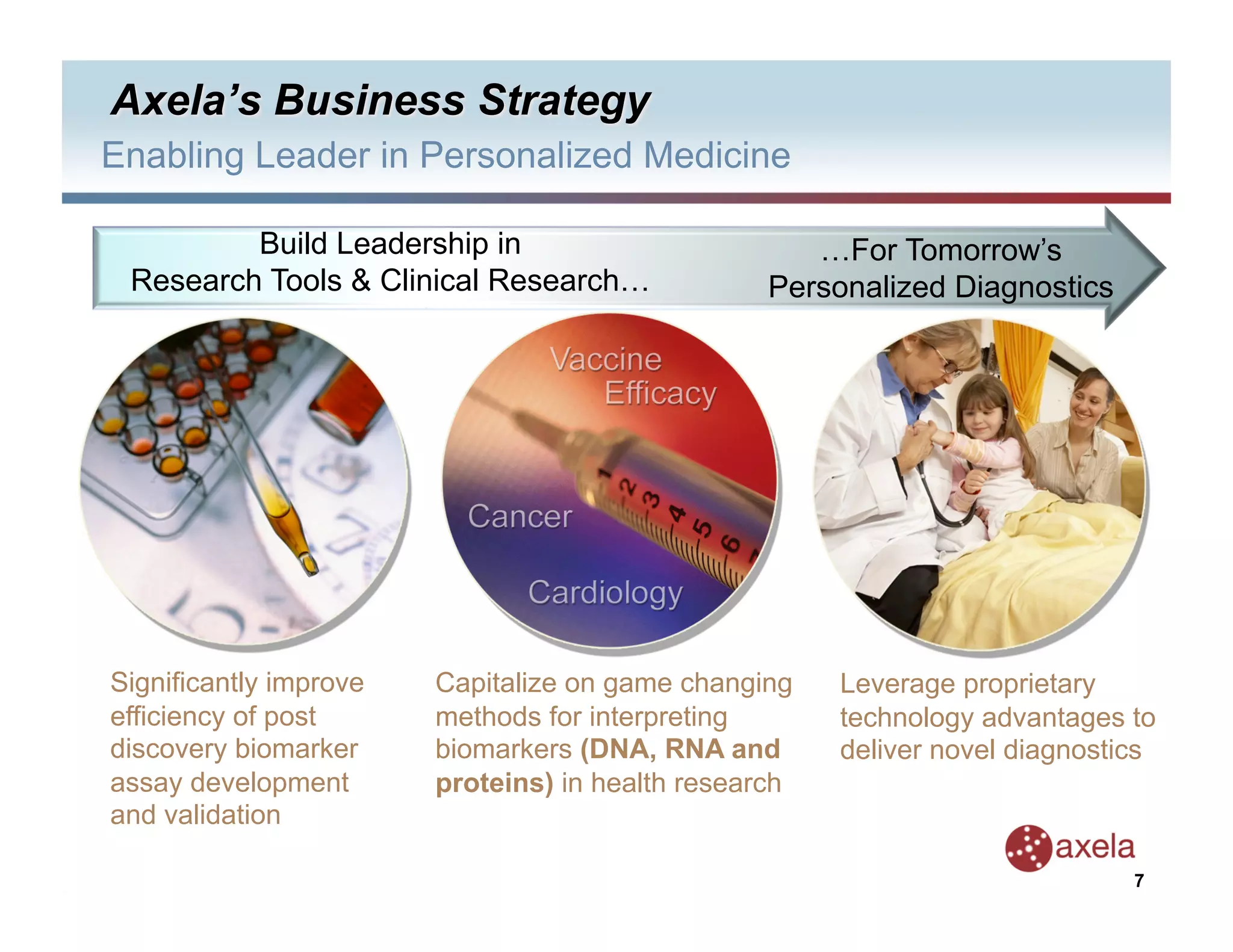
Enabling Leader in Personalized Medicine

         Build Leadership in                         …For Tomorrow’s
 Research Tools & Clinical Research…              Personalized Diagnostics


Significantly improve   Capitalize on game changing    Leverage proprietary
efficiency of post      methods for interpreting       technology advantages to
discovery biomarker     biomarkers (DNA, RNA and       deliver novel diagnostics
assay development       proteins) in health research
and validation

                                                                              7
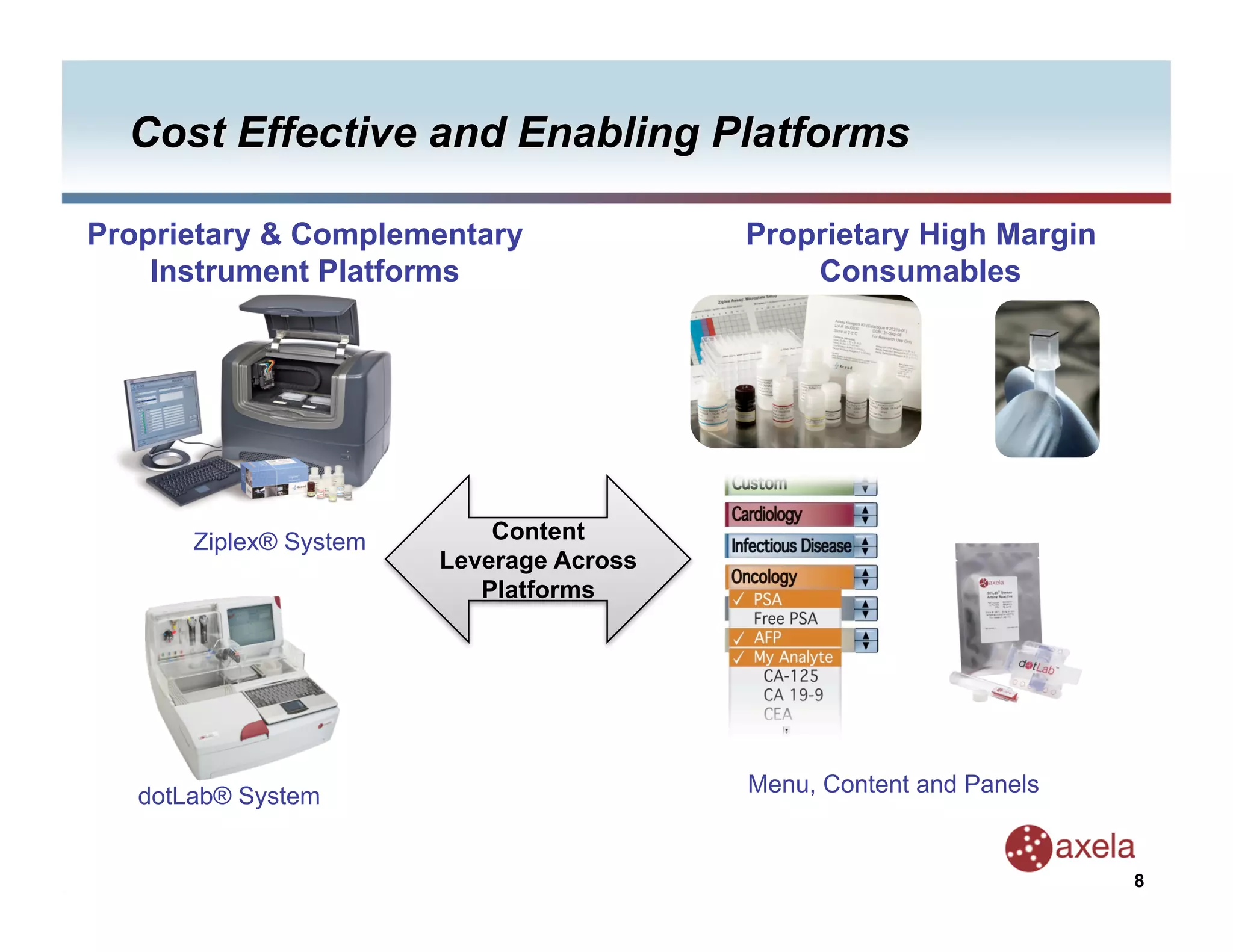
Proprietary & Complementary               Proprietary High Margin
    Instrument Platforms                      Consumables


       Ziplex® System       Content
                        Leverage Across
                           Platforms


   dotLab® System                         Menu, Content and Panels


                                                                     8
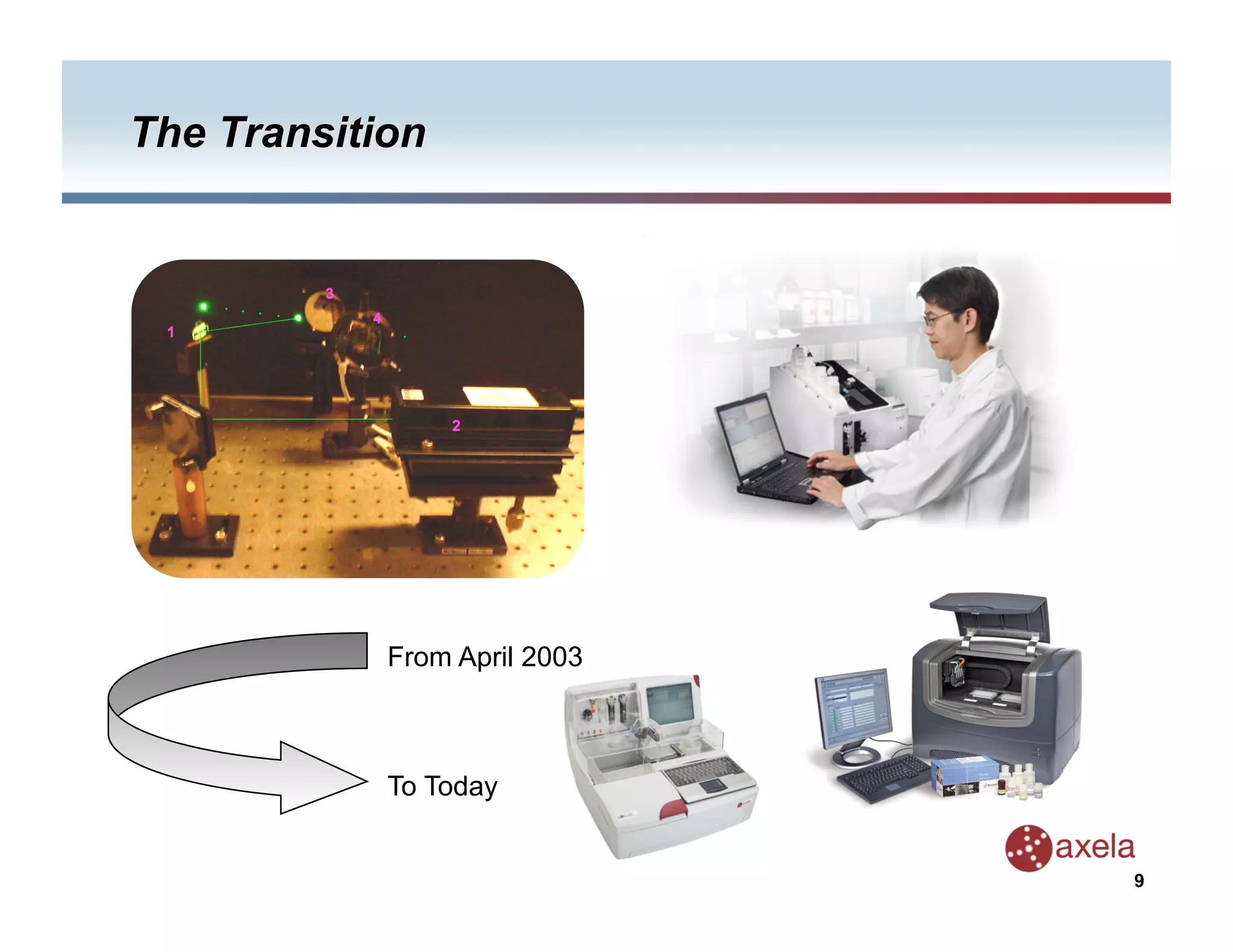
From April 2003


To Today


                  9
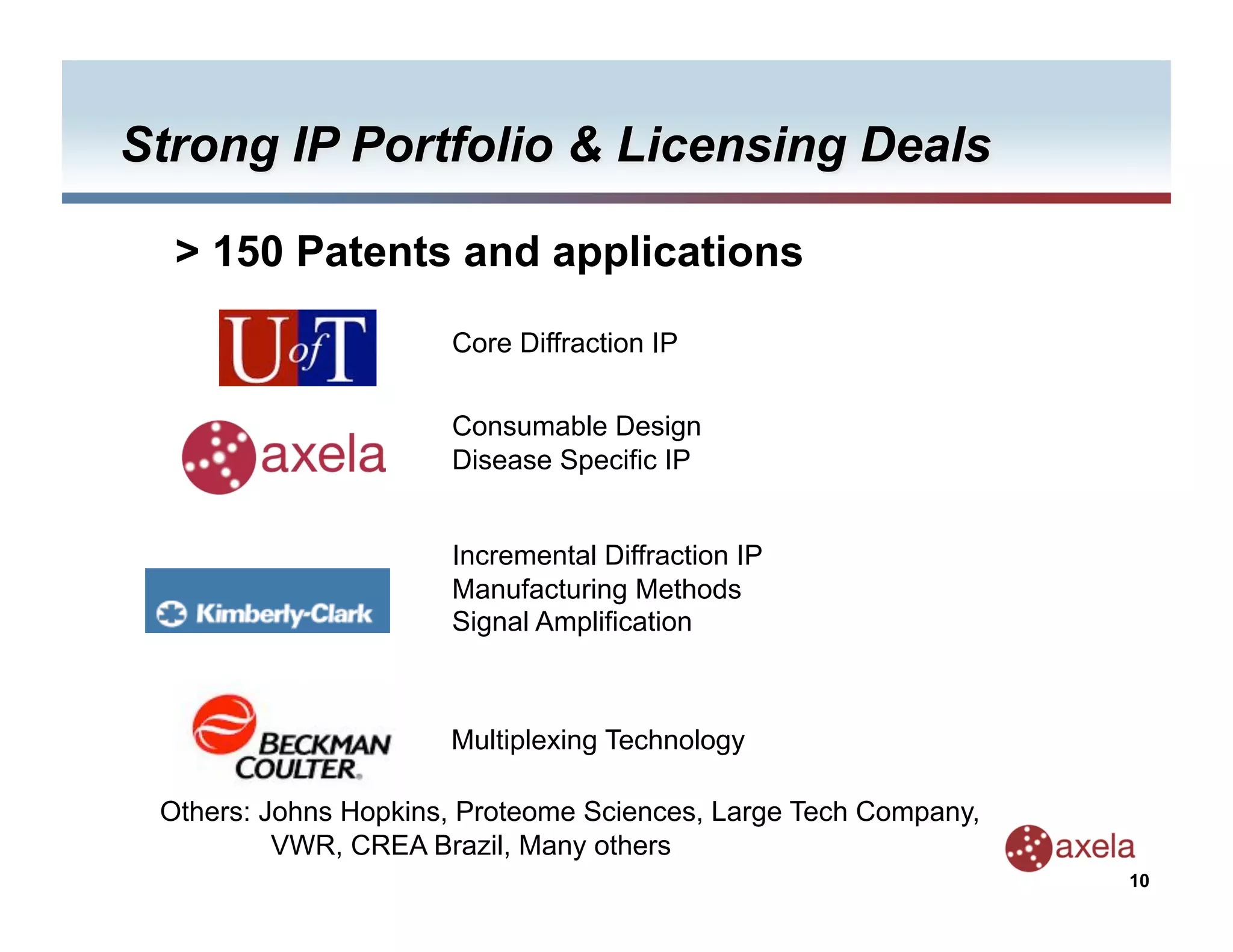
> 150 Patents and applications

                     Core Diffraction IP


                     Consumable Design
                     Disease Specific IP


                     Incremental Diffraction IP
                     Manufacturing Methods
                     Signal Amplification


                     Multiplexing Technology

Others: Johns Hopkins, Proteome Sciences, Large Tech Company,
         VWR, CREA Brazil, Many others
                                                                10
Key events in the history of Axela
•  Company founded 2001 by Cynthia Goh
  •  Seed funding from Primaxis and Royal Bay Capital
•  2003 I was recruited from the states to run Axela
  •  Later stage funding support from VenGrowth
•  2004 the first prototypes systems developed
•  Late 2005 Major in-licensing deal with K-C
•  2007 in-licensed multiplexing IP from Beckman
   Coulter
•  2010 Amalgamated Axela and Xceed Molecular

                                                        11
  Use a consistent process to assess progress


   Understand where and when you exit ahead of time


   Have clear role definition


   Be honest with yourself and others relative to
    expectations


   Hire only the best…… and LISTEN!!


                                                       12
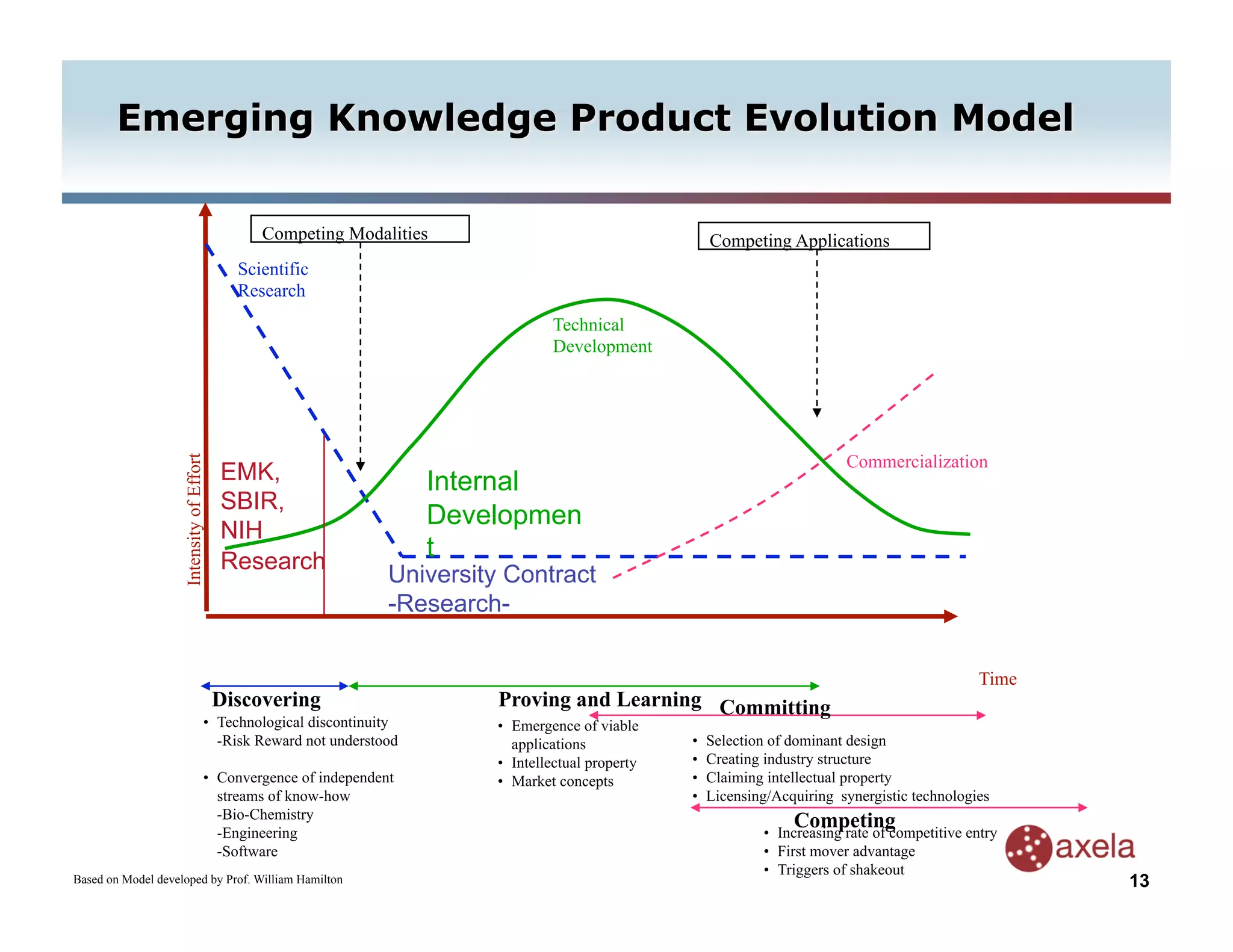
Competing Modalities                                         Competing Applications
                                            Scientific
                                            Research
                                                                                     Technical
                                                                                     Development


                                                                                                                                 Commercialization
                    Intensity of Effort


                                          EMK,                         Internal
                                          SBIR,
                                                                       Developmen
                                          NIH
                                          Research
                                                                       t
                                                                  University Contract
                                                                  -Research-

                                                                                                                                                       Time
                                          Discovering                       Proving and Learning Committing
                                      •  Technological discontinuity        •  Emergence of viable
                                         -Risk Reward not understood           applications            •    Selection of dominant design
                                                                            •  Intellectual property   •    Creating industry structure
                                      •  Convergence of independent         •  Market concepts         •    Claiming intellectual property
                                         streams of know-how                                           •    Licensing/Acquiring synergistic technologies
                                         -Bio-Chemistry
                                         -Engineering
                                                                                                                         Competing
                                                                                                                    •  Increasing rate of competitive entry
                                         -Software                                                                  •  First mover advantage
                                                                                                                    •  Triggers of shakeout
Based on Model developed by Prof. William Hamilton                                                                                                            13
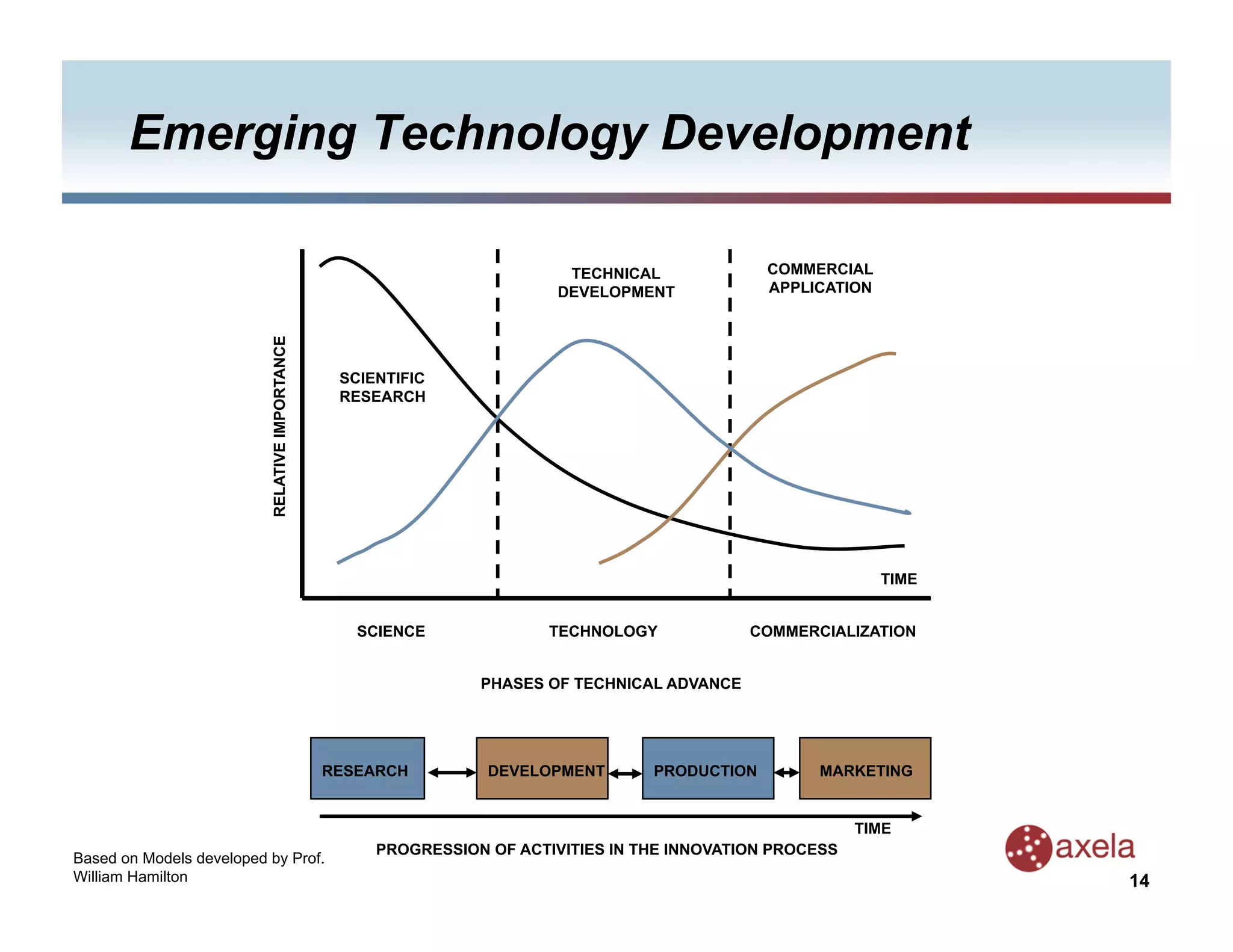
Emerging Technology Development

                                                                          TECHNICAL             COMMERCIAL
                                                                         DEVELOPMENT            APPLICATION
                          RELATIVE IMPORTANCE


                                                 SCIENTIFIC
                                                 RESEARCH


                                                                                                              TIME


                                                   SCIENCE              TECHNOLOGY            COMMERCIALIZATION


                                                                PHASES OF TECHNICAL ADVANCE


                                                RESEARCH         DEVELOPMENT       PRODUCTION        MARKETING


                                                                                                           TIME
                                                     PROGRESSION OF ACTIVITIES IN THE INNOVATION PROCESS
Based on Models developed by Prof.
William Hamilton                                                                                                     14
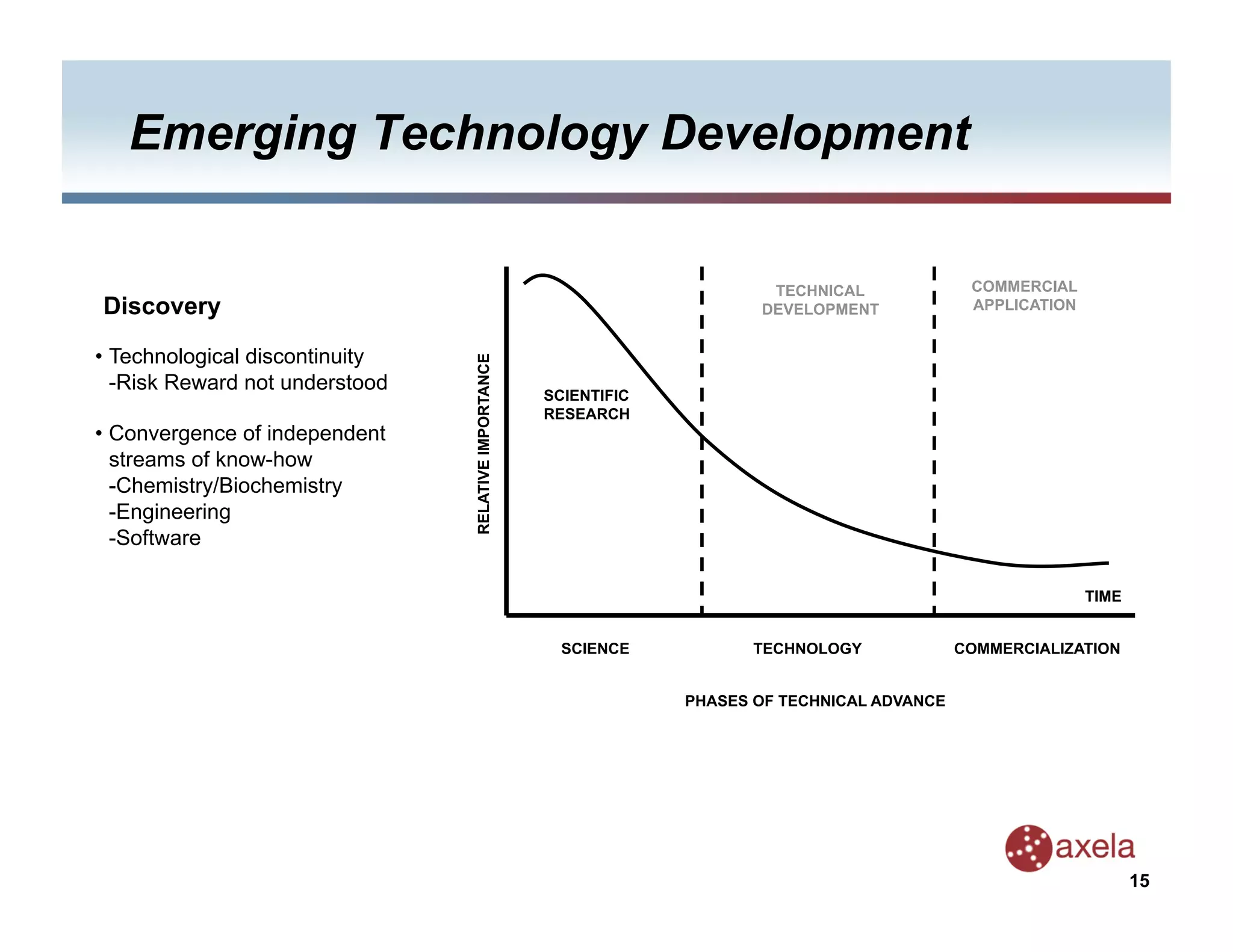
Emerging Technology Development

                                                                            TECHNICAL              COMMERCIAL
Discovery                                                                  DEVELOPMENT             APPLICATION


•  Technological discontinuity


                                 RELATIVE IMPORTANCE
   -Risk Reward not understood
                                                       SCIENTIFIC
                                                       RESEARCH
•  Convergence of independent
   streams of know-how
   -Chemistry/Biochemistry
   -Engineering
   -Software

                                                                                                                 TIME


                                                         SCIENCE           TECHNOLOGY             COMMERCIALIZATION


                                                                    PHASES OF TECHNICAL ADVANCE


                                                                                                                        15
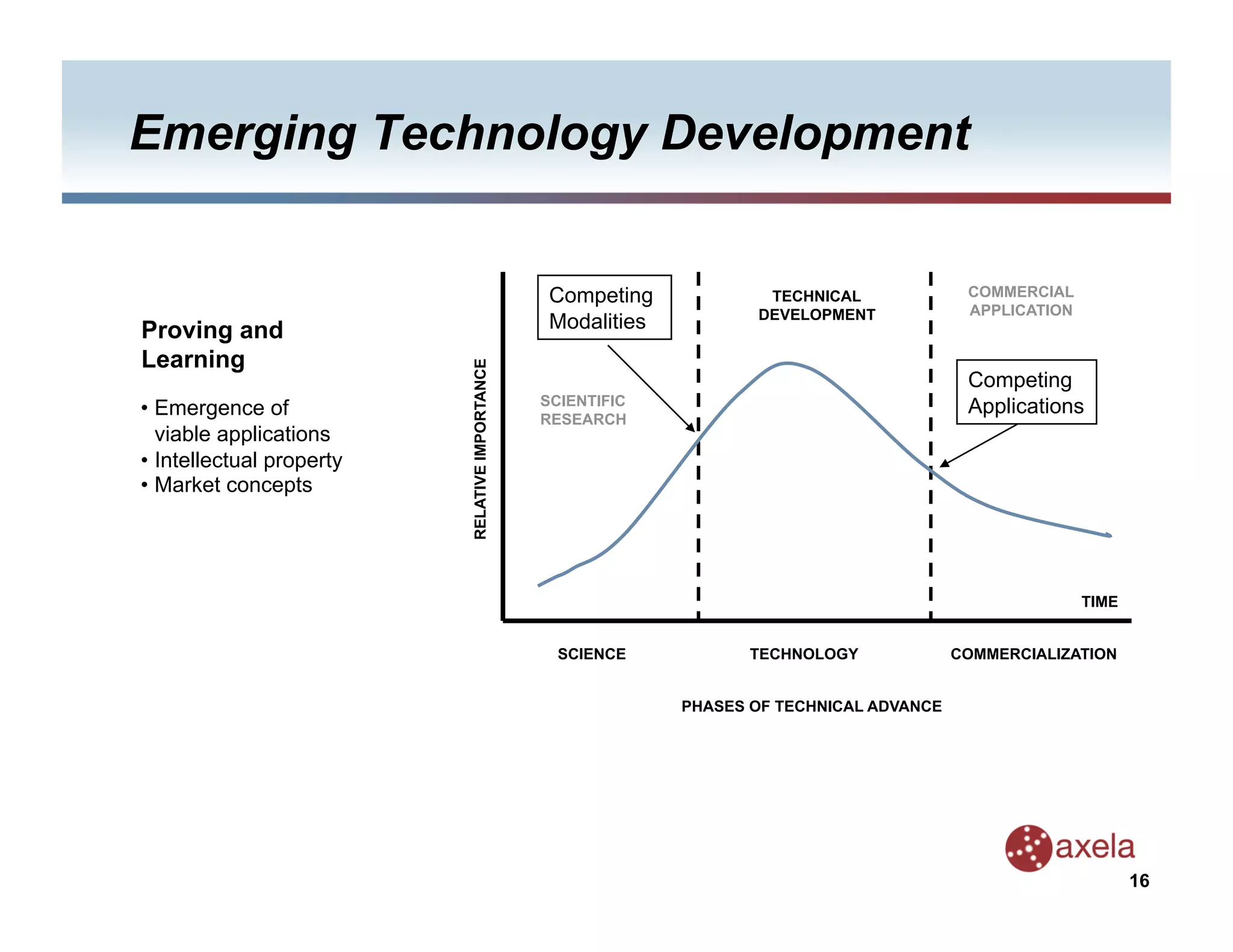
Emerging Technology Development


                                                  Competing            TECHNICAL              COMMERCIAL
                                                                      DEVELOPMENT             APPLICATION
Proving and                                       Modalities
Learning


                           RELATIVE IMPORTANCE
                                                                                              Competing
                                                 SCIENTIFIC                                   Applications
•  Emergence of                                  RESEARCH
   viable applications
•  Intellectual property
•  Market concepts


                                                                                                            TIME


                                                   SCIENCE            TECHNOLOGY             COMMERCIALIZATION


                                                               PHASES OF TECHNICAL ADVANCE


                                                                                                                   16
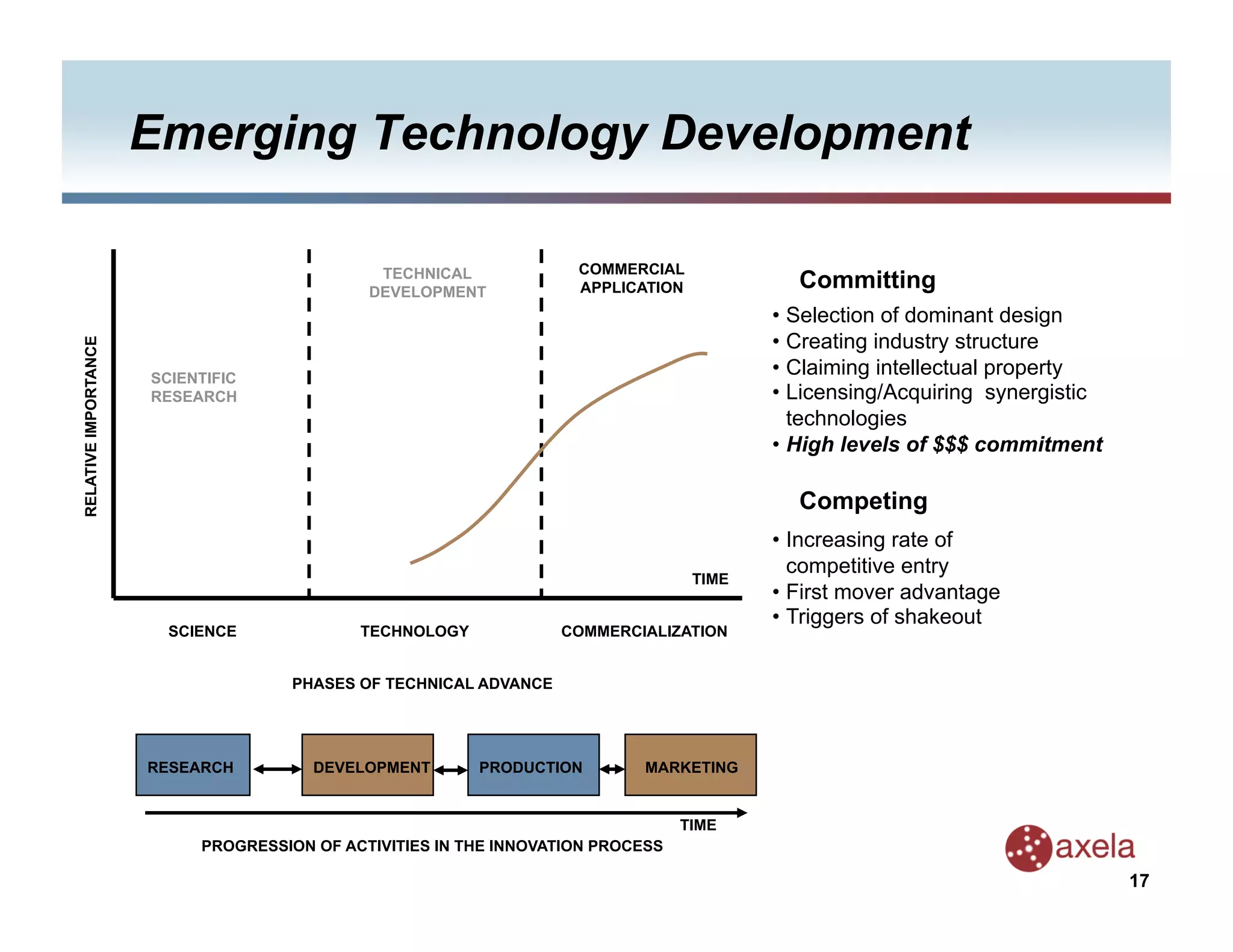
Emerging Technology Development

                                              TECHNICAL             COMMERCIAL
                                             DEVELOPMENT            APPLICATION            Committing
                                                                                         •  Selection of dominant design
                                                                                         •  Creating industry structure
RELATIVE IMPORTANCE


                      SCIENTIFIC
                                                                                         •  Claiming intellectual property
                      RESEARCH                                                           •  Licensing/Acquiring synergistic
                                                                                            technologies
                                                                                         •  High levels of $$$ commitment

                                                                                           Competing
                                                                                         •  Increasing rate of
                                                                                            competitive entry
                                                                                  TIME
                                                                                         •  First mover advantage
                                                                                         •  Triggers of shakeout
                        SCIENCE             TECHNOLOGY             COMMERCIALIZATION


                                     PHASES OF TECHNICAL ADVANCE


                      RESEARCH         DEVELOPMENT       PRODUCTION        MARKETING


                                                                                 TIME
                           PROGRESSION OF ACTIVITIES IN THE INNOVATION PROCESS

                                                                                                                              17
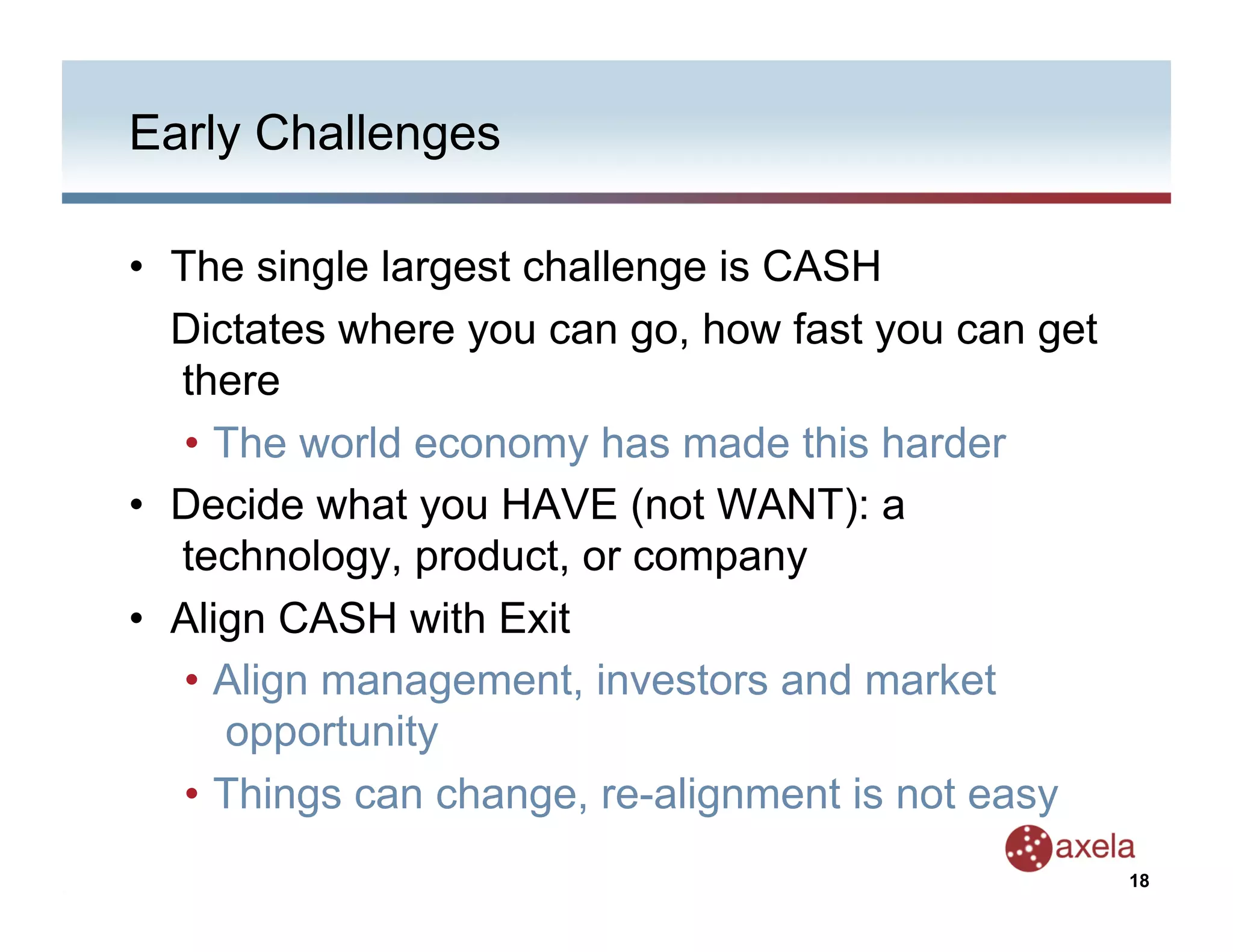
Early Challenges

•  The single largest challenge is CASH
   Dictates where you can go, how fast you can get
   there
    •  The world economy has made this harder
•  Decide what you HAVE (not WANT): a
   technology, product, or company
•  Align CASH with Exit
    •  Align management, investors and market
       opportunity
    •  Things can change, re-alignment is not easy
                                                     18
•  I should write a book called “Angel turned Devil”
    •  Third wave example
    •  Axela Example

   •  Take away:
       • Early capital has higher potential risk, higher
        potential gain but it has even less odds of paying
        out unless the business strategy is aligned with
        investment strategy


                                                             19
•  Founder/CEO
    •  Publish vs Profit
    •  Individual discovery vs corporate asset
•  Deal with serial inventor/founder vs serial entrepreneur
    •  Expectation creation is important
•  As the company’s domain expertise shifts;
    •  Does the hand off between inventor and company get
       easier or more complex?


                                                              20
Later
•  Everyone has a shelf life and a moment of
   strength
   •  Understand it, plan for it, and make changes
      when needed
   •  This is very hard especially when it is yourself


                                                         21
How You Try to Change the Odds?


   Understanding how important communication is

   Failure is inevitable; understand it; scar tissue is
    important

   Change is constant; embrace it

   Always seek to know what you don’t know

   The importance of passion alignment

   Partner, Partner, Partner


   What Ever you do:
    •  “Don’t’ Run Out of Money”


                                                           22
•  In the book the world is flat
    •  Small companies will act large
    •  Large companies will act small

•  The two things that kill deals is time and greed


                                                      23
•  Cash is king!!
    •  Which is harder the first $20 Thousand or the last $20
       Million?
    •  When they pass the cookies take some, no matter
       what it costs
    •  Balance the single dominant investor value
•  Always be ready to learn
•  Understand your own limits
•  Strong and critical board is as important as good
   investors
•  Good management wins over good technology
•  Be honest with yourself, your fellow employees, and your
   investors
                                                                24
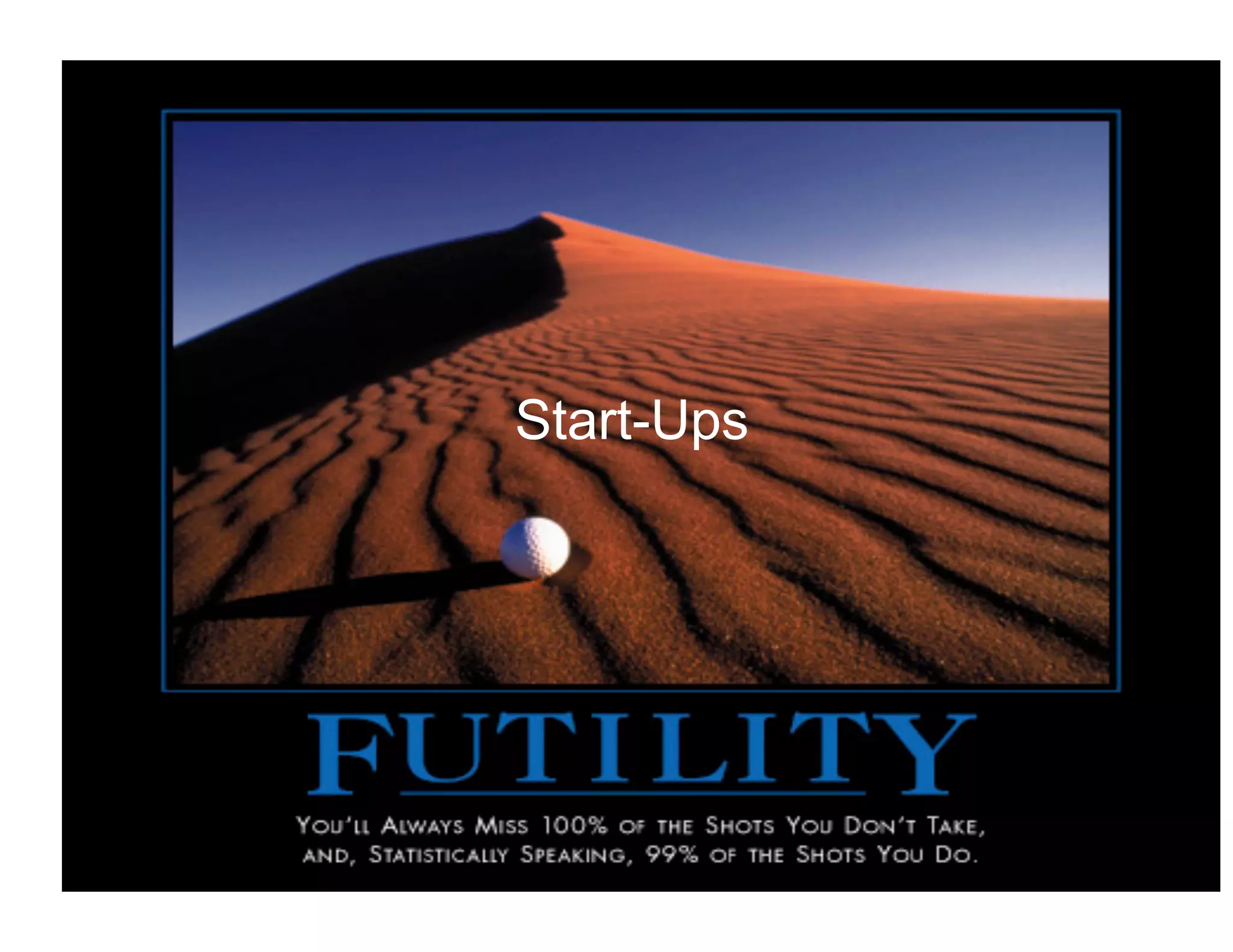
Start-Ups


            25

Lessons learned as an entrepreneur

  • 1.
    Lessons Learned asan Entrepreneur
  • 2.
  • 3.
    Agenda   A little about Rocky and past experiences   Some facts about start-ups   Axela Today   Product Life cycle   Tools I have found useful over the years   Axela early days   How we transitioned   Lessons learned 3
  • 4.
    Over 30 Years Diagnostics& Life Science Industry Rocky’s Personal Perspective 4
  • 5.
    Rocky’s History • TechniconLabs • Becton Dickinson • Third Wave Technologies (TWTI) • Genomic Utilities Inc • Axela Inc 5
  • 6.
      60% OfCompanies Fail, First 6 months   82% Fail by 10th Anniversary   90% New Products Fail   The average CEO life is 2.5 years   Statistically and for someone to be successful multiple times in succession is hard (if not impossible)   I Have not adjusted these numbers for the lack of capital in Canada today…..it is likely worse 6
  • 7.
    Enabling Leader inPersonalized Medicine Build Leadership in …For Tomorrow’s Research Tools & Clinical Research… Personalized Diagnostics Significantly improve Capitalize on game changing Leverage proprietary efficiency of post methods for interpreting technology advantages to discovery biomarker biomarkers (DNA, RNA and deliver novel diagnostics assay development proteins) in health research and validation 7
  • 8.
    Proprietary & Complementary Proprietary High Margin Instrument Platforms Consumables Ziplex® System Content Leverage Across Platforms dotLab® System Menu, Content and Panels 8
  • 9.
  • 10.
    > 150 Patentsand applications Core Diffraction IP Consumable Design Disease Specific IP Incremental Diffraction IP Manufacturing Methods Signal Amplification Multiplexing Technology Others: Johns Hopkins, Proteome Sciences, Large Tech Company, VWR, CREA Brazil, Many others 10
  • 11.
    Key events inthe history of Axela •  Company founded 2001 by Cynthia Goh •  Seed funding from Primaxis and Royal Bay Capital •  2003 I was recruited from the states to run Axela •  Later stage funding support from VenGrowth •  2004 the first prototypes systems developed •  Late 2005 Major in-licensing deal with K-C •  2007 in-licensed multiplexing IP from Beckman Coulter •  2010 Amalgamated Axela and Xceed Molecular 11
  • 12.
      Use aconsistent process to assess progress   Understand where and when you exit ahead of time   Have clear role definition   Be honest with yourself and others relative to expectations   Hire only the best…… and LISTEN!! 12
  • 13.
    Competing Modalities Competing Applications Scientific Research Technical Development Commercialization Intensity of Effort EMK, Internal SBIR, Developmen NIH Research t University Contract -Research- Time Discovering Proving and Learning Committing •  Technological discontinuity •  Emergence of viable -Risk Reward not understood applications •  Selection of dominant design •  Intellectual property •  Creating industry structure •  Convergence of independent •  Market concepts •  Claiming intellectual property streams of know-how •  Licensing/Acquiring synergistic technologies -Bio-Chemistry -Engineering Competing •  Increasing rate of competitive entry -Software •  First mover advantage •  Triggers of shakeout Based on Model developed by Prof. William Hamilton 13
  • 14.
    Emerging Technology Development TECHNICAL COMMERCIAL DEVELOPMENT APPLICATION RELATIVE IMPORTANCE SCIENTIFIC RESEARCH TIME SCIENCE TECHNOLOGY COMMERCIALIZATION PHASES OF TECHNICAL ADVANCE RESEARCH DEVELOPMENT PRODUCTION MARKETING TIME PROGRESSION OF ACTIVITIES IN THE INNOVATION PROCESS Based on Models developed by Prof. William Hamilton 14
  • 15.
    Emerging Technology Development TECHNICAL COMMERCIAL Discovery DEVELOPMENT APPLICATION •  Technological discontinuity RELATIVE IMPORTANCE -Risk Reward not understood SCIENTIFIC RESEARCH •  Convergence of independent streams of know-how -Chemistry/Biochemistry -Engineering -Software TIME SCIENCE TECHNOLOGY COMMERCIALIZATION PHASES OF TECHNICAL ADVANCE 15
  • 16.
    Emerging Technology Development Competing TECHNICAL COMMERCIAL DEVELOPMENT APPLICATION Proving and Modalities Learning RELATIVE IMPORTANCE Competing SCIENTIFIC Applications •  Emergence of RESEARCH viable applications •  Intellectual property •  Market concepts TIME SCIENCE TECHNOLOGY COMMERCIALIZATION PHASES OF TECHNICAL ADVANCE 16
  • 17.
    Emerging Technology Development TECHNICAL COMMERCIAL DEVELOPMENT APPLICATION Committing •  Selection of dominant design •  Creating industry structure RELATIVE IMPORTANCE SCIENTIFIC •  Claiming intellectual property RESEARCH •  Licensing/Acquiring synergistic technologies •  High levels of $$$ commitment Competing •  Increasing rate of competitive entry TIME •  First mover advantage •  Triggers of shakeout SCIENCE TECHNOLOGY COMMERCIALIZATION PHASES OF TECHNICAL ADVANCE RESEARCH DEVELOPMENT PRODUCTION MARKETING TIME PROGRESSION OF ACTIVITIES IN THE INNOVATION PROCESS 17
  • 18.
    Early Challenges •  Thesingle largest challenge is CASH Dictates where you can go, how fast you can get there •  The world economy has made this harder •  Decide what you HAVE (not WANT): a technology, product, or company •  Align CASH with Exit •  Align management, investors and market opportunity •  Things can change, re-alignment is not easy 18
  • 19.
    •  I shouldwrite a book called “Angel turned Devil” •  Third wave example •  Axela Example •  Take away: • Early capital has higher potential risk, higher potential gain but it has even less odds of paying out unless the business strategy is aligned with investment strategy 19
  • 20.
    •  Founder/CEO •  Publish vs Profit •  Individual discovery vs corporate asset •  Deal with serial inventor/founder vs serial entrepreneur •  Expectation creation is important •  As the company’s domain expertise shifts; •  Does the hand off between inventor and company get easier or more complex? 20
  • 21.
    Later •  Everyone hasa shelf life and a moment of strength •  Understand it, plan for it, and make changes when needed •  This is very hard especially when it is yourself 21
  • 22.
    How You Tryto Change the Odds?   Understanding how important communication is   Failure is inevitable; understand it; scar tissue is important   Change is constant; embrace it   Always seek to know what you don’t know   The importance of passion alignment   Partner, Partner, Partner   What Ever you do: •  “Don’t’ Run Out of Money” 22
  • 23.
    •  In thebook the world is flat •  Small companies will act large •  Large companies will act small •  The two things that kill deals is time and greed 23
  • 24.
    •  Cash isking!! •  Which is harder the first $20 Thousand or the last $20 Million? •  When they pass the cookies take some, no matter what it costs •  Balance the single dominant investor value •  Always be ready to learn •  Understand your own limits •  Strong and critical board is as important as good investors •  Good management wins over good technology •  Be honest with yourself, your fellow employees, and your investors 24
  • 25.