Topic :-Inheritance
Presented By:
Jinal Budheliya :170060107002
Nikit Dungarani :170060107008
Smit Savani :170060107053
Mayur Sharma :170060107054
Kaushik Sutariya :170060107059
Bhagwan Mahavir College of
Engineering and Technology
Guided By :Ms. Ridhdhi Naik
Subject :- .Net Technology(2160711)
Inheritance
 Inheritance is where one class (child class) inherits the properties of
another class (parent class).
 Inheritance is a mechanism of acquiring the features and behaviors
of a class by another class.
 The class whose members are inherited is called the base class, and
the class that inherits those members is called the derived class.
 Inheritance implements the IS-A relationship.
 Example
• “She had inherited the beauty of her mother”
Why Inheritance?
 Advantages of Inheritance
• Reduce code redundancy
• Provides code reusability
• Reduces source code size and improves code readability
• Code is easy to manage and divided into parent and child classes
Disadvantages - Inheritance
 In Inheritance base class and child classes are tightly coupled.
Hence If you change the code of parent class, it will get affects to
the all the child classes.
 In class hierarchy many data members remain unused and the
memory allocated to them is not utilized.
 Hence affect performance of your program if you have not
implemented inheritance correctly.
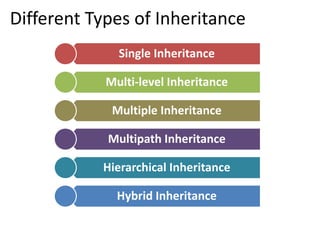
Different Types of Inheritance
Single Inheritance
Multi-level Inheritance
Multiple Inheritance
Multipath Inheritance
Hierarchical Inheritance
Hybrid Inheritance
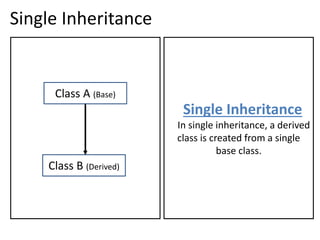
Single Inheritance
Single Inheritance
In single inheritance, a derived
class is created from a single
base class.
Class A (Base)
Class B (Derived)
Example - Single Inheritance
//Base Class
class Teacher
{
public void Teach()
{
Console.WriteLine("Teach");
}
}
//Derived Class
class Student : Teacher
{
public void Learn()
{
Console.WriteLine("Learn");
}
}
class Program
{
static void Main(string[] args)
{
Teacher d = new Teacher();
d.Teach();
Student s = new Student();
s.Learn();
s.Teach();
Console.ReadKey();
}
}
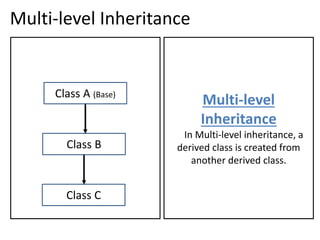
Multi-level Inheritance
Multi-level
Inheritance
In Multi-level inheritance, a
derived class is created from
another derived class.
Class A (Base)
Class B
Class C
Example – Multi-Level Inheritance
//Base Class
class Teacher
{
public void Teach()
{
Console.WriteLine("Teach");
}
}
//Base,Derived Class
class Student : Teacher
{
public void Learn()
{
Console.WriteLine("Learn");
}
}
//Derived Class
class SemFour : Student
{
public void FourthSem()
{
Console.WriteLine("Semester
Four Students");
}
}
class Program
{
static void Main(string[] args)
{
Teacher d = new Teacher();
d.Teach();
Student s = new Student();
s.Learn();
s.Teach();
SemFour Sem = new SemFour();
Sem.Learn();
Sem.Teach();
Sem.FourthSem();
Console.ReadKey();
}
}
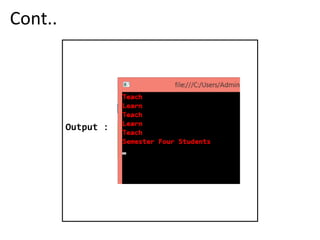
Cont..
Output :
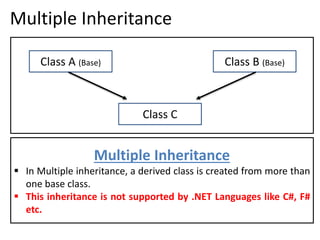
Multiple Inheritance
 In Multiple inheritance, a derived class is created from more than
one base class.
 This inheritance is not supported by .NET Languages like C#, F#
etc.
Class A (Base) Class B (Base)
Class C
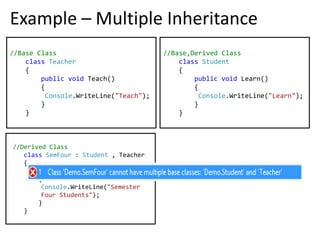
Example – Multiple Inheritance
//Base Class
class Teacher
{
public void Teach()
{
Console.WriteLine("Teach");
}
}
//Base,Derived Class
class Student
{
public void Learn()
{
Console.WriteLine("Learn");
}
}
//Derived Class
class SemFour : Student , Teacher
{
public void FourthSem()
{
Console.WriteLine("Semester
Four Students");
}
}
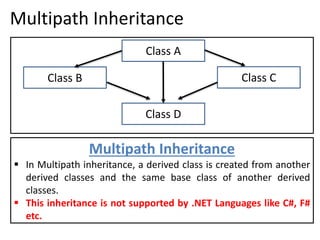
Multipath Inheritance
 In Multipath inheritance, a derived class is created from another
derived classes and the same base class of another derived
classes.
 This inheritance is not supported by .NET Languages like C#, F#
etc.
Class A
Class B Class C
Class D
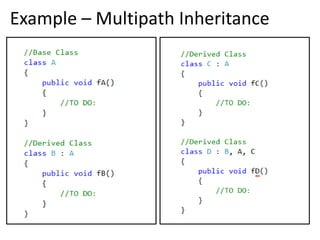
Example – Multipath Inheritance
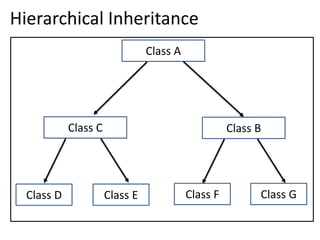
Hierarchical Inheritance
Class A
Class C Class B
Class D Class E Class F Class G
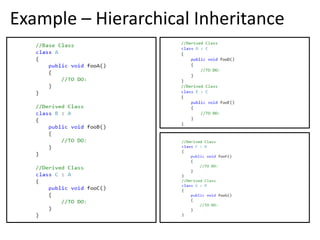
Example – Hierarchical Inheritance
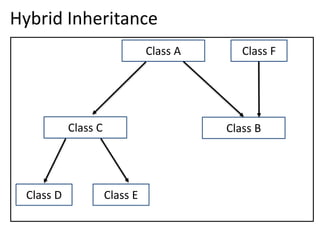
Hybrid Inheritance
Class A
Class C Class B
Class D Class E
Class F
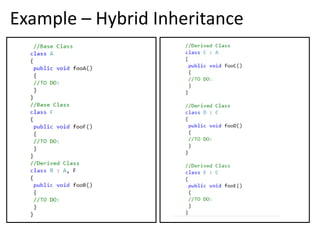
Example – Hybrid Inheritance
Inheritance

Inheritance

  • 1.
    Topic :-Inheritance Presented By: JinalBudheliya :170060107002 Nikit Dungarani :170060107008 Smit Savani :170060107053 Mayur Sharma :170060107054 Kaushik Sutariya :170060107059 Bhagwan Mahavir College of Engineering and Technology Guided By :Ms. Ridhdhi Naik Subject :- .Net Technology(2160711)
  • 2.
    Inheritance  Inheritance iswhere one class (child class) inherits the properties of another class (parent class).  Inheritance is a mechanism of acquiring the features and behaviors of a class by another class.  The class whose members are inherited is called the base class, and the class that inherits those members is called the derived class.  Inheritance implements the IS-A relationship.  Example • “She had inherited the beauty of her mother”
  • 3.
    Why Inheritance?  Advantagesof Inheritance • Reduce code redundancy • Provides code reusability • Reduces source code size and improves code readability • Code is easy to manage and divided into parent and child classes
  • 4.
    Disadvantages - Inheritance In Inheritance base class and child classes are tightly coupled. Hence If you change the code of parent class, it will get affects to the all the child classes.  In class hierarchy many data members remain unused and the memory allocated to them is not utilized.  Hence affect performance of your program if you have not implemented inheritance correctly.
  • 5.
    Different Types ofInheritance Single Inheritance Multi-level Inheritance Multiple Inheritance Multipath Inheritance Hierarchical Inheritance Hybrid Inheritance
  • 6.
    Single Inheritance Single Inheritance Insingle inheritance, a derived class is created from a single base class. Class A (Base) Class B (Derived)
  • 7.
    Example - SingleInheritance //Base Class class Teacher { public void Teach() { Console.WriteLine("Teach"); } } //Derived Class class Student : Teacher { public void Learn() { Console.WriteLine("Learn"); } } class Program { static void Main(string[] args) { Teacher d = new Teacher(); d.Teach(); Student s = new Student(); s.Learn(); s.Teach(); Console.ReadKey(); } }
  • 8.
    Multi-level Inheritance Multi-level Inheritance In Multi-levelinheritance, a derived class is created from another derived class. Class A (Base) Class B Class C
  • 9.
    Example – Multi-LevelInheritance //Base Class class Teacher { public void Teach() { Console.WriteLine("Teach"); } } //Base,Derived Class class Student : Teacher { public void Learn() { Console.WriteLine("Learn"); } } //Derived Class class SemFour : Student { public void FourthSem() { Console.WriteLine("Semester Four Students"); } } class Program { static void Main(string[] args) { Teacher d = new Teacher(); d.Teach(); Student s = new Student(); s.Learn(); s.Teach(); SemFour Sem = new SemFour(); Sem.Learn(); Sem.Teach(); Sem.FourthSem(); Console.ReadKey(); } }
  • 10.
  • 11.
    Multiple Inheritance Multiple Inheritance In Multiple inheritance, a derived class is created from more than one base class.  This inheritance is not supported by .NET Languages like C#, F# etc. Class A (Base) Class B (Base) Class C
  • 12.
    Example – MultipleInheritance //Base Class class Teacher { public void Teach() { Console.WriteLine("Teach"); } } //Base,Derived Class class Student { public void Learn() { Console.WriteLine("Learn"); } } //Derived Class class SemFour : Student , Teacher { public void FourthSem() { Console.WriteLine("Semester Four Students"); } }
  • 13.
    Multipath Inheritance Multipath Inheritance In Multipath inheritance, a derived class is created from another derived classes and the same base class of another derived classes.  This inheritance is not supported by .NET Languages like C#, F# etc. Class A Class B Class C Class D
  • 14.
  • 15.
    Hierarchical Inheritance Class A ClassC Class B Class D Class E Class F Class G
  • 16.
  • 17.
    Hybrid Inheritance Class A ClassC Class B Class D Class E Class F
  • 18.
    Example – HybridInheritance