Inheritance
In the Java language, classes can be derived from other classes, thereby
inheriting fields and methods from those classes.
A class that is derived from another class is called a subclass (also a derived
class, extended class, or child class).
The class from which the subclass is derived is called a superclass (also a
base class or a parent class).
The idea of inheritance is simple but powerful:
When you want to create a new class and there is already a class that includes
some of the code that you want, you can derive your new class from the existing
class.
In doing this, you can reuse the fields and methods of the existing class without
having to write (and debug!) them yourself.
A subclass inherits all the members (fields, methods, and nested classes) from its
superclass.
Constructors are not members, so they are not inherited by subclasses, but the
constructor of the superclass can be invoked from the subclass.
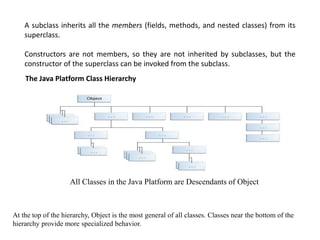
The Java Platform Class Hierarchy
At the top of the hierarchy, Object is the most general of all classes. Classes near the bottom of the
hierarchy provide more specialized behavior.
All Classes in the Java Platform are Descendants of Object
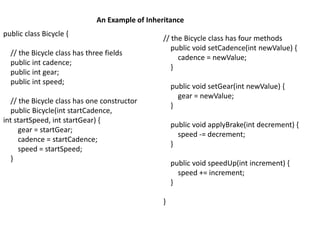
An Example of Inheritance
public class Bicycle {
// the Bicycle class has three fields
public int cadence;
public int gear;
public int speed;
// the Bicycle class has one constructor
public Bicycle(int startCadence,
int startSpeed, int startGear) {
gear = startGear;
cadence = startCadence;
speed = startSpeed;
}
// the Bicycle class has four methods
public void setCadence(int newValue) {
cadence = newValue;
}
public void setGear(int newValue) {
gear = newValue;
}
public void applyBrake(int decrement) {
speed -= decrement;
}
public void speedUp(int increment) {
speed += increment;
}
}
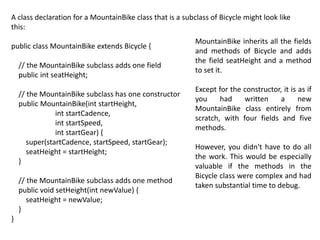
A class declaration for a MountainBike class that is a subclass of Bicycle might look like
this:
public class MountainBike extends Bicycle {
// the MountainBike subclass adds one field
public int seatHeight;
// the MountainBike subclass has one constructor
public MountainBike(int startHeight,
int startCadence,
int startSpeed,
int startGear) {
super(startCadence, startSpeed, startGear);
seatHeight = startHeight;
}
// the MountainBike subclass adds one method
public void setHeight(int newValue) {
seatHeight = newValue;
}
}
MountainBike inherits all the fields
and methods of Bicycle and adds
the field seatHeight and a method
to set it.
Except for the constructor, it is as if
you had written a new
MountainBike class entirely from
scratch, with four fields and five
methods.
However, you didn't have to do all
the work. This would be especially
valuable if the methods in the
Bicycle class were complex and had
taken substantial time to debug.
A subclass inherits all of the public and protected members of its parent, no matter what
package the subclass is in. If the subclass is in the same package as its parent, it also
inherits the package-private members of the parent.
You can use the inherited members as is, replace them, hide them, or supplement them with
new members:
•The inherited fields can be used directly, just like any other fields.
•You can declare a field in the subclass with the same name as the one in the superclass,
thus hiding it (not recommended).
•You can declare new fields in the subclass that are not in the superclass.
•The inherited methods can be used directly as they are.
•You can write a new instance method in the subclass that has the same signature as the one
in the superclass, thus overriding it.
•You can write a new static method in the subclass that has the same signature as the one in
the superclass, thus hiding it.
•You can declare new methods in the subclass that are not in the superclass.
•You can write a subclass constructor that invokes the constructor of the superclass, either
implicitly or by using the keyword super.
What You Can Do in a Subclass
Private Members in a Superclass
A subclass does not inherit the private members of its parent class.
However, if the superclass has public or protected methods for accessing its
private fields, these can also be used by the subclass.
A nested class has access to all the private members of its enclosing class—both
fields and methods.
Therefore, a public or protected nested class inherited by a subclass has indirect
access to all of the private members of the superclass.
Casting Objects
We have seen that an object is of the data type of the class from which it was
instantiated. For example, if we write
public MountainBike myBike = new MountainBike();
then myBike is of type MountainBike.
MountainBike is descended from Bicycle and Object. Therefore, a MountainBike is a
Bicycle and is also an Object, and it can be used wherever Bicycle or Object objects are
called for.
The reverse is not necessarily true: a Bicycle may be a MountainBike, but it isn't
necessarily. Similarly, an Object may be a Bicycle or a MountainBike, but it isn't
necessarily.
Casting shows the use of an object of one type in place of another type, among the objects
permitted by inheritance and implementations. For example, if we write
Object obj = new MountainBike();
then obj is both an Object and a MountainBike (until such time as obj is assigned another
object that is not a MountainBike). This is called implicit casting.
If, on the other hand, we write
MountainBike myBike = obj;
we would get a compile-time error because obj is not known to the compiler to be a
MountainBike. However, we can tell the compiler that we promise to assign a MountainBike
to obj by explicit casting:
MountainBike myBike = (MountainBike)obj;
This cast inserts a runtime check that obj is assigned a MountainBike so that the compiler
can safely assume that obj is a MountainBike. If obj is not a MountainBike at runtime, an
exception will be thrown.
Note: You can make a logical test as to the type of a particular object using the
instanceof operator. This can save you from a runtime error owing to an
improper cast. For example:
if (obj instanceof MountainBike) {
MountainBike myBike = (MountainBike)obj;
}
Here the instanceof operator verifies that obj refers to a MountainBike so that
we can make the cast with knowledge that there will be no runtime exception
thrown.
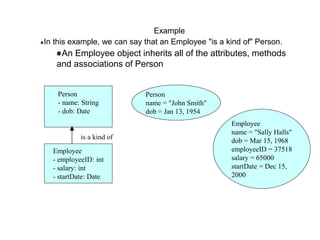
Example
In this example, we can say that an Employee "is a kind of" Person.
An Employee object inherits all of the attributes, methods
and associations of Person
Person
- name: String
- dob: Date
Employee
- employeeID: int
- salary: int
- startDate: Date
Person
name = "John Smith"
dob = Jan 13, 1954
Employee
name = "Sally Halls"
dob = Mar 15, 1968
employeeID = 37518
salary = 65000
startDate = Dec 15,
2000
is a kind of
Inheritance in Java
Inheritance is declared using the "extends" keyword
If inheritance is not defined, the class extends a class called Object
Person
- name: String
- dob: Date
Employee
- employeeID: int
- salary: int
- startDate: Date
public class Person
{
private String name;
private Date dob;
[...]
public class Employee extends Person
{
private int employeID;
private int salary;
private Date startDate;
[...]
Employee anEmployee = new Employee();
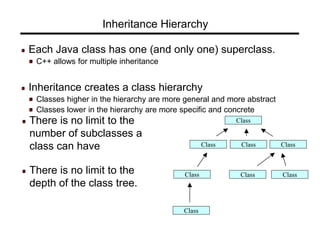
Inheritance Hierarchy
Each Java class has one (and only one) superclass.
C++ allows for multiple inheritance
Inheritance creates a class hierarchy
Classes higher in the hierarchy are more general and more abstract
Classes lower in the hierarchy are more specific and concrete
ClassThere is no limit to the
number of subclasses a
class can have
There is no limit to the
depth of the class tree.
Class Class Class
Class
Class ClassClass
Constructors and Initialization
Classes use constructors to initialize instance variables
When a subclass object is created, its constructor is called.
It is the responsibility of the subclass constructor to invoke the
appropriate superclass constructors so that the instance variables
defined in the superclass are properly initialized
Superclass constructors can be called using the "super"
keyword in a manner similar to "this"
It must be the first line of code in the constructor
If a call to super is not made, the system will
automatically attempt to invoke the no-argument
constructor of the superclass.
Constructors - Example
public class BankAccount
{
private String ownersName;
private int accountNumber;
private float balance;
public BankAccount(int anAccountNumber, String aName)
{
accountNumber = anAccountNumber;
ownersName = aName;
}
[...]
}
public class OverdraftAccount extends BankAccount
{
private float overdraftLimit;
public OverdraftAccount(int anAccountNumber, String aName, float aLimit)
{
super(anAccountNumber, aName);
overdraftLimit = aLimit;
}
}
Method Overriding
Subclasses inherit all methods from their superclass
Sometimes, the implementation of the method in the superclass does
not provide the functionality required by the subclass.
In these cases, the method must be overridden.
To override a method, provide an implementation in the
subclass.
The method in the subclass MUST have the exact same signature as
the method it is overriding.
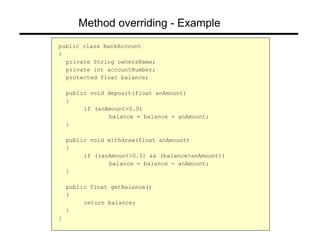
Method overriding - Example
public class BankAccount
{
private String ownersName;
private int accountNumber;
protected float balance;
public void deposit(float anAmount)
{
if (anAmount>0.0)
balance = balance + anAmount;
}
public void withdraw(float anAmount)
{
if ((anAmount>0.0) && (balance>anAmount))
balance = balance - anAmount;
}
public float getBalance()
{
return balance;
}
}
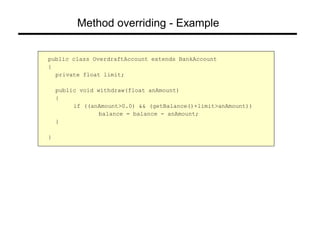
Method overriding - Example
public class OverdraftAccount extends BankAccount
{
private float limit;
public void withdraw(float anAmount)
{
if ((anAmount>0.0) && (getBalance()+limit>anAmount))
balance = balance - anAmount;
}
}
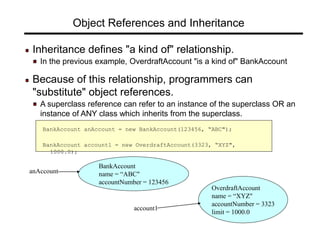
Object References and Inheritance
Inheritance defines "a kind of" relationship.
In the previous example, OverdraftAccount "is a kind of" BankAccount
Because of this relationship, programmers can
"substitute" object references.
A superclass reference can refer to an instance of the superclass OR an
instance of ANY class which inherits from the superclass.
BankAccount anAccount = new BankAccount(123456, “ABC");
BankAccount account1 = new OverdraftAccount(3323, “XYZ",
1000.0);
anAccount
account1
BankAccount
name = “ABC"
accountNumber = 123456
OverdraftAccount
name = “XYZ"
accountNumber = 3323
limit = 1000.0
Polymorphism
In the previous slide, the two variables are defined to
have the same type at compile time: BankAccount
However, the types of objects they are referring to at runtime are
different
What happens when the withdraw method is invoked on
each object?
anAccount refers to an instance of BankAccount. Therefore, the
withdraw method defined in BankAccount is invoked.
account1 refers to an instance of OverdraftAccount. Therefore, the
withdraw method defined in OverdraftAccount is invoked.
Polymorphism is: The method being invoked on an
object is determined AT RUNTIME and is based on the
type of the object receiving the message.
Final Methods and Final Classes
Methods can be qualified with the final modifier
Final methods cannot be overridden.
This can be useful for security purposes.
public final boolean validatePassword(String username, String Password)
{
[...]
Classes can be qualified with the final modifier
The class cannot be extended
This can be used to improve performance. Because there an be no
subclasses, there will be no polymorphic overhead at runtime.
public final class Color
{
[...]
Review
What is inheritance? What is a superclass? What is a
subclass?
Which class is at the top of the class hierarchy in Java?
What are the constructor issues surrounding inheritance?
What is method overriding? What is polymorphism? How
are they related?
What is a final method? What is a final class?

Inheritance

  • 1.
  • 2.
    In the Javalanguage, classes can be derived from other classes, thereby inheriting fields and methods from those classes. A class that is derived from another class is called a subclass (also a derived class, extended class, or child class). The class from which the subclass is derived is called a superclass (also a base class or a parent class). The idea of inheritance is simple but powerful: When you want to create a new class and there is already a class that includes some of the code that you want, you can derive your new class from the existing class. In doing this, you can reuse the fields and methods of the existing class without having to write (and debug!) them yourself.
  • 3.
    A subclass inheritsall the members (fields, methods, and nested classes) from its superclass. Constructors are not members, so they are not inherited by subclasses, but the constructor of the superclass can be invoked from the subclass. The Java Platform Class Hierarchy At the top of the hierarchy, Object is the most general of all classes. Classes near the bottom of the hierarchy provide more specialized behavior. All Classes in the Java Platform are Descendants of Object
  • 4.
    An Example ofInheritance public class Bicycle { // the Bicycle class has three fields public int cadence; public int gear; public int speed; // the Bicycle class has one constructor public Bicycle(int startCadence, int startSpeed, int startGear) { gear = startGear; cadence = startCadence; speed = startSpeed; } // the Bicycle class has four methods public void setCadence(int newValue) { cadence = newValue; } public void setGear(int newValue) { gear = newValue; } public void applyBrake(int decrement) { speed -= decrement; } public void speedUp(int increment) { speed += increment; } }
  • 5.
    A class declarationfor a MountainBike class that is a subclass of Bicycle might look like this: public class MountainBike extends Bicycle { // the MountainBike subclass adds one field public int seatHeight; // the MountainBike subclass has one constructor public MountainBike(int startHeight, int startCadence, int startSpeed, int startGear) { super(startCadence, startSpeed, startGear); seatHeight = startHeight; } // the MountainBike subclass adds one method public void setHeight(int newValue) { seatHeight = newValue; } } MountainBike inherits all the fields and methods of Bicycle and adds the field seatHeight and a method to set it. Except for the constructor, it is as if you had written a new MountainBike class entirely from scratch, with four fields and five methods. However, you didn't have to do all the work. This would be especially valuable if the methods in the Bicycle class were complex and had taken substantial time to debug.
  • 6.
    A subclass inheritsall of the public and protected members of its parent, no matter what package the subclass is in. If the subclass is in the same package as its parent, it also inherits the package-private members of the parent. You can use the inherited members as is, replace them, hide them, or supplement them with new members: •The inherited fields can be used directly, just like any other fields. •You can declare a field in the subclass with the same name as the one in the superclass, thus hiding it (not recommended). •You can declare new fields in the subclass that are not in the superclass. •The inherited methods can be used directly as they are. •You can write a new instance method in the subclass that has the same signature as the one in the superclass, thus overriding it. •You can write a new static method in the subclass that has the same signature as the one in the superclass, thus hiding it. •You can declare new methods in the subclass that are not in the superclass. •You can write a subclass constructor that invokes the constructor of the superclass, either implicitly or by using the keyword super. What You Can Do in a Subclass
  • 7.
    Private Members ina Superclass A subclass does not inherit the private members of its parent class. However, if the superclass has public or protected methods for accessing its private fields, these can also be used by the subclass. A nested class has access to all the private members of its enclosing class—both fields and methods. Therefore, a public or protected nested class inherited by a subclass has indirect access to all of the private members of the superclass.
  • 8.
    Casting Objects We haveseen that an object is of the data type of the class from which it was instantiated. For example, if we write public MountainBike myBike = new MountainBike(); then myBike is of type MountainBike. MountainBike is descended from Bicycle and Object. Therefore, a MountainBike is a Bicycle and is also an Object, and it can be used wherever Bicycle or Object objects are called for. The reverse is not necessarily true: a Bicycle may be a MountainBike, but it isn't necessarily. Similarly, an Object may be a Bicycle or a MountainBike, but it isn't necessarily.
  • 9.
    Casting shows theuse of an object of one type in place of another type, among the objects permitted by inheritance and implementations. For example, if we write Object obj = new MountainBike(); then obj is both an Object and a MountainBike (until such time as obj is assigned another object that is not a MountainBike). This is called implicit casting. If, on the other hand, we write MountainBike myBike = obj; we would get a compile-time error because obj is not known to the compiler to be a MountainBike. However, we can tell the compiler that we promise to assign a MountainBike to obj by explicit casting: MountainBike myBike = (MountainBike)obj; This cast inserts a runtime check that obj is assigned a MountainBike so that the compiler can safely assume that obj is a MountainBike. If obj is not a MountainBike at runtime, an exception will be thrown.
  • 10.
    Note: You canmake a logical test as to the type of a particular object using the instanceof operator. This can save you from a runtime error owing to an improper cast. For example: if (obj instanceof MountainBike) { MountainBike myBike = (MountainBike)obj; } Here the instanceof operator verifies that obj refers to a MountainBike so that we can make the cast with knowledge that there will be no runtime exception thrown.
  • 11.
    Example In this example,we can say that an Employee "is a kind of" Person. An Employee object inherits all of the attributes, methods and associations of Person Person - name: String - dob: Date Employee - employeeID: int - salary: int - startDate: Date Person name = "John Smith" dob = Jan 13, 1954 Employee name = "Sally Halls" dob = Mar 15, 1968 employeeID = 37518 salary = 65000 startDate = Dec 15, 2000 is a kind of
  • 12.
    Inheritance in Java Inheritanceis declared using the "extends" keyword If inheritance is not defined, the class extends a class called Object Person - name: String - dob: Date Employee - employeeID: int - salary: int - startDate: Date public class Person { private String name; private Date dob; [...] public class Employee extends Person { private int employeID; private int salary; private Date startDate; [...] Employee anEmployee = new Employee();
  • 13.
    Inheritance Hierarchy Each Javaclass has one (and only one) superclass. C++ allows for multiple inheritance Inheritance creates a class hierarchy Classes higher in the hierarchy are more general and more abstract Classes lower in the hierarchy are more specific and concrete ClassThere is no limit to the number of subclasses a class can have There is no limit to the depth of the class tree. Class Class Class Class Class ClassClass
  • 14.
    Constructors and Initialization Classesuse constructors to initialize instance variables When a subclass object is created, its constructor is called. It is the responsibility of the subclass constructor to invoke the appropriate superclass constructors so that the instance variables defined in the superclass are properly initialized Superclass constructors can be called using the "super" keyword in a manner similar to "this" It must be the first line of code in the constructor If a call to super is not made, the system will automatically attempt to invoke the no-argument constructor of the superclass.
  • 15.
    Constructors - Example publicclass BankAccount { private String ownersName; private int accountNumber; private float balance; public BankAccount(int anAccountNumber, String aName) { accountNumber = anAccountNumber; ownersName = aName; } [...] } public class OverdraftAccount extends BankAccount { private float overdraftLimit; public OverdraftAccount(int anAccountNumber, String aName, float aLimit) { super(anAccountNumber, aName); overdraftLimit = aLimit; } }
  • 16.
    Method Overriding Subclasses inheritall methods from their superclass Sometimes, the implementation of the method in the superclass does not provide the functionality required by the subclass. In these cases, the method must be overridden. To override a method, provide an implementation in the subclass. The method in the subclass MUST have the exact same signature as the method it is overriding.
  • 17.
    Method overriding -Example public class BankAccount { private String ownersName; private int accountNumber; protected float balance; public void deposit(float anAmount) { if (anAmount>0.0) balance = balance + anAmount; } public void withdraw(float anAmount) { if ((anAmount>0.0) && (balance>anAmount)) balance = balance - anAmount; } public float getBalance() { return balance; } }
  • 18.
    Method overriding -Example public class OverdraftAccount extends BankAccount { private float limit; public void withdraw(float anAmount) { if ((anAmount>0.0) && (getBalance()+limit>anAmount)) balance = balance - anAmount; } }
  • 19.
    Object References andInheritance Inheritance defines "a kind of" relationship. In the previous example, OverdraftAccount "is a kind of" BankAccount Because of this relationship, programmers can "substitute" object references. A superclass reference can refer to an instance of the superclass OR an instance of ANY class which inherits from the superclass. BankAccount anAccount = new BankAccount(123456, “ABC"); BankAccount account1 = new OverdraftAccount(3323, “XYZ", 1000.0); anAccount account1 BankAccount name = “ABC" accountNumber = 123456 OverdraftAccount name = “XYZ" accountNumber = 3323 limit = 1000.0
  • 20.
    Polymorphism In the previousslide, the two variables are defined to have the same type at compile time: BankAccount However, the types of objects they are referring to at runtime are different What happens when the withdraw method is invoked on each object? anAccount refers to an instance of BankAccount. Therefore, the withdraw method defined in BankAccount is invoked. account1 refers to an instance of OverdraftAccount. Therefore, the withdraw method defined in OverdraftAccount is invoked. Polymorphism is: The method being invoked on an object is determined AT RUNTIME and is based on the type of the object receiving the message.
  • 21.
    Final Methods andFinal Classes Methods can be qualified with the final modifier Final methods cannot be overridden. This can be useful for security purposes. public final boolean validatePassword(String username, String Password) { [...] Classes can be qualified with the final modifier The class cannot be extended This can be used to improve performance. Because there an be no subclasses, there will be no polymorphic overhead at runtime. public final class Color { [...]
  • 22.
    Review What is inheritance?What is a superclass? What is a subclass? Which class is at the top of the class hierarchy in Java? What are the constructor issues surrounding inheritance? What is method overriding? What is polymorphism? How are they related? What is a final method? What is a final class?