How is DNAorganized?
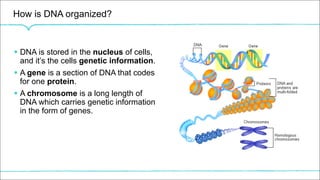
§ DNA is stored in the nucleus of cells,
and it’s the cells genetic information.
§ A gene is a section of DNA that codes
for one protein.
§ A chromosome is a long length of
DNA which carries genetic information
in the form of genes.
2.
Diploid vs Haploid
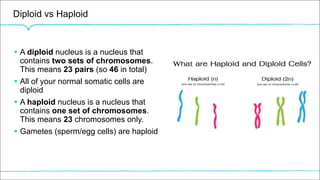
§A diploid nucleus is a nucleus that
contains two sets of chromosomes.
This means 23 pairs (so 46 in total)
§ All of your normal somatic cells are
diploid
§ A haploid nucleus is a nucleus that
contains one set of chromosomes.
This means 23 chromosomes only.
§ Gametes (sperm/egg cells) are haploid
3.
Mitosis
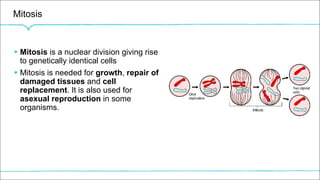
§ Mitosis isa nuclear division giving rise
to genetically identical cells
§ Mitosis is needed for growth, repair of
damaged tissues and cell
replacement. It is also used for
asexual reproduction in some
organisms.
4.
Mitosis: The steps
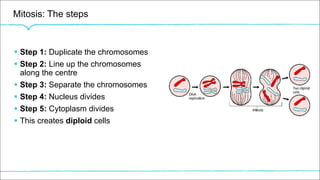
§Step 1: Duplicate the chromosomes
§ Step 2: Line up the chromosomes
along the centre
§ Step 3: Separate the chromosomes
§ Step 4: Nucleus divides
§ Step 5: Cytoplasm divides
§ This creates diploid cells
5.
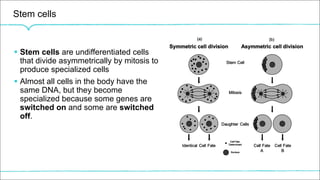
Stem cells
§ Stemcells are undifferentiated cells
that divide asymmetrically by mitosis to
produce specialized cells
§ Almost all cells in the body have the
same DNA, but they become
specialized because some genes are
switched on and some are switched
off.
6.
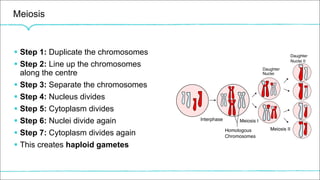
Meiosis
§ Step 1:Duplicate the chromosomes
§ Step 2: Line up the chromosomes
along the centre
§ Step 3: Separate the chromosomes
§ Step 4: Nucleus divides
§ Step 5: Cytoplasm divides
§ Step 6: Nuclei divide again
§ Step 7: Cytoplasm divides again
§ This creates haploid gametes
7.
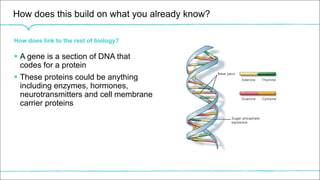
How does thisbuild on what you already know?
How does link to the rest of biology?
§ A gene is a section of DNA that
codes for a protein
§ These proteins could be anything
including enzymes, hormones,
neurotransmitters and cell membrane
carrier proteins
8.
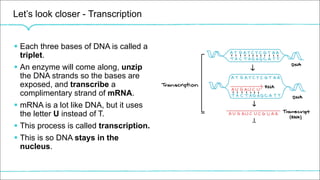
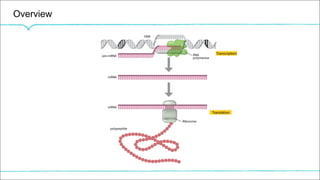
Let’s look closer- Transcription
§ Each three bases of DNA is called a
triplet.
§ An enzyme will come along, unzip
the DNA strands so the bases are
exposed, and transcribe a
complimentary strand of mRNA.
§ mRNA is a lot like DNA, but it uses
the letter U instead of T.
§ This process is called transcription.
§ This is so DNA stays in the
nucleus.
9.
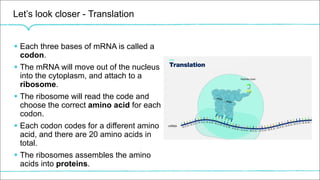
Let’s look closer- Translation
§ Each three bases of mRNA is called a
codon.
§ The mRNA will move out of the nucleus
into the cytoplasm, and attach to a
ribosome.
§ The ribosome will read the code and
choose the correct amino acid for each
codon.
§ Each codon codes for a different amino
acid, and there are 20 amino acids in
total.
§ The ribosomes assembles the amino
acids into proteins.
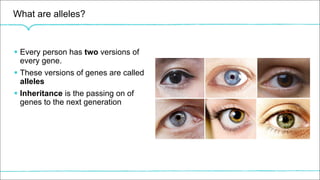
What are alleles?
§Every person has two versions of
every gene.
§ These versions of genes are called
alleles
§ Inheritance is the passing on of
genes to the next generation
12.
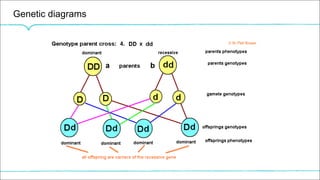
There are twotypes of alleles
§ An allele is either dominant or
recessive.
§ If a person has a dominant allele, it will
always be expressed
§ If a person has a recessive allele, it will
only be expressed if there is no
dominant
13.
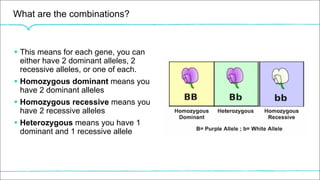
What are thecombinations?
§ This means for each gene, you can
either have 2 dominant alleles, 2
recessive alleles, or one of each.
§ Homozygous dominant means you
have 2 dominant alleles
§ Homozygous recessive means you
have 2 recessive alleles
§ Heterozygous means you have 1
dominant and 1 recessive allele
14.
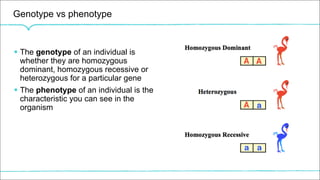
Genotype vs phenotype
§The genotype of an individual is
whether they are homozygous
dominant, homozygous recessive or
heterozygous for a particular gene
§ The phenotype of an individual is the
characteristic you can see in the
organism
15.
Punnett squares
§ Wecan use Punnett squares to
predict the genotypes and phenotypes
of the offspring when two individuals
mate
16.
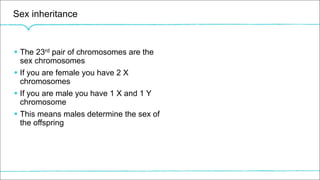
Sex inheritance
§ The23rd pair of chromosomes are the
sex chromosomes
§ If you are female you have 2 X
chromosomes
§ If you are male you have 1 X and 1 Y
chromosome
§ This means males determine the sex of
the offspring
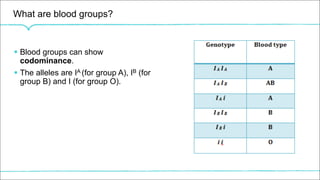
What is codominace?
§Sometimes, the alleles for a gene
can be codominant which means in
a heterozygote, both alleles are
expressed.
20.
What are bloodgroups?
§ Blood groups can show
codominance.
§ The alleles are IA (for group A), IB (for
group B) and I (for group O).
21.
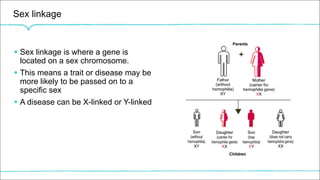
Sex linkage
§ Sexlinkage is where a gene is
located on a sex chromosome.
§ This means a trait or disease may be
more likely to be passed on to a
specific sex
§ A disease can be X-linked or Y-linked
22.
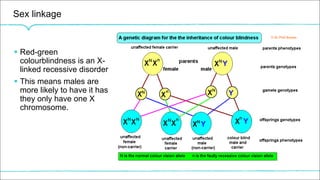
Sex linkage
§ Red-green
colourblindnessis an X-
linked recessive disorder
§ This means males are
more likely to have it has
they only have one X
chromosome.




![Unit 5[1].pptx bdt ye het y53y ht hhryjh hthtj bttjj ee hj](https://cdn.slidesharecdn.com/ss_thumbnails/unit51-260121143715-8884f308-thumbnail.jpg?width=640&height=640&fit=bounds)


![Dna and genetics_basic_power_point__1-14-11[1]](https://cdn.slidesharecdn.com/ss_thumbnails/dnaandgeneticsbasicpowerpoint1-14-111-130412085212-phpapp02-thumbnail.jpg?width=640&height=640&fit=bounds)


