inhalational injury
Done by : Mohammad AL-hunaifat and
Qutaiba Al-bustanji
Supervised by :Dr. Salah Qaryoute
Mutah University – jordan
overview
• definition
• Epidemiology
• Pathophysiology
• Clinical assessment
• Diagnosis and investigations
• Management and Prognosis
definition
A spectrum of respiratory tract and
systemic insult caused by aspiration
of superheated gases, steam, hot
liquids, or noxious products of
incomplete combustion.
epidemiology
• 1/3 of burn admissions have inhalation injury.
• 12% pts inhalation injury alone require intubation
• 62% pts burn + inhalation injury intubated.
• Mortality from smoke injury alone is 0-12%.
• Mortality from smoke injury and burns is 30-90%.
• Mortality from smoke injury and pneumonia 60%.
• The majority of these deaths are believed to be due
to respiratory system injury.
• The male-to-female ratio about 3:2 .
Introduction
Inhaled substances may affect respiratory system at
various levels according to various factors, and those
factors also determine the degree of injury , such as :
1- The characteristics of substances : concentration of
inhaled toxin , particle size , water solubility .
• Highly water-soluble gases and vapors and larger mist
or dust particles (greater than 10 microns in diameter)
generally are deposited in the upper airways .
• This is followed by rapidly developing sings of
upper airway irritation that are accompanied by
eye and mucous membrane irritation.
• In severe exposures, progressive coughing,
wheezing, or stridor may result in upper airway
obstruction.
• Less soluble gases and vapors and smaller
particles can be inhaled more deeply into the
respiratory tract , resulting in delayed onset of
the symptoms.
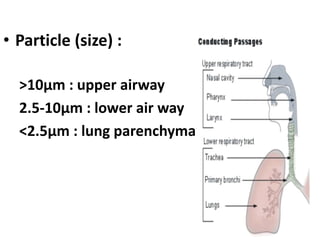
• Particle (size) :
>10µm : upper airway
2.5-10µm : lower air way
<2.5µm : lung parenchyma
2- Environmental factors: duration of
exposure , whether exposure occurred in an
enclosed space.
3- host factors: age of patient , underlying lung
debilitating illness particularly underlying
reactive airway disease or lung disease that
impairs host defense mechanisms.
Pathophysiology
• Thermal damage
• Asphyxiation
• Pulmonary irritation
• Systemic toxic effects
Thermal damage
• Usually limited to the oropharyngeal area
• Because of the combination of efficient heat dissipation
in the upper airway, low heat conduction capacity of air
and reflex closure of the larynx, super-heated air usually
causes injury only to upper airway structures.
• Injury to these airway structures may cause massive
swelling of the tongue, epiglottis , with obstruction.
• The exception are Steam injuries, volatile gases ,
explosive gases has a much greater heat-carrying
capacity
Asphyxiation
• Tissue hypoxia can occur via several
mechanisms:
1- the decrease in (FIO2) leads to hypoxia
2- Carbon monoxide
3- Cyanide
Carbon monoxide (CO):
• Carbon monoxide is an odorless , tasteless,
nonirritating gas produced by the incomplete
combustion of carbon-containing compounds,
such as wood, coal, and gasoline.
• The affinity of carbon monoxide for
hemoglobin is 200 times greater than for
oxygen.
• Account for 80% of fatalities from inhalation
injury.
• Carbon monoxide competes with oxygen for
hemoglobin binding and Decreasing the oxygen-
carrying capacity of the blood & causes a left shift
in oxyhemoglobin saturation dissociation curve.
• Bind to cardiac and skeletal muscle , resulting in
direct toxicity .
• Decreased myocardial contractility.
• Carbon monoxide inhibits intracellular
cytochrome oxidase enzyme systems , most
notably cytochrome P-450 resulting in inability of
cellular systems to utilize oxygen .
:Cyanide
• Cyanide has a characteristic almond like odor.
• Inhaled hydrogen cyanide, produced during
combustion of multiple materials polyurethane
, nitrogen containing material , nylon, wool, silk.
• Binds to the ferric ion on cytochrome A3,
interfering cellular respiration, causing Lactic
acidosis.
• Hydrogen cyanide is absorbed rapidly, producing
an almost immediate effect if exposure is by
inhalation
• In contrast, cyanide salts (potassium, sodium
cyanide, silver and copper cyanide) which are
typically ingested, must be converted to hydrogen
cyanide and are absorbed more slowly.
• Low levels of cyanide increase cardiac output . At
higher levels, a wide variety of bradyarrhythmia
and tachyarrhythmia occur.
• seizures & apnea.
Pulmonary Irritation
• hyperinflation and atelectasis .
• Debris from cellular necrosis.
• inflammatory exudate.
• shed epithelium with carbonaceous material
to narrow airways / compromised by edema.
• Reflex bronchoconstriction.
• Both inspiratory and expiratory resistance are
increased
• Surfactant production and activity are both
impaired.
• Damage to the alveolar capillary membrane
increases its permeability.
• intravascular leakage.
• increased lymphatic flow.
• alveolar edema / Alveoli fill with thick, bloody
fluid.
• ventilation-perfusion mismatch and hypoxia.
• Activation of polymorphonuclear neutrophils
resident alveolar macrophages, increased
activity of systemic interleukin (IL)–1, IL-6, IL-8,
and tumor necrosis factor alpha (TNF-α) and
neutrophilic infiltration lead to atelectasis and
impaired mucociliary function
Classification of injury
• Acute (1-2 days of exposure):
–Laryngeal edema.
–Airflow obx- asthma & bronchitis.
–Pneumonitis , pulmonary edema.
–ARDS.
• Delayed Onset (days to weeks):
–Bacterial pneumonia (4-5 days).
–Atelectasis / lobar collapse.
–Pulmonary Embolism.
•Immobilization and/or compartment
syndrome altered.
•Hypercoagulable state secondary to
SIRS.
• Persistent sequelae ( weeks to
months)
–COPD
–RADS (Reactive Airway Dysfunction
Syndrome)
–Bronchitis
–Bronchiolitis obliterans
–Cryptogenic organizing pneumonia (COP)
Sign and symptoms of inh. inj.
• Patient burnt in a closed place .
• Full thickness / deep dermal burns to the
face , neck , upper torso .
• RS : cough, dyspnea, wheezing, stridor,
hoarseness, hemoptysis, tachypnea,
rales, rhonchi , carbonaceous sputum,
facial burns, soot marks & singed
eyebrows and nasal hair .
• CNS : severe temporal headache, lethargy & coma
, and generalized muscle weakness
• Neurologic injury may be the result of hypoxia at
the time of injury or may result from hypoxia
secondary to pulmonary dysfunction.
• Cvs : narrowed pulse pressure, Hypotension ,
acute ischemia.
• symptoms are usually present within 12-24 hours
Work up
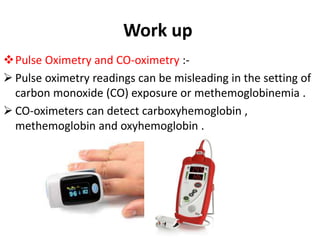
Pulse Oximetry and CO-oximetry :-
 Pulse oximetry readings can be misleading in the setting of
carbon monoxide (CO) exposure or methemoglobinemia .
 CO-oximeters can detect carboxyhemoglobin ,
methemoglobin and oxyhemoglobin .
 Arterial Blood Gases
• Hypoxia and hypercarbia in significant respiratory
distress .
• Arterial oxygen tension [PaO2] does not accurately
reflect the degree of CO poisoning or cellular
hypoxia , PaO2 level reflects the oxygen dissolved in
blood that is not altered by the hemoglobin-bound
CO
• Metabolic acidosis
• High (A-a) gradient
Cont.
Cont.
 CBC, blood typing & cross matching
– WBCs for infection
– Hemoconcentration
– for blood transfusion
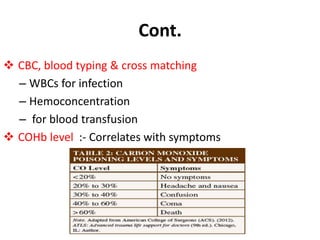
 COHb level :- Correlates with symptoms
Cont.
 Cyanide level :- Persistent neurological &
cardiovascular dysfunction with lactic acidosis
indicates CN poisoning.
 Chest X-ray :- normal in most of cases but repeated
after 24h to detect Pulmonary edema , ARDS and
any lung injury
 C-spine XR to investigate neck injury in all
unconscious patients
Cont.
CT scan
In complicated cases
PFT
• In inhalation injury: a decrease in pulmonary
compliance, vital capacity, functional residual capacity.
• Decreased FEV1 & peak flow means obstruction
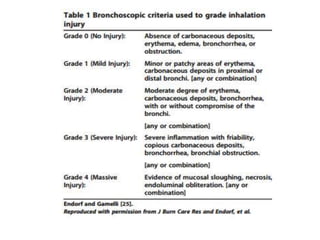
• Bronchoscopy ( diagnostic & therapeutic)
assessing the degree of airway injury by :
– Visualization of erythema, edema, ulceration, soot
deposition.
– It highly effective in removing foreign particles and
accumulated secretions that worsen the
inflammatory response .
Management
• ABCDE
A :-
• An airway should be immediately secured with an
endotracheal tube (ETT) if there is Indications for
intubation:
- Direct visualization erythema / swelling of
oropharynx
- Hoarseness the voice
- Stridor
- Dyspnea
B :-
• 100% oxygen via nonrebreather mask , if
intubated required then hyperventilation with
100% should be instituted
• Auscultate the Chest to recognize good
bilateral air entry
Cont.
C :-
Large-bore IV catheter access may be needed to facilitate
fluid resuscitation.
D :-
AVPU
E :-
Exposure
Cont.
Medication
• Inhaled beta-agonist bronchodilators (e.g.,
nebulized albuterol) are used in those patients
with bronchoconstriction
• corticosteroids are beneficial in toxic smoke
inhalation is a matter of some debate, but many
experts consider these agents helpful in this
setting.
• Patients with pulmonary damage from
inhalation injury are at increased risk for
secondary bacterial infection. The most common
organisms are Staphylococcus
aureus and Pseudomonas aeruginosa. Direct
parenteral coverage with antibiotics to cover
these bacteria if infection is suspected.
Cont.
CO poisoning :
1. cessation of exposure .
2. administration of 100% oxygen
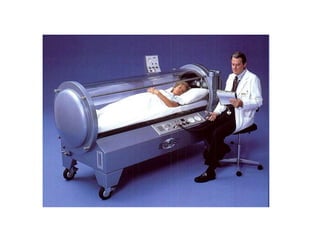
3. Hyperbaric oxygenation therapy (HBO) ?
• encourage rapid displacement of CO from hemoglobin .
• reduce the duration of the hypoxic state .
Cyanide (CN) poisoning
Cyanide antidote :
1- amyl nitrite
2- sodium thiosulfate
3- sodium nitrite
Tracheostomy
• tracheostomy can be lifesaving for patients in
whom endotracheal intubation is not possible,
because of severe airway edema or burns
• But it increased complication rate and risk of
sepsis when compared with endotracheal
intubation
Prognosis
• The prognosis and natural course of inhalation injury
is highly variable .
• More than 90% of Individuals who suffer from
inhalation injury recover completely, returning to
normal health, while Mortality from the most
common source of inhalation injury, smoke
inhalation, is estimated to be 5% to 8%.
• Thank you

Inhalational injury Dx and Tx

  • 1.
    inhalational injury Done by: Mohammad AL-hunaifat and Qutaiba Al-bustanji Supervised by :Dr. Salah Qaryoute Mutah University – jordan
  • 2.
    overview • definition • Epidemiology •Pathophysiology • Clinical assessment • Diagnosis and investigations • Management and Prognosis
  • 3.
    definition A spectrum ofrespiratory tract and systemic insult caused by aspiration of superheated gases, steam, hot liquids, or noxious products of incomplete combustion.
  • 4.
    epidemiology • 1/3 ofburn admissions have inhalation injury. • 12% pts inhalation injury alone require intubation • 62% pts burn + inhalation injury intubated. • Mortality from smoke injury alone is 0-12%. • Mortality from smoke injury and burns is 30-90%. • Mortality from smoke injury and pneumonia 60%. • The majority of these deaths are believed to be due to respiratory system injury. • The male-to-female ratio about 3:2 .
  • 5.
    Introduction Inhaled substances mayaffect respiratory system at various levels according to various factors, and those factors also determine the degree of injury , such as : 1- The characteristics of substances : concentration of inhaled toxin , particle size , water solubility . • Highly water-soluble gases and vapors and larger mist or dust particles (greater than 10 microns in diameter) generally are deposited in the upper airways .
  • 6.
    • This isfollowed by rapidly developing sings of upper airway irritation that are accompanied by eye and mucous membrane irritation. • In severe exposures, progressive coughing, wheezing, or stridor may result in upper airway obstruction. • Less soluble gases and vapors and smaller particles can be inhaled more deeply into the respiratory tract , resulting in delayed onset of the symptoms.
  • 7.
    • Particle (size): >10µm : upper airway 2.5-10µm : lower air way <2.5µm : lung parenchyma
  • 8.
    2- Environmental factors:duration of exposure , whether exposure occurred in an enclosed space. 3- host factors: age of patient , underlying lung debilitating illness particularly underlying reactive airway disease or lung disease that impairs host defense mechanisms.
  • 9.
    Pathophysiology • Thermal damage •Asphyxiation • Pulmonary irritation • Systemic toxic effects
  • 10.
    Thermal damage • Usuallylimited to the oropharyngeal area • Because of the combination of efficient heat dissipation in the upper airway, low heat conduction capacity of air and reflex closure of the larynx, super-heated air usually causes injury only to upper airway structures. • Injury to these airway structures may cause massive swelling of the tongue, epiglottis , with obstruction. • The exception are Steam injuries, volatile gases , explosive gases has a much greater heat-carrying capacity
  • 11.
    Asphyxiation • Tissue hypoxiacan occur via several mechanisms: 1- the decrease in (FIO2) leads to hypoxia 2- Carbon monoxide 3- Cyanide
  • 12.
    Carbon monoxide (CO): •Carbon monoxide is an odorless , tasteless, nonirritating gas produced by the incomplete combustion of carbon-containing compounds, such as wood, coal, and gasoline. • The affinity of carbon monoxide for hemoglobin is 200 times greater than for oxygen. • Account for 80% of fatalities from inhalation injury.
  • 13.
    • Carbon monoxidecompetes with oxygen for hemoglobin binding and Decreasing the oxygen- carrying capacity of the blood & causes a left shift in oxyhemoglobin saturation dissociation curve. • Bind to cardiac and skeletal muscle , resulting in direct toxicity . • Decreased myocardial contractility. • Carbon monoxide inhibits intracellular cytochrome oxidase enzyme systems , most notably cytochrome P-450 resulting in inability of cellular systems to utilize oxygen .
  • 14.
    :Cyanide • Cyanide hasa characteristic almond like odor. • Inhaled hydrogen cyanide, produced during combustion of multiple materials polyurethane , nitrogen containing material , nylon, wool, silk. • Binds to the ferric ion on cytochrome A3, interfering cellular respiration, causing Lactic acidosis.
  • 15.
    • Hydrogen cyanideis absorbed rapidly, producing an almost immediate effect if exposure is by inhalation • In contrast, cyanide salts (potassium, sodium cyanide, silver and copper cyanide) which are typically ingested, must be converted to hydrogen cyanide and are absorbed more slowly. • Low levels of cyanide increase cardiac output . At higher levels, a wide variety of bradyarrhythmia and tachyarrhythmia occur. • seizures & apnea.
  • 16.
    Pulmonary Irritation • hyperinflationand atelectasis . • Debris from cellular necrosis. • inflammatory exudate. • shed epithelium with carbonaceous material to narrow airways / compromised by edema. • Reflex bronchoconstriction. • Both inspiratory and expiratory resistance are increased
  • 17.
    • Surfactant productionand activity are both impaired. • Damage to the alveolar capillary membrane increases its permeability. • intravascular leakage. • increased lymphatic flow. • alveolar edema / Alveoli fill with thick, bloody fluid. • ventilation-perfusion mismatch and hypoxia.
  • 18.
    • Activation ofpolymorphonuclear neutrophils resident alveolar macrophages, increased activity of systemic interleukin (IL)–1, IL-6, IL-8, and tumor necrosis factor alpha (TNF-α) and neutrophilic infiltration lead to atelectasis and impaired mucociliary function
  • 19.
    Classification of injury •Acute (1-2 days of exposure): –Laryngeal edema. –Airflow obx- asthma & bronchitis. –Pneumonitis , pulmonary edema. –ARDS.
  • 20.
    • Delayed Onset(days to weeks): –Bacterial pneumonia (4-5 days). –Atelectasis / lobar collapse. –Pulmonary Embolism. •Immobilization and/or compartment syndrome altered. •Hypercoagulable state secondary to SIRS.
  • 21.
    • Persistent sequelae( weeks to months) –COPD –RADS (Reactive Airway Dysfunction Syndrome) –Bronchitis –Bronchiolitis obliterans –Cryptogenic organizing pneumonia (COP)
  • 22.
    Sign and symptomsof inh. inj. • Patient burnt in a closed place . • Full thickness / deep dermal burns to the face , neck , upper torso . • RS : cough, dyspnea, wheezing, stridor, hoarseness, hemoptysis, tachypnea, rales, rhonchi , carbonaceous sputum, facial burns, soot marks & singed eyebrows and nasal hair .
  • 23.
    • CNS :severe temporal headache, lethargy & coma , and generalized muscle weakness • Neurologic injury may be the result of hypoxia at the time of injury or may result from hypoxia secondary to pulmonary dysfunction. • Cvs : narrowed pulse pressure, Hypotension , acute ischemia. • symptoms are usually present within 12-24 hours
  • 24.
    Work up Pulse Oximetryand CO-oximetry :-  Pulse oximetry readings can be misleading in the setting of carbon monoxide (CO) exposure or methemoglobinemia .  CO-oximeters can detect carboxyhemoglobin , methemoglobin and oxyhemoglobin .
  • 25.
     Arterial BloodGases • Hypoxia and hypercarbia in significant respiratory distress . • Arterial oxygen tension [PaO2] does not accurately reflect the degree of CO poisoning or cellular hypoxia , PaO2 level reflects the oxygen dissolved in blood that is not altered by the hemoglobin-bound CO • Metabolic acidosis • High (A-a) gradient Cont.
  • 26.
    Cont.  CBC, bloodtyping & cross matching – WBCs for infection – Hemoconcentration – for blood transfusion  COHb level :- Correlates with symptoms
  • 27.
    Cont.  Cyanide level:- Persistent neurological & cardiovascular dysfunction with lactic acidosis indicates CN poisoning.  Chest X-ray :- normal in most of cases but repeated after 24h to detect Pulmonary edema , ARDS and any lung injury  C-spine XR to investigate neck injury in all unconscious patients
  • 28.
    Cont. CT scan In complicatedcases PFT • In inhalation injury: a decrease in pulmonary compliance, vital capacity, functional residual capacity. • Decreased FEV1 & peak flow means obstruction
  • 29.
    • Bronchoscopy (diagnostic & therapeutic) assessing the degree of airway injury by : – Visualization of erythema, edema, ulceration, soot deposition. – It highly effective in removing foreign particles and accumulated secretions that worsen the inflammatory response .
  • 31.
    Management • ABCDE A :- •An airway should be immediately secured with an endotracheal tube (ETT) if there is Indications for intubation: - Direct visualization erythema / swelling of oropharynx - Hoarseness the voice - Stridor - Dyspnea
  • 32.
    B :- • 100%oxygen via nonrebreather mask , if intubated required then hyperventilation with 100% should be instituted • Auscultate the Chest to recognize good bilateral air entry Cont.
  • 33.
    C :- Large-bore IVcatheter access may be needed to facilitate fluid resuscitation. D :- AVPU E :- Exposure Cont.
  • 34.
    Medication • Inhaled beta-agonistbronchodilators (e.g., nebulized albuterol) are used in those patients with bronchoconstriction • corticosteroids are beneficial in toxic smoke inhalation is a matter of some debate, but many experts consider these agents helpful in this setting.
  • 35.
    • Patients withpulmonary damage from inhalation injury are at increased risk for secondary bacterial infection. The most common organisms are Staphylococcus aureus and Pseudomonas aeruginosa. Direct parenteral coverage with antibiotics to cover these bacteria if infection is suspected. Cont.
  • 36.
    CO poisoning : 1.cessation of exposure . 2. administration of 100% oxygen 3. Hyperbaric oxygenation therapy (HBO) ? • encourage rapid displacement of CO from hemoglobin . • reduce the duration of the hypoxic state .
  • 38.
    Cyanide (CN) poisoning Cyanideantidote : 1- amyl nitrite 2- sodium thiosulfate 3- sodium nitrite
  • 39.
    Tracheostomy • tracheostomy canbe lifesaving for patients in whom endotracheal intubation is not possible, because of severe airway edema or burns • But it increased complication rate and risk of sepsis when compared with endotracheal intubation
  • 40.
    Prognosis • The prognosisand natural course of inhalation injury is highly variable . • More than 90% of Individuals who suffer from inhalation injury recover completely, returning to normal health, while Mortality from the most common source of inhalation injury, smoke inhalation, is estimated to be 5% to 8%.
  • 41.