BOSTON UNIVERSITY 
GRADUATE SCHOOL OF ARTS AND SCIENCES 
Dissertation 
MEASURING NEURON/GLIAL CELLULAR ARRANGEMENT IN THE 
MAMMALIAN CORTEX 
by 
ANDREW INGLIS 
B.S., University of Virginia, 2000 
M.A.T., Johns Hopkins University, 2002 
Submitted in partial ful
llment of the 
requirements for the degree of 
Doctor of Philosophy 
2010
MEASURING NEURON/GLIAL CELLULAR ARRANGEMENT IN THE 
MAMMALIAN CORTEX 
(Order No. ) 
ANDREW INGLIS 
Boston University Graduate School of Arts and Sciences, 2010 
Major Professor: H. Eugene Stanley, University Professor and Professor of Physics 
ABSTRACT 
The spatial arrangement of cells in the mammalian cortex directly relates to how the brain 
performs functionally. These cells include neurons, the fundamental building block of the 
neural network, and glia, which provide regulation, insulation, mechanical support, and 
nutrition for neurons and their processes. Currently, most analyses of pathological changes 
in spatial arrangement of neuron and glial cells rely on aberrations of cell placements large 
enough to be visible by the naked eye. We present a method that enables quanti
cation 
of subtle spatial arrangement properties, or patterns, which exist right above biological 
noise and that may not be visually apparent due to the pattern's subtlety or lack of spatial 
cohesion. This method enables new comparisons between functional behavior of brain 
regions and quantitative measurements of detailed morphology within those regions. The 
method requires a three-fold eort of digitization, recognition, and analysis: we
rst develop 
the experimental platform needed to digitize tissue automatically at high resolution ( 1m 
per pixel) throughout whole tissue samples spanning the entire brain. We then develop 
the algorithms necessary to recognize cells within this digitized tissue, focusing on the 
challenge of delineating between neuron and glial cells in the same tissue sample. Finally, 
we show the analysis methods that are enabled by the new dataset. Among the methods 
are traditional measurements of total cell count and density, microcolumnar arrangement 
of neurons, and cross-correlation analysis between two cell populations such as neurons 
iv
and glial cells. These measurements are either taken in known regions of the cortex or as 
running windows which show changes in spatial properties through the tissue irrespective 
of region delineations. The statistical robustness of the method is validated by comparing 
the results with models of multiple cell populations and changing spatial properties. We use 
the method to analyze cortical tissue samples from the rat and Rhesus monkey, and discuss 
current theories on mechanisms within the brain that may aect spatial arrangement of 
cells. Lastly, we describe future directions of study. 
v
Contents 
1 Introduction 1 
1.1 Studying the brain with the brain . . . . . . . . . . . . . . . . . . . . . . . 1 
1.2 A need for quantitative spatial arrangement tools . . . . . . . . . . . . . . . 3 
1.3 Overview of dissertation . . . . . . . . . . . . . . . . . . . . . . . . . . . . . 8 
2 Theory and Literature Review 13 
2.1 Brain anatomy review . . . . . . . . . . . . . . . . . . . . . . . . . . . . . . 13 
2.1.1 Cell types in the brain . . . . . . . . . . . . . . . . . . . . . . . . . . 13 
2.1.2 Basic anatomy . . . . . . . . . . . . . . . . . . . . . . . . . . . . . . 17 
2.2 Spatial arrangement . . . . . . . . . . . . . . . . . . . . . . . . . . . . . . . 19 
2.2.1 Development . . . . . . . . . . . . . . . . . . . . . . . . . . . . . . . 19 
2.2.2 Aging and disease . . . . . . . . . . . . . . . . . . . . . . . . . . . . 21 
2.2.3 Mechanisms . . . . . . . . . . . . . . . . . . . . . . . . . . . . . . . . 22 
2.2.4 Cortical microcolumn . . . . . . . . . . . . . . . . . . . . . . . . . . 22 
2.3 Measurement theory . . . . . . . . . . . . . . . . . . . . . . . . . . . . . . . 25 
2.3.1 Raw data . . . . . . . . . . . . . . . . . . . . . . . . . . . . . . . . . 25 
2.3.2 Stereology . . . . . . . . . . . . . . . . . . . . . . . . . . . . . . . . . 25 
2.3.3 Correlation measurements . . . . . . . . . . . . . . . . . . . . . . . . 29 
3 Experimental Method 40 
3.1 Introduction . . . . . . . . . . . . . . . . . . . . . . . . . . . . . . . . . . . . 40 
3.2 Digital image acquisition . . . . . . . . . . . . . . . . . . . . . . . . . . . . . 41 
vi
3.2.1 Introduction . . . . . . . . . . . . . . . . . . . . . . . . . . . . . . . 41 
3.2.2 Traditional optical imaging microscope . . . . . . . . . . . . . . . . . 41 
3.2.3 Stitching . . . . . . . . . . . . . . . . . . . . . . . . . . . . . . . . . 44 
3.2.4 DMetrix acquisition . . . . . . . . . . . . . . . . . . . . . . . . . . . 46 
3.3 Recognition of cell information . . . . . . . . . . . . . . . . . . . . . . . . . 49 
3.3.1 Methods . . . . . . . . . . . . . . . . . . . . . . . . . . . . . . . . . . 54 
3.3.2 Recognition results . . . . . . . . . . . . . . . . . . . . . . . . . . . . 75 
3.3.3 Discussion . . . . . . . . . . . . . . . . . . . . . . . . . . . . . . . . . 78 
3.3.4 Software . . . . . . . . . . . . . . . . . . . . . . . . . . . . . . . . . . 80 
3.3.5 Validation by comparing with Stereology . . . . . . . . . . . . . . . 80 
4 Results 97 
4.1 Macaque monkey . . . . . . . . . . . . . . . . . . . . . . . . . . . . . . . . . 97 
4.1.1 Subjects . . . . . . . . . . . . . . . . . . . . . . . . . . . . . . . . . . 97 
4.1.2 Area 46 dorsal/ventral studies . . . . . . . . . . . . . . . . . . . . . 98 
4.1.3 Area TE studies . . . . . . . . . . . . . . . . . . . . . . . . . . . . . 105 
4.1.4 Area TE comparison with model . . . . . . . . . . . . . . . . . . . . 109 
4.2 Rat tissue . . . . . . . . . . . . . . . . . . . . . . . . . . . . . . . . . . . . . 117 
5 Future studies 122 
5.1 Database integration . . . . . . . . . . . . . . . . . . . . . . . . . . . . . . . 122 
5.2 Next area analysis . . . . . . . . . . . . . . . . . . . . . . . . . . . . . . . . 123 
5.2.1 46DV analysis . . . . . . . . . . . . . . . . . . . . . . . . . . . . . . 123 
5.2.2 TE analysis . . . . . . . . . . . . . . . . . . . . . . . . . . . . . . . . 127 
5.2.3 Frontal lobe analysis . . . . . . . . . . . . . . . . . . . . . . . . . . . 128 
5.2.4 Rat tissue analysis . . . . . . . . . . . . . . . . . . . . . . . . . . . . 128 
5.3 Mechanism investigation . . . . . . . . . . . . . . . . . . . . . . . . . . . . . 128 
5.3.1 Perineuronal net . . . . . . . . . . . . . . . . . . . . . . . . . . . . . 129 
5.3.2 Dendrites and glia . . . . . . . . . . . . . . . . . . . . . . . . . . . . 130 
vii
5.4 Additional correlations . . . . . . . . . . . . . . . . . . . . . . . . . . . . . . 131 
5.5 Modeling and networks . . . . . . . . . . . . . . . . . . . . . . . . . . . . . 132 
Bibliography 135 
Curriculum Vitae 145 
viii
List of Figures 
1.1 Brain investigation methods phase space . . . . . . . . . . . . . . . . . . . . 2 
1.2 Epileptic seizure displasia . . . . . . . . . . . . . . . . . . . . . . . . . . . . 4 
1.3 Example of the measurement of the columnarity of neurons . . . . . . . . . 5 
2.1 Examples of neurons . . . . . . . . . . . . . . . . . . . . . . . . . . . . . . . 14 
2.2 Examples of glial . . . . . . . . . . . . . . . . . . . . . . . . . . . . . . . . . 15 
2.3 Theory of glial-neuron interactions . . . . . . . . . . . . . . . . . . . . . . . 16 
2.4 Side view of the brain . . . . . . . . . . . . . . . . . . . . . . . . . . . . . . 17 
2.5 Coronal section of the brain and layers . . . . . . . . . . . . . . . . . . . . . 18 
2.6 Human development from 0 to 3 weeks of gestation . . . . . . . . . . . . . . 19 
2.7 Human development from 3 weeks to 9 months . . . . . . . . . . . . . . . . 20 
2.8 Example of microcolumnar structure . . . . . . . . . . . . . . . . . . . . . . 23 
2.9 Example of tissue . . . . . . . . . . . . . . . . . . . . . . . . . . . . . . . . . 26 
2.10 Example of tissue with cell locations . . . . . . . . . . . . . . . . . . . . . . 26 
2.11 Properties of cells . . . . . . . . . . . . . . . . . . . . . . . . . . . . . . . . . 27 
2.12 Region of interest . . . . . . . . . . . . . . . . . . . . . . . . . . . . . . . . . 27 
2.13 Stereological sample . . . . . . . . . . . . . . . . . . . . . . . . . . . . . . . 28 
2.14 Correlation mapping sample . . . . . . . . . . . . . . . . . . . . . . . . . . . 30 
2.15 Coordinate space to density map space . . . . . . . . . . . . . . . . . . . . . 30 
2.16 Radial correlation between neurons and glial cells . . . . . . . . . . . . . . . 32 
2.17 Density maps for common dementias . . . . . . . . . . . . . . . . . . . . . . 33 
2.18 Microcolumnar measures . . . . . . . . . . . . . . . . . . . . . . . . . . . . . 34 
ix
2.19 Quantifying microcolumnar measures . . . . . . . . . . . . . . . . . . . . . . 35 
2.20 Map analysis of tissue properties . . . . . . . . . . . . . . . . . . . . . . . . 36 
2.21 Required cell numbers for correlation analysis . . . . . . . . . . . . . . . . . 38 
3.1 Montaging computer . . . . . . . . . . . . . . . . . . . . . . . . . . . . . . . 43 
3.2 Slide example . . . . . . . . . . . . . . . . . . . . . . . . . . . . . . . . . . . 45 
3.3 Z-Stack example . . . . . . . . . . . . . . . . . . . . . . . . . . . . . . . . . 45 
3.4 Stitching example . . . . . . . . . . . . . . . . . . . . . . . . . . . . . . . . . 47 
3.5 Comparison of two digitization techniques . . . . . . . . . . . . . . . . . . . 48 
3.6 Challenges of automated neuron recognition . . . . . . . . . . . . . . . . . . 50 
3.7 Monkey tissue database . . . . . . . . . . . . . . . . . . . . . . . . . . . . . 52 
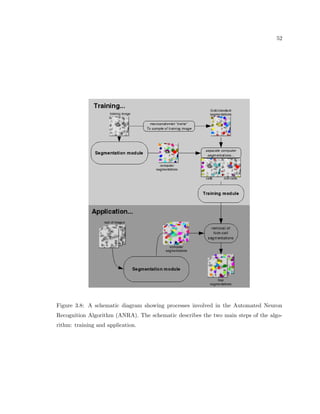
3.8 Automated Neuron Recognition Algorithm (ANRA) . . . . . . . . . . . . . 53 
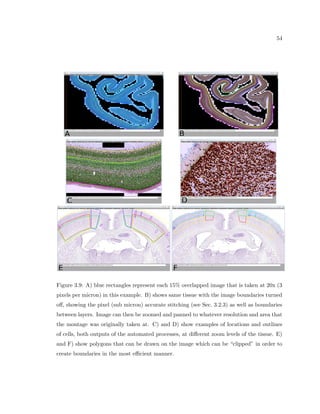
3.9 Examples of the ANRA visualization system . . . . . . . . . . . . . . . . . . 55 
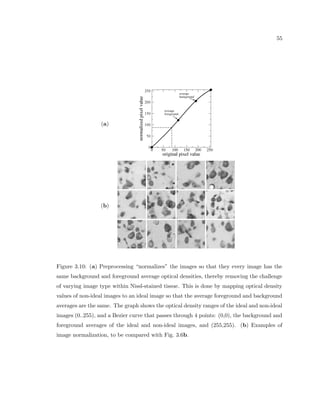
3.10 Image pre-processing . . . . . . . . . . . . . . . . . . . . . . . . . . . . . . . 56 
3.11 Steps of segmentation module 1 . . . . . . . . . . . . . . . . . . . . . . . . . 59 
3.12 Active contour control points . . . . . . . . . . . . . . . . . . . . . . . . . . 60 
3.13 Examples of active contour movement . . . . . . . . . . . . . . . . . . . . . 62 
3.14 Energies of active contour during movement . . . . . . . . . . . . . . . . . . 63 
3.15 Control point movement . . . . . . . . . . . . . . . . . . . . . . . . . . . . . 63 
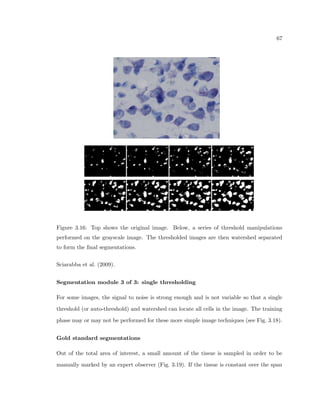
3.16 Multithreshold method of segmentation . . . . . . . . . . . . . . . . . . . . 68 
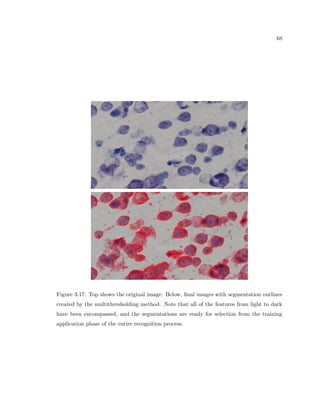
3.17 Example of multithreshold method . . . . . . . . . . . . . . . . . . . . . . . 69 
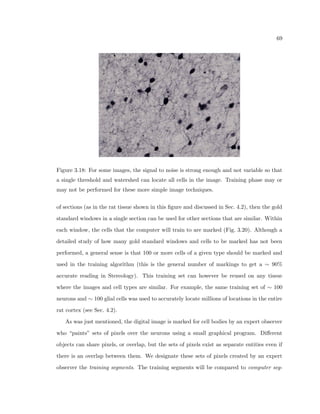
3.18 Example of images for single threshold . . . . . . . . . . . . . . . . . . . . . 70 
3.19 Example of gold standard selection . . . . . . . . . . . . . . . . . . . . . . . 71 
3.20 Example of gold standard marks . . . . . . . . . . . . . . . . . . . . . . . . 72 
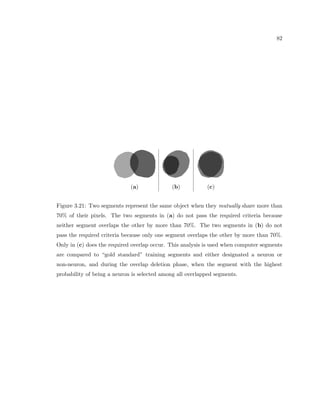
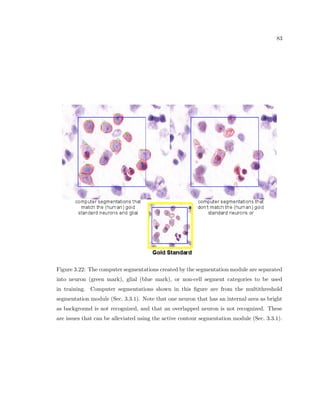
3.21 Overlap of segmentations . . . . . . . . . . . . . . . . . . . . . . . . . . . . 83 
3.22 Use of gold standard marks in training . . . . . . . . . . . . . . . . . . . . . 84 
3.23 Origional set of segment properties . . . . . . . . . . . . . . . . . . . . . . . 85 
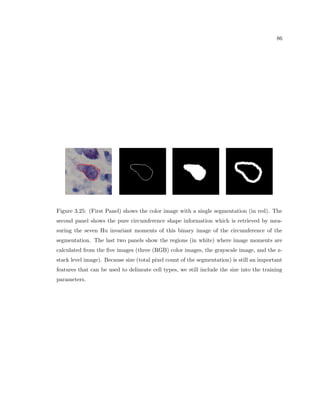
3.24 Hu invariant moment measurements . . . . . . . . . . . . . . . . . . . . . . 86 
x
3.25 Example of segmentation parameters . . . . . . . . . . . . . . . . . . . . . . 87 
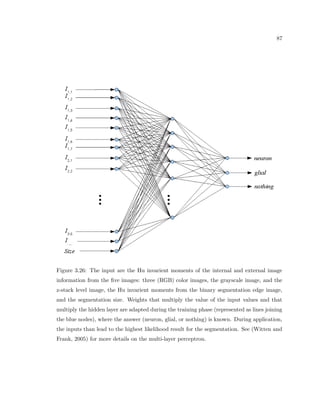
3.26 Schematic of Multi-layer Percepton . . . . . . . . . . . . . . . . . . . . . . . 88 
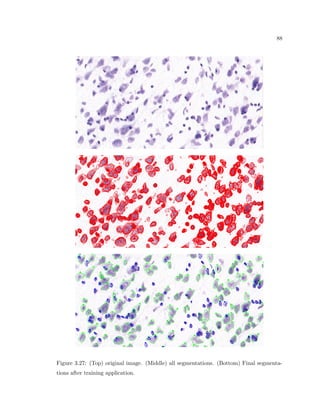
3.27 Example of ANRA output . . . . . . . . . . . . . . . . . . . . . . . . . . . . 89 
3.28 Recognition quality de
nitions . . . . . . . . . . . . . . . . . . . . . . . . . 90 
3.29 Detailed active contour segmentation results . . . . . . . . . . . . . . . . . . 91 
3.30 Comparison of ANRA and semi-automatic method . . . . . . . . . . . . . . 92 
3.31 ANRA results . . . . . . . . . . . . . . . . . . . . . . . . . . . . . . . . . . . 93 
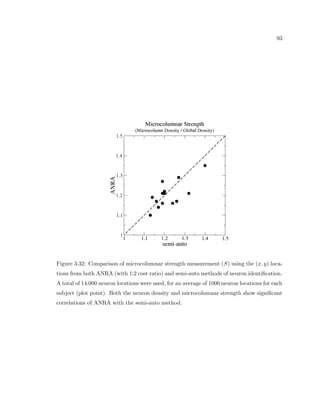
3.32 ANRA / semiautomatic comparison . . . . . . . . . . . . . . . . . . . . . . 94 
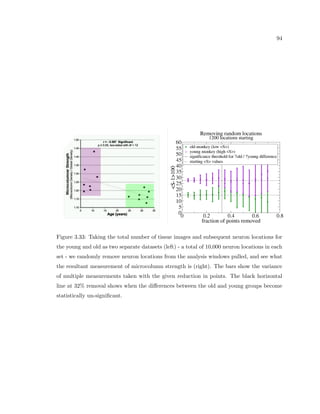
3.33 Eect of reduction in recognition rate on measurements . . . . . . . . . . . 95 
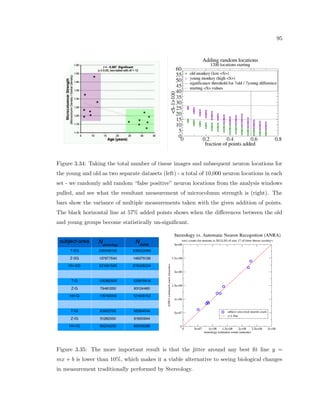
3.34 Eect of adding random false positives on measurements . . . . . . . . . . . 96 
3.35 Comparison of ANRA with stereology for a neuron counting study . . . . . 96 
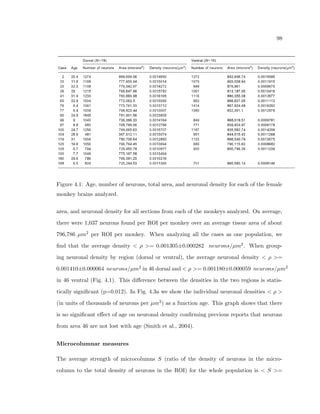
4.1 Raw data overview, 46dv, female monkey . . . . . . . . . . . . . . . . . . . 99 
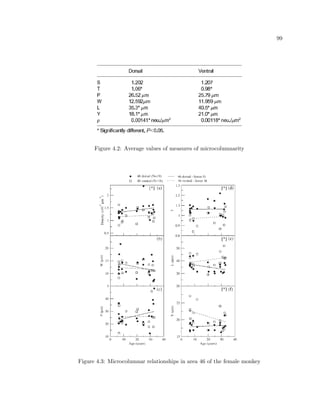
4.2 Average values of measures of microcolumnarity . . . . . . . . . . . . . . . 100 
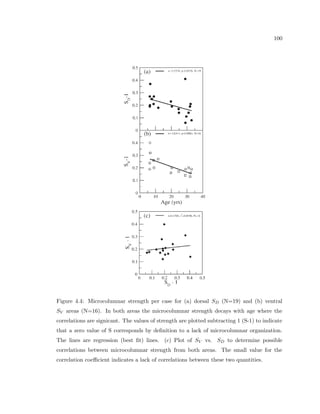
4.3 Microcolumnar relationships in area 46 of the female monkey . . . . . . . . 100 
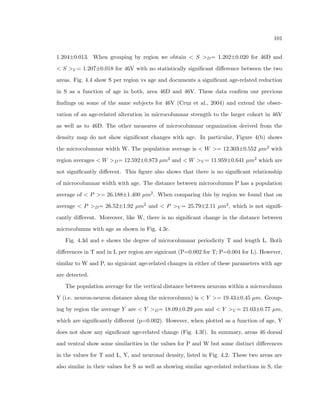
4.4 Microcolumnar strength in dorsal vs. ventral portion of the brain . . . . . . 101 
4.5 Microcolumnar strength in relation to behavior . . . . . . . . . . . . . . . . 104 
4.6 Data acquisition for area TE . . . . . . . . . . . . . . . . . . . . . . . . . . 106 
4.7 Raw data overview, TE, female monkey . . . . . . . . . . . . . . . . . . . . 107 
4.8 Microcolumnar relationships in area TE of the female monkey, compared 
with 46dv . . . . . . . . . . . . . . . . . . . . . . . . . . . . . . . . . . . . . 107 
4.9 Microcolumnarity of TE vs age, compared with 46dv . . . . . . . . . . . . . 108 
4.10 Preliminary running window result in area TE . . . . . . . . . . . . . . . . 108 
4.11 Schematic diagram showing the variables in the model . . . . . . . . . . . . 110 
4.12 Microcolumnar model . . . . . . . . . . . . . . . . . . . . . . . . . . . . . . 111 
4.13 Front and top view of examples of model neuron con
gurations . . . . . . . 112 
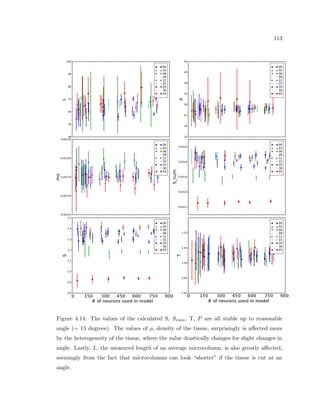
4.14 Modelling tissue angle of cut . . . . . . . . . . . . . . . . . . . . . . . . . . 114 
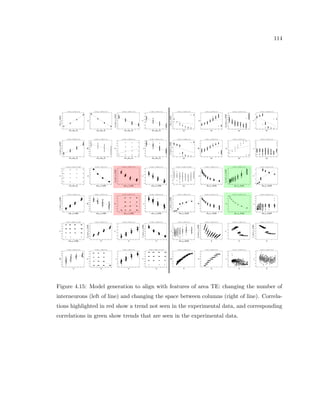
4.15 Part 1 of 2 of changing density model comparison . . . . . . . . . . . . . . . 115 
xi
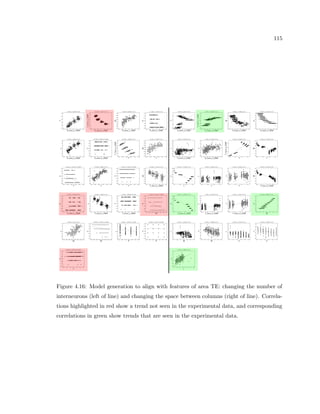
4.16 Part 2 of 2 of changing density model comparison . . . . . . . . . . . . . . . 116 
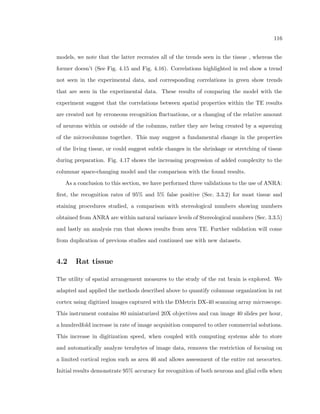
4.17 Model generation to align with features of area TE . . . . . . . . . . . . . . 118 
4.18 Depiction of 5 million neuron and glial locations within the rat brain . . . . 119 
4.19 Probe analysis focusing on dierent layers of the rat cortex . . . . . . . . . 121 
5.1 Original image data from area 46 . . . . . . . . . . . . . . . . . . . . . . . . 124 
5.2 New measurements for area 46 . . . . . . . . . . . . . . . . . . . . . . . . . 125 
5.3 New running window measurement for area TE . . . . . . . . . . . . . . . . 126 
5.4 Comparison of two running window results for area TE . . . . . . . . . . . 127 
5.5 Example of other properties to correlate . . . . . . . . . . . . . . . . . . . . 132 
5.6 modeling network connectivity . . . . . . . . . . . . . . . . . . . . . . . . . 134 
xii
List of Abbreviations 
2PI two-photon imaging 
ABA Allen Brain Atlas 
ANRA Automatic Neuron Recognition Algorithm 
CCD charge-coupled device 
CS case studies 
CT computed tomography 
DTI diusion tensor imaging 
ECM extracellular matrix 
EEG electroencephalography 
FCD focal cortical displacias 
fMRI functional magnetic resonance imaging 
ISH in-situ hybridization 
MC motor cortex 
MEG magnetoencephalography 
MLP multi-layer perceptron 
MRI magnetic resonance imaging 
NA neuroanatomy 
NE needle electrodes 
PET positron emission tomography 
PN perineuronal net 
RGB red-green-blue 
xiii
ROC receiver operator characteristic 
ROI region of interest 
SS somatosensory cortex 
xiv
Chapter 1 
Introduction 
1.1 Studying the brain with the brain 
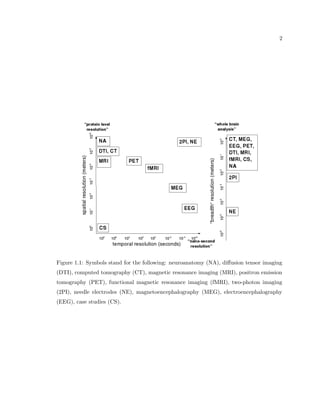
The past decade has witnessed a surge in research eort dedicated to investigating the 
mammalian brain. In addition to the large motivating factor of understanding how our 
minds work, the surge is supported by an continually advancing set of technology aided 
measurement tools to allow higher resolution and more complex measurements. Even with 
the increased eort and technology, however, there still remains only a handful fundamental 
ways to measure brain activity, processes, and makeup (ie: fMRI, stereology, individual 
neuron potentials, etc.). These methods contribute distinct measurements of the brain by 
falling within particular ranges of three scales: spatial, ranging from inches to nanometers, 
temporal, ranging from years to milliseconds, and breadth scale, ranging from individual 
neuron measurements to whole brain measurements. It is worth noting that no measurement 
tool is maximized in all three categories (Fig. 1.1). For example, while fMRI measurements 
span the entire brain, the spatial resolution only allows the combined eect of hundreds of 
neurons
ring together to be resolved. Another example, needle electrode measurements, 
have a high temporal resolution within the millisecond range, but cannot identify single 
neurons, and only extend thousands of neurons, or cubic millimeters, of volume. All in all, 
researchers have attempted to
ll this phase space in order to leave no stone unturned in 
the dicult task of understanding brain processes. 
1
2 
Figure 1.1: Symbols stand for the following: neuroanatomy (NA), diusion tensor imaging 
(DTI), computed tomography (CT), magnetic resonance imaging (MRI), positron emission 
tomography (PET), functional magnetic resonance imaging (fMRI), two-photon imaging 
(2PI), needle electrodes (NE), magnetoencephalography (MEG), electroencephalography 
(EEG), case studies (CS).
3 
By collecting individual neuron and other cell body properties (such as glial cells) of 
location, size, and shape, from every cell within an extent of the entire brain at micron 
resolution, we are able to create a map of spatial arrangement properties of cell bodies with 
respect to one other throughout the entire cortex, adding a new way to measure the brain 
within the triptych of temporal scale, spatial scale, and extent. 
1.2 A need for quantitative spatial arrangement tools 
In a recent special issue of Child's Nervous System, researchers and doctors gave an update 
on the best methods for treating children with severe epileptic seizures (Hildebrandt et al., 
2005). Two reports in the issue gave overviews of an eect called focal cortical displacias, 
which means that there are drastic changes (displacias) that occur in the local (focal) ar-rangement 
of cells in the regions that are aected by the seizures (cortical) (Rickert, 2006; 
Rocco and Tamburrini, 2005). In the task of stopping seizures from occurring, understand-ing 
these subtle but statistically signicant neuroanatomical abnormalities is a fundamental 
step to understanding how the seizures occur, how seizures damage the brain, and how to 
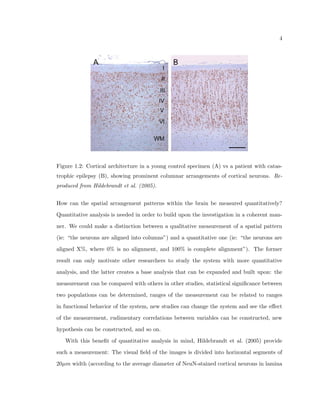
stop seizures in the future. One example of focal cortical displacia is a heightened tendency 
for neurons to align vertically into a columnar structure in brain areas that experienced 
epileptic activity compared to similar brain areas that did not experience epileptic activity 
(Fig. 1.2). 
Many questions arise from the
ndings of this study on focal cortical displacias in epilep-tic 
patients. How is the alignment of the neurons in a speci
c brain area related to the 
epileptic
ring within that area? Are brains with higher columnarity more prone to epilep-tic 
activity, or is the columnarity an aect of the seizures? How does the structure of the 
neurons hint to how the neurons are connected with one another? The answers to these and 
many other questions can come in many forms, such as performing the analysis on many 
more human subjects, by recreating the eect of epileptic seizure in another animal type, 
such as a rat, or by modeling the connections of the neurons in silico (with computers). 
There is a fundamental question that underlies the exploration of all of these questions:
4 
Figure 1.2: Cortical architecture in a young control specimen (A) vs a patient with catas-trophic 
epilepsy (B), showing prominent columnar arrangements of cortical neurons. Re- 
produced from Hildebrandt et al. (2005). 
How can the spatial arrangement patterns within the brain be measured quantitatively? 
Quantitative analysis is needed in order to build upon the investigation in a coherent man-ner. 
We could make a distinction between a qualitative measurement of a spatial pattern 
(ie: the neurons are aligned into columns) and a quantitative one (ie: the neurons are 
aligned X%, where 0% is no alignment, and 100% is complete alignment). The former 
result can only motivate other researchers to study the system with more quantitative 
analysis, and the latter creates a base analysis that can be expanded and built upon: the 
measurement can be compared with others in other studies, statistical signi
cance between 
two populations can be determined, ranges of the measurement can be related to ranges 
in functional behavior of the system, new studies can change the system and see the eect 
of the measurement, rudimentary correlations between variables can be constructed, new 
hypothesis can be constructed, and so on. 
With this bene
t of quantitative analysis in mind, Hildebrandt et al. (2005) provide 
such a measurement: The visual
eld of the images is divided into horizontal segments of 
20m width (according to the average diameter of NeuN-stained cortical neurons in lamina
5 
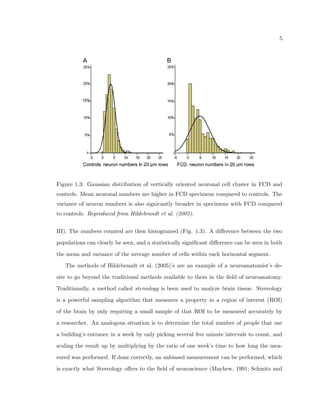
Figure 1.3: Gaussian distribution of vertically oriented neuronal cell cluster in FCD and 
controls. Mean neuronal numbers are higher in FCD specimens compared to controls. The 
variance of neuron numbers is also signicantly broader in specimens with FCD compared 
to controls. Reproduced from Hildebrandt et al. (2005). 
III). The numbers counted are then histogramed (Fig. 1.3). A dierence between the two 
populations can clearly be seen, and a statistically signi
cant dierence can be seen in both 
the mean and variance of the average number of cells within each horizontal segment. 
The methods of Hildebrandt et al. (2005)'s are an example of a neuroanatomist's de-sire 
to go beyond the traditional methods available to them in the
eld of neuroanatomy. 
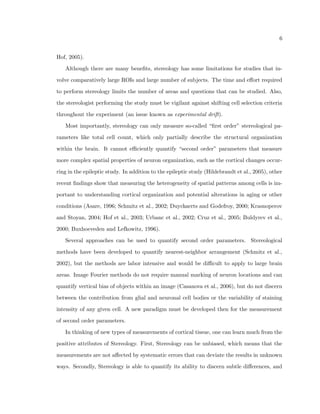
Traditionally, a method called stereology is been used to analyze brain tissue. Stereology 
is a powerful sampling algorithm that measures a property in a region of interest (ROI) 
of the brain by only requiring a small sample of that ROI to be measured accurately by 
a researcher. An analogous situation is to determine the total number of people that use 
a building's entrance in a week by only picking several
ve minute intervals to count, and 
scaling the result up by multiplying by the ratio of one week's time to how long the mea-sured 
was performed. If done correctly, an unbiased measurement can be performed, which 
is exactly what Stereology oers to the
eld of neuroscience (Mayhew, 1991; Schmitz and
6 
Hof, 2005). 
Although there are many bene
ts, stereology has some limitations for studies that in-volve 
comparatively large ROIs and large number of subjects. The time and eort required 
to perform stereology limits the number of areas and questions that can be studied. Also, 
the stereologist performing the study must be vigilant against shifting cell selection criteria 
throughout the experiment (an issue known as experimental drift). 
Most importantly, stereology can only measure so-called
rst order stereological pa-rameters 
like total cell count, which only partially describe the structural organization 
within the brain. It cannot eciently quantify second order parameters that measure 
more complex spatial properties of neuron organization, such as the cortical changes occur-ring 
in the epileptic study. In addition to the epileptic study (Hildebrandt et al., 2005), other 
recent
ndings show that measuring the heterogeneity of spatial patterns among cells is im-portant 
to understanding cortical organization and potential alterations in aging or other 
conditions (Asare, 1996; Schmitz et al., 2002; Duyckaerts and Godefroy, 2000; Krasnoperov 
and Stoyan, 2004; Hof et al., 2003; Urbanc et al., 2002; Cruz et al., 2005; Buldyrev et al., 
2000; Buxhoeveden and Lefkowitz, 1996). 
Several approaches can be used to quantify second order parameters. Stereological 
methods have been developed to quantify nearest-neighbor arrangement (Schmitz et al., 
2002), but the methods are labor intensive and would be dicult to apply to large brain 
areas. Image Fourier methods do not require manual marking of neuron locations and can 
quantify vertical bias of objects within an image (Casanova et al., 2006), but do not discern 
between the contribution from glial and neuronal cell bodies or the variability of staining 
intensity of any given cell. A new paradigm must be developed then for the measurement 
of second order parameters. 
In thinking of new types of measurements of cortical tissue, one can learn much from the 
positive attributes of Stereology. First, Stereology can be unbiased, which means that the 
measurements are not aected by systematic errors that can deviate the results in unknown 
ways. Secondly, Stereology is able to quantify its ability to discern subtle dierences, and
7 
this ability can be adapted by sampling more tissue. Lastly, Stereology is able to make 
measurements through the entire brain. It is these three properties that make Stereology a 
powerful method. It is our goal to incorporated these properties into a measurement tool 
for second order, spatial arrangement properties of the brain. 
We attempt to satisfy such measurement attributes by automatically collecting individ-ual 
neuron and other cell body properties (such as glial cells) of location, size, and shape, 
from every neuron within an extent of the ROI. The automatic nature of the measurement 
allows it to be performed in large datasets and reduces biases that are attributable to the 
experimental drift mentioned earlier. It also allows for measurements based on the highest 
level of statistics possible, in order to have the maximal discernibility of a feature above 
biological noise. The basic pillars of Stereology thereby attempted to be attained, we also 
mention an additional and exciting quality of such a method: it moves the neuroanatomical 
exploration of the brain away from a hypothesis driven model to a more of a data driven 
model: due to the time consuming nature of stereology, studies that investigate detailed 
anatomy are resource intensive, therefore only the investigations perceived to be the most 
salient are performed. The ability to perform investigations to answer quick hypothesis 
driven questions, or to search for unknown correlations that are not thought of by the re-searcher 
are not available in the
eld. Our method enables such studies in neuroanatomy 
research, and therefore can open new pathways to discover underlying principles of anatom-ical 
organization. 
There are several technologies that allow this type of analysis. First, the data transfer 
and storage capacities needed to inexpensively store terabytes of brain tissue image data 
has only recently become available. Also, the computing power to measure millions of neu-ron 
properties from slices of brain tissue in a timely manner has also only recently become 
available. Furthermore, the advances in CCD imaging technology and computer operated 
microscope stages now allow for high speed digitization of the tissue to be automatically an-alyzed 
by a computer. Lastly, ecient machine learning algorithms have become advanced 
enough to solve complex automatic recognition problems. This type of development in fast
8 
computing and storage space, commonly known to have revolutionized the study of genetics 
and computer science, is also advancing anatomical brain sciences in this project and others 
(Jones et al., 2009). 
1.3 Overview of dissertation 
In this
rst chapter of this Dissertation, we have given a motivation for the need to be 
able to measure subtle patterns of cellular arrangement in the brain, and have given a brief 
overview of the our method. 
In Chapter 2 we further motivate the main investigation of spatial arrangement of brain 
cells by reviewing known and possible sources of cell arrangement features within the brain, 
then describe the hypotheses to be studied. 
We then review the mathematical framework used in the analysis. We describe the 
new measurements motivated by statistical physics that are used on the experimental cell 
property data. As described in the previous section (Sec. 1.2), this data consists of millions 
of neuron and glial cell properties such as location, size and shape. As within many
elds 
of physics, our goal is to condense the inherent complexity and variability of such a large 
biological system by condensing the information into single measurements, but also be 
careful not to throw out meaningful qualities and information during the process. We 
investigate and use several analysis tools, ranging from traditional density and neuron count, 
to histogram distributions of properties, to multi-dimensional correlative analysis. 
We show how the overall method can recreate the methods of Stereology, and add addi-tional 
insight to the traditional methods by enabling heterogeneities of traditional features 
such as density and count to be seen in the ROI. We then move to pair-correlation analysis, 
which observes the relationships between particles rather than just the average properties of 
individual particles in a system. Such measurement's ability to glean illustrative properties 
of noisy complex systems of particles make them appealing as tools to study biological sys-tems 
with many particles such as neuron or glial cells. Pair correlation methods have been 
used to explore relationships between two dierent types of objects such as neurons and
9 
neuro
brillary plaques (Urbanc et al., 2002) and the relationship between neuron cell bodies 
(Buldyrev et al., 2000). By using a two-dimensional pair-correlation involving the relative 
separations of neurons, we discover the tendency for neurons to align perpendicularly to 
the cortex surface, and are able to measure the strength of microcolumnar order and micro-columnar 
width and length (Cruz et al., 2005). In addition to these correlation methods, 
which use the locational spatial properties, we also discuss correlations using the size and 
shape properties of cells which can give axon/dendrite process directions and neuron/cell 
type information. We also investigate cross correlations between glial cells and neurons. 
Motivated by the heterogeneous nature of spatial arrangement properties, we develop 
a method of exploring changing properties as one probes in a linear dimension through 
the cortex. Because of the photomontaging ability, we are able to measure changes of 
spatial arrangement features seamlessly across tens of thousands of microns. Because of 
the intrinsic curvature of the cortex, we create tracks using the visualization system that 
serve as a guide to our running window analysis. Once the tracks have been de
ned, a 
running window, or section of the track, is selected, and the x,y locations acquired with 
ANRA within the running window are used for spatial measurements. The analysis window 
is lengthened or shortened depending on the number of data points (cell bodies) that are 
needed for a statistically signi
cant measurement. 
Because of the biological noise, recognition error (from the automatic recognition mea-surements), 
and the dependence of the statistical measurements on the complex coordinate 
system of the brain, there is a need to validate the data recognition and measurement 
tools on a model of cells. These types of validation studies using models are an attempt 
to be as true as possible to the high standards that Stereology has bring to the study of 
neuroanatomy. We do this by determining the eects of recognition and orientation on 
the ability to discern subtle changes in the measurements as we either probe the tissue, or 
pass across the tissue in the running window analysis. One main goal is to determine what 
amount of variation from the real values (values obtained if unlimited data of similar spatial 
arrangement was available) occurs depending on how many particles are incorporated in
10 
a given measurement. This variation determines the spatial resolution we can see changes 
within across the cortex. We investigate this relationship between noise, sample size and 
resolution for all of the measures implemented in the study. We investigate these properties 
explicitly by introducing known distributions of noise into the analysis calculations. We 
also empirically determine variance levels by modeling biological and recognition variance 
into a model of cell organization. 
In Chapter 3 we motivate and describe the new experimental tool to collect data from 
the brain, called the Automatic Neuron Recognition Algorithm, or ANRA. Individual lo-cations 
of many neuronal cell bodies ( 104) are needed to enable statistically signi
cant 
measurements of spatial organization within the brain such as nearest-neighbor and micro-columnarity 
measurements, as well as enable investigations on the heterogeneity of neuron 
properties within a given region. As mentioned earlier, the acquisition of such numbers of 
neurons by manually or semi-automatically identifying and marking the location of each is 
prohibitively time-consuming and open to user bias. ANRA is the experimental technique 
that allows the acquisition of such large numbers of neuron properties with the maximal 
eciency and accuracy aorded by current computing techniques. 
ANRA automatically obtains the (x,y,z) location of individual cells (along with proper-ties 
such as observed size, shape, and type of neuron or glial cell) within digitized images 
of single or multiple stained tissue. Nissl-staining has the unique advantage of being the 
least expensive, easiest applied, and most durable method for staining both neurons and 
glia. Stores of archival brain tissue that exist in laboratories and research collections around 
the world is stained with the Nissl method. Proper identi
cation of neurons and glial cells 
within such Nissl-stained sections is inherently dicult however due to the variability in 
neuron staining, the overlap of neuron and glial cells with one another, the presence of 
partial or damaged neurons at tissue surfaces, and the presence of non-cell objects such as 
blood vessels. To overcome these challenges and identify neurons, ANRA applies a combi-nation 
of image segmentation and machine learning (Inglis et al., 2008). The steps involve 
teaching the computer to
nd cells by giving the computer examples of correctly identi-
11
ed cells, then the computer performs color selection (in the case of counter-stained tissue), 
segmentation to
nd outlines of potential cells, then arti
cial neural network training in 
order to distinguish between neurons, glia, and non-neuron segmentations. 
Furthermore, ANRA allows the user to explore various segmentation and training mod-ules 
that give the optimal result for varying image type and quality. It then stores the 
parameter selection and training created by the neuro-anatomist in order to be reused as 
similar areas of other brain sections to be analyzed. The end result is a platform that 
combines the most advanced machine learning and segmentation technology available in 
order to analyze readily available tissue samples and create datasets of millions of brain cell 
properties for further analysis. 
Through the control of a motorized stage, images are acquired with a small overlap, 
allowing the creation of whole hemisphere photomontages that can serve as input to any 
of our proposed analyses. Cells are automatically found within the montage using ANRA 
on large regions of the brain using a single coordinate system, rather than thousands of 
disjointed images. The viewing interface for ANRA allows the researcher to 
y through 
the montaged tissue samples and neuron measurement results similar to BrainMaps.org 
(Mikula et al., 2007). This enables researchers and expert neuroanatomists to perform 
the host of experimental techniques on the project such as machine training, veri
cation, 
marking traditional boundaries, making contours to perform running window analysis, and 
organize data storage during the data acquisition process. It also enables the user to display 
the results of the correlative analysis in a topographical manner. 
In Chapter 4, we give the results obtained by the new method focusing on proof of 
concept and validation of the automatic model. The results use two datasets: the adult 
Fischer-344 brown rat brain studied at the University of Arizona, and the Macaque monkey 
brain studied at the Boston University Medical school. We review results obtained from 
manual acquisition of cell information from Macaque monkey tissue and show the initial 
results using the new ANRA method within similar studies. We also use modeling to 
explain correlations found within the results measuring microcolumnar properties within the
12 
monkey tissue. We then give preliminary results performed on the rat cortex, incorporating 
cell size and cell type analysis in addition to the measurement of microcolumnar properties. 
The methods developed in this dissertation, as well as the preliminary results, have been 
performed to allow a continued research eort. In Chapter 5, we describe the next steps 
and future directions of the project.
Chapter 2 
Theory and Literature Review 
In this chapter we will further motivate our overarching method of digitization, recognition, 
and analysis by reviewing current challenges of investigating the cortex using traditional 
spatial arrangement methods, then introducing the theory behind our new methods as an 
additional and necessary tool. This chapter also rearms the study of neuroanatomy as one 
of the most powerful ways to investigate the brain, even with the advent of newer methods 
as described in section 1.1. 
2.1 Brain anatomy review 
2.1.1 Cell types in the brain 
The two major cell types in the brain are neurons and glial cells. 
Neurons are thought to be the fundamental building block of the electrical network that 
produces the major actions of the brain, such as sensory input, motor control, memory, 
and consciousness. Neurons share a common set of properties that have led researchers to 
believe that they are the fundamental processing unit of the brain. These features are the so 
called processes that emit from the main part of the cell body and which connect to other 
neuron cell bodies. The two main categories of processes are those that receive information 
from other neurons called dendrites, and processes that transmit information to other cells 
called the axon. There are usually many dendrites, and usually one axon. The neuron 
13
14 
Figure 2.1: Examples of neuron shape, size, and type. A. Pyramidal cell. B. Small multipo-lar 
cell, in which the axon quickly divides into numerous branches. C. Small fusiform cell. 
D. and E. Ganglion cells (E shows T-shaped division of axon). ax. stands for the axon, the 
process that transmits information to other cells. Reproduced from Gray (1918) 
therefore is thought to integrate all of the signals that enter from the dendritic processes, 
and use this information to decide whether, and how, to
re it's own signal from its axon, 
a signal that is then picked up by the dendrites of other processes. The signals that enter 
the cell body from the dendrites (and sometimes from the surface of the cell body) do not 
aect the
ring decision of the cell equally, rather have dierent weights based on the 
intensity of the input signal, the temporal pattern of the signal (the neurons can
re with 
pulses of dierent frequencies), and the location of the signal along the dendritic processes 
(or the cell body). Neuron cells can be very dierently volumed (having diameters from 
2  200m) and dierently shaped (having 1-100 processes coming o of their cell bodies) 
with processes spanning very short distances - 10's of m (to nearby neuron cell bodies) to 
meters (to cells in dierent areas of the brain). Lastly, the
ring properties of neurons are 
created by certain types and combinations of neurotransmitting elements. 
There have been numerous categorizations of neurons de
ned according to shape, lo-cation, 
and behavior (Abeles, 1991; Braitenberg and Shuuz, 1998). For our purposes, we
15 
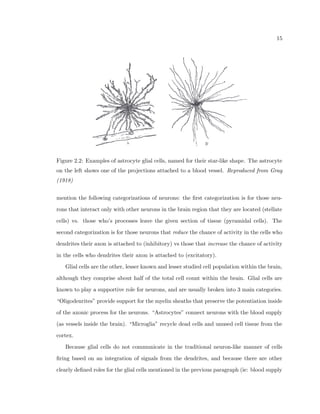
Figure 2.2: Examples of astrocyte glial cells, named for their star-like shape. The astrocyte 
on the left shows one of the projections attached to a blood vessel. Reproduced from Gray 
(1918) 
mention the following categorizations of neurons: the
rst categorization is for those neu-rons 
that interact only with other neurons in the brain region that they are located (stellate 
cells) vs. those who's processes leave the given section of tissue (pyramidal cells). The 
second categorization is for those neurons that reduce the chance of activity in the cells who 
dendrites their axon is attached to (inhibitory) vs those that increase the chance of activity 
in the cells who dendrites their axon is attached to (excitatory). 
Glial cells are the other, lesser known and lesser studied cell population within the brain, 
although they comprise about half of the total cell count within the brain. Glial cells are 
known to play a supportive role for neurons, and are usually broken into 3 main categories. 
Oligodenrites provide support for the myelin sheaths that preserve the potentiation inside 
of the axonic process for the neurons. Astrocytes connect neurons with the blood supply 
(as vessels inside the brain). Microglia recycle dead cells and unused cell tissue from the 
cortex. 
Because glial cells do not communicate in the traditional neuron-like manner of cells
ring based on an integration of signals from the dendrites, and because there are other 
clearly de
ned roles for the glial cells mentioned in the previous paragraph (ie: blood supply
16 
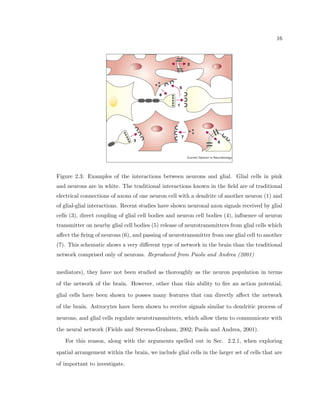
Figure 2.3: Examples of the interactions between neurons and glial. Glial cells in pink 
and neurons are in white. The traditional interactions known in the
eld are of traditional 
electrical connections of axons of one neuron cell with a dendrite of another neuron (1) and 
of glial-glial interactions. Recent studies have shown neuronal axon signals received by glial 
cells (3), direct coupling of glial cell bodies and neuron cell bodies (4), in
uence of neuron 
transmitter on nearby glial cell bodies (5) release of neurotransmitters from glial cells which 
aect the
ring of neurons (6), and passing of neurotransmitter from one glial cell to another 
(7). This schematic shows a very dierent type of network in the brain than the traditional 
network comprised only of neurons. Reproduced from Paola and Andrea (2001) 
mediators), they have not been studied as thoroughly as the neuron population in terms 
of the network of the brain. However, other than this ability to
re an action potential, 
glial cells have been shown to posses many features that can directly aect the network 
of the brain. Astrocytes have been shown to receive signals similar to dendritic process of 
neurons, and glial cells regulate neurotransmitters, which allow them to communicate with 
the neural network (Fields and Stevens-Graham, 2002; Paola and Andrea, 2001). 
For this reason, along with the arguments spelled out in Sec. 2.2.1, when exploring 
spatial arrangement within the brain, we include glial cells in the larger set of cells that are 
of important to investigate.
17 
Figure 2.4: Shows three main areas of the brain: the cortex (top), the cerebellum (lower 
left), and brain stem (bottom). The cortex is split into its main functional areas: the frontal 
lobe, the parietal lobe, the occipital lobe, and the temporal lobe. Reproduced from Gray 
(1918) 
2.1.2 Basic anatomy 
The brain is a biological system that does not adhere to a given rectilinear coordinate 
system. Rather, it is comprised of a set of several major complicatedly curved regions 
that have developed for tasks such as those necessary for bodily function (brain stem), 
muscle coordination (cerebellum) and higher level processing of sensory input (cortex) (see 
Fig. 2.4). 
We focus on the cortex, which can be split up further into areas that focus on certain 
aspects of higher level processing of sensory input, such as integration of sensory information 
(parietal lobe), visual processing (occipital lobe), auditory processing (temporal lobe), and 
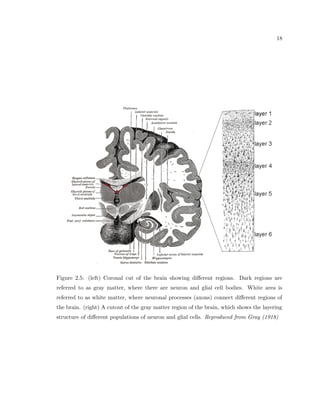
executive function (frontal lobe). The cortex is comprised of the gray matter, the layer of 
neuron and glial cells on the folded surface of the cortex, and white matter, the area which 
is mainly processes (axons) traveling between dierent brain regions (see Fig. 2.5).
18 
Figure 2.5: (left) Coronal cut of the brain showing dierent regions. Dark regions are 
referred to as gray matter, where there are neuron and glial cell bodies. White area is 
referred to as white matter, where neuronal processes (axons) connect dierent regions of 
the brain. (right) A cutout of the gray matter region of the brain, which shows the layering 
structure of dierent populations of neuron and glial cells. Reproduced from Gray (1918)
19 
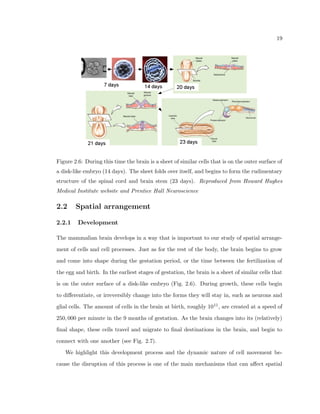
Figure 2.6: During this time the brain is a sheet of similar cells that is on the outer surface of 
a disk-like embryo (14 days). The sheet folds over itself, and begins to form the rudimentary 
structure of the spinal cord and brain stem (23 days). Reproduced from Howard Hughes 
Medical Institute website and Prentice Hall Neuroscience 
2.2 Spatial arrangement 
2.2.1 Development 
The mammalian brain develops in a way that is important to our study of spatial arrange-ment 
of cells and cell processes. Just as for the rest of the body, the brain begins to grow 
and come into shape during the gestation period, or the time between the fertilization of 
the egg and birth. In the earliest stages of gestation, the brain is a sheet of similar cells that 
is on the outer surface of a disk-like embryo (Fig. 2.6). During growth, these cells begin 
to dierentiate, or irreversibly change into the forms they will stay in, such as neurons and 
glial cells. The amount of cells in the brain at birth, roughly 1011, are created at a speed of 
250; 000 per minute in the 9 months of gestation. As the brain changes into its (relatively)
nal shape, these cells travel and migrate to
nal destinations in the brain, and begin to 
connect with one another (see Fig. 2.7). 
We highlight this development process and the dynamic nature of cell movement be-cause 
the disruption of this process is one of the main mechanisms that can aect spatial
20 
Figure 2.7: During growth, these cells begin to dierentiate, or irreversibly change into the 
cells that they will stay as during the life of the animal, such as neurons and glial cells. The 
amount of cells in the brain at birth, roughly 1011, are created at a speed of 250000 per 
minute in the 9 months of gestation. Reproduced from Neuroscience for Kids, University of 
Washington
21 
arrangement of cells within the developed brain. Several diseases such as schizophrenia 
and epilepsy have been attributable to the improper migration of certain cell types during 
gestation (Anderson et al., 1996; Jones et al., 2002). With many of these conditions it is 
not clear what is the direct cause for the loss in function. For example, studies have demon-strated 
that abnormal synaptic pruning in early development or childhood, and abnormal 
functional connectivity in adulthood may be causal factors in schizophrenia (Feinberg, 1982; 
Meyer-Lindenberg et al., 2001). Brain metabolic abnormalities have been observed in bipo-lar 
disorder (Dager et al., 2004), while structural abnormalities have been found to be 
associated with schizophrenia but not bipolar disorder in carefully controlled studies of 
patients and their relatives (McDonald et al., 2004). 
2.2.2 Aging and disease 
There are many hypotheses that address the neuronal basis of cognitive dysfunction in 
various disease states and the cognitive changes in normal aging. In some cases, including 
neurodegenerative disorders like Alzheimers, Parkinsons and Huntingtons disease, the ma-jor 
pathologies are relatively well established as either global loss of neurons in Alzheimers 
disease or focal loss in Parkinsons disease. For example, the underlying pathology in Parkin-sons 
disease has long been known to be due to degeneration of the substantia nigra (a brain 
structure located midbrain that plays an important role in reward, addiction, and move-ment) 
and the concomitant loss of
bers in the nigrostriatal dopaminergic pathway (neural 
pathway that connects the substantia nigra with the striatum) (Roe, 1997). Huntingtons 
disease on the other hand is known to be a disorder that aects other striatal circuits in 
the brain (Charvin et al., 2005). 
Normal aging is characterized by impairments in memory function (Herndon et al., 1997) 
and in executive function (Moore et al., 2005). While the conventional wisdom held that 
age-related cognitive decline is due to loss of neurons, this idea has not withstood scienti
c 
scrutiny as careful studies of both animals and humans have now demonstrated that there is 
no signi
cant loss of cortical neurons in gray matter (Peters et al., 1998). Instead, it seems
22 
likely that age-related atrophy of the forebrain is largely due to loss of cortical white matter 
(Peters and Rosene, 2003). These observations stand in stark contrast to the loss of neurons, 
gray matter, and white matter that occurs in neurodegenerative diseases like Alzheimers 
disease and has forced researchers to look elsewhere to understand the neuroanatomical 
basis of cognitive decline in normal aging. Even in neurodegenerative diseases such as 

Lewy-Body dementia, there is a loss in function that does not correlate with neuron loss 
(Buldyrev et al., 2000). 
2.2.3 Mechanisms 
Changes in spatial arrangement may re
ect small displacements of the soma, but it is 
likely that these somal displacements merely re
ect more widespread alterations in spatial 
relationships of elements in the surrounding neuropil. Candidates for this are changes in 
dendrites that have been demonstrated to undergo atrophy in a number of models of normal 
aging. It is possible that age-related changes in microcolumnar coherence occur in part from 
underlying changes in dendrite structure on a per-region and per-case basis. 
In addition to neurons and dendrites, glial cells are also present in the neuropil and 
spatially associated with dendrites, axons, and neurons. Of the three dierent glial cells, 
the oligodendroglia are critical to maintain normal myelination; astrocytes are intimately 
invested around neuronal somata, dendrites, and synapses as well as nodes of Ranvier on 
myelinated
bers; and microglia respond to damage and produce in
ammation. Moreover, 
astrocyte and microglial processes are known to be relatively motile but the spatial rela-tionship 
of glia to microcolumnar structure is completely unknown. Hence, changes in any 
of these glial elements could aect neurons and their processes. It is therefore possible that 
that age related changes in microcolumnar coherence or changes in dendrites are associated 
with changes in glial cell distribution.
23 
Figure 2.8: Three drawings by Santiago Ramon y Cajal showing the microcolumnar struc-ture 
within gray matter of the cortex from the pia surface (outer surface of the brain)(top) 
to the white matter (bottom). Left: Nissl-stained visual cortex of a human adult. Middle: 
Nissl-stained motor cortex of a human adult. Right: Golgi-stained cortex of a 1 1/2 month 
old infant. Note the tendency of the cells to line up vertically Reproduced from y Cajal 
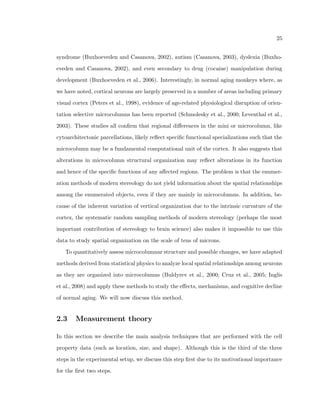
(1899)
24 
2.2.4 Cortical microcolumn 
In terms of age-related de

cits in cognitive function and the possible underlying neurobi-ological 
substrates, the microcolumn is a distinct unit of vertically arranged neurons that 
is second only to horizontal lamination as a distinct feature of the spatial organization of 
cerebral cortex (see Fig. 2.8). Studies of the horizontal lamination have 
ourished for over 
a century and have consistently demonstrated that observable dierences in horizontal lam-ination 
pattern that parcellate the cortex into dierent areas (e.g. Brodmanns or Vogts 
numbered or lettered areas) have consistently turned out to re
ect real functional dier-ences. 
But in contrast to the horizontal lamination that was studied at a scale of centimeters 
or millimeters and can be related to macroscopic variables such as damage due to stroke 
or experimental lesion, the vertical organization exists on a microscopic scale with vertical 
arrays spacing ranging from 20 to 100 microns for the microcolumn and multiple micro-columns 
making up macrocolumns that do not exceed 1 mm (Jones, 2000). In fact, despite 
the visual identi
cation of this vertical organization the potential functional signi
cance of 
the microcolumn was only appreciated after the neurophysiological studies in somatosen-sory 
cortex (Mountcastle, 1957, 1997, 2003) and in visual cortex (Hubel and Wiesel, 1963, 
1977) demonstrated that each microcolumn had unique receptive
eld properties. Since 
then the microcolumn has received occasional attention at a fundamental level (Swindale, 
1990; D. Purves and LaMantia, 1992; Saleem et al., 1993; Tommerdahl et al., 1993; Peters 
and Sethares, 1991; Vercelli et al., 2004) and more recently in the context of cortical patholo-gies 
(Buxhoeveden and Lefkowitz, 1996; Buxhoeveden and Casanova, 2002; Casanova et al., 
2002). Our interest in the microcolumn stems from a growing body of studies that relate 
the anatomy of the microcolumn to loss of function, and which implicate structural changes 
in microcolumns in cognitive changes seen in normal aging and disease states. For exam-ple, 
dierences in neuron distribution in general and within microcolumns are observed in 
normal aging (Cruz et al., 2004; Chance et al., 2006) and in Alzheimer's Disease (VanHoe-sen 
and Solodkin, 1993; Buldyrev et al., 2000). Alterations in microcolumnarity have also 
been reported in schizophrenia (Benes and Bird, 1987; Buxhoeveden et al., 2000), Downs
25 
syndrome (Buxhoeveden and Casanova, 2002), autism (Casanova, 2003), dyslexia (Buxho-eveden 
and Casanova, 2002), and even secondary to drug (cocaine) manipulation during 
development (Buxhoeveden et al., 2006). Interestingly, in normal aging monkeys where, as 
we have noted, cortical neurons are largely preserved in a number of areas including primary 
visual cortex (Peters et al., 1998), evidence of age-related physiological disruption of orien-tation 
selective microcolumns has been reported (Schmolesky et al., 2000; Leventhal et al., 
2003). These studies all con
rm that regional dierences in the mini or microcolumn, like 
cytoarchitectonic parcellations, likely re
ect speci
c functional specializations such that the 
microcolumn may be a fundamental computational unit of the cortex. It also suggests that 
alterations in microcolumn structural organization may re
ect alterations in its function 
and hence of the speci
c functions of any aected regions. The problem is that the enumer-ation 
methods of modern stereology do not yield information about the spatial relationships 
among the enumerated objects, even if they are mainly in microcolumns. In addition, be-cause 
of the inherent variation of vertical organization due to the intrinsic curvature of the 
cortex, the systematic random sampling methods of modern stereology (perhaps the most 
important contribution of stereology to brain science) also makes it impossible to use this 
data to study spatial organization on the scale of tens of microns. 
To quantitatively assess microcolumnar structure and possible changes, we have adapted 
methods derived from statistical physics to analyze local spatial relationships among neurons 
as they are organized into microcolumns (Buldyrev et al., 2000; Cruz et al., 2005; Inglis 
et al., 2008) and apply these methods to study the eects, mechanisms, and cognitive decline 
of normal aging. We will now discuss this method. 
2.3 Measurement theory 
In this section we describe the main analysis techniques that are performed with the cell 
property data (such as location, size, and shape). Although this is the third of the three 
steps in the experimental setup, we discuss this step
rst due to its motivational importance 
for the
rst two steps.
26 
Figure 2.9: Example of tissue sample from the rat brain. 
2.3.1 Raw data 
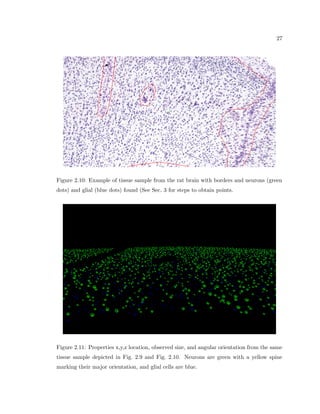
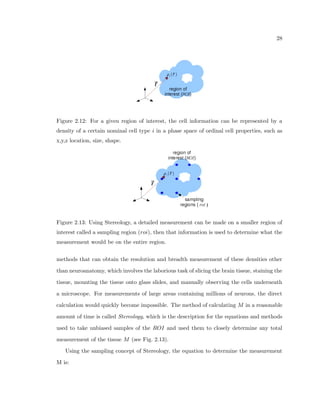
The raw data used in measurements are the cell body properties inside of the tissue (Fig. 2.9 
and Fig. 2.10). Properties such as x,y,z location, observed size, and angular orientation from 
the same tissue sample can then be depicted independent of the original images (Fig 2.11). 
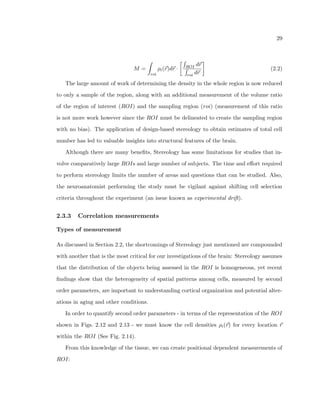
The raw information extracted from the image (as described in Sec. 3) can be represented 
by a nominal cell type i (where i can be neurons or glial cells) in a phase space of ordinal 
cell properties, such as x,y,z location, size, shape (Fig 2.12). 
2.3.2 Stereology 
As mentioned previously, the traditional method of condensing this large amount of data 
into a measurement of the ROI is to integrate the density over the space to obtain a 
measurement M: 
M = 
Z 
ROI 
i(~r)d~r (2.1) 
If this was the
nal equation that is used to obtain a measurement, then the process 
would quickly become prohibitively time consuming. Recall from Fig. 1.1 that there are no
27 
Figure 2.10: Example of tissue sample from the rat brain with borders and neurons (green 
dots) and glial (blue dots) found (See Sec. 3 for steps to obtain points. 
Figure 2.11: Properties x,y,z location, observed size, and angular orientation from the same 
tissue sample depicted in Fig. 2.9 and Fig. 2.10. Neurons are green with a yellow spine 

marking their major orientation, and glial cells are blue.
28 
Figure 2.12: For a given region of interest, the cell information can be represented by a 
density of a certain nominal cell type i in a phase space of ordinal cell properties, such as 
x,y,z location, size, shape. 
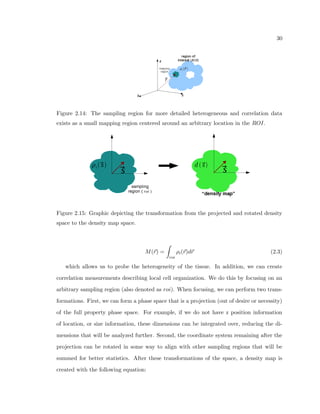
Figure 2.13: Using Stereology, a detailed measurement can be made on a smaller region of 
interest called a sampling region (roi), then that information is used to determine what the 

measurement would be on the entire region. 
methods that can obtain the resolution and breadth measurement of these densities other 
than neuroanatomy, which involves the laborious task of slicing the brain tissue, staining the 
tissue, mounting the tissue onto glass slides, and manually observing the cells underneath 
a microscope. For measurements of large areas containing millions of neurons, the direct 
calculation would quickly become impossible. The method of calculating M in a reasonable 
amount of time is called Stereology, which is the description for the equations and methods 
used to take unbiased samples of the ROI and used them to closely determine any total 
measurement of the tissue M (see Fig. 2.13). 
Using the sampling concept of Stereology, the equation to determine the measurement 
M is:
29 
M = 
Z 
roi 
i(~r)d~r  
R 
ROI d~r R 
roi d~r 
 
(2.2) 
The large amount of work of determining the density in the whole region is now reduced 
to only a sample of the region, along with an additional measurement of the volume ratio 
of the region of interest (ROI) and the sampling region (roi) (measurement of this ratio 
is not more work however since the ROI must be delineated to create the sampling region 
with no bias). The application of design-based stereology to obtain estimates of total cell 
number has led to valuable insights into structural features of the brain. 
Although there are many bene
ts, Stereology has some limitations for studies that in-volve 
comparatively large ROIs and large number of subjects. The time and eort required 
to perform stereology limits the number of areas and questions that can be studied. Also, 
the neuroanatomist performing the study must be vigilant against shifting cell selection 
criteria throughout the experiment (an issue known as experimental drift). 
2.3.3 Correlation measurements 
Types of measurement 
As discussed in Section 2.2, the shortcomings of Stereology just mentioned are compounded 
with another that is the most critical for our investigations of the brain: Stereology assumes 
that the distribution of the objects being assessed in the ROI is homogeneous, yet recent
ndings show that the heterogeneity of spatial patterns among cells, measured by second 
order parameters, are important to understanding cortical organization and potential alter-ations 
in aging and other conditions. 
In order to quantify second order parameters - in terms of the representation of the ROI 
shown in Figs. 2.12 and 2.13 - we must know the cell densities i(~r) for every location ~r 
within the ROI (See Fig. 2.14). 
From this knowledge of the tissue, we can create positional dependent measurements of 
ROI:
30 
Figure 2.14: The sampling region for more detailed heterogeneous and correlation data 
exists as a small mapping region centered around an arbitrary location in the ROI. 
Figure 2.15: Graphic depicting the transformation from the projected and rotated density 
space to the density map space. 
M(~r) = 
Z 
roi 
i(~r)d~r (2.3) 
which allows us to probe the heterogeneity of the tissue. In addition, we can create 
correlation measurements describing local cell organization. We do this by focusing on an 
arbitrary sampling region (also denoted as roi). When focusing, we can perform two trans-formations. 
First, we can form a phase space that is a projection (out of desire or necessity) 
of the full property phase space. For example, if we do not have z position information 
of location, or size information, these dimensions can be integrated over, reducing the di-mensions 
that will be analyzed further. Second, the coordinate system remaining after the 
projection can be rotated in some way to align with other sampling regions that will be 
summed for better statistics. After these transformations of the space, a density map is 
created with the following equation:
31 
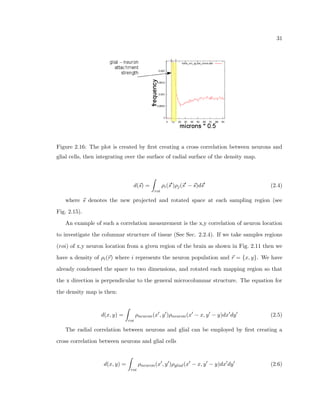
Figure 2.16: The plot is created by
rst creating a cross correlation between neurons and 
glial cells, then integrating over the surface of radial surface of the density map. 
d(~s) = 
Z 
roi 
i(~s0)j(~s0 ~s)d~s0 (2.4) 
where ~s denotes the new projected and rotated space at each sampling region (see 
Fig. 2.15). 
An example of such a correlation measurement is the x,y correlation of neuron location 
to investigate the columnar structure of tissue (See Sec. 2.2.4). If we take samples regions 
(roi) of x,y neuron location from a given region of the brain as shown in Fig. 2.11 then we 
have a density of i(~r) where i represents the neuron population and ~r = fx; yg. We have 
already condensed the space to two dimensions, and rotated each mapping region so that 
the x direction is perpendicular to the general microcolumnar structure. The equation for 
the density map is then: 
d(x; y) = 
Z 
roi 
neuron(x0; y0)neuron(x0  x; y0  y)dx0dy0 (2.5) 
The radial correlation between neurons and glial can be employed by
rst creating a 
cross correlation between neurons and glial cells 
d(x; y) = 
Z 
roi 
neuron(x0; y0)glial(x0  x; y0  y)dx0dy0 (2.6)
32 
then integrating over the surface of radial surface of the density map (see Fig. 2.16). 
d(r) = 
I 
surface 
d(x; y)d~r (2.7) 
where d(x; y) is de
ned in Eq. 2.6. 
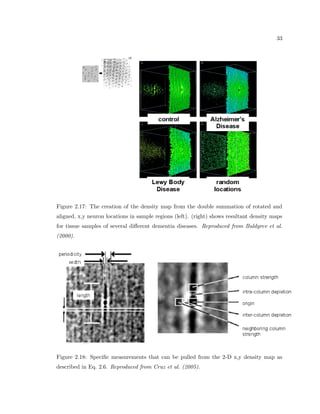
Using this correlation technique, we examined the structural integrity of this new archi-tectural 
feature in two common dementia illnesses, Alzheimer disease and dementia with 
Lewy bodies. In Alzheimer disease, there is a dramatic, nearly complete loss of microcolum-nar 
organization. The relative degree of loss of microcolumns is directly proportional to the 
number of neuro
brillary tangles, but not related to the amount of amyloid-B deposition. 
In dementia with Lewy bodies, a similar disruption of microcolumnar architecture occurs 
despite minimal neuronal loss. These observations show that quantitative analysis of com-plex 
cortical architecture can be applied to analyze the anatomical basis of brain disorders 
(see Fig. 2.17). 
From such density maps, we measure quantitative properties that de
ne the properties 
of a given correlative structure. To do this, we quantitatively measure features inside of the 
density map. For a given density map as shown in Fig. 2.18 properties are measured such 
as the column strength, periodicity of the microcolumn, width, and length. With respect to 
strength, these measurements are determined by the relative density inside verses outside 
of certain areas within the density map. With respect to width, a summation of rows of 
the density map can be made, then the width of the main peak outside of the noise of the 
image is measured. With respect to periodicity, a similar summation of rows is performed, 
then a peak-to-peak measurement is made. 
Quantitative measurement are extracted from the density map shown in Fig. 2.18, like 
the distance between columns, length and width of columns, and strengths of columnar 
properties, which are the relative tendency for cells to be in certain locations with respect 
to one another. The strengths are calculated by measuring the relative dierence in density 
of a particular small region of interest (roi) compared to the density average of the entire 
density map region of interest (ROI):
33 
Figure 2.17: The creation of the density map from the double summation of rotated and 
aligned, x,y neuron locations in sample regions (left). (right) shows resultant density maps 
for tissue samples of several dierent dementia diseases. Reproduced from Buldyrev et al. 
(2000). 
Figure 2.18: Speci
c measurements that can be pulled from the 2-D x,y density map as 
described in Eq. 2.6. Reproduced from Cruz et al. (2005).
34 
Figure 2.19: the roi that is measured are shown in Fig. 2.18 as column strength (known as 
measurement S), intra-column depletion, origin, inter-column depletions, and neighboring 
column strength (known as measurement T). 
M = 
R 
roi d(~s0)d~s0 
R 
ROI d(~s0)d~s0 (2.8) 
The quantities Snum and Tnum are the quantities S and T that they have not been 
normalized by the average density. In certain cases (as will be shown) this gives additional 
information about the spatial properties of cells within the tissue. 
Motivated by the heterogeneous nature of spatial arrangement properties, we develop a 
method of exploring changing properties as one probes in a linear dimension through the 
cortex. Because of the photomontaging ability (see Sec. 3), we are able to measure changes 
of spatial arrangement features seamlessly across thousands of microns. Measurements from 
this analysis can take one of three forms. First, the measurement can act as a probe, so 
that for a given area of the brain, multiple overlapping samples are taken, and a cumulative 
density map is formed based on all sampling regions of a known location. Secondly, local 
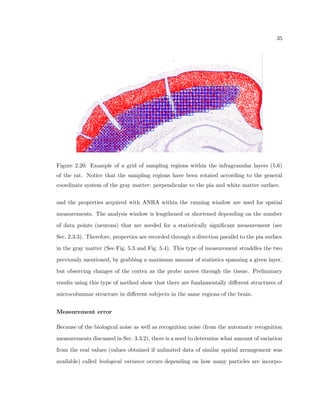
measurements of the correlations can be made by taking a local set of sampling regions and 
creating a density map for each one (See Fig. 2.20). The bene
t of this type of analysis 
is that regions mustn't need to be de
ned before the analysis occurs as required in the 
probe method. Lastly, because of the intrinsic curvature of the cortex, we create tracks 
using the visualization system that serve as a guide to our running window analysis. Once 
the tracks have been de
ned, a running window, or section of the track, is selected,
35 
Figure 2.20: Example of a grid of sampling regions within the infragranular layers (5,6) 
of the rat. Notice that the sampling regions have been rotated according to the general 
coordinate system of the gray matter: perpendicular to the pia and white matter surface. 
and the properties acquired with ANRA within the running window are used for spatial 
measurements. The analysis window is lengthened or shortened depending on the number 
of data points (neurons) that are needed for a statistically signi
cant measurement (see 
Sec. 2.3.3). Therefore, properties are recorded through a direction parallel to the pia surface 
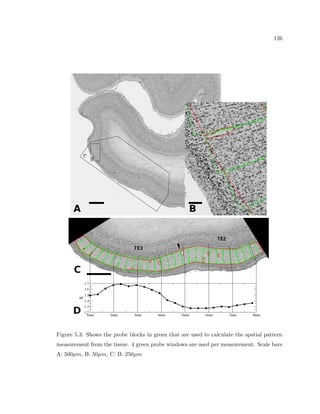
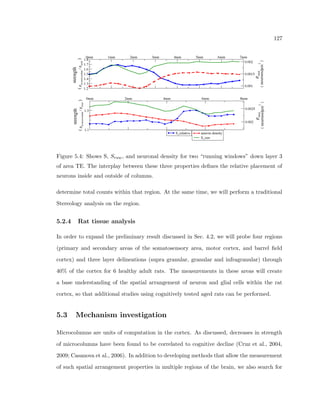
in the gray matter (See Fig. 5.3 and Fig. 5.4). This type of measurement straddles the two 
previously mentioned, by grabbing a maximum amount of statistics spanning a given layer, 
but observing changes of the cortex as the probe moves through the tissue. Preliminary 
results using this type of method show that there are fundamentally dierent structures of 
microcolumnar structure in dierent subjects in the same regions of the brain. 
Measurement error 
Because of the biological noise as well as recognition noise (from the automatic recognition 
measurements discussed in Sec. 3.3.2), there is a need to determine what amount of variation 
from the real values (values obtained if unlimited data of similar spatial arrangement was 
available) called biological variance occurs depending on how many particles are incorpo-
36 
rated in a given measurement. This variation determines the resolution we can see changes 
in neuron spatial organization across the cortex. We investigate this relationship between 
noise, sample size and resolution for all of the measures implemented in the study. We 
investigate these properties explicitly by introducing known distributions of noise into the 
analysis calculations. We also empirically determine variance levels by modeling biological 
and recognition variance into a model of neuron organization. 
It is possible to estimate the upper limit of error that is obtained with such a measure-ment 
by assuming that the cell information is randomly distributed throughout the tissue. 
Here we follow the logic of Buldyrev et al. (2000), but adapt the question from one of being 
able too see a statistically signi
cant features on a pixel by pixel basis (in order to visualize 
spatial arrangement properties as in Fig. 2.17) to one of seeing statistical signi
cance in a 
measurement over a given ROI. For such a random sample, the average number of cells 
 ni  in the measurement area (such as the column strength area in Fig. 2.18) is repre-sented 
by a, where  is the average density of cells and a is the area of the measurement 
window. The standard deviation of the cell count in a Poisson distribution is given as 
p 
 ni . The standard deviation of the density in area a is then 
 = 
p 
a 
a 
= 
r 
 
a 
(2.9) 
The
nal density map is an integral, or summation in discrete terms, of the total number 
of cells N in the ROI, therefore the standard deviation of the density maps is   
p 
N. 
Finally, the error of the measurement of the density map is then 
e = 
1 
p 
aN 
: (2.10) 
We then solve for the number of cell locations needed for a given area measurement, 
average density of cells, and error tolerance: 
N = 
1 
e2a 
: (2.11)
37 
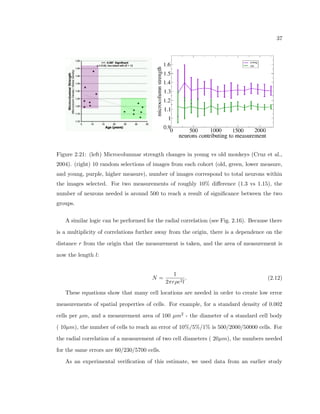
Figure 2.21: (left) Microcolumnar strength changes in young vs old monkeys (Cruz et al., 
2004). (right) 10 random selections of images from each cohort (old, green, lower measure, 
and young, purple, higher measure), number of images correspond to total neurons within 
the images selected. For two measurements of roughly 10% dierence (1.3 vs 1.15), the 
number of neurons needed is around 500 to reach a result of signi
cance between the two 
groups. 
A similar logic can be performed for the radial correlation (see Fig. 2.16). Because there 
is a multiplicity of correlations further away from the origin, there is a dependence on the 
distance r from the origin that the measurement is taken, and the area of measurement is 
now the length l: 
N = 
1 
2re2l 
: (2.12) 
These equations show that many cell locations are needed in order to create low error 
measurements of spatial properties of cells. For example, for a standard density of 0.002 
cells per m, and a measurement area of 100 m2 - the diameter of a standard cell body 
( 10m), the number of cells to reach an error of 10%/5%/1% is 500/2000/50000 cells. For 
the radial correlation of a measurement of two cell diameters ( 20m), the numbers needed 
for the same errors are 60/230/5700 cells. 
As an experimental veri
cation of this estimate, we used data from an earlier study
38 
showing microcolumnar strength changes in young vs old monkeys (Cruz et al., 2004). 
Taking the total number of tissue images and subsequent neuron locations for the young 
and old as two separate datasets (a total of 10,000 neuron locations in each set), we randomly 
pull subsequently larger number of images (and hence neuron locations) to incorporate in 
the measurement of S (see Fig. 2.21). We
nd that for two measurements of roughly 10% 
dierence (1.3 vs 1.15), the number of neurons needed is around 500 to reach a result of 
signi
cance between the two groups. This is the point where the measurement statistical 
noise becomes less than the biological noise of the tissue. 
In this chapter we reviewed the many ways that cells in the brain can be in
uenced 
by there spatial arrangement with respect to one another, and how changes in this spatial 
arrangement can be a marker for other changes in the neuron/glial cell network. We intro-duced 
tools that can be used to measure heterogeneity of average properties of individual 
cells within the brain, and can also quantitatively measure the spatial relationships between 
cells of the same and dierent populations. We tested the statistical robustness of these 
measurements of real data, and found that we can tune the statistical noise of the measure-ment 
to the desired level to be able to see subtle changes in patterns right above biological 
noise that are not visible by the naked eye. We also noted that the number of cells needed 
for these measurements is large, and must be performed locally wherever the measurement 
is taken. 
With this motivation, we move to the next Chapter, which discusses the experimental 
technique to obtain the large datasets needed for large scale correlative analysis within the 
cortex.
Chapter 3 
Experimental Method 
3.1 Introduction 
The purpose of this section is to describe the automated methods developed to quickly and 
eciency acquire individual cell information from brain tissue samples. The goal of these 
methods are to acquire the dataset i(~r) as described in Sec. 2 where  is the density, ~r is 
the position in phase space that holds such a density of cells, and i is the cell population, 
such as neurons, glial cells, or certain delineations within these populations. 
We also note that i(~r) can include other features, such as dendrites or axons. These 
feature's spatial extents are dierent than cell bodies in that they have a longer length 
through the tissue, and cannot be represented by a single x,y,z location. Dendritic processes 
can be fully represented as an angle, length, and position with a known respect to the length, 
for example. 
Focusing on the independent variable ~r, we say that this variable includes every possible 
property that can be measured of the feature: location in space (separable in a convenient 
way into three dimensions x, y, and z) length, area, color, shape (again, separable into 
several quantities such as moments). When a property is not measured or is not of interest, 
then ~r does not include it, and the density used is integrated over that property and the 
new space of interest is probed with ~r0, which is the number of dimensions less the property 
integrated over. 
39
40 
This formalism allows us to measure average, heterogeneous, and correlative properties 
from the same large dataset (~r)i, and therefore separate the creation and analysis of this 
property. 
One other point to note is that the dataset i(~r) is created in a discrete manner: it is 
a list of events (cell bodies, processes), each with a list of properties ~r. All equations of 
averages or correlations that integrate over the density are in reality counting events that 
fall within the space being integrated over. 
In the remainder of this chapter we describe how to obtain the dataset i(~r). The meth-ods 
are split into two parts: 1) digital image acquisition, and 2) automatic cell recognition. 
3.2 Digital image acquisition 
3.2.1 Introduction 
As mentioned in Sec. 1.2, there are several technologies that allow the dataset i(~r) to be 
retrieved in a reasonable amount of time. The
rst part of the analysis - fast digitization of 
tissue samples - takes advantage of CCD imaging technology and computer operated micro-scope 
stages which allow for high speed digitization of the tissue, along with faster transfer 
speeds of data and storage capacities which allow for inexpensive storage of terabytes of 
brain tissue image data. This type of digitization is recently being used in large scale ex-periments 
that require cellular level information from the entire brain (Bernard et al., 2009; 
Lein and Jones, 2007). For this reason, there are many eorts in the
eld to automatically 
digitize tissue quickly (one brain's worth of tissue per day per microscope for example) in 
order to satisfy the retrieval of the desired information from that tissue. In this section 
we describe our own automatic quick digitization systems, where individual cellular and 
cellular processes is the desired information to be retrieved. 
3.2.2 Traditional optical imaging microscope 
We use a system described above at the Boston University Department of Anatomy which 
consists of a 12-bit RGB CCD camera (Retiga, British Columbia, Canada), a motorized
41 
stage platform (Prior Scienti
c, Rockland, MA, USA), a compound microscope system to 
focus light on the tissue and pass the image of the tissue to the CCD camera (Olympus, 
Shinjuku, Tokyo, Japan), and a Linux-based computer with serial port, usb, and
rewire 
capabilities (see Fig. 3.1). The computer controls the appropriate coordination of moving 
the stage and the camera. 
A set of tissue samples is digitized in the following way. First, The optical pathway for 
the particular resolution desired is set up on the microscope. This includes the focusing 
of the light on the tissue sample (Kohler illumination), and aligning all light diaphragms 
to minimize stray rays of light through the optical pathway. The amount of light that is 
allowed to pass through the tissue is maximized by disabling all
lters. This will allow 
for the minimization of the exposure time in the next step. A set of three parameters is 
then created for the digitization: the exposure time of the CCD camera (which enables the 
light entering the camera to take advantage of the 12-bit storage range of the camera), a 
background image (which is subsequently subtracted from each image taken and removes 
variations in light and blemishes that exist not on the tissue sample but in the optical chain 
which would lead to tiling eect in the montages), and the mean and maximum values of 
each channel of a sample image (which allow the color channels to be aligned in intensity, 
thereby creating a white looking background, a process known as white balance. This 
set of parameters can then be used for all digitization for similar tissue samples and as all 
microscope properties stay constant. A mark is then made in the upper left corner of the 
tissue that will be digitized, and the width and height of the region of tissue is recorded. 
The slide (see Fig. 3.2 for example) is then placed on the stage and the optical path 
leading to the CCD is placed at the dot. The program that controls the stage and camera 
is then run with all of information and settings given in the previous paragraph, which 
scrolls through the tissue, taking pictures so that the desired area is covered. The pictures 
are taken with a certain amount of overlap, so that they can be appropriately stitched 
afterwards (see Sec. 3.2.3). Focus is kept at the center of the tissue by periodically scanning 
through the z-axis and measuring the sharpness of the image as it passes through this set
42 
Figure 3.1: We use the following system at the Boston University Department of Anatomy. 
a 12-bit RGB CCD camera (Retiga, British Columbia, Canada), a motorized stage platform 
(Prior Scienti
c, Rockland, MA, USA), a compound microscope system to focus light on 
the tissue and pass the image of the tissue to the CCD camera (Olympus, Shinjuku, Tokyo, 
Japan), and a Linux-based computer with serial port, usb, and
rewire capabilities.
43 
of images in the z plane, known as a z-stack. At each of these periodic checkpoints, the z 
axis is shifted so that it is at the most sharp level. The picture taking rasters through the 
digitized area until it has covered the whole area. 
An advance to this method is to move through the z-axis of the tissue at each x,y, 15% 
overlapped location of the image acquisition, and save each set of the z-stacked images. 
This is advantageous because for objectives of 20x and beyond, the depth of
eld is less 
than the thickness of the mounted tissue. For example, the 20x objective has a 2:5m 
depth of
eld, whereas the thickness of the tissue is 8m. This makes some of the features 
out of focus with this objective. By taking 5 pictures at 2m steps, every feature in the 
tissue is guaranteed to be in focus in at least one image. These images can be stacked 
together to create one image using the information from all of them in the following way: 
each pixel in the
nal image is selected from the z-stack image that has the sharpest
eld 
of pixels (of a given kernel size, e.g., 5x5 pixels) surrounding it. Sharpness is de
ned by the 
summation of the derivative values of the image in the kernel around the pixel. The output 
of this algorithm is an image where none of the features are out of focus and a so-called 
height map which tells what level each pixel came from (see Fig. 3.3). These two pieces 
of information are useful during the recognition phase of the algorithm (see Sec. 3.3) as well 
as to give an added resolution to the z value in the i(~r). Typical images are of 0:32 pixels 
per m, and are of the size 1024x1392 pixels. 
3.2.3 Stitching 
Once the sections are digitized, their relative coordinates are combined by stitching them 
in the x and y directions. For each set of neighboring images, the optimal location for their 
placement is determined by
nding the minimum of the dierence of each overlapped pixel. 
Because of stage misalignment, it is advantageous to be able to search tens of pixels away 
from the prede
ned 15% overlap. To do this eciently, the images are reduced in resolution 
and searched for gross changes optimal overlap, then brought up to the original resolution 
for pixel resolution corrections to the overlap (see Fig. 3.4). The values for every boundary
44 
Figure 3.2: An example of a 2 inch by 3 inch slide that has two sections of tissue from the 
Macaque monkey brain. The dot in the upper left of the slide is the stating point for the 
digitization. 
Figure 3.3: (Left) a single z-level from the 5 that were taken in 2 micron steps, covering 
completely the depth of
eld of the 10 micron thick (shrunk from 30 microns) tissue sample 
with a single depth of
eld of 2 microns. (Middle) the z-stacked image, where all features 
are in focus. (Right) so-called height map which tells what level each pixel came from. 
The average value of this images over the entire cell body shows the relative z placement 
with respect to the other features in the image.
45 
is then taken into consideration as a second set of 512x512 visualization images are created 
that perfectly abut one another (Mikula et al., 2007). 
3.2.4 DMetrix acquisition 
As an alternative to the digitization and stitching as described, we use a proprietary system 
which was designed for high throughput acquisition of tissue samples for virtual viewing of 
tissue (DMetrix, Arizona, USA). Since this system was designed for digital pathology it has 
to be determined if the quality of the images is at a high enough resolution and quality for 
the cell recognition step described in the next section. See Fig. 3.5 for a comparison of the 
tissue qualities.
46 
Figure 3.4: Above, three z-stack images with 15% programmed overlap shown with the 
small corrections from that 15% in order to have perfect overlap. Top image, the image 
boundaries shown, and below, the boundaries are not shown for a seamless montage. The 
space in the lower right hand corner is o of the tissue sample, and was therefore not 
acquired, as no reasonable locational relationship between this image and the others could 
be made.
47 
Figure 3.5: (Left) Traditional Optical Imaging Microscope. (Right) DMetrix Acquisition. 
Image quality is reduced in the DMetrix Acquisition due to fast digitization and compression 
algorithms. However, due to the low complexity of the layout of neurons and glial cells in 
the rat tissue being digitized by the DMetrix system, the lower image quality still oers 
high recognition rates.
48 
3.3 Recognition of cell information 
The purpose of this section is to describe the automated methods developed to quickly and 
eciency acquire individual cell information. This chapter is an upgraded version of Inglis 
et al. (2008). 
There are several challenges to automatically retrieve neuron locations from two-dimensional 
digitized images of Nissl-stained brain tissue (Fig. 3.6a). A major challenge is to distinguish 
cells (such as neurons and glial, and to delineate types within these categories) and non-cell 
objects, including staining errors, tissue folds, dirt particles, and blood vessels. Another 
challenge is to identify cells such as neurons that dier almost as widely from each other as 
they do from non-neuronal objects. Cell bodies are naturally diverse in size and shape and 
neurons have dierent orientations with respect to their dendrite and axon processes. Cells 
can also be cleaved at the cutting surface or damaged by the cutting process, which aects 
their shape in the tissue. These variables lead to diverse cell pro
les within the tissue slice. 
A further challenge is to discriminate between neurons that overlap, a common
nding as 
tissue sections are 3D volumes projected onto a 2D image. 
There are currently several published approaches to automatic retrieval of cell bod-ies 
from images. Some methods use segmentation techniques based on thresholding (Slater 
et al., 1996; Benali et al., 2003), Potts model (Peng et al., 2003), watershed (Lin et al., 2005), 
and active contours (Ray et al., 2002). Others use trained neural networks to mark appro-priately 
sized pixel patches as cells of interest. The pixel patch training methods use 
arti
cial neural networks (Sjostrom et al., 1999), local linear mapping (Nattkemper et al., 
2001), Fischer's linear discriminant (Long et al., 2005), and support vector machines (Long 
et al., 2006). Another method based on template matching has been recently introduced 
by Costa and Bollt (2006). 
We are aware of the current state of the art cell recognition algorithms such as these 
and incorporate their bene

Inglis PhD Thesis

  • 1.
    BOSTON UNIVERSITY GRADUATESCHOOL OF ARTS AND SCIENCES Dissertation MEASURING NEURON/GLIAL CELLULAR ARRANGEMENT IN THE MAMMALIAN CORTEX by ANDREW INGLIS B.S., University of Virginia, 2000 M.A.T., Johns Hopkins University, 2002 Submitted in partial ful
  • 2.
    llment of the requirements for the degree of Doctor of Philosophy 2010
  • 3.
    MEASURING NEURON/GLIAL CELLULARARRANGEMENT IN THE MAMMALIAN CORTEX (Order No. ) ANDREW INGLIS Boston University Graduate School of Arts and Sciences, 2010 Major Professor: H. Eugene Stanley, University Professor and Professor of Physics ABSTRACT The spatial arrangement of cells in the mammalian cortex directly relates to how the brain performs functionally. These cells include neurons, the fundamental building block of the neural network, and glia, which provide regulation, insulation, mechanical support, and nutrition for neurons and their processes. Currently, most analyses of pathological changes in spatial arrangement of neuron and glial cells rely on aberrations of cell placements large enough to be visible by the naked eye. We present a method that enables quanti
  • 4.
    cation of subtlespatial arrangement properties, or patterns, which exist right above biological noise and that may not be visually apparent due to the pattern's subtlety or lack of spatial cohesion. This method enables new comparisons between functional behavior of brain regions and quantitative measurements of detailed morphology within those regions. The method requires a three-fold eort of digitization, recognition, and analysis: we
  • 5.
    rst develop theexperimental platform needed to digitize tissue automatically at high resolution ( 1m per pixel) throughout whole tissue samples spanning the entire brain. We then develop the algorithms necessary to recognize cells within this digitized tissue, focusing on the challenge of delineating between neuron and glial cells in the same tissue sample. Finally, we show the analysis methods that are enabled by the new dataset. Among the methods are traditional measurements of total cell count and density, microcolumnar arrangement of neurons, and cross-correlation analysis between two cell populations such as neurons iv
  • 6.
    and glial cells.These measurements are either taken in known regions of the cortex or as running windows which show changes in spatial properties through the tissue irrespective of region delineations. The statistical robustness of the method is validated by comparing the results with models of multiple cell populations and changing spatial properties. We use the method to analyze cortical tissue samples from the rat and Rhesus monkey, and discuss current theories on mechanisms within the brain that may aect spatial arrangement of cells. Lastly, we describe future directions of study. v
  • 7.
    Contents 1 Introduction1 1.1 Studying the brain with the brain . . . . . . . . . . . . . . . . . . . . . . . 1 1.2 A need for quantitative spatial arrangement tools . . . . . . . . . . . . . . . 3 1.3 Overview of dissertation . . . . . . . . . . . . . . . . . . . . . . . . . . . . . 8 2 Theory and Literature Review 13 2.1 Brain anatomy review . . . . . . . . . . . . . . . . . . . . . . . . . . . . . . 13 2.1.1 Cell types in the brain . . . . . . . . . . . . . . . . . . . . . . . . . . 13 2.1.2 Basic anatomy . . . . . . . . . . . . . . . . . . . . . . . . . . . . . . 17 2.2 Spatial arrangement . . . . . . . . . . . . . . . . . . . . . . . . . . . . . . . 19 2.2.1 Development . . . . . . . . . . . . . . . . . . . . . . . . . . . . . . . 19 2.2.2 Aging and disease . . . . . . . . . . . . . . . . . . . . . . . . . . . . 21 2.2.3 Mechanisms . . . . . . . . . . . . . . . . . . . . . . . . . . . . . . . . 22 2.2.4 Cortical microcolumn . . . . . . . . . . . . . . . . . . . . . . . . . . 22 2.3 Measurement theory . . . . . . . . . . . . . . . . . . . . . . . . . . . . . . . 25 2.3.1 Raw data . . . . . . . . . . . . . . . . . . . . . . . . . . . . . . . . . 25 2.3.2 Stereology . . . . . . . . . . . . . . . . . . . . . . . . . . . . . . . . . 25 2.3.3 Correlation measurements . . . . . . . . . . . . . . . . . . . . . . . . 29 3 Experimental Method 40 3.1 Introduction . . . . . . . . . . . . . . . . . . . . . . . . . . . . . . . . . . . . 40 3.2 Digital image acquisition . . . . . . . . . . . . . . . . . . . . . . . . . . . . . 41 vi
  • 8.
    3.2.1 Introduction .. . . . . . . . . . . . . . . . . . . . . . . . . . . . . . 41 3.2.2 Traditional optical imaging microscope . . . . . . . . . . . . . . . . . 41 3.2.3 Stitching . . . . . . . . . . . . . . . . . . . . . . . . . . . . . . . . . 44 3.2.4 DMetrix acquisition . . . . . . . . . . . . . . . . . . . . . . . . . . . 46 3.3 Recognition of cell information . . . . . . . . . . . . . . . . . . . . . . . . . 49 3.3.1 Methods . . . . . . . . . . . . . . . . . . . . . . . . . . . . . . . . . . 54 3.3.2 Recognition results . . . . . . . . . . . . . . . . . . . . . . . . . . . . 75 3.3.3 Discussion . . . . . . . . . . . . . . . . . . . . . . . . . . . . . . . . . 78 3.3.4 Software . . . . . . . . . . . . . . . . . . . . . . . . . . . . . . . . . . 80 3.3.5 Validation by comparing with Stereology . . . . . . . . . . . . . . . 80 4 Results 97 4.1 Macaque monkey . . . . . . . . . . . . . . . . . . . . . . . . . . . . . . . . . 97 4.1.1 Subjects . . . . . . . . . . . . . . . . . . . . . . . . . . . . . . . . . . 97 4.1.2 Area 46 dorsal/ventral studies . . . . . . . . . . . . . . . . . . . . . 98 4.1.3 Area TE studies . . . . . . . . . . . . . . . . . . . . . . . . . . . . . 105 4.1.4 Area TE comparison with model . . . . . . . . . . . . . . . . . . . . 109 4.2 Rat tissue . . . . . . . . . . . . . . . . . . . . . . . . . . . . . . . . . . . . . 117 5 Future studies 122 5.1 Database integration . . . . . . . . . . . . . . . . . . . . . . . . . . . . . . . 122 5.2 Next area analysis . . . . . . . . . . . . . . . . . . . . . . . . . . . . . . . . 123 5.2.1 46DV analysis . . . . . . . . . . . . . . . . . . . . . . . . . . . . . . 123 5.2.2 TE analysis . . . . . . . . . . . . . . . . . . . . . . . . . . . . . . . . 127 5.2.3 Frontal lobe analysis . . . . . . . . . . . . . . . . . . . . . . . . . . . 128 5.2.4 Rat tissue analysis . . . . . . . . . . . . . . . . . . . . . . . . . . . . 128 5.3 Mechanism investigation . . . . . . . . . . . . . . . . . . . . . . . . . . . . . 128 5.3.1 Perineuronal net . . . . . . . . . . . . . . . . . . . . . . . . . . . . . 129 5.3.2 Dendrites and glia . . . . . . . . . . . . . . . . . . . . . . . . . . . . 130 vii
  • 9.
    5.4 Additional correlations. . . . . . . . . . . . . . . . . . . . . . . . . . . . . . 131 5.5 Modeling and networks . . . . . . . . . . . . . . . . . . . . . . . . . . . . . 132 Bibliography 135 Curriculum Vitae 145 viii
  • 10.
    List of Figures 1.1 Brain investigation methods phase space . . . . . . . . . . . . . . . . . . . . 2 1.2 Epileptic seizure displasia . . . . . . . . . . . . . . . . . . . . . . . . . . . . 4 1.3 Example of the measurement of the columnarity of neurons . . . . . . . . . 5 2.1 Examples of neurons . . . . . . . . . . . . . . . . . . . . . . . . . . . . . . . 14 2.2 Examples of glial . . . . . . . . . . . . . . . . . . . . . . . . . . . . . . . . . 15 2.3 Theory of glial-neuron interactions . . . . . . . . . . . . . . . . . . . . . . . 16 2.4 Side view of the brain . . . . . . . . . . . . . . . . . . . . . . . . . . . . . . 17 2.5 Coronal section of the brain and layers . . . . . . . . . . . . . . . . . . . . . 18 2.6 Human development from 0 to 3 weeks of gestation . . . . . . . . . . . . . . 19 2.7 Human development from 3 weeks to 9 months . . . . . . . . . . . . . . . . 20 2.8 Example of microcolumnar structure . . . . . . . . . . . . . . . . . . . . . . 23 2.9 Example of tissue . . . . . . . . . . . . . . . . . . . . . . . . . . . . . . . . . 26 2.10 Example of tissue with cell locations . . . . . . . . . . . . . . . . . . . . . . 26 2.11 Properties of cells . . . . . . . . . . . . . . . . . . . . . . . . . . . . . . . . . 27 2.12 Region of interest . . . . . . . . . . . . . . . . . . . . . . . . . . . . . . . . . 27 2.13 Stereological sample . . . . . . . . . . . . . . . . . . . . . . . . . . . . . . . 28 2.14 Correlation mapping sample . . . . . . . . . . . . . . . . . . . . . . . . . . . 30 2.15 Coordinate space to density map space . . . . . . . . . . . . . . . . . . . . . 30 2.16 Radial correlation between neurons and glial cells . . . . . . . . . . . . . . . 32 2.17 Density maps for common dementias . . . . . . . . . . . . . . . . . . . . . . 33 2.18 Microcolumnar measures . . . . . . . . . . . . . . . . . . . . . . . . . . . . . 34 ix
  • 11.
    2.19 Quantifying microcolumnarmeasures . . . . . . . . . . . . . . . . . . . . . . 35 2.20 Map analysis of tissue properties . . . . . . . . . . . . . . . . . . . . . . . . 36 2.21 Required cell numbers for correlation analysis . . . . . . . . . . . . . . . . . 38 3.1 Montaging computer . . . . . . . . . . . . . . . . . . . . . . . . . . . . . . . 43 3.2 Slide example . . . . . . . . . . . . . . . . . . . . . . . . . . . . . . . . . . . 45 3.3 Z-Stack example . . . . . . . . . . . . . . . . . . . . . . . . . . . . . . . . . 45 3.4 Stitching example . . . . . . . . . . . . . . . . . . . . . . . . . . . . . . . . . 47 3.5 Comparison of two digitization techniques . . . . . . . . . . . . . . . . . . . 48 3.6 Challenges of automated neuron recognition . . . . . . . . . . . . . . . . . . 50 3.7 Monkey tissue database . . . . . . . . . . . . . . . . . . . . . . . . . . . . . 52 3.8 Automated Neuron Recognition Algorithm (ANRA) . . . . . . . . . . . . . 53 3.9 Examples of the ANRA visualization system . . . . . . . . . . . . . . . . . . 55 3.10 Image pre-processing . . . . . . . . . . . . . . . . . . . . . . . . . . . . . . . 56 3.11 Steps of segmentation module 1 . . . . . . . . . . . . . . . . . . . . . . . . . 59 3.12 Active contour control points . . . . . . . . . . . . . . . . . . . . . . . . . . 60 3.13 Examples of active contour movement . . . . . . . . . . . . . . . . . . . . . 62 3.14 Energies of active contour during movement . . . . . . . . . . . . . . . . . . 63 3.15 Control point movement . . . . . . . . . . . . . . . . . . . . . . . . . . . . . 63 3.16 Multithreshold method of segmentation . . . . . . . . . . . . . . . . . . . . 68 3.17 Example of multithreshold method . . . . . . . . . . . . . . . . . . . . . . . 69 3.18 Example of images for single threshold . . . . . . . . . . . . . . . . . . . . . 70 3.19 Example of gold standard selection . . . . . . . . . . . . . . . . . . . . . . . 71 3.20 Example of gold standard marks . . . . . . . . . . . . . . . . . . . . . . . . 72 3.21 Overlap of segmentations . . . . . . . . . . . . . . . . . . . . . . . . . . . . 83 3.22 Use of gold standard marks in training . . . . . . . . . . . . . . . . . . . . . 84 3.23 Origional set of segment properties . . . . . . . . . . . . . . . . . . . . . . . 85 3.24 Hu invariant moment measurements . . . . . . . . . . . . . . . . . . . . . . 86 x
  • 12.
    3.25 Example ofsegmentation parameters . . . . . . . . . . . . . . . . . . . . . . 87 3.26 Schematic of Multi-layer Percepton . . . . . . . . . . . . . . . . . . . . . . . 88 3.27 Example of ANRA output . . . . . . . . . . . . . . . . . . . . . . . . . . . . 89 3.28 Recognition quality de
  • 13.
    nitions . .. . . . . . . . . . . . . . . . . . . . . . . 90 3.29 Detailed active contour segmentation results . . . . . . . . . . . . . . . . . . 91 3.30 Comparison of ANRA and semi-automatic method . . . . . . . . . . . . . . 92 3.31 ANRA results . . . . . . . . . . . . . . . . . . . . . . . . . . . . . . . . . . . 93 3.32 ANRA / semiautomatic comparison . . . . . . . . . . . . . . . . . . . . . . 94 3.33 Eect of reduction in recognition rate on measurements . . . . . . . . . . . 95 3.34 Eect of adding random false positives on measurements . . . . . . . . . . . 96 3.35 Comparison of ANRA with stereology for a neuron counting study . . . . . 96 4.1 Raw data overview, 46dv, female monkey . . . . . . . . . . . . . . . . . . . 99 4.2 Average values of measures of microcolumnarity . . . . . . . . . . . . . . . 100 4.3 Microcolumnar relationships in area 46 of the female monkey . . . . . . . . 100 4.4 Microcolumnar strength in dorsal vs. ventral portion of the brain . . . . . . 101 4.5 Microcolumnar strength in relation to behavior . . . . . . . . . . . . . . . . 104 4.6 Data acquisition for area TE . . . . . . . . . . . . . . . . . . . . . . . . . . 106 4.7 Raw data overview, TE, female monkey . . . . . . . . . . . . . . . . . . . . 107 4.8 Microcolumnar relationships in area TE of the female monkey, compared with 46dv . . . . . . . . . . . . . . . . . . . . . . . . . . . . . . . . . . . . . 107 4.9 Microcolumnarity of TE vs age, compared with 46dv . . . . . . . . . . . . . 108 4.10 Preliminary running window result in area TE . . . . . . . . . . . . . . . . 108 4.11 Schematic diagram showing the variables in the model . . . . . . . . . . . . 110 4.12 Microcolumnar model . . . . . . . . . . . . . . . . . . . . . . . . . . . . . . 111 4.13 Front and top view of examples of model neuron con
  • 14.
    gurations . .. . . . . 112 4.14 Modelling tissue angle of cut . . . . . . . . . . . . . . . . . . . . . . . . . . 114 4.15 Part 1 of 2 of changing density model comparison . . . . . . . . . . . . . . . 115 xi
  • 15.
    4.16 Part 2of 2 of changing density model comparison . . . . . . . . . . . . . . . 116 4.17 Model generation to align with features of area TE . . . . . . . . . . . . . . 118 4.18 Depiction of 5 million neuron and glial locations within the rat brain . . . . 119 4.19 Probe analysis focusing on dierent layers of the rat cortex . . . . . . . . . 121 5.1 Original image data from area 46 . . . . . . . . . . . . . . . . . . . . . . . . 124 5.2 New measurements for area 46 . . . . . . . . . . . . . . . . . . . . . . . . . 125 5.3 New running window measurement for area TE . . . . . . . . . . . . . . . . 126 5.4 Comparison of two running window results for area TE . . . . . . . . . . . 127 5.5 Example of other properties to correlate . . . . . . . . . . . . . . . . . . . . 132 5.6 modeling network connectivity . . . . . . . . . . . . . . . . . . . . . . . . . 134 xii
  • 16.
    List of Abbreviations 2PI two-photon imaging ABA Allen Brain Atlas ANRA Automatic Neuron Recognition Algorithm CCD charge-coupled device CS case studies CT computed tomography DTI diusion tensor imaging ECM extracellular matrix EEG electroencephalography FCD focal cortical displacias fMRI functional magnetic resonance imaging ISH in-situ hybridization MC motor cortex MEG magnetoencephalography MLP multi-layer perceptron MRI magnetic resonance imaging NA neuroanatomy NE needle electrodes PET positron emission tomography PN perineuronal net RGB red-green-blue xiii
  • 17.
    ROC receiver operatorcharacteristic ROI region of interest SS somatosensory cortex xiv
  • 18.
    Chapter 1 Introduction 1.1 Studying the brain with the brain The past decade has witnessed a surge in research eort dedicated to investigating the mammalian brain. In addition to the large motivating factor of understanding how our minds work, the surge is supported by an continually advancing set of technology aided measurement tools to allow higher resolution and more complex measurements. Even with the increased eort and technology, however, there still remains only a handful fundamental ways to measure brain activity, processes, and makeup (ie: fMRI, stereology, individual neuron potentials, etc.). These methods contribute distinct measurements of the brain by falling within particular ranges of three scales: spatial, ranging from inches to nanometers, temporal, ranging from years to milliseconds, and breadth scale, ranging from individual neuron measurements to whole brain measurements. It is worth noting that no measurement tool is maximized in all three categories (Fig. 1.1). For example, while fMRI measurements span the entire brain, the spatial resolution only allows the combined eect of hundreds of neurons
  • 19.
    ring together tobe resolved. Another example, needle electrode measurements, have a high temporal resolution within the millisecond range, but cannot identify single neurons, and only extend thousands of neurons, or cubic millimeters, of volume. All in all, researchers have attempted to
  • 20.
    ll this phasespace in order to leave no stone unturned in the dicult task of understanding brain processes. 1
  • 21.
    2 Figure 1.1:Symbols stand for the following: neuroanatomy (NA), diusion tensor imaging (DTI), computed tomography (CT), magnetic resonance imaging (MRI), positron emission tomography (PET), functional magnetic resonance imaging (fMRI), two-photon imaging (2PI), needle electrodes (NE), magnetoencephalography (MEG), electroencephalography (EEG), case studies (CS).
  • 22.
    3 By collectingindividual neuron and other cell body properties (such as glial cells) of location, size, and shape, from every cell within an extent of the entire brain at micron resolution, we are able to create a map of spatial arrangement properties of cell bodies with respect to one other throughout the entire cortex, adding a new way to measure the brain within the triptych of temporal scale, spatial scale, and extent. 1.2 A need for quantitative spatial arrangement tools In a recent special issue of Child's Nervous System, researchers and doctors gave an update on the best methods for treating children with severe epileptic seizures (Hildebrandt et al., 2005). Two reports in the issue gave overviews of an eect called focal cortical displacias, which means that there are drastic changes (displacias) that occur in the local (focal) ar-rangement of cells in the regions that are aected by the seizures (cortical) (Rickert, 2006; Rocco and Tamburrini, 2005). In the task of stopping seizures from occurring, understand-ing these subtle but statistically signicant neuroanatomical abnormalities is a fundamental step to understanding how the seizures occur, how seizures damage the brain, and how to stop seizures in the future. One example of focal cortical displacia is a heightened tendency for neurons to align vertically into a columnar structure in brain areas that experienced epileptic activity compared to similar brain areas that did not experience epileptic activity (Fig. 1.2). Many questions arise from the
  • 23.
    ndings of thisstudy on focal cortical displacias in epilep-tic patients. How is the alignment of the neurons in a speci
  • 24.
    c brain arearelated to the epileptic
  • 25.
    ring within thatarea? Are brains with higher columnarity more prone to epilep-tic activity, or is the columnarity an aect of the seizures? How does the structure of the neurons hint to how the neurons are connected with one another? The answers to these and many other questions can come in many forms, such as performing the analysis on many more human subjects, by recreating the eect of epileptic seizure in another animal type, such as a rat, or by modeling the connections of the neurons in silico (with computers). There is a fundamental question that underlies the exploration of all of these questions:
  • 26.
    4 Figure 1.2:Cortical architecture in a young control specimen (A) vs a patient with catas-trophic epilepsy (B), showing prominent columnar arrangements of cortical neurons. Re- produced from Hildebrandt et al. (2005). How can the spatial arrangement patterns within the brain be measured quantitatively? Quantitative analysis is needed in order to build upon the investigation in a coherent man-ner. We could make a distinction between a qualitative measurement of a spatial pattern (ie: the neurons are aligned into columns) and a quantitative one (ie: the neurons are aligned X%, where 0% is no alignment, and 100% is complete alignment). The former result can only motivate other researchers to study the system with more quantitative analysis, and the latter creates a base analysis that can be expanded and built upon: the measurement can be compared with others in other studies, statistical signi
  • 27.
    cance between twopopulations can be determined, ranges of the measurement can be related to ranges in functional behavior of the system, new studies can change the system and see the eect of the measurement, rudimentary correlations between variables can be constructed, new hypothesis can be constructed, and so on. With this bene
  • 28.
    t of quantitativeanalysis in mind, Hildebrandt et al. (2005) provide such a measurement: The visual
  • 29.
    eld of theimages is divided into horizontal segments of 20m width (according to the average diameter of NeuN-stained cortical neurons in lamina
  • 30.
    5 Figure 1.3:Gaussian distribution of vertically oriented neuronal cell cluster in FCD and controls. Mean neuronal numbers are higher in FCD specimens compared to controls. The variance of neuron numbers is also signicantly broader in specimens with FCD compared to controls. Reproduced from Hildebrandt et al. (2005). III). The numbers counted are then histogramed (Fig. 1.3). A dierence between the two populations can clearly be seen, and a statistically signi
  • 31.
    cant dierence canbe seen in both the mean and variance of the average number of cells within each horizontal segment. The methods of Hildebrandt et al. (2005)'s are an example of a neuroanatomist's de-sire to go beyond the traditional methods available to them in the
  • 32.
    eld of neuroanatomy. Traditionally, a method called stereology is been used to analyze brain tissue. Stereology is a powerful sampling algorithm that measures a property in a region of interest (ROI) of the brain by only requiring a small sample of that ROI to be measured accurately by a researcher. An analogous situation is to determine the total number of people that use a building's entrance in a week by only picking several
  • 33.
    ve minute intervalsto count, and scaling the result up by multiplying by the ratio of one week's time to how long the mea-sured was performed. If done correctly, an unbiased measurement can be performed, which is exactly what Stereology oers to the
  • 34.
    eld of neuroscience(Mayhew, 1991; Schmitz and
  • 35.
    6 Hof, 2005). Although there are many bene
  • 36.
    ts, stereology hassome limitations for studies that in-volve comparatively large ROIs and large number of subjects. The time and eort required to perform stereology limits the number of areas and questions that can be studied. Also, the stereologist performing the study must be vigilant against shifting cell selection criteria throughout the experiment (an issue known as experimental drift). Most importantly, stereology can only measure so-called
  • 37.
    rst order stereologicalpa-rameters like total cell count, which only partially describe the structural organization within the brain. It cannot eciently quantify second order parameters that measure more complex spatial properties of neuron organization, such as the cortical changes occur-ring in the epileptic study. In addition to the epileptic study (Hildebrandt et al., 2005), other recent
  • 38.
    ndings show thatmeasuring the heterogeneity of spatial patterns among cells is im-portant to understanding cortical organization and potential alterations in aging or other conditions (Asare, 1996; Schmitz et al., 2002; Duyckaerts and Godefroy, 2000; Krasnoperov and Stoyan, 2004; Hof et al., 2003; Urbanc et al., 2002; Cruz et al., 2005; Buldyrev et al., 2000; Buxhoeveden and Lefkowitz, 1996). Several approaches can be used to quantify second order parameters. Stereological methods have been developed to quantify nearest-neighbor arrangement (Schmitz et al., 2002), but the methods are labor intensive and would be dicult to apply to large brain areas. Image Fourier methods do not require manual marking of neuron locations and can quantify vertical bias of objects within an image (Casanova et al., 2006), but do not discern between the contribution from glial and neuronal cell bodies or the variability of staining intensity of any given cell. A new paradigm must be developed then for the measurement of second order parameters. In thinking of new types of measurements of cortical tissue, one can learn much from the positive attributes of Stereology. First, Stereology can be unbiased, which means that the measurements are not aected by systematic errors that can deviate the results in unknown ways. Secondly, Stereology is able to quantify its ability to discern subtle dierences, and
  • 39.
    7 this abilitycan be adapted by sampling more tissue. Lastly, Stereology is able to make measurements through the entire brain. It is these three properties that make Stereology a powerful method. It is our goal to incorporated these properties into a measurement tool for second order, spatial arrangement properties of the brain. We attempt to satisfy such measurement attributes by automatically collecting individ-ual neuron and other cell body properties (such as glial cells) of location, size, and shape, from every neuron within an extent of the ROI. The automatic nature of the measurement allows it to be performed in large datasets and reduces biases that are attributable to the experimental drift mentioned earlier. It also allows for measurements based on the highest level of statistics possible, in order to have the maximal discernibility of a feature above biological noise. The basic pillars of Stereology thereby attempted to be attained, we also mention an additional and exciting quality of such a method: it moves the neuroanatomical exploration of the brain away from a hypothesis driven model to a more of a data driven model: due to the time consuming nature of stereology, studies that investigate detailed anatomy are resource intensive, therefore only the investigations perceived to be the most salient are performed. The ability to perform investigations to answer quick hypothesis driven questions, or to search for unknown correlations that are not thought of by the re-searcher are not available in the
  • 40.
    eld. Our methodenables such studies in neuroanatomy research, and therefore can open new pathways to discover underlying principles of anatom-ical organization. There are several technologies that allow this type of analysis. First, the data transfer and storage capacities needed to inexpensively store terabytes of brain tissue image data has only recently become available. Also, the computing power to measure millions of neu-ron properties from slices of brain tissue in a timely manner has also only recently become available. Furthermore, the advances in CCD imaging technology and computer operated microscope stages now allow for high speed digitization of the tissue to be automatically an-alyzed by a computer. Lastly, ecient machine learning algorithms have become advanced enough to solve complex automatic recognition problems. This type of development in fast
  • 41.
    8 computing andstorage space, commonly known to have revolutionized the study of genetics and computer science, is also advancing anatomical brain sciences in this project and others (Jones et al., 2009). 1.3 Overview of dissertation In this
  • 42.
    rst chapter ofthis Dissertation, we have given a motivation for the need to be able to measure subtle patterns of cellular arrangement in the brain, and have given a brief overview of the our method. In Chapter 2 we further motivate the main investigation of spatial arrangement of brain cells by reviewing known and possible sources of cell arrangement features within the brain, then describe the hypotheses to be studied. We then review the mathematical framework used in the analysis. We describe the new measurements motivated by statistical physics that are used on the experimental cell property data. As described in the previous section (Sec. 1.2), this data consists of millions of neuron and glial cell properties such as location, size and shape. As within many
  • 43.
    elds of physics,our goal is to condense the inherent complexity and variability of such a large biological system by condensing the information into single measurements, but also be careful not to throw out meaningful qualities and information during the process. We investigate and use several analysis tools, ranging from traditional density and neuron count, to histogram distributions of properties, to multi-dimensional correlative analysis. We show how the overall method can recreate the methods of Stereology, and add addi-tional insight to the traditional methods by enabling heterogeneities of traditional features such as density and count to be seen in the ROI. We then move to pair-correlation analysis, which observes the relationships between particles rather than just the average properties of individual particles in a system. Such measurement's ability to glean illustrative properties of noisy complex systems of particles make them appealing as tools to study biological sys-tems with many particles such as neuron or glial cells. Pair correlation methods have been used to explore relationships between two dierent types of objects such as neurons and
  • 44.
  • 45.
    brillary plaques (Urbancet al., 2002) and the relationship between neuron cell bodies (Buldyrev et al., 2000). By using a two-dimensional pair-correlation involving the relative separations of neurons, we discover the tendency for neurons to align perpendicularly to the cortex surface, and are able to measure the strength of microcolumnar order and micro-columnar width and length (Cruz et al., 2005). In addition to these correlation methods, which use the locational spatial properties, we also discuss correlations using the size and shape properties of cells which can give axon/dendrite process directions and neuron/cell type information. We also investigate cross correlations between glial cells and neurons. Motivated by the heterogeneous nature of spatial arrangement properties, we develop a method of exploring changing properties as one probes in a linear dimension through the cortex. Because of the photomontaging ability, we are able to measure changes of spatial arrangement features seamlessly across tens of thousands of microns. Because of the intrinsic curvature of the cortex, we create tracks using the visualization system that serve as a guide to our running window analysis. Once the tracks have been de
  • 46.
    ned, a runningwindow, or section of the track, is selected, and the x,y locations acquired with ANRA within the running window are used for spatial measurements. The analysis window is lengthened or shortened depending on the number of data points (cell bodies) that are needed for a statistically signi
  • 47.
    cant measurement. Becauseof the biological noise, recognition error (from the automatic recognition mea-surements), and the dependence of the statistical measurements on the complex coordinate system of the brain, there is a need to validate the data recognition and measurement tools on a model of cells. These types of validation studies using models are an attempt to be as true as possible to the high standards that Stereology has bring to the study of neuroanatomy. We do this by determining the eects of recognition and orientation on the ability to discern subtle changes in the measurements as we either probe the tissue, or pass across the tissue in the running window analysis. One main goal is to determine what amount of variation from the real values (values obtained if unlimited data of similar spatial arrangement was available) occurs depending on how many particles are incorporated in
  • 48.
    10 a givenmeasurement. This variation determines the spatial resolution we can see changes within across the cortex. We investigate this relationship between noise, sample size and resolution for all of the measures implemented in the study. We investigate these properties explicitly by introducing known distributions of noise into the analysis calculations. We also empirically determine variance levels by modeling biological and recognition variance into a model of cell organization. In Chapter 3 we motivate and describe the new experimental tool to collect data from the brain, called the Automatic Neuron Recognition Algorithm, or ANRA. Individual lo-cations of many neuronal cell bodies ( 104) are needed to enable statistically signi
  • 49.
    cant measurements ofspatial organization within the brain such as nearest-neighbor and micro-columnarity measurements, as well as enable investigations on the heterogeneity of neuron properties within a given region. As mentioned earlier, the acquisition of such numbers of neurons by manually or semi-automatically identifying and marking the location of each is prohibitively time-consuming and open to user bias. ANRA is the experimental technique that allows the acquisition of such large numbers of neuron properties with the maximal eciency and accuracy aorded by current computing techniques. ANRA automatically obtains the (x,y,z) location of individual cells (along with proper-ties such as observed size, shape, and type of neuron or glial cell) within digitized images of single or multiple stained tissue. Nissl-staining has the unique advantage of being the least expensive, easiest applied, and most durable method for staining both neurons and glia. Stores of archival brain tissue that exist in laboratories and research collections around the world is stained with the Nissl method. Proper identi
  • 50.
    cation of neuronsand glial cells within such Nissl-stained sections is inherently dicult however due to the variability in neuron staining, the overlap of neuron and glial cells with one another, the presence of partial or damaged neurons at tissue surfaces, and the presence of non-cell objects such as blood vessels. To overcome these challenges and identify neurons, ANRA applies a combi-nation of image segmentation and machine learning (Inglis et al., 2008). The steps involve teaching the computer to
  • 51.
    nd cells bygiving the computer examples of correctly identi-
  • 52.
  • 53.
    ed cells, thenthe computer performs color selection (in the case of counter-stained tissue), segmentation to
  • 54.
    nd outlines ofpotential cells, then arti
  • 55.
    cial neural networktraining in order to distinguish between neurons, glia, and non-neuron segmentations. Furthermore, ANRA allows the user to explore various segmentation and training mod-ules that give the optimal result for varying image type and quality. It then stores the parameter selection and training created by the neuro-anatomist in order to be reused as similar areas of other brain sections to be analyzed. The end result is a platform that combines the most advanced machine learning and segmentation technology available in order to analyze readily available tissue samples and create datasets of millions of brain cell properties for further analysis. Through the control of a motorized stage, images are acquired with a small overlap, allowing the creation of whole hemisphere photomontages that can serve as input to any of our proposed analyses. Cells are automatically found within the montage using ANRA on large regions of the brain using a single coordinate system, rather than thousands of disjointed images. The viewing interface for ANRA allows the researcher to y through the montaged tissue samples and neuron measurement results similar to BrainMaps.org (Mikula et al., 2007). This enables researchers and expert neuroanatomists to perform the host of experimental techniques on the project such as machine training, veri
  • 56.
    cation, marking traditionalboundaries, making contours to perform running window analysis, and organize data storage during the data acquisition process. It also enables the user to display the results of the correlative analysis in a topographical manner. In Chapter 4, we give the results obtained by the new method focusing on proof of concept and validation of the automatic model. The results use two datasets: the adult Fischer-344 brown rat brain studied at the University of Arizona, and the Macaque monkey brain studied at the Boston University Medical school. We review results obtained from manual acquisition of cell information from Macaque monkey tissue and show the initial results using the new ANRA method within similar studies. We also use modeling to explain correlations found within the results measuring microcolumnar properties within the
  • 57.
    12 monkey tissue.We then give preliminary results performed on the rat cortex, incorporating cell size and cell type analysis in addition to the measurement of microcolumnar properties. The methods developed in this dissertation, as well as the preliminary results, have been performed to allow a continued research eort. In Chapter 5, we describe the next steps and future directions of the project.
  • 58.
    Chapter 2 Theoryand Literature Review In this chapter we will further motivate our overarching method of digitization, recognition, and analysis by reviewing current challenges of investigating the cortex using traditional spatial arrangement methods, then introducing the theory behind our new methods as an additional and necessary tool. This chapter also rearms the study of neuroanatomy as one of the most powerful ways to investigate the brain, even with the advent of newer methods as described in section 1.1. 2.1 Brain anatomy review 2.1.1 Cell types in the brain The two major cell types in the brain are neurons and glial cells. Neurons are thought to be the fundamental building block of the electrical network that produces the major actions of the brain, such as sensory input, motor control, memory, and consciousness. Neurons share a common set of properties that have led researchers to believe that they are the fundamental processing unit of the brain. These features are the so called processes that emit from the main part of the cell body and which connect to other neuron cell bodies. The two main categories of processes are those that receive information from other neurons called dendrites, and processes that transmit information to other cells called the axon. There are usually many dendrites, and usually one axon. The neuron 13
  • 59.
    14 Figure 2.1:Examples of neuron shape, size, and type. A. Pyramidal cell. B. Small multipo-lar cell, in which the axon quickly divides into numerous branches. C. Small fusiform cell. D. and E. Ganglion cells (E shows T-shaped division of axon). ax. stands for the axon, the process that transmits information to other cells. Reproduced from Gray (1918) therefore is thought to integrate all of the signals that enter from the dendritic processes, and use this information to decide whether, and how, to
  • 60.
    re it's ownsignal from its axon, a signal that is then picked up by the dendrites of other processes. The signals that enter the cell body from the dendrites (and sometimes from the surface of the cell body) do not aect the
  • 61.
    ring decision ofthe cell equally, rather have dierent weights based on the intensity of the input signal, the temporal pattern of the signal (the neurons can
  • 62.
    re with pulsesof dierent frequencies), and the location of the signal along the dendritic processes (or the cell body). Neuron cells can be very dierently volumed (having diameters from 2 200m) and dierently shaped (having 1-100 processes coming o of their cell bodies) with processes spanning very short distances - 10's of m (to nearby neuron cell bodies) to meters (to cells in dierent areas of the brain). Lastly, the
  • 63.
    ring properties ofneurons are created by certain types and combinations of neurotransmitting elements. There have been numerous categorizations of neurons de
  • 64.
    ned according toshape, lo-cation, and behavior (Abeles, 1991; Braitenberg and Shuuz, 1998). For our purposes, we
  • 65.
    15 Figure 2.2:Examples of astrocyte glial cells, named for their star-like shape. The astrocyte on the left shows one of the projections attached to a blood vessel. Reproduced from Gray (1918) mention the following categorizations of neurons: the
  • 66.
    rst categorization isfor those neu-rons that interact only with other neurons in the brain region that they are located (stellate cells) vs. those who's processes leave the given section of tissue (pyramidal cells). The second categorization is for those neurons that reduce the chance of activity in the cells who dendrites their axon is attached to (inhibitory) vs those that increase the chance of activity in the cells who dendrites their axon is attached to (excitatory). Glial cells are the other, lesser known and lesser studied cell population within the brain, although they comprise about half of the total cell count within the brain. Glial cells are known to play a supportive role for neurons, and are usually broken into 3 main categories. Oligodenrites provide support for the myelin sheaths that preserve the potentiation inside of the axonic process for the neurons. Astrocytes connect neurons with the blood supply (as vessels inside the brain). Microglia recycle dead cells and unused cell tissue from the cortex. Because glial cells do not communicate in the traditional neuron-like manner of cells
  • 67.
    ring based onan integration of signals from the dendrites, and because there are other clearly de
  • 68.
    ned roles forthe glial cells mentioned in the previous paragraph (ie: blood supply
  • 69.
    16 Figure 2.3:Examples of the interactions between neurons and glial. Glial cells in pink and neurons are in white. The traditional interactions known in the
  • 70.
    eld are oftraditional electrical connections of axons of one neuron cell with a dendrite of another neuron (1) and of glial-glial interactions. Recent studies have shown neuronal axon signals received by glial cells (3), direct coupling of glial cell bodies and neuron cell bodies (4), in uence of neuron transmitter on nearby glial cell bodies (5) release of neurotransmitters from glial cells which aect the
  • 71.
    ring of neurons(6), and passing of neurotransmitter from one glial cell to another (7). This schematic shows a very dierent type of network in the brain than the traditional network comprised only of neurons. Reproduced from Paola and Andrea (2001) mediators), they have not been studied as thoroughly as the neuron population in terms of the network of the brain. However, other than this ability to
  • 72.
    re an actionpotential, glial cells have been shown to posses many features that can directly aect the network of the brain. Astrocytes have been shown to receive signals similar to dendritic process of neurons, and glial cells regulate neurotransmitters, which allow them to communicate with the neural network (Fields and Stevens-Graham, 2002; Paola and Andrea, 2001). For this reason, along with the arguments spelled out in Sec. 2.2.1, when exploring spatial arrangement within the brain, we include glial cells in the larger set of cells that are of important to investigate.
  • 73.
    17 Figure 2.4:Shows three main areas of the brain: the cortex (top), the cerebellum (lower left), and brain stem (bottom). The cortex is split into its main functional areas: the frontal lobe, the parietal lobe, the occipital lobe, and the temporal lobe. Reproduced from Gray (1918) 2.1.2 Basic anatomy The brain is a biological system that does not adhere to a given rectilinear coordinate system. Rather, it is comprised of a set of several major complicatedly curved regions that have developed for tasks such as those necessary for bodily function (brain stem), muscle coordination (cerebellum) and higher level processing of sensory input (cortex) (see Fig. 2.4). We focus on the cortex, which can be split up further into areas that focus on certain aspects of higher level processing of sensory input, such as integration of sensory information (parietal lobe), visual processing (occipital lobe), auditory processing (temporal lobe), and executive function (frontal lobe). The cortex is comprised of the gray matter, the layer of neuron and glial cells on the folded surface of the cortex, and white matter, the area which is mainly processes (axons) traveling between dierent brain regions (see Fig. 2.5).
  • 74.
    18 Figure 2.5:(left) Coronal cut of the brain showing dierent regions. Dark regions are referred to as gray matter, where there are neuron and glial cell bodies. White area is referred to as white matter, where neuronal processes (axons) connect dierent regions of the brain. (right) A cutout of the gray matter region of the brain, which shows the layering structure of dierent populations of neuron and glial cells. Reproduced from Gray (1918)
  • 75.
    19 Figure 2.6:During this time the brain is a sheet of similar cells that is on the outer surface of a disk-like embryo (14 days). The sheet folds over itself, and begins to form the rudimentary structure of the spinal cord and brain stem (23 days). Reproduced from Howard Hughes Medical Institute website and Prentice Hall Neuroscience 2.2 Spatial arrangement 2.2.1 Development The mammalian brain develops in a way that is important to our study of spatial arrange-ment of cells and cell processes. Just as for the rest of the body, the brain begins to grow and come into shape during the gestation period, or the time between the fertilization of the egg and birth. In the earliest stages of gestation, the brain is a sheet of similar cells that is on the outer surface of a disk-like embryo (Fig. 2.6). During growth, these cells begin to dierentiate, or irreversibly change into the forms they will stay in, such as neurons and glial cells. The amount of cells in the brain at birth, roughly 1011, are created at a speed of 250; 000 per minute in the 9 months of gestation. As the brain changes into its (relatively)
  • 76.
    nal shape, thesecells travel and migrate to
  • 77.
    nal destinations inthe brain, and begin to connect with one another (see Fig. 2.7). We highlight this development process and the dynamic nature of cell movement be-cause the disruption of this process is one of the main mechanisms that can aect spatial
  • 78.
    20 Figure 2.7:During growth, these cells begin to dierentiate, or irreversibly change into the cells that they will stay as during the life of the animal, such as neurons and glial cells. The amount of cells in the brain at birth, roughly 1011, are created at a speed of 250000 per minute in the 9 months of gestation. Reproduced from Neuroscience for Kids, University of Washington
  • 79.
    21 arrangement ofcells within the developed brain. Several diseases such as schizophrenia and epilepsy have been attributable to the improper migration of certain cell types during gestation (Anderson et al., 1996; Jones et al., 2002). With many of these conditions it is not clear what is the direct cause for the loss in function. For example, studies have demon-strated that abnormal synaptic pruning in early development or childhood, and abnormal functional connectivity in adulthood may be causal factors in schizophrenia (Feinberg, 1982; Meyer-Lindenberg et al., 2001). Brain metabolic abnormalities have been observed in bipo-lar disorder (Dager et al., 2004), while structural abnormalities have been found to be associated with schizophrenia but not bipolar disorder in carefully controlled studies of patients and their relatives (McDonald et al., 2004). 2.2.2 Aging and disease There are many hypotheses that address the neuronal basis of cognitive dysfunction in various disease states and the cognitive changes in normal aging. In some cases, including neurodegenerative disorders like Alzheimers, Parkinsons and Huntingtons disease, the ma-jor pathologies are relatively well established as either global loss of neurons in Alzheimers disease or focal loss in Parkinsons disease. For example, the underlying pathology in Parkin-sons disease has long been known to be due to degeneration of the substantia nigra (a brain structure located midbrain that plays an important role in reward, addiction, and move-ment) and the concomitant loss of
  • 80.
    bers in thenigrostriatal dopaminergic pathway (neural pathway that connects the substantia nigra with the striatum) (Roe, 1997). Huntingtons disease on the other hand is known to be a disorder that aects other striatal circuits in the brain (Charvin et al., 2005). Normal aging is characterized by impairments in memory function (Herndon et al., 1997) and in executive function (Moore et al., 2005). While the conventional wisdom held that age-related cognitive decline is due to loss of neurons, this idea has not withstood scienti
  • 81.
    c scrutiny ascareful studies of both animals and humans have now demonstrated that there is no signi
  • 82.
    cant loss ofcortical neurons in gray matter (Peters et al., 1998). Instead, it seems
  • 83.
    22 likely thatage-related atrophy of the forebrain is largely due to loss of cortical white matter (Peters and Rosene, 2003). These observations stand in stark contrast to the loss of neurons, gray matter, and white matter that occurs in neurodegenerative diseases like Alzheimers disease and has forced researchers to look elsewhere to understand the neuroanatomical basis of cognitive decline in normal aging. Even in neurodegenerative diseases such as Lewy-Body dementia, there is a loss in function that does not correlate with neuron loss (Buldyrev et al., 2000). 2.2.3 Mechanisms Changes in spatial arrangement may re ect small displacements of the soma, but it is likely that these somal displacements merely re ect more widespread alterations in spatial relationships of elements in the surrounding neuropil. Candidates for this are changes in dendrites that have been demonstrated to undergo atrophy in a number of models of normal aging. It is possible that age-related changes in microcolumnar coherence occur in part from underlying changes in dendrite structure on a per-region and per-case basis. In addition to neurons and dendrites, glial cells are also present in the neuropil and spatially associated with dendrites, axons, and neurons. Of the three dierent glial cells, the oligodendroglia are critical to maintain normal myelination; astrocytes are intimately invested around neuronal somata, dendrites, and synapses as well as nodes of Ranvier on myelinated
  • 84.
    bers; and microgliarespond to damage and produce in ammation. Moreover, astrocyte and microglial processes are known to be relatively motile but the spatial rela-tionship of glia to microcolumnar structure is completely unknown. Hence, changes in any of these glial elements could aect neurons and their processes. It is therefore possible that that age related changes in microcolumnar coherence or changes in dendrites are associated with changes in glial cell distribution.
  • 85.
    23 Figure 2.8:Three drawings by Santiago Ramon y Cajal showing the microcolumnar struc-ture within gray matter of the cortex from the pia surface (outer surface of the brain)(top) to the white matter (bottom). Left: Nissl-stained visual cortex of a human adult. Middle: Nissl-stained motor cortex of a human adult. Right: Golgi-stained cortex of a 1 1/2 month old infant. Note the tendency of the cells to line up vertically Reproduced from y Cajal (1899)
  • 86.
    24 2.2.4 Corticalmicrocolumn In terms of age-related de
  • 87.
    cits in cognitivefunction and the possible underlying neurobi-ological substrates, the microcolumn is a distinct unit of vertically arranged neurons that is second only to horizontal lamination as a distinct feature of the spatial organization of cerebral cortex (see Fig. 2.8). Studies of the horizontal lamination have ourished for over a century and have consistently demonstrated that observable dierences in horizontal lam-ination pattern that parcellate the cortex into dierent areas (e.g. Brodmanns or Vogts numbered or lettered areas) have consistently turned out to re ect real functional dier-ences. But in contrast to the horizontal lamination that was studied at a scale of centimeters or millimeters and can be related to macroscopic variables such as damage due to stroke or experimental lesion, the vertical organization exists on a microscopic scale with vertical arrays spacing ranging from 20 to 100 microns for the microcolumn and multiple micro-columns making up macrocolumns that do not exceed 1 mm (Jones, 2000). In fact, despite the visual identi
  • 88.
    cation of thisvertical organization the potential functional signi
  • 89.
    cance of themicrocolumn was only appreciated after the neurophysiological studies in somatosen-sory cortex (Mountcastle, 1957, 1997, 2003) and in visual cortex (Hubel and Wiesel, 1963, 1977) demonstrated that each microcolumn had unique receptive
  • 90.
    eld properties. Since then the microcolumn has received occasional attention at a fundamental level (Swindale, 1990; D. Purves and LaMantia, 1992; Saleem et al., 1993; Tommerdahl et al., 1993; Peters and Sethares, 1991; Vercelli et al., 2004) and more recently in the context of cortical patholo-gies (Buxhoeveden and Lefkowitz, 1996; Buxhoeveden and Casanova, 2002; Casanova et al., 2002). Our interest in the microcolumn stems from a growing body of studies that relate the anatomy of the microcolumn to loss of function, and which implicate structural changes in microcolumns in cognitive changes seen in normal aging and disease states. For exam-ple, dierences in neuron distribution in general and within microcolumns are observed in normal aging (Cruz et al., 2004; Chance et al., 2006) and in Alzheimer's Disease (VanHoe-sen and Solodkin, 1993; Buldyrev et al., 2000). Alterations in microcolumnarity have also been reported in schizophrenia (Benes and Bird, 1987; Buxhoeveden et al., 2000), Downs
  • 91.
    25 syndrome (Buxhoevedenand Casanova, 2002), autism (Casanova, 2003), dyslexia (Buxho-eveden and Casanova, 2002), and even secondary to drug (cocaine) manipulation during development (Buxhoeveden et al., 2006). Interestingly, in normal aging monkeys where, as we have noted, cortical neurons are largely preserved in a number of areas including primary visual cortex (Peters et al., 1998), evidence of age-related physiological disruption of orien-tation selective microcolumns has been reported (Schmolesky et al., 2000; Leventhal et al., 2003). These studies all con
  • 92.
    rm that regionaldierences in the mini or microcolumn, like cytoarchitectonic parcellations, likely re ect speci
  • 93.
    c functional specializationssuch that the microcolumn may be a fundamental computational unit of the cortex. It also suggests that alterations in microcolumn structural organization may re ect alterations in its function and hence of the speci
  • 94.
    c functions ofany aected regions. The problem is that the enumer-ation methods of modern stereology do not yield information about the spatial relationships among the enumerated objects, even if they are mainly in microcolumns. In addition, be-cause of the inherent variation of vertical organization due to the intrinsic curvature of the cortex, the systematic random sampling methods of modern stereology (perhaps the most important contribution of stereology to brain science) also makes it impossible to use this data to study spatial organization on the scale of tens of microns. To quantitatively assess microcolumnar structure and possible changes, we have adapted methods derived from statistical physics to analyze local spatial relationships among neurons as they are organized into microcolumns (Buldyrev et al., 2000; Cruz et al., 2005; Inglis et al., 2008) and apply these methods to study the eects, mechanisms, and cognitive decline of normal aging. We will now discuss this method. 2.3 Measurement theory In this section we describe the main analysis techniques that are performed with the cell property data (such as location, size, and shape). Although this is the third of the three steps in the experimental setup, we discuss this step
  • 95.
    rst due toits motivational importance for the
  • 96.
  • 97.
    26 Figure 2.9:Example of tissue sample from the rat brain. 2.3.1 Raw data The raw data used in measurements are the cell body properties inside of the tissue (Fig. 2.9 and Fig. 2.10). Properties such as x,y,z location, observed size, and angular orientation from the same tissue sample can then be depicted independent of the original images (Fig 2.11). The raw information extracted from the image (as described in Sec. 3) can be represented by a nominal cell type i (where i can be neurons or glial cells) in a phase space of ordinal cell properties, such as x,y,z location, size, shape (Fig 2.12). 2.3.2 Stereology As mentioned previously, the traditional method of condensing this large amount of data into a measurement of the ROI is to integrate the density over the space to obtain a measurement M: M = Z ROI i(~r)d~r (2.1) If this was the
  • 98.
    nal equation thatis used to obtain a measurement, then the process would quickly become prohibitively time consuming. Recall from Fig. 1.1 that there are no
  • 99.
    27 Figure 2.10:Example of tissue sample from the rat brain with borders and neurons (green dots) and glial (blue dots) found (See Sec. 3 for steps to obtain points. Figure 2.11: Properties x,y,z location, observed size, and angular orientation from the same tissue sample depicted in Fig. 2.9 and Fig. 2.10. Neurons are green with a yellow spine marking their major orientation, and glial cells are blue.
  • 100.
    28 Figure 2.12:For a given region of interest, the cell information can be represented by a density of a certain nominal cell type i in a phase space of ordinal cell properties, such as x,y,z location, size, shape. Figure 2.13: Using Stereology, a detailed measurement can be made on a smaller region of interest called a sampling region (roi), then that information is used to determine what the measurement would be on the entire region. methods that can obtain the resolution and breadth measurement of these densities other than neuroanatomy, which involves the laborious task of slicing the brain tissue, staining the tissue, mounting the tissue onto glass slides, and manually observing the cells underneath a microscope. For measurements of large areas containing millions of neurons, the direct calculation would quickly become impossible. The method of calculating M in a reasonable amount of time is called Stereology, which is the description for the equations and methods used to take unbiased samples of the ROI and used them to closely determine any total measurement of the tissue M (see Fig. 2.13). Using the sampling concept of Stereology, the equation to determine the measurement M is:
  • 101.
    29 M = Z roi i(~r)d~r R ROI d~r R roi d~r (2.2) The large amount of work of determining the density in the whole region is now reduced to only a sample of the region, along with an additional measurement of the volume ratio of the region of interest (ROI) and the sampling region (roi) (measurement of this ratio is not more work however since the ROI must be delineated to create the sampling region with no bias). The application of design-based stereology to obtain estimates of total cell number has led to valuable insights into structural features of the brain. Although there are many bene
  • 102.
    ts, Stereology hassome limitations for studies that in-volve comparatively large ROIs and large number of subjects. The time and eort required to perform stereology limits the number of areas and questions that can be studied. Also, the neuroanatomist performing the study must be vigilant against shifting cell selection criteria throughout the experiment (an issue known as experimental drift). 2.3.3 Correlation measurements Types of measurement As discussed in Section 2.2, the shortcomings of Stereology just mentioned are compounded with another that is the most critical for our investigations of the brain: Stereology assumes that the distribution of the objects being assessed in the ROI is homogeneous, yet recent
  • 103.
    ndings show thatthe heterogeneity of spatial patterns among cells, measured by second order parameters, are important to understanding cortical organization and potential alter-ations in aging and other conditions. In order to quantify second order parameters - in terms of the representation of the ROI shown in Figs. 2.12 and 2.13 - we must know the cell densities i(~r) for every location ~r within the ROI (See Fig. 2.14). From this knowledge of the tissue, we can create positional dependent measurements of ROI:
  • 104.
    30 Figure 2.14:The sampling region for more detailed heterogeneous and correlation data exists as a small mapping region centered around an arbitrary location in the ROI. Figure 2.15: Graphic depicting the transformation from the projected and rotated density space to the density map space. M(~r) = Z roi i(~r)d~r (2.3) which allows us to probe the heterogeneity of the tissue. In addition, we can create correlation measurements describing local cell organization. We do this by focusing on an arbitrary sampling region (also denoted as roi). When focusing, we can perform two trans-formations. First, we can form a phase space that is a projection (out of desire or necessity) of the full property phase space. For example, if we do not have z position information of location, or size information, these dimensions can be integrated over, reducing the di-mensions that will be analyzed further. Second, the coordinate system remaining after the projection can be rotated in some way to align with other sampling regions that will be summed for better statistics. After these transformations of the space, a density map is created with the following equation:
  • 105.
    31 Figure 2.16:The plot is created by
  • 106.
    rst creating across correlation between neurons and glial cells, then integrating over the surface of radial surface of the density map. d(~s) = Z roi i(~s0)j(~s0 ~s)d~s0 (2.4) where ~s denotes the new projected and rotated space at each sampling region (see Fig. 2.15). An example of such a correlation measurement is the x,y correlation of neuron location to investigate the columnar structure of tissue (See Sec. 2.2.4). If we take samples regions (roi) of x,y neuron location from a given region of the brain as shown in Fig. 2.11 then we have a density of i(~r) where i represents the neuron population and ~r = fx; yg. We have already condensed the space to two dimensions, and rotated each mapping region so that the x direction is perpendicular to the general microcolumnar structure. The equation for the density map is then: d(x; y) = Z roi neuron(x0; y0)neuron(x0 x; y0 y)dx0dy0 (2.5) The radial correlation between neurons and glial can be employed by
  • 107.
    rst creating a cross correlation between neurons and glial cells d(x; y) = Z roi neuron(x0; y0)glial(x0 x; y0 y)dx0dy0 (2.6)
  • 108.
    32 then integratingover the surface of radial surface of the density map (see Fig. 2.16). d(r) = I surface d(x; y)d~r (2.7) where d(x; y) is de
  • 109.
    ned in Eq.2.6. Using this correlation technique, we examined the structural integrity of this new archi-tectural feature in two common dementia illnesses, Alzheimer disease and dementia with Lewy bodies. In Alzheimer disease, there is a dramatic, nearly complete loss of microcolum-nar organization. The relative degree of loss of microcolumns is directly proportional to the number of neuro
  • 110.
    brillary tangles, butnot related to the amount of amyloid-B deposition. In dementia with Lewy bodies, a similar disruption of microcolumnar architecture occurs despite minimal neuronal loss. These observations show that quantitative analysis of com-plex cortical architecture can be applied to analyze the anatomical basis of brain disorders (see Fig. 2.17). From such density maps, we measure quantitative properties that de
  • 111.
    ne the properties of a given correlative structure. To do this, we quantitatively measure features inside of the density map. For a given density map as shown in Fig. 2.18 properties are measured such as the column strength, periodicity of the microcolumn, width, and length. With respect to strength, these measurements are determined by the relative density inside verses outside of certain areas within the density map. With respect to width, a summation of rows of the density map can be made, then the width of the main peak outside of the noise of the image is measured. With respect to periodicity, a similar summation of rows is performed, then a peak-to-peak measurement is made. Quantitative measurement are extracted from the density map shown in Fig. 2.18, like the distance between columns, length and width of columns, and strengths of columnar properties, which are the relative tendency for cells to be in certain locations with respect to one another. The strengths are calculated by measuring the relative dierence in density of a particular small region of interest (roi) compared to the density average of the entire density map region of interest (ROI):
  • 112.
    33 Figure 2.17:The creation of the density map from the double summation of rotated and aligned, x,y neuron locations in sample regions (left). (right) shows resultant density maps for tissue samples of several dierent dementia diseases. Reproduced from Buldyrev et al. (2000). Figure 2.18: Speci
  • 113.
    c measurements thatcan be pulled from the 2-D x,y density map as described in Eq. 2.6. Reproduced from Cruz et al. (2005).
  • 114.
    34 Figure 2.19:the roi that is measured are shown in Fig. 2.18 as column strength (known as measurement S), intra-column depletion, origin, inter-column depletions, and neighboring column strength (known as measurement T). M = R roi d(~s0)d~s0 R ROI d(~s0)d~s0 (2.8) The quantities Snum and Tnum are the quantities S and T that they have not been normalized by the average density. In certain cases (as will be shown) this gives additional information about the spatial properties of cells within the tissue. Motivated by the heterogeneous nature of spatial arrangement properties, we develop a method of exploring changing properties as one probes in a linear dimension through the cortex. Because of the photomontaging ability (see Sec. 3), we are able to measure changes of spatial arrangement features seamlessly across thousands of microns. Measurements from this analysis can take one of three forms. First, the measurement can act as a probe, so that for a given area of the brain, multiple overlapping samples are taken, and a cumulative density map is formed based on all sampling regions of a known location. Secondly, local measurements of the correlations can be made by taking a local set of sampling regions and creating a density map for each one (See Fig. 2.20). The bene
  • 115.
    t of thistype of analysis is that regions mustn't need to be de
  • 116.
    ned before theanalysis occurs as required in the probe method. Lastly, because of the intrinsic curvature of the cortex, we create tracks using the visualization system that serve as a guide to our running window analysis. Once the tracks have been de
  • 117.
    ned, a runningwindow, or section of the track, is selected,
  • 118.
    35 Figure 2.20:Example of a grid of sampling regions within the infragranular layers (5,6) of the rat. Notice that the sampling regions have been rotated according to the general coordinate system of the gray matter: perpendicular to the pia and white matter surface. and the properties acquired with ANRA within the running window are used for spatial measurements. The analysis window is lengthened or shortened depending on the number of data points (neurons) that are needed for a statistically signi
  • 119.
    cant measurement (see Sec. 2.3.3). Therefore, properties are recorded through a direction parallel to the pia surface in the gray matter (See Fig. 5.3 and Fig. 5.4). This type of measurement straddles the two previously mentioned, by grabbing a maximum amount of statistics spanning a given layer, but observing changes of the cortex as the probe moves through the tissue. Preliminary results using this type of method show that there are fundamentally dierent structures of microcolumnar structure in dierent subjects in the same regions of the brain. Measurement error Because of the biological noise as well as recognition noise (from the automatic recognition measurements discussed in Sec. 3.3.2), there is a need to determine what amount of variation from the real values (values obtained if unlimited data of similar spatial arrangement was available) called biological variance occurs depending on how many particles are incorpo-
  • 120.
    36 rated ina given measurement. This variation determines the resolution we can see changes in neuron spatial organization across the cortex. We investigate this relationship between noise, sample size and resolution for all of the measures implemented in the study. We investigate these properties explicitly by introducing known distributions of noise into the analysis calculations. We also empirically determine variance levels by modeling biological and recognition variance into a model of neuron organization. It is possible to estimate the upper limit of error that is obtained with such a measure-ment by assuming that the cell information is randomly distributed throughout the tissue. Here we follow the logic of Buldyrev et al. (2000), but adapt the question from one of being able too see a statistically signi
  • 121.
    cant features ona pixel by pixel basis (in order to visualize spatial arrangement properties as in Fig. 2.17) to one of seeing statistical signi
  • 122.
    cance in a measurement over a given ROI. For such a random sample, the average number of cells ni in the measurement area (such as the column strength area in Fig. 2.18) is repre-sented by a, where is the average density of cells and a is the area of the measurement window. The standard deviation of the cell count in a Poisson distribution is given as p ni . The standard deviation of the density in area a is then = p a a = r a (2.9) The
  • 123.
    nal density mapis an integral, or summation in discrete terms, of the total number of cells N in the ROI, therefore the standard deviation of the density maps is p N. Finally, the error of the measurement of the density map is then e = 1 p aN : (2.10) We then solve for the number of cell locations needed for a given area measurement, average density of cells, and error tolerance: N = 1 e2a : (2.11)
  • 124.
    37 Figure 2.21:(left) Microcolumnar strength changes in young vs old monkeys (Cruz et al., 2004). (right) 10 random selections of images from each cohort (old, green, lower measure, and young, purple, higher measure), number of images correspond to total neurons within the images selected. For two measurements of roughly 10% dierence (1.3 vs 1.15), the number of neurons needed is around 500 to reach a result of signi
  • 125.
    cance between thetwo groups. A similar logic can be performed for the radial correlation (see Fig. 2.16). Because there is a multiplicity of correlations further away from the origin, there is a dependence on the distance r from the origin that the measurement is taken, and the area of measurement is now the length l: N = 1 2re2l : (2.12) These equations show that many cell locations are needed in order to create low error measurements of spatial properties of cells. For example, for a standard density of 0.002 cells per m, and a measurement area of 100 m2 - the diameter of a standard cell body ( 10m), the number of cells to reach an error of 10%/5%/1% is 500/2000/50000 cells. For the radial correlation of a measurement of two cell diameters ( 20m), the numbers needed for the same errors are 60/230/5700 cells. As an experimental veri
  • 126.
    cation of thisestimate, we used data from an earlier study
  • 127.
    38 showing microcolumnarstrength changes in young vs old monkeys (Cruz et al., 2004). Taking the total number of tissue images and subsequent neuron locations for the young and old as two separate datasets (a total of 10,000 neuron locations in each set), we randomly pull subsequently larger number of images (and hence neuron locations) to incorporate in the measurement of S (see Fig. 2.21). We
  • 128.
    nd that fortwo measurements of roughly 10% dierence (1.3 vs 1.15), the number of neurons needed is around 500 to reach a result of signi
  • 129.
    cance between thetwo groups. This is the point where the measurement statistical noise becomes less than the biological noise of the tissue. In this chapter we reviewed the many ways that cells in the brain can be in uenced by there spatial arrangement with respect to one another, and how changes in this spatial arrangement can be a marker for other changes in the neuron/glial cell network. We intro-duced tools that can be used to measure heterogeneity of average properties of individual cells within the brain, and can also quantitatively measure the spatial relationships between cells of the same and dierent populations. We tested the statistical robustness of these measurements of real data, and found that we can tune the statistical noise of the measure-ment to the desired level to be able to see subtle changes in patterns right above biological noise that are not visible by the naked eye. We also noted that the number of cells needed for these measurements is large, and must be performed locally wherever the measurement is taken. With this motivation, we move to the next Chapter, which discusses the experimental technique to obtain the large datasets needed for large scale correlative analysis within the cortex.
  • 130.
    Chapter 3 ExperimentalMethod 3.1 Introduction The purpose of this section is to describe the automated methods developed to quickly and eciency acquire individual cell information from brain tissue samples. The goal of these methods are to acquire the dataset i(~r) as described in Sec. 2 where is the density, ~r is the position in phase space that holds such a density of cells, and i is the cell population, such as neurons, glial cells, or certain delineations within these populations. We also note that i(~r) can include other features, such as dendrites or axons. These feature's spatial extents are dierent than cell bodies in that they have a longer length through the tissue, and cannot be represented by a single x,y,z location. Dendritic processes can be fully represented as an angle, length, and position with a known respect to the length, for example. Focusing on the independent variable ~r, we say that this variable includes every possible property that can be measured of the feature: location in space (separable in a convenient way into three dimensions x, y, and z) length, area, color, shape (again, separable into several quantities such as moments). When a property is not measured or is not of interest, then ~r does not include it, and the density used is integrated over that property and the new space of interest is probed with ~r0, which is the number of dimensions less the property integrated over. 39
  • 131.
    40 This formalismallows us to measure average, heterogeneous, and correlative properties from the same large dataset (~r)i, and therefore separate the creation and analysis of this property. One other point to note is that the dataset i(~r) is created in a discrete manner: it is a list of events (cell bodies, processes), each with a list of properties ~r. All equations of averages or correlations that integrate over the density are in reality counting events that fall within the space being integrated over. In the remainder of this chapter we describe how to obtain the dataset i(~r). The meth-ods are split into two parts: 1) digital image acquisition, and 2) automatic cell recognition. 3.2 Digital image acquisition 3.2.1 Introduction As mentioned in Sec. 1.2, there are several technologies that allow the dataset i(~r) to be retrieved in a reasonable amount of time. The
  • 132.
    rst part ofthe analysis - fast digitization of tissue samples - takes advantage of CCD imaging technology and computer operated micro-scope stages which allow for high speed digitization of the tissue, along with faster transfer speeds of data and storage capacities which allow for inexpensive storage of terabytes of brain tissue image data. This type of digitization is recently being used in large scale ex-periments that require cellular level information from the entire brain (Bernard et al., 2009; Lein and Jones, 2007). For this reason, there are many eorts in the
  • 133.
    eld to automatically digitize tissue quickly (one brain's worth of tissue per day per microscope for example) in order to satisfy the retrieval of the desired information from that tissue. In this section we describe our own automatic quick digitization systems, where individual cellular and cellular processes is the desired information to be retrieved. 3.2.2 Traditional optical imaging microscope We use a system described above at the Boston University Department of Anatomy which consists of a 12-bit RGB CCD camera (Retiga, British Columbia, Canada), a motorized
  • 134.
    41 stage platform(Prior Scienti
  • 135.
    c, Rockland, MA,USA), a compound microscope system to focus light on the tissue and pass the image of the tissue to the CCD camera (Olympus, Shinjuku, Tokyo, Japan), and a Linux-based computer with serial port, usb, and
  • 136.
    rewire capabilities (seeFig. 3.1). The computer controls the appropriate coordination of moving the stage and the camera. A set of tissue samples is digitized in the following way. First, The optical pathway for the particular resolution desired is set up on the microscope. This includes the focusing of the light on the tissue sample (Kohler illumination), and aligning all light diaphragms to minimize stray rays of light through the optical pathway. The amount of light that is allowed to pass through the tissue is maximized by disabling all
  • 137.
    lters. This willallow for the minimization of the exposure time in the next step. A set of three parameters is then created for the digitization: the exposure time of the CCD camera (which enables the light entering the camera to take advantage of the 12-bit storage range of the camera), a background image (which is subsequently subtracted from each image taken and removes variations in light and blemishes that exist not on the tissue sample but in the optical chain which would lead to tiling eect in the montages), and the mean and maximum values of each channel of a sample image (which allow the color channels to be aligned in intensity, thereby creating a white looking background, a process known as white balance. This set of parameters can then be used for all digitization for similar tissue samples and as all microscope properties stay constant. A mark is then made in the upper left corner of the tissue that will be digitized, and the width and height of the region of tissue is recorded. The slide (see Fig. 3.2 for example) is then placed on the stage and the optical path leading to the CCD is placed at the dot. The program that controls the stage and camera is then run with all of information and settings given in the previous paragraph, which scrolls through the tissue, taking pictures so that the desired area is covered. The pictures are taken with a certain amount of overlap, so that they can be appropriately stitched afterwards (see Sec. 3.2.3). Focus is kept at the center of the tissue by periodically scanning through the z-axis and measuring the sharpness of the image as it passes through this set
  • 138.
    42 Figure 3.1:We use the following system at the Boston University Department of Anatomy. a 12-bit RGB CCD camera (Retiga, British Columbia, Canada), a motorized stage platform (Prior Scienti
  • 139.
    c, Rockland, MA,USA), a compound microscope system to focus light on the tissue and pass the image of the tissue to the CCD camera (Olympus, Shinjuku, Tokyo, Japan), and a Linux-based computer with serial port, usb, and
  • 140.
  • 141.
    43 of imagesin the z plane, known as a z-stack. At each of these periodic checkpoints, the z axis is shifted so that it is at the most sharp level. The picture taking rasters through the digitized area until it has covered the whole area. An advance to this method is to move through the z-axis of the tissue at each x,y, 15% overlapped location of the image acquisition, and save each set of the z-stacked images. This is advantageous because for objectives of 20x and beyond, the depth of
  • 142.
    eld is less than the thickness of the mounted tissue. For example, the 20x objective has a 2:5m depth of
  • 143.
    eld, whereas thethickness of the tissue is 8m. This makes some of the features out of focus with this objective. By taking 5 pictures at 2m steps, every feature in the tissue is guaranteed to be in focus in at least one image. These images can be stacked together to create one image using the information from all of them in the following way: each pixel in the
  • 144.
    nal image isselected from the z-stack image that has the sharpest
  • 145.
    eld of pixels(of a given kernel size, e.g., 5x5 pixels) surrounding it. Sharpness is de
  • 146.
    ned by the summation of the derivative values of the image in the kernel around the pixel. The output of this algorithm is an image where none of the features are out of focus and a so-called height map which tells what level each pixel came from (see Fig. 3.3). These two pieces of information are useful during the recognition phase of the algorithm (see Sec. 3.3) as well as to give an added resolution to the z value in the i(~r). Typical images are of 0:32 pixels per m, and are of the size 1024x1392 pixels. 3.2.3 Stitching Once the sections are digitized, their relative coordinates are combined by stitching them in the x and y directions. For each set of neighboring images, the optimal location for their placement is determined by
  • 147.
    nding the minimumof the dierence of each overlapped pixel. Because of stage misalignment, it is advantageous to be able to search tens of pixels away from the prede
  • 148.
    ned 15% overlap.To do this eciently, the images are reduced in resolution and searched for gross changes optimal overlap, then brought up to the original resolution for pixel resolution corrections to the overlap (see Fig. 3.4). The values for every boundary
  • 149.
    44 Figure 3.2:An example of a 2 inch by 3 inch slide that has two sections of tissue from the Macaque monkey brain. The dot in the upper left of the slide is the stating point for the digitization. Figure 3.3: (Left) a single z-level from the 5 that were taken in 2 micron steps, covering completely the depth of
  • 150.
    eld of the10 micron thick (shrunk from 30 microns) tissue sample with a single depth of
  • 151.
    eld of 2microns. (Middle) the z-stacked image, where all features are in focus. (Right) so-called height map which tells what level each pixel came from. The average value of this images over the entire cell body shows the relative z placement with respect to the other features in the image.
  • 152.
    45 is thentaken into consideration as a second set of 512x512 visualization images are created that perfectly abut one another (Mikula et al., 2007). 3.2.4 DMetrix acquisition As an alternative to the digitization and stitching as described, we use a proprietary system which was designed for high throughput acquisition of tissue samples for virtual viewing of tissue (DMetrix, Arizona, USA). Since this system was designed for digital pathology it has to be determined if the quality of the images is at a high enough resolution and quality for the cell recognition step described in the next section. See Fig. 3.5 for a comparison of the tissue qualities.
  • 153.
    46 Figure 3.4:Above, three z-stack images with 15% programmed overlap shown with the small corrections from that 15% in order to have perfect overlap. Top image, the image boundaries shown, and below, the boundaries are not shown for a seamless montage. The space in the lower right hand corner is o of the tissue sample, and was therefore not acquired, as no reasonable locational relationship between this image and the others could be made.
  • 154.
    47 Figure 3.5:(Left) Traditional Optical Imaging Microscope. (Right) DMetrix Acquisition. Image quality is reduced in the DMetrix Acquisition due to fast digitization and compression algorithms. However, due to the low complexity of the layout of neurons and glial cells in the rat tissue being digitized by the DMetrix system, the lower image quality still oers high recognition rates.
  • 155.
    48 3.3 Recognitionof cell information The purpose of this section is to describe the automated methods developed to quickly and eciency acquire individual cell information. This chapter is an upgraded version of Inglis et al. (2008). There are several challenges to automatically retrieve neuron locations from two-dimensional digitized images of Nissl-stained brain tissue (Fig. 3.6a). A major challenge is to distinguish cells (such as neurons and glial, and to delineate types within these categories) and non-cell objects, including staining errors, tissue folds, dirt particles, and blood vessels. Another challenge is to identify cells such as neurons that dier almost as widely from each other as they do from non-neuronal objects. Cell bodies are naturally diverse in size and shape and neurons have dierent orientations with respect to their dendrite and axon processes. Cells can also be cleaved at the cutting surface or damaged by the cutting process, which aects their shape in the tissue. These variables lead to diverse cell pro
  • 156.
    les within thetissue slice. A further challenge is to discriminate between neurons that overlap, a common
  • 157.
    nding as tissuesections are 3D volumes projected onto a 2D image. There are currently several published approaches to automatic retrieval of cell bod-ies from images. Some methods use segmentation techniques based on thresholding (Slater et al., 1996; Benali et al., 2003), Potts model (Peng et al., 2003), watershed (Lin et al., 2005), and active contours (Ray et al., 2002). Others use trained neural networks to mark appro-priately sized pixel patches as cells of interest. The pixel patch training methods use arti
  • 158.
    cial neural networks(Sjostrom et al., 1999), local linear mapping (Nattkemper et al., 2001), Fischer's linear discriminant (Long et al., 2005), and support vector machines (Long et al., 2006). Another method based on template matching has been recently introduced by Costa and Bollt (2006). We are aware of the current state of the art cell recognition algorithms such as these and incorporate their bene