Development of a Magnetic Component
Design Environment
Marko Tanaskovic
Department of Information Technology and Electrical Engineering
Supervisors: Andreas Ecklebe and Jonas M¨uhlethaler
Professor: Prof. Dr. Johann W. Kolar
August 8, 2011
Preface
This master thesis was written and conducted during the period of February to July at both the Automation
Devices department of ABB Corporate Research Center in Baden and Power Electronic Systems Laboratory
at Federal Institute of Technology in Zurich (ETHZ). Both institutions provided guidance and supervision
for this thesis.
Work on this thesis came as continuation of the work I did at the Automation Devices department of
ABB Corporate Research Center in Baden during a six month internship. This master thesis project, together
with the internship I did before, gave me the opportunity to work on many different tasks and to learn a lot.
Tasks ranged from sensor design, PCB design to high level programming in Matlab. Therefore, this project
helped me to learn a lot and to gain new skills.
I would like to thank my supervisors Andreas Ecklebe and Jonas M¨uhlethaler for their professional
guidance and valuable advice. Their guidance helped keep this project on track. I would also like to thank
ABB Corporate Research for providing me the opportunity to work on a very interesting project during one
year. In addition, I would like to thank Prof. Dr. Johan W. Kolar for a chance to do my master thesis in his
lab and for providing very good working environment. My acknowledgment also goes to Ministry of youth
and sport of Republic of Serbia for financial support I was granted during my master studies. Last, but not
least important I would like to thank my family members and my friends for giving me huge support and
help during my master studies.
Abstract
Magnetic components often occupy a lot of space in power electronic systems and have quite high loses.
Therefore, in order to reduce the size of inductors and transformers and make them more efficient, the
design procedure of magnetic components should be improved. In order to achieve a good design, good loss
models are necessary. Recently, core loss modeling has been significantly improved. However, state-of-the-
art core loss models are not easy-to-use in practice as they require core loss measurement and extraction of
certain parameters based on the measurements. Therefore, such models are not widely used among design
engineers. In this thesis project, a magnetic component design environment that supports a state-of-the-art
core loss model has been built. The environment consists of an automated core loss measurement system,
a database for storing the measurements and a design software. Due to the high degree of automation, the
environment can be used for easy and straightforward design. It has been shown that the built environment
can improve magnetic component design and make it more accurate. Measurements performed on inductors
prove that a very good accuracy in predicting component losses and temperature is achieved by the built
environment. Relative error between predicted and measured losses and temperature is less than 10 %.
I
II
Contents
1 Introduction 1
2 Magnetic Materials Overview and Comparison 3
2.1 Classification of Magnetic Materials . . . . . . . . . . . . . . . . . . . . . . . . . . . . . . 3
2.2 Iron Based Alloys . . . . . . . . . . . . . . . . . . . . . . . . . . . . . . . . . . . . . . . . 6
2.3 Powder Iron . . . . . . . . . . . . . . . . . . . . . . . . . . . . . . . . . . . . . . . . . . . 10
2.4 Amorphous and Nanocrystalline Alloys . . . . . . . . . . . . . . . . . . . . . . . . . . . . 13
2.5 Ferrites . . . . . . . . . . . . . . . . . . . . . . . . . . . . . . . . . . . . . . . . . . . . . 18
3 Core Loss Modeling 23
4 Magnetic Component Design Environment 31
5 Core Loss Measurement System 33
5.1 System Hardware . . . . . . . . . . . . . . . . . . . . . . . . . . . . . . . . . . . . . . . . 34
5.1.1 Power Stage . . . . . . . . . . . . . . . . . . . . . . . . . . . . . . . . . . . . . . 36
5.1.2 Filter Stage . . . . . . . . . . . . . . . . . . . . . . . . . . . . . . . . . . . . . . . 37
5.1.3 Heating Chamber . . . . . . . . . . . . . . . . . . . . . . . . . . . . . . . . . . . . 40
5.2 System Enclosure and Safety . . . . . . . . . . . . . . . . . . . . . . . . . . . . . . . . . . 42
5.3 System Software . . . . . . . . . . . . . . . . . . . . . . . . . . . . . . . . . . . . . . . . 45
5.3.1 DSP Software . . . . . . . . . . . . . . . . . . . . . . . . . . . . . . . . . . . . . . 46
5.3.2 Matlab Software . . . . . . . . . . . . . . . . . . . . . . . . . . . . . . . . . . . . 48
III
CONTENTS
6 Core Loss Measurement Database 65
6.1 Database Structure . . . . . . . . . . . . . . . . . . . . . . . . . . . . . . . . . . . . . . . 65
6.2 Software for Database Management and Data Visualization . . . . . . . . . . . . . . . . . . 67
7 Magnetic Component Design Software 71
7.1 Software Extensions . . . . . . . . . . . . . . . . . . . . . . . . . . . . . . . . . . . . . . 71
8 Design Environment Usage Illustration and Validation 77
8.1 Design Procedure . . . . . . . . . . . . . . . . . . . . . . . . . . . . . . . . . . . . . . . . 77
8.2 Design Example . . . . . . . . . . . . . . . . . . . . . . . . . . . . . . . . . . . . . . . . . 79
8.3 Modeling Validation . . . . . . . . . . . . . . . . . . . . . . . . . . . . . . . . . . . . . . 82
9 Conclusion and Outlook 87
A Altium Schematics 89
B Rack Modification Drawings 97
C System Safety Schematics 105
D DSP Variables 109
E Core Loss Measurement System Software Functions 113
F Database Management Software Functions 117
G On Selecting and Preparing Sample Cores for Loss Measurements 119
H Additional Loss and Temperature Measurements 123
IV
List of Figures
1.1 Design environment for optimal component design . . . . . . . . . . . . . . . . . . . . . . 2
2.1 Classification of ferromagnetic materials . . . . . . . . . . . . . . . . . . . . . . . . . . . . 6
2.2 Different BH curve shapes obtained by annealing . . . . . . . . . . . . . . . . . . . . . . . 9
2.3 Iron based alloy cores – manufacturing process . . . . . . . . . . . . . . . . . . . . . . . . 10
2.4 Iron powder cores – manufacturing process . . . . . . . . . . . . . . . . . . . . . . . . . . 13
2.5 Crystalline structure comparison . . . . . . . . . . . . . . . . . . . . . . . . . . . . . . . . 14
2.6 Rapid solidification process . . . . . . . . . . . . . . . . . . . . . . . . . . . . . . . . . . . 17
2.7 Amorphous and nanocrystalline alloy cores manufacturing process . . . . . . . . . . . . . . 18
2.8 Sintering process cycle . . . . . . . . . . . . . . . . . . . . . . . . . . . . . . . . . . . . . 21
2.9 Manufacturing process of ferrites . . . . . . . . . . . . . . . . . . . . . . . . . . . . . . . . 21
3.1 Weiss domains - illustration . . . . . . . . . . . . . . . . . . . . . . . . . . . . . . . . . . . 24
3.2 Definition of variables in i2
GSE model . . . . . . . . . . . . . . . . . . . . . . . . . . . . . 27
3.3 Interpolation of loss map data illustration . . . . . . . . . . . . . . . . . . . . . . . . . . . 29
4.1 Magnetic component design environment . . . . . . . . . . . . . . . . . . . . . . . . . . . 32
5.1 B and H measurement principle . . . . . . . . . . . . . . . . . . . . . . . . . . . . . . . . 34
5.2 Automated core loss measurement system . . . . . . . . . . . . . . . . . . . . . . . . . . . 35
5.3 Core loss measurement system principal schematics . . . . . . . . . . . . . . . . . . . . . . 36
5.4 Power stage simplified schematics and realization photograph . . . . . . . . . . . . . . . . . 37
V
LIST OF FIGURES
5.5 Principal schematics of the low pass filter . . . . . . . . . . . . . . . . . . . . . . . . . . . 38
5.6 Bode diagram of the filter . . . . . . . . . . . . . . . . . . . . . . . . . . . . . . . . . . . . 39
5.7 Filter bypassing schematics . . . . . . . . . . . . . . . . . . . . . . . . . . . . . . . . . . . 40
5.8 Filter board photograph . . . . . . . . . . . . . . . . . . . . . . . . . . . . . . . . . . . . . 40
5.9 Heating chamber control principle schematics . . . . . . . . . . . . . . . . . . . . . . . . . 42
5.10 Temperature sensor principal schematics . . . . . . . . . . . . . . . . . . . . . . . . . . . . 43
5.11 Temperature sensor picture . . . . . . . . . . . . . . . . . . . . . . . . . . . . . . . . . . . 43
5.12 Illustration on how system parts are organized inside the rack . . . . . . . . . . . . . . . . . 44
5.13 Simplified schematics of system safety . . . . . . . . . . . . . . . . . . . . . . . . . . . . . 46
5.14 Different excitation signals that can be generated by the system . . . . . . . . . . . . . . . . 48
5.15 Hysteresis control low used for temperature regulation . . . . . . . . . . . . . . . . . . . . 49
5.16 Tab for setting core under test data . . . . . . . . . . . . . . . . . . . . . . . . . . . . . . . 50
5.17 Settings tab . . . . . . . . . . . . . . . . . . . . . . . . . . . . . . . . . . . . . . . . . . . 51
5.18 Single measurement tab . . . . . . . . . . . . . . . . . . . . . . . . . . . . . . . . . . . . . 52
5.19 Single mode regulation algorithm . . . . . . . . . . . . . . . . . . . . . . . . . . . . . . . 55
5.20 Window for analyzing and saving single mode core loss measurement . . . . . . . . . . . . 57
5.21 Sweep measurement tab . . . . . . . . . . . . . . . . . . . . . . . . . . . . . . . . . . . . 59
5.22 Sweep mode regulation structure . . . . . . . . . . . . . . . . . . . . . . . . . . . . . . . . 60
5.23 Window for saving and analyzing sweep measurements . . . . . . . . . . . . . . . . . . . . 61
5.24 Tab for extracting material BH curve . . . . . . . . . . . . . . . . . . . . . . . . . . . . . . 62
6.1 Organization of database tables . . . . . . . . . . . . . . . . . . . . . . . . . . . . . . . . . 66
6.2 Database management tab . . . . . . . . . . . . . . . . . . . . . . . . . . . . . . . . . . . 67
6.3 Tab for data visualization . . . . . . . . . . . . . . . . . . . . . . . . . . . . . . . . . . . . 69
6.4 Examples of possible plots . . . . . . . . . . . . . . . . . . . . . . . . . . . . . . . . . . . 70
7.1 Graphical user interface of the magnetic component design software . . . . . . . . . . . . . 72
7.2 Illustration of the initial BH relation extraction . . . . . . . . . . . . . . . . . . . . . . . . 73
VI
LIST OF FIGURES
7.3 Dependence of measured sweep energy from zero voltage time period . . . . . . . . . . . . 74
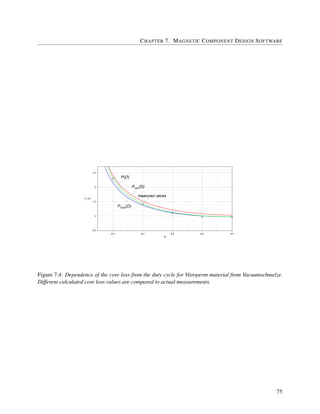
7.4 Dependence of the core loss from the duty cycle . . . . . . . . . . . . . . . . . . . . . . . . 75
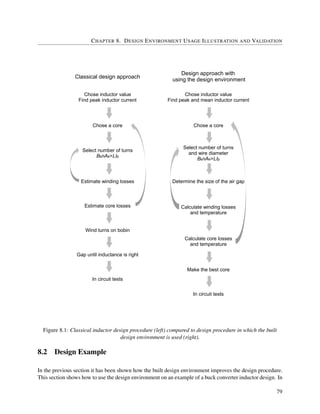
8.1 Comparison of inductor design procedures . . . . . . . . . . . . . . . . . . . . . . . . . . . 79
8.2 Illustration on how to graphically determine parameters necessary for loss calculation . . . . 81
8.3 Current waveforms of tested inductors . . . . . . . . . . . . . . . . . . . . . . . . . . . . . 85
8.4 Relative error comparison . . . . . . . . . . . . . . . . . . . . . . . . . . . . . . . . . . . . 86
G.1 Illustration on how to wind the test cores . . . . . . . . . . . . . . . . . . . . . . . . . . . . 121
H.1 Test inductors specifications . . . . . . . . . . . . . . . . . . . . . . . . . . . . . . . . . . 125
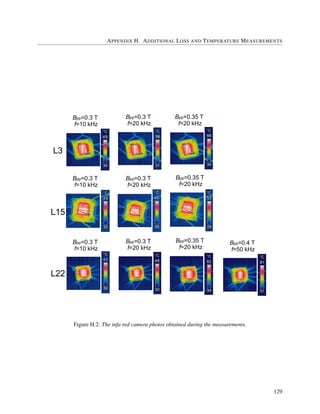
H.2 Infra red camera photos obtained during measurements . . . . . . . . . . . . . . . . . . . . 129
VII
LIST OF FIGURES
VIII
List of Tables
2.1 Typical representatives of different magnetic material categories . . . . . . . . . . . . . . . 4
2.2 Iron based alloys produced by Magnetics . . . . . . . . . . . . . . . . . . . . . . . . . . . 7
2.3 Advantages and disadvantages of iron based alloys . . . . . . . . . . . . . . . . . . . . . . 8
2.4 Iron powder materials . . . . . . . . . . . . . . . . . . . . . . . . . . . . . . . . . . . . . . 11
2.5 Comparison of different iron powder materials . . . . . . . . . . . . . . . . . . . . . . . . . 11
2.6 Advantages and disadvantages of iron powder cores . . . . . . . . . . . . . . . . . . . . . . 12
2.7 Amorphous and nanocrystalline alloys . . . . . . . . . . . . . . . . . . . . . . . . . . . . . 15
2.8 Advantages and disadvantages of amorphous alloys . . . . . . . . . . . . . . . . . . . . . . 16
2.9 Advantages and disadvantages of nanocrystalline alloys . . . . . . . . . . . . . . . . . . . . 16
2.10 Ferrite materials . . . . . . . . . . . . . . . . . . . . . . . . . . . . . . . . . . . . . . . . . 19
2.11 Advantages and disadvantages of ferrites . . . . . . . . . . . . . . . . . . . . . . . . . . . . 20
5.1 Specification of the main hardware parts . . . . . . . . . . . . . . . . . . . . . . . . . . . . 36
5.2 Specification of power stage parts . . . . . . . . . . . . . . . . . . . . . . . . . . . . . . . 37
5.3 Values of different filter parts . . . . . . . . . . . . . . . . . . . . . . . . . . . . . . . . . . 38
5.4 External inductor specifications . . . . . . . . . . . . . . . . . . . . . . . . . . . . . . . . . 39
5.5 Characteristics of the used oven . . . . . . . . . . . . . . . . . . . . . . . . . . . . . . . . 41
5.6 Constants of the Pi controller for average sinusoidal current regulation . . . . . . . . . . . . 47
5.7 PI constants for fine flux density peak-to-peak ripple regulation . . . . . . . . . . . . . . . . 54
5.8 List of errors that the software can detect . . . . . . . . . . . . . . . . . . . . . . . . . . . . 56
5.9 Frequency values for which the automatic oscilloscope setting is possible . . . . . . . . . . 56
IX
LIST OF TABLES
8.1 Buck converter design specifications . . . . . . . . . . . . . . . . . . . . . . . . . . . . . . 80
8.2 Possible buck converter inductors . . . . . . . . . . . . . . . . . . . . . . . . . . . . . . . 82
8.3 Measurement results for continuous conduction mode . . . . . . . . . . . . . . . . . . . . . 83
8.4 Measurement results for discontinuous conduction mode . . . . . . . . . . . . . . . . . . . 84
D.1 List of possible mode variable values . . . . . . . . . . . . . . . . . . . . . . . . . . . . . . 109
D.2 DSP variables for setting two level voltage excitation with 50 % duty cycle and average
current control . . . . . . . . . . . . . . . . . . . . . . . . . . . . . . . . . . . . . . . . . . 110
D.3 DSP variables for setting three level voltage excitation . . . . . . . . . . . . . . . . . . . . 110
D.4 DSP variables for setting sinusoidal voltage excitation with average current regulation . . . . 110
D.5 DSP variables for setting two level voltage excitation with changing duty cycle . . . . . . . 110
D.6 List of possible filtermode variable values . . . . . . . . . . . . . . . . . . . . . . . . . . . 111
D.7 List of variables used to control heating chamber operation . . . . . . . . . . . . . . . . . . 111
G.1 Optimal core cross sections for different measurement frequencies . . . . . . . . . . . . . . 120
H.1 Result comparison for inductor L3 without taking temperature into account . . . . . . . . . 124
H.2 Result comparison for inductor L3 without taking temperature into account . . . . . . . . . 126
H.3 Result comparison for inductor L22 without taking temperature into account . . . . . . . . . 127
H.4 Comparison of calculated and measured values in experiments in which component temper-
ature is taken into account . . . . . . . . . . . . . . . . . . . . . . . . . . . . . . . . . . . 128
X
Chapter 1
Introduction
In modern day power electronics, increasing power density has become very important. There is a constant
need to reduce the size of power electronic systems. Also, having systems that save energy, have efficient
cooling systems and are more reliable has become extremely important. In order to achieve all of this,
optimal design of individual system components is required. Magnetic components such as inductors and
transformers often occupy a lot of space within a system. These components can often have high losses and
require special cooling. Therefore, in order to have magnetic components that are smaller in size and more
efficient, magnetic component design has to be improved.
Nowadays, magnetic component design is mainly guided by certain well known rules of thumb, but also
by certain rules that design engineers derive themselves based on their own experience. Designers often
use loss models that are very simple and not accurate enough. In the last couple of decades new magnetic
materials with lower losses and other fine properties have appeared on the market. Therefore, in order to
make full use of the new developments in the material science, magnetic component design procedure needs
to become more structured. If the design would follow more strict criteria and use more precise loss models,
it would be much easier to select best possible core material, shape and size for a certain application.
Ultimate goal would be to create a magnetic component design environment in which optimal design
would be possible. This environment would consist of semiautomatic software with optimization algorithms.
Such software would take design requirements as its inputs, but also certain inputs from the designer. The
software would then, by using precise loss and thermal models, help the designer to select best possible core
material, size and shape, winding style, wire diameter and winding number for a given application. Figure
1.1 illustrates the concept of such design environment.
In order to build such an environment, very precise loss and thermal models are necessary. Core loss
modeling is the most challenging. This is because core losses depend on many different parameters very
nonlinearly and there is no physical model that could be used. In recent years, core loss modeling has been
improved and new models that have good accuracy have been proposed. These models use both empirical
equations and loss maps, which are mappings of core losses for different parameters from which losses
depend. However, information necessary to use such models is usually not provided by manufacturers.
Therefore, core loss measurements need to be done in order to enable the use of such models.
In this thesis, magnetic component design environment that can facilitate the use of one such state of the
art core loss model has been built. The environment consists of a core loss measurement system, database
for storing the measurements and magnetic component design software. Core loss measurement system
1
CHAPTER 1. INTRODUCTION
Design requirements Semiautomatic
optimization algorithm
Final product
Engineer
Precise loss and
thermal models
Database with possible
core materials and shapes,
winding styles and
cooling strategies
Figure 1.1: Design environment for optimal component design
can perform automatic core loss measurements. This system can be used to do all the measurements that
are necessary for modeling core losses for different materials. Built database is used for organized storage
of the measurement results. Software that enables easy database management and data visualization has
also been built. This software enables easy comparison of losses for different materials or for a single
material at different operating conditions. The database has been connected to magnetic component design
software that existed before. This software can be used to accurately predict inductance and calculate core
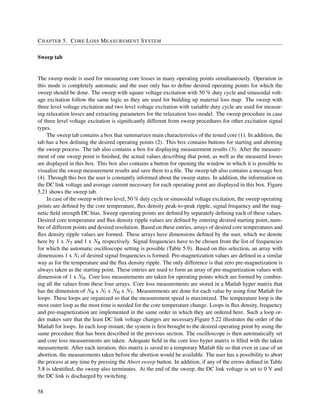
and winding losses and temperature for inductive components. Core loss measurement system, database
and design software are connected and form a powerful environment for modeling magnetic components.
Way how to use the built environment in magnetic component design is illustrated on a real design example,
where all the advantages of having such an environment are pointed out. In order to verify the accuracy of the
loss and temperature models used by the environment, measurements were done on several built inductors.
These measurements showed very good accuracy with absolute relative error of predicted component loss
and temperature that was less than 10 % for all the measurements.
This report first gives an overview of magnetic materials that are used in modern day power electronics.
Explanations on the physical background of the core losses as well as different ways to model them are
given in chapter 3. This chapter also gives detailed description of the core loss model that is used by the
built design environment. Chapter 4 describes the design environment that has been built. Chapters 5, 6
and 7 give more detailed description of the measurement system, database and magnetic design software
respectively. In chapter 8 it is illustrated on a real design example how the design environment can be
used. This chapter also describes measurements that were done in order to validate models used by the
environment. Finally chapter 9 gives conclusions and suggestions for future work.
2
Chapter 2
Magnetic Materials Overview and
Comparison
The history of magnetism begins in the 6th century B.C. when the Greek philosopher Thales discovered
magnetic properties of a mineral called magnetite. He noticed that his walking stick that had a metal ending
was attracted by a rock made of magnetite. However, the first scientific study on magnetism was published
in 1600 by William Gilbert, where the physical background of magnetic forces was explained. Later, the
science of electromagnetism was shaped by scientists like Faraday, Maxwell, Oersted and Hertz.
Parallel to the developments in the magnetic theory, considerable attention was focused on understanding
different magnetic materials and producing materials with desirable characteristics. Since the performance
of magnetic components used in power electronics and in other fields of electrical engineering greatly de-
pends on material characteristics, there is always a need to produce materials with better characteristics.
However, there is no perfect magnetic material that would meet all the designers requirements. Therefore
designing magnetic components is always a tradeoff between cost, size and performance indexes. Because
of this, knowing the characteristics of different magnetic materials and their advantages and disadvantages
is essential for the process of designing magnetic components.
This chapter gives a systematic overview of the magnetic materials used in modern day power elec-
tronics. It lists advantages and disadvantages of different material groups. This gives the basis for their
comparison, which is a first step in magnetic component design. Moreover, manufacturing processes for
each of the groups are described. This is important for better understanding all the differences and similari-
ties between different material groups.
2.1 Classification of Magnetic Materials
According to their magnetic properties, all materials can be classified in three groups [1], [3]:
• Diamagnetic materials
• Paramagnetic materials
3
CHAPTER 2. MAGNETIC MATERIALS OVERVIEW AND COMPARISON
Diamagnetic Paramagnetic Ferromagnetic
Superconductor Cesium Cobalt
Graphite Aluminum Iron
Copper Lithium Nickel
Lead Magnesium
Silver Sodium
Water
Table 2.1: Some typical representatives of diamagnetic, paramagnetic and ferromagnetic materials.
• Ferromagnetic materials
Diamagnetic materials (Diamagnets) are materials that have magnetic permeability less than µ0 (relative
permeability is less than 1). These materials cause the lines of magnetic flux to curve away from the ma-
terial and hence it appears as they create a magnetic field opposed to an external magnetic field. Such a
behavior is common to most of materials present in nature (and often these materials are referred to as non-
magnetic). However, the effect of repulsion when exposed to external magnetic field is so weak that it is
usually not noticed at all. The only exceptions are superconductors which completely exclude the lines of
magnetic flux and can be regarded as perfect diamagnets.
Paramagnetic materials (Paramagnets) have relative permeability slightly higher than one. These ma-
terials are slightly magnetized in the presence of external magnetic field. However, in the absence of the
external magnetic field these materials retain no magnetization.
Ferromagnetic materials (Ferromagnets) have relative permeability much greater than one (typically
from 10 to 100000) [1]. These materials get magnetized in the presence of an external magnetic field and
unlike paramagnets do not immediately get demagnetized when the external field is removed. Ferromag-
netic materials are the only ones that can be used to produce considerable magnetic forces. These forces can
be noticed and felt and they are the ones that are generally associated with the phenomenon of magnetism
encountered in everyday life. These materials are relevant for the design of magnetic components for power
electronics. Some typical diamagnetic, paramagnetic and ferromagnetic materials found in nature are listed
in Table 2.1.
Ferromagnetic materials can be further divided into two groups depending on their coercive force (Hc)
[1],[3]. These two groups are:
• Hard magnetic materials
• Soft magnetic materials
According to [1], hard magnetic materials are those that have Hc > 10000 A/m. These materials are often
called permanent magnets. Usually they also have very high value for remanent induction Br. Therefore,
these materials are very hard to demagnetize (hence the name permanent magnets). Typical applications of
such materials are for electrical motors and generators, sensing devices and mechanical holding.
Soft magnetic materials typically have Hc < 1000 A/m. Therefore, they are characterized by much
narrower BH loops compared to hard magnetic materials. Moreover, it is much easier to change magnetic
alignment in the structure of these materials. They are widely used in modern electrical engineering and
4
CHAPTER 2. MAGNETIC MATERIALS OVERVIEW AND COMPARISON
electronic applications. In fact, most of magnetic components in power electronics use cores made of these
materials.
Materials that have Hc in the range of 1000 – 10000 A/m are considered to be somewhat between soft
and hard, however there is no general term that would describe such materials [3]. These materials are
mainly used as recording media.
Since soft magnetic materials are the most relevant for power electronics, we will mainly focus on them.
They can be further divided into two groups based on their chemical composition:
• Ferrites (ferrimagnetic materials)
• Iron (Fe) based soft magnetic materials (ferromagnetic materials in narrow sense)
Here it is important to stress the difference between the terms, since often in literature soft magnetic ma-
terials based on iron are referred to as ferromagnetic although they, together with ferrimagnetic materials,
belong to the larger group of ferromagnetic materials. However it is often said that soft magnetic materials
based on iron are ferromagnetic materials in narrow sense [1].
Ferrimagnetic materials (ferrites) are ceramic materials made from oxides of iron and metals like man-
ganese (Mn), zinc (Zn) and nickel (Ni). Their main advantage is high electrical resistivity and relatively low
losses at high frequencies. However, these materials have quite low saturation flux density.
Ferromagnetic materials are made of metal alloys of iron and metals like silicon (Si), nickel, chrome
(Cr) and cobalt (Co). They have higher saturation flux density than ferrites, but also much higher electrical
conductivity (therefore higher losses due to eddy currents). This group of materials can be further divided
into several subgroups based on the manufacturing technology and material properties:
• Iron based alloys
• Powder iron
• Amorphous alloys
• Nanocrystalline alloys
The order in which these different material groups are listed corresponds to chronological order in which
they appeared and in which they have been manufactured and used in power electronics. Iron based alloys
are metal alloys of iron and silicon, nickel or cobalt. Powder iron cores are made from small iron (or other
material containing iron) particles which are mutually electrically isolated. Amorphous alloys are iron or
cobalt based alloys with special crystalline structure. They do not have crystal structure characteristic for
metals, but amorphous structure typical for glass or liquids. Nanocrystalline alloys are two phase materials
which have an amorphous alloy as a minority phase and FeSi crystals embedded into this amorphous phase.
Manufacturing processes as well as characteristics of these materials are given in the following sections.
Figure 2.1 illustrates described classification of magnetic materials
5
CHAPTER 2. MAGNETIC MATERIALS OVERVIEW AND COMPARISON
Ferromagnetic Materials
(in brooder sense)
Soft Magnetic Materials
- easily magnetized and demagnetized -
Hard Magnetic Materials
- permanent magnets -
Iron Based Materials
(ferromagnetic in narrow sense)
- Alloys made of iron and metals
like Si, Ni, Cr and Co -
Ferrites
(ferrimagnetic)
- Ceramic materials made of oxides of
iron and metals like Mn, Zn and Ni -
Nanocrystalline Alloys
- Materials consisting of an
amorphous minority phase in
which ultra fine crystals of
FeSi are embedded -
Amorphous Alloys
- Cores made of metal
alloys that have
amorphous structure
(crystalline structure
similar to liquids or glass) -
Powder Iron
- Cores made of small
iron (or other material
containing iron) particles that
are mutually electrically
Isolated -
Iron Based Alloys
- Cores made of isolated
thin metal laminations of
alloys of iron
and metals like Si,
Ni or Co -
Figure 2.1: Classification of ferromagnetic materials.
2.2 Iron Based Alloys
Classification and properties
Iron based alloys have very high electrical conductivity (typically in the range of 2 · 107 to 5 · 107 S/m).
Therefore, in order to reduce losses due to eddy currents, cores from these materials are made from many
thin laminations that are mutually electrically isolated. For such laminated cores a stacking factor is defined.
This is the ratio between cross section of the magnetic material and the cross section of the whole core.
Typical values for the stacking factor are between 0.9 and 0.95.
Based on the material that is used together with iron to form an alloy, these materials can be divided in
three groups:
• Iron-silicon alloys
• Iron-nickel alloys
• Iron-cobalt alloys
Iron-silicon alloys were the first material (except for the pure iron) to be used for inductors and transform-
ers. These materials have been extensively used for many years, and they are probably still (regarded in
6
CHAPTER 2. MAGNETIC MATERIALS OVERVIEW AND COMPARISON
Material Chemical comp. Curie temp. [◦C] Initial perm. Saturation flux density [T]
Magnesil 3%Si 97%Fe 750 1.5 K 1.5 – 1.8
Supremalloy 79%Ni 17%Fe 4%Mo 460 10 –50 K 0.66 – 0.82
Permalloy 80 78%Ni 17%Fe 5%Mo 460 12 – 100 K 0.65 – 0.82
Orthanol 50%Ni 50%Fe 500 2 K 1.42 – 1.58
Supermdur 49%Co 49%Fe 2%V 940 0.8 K 1.9 – 2.2
Table 2.2: Iron based alloys produced by Magnetics (data taken from [2] and [10]).
kilograms) the most used magnetic materials [2].
The main reason why silicon is added to iron is to reduce the conductivity and therefore reduce eddy
current loses. In addition, adding silicon reduces magnetostriction, and hence reduces the acoustic noise
caused by mechanical stress in material as a result of changing magnetic field. However, adding silicon also
has some negative effects. It reduces the saturation flux density, and can make the material lifetime shorter.
Also, adding more silicon results in a material that is very brittle. According to [1] the maximal percentage
of silicon that can be added to steel and that the material still keeps useful properties is 6.5 %. However,
iron-silicon alloy mostly used today is the one with 3 % silicon content.
Special kind of iron-silicon alloy is grain oriented silicon steel. This material has much higher perme-
ability and much lower loses in one direction than in the other. This is used when forming cores out of
this material. Namely it is always good to have lower loss and higher permeability in the direction along
the laminations, where the magnetic flux passes, than in the orthogonal direction. This property is called
anisotropy. When a magnetic material has the same magnetic properties in all directions it is called isotropic
and when this is not the case it is called anisotropic. In the last years there have been a lot of improvements
in grain oriented silicon steel manufacturing. As a result there are grain oriented silicon steel materials that
can have quite low loses in the lamination direction compared to other materials in the iron based alloys
group. Silicon steel material that is isotropic is called Non-oriented silicon steel.
Iron-nickel alloys can be made of different proportions of nickel. Today there are three different types
of iron-nickel alloys that are produced. The alloy with 80 % Ni content has very high initial permeability
(typically up to 100 K). Alloy with 50 % Ni has the highest saturation flux density in the group of iron-nickel
alloys (close to 1.6 T). And the alloy with 36 % Ni has the highest electrical resistivity in this group, also
this material has one of the smallest thermal expansion coefficient of all the magnetic materials used today.
Iron-cobalt alloys are usually made of 50 % Co. These materials have extremely high saturation flux
density (up to 2.2 T). They are used for electromagnet pole tips.
Today the greatest manufacturers of iron based alloys are Magnetics [10], Vacuumschmelze [11] and
TDK [12]. Table 2.2 gives some of the iron based alloys produced by Magnetics and lists some of their
magnetic properties. As the table shows, iron based alloys have quite high saturation flux density and offer
quite a wide range of different initial permeability values. Saturation flux density of 50 % cobalt alloy has
in fact the highest saturation flux density value among all commercially available soft magnetic materials.
In addition, these materials typically have Curie temperature greater than 450◦C and can therefore be used
at high temperatures (typically up to 150◦C in order to have a high margin to Curie temperature). Due to the
fact that these materials have been manufactured and used for many years now, their manufacturing process
has developed so that they are relatively inexpensive compared to other magnetic materials. In addition
cores of various sizes and shapes are readily available. Cores made of iron based alloy laminations are not
brittle. They are quite strong and not sensitive to mechanical wear.
7
CHAPTER 2. MAGNETIC MATERIALS OVERVIEW AND COMPARISON
Advantages Disadvantages
+ High saturation flux density Bsat (typ. in the
range 0.8 to 2.2 T)
+ Wide initial permeability range (typ. 0.6 up
to 100 K)
+ Can stand high temperatures (typ. Curie
temp. > 450◦C)
+ Inexpensive
+ Cores produced in many different shapes and
sizes
+ Cores not brittle
+ Cores not sensitive to mechanical stress
– High core losses (typ. 50 up to 250 W/kg @
10 kHz, 0.5 T)
– High electric conductivity (typ. 2 · 107 to 5 ·
107 S/m)
– Audio noise due to magnetostriction
Table 2.3: Advantages and disadvantages of iron based alloys.
However, these materials have quite high losses compared to all other materials due to their high electric
conductivity, which contributes to eddy current losses. Therefore all these materials are mainly used for low
frequency applications, as at high frequencies losses can become too high. Moreover, since the cores are
made from stacked laminations they usually produce audio noise due to magnetostriction effects. Table 2.3
summarizes advantages and disadvantages of iron based alloys.
Manufacturing process
Manufacturing process for cores made of iron based alloys is neither complex nor expensive, hence the cores
made out of these materials are inexpensive and produced in various dimensions and sizes. Manufacturing
process starts with raw material preparation. As already said, iron and silicon, nickel or cobalt are used as
main raw materials. In addition, these alloys may contain a small content of other elements that improve
their magnetic or mechanical properties. Among them are aluminum (Al), chrome (Cr), molybdenum (Mo)
and vanadium (V). However, these elements typically make less than 5 % of the alloy content (see Table
2.2). All the necessary raw materials are weighted, mixed and melted to form a liquid metal. This metal in
liquid state is then rolled into thin metal ribbons. The rolling process consists of two phases. The first phase
is called hot rolling as the liquid metal is rolled and thinned while it slowly cools down. The second phase is
called cold rolling. In this phase cool and already formed metal ribbon is further thinned by rolling in order
to ensure constant thickness of the final ribbon. These metal ribbons are produced in various thicknesses.
The typical thickness range is 0.02 – 6.4 mm. Losses due to eddy currents of the manufactured cores will
depend on the ribbon thickness. Reducing the ribbon thickness reduces the eddy current losses, but also
makes the manufacturing more expensive as it requires more subtle rolling process.
8
CHAPTER 2. MAGNETIC MATERIALS OVERVIEW AND COMPARISON
Cores are formed from metal ribbons, where laminations are electrically insulated. This is achieved by
coating the metal ribbon with a thin layer of electrically insulating material. Materials that also have bind-
ing properties (behave like glue) are used so that the laminations would stick together after core formation.
Toroids are then simply formed by winding the coated ribbon tape. For other core shapes (such as E shapes
for example), the core formation process is a bit more complex. For these cores building parts are formed
(parts of the shape that can be easily made by stacking laminations – like I shape for example) and then
these building parts are glued together. The laminations from which the cores are formed have defined eddy
current loses, Curie temperature, saturation flux density, mechanical and thermal properties. However, for
most of the materials the BH curve can be modified and therefore, initial permeability and core loses can be
controlled before the cores are formed.
The process in which the final BH curve of the material is formed is called annealing. In this process the
cores are heated up to high temperature, while at the same time they are exposed to external magnetic field.
During this process, final steps of crystallization in the laminations take place and depending on how long
this process lasts and what was the direction of the external magnetic field, the final BH loop is shaped. If the
lines of the external magnetic field are orthogonal to the core laminations (transversal field annealing), the
final BH curve has more round or elongated shape and when the external magnetic field is parallel to core
laminations (longitudinal field annealing), final BH curve has square shape. Figure 2.2 shows three typical
BH loop shapes that can be obtained. Nickel and cobalt alloys always need to be annealed. The same goes
square round elongated
Figure 2.2: Different BH curve shapes obtained by annealing [9].
for grained oriented silicon steel. However, there are some types of iron–silicon alloys (non-oriented silicon
steel) whose BH curve can not be altered by annealing.
After annealing the laminations and stacking them to form the cores, the cores can be considered fin-
ished. They have all the magnetic, mechanical and thermal properties well defined. However, often these
cores are further processed in order to make their use easier. This is done by further coating the cores (al-
though for iron based alloys cores often come without any coating). The most usual coating material is
nylon or plastic. Often the cores are stored in aluminum case which can be coated or not. All this is done
to give further mechanical support for the laminated core and to better facilitate automated core winding.
Figure 2.3 illustrates manufacturing process for cores made of iron based alloys.
9
CHAPTER 2. MAGNETIC MATERIALS OVERVIEW AND COMPARISON
Alloy material
mixing and melting
Raw materials:
Fe, Si, Ni, Co
Hot & cold
metal rolling
Liquid
metal
0.02 – 6.4 mm
tick metal
ribbon
Core winding and
insulating
laminations
Finished coresAnnealing process
Cores consisting of many
Thin, electrically isolated
laminations
Fe-Ni and
Fe-Co alloys,
Grain oriented
silicon steal
Non-oriented silicon steal
Figure 2.3: Iron based alloy cores – manufacturing process.
2.3 Powder Iron
Classification and properties
Powder iron cores are made from very small particles of iron (or other materials containing iron) that are
bound together and electrically isolated. This significantly reduces electrical conductivity of the material (10
to 100 times compared to iron based alloys) and hence eddy current losses are reduced. The fact that cores
are made of small isolated particles means that these cores have an air gap that is distributed throughout
the core. The distance between the particles (or the thickness of isolation between them) determines the
size of the distributed air gap and also the permeability of the material. A with a wide range of different
permeability are offered.
According to [2], iron powder cores were patented and their production began at the beginning of the
20th century. Since that time, manufacturing process of iron powder cores has not changed much, but the
materials used have been thoroughly researched and improved. Today iron powder cores are extensively
used in many fields of power electronics and electrical engineering.
According to their chemical composition all powder iron materials can be divided into 4 groups:
• Molypermalloy (MPP)
• High flux (HF)
• Sendust
• Pure iron powder
Here one clarification is in order. We refer to the whole group as powder iron in this thesis because of
historical and consistency reasons. However, as can be seen pure iron powder is only one subgroup, while
also other materials are classified as powder iron. Due to the fact that the pure iron powder appeared first
and as the manufacturing process is very similar for all the subgroups, in literature all these materials are
10
CHAPTER 2. MAGNETIC MATERIALS OVERVIEW AND COMPARISON
Material Chemical comp. Curie temp. [◦C] Initial perm. Saturation flux density [T]
MPP 80%Ni 20%Fe 450 14 – 550 K 0.7
High Flux 50%Ni 50%Fe 360 14 – 160 K 1.5
Sendust 85%Fe 9%Si 6%Al 740 26 – 125 K 1
Pure Iron Powder 100%Fe 770 4 – 100 K 0.5 – 1.4
Table 2.4: Iron powder materials (data taken from [2] and [4]).
MPP High flux Sendust Iron Powder
Core loss Lowest Moderate Low High
Perm. vs. DC bias Better Best Good Good
Temperature stability Best Very Good Very Good Fair
Relative cost High Medium Low Lowest
Table 2.5: Comparison of different iron powder materials (adapted from [4]).
referred as powder iron [1], [2]. So the same group name is kept in this thesis.
Molypermalloy (MPP) powder cores are made of 80 % nickel and 20 % iron. These cores can have
extremely high initial permeability (up to 550 K). In addition this material has the smallest loses compared
to other iron powder materials. However, the saturation flux density is smaller than for other materials.
Also, its relative cost is the highest in this group. These cores are mainly used for in-line noise filters, high
Q filters and resonant circuits [4].
High flux (HF) powder cores are made of 50 % nickel and 50 % iron. They have the highest saturation
flux density in the group (twice higher than MPP). However, they have higher core loses when compared to
MPP. Main applications of this material are for switching regulator inductors, in-line noise filters, fly back
transformers, power factor correction (PFC), and pulse transformers [4].
Sendust powder cores are made of 85 % iron, 9 % silicon and 6 % aluminum. This material has high
saturation flux density (1 T). It has losses lower than HF and a price that is lower both than prices for MPP
and HF. One of the advantages of this material is that it has almost no magnetostriction which makes it
useful in applications operating at audible frequencies [4].
Pure iron powder cores are made from 100 % iron particles. This was the first, material to be produced
and used in this group. This material has high saturation flux density and is cheaper compared to all three
materials mentioned before. However, it also has much higher losses. This material is mostly used for
electromagnetic interference filters and low-frequency chokes in switched-mode power supplies [5]. Table
2.4 lists some of the magnetic properties of these materials.
Table 2.5 summarizes advantages and disadvantages of different iron powder materials.
Biggest manufacturers of powder iron cores are Magnetics and Micrometals [13]. Furthermore, there
is a great number of smaller companies producing powder iron cores with almost the same specifications
as for the cores from these two manufacturers. The main advantage of these materials is that they have a
high saturation flux density, offer a great variety of initial permeability values (even up to 550 K), and have
lower losses compared to iron based alloys (although pure iron powder has loses that are comparable to loses
of iron based alloys). In addition, all the materials apart from pure iron powder have more than 10 times
lower electric conductivity and therefore much lower eddy current loses. Because of all this, these materials
are well suited for high frequency applications. They are relatively inexpensive and cores are available in
11
CHAPTER 2. MAGNETIC MATERIALS OVERVIEW AND COMPARISON
Advantages Disadvantages
+ High saturation flux density Bsat (typ. in the
range 0.8 to 1.5 T)
+ Wide initial permeability range (typ. 300 up
to 550 K)
+ Low core losses (only for certain materials)
(typ. 0.02 up to 250 W/kg @ 10 kHz, 0.5 T)
+ Low audio noise due to magnetostriction
+ Inexpensive
+ Cores produced in many different shapes
– High electric conductivity (typ. 2·104 to 1.5·
106 S/m)
– Can not stand high temperatures (typ. oper-
ating temperature < 110◦C)
– Fragile and sensitive to mechanical stress
– Brittle
– No large cores available
Table 2.6: Advantages and disadvantages of iron powder cores.
many shapes. However, big cores are not available. In addition, magnetostriction is quite low (and for
some material types almost not existing), so there is no audio noise problem. One of the advantages often
mentioned by manufacturers is that these materials exhibit soft saturation (no abrupt change in the slop of
the BH curve when saturating), which can be a great advantage in certain applications [4], [5].
Although these materials have lower electric conductivity than iron based alloys, it is still quite high
compared to ferrites and amorphous based alloys. In addition, due to the way the cores are manufactured
they can not stand very high temperatures. The main reason for this is that binding materials used to form the
cores are very sensitive to high temperatures. Therefore, exposing cores to high temperatures for long time
significantly reduces material lifetime. Manufacturers usually give a maximal temperature value that does
not affect the lifetime of the material (typically in the range of 90 to 110◦C [4],[5]). Furthermore, the cores
are quite sensitive to mechanical stress and can easily break. Table 2.6 lists advantages and disadvantages
of powder iron materials.
Manufacturing process
Manufacturing process for iron powder cores is not complex, and has not changed too much since the time
these materials were produced for the first time. This contributes to their relatively low price. Manufacturing
process starts with raw material preparation. For pure iron powder, iron with low carbon content is used.
For other materials, metals consisting of appropriate proportion of nickel and iron or silicon and iron are
used. These raw materials are then milled to obtain the powder with uniform particle size. Typical size of
powder particles after milling is in the range of 0.5 – 15 µm.
The next step in manufacturing process is the creation of the isolation layer around each of the particles.
This is achieved by treating the powder with acids, which creates a layer of oxide around each particle.
The amount of acid used determines the thickness of electrically isolating oxide layer around particles. On
the other hand this thickness determines the size of the distributed air gap (and therefore material initial
12
CHAPTER 2. MAGNETIC MATERIALS OVERVIEW AND COMPARISON
permeability) as well as the electrical conductivity of the material. Therefore, by controlling the amount of
acids added, it is possible to control the size of the air gap and electric conductivity. In this process various
acids are used. The acid to be used to get the best performance is still a topic of extensive research.
After the powder has been treated with appropriate amount of acids, cores are formed from the powder.
This is done by adding binding materials and by pressing. Mostly used binding material is resin binder,
which can not stand high temperature. This is the main reason for lower maximal operating temperature
that these materials have compared to other magnetic materials. However, ways on how to improve binding
material properties are constantly researched and it is reasonable to expect improvements in this aspect of
the manufacturing process. Cores are finally formed by pressing the powder mixed with binding materials.
Cores formed in such a way are not very strong and are quite sensitive to mechanical wear. This is the main
reason why there are almost no big iron powder cores available, as they would break very easy.
Due to this disadvantage, if non coated cores would be used, parts of the core would start to fall off due
to external mechanical influences (during the processes of core packaging, transportation and eventually
winding). Therefore, iron powder cores always need to be coated. Most usual coatings are epoxy coating
and parylene coating. Both these materials are sort of plastics that are electrical isolators. Figure 2.4
illustrates the steps in the manufacturing process of powder iron cores.
Material milling
Raw materials:
Fe with low carbon
content or other
materials made of
Fe and Ni or Si
Treatment with
acids
Iron powder
Iron powder
oxide
Adding binders
and forming cores
by pressing
Finished cores
Finishing
(core coating)
Iron powder
cores
Figure 2.4: Iron powder cores – manufacturing process.
2.4 Amorphous and Nanocrystalline Alloys
Amorphous alloys are made of iron or cobalt and materials like boron (B) and silicon. These alloys have
special chemical, mechanic and magnetic properties. Atoms in their structure are in complete disorder and
there is no regular crystal structure that is characteristic for normal metals. Such amorphous structure is
typical for liquids, molten metal, or glass. Therefore, amorphous alloys are often called metallic glasses [2].
These alloys are produced in a form of tin ribbons directly from melt in a process of rapid solidification.
Cores are then formed by winding electrically isolated ribbons.
Nanocrystalline alloys are two phase materials. They are made of an amorphous minority phase in which
ultra fine Fe-Si crystals are embedded. The typical crystal size is 10 –15 nm. Amorphous phase makes some
20 – 30 % of nanocrystalline material, which gives typical distance between crystals of about 1 – 2 nm [7].
Nanocrystalline alloy cores are made of amorphous alloy cores which are subject to crystallization during
13
CHAPTER 2. MAGNETIC MATERIALS OVERVIEW AND COMPARISON
annealing process. Figure 2.5 illustrates the difference between normal crystalline structure characteristic
for metals and amorphous and nanocrystalline structure.
Normal crystalline structure
characteristic for metals
Amorphous structure Nanocrystalline structure
Figure 2.5: Comparison between normal, amorphous and nanocrystalline structure [11].
Both material groups are quite new. Amorphous alloys were discovered in the late sixties and their com-
mercial production began in the seventies. Nanocrystalline alloys were discovered at the end of eighties-
beginning of nineties and their commercial production began at the end of nineties. The possibilities for
improving the properties of these materials as well as their manufacturing process are topics of active re-
search.
Amorphous alloys are usually classified into two groups based on the metal that dominates the alloy
content:
• Iron based amorphous alloys
• Cobalt based amorphous alloys
Iron based amorphous alloys have iron as their main constituent. These materials have quite high saturation
flux density (up to 1.6 T) and find many applications both at low and high frequencies. At low frequencies
they are used for high efficiency industrial transformers. According to [1] transformers made of this mate-
rial achieve efficiency of up to 99.5 % due to their low loses. In high frequency range these materials are
mainly used for fly back and push-pull transformers, active power factor correction common mode chokes
and power supply inductors. Main manufacturer of iron based amorphous alloys is Metglas [14].
Cobalt based amorphous alloys mainly contain cobalt. These alloys have much lower saturation flux
density compared to iron based alloys (typically around 0.7 T). In addition, they are much more expensive,
as cobalt is more expensive than iron. These materials are mainly used for anti-theft devices, magnetic field
sensors, magnetic shielding and magnetic switches. Cobalt based amorphous alloys are mainly produced
by Metglas and Vacuumschmelze. There is also a number of smaller companies that offer amorphous cores
with identical specifications as for the ones from Metglas.
Nanocrystalline alloys are usually consisting of many elements in different proportions. Some of the
mostly used materials are Finmet (from Metglas) which has chemical formula Fe73.5Cu1Nb3B9, Vitrop-
erm (from Vacuumschmelze) with chemical formula Fe73.5Cu1Nb3B7 and Nanoperm (from Magnetec [15])
14
CHAPTER 2. MAGNETIC MATERIALS OVERVIEW AND COMPARISON
Material Chemical composition Curie temp. [◦C] Init. perm. Sat. flux density [T]
Amorphous Alloys
2605SC 81%Fe 13.5%B 3.5%Si 370 1.5 K 1.5 – 1.6
2605SA1 Fe based alloy 370 20-35 K 1.56
2714A 66%Co 15%Si 4%Fe 205 2 K 0.5 – 0.65
Vitrovac 603 Co based alloy 205 3 K 0.8
Nanocrystaline Alloys
Vitroperm Fe73.5Cu1Nb3B7 460 30 – 80 K 1.0 – 1.2
Nanoperm Fe73.5Cu1Nb3B7 600 0.5 – 100 K 1.2
Finmet Fe73.5Cu1Nb3B9 570 30 – 100 1.23
Table 2.7: Amorphous and nanocrystalline alloys (data taken from [2] and [14]).
which has the same chemical composition as Vitroperm. These materials generally have lower saturation
flux density when compared to iron based amorphous alloys, but higher when compared to cobalt based
alloys. Furthermore, due to the fact that they contain FeSi crystals, they have higher electrical conductivity
than amorphous alloys. However, these materials offer very wide range of initial permeabilities. In fact they
have the highest product of initial permeability and saturation flux density among all the magnetic materials.
This means that magnetic components made of these materials have the smallest dimensions compared to all
other magnetic materials. Main applications of nanocrystalline cores are common mode chokes, magnetic
amplifiers and precise current sensing devices. These materials are also used for various switched mode
power transformers. Nanocrystalline materials are slowly replacing ferrites in many applications. Table 2.7
lists some amorphous and nanocrystalline alloys and gives their magnetic properties.
Using amorphous and nanocrystalline alloys has many advantages. Main advantage of amorphous alloys
is that amorphous crystal structure leads to much lower electrical conductivity than with metals that have
normal crystal structure. In addition these materials have quite low hysteresis losses. All of these makes
them very suitable for use at high frequencies. Moreover these materials offer quite high saturation flux den-
sity (up to 1.6 T). Cores made of amorphous ribbons are not brittle and they are not sensitive to mechanical
wear. Moreover, these cores can withstand constant working temperatures up to 130◦C.
However, these cores are very expensive compared to cores made from more traditional magnetic mate-
rials. In addition, there are not many different core shapes available. Cores are mainly produced as toroids
and U shaped cores. Magnetostriction is very strong with these materials and therefore they produce very
high noise at audio frequencies. Also these materials do not offer very wide initial permeability range and
there are no amorphous cores with high permeability available. Main advantages and disadvantages of amor-
phous alloys are listed in Table 2.8.
Nanocrystalline alloys also have quite high saturation flux density. However, it is slightly lower than
for amorphous alloys (typically up to 1.2 T). In the last years it has been realized that using other elements
than silicon to form crystals inside amorphous phase could result in higher saturation flux density. This is a
topic of intensive research and it is reasonable to expect improvements in this aspect of nanocrystalline alloy
production. These materials also offer wide range of initial permeability values. In fact it is recognized that
using these materials results in cores that are much smaller compared to cores made from all other magnetic
materials. These materials can also stand high temperatures up to 130◦C. Contrary to amorphous alloys,
due to the fact that they contain FeSi crystals, these materials emit little or no noise due to magnetostriction.
However, the presence of FeSi crystals has also negative sides. The greatest one is that electric conduc-
15
CHAPTER 2. MAGNETIC MATERIALS OVERVIEW AND COMPARISON
Advantages Disadvantages
+ High saturation flux density Bsat (typ. in the
range 0.5 to 1.6 T)
+ Low core losses (typ. 2 up to 20 W/kg @
10 kHz, 0.5 T)
+ Electric conductivity (typ. less than 5 ·
103 S/m)
+ Can stand high temperatures (typ. operating
temperature up to 130◦C)
+ Not sensitive to mechanical stress
+ Not brittle
– Not wide initial permeability range (typ.
0.8 K up to 50 K)
– Very high audio noise due to magnetostric-
tion
– Expensive
– Not many different core shapes available
(mainly toroidal and U cores available)
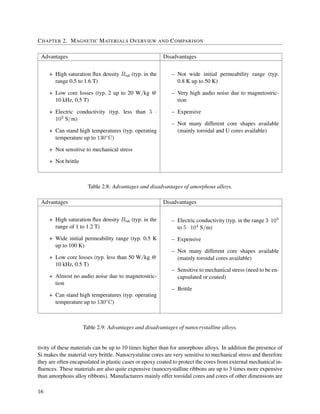
Table 2.8: Advantages and disadvantages of amorphous alloys.
Advantages Disadvantages
+ High saturation flux density Bsat (typ. in the
range of 1 to 1.2 T)
+ Wide initial permeability range (typ. 0.5 K
up to 100 K)
+ Low core losses (typ. less than 50 W/kg @
10 kHz, 0.5 T)
+ Almost no audio noise due to magnetostric-
tion
+ Can stand high temperatures (typ. operating
temperature up to 130◦C)
– Electric conductivity (typ. in the range 3·103
to 5 · 104 S/m)
– Expensive
– Not many different core shapes available
(mainly toroidal cores available)
– Sensitive to mechanical stress (need to be en-
capsulated or coated)
– Brittle
Table 2.9: Advantages and disadvantages of nanocrystalline alloys.
tivity of these materials can be up to 10 times higher than for amorphous alloys. In addition the presence of
Si makes the material very brittle. Nanocrystaline cores are very sensitive to mechanical stress and therefore
they are often encapsulated in plastic cases or epoxy coated to protect the cores from external mechanical in-
fluences. These materials are also quite expensive (nanocrystalline ribbons are up to 3 times more expensive
than amorphous alloy ribbons). Manufacturers mainly offer toroidal cores and cores of other dimensions are
16
CHAPTER 2. MAGNETIC MATERIALS OVERVIEW AND COMPARISON
not available. Table 2.9 lists main advantages and disadvantages of nanocrystaline alloys.
Manufacturing process
Manufacturing processes for amorphous and nanocrystalline alloys are similar. This is because nanocrys-
talline alloys are obtained out of amorphous materials by initializing crystallization process during anneal-
ing. Same as for other material groups, manufacturing process starts with raw material preparation. De-
pending on the chemical structure of the final alloy different elements are used. Amorphous alloys contain
mainly Fe, B and Si. For nanocrystalline alloys Cu and niobium (Nb) need to be added. Cu is added as its
atoms serve as starting points around which Fe-Si crystals are later formed, while Nb prevents the crystals
of growing too much. Similar as for iron based alloys, raw materials are melted and turned into liquid metal.
However contrary to manufacturing process of iron based alloys, where the ribbons were made from the
molten metal that cooled down slowly, amorphous ribbons are made from molten metal in the process of
rapid solidification.
During rapid solidification process, amorphous alloys are obtained from molten metal which is cooled
down very quickly (typical cooling speed is 106 K/s) which does not allow crystals to be form. Because of
this fast solidification, atoms behave like frozen and retain similar structure as they had when the metal was
in liquid state. In this process the molten metal is first heated up to 1300◦C by an induction heater. The melt
is then projected through a ceramic nozzle directly onto a fast spinning (around 100 km/h) water cooled
roller whose temperature is always controlled to be around 20◦C. As a result amorphous ribbon which is
typically 0.02 mm thick and can have width in the range of 17 – 25 mm is obtained. Figure 2.6 illustrates
rapid solidification process.
Figure 2.6: Rapid solidification process [11].
17
CHAPTER 2. MAGNETIC MATERIALS OVERVIEW AND COMPARISON
Amorphous ribbons are then coated with electrically isolating material and wound to cores. These cores
than need to be annealed in order to get the desired BH loop shape (usually the loop can be one of three
shapes shown in Figure 2.2). Cores made of amorphous alloys are annealed at temperatures which are lower
than crystallization temperature.
Nanocrystalline alloys annealing is done at temperature in the range of 500 − 600◦C. At this tempera-
ture Fe-Si crystals begin to form around Cu atoms. These crystals then start to grow. However the growth is
stopped by the presence of Nb, which results in a material that consists of crystals which are mutually sepa-
rated by amorphous regions (see Figure 2.5). After annealing (and crystallization for nanocrystalline alloys)
cores can be considered finished. Amorphous material cores can be further coated, but it is not necessary,
while nanocrystalline cores are always either coated or encapsulated in plastic cases in order to protect their
mechanical integrity. Manufacturing process for amorphous and nanocrystalline alloy cores is illustrated in
Figure 2.7.
Alloy material
mixing and melting
Raw materials:
Fe, B, Si, (Cu, Nb)
Rapid solidification
Liquid
metal
Amorphous
metal ribbon
Core winding and
insulating
laminations
Finished cores
Annealing process
Amorphous alloys
Annealing process
Crystallization
Nanocrystalline alloys
Figure 2.7: Amorphous and nanocrystalline alloy cores manufacturing process.
2.5 Ferrites
Classification and properties
Commercial use of ferrites began in the middle of the 20th century and today they are probably the most
used materials in power electronics. They are mainly used for power transformers and chokes, inductors and
tuned transformers, pulse and wideband transformers, shield beads and chokes and transducers.
Ferrites are dark gray or black ceramic materials. They are chemically inert, homogenous, extremely
18
CHAPTER 2. MAGNETIC MATERIALS OVERVIEW AND COMPARISON
Material Chemical comp. Curie temp. [◦C] Initial perm. Saturation flux density [T]
K MnZn ferrite > 230 1.5 K 0.48
R MnZn ferrite > 230 2.3 K 0.5
P MnZn ferrite > 230 2.5 K 0.5
F MnZn ferrite > 250 5 K 0.49
W MnZn ferrite > 125 10 K 0.43
H MnZn ferrite > 125 15 K 0.43
Table 2.10: Ferrite materials produced by Magnetics (data taken from [2]).
brittle and very hard materials. They are composed of various oxides, having iron oxide as their main
constituent. General chemical formula of ferrites is MeFe2O3, where Me represents one or more divalent
transition metals. Depending of what Me actually is, ferrites can be classified in two groups [2]:
• Manganese-zinc ferrites (Me = MnZn)
• Nickel-zinc ferrites (Me = NiZn)
Manganese-zinc ferrites are more widely used than nickel-zinc ferrites, and they are produced in greater
variety of different materials. They have higher initial permeability, but also higher electrical conductivity
than nickel-zinc ferrites. They are mainly used in applications where the frequency is less than 2 MHz.
Nickel-zinc ferrites have extremely low electrical conductivity (typically 10−5 S/m) . This makes them
suitable for applications with frequencies from 1 – 2 MHz up to several hundreds of MHz. However, these
materials have lower initial permeability than manganese-zinc ferrites.
Main manufacturers of ferrite cores are Magnetics, Epcos [16] and Feroxcube [17]. There is also a great
number of smaller companies producing ferrites. Table 2.10 lists some of the most popular ferrite materials
from Magnetics. As can be seen from the table, ferrites have quite low saturation flux density compared to
other magnetic materials. In addition, they do not offer wide range of initial permeability values, as very
high permeability is not available. In addition, mechanical properties of ferrites are not so good. They are
very brittle materials that are extremely hard to process and cut. Also they do not have very high Currie
temperatures and their magnetic properties significantly depend on temperature.
Nevertheless, ferrites have very low electric conductivity compared to all other magnetic materials (typi-
cally in the range 1·10−5 −1 S/m). Also, they have quite low loses. All of these makes them well suited for
high frequency applications. This is the main reason why ferrites are so widely used in modern day power
electronics. In addition, ferrite cores are available in many different shapes and sizes at relatively low price.
Ferrites do not suffer from problems with producing noise due to magnetostriction. Table 2.11 lists all the
advantages and disadvantages of ferrites.
Manufacturing process
Raw materials in the ferrite core production process are oxides and carbons of main constituents. The first
phase in manufacturing process is weighting and mixing of the raw materials which are in the form of
powder. The mixing can be dry, or water can be added in order to make a slurry mass that is then mixed
19
CHAPTER 2. MAGNETIC MATERIALS OVERVIEW AND COMPARISON
Advantages Disadvantages
+ Inexpensive
+ Available in many different core shapes and
sizes
+ Low core losses (typ. 5 up to 100 W/kg @
10 kHz, 0.5 T)
+ Almost no audio noise due to magnetostric-
tion
+ Very low electric conductivity (typ. in the
range of 1 · 10−5 to 1 S/m)
– Low saturation flux density Bsat (typ. in the
range 0.3 to 0.5 T)
– No wide range of initial permeability avail-
able (typ. 0.1 K up to 20 K)
– Not so high Currie temperatures, magnetic
properties deteriorate significantly with tem-
perature increase
– Very strong and extremely hard to process
and cut
– Brittle
Table 2.11: Advantages and disadvantages of ferrites.
more easily. In case when wet mixing is used, water needs to be first evaporated before the next step in
the manufacturing process. Mixed raw materials are then exposed to high temperatures in what is called
calcining process. The main purpose of this phase is to eliminate any impurities present in the mixture as
the quality of the final product greatly depends on the presence of impurities in the raw material. Mixed
powder mass is then milled in order to obtain powder with uniform particle sizes. Organic binders are
added to this powder and cores are formed by pressing. Pressing is done by using combined action of
top and bottom punches in a cavity so that a part with uniform density is formed. Today, tools that allow
simultaneous production of many cores exist. Also, quite complex core shapes can be produced nowadays.
Since the finished ferrite cores are so hard that they can not be further cut or shaped, the final core shape has
to be formed during this phase. As a result of pressing, so called green cores are obtained. In order to obtain
ferrite cores, green cores need to be subjected to sintering.
Sintering is a process characteristic for ceramic production. It is the most important step in the cycle
of ferrite manufacturing as during this process ferrite material achieves its final mechanical and magnetic
characteristics. During sintering process equilibrium of time, temperature and atmosphere is achieved in
order to turn green core into ferrite material. Sintering consists of three phases. The first one is the burnout
phase in which the temperature is gradually increased from room temperature up to 800◦C. The atmosphere
in which this is done is air. The main purpose of this sintering phase is to burn out any left impurities,
binders or lubricants and to eliminate any moisture. Next step is the actual sintering process in which
the temperature is further increased up to 1000 − 1500◦C depending on the actual material. While the
temperature is increased, non oxidizing gas is introduced into the chamber in order to reduce the content
of oxygen in the atmosphere. During the last phase of sintering, in which the cores are cooled down, the
oxygen level is reduced to zero. Figure 2.8 illustrates a typical sintering cycle. During sintering, the size of
the cores is reduces by 20 – 30 %. Therefore, green cores always need to be larger than the end products.
However the actual amount of core shrinkage is not certain and therefore ferrite cores always have up to
±2 % uncertainty on their final size [6]. Figure 2.9 illustrates the manufacturing process for ferrites.
20
CHAPTER 2. MAGNETIC MATERIALS OVERVIEW AND COMPARISON
Figure 2.8: Sintering process cycle [8].
Material
preparation and
weighting
Raw materials:
Oxides and
carbons of main
constituents
Milling to specific
grain size
Raw materials
with right
proportion Powder with
uniform grain
size
Adding organic
binders and forming
cores by pressing
Finished cores
Finishing
(core coating)
Green cores
Sintering
process
Figure 2.9: Manufacturing process of ferrites.
21
CHAPTER 2. MAGNETIC MATERIALS OVERVIEW AND COMPARISON
22
Chapter 3
Core Loss Modeling
As already said, designing magnetic components, such as transformers and inductors, requires some specific
knowledge about the electrical and magnetic properties of the magnetic material that is used. One of the
most important properties that should be known is the core loss behavior. Core loss depends on the mag-
netic material used, core geometry and size, shape of the exciting flux density waveform, excitation signal
frequency, magnetic field strength DC bias and operating temperature. Therefore, it is an important factor
that determines the choice of magnetic material, core size and shape.
In modern day power electronics it is very important to reduce the size and increase efficiency of power
electronic systems. Since transformers and inductors occupy a lot of space and produce considerable amount
of losses, ways to reduce loses in these components have become an important research issue. The first step
in making any improvement in this direction is to derive an accurate core loss model. However, core loss
modeling is not a trivial task and is still a topic of active scientific research.
This chapter gives a short introduction on physical origin of core loses. It describes some of the most
usual ways to model core loses that are used today and compares different modeling approaches, giving
advantages and disadvantages for each method. At the end of the chapter an accurate and easy to use, hybrid
core loss modeling approach is described.
Physical Origin of Losses
In order to understand physics behind core losses, one has to look at the process of magnetization. This pro-
cess occurs due to alignment of electron magnetic moments under the influence of external magnetic field.
Each electron of the atoms in the crystal structure of magnetic material has a magnetic (orbital) moment
which is a consequence of its rotation around the atom nucleus. When an external magnetic field exists,
these magnetic moments start to orient themselves in the direction parallel to the lines of external mag-
netic field. As a result, complete atoms in the structure start behaving like small magnets that are aligned
parallel to the external magnetic field. However, the alignment of these atomic magnets does not happen
homogenously in the entire structure, but only within certain regions called ferromagnetic (or Weiss) do-
mains. These domains usually have laminar patterns and their size can vary from 0.001 mm3 to 1 mm3
[1]. Each of the domains is characterized by an overall magnetic moment which is a result of summing
together many atomic magnets. Domain magnetic moments are oriented in such a way that the total energy
23
CHAPTER 3. CORE LOSS MODELING
is kept minimal. This means that the adjacent domains have opposite magnetic moments. Weiss domains
are mutually separated by the so called domain (or Bloch) walls. Organization of the Weiss domains in a
magnetic material is illustrated in Figure 3.1.
Figure 3.1: Illustration of Weiss domains and domain wall movement [18].
In order to change global magnetization of the material, domain walls need to move. Therefore, magne-
tization change is highly localized and not uniform through the material. This means that the magnetization
change is spatially distributed. In addition, presence of imperfections in magnetic materials causes rapid
movements of the domain walls, the so called Barkhausen Jumps. Therefore, the magnetization is also
discrete in time, as the local velocity of the domain walls is different than the change rate of the external
magnetic field. Discrete nature of magnetization in terms of space and time means that there is a rapid local
change of magnetization even if the external magnetic field is changing very slowly. Associated with these
changes are local energy losses caused by eddy currents and spin relaxation. Globally, loses are determined
by local and time distribution of these local losses. In addition, macroscopic eddy current losses contribute
to total core losses. They are caused by currents in the material induced by the external magnetic field.
Therefore, core losses on a macroscopic scale are caused by the damping of domain wall movements by
eddy currents and spin relaxation on a microscopic scale and macroscopic eddy current losses.
Ways to Model Core Losses
Detailed knowledge on physical background of core losses does not help much in their modeling. Losses
depend on very chaotic space and time distribution of domain wall movement and therefore it is almost
impossible to derive physical equations that could precisely model losses. Since the model derivation from
the first principles is not possible, there are several other approaches to model core losses developed by the
electrical engineering community. Models that are often found in the literature and that are used in practice
can be divided into four groups:
24
CHAPTER 3. CORE LOSS MODELING
1. Hysteresis models (like Preisach and Jiles-Atherton)
2. Empirical equations (based on Steinmetz Equation)
3. Loss–separation approach
4. Loss map
Hysteresis models are mathematical core loss models that find their bases in the physical processes behind
core losses. They can be generally divided into two groups. Jiles-Atherton model [21] is based on macro-
scopic energy calculation. It consists of a differential equation that can model core losses. Parameters of the
model need to be determined iteratively. The advantage of this model is that it leads to good understanding
of the magnetization process. The main drawback of the model is that there is a great number of parameters
that need to be estimated. Second model is the so called Preisachs model [22]. In this model, a statistic ap-
proach is used for describing space and time distribution of domain wall movements. A weighted function is
used for representing material characteristics. The main disadvantage of this model is that the identification
of the parameters in this function is very hard. It requires great experimental effort without offering high
accuracy [18].
Empirical equations for modeling core loses are mainly based on the so called Steinmetz equation which
was formulated (in a bit different form than it is used today) more than a century ago [23]. This equation
describes core losses per unit volume as a function of excitation signal frequency and flux density amplitude:
Pv = kfα ˆBβ
, (3.1)
where Pv represents time-average power loss per unit volume in W/m3, f is the frequency of the applied
sinusoidal excitation signal in Hz and ˆB is peak induction in T. Parameters k, α and β are material dependent.
These parameters are often called Steinmetz parameters. Steinmetz equation has been widely used as a
starting point for modeling core loses for many years now. Manufacturers sometimes directly give Steinmetz
parameters as a means for design engineers to calculate core losses. Moreover, Steinmetz equation has been
widely used by electric engineers even in cases when manufacturers provide raw data on losses per unit
volume (or mass). In this case many design engineers use the data to estimate Steinmetz parameters and then
calculate the losses in operating point of interest by using equation 3.1. However, although widely accepted
and used in electrical engineering community, Steinmetz equation has three serious drawbacks. The first one
is that the parameters k, α and β are only valid for a limited frequency and flux density range. Therefore
manufacturers often provide couple of parameter sets for different ranges. However, calculating losses at the
borders of these ranges may lead to significant errors. Another big disadvantage is that Steinmetz equation
is only valid for sinusoidal excitations. This is a significant limitation when having in mind that in modern
day power electronics mainly non-sinusoidal excitation signals are used. Third disadvantage is that, by
Steinmetz equation, core losses are modeled only as a function of frequency and flux density. However,
many experimental findings show that core losses can also significantly depend on core temperature and DC
bias of the magnetic field strength [25] – [27].
There has been a lot of attempts to extend the Steinmetz equation in order to overcome these drawbacks.
Most important improvement is the one that extends the model so it can be used for greater variety of flux
density waveforms. This extension was motivated by the finding that the losses due to domain wall motion
directly depends on dB/dt. In [18] – [20], the so called improved Generalized Steinmetz Equation (iGSE)
has been introduced. According to this equation core loses per unit volume can be calculated as:
Pv =
1
T
T
0
ki
dB
dt
α
(∆B)β−α
dt, (3.2)
25
CHAPTER 3. CORE LOSS MODELING
where T is the period of the exciting signal and ∆B is peak-to-peak flux density ripple. Parameters α and
β are the same parameters as used in Steinmetz equation and ki is related to the k in Steinmetz equation by
the following relation:
ki =
k
(2π)α−1 2π
0 |cosθ|α
2β−αdθ
(3.3)
The iGSE equation allows quite accurate loss estimation for a great variety of flux density waveforms.
According to this equation no losses occur when the flux remains constant. However, this contradicts ex-
perimental findings which show that core loss still exists even when the flux density is constant [28], [29].
In [28] it has been assumed that losses at constant flux density occur due to relaxation effects. These
losses are termed relaxation losses and it is assumed that they occure due to fast changes in magnetization,
when the matherial has to progresivly move towards the new thermal equilibrium. In the same work the
iGSE equation is further extended so that the relaxation losses are taken into account. Extended equation is
termed improved-improved Generalized Steinmetz Equation (i2
GSE). According to this model, core losses
per-unit-volume are calculated as:
Pv =
1
T
T
0
ki
dB
dt
α
(∆B)β−α
dt +
n
l=1
QrlPrl, (3.4)
where n represents the number of stepped voltage changes in the excitation signal, Qrl is the function that
further describes the flux density change:
Qrl = e
−qr
dB(t+)
dt
dB(t−)
dt , (3.5)
where dB(t−)/dt represents the flux density change rate before the switching, dB(t+)/dt is the flux den-
sity change rate after the switching and qr is material dependent parameter which has to be determined
experimentally. For each stepped voltage change, Prl is given by the equation:
Prl =
1
T
kr
dB(t−)
dt
αr
(∆B)βr
(1 − e−
t1
τ ), (3.6)
where t1 represents the time to the next stepped change and kr, αr, βr and τ are material dependent param-
eters that can be determined experimentally by measuring loss energy for trapezoidal flux waveforms with
different lengths of the constant flux period. Figure 3.2 shows the meaning of the variables in equations
3.4/3.5/3.6.
As can be seen, the only difference to the Equation 3.2 is that there is an additional term that should
compensate for the losses occurring due to relaxation process. With this extension, losses can be modeled
for any flux density waveform encountered in modern day power electronic systems. However, the depen-
dence of the losses on temperature and magnetic field strength DC bias is not modeled. There has been
several works on extending the Steinmetz model so that dependence on pre-magnetization can be taken into
account. In [25] a model in which ki and β in the Equation 3.2 would be modeled as functions of pre-
magnetization DC bias is proposed. However, a complete analytical model that would describe losses as a
function of frequency, flux density, DC bias and temperature still does not exist.
In loss separation approach, core loses are divided into three parts. It is assumed that losses can be
separated into static hysteresis losses (Ph), dynamic eddy-current losses (Pcl) and the so called excess losses
(Pexc):
Pv = Ph + Pcl + Pexc (3.7)
26
CHAPTER 3. CORE LOSS MODELING
t1
dB(t-)/dt
dB(t+)/dt
t
B Change point for which the
contribution is calculated
Figure 3.2: Definition of variables in i2GSE model.
This model is a result of a common belief that existed in electrical engineering community for a long time
that core loses are caused by two independent physical effects: static hysteresis and eddy-currents. However,
as explained before this lacks theoretical justification, since the losses are caused by microscopic domain
wall movements and can not be so easily divided at macroscopic scale. Since modeling losses only as a sum
of these two terms can lead to very big errors, excess loss term is added in order to compensate for the error.
Analytic form only exists for calculating eddy-current loses, while other two terms need to be determined
experimentally [30]. Two main disadvantages of such a model are that it lacks physical justification and that
extraction of the model parameters can be very difficult.
Modeling approach based on loss map implies extensive core loss measurement. In this modeling ap-
proach the loss map stores information on loss per volume for many operating points described by flux
density ripple amplitude (∆B), excitation signal frequency (f), pre-magnetization DC bias (HDC) and tem-
perature (T). Measurements are usually repeated for great variety of excitation signal waveforms. Losses
for a particular working point are then calculated by interpolation between closest operating points for which
measurements are available. If measurement points are selected densely enough, this approach leads to very
accurate results. The main disadvantage is that extensive measurements are necessary in order to achieve
good accuracy. Ways to model core losses by using a loss map are described in [24] – [27].
General problem with modeling core losses is that manufacturers do not provide data which could be
sufficient to derive most of the analytic models presented here. Therefore in order to extract model parame-
ters, usually extensive measurements have to be done. At present there is no universal core loss model that
would be precise and widely accepted and used both by manufacturers and engineers. All of the modeling
approaches described above have certain disadvantages. Therefore, in order to make a precise and useful
core loss model, some of these models need to be combined. In the following section one such hybrid
model is described. It was found to be quite accurate. This model is used as a basis for building magnetic
component design environment presented in this thesis.
27
CHAPTER 3. CORE LOSS MODELING
Hybrid Core Loss Model
In [31], an approach which combines loss map and i2
GSE is proposed. It is proposes that core losses should
be measured and stored in a loss map. This should be done for various operating points described by peak-
to-peak flux density ripple (∆B), excitation signal frequency (f), temperature (T) and pre-magnetization
DC bias (HDC). Measurements should be performed with sinusoidal flux waveforms for low frequencies
(less than 1 kHz) and with triangular, 50 % duty cycle flux waveform for high frequencies (above 1 kHz). In
addition, the loss map should contain the initial BH relation, which can be taken from material datasheet or
can be estimated from a measured differential BH curve. Also it is proposed that a set of parameters αr, βr,
kr, τ and qr should be contained in the loss map (these parameters are as in Equations 3.5 and 3.6). These
parameters can be estimated experimentally by measuring core losses for specific flux density waveforms.
Core losses per unit volume are then calculated by using such a loss map and the i2
GSE model.
This hybrid model can be used for calculating losses for an arbitrary flux density waveform. For instance
signals that are often found in power electronic devices today are those that consist of a fundamental, low
frequency, sinusoidal part and a high frequency, piecewise linear signal that is superimposed to it. Such flux
density waveforms are typical in power factor correction applications for example. The proposed model
is very good in modeling losses for such a complex flux waveform. The flux density waveform for which
the losses should be calculated is broken up into the fundamental waveform, which is usually sinusoidal,
and the piecewise linear flux waveform segments. The losses per unit volume are then calculated for the
fundamental and for each linear segment and then summed up in order to get total losses. For it, piecewise
linear waveforms are translated into triangular flux waveforms with same ∆B, HDC and same flux density
slope dB
dt . This has to be done in order to have correspondence with the loss map in which loss values are
stored for symmetric triangular waveforms. For each of the linear segments, an operating point is defined:
(∆B∗, f∗, H∗
DC, T∗). The loss dependence on temperature and pre-magnetization DC bias is obtained by
linear interpolation. The dependence on frequency and flux density ripple is obtained for the fundamental
(sinusoidal) signal by Equation 3.1 and for the piecewise linear segments by Equation 3.3. The necessary
parameters α, β and k (or ki) are extracted from the loss data stored in the loss map. To this end, mea-
surement points that are closest to the operating point of interest need to be identified. All together nine
measurement points are needed for interpolation. For extraction of α, β and k (or ki) three points are needed
and this has to be multiplied by three for the linear interpolation in T and HDC. First, a linear interpola-
tion in temperature and DC bias is done. This is done for all three ∆B/f pairs of interest. This leads to
losses for three points with different ∆B and f values that are close to the values of the operating point
of interest. The temperature and DC bias values as in the operating point of interest has been interpolated:
(∆B1, f1, H∗
DC, T∗), (∆B2, f1, H∗
DC, T∗), (∆B1, f2, H∗
DC, T∗). Out of these three points α, β and k (or ki)
are extracted by solving a system of three nonlinear equations (Equation 3.1 for low frequency measure-
ment data and Equation 3.2 for high frequency measurement data). The interpolation process is illustrated
in Figure 3.3. Core losses per unit volume are then calculated by Steinmetz equation in case of fundamental
and in case of piecewise linear segments by the i2
GSE equation.
It has been shown that this modeling strategy results in a very accurate loss calculation even in cases
when loss map is not very dense. Therefore, this approach offers very good accuracy at a moderate mea-
surement effort. In addition, in [31] a way for calculating losses of the complete inductors and transformers
based on this core loss modeling approach is given, i.e. it is shown how to take the core shape into consid-
eration. Furthermore, it is shown how to calculate copper losses.
28
CHAPTER 3. CORE LOSS MODELING
Interpolation in temperature and pre-magnetization DC bias Interpolation in frequency and flux density ripple
Figure 3.3: Illustration of the interpolation process for the loss map data [31].
29
CHAPTER 3. CORE LOSS MODELING
30
Chapter 4
Magnetic Component Design Environment
The hybrid core loss measurement model presented in the previous chapter enables a very accurate loss
calculation. However, this model requires core loss measurement and therefore specific infrastructure is
necessary to use the model. In this thesis project, a magnetic component design environment which can sup-
port described core loss model has been built. This design environment consists of a core loss measurement
system, a database for storing the measurements and a software for magnetic component design. These three
parts are mutually connected to form an easy-to-use environment.
The core loss measurement system that has been built enables efficient loss map generation and the
extraction of relaxation loss model parameters. The measurement system existed before this project. In
this project it has been extended and made completely automatic. The measurement system has now a user
friendly graphical interface which enables easy measurements. In addition, due to the fact that it is auto-
matic, great number of measurements can be made in a short period of time. All this enables an easy loss
map formation.
In order to use the loss measurements made by the measurement system, the results need to be stored in
an organized manner. Therefore, a database has been built. In addition, an easy to use Matlab software for
database management has been implemented. This software enables visualization of the loss data from the
database. This allows an easy and fast overview and comparison of core losses for different materials. The
database represents an interface between the core loss measurement system and the design software.
Software for designing inductors and transformers based on the modeling principles described in the
previous chapter already existed before the start of this project. In this project it has been extended by
including the relaxation loss model and connecting the software with the loss measurement database. The
software has a user friendly graphical interface and has shown to be very useful as it can import current and
voltage waveforms from circuit simulation software (such as Simplorer or Matlab).
Together, the core loss measurement system, the database and the design software build an automated
and easy-to-use environment which can be used for designing magnetic components. The structure of the
design environment is shown in Figure 4.1. The main advantage of the environment is that it enables a very
precise calculation of magnetic component losses and temperature. In the following chapters the automated
core loss measurement system, the database and the improvements of the design software are described in
more detail.
31
CHAPTER 4. MAGNETIC COMPONENT DESIGN ENVIRONMENT
Automated measurement system
Core material database Design software
Circuit simulator
Finished inductor
Figure 4.1: Magnetic component design environment.
32
Chapter 5
Core Loss Measurement System
There are two possible ways to measure core losses:
1. Calorimetric loss measurement
2. Electrical loss measurement
In calorimetric loss measurement, loss power is measured directly by using the fact that power losses dissi-
pate heat that can be measured. The main advantage of this method is that power is measured directly, which
results in higher accuracy when compared to electrical method. However, this approach has two significant
disadvantages. The first one is that it is impossible to measure only core losses. Core losses, together with
copper loses are measured and therefore, a very accurate copper loss models would be necessary for precise
estimation of the core losses. In addition, calorimetric measurements are very slow compared to electrical
ones. Therefore, such a method would not be suitable for building a fast automated measurement system.
The implemented electrical loss measurement strategy is based on the fact that core loss per unit volume
is proportional to the area enclosed by the BH curve:
Pv = f BdH, (5.1)
where f denotes the frequency of the excitation signal, or in other words it represents the number of BH
loops that are made in one second. In order to measure losses, B and H need to be measured indirectly. To
measure B and H two windings over the core under test are necessary. The secondary winding is used as a
sense winding to sense flux density:
B(t) =
1
N2Ae
t
0
v(τ)dτ, (5.2)
where N2 represents the number of sense winding turns and Ae is effective cross section area of the core
under test. The primary winding is used as the excitation winding. If the current through this winding is
measured, the magnetic field strength can be calculated:
H(t) =
N1i(t)
le
, (5.3)
33
CHAPTER 5. CORE LOSS MEASUREMENT SYSTEM
where N1 represents the number of excitation winding turns and le the effective magnetic path length of the
Core Under Test (CUT). Figure 5.1 illustrates this measurement principle.
Core under test
Excitation
system
i(t)
v(t)N1 N2
Figure 5.1: Illustration of the principle for indirect measurement of B and H.
Main advantage of this electrical core loss measurement strategy is that core losses can be measured
very quickly and that only loses in magnetic material are measured (i.e. winding losses are excluded). On
the other hand it is very difficult to measure losses in cores with air gap. This also goes for iron powder cores
which have distributed air gap and cores that have very low permeability. The main reason for this is that
for these cores, a very small error in measuring the phase shift of primary winding current and secondary
winding voltage results in a very big error in loss measurement. Another potential source of measurement
error are parasitic capacitances which exist between primary and secondary winding, between windings and
the core and between winding turns in a single winding. However, the effects of parasitic capacitance can
be significantly reduced by wise choice of core size and winding style (see Appendix G). Despite these
weaknesses, this approach offers reasonable accuracy at a very high measurement speed which makes it
very useful for building automated core loss measurement system. Therefore, this measurement method has
been widely used for measuring core losses, and is also used by the automated system presented here.
The automated core loss measurement system consists of an oscilloscope, a system for generating dif-
ferent excitation signals and a heating chamber. The whole system is enclosed in a movable rack and is
equipped with a system of relays and switches which enable safe usage of the system in an industrial en-
vironment. The system is controlled by a Matlab program running on the oscilloscope. This program has
a user friendly graphical interface and is in charge of measuring losses, storing them and keeping the user
informed about the system status. The hardware used for generating desired excitation signals is controlled
by a DSP board which is in communication with the Matlab program. The system can perform measure-
ments for various operating points completely automatically. It automatically regulates the operating point
parameters. Figure 5.2 gives a photograph of the core loss measurement system. In the following sections,
system hardware, enclosure and safety as well as system software are described in greater detail.
5.1 System Hardware
An oscilloscope is used for sensing the current of the excitation winding and voltage of the sense winding.
A LeCroy oscilloscope which has Windows and Matlab running on it is used. The oscilloscope is also
a central control unit of the system, as it controls other hardware parts of the system. The system for
34
CHAPTER 5. CORE LOSS MEASUREMENT SYSTEM
(a) (b)
Figure 5.2: Automated core loss measurement system – (a) front view; (b) side view.
generating excitation signals over the core under test consists of a DC power supply which is controlled by
Matlab software, power stage which is an H-bridge controlled by a DSP board, and a filter stage which is a
series connection of two LC filters that can be bypassed in case it should not be used. The power stage is
capable of maximal input voltage of 450 V and the filter stage is capable of maximal input voltage of 300 V.
Both stages are capable of a maximal output current up to 30 A. Power stage can give switching frequency
of up to 200 kHz. When the power and filter stages are connected in series, the power stage generates a Pulse
Width Modulated (PWM) sinusoidal signal which is then filtered by the filter stage. Like this, a sinusoidal
excitations in the frequency range of 50 Hz – 1 kHz can be generated. In order to heat up the core under
test, a custom made heating chamber is used. The heating chamber is controlled by the DSP board on the
power stage, where the temperature of the core under test is sensed by a custom made temperature sensor.
Figure 5.3 shows the principal schematics of the system hardware and Table 5.1 gives specification of the
main hardware parts of the system. In the following sections the power stage, the filter stage and the heating
35
CHAPTER 5. CORE LOSS MEASUREMENT SYSTEM
chamber are described in more detail.
DSP
DC power supply Power stage Filter stage
Core under test
Heating chamber
Grid
DC power supply
Figure 5.3: Core loss measurement system principal schematics.
Oscilloscope LeCroy WaveRunner 104MXi-A
Current probe LeCroy AP015
Power supply Sorensen DCS600-1.7E
Heating chamber Custom made, 800 W, 30 − 160◦C
Temperature sensor Custom made, can measure in the range: 19 − 180◦C
Power stage 0 – 450 V
0 – 25 A
0 – 200 kHz
Filter stage 0 – 450 V
0 – 30 A
0 – 1 kHz
Table 5.1: Specification of the main hardware parts.
5.1.1 Power Stage
The power stage contains an H-bridge with 4 MOSFETs. It can generate square voltage signals with the
amplitude of up to 450 V and frequency of up to 200 kHz. The DC power supply voltage used by the
power stage is stabilized by electrolytic, foil and ceramic capacitors. Capacitance values used as well as
specifications of other stage parts are summarized in Table 5.2. Power stage simplified schematics and the
36
CHAPTER 5. CORE LOSS MEASUREMENT SYSTEM
photograph of the realized power stage are shown in Figure 5.4. Transistors in the H-bridge are controlled
(a) (b)
To core
under test
Or
To filter
+
Core
under test
Figure 5.4: (a) Power stage simplified schematics; (b) Power stage realization photograph.
Power MOSFETs IXYS IXFB82N60P
Gate driver IXYS IXDD414SI
Capacitors Electrolytic: 2.75 mF
Foil: 360 µF
Ceramic: 3.86 µF
DSP TI TMS320F2808
Current sensor Sensitec CDS4015
Fans San Ace 40 GE
Table 5.2: Specification of power stage parts.
by a DSP board developed at the Power Electronic Systems Laboratory at ETH. The board is based on Texas
Instruments DSP. The power stage also has a current sensor which is used for controlling the average current
over the core under test. Since the DSP board on the power stage is also used for controlling the bypass
relays on the filter stage, the power stage contains an interface connector by which it can be connected
to the filter stage. It also contains an interface connector for attaching temperature sensor circuitry. The
temperature sensor is used for sensing the temperature of the core under test.
5.1.2 Filter Stage
In order to be able to generate pure sinusoidal voltage excitation over the core under test, a low pass filter
has been built. The filter consists of two LC stages which are connected in series. At the entrance of the
37
CHAPTER 5. CORE LOSS MEASUREMENT SYSTEM
filter there is a common mode reduction choke. Principal schematic of the filter is given in Figure 5.5 and
the values of the filter parts are listed in Table 5.3. Detailed schematics for the filter board are given in
Appendix A.
L
LCM
L L
L L L
LL
RD
RD
RD
RD
C C
Iin Iout
Uin Uout
Figure 5.5: Low pass filter principal schematics.
C 7.4 µF
L 20 µH
RD 0.67 Ω
Table 5.3: Values of different filter parts.
From the values in Table 5.3, a filter cutoff frequency of 10 kHz can be calculated. Bode characteristic
of the filter is given in Figure 5.6. However, it is important to say that the actual cutoff frequency of the filter
and the core under test when they are connected is lower than the cutoff frequency of the filter alone. Cutoff
frequency is reduced as the value of the inductance connected to the filter output is increased. However,
for usually inductance values that are connected to the filter output, and which is typically not greater than
15 mH, filter can give sinusoidal voltage and current waveforms of up to 1 kHz at its output.
The filter circuitry also contains the same current sensor as in the power stage, so that the output current
of the filter stage can be measured. At low frequencies, according to Equation 5.2, a very fine resolution of
input voltage is necessary for acceptable flux density ripple resolution. Since the used DC power supply can
not provide such a fine resolution, an external inductor is added in series with the core under test. This way
voltage provided by the DC power supply is divided between external inductor and the core under test and
therefore, the resolution of the voltage that can be applied over the core under test is significantly increased.
The filter board has a connector to which the external inductor is connected to the output of the filter board.
This external inductor is an integral part of the filter circuitry. Its specifications are given in table 5.4.
In addition to the filter circuitry, the filter board also contains bypass relays. When the filter is not needed,
it can be bypassed. However, it is not enough simply to short circuit it, but it also has to be disconnected
from the rest of the circuitry at both its output and input. Therefore, three relays are used. Two of them are
38
CHAPTER 5. CORE LOSS MEASUREMENT SYSTEM
Figure 5.6: Low pass filter – Bode diagram.
Inductivity 9 mH
Linear up to 30 A
Rated voltage 3 kV
Dimensions 150 x 112 x 145 mm3
Weight 8.2 kg
Table 5.4: External inductor specifications.
used for connecting and disconnecting the filter circuitry at the input and output, and one more relay is used
to short circuit the filter. In case all three relays are in open position, the CUT is completely disconnected
from both the filter and the power stage. The bypassing logic is shown in Figure 5.7. As can be seen, the
external inductor is bypassed as a part of filter circuitry and when the power stage is directly connected to
the core under test, the external inductor is not connected. The relays are controlled by the DSP board on
the power stage. The DSP is connected to the filter stage through the interface connector. The photograph
of the realized filter board is given in figure 5.8.
39
CHAPTER 5. CORE LOSS MEASUREMENT SYSTEM
Filter
X
X
Power
Stage
X
X
X
X
External
inductor
Core
under
test
Figure 5.7: Filter bypassing schematics.
Figure 5.8: Filter board photograph.
5.1.3 Heating Chamber
Measuring the influence of temperature on core losses is very important. Therefore, the system is capable of
heating up the core under test to a desired temperature before taking the loss measurement. This is possible
40
CHAPTER 5. CORE LOSS MEASUREMENT SYSTEM
with the temperature sensor and the custom heating chamber that has been built. An alternative to this
solution would have been to take a commercially available heating chamber instead. However, most of the
commercially available heating chambers are much bigger than needed for the loss measurement system.
Namely it is reasonable to assume that the maximal diameter of the tested core should not exceed 250 mm
and that the needed volume of the heating chamber is not greater than 10 liters. Using an oven bigger than
this brings one disadvantage. The heating process becomes longer as the air mass that needs to be heated
becomes greater. This can significantly slow down the measurement process in case measurements with
several different temperature values are made. Even if a commercially available heating chamber would
have been used, a temperature sensor would still be needed. This is because commercial heating chamber
would be able to measure the temperature inside the chamber, but not the temperature of the core under test,
which could be higher than the temperature in the chamber in case core losses are high and the core heats
up. In this case, before taking the measurement, the system should wait for the core to cool down. In case
no temperature sensor would be used, quite long waiting time would be necessary in order to make sure that
the core always has the same temperature as the ambient. When the core temperature is measured, this time
becomes much shorter which contributes to significantly shorter overall measurement time. Therefore, in
order to have fast measurement system, a custom heating chamber and a temperature sensor were built.
As a basis for the heating system a commercially available backing oven is used. The used oven is
Mini–Bakofen KB 9.2 manufactured by Steba. The oven has a volume of 9 liters and it has two quartz
heaters on top and bottom with power of 800W. Specifications of the used oven are given in Table 5.5. The
Volume 9 l
External dimensions to 205 x 370 x 340 mm3
Heater type two quartz heaters
Heating power 800 W
Maximal temperature 250◦C
Table 5.5: Characteristics of the used oven.
oven is made out of stainless steel and it has a glass door. In order to further thermally isolate the oven from
the rest of the system it has been covered by a special isolating materials from all sides. At the bottom, a
special 12 mm thick thermo isolating plate is used, so that the chamber can be fixed to the rest of the system
without any thermal connection. All other sides of the heating chamber are covered with 6 mm thick glass
wool.
The oven temperature is controlled by turning the oven power on and off. For this purpose a small
printed circuit board that acts as an oven controller has been built. The board contains a relay that can turn
the heating chamber on or off depending on the digital signal it receives from the DSP board on the power
stage. Decision on whether to turn the heaters on or off is made on the bases of measured temperature of the
tested core. Simplified schematic of the heating chamber control principle is given in Figure 5.9. Detailed
schematic of the control board is provided in Appendix A.
The temperature sensor is built as a separate printed circuit board that can be integrated into the system
through an interface connector on the power stage. Platinum thin film (RTD) resistor with 100 Ω at 0◦C
(Pt100) is used for sensing the temperature. The Pt100 resistor has three connection wires that are 1.5 m
long. Three wires are used in order to reduce the voltage drop in the wires when sensing and therefore make
the measurements more precise. The resistor is capable of sensing temperature in the range of −55◦−200◦C.
However, in order to maximize sensor resolution, overall sensor is built so that the temperature in range of
15◦ −200◦C can be measured. Resistance change is measured through the change of voltage over the Pt100
41
CHAPTER 5. CORE LOSS MEASUREMENT SYSTEM
DSP
Temperature
sensor
circuitry
X
X
250V
50Hz
Power Stage
Heating Chamber
Core Under
Test
Temperature
Sensor
Heating Chamber
Control Board
Figure 5.9: Heating chamber control principle schematics.
resistor. For this a current source is used which keeps the current through the thermo resistor constant, thus
making the voltage change over the resistor dependent on temperature change. The voltage signal is first
filtered by a double stage RC filter which has attenuation of −40 dB at frequencies above 95 Hz, the signal
is then buffered. Buffered voltage signal is then amplified 39 times and 3.3 V level is subtracted from the
amplified signal by a system of two operational amplifiers. This way, a temperature range of 15◦ − 200◦C
is transformed into a voltage range of 0.6 – 3.2 V. Such voltage range is optimal for the AD converter of
the used DSP board. The transfer function of the described temperature sensor is given by the following
equation:
Vout = 0.6 + 15.242 · 10−3
T − 22.4445 · 10−7
T2
, (5.4)
where output voltage is in V and temperature is in ◦C. The quadratic term in the transfer function can be
neglected as its contribution is very small for the measured temperature range. At the temperature sensor
output, additional low pass RC filter is used and a 3.3 V Zener diode is added in order to protect the DSP
from any failure in the temperature sensor circuitry. Principal schematics of the temperature sensor is given
in Figure 5.10 and a photograph of the realized sensor board is shown in Figure 5.11. Detailed schematic of
the temperature sensor board is provided in Appendix A.
5.2 System Enclosure and Safety
The core loss measurement system is enclosed in a movable rack. A LAN–Cabinet TiRAX plug & play from
Apra-norm Electromechanik is used. Used rack cabinet has outer dimensions of 1200 x 600 x 300 mm3.
It has a front viewing door with a protective glass and a closed back door. The cabinet is equipped with a
cooling system consisting of a temperature regulator and three fans with the flow rate of 115 m3/h each.
The module with the fans is mounted at the cabinet bottom, and the cabinet top cover is adapted so that the
42
CHAPTER 5. CORE LOSS MEASUREMENT SYSTEM
Signal
filtering
Signal
buffering
Signal
amplification
3.3 V level
subtraction
Signal filtering
and
protecton
Temperature
sensing
Figure 5.10: Temperature sensor principal schematics.
Figure 5.11: Picture of the temperature sensor board.
43
CHAPTER 5. CORE LOSS MEASUREMENT SYSTEM
hot air can get out. The rack is standing on a roller base which has two guide castor wheels and two break
rollers. System parts are mainly placed on shelves inside the rack. Relays and other equipment for safety are
placed at the rack bottom. Above the safety equipment the DC power supply is positioned. On a shelf above
the power supply, power and filter stages together with external inductor and control board for the heating
chamber are placed. On top of the stages, the heating chamber is placed. In front of the heating chamber,
the board which is used for connecting the CUT to the rest of the system is placed. Current and voltage
measurement probes are fixed to this board. The oscilloscope is placed at the racks top. The area where the
oscilloscope is placed is opened so that the oscilloscope is always available for the user. Other system parts
are placed behind the viewing door. Figure 5.12 illustrates how different system parts are organized inside
the rack.
In order to place the system inside the rack as explained above, commercial rack had to be slightly
modified. The biggest modification that was made is that the front viewing door had to be cut in order to
make the rack part where the oscilloscope is placed opened. In addition, holes for safety switches, a lamp
and cut outs for the ventilation of the oscilloscope and the heating chamber had to be made. Drawings for
all of these modifications are given in Appendix B.
Oscilloscope
Heating Chamber
&
Connection board
Power stage
&
Filter stage
DC power supply
Safety relays
300
600
600
1200
170130200400
Figure 5.12: Illustration on how system parts are organized inside the rack.
The core loss measurement system is meant to be used in industrial environment and therefore safety
issues have to be considered in detail. The main idea behind the safety part of the system is to make sure that
44
CHAPTER 5. CORE LOSS MEASUREMENT SYSTEM
the user of the core loss system can operate the system safely and at the same time feel comfortable while
using the system. The main danger for the user is to come in contact with the high voltage by touching some
of the connection terminals. The fact that the system is enclosed reduces this risk significantly. However,
user should also be protected in cases when the core under test needs to be changed. Therefore, a safety
system that can bring the whole system to a safe state has been constructed. It consists of a mechanical
switch, system of relays and a safety lamp. A mechanical switch is used to bring the system to safe or
operational state. The system is brought to the safe state through the following chain of events:
1. DC power supply is turned off.
2. DC power supply is discharged by connecting it to power resistors.
3. DC power supply outputs as well as the terminals for which the core under test is connected are
connected to protective earth. Signaling lamp becomes green.
4. Power stage and heating chamber are turned off – system is in safe mode.
The system is brought from the safe into operational mode by the following chain of events:
1. DC power supply and terminals to which the core under test is connected are disconnected from the
protective earth.
2. Discharge resistors are disconnected from the system circuitry.
3. Power stage and heating chamber are turned on.
4. DC power supply is turned on. The signaling lamp becomes red – system is in operational mode.
A simplified schematic of the safety system is shown in Figure 5.13 and the detailed schematic is provided
in the Appendix C. As can be seen, the safety switch does not affect the operation of the oscilloscope. The
oscilloscope remains turned on, no matter whether the system is in safe or operational mode. In addition to
the safety switch, the system has a general on/off switch which connects or disconnects the whole system
from the grid. System also has a 15 A protection fuse at its input in order to provide more safety in case of
a short circuit.
5.3 System Software
The core loss measurement system is controlled by a C program running on the DSP board that is placed on
the power stage and a Matlab program that is running on the oscilloscope. The DSP program controls the
system hardware on a low level and the Matlab code controls the system on a higher level. The operation
of the DSP is also governed by the Matlab code through an RS232 serial communication. Matlab program
has a graphical user interface and is also used for storing and visualizing measured data. In the following
sections both DSP and Matlab codes are described in detail.
45
CHAPTER 5. CORE LOSS MEASUREMENT SYSTEM
Oscilloscope
DC
Power
Supply
Power
Stage
Filter
Stage
Heating
Chamber
General
On/Off switch
P
N
PE
Safety switch
Figure 5.13: Simplified schematics of system safety.
5.3.1 DSP Software
The DSP software is in charge of controlling the hardware of the power stage in order to generate necessary
voltage and current waveforms for the CUT. In addition, it regulates temperature of the CUT and is in charge
of bypassing the filter stage if necessary. Software also reads values from the current and temperature sensors
and stores the read values to variables from which Matlab software can read them. The code is written so
that it can be controlled externally through manipulation of different variables. There are four different
signal types that can be generated.
1. Two level square voltage signal with 50% duty cycle and frequency that can be set. In this mode the
average current in the core under test is regulated. The program reads measurements from the current
sensor at zero crossings of the current and regulates the average current by manipulating the duty
cycle. A PI controller is used for this regulation. Signal with frequencies from 1 to 200 kHz with
average current of up to 25 A can be generated.
2. Three level voltage signal. In this operational mode it is possible to generate periodic, three level
voltage excitation consisting of positive, negative and zero voltage levels. Time length of positive and
negative voltage parts has to be the same in order to have zero average current over the CUT. The
period of the signal as well as the lengths of positive, negative and zero voltage time length can be set
by Matlab program through variables that are specified in the Appendix D.
3. Sinusoidal voltage signal with average current regulation. In order to generate sinusoidal excitation
signals, the filter board has to be used. The power stage generates PWM signal that is low pass filtered
in order to obtain purely sinusoidal excitations. The PWM signal has a frequency of 100 kHz. The
PWM signal is generated through modulation of the duty cycle with the sinusoidal carrier. Modulation
46
CHAPTER 5. CORE LOSS MEASUREMENT SYSTEM
index is 0.91. In order to control the average current, measurements from the current sensor are taken
at the zero crossings of the current. Since the zero crossings of the current correspond to maxima
and minima of the voltage, and hence to maxima and minima of the carrier, current measurements
are taken in moments when the carrier attains its maximum or minimum. Current is controlled by
manipulating the duty cycle. An additional control term is added to the value of the duty cycle
calculated by modulation algorithm. The value of the control term is calculated by a PI controller
each time the carrier attains its maximum or minimum.
e = Iref − Imes
eint = eint + e
h = Kp · e + Ki · eint,
(5.5)
where Imes represents the measured current and Iref is the set current reference, eint represents the
integral error of the PI controller and h is the control term which is added to the duty cycle value.
Values of the PI controller constants are listed in Table 5.6. The duty cycle of the PWM signal is
Constant Value
Kp 1
Ki 1
Table 5.6: Constants of the Pi controller for average sinusoidal current regulation.
calculated in the following way:
duty cycle = 0.5 + 0.91 · sin(2πft) + h, (5.6)
where f is the desired frequency of the sinusoidal excitation and t represents the value of a counter
which is incremented at the frequency of the PWM signal. Frequency of the sinusoidal signal, as well
as the reference average current can be set in order to obtain signals with desired characteristics.
4. Two level voltage signal with changing duty cycle. In this mode a capacitor has to be connected in
series to the CUT to block a possible DC current in the CUT. If there was no capacitor, in cases when
the duty cycle is not 50 %, DC current over the core under test would grow without limit. In this
operation mode, signal frequency and desired duty cycle can be set through variables.
Variables that need to be set in order to obtain excitation signal are listed in Appendix D. Figure 5.14
illustrates four excitation signal types that can be generated by the system.
The DSP code also have the functionality of controlling the heating chamber. The control is done
through a simple on/off hysteresis controller. Temperature of the core under test is measured by temperature
sensor. The temperature is kept within ±3◦C limit from the reference temperature by turning the heating
chamber on and off. This is achieved by a digital signal that controls the relay on the heating chamber
control board. Hysteresis control law used for temperature regulation is shown in Figure 5.15. It is also
possible to disable temperature control through a variable. When the control is disabled, heating chamber
remains off.
Over-current protection has also been realized through the DSP hardware interrupt and the DSP code.
In case a current greater than 35 A is sensed, the DSP hardware interrupt occurs. The DSP software makes
sure that in this case any switching stops in order to protect the system from destruction due to high current.
47
CHAPTER 5. CORE LOSS MEASUREMENT SYSTEM
Two level square voltage excitation
with 50% duty cycle and average
current regulation
Three level square voltage excitation
with zero voltage level
Sinusoidal voltage excitation with
average current regulation
Two level square voltage excitation
with a duty cycle that can be set
t
t
t
t
t
t
t
t
i
i
i
i
v
v
v
v
Figure 5.14: Different excitation signals that can be generated by the system.
The DSP program also regulates the bypassing of the filter stage. This is done through two digital signals
that control the bypassing relays on the filter stage.
5.3.2 Matlab Software
The Matlab program controls the measurement system and calculates/stores core losses. The program has a
graphical user interface (GUI) for communicating with the user. There are two modes in which it is possible
to take core loss measurements. In single measurement mode, core loss measurements are taken for a single
48
CHAPTER 5. CORE LOSS MEASUREMENT SYSTEM
Tref - Tmes
Heating chamber
ON/OFF
3°C-3°C
ON
OFF
Figure 5.15: Hysteresis control law for temperature regulation. Tref is temperature reference and Tmes is
temperature value measured by temperature sensor.
operating point. In this mode it is possible to select the level of automation. The sweep measurement mode
is used for measuring core losses in many operating points. In this mode measurements are done completely
automatically and the user only needs to specify desired set of operating points. In addition to measuring
core losses, software can be used for automatic material BH curve extraction.
Matlab software consists of several functions. A list of these functions and a short description for
each function is given in the Appendix E. In this section the main software structure and functionality
is described. The graphical interface consists of several tabs: the tab for setting the CUT data, the tab for
selecting desired excitation signal, the tab for BH curve extraction and the tabs for single and sweep core loss
measurement. Tabs can be selected in two tab lists that are always visible. In addition, buttons for opening
the database management software and for rebooting the system are visible. The button for rebooting the
system reboots the DSP and clears all Matlab variables. The software description in this section follows the
GUI organization. In the following subsections, functionality of each GUI tab is described in detail.
Tab for setting core under test data
The first thing that has to be done, before any measurement can be made, is to enter necessary data describing
the core under test. Therefore, the tab for entering core under test data is, by default, always the first visible
tab upon software startup. In order to be able to calculate core losses, the program needs the data on
magnetic path length (le) and cross section area of the core (Ae), as well as the numbers of primary (N1)
and secondary (N2) windings. The tab for setting core data is used to make these specifications. The user
should also enter material name so that the measurements can later be added to the database and connected
49
CHAPTER 5. CORE LOSS MEASUREMENT SYSTEM
to other measurements done for the same material. In addition, core part number can be typed in. This
information is saved with the measurement results and can be used later for identifying the exact core that
was used for particular measurement. All the core data can be saved to a Matlab file and later loaded so
that the user does not have to retype all the values when using the same core again (labeled as 2 in Figure
5.16). The Matlab file to which the data is saved has the same name as the name of the core set by the user.
Besides the fields for entering core data (1), this tab has a field for entering the name of the person taking
the measurements (3). In case the data is stored to the database, the name of the executor is also stored as
additional information. Figure 5.16 shows the tab for setting core data.
3
2
1
Figure 5.16: Tab for setting core under test data.
Settings tab
In this tab, the excitation signal waveform can be selected (1). Waveforms that can be generated by the
system have already been described in the previous section. The measurement algorithm greatly depends
on the selected excitation signal type. In addition, oscilloscope parameters: the oscilloscope deskew time
and initial scale for the current measurement are set in this tab (2). The deskew time is the measured time
delay of the current measurement compared to the voltage probe response. This delay is compensated
50
CHAPTER 5. CORE LOSS MEASUREMENT SYSTEM
by the algorithm that calculates core losses. This is done by delaying measured current value each time
losses are calculated. Deskew time has to be compensated, as otherwise big errors in loss measurement are
possible. The value in the GUI should be changed only in case one of the probes or the whole oscilloscope
is changed. In this case the deskew time should be measured and the new value entered. Initial scale for
the current measurement is also set in this tab. Since the measured current amplitude is not known, during
the measurements, auto scaling of the measured current is done in order to find the optimal scale. However,
before the auto-scaling can start some initial scale has to be set. Default value is 500 mA/Div. This value
can be changed by the user in cases very high currents are expected. Usually it is not necessary to change
the default value. Figure 5.17 shows the settings tab.
2
1
Figure 5.17: Settings tab – used for selecting excitation signal type and setting oscilloscope parameters.
Single measurement tab
The single measurement tab is used for performing core loss measurements in a single operating point.
Graphical objects, as well as functions related to them are organized so that user is allowed flexibility in per-
forming measurements. The tab window contains a box in which details of the tested core are summarized
(1). It also contains a message box through which the user is informed about the measurement status (2).
There are also boxes for setting the desired operating point (3) and a box which summarizes measurement
51
CHAPTER 5. CORE LOSS MEASUREMENT SYSTEM
results (4). Single measurement tab is shown in Figure 5.18. In case square voltage excitation with 50 %
1
2
4
3
Figure 5.18: Single measurement tab.
duty cycle and current regulation or sinusoidal excitation with current regulation is selected, the operating
point is described by desired core temperature (T), signal frequency (f), flux density peak to peak ripple
(BPP) and magnetic field strength DC bias (HDC). In case three level square voltage excitation is selected,
operating point is determined by desired temperature, flux density peak to peak ripple, excitation period (t3),
length of the positive and negative voltage parts (t2) and length of zero voltage piece between positive and
negative voltage (t1). In case square voltage excitation with variable duty cycle is selected, operating point
is defined by desired temperature, signal frequency, flux density peak to peak ripple and desired duty cycle
(D).
In addition, in all modes the user can chose whether the flux density ripple should be regulated auto-
matically or manually. When the automatic operation mode is selected, program automatically sets the DC
link voltage necessary to obtain desired flux density ripple. When the manual mode is selected, the user sets
the desired DC power supply voltage and the flux density ripple is determined by the set voltage. The box
for defining the operating point also contains a Start button. Function connected to this button brings the
system to the desired operating point. This is done through several regulation steps.
1. Read the values that describe the operating point, as well as the parameters defining the core under
test.
52
CHAPTER 5. CORE LOSS MEASUREMENT SYSTEM
2. In case automatic operation mode is selected, the necessary voltage of the power supply is calculated.
The voltage will depend on the desired flux density peak-to-peak ripple. The necessary DC link
voltage can be calculated by using Equation 5.2 for the excitation winding. In case of a square, 50 %
duty cycle voltage excitation, the DC link voltage is given by:
VDC = 2fBPPAeN1 (5.7)
In case of three level voltage excitation, the necessary voltage does not depend on the signal frequency,
but on the length of positive and negative voltage parts:
VDC =
BPPAeN1
t2
(5.8)
In case of excitation signals with changing duty cycle, the DC power supply voltage is determined
with the duty cycle:
VDC =
fBPPAeN1
2(1 − D)D
(5.9)
For sinusoidal excitation, the amplitude of the voltage that should be applied across the CUT in order
to obtain desired flux density ripple can be calculated by:
V = πfBPPAeN1 (5.10)
However, in case of sinusoidal excitation, in order to calculate the necessary DC link voltage, the
modulation index and the fact that the additional 9 mH inductor is connected in series to the core
under test have to be taken into consideration. The DC link voltage is divided by the external inductor
and the CUT, and therefore it is calculated as:
VDC =
(9 · 10−3 + L)V
0.9L
, (5.11)
where L is the inductance of the tested core. This value is not known and has to be measured by the
software. In order to measure the inductance, a 500 Hz sinusoidal signal is applied to the core under
test. The DC power supply voltage is set to 10 V and the amplitude of the voltage over the core under
test is measured indirectly through sense winding. Equation 5.11 is used to calculate the inductance
of the CUT. Measured value is then stored so that such a measurement is performed only once for
each new CUT. For square and sinusoidal voltage waveforms, the average current over the core under
test is regulated. The average current is calculated based on the desired magnetic field strength DC
bias. Calculation is based on Equation 5.3:
Iavg =
leHDC
N1
(5.12)
3. Bring the core temperature to desired value. The temperature of the core under test is first measured.
In case the measured temperature is higher than the reference value, the program waits until the
core under test cools down. In case actual temperature is lower than the desired one, the reference
temperature is written to the DSP and the temperature regulation algorithm of the DSP software is
activated. In order to make sure that the core under test is homogenously heated up, the program
waits and leaves the DSP to regulate the temperature for a certain period of time. The length of
this time period is proportional to the difference between temperature reference and the initial core
53
CHAPTER 5. CORE LOSS MEASUREMENT SYSTEM
temperature and the volume of the core. Time constant that has been determined experimentally and
that is valid for all kinds of tested cores is 5 · 105 s/◦Cm3. This guarantees that no matter how big the
core is, the core will always be homogenously heated. In case a negative value is set as desired core
temperature, this regulation step is skipped and core temperature is not regulated.
4. Set the DC power supply voltage. In case the automatic mode is selected, the calculated DC link
voltage is set. In manual mode the voltage level entered by the user is set. The program writes the
voltage level to the DC power supply and monitors the actual voltage until it reaches the set value.
5. Set values in the DSP. In order for the hardware to start generating desired signal, corresponding
variables of the DSP have to be set first. These variables are listed and explained in detail in the
Appendix D. After setting all the necessary variables, the DSP mode is changed accordingly. At this
point, if all the setting went well, the system should be generating desired signal for the CUT.
6. Correcting current offset (this step is only performed in case square or sinusoidal excitation with
current regulation is selected). Although average current is regulated by a PI controller in the DSP,
actual average current over the tested core might slightly differ from the set reference value. The
reason for this lays in imperfections of the current sensing system. In order to make a correction, the
current over the core under test is measured by the oscilloscope in order to calculate the actual average
current. The current measurement is done 5 times for a time interval equal to 100 periods for high
frequency signal and 10 periods for sinusoidal signal. After each measurement the average current
is calculated. Difference between the set current value and mean of 5 measured values is taken to be
the current correction value. This value is subtracted from the current reference and this new value is
written to the DSP. There is an option to disable current correction when in manual operation mode.
If this option is selected this regulation step is skipped.
7. Fine regulation of flux density peak-to-peak ripple (in case automatic operation mode is selected).
Although the DC link voltage of the power supply is always set so that desired flux density ripple
would be achieved, actual amplitude may slightly differ from the desired value. There are many pos-
sible reasons for this error. For instance, a voltage drop across the windings or imprecise inductance
measurement in case of sinusoidal excitation. Therefore, the DC link voltage is corrected in order
to achieve the desired peak-to-peak flux density ripple. This is done through PI regulation where the
amplitude of the flux density ripple is the measured variable and the control variable is the voltage of
the power supply. Constants of the PI controller are different for square and for sinusoidal excitation
and are listed in Table 5.7. The orrection process is terminated when the difference between desired
and actual flux density ripple amplitude falls below 1 %. Last output of the PI controller is taken to
be the correct DC link voltage.
Square excitation Sinusoidal excitation
Kp 20 5
Ki 4 0.8
Table 5.7: PI constants for fine flux density peak-to-peak ripple regulation.
The single mode regulation algorithm is shown in Figure 5.19.The described regulation algorithm can be
aborted at any point by the user. If the Stop button is pressed, the process is terminated. In this case any
54
CHAPTER 5. CORE LOSS MEASUREMENT SYSTEM
Read set values
Calculate necessary
DC link voltage
Calculate necessary
average current
Bring the core temperature
to the desired value
Set the power
supply voltage
Set the DSP variables
Correct average current
Fine regulate flux density
peak-to-peak ripple
End
Automatic mode
selected
Manual mode
selected
Three level voltage excitation
or
two level voltage excitation
with variable duty cycle
Two level voltage excitation
or sinusoidal voltage excitation
Positive temperature
value set
Negative temperature
value set
Average current correction
turned on
Average current correction
turned off
Manual mode
selected
Automatic mode
selected
Figure 5.19: Single mode regulation algorithm.
control loop that might be active is terminated, the DC link voltage is set to 0 V and a command to stop
any switching is sent to the DSP. In addition, the regulation process is aborted if a system error is detected.
Typical problems that may occur and that are detected by the system are that the DC power supply goes into
current limitation mode or that the voltage of the DC power supply that should be set is too low or high. In
addition, the program can detect cases when there is no excitation signal, although it should exist. In these
cases the error cause is not known, but the program identifies that an error occurred and therefore terminates
the regulation process. The user is informed about the error through a message. Table 5.8 lists possible
errors and ways to detect them.
55
CHAPTER 5. CORE LOSS MEASUREMENT SYSTEM
System error Way to detect
Desired signal frequency outside al-
lowed range
User enters frequency value greater than 200 kHz or smaller than
1 kHz for high frequency excitation and higher than 1 kHz or
lower than 50 Hz for sinusoidal excitation
Desired temperature outside allowed
range
User enters desired core temperature value that is higher than
160◦C or a positive value lower than 30◦C
Average current too high Reference value of the average current to be written to the DSP
is greater than 25 A
DC link voltage too high DC link voltage that should be set is higher than 450 V for high
frequency excitation and 300 V for sinusoidal excitation
DC link voltage too low DC link voltage that should be set is lower than 3 V
DC link in current limitation mode Measured current of the DC power supply is equal to 1.7 A
Unknown error There is no voltage or current on the CUT when the program
expects that excitation signal should exist
Table 5.8: List of errors that the software can detect with short explanation on how they are detected.
When the system is brought to the desired operating point, measurements can be taken. Before taking the
measurements, the oscilloscope has to be set. In the single operation mode, the user can set the oscilloscope
manually, or the settings can be made automatically. The button Set oscilloscope automatically is connected
to the function that does the setting. Since the losses are calculated through the integration of the BH curve,
current and voltage measurements have to be taken for exactly one period or for a time interval that is equal
to integer multiple of the signal period. Therefore, for signals that have frequencies lower than 10 kHz,
horizontal oscilloscope resolution is set so that exactly one period is visible in the oscilloscope screen. For
higher frequencies, horizontal resolution is set so that 10 full periods are visible on the oscilloscope screen.
The oscilloscope has a limited set of scales for setting the horizontal axes. Therefore, the set of frequencies
for which the automatic oscilloscope setting is possible is also limited. Table 5.9 lists frequency values for
which the automatic setting is possible. The oscilloscope vertical settings are set so that the best possible
f [kHz]
High frequency excitation 1 2 5 10 20 50 100 200
Sinusoidal excitation 0.05 0.1 0.2 0.5
Table 5.9: List of frequencies for which the automatic oscilloscope setting is possible.
resolution is obtained while still having the whole signals visible on the oscilloscope screen.
Button Get results is used for taking the measurement and calculating core losses. The function that
is connected to this button takes the current and voltage measurement from the oscilloscope and delays
measured current in order to compensate for the deskew time. Losses per unit volume are then calculated
according to the equations 5.1, 5.2 and 5.3. This is repeated three times and the actual core loss value is
taken as a mean value. Upon taking the measurements, the results box is populated with the values that
were actually measured. Measured voltage and current, as well as the calculated flux density, magnetic field
strength and core loss are stored to a temporary Matlab file. The results can then be saved permanently by
the user. In case the data is not saved, the temporary file will be overwritten after the next measurement.
56
CHAPTER 5. CORE LOSS MEASUREMENT SYSTEM
When automatic operation mode is selected, after the measurement, the voltage of the DC link is set to 0 V
and the DC link is discharged by switching until the actual voltage falls below 5 V.
The measured results can be reviewed and saved. Button Analyze results opens a new tab. The tab has
three figures in which the measured voltage (1) and current (2) waveforms, as well as the BH loop (3) are
shown. This tab also gives a possibility to save the measurement (4). Figure 5.20 shows how the window
for single measurement data analysis looks like. The program always generates a default name for the file to
which the results can be saved. This default name consists of the material name and the date and time when
the measurement was taken. The user can change this name and also add comment to the final file. The data
is saved both to a Matlab and a text file. The Matlab file stores variables containing values that describe the
operating point for which the measurement has been performed. Measured core loss value is also stored.
In addition, arrays of the measured current and voltage as well as the calculated B and H are stored. The
text file also lists values that describe the operating point and the core loss measurement. In the text file the
measured current and voltage values as well as the calculated B and H are stored in a form of a table.
1
3
2
4
Figure 5.20: Window for analyzing and saving single mode core loss measurement.
57
CHAPTER 5. CORE LOSS MEASUREMENT SYSTEM
Sweep tab
The sweep mode is used for measuring core losses in many operating points simultaneously. Operation in
this mode is completely automatic and the user only has to define desired operating points for which the
sweep should be done. The sweep with square voltage excitation with 50 % duty cycle and sinusoidal volt-
age excitation follow the same logic as they are used for building up material loss map. The sweep with
three level voltage excitation and two level voltage excitation with variable duty cycle are used for measur-
ing relaxation losses and extracting parameters for the relaxation loss model. The sweep procedure in case
of three level voltage excitation is significantly different from sweep procedures for other excitation signal
types.
The sweep tab contains a box that summarizes main characteristics of the tested core (1). In addition, the
tab has a box defining the desired operating points (2). This box contains buttons for starting and aborting
the sweep process. The tab also contains a box for displaying measurement results (3). After the measure-
ment of one sweep point is finished, the actual values describing that point, as well as the measured losses
are displayed in this box. This box also contains a button for opening the window in which it is possible to
visualize the sweep measurement results and save them to a file. The sweep tab also contains a message box
(4). Through this box the user is constantly informed about the sweep status. In addition, the information on
the DC link voltage and average current necessary for each operating point are displayed in this box. Figure
5.21 shows the sweep tab.
In case of the sweep with two level, 50 % duty cycle or sinusoidal voltage excitation, the sweep operating
points are defined by the core temperature, flux density peak-to-peak ripple, signal frequency and the mag-
netic field strength DC bias. Sweep operating points are defined by separately defining each of these values.
Desired core temperature and flux density ripple values are defined by entering desired starting point, num-
ber of different points and desired resolution. Based on these entries, arrays of desired core temperatures and
flux density ripple values are formed. These arrays have dimensions defined by the user, which we denote
here by 1 x NT and 1 x NB respectively. Signal frequencies have to be chosen from the list of frequencies
for which the automatic oscilloscope setting is possible (Table 5.9). Based on this selection, an array with
dimensions 1 x Nf of desired signal frequencies is formed. Pre-magnetization values are defined in a similar
way as for the temperature and the flux density ripple. The only difference is that zero pre-magnetization is
always taken as the starting point. These entries are used to form an array of pre-magnetization values with
dimension of 1 x NH. Core loss measurements are taken for operating points which are formed by combin-
ing all the values from these four arrays. Core loss measurements are stored in a Matlab hyper matrix that
has the dimension of NB x Nf x NH x NT. Measurements are done for each value by using four Matlab for
loops. These loops are organized so that the measurement speed is maximized. The temperature loop is the
most outer loop as the most time is needed for the core temperature change. Loops in flux density, frequency
and pre-magnetization are implemented in the same order in which they are ordered here. Such a loop or-
der makes sure that the least DC link voltage changes are necessary.Figure 5.22 illustrates the order of the
Matlab for loops. In each loop instant, the system is first brought to the desired operating point by using the
same procedure that has been described in the previous section. The oscilloscope is then automatically set
and core loss measurements are taken. Adequate field in the core loss hyper matrix is filled with the taken
measurement. After each iteration, this matrix is saved to a temporary Matlab file so that even in case of an
abortion, the measurements taken before the abortion would be available. The user has a possibility to abort
the process at any time by pressing the Abort sweep button. In addition, if any of the errors defined in Table
5.8 is identified, the sweep also terminates. At the end of the sweep, the DC link voltage is set to 0 V and
the DC link is discharged by switching.
58
CHAPTER 5. CORE LOSS MEASUREMENT SYSTEM
1
4
3
2
Figure 5.21: Sweep measurement tab.
The sweep with square voltage excitation for which the duty cycle can be changed has a very similar
structure. In this case, instead of the magnetic field strength DC bias, desired duty cycle values are used to
define sweep operating points. Since for this excitation signal it is necessary to have an additional capacitor
connected in series with the CUT, upon the startup of the sweep a warning window is issued asking the user
to check if this is the case. The user can then either resume the process or abort it. The hyper matrix to
which the measured values are stored has the same structure as in case of the sweep with 50 % duty cycle
and sinusoidal voltage excitation.
Sweep with three level voltage excitation is used for measuring core losses due to relaxation effects.
The sweep in this case has a different structure than the sweep for other excitation signals. The biggest
difference is that in this case the loss energy instead of the loss power is measured. This is because the
energy is used to extract parameters that describe relaxation losses. In addition, the operating point in this
case is described by core temperature, flux density peak to peak ripple and time length of the positive and
negative voltage period. For each of such operating points, the loss energy is measured at different time
lengths of the zero voltage period. Therefore, in this version of the sweep, the system is first brought to
the desired operating point and then for this point energy measurements are repeated for defined values of
zero voltage time length. In addition, since it is not possible to know in advance what is the maximal zero
voltage time length that is necessary for the extraction of the relaxation loss parameters, a tool which helps
the user to determine this maximal time has been developed. The user can open a window in which each
59
CHAPTER 5. CORE LOSS MEASUREMENT SYSTEM
Loop in desired temperature
values (T)
Loop in desired flux density
peak-to-peak values (BPP)
Loop in desired frequency
values (f)
Loop in desired magnetic field
strength DC bias values (HDC)
Regulation and loss
measurement for the
operating point:(BPP, HDC, f, T)
End
Figure 5.22: Sweep mode regulation structure.
measurement point is plotted once it is measured. This window also has a button which, when pressed, stops
further measurements for greater zero voltage time period. Therefore, to make the measurements optimally,
the user should define zero voltage time period points with desired resolution and the number of points that
is very big. Then, by using described tool, the optimal number of points can be determined. Although in
this case the sweep has a different structure than for other excitation signals, the hyper matrix to which the
measurement results are stored has the same structure but with different underlying variables.
When the sweep is finished, the user can open the window for analyzing measurements and saving re-
sults. In this window measured values are plotted (1) and there is a dialog box in which the user can enter
60
CHAPTER 5. CORE LOSS MEASUREMENT SYSTEM
desired file name for saving the sweep measurements to a file (2). The program generates a default name for
the saved files. This name consists of the tested material name and the date and time of the measurement.
The user can chose to change the file name. However, only the files with the default file name can later be
added to the material database. Results are saved both to a Matlab and a text file. The Matlab file stores
arrays that describe operating points for which the sweep was conducted and also the hyper matrix in which
the measurements are stored. The saved text file represents the sweep measurements with a table in which
every row contains the values describing particular sweep operating point and measurement result for that
point. The window used for saving and analyzing sweep measurements is shown in Figure 5.23.
2
1
Figure 5.23: Window for saving and analyzing sweep measurements.
BH curve extraction tab
Besides measuring core losses, the system is capable of extracting differential BH curves of core materials.
BH curves at different core temperatures and for different frequencies can be scanned. The graphical user
interface has a special tab that is used for BH curve extraction. This tab contains fields for entering desired
core temperature (1) and frequency (2) at which the curve should be extracted, as well as the field for
entering expected saturation flux density (3). In addition, the tab contains a figure in which the BH curve is
plotted once it is extracted (4), buttons for starting the extraction process (5) and aborting it (6) and a dialog
61
CHAPTER 5. CORE LOSS MEASUREMENT SYSTEM
for saving the extracted BH curve points (7). This tab also has a message box that is used to keep the user
informed about the extraction process status. Figure 5.24 shows the tab for BH curve extraction.
1
2
3
4
5 6
7
Figure 5.24: Tab for extracting material BH curve.
Depending on the set frequency at which the BH curve should be extracted, the software automatically
determines the type of excitation signal that should be used. If the desired frequency is higher than 1 kHz,
two level voltage excitation with 50 % duty cycle is used. Otherwise, sinusoidal voltage excitation is used.
Same as in the sweep measurement, BH loop extraction is only possible for the frequency values listed in
Table 5.9. Upon pressing the Extract BH loop button, the software first regulates the core temperature in
the same way as it is done in the single measurement mode. In case negative value is entered as the desired
core temperature, the temperature regulation step is skipped and the core temperature is not changed. After
this, the program determines the excitation type that has to be used. Then by using Equations 5.7 and 5.11
(depending on the excitation signal that should be used) and the expected saturation flux density set by
the user, the program calculates the DC link voltage needed to reach the expected saturation flux density.
However, the actual DC link voltage that is set is 10 % lower than the calculated value. After setting
the voltage, the program sets the necessary DSP variables and starts switching. The DC link voltage is then
gradually increased until the saturation is reached. Therefore, when entering the value of expected saturation
flux density, the user can enter just some rough estimation. If the saturation flux density is unknown a small
(underestimated) value should be chosen. However, using more precise value makes the extraction process
faster. The DC link voltage is gradually increased by 4 % of the initial value until the saturation is identified.
62
CHAPTER 5. CORE LOSS MEASUREMENT SYSTEM
Way to identify the saturation depends on the used excitation signal. In case sinusoidal excitation is used,
the external inductor is connected in series with the CUT. Therefore, when the CUT starts saturating, the
system behaves as a current source (looking from the CUT side). In this case, the measured voltage of
the CUT starts to deviate from being sinusoidal, while its current stays sinusoidal. Therefore, in order to
identify the saturation in this case, the program looks at the change of the measured flux density ripple after
each voltage increase. When the ripple increase is less than 1 %, the software detects a saturation. In case
of square voltage signal, the measured voltage of the CUT always depends on the set DC link voltage, and
therefore by increasing the DC link voltage, the flux density ripple can be arbitrarily increased. However,
due to saturation, the current waveform in the core deviates from the perfect triangular form and the current
maximum starts increasing rapidly with a small voltage increase once the core saturates. This fact is used
for detecting saturation. If the maximal current increases for more than 12 % after the DC link voltage is
increased, the program considers that the core has saturated. Once the core saturates, the program takes the
measurement of the primary side current and the secondary side voltage and calculates the flux density and
the magnetic field strength based on the measurements. The BH curve is plotted in the figure space of the
extraction window.
The user can save the extracted curve to both a Matlab and a text file. The Matlab file stores two arrays
consisting of the calculated B and H points. In the text file, measured points are represented in a form of two
column table in which every raw contains one calculated H point and its corresponding B point. After the
BH curve extraction is finished, the program generates a default name for the save files. Similarly as for the
sweep measurements, in order to be able to add the extracted BH curve to the database, this default name
should be used when saving the results.
63
CHAPTER 5. CORE LOSS MEASUREMENT SYSTEM
64
Chapter 6
Core Loss Measurement Database
The core loss measurement system described in the previous chapter can be used for measuring core losses
for many different core materials at a great number of operating points. In order to be able to use these
measurements efficiently, they need to be stored in an organized manner. Therefore, a database for storing
core loss measurements has been built. This database has two main functions. The first one is that it is used
as a loss map by the magnetic component design software. The design software that is used as a part of the
design environment uses core loss model described in Chapter 3. Therefore, the software needs a core loss
map in order to be able to model core losses. The built database is connected to the magnetic component
design software and is used as a loss map. Another very important purpose of the database is to enable design
engineers to easily analyze and compare core loss measurements. It is often of great importance to be able
to compare core losses of different materials in order to find the best material for a certain application. In
addition, it may be of interest to analyze how core losses for a single material change with temperature, or
how the materials BH curve changes. Having the core loss measurement database makes such comparisons
very easy.
The database is organized in the form of two SQL tables. Physically, the data is stored on a server
in a form of zipped text files. In addition to the database, Matlab software for managing the database
and visualizing the stored data has been build. This software can on one hand be used for adding new
measurement entries to the database or removing data from the database. On the other hand, it is capable
of reading data from the database and plotting it in a form specified by the user. In the following sections,
detailed description of the database structure and the Matlab software are given.
6.1 Database Structure
The data inside the database is organized in two tables. One table contains the data describing core materials
and the other table contains the measurement data. Tables are mutually connected through a field containing
material identity number. When added to the database, each material gets a unique identity number. Besides
this field, the core material table contains fields with material and manufacturer name and four fields with
physical parameters describing the material. These parameters are saturation flux density, initial permeabil-
ity, electric and thermal conductivity of the material. Initial permeability values from the database are used
by the magnetic design software for inductance calculation. Other parameters are not used by the software,
65
CHAPTER 6. CORE LOSS MEASUREMENT DATABASE
but it is possible that they might be used in one of the future improvements of the software. These parame-
ters give a good ground for comparing different magnetic materials.
The table containing the measured data stores one sweep or BH curve measurement in each row. The
table contains fields with data that describes the CUT used for the stored measurement. These are the fields
with part number of the core, magnetic path length, cross section area and numbers of primary and sec-
ondary windings. In addition, the table contains a field with date and time of the measurement and a field
with the executor name. Furthermore, there is a field which stores comments made by the executor during
the measurements. All this fields make it very easy to identify the exact CUT that was used and the person
who did certain measurement. The table contains four columns for storing the measurement results. These
are the column for storing the sweep results obtained with two level 50% duty cycle voltage excitation, the
column for storing the sweep results obtained with sinusoidal voltage excitation, the column for storing the
sweep measurements done for relaxation loss parameter extraction (three level voltage excitation and two
level voltage excitation with changing duty cycle) and the column for storing extracted BH curves. Mea-
surement data is stored in the form of zipped text files. Figure 6.1 illustrates the organization of database
tables.
Figure 6.1: Organization of database tables.
66
CHAPTER 6. CORE LOSS MEASUREMENT DATABASE
6.2 Software for Database Management and Data Visualization
The Matlab software that has been developed is used for adding new entries to the database or removing
existing entries from the database. The software is also used for visualizing the data from the database. This
program has a graphical user interface for easy communication with the user. The main part of the software
is a Matlab class used for interaction with the database. Methods of this class are used for tasks such as ini-
tialization of the communication with the database, adding an entry to the database or reading the data from
the database. Detailed list of all the class methods with short description of their functionality is provided
in Appendix F. In this section, the structure of the graphical user interface and the main functionality of the
program are described.
The graphical user interface consists of two tabs. One tab is used for database management and the
other one is used for data visualization. The tab for database management is shown in Figure 6.2. This tab
Figure 6.2: Database management tab.
contains a list of all the materials that are stored in the database. The tab also has a box which summarizes
properties of the material selected in the material list. Information on the date and time of the last measure-
ment for the given material is also displayed in this box. In case measurements for that material have been
done after the specified time, the user is informed that there are new measurements for the given material
that can be added to the database. In order to identify such a situation, the program looks into the folders in
which the files saved by the core loss measurement system are stored. Since the default file names consist of
the material name and the date and time of the measurement, the software can identify new measurements
67
CHAPTER 6. CORE LOSS MEASUREMENT DATABASE
that have not been stored to the database yet. For each of the Matlab files it is first determined whether they
contain data for the given material by analyzing the first part of the file name. Then the measurement date
and time is compared to the latest date and time for all the measurements of the given material stored in
the database. This way all the measurements that have been saved, but not yet stored to the database can
be identified. This identification is only possible for the files that were saved under the default names, user
defined file names are not considered. The tab also has a button for updating database entries for the given
material. Upon pressing this button all the files that have been identified as new are added to the database.
This is done by first transforming the data from the Matlab files into character strings and then zipping the
text files created from the strings. Depending on the type of saved data, entries are added to one of four
columns of the database table. In addition, the tab contains a box for adding new material to the database.
This box allows the user to manually enter the details describing the material that should be added to the
database and to add it by pressing a button. This box can also be used for editing material properties that are
already stored in the database. Materials can be removed from the database by using a button. In this case
material is completely removed from the database table together with all the stored measurements for that
material. Since removing a material from the database by mistake can cause big damage, before actually
removing the material, the program asks the user to confirm the decision.
The tab for the visualization of data inside the database allows for easy generation of different plots
representing the measured data. This tab also contains a list with all the materials stored in the database.
Through the list, the user can select the material for which the plotting should be made. The tab gives the
opportunity to select the type of the data to be plotted. It is possible to select between plotting material BH
curves, visualizing loss data at high frequencies (greater than 1 kHz) or at low frequencies (where sinusoidal
excitation has been used in measurements) and visualizing measurements taken for extraction of the relax-
ation parameters. When plotting BH curves, the program finds all the database entries containing extracted
BH curves for the given material. The user can then select which BH curve should be plotted. In case of low
and high frequency loss data, the program first forms a loss map in a form of a hyper matrix from all stored
measurement results. The user can then select what should be the parameter on the plot x-axes, as well as
the precise values for other parameters that form operating points in the loss map. In case of measurements
for extracting relaxation loss parameters, the user can select whether to plot the measured core losses as a
function of signal duty cycle for measurements with two level voltage excitation with changing duty cycle
or the measured loss energy as a function of zero voltage time period in case measurements were performed
with three level voltage excitation. The tab also has a box for managing plot figures. This box gives the op-
portunity to select the style of the plotting line. Also there is a list with all figures that have been made. The
user can chose whether to plot the data in a new figure or to plot it on top of an already existing figure. The
tab for data visualization is shown in Figure 6.3. Figure 6.4 shows some typical plots that can be generated
by the software.
68
CHAPTER 6. CORE LOSS MEASUREMENT DATABASE
Figure 6.3: Tab for data visualization.
69
CHAPTER 6. CORE LOSS MEASUREMENT DATABASE
- 1 5 0 - 1 0 0 - 5 0 0 5 0 1 0 0
- 0 . 4
- 0 . 3
- 0 . 2
- 0 . 1
0
0 . 1
0 . 2
0 . 3
0 . 4
H [ A / m ]
B[T]
N 8 7
B H c u r v e f= 5 0 0 H z T = 6 0 ° C
in it ia l B H r e la t io n f= 5 0 0 H z T = 6 0 ° C
1 0
- 1
1 0
0
1 0
3
1 0
4
1 0
5
1 0
6
B
p p
[ T ]
P
v
[W/m3]
N 8 7
f= 5 k H z H D C = 0 A / m T = 2 3 ° C
f= 2 0 k H z H D C = 0 A / m T = 2 3 ° C
f= 5 0 k H z H D C = 0 A / m T = 2 3 ° C
2 0 3 0 4 0 5 0 6 0 7 0 8 0 9 0 1 0 0 1 1 0 1 2 0
1 0
3
1 0
4
1 0
5
T [ ° C ]
P
v
[W/m3]
N 8 7
f= 5 k H z B p p = 0 . 2 T H D C = 0 A / m
f= 2 0 k H z B p p = 0 . 2 T H D C = 0 A / m
f= 5 0 k H z B p p = 0 . 2 T H D C = 0 A / m
0 1 2 3 4 5 6 7 8
0 . 2 0 3 5
0 . 2 0 4
0 . 2 0 4 5
0 . 2 0 5
0 . 2 0 5 5
0 . 2 0 6
0 . 2 0 6 5
0 . 2 0 7
0 . 2 0 7 5
0 . 2 0 8
t
1
[ u s ]
E[J]
N 8 7
B p p = 0 . 1 T t 2 = 2 5 u s T = 2 3 ° C
Figure 6.4: Examples of some plots made for N87 ferrite material from EPCOS. Top left plot shows the BH
curve of the material; top right shows core losses as a function of peak-to-peak flux density ripple for
different signal frequency values; bottom left shows core loss as a function of temperature at different
signal frequencies; bottom right shows dependence of loss energy from zero voltage time in a sweep
measurement done with three level voltage excitation.
70
Chapter 7
Magnetic Component Design Software
The magnetic component design software already existed before the start of this master thesis project. In
this project it has been connected to the core loss measurement database in order to complete the design
environment. Also the software was slightly improved by adding the relaxation loss model that did not
exist before. This chapter gives a short overview of the design software and describes the extensions of the
software in detail.
The magnetic component design software can be used for calculating core losses for four different core
geometries. The hybrid core loss model described in Chapter 3 is used. Also, winding loss calculation for
solid wire is possible, with the prospect of extending the software so that calculation would be possible for
litz wire or foil windings. Winding losses are calculated by using the models for skin effect and proximity
effect losses. In addition, based on the calculated losses, the software can calculate expected temperature
for both the core and the windings. The software is also capable of calculating inductance values for four
implemented core geometries. Excitation signals for which losses and temperature can be calculated can be
selected from a list of predefined signal waveforms (where square, sinusoidal and trapezoidal flux density
waveforms are available) or they can be imported from circuit simulation software such as Simplorer or
Matlab. Figure 7.1 shows how the graphical user interface of the design software looks like. Detailed
description of the design software can be found in [32].
7.1 Software Extensions
Magnetic component design software has been extended so that it can use the data from the database as a
loss map. In order to form the loss map, the loss measurements from the database are fused together into a
hyper-matrix. This is done by using methods of the class for interacting with the database. Used methods are
listed in Appendix F. The software also uses the information on the initial permeability of the material that
is stored in the database. In addition, initial BH relation that the software needs for inductance calculation
is extracted from one of the material BH curves stored in the database. Although, such an approximation of
the initial BH relation is not very accurate in the area where the strength of magnetic field is close to zero,
it is the best approximation that can be made from a dynamic BH loop measurement. This is necessary for
materials for which manufacturers do not provide the initial relation data. Initial BH relation is calculated
by assigning to each H value, the mean of the two B values that correspond to it in the BH curve. Figure
71
CHAPTER 7. MAGNETIC COMPONENT DESIGN SOFTWARE
Figure 7.1: Graphical user interface of the magnetic component design software.
7.2 shows an example of an extracted initial BH relation together with the differential BH curve from which
it was extracted.
The biggest extension of the design software implemented during this master thesis work is the imple-
mentation of the relaxation loss calculation. Before this extension, the iGSE equation (Equation 3.2) was
used for calculating core losses. In order to take losses due to relaxation effects into account, the i2
GSE
model has been implemented (Equations: 3.4, 3.5 and 3.6). For this implementation, values of relaxation
loss parameters (kr, αr, βr, τ and qr) are necessary. These values are extracted from the measurement data
stored in the database. In order to be able to extract the parameters, the program needs three sweep mea-
surements done with three level voltage excitation and at least one sweep measurement done for two level
voltage excitation with changing duty cycle. In case that the specified number of measurements can not be
found in the database, the program sets all the parameters to zero and hence relaxation losses are not taken
into account when calculating core losses. Parameters kr, αr, βr and τ are extracted from the loss energy
sweep measurements done with three level voltage excitation signal. Measured energy depends on the zero
voltage time period. This dependence is shown in Figure 7.3 and can be mathematically described in the
following way:
E = 2∆E 1 − e
t1
τ , (7.1)
where ∆E depends on the flux density change rate and peak-to-peak ripple:
∆E = kr
dB
dt
αr
(∆B)βr
(7.2)
72
CHAPTER 7. MAGNETIC COMPONENT DESIGN SOFTWARE
- 1 5 0 - 1 0 0 - 5 0 0 5 0 1 0 0 1 5 0
- 0 . 4
- 0 . 3
- 0 . 2
- 0 . 1
0
0 . 1
0 . 2
0 . 3
0 . 4
H [ A / m ]
B[T]
N 8 7
M a t e r ia l B H c u r v e
E x t r a c t e d in it ia l B H r e la t io n
Figure 7.2: BH curve for EPCOS N87 ferrite with initial BH relation extracted from the curve.
For a particular sweep operating point defined by the flux density peak-to-peak ripple (BPP) and time length
of positive and negative voltage period (t2), this equation becomes:
∆E = kr
BPP
t2
αr
(Bpp)βr
(7.3)
The value for ∆E can be calculated from the measurement data by subtracting the measured energy for
t1 = 0 from energy measured for biggest t1 in the sweep measurement. Figure 7.3 illustrates the way to
calculate ∆E. By forming equation 7.3 for three different operating points, a system of three nonlinear
equations with three unknown parameters is formed. The relaxation loss model parameters are obtained by
solving this system and by using Equation 7.1 for calculating τ.
The parameter qr can be extracted from the sweep measurement data obtained with two level voltage
excitation with variable duty cycle. This parameter is used to correct the error occurring when the core
losses are calculated by only using the iGSE for low duty cycle values. If we denote the core loss calculated
by only using the iGSE, for a given duty cycle value from the sweep by PiGSE(D), we will see that for low
duty cycle values actually measured results are higher than the calculated values. On the other hand, the
measured losses are always lower than the upper loss limit given by the equation:
Pmax(D) = PiGSE(D) + Pr, (7.4)
where Pr represents the contribution of the relaxation loss, given by Equation 3.6. According to the i2
GSE
model, core losses for a given duty cycle are calculated by the following equation:
P(D) = PiGSE(D) + e−qr
D
1−D Pr (7.5)
73
CHAPTER 7. MAGNETIC COMPONENT DESIGN SOFTWARE
0 10 20 30 40 50 60
0
1
2
3
4
5
6
7
t
1
[µs]
E[µJ]
∆B = 50mT, t
2
= 10µs
∆B = 100mT, t
2
= 10µs
∆B = 100mT, t2
= 5µs
τ
2∆E.
Figure 7.3: Dependence of measured sweep energy from zero voltage time period with illustration on how
to calculate ∆E. Shown measurement results are for N87 EPCOS material.
Therefore, the parameter qr has to be determined so that the losses calculated by Equation 7.5 match the
actually obtained measurement results. This can be done by finding qr that minimizes cumulative core loss
prediction error for all duty cycle values in the sweep measurement:
qr = arg max
qr
D
PiGSE(D) + e−qr
D
1−D Pr − Pmes(D) , (7.6)
where Pmes(D) represents the measured sweep point for a given duty cycle. Figure 7.4 illustrates the dif-
ference between actually measured values and the loss calculation in case of only using the iGSE and in
case when the i2
GSE with properly determined qr is used for the loss calculation. The program calculates
PiGSE(D) by extracting ki, α and β from the material loss map for each duty cycle point in the sweep.
74
CHAPTER 7. MAGNETIC COMPONENT DESIGN SOFTWARE
PiGSE(D)
Pmax(D)
measured values
P(D)
Figure 7.4: Dependence of the core loss from the duty cycle for Vitroperm material from Vacuumschmelze.
Different calculated core loss values are compared to actual measurements.
75
CHAPTER 7. MAGNETIC COMPONENT DESIGN SOFTWARE
76
Chapter 8
Design Environment Usage Illustration and
Validation
In order to demonstrate how the built design environment can be used for magnetic component design, a full
design procedure is illustrated on a real example. A design procedure in which the environment is used is
compared with a more traditional design approach in order to stress all the advantages of using the design
environment. In addition, loss and temperature measurements were done for some of the designed inductors
in order to validate the models used by the design environment. This chapter first describes the design
procedure which makes the full use of the environment and compares this procedure with a more classical
design approach. The design procedure is than illustrated on a design example. At the end, experiments and
measurements done with the built components in order to validate the modeling accuracy of the environment
are described.
8.1 Design Procedure
Designing inductors and transformers can often be a big challenge. The main problem lies in the accurate
prediction of component loss and temperature. The actual design procedure may vary depending on the
application, but also on engineers experience and preference. Typical inductor design involves a lot of
generally known rules of thumb, but also a lot of design rules that engineers develop themselves during
years of experience. In this section a typical inductor design procedure is described. This procedure is then
used to highlight all the improvements that the built design environment brings into the design process.
One typical inductor design procedure is described in [33]. It is based on many years of experience that
the author has in designing magnetic components. Although slight variations of the procedure are possible
among engineers, it is reasonable to assume that this design approach well illustrates the most common
strategy used by engineers in designing magnetic components. In this procedure, component inductance and
peak current value have to be determined first. Based on this, the design engineer has to decide on the shape
and size of the used core. Also, a suitable core material should be selected. Good knowledge on properties
of different magnetic materials can greatly help in this selection. Initial selection of the core size and shape
is not straightforward and mainly depends on the design engineer experience and feeling. Depending on the
77
CHAPTER 8. DESIGN ENVIRONMENT USAGE ILLUSTRATION AND VALIDATION
expected component current, the engineer should select the winding style and wire diameter to be used. In
addition, the number of windings should be selected. When choosing winding number care has to be taken
not to have core saturation. To that end following inequality should be respected:
BsnAe > LIp, (8.1)
where Bs stands for saturation flux density of the used material, n is the selected number of windings, Ae
is the cross section area of the selected core and L and Ip stand for component inductance and peak current
respectively. Any winding number that satisfies this equation makes sure that no saturation occurs in the
working current range of the designed inductor. There are no general rules on how to make all these initial
selections. Engineers mainly relay on their experience in order to make an initial educated guess. Therefore,
the best core and winding number have to be chosen in an iterative procedure. The best indicators of how
good the choice is are the expected core and winding losses. In case expected core losses are too big, a
bigger core size has to be selected or different core material considered. On the other hand if the excepted
losses are too small, the core size can be further reduced. Also, big winding losses may make it necessary
to reduce the number of windings or to change the wire diameter. Calculating core and winding losses is
not an easy task. Usually design engineers do not use precise and complex loss models. On the contrary,
losses are only estimated. In case of core losses this is done by using available manufacturer data on core
losses. Manufacturers often provide graphics which describe core losses per unit volume as a function of
flux density ripple for different frequencies. Most design engineers use this data to extract the Steinmetz
parameters and to estimate core losses by using Steinmetz equation (Equation 3.1). Winding losses are
usually estimated by using simplified equations for the skin effect and the proximity effect losses. Once
the best core size and shape and the best winding number are determined, the core is physically built. In
order to achieve desired inductance, the engineer has to gap the core manually until the desired inductance
is reached. After completing the core, in-circuit test are done to measure the actual losses and to verify the
design.
The main problem with this design approach is that the actual losses may not match predicted losses.
This is because the loss estimation can be very inaccurate. When estimating core losses, influence of pre-
magnetization and temperature is not taken into consideration. Also, relaxation losses are not considered.
This may result in a big underestimation of the losses, which only becomes clear during in-circuit tests. In
this case, the whole design procedure has to be repeated. The design environment described in this thesis
helps to overcome this problem and to further improve the described design procedure. When using the
environment, the engineer can determine the necessary air gap size in the software. After selecting the
core size and shape and the winding number, inductance calculation algorithm implemented in the magnetic
design software can be used to determine the size of the air gap. Based on this, core and winding losses as
well as expected maximal temperatures can be precisely calculated for the gaped core. Calculated values
correspond to losses and temperatures that would be observed during the in-circuit testing. Based on these
calculations, the engineer can reconsider the core and winding selection until the design that best matches
the requirements is found. Final design can then be built. Unlike in the classical case, only the inductor that
is the final design has to be built. This is because the results of in-circuit tests should match well with the
values calculated by the software. Figure 8.1 illustrates both the classical and the improved design procedure
that uses the design environment.
78
CHAPTER 8. DESIGN ENVIRONMENT USAGE ILLUSTRATION AND VALIDATION
Chose inductor value
Find peak inductor current
Chose a core
Select number of turns
BsnAe>LIp
Estimate winding losses
Estimate core losses
Wind turns on bobin
Gap until inductance is right
In circuit tests
Chose inductor value
Find peak and mean inductor current
Chose a core
Select number of turns
and wire diameter
BsnAe>LIp
Determine the size of the air gap
Calculate winding losses
and temperature
Calculate core losses
and temperature
Make the best core
In circuit tests
Classical design approach
Design approach with
using the design environment
Figure 8.1: Classical inductor design procedure (left) compared to design procedure in which the built
design environment is used (right).
8.2 Design Example
In the previous section it has been shown how the built design environment improves the design procedure.
This section shows how to use the design environment on an example of a buck converter inductor design. In
79
CHAPTER 8. DESIGN ENVIRONMENT USAGE ILLUSTRATION AND VALIDATION
this example we design an inductor for a buck converter with output power of 60 W. The designed inductor
should have an inductance of 46.875 µH with the peak current of 8 A and average current of 4 A. Schematics
of the buck converter and inductor design specifications are shown in Table 8.1
Vd 40 V
Vo 15 V
Switching frequency 25 kHz
Duty cycle 0.375
L 46.875 µH
IL mean 4 A
IL peak 8 A
Table 8.1: Buck converter inductor that is being designed (left) and the inductor design
specifications(right).
According to what has been said in Chapter 2, ferrite would be a good material choice for this design
task. We have decided to use N87 material from EPCOS. The design environment will then help us to
select the best possible core size, winding number and wire diameter. In order to be able to use the design
environment, core loss map for the given material has to be built first. For building the loss map, two sample
cores are used. Smaller, toroidal core with cross section of Ae = 195.7 mm2 and magnetic path length
le = 120.4 mm is used for measuring core losses at higher frequencies (measurements with two level voltage
excitation with 50 % duty cycle). These measurements are performed through several sweeps in which losses
are measured for different values of signal frequency, flux density peak to peak ripple, pre-magnetization
and temperature. Bigger core, made out of two U cores with cross section area of Ae = 354 mm2 and
magnetic path length le = 840 mm is used for measuring core losses at lower frequencies (measurement
with sinusoidal voltage excitation). In this case the measurements are performed with several sweeps in
which frequency and flux density peak-to-peak ripple is changing at different temperatures. Generally, it
would be best if toroidal cores would be used for loss measurement, however this is not always possible.
The limitations of the measurement system determine the size of the core that should be used. However,
manufacturers can not always provide toroidal cores in all sizes. In this case double U cores can be used.
Detail discussion on how to optimally select measurement cores for the core loss measurement system and
how to wind them is given in Appendix G. Besides sweep measurements for forming the loss map, sweeps
with three level voltage excitation at three operating points as well as the sweep with two level voltage
excitation and variable duty cycle are made. These measurements allow the relaxation loss parameters to be
extracted. In addition, the BH curve of the material is extracted at room temperature. All these measurements
are stored to the database and therefore, magnetic design software has all the data necessary to calculate core
losses for the given material.
After forming the loss map by measurements, the actual design process can begin. In this particular
design task we have decided to use cores formed from two E shaped parts with same length of all three legs.
Component inductance can then be adjusted by setting the size of the three air gaps two E shaped parts.
In order to determine the best possible core size, the best wire diameter and winding number, we calculate
80
CHAPTER 8. DESIGN ENVIRONMENT USAGE ILLUSTRATION AND VALIDATION
expected core and winding losses and temperatures for several different core sizes and wire diameters. For
each of the different core sizes, number of windings is selected by respecting Inequality 8.1. Then the
size of the air gaps is determined by using the magnetic component design software. The software can
calculate the inductance based on the material initial BH relation. The user has to manually increase the
air gap size until desired inductance is reached, similar as what would be done with a real inductor. When
the air gap size is determined, losses can be calculated. In order to calculate the losses, the program has
to be provided with the information on excitation signal frequency and duty cycle. These values are given
by the design requirements and are listed in Table 8.1. The program also needs the flux density peak-to-
peak ripple and magnetic field strength DC bias values. These values need to be calculated. The initial
BH relation and the program functionality can be used to calculate these two values. The magnetic design
software can plot points determined by certain current values on the initial BH relation curve. Therefore,
knowing that for the given design example, the mean current is equal to 4 A and the peak current to 8 A,
the H value from the initial BH relation for the point corresponding to 4 A has to be read and the B value
of the point corresponding to 8 A. These points correspond to the pre-magnetization DC bias and the flux
density peak-to-peak ripple used for the loss calculation. Figure 8.2 illustrates the process of determining
these two values. Points plotted on the initial BH relation curve can also be used to determine whether the
component would operate in linear BH range, which is also very important. An alternative way to calculate
the parameters for the loss calculation would have been to simulate the circuit in a simulator like Simplorer
or Matlab and then import simulated waveforms into the design software. With this approach, the losses for
arbitrarily complex excitations can be calculated.
read Bpp
read HDC
Points 11 and 21
correspond to 4 and 8 A
inductor current
Figure 8.2: Illustration on how to graphically determine flux density peak-to-peak ripple and magnetic field
strength DC bias values that are necessary for the loss and temperature calculation.
Table 8.2 lists calculated losses and temperatures for several different core sizes and wire diameters. In
order to select the best design, one would have to consider the design requirements such as size or maximal
component temperature. In this design example we take the smallest possible core with reasonable losses
and temperature to be the best one (core L2).
81
CHAPTER 8. DESIGN ENVIRONMENT USAGE ILLUSTRATION AND VALIDATION
Inductor
label
Used core
Air gap
[mm]
Winding
no.
Wire
diameter
[mm]
Max. di-
mension
[mm]
Loss [W]
Max.
tempera-
ture
[◦C]
L1 E25137 1.05 27 0.45 25 1.36 77.7
L2 E25137 1.05 27 0.63 25 1 65
L3 E25137 1.05 27 0.8 25 1.15 67.4
L7 E30157 1 26 0.45 30 1.15 67
L7 E30157 1 26 0.63 30 0.84 58.9
L7 E30157 1 26 0.8 30 0.7 50.9
L13 E32169 0.55 18 0.45 32 0.76 47
L13 E32169 0.55 18 0.63 32 0.56 39.8
L13 E32169 0.55 18 0.8 32 0.5 37.6
Table 8.2: List of possible buck converter inductors with calculated total losses and maximal temperature.
8.3 Modeling Validation
In order to validate loss and thermal models used by the design environment and to check its overall accuracy,
inductors labeled as L3, L8 and L15 in Table 8.2 were built. Built inductors were used in the actual buck
converter and their core and winding losses and temperatures were measured and compared to the values
calculated by the magnetic component design software. Measurements were done for two operating modes
of the buck converter. First mode was the continuous conduction mode, with the same specifications as the
ones for which the inductor was designed (Table 8.1). Measurements were also done in the discontinuous
conduction mode of the buck converter. In this case, the output power was decreased to 48 W, and the
output voltage was increased to 20 V. Resulting current waveforms over the inductor are shown in Figure
8.3. Losses have been measured with the Power Analyzer Yokogawa WT3000, which calculates the real
power by measuring voltage and current. Core and winding temperatures have been measured with infrared
camera FLIR ThermaCAM. Tables 8.3 and 8.4 give the comparison between predicted and measured loss
and temperature values for continuous and discontinuous conduction mode respectively. Pictures made with
the infra red camera during the measurements are also shown.
82
CHAPTER 8. DESIGN ENVIRONMENT USAGE ILLUSTRATION AND VALIDATION
L3 = 44.7 μH
Calculated Measured Rel. error
Loss [W]
core: 0.13
1.26 8.73%winding: 1.02
total: 1.15
Core
temperature 38◦
C 40◦
C 5%
Winding
temperature 67◦
C 68◦
C 1.5%
L8 = 47.7 μH
Calculated Measured Rel. error
Loss [W]
core: 0.16
0.9 6.67%winding: 0.68
total: 0.84
Core
temperature 35.4◦
C 35◦
C 1.14%
Winding
temperature 58.9◦
C 63◦
C 6.5%
L15 = 45.8 μH
Calculated Measured Rel. error
Loss [W]
core: 0.25
0.53 5.66%winding: 0.25
total: 0.50
Core
temperature 35.8◦
C 34◦
C 5.29%
Winding
temperature 37.6◦
C 41◦
C 8.29%
Table 8.3: Comparison of the measurement results and the values calculated with the magnetic component
design software for the continuous conduction mode.
83
CHAPTER 8. DESIGN ENVIRONMENT USAGE ILLUSTRATION AND VALIDATION
L3 = 44.7 μH
Calculated Measured Rel. error
Loss [W]
core: 0.12
0.64 1.56%winding: 0.51
total: 0.63
Core
temperature 39.2◦
C 38◦
C 3.16%
Winding
temperature 49.9◦
C 48◦
C 3.96%
L8 = 47.7 μH
Calculated Measured Rel. error
Loss [W]
core: 0.1
0.62 4.84%winding: 0.49
total: 0.59
Core
temperature 33.3◦
C 33◦
C 0.9%
Winding
temperature 47.9◦
C 48◦
C 0.2%
L15 = 45.8 μH
Calculated Measured Rel. error
Loss [W]
core: 0.18
0.43 9.3%winding: 0.21
total: 0.39
Core
temperature 33.8◦
C 32◦
C 5.62%
Winding
temperature 35.7◦
C 38◦
C 6.06%
Table 8.4: Comparison of the the measurement results and the values calculated with the magnetic
component design software for discontinuous conduction mode.
84
CHAPTER 8. DESIGN ENVIRONMENT USAGE ILLUSTRATION AND VALIDATION
0 1 0 2 0 3 0 4 0 5 0 6 0 7 0
0
1
2
3
4
5
6
7
8
t [ µ s ]
i
L
[A]
In d u c t o r c u r re n t in c o n t in u o u s c o n d u c t io n m o d e
0 1 0 2 0 3 0 4 0 5 0 6 0 7 0
0
1
2
3
4
5
6
7
8
t [ µ s ]
iL
[A]
In d u c t o r c u r r e n t in d is c o n t in u o u s c o n d u c t io n m o d e
t [μs] t [μs]
Inductor current in continuous conduction mode Inductor current in discontinuous conduction mode
IL[A]
IL[A]
Figure 8.3: Current waveforms of tested inductors in two operational modes of the buck converter.
As can be seen from the tables, a very good accuracy is achieved. For all the calculated loss and
temperature values, a relative error less than 10 % is achieved. This is very good accuracy when having in
mind that all the calculations were completely based on the approximated initial BH relation. Therefore, due
to errors in this approximation, there are errors in the calculated inductance. Actually measured inductance
values are shown in Tables 8.3 and 8.4. During the measurements on the buck converter, the inductor current
was not exactly regulated, only the output power and voltage were set to exactly match the specifications.
Therefore, any errors in the inductance influence the actual shape of the inductor current and consequently
the measured losses.
In addition to measurements done with the buck converter circuitry, more measurements were performed
with these three inductors. One more inductor was built for the purpose of verifying loss and temperature
calculations. Additional measurements with these four cores were done by using the core loss measurement
system for generating triangular current excitations at different frequencies. In all these measurements a
relative error less than 10 % was observed. These additional measurements are documented in Appendix H.
One interesting thing to consider when talking about modeling accuracy is what effect the improved core
loss model on the overall loss calculation accuracy have. This analysis can go into two directions. First
one is to analyze what is the contribution of having the loss map and considering the influence that the pre-
magnetization and temperature have on core losses. Second one is to analyze the impact of taking relaxation
loss into account. In order to determine this, two experiments were done. In the first one, losses in case
of the continuous conduction mode were recalculated with not taking the pre-magnetization into account.
This was done by simply setting the HDC value in the software to zero (this also reduces the winding losses,
however, it has been shown that this effect is negligible). The relative error for all three inductors in this
case was compared to the error in case of normal loss calculation. In the second experiment, losses in case
of continuous conduction mode were recalculated with not considering relaxation losses. This was done by
artificially setting the relaxation loss model parameters to zero in the software. Again, the relative errors
were compared with the case of having the normal loss calculation. Figure 8.4 shows the comparison of
relative errors for these two experiments. As can be seen, not taking the influence of pre-magnetization into
85
CHAPTER 8. DESIGN ENVIRONMENT USAGE ILLUSTRATION AND VALIDATION
0
2
4
6
8
10
12
14
16
18
20
L3 L8 L15
Relative error when HDC is considered
Relative error when HDC is not considered
0
2
4
6
8
10
12
14
16
18
20
L3 L8 L15
Relative error when relaxation effects are considered
Relative error when relaxation effects are not considered
Figure 8.4: Comparison of relative errors in case of the normal loss calculation and the calculation when
the influence of pre-magnetization is not taken into account for continuous conduction operation mode
(left) and in case of the normal loss calculation and the calculation which does not consider relaxation
losses in case of discontinuous conduction mode (right).
account or disregarding the relaxation losses can increase the relative error for more than double. In case of
the recalculated losses, the relative error is no longer always smaller than 10 %, on the contrary it is bigger
for most cases. This shows that using the hybrid core loss model and considering relaxation losses has a
significant influence on the accuracy of the loss calculation.
86
Chapter 9
Conclusion and Outlook
In this thesis, a magnetic component design environment has been built. The environment consists of the
core loss measurement system that can be used for automatic core loss measurement and BH curve extrac-
tion, the database for storing the measurements and the magnetic component design software. The core loss
measurement system is completely automatic and enables fast measurements. The measurement system has
a graphical user interface which makes it very easy to use. The core loss measurement database stores mea-
surements made by the measurement system. The database is equipped with a Matlab software for database
management and data visualization. This software allows a very easy visualization of the measured data.
This is a very useful tool for every magnetic component design engineer, as it gives a possibility to compare
different materials or to analyze losses for a single material. The magnetic component design software that
already existed was slightly extended and connected to the database. The software can use the database to
form loss maps for different materials. This software uses state-of-the-art core and winding loss models to
calculate loses of inductive components. It can import excitation signals for which losses should be cal-
culated from circuit simulation software such as Simplorer or Matlab. Together with the database and the
core loss measurement system, this software makes a powerful environment for modeling core losses. This
environment is very easy and straightforward to use.
Moreover, the built design environment can significantly improve magnetic component design process
and make it more easy for the engineer. Normally, inductor and transformer design requires a lot of experi-
ence from the design engineer and often it is not straightforward to make a decision on which material to use
or what core shape and size to select. In this thesis a detailed discussion on different magnetic materials used
in modern day power electronics is provided. This discussion can significantly help in making the decision
on the type of magnetic material to be used in certain application. Another problematic part of the design
process is that the core and winding losses are very often calculated by oversimplified models, which can
result in big design errors. The built design environment helps to overcome this problem. It allows for very
accurate prediction of component loses and maximal temperature. This has been verified on a great number
of in circuit measurements which showed the relative prediction error of less than 10 % for both the losses
and temperature. Therefore, the built environment can be used as a very powerful tool in the process of
magnetic component design. In addition, the core loss measurement system can be used for further research
in the area of core loss modeling. It is reasonable to expect that the further developments in this field could
even increase modeling accuracy.
The design environment can be further improved by improving the magnetic component design soft-
87
CHAPTER 9. CONCLUSION AND OUTLOOK
ware. The main improvement would be the extension of different core shapes and different winding types
for which the loss and temperature calculation is possible. These are for example toroidal core shapes and
litz and foil windings. Further extension of the design environment would be achieved by development
of optimization algorithms that would allow optimal component design. Such algorithms would use im-
plemented core and winding loss models and core loss information on different magnetic materials stored
in the database to help the user select the best possible material, core shape and size, winding style, wire
diameter and winding number. These optimization algorithms should also take into account manufacturing
limitations for different magnetic material types described in this thesis. Incorporating such algorithms into
design environment described in this thesis would lead to an environment in which the optimal magnetic
component design is possible.
88
Appendix A
Altium Schematics
In this section, detailed Altium schematics of the filter board, the temperature sensor board and the heating
chamber control board are given.
89
APPENDIXA.ALTIUMSCHEMATICS
Overview filter board PCB
2011-06-091 of Revision:4 B Date:
Main.SchDoc
Drawn by:
File:
Sheet:
ABB
In+
In-
Out+
Out-
GND
Connector
Connector.SchDoc
In-
In+
Out+
Out-
Filter
Filter.SchDoc
GND
Jonas Mühlethaler
90
APPENDIXA.ALTIUMSCHEMATICS
2011-06-092 of Revision:4 B Date:
connector.SchDoc
Drawn by:
File:
Marko Tanaskovic
Sheet:
ABB
C103
1uF,25V,0805
C102
10uF,25V,1206
+12V
Footprints of the holes
for board holders
1
X102
1
X103
1
X105
1
X104
In+
In-
Out+
Out-
R104
270
relay1
IInIOut
SENSE_IL
Measurement
Measurement.SchDoc
SENSE_IL
+5V +3.3V
Q100
BC846BLT1
D100
Diode
K100
Relay-DPDT
R105
270
relay2 Q101
BC846BLT1
D101
Diode
1
1
2
2
3
3
4
4
5
5
6
6
7
7
8
8
K101
Relay-DPDT
C107
470nF,25V,0805
C106
1uF,25V,0805
C105
10uF,25V,1206
C109
1uF,25V,0805
C108
10uF,25V,1206
C111
1uF,25V,0805
C110
10uF,25V,1206
BC846BLT1G
F1653605
Schottky Dioden
SS1P4L
F1336535
1
H1
1
H2
1
H3
1
H4
C114
470nF,25V,0805
C113
1uF,25V,0805
C112
10uF,25V,1206
This is the connector
for the filter board
+12V
+3.3V
+5V
Relay1
Relay2
SENSE_IL
1
2
3
4
5
6
7
8
9
10
11
12
P100
Header 6X2A
GND
GND
GND GND GND GND GND GND GND GND GND
GND GND
GND GND
+12V
+12V
K102
Relay-DPDT
D102
Diode
Q102
BC846BLT1
GND
R106
270
relay2
C116
10uF,25V,1206
C117
1uF,25V,0805
GND GND
+12V
1
H6
1
H5
Filter interface circuitry
91
APPENDIXA.ALTIUMSCHEMATICS
Current Measurement
2011-06-093 of Revision:4 A Date:
Measurement.SchDoc
Drawn by:
File:
Jonas Mühlethaler
Sheet:
ABB
IIn
IOut
C300
100nF R300
470
Vrefout
1
Sigout
2
GND
3
Vcc
4
Vrefin
5
Cd
6
OVC
7
Vset
8
Iin
9
Iout
10
IC300
CDS4015
R301
20k SENSE_IL
2
3
4
1
8
IC301A
AD8602
+3.3V
C301
1.5nF
C302
100nF
R302
20k
R305
100R
R303
12k
R304
12k
AD8602ARZ
SOIC8
F9604308
+3.3V
+5V
C303
1uF,25V,0805
C304
10uF,25V,1206
GND
GND
GND
GND
GND GND GND GND
92
APPENDIXA.ALTIUMSCHEMATICS
In+
In-
Out+1U
1
2U
2
L200A
L_CM_2
1V
4
2V
3
L200B
L_CM_2
Out-
L203 20uH
L204 20uH L208 20uH
L207 20uH L201 20uH
L202 20uH L206 20uH
L205 20uH
C217
0.47u/X2
C216
0.47u/X2
C238
2.2u/X2
C244
2.2u/X2
C247
2.2u/X2
C228
2.2u/X2
C235
2.2u/X2
C239
2.2u/X2
C212
0.47u/X2
C220
0.47u/X2
R208
4R7/ 3W
TYCO ELECTRONICS - SMW32R7JT
3W 5% 2R7
F1086374R209
4R7/ 3W
R210
4R7/ 3W
R211
4R7/ 3W
R212
4R7/ 3W
R213
4R7/ 3W
R214
4R7/ 3W
R215
4R7/ 3W
R200
2R7/ 3W
R201
2R7/ 3W
R202
2R7/ 3W
R203
2R7/ 3W
R204
2R7/ 3W
R205
2R7/ 3W
R206
2R7/ 3W
R207
2R7/ 3W
EPCOS B32923
X2, 0.47uF, 305V
D820767
EPCOS B32923
X2, 1uF, 305V
D820768
C206
1u/X2
C207
1u/X2
C200
1u/X2
C201
1u/X2
C250
10nF
C251
10nF
C252
10nF
C253
10nF
C254
10nF
C255
10nF
C256
10nF
C257
10nF
C258
10nF
C259
10nF
C260
10nF
C261
10nF
C268
10nF
C264
10nF
C265
10nF
C269
10nF
1
X201
1
X202
R2088
4R7/ 3W
R2089
4R7/ 3W
R2090
4R7/ 3W
R2115
4R7/ 3W
R2116
4R7/ 3W
R2117
4R7/ 3W
TYCO ELECTRONICS - SMW32R7JT
3W 5% 4R7
F1086378
EPCOS B32923
X2, 2.2uF, 305V
D820769
Connector for the
external inductor
MURATA GA355
X2, 10nF, 250V
Filter
2011-06-104 of Revision:4 B Date:
Filter.SchDoc
Drawn by:
File:
Marko Tanaskovic
Sheet:
ABB
93
APPENDIXA.ALTIUMSCHEMATICS
1
2
3
P800
Header 3H
1
+V
2
-V
3
R
U800
LM334Z
12V
R800
137
R801
1K37
D800
1N 457
GND
R802
510R
C800
3u3F
GND
C801
3u3F
GND
R803
510R
12V
GND
R804
100R
R805
3k9
GND
GND
12V
R806
100R
R807
3k9
GND
12V
GND
R808
1k
R809
1k
GND
R810
1k
3.3V
R811
1k
R812
510R
C802
3u3F
GND
D801
BZG05C3V3
GND
Sense_temp
12V
3.3V
Sense_temp
GND
C804
1uF,25V,0805
C803
10uF,25V,1206
GND GND
C114
470nF,25V,0805
C113
1uF,25V,0805
C112
10uF,25V,1206
3.3V
GND GND GND
3
4
2
1
5
U801A
TLV2401IDBVT
12V
1
2
3
4
5
6
P801
Header 6
3
2
1
84
U802A
LM358AD
6
5
7
84
U802B
LM358AD
12V
C115
100nF
GND
12V
C116
100nF
GND
2011-07-281 of Revision:1 B Date:
Temperature_sensor.SchDoc
Drawn by:
File:
Marko Tanaskovic
Sheet:
ABB
Temperature Sensor
94
APPENDIXA.ALTIUMSCHEMATICS
Heating chamber control board
2011-06-151 of Revision:1 A Date:
connector.SchDoc
Drawn by:
File:
Marko Tanaskovic
Sheet:
R104
270
SGND
relay1 Q100
BC846BLT1
D100
Diode
K100
Relay-DPDT
+12V
C109
1uF,25V,0805
C108
10uF,25V,1206
SGND SGND
BC846BLT1G
F1653605
Schottky Dioden
SS1P4L
F13365351
H1
1
H2
1
H3
1
H4
1
2
H11
External Supply
1
2
3
4
5
6
7
P1
AC/DC converter
+12V SGND
1
2
H12
Heating chamber connector
1
2
P2
Header 2
SGND
relay1
C103
1uF,25V,0805
C10210uF,25V,1206
+12V
SGND SGND
1
2
P100
Fuse holder
Input connector Output
connector
ABB
Footprints of holes
for board holders
Interface connector for
connection with the
DSP board
95
APPENDIX A. ALTIUM SCHEMATICS
96
Appendix B
Rack Modification Drawings
In this section CAD drawings for the necessary modifications of the rack used for the core loss measurement
system are shown. The following modification drawings are given:
1. Drawing for cutting the rack door
2. Drawing for the new door locking system
3. Drawing for the cut outs in the top panel for the safety lamp placement
4. Drawing for the cut outs in the side plate for placement of the safety switches
5. Drawing of the ventilation cut outs
6. Drawing of the heating chamber shelf cut out
97
APPENDIX B. RACK MODIFICATION DRAWINGS
98
APPENDIX B. RACK MODIFICATION DRAWINGS
99
APPENDIX B. RACK MODIFICATION DRAWINGS
100
APPENDIX B. RACK MODIFICATION DRAWINGS
101
APPENDIX B. RACK MODIFICATION DRAWINGS
102
APPENDIX B. RACK MODIFICATION DRAWINGS
103
APPENDIX B. RACK MODIFICATION DRAWINGS
104
Appendix C
System Safety Schematics
In this section detailed schematics of the core loss measurement system safety are given
105
APPENDIXC.SYSTEMSAFETYSCHEMATICS
106
APPENDIXC.SYSTEMSAFETYSCHEMATICS
L
N
PE
S6
U1
24V
0V
MAIN CIRCUIT
POWER SUPPLY
X1:2
X1:3
X1:4
POWER STAGE
F1
11 12 L1
L2
T1
T2
K2
L1
T1
L2
T2
Z1 Z2
Z3 Z4
X1:5
X1:6
K2
L1
T1
L2
T2 U2
12V
0V
COOLING
SYSTEM
CABINET
LIGHT
Z1 Z2 Z3 Z4
K2
L1
T1
L2
T2
L3
T3
PE
R1 R2
K3 K3
L1
T1
L2
T2
SUPPLY FOR THE
FANS OF THE
POWER STAGE
FANS
TERMINALS FOR
CONNECTING THE
CORE UNDER TEST
HEATING
CHAMBER
OSCILLO -
SCOPE
107
APPENDIX C. SYSTEM SAFETY SCHEMATICS
108
Appendix D
DSP Variables
This section lists all the DSP variables that can be used to control the functionality of the DSP program.
The DSP code functionality can be selected by setting a single variable. This variable has the name
mode. Meanings of different values for this variable are listed in Table D.1. In addition to selecting the
operation mode, exact properties of the excitation signal can be specified. Variables that can be used to
specify the properties of the four excitation signal types used by the system are listed in tables D.2 to D.5.
mode Operation mode Comments
0 Off
There is no switching, the DSP generates a signal which makes sure that all
the transistors are turned off
1 Buck mode
This operation mode is reserved for the system operation in the buck mode, in
the current system configuration it is not used
2 Full bridge mode
In this mode, the system can generate two level voltage excitation with 50 %
duty cycle and controlled average current
3 Sine mode
This mode is reserved for the DSP functionality in which the inductor current
would be controlled in case of sinusoidal voltage excitation. In the current
system configuration this mode is not used
4 Calibration mode
This mode is meant to be used for measuring the CUT inductance. This mea-
surement is not precise and therefore in the current system configuration this
mode is not used
5 Sine voltage mode
This mode is used for generating sinusoidal voltage excitation with average
current regulation
6 Zero voltage mode This mode is used for generating three level voltage excitation
7 Manual mode
This mode is used for generating two level voltage excitation with variable
duty cycle
Table D.1: List of possible values of the DSP mode variable with meaning for the different values.
109
APPENDIX D. DSP VARIABLES
Variable Meaning Units
PWM Period Period of the two level voltage signal µs
currentSOLL Reference for the average current 214 Stands for 1 A
Table D.2: DSP variables for setting two level voltage excitation with 50 % duty cycle and average
current control.
Variable Meaning Units
t1 Length of the zero voltage period µs
t2
Length of the positive and negative voltage
periods
µs
t3 Signal period µs
Table D.3: DSP variables for setting three level voltage excitation.
Variable Meaning Units
SINE Period Period of the sinusoidal signal µs
currentSOLL Reference for the average current 214 Stands for 1 A
Table D.4: DSP variables for setting sinusoidal voltage excitation with average current regulation.
Variable Meaning Units
PWM Period
Period of the square voltage signal with arbi-
trary duty cycle
µs
DutyCycle Desired duty cycle value in %
Table D.5: DSP variables for setting two level voltage excitation with changing duty cycle.
110
APPENDIX D. DSP VARIABLES
In order to connect or disconnect the filter board from the system, a single DSP variable can be set. This
variable is called filtermode. Meaning of different variable values is given in the following table:
filtermode Description
0 The filter is bypassed
1 The filter is included in the system
Any other value Both the filter and the power stage are disconnected from the CUT
Table D.6: List of possible values for the DSP filtermode variable with the meaning for different variable
values.
In addition, the heating chamber operation can be controlled trough several variables. These variables are
listed in the following table:
Variable Description
REFtempcore
Reference value for the core temperature; desired reference temperature should
be mapped to this variable according to equation: REFtempcore = 20.7469·
T + 817.4959
regulate temp
This variable determines whether the core temperature should be regulated. If
set to 0, there is no regulation and the heating chamber is turned off. If set to1,
core temperature is regulated by turning the heating chamber on or off
tempcore
This variable represents the measured core temperature. In can be mapped to
temperature value in ◦C by using equation: T = 0.0482·tempcore−39.4033
Table D.7: List of variables used to control the heating chamber operation.
111
APPENDIX D. DSP VARIABLES
112
Appendix E
Core Loss Measurement System Software
Functions
This section gives the list of all the functions that make up the software for controlling the core loss mea-
surement system. For each of the functions, a short description of its function is given.
• additional plots ( )
Function used for making additional plots in the sweep measurement.
• [ JperV, H, B ] = BHAnalyse ( N1, N2, A, MLP, t, u, i )
Function for calculating loss energy per unit volume, magnetic field strength and flux density out of
measured voltage and current and based on the data describing the CUT.
• [ alfar, betar, kr ] = calculate relaxation parameters ( data )
Function for calculating some of the relaxation loss model parameters based on the sweep measure-
ments done with three level voltage excitation.
• [ alfa, beta, ki ] = calculate steinmetz parameters ( f, dB, loss, type )
Function for calculating the Steinmetz parameters for the sweep done with sinusoidal voltage exci-
tation or the generalized Steinmetz parameters for the sweep done with two level voltage excitation
with 50 % duty cycle.
• com init ( )
Function used for opening the serial port and creating a global variable for communication with the
DSP.
• [ currentOFFSET ] = curOFFSET ( )
Function for determining the zero offset of the current measurement.
• [ signal SH ] = deskew ( signal, t, shift )
Function for deskewing the given current signal for the specified amount of shift time.
• [ value, err ] = dsp read ( var, format, addindex )
Function for reading the specified DSP variable value.
113
APPENDIX E. CORE LOSS MEASUREMENT SYSTEM SOFTWARE FUNCTIONS
• [ err ] = dsp reset ( )
Function for resetting the DSP.
• [ err ] = dsp write ( var, value, format, addindex )
Function for writing a value to the specified DSP variable.
• [ L ] = getinductance2 ( Nprim, Nsec, AperDiv )
Function that measures the CUT inductance.
• [ u, i, t, ack ] = getOSC ( )
Function that reads the CUT secondary side voltage and primary side current from the oscilloscope.
• [ out ] = is current saturated ( in )
Function that identifies whether the DC power supply is in current limit operation mode.
• [ abort ] = mode2on ( )
Function that sets the DSP mode variable to 2 (two level voltage excitation with 50 % duty cycle) and
monitors the DSP operation until the measured current reaches the desired reference value.
• [ abort ] = mode5on ( )
Function that sets the DSP mode variable to 5 (sinusoidal voltage excitation) and monitors the DSP
operation until the measured current reaches the desired reference value.
• [ temp ] = read core temp ( )
Function that reads the number representing the core temperature measured by the temperature sensor
and converts it to ◦C.
• [ out ] = readmapfile ( )
Function used for reading the map file necessary for the communication with the DSP.
• [ curr , vol ] = readPowerSupply ( num )
Function for reading the actual current and voltage of the DC power supply.
• [ ack ] = scaleOSC ( signal )
Function for auto scaling of the oscilloscope.
• [ ack ] = set ref temp ( temp )
Function for writing the desired core under test reference temperature to the DSP.
• [ ack, v ] = setBpp ( dB, Nprim, Nsec, cross section, MLP, v, signal )
Function for fine regulation of the flux density peak-to-peak ripple.
• [ ack ] = setosc ( i avg, f, Nprim, Nsec, AperDiv, v1, all )
Function for setting the oscilloscope horizontal and vertical axis scale.
• [ ack ] = setPowerSupply ( v, imax, out )
Function for setting the desired DC power supply voltage.
• [ ack ] = setTemp ( Temperature, code )
Function that sets the desired CUT temperature and monitors the DSP operation until the reference
temperature is reached.
114
APPENDIX E. CORE LOSS MEASUREMENT SYSTEM SOFTWARE FUNCTIONS
• system off ( )
Function that sets the DC power supply voltage to 0 V and writes 0 to the DSP mode variable.
115
APPENDIX E. CORE LOSS MEASUREMENT SYSTEM SOFTWARE FUNCTIONS
116
Appendix F
Database Management Software Functions
Software for database management and data visualization is organized in a single Matlab class which is
used for communicating with the database. This section lists all the methods of this class and gives a short
description for each one.
• [ obj ] = database1 ( )
Class constructor, it initializes the communication with the database.
• [ obj output ] = core materials ( obj )
Method that returns the list of all the materials that are stored in the database.
• [ obj ] = add material ( obj, material, manufacturer, init perm, sat flux dens, el conduc, ther conduc )
Method for adding a new material to the database.
• [ properties ] = return material properties ( obj, material )
This method returns material properties that are stored in the database for the given material.
• [ date ] = return date ( obj, material )
Method that returns the date and time of the last measurement stored in the database for the given
material.
• [ obj ] = include file ( obj, file location, filename, j )
Method that adds new measurement data from a saved file to the database.
• [ out ] = is in database ( obj, material, manufacturer )
Method that checks whether the given material is stored in the database.
• [ out ] = take data ( obj, material )
Method that returns all the data stored in the database for a given material, data is returned in a form
of Matlab structure.
• [ obj, out ] = getBH ( obj, material )
This method collects and returns all the scanned BH curves that are stored in the database for the
given material.
117
APPENDIX F. DATABASE MANAGEMENT SOFTWARE FUNCTIONS
• [ obj, out ] = return high frequency ( obj, material )
This method collects and returns, in a form of Matlab structure, all the sweep measurements done with
square voltage excitation with 50 % duty cycle that are stored in the database for the given material.
• [ obj, out ] = return low frequency ( obj, material )
This method collects and returns, in a form of Matlab structure, all the sweep measurements done
with sinusoidal voltage excitation that are stored in the database for the given material.
• [ obj, out ] = return relaxation losses ( obj, material )
This method collects and returns, in a form of Matlab structure, all the sweep measurements done
for the extraction of relaxation loss model parameters that are stored in the database for the given
material.
• [ obj ] = delete from database ( obj, material, manufacturer )
Method that removes the given material from the database.
• [ obj ] = close database ( obj )
Method that terminates the communication with the database.
118
Appendix G
On Selecting and Preparing Sample Cores
for Loss Measurements
In order to make the full use of the built core loss measurement system, sample cores used for measurements
should be selected so that the best possible accuracy is achieved. This section gives some guidance on how
to select sample cores and how to wind them. The main source of measurement noise are the parasitic
capacitances between primary and secondary windings, between turns of a single winding and between
windings and the core. In order to minimize the ringing due to the parasitic capacitances, it is best to
have a small number of windings on the test core. Experience shows that the optimal number of primary
windings should be in the range of 10 to 20. In order to allow for a wide measurement range, the number
of secondary windings should be approximately 2 to 4 times smaller. Primary side windings should be
distributed along the whole core in order to have homogenous flux density distribution. In order to minimize
parasitic capacitances between the primary and the secondary windings, the secondary side winding should
be concentrated on a small part of the core. This is done by pressing the secondary side windings close to
each other. Figure G.1 shows described winding style. In case a core with sharp edges is used, it should
be covered with tape in order to protect the winding isolation from damage. Short circuits between the
windings effectively reduce the winding number and result in a wrong measurement results.
In order to have small number of windings and still be able to do the measurements without reaching
system limitations, the core size has to be selected wisely. The limiting factor of the system is the voltage
that can be provided by the DC power supply. This voltage is determined by the excitation signal frequency,
flux density peak-to-peak ripple, primary winding number and core cross section area. In order to maximize
the range of measurements that can be done with a single core, cores with appropriate cross section have
to be chosen. According to the experience in using the measurement system, cores of three different sizes
are necessary to cover the whole range of possible frequencies and flux density ripple values. All possible
measurement frequencies can be divided in three ranges. For each range there is an optimal range for core
cross section. These ranges are listed in Table G.1. When making a selection of measurement cores, these
ranges should be taken into consideration. In each range it is best to chose the core with biggest possible
magnetic path length. Bigger path length means higher primary currents, and therefore smaller influence of
measurement noise on the loss calculation.
It is best to use toroids for the measurements. However, it sometimes happens that manufacturers do
not provide toroidal cores for all the cross section ranges listed in Table G.1. In this case U cores can be
119
APPENDIX G. ON SELECTING AND PREPARING SAMPLE CORES FOR LOSS MEASUREMENTS
Frequency range [kHz] Core cross section range [mm2]
0.05 – 1 400 – 800
1 – 100 90 – 300
100 – 200 60 – 90
Table G.1: Optimal CUT cross section ranges for different excitation frequency values.
used. When building test cores out of U shaped parts, two parts should be tightly pressed together in order
to make sure that there is no air gap between them. Presence of any air gap can have significant influence
on the measurement accuracy.
120
APPENDIX G. ON SELECTING AND PREPARING SAMPLE CORES FOR LOSS MEASUREMENTS
Primary windings distributed
over the core
Secondary windings
pressed together
Tape is used to protect
wire isolation from
sharp edges
Test core made of two U parts
N1=10 N2=10
Test core made of toroid
N1=20 N2=5
Primary windings
Distributed over
the core
Secondary
windings
pressed together
Figure G.1: Illustration on how to wind the test cores.
121
APPENDIX G. ON SELECTING AND PREPARING SAMPLE CORES FOR LOSS MEASUREMENTS
122
Appendix H
Additional Loss and Temperature
Measurements
In addition to the measurements described in chapter 8, more measurements have been done in order to val-
idate loss and thermal models used by the design environment. An additional core has been built, it order to
have four test cores. This core is labeled as L22. It is made from the core shape E20106 with 80 windings
of wire diameter 0.45 mm and air gap of 1 mm. Additional experiments were done for inductors L3, L15
and L22. Figure H.1 shows specifications for these three inductors that are used for calculations in magnetic
component design software.
In order to validate the loss models independently from the temperature models, in the first experiment
only losses were considered. Loss measurements were taken quickly in order not to let the core temperature
change. When calculating losses with the design software, the thermal models were disabled. Tables H.1 to
H.3 compare the measured with the calculated losses at different operating points. Core loss measurement
system was used to generate square voltage excitations with 50 % duty cycle. In the experiment, the flux
density peak-to-peak ripple was exactly controlled.
In addition, experiments in which component temperature is considered were performed. In these mea-
surements the inductors were again excited with square voltage signal with 50 % duty cycle. However,
in this experiments, the loss measurement was only taken after component temperature reached the steady
state. In addition to the loss measurements, winding and core temperatures were measured with the infra
red camera. Table H.4 compares the calculated with the measured values and Figure H.2 shows the infra red
camera images obtained during the measurements.
123
APPENDIX H. ADDITIONAL LOSS AND TEMPERATURE MEASUREMENTS
Results for inductor L3
Operating point Calculated losses Meas. losses Comparison
BPP [T] f [kHz] Core loss [W] Winding loss [W] Total loss [W] Total loss [W] Rel. error [%]
0.1 5 0.002 0.05 0.052 0.05 4
0.15 5 0.006 0.11 0.116 0.11 5.45
0.2 5 0.01 0.2 0.21 0.2 5
0.25 5 0.02 0.31 0.33 0.32 3.13
0.3 5 0.03 0.45 0.48 0.46 4.35
0.35 5 0.05 0.6 0.65 0.63 3.17
0.1 10 0.005 0.05 0.055 0.06 8.33
0.15 10 0.01 0.12 0.13 0.13 0
0.2 10 0.02 0.2 0.22 0.24 8.33
0.25 10 0.04 0.32 0.36 0.37 2.7
0.3 10 0.06 0.47 0.53 0.54 1.85
0.35 10 0.09 0.63 0.72 0.74 2.7
0.1 20 0.01 0.06 0.07 0.077 9.09
0.15 20 0.03 0.13 0.16 0.17 5.88
0.2 20 0.05 0.24 0.29 0.32 9.38
0.25 20 0.08 0.37 0.45 0.49 8.22
0.3 20 0.13 0.54 0.67 0.73 8.22
0.35 20 0.18 0.73 0.91 1 9
Table H.1: Comparison of the calculated and the measured loss values for the inductor L3 in case the
temperature modeling is not considered.
124
APPENDIX H. ADDITIONAL LOSS AND TEMPERATURE MEASUREMENTS
L3 settings
L15 settings
L22 settings
Figure H.1: Print screens showing the specifications of the test inductors used in loss and thermal
calculations.
125
APPENDIX H. ADDITIONAL LOSS AND TEMPERATURE MEASUREMENTS
Results for inductor L15
Operating point Calculated losses Meas. losses Comparison
BPP [T] f [kHz] Core loss [W] Winding loss [W] Total loss [W] Total loss [W] Rel. error [%]
0.1 5 0.006 0.032 0.038 0.041 7.32
0.15 5 0.017 0.07 0.087 0.083 4.82
0.2 5 0.035 0.126 0.161 0.15 7.33
0.25 5 0.056 0.2 0.256 0.25 2.4
0.3 5 0.084 0.28 0.364 0.36 1.11
0.35 5 0.12 0.386 0.506 0.5 1.2
0.1 10 0.012 0.033 0.045 0.049 8.16
0.15 10 0.031 0.075 0.106 0.1 6
0.2 10 0.06 0.13 0.19 0.18 5.55
0.25 10 0.1 0.2 0.3 0.31 3.23
0.3 10 0.16 0.3 0.46 0.44 4.55
0.35 10 0.24 0.4 0.64 0.64 0
0.1 20 0.025 0.04 0.065 0.06 8.33
0.15 20 0.06 0.09 0.15 0.156 3.85
0.2 20 0.12 0.16 0.28 0.27 3.7
0.25 20 0.2 0.25 0.45 0.43 4.65
0.3 20 0.32 0.36 0.68 0.63 7.94
0.35 20 0.48 0.49 0.97 0.89 8.99
Table H.2: Comparison of the calculated and the measured loss values for the inductor L15 in case
temperature modeling is not considered.
126
APPENDIX H. ADDITIONAL LOSS AND TEMPERATURE MEASUREMENTS
Results for inductor L22
Operating point Calculated losses Meas. losses Comparison
BPP [T] f [kHz] Core loss [W] Winding loss [W] Total loss [W] Total loss [W] Rel. error [%]
0.1 5 0.0015 0.025 0.0265 0.026 1.92
0.15 5 0.004 0.057 0.061 0.058 5.17
0.2 5 0.008 0.1 0.108 0.1 8
0.25 5 0.01 0.16 0.17 0.16 6.25
0.3 5 0.02 0.23 0.25 0.23 8.69
0.35 5 0.03 0.3 0.33 0.32 3.12
0.1 10 0.003 0.027 0.03 0.029 3.45
0.15 10 0.007 0.061 0.068 0.065 4.62
0.2 10 0.014 0.109 0.123 0.12 2.5
0.25 10 0.02 0.17 0.19 0.18 5.55
0.3 10 0.04 0.25 0.29 0.27 7.4
0.35 10 0.055 0.33 0.385 0.36 6.94
0.1 20 0.006 0.035 0.041 0.04 2.5
0.15 20 0.01 0.08 0.09 0.093 3.22
0.2 20 0.03 0.14 0.17 0.17 0
0.25 20 0.05 0.22 0.27 0.27 0
0.3 20 0.07 0.32 0.39 0.38 2.63
0.35 20 0.11 0.43 0.54 0.52 3.85
Table H.3: Comparison of the calculated and the measured loss values for the inductor L3 in case
temperature modeling is not considered.
127
APPENDIXH.ADDITIONALLOSSANDTEMPERATUREMEASUREMENTS
Operating point Calculated losses and temperature Meas. losses and temperature Comparison
BPP f [kHz]
Core
loss [W]
Winding
loss [W]
Total
loss [W]
Core
temp.
[◦C]
Winding
temp.
[◦C]
Core
loss [W]
Core
temp.
[◦C]
Winding
temp.
[◦C]
Relative
loss er-
ror [%]
Relative
core
temp.
er-
ror [%]
Relative
wind-
ing
temp.
er-
ror [%]
Results for inductor L3
0.3 10 0.07 0.39 0.46 36 44.3 0.5 40 49 8 10 9.59
0.3 20 0.13 0.58 0.71 40.5 52.5 0.47 43 58 4.05 5.81 9.48
0.35 20 0.18 0.8 0.98 45 61 1.01 49 66 2.97 8.16 7.57
Results for inductor L15
0.3 10 0.15 0.31 0.46 34 39 0.45 35 43 2.22 2.94 9.3
0.3 20 0.28 0.37 0.65 37.9 41.7 0.6 37 45 8.33 2.43 7.33
0.35 20 0.4 0.52 0.92 42 47.1 0.94 44 52 2.13 4.54 9.42
Results for inductor L22
0.3 10 0.035 0.24 0.275 34.2 40.6 0.27 37 42 1.86 7.49 3.33
0.3 20 0.06 0.33 0.39 37.5 45.6 0.38 39 46 2.63 3.85 0.87
0.35 20 0.09 0.45 0.54 41.4 52.1 0.52 44 52 3.85 5.9 0.19
0.4 50 0.23 1.44 1.67 64.5 97 1.6 60 91 4.38 7.5 6.59
Table H.4: Comparison of the calculated and the measured values in experiments in which the component temperature is taken into account.
128
APPENDIX H. ADDITIONAL LOSS AND TEMPERATURE MEASUREMENTS
L3
Bpp=0.3 T
f=10 kHz
Bpp=0.3 T
f=20 kHz
Bpp=0.35 T
f=20 kHz
L15
Bpp=0.3 T
f=10 kHz
Bpp=0.3 T
f=20 kHz
Bpp=0.35 T
f=20 kHz
Bpp=0.3 T
f=10 kHz
Bpp=0.3 T
f=20 kHz
Bpp=0.35 T
f=20 kHz
Bpp=0.4 T
f=50 kHz
L22
Figure H.2: The infa red camera photos obtained during the measurements.
129
APPENDIX H. ADDITIONAL LOSS AND TEMPERATURE MEASUREMENTS
130
Bibliography
[1] A.Van de Bossche, V. C. Valchev: Inductors and Transformers for Power Electronics, Taylor & Francis
Group, London, ISBN 1-57444-679-7, 2005
[2] Colonel Wm. T. McLyman: Transformer and Inductor Desigh Handbook, Marcel Dekker, Inc., New
York, ISBN 0-8247-5393-3, 2004
[3] W. Shen: Doctoral dissertation: Design of High-density Transformers for High-Frequency High-power
Converters, Virginia Polytechnic Institute and State University, Blacksburg, Virginia, July 2006
[4] 2011 Magnetics Powder Core Catalog, available online at: http://www.mag-inc.com/design/technical-
documents
[5] Micrometals catalog: Power Conversion & Line Filter Applications, Issue L, February 2007, available
online at: http://www.micrometals.com/pcparts/PC L.pdf
[6] S. M. Ni and K. T. Lwin: Production of Manganese-Zync Ferrite Cores for Electronic Applications,
World Academy of Science, Engineering and Technology, vol. 46, pp.150-155,2008
[7] M. E. McHenry, M. A. Willard, D. E. Laughlin: Amorphous and nanocrystalline materials for appli-
cations as soft magnets, Progress in Materials Science, vol. 44, pp. 291-433, 1999
[8] Magnetic Materials Producers Association: Soft Ferrites, a User’s Guide, 1998, available online at:
http://www.magneticsgroup.com/pdf/mmpa
[9] Vacuumschmelze catalog: Soft Magnetic Materials and Semi–finished Products, available online at:
http://www.vacuumschmelze.de/fileadmin/documents/broschueren/htbrosch/Pb-pht-1.pdf
[10] www.mag-inc.com
[11] www.vacuumschmelze.de
[12] www.global.tdk.com
[13] www.micrometals.com
[14] www.metglas.com/
[15] www.magnetec.de/
[16] www.epcos.com
131
BIBLIOGRAPHY
[17] www.ferroxcube.com/
[18] J. Reinert, A. Brockmeyer, and R. De Doncker: Calculation of core losses in ferro- and ferrimagnetic
materials based on the modified Steinmetz equation, IEEE Transactions on Industry Applications, vol.
37, no. 4, pp. 1055-1061, 2001
[19] J. Li, T. Abdulah and C. R. Sullivan: Improved calculation of core loss with nonsinusoidal waveforms,
Industry Applications Conference, 36th IEEE IAS Anual Meeting, vol. 4, pp. 2203-2210, 2001
[20] K. Venkatachalam, C. R. Sullivan, T. Abdallah and H. Tacca: Accurate prediction of ferrite core loss
with nonsinusoidal waveforms using only steinmetz parameters, in Proc. of IEEE Workshop on Com-
puters in Power Electronics, pp. 36-41, 2002
[21] D.C. Jiles and D.L. Atherton: Theory of ferromagnetic hysteresis, Magn. Magn. Mater., vol. 61, pp.48-
60, 1986
[22] S. Y. R. Hui and J. Zhu: Magnetic hysteresis modeling and simulation using the Preisach theoty and
TLM technique, in Proc. IEEE PESC’94, pp.837-842, 1994
[23] C. P. Steinmetz: On the law of hysteresis, in Proc. IEEE, vol. 72, pp.837-842, 1984
[24] S. Iysu, K. Shimizu and and K. Ishii: A novel iron loss calculation method on power converters based
on dynamic minor loops, in Proc. of European Conference on Power Electronics and and Applications,
pp. 2016-2022, 2005
[25] J. M¨uhlethaler, J. Biela, J. W. Kolar and A. Ecklebe: Core losses under DC bias condition based on
Steinmetz parameters, in Proc. IEEE/IEEJ International Power Electronics Conference (ECCE Asia),
pp. 2430-2437, 2010
[26] T. Shimizu and K. Ishii: An iron loss calculating method for AC filter inductors used on PWM inverters,
in Proc. of 37th IEEE Power Electronics Specialists Conference (PESC), pp. 1-7, 2006
[27] K. Terashima, K. Wada, T. Schimitzu, T. Nakazava, K. Ishii and Y. Hayashi: Evaluation of the iron
loss of an inductor based on dynamic minor characteristics, in Proc. of European Conference of Power
Electronics and Applications, pp. 1-8, 2007
[28] J. M¨uhlethaler, J. Biela, J. W. Kolar and A. Ecklebe: Improved core loss calculation for magnetic com-
ponents in power electronic systems, in Proc. of Applied Power Electronics Conference and Exposition
(APEC), 2011
[29] C. R. Sullivan, J.H. Harris and E. Herbert: Core losses prediction for general PWM waveforms from a
simplified set of measurement data, in Proc. of Applied Power Electronics Conference and Exposition
(APEC), pp. 1048-1055, 2010
[30] G. Bertotti: General Properties of Power Losses in Soft Ferromagnetic Materials, IEEE Transactions
on Magnetics, vol. 24, no. 1, pp. 621-630, 1998
[31] J. M¨uhlethaler, J. W. Kolar and A. Ecklebe: Loss modeling of inductive components employed in
power electronic systems, Proceedings of the 8th international conference on power electronics –
ECCA Asia, The Shilla Jeju, Korea 2011
132
BIBLIOGRAPHY
[32] R. Blattman: Modeling of circuit-simulated inductive components, Semester thesis for Power Elec-
tronic Systems Laboraratory of ETH, March 2011
[33] R. Ridley: Practical high frequency magnetics design and measurement, 26th
Annual Applied Power
Electronics Conference, Ft. Worth, TX, 2011
133

Final_report

  • 1.
    Development of aMagnetic Component Design Environment Marko Tanaskovic Department of Information Technology and Electrical Engineering Supervisors: Andreas Ecklebe and Jonas M¨uhlethaler Professor: Prof. Dr. Johann W. Kolar August 8, 2011
  • 3.
    Preface This master thesiswas written and conducted during the period of February to July at both the Automation Devices department of ABB Corporate Research Center in Baden and Power Electronic Systems Laboratory at Federal Institute of Technology in Zurich (ETHZ). Both institutions provided guidance and supervision for this thesis. Work on this thesis came as continuation of the work I did at the Automation Devices department of ABB Corporate Research Center in Baden during a six month internship. This master thesis project, together with the internship I did before, gave me the opportunity to work on many different tasks and to learn a lot. Tasks ranged from sensor design, PCB design to high level programming in Matlab. Therefore, this project helped me to learn a lot and to gain new skills. I would like to thank my supervisors Andreas Ecklebe and Jonas M¨uhlethaler for their professional guidance and valuable advice. Their guidance helped keep this project on track. I would also like to thank ABB Corporate Research for providing me the opportunity to work on a very interesting project during one year. In addition, I would like to thank Prof. Dr. Johan W. Kolar for a chance to do my master thesis in his lab and for providing very good working environment. My acknowledgment also goes to Ministry of youth and sport of Republic of Serbia for financial support I was granted during my master studies. Last, but not least important I would like to thank my family members and my friends for giving me huge support and help during my master studies.
  • 5.
    Abstract Magnetic components oftenoccupy a lot of space in power electronic systems and have quite high loses. Therefore, in order to reduce the size of inductors and transformers and make them more efficient, the design procedure of magnetic components should be improved. In order to achieve a good design, good loss models are necessary. Recently, core loss modeling has been significantly improved. However, state-of-the- art core loss models are not easy-to-use in practice as they require core loss measurement and extraction of certain parameters based on the measurements. Therefore, such models are not widely used among design engineers. In this thesis project, a magnetic component design environment that supports a state-of-the-art core loss model has been built. The environment consists of an automated core loss measurement system, a database for storing the measurements and a design software. Due to the high degree of automation, the environment can be used for easy and straightforward design. It has been shown that the built environment can improve magnetic component design and make it more accurate. Measurements performed on inductors prove that a very good accuracy in predicting component losses and temperature is achieved by the built environment. Relative error between predicted and measured losses and temperature is less than 10 %. I
  • 6.
  • 7.
    Contents 1 Introduction 1 2Magnetic Materials Overview and Comparison 3 2.1 Classification of Magnetic Materials . . . . . . . . . . . . . . . . . . . . . . . . . . . . . . 3 2.2 Iron Based Alloys . . . . . . . . . . . . . . . . . . . . . . . . . . . . . . . . . . . . . . . . 6 2.3 Powder Iron . . . . . . . . . . . . . . . . . . . . . . . . . . . . . . . . . . . . . . . . . . . 10 2.4 Amorphous and Nanocrystalline Alloys . . . . . . . . . . . . . . . . . . . . . . . . . . . . 13 2.5 Ferrites . . . . . . . . . . . . . . . . . . . . . . . . . . . . . . . . . . . . . . . . . . . . . 18 3 Core Loss Modeling 23 4 Magnetic Component Design Environment 31 5 Core Loss Measurement System 33 5.1 System Hardware . . . . . . . . . . . . . . . . . . . . . . . . . . . . . . . . . . . . . . . . 34 5.1.1 Power Stage . . . . . . . . . . . . . . . . . . . . . . . . . . . . . . . . . . . . . . 36 5.1.2 Filter Stage . . . . . . . . . . . . . . . . . . . . . . . . . . . . . . . . . . . . . . . 37 5.1.3 Heating Chamber . . . . . . . . . . . . . . . . . . . . . . . . . . . . . . . . . . . . 40 5.2 System Enclosure and Safety . . . . . . . . . . . . . . . . . . . . . . . . . . . . . . . . . . 42 5.3 System Software . . . . . . . . . . . . . . . . . . . . . . . . . . . . . . . . . . . . . . . . 45 5.3.1 DSP Software . . . . . . . . . . . . . . . . . . . . . . . . . . . . . . . . . . . . . . 46 5.3.2 Matlab Software . . . . . . . . . . . . . . . . . . . . . . . . . . . . . . . . . . . . 48 III
  • 8.
    CONTENTS 6 Core LossMeasurement Database 65 6.1 Database Structure . . . . . . . . . . . . . . . . . . . . . . . . . . . . . . . . . . . . . . . 65 6.2 Software for Database Management and Data Visualization . . . . . . . . . . . . . . . . . . 67 7 Magnetic Component Design Software 71 7.1 Software Extensions . . . . . . . . . . . . . . . . . . . . . . . . . . . . . . . . . . . . . . 71 8 Design Environment Usage Illustration and Validation 77 8.1 Design Procedure . . . . . . . . . . . . . . . . . . . . . . . . . . . . . . . . . . . . . . . . 77 8.2 Design Example . . . . . . . . . . . . . . . . . . . . . . . . . . . . . . . . . . . . . . . . . 79 8.3 Modeling Validation . . . . . . . . . . . . . . . . . . . . . . . . . . . . . . . . . . . . . . 82 9 Conclusion and Outlook 87 A Altium Schematics 89 B Rack Modification Drawings 97 C System Safety Schematics 105 D DSP Variables 109 E Core Loss Measurement System Software Functions 113 F Database Management Software Functions 117 G On Selecting and Preparing Sample Cores for Loss Measurements 119 H Additional Loss and Temperature Measurements 123 IV
  • 9.
    List of Figures 1.1Design environment for optimal component design . . . . . . . . . . . . . . . . . . . . . . 2 2.1 Classification of ferromagnetic materials . . . . . . . . . . . . . . . . . . . . . . . . . . . . 6 2.2 Different BH curve shapes obtained by annealing . . . . . . . . . . . . . . . . . . . . . . . 9 2.3 Iron based alloy cores – manufacturing process . . . . . . . . . . . . . . . . . . . . . . . . 10 2.4 Iron powder cores – manufacturing process . . . . . . . . . . . . . . . . . . . . . . . . . . 13 2.5 Crystalline structure comparison . . . . . . . . . . . . . . . . . . . . . . . . . . . . . . . . 14 2.6 Rapid solidification process . . . . . . . . . . . . . . . . . . . . . . . . . . . . . . . . . . . 17 2.7 Amorphous and nanocrystalline alloy cores manufacturing process . . . . . . . . . . . . . . 18 2.8 Sintering process cycle . . . . . . . . . . . . . . . . . . . . . . . . . . . . . . . . . . . . . 21 2.9 Manufacturing process of ferrites . . . . . . . . . . . . . . . . . . . . . . . . . . . . . . . . 21 3.1 Weiss domains - illustration . . . . . . . . . . . . . . . . . . . . . . . . . . . . . . . . . . . 24 3.2 Definition of variables in i2 GSE model . . . . . . . . . . . . . . . . . . . . . . . . . . . . . 27 3.3 Interpolation of loss map data illustration . . . . . . . . . . . . . . . . . . . . . . . . . . . 29 4.1 Magnetic component design environment . . . . . . . . . . . . . . . . . . . . . . . . . . . 32 5.1 B and H measurement principle . . . . . . . . . . . . . . . . . . . . . . . . . . . . . . . . 34 5.2 Automated core loss measurement system . . . . . . . . . . . . . . . . . . . . . . . . . . . 35 5.3 Core loss measurement system principal schematics . . . . . . . . . . . . . . . . . . . . . . 36 5.4 Power stage simplified schematics and realization photograph . . . . . . . . . . . . . . . . . 37 V
  • 10.
    LIST OF FIGURES 5.5Principal schematics of the low pass filter . . . . . . . . . . . . . . . . . . . . . . . . . . . 38 5.6 Bode diagram of the filter . . . . . . . . . . . . . . . . . . . . . . . . . . . . . . . . . . . . 39 5.7 Filter bypassing schematics . . . . . . . . . . . . . . . . . . . . . . . . . . . . . . . . . . . 40 5.8 Filter board photograph . . . . . . . . . . . . . . . . . . . . . . . . . . . . . . . . . . . . . 40 5.9 Heating chamber control principle schematics . . . . . . . . . . . . . . . . . . . . . . . . . 42 5.10 Temperature sensor principal schematics . . . . . . . . . . . . . . . . . . . . . . . . . . . . 43 5.11 Temperature sensor picture . . . . . . . . . . . . . . . . . . . . . . . . . . . . . . . . . . . 43 5.12 Illustration on how system parts are organized inside the rack . . . . . . . . . . . . . . . . . 44 5.13 Simplified schematics of system safety . . . . . . . . . . . . . . . . . . . . . . . . . . . . . 46 5.14 Different excitation signals that can be generated by the system . . . . . . . . . . . . . . . . 48 5.15 Hysteresis control low used for temperature regulation . . . . . . . . . . . . . . . . . . . . 49 5.16 Tab for setting core under test data . . . . . . . . . . . . . . . . . . . . . . . . . . . . . . . 50 5.17 Settings tab . . . . . . . . . . . . . . . . . . . . . . . . . . . . . . . . . . . . . . . . . . . 51 5.18 Single measurement tab . . . . . . . . . . . . . . . . . . . . . . . . . . . . . . . . . . . . . 52 5.19 Single mode regulation algorithm . . . . . . . . . . . . . . . . . . . . . . . . . . . . . . . 55 5.20 Window for analyzing and saving single mode core loss measurement . . . . . . . . . . . . 57 5.21 Sweep measurement tab . . . . . . . . . . . . . . . . . . . . . . . . . . . . . . . . . . . . 59 5.22 Sweep mode regulation structure . . . . . . . . . . . . . . . . . . . . . . . . . . . . . . . . 60 5.23 Window for saving and analyzing sweep measurements . . . . . . . . . . . . . . . . . . . . 61 5.24 Tab for extracting material BH curve . . . . . . . . . . . . . . . . . . . . . . . . . . . . . . 62 6.1 Organization of database tables . . . . . . . . . . . . . . . . . . . . . . . . . . . . . . . . . 66 6.2 Database management tab . . . . . . . . . . . . . . . . . . . . . . . . . . . . . . . . . . . 67 6.3 Tab for data visualization . . . . . . . . . . . . . . . . . . . . . . . . . . . . . . . . . . . . 69 6.4 Examples of possible plots . . . . . . . . . . . . . . . . . . . . . . . . . . . . . . . . . . . 70 7.1 Graphical user interface of the magnetic component design software . . . . . . . . . . . . . 72 7.2 Illustration of the initial BH relation extraction . . . . . . . . . . . . . . . . . . . . . . . . 73 VI
  • 11.
    LIST OF FIGURES 7.3Dependence of measured sweep energy from zero voltage time period . . . . . . . . . . . . 74 7.4 Dependence of the core loss from the duty cycle . . . . . . . . . . . . . . . . . . . . . . . . 75 8.1 Comparison of inductor design procedures . . . . . . . . . . . . . . . . . . . . . . . . . . . 79 8.2 Illustration on how to graphically determine parameters necessary for loss calculation . . . . 81 8.3 Current waveforms of tested inductors . . . . . . . . . . . . . . . . . . . . . . . . . . . . . 85 8.4 Relative error comparison . . . . . . . . . . . . . . . . . . . . . . . . . . . . . . . . . . . . 86 G.1 Illustration on how to wind the test cores . . . . . . . . . . . . . . . . . . . . . . . . . . . . 121 H.1 Test inductors specifications . . . . . . . . . . . . . . . . . . . . . . . . . . . . . . . . . . 125 H.2 Infra red camera photos obtained during measurements . . . . . . . . . . . . . . . . . . . . 129 VII
  • 12.
  • 13.
    List of Tables 2.1Typical representatives of different magnetic material categories . . . . . . . . . . . . . . . 4 2.2 Iron based alloys produced by Magnetics . . . . . . . . . . . . . . . . . . . . . . . . . . . 7 2.3 Advantages and disadvantages of iron based alloys . . . . . . . . . . . . . . . . . . . . . . 8 2.4 Iron powder materials . . . . . . . . . . . . . . . . . . . . . . . . . . . . . . . . . . . . . . 11 2.5 Comparison of different iron powder materials . . . . . . . . . . . . . . . . . . . . . . . . . 11 2.6 Advantages and disadvantages of iron powder cores . . . . . . . . . . . . . . . . . . . . . . 12 2.7 Amorphous and nanocrystalline alloys . . . . . . . . . . . . . . . . . . . . . . . . . . . . . 15 2.8 Advantages and disadvantages of amorphous alloys . . . . . . . . . . . . . . . . . . . . . . 16 2.9 Advantages and disadvantages of nanocrystalline alloys . . . . . . . . . . . . . . . . . . . . 16 2.10 Ferrite materials . . . . . . . . . . . . . . . . . . . . . . . . . . . . . . . . . . . . . . . . . 19 2.11 Advantages and disadvantages of ferrites . . . . . . . . . . . . . . . . . . . . . . . . . . . . 20 5.1 Specification of the main hardware parts . . . . . . . . . . . . . . . . . . . . . . . . . . . . 36 5.2 Specification of power stage parts . . . . . . . . . . . . . . . . . . . . . . . . . . . . . . . 37 5.3 Values of different filter parts . . . . . . . . . . . . . . . . . . . . . . . . . . . . . . . . . . 38 5.4 External inductor specifications . . . . . . . . . . . . . . . . . . . . . . . . . . . . . . . . . 39 5.5 Characteristics of the used oven . . . . . . . . . . . . . . . . . . . . . . . . . . . . . . . . 41 5.6 Constants of the Pi controller for average sinusoidal current regulation . . . . . . . . . . . . 47 5.7 PI constants for fine flux density peak-to-peak ripple regulation . . . . . . . . . . . . . . . . 54 5.8 List of errors that the software can detect . . . . . . . . . . . . . . . . . . . . . . . . . . . . 56 5.9 Frequency values for which the automatic oscilloscope setting is possible . . . . . . . . . . 56 IX
  • 14.
    LIST OF TABLES 8.1Buck converter design specifications . . . . . . . . . . . . . . . . . . . . . . . . . . . . . . 80 8.2 Possible buck converter inductors . . . . . . . . . . . . . . . . . . . . . . . . . . . . . . . 82 8.3 Measurement results for continuous conduction mode . . . . . . . . . . . . . . . . . . . . . 83 8.4 Measurement results for discontinuous conduction mode . . . . . . . . . . . . . . . . . . . 84 D.1 List of possible mode variable values . . . . . . . . . . . . . . . . . . . . . . . . . . . . . . 109 D.2 DSP variables for setting two level voltage excitation with 50 % duty cycle and average current control . . . . . . . . . . . . . . . . . . . . . . . . . . . . . . . . . . . . . . . . . . 110 D.3 DSP variables for setting three level voltage excitation . . . . . . . . . . . . . . . . . . . . 110 D.4 DSP variables for setting sinusoidal voltage excitation with average current regulation . . . . 110 D.5 DSP variables for setting two level voltage excitation with changing duty cycle . . . . . . . 110 D.6 List of possible filtermode variable values . . . . . . . . . . . . . . . . . . . . . . . . . . . 111 D.7 List of variables used to control heating chamber operation . . . . . . . . . . . . . . . . . . 111 G.1 Optimal core cross sections for different measurement frequencies . . . . . . . . . . . . . . 120 H.1 Result comparison for inductor L3 without taking temperature into account . . . . . . . . . 124 H.2 Result comparison for inductor L3 without taking temperature into account . . . . . . . . . 126 H.3 Result comparison for inductor L22 without taking temperature into account . . . . . . . . . 127 H.4 Comparison of calculated and measured values in experiments in which component temper- ature is taken into account . . . . . . . . . . . . . . . . . . . . . . . . . . . . . . . . . . . 128 X
  • 15.
    Chapter 1 Introduction In modernday power electronics, increasing power density has become very important. There is a constant need to reduce the size of power electronic systems. Also, having systems that save energy, have efficient cooling systems and are more reliable has become extremely important. In order to achieve all of this, optimal design of individual system components is required. Magnetic components such as inductors and transformers often occupy a lot of space within a system. These components can often have high losses and require special cooling. Therefore, in order to have magnetic components that are smaller in size and more efficient, magnetic component design has to be improved. Nowadays, magnetic component design is mainly guided by certain well known rules of thumb, but also by certain rules that design engineers derive themselves based on their own experience. Designers often use loss models that are very simple and not accurate enough. In the last couple of decades new magnetic materials with lower losses and other fine properties have appeared on the market. Therefore, in order to make full use of the new developments in the material science, magnetic component design procedure needs to become more structured. If the design would follow more strict criteria and use more precise loss models, it would be much easier to select best possible core material, shape and size for a certain application. Ultimate goal would be to create a magnetic component design environment in which optimal design would be possible. This environment would consist of semiautomatic software with optimization algorithms. Such software would take design requirements as its inputs, but also certain inputs from the designer. The software would then, by using precise loss and thermal models, help the designer to select best possible core material, size and shape, winding style, wire diameter and winding number for a given application. Figure 1.1 illustrates the concept of such design environment. In order to build such an environment, very precise loss and thermal models are necessary. Core loss modeling is the most challenging. This is because core losses depend on many different parameters very nonlinearly and there is no physical model that could be used. In recent years, core loss modeling has been improved and new models that have good accuracy have been proposed. These models use both empirical equations and loss maps, which are mappings of core losses for different parameters from which losses depend. However, information necessary to use such models is usually not provided by manufacturers. Therefore, core loss measurements need to be done in order to enable the use of such models. In this thesis, magnetic component design environment that can facilitate the use of one such state of the art core loss model has been built. The environment consists of a core loss measurement system, database for storing the measurements and magnetic component design software. Core loss measurement system 1
  • 16.
    CHAPTER 1. INTRODUCTION Designrequirements Semiautomatic optimization algorithm Final product Engineer Precise loss and thermal models Database with possible core materials and shapes, winding styles and cooling strategies Figure 1.1: Design environment for optimal component design can perform automatic core loss measurements. This system can be used to do all the measurements that are necessary for modeling core losses for different materials. Built database is used for organized storage of the measurement results. Software that enables easy database management and data visualization has also been built. This software enables easy comparison of losses for different materials or for a single material at different operating conditions. The database has been connected to magnetic component design software that existed before. This software can be used to accurately predict inductance and calculate core and winding losses and temperature for inductive components. Core loss measurement system, database and design software are connected and form a powerful environment for modeling magnetic components. Way how to use the built environment in magnetic component design is illustrated on a real design example, where all the advantages of having such an environment are pointed out. In order to verify the accuracy of the loss and temperature models used by the environment, measurements were done on several built inductors. These measurements showed very good accuracy with absolute relative error of predicted component loss and temperature that was less than 10 % for all the measurements. This report first gives an overview of magnetic materials that are used in modern day power electronics. Explanations on the physical background of the core losses as well as different ways to model them are given in chapter 3. This chapter also gives detailed description of the core loss model that is used by the built design environment. Chapter 4 describes the design environment that has been built. Chapters 5, 6 and 7 give more detailed description of the measurement system, database and magnetic design software respectively. In chapter 8 it is illustrated on a real design example how the design environment can be used. This chapter also describes measurements that were done in order to validate models used by the environment. Finally chapter 9 gives conclusions and suggestions for future work. 2
  • 17.
    Chapter 2 Magnetic MaterialsOverview and Comparison The history of magnetism begins in the 6th century B.C. when the Greek philosopher Thales discovered magnetic properties of a mineral called magnetite. He noticed that his walking stick that had a metal ending was attracted by a rock made of magnetite. However, the first scientific study on magnetism was published in 1600 by William Gilbert, where the physical background of magnetic forces was explained. Later, the science of electromagnetism was shaped by scientists like Faraday, Maxwell, Oersted and Hertz. Parallel to the developments in the magnetic theory, considerable attention was focused on understanding different magnetic materials and producing materials with desirable characteristics. Since the performance of magnetic components used in power electronics and in other fields of electrical engineering greatly de- pends on material characteristics, there is always a need to produce materials with better characteristics. However, there is no perfect magnetic material that would meet all the designers requirements. Therefore designing magnetic components is always a tradeoff between cost, size and performance indexes. Because of this, knowing the characteristics of different magnetic materials and their advantages and disadvantages is essential for the process of designing magnetic components. This chapter gives a systematic overview of the magnetic materials used in modern day power elec- tronics. It lists advantages and disadvantages of different material groups. This gives the basis for their comparison, which is a first step in magnetic component design. Moreover, manufacturing processes for each of the groups are described. This is important for better understanding all the differences and similari- ties between different material groups. 2.1 Classification of Magnetic Materials According to their magnetic properties, all materials can be classified in three groups [1], [3]: • Diamagnetic materials • Paramagnetic materials 3
  • 18.
    CHAPTER 2. MAGNETICMATERIALS OVERVIEW AND COMPARISON Diamagnetic Paramagnetic Ferromagnetic Superconductor Cesium Cobalt Graphite Aluminum Iron Copper Lithium Nickel Lead Magnesium Silver Sodium Water Table 2.1: Some typical representatives of diamagnetic, paramagnetic and ferromagnetic materials. • Ferromagnetic materials Diamagnetic materials (Diamagnets) are materials that have magnetic permeability less than µ0 (relative permeability is less than 1). These materials cause the lines of magnetic flux to curve away from the ma- terial and hence it appears as they create a magnetic field opposed to an external magnetic field. Such a behavior is common to most of materials present in nature (and often these materials are referred to as non- magnetic). However, the effect of repulsion when exposed to external magnetic field is so weak that it is usually not noticed at all. The only exceptions are superconductors which completely exclude the lines of magnetic flux and can be regarded as perfect diamagnets. Paramagnetic materials (Paramagnets) have relative permeability slightly higher than one. These ma- terials are slightly magnetized in the presence of external magnetic field. However, in the absence of the external magnetic field these materials retain no magnetization. Ferromagnetic materials (Ferromagnets) have relative permeability much greater than one (typically from 10 to 100000) [1]. These materials get magnetized in the presence of an external magnetic field and unlike paramagnets do not immediately get demagnetized when the external field is removed. Ferromag- netic materials are the only ones that can be used to produce considerable magnetic forces. These forces can be noticed and felt and they are the ones that are generally associated with the phenomenon of magnetism encountered in everyday life. These materials are relevant for the design of magnetic components for power electronics. Some typical diamagnetic, paramagnetic and ferromagnetic materials found in nature are listed in Table 2.1. Ferromagnetic materials can be further divided into two groups depending on their coercive force (Hc) [1],[3]. These two groups are: • Hard magnetic materials • Soft magnetic materials According to [1], hard magnetic materials are those that have Hc > 10000 A/m. These materials are often called permanent magnets. Usually they also have very high value for remanent induction Br. Therefore, these materials are very hard to demagnetize (hence the name permanent magnets). Typical applications of such materials are for electrical motors and generators, sensing devices and mechanical holding. Soft magnetic materials typically have Hc < 1000 A/m. Therefore, they are characterized by much narrower BH loops compared to hard magnetic materials. Moreover, it is much easier to change magnetic alignment in the structure of these materials. They are widely used in modern electrical engineering and 4
  • 19.
    CHAPTER 2. MAGNETICMATERIALS OVERVIEW AND COMPARISON electronic applications. In fact, most of magnetic components in power electronics use cores made of these materials. Materials that have Hc in the range of 1000 – 10000 A/m are considered to be somewhat between soft and hard, however there is no general term that would describe such materials [3]. These materials are mainly used as recording media. Since soft magnetic materials are the most relevant for power electronics, we will mainly focus on them. They can be further divided into two groups based on their chemical composition: • Ferrites (ferrimagnetic materials) • Iron (Fe) based soft magnetic materials (ferromagnetic materials in narrow sense) Here it is important to stress the difference between the terms, since often in literature soft magnetic ma- terials based on iron are referred to as ferromagnetic although they, together with ferrimagnetic materials, belong to the larger group of ferromagnetic materials. However it is often said that soft magnetic materials based on iron are ferromagnetic materials in narrow sense [1]. Ferrimagnetic materials (ferrites) are ceramic materials made from oxides of iron and metals like man- ganese (Mn), zinc (Zn) and nickel (Ni). Their main advantage is high electrical resistivity and relatively low losses at high frequencies. However, these materials have quite low saturation flux density. Ferromagnetic materials are made of metal alloys of iron and metals like silicon (Si), nickel, chrome (Cr) and cobalt (Co). They have higher saturation flux density than ferrites, but also much higher electrical conductivity (therefore higher losses due to eddy currents). This group of materials can be further divided into several subgroups based on the manufacturing technology and material properties: • Iron based alloys • Powder iron • Amorphous alloys • Nanocrystalline alloys The order in which these different material groups are listed corresponds to chronological order in which they appeared and in which they have been manufactured and used in power electronics. Iron based alloys are metal alloys of iron and silicon, nickel or cobalt. Powder iron cores are made from small iron (or other material containing iron) particles which are mutually electrically isolated. Amorphous alloys are iron or cobalt based alloys with special crystalline structure. They do not have crystal structure characteristic for metals, but amorphous structure typical for glass or liquids. Nanocrystalline alloys are two phase materials which have an amorphous alloy as a minority phase and FeSi crystals embedded into this amorphous phase. Manufacturing processes as well as characteristics of these materials are given in the following sections. Figure 2.1 illustrates described classification of magnetic materials 5
  • 20.
    CHAPTER 2. MAGNETICMATERIALS OVERVIEW AND COMPARISON Ferromagnetic Materials (in brooder sense) Soft Magnetic Materials - easily magnetized and demagnetized - Hard Magnetic Materials - permanent magnets - Iron Based Materials (ferromagnetic in narrow sense) - Alloys made of iron and metals like Si, Ni, Cr and Co - Ferrites (ferrimagnetic) - Ceramic materials made of oxides of iron and metals like Mn, Zn and Ni - Nanocrystalline Alloys - Materials consisting of an amorphous minority phase in which ultra fine crystals of FeSi are embedded - Amorphous Alloys - Cores made of metal alloys that have amorphous structure (crystalline structure similar to liquids or glass) - Powder Iron - Cores made of small iron (or other material containing iron) particles that are mutually electrically Isolated - Iron Based Alloys - Cores made of isolated thin metal laminations of alloys of iron and metals like Si, Ni or Co - Figure 2.1: Classification of ferromagnetic materials. 2.2 Iron Based Alloys Classification and properties Iron based alloys have very high electrical conductivity (typically in the range of 2 · 107 to 5 · 107 S/m). Therefore, in order to reduce losses due to eddy currents, cores from these materials are made from many thin laminations that are mutually electrically isolated. For such laminated cores a stacking factor is defined. This is the ratio between cross section of the magnetic material and the cross section of the whole core. Typical values for the stacking factor are between 0.9 and 0.95. Based on the material that is used together with iron to form an alloy, these materials can be divided in three groups: • Iron-silicon alloys • Iron-nickel alloys • Iron-cobalt alloys Iron-silicon alloys were the first material (except for the pure iron) to be used for inductors and transform- ers. These materials have been extensively used for many years, and they are probably still (regarded in 6
  • 21.
    CHAPTER 2. MAGNETICMATERIALS OVERVIEW AND COMPARISON Material Chemical comp. Curie temp. [◦C] Initial perm. Saturation flux density [T] Magnesil 3%Si 97%Fe 750 1.5 K 1.5 – 1.8 Supremalloy 79%Ni 17%Fe 4%Mo 460 10 –50 K 0.66 – 0.82 Permalloy 80 78%Ni 17%Fe 5%Mo 460 12 – 100 K 0.65 – 0.82 Orthanol 50%Ni 50%Fe 500 2 K 1.42 – 1.58 Supermdur 49%Co 49%Fe 2%V 940 0.8 K 1.9 – 2.2 Table 2.2: Iron based alloys produced by Magnetics (data taken from [2] and [10]). kilograms) the most used magnetic materials [2]. The main reason why silicon is added to iron is to reduce the conductivity and therefore reduce eddy current loses. In addition, adding silicon reduces magnetostriction, and hence reduces the acoustic noise caused by mechanical stress in material as a result of changing magnetic field. However, adding silicon also has some negative effects. It reduces the saturation flux density, and can make the material lifetime shorter. Also, adding more silicon results in a material that is very brittle. According to [1] the maximal percentage of silicon that can be added to steel and that the material still keeps useful properties is 6.5 %. However, iron-silicon alloy mostly used today is the one with 3 % silicon content. Special kind of iron-silicon alloy is grain oriented silicon steel. This material has much higher perme- ability and much lower loses in one direction than in the other. This is used when forming cores out of this material. Namely it is always good to have lower loss and higher permeability in the direction along the laminations, where the magnetic flux passes, than in the orthogonal direction. This property is called anisotropy. When a magnetic material has the same magnetic properties in all directions it is called isotropic and when this is not the case it is called anisotropic. In the last years there have been a lot of improvements in grain oriented silicon steel manufacturing. As a result there are grain oriented silicon steel materials that can have quite low loses in the lamination direction compared to other materials in the iron based alloys group. Silicon steel material that is isotropic is called Non-oriented silicon steel. Iron-nickel alloys can be made of different proportions of nickel. Today there are three different types of iron-nickel alloys that are produced. The alloy with 80 % Ni content has very high initial permeability (typically up to 100 K). Alloy with 50 % Ni has the highest saturation flux density in the group of iron-nickel alloys (close to 1.6 T). And the alloy with 36 % Ni has the highest electrical resistivity in this group, also this material has one of the smallest thermal expansion coefficient of all the magnetic materials used today. Iron-cobalt alloys are usually made of 50 % Co. These materials have extremely high saturation flux density (up to 2.2 T). They are used for electromagnet pole tips. Today the greatest manufacturers of iron based alloys are Magnetics [10], Vacuumschmelze [11] and TDK [12]. Table 2.2 gives some of the iron based alloys produced by Magnetics and lists some of their magnetic properties. As the table shows, iron based alloys have quite high saturation flux density and offer quite a wide range of different initial permeability values. Saturation flux density of 50 % cobalt alloy has in fact the highest saturation flux density value among all commercially available soft magnetic materials. In addition, these materials typically have Curie temperature greater than 450◦C and can therefore be used at high temperatures (typically up to 150◦C in order to have a high margin to Curie temperature). Due to the fact that these materials have been manufactured and used for many years now, their manufacturing process has developed so that they are relatively inexpensive compared to other magnetic materials. In addition cores of various sizes and shapes are readily available. Cores made of iron based alloy laminations are not brittle. They are quite strong and not sensitive to mechanical wear. 7
  • 22.
    CHAPTER 2. MAGNETICMATERIALS OVERVIEW AND COMPARISON Advantages Disadvantages + High saturation flux density Bsat (typ. in the range 0.8 to 2.2 T) + Wide initial permeability range (typ. 0.6 up to 100 K) + Can stand high temperatures (typ. Curie temp. > 450◦C) + Inexpensive + Cores produced in many different shapes and sizes + Cores not brittle + Cores not sensitive to mechanical stress – High core losses (typ. 50 up to 250 W/kg @ 10 kHz, 0.5 T) – High electric conductivity (typ. 2 · 107 to 5 · 107 S/m) – Audio noise due to magnetostriction Table 2.3: Advantages and disadvantages of iron based alloys. However, these materials have quite high losses compared to all other materials due to their high electric conductivity, which contributes to eddy current losses. Therefore all these materials are mainly used for low frequency applications, as at high frequencies losses can become too high. Moreover, since the cores are made from stacked laminations they usually produce audio noise due to magnetostriction effects. Table 2.3 summarizes advantages and disadvantages of iron based alloys. Manufacturing process Manufacturing process for cores made of iron based alloys is neither complex nor expensive, hence the cores made out of these materials are inexpensive and produced in various dimensions and sizes. Manufacturing process starts with raw material preparation. As already said, iron and silicon, nickel or cobalt are used as main raw materials. In addition, these alloys may contain a small content of other elements that improve their magnetic or mechanical properties. Among them are aluminum (Al), chrome (Cr), molybdenum (Mo) and vanadium (V). However, these elements typically make less than 5 % of the alloy content (see Table 2.2). All the necessary raw materials are weighted, mixed and melted to form a liquid metal. This metal in liquid state is then rolled into thin metal ribbons. The rolling process consists of two phases. The first phase is called hot rolling as the liquid metal is rolled and thinned while it slowly cools down. The second phase is called cold rolling. In this phase cool and already formed metal ribbon is further thinned by rolling in order to ensure constant thickness of the final ribbon. These metal ribbons are produced in various thicknesses. The typical thickness range is 0.02 – 6.4 mm. Losses due to eddy currents of the manufactured cores will depend on the ribbon thickness. Reducing the ribbon thickness reduces the eddy current losses, but also makes the manufacturing more expensive as it requires more subtle rolling process. 8
  • 23.
    CHAPTER 2. MAGNETICMATERIALS OVERVIEW AND COMPARISON Cores are formed from metal ribbons, where laminations are electrically insulated. This is achieved by coating the metal ribbon with a thin layer of electrically insulating material. Materials that also have bind- ing properties (behave like glue) are used so that the laminations would stick together after core formation. Toroids are then simply formed by winding the coated ribbon tape. For other core shapes (such as E shapes for example), the core formation process is a bit more complex. For these cores building parts are formed (parts of the shape that can be easily made by stacking laminations – like I shape for example) and then these building parts are glued together. The laminations from which the cores are formed have defined eddy current loses, Curie temperature, saturation flux density, mechanical and thermal properties. However, for most of the materials the BH curve can be modified and therefore, initial permeability and core loses can be controlled before the cores are formed. The process in which the final BH curve of the material is formed is called annealing. In this process the cores are heated up to high temperature, while at the same time they are exposed to external magnetic field. During this process, final steps of crystallization in the laminations take place and depending on how long this process lasts and what was the direction of the external magnetic field, the final BH loop is shaped. If the lines of the external magnetic field are orthogonal to the core laminations (transversal field annealing), the final BH curve has more round or elongated shape and when the external magnetic field is parallel to core laminations (longitudinal field annealing), final BH curve has square shape. Figure 2.2 shows three typical BH loop shapes that can be obtained. Nickel and cobalt alloys always need to be annealed. The same goes square round elongated Figure 2.2: Different BH curve shapes obtained by annealing [9]. for grained oriented silicon steel. However, there are some types of iron–silicon alloys (non-oriented silicon steel) whose BH curve can not be altered by annealing. After annealing the laminations and stacking them to form the cores, the cores can be considered fin- ished. They have all the magnetic, mechanical and thermal properties well defined. However, often these cores are further processed in order to make their use easier. This is done by further coating the cores (al- though for iron based alloys cores often come without any coating). The most usual coating material is nylon or plastic. Often the cores are stored in aluminum case which can be coated or not. All this is done to give further mechanical support for the laminated core and to better facilitate automated core winding. Figure 2.3 illustrates manufacturing process for cores made of iron based alloys. 9
  • 24.
    CHAPTER 2. MAGNETICMATERIALS OVERVIEW AND COMPARISON Alloy material mixing and melting Raw materials: Fe, Si, Ni, Co Hot & cold metal rolling Liquid metal 0.02 – 6.4 mm tick metal ribbon Core winding and insulating laminations Finished coresAnnealing process Cores consisting of many Thin, electrically isolated laminations Fe-Ni and Fe-Co alloys, Grain oriented silicon steal Non-oriented silicon steal Figure 2.3: Iron based alloy cores – manufacturing process. 2.3 Powder Iron Classification and properties Powder iron cores are made from very small particles of iron (or other materials containing iron) that are bound together and electrically isolated. This significantly reduces electrical conductivity of the material (10 to 100 times compared to iron based alloys) and hence eddy current losses are reduced. The fact that cores are made of small isolated particles means that these cores have an air gap that is distributed throughout the core. The distance between the particles (or the thickness of isolation between them) determines the size of the distributed air gap and also the permeability of the material. A with a wide range of different permeability are offered. According to [2], iron powder cores were patented and their production began at the beginning of the 20th century. Since that time, manufacturing process of iron powder cores has not changed much, but the materials used have been thoroughly researched and improved. Today iron powder cores are extensively used in many fields of power electronics and electrical engineering. According to their chemical composition all powder iron materials can be divided into 4 groups: • Molypermalloy (MPP) • High flux (HF) • Sendust • Pure iron powder Here one clarification is in order. We refer to the whole group as powder iron in this thesis because of historical and consistency reasons. However, as can be seen pure iron powder is only one subgroup, while also other materials are classified as powder iron. Due to the fact that the pure iron powder appeared first and as the manufacturing process is very similar for all the subgroups, in literature all these materials are 10
  • 25.
    CHAPTER 2. MAGNETICMATERIALS OVERVIEW AND COMPARISON Material Chemical comp. Curie temp. [◦C] Initial perm. Saturation flux density [T] MPP 80%Ni 20%Fe 450 14 – 550 K 0.7 High Flux 50%Ni 50%Fe 360 14 – 160 K 1.5 Sendust 85%Fe 9%Si 6%Al 740 26 – 125 K 1 Pure Iron Powder 100%Fe 770 4 – 100 K 0.5 – 1.4 Table 2.4: Iron powder materials (data taken from [2] and [4]). MPP High flux Sendust Iron Powder Core loss Lowest Moderate Low High Perm. vs. DC bias Better Best Good Good Temperature stability Best Very Good Very Good Fair Relative cost High Medium Low Lowest Table 2.5: Comparison of different iron powder materials (adapted from [4]). referred as powder iron [1], [2]. So the same group name is kept in this thesis. Molypermalloy (MPP) powder cores are made of 80 % nickel and 20 % iron. These cores can have extremely high initial permeability (up to 550 K). In addition this material has the smallest loses compared to other iron powder materials. However, the saturation flux density is smaller than for other materials. Also, its relative cost is the highest in this group. These cores are mainly used for in-line noise filters, high Q filters and resonant circuits [4]. High flux (HF) powder cores are made of 50 % nickel and 50 % iron. They have the highest saturation flux density in the group (twice higher than MPP). However, they have higher core loses when compared to MPP. Main applications of this material are for switching regulator inductors, in-line noise filters, fly back transformers, power factor correction (PFC), and pulse transformers [4]. Sendust powder cores are made of 85 % iron, 9 % silicon and 6 % aluminum. This material has high saturation flux density (1 T). It has losses lower than HF and a price that is lower both than prices for MPP and HF. One of the advantages of this material is that it has almost no magnetostriction which makes it useful in applications operating at audible frequencies [4]. Pure iron powder cores are made from 100 % iron particles. This was the first, material to be produced and used in this group. This material has high saturation flux density and is cheaper compared to all three materials mentioned before. However, it also has much higher losses. This material is mostly used for electromagnetic interference filters and low-frequency chokes in switched-mode power supplies [5]. Table 2.4 lists some of the magnetic properties of these materials. Table 2.5 summarizes advantages and disadvantages of different iron powder materials. Biggest manufacturers of powder iron cores are Magnetics and Micrometals [13]. Furthermore, there is a great number of smaller companies producing powder iron cores with almost the same specifications as for the cores from these two manufacturers. The main advantage of these materials is that they have a high saturation flux density, offer a great variety of initial permeability values (even up to 550 K), and have lower losses compared to iron based alloys (although pure iron powder has loses that are comparable to loses of iron based alloys). In addition, all the materials apart from pure iron powder have more than 10 times lower electric conductivity and therefore much lower eddy current loses. Because of all this, these materials are well suited for high frequency applications. They are relatively inexpensive and cores are available in 11
  • 26.
    CHAPTER 2. MAGNETICMATERIALS OVERVIEW AND COMPARISON Advantages Disadvantages + High saturation flux density Bsat (typ. in the range 0.8 to 1.5 T) + Wide initial permeability range (typ. 300 up to 550 K) + Low core losses (only for certain materials) (typ. 0.02 up to 250 W/kg @ 10 kHz, 0.5 T) + Low audio noise due to magnetostriction + Inexpensive + Cores produced in many different shapes – High electric conductivity (typ. 2·104 to 1.5· 106 S/m) – Can not stand high temperatures (typ. oper- ating temperature < 110◦C) – Fragile and sensitive to mechanical stress – Brittle – No large cores available Table 2.6: Advantages and disadvantages of iron powder cores. many shapes. However, big cores are not available. In addition, magnetostriction is quite low (and for some material types almost not existing), so there is no audio noise problem. One of the advantages often mentioned by manufacturers is that these materials exhibit soft saturation (no abrupt change in the slop of the BH curve when saturating), which can be a great advantage in certain applications [4], [5]. Although these materials have lower electric conductivity than iron based alloys, it is still quite high compared to ferrites and amorphous based alloys. In addition, due to the way the cores are manufactured they can not stand very high temperatures. The main reason for this is that binding materials used to form the cores are very sensitive to high temperatures. Therefore, exposing cores to high temperatures for long time significantly reduces material lifetime. Manufacturers usually give a maximal temperature value that does not affect the lifetime of the material (typically in the range of 90 to 110◦C [4],[5]). Furthermore, the cores are quite sensitive to mechanical stress and can easily break. Table 2.6 lists advantages and disadvantages of powder iron materials. Manufacturing process Manufacturing process for iron powder cores is not complex, and has not changed too much since the time these materials were produced for the first time. This contributes to their relatively low price. Manufacturing process starts with raw material preparation. For pure iron powder, iron with low carbon content is used. For other materials, metals consisting of appropriate proportion of nickel and iron or silicon and iron are used. These raw materials are then milled to obtain the powder with uniform particle size. Typical size of powder particles after milling is in the range of 0.5 – 15 µm. The next step in manufacturing process is the creation of the isolation layer around each of the particles. This is achieved by treating the powder with acids, which creates a layer of oxide around each particle. The amount of acid used determines the thickness of electrically isolating oxide layer around particles. On the other hand this thickness determines the size of the distributed air gap (and therefore material initial 12
  • 27.
    CHAPTER 2. MAGNETICMATERIALS OVERVIEW AND COMPARISON permeability) as well as the electrical conductivity of the material. Therefore, by controlling the amount of acids added, it is possible to control the size of the air gap and electric conductivity. In this process various acids are used. The acid to be used to get the best performance is still a topic of extensive research. After the powder has been treated with appropriate amount of acids, cores are formed from the powder. This is done by adding binding materials and by pressing. Mostly used binding material is resin binder, which can not stand high temperature. This is the main reason for lower maximal operating temperature that these materials have compared to other magnetic materials. However, ways on how to improve binding material properties are constantly researched and it is reasonable to expect improvements in this aspect of the manufacturing process. Cores are finally formed by pressing the powder mixed with binding materials. Cores formed in such a way are not very strong and are quite sensitive to mechanical wear. This is the main reason why there are almost no big iron powder cores available, as they would break very easy. Due to this disadvantage, if non coated cores would be used, parts of the core would start to fall off due to external mechanical influences (during the processes of core packaging, transportation and eventually winding). Therefore, iron powder cores always need to be coated. Most usual coatings are epoxy coating and parylene coating. Both these materials are sort of plastics that are electrical isolators. Figure 2.4 illustrates the steps in the manufacturing process of powder iron cores. Material milling Raw materials: Fe with low carbon content or other materials made of Fe and Ni or Si Treatment with acids Iron powder Iron powder oxide Adding binders and forming cores by pressing Finished cores Finishing (core coating) Iron powder cores Figure 2.4: Iron powder cores – manufacturing process. 2.4 Amorphous and Nanocrystalline Alloys Amorphous alloys are made of iron or cobalt and materials like boron (B) and silicon. These alloys have special chemical, mechanic and magnetic properties. Atoms in their structure are in complete disorder and there is no regular crystal structure that is characteristic for normal metals. Such amorphous structure is typical for liquids, molten metal, or glass. Therefore, amorphous alloys are often called metallic glasses [2]. These alloys are produced in a form of tin ribbons directly from melt in a process of rapid solidification. Cores are then formed by winding electrically isolated ribbons. Nanocrystalline alloys are two phase materials. They are made of an amorphous minority phase in which ultra fine Fe-Si crystals are embedded. The typical crystal size is 10 –15 nm. Amorphous phase makes some 20 – 30 % of nanocrystalline material, which gives typical distance between crystals of about 1 – 2 nm [7]. Nanocrystalline alloy cores are made of amorphous alloy cores which are subject to crystallization during 13
  • 28.
    CHAPTER 2. MAGNETICMATERIALS OVERVIEW AND COMPARISON annealing process. Figure 2.5 illustrates the difference between normal crystalline structure characteristic for metals and amorphous and nanocrystalline structure. Normal crystalline structure characteristic for metals Amorphous structure Nanocrystalline structure Figure 2.5: Comparison between normal, amorphous and nanocrystalline structure [11]. Both material groups are quite new. Amorphous alloys were discovered in the late sixties and their com- mercial production began in the seventies. Nanocrystalline alloys were discovered at the end of eighties- beginning of nineties and their commercial production began at the end of nineties. The possibilities for improving the properties of these materials as well as their manufacturing process are topics of active re- search. Amorphous alloys are usually classified into two groups based on the metal that dominates the alloy content: • Iron based amorphous alloys • Cobalt based amorphous alloys Iron based amorphous alloys have iron as their main constituent. These materials have quite high saturation flux density (up to 1.6 T) and find many applications both at low and high frequencies. At low frequencies they are used for high efficiency industrial transformers. According to [1] transformers made of this mate- rial achieve efficiency of up to 99.5 % due to their low loses. In high frequency range these materials are mainly used for fly back and push-pull transformers, active power factor correction common mode chokes and power supply inductors. Main manufacturer of iron based amorphous alloys is Metglas [14]. Cobalt based amorphous alloys mainly contain cobalt. These alloys have much lower saturation flux density compared to iron based alloys (typically around 0.7 T). In addition, they are much more expensive, as cobalt is more expensive than iron. These materials are mainly used for anti-theft devices, magnetic field sensors, magnetic shielding and magnetic switches. Cobalt based amorphous alloys are mainly produced by Metglas and Vacuumschmelze. There is also a number of smaller companies that offer amorphous cores with identical specifications as for the ones from Metglas. Nanocrystalline alloys are usually consisting of many elements in different proportions. Some of the mostly used materials are Finmet (from Metglas) which has chemical formula Fe73.5Cu1Nb3B9, Vitrop- erm (from Vacuumschmelze) with chemical formula Fe73.5Cu1Nb3B7 and Nanoperm (from Magnetec [15]) 14
  • 29.
    CHAPTER 2. MAGNETICMATERIALS OVERVIEW AND COMPARISON Material Chemical composition Curie temp. [◦C] Init. perm. Sat. flux density [T] Amorphous Alloys 2605SC 81%Fe 13.5%B 3.5%Si 370 1.5 K 1.5 – 1.6 2605SA1 Fe based alloy 370 20-35 K 1.56 2714A 66%Co 15%Si 4%Fe 205 2 K 0.5 – 0.65 Vitrovac 603 Co based alloy 205 3 K 0.8 Nanocrystaline Alloys Vitroperm Fe73.5Cu1Nb3B7 460 30 – 80 K 1.0 – 1.2 Nanoperm Fe73.5Cu1Nb3B7 600 0.5 – 100 K 1.2 Finmet Fe73.5Cu1Nb3B9 570 30 – 100 1.23 Table 2.7: Amorphous and nanocrystalline alloys (data taken from [2] and [14]). which has the same chemical composition as Vitroperm. These materials generally have lower saturation flux density when compared to iron based amorphous alloys, but higher when compared to cobalt based alloys. Furthermore, due to the fact that they contain FeSi crystals, they have higher electrical conductivity than amorphous alloys. However, these materials offer very wide range of initial permeabilities. In fact they have the highest product of initial permeability and saturation flux density among all the magnetic materials. This means that magnetic components made of these materials have the smallest dimensions compared to all other magnetic materials. Main applications of nanocrystalline cores are common mode chokes, magnetic amplifiers and precise current sensing devices. These materials are also used for various switched mode power transformers. Nanocrystalline materials are slowly replacing ferrites in many applications. Table 2.7 lists some amorphous and nanocrystalline alloys and gives their magnetic properties. Using amorphous and nanocrystalline alloys has many advantages. Main advantage of amorphous alloys is that amorphous crystal structure leads to much lower electrical conductivity than with metals that have normal crystal structure. In addition these materials have quite low hysteresis losses. All of these makes them very suitable for use at high frequencies. Moreover these materials offer quite high saturation flux den- sity (up to 1.6 T). Cores made of amorphous ribbons are not brittle and they are not sensitive to mechanical wear. Moreover, these cores can withstand constant working temperatures up to 130◦C. However, these cores are very expensive compared to cores made from more traditional magnetic mate- rials. In addition, there are not many different core shapes available. Cores are mainly produced as toroids and U shaped cores. Magnetostriction is very strong with these materials and therefore they produce very high noise at audio frequencies. Also these materials do not offer very wide initial permeability range and there are no amorphous cores with high permeability available. Main advantages and disadvantages of amor- phous alloys are listed in Table 2.8. Nanocrystalline alloys also have quite high saturation flux density. However, it is slightly lower than for amorphous alloys (typically up to 1.2 T). In the last years it has been realized that using other elements than silicon to form crystals inside amorphous phase could result in higher saturation flux density. This is a topic of intensive research and it is reasonable to expect improvements in this aspect of nanocrystalline alloy production. These materials also offer wide range of initial permeability values. In fact it is recognized that using these materials results in cores that are much smaller compared to cores made from all other magnetic materials. These materials can also stand high temperatures up to 130◦C. Contrary to amorphous alloys, due to the fact that they contain FeSi crystals, these materials emit little or no noise due to magnetostriction. However, the presence of FeSi crystals has also negative sides. The greatest one is that electric conduc- 15
  • 30.
    CHAPTER 2. MAGNETICMATERIALS OVERVIEW AND COMPARISON Advantages Disadvantages + High saturation flux density Bsat (typ. in the range 0.5 to 1.6 T) + Low core losses (typ. 2 up to 20 W/kg @ 10 kHz, 0.5 T) + Electric conductivity (typ. less than 5 · 103 S/m) + Can stand high temperatures (typ. operating temperature up to 130◦C) + Not sensitive to mechanical stress + Not brittle – Not wide initial permeability range (typ. 0.8 K up to 50 K) – Very high audio noise due to magnetostric- tion – Expensive – Not many different core shapes available (mainly toroidal and U cores available) Table 2.8: Advantages and disadvantages of amorphous alloys. Advantages Disadvantages + High saturation flux density Bsat (typ. in the range of 1 to 1.2 T) + Wide initial permeability range (typ. 0.5 K up to 100 K) + Low core losses (typ. less than 50 W/kg @ 10 kHz, 0.5 T) + Almost no audio noise due to magnetostric- tion + Can stand high temperatures (typ. operating temperature up to 130◦C) – Electric conductivity (typ. in the range 3·103 to 5 · 104 S/m) – Expensive – Not many different core shapes available (mainly toroidal cores available) – Sensitive to mechanical stress (need to be en- capsulated or coated) – Brittle Table 2.9: Advantages and disadvantages of nanocrystalline alloys. tivity of these materials can be up to 10 times higher than for amorphous alloys. In addition the presence of Si makes the material very brittle. Nanocrystaline cores are very sensitive to mechanical stress and therefore they are often encapsulated in plastic cases or epoxy coated to protect the cores from external mechanical in- fluences. These materials are also quite expensive (nanocrystalline ribbons are up to 3 times more expensive than amorphous alloy ribbons). Manufacturers mainly offer toroidal cores and cores of other dimensions are 16
  • 31.
    CHAPTER 2. MAGNETICMATERIALS OVERVIEW AND COMPARISON not available. Table 2.9 lists main advantages and disadvantages of nanocrystaline alloys. Manufacturing process Manufacturing processes for amorphous and nanocrystalline alloys are similar. This is because nanocrys- talline alloys are obtained out of amorphous materials by initializing crystallization process during anneal- ing. Same as for other material groups, manufacturing process starts with raw material preparation. De- pending on the chemical structure of the final alloy different elements are used. Amorphous alloys contain mainly Fe, B and Si. For nanocrystalline alloys Cu and niobium (Nb) need to be added. Cu is added as its atoms serve as starting points around which Fe-Si crystals are later formed, while Nb prevents the crystals of growing too much. Similar as for iron based alloys, raw materials are melted and turned into liquid metal. However contrary to manufacturing process of iron based alloys, where the ribbons were made from the molten metal that cooled down slowly, amorphous ribbons are made from molten metal in the process of rapid solidification. During rapid solidification process, amorphous alloys are obtained from molten metal which is cooled down very quickly (typical cooling speed is 106 K/s) which does not allow crystals to be form. Because of this fast solidification, atoms behave like frozen and retain similar structure as they had when the metal was in liquid state. In this process the molten metal is first heated up to 1300◦C by an induction heater. The melt is then projected through a ceramic nozzle directly onto a fast spinning (around 100 km/h) water cooled roller whose temperature is always controlled to be around 20◦C. As a result amorphous ribbon which is typically 0.02 mm thick and can have width in the range of 17 – 25 mm is obtained. Figure 2.6 illustrates rapid solidification process. Figure 2.6: Rapid solidification process [11]. 17
  • 32.
    CHAPTER 2. MAGNETICMATERIALS OVERVIEW AND COMPARISON Amorphous ribbons are then coated with electrically isolating material and wound to cores. These cores than need to be annealed in order to get the desired BH loop shape (usually the loop can be one of three shapes shown in Figure 2.2). Cores made of amorphous alloys are annealed at temperatures which are lower than crystallization temperature. Nanocrystalline alloys annealing is done at temperature in the range of 500 − 600◦C. At this tempera- ture Fe-Si crystals begin to form around Cu atoms. These crystals then start to grow. However the growth is stopped by the presence of Nb, which results in a material that consists of crystals which are mutually sepa- rated by amorphous regions (see Figure 2.5). After annealing (and crystallization for nanocrystalline alloys) cores can be considered finished. Amorphous material cores can be further coated, but it is not necessary, while nanocrystalline cores are always either coated or encapsulated in plastic cases in order to protect their mechanical integrity. Manufacturing process for amorphous and nanocrystalline alloy cores is illustrated in Figure 2.7. Alloy material mixing and melting Raw materials: Fe, B, Si, (Cu, Nb) Rapid solidification Liquid metal Amorphous metal ribbon Core winding and insulating laminations Finished cores Annealing process Amorphous alloys Annealing process Crystallization Nanocrystalline alloys Figure 2.7: Amorphous and nanocrystalline alloy cores manufacturing process. 2.5 Ferrites Classification and properties Commercial use of ferrites began in the middle of the 20th century and today they are probably the most used materials in power electronics. They are mainly used for power transformers and chokes, inductors and tuned transformers, pulse and wideband transformers, shield beads and chokes and transducers. Ferrites are dark gray or black ceramic materials. They are chemically inert, homogenous, extremely 18
  • 33.
    CHAPTER 2. MAGNETICMATERIALS OVERVIEW AND COMPARISON Material Chemical comp. Curie temp. [◦C] Initial perm. Saturation flux density [T] K MnZn ferrite > 230 1.5 K 0.48 R MnZn ferrite > 230 2.3 K 0.5 P MnZn ferrite > 230 2.5 K 0.5 F MnZn ferrite > 250 5 K 0.49 W MnZn ferrite > 125 10 K 0.43 H MnZn ferrite > 125 15 K 0.43 Table 2.10: Ferrite materials produced by Magnetics (data taken from [2]). brittle and very hard materials. They are composed of various oxides, having iron oxide as their main constituent. General chemical formula of ferrites is MeFe2O3, where Me represents one or more divalent transition metals. Depending of what Me actually is, ferrites can be classified in two groups [2]: • Manganese-zinc ferrites (Me = MnZn) • Nickel-zinc ferrites (Me = NiZn) Manganese-zinc ferrites are more widely used than nickel-zinc ferrites, and they are produced in greater variety of different materials. They have higher initial permeability, but also higher electrical conductivity than nickel-zinc ferrites. They are mainly used in applications where the frequency is less than 2 MHz. Nickel-zinc ferrites have extremely low electrical conductivity (typically 10−5 S/m) . This makes them suitable for applications with frequencies from 1 – 2 MHz up to several hundreds of MHz. However, these materials have lower initial permeability than manganese-zinc ferrites. Main manufacturers of ferrite cores are Magnetics, Epcos [16] and Feroxcube [17]. There is also a great number of smaller companies producing ferrites. Table 2.10 lists some of the most popular ferrite materials from Magnetics. As can be seen from the table, ferrites have quite low saturation flux density compared to other magnetic materials. In addition, they do not offer wide range of initial permeability values, as very high permeability is not available. In addition, mechanical properties of ferrites are not so good. They are very brittle materials that are extremely hard to process and cut. Also they do not have very high Currie temperatures and their magnetic properties significantly depend on temperature. Nevertheless, ferrites have very low electric conductivity compared to all other magnetic materials (typi- cally in the range 1·10−5 −1 S/m). Also, they have quite low loses. All of these makes them well suited for high frequency applications. This is the main reason why ferrites are so widely used in modern day power electronics. In addition, ferrite cores are available in many different shapes and sizes at relatively low price. Ferrites do not suffer from problems with producing noise due to magnetostriction. Table 2.11 lists all the advantages and disadvantages of ferrites. Manufacturing process Raw materials in the ferrite core production process are oxides and carbons of main constituents. The first phase in manufacturing process is weighting and mixing of the raw materials which are in the form of powder. The mixing can be dry, or water can be added in order to make a slurry mass that is then mixed 19
  • 34.
    CHAPTER 2. MAGNETICMATERIALS OVERVIEW AND COMPARISON Advantages Disadvantages + Inexpensive + Available in many different core shapes and sizes + Low core losses (typ. 5 up to 100 W/kg @ 10 kHz, 0.5 T) + Almost no audio noise due to magnetostric- tion + Very low electric conductivity (typ. in the range of 1 · 10−5 to 1 S/m) – Low saturation flux density Bsat (typ. in the range 0.3 to 0.5 T) – No wide range of initial permeability avail- able (typ. 0.1 K up to 20 K) – Not so high Currie temperatures, magnetic properties deteriorate significantly with tem- perature increase – Very strong and extremely hard to process and cut – Brittle Table 2.11: Advantages and disadvantages of ferrites. more easily. In case when wet mixing is used, water needs to be first evaporated before the next step in the manufacturing process. Mixed raw materials are then exposed to high temperatures in what is called calcining process. The main purpose of this phase is to eliminate any impurities present in the mixture as the quality of the final product greatly depends on the presence of impurities in the raw material. Mixed powder mass is then milled in order to obtain powder with uniform particle sizes. Organic binders are added to this powder and cores are formed by pressing. Pressing is done by using combined action of top and bottom punches in a cavity so that a part with uniform density is formed. Today, tools that allow simultaneous production of many cores exist. Also, quite complex core shapes can be produced nowadays. Since the finished ferrite cores are so hard that they can not be further cut or shaped, the final core shape has to be formed during this phase. As a result of pressing, so called green cores are obtained. In order to obtain ferrite cores, green cores need to be subjected to sintering. Sintering is a process characteristic for ceramic production. It is the most important step in the cycle of ferrite manufacturing as during this process ferrite material achieves its final mechanical and magnetic characteristics. During sintering process equilibrium of time, temperature and atmosphere is achieved in order to turn green core into ferrite material. Sintering consists of three phases. The first one is the burnout phase in which the temperature is gradually increased from room temperature up to 800◦C. The atmosphere in which this is done is air. The main purpose of this sintering phase is to burn out any left impurities, binders or lubricants and to eliminate any moisture. Next step is the actual sintering process in which the temperature is further increased up to 1000 − 1500◦C depending on the actual material. While the temperature is increased, non oxidizing gas is introduced into the chamber in order to reduce the content of oxygen in the atmosphere. During the last phase of sintering, in which the cores are cooled down, the oxygen level is reduced to zero. Figure 2.8 illustrates a typical sintering cycle. During sintering, the size of the cores is reduces by 20 – 30 %. Therefore, green cores always need to be larger than the end products. However the actual amount of core shrinkage is not certain and therefore ferrite cores always have up to ±2 % uncertainty on their final size [6]. Figure 2.9 illustrates the manufacturing process for ferrites. 20
  • 35.
    CHAPTER 2. MAGNETICMATERIALS OVERVIEW AND COMPARISON Figure 2.8: Sintering process cycle [8]. Material preparation and weighting Raw materials: Oxides and carbons of main constituents Milling to specific grain size Raw materials with right proportion Powder with uniform grain size Adding organic binders and forming cores by pressing Finished cores Finishing (core coating) Green cores Sintering process Figure 2.9: Manufacturing process of ferrites. 21
  • 36.
    CHAPTER 2. MAGNETICMATERIALS OVERVIEW AND COMPARISON 22
  • 37.
    Chapter 3 Core LossModeling As already said, designing magnetic components, such as transformers and inductors, requires some specific knowledge about the electrical and magnetic properties of the magnetic material that is used. One of the most important properties that should be known is the core loss behavior. Core loss depends on the mag- netic material used, core geometry and size, shape of the exciting flux density waveform, excitation signal frequency, magnetic field strength DC bias and operating temperature. Therefore, it is an important factor that determines the choice of magnetic material, core size and shape. In modern day power electronics it is very important to reduce the size and increase efficiency of power electronic systems. Since transformers and inductors occupy a lot of space and produce considerable amount of losses, ways to reduce loses in these components have become an important research issue. The first step in making any improvement in this direction is to derive an accurate core loss model. However, core loss modeling is not a trivial task and is still a topic of active scientific research. This chapter gives a short introduction on physical origin of core loses. It describes some of the most usual ways to model core loses that are used today and compares different modeling approaches, giving advantages and disadvantages for each method. At the end of the chapter an accurate and easy to use, hybrid core loss modeling approach is described. Physical Origin of Losses In order to understand physics behind core losses, one has to look at the process of magnetization. This pro- cess occurs due to alignment of electron magnetic moments under the influence of external magnetic field. Each electron of the atoms in the crystal structure of magnetic material has a magnetic (orbital) moment which is a consequence of its rotation around the atom nucleus. When an external magnetic field exists, these magnetic moments start to orient themselves in the direction parallel to the lines of external mag- netic field. As a result, complete atoms in the structure start behaving like small magnets that are aligned parallel to the external magnetic field. However, the alignment of these atomic magnets does not happen homogenously in the entire structure, but only within certain regions called ferromagnetic (or Weiss) do- mains. These domains usually have laminar patterns and their size can vary from 0.001 mm3 to 1 mm3 [1]. Each of the domains is characterized by an overall magnetic moment which is a result of summing together many atomic magnets. Domain magnetic moments are oriented in such a way that the total energy 23
  • 38.
    CHAPTER 3. CORELOSS MODELING is kept minimal. This means that the adjacent domains have opposite magnetic moments. Weiss domains are mutually separated by the so called domain (or Bloch) walls. Organization of the Weiss domains in a magnetic material is illustrated in Figure 3.1. Figure 3.1: Illustration of Weiss domains and domain wall movement [18]. In order to change global magnetization of the material, domain walls need to move. Therefore, magne- tization change is highly localized and not uniform through the material. This means that the magnetization change is spatially distributed. In addition, presence of imperfections in magnetic materials causes rapid movements of the domain walls, the so called Barkhausen Jumps. Therefore, the magnetization is also discrete in time, as the local velocity of the domain walls is different than the change rate of the external magnetic field. Discrete nature of magnetization in terms of space and time means that there is a rapid local change of magnetization even if the external magnetic field is changing very slowly. Associated with these changes are local energy losses caused by eddy currents and spin relaxation. Globally, loses are determined by local and time distribution of these local losses. In addition, macroscopic eddy current losses contribute to total core losses. They are caused by currents in the material induced by the external magnetic field. Therefore, core losses on a macroscopic scale are caused by the damping of domain wall movements by eddy currents and spin relaxation on a microscopic scale and macroscopic eddy current losses. Ways to Model Core Losses Detailed knowledge on physical background of core losses does not help much in their modeling. Losses depend on very chaotic space and time distribution of domain wall movement and therefore it is almost impossible to derive physical equations that could precisely model losses. Since the model derivation from the first principles is not possible, there are several other approaches to model core losses developed by the electrical engineering community. Models that are often found in the literature and that are used in practice can be divided into four groups: 24
  • 39.
    CHAPTER 3. CORELOSS MODELING 1. Hysteresis models (like Preisach and Jiles-Atherton) 2. Empirical equations (based on Steinmetz Equation) 3. Loss–separation approach 4. Loss map Hysteresis models are mathematical core loss models that find their bases in the physical processes behind core losses. They can be generally divided into two groups. Jiles-Atherton model [21] is based on macro- scopic energy calculation. It consists of a differential equation that can model core losses. Parameters of the model need to be determined iteratively. The advantage of this model is that it leads to good understanding of the magnetization process. The main drawback of the model is that there is a great number of parameters that need to be estimated. Second model is the so called Preisachs model [22]. In this model, a statistic ap- proach is used for describing space and time distribution of domain wall movements. A weighted function is used for representing material characteristics. The main disadvantage of this model is that the identification of the parameters in this function is very hard. It requires great experimental effort without offering high accuracy [18]. Empirical equations for modeling core loses are mainly based on the so called Steinmetz equation which was formulated (in a bit different form than it is used today) more than a century ago [23]. This equation describes core losses per unit volume as a function of excitation signal frequency and flux density amplitude: Pv = kfα ˆBβ , (3.1) where Pv represents time-average power loss per unit volume in W/m3, f is the frequency of the applied sinusoidal excitation signal in Hz and ˆB is peak induction in T. Parameters k, α and β are material dependent. These parameters are often called Steinmetz parameters. Steinmetz equation has been widely used as a starting point for modeling core loses for many years now. Manufacturers sometimes directly give Steinmetz parameters as a means for design engineers to calculate core losses. Moreover, Steinmetz equation has been widely used by electric engineers even in cases when manufacturers provide raw data on losses per unit volume (or mass). In this case many design engineers use the data to estimate Steinmetz parameters and then calculate the losses in operating point of interest by using equation 3.1. However, although widely accepted and used in electrical engineering community, Steinmetz equation has three serious drawbacks. The first one is that the parameters k, α and β are only valid for a limited frequency and flux density range. Therefore manufacturers often provide couple of parameter sets for different ranges. However, calculating losses at the borders of these ranges may lead to significant errors. Another big disadvantage is that Steinmetz equation is only valid for sinusoidal excitations. This is a significant limitation when having in mind that in modern day power electronics mainly non-sinusoidal excitation signals are used. Third disadvantage is that, by Steinmetz equation, core losses are modeled only as a function of frequency and flux density. However, many experimental findings show that core losses can also significantly depend on core temperature and DC bias of the magnetic field strength [25] – [27]. There has been a lot of attempts to extend the Steinmetz equation in order to overcome these drawbacks. Most important improvement is the one that extends the model so it can be used for greater variety of flux density waveforms. This extension was motivated by the finding that the losses due to domain wall motion directly depends on dB/dt. In [18] – [20], the so called improved Generalized Steinmetz Equation (iGSE) has been introduced. According to this equation core loses per unit volume can be calculated as: Pv = 1 T T 0 ki dB dt α (∆B)β−α dt, (3.2) 25
  • 40.
    CHAPTER 3. CORELOSS MODELING where T is the period of the exciting signal and ∆B is peak-to-peak flux density ripple. Parameters α and β are the same parameters as used in Steinmetz equation and ki is related to the k in Steinmetz equation by the following relation: ki = k (2π)α−1 2π 0 |cosθ|α 2β−αdθ (3.3) The iGSE equation allows quite accurate loss estimation for a great variety of flux density waveforms. According to this equation no losses occur when the flux remains constant. However, this contradicts ex- perimental findings which show that core loss still exists even when the flux density is constant [28], [29]. In [28] it has been assumed that losses at constant flux density occur due to relaxation effects. These losses are termed relaxation losses and it is assumed that they occure due to fast changes in magnetization, when the matherial has to progresivly move towards the new thermal equilibrium. In the same work the iGSE equation is further extended so that the relaxation losses are taken into account. Extended equation is termed improved-improved Generalized Steinmetz Equation (i2 GSE). According to this model, core losses per-unit-volume are calculated as: Pv = 1 T T 0 ki dB dt α (∆B)β−α dt + n l=1 QrlPrl, (3.4) where n represents the number of stepped voltage changes in the excitation signal, Qrl is the function that further describes the flux density change: Qrl = e −qr dB(t+) dt dB(t−) dt , (3.5) where dB(t−)/dt represents the flux density change rate before the switching, dB(t+)/dt is the flux den- sity change rate after the switching and qr is material dependent parameter which has to be determined experimentally. For each stepped voltage change, Prl is given by the equation: Prl = 1 T kr dB(t−) dt αr (∆B)βr (1 − e− t1 τ ), (3.6) where t1 represents the time to the next stepped change and kr, αr, βr and τ are material dependent param- eters that can be determined experimentally by measuring loss energy for trapezoidal flux waveforms with different lengths of the constant flux period. Figure 3.2 shows the meaning of the variables in equations 3.4/3.5/3.6. As can be seen, the only difference to the Equation 3.2 is that there is an additional term that should compensate for the losses occurring due to relaxation process. With this extension, losses can be modeled for any flux density waveform encountered in modern day power electronic systems. However, the depen- dence of the losses on temperature and magnetic field strength DC bias is not modeled. There has been several works on extending the Steinmetz model so that dependence on pre-magnetization can be taken into account. In [25] a model in which ki and β in the Equation 3.2 would be modeled as functions of pre- magnetization DC bias is proposed. However, a complete analytical model that would describe losses as a function of frequency, flux density, DC bias and temperature still does not exist. In loss separation approach, core loses are divided into three parts. It is assumed that losses can be separated into static hysteresis losses (Ph), dynamic eddy-current losses (Pcl) and the so called excess losses (Pexc): Pv = Ph + Pcl + Pexc (3.7) 26
  • 41.
    CHAPTER 3. CORELOSS MODELING t1 dB(t-)/dt dB(t+)/dt t B Change point for which the contribution is calculated Figure 3.2: Definition of variables in i2GSE model. This model is a result of a common belief that existed in electrical engineering community for a long time that core loses are caused by two independent physical effects: static hysteresis and eddy-currents. However, as explained before this lacks theoretical justification, since the losses are caused by microscopic domain wall movements and can not be so easily divided at macroscopic scale. Since modeling losses only as a sum of these two terms can lead to very big errors, excess loss term is added in order to compensate for the error. Analytic form only exists for calculating eddy-current loses, while other two terms need to be determined experimentally [30]. Two main disadvantages of such a model are that it lacks physical justification and that extraction of the model parameters can be very difficult. Modeling approach based on loss map implies extensive core loss measurement. In this modeling ap- proach the loss map stores information on loss per volume for many operating points described by flux density ripple amplitude (∆B), excitation signal frequency (f), pre-magnetization DC bias (HDC) and tem- perature (T). Measurements are usually repeated for great variety of excitation signal waveforms. Losses for a particular working point are then calculated by interpolation between closest operating points for which measurements are available. If measurement points are selected densely enough, this approach leads to very accurate results. The main disadvantage is that extensive measurements are necessary in order to achieve good accuracy. Ways to model core losses by using a loss map are described in [24] – [27]. General problem with modeling core losses is that manufacturers do not provide data which could be sufficient to derive most of the analytic models presented here. Therefore in order to extract model parame- ters, usually extensive measurements have to be done. At present there is no universal core loss model that would be precise and widely accepted and used both by manufacturers and engineers. All of the modeling approaches described above have certain disadvantages. Therefore, in order to make a precise and useful core loss model, some of these models need to be combined. In the following section one such hybrid model is described. It was found to be quite accurate. This model is used as a basis for building magnetic component design environment presented in this thesis. 27
  • 42.
    CHAPTER 3. CORELOSS MODELING Hybrid Core Loss Model In [31], an approach which combines loss map and i2 GSE is proposed. It is proposes that core losses should be measured and stored in a loss map. This should be done for various operating points described by peak- to-peak flux density ripple (∆B), excitation signal frequency (f), temperature (T) and pre-magnetization DC bias (HDC). Measurements should be performed with sinusoidal flux waveforms for low frequencies (less than 1 kHz) and with triangular, 50 % duty cycle flux waveform for high frequencies (above 1 kHz). In addition, the loss map should contain the initial BH relation, which can be taken from material datasheet or can be estimated from a measured differential BH curve. Also it is proposed that a set of parameters αr, βr, kr, τ and qr should be contained in the loss map (these parameters are as in Equations 3.5 and 3.6). These parameters can be estimated experimentally by measuring core losses for specific flux density waveforms. Core losses per unit volume are then calculated by using such a loss map and the i2 GSE model. This hybrid model can be used for calculating losses for an arbitrary flux density waveform. For instance signals that are often found in power electronic devices today are those that consist of a fundamental, low frequency, sinusoidal part and a high frequency, piecewise linear signal that is superimposed to it. Such flux density waveforms are typical in power factor correction applications for example. The proposed model is very good in modeling losses for such a complex flux waveform. The flux density waveform for which the losses should be calculated is broken up into the fundamental waveform, which is usually sinusoidal, and the piecewise linear flux waveform segments. The losses per unit volume are then calculated for the fundamental and for each linear segment and then summed up in order to get total losses. For it, piecewise linear waveforms are translated into triangular flux waveforms with same ∆B, HDC and same flux density slope dB dt . This has to be done in order to have correspondence with the loss map in which loss values are stored for symmetric triangular waveforms. For each of the linear segments, an operating point is defined: (∆B∗, f∗, H∗ DC, T∗). The loss dependence on temperature and pre-magnetization DC bias is obtained by linear interpolation. The dependence on frequency and flux density ripple is obtained for the fundamental (sinusoidal) signal by Equation 3.1 and for the piecewise linear segments by Equation 3.3. The necessary parameters α, β and k (or ki) are extracted from the loss data stored in the loss map. To this end, mea- surement points that are closest to the operating point of interest need to be identified. All together nine measurement points are needed for interpolation. For extraction of α, β and k (or ki) three points are needed and this has to be multiplied by three for the linear interpolation in T and HDC. First, a linear interpola- tion in temperature and DC bias is done. This is done for all three ∆B/f pairs of interest. This leads to losses for three points with different ∆B and f values that are close to the values of the operating point of interest. The temperature and DC bias values as in the operating point of interest has been interpolated: (∆B1, f1, H∗ DC, T∗), (∆B2, f1, H∗ DC, T∗), (∆B1, f2, H∗ DC, T∗). Out of these three points α, β and k (or ki) are extracted by solving a system of three nonlinear equations (Equation 3.1 for low frequency measure- ment data and Equation 3.2 for high frequency measurement data). The interpolation process is illustrated in Figure 3.3. Core losses per unit volume are then calculated by Steinmetz equation in case of fundamental and in case of piecewise linear segments by the i2 GSE equation. It has been shown that this modeling strategy results in a very accurate loss calculation even in cases when loss map is not very dense. Therefore, this approach offers very good accuracy at a moderate mea- surement effort. In addition, in [31] a way for calculating losses of the complete inductors and transformers based on this core loss modeling approach is given, i.e. it is shown how to take the core shape into consid- eration. Furthermore, it is shown how to calculate copper losses. 28
  • 43.
    CHAPTER 3. CORELOSS MODELING Interpolation in temperature and pre-magnetization DC bias Interpolation in frequency and flux density ripple Figure 3.3: Illustration of the interpolation process for the loss map data [31]. 29
  • 44.
    CHAPTER 3. CORELOSS MODELING 30
  • 45.
    Chapter 4 Magnetic ComponentDesign Environment The hybrid core loss measurement model presented in the previous chapter enables a very accurate loss calculation. However, this model requires core loss measurement and therefore specific infrastructure is necessary to use the model. In this thesis project, a magnetic component design environment which can sup- port described core loss model has been built. This design environment consists of a core loss measurement system, a database for storing the measurements and a software for magnetic component design. These three parts are mutually connected to form an easy-to-use environment. The core loss measurement system that has been built enables efficient loss map generation and the extraction of relaxation loss model parameters. The measurement system existed before this project. In this project it has been extended and made completely automatic. The measurement system has now a user friendly graphical interface which enables easy measurements. In addition, due to the fact that it is auto- matic, great number of measurements can be made in a short period of time. All this enables an easy loss map formation. In order to use the loss measurements made by the measurement system, the results need to be stored in an organized manner. Therefore, a database has been built. In addition, an easy to use Matlab software for database management has been implemented. This software enables visualization of the loss data from the database. This allows an easy and fast overview and comparison of core losses for different materials. The database represents an interface between the core loss measurement system and the design software. Software for designing inductors and transformers based on the modeling principles described in the previous chapter already existed before the start of this project. In this project it has been extended by including the relaxation loss model and connecting the software with the loss measurement database. The software has a user friendly graphical interface and has shown to be very useful as it can import current and voltage waveforms from circuit simulation software (such as Simplorer or Matlab). Together, the core loss measurement system, the database and the design software build an automated and easy-to-use environment which can be used for designing magnetic components. The structure of the design environment is shown in Figure 4.1. The main advantage of the environment is that it enables a very precise calculation of magnetic component losses and temperature. In the following chapters the automated core loss measurement system, the database and the improvements of the design software are described in more detail. 31
  • 46.
    CHAPTER 4. MAGNETICCOMPONENT DESIGN ENVIRONMENT Automated measurement system Core material database Design software Circuit simulator Finished inductor Figure 4.1: Magnetic component design environment. 32
  • 47.
    Chapter 5 Core LossMeasurement System There are two possible ways to measure core losses: 1. Calorimetric loss measurement 2. Electrical loss measurement In calorimetric loss measurement, loss power is measured directly by using the fact that power losses dissi- pate heat that can be measured. The main advantage of this method is that power is measured directly, which results in higher accuracy when compared to electrical method. However, this approach has two significant disadvantages. The first one is that it is impossible to measure only core losses. Core losses, together with copper loses are measured and therefore, a very accurate copper loss models would be necessary for precise estimation of the core losses. In addition, calorimetric measurements are very slow compared to electrical ones. Therefore, such a method would not be suitable for building a fast automated measurement system. The implemented electrical loss measurement strategy is based on the fact that core loss per unit volume is proportional to the area enclosed by the BH curve: Pv = f BdH, (5.1) where f denotes the frequency of the excitation signal, or in other words it represents the number of BH loops that are made in one second. In order to measure losses, B and H need to be measured indirectly. To measure B and H two windings over the core under test are necessary. The secondary winding is used as a sense winding to sense flux density: B(t) = 1 N2Ae t 0 v(τ)dτ, (5.2) where N2 represents the number of sense winding turns and Ae is effective cross section area of the core under test. The primary winding is used as the excitation winding. If the current through this winding is measured, the magnetic field strength can be calculated: H(t) = N1i(t) le , (5.3) 33
  • 48.
    CHAPTER 5. CORELOSS MEASUREMENT SYSTEM where N1 represents the number of excitation winding turns and le the effective magnetic path length of the Core Under Test (CUT). Figure 5.1 illustrates this measurement principle. Core under test Excitation system i(t) v(t)N1 N2 Figure 5.1: Illustration of the principle for indirect measurement of B and H. Main advantage of this electrical core loss measurement strategy is that core losses can be measured very quickly and that only loses in magnetic material are measured (i.e. winding losses are excluded). On the other hand it is very difficult to measure losses in cores with air gap. This also goes for iron powder cores which have distributed air gap and cores that have very low permeability. The main reason for this is that for these cores, a very small error in measuring the phase shift of primary winding current and secondary winding voltage results in a very big error in loss measurement. Another potential source of measurement error are parasitic capacitances which exist between primary and secondary winding, between windings and the core and between winding turns in a single winding. However, the effects of parasitic capacitance can be significantly reduced by wise choice of core size and winding style (see Appendix G). Despite these weaknesses, this approach offers reasonable accuracy at a very high measurement speed which makes it very useful for building automated core loss measurement system. Therefore, this measurement method has been widely used for measuring core losses, and is also used by the automated system presented here. The automated core loss measurement system consists of an oscilloscope, a system for generating dif- ferent excitation signals and a heating chamber. The whole system is enclosed in a movable rack and is equipped with a system of relays and switches which enable safe usage of the system in an industrial en- vironment. The system is controlled by a Matlab program running on the oscilloscope. This program has a user friendly graphical interface and is in charge of measuring losses, storing them and keeping the user informed about the system status. The hardware used for generating desired excitation signals is controlled by a DSP board which is in communication with the Matlab program. The system can perform measure- ments for various operating points completely automatically. It automatically regulates the operating point parameters. Figure 5.2 gives a photograph of the core loss measurement system. In the following sections, system hardware, enclosure and safety as well as system software are described in greater detail. 5.1 System Hardware An oscilloscope is used for sensing the current of the excitation winding and voltage of the sense winding. A LeCroy oscilloscope which has Windows and Matlab running on it is used. The oscilloscope is also a central control unit of the system, as it controls other hardware parts of the system. The system for 34
  • 49.
    CHAPTER 5. CORELOSS MEASUREMENT SYSTEM (a) (b) Figure 5.2: Automated core loss measurement system – (a) front view; (b) side view. generating excitation signals over the core under test consists of a DC power supply which is controlled by Matlab software, power stage which is an H-bridge controlled by a DSP board, and a filter stage which is a series connection of two LC filters that can be bypassed in case it should not be used. The power stage is capable of maximal input voltage of 450 V and the filter stage is capable of maximal input voltage of 300 V. Both stages are capable of a maximal output current up to 30 A. Power stage can give switching frequency of up to 200 kHz. When the power and filter stages are connected in series, the power stage generates a Pulse Width Modulated (PWM) sinusoidal signal which is then filtered by the filter stage. Like this, a sinusoidal excitations in the frequency range of 50 Hz – 1 kHz can be generated. In order to heat up the core under test, a custom made heating chamber is used. The heating chamber is controlled by the DSP board on the power stage, where the temperature of the core under test is sensed by a custom made temperature sensor. Figure 5.3 shows the principal schematics of the system hardware and Table 5.1 gives specification of the main hardware parts of the system. In the following sections the power stage, the filter stage and the heating 35
  • 50.
    CHAPTER 5. CORELOSS MEASUREMENT SYSTEM chamber are described in more detail. DSP DC power supply Power stage Filter stage Core under test Heating chamber Grid DC power supply Figure 5.3: Core loss measurement system principal schematics. Oscilloscope LeCroy WaveRunner 104MXi-A Current probe LeCroy AP015 Power supply Sorensen DCS600-1.7E Heating chamber Custom made, 800 W, 30 − 160◦C Temperature sensor Custom made, can measure in the range: 19 − 180◦C Power stage 0 – 450 V 0 – 25 A 0 – 200 kHz Filter stage 0 – 450 V 0 – 30 A 0 – 1 kHz Table 5.1: Specification of the main hardware parts. 5.1.1 Power Stage The power stage contains an H-bridge with 4 MOSFETs. It can generate square voltage signals with the amplitude of up to 450 V and frequency of up to 200 kHz. The DC power supply voltage used by the power stage is stabilized by electrolytic, foil and ceramic capacitors. Capacitance values used as well as specifications of other stage parts are summarized in Table 5.2. Power stage simplified schematics and the 36
  • 51.
    CHAPTER 5. CORELOSS MEASUREMENT SYSTEM photograph of the realized power stage are shown in Figure 5.4. Transistors in the H-bridge are controlled (a) (b) To core under test Or To filter + Core under test Figure 5.4: (a) Power stage simplified schematics; (b) Power stage realization photograph. Power MOSFETs IXYS IXFB82N60P Gate driver IXYS IXDD414SI Capacitors Electrolytic: 2.75 mF Foil: 360 µF Ceramic: 3.86 µF DSP TI TMS320F2808 Current sensor Sensitec CDS4015 Fans San Ace 40 GE Table 5.2: Specification of power stage parts. by a DSP board developed at the Power Electronic Systems Laboratory at ETH. The board is based on Texas Instruments DSP. The power stage also has a current sensor which is used for controlling the average current over the core under test. Since the DSP board on the power stage is also used for controlling the bypass relays on the filter stage, the power stage contains an interface connector by which it can be connected to the filter stage. It also contains an interface connector for attaching temperature sensor circuitry. The temperature sensor is used for sensing the temperature of the core under test. 5.1.2 Filter Stage In order to be able to generate pure sinusoidal voltage excitation over the core under test, a low pass filter has been built. The filter consists of two LC stages which are connected in series. At the entrance of the 37
  • 52.
    CHAPTER 5. CORELOSS MEASUREMENT SYSTEM filter there is a common mode reduction choke. Principal schematic of the filter is given in Figure 5.5 and the values of the filter parts are listed in Table 5.3. Detailed schematics for the filter board are given in Appendix A. L LCM L L L L L LL RD RD RD RD C C Iin Iout Uin Uout Figure 5.5: Low pass filter principal schematics. C 7.4 µF L 20 µH RD 0.67 Ω Table 5.3: Values of different filter parts. From the values in Table 5.3, a filter cutoff frequency of 10 kHz can be calculated. Bode characteristic of the filter is given in Figure 5.6. However, it is important to say that the actual cutoff frequency of the filter and the core under test when they are connected is lower than the cutoff frequency of the filter alone. Cutoff frequency is reduced as the value of the inductance connected to the filter output is increased. However, for usually inductance values that are connected to the filter output, and which is typically not greater than 15 mH, filter can give sinusoidal voltage and current waveforms of up to 1 kHz at its output. The filter circuitry also contains the same current sensor as in the power stage, so that the output current of the filter stage can be measured. At low frequencies, according to Equation 5.2, a very fine resolution of input voltage is necessary for acceptable flux density ripple resolution. Since the used DC power supply can not provide such a fine resolution, an external inductor is added in series with the core under test. This way voltage provided by the DC power supply is divided between external inductor and the core under test and therefore, the resolution of the voltage that can be applied over the core under test is significantly increased. The filter board has a connector to which the external inductor is connected to the output of the filter board. This external inductor is an integral part of the filter circuitry. Its specifications are given in table 5.4. In addition to the filter circuitry, the filter board also contains bypass relays. When the filter is not needed, it can be bypassed. However, it is not enough simply to short circuit it, but it also has to be disconnected from the rest of the circuitry at both its output and input. Therefore, three relays are used. Two of them are 38
  • 53.
    CHAPTER 5. CORELOSS MEASUREMENT SYSTEM Figure 5.6: Low pass filter – Bode diagram. Inductivity 9 mH Linear up to 30 A Rated voltage 3 kV Dimensions 150 x 112 x 145 mm3 Weight 8.2 kg Table 5.4: External inductor specifications. used for connecting and disconnecting the filter circuitry at the input and output, and one more relay is used to short circuit the filter. In case all three relays are in open position, the CUT is completely disconnected from both the filter and the power stage. The bypassing logic is shown in Figure 5.7. As can be seen, the external inductor is bypassed as a part of filter circuitry and when the power stage is directly connected to the core under test, the external inductor is not connected. The relays are controlled by the DSP board on the power stage. The DSP is connected to the filter stage through the interface connector. The photograph of the realized filter board is given in figure 5.8. 39
  • 54.
    CHAPTER 5. CORELOSS MEASUREMENT SYSTEM Filter X X Power Stage X X X X External inductor Core under test Figure 5.7: Filter bypassing schematics. Figure 5.8: Filter board photograph. 5.1.3 Heating Chamber Measuring the influence of temperature on core losses is very important. Therefore, the system is capable of heating up the core under test to a desired temperature before taking the loss measurement. This is possible 40
  • 55.
    CHAPTER 5. CORELOSS MEASUREMENT SYSTEM with the temperature sensor and the custom heating chamber that has been built. An alternative to this solution would have been to take a commercially available heating chamber instead. However, most of the commercially available heating chambers are much bigger than needed for the loss measurement system. Namely it is reasonable to assume that the maximal diameter of the tested core should not exceed 250 mm and that the needed volume of the heating chamber is not greater than 10 liters. Using an oven bigger than this brings one disadvantage. The heating process becomes longer as the air mass that needs to be heated becomes greater. This can significantly slow down the measurement process in case measurements with several different temperature values are made. Even if a commercially available heating chamber would have been used, a temperature sensor would still be needed. This is because commercial heating chamber would be able to measure the temperature inside the chamber, but not the temperature of the core under test, which could be higher than the temperature in the chamber in case core losses are high and the core heats up. In this case, before taking the measurement, the system should wait for the core to cool down. In case no temperature sensor would be used, quite long waiting time would be necessary in order to make sure that the core always has the same temperature as the ambient. When the core temperature is measured, this time becomes much shorter which contributes to significantly shorter overall measurement time. Therefore, in order to have fast measurement system, a custom heating chamber and a temperature sensor were built. As a basis for the heating system a commercially available backing oven is used. The used oven is Mini–Bakofen KB 9.2 manufactured by Steba. The oven has a volume of 9 liters and it has two quartz heaters on top and bottom with power of 800W. Specifications of the used oven are given in Table 5.5. The Volume 9 l External dimensions to 205 x 370 x 340 mm3 Heater type two quartz heaters Heating power 800 W Maximal temperature 250◦C Table 5.5: Characteristics of the used oven. oven is made out of stainless steel and it has a glass door. In order to further thermally isolate the oven from the rest of the system it has been covered by a special isolating materials from all sides. At the bottom, a special 12 mm thick thermo isolating plate is used, so that the chamber can be fixed to the rest of the system without any thermal connection. All other sides of the heating chamber are covered with 6 mm thick glass wool. The oven temperature is controlled by turning the oven power on and off. For this purpose a small printed circuit board that acts as an oven controller has been built. The board contains a relay that can turn the heating chamber on or off depending on the digital signal it receives from the DSP board on the power stage. Decision on whether to turn the heaters on or off is made on the bases of measured temperature of the tested core. Simplified schematic of the heating chamber control principle is given in Figure 5.9. Detailed schematic of the control board is provided in Appendix A. The temperature sensor is built as a separate printed circuit board that can be integrated into the system through an interface connector on the power stage. Platinum thin film (RTD) resistor with 100 Ω at 0◦C (Pt100) is used for sensing the temperature. The Pt100 resistor has three connection wires that are 1.5 m long. Three wires are used in order to reduce the voltage drop in the wires when sensing and therefore make the measurements more precise. The resistor is capable of sensing temperature in the range of −55◦−200◦C. However, in order to maximize sensor resolution, overall sensor is built so that the temperature in range of 15◦ −200◦C can be measured. Resistance change is measured through the change of voltage over the Pt100 41
  • 56.
    CHAPTER 5. CORELOSS MEASUREMENT SYSTEM DSP Temperature sensor circuitry X X 250V 50Hz Power Stage Heating Chamber Core Under Test Temperature Sensor Heating Chamber Control Board Figure 5.9: Heating chamber control principle schematics. resistor. For this a current source is used which keeps the current through the thermo resistor constant, thus making the voltage change over the resistor dependent on temperature change. The voltage signal is first filtered by a double stage RC filter which has attenuation of −40 dB at frequencies above 95 Hz, the signal is then buffered. Buffered voltage signal is then amplified 39 times and 3.3 V level is subtracted from the amplified signal by a system of two operational amplifiers. This way, a temperature range of 15◦ − 200◦C is transformed into a voltage range of 0.6 – 3.2 V. Such voltage range is optimal for the AD converter of the used DSP board. The transfer function of the described temperature sensor is given by the following equation: Vout = 0.6 + 15.242 · 10−3 T − 22.4445 · 10−7 T2 , (5.4) where output voltage is in V and temperature is in ◦C. The quadratic term in the transfer function can be neglected as its contribution is very small for the measured temperature range. At the temperature sensor output, additional low pass RC filter is used and a 3.3 V Zener diode is added in order to protect the DSP from any failure in the temperature sensor circuitry. Principal schematics of the temperature sensor is given in Figure 5.10 and a photograph of the realized sensor board is shown in Figure 5.11. Detailed schematic of the temperature sensor board is provided in Appendix A. 5.2 System Enclosure and Safety The core loss measurement system is enclosed in a movable rack. A LAN–Cabinet TiRAX plug & play from Apra-norm Electromechanik is used. Used rack cabinet has outer dimensions of 1200 x 600 x 300 mm3. It has a front viewing door with a protective glass and a closed back door. The cabinet is equipped with a cooling system consisting of a temperature regulator and three fans with the flow rate of 115 m3/h each. The module with the fans is mounted at the cabinet bottom, and the cabinet top cover is adapted so that the 42
  • 57.
    CHAPTER 5. CORELOSS MEASUREMENT SYSTEM Signal filtering Signal buffering Signal amplification 3.3 V level subtraction Signal filtering and protecton Temperature sensing Figure 5.10: Temperature sensor principal schematics. Figure 5.11: Picture of the temperature sensor board. 43
  • 58.
    CHAPTER 5. CORELOSS MEASUREMENT SYSTEM hot air can get out. The rack is standing on a roller base which has two guide castor wheels and two break rollers. System parts are mainly placed on shelves inside the rack. Relays and other equipment for safety are placed at the rack bottom. Above the safety equipment the DC power supply is positioned. On a shelf above the power supply, power and filter stages together with external inductor and control board for the heating chamber are placed. On top of the stages, the heating chamber is placed. In front of the heating chamber, the board which is used for connecting the CUT to the rest of the system is placed. Current and voltage measurement probes are fixed to this board. The oscilloscope is placed at the racks top. The area where the oscilloscope is placed is opened so that the oscilloscope is always available for the user. Other system parts are placed behind the viewing door. Figure 5.12 illustrates how different system parts are organized inside the rack. In order to place the system inside the rack as explained above, commercial rack had to be slightly modified. The biggest modification that was made is that the front viewing door had to be cut in order to make the rack part where the oscilloscope is placed opened. In addition, holes for safety switches, a lamp and cut outs for the ventilation of the oscilloscope and the heating chamber had to be made. Drawings for all of these modifications are given in Appendix B. Oscilloscope Heating Chamber & Connection board Power stage & Filter stage DC power supply Safety relays 300 600 600 1200 170130200400 Figure 5.12: Illustration on how system parts are organized inside the rack. The core loss measurement system is meant to be used in industrial environment and therefore safety issues have to be considered in detail. The main idea behind the safety part of the system is to make sure that 44
  • 59.
    CHAPTER 5. CORELOSS MEASUREMENT SYSTEM the user of the core loss system can operate the system safely and at the same time feel comfortable while using the system. The main danger for the user is to come in contact with the high voltage by touching some of the connection terminals. The fact that the system is enclosed reduces this risk significantly. However, user should also be protected in cases when the core under test needs to be changed. Therefore, a safety system that can bring the whole system to a safe state has been constructed. It consists of a mechanical switch, system of relays and a safety lamp. A mechanical switch is used to bring the system to safe or operational state. The system is brought to the safe state through the following chain of events: 1. DC power supply is turned off. 2. DC power supply is discharged by connecting it to power resistors. 3. DC power supply outputs as well as the terminals for which the core under test is connected are connected to protective earth. Signaling lamp becomes green. 4. Power stage and heating chamber are turned off – system is in safe mode. The system is brought from the safe into operational mode by the following chain of events: 1. DC power supply and terminals to which the core under test is connected are disconnected from the protective earth. 2. Discharge resistors are disconnected from the system circuitry. 3. Power stage and heating chamber are turned on. 4. DC power supply is turned on. The signaling lamp becomes red – system is in operational mode. A simplified schematic of the safety system is shown in Figure 5.13 and the detailed schematic is provided in the Appendix C. As can be seen, the safety switch does not affect the operation of the oscilloscope. The oscilloscope remains turned on, no matter whether the system is in safe or operational mode. In addition to the safety switch, the system has a general on/off switch which connects or disconnects the whole system from the grid. System also has a 15 A protection fuse at its input in order to provide more safety in case of a short circuit. 5.3 System Software The core loss measurement system is controlled by a C program running on the DSP board that is placed on the power stage and a Matlab program that is running on the oscilloscope. The DSP program controls the system hardware on a low level and the Matlab code controls the system on a higher level. The operation of the DSP is also governed by the Matlab code through an RS232 serial communication. Matlab program has a graphical user interface and is also used for storing and visualizing measured data. In the following sections both DSP and Matlab codes are described in detail. 45
  • 60.
    CHAPTER 5. CORELOSS MEASUREMENT SYSTEM Oscilloscope DC Power Supply Power Stage Filter Stage Heating Chamber General On/Off switch P N PE Safety switch Figure 5.13: Simplified schematics of system safety. 5.3.1 DSP Software The DSP software is in charge of controlling the hardware of the power stage in order to generate necessary voltage and current waveforms for the CUT. In addition, it regulates temperature of the CUT and is in charge of bypassing the filter stage if necessary. Software also reads values from the current and temperature sensors and stores the read values to variables from which Matlab software can read them. The code is written so that it can be controlled externally through manipulation of different variables. There are four different signal types that can be generated. 1. Two level square voltage signal with 50% duty cycle and frequency that can be set. In this mode the average current in the core under test is regulated. The program reads measurements from the current sensor at zero crossings of the current and regulates the average current by manipulating the duty cycle. A PI controller is used for this regulation. Signal with frequencies from 1 to 200 kHz with average current of up to 25 A can be generated. 2. Three level voltage signal. In this operational mode it is possible to generate periodic, three level voltage excitation consisting of positive, negative and zero voltage levels. Time length of positive and negative voltage parts has to be the same in order to have zero average current over the CUT. The period of the signal as well as the lengths of positive, negative and zero voltage time length can be set by Matlab program through variables that are specified in the Appendix D. 3. Sinusoidal voltage signal with average current regulation. In order to generate sinusoidal excitation signals, the filter board has to be used. The power stage generates PWM signal that is low pass filtered in order to obtain purely sinusoidal excitations. The PWM signal has a frequency of 100 kHz. The PWM signal is generated through modulation of the duty cycle with the sinusoidal carrier. Modulation 46
  • 61.
    CHAPTER 5. CORELOSS MEASUREMENT SYSTEM index is 0.91. In order to control the average current, measurements from the current sensor are taken at the zero crossings of the current. Since the zero crossings of the current correspond to maxima and minima of the voltage, and hence to maxima and minima of the carrier, current measurements are taken in moments when the carrier attains its maximum or minimum. Current is controlled by manipulating the duty cycle. An additional control term is added to the value of the duty cycle calculated by modulation algorithm. The value of the control term is calculated by a PI controller each time the carrier attains its maximum or minimum. e = Iref − Imes eint = eint + e h = Kp · e + Ki · eint, (5.5) where Imes represents the measured current and Iref is the set current reference, eint represents the integral error of the PI controller and h is the control term which is added to the duty cycle value. Values of the PI controller constants are listed in Table 5.6. The duty cycle of the PWM signal is Constant Value Kp 1 Ki 1 Table 5.6: Constants of the Pi controller for average sinusoidal current regulation. calculated in the following way: duty cycle = 0.5 + 0.91 · sin(2πft) + h, (5.6) where f is the desired frequency of the sinusoidal excitation and t represents the value of a counter which is incremented at the frequency of the PWM signal. Frequency of the sinusoidal signal, as well as the reference average current can be set in order to obtain signals with desired characteristics. 4. Two level voltage signal with changing duty cycle. In this mode a capacitor has to be connected in series to the CUT to block a possible DC current in the CUT. If there was no capacitor, in cases when the duty cycle is not 50 %, DC current over the core under test would grow without limit. In this operation mode, signal frequency and desired duty cycle can be set through variables. Variables that need to be set in order to obtain excitation signal are listed in Appendix D. Figure 5.14 illustrates four excitation signal types that can be generated by the system. The DSP code also have the functionality of controlling the heating chamber. The control is done through a simple on/off hysteresis controller. Temperature of the core under test is measured by temperature sensor. The temperature is kept within ±3◦C limit from the reference temperature by turning the heating chamber on and off. This is achieved by a digital signal that controls the relay on the heating chamber control board. Hysteresis control law used for temperature regulation is shown in Figure 5.15. It is also possible to disable temperature control through a variable. When the control is disabled, heating chamber remains off. Over-current protection has also been realized through the DSP hardware interrupt and the DSP code. In case a current greater than 35 A is sensed, the DSP hardware interrupt occurs. The DSP software makes sure that in this case any switching stops in order to protect the system from destruction due to high current. 47
  • 62.
    CHAPTER 5. CORELOSS MEASUREMENT SYSTEM Two level square voltage excitation with 50% duty cycle and average current regulation Three level square voltage excitation with zero voltage level Sinusoidal voltage excitation with average current regulation Two level square voltage excitation with a duty cycle that can be set t t t t t t t t i i i i v v v v Figure 5.14: Different excitation signals that can be generated by the system. The DSP program also regulates the bypassing of the filter stage. This is done through two digital signals that control the bypassing relays on the filter stage. 5.3.2 Matlab Software The Matlab program controls the measurement system and calculates/stores core losses. The program has a graphical user interface (GUI) for communicating with the user. There are two modes in which it is possible to take core loss measurements. In single measurement mode, core loss measurements are taken for a single 48
  • 63.
    CHAPTER 5. CORELOSS MEASUREMENT SYSTEM Tref - Tmes Heating chamber ON/OFF 3°C-3°C ON OFF Figure 5.15: Hysteresis control law for temperature regulation. Tref is temperature reference and Tmes is temperature value measured by temperature sensor. operating point. In this mode it is possible to select the level of automation. The sweep measurement mode is used for measuring core losses in many operating points. In this mode measurements are done completely automatically and the user only needs to specify desired set of operating points. In addition to measuring core losses, software can be used for automatic material BH curve extraction. Matlab software consists of several functions. A list of these functions and a short description for each function is given in the Appendix E. In this section the main software structure and functionality is described. The graphical interface consists of several tabs: the tab for setting the CUT data, the tab for selecting desired excitation signal, the tab for BH curve extraction and the tabs for single and sweep core loss measurement. Tabs can be selected in two tab lists that are always visible. In addition, buttons for opening the database management software and for rebooting the system are visible. The button for rebooting the system reboots the DSP and clears all Matlab variables. The software description in this section follows the GUI organization. In the following subsections, functionality of each GUI tab is described in detail. Tab for setting core under test data The first thing that has to be done, before any measurement can be made, is to enter necessary data describing the core under test. Therefore, the tab for entering core under test data is, by default, always the first visible tab upon software startup. In order to be able to calculate core losses, the program needs the data on magnetic path length (le) and cross section area of the core (Ae), as well as the numbers of primary (N1) and secondary (N2) windings. The tab for setting core data is used to make these specifications. The user should also enter material name so that the measurements can later be added to the database and connected 49
  • 64.
    CHAPTER 5. CORELOSS MEASUREMENT SYSTEM to other measurements done for the same material. In addition, core part number can be typed in. This information is saved with the measurement results and can be used later for identifying the exact core that was used for particular measurement. All the core data can be saved to a Matlab file and later loaded so that the user does not have to retype all the values when using the same core again (labeled as 2 in Figure 5.16). The Matlab file to which the data is saved has the same name as the name of the core set by the user. Besides the fields for entering core data (1), this tab has a field for entering the name of the person taking the measurements (3). In case the data is stored to the database, the name of the executor is also stored as additional information. Figure 5.16 shows the tab for setting core data. 3 2 1 Figure 5.16: Tab for setting core under test data. Settings tab In this tab, the excitation signal waveform can be selected (1). Waveforms that can be generated by the system have already been described in the previous section. The measurement algorithm greatly depends on the selected excitation signal type. In addition, oscilloscope parameters: the oscilloscope deskew time and initial scale for the current measurement are set in this tab (2). The deskew time is the measured time delay of the current measurement compared to the voltage probe response. This delay is compensated 50
  • 65.
    CHAPTER 5. CORELOSS MEASUREMENT SYSTEM by the algorithm that calculates core losses. This is done by delaying measured current value each time losses are calculated. Deskew time has to be compensated, as otherwise big errors in loss measurement are possible. The value in the GUI should be changed only in case one of the probes or the whole oscilloscope is changed. In this case the deskew time should be measured and the new value entered. Initial scale for the current measurement is also set in this tab. Since the measured current amplitude is not known, during the measurements, auto scaling of the measured current is done in order to find the optimal scale. However, before the auto-scaling can start some initial scale has to be set. Default value is 500 mA/Div. This value can be changed by the user in cases very high currents are expected. Usually it is not necessary to change the default value. Figure 5.17 shows the settings tab. 2 1 Figure 5.17: Settings tab – used for selecting excitation signal type and setting oscilloscope parameters. Single measurement tab The single measurement tab is used for performing core loss measurements in a single operating point. Graphical objects, as well as functions related to them are organized so that user is allowed flexibility in per- forming measurements. The tab window contains a box in which details of the tested core are summarized (1). It also contains a message box through which the user is informed about the measurement status (2). There are also boxes for setting the desired operating point (3) and a box which summarizes measurement 51
  • 66.
    CHAPTER 5. CORELOSS MEASUREMENT SYSTEM results (4). Single measurement tab is shown in Figure 5.18. In case square voltage excitation with 50 % 1 2 4 3 Figure 5.18: Single measurement tab. duty cycle and current regulation or sinusoidal excitation with current regulation is selected, the operating point is described by desired core temperature (T), signal frequency (f), flux density peak to peak ripple (BPP) and magnetic field strength DC bias (HDC). In case three level square voltage excitation is selected, operating point is determined by desired temperature, flux density peak to peak ripple, excitation period (t3), length of the positive and negative voltage parts (t2) and length of zero voltage piece between positive and negative voltage (t1). In case square voltage excitation with variable duty cycle is selected, operating point is defined by desired temperature, signal frequency, flux density peak to peak ripple and desired duty cycle (D). In addition, in all modes the user can chose whether the flux density ripple should be regulated auto- matically or manually. When the automatic operation mode is selected, program automatically sets the DC link voltage necessary to obtain desired flux density ripple. When the manual mode is selected, the user sets the desired DC power supply voltage and the flux density ripple is determined by the set voltage. The box for defining the operating point also contains a Start button. Function connected to this button brings the system to the desired operating point. This is done through several regulation steps. 1. Read the values that describe the operating point, as well as the parameters defining the core under test. 52
  • 67.
    CHAPTER 5. CORELOSS MEASUREMENT SYSTEM 2. In case automatic operation mode is selected, the necessary voltage of the power supply is calculated. The voltage will depend on the desired flux density peak-to-peak ripple. The necessary DC link voltage can be calculated by using Equation 5.2 for the excitation winding. In case of a square, 50 % duty cycle voltage excitation, the DC link voltage is given by: VDC = 2fBPPAeN1 (5.7) In case of three level voltage excitation, the necessary voltage does not depend on the signal frequency, but on the length of positive and negative voltage parts: VDC = BPPAeN1 t2 (5.8) In case of excitation signals with changing duty cycle, the DC power supply voltage is determined with the duty cycle: VDC = fBPPAeN1 2(1 − D)D (5.9) For sinusoidal excitation, the amplitude of the voltage that should be applied across the CUT in order to obtain desired flux density ripple can be calculated by: V = πfBPPAeN1 (5.10) However, in case of sinusoidal excitation, in order to calculate the necessary DC link voltage, the modulation index and the fact that the additional 9 mH inductor is connected in series to the core under test have to be taken into consideration. The DC link voltage is divided by the external inductor and the CUT, and therefore it is calculated as: VDC = (9 · 10−3 + L)V 0.9L , (5.11) where L is the inductance of the tested core. This value is not known and has to be measured by the software. In order to measure the inductance, a 500 Hz sinusoidal signal is applied to the core under test. The DC power supply voltage is set to 10 V and the amplitude of the voltage over the core under test is measured indirectly through sense winding. Equation 5.11 is used to calculate the inductance of the CUT. Measured value is then stored so that such a measurement is performed only once for each new CUT. For square and sinusoidal voltage waveforms, the average current over the core under test is regulated. The average current is calculated based on the desired magnetic field strength DC bias. Calculation is based on Equation 5.3: Iavg = leHDC N1 (5.12) 3. Bring the core temperature to desired value. The temperature of the core under test is first measured. In case the measured temperature is higher than the reference value, the program waits until the core under test cools down. In case actual temperature is lower than the desired one, the reference temperature is written to the DSP and the temperature regulation algorithm of the DSP software is activated. In order to make sure that the core under test is homogenously heated up, the program waits and leaves the DSP to regulate the temperature for a certain period of time. The length of this time period is proportional to the difference between temperature reference and the initial core 53
  • 68.
    CHAPTER 5. CORELOSS MEASUREMENT SYSTEM temperature and the volume of the core. Time constant that has been determined experimentally and that is valid for all kinds of tested cores is 5 · 105 s/◦Cm3. This guarantees that no matter how big the core is, the core will always be homogenously heated. In case a negative value is set as desired core temperature, this regulation step is skipped and core temperature is not regulated. 4. Set the DC power supply voltage. In case the automatic mode is selected, the calculated DC link voltage is set. In manual mode the voltage level entered by the user is set. The program writes the voltage level to the DC power supply and monitors the actual voltage until it reaches the set value. 5. Set values in the DSP. In order for the hardware to start generating desired signal, corresponding variables of the DSP have to be set first. These variables are listed and explained in detail in the Appendix D. After setting all the necessary variables, the DSP mode is changed accordingly. At this point, if all the setting went well, the system should be generating desired signal for the CUT. 6. Correcting current offset (this step is only performed in case square or sinusoidal excitation with current regulation is selected). Although average current is regulated by a PI controller in the DSP, actual average current over the tested core might slightly differ from the set reference value. The reason for this lays in imperfections of the current sensing system. In order to make a correction, the current over the core under test is measured by the oscilloscope in order to calculate the actual average current. The current measurement is done 5 times for a time interval equal to 100 periods for high frequency signal and 10 periods for sinusoidal signal. After each measurement the average current is calculated. Difference between the set current value and mean of 5 measured values is taken to be the current correction value. This value is subtracted from the current reference and this new value is written to the DSP. There is an option to disable current correction when in manual operation mode. If this option is selected this regulation step is skipped. 7. Fine regulation of flux density peak-to-peak ripple (in case automatic operation mode is selected). Although the DC link voltage of the power supply is always set so that desired flux density ripple would be achieved, actual amplitude may slightly differ from the desired value. There are many pos- sible reasons for this error. For instance, a voltage drop across the windings or imprecise inductance measurement in case of sinusoidal excitation. Therefore, the DC link voltage is corrected in order to achieve the desired peak-to-peak flux density ripple. This is done through PI regulation where the amplitude of the flux density ripple is the measured variable and the control variable is the voltage of the power supply. Constants of the PI controller are different for square and for sinusoidal excitation and are listed in Table 5.7. The orrection process is terminated when the difference between desired and actual flux density ripple amplitude falls below 1 %. Last output of the PI controller is taken to be the correct DC link voltage. Square excitation Sinusoidal excitation Kp 20 5 Ki 4 0.8 Table 5.7: PI constants for fine flux density peak-to-peak ripple regulation. The single mode regulation algorithm is shown in Figure 5.19.The described regulation algorithm can be aborted at any point by the user. If the Stop button is pressed, the process is terminated. In this case any 54
  • 69.
    CHAPTER 5. CORELOSS MEASUREMENT SYSTEM Read set values Calculate necessary DC link voltage Calculate necessary average current Bring the core temperature to the desired value Set the power supply voltage Set the DSP variables Correct average current Fine regulate flux density peak-to-peak ripple End Automatic mode selected Manual mode selected Three level voltage excitation or two level voltage excitation with variable duty cycle Two level voltage excitation or sinusoidal voltage excitation Positive temperature value set Negative temperature value set Average current correction turned on Average current correction turned off Manual mode selected Automatic mode selected Figure 5.19: Single mode regulation algorithm. control loop that might be active is terminated, the DC link voltage is set to 0 V and a command to stop any switching is sent to the DSP. In addition, the regulation process is aborted if a system error is detected. Typical problems that may occur and that are detected by the system are that the DC power supply goes into current limitation mode or that the voltage of the DC power supply that should be set is too low or high. In addition, the program can detect cases when there is no excitation signal, although it should exist. In these cases the error cause is not known, but the program identifies that an error occurred and therefore terminates the regulation process. The user is informed about the error through a message. Table 5.8 lists possible errors and ways to detect them. 55
  • 70.
    CHAPTER 5. CORELOSS MEASUREMENT SYSTEM System error Way to detect Desired signal frequency outside al- lowed range User enters frequency value greater than 200 kHz or smaller than 1 kHz for high frequency excitation and higher than 1 kHz or lower than 50 Hz for sinusoidal excitation Desired temperature outside allowed range User enters desired core temperature value that is higher than 160◦C or a positive value lower than 30◦C Average current too high Reference value of the average current to be written to the DSP is greater than 25 A DC link voltage too high DC link voltage that should be set is higher than 450 V for high frequency excitation and 300 V for sinusoidal excitation DC link voltage too low DC link voltage that should be set is lower than 3 V DC link in current limitation mode Measured current of the DC power supply is equal to 1.7 A Unknown error There is no voltage or current on the CUT when the program expects that excitation signal should exist Table 5.8: List of errors that the software can detect with short explanation on how they are detected. When the system is brought to the desired operating point, measurements can be taken. Before taking the measurements, the oscilloscope has to be set. In the single operation mode, the user can set the oscilloscope manually, or the settings can be made automatically. The button Set oscilloscope automatically is connected to the function that does the setting. Since the losses are calculated through the integration of the BH curve, current and voltage measurements have to be taken for exactly one period or for a time interval that is equal to integer multiple of the signal period. Therefore, for signals that have frequencies lower than 10 kHz, horizontal oscilloscope resolution is set so that exactly one period is visible in the oscilloscope screen. For higher frequencies, horizontal resolution is set so that 10 full periods are visible on the oscilloscope screen. The oscilloscope has a limited set of scales for setting the horizontal axes. Therefore, the set of frequencies for which the automatic oscilloscope setting is possible is also limited. Table 5.9 lists frequency values for which the automatic setting is possible. The oscilloscope vertical settings are set so that the best possible f [kHz] High frequency excitation 1 2 5 10 20 50 100 200 Sinusoidal excitation 0.05 0.1 0.2 0.5 Table 5.9: List of frequencies for which the automatic oscilloscope setting is possible. resolution is obtained while still having the whole signals visible on the oscilloscope screen. Button Get results is used for taking the measurement and calculating core losses. The function that is connected to this button takes the current and voltage measurement from the oscilloscope and delays measured current in order to compensate for the deskew time. Losses per unit volume are then calculated according to the equations 5.1, 5.2 and 5.3. This is repeated three times and the actual core loss value is taken as a mean value. Upon taking the measurements, the results box is populated with the values that were actually measured. Measured voltage and current, as well as the calculated flux density, magnetic field strength and core loss are stored to a temporary Matlab file. The results can then be saved permanently by the user. In case the data is not saved, the temporary file will be overwritten after the next measurement. 56
  • 71.
    CHAPTER 5. CORELOSS MEASUREMENT SYSTEM When automatic operation mode is selected, after the measurement, the voltage of the DC link is set to 0 V and the DC link is discharged by switching until the actual voltage falls below 5 V. The measured results can be reviewed and saved. Button Analyze results opens a new tab. The tab has three figures in which the measured voltage (1) and current (2) waveforms, as well as the BH loop (3) are shown. This tab also gives a possibility to save the measurement (4). Figure 5.20 shows how the window for single measurement data analysis looks like. The program always generates a default name for the file to which the results can be saved. This default name consists of the material name and the date and time when the measurement was taken. The user can change this name and also add comment to the final file. The data is saved both to a Matlab and a text file. The Matlab file stores variables containing values that describe the operating point for which the measurement has been performed. Measured core loss value is also stored. In addition, arrays of the measured current and voltage as well as the calculated B and H are stored. The text file also lists values that describe the operating point and the core loss measurement. In the text file the measured current and voltage values as well as the calculated B and H are stored in a form of a table. 1 3 2 4 Figure 5.20: Window for analyzing and saving single mode core loss measurement. 57
  • 72.
    CHAPTER 5. CORELOSS MEASUREMENT SYSTEM Sweep tab The sweep mode is used for measuring core losses in many operating points simultaneously. Operation in this mode is completely automatic and the user only has to define desired operating points for which the sweep should be done. The sweep with square voltage excitation with 50 % duty cycle and sinusoidal volt- age excitation follow the same logic as they are used for building up material loss map. The sweep with three level voltage excitation and two level voltage excitation with variable duty cycle are used for measur- ing relaxation losses and extracting parameters for the relaxation loss model. The sweep procedure in case of three level voltage excitation is significantly different from sweep procedures for other excitation signal types. The sweep tab contains a box that summarizes main characteristics of the tested core (1). In addition, the tab has a box defining the desired operating points (2). This box contains buttons for starting and aborting the sweep process. The tab also contains a box for displaying measurement results (3). After the measure- ment of one sweep point is finished, the actual values describing that point, as well as the measured losses are displayed in this box. This box also contains a button for opening the window in which it is possible to visualize the sweep measurement results and save them to a file. The sweep tab also contains a message box (4). Through this box the user is constantly informed about the sweep status. In addition, the information on the DC link voltage and average current necessary for each operating point are displayed in this box. Figure 5.21 shows the sweep tab. In case of the sweep with two level, 50 % duty cycle or sinusoidal voltage excitation, the sweep operating points are defined by the core temperature, flux density peak-to-peak ripple, signal frequency and the mag- netic field strength DC bias. Sweep operating points are defined by separately defining each of these values. Desired core temperature and flux density ripple values are defined by entering desired starting point, num- ber of different points and desired resolution. Based on these entries, arrays of desired core temperatures and flux density ripple values are formed. These arrays have dimensions defined by the user, which we denote here by 1 x NT and 1 x NB respectively. Signal frequencies have to be chosen from the list of frequencies for which the automatic oscilloscope setting is possible (Table 5.9). Based on this selection, an array with dimensions 1 x Nf of desired signal frequencies is formed. Pre-magnetization values are defined in a similar way as for the temperature and the flux density ripple. The only difference is that zero pre-magnetization is always taken as the starting point. These entries are used to form an array of pre-magnetization values with dimension of 1 x NH. Core loss measurements are taken for operating points which are formed by combin- ing all the values from these four arrays. Core loss measurements are stored in a Matlab hyper matrix that has the dimension of NB x Nf x NH x NT. Measurements are done for each value by using four Matlab for loops. These loops are organized so that the measurement speed is maximized. The temperature loop is the most outer loop as the most time is needed for the core temperature change. Loops in flux density, frequency and pre-magnetization are implemented in the same order in which they are ordered here. Such a loop or- der makes sure that the least DC link voltage changes are necessary.Figure 5.22 illustrates the order of the Matlab for loops. In each loop instant, the system is first brought to the desired operating point by using the same procedure that has been described in the previous section. The oscilloscope is then automatically set and core loss measurements are taken. Adequate field in the core loss hyper matrix is filled with the taken measurement. After each iteration, this matrix is saved to a temporary Matlab file so that even in case of an abortion, the measurements taken before the abortion would be available. The user has a possibility to abort the process at any time by pressing the Abort sweep button. In addition, if any of the errors defined in Table 5.8 is identified, the sweep also terminates. At the end of the sweep, the DC link voltage is set to 0 V and the DC link is discharged by switching. 58
  • 73.
    CHAPTER 5. CORELOSS MEASUREMENT SYSTEM 1 4 3 2 Figure 5.21: Sweep measurement tab. The sweep with square voltage excitation for which the duty cycle can be changed has a very similar structure. In this case, instead of the magnetic field strength DC bias, desired duty cycle values are used to define sweep operating points. Since for this excitation signal it is necessary to have an additional capacitor connected in series with the CUT, upon the startup of the sweep a warning window is issued asking the user to check if this is the case. The user can then either resume the process or abort it. The hyper matrix to which the measured values are stored has the same structure as in case of the sweep with 50 % duty cycle and sinusoidal voltage excitation. Sweep with three level voltage excitation is used for measuring core losses due to relaxation effects. The sweep in this case has a different structure than the sweep for other excitation signals. The biggest difference is that in this case the loss energy instead of the loss power is measured. This is because the energy is used to extract parameters that describe relaxation losses. In addition, the operating point in this case is described by core temperature, flux density peak to peak ripple and time length of the positive and negative voltage period. For each of such operating points, the loss energy is measured at different time lengths of the zero voltage period. Therefore, in this version of the sweep, the system is first brought to the desired operating point and then for this point energy measurements are repeated for defined values of zero voltage time length. In addition, since it is not possible to know in advance what is the maximal zero voltage time length that is necessary for the extraction of the relaxation loss parameters, a tool which helps the user to determine this maximal time has been developed. The user can open a window in which each 59
  • 74.
    CHAPTER 5. CORELOSS MEASUREMENT SYSTEM Loop in desired temperature values (T) Loop in desired flux density peak-to-peak values (BPP) Loop in desired frequency values (f) Loop in desired magnetic field strength DC bias values (HDC) Regulation and loss measurement for the operating point:(BPP, HDC, f, T) End Figure 5.22: Sweep mode regulation structure. measurement point is plotted once it is measured. This window also has a button which, when pressed, stops further measurements for greater zero voltage time period. Therefore, to make the measurements optimally, the user should define zero voltage time period points with desired resolution and the number of points that is very big. Then, by using described tool, the optimal number of points can be determined. Although in this case the sweep has a different structure than for other excitation signals, the hyper matrix to which the measurement results are stored has the same structure but with different underlying variables. When the sweep is finished, the user can open the window for analyzing measurements and saving re- sults. In this window measured values are plotted (1) and there is a dialog box in which the user can enter 60
  • 75.
    CHAPTER 5. CORELOSS MEASUREMENT SYSTEM desired file name for saving the sweep measurements to a file (2). The program generates a default name for the saved files. This name consists of the tested material name and the date and time of the measurement. The user can chose to change the file name. However, only the files with the default file name can later be added to the material database. Results are saved both to a Matlab and a text file. The Matlab file stores arrays that describe operating points for which the sweep was conducted and also the hyper matrix in which the measurements are stored. The saved text file represents the sweep measurements with a table in which every row contains the values describing particular sweep operating point and measurement result for that point. The window used for saving and analyzing sweep measurements is shown in Figure 5.23. 2 1 Figure 5.23: Window for saving and analyzing sweep measurements. BH curve extraction tab Besides measuring core losses, the system is capable of extracting differential BH curves of core materials. BH curves at different core temperatures and for different frequencies can be scanned. The graphical user interface has a special tab that is used for BH curve extraction. This tab contains fields for entering desired core temperature (1) and frequency (2) at which the curve should be extracted, as well as the field for entering expected saturation flux density (3). In addition, the tab contains a figure in which the BH curve is plotted once it is extracted (4), buttons for starting the extraction process (5) and aborting it (6) and a dialog 61
  • 76.
    CHAPTER 5. CORELOSS MEASUREMENT SYSTEM for saving the extracted BH curve points (7). This tab also has a message box that is used to keep the user informed about the extraction process status. Figure 5.24 shows the tab for BH curve extraction. 1 2 3 4 5 6 7 Figure 5.24: Tab for extracting material BH curve. Depending on the set frequency at which the BH curve should be extracted, the software automatically determines the type of excitation signal that should be used. If the desired frequency is higher than 1 kHz, two level voltage excitation with 50 % duty cycle is used. Otherwise, sinusoidal voltage excitation is used. Same as in the sweep measurement, BH loop extraction is only possible for the frequency values listed in Table 5.9. Upon pressing the Extract BH loop button, the software first regulates the core temperature in the same way as it is done in the single measurement mode. In case negative value is entered as the desired core temperature, the temperature regulation step is skipped and the core temperature is not changed. After this, the program determines the excitation type that has to be used. Then by using Equations 5.7 and 5.11 (depending on the excitation signal that should be used) and the expected saturation flux density set by the user, the program calculates the DC link voltage needed to reach the expected saturation flux density. However, the actual DC link voltage that is set is 10 % lower than the calculated value. After setting the voltage, the program sets the necessary DSP variables and starts switching. The DC link voltage is then gradually increased until the saturation is reached. Therefore, when entering the value of expected saturation flux density, the user can enter just some rough estimation. If the saturation flux density is unknown a small (underestimated) value should be chosen. However, using more precise value makes the extraction process faster. The DC link voltage is gradually increased by 4 % of the initial value until the saturation is identified. 62
  • 77.
    CHAPTER 5. CORELOSS MEASUREMENT SYSTEM Way to identify the saturation depends on the used excitation signal. In case sinusoidal excitation is used, the external inductor is connected in series with the CUT. Therefore, when the CUT starts saturating, the system behaves as a current source (looking from the CUT side). In this case, the measured voltage of the CUT starts to deviate from being sinusoidal, while its current stays sinusoidal. Therefore, in order to identify the saturation in this case, the program looks at the change of the measured flux density ripple after each voltage increase. When the ripple increase is less than 1 %, the software detects a saturation. In case of square voltage signal, the measured voltage of the CUT always depends on the set DC link voltage, and therefore by increasing the DC link voltage, the flux density ripple can be arbitrarily increased. However, due to saturation, the current waveform in the core deviates from the perfect triangular form and the current maximum starts increasing rapidly with a small voltage increase once the core saturates. This fact is used for detecting saturation. If the maximal current increases for more than 12 % after the DC link voltage is increased, the program considers that the core has saturated. Once the core saturates, the program takes the measurement of the primary side current and the secondary side voltage and calculates the flux density and the magnetic field strength based on the measurements. The BH curve is plotted in the figure space of the extraction window. The user can save the extracted curve to both a Matlab and a text file. The Matlab file stores two arrays consisting of the calculated B and H points. In the text file, measured points are represented in a form of two column table in which every raw contains one calculated H point and its corresponding B point. After the BH curve extraction is finished, the program generates a default name for the save files. Similarly as for the sweep measurements, in order to be able to add the extracted BH curve to the database, this default name should be used when saving the results. 63
  • 78.
    CHAPTER 5. CORELOSS MEASUREMENT SYSTEM 64
  • 79.
    Chapter 6 Core LossMeasurement Database The core loss measurement system described in the previous chapter can be used for measuring core losses for many different core materials at a great number of operating points. In order to be able to use these measurements efficiently, they need to be stored in an organized manner. Therefore, a database for storing core loss measurements has been built. This database has two main functions. The first one is that it is used as a loss map by the magnetic component design software. The design software that is used as a part of the design environment uses core loss model described in Chapter 3. Therefore, the software needs a core loss map in order to be able to model core losses. The built database is connected to the magnetic component design software and is used as a loss map. Another very important purpose of the database is to enable design engineers to easily analyze and compare core loss measurements. It is often of great importance to be able to compare core losses of different materials in order to find the best material for a certain application. In addition, it may be of interest to analyze how core losses for a single material change with temperature, or how the materials BH curve changes. Having the core loss measurement database makes such comparisons very easy. The database is organized in the form of two SQL tables. Physically, the data is stored on a server in a form of zipped text files. In addition to the database, Matlab software for managing the database and visualizing the stored data has been build. This software can on one hand be used for adding new measurement entries to the database or removing data from the database. On the other hand, it is capable of reading data from the database and plotting it in a form specified by the user. In the following sections, detailed description of the database structure and the Matlab software are given. 6.1 Database Structure The data inside the database is organized in two tables. One table contains the data describing core materials and the other table contains the measurement data. Tables are mutually connected through a field containing material identity number. When added to the database, each material gets a unique identity number. Besides this field, the core material table contains fields with material and manufacturer name and four fields with physical parameters describing the material. These parameters are saturation flux density, initial permeabil- ity, electric and thermal conductivity of the material. Initial permeability values from the database are used by the magnetic design software for inductance calculation. Other parameters are not used by the software, 65
  • 80.
    CHAPTER 6. CORELOSS MEASUREMENT DATABASE but it is possible that they might be used in one of the future improvements of the software. These parame- ters give a good ground for comparing different magnetic materials. The table containing the measured data stores one sweep or BH curve measurement in each row. The table contains fields with data that describes the CUT used for the stored measurement. These are the fields with part number of the core, magnetic path length, cross section area and numbers of primary and sec- ondary windings. In addition, the table contains a field with date and time of the measurement and a field with the executor name. Furthermore, there is a field which stores comments made by the executor during the measurements. All this fields make it very easy to identify the exact CUT that was used and the person who did certain measurement. The table contains four columns for storing the measurement results. These are the column for storing the sweep results obtained with two level 50% duty cycle voltage excitation, the column for storing the sweep results obtained with sinusoidal voltage excitation, the column for storing the sweep measurements done for relaxation loss parameter extraction (three level voltage excitation and two level voltage excitation with changing duty cycle) and the column for storing extracted BH curves. Mea- surement data is stored in the form of zipped text files. Figure 6.1 illustrates the organization of database tables. Figure 6.1: Organization of database tables. 66
  • 81.
    CHAPTER 6. CORELOSS MEASUREMENT DATABASE 6.2 Software for Database Management and Data Visualization The Matlab software that has been developed is used for adding new entries to the database or removing existing entries from the database. The software is also used for visualizing the data from the database. This program has a graphical user interface for easy communication with the user. The main part of the software is a Matlab class used for interaction with the database. Methods of this class are used for tasks such as ini- tialization of the communication with the database, adding an entry to the database or reading the data from the database. Detailed list of all the class methods with short description of their functionality is provided in Appendix F. In this section, the structure of the graphical user interface and the main functionality of the program are described. The graphical user interface consists of two tabs. One tab is used for database management and the other one is used for data visualization. The tab for database management is shown in Figure 6.2. This tab Figure 6.2: Database management tab. contains a list of all the materials that are stored in the database. The tab also has a box which summarizes properties of the material selected in the material list. Information on the date and time of the last measure- ment for the given material is also displayed in this box. In case measurements for that material have been done after the specified time, the user is informed that there are new measurements for the given material that can be added to the database. In order to identify such a situation, the program looks into the folders in which the files saved by the core loss measurement system are stored. Since the default file names consist of the material name and the date and time of the measurement, the software can identify new measurements 67
  • 82.
    CHAPTER 6. CORELOSS MEASUREMENT DATABASE that have not been stored to the database yet. For each of the Matlab files it is first determined whether they contain data for the given material by analyzing the first part of the file name. Then the measurement date and time is compared to the latest date and time for all the measurements of the given material stored in the database. This way all the measurements that have been saved, but not yet stored to the database can be identified. This identification is only possible for the files that were saved under the default names, user defined file names are not considered. The tab also has a button for updating database entries for the given material. Upon pressing this button all the files that have been identified as new are added to the database. This is done by first transforming the data from the Matlab files into character strings and then zipping the text files created from the strings. Depending on the type of saved data, entries are added to one of four columns of the database table. In addition, the tab contains a box for adding new material to the database. This box allows the user to manually enter the details describing the material that should be added to the database and to add it by pressing a button. This box can also be used for editing material properties that are already stored in the database. Materials can be removed from the database by using a button. In this case material is completely removed from the database table together with all the stored measurements for that material. Since removing a material from the database by mistake can cause big damage, before actually removing the material, the program asks the user to confirm the decision. The tab for the visualization of data inside the database allows for easy generation of different plots representing the measured data. This tab also contains a list with all the materials stored in the database. Through the list, the user can select the material for which the plotting should be made. The tab gives the opportunity to select the type of the data to be plotted. It is possible to select between plotting material BH curves, visualizing loss data at high frequencies (greater than 1 kHz) or at low frequencies (where sinusoidal excitation has been used in measurements) and visualizing measurements taken for extraction of the relax- ation parameters. When plotting BH curves, the program finds all the database entries containing extracted BH curves for the given material. The user can then select which BH curve should be plotted. In case of low and high frequency loss data, the program first forms a loss map in a form of a hyper matrix from all stored measurement results. The user can then select what should be the parameter on the plot x-axes, as well as the precise values for other parameters that form operating points in the loss map. In case of measurements for extracting relaxation loss parameters, the user can select whether to plot the measured core losses as a function of signal duty cycle for measurements with two level voltage excitation with changing duty cycle or the measured loss energy as a function of zero voltage time period in case measurements were performed with three level voltage excitation. The tab also has a box for managing plot figures. This box gives the op- portunity to select the style of the plotting line. Also there is a list with all figures that have been made. The user can chose whether to plot the data in a new figure or to plot it on top of an already existing figure. The tab for data visualization is shown in Figure 6.3. Figure 6.4 shows some typical plots that can be generated by the software. 68
  • 83.
    CHAPTER 6. CORELOSS MEASUREMENT DATABASE Figure 6.3: Tab for data visualization. 69
  • 84.
    CHAPTER 6. CORELOSS MEASUREMENT DATABASE - 1 5 0 - 1 0 0 - 5 0 0 5 0 1 0 0 - 0 . 4 - 0 . 3 - 0 . 2 - 0 . 1 0 0 . 1 0 . 2 0 . 3 0 . 4 H [ A / m ] B[T] N 8 7 B H c u r v e f= 5 0 0 H z T = 6 0 ° C in it ia l B H r e la t io n f= 5 0 0 H z T = 6 0 ° C 1 0 - 1 1 0 0 1 0 3 1 0 4 1 0 5 1 0 6 B p p [ T ] P v [W/m3] N 8 7 f= 5 k H z H D C = 0 A / m T = 2 3 ° C f= 2 0 k H z H D C = 0 A / m T = 2 3 ° C f= 5 0 k H z H D C = 0 A / m T = 2 3 ° C 2 0 3 0 4 0 5 0 6 0 7 0 8 0 9 0 1 0 0 1 1 0 1 2 0 1 0 3 1 0 4 1 0 5 T [ ° C ] P v [W/m3] N 8 7 f= 5 k H z B p p = 0 . 2 T H D C = 0 A / m f= 2 0 k H z B p p = 0 . 2 T H D C = 0 A / m f= 5 0 k H z B p p = 0 . 2 T H D C = 0 A / m 0 1 2 3 4 5 6 7 8 0 . 2 0 3 5 0 . 2 0 4 0 . 2 0 4 5 0 . 2 0 5 0 . 2 0 5 5 0 . 2 0 6 0 . 2 0 6 5 0 . 2 0 7 0 . 2 0 7 5 0 . 2 0 8 t 1 [ u s ] E[J] N 8 7 B p p = 0 . 1 T t 2 = 2 5 u s T = 2 3 ° C Figure 6.4: Examples of some plots made for N87 ferrite material from EPCOS. Top left plot shows the BH curve of the material; top right shows core losses as a function of peak-to-peak flux density ripple for different signal frequency values; bottom left shows core loss as a function of temperature at different signal frequencies; bottom right shows dependence of loss energy from zero voltage time in a sweep measurement done with three level voltage excitation. 70
  • 85.
    Chapter 7 Magnetic ComponentDesign Software The magnetic component design software already existed before the start of this master thesis project. In this project it has been connected to the core loss measurement database in order to complete the design environment. Also the software was slightly improved by adding the relaxation loss model that did not exist before. This chapter gives a short overview of the design software and describes the extensions of the software in detail. The magnetic component design software can be used for calculating core losses for four different core geometries. The hybrid core loss model described in Chapter 3 is used. Also, winding loss calculation for solid wire is possible, with the prospect of extending the software so that calculation would be possible for litz wire or foil windings. Winding losses are calculated by using the models for skin effect and proximity effect losses. In addition, based on the calculated losses, the software can calculate expected temperature for both the core and the windings. The software is also capable of calculating inductance values for four implemented core geometries. Excitation signals for which losses and temperature can be calculated can be selected from a list of predefined signal waveforms (where square, sinusoidal and trapezoidal flux density waveforms are available) or they can be imported from circuit simulation software such as Simplorer or Matlab. Figure 7.1 shows how the graphical user interface of the design software looks like. Detailed description of the design software can be found in [32]. 7.1 Software Extensions Magnetic component design software has been extended so that it can use the data from the database as a loss map. In order to form the loss map, the loss measurements from the database are fused together into a hyper-matrix. This is done by using methods of the class for interacting with the database. Used methods are listed in Appendix F. The software also uses the information on the initial permeability of the material that is stored in the database. In addition, initial BH relation that the software needs for inductance calculation is extracted from one of the material BH curves stored in the database. Although, such an approximation of the initial BH relation is not very accurate in the area where the strength of magnetic field is close to zero, it is the best approximation that can be made from a dynamic BH loop measurement. This is necessary for materials for which manufacturers do not provide the initial relation data. Initial BH relation is calculated by assigning to each H value, the mean of the two B values that correspond to it in the BH curve. Figure 71
  • 86.
    CHAPTER 7. MAGNETICCOMPONENT DESIGN SOFTWARE Figure 7.1: Graphical user interface of the magnetic component design software. 7.2 shows an example of an extracted initial BH relation together with the differential BH curve from which it was extracted. The biggest extension of the design software implemented during this master thesis work is the imple- mentation of the relaxation loss calculation. Before this extension, the iGSE equation (Equation 3.2) was used for calculating core losses. In order to take losses due to relaxation effects into account, the i2 GSE model has been implemented (Equations: 3.4, 3.5 and 3.6). For this implementation, values of relaxation loss parameters (kr, αr, βr, τ and qr) are necessary. These values are extracted from the measurement data stored in the database. In order to be able to extract the parameters, the program needs three sweep mea- surements done with three level voltage excitation and at least one sweep measurement done for two level voltage excitation with changing duty cycle. In case that the specified number of measurements can not be found in the database, the program sets all the parameters to zero and hence relaxation losses are not taken into account when calculating core losses. Parameters kr, αr, βr and τ are extracted from the loss energy sweep measurements done with three level voltage excitation signal. Measured energy depends on the zero voltage time period. This dependence is shown in Figure 7.3 and can be mathematically described in the following way: E = 2∆E 1 − e t1 τ , (7.1) where ∆E depends on the flux density change rate and peak-to-peak ripple: ∆E = kr dB dt αr (∆B)βr (7.2) 72
  • 87.
    CHAPTER 7. MAGNETICCOMPONENT DESIGN SOFTWARE - 1 5 0 - 1 0 0 - 5 0 0 5 0 1 0 0 1 5 0 - 0 . 4 - 0 . 3 - 0 . 2 - 0 . 1 0 0 . 1 0 . 2 0 . 3 0 . 4 H [ A / m ] B[T] N 8 7 M a t e r ia l B H c u r v e E x t r a c t e d in it ia l B H r e la t io n Figure 7.2: BH curve for EPCOS N87 ferrite with initial BH relation extracted from the curve. For a particular sweep operating point defined by the flux density peak-to-peak ripple (BPP) and time length of positive and negative voltage period (t2), this equation becomes: ∆E = kr BPP t2 αr (Bpp)βr (7.3) The value for ∆E can be calculated from the measurement data by subtracting the measured energy for t1 = 0 from energy measured for biggest t1 in the sweep measurement. Figure 7.3 illustrates the way to calculate ∆E. By forming equation 7.3 for three different operating points, a system of three nonlinear equations with three unknown parameters is formed. The relaxation loss model parameters are obtained by solving this system and by using Equation 7.1 for calculating τ. The parameter qr can be extracted from the sweep measurement data obtained with two level voltage excitation with variable duty cycle. This parameter is used to correct the error occurring when the core losses are calculated by only using the iGSE for low duty cycle values. If we denote the core loss calculated by only using the iGSE, for a given duty cycle value from the sweep by PiGSE(D), we will see that for low duty cycle values actually measured results are higher than the calculated values. On the other hand, the measured losses are always lower than the upper loss limit given by the equation: Pmax(D) = PiGSE(D) + Pr, (7.4) where Pr represents the contribution of the relaxation loss, given by Equation 3.6. According to the i2 GSE model, core losses for a given duty cycle are calculated by the following equation: P(D) = PiGSE(D) + e−qr D 1−D Pr (7.5) 73
  • 88.
    CHAPTER 7. MAGNETICCOMPONENT DESIGN SOFTWARE 0 10 20 30 40 50 60 0 1 2 3 4 5 6 7 t 1 [µs] E[µJ] ∆B = 50mT, t 2 = 10µs ∆B = 100mT, t 2 = 10µs ∆B = 100mT, t2 = 5µs τ 2∆E. Figure 7.3: Dependence of measured sweep energy from zero voltage time period with illustration on how to calculate ∆E. Shown measurement results are for N87 EPCOS material. Therefore, the parameter qr has to be determined so that the losses calculated by Equation 7.5 match the actually obtained measurement results. This can be done by finding qr that minimizes cumulative core loss prediction error for all duty cycle values in the sweep measurement: qr = arg max qr D PiGSE(D) + e−qr D 1−D Pr − Pmes(D) , (7.6) where Pmes(D) represents the measured sweep point for a given duty cycle. Figure 7.4 illustrates the dif- ference between actually measured values and the loss calculation in case of only using the iGSE and in case when the i2 GSE with properly determined qr is used for the loss calculation. The program calculates PiGSE(D) by extracting ki, α and β from the material loss map for each duty cycle point in the sweep. 74
  • 89.
    CHAPTER 7. MAGNETICCOMPONENT DESIGN SOFTWARE PiGSE(D) Pmax(D) measured values P(D) Figure 7.4: Dependence of the core loss from the duty cycle for Vitroperm material from Vacuumschmelze. Different calculated core loss values are compared to actual measurements. 75
  • 90.
    CHAPTER 7. MAGNETICCOMPONENT DESIGN SOFTWARE 76
  • 91.
    Chapter 8 Design EnvironmentUsage Illustration and Validation In order to demonstrate how the built design environment can be used for magnetic component design, a full design procedure is illustrated on a real example. A design procedure in which the environment is used is compared with a more traditional design approach in order to stress all the advantages of using the design environment. In addition, loss and temperature measurements were done for some of the designed inductors in order to validate the models used by the design environment. This chapter first describes the design procedure which makes the full use of the environment and compares this procedure with a more classical design approach. The design procedure is than illustrated on a design example. At the end, experiments and measurements done with the built components in order to validate the modeling accuracy of the environment are described. 8.1 Design Procedure Designing inductors and transformers can often be a big challenge. The main problem lies in the accurate prediction of component loss and temperature. The actual design procedure may vary depending on the application, but also on engineers experience and preference. Typical inductor design involves a lot of generally known rules of thumb, but also a lot of design rules that engineers develop themselves during years of experience. In this section a typical inductor design procedure is described. This procedure is then used to highlight all the improvements that the built design environment brings into the design process. One typical inductor design procedure is described in [33]. It is based on many years of experience that the author has in designing magnetic components. Although slight variations of the procedure are possible among engineers, it is reasonable to assume that this design approach well illustrates the most common strategy used by engineers in designing magnetic components. In this procedure, component inductance and peak current value have to be determined first. Based on this, the design engineer has to decide on the shape and size of the used core. Also, a suitable core material should be selected. Good knowledge on properties of different magnetic materials can greatly help in this selection. Initial selection of the core size and shape is not straightforward and mainly depends on the design engineer experience and feeling. Depending on the 77
  • 92.
    CHAPTER 8. DESIGNENVIRONMENT USAGE ILLUSTRATION AND VALIDATION expected component current, the engineer should select the winding style and wire diameter to be used. In addition, the number of windings should be selected. When choosing winding number care has to be taken not to have core saturation. To that end following inequality should be respected: BsnAe > LIp, (8.1) where Bs stands for saturation flux density of the used material, n is the selected number of windings, Ae is the cross section area of the selected core and L and Ip stand for component inductance and peak current respectively. Any winding number that satisfies this equation makes sure that no saturation occurs in the working current range of the designed inductor. There are no general rules on how to make all these initial selections. Engineers mainly relay on their experience in order to make an initial educated guess. Therefore, the best core and winding number have to be chosen in an iterative procedure. The best indicators of how good the choice is are the expected core and winding losses. In case expected core losses are too big, a bigger core size has to be selected or different core material considered. On the other hand if the excepted losses are too small, the core size can be further reduced. Also, big winding losses may make it necessary to reduce the number of windings or to change the wire diameter. Calculating core and winding losses is not an easy task. Usually design engineers do not use precise and complex loss models. On the contrary, losses are only estimated. In case of core losses this is done by using available manufacturer data on core losses. Manufacturers often provide graphics which describe core losses per unit volume as a function of flux density ripple for different frequencies. Most design engineers use this data to extract the Steinmetz parameters and to estimate core losses by using Steinmetz equation (Equation 3.1). Winding losses are usually estimated by using simplified equations for the skin effect and the proximity effect losses. Once the best core size and shape and the best winding number are determined, the core is physically built. In order to achieve desired inductance, the engineer has to gap the core manually until the desired inductance is reached. After completing the core, in-circuit test are done to measure the actual losses and to verify the design. The main problem with this design approach is that the actual losses may not match predicted losses. This is because the loss estimation can be very inaccurate. When estimating core losses, influence of pre- magnetization and temperature is not taken into consideration. Also, relaxation losses are not considered. This may result in a big underestimation of the losses, which only becomes clear during in-circuit tests. In this case, the whole design procedure has to be repeated. The design environment described in this thesis helps to overcome this problem and to further improve the described design procedure. When using the environment, the engineer can determine the necessary air gap size in the software. After selecting the core size and shape and the winding number, inductance calculation algorithm implemented in the magnetic design software can be used to determine the size of the air gap. Based on this, core and winding losses as well as expected maximal temperatures can be precisely calculated for the gaped core. Calculated values correspond to losses and temperatures that would be observed during the in-circuit testing. Based on these calculations, the engineer can reconsider the core and winding selection until the design that best matches the requirements is found. Final design can then be built. Unlike in the classical case, only the inductor that is the final design has to be built. This is because the results of in-circuit tests should match well with the values calculated by the software. Figure 8.1 illustrates both the classical and the improved design procedure that uses the design environment. 78
  • 93.
    CHAPTER 8. DESIGNENVIRONMENT USAGE ILLUSTRATION AND VALIDATION Chose inductor value Find peak inductor current Chose a core Select number of turns BsnAe>LIp Estimate winding losses Estimate core losses Wind turns on bobin Gap until inductance is right In circuit tests Chose inductor value Find peak and mean inductor current Chose a core Select number of turns and wire diameter BsnAe>LIp Determine the size of the air gap Calculate winding losses and temperature Calculate core losses and temperature Make the best core In circuit tests Classical design approach Design approach with using the design environment Figure 8.1: Classical inductor design procedure (left) compared to design procedure in which the built design environment is used (right). 8.2 Design Example In the previous section it has been shown how the built design environment improves the design procedure. This section shows how to use the design environment on an example of a buck converter inductor design. In 79
  • 94.
    CHAPTER 8. DESIGNENVIRONMENT USAGE ILLUSTRATION AND VALIDATION this example we design an inductor for a buck converter with output power of 60 W. The designed inductor should have an inductance of 46.875 µH with the peak current of 8 A and average current of 4 A. Schematics of the buck converter and inductor design specifications are shown in Table 8.1 Vd 40 V Vo 15 V Switching frequency 25 kHz Duty cycle 0.375 L 46.875 µH IL mean 4 A IL peak 8 A Table 8.1: Buck converter inductor that is being designed (left) and the inductor design specifications(right). According to what has been said in Chapter 2, ferrite would be a good material choice for this design task. We have decided to use N87 material from EPCOS. The design environment will then help us to select the best possible core size, winding number and wire diameter. In order to be able to use the design environment, core loss map for the given material has to be built first. For building the loss map, two sample cores are used. Smaller, toroidal core with cross section of Ae = 195.7 mm2 and magnetic path length le = 120.4 mm is used for measuring core losses at higher frequencies (measurements with two level voltage excitation with 50 % duty cycle). These measurements are performed through several sweeps in which losses are measured for different values of signal frequency, flux density peak to peak ripple, pre-magnetization and temperature. Bigger core, made out of two U cores with cross section area of Ae = 354 mm2 and magnetic path length le = 840 mm is used for measuring core losses at lower frequencies (measurement with sinusoidal voltage excitation). In this case the measurements are performed with several sweeps in which frequency and flux density peak-to-peak ripple is changing at different temperatures. Generally, it would be best if toroidal cores would be used for loss measurement, however this is not always possible. The limitations of the measurement system determine the size of the core that should be used. However, manufacturers can not always provide toroidal cores in all sizes. In this case double U cores can be used. Detail discussion on how to optimally select measurement cores for the core loss measurement system and how to wind them is given in Appendix G. Besides sweep measurements for forming the loss map, sweeps with three level voltage excitation at three operating points as well as the sweep with two level voltage excitation and variable duty cycle are made. These measurements allow the relaxation loss parameters to be extracted. In addition, the BH curve of the material is extracted at room temperature. All these measurements are stored to the database and therefore, magnetic design software has all the data necessary to calculate core losses for the given material. After forming the loss map by measurements, the actual design process can begin. In this particular design task we have decided to use cores formed from two E shaped parts with same length of all three legs. Component inductance can then be adjusted by setting the size of the three air gaps two E shaped parts. In order to determine the best possible core size, the best wire diameter and winding number, we calculate 80
  • 95.
    CHAPTER 8. DESIGNENVIRONMENT USAGE ILLUSTRATION AND VALIDATION expected core and winding losses and temperatures for several different core sizes and wire diameters. For each of the different core sizes, number of windings is selected by respecting Inequality 8.1. Then the size of the air gaps is determined by using the magnetic component design software. The software can calculate the inductance based on the material initial BH relation. The user has to manually increase the air gap size until desired inductance is reached, similar as what would be done with a real inductor. When the air gap size is determined, losses can be calculated. In order to calculate the losses, the program has to be provided with the information on excitation signal frequency and duty cycle. These values are given by the design requirements and are listed in Table 8.1. The program also needs the flux density peak-to- peak ripple and magnetic field strength DC bias values. These values need to be calculated. The initial BH relation and the program functionality can be used to calculate these two values. The magnetic design software can plot points determined by certain current values on the initial BH relation curve. Therefore, knowing that for the given design example, the mean current is equal to 4 A and the peak current to 8 A, the H value from the initial BH relation for the point corresponding to 4 A has to be read and the B value of the point corresponding to 8 A. These points correspond to the pre-magnetization DC bias and the flux density peak-to-peak ripple used for the loss calculation. Figure 8.2 illustrates the process of determining these two values. Points plotted on the initial BH relation curve can also be used to determine whether the component would operate in linear BH range, which is also very important. An alternative way to calculate the parameters for the loss calculation would have been to simulate the circuit in a simulator like Simplorer or Matlab and then import simulated waveforms into the design software. With this approach, the losses for arbitrarily complex excitations can be calculated. read Bpp read HDC Points 11 and 21 correspond to 4 and 8 A inductor current Figure 8.2: Illustration on how to graphically determine flux density peak-to-peak ripple and magnetic field strength DC bias values that are necessary for the loss and temperature calculation. Table 8.2 lists calculated losses and temperatures for several different core sizes and wire diameters. In order to select the best design, one would have to consider the design requirements such as size or maximal component temperature. In this design example we take the smallest possible core with reasonable losses and temperature to be the best one (core L2). 81
  • 96.
    CHAPTER 8. DESIGNENVIRONMENT USAGE ILLUSTRATION AND VALIDATION Inductor label Used core Air gap [mm] Winding no. Wire diameter [mm] Max. di- mension [mm] Loss [W] Max. tempera- ture [◦C] L1 E25137 1.05 27 0.45 25 1.36 77.7 L2 E25137 1.05 27 0.63 25 1 65 L3 E25137 1.05 27 0.8 25 1.15 67.4 L7 E30157 1 26 0.45 30 1.15 67 L7 E30157 1 26 0.63 30 0.84 58.9 L7 E30157 1 26 0.8 30 0.7 50.9 L13 E32169 0.55 18 0.45 32 0.76 47 L13 E32169 0.55 18 0.63 32 0.56 39.8 L13 E32169 0.55 18 0.8 32 0.5 37.6 Table 8.2: List of possible buck converter inductors with calculated total losses and maximal temperature. 8.3 Modeling Validation In order to validate loss and thermal models used by the design environment and to check its overall accuracy, inductors labeled as L3, L8 and L15 in Table 8.2 were built. Built inductors were used in the actual buck converter and their core and winding losses and temperatures were measured and compared to the values calculated by the magnetic component design software. Measurements were done for two operating modes of the buck converter. First mode was the continuous conduction mode, with the same specifications as the ones for which the inductor was designed (Table 8.1). Measurements were also done in the discontinuous conduction mode of the buck converter. In this case, the output power was decreased to 48 W, and the output voltage was increased to 20 V. Resulting current waveforms over the inductor are shown in Figure 8.3. Losses have been measured with the Power Analyzer Yokogawa WT3000, which calculates the real power by measuring voltage and current. Core and winding temperatures have been measured with infrared camera FLIR ThermaCAM. Tables 8.3 and 8.4 give the comparison between predicted and measured loss and temperature values for continuous and discontinuous conduction mode respectively. Pictures made with the infra red camera during the measurements are also shown. 82
  • 97.
    CHAPTER 8. DESIGNENVIRONMENT USAGE ILLUSTRATION AND VALIDATION L3 = 44.7 μH Calculated Measured Rel. error Loss [W] core: 0.13 1.26 8.73%winding: 1.02 total: 1.15 Core temperature 38◦ C 40◦ C 5% Winding temperature 67◦ C 68◦ C 1.5% L8 = 47.7 μH Calculated Measured Rel. error Loss [W] core: 0.16 0.9 6.67%winding: 0.68 total: 0.84 Core temperature 35.4◦ C 35◦ C 1.14% Winding temperature 58.9◦ C 63◦ C 6.5% L15 = 45.8 μH Calculated Measured Rel. error Loss [W] core: 0.25 0.53 5.66%winding: 0.25 total: 0.50 Core temperature 35.8◦ C 34◦ C 5.29% Winding temperature 37.6◦ C 41◦ C 8.29% Table 8.3: Comparison of the measurement results and the values calculated with the magnetic component design software for the continuous conduction mode. 83
  • 98.
    CHAPTER 8. DESIGNENVIRONMENT USAGE ILLUSTRATION AND VALIDATION L3 = 44.7 μH Calculated Measured Rel. error Loss [W] core: 0.12 0.64 1.56%winding: 0.51 total: 0.63 Core temperature 39.2◦ C 38◦ C 3.16% Winding temperature 49.9◦ C 48◦ C 3.96% L8 = 47.7 μH Calculated Measured Rel. error Loss [W] core: 0.1 0.62 4.84%winding: 0.49 total: 0.59 Core temperature 33.3◦ C 33◦ C 0.9% Winding temperature 47.9◦ C 48◦ C 0.2% L15 = 45.8 μH Calculated Measured Rel. error Loss [W] core: 0.18 0.43 9.3%winding: 0.21 total: 0.39 Core temperature 33.8◦ C 32◦ C 5.62% Winding temperature 35.7◦ C 38◦ C 6.06% Table 8.4: Comparison of the the measurement results and the values calculated with the magnetic component design software for discontinuous conduction mode. 84
  • 99.
    CHAPTER 8. DESIGNENVIRONMENT USAGE ILLUSTRATION AND VALIDATION 0 1 0 2 0 3 0 4 0 5 0 6 0 7 0 0 1 2 3 4 5 6 7 8 t [ µ s ] i L [A] In d u c t o r c u r re n t in c o n t in u o u s c o n d u c t io n m o d e 0 1 0 2 0 3 0 4 0 5 0 6 0 7 0 0 1 2 3 4 5 6 7 8 t [ µ s ] iL [A] In d u c t o r c u r r e n t in d is c o n t in u o u s c o n d u c t io n m o d e t [μs] t [μs] Inductor current in continuous conduction mode Inductor current in discontinuous conduction mode IL[A] IL[A] Figure 8.3: Current waveforms of tested inductors in two operational modes of the buck converter. As can be seen from the tables, a very good accuracy is achieved. For all the calculated loss and temperature values, a relative error less than 10 % is achieved. This is very good accuracy when having in mind that all the calculations were completely based on the approximated initial BH relation. Therefore, due to errors in this approximation, there are errors in the calculated inductance. Actually measured inductance values are shown in Tables 8.3 and 8.4. During the measurements on the buck converter, the inductor current was not exactly regulated, only the output power and voltage were set to exactly match the specifications. Therefore, any errors in the inductance influence the actual shape of the inductor current and consequently the measured losses. In addition to measurements done with the buck converter circuitry, more measurements were performed with these three inductors. One more inductor was built for the purpose of verifying loss and temperature calculations. Additional measurements with these four cores were done by using the core loss measurement system for generating triangular current excitations at different frequencies. In all these measurements a relative error less than 10 % was observed. These additional measurements are documented in Appendix H. One interesting thing to consider when talking about modeling accuracy is what effect the improved core loss model on the overall loss calculation accuracy have. This analysis can go into two directions. First one is to analyze what is the contribution of having the loss map and considering the influence that the pre- magnetization and temperature have on core losses. Second one is to analyze the impact of taking relaxation loss into account. In order to determine this, two experiments were done. In the first one, losses in case of the continuous conduction mode were recalculated with not taking the pre-magnetization into account. This was done by simply setting the HDC value in the software to zero (this also reduces the winding losses, however, it has been shown that this effect is negligible). The relative error for all three inductors in this case was compared to the error in case of normal loss calculation. In the second experiment, losses in case of continuous conduction mode were recalculated with not considering relaxation losses. This was done by artificially setting the relaxation loss model parameters to zero in the software. Again, the relative errors were compared with the case of having the normal loss calculation. Figure 8.4 shows the comparison of relative errors for these two experiments. As can be seen, not taking the influence of pre-magnetization into 85
  • 100.
    CHAPTER 8. DESIGNENVIRONMENT USAGE ILLUSTRATION AND VALIDATION 0 2 4 6 8 10 12 14 16 18 20 L3 L8 L15 Relative error when HDC is considered Relative error when HDC is not considered 0 2 4 6 8 10 12 14 16 18 20 L3 L8 L15 Relative error when relaxation effects are considered Relative error when relaxation effects are not considered Figure 8.4: Comparison of relative errors in case of the normal loss calculation and the calculation when the influence of pre-magnetization is not taken into account for continuous conduction operation mode (left) and in case of the normal loss calculation and the calculation which does not consider relaxation losses in case of discontinuous conduction mode (right). account or disregarding the relaxation losses can increase the relative error for more than double. In case of the recalculated losses, the relative error is no longer always smaller than 10 %, on the contrary it is bigger for most cases. This shows that using the hybrid core loss model and considering relaxation losses has a significant influence on the accuracy of the loss calculation. 86
  • 101.
    Chapter 9 Conclusion andOutlook In this thesis, a magnetic component design environment has been built. The environment consists of the core loss measurement system that can be used for automatic core loss measurement and BH curve extrac- tion, the database for storing the measurements and the magnetic component design software. The core loss measurement system is completely automatic and enables fast measurements. The measurement system has a graphical user interface which makes it very easy to use. The core loss measurement database stores mea- surements made by the measurement system. The database is equipped with a Matlab software for database management and data visualization. This software allows a very easy visualization of the measured data. This is a very useful tool for every magnetic component design engineer, as it gives a possibility to compare different materials or to analyze losses for a single material. The magnetic component design software that already existed was slightly extended and connected to the database. The software can use the database to form loss maps for different materials. This software uses state-of-the-art core and winding loss models to calculate loses of inductive components. It can import excitation signals for which losses should be cal- culated from circuit simulation software such as Simplorer or Matlab. Together with the database and the core loss measurement system, this software makes a powerful environment for modeling core losses. This environment is very easy and straightforward to use. Moreover, the built design environment can significantly improve magnetic component design process and make it more easy for the engineer. Normally, inductor and transformer design requires a lot of experi- ence from the design engineer and often it is not straightforward to make a decision on which material to use or what core shape and size to select. In this thesis a detailed discussion on different magnetic materials used in modern day power electronics is provided. This discussion can significantly help in making the decision on the type of magnetic material to be used in certain application. Another problematic part of the design process is that the core and winding losses are very often calculated by oversimplified models, which can result in big design errors. The built design environment helps to overcome this problem. It allows for very accurate prediction of component loses and maximal temperature. This has been verified on a great number of in circuit measurements which showed the relative prediction error of less than 10 % for both the losses and temperature. Therefore, the built environment can be used as a very powerful tool in the process of magnetic component design. In addition, the core loss measurement system can be used for further research in the area of core loss modeling. It is reasonable to expect that the further developments in this field could even increase modeling accuracy. The design environment can be further improved by improving the magnetic component design soft- 87
  • 102.
    CHAPTER 9. CONCLUSIONAND OUTLOOK ware. The main improvement would be the extension of different core shapes and different winding types for which the loss and temperature calculation is possible. These are for example toroidal core shapes and litz and foil windings. Further extension of the design environment would be achieved by development of optimization algorithms that would allow optimal component design. Such algorithms would use im- plemented core and winding loss models and core loss information on different magnetic materials stored in the database to help the user select the best possible material, core shape and size, winding style, wire diameter and winding number. These optimization algorithms should also take into account manufacturing limitations for different magnetic material types described in this thesis. Incorporating such algorithms into design environment described in this thesis would lead to an environment in which the optimal magnetic component design is possible. 88
  • 103.
    Appendix A Altium Schematics Inthis section, detailed Altium schematics of the filter board, the temperature sensor board and the heating chamber control board are given. 89
  • 104.
    APPENDIXA.ALTIUMSCHEMATICS Overview filter boardPCB 2011-06-091 of Revision:4 B Date: Main.SchDoc Drawn by: File: Sheet: ABB In+ In- Out+ Out- GND Connector Connector.SchDoc In- In+ Out+ Out- Filter Filter.SchDoc GND Jonas Mühlethaler 90
  • 105.
    APPENDIXA.ALTIUMSCHEMATICS 2011-06-092 of Revision:4B Date: connector.SchDoc Drawn by: File: Marko Tanaskovic Sheet: ABB C103 1uF,25V,0805 C102 10uF,25V,1206 +12V Footprints of the holes for board holders 1 X10² 1 X10³ 1 X10⁵ 1 X10⁴ In+ In- Out+ Out- R104 270 relay1 IInIOut SENSE_IL Measurement Measurement.SchDoc SENSE_IL +5V +3.3V Q100 BC846BLT1 D100 Diode K100 Relay-DPDT R105 270 relay2 Q101 BC846BLT1 D101 Diode 1 1 2 2 3 3 4 4 5 5 6 6 7 7 8 8 K101 Relay-DPDT C107 470nF,25V,0805 C106 1uF,25V,0805 C105 10uF,25V,1206 C109 1uF,25V,0805 C108 10uF,25V,1206 C111 1uF,25V,0805 C110 10uF,25V,1206 BC846BLT1G F1653605 Schottky Dioden SS1P4L F1336535 1 H1 1 H2 1 H3 1 H4 C114 470nF,25V,0805 C113 1uF,25V,0805 C112 10uF,25V,1206 This is the connector for the filter board +12V +3.3V +5V Relay1 Relay2 SENSE_IL 1 2 3 4 5 6 7 8 9 10 11 12 P100 Header 6X2A GND GND GND GND GND GND GND GND GND GND GND GND GND GND GND +12V +12V K102 Relay-DPDT D102 Diode Q102 BC846BLT1 GND R106 270 relay2 C116 10uF,25V,1206 C117 1uF,25V,0805 GND GND +12V 1 H6 1 H5 Filter interface circuitry 91
  • 106.
    APPENDIXA.ALTIUMSCHEMATICS Current Measurement 2011-06-093 ofRevision:4 A Date: Measurement.SchDoc Drawn by: File: Jonas Mühlethaler Sheet: ABB IIn IOut C300 100nF R300 470 Vrefout 1 Sigout 2 GND 3 Vcc 4 Vrefin 5 Cd 6 OVC 7 Vset 8 Iin 9 Iout 10 IC300 CDS4015 R301 20k SENSE_IL 2 3 4 1 8 IC301A AD8602 +3.3V C301 1.5nF C302 100nF R302 20k R305 100R R303 12k R304 12k AD8602ARZ SOIC8 F9604308 +3.3V +5V C303 1uF,25V,0805 C304 10uF,25V,1206 GND GND GND GND GND GND GND GND 92
  • 107.
    APPENDIXA.ALTIUMSCHEMATICS In+ In- Out+1U 1 2U 2 L200A L_CM_2 1V 4 2V 3 L200B L_CM_2 Out- L203 20uH L204 20uHL208 20uH L207 20uH L201 20uH L202 20uH L206 20uH L205 20uH C217 0.47u/X2 C216 0.47u/X2 C238 2.2u/X2 C244 2.2u/X2 C247 2.2u/X2 C228 2.2u/X2 C235 2.2u/X2 C239 2.2u/X2 C212 0.47u/X2 C220 0.47u/X2 R208 4R7/ 3W TYCO ELECTRONICS - SMW32R7JT 3W 5% 2R7 F1086374R209 4R7/ 3W R210 4R7/ 3W R211 4R7/ 3W R212 4R7/ 3W R213 4R7/ 3W R214 4R7/ 3W R215 4R7/ 3W R200 2R7/ 3W R201 2R7/ 3W R202 2R7/ 3W R203 2R7/ 3W R204 2R7/ 3W R205 2R7/ 3W R206 2R7/ 3W R207 2R7/ 3W EPCOS B32923 X2, 0.47uF, 305V D820767 EPCOS B32923 X2, 1uF, 305V D820768 C206 1u/X2 C207 1u/X2 C200 1u/X2 C201 1u/X2 C250 10nF C251 10nF C252 10nF C253 10nF C254 10nF C255 10nF C256 10nF C257 10nF C258 10nF C259 10nF C260 10nF C261 10nF C268 10nF C264 10nF C265 10nF C269 10nF 1 X201 1 X202 R2088 4R7/ 3W R2089 4R7/ 3W R2090 4R7/ 3W R2115 4R7/ 3W R2116 4R7/ 3W R2117 4R7/ 3W TYCO ELECTRONICS - SMW32R7JT 3W 5% 4R7 F1086378 EPCOS B32923 X2, 2.2uF, 305V D820769 Connector for the external inductor MURATA GA355 X2, 10nF, 250V Filter 2011-06-104 of Revision:4 B Date: Filter.SchDoc Drawn by: File: Marko Tanaskovic Sheet: ABB 93
  • 108.
    APPENDIXA.ALTIUMSCHEMATICS 1 2 3 P800 Header 3H 1 +V 2 -V 3 R U800 LM334Z 12V R800 137 R801 1K37 D800 1N 457 GND R802 510R C800 3u3F GND C801 3u3F GND R803 510R 12V GND R804 100R R805 3k9 GND GND 12V R806 100R R807 3k9 GND 12V GND R808 1k R809 1k GND R810 1k 3.3V R811 1k R812 510R C802 3u3F GND D801 BZG05C3V3 GND Sense_temp 12V 3.3V Sense_temp GND C804 1uF,25V,0805 C803 10uF,25V,1206 GNDGND C114 470nF,25V,0805 C113 1uF,25V,0805 C112 10uF,25V,1206 3.3V GND GND GND 3 4 2 1 5 U801A TLV2401IDBVT 12V 1 2 3 4 5 6 P801 Header 6 3 2 1 84 U802A LM358AD 6 5 7 84 U802B LM358AD 12V C115 100nF GND 12V C116 100nF GND 2011-07-281 of Revision:1 B Date: Temperature_sensor.SchDoc Drawn by: File: Marko Tanaskovic Sheet: ABB Temperature Sensor 94
  • 109.
    APPENDIXA.ALTIUMSCHEMATICS Heating chamber controlboard 2011-06-151 of Revision:1 A Date: connector.SchDoc Drawn by: File: Marko Tanaskovic Sheet: R104 270 SGND relay1 Q100 BC846BLT1 D100 Diode K100 Relay-DPDT +12V C109 1uF,25V,0805 C108 10uF,25V,1206 SGND SGND BC846BLT1G F1653605 Schottky Dioden SS1P4L F13365351 H1 1 H2 1 H3 1 H4 1 2 H11 External Supply 1 2 3 4 5 6 7 P1 AC/DC converter +12V SGND 1 2 H12 Heating chamber connector 1 2 P2 Header 2 SGND relay1 C103 1uF,25V,0805 C10210uF,25V,1206 +12V SGND SGND 1 2 P100 Fuse holder Input connector Output connector ABB Footprints of holes for board holders Interface connector for connection with the DSP board 95
  • 110.
    APPENDIX A. ALTIUMSCHEMATICS 96
  • 111.
    Appendix B Rack ModificationDrawings In this section CAD drawings for the necessary modifications of the rack used for the core loss measurement system are shown. The following modification drawings are given: 1. Drawing for cutting the rack door 2. Drawing for the new door locking system 3. Drawing for the cut outs in the top panel for the safety lamp placement 4. Drawing for the cut outs in the side plate for placement of the safety switches 5. Drawing of the ventilation cut outs 6. Drawing of the heating chamber shelf cut out 97
  • 112.
    APPENDIX B. RACKMODIFICATION DRAWINGS 98
  • 113.
    APPENDIX B. RACKMODIFICATION DRAWINGS 99
  • 114.
    APPENDIX B. RACKMODIFICATION DRAWINGS 100
  • 115.
    APPENDIX B. RACKMODIFICATION DRAWINGS 101
  • 116.
    APPENDIX B. RACKMODIFICATION DRAWINGS 102
  • 117.
    APPENDIX B. RACKMODIFICATION DRAWINGS 103
  • 118.
    APPENDIX B. RACKMODIFICATION DRAWINGS 104
  • 119.
    Appendix C System SafetySchematics In this section detailed schematics of the core loss measurement system safety are given 105
  • 120.
  • 121.
    APPENDIXC.SYSTEMSAFETYSCHEMATICS L N PE S6 U1 24V 0V MAIN CIRCUIT POWER SUPPLY X1:2 X1:3 X1:4 POWERSTAGE F1 11 12 L1 L2 T1 T2 K2 L1 T1 L2 T2 Z1 Z2 Z3 Z4 X1:5 X1:6 K2 L1 T1 L2 T2 U2 12V 0V COOLING SYSTEM CABINET LIGHT Z1 Z2 Z3 Z4 K2 L1 T1 L2 T2 L3 T3 PE R1 R2 K3 K3 L1 T1 L2 T2 SUPPLY FOR THE FANS OF THE POWER STAGE FANS TERMINALS FOR CONNECTING THE CORE UNDER TEST HEATING CHAMBER OSCILLO - SCOPE 107
  • 122.
    APPENDIX C. SYSTEMSAFETY SCHEMATICS 108
  • 123.
    Appendix D DSP Variables Thissection lists all the DSP variables that can be used to control the functionality of the DSP program. The DSP code functionality can be selected by setting a single variable. This variable has the name mode. Meanings of different values for this variable are listed in Table D.1. In addition to selecting the operation mode, exact properties of the excitation signal can be specified. Variables that can be used to specify the properties of the four excitation signal types used by the system are listed in tables D.2 to D.5. mode Operation mode Comments 0 Off There is no switching, the DSP generates a signal which makes sure that all the transistors are turned off 1 Buck mode This operation mode is reserved for the system operation in the buck mode, in the current system configuration it is not used 2 Full bridge mode In this mode, the system can generate two level voltage excitation with 50 % duty cycle and controlled average current 3 Sine mode This mode is reserved for the DSP functionality in which the inductor current would be controlled in case of sinusoidal voltage excitation. In the current system configuration this mode is not used 4 Calibration mode This mode is meant to be used for measuring the CUT inductance. This mea- surement is not precise and therefore in the current system configuration this mode is not used 5 Sine voltage mode This mode is used for generating sinusoidal voltage excitation with average current regulation 6 Zero voltage mode This mode is used for generating three level voltage excitation 7 Manual mode This mode is used for generating two level voltage excitation with variable duty cycle Table D.1: List of possible values of the DSP mode variable with meaning for the different values. 109
  • 124.
    APPENDIX D. DSPVARIABLES Variable Meaning Units PWM Period Period of the two level voltage signal µs currentSOLL Reference for the average current 214 Stands for 1 A Table D.2: DSP variables for setting two level voltage excitation with 50 % duty cycle and average current control. Variable Meaning Units t1 Length of the zero voltage period µs t2 Length of the positive and negative voltage periods µs t3 Signal period µs Table D.3: DSP variables for setting three level voltage excitation. Variable Meaning Units SINE Period Period of the sinusoidal signal µs currentSOLL Reference for the average current 214 Stands for 1 A Table D.4: DSP variables for setting sinusoidal voltage excitation with average current regulation. Variable Meaning Units PWM Period Period of the square voltage signal with arbi- trary duty cycle µs DutyCycle Desired duty cycle value in % Table D.5: DSP variables for setting two level voltage excitation with changing duty cycle. 110
  • 125.
    APPENDIX D. DSPVARIABLES In order to connect or disconnect the filter board from the system, a single DSP variable can be set. This variable is called filtermode. Meaning of different variable values is given in the following table: filtermode Description 0 The filter is bypassed 1 The filter is included in the system Any other value Both the filter and the power stage are disconnected from the CUT Table D.6: List of possible values for the DSP filtermode variable with the meaning for different variable values. In addition, the heating chamber operation can be controlled trough several variables. These variables are listed in the following table: Variable Description REFtempcore Reference value for the core temperature; desired reference temperature should be mapped to this variable according to equation: REFtempcore = 20.7469· T + 817.4959 regulate temp This variable determines whether the core temperature should be regulated. If set to 0, there is no regulation and the heating chamber is turned off. If set to1, core temperature is regulated by turning the heating chamber on or off tempcore This variable represents the measured core temperature. In can be mapped to temperature value in ◦C by using equation: T = 0.0482·tempcore−39.4033 Table D.7: List of variables used to control the heating chamber operation. 111
  • 126.
    APPENDIX D. DSPVARIABLES 112
  • 127.
    Appendix E Core LossMeasurement System Software Functions This section gives the list of all the functions that make up the software for controlling the core loss mea- surement system. For each of the functions, a short description of its function is given. • additional plots ( ) Function used for making additional plots in the sweep measurement. • [ JperV, H, B ] = BHAnalyse ( N1, N2, A, MLP, t, u, i ) Function for calculating loss energy per unit volume, magnetic field strength and flux density out of measured voltage and current and based on the data describing the CUT. • [ alfar, betar, kr ] = calculate relaxation parameters ( data ) Function for calculating some of the relaxation loss model parameters based on the sweep measure- ments done with three level voltage excitation. • [ alfa, beta, ki ] = calculate steinmetz parameters ( f, dB, loss, type ) Function for calculating the Steinmetz parameters for the sweep done with sinusoidal voltage exci- tation or the generalized Steinmetz parameters for the sweep done with two level voltage excitation with 50 % duty cycle. • com init ( ) Function used for opening the serial port and creating a global variable for communication with the DSP. • [ currentOFFSET ] = curOFFSET ( ) Function for determining the zero offset of the current measurement. • [ signal SH ] = deskew ( signal, t, shift ) Function for deskewing the given current signal for the specified amount of shift time. • [ value, err ] = dsp read ( var, format, addindex ) Function for reading the specified DSP variable value. 113
  • 128.
    APPENDIX E. CORELOSS MEASUREMENT SYSTEM SOFTWARE FUNCTIONS • [ err ] = dsp reset ( ) Function for resetting the DSP. • [ err ] = dsp write ( var, value, format, addindex ) Function for writing a value to the specified DSP variable. • [ L ] = getinductance2 ( Nprim, Nsec, AperDiv ) Function that measures the CUT inductance. • [ u, i, t, ack ] = getOSC ( ) Function that reads the CUT secondary side voltage and primary side current from the oscilloscope. • [ out ] = is current saturated ( in ) Function that identifies whether the DC power supply is in current limit operation mode. • [ abort ] = mode2on ( ) Function that sets the DSP mode variable to 2 (two level voltage excitation with 50 % duty cycle) and monitors the DSP operation until the measured current reaches the desired reference value. • [ abort ] = mode5on ( ) Function that sets the DSP mode variable to 5 (sinusoidal voltage excitation) and monitors the DSP operation until the measured current reaches the desired reference value. • [ temp ] = read core temp ( ) Function that reads the number representing the core temperature measured by the temperature sensor and converts it to ◦C. • [ out ] = readmapfile ( ) Function used for reading the map file necessary for the communication with the DSP. • [ curr , vol ] = readPowerSupply ( num ) Function for reading the actual current and voltage of the DC power supply. • [ ack ] = scaleOSC ( signal ) Function for auto scaling of the oscilloscope. • [ ack ] = set ref temp ( temp ) Function for writing the desired core under test reference temperature to the DSP. • [ ack, v ] = setBpp ( dB, Nprim, Nsec, cross section, MLP, v, signal ) Function for fine regulation of the flux density peak-to-peak ripple. • [ ack ] = setosc ( i avg, f, Nprim, Nsec, AperDiv, v1, all ) Function for setting the oscilloscope horizontal and vertical axis scale. • [ ack ] = setPowerSupply ( v, imax, out ) Function for setting the desired DC power supply voltage. • [ ack ] = setTemp ( Temperature, code ) Function that sets the desired CUT temperature and monitors the DSP operation until the reference temperature is reached. 114
  • 129.
    APPENDIX E. CORELOSS MEASUREMENT SYSTEM SOFTWARE FUNCTIONS • system off ( ) Function that sets the DC power supply voltage to 0 V and writes 0 to the DSP mode variable. 115
  • 130.
    APPENDIX E. CORELOSS MEASUREMENT SYSTEM SOFTWARE FUNCTIONS 116
  • 131.
    Appendix F Database ManagementSoftware Functions Software for database management and data visualization is organized in a single Matlab class which is used for communicating with the database. This section lists all the methods of this class and gives a short description for each one. • [ obj ] = database1 ( ) Class constructor, it initializes the communication with the database. • [ obj output ] = core materials ( obj ) Method that returns the list of all the materials that are stored in the database. • [ obj ] = add material ( obj, material, manufacturer, init perm, sat flux dens, el conduc, ther conduc ) Method for adding a new material to the database. • [ properties ] = return material properties ( obj, material ) This method returns material properties that are stored in the database for the given material. • [ date ] = return date ( obj, material ) Method that returns the date and time of the last measurement stored in the database for the given material. • [ obj ] = include file ( obj, file location, filename, j ) Method that adds new measurement data from a saved file to the database. • [ out ] = is in database ( obj, material, manufacturer ) Method that checks whether the given material is stored in the database. • [ out ] = take data ( obj, material ) Method that returns all the data stored in the database for a given material, data is returned in a form of Matlab structure. • [ obj, out ] = getBH ( obj, material ) This method collects and returns all the scanned BH curves that are stored in the database for the given material. 117
  • 132.
    APPENDIX F. DATABASEMANAGEMENT SOFTWARE FUNCTIONS • [ obj, out ] = return high frequency ( obj, material ) This method collects and returns, in a form of Matlab structure, all the sweep measurements done with square voltage excitation with 50 % duty cycle that are stored in the database for the given material. • [ obj, out ] = return low frequency ( obj, material ) This method collects and returns, in a form of Matlab structure, all the sweep measurements done with sinusoidal voltage excitation that are stored in the database for the given material. • [ obj, out ] = return relaxation losses ( obj, material ) This method collects and returns, in a form of Matlab structure, all the sweep measurements done for the extraction of relaxation loss model parameters that are stored in the database for the given material. • [ obj ] = delete from database ( obj, material, manufacturer ) Method that removes the given material from the database. • [ obj ] = close database ( obj ) Method that terminates the communication with the database. 118
  • 133.
    Appendix G On Selectingand Preparing Sample Cores for Loss Measurements In order to make the full use of the built core loss measurement system, sample cores used for measurements should be selected so that the best possible accuracy is achieved. This section gives some guidance on how to select sample cores and how to wind them. The main source of measurement noise are the parasitic capacitances between primary and secondary windings, between turns of a single winding and between windings and the core. In order to minimize the ringing due to the parasitic capacitances, it is best to have a small number of windings on the test core. Experience shows that the optimal number of primary windings should be in the range of 10 to 20. In order to allow for a wide measurement range, the number of secondary windings should be approximately 2 to 4 times smaller. Primary side windings should be distributed along the whole core in order to have homogenous flux density distribution. In order to minimize parasitic capacitances between the primary and the secondary windings, the secondary side winding should be concentrated on a small part of the core. This is done by pressing the secondary side windings close to each other. Figure G.1 shows described winding style. In case a core with sharp edges is used, it should be covered with tape in order to protect the winding isolation from damage. Short circuits between the windings effectively reduce the winding number and result in a wrong measurement results. In order to have small number of windings and still be able to do the measurements without reaching system limitations, the core size has to be selected wisely. The limiting factor of the system is the voltage that can be provided by the DC power supply. This voltage is determined by the excitation signal frequency, flux density peak-to-peak ripple, primary winding number and core cross section area. In order to maximize the range of measurements that can be done with a single core, cores with appropriate cross section have to be chosen. According to the experience in using the measurement system, cores of three different sizes are necessary to cover the whole range of possible frequencies and flux density ripple values. All possible measurement frequencies can be divided in three ranges. For each range there is an optimal range for core cross section. These ranges are listed in Table G.1. When making a selection of measurement cores, these ranges should be taken into consideration. In each range it is best to chose the core with biggest possible magnetic path length. Bigger path length means higher primary currents, and therefore smaller influence of measurement noise on the loss calculation. It is best to use toroids for the measurements. However, it sometimes happens that manufacturers do not provide toroidal cores for all the cross section ranges listed in Table G.1. In this case U cores can be 119
  • 134.
    APPENDIX G. ONSELECTING AND PREPARING SAMPLE CORES FOR LOSS MEASUREMENTS Frequency range [kHz] Core cross section range [mm2] 0.05 – 1 400 – 800 1 – 100 90 – 300 100 – 200 60 – 90 Table G.1: Optimal CUT cross section ranges for different excitation frequency values. used. When building test cores out of U shaped parts, two parts should be tightly pressed together in order to make sure that there is no air gap between them. Presence of any air gap can have significant influence on the measurement accuracy. 120
  • 135.
    APPENDIX G. ONSELECTING AND PREPARING SAMPLE CORES FOR LOSS MEASUREMENTS Primary windings distributed over the core Secondary windings pressed together Tape is used to protect wire isolation from sharp edges Test core made of two U parts N1=10 N2=10 Test core made of toroid N1=20 N2=5 Primary windings Distributed over the core Secondary windings pressed together Figure G.1: Illustration on how to wind the test cores. 121
  • 136.
    APPENDIX G. ONSELECTING AND PREPARING SAMPLE CORES FOR LOSS MEASUREMENTS 122
  • 137.
    Appendix H Additional Lossand Temperature Measurements In addition to the measurements described in chapter 8, more measurements have been done in order to val- idate loss and thermal models used by the design environment. An additional core has been built, it order to have four test cores. This core is labeled as L22. It is made from the core shape E20106 with 80 windings of wire diameter 0.45 mm and air gap of 1 mm. Additional experiments were done for inductors L3, L15 and L22. Figure H.1 shows specifications for these three inductors that are used for calculations in magnetic component design software. In order to validate the loss models independently from the temperature models, in the first experiment only losses were considered. Loss measurements were taken quickly in order not to let the core temperature change. When calculating losses with the design software, the thermal models were disabled. Tables H.1 to H.3 compare the measured with the calculated losses at different operating points. Core loss measurement system was used to generate square voltage excitations with 50 % duty cycle. In the experiment, the flux density peak-to-peak ripple was exactly controlled. In addition, experiments in which component temperature is considered were performed. In these mea- surements the inductors were again excited with square voltage signal with 50 % duty cycle. However, in this experiments, the loss measurement was only taken after component temperature reached the steady state. In addition to the loss measurements, winding and core temperatures were measured with the infra red camera. Table H.4 compares the calculated with the measured values and Figure H.2 shows the infra red camera images obtained during the measurements. 123
  • 138.
    APPENDIX H. ADDITIONALLOSS AND TEMPERATURE MEASUREMENTS Results for inductor L3 Operating point Calculated losses Meas. losses Comparison BPP [T] f [kHz] Core loss [W] Winding loss [W] Total loss [W] Total loss [W] Rel. error [%] 0.1 5 0.002 0.05 0.052 0.05 4 0.15 5 0.006 0.11 0.116 0.11 5.45 0.2 5 0.01 0.2 0.21 0.2 5 0.25 5 0.02 0.31 0.33 0.32 3.13 0.3 5 0.03 0.45 0.48 0.46 4.35 0.35 5 0.05 0.6 0.65 0.63 3.17 0.1 10 0.005 0.05 0.055 0.06 8.33 0.15 10 0.01 0.12 0.13 0.13 0 0.2 10 0.02 0.2 0.22 0.24 8.33 0.25 10 0.04 0.32 0.36 0.37 2.7 0.3 10 0.06 0.47 0.53 0.54 1.85 0.35 10 0.09 0.63 0.72 0.74 2.7 0.1 20 0.01 0.06 0.07 0.077 9.09 0.15 20 0.03 0.13 0.16 0.17 5.88 0.2 20 0.05 0.24 0.29 0.32 9.38 0.25 20 0.08 0.37 0.45 0.49 8.22 0.3 20 0.13 0.54 0.67 0.73 8.22 0.35 20 0.18 0.73 0.91 1 9 Table H.1: Comparison of the calculated and the measured loss values for the inductor L3 in case the temperature modeling is not considered. 124
  • 139.
    APPENDIX H. ADDITIONALLOSS AND TEMPERATURE MEASUREMENTS L3 settings L15 settings L22 settings Figure H.1: Print screens showing the specifications of the test inductors used in loss and thermal calculations. 125
  • 140.
    APPENDIX H. ADDITIONALLOSS AND TEMPERATURE MEASUREMENTS Results for inductor L15 Operating point Calculated losses Meas. losses Comparison BPP [T] f [kHz] Core loss [W] Winding loss [W] Total loss [W] Total loss [W] Rel. error [%] 0.1 5 0.006 0.032 0.038 0.041 7.32 0.15 5 0.017 0.07 0.087 0.083 4.82 0.2 5 0.035 0.126 0.161 0.15 7.33 0.25 5 0.056 0.2 0.256 0.25 2.4 0.3 5 0.084 0.28 0.364 0.36 1.11 0.35 5 0.12 0.386 0.506 0.5 1.2 0.1 10 0.012 0.033 0.045 0.049 8.16 0.15 10 0.031 0.075 0.106 0.1 6 0.2 10 0.06 0.13 0.19 0.18 5.55 0.25 10 0.1 0.2 0.3 0.31 3.23 0.3 10 0.16 0.3 0.46 0.44 4.55 0.35 10 0.24 0.4 0.64 0.64 0 0.1 20 0.025 0.04 0.065 0.06 8.33 0.15 20 0.06 0.09 0.15 0.156 3.85 0.2 20 0.12 0.16 0.28 0.27 3.7 0.25 20 0.2 0.25 0.45 0.43 4.65 0.3 20 0.32 0.36 0.68 0.63 7.94 0.35 20 0.48 0.49 0.97 0.89 8.99 Table H.2: Comparison of the calculated and the measured loss values for the inductor L15 in case temperature modeling is not considered. 126
  • 141.
    APPENDIX H. ADDITIONALLOSS AND TEMPERATURE MEASUREMENTS Results for inductor L22 Operating point Calculated losses Meas. losses Comparison BPP [T] f [kHz] Core loss [W] Winding loss [W] Total loss [W] Total loss [W] Rel. error [%] 0.1 5 0.0015 0.025 0.0265 0.026 1.92 0.15 5 0.004 0.057 0.061 0.058 5.17 0.2 5 0.008 0.1 0.108 0.1 8 0.25 5 0.01 0.16 0.17 0.16 6.25 0.3 5 0.02 0.23 0.25 0.23 8.69 0.35 5 0.03 0.3 0.33 0.32 3.12 0.1 10 0.003 0.027 0.03 0.029 3.45 0.15 10 0.007 0.061 0.068 0.065 4.62 0.2 10 0.014 0.109 0.123 0.12 2.5 0.25 10 0.02 0.17 0.19 0.18 5.55 0.3 10 0.04 0.25 0.29 0.27 7.4 0.35 10 0.055 0.33 0.385 0.36 6.94 0.1 20 0.006 0.035 0.041 0.04 2.5 0.15 20 0.01 0.08 0.09 0.093 3.22 0.2 20 0.03 0.14 0.17 0.17 0 0.25 20 0.05 0.22 0.27 0.27 0 0.3 20 0.07 0.32 0.39 0.38 2.63 0.35 20 0.11 0.43 0.54 0.52 3.85 Table H.3: Comparison of the calculated and the measured loss values for the inductor L3 in case temperature modeling is not considered. 127
  • 142.
    APPENDIXH.ADDITIONALLOSSANDTEMPERATUREMEASUREMENTS Operating point Calculatedlosses and temperature Meas. losses and temperature Comparison BPP f [kHz] Core loss [W] Winding loss [W] Total loss [W] Core temp. [◦C] Winding temp. [◦C] Core loss [W] Core temp. [◦C] Winding temp. [◦C] Relative loss er- ror [%] Relative core temp. er- ror [%] Relative wind- ing temp. er- ror [%] Results for inductor L3 0.3 10 0.07 0.39 0.46 36 44.3 0.5 40 49 8 10 9.59 0.3 20 0.13 0.58 0.71 40.5 52.5 0.47 43 58 4.05 5.81 9.48 0.35 20 0.18 0.8 0.98 45 61 1.01 49 66 2.97 8.16 7.57 Results for inductor L15 0.3 10 0.15 0.31 0.46 34 39 0.45 35 43 2.22 2.94 9.3 0.3 20 0.28 0.37 0.65 37.9 41.7 0.6 37 45 8.33 2.43 7.33 0.35 20 0.4 0.52 0.92 42 47.1 0.94 44 52 2.13 4.54 9.42 Results for inductor L22 0.3 10 0.035 0.24 0.275 34.2 40.6 0.27 37 42 1.86 7.49 3.33 0.3 20 0.06 0.33 0.39 37.5 45.6 0.38 39 46 2.63 3.85 0.87 0.35 20 0.09 0.45 0.54 41.4 52.1 0.52 44 52 3.85 5.9 0.19 0.4 50 0.23 1.44 1.67 64.5 97 1.6 60 91 4.38 7.5 6.59 Table H.4: Comparison of the calculated and the measured values in experiments in which the component temperature is taken into account. 128
  • 143.
    APPENDIX H. ADDITIONALLOSS AND TEMPERATURE MEASUREMENTS L3 Bpp=0.3 T f=10 kHz Bpp=0.3 T f=20 kHz Bpp=0.35 T f=20 kHz L15 Bpp=0.3 T f=10 kHz Bpp=0.3 T f=20 kHz Bpp=0.35 T f=20 kHz Bpp=0.3 T f=10 kHz Bpp=0.3 T f=20 kHz Bpp=0.35 T f=20 kHz Bpp=0.4 T f=50 kHz L22 Figure H.2: The infa red camera photos obtained during the measurements. 129
  • 144.
    APPENDIX H. ADDITIONALLOSS AND TEMPERATURE MEASUREMENTS 130
  • 145.
    Bibliography [1] A.Van deBossche, V. C. Valchev: Inductors and Transformers for Power Electronics, Taylor & Francis Group, London, ISBN 1-57444-679-7, 2005 [2] Colonel Wm. T. McLyman: Transformer and Inductor Desigh Handbook, Marcel Dekker, Inc., New York, ISBN 0-8247-5393-3, 2004 [3] W. Shen: Doctoral dissertation: Design of High-density Transformers for High-Frequency High-power Converters, Virginia Polytechnic Institute and State University, Blacksburg, Virginia, July 2006 [4] 2011 Magnetics Powder Core Catalog, available online at: http://www.mag-inc.com/design/technical- documents [5] Micrometals catalog: Power Conversion & Line Filter Applications, Issue L, February 2007, available online at: http://www.micrometals.com/pcparts/PC L.pdf [6] S. M. Ni and K. T. Lwin: Production of Manganese-Zync Ferrite Cores for Electronic Applications, World Academy of Science, Engineering and Technology, vol. 46, pp.150-155,2008 [7] M. E. McHenry, M. A. Willard, D. E. Laughlin: Amorphous and nanocrystalline materials for appli- cations as soft magnets, Progress in Materials Science, vol. 44, pp. 291-433, 1999 [8] Magnetic Materials Producers Association: Soft Ferrites, a User’s Guide, 1998, available online at: http://www.magneticsgroup.com/pdf/mmpa [9] Vacuumschmelze catalog: Soft Magnetic Materials and Semi–finished Products, available online at: http://www.vacuumschmelze.de/fileadmin/documents/broschueren/htbrosch/Pb-pht-1.pdf [10] www.mag-inc.com [11] www.vacuumschmelze.de [12] www.global.tdk.com [13] www.micrometals.com [14] www.metglas.com/ [15] www.magnetec.de/ [16] www.epcos.com 131
  • 146.
    BIBLIOGRAPHY [17] www.ferroxcube.com/ [18] J.Reinert, A. Brockmeyer, and R. De Doncker: Calculation of core losses in ferro- and ferrimagnetic materials based on the modified Steinmetz equation, IEEE Transactions on Industry Applications, vol. 37, no. 4, pp. 1055-1061, 2001 [19] J. Li, T. Abdulah and C. R. Sullivan: Improved calculation of core loss with nonsinusoidal waveforms, Industry Applications Conference, 36th IEEE IAS Anual Meeting, vol. 4, pp. 2203-2210, 2001 [20] K. Venkatachalam, C. R. Sullivan, T. Abdallah and H. Tacca: Accurate prediction of ferrite core loss with nonsinusoidal waveforms using only steinmetz parameters, in Proc. of IEEE Workshop on Com- puters in Power Electronics, pp. 36-41, 2002 [21] D.C. Jiles and D.L. Atherton: Theory of ferromagnetic hysteresis, Magn. Magn. Mater., vol. 61, pp.48- 60, 1986 [22] S. Y. R. Hui and J. Zhu: Magnetic hysteresis modeling and simulation using the Preisach theoty and TLM technique, in Proc. IEEE PESC’94, pp.837-842, 1994 [23] C. P. Steinmetz: On the law of hysteresis, in Proc. IEEE, vol. 72, pp.837-842, 1984 [24] S. Iysu, K. Shimizu and and K. Ishii: A novel iron loss calculation method on power converters based on dynamic minor loops, in Proc. of European Conference on Power Electronics and and Applications, pp. 2016-2022, 2005 [25] J. M¨uhlethaler, J. Biela, J. W. Kolar and A. Ecklebe: Core losses under DC bias condition based on Steinmetz parameters, in Proc. IEEE/IEEJ International Power Electronics Conference (ECCE Asia), pp. 2430-2437, 2010 [26] T. Shimizu and K. Ishii: An iron loss calculating method for AC filter inductors used on PWM inverters, in Proc. of 37th IEEE Power Electronics Specialists Conference (PESC), pp. 1-7, 2006 [27] K. Terashima, K. Wada, T. Schimitzu, T. Nakazava, K. Ishii and Y. Hayashi: Evaluation of the iron loss of an inductor based on dynamic minor characteristics, in Proc. of European Conference of Power Electronics and Applications, pp. 1-8, 2007 [28] J. M¨uhlethaler, J. Biela, J. W. Kolar and A. Ecklebe: Improved core loss calculation for magnetic com- ponents in power electronic systems, in Proc. of Applied Power Electronics Conference and Exposition (APEC), 2011 [29] C. R. Sullivan, J.H. Harris and E. Herbert: Core losses prediction for general PWM waveforms from a simplified set of measurement data, in Proc. of Applied Power Electronics Conference and Exposition (APEC), pp. 1048-1055, 2010 [30] G. Bertotti: General Properties of Power Losses in Soft Ferromagnetic Materials, IEEE Transactions on Magnetics, vol. 24, no. 1, pp. 621-630, 1998 [31] J. M¨uhlethaler, J. W. Kolar and A. Ecklebe: Loss modeling of inductive components employed in power electronic systems, Proceedings of the 8th international conference on power electronics – ECCA Asia, The Shilla Jeju, Korea 2011 132
  • 147.
    BIBLIOGRAPHY [32] R. Blattman:Modeling of circuit-simulated inductive components, Semester thesis for Power Elec- tronic Systems Laboraratory of ETH, March 2011 [33] R. Ridley: Practical high frequency magnetics design and measurement, 26th Annual Applied Power Electronics Conference, Ft. Worth, TX, 2011 133