Automatic Detection and Classification of
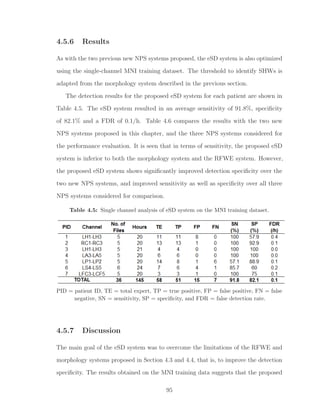
Neural Signals in Epilepsy
Rajeev Yadav
A Thesis
in
The Department
of
Electrical and Computer Engineering
Presented in Partial Fulfillment of the Requirements
for the Degree of Doctor of Philisophy at
Concordia University,
Montreal, Quebec, Canada
April 2012
© Rajeev Yadav, 2012
CONCORDIA UNIVERSITY
School of Graduate Studies
This is to certify that the thesis prepared
By: : Rajeev Yadav
Entitled: Automatic Detection and Classification of Neural Signals
in Epilepsy
and submitted in partial fulfilment of the requirements for the degree of
Doctor of Philosophy (Electrical Engineering)
complies with the regulations of this University and meets the accepted standards
with respect to originality and quality.
Signed by the final examining committee :
Chair
Dr. D. Dysart-Gale
External Examiner
Dr. J. Gotman
External to Program
Dr. C. Y. Su
Examiner
Dr. M. O. Ahmad
Examiner
Dr. W-P. Zhu
Thesis Supervisor
Dr. M. N. S. Swamy
Thesis Supervisor
Dr. R. Agarwal
Approved by
Dr. J. X. Zhang, Graduate Program Director
April 10, 2012.
Dr. Robin A. L. Drew, Dean of Faculty
(Engineering and Computer Science)
ABSTRACT
Automatic Detection and Classification
of Neural Signals in Epilepsy
Rajeev Yadav, Ph.D.
Concordia University, 2012
The success of an epilepsy treatment, such as resective surgery, relies heavily on
the accurate identification and localization of the brain regions involved in epilepsy
for which patients undergo continuous intracranial electroencephalogram (EEG) mon-
itoring. The prolonged EEG recordings are screened for two main biomarkers of
epilepsy: seizures and interictal spikes. Visual screening and quantitation of these
two biomarkers in voluminous EEG recordings is highly subjective, labor-intensive,
tiresome and expensive. This thesis focuses on developing new techniques to detect
and classify these events in the EEG to aid the review of prolonged intracranial EEG
recordings.
It has been observed in the literature that reliable seizure detection can be made
by quantifying the evolution of seizure EEG waveforms. This thesis presents three
new computationally simple non-patient-specific (NPS) seizure detection systems that
quantify the temporal evolution of seizure EEG. The first method is based on the
frequency-weighted-energy, the second method on quantifying the EEG waveform
sharpness, while the third method mimics EEG experts. The performance of these
new methods is compared with that of three state-of-the-art NPS seizure detection
systems. The results show that the proposed systems outperform these state-of-the-art
systems.
Epilepsy therapies are individualized for numerous reasons, and patient-specific
(PS) seizure detection techniques are needed not only in the pre-surgical evaluation of
prolonged EEG recordings, but also in the emerging neuro-responsive therapies. This
thesis proposes a new model-based PS seizure detection system that requires only
iii
the knowledge of a template seizure pattern to derive the seizure model consisting
of a set of basis functions necessary to utilize the statistically optimal null filters
(SONF) for the detection of the subsequent seizures. The results of the performance
evaluation show that the proposed system provides improved results compared to the
clinically-used PS system.
Quantitative analysis of the second biomarker, interictal spikes, may help in the
understanding of epileptogenesis, and to identify new epileptic biomarkers and new
therapies. However, such an analysis is still done manually in most of the epilepsy
centers. This thesis presents an unsupervised spike sorting system that does not
require a priori knowledge of the complete spike data.
iv
I dedicate this work to people suffering from epilepsy,
and to great mentors who enlightened my career and life.
v
Acknowledgements
I would like to express deepest gratitude to my phenomenal advisers Drs. R.
Agarwal and M. N. S. Swamy for their meticulous guidance, unflagging support and
encouragement, persistent drive towards excellence, and the freedom to pursue ideas
in my own way. I am indebted to my advisers for everything that I have achieved in
these many years.
I sincerely thank Drs. M. Omair Ahmad and Weiping Zhu for their guidance and
feedback as members of my thesis committee.
I greatfully acknowledge the support of Concordia University through bursaries and
graduate teaching assistantships; and the Natural Sciences and Engineering Research
Council (NSERC), Regroupement Strat´egique en Microsyst`emes du Qu´ebec (ReSMiQ),
and the National Institutes of Health (NIH) and National Institute of Neurological
Disorders and Stroke (NINDS) through grants awarded to Drs. R. Agarwal and M. N.
S. Swamy.
I thank Stellate Systems Inc. for providing the MNI database and the Harmonie
EEG software. I wish to thank the University of Freiburg and the University Hospital
Freiburg for the FSP database, the Department of Neurology and the Center for
Molecular Medicine and Genetics, Wayne State University for the WSU database, and
the Free/Libre/Open Source Software (FLOSS) for a variety of tools, namely, BioSig,
MikTex, LYX, and JabRef.
Thanks en masse to my colleagues at the Centre for Signal Processing and Com-
munication, and friends I have come to know during my PhD years, including Drs.
Saad Bouguezel, Gui Xie, Yong Zeng, Sreeraman Rajan, Aashit K. Shah, Jeoffrey A.
Loeb, and Fabiano Pandozzi; and Yves McDonald, Ralph Pollard and Victor Lanzo.
A very special thanks go to Tarun Madan for his helping hands during my entry into
Canada.
vi
I am grateful for God’s provision of joys, challenges, and grace for growth. My
achievements up to this moment would not have been possible without the support
from my family members. First of all, I would like to thank my late grandparents (Shri
Balram and Smt. Kulwanti Devi Yadav), and my parents (Shri Jagan Nath and Smt.
Sneh Lata Yadav) for providing the encouragement and confidence that sustained
me throughout the tough times. I am grateful to my supportive parents-in-law (Shri
Gauri Shankar and Smt. Luxmi Yadav), maternal uncles, especially Shri Arun Kumar
Yadav and his family, brothers (Sanjeev, Jeetendra, Amit and Ankit), sisters-in-law
(Reeta and Indu) and sisters (Sonia and Vidisha).
Last, but not the least, I eternally thank my wife, Kanak, for her unconditional
love, constant encouragement, support, understanding and patience throughout the
completion of this research.
vii
Contents
List of Figures xiii
List of Tables xxvi
List of Acronyms xxvii
1 Introduction 1
1.1 Epileptic Seizure . . . . . . . . . . . . . . . . . . . . . . . . . . . . . . 1
1.2 Electroencephalography . . . . . . . . . . . . . . . . . . . . . . . . . 2
1.3 EEG Classification . . . . . . . . . . . . . . . . . . . . . . . . . . . . 4
1.4 Motivation . . . . . . . . . . . . . . . . . . . . . . . . . . . . . . . . . 8
1.5 Scope of the Thesis . . . . . . . . . . . . . . . . . . . . . . . . . . . . 12
1.6 Organization of the Thesis . . . . . . . . . . . . . . . . . . . . . . . . 13
2 Literature Review 14
2.1 Introduction . . . . . . . . . . . . . . . . . . . . . . . . . . . . . . . . 14
2.2 Automatic Seizure Detection . . . . . . . . . . . . . . . . . . . . . . . 14
2.2.1 Non-Patient-Specific Seizure Detection . . . . . . . . . . . . . 17
2.2.2 Patient-Specific Seizure Detection . . . . . . . . . . . . . . . . 24
2.3 Spike Sorting Techniques . . . . . . . . . . . . . . . . . . . . . . . . . 28
2.4 Summary . . . . . . . . . . . . . . . . . . . . . . . . . . . . . . . . . . 31
viii
3 Data Description 35
3.1 Introduction . . . . . . . . . . . . . . . . . . . . . . . . . . . . . . . . 35
3.2 Data Description . . . . . . . . . . . . . . . . . . . . . . . . . . . . . 35
3.2.1 MNI Database . . . . . . . . . . . . . . . . . . . . . . . . . . 36
3.2.2 FSP Database . . . . . . . . . . . . . . . . . . . . . . . . . . . 37
3.2.3 WSU Database . . . . . . . . . . . . . . . . . . . . . . . . . . 37
3.2.4 Data Conversion . . . . . . . . . . . . . . . . . . . . . . . . . 38
3.2.5 Data Selection . . . . . . . . . . . . . . . . . . . . . . . . . . . . 41
3.3 Performance Evaluation Methodology . . . . . . . . . . . . . . . . . . 42
3.3.1 Seizure Detection . . . . . . . . . . . . . . . . . . . . . . . . . 42
3.3.2 Spike Sorting . . . . . . . . . . . . . . . . . . . . . . . . . . . 45
4 New Non-Patient-Specific Seizure Detection Systems 46
4.1 Introduction . . . . . . . . . . . . . . . . . . . . . . . . . . . . . . . . 46
4.2 Time-evolution of Seizure . . . . . . . . . . . . . . . . . . . . . . . . 47
4.3 Relative Frequency-Weighted Energy System . . . . . . . . . . . . . 48
4.3.1 Pre-processing and Artifact Rejection . . . . . . . . . . . . . . 49
4.3.2 Feature Extraction . . . . . . . . . . . . . . . . . . . . . . . . . 51
4.3.3 Classification . . . . . . . . . . . . . . . . . . . . . . . . . . . 54
4.3.4 Performance Evaluation . . . . . . . . . . . . . . . . . . . . . 58
4.3.5 Results . . . . . . . . . . . . . . . . . . . . . . . . . . . . . . . 60
4.3.6 Discussion . . . . . . . . . . . . . . . . . . . . . . . . . . . . . 60
4.4 Morphology System . . . . . . . . . . . . . . . . . . . . . . . . . . . . 67
4.4.1 Pre-processing and Artifact Rejection . . . . . . . . . . . . . . 69
4.4.2 Feature Extraction . . . . . . . . . . . . . . . . . . . . . . . . . 71
4.4.3 Classification . . . . . . . . . . . . . . . . . . . . . . . . . . . 73
4.4.4 Performance Evaluation . . . . . . . . . . . . . . . . . . . . . 76
4.4.5 Results . . . . . . . . . . . . . . . . . . . . . . . . . . . . . . . 77
ix
4.4.6 Discussion . . . . . . . . . . . . . . . . . . . . . . . . . . . . . 77
4.5 Evolution Seizure Detection System . . . . . . . . . . . . . . . . . . . 82
4.5.1 Pre-processing and Artifact Rejection . . . . . . . . . . . . . . 84
4.5.2 Feature Extraction . . . . . . . . . . . . . . . . . . . . . . . . 84
4.5.3 Identification of Candidate Seizure Event . . . . . . . . . . . . 89
4.5.4 Validation of Candidate Seizure Event . . . . . . . . . . . . . . 91
4.5.5 Performance Evaluation . . . . . . . . . . . . . . . . . . . . . 93
4.5.6 Results . . . . . . . . . . . . . . . . . . . . . . . . . . . . . . . 95
4.5.7 Discussion . . . . . . . . . . . . . . . . . . . . . . . . . . . . . 95
4.6 Summary . . . . . . . . . . . . . . . . . . . . . . . . . . . . . . . . . 100
5 Performance Evaluation and Rapid EEG Review Tool 104
5.1 Introduction . . . . . . . . . . . . . . . . . . . . . . . . . . . . . . . . 104
5.2 MNI Database Results . . . . . . . . . . . . . . . . . . . . . . . . . . 104
5.3 Discussion . . . . . . . . . . . . . . . . . . . . . . . . . . . . . . . . . 106
5.4 FSP Database Results . . . . . . . . . . . . . . . . . . . . . . . . . . . 111
5.5 Discussion . . . . . . . . . . . . . . . . . . . . . . . . . . . . . . . . . 115
5.6 Rapid Review of Prolonged EEG Recordings . . . . . . . . . . . . . . 124
5.6.1 Background . . . . . . . . . . . . . . . . . . . . . . . . . . . . 124
5.6.2 Method . . . . . . . . . . . . . . . . . . . . . . . . . . . . . . 125
5.6.3 Results and Discussion . . . . . . . . . . . . . . . . . . . . . . 127
5.7 Summary . . . . . . . . . . . . . . . . . . . . . . . . . . . . . . . . . 133
6 A New Model-Based Patient-Specific Seizure Detection System 135
6.1 Introduction . . . . . . . . . . . . . . . . . . . . . . . . . . . . . . . . 135
6.2 Problem Formulation . . . . . . . . . . . . . . . . . . . . . . . . . . . 136
6.3 Model-Based Seizure Detection . . . . . . . . . . . . . . . . . . . . . 139
6.4 Pre-processing and Artifact Rejection . . . . . . . . . . . . . . . . . . . 141
x
6.5 Seizure Model . . . . . . . . . . . . . . . . . . . . . . . . . . . . . . . 143
6.5.1 STFT-based Segmentation . . . . . . . . . . . . . . . . . . . . 144
6.5.2 Rejection of Artifacts and Redundant Epochs in TPAT . . . . 145
6.5.3 Modeling of TPAT Epochs . . . . . . . . . . . . . . . . . . . . 147
6.6 Statistically Optimal Null Filter . . . . . . . . . . . . . . . . . . . . . 148
6.6.1 Classifier Training . . . . . . . . . . . . . . . . . . . . . . . . . 151
6.6.2 Model Selection . . . . . . . . . . . . . . . . . . . . . . . . . . . 151
6.6.3 Evolution-based Classification . . . . . . . . . . . . . . . . . . 153
6.7 Performance Evaluation . . . . . . . . . . . . . . . . . . . . . . . . . 154
6.8 Results . . . . . . . . . . . . . . . . . . . . . . . . . . . . . . . . . . . 157
6.9 Discussion . . . . . . . . . . . . . . . . . . . . . . . . . . . . . . . . . 157
6.10 Summary . . . . . . . . . . . . . . . . . . . . . . . . . . . . . . . . . 164
7 Unsupervised Spike Sorting 165
7.1 Introduction . . . . . . . . . . . . . . . . . . . . . . . . . . . . . . . . 165
7.2 Challenges in Spike Sorting . . . . . . . . . . . . . . . . . . . . . . . 166
7.3 Automatic Spike Classification . . . . . . . . . . . . . . . . . . . . . . 168
7.3.1 Spike Data (Spike Detection) . . . . . . . . . . . . . . . . . . 170
7.3.2 Spike Alignment . . . . . . . . . . . . . . . . . . . . . . . . . . 171
7.3.3 Morphological Correlator . . . . . . . . . . . . . . . . . . . . . 172
7.3.4 Principal Component Analysis . . . . . . . . . . . . . . . . . 173
7.3.5 Codebook-based Template-Matching . . . . . . . . . . . . . . 175
7.3.6 Hierarchical Clustering and Post-classification . . . . . . . . . 176
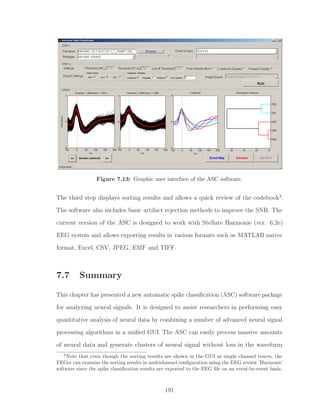
7.3.7 Graphical User Interface and Result Display . . . . . . . . . . 177
7.4 Performance Evaluation . . . . . . . . . . . . . . . . . . . . . . . . . 178
7.4.1 Geometric Technique . . . . . . . . . . . . . . . . . . . . . . . 179
7.4.2 Dendogram Analysis . . . . . . . . . . . . . . . . . . . . . . . 180
7.5 Results . . . . . . . . . . . . . . . . . . . . . . . . . . . . . . . . . . . . 181
xi
7.6 Discussion . . . . . . . . . . . . . . . . . . . . . . . . . . . . . . . . . 183
7.7 Summary . . . . . . . . . . . . . . . . . . . . . . . . . . . . . . . . . . 191
8 Conclusion 193
8.1 Concluding Remarks . . . . . . . . . . . . . . . . . . . . . . . . . . . 193
8.2 Contributions . . . . . . . . . . . . . . . . . . . . . . . . . . . . . . . 197
8.3 Future Perspectives . . . . . . . . . . . . . . . . . . . . . . . . . . . . 199
8.3.1 Non-Patient-Specific System . . . . . . . . . . . . . . . . . . . 199
8.3.2 Patient-Specific System . . . . . . . . . . . . . . . . . . . . . . . 201
8.3.3 Spike Sorting System . . . . . . . . . . . . . . . . . . . . . . . 202
References 204
xii
List of Figures
1.1 Classification of EEG-based on the electrode placement. Images ob-
tained from (a) www.erwinadr.blogspot.com, and (b-c) www.uwhealth.org. 3
1.2 An example of 20 seconds of multi-channel intracerebral EEG of a patient. 4
1.3 Schematic for classification of EEG in epilepsy by the EEGer. Adap-
ted from Self-adapting algorithms for seizure detection during EEG
monitoring by H. Qu, 1995, McGill University, Canada [20]. . . . . . 6
1.4 An example 20 seconds of SEEG representing ictal (seizure) and inter-
ictal activity for a patient . . . . . . . . . . . . . . . . . . . . . . . . 6
1.5 Graphical illustration of behavioral changes during seizure in epileptic
children. Images obtained from the website of WHO/UNESCO, and
from http://wikinoticia.com. . . . . . . . . . . . . . . . . . . . . . . . 7
1.6 Architecture of a fully automatic patient-specific seizure detection system. 11
3.1 Protocol for analysis of the EEG signals. . . . . . . . . . . . . . . . 39
3.2 Section-based technique of performance evaluation. Numbered events
represent the algorithm detections, EEGer section is a multi-channel
duration event and the ’red’ rectangular box represents the detection
section on channel of interest (LH1-LH3). . . . . . . . . . . . . . . . . 44
xiii
4.1 Encoding the time evolution of seizure by tracking the EEG character-
istics. The example parametrizes temporal changes in EEG amplitude.
Seizure onset is at the point ’A’. Seizure is segmented into three sec-
tions representing monotonic increase (AB), stable (BC) and monotonic
decrease (CD) in the amplitude. . . . . . . . . . . . . . . . . . . . . 48
4.2 Flow chart of the RFWE seizure detection system. . . . . . . . . . . . 49
4.3 (A): Single channel EEG contaminated by the two common artifacts
present in the intracranial EEG. (B) represents the time instances of
IEAs, and (C) represents the time instances of HAs in (A). . . . . . . . 51
4.4 Feature extraction techniques: (A) single sliding window, and (B) two
sliding window feature extraction. . . . . . . . . . . . . . . . . . . . . 52
4.5 The example represents 160 s of EEG activity that includes normal
(background) and seizure activity. The RFWE describes the changes
seen in the EEG as it progresses from inter-ictal (background) to ictal
(seizure) state, and back to inter-ictal state. . . . . . . . . . . . . . . 54
4.6 Tracking the continual increase of the RFWE trajectory at the seizure
onset. . . . . . . . . . . . . . . . . . . . . . . . . . . . . . . . . . . . 56
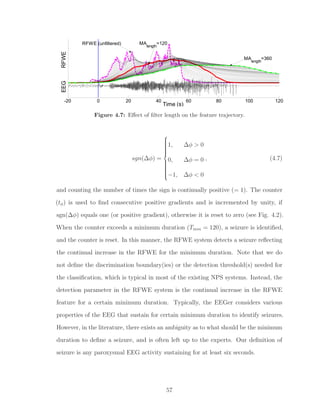
4.7 Effect of filter length on the feature trajectory. . . . . . . . . . . . . . 57
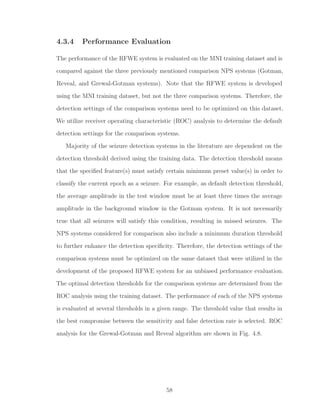
4.8 ROC analysis for Grewal-Gotman system and Reveal algorithm. The
detection threshold of the Grewal-Gotman system and Reveal algorithm
is varied from 1 to 10. The selected thresholds for Grewal-Gotman
system (detection threshold = 3) and Reveal algorithm (perception
value = 5) are selected. . . . . . . . . . . . . . . . . . . . . . . . . . . 59
4.9 Seizure classification-based on duration. . . . . . . . . . . . . . . . . . 62
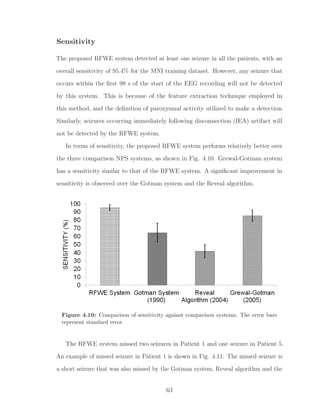
4.10 Comparison of sensitivity against comparison systems. The error bars
represent standard error. . . . . . . . . . . . . . . . . . . . . . . . . . 63
xiv
4.11 Missed 30 s long seizure in Channel LH1-LH3 in Patient 1. The seizure
was missed by the RFWE system as well as all three comparison systems. 64
4.12 An example of low amplitude, mixed frequency seizure in Patient 5 that
was missed by the RFWE and Gotman systems, but detected by the
Reveal algorithm and Grewal-Gotman system. . . . . . . . . . . . . 64
4.13 Good detection in Patient 2 (channel: RC1-RC3) of the MNI training
dataset. The multichannel EEG (15 s) containing a seizure that was
detected by RFWE system and Grewal-Gotman system but missed by
Gotman system and Reveal algorithm. The detection time instance is
shown by vertical line. . . . . . . . . . . . . . . . . . . . . . . . . . . 65
4.14 Multichannel EEG (30 s) with an example of false detection in Patient
5 (channel: LP1-LP2) of the MNI training dataset that was detected by
the RFWE system and the three comparison systems. The detection
time instance is shown by the vertical line. . . . . . . . . . . . . . . . 66
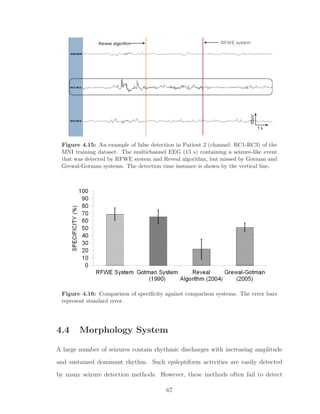
4.15 An example of false detection in Patient 2 (channel: RC1-RC3) of
the MNI training dataset. The multichannel EEG (15 s) containing
a seizure-like event that was detected by RFWE system and Reveal
algorithm, but missed by Gotman and Grewal-Gotman systems. The
detection time instance is shown by the vertical line. . . . . . . . . . 67
4.16 Comparison of specificity against comparison systems. The error bars
represent standard error. . . . . . . . . . . . . . . . . . . . . . . . . . 67
4.17 Illustration of gradually increasing number of sharp components (sharp
wave complexes and spike-like activities) as the seizure evolves. The
number of sharp components prior to seizure onset is non-existent
compared to post-onset. . . . . . . . . . . . . . . . . . . . . . . . . . 69
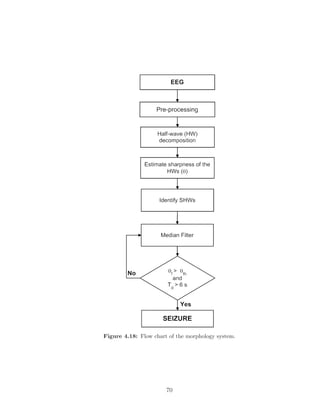
4.18 Flow chart of the morphology system. . . . . . . . . . . . . . . . . . . 70
xv
4.19 A section of EEG is zoomed in to illustrate half-wave decomposition
and estimation of sharpness of the half-wave. The slope of the best-fit
line between the local extrema (thick-black line) is the sharpness feature. 72
4.20 Evolution of SHW as the seizure progresses. (A) Seizure with back-
ground. (B) SHW corresponding to the EEG in (A). . . . . . . . . . 73
4.21 Threshold estimation using the receiver operating characteristics (ROC)
analysis. The threshold mth is varied from 5 to 50 and for each mth,
the average sensitivity and false detection rate is computed to generate
the ROC curve. The default threshold (mth = 25) which we use for
morphology system is shown encircled. . . . . . . . . . . . . . . . . . 75
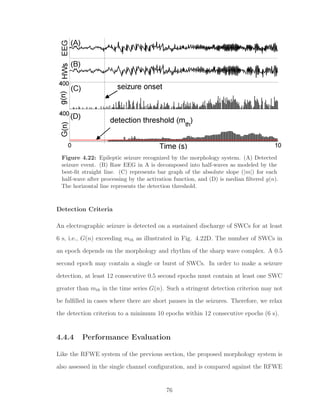
4.22 Epileptic seizure recognized by the morphology system. (A) Detected
seizure event. (B) Raw EEG in A is decomposed into half-waves as
modeled by the best-fit straight line. (C) represents bar graph of the
absolute slope (|m|) for each half-wave after processing by the activation
function, and (D) is median filtered g(n). The horizontal line represents
the detection threshold. . . . . . . . . . . . . . . . . . . . . . . . . . 76
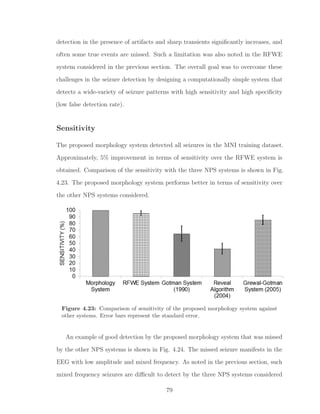
4.23 Comparison of sensitivity of the proposed morphology system against
other systems. Error bars represent the standard error. . . . . . . . . 79
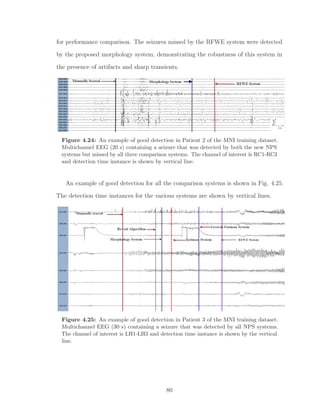
4.24 An example of good detection in Patient 2 of the MNI training dataset.
Multichannel EEG (20 s) containing a seizure that was detected by both
the new NPS systems but missed by all three comparison systems. The
channel of interest is RC1-RC3 and detection time instance is shown
by vertical line. . . . . . . . . . . . . . . . . . . . . . . . . . . . . . . 80
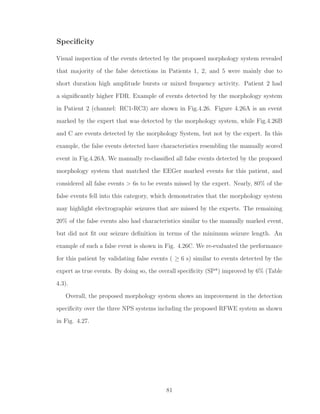
4.25 An example of good detection in Patient 3 of the MNI training dataset.
Multichannel EEG (30 s) containing a seizure that was detected by all
NPS systems. The channel of interest is LH1-LH3 and detection time
instance is shown by the vertical line. . . . . . . . . . . . . . . . . . . 80
xvi
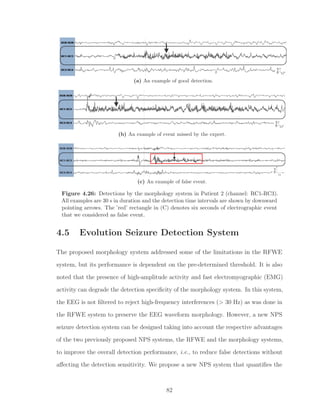
4.26 Detections by the morphology system in Patient 2 (channel: RC1-RC3).
All examples are 30 s in duration and the detection time intervals are
shown by downward pointing arrows. The ’red’ rectangle in (C) denotes
six seconds of electrographic event that we considered as false event. . 82
4.27 Comparison of specificity of the morphology system with the other
systems on the MNI training dataset. Error bars represent standard
error. . . . . . . . . . . . . . . . . . . . . . . . . . . . . . . . . . . . . 83
4.28 Flowchart of the eSD system. . . . . . . . . . . . . . . . . . . . . . . 86
4.29 Time evolution of coefficient of variation of amplitude superimposed on
the EEG. . . . . . . . . . . . . . . . . . . . . . . . . . . . . . . . . . 88
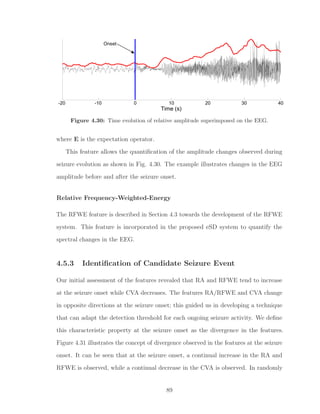
4.30 Time evolution of relative amplitude superimposed on the EEG. . . . 89
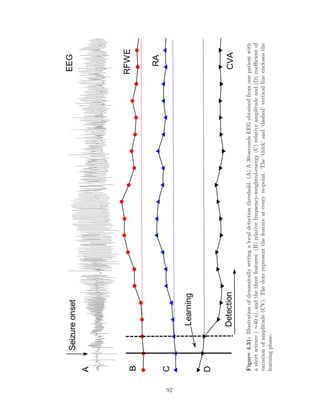
4.31 Illustration of dynamically setting a local detection threshold. (A)
A 30-seconds EEG obtained from one patient with a short seizure (
∼40 s), and the three features: (B) relative frequency-weighted-energy
(C) relative amplitude and (D) coefficient of variation of amplitude
(CV). The dots represent the feature at every m-point. The ‘thick’ and
‘dashed’ vertical line encloses the learning phase. . . . . . . . . . . . . 92
4.32 Illustration of the quantification of evolution of SWC density. (A) is
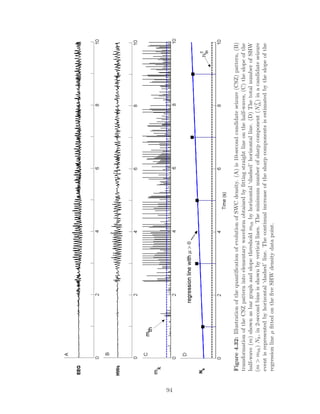
10-second candidate seizure (CSZ) pattern, (B) transformation of the
CSZ pattern into elementary waveform obtained by fitting straight line
on the half-waves, (C) the slope of the half-wave (m) shown as bar
graph and slope threshold mth by horizontal ‘dashed’ horizontal line.
(D) The total number of SHW (m > mth) Nk, in 2-second bins is shown
by vertical lines. The minimum number of sharp component (NT
th) in a
candidate seizure event is represented by horizontal ‘dashed’ line. The
continual increase of the sharp components is estimated by the slope of
the regression line µ fitted on the five SHW density data point. . . . . 94
xvii
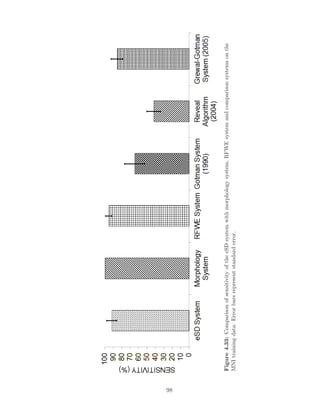
4.33 Comparison of sensitivity of the eSD system with morphology system,
RFWE system and comparison systems on the MNI training data.
Error bars represent standard error. . . . . . . . . . . . . . . . . . . 98
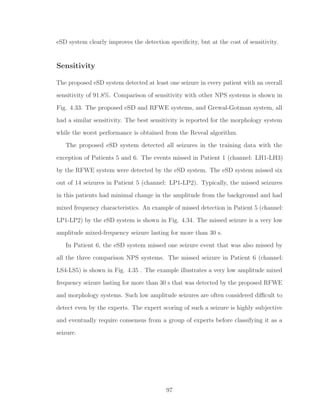
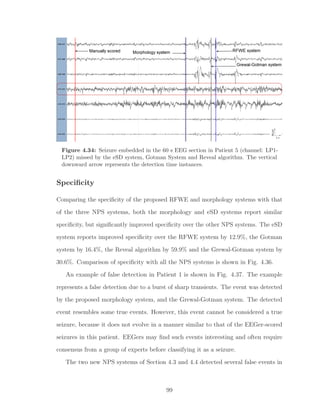
4.34 Seizure embedded in the 60 s EEG section in Patient 5 (channel: LP1-
LP2) missed by the eSD system, Gotman System and Reveal algorithm.
The vertical downward arrow represents the detection time instances. 99
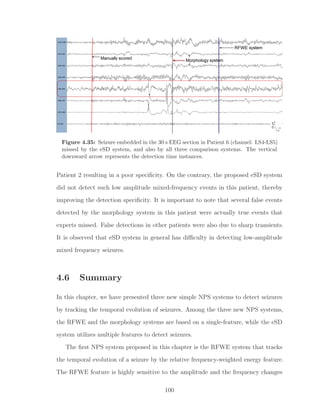
4.35 Seizure embedded in the 30 s EEG section in Patient 6 (channel: LS4-
LS5) missed by the eSD system, and also by all three comparison
systems. The vertical downward arrow represents the detection time
instances. . . . . . . . . . . . . . . . . . . . . . . . . . . . . . . . . . 100
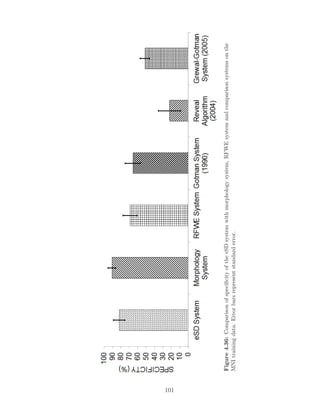
4.36 Comparison of specificity of the eSD system with morphology system,
RFWE system and comparison systems on the MNI training data.
Error bars represent standard error. . . . . . . . . . . . . . . . . . . . 101
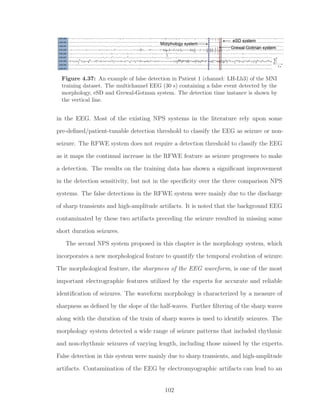
4.37 An example of false detection in Patient 1 (channel: LH-Lh3) of the
MNI training dataset. The multichannel EEG (30 s) containing a false
event detected by the morphology, eSD and Grewal-Gotman system.
The detection time instance is shown by the vertical line. . . . . . . . 102
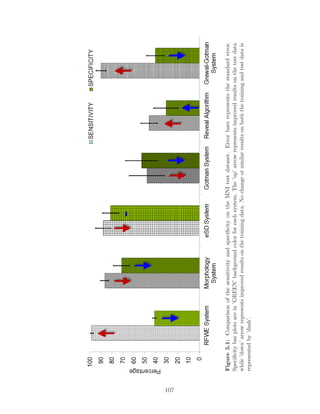
5.1 Comparison of the sensitivity and specificity on the MNI test dataset.
Error bars represents the standard error. Specificity bar plots are in
’GREEN’ background color for each system. The ’up’ arrow represents
improved results on the test data while ’down’ arrow represents improved
results on the training data. No change or similar results on both the
training and test data is represented by ’dash’. . . . . . . . . . . . . . 107
xviii
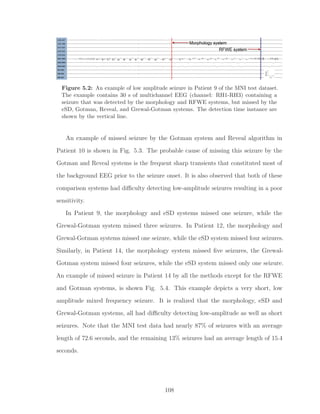
5.2 An example of low amplitude seizure in Patient 9 of the MNI test
dataset. The example contains 30 s of multichannel EEG (channel:
RH1-RH3) containing a seizure that was detected by the morphology
and RFWE systems, but missed by the eSD, Gotman, Reveal, and
Grewal-Gotman systems. The detection time instance are shown by
the vertical line. . . . . . . . . . . . . . . . . . . . . . . . . . . . . . 108
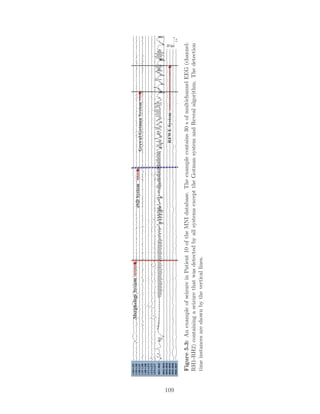
5.3 An example of seizure in Patient 10 of the MNI database. The example
contains 30 s of multichannel EEG (channel: RH1-RH2) containing a
seizure that was detected by all systems except the Gotman system
and Reveal algorithm. The detection time instances are shown by the
vertical lines. . . . . . . . . . . . . . . . . . . . . . . . . . . . . . . . 109
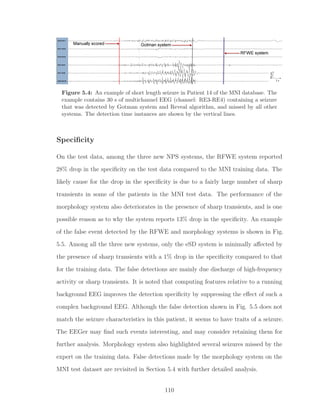
5.4 An example of short length seizure in Patient 14 of the MNI database.
The example contains 30 s of multichannel EEG (channel: RE3-RE4)
containing a seizure that was detected by Gotman system and Reveal
algorithm, and missed by all other systems. The detection time instances
are shown by the vertical lines. . . . . . . . . . . . . . . . . . . . . . 110
5.5 An example of false detection in Patient 9 of the MNI test data. The
example contains 30 s of multichannel EEG (channel: RH1-RH3) detec-
ted by RFWE system and morphology system, but not by other NPS
systems. The detection time instances are shown by the vertical lines. 111
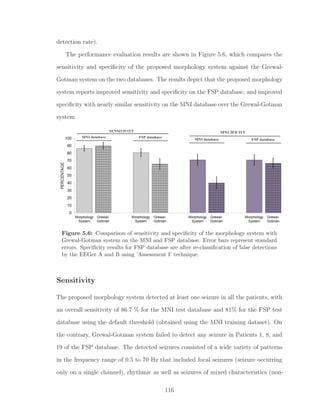
5.6 Comparison of sensitivity and specificity of the morphology system
with Grewal-Gotman system on the MNI and FSP database. Error
bars represent standard errors. Specificity results for FSP database are
after re-classification of false detections by the EEGer A and B using
’Assessment I’ technique. . . . . . . . . . . . . . . . . . . . . . . . . 116
xix
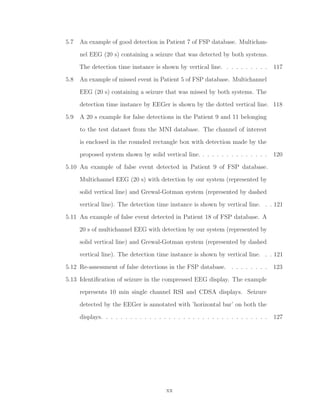
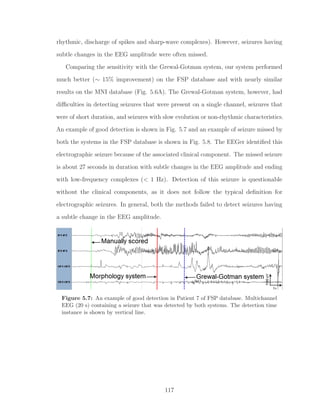
5.7 An example of good detection in Patient 7 of FSP database. Multichan-
nel EEG (20 s) containing a seizure that was detected by both systems.
The detection time instance is shown by vertical line. . . . . . . . . . 117
5.8 An example of missed event in Patient 5 of FSP database. Multichannel
EEG (20 s) containing a seizure that was missed by both systems. The
detection time instance by EEGer is shown by the dotted vertical line. 118
5.9 A 20 s example for false detections in the Patient 9 and 11 belonging
to the test dataset from the MNI database. The channel of interest
is enclosed in the rounded rectangle box with detection made by the
proposed system shown by solid vertical line. . . . . . . . . . . . . . . 120
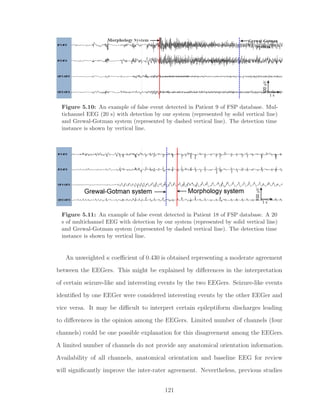
5.10 An example of false event detected in Patient 9 of FSP database.
Multichannel EEG (20 s) with detection by our system (represented by
solid vertical line) and Grewal-Gotman system (represented by dashed
vertical line). The detection time instance is shown by vertical line. . . 121
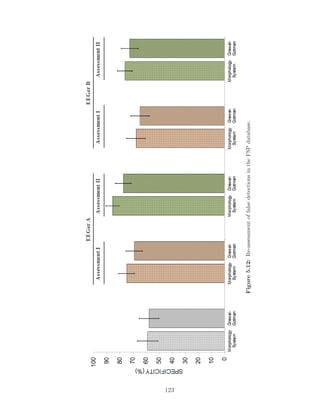
5.11 An example of false event detected in Patient 18 of FSP database. A
20 s of multichannel EEG with detection by our system (represented by
solid vertical line) and Grewal-Gotman system (represented by dashed
vertical line). The detection time instance is shown by vertical line. . . 121
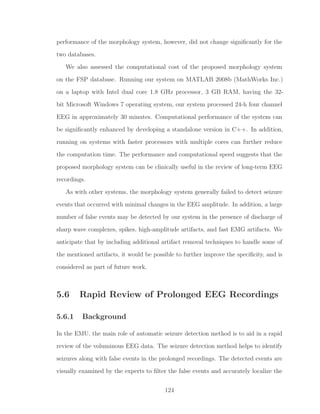
5.12 Re-assessment of false detections in the FSP database. . . . . . . . . 123
5.13 Identification of seizure in the compressed EEG display. The example
represents 10 min single channel RSI and CDSA displays. Seizure
detected by the EEGer is annotated with ’horizontal bar’ on both the
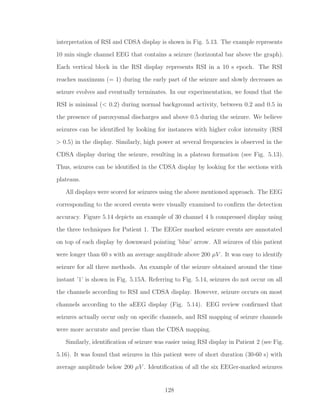
displays. . . . . . . . . . . . . . . . . . . . . . . . . . . . . . . . . . . 127
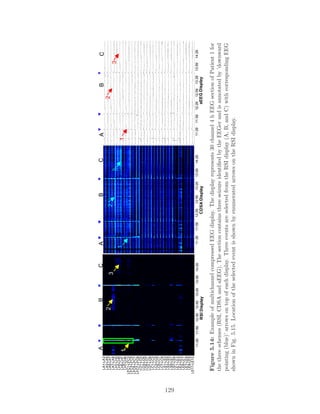
xx
5.14 Example of multichannel compressed EEG display. The display rep-
resents 30 channel 4 h EEG section of Patient 1 for the three schemes
(RSI, CDSA and aEEG). The section contains three seizure identified
by the EEGer and is annotated by ’downward pointing (blue)’ arrows
on top of each display. Three events are selected from the RSI display
(A, B, and C) with corresponding EEG shown in Fig. 5.15. Location of
the selected event is shown by enumerated arrows on the RSI display. 129
5.15 EEG corresponding to the events selected from the RSI display in Fig.
5.14. (A) represents a seizure around the time point ’1’, (B) represents
the pre-ictal rhythmic discharge of sharp waves around the time point
’2’, and (C) represents discharges of sharp wave complexes around the
time point ’3’ in Fig. 5.13, respectively. Each segment represents 30 s
of 10 channel EEG. . . . . . . . . . . . . . . . . . . . . . . . . . . . 130
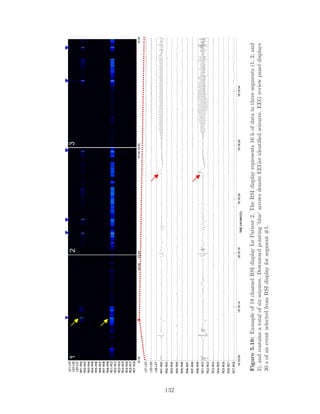
5.16 Example of 18 channel RSI display for Patient 2. The RSI display
represents 16 h of data in three segments (1, 2, and 3), and contains a
total of six seizures. Downward pointing ’blue’ arrows denote EEGer
identified seizures. EEG review panel displays 30 s of an event selected
from RSI display for segment #1. . . . . . . . . . . . . . . . . . . . 132
6.1 The example illustrates temporal evolution of a seizure which is observed
as piecewise stationary rhythms. This example encapsulates a 90 s single
channel EEG (channel: RH1-RH2) of a patient, which is considered
as the template pattern in this patient. The piecewise stationary
rhythms (template epochs) in the template pattern are enumerated
and is obtained by the proposed STFT-based adaptive segmentation
algorithm. . . . . . . . . . . . . . . . . . . . . . . . . . . . . . . . . 137
xxi
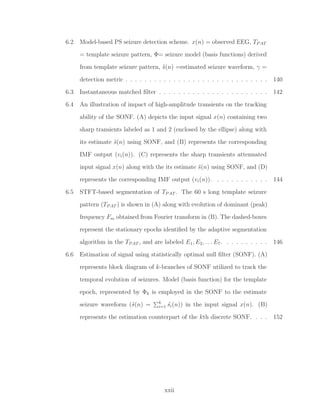
6.2 Model-based PS seizure detection scheme. x(n) = observed EEG, TPAT
= template seizure pattern, Φ= seizure model (basis functions) derived
from template seizure pattern, ˆs(n) =estimated seizure waveform, γ =
detection metric . . . . . . . . . . . . . . . . . . . . . . . . . . . . . . 140
6.3 Instantaneous matched filter . . . . . . . . . . . . . . . . . . . . . . . 142
6.4 An illustration of impact of high-amplitude transients on the tracking
ability of the SONF. (A) depicts the input signal x(n) containing two
sharp transients labeled as 1 and 2 (enclosed by the ellipse) along with
its estimate ˆs(n) using SONF, and (B) represents the corresponding
IMF output (vi(n)). (C) represents the sharp transients attenuated
input signal x(n) along with the its estimate ˆs(n) using SONF, and (D)
represents the corresponding IMF output (vi(n)). . . . . . . . . . . . 144
6.5 STFT-based segmentation of TPAT . The 60 s long template seizure
pattern (TPAT ) is shown in (A) along with evolution of dominant (peak)
frequency Fm obtained from Fourier transform in (B). The dashed-boxes
represent the stationary epochs identified by the adaptive segmentation
algorithm in the TPAT , and are labeled E1, E2, . . . E7. . . . . . . . . . 146
6.6 Estimation of signal using statistically optimal null filter (SONF). (A)
represents block diagram of k-branches of SONF utilized to track the
temporal evolution of seizures. Model (basis function) for the template
epoch, represented by Φk is employed in the SONF to the estimate
seizure waveform (ˆs(n) = k
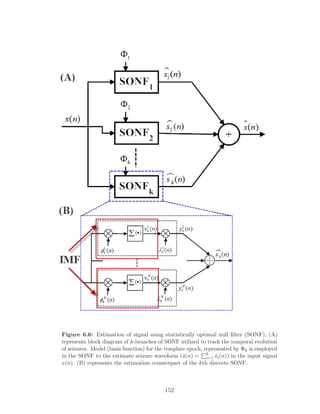
i=1 ˆsi(n)) in the input signal x(n). (B)
represents the estimation counterpart of the kth discrete SONF. . . . 152
xxii
6.7 Evolution-based classification. (A) represents two disjoint (k = 2)
template epochs of TPAT along with their power spectral density plot.
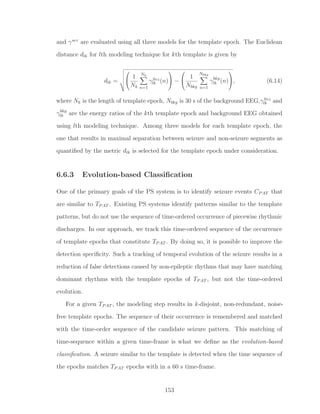
A candidate seizure pattern CPAT similar to TPAT detected using the
seizure model is shown in (B). (C) represents the CPAT and (D) the
energy ratios γk for the k-SONF branches (one model for each template
epochs), and (E) depicts detection by the individual SONF branches.
The ’number’ represents time-order in which the template epochs con-
stitute the TPAT, = {E1,E2} that are examined by the evolution-based
classifier to make a detection. The vertical ’dashed’ line denotes the
final detection of an event similar to TPAT . . . . . . . . . . . . . . . . 155
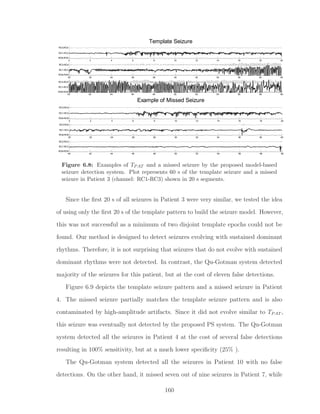
6.8 Examples of TPAT and a missed seizure by the proposed model-based
seizure detection system. Plot represents 60 s of the template seizure
and a missed seizure in Patient 3 (channel: RC1-RC3) shown in 20 s
segments. . . . . . . . . . . . . . . . . . . . . . . . . . . . . . . . . . 160
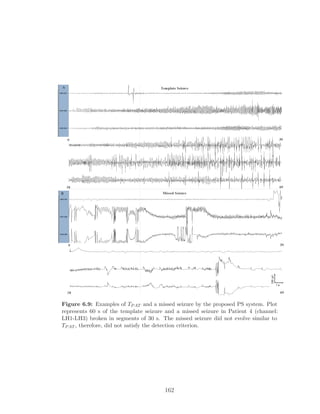
6.9 Examples of TPAT and a missed seizure by the proposed PS system.
Plot represents 60 s of the template seizure and a missed seizure in
Patient 4 (channel: LH1-LH3) broken in segments of 30 s. The missed
seizure did not evolve similar to TPAT , therefore, did not satisfy the
detection criterion. . . . . . . . . . . . . . . . . . . . . . . . . . . . . 162
6.10 Examples of a template seizure and a missed seizure by the comparison
system in Patient 7. Data represents 20 s of the training data and 20 s
of a missed seizure. . . . . . . . . . . . . . . . . . . . . . . . . . . . 163
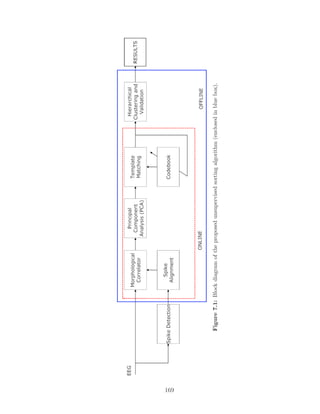
7.1 Block diagram of the proposed unsupervised sorting algorithm (enclosed
in blue box). . . . . . . . . . . . . . . . . . . . . . . . . . . . . . . . . 169
xxiii
7.2 Multichannel spike and spike-waveform complex event. (A) represents
multichannel EEG event extracted around the vertex of the reference
(detected) spike. Vertical line represents the vertex of the detected
spike. (B) represents 100 ms of multichannel spike data (X), and (C)
represents example of multichannel spike-waveform complex (Y), both
aligned to the reference spike vertex. . . . . . . . . . . . . . . . . . . . 171
7.3 Identification of channels with spikes similar to the reference spike using
morphological correlator. . . . . . . . . . . . . . . . . . . . . . . . . . 173
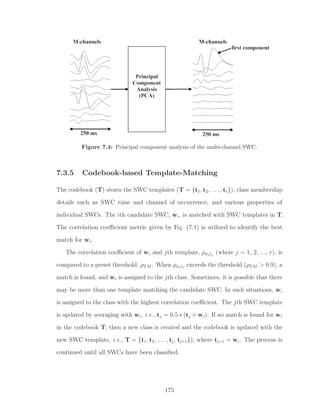
7.4 Principal component analysis of the multi-channel SWC. . . . . . . . 175
7.5 Events lost in the insignificant clusters on thresholding relative to the
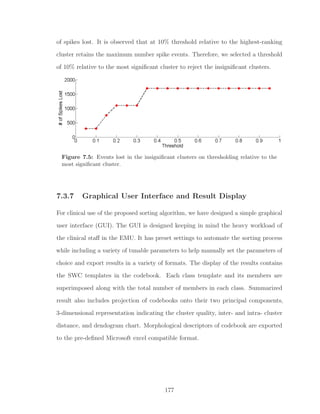
most significant cluster. . . . . . . . . . . . . . . . . . . . . . . . . . . 177
7.6 Visual analysis of the cluster quality . . . . . . . . . . . . . . . . . . 180
7.7 Percentage of events lost by the proposed ASC and WAVE CLUS
methods. Error bar represents standard error. . . . . . . . . . . . . . . 181
7.8 Codebook generated using AutoSpike and ManuSpike events for Patient
5 using the proposed spike sorting algorithm. . . . . . . . . . . . . . . 187
7.9 Illustration of cluster validation in terms of inter- and intra- cluster
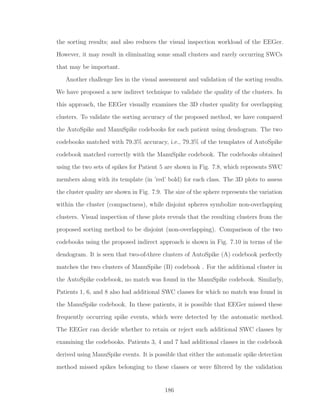
distance for the two codebooks of Patient 5. . . . . . . . . . . . . . . 188
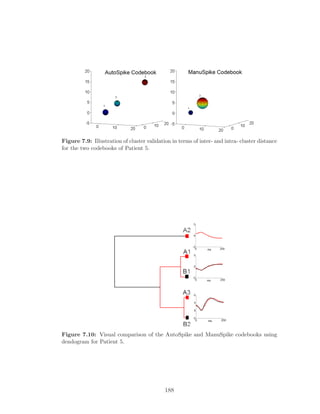
7.10 Visual comparison of the AutoSpike and ManuSpike codebooks using
dendogram for Patient 5. . . . . . . . . . . . . . . . . . . . . . . . . . 188
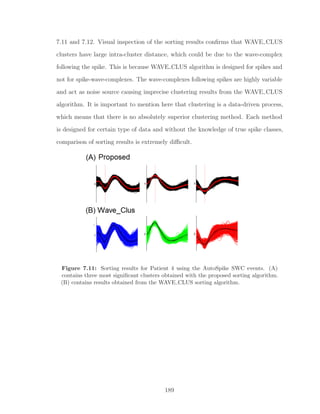
7.11 Sorting results for Patient 4 using the AutoSpike SWC events. (A)
contains three most significant clusters obtained with the proposed
sorting algorithm. (B) contains results obtained from the WAVE CLUS
sorting algorithm. . . . . . . . . . . . . . . . . . . . . . . . . . . . . 189
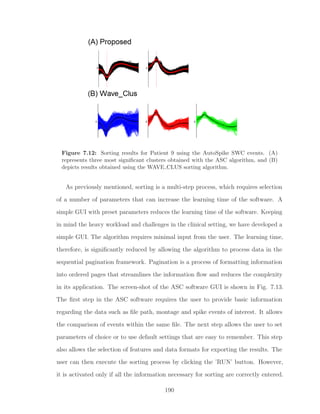
7.12 Sorting results for Patient 9 using the AutoSpike SWC events. (A) rep-
resents three most significant clusters obtained with the ASC algorithm,
and (B) depicts results obtained using the WAVE CLUS sorting algorithm.190
xxiv
7.13 Graphic user interface of the ASC software. . . . . . . . . . . . . . . . 191
xxv
List of Tables
2.1 Summary of seizure detection systems . . . . . . . . . . . . . . . . . . 18
4.1 Detection results for the proposed RFWE system on the MNI training
dataset . . . . . . . . . . . . . . . . . . . . . . . . . . . . . . . . . . . 60
4.2 Detection results for the three comparison systems on the MNI training
dataset . . . . . . . . . . . . . . . . . . . . . . . . . . . . . . . . . . . . 61
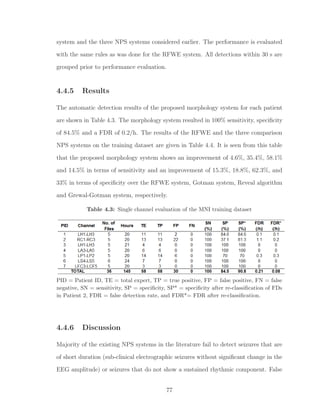
4.3 Single channel evaluation of the MNI training dataset . . . . . . . . . 77
4.4 Comparison results of the MNI training dataset . . . . . . . . . . . . 78
4.5 Single channel analysis of eSD system on the MNI training dataset. . 95
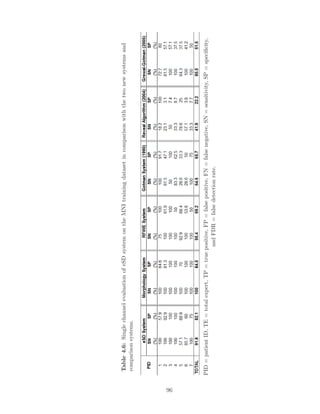
4.6 Single channel evaluation of eSD system on the MNI training dataset
in comparison with the two new systems and comparison systems. . . 96
5.1 MNI database results. . . . . . . . . . . . . . . . . . . . . . . . . . . 105
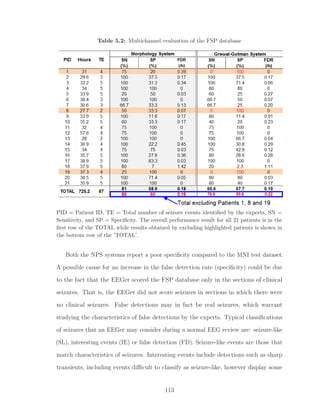
5.2 Multichannel evaluation of the FSP database . . . . . . . . . . . . . . 113
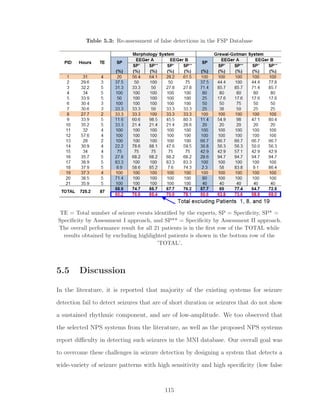
5.3 Re-assessment of false detections in the FSP Database . . . . . . . . 115
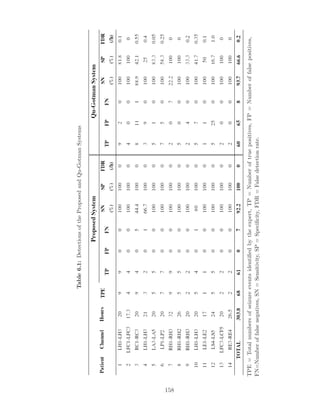
6.1 Detections of the Proposed and Qu-Gotman Systems . . . . . . . . . 158
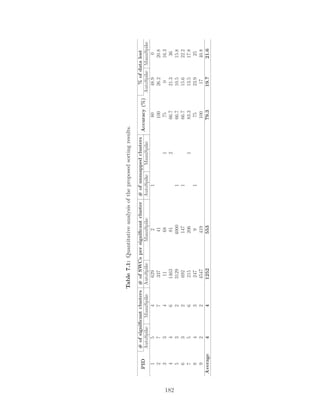
7.1 Quantitative analysis of the proposed sorting results. . . . . . . . . . 182
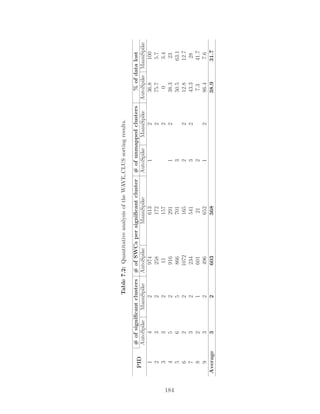
7.2 Quantitative analysis of the WAVE CLUS sorting results. . . . . . . . 184
xxvi
List of Acronyms
AED Anti-Epileptic Drug
aEEG Amplitude Integrated EEG
ASC Automatic Spike Classification
ASD Automatic Seizure Detection
CDSA Color Density Spectral Array
CEPA Compressed EEG Pattern Analysis
CSA Compressed Spectral Array
CSZ Candidate Seizure Event
CT Computerized Tomography
CVA Coefficient of Variation of the Amplitude
DFT Discrete Fourier Transform
EEG Electroencephalograph
EEGer EEG Expert
EMU Epilepsy Monitoring Unit
FDR False Detection Rate
xxvii
FIR Finite Impulse Response
fMRI Functional Magnetic Resonance Imaging
FWE Frequency-Weighted-Energy
GMM Gaussian Mixture Model
GUI Graphical User Interface
HA High-Amplitude Artifact
HW Half-Wave
IEA Iso-Electric Artifact
IED Interictal Epileptic Discharge
IIR Infinite Impulse Response
IMF Instantaneous Matched Filter
IS Interictal Spike
LTM Long-Term Monitoring
MA Moving Average
MF Matched Filter
NICU Neurological Intensive Care Unit
NLEO Non-linear Energy Operator
NPS Non-Patient-Specific
NRT Neuro-Responsive Therapy
PCA Pincipal Component Analysis
xxviii
PET Positron Emission Tomography
PNN Probablistic Neural Network
PPV Positive Percentage Agreement Value
PS Patient-Specific
RA Relative Amplitude
RFWE Relative Frequency-weighted Energy
ROC Receiver Operating Characteristic
RSI Relative Sharpness Index
SBR Signal-to-Background Ratio
SEEG Stereoencephalogram
SHW Sharpness of the Half-Wave
SOM Self-Organizing Map
SONF Statistically Optimal Null Filter
STL Short-term Lyapunov Exponent
SUDEP Sudden Unexplained Death in Epilepsy
SWC Sharp-Wave Complex
SWCD Sharp-Wave Complex Density
xxix
Chapter 1
Introduction
Epilepsy is a name given to a collection of neurological disorders. It is usually defined as
a tendency to have recurrent seizures. It is an ancient disorder found in all civilizations,
and it can be traced back as far as medical records exist. In fact, epilepsy is a disorder
that can occur in all mammalian species, probably more frequently as brains become
more complex. Remarkably, epilepsy is also uniformly distributed around the world.
There are no racial, geographical or social class boundaries. It occurs in both genders at
all ages, especially in neonates and in aging population. The clinical features of seizures
are often dramatic and alarming and frequently elicit fear and misunderstanding. This
in turn has led to profound social consequences for sufferers and has greatly added to
the burden of this disease [1].
In this chapter, we introduce some basic concepts in recognition and management
of epilepsy, and motivation for this research. Finally, we will give an outline of the
thesis.
1.1 Epileptic Seizure
Epilepsy is one of the most common and the oldest chronic neurological disorder
known to mankind. It is not a singular disease entity, but a variety of disorders
1
reflecting underlying brain dysfunction that may result from many different causes [2].
Approximately, 2% of the world population exhibit symptoms of epilepsy characterized
by the existence of abnormal synchronous discharges in large ensembles of neurons in
the brain structure [3]. This results in one or more clinical symptoms such as loss of
consciousness, behavioral changes, loss of motor activity, loss of senses. At times, it
can lead to death due to unexplained reasons, known as sudden unexplained death
in epilepsy (SUDEP). It is characterized by a tendency to have recurrent seizures. A
person is diagnosed epileptic on the occurrence of two or more unprovoked seizures,
and every year more than 2 million new cases of epilepsy are diagnosed [1, 4-9].
Seizure prevalence increases with age resulting in severe neurological damage that
often becomes medically intractable, a condition in which seizure cannot be controlled
by the administration of two or more anti-epileptic drugs (AEDs). Patients with
medically intractable seizures are often candidates for surgical resection (removal
of the epileptic foci in the brain), which requires accurate localization. Because
of the unknown time of occurrence of seizures, these patients undergo prolonged
monitoring during which a variety of clinical examinations are performed. These
include electrophysiological assessment and neuroimaging evaluation to accurately
identify and localize epileptic foci. Unfortunately, not all patients with intractable
seizure can benefit from resective surgery because of the associated severe systemic
consequences. Alternatively, these patients may benefit by the recent emergence of
novel electroconvulsive and neuromodulation therapies.
1.2 Electroencephalography
Electrophysiological assessment of epileptic patients involves mainly the electroen-
cephalography, which is the primary tool for the clinical recognition and management
of various neurological disorders, including epilepsy. It represents neurophysiologic
2
activity of the brain measured electrographically using electrodes placed on the scalp
or in special cases, subdurally on the cerebral cortex or deeper brain tissues. The
resulting traces are known as an electroencephalogram (EEG) and are sometimes
called brainwaves. Depending on how the electrodes are used for recording the EEG,
it can be specified as the scalp EEG (electrodes placed on the scalp), or intracerebral
EEG (electrodes implanted on the surface or deep brain). Subdural EEG electrodes
are those electrodes which sit over the surface of the brain while depth EEG electrodes
are inserted in the brain. The placement of these electrodes is confirmed with co-
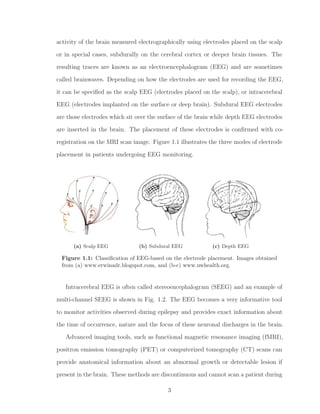
registration on the MRI scan image. Figure 1.1 illustrates the three modes of electrode
placement in patients undergoing EEG monitoring.
(a) Scalp EEG (b) Subdural EEG (c) Depth EEG
Figure 1.1: Classification of EEG-based on the electrode placement. Images obtained
from (a) www.erwinadr.blogspot.com, and (b-c) www.uwhealth.org.
Intracerebral EEG is often called stereoencephalogram (SEEG) and an example of
multi-channel SEEG is shown in Fig. 1.2. The EEG becomes a very informative tool
to monitor activities observed during epilepsy and provides exact information about
the time of occurrence, nature and the focus of these neuronal discharges in the brain.
Advanced imaging tools, such as functional magnetic resonance imaging (fMRI),
positron emission tomography (PET) or computerized tomography (CT) scans can
provide anatomical information about an abnormal growth or detectable lesion if
present in the brain. These methods are discontinuous and cannot scan a patient during
3
an on-going seizure where the time of occurrence is unknown. That is, continuously
scanning a patient is not possible. Thus, EEG is the only practical approach for
functional long-term continuous monitoring of the brain with a high temporal and
spatial resolution. Recent advances in the new neurostimulating system for epilepsy
rely on the EEG to detect seizures and subsequently abort their progression by
triggering focal treatment (electrical stimulation, focal cooling or drug release) [10-18].
Clearly, EEG plays a significant role from diagnosis to treatment of epileptic patients.
However, interpretation of EEG is notoriously difficult and requires EEG experts
(EEGer) consensus for its recognition.
Figure 1.2: An example of 20 seconds of multi-channel intracerebral EEG of a patient.
1.3 EEG Classification
The EEG consists of signals from both the cerebral and non-cerebral origins. Depending
on the recording technique, the contribution from each may vary. Abnormal EEG
patterns are specific to the type of study being performed. It is the task of the EEGer
to recognize the waveform of interest from the observed EEG and to identify the likely
locations of their generators. Since intracerebral or subdural electrodes are usually
4
closer to neurons than the scalp electrodes, the amplitude of EEGs recorded by the
depth electrodes is usually larger than that from scalp electrodes [19-21]. When EEG
is recorded with scalp electrodes, the amplitude is of the order of 20µV to 100 µV , and
of the order of 100 µV to 2 mV when recorded using depth electrodes. The spectral
bandwidth of the EEG (normal and abnormal) is from under 0.5 Hz to about 500 Hz.
The EEG experts visually inspect the prolonged recordings to identify epileptiform
activities. The common approach utilized to classify EEG is shown in Fig. 1.3.
Interictal EEG is defined as the non-seizure activity or the background EEG. The
interictal EEG comprises of normal patterns as well as abnormal patterns (such as
spikes, high frequency oscillations, etc) along with normal rhythmic discharges such
as alpha rhythm and sleep spindles [5, 22-27].
Generally, most of the seizures have some common characteristics, such as rhythmic
discharge of large amplitude or a low amplitude desynchronized EEG at the onset,
and repetitive spikes and irregular slow waves. No two patients have identical ictal
pattern. Even within the same patient, the two ictal patterns are never identical
though similar. Thus, the definition of a seizure still remains vague. However, the most
widely accepted definition for seizure states that during an epileptic seizure, a new
type of EEG rhythm appears, hesitantly, and then more distinctly, and soon it boldly
dominates the EEG tracing. It tends to become slower with increasing amplitude and
the more distinct spiky phases of the rhythmical waves observed in an EEG recording
[5]. An example of such a seizure is shown in Fig. 1.4.
5
EEG
Normal
Abnormal
Epileptiform
Non-epileptiform
Spikes
Seizure
Figure 1.3: Schematic for classification of EEG in epilepsy by the EEGer. Adapted
from Self-adapting algorithms for seizure detection during EEG monitoring by H. Qu,
1995, McGill University, Canada [20].
Figure 1.4: An example 20 seconds of SEEG representing ictal (seizure) and interictal
activity for a patient
Early stages of an epileptic seizure provide information about the seizure focus,
type and various characteristics of clinical significance. Seizures can be divided into
two distinct categories: (a) clinical and (b) sub-clinical. Clinical seizures are recognized
by certain behavioral changes associated with the seizure. Behavioral symptoms in
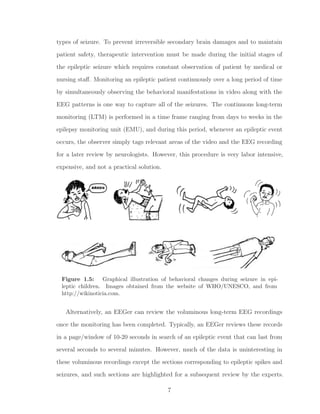
epileptic children are illustrated in Fig. 1.5. In some patients, there is minimal
or no behavioral changes during an epileptic seizure. Such seizures are known as
electrographic or sub-clinical seizures. EEG captures the abnormal activity in both
6
types of seizure. To prevent irreversible secondary brain damages and to maintain
patient safety, therapeutic intervention must be made during the initial stages of
the epileptic seizure which requires constant observation of patient by medical or
nursing staff. Monitoring an epileptic patient continuously over a long period of time
by simultaneously observing the behavioral manifestations in video along with the
EEG patterns is one way to capture all of the seizures. The continuous long-term
monitoring (LTM) is performed in a time frame ranging from days to weeks in the
epilepsy monitoring unit (EMU), and during this period, whenever an epileptic event
occurs, the observer simply tags relevant areas of the video and the EEG recording
for a later review by neurologists. However, this procedure is very labor intensive,
expensive, and not a practical solution.
Figure 1.5: Graphical illustration of behavioral changes during seizure in epi-
leptic children. Images obtained from the website of WHO/UNESCO, and from
http://wikinoticia.com.
Alternatively, an EEGer can review the voluminous long-term EEG recordings
once the monitoring has been completed. Typically, an EEGer reviews these records
in a page/window of 10-20 seconds in search of an epileptic event that can last from
several seconds to several minutes. However, much of the data is uninteresting in
these voluminous recordings except the sections corresponding to epileptic spikes and
seizures, and such sections are highlighted for a subsequent review by the experts.
7
This review process is again highly subjective, labor intensive, and tiresome.
Automatic seizure and spike detection methods can assist the nursing staff as
well as the EEGer to rapidly review the prolonged EEG recordings to retain sections
from recordings of clinical significance. Therefore, there arises a need for automatic
detection and classification of seizures and interictal spikes.
1.4 Motivation
The following provides the role of seizures and spikes in the management of epilepsy
in the EMUs, highlighting the clinical needs and challenges encountered that builds
the foundation for this research.
Seizure Detection
Automatic seizure detection techniques have received intense attention in the recent
past. Such methods are used in the EMU as a seizure warning system and aid in the
rapid review of the prolonged EEG recordings. Majority of the existing seizure detection
systems are designed for the scalp EEG. Patients who are candidate for resective
surgery or neurostimulating therapies undergo prolonged intracranial EEG recording.
Intracranial EEG contains a wide variety of seizure patterns that are minimally
contaminated by artifacts. Seizure detection methods designed for intracranial EEG
often require very high sensitivity and with minimal number of false detections. In
spite of high sensitivity, several electrographic seizures go undetected. Additionally,
majority of the existing seizure detection methods report difficulty in detecting short-
duration seizures or those with non-rhythmic mixed frequency characteristics or low
amplitude seizures.
In order to maintain high sensitivity and specificity, majority of the existing
methods employ strategies by combining a number of neighboring channels. Such
8
methods often fail to detect seizures occurring on a few channels, i.e., focal seizures that
occur on spatially separated channels. To improve sensitivity and specificity, a handful
of patient-specific seizure detection methods, that are based on the recurring nature
of epileptic seizures, have been proposed. Isolating precisely reproducible phenomena
in EEG signals still remains a difficult task that can highlight the neurophysiological
mechanisms to characterize an epileptic brain. Patient-specific seizure detection
systems thus become an indispensable tool aimed at better defining and understanding
epileptogenic areas to improve surgical treatments [28, 29].
Even though patient-specific seizure detectors demonstrate improved performance
over the generic methods, they are not practical. The main limiting factors in
all patient-specific detectors are (a) supervised selection of the seizure EEG, (b)
supervised selection of the non-seizure EEG (or a set of non-seizure EEG patterns),
and (c) supervised training of the classifier. Another fundamental problem in all seizure
detection methods is the detection of seizures with subtle changes in the amplitude [30-
37]. This is a problem that persists even in the visual detection of seizures. Addressing
some of these limitations will lead to a more practical patient-specific detector.
In addition to the seizure detection, one of the primary aims of the review of
prolonged intracranial EEG monitoring is to map channel-by-channel timeline of
seizures and epileptiform activities that can provide visualization of seizure onset
and spread (both temporally and spatially), which is pivotal when planning resective
surgery. This type of 2D visualization is unavailable for the review of intracranial
EEG. Automatic seizure detection can aid in the rapid identification of seizures.
However, it does not allow for a quantitative seizure analysis, which is still done
manually by experts. Therefore, adjunctive methods that allow quick identification of
seizures, provide a view of seizure activity over prolonged durations, seizure recurrence
frequency, and sites involved in the seizure generation for therapeutic interventions,
and management are much needed in the EMUs [5, 38-42].
9
Prolonged intracranial EEG recording is also performed prior to the implantation
of a neurostimulating device to identify the seizure foci and neural areas for stimulation
therapy for patients who may not benefit from the resective surgery. The idea behind
neurostimulation devices is to deliver focal treatment to inhibit the epileptic activity.
Electrical stimulation of the epileptogenic foci to inhibit the progression of seizure
is one such method that is gaining popularity [13-16, 18, 43, 44]. The success of
such devices rely heavily on the seizure detection capabilities. Computationally light,
low-power, robust and patient-specific seizure detectors are prerequisite to maintain
the longevity of the device (battery) and patient safety. However, seizure detection
system for application in the neurostimulating device is still in its infancy.
A fully automatic patient-adaptive seizure detection system is much needed, but
the clinical requirements of the seizure detection system and the existing challenges
in the non-patient specific (NPS) and patient-specific (PS) approaches of seizure
detection do not allow the existence of such a system. However, a fully automated
patient-adaptive seizure detection system is feasible by combining NPS and PS systems
to capture the advantages of the two approaches. The architecture of such a system is
shown in Fig. 1.6. Automatic patient-adaptation in such a system may be possible
by addressing the limitations in the PS systems, that is, by removing the need for a
large background EEG, automating the selection of the template seizure pattern and
training of the classifier. In such a system, the NPS system bootstraps the PS system
with template seizure patterns, and the PS system leverages on the event it detects to
optimize itself. It may be possible that seizures that are difficult to be detected by
the NPS system are easily identifiable by the PS system. Conversely, seizure patterns
that are difficult to be detected by the PS system are detected by the NPS system.
The patient-specific pattern database is updated on subsequent detections. Then,
the patterns in the database, ranked based on their recurrence frequency via the PS
system, may allow the experts to perform rapid qualitative and quantitative analysis.
10
Thus, the time involved in the manual qualitative analysis of the detected patterns,
quantification of reproducible seizure patterns, and correlation with the clinical data,
reduces significantly. However, realization of such a system demands that both the
NPS and PS systems are computationally light and robust.
Figure 1.6: Architecture of a fully automatic patient-specific seizure detection system.
In this thesis, we aim to develop new NPS and PS systems that can be used in the
fully automatic PS seizure detection system of Fig. 1.6.
Spike Classification
In addition to seizures, epileptic spikes also play an important role in the diagnosis
of seizure onset zones. They tend to occur more frequently than seizures and are
linked to the seizure onset zones. Detection and classification of spikes thus can
improve the epilepsy management. Furthermore, several studies have reported a
better surgical outcome when regions of frequent spikes (interictal) are also removed
[45]. However, it is still unclear as to exactly how interictal spikes develop, and how
they propagate and contribute to the generation of seizures [46-48]. A recent study
examined human brain tissues at regions of seizure onset and found a small group
of genes highly correlated with the interictal spike frequency [49, 50]. Quantitative
analysis of interictal spiking thus becomes inevitable, and may help to identify epileptic
biomarkers for drug therapy.
11
Automatic spike detection has received intense attention in the literature. On the
other hand, to date, spike classification is still done manually by the experts in most of
the EMUs, which is extremely subjective, challenging, tiresome, and expensive. There
exist a large number of automatic spike classification systems for neurophysiological
experiments but not for the intracranial EEG recording that can handle a large number
of electrodes and massive amount of data. Unavailability of a system for quantitative
analysis of interictal spikes in the intracranial EEG motivated us to develop a new
spike classification system.
1.5 Scope of the Thesis
The first objective of this research is to devise robust computationally-light techniques
for seizure detection that find widespread application in the EMU as a seizure warn-
ing system, aid in the rapid review of the prolonged intracranial EEG recordings,
and provide quantitative and qualitative seizure related information towards rapid
identification of epileptogenic sites. New NPS and PS seizure detection methods are
developed to overcome some of the existing challenges present in the seizure detection
literature. The proposed methods are compared against the popular seizure detection
techniques in the literature. These systems are also explored from the point of view
of generation of a new multi-channel 2D visualization of epileptiform activities that
allows easy and rapid quantitation of intracranial EEG recordings in the EMU.
The second objective of this research is to devise a robust spike sorting technique
for intracranial EEG recordings. Towards this goal, we develop an unsupervised
spike sorting algorithm that does not require a priori knowledge of spike classes,
is computationally simple and overcomes some of the existing challenges in spike
sorting. A graphical user interface (GUI) for spike sorting is developed to facilitate
easy integration of the algorithm in the clinical settings.
12
1.6 Organization of the Thesis
The thesis is organized as follows.
Chapter 2 reviews popular seizure detection and spike sorting methods.
Chapter 3 describes the EEG data used to develop and evaluate the performance
of the methods proposed in this thesis.
Chapter 4 describes three new, computationally simple, data driven NPS systems.
The NPS systems quantify the continual increase (temporal evolution) in the seizure-
related EEG characteristics to make detections. This chapter presents results obtained
on the training dataset.
Chapter 5 presents performance evaluation results on the test data for the new NPS
methods compared against three popular comparison systems (Gotman system [51],
Reveal algorithm [52], and Grewal-Gotman system [32]). This chapter also describes a
new digital trending tool aimed to facilitate rapid review of prolonged EEG recordings
in the EMU.
Chapter 6 describes a new model-based PS system suitable for the development
of a fully automatic PS system. The PS system is developed in the framework of
statistically optimal null filters, which is a novel approach for solving the problem
of enhancement/suppression of narrowband signals of short-record length. The per-
formance of the new model-based PS system is compared with that of the popular PS
system of Qu-Gotman [21]).
Chapter 7 describes a new graphical user interface (GUI) software package for
automatic classification of epileptic spikes in the intracranial EEG recordings. The
chapter describes the data utilized in the development, validation strategy and the
spike classification algorithm. An easy-to-use GUI is developed that facilitates easy
integration of the method in the clinical settings.
Finally, in Chapter 8, concluding remarks highlighting the contributions of the
thesis and suggestions for further investigation are provided.
13
Chapter 2
Literature Review
2.1 Introduction
This chapter provides an overview of published research on seizure detection and spike
sorting. A plethora of seizure detection and spike sorting algorithms1
exists in the
literature. We limit our discussion to some of the recent and landmark approaches of
seizure detection and spike sorting methods, with particular attention to the algorithms
that are relevant to this research work.
2.2 Automatic Seizure Detection
The topic of seizure detection has gained much attention in recent years due to its
evidence in prognosis, diagnosis and as a therapeutic tool in the epilepsy care along
with the availability of low-cost, fast computation tools. Chapter 1 introduced the
role of EEG in epilepsy care and management and discussed some of the existing
challenges in the design of the automatic seizure detection (ASD) systems. The study
of Ives and Woods [53] on 100 patients reported 30% of seizures as only electrographic
1
It is important to note that the spike sorting algorithms reviewed in this chapter are designed
specifically for the action potentials that are also called spikes and not for the epileptic spikes.
Nonetheless, the process in these methods can be employed for epileptic spike classification.
14
changes with no observable behavioral manifestations. This study demonstrated the
importance of EEG monitoring and the role of ASD systems without which it would
have been virtually impossible to detect purely electrographic seizures. Majority
of ASD systems are designed to facilitate the review of prolonged EEG recordings,
whereas only a few ASD systems are designed to perform online detection during
the monitoring session. Care and management of an epileptic patient are dependent
on the ASD system. Therefore, automatic seizure detectors must have a very high
sensitivity (proportion of seizures that are detected) and a very low false detection
rate (FDR). In the EMU settings, the detection sensitivity is of more importance
than the FDR, since missed seizures may never be reviewed by the EEGer, and are
therefore of more serious consequence [22, 54]. Both sensitivity and FDR are equally
important in neurological intensive care unit (NICU) applications, as large number
of false detections are annoying and require additional staff vigilance in a very busy
and stressful environment [55-59]. In certain applications of ASD systems, the time
lag associated in a seizure detection is also important. For example, neuroresponsive
therapy (NRT) application requires the ASD system to predict/detect seizure as early
as possible to initiate preventive measures.
The first automatic seizure detection method designed to detect seizures with
sustained paroxysmal rhythmic activity is the pioneering work of Gotman [51, 54] and
is an industry standard in seizure detection. Since then, there has been a marked
increase in seizure-related research. ASD systems are available (a) as seizure onset
detectors, (b) as seizure pattern detectors or (c) as seizure prediction systems. A
seizure onset detector aims to detect seizures at the onset, which inherently results
in a higher rate of false detection. Some methods aim to detect the seizure patterns,
improving FDR rate at the cost of increased detection delay, while a few methods
predict seizures minutes or even hours in advance. However, such systems report none
to minimal success in predicting seizures.
15
In general, an ASD system comprises of three main stages, pre-processing, feature
extraction, and decision-making (classifier). The two popular approaches of feature
extraction considered in the design of the ASD systems are based on (a) waveform or
morphology and (b) EEG statistics in short segments, which we define as segment-
based features for the sake of simplicity. In the first approach, the EEG waveform
characteristics or morphology include, such as the height/width of the wave complexes,
and area of the positive/negative half-waves. In the second approach, the more popular
ones are the segment-based features such as average amplitude, energy, variance, and
power spectral density. The classifier is designed using features to discriminate the
EEG into two classes: seizure or non-seizure. A number of classifiers are available in
the literature that can be broadly categorized as linear classifiers, statistical classifiers,
non-linear classifiers, or artificial neural networks.
Based on the number of channels used in the EEG classification, ASD systems are
further sub-divided into single channel or multi-channel system. It should be noted
that a majority of the multi-channel ASD systems are, in fact, single channel detectors
that combine the individual channel detections to include spatial information from
several channels towards the final decision. Furthermore, based on the patient age
group, ASD systems are grouped into newborn (neonate) or adult seizure detection
systems, and according to the method of EEG acquisition into scalp (surface) or depth
(intracranial) ASD systems.
In addition to the above, ASD systems are available as generic or specific to each
patient. Generic ASD systems can be termed as non-patient-specific (NPS) systems,
and those that are optimized for each patient as the patient-specific (PS) systems.
Majority of the ASD systems in the literature belongs to the former category. This
is because seizure-pattern information for a given patient is usually unavailable in
advance. On the contrary, there exist only a few PS systems, which rely on a priori
information of seizure and non-seizure data for each patient to train the detector
16
prior to usage. Table 2.1 provides a summary of the ASD systems according to the
categories described above.
Clearly, the challenges facing the designer of an automatic seizure detector are
significant. No one detector can easily satisfy the varying requirements, and is the
reason for the existence of many seizure detection methods in the literature. In this
thesis, we broadly categorize automatic seizure detection into two groups:
• NPS seizure detection
• PS seizure detection
2.2.1 Non-Patient-Specific Seizure Detection
Gotman [54] designed a seizure detection system, which detected seizures based on
decomposing EEG signals into half-wave components and analyzing them in 2-second
epochs. The features selected to characterize seizures were the zero-crossings, half-
wave amplitude, and rhythmicity. Relative to a background that trails the test
epoch, a seizure detection occurs in the test epoch when the features exceed the pre-
defined detection thresholds. Detections in individual channels are combined in some
spatio-temporal context for final detection. Numerous types of seizures were detected
by this method in 22 scalp EEG recordings (mean duration 12.4 h) and 44 depth
EEG recordings (mean duration 18.7 h). The method was subsequently improved
by increasing the distance between the background and test epoch to account for
seizures with a gradual onset [51]. By altering the amplitude parameters, the method
was capable of detecting low amplitude seizure discharges. Additionally, enhanced
temporal context further reduced the false detections caused by short rhythmic bursts.
A patient alarm was introduced to automatically record ictal event when either the
patient or nurse became aware of a seizure onset. These modifications on 293 h of
EEG of 49 patients resulted in an overall sensitivity ranging between 70-80% with a
17
Table 2.1: Summary of seizure detection systems
LC: linear classifiers, NLC: non-linear classifiers, SC: statistical classifiers, ANN: artificial neural network
18
FDR of 0.84/h in scalp EEG and a FDR of 1.35/h in depth EEG [51]. Many of the
concepts introduced by Gotman continue to be pervasive in seizure detection research.
Pauri et al. [96] evaluated the method of [51] in a clinical setting. The EEG
data of twelve patients with medically intractable partial seizure, who had undergone
video-EEG monitoring over 1-15 days (mean 10.5 days), were marked with the help
of the Gotman ASD system and fast video review. Detections in individual channels
were rated from 1 to 4 according to their likelihood of being genuine. The method was
tested with several settings. A total of 461 hours of EEG having 216 seizures from
twelve patients were analyzed. The two best performing settings showed a sensitivity
of 81.4% with a FDR of 5.38/h and a sensitivity of 73.1% with a FDR of 5.01/h. The
study demonstrated the need for tunable detection thresholds in ASD systems.
Harding [97] proposed a system to detect seizures (temporal lobe epilepsy) by
detecting spiking phases using two main features: (1) magnitude of the sample-to-
sample difference, and (2) the time difference between large magnitude spikes to
determine the spiking rate. In this method, the number of large magnitude spikes are
counted in a 5 s epoch and when the counter value exceeds a pre-defined threshold, a
detection is made. The magnitude of a spike is considered large if it is greater than
the running average of the background spikes scaled by a signal-to-background ratio
(SBR). Spiking rate and rhythmicity are used to differentiate between the seizure
activity and the spike bursts or artifacts. The method was tested on 40 patient EEG
data with a total of 416 seizures over 1578 hours, and resulted in a sensitivity of 92.6%
and a FDR of 1.94/h. The detection threshold was adjusted for individual patients on
observation of the first seizure.
Gabor et al. [98] proposed a self-organizing map (SOM) neural network-based
seizure detector named as CNet. In this method, the individual channels are filtered
using a wavelet transform-based matched filter followed by 256-point FFT. Input to
the SOM were the 256 coefficients that constituted the feature vector. The method
19
detected seizures with a sensitivity of 90% and a FDR of 0.79/h. The weak aspects in
this study are the use of a high-dimensional feature vector, pre-selection of the seizure
type (frontal and temporal lobe) and tuning of the detection parameters to optimize
the performance. In a subsequent study [99], the authors validated the performance
of their method against two commercial seizure detection algorithms, namely, Monitor
(Stellate Systems Inc.) and audio-transformation (Oxford Medilog). The methods were
evaluated on 4553.8 h of EEG data of 65 patients. CNet resulted in a sensitivity of
92.8% with a FDR of 1.35/h, Monitor resulted in a sensitivity of 74.4% sensitivity with
a FDR of 3.02/h, and audio-transformation method reported a sensitivity of 98.3%
(false detection was not reported because of the subjective nature of the method). The
authors demonstrated variation in the performance of the algorithm on data previously
unseen by the algorithm.
Osorio et al. [100] proposed a real-time seizure detection system with short
detection delay. The EEG is filtered in the frequency range of 5-40 Hz using a wavelet
finite impulse response (FIR) filter. The filtered EEG is squared, median filtered and
compared to a background signal. The method was tested on 125 seizures reporting
100% sensitivity and zero false positives. The authors claim the method to be generic,
but on close inspection, it seems to be specific to a group of patients (mesial temporal
seizures). Furthermore, the method has neither been validated on continuous data nor
on previously unseen data, thus contributing to overestimated performance.
Khan and Gotman [101] proposed a seizure onset method to improve the per-
formance of [51] for depth EEG recordings. The method requires a minimum of two
channels for detection and employs wavelet decomposition to separate the EEG into
frequency scales. A number of features are calculated for each scale and applied
to empirical decision thresholds. The method was evaluated on 229 hours of depth
EEG from 11 patients that resulted in a sensitivity of 85.6% with a FDR of 0.3/h.
Note that the wavelet decomposition into different scales hinders the clinical use of
20
the method, since different clinical settings record EEG at different sampling rates.
This research was extended in [102] for scalp EEG and in [32] for depth EEG. The
limitation introduced by wavelet decomposition is addressed by the use of filter-banks
and the limitations of the empirical thresholds with an approximate Bayesian classifier.
The method included a user tunable threshold, which allows for trade-off between
sensitivity, detection delay, and FDR. The data is processed in 4 s epoch and is filtered
by a filter-bank similar to wavelet decomposition. Relative energy, relative amplitude,
and coefficient of variance of the amplitude were adapted from the previous work of
[101]. Once the EEG data is separated into frequency bands, each frequency band has
a combination of five features to create a feature vector. Using Bayes theorem, the
classifier is trained to separate the two classes. The method was evaluated on 360 h of
EEG and resulted in a sensitivity of 77.9% with a FDR of 0.85/h for scalp EEG and a
sensitivity of 86.4% with a FDR of 0.47/h for depth EEG without any tuning.
Iasemidis et al. [103] proposed a short-term maximum Lyapunov exponent
(STLmax)-based seizure prediction and detection system to assist in easy review
of EEG recordings. The authors in subsequent studies [68-73] demonstrated a pro-
gressive dynamical entrainment of electrode sites as seizure onset approaches. The
method has been validated on single as well as on the multi-channel EEG recording
from 2-5 patients that resulted in prediction sensitivity ranging between 82-91% and
FDR between 0.16-0.19/h. The method has not been validated on a large data set
and is designed for a specific type of seizure (TLE). However, the method is promising
for therapeutic application.
Wilson et al. [52] proposed the Reveal algorithm based on Matching Pursuit (MP),
small neural-network-rules and connected-object hierarchical clustering based seizure
detection system for clinical application in the EMU. The EEG is decomposed into a
set of ’atoms’ each localized in time and frequency using the MP algorithm. From
the resulting set of atoms, temporal features are extracted relative to a background
21
and combined with spatial information to develop a set of rules, which authors have
referred to as neural network-rules. The detections are clustered together towards the
final detection. The algorithm has been validated on a large dataset and compared
with two other methods CNet and Sensa (Stellate Systems). The method included 676
seizures from 1046 hours of EEG recording and resulted in a sensitivity of 76% with a
FDR of 0.11/h, whereas CNet and Sensa reported sensitivities of 48.2 and 38.5% with
FDR of 0.75 and 0.11/h respectively. The method is another widely accepted clinical
seizure detection tool used in the EMU.
Navakatikyan et al. [110] proposed a waveform-based (morphology) neonatal
seizure detection algorithm to detect heightened regularity in EEG wave sequences
using wave intervals, amplitudes and shapes. The algorithm involves several steps
mimicking human experts. It includes filtering the EEG signal, parallel fragmentation
of EEG signal into waves, wave-feature extraction and averaging, and elementary,
preliminary and final detection. The EEG trace is fragmented into waves using a
moving average technique to determine the points of intersection with the EEG signal.
Then, each wave is partitioned into two halves based on the local maxima and minima
of the wave. The positive half of the wave is defined as peak-wave and negative
half of the wave as the trough wave. To quantify increased regularity in the EEG
waveforms during seizure, the peak- and trough- waves are matched with the peak-
and trough- waves of previous two consecutive waves. The average of the previous
four matching parameters (correlation coefficient) is compared to a threshold to detect
seizure. The performance of the algorithm was assessed against Gotman [111] and Liu
[112] algorithms and resulted in sensitivity ranging between 83-95% when tested on 55
neonate EEG data. The method of Gotman [111] and Liu [112] resulted in sensitivities
ranging between 45-88% and 96-99% respectively. This study (along with the study of
[51, 97, 113]) suggests that methods based on morphological features tend to perform
better over the ASD techniques that employ the more popular segment-based features
22
for classification.
Aarabi et al. [114] proposed an adaptive neuro-fuzzy inference-based seizure
detection system for depth EEG recordings. In this method, the measures employed
to quantify seizure were adapted from [32] and [115]. The measures are input to a rule-
based classifier which detects seizure on individual channels. The individual channel
detections are combined in some spatio-temporal context to make a multichannel final
detection. The study reported a sensitivity of 98.7% and a FDR of 0.27/h for depth
EEG from 21 patients. The study considered only clinical seizures with an average
duration of 102 s and excluded all subclinical and short seizures from their analysis.
Kelly et al. [116] proposed the IdentEvent seizure detection method for scalp
EEG that has recently received FDA approval for clinical use in review of EEG
recordings. The method employs three descriptors: pattern-match regularity statistic,
local maximum frequency, and amplitude variation, in order to identify seizures. The
IdentEvent algorithm performance has been evaluated on 1208.24 hours of the scalp
EEG of 55 patients that resulted in positive percentage agreement value (PPV) of
79.5% and a FDR of 2/h and is compared against the Reveal algorithm [52]. Reveal
algorithm was evaluated at three different detection settings that resulted in PPV
ranging between of 74-80% with FDR ranging between 6-13/h.
Duun-Henriksen et al. [117] have investigated the performance of automatic seizure
detection using only a few recording channels. The method operates in two stages:
first, it selects the channels used for analysis based on a simple feature, and then it
performs seizure detection using a support vector machine-based classifier with wavelet
domain features. Data from 10 patients undergoing presurgical invasive monitoring
with 48-64 channels sampled at 239.75 Hz were considered to train and test the ASD
system. The data contains a total of 59 clinical seizure in 1419 h of recordings. The
study reports minimal improvement in the sensitivity by the algorithm over the EEGer
on a set of preselected channels having highest variance and entropy between the two
23
groups. Note that the selected channel may not always remain the highest variance
channel at all times during the monitoring session. Furthermore, the study did not
include sub-clinical and focal seizures in the performance evaluation. Therefore, the
claims may not hold true for all types of epileptic seizures.
Recently, Majumdar and Vardhan [118] have proposed a differential operator and
windowed variance based seizure detection system that yielded 91.5% sensitivity and
a FDR of 0.12/h on 15 patients depth EEG recording. It is interesting to note that
the method quantifies abnormally sharp activities to make a seizure detection similar
to our work in [33, 34, 119, 120], but using different features. Authors excluded six
patients on which their method did not perform satisfactorily. Furthermore, this
method did not detect subclinical seizures in this data.
2.2.2 Patient-Specific Seizure Detection
Qu and Gotman [21] introduced the concept of patient-specific seizure detection using
a template matching approach. During LTM, once a seizure occurs in a patient, its
onset is manually selected and stored. A large background preceding the seizure is also
selected. This information about the seizure and the background is utilized to train a
classifier. During subsequent monitoring sessions for the given patient, the EEG is
scanned for a good match to the template seizure using the trained classifier; when one
is found, it is reported immediately as the onset of a similar seizure. The classifier used
in the method is a modified nearest-neighbor classifier. The method is not automatic
and its applicability in clinical setting is limited because of the requirement of manual
selection of the template seizure pattern and manual selection of a large background
EEG. Additionally, the training of the classifier is complex. However, this study
opened new avenues towards building new PS seizure detection schemes.
Wendling et al. [28] proposed a method to quantify similar seizures using a modified
Wagner and Fischer’s algorithm . The process involves (i) segmentation of depth EEG
24
signals, (ii) characterization and labeling of the EEG segments, and (iii) comparison
of observations coded as sequences of symbol vectors. The third step is based on a
vectorial extension of the Wagner and Fischer’s algorithm [121] to first quantify the
similarities between observations and then to extract invariant information, referred to
as spatio-temporal signatures. The study reported reproducible mechanisms occurring
during seizures for a given patient. In subsequent studies on medically refractory
partial seizures, the authors demonstrated reproducible propagation schemes that may
help in the understanding of epileptogenic networks [122, 123].
Shoeb et al. [124] proposed a multichannel seizure onset detector system using
wavelet decomposition to capture morphological and spatial information that con-
stituted feature vector as an input to a support vector machine (SVM) classifier
for the presence of seizure. The method requires prior knowledge of at least 2-4
seizures, and non-seizure background EEG. The trained classifier is used to detect
subsequent seizures in the record. The method was evaluated on 36 pediatric scalp
EEGs resulting in a sensitivity of 94% with a FDR of 0.25/h. In contrast to other
PS methods, where only a single seizure pattern is used for training, this method
requires more than one template seizure pattern. The method has been considered in
a neuroresponsive therapy [125], where the EEG features were computed within the
implantable device.The features were then transmitted to a high performance remote
computer for classification. Authors suggest that remote classification reduces the
computational cost and is aimed at extending the implant’s battery life. However, a
centralized remote system for seizure classification is not a practical solution.
Osario et al. [64, 90-93] extended their originally proposed NPS method [100] in
the design of PS system to prevent propagation of a seizure using electrical stimulation.
A set of candidate filter banks based on the power in the different spectral bands
are designed using a priori known seizure and non-seizure patterns. The filter that
maximally separates the seizure and non-seizure is selected to train the classifier. The
25
trained classifier is used to detect remaining seizures in the data. The authors selected
short segments of seizure and non-seizure to demonstrate their method. However, the
scheme has not been validated on prolonged and continuous EEG recordings.
Wilson et al. [130, 131] presented a neural network architecture to design a
PS method (known as MagicMarker) similar to their Reveal algorithm. It trains
the PS classifier rapidly without human intervention, requires minimal sample data,
and employs a supervised learning algorithm to improve classification errors. The
probabilistic neural network (PNN) is trained on a single seizure event and the
corresponding background activity that extends from the end of the previous seizure
event (or the beginning of the record) to the start of the current seizure event. Although
the method requires a single seizure pattern, it needs extensively long background
EEG, thus limiting its practical application.
Shi et al. [132] proposed a model-based seizure detection using statistically optimal
null filter (SONF) which requires only the a priori knowledge of a single seizure
pattern. The authors proposed sinusoidal wavelet basis function to model the template
seizure. The approach provided 100% sensitivity and no false detection on single
channel study of two patients. However, the method has several drawbacks: (1)
it is not automatic, (2) involves visual segmentation of the template pattern, (3)
employs wavelet domain-based modeling of the template pattern, and (4) has not been
validated on large dataset. Addressing the limitation to this method may lead to the
development of an automatic, robust and more practical PS system.
Zandi et al. [35] proposed a patient-specific seizure detection method for scalp
EEG recording based on wavelet packet transform. The method requires a priori
knowledge of the seizure and a large background EEG (∼30 min.). The seizure and
background EEG is analyzed in a 2 s moving window with 50% overlap. Each epoch
is decomposed into a wavelet-packet tree. Energy in each sub-band is used to estimate
the probability density function of each sub band relative to a reference, to estimate
26
the distance between seizure and non-seizure. In addition, regularity index is also
computed from the decomposed wavelet packets to train the classifier. The combined
seizure index which measures increased regularity and energy index on the individual
channels are combined with multichannel information to identify seizures similar to
the template seizure. The method has been validated on 14 patients resulting in a
sensitivity of 90.5% with a false detection rate of 0.51/h. The PS scheme has several
drawbacks: not automatic, selection of very large non-seizure reference, wavelet-packet
based analysis, manual tuning of the detection thresholds, and selection of specific
type of seizure dataset (temporal lobe epilepsy).
Salam et al. [133] recently proposed a low-power patient-specific seizure onset
detector for implantable devices. The method is based on the concept of detecting
progressive increase in the amplitude and frequency at the seizure onset to make
accurate seizure detection proposed in [33, 34, 36, 98-100]. Based on this concept, the
authors devised an algorithm that consists of a set of voltage and frequency detectors
to identify a progressive increase in the amplitude and frequency at the seizure onset in
multiple frequency bands. The detection thresholds are customized for each individual
patient to maximize specificity and to prevent unwarranted neural stimulation. The
algorithm is validated on seven medically refractory epileptic patients with a report
of 100% specificity and average onset delay of 13.5 seconds. The method is designed
specifically for seizure that progressively increases with low-voltage fast-activity. Note
that specificity can be maximized to 100%, but at the cost of sensitivity, which has
not been reported in this study. Further, the method has also not been validated on
varied and large intracranial EEG recordings.
27
2.3 Spike Sorting Techniques
Patients with medically refractory seizures are candidates for surgical resection of the
seizure onset area or for deep brain stimulation therapies that can lead to significant
reduction or cessation of seizures. Several studies report a better surgical outcome when
regions of frequent interictal spikes are also removed [45, 101-106]. However, as to how
exactly the interictal spikes develop and as to how they propagate and contribute to
the generation of seizures is not well understood [107-109]. Automatic spike detection
techniques have received intense attention to aid rapid identification of spikes in the
voluminous EEG recordings. However, quantitative analysis of epileptiform spikes is
still done manually which is a very labor-intensive and time consuming task.
On the other hand, spike2
classification is the first step in experimental neuro-
physiological studies aimed to better understand the brain functions. Classification of
spikes is studied since (1) spikes are highly stereotypical, permitting the modeling of
their shapes to facilitate classification of the associated neurons, (2) spike trains carry
an affluent amount of information permitting modeling of brain functions at very high
temporal and spatial resolutions, and (3) spike occurrences mediate plasticity such
as learning and memory formations [110-112]. However, spike classification schemes
mainly focus on the timing of their individual occurrences (spike train analysis) and
not on their actual shapes [146, 147]. A relatively large number of spike classification
methods have been proposed for neuro-physiological experiments. The following
presents some of the popular spike classification methods.
Willming and Wheeler [149] proposed a four channel extracellular spike sorting
algorithm based on spike amplitude. The classification routine considered a spike to
belong to the same class when the peak amplitude fell within a user specified interval.
2
It must be noted that spikes in the EEG and in the basic neurophysiological experiments are
two different entities. The use of the term ’spike’ in experimental neurophysiological studies refer
to action potentials, recorded using microelectrodes (1 ms events) that represent the normal and
abnormal functions of single/multi-cell neurons. The epileptic spikes in the EEG are recorded with
macroelectrodes that typically last 35 to 200 milliseconds.
28
The authors proposed two more approaches that compared the RMS error between the
stored templates of each unit’s spike waveform and the spike most recently detected.
The new spike was classified according to the minimum of the RMS errors computed.
The third algorithm utilized principal component analysis (PCA) for classification.
Peak amplitude windowing-based algorithm outperformed the principal component
and template matching algorithm. The signal-to-noise ratio of the spikes and large
variation in the spike waveforms justifies the poor classification by template matching
approach compared to peak-amplitude and principal component approaches.
Chandra and Optican [150] proposed a connectionist neural network for sorting
extracellular spike recordings. Spikes were detected when the amplitude of the recorded
signal exceeded a positive or negative threshold. Detected spikes were clustered together
to form noise-free templates using the simultaneous clustering algorithm, which first
finds the best clusters around each waveform, groups these initial clusters together
and then selects the best and final clusters. Each detected waveform is initially a
potential initiator waveform for a cluster. The waveforms are clustered with the
initiator waveform based on the best alignment and Euclidean distance, resulting in
M clusters for M waveforms. The clusters are selected based on inter-cluster distance,
cluster density and a cluster-scatter measure. Centroids of the selected clusters are
the templates. A fully connected feed-forward, three layer trained neural network
examines the template and spikes. The performance was determined on simulated
data.
Quiroga et al. [151] proposed a method for detecting and sorting spikes from
multi-unit extracellular recordings. The method combines wavelet transform and
super-paramagnetic clustering and encompasses three principal stages. Spikes are
detected with an automatic amplitude threshold on the high-pass filtered data and a
small set of wavelet coefficients from each spike is chosen as input for the clustering
algorithm. Clustering algorithm is based on simulated interaction between each
29
data point and its k-nearest neighbors, which is implemented as a Monte Carlo
iteration of a Potts model. The complete clustering algorithm is known as super-
paramagnetic clustering algorithm. The algorithm outperformed when compared to
other conventional methods using several simulated data sets whose characteristics
closely resemble those of in vivo recordings. The unsupervised and fast implementation
of the sorting technique is commonly known as WAVE CLUS.
Wood et al. [152] studied variability in manual spike sorting and its implications in
the neural prosthetics. The study highlighted the challenges encountered in manually
sorting a large number of multi-channel data and the need for a robust spike sorting
algorithm.
Kaneko et al. [153] proposed tracking spike-amplitude changes to improve the
sorting results. Their sorting algorithm included spike detection, spike vectorization,
burst detection, and spike classification. A spike was detected by matching the
recorded waveforms with a set of spike templates with different durations (spike
detection). The amplitudes of these waveforms constituted a spike-amplitude vector
(spike vectorization). Spike bursts were detected based on attenuation of the spike
amplitude and inter-spike intervals (ISIs) (burst detection). Finally, clusters of spike-
amplitude vectors in the six-dimensional vector space were statistically classified by
bottom-up hierarchical clustering in which every spike-amplitude vector was first
assigned to a cluster, and then the nearest clusters were repeatedly combined into a
new cluster until clustering ended by Mahalanobis generalized distance. The study
reports that cluster tracking improves the quality of multi-neuronal data analysis
resulting in compact clusters.
Wolf et al. [154] proposed an unsupervised algorithm for sorting and tracking
action potentials of individual neurons in multi-unit extracellular recordings. This
approach assumes that each neuron produces spikes whose waveform features vary
according to a probability distribution, and thus, each generating neuron may be
30
represented as a component in a mixture model. Additionally, the method incorporates
the knowledge of available information over time to re-identify previously identified
neurons despite possible changes in the amplitude, phase, and numbers of neuronal
signals. This is achieved by dividing the long recordings into short time intervals
followed by temporal alignment of spike events. The detected spike waveform is then
projected onto a d-dimensional feature space, and are clustered by optimizing the
Gaussian mixture models (GMM) via expectation–maximization (EM). Validation
of the sorting algorithm on the recordings from macaque parietal cortex showed
significantly more consistent clustering and tracking results than traditional methods
based on EM optimization of the mixture models.
Chan et al. [155] proposed an unsupervised spike sorting method for extracellular
recordings. It is based on wavelet coefficients, spike alignment and template-matching.
The method uses significant wavelet coefficients near the alignment point to improve
the sorting results. Herein, once a spike is detected, its selected wavelet coefficients
are used as a vector to find a match in the codebook. The method does not require a
priori knowledge of complete recording to derive the templates.
2.4 Summary
Seizure detection
In the first part of this chapter, we have reviewed seizure detection to identify the
drawbacks, limitations and scope for improvements in existing methods. A large
number of seizure detectors exists in the literature that are designed based on the
patient age group (neonatal and adult), type of EEG recording (scalp, ECoG, or
depth), and clinical use (prediction or detection). The seizure detection techniques
can be broadly classified according to the detection approach: non-patient-specific
and patient-specific.
31
It is noted that the literature is abundant with NPS seizure detection methods
and there exist relatively few PS seizure detection methods. In the development of
NPS seizure detection methods, a large training dataset is employed, whereas in the
PS detection methods, the patient’s own seizure and non-seizure EEG data constitute
the training data. The NPS/PS methods derive features using the training data to
build a classifier for an accurate detection of seizure events.
Some NPS algorithms use a simple threshold-based classifier (rule-based), where
the detection threshold is generally fixed and only a few of these provide a facility to
tune the detection threshold. The study of Pauri et al. [96] showed that sensitivity is
inversely proportional to the detection threshold. Low detection threshold results in
high sensitivity, but at the cost of increased false detections, whereas a high threshold
setting causes an increased number of missed detections. Unpredictable and dynamic
behavior of the epileptic seizure increases the complexity in selecting the detection
threshold. In order to reduce this trade off, a multitude of features are extracted from
the short EEG segment. The linearly separable dichotomy problem of the EEG into
seizure and non-seizure becomes hyper-dimensional with the increase in the numbers
of features. ANN-based classifiers are often considered in the seizure detection systems,
which requires a complex supervised training of the classifier. The large number of
features in the ANN-based methods typecast such methods to some specific type of
seizures, and also increases the algorithm’s complexity.
In contrast to the non-patient-specific seizure detection systems, there exists no
patient-specific method that is fully automatic. PS methods rely on the manual
selection of one or more seizure and non-seizure sections by the EEGer to train
the classifier. Manual selection of the EEG sections is time-consuming and very
subjective. To some extent, the model-based seizure detection using SONF of Shi et
al. [132] reduces the dependence of the classifier on both the template seizure and
the background EEG . This approach still needs the a priori known template pattern
32
that is provided by an EEGer. The performance of PS methods are superior to that
of the NPS methods, but they are generally not practical.
Spike classification
The second part of the chapter reviewed spike sorting techniques to identify drawbacks,
limitations and scope of improvements in the existing methods. Spike classification is
of immense importance in basic sciences, experimental and clinical neurophysiology to
better understand the dynamic brain functions. Analyzing neural signals allows a better
understanding of the mechanism underlying complex functions such as perception,
learning, and motor processing that lead to accurate diagnosis and development of new
bio-markers, drug therapies and prosthetic devices. This is one of the reasons as to
why spike sorting literature primarily dominates intra- and extra-cellular spikes (action
potentials). Furthermore, literature review depicts why spike sorting still remains as
one of the most challenging problems despite decades of effort. The difficulties (intra-
and extracellular recordings) are well-known and include issues of nonstationarity,
non-Gaussianity, temporal dependencies between spikes and overlapping spike shapes
due to synchronous activity in nearby neurons. Several unsupervised methods for
spike sorting have been proposed in the recent past with varying degree of success.
Most methods are offline classification, which employ principal component analysis,
wavelet transform and/or neural networks. Some online spike sorting approaches based
on template-matching have been proposed that dynamically derive templates, which
are susceptible to noise interferences leading to misclassification, and often employ
computationally demanding techniques such as hierarchical clustering.
Epileptiform spikes which tend to occur more frequently compared to seizures are
stereotyped and linked to specific neurons involved in their generation. Removing the
sites of frequent epileptic spikes has been shown to improve surgical outcome. Recently,
it has been shown that a small group of genes to be highly correlated with the interictal
33
spike frequency demanding a need for qualitative and quantitative analysis of epileptic
spikes. While immense attention is given to automatic detection of epileptic spikes,
only a handful spike sorting algorithms are available for the EEG recordings. Note
that spike sorting methods designed for extracellular recordings (local field potentials
or action potentials) cannot be applied to classify spikes in the EEG for several reasons.
Typically, epileptic patients undergo prolonged monitoring period for several days to
weeks making it nearly impossible to have a priori knowledge of the spike waveforms,
which is required in most of the sorting algorithms. The number of electrodes also
varies across patients and generally ranges between 32-256 channels. A large number
of channels introduce computational complexity in online spike sorting. Additionally,
the EEG is digitized at different sampling rates (200 to 5000 Hz) within the same
centre and across laboratories. Sorting methods based on multi-resolution analysis,
such as wavelet transform, are limited by the sampling rate which ultimately limits
their widespread application.
34
Chapter 3
Data Description
3.1 Introduction
In this chapter, we provide the details of the data used in the development and testing
of the new systems described in this thesis along with the techniques of performance
evaluation.
3.2 Data Description
The International League Against Epilepsy (ILAE) commission [156] provides a
guideline for the use of long-term monitoring in epilepsy. We have selected EEG
data as per this recommendation to train and test the new seizure detection methods.
The data for the seizure detection methods are obtained from two different sources
- (1) Montreal Neurological Institute, McGill University (MNI), and (2) Freiburg
University Hospital (FSP), while the data for spike classification method is obtained
from Wayne State University (WSU). The databases from these sites are as described
in this section.
35
3.2.1 MNI Database
The first dataset referred to as the MNI database consists of intracerebral EEG data
acquired with the Harmonie System (Stellate System Inc., Montreal, Canada) from
the Epilepsy Telemetry Unit at the Montreal Neurological Institute and Hospital
(MNI/MNH). The database contains fifteen patients’ data collected for another study
[32]. One patient data was rejected because it was not possible to define unambiguous
start and end of seizures. Thus, data from 14 patients with over 304 h of EEG
constitutes the MNI database.
MNI data were bandpass filtered between 0.5 and 70 Hz prior to digitization at
the sampling rate of 200 Hz. All patients had stainless steel nine contact depth EEG
electrodes that were surgically placed inside the brain with contacts located 5 mm
apart. Some patients also had epidural peg electrodes that were typically labeled
using the letter ’E’. Depth electrodes were most commonly placed in the amygdala,
hippocampus, frontal or occipital lobes labeled as ’AM’, ’H’, ’F’, and ’O’ with deepest
contact labeled as 1. Normally, electrodes placed in the left and right hemispheres were
labeled with either an ’L’ or an ’R’, for example, electrode in the left amygdala was
labeled ’LAM’. There was no pre-screening of the patients other than the requirement
that they had at least three electrographic seizures during the monitoring sessions.
For each patient, five sections of recordings, approximately 4-7 h each, were extracted
in such a way that the three sections had at least one seizure each, one section during
wakefulness without seizures, and one without seizures during sleep. This ensured
that no patient biased the overall performance. Prior to sectioning, a trained EEG
specialist using a bipolar montage scored all data for seizures.
In our initial assessment of the MNI database, we observed that some seizures are
present only on a single channel. Therefore, we considered analyzing MNI database
in single channel configuration. We selected the channel in which seizure is visually
clearest or obvious in the first seizure section of each patient of the MNI database.
36
The same channel is used in the remaining data for each patient in all the methods.
3.2.2 FSP Database
The second dataset of intracerebral EEG, referred to as the FSP database, consists
of a subset of data from the Freiburg seizure prediction (FSP) database which is a
subset of European epilepsy database [30, 157]. The FSP database contains invasive
EEG recordings of 21 patients suffering from medically intractable focal epilepsy. The
data were recorded from patients undergoing presurgical epilepsy monitoring at the
Epilepsy Center of the University Hospital of Freiburg, Germany. The EEG data were
acquired using Neurofile NT digital video EEG system with 128 channels sampled at
256 Hz sampling rate, and digitized using a 16-bit analogue-to-digital converter. The
database contains EEG recordings obtained using grids, strips and depth-electrodes.
The six contacts from the implanted grids, strips and depth-electrodes were selected by
visual inspection of the raw data by the EEGer. Three of these contacts were selected
from the seizure onset zone, specifically from the areas involved in early ictal activity.
The remaining three electrode contacts were selected as not involved or involved last
in the seizure spread [157].
FSP database data were filtered using a 5th order digital Butterworth bandpass
filter between 0.5 and 70 Hz, and notched to remove 50 Hz power line noise. Four
bipolar channels were constructed by subtracting the signals of consecutive intracerebral
contacts, two for the epileptogenic zone and two for the associated remote locations
[114].
3.2.3 WSU Database
The third dataset of intracerebral EEG, referred to as the WSU database, consists
of a subset of data of nine medically intractable epilepsy patients who underwent
presurgical evaluation between January, 2002 and August, 2008 at the Comprehensive
37
Epilepsy Program at Wayne State University, Detroit, USA. The EEG in the WSU
database were obtained with Stellate Harmonie digital recorder (Stellate Inc., Montreal,
PQ, Canada) with a sampling rate of 200 Hz. For each patient, three distinct 10
minute segments of the continuous awake EEG were selected based on the criteria:
(a) at least a 3 h interval between each segment, and (b) ≥ 2 h after a partial seizure
and ≥8 h after a secondarily generalized tonic-clonic seizure as described in [49, 50].
One of the three randomly selected 10 minute segment for each patient is considered
in the design and evaluation of the spike sorting algorithm. The study was designed
to elucidate activity-dependent molecular pathways in human epileptic foci using
functional genomic methods and to quantify interictal patterns linked with specific
genes in epilepsy.
3.2.4 Data Conversion
In this dissertation, algorithm development, data processing and performance evalu-
ations are carried out using the MATLAB (Mathwork Inc., USA), while the review of
the EEG signals and detected events are performed in the Stellate Harmonie software.
Figure 3.1 illustrates the various steps involved in the data conversion, analysis and
review. The EEG signals in the two databases were acquired using two different EEG
machines that store the data in a format that is incompatible with the MATLAB
environment. Therefore, the data must be converted to a format that is recognized by
MATLAB in order to process the EEG signals.
The signal files in the MNI and WSU database are imported into MATLAB
environment using the Stellate’s MATLAB interface toolbox. The signal files in the
FSP database were only available in the ASCII format. Neurofile NT EEG recording
system does not support exporting multichannel EEG signals into single ASCII file.
Therefore, the continuous multichannel EEG recording is segmented into one file per
channel, and each file is approximately 1 h long. Thus, the twenty-one patient FSP
38
Figure3.1:ProtocolforanalysisoftheEEGsignals.
39
database contained 4299 ASCII files. ASCII files for each patient were loaded into
MATLAB, where the data is converted to bipolar montage. This is done by subtracting
the signals of consecutive intracerebral contacts. The resulting single channel bipolar
signals are then merged to generate the four-channel record per patient.
Harmonie 6.2e review software (Stellate Systems Inc., Montreal, Canada) is a
clinical EEG review software that allows an easy and rapid review of multichannel
EEG recordings. Since the MNI and WSU database were originally recorded in the
Harmonie software, no additional data conversion is required for this data. However,
the ASCII signal files in the FSP database are not compatible with Harmonie. To
review FSP data in Harmonie, the data must first be converted to a format that is
supported by the Harmonie software. The European Data Format (EDF/EDF+) is a
standard data format for exchange and storage of medical time series data such as EEG.
This data format is supported by Harmonie. BioSig [158] is a toolbox for MATLAB
that allows converting ASCII to EDF format. Therefore, the four channel bipolar
EEG data in the FSP database were converted to EDF using freely available BioSig
toolbox [158]. Subsequently, the converted EDF files were imported into Harmonie
6.2e software.
All algorithm developments are done in the MATLAB environment, while data is
reviewed in the Harmonie software. This allows an easy evaluation of the algorithm
performance and validation of detected events by the EEG experts.
Performance of the newly developed seizure detection systems in this thesis are
compared against popular methods from the literature (Gotman (1990) [51], Qu and
Gotman (1997) [21], Grewal-Gotman (2005) [32], and Reveal Algorithm (2004) [52]).
Harmonie software includes Gotman (1990), Qu and Gotman (1997), and Grewal-
Gotman (2005) seizure detection methods. The Reveal algorithm is included in the
Persyst EEG Suite ver. 20090819 (http://www.eeg-persyst.com).
In this work, we have used the freely available time-limited Persyst EEG Suite
40
version that supports the EDF format. The algorithm detections are stored by the
software in its own proprietary format, but provides a provision to export results
to Microsoft Excel (Microsoft Inc, USA). Performance analysis is done by exporting
Reveal detections to Microsoft Excel and then imported into the Harmonie files using
the Stellate MATLAB interface toolbox (refer to Fig. 3.1). By doing so, events
detected by Reveal algorithm can be easily reviewed and compared with those revealed
by the other methods on a common platform.
3.2.5 Data Selection
Seizure Detection
An initial assessment of the data of the complete MNI database revealed that in some
patients seizures are present only in a single channel (focal seizures). Therefore, a
single channel analysis is considered for the MNI database. Visual inspection of the
first seizure section facilitated the selection of the single channel for analysis. For
patients with seizures occurring simultaneously on multiple channels, we selected the
channel in which the seizure is the most prominent. The selected channel is used to
evaluate all data for the given patient.
For the purpose of training and testing, the MNI database was split into two sets.
The training dataset for the NPS system includes randomly-selected seven patient
data. This subset contains 58 seizures in approximately 145 h of single channel EEG.
The remaining seven patient data were used as the test dataset and had 42 seizures in
approximately 158 h of single channel EEG. The training dataset for the PS system
on the other hand includes the first occurring seizure in the first seizure section of
each patient along with 30 seconds of background EEG preceding the seizure onset.
The FSP database is used as a completely blind test data. This database is not
considered during the development phase of the methods, and is used for an unbiased
performance evaluation of NPS systems.
41
Spike Sorting
The WSU data are scored for interictal spikes by two different spike detection strategies
in the referential montage. The spike detection module in the Stellate Harmonie
software v 6.2e (Stellate Inc.) with default settings is utilized to identify interictal
spikes [159]. The same data is visually scored by a trained EEGer for interictal spikes.
The visually scored data included noise-free polyspikes that were often missed by the
automatic spike detector. On the contrary, automatically detected spikes included
false positives such as spike-like movement artifacts and mu rhythms. We will hereafter
refer to ’AutoSpike’ as the spikes detected by the Stellate spike detection module and
’ManuSpike’ as the spikes identified by the EEG expert.
The training data consists of randomly selected EEG of five patients while the test
data included all the nine patients of the WSU database. The spike sorting algorithm
is optimized using the AutoSpike events of the training data. Validation involves the
comparison of sorting outcomes using the two spike events (AutoSpike and ManuSpike)
of all the nine patients.
3.3 Performance Evaluation Methodology
3.3.1 Seizure Detection
There is quite a bit of inconsistency in the literature in terms of the format of the
results reported. For this reason, it is worth defining the measures that we will use to
evaluate the proposed methods. In this dissertation, a single channel EEG analysis
is considered, since most of the seizure detection methods in the literature detect
seizures independently on each channel, and later combine the individual detections
from neighboring channels to make a final multi-channel detection. Another reason
for single channel analysis is that focal seizures often occur only in one or sometimes
42
in two neighboring channels. In each EEG recording, we have selected the channel
in which seizure is unambiguous and there is no likelihood of disagreement among
EEGers by visual inspection of only the first seizure section.
The time instant where the seizure starts first in any given channel is considered
as the beginning of the seizure event (seizure onset) and the end of the seizure event
is defined as the time instant at which the seizure activity is no longer present in
any channel. A manually marked seizure event is a duration event marked across all
channels. In this work, since the detections are made on a single channel basis, the
channel selected for analysis may not be the channel representing the seizure onset.
The performance is evaluated by examining any overlap of the automatic detection
with the manually scored event, as shown in Fig. 3.2. The example show in Fig. 3.2
contains a multichannel EEG scored for seizure onset (SzO) and end (SzE) based
on multichannel information by the EEG expert. The shaded area (’yellow’ color)
encapsulates seizure section marked by the EEGer. To demonstrate single channel
performance evaluation, we select LH1-LH3 as the channel of interest on which
automatic detections are enumerated from 1-8. Automatic seizure detection can occur
prior to the seizure onset or after the seizure ends depending upon the temporal
characteristics of the seizure. Furthermore, multiple seizure events can be detected
for a given seizure depending on the classification rule. As a general rule, automatic
detection events detected within 30 s of one another are grouped into a single event [19,
30, 32, 54, 81]. As a result of this grouping, it is possible that some algorithm detections
occur prior to the manually scored onset. This can be addressed by extending the
manually marked seizure sections, allowing a fair assessment of the detected events. In
this work, the seizure section is extended on either side by 15 s, (T1 = T2 = 15 s) for
the purpose of performance evaluation. In the example shown in Fig. 3.2, automatic
detected events 3, 4, 5, 6 are considered good detection while 1, 2, 7, 8 are considered
false events for this seizure.
43
Figure 3.2: Section-based technique of performance evaluation. Numbered events
represent the algorithm detections, EEGer section is a multi-channel duration event
and the ’red’ rectangular box represents the detection section on channel of interest
(LH1-LH3).
The performance measures, sensitivity, specificity, false detection rate, average
detection latency and receiver operating characteristic curve are used to evaluate
the performance of the new seizure detection systems presented in this thesis and to
compare it with those of the existing methods. These are defined as follows [21, 32,
51, 52, 54, 101, 160, 161]:
• Sensitivity: Ratio of the number of true seizures detected by the algorithm (TP)
to the total number of seizures marked by the EEGer (TE) and is given by
ST = TP/TE.
• Specificity: Ratio of the number of true seizures detected by the algorithm (TP)
to the total number of events detected by the algorithm detected (TD) and
is given by SP = TP/TD = TP/(TP + FP), where FP is false positive, i.e.,
events detected by the algorithm, but not scored by the expert, which is also
referred to as false detection (FD).
• False Negative (FN) : Events identified as seizures by the EEGer, but were
missed by the algorithm.
44
• False Detection Rate (FDR): Number of false detections/hour.
• A receiver operating characteristic (ROC) curve is a graphical representation of
sensitivity against specificity or FDR, as the detection parameter of interest is
varied. The area under the ROC curve (ROC area, calculated using trapezoidal
numerical integration) is an effective way of comparing the performance of
different features or classifiers. A random discrimination will give an area of 0.5
under the curve, while perfect discrimination between classes will give an area
of 1 under the ROC curve. The ROC area is equivalent to the Mann Whitney
version of the Wilcoxon rank-sum statistic [162].
It is important to mention at this point that aforementioned definition of the term
sensitivity and specificity are often misinterpreted with the accuracy and positive
predictive value that are commonly used in the diagnostic testing, where the presence
or absence of an event is clear (disease/no disease). True negative (TN) outcome
isn’t well defined for continuous data. For example, in one-hour section of EEG with
one-minute of seizure and 59 minutes of non-seizure, it is not obvious what constitutes
a negative event. The definition of the term sensitivity and specificity mentioned
above are consistent with the usage in a large number of publications in the seizure
detection literature [21, 32, 51, 52, 54, 94, 101, 160, 161].
3.3.2 Spike Sorting
One of the main challenges in the spike sorting is the lack of a priori knowledge of the
total number of classes or clusters in the data. To address this challenge, we propose
a new indirect approach to validate our sorting method and is described in Chapter 7.
45
Chapter 4
New Non-Patient-Specific Seizure
Detection Systems
4.1 Introduction
We propose in this chapter three new non-patient-specific (NPS) seizure detection
systems, that track the temporal progression of seizures by simple mathematical
descriptors [33, 34, 36, 120, 136]. We select three popular NPS seizure detection
systems for a comparative evaluation of the performance. The three selected NPS
systems are the Gotman system [51], the Reveal algorithm [52], and the Grewal-
Gotman system [32], which will hereafter be referred to as the comparison NPS
systems.
The first proposed NPS system employs a simple detection strategy to track the
continual increase in the feature value (relative frequency-weighted energy) as a seizure
progresses, and hence is termed the relative frequency-weighted energy (RFWE) system
[36]. The second proposed NPS system quantifies the EEG waveform morphology
and tracks the continual increase of abnormally sharp activity to make a detection,
and is called as morphology system [34, 120]. The third proposed system, termed
46
the evolution seizure detection (eSD) system [33, 136], incorporates the intelligent
seizure detection strategy of the EEG experts to make a detection, and quantifies four
different EEG features to track the temporal progression of seizures.
First, we introduce the time evolution of seizure that is utilized in the development
of the new NPS systems. We then describe each of the new NPS systems and present
results of the optimized method on the MNI training data. The results are compared
against three existing systems mentioned previously. Each of the new NPS systems
aims to address some of the challenges of its predecessor to improve the overall
detection results.
4.2 Time-evolution of Seizure
Traditionally, NPS seizure detection techniques treat seizure detection as a binary
classification problem, i.e., seizure or non-seizure. A variety of features are considered
to quantify and identify the discrimination boundary that separates the two classes.
However, features that can perfectly separate seizure and non-seizure classes have not
yet been found. Alternatively, we hypothesize that it is possible to make accurate
seizure detection by tracking the time evolution of the EEG characteristics.
Epileptic seizure is a dynamic short-time abnormal activity in the brain that starts
sporadically, propagates, and after sometime terminates by returning to the normal
brain state. This seizure evolution can be mapped as a function of time. A graphical
illustration of seizure time evolution is shown in Fig. 4.1. The envelope represents the
changes in the amplitude characteristics of the EEG. The example depicts how we
encode the time evolution of a seizure using the amplitude feature. Seizure onset is at
the point ’A’ and the end of the seizure is at ’D’. Complete seizure has been segmented
into three sections. The section AB represents the monotonic increase (growth) in the
feature value. The BC section represents the stable amplitude segment, and section
47
CD represents the monotonic decrease (decay). The rate of increase or decrease, and
the duration of each of the three sections vary from seizure to seizure, making the
seizure detection very challenging. Nonetheless, this observation of continual growth
or decay in the EEG characteristics can be employed to design computationally light,
robust data-driven NPS systems. We believe that by quantifying the AB section of
the seizure time evolution, it is possible to detect seizure as close as possible to the
onset, which is one of the prerequisites for clinical application of the new system.
-20 0 20 40 60 80 100 120
Time (s)
A
B C
D
Figure 4.1: Encoding the time evolution of seizure by tracking the EEG characteristics.
The example parametrizes temporal changes in EEG amplitude. Seizure onset is at the
point ’A’. Seizure is segmented into three sections representing monotonic increase (AB),
stable (BC) and monotonic decrease (CD) in the amplitude.
In the following, we present three proposed NPS seizure detection systems, namely,
the RFWE system [36], morphology system [34, 120] and eSD system [33, 136].
4.3 Relative Frequency-Weighted Energy System
In this proposed system, the temporal changes in the amplitude and the frequency
are quantified using a single EEG feature, namely, the relative frequency-weighted
energy (RFWE) to make detections [36]. More specifically, we devise a new seizure
detection scheme that uses the RFWE feature to track the continually increasing
phase of the seizure onset (AB described in Fig. 4.1). The three main steps involved
in this system include: (1) pre-processing and artifact rejection, (2) feature extraction,
48
and (3) classification. The flow chart of the RFWE system is shown in Fig. 4.2, and
the following subsections describe the various blocks of the RFWE system in detail.
0φ∆ >
0tφ =
1t tφ φ= +
mint Tφ >
Figure 4.2: Flow chart of the RFWE seizure detection system.
4.3.1 Pre-processing and Artifact Rejection
Intracranial EEG is relatively free from artifacts in comparison to the scalp EEG, but
spans a wider frequency spectrum, has a highly variable seizure morphology and a
variety of sharp wave complexes, ranging from needle-like fast activity to much slower
discharges that can be contaminated by high-amplitude artifacts (HAs), iso-electric
artifacts (IEAs), power line noise, and fast electromygraphy (EMG) activity [5]. The
pre-processing and artifact rejection block conditions the signal and incorporates
techniques to reject these commonly occurring artifacts.
EMG artifact in the intracranial EEG is observed with substantial energy in the
spectral content beyond 30 Hz [163], while the seizure activity in the intracranial
49
EEG is observed to be within 0.5-70 Hz band and primarily reported to be in 3-30 Hz
band [32, 35, 51]. To reduce high frequency interferences and noise, the raw EEG is
band-pass (3-30 Hz) filtered using a 5th order digital Butterworth IIR filter [102]. The
data is processed in both forward and reverse directions to minimize the non-linear
phase distortion caused by the IIR filters [32, 114].
Generally, poor electrode connection is the root cause for EEG contamination by
power line noise. A notch filter with null frequency centered at the power supply
frequency, i.e., 50/60 Hz is employed to filter the power line noise [164, 165].
Iso-electric artifacts (IEAs) cause false detection in NPS methods that employ
techniques to compute features relative to a background EEG [32, 114]. A flat or
iso-electric EEG (disconnection artifact) occurs when a patient gets disconnected for
one or the other reasons from the recording device while recording continues. An
increase in the feature value relative to the flat background is observed upon the
patient reconnection. Since we compute the RFWE feature relative to the background
EEG, it becomes necessary to handle IEA in this block. A disconnection is identified
by computing the variance of the EEG amplitude in small segments. It is expected
that during the flat-line, the variance in the EEG amplitude will be zero. On the
occurrence of such an event in the data, the detection is suppressed for the next 90
seconds.
High-amplitude artifacts (HAs) are the second most common type of artifact
observed in the intracranial EEG that often originate as an abrupt change in the EEG
amplitude due to patient or electrode movement [32, 114]. Typically, intracranial
EEG is observed to be within ±2500 µV . Therefore, an epoch contaminated by
high-amplitude artifact can be easily identified and excluded from the analysis. Any
test window in which the amplitude exceeds ±2500 µV is ignored from further analysis.
The example in Fig. 4.3 depicts a 5-hour single channel EEG data contaminated by
IEA and HA.
50
Figure 4.3: (A): Single channel EEG contaminated by the two common artifacts
present in the intracranial EEG. (B) represents the time instances of IEAs, and (C)
represents the time instances of HAs in (A).
4.3.2 Feature Extraction
Feature Extraction Techniques
In the seizure detection arena, feature extraction is performed using a sliding data
frame (window/epoch) approach. There are two popular approaches in the literature:
(a) single sliding window, and (b) two sliding windows. In the first approach, the
features are computed from the EEG in the test window (xtest) which moves through
the data in small steps. The size of the test window and the step size are determined
by the detection algorithm requirements. In general, the duration of the test window
is preferred to be as short as possible to address the rapidly changing EEG, yet it must
be large enough to compute the features accurately. Figure 4.4A illustrates the single
sliding window feature extraction technique. The second feature extraction technique
incorporates two sliding windows and is shown in Figure 4.4B. This feature extraction
technique enhances the separability between seizure and non-seizure by computing
the features relative to a reference window. Here, the reference window is also known
51
as the background window (xbkg) that ideally represents the non-seizure EEG. The
background window can be fixed or slide synchronously with the test window. The
latter is more commonly used to ensure that the most current background EEG state is
used for the reference [51, 54]. The gap or separation between the test and background
windows reduces the chances of the background window to include seizure EEG. The
duration of the background window and gap is generally large compared to the test
window.
(A)
test window
xtest
(B)
step size test windowbackground window
xbkg xtest
gap
time
Figure 4.4: Feature extraction techniques: (A) single sliding window, and (B) two
sliding window feature extraction.
We experimented with different test window lengths (0.5-30 seconds) and selected
2 seconds to be suitable for the RFWE system. Detection delay and subtle changes
in the ongoing epileptic seizure are captured with a sliding test window that moves
in small steps. Empirically determined overlap of 75% is considered suitable for this
method. The test window is separated from the background window by a 60 s gap,
where the background window duration is chosen to be 30 s. The size of the gap and
the background window is taken from the previous studies of Gotman et al. [21, 32,
51, 54, 101, 156, 166].
52
Relative Frequency-Weighted Energy
In general, seizure EEG patterns are distinguished from the background EEG by
a change in the amplitude in one or more dominant rhythms for a short duration.
However, some seizures show a fast transition in frequency with minimal or no change
in the amplitude. It is possible to quantify such seizures using frequency-weighted-
energy (FWE). Frequency-weighted-energy is sensitive to variations in both amplitude
and frequency resulting in higher energy during the seizure than non-seizure activity
[37, 39, 169]. Teager proposed a simple non-linear energy operator (NLEO) to quantify
the energy proportional to change in the amplitude or frequency. This operator can
be presented in its discrete form as [168]
ψ [x(n)] = x2
(n) − x(n − 1)x(n − 2), (4.1)
where x(n − k), k = 0, 1, 2 are delayed samples of the EEG signal. One of the key
properties of this operator for a pure sinusoid can be summarized by the rule
Ψ = ψ[A cos(ωin + φ)] = A2
sin2
(ωi), (4.2)
where A is the amplitude and ωi is the frequency. For ωi much less than the sampling
frequency, Ψ ≈ A2
ω2
i . In cases where the frequencies of interest are much lower than the
sampling frequency, as with EEGs, the output of NLEO can be considered a measure
of the spectral content of the signal [39, 167, 169-172]. A more generalized form of
the Teager operator had been given earlier by Plotkin and Swamy [170, 171, 172],
ψg[x(n)] = x(n − l)x(n − p) − x(n − q)x(n − s), l + p = q + s (4.3)
where ψg denotes generalized NLEO. Agarwal et al. [167] showed that for l = p and
q = s, ψg is more robust to noise. That is, if the input signal x contains additive
53
white noise, then the output in Eq. (4.3) will not contain a component reflecting the
input noise [39, 167, 169]. This is due to the removal of the square term in Eq. (4.3).
For this reason, we choose l = 1, p = 2, q = 0 and s = 3. The expected value of the
output of the generalized NLEO (ψg) is referred to as the frequency-weighted-energy
(FWE) [39, 167].
Some seizures do not reflect any amplitude evolution, but show a rapid transition
from one frequency to another. FWE is useful in the identification of such seizures,
since it has been shown to be highly sensitive to amplitude and frequency changes
in the EEG [39, 167]. For this method, the feature is extracted using two sliding
windows. The ratio of the FWE in the two windows (test and background) is referred
to as the relative frequency-weighted energy, Q (n),
Q (n) =
1
N
N
1 ψg[xtest(n)]
1
M
M
1 ψg[xbkg(n)]
. (4.4)
An example of the time-evolution of a seizure in the RFWE is shown in Fig. 4.5.
Figure 4.5: The example represents 160 s of EEG activity that includes normal
(background) and seizure activity. The RFWE describes the changes seen in the EEG as
it progresses from inter-ictal (background) to ictal (seizure) state, and back to inter-ictal
state.
4.3.3 Classification
The RFWE feature shows a continual increase from the baseline at the onset of seizure,
as seen from Fig. 4.5. It was realized that this can be used to track the RFWE
54
trajectory for a reliable seizure detection. However, sharp transients and artifacts
cause abrupt fluctuations in the time-evolution trends of the RFWE (Q [n]), and
must be addressed prior to classification. The spurious fluctuations in Q [n] can be
suppressed by a moving average (MA) filter to generate a smooth time-evolution trend.
Therefore, we incorporate a recursive moving average filter to attenuate the effects of
spurious fluctuations in Q [n], given by
Q[n] = Q[n − 1] +
Q [n] − Q [n − M]
M
, (4.5)
where Q[ ] is the M-point average output signal and Q [ ] represents the unfiltered
RFWE input signal.
We experimented with different lengths of the MA filter to determine the filter
length that best suits the RFWE system. Figure 4.7 illustrates the effect of the MA
filter length on the RFWE feature. It can be seen that with increasing filter length,
M, the spurious fluctuations in the Q [n] are suppressed, resulting in a smooth trend.
The amount of spurious noise reduced by the MA filter is equal to the square root of
the filter length. That is, a 120 points MA filter reduces the noise by a factor of 10.95
while a 360 point MA filter reduces the noise by a factor of 18.95 [173]. It is also noted
that a higher-order MA filter tends to blur the seizure onset and end. In the example
of Fig. 4.7, it can be seen that for M = 360 the envelop shifts the seizure onset and
terminates the seizure far beyond the actual seizure onset and end. Interestingly, the
output accurately maps the seizure onset and end for M = 120 points. After studying
the training data, a 120 points MA filter, which corresponds to 30 seconds of the EEG,
was considered suitable.
55
Figure 4.6: Tracking the continual increase of the RFWE trajectory at the seizure
onset.
In the RFWE system, we aim to quantify the time evolution of the seizure to make
a detection that does not require a priori knowledge of the seizure type. In other
words, the method aims to track the continual increase in the feature value, which
does not require a default detection threshold with respect to the feature. However,
the definition of minimum duration of seizure can be used to control the trade-off
between sensitivity and specificity. This is achieved by examining the gradient of Q[n]
for continual increase as illustrated in Fig. 4.6. The gradient, ∆φ[n], is computed by
taking the difference of two successive Q[n] values.
∆φ[n] = Q[n] − Q[n − 1], (4.6)
Continual increase in the amplitude, frequency or both can be tracked using ∆φ[n]
by looking for a continual positive gradient. Furthermore, in order to classify the
continual increase in the RFWE trend to be due to seizure, it must satisfy a minimum
duration. This is achieved by extracting the sign of ∆φ[n] given by
56
-20 0 20 40 60 80 100 120
Time (s)
EEGRFWE
RFWE (unfiltered)
MA
length
=360
MA
length
=120
Figure 4.7: Effect of filter length on the feature trajectory.
sgn(∆φ) =



1, ∆φ > 0
0, ∆φ = 0
−1, ∆φ < 0
, (4.7)
and counting the number of times the sign is continually positive (= 1). The counter
(tφ) is used to find consecutive positive gradients and is incremented by unity, if
sgn(∆φ) equals one (or positive gradient), otherwise it is reset to zero (see Fig. 4.2).
When the counter exceeds a minimum duration (Tmin = 120), a seizure is identified,
and the counter is reset. In this manner, the RFWE system detects a seizure reflecting
the continual increase in the RFWE for the minimum duration. Note that we do
not define the discrimination boundary(ies) or the detection threshold(s) needed for
the classification, which is typical in most of the existing NPS systems. Instead, the
detection parameter in the RFWE system is the continual increase in the RFWE
feature for a certain minimum duration. Typically, the EEGer considers various
properties of the EEG that sustain for certain minimum duration to identify seizures.
However, in the literature, there exists an ambiguity as to what should be the minimum
duration to define a seizure, and is often left up to the experts. Our definition of
seizure is any paroxysmal EEG activity sustaining for at least six seconds.
57
4.3.4 Performance Evaluation
The performance of the RFWE system is evaluated on the MNI training dataset and is
compared against the three previously mentioned comparison NPS systems (Gotman,
Reveal, and Grewal-Gotman systems). Note that the RFWE system is developed
using the MNI training dataset, but not the three comparison systems. Therefore, the
detection settings of the comparison systems need to be optimized on this dataset.
We utilize receiver operating characteristic (ROC) analysis to determine the default
detection settings for the comparison systems.
Majority of the seizure detection systems in the literature are dependent on the
detection threshold derived using the training data. The detection threshold means
that the specified feature(s) must satisfy certain minimum preset value(s) in order to
classify the current epoch as a seizure. For example, as default detection threshold,
the average amplitude in the test window must be at least three times the average
amplitude in the background window in the Gotman system. It is not necessarily
true that all seizures will satisfy this condition, resulting in missed seizures. The
NPS systems considered for comparison also include a minimum duration threshold
to further enhance the detection specificity. Therefore, the detection settings of the
comparison systems must be optimized on the same dataset that were utilized in the
development of the proposed RFWE system for an unbiased performance evaluation.
The optimal detection thresholds for the comparison systems are determined from the
ROC analysis using the training dataset. The performance of each of the NPS systems
is evaluated at several thresholds in a given range. The threshold value that results in
the best compromise between the sensitivity and false detection rate is selected. ROC
analysis for the Grewal-Gotman and Reveal algorithm are shown in Fig. 4.8.
58
Figure 4.8: ROC analysis for Grewal-Gotman system and Reveal algorithm. The
detection threshold of the Grewal-Gotman system and Reveal algorithm is varied from
1 to 10. The selected thresholds for Grewal-Gotman system (detection threshold = 3)
and Reveal algorithm (perception value = 5) are selected.
Note that the seizure varies from the patient-to-patient. Therefore, it is very
difficult to set a single threshold value at which the detector gives the best result
for all patients. One of our aims is to overcome this limitation, which we achieve by
tracking the time evolution of the seizure as it progresses.
Prior to any performance evaluation, all automatic detections that are within 30 s
of each other are clustered as a single seizure event. An event detected by the proposed
algorithm is considered a good detection, if there is any overlap with a manually
scored event; otherwise, it is considered a false detection. The performance is assessed
with the three most commonly used performance measures in the seizure detection
literature: sensitivity, specificity and false detection rate as described in Chapter 3
[32, 160].
59
4.3.5 Results
The detection results on the MNI training data of the RFWE system for each patient
are shown in Table 4.1, while the corresponding results for the three comparison
systems are shown in Table 4.2. The RFWE system results in a sensitivity of 95.4%,
specificity of 69.2%, and FDR of 0.2/h. The Gotman, Reveal, and Grewal-Gotman
systems report a sensitivity of 64.6%, 41.9% and 85.5%, and a specificity of 65.7%,
22.2% and 51.5%, respectively. The RFWE system shows an overall improvement of
30.8%, 53.5% and 9.9% in terms of sensitivity, and 3.5%, 47% and 17.7% in terms of
specificity over the Gotman, Reveal and Grewal-Gotman systems, respectively.
Table 4.1: Detection results for the proposed RFWE system on the MNI training
dataset
PID = patient ID, TE = total expert, TP = true positive, FP = false positive, FN = false
negative, SN = sensitivity, SP = specificity, FDR = false detection rate.
4.3.6 Discussion
The main goal of the proposed RFWE system was to quantify the temporal evolution
of seizure by a computationally simple approach. This is achieved by quantifying the
amplitude and frequency changes in the EEG by a single feature, i.e., the relative
frequency-weighted energy (RFWE). Since the RFWE feature is highly sensitive to
subtle changes in the EEG amplitude and frequency, sharp transients which occur
more frequently in the background EEG can disrupt temporal evolution in the RFWE.
60
Table4.2:DetectionresultsforthethreecomparisonsystemsontheMNItrainingdataset
PID=patientID,SN=sensitivity,SP=specificity,andFDR=Falsedetectionrate
61
Figure 4.9: Seizure classification-based on duration.
Therefore, any spurious fluctuation in the RFWE feature is suppressed by a moving
average filter. Then, the gradient of the filtered RFWE is examined for a continual
increase to make a detection. An advantage of the RFWE system is that it does not
require a priori knowledge of seizures to set the detection threshold. Training-data
results demonstrate a significantly improved detection sensitivity over the NPS systems
in , [51], and [52] with a nearly similar detection specificity.
To better assess the limitations of the new NPS, we categorized the seizures based
on their duration and according to their characteristics upon visual review of the
training data. Seizure activity sustaining for more than 30 s were defined as long
seizures, otherwise they were considered short seizures. The distribution of short and
long seizures based on this classification is shown in Fig. 4.9. Patients 1, 2 and 5 had
both long- and short- length seizures, while Patients 3, 4, and 7 had only long-length
seizures and Patient 6 had only short-length seizures.
62
Sensitivity
The proposed RFWE system detected at least one seizure in all the patients, with an
overall sensitivity of 95.4% for the MNI training dataset. However, any seizure that
occurs within the first 98 s of the start of the EEG recording will not be detected
by this system. This is because of the feature extraction technique employed in
this method, and the definition of paroxysmal activity utilized to make a detection.
Similarly, seizures occurring immediately following disconnection (IEA) artifact will
not be detected by the RFWE system.
In terms of sensitivity, the proposed RFWE system performs relatively better over
the three comparison NPS systems, as shown in Fig. 4.10. Grewal-Gotman system
has a sensitivity similar to that of the RFWE system. A significant improvement in
sensitivity is observed over the Gotman system and the Reveal algorithm.
Figure 4.10: Comparison of sensitivity against comparison systems. The error bars
represent standard error.
The RFWE system missed two seizures in Patient 1 and one seizure in Patient 5.
An example of missed seizure in Patient 1 is shown in Fig. 4.11. The missed seizure is
a short seizure that was also missed by the Gotman system, Reveal algorithm and the
63
Grewal-Gotman system. Majority of the NPS systems in the literature report difficulty
in detecting short seizure including the three NPS systems considered for performance
comparison. This may be a possible reason as to why all the three comparison NPS
systems missed this seizure. It was observed in the review of this patient EEG that
several minutes (> 30 min) of the background EEG before the seizure onset consisted
frequent discharges of sharp transients. This could be a possible reason for missing
this seizure by the RFWE system as it relies on relative characteristics.
Figure 4.11: Missed 30 s long seizure in Channel LH1-LH3 in Patient 1. The seizure
was missed by the RFWE system as well as all three comparison systems.
The missed seizure in Patient 5 is shown in Fig. 4.12. The missed seizure evolves
with low amplitude and mixed frequency characteristics. This seizure was detected by
the Reveal algorithm and Grewal-Gotman system. The likely cause for its detection by
these two NPS systems could be due to prominent seizure activity in the neighboring
channel. The Grewal-Gotman and Reveal algorithm rely on multiple channels to make
a detection, but not the proposed RFWE and the Gotman systems.
Figure 4.12: An example of low amplitude, mixed frequency seizure in Patient 5 that
was missed by the RFWE and Gotman systems, but detected by the Reveal algorithm
and Grewal-Gotman system.
An example of good detection in Patient 2 is shown in Fig. 4.13. The example
64
represents short focal seizure detected by the RFWE system and Grewal-Gotman
system, but missed by the Gotman system and the Reveal algorithm.
The examples of missed and good detections show that the proposed RFWE system
fails to detect short-length seizure if the background is contaminated by the presence
of sharp transients. It is observed that in some patients, the frequency of occurrence
of sharp transients increases several folds prior to the seizure. Onset of frequent
discharges compared to sporadically occurring sharp transients in the background
EEG can lead to detection of events several minutes to several seconds before the
actual seizure. In other words, frequent discharge of sharp-transients over-shadows
the evolution of short seizures, thereby missing the detection of such events.
Figure 4.13: Good detection in Patient 2 (channel: RC1-RC3) of the MNI training
dataset. The multichannel EEG (15 s) containing a seizure that was detected by RFWE
system and Grewal-Gotman system but missed by Gotman system and Reveal algorithm.
The detection time instance is shown by vertical line.
Specificity
Specificity indicates the quality of the detections made by the seizure detection method.
Majority of the false detections are due to sporadically occurring sharp transients with
a relatively higher amplitude or due to contamination by high-amplitude artifacts. An
65
example of false detection in Patient 5 is shown in Fig. 4.14. This event was detected
by all NPS systems.
In Patient 2, some of the false detections were due to the presence of low amplitude
fast activity. An example of such a false event is shown in Fig. 4.15. Detection of
such an event is possible probably due to the fact that the RFWE feature is highly
sensitive to changes in the amplitude and the frequency. On careful examination of
these false events by the RFWE system, it was realized that some of these events were
very similar to the seizures detected by the experts. It may indeed be possible that
the experts missed such events in their manual scoring. Validating these false events
may further improve the detection specificity.
In terms of specificity, with the exception of the Reveal algorithm, the other two
comparison NPS systems had a specificity nearly similar to that of the proposed
RFWE system, as shown in Fig. 4.16.
Figure 4.14: Multichannel EEG (30 s) with an example of false detection in Patient
5 (channel: LP1-LP2) of the MNI training dataset that was detected by the RFWE
system and the three comparison systems. The detection time instance is shown by the
vertical line.
66
Figure 4.15: An example of false detection in Patient 2 (channel: RC1-RC3) of the
MNI training dataset. The multichannel EEG (15 s) containing a seizure-like event
that was detected by RFWE system and Reveal algorithm, but missed by Gotman and
Grewal-Gotman systems. The detection time instance is shown by the vertical line.
Figure 4.16: Comparison of specificity against comparison systems. The error bars
represent standard error.
4.4 Morphology System
A large number of seizures contain rhythmic discharges with increasing amplitude
and sustained dominant rhythm. Such epileptiform activities are easily detected
by many seizure detection methods. However, these methods often fail to detect
67
short duration seizures or those with non-rhythmic mixed frequency characteristics
[32, 51, 100, 114, 88]. As noted in the previous section, a large number of false events
are detected in the presence of sharp transients and high-amplitude artifacts by the
proposed RFWE system as well as the three NPS systems selected for comparison.
This needs to be addressed in order to improve the overall detection performance for
widespread applicability of the NPS methods in the EMU.
In general, one common property of all epileptic seizures is the increase in the
number of sharp-wave complexes (SWCs) as the seizure progresses. Sharp wave com-
plexes include sharp transients, sharp waves and polymorphic epileptogenic waveforms
that are distinct from the background EEG [51, 174, 175]. Figure 4.17 illustrates the
evolution of epileptic seizure in the context of sharp-wave complexes (SWCs) as the
seizure progresses. By quantifying this unique morphological property of the EEG,
it may be possible to make more accurate seizure detections with improved system
performance. In our initial investigation of various EEG properties, we discovered that
sharpness of the half-waves (SHWs) can grossly characterize the EEG morphology.
It was noted that the number of SHWs profoundly increase as the seizure progresses.
This characteristic morphological property of the seizure is utilized to design a new
NPS system that we refer to as the morphology system [34, 120]. We note that this is
the first reported use of the sharpness feature to track temporal evolution of seizure
for detection.
The Morphology system is composed of the following six blocks.
1. Pre-processing and artifact rejection
2. Half-wave (HW) decomposition
3. Estimation of sharpness of the half-waves
4. Identification of sharp epileptiform activity
5. Median filtering
68
sharp components
seizure onset
pre-ictal
increase in SWCs
Figure 4.17: Illustration of gradually increasing number of sharp components (sharp
wave complexes and spike-like activities) as the seizure evolves. The number of sharp
components prior to seizure onset is non-existent compared to post-onset.
6. Detection criteria
All epileptic seizures whether rhythmic, non-rhythmic or mixed-frequency, exhibit
increased sharp-wave like activity as they evolve. To quantify this increased sharp-wave
activity, the raw EEG is decomposed into half-waves (HW). Prior to HW decomposition,
the pre-processing block screens each epoch for high amplitude artifact contamination.
The sharpness of each half-wave is estimated by the slope of the best-fit least-square
estimated straight line. Median filtering is used to reduce the effect of very sharp
outlier HWs, and a seizure is detected on the continual presence of SHWs. To track
the persistence of SHWs, the data is processed in 0.5 s non-overlapping epochs. The
continual detection of the SHWs represents an ongoing epileptic activity. The flow
chart of the proposed method is shown in Fig. 4.18. The details of each of the six
blocks of the morphology system are described below.
4.4.1 Pre-processing and Artifact Rejection
The pre-processing block screens each epoch for contamination by HA artifacts as
in the case of the proposed RFWE system. Epochs contaminated by HA artifacts
are excluded from the analysis. The preprocessed data is utilized to compute the
morphological feature as described below.
69
Figure 4.18: Flow chart of the morphology system.
70
4.4.2 Feature Extraction
Seizures occurring at the start of data recording are missed due to the unavailability of
the background EEG in the two sliding-window feature extraction scheme as observed
in the proposed RFWE system. Therefore, in this proposed system, the feature is
computed using a single window technique, i.e., no background EEG is utilized. A
small test epoch (0.5 s) is employed to capture subtle changes in the EEG to detect
seizure as close as possible to the onset.
Half-wave Decomposition
Majority of the false detections in the RFWE system and the three comparison NPS
systems were due to the discharge of sharp transients. These systems failed to make
a clear distinction between the seizure and sharp transients. As described earlier in
this section, one of the key properties of seizure is the persistent increase in the sharp
wave complexes (SWC) as the seizure evolves. By devising a method to quantify this
property, it is possible to improve the detection specificity. To do so, the EEG is
first decomposed into a series of half-waves, where a half-wave (HW) is defined as the
segment of EEG waveform located between two adjacent extrema (i.e., a minimum
and a maximum, or vice versa), as shown in Fig. 4.19. The extremas are detected
by the change in the sign of slope, which we measure as the difference between two
adjacent samples [22, 176]. To reduce the effect of small fluctuations due to noise and
artifacts, HWs less than 15 ms (3 samples) in duration are ignored.
Sharpness of a Half-wave
Each half-wave is characterized by its sharpness feature, sharpness being defined as the
slope (m) of the best-fit straight line of each half-wave. Since the slope is a function of
both amplitude and duration (frequency) of the HW, the sharpness feature is highly
sensitive to both of these. Some approaches in the literature have utilized the HW
71
Figure 4.19: A section of EEG is zoomed in to illustrate half-wave decomposition and
estimation of sharpness of the half-wave. The slope of the best-fit line between the local
extrema (thick-black line) is the sharpness feature.
peak-to-peak amplitude and their duration as features for detection of epileptiform
EEG [22, 97, 110, 176]. In the same spirit, we quantify the amplitude and frequency
changes in the EEG by a single feature, the sharpness of the half-wave (SHW), defined
as the absolute value of m. It may be noted that this has not been previously reported
for the detection of epileptic seizures. The evolution of EEG sharpness as a function of
time is illustrated by the example in Fig. 4.20. Clearly, the SHW is profoundly greater
and increases during the seizure compared to that during the non-seizure activity. We
utilize this observation in the proposed morphology system to differentiate between
normal and epileptic activity.
72
(a)
(b)
Figure 4.20: Evolution of SHW as the seizure progresses. (A) Seizure with background.
(B) SHW corresponding to the EEG in (A).
4.4.3 Classification
Identification of Sharp Epileptiform Activities
As noted in the example shown in Fig. 4.20, it is possible to discriminate between the
seizure and the normal EEG by applying a threshold that highlights abnormally sharp
activities linked with the seizure. This can be achieved by applying a scaled-heaviside
step function (activation function) [177] that limits the SHWs to a minimum sharpness,
and is given by
g(n) =



m for m ≥ mth
0 otherwise
, (4.8)
where mth is the threshold to identify candidate HWs that may correspond to the
seizures. Receiver operator characteristic (ROC) analysis on the training data is
73
utilized to determine the default value of mth that provides a suitable separation
between seizure and non-seizure EEG. Using the MNI training data, the sensitivity
and the FDR are computed for each mth in the range of 5 − 50. We use the knee of
the ROC curve to select mth and is shown in Fig. 4.21.
Median Filter
The output of the activation filter is shown in Fig. 4.22C, which indicates that not all
sporadically occurring SWCs in the EEG (see Fig. 4.22C prior to seizure onset) are
removed. Such occasionally occurring SWCs may lead to an increase in the detection
of false events. Therefore, such sporadic SWCs must be removed prior to classification.
The impact of spurious SWCs can be suppressed or smoothed by a moving average
or a median filter. A median filter is preferred to eliminate the effect of a few SWCs
over the moving average filter, since it is insensitive to outliers and the extreme values
[100, 129, 178, 179].
The median filter is defined as follows: To compute the output of a median filter,
an odd number of sample values are ranked (sorted numerically) and the middle value
is used as the filter output. For a filter of window length (L = 2k + 1), the filtering
procedure for the input SHW sequence is given by
G(n) = med[g(n − k), . . . , g(n), . . . , g(n + k)] (4.9)
where g(n), and G(n) are the input values and the output of the window centered at
the nth value, respectively. In Eq. (4.9), ’med’ denotes the median value. Equation
(4.9) represents a non-recursive median filter [178, 180]. Computational cost can be
reduced by employing a recursive median filter that replaces the center point g(n) of
the window by the median value of all the points inside it, and uses these values to
calculate the median in the subsequent window positions. The output of recursive
median filter is given by
74
G(n) = med[G(n − k), . . . , G(n), g(n), . . . , g(n + k)], (4.10)
which replaces at every step, the leftmost k-points in the moving window with the
previously k output points [181, 180]. The filter length (L) is empirically determined
considering the low-frequency seizure activity. We hypothesize that each 0.5-second
epoch will have at least one abnormally sharp activity, therefore, a total of 12 in the
six seconds, we round this number to 15 for robustness due to potential influence by
noise.
An added advantage of this layer is that it preserves continual increase of the
SHWs as the seizure evolves. Figure 4.22 illustrates the process of quantifying SWCs
using half-waves. In this example, a 10 s section of epileptic seizure is shown in Fig.
4.22A, and best-fit straight lines for each HW are shown in Fig.4.22B. The sharpness
measure (m) of the HWs that satisfy the requirement for SHWs are shown by the bar
plot in Fig. 4.22C. G(n) clearly reveals absence of SHWs prior to seizure onset while
during the post onset there is sudden increase in the number of SHWs (Fig. 4.22D).
Figure 4.21: Threshold estimation using the receiver operating characteristics (ROC)
analysis. The threshold mth is varied from 5 to 50 and for each mth, the average
sensitivity and false detection rate is computed to generate the ROC curve. The default
threshold (mth = 25) which we use for morphology system is shown encircled.
75
Figure 4.22: Epileptic seizure recognized by the morphology system. (A) Detected
seizure event. (B) Raw EEG in A is decomposed into half-waves as modeled by the
best-fit straight line. (C) represents bar graph of the absolute slope (|m|) for each
half-wave after processing by the activation function, and (D) is median filtered g(n).
The horizontal line represents the detection threshold.
Detection Criteria
An electrographic seizure is detected on a sustained discharge of SWCs for at least
6 s, i.e., G(n) exceeding mth as illustrated in Fig. 4.22D. The number of SWCs in
an epoch depends on the morphology and rhythm of the sharp wave complex. A 0.5
second epoch may contain a single or burst of SWCs. In order to make a seizure
detection, at least 12 consecutive 0.5 second epochs must contain at least one SWC
greater than mth in the time series G(n). Such a stringent detection criterion may not
be fulfilled in cases where there are short pauses in the seizures. Therefore, we relax
the detection criterion to a minimum 10 epochs within 12 consecutive epochs (6 s).
4.4.4 Performance Evaluation
Like the RFWE system of the previous section, the proposed morphology system is
also assessed in the single channel configuration, and is compared against the RFWE
76
system and the three NPS systems considered earlier. The performance is evaluated
with the same rules as was done for the RFWE system. All detections within 30 s are
grouped prior to performance evaluation.
4.4.5 Results
The automatic detection results of the proposed morphology system for each patient
are shown in Table 4.3. The morphology system resulted in 100% sensitivity, specificity
of 84.5% and a FDR of 0.2/h. The results of the RFWE and the three comparison
NPS systems on the training dataset are given in Table 4.4. It is seen from this table
that the proposed morphology system shows an improvement of 4.6%, 35.4%, 58.1%
and 14.5% in terms of sensitivity and an improvement of 15.3%, 18.8%, 62.3%, and
33% in terms of specificity over the RFWE system, Gotman system, Reveal algorithm
and Grewal-Gotman system, respectively.
Table 4.3: Single channel evaluation of the MNI training dataset
PID = Patient ID, TE = total expert, TP = true positive, FP = false positive, FN = false
negative, SN = sensitivity, SP = specificity, SP* = specificity after re-classification of FDs
in Patient 2, FDR = false detection rate, and FDR*= FDR after re-classification.
4.4.6 Discussion
Majority of the existing NPS systems in the literature fail to detect seizures that are
of short duration (sub-clinical electrographic seizures without significant change in the
EEG amplitude) or seizures that do not show a sustained rhythmic component. False
77
Table4.4:ComparisonresultsoftheMNItrainingdataset
PID=patientID,SN=sensitivity,SP=specificity.
78
detection in the presence of artifacts and sharp transients significantly increases, and
often some true events are missed. Such a limitation was also noted in the RFWE
system considered in the previous section. The overall goal was to overcome these
challenges in the seizure detection by designing a computationally simple system that
detects a wide-variety of seizure patterns with high sensitivity and high specificity
(low false detection rate).
Sensitivity
The proposed morphology system detected all seizures in the MNI training dataset.
Approximately, 5% improvement in terms of sensitivity over the RFWE system is
obtained. Comparison of the sensitivity with the three NPS systems is shown in Fig.
4.23. The proposed morphology system performs better in terms of sensitivity over
the other NPS systems considered.
Figure 4.23: Comparison of sensitivity of the proposed morphology system against
other systems. Error bars represent the standard error.
An example of good detection by the proposed morphology system that was missed
by the other NPS systems is shown in Fig. 4.24. The missed seizure manifests in the
EEG with low amplitude and mixed frequency. As noted in the previous section, such
mixed frequency seizures are difficult to detect by the three NPS systems considered
79
for performance comparison. The seizures missed by the RFWE system were detected
by the proposed morphology system, demonstrating the robustness of this system in
the presence of artifacts and sharp transients.
Figure 4.24: An example of good detection in Patient 2 of the MNI training dataset.
Multichannel EEG (20 s) containing a seizure that was detected by both the new NPS
systems but missed by all three comparison systems. The channel of interest is RC1-RC3
and detection time instance is shown by vertical line.
An example of good detection for all the comparison systems is shown in Fig. 4.25.
The detection time instances for the various systems are shown by vertical lines.
Figure 4.25: An example of good detection in Patient 3 of the MNI training dataset.
Multichannel EEG (30 s) containing a seizure that was detected by all NPS systems.
The channel of interest is LH1-LH3 and detection time instance is shown by the vertical
line.
80
Specificity
Visual inspection of the events detected by the proposed morphology system revealed
that majority of the false detections in Patients 1, 2, and 5 were mainly due to
short duration high amplitude bursts or mixed frequency activity. Patient 2 had
a significantly higher FDR. Example of events detected by the morphology system
in Patient 2 (channel: RC1-RC3) are shown in Fig.4.26. Figure 4.26A is an event
marked by the expert that was detected by the morphology system, while Fig.4.26B
and C are events detected by the morphology System, but not by the expert. In this
example, the false events detected have characteristics resembling the manually scored
event in Fig.4.26A. We manually re-classified all false events detected by the proposed
morphology system that matched the EEGer marked events for this patient, and
considered all false events > 6s to be events missed by the expert. Nearly, 80% of the
false events fell into this category, which demonstrates that the morphology system
may highlight electrographic seizures that are missed by the experts. The remaining
20% of the false events also had characteristics similar to the manually marked event,
but did not fit our seizure definition in terms of the minimum seizure length. An
example of such a false event is shown in Fig. 4.26C. We re-evaluated the performance
for this patient by validating false events ( ≥ 6 s) similar to events detected by the
expert as true events. By doing so, the overall specificity (SP*) improved by 6% (Table
4.3).
Overall, the proposed morphology system shows an improvement in the detection
specificity over the three NPS systems including the proposed RFWE system as shown
in Fig. 4.27.
81
(a) An example of good detection.
(b) An example of event missed by the expert.
(c) An example of false event.
Figure 4.26: Detections by the morphology system in Patient 2 (channel: RC1-RC3).
All examples are 30 s in duration and the detection time intervals are shown by downward
pointing arrows. The ’red’ rectangle in (C) denotes six seconds of electrographic event
that we considered as false event.
4.5 Evolution Seizure Detection System
The proposed morphology system addressed some of the limitations in the RFWE
system, but its performance is dependent on the pre-determined threshold. It is also
noted that the presence of high-amplitude activity and fast electromyographic (EMG)
activity can degrade the detection specificity of the morphology system. In this system,
the EEG is not filtered to reject high-frequency interferences (> 30 Hz) as was done in
the RFWE system to preserve the EEG waveform morphology. However, a new NPS
seizure detection system can be designed taking into account the respective advantages
of the two previously proposed NPS systems, the RFWE and the morphology systems,
to improve the overall detection performance, i.e., to reduce false detections without
affecting the detection sensitivity. We propose a new NPS system that quantifies the
82
Figure 4.27: Comparison of specificity of the morphology system with the other
systems on the MNI training dataset. Error bars represent standard error.
evolving changes in the EEG characteristics as the seizure progresses, and will be
called the evolution seizure detection (eSD) system [33, 136].
The seizure identification in the proposed eSD system is done in two steps. The
concept utilized in the eSD system is to first identify candidate seizure (CSZ) events
based on the evolving changes in the amplitude, frequency and the rhythmicity, and
then verify the CSZ event sharpness characteristics to make the final detection. The
proposed eSD system scheme gains its strength from (a) a novel computationally
simple scheme, which continuously examines the evolving characteristics of the EEG
features to set unique detection threshold to identify the candidate seizure event, and
(b) then use a computationally simple approach to validate and classify the candidate
seizure event. The proposed eSD system is composed of the following four blocks.
1. Pre-processing and artifact rejection
2. Feature extraction
3. Identification of candidate seizure event
4. Validation of candidate seizure event
83
The flowchart of the eSD system is shown in Fig. 4.28, and each of the four blocks is
described below.
4.5.1 Pre-processing and Artifact Rejection
The pre-processing and artifact rejection techniques employed in the RFWE system
(described in Section 4.3.1) are also utilized in the proposed eSD system.
4.5.2 Feature Extraction
The two popular approaches of feature extraction in the literature are (a) single sliding
window and (b) two sliding windows as discussed in Section 4.3. In the proposed eSD
system, we employ both of these techniques, since some of the features are computed
relative to a dynamically changing background, while some others do not require
the reference window for their computation. For computing features relative to a
background, the length of the test epoch must be sufficiently large to compute reliable
estimates of the features, and must have a small step-size to capture subtle changes in
the EEG. Subtle changes in an ongoing epileptic seizure are captured with a sliding test
epoch (xtest) of 2 s that moves in steps of 0.25 s. The test epoch (xtest ) is separated
from the background window (xbkg) by a 60 s gap. The length of the background
window duration is 30 s. The test window that slides in small steps allows smooth
tracking of the seizure evolution as well as reduces the risk of missing seizures.
Features computed using the single sliding window must be time synchronized
with the two sliding windows feature extraction technique, and at the same time must
provide reliable estimates of the EEG parameters. Therefore, the length of the test
epoch (= 2 s) is kept the same for both the feature extraction techniques.
In the proposed eSD system, four non-redundant features are utilized to quantify
changes in the seizure EEG compared to the two single feature methods of Sections
4.3 and 4.4. The four features are relative amplitude (RA) that captures changes
84
in the EEG amplitude, RFWE that quantifies the spectral content of the seizure,
coefficient of variation of the amplitude (CVA) that quantifies the EEG rhythmicity,
and sharp-wave complex density (SWCD). The features RA and RFWE are calculated
relative to a dynamically changing background, while the features CVA and SWCD
are computed from the single sliding window.
85
>
T T
thN N
#of 4k
N ≥
Figure 4.28: Flowchart of the eSD system.
86
Sharp-Wave Complex Density
One of the key properties of seizure evolution is the continual increase in the number
of sharp components, as previously discussed in Section 4.3 [34]. Patterns due to
artifacts can be isolated by examining this characteristic property of seizure evolution.
We compute the SWC density feature to establish the increase in the number of
sharp components as the seizure evolves. This is achieved by decomposing the EEG
into half-waves and quantifying the sharpness of the half-waves by the slope of the
best-fit line, as was done in the morphology system in Section 4.4. As was done in
that system, the sharpness of the half-waves is restricted to highlight the potential
epileptiform sharp activity. The SWC density (SWCD) is then defined as the number
of SHWs in the test epoch. Computational load can be significantly reduced by
computing the density of SWCs in a non-overlapping test window instead of a sliding
window that moves in small steps. Therefore, the density of SWCs is computed from
a two-second non-overlapping test window. This feature is computed along with the
other three features, but used only to validate a candidate seizure event (CSZ). The
validation of CSZ involves establishing evolving changes in terms of sharp-components
to differentiate between seizure and artifact.
Coefficient of Variation of the Amplitude
The coefficient of variation of the amplitude (CVA) quantifies in a simple way the
increased regularity in the amplitude during a seizure. It is defined as the ratio of
variance of the absolute amplitude to the square of the mean absolute amplitude.
CVA=
σ2
|xtest|
µ2
|xtest|
, (4.11)
where σ2
|xtest| is the variance and µ|xtest| is the mean of the absolute of the xtest. The
CVA is computed from the 2 s test epoch that slides in small steps. Signals exhibiting
87
strong rhythmic characteristics are likely to have regularity both in the frequency
and the amplitude as typically observed in the seizures [32]. An example of CVA
feature before and after a seizure onset is shown in Fig. 4.29. The CVA decreases
with the increased rhythmic EEG activity and vice versa. It is seen in Fig.4.29 that
CVA decreases and remains below some arbitrary baseline value during the seizure.
-20 -10 0 10 20 30 40
Time (s)
Onset
Figure 4.29: Time evolution of coefficient of variation of amplitude superimposed on
the EEG.
Relative Amplitude
The widely accepted definition of epileptic seizure states that during an epileptic
seizure, a new type of EEG rhythm appears, hesitantly, and then more distinctly, and
soon it boldly dominates the EEG tracing. It tends to become slower with increasing
amplitude and the more distinct spiky phases of the rhythmical waves appear [5].
Our observation is consistent with this definition with respect to the increase in the
amplitude relative to the background during a seizure evolution, and is therefore,
considered as one of the hallmark features suitable for the identification of seizures.
The relative amplitude (RA) is computed using the two sliding window technique. It
is defined as the ratio of the mean absolute amplitude in the test window (xtest) and
the background window (xbkg) and is given by
RA =
E(|xtest|)
E(|xbkg|)
, (4.12)
88
-20 -10 0 10 20 30 40
Time (s)
Onset
Figure 4.30: Time evolution of relative amplitude superimposed on the EEG.
where E is the expectation operator.
This feature allows the quantification of the amplitude changes observed during
seizure evolution as shown in Fig. 4.30. The example illustrates changes in the EEG
amplitude before and after the seizure onset.
Relative Frequency-Weighted-Energy
The RFWE feature is described in Section 4.3 towards the development of the RFWE
system. This feature is incorporated in the proposed eSD system to quantify the
spectral changes in the EEG.
4.5.3 Identification of Candidate Seizure Event
Our initial assessment of the features revealed that RA and RFWE tend to increase
at the seizure onset while CVA decreases. The features RA/RFWE and CVA change
in opposite directions at the seizure onset; this guided us in developing a technique
that can adapt the detection threshold for each ongoing seizure activity. We define
this characteristic property at the seizure onset as the divergence in the features.
Figure 4.31 illustrates the concept of divergence observed in the features at the seizure
onset. It can be seen that at the seizure onset, a continual increase in the RA and
RFWE is observed, while a continual decrease in the CVA is observed. In randomly
89
selected non-seizure epochs from the training dataset, we observed no such divergence
or sustained increase or decrease in the feature values during non-seizure activity.
A candidate seizure event can be identified by looking for sections in the EEG
with a continual increase/decrease in the above features for a minimum duration.
At such instances, the detection threshold for each feature can be set. We define
this process of identifying and setting the detection threshold as the learning phase
of the proposed eSD system as illustrated in Fig. 4.31. In the learning mode, the
instantaneous feature values of the RA, RFWE and CVA are continuously examined.
The system continuously monitors for instances, where RA and RFWE increase, while
CVA decreases. This is achieved by comparing the current feature value with the
previous one, to detect the onset of the divergence (κ). That is, we evaluate the
following:
κ = ((FA ∨ FB) > 0) ∧ (FC < 0), (4.13)
where,
FA = RAp − RAp−1. (4.14)
FB = RFWEp − RFWEp−1. (4.15)
FC = CVAp − CVAp−1. (4.16)
and p represents the test epoch number. The operators utilized in the determination
of κ are mathematical (logical) operators, i.e., ‘OR’ (∨) and ‘AND’ (∧). At the onset
of the divergence, the detection thresholds (δp
RA, δp
RFWE, and δp
CV A) are set as the
current epoch (pth epoch) feature values.
90
In the detection mode, the feature values in the subsequent epochs must satisfy
the detection thresholds for at least 6 s to identify a CSZ. Due to the presence of
artifacts or non-stationary nature of the seizure evolution, it is possible that there
may be some spurious fluctuations or pauses during the detection phase, where the
detection criteria may not be satisfied for a continuous 6 s period. In such conditions,
the detection criteria must be satisfied for at least a minimum of 6 s within eight
seconds.
The eSD system switches between the learning and detection modes to identify a
CSZ. At any given time point, only one of the two modes is active. That is, the learning
mode is active when the system examines the EEG features for divergence, and, on
the occurrence of divergence in the features, the system switches to the detection
mode. The system returns to the learning mode after the CSZ is validated or when
the conditions to identify a CSZ are not fulfilled.
4.5.4 Validation of Candidate Seizure Event
The proposed eSD system validates a CSZ by establishing a continual increase in
the sharp components via the SWC density. One simple approach to quantify the
progressive or continual increase in the SWCs is by examining the slope of a regression
line fitted to the SWC density of the CSZ. Figure 4.32 illustrates this concept. On
detection of a CSZ, the most recent five SWCDs are examined, which corresponds
to 10 s of the EEG. The 10 s CSZ pattern shown in Fig. 4.32A is decomposed into
half-waves and modeled by fitting a straight line (Fig. 4.32B), as described in the
morphology system described in Section 4.3. The absolute value of the slope (m) of
the best-fit line for each half-wave is shown in Fig. 4.32C. SWCs are identified by
comparing the sharpness feature (m) to a minimum (mth). We compute the density
of SWCs as the number (Nk) of SHW in the 2 s epochs shown in Fig. 4.32D. A
regression line is fit to the Nk of the five two-second epochs of the CSZ. The slope
91
C
D
A
Learning
Detection
Seizureonset
B
CVA
RA
RFWE
EEG
Figure4.31:Illustrationofdynamicallysettingalocaldetectionthreshold.(A)A30-secondsEEGobtainedfromonepatientwith
ashortseizure(∼40s),andthethreefeatures:(B)relativefrequency-weighted-energy(C)relativeamplitudeand(D)coefficientof
variationofamplitude(CV).Thedotsrepresentthefeatureateverym-point.The‘thick’and‘dashed’verticallineenclosesthe
learningphase.
92
(µ ) of the resulting regression line is used to determine the continual increase in the
sharp components. A positive slope (µ > 0) establishes a continual increase in the
density of sharp components.
Normal EEG rhythms with occasionally occurring sharp transients can at times
meet the condition of µ > 0, and are detected as the CSZ. Such false events plagued
both the RFWE and the morphology systems. One way to reject such events is by
enforcing a minimum number of SWCs in the CSZ. The total number of SWCs in
the CSZ (NT
= 5
k=1 Nk) is examined against a default threshold (NT
th), where Nk
represents SWCD in the kth two-second epoch.
It is a well-known fact that the best-fit line is sensitive to extreme values which may
pass the first validation criterion (µ > 0) of the CSZ, that is establishing a continual
increase in the Nk. Furthermore, a single instance of high-frequency burst in the CSZ
can satisfy the second validation criterion, namely, NT
> NT
th, which can lead to a
false classification of the CSZ. Such CSZ patterns can be rejected by examining the
characteristic property of seizure as a continual increase in the sharp components at
the seizure onset. That is, in addition to the above two conditions, the CSZ must
have Nk > 0 in at least 4 of 5 two-second epochs. A seizure is detected when all the
three conditions are met, otherwise the CSZ is rejected as due to artifacts.
4.5.5 Performance Evaluation
The performance of the proposed eSD system is also assessed in single channel
configuration, and is compared against the two proposed NPS systems, and the three
comparison NPS systems. The performance is evaluated with the same rules as was
done for the two NPS systems proposed earlier in this chapter. Any detections within
30 s were grouped prior to performance evaluation.
93
Figure4.32:IllustrationofthequantificationofevolutionofSWCdensity.(A)is10-secondcandidateseizure(CSZ)pattern,(B)
transformationoftheCSZpatternintoelementarywaveformobtainedbyfittingstraightlineonthehalf-waves,(C)theslopeofthe
half-wave(m)shownasbargraphandslopethresholdmthbyhorizontal‘dashed’horizontalline.(D)ThetotalnumberofSHW
(m>mth)Nk,in2-secondbinsisshownbyverticallines.Theminimumnumberofsharpcomponent(NT
th)inacandidateseizure
eventisrepresentedbyhorizontal‘dashed’line.Thecontinualincreaseofthesharpcomponentsisestimatedbytheslopeofthe
regressionlineµfittedonthefiveSHWdensitydatapoint.
94
4.5.6 Results
As with the two previous new NPS systems proposed, the eSD system is also optimized
using the single-channel MNI training dataset. The threshold to identify SHWs is
adapted from the morphology system described in the previous section.
The detection results for the proposed eSD system for each patient are shown in
Table 4.5. The eSD system resulted in an average sensitivity of 91.8%, specificity
of 82.1% and a FDR of 0.1/h. Table 4.6 compares the results with the two new
NPS systems proposed in this chapter, and the three NPS systems considered for
the performance evaluation. It is seen that in terms of sensitivity, the proposed eSD
system is inferior to both the morphology system and the RFWE system. However,
the proposed eSD system shows significantly improved detection specificity over the
two new NPS systems, and improved sensitivity as well as specificity over all three
NPS systems considered for comparison.
Table 4.5: Single channel analysis of eSD system on the MNI training dataset.
PID = patient ID, TE = total expert, TP = true positive, FP = false positive, FN = false
negative, SN = sensitivity, SP = specificity, and FDR = false detection rate.
4.5.7 Discussion
The main goal of the eSD system was to overcome the limitations of the RFWE and
morphology systems proposed in Section 4.3 and 4.4, that is, to improve the detection
specificity. The results obtained on the MNI training data suggests that the proposed
95
Table4.6:SinglechannelevaluationofeSDsystemontheMNItrainingdatasetincomparisonwiththetwonewsystemsand
comparisonsystems.
PID=patientID,TE=totalexpert,TP=truepositive,FP=falsepositive,FN=falsenegative,SN=sensitivity,SP=specificity,
andFDR=falsedetectionrate.
96
eSD system clearly improves the detection specificity, but at the cost of sensitivity.
Sensitivity
The proposed eSD system detected at least one seizure in every patient with an overall
sensitivity of 91.8%. Comparison of sensitivity with other NPS systems is shown in
Fig. 4.33. The proposed eSD and RFWE systems, and Grewal-Gotman system, all
had a similar sensitivity. The best sensitivity is reported for the morphology system
while the worst performance is obtained from the Reveal algorithm.
The proposed eSD system detected all seizures in the training data with the
exception of Patients 5 and 6. The events missed in Patient 1 (channel: LH1-LH3)
by the RFWE system were detected by the eSD system. The eSD system missed six
out of 14 seizures in Patient 5 (channel: LP1-LP2). Typically, the missed seizures
in this patients had minimal change in the amplitude from the background and had
mixed frequency characteristics. An example of missed detection in Patient 5 (channel:
LP1-LP2) by the eSD system is shown in Fig. 4.34. The missed seizure is a very low
amplitude mixed-frequency seizure lasting for more than 30 s.
In Patient 6, the eSD system missed one seizure event that was also missed by
all the three comparison NPS systems. The missed seizure in Patient 6 (channel:
LS4-LS5) is shown in Fig. 4.35 . The example illustrates a very low amplitude mixed
frequency seizure lasting for more than 30 s that was detected by the proposed RFWE
and morphology systems. Such low amplitude seizures are often considered difficult to
detect even by the experts. The expert scoring of such a seizure is highly subjective
and eventually require consensus from a group of experts before classifying it as a
seizure.
97
Figure4.33:ComparisonofsensitivityoftheeSDsystemwithmorphologysystem,RFWEsystemandcomparisonsystemsonthe
MNItrainingdata.Errorbarsrepresentstandarderror.
98
Figure 4.34: Seizure embedded in the 60 s EEG section in Patient 5 (channel: LP1-
LP2) missed by the eSD system, Gotman System and Reveal algorithm. The vertical
downward arrow represents the detection time instances.
Specificity
Comparing the specificity of the proposed RFWE and morphology systems with that
of the three NPS systems, both the morphology and eSD systems report similar
specificity, but significantly improved specificity over the other NPS systems. The eSD
system reports improved specificity over the RFWE system by 12.9%, the Gotman
system by 16.4%, the Reveal algorithm by 59.9% and the Grewal-Gotman system by
30.6%. Comparison of specificity with all the NPS systems is shown in Fig. 4.36.
An example of false detection in Patient 1 is shown in Fig. 4.37. The example
represents a false detection due to a burst of sharp transients. The event was detected
by the proposed morphology system, and the Grewal-Gotman system. The detected
event resembles some true events. However, this event cannot be considered a true
seizure, because it does not evolve in a manner similar to that of the EEGer-scored
seizures in this patient. EEGers may find such events interesting and often require
consensus from a group of experts before classifying it as a seizure.
The two new NPS systems of Section 4.3 and 4.4 detected several false events in
99
Figure 4.35: Seizure embedded in the 30 s EEG section in Patient 6 (channel: LS4-LS5)
missed by the eSD system, and also by all three comparison systems. The vertical
downward arrow represents the detection time instances.
Patient 2 resulting in a poor specificity. On the contrary, the proposed eSD system
did not detect such low amplitude mixed-frequency events in this patient, thereby
improving the detection specificity. It is important to note that several false events
detected by the morphology system in this patient were actually true events that
experts missed. False detections in other patients were also due to sharp transients.
It is observed that eSD system in general has difficulty in detecting low-amplitude
mixed frequency seizures.
4.6 Summary
In this chapter, we have presented three new simple NPS systems to detect seizures
by tracking the temporal evolution of seizures. Among the three new NPS systems,
the RFWE and the morphology systems are based on a single-feature, while the eSD
system utilizes multiple features to detect seizures.
The first NPS system proposed in this chapter is the RFWE system that tracks
the temporal evolution of a seizure by the relative frequency-weighted energy feature.
The RFWE feature is highly sensitive to the amplitude and the frequency changes
100
Figure4.36:ComparisonofspecificityoftheeSDsystemwithmorphologysystem,RFWEsystemandcomparisonsystemsonthe
MNItrainingdata.Errorbarsrepresentstandarderror.
101
Figure 4.37: An example of false detection in Patient 1 (channel: LH-Lh3) of the MNI
training dataset. The multichannel EEG (30 s) containing a false event detected by the
morphology, eSD and Grewal-Gotman system. The detection time instance is shown by
the vertical line.
in the EEG. Most of the existing NPS systems in the literature rely upon some
pre-defined/patient-tunable detection threshold to classify the EEG as seizure or non-
seizure. The RFWE system does not require a detection threshold to classify the EEG
as it maps the continual increase in the RFWE feature as seizure progresses to make
a detection. The results on the training data has shown a significant improvement
in the detection sensitivity, but not in the specificity over the three comparison NPS
systems. The false detections in the RFWE system were mainly due to the discharge
of sharp transients and high-amplitude artifacts. It is noted that the background EEG
contaminated by these two artifacts preceding the seizure resulted in missing some
short duration seizures.
The second NPS system proposed in this chapter is the morphology system, which
incorporates a new morphological feature to quantify the temporal evolution of seizure.
The morphological feature, the sharpness of the EEG waveform, is one of the most
important electrographic features utilized by the experts for accurate and reliable
identification of seizures. The waveform morphology is characterized by a measure of
sharpness as defined by the slope of the half-waves. Further filtering of the sharp waves
along with the duration of the train of sharp waves is used to identify seizures. The
morphology system detected a wide range of seizure patterns that included rhythmic
and non-rhythmic seizures of varying length, including those missed by the experts.
False detection in this system were mainly due to sharp transients, and high-amplitude
artifacts. Contamination of the EEG by electromyographic artifacts can lead to an
102
increase in the number of false detections. Nonetheless, the proposed morphology
system offers improved performance over all the three comparison NPS systems, and
establishes a definitive role in the review of long-term EEG recordings.
The third NPS system proposed is this chapter is the eSD system, which incor-
porates the intelligent approach of EEG experts in the identification of seizures by
quantifying and validating the temporal evolution of seizure characteristics. The eSD
system first identifies a candidate seizure event by examining the temporal evolution of
EEG in the relative amplitude, the RFWE, and the coefficient of variation of amplitude
features. The morphological properties of the candidate seizure event is then assessed
to make a detection with an attempt to improve the drawbacks of the RFWE and
morphology systems. The eSD system significantly improved detection specificity over
the RFWE and morphology systems as well as the three comparison NPS systems.
However, on the training data, it is noted that majority of the low-amplitude mixed
frequency seizures are difficult to be detected by the eSD system. Overall, the eSD
system offers a performance comparable to that of the morphology system and can
aid in a rapid review of long-term EEG recordings.
103
Chapter 5
Performance Evaluation and Rapid
EEG Review Tool
5.1 Introduction
Three new NPS seizure detection systems were proposed and optimized using the MNI
training dataset in Chapter 4. In this Chapter, we evaluate the performance of these
new systems on a previously unseen MNI test dataset. Among the three proposed
NPS systems, the one with the best performance is selected for final performance
assessment on a completely blind test data (FSP database). We conclude this chapter
by demonstrating a novel tool to aid in a rapid review of voluminous multichannel
EEG recordings for application in EMU [119, 182].
5.2 MNI Database Results
In Chapter 4, we proposed three new NPS systems and presented results on the
seven patients (Patients 1-7) belonging to the training dataset of the MNI database.
We compared the performance of the new NPS system against three popular NPS
systems from the literature. Training data results of the new systems revealed an
104
improvement in the overall performance over all the three popular NPS systems from
the literature. However, this performance evaluation is biased, since we optimized
the proposed NPS systems using the same data that was used for the performance
evaluation. Therefore, to make meaningful comparisons, we evaluate all the three
proposed systems on a previously unseen test data. We utilize the remaining seven
patients (Patients 8-14) of the MNI database to evaluate the performance of the
proposed RFWE, morphology, and eSD systems. The performance of these new NPS
systems are compared against that of the popular NPS systems: Gotman system,
Reveal algorithm and Grewal-Gotman system. The default setting for each of the
NPS systems considered for the performance evaluation is determined using the ROC
analysis, as described in the previous chapter. The performance is evaluated using
the same technique as was done for the training data. A summary of the results
obtained on the test dataset are shown in Table 5.1. For comparative assessment, we
also include results obtained on the training dataset.
Table 5.1: MNI database results.
Method Training Data Test Data
Sensitivity (%) Specificity (%) Sensitivity (%) Specificity (%)
RFWE System 95.4 69.2 98.7 41.1
Morphology System 100 84.5 86.7 71.3
eSD System 91.8 82.1 88.0 81.4
Gotman System 64.6 65.7 47.9 46.3
Reveal Algorithm 41.9 22.2 46.2 30.7
Grewal-Gotman System 85.5 51.5 90.2 40.5
Figure 5.1 shows single channel performance of the various NPS systems on the
MNI test dataset. It is seen that for all the three new NPS systems proposed in
Chapter 4 and the Grewal-Gotman system have similar sensitivity.
The proposed RFWE system reported the highest sensitivity on this unseen test
data (98.7%) followed by the Grewal-Gotman system (90.2%), the proposed eSD
system (88%), the proposed morphology system (86.7%), the Gotman system (47.9%)
and the Reveal algorithm (46.2%).
105
In terms of specificity, both the morphology and the eSD systems result in a
significantly improved specificity over the RFWE and the three NPS systems used
for comparison. The eSD system reported 40.3%, 10.1%, 35.1%, 50.7% and 40.9%
improvement in the specificity over the RFWE, morphology, Gotman, Reveal and
Grewal-Gotman systems, respectively. Similarly, the morphology system reported
30.2%, 25%, 40.6%, and 30.8% improvement in the specificity over the RFWE, Gotman,
Reveal and Grewal-Gotman systems, respectively. The eSD system had specificity
similar to that of the morphology system.
Performance comparison between the training and test MNI dataset for the various
NPS systems are indicated by ’up’ and ’down’ pointing arrows in Fig. 5.1. The ’up’
arrow represents improved results on the test data while ’down’ arrow represents
improved results on the training data. No change or similar results on both the
training and test data is represented by ’dash’.
5.3 Discussion
Sensitivity
On the MNI test dataset, the RFWE system reported highest sensitivity while missing
one short length seizure in Patient 8. One possible reason for missing this seizure is
due to the complex background activity that is precursor to the missed seizure. In
Patient 9, the morphology and eSD systems missed one seizure. This patient mainly
had seizures of very low amplitude that were difficult to detect. An example of the
missed seizure in this patient is shown in Fig. 5.2.
106
Figure5.1:ComparisonofthesensitivityandspecificityontheMNItestdataset.Errorbarsrepresentsthestandarderror.
Specificitybarplotsarein’GREEN’backgroundcolorforeachsystem.The’up’arrowrepresentsimprovedresultsonthetestdata
while’down’arrowrepresentsimprovedresultsonthetrainingdata.Nochangeorsimilarresultsonboththetrainingandtestdatais
representedby’dash’.
107
Figure 5.2: An example of low amplitude seizure in Patient 9 of the MNI test dataset.
The example contains 30 s of multichannel EEG (channel: RH1-RH3) containing a
seizure that was detected by the morphology and RFWE systems, but missed by the
eSD, Gotman, Reveal, and Grewal-Gotman systems. The detection time instance are
shown by the vertical line.
An example of missed seizure by the Gotman system and Reveal algorithm in
Patient 10 is shown in Fig. 5.3. The probable cause of missing this seizure by the
Gotman and Reveal systems is the frequent sharp transients that constituted most of
the background EEG prior to the seizure onset. It is also observed that both of these
comparison systems had difficulty detecting low-amplitude seizures resulting in a poor
sensitivity.
In Patient 9, the morphology and eSD systems missed one seizure, while the
Grewal-Gotman system missed three seizures. In Patient 12, the morphology and
Grewal-Gotman systems missed one seizure, while the eSD system missed four seizures.
Similarly, in Patient 14, the morphology system missed five seizures, the Grewal-
Gotman system missed four seizures, while the eSD system missed only one seizure.
An example of missed seizure in Patient 14 by all the methods except for the RFWE
and Gotman systems, is shown Fig. 5.4. This example depicts a very short, low
amplitude mixed frequency seizure. It is realized that the morphology, eSD and
Grewal-Gotman systems, all had difficulty detecting low-amplitude as well as short
seizures. Note that the MNI test data had nearly 87% of seizures with an average
length of 72.6 seconds, and the remaining 13% seizures had an average length of 15.4
seconds.
108
Figure5.3:AnexampleofseizureinPatient10oftheMNIdatabase.Theexamplecontains30sofmultichannelEEG(channel:
RH1-RH2)containingaseizurethatwasdetectedbyallsystemsexcepttheGotmansystemandRevealalgorithm.Thedetection
timeinstancesareshownbytheverticallines.
109
Figure 5.4: An example of short length seizure in Patient 14 of the MNI database. The
example contains 30 s of multichannel EEG (channel: RE3-RE4) containing a seizure
that was detected by Gotman system and Reveal algorithm, and missed by all other
systems. The detection time instances are shown by the vertical lines.
Specificity
On the test data, among the three new NPS systems, the RFWE system reported
28% drop in the specificity on the test data compared to the MNI training data. The
likely cause for the drop in the specificity is due to a fairly large number of sharp
transients in some of the patients in the MNI test data. The performance of the
morphology system also deteriorates in the presence of sharp transients, and is one
possible reason as to why the system reports 13% drop in the specificity. An example
of the false event detected by the RFWE and morphology systems is shown in Fig.
5.5. Among all the three new systems, only the eSD system is minimally affected by
the presence of sharp transients with a 1% drop in the specificity compared to that
for the training data. The false detections are mainly due discharge of high-frequency
activity or sharp transients. It is noted that computing features relative to a running
background EEG improves the detection specificity by suppressing the effect of such a
complex background EEG. Although the false detection shown in Fig. 5.5 does not
match the seizure characteristics in this patient, it seems to have traits of a seizure.
The EEGer may find such events interesting, and may consider retaining them for
further analysis. Morphology system also highlighted several seizures missed by the
expert on the training data. False detections made by the morphology system on the
MNI test dataset are revisited in Section 5.4 with further detailed analysis.
110
Figure 5.5: An example of false detection in Patient 9 of the MNI test data. The
example contains 30 s of multichannel EEG (channel: RH1-RH3) detected by RFWE
system and morphology system, but not by other NPS systems. The detection time
instances are shown by the vertical lines.
5.4 FSP Database Results
The performance assessment on the MNI test data can still be viewed as biased for
several reasons. Since the proposed methods were developed in sequence, after the
assessment of first method, that test data is no longer blind to subsequent methods
even though the test data was not used in the development of the other methods.
Our channel selection criterion and single channel vs. multichannel performance
evaluation are among several possible reasons. Depth recordings are made using the
grid, strip or depth electrodes. The strip and grid electrodes are disk electrodes of
4 mm in diameters that are placed on brain surface (cortex). On the other hand,
depth electrodes penetrate the brain and have multiple electrodes along their length
with smaller surface area compared to the grid and strip electrodes. They may be
closer to the generators of the epileptic discharges and hence, the EEG may be of
higher amplitude. Thus, electrode configuration can cause variations in the overall
system performance [47, 183]. In addition, the digital EEG acquisition systems within
the same center and across different EMUs, have different front-end settings such as
amplifier gains, filter settings and sampling rates. These settings can also lead to
variation in the performance. Therefore, we evaluate the performance of one of the
new NPS systems proposed in Chapter 4, and compare it with one of the popular
comparison NPS systems, on a totally new EEG dataset recorded using a different
111
hardware (different front-end settings) consisting of varied type of intracranial EEG
recordings (depth, strip, and grid electrodes).
For this purpose, we select the new NPS system that reports the best overall
performance on the MNI database. It is seen from Table 5.1 that the NPS systems
with the best overall sensitivity and specificity are the morphology system, the eSD
system and the Grewal-Gotman system. Both the morphology and eSD systems report
a similar sensitivity, but the latter reports 10% improvement in the specificity on
the MNI test dataset. It is important to mention here that re-assessment of false
detections made by the morphology system revealed several events that were in fact
true events, i.e., events not scored by the expert. In addition, the morphology system
is computationally light compared to the eSD system. Considering all these factors, we
selected the morphology system from the new NPS systems, and the Grewal-Gotman
system from the literature, for performance evaluation on the blind test dataset.
The performances of the morphology and Grewal-Gotman systems are assessed
in multichannel configuration on the FSP database (see detailed description of the
database in Chapter 3). The performances are evaluated with the same rules as was
done for the MNI database.
On the multichannel FSP database, the morphology system resulted in an average
sensitivity of 81% and specificity of 58.9%, respectively, whereas the Grewal-Gotman
system reported an average sensitivity of 65.6% and specificity of 57.7%, as shown in
the Table 5.2. For this database, the morphology system shows an overall improvement
in the sensitivity by 15.4% over the Grewal-Gotman system with a similar specificity.
It is interesting to note that the Grewal-Gotman system did not make any detection
(missed all seizures) in Patients 1, 8 and 19. Excluding these patients from the
performance evaluation, the morphology system reports an additional 9.4% and 11.6%
improvement in the sensitivity and specificity, respectively, over the Grewal-Gotman
system.
112
Table 5.2: Multichannel evaluation of the FSP database
PID = Patient ID, TE = Total number of seizure events identified by the experts, SN =
Sensitivity, and SP = Specificity. The overall performance result for all 21 patients is in the
first row of the TOTAL while results obtained by excluding highlighted patients is shown in
the bottom row of the ’TOTAL’.
Both the NPS systems report a poor specificity compared to the MNI test dataset.
A possible cause for an increase in the false detection rate (specificity) could be due
to the fact that the EEGer scored the FSP database only in the sections of clinical
seizures. That is, the EEGer did not score seizures in sections in which there were
no clinical seizures. False detections may in fact be real seizures, which warrant
studying the characteristics of false detections by the experts. Typical classifications
of seizures that an EEGer may consider during a normal EEG review are: seizure-like
(SL), interesting events (IE) or false detection (FD). Seizure-like events are those that
match characteristics of seizures. Interesting events include detections such as sharp
transients, including events difficult to classify as seizure-like, however display some
113
properties of the seizures. False detections are clearly non-seizure like activity. Two
neurophysiologists (EEGer A & B) independently re-assessed all the false detections,
and classified them in the above three categories for the proposed morphology system
and the Grewal-Gotman system. We define the three category classification of the
FDs by the experts as Assessment I. The performance is re-assessed using Assessment
I approach and the results are shown in Table 5.3. Re-assessment of the FDs for the
two methods showed improvement in the specificity for all data.
It is not uncommon to note variability in the EEG scoring by the experts. We too
note a variation in the EEGer scoring. Therefore, we estimated the Cohen’s κ score,
a popular measure employed to measure inter-rate variability. We used κ statistics
to adjust the observed inter-observer agreement (po) for the proportion of random
agreement (pe): κ = (po − pe)/(1 − pe). If both the EEGers are in complete agreement,
then κ = 1. If there is no agreement other than what would be expected by chance,
then κ ≤0 [116, 184]. A moderate agreement between the two EEGers is achieved
(κ = 0.43) on re-assigning these false detections into the three categories (SL, IE, and
FD).
Some EEGers consider classifying the EEG into two categories: seizure-like and
false detection [52, 185]. This motivated us to evaluate the performance using the
two category classification, which we define as Assessment II. In this assessment of
false detections, we combine the seizure-like and interesting as seizure-like events.
The specificity for the Assessment II validation approach is also shown in Table
5.3. Re-assessment using Assessment II showed an improvement in the detection
specificity for the two systems. This classification mode resulted in a substantial
agreement (κ = 0.81) between the EEGers, establishing expert’s agreement on a
clear demarcation between the two categories: SL and FD. Re-assessment of the false
detection is discussed in the next section.
114
Table 5.3: Re-assessment of false detections in the FSP Database
TE = Total number of seizure events identified by the experts, SP = Specificity, SP* =
Specificity by Assessment I approach, and SP** = Specificity by Assessment II approach.
The overall performance result for all 21 patients is in the first row of the TOTAL while
results obtained by excluding highlighted patients is shown in the bottom row of the
’TOTAL’.
5.5 Discussion
In the literature, it is reported that majority of the existing systems for seizure
detection fail to detect seizures that are of short duration or seizures that do not show
a sustained rhythmic component, and are of low-amplitude. We too observed that
the selected NPS systems from the literature, as well as the proposed NPS systems
report difficulty in detecting such seizures in the MNI database. Our overall goal was
to overcome these challenges in seizure detection by designing a system that detects a
wide-variety of seizure patterns with high sensitivity and high specificity (low false
115
detection rate).
The performance evaluation results are shown in Figure 5.6, which compares the
sensitivity and specificity of the proposed morphology system against the Grewal-
Gotman system on the two databases. The results depict that the proposed morphology
system reports improved sensitivity and specificity on the FSP database, and improved
specificity with nearly similar sensitivity on the MNI database over the Grewal-Gotman
system.
Figure 5.6: Comparison of sensitivity and specificity of the morphology system with
Grewal-Gotman system on the MNI and FSP database. Error bars represent standard
errors. Specificity results for FSP database are after re-classification of false detections
by the EEGer A and B using ’Assessment I’ technique.
Sensitivity
The proposed morphology system detected at least one seizure in all the patients, with
an overall sensitivity of 86.7 % for the MNI test database and 81% for the FSP test
database using the default threshold (obtained using the MNI training dataset). On
the contrary, Grewal-Gotman system failed to detect any seizure in Patients 1, 8, and
19 of the FSP database. The detected seizures consisted of a wide variety of patterns
in the frequency range of 0.5 to 70 Hz that included focal seizures (seizure occurring
only on a single channel), rhythmic as well as seizures of mixed characteristics (non-
116
rhythmic, discharge of spikes and sharp-wave complexes). However, seizures having
subtle changes in the EEG amplitude were often missed.
Comparing the sensitivity with the Grewal-Gotman system, our system performed
much better (∼ 15% improvement) on the FSP database and with nearly similar
results on the MNI database (Fig. 5.6A). The Grewal-Gotman system, however, had
difficulties in detecting seizures that were present on a single channel, seizures that
were of short duration, and seizures with slow evolution or non-rhythmic characteristics.
An example of good detection is shown in Fig. 5.7 and an example of seizure missed by
both the systems in the FSP database is shown in Fig. 5.8. The EEGer identified this
electrographic seizure because of the associated clinical component. The missed seizure
is about 27 seconds in duration with subtle changes in the EEG amplitude and ending
with low-frequency complexes (< 1 Hz). Detection of this seizure is questionable
without the clinical components, as it does not follow the typical definition for
electrographic seizures. In general, both the methods failed to detect seizures having
a subtle change in the EEG amplitude.
Figure 5.7: An example of good detection in Patient 7 of FSP database. Multichannel
EEG (20 s) containing a seizure that was detected by both systems. The detection time
instance is shown by vertical line.
117
Figure 5.8: An example of missed event in Patient 5 of FSP database. Multichannel
EEG (20 s) containing a seizure that was missed by both systems. The detection time
instance by EEGer is shown by the dotted vertical line.
Specificity
As previously mentioned, specificity indicates the quality of detections made by the
seizure detection method. On the MNI database, using the default threshold, the
morphology system had an average specificity of 91.2 % on the training data [34]
and 71.3% on the test data. A specificity of 58.9% is obtained on the FSP test
database. The specificity on the FSP test database is poor compared to that on the
MNI database, thus indicating a higher false detection rate. It is possible that some
of these false detections may in fact be sub-clinical seizures that were not identified by
the EEGer in the original review of this data. Re-evaluating these false detections
may provide more insight into the detection specificity.
The average number of false detections in the MNI database as well as in the
FSP database were quite uniform in majority of the patients. In the MNI database,
two patients (Patient 9 and 11) had a significantly large number of false detections.
In both cases, majority of the false detections occurred prior to the seizures. The
false detections included a discharge of sharp-wave complexes (∼5 s), low amplitude
fast activity, or were due to bursts of sharp transients in addition to high amplitude
artifacts (see Fig. 5.9). A large proportion of the false detections occurred several
seconds to several minutes before the seizure onset. A recent study by Marsh et al.
118
[45] has demonstrated the role of interictal epileptic discharge (IED) for improved
localization of seizure focus in children with intractable epilepsy. The authors report
that electrodes with highest frequency of IEDs over long periods of intracranial EEG
correlate with the electrodes involved in the seizure onset in about two-thirds of
patients [45]. Furthermore, IEDs are used clinically in a variety of ways to help
identify the regions of surgical resection [186]. Several other studies, using long-term
depth EEG, report that in addition to resection of the seizure onset zone, resection
of regions generating ’significant’ interictal spikes and sharp waves improves seizure
freedom postoperatively [187, 188]. It may be possible that in some patients increased
false detections by our system, due to increased sharp activity, are precursors to
seizures or markers for seizure onset zones. Therefore, such events can be potentially
used as a clinical tool to identify regions of interest that warrant further review.
Similarly, a large proportion of false detections in the FSP database were due
to discharges of sharp-wave complexes and fast rhythmic activities. Two patients
(Patient 9 and 18) had a significantly higher number of false detections. An example of
false detection for Patient 9 is shown in Fig. 5.10 and for Patient 18 in Fig. 5.11. The
examples in Fig. 5.10 and 5.11 in fact resemble sub-clinical electrographic seizures that
were not marked by the EEGer. As noted above, this is because the FSP database is
annotated by experts based on the knowledge of clinical seizures. That is, the data was
reviewed for the presence of electrographic discharges only at the instances of clinical
seizures. It is possible that some of the false detections (EEG sections without clinical
events) are indeed electrographic seizures. To further evaluate these false detections,
two neurophysiologists (EEGer A and B) re-classified these events into three categories
(Assessment I), seizure-like (SL) activity, interesting events (IE) and false detections
(FD). Seizure-like activity included detections that matched characteristics of seizures
(as in, Fig. 5.10 and 5.11). Interesting events included detections such as discharge
of sharp transients that may be considered interesting events to the EEGer. False
119
detection included those that were clearly non-seizure. Performance was re-assessed
using this approach (Assessment I) and results of the re-classification are shown in
Table 5.3. The inter-reviewer variability was evaluated by calculating Cohen’s κ
between the EEGers.
(a) Example of false detection in Patient 9 (channel: RH1-RH3) which represents low amplitude
fast activity.
(b) An example of false detection in Patient 11 (channel: RH1-RH3) which represents a burst of
high amplitude sharp wave complexes.
Figure 5.9: A 20 s example for false detections in the Patient 9 and 11 belonging to the
test dataset from the MNI database. The channel of interest is enclosed in the rounded
rectangle box with detection made by the proposed system shown by solid vertical line.
120
Figure 5.10: An example of false event detected in Patient 9 of FSP database. Mul-
tichannel EEG (20 s) with detection by our system (represented by solid vertical line)
and Grewal-Gotman system (represented by dashed vertical line). The detection time
instance is shown by vertical line.
Figure 5.11: An example of false event detected in Patient 18 of FSP database. A 20
s of multichannel EEG with detection by our system (represented by solid vertical line)
and Grewal-Gotman system (represented by dashed vertical line). The detection time
instance is shown by vertical line.
An unweighted κ coefficient of 0.430 is obtained representing a moderate agreement
between the EEGers. This might be explained by differences in the interpretation
of certain seizure-like and interesting events by the two EEGers. Seizure-like events
identified by one EEGer were considered interesting events by the other EEGer and
vice versa. It may be difficult to interpret certain epileptiform discharges leading
to differences in the opinion among the EEGers. Limited number of channels (four
channels) could be one possible explanation for this disagreement among the EEGers.
A limited number of channels do not provide any anatomical orientation information.
Availability of all channels, anatomical orientation and baseline EEG for review
will significantly improve the inter-rater agreement. Nevertheless, previous studies
121
have shown that EEGers (based on their experience) report perfect to near perfect
agreement when the EEG is categorized into seizure and false detections [116, 184, 189].
In our data, near perfect agreement (κ = 0.81) between the EEGers is achieved when
all events that were scored seizure-like by one EEGer and interesting by the other
are treated as true positives, i.e., the two categories (seizure-like + interesting =
seizure-like) are combined. Therefore, we computed specificity for two category re-
classification (Assessment II). As expected, an overall improvement in the specificity
is observed (see Table 5.3 and Fig. 5.12), which suggests that several FDs are in fact
seizures that were not originally scored in the FSP database.
It can be seen that the specificity is poor in some patients in both the MNI and
FSP databases. That is, there are a large number of false detections in these patients
due to short paroxysmal activities. For clinical application of the method, a tunable
threshold must be considered, which can be used to address the trade-off between the
detection sensitivity and specificity. In our NPS systems, we have aimed to remove
the dependence on the preset detection thresholds. However, the use of a minimum
duration as part of the definition of seizures can be considered as a threshold that
can be tunable. The EEGer can increase the duration threshold on observing a large
number of short false events to reduce these false detections.
It is important to mention here that MNI database are all depth recordings while
FSP database is a mix of depth, strip and grid recordings. Seizure manifestations
in the depth EEG are likely to be similar for both the databases, while strip and
grid electrodes are likely to have a different manifestation. This is because seizure
manifestation is different for different brain regions. Depth electrodes can be placed
into deeper brain regions such as hippocampus, hypothalamus, and deep frontal lobes,
where there is inadequate coverage provided by subdural strip and grid electrodes.
Furthermore, the two database were acquired using two different hardware (Stellate
Harmonie and Neurofile NT systems) and at two different sampling rates. The
122
Figure5.12:Re-assessmentoffalsedetectionsintheFSPdatabase.
123
performance of the morphology system, however, did not change significantly for the
two databases.
We also assessed the computational cost of the proposed morphology system
on the FSP database. Running our system on MATLAB 2008b (MathWorks Inc.)
on a laptop with Intel dual core 1.8 GHz processor, 3 GB RAM, having the 32-
bit Microsoft Windows 7 operating system, our system processed 24-h four channel
EEG in approximately 30 minutes. Computational performance of the system can
be significantly enhanced by developing a standalone version in C++. In addition,
running on systems with faster processors with multiple cores can further reduce
the computation time. The performance and computational speed suggests that the
proposed morphology system can be clinically useful in the review of long-term EEG
recordings.
As with other systems, the morphology system generally failed to detect seizure
events that occurred with minimal changes in the EEG amplitude. In addition, a large
number of false events may be detected by our system in the presence of discharge of
sharp wave complexes, spikes, high-amplitude artifacts, and fast EMG artifacts. We
anticipate that by including additional artifact removal techniques to handle some of
the mentioned artifacts, it would be possible to further improve the specificity, and is
considered as part of future work.
5.6 Rapid Review of Prolonged EEG Recordings
5.6.1 Background
In the EMU, the main role of automatic seizure detection method is to aid in a rapid
review of the voluminous EEG data. The seizure detection method helps to identify
seizures along with false events in the prolonged recordings. The detected events are
visually examined by the experts to filter the false events and accurately localize the
124
epileptogenic sites, which is a tiresome task. Mapping channel-by-channel timeline of
seizures and the epileptiform activities can provide visualization of seizure onset and
spread (both temporally and spatially), and can be a powerful tool for planning of
surgical resection. This type of 2D visualization is generally unavailable for the review
of intracranial EEG. Therefore, it becomes very important to develop adjunctive
tools that allow quick identification of seizures, provide a view of seizure activity over
prolonged durations, seizure recurrence frequency, and the sites involved in the seizure
generation for therapeutic interventions and management [5, 38-41].
Rapid identification of epileptogenic sites and evaluation of spatio-temporal dynam-
ics is possible by digital trending tools [38-40]. Tools such as amplitude integrated
EEG (aEEG ), envelope trend (ET), compressed spectral array (CSA), color density
spectral array (CDSA), and compressed EEG pattern analysis (CEPA) allow graphical
display of the EEG trends [38-40]. The process typically involves splitting EEG data
into small epochs, and extracting features for graphical display. For example, CSA
displays time, frequency, and power in a three-dimensional graphical view. However,
CSA display has a practical limitation of a few channels [38, 40, 42, 190]. CDSA is a
modified CSA that allows the display to accommodate a few more channels. Typically,
intracranial EEG recording consist of 32 to 256 channels. The large number of channels
increases the computational complexity. EEGer experience in the interpretation of
such graphical display is yet another limiting factor [38-40]. These factors limit the
utility of the compressed EEG display in the EMU. Computationally simple and
easy-to-interpret compressed EEG display, specially designed to review multichannel
intracranial EEG for paroxysmal or seizure activity is much needed.
5.6.2 Method
Note that the seizure onset zone is the single most definitive localizing feature of the
epileptogenic region. For this reason, it is important to identify all channels (electrodes)
125
in the seizure onset and their recurrence frequency for anatomical localization [38-40].
As previously mentioned in Chapter 4, an electrographic seizure is a discharge of
sharp wave complexes evolving in frequency and amplitude, including repetitive spikes.
Furthermore, discharge of sharp waves (sharp transients, spikes, and epileptiform
discharges) occur more frequently than seizure, and can be linked to the brain regions
involved in the epileptogenesis [5]. It is realized that the sharpness of the EEG
waveform can be a robust marker to highlight epileptogenic areas (both temporally
and spatially). The sharpness measure to parametrize the EEG waveform morphology
proposed in Chapter 4 is utilized to generate the new compressed display.
Easy, reliable and intuitive interpretation is important to maintain patient safety
in the EMU, where experienced EEGer may not be available round-the-clock. Color-
intensity plots are intuitive, easy-to-interpret and require minimal training. Therefore,
we quantify the level of sharp activity in the EEG, and graphically display it as a color-
intensity plot. To do so, we split the EEG into short segments (epochs) and extract
a feature for the graphical display. For compressed display, the EEG is processed in
10 s non-overlapping epochs. The feature for graphical display is the level of sharp
activity in an epoch referred to as relative sharpness index (RSI), and is given by
RSI =
# of m > mth
Total # of m
, (5.1)
where m is a measure of the sharpness of the half-waves in the epoch (see Chapter
4, Section 4.4). The resulting RSI is displayed as a color-intensity plot that allows
the compression of several hours of multichannel EEG on a single page display. We
randomly selected two patients from the MNI database to illustrate the RSI display
to aid in a rapid review of prolonged intracranial EEG recordings.
126
5.6.3 Results and Discussion
The performance evaluation of the compressed displays is done by examining the
display size, interpretation, and computational complexity. To do a comparative
assessment of these complexities, we selected CDSA and aEEG displays. Compressed
EEG displays using all three techniques (RSI, CDSA and aEEG) were generated for
the two patient EEG recordings from the MNI database. Seizure, epileptiform activity,
and areas of potential seizure development were visually identified and correlated with
the EEG. This evaluation allowed us to decide on the best method among the three
techniques.
13:39 13:49
F
0
0.2
0.4
0.6
0.8
1
30
0
TIME [HH:MM]
COLOR DENSITY SPECTRAL ARRAY (CDSA)
COLORMAPRELATIVE SHARPNESS INDEX (RSI)
Figure 5.13: Identification of seizure in the compressed EEG display. The example
represents 10 min single channel RSI and CDSA displays. Seizure detected by the EEGer
is annotated with ’horizontal bar’ on both the displays.
First, it is important to describe how compressed displays are interpreted for
seizures. Note that compressed display represents EEG activity in a transformed
domain as a function of time. The features utilized are the level of sharpness in the RSI
display, power at the different frequencies in the CDSA, and the amplitude activity
in the aEEG. These features are represented as color-intensity (RSI and CDSA) or
trend (aEEG) graphs. An electrographic seizure evolves in both the amplitude and
frequency; therefore, the intensity or the magnitude of the feature will be lower during
non-seizure and maximum during a seizure. A seizure can be identified by looking
for high-intensity segments in the compressed display. An example to illustrate the
127
interpretation of RSI and CDSA display is shown in Fig. 5.13. The example represents
10 min single channel EEG that contains a seizure (horizontal bar above the graph).
Each vertical block in the RSI display represents RSI in a 10 s epoch. The RSI
reaches maximum (= 1) during the early part of the seizure and slowly decreases as
seizure evolves and eventually terminates. In our experimentation, we found that the
RSI is minimal (< 0.2) during normal background activity, between 0.2 and 0.5 in
the presence of paroxysmal discharges and above 0.5 during the seizure. We believe
seizures can be identified by looking for instances with higher color intensity (RSI
> 0.5) in the display. Similarly, high power at several frequencies is observed in the
CDSA display during the seizure, resulting in a plateau formation (see Fig. 5.13).
Thus, seizures can be identified in the CDSA display by looking for the sections with
plateaus.
All displays were scored for seizures using the above mentioned approach. The EEG
corresponding to the scored events were visually examined to confirm the detection
accuracy. Figure 5.14 depicts an example of 30 channel 4 h compressed display using
the three techniques for Patient 1. The EEGer marked seizure events are annotated
on top of each display by downward pointing ’blue’ arrow. All seizures of this patient
were longer than 60 s with an average amplitude above 200 µV . It was easy to identify
seizure for all three methods. An example of the seizure obtained around the time
instant ’1’ is shown in Fig. 5.15A. Referring to Fig. 5.14, seizures do not occur on all
the channels according to RSI and CDSA display. However, seizure occurs on most
channels according to the aEEG display (Fig. 5.14). EEG review confirmed that
seizures actually occur only on specific channels, and RSI mapping of seizure channels
were more accurate and precise than the CDSA mapping.
Similarly, identification of seizure was easier using RSI display in Patient 2 (see Fig.
5.16). It was found that seizures in this patient were of short duration (30-60 s) with
average amplitude below 200 µV . Identification of all the six EEGer-marked seizures
128
11:2911:5912:2912:5913:2913:5914:29
LA1-LA3
LA3-LA5
LA5-LA7
LA7-LA8
LH1-LH3
LH3-LH5
LH5-LH7
LH7-LH8
LFC1-LFC3
LFC3-LFC5
LFC5-LFC7
LFC7-LFC8
LO1-LO3
LO3-LO5
LO5-LO7
LO7-LO9
LC1-LC3
LC3-LC5
LC5-LC7
LC7-LC9
LS1-LS3
LS3-LS5
LS5-LS7
LS7-LS9
LE1-LE2
LE2-LE3
LE6-LE7
LE7-LE8
LE8-LE9
LE11-LE12
11:2911:5912:2912:5913:2913:5914:2911:2911:5912:2912:5913:2913:5914:29
RSIDisplayCDSADisplay
23
1
2
3
11
2
3
aEEGDisplay
BCBABCACA
Figure5.14:ExampleofmultichannelcompressedEEGdisplay.Thedisplayrepresents30channel4hEEGsectionofPatient1for
thethreeschemes(RSI,CDSAandaEEG).ThesectioncontainsthreeseizureidentifiedbytheEEGerandisannotatedby’downward
pointing(blue)’arrowsontopofeachdisplay.ThreeeventsareselectedfromtheRSIdisplay(A,B,andC)withcorrespondingEEG
showninFig.5.15.LocationoftheselectedeventisshownbyenumeratedarrowsontheRSIdisplay.
129
13:15:1413:15:1913:15:2413:15:2913:15:3413:15:39
LFC3-LFC5
LFC1-LFC3
LH7-LH8
LH5-LH7
LH3-LH5
LH1-LH3
LA7-LA8
LA5-LA7
LA3-LA5
LA1-LA3
11:33:4411:33:4911:33:5411:33:5911:34:0411:34:09
LFC3-LFC5
LFC1-LFC3
LH7-LH8
LH5-LH7
LH3-LH5
LH1-LH3
LA7-LA8
LA5-LA7
LA3-LA5
LA1-LA3
14:31:5414:31:5914:32:0414:32:0914:32:1414:32:19
LFC3-LFC5
LFC1-LFC3
LH7-LH8
LH5-LH7
LH3-LH5
LH1-LH3
LA7-LA8
LA5-LA7
LA3-LA5
LA1-LA3
A
TIME[HH:MM:SS]
C
B
EEGREVIEWPANEL
Figure5.15:EEGcorrespondingtotheeventsselectedfromtheRSIdisplayinFig.5.14.(A)representsaseizurearoundthetime
point’1’,(B)representsthepre-ictalrhythmicdischargeofsharpwavesaroundthetimepoint’2’,and(C)representsdischargesof
sharpwavecomplexesaroundthetimepoint’3’inFig.5.13,respectively.Eachsegmentrepresents30sof10channelEEG.
130
using CDSA and aEEG was difficult. This is probably due to the fact that seizures in
this patient were focal and low amplitude (channel: RH1-RH2 and RC1-RC2). This is
consistent with the observations in [5, 191]. As with the CDSA and aEEG, detection of
seizures with no or minimal change in the EEG amplitude (< 20 µV) is also challenging
for the RSI display. However, RSI is still able to clearly and accurately highlight the
epileptogenic sites, i.e., channels with profoundly increased sharp activity (confirmed
by the EEG review) than the comparison displays. Increased sharp activities are
often associated with regions involved in the seizure generation [190]. Therefore, this
information may be clinically vital in the identification of neuronal areas involved
in the seizure generation. In Patient 1, we observed such activity to be present,
predominantly and consistently in all seizure EEG sections on the channels LA7-LA8,
LFC1-LFC3 and LE2-LE3 (see Fig. 5.14) that disappears at the seizure onset. The
corresponding raw EEG of such an activity is shown in Fig. 5.15B (obtained around
the time instant shown by arrow ’2’ in Fig. 5.14). In this patient, RSI display also
reveals increased sharp activity on other sites as well (channel: LH1-LH3, LH3-LH5
and LH7-LH8). Figure 5.15C depicts an example of such activity (around the time
instant shown by arrow ’3’ in Fig. 5.14). Similarly, in Patient 2, such sharp activity
predominantly occurs only on two specific channels (RH1-RH2 and RC1-RC2) as seen
in Fig. 5.16 (RSI display). CDSA display also confirmed presence of such activity but
not the aEEG display (not shown).
A compressed display is advantageous in the EMUs when timely intervention
becomes important on seizure detection to prevent secondary brain damages [5, 38, 39,
192]. The main limiting factor of the compressed display is the display-size complexity
[38, 193]. In CDSA and aEEG, the spatio-temporal resolution of the display decreases
with an increase in the number of channels and the duration of monitoring, making
the interpretation very difficult. On the contrary, an increase in the number of
channels minimally affects the RSI display. This effect can be seen on the multichannel
131
18:18:0918:18:1418:18:1918:18:2418:18:2918:18:34
RC7-RC8
RC6-RC7
RC5-RC6
RC4-RC5
RC3-RC4
RC2-RC3
RC1-RC2
RH8-RH9
RH7-RH8
RH6-RH7
RH5-RH6
RH4-RH5
RH3-RH4
RH2-RH3
RH1-RH2
LE5-LE7
LE3-LE5
LE1-LE3
16:3020:30
LE1-LE3
LE3-LE5
LE5-LE7
RH1-RH2
RH2-RH3
RH3-RH4
RH4-RH5
RH5-RH6
RH6-RH7
RH7-RH8
RH8-RH9
RC1-RC2
RC2-RC3
RC3-RC4
RC4-RC5
RC5-RC6
RC6-RC7
RC7-RC8
02:4007:4010:4015:40
231
TIME(HH:MM:SS)
Figure5.16:Exampleof18channelRSIdisplayforPatient2.TheRSIdisplayrepresents16hofdatainthreesegments(1,2,and
3),andcontainsatotalofsixseizures.Downwardpointing’blue’arrowsdenoteEEGeridentifiedseizures.EEGreviewpaneldisplays
30sofaneventselectedfromRSIdisplayforsegment#1.
132
compressed display in Fig. 5.14. An added advantage of the RSI display is that it is
easy-to-interpret, and hence can be used by experienced as well as inexperienced staff
to monitor and flag ongoing or ensuing abnormalities.
5.7 Summary
In this chapter, we have evaluated the performance of three new NPS systems proposed
in Chapter 4 and compared against the three popular NPS systems from the literature
on the MNI test dataset. We have selected one of the new NPS systems and one of
the comparison NPS systems to make a head-to-head comparison on a completely
blind test data.
Among the new NPS systems, the morphology and eSD systems both outperformed
the comparison NPS systems in terms of sensitivity as well as specificity on the seven
patients single-channel MNI test dataset. Furthermore, the morphology system and
the Grewal-Gotman system were selected for further performance assessment on a
completely blind test data (FSP database). The FSP database consists of 21 patient
intracranial EEG recordings that were recorded using a different EEG system with a
different sampling rate and included varied types of electrodes (depth, grid and strip
electrode). The morphology system does not require any a priori knowledge of patient-
specific seizures. It is based on quantifying the morphology of the EEG waveform.
The method does not require a background EEG in computing the ’sharpness’ feature,
which improves the overall computational cost, and the results do indeed show an
improvement in the sensitivity and specificity on the FSP database. The performance
suggests that the morphology system can be clinically useful in the review of long-term
depth EEG recordings.
The chapter also described a clinical tool for the EMU, aimed to rapidly review
prolonged recordings, and to identify epileptogenic sites by a novel multichannel
133
compressed (RSI) display. The new RSI display is compared for computational,
interpretation and display complexities against two popular digital trending tools from
the literature. The RSI display has been shown to be easy-to-interpret compared to
the compressed EEG displays for multichannel prolonged intracranial EEG recordings.
134
Chapter 6
A New Model-Based
Patient-Specific Seizure Detection
System
6.1 Introduction
Patient-specific (PS) seizure detection systems are those that allow the recognition
of recurring seizure patterns tailored for individual patients. It is based on the
observations that one or two, and sometimes even more types of seizures, tend to occur
repeatedly within a patient. To build such a system, experts utilize the knowledge
of previously identified seizure and non-seizure EEG to train a classifier for the
given patient. The trained classifier for the given patient is used to detect similar
seizures in all subsequent EEG recordings/monitoring. Even though PS systems
report significantly improved detection performance over the NPS systems, they are at
present, impractical due to (a) supervised selection of the seizure pattern that serves
as the template pattern, (b) supervised selection of the non-seizure EEG (or a set of
non-seizure EEG patterns), and (c) supervised training of the classifier. It is believed
135
that removing the latter two dependencies would lead to a more practical solution in
the design of PS systems.
In Chapter 1, we introduced the framework of a fully automatic PS system that
aims to address the existing challenges in the seizure detection by combining the NPS
and PS systems. New computationally light NPS systems were developed in Chapter
4 and 5 for this framework. In this chapter, we develop a new PS seizure detection
system that eliminates the need for supervised selection of non-seizure data and for
the supervised training of the classifier. Such a PS system is able to detect recurring
seizure patterns of non-equal duration. The new PS system builds a seizure model
for a previously identified seizure that can be used with the statistically optimal null
filter (SONF) for subsequent detection of similar seizures [37, 134, 135, 194]. The
performance of the new PS system is evaluated on the 304 h of single channel EEG
obtained from 14 patients of MNI database and is compared with the clinically used
PS system proposed by Qu and Gotman [21].
6.2 Problem Formulation
We assume seizure to be a narrow-band signal in comparison to the disproportionately
large background EEG and define the problem as the detection of rhythmic narrowband
seizure activity, s(n), from the observed EEG consisting of signal and noise, x(n) =
s(n) + n(n). It is important to note that the rhythmic narrowband seizure activity
evolves as the seizure progresses over time. In other words, a seizure is composed
of short piecewise stationary rhythmic discharges that change from one rhythm to
another as the seizure progresses. Figure 6.1 illustrates the temporal progression of a
seizure in short piecewise stationary rhythms. The problem can be re-defined as the
detection of these narrowband piecewise stationary rhythms, i.e., the template seizure,
s(n), consisting of a set of components, s1(n), s2(n) , ... sN (n), with a specific order of
136
Figure 6.1: The example illustrates temporal evolution of a seizure which is observed
as piecewise stationary rhythms. This example encapsulates a 90 s single channel EEG
(channel: RH1-RH2) of a patient, which is considered as the template pattern in this
patient. The piecewise stationary rhythms (template epochs) in the template pattern
are enumerated and is obtained by the proposed STFT-based adaptive segmentation
algorithm.
temporal occurrence.
The proposed PS seizure detection system must be capable of
1. detecting the seizure components (piecewise rhythms) of non-equal duration,
and
2. quantifying the time-order sequences of the occurrence of these components for
the final seizure detection.
We aim to address these challenges by a new PS system that is computationally light,
generates a seizure model and maps the time-ordered occurrence of the seizure compon-
ents in order to make an accurate detection. To address the existing challenges listed
above, the new PS system must utilize techniques that estimate seizure components
from the observed EEG ensuring maximal separation between the two categories:
137
seizure and non-seizure. We select statistically optimal null filters (SONF) for the
proposed model-based PS system. The use of SONF is a novel approach for the prob-
lem of enhancement/suppression of narrowband signals of short-record length based
on combining maximum signal-to-noise ratio (SNR) and least-square optimization
criteria [170, 172]. Its intrinsic property is the ability to track signals rapidly leading
to a more practical processing of short-duration signals and has been shown to be
equivalent to the well-known Kalman filter, but with a much simpler implementation
[195-199]. SONF is a linear time-varying filter, and can be implemented as a number
of parallel filters. Thus, SONF becomes an obvious choice for processing time-varying,
narrowband seizure components that may lead to a practical PS system. However,
SONF requires a priori knowledge of the signal components or the basis functions
constituting the signals to be estimated.
In the proposed PS system, the first step involves partitioning the seizure signal
s(n) into a set of piecewise stationary seizure components, s(n), s2(n), ..., sN (n). Here,
an a priori known seizure is considered as the template seizure pattern TPAT , the
piecewise stationary segments as seizure components or epochs, and the unknown
seizures for a given patient as the candidate seizure pattern (CPAT ). The second step
involves extracting ’k’ non-redundant rhythmic components of TPAT that constitute
the set of ’template epochs’. The third step involves identifying the composing basis
functions for each template epoch that are required to implement the SONF. The
seizure model is a set of basis functions for each of the k-template epochs. Finally,
the PS classifier is trained using TPAT and the derived seizure model. The trained
PS system is employed to detect narrowband template epochs in all subsequent data.
The tracking of the time-ordered occurrence of k-template epochs is possible by a
parallel implementation of the SONFs, where each of the SONFs corresponds to a
different template epoch of TPAT . That is, at any given time only one SONF will track
a template epoch. By tracking the time-ordered estimation of the components by the
138
SONF, it is possible to identify the subsequent seizures with similar characteristics.
An added advantage of this detection strategy is the ability to minimize the detection
of non-epileptic rhythms that have similar rhythmic characteristics as TPAT , but not
the time-ordered component occurrence. This is due to the fact that the dominant
rhythm of an epileptic seizure evolves in short bursts as shown in Fig. 6.1, while
normal EEG rhythms do not typically evolve. The non-epileptic rhythms include the
non-ictal rhythmic discharges such as the alpha rhythms, mu rhythms, lambda waves,
sleep spindles, and sub-clinical rhythmic discharges (SREDA) [5, 134].
6.3 Model-Based Seizure Detection
The block diagram of the proposed PS system is shown in Fig. 6.2, and consists of
the blocks: (a) pre-processing and artifact rejection, (b) seizure model, (c) SONF,
(d) detection criterion (energy ratio), and (e) evolution-based classification. SONF is
used to estimate the seizure waveform (rhythmic components) from the observed EEG.
If the observed EEG contains the same type of seizure as described by the a priori
known model, the output of the SONF will represent an estimate of the seizure ˆs(n).
In this case, the energy ratio γ between the seizure estimate ˆs(n) and the observed
EEG x(n) should be large; conversely, if the EEG contains no seizure (x(n) = n(n)),
then the SONF output should be near zero with little energy. The energy ratio in
this case will be small. Thus, the energy ratio γ of the seizure estimate ˆs(n) and the
observed EEG x(n) can be used as a metric to decide whether the input EEG contains
a seizure or not [132]. In terms of k-parallel SONFs, one for each of the k-template
epochs, the energy ratio γk of the estimate of the kth template epoch, ˆsk(n), and the
observed EEG x(n) is used as a metric to decide whether the input EEG contains the
kth template epoch or not. The time-ordered sequence in which the template epochs
occur in the TPAT and CPAT are matched to determine whether the TPAT and CPAT
139
are similar or not.
As previously mentioned, the first step in building the seizure model involves
segmenting the template seizure pattern (TPAT ) into stationary epochs (piece-wise
stationary rhythms as seen in Fig. 6.1). The first 60 s of a priori known seizure or the
complete seizure, if it lasts less than 60 s, is considered as the TPAT . Short-time Fourier
transform (STFT)-based segmentation algorithm is developed to partition the TPAT
into quasi-stationary segments or epochs [37, 167, 169]. Redundant epochs (epochs
with similar characteristics) reduce the robustness of the classifier while increasing the
computational load. Therefore, we incorporate an unsupervised clustering scheme to
identify and reject similar epochs as well as epochs that may be due to noise. This
results in disjoint, noise-free, non-redundant epochs that are utilized for building the
seizure model, and are referred to as ’template epochs’. Seizure model is a set of
orthogonal basis functions (required in the SONF) that represent the dominant rhythm
of each template epoch, e.g., each rhythmic epoch of the seizure in Fig. 6.1. The data
is processed in short segments (test epochs) that slide in small steps (step-size = 0.25
s). A small step-size allows tracking subtle changes in the EEG. The epoch length
ranges from 2 to 6 s, determined by the segmentation algorithm [37]. The following
sections describe each block of Fig. 6.2 in detail.
Φ
( )x n
PATT
ˆ( )s n γ
2
2
ˆ ( )
( )
s n
x n
γ =
∑
∑
Figure 6.2: Model-based PS seizure detection scheme. x(n) = observed EEG, TPAT
= template seizure pattern, Φ= seizure model (basis functions) derived from template
seizure pattern, ˆs(n) =estimated seizure waveform, γ = detection metric
140
6.4 Pre-processing and Artifact Rejection
As discussed previously in Chapter 4, intracranial EEG is relatively free from artifacts
as compared to the scalp EEG, but spans a wider frequency spectrum, has a highly
variable seizure morphology and a variety of sharp wave complexes, ranging from
needle-like fast activity to much slower discharges [5]. Generally, most of the seizure
activity is reported to be dominant in 3-30 Hz band [31, 102]. Therefore, we employ a
5th order Butterworth low-pass digital filter (cut-off frequency fc = 30 Hz) to remove
unwanted high frequency interferences as was done in Chapter 4 for NPS systems.
High-amplitude and iso-electric artifacts are also addressed in a manner similar to
what was done in the NPS systems.
Since the SONF has properties similar to the recursive least-square (RLS) es-
timation technique, it is expected that it may not work well for data that contains
randomly occurring data points with extreme values. That is, the tracking capability
of the SONF may be impaired or reduced in the presence of sporadically occurring
high-amplitude transients. Such high-amplitude transients need to be suppressed
before estimating the desired signal by the SONF. We employ the idea of instantaneous
matched filter (IMF) proposed by Agarwal et al. [195-199] as a key building block
in the SONF to identify and suppress instantaneous time-points of high-amplitude
transients within each processing epoch. If a matched filter (MF) is used to detect
the signal at any given time, then at the output we obtain a signal that provides the
maximum output signal-to-noise ratio (SNRo), for the considered time interval - 0 to
n. Because the time interval or frame of observation is continually increasing, at each
considered time instant, the MF provides a new output signal and a new SNRo, and
hence it is termed the instantaneous matched filter [197, 199]. Figure 6.3 depicts the
IMF.
141
Figure 6.3: Instantaneous matched filter
The IMF provides at each instant of time the maximum SNRo at the output, v(n),
and the effect of sporadically occurring high-amplitude transients on v(n) is seen as
sudden jumps or shifts. An example illustrating an input signal x(n) contaminated
with such artifacts (encircled areas) and estimated output ˆs(n) without any artifact
rejection from the SONF is shown in Fig. 6.4A. The corresponding IMF output is
shown in Fig. 6.4B, which reflects (encircled areas) sudden jump due to the presence
of transients. Examining v(n) can assist in identifying the time-instances in the input
signal, where these artifacts occur. As IMF provides maximum SNRo at the output,
it is expected that a continual increase (linear) in the IMF output is observed. We
first remove such trends in the v(n) by taking the first order difference of the v(n)
time series.
w(n) = v(n) − v(n − 1), (6.1)
where v(n) is the output of the IMF and w(n) is the first-difference series. The new
time series w(n) is examined to identify the considerably dissimilar points with respect
to the remaining data. Chebyshev’s inequality is employed to determine a lower bound
of the percentage of data that is within b number of standard deviations from the
mean [134, 200]. In the case of data with normal distribution, it is known that about
95% of the data will fall within two standard deviations from the mean.
When data distribution is unknown, Chebyshev’s inequality, given by
142
P(|W − µ| ≤ bσ) ≥ (1 −
1
b2
) (6.2)
can be used, where W represents a random variable of the detrended w(n) of unknown
distribution with the expected mean, µ, and variance σ2
. The number of standard
deviations from the mean is represented by b that gives a lower bound for the percentage
of data that is within a certain number of standard deviations from the mean. Equation
(6.2) can be re-arranged to focus on the amount of data away from the mean, and is
given by
P(|W − µ| ≥ bσ) ≤ (
1
b2
). (6.3)
Assuming that a relatively small percentage of outliers (high-amplitude transients)
exists in the input x(n), then outliers are the sample points outside the boundary, bσ,
due to the high amplitude transients [134, 200]. The amplitude of the corresponding
sample points in the input signal are attenuated by empirically determined factor of
75 % [134, 135]. The resulting non-linearly modified signal is used as the input to the
SONF. Figure 6.4 represents the non-linearly modified input signal x(n) along with
its estimate ˆs(n) by the SONF. The corresponding IMF output is shown in Fig. 6.4D
which clearly reflects the suppression of the transients present in x(n).
6.5 Seizure Model
The fully automated process of modeling TPAT involves
• Segmentation of TPAT into piecewise stationary segments.
• Identification and rejection of redundant epochs resulting from the segmentation
of TPAT .
• Modeling of each remaining template epoch.
143
Figure 6.4: An illustration of impact of high-amplitude transients on the tracking
ability of the SONF. (A) depicts the input signal x(n) containing two sharp transients
labeled as 1 and 2 (enclosed by the ellipse) along with its estimate ˆs(n) using SONF,
and (B) represents the corresponding IMF output (vi(n)). (C) represents the sharp
transients attenuated input signal x(n) along with the its estimate ˆs(n) using SONF,
and (D) represents the corresponding IMF output (vi(n)).
6.5.1 STFT-based Segmentation
The first step in modeling the template pattern (TPAT ) involves partitioning TPAT
into disjoint stationary epochs corresponding to the piece-wise stationary rhythms.
In the original work of Shi et al. [132], the template seizure pattern was visually
segmented into 6 s non-overlapping epochs. Since a fixed length of the epochs may not
be ideal for all types of seizures, we determine the length of the epochs using adaptive
segmentation. The segmentation process is automated by introducing a short-time
Fourier Transform (STFT)-based segmentation technique to identify the stationary
sections [36, 135]. The Fourier transform of the template pattern is computed for
sliding data frames of 2 s with a step size (τ) of 0.25 s. The dominant rhythm
frequency Fm in each data frame is defined as the frequency with maximum power in
the discrete Fourier transform (DFT), X(f), and m denotes the frequency index with
the maximum power. The resulting set is a new discrete time series of the dominant
frequency with a sampling interval of τ as shown in Fig. 6.5B. The changes in the
144
dominant rhythm of TPAT are observed as a change in Fm(τ). The points of change
in the dominant frequencies are identified as segmentation boundaries given by
gτ = |Fm(τ) − Fm(τ − 1)| < ∆, (6.4)
where ∆ = 0.25 is the tolerance threshold defined as the maximal allowable change in
two consecutive Fm samples [36, 135].
Segmented epochs shorter than 2 s are rejected. By doing so, we retain only the
epochs with sustained dominant rhythm. The length of the final basis functions is set
as the average duration of all identified epochs. The length of the sliding test window
required in the SONF is set to the length of the basis functions.
In the example of Fig. 6.5, TPAT is segmented into a set of seven stationary epochs
(p = 7), E = {E1, E2, . . . , E7}. Some epochs in this set represent the same dominant
rhythms, that is, epochs E1 and E2, E3 and E4, and E5, E6 and E7 shown in Fig.
6.5B have the same dominant rhythm. Computational cost in the PS system can
be reduced by rejecting redundant epochs prior to constructing the basis functions.
Additionally, in some complex template seizures, it is possible that some of the epochs
resulting from the segmentation algorithm are due to background noise. Such epochs
must also be eliminated prior to the construction of the seizure model.
6.5.2 Rejection of Artifacts and Redundant Epochs in TPAT
A simple approach to keep only one of the several epochs with the same dominant
rhythm is possible by examining the dominant frequency. Alternatively, cross-validation
techniques can be explored to identify and reject redundant epochs. We use the latter
method to identify and reject redundant epochs. The idea is to use the pth template
epoch to derive a model for use in the SONF to process the remaining (p−1) template
epochs. The classifier of the pth template epoch is trained using the pth epoch and
145
model derived for the SONF and tested on the remaining (p − 1) epochs. All of the
epochs detected by the pth model are observed to be similar. The epoch with the
highest energy ratio is retained as one of the template epochs to model the seizure.
The process is repeated until all the epochs are unique. An epoch due to noise consists
of a mixture of frequencies without any sustained rhythm; the model derived using
such epochs will fail to detect the epoch itself. These epochs are therefore rejected
from further considerations [134, 135].
The resulting k epochs are disjoint, noise-free and non-redundant, and are utilized
to build the final seizure model. As seen in the example of Fig. 6.5, segmentation
of TPAT resulted in seven stationary epochs (E = {E1, E2, . . . , E7}) of which only
three epochs are unique (k = 3). These three disjoint template epochs are utilized to
build the final seizure model that uses 3-SONF branches, one SONF for each template
epoch.
Figure 6.5: STFT-based segmentation of TPAT . The 60 s long template seizure
pattern (TPAT ) is shown in (A) along with evolution of dominant (peak) frequency
Fm obtained from Fourier transform in (B). The dashed-boxes represent the stationary
epochs identified by the adaptive segmentation algorithm in the TPAT , and are labeled
E1, E2, . . . E7.
146
6.5.3 Modeling of TPAT Epochs
In using the SONF, an orthogonal linear expansion of the signal to be estimated is
required. The basis functions in this expansion constitute the model for the signal.
We, therefore, consider representing an EEG rhythm (template epoch) in terms of
a linear combination of sinusoids, which is the one of the more popular approaches
employed in signal analysis. One approach of constructing basis functions to model
the template epochs in the wavelet domain is proposed in [132]. In this method, each
template epoch is decomposed into wavelet scales in 3-25 Hz band. At the sampling
rate of 200 Hz, scales 3, 4, 5 corresponds to the 3-25 Hz band. The scale contributing
maximum energy is selected and peak frequency in the spectrum of the selected scale
signal is used to construct the sinusoid. Since the phase information is unknown, the
Hilbert transform is also required. This approach of constructing the basis functions
is limited by the sampling rate at which the EEG is digitized. We propose three
additional techniques of modeling the template epochs [36, 134, 135].
• Sinusoidal Basis Function (SBF) [36, 134, 135]: The first and second dominant
frequencies corresponding to the two largest peaks in the power spectrum of
the template epochs are selected and modeled by sinusoids. Hilbert transforms
(quadrature component) of the sinusoids of the selected frequencies are also
considered since the phase of the input is unknown.
• Harmonic Basis Function (HBF) [135]: It is observed that power spectral density
of some template epochs consists of dominant peaks as well as their harmonic
components. As with the SBF method, the first and second dominant frequencies
corresponding to the largest peaks in the spectrum are selected to formulate the
basis functions. Additionally, the harmonics of the two dominant rhythms are
also identified. Sinusoids corresponding to the frequencies of the two dominant
rhythms and their relevant harmonic components (and their Hilbert transform)
147
are used as the basis functions to model each template epoch.
• Ratio-spectrum Basis Function (RBF) [128, 135]: In this approach, the ratios
of the power spectral densities of the template epochs and the background
EEG are taken to highlight the dominant seizure frequencies. The dominant
frequencies resulting from the ratio-spectrum are selected and modeled using
the SBF approach. The reference EEG is the 30 s of background EEG preceding
the template seizure pattern.
Of the three, the model that best represents TPAT is selected to identify similar seizures
in the remaining data. Selection of the best model representing TPAT is described in
the classifier training section. The main building block of the model-based PS seizure
detection is the SONF, which is described in the next section.
6.6 Statistically Optimal Null Filter
The use of statistically optimal null filter (SONF) was proposed by Agarwal et al.
[195-199] for the enhancement/suppression of narrowband signals, and is based on
combining the maximum output signal-to-noise ratio (SNRo) and the least-square
(LS) optimization criteria. SONFs are obtained by scaling the output (optimal in the
maximum output SNR ratio sense) of the instantaneous matched filter (IMF). Its
intrinsic property is the ability to track signals rapidly leading to a more practical
processing of short-duration signals. It has been shown that SONF is equivalent to
the well-known Kalman filter, but with a much simpler implementation [195-199].
In the SONF-based estimation of a signal with unknown shape, we assume that
the desired signal s(n) can be represented as a linear combination of a priori known
set of orthogonal basis function, {φi(n), i = 1, 2, ..., N}, i.e.,
s(n) =
N
i=1
aiφi(n) (6.5)
148
where ai are the unknown scaling variables.
In a model-based PS system, TPAT represents the signal s(n) of interest that is to be
estimated, and consists of k-narrowband components, s(n) = {s1(n), s2(n), ..., sk(n)},
in a specific-time ordered sequence. We consider implementing k-parallel SONF
branches, one for each template epoch as shown in Fig. 6.6. The kth epoch can be
represented as sk(n) = N
i=1 aikφik(n). The signal sk(n) in the presence of additive
white Gaussian noise (AWGN) can be estimated by the SONF with N parallel
branches− one corresponding to each term in the expansion of sk(n), as shown in Fig.
6.6B.
Since only one seizure component sk(n) can occur at any given time, then at the
lth time instance, the input mixture xk(n) to the SONF can be written as
xk(n) = sk(n) + n(n), (6.6)
=
N
i=1
aikφik(n) + n(n). (6.7)
The output of the ith IMF in Fig. 6.6 is,
vik(n) =
N
m
xk(m)Φik(m), (6.8)
=
n−1
m
xk(m)φik(m) + xk(n)φik(n), (6.9)
= vk(n − 1) + xk(n)φik(n), (6.10)
scaled by λk(n)’s (obtained through LS optimization) to produce the estimate of the
desired seizure signal (Fig. 6.6B),
yk(n) =
N
i=1
λik(n)vik(n), (6.11)
149
and
ˆsk(n) =
N
i=1
ˆyik(n) (6.12)
The above can be summarized in general vector notation (without any subscript)
as,
λ(n) = [ λ1(n) λ2(n) λ3(n) ... λN (n) ]T
ν(n) = [ ν1(n) ν2(n) ν3(n) ... νN (n) ]T
Φ(n) = [ φ1(n) φ2(n) φ3(n) ... φN (n) ]T
where λ(n), ν(n) and φ(n) are the post-IMF scaling functions, output of the IMF and
the set of known basis functions, respectively. The complete recursive algorithm for
implementing the SONF for the kth branch of Fig. 6.6 can be written as
νk(n) = νk(n − 1) + x(n)Φk(n)
Pk(n) = Pk(n − 1) −
Pk(n − 1)Φk(n)ΦT
k (n)Pk(n − 1)
1 + ΦT
k (n)Pk(n − 1)Φk(n)
λk(n) = Pk(n)Φk(n)
ˆsk(n) = νT
k (n)λk(n)
The gain matrix P(n) is initially chosen to be positive-definite. As a general rule,
one may choose P(0) = SNR • I, where I is the identity matrix of order N and
ν(0) = x(0)Φ(0). A detailed description of the statistically optimal null filter can be
found in [195-199].
150
6.6.1 Classifier Training
The SONF estimates the desired signal using the model. The output of the SONF is
nearly zero except when the input EEG matches the model. That is, the output of
the SONF for the kth template epoch is nearly zero except at the time instance where
the kth template epoch is present in TPAT . The energy ratio, γk, of the kth estimated
component and the input signal can be used to discriminate parts of the seizure that
are similar to the kth template epoch, and is given by (Fig. 6.7)
γk =
sk
2
(n)
x2(n)
. (6.13)
The detection threshold for the kth model, δth
k , is set as 1/3 of the maximum γk where
the input is the template pattern itself. The strategy for selection of δth
k is based
on the observation on simulated EEG and MNI training dataset. Different values
of the thresholds were explored that included maximum γk, 1/3rd of the maximum
γk, 1/2 of the maximum γk, and average γk at the instance of template epoch. The
remaining data for a given patient is evaluated using the SONF at the set thresholds.
The threshold that reported best sensitivity and specificity was selected, which was
found to be 1/3rd of the maximum γk.
6.6.2 Model Selection
In Section 6.5.3, we proposed three techniques for constructing the basis functions
for the template epoch. The resulting set of basis functions for the template epoch is
known as a model. Model selection involves selecting the model that best represents
the template epoch, i.e., the model which results in maximum separation between
non-seizure and seizure EEG in the SONF framework. The energy ratio is computed
using a model during background EEG (γbkg
) and at the time instances where the
model matches the template epoch (γsez
). The Euclidean distances between γbkg
151
Figure 6.6: Estimation of signal using statistically optimal null filter (SONF). (A)
represents block diagram of k-branches of SONF utilized to track the temporal evolution
of seizures. Model (basis function) for the template epoch, represented by Φk is employed
in the SONF to the estimate seizure waveform (ˆs(n) = k
i=1 ˆsi(n)) in the input signal
x(n). (B) represents the estimation counterpart of the kth discrete SONF.
152
and γsez
are evaluated using all three models for the template epoch. The Euclidean
distance dlk for lth modeling technique for kth template is given by
dlk =


1
Nk
Nk
n=1
γSez
lk (n)

 −


1
Nbkg
Nbkg
n=1
γbkg
lk (n)

, (6.14)
where Nk is the length of template epoch, Nbkg is 30 s of the background EEG,γSez
lk and
γbkg
lk are the energy ratios of the kth template epoch and background EEG obtained
using lth modeling technique. Among three models for each template epoch, the
one that results in maximal separation between seizure and non-seizure segments as
quantified by the metric dlk is selected for the template epoch under consideration.
6.6.3 Evolution-based Classification
One of the primary goals of the PS system is to identify seizure events CPAT that
are similar to TPAT . Existing PS systems identify patterns similar to the template
patterns, but do not use the sequence of time-ordered occurrence of piecewise rhythmic
discharges. In our approach, we track this time-ordered sequence of the occurrence
of template epochs that constitute TPAT . By doing so, it is possible to improve the
detection specificity. Such a tracking of temporal evolution of the seizure results in a
reduction of false detections caused by non-epileptic rhythms that may have matching
dominant rhythms with the template epochs of TPAT , but not the time-ordered
evolution.
For a given TPAT , the modeling step results in k-disjoint, non-redundant, noise-
free template epochs. The sequence of their occurrence is remembered and matched
with the time-order sequence of the candidate seizure pattern. This matching of
time-sequence within a given time-frame is what we define as the evolution-based
classification. A seizure similar to the template is detected when the time sequence of
the epochs matches TPAT epochs with in a 60 s time-frame.
153
Figure 6.7 illustrates this novel evolution-based classification approach employed in
the proposed model-based PS system. The modeling process resulted in two disjoint
non-redundant epochs for the given TPAT . The two template epochs of TPAT are
labeled E1and E2 and shown in Fig. 6.7A. Enumerated subscripts denote the time-
order in which they occur in TPAT . The power spectral density plot confirms the
non-overlapping dominant rhythm of the template epochs (Fig. 6.7B). The model-
based PS system for this TPAT consists of two parallel branches of SONF, one for each
template epoch. The detection thresholds are set using the model and the training
data, as described in the classifier training section (Section 6.6.1). The trained PS
system is utilized to detect candidate seizure patterns similar to TPAT . An example of
detected CPAT similar to TPAT is shown in Fig. 6.7C. Raw EEG is shown to map the
detection by the evolution-based classifier. The energy ratios (γ1, γ2) are shown in Fig.
6.7D. The time-sequence of the detected epochs in CPAT is matched to the template
epochs of TPAT to make final detection. In this example, the sequential detection of
template epoch 1 followed by template epoch 2 matches the sequence of the template
epochs in TPAT . The final detection decision is represented by vertical ’dashed’ line in
Fig. 6.7. In this example, there are two instances where the time-ordered template
epochs match. Therefore, there are two detections as indicated by the two dashed
vertical lines.
6.7 Performance Evaluation
The performance of the proposed model-based seizure detection system is assessed on
the MNI database. The MNI database consists of intracranial EEG recordings from
14 patients that was originally scored based on all channels for another study [32]. We
selected the most prominent seizure channel from the multichannel EEG of individual
patients for evaluating the performance of the proposed system, as was done for the
154
(a)
(b)
Figure 6.7: Evolution-based classification. (A) represents two disjoint (k = 2) template
epochs of TPAT along with their power spectral density plot. A candidate seizure pattern
CPAT similar to TPAT detected using the seizure model is shown in (B). (C) represents the
CPAT and (D) the energy ratios γk for the k-SONF branches (one model for each template
epochs), and (E) depicts detection by the individual SONF branches. The ’number’
represents time-order in which the template epochs constitute the TPAT, = {E1,E2}
that are examined by the evolution-based classifier to make a detection. The vertical
’dashed’ line denotes the final detection of an event similar to TPAT .
155
NPS systems in Chapter 4. For each patient, the first occurring seizure is used as
the template seizure pattern (TPAT ) for the training of the proposed PS system. The
training data includes 30 s of EEG preceding the seizure template. The trained PS
system is used to detect all other seizures that are similar to the template seizure for
the given patient. Same template seizure pattern is used to train the Qu-Gotman
system which, in addition, requires a minimum of 30 minutes of non-seizure EEG.
We selected 30 min section of non-seizure EEG preceding the template pattern. The
background EEG in some patients included one or two patient-disconnection artifacts.
The background EEG is visually inspected for such artifacts. When the background
EEG contains these artifacts, additional seizure-free EEG data is added to compensate
the disconnection artifacts. In all 14 patients, we did not find any manually scored
seizures within the 30 min seizure-free section preceding TPAT for the Qu-Gotman
system. For both the methods, the training data consisted of the first seizure in each
patient (14 template seizures) and the test data included the remaining 4 sections
of data for each patient consisting of a total of 68 seizures in the 304 hours of single
channel EEG for the 14 patients. We used hold-out validation technique in evaluating
the performance of the proposed and Qu-Gotman systems. The test data for each
patient included all EEG sections except the training sections. That is, the test and
training data are mutually exclusive or do not overlap.
A good detection in the proposed system is an event that is detected within 60 s of
the manually scored seizure onset. Prior to performance evaluation, detections within
30 s of one another were grouped as a single detection. We evaluate the Qu-Gotman
system [21] using the same dataset and the same criterion. The performance is assessed
by the three popular measures in the seizure detection literature: sensitivity, specificity,
and false detection rate (FDR), described in Chapter 3.
156
6.8 Results
Results of the proposed PS system and the Qu-Gotman system for the individual
patients on the test data are shown in Table 6.1. The model-based PS system resulted
in an overall 100% specificity (FDR = 0/h) and 92.2% sensitivity. Qu-Gotman system
resulted in an overall specificity of 66.6%, sensitivity of 93.7% and a FDR of 0.2/h.
The new PS system reflects a significant improvement (approximately by 33%) in the
specificity when compared to the Qu-Gotman system, but at the cost of a 2% drop in
the sensitivity.
6.9 Discussion
The main goal of the patient-specific seizure detection system in the EMU is to identify
reproducible phenomena that characterize epileptic seizures. The advantage of a PS
system is that it improves the detection sensitivity and reduces the false detection rate.
The proposed model-based PS system significantly improves the detection specificity
resulting in no false detection, while the Qu-Gotman system resulted in a FDR of
0.2/h on the same dataset. Clearly, our method outperforms the popular Qu-Gotman
system.
Although the existing patient-specific seizure detectors show improved sensitivity
and FDR over the generic methods, they are not practical. The main limiting factors
are (a) selection of the template seizure pattern, (b) selection of the background EEG,
and (c) supervised training of the classifier. We have overcome these challenges by
using a novel model-based scheme with SONFs as the building blocks, which can
rapidly track narrowband signals buried in noise [195, 197]. Adaptive modeling and
unsupervised classifier training are some of the key attributes of this new system.
Unlike the multiresolution-based detectors, our PS system is not limited by the
sampling rate. Additionally, seizures with minimal change in the EEG amplitude are
157
Table6.1:DetectionsoftheProposedandQu-GotmanSystems
TPE=Totalnumbersofseizureeventsidentifiedbytheexpert,TP=Numberoftruepositives,FP=Numberoffalsepositives,
FN=Numberoffalsenegatives,SN=Sensitivity,SP=Specificity,FDR=Falsedetectionrate.
158
reported to be generally very difficult to detect by experts as well automatic seizure
detectors. The proposed PS system is capable of detecting low-amplitude seizures,
since it estimates the seizure signals while suppressing the non-seizure EEG, thereby
enhancing the discrimination boundary between the two categories. We have studied
the ability of the proposed system to detect low amplitude seizures using simulated
data1
in [134].
The new PS system resulted in no false detections while missing five out of nine
seizures in Patient 3, one out of three seizures in Patient 4 and one out of five seizures
in Patient 10. An example of the missed seizure and the corresponding template
pattern for Patient 3 (channel: RC1-RC3) is shown in Fig. 6.8. The initial few seconds
of the template pattern contain the mixed frequency characteristics (4 to 34 s) that
later evolve into rhythmic activity. The missed seizure is similar to the mixed seizure
part of the template seizure in the initial seconds (6 to 20 s), but did not continue to
evolve into the rhythmic part. On careful examination of the four derived template
epochs for this patient data, it is observed that the first template epoch corresponded
to the mixed frequency part, while the other three template epochs came from the
rhythmic part of the template pattern (TPAT ). The proposed system is designed to
detect seizures when the candidate seizures match the time-ordered occurrence of the
template epochs in the TPAT . All of the missed seizures in this patient did not meet
this criterion. Clearly, the missed seizure do not match the template seizure.
1
Simulated EEG under varying SNR conditions and durations were used in the development of
the model-based PS system. These are not presented in this thesis.
159
0 2 4 6 8 10 12 14 16 18 20
RO8-RO9
RC1-RC3
RC3-RC4
20 22 24 26 28 30 32 34 36 38 40
RO8-RO9
RC1-RC3
RC3-RC4
40 42 44 46 48 50 52 54 56 58 60
RO8-RO9
RC1-RC3
RC3-RC4
0 2 4 6 8 10 12 14 16 18 20
RO8-RO9
RC1-RC3
RC3-RC4
20 22 24 26 28 30 32 34 36 38 40
RO8-RO9
RC1-RC3
RC3-RC4
40 42 44 46 48 50 52 54 56 58 60
RO8-RO9
RC1-RC3
RC3-RC4
Template Seizure
Example of Missed Seizure
Figure 6.8: Examples of TPAT and a missed seizure by the proposed model-based
seizure detection system. Plot represents 60 s of the template seizure and a missed
seizure in Patient 3 (channel: RC1-RC3) shown in 20 s segments.
Since the first 20 s of all seizures in Patient 3 were very similar, we tested the idea
of using only the first 20 s of the template pattern to build the seizure model. However,
this was not successful as a minimum of two disjoint template epochs could not be
found. Our method is designed to detect seizures evolving with sustained dominant
rhythms. Therefore, it is not surprising that seizures that do not evolve with sustained
dominant rhythms were not detected. In contrast, the Qu-Gotman system detected
majority of the seizures for this patient, but at the cost of eleven false detections.
Figure 6.9 depicts the template seizure pattern and a missed seizure in Patient
4. The missed seizure partially matches the template seizure pattern and is also
contaminated by high-amplitude artifacts. Since it did not evolve similar to TPAT ,
this seizure was eventually not detected by the proposed PS system. The Qu-Gotman
system detected all the seizures in Patient 4 at the cost of several false detections
resulting in 100% sensitivity, but at a much lower specificity (25% ).
The Qu-Gotman system detected all the seizures in Patient 10 with no false
detections. On the other hand, it missed seven out of nine seizures in Patient 7, while
160
our system detected all of them with no FDs. The likely cause for the Qu-Gotman
system to miss some of them is the very low EEG amplitude. Additionally, the seizures
missed by the Qu-Gotman system did not evolve in a way similar to the multichannel
template seizure within first 20 s. Seizures can go undetected in the Qu-Gotman
system due to spatial constraints, which require the seizure onsets to occur in the
same channel as those of the template seizure [21]. An example of a training seizure
and a missed seizure in the Qu-Gotman system is shown in Fig. 6.10. Clearly, in this
example, the test seizure in channels other than RH1-RH3 were of low amplitude and
did not evolve in the same manner as the template seizure. No such spatial constraints
exists in our PS system.
Majority of the false detections made by the Qu-Gotman system were brief rhythmic
bursts (< 4-6 s). These short rhythmic discharges did not evolve like the template
seizure pattern, and hence were not detected by our system, resulting in a significantly
improved detection specificity2
.
As with other systems, our system too has limitations. It cannot detect mixed
frequency seizures. The system requires a minimum of two template epochs in order
to make a detection.
Isolating precisely reproducible phenomena in EEG signals remains a difficult task
and is vitally important to answer several fundamental questions and can highlight
possible pathways of the propagation of epileptic discharges. The proposed evolution-
based classification in the PS system allows the identification of recurring seizure
patterns that can accurately map the propagation of epileptic discharges by incorpor-
ating multichannel information; this warrants further research and is considered as
part of future work.
2
It must be noted that Qu-Gotman system is designed as a seizure warning system which requires
the method to have a short detection delay. Our system, while improving the detection specificity,
cannot be used as a seizure warning system because of the constraints imposed in the evolution-based
classification which increases the detection delay.
161
Figure 6.9: Examples of TPAT and a missed seizure by the proposed PS system. Plot
represents 60 s of the template seizure and a missed seizure in Patient 4 (channel:
LH1-LH3) broken in segments of 30 s. The missed seizure did not evolve similar to
TPAT , therefore, did not satisfy the detection criterion.
162
Figure6.10:ExamplesofatemplateseizureandamissedseizurebythecomparisonsysteminPatient7.Datarepresents20sof
thetrainingdataand20sofamissedseizure.
163
6.10 Summary
We have presented a novel fully-automated patient-specific seizure detection method
that is based on the idea that epileptic seizures of one or more type tend to recur within
each patient. Piece-wise sustained rhythms of each types of seizure were modeled
from the a priori known template seizure pattern. Resulting model formulates the
required kernel for the SONF to detect similar seizures in subsequent EEG recordings.
The process of building a dedicated seizure detection method for each type of seizure
(template seizure) has been fully automated. We have assessed the performance of
the detection on simulated EEG as well as on 14 patient recordings. The results have
shown a sensitivity greater than 92% without any false detections on the 14 patient
recordings. Comparison with one of the seminal patient-specific seizure detection
methods on the same data has shown a greatly improved performance.
164
Chapter 7
Unsupervised Spike Sorting
7.1 Introduction
In epilepsy, little is known as to how normal brain regions become and remain epileptic.
Regardless of the original brain insult, the neocortical epileptic foci show remarkably
similar electrophysiological patterns of localized abnormal electrical discharges. These
discharges become rhythmic and spread to widespread brain regions to produce clinical
seizures. A lot more frequently than seizures, the focal brain regions generate localized
’interictal’ discharges that can be used to identify regions of seizure onset [49, 50, 201].
Interictal discharges commonly known as interictal spikes (ISs) are expressed by high-
amplitude (> 50µV), fast transients often followed by a slow wave for several hundreds
of milliseconds. The hallmark property of interictal spikes are the increased tendency
to recur periodically and often cluster in brief paroxysms [49, 202]. Because normal
neuronal activity is a critical force that shapes nervous system development and
plasticity, it appears that ongoing ictal and interictal epileptic activities influence the
functional and structural changes that lead to hyper-excitability and hyper-connectivity.
Consistent with this idea, gene encodings, neurotransmitter receptors, ion channels,
transcription and neurotrophic factors have been found to be differentially expressed in
165
various animal models of epilepsy and in the human epileptic brain tissues [49, 50, 201].
Therefore, it is possible to elucidate activity-dependent molecular pathways linked
with epilepsy. This can be achieved by comparing “electrically-active neocortex” to
“control neocortex” within the same patient to search for common gene expression
changes across many patients [49, 50, 201]. Furthermore, even though as to how
exactly interictal spikes develop, propagate and contribute to the generation of seizures
is not well understood, several studies report a better surgical outcome when regions
of frequent interictal spikes are also removed [45, 203]. Qualitative and quantitative
analysis of interictal spikes thus become vitally important for epilepsy management.
However, no such tool exists for use with intracranial EEG recordings.
In this chapter, we propose a new unsupervised spike sorting method to facilitate
rapid qualitative and quantitative analysis of interictal spikes for intracranial EEG
[204, 205]. The performance of the proposed sorting method is compared against a
popular unsupervised spike sorting technique (WAVE CLUS1
) [151] that is designed
for extracellular potentials.
Keeping in mind the heavy workload of the clinical staff in the EMUs, we unify the
proposed spike sorting algorithm with a simple, easy-to-use graphical user interface
(GUI). Hereafter, we will refer to complete spike classification software package as the
automatic spike classification (ASC) package.
7.2 Challenges in Spike Sorting
Spike sorting is the first step in the qualitative and quantitative analysis of neural spikes.
The process involves detecting spikes and clustering or mapping each spike to its source.
It is generally considered a high dimensional clustering problem that still remains
incompletely-solved due to issues of signal-to-noise ratio (SNR), non-stationarity, and
1
Wave Clus spike sorting system is designed for sorting action potentials and not for the interictal
spikes.
166
non-Gaussianity. Artifacts resembling spikes lead to erroneous classification [147, 153,
154, 206-210]. The two major challenges to be faced in the analysis of interictal spikes,
are the wide variety of spike morphologies and the lack of a priori knowledge of spike
information for each patient. Manual correction of the sorting errors and the sorting
results thus become mandatory; this is time-intensive and subjective [211].
A large number of electrodes introduces computational complexity that can vary
from patient to patient. Furthermore, EEG is digitized at different sampling rates (200
to 5000 Hz) across various laboratories. Sorting methods based on multi-resolution
analysis, such as the wavelet transform, are dependent on the sampling rate, which
ultimately limits their widespread application [155, 209]. Majority of the spike sorting
algorithms in the literature parametrize spikes into a high dimensional feature space to
overcome the data sparsity and low SNR. However, representation of spikes in terms
of features loses the morphology of the spikes, which can be important in the invasive
studies [155, 209].
Validation of the spike sorting results is another challenge, since spike classes
are not known a priori. Typically, the sorting results are evaluated using one or
more cluster validity metrics on simulated data for varying SNR and with a limited
number of spike classes. The popular performance evaluation measures are intra- and
inter- cluster distance, Folkes and Mallows index, Huberts Γ statistics, cophenetic
correlation coefficient, Dunn index, Davies-Bouldin index, and Xie-Beni index [212].
These measures give an indication of the cluster quality, which requires experts to
visually screen the spikes and validate the automatic sorting results.
In this chapter, we propose a new spike sorting method, designed for prolonged
depth EEG recordings, that address some of the above practical issues. This chapter
also proposes an easy-to-interpret cluster validation method.
167
7.3 Automatic Spike Classification
In the literature, it has been reported that template matching sorting methods
outperform other sorting techniques. These methods, however, require complete
knowledge of the data, and often employ principal component analysis (PCA) and
wavelet transformations to generate the templates [209, 213]. Taking into account
the superior performance of the template matching sorting techniques, we propose
a sorting algorithm that uses template matching at its core, but does not require a
priori knowledge of all the data to generate the templates. That is, the templates
are created on-the-fly as the data becomes available. Thus, one of the primary goals
in the proposed method is to generate the best representation of the template, as
the clustering outcomes are heavily dependent on the templates. Since spike wave
complexes are crucial in epilepsy research, we propose a full waveform-based sorting
algorithm. Challenges in waveform-based sorting techniques mainly arise due to
noise, data dimensionality and sparsity. In multichannel recordings, adjacent channels
sometimes contain the same type of spike activity. In these cases, correlations between
channels can be exploited to generate templates for which we consider a morphological
correlator and the PCA. Waveform-based sorting methods suffer from transient and
unavoidable gradual changes in the spike waveform (waveform nonstationarities),
resulting in the creation of a large number of overlapping clusters. To eliminate
this type of sorting errors, we employ an offline method (hierarchical clustering and
validation) that uses a priori knowledge of the templates and the spike waveforms
to improve the quality of the sorting results. The proposed sorting algorithm is
shown in the block diagram enclosed by thick ’blue’ rectangular box in Fig. 7.1 and
is composed of five blocks: (a) spike alignment, (b) morphological correlator, (c)
principal component analysis, (d) template matching, and (e) hierarchical clustering
and validation.
It is important to define the various terms used in the proposed method before
168
Figure7.1:Blockdiagramoftheproposedunsupervisedsortingalgorithm(enclosedinbluebox).
169
describing each of the building blocks. We define a single channel detected spike
as the reference spike irrespective of whether the spike was detected automatically
or manually. Multichannel EEG centered around the vertex of the reference spike
is defined as the multichannel spike event. Let X = [x1, x2, ..., xN ] represent the
multichannel spike event, where N is the number of channels and the column xi
represents the ith channel spike data of length n. A variety of clinical studies examine
not only the spike, but also the waveform following the spike which we define as the
spike-wave-complex (SWC). Therefore, 150 ms of the EEG following the spike event
is added to create the SWC. Let Y = [yi, y2, ...yN ] represent the N-channel SWCs,
where each column is a vector of length m. In our analysis, m = 250 ms (± 50 ms
of spike data around the spike vertex and 150 ms of data following the spike event)
was empirically found to be optimal in this development. Since the proposed method
generates templates on-the-fly by exploiting the spatial correlation between adjacent
channels, aligning spikes to a common reference point (which is the vertex of reference
spike) becomes inevitable and is the first step in the proposed method. Both X and Y
represent aligned multichannel spike data. Figure 7.2 illustrates the multichannel EEG
extracted around the reference spike, aligned multichannel spike and the resulting
SWC event. A template is defined as the optimal or best single-channel representation
for a group (class) of similar SWC events and a codebook is defined as a collection of
SWC templates for a patient.
7.3.1 Spike Data (Spike Detection)
The state-dependent spike detection algorithm of [159] available in the Stellate Har-
monie v6.2e software (Stellate Inc, Montreal, Canada) is employed to identify spikes,
which we refer to as the AutoSpike events. Same patient data is also scored for spike
events by an experienced EEGer. Manually identified spikes will be referred to as
the ManuSpike events. Even though previously detected spikes are utilized for spike
170
Figure 7.2: Multichannel spike and spike-waveform complex event. (A) represents
multichannel EEG event extracted around the vertex of the reference (detected) spike.
Vertical line represents the vertex of the detected spike. (B) represents 100 ms of
multichannel spike data (X), and (C) represents example of multichannel spike-waveform
complex (Y), both aligned to the reference spike vertex.
clustering, the classification is done in an online manner. The detected spikes are
processed sequentially; one at a time as they would be in an online application.
7.3.2 Spike Alignment
One of the most difficult and complex parts of sorting process is the unsupervised
clustering where no a priori knowledge of the templates or clusters is available. In
the case of template-matching, it is a well established fact that the shape, phase,
and length of the templates have a significant effect on the algorithm’s performance.
Therefore, it is important to generate a noise-free estimate of the template. In a
multichannel EEG, noise-free template can be generated on-the-fly by exploiting the
spatial correlation between adjacent channels. However, it is observed that interictal
spikes do not occur perfectly aligned across multiple channels. This generally happens
due to sequential activation of unidirectional dynamical neural networks. Therefore,
171
it becomes important to first align the multichannel spike event to the vertex of the
reference spike to minimize the effect of time-shift.
The considered spike event labeled at the vertex serves as the reference spike. The
vertex is used as the reference point along which spikes in all the other channels will
be aligned. To do so, we extract 50 ms of the multichannel data around the vertex of
the reference spike. The local maxima or minima within ±25 ms of the reference spike
vertex is considered as the correct vertex in each of the other channels. Local maxima
or minima in each channel is shifted so that it occurs at the same time instance as the
reference spike vertex. This rule is applied to all channels whether there exists a spike
or not.
7.3.3 Morphological Correlator
As previously mentioned, we want to exploit the spatial correlation between adjacent
channels in the creation of a noise-free template using PCA. In multichannel EEG data,
not all channels contain the same type of interictal spike as the reference spike, and
not all channels contain spike events. It becomes very difficult to automatically select
the principal component that best represents the reference spike. Therefore, channels
without interictal spikes and/or channels with dissimilar spikes from the reference must
be ignored in the analysis. This step is aimed at increasing the data sparsity, enhancing
the SNR, and reducing the computational load in the PCA. Channels with waveforms
similar to that of the reference spike channel are extracted from the multichannel spike
event, X ∈ RNxn
by using the correlation measure. Since the wave-complex following
the spike is highly variable, including it would significantly affect the identification of
similar spikes. Therefore, we consider only the multichannel spike event and not the
multichannel SWC event in the morphological correlator.
The correlation coefficient ρij between the reference spike channel, xi, and all the
other channels, xj is computed by
172
ρij =
nΣxixj − (Σxi)(Σxj)
n(Σx2
i ) − (Σxi)2 n(Σx2
j ) − (Σxj)2
, (7.1)
where n is the length of the spikes. The correlation coefficient ρij between the ith
reference spike and jth channel is compared to a threshold, ρMC. If ρij exceeds ρMC,
then channels with spikes similar to the reference spike are identified. In this manner,
only those channels similar to the reference spike channel are retained for further
analysis, as shown in Fig. 7.3. This step reduces the data dimension and is similar
to subtractive clustering technique in [213]. In subtractive clustering, similar spikes
around the defined cluster center point (reference spike) are searched and extracted,
and the process iterates until all of the data belongs to unique classes.
Figure 7.3: Identification of channels with spikes similar to the reference spike using
morphological correlator.
7.3.4 Principal Component Analysis
The output of the morphological correlator along with the wave-complexes following
the spike represents the multichannel SWC event, Y. We apply PCA to the resulting
multichannel SWC event to generate a noise-free estimate of the template spike. PCA
173
is a linear mathematical transform that seeks a projection of the correlated data to a
new uncorrelated coordinate system called principal components. These coordinates
are an ordered set of orthogonal basis vectors that capture the directions of the largest
variation in the data. It has been shown that incorrectly aligned spike waveforms
affect the projection bases in the PCA and thus, the clustering outcome [214, 215]. It
is for this reason that we align the spike vertex across channels.
For the implementation of PCA, the mean-centered signals, Yc are whitened using
the following equation:
Z = V · Yc, (7.2)
where V = Λ−1/2
UT
is the whitening matrix, Λ = diag[λ1, ..., λk] and U are the
eigenvalue and eigenvector matrices, respectively, of the covariance matrix of YC.
Mean centering is necessary for performing PCA to ensure that the first principal
component describes the direction of maximum variance. In Eq. (7.2), each column zi
corresponds to the projection of y on the ith
principal component ui, and the variance
of the component zi is λi such that λ1 > λ2 >, ..., > λk.
In high SNR conditions, the first principal component (highest variance) corres-
ponds to the signal (reference SWC) while low variance components correspond to
noise. In low SNR conditions, the selection of principal components corresponding
to the SWC event becomes more complex. In the framework of unsupervised spike
sorting, we want to automatically select the component that best represents the SWC.
By employing the morphological correlator as a preprocessing step, we eliminate
channels that do not contain information related to the reference spike. This results
in a high SNR condition, where the best representation of the reference SWC is the
first principal component. Therefore, the first principal component is considered as
the candidate SWC, wi, as shown in Fig. 7.4.
174
Figure 7.4: Principal component analysis of the multi-channel SWC.
7.3.5 Codebook-based Template-Matching
The codebook (T) stores the SWC templates (T = {t1, t2, . . . , tr}), class membership
details such as SWC time and channel of occurrence, and various properties of
individual SWCs. The ith candidate SWC, wi, is matched with SWC templates in T.
The correlation coefficient metric given by Eq. (7.1) is utilized to identify the best
match for wi.
The correlation coefficient of wi and jth template, ρwitj
(where j = 1, 2, ..., r), is
compared to a preset threshold, ρTM . When ρwitj
exceeds the threshold (ρTM > 0.9), a
match is found, and wi is assigned to the jth class. Sometimes, it is possible that there
may be more than one template matching the candidate SWC. In such situations, wi
is assigned to the class with the highest correlation coefficient. The jth SWC template
is updated by averaging with wi, i.e., tj = 0.5 ∗ (tj + wi). If no match is found for wi
in the codebook T, then a new class is created and the codebook is updated with the
new SWC template, i.e., T = {t1, t2, . . . , tj, tj+1}), where tj+1 = wi. The process is
continued until all SWCs have been classified.
175
7.3.6 Hierarchical Clustering and Post-classification
Since the SWC templates evolve over time, they are highly susceptible to noise and
EEG non-stationarity, resulting in the creation of redundant classes. Furthermore,
since interictal spike-wave-complexes tend to recur periodically, a large number of
these events will be concentrated in clusters with large number of members. Therefore,
sorting results can be further improved by identifying and rejecting overlapping and
insignificant clusters.
Kaneko et al. [153] utilized the bottom-up approach (agglomerative) hierarchical
clustering to identify and merge similar classes. We too employ agglomerative clustering
using single linkage rule, where the similarity parameter is the Mahalanobis distance
to identify and merge similar classes. In this approach, the process iterates until all
objects are aggregated into a single class using the distance measure. The distance,
di,j, between ith and jth class is evaluated using the Mahalanobis distance given by
di,j = µi − µj
T
Σ−1 µi − µj (7.3)
where µ and are the SWC classes and the covariance matrix, respectively. The
threshold to merge clusters based on the Mahalanobis distance between cluster centers
is set to 0.1 and is adapted from [216]. This results in well-separated clusters.
In our application, we are only interested in clusters with a significantly large
number of members. Since rarely occurring SWC events and events due to noise and
artifacts are expected to have a relatively low number of members in the clusters. By
applying a threshold relative to the highest-ranking cluster (cluster with the highest
number of members), we can reject clusters that contain rarely occurring events and
events due to noise and artifacts, thus improving the codebook quality. Therefore, we
examined the number of spikes lost with this relative threshold on the five patients
training data. Figure 7.5 illustrates the effect of the relative threshold on the number
176
of spikes lost. It is observed that at 10% threshold relative to the highest-ranking
cluster retains the maximum number spike events. Therefore, we selected a threshold
of 10% relative to the most significant cluster to reject the insignificant clusters.
Figure 7.5: Events lost in the insignificant clusters on thresholding relative to the
most significant cluster.
7.3.7 Graphical User Interface and Result Display
For clinical use of the proposed sorting algorithm, we have designed a simple graphical
user interface (GUI). The GUI is designed keeping in mind the heavy workload of
the clinical staff in the EMU. It has preset settings to automate the sorting process
while including a variety of tunable parameters to help manually set the parameters of
choice and export results in a variety of formats. The display of the results contains
the SWC templates in the codebook. Each class template and its members are
superimposed along with the total number of members in each class. Summarized
result also includes projection of codebooks onto their two principal components,
3-dimensional representation indicating the cluster quality, inter- and intra- cluster
distance, and dendogram chart. Morphological descriptors of codebook are exported
to the pre-defined Microsoft excel compatible format.
177
7.4 Performance Evaluation
A popular unsupervised spike sorting technique ’WAVE CLUS’ [151] for extracellular
recordings is considered for comparison. The inputs to the WAVE CLUS are AutoSpike
and ManuSpike events. The sorting results are visually assessed for the number of
overlapping clusters in the codebook.
One of the main challenges in the spike sorting is the lack of a priori knowledge
of the total number of classes or clusters in the data. Researchers, therefore, often
validate their spike sorting methods using simulated data with a fixed number of
spike classes [155, 207]. On real data, algorithm performance may vary and requires
mandatory visual inspection of the sorting results. Evaluating the clustering results
by traditional approaches is time-consuming and highly subjective.
We propose a new indirect approach to validate our sorting method, which estab-
lishes a definite role for automatic spike detection and sorting methods for clinical
application. In this approach, we compare the sorting results of spike events detected
by two different approaches - automatic spike detector (AutoSpike) and the gold
standard manual spike scoring by the EEGer (ManuSpike). Codebooks generated
using the two sets of spike data for the same patient are expected to have the same
number and type of classes. Therefore, the spike sorting method can be indirectly
validated by visually comparing the codebooks for the two sets of spikes. We refer to
these two codebooks as the AutoSpike- and Manuspike-codebooks for each patient. To
facilitate easy visual assessment of the sorting result, we employ visual cluster analysis
techniques.
Visualization mitigates the challenges in traditional approaches of cluster validation.
It maps the high-dimensional data to a 2D or 3D space and aids users having an intuitive
and easily understood graph/image to reveal the grouping relationship between the
data [217, 218]. Several techniques have been proposed for visual cluster analysis
such as icon-based, pixel-oriented, and geometric techniques, and multidimensional
178
scaling maps such as hierarchical blob, self-organizing maps, and PCA [217, 218].
However, visual assessment of quality of clustering result still heavily relies on the
user’s visual perception and understanding on cluster distribution. We include two
different easy-to-interpret cluster visualizations: (a) geometric technique, and (b)
dendogram.
7.4.1 Geometric Technique
The basic idea of geometric technique is to visualize transformations and projections
of the data to produce useful and insightful visualizations. We propose a new easy-
to-interpret visual cluster analysis technique, which is a combination of visualization
and cluster analysis. We represent the cluster quality metrics in 3D space as spheres.
The center of the sphere is the centroid of the cluster and radius of the sphere is
the variation within the cluster (intra-cluster distance). The centroid of a cluster
is the average of all SWC points for the given cluster. Since waveform variations
in a cluster can lead to shift in the actual cluster center, we compute the cluster
centroid using the first principal component from PCA instead of directly deriving
it from the cluster. The ith cluster is represented as sphere Si at center Pi of radius
ri = σ2
i , where Pi = {ci, ci, ci} and ci is the centroid of the first principal component
of the ith cluster in the codebook. The inter-cluster distance is the Mahalanobis
distance between the ith and jth cluster. The resulting 3D visualization allows an easy
identification of overlapping clusters, where disjoint spheres symbolize non-overlapping
clusters. The example in Fig. 7.6 shows the 3D representation of the inter- and intra-
cluster distances obtained using the AutoSpike events of a patient before applying
the hierarchical clustering. At this stage, the codebook contains six clusters of which
two are well separated and compact (A and B), while two pairs of clusters overlap (C,
D) and (E, F). It is noted that in the pair (E, F), one of the overlapping clusters (F)
appears to be much less compact than the other (E), i.e., larger intra-cluster distance.
179
The EEGer can rapidly identify in his or her visual assessment that the two pairs
of clusters overlap and can further scrutinize the SWC templates of the overlapping
clusters.
Figure 7.6: Visual analysis of the cluster quality
7.4.2 Dendogram Analysis
We want to compare the two codebooks for each patient resulting from the two
sets of spikes (AutoSpike and ManuSpike) using the proposed sorting method in
order to validate the sorting results. This can be achieved by dendogram, which
can highlight similarity and dissimilarity between codebooks via a simple tree-like
diagram. A dendogram is generated using hierarchical clustering method (bottom-up,
complete linkage rule with Euclidean distance metric). Identical SWC templates in
Auto-codebook and Manu-codebook for each patient will be at the same node in the
dendogram that can be visually confirmed. We compute the accuracy (%), which
is defined as the percentage of correct matching between the two codebooks, that
is, the number of templates in the AutoSpike codebook that correctly matches the
templates in the ManuSpike codebook and vice versa. When no match for a cluster in
one codebook is found in the other codebook, they are assigned as unmapped clusters.
Additionally, for each method, the total number of significant and insignificant clusters
180
are also calculated.
7.5 Results
The results of quantitative analysis of the two codebooks for each patient in the
WSU database for the proposed method are shown in Table 7.1. On the average, the
proposed sorting method loses 19.7% of AutoSpike and 21.6% of ManuSpike events
in the respective codebooks for all the nine patients. The average number of spikes
in the insignificant classes were 6 for AutoSpike and 4 for ManuSpike events (not
shown). Visual inspection of the codebooks via the 3D geometric technique revealed
the clusters to be disjoint. The comparison of significant clusters in the two codebooks
for each patient via the dendogram resulted in 79.3% accurate matching.
Figure 7.7: Percentage of events lost by the proposed ASC and WAVE CLUS methods.
Error bar represents standard error.
Similarly, the results of quantitative analysis of the two codebooks for the WAVE CLUS
method are shown in Table 7.2 for all the nine patients. On the average, the
WAVE CLUS sorting algorithm loses 38.9% of AutoSpike and 31.7% of ManuS-
pike events in the respective codebooks. In several patients, WAVE CLUS clustering
results were observed to be imprecise. In such situations and without a knowledge of
the true class labels, it was difficult to match the two codebooks. Therefore, matching
181
Table7.1:Quantitativeanalysisoftheproposedsortingresults.
PID
#ofsignificantclusters#ofSWCspersignificantcluster#ofunmappedclusters
Accuracy(%)
%ofdatalost
AutoSpikeManuSpikeAutoSpikeManuSpikeAutoSpikeManuSpikeAutoSpikeManuSpike
154629218048.90
2773374110026.220.8
3341168175016.3
446146381266.721.336
53231294000166.710.515.8
632692147166.715.622.2
756215206183.313.517.8
843247917523.925
92245474191001740.8
Average44125255379.319.721.6
182
accuracy is not reported for the WAVE CLUS algorithm.
7.6 Discussion
The purpose of this study was to develop an unsupervised sorting technique to aid in
the rapid quantitative analysis of interictal spikes and establish definite role of spike
detection and sorting techniques for clinical application in the EMU.
Template matching-based sorting methods are the most preferred technique in the
literature because of their superior performance. These methods, however, require a
knowledge of the complete data to derive the templates. Therefore, template-matching
sorting methods are generally not well suited for online analysis. We have proposed a
novel online spike sorting technique that employs template-matching at its core and
dynamically derives the templates as the data becomes available.
Majority of the spike sorting methods in the literature extract various features
of spikes such as spike height, width, peak-to-peak amplitude, half-wave duration,
slopes, and wavelet coefficients. These features are utilized to measure similarity
between spikes to perform sorting. Classifying spikes directly using waveforms in
high dimensional space is considered very challenging because data points are sparse
and noisy, resulting in imprecise clusters [147, 211, 219]. Waveform morphology is
vitally important in invasive EEG studies. Therefore, representation of the spike wave
complex into features is not generally suitable. To address this clinical need, we have
proposed a multistage complete waveform-based sorting technique.
We have incorporated PCA to generate the noise-free estimate of the templates.
However, PCA requires a set of synchronized spikes to perform PCA. We have used
the reference spike (defined earlier) to align data on other channels prior to processing
the multichannel SWC by PCA to generate the best estimate for the SWC candidate.
When multichannel SWC events are not available for PCA, the SWC event is considered
183
Table7.2:QuantitativeanalysisoftheWAVECLUSsortingresults.
PID
#ofsignificantclusters#ofSWCspersignificantcluster#ofunmappedclusters%ofdatalost
AutoSpikeManuSpikeAutoSpikeManuSpikeAutoSpikeManuSpikeAutoSpikeManuSpike
1429746131236.8100
232258172275.75.7
33211157203.4
4529162911238.323
565866701350.563.1
62210721652212.812.7
7322345413243.328
8216012127.341.7
9324966521286.47.6
Average3260336838.931.7
184
as the SWC candidate.
In the literature, there exist a few template-matching sorting techniques that dy-
namically derive templates, but such methods have been shown to result in overlapping
clusters [206, 220-222]. Visual assessment of sorting results, therefore, becomes very
difficult. The challenges arise due to (1) overlapping clusters, and (2) unknown number
of clusters. The latter is application dependent and does not have a general solution.
However, the issue of overlapping clusters that arises due to noise and artifacts can be
resolved. It has been shown in [153] that tracking spike-amplitude changes improves
the quality of the spike templates and reduces the number of overlapping clusters. We
have also followed a similar approach to minimize the influence of noise and artifacts.
The templates are continually updated over time whenever a matching event is found.
This is advantageous as it improves the SNR of the SWC template and results in a
reduction of number of overlapping clusters.
Kaneko et al. [153] showed that tracking spike clusters by repeatedly applying
bottom-up hierarchical clustering to spike data recorded during temporally overlapping
frames helps in improving the quality of the sorting results. However, repeatedly
applying hierarchical clustering is computationally expensive. Instead of repeatedly
performing hierarchical clustering on each subsequent frame, the same can be applied
on the codebook once the online analysis has been completed. Our method identifies
and merges overlapping clusters in the codebook using hierarchical clustering once the
online analysis has been completed. This improves the quality of the sorting results.
The codebook contains clusters that are due to interictal spikes as well as rarely
occurring events and artifacts. The EEGer is mainly interested in the significant
clusters. This is because significant clusters are likely to contain the highly stereotypical
recurring interictal spikes. Therefore, clusters with lower membership can be deleted
from the codebook. We reject clusters with number of SWC members below some
percentage of the most significant cluster membership. This improves the quality of
185
the sorting results; and also reduces the visual inspection workload of the EEGer.
However, it may result in eliminating some small clusters and rarely occurring SWCs
that may be important.
Another challenge lies in the visual assessment and validation of the sorting results.
We have proposed a new indirect technique to validate the quality of the clusters. In
this approach, the EEGer visually examines the 3D cluster quality for overlapping
clusters. To validate the sorting accuracy of the proposed method, we have compared
the AutoSpike and ManuSpike codebooks for each patient using dendogram. The two
codebooks matched with 79.3% accuracy, i.e., 79.3% of the templates of AutoSpike
codebook matched correctly with the ManuSpike codebook. The codebooks obtained
using the two sets of spikes for Patient 5 are shown in Fig. 7.8, which represents SWC
members along with its template (in ’red’ bold) for each class. The 3D plots to assess
the cluster quality are shown in Fig. 7.9. The size of the sphere represents the variation
within the cluster (compactness), while disjoint spheres symbolize non-overlapping
clusters. Visual inspection of these plots reveals that the resulting clusters from the
proposed sorting method to be disjoint (non-overlapping). Comparison of the two
codebooks using the proposed indirect approach is shown in Fig. 7.10 in terms of the
dendogram. It is seen that two-of-three clusters of AutoSpike (A) codebook perfectly
matches the two clusters of ManuSpike (B) codebook . For the additional cluster in
the AutoSpike codebook, no match was found in the ManuSpike codebook. Similarly,
Patients 1, 6, and 8 also had additional SWC classes for which no match was found in
the ManuSpike codebook. In these patients, it is possible that EEGer missed these
frequently occurring spike events, which were detected by the automatic method.
The EEGer can decide whether to retain or reject such additional SWC classes by
examining the codebooks. Patients 3, 4 and 7 had additional classes in the codebook
derived using ManuSpike events. It is possible that either the automatic spike detection
method missed spikes belonging to these classes or were filtered by the validation
186
Figure 7.8: Codebook generated using AutoSpike and ManuSpike events for Patient 5
using the proposed spike sorting algorithm.
block (due to lower cluster membership). The cut-off threshold in the validation block
is a function of the class with the highest membership. Therefore, some of the SWC
classes with lower membership may have been rejected. It is important to mention
that the EEGer may not have access to both the AutoSpike and Manuspike codebooks.
The two codebooks were employed to validate the sorting results in the absence of
true class labels. Validation of the sorting results with this indirect approach reported
good matching between the two codebooks. This establishes a definite role for spike
detection and the proposed sorting method for clinical use. The EEGer can rapidly
examine the codebook, thereby significantly reducing the cost of identifying and
classifying events by the experts.
We have also compared our sorting method with a popular spike sorting tech-
nique WAVE CLUS [151]. The AutoSpike and ManuSpike events were input to the
WAVE CLUS sorting algorithm to generate the two codebooks. Sorting was performed
at the default settings of the algorithm and summary of the sorting results are shown
in Table 7.2. The sorting results for Patients 4 and 9 obtained using the AutoSpike
events by the proposed and WAVE CLUS techniques, respectively, are shown in Fig.
187
Figure 7.9: Illustration of cluster validation in terms of inter- and intra- cluster distance
for the two codebooks of Patient 5.
Figure 7.10: Visual comparison of the AutoSpike and ManuSpike codebooks using
dendogram for Patient 5.
188
7.11 and 7.12. Visual inspection of the sorting results confirms that WAVE CLUS
clusters have large intra-cluster distance, which could be due to the wave-complex
following the spike. This is because WAVE CLUS algorithm is designed for spikes and
not for spike-wave-complexes. The wave-complexes following spikes are highly variable
and act as noise source causing imprecise clustering results from the WAVE CLUS
algorithm. It is important to mention here that clustering is a data-driven process,
which means that there is no absolutely superior clustering method. Each method
is designed for certain type of data and without the knowledge of true spike classes,
comparison of sorting results is extremely difficult.
Figure 7.11: Sorting results for Patient 4 using the AutoSpike SWC events. (A)
contains three most significant clusters obtained with the proposed sorting algorithm.
(B) contains results obtained from the WAVE CLUS sorting algorithm.
189
Figure 7.12: Sorting results for Patient 9 using the AutoSpike SWC events. (A)
represents three most significant clusters obtained with the ASC algorithm, and (B)
depicts results obtained using the WAVE CLUS sorting algorithm.
As previously mentioned, sorting is a multi-step process, which requires selection
of a number of parameters that can increase the learning time of the software. A
simple GUI with preset parameters reduces the learning time of the software. Keeping
in mind the heavy workload and challenges in the clinical setting, we have developed a
simple GUI. The algorithm requires minimal input from the user. The learning time,
therefore, is significantly reduced by allowing the algorithm to process data in the
sequential pagination framework. Pagination is a process of formatting information
into ordered pages that streamlines the information flow and reduces the complexity
in its application. The screen-shot of the ASC software GUI is shown in Fig. 7.13.
The first step in the ASC software requires the user to provide basic information
regarding the data such as file path, montage and spike events of interest. It allows
the comparison of events within the same file. The next step allows the user to set
parameters of choice or to use default settings that are easy to remember. This step
also allows the selection of features and data formats for exporting the results. The
user can then execute the sorting process by clicking the ’RUN’ button. However,
it is activated only if all the information necessary for sorting are correctly entered.
190
Figure 7.13: Graphic user interface of the ASC software.
The third step displays sorting results and allows a quick review of the codebook2
.
The software also includes basic artifact rejection methods to improve the SNR. The
current version of the ASC is designed to work with Stellate Harmonie (ver. 6.2e)
EEG system and allows exporting results in various formats such as MATLAB native
format, Excel, CSV, JPEG, EMF and TIFF.
7.7 Summary
This chapter has presented a new automatic spike classification (ASC) software package
for analyzing neural signals. It is designed to assist researchers in performing easy
quantitative analysis of neural data by combining a number of advanced neural signal
processing algorithms in a unified GUI. The ASC can easily process massive amounts
of neural data and generate clusters of neural signal without loss in the waveform
2
Note that even though the sorting results are shown in the GUI as single channel traces, the
EEGer can examine the sorting results in multichannel configuration using the EEG review ’Harmonie’
software since the spike classification results are exported to the EEG file on an event-by-event basis.
191
morphology. The ASC is designed to improve the quality of analysis. A new indirect
approach to validate sorting results has also been proposed in this chapter. Visual
assessment of the sorting results revealed disjoint and compact clusters. The method
has been compared against a popular spike sorting algorithm, WAVE CLUS. Results
have shown greatly improved performance compared to that of the WAVE CLUS
algorithm.
192
Chapter 8
Conclusion
This chapter presents the overall conclusions of this research, including the summary
of achievements and contributions towards the classification of neural signals followed
by directions for future research.
8.1 Concluding Remarks
In epilepsy, EEG is the primary and the only continuous monitoring tool available to
the clinicians. However, its interpretation is notoriously difficult. The success of an
epilepsy treatment, such as resective surgery, relies heavily on accurate identification
and localization of the abnormal brain regions involved in epilepsy for which patients
undergo continuous EEG monitoring. The two main biomarkers of epilepsy in the EEG
are (a) the seizures and (b) interictal spikes. They are identified by visually inspecting
the prolonged EEG recordings. However, visual screening in the voluminous EEG
is highly subjective, labor-intensive, tiresome and expensive. Therefore, automatic
techniques to quantify spikes and seizures are much needed in the EMUs. In this thesis,
we have developed automatic techniques to detect and classify these two biomarkers
of epilepsy to facilitate easy and rapid analysis of the prolonged EEG recordings.
Epilepsy therapies are individualized for numerous reasons; therefore, automatic
193
detection and classification techniques must also be patient-specific. In the seizure
detection arena, patient-specific seizure detection techniques are needed not only in
the presurgical evaluation of prolonged EEG recordings, but also in the emerging
neuro-responsive therapies. However, to date, there does not exist any fully automatic
patient-specific seizure detection system.
One of the possible design frameworks for a fully-automatic patient-specific (PS)
seizure detection system may involve combining the PS and the more generalized
non-patient-specific (NPS) seizure detection techniques. In this framework, a NPS
technique (which does not requires any a priori seizure information) can be employed
to bootstrap the PS technique with the necessary seizure-related information. This
information then can be utilized for on-the-fly (unsupervised) training of the PS
scheme and subsequently, the PS system can detect recurring patterns similar to the
template. However, the inherent tradeoff between the detection accuracy and the
algorithm complexity in the NPS and PS techniques limit the possibility of such a
fully automatic PS system. Thus, one of the primary goals of this research was to
develop robust computationally-simple NPS and PS seizure detection methods that
may serve as building blocks of a fully automatic PS seizure detection system.
The design process of a new seizure detection system involves the determination
of discriminating boundaries between seizure and non-seizure EEG by parametric
representation of seizure EEG. Majority of the NPS and PS systems in the literature
are based on this design approach. However, these systems report difficulty in detecting
short-duration seizures, slow evolving seizures, seizures with minimal change in the
amplitude and frequency, and seizures occurring on a single channel. Alternatively, in
the seizure detection literature, it has been observed that reliable detection can be
made by quantifying the seizure evolution. However, quantifying time-evolution of
seizure in a low-complexity domain has been considered very challenging. Thus, one
of the objectives of this research was to develop new computationally simple NPS and
194
PS seizure detection systems that quantify seizure evolution.
In Chapter 4, three new NPS systems, namely the RFWE, morphology and the
eSD systems were proposed that quantify the time-evolution of seizures. The main
focus in the design of NPS systems was to ensure that the proposed systems can detect
a wide variety of seizure patterns and seizures occurring on a single channel, and at
the same time is computationally light. This led to the investigation of a variety of
EEG features in order to design the new NPS systems. The performance of the new
systems have been evaluated against three popular NPS systems, namely, the Gotman
system, Reveal algorithm, and the Grewal-Gotman system.
The evaluation in single channel configuration of the RFWE, morphology and the
eSD systems on the MNI test data yielded an average sensitivity of 98.7%, 86.7%
and 88%, and detection specificity of 41.1%, 71.3% and 81.4%, respectively. The new
NPS systems reported improvement in both the sensitivity and the specificity over
the compared systems. Among the three new NPS systems, the morphology system
detected a wide range of seizure patterns that included rhythmic and non-rhythmic
seizures of varying length, including those missed by the experts. This system was
robust to noise and artifacts, and computationally light compared to the RFWE and
eSD systems. Therefore, this system was selected for performance evaluation in mul-
tichannel configuration using previously unseen FSP database. Among the comparison
systems, Grewal-Gotman system outperformed the other two comparison systems on
the MNI test data. Therefore, this system was selected for multichannel evaluation
on the FSP database. Multichannel evaluation of the morphology system against the
Grewal-Gotman system yielded significantly improved detection performance. The
comparison systems generally failed to detect seizures occurring on a single channel,
seizures with minimal change in the amplitude and frequency, and short-duration
seizures. The new NPS systems detected seizures that are often difficult to detect by
the comparison system, and also revealed several electrographic seizures missed by
195
the experts. The performance results suggest that new NPS system can aid in the
rapid review of prolonged EEG recordings in the EMUs.
The focus of this research was not limited only to the design of NPS system, but
also to explore and develop new tools that can provide visualization of seizure onset
and spread, and allow easy mapping of channel-by-channel timeline of seizure. In
Chapter 5, a new adjunctive tool (RFI display) that allows easy and quick identification
of paroxysmal activities in the intracranial EEG has been proposed. RFI display has
been compared against two other methods in the literature. It was demonstrated
that the RFI display is easy-to-interpret and minimally affected by the display size
complexity.
The second objective of this research was to address the main limitations in
the automation of patient-specific seizure detection. The limiting factors are due
to (1) the supervised selection of the seizure EEG, (2) the supervised selection of
non-seizure EEG, and (3) the supervised training of the classifier. In Chapter 6, we
have addressed these challenges with a new model-based PS system. The model-based
PS system requires only the knowledge of the seizure pattern to derive the seizure
model consisting of a set of basis functions necessary to utilize the statistically optimal
null filters (SONF) for the detection of seizures. The process of modeling involves
several steps that have been automated. The seizure classification is based on tracking
the temporal evolution of the seizure rhythm to enhance the detection specificity. The
new model-based PS system has been compared against a popular patient-specific
system (Qu-Gotman system) from the literature on the MNI database. The evaluation
of the new PS system yielded an average sensitivity of 92% with no false detection
and resulting in significantly improved performance over the compared system. This
translates into a very promising reliable system with enormous clinical potential.
The development of a fully-automatic patient-specific system based on the new
NPS and PS systems presented in this thesis, will open the doors to the investigation
196
of numerous unanswered questions in epilepsy and find a variety of clinical applications.
Nonetheless, the new NPS and PS systems can work independently and can be clinically
used to review prolonged intracranial EEG recordings.
The third objective in this research was to develop an unsupervised spike classi-
fication system to aid in the rapid quantitative and qualitative analysis of interictal
spikes. Such a tool for the intracranial EEG is unavailable for clinical use. In this
thesis, we have developed a new unsupervised spike sorting algorithm based on the
spike waveform template matching, which does not require a priori knowledge of
the spike templates. A graphical user interface (GUI) has also been developed to
assist easy integration of the automatic spike sorting system in clinical setting. In
Chapter 7, the new spike sorting system has been described and compared against
one of the popular spike sorting systems (WAVE CLUS) for extracellular recordings
on the nine patients’ EEG of the WSU database. Due to the unavailability of all
spike classes, it becomes extremely difficult to validate the sorting results. We have
introduced a simple easy-to-interpret visual analysis technique to validate the sorting
results. Visual inspection of the sorting results has confirmed that the proposed system
had non-overlapping clusters with improved sorting accuracy over the WAVE CLUS
system.
8.2 Contributions
The main contributions of this research are (1) introduction of a new feature to quantify
seizures, (2) design of three new NPS seizure detection systems that quantify temporal
evolution of seizures, (3) a new adjunctive 2D visualization tool for rapid review
of long-term intracranial EEG recordings, (4) semi-automatic PS seizure detection
system that includes a new adaptive EEG segmentation algorithm, a new technique
for artifact rejection, unsupervised modeling of the template seizure, and unsupervised
197
training of the PS classifier, and (5) a new unsupervised spike classification system for
intracranial EEG recordings. The following provides further details on each of these
contributions:
1. The main limitation in NPS detection schemes is the lack of simple robust
markers for seizures. This has resulted in seizure detection schemes that often
employ a large number of features and a complex detection strategy to address
the highly varying seizure EEG morphologies. One of the hallmark properties
of seizure evolution is the increase in the number of sharp waveform complexes
as the seizure evolves. We have introduced a novel approach to quantify EEG
sharpness that allows reliable detection of seizures. This has not been done
previously.
2. Tracking temporal progression (evolution) of seizure to detect seizure in low
complexity detection schemes is considered extremely challenging. We have
developed three computationally simple NPS detection schemes by tracking the
temporal progression of the seizures. The performances of the newly developed
detection systems have been shown to be superior to the current state-of-the-art
NPS systems.
3. We have introduced a new adjunctive compressed EEG display to aid in the
rapid review of voluminous intracranial EEG recording. It is based on a new
relative sharpness index measure which quantifies the frequency of abnormally
sharp activity in the EEG and provides a birds-eye-view of potential epilepti-
form activity. Such a display is currently unavailable for the intracranial EEG
recordings.
4. A novel PS system, that requires only the knowledge of the template seizure
patterns, has been developed. The key building blocks of this new system are
(1) a new adaptive segmentation method, (2) new adaptive modeling approach,
198
(3) novel evolution-based classifier and (4) a new technique for artifact rejection.
Underlying each of the building blocks is the SONF. While current state-of-the-
art requires one or more template seizure patterns, a large amount of carefully
selected background EEG and supervised training of the classifier, our proposed
PS system requires only the selection of a single template pattern to build a
patient-specific seizure classifier. The new PS system is computationally light
compared to the existing PS detection systems. The performance of the new PS
system has been shown to be superior in terms of the detection specificity over
the current state-of-the-art PS system.
5. A spike sorting system for quantitative analysis of interictal spike in the EMU is
unavailable. We have developed a new unsupervised spike sorting system based
on waveform template matching and principal component analysis (PCA) for
quantitative analysis of the interictal spikes. The new system does not require
a priori knowledge of the complete data or the spike templates. The spike
templates are dynamically derived and a patient-specific template codebook
generated. It has been shown that the new system is capable of handling a large
number of electrodes. The performance of the new sorting system results in
disjoint clusters, in contrast to the current state-of-the-art spike sorting system.
A GUI is also designed keeping in mind the heavy workload of the clinical staff
in the EMU.
8.3 Future Perspectives
8.3.1 Non-Patient-Specific System
• High-frequency activity up to 1000 Hz in the EEG has been shown to be linked
to epilepsy. These patterns have come to be known as high-frequency oscillations
199
(HFOs). HFOs are low-amplitude transient events that are thought to play a
role in the physiological and pathological neural process [223-227]. We have
demonstrated that the new sharpness of EEG waveform feature is highly sensitive
to changes in the amplitude and frequency. We believe that this feature can be
utilized to make computationally light and robust HFO detector.
• The ideal spike detector does not exist as the specificity and sensitivity remain
difficult to assess when there exists a large variability in the visual classification
by the experts [228]. Nonetheless, the waveform sharpness is one of the most
important characteristics of an interictal spike, which can be explored with
respect to the new feature proposed in this thesis to develop a reliable spike
detector.
• It has been noted that the detection specificity of the new NPS system proposed
in this thesis may deteriorate in the presence of sharp transients, high-frequency
electromyographic activity and high-amplitude artifacts. New artifact rejection
strategies need to be explored to handle such artifacts. Since scalp EEG is prone
to additional artifacts, extending the new NPS systems to scalp EEG would
require additional considerations.
• The RSI display allows rapid identification of epileptogenic sites. However, the
new compressed EEG display does not provide any quantitative information of
the epileptiform activity. Information such as seizure recurrence, onset zone, and
spreads, are manually identified by the expert. Manual identification of these
crucial informations is extremely tiresome and subjective. These informations
can be made available by combining the RSI display, NPS and the PS systems
developed in this thesis, which could improve the care and management of
epilepsy patients, and therefore, must be investigated.
200
8.3.2 Patient-Specific System
• The patient-specific seizure detection system developed in this thesis is based on
a single channel EEG. In practical applications, EEG is analyzed in multichannel
configuration. An extension of the model-based PS system to the multi-channel
scenario can be developed by (a) modeling the template seizure epochs across
multiple channels, (b) removing the redundant epochs, (c) finding spatio-temporal
sequence, and (d) then looking for similar sequence in the remaining data. A
match across multichannel in spatio-temporal sequences would likely increase
the detection specificity.
• One of the limitations in the proposed PS system is that it fails to detect
non-rhythmic mixed frequency seizures along with short duration seizures. New
techniques to model mixed-frequency and short rhythmic seizures need to be
explored.
• As described earlier in this chapter, automatic PS systems are needed in view of
their unmatched detection accuracy for a variety of diagnostic and therapeutic
applications. We have developed individual building blocks of such a fully-
automatic PS system. The obvious next step would be to implement and
validate the fully-automatic PS system, where the NPS system bootstraps the
PS system to supply the template seizure.
• The extension of the proposed PS system for the scalp EEG would require
inclusion of additional artifact management. This is due to fact that the scalp
EEG is generally affected by artifacts to a greater degree than the intracranial
EEG. Since the proposed PS system examines the sequential occurrences of
specific rhythmic discharges, rhythmic artifacts may not be a problem as they will
not satisfy the stringent criterion of the sequential occurrences. However, motion,
electro-oculogram (EOG), electrocardiogram (EKG) and electromyogram (EMG)
201
artifacts must be removed to ensure that components representing EEG activity
are preserved [229]. Therefore, extending the new PS system to scalp EEG
would require additional considerations to handle these artifacts.
8.3.3 Spike Sorting System
The proposed spike sorting system provides the basic tool necessary for the analysis
of interictal spikes. The method can be improved on several fronts, and some of the
possible avenues are listed below.
• Alignment of the spikes to its maximum amplitude plays a pivotal role in the
success of the proposed method. However, local maximum of the spike may
get corrupted by the noise causing misalignment. Smoothing techniques such
as cubic spline interpolation can be explored to minimize the effect of noise.
Aligning spikes to the point of its maximum slope or frequency-weighted energy
can also be explored; these should further improve the classification results.
• Aligning spikes in the multichannel EEG distorts the spike propagation pathways,
which are vitally important in some clinical studies such as epilepsy. Instead of
aligning multichannel EEG with the reference spike, the multichannel spike event
can be used directly as a template. This will result in multichannel templates
instead of a single-channel template and will preserve the spike propagation
pathways. However, this will lead to templates with poor SNR that can result
in an increased number of misclassification and overlapping clusters. Effect of
noise in the multichannel template can be minimized by exploring techniques
such as independent component analysis (ICA). The benefits of ICA are many,
including the ability to automatically detect artifacts and overlapping spikes
and to handle waveform non-stationarities [230]. However, it must be noted that
the ICA, an iterative algorithm, is computationally expensive.
202
An obvious extension of the proposed sorting method would be in the statistical
characterization of the spatio-temporal distribution of interictal spikes in a large
dataset and identifying the subsets of brain structures frequently and conjointly
involved in the generation of interictal spikes [228].
203
References
[1] World Health Organization, ATLAS : Epilepsy care in the world. World Health
Organization, 2005.
[2] R. S. Fisher, G. Harding, G. Erba, G. L. Barkley, and A. Wilkins, “Photic-
and pattern-induced seizures: a review for the epilepsy foundation of america
working group,” Epilepsia, vol. 46, no. 9, pp. 1426–41, 2005.
[3] F. Mormann, R. G. Andrzejak, T. Kreuz, C. Rieke, P. David, C. E. Elger, and
K. Lehnertz, “Automated detection of a preseizure state based on a decrease in
synchronization in intracranial electroencephalogram recordings from epilepsy
patients,” Physical Review E, vol. 67, no. 2 Pt 1, p. 021912, 2003.
[4] I. Kotsopoulos, T. Van Merode, F. Kessels, M. De Krom, and J. Knottnerus,“Sys-
tematic review and meta-analysis of incidence studies of epilepsy and unprovoked
seizures,” Epilepsia, vol. 43, no. 11, pp. 1402–1409, 2002.
[5] E. Niedermeyer and F. L. D. Silva, Electroencephalography: Basic Principles,
Clinical Applications, and Related Fields. Lippincott Williams & Wilkins, 2004.
[6] “ILAE classification of epilepsies: its applicability and practical value of different
diagnostic categories,” Epilepsia, vol. 37, no. 11, pp. 1051–9, 1996.
204
[7] D. Schmidt and S. C. Schachter, Puzzling cases of epilepsy. Academic Press,
2008.
[8] C. G. Wasterlain and D. M. Treiman, Status Epilepticus : mechanisms and
management. MIT Press, 2006.
[9] G. Adelman and B. H. Smith, Encyclopedia of Neuroscience. Elsevier, 1999.
[10] X. F. Yang and S. M. Rothman, “Focal cooling rapidly terminates experimental
neocortical seizures,” Annals of Neurology, vol. 49, no. 6, pp. 721–6, 2001.
[11] X. F. Yang, D. W. Duffy, R. E. Morley, and S. M. Rothman, “Neocortical seizure
termination by focal cooling: temperature dependence and automated seizure
detection,” Epilepsia, vol. 43, no. 3, pp. 240–5, 2002.
[12] B. Litt and J. Echauz, “Prediction of epileptic seizures,” Lancet Neurology, vol. 1,
no. 1, pp. 22–30, 2002.
[13] W. S. Anderson, E. H. Kossoff, G. K. Bergey, and G. I. Jallo, “Implantation
of a responsive neurostimulator device in patients with refractory epilepsy,”
Neurosurgical Focus, vol. 25, no. 3, p. E12, 2008.
[14] T. L. Skarpaas and M. J. Morrell, “Intracranial stimulation therapy for epilepsy,”
Neurotherapeutics, vol. 6, no. 2, pp. 238–43, 2009.
[15] S. Wong, G. H. Baltuch, J. L. Jaggi, and S. F. Danish, “Functional localization
and visualization of the subthalamic nucleus from microelectrode recordings
acquired during DBS surgery with unsupervised machine learning,” Journal of
Neural Engineering, vol. 6, no. 2, p. 026006, 2009.
[16] K. B. Baker, B. H. Kopell, D. Malone, C. Horenstein, M. Lowe, M. D. Phillips,
and A. R. Rezai, “Deep brain stimulation for obsessive-compulsive disorder:
using functional magnetic resonance imaging and electrophysiological techniques:
205
technical case report,”Neurosurgery, vol. 61, no. 5 Suppl 2, pp. E367–8; discussion
E368, 2007.
[17] S. M. Rothman, “The therapeutic potential of focal cooling for neocortical
epilepsy,” Neurotherapeutics, vol. 6, no. 2, pp. 251–7, 2009.
[18] S. Raghunathan, S. K. Gupta, M. P. Ward, R. M. Worth, K. Roy, and P. P.
Irazoqui, “The design and hardware implementation of a low-power real-time
seizure detection algorithm,” Journal of Neural Engineering, vol. 6, no. 5,
p. 56005, 2009.
[19] H. Qu and J. Gotman, “Improvement in seizure detection performance by
automatic adaptation to the EEG of each patient,” Electroencephalography and
Clinical Neurophysiology, vol. 86, no. 2, pp. 79–87, 1993.
[20] H. Qu, Self-adapting algorithms for seizure detection during EEG monitoring.
PhD thesis, Department of Biomedical Engineering, McGill University, 1994.
[21] H. Qu and J. Gotman, “A patient-specific algorithm for the detection of seizure
onset in long-term EEG monitoring: possible use as a warning device,” IEEE
Transactions on Biomedical Engineering, vol. 44, no. 2, pp. 115–22, 1997.
[22] J. Gotman, “Automatic recognition of interictal spikes,” Electroencephalography
and Clinical Neurophysiology, vol. 37, pp. 93–114, 1985.
[23] D. Zumsteg, D. M. Andrade, and R. A. Wennberg, “Source localization of small
sharp spikes: low resolution electromagnetic tomography (LORETA) reveals two
distinct cortical sources,” Clinical Neurophysiology, vol. 117, no. 6, pp. 1380–7,
2006.
[24] E. Niedermeyer, “The clinical relevance of EEG interpretation,” Clinical Electro-
encephalography, vol. 34, no. 3, pp. 93–8, 2003.
206
[25] E. Niedermeyer, “Ultrafast EEG activities and their significance,” Journal of
Clinical EEG and Neuroscience, vol. 36, no. 4, pp. 257–62, 2005.
[26] T. Yu, Y. Wang, G. Zhang, L. Cai, W. Du, and Y. Li, “Posterior cortex epilepsy:
Diagnostic considerations and surgical outcome,” Seizure, 2009.
[27] M. Zijlmans, J. Jacobs, Y. U. Kahn, R. Zelmann, F. Dubeau, and J. Gotman,
“Ictal and interictal high frequency oscillations in patients with focal epilepsy,”
Clinical Neurophysiology, vol. 122, no. 4, pp. 664–71, 2011.
[28] F. Wendling, J. J. Bellanger, J. M. Badier, and J. L. Coatrieux, “Extraction of
spatio-temporal signatures from depth EEG seizure signals based on objective
matching in warped vectorial observations,” IEEE Transactions on Biomedical
Engineering, vol. 43, no. 10, pp. 990–1000, 1996.
[29] F. Wendling, M. B. Shamsollahi, J. M. Badier, and J. J. Bellanger, “Time-
frequency matching of warped depth-EEG seizure observations,” IEEE Transac-
tions on Biomedical Engineering, vol. 46, no. 5, pp. 601–5, 1999.
[30] R. Meier, H. Dittrich, A. Schulze-Bonhage, and A. Aertsen, “Detecting epileptic
seizures in long-term human EEG: a new approach to automatic online and
real-time detection and classification of polymorphic seizure patterns,” Journal
of Clinical Neurophysiology, vol. 25, no. 3, pp. 119–31, 2008.
[31] J. Gotman, “Automatic detection of seizures and spikes,” Journal of Clinical
Neurophysiology, vol. 16, no. 2, pp. 130–40, 1999.
[32] S. Grewal and J. Gotman, “An automatic warning system for epileptic seizures
recorded on intracerebral EEGs,” Clinical Neurophysiology, vol. 116, no. 10,
pp. 2460–72, 2005.
207
[33] R. Yadav, R. Agarwal, and M. N. S. Swamy, “A novel dual-stage classifier for
automatic detection of epileptic seizures,” Proceedings of IEEE Engineering in
Medicine and Biology Society Conference, pp. 911–914, 2008.
[34] R. Yadav, R. Agarwal, and M. N. S. Swamy,“A novel morphology-based classifier
for automatic detection of epileptic seizures,” Proceedings of IEEE Engineering
in Medicine and Biology Society Conference, pp. 5545–5548, 2010.
[35] A. S. Zandi, M. Javidan, G. A. Dumont, and R. Tafreshi, “Automated real-time
epileptic seizure detection in scalp EEG recordings using an algorithm based
on wavelet packet transform,” IEEE Transactions on Biomedical Engineering,
vol. 57, no. 7, pp. 1639–51, 2010.
[36] R. Yadav, R. Agarwal, and M. N. S. Swamy, “Detection of epileptic seizures
in stereo-EEG using frequency-weighted energy,” Proceedings of IEEE Midwest
Symposium on Circuits and Systems, pp. 77–80, 2007.
[37] R. Yadav, R. Agarwal, and M. N. S. Swamy, “STFT-based segmentation in
model-based seizure detection,” Proceedings of IEEE Canadian Conference on
Electrical and Computer Engineering, pp. 729–732, 2007.
[38] C. I. Akman, V. Micic, A. Thompson, and J. J. Riviello, “Seizure detection
using digital trend analysis: Factors affecting utility,” Epilepsy Research, vol. 93,
pp. 66–72, Jan 2011.
[39] R. Agarwal, J. Gotman, D. Flanagan, and B. Rosenblatt, “Automatic EEG
analysis during long-term monitoring in the ICU,” Electroencephalography and
Clinical Neurophysiology, vol. 107, pp. 44–58, Jul 1998.
[40] A. K. Shah, R. Agarwal, J. R. Carhuapoma, and J. A. Loeb, “Compressed EEG
pattern analysis for critically ill neurological-neurosurgical patients,” Neurocrit-
ical Care, vol. 5, no. 2, pp. 124–33, 2006.
208
[41] C. P. Stewart, H. Otsubo, A. Ochi, R. Sharma, J. S. Hutchison, and C. D. Hahn,
“Seizure identification in the ICU using quantitative EEG displays,” Neurology,
vol. 75, no. 17, pp. 1501–8, 2010.
[42] V. Gnatkovsky, S. Francione, F. Cardinale, R. Mai, L. Tassi, G. L. Russo, and
M. de Curtis, “Identification of reproducible ictal patterns based on quantified
frequency analysis of intracranial EEG signals.,” Epilepsia, vol. 52, pp. 477–488,
Mar 2011.
[43] R. Wagner, D. M. Feeney, F. P. Gullotta, and I. L. Cote, “Suppression of cortical
epileptiform activity by generalized and localized ECoG desynchronization,”
Electroencephalography and Clinical Neurophysiology, vol. 39, no. 5, pp. 499–506,
1975.
[44] T. E. Peters, N. C. Bhavaraju, M. G. Frei, and I. Osorio, “Network system for
automated seizure detection and contingent delivery of therapy,” Journal of
Clinical Neurophysiology, vol. 18, no. 6, pp. 545–9, 2001.
[45] E. D. Marsh, B. Peltzer, r. Brown, M. W., C. Wusthoff, J. Storm, P. B., B. Litt,
and B. E. Porter, “Interictal EEG spikes identify the region of electrographic
seizure onset in some, but not all, pediatric epilepsy patients,” Epilepsia, vol. 51,
no. 4, pp. 592–601, 2010.
[46] R. G. Emerson, C. A. Turner, T. A. Pedley, T. S. Walczak, and M. Forgione,
“Propagation patterns of temporal spikes,” Electroencephalography and Clinical
Neurophysiology, vol. 94, no. 5, pp. 338–48, 1995.
[47] E. Asano, O. Muzik, A. Shah, C. Juhasz, D. C. Chugani, S. Sood, J. Janisse, E. L.
Ergun, J. Ahn-Ewing, C. Shen, J. Gotman, and H. T. Chugani, “Quantitative
interictal subdural EEG analyses in children with neocortical epilepsy,” Epilepsia,
vol. 44, no. 3, pp. 425–34, 2003.
209
[48] J. Bourien, F. Bartolomei, J. J. Bellanger, M. Gavaret, P. Chauvel, and F. Wend-
ling, “A method to identify reproducible subsets of co-activated structures during
interictal spikes. application to intracerebral EEG in temporal lobe epilepsy,”
Clinical Neurophysiology, vol. 116, no. 2, pp. 443–55, 2005.
[49] S. N. Rakhade, B. Yao, S. Ahmed, E. Asano, T. L. Beaumont, A. K. Shah,
S. Draghici, R. Krauss, H. T. Chugani, S. Sood, and J. A. Loeb, “A common
pattern of persistent gene activation in human neocortical epileptic foci,” Annals
of Neurology, vol. 58, no. 5, pp. 736–47, 2005.
[50] S. N. Rakhade, A. K. Shah, R. Agarwal, B. Yao, E. Asano, and J. A. Loeb,
“Activity-dependent gene expression correlates with interictal spiking in human
neocortical epilepsy,” Epilepsia, vol. 48 Suppl 5, pp. 86–95, 2007.
[51] J. Gotman, “Automatic seizure detection: improvements and evaluation,” Elec-
troencephalography and Clinical Neurophysiology, vol. 76, no. 4, pp. 317–24,
1990.
[52] S. B. Wilson, M. L. Scheuer, R. G. Emerson, and A. J. Gabor, “Seizure detection:
evaluation of the Reveal algorithm,” Clinical Neurophysiology, vol. 115, no. 10,
pp. 2280–91, 2004.
[53] J. R. Ives, “Video recording during long-term EEG monitoring of epileptic
patients,” Advances in Neurology, vol. 46, pp. 1–11, 1987.
[54] J. Gotman, “Automatic recognition of epileptic seizures in the EEG,” Elec-
troencephalography and Clinical Neurophysiology, vol. 54, no. 5, pp. 530–40,
1982.
[55] J. Kay, “Continuous EEG monitoring in the intensive care unit,” Canadian
Journal Neurological Sciences, vol. 25, no. 1, pp. S12–5, 1998.
210
[56] K. G. Jordan, “Continuous EEG monitoring in the neuroscience intensive care
unit and emergency department,” Journal of Clinical Neurophysiology, vol. 16,
no. 1, pp. 14–39, 1999.
[57] J. Claassen and S. A. Mayer, “Continuous electroencephalographic monitoring
in neurocritical care,” Current Neurology and Neuroscience Reports, vol. 2, no. 6,
pp. 534–40, 2002.
[58] M. Casazza, G. Avanzini, P. Ferroli, F. Villani, and G. Broggi, “Vagal nerve
stimulation: relationship between outcome and electroclinical seizure pattern,”
Seizure, vol. 15, no. 3, pp. 198–207, 2006.
[59] A. M. Chan, F. T. Sun, E. H. Boto, and B. M. Wingeier, “Automated seizure
onset detection for accurate onset time determination in intracranial EEG,”
Clinical Neurophysiology, vol. 119, no. 12, pp. 2687–96, 2008.
[60] M. D’Alessandro, R. Esteller, G. Vachtsevanos, A. Hinson, J. Echauz, and B. Litt,
“Epileptic seizure prediction using hybrid feature selection over multiple intra-
cranial EEG electrode contacts: a report of four patients,” IEEE Transactions
on Biomedical Engineering, vol. 50, no. 5, pp. 603–15, 2003.
[61] G. R. Minasyan, J. B. Chatten, M. J. Chatten, and R. N. Harner, “Patient-
specific early seizure detection from scalp electroencephalogram,” Journal of
Clinical Neurophysiology, vol. 27, no. 3, pp. 163–78, 2010.
[62] A. M. Murro, D. W. King, J. R. Smith, B. B. Gallagher, H. F. Flanigin,
and K. Meador, “Computerized seizure detection of complex partial seizures,”
Electroencephalography and Clinical Neurophysiology, vol. 79, no. 4, pp. 330–3,
1991.
211
[63] P. Hilfiker and M. Egli, “Detection and evolution of rhythmic components in
ictal EEG using short segment spectra and discriminant analysis,” Electroen-
cephalography and Clinical Neurophysiology, vol. 82, no. 4, pp. 255–65, 1992.
[64] S. J. Schiff, A. Aldroubi, M. Unser, and S. Sato, “Fast wavelet transformation
of EEG,” Electroencephalography and Clinical Neurophysiology, vol. 91, no. 6,
pp. 442–55, 1994.
[65] N. Pradhan, P. K. Sadasivan, and G. R. Arunodaya,“Detection of seizure activity
in EEG by an artificial neural network: a preliminary study,” Computers and
Biomedical Research, vol. 29, no. 4, pp. 303–13, 1996.
[66] W. G. Hofmann and M. P. Spreng, “Unsupervised classification of EEG from
subdural seizure recordings,” Brain Topography, vol. 10, no. 2, pp. 121–32, 1997.
[67] A. Klatchko, G. Raviv, W. R. Webber, and R. P. Lesser, “Enhancing the
detection of seizures with a clustering algorithm,” Electroencephalography and
Clinical Neurophysiology, vol. 106, no. 1, pp. 52–63, 1998.
[68] H. S. Park, Y. H. Lee, N. G. Kim, D. S. Lee, and S. I. Kim, “Detection of
epileptiform activities in the EEG using neural network and expert system.,”
Studies in Health Technology and Informatics, vol. 52 Pt 2, pp. 1255–1259, 1998.
[69] K. Lehnertz, “Non-linear time series analysis of intracranial EEG recordings in
patients with epilepsy–an overview.,” International Journal of Psychophysiology,
vol. 34, pp. 45–52, Oct 1999.
[70] F. Sartoretto and M. Ermani, “Automatic detection of epileptiform activity by
single-level wavelet analysis,” Clinical Neurophysiology, vol. 110, no. 2, pp. 239–
249, 1999.
212
[71] B. Boarshash and M. Mesbah, “A time-frequency approach for newborn seizure
detection,” IEEE Engineering in Medicine and Biology Magazine, vol. 20, no. 5,
pp. 54–64, 2001.
[72] H. S. Liu, T. Zhang, and F. S. Yang, “A multistage, multimethod approach for
automatic detection and classification of epileptiform EEG,” IEEE Transactions
on Biomedical Engineering, vol. 49, no. 12, pp. 1557–1566, 2002.
[73] P. E. McSharry, T. He, L. A. Smith, and L. Tarassenko, “Linear and non-
linear methods for automatic seizure detection in scalp electro-encephalogram
recordings,” Medical and Biological Engineering and Computing, vol. 40, no. 4,
pp. 447–61, 2002.
[74] J. Altenburg, R. J. Vermeulen, R. L. Strijers, W. P. Fetter, and C. J. Stam,
“Seizure detection in the neonatal EEG with synchronization likelihood,” Clinical
Neurophysiology, vol. 114, no. 1, pp. 50–5, 2003.
[75] M. K. Kiymik, A. Subasi, and H. R. Ozcalik, “Neural networks with periodogram
and autoregressive spectral analysis methods in detection of epileptic seizure,”
Journal of Medical Systems, vol. 28, no. 6, pp. 511–22, 2004.
[76] V. P. Nigam and D. Graupe, “A neural-network-based detection of epilepsy.,”
Journal of Neurology Research, vol. 26, pp. 55–60, Jan 2004.
[77] N. Acir, I. Oztura, M. Kuntalp, B. Baklan, and C. Guzelis, “Automatic detection
of epileptiform events in EEG by a three-stage procedure based on artificial
neural networks,” IEEE Transactions on Biomedical Engineering, vol. 52, no. 1,
pp. 30–40, 2005.
[78] A. Alkan, E. Koklukaya, and A. Subasi, “Automatic seizure detection in EEG
using logistic regression and artificial neural network,” Journal of Neuroscience
Methods, vol. 148, no. 2, pp. 167–76, 2005.
213
[79] A. Subasi, “Epileptic seizure detection using dynamic wavelet network,” Expert
Systems with Applications, vol. 29, no. 2, pp. 343–355, 2005.
[80] C. M. L. Lommen, P. J. M. Cluitmans, J. J. M. Kierkels, J. W. Pasman,
P. Andriessen, L. G. Van Rooij, K. D. Liem, and S. B. Oetomo, “Sensitivity
of 98% in automatic seizure detection of neonatal amplitude-integrated EEG,”
Pediatric Research, p. 225, 2005.
[81] A. Aarabi, F. Wallois, and R. Grebe, “Automated neonatal seizure detection:
a multistage classification system through feature selection based on relevance
and redundancy analysis,” Clinical Neurophysiology, vol. 117, no. 2, pp. 328–40,
2006.
[82] A. B. Gardner, A. M. Krieger, G. Vachtsevanos, and B. Litt, “One-class nov-
elty detection for seizure analysis from intracranial EEG,” Journal of Machine
Learning Research, vol. 7, pp. 1025–1044, 2006.
[83] H. Adeli, S. Ghosh-Dastidar, and N. Dadmehr, “A wavelet-chaos methodology
for analysis of EEGs and EEG subbands to detect seizure and epilepsy,” IEEE
Transactions on Biomedical Engineering, vol. 54, no. 2, pp. 205–11, 2007.
[84] S. Ghosh-Dastidar, H. Adeli, and N. Dadmehr, “Mixed-band wavelet-chaos-
neural network methodology for epilepsy and epileptic seizure detection,” IEEE
Transactions on Biomedical Engineering, vol. 54, no. 9, pp. 1545–51, 2007.
[85] A. Subasi, “Application of adaptive neuro-fuzzy inference system for epileptic
seizure detection using wavelet feature extraction,” Computers in Biology and
Medicine, vol. 37, no. 2, pp. 227–44, 2007.
[86] A. T. Tzallas, M. G. Tsipouras, and D. I. Fotiadis, “The use of time-frequency
distributions for epileptic seizure detection in EEG recordings,” Proceedings
214
of IEEE Engineering in Medicine and Biology Society Conference, vol. 2007,
pp. 3–6, 2007.
[87] B. R. Greene, P. de Chazal, G. B. Boylan, S. Connolly, and R. B. Reilly,
“Electrocardiogram based neonatal seizure detection,” IEEE Transactions on
Biomedical Engineering, vol. 54, no. 4, pp. 673–82, 2007.
[88] M. A. Harrison, M. G. Frei, and I. Osorio, “Detection of seizure rhythmicity by
recurrences,” Chaos, vol. 18, no. 3, p. 033124, 2008.
[89] L. Kuhlmann, A. N. Burkitt, M. J. Cook, K. Fuller, D. B. Grayden, L. Seiderer,
and I. M. Y. Mareels, “Seizure detection using seizure probability estimation:
Comparison of features used to detect seizures,” Annals of Biomedical Engineer-
ing, vol. 37, no. 10, pp. 2129–2145, 2009.
[90] B. Abibullaev, M. S. Kim, and H. D. Seo, “Seizure detection in temporal lobe
epileptic EEGs using the best basis wavelet functions,” Journal of Medical
Systems, vol. 34, no. 4, pp. 755–65, 2010.
[91] L. Guo, D. Rivero, J. Dorado, J. R. Rabunal, and A. Pazos, “Automatic epileptic
seizure detection in EEGs based on line length feature and artificial neural
networks,” Journal of Neuroscience Methods, 2010.
[92] E. M. Thomas, A. Temko, G. Lightbody, W. P. Marnane, and G. B. Boylan,
“Gaussian mixture models for classification of neonatal seizures using EEG,”
Physiological Measurement, vol. 31, no. 7, pp. 1047–64, 2010.
[93] G. E. Polychronaki, P. Y. Ktonas, S. Gatzonis, A. Siatouni, P. A. Asvestas,
H. Tsekou, D. Sakas, and K. S. Nikita, “Comparison of fractal dimension
estimation algorithms for epileptic seizure onset detection,” Journal of Neural
Engineering, vol. 7, no. 4, p. 046007, 2010.
215
[94] A. Temko, E. Thomas, W. Marnane, G. Lightbody, and G. Boylan, “EEG-
based neonatal seizure detection with support vector machines,” Clinical Neuro-
physiology, vol. 122, no. 3, pp. 464–73, 2011.
[95] A. W. Chiu, M. Derchansky, M. Cotic, P. L. Carlen, S. O. Turner, and B. L.
Bardakjian, “Wavelet-based Gaussian-mixture hidden markov model for the
detection of multistage seizure dynamics: a proof-of-concept study.,” BioMedical
Engineering OnLine, vol. 10, p. 29, 2011.
[96] F. Pauri, F. Pierelli, G. E. Chatrian, and W. W. Erdly, “Long-term EEG-
video-audio monitoring: computer detection of focal EEG seizure patterns,”
Electroencephalography and Clinical Neurophysiology, vol. 82, no. 1, pp. 1–9,
1992.
[97] G. W. Harding, “An automated seizure monitoring system for patients with
indwelling recording electrodes,” Electroencephalography and Clinical Neuro-
physiology, vol. 86, no. 6, pp. 428–37, 1993.
[98] A. J. Gabor, R. R. Leach, and F. U. Dowla, “Automated seizure detection
using a self-organizing neural network,” Electroencephalography and Clinical
Neurophysiology, vol. 99, no. 3, pp. 257–66, 1996.
[99] A. J. Gabor, “Seizure detection using a self-organizing neural network: validation
and comparison with other detection strategies,” Electroencephalography and
Clinical Neurophysiology, vol. 107, no. 1, pp. 27–32, 1998.
[100] I. Osorio, M. G. Frei, and S. B. Wilkinson, “Real-time automated detection
and quantitative analysis of seizures and short-term prediction of clinical onset,”
Epilepsia, vol. 39, no. 6, pp. 615–27, 1998.
216
[101] Y. U. Khan and J. Gotman, “Wavelet based automatic seizure detection in
intracerebral electroencephalogram,” Clinical Neurophysiology, vol. 114, no. 5,
pp. 898–908, 2003.
[102] M. E. Saab and J. Gotman, “A system to detect the onset of epileptic seizures
in scalp EEG,” Clinical Neurophysiology, vol. 116, no. 2, pp. 427–42, 2005.
[103] L. D. Iasemidis, “Epileptic seizure prediction and control,” IEEE Transactions
on Biomedical Engineering, vol. 50, no. 5, pp. 549–58, 2003.
[104] L. D. Iasemidis, J. C. Sackellares, H. P. Zaveri, and W. J. Williams, “Phase
space topography and the Lyapunov exponent of electrocorticograms in partial
seizures,” Brain Topography, vol. 2, no. 3, pp. 187–201, 1990.
[105] M. C. Casdagli, L. D. Iasemidis, R. S. Savit, R. L. Gilmore, S. N. Roper, and
J. C. Sackellares, “Non-linearity in invasive EEG recordings from patients with
temporal lobe epilepsy,” Electroencephalography and Clinical Neurophysiology,
vol. 102, no. 2, pp. 98–105, 1997.
[106] L. D. Iasemidis, D.-S. Shiau, W. Chaovalitwongse, J. C. Sackellares, P. M.
Pardalos, J. C. Principe, P. R. Carney, A. Prasad, B. Veeramani, and K. Tsakalis,
“Adaptive epileptic seizure prediction system,” IEEE Transactions on Biomedical
Engineering, vol. 50, no. 5, pp. 616–627, 2003.
[107] L. D. Iasemidis, D. S. Shiau, J. C. Sackellares, P. M. Pardalos, and A. Prasad,
“Dynamical resetting of the human brain at epileptic seizures: application of
nonlinear dynamics and global optimization techniques,” IEEE Transactions on
Biomedical Engineering, vol. 51, no. 3, pp. 493–506, 2004.
[108] L. D. Iasemidis, D. S. Shiau, P. M. Pardalos, W. Chaovalitwongse, K. Narayanan,
A. Prasad, K. Tsakalis, P. R. Carney, and J. C. Sackellares, “Long-term pro-
217
spective on-line real-time seizure prediction,” Clinical Neurophysiology, vol. 116,
no. 3, pp. 532–44, 2005.
[109] S. Sabesan, L. B. Good, K. S. Tsakalis, A. Spanias, D. M. Treiman, and L. D.
Iasemidis, “Information flow and application to epileptogenic focus localization
from intracranial EEG,” IEEE Transactions on Neural Systems and Rehabilita-
tion Engineering, vol. 17, pp. 244–53, Jun 2009.
[110] M. A. Navakatikyan, P. B. Colditz, C. J. Burke, T. E. Inder, J. Richmond, and
C. E. Williams,“Seizure detection algorithm for neonates based on wave-sequence
analysis,” Clinical Neurophysiology, vol. 117, no. 6, pp. 1190–203, 2006.
[111] J. Gotman, D. Flanagan, B. Rosenblatt, A. Bye, and E. M. Mizrahi, “Evaluation
of an automatic seizure detection method for the newborn EEG,” Electroenceph-
alography and Clinical Neurophysiology, vol. 103, no. 3, pp. 363–9, 1997.
[112] A. Liu, J. S. Hahn, G. P. Heldt, and R. W. Coen, “Detection of neonatal
seizures through computerized EEG analysis,” Electroencephalography and Clin-
ical Neurophysiology, vol. 82, no. 1, pp. 30–7, 1992.
[113] W. R. S. Webber, R. P. Lesser, R. T. Richardson, and K. Wilson, “An approach
to seizure detection using an artificial neural network (ANN),” Electroencephalo-
graphy and Clinical Neurophysiology, vol. 98, no. 4, pp. 250–272, 1996.
[114] A. Aarabi, R. Fazel-Rezai, and Y. Aghakhani, “Seizure detection in intracranial
EEG using a fuzzy inference system,” Proceedings of IEEE Engineering in
Medicine and Biology Society Conference, vol. 1, pp. 1860–3, 2009.
[115] V. Srinivasan, C. Eswaran, and N. Sriraam, “Artificial neural network based
epileptic detection using time-domain and frequency-domain features,” Journal
of Medical Systems, vol. 29, no. 6, pp. 647–60, 2005.
218
[116] K. M. Kelly, D. S. Shiau, R. T. Kern, J. H. Chien, M. C. Yang, K. A. Yandora,
J. P. Valeriano, J. J. Halford, and J. C. Sackellares, “Assessment of a scalp
EEG-based automated seizure detection system,” Clinical Neurophysiology, 2010.
[117] J. Duun-Henriksen, T. W. Kjaer, R. E. Madsen, L. S. Remvig, C. E. Thomsen,
and H. B. D. Sorensen, “Channel selection for automatic seizure detection.,”
Clinical Neurophysiology, Jul 2011.
[118] K. Majumdar and P. Vardhan, “Automatic seizure detection in ECoG by differ-
ential operator and windowed variance.,” IEEE Transactions on Neural Systems
and Rehabilitation Engineering, May 2011.
[119] R. Yadav, M. N. S. Swamy, and R. Agarwal,“Rapid identification of epileptogenic
sites in the intracranial EEG recordings,” Proceedings of IEEE Engineering in
Medicine and Biology Society Conference, pp. 7553–7556, 2011.
[120] R. Yadav, A. K. Shah, J. A. Loeb, M. N. S. Swamy, and R. Agarwal,“Morphology-
based automatic detection of epiletpic seizures,” IEEE Transactions on Biomed-
ical Engineering, vol. 59, p. 11 pages, 2012 (accepted).
[121] R. A. Wagner and M. J. Fisher,“The string-to-string correction problem,”Journal
of the Association for Computing Machinery, vol. 21, no. 1, pp. 168–173, 1974.
[122] F. Wendling and F. Bartolomei, “Modeling EEG signals and interpreting meas-
ures of relationship during temporal-lobe seizures: an approach to the study of
epileptogenic networks,” Epileptic Disorders, vol. Special Issue, pp. 67–78, 2001.
[123] F. Wendling, F. Bartolomei, J. J. Bellanger, J. Bourien, and P. Chauvel, “Epi-
leptic fast intracerebral EEG activity: evidence for spatial decorrelation at
seizure onset,” Brain, vol. 126, no. Pt 6, pp. 1449–59, 2003.
219
[124] A. Shoeb, H. Edwards, J. Connolly, B. Bourgeois, S. T. Treves, and J. Guttag,
“Patient-specific seizure onset detection,” Epilepsy and Behavior, vol. 5, no. 4,
pp. 483–98, 2004.
[125] N. Verma, A. Shoeb, J. Bohorquez, J. Dawson, J. Guttag, and A. P. m.
Chandrakasan, “A micro-power EEG acquisition SoC with integrated feature
extraction processor for a chronic seizure detection system,” IEEE Journal of
Solid-State Circuits, vol. 45, no. 4, pp. 804–816, 2010.
[126] L. Meng, M. G. Frei, I. Osorio, G. Strang, and T. Q. Nguyen, “Gaussian mixture
models of ECoG signal features for improved detection of epileptic seizures,”
Medical Engineering and Physics, vol. 26, no. 5, pp. 379–93, 2004.
[127] I. Osorio, M. G. Frei, S. Sunderam, J. Giftakis, N. C. Bhavaraju, S. F. Schaffner,
and S. B. Wilkinson, “Automated seizure abatement in humans using electrical
stimulation,” Annals of Neurology, vol. 57, no. 2, pp. 258–68, 2005.
[128] S. M. Haas, M. G. Frei, and I. Osorio, “Strategies for adapting automated
seizure detection algorithms,” Medical Engineering and Physics, vol. 29, no. 8,
pp. 895–909, 2007.
[129] I. Osorio and M. G. Frei, “Real-time detection, quantification, warning, and
control of epileptic seizures: the foundations for a scientific epileptology,”Epilepsy
and Behavior, vol. 16, no. 3, pp. 391–6, 2009.
[130] S. B. Wilson, “A neural network method for automatic and incremental learn-
ing applied to patient-dependent seizure detection,” Clinical Neurophysiology,
vol. 116, no. 8, pp. 1785–95, 2005.
[131] S. B. Wilson, “Algorithm architectures for patient dependent seizure detection,”
Clinical Neurophysiology, vol. 117, no. 6, pp. 1204–16, 2006.
220
[132] L. Shi, R. Agarwal, and M. N. S. Swamy, “Model-based seizure detection method
using statistically optimal filters,” Proceedings of IEEE Engineering in Medicine
and Biology Society Conference, vol. 1, pp. 45–8, 2004.
[133] M. T. Salam, M. Sawan, and D. K. Nguyen, “A novel low-power-implantable
epileptic seizure-onset detector,” IEEE Transactions on Biomedical Circuits and
Systems, no. 99, 2011. Early Access.
[134] R. Yadav, R. Agarwal, and M. N. S. Swamy, “A new improved model-based
seizure detection using statistically optimal null filter,” Proceedings of IEEE
Engineering in Medicine and Biology Society Conference, pp. 1318–1322, 2009.
[135] R. Yadav, R. Agarwal, and M. N. S. Swamy, “Model-based seizure detection for
intracranial EEG recordings,” IEEE Transactions on Biomedical Engineering,
vol. 59, p. 10 pages, 2012 (accepted).
[136] R. Yadav, M. N. S. Swamy, and R. Agarwal, “Evolution-based automatic seizure
detection for intracranial EEG recordings,” IEEE Transactions on Biomedical
Engineering, 2011 (to be submitted).
[137] R. L. Kutsy, D. F. Farrell, and G. A. Ojemann, “Ictal patterns of neocor-
tical seizures monitored with intracranial electrodes: correlation with surgical
outcome,” Epilepsia, vol. 40, no. 3, pp. 257–66, 1999.
[138] C. Amo, C. Saldana, M. G. Hidalgo, F. Maestu, A. Fernandez, J. Arrazola,
and T. Ortiz, “Magnetoencephalographic localization of peritumoral temporal
epileptic focus previous surgical resection,” Seizure, vol. 12, no. 1, pp. 19–22,
2003.
[139] G. Di Gennaro, P. P. Quarato, F. Sebastiano, V. Esposito, P. Onorati, A. Mascia,
P. Romanelli, L. G. Grammaldo, C. Falco, C. Scoppetta, F. Eusebi, M. Manfredi,
221
and G. Cantore, “Postoperative EEG and seizure outcome in temporal lobe
epilepsy surgery,” Clinical Neurophysiology, vol. 115, no. 5, pp. 1212–9, 2004.
[140] C. Barba, F. Doglietto, L. De Luca, G. Faraca, C. Marra, M. Meglio, G. F.
Rossi, and G. Colicchio, “Retrospective analysis of variables favouring good
surgical outcome in posterior epilepsies,” Journal of Neurology, vol. 252, no. 4,
pp. 465–72, 2005.
[141] E. Ben-Jacob, S. Boccaletti, A. Pomyalov, I. Procaccia, and V. L. Towle,
“Detecting and localizing the foci in human epileptic seizures,” Chaos, vol. 17,
no. 4, p. 043113, 2007.
[142] L. Ding, C. Wilke, B. Xu, X. Xu, W. van Drongelen, M. Kohrman, and B. He,
“EEG source imaging: correlating source locations and extents with electro-
corticography and surgical resections in epilepsy patients,” Journal of Clinical
Neurophysiology, vol. 24, no. 2, pp. 130–6, 2007.
[143] C. E. Stafstrom, “Sites of interictal spike generation in neocortex,” Epilepsy
Currents / American Epilepsy Society, vol. 4, no. 3, pp. 96–7, 2004.
[144] I. Ulbert, G. Heit, J. Madsen, G. Karmos, and E. Halgren, “Laminar analysis of
human neocortical interictal spike generation and propagation: current source
density and multiunit analysis in vivo,” Epilepsia, vol. 45 Suppl 4, pp. 48–56,
2004.
[145] D. Fabo, Z. Magloczky, L. Wittner, A. Pek, L. Eross, S. Czirjak, J. Vajda,
A. Solyom, G. Rasonyi, A. Szucs, A. Kelemen, V. Juhos, L. Grand, B. Dombovari,
P. Halasz, T. F. Freund, E. Halgren, G. Karmos, and I. Ulbert, “Properties of in
vivo interictal spike generation in the human subiculum,” Brain, vol. 131, no. Pt
2, pp. 485–99, 2008.
222
[146] K. G. Oweiss, Statistical Signal Processing for Neuroscience and Neurotechnology.
Academic Press, 2010.
[147] E. N. Brown, R. E. Kass, and P. P. Mitra, “Multiple neural spike train data
analysis: state-of-the-art and future challenges,” Nature Neuroscience, vol. 7,
no. 5, pp. 456–61, 2004.
[148] M. Aghagolzadeh and K. Oweiss, “Compressed and distributed sensing of neur-
onal activity for real time spike train decoding,” IEEE Transactions on Neural
Systems and Rehabilitation Engineering, vol. 17, pp. 116–127, Apr 2009.
[149] D. A. Willming and B. C. Wheeler, “Real-time multichannel neural spike recog-
nition with DSPs,” IEEE Engineering in Medicine and Biology Magazine, vol. 9,
no. 1, pp. 37–9, 1990.
[150] R. Chandra and L. M. Optican, “Detection, classification, and superposition
resolution of action potentials in multiunit single-channel recordings by an on-
line real-time neural network,” IEEE Transactions on Biomedical Engineering,
vol. 44, pp. 403–412, May 1997.
[151] R. Q. Quiroga, Z. Nadasdy, and Y. Ben-Shaul,“Unsupervised spike detection and
sorting with wavelets and superparamagnetic clustering,” Neural Computation,
vol. 16, pp. 1661–87, Aug 2004.
[152] F. Wood, M. J. Black, C. Vargas-Irwin, M. Fellows, and J. P. Donoghue, “On
the variability of manual spike sorting,” IEEE Transactions on Biomedical
Engineering, vol. 51, pp. 912–918, Jun 2004.
[153] H. Kaneko, H. Tamura, and S. S. Suzuki, “Tracking spike-amplitude changes
to improve the quality of multineuronal data analysis,” IEEE Transactions on
Biomedical Engineering, vol. 54, no. 2, pp. 262–272, 2007.
223
[154] M. T. Wolf and J. W. Burdick,“A Bayesian clustering method for tracking neural
signals over successive intervals,” IEEE Transactions on Biomedical Engineering,
vol. 56, no. 11, pp. 2649–2659, 2009.
[155] H.-L. Chan, T. Wu, S.-T. Lee, M.-A. Lin, S.-M. He, P.-K. Chao, and Y.-T. Tsai,
“Unsupervised wavelet-based spike sorting with dynamic codebook searching and
replenishment,” Neurocomputing, vol. 73, no. 7-9, pp. 1513–1527, 2010.
[156] D. Velis, P. Plouin, J. Gotman, F. L. da Silva, and I. L. A. E. D. S. on Neuro-
physiology, “Recommendations regarding the requirements and applications for
long-term recordings in epilepsy.,” Epilepsia, vol. 48, pp. 379–384, Feb 2007.
[157] A. Schad, K. Schindler, B. Schelter, T. Maiwald, A. Brandt, J. Timmer, and
A. Schulze-Bonhage, “Application of a multivariate seizure detection and pre-
diction method to non-invasive and intracranial long-term EEG recordings,”
Clinical Neurophysiology, vol. 119, no. 1, pp. 197–211, 2008.
[158] A. Schlogl and C. Brunner, “BioSig: A free and open source software library for
BCI research,” IEEE Computers, 2008.
[159] J. Gotman and L. Y. Wang, “State-dependent spike detection: concepts and pre-
liminary results.,” Electroencephalography and Clinical Neurophysiology, vol. 79,
pp. 11–19, Jul 1991.
[160] T. Pietila, S. Vapaakoski, U. Nousiainen, A. Varri, H. Frey, V. Hakkinen, and
Y. Neuvo, “Evaluation of a computerized system for recognition of epileptic
activity during long-term EEG recording,” Electroencephalography and Clinical
Neurophysiology, vol. 90, no. 6, pp. 438–43, 1994.
[161] A. Temko, E. Thomas, W. Marnane, G. Lightbody, and G. B. Boylan, “Per-
formance assessment for EEG-based neonatal seizure detectors,” Clinical Neuro-
physiology, vol. 122, no. 3, pp. 474–82, 2011.
224
[162] J. K. Peat and B. Barton, Medical Statistics : a guide to data analysis and
critical appraisal. Blackwell Pub., 2005.
[163] B. W. McMenamin, A. J. Shackman, L. L. Greischar, and R. J. Davidson,
“Electromyogenic artifacts and electroencephalographic inferences revisited.,”
Neuroimage, vol. 54, pp. 4–9, Aug 2010.
[164] A. Antoniou, Digital Signal Processing : signals systems and filters. McGraw-Hill,
2006.
[165] M. Akay, Handbook of Neural Engineering. Wiley, 2007.
[166] M. Zijlmans, J. Jacobs, R. Zelmann, F. Dubeau, and J. Gotman,“High frequency
oscillations and seizure frequency in patients with focal epilepsy,” Epilepsy
Research, vol. 85, no. 2-3, pp. 287–92, 2009.
[167] R. Agarwal and J. Gotman, “Adaptive segmentation of electroencephalographic
data using a nonlinear energy operator,” Proceedings of IEEE International
Symposium on Circuits and Systems, vol. 4, pp. 199–202, 1999.
[168] J. F. Kaiser, “Some useful properties of Teager’s energy operators,” Proceedings
of IEEE International Conference on Acoustics, Speech, and Signal Processing,
vol. 3, pp. 149–152, 1993.
[169] R. Agarwal and J. Gotman, “Long-term EEG compression for intensive-care
settings,”IEEE Engineering in Medicine and Biology Magazine, vol. 20, pp. 23–9,
Sep-Oct 2001.
[170] E. I. Plotkin and M. N. S. Swamy, “Multistage implementation of parameter-
invariant null filter and its application to discrimination of closely spaced sinus-
oids,” Proceedings of IEEE International Symposium on Circuits and Systems,
pp. 767–770 vol.1, 1988.
225
[171] E. I. Plotkin and M. N. S. Swamy, “Parameter-free structural modeling: A
contribution to the solution of the separation of highly correlated AR-signals,”
Proceedings of IEEE International Symposium on Circuits and Systems, pp. D1–
D4 3596, 1998.
[172] E. I. Plotkin and M. N. S. Swamy, “Signal processing based on parameter struc-
tural modeling and separation of highly correlated signals of known structure,”
Circuits Systems and Signal Processing, vol. 17, pp. 51–68, 1998.
[173] W. S. Steven, The Scientist and Engineer’s Guide to Digital Signal Processing.
California Technical Publishing, 2002.
[174] P. Y. Ktonas, W. M. Luoh, M. L. Kejariwal, E. L. Reilly, and M. A. Seward,
“Computer-aided quantification of EEG spike and sharp wave characteristics,”
Electroencephalography and Clinical Neurophysiology, vol. 51, no. 3, pp. 237–43,
1981.
[175] N. B. Karayiannis, A. Mukherjee, J. R. Glover, P. Y. Ktonas, J. D. Frost,
R. A. Hrachovy, and E. A. Mizrahi, “Detection of pseudo sinusoidal epileptic
seizure segments in the neonatal EEG by cascading a rule-based algorithm with
a neural network,” IEEE Transactions on Biomedical Engineering, vol. 53, no. 4,
pp. 633–641, 2006.
[176] B. L. Davey, W. R. Fright, G. J. Carroll, and R. D. Jones, “Expert system
approach to detection of epileptiform activity in the EEG,”Medical and Biological
Engineering and Computing, vol. 27, no. 4, pp. 365–70, 1989.
[177] R. Bracewell, The Fourier Transform and Its Applications. McGraw-Hill, June
1999.
226
[178] A. Burian and P. Kuosmanen, “Tuning the smoothness of the recursive median
filter,” IEEE Transactions on Signal Processing, vol. 50, no. 7, pp. 1631–1639,
2002.
[179] J. J. Niederhauser, R. Esteller, J. Echauz, G. Vachtsevanos, and B. Litt, “Detec-
tion of seizure precursors from depth-EEG using a sign periodogram transform,”
IEEE Transactions on Biomedical Engineering, vol. 50, no. 4, pp. 449–58, 2003.
[180] Y. Lee and S. Kassam, “Generalized median filtering and related nonlinear filter-
ing techniques,” IEEE Transactions on Acoustics, Speech and Signal Processing,
vol. 33, no. 3, pp. 672–683, 1985.
[181] T. Nodes and J. Gallagher, N., “Median filters: Some modifications and their
properties,” IEEE Transactions on Acoustics, Speech and Signal Processing,
vol. 30, no. 5, pp. 739–746, 1982.
[182] R. Yadav, R. Agarwal, and M. N. S. Swamy, “Computer-aided rapid review of
depth EEG in epilepsy,” Proceedings of Insititute of Mental Health Research
(IMHR) Annual Young Researchers’ Conference, p. 20, 2011.
[183] E. Asano, K. Benedek, A. Shah, C. Juhasz, J. Shah, D. C. Chugani, O. Muzik,
S. Sood, and H. T. Chugani, “Is intraoperative electrocorticography reliable
in children with intractable neocortical epilepsy?,” Epilepsia, vol. 45, no. 9,
pp. 1091–9, 2004.
[184] H. Stroink, R.-J. Schimsheimer, A. W. de Weerd, A. T. Geerts, W. F. Arts, E. A.
Peeters, O. F. Brouwer, A. B. Peters, and C. A. van Donselaar, “Interobserver
reliability of visual interpretation of electroencephalograms in children with
newly diagnosed seizures.,” Developmental Medicine and Child Neurology, vol. 48,
pp. 374–377, May 2006.
227
[185] S. B. Wilson, M. L. Scheuer, C. Plummer, B. Young, and S. Pacia, “Seizure
detection: correlation of human experts,” Clinical Neurophysiology, vol. 114,
no. 11, pp. 2156–64, 2003.
[186] A. Hufnagel, M. Dumpelmann, J. Zentner, O. Schijns, and C. E. Elger, “Clin-
ical relevance of quantified intracranial interictal spike activity in presurgical
evaluation of epilepsy,” Epilepsia, vol. 41, no. 4, pp. 467–78, 2000.
[187] J. M. Paolicchi, P. Jayakar, P. Dean, I. Yaylali, G. Morrison, A. Prats, T. Resnik,
L. Alvarez, and M. Duchowny, “Predictors of outcome in pediatric epilepsy
surgery.,” Neurology, vol. 54, pp. 642–647, Feb 2000.
[188] P. Krsek, B. Maton, P. Jayakar, P. Dean, B. Korman, G. Rey, C. Dunoyer,
E. Pacheco-Jacome, G. Morrison, J. Ragheb, H. V. Vinters, T. Resnick, and
M. Duchowny, “Incomplete resection of focal cortical dysplasia is the main
predictor of poor postsurgical outcome.,” Neurology, vol. 72, pp. 217–223, Jan
2009.
[189] D. L. Gilbert, “Interobserver reliability of visual interpretation of electroenceph-
alograms in children with newly diagnosed seizures.,” Developmental Medicine
and Child Neurology, vol. 48, pp. 1009–10, Dec 2006.
[190] P. W. Kaplan and F. W. Drislane, Nonconvulsive Status Epilepticus. Demos
Medical Publishing, New York, USA, 2008.
[191] J. Mitra, J. R. Glover, P. Y. Ktonas, A. Thitai Kumar, A. Mukherjee, N. B.
Karayiannis, J. Frost, J. D., R. A. Hrachovy, and E. M. Mizrahi, “A multistage
system for the automated detection of epileptic seizures in neonatal electroen-
cephalography,” Journal of Clinical Neurophysiology, vol. 26, no. 4, pp. 218–26,
2009.
228
[192] C. Borel and D. Hanley, “Neurologic intensive care unit monitoring,” Critical
Care Clinics, vol. 1, pp. 223–39, Jul 1985.
[193] T. Madan, “Compression of long-term EEG using power spectral density,” Mas-
ter’s thesis, Dept. of Electrical and Computer Engineering, Concordia University,
2005.
[194] R. Yadav, R. Agarwal, and M. N. S. Swamy, “Smart monitoring and therapeutic
application of the self-adapting seizure detection system,” IEEE Workshop on
Adverse Response Monitoring (WARM), 2010.
[195] R. Agarwal, E. I. Plotkin, and M. N. S. Swamy, “Statistically optimal null
filters: Kalman equivalence,” Proceedings of IEEE International Conference on
Acoustics, Speech, and Signal Processing, vol. 1, pp. 173–176 vol.1, 2000.
[196] R. Agarwal, E. I. Plotkin, and M. N. S. Swamy, “Statistically optimal null filters
for processing short record length signals,” Proceedings of IEEE International
Symposium on Circuits and Systems, vol. 3, pp. 2277–2280 vol.3, 1995.
[197] R. Agarwal, Enhancement techniques of short-duration narrowband signals with
application to ABR audiometry. PhD thesis, Dept. of Electrical and Computer
Engineering, Concordia University, 1995.
[198] R. Agarwal, E. I. Plotkin, and M. N. S. Swamy, “Recursive implementation of
statistically-optimal null filters,” Proceedings of IEEE International Symposium
on Circuits and Systems, vol. 2, pp. 245–248 vol.2, 1996.
[199] R. Agarwal, E. I. Plotkin, and M. N. S. Swamy, “Statistically optimal null
filter based on instantaneous matched processing,” Circuits Systems and Signal
Processing, vol. 20, pp. 37–61, 2001.
229
[200] B. G. Amidan, T. A. Ferryman, and S. K. Cooley, “Data outlier detection using
the Chebyshev theorem,” IEEE Aerospace Conference, pp. 3814–3819 4555, 2005.
[201] S. N. Rakhade and J. A. Loeb, “Focal reduction of neuronal glutamate trans-
porters in human neocortical epilepsy,” Epilepsia, vol. 49, no. 2, pp. 226–236,
2008.
[202] M. Curtis and G. Avanzini, “Interictal spikes in focal epileptogenesis,” Progress
in Neurobiology, vol. 63, no. 5, pp. 541–67, 2001.
[203] S. Demont-Guignard, P. Benquet, U. Gerber, and F. Wendling, “Analysis of
intracerebral EEG recordings of epileptic spikes: Insights from a neural network
model,” IEEE Transactions on Biomedical Engineering, vol. 56, no. 12, pp. 2782–
2795, 2009.
[204] R. Yadav, A. K. Shah, J. A. Loeb, M. N. S. Swamy, and R. Agarwal, “A
novel unsupervised spike sorting algorithm for intracranial EEG recordings,”
Proceedings of IEEE Engineering in Medicine and Biology Society Conference,
pp. 7545–7548, 2011.
[205] R. Yadav, A. K. Shah, J. A. Loeb, M. N. S. Swamy, and R. Agarwal, “Automatic
spike sorting with dynamic codebook for intracranial EEG,” IEEE Transactions
on Biomedical Engineering, 2011 (to be submitted).
[206] H. Kaneko, S. S. Suzuki, J. Okada, and M. Akamatsu, “Multineuronal spike
classification based on multisite electrode recording, whole-waveform analysis,
and hierarchical clustering,” IEEE Transactions on Biomedical Engineering,
vol. 46, no. 3, pp. 280–90, 1999.
[207] P. Zhang, “Spike sorting based on automatic template reconstruction with a
partial solution to the overlapping problem,” Journal of Neuroscience Methods,
vol. 135, no. 1-2, pp. 55–65, 2004.
230
[208] R. Vollgraf and K. Obermayer, “Improved optimal linear filters for the discrimin-
ation of multichannel waveform templates for spike-sorting applications,” IEEE
Signal Processing Letters, vol. 13, no. 3, pp. 121–124, 2006.
[209] Y. Ghanbari, P. Papamichalis, and L. Spence, “Graph-Laplacian features for
neural waveform classification,” IEEE Transactions on Biomedical Engineering,
Nov 1 2010.
[210] D. Ge, E. Le Carpentier, J. Idier, and D. Farina, “Spike sorting by stochastic sim-
ulation,” IEEE Transactions on Neural Systems and Rehabilitation Engineering,
vol. 19, no. 3, pp. 249–259, 2011.
[211] T. Takekawa, Y. Isomura, and T. Fukai, “Accurate spike sorting for multi-unit
recordings.,” European Journal of Neuroscience, vol. 31, pp. 263–272, Jan 2010.
[212] M. Halkidi, Y. Batistakis, and M. Vazirgiannis, “On clustering validation tech-
niques,” Journal of Intelligent Information Systems, vol. 17, no. 2, pp. 107–145,
2001.
[213] G. Zhang, Y. H. Raol, F. C. Hsu, D. A. Coulter, and A. R. Brooks-Kayal,“Effects
of status epilepticus on hippocampal GABAA receptors are age-dependent,”
Neuroscience, vol. 125, no. 2, pp. 299–303, 2004.
[214] H. K. Jung, J. H. Choi, and T. Kim, “Solving alignment problems in neural spike
sorting using frequency domain PCA,” Neurocomputing, vol. 69, pp. 975–978,
Mar 2006.
[215] K. Balasubramanian and I. Obeid, “Fuzzy logic-based spike sorting system,”
Journal of Neuroscience Methods, vol. 198, pp. 125–34, May 15 2011.
[216] K. Younis, M. Karim, R. Hardie, J. Loomis, S. Rogers, and M. DeSimio,
“Cluster merging based on weighted Mahalanobis distance with application in
231
digital mammograph,” Proceedings of IEEE National Aerospace and Electronics
Conference, pp. 525–530, 1998.
[217] T. Schreck, J. Bernard, T. von Landesberger, and J. Kohlhammer, “Visual
cluster analysis of trajectory data with interactive Kohonen maps,” Information
Visualization, vol. 8, pp. 14–29–, 2009.
[218] K. B. Zhang, M. A. Orgun, and K. Zhang, “HOV3: An approach to visual cluster
analysis,” Proceedings of Advanced Data Mining and Applications Conference,
vol. 4093, pp. 316–327–, 2006.
[219] H.-P. Kriegel, P. Kroger, and A. Zimek, “Clustering high-dimensional data: A
survey on subspace clustering, pattern-based clustering, and correlation cluster-
ing,” ACM Transactions on Knowledge Discovery from Data, vol. 3, pp. 1:1–1:58,
March 2009.
[220] H. Bergman and M. R. Delong, “A personal computer-based spike detector
and sorter - implementation and evaluation,” Journal of Neuroscience Methods,
vol. 41, pp. 187–197, Mar 1992.
[221] H. S. Cho, D. Corina, J. F. Brinkley, G. A. Ojemann, and L. G. Shapiro, “A
new template matching method using variance estimation for spike sorting,”
IEEE Engineering in Medicine and Biology Conference on Neural Engineering,
pp. 225–228 693, 2005.
[222] T. Sato, T. Suzuki, and K. Mabuchi, “Fast template matching for spike sorting,”
Electronics and Communications in Japan, vol. 92, pp. 57–63, Nov 2009.
[223] A. Bragin, C. L. Wilson, J. Almajano, I. Mody, and J. Engel, “High-frequency os-
cillations after status epilepticus: epileptogenesis and seizure genesis,” Epilepsia,
vol. 45, pp. 1017–23, Sep 2004.
232
[224] A. B. Gardner, G. A. Worrell, E. Marsh, D. Dlugos, and B. Litt, “Human and
automated detection of high-frequency oscillations in clinical intracranial EEG
recordings,” Clinical Neurophysiology, vol. 118, no. 5, pp. 1134–1143, 2007.
[225] M. Brazdil, J. Halamek, P. Jurak, P. Daniel, R. Kuba, J. Chrastina, Z. Novak,
and I. Rektor, “Interictal high-frequency oscillations indicate seizure onset zone
in patients with focal cortical dysplasia,” Epilepsy Research, vol. 90, no. 1-2,
pp. 28–32, 2010.
[226] J. Jacobs, P. Levan, C. E. Chatillon, A. Olivier, F. Dubeau, and J. Gotman,
“High frequency oscillations in intracranial EEGs mark epileptogenicity rather
than lesion type,” Brain, vol. 132, no. Pt 4, pp. 1022–37, 2009.
[227] T. Akiyama, D. W. Chan, C. Y. Go, A. Ochi, I. M. Elliott, E. J. Donner, S. K.
Weiss, O. C. Snead, J. T. Rutka, J. M. Drake, and H. Otsubo, “Topographic
movie of intracranial ictal high-frequency oscillations with seizure semiology:
epileptic network in Jacksonian seizures,” Epilepsia, vol. 52, no. 1, pp. 75–83,
2011.
[228] F. Wendling, K. Ansari-Asl, F. Bartolomei, and L. Senhadji, “From EEG signals
to brain connectivity: a model-based evaluation of interdependence measures.,”
Journal of Neuroscience Methods, vol. 183, pp. 9–18, Sep 2009.
[229] P. LeVan, E. Urrestarazu, and J. Gotman, “A system for automatic artifact
removal in ictal scalp EEG based on independent component analysis and
bayesian classification,” Clinical Neurophysiology, vol. 117, no. 4, pp. 912–27,
2006.
[230] S. Gibson, J. W. Judy, and M. D., “Spike sorting: The first step in decoding the
brain,” IEEE Signal Processing Magazine, vol. 29, no. 1, pp. 124–145, 2012.
233

RY_PhD_Thesis_2012

  • 1.
    Automatic Detection andClassification of Neural Signals in Epilepsy Rajeev Yadav A Thesis in The Department of Electrical and Computer Engineering Presented in Partial Fulfillment of the Requirements for the Degree of Doctor of Philisophy at Concordia University, Montreal, Quebec, Canada April 2012 © Rajeev Yadav, 2012
  • 2.
    CONCORDIA UNIVERSITY School ofGraduate Studies This is to certify that the thesis prepared By: : Rajeev Yadav Entitled: Automatic Detection and Classification of Neural Signals in Epilepsy and submitted in partial fulfilment of the requirements for the degree of Doctor of Philosophy (Electrical Engineering) complies with the regulations of this University and meets the accepted standards with respect to originality and quality. Signed by the final examining committee : Chair Dr. D. Dysart-Gale External Examiner Dr. J. Gotman External to Program Dr. C. Y. Su Examiner Dr. M. O. Ahmad Examiner Dr. W-P. Zhu Thesis Supervisor Dr. M. N. S. Swamy Thesis Supervisor Dr. R. Agarwal Approved by Dr. J. X. Zhang, Graduate Program Director April 10, 2012. Dr. Robin A. L. Drew, Dean of Faculty (Engineering and Computer Science)
  • 3.
    ABSTRACT Automatic Detection andClassification of Neural Signals in Epilepsy Rajeev Yadav, Ph.D. Concordia University, 2012 The success of an epilepsy treatment, such as resective surgery, relies heavily on the accurate identification and localization of the brain regions involved in epilepsy for which patients undergo continuous intracranial electroencephalogram (EEG) mon- itoring. The prolonged EEG recordings are screened for two main biomarkers of epilepsy: seizures and interictal spikes. Visual screening and quantitation of these two biomarkers in voluminous EEG recordings is highly subjective, labor-intensive, tiresome and expensive. This thesis focuses on developing new techniques to detect and classify these events in the EEG to aid the review of prolonged intracranial EEG recordings. It has been observed in the literature that reliable seizure detection can be made by quantifying the evolution of seizure EEG waveforms. This thesis presents three new computationally simple non-patient-specific (NPS) seizure detection systems that quantify the temporal evolution of seizure EEG. The first method is based on the frequency-weighted-energy, the second method on quantifying the EEG waveform sharpness, while the third method mimics EEG experts. The performance of these new methods is compared with that of three state-of-the-art NPS seizure detection systems. The results show that the proposed systems outperform these state-of-the-art systems. Epilepsy therapies are individualized for numerous reasons, and patient-specific (PS) seizure detection techniques are needed not only in the pre-surgical evaluation of prolonged EEG recordings, but also in the emerging neuro-responsive therapies. This thesis proposes a new model-based PS seizure detection system that requires only iii
  • 4.
    the knowledge ofa template seizure pattern to derive the seizure model consisting of a set of basis functions necessary to utilize the statistically optimal null filters (SONF) for the detection of the subsequent seizures. The results of the performance evaluation show that the proposed system provides improved results compared to the clinically-used PS system. Quantitative analysis of the second biomarker, interictal spikes, may help in the understanding of epileptogenesis, and to identify new epileptic biomarkers and new therapies. However, such an analysis is still done manually in most of the epilepsy centers. This thesis presents an unsupervised spike sorting system that does not require a priori knowledge of the complete spike data. iv
  • 5.
    I dedicate thiswork to people suffering from epilepsy, and to great mentors who enlightened my career and life. v
  • 6.
    Acknowledgements I would liketo express deepest gratitude to my phenomenal advisers Drs. R. Agarwal and M. N. S. Swamy for their meticulous guidance, unflagging support and encouragement, persistent drive towards excellence, and the freedom to pursue ideas in my own way. I am indebted to my advisers for everything that I have achieved in these many years. I sincerely thank Drs. M. Omair Ahmad and Weiping Zhu for their guidance and feedback as members of my thesis committee. I greatfully acknowledge the support of Concordia University through bursaries and graduate teaching assistantships; and the Natural Sciences and Engineering Research Council (NSERC), Regroupement Strat´egique en Microsyst`emes du Qu´ebec (ReSMiQ), and the National Institutes of Health (NIH) and National Institute of Neurological Disorders and Stroke (NINDS) through grants awarded to Drs. R. Agarwal and M. N. S. Swamy. I thank Stellate Systems Inc. for providing the MNI database and the Harmonie EEG software. I wish to thank the University of Freiburg and the University Hospital Freiburg for the FSP database, the Department of Neurology and the Center for Molecular Medicine and Genetics, Wayne State University for the WSU database, and the Free/Libre/Open Source Software (FLOSS) for a variety of tools, namely, BioSig, MikTex, LYX, and JabRef. Thanks en masse to my colleagues at the Centre for Signal Processing and Com- munication, and friends I have come to know during my PhD years, including Drs. Saad Bouguezel, Gui Xie, Yong Zeng, Sreeraman Rajan, Aashit K. Shah, Jeoffrey A. Loeb, and Fabiano Pandozzi; and Yves McDonald, Ralph Pollard and Victor Lanzo. A very special thanks go to Tarun Madan for his helping hands during my entry into Canada. vi
  • 7.
    I am gratefulfor God’s provision of joys, challenges, and grace for growth. My achievements up to this moment would not have been possible without the support from my family members. First of all, I would like to thank my late grandparents (Shri Balram and Smt. Kulwanti Devi Yadav), and my parents (Shri Jagan Nath and Smt. Sneh Lata Yadav) for providing the encouragement and confidence that sustained me throughout the tough times. I am grateful to my supportive parents-in-law (Shri Gauri Shankar and Smt. Luxmi Yadav), maternal uncles, especially Shri Arun Kumar Yadav and his family, brothers (Sanjeev, Jeetendra, Amit and Ankit), sisters-in-law (Reeta and Indu) and sisters (Sonia and Vidisha). Last, but not the least, I eternally thank my wife, Kanak, for her unconditional love, constant encouragement, support, understanding and patience throughout the completion of this research. vii
  • 8.
    Contents List of Figuresxiii List of Tables xxvi List of Acronyms xxvii 1 Introduction 1 1.1 Epileptic Seizure . . . . . . . . . . . . . . . . . . . . . . . . . . . . . . 1 1.2 Electroencephalography . . . . . . . . . . . . . . . . . . . . . . . . . 2 1.3 EEG Classification . . . . . . . . . . . . . . . . . . . . . . . . . . . . 4 1.4 Motivation . . . . . . . . . . . . . . . . . . . . . . . . . . . . . . . . . 8 1.5 Scope of the Thesis . . . . . . . . . . . . . . . . . . . . . . . . . . . . 12 1.6 Organization of the Thesis . . . . . . . . . . . . . . . . . . . . . . . . 13 2 Literature Review 14 2.1 Introduction . . . . . . . . . . . . . . . . . . . . . . . . . . . . . . . . 14 2.2 Automatic Seizure Detection . . . . . . . . . . . . . . . . . . . . . . . 14 2.2.1 Non-Patient-Specific Seizure Detection . . . . . . . . . . . . . 17 2.2.2 Patient-Specific Seizure Detection . . . . . . . . . . . . . . . . 24 2.3 Spike Sorting Techniques . . . . . . . . . . . . . . . . . . . . . . . . . 28 2.4 Summary . . . . . . . . . . . . . . . . . . . . . . . . . . . . . . . . . . 31 viii
  • 9.
    3 Data Description35 3.1 Introduction . . . . . . . . . . . . . . . . . . . . . . . . . . . . . . . . 35 3.2 Data Description . . . . . . . . . . . . . . . . . . . . . . . . . . . . . 35 3.2.1 MNI Database . . . . . . . . . . . . . . . . . . . . . . . . . . 36 3.2.2 FSP Database . . . . . . . . . . . . . . . . . . . . . . . . . . . 37 3.2.3 WSU Database . . . . . . . . . . . . . . . . . . . . . . . . . . 37 3.2.4 Data Conversion . . . . . . . . . . . . . . . . . . . . . . . . . 38 3.2.5 Data Selection . . . . . . . . . . . . . . . . . . . . . . . . . . . . 41 3.3 Performance Evaluation Methodology . . . . . . . . . . . . . . . . . . 42 3.3.1 Seizure Detection . . . . . . . . . . . . . . . . . . . . . . . . . 42 3.3.2 Spike Sorting . . . . . . . . . . . . . . . . . . . . . . . . . . . 45 4 New Non-Patient-Specific Seizure Detection Systems 46 4.1 Introduction . . . . . . . . . . . . . . . . . . . . . . . . . . . . . . . . 46 4.2 Time-evolution of Seizure . . . . . . . . . . . . . . . . . . . . . . . . 47 4.3 Relative Frequency-Weighted Energy System . . . . . . . . . . . . . 48 4.3.1 Pre-processing and Artifact Rejection . . . . . . . . . . . . . . 49 4.3.2 Feature Extraction . . . . . . . . . . . . . . . . . . . . . . . . . 51 4.3.3 Classification . . . . . . . . . . . . . . . . . . . . . . . . . . . 54 4.3.4 Performance Evaluation . . . . . . . . . . . . . . . . . . . . . 58 4.3.5 Results . . . . . . . . . . . . . . . . . . . . . . . . . . . . . . . 60 4.3.6 Discussion . . . . . . . . . . . . . . . . . . . . . . . . . . . . . 60 4.4 Morphology System . . . . . . . . . . . . . . . . . . . . . . . . . . . . 67 4.4.1 Pre-processing and Artifact Rejection . . . . . . . . . . . . . . 69 4.4.2 Feature Extraction . . . . . . . . . . . . . . . . . . . . . . . . . 71 4.4.3 Classification . . . . . . . . . . . . . . . . . . . . . . . . . . . 73 4.4.4 Performance Evaluation . . . . . . . . . . . . . . . . . . . . . 76 4.4.5 Results . . . . . . . . . . . . . . . . . . . . . . . . . . . . . . . 77 ix
  • 10.
    4.4.6 Discussion .. . . . . . . . . . . . . . . . . . . . . . . . . . . . 77 4.5 Evolution Seizure Detection System . . . . . . . . . . . . . . . . . . . 82 4.5.1 Pre-processing and Artifact Rejection . . . . . . . . . . . . . . 84 4.5.2 Feature Extraction . . . . . . . . . . . . . . . . . . . . . . . . 84 4.5.3 Identification of Candidate Seizure Event . . . . . . . . . . . . 89 4.5.4 Validation of Candidate Seizure Event . . . . . . . . . . . . . . 91 4.5.5 Performance Evaluation . . . . . . . . . . . . . . . . . . . . . 93 4.5.6 Results . . . . . . . . . . . . . . . . . . . . . . . . . . . . . . . 95 4.5.7 Discussion . . . . . . . . . . . . . . . . . . . . . . . . . . . . . 95 4.6 Summary . . . . . . . . . . . . . . . . . . . . . . . . . . . . . . . . . 100 5 Performance Evaluation and Rapid EEG Review Tool 104 5.1 Introduction . . . . . . . . . . . . . . . . . . . . . . . . . . . . . . . . 104 5.2 MNI Database Results . . . . . . . . . . . . . . . . . . . . . . . . . . 104 5.3 Discussion . . . . . . . . . . . . . . . . . . . . . . . . . . . . . . . . . 106 5.4 FSP Database Results . . . . . . . . . . . . . . . . . . . . . . . . . . . 111 5.5 Discussion . . . . . . . . . . . . . . . . . . . . . . . . . . . . . . . . . 115 5.6 Rapid Review of Prolonged EEG Recordings . . . . . . . . . . . . . . 124 5.6.1 Background . . . . . . . . . . . . . . . . . . . . . . . . . . . . 124 5.6.2 Method . . . . . . . . . . . . . . . . . . . . . . . . . . . . . . 125 5.6.3 Results and Discussion . . . . . . . . . . . . . . . . . . . . . . 127 5.7 Summary . . . . . . . . . . . . . . . . . . . . . . . . . . . . . . . . . 133 6 A New Model-Based Patient-Specific Seizure Detection System 135 6.1 Introduction . . . . . . . . . . . . . . . . . . . . . . . . . . . . . . . . 135 6.2 Problem Formulation . . . . . . . . . . . . . . . . . . . . . . . . . . . 136 6.3 Model-Based Seizure Detection . . . . . . . . . . . . . . . . . . . . . 139 6.4 Pre-processing and Artifact Rejection . . . . . . . . . . . . . . . . . . . 141 x
  • 11.
    6.5 Seizure Model. . . . . . . . . . . . . . . . . . . . . . . . . . . . . . . 143 6.5.1 STFT-based Segmentation . . . . . . . . . . . . . . . . . . . . 144 6.5.2 Rejection of Artifacts and Redundant Epochs in TPAT . . . . 145 6.5.3 Modeling of TPAT Epochs . . . . . . . . . . . . . . . . . . . . 147 6.6 Statistically Optimal Null Filter . . . . . . . . . . . . . . . . . . . . . 148 6.6.1 Classifier Training . . . . . . . . . . . . . . . . . . . . . . . . . 151 6.6.2 Model Selection . . . . . . . . . . . . . . . . . . . . . . . . . . . 151 6.6.3 Evolution-based Classification . . . . . . . . . . . . . . . . . . 153 6.7 Performance Evaluation . . . . . . . . . . . . . . . . . . . . . . . . . 154 6.8 Results . . . . . . . . . . . . . . . . . . . . . . . . . . . . . . . . . . . 157 6.9 Discussion . . . . . . . . . . . . . . . . . . . . . . . . . . . . . . . . . 157 6.10 Summary . . . . . . . . . . . . . . . . . . . . . . . . . . . . . . . . . 164 7 Unsupervised Spike Sorting 165 7.1 Introduction . . . . . . . . . . . . . . . . . . . . . . . . . . . . . . . . 165 7.2 Challenges in Spike Sorting . . . . . . . . . . . . . . . . . . . . . . . 166 7.3 Automatic Spike Classification . . . . . . . . . . . . . . . . . . . . . . 168 7.3.1 Spike Data (Spike Detection) . . . . . . . . . . . . . . . . . . 170 7.3.2 Spike Alignment . . . . . . . . . . . . . . . . . . . . . . . . . . 171 7.3.3 Morphological Correlator . . . . . . . . . . . . . . . . . . . . . 172 7.3.4 Principal Component Analysis . . . . . . . . . . . . . . . . . 173 7.3.5 Codebook-based Template-Matching . . . . . . . . . . . . . . 175 7.3.6 Hierarchical Clustering and Post-classification . . . . . . . . . 176 7.3.7 Graphical User Interface and Result Display . . . . . . . . . . 177 7.4 Performance Evaluation . . . . . . . . . . . . . . . . . . . . . . . . . 178 7.4.1 Geometric Technique . . . . . . . . . . . . . . . . . . . . . . . 179 7.4.2 Dendogram Analysis . . . . . . . . . . . . . . . . . . . . . . . 180 7.5 Results . . . . . . . . . . . . . . . . . . . . . . . . . . . . . . . . . . . . 181 xi
  • 12.
    7.6 Discussion .. . . . . . . . . . . . . . . . . . . . . . . . . . . . . . . . 183 7.7 Summary . . . . . . . . . . . . . . . . . . . . . . . . . . . . . . . . . . 191 8 Conclusion 193 8.1 Concluding Remarks . . . . . . . . . . . . . . . . . . . . . . . . . . . 193 8.2 Contributions . . . . . . . . . . . . . . . . . . . . . . . . . . . . . . . 197 8.3 Future Perspectives . . . . . . . . . . . . . . . . . . . . . . . . . . . . 199 8.3.1 Non-Patient-Specific System . . . . . . . . . . . . . . . . . . . 199 8.3.2 Patient-Specific System . . . . . . . . . . . . . . . . . . . . . . . 201 8.3.3 Spike Sorting System . . . . . . . . . . . . . . . . . . . . . . . 202 References 204 xii
  • 13.
    List of Figures 1.1Classification of EEG-based on the electrode placement. Images ob- tained from (a) www.erwinadr.blogspot.com, and (b-c) www.uwhealth.org. 3 1.2 An example of 20 seconds of multi-channel intracerebral EEG of a patient. 4 1.3 Schematic for classification of EEG in epilepsy by the EEGer. Adap- ted from Self-adapting algorithms for seizure detection during EEG monitoring by H. Qu, 1995, McGill University, Canada [20]. . . . . . 6 1.4 An example 20 seconds of SEEG representing ictal (seizure) and inter- ictal activity for a patient . . . . . . . . . . . . . . . . . . . . . . . . 6 1.5 Graphical illustration of behavioral changes during seizure in epileptic children. Images obtained from the website of WHO/UNESCO, and from http://wikinoticia.com. . . . . . . . . . . . . . . . . . . . . . . . 7 1.6 Architecture of a fully automatic patient-specific seizure detection system. 11 3.1 Protocol for analysis of the EEG signals. . . . . . . . . . . . . . . . 39 3.2 Section-based technique of performance evaluation. Numbered events represent the algorithm detections, EEGer section is a multi-channel duration event and the ’red’ rectangular box represents the detection section on channel of interest (LH1-LH3). . . . . . . . . . . . . . . . . 44 xiii
  • 14.
    4.1 Encoding thetime evolution of seizure by tracking the EEG character- istics. The example parametrizes temporal changes in EEG amplitude. Seizure onset is at the point ’A’. Seizure is segmented into three sec- tions representing monotonic increase (AB), stable (BC) and monotonic decrease (CD) in the amplitude. . . . . . . . . . . . . . . . . . . . . 48 4.2 Flow chart of the RFWE seizure detection system. . . . . . . . . . . . 49 4.3 (A): Single channel EEG contaminated by the two common artifacts present in the intracranial EEG. (B) represents the time instances of IEAs, and (C) represents the time instances of HAs in (A). . . . . . . . 51 4.4 Feature extraction techniques: (A) single sliding window, and (B) two sliding window feature extraction. . . . . . . . . . . . . . . . . . . . . 52 4.5 The example represents 160 s of EEG activity that includes normal (background) and seizure activity. The RFWE describes the changes seen in the EEG as it progresses from inter-ictal (background) to ictal (seizure) state, and back to inter-ictal state. . . . . . . . . . . . . . . 54 4.6 Tracking the continual increase of the RFWE trajectory at the seizure onset. . . . . . . . . . . . . . . . . . . . . . . . . . . . . . . . . . . . 56 4.7 Effect of filter length on the feature trajectory. . . . . . . . . . . . . . 57 4.8 ROC analysis for Grewal-Gotman system and Reveal algorithm. The detection threshold of the Grewal-Gotman system and Reveal algorithm is varied from 1 to 10. The selected thresholds for Grewal-Gotman system (detection threshold = 3) and Reveal algorithm (perception value = 5) are selected. . . . . . . . . . . . . . . . . . . . . . . . . . . 59 4.9 Seizure classification-based on duration. . . . . . . . . . . . . . . . . . 62 4.10 Comparison of sensitivity against comparison systems. The error bars represent standard error. . . . . . . . . . . . . . . . . . . . . . . . . . 63 xiv
  • 15.
    4.11 Missed 30s long seizure in Channel LH1-LH3 in Patient 1. The seizure was missed by the RFWE system as well as all three comparison systems. 64 4.12 An example of low amplitude, mixed frequency seizure in Patient 5 that was missed by the RFWE and Gotman systems, but detected by the Reveal algorithm and Grewal-Gotman system. . . . . . . . . . . . . 64 4.13 Good detection in Patient 2 (channel: RC1-RC3) of the MNI training dataset. The multichannel EEG (15 s) containing a seizure that was detected by RFWE system and Grewal-Gotman system but missed by Gotman system and Reveal algorithm. The detection time instance is shown by vertical line. . . . . . . . . . . . . . . . . . . . . . . . . . . 65 4.14 Multichannel EEG (30 s) with an example of false detection in Patient 5 (channel: LP1-LP2) of the MNI training dataset that was detected by the RFWE system and the three comparison systems. The detection time instance is shown by the vertical line. . . . . . . . . . . . . . . . 66 4.15 An example of false detection in Patient 2 (channel: RC1-RC3) of the MNI training dataset. The multichannel EEG (15 s) containing a seizure-like event that was detected by RFWE system and Reveal algorithm, but missed by Gotman and Grewal-Gotman systems. The detection time instance is shown by the vertical line. . . . . . . . . . 67 4.16 Comparison of specificity against comparison systems. The error bars represent standard error. . . . . . . . . . . . . . . . . . . . . . . . . . 67 4.17 Illustration of gradually increasing number of sharp components (sharp wave complexes and spike-like activities) as the seizure evolves. The number of sharp components prior to seizure onset is non-existent compared to post-onset. . . . . . . . . . . . . . . . . . . . . . . . . . 69 4.18 Flow chart of the morphology system. . . . . . . . . . . . . . . . . . . 70 xv
  • 16.
    4.19 A sectionof EEG is zoomed in to illustrate half-wave decomposition and estimation of sharpness of the half-wave. The slope of the best-fit line between the local extrema (thick-black line) is the sharpness feature. 72 4.20 Evolution of SHW as the seizure progresses. (A) Seizure with back- ground. (B) SHW corresponding to the EEG in (A). . . . . . . . . . 73 4.21 Threshold estimation using the receiver operating characteristics (ROC) analysis. The threshold mth is varied from 5 to 50 and for each mth, the average sensitivity and false detection rate is computed to generate the ROC curve. The default threshold (mth = 25) which we use for morphology system is shown encircled. . . . . . . . . . . . . . . . . . 75 4.22 Epileptic seizure recognized by the morphology system. (A) Detected seizure event. (B) Raw EEG in A is decomposed into half-waves as modeled by the best-fit straight line. (C) represents bar graph of the absolute slope (|m|) for each half-wave after processing by the activation function, and (D) is median filtered g(n). The horizontal line represents the detection threshold. . . . . . . . . . . . . . . . . . . . . . . . . . 76 4.23 Comparison of sensitivity of the proposed morphology system against other systems. Error bars represent the standard error. . . . . . . . . 79 4.24 An example of good detection in Patient 2 of the MNI training dataset. Multichannel EEG (20 s) containing a seizure that was detected by both the new NPS systems but missed by all three comparison systems. The channel of interest is RC1-RC3 and detection time instance is shown by vertical line. . . . . . . . . . . . . . . . . . . . . . . . . . . . . . . 80 4.25 An example of good detection in Patient 3 of the MNI training dataset. Multichannel EEG (30 s) containing a seizure that was detected by all NPS systems. The channel of interest is LH1-LH3 and detection time instance is shown by the vertical line. . . . . . . . . . . . . . . . . . . 80 xvi
  • 17.
    4.26 Detections bythe morphology system in Patient 2 (channel: RC1-RC3). All examples are 30 s in duration and the detection time intervals are shown by downward pointing arrows. The ’red’ rectangle in (C) denotes six seconds of electrographic event that we considered as false event. . 82 4.27 Comparison of specificity of the morphology system with the other systems on the MNI training dataset. Error bars represent standard error. . . . . . . . . . . . . . . . . . . . . . . . . . . . . . . . . . . . . 83 4.28 Flowchart of the eSD system. . . . . . . . . . . . . . . . . . . . . . . 86 4.29 Time evolution of coefficient of variation of amplitude superimposed on the EEG. . . . . . . . . . . . . . . . . . . . . . . . . . . . . . . . . . 88 4.30 Time evolution of relative amplitude superimposed on the EEG. . . . 89 4.31 Illustration of dynamically setting a local detection threshold. (A) A 30-seconds EEG obtained from one patient with a short seizure ( ∼40 s), and the three features: (B) relative frequency-weighted-energy (C) relative amplitude and (D) coefficient of variation of amplitude (CV). The dots represent the feature at every m-point. The ‘thick’ and ‘dashed’ vertical line encloses the learning phase. . . . . . . . . . . . . 92 4.32 Illustration of the quantification of evolution of SWC density. (A) is 10-second candidate seizure (CSZ) pattern, (B) transformation of the CSZ pattern into elementary waveform obtained by fitting straight line on the half-waves, (C) the slope of the half-wave (m) shown as bar graph and slope threshold mth by horizontal ‘dashed’ horizontal line. (D) The total number of SHW (m > mth) Nk, in 2-second bins is shown by vertical lines. The minimum number of sharp component (NT th) in a candidate seizure event is represented by horizontal ‘dashed’ line. The continual increase of the sharp components is estimated by the slope of the regression line µ fitted on the five SHW density data point. . . . . 94 xvii
  • 18.
    4.33 Comparison ofsensitivity of the eSD system with morphology system, RFWE system and comparison systems on the MNI training data. Error bars represent standard error. . . . . . . . . . . . . . . . . . . 98 4.34 Seizure embedded in the 60 s EEG section in Patient 5 (channel: LP1- LP2) missed by the eSD system, Gotman System and Reveal algorithm. The vertical downward arrow represents the detection time instances. 99 4.35 Seizure embedded in the 30 s EEG section in Patient 6 (channel: LS4- LS5) missed by the eSD system, and also by all three comparison systems. The vertical downward arrow represents the detection time instances. . . . . . . . . . . . . . . . . . . . . . . . . . . . . . . . . . 100 4.36 Comparison of specificity of the eSD system with morphology system, RFWE system and comparison systems on the MNI training data. Error bars represent standard error. . . . . . . . . . . . . . . . . . . . 101 4.37 An example of false detection in Patient 1 (channel: LH-Lh3) of the MNI training dataset. The multichannel EEG (30 s) containing a false event detected by the morphology, eSD and Grewal-Gotman system. The detection time instance is shown by the vertical line. . . . . . . . 102 5.1 Comparison of the sensitivity and specificity on the MNI test dataset. Error bars represents the standard error. Specificity bar plots are in ’GREEN’ background color for each system. The ’up’ arrow represents improved results on the test data while ’down’ arrow represents improved results on the training data. No change or similar results on both the training and test data is represented by ’dash’. . . . . . . . . . . . . . 107 xviii
  • 19.
    5.2 An exampleof low amplitude seizure in Patient 9 of the MNI test dataset. The example contains 30 s of multichannel EEG (channel: RH1-RH3) containing a seizure that was detected by the morphology and RFWE systems, but missed by the eSD, Gotman, Reveal, and Grewal-Gotman systems. The detection time instance are shown by the vertical line. . . . . . . . . . . . . . . . . . . . . . . . . . . . . . 108 5.3 An example of seizure in Patient 10 of the MNI database. The example contains 30 s of multichannel EEG (channel: RH1-RH2) containing a seizure that was detected by all systems except the Gotman system and Reveal algorithm. The detection time instances are shown by the vertical lines. . . . . . . . . . . . . . . . . . . . . . . . . . . . . . . . 109 5.4 An example of short length seizure in Patient 14 of the MNI database. The example contains 30 s of multichannel EEG (channel: RE3-RE4) containing a seizure that was detected by Gotman system and Reveal algorithm, and missed by all other systems. The detection time instances are shown by the vertical lines. . . . . . . . . . . . . . . . . . . . . . 110 5.5 An example of false detection in Patient 9 of the MNI test data. The example contains 30 s of multichannel EEG (channel: RH1-RH3) detec- ted by RFWE system and morphology system, but not by other NPS systems. The detection time instances are shown by the vertical lines. 111 5.6 Comparison of sensitivity and specificity of the morphology system with Grewal-Gotman system on the MNI and FSP database. Error bars represent standard errors. Specificity results for FSP database are after re-classification of false detections by the EEGer A and B using ’Assessment I’ technique. . . . . . . . . . . . . . . . . . . . . . . . . 116 xix
  • 20.
    5.7 An exampleof good detection in Patient 7 of FSP database. Multichan- nel EEG (20 s) containing a seizure that was detected by both systems. The detection time instance is shown by vertical line. . . . . . . . . . 117 5.8 An example of missed event in Patient 5 of FSP database. Multichannel EEG (20 s) containing a seizure that was missed by both systems. The detection time instance by EEGer is shown by the dotted vertical line. 118 5.9 A 20 s example for false detections in the Patient 9 and 11 belonging to the test dataset from the MNI database. The channel of interest is enclosed in the rounded rectangle box with detection made by the proposed system shown by solid vertical line. . . . . . . . . . . . . . . 120 5.10 An example of false event detected in Patient 9 of FSP database. Multichannel EEG (20 s) with detection by our system (represented by solid vertical line) and Grewal-Gotman system (represented by dashed vertical line). The detection time instance is shown by vertical line. . . 121 5.11 An example of false event detected in Patient 18 of FSP database. A 20 s of multichannel EEG with detection by our system (represented by solid vertical line) and Grewal-Gotman system (represented by dashed vertical line). The detection time instance is shown by vertical line. . . 121 5.12 Re-assessment of false detections in the FSP database. . . . . . . . . 123 5.13 Identification of seizure in the compressed EEG display. The example represents 10 min single channel RSI and CDSA displays. Seizure detected by the EEGer is annotated with ’horizontal bar’ on both the displays. . . . . . . . . . . . . . . . . . . . . . . . . . . . . . . . . . . 127 xx
  • 21.
    5.14 Example ofmultichannel compressed EEG display. The display rep- resents 30 channel 4 h EEG section of Patient 1 for the three schemes (RSI, CDSA and aEEG). The section contains three seizure identified by the EEGer and is annotated by ’downward pointing (blue)’ arrows on top of each display. Three events are selected from the RSI display (A, B, and C) with corresponding EEG shown in Fig. 5.15. Location of the selected event is shown by enumerated arrows on the RSI display. 129 5.15 EEG corresponding to the events selected from the RSI display in Fig. 5.14. (A) represents a seizure around the time point ’1’, (B) represents the pre-ictal rhythmic discharge of sharp waves around the time point ’2’, and (C) represents discharges of sharp wave complexes around the time point ’3’ in Fig. 5.13, respectively. Each segment represents 30 s of 10 channel EEG. . . . . . . . . . . . . . . . . . . . . . . . . . . . 130 5.16 Example of 18 channel RSI display for Patient 2. The RSI display represents 16 h of data in three segments (1, 2, and 3), and contains a total of six seizures. Downward pointing ’blue’ arrows denote EEGer identified seizures. EEG review panel displays 30 s of an event selected from RSI display for segment #1. . . . . . . . . . . . . . . . . . . . 132 6.1 The example illustrates temporal evolution of a seizure which is observed as piecewise stationary rhythms. This example encapsulates a 90 s single channel EEG (channel: RH1-RH2) of a patient, which is considered as the template pattern in this patient. The piecewise stationary rhythms (template epochs) in the template pattern are enumerated and is obtained by the proposed STFT-based adaptive segmentation algorithm. . . . . . . . . . . . . . . . . . . . . . . . . . . . . . . . . 137 xxi
  • 22.
    6.2 Model-based PSseizure detection scheme. x(n) = observed EEG, TPAT = template seizure pattern, Φ= seizure model (basis functions) derived from template seizure pattern, ˆs(n) =estimated seizure waveform, γ = detection metric . . . . . . . . . . . . . . . . . . . . . . . . . . . . . . 140 6.3 Instantaneous matched filter . . . . . . . . . . . . . . . . . . . . . . . 142 6.4 An illustration of impact of high-amplitude transients on the tracking ability of the SONF. (A) depicts the input signal x(n) containing two sharp transients labeled as 1 and 2 (enclosed by the ellipse) along with its estimate ˆs(n) using SONF, and (B) represents the corresponding IMF output (vi(n)). (C) represents the sharp transients attenuated input signal x(n) along with the its estimate ˆs(n) using SONF, and (D) represents the corresponding IMF output (vi(n)). . . . . . . . . . . . 144 6.5 STFT-based segmentation of TPAT . The 60 s long template seizure pattern (TPAT ) is shown in (A) along with evolution of dominant (peak) frequency Fm obtained from Fourier transform in (B). The dashed-boxes represent the stationary epochs identified by the adaptive segmentation algorithm in the TPAT , and are labeled E1, E2, . . . E7. . . . . . . . . . 146 6.6 Estimation of signal using statistically optimal null filter (SONF). (A) represents block diagram of k-branches of SONF utilized to track the temporal evolution of seizures. Model (basis function) for the template epoch, represented by Φk is employed in the SONF to the estimate seizure waveform (ˆs(n) = k i=1 ˆsi(n)) in the input signal x(n). (B) represents the estimation counterpart of the kth discrete SONF. . . . 152 xxii
  • 23.
    6.7 Evolution-based classification.(A) represents two disjoint (k = 2) template epochs of TPAT along with their power spectral density plot. A candidate seizure pattern CPAT similar to TPAT detected using the seizure model is shown in (B). (C) represents the CPAT and (D) the energy ratios γk for the k-SONF branches (one model for each template epochs), and (E) depicts detection by the individual SONF branches. The ’number’ represents time-order in which the template epochs con- stitute the TPAT, = {E1,E2} that are examined by the evolution-based classifier to make a detection. The vertical ’dashed’ line denotes the final detection of an event similar to TPAT . . . . . . . . . . . . . . . . 155 6.8 Examples of TPAT and a missed seizure by the proposed model-based seizure detection system. Plot represents 60 s of the template seizure and a missed seizure in Patient 3 (channel: RC1-RC3) shown in 20 s segments. . . . . . . . . . . . . . . . . . . . . . . . . . . . . . . . . . 160 6.9 Examples of TPAT and a missed seizure by the proposed PS system. Plot represents 60 s of the template seizure and a missed seizure in Patient 4 (channel: LH1-LH3) broken in segments of 30 s. The missed seizure did not evolve similar to TPAT , therefore, did not satisfy the detection criterion. . . . . . . . . . . . . . . . . . . . . . . . . . . . . 162 6.10 Examples of a template seizure and a missed seizure by the comparison system in Patient 7. Data represents 20 s of the training data and 20 s of a missed seizure. . . . . . . . . . . . . . . . . . . . . . . . . . . . 163 7.1 Block diagram of the proposed unsupervised sorting algorithm (enclosed in blue box). . . . . . . . . . . . . . . . . . . . . . . . . . . . . . . . . 169 xxiii
  • 24.
    7.2 Multichannel spikeand spike-waveform complex event. (A) represents multichannel EEG event extracted around the vertex of the reference (detected) spike. Vertical line represents the vertex of the detected spike. (B) represents 100 ms of multichannel spike data (X), and (C) represents example of multichannel spike-waveform complex (Y), both aligned to the reference spike vertex. . . . . . . . . . . . . . . . . . . . 171 7.3 Identification of channels with spikes similar to the reference spike using morphological correlator. . . . . . . . . . . . . . . . . . . . . . . . . . 173 7.4 Principal component analysis of the multi-channel SWC. . . . . . . . 175 7.5 Events lost in the insignificant clusters on thresholding relative to the most significant cluster. . . . . . . . . . . . . . . . . . . . . . . . . . . 177 7.6 Visual analysis of the cluster quality . . . . . . . . . . . . . . . . . . 180 7.7 Percentage of events lost by the proposed ASC and WAVE CLUS methods. Error bar represents standard error. . . . . . . . . . . . . . . 181 7.8 Codebook generated using AutoSpike and ManuSpike events for Patient 5 using the proposed spike sorting algorithm. . . . . . . . . . . . . . . 187 7.9 Illustration of cluster validation in terms of inter- and intra- cluster distance for the two codebooks of Patient 5. . . . . . . . . . . . . . . 188 7.10 Visual comparison of the AutoSpike and ManuSpike codebooks using dendogram for Patient 5. . . . . . . . . . . . . . . . . . . . . . . . . . 188 7.11 Sorting results for Patient 4 using the AutoSpike SWC events. (A) contains three most significant clusters obtained with the proposed sorting algorithm. (B) contains results obtained from the WAVE CLUS sorting algorithm. . . . . . . . . . . . . . . . . . . . . . . . . . . . . 189 7.12 Sorting results for Patient 9 using the AutoSpike SWC events. (A) rep- resents three most significant clusters obtained with the ASC algorithm, and (B) depicts results obtained using the WAVE CLUS sorting algorithm.190 xxiv
  • 25.
    7.13 Graphic userinterface of the ASC software. . . . . . . . . . . . . . . . 191 xxv
  • 26.
    List of Tables 2.1Summary of seizure detection systems . . . . . . . . . . . . . . . . . . 18 4.1 Detection results for the proposed RFWE system on the MNI training dataset . . . . . . . . . . . . . . . . . . . . . . . . . . . . . . . . . . . 60 4.2 Detection results for the three comparison systems on the MNI training dataset . . . . . . . . . . . . . . . . . . . . . . . . . . . . . . . . . . . . 61 4.3 Single channel evaluation of the MNI training dataset . . . . . . . . . 77 4.4 Comparison results of the MNI training dataset . . . . . . . . . . . . 78 4.5 Single channel analysis of eSD system on the MNI training dataset. . 95 4.6 Single channel evaluation of eSD system on the MNI training dataset in comparison with the two new systems and comparison systems. . . 96 5.1 MNI database results. . . . . . . . . . . . . . . . . . . . . . . . . . . 105 5.2 Multichannel evaluation of the FSP database . . . . . . . . . . . . . . 113 5.3 Re-assessment of false detections in the FSP Database . . . . . . . . 115 6.1 Detections of the Proposed and Qu-Gotman Systems . . . . . . . . . 158 7.1 Quantitative analysis of the proposed sorting results. . . . . . . . . . 182 7.2 Quantitative analysis of the WAVE CLUS sorting results. . . . . . . . 184 xxvi
  • 27.
    List of Acronyms AEDAnti-Epileptic Drug aEEG Amplitude Integrated EEG ASC Automatic Spike Classification ASD Automatic Seizure Detection CDSA Color Density Spectral Array CEPA Compressed EEG Pattern Analysis CSA Compressed Spectral Array CSZ Candidate Seizure Event CT Computerized Tomography CVA Coefficient of Variation of the Amplitude DFT Discrete Fourier Transform EEG Electroencephalograph EEGer EEG Expert EMU Epilepsy Monitoring Unit FDR False Detection Rate xxvii
  • 28.
    FIR Finite ImpulseResponse fMRI Functional Magnetic Resonance Imaging FWE Frequency-Weighted-Energy GMM Gaussian Mixture Model GUI Graphical User Interface HA High-Amplitude Artifact HW Half-Wave IEA Iso-Electric Artifact IED Interictal Epileptic Discharge IIR Infinite Impulse Response IMF Instantaneous Matched Filter IS Interictal Spike LTM Long-Term Monitoring MA Moving Average MF Matched Filter NICU Neurological Intensive Care Unit NLEO Non-linear Energy Operator NPS Non-Patient-Specific NRT Neuro-Responsive Therapy PCA Pincipal Component Analysis xxviii
  • 29.
    PET Positron EmissionTomography PNN Probablistic Neural Network PPV Positive Percentage Agreement Value PS Patient-Specific RA Relative Amplitude RFWE Relative Frequency-weighted Energy ROC Receiver Operating Characteristic RSI Relative Sharpness Index SBR Signal-to-Background Ratio SEEG Stereoencephalogram SHW Sharpness of the Half-Wave SOM Self-Organizing Map SONF Statistically Optimal Null Filter STL Short-term Lyapunov Exponent SUDEP Sudden Unexplained Death in Epilepsy SWC Sharp-Wave Complex SWCD Sharp-Wave Complex Density xxix
  • 30.
    Chapter 1 Introduction Epilepsy isa name given to a collection of neurological disorders. It is usually defined as a tendency to have recurrent seizures. It is an ancient disorder found in all civilizations, and it can be traced back as far as medical records exist. In fact, epilepsy is a disorder that can occur in all mammalian species, probably more frequently as brains become more complex. Remarkably, epilepsy is also uniformly distributed around the world. There are no racial, geographical or social class boundaries. It occurs in both genders at all ages, especially in neonates and in aging population. The clinical features of seizures are often dramatic and alarming and frequently elicit fear and misunderstanding. This in turn has led to profound social consequences for sufferers and has greatly added to the burden of this disease [1]. In this chapter, we introduce some basic concepts in recognition and management of epilepsy, and motivation for this research. Finally, we will give an outline of the thesis. 1.1 Epileptic Seizure Epilepsy is one of the most common and the oldest chronic neurological disorder known to mankind. It is not a singular disease entity, but a variety of disorders 1
  • 31.
    reflecting underlying braindysfunction that may result from many different causes [2]. Approximately, 2% of the world population exhibit symptoms of epilepsy characterized by the existence of abnormal synchronous discharges in large ensembles of neurons in the brain structure [3]. This results in one or more clinical symptoms such as loss of consciousness, behavioral changes, loss of motor activity, loss of senses. At times, it can lead to death due to unexplained reasons, known as sudden unexplained death in epilepsy (SUDEP). It is characterized by a tendency to have recurrent seizures. A person is diagnosed epileptic on the occurrence of two or more unprovoked seizures, and every year more than 2 million new cases of epilepsy are diagnosed [1, 4-9]. Seizure prevalence increases with age resulting in severe neurological damage that often becomes medically intractable, a condition in which seizure cannot be controlled by the administration of two or more anti-epileptic drugs (AEDs). Patients with medically intractable seizures are often candidates for surgical resection (removal of the epileptic foci in the brain), which requires accurate localization. Because of the unknown time of occurrence of seizures, these patients undergo prolonged monitoring during which a variety of clinical examinations are performed. These include electrophysiological assessment and neuroimaging evaluation to accurately identify and localize epileptic foci. Unfortunately, not all patients with intractable seizure can benefit from resective surgery because of the associated severe systemic consequences. Alternatively, these patients may benefit by the recent emergence of novel electroconvulsive and neuromodulation therapies. 1.2 Electroencephalography Electrophysiological assessment of epileptic patients involves mainly the electroen- cephalography, which is the primary tool for the clinical recognition and management of various neurological disorders, including epilepsy. It represents neurophysiologic 2
  • 32.
    activity of thebrain measured electrographically using electrodes placed on the scalp or in special cases, subdurally on the cerebral cortex or deeper brain tissues. The resulting traces are known as an electroencephalogram (EEG) and are sometimes called brainwaves. Depending on how the electrodes are used for recording the EEG, it can be specified as the scalp EEG (electrodes placed on the scalp), or intracerebral EEG (electrodes implanted on the surface or deep brain). Subdural EEG electrodes are those electrodes which sit over the surface of the brain while depth EEG electrodes are inserted in the brain. The placement of these electrodes is confirmed with co- registration on the MRI scan image. Figure 1.1 illustrates the three modes of electrode placement in patients undergoing EEG monitoring. (a) Scalp EEG (b) Subdural EEG (c) Depth EEG Figure 1.1: Classification of EEG-based on the electrode placement. Images obtained from (a) www.erwinadr.blogspot.com, and (b-c) www.uwhealth.org. Intracerebral EEG is often called stereoencephalogram (SEEG) and an example of multi-channel SEEG is shown in Fig. 1.2. The EEG becomes a very informative tool to monitor activities observed during epilepsy and provides exact information about the time of occurrence, nature and the focus of these neuronal discharges in the brain. Advanced imaging tools, such as functional magnetic resonance imaging (fMRI), positron emission tomography (PET) or computerized tomography (CT) scans can provide anatomical information about an abnormal growth or detectable lesion if present in the brain. These methods are discontinuous and cannot scan a patient during 3
  • 33.
    an on-going seizurewhere the time of occurrence is unknown. That is, continuously scanning a patient is not possible. Thus, EEG is the only practical approach for functional long-term continuous monitoring of the brain with a high temporal and spatial resolution. Recent advances in the new neurostimulating system for epilepsy rely on the EEG to detect seizures and subsequently abort their progression by triggering focal treatment (electrical stimulation, focal cooling or drug release) [10-18]. Clearly, EEG plays a significant role from diagnosis to treatment of epileptic patients. However, interpretation of EEG is notoriously difficult and requires EEG experts (EEGer) consensus for its recognition. Figure 1.2: An example of 20 seconds of multi-channel intracerebral EEG of a patient. 1.3 EEG Classification The EEG consists of signals from both the cerebral and non-cerebral origins. Depending on the recording technique, the contribution from each may vary. Abnormal EEG patterns are specific to the type of study being performed. It is the task of the EEGer to recognize the waveform of interest from the observed EEG and to identify the likely locations of their generators. Since intracerebral or subdural electrodes are usually 4
  • 34.
    closer to neuronsthan the scalp electrodes, the amplitude of EEGs recorded by the depth electrodes is usually larger than that from scalp electrodes [19-21]. When EEG is recorded with scalp electrodes, the amplitude is of the order of 20µV to 100 µV , and of the order of 100 µV to 2 mV when recorded using depth electrodes. The spectral bandwidth of the EEG (normal and abnormal) is from under 0.5 Hz to about 500 Hz. The EEG experts visually inspect the prolonged recordings to identify epileptiform activities. The common approach utilized to classify EEG is shown in Fig. 1.3. Interictal EEG is defined as the non-seizure activity or the background EEG. The interictal EEG comprises of normal patterns as well as abnormal patterns (such as spikes, high frequency oscillations, etc) along with normal rhythmic discharges such as alpha rhythm and sleep spindles [5, 22-27]. Generally, most of the seizures have some common characteristics, such as rhythmic discharge of large amplitude or a low amplitude desynchronized EEG at the onset, and repetitive spikes and irregular slow waves. No two patients have identical ictal pattern. Even within the same patient, the two ictal patterns are never identical though similar. Thus, the definition of a seizure still remains vague. However, the most widely accepted definition for seizure states that during an epileptic seizure, a new type of EEG rhythm appears, hesitantly, and then more distinctly, and soon it boldly dominates the EEG tracing. It tends to become slower with increasing amplitude and the more distinct spiky phases of the rhythmical waves observed in an EEG recording [5]. An example of such a seizure is shown in Fig. 1.4. 5
  • 35.
    EEG Normal Abnormal Epileptiform Non-epileptiform Spikes Seizure Figure 1.3: Schematicfor classification of EEG in epilepsy by the EEGer. Adapted from Self-adapting algorithms for seizure detection during EEG monitoring by H. Qu, 1995, McGill University, Canada [20]. Figure 1.4: An example 20 seconds of SEEG representing ictal (seizure) and interictal activity for a patient Early stages of an epileptic seizure provide information about the seizure focus, type and various characteristics of clinical significance. Seizures can be divided into two distinct categories: (a) clinical and (b) sub-clinical. Clinical seizures are recognized by certain behavioral changes associated with the seizure. Behavioral symptoms in epileptic children are illustrated in Fig. 1.5. In some patients, there is minimal or no behavioral changes during an epileptic seizure. Such seizures are known as electrographic or sub-clinical seizures. EEG captures the abnormal activity in both 6
  • 36.
    types of seizure.To prevent irreversible secondary brain damages and to maintain patient safety, therapeutic intervention must be made during the initial stages of the epileptic seizure which requires constant observation of patient by medical or nursing staff. Monitoring an epileptic patient continuously over a long period of time by simultaneously observing the behavioral manifestations in video along with the EEG patterns is one way to capture all of the seizures. The continuous long-term monitoring (LTM) is performed in a time frame ranging from days to weeks in the epilepsy monitoring unit (EMU), and during this period, whenever an epileptic event occurs, the observer simply tags relevant areas of the video and the EEG recording for a later review by neurologists. However, this procedure is very labor intensive, expensive, and not a practical solution. Figure 1.5: Graphical illustration of behavioral changes during seizure in epi- leptic children. Images obtained from the website of WHO/UNESCO, and from http://wikinoticia.com. Alternatively, an EEGer can review the voluminous long-term EEG recordings once the monitoring has been completed. Typically, an EEGer reviews these records in a page/window of 10-20 seconds in search of an epileptic event that can last from several seconds to several minutes. However, much of the data is uninteresting in these voluminous recordings except the sections corresponding to epileptic spikes and seizures, and such sections are highlighted for a subsequent review by the experts. 7
  • 37.
    This review processis again highly subjective, labor intensive, and tiresome. Automatic seizure and spike detection methods can assist the nursing staff as well as the EEGer to rapidly review the prolonged EEG recordings to retain sections from recordings of clinical significance. Therefore, there arises a need for automatic detection and classification of seizures and interictal spikes. 1.4 Motivation The following provides the role of seizures and spikes in the management of epilepsy in the EMUs, highlighting the clinical needs and challenges encountered that builds the foundation for this research. Seizure Detection Automatic seizure detection techniques have received intense attention in the recent past. Such methods are used in the EMU as a seizure warning system and aid in the rapid review of the prolonged EEG recordings. Majority of the existing seizure detection systems are designed for the scalp EEG. Patients who are candidate for resective surgery or neurostimulating therapies undergo prolonged intracranial EEG recording. Intracranial EEG contains a wide variety of seizure patterns that are minimally contaminated by artifacts. Seizure detection methods designed for intracranial EEG often require very high sensitivity and with minimal number of false detections. In spite of high sensitivity, several electrographic seizures go undetected. Additionally, majority of the existing seizure detection methods report difficulty in detecting short- duration seizures or those with non-rhythmic mixed frequency characteristics or low amplitude seizures. In order to maintain high sensitivity and specificity, majority of the existing methods employ strategies by combining a number of neighboring channels. Such 8
  • 38.
    methods often failto detect seizures occurring on a few channels, i.e., focal seizures that occur on spatially separated channels. To improve sensitivity and specificity, a handful of patient-specific seizure detection methods, that are based on the recurring nature of epileptic seizures, have been proposed. Isolating precisely reproducible phenomena in EEG signals still remains a difficult task that can highlight the neurophysiological mechanisms to characterize an epileptic brain. Patient-specific seizure detection systems thus become an indispensable tool aimed at better defining and understanding epileptogenic areas to improve surgical treatments [28, 29]. Even though patient-specific seizure detectors demonstrate improved performance over the generic methods, they are not practical. The main limiting factors in all patient-specific detectors are (a) supervised selection of the seizure EEG, (b) supervised selection of the non-seizure EEG (or a set of non-seizure EEG patterns), and (c) supervised training of the classifier. Another fundamental problem in all seizure detection methods is the detection of seizures with subtle changes in the amplitude [30- 37]. This is a problem that persists even in the visual detection of seizures. Addressing some of these limitations will lead to a more practical patient-specific detector. In addition to the seizure detection, one of the primary aims of the review of prolonged intracranial EEG monitoring is to map channel-by-channel timeline of seizures and epileptiform activities that can provide visualization of seizure onset and spread (both temporally and spatially), which is pivotal when planning resective surgery. This type of 2D visualization is unavailable for the review of intracranial EEG. Automatic seizure detection can aid in the rapid identification of seizures. However, it does not allow for a quantitative seizure analysis, which is still done manually by experts. Therefore, adjunctive methods that allow quick identification of seizures, provide a view of seizure activity over prolonged durations, seizure recurrence frequency, and sites involved in the seizure generation for therapeutic interventions, and management are much needed in the EMUs [5, 38-42]. 9
  • 39.
    Prolonged intracranial EEGrecording is also performed prior to the implantation of a neurostimulating device to identify the seizure foci and neural areas for stimulation therapy for patients who may not benefit from the resective surgery. The idea behind neurostimulation devices is to deliver focal treatment to inhibit the epileptic activity. Electrical stimulation of the epileptogenic foci to inhibit the progression of seizure is one such method that is gaining popularity [13-16, 18, 43, 44]. The success of such devices rely heavily on the seizure detection capabilities. Computationally light, low-power, robust and patient-specific seizure detectors are prerequisite to maintain the longevity of the device (battery) and patient safety. However, seizure detection system for application in the neurostimulating device is still in its infancy. A fully automatic patient-adaptive seizure detection system is much needed, but the clinical requirements of the seizure detection system and the existing challenges in the non-patient specific (NPS) and patient-specific (PS) approaches of seizure detection do not allow the existence of such a system. However, a fully automated patient-adaptive seizure detection system is feasible by combining NPS and PS systems to capture the advantages of the two approaches. The architecture of such a system is shown in Fig. 1.6. Automatic patient-adaptation in such a system may be possible by addressing the limitations in the PS systems, that is, by removing the need for a large background EEG, automating the selection of the template seizure pattern and training of the classifier. In such a system, the NPS system bootstraps the PS system with template seizure patterns, and the PS system leverages on the event it detects to optimize itself. It may be possible that seizures that are difficult to be detected by the NPS system are easily identifiable by the PS system. Conversely, seizure patterns that are difficult to be detected by the PS system are detected by the NPS system. The patient-specific pattern database is updated on subsequent detections. Then, the patterns in the database, ranked based on their recurrence frequency via the PS system, may allow the experts to perform rapid qualitative and quantitative analysis. 10
  • 40.
    Thus, the timeinvolved in the manual qualitative analysis of the detected patterns, quantification of reproducible seizure patterns, and correlation with the clinical data, reduces significantly. However, realization of such a system demands that both the NPS and PS systems are computationally light and robust. Figure 1.6: Architecture of a fully automatic patient-specific seizure detection system. In this thesis, we aim to develop new NPS and PS systems that can be used in the fully automatic PS seizure detection system of Fig. 1.6. Spike Classification In addition to seizures, epileptic spikes also play an important role in the diagnosis of seizure onset zones. They tend to occur more frequently than seizures and are linked to the seizure onset zones. Detection and classification of spikes thus can improve the epilepsy management. Furthermore, several studies have reported a better surgical outcome when regions of frequent spikes (interictal) are also removed [45]. However, it is still unclear as to exactly how interictal spikes develop, and how they propagate and contribute to the generation of seizures [46-48]. A recent study examined human brain tissues at regions of seizure onset and found a small group of genes highly correlated with the interictal spike frequency [49, 50]. Quantitative analysis of interictal spiking thus becomes inevitable, and may help to identify epileptic biomarkers for drug therapy. 11
  • 41.
    Automatic spike detectionhas received intense attention in the literature. On the other hand, to date, spike classification is still done manually by the experts in most of the EMUs, which is extremely subjective, challenging, tiresome, and expensive. There exist a large number of automatic spike classification systems for neurophysiological experiments but not for the intracranial EEG recording that can handle a large number of electrodes and massive amount of data. Unavailability of a system for quantitative analysis of interictal spikes in the intracranial EEG motivated us to develop a new spike classification system. 1.5 Scope of the Thesis The first objective of this research is to devise robust computationally-light techniques for seizure detection that find widespread application in the EMU as a seizure warn- ing system, aid in the rapid review of the prolonged intracranial EEG recordings, and provide quantitative and qualitative seizure related information towards rapid identification of epileptogenic sites. New NPS and PS seizure detection methods are developed to overcome some of the existing challenges present in the seizure detection literature. The proposed methods are compared against the popular seizure detection techniques in the literature. These systems are also explored from the point of view of generation of a new multi-channel 2D visualization of epileptiform activities that allows easy and rapid quantitation of intracranial EEG recordings in the EMU. The second objective of this research is to devise a robust spike sorting technique for intracranial EEG recordings. Towards this goal, we develop an unsupervised spike sorting algorithm that does not require a priori knowledge of spike classes, is computationally simple and overcomes some of the existing challenges in spike sorting. A graphical user interface (GUI) for spike sorting is developed to facilitate easy integration of the algorithm in the clinical settings. 12
  • 42.
    1.6 Organization ofthe Thesis The thesis is organized as follows. Chapter 2 reviews popular seizure detection and spike sorting methods. Chapter 3 describes the EEG data used to develop and evaluate the performance of the methods proposed in this thesis. Chapter 4 describes three new, computationally simple, data driven NPS systems. The NPS systems quantify the continual increase (temporal evolution) in the seizure- related EEG characteristics to make detections. This chapter presents results obtained on the training dataset. Chapter 5 presents performance evaluation results on the test data for the new NPS methods compared against three popular comparison systems (Gotman system [51], Reveal algorithm [52], and Grewal-Gotman system [32]). This chapter also describes a new digital trending tool aimed to facilitate rapid review of prolonged EEG recordings in the EMU. Chapter 6 describes a new model-based PS system suitable for the development of a fully automatic PS system. The PS system is developed in the framework of statistically optimal null filters, which is a novel approach for solving the problem of enhancement/suppression of narrowband signals of short-record length. The per- formance of the new model-based PS system is compared with that of the popular PS system of Qu-Gotman [21]). Chapter 7 describes a new graphical user interface (GUI) software package for automatic classification of epileptic spikes in the intracranial EEG recordings. The chapter describes the data utilized in the development, validation strategy and the spike classification algorithm. An easy-to-use GUI is developed that facilitates easy integration of the method in the clinical settings. Finally, in Chapter 8, concluding remarks highlighting the contributions of the thesis and suggestions for further investigation are provided. 13
  • 43.
    Chapter 2 Literature Review 2.1Introduction This chapter provides an overview of published research on seizure detection and spike sorting. A plethora of seizure detection and spike sorting algorithms1 exists in the literature. We limit our discussion to some of the recent and landmark approaches of seizure detection and spike sorting methods, with particular attention to the algorithms that are relevant to this research work. 2.2 Automatic Seizure Detection The topic of seizure detection has gained much attention in recent years due to its evidence in prognosis, diagnosis and as a therapeutic tool in the epilepsy care along with the availability of low-cost, fast computation tools. Chapter 1 introduced the role of EEG in epilepsy care and management and discussed some of the existing challenges in the design of the automatic seizure detection (ASD) systems. The study of Ives and Woods [53] on 100 patients reported 30% of seizures as only electrographic 1 It is important to note that the spike sorting algorithms reviewed in this chapter are designed specifically for the action potentials that are also called spikes and not for the epileptic spikes. Nonetheless, the process in these methods can be employed for epileptic spike classification. 14
  • 44.
    changes with noobservable behavioral manifestations. This study demonstrated the importance of EEG monitoring and the role of ASD systems without which it would have been virtually impossible to detect purely electrographic seizures. Majority of ASD systems are designed to facilitate the review of prolonged EEG recordings, whereas only a few ASD systems are designed to perform online detection during the monitoring session. Care and management of an epileptic patient are dependent on the ASD system. Therefore, automatic seizure detectors must have a very high sensitivity (proportion of seizures that are detected) and a very low false detection rate (FDR). In the EMU settings, the detection sensitivity is of more importance than the FDR, since missed seizures may never be reviewed by the EEGer, and are therefore of more serious consequence [22, 54]. Both sensitivity and FDR are equally important in neurological intensive care unit (NICU) applications, as large number of false detections are annoying and require additional staff vigilance in a very busy and stressful environment [55-59]. In certain applications of ASD systems, the time lag associated in a seizure detection is also important. For example, neuroresponsive therapy (NRT) application requires the ASD system to predict/detect seizure as early as possible to initiate preventive measures. The first automatic seizure detection method designed to detect seizures with sustained paroxysmal rhythmic activity is the pioneering work of Gotman [51, 54] and is an industry standard in seizure detection. Since then, there has been a marked increase in seizure-related research. ASD systems are available (a) as seizure onset detectors, (b) as seizure pattern detectors or (c) as seizure prediction systems. A seizure onset detector aims to detect seizures at the onset, which inherently results in a higher rate of false detection. Some methods aim to detect the seizure patterns, improving FDR rate at the cost of increased detection delay, while a few methods predict seizures minutes or even hours in advance. However, such systems report none to minimal success in predicting seizures. 15
  • 45.
    In general, anASD system comprises of three main stages, pre-processing, feature extraction, and decision-making (classifier). The two popular approaches of feature extraction considered in the design of the ASD systems are based on (a) waveform or morphology and (b) EEG statistics in short segments, which we define as segment- based features for the sake of simplicity. In the first approach, the EEG waveform characteristics or morphology include, such as the height/width of the wave complexes, and area of the positive/negative half-waves. In the second approach, the more popular ones are the segment-based features such as average amplitude, energy, variance, and power spectral density. The classifier is designed using features to discriminate the EEG into two classes: seizure or non-seizure. A number of classifiers are available in the literature that can be broadly categorized as linear classifiers, statistical classifiers, non-linear classifiers, or artificial neural networks. Based on the number of channels used in the EEG classification, ASD systems are further sub-divided into single channel or multi-channel system. It should be noted that a majority of the multi-channel ASD systems are, in fact, single channel detectors that combine the individual channel detections to include spatial information from several channels towards the final decision. Furthermore, based on the patient age group, ASD systems are grouped into newborn (neonate) or adult seizure detection systems, and according to the method of EEG acquisition into scalp (surface) or depth (intracranial) ASD systems. In addition to the above, ASD systems are available as generic or specific to each patient. Generic ASD systems can be termed as non-patient-specific (NPS) systems, and those that are optimized for each patient as the patient-specific (PS) systems. Majority of the ASD systems in the literature belongs to the former category. This is because seizure-pattern information for a given patient is usually unavailable in advance. On the contrary, there exist only a few PS systems, which rely on a priori information of seizure and non-seizure data for each patient to train the detector 16
  • 46.
    prior to usage.Table 2.1 provides a summary of the ASD systems according to the categories described above. Clearly, the challenges facing the designer of an automatic seizure detector are significant. No one detector can easily satisfy the varying requirements, and is the reason for the existence of many seizure detection methods in the literature. In this thesis, we broadly categorize automatic seizure detection into two groups: • NPS seizure detection • PS seizure detection 2.2.1 Non-Patient-Specific Seizure Detection Gotman [54] designed a seizure detection system, which detected seizures based on decomposing EEG signals into half-wave components and analyzing them in 2-second epochs. The features selected to characterize seizures were the zero-crossings, half- wave amplitude, and rhythmicity. Relative to a background that trails the test epoch, a seizure detection occurs in the test epoch when the features exceed the pre- defined detection thresholds. Detections in individual channels are combined in some spatio-temporal context for final detection. Numerous types of seizures were detected by this method in 22 scalp EEG recordings (mean duration 12.4 h) and 44 depth EEG recordings (mean duration 18.7 h). The method was subsequently improved by increasing the distance between the background and test epoch to account for seizures with a gradual onset [51]. By altering the amplitude parameters, the method was capable of detecting low amplitude seizure discharges. Additionally, enhanced temporal context further reduced the false detections caused by short rhythmic bursts. A patient alarm was introduced to automatically record ictal event when either the patient or nurse became aware of a seizure onset. These modifications on 293 h of EEG of 49 patients resulted in an overall sensitivity ranging between 70-80% with a 17
  • 47.
    Table 2.1: Summaryof seizure detection systems LC: linear classifiers, NLC: non-linear classifiers, SC: statistical classifiers, ANN: artificial neural network 18
  • 48.
    FDR of 0.84/hin scalp EEG and a FDR of 1.35/h in depth EEG [51]. Many of the concepts introduced by Gotman continue to be pervasive in seizure detection research. Pauri et al. [96] evaluated the method of [51] in a clinical setting. The EEG data of twelve patients with medically intractable partial seizure, who had undergone video-EEG monitoring over 1-15 days (mean 10.5 days), were marked with the help of the Gotman ASD system and fast video review. Detections in individual channels were rated from 1 to 4 according to their likelihood of being genuine. The method was tested with several settings. A total of 461 hours of EEG having 216 seizures from twelve patients were analyzed. The two best performing settings showed a sensitivity of 81.4% with a FDR of 5.38/h and a sensitivity of 73.1% with a FDR of 5.01/h. The study demonstrated the need for tunable detection thresholds in ASD systems. Harding [97] proposed a system to detect seizures (temporal lobe epilepsy) by detecting spiking phases using two main features: (1) magnitude of the sample-to- sample difference, and (2) the time difference between large magnitude spikes to determine the spiking rate. In this method, the number of large magnitude spikes are counted in a 5 s epoch and when the counter value exceeds a pre-defined threshold, a detection is made. The magnitude of a spike is considered large if it is greater than the running average of the background spikes scaled by a signal-to-background ratio (SBR). Spiking rate and rhythmicity are used to differentiate between the seizure activity and the spike bursts or artifacts. The method was tested on 40 patient EEG data with a total of 416 seizures over 1578 hours, and resulted in a sensitivity of 92.6% and a FDR of 1.94/h. The detection threshold was adjusted for individual patients on observation of the first seizure. Gabor et al. [98] proposed a self-organizing map (SOM) neural network-based seizure detector named as CNet. In this method, the individual channels are filtered using a wavelet transform-based matched filter followed by 256-point FFT. Input to the SOM were the 256 coefficients that constituted the feature vector. The method 19
  • 49.
    detected seizures witha sensitivity of 90% and a FDR of 0.79/h. The weak aspects in this study are the use of a high-dimensional feature vector, pre-selection of the seizure type (frontal and temporal lobe) and tuning of the detection parameters to optimize the performance. In a subsequent study [99], the authors validated the performance of their method against two commercial seizure detection algorithms, namely, Monitor (Stellate Systems Inc.) and audio-transformation (Oxford Medilog). The methods were evaluated on 4553.8 h of EEG data of 65 patients. CNet resulted in a sensitivity of 92.8% with a FDR of 1.35/h, Monitor resulted in a sensitivity of 74.4% sensitivity with a FDR of 3.02/h, and audio-transformation method reported a sensitivity of 98.3% (false detection was not reported because of the subjective nature of the method). The authors demonstrated variation in the performance of the algorithm on data previously unseen by the algorithm. Osorio et al. [100] proposed a real-time seizure detection system with short detection delay. The EEG is filtered in the frequency range of 5-40 Hz using a wavelet finite impulse response (FIR) filter. The filtered EEG is squared, median filtered and compared to a background signal. The method was tested on 125 seizures reporting 100% sensitivity and zero false positives. The authors claim the method to be generic, but on close inspection, it seems to be specific to a group of patients (mesial temporal seizures). Furthermore, the method has neither been validated on continuous data nor on previously unseen data, thus contributing to overestimated performance. Khan and Gotman [101] proposed a seizure onset method to improve the per- formance of [51] for depth EEG recordings. The method requires a minimum of two channels for detection and employs wavelet decomposition to separate the EEG into frequency scales. A number of features are calculated for each scale and applied to empirical decision thresholds. The method was evaluated on 229 hours of depth EEG from 11 patients that resulted in a sensitivity of 85.6% with a FDR of 0.3/h. Note that the wavelet decomposition into different scales hinders the clinical use of 20
  • 50.
    the method, sincedifferent clinical settings record EEG at different sampling rates. This research was extended in [102] for scalp EEG and in [32] for depth EEG. The limitation introduced by wavelet decomposition is addressed by the use of filter-banks and the limitations of the empirical thresholds with an approximate Bayesian classifier. The method included a user tunable threshold, which allows for trade-off between sensitivity, detection delay, and FDR. The data is processed in 4 s epoch and is filtered by a filter-bank similar to wavelet decomposition. Relative energy, relative amplitude, and coefficient of variance of the amplitude were adapted from the previous work of [101]. Once the EEG data is separated into frequency bands, each frequency band has a combination of five features to create a feature vector. Using Bayes theorem, the classifier is trained to separate the two classes. The method was evaluated on 360 h of EEG and resulted in a sensitivity of 77.9% with a FDR of 0.85/h for scalp EEG and a sensitivity of 86.4% with a FDR of 0.47/h for depth EEG without any tuning. Iasemidis et al. [103] proposed a short-term maximum Lyapunov exponent (STLmax)-based seizure prediction and detection system to assist in easy review of EEG recordings. The authors in subsequent studies [68-73] demonstrated a pro- gressive dynamical entrainment of electrode sites as seizure onset approaches. The method has been validated on single as well as on the multi-channel EEG recording from 2-5 patients that resulted in prediction sensitivity ranging between 82-91% and FDR between 0.16-0.19/h. The method has not been validated on a large data set and is designed for a specific type of seizure (TLE). However, the method is promising for therapeutic application. Wilson et al. [52] proposed the Reveal algorithm based on Matching Pursuit (MP), small neural-network-rules and connected-object hierarchical clustering based seizure detection system for clinical application in the EMU. The EEG is decomposed into a set of ’atoms’ each localized in time and frequency using the MP algorithm. From the resulting set of atoms, temporal features are extracted relative to a background 21
  • 51.
    and combined withspatial information to develop a set of rules, which authors have referred to as neural network-rules. The detections are clustered together towards the final detection. The algorithm has been validated on a large dataset and compared with two other methods CNet and Sensa (Stellate Systems). The method included 676 seizures from 1046 hours of EEG recording and resulted in a sensitivity of 76% with a FDR of 0.11/h, whereas CNet and Sensa reported sensitivities of 48.2 and 38.5% with FDR of 0.75 and 0.11/h respectively. The method is another widely accepted clinical seizure detection tool used in the EMU. Navakatikyan et al. [110] proposed a waveform-based (morphology) neonatal seizure detection algorithm to detect heightened regularity in EEG wave sequences using wave intervals, amplitudes and shapes. The algorithm involves several steps mimicking human experts. It includes filtering the EEG signal, parallel fragmentation of EEG signal into waves, wave-feature extraction and averaging, and elementary, preliminary and final detection. The EEG trace is fragmented into waves using a moving average technique to determine the points of intersection with the EEG signal. Then, each wave is partitioned into two halves based on the local maxima and minima of the wave. The positive half of the wave is defined as peak-wave and negative half of the wave as the trough wave. To quantify increased regularity in the EEG waveforms during seizure, the peak- and trough- waves are matched with the peak- and trough- waves of previous two consecutive waves. The average of the previous four matching parameters (correlation coefficient) is compared to a threshold to detect seizure. The performance of the algorithm was assessed against Gotman [111] and Liu [112] algorithms and resulted in sensitivity ranging between 83-95% when tested on 55 neonate EEG data. The method of Gotman [111] and Liu [112] resulted in sensitivities ranging between 45-88% and 96-99% respectively. This study (along with the study of [51, 97, 113]) suggests that methods based on morphological features tend to perform better over the ASD techniques that employ the more popular segment-based features 22
  • 52.
    for classification. Aarabi etal. [114] proposed an adaptive neuro-fuzzy inference-based seizure detection system for depth EEG recordings. In this method, the measures employed to quantify seizure were adapted from [32] and [115]. The measures are input to a rule- based classifier which detects seizure on individual channels. The individual channel detections are combined in some spatio-temporal context to make a multichannel final detection. The study reported a sensitivity of 98.7% and a FDR of 0.27/h for depth EEG from 21 patients. The study considered only clinical seizures with an average duration of 102 s and excluded all subclinical and short seizures from their analysis. Kelly et al. [116] proposed the IdentEvent seizure detection method for scalp EEG that has recently received FDA approval for clinical use in review of EEG recordings. The method employs three descriptors: pattern-match regularity statistic, local maximum frequency, and amplitude variation, in order to identify seizures. The IdentEvent algorithm performance has been evaluated on 1208.24 hours of the scalp EEG of 55 patients that resulted in positive percentage agreement value (PPV) of 79.5% and a FDR of 2/h and is compared against the Reveal algorithm [52]. Reveal algorithm was evaluated at three different detection settings that resulted in PPV ranging between of 74-80% with FDR ranging between 6-13/h. Duun-Henriksen et al. [117] have investigated the performance of automatic seizure detection using only a few recording channels. The method operates in two stages: first, it selects the channels used for analysis based on a simple feature, and then it performs seizure detection using a support vector machine-based classifier with wavelet domain features. Data from 10 patients undergoing presurgical invasive monitoring with 48-64 channels sampled at 239.75 Hz were considered to train and test the ASD system. The data contains a total of 59 clinical seizure in 1419 h of recordings. The study reports minimal improvement in the sensitivity by the algorithm over the EEGer on a set of preselected channels having highest variance and entropy between the two 23
  • 53.
    groups. Note thatthe selected channel may not always remain the highest variance channel at all times during the monitoring session. Furthermore, the study did not include sub-clinical and focal seizures in the performance evaluation. Therefore, the claims may not hold true for all types of epileptic seizures. Recently, Majumdar and Vardhan [118] have proposed a differential operator and windowed variance based seizure detection system that yielded 91.5% sensitivity and a FDR of 0.12/h on 15 patients depth EEG recording. It is interesting to note that the method quantifies abnormally sharp activities to make a seizure detection similar to our work in [33, 34, 119, 120], but using different features. Authors excluded six patients on which their method did not perform satisfactorily. Furthermore, this method did not detect subclinical seizures in this data. 2.2.2 Patient-Specific Seizure Detection Qu and Gotman [21] introduced the concept of patient-specific seizure detection using a template matching approach. During LTM, once a seizure occurs in a patient, its onset is manually selected and stored. A large background preceding the seizure is also selected. This information about the seizure and the background is utilized to train a classifier. During subsequent monitoring sessions for the given patient, the EEG is scanned for a good match to the template seizure using the trained classifier; when one is found, it is reported immediately as the onset of a similar seizure. The classifier used in the method is a modified nearest-neighbor classifier. The method is not automatic and its applicability in clinical setting is limited because of the requirement of manual selection of the template seizure pattern and manual selection of a large background EEG. Additionally, the training of the classifier is complex. However, this study opened new avenues towards building new PS seizure detection schemes. Wendling et al. [28] proposed a method to quantify similar seizures using a modified Wagner and Fischer’s algorithm . The process involves (i) segmentation of depth EEG 24
  • 54.
    signals, (ii) characterizationand labeling of the EEG segments, and (iii) comparison of observations coded as sequences of symbol vectors. The third step is based on a vectorial extension of the Wagner and Fischer’s algorithm [121] to first quantify the similarities between observations and then to extract invariant information, referred to as spatio-temporal signatures. The study reported reproducible mechanisms occurring during seizures for a given patient. In subsequent studies on medically refractory partial seizures, the authors demonstrated reproducible propagation schemes that may help in the understanding of epileptogenic networks [122, 123]. Shoeb et al. [124] proposed a multichannel seizure onset detector system using wavelet decomposition to capture morphological and spatial information that con- stituted feature vector as an input to a support vector machine (SVM) classifier for the presence of seizure. The method requires prior knowledge of at least 2-4 seizures, and non-seizure background EEG. The trained classifier is used to detect subsequent seizures in the record. The method was evaluated on 36 pediatric scalp EEGs resulting in a sensitivity of 94% with a FDR of 0.25/h. In contrast to other PS methods, where only a single seizure pattern is used for training, this method requires more than one template seizure pattern. The method has been considered in a neuroresponsive therapy [125], where the EEG features were computed within the implantable device.The features were then transmitted to a high performance remote computer for classification. Authors suggest that remote classification reduces the computational cost and is aimed at extending the implant’s battery life. However, a centralized remote system for seizure classification is not a practical solution. Osario et al. [64, 90-93] extended their originally proposed NPS method [100] in the design of PS system to prevent propagation of a seizure using electrical stimulation. A set of candidate filter banks based on the power in the different spectral bands are designed using a priori known seizure and non-seizure patterns. The filter that maximally separates the seizure and non-seizure is selected to train the classifier. The 25
  • 55.
    trained classifier isused to detect remaining seizures in the data. The authors selected short segments of seizure and non-seizure to demonstrate their method. However, the scheme has not been validated on prolonged and continuous EEG recordings. Wilson et al. [130, 131] presented a neural network architecture to design a PS method (known as MagicMarker) similar to their Reveal algorithm. It trains the PS classifier rapidly without human intervention, requires minimal sample data, and employs a supervised learning algorithm to improve classification errors. The probabilistic neural network (PNN) is trained on a single seizure event and the corresponding background activity that extends from the end of the previous seizure event (or the beginning of the record) to the start of the current seizure event. Although the method requires a single seizure pattern, it needs extensively long background EEG, thus limiting its practical application. Shi et al. [132] proposed a model-based seizure detection using statistically optimal null filter (SONF) which requires only the a priori knowledge of a single seizure pattern. The authors proposed sinusoidal wavelet basis function to model the template seizure. The approach provided 100% sensitivity and no false detection on single channel study of two patients. However, the method has several drawbacks: (1) it is not automatic, (2) involves visual segmentation of the template pattern, (3) employs wavelet domain-based modeling of the template pattern, and (4) has not been validated on large dataset. Addressing the limitation to this method may lead to the development of an automatic, robust and more practical PS system. Zandi et al. [35] proposed a patient-specific seizure detection method for scalp EEG recording based on wavelet packet transform. The method requires a priori knowledge of the seizure and a large background EEG (∼30 min.). The seizure and background EEG is analyzed in a 2 s moving window with 50% overlap. Each epoch is decomposed into a wavelet-packet tree. Energy in each sub-band is used to estimate the probability density function of each sub band relative to a reference, to estimate 26
  • 56.
    the distance betweenseizure and non-seizure. In addition, regularity index is also computed from the decomposed wavelet packets to train the classifier. The combined seizure index which measures increased regularity and energy index on the individual channels are combined with multichannel information to identify seizures similar to the template seizure. The method has been validated on 14 patients resulting in a sensitivity of 90.5% with a false detection rate of 0.51/h. The PS scheme has several drawbacks: not automatic, selection of very large non-seizure reference, wavelet-packet based analysis, manual tuning of the detection thresholds, and selection of specific type of seizure dataset (temporal lobe epilepsy). Salam et al. [133] recently proposed a low-power patient-specific seizure onset detector for implantable devices. The method is based on the concept of detecting progressive increase in the amplitude and frequency at the seizure onset to make accurate seizure detection proposed in [33, 34, 36, 98-100]. Based on this concept, the authors devised an algorithm that consists of a set of voltage and frequency detectors to identify a progressive increase in the amplitude and frequency at the seizure onset in multiple frequency bands. The detection thresholds are customized for each individual patient to maximize specificity and to prevent unwarranted neural stimulation. The algorithm is validated on seven medically refractory epileptic patients with a report of 100% specificity and average onset delay of 13.5 seconds. The method is designed specifically for seizure that progressively increases with low-voltage fast-activity. Note that specificity can be maximized to 100%, but at the cost of sensitivity, which has not been reported in this study. Further, the method has also not been validated on varied and large intracranial EEG recordings. 27
  • 57.
    2.3 Spike SortingTechniques Patients with medically refractory seizures are candidates for surgical resection of the seizure onset area or for deep brain stimulation therapies that can lead to significant reduction or cessation of seizures. Several studies report a better surgical outcome when regions of frequent interictal spikes are also removed [45, 101-106]. However, as to how exactly the interictal spikes develop and as to how they propagate and contribute to the generation of seizures is not well understood [107-109]. Automatic spike detection techniques have received intense attention to aid rapid identification of spikes in the voluminous EEG recordings. However, quantitative analysis of epileptiform spikes is still done manually which is a very labor-intensive and time consuming task. On the other hand, spike2 classification is the first step in experimental neuro- physiological studies aimed to better understand the brain functions. Classification of spikes is studied since (1) spikes are highly stereotypical, permitting the modeling of their shapes to facilitate classification of the associated neurons, (2) spike trains carry an affluent amount of information permitting modeling of brain functions at very high temporal and spatial resolutions, and (3) spike occurrences mediate plasticity such as learning and memory formations [110-112]. However, spike classification schemes mainly focus on the timing of their individual occurrences (spike train analysis) and not on their actual shapes [146, 147]. A relatively large number of spike classification methods have been proposed for neuro-physiological experiments. The following presents some of the popular spike classification methods. Willming and Wheeler [149] proposed a four channel extracellular spike sorting algorithm based on spike amplitude. The classification routine considered a spike to belong to the same class when the peak amplitude fell within a user specified interval. 2 It must be noted that spikes in the EEG and in the basic neurophysiological experiments are two different entities. The use of the term ’spike’ in experimental neurophysiological studies refer to action potentials, recorded using microelectrodes (1 ms events) that represent the normal and abnormal functions of single/multi-cell neurons. The epileptic spikes in the EEG are recorded with macroelectrodes that typically last 35 to 200 milliseconds. 28
  • 58.
    The authors proposedtwo more approaches that compared the RMS error between the stored templates of each unit’s spike waveform and the spike most recently detected. The new spike was classified according to the minimum of the RMS errors computed. The third algorithm utilized principal component analysis (PCA) for classification. Peak amplitude windowing-based algorithm outperformed the principal component and template matching algorithm. The signal-to-noise ratio of the spikes and large variation in the spike waveforms justifies the poor classification by template matching approach compared to peak-amplitude and principal component approaches. Chandra and Optican [150] proposed a connectionist neural network for sorting extracellular spike recordings. Spikes were detected when the amplitude of the recorded signal exceeded a positive or negative threshold. Detected spikes were clustered together to form noise-free templates using the simultaneous clustering algorithm, which first finds the best clusters around each waveform, groups these initial clusters together and then selects the best and final clusters. Each detected waveform is initially a potential initiator waveform for a cluster. The waveforms are clustered with the initiator waveform based on the best alignment and Euclidean distance, resulting in M clusters for M waveforms. The clusters are selected based on inter-cluster distance, cluster density and a cluster-scatter measure. Centroids of the selected clusters are the templates. A fully connected feed-forward, three layer trained neural network examines the template and spikes. The performance was determined on simulated data. Quiroga et al. [151] proposed a method for detecting and sorting spikes from multi-unit extracellular recordings. The method combines wavelet transform and super-paramagnetic clustering and encompasses three principal stages. Spikes are detected with an automatic amplitude threshold on the high-pass filtered data and a small set of wavelet coefficients from each spike is chosen as input for the clustering algorithm. Clustering algorithm is based on simulated interaction between each 29
  • 59.
    data point andits k-nearest neighbors, which is implemented as a Monte Carlo iteration of a Potts model. The complete clustering algorithm is known as super- paramagnetic clustering algorithm. The algorithm outperformed when compared to other conventional methods using several simulated data sets whose characteristics closely resemble those of in vivo recordings. The unsupervised and fast implementation of the sorting technique is commonly known as WAVE CLUS. Wood et al. [152] studied variability in manual spike sorting and its implications in the neural prosthetics. The study highlighted the challenges encountered in manually sorting a large number of multi-channel data and the need for a robust spike sorting algorithm. Kaneko et al. [153] proposed tracking spike-amplitude changes to improve the sorting results. Their sorting algorithm included spike detection, spike vectorization, burst detection, and spike classification. A spike was detected by matching the recorded waveforms with a set of spike templates with different durations (spike detection). The amplitudes of these waveforms constituted a spike-amplitude vector (spike vectorization). Spike bursts were detected based on attenuation of the spike amplitude and inter-spike intervals (ISIs) (burst detection). Finally, clusters of spike- amplitude vectors in the six-dimensional vector space were statistically classified by bottom-up hierarchical clustering in which every spike-amplitude vector was first assigned to a cluster, and then the nearest clusters were repeatedly combined into a new cluster until clustering ended by Mahalanobis generalized distance. The study reports that cluster tracking improves the quality of multi-neuronal data analysis resulting in compact clusters. Wolf et al. [154] proposed an unsupervised algorithm for sorting and tracking action potentials of individual neurons in multi-unit extracellular recordings. This approach assumes that each neuron produces spikes whose waveform features vary according to a probability distribution, and thus, each generating neuron may be 30
  • 60.
    represented as acomponent in a mixture model. Additionally, the method incorporates the knowledge of available information over time to re-identify previously identified neurons despite possible changes in the amplitude, phase, and numbers of neuronal signals. This is achieved by dividing the long recordings into short time intervals followed by temporal alignment of spike events. The detected spike waveform is then projected onto a d-dimensional feature space, and are clustered by optimizing the Gaussian mixture models (GMM) via expectation–maximization (EM). Validation of the sorting algorithm on the recordings from macaque parietal cortex showed significantly more consistent clustering and tracking results than traditional methods based on EM optimization of the mixture models. Chan et al. [155] proposed an unsupervised spike sorting method for extracellular recordings. It is based on wavelet coefficients, spike alignment and template-matching. The method uses significant wavelet coefficients near the alignment point to improve the sorting results. Herein, once a spike is detected, its selected wavelet coefficients are used as a vector to find a match in the codebook. The method does not require a priori knowledge of complete recording to derive the templates. 2.4 Summary Seizure detection In the first part of this chapter, we have reviewed seizure detection to identify the drawbacks, limitations and scope for improvements in existing methods. A large number of seizure detectors exists in the literature that are designed based on the patient age group (neonatal and adult), type of EEG recording (scalp, ECoG, or depth), and clinical use (prediction or detection). The seizure detection techniques can be broadly classified according to the detection approach: non-patient-specific and patient-specific. 31
  • 61.
    It is notedthat the literature is abundant with NPS seizure detection methods and there exist relatively few PS seizure detection methods. In the development of NPS seizure detection methods, a large training dataset is employed, whereas in the PS detection methods, the patient’s own seizure and non-seizure EEG data constitute the training data. The NPS/PS methods derive features using the training data to build a classifier for an accurate detection of seizure events. Some NPS algorithms use a simple threshold-based classifier (rule-based), where the detection threshold is generally fixed and only a few of these provide a facility to tune the detection threshold. The study of Pauri et al. [96] showed that sensitivity is inversely proportional to the detection threshold. Low detection threshold results in high sensitivity, but at the cost of increased false detections, whereas a high threshold setting causes an increased number of missed detections. Unpredictable and dynamic behavior of the epileptic seizure increases the complexity in selecting the detection threshold. In order to reduce this trade off, a multitude of features are extracted from the short EEG segment. The linearly separable dichotomy problem of the EEG into seizure and non-seizure becomes hyper-dimensional with the increase in the numbers of features. ANN-based classifiers are often considered in the seizure detection systems, which requires a complex supervised training of the classifier. The large number of features in the ANN-based methods typecast such methods to some specific type of seizures, and also increases the algorithm’s complexity. In contrast to the non-patient-specific seizure detection systems, there exists no patient-specific method that is fully automatic. PS methods rely on the manual selection of one or more seizure and non-seizure sections by the EEGer to train the classifier. Manual selection of the EEG sections is time-consuming and very subjective. To some extent, the model-based seizure detection using SONF of Shi et al. [132] reduces the dependence of the classifier on both the template seizure and the background EEG . This approach still needs the a priori known template pattern 32
  • 62.
    that is providedby an EEGer. The performance of PS methods are superior to that of the NPS methods, but they are generally not practical. Spike classification The second part of the chapter reviewed spike sorting techniques to identify drawbacks, limitations and scope of improvements in the existing methods. Spike classification is of immense importance in basic sciences, experimental and clinical neurophysiology to better understand the dynamic brain functions. Analyzing neural signals allows a better understanding of the mechanism underlying complex functions such as perception, learning, and motor processing that lead to accurate diagnosis and development of new bio-markers, drug therapies and prosthetic devices. This is one of the reasons as to why spike sorting literature primarily dominates intra- and extra-cellular spikes (action potentials). Furthermore, literature review depicts why spike sorting still remains as one of the most challenging problems despite decades of effort. The difficulties (intra- and extracellular recordings) are well-known and include issues of nonstationarity, non-Gaussianity, temporal dependencies between spikes and overlapping spike shapes due to synchronous activity in nearby neurons. Several unsupervised methods for spike sorting have been proposed in the recent past with varying degree of success. Most methods are offline classification, which employ principal component analysis, wavelet transform and/or neural networks. Some online spike sorting approaches based on template-matching have been proposed that dynamically derive templates, which are susceptible to noise interferences leading to misclassification, and often employ computationally demanding techniques such as hierarchical clustering. Epileptiform spikes which tend to occur more frequently compared to seizures are stereotyped and linked to specific neurons involved in their generation. Removing the sites of frequent epileptic spikes has been shown to improve surgical outcome. Recently, it has been shown that a small group of genes to be highly correlated with the interictal 33
  • 63.
    spike frequency demandinga need for qualitative and quantitative analysis of epileptic spikes. While immense attention is given to automatic detection of epileptic spikes, only a handful spike sorting algorithms are available for the EEG recordings. Note that spike sorting methods designed for extracellular recordings (local field potentials or action potentials) cannot be applied to classify spikes in the EEG for several reasons. Typically, epileptic patients undergo prolonged monitoring period for several days to weeks making it nearly impossible to have a priori knowledge of the spike waveforms, which is required in most of the sorting algorithms. The number of electrodes also varies across patients and generally ranges between 32-256 channels. A large number of channels introduce computational complexity in online spike sorting. Additionally, the EEG is digitized at different sampling rates (200 to 5000 Hz) within the same centre and across laboratories. Sorting methods based on multi-resolution analysis, such as wavelet transform, are limited by the sampling rate which ultimately limits their widespread application. 34
  • 64.
    Chapter 3 Data Description 3.1Introduction In this chapter, we provide the details of the data used in the development and testing of the new systems described in this thesis along with the techniques of performance evaluation. 3.2 Data Description The International League Against Epilepsy (ILAE) commission [156] provides a guideline for the use of long-term monitoring in epilepsy. We have selected EEG data as per this recommendation to train and test the new seizure detection methods. The data for the seizure detection methods are obtained from two different sources - (1) Montreal Neurological Institute, McGill University (MNI), and (2) Freiburg University Hospital (FSP), while the data for spike classification method is obtained from Wayne State University (WSU). The databases from these sites are as described in this section. 35
  • 65.
    3.2.1 MNI Database Thefirst dataset referred to as the MNI database consists of intracerebral EEG data acquired with the Harmonie System (Stellate System Inc., Montreal, Canada) from the Epilepsy Telemetry Unit at the Montreal Neurological Institute and Hospital (MNI/MNH). The database contains fifteen patients’ data collected for another study [32]. One patient data was rejected because it was not possible to define unambiguous start and end of seizures. Thus, data from 14 patients with over 304 h of EEG constitutes the MNI database. MNI data were bandpass filtered between 0.5 and 70 Hz prior to digitization at the sampling rate of 200 Hz. All patients had stainless steel nine contact depth EEG electrodes that were surgically placed inside the brain with contacts located 5 mm apart. Some patients also had epidural peg electrodes that were typically labeled using the letter ’E’. Depth electrodes were most commonly placed in the amygdala, hippocampus, frontal or occipital lobes labeled as ’AM’, ’H’, ’F’, and ’O’ with deepest contact labeled as 1. Normally, electrodes placed in the left and right hemispheres were labeled with either an ’L’ or an ’R’, for example, electrode in the left amygdala was labeled ’LAM’. There was no pre-screening of the patients other than the requirement that they had at least three electrographic seizures during the monitoring sessions. For each patient, five sections of recordings, approximately 4-7 h each, were extracted in such a way that the three sections had at least one seizure each, one section during wakefulness without seizures, and one without seizures during sleep. This ensured that no patient biased the overall performance. Prior to sectioning, a trained EEG specialist using a bipolar montage scored all data for seizures. In our initial assessment of the MNI database, we observed that some seizures are present only on a single channel. Therefore, we considered analyzing MNI database in single channel configuration. We selected the channel in which seizure is visually clearest or obvious in the first seizure section of each patient of the MNI database. 36
  • 66.
    The same channelis used in the remaining data for each patient in all the methods. 3.2.2 FSP Database The second dataset of intracerebral EEG, referred to as the FSP database, consists of a subset of data from the Freiburg seizure prediction (FSP) database which is a subset of European epilepsy database [30, 157]. The FSP database contains invasive EEG recordings of 21 patients suffering from medically intractable focal epilepsy. The data were recorded from patients undergoing presurgical epilepsy monitoring at the Epilepsy Center of the University Hospital of Freiburg, Germany. The EEG data were acquired using Neurofile NT digital video EEG system with 128 channels sampled at 256 Hz sampling rate, and digitized using a 16-bit analogue-to-digital converter. The database contains EEG recordings obtained using grids, strips and depth-electrodes. The six contacts from the implanted grids, strips and depth-electrodes were selected by visual inspection of the raw data by the EEGer. Three of these contacts were selected from the seizure onset zone, specifically from the areas involved in early ictal activity. The remaining three electrode contacts were selected as not involved or involved last in the seizure spread [157]. FSP database data were filtered using a 5th order digital Butterworth bandpass filter between 0.5 and 70 Hz, and notched to remove 50 Hz power line noise. Four bipolar channels were constructed by subtracting the signals of consecutive intracerebral contacts, two for the epileptogenic zone and two for the associated remote locations [114]. 3.2.3 WSU Database The third dataset of intracerebral EEG, referred to as the WSU database, consists of a subset of data of nine medically intractable epilepsy patients who underwent presurgical evaluation between January, 2002 and August, 2008 at the Comprehensive 37
  • 67.
    Epilepsy Program atWayne State University, Detroit, USA. The EEG in the WSU database were obtained with Stellate Harmonie digital recorder (Stellate Inc., Montreal, PQ, Canada) with a sampling rate of 200 Hz. For each patient, three distinct 10 minute segments of the continuous awake EEG were selected based on the criteria: (a) at least a 3 h interval between each segment, and (b) ≥ 2 h after a partial seizure and ≥8 h after a secondarily generalized tonic-clonic seizure as described in [49, 50]. One of the three randomly selected 10 minute segment for each patient is considered in the design and evaluation of the spike sorting algorithm. The study was designed to elucidate activity-dependent molecular pathways in human epileptic foci using functional genomic methods and to quantify interictal patterns linked with specific genes in epilepsy. 3.2.4 Data Conversion In this dissertation, algorithm development, data processing and performance evalu- ations are carried out using the MATLAB (Mathwork Inc., USA), while the review of the EEG signals and detected events are performed in the Stellate Harmonie software. Figure 3.1 illustrates the various steps involved in the data conversion, analysis and review. The EEG signals in the two databases were acquired using two different EEG machines that store the data in a format that is incompatible with the MATLAB environment. Therefore, the data must be converted to a format that is recognized by MATLAB in order to process the EEG signals. The signal files in the MNI and WSU database are imported into MATLAB environment using the Stellate’s MATLAB interface toolbox. The signal files in the FSP database were only available in the ASCII format. Neurofile NT EEG recording system does not support exporting multichannel EEG signals into single ASCII file. Therefore, the continuous multichannel EEG recording is segmented into one file per channel, and each file is approximately 1 h long. Thus, the twenty-one patient FSP 38
  • 68.
  • 69.
    database contained 4299ASCII files. ASCII files for each patient were loaded into MATLAB, where the data is converted to bipolar montage. This is done by subtracting the signals of consecutive intracerebral contacts. The resulting single channel bipolar signals are then merged to generate the four-channel record per patient. Harmonie 6.2e review software (Stellate Systems Inc., Montreal, Canada) is a clinical EEG review software that allows an easy and rapid review of multichannel EEG recordings. Since the MNI and WSU database were originally recorded in the Harmonie software, no additional data conversion is required for this data. However, the ASCII signal files in the FSP database are not compatible with Harmonie. To review FSP data in Harmonie, the data must first be converted to a format that is supported by the Harmonie software. The European Data Format (EDF/EDF+) is a standard data format for exchange and storage of medical time series data such as EEG. This data format is supported by Harmonie. BioSig [158] is a toolbox for MATLAB that allows converting ASCII to EDF format. Therefore, the four channel bipolar EEG data in the FSP database were converted to EDF using freely available BioSig toolbox [158]. Subsequently, the converted EDF files were imported into Harmonie 6.2e software. All algorithm developments are done in the MATLAB environment, while data is reviewed in the Harmonie software. This allows an easy evaluation of the algorithm performance and validation of detected events by the EEG experts. Performance of the newly developed seizure detection systems in this thesis are compared against popular methods from the literature (Gotman (1990) [51], Qu and Gotman (1997) [21], Grewal-Gotman (2005) [32], and Reveal Algorithm (2004) [52]). Harmonie software includes Gotman (1990), Qu and Gotman (1997), and Grewal- Gotman (2005) seizure detection methods. The Reveal algorithm is included in the Persyst EEG Suite ver. 20090819 (http://www.eeg-persyst.com). In this work, we have used the freely available time-limited Persyst EEG Suite 40
  • 70.
    version that supportsthe EDF format. The algorithm detections are stored by the software in its own proprietary format, but provides a provision to export results to Microsoft Excel (Microsoft Inc, USA). Performance analysis is done by exporting Reveal detections to Microsoft Excel and then imported into the Harmonie files using the Stellate MATLAB interface toolbox (refer to Fig. 3.1). By doing so, events detected by Reveal algorithm can be easily reviewed and compared with those revealed by the other methods on a common platform. 3.2.5 Data Selection Seizure Detection An initial assessment of the data of the complete MNI database revealed that in some patients seizures are present only in a single channel (focal seizures). Therefore, a single channel analysis is considered for the MNI database. Visual inspection of the first seizure section facilitated the selection of the single channel for analysis. For patients with seizures occurring simultaneously on multiple channels, we selected the channel in which the seizure is the most prominent. The selected channel is used to evaluate all data for the given patient. For the purpose of training and testing, the MNI database was split into two sets. The training dataset for the NPS system includes randomly-selected seven patient data. This subset contains 58 seizures in approximately 145 h of single channel EEG. The remaining seven patient data were used as the test dataset and had 42 seizures in approximately 158 h of single channel EEG. The training dataset for the PS system on the other hand includes the first occurring seizure in the first seizure section of each patient along with 30 seconds of background EEG preceding the seizure onset. The FSP database is used as a completely blind test data. This database is not considered during the development phase of the methods, and is used for an unbiased performance evaluation of NPS systems. 41
  • 71.
    Spike Sorting The WSUdata are scored for interictal spikes by two different spike detection strategies in the referential montage. The spike detection module in the Stellate Harmonie software v 6.2e (Stellate Inc.) with default settings is utilized to identify interictal spikes [159]. The same data is visually scored by a trained EEGer for interictal spikes. The visually scored data included noise-free polyspikes that were often missed by the automatic spike detector. On the contrary, automatically detected spikes included false positives such as spike-like movement artifacts and mu rhythms. We will hereafter refer to ’AutoSpike’ as the spikes detected by the Stellate spike detection module and ’ManuSpike’ as the spikes identified by the EEG expert. The training data consists of randomly selected EEG of five patients while the test data included all the nine patients of the WSU database. The spike sorting algorithm is optimized using the AutoSpike events of the training data. Validation involves the comparison of sorting outcomes using the two spike events (AutoSpike and ManuSpike) of all the nine patients. 3.3 Performance Evaluation Methodology 3.3.1 Seizure Detection There is quite a bit of inconsistency in the literature in terms of the format of the results reported. For this reason, it is worth defining the measures that we will use to evaluate the proposed methods. In this dissertation, a single channel EEG analysis is considered, since most of the seizure detection methods in the literature detect seizures independently on each channel, and later combine the individual detections from neighboring channels to make a final multi-channel detection. Another reason for single channel analysis is that focal seizures often occur only in one or sometimes 42
  • 72.
    in two neighboringchannels. In each EEG recording, we have selected the channel in which seizure is unambiguous and there is no likelihood of disagreement among EEGers by visual inspection of only the first seizure section. The time instant where the seizure starts first in any given channel is considered as the beginning of the seizure event (seizure onset) and the end of the seizure event is defined as the time instant at which the seizure activity is no longer present in any channel. A manually marked seizure event is a duration event marked across all channels. In this work, since the detections are made on a single channel basis, the channel selected for analysis may not be the channel representing the seizure onset. The performance is evaluated by examining any overlap of the automatic detection with the manually scored event, as shown in Fig. 3.2. The example show in Fig. 3.2 contains a multichannel EEG scored for seizure onset (SzO) and end (SzE) based on multichannel information by the EEG expert. The shaded area (’yellow’ color) encapsulates seizure section marked by the EEGer. To demonstrate single channel performance evaluation, we select LH1-LH3 as the channel of interest on which automatic detections are enumerated from 1-8. Automatic seizure detection can occur prior to the seizure onset or after the seizure ends depending upon the temporal characteristics of the seizure. Furthermore, multiple seizure events can be detected for a given seizure depending on the classification rule. As a general rule, automatic detection events detected within 30 s of one another are grouped into a single event [19, 30, 32, 54, 81]. As a result of this grouping, it is possible that some algorithm detections occur prior to the manually scored onset. This can be addressed by extending the manually marked seizure sections, allowing a fair assessment of the detected events. In this work, the seizure section is extended on either side by 15 s, (T1 = T2 = 15 s) for the purpose of performance evaluation. In the example shown in Fig. 3.2, automatic detected events 3, 4, 5, 6 are considered good detection while 1, 2, 7, 8 are considered false events for this seizure. 43
  • 73.
    Figure 3.2: Section-basedtechnique of performance evaluation. Numbered events represent the algorithm detections, EEGer section is a multi-channel duration event and the ’red’ rectangular box represents the detection section on channel of interest (LH1-LH3). The performance measures, sensitivity, specificity, false detection rate, average detection latency and receiver operating characteristic curve are used to evaluate the performance of the new seizure detection systems presented in this thesis and to compare it with those of the existing methods. These are defined as follows [21, 32, 51, 52, 54, 101, 160, 161]: • Sensitivity: Ratio of the number of true seizures detected by the algorithm (TP) to the total number of seizures marked by the EEGer (TE) and is given by ST = TP/TE. • Specificity: Ratio of the number of true seizures detected by the algorithm (TP) to the total number of events detected by the algorithm detected (TD) and is given by SP = TP/TD = TP/(TP + FP), where FP is false positive, i.e., events detected by the algorithm, but not scored by the expert, which is also referred to as false detection (FD). • False Negative (FN) : Events identified as seizures by the EEGer, but were missed by the algorithm. 44
  • 74.
    • False DetectionRate (FDR): Number of false detections/hour. • A receiver operating characteristic (ROC) curve is a graphical representation of sensitivity against specificity or FDR, as the detection parameter of interest is varied. The area under the ROC curve (ROC area, calculated using trapezoidal numerical integration) is an effective way of comparing the performance of different features or classifiers. A random discrimination will give an area of 0.5 under the curve, while perfect discrimination between classes will give an area of 1 under the ROC curve. The ROC area is equivalent to the Mann Whitney version of the Wilcoxon rank-sum statistic [162]. It is important to mention at this point that aforementioned definition of the term sensitivity and specificity are often misinterpreted with the accuracy and positive predictive value that are commonly used in the diagnostic testing, where the presence or absence of an event is clear (disease/no disease). True negative (TN) outcome isn’t well defined for continuous data. For example, in one-hour section of EEG with one-minute of seizure and 59 minutes of non-seizure, it is not obvious what constitutes a negative event. The definition of the term sensitivity and specificity mentioned above are consistent with the usage in a large number of publications in the seizure detection literature [21, 32, 51, 52, 54, 94, 101, 160, 161]. 3.3.2 Spike Sorting One of the main challenges in the spike sorting is the lack of a priori knowledge of the total number of classes or clusters in the data. To address this challenge, we propose a new indirect approach to validate our sorting method and is described in Chapter 7. 45
  • 75.
    Chapter 4 New Non-Patient-SpecificSeizure Detection Systems 4.1 Introduction We propose in this chapter three new non-patient-specific (NPS) seizure detection systems, that track the temporal progression of seizures by simple mathematical descriptors [33, 34, 36, 120, 136]. We select three popular NPS seizure detection systems for a comparative evaluation of the performance. The three selected NPS systems are the Gotman system [51], the Reveal algorithm [52], and the Grewal- Gotman system [32], which will hereafter be referred to as the comparison NPS systems. The first proposed NPS system employs a simple detection strategy to track the continual increase in the feature value (relative frequency-weighted energy) as a seizure progresses, and hence is termed the relative frequency-weighted energy (RFWE) system [36]. The second proposed NPS system quantifies the EEG waveform morphology and tracks the continual increase of abnormally sharp activity to make a detection, and is called as morphology system [34, 120]. The third proposed system, termed 46
  • 76.
    the evolution seizuredetection (eSD) system [33, 136], incorporates the intelligent seizure detection strategy of the EEG experts to make a detection, and quantifies four different EEG features to track the temporal progression of seizures. First, we introduce the time evolution of seizure that is utilized in the development of the new NPS systems. We then describe each of the new NPS systems and present results of the optimized method on the MNI training data. The results are compared against three existing systems mentioned previously. Each of the new NPS systems aims to address some of the challenges of its predecessor to improve the overall detection results. 4.2 Time-evolution of Seizure Traditionally, NPS seizure detection techniques treat seizure detection as a binary classification problem, i.e., seizure or non-seizure. A variety of features are considered to quantify and identify the discrimination boundary that separates the two classes. However, features that can perfectly separate seizure and non-seizure classes have not yet been found. Alternatively, we hypothesize that it is possible to make accurate seizure detection by tracking the time evolution of the EEG characteristics. Epileptic seizure is a dynamic short-time abnormal activity in the brain that starts sporadically, propagates, and after sometime terminates by returning to the normal brain state. This seizure evolution can be mapped as a function of time. A graphical illustration of seizure time evolution is shown in Fig. 4.1. The envelope represents the changes in the amplitude characteristics of the EEG. The example depicts how we encode the time evolution of a seizure using the amplitude feature. Seizure onset is at the point ’A’ and the end of the seizure is at ’D’. Complete seizure has been segmented into three sections. The section AB represents the monotonic increase (growth) in the feature value. The BC section represents the stable amplitude segment, and section 47
  • 77.
    CD represents themonotonic decrease (decay). The rate of increase or decrease, and the duration of each of the three sections vary from seizure to seizure, making the seizure detection very challenging. Nonetheless, this observation of continual growth or decay in the EEG characteristics can be employed to design computationally light, robust data-driven NPS systems. We believe that by quantifying the AB section of the seizure time evolution, it is possible to detect seizure as close as possible to the onset, which is one of the prerequisites for clinical application of the new system. -20 0 20 40 60 80 100 120 Time (s) A B C D Figure 4.1: Encoding the time evolution of seizure by tracking the EEG characteristics. The example parametrizes temporal changes in EEG amplitude. Seizure onset is at the point ’A’. Seizure is segmented into three sections representing monotonic increase (AB), stable (BC) and monotonic decrease (CD) in the amplitude. In the following, we present three proposed NPS seizure detection systems, namely, the RFWE system [36], morphology system [34, 120] and eSD system [33, 136]. 4.3 Relative Frequency-Weighted Energy System In this proposed system, the temporal changes in the amplitude and the frequency are quantified using a single EEG feature, namely, the relative frequency-weighted energy (RFWE) to make detections [36]. More specifically, we devise a new seizure detection scheme that uses the RFWE feature to track the continually increasing phase of the seizure onset (AB described in Fig. 4.1). The three main steps involved in this system include: (1) pre-processing and artifact rejection, (2) feature extraction, 48
  • 78.
    and (3) classification.The flow chart of the RFWE system is shown in Fig. 4.2, and the following subsections describe the various blocks of the RFWE system in detail. 0φ∆ > 0tφ = 1t tφ φ= + mint Tφ > Figure 4.2: Flow chart of the RFWE seizure detection system. 4.3.1 Pre-processing and Artifact Rejection Intracranial EEG is relatively free from artifacts in comparison to the scalp EEG, but spans a wider frequency spectrum, has a highly variable seizure morphology and a variety of sharp wave complexes, ranging from needle-like fast activity to much slower discharges that can be contaminated by high-amplitude artifacts (HAs), iso-electric artifacts (IEAs), power line noise, and fast electromygraphy (EMG) activity [5]. The pre-processing and artifact rejection block conditions the signal and incorporates techniques to reject these commonly occurring artifacts. EMG artifact in the intracranial EEG is observed with substantial energy in the spectral content beyond 30 Hz [163], while the seizure activity in the intracranial 49
  • 79.
    EEG is observedto be within 0.5-70 Hz band and primarily reported to be in 3-30 Hz band [32, 35, 51]. To reduce high frequency interferences and noise, the raw EEG is band-pass (3-30 Hz) filtered using a 5th order digital Butterworth IIR filter [102]. The data is processed in both forward and reverse directions to minimize the non-linear phase distortion caused by the IIR filters [32, 114]. Generally, poor electrode connection is the root cause for EEG contamination by power line noise. A notch filter with null frequency centered at the power supply frequency, i.e., 50/60 Hz is employed to filter the power line noise [164, 165]. Iso-electric artifacts (IEAs) cause false detection in NPS methods that employ techniques to compute features relative to a background EEG [32, 114]. A flat or iso-electric EEG (disconnection artifact) occurs when a patient gets disconnected for one or the other reasons from the recording device while recording continues. An increase in the feature value relative to the flat background is observed upon the patient reconnection. Since we compute the RFWE feature relative to the background EEG, it becomes necessary to handle IEA in this block. A disconnection is identified by computing the variance of the EEG amplitude in small segments. It is expected that during the flat-line, the variance in the EEG amplitude will be zero. On the occurrence of such an event in the data, the detection is suppressed for the next 90 seconds. High-amplitude artifacts (HAs) are the second most common type of artifact observed in the intracranial EEG that often originate as an abrupt change in the EEG amplitude due to patient or electrode movement [32, 114]. Typically, intracranial EEG is observed to be within ±2500 µV . Therefore, an epoch contaminated by high-amplitude artifact can be easily identified and excluded from the analysis. Any test window in which the amplitude exceeds ±2500 µV is ignored from further analysis. The example in Fig. 4.3 depicts a 5-hour single channel EEG data contaminated by IEA and HA. 50
  • 80.
    Figure 4.3: (A):Single channel EEG contaminated by the two common artifacts present in the intracranial EEG. (B) represents the time instances of IEAs, and (C) represents the time instances of HAs in (A). 4.3.2 Feature Extraction Feature Extraction Techniques In the seizure detection arena, feature extraction is performed using a sliding data frame (window/epoch) approach. There are two popular approaches in the literature: (a) single sliding window, and (b) two sliding windows. In the first approach, the features are computed from the EEG in the test window (xtest) which moves through the data in small steps. The size of the test window and the step size are determined by the detection algorithm requirements. In general, the duration of the test window is preferred to be as short as possible to address the rapidly changing EEG, yet it must be large enough to compute the features accurately. Figure 4.4A illustrates the single sliding window feature extraction technique. The second feature extraction technique incorporates two sliding windows and is shown in Figure 4.4B. This feature extraction technique enhances the separability between seizure and non-seizure by computing the features relative to a reference window. Here, the reference window is also known 51
  • 81.
    as the backgroundwindow (xbkg) that ideally represents the non-seizure EEG. The background window can be fixed or slide synchronously with the test window. The latter is more commonly used to ensure that the most current background EEG state is used for the reference [51, 54]. The gap or separation between the test and background windows reduces the chances of the background window to include seizure EEG. The duration of the background window and gap is generally large compared to the test window. (A) test window xtest (B) step size test windowbackground window xbkg xtest gap time Figure 4.4: Feature extraction techniques: (A) single sliding window, and (B) two sliding window feature extraction. We experimented with different test window lengths (0.5-30 seconds) and selected 2 seconds to be suitable for the RFWE system. Detection delay and subtle changes in the ongoing epileptic seizure are captured with a sliding test window that moves in small steps. Empirically determined overlap of 75% is considered suitable for this method. The test window is separated from the background window by a 60 s gap, where the background window duration is chosen to be 30 s. The size of the gap and the background window is taken from the previous studies of Gotman et al. [21, 32, 51, 54, 101, 156, 166]. 52
  • 82.
    Relative Frequency-Weighted Energy Ingeneral, seizure EEG patterns are distinguished from the background EEG by a change in the amplitude in one or more dominant rhythms for a short duration. However, some seizures show a fast transition in frequency with minimal or no change in the amplitude. It is possible to quantify such seizures using frequency-weighted- energy (FWE). Frequency-weighted-energy is sensitive to variations in both amplitude and frequency resulting in higher energy during the seizure than non-seizure activity [37, 39, 169]. Teager proposed a simple non-linear energy operator (NLEO) to quantify the energy proportional to change in the amplitude or frequency. This operator can be presented in its discrete form as [168] ψ [x(n)] = x2 (n) − x(n − 1)x(n − 2), (4.1) where x(n − k), k = 0, 1, 2 are delayed samples of the EEG signal. One of the key properties of this operator for a pure sinusoid can be summarized by the rule Ψ = ψ[A cos(ωin + φ)] = A2 sin2 (ωi), (4.2) where A is the amplitude and ωi is the frequency. For ωi much less than the sampling frequency, Ψ ≈ A2 ω2 i . In cases where the frequencies of interest are much lower than the sampling frequency, as with EEGs, the output of NLEO can be considered a measure of the spectral content of the signal [39, 167, 169-172]. A more generalized form of the Teager operator had been given earlier by Plotkin and Swamy [170, 171, 172], ψg[x(n)] = x(n − l)x(n − p) − x(n − q)x(n − s), l + p = q + s (4.3) where ψg denotes generalized NLEO. Agarwal et al. [167] showed that for l = p and q = s, ψg is more robust to noise. That is, if the input signal x contains additive 53
  • 83.
    white noise, thenthe output in Eq. (4.3) will not contain a component reflecting the input noise [39, 167, 169]. This is due to the removal of the square term in Eq. (4.3). For this reason, we choose l = 1, p = 2, q = 0 and s = 3. The expected value of the output of the generalized NLEO (ψg) is referred to as the frequency-weighted-energy (FWE) [39, 167]. Some seizures do not reflect any amplitude evolution, but show a rapid transition from one frequency to another. FWE is useful in the identification of such seizures, since it has been shown to be highly sensitive to amplitude and frequency changes in the EEG [39, 167]. For this method, the feature is extracted using two sliding windows. The ratio of the FWE in the two windows (test and background) is referred to as the relative frequency-weighted energy, Q (n), Q (n) = 1 N N 1 ψg[xtest(n)] 1 M M 1 ψg[xbkg(n)] . (4.4) An example of the time-evolution of a seizure in the RFWE is shown in Fig. 4.5. Figure 4.5: The example represents 160 s of EEG activity that includes normal (background) and seizure activity. The RFWE describes the changes seen in the EEG as it progresses from inter-ictal (background) to ictal (seizure) state, and back to inter-ictal state. 4.3.3 Classification The RFWE feature shows a continual increase from the baseline at the onset of seizure, as seen from Fig. 4.5. It was realized that this can be used to track the RFWE 54
  • 84.
    trajectory for areliable seizure detection. However, sharp transients and artifacts cause abrupt fluctuations in the time-evolution trends of the RFWE (Q [n]), and must be addressed prior to classification. The spurious fluctuations in Q [n] can be suppressed by a moving average (MA) filter to generate a smooth time-evolution trend. Therefore, we incorporate a recursive moving average filter to attenuate the effects of spurious fluctuations in Q [n], given by Q[n] = Q[n − 1] + Q [n] − Q [n − M] M , (4.5) where Q[ ] is the M-point average output signal and Q [ ] represents the unfiltered RFWE input signal. We experimented with different lengths of the MA filter to determine the filter length that best suits the RFWE system. Figure 4.7 illustrates the effect of the MA filter length on the RFWE feature. It can be seen that with increasing filter length, M, the spurious fluctuations in the Q [n] are suppressed, resulting in a smooth trend. The amount of spurious noise reduced by the MA filter is equal to the square root of the filter length. That is, a 120 points MA filter reduces the noise by a factor of 10.95 while a 360 point MA filter reduces the noise by a factor of 18.95 [173]. It is also noted that a higher-order MA filter tends to blur the seizure onset and end. In the example of Fig. 4.7, it can be seen that for M = 360 the envelop shifts the seizure onset and terminates the seizure far beyond the actual seizure onset and end. Interestingly, the output accurately maps the seizure onset and end for M = 120 points. After studying the training data, a 120 points MA filter, which corresponds to 30 seconds of the EEG, was considered suitable. 55
  • 85.
    Figure 4.6: Trackingthe continual increase of the RFWE trajectory at the seizure onset. In the RFWE system, we aim to quantify the time evolution of the seizure to make a detection that does not require a priori knowledge of the seizure type. In other words, the method aims to track the continual increase in the feature value, which does not require a default detection threshold with respect to the feature. However, the definition of minimum duration of seizure can be used to control the trade-off between sensitivity and specificity. This is achieved by examining the gradient of Q[n] for continual increase as illustrated in Fig. 4.6. The gradient, ∆φ[n], is computed by taking the difference of two successive Q[n] values. ∆φ[n] = Q[n] − Q[n − 1], (4.6) Continual increase in the amplitude, frequency or both can be tracked using ∆φ[n] by looking for a continual positive gradient. Furthermore, in order to classify the continual increase in the RFWE trend to be due to seizure, it must satisfy a minimum duration. This is achieved by extracting the sign of ∆φ[n] given by 56
  • 86.
    -20 0 2040 60 80 100 120 Time (s) EEGRFWE RFWE (unfiltered) MA length =360 MA length =120 Figure 4.7: Effect of filter length on the feature trajectory. sgn(∆φ) =    1, ∆φ > 0 0, ∆φ = 0 −1, ∆φ < 0 , (4.7) and counting the number of times the sign is continually positive (= 1). The counter (tφ) is used to find consecutive positive gradients and is incremented by unity, if sgn(∆φ) equals one (or positive gradient), otherwise it is reset to zero (see Fig. 4.2). When the counter exceeds a minimum duration (Tmin = 120), a seizure is identified, and the counter is reset. In this manner, the RFWE system detects a seizure reflecting the continual increase in the RFWE for the minimum duration. Note that we do not define the discrimination boundary(ies) or the detection threshold(s) needed for the classification, which is typical in most of the existing NPS systems. Instead, the detection parameter in the RFWE system is the continual increase in the RFWE feature for a certain minimum duration. Typically, the EEGer considers various properties of the EEG that sustain for certain minimum duration to identify seizures. However, in the literature, there exists an ambiguity as to what should be the minimum duration to define a seizure, and is often left up to the experts. Our definition of seizure is any paroxysmal EEG activity sustaining for at least six seconds. 57
  • 87.
    4.3.4 Performance Evaluation Theperformance of the RFWE system is evaluated on the MNI training dataset and is compared against the three previously mentioned comparison NPS systems (Gotman, Reveal, and Grewal-Gotman systems). Note that the RFWE system is developed using the MNI training dataset, but not the three comparison systems. Therefore, the detection settings of the comparison systems need to be optimized on this dataset. We utilize receiver operating characteristic (ROC) analysis to determine the default detection settings for the comparison systems. Majority of the seizure detection systems in the literature are dependent on the detection threshold derived using the training data. The detection threshold means that the specified feature(s) must satisfy certain minimum preset value(s) in order to classify the current epoch as a seizure. For example, as default detection threshold, the average amplitude in the test window must be at least three times the average amplitude in the background window in the Gotman system. It is not necessarily true that all seizures will satisfy this condition, resulting in missed seizures. The NPS systems considered for comparison also include a minimum duration threshold to further enhance the detection specificity. Therefore, the detection settings of the comparison systems must be optimized on the same dataset that were utilized in the development of the proposed RFWE system for an unbiased performance evaluation. The optimal detection thresholds for the comparison systems are determined from the ROC analysis using the training dataset. The performance of each of the NPS systems is evaluated at several thresholds in a given range. The threshold value that results in the best compromise between the sensitivity and false detection rate is selected. ROC analysis for the Grewal-Gotman and Reveal algorithm are shown in Fig. 4.8. 58
  • 88.
    Figure 4.8: ROCanalysis for Grewal-Gotman system and Reveal algorithm. The detection threshold of the Grewal-Gotman system and Reveal algorithm is varied from 1 to 10. The selected thresholds for Grewal-Gotman system (detection threshold = 3) and Reveal algorithm (perception value = 5) are selected. Note that the seizure varies from the patient-to-patient. Therefore, it is very difficult to set a single threshold value at which the detector gives the best result for all patients. One of our aims is to overcome this limitation, which we achieve by tracking the time evolution of the seizure as it progresses. Prior to any performance evaluation, all automatic detections that are within 30 s of each other are clustered as a single seizure event. An event detected by the proposed algorithm is considered a good detection, if there is any overlap with a manually scored event; otherwise, it is considered a false detection. The performance is assessed with the three most commonly used performance measures in the seizure detection literature: sensitivity, specificity and false detection rate as described in Chapter 3 [32, 160]. 59
  • 89.
    4.3.5 Results The detectionresults on the MNI training data of the RFWE system for each patient are shown in Table 4.1, while the corresponding results for the three comparison systems are shown in Table 4.2. The RFWE system results in a sensitivity of 95.4%, specificity of 69.2%, and FDR of 0.2/h. The Gotman, Reveal, and Grewal-Gotman systems report a sensitivity of 64.6%, 41.9% and 85.5%, and a specificity of 65.7%, 22.2% and 51.5%, respectively. The RFWE system shows an overall improvement of 30.8%, 53.5% and 9.9% in terms of sensitivity, and 3.5%, 47% and 17.7% in terms of specificity over the Gotman, Reveal and Grewal-Gotman systems, respectively. Table 4.1: Detection results for the proposed RFWE system on the MNI training dataset PID = patient ID, TE = total expert, TP = true positive, FP = false positive, FN = false negative, SN = sensitivity, SP = specificity, FDR = false detection rate. 4.3.6 Discussion The main goal of the proposed RFWE system was to quantify the temporal evolution of seizure by a computationally simple approach. This is achieved by quantifying the amplitude and frequency changes in the EEG by a single feature, i.e., the relative frequency-weighted energy (RFWE). Since the RFWE feature is highly sensitive to subtle changes in the EEG amplitude and frequency, sharp transients which occur more frequently in the background EEG can disrupt temporal evolution in the RFWE. 60
  • 90.
  • 91.
    Figure 4.9: Seizureclassification-based on duration. Therefore, any spurious fluctuation in the RFWE feature is suppressed by a moving average filter. Then, the gradient of the filtered RFWE is examined for a continual increase to make a detection. An advantage of the RFWE system is that it does not require a priori knowledge of seizures to set the detection threshold. Training-data results demonstrate a significantly improved detection sensitivity over the NPS systems in , [51], and [52] with a nearly similar detection specificity. To better assess the limitations of the new NPS, we categorized the seizures based on their duration and according to their characteristics upon visual review of the training data. Seizure activity sustaining for more than 30 s were defined as long seizures, otherwise they were considered short seizures. The distribution of short and long seizures based on this classification is shown in Fig. 4.9. Patients 1, 2 and 5 had both long- and short- length seizures, while Patients 3, 4, and 7 had only long-length seizures and Patient 6 had only short-length seizures. 62
  • 92.
    Sensitivity The proposed RFWEsystem detected at least one seizure in all the patients, with an overall sensitivity of 95.4% for the MNI training dataset. However, any seizure that occurs within the first 98 s of the start of the EEG recording will not be detected by this system. This is because of the feature extraction technique employed in this method, and the definition of paroxysmal activity utilized to make a detection. Similarly, seizures occurring immediately following disconnection (IEA) artifact will not be detected by the RFWE system. In terms of sensitivity, the proposed RFWE system performs relatively better over the three comparison NPS systems, as shown in Fig. 4.10. Grewal-Gotman system has a sensitivity similar to that of the RFWE system. A significant improvement in sensitivity is observed over the Gotman system and the Reveal algorithm. Figure 4.10: Comparison of sensitivity against comparison systems. The error bars represent standard error. The RFWE system missed two seizures in Patient 1 and one seizure in Patient 5. An example of missed seizure in Patient 1 is shown in Fig. 4.11. The missed seizure is a short seizure that was also missed by the Gotman system, Reveal algorithm and the 63
  • 93.
    Grewal-Gotman system. Majorityof the NPS systems in the literature report difficulty in detecting short seizure including the three NPS systems considered for performance comparison. This may be a possible reason as to why all the three comparison NPS systems missed this seizure. It was observed in the review of this patient EEG that several minutes (> 30 min) of the background EEG before the seizure onset consisted frequent discharges of sharp transients. This could be a possible reason for missing this seizure by the RFWE system as it relies on relative characteristics. Figure 4.11: Missed 30 s long seizure in Channel LH1-LH3 in Patient 1. The seizure was missed by the RFWE system as well as all three comparison systems. The missed seizure in Patient 5 is shown in Fig. 4.12. The missed seizure evolves with low amplitude and mixed frequency characteristics. This seizure was detected by the Reveal algorithm and Grewal-Gotman system. The likely cause for its detection by these two NPS systems could be due to prominent seizure activity in the neighboring channel. The Grewal-Gotman and Reveal algorithm rely on multiple channels to make a detection, but not the proposed RFWE and the Gotman systems. Figure 4.12: An example of low amplitude, mixed frequency seizure in Patient 5 that was missed by the RFWE and Gotman systems, but detected by the Reveal algorithm and Grewal-Gotman system. An example of good detection in Patient 2 is shown in Fig. 4.13. The example 64
  • 94.
    represents short focalseizure detected by the RFWE system and Grewal-Gotman system, but missed by the Gotman system and the Reveal algorithm. The examples of missed and good detections show that the proposed RFWE system fails to detect short-length seizure if the background is contaminated by the presence of sharp transients. It is observed that in some patients, the frequency of occurrence of sharp transients increases several folds prior to the seizure. Onset of frequent discharges compared to sporadically occurring sharp transients in the background EEG can lead to detection of events several minutes to several seconds before the actual seizure. In other words, frequent discharge of sharp-transients over-shadows the evolution of short seizures, thereby missing the detection of such events. Figure 4.13: Good detection in Patient 2 (channel: RC1-RC3) of the MNI training dataset. The multichannel EEG (15 s) containing a seizure that was detected by RFWE system and Grewal-Gotman system but missed by Gotman system and Reveal algorithm. The detection time instance is shown by vertical line. Specificity Specificity indicates the quality of the detections made by the seizure detection method. Majority of the false detections are due to sporadically occurring sharp transients with a relatively higher amplitude or due to contamination by high-amplitude artifacts. An 65
  • 95.
    example of falsedetection in Patient 5 is shown in Fig. 4.14. This event was detected by all NPS systems. In Patient 2, some of the false detections were due to the presence of low amplitude fast activity. An example of such a false event is shown in Fig. 4.15. Detection of such an event is possible probably due to the fact that the RFWE feature is highly sensitive to changes in the amplitude and the frequency. On careful examination of these false events by the RFWE system, it was realized that some of these events were very similar to the seizures detected by the experts. It may indeed be possible that the experts missed such events in their manual scoring. Validating these false events may further improve the detection specificity. In terms of specificity, with the exception of the Reveal algorithm, the other two comparison NPS systems had a specificity nearly similar to that of the proposed RFWE system, as shown in Fig. 4.16. Figure 4.14: Multichannel EEG (30 s) with an example of false detection in Patient 5 (channel: LP1-LP2) of the MNI training dataset that was detected by the RFWE system and the three comparison systems. The detection time instance is shown by the vertical line. 66
  • 96.
    Figure 4.15: Anexample of false detection in Patient 2 (channel: RC1-RC3) of the MNI training dataset. The multichannel EEG (15 s) containing a seizure-like event that was detected by RFWE system and Reveal algorithm, but missed by Gotman and Grewal-Gotman systems. The detection time instance is shown by the vertical line. Figure 4.16: Comparison of specificity against comparison systems. The error bars represent standard error. 4.4 Morphology System A large number of seizures contain rhythmic discharges with increasing amplitude and sustained dominant rhythm. Such epileptiform activities are easily detected by many seizure detection methods. However, these methods often fail to detect 67
  • 97.
    short duration seizuresor those with non-rhythmic mixed frequency characteristics [32, 51, 100, 114, 88]. As noted in the previous section, a large number of false events are detected in the presence of sharp transients and high-amplitude artifacts by the proposed RFWE system as well as the three NPS systems selected for comparison. This needs to be addressed in order to improve the overall detection performance for widespread applicability of the NPS methods in the EMU. In general, one common property of all epileptic seizures is the increase in the number of sharp-wave complexes (SWCs) as the seizure progresses. Sharp wave com- plexes include sharp transients, sharp waves and polymorphic epileptogenic waveforms that are distinct from the background EEG [51, 174, 175]. Figure 4.17 illustrates the evolution of epileptic seizure in the context of sharp-wave complexes (SWCs) as the seizure progresses. By quantifying this unique morphological property of the EEG, it may be possible to make more accurate seizure detections with improved system performance. In our initial investigation of various EEG properties, we discovered that sharpness of the half-waves (SHWs) can grossly characterize the EEG morphology. It was noted that the number of SHWs profoundly increase as the seizure progresses. This characteristic morphological property of the seizure is utilized to design a new NPS system that we refer to as the morphology system [34, 120]. We note that this is the first reported use of the sharpness feature to track temporal evolution of seizure for detection. The Morphology system is composed of the following six blocks. 1. Pre-processing and artifact rejection 2. Half-wave (HW) decomposition 3. Estimation of sharpness of the half-waves 4. Identification of sharp epileptiform activity 5. Median filtering 68
  • 98.
    sharp components seizure onset pre-ictal increasein SWCs Figure 4.17: Illustration of gradually increasing number of sharp components (sharp wave complexes and spike-like activities) as the seizure evolves. The number of sharp components prior to seizure onset is non-existent compared to post-onset. 6. Detection criteria All epileptic seizures whether rhythmic, non-rhythmic or mixed-frequency, exhibit increased sharp-wave like activity as they evolve. To quantify this increased sharp-wave activity, the raw EEG is decomposed into half-waves (HW). Prior to HW decomposition, the pre-processing block screens each epoch for high amplitude artifact contamination. The sharpness of each half-wave is estimated by the slope of the best-fit least-square estimated straight line. Median filtering is used to reduce the effect of very sharp outlier HWs, and a seizure is detected on the continual presence of SHWs. To track the persistence of SHWs, the data is processed in 0.5 s non-overlapping epochs. The continual detection of the SHWs represents an ongoing epileptic activity. The flow chart of the proposed method is shown in Fig. 4.18. The details of each of the six blocks of the morphology system are described below. 4.4.1 Pre-processing and Artifact Rejection The pre-processing block screens each epoch for contamination by HA artifacts as in the case of the proposed RFWE system. Epochs contaminated by HA artifacts are excluded from the analysis. The preprocessed data is utilized to compute the morphological feature as described below. 69
  • 99.
    Figure 4.18: Flowchart of the morphology system. 70
  • 100.
    4.4.2 Feature Extraction Seizuresoccurring at the start of data recording are missed due to the unavailability of the background EEG in the two sliding-window feature extraction scheme as observed in the proposed RFWE system. Therefore, in this proposed system, the feature is computed using a single window technique, i.e., no background EEG is utilized. A small test epoch (0.5 s) is employed to capture subtle changes in the EEG to detect seizure as close as possible to the onset. Half-wave Decomposition Majority of the false detections in the RFWE system and the three comparison NPS systems were due to the discharge of sharp transients. These systems failed to make a clear distinction between the seizure and sharp transients. As described earlier in this section, one of the key properties of seizure is the persistent increase in the sharp wave complexes (SWC) as the seizure evolves. By devising a method to quantify this property, it is possible to improve the detection specificity. To do so, the EEG is first decomposed into a series of half-waves, where a half-wave (HW) is defined as the segment of EEG waveform located between two adjacent extrema (i.e., a minimum and a maximum, or vice versa), as shown in Fig. 4.19. The extremas are detected by the change in the sign of slope, which we measure as the difference between two adjacent samples [22, 176]. To reduce the effect of small fluctuations due to noise and artifacts, HWs less than 15 ms (3 samples) in duration are ignored. Sharpness of a Half-wave Each half-wave is characterized by its sharpness feature, sharpness being defined as the slope (m) of the best-fit straight line of each half-wave. Since the slope is a function of both amplitude and duration (frequency) of the HW, the sharpness feature is highly sensitive to both of these. Some approaches in the literature have utilized the HW 71
  • 101.
    Figure 4.19: Asection of EEG is zoomed in to illustrate half-wave decomposition and estimation of sharpness of the half-wave. The slope of the best-fit line between the local extrema (thick-black line) is the sharpness feature. peak-to-peak amplitude and their duration as features for detection of epileptiform EEG [22, 97, 110, 176]. In the same spirit, we quantify the amplitude and frequency changes in the EEG by a single feature, the sharpness of the half-wave (SHW), defined as the absolute value of m. It may be noted that this has not been previously reported for the detection of epileptic seizures. The evolution of EEG sharpness as a function of time is illustrated by the example in Fig. 4.20. Clearly, the SHW is profoundly greater and increases during the seizure compared to that during the non-seizure activity. We utilize this observation in the proposed morphology system to differentiate between normal and epileptic activity. 72
  • 102.
    (a) (b) Figure 4.20: Evolutionof SHW as the seizure progresses. (A) Seizure with background. (B) SHW corresponding to the EEG in (A). 4.4.3 Classification Identification of Sharp Epileptiform Activities As noted in the example shown in Fig. 4.20, it is possible to discriminate between the seizure and the normal EEG by applying a threshold that highlights abnormally sharp activities linked with the seizure. This can be achieved by applying a scaled-heaviside step function (activation function) [177] that limits the SHWs to a minimum sharpness, and is given by g(n) =    m for m ≥ mth 0 otherwise , (4.8) where mth is the threshold to identify candidate HWs that may correspond to the seizures. Receiver operator characteristic (ROC) analysis on the training data is 73
  • 103.
    utilized to determinethe default value of mth that provides a suitable separation between seizure and non-seizure EEG. Using the MNI training data, the sensitivity and the FDR are computed for each mth in the range of 5 − 50. We use the knee of the ROC curve to select mth and is shown in Fig. 4.21. Median Filter The output of the activation filter is shown in Fig. 4.22C, which indicates that not all sporadically occurring SWCs in the EEG (see Fig. 4.22C prior to seizure onset) are removed. Such occasionally occurring SWCs may lead to an increase in the detection of false events. Therefore, such sporadic SWCs must be removed prior to classification. The impact of spurious SWCs can be suppressed or smoothed by a moving average or a median filter. A median filter is preferred to eliminate the effect of a few SWCs over the moving average filter, since it is insensitive to outliers and the extreme values [100, 129, 178, 179]. The median filter is defined as follows: To compute the output of a median filter, an odd number of sample values are ranked (sorted numerically) and the middle value is used as the filter output. For a filter of window length (L = 2k + 1), the filtering procedure for the input SHW sequence is given by G(n) = med[g(n − k), . . . , g(n), . . . , g(n + k)] (4.9) where g(n), and G(n) are the input values and the output of the window centered at the nth value, respectively. In Eq. (4.9), ’med’ denotes the median value. Equation (4.9) represents a non-recursive median filter [178, 180]. Computational cost can be reduced by employing a recursive median filter that replaces the center point g(n) of the window by the median value of all the points inside it, and uses these values to calculate the median in the subsequent window positions. The output of recursive median filter is given by 74
  • 104.
    G(n) = med[G(n− k), . . . , G(n), g(n), . . . , g(n + k)], (4.10) which replaces at every step, the leftmost k-points in the moving window with the previously k output points [181, 180]. The filter length (L) is empirically determined considering the low-frequency seizure activity. We hypothesize that each 0.5-second epoch will have at least one abnormally sharp activity, therefore, a total of 12 in the six seconds, we round this number to 15 for robustness due to potential influence by noise. An added advantage of this layer is that it preserves continual increase of the SHWs as the seizure evolves. Figure 4.22 illustrates the process of quantifying SWCs using half-waves. In this example, a 10 s section of epileptic seizure is shown in Fig. 4.22A, and best-fit straight lines for each HW are shown in Fig.4.22B. The sharpness measure (m) of the HWs that satisfy the requirement for SHWs are shown by the bar plot in Fig. 4.22C. G(n) clearly reveals absence of SHWs prior to seizure onset while during the post onset there is sudden increase in the number of SHWs (Fig. 4.22D). Figure 4.21: Threshold estimation using the receiver operating characteristics (ROC) analysis. The threshold mth is varied from 5 to 50 and for each mth, the average sensitivity and false detection rate is computed to generate the ROC curve. The default threshold (mth = 25) which we use for morphology system is shown encircled. 75
  • 105.
    Figure 4.22: Epilepticseizure recognized by the morphology system. (A) Detected seizure event. (B) Raw EEG in A is decomposed into half-waves as modeled by the best-fit straight line. (C) represents bar graph of the absolute slope (|m|) for each half-wave after processing by the activation function, and (D) is median filtered g(n). The horizontal line represents the detection threshold. Detection Criteria An electrographic seizure is detected on a sustained discharge of SWCs for at least 6 s, i.e., G(n) exceeding mth as illustrated in Fig. 4.22D. The number of SWCs in an epoch depends on the morphology and rhythm of the sharp wave complex. A 0.5 second epoch may contain a single or burst of SWCs. In order to make a seizure detection, at least 12 consecutive 0.5 second epochs must contain at least one SWC greater than mth in the time series G(n). Such a stringent detection criterion may not be fulfilled in cases where there are short pauses in the seizures. Therefore, we relax the detection criterion to a minimum 10 epochs within 12 consecutive epochs (6 s). 4.4.4 Performance Evaluation Like the RFWE system of the previous section, the proposed morphology system is also assessed in the single channel configuration, and is compared against the RFWE 76
  • 106.
    system and thethree NPS systems considered earlier. The performance is evaluated with the same rules as was done for the RFWE system. All detections within 30 s are grouped prior to performance evaluation. 4.4.5 Results The automatic detection results of the proposed morphology system for each patient are shown in Table 4.3. The morphology system resulted in 100% sensitivity, specificity of 84.5% and a FDR of 0.2/h. The results of the RFWE and the three comparison NPS systems on the training dataset are given in Table 4.4. It is seen from this table that the proposed morphology system shows an improvement of 4.6%, 35.4%, 58.1% and 14.5% in terms of sensitivity and an improvement of 15.3%, 18.8%, 62.3%, and 33% in terms of specificity over the RFWE system, Gotman system, Reveal algorithm and Grewal-Gotman system, respectively. Table 4.3: Single channel evaluation of the MNI training dataset PID = Patient ID, TE = total expert, TP = true positive, FP = false positive, FN = false negative, SN = sensitivity, SP = specificity, SP* = specificity after re-classification of FDs in Patient 2, FDR = false detection rate, and FDR*= FDR after re-classification. 4.4.6 Discussion Majority of the existing NPS systems in the literature fail to detect seizures that are of short duration (sub-clinical electrographic seizures without significant change in the EEG amplitude) or seizures that do not show a sustained rhythmic component. False 77
  • 107.
  • 108.
    detection in thepresence of artifacts and sharp transients significantly increases, and often some true events are missed. Such a limitation was also noted in the RFWE system considered in the previous section. The overall goal was to overcome these challenges in the seizure detection by designing a computationally simple system that detects a wide-variety of seizure patterns with high sensitivity and high specificity (low false detection rate). Sensitivity The proposed morphology system detected all seizures in the MNI training dataset. Approximately, 5% improvement in terms of sensitivity over the RFWE system is obtained. Comparison of the sensitivity with the three NPS systems is shown in Fig. 4.23. The proposed morphology system performs better in terms of sensitivity over the other NPS systems considered. Figure 4.23: Comparison of sensitivity of the proposed morphology system against other systems. Error bars represent the standard error. An example of good detection by the proposed morphology system that was missed by the other NPS systems is shown in Fig. 4.24. The missed seizure manifests in the EEG with low amplitude and mixed frequency. As noted in the previous section, such mixed frequency seizures are difficult to detect by the three NPS systems considered 79
  • 109.
    for performance comparison.The seizures missed by the RFWE system were detected by the proposed morphology system, demonstrating the robustness of this system in the presence of artifacts and sharp transients. Figure 4.24: An example of good detection in Patient 2 of the MNI training dataset. Multichannel EEG (20 s) containing a seizure that was detected by both the new NPS systems but missed by all three comparison systems. The channel of interest is RC1-RC3 and detection time instance is shown by vertical line. An example of good detection for all the comparison systems is shown in Fig. 4.25. The detection time instances for the various systems are shown by vertical lines. Figure 4.25: An example of good detection in Patient 3 of the MNI training dataset. Multichannel EEG (30 s) containing a seizure that was detected by all NPS systems. The channel of interest is LH1-LH3 and detection time instance is shown by the vertical line. 80
  • 110.
    Specificity Visual inspection ofthe events detected by the proposed morphology system revealed that majority of the false detections in Patients 1, 2, and 5 were mainly due to short duration high amplitude bursts or mixed frequency activity. Patient 2 had a significantly higher FDR. Example of events detected by the morphology system in Patient 2 (channel: RC1-RC3) are shown in Fig.4.26. Figure 4.26A is an event marked by the expert that was detected by the morphology system, while Fig.4.26B and C are events detected by the morphology System, but not by the expert. In this example, the false events detected have characteristics resembling the manually scored event in Fig.4.26A. We manually re-classified all false events detected by the proposed morphology system that matched the EEGer marked events for this patient, and considered all false events > 6s to be events missed by the expert. Nearly, 80% of the false events fell into this category, which demonstrates that the morphology system may highlight electrographic seizures that are missed by the experts. The remaining 20% of the false events also had characteristics similar to the manually marked event, but did not fit our seizure definition in terms of the minimum seizure length. An example of such a false event is shown in Fig. 4.26C. We re-evaluated the performance for this patient by validating false events ( ≥ 6 s) similar to events detected by the expert as true events. By doing so, the overall specificity (SP*) improved by 6% (Table 4.3). Overall, the proposed morphology system shows an improvement in the detection specificity over the three NPS systems including the proposed RFWE system as shown in Fig. 4.27. 81
  • 111.
    (a) An exampleof good detection. (b) An example of event missed by the expert. (c) An example of false event. Figure 4.26: Detections by the morphology system in Patient 2 (channel: RC1-RC3). All examples are 30 s in duration and the detection time intervals are shown by downward pointing arrows. The ’red’ rectangle in (C) denotes six seconds of electrographic event that we considered as false event. 4.5 Evolution Seizure Detection System The proposed morphology system addressed some of the limitations in the RFWE system, but its performance is dependent on the pre-determined threshold. It is also noted that the presence of high-amplitude activity and fast electromyographic (EMG) activity can degrade the detection specificity of the morphology system. In this system, the EEG is not filtered to reject high-frequency interferences (> 30 Hz) as was done in the RFWE system to preserve the EEG waveform morphology. However, a new NPS seizure detection system can be designed taking into account the respective advantages of the two previously proposed NPS systems, the RFWE and the morphology systems, to improve the overall detection performance, i.e., to reduce false detections without affecting the detection sensitivity. We propose a new NPS system that quantifies the 82
  • 112.
    Figure 4.27: Comparisonof specificity of the morphology system with the other systems on the MNI training dataset. Error bars represent standard error. evolving changes in the EEG characteristics as the seizure progresses, and will be called the evolution seizure detection (eSD) system [33, 136]. The seizure identification in the proposed eSD system is done in two steps. The concept utilized in the eSD system is to first identify candidate seizure (CSZ) events based on the evolving changes in the amplitude, frequency and the rhythmicity, and then verify the CSZ event sharpness characteristics to make the final detection. The proposed eSD system scheme gains its strength from (a) a novel computationally simple scheme, which continuously examines the evolving characteristics of the EEG features to set unique detection threshold to identify the candidate seizure event, and (b) then use a computationally simple approach to validate and classify the candidate seizure event. The proposed eSD system is composed of the following four blocks. 1. Pre-processing and artifact rejection 2. Feature extraction 3. Identification of candidate seizure event 4. Validation of candidate seizure event 83
  • 113.
    The flowchart ofthe eSD system is shown in Fig. 4.28, and each of the four blocks is described below. 4.5.1 Pre-processing and Artifact Rejection The pre-processing and artifact rejection techniques employed in the RFWE system (described in Section 4.3.1) are also utilized in the proposed eSD system. 4.5.2 Feature Extraction The two popular approaches of feature extraction in the literature are (a) single sliding window and (b) two sliding windows as discussed in Section 4.3. In the proposed eSD system, we employ both of these techniques, since some of the features are computed relative to a dynamically changing background, while some others do not require the reference window for their computation. For computing features relative to a background, the length of the test epoch must be sufficiently large to compute reliable estimates of the features, and must have a small step-size to capture subtle changes in the EEG. Subtle changes in an ongoing epileptic seizure are captured with a sliding test epoch (xtest) of 2 s that moves in steps of 0.25 s. The test epoch (xtest ) is separated from the background window (xbkg) by a 60 s gap. The length of the background window duration is 30 s. The test window that slides in small steps allows smooth tracking of the seizure evolution as well as reduces the risk of missing seizures. Features computed using the single sliding window must be time synchronized with the two sliding windows feature extraction technique, and at the same time must provide reliable estimates of the EEG parameters. Therefore, the length of the test epoch (= 2 s) is kept the same for both the feature extraction techniques. In the proposed eSD system, four non-redundant features are utilized to quantify changes in the seizure EEG compared to the two single feature methods of Sections 4.3 and 4.4. The four features are relative amplitude (RA) that captures changes 84
  • 114.
    in the EEGamplitude, RFWE that quantifies the spectral content of the seizure, coefficient of variation of the amplitude (CVA) that quantifies the EEG rhythmicity, and sharp-wave complex density (SWCD). The features RA and RFWE are calculated relative to a dynamically changing background, while the features CVA and SWCD are computed from the single sliding window. 85
  • 115.
    > T T thN N #of4k N ≥ Figure 4.28: Flowchart of the eSD system. 86
  • 116.
    Sharp-Wave Complex Density Oneof the key properties of seizure evolution is the continual increase in the number of sharp components, as previously discussed in Section 4.3 [34]. Patterns due to artifacts can be isolated by examining this characteristic property of seizure evolution. We compute the SWC density feature to establish the increase in the number of sharp components as the seizure evolves. This is achieved by decomposing the EEG into half-waves and quantifying the sharpness of the half-waves by the slope of the best-fit line, as was done in the morphology system in Section 4.4. As was done in that system, the sharpness of the half-waves is restricted to highlight the potential epileptiform sharp activity. The SWC density (SWCD) is then defined as the number of SHWs in the test epoch. Computational load can be significantly reduced by computing the density of SWCs in a non-overlapping test window instead of a sliding window that moves in small steps. Therefore, the density of SWCs is computed from a two-second non-overlapping test window. This feature is computed along with the other three features, but used only to validate a candidate seizure event (CSZ). The validation of CSZ involves establishing evolving changes in terms of sharp-components to differentiate between seizure and artifact. Coefficient of Variation of the Amplitude The coefficient of variation of the amplitude (CVA) quantifies in a simple way the increased regularity in the amplitude during a seizure. It is defined as the ratio of variance of the absolute amplitude to the square of the mean absolute amplitude. CVA= σ2 |xtest| µ2 |xtest| , (4.11) where σ2 |xtest| is the variance and µ|xtest| is the mean of the absolute of the xtest. The CVA is computed from the 2 s test epoch that slides in small steps. Signals exhibiting 87
  • 117.
    strong rhythmic characteristicsare likely to have regularity both in the frequency and the amplitude as typically observed in the seizures [32]. An example of CVA feature before and after a seizure onset is shown in Fig. 4.29. The CVA decreases with the increased rhythmic EEG activity and vice versa. It is seen in Fig.4.29 that CVA decreases and remains below some arbitrary baseline value during the seizure. -20 -10 0 10 20 30 40 Time (s) Onset Figure 4.29: Time evolution of coefficient of variation of amplitude superimposed on the EEG. Relative Amplitude The widely accepted definition of epileptic seizure states that during an epileptic seizure, a new type of EEG rhythm appears, hesitantly, and then more distinctly, and soon it boldly dominates the EEG tracing. It tends to become slower with increasing amplitude and the more distinct spiky phases of the rhythmical waves appear [5]. Our observation is consistent with this definition with respect to the increase in the amplitude relative to the background during a seizure evolution, and is therefore, considered as one of the hallmark features suitable for the identification of seizures. The relative amplitude (RA) is computed using the two sliding window technique. It is defined as the ratio of the mean absolute amplitude in the test window (xtest) and the background window (xbkg) and is given by RA = E(|xtest|) E(|xbkg|) , (4.12) 88
  • 118.
    -20 -10 010 20 30 40 Time (s) Onset Figure 4.30: Time evolution of relative amplitude superimposed on the EEG. where E is the expectation operator. This feature allows the quantification of the amplitude changes observed during seizure evolution as shown in Fig. 4.30. The example illustrates changes in the EEG amplitude before and after the seizure onset. Relative Frequency-Weighted-Energy The RFWE feature is described in Section 4.3 towards the development of the RFWE system. This feature is incorporated in the proposed eSD system to quantify the spectral changes in the EEG. 4.5.3 Identification of Candidate Seizure Event Our initial assessment of the features revealed that RA and RFWE tend to increase at the seizure onset while CVA decreases. The features RA/RFWE and CVA change in opposite directions at the seizure onset; this guided us in developing a technique that can adapt the detection threshold for each ongoing seizure activity. We define this characteristic property at the seizure onset as the divergence in the features. Figure 4.31 illustrates the concept of divergence observed in the features at the seizure onset. It can be seen that at the seizure onset, a continual increase in the RA and RFWE is observed, while a continual decrease in the CVA is observed. In randomly 89
  • 119.
    selected non-seizure epochsfrom the training dataset, we observed no such divergence or sustained increase or decrease in the feature values during non-seizure activity. A candidate seizure event can be identified by looking for sections in the EEG with a continual increase/decrease in the above features for a minimum duration. At such instances, the detection threshold for each feature can be set. We define this process of identifying and setting the detection threshold as the learning phase of the proposed eSD system as illustrated in Fig. 4.31. In the learning mode, the instantaneous feature values of the RA, RFWE and CVA are continuously examined. The system continuously monitors for instances, where RA and RFWE increase, while CVA decreases. This is achieved by comparing the current feature value with the previous one, to detect the onset of the divergence (κ). That is, we evaluate the following: κ = ((FA ∨ FB) > 0) ∧ (FC < 0), (4.13) where, FA = RAp − RAp−1. (4.14) FB = RFWEp − RFWEp−1. (4.15) FC = CVAp − CVAp−1. (4.16) and p represents the test epoch number. The operators utilized in the determination of κ are mathematical (logical) operators, i.e., ‘OR’ (∨) and ‘AND’ (∧). At the onset of the divergence, the detection thresholds (δp RA, δp RFWE, and δp CV A) are set as the current epoch (pth epoch) feature values. 90
  • 120.
    In the detectionmode, the feature values in the subsequent epochs must satisfy the detection thresholds for at least 6 s to identify a CSZ. Due to the presence of artifacts or non-stationary nature of the seizure evolution, it is possible that there may be some spurious fluctuations or pauses during the detection phase, where the detection criteria may not be satisfied for a continuous 6 s period. In such conditions, the detection criteria must be satisfied for at least a minimum of 6 s within eight seconds. The eSD system switches between the learning and detection modes to identify a CSZ. At any given time point, only one of the two modes is active. That is, the learning mode is active when the system examines the EEG features for divergence, and, on the occurrence of divergence in the features, the system switches to the detection mode. The system returns to the learning mode after the CSZ is validated or when the conditions to identify a CSZ are not fulfilled. 4.5.4 Validation of Candidate Seizure Event The proposed eSD system validates a CSZ by establishing a continual increase in the sharp components via the SWC density. One simple approach to quantify the progressive or continual increase in the SWCs is by examining the slope of a regression line fitted to the SWC density of the CSZ. Figure 4.32 illustrates this concept. On detection of a CSZ, the most recent five SWCDs are examined, which corresponds to 10 s of the EEG. The 10 s CSZ pattern shown in Fig. 4.32A is decomposed into half-waves and modeled by fitting a straight line (Fig. 4.32B), as described in the morphology system described in Section 4.3. The absolute value of the slope (m) of the best-fit line for each half-wave is shown in Fig. 4.32C. SWCs are identified by comparing the sharpness feature (m) to a minimum (mth). We compute the density of SWCs as the number (Nk) of SHW in the 2 s epochs shown in Fig. 4.32D. A regression line is fit to the Nk of the five two-second epochs of the CSZ. The slope 91
  • 121.
  • 122.
    (µ ) ofthe resulting regression line is used to determine the continual increase in the sharp components. A positive slope (µ > 0) establishes a continual increase in the density of sharp components. Normal EEG rhythms with occasionally occurring sharp transients can at times meet the condition of µ > 0, and are detected as the CSZ. Such false events plagued both the RFWE and the morphology systems. One way to reject such events is by enforcing a minimum number of SWCs in the CSZ. The total number of SWCs in the CSZ (NT = 5 k=1 Nk) is examined against a default threshold (NT th), where Nk represents SWCD in the kth two-second epoch. It is a well-known fact that the best-fit line is sensitive to extreme values which may pass the first validation criterion (µ > 0) of the CSZ, that is establishing a continual increase in the Nk. Furthermore, a single instance of high-frequency burst in the CSZ can satisfy the second validation criterion, namely, NT > NT th, which can lead to a false classification of the CSZ. Such CSZ patterns can be rejected by examining the characteristic property of seizure as a continual increase in the sharp components at the seizure onset. That is, in addition to the above two conditions, the CSZ must have Nk > 0 in at least 4 of 5 two-second epochs. A seizure is detected when all the three conditions are met, otherwise the CSZ is rejected as due to artifacts. 4.5.5 Performance Evaluation The performance of the proposed eSD system is also assessed in single channel configuration, and is compared against the two proposed NPS systems, and the three comparison NPS systems. The performance is evaluated with the same rules as was done for the two NPS systems proposed earlier in this chapter. Any detections within 30 s were grouped prior to performance evaluation. 93
  • 123.
  • 124.
    4.5.6 Results As withthe two previous new NPS systems proposed, the eSD system is also optimized using the single-channel MNI training dataset. The threshold to identify SHWs is adapted from the morphology system described in the previous section. The detection results for the proposed eSD system for each patient are shown in Table 4.5. The eSD system resulted in an average sensitivity of 91.8%, specificity of 82.1% and a FDR of 0.1/h. Table 4.6 compares the results with the two new NPS systems proposed in this chapter, and the three NPS systems considered for the performance evaluation. It is seen that in terms of sensitivity, the proposed eSD system is inferior to both the morphology system and the RFWE system. However, the proposed eSD system shows significantly improved detection specificity over the two new NPS systems, and improved sensitivity as well as specificity over all three NPS systems considered for comparison. Table 4.5: Single channel analysis of eSD system on the MNI training dataset. PID = patient ID, TE = total expert, TP = true positive, FP = false positive, FN = false negative, SN = sensitivity, SP = specificity, and FDR = false detection rate. 4.5.7 Discussion The main goal of the eSD system was to overcome the limitations of the RFWE and morphology systems proposed in Section 4.3 and 4.4, that is, to improve the detection specificity. The results obtained on the MNI training data suggests that the proposed 95
  • 125.
  • 126.
    eSD system clearlyimproves the detection specificity, but at the cost of sensitivity. Sensitivity The proposed eSD system detected at least one seizure in every patient with an overall sensitivity of 91.8%. Comparison of sensitivity with other NPS systems is shown in Fig. 4.33. The proposed eSD and RFWE systems, and Grewal-Gotman system, all had a similar sensitivity. The best sensitivity is reported for the morphology system while the worst performance is obtained from the Reveal algorithm. The proposed eSD system detected all seizures in the training data with the exception of Patients 5 and 6. The events missed in Patient 1 (channel: LH1-LH3) by the RFWE system were detected by the eSD system. The eSD system missed six out of 14 seizures in Patient 5 (channel: LP1-LP2). Typically, the missed seizures in this patients had minimal change in the amplitude from the background and had mixed frequency characteristics. An example of missed detection in Patient 5 (channel: LP1-LP2) by the eSD system is shown in Fig. 4.34. The missed seizure is a very low amplitude mixed-frequency seizure lasting for more than 30 s. In Patient 6, the eSD system missed one seizure event that was also missed by all the three comparison NPS systems. The missed seizure in Patient 6 (channel: LS4-LS5) is shown in Fig. 4.35 . The example illustrates a very low amplitude mixed frequency seizure lasting for more than 30 s that was detected by the proposed RFWE and morphology systems. Such low amplitude seizures are often considered difficult to detect even by the experts. The expert scoring of such a seizure is highly subjective and eventually require consensus from a group of experts before classifying it as a seizure. 97
  • 127.
  • 128.
    Figure 4.34: Seizureembedded in the 60 s EEG section in Patient 5 (channel: LP1- LP2) missed by the eSD system, Gotman System and Reveal algorithm. The vertical downward arrow represents the detection time instances. Specificity Comparing the specificity of the proposed RFWE and morphology systems with that of the three NPS systems, both the morphology and eSD systems report similar specificity, but significantly improved specificity over the other NPS systems. The eSD system reports improved specificity over the RFWE system by 12.9%, the Gotman system by 16.4%, the Reveal algorithm by 59.9% and the Grewal-Gotman system by 30.6%. Comparison of specificity with all the NPS systems is shown in Fig. 4.36. An example of false detection in Patient 1 is shown in Fig. 4.37. The example represents a false detection due to a burst of sharp transients. The event was detected by the proposed morphology system, and the Grewal-Gotman system. The detected event resembles some true events. However, this event cannot be considered a true seizure, because it does not evolve in a manner similar to that of the EEGer-scored seizures in this patient. EEGers may find such events interesting and often require consensus from a group of experts before classifying it as a seizure. The two new NPS systems of Section 4.3 and 4.4 detected several false events in 99
  • 129.
    Figure 4.35: Seizureembedded in the 30 s EEG section in Patient 6 (channel: LS4-LS5) missed by the eSD system, and also by all three comparison systems. The vertical downward arrow represents the detection time instances. Patient 2 resulting in a poor specificity. On the contrary, the proposed eSD system did not detect such low amplitude mixed-frequency events in this patient, thereby improving the detection specificity. It is important to note that several false events detected by the morphology system in this patient were actually true events that experts missed. False detections in other patients were also due to sharp transients. It is observed that eSD system in general has difficulty in detecting low-amplitude mixed frequency seizures. 4.6 Summary In this chapter, we have presented three new simple NPS systems to detect seizures by tracking the temporal evolution of seizures. Among the three new NPS systems, the RFWE and the morphology systems are based on a single-feature, while the eSD system utilizes multiple features to detect seizures. The first NPS system proposed in this chapter is the RFWE system that tracks the temporal evolution of a seizure by the relative frequency-weighted energy feature. The RFWE feature is highly sensitive to the amplitude and the frequency changes 100
  • 130.
  • 131.
    Figure 4.37: Anexample of false detection in Patient 1 (channel: LH-Lh3) of the MNI training dataset. The multichannel EEG (30 s) containing a false event detected by the morphology, eSD and Grewal-Gotman system. The detection time instance is shown by the vertical line. in the EEG. Most of the existing NPS systems in the literature rely upon some pre-defined/patient-tunable detection threshold to classify the EEG as seizure or non- seizure. The RFWE system does not require a detection threshold to classify the EEG as it maps the continual increase in the RFWE feature as seizure progresses to make a detection. The results on the training data has shown a significant improvement in the detection sensitivity, but not in the specificity over the three comparison NPS systems. The false detections in the RFWE system were mainly due to the discharge of sharp transients and high-amplitude artifacts. It is noted that the background EEG contaminated by these two artifacts preceding the seizure resulted in missing some short duration seizures. The second NPS system proposed in this chapter is the morphology system, which incorporates a new morphological feature to quantify the temporal evolution of seizure. The morphological feature, the sharpness of the EEG waveform, is one of the most important electrographic features utilized by the experts for accurate and reliable identification of seizures. The waveform morphology is characterized by a measure of sharpness as defined by the slope of the half-waves. Further filtering of the sharp waves along with the duration of the train of sharp waves is used to identify seizures. The morphology system detected a wide range of seizure patterns that included rhythmic and non-rhythmic seizures of varying length, including those missed by the experts. False detection in this system were mainly due to sharp transients, and high-amplitude artifacts. Contamination of the EEG by electromyographic artifacts can lead to an 102
  • 132.
    increase in thenumber of false detections. Nonetheless, the proposed morphology system offers improved performance over all the three comparison NPS systems, and establishes a definitive role in the review of long-term EEG recordings. The third NPS system proposed is this chapter is the eSD system, which incor- porates the intelligent approach of EEG experts in the identification of seizures by quantifying and validating the temporal evolution of seizure characteristics. The eSD system first identifies a candidate seizure event by examining the temporal evolution of EEG in the relative amplitude, the RFWE, and the coefficient of variation of amplitude features. The morphological properties of the candidate seizure event is then assessed to make a detection with an attempt to improve the drawbacks of the RFWE and morphology systems. The eSD system significantly improved detection specificity over the RFWE and morphology systems as well as the three comparison NPS systems. However, on the training data, it is noted that majority of the low-amplitude mixed frequency seizures are difficult to be detected by the eSD system. Overall, the eSD system offers a performance comparable to that of the morphology system and can aid in a rapid review of long-term EEG recordings. 103
  • 133.
    Chapter 5 Performance Evaluationand Rapid EEG Review Tool 5.1 Introduction Three new NPS seizure detection systems were proposed and optimized using the MNI training dataset in Chapter 4. In this Chapter, we evaluate the performance of these new systems on a previously unseen MNI test dataset. Among the three proposed NPS systems, the one with the best performance is selected for final performance assessment on a completely blind test data (FSP database). We conclude this chapter by demonstrating a novel tool to aid in a rapid review of voluminous multichannel EEG recordings for application in EMU [119, 182]. 5.2 MNI Database Results In Chapter 4, we proposed three new NPS systems and presented results on the seven patients (Patients 1-7) belonging to the training dataset of the MNI database. We compared the performance of the new NPS system against three popular NPS systems from the literature. Training data results of the new systems revealed an 104
  • 134.
    improvement in theoverall performance over all the three popular NPS systems from the literature. However, this performance evaluation is biased, since we optimized the proposed NPS systems using the same data that was used for the performance evaluation. Therefore, to make meaningful comparisons, we evaluate all the three proposed systems on a previously unseen test data. We utilize the remaining seven patients (Patients 8-14) of the MNI database to evaluate the performance of the proposed RFWE, morphology, and eSD systems. The performance of these new NPS systems are compared against that of the popular NPS systems: Gotman system, Reveal algorithm and Grewal-Gotman system. The default setting for each of the NPS systems considered for the performance evaluation is determined using the ROC analysis, as described in the previous chapter. The performance is evaluated using the same technique as was done for the training data. A summary of the results obtained on the test dataset are shown in Table 5.1. For comparative assessment, we also include results obtained on the training dataset. Table 5.1: MNI database results. Method Training Data Test Data Sensitivity (%) Specificity (%) Sensitivity (%) Specificity (%) RFWE System 95.4 69.2 98.7 41.1 Morphology System 100 84.5 86.7 71.3 eSD System 91.8 82.1 88.0 81.4 Gotman System 64.6 65.7 47.9 46.3 Reveal Algorithm 41.9 22.2 46.2 30.7 Grewal-Gotman System 85.5 51.5 90.2 40.5 Figure 5.1 shows single channel performance of the various NPS systems on the MNI test dataset. It is seen that for all the three new NPS systems proposed in Chapter 4 and the Grewal-Gotman system have similar sensitivity. The proposed RFWE system reported the highest sensitivity on this unseen test data (98.7%) followed by the Grewal-Gotman system (90.2%), the proposed eSD system (88%), the proposed morphology system (86.7%), the Gotman system (47.9%) and the Reveal algorithm (46.2%). 105
  • 135.
    In terms ofspecificity, both the morphology and the eSD systems result in a significantly improved specificity over the RFWE and the three NPS systems used for comparison. The eSD system reported 40.3%, 10.1%, 35.1%, 50.7% and 40.9% improvement in the specificity over the RFWE, morphology, Gotman, Reveal and Grewal-Gotman systems, respectively. Similarly, the morphology system reported 30.2%, 25%, 40.6%, and 30.8% improvement in the specificity over the RFWE, Gotman, Reveal and Grewal-Gotman systems, respectively. The eSD system had specificity similar to that of the morphology system. Performance comparison between the training and test MNI dataset for the various NPS systems are indicated by ’up’ and ’down’ pointing arrows in Fig. 5.1. The ’up’ arrow represents improved results on the test data while ’down’ arrow represents improved results on the training data. No change or similar results on both the training and test data is represented by ’dash’. 5.3 Discussion Sensitivity On the MNI test dataset, the RFWE system reported highest sensitivity while missing one short length seizure in Patient 8. One possible reason for missing this seizure is due to the complex background activity that is precursor to the missed seizure. In Patient 9, the morphology and eSD systems missed one seizure. This patient mainly had seizures of very low amplitude that were difficult to detect. An example of the missed seizure in this patient is shown in Fig. 5.2. 106
  • 136.
  • 137.
    Figure 5.2: Anexample of low amplitude seizure in Patient 9 of the MNI test dataset. The example contains 30 s of multichannel EEG (channel: RH1-RH3) containing a seizure that was detected by the morphology and RFWE systems, but missed by the eSD, Gotman, Reveal, and Grewal-Gotman systems. The detection time instance are shown by the vertical line. An example of missed seizure by the Gotman system and Reveal algorithm in Patient 10 is shown in Fig. 5.3. The probable cause of missing this seizure by the Gotman and Reveal systems is the frequent sharp transients that constituted most of the background EEG prior to the seizure onset. It is also observed that both of these comparison systems had difficulty detecting low-amplitude seizures resulting in a poor sensitivity. In Patient 9, the morphology and eSD systems missed one seizure, while the Grewal-Gotman system missed three seizures. In Patient 12, the morphology and Grewal-Gotman systems missed one seizure, while the eSD system missed four seizures. Similarly, in Patient 14, the morphology system missed five seizures, the Grewal- Gotman system missed four seizures, while the eSD system missed only one seizure. An example of missed seizure in Patient 14 by all the methods except for the RFWE and Gotman systems, is shown Fig. 5.4. This example depicts a very short, low amplitude mixed frequency seizure. It is realized that the morphology, eSD and Grewal-Gotman systems, all had difficulty detecting low-amplitude as well as short seizures. Note that the MNI test data had nearly 87% of seizures with an average length of 72.6 seconds, and the remaining 13% seizures had an average length of 15.4 seconds. 108
  • 138.
  • 139.
    Figure 5.4: Anexample of short length seizure in Patient 14 of the MNI database. The example contains 30 s of multichannel EEG (channel: RE3-RE4) containing a seizure that was detected by Gotman system and Reveal algorithm, and missed by all other systems. The detection time instances are shown by the vertical lines. Specificity On the test data, among the three new NPS systems, the RFWE system reported 28% drop in the specificity on the test data compared to the MNI training data. The likely cause for the drop in the specificity is due to a fairly large number of sharp transients in some of the patients in the MNI test data. The performance of the morphology system also deteriorates in the presence of sharp transients, and is one possible reason as to why the system reports 13% drop in the specificity. An example of the false event detected by the RFWE and morphology systems is shown in Fig. 5.5. Among all the three new systems, only the eSD system is minimally affected by the presence of sharp transients with a 1% drop in the specificity compared to that for the training data. The false detections are mainly due discharge of high-frequency activity or sharp transients. It is noted that computing features relative to a running background EEG improves the detection specificity by suppressing the effect of such a complex background EEG. Although the false detection shown in Fig. 5.5 does not match the seizure characteristics in this patient, it seems to have traits of a seizure. The EEGer may find such events interesting, and may consider retaining them for further analysis. Morphology system also highlighted several seizures missed by the expert on the training data. False detections made by the morphology system on the MNI test dataset are revisited in Section 5.4 with further detailed analysis. 110
  • 140.
    Figure 5.5: Anexample of false detection in Patient 9 of the MNI test data. The example contains 30 s of multichannel EEG (channel: RH1-RH3) detected by RFWE system and morphology system, but not by other NPS systems. The detection time instances are shown by the vertical lines. 5.4 FSP Database Results The performance assessment on the MNI test data can still be viewed as biased for several reasons. Since the proposed methods were developed in sequence, after the assessment of first method, that test data is no longer blind to subsequent methods even though the test data was not used in the development of the other methods. Our channel selection criterion and single channel vs. multichannel performance evaluation are among several possible reasons. Depth recordings are made using the grid, strip or depth electrodes. The strip and grid electrodes are disk electrodes of 4 mm in diameters that are placed on brain surface (cortex). On the other hand, depth electrodes penetrate the brain and have multiple electrodes along their length with smaller surface area compared to the grid and strip electrodes. They may be closer to the generators of the epileptic discharges and hence, the EEG may be of higher amplitude. Thus, electrode configuration can cause variations in the overall system performance [47, 183]. In addition, the digital EEG acquisition systems within the same center and across different EMUs, have different front-end settings such as amplifier gains, filter settings and sampling rates. These settings can also lead to variation in the performance. Therefore, we evaluate the performance of one of the new NPS systems proposed in Chapter 4, and compare it with one of the popular comparison NPS systems, on a totally new EEG dataset recorded using a different 111
  • 141.
    hardware (different front-endsettings) consisting of varied type of intracranial EEG recordings (depth, strip, and grid electrodes). For this purpose, we select the new NPS system that reports the best overall performance on the MNI database. It is seen from Table 5.1 that the NPS systems with the best overall sensitivity and specificity are the morphology system, the eSD system and the Grewal-Gotman system. Both the morphology and eSD systems report a similar sensitivity, but the latter reports 10% improvement in the specificity on the MNI test dataset. It is important to mention here that re-assessment of false detections made by the morphology system revealed several events that were in fact true events, i.e., events not scored by the expert. In addition, the morphology system is computationally light compared to the eSD system. Considering all these factors, we selected the morphology system from the new NPS systems, and the Grewal-Gotman system from the literature, for performance evaluation on the blind test dataset. The performances of the morphology and Grewal-Gotman systems are assessed in multichannel configuration on the FSP database (see detailed description of the database in Chapter 3). The performances are evaluated with the same rules as was done for the MNI database. On the multichannel FSP database, the morphology system resulted in an average sensitivity of 81% and specificity of 58.9%, respectively, whereas the Grewal-Gotman system reported an average sensitivity of 65.6% and specificity of 57.7%, as shown in the Table 5.2. For this database, the morphology system shows an overall improvement in the sensitivity by 15.4% over the Grewal-Gotman system with a similar specificity. It is interesting to note that the Grewal-Gotman system did not make any detection (missed all seizures) in Patients 1, 8 and 19. Excluding these patients from the performance evaluation, the morphology system reports an additional 9.4% and 11.6% improvement in the sensitivity and specificity, respectively, over the Grewal-Gotman system. 112
  • 142.
    Table 5.2: Multichannelevaluation of the FSP database PID = Patient ID, TE = Total number of seizure events identified by the experts, SN = Sensitivity, and SP = Specificity. The overall performance result for all 21 patients is in the first row of the TOTAL while results obtained by excluding highlighted patients is shown in the bottom row of the ’TOTAL’. Both the NPS systems report a poor specificity compared to the MNI test dataset. A possible cause for an increase in the false detection rate (specificity) could be due to the fact that the EEGer scored the FSP database only in the sections of clinical seizures. That is, the EEGer did not score seizures in sections in which there were no clinical seizures. False detections may in fact be real seizures, which warrant studying the characteristics of false detections by the experts. Typical classifications of seizures that an EEGer may consider during a normal EEG review are: seizure-like (SL), interesting events (IE) or false detection (FD). Seizure-like events are those that match characteristics of seizures. Interesting events include detections such as sharp transients, including events difficult to classify as seizure-like, however display some 113
  • 143.
    properties of theseizures. False detections are clearly non-seizure like activity. Two neurophysiologists (EEGer A & B) independently re-assessed all the false detections, and classified them in the above three categories for the proposed morphology system and the Grewal-Gotman system. We define the three category classification of the FDs by the experts as Assessment I. The performance is re-assessed using Assessment I approach and the results are shown in Table 5.3. Re-assessment of the FDs for the two methods showed improvement in the specificity for all data. It is not uncommon to note variability in the EEG scoring by the experts. We too note a variation in the EEGer scoring. Therefore, we estimated the Cohen’s κ score, a popular measure employed to measure inter-rate variability. We used κ statistics to adjust the observed inter-observer agreement (po) for the proportion of random agreement (pe): κ = (po − pe)/(1 − pe). If both the EEGers are in complete agreement, then κ = 1. If there is no agreement other than what would be expected by chance, then κ ≤0 [116, 184]. A moderate agreement between the two EEGers is achieved (κ = 0.43) on re-assigning these false detections into the three categories (SL, IE, and FD). Some EEGers consider classifying the EEG into two categories: seizure-like and false detection [52, 185]. This motivated us to evaluate the performance using the two category classification, which we define as Assessment II. In this assessment of false detections, we combine the seizure-like and interesting as seizure-like events. The specificity for the Assessment II validation approach is also shown in Table 5.3. Re-assessment using Assessment II showed an improvement in the detection specificity for the two systems. This classification mode resulted in a substantial agreement (κ = 0.81) between the EEGers, establishing expert’s agreement on a clear demarcation between the two categories: SL and FD. Re-assessment of the false detection is discussed in the next section. 114
  • 144.
    Table 5.3: Re-assessmentof false detections in the FSP Database TE = Total number of seizure events identified by the experts, SP = Specificity, SP* = Specificity by Assessment I approach, and SP** = Specificity by Assessment II approach. The overall performance result for all 21 patients is in the first row of the TOTAL while results obtained by excluding highlighted patients is shown in the bottom row of the ’TOTAL’. 5.5 Discussion In the literature, it is reported that majority of the existing systems for seizure detection fail to detect seizures that are of short duration or seizures that do not show a sustained rhythmic component, and are of low-amplitude. We too observed that the selected NPS systems from the literature, as well as the proposed NPS systems report difficulty in detecting such seizures in the MNI database. Our overall goal was to overcome these challenges in seizure detection by designing a system that detects a wide-variety of seizure patterns with high sensitivity and high specificity (low false 115
  • 145.
    detection rate). The performanceevaluation results are shown in Figure 5.6, which compares the sensitivity and specificity of the proposed morphology system against the Grewal- Gotman system on the two databases. The results depict that the proposed morphology system reports improved sensitivity and specificity on the FSP database, and improved specificity with nearly similar sensitivity on the MNI database over the Grewal-Gotman system. Figure 5.6: Comparison of sensitivity and specificity of the morphology system with Grewal-Gotman system on the MNI and FSP database. Error bars represent standard errors. Specificity results for FSP database are after re-classification of false detections by the EEGer A and B using ’Assessment I’ technique. Sensitivity The proposed morphology system detected at least one seizure in all the patients, with an overall sensitivity of 86.7 % for the MNI test database and 81% for the FSP test database using the default threshold (obtained using the MNI training dataset). On the contrary, Grewal-Gotman system failed to detect any seizure in Patients 1, 8, and 19 of the FSP database. The detected seizures consisted of a wide variety of patterns in the frequency range of 0.5 to 70 Hz that included focal seizures (seizure occurring only on a single channel), rhythmic as well as seizures of mixed characteristics (non- 116
  • 146.
    rhythmic, discharge ofspikes and sharp-wave complexes). However, seizures having subtle changes in the EEG amplitude were often missed. Comparing the sensitivity with the Grewal-Gotman system, our system performed much better (∼ 15% improvement) on the FSP database and with nearly similar results on the MNI database (Fig. 5.6A). The Grewal-Gotman system, however, had difficulties in detecting seizures that were present on a single channel, seizures that were of short duration, and seizures with slow evolution or non-rhythmic characteristics. An example of good detection is shown in Fig. 5.7 and an example of seizure missed by both the systems in the FSP database is shown in Fig. 5.8. The EEGer identified this electrographic seizure because of the associated clinical component. The missed seizure is about 27 seconds in duration with subtle changes in the EEG amplitude and ending with low-frequency complexes (< 1 Hz). Detection of this seizure is questionable without the clinical components, as it does not follow the typical definition for electrographic seizures. In general, both the methods failed to detect seizures having a subtle change in the EEG amplitude. Figure 5.7: An example of good detection in Patient 7 of FSP database. Multichannel EEG (20 s) containing a seizure that was detected by both systems. The detection time instance is shown by vertical line. 117
  • 147.
    Figure 5.8: Anexample of missed event in Patient 5 of FSP database. Multichannel EEG (20 s) containing a seizure that was missed by both systems. The detection time instance by EEGer is shown by the dotted vertical line. Specificity As previously mentioned, specificity indicates the quality of detections made by the seizure detection method. On the MNI database, using the default threshold, the morphology system had an average specificity of 91.2 % on the training data [34] and 71.3% on the test data. A specificity of 58.9% is obtained on the FSP test database. The specificity on the FSP test database is poor compared to that on the MNI database, thus indicating a higher false detection rate. It is possible that some of these false detections may in fact be sub-clinical seizures that were not identified by the EEGer in the original review of this data. Re-evaluating these false detections may provide more insight into the detection specificity. The average number of false detections in the MNI database as well as in the FSP database were quite uniform in majority of the patients. In the MNI database, two patients (Patient 9 and 11) had a significantly large number of false detections. In both cases, majority of the false detections occurred prior to the seizures. The false detections included a discharge of sharp-wave complexes (∼5 s), low amplitude fast activity, or were due to bursts of sharp transients in addition to high amplitude artifacts (see Fig. 5.9). A large proportion of the false detections occurred several seconds to several minutes before the seizure onset. A recent study by Marsh et al. 118
  • 148.
    [45] has demonstratedthe role of interictal epileptic discharge (IED) for improved localization of seizure focus in children with intractable epilepsy. The authors report that electrodes with highest frequency of IEDs over long periods of intracranial EEG correlate with the electrodes involved in the seizure onset in about two-thirds of patients [45]. Furthermore, IEDs are used clinically in a variety of ways to help identify the regions of surgical resection [186]. Several other studies, using long-term depth EEG, report that in addition to resection of the seizure onset zone, resection of regions generating ’significant’ interictal spikes and sharp waves improves seizure freedom postoperatively [187, 188]. It may be possible that in some patients increased false detections by our system, due to increased sharp activity, are precursors to seizures or markers for seizure onset zones. Therefore, such events can be potentially used as a clinical tool to identify regions of interest that warrant further review. Similarly, a large proportion of false detections in the FSP database were due to discharges of sharp-wave complexes and fast rhythmic activities. Two patients (Patient 9 and 18) had a significantly higher number of false detections. An example of false detection for Patient 9 is shown in Fig. 5.10 and for Patient 18 in Fig. 5.11. The examples in Fig. 5.10 and 5.11 in fact resemble sub-clinical electrographic seizures that were not marked by the EEGer. As noted above, this is because the FSP database is annotated by experts based on the knowledge of clinical seizures. That is, the data was reviewed for the presence of electrographic discharges only at the instances of clinical seizures. It is possible that some of the false detections (EEG sections without clinical events) are indeed electrographic seizures. To further evaluate these false detections, two neurophysiologists (EEGer A and B) re-classified these events into three categories (Assessment I), seizure-like (SL) activity, interesting events (IE) and false detections (FD). Seizure-like activity included detections that matched characteristics of seizures (as in, Fig. 5.10 and 5.11). Interesting events included detections such as discharge of sharp transients that may be considered interesting events to the EEGer. False 119
  • 149.
    detection included thosethat were clearly non-seizure. Performance was re-assessed using this approach (Assessment I) and results of the re-classification are shown in Table 5.3. The inter-reviewer variability was evaluated by calculating Cohen’s κ between the EEGers. (a) Example of false detection in Patient 9 (channel: RH1-RH3) which represents low amplitude fast activity. (b) An example of false detection in Patient 11 (channel: RH1-RH3) which represents a burst of high amplitude sharp wave complexes. Figure 5.9: A 20 s example for false detections in the Patient 9 and 11 belonging to the test dataset from the MNI database. The channel of interest is enclosed in the rounded rectangle box with detection made by the proposed system shown by solid vertical line. 120
  • 150.
    Figure 5.10: Anexample of false event detected in Patient 9 of FSP database. Mul- tichannel EEG (20 s) with detection by our system (represented by solid vertical line) and Grewal-Gotman system (represented by dashed vertical line). The detection time instance is shown by vertical line. Figure 5.11: An example of false event detected in Patient 18 of FSP database. A 20 s of multichannel EEG with detection by our system (represented by solid vertical line) and Grewal-Gotman system (represented by dashed vertical line). The detection time instance is shown by vertical line. An unweighted κ coefficient of 0.430 is obtained representing a moderate agreement between the EEGers. This might be explained by differences in the interpretation of certain seizure-like and interesting events by the two EEGers. Seizure-like events identified by one EEGer were considered interesting events by the other EEGer and vice versa. It may be difficult to interpret certain epileptiform discharges leading to differences in the opinion among the EEGers. Limited number of channels (four channels) could be one possible explanation for this disagreement among the EEGers. A limited number of channels do not provide any anatomical orientation information. Availability of all channels, anatomical orientation and baseline EEG for review will significantly improve the inter-rater agreement. Nevertheless, previous studies 121
  • 151.
    have shown thatEEGers (based on their experience) report perfect to near perfect agreement when the EEG is categorized into seizure and false detections [116, 184, 189]. In our data, near perfect agreement (κ = 0.81) between the EEGers is achieved when all events that were scored seizure-like by one EEGer and interesting by the other are treated as true positives, i.e., the two categories (seizure-like + interesting = seizure-like) are combined. Therefore, we computed specificity for two category re- classification (Assessment II). As expected, an overall improvement in the specificity is observed (see Table 5.3 and Fig. 5.12), which suggests that several FDs are in fact seizures that were not originally scored in the FSP database. It can be seen that the specificity is poor in some patients in both the MNI and FSP databases. That is, there are a large number of false detections in these patients due to short paroxysmal activities. For clinical application of the method, a tunable threshold must be considered, which can be used to address the trade-off between the detection sensitivity and specificity. In our NPS systems, we have aimed to remove the dependence on the preset detection thresholds. However, the use of a minimum duration as part of the definition of seizures can be considered as a threshold that can be tunable. The EEGer can increase the duration threshold on observing a large number of short false events to reduce these false detections. It is important to mention here that MNI database are all depth recordings while FSP database is a mix of depth, strip and grid recordings. Seizure manifestations in the depth EEG are likely to be similar for both the databases, while strip and grid electrodes are likely to have a different manifestation. This is because seizure manifestation is different for different brain regions. Depth electrodes can be placed into deeper brain regions such as hippocampus, hypothalamus, and deep frontal lobes, where there is inadequate coverage provided by subdural strip and grid electrodes. Furthermore, the two database were acquired using two different hardware (Stellate Harmonie and Neurofile NT systems) and at two different sampling rates. The 122
  • 152.
  • 153.
    performance of themorphology system, however, did not change significantly for the two databases. We also assessed the computational cost of the proposed morphology system on the FSP database. Running our system on MATLAB 2008b (MathWorks Inc.) on a laptop with Intel dual core 1.8 GHz processor, 3 GB RAM, having the 32- bit Microsoft Windows 7 operating system, our system processed 24-h four channel EEG in approximately 30 minutes. Computational performance of the system can be significantly enhanced by developing a standalone version in C++. In addition, running on systems with faster processors with multiple cores can further reduce the computation time. The performance and computational speed suggests that the proposed morphology system can be clinically useful in the review of long-term EEG recordings. As with other systems, the morphology system generally failed to detect seizure events that occurred with minimal changes in the EEG amplitude. In addition, a large number of false events may be detected by our system in the presence of discharge of sharp wave complexes, spikes, high-amplitude artifacts, and fast EMG artifacts. We anticipate that by including additional artifact removal techniques to handle some of the mentioned artifacts, it would be possible to further improve the specificity, and is considered as part of future work. 5.6 Rapid Review of Prolonged EEG Recordings 5.6.1 Background In the EMU, the main role of automatic seizure detection method is to aid in a rapid review of the voluminous EEG data. The seizure detection method helps to identify seizures along with false events in the prolonged recordings. The detected events are visually examined by the experts to filter the false events and accurately localize the 124
  • 154.
    epileptogenic sites, whichis a tiresome task. Mapping channel-by-channel timeline of seizures and the epileptiform activities can provide visualization of seizure onset and spread (both temporally and spatially), and can be a powerful tool for planning of surgical resection. This type of 2D visualization is generally unavailable for the review of intracranial EEG. Therefore, it becomes very important to develop adjunctive tools that allow quick identification of seizures, provide a view of seizure activity over prolonged durations, seizure recurrence frequency, and the sites involved in the seizure generation for therapeutic interventions and management [5, 38-41]. Rapid identification of epileptogenic sites and evaluation of spatio-temporal dynam- ics is possible by digital trending tools [38-40]. Tools such as amplitude integrated EEG (aEEG ), envelope trend (ET), compressed spectral array (CSA), color density spectral array (CDSA), and compressed EEG pattern analysis (CEPA) allow graphical display of the EEG trends [38-40]. The process typically involves splitting EEG data into small epochs, and extracting features for graphical display. For example, CSA displays time, frequency, and power in a three-dimensional graphical view. However, CSA display has a practical limitation of a few channels [38, 40, 42, 190]. CDSA is a modified CSA that allows the display to accommodate a few more channels. Typically, intracranial EEG recording consist of 32 to 256 channels. The large number of channels increases the computational complexity. EEGer experience in the interpretation of such graphical display is yet another limiting factor [38-40]. These factors limit the utility of the compressed EEG display in the EMU. Computationally simple and easy-to-interpret compressed EEG display, specially designed to review multichannel intracranial EEG for paroxysmal or seizure activity is much needed. 5.6.2 Method Note that the seizure onset zone is the single most definitive localizing feature of the epileptogenic region. For this reason, it is important to identify all channels (electrodes) 125
  • 155.
    in the seizureonset and their recurrence frequency for anatomical localization [38-40]. As previously mentioned in Chapter 4, an electrographic seizure is a discharge of sharp wave complexes evolving in frequency and amplitude, including repetitive spikes. Furthermore, discharge of sharp waves (sharp transients, spikes, and epileptiform discharges) occur more frequently than seizure, and can be linked to the brain regions involved in the epileptogenesis [5]. It is realized that the sharpness of the EEG waveform can be a robust marker to highlight epileptogenic areas (both temporally and spatially). The sharpness measure to parametrize the EEG waveform morphology proposed in Chapter 4 is utilized to generate the new compressed display. Easy, reliable and intuitive interpretation is important to maintain patient safety in the EMU, where experienced EEGer may not be available round-the-clock. Color- intensity plots are intuitive, easy-to-interpret and require minimal training. Therefore, we quantify the level of sharp activity in the EEG, and graphically display it as a color- intensity plot. To do so, we split the EEG into short segments (epochs) and extract a feature for the graphical display. For compressed display, the EEG is processed in 10 s non-overlapping epochs. The feature for graphical display is the level of sharp activity in an epoch referred to as relative sharpness index (RSI), and is given by RSI = # of m > mth Total # of m , (5.1) where m is a measure of the sharpness of the half-waves in the epoch (see Chapter 4, Section 4.4). The resulting RSI is displayed as a color-intensity plot that allows the compression of several hours of multichannel EEG on a single page display. We randomly selected two patients from the MNI database to illustrate the RSI display to aid in a rapid review of prolonged intracranial EEG recordings. 126
  • 156.
    5.6.3 Results andDiscussion The performance evaluation of the compressed displays is done by examining the display size, interpretation, and computational complexity. To do a comparative assessment of these complexities, we selected CDSA and aEEG displays. Compressed EEG displays using all three techniques (RSI, CDSA and aEEG) were generated for the two patient EEG recordings from the MNI database. Seizure, epileptiform activity, and areas of potential seizure development were visually identified and correlated with the EEG. This evaluation allowed us to decide on the best method among the three techniques. 13:39 13:49 F 0 0.2 0.4 0.6 0.8 1 30 0 TIME [HH:MM] COLOR DENSITY SPECTRAL ARRAY (CDSA) COLORMAPRELATIVE SHARPNESS INDEX (RSI) Figure 5.13: Identification of seizure in the compressed EEG display. The example represents 10 min single channel RSI and CDSA displays. Seizure detected by the EEGer is annotated with ’horizontal bar’ on both the displays. First, it is important to describe how compressed displays are interpreted for seizures. Note that compressed display represents EEG activity in a transformed domain as a function of time. The features utilized are the level of sharpness in the RSI display, power at the different frequencies in the CDSA, and the amplitude activity in the aEEG. These features are represented as color-intensity (RSI and CDSA) or trend (aEEG) graphs. An electrographic seizure evolves in both the amplitude and frequency; therefore, the intensity or the magnitude of the feature will be lower during non-seizure and maximum during a seizure. A seizure can be identified by looking for high-intensity segments in the compressed display. An example to illustrate the 127
  • 157.
    interpretation of RSIand CDSA display is shown in Fig. 5.13. The example represents 10 min single channel EEG that contains a seizure (horizontal bar above the graph). Each vertical block in the RSI display represents RSI in a 10 s epoch. The RSI reaches maximum (= 1) during the early part of the seizure and slowly decreases as seizure evolves and eventually terminates. In our experimentation, we found that the RSI is minimal (< 0.2) during normal background activity, between 0.2 and 0.5 in the presence of paroxysmal discharges and above 0.5 during the seizure. We believe seizures can be identified by looking for instances with higher color intensity (RSI > 0.5) in the display. Similarly, high power at several frequencies is observed in the CDSA display during the seizure, resulting in a plateau formation (see Fig. 5.13). Thus, seizures can be identified in the CDSA display by looking for the sections with plateaus. All displays were scored for seizures using the above mentioned approach. The EEG corresponding to the scored events were visually examined to confirm the detection accuracy. Figure 5.14 depicts an example of 30 channel 4 h compressed display using the three techniques for Patient 1. The EEGer marked seizure events are annotated on top of each display by downward pointing ’blue’ arrow. All seizures of this patient were longer than 60 s with an average amplitude above 200 µV . It was easy to identify seizure for all three methods. An example of the seizure obtained around the time instant ’1’ is shown in Fig. 5.15A. Referring to Fig. 5.14, seizures do not occur on all the channels according to RSI and CDSA display. However, seizure occurs on most channels according to the aEEG display (Fig. 5.14). EEG review confirmed that seizures actually occur only on specific channels, and RSI mapping of seizure channels were more accurate and precise than the CDSA mapping. Similarly, identification of seizure was easier using RSI display in Patient 2 (see Fig. 5.16). It was found that seizures in this patient were of short duration (30-60 s) with average amplitude below 200 µV . Identification of all the six EEGer-marked seizures 128
  • 158.
    11:2911:5912:2912:5913:2913:5914:29 LA1-LA3 LA3-LA5 LA5-LA7 LA7-LA8 LH1-LH3 LH3-LH5 LH5-LH7 LH7-LH8 LFC1-LFC3 LFC3-LFC5 LFC5-LFC7 LFC7-LFC8 LO1-LO3 LO3-LO5 LO5-LO7 LO7-LO9 LC1-LC3 LC3-LC5 LC5-LC7 LC7-LC9 LS1-LS3 LS3-LS5 LS5-LS7 LS7-LS9 LE1-LE2 LE2-LE3 LE6-LE7 LE7-LE8 LE8-LE9 LE11-LE12 11:2911:5912:2912:5913:2913:5914:2911:2911:5912:2912:5913:2913:5914:29 RSIDisplayCDSADisplay 23 1 2 3 11 2 3 aEEGDisplay BCBABCACA Figure5.14:ExampleofmultichannelcompressedEEGdisplay.Thedisplayrepresents30channel4hEEGsectionofPatient1for thethreeschemes(RSI,CDSAandaEEG).ThesectioncontainsthreeseizureidentifiedbytheEEGerandisannotatedby’downward pointing(blue)’arrowsontopofeachdisplay.ThreeeventsareselectedfromtheRSIdisplay(A,B,andC)withcorrespondingEEG showninFig.5.15.LocationoftheselectedeventisshownbyenumeratedarrowsontheRSIdisplay. 129
  • 159.
  • 160.
    using CDSA andaEEG was difficult. This is probably due to the fact that seizures in this patient were focal and low amplitude (channel: RH1-RH2 and RC1-RC2). This is consistent with the observations in [5, 191]. As with the CDSA and aEEG, detection of seizures with no or minimal change in the EEG amplitude (< 20 µV) is also challenging for the RSI display. However, RSI is still able to clearly and accurately highlight the epileptogenic sites, i.e., channels with profoundly increased sharp activity (confirmed by the EEG review) than the comparison displays. Increased sharp activities are often associated with regions involved in the seizure generation [190]. Therefore, this information may be clinically vital in the identification of neuronal areas involved in the seizure generation. In Patient 1, we observed such activity to be present, predominantly and consistently in all seizure EEG sections on the channels LA7-LA8, LFC1-LFC3 and LE2-LE3 (see Fig. 5.14) that disappears at the seizure onset. The corresponding raw EEG of such an activity is shown in Fig. 5.15B (obtained around the time instant shown by arrow ’2’ in Fig. 5.14). In this patient, RSI display also reveals increased sharp activity on other sites as well (channel: LH1-LH3, LH3-LH5 and LH7-LH8). Figure 5.15C depicts an example of such activity (around the time instant shown by arrow ’3’ in Fig. 5.14). Similarly, in Patient 2, such sharp activity predominantly occurs only on two specific channels (RH1-RH2 and RC1-RC2) as seen in Fig. 5.16 (RSI display). CDSA display also confirmed presence of such activity but not the aEEG display (not shown). A compressed display is advantageous in the EMUs when timely intervention becomes important on seizure detection to prevent secondary brain damages [5, 38, 39, 192]. The main limiting factor of the compressed display is the display-size complexity [38, 193]. In CDSA and aEEG, the spatio-temporal resolution of the display decreases with an increase in the number of channels and the duration of monitoring, making the interpretation very difficult. On the contrary, an increase in the number of channels minimally affects the RSI display. This effect can be seen on the multichannel 131
  • 161.
  • 162.
    compressed display inFig. 5.14. An added advantage of the RSI display is that it is easy-to-interpret, and hence can be used by experienced as well as inexperienced staff to monitor and flag ongoing or ensuing abnormalities. 5.7 Summary In this chapter, we have evaluated the performance of three new NPS systems proposed in Chapter 4 and compared against the three popular NPS systems from the literature on the MNI test dataset. We have selected one of the new NPS systems and one of the comparison NPS systems to make a head-to-head comparison on a completely blind test data. Among the new NPS systems, the morphology and eSD systems both outperformed the comparison NPS systems in terms of sensitivity as well as specificity on the seven patients single-channel MNI test dataset. Furthermore, the morphology system and the Grewal-Gotman system were selected for further performance assessment on a completely blind test data (FSP database). The FSP database consists of 21 patient intracranial EEG recordings that were recorded using a different EEG system with a different sampling rate and included varied types of electrodes (depth, grid and strip electrode). The morphology system does not require any a priori knowledge of patient- specific seizures. It is based on quantifying the morphology of the EEG waveform. The method does not require a background EEG in computing the ’sharpness’ feature, which improves the overall computational cost, and the results do indeed show an improvement in the sensitivity and specificity on the FSP database. The performance suggests that the morphology system can be clinically useful in the review of long-term depth EEG recordings. The chapter also described a clinical tool for the EMU, aimed to rapidly review prolonged recordings, and to identify epileptogenic sites by a novel multichannel 133
  • 163.
    compressed (RSI) display.The new RSI display is compared for computational, interpretation and display complexities against two popular digital trending tools from the literature. The RSI display has been shown to be easy-to-interpret compared to the compressed EEG displays for multichannel prolonged intracranial EEG recordings. 134
  • 164.
    Chapter 6 A NewModel-Based Patient-Specific Seizure Detection System 6.1 Introduction Patient-specific (PS) seizure detection systems are those that allow the recognition of recurring seizure patterns tailored for individual patients. It is based on the observations that one or two, and sometimes even more types of seizures, tend to occur repeatedly within a patient. To build such a system, experts utilize the knowledge of previously identified seizure and non-seizure EEG to train a classifier for the given patient. The trained classifier for the given patient is used to detect similar seizures in all subsequent EEG recordings/monitoring. Even though PS systems report significantly improved detection performance over the NPS systems, they are at present, impractical due to (a) supervised selection of the seizure pattern that serves as the template pattern, (b) supervised selection of the non-seizure EEG (or a set of non-seizure EEG patterns), and (c) supervised training of the classifier. It is believed 135
  • 165.
    that removing thelatter two dependencies would lead to a more practical solution in the design of PS systems. In Chapter 1, we introduced the framework of a fully automatic PS system that aims to address the existing challenges in the seizure detection by combining the NPS and PS systems. New computationally light NPS systems were developed in Chapter 4 and 5 for this framework. In this chapter, we develop a new PS seizure detection system that eliminates the need for supervised selection of non-seizure data and for the supervised training of the classifier. Such a PS system is able to detect recurring seizure patterns of non-equal duration. The new PS system builds a seizure model for a previously identified seizure that can be used with the statistically optimal null filter (SONF) for subsequent detection of similar seizures [37, 134, 135, 194]. The performance of the new PS system is evaluated on the 304 h of single channel EEG obtained from 14 patients of MNI database and is compared with the clinically used PS system proposed by Qu and Gotman [21]. 6.2 Problem Formulation We assume seizure to be a narrow-band signal in comparison to the disproportionately large background EEG and define the problem as the detection of rhythmic narrowband seizure activity, s(n), from the observed EEG consisting of signal and noise, x(n) = s(n) + n(n). It is important to note that the rhythmic narrowband seizure activity evolves as the seizure progresses over time. In other words, a seizure is composed of short piecewise stationary rhythmic discharges that change from one rhythm to another as the seizure progresses. Figure 6.1 illustrates the temporal progression of a seizure in short piecewise stationary rhythms. The problem can be re-defined as the detection of these narrowband piecewise stationary rhythms, i.e., the template seizure, s(n), consisting of a set of components, s1(n), s2(n) , ... sN (n), with a specific order of 136
  • 166.
    Figure 6.1: Theexample illustrates temporal evolution of a seizure which is observed as piecewise stationary rhythms. This example encapsulates a 90 s single channel EEG (channel: RH1-RH2) of a patient, which is considered as the template pattern in this patient. The piecewise stationary rhythms (template epochs) in the template pattern are enumerated and is obtained by the proposed STFT-based adaptive segmentation algorithm. temporal occurrence. The proposed PS seizure detection system must be capable of 1. detecting the seizure components (piecewise rhythms) of non-equal duration, and 2. quantifying the time-order sequences of the occurrence of these components for the final seizure detection. We aim to address these challenges by a new PS system that is computationally light, generates a seizure model and maps the time-ordered occurrence of the seizure compon- ents in order to make an accurate detection. To address the existing challenges listed above, the new PS system must utilize techniques that estimate seizure components from the observed EEG ensuring maximal separation between the two categories: 137
  • 167.
    seizure and non-seizure.We select statistically optimal null filters (SONF) for the proposed model-based PS system. The use of SONF is a novel approach for the prob- lem of enhancement/suppression of narrowband signals of short-record length based on combining maximum signal-to-noise ratio (SNR) and least-square optimization criteria [170, 172]. Its intrinsic property is the ability to track signals rapidly leading to a more practical processing of short-duration signals and has been shown to be equivalent to the well-known Kalman filter, but with a much simpler implementation [195-199]. SONF is a linear time-varying filter, and can be implemented as a number of parallel filters. Thus, SONF becomes an obvious choice for processing time-varying, narrowband seizure components that may lead to a practical PS system. However, SONF requires a priori knowledge of the signal components or the basis functions constituting the signals to be estimated. In the proposed PS system, the first step involves partitioning the seizure signal s(n) into a set of piecewise stationary seizure components, s(n), s2(n), ..., sN (n). Here, an a priori known seizure is considered as the template seizure pattern TPAT , the piecewise stationary segments as seizure components or epochs, and the unknown seizures for a given patient as the candidate seizure pattern (CPAT ). The second step involves extracting ’k’ non-redundant rhythmic components of TPAT that constitute the set of ’template epochs’. The third step involves identifying the composing basis functions for each template epoch that are required to implement the SONF. The seizure model is a set of basis functions for each of the k-template epochs. Finally, the PS classifier is trained using TPAT and the derived seizure model. The trained PS system is employed to detect narrowband template epochs in all subsequent data. The tracking of the time-ordered occurrence of k-template epochs is possible by a parallel implementation of the SONFs, where each of the SONFs corresponds to a different template epoch of TPAT . That is, at any given time only one SONF will track a template epoch. By tracking the time-ordered estimation of the components by the 138
  • 168.
    SONF, it ispossible to identify the subsequent seizures with similar characteristics. An added advantage of this detection strategy is the ability to minimize the detection of non-epileptic rhythms that have similar rhythmic characteristics as TPAT , but not the time-ordered component occurrence. This is due to the fact that the dominant rhythm of an epileptic seizure evolves in short bursts as shown in Fig. 6.1, while normal EEG rhythms do not typically evolve. The non-epileptic rhythms include the non-ictal rhythmic discharges such as the alpha rhythms, mu rhythms, lambda waves, sleep spindles, and sub-clinical rhythmic discharges (SREDA) [5, 134]. 6.3 Model-Based Seizure Detection The block diagram of the proposed PS system is shown in Fig. 6.2, and consists of the blocks: (a) pre-processing and artifact rejection, (b) seizure model, (c) SONF, (d) detection criterion (energy ratio), and (e) evolution-based classification. SONF is used to estimate the seizure waveform (rhythmic components) from the observed EEG. If the observed EEG contains the same type of seizure as described by the a priori known model, the output of the SONF will represent an estimate of the seizure ˆs(n). In this case, the energy ratio γ between the seizure estimate ˆs(n) and the observed EEG x(n) should be large; conversely, if the EEG contains no seizure (x(n) = n(n)), then the SONF output should be near zero with little energy. The energy ratio in this case will be small. Thus, the energy ratio γ of the seizure estimate ˆs(n) and the observed EEG x(n) can be used as a metric to decide whether the input EEG contains a seizure or not [132]. In terms of k-parallel SONFs, one for each of the k-template epochs, the energy ratio γk of the estimate of the kth template epoch, ˆsk(n), and the observed EEG x(n) is used as a metric to decide whether the input EEG contains the kth template epoch or not. The time-ordered sequence in which the template epochs occur in the TPAT and CPAT are matched to determine whether the TPAT and CPAT 139
  • 169.
    are similar ornot. As previously mentioned, the first step in building the seizure model involves segmenting the template seizure pattern (TPAT ) into stationary epochs (piece-wise stationary rhythms as seen in Fig. 6.1). The first 60 s of a priori known seizure or the complete seizure, if it lasts less than 60 s, is considered as the TPAT . Short-time Fourier transform (STFT)-based segmentation algorithm is developed to partition the TPAT into quasi-stationary segments or epochs [37, 167, 169]. Redundant epochs (epochs with similar characteristics) reduce the robustness of the classifier while increasing the computational load. Therefore, we incorporate an unsupervised clustering scheme to identify and reject similar epochs as well as epochs that may be due to noise. This results in disjoint, noise-free, non-redundant epochs that are utilized for building the seizure model, and are referred to as ’template epochs’. Seizure model is a set of orthogonal basis functions (required in the SONF) that represent the dominant rhythm of each template epoch, e.g., each rhythmic epoch of the seizure in Fig. 6.1. The data is processed in short segments (test epochs) that slide in small steps (step-size = 0.25 s). A small step-size allows tracking subtle changes in the EEG. The epoch length ranges from 2 to 6 s, determined by the segmentation algorithm [37]. The following sections describe each block of Fig. 6.2 in detail. Φ ( )x n PATT ˆ( )s n γ 2 2 ˆ ( ) ( ) s n x n γ = ∑ ∑ Figure 6.2: Model-based PS seizure detection scheme. x(n) = observed EEG, TPAT = template seizure pattern, Φ= seizure model (basis functions) derived from template seizure pattern, ˆs(n) =estimated seizure waveform, γ = detection metric 140
  • 170.
    6.4 Pre-processing andArtifact Rejection As discussed previously in Chapter 4, intracranial EEG is relatively free from artifacts as compared to the scalp EEG, but spans a wider frequency spectrum, has a highly variable seizure morphology and a variety of sharp wave complexes, ranging from needle-like fast activity to much slower discharges [5]. Generally, most of the seizure activity is reported to be dominant in 3-30 Hz band [31, 102]. Therefore, we employ a 5th order Butterworth low-pass digital filter (cut-off frequency fc = 30 Hz) to remove unwanted high frequency interferences as was done in Chapter 4 for NPS systems. High-amplitude and iso-electric artifacts are also addressed in a manner similar to what was done in the NPS systems. Since the SONF has properties similar to the recursive least-square (RLS) es- timation technique, it is expected that it may not work well for data that contains randomly occurring data points with extreme values. That is, the tracking capability of the SONF may be impaired or reduced in the presence of sporadically occurring high-amplitude transients. Such high-amplitude transients need to be suppressed before estimating the desired signal by the SONF. We employ the idea of instantaneous matched filter (IMF) proposed by Agarwal et al. [195-199] as a key building block in the SONF to identify and suppress instantaneous time-points of high-amplitude transients within each processing epoch. If a matched filter (MF) is used to detect the signal at any given time, then at the output we obtain a signal that provides the maximum output signal-to-noise ratio (SNRo), for the considered time interval - 0 to n. Because the time interval or frame of observation is continually increasing, at each considered time instant, the MF provides a new output signal and a new SNRo, and hence it is termed the instantaneous matched filter [197, 199]. Figure 6.3 depicts the IMF. 141
  • 171.
    Figure 6.3: Instantaneousmatched filter The IMF provides at each instant of time the maximum SNRo at the output, v(n), and the effect of sporadically occurring high-amplitude transients on v(n) is seen as sudden jumps or shifts. An example illustrating an input signal x(n) contaminated with such artifacts (encircled areas) and estimated output ˆs(n) without any artifact rejection from the SONF is shown in Fig. 6.4A. The corresponding IMF output is shown in Fig. 6.4B, which reflects (encircled areas) sudden jump due to the presence of transients. Examining v(n) can assist in identifying the time-instances in the input signal, where these artifacts occur. As IMF provides maximum SNRo at the output, it is expected that a continual increase (linear) in the IMF output is observed. We first remove such trends in the v(n) by taking the first order difference of the v(n) time series. w(n) = v(n) − v(n − 1), (6.1) where v(n) is the output of the IMF and w(n) is the first-difference series. The new time series w(n) is examined to identify the considerably dissimilar points with respect to the remaining data. Chebyshev’s inequality is employed to determine a lower bound of the percentage of data that is within b number of standard deviations from the mean [134, 200]. In the case of data with normal distribution, it is known that about 95% of the data will fall within two standard deviations from the mean. When data distribution is unknown, Chebyshev’s inequality, given by 142
  • 172.
    P(|W − µ|≤ bσ) ≥ (1 − 1 b2 ) (6.2) can be used, where W represents a random variable of the detrended w(n) of unknown distribution with the expected mean, µ, and variance σ2 . The number of standard deviations from the mean is represented by b that gives a lower bound for the percentage of data that is within a certain number of standard deviations from the mean. Equation (6.2) can be re-arranged to focus on the amount of data away from the mean, and is given by P(|W − µ| ≥ bσ) ≤ ( 1 b2 ). (6.3) Assuming that a relatively small percentage of outliers (high-amplitude transients) exists in the input x(n), then outliers are the sample points outside the boundary, bσ, due to the high amplitude transients [134, 200]. The amplitude of the corresponding sample points in the input signal are attenuated by empirically determined factor of 75 % [134, 135]. The resulting non-linearly modified signal is used as the input to the SONF. Figure 6.4 represents the non-linearly modified input signal x(n) along with its estimate ˆs(n) by the SONF. The corresponding IMF output is shown in Fig. 6.4D which clearly reflects the suppression of the transients present in x(n). 6.5 Seizure Model The fully automated process of modeling TPAT involves • Segmentation of TPAT into piecewise stationary segments. • Identification and rejection of redundant epochs resulting from the segmentation of TPAT . • Modeling of each remaining template epoch. 143
  • 173.
    Figure 6.4: Anillustration of impact of high-amplitude transients on the tracking ability of the SONF. (A) depicts the input signal x(n) containing two sharp transients labeled as 1 and 2 (enclosed by the ellipse) along with its estimate ˆs(n) using SONF, and (B) represents the corresponding IMF output (vi(n)). (C) represents the sharp transients attenuated input signal x(n) along with the its estimate ˆs(n) using SONF, and (D) represents the corresponding IMF output (vi(n)). 6.5.1 STFT-based Segmentation The first step in modeling the template pattern (TPAT ) involves partitioning TPAT into disjoint stationary epochs corresponding to the piece-wise stationary rhythms. In the original work of Shi et al. [132], the template seizure pattern was visually segmented into 6 s non-overlapping epochs. Since a fixed length of the epochs may not be ideal for all types of seizures, we determine the length of the epochs using adaptive segmentation. The segmentation process is automated by introducing a short-time Fourier Transform (STFT)-based segmentation technique to identify the stationary sections [36, 135]. The Fourier transform of the template pattern is computed for sliding data frames of 2 s with a step size (τ) of 0.25 s. The dominant rhythm frequency Fm in each data frame is defined as the frequency with maximum power in the discrete Fourier transform (DFT), X(f), and m denotes the frequency index with the maximum power. The resulting set is a new discrete time series of the dominant frequency with a sampling interval of τ as shown in Fig. 6.5B. The changes in the 144
  • 174.
    dominant rhythm ofTPAT are observed as a change in Fm(τ). The points of change in the dominant frequencies are identified as segmentation boundaries given by gτ = |Fm(τ) − Fm(τ − 1)| < ∆, (6.4) where ∆ = 0.25 is the tolerance threshold defined as the maximal allowable change in two consecutive Fm samples [36, 135]. Segmented epochs shorter than 2 s are rejected. By doing so, we retain only the epochs with sustained dominant rhythm. The length of the final basis functions is set as the average duration of all identified epochs. The length of the sliding test window required in the SONF is set to the length of the basis functions. In the example of Fig. 6.5, TPAT is segmented into a set of seven stationary epochs (p = 7), E = {E1, E2, . . . , E7}. Some epochs in this set represent the same dominant rhythms, that is, epochs E1 and E2, E3 and E4, and E5, E6 and E7 shown in Fig. 6.5B have the same dominant rhythm. Computational cost in the PS system can be reduced by rejecting redundant epochs prior to constructing the basis functions. Additionally, in some complex template seizures, it is possible that some of the epochs resulting from the segmentation algorithm are due to background noise. Such epochs must also be eliminated prior to the construction of the seizure model. 6.5.2 Rejection of Artifacts and Redundant Epochs in TPAT A simple approach to keep only one of the several epochs with the same dominant rhythm is possible by examining the dominant frequency. Alternatively, cross-validation techniques can be explored to identify and reject redundant epochs. We use the latter method to identify and reject redundant epochs. The idea is to use the pth template epoch to derive a model for use in the SONF to process the remaining (p−1) template epochs. The classifier of the pth template epoch is trained using the pth epoch and 145
  • 175.
    model derived forthe SONF and tested on the remaining (p − 1) epochs. All of the epochs detected by the pth model are observed to be similar. The epoch with the highest energy ratio is retained as one of the template epochs to model the seizure. The process is repeated until all the epochs are unique. An epoch due to noise consists of a mixture of frequencies without any sustained rhythm; the model derived using such epochs will fail to detect the epoch itself. These epochs are therefore rejected from further considerations [134, 135]. The resulting k epochs are disjoint, noise-free and non-redundant, and are utilized to build the final seizure model. As seen in the example of Fig. 6.5, segmentation of TPAT resulted in seven stationary epochs (E = {E1, E2, . . . , E7}) of which only three epochs are unique (k = 3). These three disjoint template epochs are utilized to build the final seizure model that uses 3-SONF branches, one SONF for each template epoch. Figure 6.5: STFT-based segmentation of TPAT . The 60 s long template seizure pattern (TPAT ) is shown in (A) along with evolution of dominant (peak) frequency Fm obtained from Fourier transform in (B). The dashed-boxes represent the stationary epochs identified by the adaptive segmentation algorithm in the TPAT , and are labeled E1, E2, . . . E7. 146
  • 176.
    6.5.3 Modeling ofTPAT Epochs In using the SONF, an orthogonal linear expansion of the signal to be estimated is required. The basis functions in this expansion constitute the model for the signal. We, therefore, consider representing an EEG rhythm (template epoch) in terms of a linear combination of sinusoids, which is the one of the more popular approaches employed in signal analysis. One approach of constructing basis functions to model the template epochs in the wavelet domain is proposed in [132]. In this method, each template epoch is decomposed into wavelet scales in 3-25 Hz band. At the sampling rate of 200 Hz, scales 3, 4, 5 corresponds to the 3-25 Hz band. The scale contributing maximum energy is selected and peak frequency in the spectrum of the selected scale signal is used to construct the sinusoid. Since the phase information is unknown, the Hilbert transform is also required. This approach of constructing the basis functions is limited by the sampling rate at which the EEG is digitized. We propose three additional techniques of modeling the template epochs [36, 134, 135]. • Sinusoidal Basis Function (SBF) [36, 134, 135]: The first and second dominant frequencies corresponding to the two largest peaks in the power spectrum of the template epochs are selected and modeled by sinusoids. Hilbert transforms (quadrature component) of the sinusoids of the selected frequencies are also considered since the phase of the input is unknown. • Harmonic Basis Function (HBF) [135]: It is observed that power spectral density of some template epochs consists of dominant peaks as well as their harmonic components. As with the SBF method, the first and second dominant frequencies corresponding to the largest peaks in the spectrum are selected to formulate the basis functions. Additionally, the harmonics of the two dominant rhythms are also identified. Sinusoids corresponding to the frequencies of the two dominant rhythms and their relevant harmonic components (and their Hilbert transform) 147
  • 177.
    are used asthe basis functions to model each template epoch. • Ratio-spectrum Basis Function (RBF) [128, 135]: In this approach, the ratios of the power spectral densities of the template epochs and the background EEG are taken to highlight the dominant seizure frequencies. The dominant frequencies resulting from the ratio-spectrum are selected and modeled using the SBF approach. The reference EEG is the 30 s of background EEG preceding the template seizure pattern. Of the three, the model that best represents TPAT is selected to identify similar seizures in the remaining data. Selection of the best model representing TPAT is described in the classifier training section. The main building block of the model-based PS seizure detection is the SONF, which is described in the next section. 6.6 Statistically Optimal Null Filter The use of statistically optimal null filter (SONF) was proposed by Agarwal et al. [195-199] for the enhancement/suppression of narrowband signals, and is based on combining the maximum output signal-to-noise ratio (SNRo) and the least-square (LS) optimization criteria. SONFs are obtained by scaling the output (optimal in the maximum output SNR ratio sense) of the instantaneous matched filter (IMF). Its intrinsic property is the ability to track signals rapidly leading to a more practical processing of short-duration signals. It has been shown that SONF is equivalent to the well-known Kalman filter, but with a much simpler implementation [195-199]. In the SONF-based estimation of a signal with unknown shape, we assume that the desired signal s(n) can be represented as a linear combination of a priori known set of orthogonal basis function, {φi(n), i = 1, 2, ..., N}, i.e., s(n) = N i=1 aiφi(n) (6.5) 148
  • 178.
    where ai arethe unknown scaling variables. In a model-based PS system, TPAT represents the signal s(n) of interest that is to be estimated, and consists of k-narrowband components, s(n) = {s1(n), s2(n), ..., sk(n)}, in a specific-time ordered sequence. We consider implementing k-parallel SONF branches, one for each template epoch as shown in Fig. 6.6. The kth epoch can be represented as sk(n) = N i=1 aikφik(n). The signal sk(n) in the presence of additive white Gaussian noise (AWGN) can be estimated by the SONF with N parallel branches− one corresponding to each term in the expansion of sk(n), as shown in Fig. 6.6B. Since only one seizure component sk(n) can occur at any given time, then at the lth time instance, the input mixture xk(n) to the SONF can be written as xk(n) = sk(n) + n(n), (6.6) = N i=1 aikφik(n) + n(n). (6.7) The output of the ith IMF in Fig. 6.6 is, vik(n) = N m xk(m)Φik(m), (6.8) = n−1 m xk(m)φik(m) + xk(n)φik(n), (6.9) = vk(n − 1) + xk(n)φik(n), (6.10) scaled by λk(n)’s (obtained through LS optimization) to produce the estimate of the desired seizure signal (Fig. 6.6B), yk(n) = N i=1 λik(n)vik(n), (6.11) 149
  • 179.
    and ˆsk(n) = N i=1 ˆyik(n) (6.12) Theabove can be summarized in general vector notation (without any subscript) as, λ(n) = [ λ1(n) λ2(n) λ3(n) ... λN (n) ]T ν(n) = [ ν1(n) ν2(n) ν3(n) ... νN (n) ]T Φ(n) = [ φ1(n) φ2(n) φ3(n) ... φN (n) ]T where λ(n), ν(n) and φ(n) are the post-IMF scaling functions, output of the IMF and the set of known basis functions, respectively. The complete recursive algorithm for implementing the SONF for the kth branch of Fig. 6.6 can be written as νk(n) = νk(n − 1) + x(n)Φk(n) Pk(n) = Pk(n − 1) − Pk(n − 1)Φk(n)ΦT k (n)Pk(n − 1) 1 + ΦT k (n)Pk(n − 1)Φk(n) λk(n) = Pk(n)Φk(n) ˆsk(n) = νT k (n)λk(n) The gain matrix P(n) is initially chosen to be positive-definite. As a general rule, one may choose P(0) = SNR • I, where I is the identity matrix of order N and ν(0) = x(0)Φ(0). A detailed description of the statistically optimal null filter can be found in [195-199]. 150
  • 180.
    6.6.1 Classifier Training TheSONF estimates the desired signal using the model. The output of the SONF is nearly zero except when the input EEG matches the model. That is, the output of the SONF for the kth template epoch is nearly zero except at the time instance where the kth template epoch is present in TPAT . The energy ratio, γk, of the kth estimated component and the input signal can be used to discriminate parts of the seizure that are similar to the kth template epoch, and is given by (Fig. 6.7) γk = sk 2 (n) x2(n) . (6.13) The detection threshold for the kth model, δth k , is set as 1/3 of the maximum γk where the input is the template pattern itself. The strategy for selection of δth k is based on the observation on simulated EEG and MNI training dataset. Different values of the thresholds were explored that included maximum γk, 1/3rd of the maximum γk, 1/2 of the maximum γk, and average γk at the instance of template epoch. The remaining data for a given patient is evaluated using the SONF at the set thresholds. The threshold that reported best sensitivity and specificity was selected, which was found to be 1/3rd of the maximum γk. 6.6.2 Model Selection In Section 6.5.3, we proposed three techniques for constructing the basis functions for the template epoch. The resulting set of basis functions for the template epoch is known as a model. Model selection involves selecting the model that best represents the template epoch, i.e., the model which results in maximum separation between non-seizure and seizure EEG in the SONF framework. The energy ratio is computed using a model during background EEG (γbkg ) and at the time instances where the model matches the template epoch (γsez ). The Euclidean distances between γbkg 151
  • 181.
    Figure 6.6: Estimationof signal using statistically optimal null filter (SONF). (A) represents block diagram of k-branches of SONF utilized to track the temporal evolution of seizures. Model (basis function) for the template epoch, represented by Φk is employed in the SONF to the estimate seizure waveform (ˆs(n) = k i=1 ˆsi(n)) in the input signal x(n). (B) represents the estimation counterpart of the kth discrete SONF. 152
  • 182.
    and γsez are evaluatedusing all three models for the template epoch. The Euclidean distance dlk for lth modeling technique for kth template is given by dlk =   1 Nk Nk n=1 γSez lk (n)   −   1 Nbkg Nbkg n=1 γbkg lk (n)  , (6.14) where Nk is the length of template epoch, Nbkg is 30 s of the background EEG,γSez lk and γbkg lk are the energy ratios of the kth template epoch and background EEG obtained using lth modeling technique. Among three models for each template epoch, the one that results in maximal separation between seizure and non-seizure segments as quantified by the metric dlk is selected for the template epoch under consideration. 6.6.3 Evolution-based Classification One of the primary goals of the PS system is to identify seizure events CPAT that are similar to TPAT . Existing PS systems identify patterns similar to the template patterns, but do not use the sequence of time-ordered occurrence of piecewise rhythmic discharges. In our approach, we track this time-ordered sequence of the occurrence of template epochs that constitute TPAT . By doing so, it is possible to improve the detection specificity. Such a tracking of temporal evolution of the seizure results in a reduction of false detections caused by non-epileptic rhythms that may have matching dominant rhythms with the template epochs of TPAT , but not the time-ordered evolution. For a given TPAT , the modeling step results in k-disjoint, non-redundant, noise- free template epochs. The sequence of their occurrence is remembered and matched with the time-order sequence of the candidate seizure pattern. This matching of time-sequence within a given time-frame is what we define as the evolution-based classification. A seizure similar to the template is detected when the time sequence of the epochs matches TPAT epochs with in a 60 s time-frame. 153
  • 183.
    Figure 6.7 illustratesthis novel evolution-based classification approach employed in the proposed model-based PS system. The modeling process resulted in two disjoint non-redundant epochs for the given TPAT . The two template epochs of TPAT are labeled E1and E2 and shown in Fig. 6.7A. Enumerated subscripts denote the time- order in which they occur in TPAT . The power spectral density plot confirms the non-overlapping dominant rhythm of the template epochs (Fig. 6.7B). The model- based PS system for this TPAT consists of two parallel branches of SONF, one for each template epoch. The detection thresholds are set using the model and the training data, as described in the classifier training section (Section 6.6.1). The trained PS system is utilized to detect candidate seizure patterns similar to TPAT . An example of detected CPAT similar to TPAT is shown in Fig. 6.7C. Raw EEG is shown to map the detection by the evolution-based classifier. The energy ratios (γ1, γ2) are shown in Fig. 6.7D. The time-sequence of the detected epochs in CPAT is matched to the template epochs of TPAT to make final detection. In this example, the sequential detection of template epoch 1 followed by template epoch 2 matches the sequence of the template epochs in TPAT . The final detection decision is represented by vertical ’dashed’ line in Fig. 6.7. In this example, there are two instances where the time-ordered template epochs match. Therefore, there are two detections as indicated by the two dashed vertical lines. 6.7 Performance Evaluation The performance of the proposed model-based seizure detection system is assessed on the MNI database. The MNI database consists of intracranial EEG recordings from 14 patients that was originally scored based on all channels for another study [32]. We selected the most prominent seizure channel from the multichannel EEG of individual patients for evaluating the performance of the proposed system, as was done for the 154
  • 184.
    (a) (b) Figure 6.7: Evolution-basedclassification. (A) represents two disjoint (k = 2) template epochs of TPAT along with their power spectral density plot. A candidate seizure pattern CPAT similar to TPAT detected using the seizure model is shown in (B). (C) represents the CPAT and (D) the energy ratios γk for the k-SONF branches (one model for each template epochs), and (E) depicts detection by the individual SONF branches. The ’number’ represents time-order in which the template epochs constitute the TPAT, = {E1,E2} that are examined by the evolution-based classifier to make a detection. The vertical ’dashed’ line denotes the final detection of an event similar to TPAT . 155
  • 185.
    NPS systems inChapter 4. For each patient, the first occurring seizure is used as the template seizure pattern (TPAT ) for the training of the proposed PS system. The training data includes 30 s of EEG preceding the seizure template. The trained PS system is used to detect all other seizures that are similar to the template seizure for the given patient. Same template seizure pattern is used to train the Qu-Gotman system which, in addition, requires a minimum of 30 minutes of non-seizure EEG. We selected 30 min section of non-seizure EEG preceding the template pattern. The background EEG in some patients included one or two patient-disconnection artifacts. The background EEG is visually inspected for such artifacts. When the background EEG contains these artifacts, additional seizure-free EEG data is added to compensate the disconnection artifacts. In all 14 patients, we did not find any manually scored seizures within the 30 min seizure-free section preceding TPAT for the Qu-Gotman system. For both the methods, the training data consisted of the first seizure in each patient (14 template seizures) and the test data included the remaining 4 sections of data for each patient consisting of a total of 68 seizures in the 304 hours of single channel EEG for the 14 patients. We used hold-out validation technique in evaluating the performance of the proposed and Qu-Gotman systems. The test data for each patient included all EEG sections except the training sections. That is, the test and training data are mutually exclusive or do not overlap. A good detection in the proposed system is an event that is detected within 60 s of the manually scored seizure onset. Prior to performance evaluation, detections within 30 s of one another were grouped as a single detection. We evaluate the Qu-Gotman system [21] using the same dataset and the same criterion. The performance is assessed by the three popular measures in the seizure detection literature: sensitivity, specificity, and false detection rate (FDR), described in Chapter 3. 156
  • 186.
    6.8 Results Results ofthe proposed PS system and the Qu-Gotman system for the individual patients on the test data are shown in Table 6.1. The model-based PS system resulted in an overall 100% specificity (FDR = 0/h) and 92.2% sensitivity. Qu-Gotman system resulted in an overall specificity of 66.6%, sensitivity of 93.7% and a FDR of 0.2/h. The new PS system reflects a significant improvement (approximately by 33%) in the specificity when compared to the Qu-Gotman system, but at the cost of a 2% drop in the sensitivity. 6.9 Discussion The main goal of the patient-specific seizure detection system in the EMU is to identify reproducible phenomena that characterize epileptic seizures. The advantage of a PS system is that it improves the detection sensitivity and reduces the false detection rate. The proposed model-based PS system significantly improves the detection specificity resulting in no false detection, while the Qu-Gotman system resulted in a FDR of 0.2/h on the same dataset. Clearly, our method outperforms the popular Qu-Gotman system. Although the existing patient-specific seizure detectors show improved sensitivity and FDR over the generic methods, they are not practical. The main limiting factors are (a) selection of the template seizure pattern, (b) selection of the background EEG, and (c) supervised training of the classifier. We have overcome these challenges by using a novel model-based scheme with SONFs as the building blocks, which can rapidly track narrowband signals buried in noise [195, 197]. Adaptive modeling and unsupervised classifier training are some of the key attributes of this new system. Unlike the multiresolution-based detectors, our PS system is not limited by the sampling rate. Additionally, seizures with minimal change in the EEG amplitude are 157
  • 187.
  • 188.
    reported to begenerally very difficult to detect by experts as well automatic seizure detectors. The proposed PS system is capable of detecting low-amplitude seizures, since it estimates the seizure signals while suppressing the non-seizure EEG, thereby enhancing the discrimination boundary between the two categories. We have studied the ability of the proposed system to detect low amplitude seizures using simulated data1 in [134]. The new PS system resulted in no false detections while missing five out of nine seizures in Patient 3, one out of three seizures in Patient 4 and one out of five seizures in Patient 10. An example of the missed seizure and the corresponding template pattern for Patient 3 (channel: RC1-RC3) is shown in Fig. 6.8. The initial few seconds of the template pattern contain the mixed frequency characteristics (4 to 34 s) that later evolve into rhythmic activity. The missed seizure is similar to the mixed seizure part of the template seizure in the initial seconds (6 to 20 s), but did not continue to evolve into the rhythmic part. On careful examination of the four derived template epochs for this patient data, it is observed that the first template epoch corresponded to the mixed frequency part, while the other three template epochs came from the rhythmic part of the template pattern (TPAT ). The proposed system is designed to detect seizures when the candidate seizures match the time-ordered occurrence of the template epochs in the TPAT . All of the missed seizures in this patient did not meet this criterion. Clearly, the missed seizure do not match the template seizure. 1 Simulated EEG under varying SNR conditions and durations were used in the development of the model-based PS system. These are not presented in this thesis. 159
  • 189.
    0 2 46 8 10 12 14 16 18 20 RO8-RO9 RC1-RC3 RC3-RC4 20 22 24 26 28 30 32 34 36 38 40 RO8-RO9 RC1-RC3 RC3-RC4 40 42 44 46 48 50 52 54 56 58 60 RO8-RO9 RC1-RC3 RC3-RC4 0 2 4 6 8 10 12 14 16 18 20 RO8-RO9 RC1-RC3 RC3-RC4 20 22 24 26 28 30 32 34 36 38 40 RO8-RO9 RC1-RC3 RC3-RC4 40 42 44 46 48 50 52 54 56 58 60 RO8-RO9 RC1-RC3 RC3-RC4 Template Seizure Example of Missed Seizure Figure 6.8: Examples of TPAT and a missed seizure by the proposed model-based seizure detection system. Plot represents 60 s of the template seizure and a missed seizure in Patient 3 (channel: RC1-RC3) shown in 20 s segments. Since the first 20 s of all seizures in Patient 3 were very similar, we tested the idea of using only the first 20 s of the template pattern to build the seizure model. However, this was not successful as a minimum of two disjoint template epochs could not be found. Our method is designed to detect seizures evolving with sustained dominant rhythms. Therefore, it is not surprising that seizures that do not evolve with sustained dominant rhythms were not detected. In contrast, the Qu-Gotman system detected majority of the seizures for this patient, but at the cost of eleven false detections. Figure 6.9 depicts the template seizure pattern and a missed seizure in Patient 4. The missed seizure partially matches the template seizure pattern and is also contaminated by high-amplitude artifacts. Since it did not evolve similar to TPAT , this seizure was eventually not detected by the proposed PS system. The Qu-Gotman system detected all the seizures in Patient 4 at the cost of several false detections resulting in 100% sensitivity, but at a much lower specificity (25% ). The Qu-Gotman system detected all the seizures in Patient 10 with no false detections. On the other hand, it missed seven out of nine seizures in Patient 7, while 160
  • 190.
    our system detectedall of them with no FDs. The likely cause for the Qu-Gotman system to miss some of them is the very low EEG amplitude. Additionally, the seizures missed by the Qu-Gotman system did not evolve in a way similar to the multichannel template seizure within first 20 s. Seizures can go undetected in the Qu-Gotman system due to spatial constraints, which require the seizure onsets to occur in the same channel as those of the template seizure [21]. An example of a training seizure and a missed seizure in the Qu-Gotman system is shown in Fig. 6.10. Clearly, in this example, the test seizure in channels other than RH1-RH3 were of low amplitude and did not evolve in the same manner as the template seizure. No such spatial constraints exists in our PS system. Majority of the false detections made by the Qu-Gotman system were brief rhythmic bursts (< 4-6 s). These short rhythmic discharges did not evolve like the template seizure pattern, and hence were not detected by our system, resulting in a significantly improved detection specificity2 . As with other systems, our system too has limitations. It cannot detect mixed frequency seizures. The system requires a minimum of two template epochs in order to make a detection. Isolating precisely reproducible phenomena in EEG signals remains a difficult task and is vitally important to answer several fundamental questions and can highlight possible pathways of the propagation of epileptic discharges. The proposed evolution- based classification in the PS system allows the identification of recurring seizure patterns that can accurately map the propagation of epileptic discharges by incorpor- ating multichannel information; this warrants further research and is considered as part of future work. 2 It must be noted that Qu-Gotman system is designed as a seizure warning system which requires the method to have a short detection delay. Our system, while improving the detection specificity, cannot be used as a seizure warning system because of the constraints imposed in the evolution-based classification which increases the detection delay. 161
  • 191.
    Figure 6.9: Examplesof TPAT and a missed seizure by the proposed PS system. Plot represents 60 s of the template seizure and a missed seizure in Patient 4 (channel: LH1-LH3) broken in segments of 30 s. The missed seizure did not evolve similar to TPAT , therefore, did not satisfy the detection criterion. 162
  • 192.
  • 193.
    6.10 Summary We havepresented a novel fully-automated patient-specific seizure detection method that is based on the idea that epileptic seizures of one or more type tend to recur within each patient. Piece-wise sustained rhythms of each types of seizure were modeled from the a priori known template seizure pattern. Resulting model formulates the required kernel for the SONF to detect similar seizures in subsequent EEG recordings. The process of building a dedicated seizure detection method for each type of seizure (template seizure) has been fully automated. We have assessed the performance of the detection on simulated EEG as well as on 14 patient recordings. The results have shown a sensitivity greater than 92% without any false detections on the 14 patient recordings. Comparison with one of the seminal patient-specific seizure detection methods on the same data has shown a greatly improved performance. 164
  • 194.
    Chapter 7 Unsupervised SpikeSorting 7.1 Introduction In epilepsy, little is known as to how normal brain regions become and remain epileptic. Regardless of the original brain insult, the neocortical epileptic foci show remarkably similar electrophysiological patterns of localized abnormal electrical discharges. These discharges become rhythmic and spread to widespread brain regions to produce clinical seizures. A lot more frequently than seizures, the focal brain regions generate localized ’interictal’ discharges that can be used to identify regions of seizure onset [49, 50, 201]. Interictal discharges commonly known as interictal spikes (ISs) are expressed by high- amplitude (> 50µV), fast transients often followed by a slow wave for several hundreds of milliseconds. The hallmark property of interictal spikes are the increased tendency to recur periodically and often cluster in brief paroxysms [49, 202]. Because normal neuronal activity is a critical force that shapes nervous system development and plasticity, it appears that ongoing ictal and interictal epileptic activities influence the functional and structural changes that lead to hyper-excitability and hyper-connectivity. Consistent with this idea, gene encodings, neurotransmitter receptors, ion channels, transcription and neurotrophic factors have been found to be differentially expressed in 165
  • 195.
    various animal modelsof epilepsy and in the human epileptic brain tissues [49, 50, 201]. Therefore, it is possible to elucidate activity-dependent molecular pathways linked with epilepsy. This can be achieved by comparing “electrically-active neocortex” to “control neocortex” within the same patient to search for common gene expression changes across many patients [49, 50, 201]. Furthermore, even though as to how exactly interictal spikes develop, propagate and contribute to the generation of seizures is not well understood, several studies report a better surgical outcome when regions of frequent interictal spikes are also removed [45, 203]. Qualitative and quantitative analysis of interictal spikes thus become vitally important for epilepsy management. However, no such tool exists for use with intracranial EEG recordings. In this chapter, we propose a new unsupervised spike sorting method to facilitate rapid qualitative and quantitative analysis of interictal spikes for intracranial EEG [204, 205]. The performance of the proposed sorting method is compared against a popular unsupervised spike sorting technique (WAVE CLUS1 ) [151] that is designed for extracellular potentials. Keeping in mind the heavy workload of the clinical staff in the EMUs, we unify the proposed spike sorting algorithm with a simple, easy-to-use graphical user interface (GUI). Hereafter, we will refer to complete spike classification software package as the automatic spike classification (ASC) package. 7.2 Challenges in Spike Sorting Spike sorting is the first step in the qualitative and quantitative analysis of neural spikes. The process involves detecting spikes and clustering or mapping each spike to its source. It is generally considered a high dimensional clustering problem that still remains incompletely-solved due to issues of signal-to-noise ratio (SNR), non-stationarity, and 1 Wave Clus spike sorting system is designed for sorting action potentials and not for the interictal spikes. 166
  • 196.
    non-Gaussianity. Artifacts resemblingspikes lead to erroneous classification [147, 153, 154, 206-210]. The two major challenges to be faced in the analysis of interictal spikes, are the wide variety of spike morphologies and the lack of a priori knowledge of spike information for each patient. Manual correction of the sorting errors and the sorting results thus become mandatory; this is time-intensive and subjective [211]. A large number of electrodes introduces computational complexity that can vary from patient to patient. Furthermore, EEG is digitized at different sampling rates (200 to 5000 Hz) across various laboratories. Sorting methods based on multi-resolution analysis, such as the wavelet transform, are dependent on the sampling rate, which ultimately limits their widespread application [155, 209]. Majority of the spike sorting algorithms in the literature parametrize spikes into a high dimensional feature space to overcome the data sparsity and low SNR. However, representation of spikes in terms of features loses the morphology of the spikes, which can be important in the invasive studies [155, 209]. Validation of the spike sorting results is another challenge, since spike classes are not known a priori. Typically, the sorting results are evaluated using one or more cluster validity metrics on simulated data for varying SNR and with a limited number of spike classes. The popular performance evaluation measures are intra- and inter- cluster distance, Folkes and Mallows index, Huberts Γ statistics, cophenetic correlation coefficient, Dunn index, Davies-Bouldin index, and Xie-Beni index [212]. These measures give an indication of the cluster quality, which requires experts to visually screen the spikes and validate the automatic sorting results. In this chapter, we propose a new spike sorting method, designed for prolonged depth EEG recordings, that address some of the above practical issues. This chapter also proposes an easy-to-interpret cluster validation method. 167
  • 197.
    7.3 Automatic SpikeClassification In the literature, it has been reported that template matching sorting methods outperform other sorting techniques. These methods, however, require complete knowledge of the data, and often employ principal component analysis (PCA) and wavelet transformations to generate the templates [209, 213]. Taking into account the superior performance of the template matching sorting techniques, we propose a sorting algorithm that uses template matching at its core, but does not require a priori knowledge of all the data to generate the templates. That is, the templates are created on-the-fly as the data becomes available. Thus, one of the primary goals in the proposed method is to generate the best representation of the template, as the clustering outcomes are heavily dependent on the templates. Since spike wave complexes are crucial in epilepsy research, we propose a full waveform-based sorting algorithm. Challenges in waveform-based sorting techniques mainly arise due to noise, data dimensionality and sparsity. In multichannel recordings, adjacent channels sometimes contain the same type of spike activity. In these cases, correlations between channels can be exploited to generate templates for which we consider a morphological correlator and the PCA. Waveform-based sorting methods suffer from transient and unavoidable gradual changes in the spike waveform (waveform nonstationarities), resulting in the creation of a large number of overlapping clusters. To eliminate this type of sorting errors, we employ an offline method (hierarchical clustering and validation) that uses a priori knowledge of the templates and the spike waveforms to improve the quality of the sorting results. The proposed sorting algorithm is shown in the block diagram enclosed by thick ’blue’ rectangular box in Fig. 7.1 and is composed of five blocks: (a) spike alignment, (b) morphological correlator, (c) principal component analysis, (d) template matching, and (e) hierarchical clustering and validation. It is important to define the various terms used in the proposed method before 168
  • 198.
  • 199.
    describing each ofthe building blocks. We define a single channel detected spike as the reference spike irrespective of whether the spike was detected automatically or manually. Multichannel EEG centered around the vertex of the reference spike is defined as the multichannel spike event. Let X = [x1, x2, ..., xN ] represent the multichannel spike event, where N is the number of channels and the column xi represents the ith channel spike data of length n. A variety of clinical studies examine not only the spike, but also the waveform following the spike which we define as the spike-wave-complex (SWC). Therefore, 150 ms of the EEG following the spike event is added to create the SWC. Let Y = [yi, y2, ...yN ] represent the N-channel SWCs, where each column is a vector of length m. In our analysis, m = 250 ms (± 50 ms of spike data around the spike vertex and 150 ms of data following the spike event) was empirically found to be optimal in this development. Since the proposed method generates templates on-the-fly by exploiting the spatial correlation between adjacent channels, aligning spikes to a common reference point (which is the vertex of reference spike) becomes inevitable and is the first step in the proposed method. Both X and Y represent aligned multichannel spike data. Figure 7.2 illustrates the multichannel EEG extracted around the reference spike, aligned multichannel spike and the resulting SWC event. A template is defined as the optimal or best single-channel representation for a group (class) of similar SWC events and a codebook is defined as a collection of SWC templates for a patient. 7.3.1 Spike Data (Spike Detection) The state-dependent spike detection algorithm of [159] available in the Stellate Har- monie v6.2e software (Stellate Inc, Montreal, Canada) is employed to identify spikes, which we refer to as the AutoSpike events. Same patient data is also scored for spike events by an experienced EEGer. Manually identified spikes will be referred to as the ManuSpike events. Even though previously detected spikes are utilized for spike 170
  • 200.
    Figure 7.2: Multichannelspike and spike-waveform complex event. (A) represents multichannel EEG event extracted around the vertex of the reference (detected) spike. Vertical line represents the vertex of the detected spike. (B) represents 100 ms of multichannel spike data (X), and (C) represents example of multichannel spike-waveform complex (Y), both aligned to the reference spike vertex. clustering, the classification is done in an online manner. The detected spikes are processed sequentially; one at a time as they would be in an online application. 7.3.2 Spike Alignment One of the most difficult and complex parts of sorting process is the unsupervised clustering where no a priori knowledge of the templates or clusters is available. In the case of template-matching, it is a well established fact that the shape, phase, and length of the templates have a significant effect on the algorithm’s performance. Therefore, it is important to generate a noise-free estimate of the template. In a multichannel EEG, noise-free template can be generated on-the-fly by exploiting the spatial correlation between adjacent channels. However, it is observed that interictal spikes do not occur perfectly aligned across multiple channels. This generally happens due to sequential activation of unidirectional dynamical neural networks. Therefore, 171
  • 201.
    it becomes importantto first align the multichannel spike event to the vertex of the reference spike to minimize the effect of time-shift. The considered spike event labeled at the vertex serves as the reference spike. The vertex is used as the reference point along which spikes in all the other channels will be aligned. To do so, we extract 50 ms of the multichannel data around the vertex of the reference spike. The local maxima or minima within ±25 ms of the reference spike vertex is considered as the correct vertex in each of the other channels. Local maxima or minima in each channel is shifted so that it occurs at the same time instance as the reference spike vertex. This rule is applied to all channels whether there exists a spike or not. 7.3.3 Morphological Correlator As previously mentioned, we want to exploit the spatial correlation between adjacent channels in the creation of a noise-free template using PCA. In multichannel EEG data, not all channels contain the same type of interictal spike as the reference spike, and not all channels contain spike events. It becomes very difficult to automatically select the principal component that best represents the reference spike. Therefore, channels without interictal spikes and/or channels with dissimilar spikes from the reference must be ignored in the analysis. This step is aimed at increasing the data sparsity, enhancing the SNR, and reducing the computational load in the PCA. Channels with waveforms similar to that of the reference spike channel are extracted from the multichannel spike event, X ∈ RNxn by using the correlation measure. Since the wave-complex following the spike is highly variable, including it would significantly affect the identification of similar spikes. Therefore, we consider only the multichannel spike event and not the multichannel SWC event in the morphological correlator. The correlation coefficient ρij between the reference spike channel, xi, and all the other channels, xj is computed by 172
  • 202.
    ρij = nΣxixj −(Σxi)(Σxj) n(Σx2 i ) − (Σxi)2 n(Σx2 j ) − (Σxj)2 , (7.1) where n is the length of the spikes. The correlation coefficient ρij between the ith reference spike and jth channel is compared to a threshold, ρMC. If ρij exceeds ρMC, then channels with spikes similar to the reference spike are identified. In this manner, only those channels similar to the reference spike channel are retained for further analysis, as shown in Fig. 7.3. This step reduces the data dimension and is similar to subtractive clustering technique in [213]. In subtractive clustering, similar spikes around the defined cluster center point (reference spike) are searched and extracted, and the process iterates until all of the data belongs to unique classes. Figure 7.3: Identification of channels with spikes similar to the reference spike using morphological correlator. 7.3.4 Principal Component Analysis The output of the morphological correlator along with the wave-complexes following the spike represents the multichannel SWC event, Y. We apply PCA to the resulting multichannel SWC event to generate a noise-free estimate of the template spike. PCA 173
  • 203.
    is a linearmathematical transform that seeks a projection of the correlated data to a new uncorrelated coordinate system called principal components. These coordinates are an ordered set of orthogonal basis vectors that capture the directions of the largest variation in the data. It has been shown that incorrectly aligned spike waveforms affect the projection bases in the PCA and thus, the clustering outcome [214, 215]. It is for this reason that we align the spike vertex across channels. For the implementation of PCA, the mean-centered signals, Yc are whitened using the following equation: Z = V · Yc, (7.2) where V = Λ−1/2 UT is the whitening matrix, Λ = diag[λ1, ..., λk] and U are the eigenvalue and eigenvector matrices, respectively, of the covariance matrix of YC. Mean centering is necessary for performing PCA to ensure that the first principal component describes the direction of maximum variance. In Eq. (7.2), each column zi corresponds to the projection of y on the ith principal component ui, and the variance of the component zi is λi such that λ1 > λ2 >, ..., > λk. In high SNR conditions, the first principal component (highest variance) corres- ponds to the signal (reference SWC) while low variance components correspond to noise. In low SNR conditions, the selection of principal components corresponding to the SWC event becomes more complex. In the framework of unsupervised spike sorting, we want to automatically select the component that best represents the SWC. By employing the morphological correlator as a preprocessing step, we eliminate channels that do not contain information related to the reference spike. This results in a high SNR condition, where the best representation of the reference SWC is the first principal component. Therefore, the first principal component is considered as the candidate SWC, wi, as shown in Fig. 7.4. 174
  • 204.
    Figure 7.4: Principalcomponent analysis of the multi-channel SWC. 7.3.5 Codebook-based Template-Matching The codebook (T) stores the SWC templates (T = {t1, t2, . . . , tr}), class membership details such as SWC time and channel of occurrence, and various properties of individual SWCs. The ith candidate SWC, wi, is matched with SWC templates in T. The correlation coefficient metric given by Eq. (7.1) is utilized to identify the best match for wi. The correlation coefficient of wi and jth template, ρwitj (where j = 1, 2, ..., r), is compared to a preset threshold, ρTM . When ρwitj exceeds the threshold (ρTM > 0.9), a match is found, and wi is assigned to the jth class. Sometimes, it is possible that there may be more than one template matching the candidate SWC. In such situations, wi is assigned to the class with the highest correlation coefficient. The jth SWC template is updated by averaging with wi, i.e., tj = 0.5 ∗ (tj + wi). If no match is found for wi in the codebook T, then a new class is created and the codebook is updated with the new SWC template, i.e., T = {t1, t2, . . . , tj, tj+1}), where tj+1 = wi. The process is continued until all SWCs have been classified. 175
  • 205.
    7.3.6 Hierarchical Clusteringand Post-classification Since the SWC templates evolve over time, they are highly susceptible to noise and EEG non-stationarity, resulting in the creation of redundant classes. Furthermore, since interictal spike-wave-complexes tend to recur periodically, a large number of these events will be concentrated in clusters with large number of members. Therefore, sorting results can be further improved by identifying and rejecting overlapping and insignificant clusters. Kaneko et al. [153] utilized the bottom-up approach (agglomerative) hierarchical clustering to identify and merge similar classes. We too employ agglomerative clustering using single linkage rule, where the similarity parameter is the Mahalanobis distance to identify and merge similar classes. In this approach, the process iterates until all objects are aggregated into a single class using the distance measure. The distance, di,j, between ith and jth class is evaluated using the Mahalanobis distance given by di,j = µi − µj T Σ−1 µi − µj (7.3) where µ and are the SWC classes and the covariance matrix, respectively. The threshold to merge clusters based on the Mahalanobis distance between cluster centers is set to 0.1 and is adapted from [216]. This results in well-separated clusters. In our application, we are only interested in clusters with a significantly large number of members. Since rarely occurring SWC events and events due to noise and artifacts are expected to have a relatively low number of members in the clusters. By applying a threshold relative to the highest-ranking cluster (cluster with the highest number of members), we can reject clusters that contain rarely occurring events and events due to noise and artifacts, thus improving the codebook quality. Therefore, we examined the number of spikes lost with this relative threshold on the five patients training data. Figure 7.5 illustrates the effect of the relative threshold on the number 176
  • 206.
    of spikes lost.It is observed that at 10% threshold relative to the highest-ranking cluster retains the maximum number spike events. Therefore, we selected a threshold of 10% relative to the most significant cluster to reject the insignificant clusters. Figure 7.5: Events lost in the insignificant clusters on thresholding relative to the most significant cluster. 7.3.7 Graphical User Interface and Result Display For clinical use of the proposed sorting algorithm, we have designed a simple graphical user interface (GUI). The GUI is designed keeping in mind the heavy workload of the clinical staff in the EMU. It has preset settings to automate the sorting process while including a variety of tunable parameters to help manually set the parameters of choice and export results in a variety of formats. The display of the results contains the SWC templates in the codebook. Each class template and its members are superimposed along with the total number of members in each class. Summarized result also includes projection of codebooks onto their two principal components, 3-dimensional representation indicating the cluster quality, inter- and intra- cluster distance, and dendogram chart. Morphological descriptors of codebook are exported to the pre-defined Microsoft excel compatible format. 177
  • 207.
    7.4 Performance Evaluation Apopular unsupervised spike sorting technique ’WAVE CLUS’ [151] for extracellular recordings is considered for comparison. The inputs to the WAVE CLUS are AutoSpike and ManuSpike events. The sorting results are visually assessed for the number of overlapping clusters in the codebook. One of the main challenges in the spike sorting is the lack of a priori knowledge of the total number of classes or clusters in the data. Researchers, therefore, often validate their spike sorting methods using simulated data with a fixed number of spike classes [155, 207]. On real data, algorithm performance may vary and requires mandatory visual inspection of the sorting results. Evaluating the clustering results by traditional approaches is time-consuming and highly subjective. We propose a new indirect approach to validate our sorting method, which estab- lishes a definite role for automatic spike detection and sorting methods for clinical application. In this approach, we compare the sorting results of spike events detected by two different approaches - automatic spike detector (AutoSpike) and the gold standard manual spike scoring by the EEGer (ManuSpike). Codebooks generated using the two sets of spike data for the same patient are expected to have the same number and type of classes. Therefore, the spike sorting method can be indirectly validated by visually comparing the codebooks for the two sets of spikes. We refer to these two codebooks as the AutoSpike- and Manuspike-codebooks for each patient. To facilitate easy visual assessment of the sorting result, we employ visual cluster analysis techniques. Visualization mitigates the challenges in traditional approaches of cluster validation. It maps the high-dimensional data to a 2D or 3D space and aids users having an intuitive and easily understood graph/image to reveal the grouping relationship between the data [217, 218]. Several techniques have been proposed for visual cluster analysis such as icon-based, pixel-oriented, and geometric techniques, and multidimensional 178
  • 208.
    scaling maps suchas hierarchical blob, self-organizing maps, and PCA [217, 218]. However, visual assessment of quality of clustering result still heavily relies on the user’s visual perception and understanding on cluster distribution. We include two different easy-to-interpret cluster visualizations: (a) geometric technique, and (b) dendogram. 7.4.1 Geometric Technique The basic idea of geometric technique is to visualize transformations and projections of the data to produce useful and insightful visualizations. We propose a new easy- to-interpret visual cluster analysis technique, which is a combination of visualization and cluster analysis. We represent the cluster quality metrics in 3D space as spheres. The center of the sphere is the centroid of the cluster and radius of the sphere is the variation within the cluster (intra-cluster distance). The centroid of a cluster is the average of all SWC points for the given cluster. Since waveform variations in a cluster can lead to shift in the actual cluster center, we compute the cluster centroid using the first principal component from PCA instead of directly deriving it from the cluster. The ith cluster is represented as sphere Si at center Pi of radius ri = σ2 i , where Pi = {ci, ci, ci} and ci is the centroid of the first principal component of the ith cluster in the codebook. The inter-cluster distance is the Mahalanobis distance between the ith and jth cluster. The resulting 3D visualization allows an easy identification of overlapping clusters, where disjoint spheres symbolize non-overlapping clusters. The example in Fig. 7.6 shows the 3D representation of the inter- and intra- cluster distances obtained using the AutoSpike events of a patient before applying the hierarchical clustering. At this stage, the codebook contains six clusters of which two are well separated and compact (A and B), while two pairs of clusters overlap (C, D) and (E, F). It is noted that in the pair (E, F), one of the overlapping clusters (F) appears to be much less compact than the other (E), i.e., larger intra-cluster distance. 179
  • 209.
    The EEGer canrapidly identify in his or her visual assessment that the two pairs of clusters overlap and can further scrutinize the SWC templates of the overlapping clusters. Figure 7.6: Visual analysis of the cluster quality 7.4.2 Dendogram Analysis We want to compare the two codebooks for each patient resulting from the two sets of spikes (AutoSpike and ManuSpike) using the proposed sorting method in order to validate the sorting results. This can be achieved by dendogram, which can highlight similarity and dissimilarity between codebooks via a simple tree-like diagram. A dendogram is generated using hierarchical clustering method (bottom-up, complete linkage rule with Euclidean distance metric). Identical SWC templates in Auto-codebook and Manu-codebook for each patient will be at the same node in the dendogram that can be visually confirmed. We compute the accuracy (%), which is defined as the percentage of correct matching between the two codebooks, that is, the number of templates in the AutoSpike codebook that correctly matches the templates in the ManuSpike codebook and vice versa. When no match for a cluster in one codebook is found in the other codebook, they are assigned as unmapped clusters. Additionally, for each method, the total number of significant and insignificant clusters 180
  • 210.
    are also calculated. 7.5Results The results of quantitative analysis of the two codebooks for each patient in the WSU database for the proposed method are shown in Table 7.1. On the average, the proposed sorting method loses 19.7% of AutoSpike and 21.6% of ManuSpike events in the respective codebooks for all the nine patients. The average number of spikes in the insignificant classes were 6 for AutoSpike and 4 for ManuSpike events (not shown). Visual inspection of the codebooks via the 3D geometric technique revealed the clusters to be disjoint. The comparison of significant clusters in the two codebooks for each patient via the dendogram resulted in 79.3% accurate matching. Figure 7.7: Percentage of events lost by the proposed ASC and WAVE CLUS methods. Error bar represents standard error. Similarly, the results of quantitative analysis of the two codebooks for the WAVE CLUS method are shown in Table 7.2 for all the nine patients. On the average, the WAVE CLUS sorting algorithm loses 38.9% of AutoSpike and 31.7% of ManuS- pike events in the respective codebooks. In several patients, WAVE CLUS clustering results were observed to be imprecise. In such situations and without a knowledge of the true class labels, it was difficult to match the two codebooks. Therefore, matching 181
  • 211.
  • 212.
    accuracy is notreported for the WAVE CLUS algorithm. 7.6 Discussion The purpose of this study was to develop an unsupervised sorting technique to aid in the rapid quantitative analysis of interictal spikes and establish definite role of spike detection and sorting techniques for clinical application in the EMU. Template matching-based sorting methods are the most preferred technique in the literature because of their superior performance. These methods, however, require a knowledge of the complete data to derive the templates. Therefore, template-matching sorting methods are generally not well suited for online analysis. We have proposed a novel online spike sorting technique that employs template-matching at its core and dynamically derives the templates as the data becomes available. Majority of the spike sorting methods in the literature extract various features of spikes such as spike height, width, peak-to-peak amplitude, half-wave duration, slopes, and wavelet coefficients. These features are utilized to measure similarity between spikes to perform sorting. Classifying spikes directly using waveforms in high dimensional space is considered very challenging because data points are sparse and noisy, resulting in imprecise clusters [147, 211, 219]. Waveform morphology is vitally important in invasive EEG studies. Therefore, representation of the spike wave complex into features is not generally suitable. To address this clinical need, we have proposed a multistage complete waveform-based sorting technique. We have incorporated PCA to generate the noise-free estimate of the templates. However, PCA requires a set of synchronized spikes to perform PCA. We have used the reference spike (defined earlier) to align data on other channels prior to processing the multichannel SWC by PCA to generate the best estimate for the SWC candidate. When multichannel SWC events are not available for PCA, the SWC event is considered 183
  • 213.
  • 214.
    as the SWCcandidate. In the literature, there exist a few template-matching sorting techniques that dy- namically derive templates, but such methods have been shown to result in overlapping clusters [206, 220-222]. Visual assessment of sorting results, therefore, becomes very difficult. The challenges arise due to (1) overlapping clusters, and (2) unknown number of clusters. The latter is application dependent and does not have a general solution. However, the issue of overlapping clusters that arises due to noise and artifacts can be resolved. It has been shown in [153] that tracking spike-amplitude changes improves the quality of the spike templates and reduces the number of overlapping clusters. We have also followed a similar approach to minimize the influence of noise and artifacts. The templates are continually updated over time whenever a matching event is found. This is advantageous as it improves the SNR of the SWC template and results in a reduction of number of overlapping clusters. Kaneko et al. [153] showed that tracking spike clusters by repeatedly applying bottom-up hierarchical clustering to spike data recorded during temporally overlapping frames helps in improving the quality of the sorting results. However, repeatedly applying hierarchical clustering is computationally expensive. Instead of repeatedly performing hierarchical clustering on each subsequent frame, the same can be applied on the codebook once the online analysis has been completed. Our method identifies and merges overlapping clusters in the codebook using hierarchical clustering once the online analysis has been completed. This improves the quality of the sorting results. The codebook contains clusters that are due to interictal spikes as well as rarely occurring events and artifacts. The EEGer is mainly interested in the significant clusters. This is because significant clusters are likely to contain the highly stereotypical recurring interictal spikes. Therefore, clusters with lower membership can be deleted from the codebook. We reject clusters with number of SWC members below some percentage of the most significant cluster membership. This improves the quality of 185
  • 215.
    the sorting results;and also reduces the visual inspection workload of the EEGer. However, it may result in eliminating some small clusters and rarely occurring SWCs that may be important. Another challenge lies in the visual assessment and validation of the sorting results. We have proposed a new indirect technique to validate the quality of the clusters. In this approach, the EEGer visually examines the 3D cluster quality for overlapping clusters. To validate the sorting accuracy of the proposed method, we have compared the AutoSpike and ManuSpike codebooks for each patient using dendogram. The two codebooks matched with 79.3% accuracy, i.e., 79.3% of the templates of AutoSpike codebook matched correctly with the ManuSpike codebook. The codebooks obtained using the two sets of spikes for Patient 5 are shown in Fig. 7.8, which represents SWC members along with its template (in ’red’ bold) for each class. The 3D plots to assess the cluster quality are shown in Fig. 7.9. The size of the sphere represents the variation within the cluster (compactness), while disjoint spheres symbolize non-overlapping clusters. Visual inspection of these plots reveals that the resulting clusters from the proposed sorting method to be disjoint (non-overlapping). Comparison of the two codebooks using the proposed indirect approach is shown in Fig. 7.10 in terms of the dendogram. It is seen that two-of-three clusters of AutoSpike (A) codebook perfectly matches the two clusters of ManuSpike (B) codebook . For the additional cluster in the AutoSpike codebook, no match was found in the ManuSpike codebook. Similarly, Patients 1, 6, and 8 also had additional SWC classes for which no match was found in the ManuSpike codebook. In these patients, it is possible that EEGer missed these frequently occurring spike events, which were detected by the automatic method. The EEGer can decide whether to retain or reject such additional SWC classes by examining the codebooks. Patients 3, 4 and 7 had additional classes in the codebook derived using ManuSpike events. It is possible that either the automatic spike detection method missed spikes belonging to these classes or were filtered by the validation 186
  • 216.
    Figure 7.8: Codebookgenerated using AutoSpike and ManuSpike events for Patient 5 using the proposed spike sorting algorithm. block (due to lower cluster membership). The cut-off threshold in the validation block is a function of the class with the highest membership. Therefore, some of the SWC classes with lower membership may have been rejected. It is important to mention that the EEGer may not have access to both the AutoSpike and Manuspike codebooks. The two codebooks were employed to validate the sorting results in the absence of true class labels. Validation of the sorting results with this indirect approach reported good matching between the two codebooks. This establishes a definite role for spike detection and the proposed sorting method for clinical use. The EEGer can rapidly examine the codebook, thereby significantly reducing the cost of identifying and classifying events by the experts. We have also compared our sorting method with a popular spike sorting tech- nique WAVE CLUS [151]. The AutoSpike and ManuSpike events were input to the WAVE CLUS sorting algorithm to generate the two codebooks. Sorting was performed at the default settings of the algorithm and summary of the sorting results are shown in Table 7.2. The sorting results for Patients 4 and 9 obtained using the AutoSpike events by the proposed and WAVE CLUS techniques, respectively, are shown in Fig. 187
  • 217.
    Figure 7.9: Illustrationof cluster validation in terms of inter- and intra- cluster distance for the two codebooks of Patient 5. Figure 7.10: Visual comparison of the AutoSpike and ManuSpike codebooks using dendogram for Patient 5. 188
  • 218.
    7.11 and 7.12.Visual inspection of the sorting results confirms that WAVE CLUS clusters have large intra-cluster distance, which could be due to the wave-complex following the spike. This is because WAVE CLUS algorithm is designed for spikes and not for spike-wave-complexes. The wave-complexes following spikes are highly variable and act as noise source causing imprecise clustering results from the WAVE CLUS algorithm. It is important to mention here that clustering is a data-driven process, which means that there is no absolutely superior clustering method. Each method is designed for certain type of data and without the knowledge of true spike classes, comparison of sorting results is extremely difficult. Figure 7.11: Sorting results for Patient 4 using the AutoSpike SWC events. (A) contains three most significant clusters obtained with the proposed sorting algorithm. (B) contains results obtained from the WAVE CLUS sorting algorithm. 189
  • 219.
    Figure 7.12: Sortingresults for Patient 9 using the AutoSpike SWC events. (A) represents three most significant clusters obtained with the ASC algorithm, and (B) depicts results obtained using the WAVE CLUS sorting algorithm. As previously mentioned, sorting is a multi-step process, which requires selection of a number of parameters that can increase the learning time of the software. A simple GUI with preset parameters reduces the learning time of the software. Keeping in mind the heavy workload and challenges in the clinical setting, we have developed a simple GUI. The algorithm requires minimal input from the user. The learning time, therefore, is significantly reduced by allowing the algorithm to process data in the sequential pagination framework. Pagination is a process of formatting information into ordered pages that streamlines the information flow and reduces the complexity in its application. The screen-shot of the ASC software GUI is shown in Fig. 7.13. The first step in the ASC software requires the user to provide basic information regarding the data such as file path, montage and spike events of interest. It allows the comparison of events within the same file. The next step allows the user to set parameters of choice or to use default settings that are easy to remember. This step also allows the selection of features and data formats for exporting the results. The user can then execute the sorting process by clicking the ’RUN’ button. However, it is activated only if all the information necessary for sorting are correctly entered. 190
  • 220.
    Figure 7.13: Graphicuser interface of the ASC software. The third step displays sorting results and allows a quick review of the codebook2 . The software also includes basic artifact rejection methods to improve the SNR. The current version of the ASC is designed to work with Stellate Harmonie (ver. 6.2e) EEG system and allows exporting results in various formats such as MATLAB native format, Excel, CSV, JPEG, EMF and TIFF. 7.7 Summary This chapter has presented a new automatic spike classification (ASC) software package for analyzing neural signals. It is designed to assist researchers in performing easy quantitative analysis of neural data by combining a number of advanced neural signal processing algorithms in a unified GUI. The ASC can easily process massive amounts of neural data and generate clusters of neural signal without loss in the waveform 2 Note that even though the sorting results are shown in the GUI as single channel traces, the EEGer can examine the sorting results in multichannel configuration using the EEG review ’Harmonie’ software since the spike classification results are exported to the EEG file on an event-by-event basis. 191
  • 221.
    morphology. The ASCis designed to improve the quality of analysis. A new indirect approach to validate sorting results has also been proposed in this chapter. Visual assessment of the sorting results revealed disjoint and compact clusters. The method has been compared against a popular spike sorting algorithm, WAVE CLUS. Results have shown greatly improved performance compared to that of the WAVE CLUS algorithm. 192
  • 222.
    Chapter 8 Conclusion This chapterpresents the overall conclusions of this research, including the summary of achievements and contributions towards the classification of neural signals followed by directions for future research. 8.1 Concluding Remarks In epilepsy, EEG is the primary and the only continuous monitoring tool available to the clinicians. However, its interpretation is notoriously difficult. The success of an epilepsy treatment, such as resective surgery, relies heavily on accurate identification and localization of the abnormal brain regions involved in epilepsy for which patients undergo continuous EEG monitoring. The two main biomarkers of epilepsy in the EEG are (a) the seizures and (b) interictal spikes. They are identified by visually inspecting the prolonged EEG recordings. However, visual screening in the voluminous EEG is highly subjective, labor-intensive, tiresome and expensive. Therefore, automatic techniques to quantify spikes and seizures are much needed in the EMUs. In this thesis, we have developed automatic techniques to detect and classify these two biomarkers of epilepsy to facilitate easy and rapid analysis of the prolonged EEG recordings. Epilepsy therapies are individualized for numerous reasons; therefore, automatic 193
  • 223.
    detection and classificationtechniques must also be patient-specific. In the seizure detection arena, patient-specific seizure detection techniques are needed not only in the presurgical evaluation of prolonged EEG recordings, but also in the emerging neuro-responsive therapies. However, to date, there does not exist any fully automatic patient-specific seizure detection system. One of the possible design frameworks for a fully-automatic patient-specific (PS) seizure detection system may involve combining the PS and the more generalized non-patient-specific (NPS) seizure detection techniques. In this framework, a NPS technique (which does not requires any a priori seizure information) can be employed to bootstrap the PS technique with the necessary seizure-related information. This information then can be utilized for on-the-fly (unsupervised) training of the PS scheme and subsequently, the PS system can detect recurring patterns similar to the template. However, the inherent tradeoff between the detection accuracy and the algorithm complexity in the NPS and PS techniques limit the possibility of such a fully automatic PS system. Thus, one of the primary goals of this research was to develop robust computationally-simple NPS and PS seizure detection methods that may serve as building blocks of a fully automatic PS seizure detection system. The design process of a new seizure detection system involves the determination of discriminating boundaries between seizure and non-seizure EEG by parametric representation of seizure EEG. Majority of the NPS and PS systems in the literature are based on this design approach. However, these systems report difficulty in detecting short-duration seizures, slow evolving seizures, seizures with minimal change in the amplitude and frequency, and seizures occurring on a single channel. Alternatively, in the seizure detection literature, it has been observed that reliable detection can be made by quantifying the seizure evolution. However, quantifying time-evolution of seizure in a low-complexity domain has been considered very challenging. Thus, one of the objectives of this research was to develop new computationally simple NPS and 194
  • 224.
    PS seizure detectionsystems that quantify seizure evolution. In Chapter 4, three new NPS systems, namely the RFWE, morphology and the eSD systems were proposed that quantify the time-evolution of seizures. The main focus in the design of NPS systems was to ensure that the proposed systems can detect a wide variety of seizure patterns and seizures occurring on a single channel, and at the same time is computationally light. This led to the investigation of a variety of EEG features in order to design the new NPS systems. The performance of the new systems have been evaluated against three popular NPS systems, namely, the Gotman system, Reveal algorithm, and the Grewal-Gotman system. The evaluation in single channel configuration of the RFWE, morphology and the eSD systems on the MNI test data yielded an average sensitivity of 98.7%, 86.7% and 88%, and detection specificity of 41.1%, 71.3% and 81.4%, respectively. The new NPS systems reported improvement in both the sensitivity and the specificity over the compared systems. Among the three new NPS systems, the morphology system detected a wide range of seizure patterns that included rhythmic and non-rhythmic seizures of varying length, including those missed by the experts. This system was robust to noise and artifacts, and computationally light compared to the RFWE and eSD systems. Therefore, this system was selected for performance evaluation in mul- tichannel configuration using previously unseen FSP database. Among the comparison systems, Grewal-Gotman system outperformed the other two comparison systems on the MNI test data. Therefore, this system was selected for multichannel evaluation on the FSP database. Multichannel evaluation of the morphology system against the Grewal-Gotman system yielded significantly improved detection performance. The comparison systems generally failed to detect seizures occurring on a single channel, seizures with minimal change in the amplitude and frequency, and short-duration seizures. The new NPS systems detected seizures that are often difficult to detect by the comparison system, and also revealed several electrographic seizures missed by 195
  • 225.
    the experts. Theperformance results suggest that new NPS system can aid in the rapid review of prolonged EEG recordings in the EMUs. The focus of this research was not limited only to the design of NPS system, but also to explore and develop new tools that can provide visualization of seizure onset and spread, and allow easy mapping of channel-by-channel timeline of seizure. In Chapter 5, a new adjunctive tool (RFI display) that allows easy and quick identification of paroxysmal activities in the intracranial EEG has been proposed. RFI display has been compared against two other methods in the literature. It was demonstrated that the RFI display is easy-to-interpret and minimally affected by the display size complexity. The second objective of this research was to address the main limitations in the automation of patient-specific seizure detection. The limiting factors are due to (1) the supervised selection of the seizure EEG, (2) the supervised selection of non-seizure EEG, and (3) the supervised training of the classifier. In Chapter 6, we have addressed these challenges with a new model-based PS system. The model-based PS system requires only the knowledge of the seizure pattern to derive the seizure model consisting of a set of basis functions necessary to utilize the statistically optimal null filters (SONF) for the detection of seizures. The process of modeling involves several steps that have been automated. The seizure classification is based on tracking the temporal evolution of the seizure rhythm to enhance the detection specificity. The new model-based PS system has been compared against a popular patient-specific system (Qu-Gotman system) from the literature on the MNI database. The evaluation of the new PS system yielded an average sensitivity of 92% with no false detection and resulting in significantly improved performance over the compared system. This translates into a very promising reliable system with enormous clinical potential. The development of a fully-automatic patient-specific system based on the new NPS and PS systems presented in this thesis, will open the doors to the investigation 196
  • 226.
    of numerous unansweredquestions in epilepsy and find a variety of clinical applications. Nonetheless, the new NPS and PS systems can work independently and can be clinically used to review prolonged intracranial EEG recordings. The third objective in this research was to develop an unsupervised spike classi- fication system to aid in the rapid quantitative and qualitative analysis of interictal spikes. Such a tool for the intracranial EEG is unavailable for clinical use. In this thesis, we have developed a new unsupervised spike sorting algorithm based on the spike waveform template matching, which does not require a priori knowledge of the spike templates. A graphical user interface (GUI) has also been developed to assist easy integration of the automatic spike sorting system in clinical setting. In Chapter 7, the new spike sorting system has been described and compared against one of the popular spike sorting systems (WAVE CLUS) for extracellular recordings on the nine patients’ EEG of the WSU database. Due to the unavailability of all spike classes, it becomes extremely difficult to validate the sorting results. We have introduced a simple easy-to-interpret visual analysis technique to validate the sorting results. Visual inspection of the sorting results has confirmed that the proposed system had non-overlapping clusters with improved sorting accuracy over the WAVE CLUS system. 8.2 Contributions The main contributions of this research are (1) introduction of a new feature to quantify seizures, (2) design of three new NPS seizure detection systems that quantify temporal evolution of seizures, (3) a new adjunctive 2D visualization tool for rapid review of long-term intracranial EEG recordings, (4) semi-automatic PS seizure detection system that includes a new adaptive EEG segmentation algorithm, a new technique for artifact rejection, unsupervised modeling of the template seizure, and unsupervised 197
  • 227.
    training of thePS classifier, and (5) a new unsupervised spike classification system for intracranial EEG recordings. The following provides further details on each of these contributions: 1. The main limitation in NPS detection schemes is the lack of simple robust markers for seizures. This has resulted in seizure detection schemes that often employ a large number of features and a complex detection strategy to address the highly varying seizure EEG morphologies. One of the hallmark properties of seizure evolution is the increase in the number of sharp waveform complexes as the seizure evolves. We have introduced a novel approach to quantify EEG sharpness that allows reliable detection of seizures. This has not been done previously. 2. Tracking temporal progression (evolution) of seizure to detect seizure in low complexity detection schemes is considered extremely challenging. We have developed three computationally simple NPS detection schemes by tracking the temporal progression of the seizures. The performances of the newly developed detection systems have been shown to be superior to the current state-of-the-art NPS systems. 3. We have introduced a new adjunctive compressed EEG display to aid in the rapid review of voluminous intracranial EEG recording. It is based on a new relative sharpness index measure which quantifies the frequency of abnormally sharp activity in the EEG and provides a birds-eye-view of potential epilepti- form activity. Such a display is currently unavailable for the intracranial EEG recordings. 4. A novel PS system, that requires only the knowledge of the template seizure patterns, has been developed. The key building blocks of this new system are (1) a new adaptive segmentation method, (2) new adaptive modeling approach, 198
  • 228.
    (3) novel evolution-basedclassifier and (4) a new technique for artifact rejection. Underlying each of the building blocks is the SONF. While current state-of-the- art requires one or more template seizure patterns, a large amount of carefully selected background EEG and supervised training of the classifier, our proposed PS system requires only the selection of a single template pattern to build a patient-specific seizure classifier. The new PS system is computationally light compared to the existing PS detection systems. The performance of the new PS system has been shown to be superior in terms of the detection specificity over the current state-of-the-art PS system. 5. A spike sorting system for quantitative analysis of interictal spike in the EMU is unavailable. We have developed a new unsupervised spike sorting system based on waveform template matching and principal component analysis (PCA) for quantitative analysis of the interictal spikes. The new system does not require a priori knowledge of the complete data or the spike templates. The spike templates are dynamically derived and a patient-specific template codebook generated. It has been shown that the new system is capable of handling a large number of electrodes. The performance of the new sorting system results in disjoint clusters, in contrast to the current state-of-the-art spike sorting system. A GUI is also designed keeping in mind the heavy workload of the clinical staff in the EMU. 8.3 Future Perspectives 8.3.1 Non-Patient-Specific System • High-frequency activity up to 1000 Hz in the EEG has been shown to be linked to epilepsy. These patterns have come to be known as high-frequency oscillations 199
  • 229.
    (HFOs). HFOs arelow-amplitude transient events that are thought to play a role in the physiological and pathological neural process [223-227]. We have demonstrated that the new sharpness of EEG waveform feature is highly sensitive to changes in the amplitude and frequency. We believe that this feature can be utilized to make computationally light and robust HFO detector. • The ideal spike detector does not exist as the specificity and sensitivity remain difficult to assess when there exists a large variability in the visual classification by the experts [228]. Nonetheless, the waveform sharpness is one of the most important characteristics of an interictal spike, which can be explored with respect to the new feature proposed in this thesis to develop a reliable spike detector. • It has been noted that the detection specificity of the new NPS system proposed in this thesis may deteriorate in the presence of sharp transients, high-frequency electromyographic activity and high-amplitude artifacts. New artifact rejection strategies need to be explored to handle such artifacts. Since scalp EEG is prone to additional artifacts, extending the new NPS systems to scalp EEG would require additional considerations. • The RSI display allows rapid identification of epileptogenic sites. However, the new compressed EEG display does not provide any quantitative information of the epileptiform activity. Information such as seizure recurrence, onset zone, and spreads, are manually identified by the expert. Manual identification of these crucial informations is extremely tiresome and subjective. These informations can be made available by combining the RSI display, NPS and the PS systems developed in this thesis, which could improve the care and management of epilepsy patients, and therefore, must be investigated. 200
  • 230.
    8.3.2 Patient-Specific System •The patient-specific seizure detection system developed in this thesis is based on a single channel EEG. In practical applications, EEG is analyzed in multichannel configuration. An extension of the model-based PS system to the multi-channel scenario can be developed by (a) modeling the template seizure epochs across multiple channels, (b) removing the redundant epochs, (c) finding spatio-temporal sequence, and (d) then looking for similar sequence in the remaining data. A match across multichannel in spatio-temporal sequences would likely increase the detection specificity. • One of the limitations in the proposed PS system is that it fails to detect non-rhythmic mixed frequency seizures along with short duration seizures. New techniques to model mixed-frequency and short rhythmic seizures need to be explored. • As described earlier in this chapter, automatic PS systems are needed in view of their unmatched detection accuracy for a variety of diagnostic and therapeutic applications. We have developed individual building blocks of such a fully- automatic PS system. The obvious next step would be to implement and validate the fully-automatic PS system, where the NPS system bootstraps the PS system to supply the template seizure. • The extension of the proposed PS system for the scalp EEG would require inclusion of additional artifact management. This is due to fact that the scalp EEG is generally affected by artifacts to a greater degree than the intracranial EEG. Since the proposed PS system examines the sequential occurrences of specific rhythmic discharges, rhythmic artifacts may not be a problem as they will not satisfy the stringent criterion of the sequential occurrences. However, motion, electro-oculogram (EOG), electrocardiogram (EKG) and electromyogram (EMG) 201
  • 231.
    artifacts must beremoved to ensure that components representing EEG activity are preserved [229]. Therefore, extending the new PS system to scalp EEG would require additional considerations to handle these artifacts. 8.3.3 Spike Sorting System The proposed spike sorting system provides the basic tool necessary for the analysis of interictal spikes. The method can be improved on several fronts, and some of the possible avenues are listed below. • Alignment of the spikes to its maximum amplitude plays a pivotal role in the success of the proposed method. However, local maximum of the spike may get corrupted by the noise causing misalignment. Smoothing techniques such as cubic spline interpolation can be explored to minimize the effect of noise. Aligning spikes to the point of its maximum slope or frequency-weighted energy can also be explored; these should further improve the classification results. • Aligning spikes in the multichannel EEG distorts the spike propagation pathways, which are vitally important in some clinical studies such as epilepsy. Instead of aligning multichannel EEG with the reference spike, the multichannel spike event can be used directly as a template. This will result in multichannel templates instead of a single-channel template and will preserve the spike propagation pathways. However, this will lead to templates with poor SNR that can result in an increased number of misclassification and overlapping clusters. Effect of noise in the multichannel template can be minimized by exploring techniques such as independent component analysis (ICA). The benefits of ICA are many, including the ability to automatically detect artifacts and overlapping spikes and to handle waveform non-stationarities [230]. However, it must be noted that the ICA, an iterative algorithm, is computationally expensive. 202
  • 232.
    An obvious extensionof the proposed sorting method would be in the statistical characterization of the spatio-temporal distribution of interictal spikes in a large dataset and identifying the subsets of brain structures frequently and conjointly involved in the generation of interictal spikes [228]. 203
  • 233.
    References [1] World HealthOrganization, ATLAS : Epilepsy care in the world. World Health Organization, 2005. [2] R. S. Fisher, G. Harding, G. Erba, G. L. Barkley, and A. Wilkins, “Photic- and pattern-induced seizures: a review for the epilepsy foundation of america working group,” Epilepsia, vol. 46, no. 9, pp. 1426–41, 2005. [3] F. Mormann, R. G. Andrzejak, T. Kreuz, C. Rieke, P. David, C. E. Elger, and K. Lehnertz, “Automated detection of a preseizure state based on a decrease in synchronization in intracranial electroencephalogram recordings from epilepsy patients,” Physical Review E, vol. 67, no. 2 Pt 1, p. 021912, 2003. [4] I. Kotsopoulos, T. Van Merode, F. Kessels, M. De Krom, and J. Knottnerus,“Sys- tematic review and meta-analysis of incidence studies of epilepsy and unprovoked seizures,” Epilepsia, vol. 43, no. 11, pp. 1402–1409, 2002. [5] E. Niedermeyer and F. L. D. Silva, Electroencephalography: Basic Principles, Clinical Applications, and Related Fields. Lippincott Williams & Wilkins, 2004. [6] “ILAE classification of epilepsies: its applicability and practical value of different diagnostic categories,” Epilepsia, vol. 37, no. 11, pp. 1051–9, 1996. 204
  • 234.
    [7] D. Schmidtand S. C. Schachter, Puzzling cases of epilepsy. Academic Press, 2008. [8] C. G. Wasterlain and D. M. Treiman, Status Epilepticus : mechanisms and management. MIT Press, 2006. [9] G. Adelman and B. H. Smith, Encyclopedia of Neuroscience. Elsevier, 1999. [10] X. F. Yang and S. M. Rothman, “Focal cooling rapidly terminates experimental neocortical seizures,” Annals of Neurology, vol. 49, no. 6, pp. 721–6, 2001. [11] X. F. Yang, D. W. Duffy, R. E. Morley, and S. M. Rothman, “Neocortical seizure termination by focal cooling: temperature dependence and automated seizure detection,” Epilepsia, vol. 43, no. 3, pp. 240–5, 2002. [12] B. Litt and J. Echauz, “Prediction of epileptic seizures,” Lancet Neurology, vol. 1, no. 1, pp. 22–30, 2002. [13] W. S. Anderson, E. H. Kossoff, G. K. Bergey, and G. I. Jallo, “Implantation of a responsive neurostimulator device in patients with refractory epilepsy,” Neurosurgical Focus, vol. 25, no. 3, p. E12, 2008. [14] T. L. Skarpaas and M. J. Morrell, “Intracranial stimulation therapy for epilepsy,” Neurotherapeutics, vol. 6, no. 2, pp. 238–43, 2009. [15] S. Wong, G. H. Baltuch, J. L. Jaggi, and S. F. Danish, “Functional localization and visualization of the subthalamic nucleus from microelectrode recordings acquired during DBS surgery with unsupervised machine learning,” Journal of Neural Engineering, vol. 6, no. 2, p. 026006, 2009. [16] K. B. Baker, B. H. Kopell, D. Malone, C. Horenstein, M. Lowe, M. D. Phillips, and A. R. Rezai, “Deep brain stimulation for obsessive-compulsive disorder: using functional magnetic resonance imaging and electrophysiological techniques: 205
  • 235.
    technical case report,”Neurosurgery,vol. 61, no. 5 Suppl 2, pp. E367–8; discussion E368, 2007. [17] S. M. Rothman, “The therapeutic potential of focal cooling for neocortical epilepsy,” Neurotherapeutics, vol. 6, no. 2, pp. 251–7, 2009. [18] S. Raghunathan, S. K. Gupta, M. P. Ward, R. M. Worth, K. Roy, and P. P. Irazoqui, “The design and hardware implementation of a low-power real-time seizure detection algorithm,” Journal of Neural Engineering, vol. 6, no. 5, p. 56005, 2009. [19] H. Qu and J. Gotman, “Improvement in seizure detection performance by automatic adaptation to the EEG of each patient,” Electroencephalography and Clinical Neurophysiology, vol. 86, no. 2, pp. 79–87, 1993. [20] H. Qu, Self-adapting algorithms for seizure detection during EEG monitoring. PhD thesis, Department of Biomedical Engineering, McGill University, 1994. [21] H. Qu and J. Gotman, “A patient-specific algorithm for the detection of seizure onset in long-term EEG monitoring: possible use as a warning device,” IEEE Transactions on Biomedical Engineering, vol. 44, no. 2, pp. 115–22, 1997. [22] J. Gotman, “Automatic recognition of interictal spikes,” Electroencephalography and Clinical Neurophysiology, vol. 37, pp. 93–114, 1985. [23] D. Zumsteg, D. M. Andrade, and R. A. Wennberg, “Source localization of small sharp spikes: low resolution electromagnetic tomography (LORETA) reveals two distinct cortical sources,” Clinical Neurophysiology, vol. 117, no. 6, pp. 1380–7, 2006. [24] E. Niedermeyer, “The clinical relevance of EEG interpretation,” Clinical Electro- encephalography, vol. 34, no. 3, pp. 93–8, 2003. 206
  • 236.
    [25] E. Niedermeyer,“Ultrafast EEG activities and their significance,” Journal of Clinical EEG and Neuroscience, vol. 36, no. 4, pp. 257–62, 2005. [26] T. Yu, Y. Wang, G. Zhang, L. Cai, W. Du, and Y. Li, “Posterior cortex epilepsy: Diagnostic considerations and surgical outcome,” Seizure, 2009. [27] M. Zijlmans, J. Jacobs, Y. U. Kahn, R. Zelmann, F. Dubeau, and J. Gotman, “Ictal and interictal high frequency oscillations in patients with focal epilepsy,” Clinical Neurophysiology, vol. 122, no. 4, pp. 664–71, 2011. [28] F. Wendling, J. J. Bellanger, J. M. Badier, and J. L. Coatrieux, “Extraction of spatio-temporal signatures from depth EEG seizure signals based on objective matching in warped vectorial observations,” IEEE Transactions on Biomedical Engineering, vol. 43, no. 10, pp. 990–1000, 1996. [29] F. Wendling, M. B. Shamsollahi, J. M. Badier, and J. J. Bellanger, “Time- frequency matching of warped depth-EEG seizure observations,” IEEE Transac- tions on Biomedical Engineering, vol. 46, no. 5, pp. 601–5, 1999. [30] R. Meier, H. Dittrich, A. Schulze-Bonhage, and A. Aertsen, “Detecting epileptic seizures in long-term human EEG: a new approach to automatic online and real-time detection and classification of polymorphic seizure patterns,” Journal of Clinical Neurophysiology, vol. 25, no. 3, pp. 119–31, 2008. [31] J. Gotman, “Automatic detection of seizures and spikes,” Journal of Clinical Neurophysiology, vol. 16, no. 2, pp. 130–40, 1999. [32] S. Grewal and J. Gotman, “An automatic warning system for epileptic seizures recorded on intracerebral EEGs,” Clinical Neurophysiology, vol. 116, no. 10, pp. 2460–72, 2005. 207
  • 237.
    [33] R. Yadav,R. Agarwal, and M. N. S. Swamy, “A novel dual-stage classifier for automatic detection of epileptic seizures,” Proceedings of IEEE Engineering in Medicine and Biology Society Conference, pp. 911–914, 2008. [34] R. Yadav, R. Agarwal, and M. N. S. Swamy,“A novel morphology-based classifier for automatic detection of epileptic seizures,” Proceedings of IEEE Engineering in Medicine and Biology Society Conference, pp. 5545–5548, 2010. [35] A. S. Zandi, M. Javidan, G. A. Dumont, and R. Tafreshi, “Automated real-time epileptic seizure detection in scalp EEG recordings using an algorithm based on wavelet packet transform,” IEEE Transactions on Biomedical Engineering, vol. 57, no. 7, pp. 1639–51, 2010. [36] R. Yadav, R. Agarwal, and M. N. S. Swamy, “Detection of epileptic seizures in stereo-EEG using frequency-weighted energy,” Proceedings of IEEE Midwest Symposium on Circuits and Systems, pp. 77–80, 2007. [37] R. Yadav, R. Agarwal, and M. N. S. Swamy, “STFT-based segmentation in model-based seizure detection,” Proceedings of IEEE Canadian Conference on Electrical and Computer Engineering, pp. 729–732, 2007. [38] C. I. Akman, V. Micic, A. Thompson, and J. J. Riviello, “Seizure detection using digital trend analysis: Factors affecting utility,” Epilepsy Research, vol. 93, pp. 66–72, Jan 2011. [39] R. Agarwal, J. Gotman, D. Flanagan, and B. Rosenblatt, “Automatic EEG analysis during long-term monitoring in the ICU,” Electroencephalography and Clinical Neurophysiology, vol. 107, pp. 44–58, Jul 1998. [40] A. K. Shah, R. Agarwal, J. R. Carhuapoma, and J. A. Loeb, “Compressed EEG pattern analysis for critically ill neurological-neurosurgical patients,” Neurocrit- ical Care, vol. 5, no. 2, pp. 124–33, 2006. 208
  • 238.
    [41] C. P.Stewart, H. Otsubo, A. Ochi, R. Sharma, J. S. Hutchison, and C. D. Hahn, “Seizure identification in the ICU using quantitative EEG displays,” Neurology, vol. 75, no. 17, pp. 1501–8, 2010. [42] V. Gnatkovsky, S. Francione, F. Cardinale, R. Mai, L. Tassi, G. L. Russo, and M. de Curtis, “Identification of reproducible ictal patterns based on quantified frequency analysis of intracranial EEG signals.,” Epilepsia, vol. 52, pp. 477–488, Mar 2011. [43] R. Wagner, D. M. Feeney, F. P. Gullotta, and I. L. Cote, “Suppression of cortical epileptiform activity by generalized and localized ECoG desynchronization,” Electroencephalography and Clinical Neurophysiology, vol. 39, no. 5, pp. 499–506, 1975. [44] T. E. Peters, N. C. Bhavaraju, M. G. Frei, and I. Osorio, “Network system for automated seizure detection and contingent delivery of therapy,” Journal of Clinical Neurophysiology, vol. 18, no. 6, pp. 545–9, 2001. [45] E. D. Marsh, B. Peltzer, r. Brown, M. W., C. Wusthoff, J. Storm, P. B., B. Litt, and B. E. Porter, “Interictal EEG spikes identify the region of electrographic seizure onset in some, but not all, pediatric epilepsy patients,” Epilepsia, vol. 51, no. 4, pp. 592–601, 2010. [46] R. G. Emerson, C. A. Turner, T. A. Pedley, T. S. Walczak, and M. Forgione, “Propagation patterns of temporal spikes,” Electroencephalography and Clinical Neurophysiology, vol. 94, no. 5, pp. 338–48, 1995. [47] E. Asano, O. Muzik, A. Shah, C. Juhasz, D. C. Chugani, S. Sood, J. Janisse, E. L. Ergun, J. Ahn-Ewing, C. Shen, J. Gotman, and H. T. Chugani, “Quantitative interictal subdural EEG analyses in children with neocortical epilepsy,” Epilepsia, vol. 44, no. 3, pp. 425–34, 2003. 209
  • 239.
    [48] J. Bourien,F. Bartolomei, J. J. Bellanger, M. Gavaret, P. Chauvel, and F. Wend- ling, “A method to identify reproducible subsets of co-activated structures during interictal spikes. application to intracerebral EEG in temporal lobe epilepsy,” Clinical Neurophysiology, vol. 116, no. 2, pp. 443–55, 2005. [49] S. N. Rakhade, B. Yao, S. Ahmed, E. Asano, T. L. Beaumont, A. K. Shah, S. Draghici, R. Krauss, H. T. Chugani, S. Sood, and J. A. Loeb, “A common pattern of persistent gene activation in human neocortical epileptic foci,” Annals of Neurology, vol. 58, no. 5, pp. 736–47, 2005. [50] S. N. Rakhade, A. K. Shah, R. Agarwal, B. Yao, E. Asano, and J. A. Loeb, “Activity-dependent gene expression correlates with interictal spiking in human neocortical epilepsy,” Epilepsia, vol. 48 Suppl 5, pp. 86–95, 2007. [51] J. Gotman, “Automatic seizure detection: improvements and evaluation,” Elec- troencephalography and Clinical Neurophysiology, vol. 76, no. 4, pp. 317–24, 1990. [52] S. B. Wilson, M. L. Scheuer, R. G. Emerson, and A. J. Gabor, “Seizure detection: evaluation of the Reveal algorithm,” Clinical Neurophysiology, vol. 115, no. 10, pp. 2280–91, 2004. [53] J. R. Ives, “Video recording during long-term EEG monitoring of epileptic patients,” Advances in Neurology, vol. 46, pp. 1–11, 1987. [54] J. Gotman, “Automatic recognition of epileptic seizures in the EEG,” Elec- troencephalography and Clinical Neurophysiology, vol. 54, no. 5, pp. 530–40, 1982. [55] J. Kay, “Continuous EEG monitoring in the intensive care unit,” Canadian Journal Neurological Sciences, vol. 25, no. 1, pp. S12–5, 1998. 210
  • 240.
    [56] K. G.Jordan, “Continuous EEG monitoring in the neuroscience intensive care unit and emergency department,” Journal of Clinical Neurophysiology, vol. 16, no. 1, pp. 14–39, 1999. [57] J. Claassen and S. A. Mayer, “Continuous electroencephalographic monitoring in neurocritical care,” Current Neurology and Neuroscience Reports, vol. 2, no. 6, pp. 534–40, 2002. [58] M. Casazza, G. Avanzini, P. Ferroli, F. Villani, and G. Broggi, “Vagal nerve stimulation: relationship between outcome and electroclinical seizure pattern,” Seizure, vol. 15, no. 3, pp. 198–207, 2006. [59] A. M. Chan, F. T. Sun, E. H. Boto, and B. M. Wingeier, “Automated seizure onset detection for accurate onset time determination in intracranial EEG,” Clinical Neurophysiology, vol. 119, no. 12, pp. 2687–96, 2008. [60] M. D’Alessandro, R. Esteller, G. Vachtsevanos, A. Hinson, J. Echauz, and B. Litt, “Epileptic seizure prediction using hybrid feature selection over multiple intra- cranial EEG electrode contacts: a report of four patients,” IEEE Transactions on Biomedical Engineering, vol. 50, no. 5, pp. 603–15, 2003. [61] G. R. Minasyan, J. B. Chatten, M. J. Chatten, and R. N. Harner, “Patient- specific early seizure detection from scalp electroencephalogram,” Journal of Clinical Neurophysiology, vol. 27, no. 3, pp. 163–78, 2010. [62] A. M. Murro, D. W. King, J. R. Smith, B. B. Gallagher, H. F. Flanigin, and K. Meador, “Computerized seizure detection of complex partial seizures,” Electroencephalography and Clinical Neurophysiology, vol. 79, no. 4, pp. 330–3, 1991. 211
  • 241.
    [63] P. Hilfikerand M. Egli, “Detection and evolution of rhythmic components in ictal EEG using short segment spectra and discriminant analysis,” Electroen- cephalography and Clinical Neurophysiology, vol. 82, no. 4, pp. 255–65, 1992. [64] S. J. Schiff, A. Aldroubi, M. Unser, and S. Sato, “Fast wavelet transformation of EEG,” Electroencephalography and Clinical Neurophysiology, vol. 91, no. 6, pp. 442–55, 1994. [65] N. Pradhan, P. K. Sadasivan, and G. R. Arunodaya,“Detection of seizure activity in EEG by an artificial neural network: a preliminary study,” Computers and Biomedical Research, vol. 29, no. 4, pp. 303–13, 1996. [66] W. G. Hofmann and M. P. Spreng, “Unsupervised classification of EEG from subdural seizure recordings,” Brain Topography, vol. 10, no. 2, pp. 121–32, 1997. [67] A. Klatchko, G. Raviv, W. R. Webber, and R. P. Lesser, “Enhancing the detection of seizures with a clustering algorithm,” Electroencephalography and Clinical Neurophysiology, vol. 106, no. 1, pp. 52–63, 1998. [68] H. S. Park, Y. H. Lee, N. G. Kim, D. S. Lee, and S. I. Kim, “Detection of epileptiform activities in the EEG using neural network and expert system.,” Studies in Health Technology and Informatics, vol. 52 Pt 2, pp. 1255–1259, 1998. [69] K. Lehnertz, “Non-linear time series analysis of intracranial EEG recordings in patients with epilepsy–an overview.,” International Journal of Psychophysiology, vol. 34, pp. 45–52, Oct 1999. [70] F. Sartoretto and M. Ermani, “Automatic detection of epileptiform activity by single-level wavelet analysis,” Clinical Neurophysiology, vol. 110, no. 2, pp. 239– 249, 1999. 212
  • 242.
    [71] B. Boarshashand M. Mesbah, “A time-frequency approach for newborn seizure detection,” IEEE Engineering in Medicine and Biology Magazine, vol. 20, no. 5, pp. 54–64, 2001. [72] H. S. Liu, T. Zhang, and F. S. Yang, “A multistage, multimethod approach for automatic detection and classification of epileptiform EEG,” IEEE Transactions on Biomedical Engineering, vol. 49, no. 12, pp. 1557–1566, 2002. [73] P. E. McSharry, T. He, L. A. Smith, and L. Tarassenko, “Linear and non- linear methods for automatic seizure detection in scalp electro-encephalogram recordings,” Medical and Biological Engineering and Computing, vol. 40, no. 4, pp. 447–61, 2002. [74] J. Altenburg, R. J. Vermeulen, R. L. Strijers, W. P. Fetter, and C. J. Stam, “Seizure detection in the neonatal EEG with synchronization likelihood,” Clinical Neurophysiology, vol. 114, no. 1, pp. 50–5, 2003. [75] M. K. Kiymik, A. Subasi, and H. R. Ozcalik, “Neural networks with periodogram and autoregressive spectral analysis methods in detection of epileptic seizure,” Journal of Medical Systems, vol. 28, no. 6, pp. 511–22, 2004. [76] V. P. Nigam and D. Graupe, “A neural-network-based detection of epilepsy.,” Journal of Neurology Research, vol. 26, pp. 55–60, Jan 2004. [77] N. Acir, I. Oztura, M. Kuntalp, B. Baklan, and C. Guzelis, “Automatic detection of epileptiform events in EEG by a three-stage procedure based on artificial neural networks,” IEEE Transactions on Biomedical Engineering, vol. 52, no. 1, pp. 30–40, 2005. [78] A. Alkan, E. Koklukaya, and A. Subasi, “Automatic seizure detection in EEG using logistic regression and artificial neural network,” Journal of Neuroscience Methods, vol. 148, no. 2, pp. 167–76, 2005. 213
  • 243.
    [79] A. Subasi,“Epileptic seizure detection using dynamic wavelet network,” Expert Systems with Applications, vol. 29, no. 2, pp. 343–355, 2005. [80] C. M. L. Lommen, P. J. M. Cluitmans, J. J. M. Kierkels, J. W. Pasman, P. Andriessen, L. G. Van Rooij, K. D. Liem, and S. B. Oetomo, “Sensitivity of 98% in automatic seizure detection of neonatal amplitude-integrated EEG,” Pediatric Research, p. 225, 2005. [81] A. Aarabi, F. Wallois, and R. Grebe, “Automated neonatal seizure detection: a multistage classification system through feature selection based on relevance and redundancy analysis,” Clinical Neurophysiology, vol. 117, no. 2, pp. 328–40, 2006. [82] A. B. Gardner, A. M. Krieger, G. Vachtsevanos, and B. Litt, “One-class nov- elty detection for seizure analysis from intracranial EEG,” Journal of Machine Learning Research, vol. 7, pp. 1025–1044, 2006. [83] H. Adeli, S. Ghosh-Dastidar, and N. Dadmehr, “A wavelet-chaos methodology for analysis of EEGs and EEG subbands to detect seizure and epilepsy,” IEEE Transactions on Biomedical Engineering, vol. 54, no. 2, pp. 205–11, 2007. [84] S. Ghosh-Dastidar, H. Adeli, and N. Dadmehr, “Mixed-band wavelet-chaos- neural network methodology for epilepsy and epileptic seizure detection,” IEEE Transactions on Biomedical Engineering, vol. 54, no. 9, pp. 1545–51, 2007. [85] A. Subasi, “Application of adaptive neuro-fuzzy inference system for epileptic seizure detection using wavelet feature extraction,” Computers in Biology and Medicine, vol. 37, no. 2, pp. 227–44, 2007. [86] A. T. Tzallas, M. G. Tsipouras, and D. I. Fotiadis, “The use of time-frequency distributions for epileptic seizure detection in EEG recordings,” Proceedings 214
  • 244.
    of IEEE Engineeringin Medicine and Biology Society Conference, vol. 2007, pp. 3–6, 2007. [87] B. R. Greene, P. de Chazal, G. B. Boylan, S. Connolly, and R. B. Reilly, “Electrocardiogram based neonatal seizure detection,” IEEE Transactions on Biomedical Engineering, vol. 54, no. 4, pp. 673–82, 2007. [88] M. A. Harrison, M. G. Frei, and I. Osorio, “Detection of seizure rhythmicity by recurrences,” Chaos, vol. 18, no. 3, p. 033124, 2008. [89] L. Kuhlmann, A. N. Burkitt, M. J. Cook, K. Fuller, D. B. Grayden, L. Seiderer, and I. M. Y. Mareels, “Seizure detection using seizure probability estimation: Comparison of features used to detect seizures,” Annals of Biomedical Engineer- ing, vol. 37, no. 10, pp. 2129–2145, 2009. [90] B. Abibullaev, M. S. Kim, and H. D. Seo, “Seizure detection in temporal lobe epileptic EEGs using the best basis wavelet functions,” Journal of Medical Systems, vol. 34, no. 4, pp. 755–65, 2010. [91] L. Guo, D. Rivero, J. Dorado, J. R. Rabunal, and A. Pazos, “Automatic epileptic seizure detection in EEGs based on line length feature and artificial neural networks,” Journal of Neuroscience Methods, 2010. [92] E. M. Thomas, A. Temko, G. Lightbody, W. P. Marnane, and G. B. Boylan, “Gaussian mixture models for classification of neonatal seizures using EEG,” Physiological Measurement, vol. 31, no. 7, pp. 1047–64, 2010. [93] G. E. Polychronaki, P. Y. Ktonas, S. Gatzonis, A. Siatouni, P. A. Asvestas, H. Tsekou, D. Sakas, and K. S. Nikita, “Comparison of fractal dimension estimation algorithms for epileptic seizure onset detection,” Journal of Neural Engineering, vol. 7, no. 4, p. 046007, 2010. 215
  • 245.
    [94] A. Temko,E. Thomas, W. Marnane, G. Lightbody, and G. Boylan, “EEG- based neonatal seizure detection with support vector machines,” Clinical Neuro- physiology, vol. 122, no. 3, pp. 464–73, 2011. [95] A. W. Chiu, M. Derchansky, M. Cotic, P. L. Carlen, S. O. Turner, and B. L. Bardakjian, “Wavelet-based Gaussian-mixture hidden markov model for the detection of multistage seizure dynamics: a proof-of-concept study.,” BioMedical Engineering OnLine, vol. 10, p. 29, 2011. [96] F. Pauri, F. Pierelli, G. E. Chatrian, and W. W. Erdly, “Long-term EEG- video-audio monitoring: computer detection of focal EEG seizure patterns,” Electroencephalography and Clinical Neurophysiology, vol. 82, no. 1, pp. 1–9, 1992. [97] G. W. Harding, “An automated seizure monitoring system for patients with indwelling recording electrodes,” Electroencephalography and Clinical Neuro- physiology, vol. 86, no. 6, pp. 428–37, 1993. [98] A. J. Gabor, R. R. Leach, and F. U. Dowla, “Automated seizure detection using a self-organizing neural network,” Electroencephalography and Clinical Neurophysiology, vol. 99, no. 3, pp. 257–66, 1996. [99] A. J. Gabor, “Seizure detection using a self-organizing neural network: validation and comparison with other detection strategies,” Electroencephalography and Clinical Neurophysiology, vol. 107, no. 1, pp. 27–32, 1998. [100] I. Osorio, M. G. Frei, and S. B. Wilkinson, “Real-time automated detection and quantitative analysis of seizures and short-term prediction of clinical onset,” Epilepsia, vol. 39, no. 6, pp. 615–27, 1998. 216
  • 246.
    [101] Y. U.Khan and J. Gotman, “Wavelet based automatic seizure detection in intracerebral electroencephalogram,” Clinical Neurophysiology, vol. 114, no. 5, pp. 898–908, 2003. [102] M. E. Saab and J. Gotman, “A system to detect the onset of epileptic seizures in scalp EEG,” Clinical Neurophysiology, vol. 116, no. 2, pp. 427–42, 2005. [103] L. D. Iasemidis, “Epileptic seizure prediction and control,” IEEE Transactions on Biomedical Engineering, vol. 50, no. 5, pp. 549–58, 2003. [104] L. D. Iasemidis, J. C. Sackellares, H. P. Zaveri, and W. J. Williams, “Phase space topography and the Lyapunov exponent of electrocorticograms in partial seizures,” Brain Topography, vol. 2, no. 3, pp. 187–201, 1990. [105] M. C. Casdagli, L. D. Iasemidis, R. S. Savit, R. L. Gilmore, S. N. Roper, and J. C. Sackellares, “Non-linearity in invasive EEG recordings from patients with temporal lobe epilepsy,” Electroencephalography and Clinical Neurophysiology, vol. 102, no. 2, pp. 98–105, 1997. [106] L. D. Iasemidis, D.-S. Shiau, W. Chaovalitwongse, J. C. Sackellares, P. M. Pardalos, J. C. Principe, P. R. Carney, A. Prasad, B. Veeramani, and K. Tsakalis, “Adaptive epileptic seizure prediction system,” IEEE Transactions on Biomedical Engineering, vol. 50, no. 5, pp. 616–627, 2003. [107] L. D. Iasemidis, D. S. Shiau, J. C. Sackellares, P. M. Pardalos, and A. Prasad, “Dynamical resetting of the human brain at epileptic seizures: application of nonlinear dynamics and global optimization techniques,” IEEE Transactions on Biomedical Engineering, vol. 51, no. 3, pp. 493–506, 2004. [108] L. D. Iasemidis, D. S. Shiau, P. M. Pardalos, W. Chaovalitwongse, K. Narayanan, A. Prasad, K. Tsakalis, P. R. Carney, and J. C. Sackellares, “Long-term pro- 217
  • 247.
    spective on-line real-timeseizure prediction,” Clinical Neurophysiology, vol. 116, no. 3, pp. 532–44, 2005. [109] S. Sabesan, L. B. Good, K. S. Tsakalis, A. Spanias, D. M. Treiman, and L. D. Iasemidis, “Information flow and application to epileptogenic focus localization from intracranial EEG,” IEEE Transactions on Neural Systems and Rehabilita- tion Engineering, vol. 17, pp. 244–53, Jun 2009. [110] M. A. Navakatikyan, P. B. Colditz, C. J. Burke, T. E. Inder, J. Richmond, and C. E. Williams,“Seizure detection algorithm for neonates based on wave-sequence analysis,” Clinical Neurophysiology, vol. 117, no. 6, pp. 1190–203, 2006. [111] J. Gotman, D. Flanagan, B. Rosenblatt, A. Bye, and E. M. Mizrahi, “Evaluation of an automatic seizure detection method for the newborn EEG,” Electroenceph- alography and Clinical Neurophysiology, vol. 103, no. 3, pp. 363–9, 1997. [112] A. Liu, J. S. Hahn, G. P. Heldt, and R. W. Coen, “Detection of neonatal seizures through computerized EEG analysis,” Electroencephalography and Clin- ical Neurophysiology, vol. 82, no. 1, pp. 30–7, 1992. [113] W. R. S. Webber, R. P. Lesser, R. T. Richardson, and K. Wilson, “An approach to seizure detection using an artificial neural network (ANN),” Electroencephalo- graphy and Clinical Neurophysiology, vol. 98, no. 4, pp. 250–272, 1996. [114] A. Aarabi, R. Fazel-Rezai, and Y. Aghakhani, “Seizure detection in intracranial EEG using a fuzzy inference system,” Proceedings of IEEE Engineering in Medicine and Biology Society Conference, vol. 1, pp. 1860–3, 2009. [115] V. Srinivasan, C. Eswaran, and N. Sriraam, “Artificial neural network based epileptic detection using time-domain and frequency-domain features,” Journal of Medical Systems, vol. 29, no. 6, pp. 647–60, 2005. 218
  • 248.
    [116] K. M.Kelly, D. S. Shiau, R. T. Kern, J. H. Chien, M. C. Yang, K. A. Yandora, J. P. Valeriano, J. J. Halford, and J. C. Sackellares, “Assessment of a scalp EEG-based automated seizure detection system,” Clinical Neurophysiology, 2010. [117] J. Duun-Henriksen, T. W. Kjaer, R. E. Madsen, L. S. Remvig, C. E. Thomsen, and H. B. D. Sorensen, “Channel selection for automatic seizure detection.,” Clinical Neurophysiology, Jul 2011. [118] K. Majumdar and P. Vardhan, “Automatic seizure detection in ECoG by differ- ential operator and windowed variance.,” IEEE Transactions on Neural Systems and Rehabilitation Engineering, May 2011. [119] R. Yadav, M. N. S. Swamy, and R. Agarwal,“Rapid identification of epileptogenic sites in the intracranial EEG recordings,” Proceedings of IEEE Engineering in Medicine and Biology Society Conference, pp. 7553–7556, 2011. [120] R. Yadav, A. K. Shah, J. A. Loeb, M. N. S. Swamy, and R. Agarwal,“Morphology- based automatic detection of epiletpic seizures,” IEEE Transactions on Biomed- ical Engineering, vol. 59, p. 11 pages, 2012 (accepted). [121] R. A. Wagner and M. J. Fisher,“The string-to-string correction problem,”Journal of the Association for Computing Machinery, vol. 21, no. 1, pp. 168–173, 1974. [122] F. Wendling and F. Bartolomei, “Modeling EEG signals and interpreting meas- ures of relationship during temporal-lobe seizures: an approach to the study of epileptogenic networks,” Epileptic Disorders, vol. Special Issue, pp. 67–78, 2001. [123] F. Wendling, F. Bartolomei, J. J. Bellanger, J. Bourien, and P. Chauvel, “Epi- leptic fast intracerebral EEG activity: evidence for spatial decorrelation at seizure onset,” Brain, vol. 126, no. Pt 6, pp. 1449–59, 2003. 219
  • 249.
    [124] A. Shoeb,H. Edwards, J. Connolly, B. Bourgeois, S. T. Treves, and J. Guttag, “Patient-specific seizure onset detection,” Epilepsy and Behavior, vol. 5, no. 4, pp. 483–98, 2004. [125] N. Verma, A. Shoeb, J. Bohorquez, J. Dawson, J. Guttag, and A. P. m. Chandrakasan, “A micro-power EEG acquisition SoC with integrated feature extraction processor for a chronic seizure detection system,” IEEE Journal of Solid-State Circuits, vol. 45, no. 4, pp. 804–816, 2010. [126] L. Meng, M. G. Frei, I. Osorio, G. Strang, and T. Q. Nguyen, “Gaussian mixture models of ECoG signal features for improved detection of epileptic seizures,” Medical Engineering and Physics, vol. 26, no. 5, pp. 379–93, 2004. [127] I. Osorio, M. G. Frei, S. Sunderam, J. Giftakis, N. C. Bhavaraju, S. F. Schaffner, and S. B. Wilkinson, “Automated seizure abatement in humans using electrical stimulation,” Annals of Neurology, vol. 57, no. 2, pp. 258–68, 2005. [128] S. M. Haas, M. G. Frei, and I. Osorio, “Strategies for adapting automated seizure detection algorithms,” Medical Engineering and Physics, vol. 29, no. 8, pp. 895–909, 2007. [129] I. Osorio and M. G. Frei, “Real-time detection, quantification, warning, and control of epileptic seizures: the foundations for a scientific epileptology,”Epilepsy and Behavior, vol. 16, no. 3, pp. 391–6, 2009. [130] S. B. Wilson, “A neural network method for automatic and incremental learn- ing applied to patient-dependent seizure detection,” Clinical Neurophysiology, vol. 116, no. 8, pp. 1785–95, 2005. [131] S. B. Wilson, “Algorithm architectures for patient dependent seizure detection,” Clinical Neurophysiology, vol. 117, no. 6, pp. 1204–16, 2006. 220
  • 250.
    [132] L. Shi,R. Agarwal, and M. N. S. Swamy, “Model-based seizure detection method using statistically optimal filters,” Proceedings of IEEE Engineering in Medicine and Biology Society Conference, vol. 1, pp. 45–8, 2004. [133] M. T. Salam, M. Sawan, and D. K. Nguyen, “A novel low-power-implantable epileptic seizure-onset detector,” IEEE Transactions on Biomedical Circuits and Systems, no. 99, 2011. Early Access. [134] R. Yadav, R. Agarwal, and M. N. S. Swamy, “A new improved model-based seizure detection using statistically optimal null filter,” Proceedings of IEEE Engineering in Medicine and Biology Society Conference, pp. 1318–1322, 2009. [135] R. Yadav, R. Agarwal, and M. N. S. Swamy, “Model-based seizure detection for intracranial EEG recordings,” IEEE Transactions on Biomedical Engineering, vol. 59, p. 10 pages, 2012 (accepted). [136] R. Yadav, M. N. S. Swamy, and R. Agarwal, “Evolution-based automatic seizure detection for intracranial EEG recordings,” IEEE Transactions on Biomedical Engineering, 2011 (to be submitted). [137] R. L. Kutsy, D. F. Farrell, and G. A. Ojemann, “Ictal patterns of neocor- tical seizures monitored with intracranial electrodes: correlation with surgical outcome,” Epilepsia, vol. 40, no. 3, pp. 257–66, 1999. [138] C. Amo, C. Saldana, M. G. Hidalgo, F. Maestu, A. Fernandez, J. Arrazola, and T. Ortiz, “Magnetoencephalographic localization of peritumoral temporal epileptic focus previous surgical resection,” Seizure, vol. 12, no. 1, pp. 19–22, 2003. [139] G. Di Gennaro, P. P. Quarato, F. Sebastiano, V. Esposito, P. Onorati, A. Mascia, P. Romanelli, L. G. Grammaldo, C. Falco, C. Scoppetta, F. Eusebi, M. Manfredi, 221
  • 251.
    and G. Cantore,“Postoperative EEG and seizure outcome in temporal lobe epilepsy surgery,” Clinical Neurophysiology, vol. 115, no. 5, pp. 1212–9, 2004. [140] C. Barba, F. Doglietto, L. De Luca, G. Faraca, C. Marra, M. Meglio, G. F. Rossi, and G. Colicchio, “Retrospective analysis of variables favouring good surgical outcome in posterior epilepsies,” Journal of Neurology, vol. 252, no. 4, pp. 465–72, 2005. [141] E. Ben-Jacob, S. Boccaletti, A. Pomyalov, I. Procaccia, and V. L. Towle, “Detecting and localizing the foci in human epileptic seizures,” Chaos, vol. 17, no. 4, p. 043113, 2007. [142] L. Ding, C. Wilke, B. Xu, X. Xu, W. van Drongelen, M. Kohrman, and B. He, “EEG source imaging: correlating source locations and extents with electro- corticography and surgical resections in epilepsy patients,” Journal of Clinical Neurophysiology, vol. 24, no. 2, pp. 130–6, 2007. [143] C. E. Stafstrom, “Sites of interictal spike generation in neocortex,” Epilepsy Currents / American Epilepsy Society, vol. 4, no. 3, pp. 96–7, 2004. [144] I. Ulbert, G. Heit, J. Madsen, G. Karmos, and E. Halgren, “Laminar analysis of human neocortical interictal spike generation and propagation: current source density and multiunit analysis in vivo,” Epilepsia, vol. 45 Suppl 4, pp. 48–56, 2004. [145] D. Fabo, Z. Magloczky, L. Wittner, A. Pek, L. Eross, S. Czirjak, J. Vajda, A. Solyom, G. Rasonyi, A. Szucs, A. Kelemen, V. Juhos, L. Grand, B. Dombovari, P. Halasz, T. F. Freund, E. Halgren, G. Karmos, and I. Ulbert, “Properties of in vivo interictal spike generation in the human subiculum,” Brain, vol. 131, no. Pt 2, pp. 485–99, 2008. 222
  • 252.
    [146] K. G.Oweiss, Statistical Signal Processing for Neuroscience and Neurotechnology. Academic Press, 2010. [147] E. N. Brown, R. E. Kass, and P. P. Mitra, “Multiple neural spike train data analysis: state-of-the-art and future challenges,” Nature Neuroscience, vol. 7, no. 5, pp. 456–61, 2004. [148] M. Aghagolzadeh and K. Oweiss, “Compressed and distributed sensing of neur- onal activity for real time spike train decoding,” IEEE Transactions on Neural Systems and Rehabilitation Engineering, vol. 17, pp. 116–127, Apr 2009. [149] D. A. Willming and B. C. Wheeler, “Real-time multichannel neural spike recog- nition with DSPs,” IEEE Engineering in Medicine and Biology Magazine, vol. 9, no. 1, pp. 37–9, 1990. [150] R. Chandra and L. M. Optican, “Detection, classification, and superposition resolution of action potentials in multiunit single-channel recordings by an on- line real-time neural network,” IEEE Transactions on Biomedical Engineering, vol. 44, pp. 403–412, May 1997. [151] R. Q. Quiroga, Z. Nadasdy, and Y. Ben-Shaul,“Unsupervised spike detection and sorting with wavelets and superparamagnetic clustering,” Neural Computation, vol. 16, pp. 1661–87, Aug 2004. [152] F. Wood, M. J. Black, C. Vargas-Irwin, M. Fellows, and J. P. Donoghue, “On the variability of manual spike sorting,” IEEE Transactions on Biomedical Engineering, vol. 51, pp. 912–918, Jun 2004. [153] H. Kaneko, H. Tamura, and S. S. Suzuki, “Tracking spike-amplitude changes to improve the quality of multineuronal data analysis,” IEEE Transactions on Biomedical Engineering, vol. 54, no. 2, pp. 262–272, 2007. 223
  • 253.
    [154] M. T.Wolf and J. W. Burdick,“A Bayesian clustering method for tracking neural signals over successive intervals,” IEEE Transactions on Biomedical Engineering, vol. 56, no. 11, pp. 2649–2659, 2009. [155] H.-L. Chan, T. Wu, S.-T. Lee, M.-A. Lin, S.-M. He, P.-K. Chao, and Y.-T. Tsai, “Unsupervised wavelet-based spike sorting with dynamic codebook searching and replenishment,” Neurocomputing, vol. 73, no. 7-9, pp. 1513–1527, 2010. [156] D. Velis, P. Plouin, J. Gotman, F. L. da Silva, and I. L. A. E. D. S. on Neuro- physiology, “Recommendations regarding the requirements and applications for long-term recordings in epilepsy.,” Epilepsia, vol. 48, pp. 379–384, Feb 2007. [157] A. Schad, K. Schindler, B. Schelter, T. Maiwald, A. Brandt, J. Timmer, and A. Schulze-Bonhage, “Application of a multivariate seizure detection and pre- diction method to non-invasive and intracranial long-term EEG recordings,” Clinical Neurophysiology, vol. 119, no. 1, pp. 197–211, 2008. [158] A. Schlogl and C. Brunner, “BioSig: A free and open source software library for BCI research,” IEEE Computers, 2008. [159] J. Gotman and L. Y. Wang, “State-dependent spike detection: concepts and pre- liminary results.,” Electroencephalography and Clinical Neurophysiology, vol. 79, pp. 11–19, Jul 1991. [160] T. Pietila, S. Vapaakoski, U. Nousiainen, A. Varri, H. Frey, V. Hakkinen, and Y. Neuvo, “Evaluation of a computerized system for recognition of epileptic activity during long-term EEG recording,” Electroencephalography and Clinical Neurophysiology, vol. 90, no. 6, pp. 438–43, 1994. [161] A. Temko, E. Thomas, W. Marnane, G. Lightbody, and G. B. Boylan, “Per- formance assessment for EEG-based neonatal seizure detectors,” Clinical Neuro- physiology, vol. 122, no. 3, pp. 474–82, 2011. 224
  • 254.
    [162] J. K.Peat and B. Barton, Medical Statistics : a guide to data analysis and critical appraisal. Blackwell Pub., 2005. [163] B. W. McMenamin, A. J. Shackman, L. L. Greischar, and R. J. Davidson, “Electromyogenic artifacts and electroencephalographic inferences revisited.,” Neuroimage, vol. 54, pp. 4–9, Aug 2010. [164] A. Antoniou, Digital Signal Processing : signals systems and filters. McGraw-Hill, 2006. [165] M. Akay, Handbook of Neural Engineering. Wiley, 2007. [166] M. Zijlmans, J. Jacobs, R. Zelmann, F. Dubeau, and J. Gotman,“High frequency oscillations and seizure frequency in patients with focal epilepsy,” Epilepsy Research, vol. 85, no. 2-3, pp. 287–92, 2009. [167] R. Agarwal and J. Gotman, “Adaptive segmentation of electroencephalographic data using a nonlinear energy operator,” Proceedings of IEEE International Symposium on Circuits and Systems, vol. 4, pp. 199–202, 1999. [168] J. F. Kaiser, “Some useful properties of Teager’s energy operators,” Proceedings of IEEE International Conference on Acoustics, Speech, and Signal Processing, vol. 3, pp. 149–152, 1993. [169] R. Agarwal and J. Gotman, “Long-term EEG compression for intensive-care settings,”IEEE Engineering in Medicine and Biology Magazine, vol. 20, pp. 23–9, Sep-Oct 2001. [170] E. I. Plotkin and M. N. S. Swamy, “Multistage implementation of parameter- invariant null filter and its application to discrimination of closely spaced sinus- oids,” Proceedings of IEEE International Symposium on Circuits and Systems, pp. 767–770 vol.1, 1988. 225
  • 255.
    [171] E. I.Plotkin and M. N. S. Swamy, “Parameter-free structural modeling: A contribution to the solution of the separation of highly correlated AR-signals,” Proceedings of IEEE International Symposium on Circuits and Systems, pp. D1– D4 3596, 1998. [172] E. I. Plotkin and M. N. S. Swamy, “Signal processing based on parameter struc- tural modeling and separation of highly correlated signals of known structure,” Circuits Systems and Signal Processing, vol. 17, pp. 51–68, 1998. [173] W. S. Steven, The Scientist and Engineer’s Guide to Digital Signal Processing. California Technical Publishing, 2002. [174] P. Y. Ktonas, W. M. Luoh, M. L. Kejariwal, E. L. Reilly, and M. A. Seward, “Computer-aided quantification of EEG spike and sharp wave characteristics,” Electroencephalography and Clinical Neurophysiology, vol. 51, no. 3, pp. 237–43, 1981. [175] N. B. Karayiannis, A. Mukherjee, J. R. Glover, P. Y. Ktonas, J. D. Frost, R. A. Hrachovy, and E. A. Mizrahi, “Detection of pseudo sinusoidal epileptic seizure segments in the neonatal EEG by cascading a rule-based algorithm with a neural network,” IEEE Transactions on Biomedical Engineering, vol. 53, no. 4, pp. 633–641, 2006. [176] B. L. Davey, W. R. Fright, G. J. Carroll, and R. D. Jones, “Expert system approach to detection of epileptiform activity in the EEG,”Medical and Biological Engineering and Computing, vol. 27, no. 4, pp. 365–70, 1989. [177] R. Bracewell, The Fourier Transform and Its Applications. McGraw-Hill, June 1999. 226
  • 256.
    [178] A. Burianand P. Kuosmanen, “Tuning the smoothness of the recursive median filter,” IEEE Transactions on Signal Processing, vol. 50, no. 7, pp. 1631–1639, 2002. [179] J. J. Niederhauser, R. Esteller, J. Echauz, G. Vachtsevanos, and B. Litt, “Detec- tion of seizure precursors from depth-EEG using a sign periodogram transform,” IEEE Transactions on Biomedical Engineering, vol. 50, no. 4, pp. 449–58, 2003. [180] Y. Lee and S. Kassam, “Generalized median filtering and related nonlinear filter- ing techniques,” IEEE Transactions on Acoustics, Speech and Signal Processing, vol. 33, no. 3, pp. 672–683, 1985. [181] T. Nodes and J. Gallagher, N., “Median filters: Some modifications and their properties,” IEEE Transactions on Acoustics, Speech and Signal Processing, vol. 30, no. 5, pp. 739–746, 1982. [182] R. Yadav, R. Agarwal, and M. N. S. Swamy, “Computer-aided rapid review of depth EEG in epilepsy,” Proceedings of Insititute of Mental Health Research (IMHR) Annual Young Researchers’ Conference, p. 20, 2011. [183] E. Asano, K. Benedek, A. Shah, C. Juhasz, J. Shah, D. C. Chugani, O. Muzik, S. Sood, and H. T. Chugani, “Is intraoperative electrocorticography reliable in children with intractable neocortical epilepsy?,” Epilepsia, vol. 45, no. 9, pp. 1091–9, 2004. [184] H. Stroink, R.-J. Schimsheimer, A. W. de Weerd, A. T. Geerts, W. F. Arts, E. A. Peeters, O. F. Brouwer, A. B. Peters, and C. A. van Donselaar, “Interobserver reliability of visual interpretation of electroencephalograms in children with newly diagnosed seizures.,” Developmental Medicine and Child Neurology, vol. 48, pp. 374–377, May 2006. 227
  • 257.
    [185] S. B.Wilson, M. L. Scheuer, C. Plummer, B. Young, and S. Pacia, “Seizure detection: correlation of human experts,” Clinical Neurophysiology, vol. 114, no. 11, pp. 2156–64, 2003. [186] A. Hufnagel, M. Dumpelmann, J. Zentner, O. Schijns, and C. E. Elger, “Clin- ical relevance of quantified intracranial interictal spike activity in presurgical evaluation of epilepsy,” Epilepsia, vol. 41, no. 4, pp. 467–78, 2000. [187] J. M. Paolicchi, P. Jayakar, P. Dean, I. Yaylali, G. Morrison, A. Prats, T. Resnik, L. Alvarez, and M. Duchowny, “Predictors of outcome in pediatric epilepsy surgery.,” Neurology, vol. 54, pp. 642–647, Feb 2000. [188] P. Krsek, B. Maton, P. Jayakar, P. Dean, B. Korman, G. Rey, C. Dunoyer, E. Pacheco-Jacome, G. Morrison, J. Ragheb, H. V. Vinters, T. Resnick, and M. Duchowny, “Incomplete resection of focal cortical dysplasia is the main predictor of poor postsurgical outcome.,” Neurology, vol. 72, pp. 217–223, Jan 2009. [189] D. L. Gilbert, “Interobserver reliability of visual interpretation of electroenceph- alograms in children with newly diagnosed seizures.,” Developmental Medicine and Child Neurology, vol. 48, pp. 1009–10, Dec 2006. [190] P. W. Kaplan and F. W. Drislane, Nonconvulsive Status Epilepticus. Demos Medical Publishing, New York, USA, 2008. [191] J. Mitra, J. R. Glover, P. Y. Ktonas, A. Thitai Kumar, A. Mukherjee, N. B. Karayiannis, J. Frost, J. D., R. A. Hrachovy, and E. M. Mizrahi, “A multistage system for the automated detection of epileptic seizures in neonatal electroen- cephalography,” Journal of Clinical Neurophysiology, vol. 26, no. 4, pp. 218–26, 2009. 228
  • 258.
    [192] C. Boreland D. Hanley, “Neurologic intensive care unit monitoring,” Critical Care Clinics, vol. 1, pp. 223–39, Jul 1985. [193] T. Madan, “Compression of long-term EEG using power spectral density,” Mas- ter’s thesis, Dept. of Electrical and Computer Engineering, Concordia University, 2005. [194] R. Yadav, R. Agarwal, and M. N. S. Swamy, “Smart monitoring and therapeutic application of the self-adapting seizure detection system,” IEEE Workshop on Adverse Response Monitoring (WARM), 2010. [195] R. Agarwal, E. I. Plotkin, and M. N. S. Swamy, “Statistically optimal null filters: Kalman equivalence,” Proceedings of IEEE International Conference on Acoustics, Speech, and Signal Processing, vol. 1, pp. 173–176 vol.1, 2000. [196] R. Agarwal, E. I. Plotkin, and M. N. S. Swamy, “Statistically optimal null filters for processing short record length signals,” Proceedings of IEEE International Symposium on Circuits and Systems, vol. 3, pp. 2277–2280 vol.3, 1995. [197] R. Agarwal, Enhancement techniques of short-duration narrowband signals with application to ABR audiometry. PhD thesis, Dept. of Electrical and Computer Engineering, Concordia University, 1995. [198] R. Agarwal, E. I. Plotkin, and M. N. S. Swamy, “Recursive implementation of statistically-optimal null filters,” Proceedings of IEEE International Symposium on Circuits and Systems, vol. 2, pp. 245–248 vol.2, 1996. [199] R. Agarwal, E. I. Plotkin, and M. N. S. Swamy, “Statistically optimal null filter based on instantaneous matched processing,” Circuits Systems and Signal Processing, vol. 20, pp. 37–61, 2001. 229
  • 259.
    [200] B. G.Amidan, T. A. Ferryman, and S. K. Cooley, “Data outlier detection using the Chebyshev theorem,” IEEE Aerospace Conference, pp. 3814–3819 4555, 2005. [201] S. N. Rakhade and J. A. Loeb, “Focal reduction of neuronal glutamate trans- porters in human neocortical epilepsy,” Epilepsia, vol. 49, no. 2, pp. 226–236, 2008. [202] M. Curtis and G. Avanzini, “Interictal spikes in focal epileptogenesis,” Progress in Neurobiology, vol. 63, no. 5, pp. 541–67, 2001. [203] S. Demont-Guignard, P. Benquet, U. Gerber, and F. Wendling, “Analysis of intracerebral EEG recordings of epileptic spikes: Insights from a neural network model,” IEEE Transactions on Biomedical Engineering, vol. 56, no. 12, pp. 2782– 2795, 2009. [204] R. Yadav, A. K. Shah, J. A. Loeb, M. N. S. Swamy, and R. Agarwal, “A novel unsupervised spike sorting algorithm for intracranial EEG recordings,” Proceedings of IEEE Engineering in Medicine and Biology Society Conference, pp. 7545–7548, 2011. [205] R. Yadav, A. K. Shah, J. A. Loeb, M. N. S. Swamy, and R. Agarwal, “Automatic spike sorting with dynamic codebook for intracranial EEG,” IEEE Transactions on Biomedical Engineering, 2011 (to be submitted). [206] H. Kaneko, S. S. Suzuki, J. Okada, and M. Akamatsu, “Multineuronal spike classification based on multisite electrode recording, whole-waveform analysis, and hierarchical clustering,” IEEE Transactions on Biomedical Engineering, vol. 46, no. 3, pp. 280–90, 1999. [207] P. Zhang, “Spike sorting based on automatic template reconstruction with a partial solution to the overlapping problem,” Journal of Neuroscience Methods, vol. 135, no. 1-2, pp. 55–65, 2004. 230
  • 260.
    [208] R. Vollgrafand K. Obermayer, “Improved optimal linear filters for the discrimin- ation of multichannel waveform templates for spike-sorting applications,” IEEE Signal Processing Letters, vol. 13, no. 3, pp. 121–124, 2006. [209] Y. Ghanbari, P. Papamichalis, and L. Spence, “Graph-Laplacian features for neural waveform classification,” IEEE Transactions on Biomedical Engineering, Nov 1 2010. [210] D. Ge, E. Le Carpentier, J. Idier, and D. Farina, “Spike sorting by stochastic sim- ulation,” IEEE Transactions on Neural Systems and Rehabilitation Engineering, vol. 19, no. 3, pp. 249–259, 2011. [211] T. Takekawa, Y. Isomura, and T. Fukai, “Accurate spike sorting for multi-unit recordings.,” European Journal of Neuroscience, vol. 31, pp. 263–272, Jan 2010. [212] M. Halkidi, Y. Batistakis, and M. Vazirgiannis, “On clustering validation tech- niques,” Journal of Intelligent Information Systems, vol. 17, no. 2, pp. 107–145, 2001. [213] G. Zhang, Y. H. Raol, F. C. Hsu, D. A. Coulter, and A. R. Brooks-Kayal,“Effects of status epilepticus on hippocampal GABAA receptors are age-dependent,” Neuroscience, vol. 125, no. 2, pp. 299–303, 2004. [214] H. K. Jung, J. H. Choi, and T. Kim, “Solving alignment problems in neural spike sorting using frequency domain PCA,” Neurocomputing, vol. 69, pp. 975–978, Mar 2006. [215] K. Balasubramanian and I. Obeid, “Fuzzy logic-based spike sorting system,” Journal of Neuroscience Methods, vol. 198, pp. 125–34, May 15 2011. [216] K. Younis, M. Karim, R. Hardie, J. Loomis, S. Rogers, and M. DeSimio, “Cluster merging based on weighted Mahalanobis distance with application in 231
  • 261.
    digital mammograph,” Proceedingsof IEEE National Aerospace and Electronics Conference, pp. 525–530, 1998. [217] T. Schreck, J. Bernard, T. von Landesberger, and J. Kohlhammer, “Visual cluster analysis of trajectory data with interactive Kohonen maps,” Information Visualization, vol. 8, pp. 14–29–, 2009. [218] K. B. Zhang, M. A. Orgun, and K. Zhang, “HOV3: An approach to visual cluster analysis,” Proceedings of Advanced Data Mining and Applications Conference, vol. 4093, pp. 316–327–, 2006. [219] H.-P. Kriegel, P. Kroger, and A. Zimek, “Clustering high-dimensional data: A survey on subspace clustering, pattern-based clustering, and correlation cluster- ing,” ACM Transactions on Knowledge Discovery from Data, vol. 3, pp. 1:1–1:58, March 2009. [220] H. Bergman and M. R. Delong, “A personal computer-based spike detector and sorter - implementation and evaluation,” Journal of Neuroscience Methods, vol. 41, pp. 187–197, Mar 1992. [221] H. S. Cho, D. Corina, J. F. Brinkley, G. A. Ojemann, and L. G. Shapiro, “A new template matching method using variance estimation for spike sorting,” IEEE Engineering in Medicine and Biology Conference on Neural Engineering, pp. 225–228 693, 2005. [222] T. Sato, T. Suzuki, and K. Mabuchi, “Fast template matching for spike sorting,” Electronics and Communications in Japan, vol. 92, pp. 57–63, Nov 2009. [223] A. Bragin, C. L. Wilson, J. Almajano, I. Mody, and J. Engel, “High-frequency os- cillations after status epilepticus: epileptogenesis and seizure genesis,” Epilepsia, vol. 45, pp. 1017–23, Sep 2004. 232
  • 262.
    [224] A. B.Gardner, G. A. Worrell, E. Marsh, D. Dlugos, and B. Litt, “Human and automated detection of high-frequency oscillations in clinical intracranial EEG recordings,” Clinical Neurophysiology, vol. 118, no. 5, pp. 1134–1143, 2007. [225] M. Brazdil, J. Halamek, P. Jurak, P. Daniel, R. Kuba, J. Chrastina, Z. Novak, and I. Rektor, “Interictal high-frequency oscillations indicate seizure onset zone in patients with focal cortical dysplasia,” Epilepsy Research, vol. 90, no. 1-2, pp. 28–32, 2010. [226] J. Jacobs, P. Levan, C. E. Chatillon, A. Olivier, F. Dubeau, and J. Gotman, “High frequency oscillations in intracranial EEGs mark epileptogenicity rather than lesion type,” Brain, vol. 132, no. Pt 4, pp. 1022–37, 2009. [227] T. Akiyama, D. W. Chan, C. Y. Go, A. Ochi, I. M. Elliott, E. J. Donner, S. K. Weiss, O. C. Snead, J. T. Rutka, J. M. Drake, and H. Otsubo, “Topographic movie of intracranial ictal high-frequency oscillations with seizure semiology: epileptic network in Jacksonian seizures,” Epilepsia, vol. 52, no. 1, pp. 75–83, 2011. [228] F. Wendling, K. Ansari-Asl, F. Bartolomei, and L. Senhadji, “From EEG signals to brain connectivity: a model-based evaluation of interdependence measures.,” Journal of Neuroscience Methods, vol. 183, pp. 9–18, Sep 2009. [229] P. LeVan, E. Urrestarazu, and J. Gotman, “A system for automatic artifact removal in ictal scalp EEG based on independent component analysis and bayesian classification,” Clinical Neurophysiology, vol. 117, no. 4, pp. 912–27, 2006. [230] S. Gibson, J. W. Judy, and M. D., “Spike sorting: The first step in decoding the brain,” IEEE Signal Processing Magazine, vol. 29, no. 1, pp. 124–145, 2012. 233