Information Resources Satisfying the Pharmacists' Qualification Needs
Would you please write down two questions you have in mind and want to know where to get the answers from???
 
What is the reason for your search???!!!!!!!!!!! How would you mostly manage it ??!!!!!!! Would you categorize your question in relation to “types of pharmaceutical information” ???!!!!!!!!!!
Strategies for  Evaluation of  Information Requests
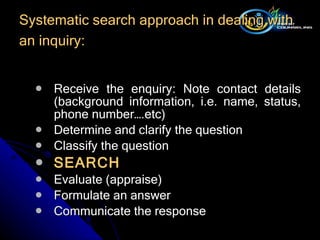
Receive the enquiry: Note contact details (background information, i.e. name, status, phone number….etc) Determine and clarify the question Classify the question SEARCH Evaluate (appraise) Formulate an answer Communicate the response  Systematic search approach in dealing with an inquiry:
To carry out medicines' information  provision roles effectively  pharmacists need to know HOW TO
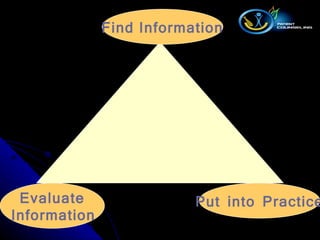
Find Information Evaluate Information Put  into  Practice
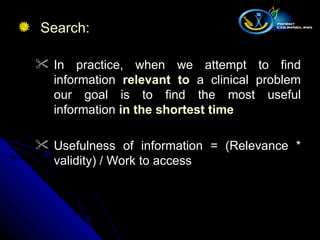
Search:  In practice, when we attempt to find information  relevant to  a clinical problem our goal is to find the most useful information  in the shortest time Usefulness of information = (Relevance * validity) / Work to access
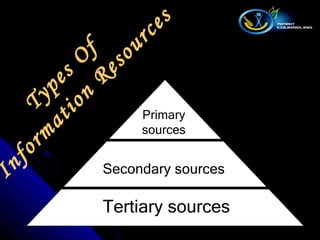
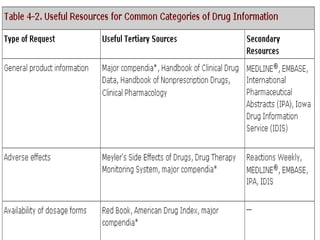
Search:  Tertiary sources relevant to the topic should be consulted  first ,  Then  progress via secondary sources to locate primary literature.  Because journal coverage varies with different secondary systems, it is important to  use more than one  secondary source for a thorough search
Primary sources Tertiary sources Secondary sources Types Of  Information Resources
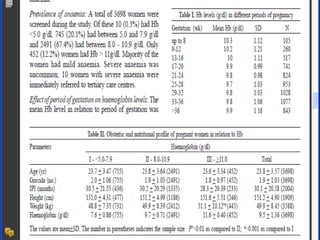
Publication of original research that has not been interpreted or changed by others Primary Literature !!!
Advantages: Current & original information Primary Literature !!!
Disadvantages: Knowledge of scientific methods and statistics is needed to properly interpret the information  Primary Literature !!!
When to use: When looking for the most up-to-date information  Primary Literature !!!
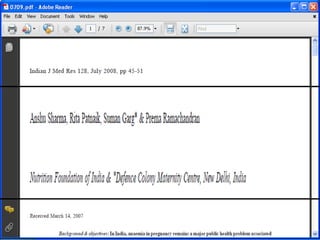
Examples: Scientific journal articles which report results of case studies, research or clinical trials Primary Literature !!!


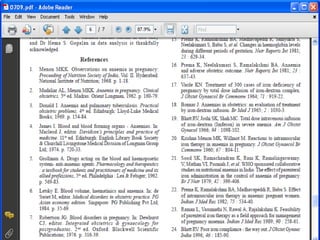
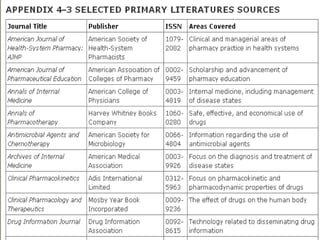
Where to find primary literature:  High-quality (peer-reviewed) resources in particular relevance to pharmacy include: Primary Literature !!!
Where to find primary literature:  The Pharmaceutical Journal Annals of Pharmacotherapy International Journal of Pharmacy Practice American Journal of Health-Systems Pharmacy Primary Literature !!!
 
Resources which provide access to primary literature Secondary Literature !!!
Advantages: Provide efficient access to primary literature Secondary Literature !!!
Disadvantages: Users need to be familiar with searching electronic databases Lag time Database scope Secondary Literature !!!
When to use: When you need to find primary literature Secondary Literature !!!
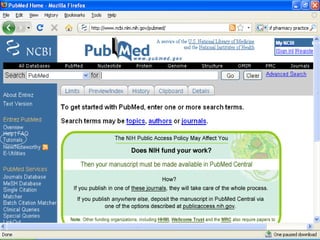
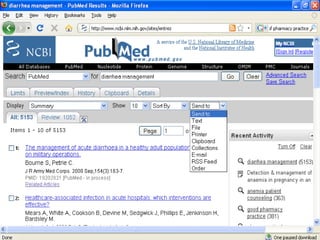
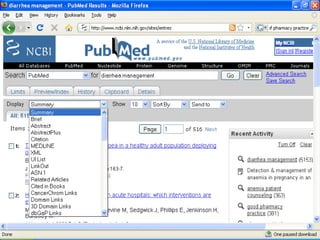
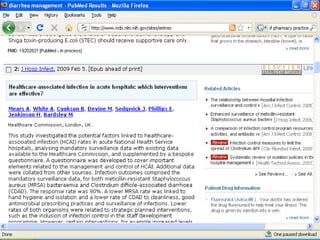
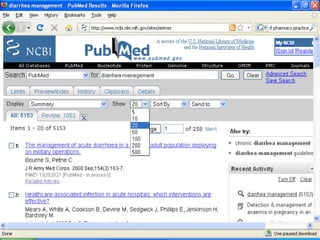
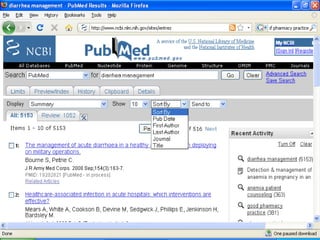
Examples: Indexing & abstracting databases such as the  PubMed Secondary Literature !!!
Collection of data & concepts drawn from primary literature Tertiary Literature !!!
Advantages: Convenient & easy to use Information is usually well established Tertiary Literature !!!
Disadvantages: Information may bee too old to be useful Tertiary Literature !!!
When to use: When you need to find background information  When you need a quick answer Tertiary Literature !!!
Examples: Reference books Drug monograph collections Review articles  Tertiary Literature !!!
Key Tertiary Drug Information Resources for Pharmacy Practice Evaluation tips !!!
Core resources on medicine AHFS Drug Information Key Tertiary Drug Information Resources for Pharmacy Practice
Core resources on medicine Martindale : the complete drug reference Key Tertiary Drug Information Resources for Pharmacy Practice
Core resources on medicine The Merck Manuals http:// www.merck.com /pubs/ Key Tertiary Drug Information Resources for Pharmacy Practice
Core resources on medicine Comprehensive pharmacy review Key Tertiary Drug Information Resources for Pharmacy Practice
Core resources on medicine British National Formulary (BNF) Key Tertiary Drug Information Resources for Pharmacy Practice
Designed as a digest for  rapid reference  & it may  NOT  always contain  ALL  the information necessary for prescribing & dispensing It includes key information on  Selection, Prescribing Dispensing and Administration of medicines **British National Formulary** (BNF)
Core resources on medicine See also, the  WHO model formulary  2006 http:// www.who.int/emlib/ModelList.aspx?Language = EN&MdType =FORMULARY Key Tertiary Drug Information Resources for Pharmacy Practice
Pharmacology Goodman and Gilman’s Pharmacological Basis of Therapeutics Key Tertiary Drug Information Resources for Pharmacy Practice
Pharmacology Lippincott’s clinical pharmacology  Key Tertiary Drug Information Resources for Pharmacy Practice
Drug interactions Stockely’s Drug Interactions Key Tertiary Drug Information Resources for Pharmacy Practice
Adverse drug reactions Myeler’s Side Effects of Drugs Key Tertiary Drug Information Resources for Pharmacy Practice
Pharmacotherapy Avery’s Drug Treatment Key Tertiary Drug Information Resources for Pharmacy Practice
Pharmacotherapy Drug and Therapeutics Bulletin Key Tertiary Drug Information Resources for Pharmacy Practice
Pharmacotherapy Clinical Pharmacy and Therapeutics Key Tertiary Drug Information Resources for Pharmacy Practice
 
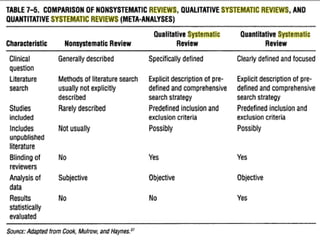
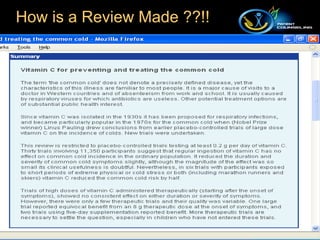
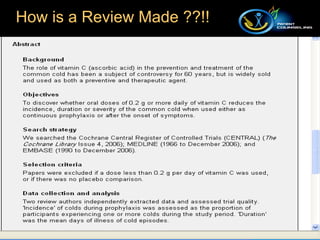
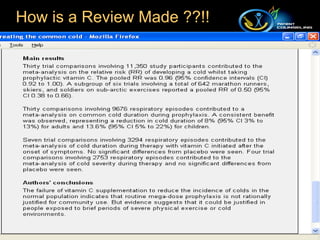
They usually contain more current information about a specific topic than textbooks Reviews & Systematic Reviews
 
How is a Review Made ??!!
Where to Find Systematic Reviews??
Example: The Cochrane Database
Reactive: Information or advice given by the pharmacist in response to questions or enquiries about medicines Proactive (active): The preparation of newsletters, bulletins, websites, etc. in an attempt to educate or raise awareness of key therapeutic issues Drug Information Provision
Consult their peers Expert opinions Carry out a literature search Pharmaceutical industry representatives How Do Healthcare workers Mostly Manage Their Information Needs ?!!!
The major disadvantage of making clinical decisions based on expert opinions is the  susceptibility of the opinion to bias , as it is  NOT   based on systematically collected information  Expert opinions !!!!
Formulate answerable questions, Identify and acquire the best evidence to answer the question, Critically appraise the evidence for its validity, impact and applicability Carry out a literature search ???!!!!
Integrate the findings with clinical expert and patient factors to extract a "clinical bottom line" or answer Evaluate the four previous steps for effectiveness and efficiency  Carry out a literature search ???!!!!
Choice of therapy (including indications and contraindications) Adverse effects Administration and dosage Product information, availability Drug interactions Most Frequent Categories of Enquiry Received by Pharmacists
Drugs in breastfeeding Complementary medicine Identification of tablets and other dosage forms Most Frequent Categories of Enquiry Received by Pharmacists
Pharmaceutical (stability, compatibility, formulations) Pharmacology (including pharmacokinetics) Most Frequent Categories of Enquiry Received by Pharmacists
Before using the internet: http:// www.ed.uiuc.edu/wp/credibility/index.html http:// library.albany.edu/usered/webeval / The Internet
Welcome to internet for medicine: http:// www.vts.intute.ac.uk /he/tutorial/medic http:// www.vts.intute.ac.uk /he/tutorial/health http:// www.vts.intute.ac.uk/acl/tutorial/wellbeing The Internet
Before using the internet: Become familiar with search techniques and the range of information available Plan your search strategy Use sites you know are trustworthy and that give details of who produces them and when they were last updated The Internet
Before using the internet: Understand the need to critically evaluate resources you find on the internet Establish who is responsible for the resource and what expertise or qualifications they have in field The Internet
Before using the internet: Don't use information from a site that is not convincingly authoritative (this could have disastrous consequences) Beware that the internet can be volatile – information can change or disappear without warning The Internet


One of the most popular is provided by the Health on the Net (HON) Foundation, a non-profit organization founded in 1995 whose mission is to guide Web users to sound, reliable information http:// www.hon.ch/home.html Quality of Information on The Internet
Wikipedia !!! Quality of Information on The Internet
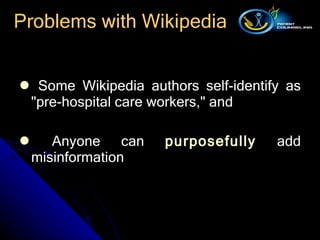
Problems with Wikipedia Many articles are written  anonymously ,  Many contributors are  students  still studying the very topics about which they write,
Some Wikipedia authors self - identify as  " pre - hospital care workers, "  and  Anyone can  purposefully  add misinformation  Problems with Wikipedia


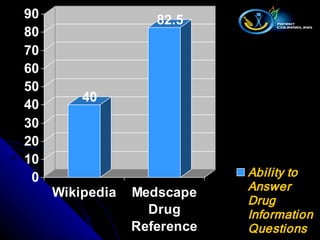
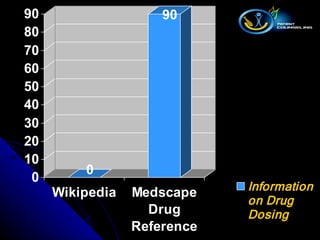
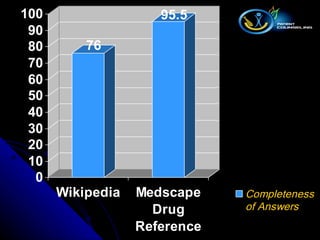
Conclusions :   Wikipedia has a more  narrow  scope, is  less  complete, and has more errors of omission than the comparator database Wikipedia may be a useful point of engagement for consumers, but is not authoritative and  should ONLY be a supplemental source of drug information
http :// www . medscape . com / viewarticle / 584450_1
Selected  Internet Sites
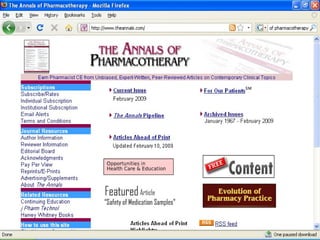
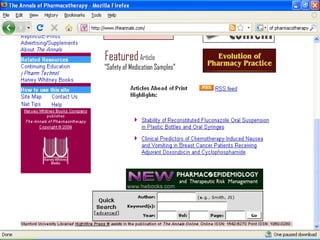
Examples: Annals of Pharmacotherapy Primary Literature !!!
 
 
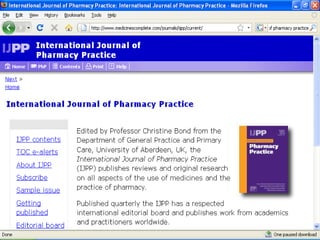
Examples: International Journal of Pharmacy Practice Primary Literature !!!
 
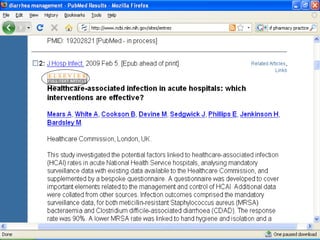
Examples: The PubMed Database Secondary Literature !!!


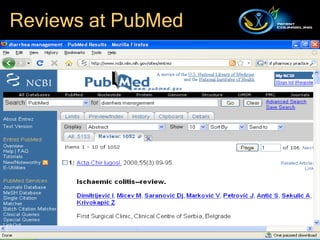
Reviews at PubMed

Information Resources 1

  • 1.
  • 2.
  • 3.
    Information Resources Satisfyingthe Pharmacists' Qualification Needs
  • 4.
    Would you pleasewrite down two questions you have in mind and want to know where to get the answers from???
  • 5.
  • 6.
    What is thereason for your search???!!!!!!!!!!! How would you mostly manage it ??!!!!!!! Would you categorize your question in relation to “types of pharmaceutical information” ???!!!!!!!!!!
  • 7.
    Strategies for Evaluation of Information Requests
  • 8.
    Receive the enquiry:Note contact details (background information, i.e. name, status, phone number….etc) Determine and clarify the question Classify the question SEARCH Evaluate (appraise) Formulate an answer Communicate the response Systematic search approach in dealing with an inquiry:
  • 9.
    To carry outmedicines' information provision roles effectively pharmacists need to know HOW TO
  • 10.
    Find Information EvaluateInformation Put into Practice
  • 11.
    Search: Inpractice, when we attempt to find information relevant to a clinical problem our goal is to find the most useful information in the shortest time Usefulness of information = (Relevance * validity) / Work to access
  • 12.
    Search: Tertiarysources relevant to the topic should be consulted first , Then progress via secondary sources to locate primary literature. Because journal coverage varies with different secondary systems, it is important to use more than one secondary source for a thorough search
  • 13.
    Primary sources Tertiarysources Secondary sources Types Of Information Resources
  • 14.
    Publication of originalresearch that has not been interpreted or changed by others Primary Literature !!!
  • 15.
    Advantages: Current &original information Primary Literature !!!
  • 16.
    Disadvantages: Knowledge ofscientific methods and statistics is needed to properly interpret the information Primary Literature !!!
  • 17.
    When to use:When looking for the most up-to-date information Primary Literature !!!
  • 18.
    Examples: Scientific journalarticles which report results of case studies, research or clinical trials Primary Literature !!!
  • 19.
  • 20.
  • 21.
  • 22.
  • 23.
  • 24.
  • 25.
  • 26.
  • 27.
    Where to findprimary literature: High-quality (peer-reviewed) resources in particular relevance to pharmacy include: Primary Literature !!!
  • 28.
    Where to findprimary literature: The Pharmaceutical Journal Annals of Pharmacotherapy International Journal of Pharmacy Practice American Journal of Health-Systems Pharmacy Primary Literature !!!
  • 29.
  • 30.
    Resources which provideaccess to primary literature Secondary Literature !!!
  • 31.
    Advantages: Provide efficientaccess to primary literature Secondary Literature !!!
  • 32.
    Disadvantages: Users needto be familiar with searching electronic databases Lag time Database scope Secondary Literature !!!
  • 33.
    When to use:When you need to find primary literature Secondary Literature !!!
  • 34.
    Examples: Indexing &abstracting databases such as the PubMed Secondary Literature !!!
  • 35.
    Collection of data& concepts drawn from primary literature Tertiary Literature !!!
  • 36.
    Advantages: Convenient &easy to use Information is usually well established Tertiary Literature !!!
  • 37.
    Disadvantages: Information maybee too old to be useful Tertiary Literature !!!
  • 38.
    When to use:When you need to find background information When you need a quick answer Tertiary Literature !!!
  • 39.
    Examples: Reference booksDrug monograph collections Review articles Tertiary Literature !!!
  • 40.
    Key Tertiary DrugInformation Resources for Pharmacy Practice Evaluation tips !!!
  • 41.
    Core resources onmedicine AHFS Drug Information Key Tertiary Drug Information Resources for Pharmacy Practice
  • 42.
    Core resources onmedicine Martindale : the complete drug reference Key Tertiary Drug Information Resources for Pharmacy Practice
  • 43.
    Core resources onmedicine The Merck Manuals http:// www.merck.com /pubs/ Key Tertiary Drug Information Resources for Pharmacy Practice
  • 44.
    Core resources onmedicine Comprehensive pharmacy review Key Tertiary Drug Information Resources for Pharmacy Practice
  • 45.
    Core resources onmedicine British National Formulary (BNF) Key Tertiary Drug Information Resources for Pharmacy Practice
  • 46.
    Designed as adigest for rapid reference & it may NOT always contain ALL the information necessary for prescribing & dispensing It includes key information on Selection, Prescribing Dispensing and Administration of medicines **British National Formulary** (BNF)
  • 47.
    Core resources onmedicine See also, the WHO model formulary 2006 http:// www.who.int/emlib/ModelList.aspx?Language = EN&MdType =FORMULARY Key Tertiary Drug Information Resources for Pharmacy Practice
  • 48.
    Pharmacology Goodman andGilman’s Pharmacological Basis of Therapeutics Key Tertiary Drug Information Resources for Pharmacy Practice
  • 49.
    Pharmacology Lippincott’s clinicalpharmacology Key Tertiary Drug Information Resources for Pharmacy Practice
  • 50.
    Drug interactions Stockely’sDrug Interactions Key Tertiary Drug Information Resources for Pharmacy Practice
  • 51.
    Adverse drug reactionsMyeler’s Side Effects of Drugs Key Tertiary Drug Information Resources for Pharmacy Practice
  • 52.
    Pharmacotherapy Avery’s DrugTreatment Key Tertiary Drug Information Resources for Pharmacy Practice
  • 53.
    Pharmacotherapy Drug andTherapeutics Bulletin Key Tertiary Drug Information Resources for Pharmacy Practice
  • 54.
    Pharmacotherapy Clinical Pharmacyand Therapeutics Key Tertiary Drug Information Resources for Pharmacy Practice
  • 55.
  • 56.
    They usually containmore current information about a specific topic than textbooks Reviews & Systematic Reviews
  • 57.
  • 58.
    How is aReview Made ??!!
  • 59.
    How is aReview Made ??!!
  • 60.
    How is aReview Made ??!!
  • 61.
    How is aReview Made ??!!
  • 62.
    Where to FindSystematic Reviews??
  • 63.
  • 64.
    Reactive: Information oradvice given by the pharmacist in response to questions or enquiries about medicines Proactive (active): The preparation of newsletters, bulletins, websites, etc. in an attempt to educate or raise awareness of key therapeutic issues Drug Information Provision
  • 65.
    Consult their peersExpert opinions Carry out a literature search Pharmaceutical industry representatives How Do Healthcare workers Mostly Manage Their Information Needs ?!!!
  • 66.
    The major disadvantageof making clinical decisions based on expert opinions is the susceptibility of the opinion to bias , as it is NOT based on systematically collected information Expert opinions !!!!
  • 67.
    Formulate answerable questions,Identify and acquire the best evidence to answer the question, Critically appraise the evidence for its validity, impact and applicability Carry out a literature search ???!!!!
  • 68.
    Integrate the findingswith clinical expert and patient factors to extract a "clinical bottom line" or answer Evaluate the four previous steps for effectiveness and efficiency Carry out a literature search ???!!!!
  • 69.
    Choice of therapy(including indications and contraindications) Adverse effects Administration and dosage Product information, availability Drug interactions Most Frequent Categories of Enquiry Received by Pharmacists
  • 70.
    Drugs in breastfeedingComplementary medicine Identification of tablets and other dosage forms Most Frequent Categories of Enquiry Received by Pharmacists
  • 71.
    Pharmaceutical (stability, compatibility,formulations) Pharmacology (including pharmacokinetics) Most Frequent Categories of Enquiry Received by Pharmacists
  • 72.
    Before using theinternet: http:// www.ed.uiuc.edu/wp/credibility/index.html http:// library.albany.edu/usered/webeval / The Internet
  • 73.
    Welcome to internetfor medicine: http:// www.vts.intute.ac.uk /he/tutorial/medic http:// www.vts.intute.ac.uk /he/tutorial/health http:// www.vts.intute.ac.uk/acl/tutorial/wellbeing The Internet
  • 74.
    Before using theinternet: Become familiar with search techniques and the range of information available Plan your search strategy Use sites you know are trustworthy and that give details of who produces them and when they were last updated The Internet
  • 75.
    Before using theinternet: Understand the need to critically evaluate resources you find on the internet Establish who is responsible for the resource and what expertise or qualifications they have in field The Internet
  • 76.
    Before using theinternet: Don't use information from a site that is not convincingly authoritative (this could have disastrous consequences) Beware that the internet can be volatile – information can change or disappear without warning The Internet
  • 77.
  • 78.
  • 79.
  • 80.
    One of themost popular is provided by the Health on the Net (HON) Foundation, a non-profit organization founded in 1995 whose mission is to guide Web users to sound, reliable information http:// www.hon.ch/home.html Quality of Information on The Internet
  • 81.
    Wikipedia !!! Qualityof Information on The Internet
  • 82.
    Problems with WikipediaMany articles are written anonymously , Many contributors are students still studying the very topics about which they write,
  • 83.
    Some Wikipedia authorsself - identify as " pre - hospital care workers, " and Anyone can purposefully add misinformation Problems with Wikipedia
  • 84.
  • 85.
  • 86.
  • 87.
    Conclusions : Wikipedia has a more narrow scope, is less complete, and has more errors of omission than the comparator database Wikipedia may be a useful point of engagement for consumers, but is not authoritative and should ONLY be a supplemental source of drug information
  • 88.
    http :// www. medscape . com / viewarticle / 584450_1
  • 89.
  • 90.
    Examples: Annals ofPharmacotherapy Primary Literature !!!
  • 91.
  • 92.
  • 93.
    Examples: International Journalof Pharmacy Practice Primary Literature !!!
  • 94.
  • 95.
    Examples: The PubMedDatabase Secondary Literature !!!
  • 96.
  • 97.
  • 98.
  • 99.
  • 100.
  • 101.
  • 102.
  • 103.
  • 104.
  • 105.

Editor's Notes

  • #42 American Society of Health-System Pharmacists, http://www.ashp.org. This drug information resource is organized by monographs containing information on both Food and Drug Administration (FDA) approved and off-label uses of medications. Information about dosing in specific populations is also included, as is a wide variety of general information about medications. Some information is also available about compatibility and stability of injectable formulations
  • #55 ff