Tariff Policy in Mongolia
URANZAYA ERDENECHULUUN
Space and Radio Communications Division
Information Technology, Post and Telecommunications Authority
ITU Regional Seminar on Costs and Tariffs for SG3RG-AO
Tokyo, Japan
8-9 April, 2013
2
Content
.
• Country overview /brief/1
• Policy and Regulatory Authorities2
• Sector Overview3
• Traffic Policy and Regulation
Development4
3
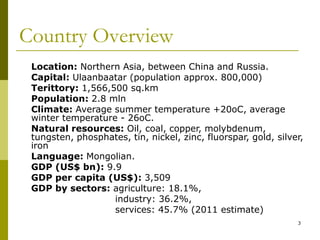
Country Overview
Location: Northern Asia, between China and Russia.
Capital: Ulaanbaatar (population approx. 800,000)
Terittory: 1,566,500 sq.km
Population: 2.8 mln
Climate: Average summer temperature +20oC, average
winter temperature - 26oC.
Natural resources: Oil, coal, copper, molybdenum,
tungsten, phosphates, tin, nickel, zinc, fluorspar, gold, silver,
iron
Language: Mongolian.
GDP (US$ bn): 9.9
GDP per capita (US$): 3,509
GDP by sectors: agriculture: 18.1%,
industry: 36.2%,
services: 45.7% (2011 estimate)
Content
4
• Country overview /brief/1
• Policy and Regulatory Authorities2
• Sector Overview3
• Traffic Policy and Regulation
Development4
5
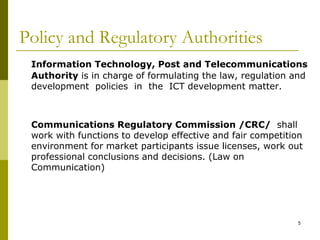
Policy and Regulatory Authorities
Information Technology, Post and Telecommunications
Authority is in charge of formulating the law, regulation and
development policies in the ICT development matter.
Communications Regulatory Commission /CRC/ shall
work with functions to develop effective and fair competition
environment for market participants issue licenses, work out
professional conclusions and decisions. (Law on
Communication)
6
Content
.
• Country overview /brief/1
• Policy and Regulatory Authorities2
• Sector Overview3
• Traffic Policy and Regulation
Development4
7
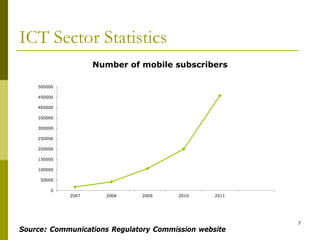
ICT Sector Statistics
Source: Communications Regulatory Commission website
0
50000
100000
150000
200000
250000
300000
350000
400000
450000
500000
2007 2008 2009 2010 2011
Number of mobile subscribers
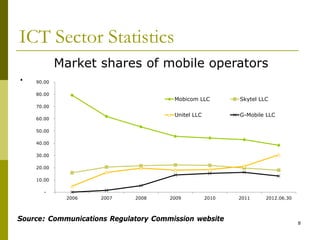
ICT Sector Statistics
.
8
-
10.00
20.00
30.00
40.00
50.00
60.00
70.00
80.00
90.00
2006 2007 2008 2009 2010 2011 2012.06.30
Mobicom LLC Skytel LLC
Unitel LLC G-Mobile LLC
Market shares of mobile operators
Source: Communications Regulatory Commission website
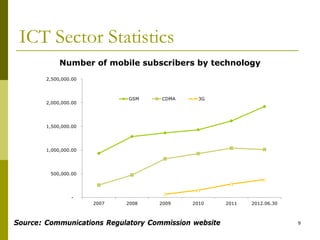
ICT Sector Statistics
Number of mobile subscribers by technology
9
-
500,000.00
1,000,000.00
1,500,000.00
2,000,000.00
2,500,000.00
2007 2008 2009 2010 2011 2012.06.30
GSM CDMA 3G
Source: Communications Regulatory Commission website
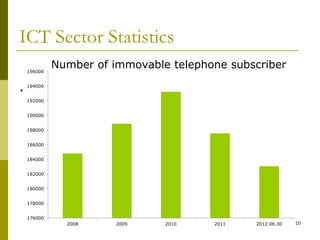
ICT Sector Statistics
Number of immovable telephone subscriber
.
10
176000
178000
180000
182000
184000
186000
188000
190000
192000
194000
196000
2008 2009 2010 2011 2012.06.30
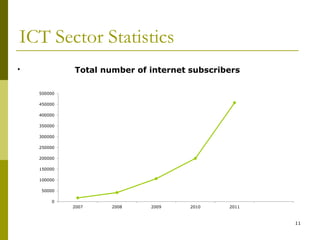
ICT Sector Statistics
.
11
0
50000
100000
150000
200000
250000
300000
350000
400000
450000
500000
2007 2008 2009 2010 2011
Total number of internet subscribers
12
Content
.
• Country overview /brief/1
• Policy and Regulatory Authorities2
• Sector Overview3
• Traffic Policy and Regulation
Development4
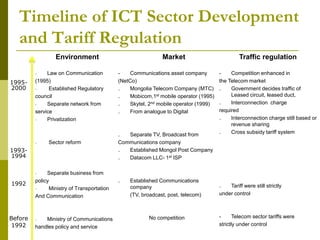
Environment
- Law on Communication
(1995)
- Established Regulatory
council
- Separate network from
service
- Privatization
- Sector reform
- Separate business from
policy
- Ministry of Transportation
And Communication
- Ministry of Communications
handles policy and service
1995-
2000
1993-
1994
1992
Before
1992
Market
- Communications asset company
(NetCo)
₋ Mongolia Telecom Company (MTC)
₋ Mobicom,1st mobile operator (1995)
₋ Skytel, 2nd mobile operator (1999)
₋ From analogue to Digital
₋ Separate TV, Broadcast from
Communications company
₋ Established Mongol Post Company
₋ Datacom LLC- 1st ISP
₋ Established Communications
company
(TV, broadcast, post, telecom)
No competition
Traffic regulation
- Competition enhanced in
the Telecom market
₋ Government decides traffic of
Leased circuit, leased duct,
₋ Interconnection charge
required
₋ Interconnection charge still based or
revenue sharing
₋ Cross subsidy tariff system
₋ Tariff were still strictly
under control
- Telecom sector tariffs were
strictly under control
Timeline of ICT Sector Development
and Tariff Regulation
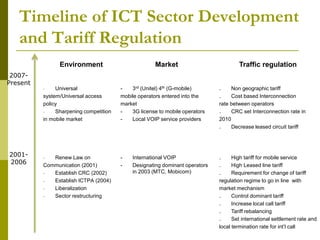
Environment
- Universal
system/Universal access
policy
- Sharpening competition
in mobile market
- Renew Law on
Communication (2001)
- Establish CRC (2002)
- Establish ICTPA (2004)
- Liberalization
- Sector restructuring
2007-
Present
2001-
2006
Market
- 3rd (Unitel) 4th (G-mobile)
mobile operators entered into the
market
- 3G license to mobile operators
- Local VOIP service providers
- International VOIP
- Designating dominant operators
in 2003 (MTC, Mobicom)
Traffic regulation
₋ Non geographic tariff
₋ Cost based Interconnection
rate between operators
₋ CRC set Interconnection rate in
2010
₋ Decrease leased circuit tariff
₋ High tariff for mobile service
₋ High Leased line tariff
₋ Requirement for change of tariff
regulation regime to go in line with
market mechanism
₋ Control dominant tariff
₋ Increase local call tariff
₋ Tariff rebalancing
₋ Set international settlement rate and
local termination rate for int’l call
Timeline of ICT Sector Development
and Tariff Regulation
15
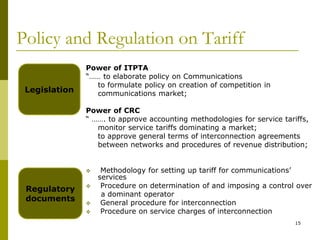
Policy and Regulation on Tariff
Legislation
Power of ITPTA
“…… to elaborate policy on Communications
to formulate policy on creation of competition in
communications market;
Power of CRC
“ ……. to approve accounting methodologies for service tariffs,
monitor service tariffs dominating a market;
to approve general terms of interconnection agreements
between networks and procedures of revenue distribution;
 Methodology for setting up tariff for communications’
services
 Procedure on determination of and imposing a control over
a dominant operator
 General procedure for interconnection
 Procedure on service charges of interconnection
Regulatory
documents
16
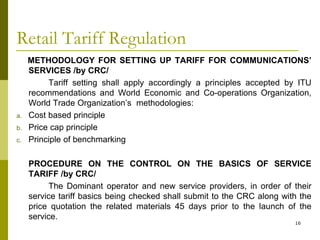
METHODOLOGY FOR SETTING UP TARIFF FOR COMMUNICATIONS’
SERVICES /by CRC/
Tariff setting shall apply accordingly a principles accepted by ITU
recommendations and World Economic and Co-operations Organization,
World Trade Organization’s methodologies:
a. Cost based principle
b. Price cap principle
c. Principle of benchmarking
PROCEDURE ON THE CONTROL ON THE BASICS OF SERVICE
TARIFF /by CRC/
The Dominant operator and new service providers, in order of their
service tariff basics being checked shall submit to the CRC along with the
price quotation the related materials 45 days prior to the launch of the
service.
Retail Tariff Regulation
17
Wholesale Tariff Regulation
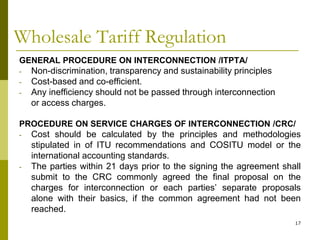
GENERAL PROCEDURE ON INTERCONNECTION /ITPTA/
- Non-discrimination, transparency and sustainability principles
- Cost-based and co-efficient.
- Any inefficiency should not be passed through interconnection
or access charges.
PROCEDURE ON SERVICE CHARGES OF INTERCONNECTION /CRC/
- Cost should be calculated by the principles and methodologies
stipulated in of ITU recommendations and COSITU model or the
international accounting standards.
- The parties within 21 days prior to the signing the agreement shall
submit to the CRC commonly agreed the final proposal on the
charges for interconnection or each parties’ separate proposals
alone with their basics, if the common agreement had not been
reached.
Addressing Market Dominance
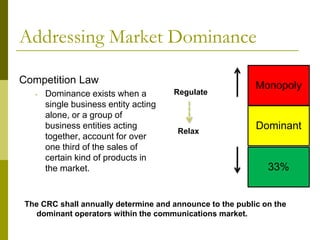
Competition Law
- Dominance exists when a
single business entity acting
alone, or a group of
business entities acting
together, account for over
one third of the sales of
certain kind of products in
the market.
18
Regulate
Relax
Monopoly
Dominant
33%
The CRC shall annually determine and announce to the public on the
dominant operators within the communications market.
Addressing Market Dominance
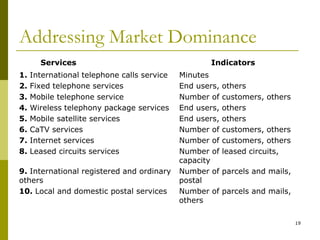
Services Indicators
1. International telephone calls service Minutes
2. Fixed telephone services End users, others
3. Mobile telephone service Number of customers, others
4. Wireless telephony package services End users, others
5. Mobile satellite services End users, others
6. CaTV services Number of customers, others
7. Internet services Number of customers, others
8. Leased circuits services Number of leased circuits,
capacity
9. International registered and ordinary Number of parcels and mails,
others postal
10. Local and domestic postal services Number of parcels and mails,
others
19
Regulation fee and interconnection
tariffs /CRC/
Non-dominant tariffs must be reviewed within 14-
21 business days and contentious dominant tariffs
reviewed within 14-21 business days respectively.
The CRC approved the minimum rates of external
billings for international incoming calls and termination
rates of international calls at mobile, wireless and fixed
networks.
The CRC also adopted a cost accounting model by
investigating economic efficiencies of a service cost and
service packages on the basis of service costs of Mongol
Post Company.
20
Regulation fee and interconnection
tariffs /CRC/
Difference between domestic and local
communication service fee has been changed to
same tariff.
-domestic mobile subscribers interconnection tariff reduced an
average of 1.7-2.1 times,
-domestic fixed subscribers interconnection tariff an average
of 1.6-2 times.
Domestic channel lease tariff for internet
service is regulated by CRC.
-internet subscriber’s monthly payment reduced by 15% in
average and enables to increase internet connection speed of
customers
21
22
Thank you for your attention.

ICT sector Tariff Policy in Mongolia

  • 1.
    Tariff Policy inMongolia URANZAYA ERDENECHULUUN Space and Radio Communications Division Information Technology, Post and Telecommunications Authority ITU Regional Seminar on Costs and Tariffs for SG3RG-AO Tokyo, Japan 8-9 April, 2013
  • 2.
    2 Content . • Country overview/brief/1 • Policy and Regulatory Authorities2 • Sector Overview3 • Traffic Policy and Regulation Development4
  • 3.
    3 Country Overview Location: NorthernAsia, between China and Russia. Capital: Ulaanbaatar (population approx. 800,000) Terittory: 1,566,500 sq.km Population: 2.8 mln Climate: Average summer temperature +20oC, average winter temperature - 26oC. Natural resources: Oil, coal, copper, molybdenum, tungsten, phosphates, tin, nickel, zinc, fluorspar, gold, silver, iron Language: Mongolian. GDP (US$ bn): 9.9 GDP per capita (US$): 3,509 GDP by sectors: agriculture: 18.1%, industry: 36.2%, services: 45.7% (2011 estimate)
  • 4.
    Content 4 • Country overview/brief/1 • Policy and Regulatory Authorities2 • Sector Overview3 • Traffic Policy and Regulation Development4
  • 5.
    5 Policy and RegulatoryAuthorities Information Technology, Post and Telecommunications Authority is in charge of formulating the law, regulation and development policies in the ICT development matter. Communications Regulatory Commission /CRC/ shall work with functions to develop effective and fair competition environment for market participants issue licenses, work out professional conclusions and decisions. (Law on Communication)
  • 6.
    6 Content . • Country overview/brief/1 • Policy and Regulatory Authorities2 • Sector Overview3 • Traffic Policy and Regulation Development4
  • 7.
    7 ICT Sector Statistics Source:Communications Regulatory Commission website 0 50000 100000 150000 200000 250000 300000 350000 400000 450000 500000 2007 2008 2009 2010 2011 Number of mobile subscribers
  • 8.
    ICT Sector Statistics . 8 - 10.00 20.00 30.00 40.00 50.00 60.00 70.00 80.00 90.00 20062007 2008 2009 2010 2011 2012.06.30 Mobicom LLC Skytel LLC Unitel LLC G-Mobile LLC Market shares of mobile operators Source: Communications Regulatory Commission website
  • 9.
    ICT Sector Statistics Numberof mobile subscribers by technology 9 - 500,000.00 1,000,000.00 1,500,000.00 2,000,000.00 2,500,000.00 2007 2008 2009 2010 2011 2012.06.30 GSM CDMA 3G Source: Communications Regulatory Commission website
  • 10.
    ICT Sector Statistics Numberof immovable telephone subscriber . 10 176000 178000 180000 182000 184000 186000 188000 190000 192000 194000 196000 2008 2009 2010 2011 2012.06.30
  • 11.
  • 12.
    12 Content . • Country overview/brief/1 • Policy and Regulatory Authorities2 • Sector Overview3 • Traffic Policy and Regulation Development4
  • 13.
    Environment - Law onCommunication (1995) - Established Regulatory council - Separate network from service - Privatization - Sector reform - Separate business from policy - Ministry of Transportation And Communication - Ministry of Communications handles policy and service 1995- 2000 1993- 1994 1992 Before 1992 Market - Communications asset company (NetCo) ₋ Mongolia Telecom Company (MTC) ₋ Mobicom,1st mobile operator (1995) ₋ Skytel, 2nd mobile operator (1999) ₋ From analogue to Digital ₋ Separate TV, Broadcast from Communications company ₋ Established Mongol Post Company ₋ Datacom LLC- 1st ISP ₋ Established Communications company (TV, broadcast, post, telecom) No competition Traffic regulation - Competition enhanced in the Telecom market ₋ Government decides traffic of Leased circuit, leased duct, ₋ Interconnection charge required ₋ Interconnection charge still based or revenue sharing ₋ Cross subsidy tariff system ₋ Tariff were still strictly under control - Telecom sector tariffs were strictly under control Timeline of ICT Sector Development and Tariff Regulation
  • 14.
    Environment - Universal system/Universal access policy -Sharpening competition in mobile market - Renew Law on Communication (2001) - Establish CRC (2002) - Establish ICTPA (2004) - Liberalization - Sector restructuring 2007- Present 2001- 2006 Market - 3rd (Unitel) 4th (G-mobile) mobile operators entered into the market - 3G license to mobile operators - Local VOIP service providers - International VOIP - Designating dominant operators in 2003 (MTC, Mobicom) Traffic regulation ₋ Non geographic tariff ₋ Cost based Interconnection rate between operators ₋ CRC set Interconnection rate in 2010 ₋ Decrease leased circuit tariff ₋ High tariff for mobile service ₋ High Leased line tariff ₋ Requirement for change of tariff regulation regime to go in line with market mechanism ₋ Control dominant tariff ₋ Increase local call tariff ₋ Tariff rebalancing ₋ Set international settlement rate and local termination rate for int’l call Timeline of ICT Sector Development and Tariff Regulation
  • 15.
    15 Policy and Regulationon Tariff Legislation Power of ITPTA “…… to elaborate policy on Communications to formulate policy on creation of competition in communications market; Power of CRC “ ……. to approve accounting methodologies for service tariffs, monitor service tariffs dominating a market; to approve general terms of interconnection agreements between networks and procedures of revenue distribution;  Methodology for setting up tariff for communications’ services  Procedure on determination of and imposing a control over a dominant operator  General procedure for interconnection  Procedure on service charges of interconnection Regulatory documents
  • 16.
    16 METHODOLOGY FOR SETTINGUP TARIFF FOR COMMUNICATIONS’ SERVICES /by CRC/ Tariff setting shall apply accordingly a principles accepted by ITU recommendations and World Economic and Co-operations Organization, World Trade Organization’s methodologies: a. Cost based principle b. Price cap principle c. Principle of benchmarking PROCEDURE ON THE CONTROL ON THE BASICS OF SERVICE TARIFF /by CRC/ The Dominant operator and new service providers, in order of their service tariff basics being checked shall submit to the CRC along with the price quotation the related materials 45 days prior to the launch of the service. Retail Tariff Regulation
  • 17.
    17 Wholesale Tariff Regulation GENERALPROCEDURE ON INTERCONNECTION /ITPTA/ - Non-discrimination, transparency and sustainability principles - Cost-based and co-efficient. - Any inefficiency should not be passed through interconnection or access charges. PROCEDURE ON SERVICE CHARGES OF INTERCONNECTION /CRC/ - Cost should be calculated by the principles and methodologies stipulated in of ITU recommendations and COSITU model or the international accounting standards. - The parties within 21 days prior to the signing the agreement shall submit to the CRC commonly agreed the final proposal on the charges for interconnection or each parties’ separate proposals alone with their basics, if the common agreement had not been reached.
  • 18.
    Addressing Market Dominance CompetitionLaw - Dominance exists when a single business entity acting alone, or a group of business entities acting together, account for over one third of the sales of certain kind of products in the market. 18 Regulate Relax Monopoly Dominant 33% The CRC shall annually determine and announce to the public on the dominant operators within the communications market.
  • 19.
    Addressing Market Dominance ServicesIndicators 1. International telephone calls service Minutes 2. Fixed telephone services End users, others 3. Mobile telephone service Number of customers, others 4. Wireless telephony package services End users, others 5. Mobile satellite services End users, others 6. CaTV services Number of customers, others 7. Internet services Number of customers, others 8. Leased circuits services Number of leased circuits, capacity 9. International registered and ordinary Number of parcels and mails, others postal 10. Local and domestic postal services Number of parcels and mails, others 19
  • 20.
    Regulation fee andinterconnection tariffs /CRC/ Non-dominant tariffs must be reviewed within 14- 21 business days and contentious dominant tariffs reviewed within 14-21 business days respectively. The CRC approved the minimum rates of external billings for international incoming calls and termination rates of international calls at mobile, wireless and fixed networks. The CRC also adopted a cost accounting model by investigating economic efficiencies of a service cost and service packages on the basis of service costs of Mongol Post Company. 20
  • 21.
    Regulation fee andinterconnection tariffs /CRC/ Difference between domestic and local communication service fee has been changed to same tariff. -domestic mobile subscribers interconnection tariff reduced an average of 1.7-2.1 times, -domestic fixed subscribers interconnection tariff an average of 1.6-2 times. Domestic channel lease tariff for internet service is regulated by CRC. -internet subscriber’s monthly payment reduced by 15% in average and enables to increase internet connection speed of customers 21
  • 22.
    22 Thank you foryour attention.