SIR DAWN TICSAY
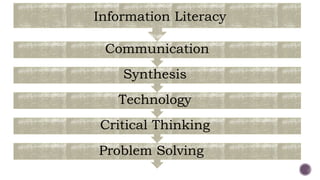
Communication
Synthesis
Technology
Critical Thinking
Problem Solving
Information Literacy
The capacity of a person to know when there is a
requirement for information, to have the skill, to
distinguish or identify, find, assess, and adequately
use that information for the problem or issue. It is
likewise defined a person’s ability to be able to
perceive when information is required and can
locate, assess, and utilize effectively the required
data.
Information Literacy is a means to express
personal ideas, develop arguments, refute the
opinions of others, learn new things, or simply
identify the truth or factual evidence about a
topic. It is acknowledge that most people are
likely to change careers at least five times
throughout their lives.
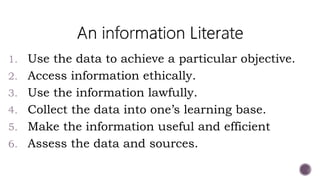
1. Use the data to achieve a particular objective.
2. Access information ethically.
3. Use the information lawfully.
4. Collect the data into one’s learning base.
5. Make the information useful and efficient
6. Assess the data and sources.
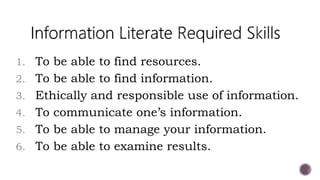
1. To be able to find resources.
2. To be able to find information.
3. Ethically and responsible use of information.
4. To communicate one’s information.
5. To be able to manage your information.
6. To be able to examine results.
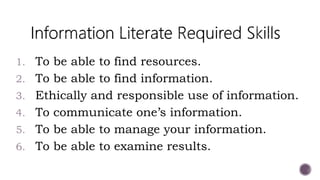
1. To be able to find resources.
2. To be able to find information.
3. Ethically and responsible use of information.
4. To communicate one’s information.
5. To be able to manage your information.
6. To be able to examine results.
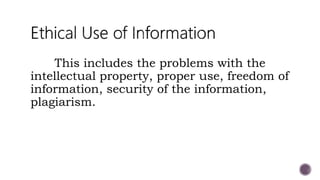
This includes the problems with the
intellectual property, proper use, freedom of
information, security of the information,
plagiarism.
STOP
PLAGIARISM
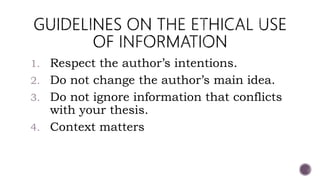
1. Respect the author’s intentions.
2. Do not change the author’s main idea.
3. Do not ignore information that conflicts
with your thesis.
4. Context matters
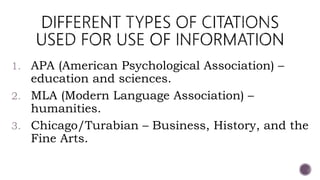
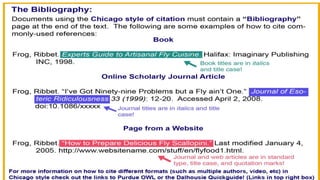
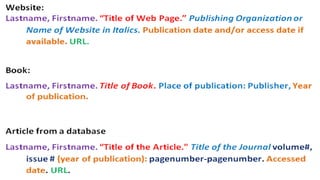
1. APA (American Psychological Association) –
education and sciences.
2. MLA (Modern Language Association) –
humanities.
3. Chicago/Turabian – Business, History, and the
Fine Arts.
Information Literacy

Information Literacy

  • 1.
  • 2.
  • 3.
    The capacity ofa person to know when there is a requirement for information, to have the skill, to distinguish or identify, find, assess, and adequately use that information for the problem or issue. It is likewise defined a person’s ability to be able to perceive when information is required and can locate, assess, and utilize effectively the required data.
  • 4.
    Information Literacy isa means to express personal ideas, develop arguments, refute the opinions of others, learn new things, or simply identify the truth or factual evidence about a topic. It is acknowledge that most people are likely to change careers at least five times throughout their lives.
  • 5.
    1. Use thedata to achieve a particular objective. 2. Access information ethically. 3. Use the information lawfully. 4. Collect the data into one’s learning base. 5. Make the information useful and efficient 6. Assess the data and sources.
  • 6.
    1. To beable to find resources. 2. To be able to find information. 3. Ethically and responsible use of information. 4. To communicate one’s information. 5. To be able to manage your information. 6. To be able to examine results.
  • 7.
    1. To beable to find resources. 2. To be able to find information. 3. Ethically and responsible use of information. 4. To communicate one’s information. 5. To be able to manage your information. 6. To be able to examine results.
  • 8.
    This includes theproblems with the intellectual property, proper use, freedom of information, security of the information, plagiarism.
  • 9.
  • 10.
    1. Respect theauthor’s intentions. 2. Do not change the author’s main idea. 3. Do not ignore information that conflicts with your thesis. 4. Context matters
  • 11.
    1. APA (AmericanPsychological Association) – education and sciences. 2. MLA (Modern Language Association) – humanities. 3. Chicago/Turabian – Business, History, and the Fine Arts.