INFORMATIC A PER LA PA CONCETTI EINFORMATIC A PER LA PA: CONCETTI E 
METODOLOGIE
C di I f ti l PA
Gianluigi Viscusi (Ph.D.)
Corso di Informatica per la PA
SEQUOIAS Lab ‐ DISCo – Università di Milano Bicocca
viscusi@disco.unimib.it
AgendaAgenda
I d i• Introduction
• Background
• The eG4M Methodology
• Dealing with principles policies and lawsDealing with principles, policies, and laws
• Conclusion and Future work
2
Transizione dalla fase di management dei computer a 
quella dei sistemi informativi
Sviluppo del valore di Business dei
SI
Management dei
Si t iSI Sistemi
Informativi
(MIS)
Relazione con le altre funzioni
Fonte, Laudon, j, Laudon K.
Manage ement dei sistemi informativi
Gestione della funzione SI
Manage,ement dei sistemi informativi
– vol. 2- Pearson, 2009
Management dei
Computer
(Computer Management o
Data Processing-DP)
Gestione attività operative e
tecniche dei SI
Data Processing-DP)
Relazione tra le strategie di business SI e ITRelazione tra le strategie di business, SI e IT
Strategia di business
Decisioni di business
Obiettivi e direzione
Verso dove si muove
il business e perché
Potenziale impatto
dei
SI/IT sul settore,
sull’azienda e
Cambiamento
Supporto al Direzione del business
sull azienda e
sull’organizzazione
Strategia dei SI
Basata sulle necessità del business
pp
business
Basata sulle necessità del business
Orientata alla domanda
Focalizzata sulle applicazioni
Cosa è richiesto
Strategia IT
Infrastruttura e servizi Necessità e priorità
Fonte, Laudon, j, Laudon K.
Manage ement dei sistemi informativi
Basata sulle attività
Orientata all’offerta
Focalizzata sulla tecnologia
Come può essere
offerto
Manage,ement dei sistemi informativi
– vol. 2- Pearson, 2009
Allineamento tra strategia e IT ‐ Henderson e 
Venkatraman (1992)
Esterna Strategia di
business
Strategia IT
Integrazione
strategica
Interna
Infrastruttura
e processi
Sistemi
informativi,
Interna e processi
organizzativi
infrastruttura e
processi
Integrazione
funzionale
a livello di
business
a livello di IT
Fonte, Laudon, j, Laudon K.j
Manage,ement dei sistemi informativi
– vol. 2- Pearson, 2009
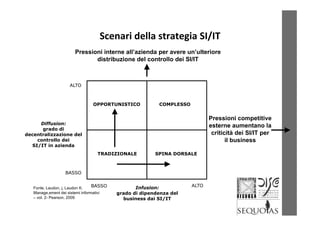
Scenari della strategia SI/ITScenari della strategia SI/IT
Pressioni interne all’azienda per avere un’ulteriore
distribuzione del controllo dei SI/IT
ALTO
OPPORTUNISTICO COMPLESSO
Diffusion:
grado di
decentralizzazione del
t ll d i
Pressioni competitive
esterne aumentano la
criticità dei SI/IT per
il b icontrollo dei
SI/IT in azienda
TRADIZIONALE SPINA DORSALE
il business
BASSO
Infusion:BASSO ALTOFonte, Laudon, j, Laudon K.
grado di dipendenza del
business dai SI/IT
j
Manage,ement dei sistemi informativi
– vol. 2- Pearson, 2009
I tre aspetti fondamentaliI tre aspetti fondamentali
Organizzazioneg
INFORMAZIONI
TecnologiaProcessi TecnologiaProcessi
Fonte, Laudon, j, Laudon K.
Manage,ement dei sistemi informativi
– vol. 2- Pearson, 2009
Portafoglio IT (1/4)Portafoglio IT (1/4)
LA)
Cultura
iServizio-S
IT
Facilities
Competenze
IT
Persone/
Organizzazione
IT
(es.Livellid
StrategiaI
Processi di gestione IT
&
Risultati:(
Layout Portafoglio
Applicativo
Componenti
IT
Reti
Fonte, Laudon, j, Laudon K.j
Manage,ement dei sistemi informativi
– vol. 2- Pearson, 2009
Portafoglio IT (2/4)Portafoglio IT (2/4)
l
Cultura
i d l l
Competenze
IT
Persone/
OrganizzazioneIT
Cultura Utenti
IT
aziendale Cultura
IT
oIToIT
egiaIT
IT OrganizzazioneIT
Facilities
Personale IT
oneecontrollo
(back-office) Processi di gestione IT (front-office)
operations; assetmanagement
oneecontrollo
(back-office)
operations; assetmanagement
(back-office)
operations; assetmanagement
tati
Strate
&
L ut
Hardware e
Networking
P.A. orientato alla
gestione
Programmazio
operations; assetmanagement
facilitymanagement
servicedelivery
OLA SLA
Programmazio
operations; assetmanagement
facilitymanagement
servicedelivery
OLA SLA
operations; assetmanagement
facilitymanagement
servicedelivery
OLA SLA
Risult
servicemanagement
Portafoglio
Applicativo
Componenti
IT
LayoutNetworking
Sistemi
Operativi
gestione
Portaf. x
Gestione
D ti
Architetture
PP
Reti
p
Dati
(DBMS)
Topologie e Protocolli
Fonte, Laudon, j, Laudon K.j
Manage,ement dei sistemi informativi
– vol. 2- Pearson, 2009
Portafoglio IT (3/4)Portafoglio IT (3/4)
IT Capabilities
Cultura Utenti
IT
Cultura
aziendale Cultura
IT
dinamiche
oFSI...)
T
Competenze
IT
Persone/
OrganizzazioneITFacilities
Personale IT
2
ontrolloITontrolloIT
azioni
eamentocond
/cambiamento
StrategiaIT
3.1
3.2
strazioneeco
(back-office)
operations; asset management
facilitymanagement
i d li
OLA SLA
strazioneeco
operations; asset management
facilitymanagement
i d li
OLA SLA
Processi di gestione IT
operations; asset management
facilitymanagement
i d li
OLA SLA
ati/Presta
utenti,alline
doevoluzione/
(front-office)
servicemanagement
S
Portafoglio
Applicativo
Componenti
IT
&
Layout
Hardware e
Networking
P.A. orientato alla
gestione
4
Amminis
service delivery
Amminis
service deliveryservice delivery
Risulta
oddisfazione
ziendali,grad
ApplicativoIT
Reti
Sistemi
Operativi
Portaf. x
Gestione
Dati
(DBMS)
Topologie e Protocolli
Architetture
1
(es.so
az
+1 4 Infrastruttura=+1 4 Infrastruttura IT=
Portafoglio IT (4/4)Portafoglio IT (4/4)
IT Dynamic Capabilities
Cultura Utenti
IT
Cultura
aziendale Cultura
IT
dinamiche
oFSI...)
T
Competenze
IT
Persone/
OrganizzazioneITFacilities
Personale IT
2
ontrolloITontrolloIT
azioni
eamentocond
/cambiamento
StrategiaIT
3.1
3.2
strazioneeco
(back-office)
operations; asset management
facilitymanagement servicemanagement
i d li
OLA SLA
strazioneeco
operations; asset management
facilitymanagement
i d li
OLA SLA
Processi di gestione IT
operations; asset management
facilitymanagement
i d li
OLA SLA
ati/Presta
utenti,alline
doevoluzione/
(front-office)
S
Portafoglio
Applicativo
Componenti
IT
&
Layout
Hardware e
Networking
P.A. orientato alla
gestione
4
Amminis
service delivery
Amminis
service deliveryservice delivery
Risulta
oddisfazione
ziendali,grad
ApplicativoIT
Reti
Sistemi
Operativi
Portaf. x
Gestione
Dati
(DBMS)
Topologie e Protocolli
Architetture
1
(es.so
az
+ =
Fonte, Laudon, j, Laudon K.
Manage,ement dei sistemi informativi
– vol. 2- Pearson, 2009
Strati di servizio (1/2)
Business
Fattori
d’influenza
Strategia ITStrategia di
business
Management del
Richiesta di servizi IT
Management del
portafoglio IT
L d hi
Produzioneed
erogazione
Leadership
Management del
t f lit i
erogazione
del servizio
portafogliotecnico
Fonte, Laudon, j, Laudon K.
Manage,ement dei sistemi informativi
– vol. 2- Pearson, 2009
Strati di servizio (2/2)Strati di servizio (2/2)
Aree
Capabilities Sourcing
L d hi
Processi Strategia IT e
Governance
Produzioneed
erogazione
Leadership
Aree di
Management del
t f lit i
erogazione
del servizio
servizio IT
portafogliotecnico
Fonte, Laudon, j, Laudon K.
Manage,ement dei sistemi informativi
– vol. 2- Pearson, 2009
Esempio di organigrammaEsempio di organigramma
L d hi
Legenda
Cli t O i ti
Client Relationship
Service Organization
Leadership
Chief Administrative
OffiChief Operations
Chief Operations
Offi
CEO
CEO
Client Organization Chief Administrative
Officer
OfficerChief Operations
Officer
Officer
Applications
Lead
Applications
Lead
Chief Relationship
Officer
Chief Relationship
Officer Chief Technology
Officer
Chief Technology
Officer
Unit
OperationsProgram
Office
Program
Office
Architecture &
Portfolio
•System analysts
•Application programmers
•Competence Centers
Biz Liaison
Manager
Biz Liaison
Manager •Break/Fix
•Regulatory
•Minor Enhancements
Application DevelopmentDivision 1
Division 2
Application
Maintenance
•Hosting
•Desktop
Help Desk
Infrastructure
•Competence Centers
•Consultants
•Project Managers
Biz Liaison
Manager
•Minor Enhancements
Biz Liaison
Manager
Division 3
Division n
. . .
•Help Desk
•Communications
Geo. Svc. Geo. Svc. Geo. Svc. Geo. Svc.Service
Regional
Country 1 Country 2 Country 3 Country n . . .
Manager Manager Manager Manager
Ser ce
Management
Fonte, Laudon, j, Laudon K.
Manage,ement dei sistemi informativi
– vol. 2- Pearson, 2009
Catena del valoreCatena del valore
Fonte, Laudon, j, Laudon K.j
Manage,ement dei sistemi informativi
– vol. 2- Pearson, 2009
Allocazione delle risorse IT (1/2)
Allocazionerisorse IT
Strategia di business
Customer Satisfaction
Risorse (spese)
discrezionali allocate
per raggiungere gli
obiettivi di business
Efficienza del sistema impresa
obiettivi di business
globali e di divisione
(necessari per
incrementare il livello
di ricavi ed il
vantaggio
Produzionedel servizio IT
vantaggio
competitivo)
Produzionedel servizio IT
(attività connesse ai sistemi tradizionali,
maintenance, aggiornamento, supporto
applicativo)
Spesa non
discrezionale per
l’attività di produzione
del servizio (necessarie(
per mantenere
l’operatività quotidiana)
Fonte: Gartner Group, ComputerEconomics.com, Accenture
Fonte, Laudon, j, Laudon K.
Manage,ement dei sistemi informativi
– vol. 2- Pearson, 2009
Allocazione delle risorse IT (2/2)Allocazione delle risorse IT (2/2)
NuoviSviluppi 14.0%
Solutions
Development &
Maintenance
NuoviSviluppi
Manutenzioneevolutiva
Manutenzione eSupportoApplicativo
Hardware13.0%
36.7%
10.7%
12.0%
Mainframe
Midrange/Server
Spesa
Software
Personale
9.0%
49.6%
8.4%
9.7%
Service
Delivery
PC e terminali
Help Desk/Supportoutente
TLC D ti
Spesa
IT
totale
TLC
3.5% dei
Ricavi
11.5%
51.9%
12.6%
6.7%
TLC - Dati
TLC Voice & Video
Pianificazionee GestioneIT
Servizi
Altro
11.1%
5.8%
7.8%
6.7%
6.4%
Leadership
an f caz n G t n
Altro
Fonte: Gartner Research, Meta, Giga, Forrester, Computer
Economics, and Accenture Analysis
11.4%
5.0%
Fonte, Laudon, j, Laudon K.j
Manage,ement dei sistemi informativi
– vol. 2- Pearson, 2009
AgendaAgenda
I d i• Introduction
• Background
• The eG4M Methodology
• Dealing with principles policies and lawsDealing with principles, policies and laws
• Conclusion and Future work
18
P i i l f P bli GPrinciples of Public Governance
• adherence to the rule of law
• the primacy of the collective interest over sectoral or p y
private interests
• respect for the rights of individuals
• eq it• equity
• transparency
• democratic accountabilitydemocratic accountability  
• responsibility for future generations
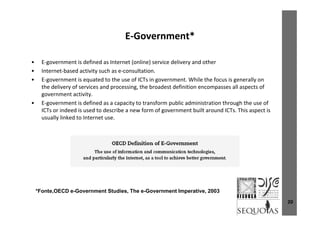
E Government*E‐Government  
• E government is defined as Internet (online) service delivery and other• E‐government is defined as Internet (online) service delivery and other
• Internet‐based activity such as e‐consultation.
• E‐government is equated to the use of ICTs in government. While the focus is generally on 
the delivery of services and processing the broadest definition encompasses all aspects ofthe delivery of services and processing, the broadest definition encompasses all aspects of 
government activity.
• E‐government is defined as a capacity to transform public administration through the use of 
ICTs or indeed is used to describe a new form of government built around ICTs. This aspect is  g p
usually linked to Internet use.
*F t OECD G t St di Th G t I ti 2003
20
*Fonte,OECD e-Government Studies, The e-Government Imperative, 2003
E GovernanceE‐Governance
• In general terms governance is the process of decision making and the process by• In general terms governance is the process of decision making and the process by 
which decisions are implemented, and an analysis of governance focuses on the 
formal and informal actors involved in decision‐making and implementing the 
decisions made and the formal and informal structures that have been set in placedecisions made and the formal and informal structures that have been set in place 
to arrive at and implement the decision. 
• Government is one of the actors in governance. Other actors involved in 
governance vary depending on the level of government that is under discussiongovernance vary depending on the level of government that is under discussion
• e‐Governance is the field of activity where policy design, co‐ordination, 
arbitration, networking and regulation (just to mention essential steering 
f ti ) ith ICT b t l f ICT t k l A d thi i l ll t ffunctions), with ICTs, but also of ICTs, takes place. And this involves all sorts of 
non‐state actors, the state representatives being however one of the main 
stakeholders (Misuraca,  Viscusi2010). 
21
MotivationsMotivations
Diff t h i th t f th bli t t d• Different approaches in the management of the public sector towards 
new models of governance, aiming to reintegrate services with a new 
perspective on bureaucracy
• Awareness that models and techniques of information systems 
evaluation exploited in the private sector cannot be adapted as‐is to 
public sector and e‐Government initiativesp
• Lack of methodologies coping with the systemic complexity of e‐
Government at strategic planning level 
• Poor consideration of the impacts of principles, policies and  laws on e‐
Government projects planning has been seldom investigated
• Poor consideration of the institutional facets of e‐Government strategy gy
as a rules‐based‐action aiming to provide services appropriate for the 
institutional context
22
QuestionsQuestions
H d l i i i h h diff• How to deal in a systemic way with the different 
facets involved in the planning of e‐Government 
i i i i ?initiatives?
• How to deal with different rules and legal 
frameworks in planning and design of e‐Government 
initiatives?
• How to elicit the institutional requirements within the 
context of intervention?f
23
AgendaAgenda
I d i h h• Introduction the research group
• Background
• The eG4M Methodology
• Dealing with principles policies and lawsDealing with principles, policies and laws
• Conclusion and Future work
24
E Government StrategyE‐Government  Strategy
A G t t t i l f G t t• An e‐Government strategy is a plan for e‐Government systems 
and their supporting infrastructure which maximizes the 
ability of management to achieve organizational objectivesability of management to achieve organizational objectives 
(Heeks, 2005)
• Furthermore, the e‐Government strategy can be seen from an , gy
institutional perspective as a rules‐based‐action aiming to 
provide services appropriate for the institutional context. 
– The appropriateness of rules considered organized into institutions 
includes both cognitive and normative components (see March & 
Olsen2008).Olsen2008).
25
Founding conceptsFounding concepts
A i t i th bilit f d t ti d h i th t ti l• Appropriateness is the capability of detecting and enhancing the potential 
of the context, and the degree the e‐Government services fit the context 
characteristics, both at the macro (scenery) micro (users context) , and 
institutional level (Bridges 2005) . The appropriateness of rules considered 
organized into institutions includes both cognitive and normative 
components (March & Olsen 2008).
• Homology of systems or structure establishes a structural correspondence 
between two phenomena or between two coherent systems of meaning and 
action (Boudon 2000, 2001).
• Quality, as a quality of an artifact, a product, a service, is the degree to y, q y , p , , g
which a set of inherent characteristics of the artifact, process, service fulfills 
requirements (ISO 2000). 
26
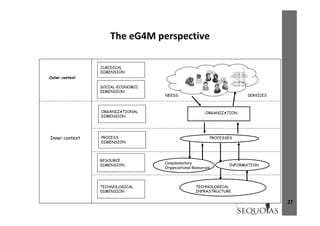
The eG4M perspectiveThe eG4M perspective
Outer context
SOCIAL-ECONOMIC
JURIDICAL
DIMENSION
ORGANIZATION
NEEDS SERVICES
ORGANIZATIONAL
SOCIAL-ECONOMIC
DIMENSION
ORGANIZATION
PROCESSESPROCESS
ORGANIZATIONAL
DIMENSION
Inner context PROCESSES
INFORMATION
Complementary
PROCESS
DIMENSION
RESOURCE
DIMENSION
Inner context
INFORMATION
TECHNOLOGICAL
INFRASTRUCTURE
Complementary
Organizational Resources
TECHNOLOGICAL
DIMEN ION
DIMENSION
INFRASTRUCTUREDIMENSION
27
The eG4M methodologyThe eG4M methodology 
28
The eG4M application scenarios
State Reconstruction
Application Scenario
(b)
State Reconstruction
Application
Scenario (a)
Q lit t
Available processes
Q lit t
Available services
Evaluation of quality of processes
Quality assessmentQuality assessment
Evaluation of quality of services
Choice of new projectsChoice of new projects
Projects improving the quality of a
process or a group of processes
Application Scenario (c)
Projects improving the quality of
a service or a group of services
Application Scenario
eReadiness and
quality assessment
Application Scenario (c)
Quality assessment
(d)
Complete assessment of an
organization
Complete assessment of an
information system, or technological
infrastructure
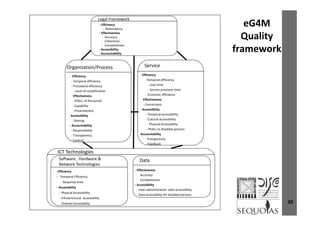
Legal Framework
- Efficiency 
‐ Redundancy 
- Effectiveness
A
eG4M 
Quality‐ Accuracy
‐ Coherence
‐ Completeness 
‐ Accessibility
‐ Accountability
Quality 
framework
‐ Efficiency
‐ Temporal efficiency
‐ Procedural efficiency
Organization/Process
‐ Efficiency
‐Temporal efficiency
‐ User time
Service
y
‐ Level of simplification
‐ Effectiveness 
‐ Effect. of Personnel
‐ Capability 
‐ Proactiveness
‐ Service provision time
‐ Economic efficiency
‐ Effectiveness
‐ Correctness
‐ Accessibility
‐ Accessibility
‐ Sharing
‐ Accountability
‐ Responsibility
‐ Transparency
‐ Temporal accessibility             
‐ Cultural accessibility 
‐ Physical Accessibility
‐ PhAcc to disabled persons
Accountability
Transparency‐ Control ‐ Transparency
‐ Feedback
ICT Technologies
Software , Hardware & 
Network Technologies
Data
Network Technologies
-Efficiency
- Temporal Efficiency 
‐ Response time
- Accessibility
- Effectiveness
‐ Accuracy
‐ Completeness
- Accessibility
‐ Inter‐administration data accessibility
‐ Physical Accessibility        
‐ Infrastructural  accessibility
‐ Channel accessibility
‐ Inter‐administration  data accessibility 
‐ Data accessibility for disabled persons
30
Legal Framework
- Efficiency 
‐ Redundancy 
- Effectiveness
A
Relationships 
between‐ Accuracy
‐ Coherence
‐ Completeness 
‐ Accessibility
‐ Accountability
between 
qualities
‐ Efficiency
‐ Temporal efficiency
‐ Procedural efficiency
Organization/Process
‐ Efficiency
‐Temporal efficiency
‐ User time
Service
y
‐ Level of simplification
‐ Effectiveness 
‐ Effect. of Personnel
‐ Capability 
‐ Proactiveness
‐ Service provision time
‐ Economic efficiency
‐ Effectiveness
‐ Correctness
‐ Accessibility
‐ Accessibility
‐ Sharing
‐ Accountability
‐ Responsibility
‐ Transparency
‐ Temporal accessibility             
‐ Cultural accessibility 
‐ Physical Accessibility
‐ PhAcc to disabled persons
Accountability
Transparency‐ Control ‐ Transparency
‐ Feedback
ICT Technologies
Software ,Hardware & 
Network Technologies
Data
Network Technologies
-Efficiency
- Temporal Efficiency 
‐ Response time
- Accessibility
- Effectiveness
‐ Accuracy
‐ Completeness
- Accessibility
‐ Interadministration data accessibility
‐ Physical Accessibility        
‐ Infrastructural  accessibility
‐ Channel accessibility
‐ Interadministration  data accessibility 
‐ Data accessibility for disabled persons
31
eG4M applicationeG4M application
E t i l li d i th G4M ( G t f• Extensively applied in the eG4M (eGovernment for 
Mediterranean Countries) project:
– Morocco – from November 2008 to April 2009
R di f M i i lit f T i (f G )• eReadiness of Municipality of Tangier (focus on Governance)
– Tunisia ‐from January 2008 to April 2009Tunisia from January 2008 to April 2009
• Information systems integration initiatives of the Tunisian Ministry of 
agriculture and hydraulic resources.
32
The tunisian experimentationThe tunisian experimentation
Th i h ll f th Mi i t i th i t ti t• The main challenge for the Ministry is the integration at 
horizontal level of the data bases of the central administrative 
departmentsdepartments.
• A second related goal is to 
– provide a unified view of the interactions between eachprovide a unified view of the interactions between each 
department and other public administration, 
• to evaluate the actual level of efficiency and effectiveness of y
current information systems for eGovernment services provision.
33
The participantsThe participants
F j d i i t ti d t t h i it i th• Four major administrative departments have priority in the e‐
Government initiatives, namely: 
– the department of animal production;– the department of animal production; 
– the department of the restructuring of agricultural state‐owned 
domains; 
– the department of veterinary services; 
– the department of water resources management
34
The actionThe action…
• eG4M state reconstruction step have been focused on the following issues:• eG4M state reconstruction step have been focused on the following issues:
– the conceptual schemas re‐engineering of the current data bases, in order to identify 
the master data of the MAHR, suitable to be used for the design of the conceptualthe master data of the MAHR, suitable to be used for the design of the conceptual 
schema of the integrated information system;
– the data quality evaluation of the available data, in terms of their currency and 
completeness, in order to verify the correspondence with the current procedures and 
services provided by the public administration;
– the representation of the interactions between public administrations in terms of 
services and related processes, together with involved type of information and 
hi f th i l d d t b th l i t d fi th i it i t tiownership of the involved data bases; the goals is to define the priority intervention 
areas in the integration initiative.
• After a set of courses introducing the methodology and related topics, the above described three issuesAfter a set of courses introducing the methodology and related topics, the above described three issues 
have been developed through participatory design workshops involving four teams composed by three 
civil servants (one senior manager and two middle level manager) each from the four departments
35
AgendaAgenda
I d i• Introduction
• Background
• The eG4M Methodology
• Dealing with principles, policies, and lawsDealing with principles, policies, and laws
• Conclusion and Future work
36
Principles Policies RulesPrinciples, Policies, Rules
P li i b id d i t ti ( ) ti ( ) d b th• Policies can be considered as intention(s), action(s) or as composed  both 
by intention(s), action(s)  (Page, 2006)
• Principles are “general views about how public affair should be arranged 
or conducted (Principle can be considered a specific Policy intentions) 
(Page, 2006)
• Public policy can be considered synonymous with law rule statute edict• Public policy can be considered synonymous with law, rule, statute, edict, 
and regulation, when considered as ”an officially expressed intention 
backed by a sanction” (Lowi, 1998)
• Nevertheless, even if all public policies must be understood as coercive, 
coercion is only one of the characteristics of rules and law besides 
coercion may confer powers or privileges without imposing obligations 
(Hart, 1961)
37
Legal systems and rulesLegal systems and rules
L l t b id d t f l (H t• Legal system scan be considered as a systems of rules (Hart, 
1961), where rules can be classified in terms of 
– primary rules that express rules of conduct (Hart 1961)primary rules that express rules of conduct (Hart, 1961)
• a primary rule as a rule (policy) that imposes an obligation on  citizens and then applies a 
sanction for nonperformance
– secondary rules that define the roles of the civil servants who have to administer the 
rules of conduct (Hart, 1961)
• a secondary rule (policy), in contrast, imposes no direct sanctions but, instead, empowers or 
enables citizens to act in their own behalf or interests
( )• A complementary distinction (Searle, 1995)is made between 
– regulative norms which describe obligations, prohibitions and permissions, 
– constitutive norms that regulate the creation of institutional facts likeconstitutive norms  that regulate the creation of institutional facts like 
property or marriage, as well as the modification of the normative system 
itself.  These latter are related to secondary rules
38
Principles/Policies checklist
Principle/Policy Market-Oriented Public-Oriented
Impersonality
Fairness
E-Gov
Equality
Personalisation
Decentralisation
vvisione
Delegislation
Subsidiarity
Wholeness
elicitatio
Wholeness
Disaggregation
Cooperation
Integration
on
Integration
Uniformity
Efficiency
Simplification
Productivity
Effectiveness
39
(Retrieved among others from Cordella,2006 – Du Gay, 2000 – Dunleavy, 2006)
Adequacy
Accountability
Transparency
Principle, goal, related rules, enabling technologies, 
socio‐organizational impact
Principle Goal Rule Driver  Socio‐organizational 
E-Gov
Impact (AS‐IS)
Efficiency Embedding  Simplification laws Cooperative  Improve administrative 
vvisione
administrative 
procedures in ICT
architectures processes
elicitatio
Effectiveness Information management 
and coordination
Laws on digital 
signature
Digital signature 
technology
Reducing Burden on 
citizens
on
40.
Common goals and strategiesCommon goals and strategies
# of Principles  # of Goals #of Strategies 
2 4 13
E-Gov
Principles Common Goals Common Strategies
<Efficiency, Effectiveness> 2 6
vvisione
Map A <Achieve internal effectiveness>
<Improving Administrative processes, 
Improving information management 
and coordination by means of laws, 
Improving information management
elicitatio
Improving information management 
and coordination by means of ICT
architecture>
on
Map B  <Reduce burden for administrative
services>
<Improving data governance, 
Enforcing laws on digital signature, 
introducing digital signature
technologies
41
services> technologies
Macro Micro objectives definitionMacro‐Micro objectives definition
Common Goals Common Strategies Macro‐Objective Micro‐objective
<Achieve internal
effectiveness>
<Improving Administrative
processes, Improving information 
management and coordination by
1. Effectiveness of the 
Administrative activity
(Organization Process )
Services accessible with 
multiple channels
E-Gov
management and coordination by 
means of laws, Improving
information management and 
coordination by means of ICT
architecture>
(Organization‐Process )
2. Simplification of administrative
activities (Laws)
vvisione
3. Reduce burden for 
administrative services (Service)
4. Use innovative ICT technologies
elicitatio
(Technology)<Reduce burden for 
administrative services>
<Improving data governance, 
Enforcing laws on digital signature, 
introducing digital signature
technologies>
on
42
Legal framework 
(an example based on Italy and Tunisia)
Consti
tution
STATE
tution
International 
treaty
ERECON
Law
Decree
NSTRUC
Decree
Decree with force of law
TION
Ordinance
Administratives rules
43
Services and related existing laws (Tunisia)
Issue Type of rule Year Objective
P i C tit ti 2002 M difi d ti l t i t d th i i l f l d tPrivacy Constitution 2002 Modified an article to introduce the principle of personal data 
protection
Privacy Law 2004 An organic guidance law on privacy
P i D 2007 C t N ti l A th it t th i i i l
STATER
Privacy Decree 2007 Creates a National Authority to govern the privacy principle
Digital economy Law 2007 An organic guidance law on digital economy
Digital economy Decree 2007 List of activities included in digital economy
RECONS
Digital economy Decree 2007 List of activities included in digital economy
Digital economy Decree 2007 Institution of the Higher Boaurd of digital economy
Electronic  Law 2000 Juridical validity of electronic documents
STRUCTI
administration
y
Electronic 
administration
Decree 2005 Creation of the electronic administration unit in the Prime minister
Cabinet Office
Electronic Law 2000 An organic guidance law on electronic commerce
ION
Electronic 
Commerce
Law 2000 An organic guidance law on electronic commerce
Electronic 
Commerce
Decree 2000 Creation of the National  Certification Agency
l i 200 l f h ifi i id i iElectronic 
Commerce
Decree 2001 Rules for the Certification provider activity
44
Services and related existing laws (Italy)
S i L f Y M i i dd dService  Law reference Year Main issues addessed
Certificate of 
residency
Law 1228/1954 1954 ‐The Municipality ownership of registry office.
‐The information to be held by the registry office.
‐The definition of rules for personal data and certificatesp
Legge 470/1988 1988 ‐ The institution by the Ministry of Interior of the National Record of the Registry Office
Law 59/97  1997 ‐The semplification of laws, rules, and administrative processes
‐The legal validity of electronic data and documents
STATER
‐ Rules for the change of the organization of public managers
Driving licence 
provision
Decrees with the 
force of law 
396/2000
285/1992
1992/2000 ‐The Municipality ownership of the registry office for civil status
‐ The creation of a digital archive for civil status in the municipality
‐The creation of a nation digital archive for civil status
RECONS
285/1992  ‐ The obligation for local public administration to exchange data in electronic format through 
the national public network
‐The creation of a digital archive for the roads by the Ministry of transports
‐ The creation of a digital archive for vehicles
Driving licence  Law 326/2003 2003 ‐ Rules for the suspension of the driving licence
STRUCTI
g
update 
/ p g
Health card 
provision
Law 23/12/1978 
n. 833
Decree 437/1999
1978/1999 ‐The rules for the registration to the national health system
‐Role and ownership of local office of the Ministry of Health 
‐ Rules for the electronic health card
ION
Health card 
update
Law 1228/1954
Law 23/12/1978 
n. 833
Decree 437/1999
1954/1978/1999 ‐The rules for the registration to the national health system
‐ Role and ownership of local office of the Ministry of Health 
‐ Rules for the electronic health card
45
Obtaining a 
doctor
Law 59/97 Decree 
270/2000
19972000 ‐Roles of the physicians in the public administration
‐Rule for obtaining a doctor
Matrix Organization/Type of InformationMatrix Organization/Type of Information
Information/
Organization
Type of Public 
Administration
Residency Driving Licence Health card
Organization Administration
Municipality Local Certifies/
Provides
‐ ‐
ffi h i l ifi /
STATER
Traffic Authority Central ‐ Certifies/
Provides
‐
Regional Health 
Authority
Local ‐ ‐ Provides
RECONS
Local Health Authority Local Uses ‐ Provides
Ministry of Interior Central Governs ‐ ‐
STRUCTI
Ministry of Finance Central Certifies/
Uses
Uses Certifies/
Governs
Ministry of Health Central Uses ‐ Governs
ION
y
46
Matrix Type of Information/DataBaseMatrix Type of Information/DataBase
National 
registry of
Local 
registry of
central 
tax
Central registry 
of the road
Regional 
health
Local health 
registry
Database
registry of 
residents
registry of 
residents
tax 
registry
of the road 
traffic office
health 
registry
registry
Residency Ministry of 
Interior
Municipality
Information
STATER
Driving licence Traffic authority
RECONS
Health card Ministry of 
finance
Region 
health 
authority
Local health 
authority
STRUCTIION
47
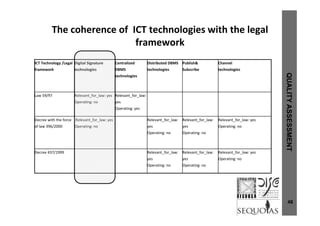
The coherence of  ICT technologies with the legal 
framework
h l / l i i l i li d i ib d bli h& h lICT Technology /Legal 
framework
Digital Signature 
technologies
Centralized 
DBMS
technologies
Distributed DBMS 
technologies
Publish&
Subscribe
Channel
technologies
QUA
Law 59/97 Relevant_for_law: yes
Operating: no
Relevant_for_law: 
yes
Operating: yes
ALITYAS
Decree with the force 
of law 396/2000
Relevant_for_law: yes
Operating: no
Relevant_for_law: 
yes
Operating: no
Relevant_for_law: 
yes
Operating: no
Relevant_for_law: yes
Operating: no
SSESSME
Decree 437/1999 Relevant_for_law: 
yes
O ti
Relevant_for_law: 
yes
O ti
Relevant_for_law: yes
Operating: no
ENT
Operating: no Operating: no
48
The impact of the current legal frameworkThe impact of the current  legal framework
Legal framework Organizational impact Technological Impact Enforcement Status
Law 59/97  Enables  Enables Strong enforcement
QUA
Decree 437/1999 Binds Enables Strong enforcement
Laws for digital signature Innovates Innovates Loose enforcement
ALITYAS
Decree with the force of law 
396/2000
Enables Enables Strong enforcement
SSESSMEENT
49
Quality for legal frameworkQuality for legal framework
• Efficiency: the legal framework is produced with a limited use of resources (Osservatorio Legislativo• Efficiency: the legal framework is produced with a limited use of resources (Osservatorio Legislativo 
Interregionale, 2007 ); such resources can be human, financial or temporal resources. 
– Redundancy: the set of laws is minimal, namely, each issue dealt with in the legal framework is regulated by one and only one law (or parts of 
law) (Martin J. Eppler, Markus Helfert, & Gasser, 2004).
• Effectiveness: the legal framework has been conceived in such a way that its concrete enforcementEffectiveness: the legal framework has been conceived in such a way that its concrete enforcement 
produces the results and outcomes initially planned (EU Commission, 2003). 
– Accuracy: laws address precisely and non ambiguously the domain of interest  and do not give rise 
to misleading applications in the domain (Lupo, De Santis, & Batini, 2005).
Coherence la s enacted o er time are not contradictor to each other and the legal terms sed– Coherence: laws enacted over time are not contradictory to each other, and the legal terms used 
within different legislative domains of intervention refer to a common coherent lexicon (Bobbio, 
1993). The different levels among laws are due to the fact the legal frameworks are in general 
structured as a hierarchy of rules; Figure 5 shows an example that generalizes the legal framework of 
Italy and other Mediterranean Countries such as Tunisia Besides International treaties ConstitutionItaly and other Mediterranean Countries such as Tunisia. Besides International treaties, Constitution
is the higher set of rules governing all the other types of rules, namely, Decrees, Decrees with force 
of Law, Ordinance and Administrative Rules, these latter governing specific administrative 
procedures.
l h l l f k dd ll h l f h d d d f– Completeness: the legal framework addresses all the issues relevant for the considered domain of 
enforcement (Bobbio, 1993; Gasser, 2003), in our case the e‐Government plan.
• Accessibility: the users of the legal framework can easily access the whole set of norms 
related to their rights, duties and obligations (Gasser, 2003).
• Accountability: the legal framework provides rules that govern the clear 
responsibility and transparency  to be provided when a law is enforced (Bobbio, 1993).  50
Relationships  between Laws‐Technology 
impacts and quality framework
-Efficiency
Legal Framework
Efficiency
- Redundancy
-Effectiveness
- Accuracy
- Coherence
- Completeness=“LOW”
-Accessibility
-Accountability = “LOW”
Organization/Process Service
- Accessibility
QUA
Loose 
enforcement
Innovates
- Accessibility
- Sharing
- Accountability
- Adequacy
- Responsibility
- Effectiveness
- Formality
- Integrity
- Proactiveness
- Efficiency
- Temporal
accessibility
- Cultural
accessibility
Ph i l
-Efficiency
-Temporal efficiency
- Economic efficiency
-Effectiveness
ALITYAS
- Transparency
- Control
- Procedural efficiency
- Level of
simplification
- Physical
Accessibility
-Accountability
- Openness
- Transparency
SSESSME
ICT
Hardware & Network Techn.
-Efficiency
- Temporal Efficiency
Data
- Effectiveness
p y
- Feedback
ENT
p y
- Response time
- Accessibility
- Infrastructural accessibility
- Channel accessibility
- Connectivity
- Accuracy
- Completeness
- Accessibility
51
Connectivity
THE ITALIAN LEGISLATION
Current legal framework New legal framework
Law No.59/97
General Principles
Current legal framework New legal framework
Law No.59/97
General Principles
QUA
Presidential Decree No. 513/97
General Rules
General Principles
Electronic documents legal validity
General Principles
Electronic documents
legal validity
ALITYAS
Electronic documents,
digital signatures and
certification services
SSESSME
Ordinance of Prime Minister
New Technical Rules
Ordinance of Prime Minister
Technical Rules
Ordinance of Prime Minister
ENT
New Technical Rules
To be updated at least
every two years
Technical Rules
To be updated at least
every two years
Technical Rules
To be updated at least
every two years
52
User related qualities
Layer Quality dimension Service Current valueLayer Quality dimension Service Current value
Service Temporal accessibility Comm. of change of residency to the new mun. 30 hours a week
Comm. of change of residency to the old mun. 30 hours a week
Change of residency in the driving licence 20 hours a week
Change of residency in the health card 25 hours a week
Reservation for medical examination 15  hours a week
Service User time Comm. of change of residency to the new mun. 3 hours
Comm. of change of residency to the old mun. 6  hours
QUA
Comm. of change of residency to the old mun.
Change of residency in the driving licence 6 hours
Change of residency in the health card 6 hours
Reservation for medical examination 24 hours a year 
C f h f id t th 1 k
ALITYAS
Service Service provision time Comm. of change of residency to the new mun. 1 week
Comm. of change of residency to the old mun. 1 week
Change of residency in the driving licence 1 month
Change of residency in the health card 1 month
SSESSME
Reservation for medical examination 3 days
Organizat
ion/proce
ss
Level of simplification Comm. of change of residency to the new mun. 2 interactions
Comm. of change of residency to the old  mun. 2 interactions
Change of residency in the driving licence 2 interactions
ENT
Change of residency in the health card 2 interactions
Reservation for medical examination 2 interactions
ICT 
infrastruc
Channel accessibility Comm. of change of residency to the new mun. Only desk
Comm. of change of residency to the old mun. Only desk
infrastruc
ture
(channel)
Comm. of change of residency to the old  mun. y
Change of residency in the driving licence Only desk
Change of residency in the health card Only desk
Reservation for medical examination Only desk
53
Relationships between Macro‐
objectives and quality dimensionsobjectives and quality dimensions
Macro objectives Quality dimensions
QUA
Temporal 
accessibility
User time Service provision 
time
Level of 
simplification
Channel 
accessibility
Reduce burden for 
administrative services
Low High  High no High
ALITYAS
Effectiveness of the 
Administrative activity
Low no no High High
Si lifi ti f d i i t ti h h
SSESSME
Simplification of administrative
activities
no High Low High no
Use innovative ICT technologies
High Low no Low High
ENT
54
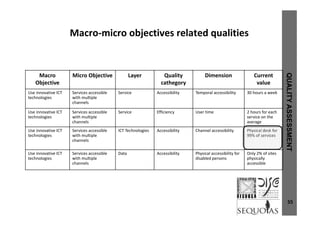
Macro‐micro objectives related qualitiesMacro micro objectives related qualities
Macro 
Objective
Micro Objective Layer Quality 
cathegory
Dimension Current 
value
QUA
Use innovative ICT 
technologies
Services accessible 
with multiple 
channels
Service Accessibility Temporal accessibility 30 hours a week
Use innovative ICT Services accessible Service Efficiency User time 2 hours for each
ALITYAS
Use innovative ICT 
technologies
Services accessible 
with multiple 
channels
Service Efficiency User time 2 hours for each 
service on the 
average
Use innovative ICT 
technologies
Services accessible 
with multiple 
ICT Technologies Accessibility Channel accessibility Physical desk for 
99% of services
SSESSME
channels
Use innovative ICT 
technologies
Services accessible 
with multiple 
channels
Data Accessibility Physical accessibility for 
disabled persons
Only 2% of sites 
physically 
accessible
ENT
channels accessible
55
BibliografiaBibliografia
• Viscusi, G., Batini, C., Mecella, M. (2010) Information Systems for 
G li f i i S i H id lbeGovernment: a quality of service perspective, Springer, Heidelberg.
• Laudon, j, Laudon K. (2009) Managemement dei sistemi informativi – vol. 
2 ‐ a cura di V. Morabito e F. Pennarola, Pearson Italia, , ,
56

Gianluigi Viscusi, Informatica per le PA.

  • 1.
    INFORMATIC A PERLA PA CONCETTI EINFORMATIC A PER LA PA: CONCETTI E  METODOLOGIE C di I f ti l PA Gianluigi Viscusi (Ph.D.) Corso di Informatica per la PA SEQUOIAS Lab ‐ DISCo – Università di Milano Bicocca viscusi@disco.unimib.it
  • 2.
    AgendaAgenda I d i•Introduction • Background • The eG4M Methodology • Dealing with principles policies and lawsDealing with principles, policies, and laws • Conclusion and Future work 2
  • 3.
    Transizione dalla fase di management dei computer a  quella dei sistemi informativi Sviluppo del valoredi Business dei SI Management dei Si t iSI Sistemi Informativi (MIS) Relazione con le altre funzioni Fonte, Laudon, j, Laudon K. Manage ement dei sistemi informativi Gestione della funzione SI Manage,ement dei sistemi informativi – vol. 2- Pearson, 2009 Management dei Computer (Computer Management o Data Processing-DP) Gestione attività operative e tecniche dei SI Data Processing-DP)
  • 4.
    Relazione tra lestrategie di business SI e ITRelazione tra le strategie di business, SI e IT Strategia di business Decisioni di business Obiettivi e direzione Verso dove si muove il business e perché Potenziale impatto dei SI/IT sul settore, sull’azienda e Cambiamento Supporto al Direzione del business sull azienda e sull’organizzazione Strategia dei SI Basata sulle necessità del business pp business Basata sulle necessità del business Orientata alla domanda Focalizzata sulle applicazioni Cosa è richiesto Strategia IT Infrastruttura e servizi Necessità e priorità Fonte, Laudon, j, Laudon K. Manage ement dei sistemi informativi Basata sulle attività Orientata all’offerta Focalizzata sulla tecnologia Come può essere offerto Manage,ement dei sistemi informativi – vol. 2- Pearson, 2009
  • 5.
    Allineamento tra strategia e IT ‐ Henderson e  Venkatraman (1992) Esterna Strategiadi business Strategia IT Integrazione strategica Interna Infrastruttura e processi Sistemi informativi, Interna e processi organizzativi infrastruttura e processi Integrazione funzionale a livello di business a livello di IT Fonte, Laudon, j, Laudon K.j Manage,ement dei sistemi informativi – vol. 2- Pearson, 2009
  • 6.
    Scenari della strategiaSI/ITScenari della strategia SI/IT Pressioni interne all’azienda per avere un’ulteriore distribuzione del controllo dei SI/IT ALTO OPPORTUNISTICO COMPLESSO Diffusion: grado di decentralizzazione del t ll d i Pressioni competitive esterne aumentano la criticità dei SI/IT per il b icontrollo dei SI/IT in azienda TRADIZIONALE SPINA DORSALE il business BASSO Infusion:BASSO ALTOFonte, Laudon, j, Laudon K. grado di dipendenza del business dai SI/IT j Manage,ement dei sistemi informativi – vol. 2- Pearson, 2009
  • 7.
    I tre aspettifondamentaliI tre aspetti fondamentali Organizzazioneg INFORMAZIONI TecnologiaProcessi TecnologiaProcessi Fonte, Laudon, j, Laudon K. Manage,ement dei sistemi informativi – vol. 2- Pearson, 2009
  • 8.
    Portafoglio IT (1/4)Portafoglio IT (1/4) LA) Cultura iServizio-S IT Facilities Competenze IT Persone/ Organizzazione IT (es.Livellid StrategiaI Processidi gestione IT & Risultati:( Layout Portafoglio Applicativo Componenti IT Reti Fonte, Laudon, j, Laudon K.j Manage,ement dei sistemi informativi – vol. 2- Pearson, 2009
  • 9.
    Portafoglio IT (2/4)Portafoglio IT (2/4) l Cultura id l l Competenze IT Persone/ OrganizzazioneIT Cultura Utenti IT aziendale Cultura IT oIToIT egiaIT IT OrganizzazioneIT Facilities Personale IT oneecontrollo (back-office) Processi di gestione IT (front-office) operations; assetmanagement oneecontrollo (back-office) operations; assetmanagement (back-office) operations; assetmanagement tati Strate & L ut Hardware e Networking P.A. orientato alla gestione Programmazio operations; assetmanagement facilitymanagement servicedelivery OLA SLA Programmazio operations; assetmanagement facilitymanagement servicedelivery OLA SLA operations; assetmanagement facilitymanagement servicedelivery OLA SLA Risult servicemanagement Portafoglio Applicativo Componenti IT LayoutNetworking Sistemi Operativi gestione Portaf. x Gestione D ti Architetture PP Reti p Dati (DBMS) Topologie e Protocolli Fonte, Laudon, j, Laudon K.j Manage,ement dei sistemi informativi – vol. 2- Pearson, 2009
  • 10.
    Portafoglio IT (3/4)Portafoglio IT (3/4) ITCapabilities Cultura Utenti IT Cultura aziendale Cultura IT dinamiche oFSI...) T Competenze IT Persone/ OrganizzazioneITFacilities Personale IT 2 ontrolloITontrolloIT azioni eamentocond /cambiamento StrategiaIT 3.1 3.2 strazioneeco (back-office) operations; asset management facilitymanagement i d li OLA SLA strazioneeco operations; asset management facilitymanagement i d li OLA SLA Processi di gestione IT operations; asset management facilitymanagement i d li OLA SLA ati/Presta utenti,alline doevoluzione/ (front-office) servicemanagement S Portafoglio Applicativo Componenti IT & Layout Hardware e Networking P.A. orientato alla gestione 4 Amminis service delivery Amminis service deliveryservice delivery Risulta oddisfazione ziendali,grad ApplicativoIT Reti Sistemi Operativi Portaf. x Gestione Dati (DBMS) Topologie e Protocolli Architetture 1 (es.so az +1 4 Infrastruttura=+1 4 Infrastruttura IT=
  • 11.
    Portafoglio IT (4/4)Portafoglio IT (4/4) ITDynamic Capabilities Cultura Utenti IT Cultura aziendale Cultura IT dinamiche oFSI...) T Competenze IT Persone/ OrganizzazioneITFacilities Personale IT 2 ontrolloITontrolloIT azioni eamentocond /cambiamento StrategiaIT 3.1 3.2 strazioneeco (back-office) operations; asset management facilitymanagement servicemanagement i d li OLA SLA strazioneeco operations; asset management facilitymanagement i d li OLA SLA Processi di gestione IT operations; asset management facilitymanagement i d li OLA SLA ati/Presta utenti,alline doevoluzione/ (front-office) S Portafoglio Applicativo Componenti IT & Layout Hardware e Networking P.A. orientato alla gestione 4 Amminis service delivery Amminis service deliveryservice delivery Risulta oddisfazione ziendali,grad ApplicativoIT Reti Sistemi Operativi Portaf. x Gestione Dati (DBMS) Topologie e Protocolli Architetture 1 (es.so az + = Fonte, Laudon, j, Laudon K. Manage,ement dei sistemi informativi – vol. 2- Pearson, 2009
  • 12.
    Strati di servizio (1/2) Business Fattori d’influenza Strategia ITStrategia di business Managementdel Richiesta di servizi IT Management del portafoglio IT L d hi Produzioneed erogazione Leadership Management del t f lit i erogazione del servizio portafogliotecnico Fonte, Laudon, j, Laudon K. Manage,ement dei sistemi informativi – vol. 2- Pearson, 2009
  • 13.
    Strati di servizio(2/2)Strati di servizio (2/2) Aree Capabilities Sourcing L d hi Processi Strategia IT e Governance Produzioneed erogazione Leadership Aree di Management del t f lit i erogazione del servizio servizio IT portafogliotecnico Fonte, Laudon, j, Laudon K. Manage,ement dei sistemi informativi – vol. 2- Pearson, 2009
  • 14.
    Esempio di organigrammaEsempio di organigramma Ld hi Legenda Cli t O i ti Client Relationship Service Organization Leadership Chief Administrative Chief Administrative OffiChief Operations Chief Operations Offi CEO CEO Client Organization Chief Administrative Officer OfficerChief Operations Officer Officer Applications Lead Applications Lead Chief Relationship Officer Chief Relationship Officer Chief Technology Officer Chief Technology Officer Unit OperationsProgram Office Program Office Architecture & Portfolio •System analysts •Application programmers •Competence Centers Biz Liaison Manager Biz Liaison Manager •Break/Fix •Regulatory •Minor Enhancements Application DevelopmentDivision 1 Division 2 Application Maintenance •Hosting •Desktop Help Desk Infrastructure •Competence Centers •Consultants •Project Managers Biz Liaison Manager •Minor Enhancements Biz Liaison Manager Division 3 Division n . . . •Help Desk •Communications Geo. Svc. Geo. Svc. Geo. Svc. Geo. Svc.Service Regional Country 1 Country 2 Country 3 Country n . . . Manager Manager Manager Manager Ser ce Management Fonte, Laudon, j, Laudon K. Manage,ement dei sistemi informativi – vol. 2- Pearson, 2009
  • 15.
    Catena del valoreCatena del valore Fonte,Laudon, j, Laudon K.j Manage,ement dei sistemi informativi – vol. 2- Pearson, 2009
  • 16.
    Allocazione delle risorse IT (1/2) Allocazionerisorse IT Strategia dibusiness Customer Satisfaction Risorse (spese) discrezionali allocate per raggiungere gli obiettivi di business Efficienza del sistema impresa obiettivi di business globali e di divisione (necessari per incrementare il livello di ricavi ed il vantaggio Produzionedel servizio IT vantaggio competitivo) Produzionedel servizio IT (attività connesse ai sistemi tradizionali, maintenance, aggiornamento, supporto applicativo) Spesa non discrezionale per l’attività di produzione del servizio (necessarie( per mantenere l’operatività quotidiana) Fonte: Gartner Group, ComputerEconomics.com, Accenture Fonte, Laudon, j, Laudon K. Manage,ement dei sistemi informativi – vol. 2- Pearson, 2009
  • 17.
    Allocazione delle risorseIT (2/2)Allocazione delle risorse IT (2/2) NuoviSviluppi 14.0% Solutions Development & Maintenance NuoviSviluppi Manutenzioneevolutiva Manutenzione eSupportoApplicativo Hardware13.0% 36.7% 10.7% 12.0% Mainframe Midrange/Server Spesa Software Personale 9.0% 49.6% 8.4% 9.7% Service Delivery PC e terminali Help Desk/Supportoutente TLC D ti Spesa IT totale TLC 3.5% dei Ricavi 11.5% 51.9% 12.6% 6.7% TLC - Dati TLC Voice & Video Pianificazionee GestioneIT Servizi Altro 11.1% 5.8% 7.8% 6.7% 6.4% Leadership an f caz n G t n Altro Fonte: Gartner Research, Meta, Giga, Forrester, Computer Economics, and Accenture Analysis 11.4% 5.0% Fonte, Laudon, j, Laudon K.j Manage,ement dei sistemi informativi – vol. 2- Pearson, 2009
  • 18.
    AgendaAgenda I d i•Introduction • Background • The eG4M Methodology • Dealing with principles policies and lawsDealing with principles, policies and laws • Conclusion and Future work 18
  • 19.
    P i il f P bli GPrinciples of Public Governance • adherence to the rule of law • the primacy of the collective interest over sectoral or p y private interests • respect for the rights of individuals • eq it• equity • transparency • democratic accountabilitydemocratic accountability   • responsibility for future generations
  • 20.
    E Government*E‐Government   •E government is defined as Internet (online) service delivery and other• E‐government is defined as Internet (online) service delivery and other • Internet‐based activity such as e‐consultation. • E‐government is equated to the use of ICTs in government. While the focus is generally on  the delivery of services and processing the broadest definition encompasses all aspects ofthe delivery of services and processing, the broadest definition encompasses all aspects of  government activity. • E‐government is defined as a capacity to transform public administration through the use of  ICTs or indeed is used to describe a new form of government built around ICTs. This aspect is  g p usually linked to Internet use. *F t OECD G t St di Th G t I ti 2003 20 *Fonte,OECD e-Government Studies, The e-Government Imperative, 2003
  • 21.
    E GovernanceE‐Governance • Ingeneral terms governance is the process of decision making and the process by• In general terms governance is the process of decision making and the process by  which decisions are implemented, and an analysis of governance focuses on the  formal and informal actors involved in decision‐making and implementing the  decisions made and the formal and informal structures that have been set in placedecisions made and the formal and informal structures that have been set in place  to arrive at and implement the decision.  • Government is one of the actors in governance. Other actors involved in  governance vary depending on the level of government that is under discussiongovernance vary depending on the level of government that is under discussion • e‐Governance is the field of activity where policy design, co‐ordination,  arbitration, networking and regulation (just to mention essential steering  f ti ) ith ICT b t l f ICT t k l A d thi i l ll t ffunctions), with ICTs, but also of ICTs, takes place. And this involves all sorts of  non‐state actors, the state representatives being however one of the main  stakeholders (Misuraca,  Viscusi2010).  21
  • 22.
    MotivationsMotivations Diff t hi th t f th bli t t d• Different approaches in the management of the public sector towards  new models of governance, aiming to reintegrate services with a new  perspective on bureaucracy • Awareness that models and techniques of information systems  evaluation exploited in the private sector cannot be adapted as‐is to  public sector and e‐Government initiativesp • Lack of methodologies coping with the systemic complexity of e‐ Government at strategic planning level  • Poor consideration of the impacts of principles, policies and  laws on e‐ Government projects planning has been seldom investigated • Poor consideration of the institutional facets of e‐Government strategy gy as a rules‐based‐action aiming to provide services appropriate for the  institutional context 22
  • 23.
    QuestionsQuestions H d li i i h h diff• How to deal in a systemic way with the different  facets involved in the planning of e‐Government  i i i i ?initiatives? • How to deal with different rules and legal  frameworks in planning and design of e‐Government  initiatives? • How to elicit the institutional requirements within the  context of intervention?f 23
  • 24.
    AgendaAgenda I d ih h• Introduction the research group • Background • The eG4M Methodology • Dealing with principles policies and lawsDealing with principles, policies and laws • Conclusion and Future work 24
  • 25.
    E Government StrategyE‐Government  Strategy AG t t t i l f G t t• An e‐Government strategy is a plan for e‐Government systems  and their supporting infrastructure which maximizes the  ability of management to achieve organizational objectivesability of management to achieve organizational objectives  (Heeks, 2005) • Furthermore, the e‐Government strategy can be seen from an , gy institutional perspective as a rules‐based‐action aiming to  provide services appropriate for the institutional context.  – The appropriateness of rules considered organized into institutions  includes both cognitive and normative components (see March &  Olsen2008).Olsen2008). 25
  • 26.
    Founding conceptsFounding concepts A it i th bilit f d t ti d h i th t ti l• Appropriateness is the capability of detecting and enhancing the potential  of the context, and the degree the e‐Government services fit the context  characteristics, both at the macro (scenery) micro (users context) , and  institutional level (Bridges 2005) . The appropriateness of rules considered  organized into institutions includes both cognitive and normative  components (March & Olsen 2008). • Homology of systems or structure establishes a structural correspondence  between two phenomena or between two coherent systems of meaning and  action (Boudon 2000, 2001). • Quality, as a quality of an artifact, a product, a service, is the degree to y, q y , p , , g which a set of inherent characteristics of the artifact, process, service fulfills  requirements (ISO 2000).  26
  • 27.
    The eG4M perspectiveThe eG4M perspective Outercontext SOCIAL-ECONOMIC JURIDICAL DIMENSION ORGANIZATION NEEDS SERVICES ORGANIZATIONAL SOCIAL-ECONOMIC DIMENSION ORGANIZATION PROCESSESPROCESS ORGANIZATIONAL DIMENSION Inner context PROCESSES INFORMATION Complementary PROCESS DIMENSION RESOURCE DIMENSION Inner context INFORMATION TECHNOLOGICAL INFRASTRUCTURE Complementary Organizational Resources TECHNOLOGICAL DIMEN ION DIMENSION INFRASTRUCTUREDIMENSION 27
  • 28.
  • 29.
    The eG4M application scenarios State Reconstruction Application Scenario (b) StateReconstruction Application Scenario (a) Q lit t Available processes Q lit t Available services Evaluation of quality of processes Quality assessmentQuality assessment Evaluation of quality of services Choice of new projectsChoice of new projects Projects improving the quality of a process or a group of processes Application Scenario (c) Projects improving the quality of a service or a group of services Application Scenario eReadiness and quality assessment Application Scenario (c) Quality assessment (d) Complete assessment of an organization Complete assessment of an information system, or technological infrastructure
  • 30.
    Legal Framework - Efficiency  ‐ Redundancy  -Effectiveness A eG4M  Quality‐ Accuracy ‐ Coherence ‐ Completeness  ‐ Accessibility ‐ Accountability Quality  framework ‐ Efficiency ‐ Temporal efficiency ‐ Procedural efficiency Organization/Process ‐ Efficiency ‐Temporal efficiency ‐ User time Service y ‐ Level of simplification ‐ Effectiveness  ‐ Effect. of Personnel ‐ Capability  ‐ Proactiveness ‐ Service provision time ‐ Economic efficiency ‐ Effectiveness ‐ Correctness ‐ Accessibility ‐ Accessibility ‐ Sharing ‐ Accountability ‐ Responsibility ‐ Transparency ‐ Temporal accessibility              ‐ Cultural accessibility  ‐ Physical Accessibility ‐ PhAcc to disabled persons Accountability Transparency‐ Control ‐ Transparency ‐ Feedback ICT Technologies Software , Hardware &  Network Technologies Data Network Technologies -Efficiency - Temporal Efficiency  ‐ Response time - Accessibility - Effectiveness ‐ Accuracy ‐ Completeness - Accessibility ‐ Inter‐administration data accessibility ‐ Physical Accessibility         ‐ Infrastructural  accessibility ‐ Channel accessibility ‐ Inter‐administration  data accessibility  ‐ Data accessibility for disabled persons 30
  • 31.
    Legal Framework - Efficiency  ‐ Redundancy  -Effectiveness A Relationships  between‐ Accuracy ‐ Coherence ‐ Completeness  ‐ Accessibility ‐ Accountability between  qualities ‐ Efficiency ‐ Temporal efficiency ‐ Procedural efficiency Organization/Process ‐ Efficiency ‐Temporal efficiency ‐ User time Service y ‐ Level of simplification ‐ Effectiveness  ‐ Effect. of Personnel ‐ Capability  ‐ Proactiveness ‐ Service provision time ‐ Economic efficiency ‐ Effectiveness ‐ Correctness ‐ Accessibility ‐ Accessibility ‐ Sharing ‐ Accountability ‐ Responsibility ‐ Transparency ‐ Temporal accessibility              ‐ Cultural accessibility  ‐ Physical Accessibility ‐ PhAcc to disabled persons Accountability Transparency‐ Control ‐ Transparency ‐ Feedback ICT Technologies Software ,Hardware &  Network Technologies Data Network Technologies -Efficiency - Temporal Efficiency  ‐ Response time - Accessibility - Effectiveness ‐ Accuracy ‐ Completeness - Accessibility ‐ Interadministration data accessibility ‐ Physical Accessibility         ‐ Infrastructural  accessibility ‐ Channel accessibility ‐ Interadministration  data accessibility  ‐ Data accessibility for disabled persons 31
  • 32.
    eG4M applicationeG4M application E ti l li d i th G4M ( G t f• Extensively applied in the eG4M (eGovernment for  Mediterranean Countries) project: – Morocco – from November 2008 to April 2009 R di f M i i lit f T i (f G )• eReadiness of Municipality of Tangier (focus on Governance) – Tunisia ‐from January 2008 to April 2009Tunisia from January 2008 to April 2009 • Information systems integration initiatives of the Tunisian Ministry of  agriculture and hydraulic resources. 32
  • 33.
    The tunisian experimentationThe tunisian experimentation Thi h ll f th Mi i t i th i t ti t• The main challenge for the Ministry is the integration at  horizontal level of the data bases of the central administrative  departmentsdepartments. • A second related goal is to  – provide a unified view of the interactions between eachprovide a unified view of the interactions between each  department and other public administration,  • to evaluate the actual level of efficiency and effectiveness of y current information systems for eGovernment services provision. 33
  • 34.
    The participantsThe participants F jd i i t ti d t t h i it i th• Four major administrative departments have priority in the e‐ Government initiatives, namely:  – the department of animal production;– the department of animal production;  – the department of the restructuring of agricultural state‐owned  domains;  – the department of veterinary services;  – the department of water resources management 34
  • 35.
    The actionThe action… • eG4Mstate reconstruction step have been focused on the following issues:• eG4M state reconstruction step have been focused on the following issues: – the conceptual schemas re‐engineering of the current data bases, in order to identify  the master data of the MAHR, suitable to be used for the design of the conceptualthe master data of the MAHR, suitable to be used for the design of the conceptual  schema of the integrated information system; – the data quality evaluation of the available data, in terms of their currency and  completeness, in order to verify the correspondence with the current procedures and  services provided by the public administration; – the representation of the interactions between public administrations in terms of  services and related processes, together with involved type of information and  hi f th i l d d t b th l i t d fi th i it i t tiownership of the involved data bases; the goals is to define the priority intervention  areas in the integration initiative. • After a set of courses introducing the methodology and related topics, the above described three issuesAfter a set of courses introducing the methodology and related topics, the above described three issues  have been developed through participatory design workshops involving four teams composed by three  civil servants (one senior manager and two middle level manager) each from the four departments 35
  • 36.
    AgendaAgenda I d i•Introduction • Background • The eG4M Methodology • Dealing with principles, policies, and lawsDealing with principles, policies, and laws • Conclusion and Future work 36
  • 37.
    Principles Policies RulesPrinciples, Policies, Rules Pli i b id d i t ti ( ) ti ( ) d b th• Policies can be considered as intention(s), action(s) or as composed  both  by intention(s), action(s)  (Page, 2006) • Principles are “general views about how public affair should be arranged  or conducted (Principle can be considered a specific Policy intentions)  (Page, 2006) • Public policy can be considered synonymous with law rule statute edict• Public policy can be considered synonymous with law, rule, statute, edict,  and regulation, when considered as ”an officially expressed intention  backed by a sanction” (Lowi, 1998) • Nevertheless, even if all public policies must be understood as coercive,  coercion is only one of the characteristics of rules and law besides  coercion may confer powers or privileges without imposing obligations  (Hart, 1961) 37
  • 38.
    Legal systems andrulesLegal systems and rules L l t b id d t f l (H t• Legal system scan be considered as a systems of rules (Hart,  1961), where rules can be classified in terms of  – primary rules that express rules of conduct (Hart 1961)primary rules that express rules of conduct (Hart, 1961) • a primary rule as a rule (policy) that imposes an obligation on  citizens and then applies a  sanction for nonperformance – secondary rules that define the roles of the civil servants who have to administer the  rules of conduct (Hart, 1961) • a secondary rule (policy), in contrast, imposes no direct sanctions but, instead, empowers or  enables citizens to act in their own behalf or interests ( )• A complementary distinction (Searle, 1995)is made between  – regulative norms which describe obligations, prohibitions and permissions,  – constitutive norms that regulate the creation of institutional facts likeconstitutive norms  that regulate the creation of institutional facts like  property or marriage, as well as the modification of the normative system  itself.  These latter are related to secondary rules 38
  • 39.
  • 40.
    Principle, goal, related rules, enabling technologies,  socio‐organizational impact Principle Goal RuleDriver  Socio‐organizational  E-Gov Impact (AS‐IS) Efficiency Embedding  Simplification laws Cooperative  Improve administrative  vvisione administrative  procedures in ICT architectures processes elicitatio Effectiveness Information management  and coordination Laws on digital  signature Digital signature  technology Reducing Burden on  citizens on 40.
  • 41.
    Common goals andstrategiesCommon goals and strategies # of Principles  # of Goals #of Strategies  2 4 13 E-Gov Principles Common Goals Common Strategies <Efficiency, Effectiveness> 2 6 vvisione Map A <Achieve internal effectiveness> <Improving Administrative processes,  Improving information management  and coordination by means of laws,  Improving information management elicitatio Improving information management  and coordination by means of ICT architecture> on Map B  <Reduce burden for administrative services> <Improving data governance,  Enforcing laws on digital signature,  introducing digital signature technologies 41 services> technologies
  • 42.
    Macro Micro objectivesdefinitionMacro‐Micro objectives definition Common Goals Common Strategies Macro‐Objective Micro‐objective <Achieve internal effectiveness> <Improving Administrative processes, Improving information  management and coordination by 1. Effectiveness of the  Administrative activity (Organization Process ) Services accessible with  multiple channels E-Gov management and coordination by  means of laws, Improving information management and  coordination by means of ICT architecture> (Organization‐Process ) 2. Simplification of administrative activities (Laws) vvisione 3. Reduce burden for  administrative services (Service) 4. Use innovative ICT technologies elicitatio (Technology)<Reduce burden for  administrative services> <Improving data governance,  Enforcing laws on digital signature,  introducing digital signature technologies> on 42
  • 43.
  • 44.
    Services and related existing laws (Tunisia) Issue Type of rule YearObjective P i C tit ti 2002 M difi d ti l t i t d th i i l f l d tPrivacy Constitution 2002 Modified an article to introduce the principle of personal data  protection Privacy Law 2004 An organic guidance law on privacy P i D 2007 C t N ti l A th it t th i i i l STATER Privacy Decree 2007 Creates a National Authority to govern the privacy principle Digital economy Law 2007 An organic guidance law on digital economy Digital economy Decree 2007 List of activities included in digital economy RECONS Digital economy Decree 2007 List of activities included in digital economy Digital economy Decree 2007 Institution of the Higher Boaurd of digital economy Electronic  Law 2000 Juridical validity of electronic documents STRUCTI administration y Electronic  administration Decree 2005 Creation of the electronic administration unit in the Prime minister Cabinet Office Electronic Law 2000 An organic guidance law on electronic commerce ION Electronic  Commerce Law 2000 An organic guidance law on electronic commerce Electronic  Commerce Decree 2000 Creation of the National  Certification Agency l i 200 l f h ifi i id i iElectronic  Commerce Decree 2001 Rules for the Certification provider activity 44
  • 45.
    Services and related existing laws (Italy) S i Lf Y M i i dd dService  Law reference Year Main issues addessed Certificate of  residency Law 1228/1954 1954 ‐The Municipality ownership of registry office. ‐The information to be held by the registry office. ‐The definition of rules for personal data and certificatesp Legge 470/1988 1988 ‐ The institution by the Ministry of Interior of the National Record of the Registry Office Law 59/97  1997 ‐The semplification of laws, rules, and administrative processes ‐The legal validity of electronic data and documents STATER ‐ Rules for the change of the organization of public managers Driving licence  provision Decrees with the  force of law  396/2000 285/1992 1992/2000 ‐The Municipality ownership of the registry office for civil status ‐ The creation of a digital archive for civil status in the municipality ‐The creation of a nation digital archive for civil status RECONS 285/1992  ‐ The obligation for local public administration to exchange data in electronic format through  the national public network ‐The creation of a digital archive for the roads by the Ministry of transports ‐ The creation of a digital archive for vehicles Driving licence  Law 326/2003 2003 ‐ Rules for the suspension of the driving licence STRUCTI g update  / p g Health card  provision Law 23/12/1978  n. 833 Decree 437/1999 1978/1999 ‐The rules for the registration to the national health system ‐Role and ownership of local office of the Ministry of Health  ‐ Rules for the electronic health card ION Health card  update Law 1228/1954 Law 23/12/1978  n. 833 Decree 437/1999 1954/1978/1999 ‐The rules for the registration to the national health system ‐ Role and ownership of local office of the Ministry of Health  ‐ Rules for the electronic health card 45 Obtaining a  doctor Law 59/97 Decree  270/2000 19972000 ‐Roles of the physicians in the public administration ‐Rule for obtaining a doctor
  • 46.
    Matrix Organization/Type ofInformationMatrix Organization/Type of Information Information/ Organization Type of Public  Administration Residency Driving Licence Health card Organization Administration Municipality Local Certifies/ Provides ‐ ‐ ffi h i l ifi / STATER Traffic Authority Central ‐ Certifies/ Provides ‐ Regional Health  Authority Local ‐ ‐ Provides RECONS Local Health Authority Local Uses ‐ Provides Ministry of Interior Central Governs ‐ ‐ STRUCTI Ministry of Finance Central Certifies/ Uses Uses Certifies/ Governs Ministry of Health Central Uses ‐ Governs ION y 46
  • 47.
    Matrix Type ofInformation/DataBaseMatrix Type of Information/DataBase National  registry of Local  registry of central  tax Central registry  of the road Regional  health Local health  registry Database registry of  residents registry of  residents tax  registry of the road  traffic office health  registry registry Residency Ministry of  Interior Municipality Information STATER Driving licence Traffic authority RECONS Health card Ministry of  finance Region  health  authority Local health  authority STRUCTIION 47
  • 48.
    The coherence of  ICT technologies with the legal  framework h l /l i i l i li d i ib d bli h& h lICT Technology /Legal  framework Digital Signature  technologies Centralized  DBMS technologies Distributed DBMS  technologies Publish& Subscribe Channel technologies QUA Law 59/97 Relevant_for_law: yes Operating: no Relevant_for_law:  yes Operating: yes ALITYAS Decree with the force  of law 396/2000 Relevant_for_law: yes Operating: no Relevant_for_law:  yes Operating: no Relevant_for_law:  yes Operating: no Relevant_for_law: yes Operating: no SSESSME Decree 437/1999 Relevant_for_law:  yes O ti Relevant_for_law:  yes O ti Relevant_for_law: yes Operating: no ENT Operating: no Operating: no 48
  • 49.
    The impact ofthe current legal frameworkThe impact of the current  legal framework Legal framework Organizational impact Technological Impact Enforcement Status Law 59/97  Enables  Enables Strong enforcement QUA Decree 437/1999 Binds Enables Strong enforcement Laws for digital signature Innovates Innovates Loose enforcement ALITYAS Decree with the force of law  396/2000 Enables Enables Strong enforcement SSESSMEENT 49
  • 50.
    Quality for legalframeworkQuality for legal framework • Efficiency: the legal framework is produced with a limited use of resources (Osservatorio Legislativo• Efficiency: the legal framework is produced with a limited use of resources (Osservatorio Legislativo  Interregionale, 2007 ); such resources can be human, financial or temporal resources.  – Redundancy: the set of laws is minimal, namely, each issue dealt with in the legal framework is regulated by one and only one law (or parts of  law) (Martin J. Eppler, Markus Helfert, & Gasser, 2004). • Effectiveness: the legal framework has been conceived in such a way that its concrete enforcementEffectiveness: the legal framework has been conceived in such a way that its concrete enforcement  produces the results and outcomes initially planned (EU Commission, 2003).  – Accuracy: laws address precisely and non ambiguously the domain of interest  and do not give rise  to misleading applications in the domain (Lupo, De Santis, & Batini, 2005). Coherence la s enacted o er time are not contradictor to each other and the legal terms sed– Coherence: laws enacted over time are not contradictory to each other, and the legal terms used  within different legislative domains of intervention refer to a common coherent lexicon (Bobbio,  1993). The different levels among laws are due to the fact the legal frameworks are in general  structured as a hierarchy of rules; Figure 5 shows an example that generalizes the legal framework of  Italy and other Mediterranean Countries such as Tunisia Besides International treaties ConstitutionItaly and other Mediterranean Countries such as Tunisia. Besides International treaties, Constitution is the higher set of rules governing all the other types of rules, namely, Decrees, Decrees with force  of Law, Ordinance and Administrative Rules, these latter governing specific administrative  procedures. l h l l f k dd ll h l f h d d d f– Completeness: the legal framework addresses all the issues relevant for the considered domain of  enforcement (Bobbio, 1993; Gasser, 2003), in our case the e‐Government plan. • Accessibility: the users of the legal framework can easily access the whole set of norms  related to their rights, duties and obligations (Gasser, 2003). • Accountability: the legal framework provides rules that govern the clear  responsibility and transparency  to be provided when a law is enforced (Bobbio, 1993).  50
  • 51.
    Relationships  between Laws‐Technology  impacts and quality framework -Efficiency Legal Framework Efficiency - Redundancy -Effectiveness -Accuracy - Coherence - Completeness=“LOW” -Accessibility -Accountability = “LOW” Organization/Process Service - Accessibility QUA Loose  enforcement Innovates - Accessibility - Sharing - Accountability - Adequacy - Responsibility - Effectiveness - Formality - Integrity - Proactiveness - Efficiency - Temporal accessibility - Cultural accessibility Ph i l -Efficiency -Temporal efficiency - Economic efficiency -Effectiveness ALITYAS - Transparency - Control - Procedural efficiency - Level of simplification - Physical Accessibility -Accountability - Openness - Transparency SSESSME ICT Hardware & Network Techn. -Efficiency - Temporal Efficiency Data - Effectiveness p y - Feedback ENT p y - Response time - Accessibility - Infrastructural accessibility - Channel accessibility - Connectivity - Accuracy - Completeness - Accessibility 51 Connectivity
  • 52.
    THE ITALIAN LEGISLATION Current legal frameworkNew legal framework Law No.59/97 General Principles Current legal framework New legal framework Law No.59/97 General Principles QUA Presidential Decree No. 513/97 General Rules General Principles Electronic documents legal validity General Principles Electronic documents legal validity ALITYAS Electronic documents, digital signatures and certification services SSESSME Ordinance of Prime Minister New Technical Rules Ordinance of Prime Minister Technical Rules Ordinance of Prime Minister ENT New Technical Rules To be updated at least every two years Technical Rules To be updated at least every two years Technical Rules To be updated at least every two years 52
  • 53.
    User related qualities Layer Quality dimensionService Current valueLayer Quality dimension Service Current value Service Temporal accessibility Comm. of change of residency to the new mun. 30 hours a week Comm. of change of residency to the old mun. 30 hours a week Change of residency in the driving licence 20 hours a week Change of residency in the health card 25 hours a week Reservation for medical examination 15  hours a week Service User time Comm. of change of residency to the new mun. 3 hours Comm. of change of residency to the old mun. 6  hours QUA Comm. of change of residency to the old mun. Change of residency in the driving licence 6 hours Change of residency in the health card 6 hours Reservation for medical examination 24 hours a year  C f h f id t th 1 k ALITYAS Service Service provision time Comm. of change of residency to the new mun. 1 week Comm. of change of residency to the old mun. 1 week Change of residency in the driving licence 1 month Change of residency in the health card 1 month SSESSME Reservation for medical examination 3 days Organizat ion/proce ss Level of simplification Comm. of change of residency to the new mun. 2 interactions Comm. of change of residency to the old  mun. 2 interactions Change of residency in the driving licence 2 interactions ENT Change of residency in the health card 2 interactions Reservation for medical examination 2 interactions ICT  infrastruc Channel accessibility Comm. of change of residency to the new mun. Only desk Comm. of change of residency to the old mun. Only desk infrastruc ture (channel) Comm. of change of residency to the old  mun. y Change of residency in the driving licence Only desk Change of residency in the health card Only desk Reservation for medical examination Only desk 53
  • 54.
    Relationships between Macro‐ objectives and qualitydimensionsobjectives and quality dimensions Macro objectives Quality dimensions QUA Temporal  accessibility User time Service provision  time Level of  simplification Channel  accessibility Reduce burden for  administrative services Low High  High no High ALITYAS Effectiveness of the  Administrative activity Low no no High High Si lifi ti f d i i t ti h h SSESSME Simplification of administrative activities no High Low High no Use innovative ICT technologies High Low no Low High ENT 54
  • 55.
    Macro‐micro objectives relatedqualitiesMacro micro objectives related qualities Macro  Objective Micro Objective Layer Quality  cathegory Dimension Current  value QUA Use innovative ICT  technologies Services accessible  with multiple  channels Service Accessibility Temporal accessibility 30 hours a week Use innovative ICT Services accessible Service Efficiency User time 2 hours for each ALITYAS Use innovative ICT  technologies Services accessible  with multiple  channels Service Efficiency User time 2 hours for each  service on the  average Use innovative ICT  technologies Services accessible  with multiple  ICT Technologies Accessibility Channel accessibility Physical desk for  99% of services SSESSME channels Use innovative ICT  technologies Services accessible  with multiple  channels Data Accessibility Physical accessibility for  disabled persons Only 2% of sites  physically  accessible ENT channels accessible 55
  • 56.
    BibliografiaBibliografia • Viscusi, G., Batini, C., Mecella, M. (2010) Information Systems for  G lif i i S i H id lbeGovernment: a quality of service perspective, Springer, Heidelberg. • Laudon, j, Laudon K. (2009) Managemement dei sistemi informativi – vol.  2 ‐ a cura di V. Morabito e F. Pennarola, Pearson Italia, , , 56