Respected Sir/Madam/Colleague
Greeting from Dr. Tushar Chokshi, Vadodara
I have completed 20 months journey of my Infographics in Anesthesiology.
I am extremely thankful and honored for allowing, accepting, tolerating and inspiring continuous endeavoring of
my infographics.
In September 2020 I started my first Infographics in Anesthesia on MgSO4. And till date I have completed almost
130 + infographics in our subjects. (लोग साथ आते गए और कारवााँ बनता गया)
I was inspired to make infographics in anesthesia by one little 5 year old child. He was having online education
during corona period from his school every day through infographics on different subjects. He was accepting
theme of story or any subject very nicely and not only that he was remembering very well (As our vision is most
valuable sense then hearing and remembers 70 to 90 %).
And from this I had taken ideas of making infographics in anesthesia. Now every time for each medication,
procedure or other things, it becomes easy for me and others to refer in single page as one slider infographics.
For each making of infographics, I usually take 5 to 10 hours to make it readable with graphics, shapes, colors, &
informations by visually appealing. Before each infographics I read, write, correct, and understand detailed
information for particular infographics from journals, textbooks and online articles. Not only that, in doubt I
always consult my colleagues who are experts and masters in their subjects by phone calls, messages or emails.
Still some informations may be written wrongly with spellings or dose or without my deep knowledge. But my
intentions are very clear to respect all my colleagues. I will be humbled if you can guide and advice me
personally. I will still advice you to refer textbooks or other articles for particular infographics.
In my life whatever I learned, taught and experienced from my teachers, seniors and colleagues, I want to give it
back to society. I am lifetime student of my subject and I will exchange my knowledge throughout the life with
you.
Lastly, I fall in love with my infographics, & not just the end product of my work. I believe to Die Empty and
Unleash my best work everyday. Show must go on.
Your Infographics Colleague,
Dr. Tushar Chokshi
InfographicS
Aspire to Inspire before we Expire
of
Dedicated to My Family
Dr. Tushar M. Chokshi
Area of
Expertise
Other
Highlights
Affiliations
Current
Position
Consultant Private Practicing
Anesthesiologist in Vadodara
(Gujarat, INDIA)
 Sterling Hospital
 Urocare Hospital
 Dhwani ENT Hospital
 Arpan Surgical Hospital
30 Years of Experience
TIVA, OFA and NORA
 Uro Anaesthesia
 Lapro Anaesthesia
ENT Anesthesia
Paediatric Anesthesia
 Founder of TIVA and OFA
Face book Groups in INDIA
 National and State Level Speaker
Started Smartphone and Tele-
Anesthesia practice in INDIA
Started Infographics in Anaesthesia

9825062245
chokshitushar@hotmail.com
MD (Anaesthesiology)
https://sites.google.com/site/tusharchokshisite
National
Origami
Teacher
Visual
Storyteller
&
Vlogger
Happy Go To Lucky Fellow
Always believe in exchange of Knowledge
List of Drugs
Adrenaline
Atracurium
Bupivacaine
Calcium
Cis-Atracurium
Clonidine
Dentrolene
Dexamethasone
Desflurane
Dexmedetomidine
Ephedrine
Diclofenac Sodium
Esmolol
Etomidate
Fentanyl
Flumazenil
Furosemide
Glycopyrrolate
Hydrocortisone
Isoflurane
Ketamine
Levo Bupivacaine
Lidocaine
MgSO4
Midazolam
Morphine
Naloxone
Nitrous Oxide
Neostigmine
Ondansetron
Paracetamol
Propofol
Remifentanil
Remimazolam
Rocuronium Bromide
Ropivacaine
Sevoflurane
Sodium Thiopental
Suxamethonium
Sugammadex
Tranexamic Acid
Xenon
Paediatric Drug Dose
PAC
PDPH
Risk of Anaesthesia
PONV
MH
LAST
List of Volatile Agents
SGD
Antidotes in Anaesthesia
Adjuvants in L/A
TIVA Kingdom
Ane Drugs Label Colour
Infertility Tests
Infertility Tests
Thyroid Function Tests
Blood Sugar Tests
Urine Tests
Cardiac Blood Tests
Lipid Profile Tests
Liver Function Tests
Complete Blood Count
Kidney Function Tests
Furosemide
Transdermal patch
Anaphylaxis
NG tubes
IV fluids
37
38
39
40
41
42
43
44
45
46
47
49
48
50
51
52
53
54
19
20
21
22
23
24
25
26
27
28
29
31
30
32
33
34
35
36
55
56
57
58
59
60
61
62
63
64
65
67
66
68
69
70
71
73
1
2
3
4
5
6
7
8
9
10
11
13
12
14
15
16
17
18
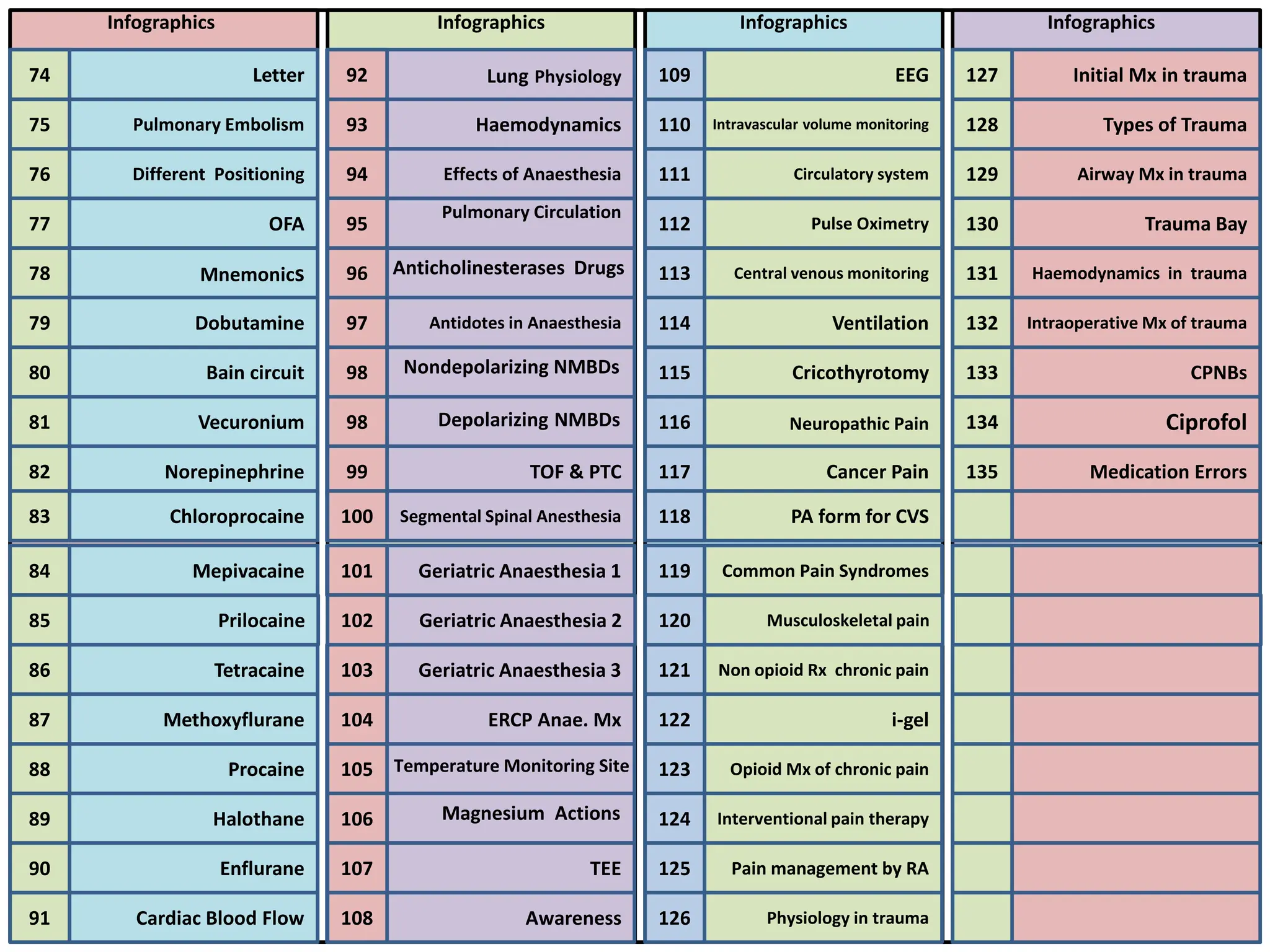
Infographics Infographics Infographics Infographics
Mephentermine
Letter
Pulmonary Embolism
Different Positioning
OFA
Mnemonics
Dobutamine
Bain circuit
Vecuronium
Norepinephrine
Chloroprocaine
Mepivacaine
Tetracaine
Prilocaine
Methoxyflurane
Procaine
Halothane
Enflurane
Cardiac Blood Flow
Lung Physiology
Haemodynamics
Effects of Anaesthesia
Pulmonary Circulation
Antidotes in Anaesthesia
TOF & PTC
Segmental Spinal Anesthesia
Geriatric Anaesthesia 1
Geriatric Anaesthesia 3
Geriatric Anaesthesia 2
ERCP Anae. Mx
TEE
Awareness
EEG
Intravascular volume monitoring
Circulatory system
Pulse Oximetry
Central venous monitoring
Ventilation
Cricothyrotomy
Neuropathic Pain
Cancer Pain
PA form for CVS
Common Pain Syndromes
Non opioid Rx chronic pain
Musculoskeletal pain
i-gel
Opioid Mx of chronic pain
Interventional pain therapy
Pain management by RA
Physiology in trauma
Initial Mx in trauma
Types of Trauma
Airway Mx in trauma
Trauma Bay
Haemodynamics in trauma
Intraoperative Mx of trauma
CPNBs
Ciprofol
Medication Errors
109
110
111
112
113
114
115
116
117
118
119
121
120
122
123
124
125
126
92
93
94
95
96
97
98
98
99
100
101
103
102
104
105
106
107
108
127
128
129
130
131
132
133
134
135
74
75
76
77
78
79
80
81
82
83
84
86
85
87
88
89
90
91
Infographics Infographics Infographics Infographics
Anticholinesterases Drugs
Nondepolarizing NMBDs
Depolarizing NMBDs
Temperature Monitoring Site
Magnesium Actions
1962-2009
1957-1961 Dexamethasone
1886-1990 Magnesium Sulphate
1956 Paracetamol
1973-1988 Diclofenac Sodium
1961-1966 Clonidine
1980-1987 Esmolol
1920-1928 Ephedrine
1971-1985 Mephentermine
1860 Cocaine
1905 Procaine
193--1941 Tetracaine
1943-1949 Lidocaine
1950 Chloroprocaine
1960 Mepivacine
1957 Bupivacine
1980 Ropivacaine
1980 Levobupivacaine
1900 Tubocurarine Chloride
1906-1951 Suxamethonium
1947 Gallamine Triethiodide
1964 Pancuronium
1974-1983 Atracurium
1984 Vecuronium
1984 Mivacurium
1989-1995 Cisatracurium
1994 Rocuronium
1830 Chloroform
1846 Ether
1920 Trichloroethylene
1956 Halothane
1963-1966 Enflurane
1979 Isoflurane
1970-1987 Desflurane
1971-1990 Savoflurane
1804 Morphine
1937-1943 Pethidine
1959-1968 Fentanil
1974 Sufentanil
1996 Remifentanil
1974 Carfentanyl
2020 Oliceridine
1930-1934 Sodium Thiopental
1962-1964-1970 Ketamine
1964-1972 Etomidate
1977-1989 Propofol
1999 Dexmedetomidine
1901 Atropine
1975 Glycopyrrolate
1964-1979
1981
Metoclopramide
Ranitidine
1980-1991 Ondansetron
1959-1963 Diazepam
1963-1977 Lorazepam
1975-1990 Midazolam
1772 Nitrous Oxide
1774 Oxygen
1881 Cyclopropaine
1898 Xenon
1996 Atipamazole
1961-1971
1982
Naloxone
Doxapram
1987 Flumezenil
1931 Neostigmine
2007-2015 Sugammdex
1967 Dentrolene
2014-2020 Remimazolam
Anesthesia Adjuvant
IV Anesthetic
Local Anesthetic
Gas
Opioid/Narcotics
Premedication
Inhaltion Anesthetic
Benzodiazepine
Muscle Relaxant
Anti MH Agent
Benzodiazepine Reversal Agent
IV Reversal Agent
Opioid Reversal Agent
Relaxant Reversal Agent
Opioid with Benzodiazepine
I
N
F
O
G
R
A
P
H
I
C
S
A
N
E
S
T
H
E
S
I
A
D
R
U
G
S
O
F
Total 69 Drugs
In Use 50 Drugs
Tranexamic acid
1895-1904 Adrenaline
1959-1964 Lasix
1964 Metoclopramide
ADRENALINE
Physiological Response of Adrenaline
Heart : Increases heart rate, Contractility and
Conduction across AV node
Lungs : Increases Respiratory Rate & Bronchodilation
Liver : Stimulates Glycogenolysis
Muscle : Stimulates Glycogenolysis and Glycolysis
Brain : Vasoconstriction and Vasodilation
Systemic : Triggers Lipolysis Muscle Contraction
Mechanism of Action
Acts on both alpha and beta-adrenergic receptors. The rise
in BP is 3-fold: a direct myocardial stimulation that
increases the strength of ventricular contraction
(positive inotropic action), an increased HR (positive
chronotropic action), and peripheral vasoconstriction
Side effects of Adrenaline
Pharmacokinetics and Pharmacodynamics
Formula : C9H13NO3 Molar mass : 183.207 g·mol−1
Receptors : Adrenergic receptors
Metabolism : Adrenergic synapse (MAO and COMT)
Protein binding : 15–20%
Metabolites : Metanephrine
Onset of action : Within 30 seconds
Elimination half life : 2 minutes
Duration of action : 5 minutes
Excretion : Urine Store : Between :20° to 25°C
Solution : Clear, Colorless & Sterile Solution
For Extravasation And Tissue Necrosis With IV Infusion :
Antidote is infiltrate the area with 10mL-15mL
of saline solution containing from 5mg-10mg of
phentolamine, an adrenergic blocking agent
Dosage and Strength
Available as 1 mg/mL (1:1000) 1mL amp. and 30 ml
vial. And 1 mL amp. contains 1 mg adrenaline, 9.0 mg
NaCl, 1.0 mg sodium metabisulfite, hydrochloric acid to
adjust pH, and water for injection
In Anaphylaxis : 0.3-0.5 mg(0.3-0.5 mL) of undiluted
adrenalin administered IM or S/C in the anterolateral
aspect of the thigh, maximum of 0.5 mg(0.5 mL) per
injection, repeated every 5 to 10 minutes as necessary
In Hypotension Associated With Septic Shock
Dilute 1 mL (1 mg) of adrenaline from its vial to 1,000 mL
of a 5 % dextrose or 5 % DNS solution to produce a 1 mcg
per mL dilution and give infusions of adrenaline into a
large vein and avoid the veins of the leg
Routes
IV
IM
Endotracheal
Intracardiac
Nasal
Eye drop
S/C
Medical use
Anaphylaxis
Cardiac arrest
To prevent superficial bleeding
Asthma & Inhaled adrenaline for Croup
Anxiety,
Apprehensiveness
Restlessness
Tremor
Weakness
Dizziness
Sweating
Palpitations
Pallor
Nausea
Vomiting
Headache
Respiratory difficulties
Cardiovascular
Angina, Arrhythmias, Hypertension,
Pallor, Palpitations, Tachycardia
Tachyarrhythmia, Vasoconstriction
Ventricular Ectopy and
Stress Cardiomyopathy
Neurological
Disorientation, Impaired memory,
Panic, Psychomotor Agitation,
Sleepiness, Tingling
Contraindications for Adrenaline
None
Invented in 1895 & In use 1904
Also known as Epinephrine (Hormone)
Produced both by the adrenal glands and by a small number
of neurons in the medulla oblongata
Gives Fight-or-Flight response
Overdose
Produce extremely elevated blood pressure and
Cerebrovascular hemorrhage
Treatment is supportive with alpha-adrenergic blocking
and beta-adrenergic blocking drugs
Adrenaline level in blood is normally less than 10 ng/L
During Exercise increase by 10-fold & in Stress 50-fold
In Pheochromocytoma levels of 1000–10,000 ng/L
IV Adrenaline produce 10,000 to 100,000 ng/L
BP Effect
The onset of
BP increase
after IV dose
in < 5
minutes &
the time to
offset BP
occurs
within 15
minutes
Precautions
Renal
Impairment
Cardiac
Arrhythmia
& Ischemia
Patients
on MAOI
and Anti-
depressant
Never
inject into
digits,
hands, or
feet with
LA because
vasoconstr
-iction
causes loss
of blood
flow to the
tissue &
necrosis
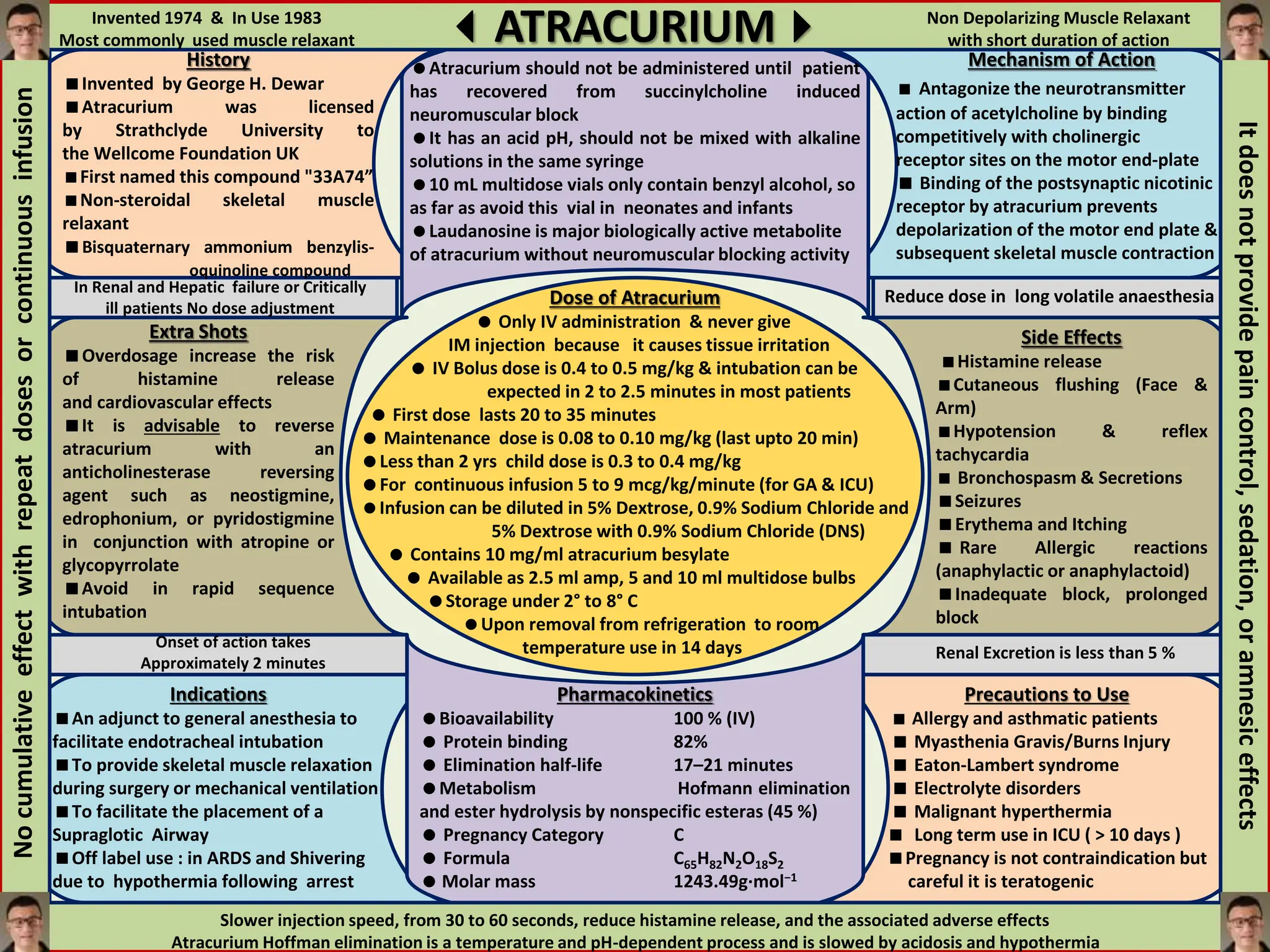
ATRACURIUM
History
Invented by George H. Dewar
Atracurium was licensed
by Strathclyde University to
the Wellcome Foundation UK
First named this compound "33A74”
Non-steroidal skeletal muscle
relaxant
Bisquaternary ammonium benzylis-
oquinoline compound
Mechanism of Action
 Antagonize the neurotransmitter
action of acetylcholine by binding
competitively with cholinergic
receptor sites on the motor end-plate
 Binding of the postsynaptic nicotinic
receptor by atracurium prevents
depolarization of the motor end plate &
subsequent skeletal muscle contraction
Extra Shots
Overdosage increase the risk
of histamine release
and cardiovascular effects
It is advisable to reverse
atracurium with an
anticholinesterase reversing
agent such as neostigmine,
edrophonium, or pyridostigmine
in conjunction with atropine or
glycopyrrolate
Avoid in rapid sequence
intubation
Side Effects
Histamine release
Cutaneous flushing (Face &
Arm)
Hypotension & reflex
tachycardia
 Bronchospasm & Secretions
Seizures
Erythema and Itching
 Rare Allergic reactions
(anaphylactic or anaphylactoid)
Inadequate block, prolonged
block
Indications
An adjunct to general anesthesia to
facilitate endotracheal intubation
To provide skeletal muscle relaxation
during surgery or mechanical ventilation
To facilitate the placement of a
Supraglotic Airway
Off label use : in ARDS and Shivering
due to hypothermia following arrest
Precautions to Use
 Allergy and asthmatic patients
 Myasthenia Gravis/Burns Injury
 Eaton-Lambert syndrome
 Electrolyte disorders
 Malignant hyperthermia
 Long term use in ICU ( > 10 days )
Pregnancy is not contraindication but
careful it is teratogenic
Pharmacokinetics
Bioavailability 100 % (IV)
 Protein binding 82%
 Elimination half-life 17–21 minutes
Metabolism Hofmann elimination
and ester hydrolysis by nonspecific esteras (45 %)
 Pregnancy Category C
 Formula C65H82N2O18S2
Molar mass 1243.49g·mol−1
Dose of Atracurium
 Only IV administration & never give
IM injection because it causes tissue irritation
 IV Bolus dose is 0.4 to 0.5 mg/kg & intubation can be
expected in 2 to 2.5 minutes in most patients
 First dose lasts 20 to 35 minutes
 Maintenance dose is 0.08 to 0.10 mg/kg (last upto 20 min)
Less than 2 yrs child dose is 0.3 to 0.4 mg/kg
For continuous infusion 5 to 9 mcg/kg/minute (for GA & ICU)
Infusion can be diluted in 5% Dextrose, 0.9% Sodium Chloride and
5% Dextrose with 0.9% Sodium Chloride (DNS)
 Contains 10 mg/ml atracurium besylate
 Available as 2.5 ml amp, 5 and 10 ml multidose bulbs
Storage under 2° to 8° C
Upon removal from refrigeration to room
temperature use in 14 days
Invented 1974 & In Use 1983
Most commonly used muscle relaxant
Non Depolarizing Muscle Relaxant
with short duration of action
Atracurium should not be administered until patient
has recovered from succinylcholine induced
neuromuscular block
It has an acid pH, should not be mixed with alkaline
solutions in the same syringe
10 mL multidose vials only contain benzyl alcohol, so
as far as avoid this vial in neonates and infants
Laudanosine is major biologically active metabolite
of atracurium without neuromuscular blocking activity
In Renal and Hepatic failure or Critically
ill patients No dose adjustment
Reduce dose in long volatile anaesthesia
Onset of action takes
Approximately 2 minutes
Renal Excretion is less than 5 %
Slower injection speed, from 30 to 60 seconds, reduce histamine release, and the associated adverse effects
Atracurium Hoffman elimination is a temperature and pH-dependent process and is slowed by acidosis and hypothermia
No
cumulative
effect
with
repeat
doses
or
continuous
infusion
It
does
not
provide
pain
control,
sedation,
or
amnesic
effects
 BUPIVACAINE 
Pharmacokinetic
Bioavailability - n/a
 Protein binding - 95%
 Metabolism - Liver
 Onset of action - Within 15 min
 Elimination half-life - 3.1 hours
(adults) 8.1 hours (neonates)
 Duration of action - 2 to 8 hr
 Excretion - Kidney 4–10%
 Routes of administration
Parenteral, Topical and Implant
 Formula - C18H28N2O
 Molar mass - 288.435 g·mol−1
Melting point - 107 to 108 °C
 Pregnancy category - AU: A US: C
 Peak effect - 35 to 40 minutes
1957
An implantable formulation of bupivacaine was approved for
medical use in USA in August 2020 for open hernia surgery
 Sometimes used in combination with epinephrine to prevent
systemic absorption and extend the duration of action
 The 0.75% (most concentrated) formulation is used in retro-
bulbar block
Indications
 Local Infiltration
 Peripheral nerve block
 Sympathetic nerve block
 Epidural & Spinal Anesthesia
Caudal blocks
Safely given in pregnancy and
lactation
Contraindications
 Known hypersensitivity
 Obstetrical paracervical blocks
 Intravenous regional anaesthesia
(Bier block)
 0.75% formulation in epidural
anesthesia during labor
 Intra articular infusions
Side effects
Sleepiness
Muscle twitching
Ringing in the ears
Changes in vision
Low blood pressure
Irregular heart rate
Low Sexual Desire
Compared to other local anesthetics,
bupivacaine is markedly Cardiotoxic
Bupivacaine can cause chondrolysis
after continuous infusion into a joint
space
Treatment of overdose is
intravenous lipid emulsion
CNS Toxicity
Circumoral numbness
Facial tingling
Vertigo/ Tinnitus
Restlessness
Anxiety/Dizziness
Seizures/Coma
CVS Toxicity
Hypotension
Arrhythmia
Bradycardia
Heart block
Cardiac arrest
GI Toxicity
Nausea/ Vomiting
High Spinal Anesthesia with Bupivacaine causes
Paresthesia, Paralysis, Apnea, Hypoventilation,
Fecal Incontinence, and Urinary Incontinence
Mechanism of Action (Amino-Amide anesthetic)
 Bupivacaine binds to the intracellular portion of voltage-
gated sodium channels and blocks sodium influx into nerve cells,
which prevents depolarization. Without depolarization, no
initiation or conduction of a pain signal can occur
The amino-amide anesthetics are more stable and less likely to
cause allergic reactions
Levobupivacaine is the (S)-(–)-enantiomer of bupivacaine, with
longer duration of action, producing less vasodilatation
Bupivacaine is available as a generic
medication and is not very expensive
Bupivacaine Dosage
 Epidural Block
 0.75% concentration :
75 to 150 mg (10 to 20 mL)
for complete motor block
 0.5% concentration
50 to 100 mg (10 to 20 mL)
moderate to complete motor block
 0.25% concentration:
25 to 50 mg (10 to 20 mL)
partial to moderate motor block
 Epidural Anesthesia:
 0.5% and 0.75% solutions
Epidural Anesthesia in Obstetrics:
 only 0.5% and 0.25%
Available as spinal heavy amp.,
preservative free and 0.25 %
& 0.5 % solution bulb
Bupivacaine Dosage
 Caudal Block: 0.25% to 0.5%
concentration (15 to 30 mL)
 Peripheral Nerve Block : 0.25% to
0.5% concentration
 Retrobulbar Block 0.75%
concentration (2 to 4 mL)
 Sympathetic Block: 0.25%
concentration (20 to 50 mL)
 Local Infiltration: 0.25%
concentration max dose of 175 mg
 Spinal anesthesia : 0.5 % heavy
solution with dextrose (2 to 4 ml)
preservative free 0.75% bupivacaine
in 8.25% dextrose ( 1 to 1.6 ml)
Usual dose of Bupivacaine is
2 mg/kg with or without adrenaline
Rapid injection of a large volume of
bupivacaine solution should be avoided and fractional or
incremental doses should be used
Local Anesthetic
Pharmacokinetics
Atomic No. : 20
Formula : C12H22CaO14
Molar Mass :
430.373 g·mol−1
Routes : Oral / IV/ Topical
Bioavailability : 100 %
Metabolism : Direct
Elimination : Renal
Ca Ca
Ca Ca
IV CALCIUM
M/A : Calcium plays a central role in a large
number of physiological actions that are essential
for life which include cardiac automaticity;
excitation–contraction coupling in myocardial,
smooth and skeletal muscle; blood coagulation;
neuronal conduction; synaptic transmission;
hormone secretion and mitotic division
A normal 70-kg
adult contains about 1.2 kg
calcium, of which more than 99%
is located in the bone
In the plasma, the normal total calcium
concentration is about 2.25–2.55
Mol/L−1 (9.0–10.2mg/dL−1)
50% of this is free ionized calcium,
10% is calcium combined with various anions,
40% is bound to proteins, mainly albumin
Calcium inj. is given IV only, S/C or IM
injections are not allowed because
causes severe necrosis or sloughing
Avoid rapid injection, it may
cause Cardiac Arrest
Dosing Regimen
A bolus dose of 100 mg
elemental calcium diluted in 100 mL
isotonic saline and given over 5-10 min.
It raise the total serum calcium by 0.5 mg/dL,
but level of calcium begins to fall after 30 min.
Therefore, the bolus dose of calcium should be
followed by a continuous infusion at a dose rate
of 1 to 2 mg/kg/h (elemental calcium) for at
least 6 hours
IV calcium available as 100 mg/ml
Ca Chloride 10 ml 10 % (272 mg)
Ca Gluconate 10 ml 10% (93 mg)
Gluconate is less irritant
to veins
Precautions for giving Calcium Injection
Calcium infusions can promote
vasoconstriction and ischemia in any of the vital
organs & and seen high in patients with low
cardiac output
Aggressive calcium replacement can promote
intracellular calcium overload, which can
produce lethal cell injury, particularly in patients
with circulatory shock, so avoid it
Always give calcium solution in large or
central veins with small intracath, due to
hyperosmolarity of calcium solutions
Hypocalcemia(< 6) & Hypercalcemia(> 14)
Sudden decreases in serum calcium may be
seen in the early postoperative period after
thyroidectomy or parathyroidectomy and may
cause laryngospasm (Give Calcium accordingly)
Hypercalcemia results from increased calcium
reabsorption from the gastrointestinal tract, in
renal insufficiency and increased bone
resorption of calcium ( Treat with Isotonic saline
Infusion, Furosemide, Calcitonin, Glucocorticoid,
Biphosphonate & Dialysis )
Symptomatic Hypocalcemia must be treated
before giving any type of anesthesia
 Antidote of Calcium is Magnesium
First isolated by Humphry Davy in 1808
It is classified as a calcium salt
Most widely used is Calcium Gluconate
Calcium Gluconate introduced in 1920
No dose adjustment is required in geriatric
hepatic or renal impairment patients
Always monitor ECG & serum calcium level every
4 hours in IV calcium therapy patients
Calcium is prime drug in Cardiac arrest and
cardiotoxicity due to hyper kalemia or hyper
magnesemia
 Common Side Effects
- Warmth/Nausea/Vomiting/Paresthesias
- Tingling /Heavy feeling/Bradycardia
- Chalky taste in your mouth
- Upset stomach/Gas/Constipation
Serious Side Effects
- Little or No Urination
- Irregular Heart Beats
- Light headedness
- Feeling tired/Muscle weakness
- Swelling/Weight gain
Indications
- Hypocalcemia/Tetany
- Hydrofluoric acid burns
-Hyperkalemia/Hyper Magnesemia
- β-blocker toxicity
- Calcium-channel blocker (CCB) toxicity
- Allergic conditions/ Spider Bites
- Pruritus due to drugs
Contraindications
Digitalized patients, VF & Hypercalcemia
Usual Dosage
Adults: 500 mg - 2 grams (5-20 mL)
Children: 200-500 mg (2-5 mL)
Infants: no more than 200 mg (not more than 2 mL)
Careful of
extravasation
in IV Calcium
and
Antidote is
Hyaluronidase
CARBON
DIOXIDE
Chemical Formula : CO2
Molar mass
44.009 g·mol−1
Colorless gas
 Low concentrations:
No odour
 High concentrations
Sharp & Acidic odour
Density : 53 % higher
than dry air
Frozen solid form of
CO2 known as dry ice
Dissolves in water to
form carbonic acid
CO2 is necessary for
the survival of life on
earth like oxygen
In Body
Produced in the
tissues and removed
from the lungs by
ventilation carried in
the blood as dissolved
gas, e.g. bicarbonate,
and small amount
bound to hemoglobin
as carbamino
hemoglobin
Dissociation curve
for carbon dioxide is
essentially linear
Increased Carbon Dioxide Production
Fever
Malignant hyperthermia
Systemic absorption during
laparoscopy procedures
Thyroid storm
Tourniquet release
Administration of sodium
bicarbonate
Increased Dead space
Decreased Minute Ventilation
CO2 Narcosis (Paco2 > 80 mm of Hg) is
a condition that develops when
excessive CO2 is present in the
bloodstream, leading to a depressed
level of consciousness & largely
results from lung disease,
hypoventilation, or environmental
exposure
Respiratory Acidosis is a condition
that occurs when the lungs can't
remove enough of the CO2 produced
by the body. Excess CO2 causes the
pH of blood and other bodily fluids to
decrease, making them too acidic,
due to failure of ventilation
CO2 is the most important end-product of tissue metabolism
Exists in three forms: (1) as free carbon dioxide, winch is dissolved in
the water of the blood, (2) as bicarbonate of the plasma, and (3) as
carbamino compounds in combination with haemoglobin
CO2 tension of the body cell is greater than that in the capillary blood,
thus CO2 moves into the blood
The partial pressure of CO2 in mixed venous blood, PvCO2 (44-46 mm
Hg) is greater than that in the alveoli of the lungs, Paco2 (38-40 mm Hg)
CO2 used in
anaesthesia since
the late 1920s,
principally to
stimulate breathing
after a period of
hyperventilation
Hypercarbia or Hypercapnia (High Paco2)
Hypercapnia defined as the Paco2 being greater than 45 mm Hg.
If the Paco2 is greater than 45 mm Hg, and the PaO2 is less than 60 mm Hg, a
patient is said to be in hypercapnic respiratory failure
Also known as Hypercarbia or CO2 Retention & confirmed by ABG analysis
Exhausted carbon dioxide absorbents and malfunctioning expiratory valves
on the anesthesia delivery circuit are possible causes hypercapnia
Hypercapnia causes
delayed awakening
in the post
anesthesia care unit
Hypocarbia, or hypocapnia, occurs when levels of CO2 in the blood
become abnormally low (Paco2 < 35 mm Hg).
Hypocarbia is confirmed by arterial blood gas analysis.
Hypocarbia, especially if only transient, is usually well tolerated by
patients. Deliberate hyperventilation, leading to hypocarbia, is often used to
decrease intracranial pressure in neurosurgical patients
Seen in hypovolemia, hypotension, hypothermia & hypothyroidism
Also seen in deep anaesthesia, iatrogenic hyperventilation, pulmonary
embolism , CNS pathology and decreased metabolism
Hypocarbia causes decreased myocardial oxygen supply, increased
myocardial oxygen demand, decreased cerebral blood flow & respiratory
alkalosis
Treated by assessing oxygenation status, decreasing minute ventilation
and restoring circulation to improve cardiac output
Initial treatment of hypercapnia is oxygen therapy with the goal of
increasing the inspired oxygen volume
In anaesthesia common causes are over sedation, hypoventilation,
inadequate gas flow and increased dead space
In operation theatre it is detected by capnography and now a days
capnography monitoring is must for CO2 like oxygen monitoring
Both hypercapnia & hypocapnia are dangerous to the life
Capnography
It is a monitoring of the
concentration or partial pressure of
carbon dioxide in the respiratory
gases as end-tidal carbon dioxide
(EtCO2)
Normal values for patients
regardless of age, sex, race, or size
range between 35-45 mm Hg
In high EtCO2 value think
respiratory failure
In low EtCO2 value think poor
systemic perfusion with shock
CHLOROPROCAINE
An ester local anesthetic
Chloroprocaine has one of the lowest partition
coefficients (low lipophilicity) and has low
potency relative to other local anesthetics
Formula : C13H19ClN2O2
Molar mass : 270.76 g·mol−1
Metabolized by pseudo cholinesterase the liver
Excretion through Kidney
Chloroprocaine is used commonly for epidural
anaesthesia
Uses of Chloroprocaine in Anaesthesia
Used in Regional Anaesthesia including Spinal,
Caudal and Epidural anaesthesia
Used in Local Anaesthesia including Brachial
plexus block, Cervical nerve block and Occipital
Maxillary/Mandibular block for Dental
anaesthesia and Infraorbital block for
Ophthalmic anaesthesia
Also in Ulnar, Paravertebral, Intercostal,
Sciatic, Lumbar Sympathetic, Stellate ganglion &
Paracervical blocks
Mechanism of Action
Causes reversible nerve conduction
blockade by decreasing nerve membrane
permeability to sodium
Binds to a specific region of the alpha
subunit on the cytoplasmic region to inhibit
voltage-gated sodium channels
This binding activity increases the
threshold for excitation in the nerve and
slows nerve impulse propagation
Chloroprocaine is vasodilator
Dose and Strength
Supplied as a 1%, 2%, and 3% solution
For Spinal is 1% and preservative-free 50 mg
Maximum recommended dose for infiltration,
or peripheral nerve block is 11 mg/kg when
administered alone, not to exceed 800 mg
When given with adrenaline, dose is 14 mg/kg
not exceeding 100 mg
2% / 3% is used in Lumbar epidural for LACS
The effect last for 60-70 minutes
Available as Chloroprocaine HCL injection
Adverse Effects
Most common adverse effect is pain
related to the procedural injection due to
high allergic reactions
Sometimes in regional use Hypotension,
Bradycardia, Nausea, and Headache
Accidental intrathecal injection during
epidural placement, with large dose may
produce ‘ Total Spinal ‘ leading to fixed and
dilated pupil
Rarely Cauda Equina Syndrome in S/A
Cautions & Contraindications
In patients with a known allergy to para-
aminobenzoic acid
Caution to use Chloroprocaine to provide
epidural, spinal, caudal, peripheral nerve and
infiltrative anesthesia in lactating women
Use with caution in patients with end-stage
liver disease
Avoid in pediatric patients younger than four
years old (Dosing is not established)
Doses more than 11 mg/kg may cause LAST
Available as 1% and 2%, in multidose
vials with methylparaben as preservative
2% and 3%, in single dose vials without
preservative and EDTA ( Note for S/A)
Always Keep from freezing, with Protect
from light and Store at 20° to 25°C
Monitoring during Chloroprocaine Anae.
According to the ASA, oxygenation,
ventilation, and circulation should be
continuously monitored
The Pulse Oximeter is the most
commonly used with Oxygen supply
During regional block with minimal or
no sedation practiced
The temperature should be assessed
whenever possible
BP & HR every 5 minutes interval taken
Never use in Intravenous Regional anesthesia
due to the risk of thrombophlebitis
Chloroprocaine does not itself appear to be
neurotoxic at clinical concentrations but
formulations that contain EDTA can cause
burning back pain when used in epidurals
A preservative-free formulation
of Chloroprocaine may be a drug of choice in
short-acting spinal anesthesia and might even
replace Lidocaine
Chloroprocaine shelf life is 24 months
Never autoclave Chloroprocaine injections
Different Doses in Different Blocks
Brachial Plexus 30 to 40 mL (600 to 800 mg)
as a 2% solution Caudal epidural 15 to 25 mL
of 2% or 3% methylparaben-free (MPF)
solution, repeated every 40-60 min
Infraorbital 0.5 to 1 mL (10 to 20 mg) as a 2%
solution Paracervical 3 mL per each of 4 sites
as a 1% solution, total dose up to 120 mg 
Pudendal 10 mL on each side as a 2% solution,
total dose 400 mg Digital 3 to 4 ml 1 %
Also called as CYCLOPOFOL 
Invented in CHINA in Feb. 2021 & patented in
Dec. 2021 Sedative, Hypnotic & Anaesthetic
Trade Name is Sishuning (HSK3486)
In china price is Rs. 3800/- per 20 ml amp.
Ciprofol is Class 1 IV Anaesthetic & Propofol analogue with improved pharmacokinetic properties
 Phase I, IIa, IIb Trails are completed  recently Phase III
Trial started on 2nd August 2022  just now only available
in CHINA  Ciprofol developed by Haisco Pharma. Group
Dose Schedule
Initial dose is 0.4 mg/kg for 30
seconds
In geriatric 0.3 mg/kg
Supplemental dose is 0.1mg/kg/
time as IV bolus for 10 seconds &
minimum 2 minute with each dose
Range from 0.3 to 0.6 mg/kg
Maintenance infusion dose is
0.1 to 0.3 mg/kg/h
Almost one forth dose is
required than Propofol
Available as 50 mg in 20 ml
borosilicate glass ampoule
solution & 200 mg in 20 ml under
development phase
Ciprofol is a Propofol
analogue with improved
pharmacokinetic properties &
pharmacodynamic characteristics
New intravenous anesthetic
agent characteristics of a rapid
rate of onset and recovery in pre-
clinical experiments
It is γ-aminobutyric acid (GABA)
receptor agonist & novel 2,6-
disubstituted phenol derivative
Circulating metabolites are
nonhypnotic and nontoxic
Non inferior to Propofol in all
trials with characteristics
Indications
Induction & Maintenance of
anesthesia in all elective surgeries
As sedation in NORA procedures
As a sedation in mechanical
ventilation in ICU
Adjuvant in TIVA
Not studied in < 18 years old pt.
In all phase trials indicated in
gastroscopy, hysteroscopy
colonoscopy, ERCP, bronchoscopy,
cystoscopy & Gynec procedures
Works as status epilepticus and as
an anti-emetic like Propofol
Better than Propofol in all
transplant Induction
Superior to Propofol
Five times More potent than
Propofol
Almost no pain on IV injection
Less hemodynamic instability
( less hypotension & depression)
Only dose dependent respiratory
depression, apnea and hypoxia
Myoclonus and infusion
syndrome are extremely rare
Better in prolonged infusion
Less serious AEs (adverse
events) than Propofol in all trials
Ciprofol induction is associated
with more stable BIS changes than
Propofol
Ciprofol binds to the γ-aminobutyric acid type A (GABAA)
receptor more tightly than Propofol and exhibits reduced
lipophilicity and more suitability
Pharmacokinetics
 Ciprofol Injection content are
soya bean oil for injection,
medium chain triglyceride, refined
egg yolk lecithine, sodium oleate,
glycerin, sodium hydroxide &
water for injection
Ciprofol is white or off-white
homogenous milky liquid
 Validity period 24 is months
Not studied in pregnant and
lactating women
Storage at 25 degree c in airtight
& do not freeze
Metabolism: oxidation to form
mono oxyglucuronic acid
In Short
Compared to Propofol, it has the
advantages of "two fast and five
few" rapid onset, rapid recovery; less
dosage, wider safety window; less
respiratory depression, risk
reduction by more than 60%; less
cardiovascular adverse events ,
stable circulation; less pain on
injection, the incidence is only 1/10
of Propofol; less lipid infusion
Highly effective, easy to control,
safe and comfortable
It takes effect quickly and wakes
up quickly
Ketamine+Ciprofol combo is viable
Extra Shots
Effect last for 3 to 5 minutes
Awakening time is about 3 min
Overdose causes cardiovascular
& respiratory depression
Approved by the China &
Australian State Food and Drug
Administration for studies
Excretion through renal 80 % and
fecal 20 %
Not known that it is excreted in
human milk
Till now 12 major trials are done
on Ciprofol in China & Australia
 May be game changer or another
experimental IV anesthetic drug
CIPROFOL
(IV Anaesthetic)
Non-Depolarising Neuromuscular Blocking Drug
One of the ten isomers of the parent molecule, Atracurium
M/A
Acts by competitive antagonism
Binds with nicotinic acetyl
chonline receptors (nAChRs) on the
motor end-plate of neuromuscular
junction to produce neuromuscular
blockade
Drug of choice in
Cardiac compromise patients
ARDS patients
Hepatic failure patients
Renal failure patients
Ideal in Neuro Surgical patients
Chemo and Obese patient
Systemic Actions
No change in Heart Rate,
Contractility, SVR and Blood
Pressure
Lung protective through its anti
inflammatory properties
Metabolism is through Hofmann
reaction
Reduces ICP, cerebral perfusion
and it is neuroprotective
Does not produce any
autonomic effect
Ideal Neuromuscular Blocking Agent
- Best intubating condition -
- Non-depolarizing mechanism of action -
- Rapid onset enabling quick intubation -
- Rapid complete and predictable recovery -
- Short elimination half life -
- No cumulative effect -
- No histamine release -
- High potency -
- Has pharmacologically inactive metabolites -
- Reversible by cholinesterase inhibitors -
- Elimination pathways less dependent on organ function -
- Lack clinically important Cardiovascular side effects -
Dose is 0.15 to 0.20 mg/kg (50-60 minutes)
Maintenance dose is 0.02 to 0.03 mg/kg (20-25 minutes)
OT and ICU Infusion 1-3 mcg/kg/minute
Paediatric dose is 0.10-0.15 mg/kg
Below 1 mth not recommended
Indications
It is intermediate onset and
duration action of drug
Mainly indicated for inpatients
and outpatients adjunct to general
anaesthesia
To facilitate tracheal intubation
To provide skeletal muscle
relaxation during surgery
For mechanical ventilation in ICU
Pregnancy, Labour, Delivery and
Nursing mother (drug of choice)
Contraindications
Known hypersensitivity
Patients with myasthenia gravis
or myasthenia syndrome
History of prior anaphylactic
reactions to neuromuscular
blocking agents
Adverse Effects
Uncommon with the use of
Cisatracurium
Less than 1% - Brady, Hypo,
Spasm, Myopathy, Prolonged Effect
- Kept refrigerated at 2 to 8 degrees Celsius
- Protected from light
- Rate of loss of potency is as high as 5% per
month at 25 degrees Celsius
- Once removed from refrigeration to room
temperature storage, it should be used
within 21 days
- Undergoes 80 % Hofmann elimination
- Renal Excretion of is only 16 %
- Elimination half-life is 20–29 minutes
- Hypothermia and Hyperthermia, increase
and decrease the duration of action
- Sedative, Volatile agents, Local
anaesthetics and Anti-epileptic agents
will prolong the effect
Avoid in
Rapid Sequence intubation
As ICU relaxant more than one week
Burns injury
Cerebral palsy
Hemiplegia (on the affected side)
Muscular denervation (peripheral nerve injury)
Severe chronic infection
Tetanus
Botulism
Cis gives uniform recovery from anesthesia
 
CLONIDINE
Invented in 1961, Medical use in 1966, Epidural use in 1984
First approved to treat HT and in 2010 approved for ADHD in children
 It is given by Oral/IV/IM/Epidural/Spinal/Skin Patch
 Imidazole compound & partial α2 receptors agonist
 It causes bradycardia, by increasing signaling through
the vagus nerve
  Mechanism of Action  
Clonidine treats high blood pressure by stimulating α2 receptors in the brain stem, which
decreases peripheral vascular resistance, lowering blood pressure. It has specificity towards
the presynaptic α2 receptors in the vasomotor center in the brainstem
 This binding has a sympatholytic effect, suppresses release of
norepinephrine ATP, renin, and neuropeptide Y which if released
would increase vascular resistance
When given IV, it temporarily increase BP
by stimulating α1 receptors in smooth
muscles in blood vessels like Dex
Clonidine crosses the
blood-brain barrier
  Indications 
To treat high BP
Menopausal Flushing
Drug withdrawal (Alcohol/Opioids/Smoking)
Spasticity and certain pain conditions
ADHD and Diarrhoea
  Use in Anaesthesia practice  
Administration of clonidine in combination with a local anaesthetic
to prolongs analgesia and motor blockade in Epidural and Spinal
When used IV or IM it gives sedation, hypnosis, analgesia, opioid need reduction
and anti-sympathetic response, to surgical trauma response
But its use is limited by its principal effects of hypotension and bradycardia
Oral Premedication : 2 to 4 mcg/kg
IV : 1-2 mcg/kg as bolus, slowly
 IV infusion : 0.2 mcg/kg/minute
Spinal : 0.5-1 mcg/kg with L/A
Epidural : 1-2 mcg/kg with L/A
Continuous Epidural Infusion : 30 mcg/hr
Patch : 0.1 mg or 0.2 mg per day
  Pharmacokinetic  
Formula : C9H9Cl2N3
Molar mass : 230.09 g·mol−1
Bioavailability : 70–80% (oral),60–70%
(transdermal)
Protein binding : 20–40%
Metabolism : Liver to inactive metabolites (50 %)
Elimination : Renal another 50 %
Elimination half-life : 6-23 hrs, in Renal Failure 41 hrs
Elimination half-life in S/A : 1.5 hrs
Store : 20° to 25°C
Shelf Life : 60 months
 Highly Lipid Soluble
  Contraindications  
Allergic reactions to clonidine
Severe Bradyarrhythmia
Above the C4 dermatome
Bleeding diathesis
Sick Sinus Syndrome
AV block of second
or third degree
No specific antidote for clonidine overdosage (Naloxone and Atropine
are used sometimes)
Epidural clonidine is not recommended for obstetrical,
post-partum, or peri-operative pain management
Spinal clonidine as an adjuvant to Cesarean Section
anesthesia is well established ( No neonatal side effect)
Available
Ampule :
150 mcg/ml
Bulb : 100 mcg/ml
10 ml vial & 500 mcg/ml
10 ml vial
Tablets : 0.1/0.2/0.3 mg
Patch : 0.1 mg or 0.2 mg
> 10%
Dizziness
Fatigue
Orthostatic
hypotension
Somnolence
(dose-dependent)
Dry mouth
Headache (dose-dependent)
Bradycardia
Skin reactions (if given transdermally)
Hypotension
In 1-10%
Pain below the ear (salivary gland)
Sedation (dose-dependent)
Erectile dysfunction
Weight gain/loss
Nausea/vomiting
Abnormal LFTs
Constipation
Skin Rash
Malaise
Anxiety
Overdose Cause
Hypotension
Bradycardia
Respiratory-
depression
Hypothermia
Drowsiness
Clonidine in the treatment of chronic neoplastic pain, used epidurally in the dose of 10-50 μg/h
Clonidine has also got benefit in the treatment of Postoperative Shivering
Clonidine is now slowly replaced by Dexmedetomidine ( Dex is full α2 receptors agonist)
If clonidine is used then Volatile Anaesthetics requirement are reduced by 50 %
Clonidine is a versatile drug that is used in the critical care setting for sedation and to treat opioid induce Hyperalgesia
D
A
N
T
R
O
L
E
N
E
Oral Dantrolene was first described in the
scientific literature in 1967, IV in 1979
Dantrolene is Hydantoin derivatives, a new
class of muscle relaxant
Dantrolene was widely used in the
management of spasticity as Oral Rx
Efficacy in treating Malignant Hyperthermia
was discovered by South African
anesthesiologist Gaisford Harrison and
reported in a landmark 1975 article published
in the British Journal of Anaesthesia
Side Effects
Drowsiness
Dizziness
Weakness
General malaise
Fatigue
Diarrhea
Indications
Primary drug used for the treatment and prevention
of malignant hyperthermia, during General Anaesthesia
Neuroleptic Malignant Syndrome, Muscle Spasticity /Spasms
Poisoning by 2,4-dinitrophenol
Contraindications
Oral Dantrolene
Pre-existing liver disease
Compromised lung function
Severe cardiovascular impairment
Hypersensitivity to Dantrolene
Pediatric patients under five years of age
People who need good muscular balance Nausea
IV Dantrolene
People with a known hypersensitivity to Dantrolene
Mechanism of Action
Dantrolene is a postsynaptic muscle
relaxant that lessens excitation-contraction
coupling in muscle cells
Work directly on the Ryanodine receptor to
prevent the release of calcium
Dantrolene does not act at the neuromuscular
junction and has no effect on the passive or
active electrical properties of the surface and
tubular membranes of skeletal muscle fibers
IV Dantrolene have normal EMG results
Pharmacokinetics
Formula C14H10N4O5
Molar mass 314.257 g·mol−1
Bioavailability 70%
Metabolism Liver
Excretion Biliary, Kidney
Routes Oral and IV
 Protein binding Mostly to albumin
Half Life 4 to 8 hrs
 Trade names Dantrium, Ryanodex
Dose of Dantrolene
The recommended dose of Dantrolene
is 1-2.5 mg/kg, repeated as necessary,
every 4-6 hrs for 24 – 48 hrs (Max 10 mg)
It is recommended that each hospital
keep a minimum stock of 36 Dantrolene
vials (720 mg), sufficient for maximum
four doses in a 70-kg person (20 mg/Vial)
Risk of Death in MH : 5% if treated,
95% if not treated with Dentrolene
Extra Shots
The poor water solubility of Dantrolene
leads to certain difficulties in its use. A
more water-soluble analog of
Dantrolene, Azumolene, is under
development for similar
indications. Azumolene has
a bromine residue instead of
the nitro group found in Dantrolene, and is
30 times more water-soluble
Dantrolene
Malignant Hyperthermia Association of the United States
guidelines state Dantrolene must be available within 10 min
of the decision to treat MH wherever volatile anesthetics or
succinylcholine are administered
Dantrolene for IV administration is supplied in 70 mL
vials, containing 20 mg Dantrolene sodium and 3 g Mannitol.
It must be diluted with 60 mL of sterile, preservative-free,
distilled water
Phlebitis is a most common side effect of
Dantrolene IV administration, noted in
approximately 10% of patients, so
intermittent bolus is preferred than
continuous IV administration
Invasive hemodynamic monitoring is
necessary while giving IV Dantrolene
Serum potassium must be closely
monitored during Dantrolene therapy
Oral Dantrolene is effective in reducing
muscle pain after IV suxamethonium in GA
Repeated dosing of Dantrolene
should be guided by clinical and
laboratory signs
Dantrolene 20 mg vial cost is Rs.
6000/- (36 vials cost are Rs. 216000/-)
Antidote of MH $ 82/Vial
DEXAMETHASONE
 Universal Friend 
Anti Nauseatic & Anti Emetic
Early Discharge from Anaesthesia
Anti Inflammatory
Weak anti pyretic effect
Anti Edema drug
Anti Shivering
Systemic Analgesic Effect
Increase Quality of Recovery
 Synthetic
Glucocorticoids with
minimal mineralocorticoid
activity
 Most potent anti
inflammatory than
Hydrocortisone and
prednisolone
 Biological half-life is 3 hours
 Metabolism in liver with
inactive metabolites
 Renal excretion upto 65%
in urine within 24 hours
Readily available
 Price is very cheap 
 Most ideal perioperative agent 
 Superior to ondensetron to reduce PONV 
 Reduce opioid Consumption 
 Decrease Analgesic effect upto 24 hours 
 Always to be given prior to surgery 
 Best TIVA and OFA adjuvant 
 Great psychological effect 
Prevents any allergic reaction 
Invented in 1957 & In use 1961 
Dose Schedule
 PONV – 0.1 mg/kg (IV) 
 Anti Inflammatory – 0.2 mg/kg(IV) 
 Analgesic – 0.1 mg/kg(IV) 
 Epidural -- 8 to 10 mg 
 Blocks – 0.1 mg/kg 
 S/A - 8 mg 
Mechanism of Actions
 Depletion of γ-aminobutyric acid (GABA)
stores and reduction of blood brain barrier
to emetogenic toxins,
 Inhibition of central prostaglandins and
serotonin
 Membrane stabilizing effect on nerves and
on spinal cord
Dexona IN DM
 4 mg is
ideal dose
8 -10 mg dose
Increase around
25 mg/dl
glucose postop
upto 24 hrs
Dexona in Sepsis
Does not
increase any
risk of wound
infection with
or without DM
in any surgical
procedure
Acute Side Effect
Flushing
Perineal Itching
Dexona
Is the only
adjuvant in
anesthesia
given
irrespective of
age, sex,
disease or ASA
status
Safe in
Onco Anesthesia
Avoid in
Psychiatric patients
Be careful in
Immuno compromised
patients
Improves
Cognitive function
In Elderly
8
8 8
8
8
8 8
8
DESFLURANE
Pharmacokinetics
 Formula C3H2F6O, Store at 15°-30°C
 Metabolism : Not metabolized
 Elimination half-life : Elimination dependent
on minute ventilation
 Routes of administration : Inhalation
 Molar mass : 168.038 g·mol−1
 Boiling point : 23.5 °C or 74.3 °F (at 1 atm)
 Brain: Gas coefficient : 0.54
 Density :1.465 g/cm³(at 20 °C)
 Molecular Weight : 168
 Vapor pressure : 88.5 kPa672 mmHg(at
20 °C) & 107 kPa804 mmHg(at 24 °C)
 Blood:Gas partition coefficient : 0.42
 Oil:Gas partition coefficient : 19
 MAC : 6 vol %  Non-flammable
Specific Gravity : 1.465  Shelf Life : 3 years
 Desflurane Vaporizer color is Blue
Most rapid onset and offset
of the volatile anesthetic used for
general anesthesia due to its
low solubility in blood
Though it vaporizes very readily, it is
colorless liquid at room temperature
 Drawbacks of desflurane are its
low potency, its pungency and its high cost
Cause tachycardia and airway irritability
when administered at concentrations
greater than 10 vol %
Due to airway irritability, desflurane
is infrequently used to induce
anesthesia via inhalation techniques
Mechanism of Action
 Desflurane is known to act as a positive
allosteric modulator of the GABAA and glycine
receptors, and as a negative allosteric
modulator of the nicotinic acetylcholine receptor,
as well as affecting other ligand-gated ion
channels
Does not corrode stainless steel, brass,
aluminum, anodized aluminum, nickel plated
brass, copper, or beryllium
Provides good relaxation for intubation
Ideal volatile agent for day care surgery
In adults, a starting concentration of 3% is
recommended & increased in 0.5-1.0%
increments every 2 to 3 breaths. Inspired
concentrations of 4-11% of desflurane usually
produce surgical anaesthesia in 2-4 minutes
Can be safely use in Obstetric anesthesia,
compromised renal and hepatic patients ( it is
less hepatotoxic)
Because of its low blood-gas partition coefficient,
desflurane allow more rapid emergence and
recovery than Halothane, Isoflurane, or even
Sevoflurane
 CVS effect : Dose dependent tachycardia
and hypertension Depression in myocardial
contractility, Decrease in SVR, Coronary
vasodilator
 CNS effect : Dose dependent Cerebral
vasodilatation Increase CBF, Cerebral blood
volume, Intracranial pressure, Cerebral oxygen
consumption decreased
 Respiratory effect : Potent respiratory
depressant, Decrease tidal volume, Increase
RR, Extremely irritant to respiratory airways
 Invented in 1970 & Medical use in 1987
Indicated as an inhalation agent for induction
of anesthesia for inpatient and outpatient
surgery in adults
Contraindicated as an inhalation agent for
the induction and maintenance of anesthesia in
non intubated pediatric patients because of a
high incidence of moderate to severe upper
airway adverse events including coughing,
laryngospasm, and secretions
Near to ideal inhalational anesthetic agent
Vaporizer specifically designed and
designated for use with desflurane should be
utilized for its administration
 Should not be used as the sole agent for
anesthetic induction in patients with
coronary artery disease or patients where
increases in heart rate or blood pressure are
undesirable
 In case of contact with skin or eye,
immediately flush skin and eye with plenty of
water at least 15 minutes
 The predicted effects of acute over exposure
by inhalation of Desflurane include headache,
dizziness or (in extreme cases) unconsciousness
 If individuals smell vapors, or experience
dizziness or headaches, they should be moved
to an area with fresh air
Age N O2 100% N N2O 60%/40% O2
2 weeks 6 9.2 ± 0.0 - -
10 weeks 5 9.4 ± 0.4 - -
9 months 4 10.0 ± 0.7 5 7.5 ± 0.8
2 years 3 9.1 ± 0.6 - -
3 years - - 5 6.4 ± 0.4
4 years 4 8.6 ± 0.6 - -
7 years 5 8.1 ± 0.6 - -
25 years 4 7.3 ± 0.0 4 4.0 ± 0.3
45 years 4 6.0 ± 0.3 6 2.8 ± 0.6
70 years 6 5.2 ± 0.6 6 1.7 ± 0.4
Effect of Age on Minimum Alveolar Concentration
Triggers
Malignant
Hyperthermia
Sedation
Anxiolysis DEXMEDETOMIDINE
Analgesic
Anaesthetic
FDA
December 1999
Market
August 2000
 Agonist of α2-adrenergic receptors 
 Most ideal anesthetic agent available 
M/A
Induces sedation by decreasing
activity of noradrenergic neurons
in the locus ceruleus in the brain
stem, thereby increasing the
activity of inhibitory gamma-
aminobutyric acid (GABA) neurons
in the ventrolateral preoptic
nucleus
 Popular in pediatric TIVA with ketamine 
 Patients sedated, but arousable, alert and respond without
uncomfortable like conscious sedation 
No effect on
Respiratory
System
 Transient Hypertension followed by Hypotension 
No Direct
effect on
Myocardium
IOP
Insulin Release
 Overdose may cause 1st or 2nd degree AV Block 
- Nasal - ~ 84 % bioavailability
Indications
Pre Anaesthetic sedation (IM/IV)
As Induction Agent
In maintenance of Anaesthesia
As adjuvant in TIVA
Intra thecal with Regional Ane.
In Post Operative Analgesia
As ICU sedation(only for 24 hrs)
Relative Contraindication
 Infusion over 24 hours
 In pre existing severe bradycardia
 Brady dysrhythemia
 Patient with < 30% EF
 Partial or Complete AV block
 In patients more than 65 y of age,
a higher incidence of bradycardia and
hypotension
Compatibility
- 0.9% sodium chloride in water
- 5% dextrose in water
- 20% mannitol
- Lactated Ringer's solution
- 100 mg/ml MgSo4 solution
- 0.3% potassium chloride solution
- With other Anesthetic agents e.g.
Propofol, Ketamine, Etomidate
Available as Ampoules or Bulb
50 mcg / 0.5ml
100 mcg / 1 ml
200 mcg / 2ml
Sileo Gel for Dogs
(Dexmedetomidine Oromucosal Gel)
0.09 mg/ml, 3 ml syringe
(BIPHASIC BLOOD PRESSURE RESPONSE) (BRADYCARDIA IS BECAUSE OF DOUBLE EFFECT)
(DECREASE OPIOID REQUIREMENT BY 50 %)
(BETTER THAN CLONIDINE IN ALL ASPECTS)
 DICLOFENAC SODIUM 
 Introduced By Ciba-Geigy in 1965
 Nonsteroidal anti-inflammatory drug
 Available worldwide
 Generic Medication
 Available as both a sodium and a
potassium salt
 Given by Mouth, Rectally, IM, IV
injection and Topical Skin Gel/Spray
Pharmacokinetic
 Formula C14H11Cl2NO2
 Protein binding More than 99%
 Metabolism Liver, oxidative, primarily by CYP2C9
 Onset of action Within 4 hours Topical,30 min Oral,
15 minutes IM, 5 minutes IV and 30 minutes Rectal
 Elimination half-life 1.2–2 hr
 Excretion 40% bile duct and 60% urine
 Molar mass 296.15 g·mol−1
Mechanism of action
 The primary mechanism responsible for its anti-
inflammatory, antipyretic, and analgesic action is
thought to be inhibition of prostaglandin synthesis by
inhibition of the transiently expressed prostaglandin-
endoperoxide synthase-2 (PGES-2) also known
as cycloxygenase-2 (COX-2).
 Blockage of voltage-dependent sodium channels
 Blockage of acid-sensing ion channels
It also appears to exhibit
bacteriostatic activity by inhibiting
bacterial DNA synthesis
Avoid use of multidose bulb/vial
 Positive allosteric modulation of KCNQ- and
BK-potassium channels
 It inhibits the lipoxygenase pathways, thus
reducing formation of the leukotrienes
 It also may inhibit phospholipase A2 as part of
its mechanism of action
 These additional actions may explain its high
potency – it is the most potent NSAID on a broad
basis
Contraindications
 Hypersensitivity against diclofenac
 History of allergic reactions (COPD,
bronchospasm, shock, rhinitis, urticaria)
Active stomach and/or
duodenal ulceration or GI bleeding
Severe congestive heart failure
Severe liver insufficiency
Severe chronic kidney disease
Pre-existing hepatic porphyria
Avoid during dengue fever
Patients with fluid retention
In worsening of pre-existing hypertension
Inflammatory bowel disease such as Crohn's disease
or ulcerative colitis
Serious skin adverse events e.g. exfoliative dermatitis,
Stevens–Johnson syndrome, toxic epidermal necrolysis
Powerful NSAID in TIVA/OFA
with analgesia and
anti-inflammatory action
 Use aqueous solution only
Best is given in single dose of 1.5
mg/kg IV slowly and maximum is
150 mg
 It is opioid sparing drug
 Always give before surgical incision
to inhibit prostaglandin receptors,
which control the haemodynamic
response to surgical stimulation
 Diclo should not be mixed with
any drug except paracetamol in
same syringe
 Given with any IV Infusion
Always dilute diclo with DW and
give slowly to avoid injection pain
Dose
 Oral 50 mg 2 or 3 times a day
 Extended-release tablets 100 mg once a day
 Potassium immediate-release tablets 50 mg
orally 2 or 3 times a day
 Sodium enteric-coated tablets 75 mg orally 2
times a day
 IV/IM 1 to 1.5 mg/kg, repeat after 8 hours
 Rectally 1 to 1.5 mg/kg ( Paediatric patients)
Diclo is better than paracetamol
to control post operative fever & pain
In anaesthesia practice Diclo
Is used as an adjuvant for
perioperative acute pain
management
 Diclofenac is an effective analgesic for acute pain in children as part of the analgesic regime in the peri
operative period with dose range from 0.5 to 2.5 mg/kg
 Infusion line pain or irritation to vein is very common during IV Diclo, so better prefer large venous line
Major side effects of diclo are 1) Abdominal or Stomach pain, Cramping, or Burning 2) Bloody or black, tarry
stools 3) Bloody urine and decreased frequency or amount of urine 4) Heartburn or Indigestion 5) Diarrhea
6) Increased thirst and Loss of appetite 7) Vomiting of blood or material that looks like coffee grounds
7) Very rare anaphylactic or anaphylactoid reaction
 Some time single dose or overdose of Diclo may cause Acute Renal Failure
 As far as avoid Diclo in geriatric age group of patients ( paracetamol is preferred )
DOBUTAMINE
Approved in
1970 - 1978
Works by
direct stimulation
of β1 receptors
Formula
C18H23NO3
Given by IV &
Intraosseous
Onset of action
within 2 min
Elimination
half life
2 min
Dobutamine is predominantly a β1-adrenergic
agonist, with weak β2 activity, and α1 selective
activity
Stimulation of the β1-adrenoceptors of the
heart, increase contractility and cardiac output
dobutamine is less prone to induce
hypertension than is dopamine
Dobutamine has mild β2 agonist activity,
which makes it useful as a vasodilator
Adverse effects
Hypertension(> 50 mm of Hg)
Angina
Arrhythmia (Most Dangerous)
Use with caution in AF
Tachycardia(>30 beats/min)
Palpitation
Sometime bronchospasm
and shortness of breath
Urinary urgency(at high dose)
Nausea and Headache
Phlebitis and very
rare Cutaneous necrosis
Overdose
Terminate the infusion
and arrhythmia treated
with lidocaine & beta blocker
& sublingual nitrate
Indications
Patients who require a positive inotropic
support in the treatment of cardiac
decompensation due to depressed contractility
Cardiogenic shock characterized by heart
failure with severe hypotension
Septic Shock
Used for detection of myocardial ischemia
(dobutamine stress echocardiography)
In Paediatric population (neonates- 18 years)
in cardiomyopathies & Cardiogenic shock
Dose & Formation
Available as 50 mg/ml in 5 ml
10 ml & 50 ml amp/bulb
Dose ranges from 2.5-10 µg
dobutamine/kg/min
Neonate-18 years an initial
dose of 5 mcg/kg/minute,
range from 2 – 20 mcg/kg/min
Low dose 2.5 µg/kg/min (15
drops/min)
Medium dose 5 g/kg/min(30
drops/min)
High dose 10 µg/kg/min(60
drops/min)
Always dilute dobutamine
with final concentration 0.5
mg/ml in DNS/D5/NS/DW
& not in RL
Contraindications
Known hypersensitivity
Pericardial Tamponade
Constrictive Pericarditis
Hypertrophic Obstructive
Cardiomyopathy
Severe Aortic Stenosis
Hypovolaemic conditions
Recent MI
Severe heart failure
Chronic Arrhythmia
Hypovolemia
Acute pericarditis,
Myocarditis or Endocarditis
Aortic Aneurysm
 Inadequately treated
arterial hypertension
Shelf Life : 3 years
Dilution of Dobutamine
used within 24 hrs and kept
in freeze for 2°C to 8°
Sometimes immediately
after opening the ampoule,
there may be a sulfuric odour
lasting for short period
Solutions containing
Dobutamine may have a pink
coloration, which may
become darker over time,
This is due to a slight
oxidation of the active
substance
Unused solution discarded
Pharmacokinetics
Dobutamine & Dopamine
Dobutamine produced a distinct increase in
cardiac index, while lowering left ventricular end-
diastolic pressure and leaving mean aortic
pressure unchanged
Dopamine also significantly improved cardiac
index, but at the expense of a greater increase in
heart rate than occurred with dobutamine
Dobutamine is preferred when there is a need
to improve low cardiac output.
 Dopamine increase global blood flow
Wide Ball
Hypotension occurs in almost 40% of all
anesthetized patients
Dopamine is recommended for patients with
kidney disease due to its ability to increase renal
blood flow
Dobutamine is preferred when there is a need
to improve low cardiac output
Dobutamine should be avoided in patients
affected by outflow obstructions, pulmonic
stenosis, or hypertrophic obstructive
Cardiomyopathy
Dobutamine Infusion
Rate of administration and duration of
dobutamine infusion is based on blood pressure,
heart rate, frequency of ectopic activity, and urine
flow; cardiac output, central venous pressure, and
pulmonary capillary wedge pressure
Initial dose: 0.5 to 1 mcg/kg/min IV infusion
Maintenance dose: 2 to 20 mcg/kg/min IV
infusion
Maximum dose: 40 mcg/kg/min IV infusion
Always label the infusion
It is Synthetic catecholamine
Haemodynemic changes occur during
anaesthesia and surgery in elderly patients,
Dobutamine corrects the perioperative decrease
in cardiac output and blood pressure, and might
prevent postoperative neurological disorders
Dobutamine is only given with guidelines of
institution and when indicated
For routine administration it is too dangerous
Monitoring with ECG is must during therapy
ENFLURANE
MECHANISM OF ACTION
Enflurane acts as a positive allosteric
modulator of the GABAA, glycine, and 5-
HT3 receptors, and as a negative allosteric
modulator of the AMPA, kainate, and NMDA
receptors as well as of nicotinic acetylcholine
receptors.
So it act on different ion channels within the
nervous system by blocking excitatory channels
and augmenting inhibitory channels
Enflurane is (2-chloro-1,1,2,-trifluoroethyl-
difluoromethyl ether) is a halogenated ether
Developed by Ross Terrell in 1963, first used
clinically in 1966
Approved by the FDA in 1972
Withdrawn from the US market due to more
Seizure activity, increased Cardio Depressant
effects and Slow onset of action
Increasingly used for
inhalational anesthesia during the 1970s and
1980s, now no longer in common use
PHARMACOKINETICS
Clear, colorless, mild sweet odor , Stable nonflammable and non
explosive liquid whose purity exceeds 99.9%
Formula : C3H2ClF5O, Molar mass : 184.49 g·mol−1
Protein binding : 97%, Boiling point at 1 atm 56.5 °C
Blood:Gas partition coefficient 1.9, Oil:Gas partition coefficient 98
Vapor pressure at 20 °C22.9 kPa (172 mm Hg), MAC : 1.68
Specific gravity (25º/25ºC) is 1.517
The MAC in man is 1.68% in pure oxygen, 0.57 in 70%
nitrous oxide, 30% oxygen, and 1.17 in 30% nitrous oxide, 70% oxygen
Rapidly absorbed into the circulation through the lungs
Metabolized : by the CYP2E1 enzyme in the liver upto only 9 %
Storage at 15º-30ºC (59º-86ºF)
Enflurane sensitizes the heart to catecholamines such as epinephrine
 Usually not recommended in Paediatric Anaesthesia as induction
DOSAGE AND ADMINISTRATION
Orange colored Vaporizers calibrated specifically for Enflurane
Preanesthetic medication should be selected according to patient
Induction may be achieved using Enflurane alone with oxygen or in
combination with oxygen-nitrous oxide mixtures
Inspired concentrations of 2.0 to 4.5% Enflurane produce surgical
anesthesia in 7 to 10 minute
Surgical levels of anesthesia maintained with 0.5 to
3.0% Enflurane
Enflurane 0.25 to 1.0% provides analgesia for vaginal delivery
AVAILABLE
In 125 and 250 mL amber-colored bottles
Contains no additives
Expire date is five years
Take Precautions to give Enflurane in Patients of
Acute Kidney & Liver injury, Epileptic patients, Neurotoxic patient
SIDE EFFECTS
Malignant hyperthermia
Movements of various muscle groups and/or
Seizures
Cardiac depression and arrhythmias
Hypotension, Respiratory depression
Hypoxia, Hypocapnia, Arrhythmias
Shivering, Nausea and Vomiting
Moderate to severe liver injury
Perioperative hyperkalemia
Cardio – Hepato – Neuro - Renal toxicity
CONTRAINDICATIONS
Seizure disorders
Known sensitivity or other halogenated
anesthetics
Suspected genetic susceptibility to Malignant
Hyperthermia
Preeclampsia and Eclampsia
Accidental occupational exposure to Enflurane
causes eye irritation, central nervous system
depression, analgesia, anesthesia, convulsions,
and respiratory depression
INDICATIONS :
Induction and maintenance of
general anesthesia (mainly as maintenance)
Used to provide analgesia for vaginal
delivery,
Low concentrations used to supplement
other GA agents during delivery by Cesarean
section,
High dose relaxes the uterus in pregnant
women giving more blood loss
The Blood-Pas partition
coefficient is slightly lower
than that of Halothane,
So induction of anaesthesia
and awakening is relatively
slower than Halothane
250 ml capacity with 7.35 kg. weight
History
ESMOLOL
 Emergency friend of
Anaesthesiologist
 Cardioselective beta1 receptor
blocker
 Shortest acting beta blocker
Class II Antiarrhythmic
Safely given in broncho-
spastic and vascular dis.
 Gives central analgesia
Opioid sparing adjuvant
in OFA and TIVA
No significant intrinsic
sympathomimetic or
membrane stabilizing
activity at therapeutic dosages
Dosages forms and Strengths
Infusion bags
2 g/100 ml, 2.5 g/250 ml, 5 g/500 ml
Injectable solution
10 mg/ml and 20 mg/ml
Compatible with all common solvents
Incompatible with NaHCO3
Never infuse in small veins or by butterfly
 Never stop abruptly due to
withdrawal effect
Pharmacokinetic
Bioavailability 90 %
Protein binding 55-60%
Metabolism Erythrocytic (in blood
by hydrolysis of its methyl ester)
Elimination half-life 9 minutes
Distribution half life 2 minutes
Duration of action 10-30 minutes
Excretion Kidney (73-78%)
Vd 3.4 liter/kg
Storage at room temperature
Safely given in pediatric
Patients ( > 2 Years)
Careful in Pregnancy
Uses
To terminate supra-
ventricular tachycardia
In episodic atrial fibrillation or
flutter
Arrhythmia during perioperative period
To reduce HR and BP during and after
cardiac surgery
In early treatment of myocardial
infarction
In blunting the haemodynemic
response to laryngoscopy and
intubation
To reduce intra and post
operative hypotension
Brady
is
less
Intraoperative Tachycardia
and Hypertension
Immediate control
1 mg/kg over 30 sec then
0.15-0.3 mg/kg/min infusion
Postoperative control
0.5 mg/kg iv for 1 min then 0.1 mg/kg/min
infusion
If not control then repeat bolus doses
For supraventricular tachycardia
0.5 mg/kg over 1 min then
0.05 mg/kg/min infusion
Hypo
Is
more
PONV
is
less
Best
adjuvant
in
Ane
Contraindication
Sinus bradycardia, Sick sinus syndrome
AV heart block, Heart failure
Pulmonary hypertension
Hypersensitivity
Side Effects
10 % or more
Hypotension asymptomatic ( 25%)
Hypotension symptomatic (12%)
Bradycardia (15 %)
 1 – 10 %
Injection site pain (8%)
Agitation (7%)
Dizziness(3%)
 1 % or less
Chest pain
Anxiety/Depression
Dry Mouth/Dyspepsia
Redness of the face and neck
Headache
Mechanism of Action
Esmolol decreases the force and
rate of heart contractions by blocking
beta-adrenergic receptors of the
sympathetic nervous system, which are
found in the heart and other organs of the
body
 Esmolol prevents the action of two
naturally occurring substances:
epinephrine and norepinephrine
Etomidate decrease in level of
circulating cortisol
IV 100 to 200 mg hydrocortisone
is given before etomidate
Pharmacokinetics
Onset of Action : within 30 to
60 seconds
Peak Effect : In 1 minute
Duration : 3 to 5 minute and
terminated by redistribution
Protein Binding : 76 %
Metabolism : Hepatic &
Plasma Esterase
Half-Life Distribution : 3
Minutes ( Anesthesia )
Half-Life Redistribution : 30
Minutes ( Sedation )
Half-Life Elimination : 3 hours
( Drowsiness )
Etomidate + Ketamine Mixture
Most suitable mixture for short procedure
Best combination for RSI in trauma and sepsis patients
Good alternative in pediatric patients compare to ketofol and ketodex
Both counter act each other adverse effects like myoclonus, nystagmus, injection site pain
Dose is 0.1mg/kg etomidate + 1 mg/kg ketamine
Mechanism of Action
• Carboxylated Imidazole agent
• Imidazole agent in IV anesthetic drugs
• R-1-(1-ethylphenyl)imidazole-5-ethyl ester
• Acts directly on the (GABA)
receptor complex blocking neuroexcitation
producing sedation/hypnosis/
anesthesia without analgesia
• Acidic pH - 6.9, pKa – 4.2,
• poorly water soluble
• soluble in 35 % propylene glycol
History
- Janssen Pharma in 1964 at Belgium
First introduced as Anti-Fungal agent
- Introduced as IV Anesthetic agent
(due to potent sedative properties )
- In Europe 1972
- In USA 1983
- In India 2013
Doses in different situations
• For Sedation : 0.1 mg/kg up to
three doses
• For G/A 0.3 to 0.4 mg/kg IV over
30-60 seconds
• In ICU : As continuous infusion 0.04
to 0.05 mg/kg/hr with continuous
monitoring
• In Cushing Syndrome or law
cortisol level patients 0.2 mg/kg
• In Geriatric patients : 0.2 mg/kg
• In Pregnancy : 0.2 mg/kg
• In Pediatric Patients : 0.1-0.3 mg/kg
Available as Milky White and Clear Solution in 2 mg/ml 10 ml Bulb or MCT/LCT preparation
Etomidate is most preferred drug
in Hemodynamically unstable
patients then any other anesthetic
agents for induction of anesthesia
Indications
• As Sedation
• As Conscious Sedation
• As Hypnotic Agent
• Etomidate Interview in Lie Detector
Test
• As Anesthetic Agent ( preferred in
cardiac patients)
• In Rapid Sequence Intubation (RSI)
• In Cardio version as Premedication
• In ICU as infusion in ventilated or
nonventilated patient
• As eSAM ( Etomidate Speech And
Memory Test)
Contra-Indications
• Proven sepsis with unstable
hemodynamic patients
• Abnormally Low Blood Pressure
even with Rx
• Decreased Function of the
Adrenal Gland
• Hypersensitivity of Etomidate
• Pediatric Patients less than 10
years age (but people have started
using etomidate up to 2 years age
with risk-benefit profile)
• In Pregnancy try to avoid as
induction agent if other anesthetic
agents are available
• In Geriatric Patients with caution
Adverse effects
• Transient Injection site pain up
to 80 % patients
• Skeletal Muscle movements
mainly myoclonic ( peripheral
limb movements ) up to 30 %
patients
• Opsoclonus ( uncontrolled eye
movements )
• Adrenal Suppression up to 10 %
patients
• Hiccups
• Apnea up to 90 seconds
• Less frequently nausea vomiting
laryngospasm, snoring,
arrhythmia & increase in PaCO2
CNS – Decrease ICP, Cerebral Blood
flow and Cerebral Metabolism
But cerebral perfusion pressure
maintained
CVS -- No or Minimal changes in
Heart Rate, Blood Pressure and
Cardiac Output
No hemodynamic changes in
response to pain
No effect on Sympathetic tone
RS – Minimal changes in Respiratory
Rate and Tidal Volume
Slight elevation in arterial carbon
dioxide tension (PaCO2)
Transient apnea up to 90 seconds
- No histamine release
- Very rare allergic reactions
- Hepatic and Renal blood flow
decreased
Administration of Drug
• Never dilute Etomidate with DW in same Syringe
• Preferably Large Vein for IV administration
• Pre administration of lidocaine if possible (2 ml)
• First dose to be completed within one arm-brain circulation (60-90 seconds )
• All muscle relaxants, benzodiazepines, narcotics and ketamine are compatible
with etomidate in same syringe except vecuronium and Vit-C
Different Effects
ETOMIDATE
In Pregnancy with Heart Dz.
etomidate is drug of choice
- FENTANYL -
Bioavailability
92% (transdermal)
89% (intranasal)
65% (buccal)
54% (sublingual)
100% (intramuscular)
100% (intravenous)
55% (inhaled)
Protein binding : 80–85%
Metabolism : Liver(CYP3A4)
Onset of action : IV within 5 minutes
Elimination half-life Formula C22H28N2O
Intravenous Molar mass : 336.479 g·mol−1
6 mins (T1/2 α) Melting point : 87.5 °C
1 hours (T1/2 β) Crosses BBB & Placenta
16 hours (T1/2 ɣ)
Intranasal : 6.5 hrs.
Transdermal : 20–27 hrs.
Sublingual/buccal
(single dose) : 2.6–13.5 hrs.
Duration of action IV : 30–60 minutes
Excretion : 75% Urine, 10% feces, 10% unchanged
Routes of Administration
Buccal
Epidural/Spinal
IM
IV
Nasal
Nebulizer
Sublingual
Skin patch
Oral
Used as Recreational drug &
also in Veterinary Anesthesia
Side Effects
Vomiting, Constipation, Sedation, Urinary
retention, Confusion, Hallucinations
Injuries related to poor coordination
Symptoms of Overdose
Respiratory depression, Somnolence,
Stupor, Coma, Skeletal muscle flaccidity,
Cold and clammy skin, Pupillary
constriction, Pulmonary edema,
Bradycardia, Hypotension, Airway
obstruction, Atypical snoring, and Death
A potent OPIOID agonist
100 times more stronger than Morphine
Fentanyl invented by Paul Janssen in 1960
and approved for medical use in 1968
Most widely used synthetic opioid
Hyperalgesia is common with Fentanyl
Fentanyl patches for cancer pain is
WHO List of Essential Medicines
Mechanism of Action
Fentanyl binds to opioid receptors, especially
the mu opioid receptor, which are coupled to
G-proteins. Activation of opioid receptors
causes GTP to be exchanged for GDP on the G-
proteins which in turn down regulates
adenylate cyclase, reducing concentrations of
cAMP. Reduced cAMP decreases cAMP
dependant influx of calcium ions into the cell.
The exchange of GTP for GDP results in
hyperpolarization of the cell and inhibition of
nerve activity
Fentanyl Antagonist
-Naloxone-
-Nalmefene-
-Naltrexone-
Doses
-Loading dose: IV 25-100 mcg or 1-2 mcg/kg
-Maintenance dose: IV 25-50 mcg or 0.35-0.5
mcg/kg every 30 to 60 minutes
-Continuous infusion: 50-200 mcg/hour (Ane.)
-TIVA : 0.5 to 2 mcg/kg
-NORA : 0.5 to 1 mcg/kg
-Rapid sequence intubation : 1 to 3 mcg/kg
-Continuous infusion : 50-100 mcg/hour (ICU)
-Epidural : 0.5-1 mcg/kg/hr
-Never exceed single doses of 3 mcg/kg  
(IM : 1-2 mcg/kg)
Uses of Fentanyl
1) As analgesic with other anaesthetic drugs
2) For maintenance in all anesthesia
technique (TIVA, NORA, Volatile, Regional)
3) In post operative pain relief
4) Management of chronic pain e.g. cancer
5) In Palliative Care
6) In ICU for mechanically ventilated patient
7) In Breakthrough pain
8) In Combat medicine in Military
9) Suppression of the cough reflex
Available Strengths of Fentanyl
(schedule II drug)
IV injection : 0.05 mg(50 mcg)/ml
2ml, 10ml and 50 ml vials
Transdermal Patch
12.5,25,37.5,50,62.5,75,100 mcg/hr
Fentanyl Buccal Tablet : 100 mcg
Intranasal Spray :
100mcg, 300mcg, 400mcg/100mcL spray
Given from Neonates to Geriatric patients
Extra Shots
-Dose reduction is 50 % in acute renal and hepatic
impairment
-Do not abruptly discontinue fentanyl in patient
-It can be mixed with propofol, ketamine,
lidocaine, etomidate and midazolam
-It also can be mixed in 5% dextrose, RL and 0.9 %
normal saline for continuous infusion
-No histamine release, thus preferred narcotic for
asthmatic patients
Extra Shots
-Fentanyl is contraindicated in patients who are on
MAO-Inhibitors
-Rapid administration cause muscle rigidity, so
always give IV injection slowly
-Fentaketacaine (Fentanyl + Ketamine + Lidocaine)
drip is used for postoperative analgesia
-Fentanyl is also used in Neuroleptanalgesia
-Recently fentanyl use extend in treatment of
epilepsy
-Narcotic delirium is common with fentanyl
Opioid
epidemic
with
fentanyl
is very
common
Fentanyl is high
potential for addiction
FLUMAZENIL
History & Important Information
 Also known as Flumazepil
First characterized in 1981, First marketed in 1987, FDA approval in
1991, Patent rights lost in 2008, So it is now generic formulation
 Flumazenil short half-life requires multiple doses
Administration of the drug requires careful monitoring by an
anesthesiologist due to potential side effects
 If the patient fails to awaken after receiving the maximal dose of IV
flumazenil (5 mg over 1 hour), other causes of the persistent sedation
or respiratory depression should be considered
 In undifferentiated coma it’s use is absolutely contraindicated
Mechanism of Action
Flumazenil is an imidazobenzodiazepine derivative and a potent
benzodiazepine receptor antagonist that competitively inhibits the
activity at the benzodiazepine recognition site on the
GABA/benzodiazepine receptor complex, thereby reversing the effects
of benzodiazepine on the central nervous system, so acts both as
antagonist and antidote
Does not antagonize the central nervous system effects of drugs
affecting GABA ergic neurons by means other than the benzodiazepine
receptor
 Benzodiazepine overdose rarely cause mortality
Indications in Anaesthesia
For the complete or partial reversal of
the sedative effects of benzodiazepines
in sedation or general anaesthesia
For the management of
benzodiazepine overdose
Other Indications
To treat overdoses of non-
benzodiazepine hypnotics, such
as Zolpide, Zaleplon and Zopiclone
(also known as "Z-drugs")
To treat Idiopathic Hypersomnia
 In Hepatic Encephalopathy
Pharmacokinetics
Formula : C15H14FN3O3
Molar Mass : 303.293 g/mol
Routes of Administration : IV
Metabolism : Hepatic, Complete
Excretion : Urine 90–95%, Feces 5–10%
Onset of Action : Within 1 or 2 minutes
Peak Effects : 7 to 10 minutes
Elimination Half Life : Initial (7-15 min), Brain (20-30
min), Terminal (40-80 min) (Average : 53 minutes)
Protein Bound : 40 to 50 %
Available : 5 or 10 ml multidose vial ( 100 μg/ml)
Compatible : With 5% Dextrose in water, Lactated
Ringer‘s and Normal Saline solutions
Storage : At 25°C & solution is stable for 24 hrs.
Dose Reduction : In Geriatric, Renal & Hepatic Pt.
Dosage Forms & Strengths
Reversal of Sedation and General Anesthesia
- 0.2 mg IV over 15 sec
- IF after 45 sec no response, administer 0.2 mg
again over 1 min; may repeat at 1 min intervals; not
to exceed 4 doses (1 mg)
-IF resedation occurs, may repeat doses at 20-min
intervals; not to exceed 1 mg/dose or 3 mg/hr
Benzodiazepine Overdose
- 0.2 mg IV over 15-30 sec
- IF no response after 30 sec, administer 0.3 mg
over 30 sec 1 min later; IF no response, repeat dose
of 0.5 mg IV over 30 sec at 1-min intervals to max
cumulative dose of 3 mg/hr
-Rarely patient may require titration up to total
dose 5 mg
Adverse Effects
 > 10%
Nausea and vomiting (11%)
 1-10%
Dizziness (10%), Abnormal/blurred vision (3-9%), Agitation (3-9%)
Dyspnea (3-9%). Hyperventilation (3-9%), Pain at injection site (3-9%)
Xerostomia (3-9%), Diaphoresis (1-3%), Emotional disturbance (1-3%)
Fatigue (1-3%), Headache (1-3%), Paresthesia (1-3%), Tremor (1-3%)
Weakness (1-3%)
1%
Delirium, Abnormal hearing, Thick tongue, Generalized seizure
Precautions for IV Administration
 Slowly over 15 to 30 seconds
 To minimize pain, administer through a freely running IV infusion
line into a large vein
Avoid extravasation
Relative Contraindication to Use
Head Injury/Seizures patients/ Patient under 1 year of age
Should not be used until the effects of neuromuscular blockade
have been fully reversed.
 In Psychiatric Patients /Status Epileptics/Myoclonus/Hypertonia
 Use In Drug- and Alcohol-Dependent Patients
 FUROSEMIDE/FRUSEMIDE (LASIX) 
Loop Diuretic Use - 1964
Bioavailability : 43 - 69 % ;
Protein Binding : 91 - 99 %
Metabolism : Liver & Kidney, Glucuronidation
Crosses placenta, enters breast milk
Elimination Half Life : upto 100 min
Excretion : Kidney 66 % & Bile Duct 33 %
Formula : C12H11ClN2O5S; Molar Mass : 330.7 g·mol−1
Serious Side Effects
Electrolyte Imbalance
Low Blood Pressure
Hearing Loss
Excessive Urination
 Feeling Thirsty
Common Side Effects
Light headed on stand
Ringing in Ears
Sensitivity to Light
Hypokalemia
Dizziness & Dry Mouth
Mechanism of Action
 Rapid acting, highly efficacious diuretic
Inhibits the reabsorption of sodium and chloride
from the loop of Henle and distal renal tubule.
Increases renal excretion of water, sodium,
chloride, magnesium, potassium, and calcium.
Effectiveness persists in impaired renal function
Special Action (Diuresis)
The action on the distal
tubules is independent of any
inhibitory effect on carbonic
anhydrase or aldosterone; it
also blocks negative, as well as
positive, free water clearance.
Bioavailability with
end-stage renal disease
43 – 46%
Elimination half-life is
prolonged in CCF & ARF
General Indications
Edema due to heart or
lung failure, hepatic
impairment, or renal
disease & in ARF or CRF
Hypertension
Therapeutic Effects
Diuresis & subsequent
mobilization of excess
fluid e.g. edema, pleural
effusions)
Decreased BP
Diuretic Effect
Relative Contraindication
Diabetes
Hyperuricemia
Low Magnesium
Low calcium
Low Chloride
Low Sodium
Low Potassium
Known C/O BPH
Hearing Loss patients
Anuria
Continuing loop
diuretics Perioperatively
is relatively safe
Study confirms that
Furosemide before
surgery does not lead to
intraoperative Hypo
Furosemide infusion
(during intra- and early
postoperative period)
has a renal protective
effect during major
surgeries
Dosage ( Oral )
Edema
20–80 mg/day as a
single dose initially, may
repeat in 6–8 hr
Hypertension
40 mg twice daily
initially
Hypercalcemia
120 mg/day in 1–3 doses
Dosage ( IV/IM )
20–40 mg, may repeat
in 1–2 hr and ↑ by 20 mg
every 1–2 hr until
response is obtained,
maintenance dose may be
given every 6–12
hr; Continuous infusion–
Bolus 0.1 mg/kg followed
by 0.1 mg/kg/hr, double
every 2 hr to a maximum
of 0.4 mg/kg/hr.
Dosage in Paediatrics
Oral
2 mg/kg as a single dose;
may be ↑ by 1–2 mg/kg
every 6–8 hr (maximum
dose = 6 mg/kg).
IV/IM
1–2 mg/kg/dose every 6–
12 hr; Continuous
infusion– 0.05 mg/kg/hr
Neonates : 1-2 mg/kg
Available as
IV/IM
10 mg/ml 2 ml or 4 ml
Oral
20 mg or 40 mg
Oral solution for
paediatric
10 mg/ml
More than 10 % patient
are getting
Hyperuricemia and
Hypokalemia after
giving Furosemide
IV/IM
Avoid use of
Furosemide in Pregnancy
and Lactation,
Only Use in Life-
Threatening
emergencies when no
safer drug available
Pharmacokinetics
GLYCOPYRROLATE
Full name is Glycopyrronium bromide
 Muscarinic anticholinergic group
 Glycopyrronium was first used in 1961 to treat peptic ulcers
 Since 1975, intravenous glycopyrronium has been used before
surgery to reduce salivary, tracheobronchial,
and pharyngeal secretions
 In June 2018, glycopyrronium was approved by the FDA to treat
excessive underarm sweating, becoming the first drug developed
specifically to reduce excessive sweating
 In inhalable form it is used to treat chronic obstructive
pulmonary disease (COPD)
 Also used to treat Sialorrhea & Ménière's disease
Side effects
 Dry mouth (Xerostomia)
 Urinary retention
 Headaches/ drowsiness
 Vomiting/diarrhea,
 Constipation
Blurry vision/ Mydriasis
 Urticaria / Pruritus
Since glycopyrronium reduces
the body's sweating ability, it can
even cause hyperthermia & heat
stroke in hot environments
 Mechanism of action : Glycopyrronium competitively blocks muscarinic receptors thus inhibiting cholinergic transmission
 Oral Administration : 1 hour before meals or 2 hours after meals, because high fat food reduces orally bioavailability
 Glycopyrrolate is associated with a more stable cardiovascular system, fewer arrhythmias and superior control of oropharyngeal
secretions at the time of reversal
Pharmacokinetics
 Glycopyrronium bromide affects the gastrointestinal
tracts, liver and kidney but has a very limited effect on the
brain and the central nervous system
 Formula : C19H28NO3
+  Molar mass : 318.437 g·mol−1
 Elimination half-life : 0.6–1.2 hours  Excretion : 85% renal
 Routes of Administration : Mouth, Intravenous, Inhalation, Topical
Glycopyrronium has a relatively slow diffusion rate, and in a
standard comparison to atropine, is more resistant to penetration
through the blood-brain barrier and placenta
 Used topically and orally to treat hyperhidrosis, in
particular, gustatory hyperhidrosis
Dosages of Glycopyrrolate
Tablets : 1mg/1.5mg/2mg
Oral solution : 1mg/5mL
Injectable solution : 0.2mg/mL
Preoperative : 4mcg/kg (IV/IM)
30-60 min before surgery
Intraoperative: 0.1 mg IV/IM;
may repeat every 2-3 minutes
Control of Secretions : 0.004-0.01
mg/kg IM/IV every 6 hours
Dosages of Glycopyrrolate
Pediatric
Children 1 month to 2 years
(4 mcg/kg (IM); may increase to 8
mcg/kg
Children > 2 years : 4 mcg/kg (IM)
Neuromuscular Blockade Reversal
0.2 mg (IV) per 1 mg of neostigmine
or 5 mg of pyridostigmine
in same syringe
 Most preferred drug in reversal by
anaesthesiologist than atropine
Relative Contraindications
Angle-closure glaucoma
 Obstructive Uropathy
GI obstruction / Paralytic ileus
 Intestinal atony of elderly or
debilitated patient
 Unstable cardiovascular status
 In Acute Hemorrhage
 Severe Ulcerative Colitis
 Toxic Megacolon, Myasthenia
Gravis, Reflux Esophagitis
 Hiatus Hernia / Mitral Stenosis
Use caution in patients with hepatic
impairment and renal impairment
 Glycopyrrolate is a synthetic quaternary amine that crosses the blood-brain barrier poorly and is less likely to cause altered mental
status or tachycardia than atropine
 It has approximately twice the potency of atropine and more potent than atropine in its antisialogogue effect
For overdose antidotes are Neostigmine
and Pyridostigmine
HALOTHANE
Discovered by C. W. Suckling in 1951
and commercial use started in 1956
Continued till 1990s as volatile
induction
No longer commercially available in the
United States and replaced by Sevoflurane
A potent trigger for Malignant
Hyperthermia
Since 2000 Isoflurane & then
Sevoflurane replaced halothane as volatile
induction in Anesthesia practice
Mechanism of Action
The exact mechanism of the action
of general anesthetics has not been
delineated.
Halothane activates GABAA and glycine
receptors
It also acts as an NMDA receptor
antagonist, inhibits nACh and voltage-
gated sodium channels, and activates 5-
HT3 and twin-pore K+ channels It does not
affect the AMPA or kainate receptors
 Potent anesthetic with a MAC of 0.75%
 Oil:Gas partition coefficient : 224
 Blood:Gas partition coefficient : 2.3
 Boiling point : 50.2 °C(at 101.325 kPa)
 Molar mass 197.38 g·mol−1
 Formula : C2HBrClF3,
 Packaged in dark-colored bottles
Unstable in light
 Stored at room temperature
 Nonflammable and Nonirritant
 Colorless and Pleasant Smelling
 Metabolism : Hepatic(CYP2E1)
 Excretion : Kidney & Respiratory
 Routes of Administration : Inhalation
General inhalation anesthetic used for
induction and maintenance of general
anesthesia
King of inhalation agent from 1956 to
1990
The only inhalational anesthetic
containing bromine, which makes
it radiopaque
Contains 0.01% Thymol as a stabilizing
agent
Available as 30/100/250 ml bottle
Actions of Halothane on body
Progressively Depresses Respiration,
Tachypnea with Reduced tidal volume
& alveolar ventilation , causes Bronchodilatation
No increase in salivary or bronchial secretions
Pharyngeal and laryngeal reflexes are
rapidly obtunded.,
Causes Hypotension, Bradycardia and
sometime Cardiac Arrhythmias
Causes dilation of the vessels of
the skin and skeletal muscles.
Potent Uterine relaxant and Produces
moderate muscular relaxation
Gives Moderate induction and very slow
Recovery
 Not good Analgesic
Common Side Effects
Nausea, Vomiting, Chills, and Headache
Serious side effects
 Hives
 Difficulty in breathing,
 Swelling of face, lips, tongue, or throat
 Abnormal heart rhythm
 Decreased lung function
 Decreased oxygen in the tissues or blood
 Hepatitis
 Kidney damage
 Malignant hyperthermia
 Problems with circulation
 Yellowing of the skin or eyes (jaundice)
Contraindication : In obstetric anaesthesia
except Uterine Relaxation is required
Halothane Hepatitis
Repeated exposure to halothane in adults
causes severe liver injury (1 in 10000) called as
halothane hepatitis, immuno allergic in origin
and this hepatitis syndrome had a mortality
rate of 30% to 70%, but it is lower in pediatric
patients
Halothane and Heart
It sensitizes the heart to catecholamines,
causing cardiac arrhythmia,
particular ventricular which is occasionally fatal
It
is
potent
trigger
for
MH
But
safe
in
Por-
phyria
Dose and MAC
Induction dose varies from patient to
patient but is usually within the range of
0.5% to 3%. & maintenance dose varies
from 0.5% to 1.5%
Halothane vaporizer is red colour
Age : MAC %
Infants : 1.08, 3 yrs : 0.91, 10 yrs. : 0.87,
15 yrs. : 0.92, 24 yrs. : 0.84,
42 yrs. : 0.76, 81 yrs. : 0.64
Reduce with N2O & Oxygen Ane.
Precautions to Use
Used only in halothane vaporizers
In patients with markedly
raised intracranial pressure
Liver Diseases (any type)
Malignant Hyperthermia suspected patient
In renal failure
With use of epinephrine or norepinephrine
Overdose
No antidote available, drug administration
stopped & assisted/controlled ventilation with
pure oxygen initiated
Fever
is
very
common
after
2-3
days
of
Haloth.
Ane
HYDROCORTISONE
Uses of Hydrocortisone
Mainly used as an Immunosuppressive Drug
in Anaphylaxis and Angioedema
Perioperatively in patients on long-term
steroid treatment to prevent an adrenal crisis
Adrenocortical Insufficiency
Adrenogenital Syndrome
High blood Calcium / Ulcerative Colitis
Anemia, Thrombocytopenia & Lymphoma
Rheumatoid Arthritis / Thyroiditis
Dermatitis ( Eczema, Psoriasis & Itching )
 Asthma & COPD
Injected into inflamed joints e.g. Gout
Congenital Adrenal Hyperplasia
Topical Creams and Ointments
Ranging from 0.1 % to 2.5 %
( 1 mg to 25 mg in 1 gm )
Oral ( Always after Food)
20 mg to 240 mg orally per day (In 3 to 4 Dose)
IM Dose
100 to 500 mg
Intravenous Dose
100 mg IV (Over 1-2 minutes ), followed by IV
infusion of 200 mg over 24 hours OR 50 mg IV
every 6 hours ( Maximum 500 mg in a day)
2 to 3 mg/kg ( Usual dose )
Pediatric Dose : 0.56 to 8 mg/kg/day oral or IV
Patented in 1936 Medical use in 1941
Hydrocortisone is the name for the
hormone Cortisol when supplied as a medication
Hydrocortisone is a Corticosteroid, acting
specifically as both a Glucocorticoid and as
a Mineralocorticoid
It is an agonist of
the glucocorticoid and mineralocorticoid
receptors
Compared to hydrocortisone, Prednisolone is
about 4 time potent and Dexamethasone about
40 times as potent in terms of Anti-
inflammatory effect
Mood changes / Headache
Increased risk of infection
Edema / Weight Gain
Swollen Ankle
Long-term use common side effects
Osteoporosis, Upset of Stomach, Physical
Weakness, Easy Bruising, Candidiasis, Sodium
Retention, Potassium Loss & Convulsions
Pharmacokinetics
Formula : C21H30O5
Molar mass : 362.466 g·mol−1
Bioavailability : 100 % in IV, IM & Oral
Elimination half-life : 1.5 hrs. (IV or IM)
Routes of Administration : Oral, IV, IM, Topical
& Rectal Store : Room Temperature
Metabolism : Liver & Excretion : Renal
In September 2020, WHO
approved Hydrocortisone is
effective in reducing mortality
rate of critically ill COVID-19
patient
Compatible with DW, Normal
Saline and Dextrose Solutions
Available as Injectable
ampoule or bulb
100/200/250/500/1000 mg
Hydrocortisone Sodium
Succinate as powder &
Phosphate as solution
Dose
No Dose adjustment in Renal,
Hepatic or Geriatric patients
Hydrocortisone in Anaesthesia
 Preoperative : 100 mg IV and dose
adjustment according to surgery, infection,
trauma with 200 mg IV infusion over 24 hours
 In Etomidate GA Induction (Specially Infusion)
Always give higher dose in obese patients and
drugs that induce CYP3A4
For patients undergoing any minor to major
anesthesia Hydrocortisone 100 mg is as good as
Dexamethasone 6–8 mg, & should be
administered at time of induction of anesthesia
 In Laryngospasm, Bronchospasm, Laryngeal
Edema & Pulmonary Edema, 100 to 200 mg dose
is indicated followed by infusion
Mechanism of Action
Hydrocortisone binds to the
glucocorticoid receptor leading
to downstream effects such as
inhibition of phospholipase A2,
NF-kappa B, other inflammatory
transcription factors, and the
promotion of anti-inflammatory
genes
Works by calming down
our body's immune response to
reduce pain, itching and
swelling (Inflammation)
ISOFLURANE
Physical properties
Molecular weight : 84.5 g/mol
 Boiling point (at 1 atm): 48.5 °C
 Density (at 25 °C) : 1.496 g/mL
 MAC : 1.15 vol %
 Water solubility 13.5 mM (at
25 °C)
 Blood:gas partition
coefficient: 1.4
 Oil:gas partition coefficient: 98
 Routes of administration :
Inhalation
 Formula : C3H2ClF5O
Invented in 1979, Non-flammable
It vaporizes readily but is a liquid at room temperature
Isoflurane is halogenated ether
Mechanism of action
1) Isoflurane binds GABA glutamate
and glycine receptors, but has different effects on
each receptor. 2) It acts as a positive allosteric
modulator of the GABAA receptor in
electrophysiology studies of neurons and
recombinant receptors. 3) It potentiates glycine
receptor activity, which decreases motor function.
4) It also inhibits receptor activity in
the NMDA glutamate receptor subtypes. 5) It
inhibits conduction in activated potassium
channels. 6) It also affects intracellular molecules.
7) It activates calcium ATPase by increasing
membrane fluidity
The average lifetime of Isoflurane
in the atmosphere is 3.2 years
Dosage Forms & Strengths
Inhalation solution
 Available as 30 ml, 100 mL &
250 mL
Anesthesia Induction &
Maintenance
 Use calibrated vaporizer
 Induction: 1.5-3% can produce
surgical anesthesia in 7-10 minutes
 Maintenance: 1-2.5% with nitrous
oxide
 Additional 0.5-1% may be needed
if given with oxygen alone
Adverse Effects
1-10%
 Nausea, Vomiting, Shivering, Hypotension
<1%
 Arrhythmias
 Malignant hyperthermia (rare)
 Elevations in white blood count
 May decrease creatinine and increase BUN
 Ileus, if severe (fatal)
 Hepatic dysfunction (postoperative period) (rare)
 Respiratory depression (rare)
 Elevated carboxyhemoglobin levels
 Hyperkalemia
Contraindications
 Hypersensivity
 Malignant Hyperthermia
Careful in use
 Coronary heart disease
Chronic Renal and Liver
Diseases
 Hyperkalemia
 Ventricular Dysfunction
 Prolong use in GA
 Latent neuromuscular disease
 Obstetrical Anesthesia
Pharmacokinetics
 Onset: Rapid (7-10 min)
 Duration: Short
 Metabolism: Liver (0.2%)
 Clear, Colorless, Stable liquid
 Containing no additives or
chemical stabilizers
 Pungent, musty, ethereal odor
Isoflurane stored in indirect sunlight in
clear, colorless glass for five years
Used
for
induction
and
maintenance
of
general
anesthesia
Premedication
with
anticholinergic
drug
is
must
before
Isoflurane
Drinking
Isoflurane
cause
drowsiness
dizziness
Headache,
nausea
&
vomiting
Isoflurane has more incidence
of airway hyper reactivity
compared to Sevoflurane
Isoflurane gives analgesia
and relaxes muscles
during anesthesia
Not
advisable
as mask
induction
in
pediatric
patient
Isoflurane
cause
decrease
in
intellectual
function
for
2
or
3
days
after
GA
Extra Shots
 Isoflurane causes cerebral
vasodilation leading to increase in
CBF and ICP and markedly reduces
the CMRO2
 95 % of inhaled Isoflurane
eliminated by exhalation
 It is unsafe to consume alcohol
after Isoflurane anesthesia
Isoflurane bottles and
vaporizers are in purple color
 Coughing and laryngospasm are
more common with Isoflurane
Iso.
Rs. 10/ml
Sevo.
Rs.30/ml
Now use of Isoflurane is declining in anesthesia practice
But widely used in Veterinary anesthesia
Main Features
 Rapid-acting general anesthetic
 Produce profound analgesia
 Normal pharyngeal-laryngeal reflexes
 Slightly enhanced skeletal muscle tone
 Cardiovascular and respiratory stimulation
 Transient and minimal respiratory depression.
Contraindications
> Angina, Stroke and very high blood pressure
Psychiatric disorders, Uncontrolled Epilepsy
In raised intraocular pressure & Eye injury
Acute Porphyria
 Age less than 3 months
 Tracheal and Laryngeal Surgery
- Bioavailability – 93 -100 %
- Protein binding - 53.5%
-Distribution half-life 1.95 min
- Half Life - 186 minutes
- Elimination - urine 91 % , 3 %
in feces and 6 % unchanged
- Clearance rate - 95 L/h/70kg
Mechanism of action
 Interacts with N-methyl-D-aspartate (NMDA) receptors,
opioid receptors, monoaminergic receptors, muscarinic
receptors and voltage sensitive Ca ion channels
 Does not interact with GABA receptors
 Selectively depress the thalamoneocortical system before
significantly obtunding the more ancient cerebral centers and
pathways (reticular-activating and limbic systems)
- Water and Lipid Soluble
- Oral ketamine broken down by
bile acids
- Undergoes hepatic Metabolism
- It can be mixed with any TIVA
drugs
- Compatible with all IV fluids
Other uses
> Emergency Dept.
> Asthma
> Seizures
>Pain management
> Depression
> Vet Anesthesia
Invented in 1962 ---- NMDA receptor antagonist with Dissociative Anesthesia ---- Approved in 1970
Most Popular Anesthetic Drug of Anesthesiologists
Ketamine
• I V Effect
Starts -2 min
Last – 25 min
• IM Effect
Starts – 5 min
Last – 4-6 hrs
• Oral – 30 min
C13H16ClNO
More
Analgesia
&
Less
Anesthesia

M/A
Main Actions
 Increase BP
 Increase Salivation
 Bronchodilation
 Hallucination
 Agitation
 Catatonia
 Prevent opioid
induced
Hyperalgesia
 Best agent
in Post anesthetic
shivering
Post
Ketamine
Double vision
& Nystagmus
are very
common
Dose Schedules
0.1-0.3 mg/kg – Analgesia
0.2-05 mg/kg – Recreational
0.4-0.8 mg/kg -- Partially dissociated
1-2 mg/kg – Fully Dissociated
1-2 mg/kg /IV – Procedural Sedation
4-8 mg/kg/IM – Procedural Sedation
0.1-0.2 mg/kg/hr – Postop Pain Relief
(Infusion maximum 3 days only)
IV Bioavailability -100 %
IM Bioavailability – 93 %
Dose Schedules
10 mg/kg /Oral – As Sedative
Premedication(Bioavailability – 20 %)
0.7-0.9 mg/kg – Intrathecal (S/A)
0.2 mg/ml – Epidural for Postop pain
Intra nasal 0.5-1 mg/kg (Bio-50%)
Intrarectal 0.5-1 mg/kg (Bio-30%)
Sublingually 0.5 -1 mg/kg (Bio-30%)
Inhalation 0.5-1 mg/kg
Topical Gel – 1% ketamine with
other drugs
Ketamine is
the only
drug which
Is given by
all routes
In body
U
N
I
Q
U
E
D
R
U
G
S
C
H
E
D
U
L
E
D
R
U
G
•Increase HR, high BP(20 %)
•Increased intracranial pressure
• Transient reddening of the skin
• Reduced appetite, nausea
• Increased salivation, vomiting
•Pain, eruptions or rashes at the injection site
• Tonic-Clonic movements
• Double vision , involuntary eye movements,
• Increased bronchial secretions
• Anaphylaxis and Dependence
• Cognitive Deficits
• Emergence reaction
Side
Effect
Pharmacokinetics
•Rapid onset and short duration of action
• Initially distributed to highly perfused brain tissues
• Crosses Blood Brain barrier
• Undergoes extensive redistribution
• Major metabolite are norketamine
and dehydronorketamine
Combination
• Ket+Propofol(Ketofol)
• Ketamine+Dex(Dexket)
• Ketamine+Fentanyl
• Ketamine+Midazolam
• Ketamine+Diazepam
• Ket+Prof+Dex (KPD)
WHO List of Essential Medicine
LEVOBUPIVACAINE
Amino Amide Local Anaesthetic
S - enantiomer of Bupivacaine
Available as Levobupivacaine
hydrochloride
Has similar nerve blocking potency
and anesthetic-analgesic profile
compared with bupivacaine
Clonidine, Morphine and Fentanyl are
compatible with Levobupivacaine
Compared to bupivacaine,
Levobupivacaine is associated with less
vasodilatation and has a longer duration
of action
It is less Cardiotoxic & Neurotoxic
Known to cause less Depression of
myocardial contractility
Levobupivacaine is contraindicated for
IV regional anaesthesia (IVRA)
Indications
 Local Infiltration Anaesthesia (LIA)
 Nerve Blocks
 Ophthalmic Blocks
 Epidural Anaesthesia
 Intrathecal Anaesthesia
 Segmental Spinal Anaesthesia
Infiltration Analgesia in children
Post operative pain management
Pharmacokinetic
Bioavailability -- N/A
Metabolism -- Hepatic
 Onset Time -- 15 to 20 minutes
Elimination half-life -- 2–2.6 hours
 Duration of Analgesia -- 2.5 to 6 hours
 Excretion -- Renal 70%, Faecal 24%
 Routes of administration -- Parenteral
Formula -- C18H28N2O
Shelf life -- 3 years
Molar Mass -- 288.435 g·mol−1
CNS effects
 Nervousness
 Tinnitus
 Tremor,
 Dizziness
 Blurred vision
 Seizures
 Tingling around the mouth
 Drowsiness,
 Loss of consciousness
 Respiratory depression
 Apnea
Cardiovascular effects
 Hypotension
 Bradycardia
 Arrhythmias and/or
Cardiac Arrest
QRS prolongation
 Invented in 1980
 Allergic reactions with
Levobupivacaine is very rare
Extra Shots
Levobupivacaine is toxic
to cartilage and their intra articular
infusions can lead to post arthroscopic
glenohumeral chondrolysis
Levobupivacaine has a similar efficacy
but an enhanced safety profile when
compared to bupivacaine, a major
advantage in regional anaesthesia
Dose Schedule
 Dose is 2 to 2.5 mg / kg
 Adrenalinated dose is 3 mg / kg
Maximum single dose of 150 to 250
mg
Maximum dose over 24 hours is 400
mg to 600 mg (18.75 mg / hr)
0.25 % and 0.5 % Concentration are
available
For Lumbar epidural labor
analgesia 0.1% to 0.25% required
 < 6 months of age, not used
Levobupivacaine is considered
particularly useful when large doses are
required, such as for plexus blocks
For caesarean section, higher
concentrations than the 5.0 mg/ml
solution should not be used. The
maximum recommended dose is 150 mg
For labour analgesia by epidural
infusion, the dose should not exceed 12.5
mg/hour
Contraindicated for use in paracervical
block in obstetrics
Each ampoule contains 50 mg in 10 ml
Available as 5 mg/ml solution for injection
Clear colorless solution
Not to be given during early pregnancy
because of embryo foetal toxicity
No effect on breast feeding
Only dilute with NS or DW
Levobupivacaine may precipitate if
diluted with alkaline solutions
Intravenous
Lidocaine
(Magic Drug)
Best Adjuvant in TIVA
Lidocaine is metabolized in the liver and excreted by the kidneys
Permanent member of Multi Model Anaesthesia & Analgesia
Analgesic
 Anti Arrhythmic
 Anti Cancer drug
 Anti Hyperalgesic
 Anti Inflammatory
 Reduces the release of cytokines
 Improvements in patient’s outcomes
 Reduced opioid analgesic consumption
 Reduce Volatile anesthetic consumption
 Decrease Laryngospasm and Laryngeal Edema
Decrease Aerosol and Droplets during Extubation
Class-1b Antiarrhythmic Amide Local Anesthetic
Most beneficial
 In painful Propofol/Etomidate Inj.
 Both in Acute and Chronic pain
 Abdominal Surgery
 Neuro surgery
 TIVA and OFA
 Onco surgery
 ENT surgery
 In ERAS
Most ideal drug to blunt airway reflexes
and sympathetic responses to
laryngoscopy and tracheal intubation
Mechanism of Action
 Blocks sodium ion channels on
the cell membranes and stabilizes
the membrane
 In neural tissues, lidocaine inhibits
the generation, transmission and
propagation of neural impulses
 At the level of the spinal reflex,
it blocks the afferent and/or
efferent parts of the reflex arc
The pharmacological effect of IV lidocaine
involves multiple pathways (peripheral
and central) and mechanisms (direct and
indirect) for pain relief
Dose Schedule
 A bolus of 1–2 mg/kg followed by
an infusion of 1–2 mg/kg/h with IBW
 From Pediatric to Geriatric
 Do not exceed a maximum dose
of 100 mg bolus or 100 mg/h
The target plasma concentration for
therapeutic effect is between 2.5 and
3.5 μg/ml
 CNS toxicity occurs in > 5 μg/ml
 CVS toxicity occurs in > 10 μg/ml
Post Operative IV Lidocaine
Use of lidocaine for up to 24 h
has significant decrease in pain
 Reduced analgesic requirements
 A faster return of GI function
An overall reduction in side effects
 Maximum post op infusion can be
given upto 3 to 5 days till the bowel
function returns normal and pain is well
Controlled
 Multi Para monitoring is must
during post op IV lidocaine
Practical Consideration
The concomitant use of IV lidocaine
with another regional anaesthesia
technique (e.g., epidural, TAP block)
requires careful consideration and is
probably best avoided because of
possible local anaesthetic toxicity
 IV lidocaine is a component of every
laparoscopic procedure, irrespective of
its duration, invasiveness and desired
outcomes
 IV lidocaine is Useful to relieve PDPH
IV
lidocaine
always,
to
ordered
by
Anesthesiologists
In
High-Risk
Patients
IV
Lidocaine
dose
must
be
reduced
Invention
1943
First Marketed
1949
In spinal Anesthesia
Dose : 50 -100 mg
Old Wine in New Bottle Best Adjuvant in TIVA
Intravenous Oxygen for Anaesthesiologist
OMg OMg
As Anesthesia Adjuvant
Dose : 30-50 mg/kg
Direct depressant on myocardial
and vascular smooth muscles
Anti-arrhythmic
Reduces systolic blood pressure
Decrease pulmonary vascular
resistance
Bronchodilator
Reduce excitability of nerves
As an Anticonvulsant
Reverse the cerebral vasospasm
Reduces the release of
acetylcholine at NMJ
Terminates muscular contraction
Causing skeletal muscles relaxation
(Versatile Drug)
Friend
Philosopher
Guide
For
Anesthesiologist
Potassium levels must be normal
Extreme caution in patients
with myasthenia gravis or other
neuromuscular disease
In renal impairment
In digitalized patients
Monitor renal function,
blood pressure, respiratory rate,
and deep tendon reflex
In Local Anesthetic Block
Dose : 50 – 250 mg
Pre-Emptive
Analgesic
Analgesic effect of
MgSO4 is due to
inhibition of calcium
channels and
NMDA receptors
Reduce the dose
requirement for
opioids, anaesthetics
and muscle relaxants
and part of MMA
Both in hypo and hyper
Magnesemia
Hyperventilated patients
Avoid in Geriatric and
Pediatric patients as far as
possible
In electrolyte disturbance
Avoid excessive use of
volatile agents with MgSO4
(500 mg /ml)
BURP
Antidote for Magnesium is
Calcium
Mephentermine
Mechanism of action
Mephentermine appears to act by
indirect stimulation of β-adrenergic
receptors causing the release
of norepinephrine from its storage sites.
It has a positive inotropic effect on
the myocardium. AV conduction and
refractory period of AV node is shortened
with an increase in ventricular
conduction velocity. It dilates arteries
and arterioles in the skeletal muscle and
mesenteric vascular beds, leading to an
increase in venous return
Pharmacokinetics
Formula : C11H17N
Molar mass : 163.264 g·mol−1
Routes : IM/IV
Metabolism : Rapidly
demethylated in the body
followed by hydroxylation
Excretion : Via Urine
Onset : IV 30 seconds
IM 5-15 Min.
Duration of action :
IV 30 Min.
IM 4 Hours
Indication
 For maintenance
of blood pressure in
hypotensive states
 For hypotension
secondary to S/A
and GA
 In the treatment
of heart failure
 Used as a nasal
decongestant
Caution When Used
1) Pregnancy
2) Lactation
3) Patients on MAO inhibitors
4) Shock due to loss of blood
or fluid
5) Cardiovascular disease
6) Hypertension
7) Hyperthyroidism
8) Skin Dryness
9) Chronic illnesses
10) Headache
Contraindications
 Pheochromocytoma
 Low blood pressure
by phenothiazines
 Abnormal heart
rhythm
 Untreated
Hypertension
 Hypersensitivity
 Overdose leads to
breathing problems
 Class of adrenergic and dopaminergic cardiac
stimulants excluding glycosides
 Amphetamine-derived Phenethylamine
 Synthetic, Non catchecholamine and indirect acting
drug
 Mephentermine abuse of prescription drugs in Gym for
Body Building and in Sports are common
Also available as 10 mg Oral tablet form
 Abuse of Mephentermine result in psychosis,
cardiovascular disorder and development of tolerance
and dependence over time
Adverse Reactions
Drowsiness/Incoherence
 Hallucinations/Convulsions
 Slow heart rate Fear/Anxiety,
Restlessness/Tremor
Insomnia/Confusion
Irritability/Psychosis
 Nausea/Vomiting
 Reduced appetite
 Urinary retention
 Dyspnea/Weakness
 Palpitation
Dosage
 Available as 30 mg/ml 10 ml Bulb
 For maintenance of blood pressure :
30–45 mg as a single dose IV
 For hypotension secondary to spinal
anaesthesia : 15 mg as a single dose IV,
repeated if needed. The maximum dose
30 mg
IV infusion of 0.1% Mephentermine in 5%
dextrose
6 mg IV bolus is common practice
Advisable to dilute 30 mg(1 ml)
Mephentermine in 4 ml DW/NS
Effect on CVS and other system
 It raises BP by increasing Cardiac output and
peripheral vascular resistance
 AV conduction and refractory period of AV node is
shortened with an increase in ventricular conduction
velocity
Effect becomes more prominent with Atropine
It dilates arterioles in skeletal muscles and mesenteric
vascular bed.
 Increases renal blood flow.
No effect on bronchial muscle and respiration
 Effect fades off with time due to tachyphylaxis
Extra Shots
Mephentermine increases maximum
breathing capacity in emphysema
patients due to partial relief of existing
bronehospasm
It is not recommended for routine use
in management of shock, especially
hypovolemic shock
 Best drug for in the treatment of
hypotension secondary to ganglionic
blockade
As far as avoid in cardiac patients
MEPIVACAINE
Mepivacaine is amide type of local anesthetic
Originally synthesized at Sweden in 1956 & available in 1960
Reasonably rapid onset (more rapid than that of procaine) and medium
duration of action (shorter than that of procaine)
Most commonly used for regional, dental or intrasynovial analgesia
Supplied as the hydrochloride salt of the racemate which consists of
R(-)-Mepivacaine and S(+)-Mepivacaine in equal proportions
Pharmacokinetics
Formula is C15H22N2O
 Molar mass is 246.354 g·mol−1
 Store at 20 to 25°C (68 to 77°F
The half-life in adults is 1.9 to
3.2 hours and in neonates 8.7 to 9
hours
 Protein bound is 75%
Excretion is via the kidney and
eliminated within 30 hours ( 90 % )
Metabolism is in liver, with over
50% of the administered dose
being excreted into the bile
Duration of Action 90-180
minutes
Onset of anesthesia with
Mepivacaine is rapid, the time of
onset for sensory block ranging
from about 3 to 20 minutes
3 % Mepivacaine is usually used
in dental anaesthesia
Can be used in intravenous
regional anaesthesia (IVRA)
Mechanism of Action
Mepivacaine bind selectively to the intracellular surface of sodium
channels to block influx of sodium into the axon.
As a result, depolarization necessary for action potential propagation
and subsequent nerve function is prevented
Used in any infiltration as local anesthesia, peripheral nerve block,
epidural, spinal and caudal block
Mepivacaine and Lidocaine
Mepivacaine is less irritating to tissue than lidocaine
2% Mepivacaine with vasoconstrictors is better than 2% lidocaine with
vasoconstrictors in dental treatment
Mepivacaine is about equal (or slightly less) in local anesthetic potency
to lidocaine
Less intrinsic vasodilator activity compared with lidocaine
Dose & Strength
Available as sterile isotonic
solutions (clear, colorless)
 In concentrations of 1%, 1.5%,
2% and 3 %
As single dose vial of 1 % 30 ml,
1.5 % 30 ml, 2 % 20 ml &
multidose vial 1 % 50 ml, 2 % 50
ml and 3 % also ( 10/20/30 mg/ml)
Given as Local Infiltration 0.5%
(via dilution) or 1%, Peripheral
nerve blocks 1% or 2%, Epidural
block 1% or 1.5% or 2%, Caudal
block 1% or 1.5% or 2%
Always use preservative-free
preparations for spinal or epidural
anesthesia
Normal-sized individuals should
not usually exceed 400 mg
Maximum dose 7 mg/kg (550)
Total dose 1000 mg/day
maximum
 Paediatric dose 5-6 mg/kg
 Toxic dose is 13 mg/kg
Precautions
Mixing or the prior or intercurrent use of any local anesthetic with
Mepivacaine is not advisable
Debilitated, elderly patients, and acutely ill patients should be given
reduced doses commensurate with their age and physical status
Use in caution in pregnancy, it may cause fetal bradycardia
It is recommended that a test dose be administered initially
Nausea
 Vomiting
 Hypotension
 Nervousness
 Dizziness
 Drowsiness
 Hives
Itching 
Skin redness 
Sweating 
Feeling hot 
Fast heartbeats 
Difficult Breathing 
Sneezing 
Contraindications
Known hypersensitivity of amide L/A
History of malignant Hyperthermia
Extra Shots
Sometime small doses of Mepivacaine injected into the head and
neck area may produce adverse reactions similar to systemic toxicity
seen with unintentional intravascular injections of larger doses
Mepivacaine does not ordinarily produce irritation or tissue damage,
and does not cause methemoglobinemia
Full monitoring specially heart rate monitoring is must in
Mepivacaine
METHOXYFLURANE
Made in 1948 by William T. Miller, Medical use in 1960
In 1999 Methoxyflurane production discontinued in the
USA and in 2005 FDA withdrew from the market
 Still used in New Zealand, Australia, Ireland, and the
United Kingdom for pain
During 2020, trials done of Methoxyflurane as an
analgesic in emergency medicine were held in the UK with
success
 Clear colorless liquid with a sweet fruity odor
 It also induces muscle relaxation
Common side effects
 Anxiety
Headache
Sleepiness
Cough
Vomiting/Nausea
Low blood pressure
Serious side effects
Kidney problems
Liver problems
Malignant Hyperthermia
Flammable (100%)
Skin Irritation (16.67%)
Eye Irritation (100%)
Pharmacokinetics
 Formula : C3H4Cl2F2O
 Molar mass : 164.96 g·mol−1
Routes of administration : Inhaled
Volatile anesthetic, Boiling Point : 105 °C
Metabolism : 70% Melting Point : -35 °C
Onset of action : Rapid
Duration of action : Several
minutes
Very high lipid solubility
Used for relief of moderate or
severe pain as a result of trauma
Methoxyflurane is very potential
Nephrotoxic volatile agent
Flammable Irritant Health Hazards
35% excreted unchanged by exhalation
Other Uses
In the induction & Maintenance of G/A
Needs no Premedication or Fasting
Mechanism of Action
Methoxyflurane induces a reduction in junctional
conductance by decreasing gap junction channel
opening times and increasing gap junction channel
closing times
It also activates calcium dependent ATPase in the
sarcoplasmic reticulum by increasing the fluidity of
the lipid membrane. It also appears to bind the D
subunit of ATP synthase and NADH dehydogenase
It also binds to the GABA receptor, the large
conductance Ca2+ activated potassium channel,
the glutamate receptor and the glycine receptor
Precautions During Methoxyflurane Anaesthesia
Protective gloves
Safety spectacles or eye protection
Do not eat, drink, or smoke during anesthesia
 Use ventilation & proper exhaust
Extra Shots
A portable, disposable, single-use inhaler device, along with a single 3 milliliter brown glass vial of Methoxyflurane allows people who are
conscious and hemodynamically stable (including children over the age of 5 years) to self-administer the medication, under supervision
Each dose lasts approximately 30 minutes, Pain relief begins after 6–8 breaths and continues for several minutes after stopping inhalation
The maximum recommended dose is 6 milliliters per day or 15 milliliters per week because of the risk of kidney problems
Compared with halothane, Methoxyflurane produces dose-dependent abnormalities in kidney function
Subclinical nephrotoxicity occurs following Methoxyflurane at 2.5 MAC for 2.5 to 3 hours
On CVS it causes moderate decrease in blood pressure with minimal changes in heart rate & in RS causes a dose-dependent decrease in tidal
volume and minute volume, with respiratory rate relatively constant
The Analgizer inhaler (disposable inhaler with self administration) was withdrawn in 1974, but use of Methoxyflurane as a sedative and
analgesic continues in Australia and New Zealand in the form of the Penthrox inhaler for obstetric patients during childbirth, as well as for patients
with bone fractures and joint dislocations & dressing changes on burn patients ( with intermittent 6 breaths)
Contraindication
Pre-existing kidney disease
Diabetes Mellitus,
in conjunction with tetracycline or
other potentially nephrotoxic drugs
Recovery is very quick Also used in Dental Anaesthesia
Found equivalent to intranasal fentanyl in analgesia
Useful in Non Operating Room Analgesia (NORA)
Penthrox
inhaler
MIDAZOLAM

 



 




 
 
Pharmacokinetics
 Bioavailability : By IV 100% , mouth
40%, IM 90%, Nasal 78% and Buccal 90%
 Protein binding : 97%
 Onset of action : Within 5 min (IV), 15
min (IM), 20 min (oral), 10 min (Bucal)
 Elimination half-life : 1.5 – 2.5 hours
 Duration of action : 1 to 6 hrs
 Excretion : Kidney
 Metabolism : Hepatic Hydroxylation
by (CYP) 3A4 enzyme system
Mechanism of Action
Midazolam binds to the GABA receptor but
does not displace GABA; rather, it enhances the affinity
of GABA for its receptor site on the same receptor
complex. The pharmacodynamic consequences of
benzodiazepine agonist actions include antianxiety
effects, sedation, and reduction of
seizure activity
 Patented in 1974 medical use in 1982
 Benzodiazepine class of drug
 Chemical name is C18H13ClFN3
Available as a generic medication
Most commonly used benzodiazepine
in anesthetic medicine
It is shorter lasting, more potent, and
causes less pain at the injection site
In 2018 Midazolam approved as a
"truth serum“ "Medication
Side Effects
 Apnea / Bradypnea / Myoclonic jerks
 Variable blood pressure readings
 Drowsiness/Headache/Hiccups
 Nausea/Vomiting/Confusion
Overdose
 It is medical Emergency
 Cautious with elderly patients
Increase with CNS depressants, alcohol,
opioids, or tricyclic antidepressants
 Antidote is Flumazenil (0.01 mg/kg IV)
Indications
For preoperative
sedation/anxiolysis/amnesia
 In Non Operating Room Anesthesia
(NORA) procedure
 An adjuvant to TIVA and OFA
 IV for induction of general anesthesia
 Continuous IV infusion for sedation of
intubated and mechanically ventilated
patients in ICU
 As oral/nasal/rectal premedication in
pediatric patients
 For the acute management of
seizures and schizophrenia
 In palliative care
Caution to use
 In Geriatric and Paediatric patients
 During pregnancy and lactation
 In alcohol- or other drug-dependent individuals
 Those with comorbid psychiatric disorders
 In critically ill patients
 In hepatic and renal impairment
 Hypersensitivity
Dose Schedules
 Available as injection,
Syrup, Tablet & Buccal form
IV/IM inj available as 1 mg/ml,
5 mg/ml & Syrup 2 mg/ml
Oral pediatric dose : 0.25 to 0.5 mg/kg
For Sedation : 0.01 to 0.05 mg/kg IV
IM: 0.02 to 0.05 mg/kg IM,Rectal o.4 mg/kg
 Maintenance dose: 0.05 to 0.1 mg/kg via
IV infusion per hour
For GA : 0.25 to 0.35 mg/kg IV
 Nasal : 5 mg (1 spray) in 1 nostril
 Geriatric : 0.01 to 0.02 mg/kg IV
ICU patients : 0.03
mg/kg/hr
 As a versatile drug, it is used for the management
of palliative sedation and terminal restlessness in Ca
It is more potent and has a shorter duration of
action than diazepam, and replaced the diazepam
Midazolam nasal spray is the first and only FDA-
approved nasal option for treating seizure clusters
Midazolam is also commonly used as a pre-
anesthetic agent to provide sedation and muscle
relaxation in Veterinary Anaesthesia
Given by Oral, IV, IM, Nasal, Buccal and Rectal route
Midazolam, at a concentration of 0.5 mg/mL,
is compatible with 5% dextrose in water and 0.9%
sodium chloride for up to 24 hours and with lactated
Ringer's solution for up to 4 hours
Compatible with Propofol, Ketamine, Etomidate,
Dexmedetomidine, Fentanyl and Remifentanyl
Midazolam provides no pain relief
MORPHINE
History and Pharmacokinetics
First isolated between 1803 and 1805 by German
pharmacist Friedrich Sertürner
The primary source of morphine is isolation from poppy
straw of the opium poppy
Bioavailability : 20–40% (oral), 36–71% (rectally), 100%
(IV/IM), 80-90 % (Epidural/Spinal )
Protein binding : 30–40% Metabolism : Hepatic 90%
Elimination half-life : 2–3 hours
Onset of action : 5 minutes (IV), 15 minutes (IM),
20 minutes (PO)
Duration of action : 3–7 hours (IV/IM), 20-24 hours
Spinal/Epidural
Excretion : Renal 90% ( 72 hours), Biliary 10%
Formula : C17H19NO3 Molar mass : 285.343 g·mol−
Store : 20°- 25°C and DO NOT FREEZE
 It cross the blood–brain barrier
Route
IV
IM
Oral
Rectal
S/C
Spinal
Epid-
-ural
Nasal
Buccal
Inhale
Subli-
-ngual
 Medical Uses 
To treat both acute & chronic
severe pain
To treat pain due to myocardial
infarction and for labor pains
 In treatment of acute pulmonary
edema
Relieving cancer pain (acute or chronic)
To reduce symptom of shortness of
breath
Epidural : For Perioperative analgesia
in all surgeries ( below cervical region) &
moderate to severe chronic pain
refractory to conservative treatment
Spinal : Labor analgesia &
Perioperative analgesia in all surgeries
(below cervical region) and Cesarean
Morphine stored in fat, so it can be
detectable even after death
 Heroin, derived from Morphine
Available as
IV Amp/Bulb : 10mg/ml, 5mg/10mL (0.5 mg/mL), 10
mg/10mL (1 mg/mL), 200mg/20 mL (10 mg/mL), 500
mg/20 mL (25 mg/mL)
Oral Tab : 10,15 ,30, 60 mg
Oral Solution : 10 mg/5ml, 20 mg/5 ml, 20mg/ml
Rectal Suppository : 5,10,20,30 mg
Dose Adult 2 mg to 10 mg/70 kg of body weight
Spinal Adult Dosage : 0.2 to 1 mg & don’t use more
than 2 ml ( repeated spinal dose not recommended )
Epidural Adult Dose : 5 mg & incremental doses of 1
to 2 mg ( Not more than 10 mg/24 Hours)
Spinal & Epidural preferably in Lumbar region only
 Spinal & Epidural pain relief is 24 hours
Spinal dosage is usually 1/10 that of Epidural dosage
D
o
s
e
&
S
t
r
e
n
g
t
h
CONTRAINDICATIONS
Allergy, Acute Bronchial Asthma, Upper Airway Obstruction
Morphine
is
addictive
and
prone
to
abuse
Antidote
is
Naloxone
and
Naltrexone
Schedule
I,
II
and
Class
A
drug
 Side Effects 
Nausea
Vomiting
Constipation
Lightheadedness
Dizziness
Drowsiness
Increased sweating
Urinary retention
Headache (PDPH type)
Dry mouth
Pruritus
Tolerance
Myoclonus
IV Injection sometime causes pain,
redness, itching, or swelling
SYMPTOMS OF OVERDOSE
Slow, shallow, or irregular breathing
Cold, clammy skin & Small pupils
Bradycardia, and Blurred vision
 Precautions to Use 
Epidural or Spinal routes limited to
the Lumbar area
Patient with known seizure
disorders
with Increased Intracranial Pressure
or Head Injury
Chronic Pulmonary Disease
Hepatic or Renal Disease
Biliary Surgery or Disorders of the
Biliary Tract
Disorders of the Urinary System
with Other Central Nervous System
Depressants
In Labor and Delivery and Nursing
Mothers
In Pediatric and Geriatric patients
In Alcoholic and Smokers patients
In Neonates and Infants
 Mechanism of Action 
It interacts predominantly with the
μ–δ-opioid (Mu-Delta) receptor
Morphine is a phenanthrene opioid
receptor agonist
Main effect is binding to and
activating the μ-opioid receptor (MOR)
in the CNS
Primary actions of therapeutic value
are analgesia and sedation
It is also a κ-opioid receptor (KOR)
and δ-opioid receptor (DOR) agonist
MOR is associated with analgesia,
sedation, euphoria,
physical dependence, and respiratory
depression
KOR is associated with spinal
analgesia, miosis (pinpoint pupils),
and psychotomimetic effects
DOR is play a role in analgesia
Also
called
as
Cube
Juice
&
First
Line
Ways to use Neostigmine to
reduce the risk of residual
neuromuscular blockade
1) Train-of-four counts less
than one or no response. Do
not use neostigmine for
reversal of neuromuscular
blockade. Wait until train-of-
four count is greater than one
2) Train-of-four count of two
or three. Administer the
proper dose of Neostigmine
(or another
acetylcholinesterase inhibitor)
and extubate when adductor
pollicis train-of-four ratio is
0.9 or greater
3) Train-of-four count is
greater than 0.4. Administer a
moderate dose of
neostigmine and extubate
when adductor pollicis train-
of-four ratio is 0.9 or greater
4) Train-of-four count greater
than 0.7. Avoid using
neostigmine as the risk of
anticholinesterase induced
muscle weakness is greater
Mechanism of Action
1) By interfering with the
breakdown of acetylcholine,
neostigmine
indirectly stimulates both
nicotinic and muscarinic
receptors
2) The drug blocks the
active site
of acetylcholinesterase so
the enzyme can no longer
break down
the acetylcholine molecules
before they reach
the postsynaptic
membrane receptors
3) Unlike physostigmine,
neostigmine has a
quaternary nitrogen; hence,
it is more polar
and does not cross
the blood–brain barrier and
enter the CNS, but it does
cross the placenta
Neostigmine is always administered along with an antimuscarinic
agent like glycopyrrolate or atropine to attenuate the
parasympathomimetic activity at other non-muscular
acetylcholine receptor sites. ( Either Mix or given before)
If bradycardia is there then always give before neostigmine
 Toxicity 
(Cholinergic Crisis)
Described as increased muscle
weakness and may
result in death due to
the involvement of respiratory
muscles. The immediate use of
atropine is required
 Medical uses 
 Myasthenia gravis
 Ogilvie's syndrome
 To reverse the effects of
muscle relaxants
Intravenously to delay the
effects of envenomation through
snakebite
Compare to Neostigmine
Sugammdex gives more
hemodynamic stability
Dose (Adult and Pediatric)
 IV 0.03 to 0.07 mg/kg (up
to max 5 mg)
 Always give slowly over
period of 2-3 min
 Can be given in pregnant
and lactating mothers
Routes of Administration
Oral 
 Intravenous 
 Intramuscular 
 Subcutaneous 
 Contraindications 
 Hypersensitivity
 Peritonitis
 Mechanical obstruction
of intestinal or urinary tract
Onset of Action
IV – 1 to 20 minutes
(IV Peak at 5-7 min)
IM – 20-30 min
Oral - 4 hrs
Available Strength
IV - 0.5mg/mL
& 1mg/mL
Oral – 15 mg tablet
Caution to Use
 Coronary artery disease
 Cardiac arrhythmias
 Recent acute coronary
syndrome
Metabolism
Slow hydrolysis by
acetylcholinesterase and also by
plasma esterases
Duration of Action
2 to 4 hours (IV)
Protein bound
15-25% to albumin
Elimination Half-Life
 47-60 min (IV)
 51-90 min (IM)
 42-60 min (PO)
 Less in children
Excretion
Unchanged drug (up to 50%) and
alcoholic metabolite (50%) are
excreted in the urine
It is water-soluble
The term is from Greek neos,
meaning "new", and "-stigmine",
in reference to its parent
molecule, physostigmine
 Bradycardia
 Increase Salivation
 Increase bronchial secretion
 Increase sweating
 Nausea/Vomiting
 Headache
 Crampy abdominal pain
Brow pain 
Blurred vision 
Phacodonesis 
Pericorneal injection 
Congestive iritis 
Various allergic reactions 
Rarely retinal detachment 
1
9
3
1
E
S
S
E
N
T
I
A
L
M
E
D
I
C
I
N
E
Bioavailability
Less than 5 %
C12
H19
N2
O2
+
NITROUS OXIDE
Laughing Gas
It is also used as an oxidiser in rocket propellants, and
in motor racing to increase the power output of engines
History
First synthesised in 1772 by Joseph Priestley
Priestley published his discovery in the
book 1775
Name “Laughing Gas", coined by Humphry
Davy
Pure N2O was first used as a medical
analgesic in December 1844 by Horace Wells
Joseph Thomas Clover invented the "gas-
nitrous-ether inhaler" in 1876
 A chemical compound, an oxide of nitrogen
with the formula N2O
At room temperature, it is a colourless non-
flammable gas, with a slight metallic scent
and taste
At elevated temperatures, nitrous oxide is
a powerful oxidizer similar to molecular oxygen
It is soluble in water
 It is called laughing gas due
to the euphoric effects upon inhaling it
Properties
Chemical Formula N2O
Molar mass 44.013 g/mol
Appearance Colourless gas
Density 1.977 g/L (gas)
Melting point −90.86 °C (−131.55 °F; 182.29 K)
Boiling point −88.48 °C (−127.26 °F; 184.67 K)
Solubility in water 1.5 g/L (15 °C)
Solubility soluble in alcohol, ether, sulfuric acid
log P 0.35
Vapour pressure 5150 kPa (20 °C)
Magnetic susceptibility −18.9·10−6 cm3/mol
Refractive index 1.000516 (0 °C, 101,325 kPa)
Viscosity 14.90 μPa·s
Molecular shape linear, C∞v
Dipole moment 0.166 D
Pharmacology
ATC code N01AX13 (WHO)
Pregnancy category US: C (Risk not ruled out)
Routes of administration Inhalation
Metabolism 0.004%
Biological half-life 5 minutes
Excretion Respiratory
Minimum alveolar concentration 105%
Blood/gas partition coefficient 0.46
Shipped under Refrigeration
Nitrous effects
 Intoxication
 Euphoria/dysphoria
 Spatial disorientation
 Temporal disorientation
Reduced pain sensitivity
 Weak Anaesthetic
Good Analgesic
 It's a vasodilator, causing vessels to widen
Contraindications
 Bowel obstruction
 Pneumothorax
 Middle ear or Sinus disease
 Scuba diving within the preceding 24 hours
 Violently disturbed psychiatric patients
 First two trimesters of pregnancy
Patients with decreased levels of
consciousness
Mechanism of action
 The exact mechanism of action of nitrous
oxide is unknown, but its effects take place
within the pain centres of the brain and spinal
cord. It is thought to have an effect on the
Gamma Amino Butyric Acid (GABA) cells
increasing inhibition of nerve cells
causing drowsiness and sleep
 It moderately blocks NMDA receptors
Side effects
 Dizziness, nausea, or vomiting
 Fatigue
 Headache
 Excessive sweating
Shivering
N2O is administered in hospitals by means of
an automated relative analgesia machine
Extra Shots
Nitrous oxide can interfere with Vitamin B12
metabolism, which is necessary for DNA
production and subsequent cellular
reproduction. Therefore, it should not be
administered during the first trimester of
pregnancy and only after medical
consultation in subsequent trimesters and
also in Children under 3 years of age.
Breathing the pure nitrous oxide
causes hypoxia (oxygen
insufficiency) and sometimes death
by asphyxiation
 Nitrous oxide is prepared on an industrial
scale by careful heating of ammonium nitrate at
about 250 C, which decomposes into nitrous
oxide and water vapour
NH4NO3 → 2 H2O + N2O
 Entonox and Nitronox are registered
trademark of with 50:50 Nitrous Oxide and
Oxygen
 Nitrous oxide has significant global
warming potential as a greenhouse gas
NOREPINEPHRINE
Pharmacokinetics
Formula C8H11NO3
 Molar mass is
169.180 g·mol−1
 Receptors α1, α2, β1, β3
 Storage 20°C to 25°C
 Protect from light
Solution is colorless,
 Do not use the solution
if its color is pinkish or
darker
 PH of 3 to 4.5
Metabolized in liver
 Excretion in urine
 Half-life is 2.4 min
Metabolic clearance is
3.1 L/m
Norepinephrine (NE), also called
noradrenaline (NA) or noradrenalin
Invented by Swedish physiologist
Ulf von Euler in mid-1940s
Referred to as one of the ‘Stress Hormones’
Norepinephrine is a catecholamine and
a phenethylamine
Functions in the brain and body as both
a hormone and neurotransmitter
In USA commonly known as Norepinephrine & in
UK /India and other countries as Noradrenaline
General function of norepinephrine is to mobilize the
brain and body for action
Mechanism of action
 It stimulates α1 and α2 adrenergic
receptors to cause blood vessel
contraction, thus increases peripheral
vascular resistance and resulted in increased
blood pressure. This effect also reduces
the blood supply to gastrointestinal tract and
kidneys. It also has some β1 receptor agonist activity
that results in a positive inotropic effect on the heart at
higher doses
Norepinephrine release is lowest in sleep, rises in
wakefulness, & reaches much higher levels in situations
of stress, fear or danger, called Fight-or-Flight response
Side Effects
Mild : Dizziness, Weakness,
Headache, Slow heart rate, Breathing difficulty,
Redness and Swelling at the injection site
Severe : Tissue ischemia, Cardiac arrhythmia, Pain or
Burning where the injection is given, Sudden
numbness/weakness/cold feeling in body, Blue lips or
Fingernails, Urinating less than usual or not at all, Trouble
in breathing, Dangerously high blood pressure with Severe
Headache and Blurred vision
Biosynthesis of Norepinephrine
Phenylalanine → Tyrosine → L-DOPA →
Dopamine → Norepinephrine
Degradation
Norepinephrine → Monoamine
oxidase or COMT
→ Vanillylmandelic Acid
Norepinephrine is produced in
nuclei that are small, the locus
coeruleus, located in the pons
Actions of Norepinephrine
In the Brain
Increases Arousal and Alertness, Promotes Vigilance,
Enhances formation and retrieval of memory, and Focuses
attention
In the Rest of the body
Norepinephrine Increases heart rate and blood
pressure, Triggers the release of glucose from
energy stores, Increases blood flow to
skeletal muscle, Reduces blood flow to the
GI system, and Inhibits voiding of the
bladder and Gastrointestinal motility
Precautions
Dilute prior to use , Infuse into a
large vein, Avoid infusions into the veins of the
leg in the elderly or in patients with occlusive
vascular disease of the legs, When discontinuing the
infusion, reduce the flow rate gradually & Avoid abrupt
withdrawal
Be careful
Giving patient on MAO-Inhibiting Drugs, Tricyclic
Antidepressants, Antidiabetics therapy , Halogenated
Anesthetics and Pediatric patients
Dose
In Acute Hypotension or cardiac Arrest
Initial dosage of 8 to 12 mcg per minute via IV infusion
Maintenance intravenous dosage is 2 to 4 mcg per minute
Sepsis & Septic Shock 0.01-3.3 mcg/kg/min IV infusion
Always dilute 250 times with NS or dextrose 5 %
before giving infusion
Supplied as 8 mg/4ml, 4 mg/4ml, 4 mg/2ml
4 mg/50 ml bulb, 1 mg/ml amp
Overdose Causes
Headache, Severe Hypertension, Reflex
Bradycardia, Increase in Peripheral
Resistance, and Decreased CO
Indications
→ Blood Pressure control
in acute Hypotensive Crisis
→ Pheochromocytomectomy
→ Sympathectomy
→ Spinal Anesthesia
→ Myocardial Infarction
→ Septicemia
→ Blood Transfusion
→ Any drug reactions
NE
NE
NE
NE
 ONDANSETRON 
Patent(1984), Use(1990)
Serotonin 5-HT3 Receptor Antagonist
 No effect on dopamine receptors or muscarinic receptors
 Overdose gives sudden loss of vision for a short time and
irregular heart beat, but there is no antidote of Ondansetron
 IV single doses of Ondansetron never exceed 16 mg at one time
Routes of Administration
Oral tablet or disintegrating tab
( 4/8/24 mg per Tablet)
Oral Solution ( 4 mg/ml)
Oral Soluble Film ( 4/8 mg)
Injectable IM or IV ( 2mg/ml)
Suppositories ( 16 mg once)
Dose
4 mg IM/IV before Anaesthesia
16 mg Oral 1 hour before Anaes.
Children 6 months or older: 0.1
to 0.15 mg/kg IV
Under 40 kg, 0.1 mg/kg IV
Over 40 kg, 4 mg IV
Under 6 months not indicated
Common side effects
 Diarrhea / Constipation,
 Headache / Ototoxicity
 Sleepiness / Drowsiness,
 Tiredness / Itchiness
Serious side effects
 Lethal QT prolongation
 Severe allergic reaction
C18H19N3O·HCl·2H2O
Generic Drug / No abuse with drug
Uses
 Controlling Postoperative
nausea and vomiting
 Postanesthetic shivering
 Cyclic vomiting syndrome
 As prophylaxis against
Radiotherapy and Chemotherapy
 To reduce vomiting associated
with gastroenteritis and
dehydration
More effective than Metoclopramide
Caution in IV
 Congestive heart failure
 Brady Arrhythmias
 Electrolyte imbalances
 Old age patients
 Extrapyramidal disease
 Co administration with
apomorphine
Uses
 In Parkinson's disease to
prevent Psychosis
 In decreasing the desired effects
of alcohol
 In Cholestatic Pruritus
 In Uremic Pruritus
 In Spinal Opioid-Induced
Pruritus
 Hyperemesis Gravidarum
 In Schizophrenia with
haloperidol
Mechanism of Action
 Highly specific and
selective serotonin 5-
HT3 receptor antagonist
 Ondansetron's antiemetic
action is mediated mostly via
antagonism of vagal afferents
with a minor contribution
from antagonism of central
receptors
 Ondansetron is equally effective to Dexamethasone for PONV
& Combination of these two agents are best to prevent PONV
 Ondansetron by blocking Bezold–Jarisch reflex (BJR) through
inhibition of serotonin receptors has been effective in the
prevention of post-spinal hypotension and bradycardia, so before
spinal anesthesia IV Ondansetron is must
 Ondansetron does not appear to reduce the analgesic effects of
Paracetamol and recent evidence suggests a synergistic effect
 Ondansetron can be taken with or without food
Pharmacokinetics
 Bioavailability - 60%
 Protein binding - 70–76%
 Metabolism - Liver
 Elimination half-life - 5.7
hours
 Excretion – Kidney
 Safe giving in Pregnancy
 With severe liver function
impairment do not give more
than 8 mg/day
 No adjustment of dose in
geriatric patients
 IV ondansetron is administered before or after surgery,
incidence of PONV does not change significantly when the
duration of surgery is less than two hours
 Addition of 8 mg ondansetron to lidocaine enhanced the
performance of lidocaine when used in IVRA, prolong
postoperative analgesia and reduce intraoperative and
postoperative analgesia
It is an effective analgesic, especially when
administered IV, useful in a broad range of clinical
conditions. Also known as Acetaminophen
Synthesized in 1878 by Morse, medical usage in
1883 & available without prescription since 1959
Nonsteroidal anti-inflammatory group drug
Routes of administration
Mouth and Buccal
Rectal
IV and IM
Onset of action
Mouth – 37 minutes
Buccal – 15 minutes
Rectal – 40 minutes
Intravenous– 8 minutes
Pharmacokinetic
Protein binding : 10–25%
Metabolism : Mainly liver
Excretion : Urine (85–90%)
Bioavailability : 63–89%
Protein binding : 10–25%
Elimination half life : 2–2.5 hours
Formula : C8H9NO2
Molar mass : 151.165 g·mol−1
Boiling point : 420 °C
Dose Schedule
Infusion 10 mg/ml available 100 ml pint & 150 mg/ml amp
 < 10 kg : 7.5 mg/kg, maximum daily dose 1 gm
 10 kg to 33 kg : 15 mg/kg, maximum daily dose 2 gm
 33 kg to 50 kg : 15 mg/kg, maximum daily dose 3 gm
 > 50 kg without any renal/liver dz : 1 gm and maximum 4 gm
 > 50 kg with any renal/liver dz : 1 gm and maximum 3 gm
The minimum interval between each IV administration
must be at least 4 hours and no more than 4 doses to be
given in 24 hours
Contraindications
Hypersensitivity to paracetamol
 In cases of severe hepatocellular insufficiency
 Pre-term newborn infants
Indications
 Short term treatment mild to moderate pain
Short- term treatment of fever
As adjuvant in TIVA and OFA
Precautions for use
 Chronic renal and liver disease
 Malnutrition
 Dehydration
Overdose
 Risk of Liver injury particularly elderly subjects
& young children with overdose of 7.5 g
 Nausea/Vomiting/Anorexia/Pallor/Abdo. Pain
Storage
Store below 25°C.
Do not Freeze
Available in 100 ml
Glass Bottle and
Non PVC Bag
Shelf life
2 years
The pharmacokinetics and the metabolism of
paracetamol are not modified in elderly subjects,
so, no dose adjustment is required
Antidote (IV/Oral) is
N-acetylcysteine (NAC)
Mechanism of Action
Paracetamol has a central
analgesic effect that is mediated through
activation of descending serotonergic pathways
 Its primary site of action, which may be,
weak inhibition of prostaglandin (PG) synthesis
or through an active metabolite influencing
cannabinoid receptors
Paracetamol never reduce tissue
inflammation like other NSAIDs
Has got opioid sparing effect
 Paracetamol combined with NSAIDs more effective for treating postoperative pain than either paracetamol or NSAIDs alone
It is safe to use during pregnancy and when breastfeeding  Paracetamol can be safely taken both with food and on an empty stomach
PCM cause rare and possibly fatal skin reactions such as Stevens–Johnson Syndrome (SJS) and Toxic Epidermal Necrolysis (TEN)
Extra Shots
An association exists between paracetamol use and asthma
so avoid in children with asthma
In contrast to aspirin, paracetamol does not prevent blood
from clotting (it is not an antiplatelet), thus it safely used in
people who have concerns with blood coagulation
Paracetamol hepatotoxicity is by far the most common
cause of acute liver failure and death within days
Combinations of oral paracetamol and opioid analgesics
and intramuscular paracetamol would be avoided
It is weak analgesic and mainly
antipyretic drug
 Some studies have found an
association between paracetamol and
a slight increase in kidney cancer, but
no effect on bladder cancer risk
It is also available in liquid
suspension and effervescent forms
It is the firs t Over The Counter
(OTC) drug in the world
Diclofenac Sodium and
Paracetamol combination is most
widely used for postoperative
analgesia, but thumb rule is that
they should be given before any
surgical incision
There are no haemodynemic
changes with paracetamol but
repeated use causes hypertension
No sedative effect
Pet Name
PCM








During IV regional anaesthesia, adding PCM to the
injected lidocaine was shown to improve the overall
quality of the block & onset is sooner
PRILOCAINE
Information
Prilocaine is a local anesthetic of
the amino amide type
First prepared by Claes Tegner and Nils
Löfgren in 1972
Fast onset and intermediate duration of
action
It has got low Cardiac toxicity
It is also used for intravenous regional
anaesthesia (IVRA)
Prilocaine has a clinical profile similar to
lidocaine and is used for
infiltration, peripheral nerve blocks, and
spinal and epidural anesthesia
Prilocaine causes significantly
less vasodilation, so addition of epinephrine is
not required to prolong the duration of action
Mechanism of Action
Prilocaine is a toluidine derivative and
intermediate-acting amino amide with local
anesthetic property. Prilocaine stabilizes the
neuronal membrane by preferential binding to
and inhibiting depolarization of the voltage-
gated sodium channel
Contraindications
Known Hypersensitivity
 Allergic Reaction of any L/A
 Metabolite of Prilocaine, may
cause methemoglobinemia
 People with sickle cell anemia
Symptomatic hypoxia
Major Kidney/Liver problem
Anemia
Bradycardia
Pharmacokinetics
 Formula : C13H20N2O
 Molar mass : 220.316 g·mol−1
 Melting point : 37 to 38 °C (99 to 100 °F)
 Protein binding : 55%
 Metabolism : Liver
 Excretion through kidney
Elimination half-life : 10-150 minutes
Routes of Administration : Topical, Spray,
IV, Infiltration, Regional and S/C
Prilocaine shows the least systemic toxicity
of all amide local anesthetics
Indications
 Dermal Anaesthesia
 Dental Anaesthesia
 During circumcision in newborn boys
 Treatment of conditions like paresthesia
To numb skin before taking IV lines
Prilocaine and Lidocaine cream is used to
numb skin
Topical lidocaine prilocaine spray for the
treatment of premature ejaculation
In superficial burns Rx
Prilocaine & Lidocaine Combinations
Both are combined to form topical cream
or spray
Got a eutectic mixture of equal quantities
(by weight) of Lidocaine and Prilocaine
5% emulsion preparation, containing 2.5%
each of Lidocaine/Prilocaine
Trade name is EMLA (Eutectic Mixture of
Local Anesthetics)
EMLA cream is used in newborn for
circumcision and to numb skin before IV
Cannulation
Spray is metered-dose aerosol, sprayed
directly on the penis to numb sensations
Side effects
Methemoglobinemia
 Blurred vision/Burning,
 Crawling/Itching
 Numbness/Prickling,
“Pins and Needles" or tingling feelings
in the lips or mouth
 Chest pain or Discomfort
 Continuing ringing or buzzing or other
unexplained noise in the ears
 Cold, clammy and pale skin
 Lightheadedness getting up suddenly
Dosing
< 10 yrs. 40 mg or 1 ml 4 %
maximum 600 mg 8mg/kg
within 2 hrs
> 10 yrs. 40-8- mg 4 % 1-2 ml with
epinephrine maximum 600 mg 8mg/kg within
2 hrs
Available as 2 % injection for veterinary
anesthesia
Prilocaine is not licensed for
intrathecal use in UK/USA
HISTORY & FACTS INDICATIONS SIDE EFFECTS
PRECAUTIONS
DOSES & STRENGTH Mechanism of Action EXTRA SHOTS
PHARMACOKINETICS

PROCAINE
Local anesthetic drug of
the amino ester group with
Antiarrhythmic properties
First synthesized in 1905
by Alfred Einhorn
First effectively and widely
used local anesthetics
Most commonly used in dental
procedures & oral surgery
Were used to reduce the pain
of IM injection of penicillin
Today also used
therapeutically due to
its sympatholytic, anti-
inflammatory and perfusion-
enhancing effects
Formula : C13H20N2O2
Molar mass : 236.315 g·mol−1
Half-life : 7.7 minutes
Elimination plasma half-life :
40–84 seconds
Metabolism : Hydrolysis by
plasma esterases into Para-
amino benzoic acid (PABA)
 Excretion : Renal
Routes of administration :
Parenteral and Oral
It increase the dopamine and
serotonin levels in brain
Available as 1% procaine in
2-ml and 6-ml ampoules and
30-ml vials
Ampoule or Vials of 0.5, 1, 2,
10 % without epinephrine, or 1
or 2% with epinephrine in
concentration of 1:50,000-
1:100,000
Also Available as 20mg/5ml,
40mg/2 ml, 600mg/30 ml bulb
It is vasodilator, so often co
administered with epinephrine
for purpose of vasoconstriction
Spinal procaine carries a
higher risk of nausea than other
local anesthetics
Compare to Lidocaine & Procaine
Lidocaine has More rapid
onset of action, more profound
anesthesia, longer duration of
action and greater potency
Incidence of TNS(transient
neurological symptoms) is
substantially lower with Procaine
than with Lidocaine
Procaine is less stable than
Lidocaine
Used with caution in patients
of asthma because there is
increased risk of anaphylactoid
reactions including
bronchospasm and status
asthmaticus
Pregnancy and breast-feeding
Myasthenia gravis
Pseudo cholinesterase
deficiency
Systemic lupus erythematosus
(SLE)
Acts by inhibiting sodium influx
through voltage gated sodium
channels in the neuronal cell
membrane of peripheral nerves
When the influx of sodium is
interrupted, an action potential
cannot arise and signal conduction
is thus inhibited
Procaine has also been shown
to antagonize the function of
NMDA receptors, nicotinic
acetylcholine receptors and the
serotonin receptor-ion channel
complex
Depression of neuronal
activity producing restlessness
and shaking, leading to minor
to severe convulsions
Skin rash, & hives,
Hypersensitivity reactions
including chills, fever, Swelling
joint pain, and weakness
Sometimes weakening
of myocardium leading
to cardiac arrest
Allergic reactions due to its
metabolites PABA
Slow onset and a short
duration of action
Mainly used for infiltration
anesthesia, peripheral nerve
block, and spinal block
Treatment of inadvertent
intra-arterial injections (10 ml of
1% procaine), as it helps to
relieve pain and vascular spasm
1% procaine injection has
recommended for the treatment
of extravasation complications
associated with venipuncture,
steroids, and antibiotics Maximum dose of Procaine
12 mg/kg
7 mg/kg
PROPOFOL
Invented in 1977 In Use 1989
Switch On & Switch Off Anaesthesia
Only Hypnosis, Anaesthesia & No Analgesia
Propofol 1 % (10mg/ml) Propofol 2 % (20mg/ml)
Milk of Amnesia Also used in Veterinary Medicine for anaesthesia
Addiction and
Propofol Infusion
Syndrome with
long-term use
Milky White Solution
WHO Essential Medicine
Only given by
IV Route Slowly
No other routes
are indicated
Pharmacodynamics
Three compartment linear model
with compartments representing
Plasma, Rapidly equilibrating tissues,
and Slowly equilibrating tissues
Indications
 Initiation and maintenance of
Monitored Anesthesia Care
(MAC) sedation
 Combined sedation and
regional anesthesia
 Induction of General
Anesthesia
 Maintenance of General
Anesthesia
 Intensive Care Unit (ICU)
sedation of intubated,
mechanically ventilated patients
 Lie Detector test
Compatibility with other Drugs
 Ketamine
 Midazolam
 Dexmedetomidine
 Fentanyl / Remifentanil
 Lidocaine / Dexamethasone
Compatibility with other fluids
 5 % Glucose
 5 % Dextrose Saline
 0.9 % NaCl
 Ringer Lactate
 Paracetamol Infusion
 Minimum Dilution 2 mg/ml
Different Doses ( IV)
Induction
Children – 3-3.5 mg/kg
 Adult – 2-2.5 mg/kg
 Geriatric – 1-1.5 mg/kg
 ASA III & IV - 1 mg/kg
Maintenance
 Children - 0.125-0.3 mg/kg/min
 Adult - 0.1-0.2 mg/kg/minute
 Geriatric - 0.05-0.1 mg/kg/min
 ASA III & IV - 0.05 mg/kg/min
Maximum Maintenance
 6-10 mg/kg/hr(Roberts regime)
ICU Patient (Maximum 10 days)
 0.01-0.05 mg/kg/minute
TCI Model : Marsh, Diprifusor
Schinder, Kataria and Paedfusor
Common Side Effects
Hypotension
 Apnea lasting 30-60 seconds
 Abnormal Movement
 Injection site burning/pain
 Respiratory acidosis
 Hypertriglyceridemia
 Rash and Itching
 Arrhythmia and Bradycardia
 Cardiac Output decreased
 Bronchospasm / Edema
 Phlebitis /Allergic Reaction
 Pancreatitis
Asystole/Cardiac Arrest
 Seizures
Contraindications
 Documented Hypersensitivity
 Egg allergy
 Soybean/Soy allergy
Cautions
 Bronchial Asthma
 Pt. with long term NSAIDs
 Severe Hypovolemia or Shock
 EF < 30 % with Cardiac Disease
 Severe hepatic dysfunction
 Severe renal Impairment
 Long term infusion
 GI bleeds, ulcers, perforation
 Pregnancy and Lactation
Mechanism of Action
 Works by increasing GABA
mediated inhibitory tone in the CNS
 Decreases the rate of dissociation
of the GABA from the receptor,
thereby increasing the duration of
the GABA-activated opening of the
chloride channel with resulting
hyper polarization of cell membrane
The endocannabinoid system
may contribute significantly to
propofol‘s anesthetic action and
to its unique properties
 Causes a prominent reduction in
the brain's information
integration capacity
Pharmacokinetics
 Formula : C12H18O
 Molar mass : 178.275 g·mol−1
 Protein binding : 95–99%
 Metabolism :
Liver glucuronidation
 Onset of action : 15–30 seconds
 Elimination half-life: 1.5–31 hr
 Duration of action : 5–10 min
 Excretion: Renal
 Renal clearance : 120 ml/min
S
H
O
R
T
A
C
T
I
N
G
L
I
P
O
P
H
I
L
I
C
I
V
A
G
E
N
T
A
L
S
O
A
V
I
L
A
B
L
E
A
S
M
C
T
-
L
C
T
Pre filled Syringes 10 ml/20 ml
10 ml/20 ml 1 % as Bulb/Ampoule
50/100 ml 1 % or 2% Bulb MCT/LCT
Propofol contains Soya oil, MCT,
glycerol, egg lecithin, sodium hydroxide,
oleic acid and water for injections
Changed
Anesthesia
Practice
Over
Dose
Death
Main Drug in TIVA
Most
widely
used
drug
In
world
HISTORY & FACTS INDICATIONS SIDE EFFECTS
Precautions to Use
DOSES & STRENGTH Mechanism of Action EXTRA SHOTS
PHARMACOKINETICS

R
E
M
I
F
E
N
T
A
N
I
L

Formula : C20H28N2O5
Molar mass : 376.453 g·mol−1
Bioavailability : 100 %
Protein binding : 70%
Onset : 1-3 min (IV)
Elimination half-life : 3 -10 min
Metabolism : Cleaved by non-
specific plasma and tissue
esterases
Routes of administration : IV
Duration of Effect : 3 to 4 min
Excretion : Urine
Storage : 2-25°C
Stable at room tem. (4 Hours)
μ-receptor agonist
Approved for use in 1996
Produces analgesia &
sedation
Considered a s soft drug
It is most widely used drug
in combination with Propofol
in TIVA-TCI
Its analgesic effect is
superior to morphine but not
to fentanyl
Universally accepted as
strong anesthetic with an
ultra-short acting and
predictable duration
It is Schedule I & II drug
Available as 1mg/3ml,
2mg/5ml & 5mg/10ml vial
Induction : 0.5-1 mcg/kg/min
Maintenance : 0.25-0.5
mcg/kg/min ( less in old age)
Conscious Analgesia : 1 mcg/kg
IV bolus, followed by 0.05-0.2
mcg/kg/min IV
Analgesia, Immediate Post-Op
0.025-0.2 mcg/kg/min IV
1-12 years old : 1 mcg/kg bolus
than 0.25 mcg/kg/min IV
Birth - 1 Year : 1 mcg/kg bolus
than 0.4 mcg/kg/min IV
 μ-receptor Opioid agonist;
inhibits ascending pain
pathways, which causes
alteration in response to pain;
produces analgesia, respiratory
depression, and sedation,
increases pain threshold
IV Compatibilities :
D5, RL, DNS, D5, NS, ½NS, DW
Always diluted to a
recommended final
concentration of 20/25/50/250
mcg/mL prior to administration
in anaesthesia practice
> 10 %
Nausea and Vomiting
1-10 %
Respiratory depression
Bradycardia/Tachycardia
Hypertension/Hypotension
Skeletal muscle rigidity
Postoperative pain
Shivering and Pruritus
Apnea/Hypoxia / Dizziness
Respiratory depression
Biliary tract disease
Decrease in RR and TV
Addiction, Abuse, and Misuse
Serotonin Syndrome
Antidote is Naloxone
As an analgesic agent for use
during the induction and
maintenance of general
anesthesia for inpatient and
outpatient procedures
For continuation as an
analgesic into the immediate
postoperative period in adult
patients under the direct
supervision of an anesthesia
practitioner in a postoperative
anesthesia care unit or intensive
care setting
As an analgesic component of
monitored anesthesia care in
adult patients
IV Use
COPD/Cor Pulmonale/CCF
Respiratory Depression
With Concomitant Other CNS
Depressants or Benzodiazepines
Serotonin Syndrome With
Concomitant Use Of Serotonergic
Drugs
Continuous infusions should
be administered only by an
infusion device
Should not be administered
into the same IV tubing with
blood due to potential
inactivation by nonspecific
esterases in blood products
 Biliary Tract Disease Patients
Remifentanil can be used in
Pregnancy, Labour, Lactation,
Geriatric , Morbid Obese Pat.
In ICU as analgesic not used
more than 16 hours
It is contraindicated in
epidural or intrathecal
administration due to the
presence of glycine in the
formulation
In Renal and Liver failure
pharmacodynamics of
Remifentanil is unaltered, so
can be given very safely
REMIMAZOLAM
New TIVA Drug
Benzodiazepine with
Opioid Property
History
1990 – Glaxo Discovered
2008 – Payon (Japan) Acquired drug
2020 – Japan approved named Anerem
2020 – USA approved named Byfavo
2020 – China approved named Ruima
2020 – Europe/Canada/ S. Korea under
approval named Aptimyda
Types of Drug
* Ester based Ultra Short Acting
* Soft Drug
* Properties of Midazolam
and Renifentanyl
* Sedative Anaesthetic
Mechanism of Action
*Acts on GABA receptors
*Potentiate effect of GABA receptor
which allows passage of chloride
ions
*And suppress and control the pain
Water Soluble product
Weight
Average: 439.313
Monoisotopic: 438.069139
Chemical Formula
C21H19BrN4O2
Protein bound:
>91% (primarily to albumin)
Pharmacodynamics
*Enhance the effects of
GABA
*Sedation within 3-3.5 m
*Ultra Short Acting
*Not a Schedule drug
*Careful in hepatic
impairment
*Caution in Patients of
abuse or dependence
Pharmacokinetics
* Half Life – 37 to 53 min
* Distribution Half-Life
0.5 to 2 Min
Clearance - 54 to 75 L/Hr
* Excretion – 80 % as
inactive metabolites
In renal failure no change
in drug pharmacokinetics
* Age, Sex, Race, weight
has no effect on drug
Strength
* Single-patient-use
vial for IV
* Each glass, injection
contains 20 mg white to
off-white lyophilized
powder, equivalent to
27.2 mg Remimazolam
Besylate ready for
reconstitution
* Storage 20°C to 25°C
* Reconstituted
Remimazolam can be
stored in the vial for up
to 8 hours under
controlled room
temperature at 20°C to
25°C
* Protect vials from
light
* Discard unused
portion.
* Contains 2.5 mg/ml
after adding 8.2 ml of
NaCl
Compatible with
* 0.9% NaCl Inj
* 5% Dextrose Inj
* 20% Dextrose Inj
* 5% & 0.45% DNS
* Ringer’s Solution
* Do not mix with other
drugs or fluids
Preparation of Drug
* Strict aseptic technique
* Not contain preservative
* Prepared immediately
before use
* To reconstitute, add 8.2 mL
sterile 0.9% NaCl Injection
which contains 2.5 mg/ml of drug
Indication
* Single dose for premedication
* Bolus dose followed by
Supplemental dose for Sedation
* Intravenous anesthetic with
opioids as a part of TIVA
• Intensive care unit sedation
• In short procedure < 30 min
Contraindication
* Remimazolam contains dextran 40
can cause hypersensitivity reactions
* History of severe hypersensitivity
reaction to dextran 40
* Avoid in clinically notable hypoxia,
bradycardia, and hypotension
* Oral Bioavailability is zero
Overdose ( Rx - Flumazenil )
* CNS depression with drowsiness
* Confusion and lethargy
* Progression to ataxia
* Respiratory depression
* Hypotension
* Abuse and Dependence
Adverse Reactions
* Hypotension (33-58%)
* Hypertension (20-42%)
*Diastolic HT(10-25%) Systolic HT(6-22%)
* Hypoxia (22%), Bradycardia (3-11%)
* Respiratory Acidosis (19%)
* Increased RR(14%), Nausea, Headache
Dose
* Induction
5 mg IV over 1 min
* Maintenance
2.5 mg over 15 seconds
* Half dose in ASA 3 & 4
* Ideal Dose 0.075 mg/kg
* Intra Nasal 0.075 mg/kg
Specific Populations
of Patient
* Pregnancy
cross the placenta and may
produce respiratory
depression and sedation in
neonates
* Lactation:
discard breast milk for 5
hours after treatment with
Remimazolam to avoid
Neonatal Sedation:
* Pediatric :
Remimazolam should not
be used in patients less
than 18 years of age
* Geriatric Use:
may cause confusion and
over-sedation in the
elderly; elderly patients
generally should be
observed closely
* Severe Hepatic
Impairment:
carefully titrated and
reduced doses indicated
* Renal Impairment:
Not altered renal failure
Pharma Co. Produced
* Acacia Pharma (USA)
* Mundipharma (Japan)
* Hana Pharm (S. Korea
and Southeast Asia
* R Pharma (Russia,
North Africa and Turkey)
*Humanwel Pharma(China)
Price of Remimazolam
(20 mg one bulb)
25 Dollars in USA
1800 Rs in India
Advantages
Over Midazolam
* Faster acting
* Shorter lasting
* Faster recovery
* Predictable recovery
* Conscious sedation
* Remimazolam TCI
pumps are under
development stage
* Called as “Soft-Drug”
because of self
metabolizing and organ
independent properties
Most Ideal
Sedative Drug
ROCURONIUM BROMIDE
Introduced in 1994
Amino Steroid non-
depolarizing neuromuscular drg
Competitive muscle relaxants
Acceptable alternative
to succinylcholine for intubation
It is rapid to intermediate
onset depending on dose and
intermediate duration drug
For intravenous use only
Available as 50 mg/5 mL (10
mg/mL), multiple dose vials
Indication
For inpatients and outpatients
as an adjunct to
general anesthesia
To facilitate both rapid
sequence and routine
tracheal intubation
To provide skeletal muscle
relaxation during surgery
or mechanical ventilation
Dose
For Tracheal Intubation 0.45 to 0.6 mg/kg provides 22 to 31
minutes of relaxation
For Rapid Sequence Intubation 0.6 to 1.2 mg/kg provides
intubating conditions in most patients in less than 2 minutes
For Maintenance Dosing is 0.1 - 0.2 mg/kg and provides relaxation
12-17 minutes
Continuous Infusion initial rate of 10 to 12 mcg/kg/min
Not used for long-term use in the ICU
Very low dose in patients with Myasthenia
Compatible in solution with
0.9% NaCl solution
5% glucose in water
5% glucose in saline
Sterile water for injection
Lactated Ringers
24 hours at room temperature
in plastic bags, glass bottles, and
plastic syringe pumps
 Never mixed with alkaline
solutions
Dose in different Age and System
In Pediatric Patients from Neonates to 18 yrs dose 0.45 to 0.6
mg/kg and intubation within 60-75 seconds
In Renal or Hepatic Impairment effect is 1.5 times
In Geriatric patients, no dose adjustment
In Pregnancy & Lactation used only if the potential benefit
justifies
In Obese patients 0.6 mg/kg with actual body weight
Not recommended for RAPID SEQUENCE INTUBATION in Pediatric
and Cesarean Section patients
Formula C32H53BrN2O4
Molecular weight 609.70
Sterile, Nonpyrogenic, isotonic
solution that is clear, colorless to
yellow/orange
Storage 2-8°C, Do not freeze
After removal from
refrigeration to room
temperature use within 60 days
Opened vials use within 30
days
Histamine release is very rare
Mechanism Of Action
Rocuronium acts by competing
for cholinergic receptors at the
motor end-plate
This action is antagonized by
acetylcholinesterase inhibitors,
such as neostigmine and
Sugammadex (Specific for
Rocuronium)
Rocuronium is eliminated
primarily by the liver and kidney
excretes about 10%
One of the main drug for
execution by lethal injections in
USA and other countries
No cardiovascular adverse
reactions except minor increases
in heart rate with higher doses
Rocuronium pretreatment in
awake patients not advisable
because it cause severe pain
during IV injection
Contraindicated in patients
known to have hypersensitivity
or history of severe allergy
Side Effects
Transient hypo or hypertension
Residual paralysis
↑ Pulmonary Vascular
Resistance
Bronchospasm or Rhonchi,
Hiccup
Arrhythmia and Tachycardia
Injection site edema, or Pruritus
Myopathy
Nausea or Vomiting
Lightheadedness
Anxiety and Confusion
Pounding in your neck or ears
If extravasation occurs then
severe local irritation
Extra Shots
Patients on anticonvulsant
Rx, Rocuronium effect is
decrease
It is structural relative of
Vecuronium Bromide
Requirement decrease in
Volatile anaesthesia
No change of dose in TIVA
 Ropivacaine has less
CNS & cardiotoxicity than
Bupivacaine in high dose
 Treatment of overdose
Is intravenous lipid emulsion
 Contraindicated for IV
regional anaesthesia (IVRA)
ROPIVACAINE
 Ropivacaine is less lipophilic
than bupivacaine
 It inhibit platelet
aggregation in plasma
 Ropivacaine has
antibacterial activity in vitro
 Ropivacaine is toxic
to cartilage and their intra-
articular infusions can lead
to Postarthroscopic
Glenohumeral Chondrolysis
Adverse effects
Central Nervous System
Nervousness
Tingling around the mouth
Tinnitus
Tremor
Dizziness
Blurred vision
Seizures
Respiratory depression
Apnea
Cardiovascular Effects
Hypotension (37%)
Bradycardia (9%)
Arrhythmias
Cardiac arrest
Pharmacokinetic
Bioavailability : 87%–98%
(epidural)  Shelf life 36 hrs.
Metabolism : Liver CYP1A2-
 Onset of action : 15 minutes
Elimination half-life: 1.6–6 h
Excretion : Kidney 86%
Formula : C17H26N2O
Molar mass: 274.408 g·mol−1
 Routes of administration:
Parenteral
Mechanism of Action
- Via reversible inhibition of sodium ion influx in
nerve fibers, thereby blocks impulse conduction in
nerve fibres
- Less lipophilic than bupivacaine and is less likely
to penetrate large myelinated motor fibres,
resulting in a relatively reduced motor blockade
- Has a greater degree of motor sensory
differentiation, which could be useful
when motor blockade is
undesirable
Extra Shots
-Crosses the placenta during epidural administration
for caesarean section but total plasma concentration
of ropivacaine was lower in the foetal circulation
than in the maternal circulation
- Toxicity as a result of inadvertent intravascular
injection of ropivacaine is low ( 0.2 %)
- -Caution in mixing any amide local ane.
- drugs with ropivacaine to avoid
additive toxic effects
Others
Nausea (25%)
Vomiting (12%)
Headache
These effects are more in geriatric patients
These effects are very low in paediatric patients
Dosage
Lumbar epidural for Surgical anaesthesia and
Caesarean section 0.75% 15-20 mL 113-150 mg
 Other surgery 1% 15-20 mL 150-200 mg
 Intrathecal administration 0.5% 3-4 mL 15-20 mg
Peripheral nerve block0.75% 10-40 mL 75-300 mg
Local Infiltration 0.2% 20-25 ml 40-50 mg
 Postoperative pain (Continuous infusion )
-Lumbar epidural 0.2% 6-10 mL/h 12-20 mg/h
-Peripheral nerve block 0.2% 5-10 mL/h 10-20 mg/h
-Intra-articular injection 0.75% 20 mL 150 mg
 Labour pain (Lumbar epidural)
Bolus 0.2% 10-20 mL 20-40 mg --
Intermittent top-ups 0.2% 10-15 mL 20-30 mg -
Continuous infusion 0.2% 6-14 mL/h 12-28 mg/h
 Use of ropivacaine in the
management of chronic pain is
new advances
 Use of Ropivacaine block
in ophthalmic surgery is not
recommended(only topical)
 Dose is 2-3 mg/kg
 Ropivacaine injection is
preservative-free and is available in
single dose containers in 2 (0.2%), 5 (0.5%),
7.5 (0.75%) and 10 mg/mL (1%) concentrations
Never exceed > 770 mg ropivacaine in 24 hrs. for
postoperative management
Solutions should be stored at 20° to 25°C
 Epidural administration of ropivacaine in some
cases increases in temperature to > 38.5°C
Allergic type reactions are rare with ropivacaine
Avoid ropivacaine in patients treated with class III
antiarrhythmic drugs because of additive cardiac effect
 With ropivacaine
clinically, the order of loss of nerve
function is as follows: (1) pain,
(2) temperature, (3) touch,
(4) proprioception, and (5) skeletal muscle tone
Addition of epinephrine to ropivacaine has no effect
on limiting systemic absorption of ropivacaine
In peripheral nerve block minimum duration of
anesthesia is 4 hours and maximum is 9 hours
In local infiltration the duration of effect varies from
2 to 6 hours
Geriatric, & ASA III given reduced dose of ropivacaine
SEVOFLURANE
Never give Sevoflurane in High Grade Fever patients
Most suitable agent for Neuroanesthesia
Inhalational Anaesthetic
Invented 1971 In Use1990
Sweet Smelling Nonflammable
Fastest Onset and Offset
Most commonly used volatile anesthetic agents in the world
Preferred agent for Mask Induction due to its lesser irritation to mucous membranes
Highly fluorinated methyl isopropyl ether Gives only Anaesthesia but no Analgesia
C4H3F7O
Physical Properties
 Boiling point : 58.6 °C (at 101.325 kPa)
 Density : 1.517–1.522 g/cm³ (at 20 °C)
 MAC : 2.1 vol % (Anesthetic ED95)
 Molecular weight : 200 u
 Vapor pressure:
157 mmHg (20.9 kPa) (at 20 °C)
197 mmHg (26.3 kPa)(at 25 °C)
317 mmHg (42.3 kPa)(at 36 °C)
 Blood:Gas partition coefficient : 0.68
 Oil:Gas partition coefficient : 47
Mechanism of Action
 Sevoflurane acts as a positive allosteric
modulator of GABAA receptor in
electrophysiology studies of neurons and
recombinant receptors. However,
 Also acts as on NMDA receptor antagonist,
potentiates glycine receptor currents, and
inhibits nAChR and 5HT3 receptors
Side Effects
Chills/Cough
Delirium/Drowsiness
Nausea/Vomiting
MAC values for Adults /Paediatric patients according to age
Age of Patient
(years)
Sevoflurane in
Oxygen
Sevoflurane in 65%
N2O / 35% O2
0 – 1 months 3.3%
2.0%
1 - < 6 months 3.0%
6 months - < 3 years 2.8%
3 - 12 2.5%
25 2.6% 1.4%
40 2.1% 1.1%
60 1.7% 0.9%
80 1.4% 0.7%
Sevoflurane is known as a less potent agent triggering Malignant Hyperthermia
Sevoflurane is more suitable than Isoflurane for single-breath induction, because it produces a smoother induction with no complication
Does not cause respiratory irritation, circulatory stimulation, or hepatotoxicity (very low blood solubility)
Indicated for induction and maintenance
of general anaesthesia in adult and
paediatric patients delivered via a
specifically calibrated yellow vaporizer
fill device
Careful with following drugs when Sevoflurane
is used
 Isoprenaline, Adrenaline and Noradrenaline
potential risk of ventricular arrhythmia
 Non-selective MAO-inhibitors : Risk of crisis
during the operation
 Calcium antagonists : Sevoflurane may lead
to marked hypotension
Concomitant use of succinylcholine
increases in serum potassium level
Most common adverse reactions
 In adult patients:
Hypotension, Nausea and Vomiting
 In elderly patients:
Bradycardia, Hypotension and Nausea
 In paediatric patients:
Agitation, Cough, Vomiting and Nausea
 Depresses cardiovascular function in a
dose related fashion
Metabolism – Pulmonary Elimination
Shelf Life – 36 hours
Storage – Above 25°C
Light has no
effect
Sevoflurane administration is compatible
with Barbiturates, Propofol, Narcotics and
other commonly used intravenous
anesthetics adjuvants
Sevoflurane is not corrosive to SS
brass, Aluminum Nickel-
plated brass, Chrome-plated
brass or
Copper alloy
OVERDOSE
In the event of overdosage, or what may appear
to be overdosage
Discontinue administration of Sevoflurane
 Maintain a patent airway
 Initiate assisted or controlled ventilation with
oxygen
 Maintain adequate cardiovascular function
Average
concentration
of Sevoflurane to achieve
MAC in an 80 year old is
approximately 50% of that
required in a 20 year old.
Sodium Thiopental
Discovered in
1930
First Used
in 1934
Largely
replaced
in the
world by
Propofol
Popularity as an
induction agent
for intubation
&
RSI
Used to induce
Medical comas,
Euthanasia
& Truth
Serum
 Rapid-onset short-acting barbiturate & Thiobarbiturate, the sulfur analogue
of sodium pentobarbital
 Yellowish, hygroscopic powder prepared as a sterile powder and after
reconstitution with an appropriate diluents is administered by the IV route
Pentothal diluted in sterile water and 0.9% Sodium Chloride
 TIVA concept started with pentothal anaesthesia
INDICATIONS
(1) As the sole anesthetic agent for brief
(15 minute) procedures
(2) For induction of anesthesia prior to
administration of other anesthetic agents
(3) To supplement regional anesthesia
(4) To provide hypnosis during balanced
anesthesia with other agents
for analgesia or muscle relaxation
(5) For the control of convulsive states
during or following inhalation anesthesia
local anesthesia, or other causes
(6) In neurosurgical patients with
increased intracranial pressure, if
adequate ventilation is provided
.
Best drug for
narcoanalysis &
narcosynthesis
in Psychiatric
disorders
Given
by IV
route
only
Readily
crosses the
Placental
barrier
OVERDOSE
Apnoea
&
Cardiac Arrest
Too rapid IV
injection cause
Fall in BP
Shock
Pharmacokinetics
Protein binding : 80%
Metabolism : Liver / Excretion : Renal
Metabolites : Pentobarbital, others
Onset of action : 30–45 seconds
Elimination half-life : 5.5–26 hours
Duration of action : 5–10 minutes
Formula : C11H17N2NaO2S
Molar mass : 264.32 g·mol−1
Mechanism of Action
Barbiturate class of drugs, which are
relatively non-selective compounds that
bind to an entire super family of ligand-
gated ion channels, of which
the GABAA receptor channel is one of
several representatives.
Avoid
Extravasation
or
Intra-arterial
injection
Store
15° to 30°C
Available
as powder
in bulb
250 mg
500 mg
1 gm
2.5 gm
5 gm
Solutions
should be
freshly
prepared
Sedation, Hypnosis,
& Anesthesia can be
maintained by using
continuous IV drip in
0.2% or 0.4%
concentration




SUXAMETHONIUM / SUCCINYLCHOLINE
Discovered 1906
In Use 1951
Pet name is Sux/Scholine
Mechanism of action
Phase 1 blocking has the principal paralytic effect. Binding of suxamethonium to the nicotinic acetylcholine receptor results in opening of the
receptor's monovalent cation channel; a disorganized depolarization of the motor end-plate occurs and calcium is released from the sarcoplasmic
reticulum. Calcium is removed from the muscle cell cytoplasm independent of repolarization. As the calcium is taken up by the sarcoplasmic
reticulum, the muscle relaxes. This explains muscle flaccidity rather than tetany following fasciculations. The results are membrane depolarization
and transient fasciculations, followed by paralysis.
Phase 2 blocking is not abnormal and is a part of its mechanism of action, it is undesirable during surgery, due to the inability to depolarize the cell
again. Often, patients must be on a ventilator for hours if Phase 2 block occurs. It is caused by the blood concentration of suxamethonium exceeding
the therapeutic window. Desensitization occurs at the nerve terminal, and the myocyte becomes less sensitive to acetylcholine; the membrane
repolarizes and cannot be depolarized again. Effect may last upto 4 to 6 hrs and treatment is simply waiting until the block resolves.
Pharmacokinetics
 An odorless, white crystalline substance
Bioavailability : NA, Soluble in water
 Metabolism : By pseudo cholinesterase to
Succinylmonocholine and Choline
Onset of Action : 30-60 sec(IV) 2-3 min (IM)
Duration of action: < 5 min(IV), 10-30 min (IM)
Excretion : Kidney (10%)
Aqueous solutions have a pH of about 4
Dihydrate melts 160 °C, Anhydrous melts
190 °C, Hygroscopic compound
Short acting depolarizing
neuromuscular blocking agent Side Effects
Serious :
 Allergic reactions & Malignant Hyperthermia
Others :
 Apnoea / Respiratory Depression
 Increased saliva production/ Jaw rigidity
 Bradycardia with repeated doses/Hypotension
 Muscle pains / Acute Rhabdomyolysis
 High blood levels of potassium
 Transient ocular hypertension
 Changes in cardiac rhythm with Arrest
Avoid in Patients of
 Major Burns / Neonates
 Closed head injury
 Acidosis / Liver Failure
 Guillain–Barré syndrome
 Cerebral stroke
 Severe intra-abdominal sepsis
 Massive trauma/Hyperkelemia
 Myopathies and Tetanus
Never give in conscious patient
before any hypnotic agent
 It is the only drug which is given IV fastest in all drug used in anaesthesia because of its very short acting effect 
 Suxamethonium reversal is (generally) automatic, But Orphenadrine Hydrochloride/ Dentrolene are possible antidotes to suxamethonium 
Indications
 Short-term muscle relaxation
in anesthesia and intensive care
 In rapid sequence intubation
 In ECT
Contraindications
 History of malignant hyperthermia
 Glaucoma, Eye injury
 low serum level of
pseudocholinesterase
Vials be stored at a temperature between 2°-8° C Multi-dose vials are stable up to 14 days at room tem
 Suxamethonium should not be mixed in the
same syringe with any other agent
During repeated dose administration, it is
recommended that the patient is fully monitored
with a peripheral nerve stimulator in order to avoid
over dosage (Tachyphylaxis)
Scholine does not readily cross the placenta
 Atropine or Glyco Pyrrolate must be given before
Scholine administration
Shelf Life
18 months
Protect
from light
Preparation and Doses
Available as multidose vials
 20 mg/ml, 50 mg/ml, 100 mg/ml
0.3-1.1 mg/kg IV single dose
3-4 mg/kg IM single dose
0.04-0.07 mg/kg IV maintenance
2.5 mg/min IV infusion
The total dose of Scholine
should not exceed 500mg
Indication
 For the reversal of neuromuscular blockade induced by Rocuronium bromide & Vecuronium bromide in adults undergoing surgery 
Contraindications
 In patients with known hypersensitivity to Sugammadex or any of its components ( Anaphylaxis & Anaphylactic shock are very rare ) 
SUGAMMADEX
Invented in 2007 by the
pharmaceutical company Organon
 Use in Europe 2008 and in USA
2015
 Reversal drug of neuromuscular
blockade
 Selective Relaxant Binding Agent
 Specific reversal agent
for Rocuronium and Vecuronium
 Formula : C72H112O48S8
 Molar mass :
2002.12 g·mol−1
Routes of
administration : IV
Available as single
Dose Vial 200 mg / 2 ml
and 500 mg / 5 ml
 Has a lower affinity for
Vecuronium than for
Rocuronium
Side Effects
 Cough / Nausea / Vomiting
 Airway problems due to the anaesthesia
wearing off
 Reduced blood pressure
Changes in heart rate (Marked Bradycardia)
Risk of Prolonged or Delayed Neuromuscular
Blockade
Risk of Coagulopathy and Bleeding
Renal Impairment
Sugammadex provides a rapid and dose-dependent
reversal of neuromuscular blockade induced by high-
dose Rocuronium, so better suitability in RAPID SEQUENCE
INDUCTION
Sugammadex, unlike neostigmine, does not
inhibit acetylcholinesterase so cholinergic effects are not
produced and co-administration of an antimuscarinic agent
(glycopyrronium bromide or atropine) is not needed
Rocuronium has a comparably quick onset in high dose
(0.6 mg/kg to 1 mg/kg) and can be rapidly reversed with
Sugammadex (16 mg/kg), so this drug combination offers
good alternative to Suxamethonium
Dosage and Administration
Administer as Single bolus injection(10 Sec)
 For Rocuronium and Vecuronium :
2- 4 mg/kg is recommended if spontaneous
recovery of the twitch response & TOF
stimulation
For Rocuronium only :
16 mg/kg is recommended after
administration of a single dose of 1.2 mg/kg of
Rocuronium
Sugammadex is
compatible with
 0.9 % NaCl
 5 % Dextrose
 Ringer Lactate
 0.45 % NaCl and 2.5 %
Dextrose
 5 % Dextrose in 0.9 %
NaCl
 Isolyte P with 5 %
Dextrose
Use of Sugammadex in different Age and Systems
 The safety and efficacy of Sugammadex in pediatric
patients have not been established ( No FDA approval )
 Sugammadex can be safely used in pregnancy and
Lactation
Not recommended in severe renal impairment & Patients
on dialysis
 In Cardiac, Pulmonary and Hepatic patients, safely given
Geriatric patients require higher doses of Sugammadex for
rapid recovery from deep neuromuscular block
Off label use and dose of Sugammadex in 2 – 18 years of
children is 2 mg / kg
Mechanism of Action
Sugammadex is a modified gamma cyclodextrin. It forms a
complex with the neuromuscular blocking agents
Rocuronium and Vecuronium, and it reduces the amount of
neuromuscular blocking agent available to bind to nicotinic
cholinergic receptors in the neuromuscular junction. This
results in the reversal of neuromuscular blockade induced by
Rocuronium and Vecuronium
 Metabolism : No metabolites of Sugammadex
 Elimination : Renal
 Half life : 2 hours & In Renal impairment : upto 19 hours
 Stored at 25°C but permitted to 15°C to 30°C
Extra Shots
 Sugammadex is clear, colorless to slightly yellow-brown,
non pyrogenic aqueous solution
Always Protect from light but when not protected from
light, the vial should be used within 5 days
Always ask females history of reproductive potential using
hormonal contraceptives because Sugammadex may reduce
the contraceptive effect upto 7 days after administration
Lethal dose of Sugammadex is 40 mg/kg, this overdose can
be removed using hemodialysis with a high-flux filter in 3-6 hrs
Atropine must be given if marked bradycardia observed
after administration of Sugammadex
 


TETRACAINE
Tetracaine patented in 1930 and came into medical use in 1941
Routes of Administration : Topical S/C and Spinal Anaesthesia
 Formula : C15H24N2O2
Molar Mass : 264.369 g·mol−1
 Also known as Amethocaine
An ester local anesthetic
 Inexpensive compared to other local anesthetic agents
 Used to numb the eyes, nose & throat
Drug has a relatively quick onset of action, especially
for intrathecal administration
 Protein Binding is 75 % & Lipid solubility is 80
Has a pH of 4.5 to 6.5 in plain solution
Mechanism of Action
Used to alter the function of calcium release channels, Ryanodine receptors that control the
release of calcium from intracellular stores
Tetracaine is an allosteric blocker of channel function
At low concentrations, Tetracaine causes an initial inhibition of
spontaneous calcium release events, while at high concentrations,
Tetracaine blocks release completely
 Functions also via blockade of intracellular
sodium channels stopping cellular
depolarization and any potential action
Uses of Tetracaine
Use in emergency
Departments, especially
for starting intravenous lines in children
Long-term use not recommended Burning at the site of use
Allergic Reactions Erythema (47%), Skin Discoloration (16%), and
Edema (14%) Systemic adverse events were less common, occurring at
rate of < 1% and included vomiting, headache, dizziness, and fever
Rare CNS excitation and/or depression
Available
Available in combination with lidocaine as a
cream and patch
Tetracaine is the T in TAC, a mixture of 5 to 12%
Tetracaine, 0.05% Adrenaline, and 4 or
10% Cocaine hydrochloride
Indication
Ophthalmic Tetracaine as rapid and short- acting topical
ophthalmic anesthetic ( FB removal, tonometry etc )
Combination Lidocaine and Tetracaine patch is indicated
for local dermal analgesia for superficial dermatological
procedures and superficial venous access
In injured in the eye, ear, or other sensitive locations
Absorption
 Systemic absorption of anaesthetic from the
combination cream is directly related to the duration and
surface area of application
 Plasma levels for Tetracaine not be possible
due to low levels (< 0.9 ng/mL)
Volume of distribution
Tetracaine is rapidly hydrolyzed in the
plasma; therefore, volume of distribution
could not be determined
Metabolism
Rapidly hydrolyzed by plasma
esterase into
primary metabolites
Tetracaine in Spinal Anaesthesia ( Used in Past)
Available as niphanoid crystals (20 mg) or as a 1% solution (20 mg), mixed with 2 ml of preservative free sterile water
Next, mix the 1% solution with equal volumes of 10% dextrose, yielding a 0.5% Tetracaine solution with 5% dextrose
Tetracaine is the longest acting spinal anesthetic & with adrenaline duration of action is upto 5 hours
The quality of motor blockade, when compared to bupivacaine, is more intense
Dose for lower limb is 4-8 mg, for lower abdomen 10-12 mg and for upper abdomen 10-16 mg
Not to
exceed 1.5
to 3 mg/kg of actual
patient weight for
dosing, and absorption
occurs from fastest to slowest in
the following order: IV >
intercostal > caudal > epidural >
brachial plexus > subcutaneous
The most
feared
complication of
Tetracaine toxicity
is the progression
to local anesthetic
Systemic toxicity (LAST) syndrome
marked by all previously mentioned
features of CNS and cardiovascular
toxicity and 20% lipid emulsion should be
immediately started at 1.5 mL/kg, followed by
infusion at 0.25 mL/kg/min
Toxicity
Tetracaine is rarely used today outside
of topical applications for short ENT
and ophthalmologic procedures
TRANEXAMIC
ACID
Mechanism of Action
-Tranexamic acid is
a synthetic analog of
the amino acid lysine. It serves
as an antifibrinolytic by
reversibly binding four to five
lysine receptor sites on
plasminogen
-This reduces conversion of
plasminogen to plasmin
preventing fibrin degradation
and preserving the
framework of fibrin's matrix
structure
History
Invented
1962
In Use
USA
2009
UK
2011
Routes of
Administration
- Oral
- Injection
- Topical
Molar Mass
157.21 g·mol−1
Bioavailability
34 %
Elimination
Half Life
3.1 hrs
Metabolism
Renal (90 %)
Formula
C8H15NO2
Side Effects
- Color vision/Dizziness
- Blood clots
-Allergic Reaction/Anaphylaxis
- Deep Vein Thrombosis
- Pulmonary Embolism
- Fast IV causes Hypotension
Dose
- Oral : 1-1.5 g or 15–25 mg/kg
2–3 times per day
- IV : 0.5-1 g by slow 3 time/day
- Usual IV dose : 10-15 mg/kg
- Infusion : 25–50 mg/ kg/24 h
- Renal failure : 10 mg/kg
Tranexamic
acid reduces
bleeding
and mortality
associated with
trauma
No increase in
thrombo-
embolic
complications
associated with
Tranexamic
acid use
It reduces
transfusion
requirements
in medical,
elective &
emergency
surgical patients
Indications
Medical :
- Hereditary angioneurotic oedema
- Upper gastrointestinal bleeding
- Reversal of drug-induced bleeding
- Hematology (Von Willebrand's disease)
 Elective Surgery :
- Oral /Dental/Maxillo-Facial surgery
- Obstetrics/Gynaecology
- Cardio-Thoracic surgery
- Orthopedics
- Neurosurgery
- Urology
- ENT surgery
- Hepato-Billiary Surgery
 Emergency Surgery :
-Civilian and Military Trauma
Do not mix TXA with any IV injection
Categorized
as pregnancy
category B
so no harm
on fetus &
breast feeding
should be
continued
 Other Uses
- Epistaxis(Topical)
- Hemoptysis(Topical)
- PPH
- Hyphema
- Melasma
Tranexamic acid is widely
used by anesthesiologists in
perioperative
blood management program
to reduce blood loss and
exposure to blood transfusion
Short Name
TXA
Biggest trial
On TXA in
Non trauma
patients
- CRASH II
- MATTERs
Exclusion:
1. DVT or PE within 12 months of surgery
2. History of DVT or PE being treated with
anticoagulation
3. Known congenital thrombophilia
4. Cardiac stent or ischemic stroke within 1 year
Relative Contraindications:
1. Renal impairment
2. Severe IHD
3. History of thromboembolic or vascular disease
4. Disseminated intravascular coagulation (DIC)
5. History of seizures
6.
Disturbances of color vision
Contraindications
 Tranexamic acid
1 amp contains 500 mg/5ml
 Always give slow IV
injection (1 ml/min)
 TXA used safely in
paediatric patients upto 10
mg/kg IV
TXA
Always careful in
inadvertent
intrathecal injection
of the TXA
TXA TXA TXA TXA TXA TXA TXA
Invented in 1973
Use in 1984
Available as 4/10/20 mg
drug in powder form
Only for IV use
Formula is C34H57BrN2O4
Bioavailability is 100 %
Metabolism in Liver 30 %
 Onset of action in < 1 min
Duration of action 20-30 minutes
Half Life is 50-80 minutes &
longer with CRF/ARF
Excretion Faecal 70 % &
Renal 30 %
VECURONIUM
Dose Schedule (on ideal body weight)
Loading : 0.08-0.1 mg/kg IV over 60 sec
0.04-0.06 mg/kg if following
succinylcholine,
Maintenance: 0.01-0.015 mg/kg
Continuous Infusion
Load: 0.001 mg/kg/min IV starting 20 min
post bolus recovery
Maintenance: 0.0008-0.0012 mg/kg/min
Paediatric Dose is 0.1 mg/kg &
maintenance dose is 0.015 mg/kg
Adverse Effects
Skeletal muscle weakness or paralysis
Respiratory insufficiency or apnea
Hypersensitivity reactions associated with
histamine release (e.g., bronchospasm, flushing,
erythema, acute urticaria, hypotension,
tachycardia)
Itching
Myositis ossificans (prolonged use)
Acute quadriplegic Myopathy syndrome (in
prolonged use)
Less cardiovascular effects than pancuronium
or atracurium
Contraindications
Hypersensitivity, Lack of ventilatory support &
Neuromuscular disease
Store
amp
or
bulb
at
20 C
to
25 C
Drug
Can
be
Dilute
in
DW
RL
NS
DNS
D5
Vecuronium bromide is an FDA approved
peripherally acting, monoquarternary,
steroidal, non-depolarizing neuromuscular
blocker with an intermediate duration of
action used during general anesthesia to
facilitate endotracheal intubation, to aid in
surgical relaxation and less
commonly, in the intensive care
setting to achieve paralysis to
facilitate mechanical ventilation
in sedated patients
Reversal agents for Vecuronium
1) Neostigmine with Atropine/ Glyco
2) Sugammadex without Atropine/Glyco
Vecuronium bromide is also
compatible in solution with:
Bacteriostatic Water for Injection
Reconstituted Vecuronium
bromide, which has an acid pH,
should not be mixed
with alkaline solutions in
the same syringe
X
Interactions
Volatile Anaesthetics – Potentiate effect in
dose dependent fashion
Opioids - Sometimes bradycardia and
Asystole
Succinylcholine - Previous administration
potentiate effect
Magnesium and Lithium – Potentiate effect
Antiepileptic – Enhances the effect
Antiarrhythmics - Potentiate the effect
Use Cautiously in
Dehydration or electrolyte
abnormalities (should be corrected)
Fractures or muscle spasm
Hyperthermia (↑ duration/intensity
of paralysis)
Significant hepatic impairment Shock
Extensive burns (may be more resistant
to effects)
Hepatobiliary obstruction, renal
dysfunction
Vecuronium is the first nondepolarizing
NMBA with intermediate duration of action
to be introduced into clinical practice
Its primary advantage is the absence of
any adverse cardiovascular effects
In elderly patients, the clearance of
Vecuronium is decreased by 30-55% and
elimination half-life is increased by
60%. This results in a three-fold
prolongation of effects
Ideal for Rapid Sequence Intubation(RSI)
Vecuronium has higher
lipid solubility, which results in
a higher amount of biliary
elimination
Vecuronium achieves its skeletal
muscle paralysis by competing with
acetylcholine for cholinergic receptor
sites and binding with the nicotinic
cholinergic receptor at the
postjunctional membrane
XENON
Discovered in
1898 by British
Chemists, Sir
William Ramsey
& Morris Travers
Anaesthetic
properties
discovered in
1939
Colorless
Odorless
Nonpungent
Nontoxic
Nonexplosive
Environment
friendly
No Bio-
transformation
Mechanism of Action
 Xenon interacts with many different
receptors and ion channels, and like many
theoretically multi-modal inhalation anesthetics, these
interactions are likely complementary
 Xenon has a high-affinity glycine-site NMDA receptor antagonist
No effect on GABA receptors
Acts on NMDA receptors of dorsal horn of spinal cord giving Analgesia
Competitive inhibitor of the serotonin 5-HT3 receptor
Xenon name comes from Greek means
“Stranger”
In future it will replace
N2O after
further
details
For one hour drug cost of Xenon is, around
Rs.15000 in Close Circuit Anesthesia
It is only 0.05 parts
per million of
Air
Uses of Xenon
 Non Medical
- Lighting/Lasers
- Television Industries(Plasma - Screens)
- Subatomic particle detection
- Aerospace Industries
 Medical
- Contrast Imaging
- Improves quality of MRI
- Radiographic Imaging
- Xenon excimer Laser
-As Anesthetics agent
Xenon in Anaesthesia
- Rapid onset of Action & Emergence
- Powerful Analgesic Properties
- Cardio protective & Neuro protective
- 1.5 times more effective than N2O
- Lack of Arrythmogenicity
- Depresses noxious stimuli e.g.
Skin Incision
Main Advantages
- Faster Induction than
Sevoflurane and Propofol
- Emergence is also 2 o 3 times
faster (Quick Recovery)
Disadvantages
- Nausea & Vomiting
- Diffusion in Body Spaces
- High Cost
Xenon anaesthesia
with
new anaesthetic unit
Properties & Pharmacokinetics
Symbol : Xe
Atomic number : 54
Atomic weight : 131.293
Electron Configuration : (Kr) 4d10 5s2 5p6
Ground level : 1S0
Ionization Potential : 12.1298 ev
Physical form : Colorless gas
Melting Point : - 111.74°C
Boiling Point : -108.09°C
Critical Temperature : 16.62°C
Density : 5.366 g/L
Specific Heat : 0.158 J/g•K
MAC : 63 %
Blood/Gas : 0.0115
Brain/Blood : 0.23
Muscle/Blood : 0.10
Oil/Gas : 1.9
No Metabolism as it is inert gas
 No Renal or Hepatic elimination
 No Malignant Hyperthermia with Xenon Anesthesia
Xenon & Nitrous Oxide
Xenon is 1.5 times more potent than N2O
 Xenon is 200 times costlier than N2O
Xenon also produces Euphoria like N2O
Xenon : Oxygen is 80:20, where as N2O : Oxygen is 66:33
Xenon rarely cause diffusion hypoxia
No antagonist for Xenon Anesthesia
N2O antagonized by Naloxone
Relative Contraindication to use Xenon in Anesthesiology
Moderate to Severe COPD
Obesity
Premature Infants
Airway Tumors 
Bowel Surgeries 
Xenon
is called as
“Anaesthetic of
Future”
Xenon Anesthesia must combined with Opioids
Xenon
is labeled as
“Most Perfect and
Ideal anesthetic agent”
No Effect of Xenon on
Coagulation
Platelet Function
Immune System
Very high price
of Manufacturing
and Scavenging
of Xenon has
discouraged its
routine use
in anesthesia
Xenon is
Called as
Nobel or
Inert Gas
but
Xenon is Licensed
as Anesthetic agent
since 2005
Xenon has virtually
no side effects.
Paediatric Anaesthesia
Drugs Doses
Anticonvulsants/Hypnotics/Sedatives:
Chloral Hydrate (50 - 75 mg/kg PO, PR)
Diazepam (0.2 - 0.3 mg/kg IV, PO, PR; 1 mg/min)
Etomidate (0.2 - 0.3 mg/kg IV)
Ketamine (0.5 - 2 mg/kg IV)
Ketamine (3 - 10 mg/kg IM or PO)
Lorazepam (0.05 - 0.1 mg/kg IV,PO,PR,IM)
Methohexital (25 mg/kg PR)
Methohexital (1 - 3 mg/kg IV)
Midazolam (0.5 mg/kg PO/nasal)
Midazolam (0.1 - 0.3 mg/kg IV)
Pentobarbital (2 - 3 mg/kg IV)
Phenobarbital (10 mg/kg IV, PO)
Phenytoin (20 mg/kg IV, PO; 1gm max)
Propofol (2 - 3 mg/kg)
Dexmedetomidine (1 mcg/kg)
Thiopental (4 - 6 mg/kg)
Miscellaneous Drugs
Acetaminophen (10 - 20 mg/kg PO)
Adenosine (0.1 mg/kg IV)
Benadryl (1 mg/kg IV initial dose)
Calcium Chloride (10 - 20 mg/kg IV )
Cortisone (major stress = 120 mg/m2 IV)
Dantrolene (2.5 mg/kg IV initial dose)
Digoxin (15 - 20 mcg/kg IV)
Diltiazem (0.15 - 0.35 mg/kg IV)
Diphenhydramine (1 mg/kg IV, PO)
Enalapril (50 - 100 mcg/kg IV q 12 hrs up to 5mg)
Esmolol (0.5 mg/kg IV then 50 - 250 mcg/kg/min)
Famotidine 0.5 mg/kg PO/IV BID
Furosemide (1 - 2 mg/kg IV)
Glucagon (0.1 mg/kg IV)
Glycopyrrolate (0.01 mg/kg IV)
Ibuprofen (4-10 mg/kg in q 8 hr. PO)
KCl (0.5 mEq/kg/hr IV)
Ketorolac (0.5 mg/kg IV)
Labetalol (0.05 - 0.1 mg/kg IV)
Mannitol (0.20 - 1.0 gm/kg IV)
Methylprednisone (1 mg/kg IV)
Procainamide (Bolus: 10 - 15 mg/kg IV Infusion: 1 - 4 mg/kg/hr)
Ranitidine (0.5 mg/kg IV)
Vasopressin (DDAVP) (0.3 units/kg IV OVER 20 MIN.)
Emergency Drugs:
Epinephrine (1:10,000)
Dextrose(D25) (2cc/kg IV)
Atropine (0.02 mg/kg IV, ETT, IM (Min 0.1mg)
Sodium Bicarbonate(8.4%) (1MEq/kg)
Lidocaine(2%) (1mg/kg IV, ETT)
Naloxone (0.01-0.1 mg/kg IV, ETT, IM)
Defibrillation (2 J/kg then 4 J/kg X 2)
Cardioversion (0.5 - 1 J/kg then double)
Regular Insulin for DKA:
0.1 U/kg/hr IV
Regular Insulin for Hyperkalemia:
0.1 U/kg + 0.5 gm/kg Dextrose IV
Glyco ( 4-10 mcg/kg IV)
MgSO4 ( 20-40 mg/kg IV )
Bronchodilators:
Albuterol (max dose 2.5 mg)
Atropine (max dose 2.0 mg)
Epinephrine(1:1000) SubQ
Isoetharine 0.025 mg)
Isoproterenol (max 1.25mg)
Racemic Epinephrine (2.25%)
Terbutaline(max 5 mg)
Antiemetic
Dolasetron (350 mcg/kg; 12.5 mg. max IV)
Droperidol (50 - 75 mcg/kg; 1.25 mg. max IV )
Dexamethasone (150 mcg/kg; 8 mg. max IV)
Granisetron (40 mcg/kg IV)
Metoclopramide (100 - 250 mcg/kg IV)
Ondansetron (50 - 100 mcg/kg; 4 mgs max IV)
Perphenazine (70 mcg/kg ORALLY)
Reversal Agents:
Neostigmine (0.035 - 0.07 mg/kg IV)
Edrophonium (0.5 - 1 mg/kg IV)
Robinul (0.007 - 0.014 mg/kg IV)
Atropine (0.005 - 0.01 mg/kg IV)
Narcan (0.02 - 0.1 mg/kg IV)
Flumazenil (25 - 50 mcg/kg IV)
Sugammdex (4 mg/kg IV)
Muscle Relaxants:
Anectine (1 - 2 mg/kg IV)
(pretreat with Atropine 0.2 mg (0.02 mg/kg)
Atracurium (0.3 - 0.5 mg/kg IV)
Cisatracurium (0.1 mg/kg IV)
Pavulon (0.1 mg/kg IV)
Vecuronium (0.1 mg/kg IV)
Mivacurium (0.2 mg/kg IV)
Zemuron (0.5 - 1 mg/kg IV)
Infusions:
Dopamine ( 3 - 20 mcg/kg/min )
Dobutrex ( 5 - 20 mcg/kg/min )
Nipride ( 1 - 10 mcg/kg/min )
Lidocaine ( 20 - 50 mcg/kg/min )
Nitroglycerine ( .2 - .4 mcg/kg/min )
Epinephrine ( 0.1 - 1.0 mcg/kg/min )
Norepinephrine ( 0.1 - 1.0 mcg/kg/min )
Isoproterenol ( 0.1 - 1.5 mcg/kg/min )
Phenylephrine ( 0.1 - 0.5 mcg/kg/min )
Aminophylline Bolus ( 6 mgs/kg )
Aminophylline Infusion ( 0.2 - 1 mgs/kg )
Narcotics:
Fentanyl (0.5 - 1 mcg/kg IV)
Morphine (0.05 - .2 mg/kg IV)
Meperidine (1 mg/kg IM/IV)
Sufentanil (0.5 - 2.0 mcg/kg IV)
Methadone (0.1 mg/kg IV)
Remifentanil (1 mcg/kg IV)
Inhalation Agent
(MAC %)
Halo ( 0.95-1.2)
Iso (1.6-1.8)
Sevo (2.5- 3)
Des (8 -10)
IV Fluids (15 ml/kg /hr)
IV Antibiotics ( 15 mg/kg IV)
ETT size (Height in feet + 1.5)
Pre Anaesthesia Machine
&
Operation Theatre
Check List
MS MAIDS Checklist
From Miller’s Anaesthesia
Rare complications
 Subdural Hematoma
 Seizures
 Saggital Sinus Thrombosis
History
August Bier in 1898 described for the first time
Causes
Lumbar puncture (30-50 %)
 Myelogram
 Spinal anesthesia (0-5 %)
Epidural “wet tap”
 Epidural catheter
Risk Factors
Former PDPH history
 Decreased BMI
 Higher especially in young
female
 Lower intraabdominal pressure
 Migraine and Similar Headache
 Experience of Practitioner
 Needle characteristic
 Pregnancy
Prevention
Use of thin bore needle
Use Pencil point needle
over Taper cut
 Keeping the bevel parallel to fibers
 Allowing the person to lie flat
 Hydration Adequate
Definition
A breach in the dura may result in PDPH
Mechanism of PDPH
Persistent Leakage of CSF
Decrease in Volume/Pressure
Shift of intracranial content Activating adenosine receptors
Stretching the meninges Dilatation of intracranial vessels
PDPH
Diagnosis
 Mostly Clinical
 MRI( contrast) of Brain
 CT is not useful
Clinical Presentation
 Normally appears within 24-48 hours of dural puncture
 May appears within 7 days & disappear in 14 days
 Headache postural in nature
 Mostly comes in upright position & disappears in lying down
position ( history and examination )
 Throbbing in nature, bilateral, confined to frontal or
retro orbital & occipital, may extend to neck
 Neck rigidity, nausea, vomiting, dizziness, photophobia,
diplopia are associated features
 Sometimes cranial nerve palsy, seizures
Treatment
PDPH is usually a self-limiting cure
If left untreated
 75% of them will resolve within the
first week
 88% will have resolved by 6 weeks
Conservative treatment involves
 Hydration (Minimum 2-3 liter/day)
 Complete Bed rest (24 to 48 hours)
 Analgesics (Oral caffeine 300 mg /
IV 500 mg) or Drinking > Coffee/Tea
 Paracetamol and NSAIDs
 5-HT receptor antagonist
Rx Epidural Blood Patch
 15– 20ml of patients own
blood administered epidurally
 Resulting blood clot have
patch effect on the dural tear
 Permanent cure by a single
blood patch in 50%
 About 40% of patients require
second blood patch
Most effective after 24 hours
of PDPH
 Fever, Sepsis, Coagulopathy and
Refusal are contraindications
Treatment in Extreme Cases
Epidural Fluids and Epidural Opioids
(Post Dural Puncture Headache)
D/D
Meningitis/Sinusitis/Migraine
Intracranial pathology
Dural Venous thrombosis
 
PDPH is estimated to
occur in between
0.1 % and 36 %
 
Unpleasant complication that affects
about 10% of the population
undergoing general anaesthesia
Postoperative nausea and vomiting
(PONV) may be triggered by various
pathways through peripheral and/or
centrally located receptors
Postoperative Vomiting has been
associated with major complications, such
as pulmonary aspiration of gastric content
Regional anesthesia or Total intravenous
anesthesia(TIVA) or Opioid free anesthesia
(OFA) are effective means to reduce the
risk for PONV
Definition
Postoperative nausea and vomiting (PONV) is the
phenomenon of nausea, vomiting, or retching
experienced by a patient in the post anesthesia care unit
(PACU) or within 24 hours following a surgical procedure
Pre operative dose of 2-4 mg Ondansetron and 4-8 mg
Dexamethasone give 95-98 % reduction in PONV
Risk factors
Patient Factors : Female gender, Obesity,
Age less than 16 years, past history
of motion sickness, Migraine or
Chemotherapy-induced nausea, high levels
of preoperative anxiety, and patients with
history of PONV
Surgical factor : increased length and
gynecological, abdominal, laparoscopic and
ENT procedures, and strabismus
procedures in children
Anaesthesia Factor : Use of Volatile
anesthetics, Nitrous oxide (N2O), Opioids,
and Longer duration of anesthesia
Smokers and the elderly have a
decreased risk for PONV
A PONV prophylaxis strategy should be
tailored to a patient’s baseline risk
Medications for PONV
Multimodal approach to treating a
patient with PONV can be efficacious
Dopamine Antagonist : Metoclopramide
Serotonin (5-HT3) receptor Antagonists
: Ondansetron, Granisetron,
and Dolasetron
Anticholinergic : Scopolamine
Glucocorticoids : Dexamethasone
Butyrophenones : Droperidol
Phenothiazines :
Promethazine & Prochlorperazine
Neurokinin 1 (NK1) receptor antagonists
Aprepitant & Rolapitant
Histamine receptor antagonists
Dimenhydrinate & Diphenhydramine
Anaesthetic Agent : Propofol Infusion
Liberal crystalloid fluid supplementation
Acupressure & Cannabinoids
Apfel’s simplified risk score for PONV
Risk factors Point
Female gender 1
Nonsmoking status 1
History of PONV or Motion sickness 1
Postoperative intravenous opioids 1
When 0, 1, 2, 3, or 4 of these factors are present, the
risk for PONV is approximately 10%, 20%, 40%, 60%,
or 80%, respectively
In Koivuranta PONV Score, duration of surgery is
more than 60 minutes included with 1 point more
In children surgery > than 30 minutes, age less
than 3 yrs & h/o POV in family are high risk for
PONV
Patients who suffer from PONV in
spite of intraoperative prophylaxis
with Ondansetron and
Dexamethasone, an antiemetic
strategy using a different
mechanism should be used instead
of repetition of same drugs
Pathways for
Nausea and
Vomiting
PONV
Representation of the
influences of various
components on poor
perioperative outcomes
Edwards classification of the relationship of
anesthesia to operative morbidity and mortality
Anesthesia related deaths
per 10000 cases
Examples of common outcome measures
Risk of
Anesthesia
Selected Areas of Focus of the Anesthesia
Patient Safety Foundation
Most common clinical causes of death in Anesthesia
The risks related to anesthesia appear to have dramatically decreased over the past
several decades. Clearly, death solely attributable to anesthesia is rare; rather,
underlying patient disease and the nature and extent of surgery have a greater effect
on overall outcome than do risks attributable to the anesthetic per se
(From Miller)
Malignant Hyperthermia
MH first recognized in Royal Melbourne
Hospital by Denborough, Australia in 1962
The efficacy of Dantrolene as a treatment
was discovered by South African
anesthesiologist Gaisford Harrison and
reported as article of BJA in 1975
Malignant Hyperthermia Association of
USA (MHAUS) was established in 1981
Malignant hyperthermia (MH) is life-
threatening familial hyper metabolic disorder of
skeletal muscle
MH occurs in 1 in 5,000 - 50,000 instances in
which people are given Anesthetic Gases/Scolene
D/D is Sepsis, Anaphylaxis, Serotonin
Syndrome, Neuroleptic Malignant Syndrome
Early Clinical Signs
Hypercapnia (First Sign)
Tachypnea/Tachycardia
Muscle Rigidity
Later signs
Hyperthermia
Hyperkalemia
Myoglobinuria
Excessive sweating
 Acidosis
Masseter(Jaw) Muscle
Rigidity(MMR) and cyanosis
after Succinylcholine is
early sign of MH and more
common in children
Elevated CK (Creatine
Kinase) in blood due to
muscle damage, more than
20000 IU (in MH)
Irregular skin color
S
I
G
N
S
Trigger Agents for MH
Myopathies
Halothane/Isoflurane
Methoxyflurane
Sevoflurane
Desflurane/Enflurane
Succinylcholine
Decamethonium
Non Trigger agents
Intravenous agents
Opioids and LAs
Non-depolarizing agents
Ketamine/Etomidate
Propofol/Dex
Anxiolytics
Nitrous Oxide
Mechanism of Action
In MH susceptible patients, the medications
induce release of stored Ca+
ions within muscle cells & resulting increase
in Ca+ concentrations within the cells cause
the muscle fibers to contract. Finally This
generates excessive heat and results
in metabolic acidosis
A 1994 consensus conference led to the
formulation of a set of diagnostic criteria.
The higher the score (above 6), the more
likely a reaction constituted to
Malignant Hyperthermia
Respiratory acidosis (end-
tidal CO2 above 55 mmHg/7.32 kPa or
arterial pCO2 above 60 mmHg/7.98 kPa)
Heart involvement (unexplained sinus
tachycardia, ventricular
tachycardia or ventricular fibrillation)
Metabolic acidosis (base excess lower
than -8, pH <7.25)
Muscle rigidity (generalized rigidity
including severe masseter muscle rigidity)
Muscle breakdown (CK >20,000/L units,
cola colored urine or excess myoglobin in
urine or serum, potassium above
6 mmol/l)
Temperature increase (rapidly
increasing temperature, T >38.8 °C)
Other (rapid reversal of MH signs with
dantrolene, elevated resting serum CK
levels)
Family history (autosomal dominant
pattern)
Muscle Testing with Caffeine-
Halothane Contracture Test (CHCT) and
Calcium-Induced Calcium Release (CICR)
Genetic testing with analysis
for RYR1 mutations
In rare cases, the biological stress, physical exercise, heat
stroke and trauma may be the trigger for MH
Treatment
Immediate Therapy
1) Discontinue inhalation agents,
succinylcholine 2) Hyperventilate with
100% O2 at least 10L/M 3) Bicarbonate 1-
2 mg/kg as needed 4) Get additional help
5) Cool patient: gastric lavage, surface,
wound 6) Treat arrhythmias – do not use
calcium channel blockers 7) Arterial or
venous blood gases 8) Electrolytes,
coagulation studies 9) Change carbon
dioxide absorbent in anesthesia machine
After Crisis is controlled
The treatment of choice is the
intravenous administration of Dantrolene
the only known antidote (20 mg/60ml vial)
Dantrolene is a muscle relaxant that
appears to work directly on the ryanodine
receptor to prevent the release of calcium
The recommended dose of Dantrolene is
1 to 2.5 mg/kg, repeated as necessary,
every 4-6 hours for 24 – 48 hours
It is recommended that each hospital
keep a minimum stock of 36 Dantrolene
vials (720 mg), sufficient for maximum
four doses in a 70-kg person
Risk of Death: 5% if treated, 95% if not
treated with Dentrolene
Advice for TIVA practice in suspected or
susceptible patients
 Prevention is better than cure
Extra Shots
MH occurs mostly in men between 2 to 42
years
More frequent in ENT, Ophthalmic and Dental
Anaesthesia
Cola coloured urine is most definite sign of MH
Untreated MH patients die because of
complications like DIC, Pulmonary oedema, Acute
Renal Failure and Cardiac Arrest
Local Anaesthetic Systemic Toxicity
H
I
S
T
o
R
Y
The introduction of cocaine as the first local anesthetic (LA) in the late nineteenth
century was soon accompanied by reports of its systemic toxicity
The symptoms were seizures, respiratory failure & adverse cardiac effects
This local anesthetic systemic toxicity (LAST) was treated with caffeine, ammonia,
or even hypodermic ether
So, it is define that local anesthetic systemic toxicity (LAST) is a life-threatening
adverse event that may occur after the administration of local anesthetic drugs
through a variety of routes (Spinal, Epidural, IV, Blocks, Spray, Jelly and Viscous)
Three pillars of LAST
treatment consist of Seizure
management, Advanced
Cardiac Life Support (ACLS),
and Prompt administration
of a 20 % lipid emulsion
LAST Tips
There is a greater likelihood for LA systemic toxicity in petite patients (small muscle
mass), those at the extremes of age, and patients with preexisting heart disease or
carnitine deficiency and the type of LA with dose
Roughly half the cases of LAST are atypical, with no seizures (other CNS symptoms),
only CV toxicity or delayed onset.
The incidence of toxicity increases with injections near richly vascular areas. It is
highest with paravertebral injections, followed by upper and lower extremity PNBs.
Prevention of LAST-related morbidity requires optimizing a complete system for
regional anesthesia: patient selection, nerve block choice, drug and dose, complete
monitoring and use of USGRA when possible, and preparing for LAST by having a kit
available and practicing with simulation.
Prevention also includes raising awareness and educating colleagues
Mechanism of Local Anesthetic Systemic Toxicity
Local anesthetics are generally safe and effective when limited to the site of therapy,
such as tissue infiltration, near a nerve or a plexus of nerves
If large amount of LA reaches the systemic circulation, supra therapeutic blood and
tissue levels can cause toxicity
This transit into the blood may be due to inadvertent intravascular injection or
vascular uptake from local spread and cardiac toxicity is due to the combination of
electrophysiologic and contractile dysfunction ( Bupivacaine is more cardio toxic )
Diagnosis and Contributing Factors
Typical Presentation : Perioral Numbness, Tinnitus, Agitation, Dysarthria, and Confusion
Followed by :
More severe central nervous system (CNS) derangements such as Seizures and Coma.
CVS derangements includes, initially presenting with Hypertension and
Tachycardia, then Bradycardia and Hypotension with more serious complications,
including Ventricular Arrhythmias and Asystole (Cardiac Arrest)
The majority of adverse events occur within 1 minute after injection of LA and toxicity
can be delayed more than 1 hour after injection (So be Careful even after one hour)
The lipophilicity of a LA is associated with toxicity, and more lipophilic LAs like have an
increased risk of toxicity (Bupivacaine > Mepivacaine > Lidocaine )
Organ dysfunction (Heart, Liver, Renal and Pulmonary) have higher
chances of LAST, because of disturbed pharmacodynamics of LAs
E
X
T
R
A
S
H
O
T
S
Incidence of LAST : 0.27 episodes per 1,000 Peripheral Nerve Blocks and 1:10,000
for Epidurals in 2020
Avoid giving LAs rapidly, in large bolus and near more vascular area
Intralipids work through increase clearance by extraction of LA from cardiac
tissue and thereby reversing cardiac depression
As far as use additives to decrease of LAs
Always aspirate at every 3 to 5 ml LA injectios
For prevention of LAST use of
ultrasound, intravascular
markers, incremental injection
with aspiration, less toxic
drugs, and the lowest effective
dose is recommended.
Always Attend
Previously Used Agents
(Although some of these are still used in clinical practice and in
research, the following anaesthetic agents are primarily of
historical interest in developed countries)
Acetylene
Chloroethane (Ethyl Chloride)
 Chloroform
 Cryofluorane
 Cyclopropane
 Diethyl ether
 Divinyl ether
 Enflurane
 Ethylene
 Fluroxene
Halothane (Still widely used in the developing
world and is on the WHO Model List of Essential
Medicines)
 Methoxyflurane (Still used currently as an analgesic)
 Methoxypropane
 Trichloroethylene
Never Marketed Agents
 Aliflurane
 Halopropane
 Norflurane
 Roflurane
 Synthane
 Teflurane
Currently Used Agents
Desflurane
 Isoflurane
 Nitrous oxide
 Sevoflurane
 Xenon
List of Inhalational Anaesthetic Agents
ACE mixture(Historical)
Mixture of Alcohol(Ethanol),
Chloroform and Ether
( 1:2:3 Parts)(1860-1900)
Historical
Sponge soaked
with Opium
Sweet oil of Vitriol
SUPRA GLOTTIC AIRWAY DEVICES
( Devices that are used to maintain the airway patency and provide ventilation by placing just above the glottic opening )
CLASSIFICATION
(A ) Based on Generation
1) First Generation
2) Second Generation
3) Third Generation
(C) Based on the Number of Lumen
1) Single Lumen Devices
2) Double Lumen Devices
3) Triple Lumen Devices
(B) Based on Sealing Mechanism
1) Cuffed Perilaryngeal Sealer
2) Cuffed Pharyngeal Sealer
3) Cuff Less Preshaped Sealer
1) LMA Classic
2) LMA Unique
3) LMA Flexible
4) LMA Proseal
5) LMA Supreme
6) LMA Intubating
7) LMA C Trach
8) LMA Gastro Airway
9) Cobra PLA
10) Combi Tube
11) I Gel
12) Baska Mask
13) Gastro Laryngeal Tube
14) King LT Airway
15) SLIPA Airway Device
16) ELISHA Airway Device
17) Ambu AURA
18) AirQ -SP
1
2
3
4
5
6
7
8
9
10
11
12
13
14
15
16
17
18
Surgical Airway
Failed Intubation
Archie Brain
Daniel Cook
Muhammed Nasir
Kanag Baska
I
N
V
E
N
T
O
R
S
Drug Name Antidote Drug Name Antidote
Sodium Thiopental Methyl Ethyl
Glutarimide
Propofol Physostigmine
Flumeznil/Naloxone
Nitrous Oxide Naloxone Etomidate Flumeznil
Narcotics Naloxone
Doxapram
Atracurium Neostigmine
Edrophonium
Benzodiazepines Flumeznil Cis Atracurium Neostigmine
Calabadion
Ketamine Naloxone
Benzodiazepines
Rocuronium Sugammadex
Calabadion
Succinyl Choline
in MH
Dentrolene Vecuronium Neostigmine
Sugammadex
Local Anaesthetics Intralipids Mivacurium Neostigmine
Edrophonium
Sevoflurane
Isoflurane
Possible Neostigmine
Physostigmine
Dexmedetomidine Atipamazole
Magnesium Calcium Calcium Magnesium
Diclofenac Sodium Adrenaline Paracetamol Acetylcysteine
Antidotes in Anaesthesiology
Adjuvants to Local Anaesthetics
Drugs which, when administered along
with LA agents, may improve the latency of
onset and duration of analgesia and
counteract the undesirable effects
associated with large doses of LAs
An ideal adjuvant should not only shorten
the speed of onset of action of the LA drug
but also reduce its dosage along with
providing hemodynamic stability, optimal
sedation, and minimum adverse effects
Used in Central Neuraxial Blockade,
Peripheral Nerve Block, Intravenously, and
in Local Infiltration
Opioids
Morphine(SA, EA)
Pethidine(SA,EA)
Fentanyl(SA, EA)
Sufentanil(SA, EA)
Hydromorphone
Buprenorphine(SA, EA, PNB)
Diamorphine(SA, EA)
Tramadol (SA, EA, PNB)
Vasoactive agents
Epinephrine (SA, EA, PNB, LIA)
Phenylephrine
Steroids
Dexamethasone(SA, EA, PNB,LIA)
Alpha-2 adrenergic agonists
Clonidine(SA, EA, PNB)
Dexmedetomidine (SA, EA, PNB)
NSAIDs
Parecoxib & Lornoxicam(SA,EA)
Other agents
Ketamine(SA, EA,PNB)
Midazolam(SA, EA, PNB)
Neostigmine(SA, EA)
Droperidol
 MgSO4 (SA, EA, PNB,LIA)
Sodium bicarbonate(PNB)
Potassium chloride
Adenosine(SA,PNB)
Dextran Adjuvants
Adjuvants
Only a few adjuvants have been
approved by the Food and Drug
Administration (FDA)
Doses
Morphine : 50 - 300 μg in SA
2–5 mg of Epidural loading
Pethidine : 25 – 50 mg
Fentanyl : 10–25 μg in SA
50–100 μg Epidural loading
Sufentanil : 2.5–10 μg in SA
10–50 μg Epidural loading
Dimorphine : 300–400 μg in SA
2–5 mg epidural loading
Tramadol : 10-20 mg in SA
20-50 mg Epidural loading
Buprenorphine : 60 μg in SA
150 μg Epidural Loading
Doses
Epinephrine : 0.2–0.3 mg, SA/LA
Phenylephrine : 2–5 mg
Clonidine : 15–150 μg in SA
75 -15 μg Epidural Loading
Dexmedetomidine : 3 - 15 μg SA
1 μg /kg Epidural loading
Dexamethasone : 4 – 8 mg in SA,
Epidural or peripheral Blocks
Ketamine : 0.5 mg/kg in SA , 0.5
– 1 mg/kg Epidural Loading
MgSO4 : 50 -100 mg in SA, 50-
200 mg in Blocks, 100-200 mg
Epidural
 Midazolam : 1 - 2.5 mg In SA
10–20 μg/kg/h Epidural Infusion
Neostigmine : 10 to 50 μg in SA
6 -7 μg/kg Epidural
Use of adjuvants to local anesthetics
is a continuously evolving field in
anesthesiology where newer agents and
techniques are being added to improve
the efficacy and safety of analgesia
Aim of using adjuvants with local
anesthetics
1) Fast Sensory Block
2) Prolong Analgesic Effect
3) Reduce Doses of LAs
4) Prevents adverse effects of LAs
5) Beneficial in day care surgeries
Verapamil, Methyprednisolone,
Ketorolac & Neuromuscular blocking drugs
extensively studied as adjuvants to LAs
Clinically termed as
“Multimodal Perineural Analgesia”
Beneficial in Acute and
Chronic pain management
Common Side Effects
Hypotension & Bradycardia
Nausea & Vomiting
Sedation & Respiratory Depression
M/A M/A
M/A M/A
 To
decrease
the
uptake at
the site of
injection
 Change
of pH/
pKa
 To
Increase
baricity
 To
increase
shelf life
and
sterility
To form
the water
soluble
complexes
at the site
 To
prolong
duration
of
analgesia
 To
increase
the
penetra
bility
across
the
tissue
planes
Recently
Added
Ziconotide
Calcitonin
Also
called as
Additives
1901
SA : Spinal Anesthesia
EA : Epidural Anesthesia
PNB : Peripheral Nerve Block
LIA : Local Infiltration Analgesia
KINGDOM
Anaesthesiologist
Fentanyl
Remifentanyl
MgSO4
King/Queen & his/her Military
Commanders
Oxygen
Soldier
Here King will decide
their military in battle of
TIVA whom to send
alone or in combination
Prince is most common
warrior and goes in
every battle
of TIVA anesthesia
Prince with one or two
supreme commander &
other commanders are
The best military of King
In absence or presence
of prince, two supreme
commanders go to
win small battles
Paediatric TIVA
TIVA TIVA Induction
TIVA Maintenance
dexmedetomidine
sugammadex
esmolol
fortwin
,
,
,
,
mephentermine
,
lorazepam
,
levo-bupivacaine
,
MgSO4
,
Fentanyl Patch
Available as 12.5/25/50/75/
100 mcg per hour patch
(1.5/3/6/9/18 mg patch)
Continuous systemic delivery of
fentanyl for up to 72 hours
Used in patients for whom
alternative treatment options are
ineffective or not tolerated (e.g.,
non-opioid analgesics)
Patch effect increase gradually,
from 12-24 hours and remaining
constant for the remainder of the
72-hour
After patch removal, effect
falling about 50% in
approximately 17 (range 13-22)
hours
Be careful about respiratory
depression & patient to informed
Fever should be monitored
Transdermal Drug Patches in Anaesthesia
Indications of Patch
Management of moderate to severe
pain relief enough to require daily,
continuous & long-term Rx
Benefits of Patch
Smooth and continuous
delivery of drug for
long time to
increase
effects
˂ 18 &
˃ 65 yrs.
Acute/severe
bronchial asthma
Mechanical Gastro-
intestinal obstruction
Suspected Surgical abdomen
Acute alcoholism, delirium
tremens, and convulsive disorders
Hypersensitive to the active substance
Contraindications of Patch
Never
use
Fentanyl
patch
in head injury,
raised ICP &
unconscious patients
Contraindicated for
perioperative pain relief
Fentanyl Patch is stable
for 2 years & stored
between 15 and 25°C
Diclofenac patch
Patch containing 100 mg of drug
Onset of Action of is in 2-3 hour
Stored at 20°C to 25°C
Effect last only for 24 hrs.
Mostly indicated in musculo-
skeletal pain and inflammation Rx
Do not use Diclofenac patch
more than 7 days (once daily only)
Buprenorphine Patch
Available as 5, 10, & 20 mcg per
hour patch (5/10/20 mg)
Each patch is indicated for 7 days
treatment only
The maximum patch dose is 20
mcg/hour
After 7 days application of patch,
use alternative analgesic
Bioavailability of patch is 15 % &
Patch effect starts after 18-24 hrs.
After removing patch, effect still
persists for 26 hrs
Never use patch in individuals
less than 40 kg in weight
Store between 15 °C and 30 °C
Avoid patch in Patients with
Myasthenia Gravis, Pregnancy and
on MAO inhibitors Rx
Ketoprofen patch is available as
20 mg and applied once daily
If patch area has body
hair, don’t shave the hair
but clip the hair close to
the skin with scissors
Nausea, vomiting
may occur during
initiation of patch
therapy
Lidocaine Patch
Available as Lidocaine 5 %
medicated plaster (700 mg)
Indicated in neuropathic pain
associated with Post Herpatic
neuralgia (not more than 3 plaster)
Works as dual mode of action
through Hydrogel Technology
Applied once daily for 12 hrs.
Never use same
body site for patch
before 3-4 weeks
M/A
‘Drug load’ in matrix &
‘skin contact area’ control
rate of drug delivery,
Drug diffuses into stratum
corneum and penetrates
through viable epidermis,
Drug enters capillary
capillary network
in dermis and
reaches
systemic
circle
Types
of Patch
1st, 2nd and
3rd Generation
according to trans
dermal delivery
systems e.g. lipophilic,
Iontophoresis, micro-
Needles, thermal ablation
electroporation and
cavitational ultrasound
Do not apply any
patch on an open skin
wound, or on areas of eczema,
infection, skin rash, or burn
injury
Clonidine patch is
available as 0.1/0.2
mg per day
NTG patch is
also
available
for
HT
Definition
Transdermal patches
are drugs that adhere to
the skin as a way to
deliver drugs & provide
specific, predetermined
dose of medication
which is absorbed
through the skin and into
the bloodstream
Dry mouth, drowsiness,
dizziness, decreased
sweating, constipation, and
mild skin itching/redness
Till now 28 drugs Transdermal patch are approved by FDA
ANAPHYLAXIS
in
ANAESTHESIA
Anaphylaxis is a severe,
potentially life-threatening
allergic reaction & it can occur
within seconds or minutes of
exposure to something you're
allergic to e.g. drugs, stings etc.
ANA means Against &
PHYLAXIS means Protection
So word itself says “Against
Protection”. 0.05–2% of the
world population experienced
anaphylaxis in their life time
A
N
A
P
H
Y
L
A
X
I
S
Pathophysiology
Exposure to allergens >
Type 1 Hypersensitivity
> IgE produced > Binds
to Mast Cells > Re
exposure > Multiple
Reactions > Release of
Histamine & other
reactionary mediators
> Generation of
Inflammatory Reactions
> Causing Flushing,
Urticaria, Angioedema,
Broncho-constriction,
Hypotension &
sometime Collapse if
untreated
Symptoms in General
Anaesthesia
Bronchospasm (78 %)
Hypotension ( 64 %)
Urticaria (54 %)
Desaturation (50 %)
Angioedema (17 %)
Cardiac Arrest (6%)
Symptoms in Neuraxial
or Regional anesthesia
Perioral Numbness
Metallic Taste
Pruritus
Light Headedness
Dyspnoea
Bradycardia
Hypotension
Collapse
Anaphylaxis reaction in
Anaesthesia seen in 1 in 6500
Anaesthetics given
Out of this 69 % cases
seen due to Muscle
Relaxants only
Patients with history of
any type of allergy got 50 %
higher chances of reactions
Anaphylaxis with
opioids are very rare
Morphine and
Pethidine have got higher
chances
Remifentanil and
Fentanyl rarely cause any
reactions
Neostigmine and
Sugammadex
anaphylaxis is reported
Anaphylaxis Grading in Anesthesia
Grade 1 – with cutaneous signs
only
Grade 2 - with cutaneous
manifestations, as well as
hemodynamic instability
Grade 3 – with life-threatening
reactions, including cardiovascular
collapse ( 80 % upto this level only)
Grade 4 – with cardiac arrest
Always find out other
cause of anaphylaxis also
in OT
It may be because of
Antibiotics, Latex, Bone
Cement, Colloids,
Cleaning solutions
(Povidone-Iodine),
Coagulation agents like
Heparin/Aprotinin, or
Propofol in newer formation rarely
causes any reaction ( 1 in 60000), but
multiple exposure of Propofol to
same patient has got higher chances
Ketamine, Dex & Etomidate
induced reactions are very rare
Etomidate is safest in all
All benzodiazepines are safe
even in any allergic patients
any other drugs in OT
Management of
Perioperative Anaphylaxis
Withdrawal of offending
drug
Interrupting effects of any
mediators
Further prevention of that
mediators
Give 100 % Oxygen
Role of Drugs
1) Adrenaline
5-10 mcg/kg IV for
hypotension and
0.1-0.5 mg IV in cardio-
vascular collapse
2) Airway support with O2
3) IV crystalloid 2-4 Liter
4) Histamine Blockers like
Diphenhydramine/Ranitidine
5) Bronchodilators like
Albuterol / Ipratropium
6) Corticosteroid, preferred
is Hydrocortisone (200)
7) Extubation delay
8) Continuous
Vitals Monitoring
Prevention is better than Cure
Meticulous history of any allergy
& perioperative preparedness
Early recognition of signs &
symptoms
If possible skin allergy testing
Identification of at risk patients
Avoidance of anesthesia & other
drugs that produce anaphylaxis
Clinical criteria
for diagnosing
Anaphylaxis
1) Acute onset of an
illness (minutes to hours)
2) Occurrence of 2 or more
of the symptoms or signs
after exposure to a likely
allergen/drugs (minutes or
hours)
3) Reduced BP after
exposure to a known
allergen/drugs (minutes to
several hours)
4) SBP < 90 mmHg
or > 30 % decrease
from baseline
suddenly
Most of drugs used in
the perioperative period
can cause anaphylaxis, it
is fortunately a rare
event.
To identify the
offending agent
during the procedure is
difficult
It is nightmare for
any anaesthesiologists
Antibiotics & Neuro-
muscular blocking agents
are most common cause
Cutaneous features,
tachycardia/hypo &
cardiovascular collapse
are most common
presentation
The main Rx
are Adrenaline and
IV Fluids
Anaphylaxis due to any
Volatile Agents are not reported
Anaphylaxis reaction with
amide L/A drugs are rare, seen
because of preservatives
Use preservative free LAs
Female patients are three
times more prone to muscle
relaxants and latex than males
Colloids account for 2.5% of
all anaphylactic reactions
intraoperatively
RL
RL
DNS
DNS
NS
NS
5D
5D
Compound Sodium Lactate
(Ringer Lactate)
Each 100 ml contains
Sodium Lactate : 0.320 g
Sodium Chloride : 0.600 g
Potassium Chloride : 0.040 g
Calcium : 0.027 g
mmol/L : Na+ 131, K+ 5, Ca ++ 2
Bicarbonate (Lactate) 29, Cl – 111, mOsmol/L : 278
Commonly used as isotonic fluid resuscitation in
blood loss and major burn injury
Relatively contraindicated giving in liver
dysfunction and head injury patients
Very safe fluid , but careful of
electrolyte changes in overload
RL better than NS in many ways
Better in blood loss & sepsis
Sodium Chloride (0.9 % W/V)
Each 100 ml contains
Sodium Chloride 0.9 g
mmol/L : Na+ 154, Cl – 154
mOsmol/L : 308
Medical use of NS started in 1831
Commonly used for to expand volume,
dilute medication and to keep the vein open
Used to treat dehydration/ hypovolemia such as
from gastroenteritis and diabetic ketoacidosis
Saline is acidic, with a pH of 5.5 (due mainly to
dissolved carbon dioxide)
Given IV, Topical and S/C
Rapid infusion of NS can cause
Metabolic Acidosis
Used to flush wounds, skin
abrasions & nasal wash
Dextrose (5% W/V)
Each 100 ml contains
Dextrose : 5 g, kcal/L : 170
mOsmol/L : 277
It is isotonic until inside the body, then
after glucose metabolism become hypotonic
Never give 5D to infants or head injury
patients, it may cause cerebral edema
Also available as 10 % dextrose solution
Administering a 5% sugar solution peri- and
postoperatively usually achieves a good balance
between starvation reactions
and hyperglycemia caused by sympathetic
activation
Usually it is not used in OT as
fluid solution by anaesthesiologist
Given only by IV route
RL is also called as Hartmann's solution
RL Given IV, Topical and S/C
Ringer invented in 1880 by Sydney
Ringer & Lactate added in 1930
RL has lower rate of acidosis as
compared with normal saline
In a large-volume resuscitation over several hours, RL maintains
a more stable blood pH than normal saline
NS concentrations vary from low to normal to high
High concentrations of NS are used rarely in medicine
but frequently in molecular biology
NS solution is referred to as physiological saline
or isotonic saline
Always consider IV fluids as medication
Hypertonic saline—7% NaCl solutions
are considered mucoactive agents and
used to hydrate thick secretions,
hyponatremia and cerebral edema
Also available as 3 % and 5% NaCl
The American Academy of Pediatrics (AAP)
recommends that patients 28 days to 18 years
of age requiring maintenance IVFs should receive
isotonic solutions with appropriate potassium
chloride and dextrose because they significantly decrease
the risk of developing hyponatremia
Consider isotonic crystalloids that contain sodium in the
range 131–154 mmol / liter
Intravenous Fluids in OT
Effect
on
RBCs
RL
Sodium Chloride (0.9% W/V)
& Dextrose (5% W/V)
Each 100 ml contains
Dextrose : 5 g, Sodium Chloride 0.90 g
Kcal/L : 170, mOsmol/L : 586
mmol/L : Na+ 154, Cl – 154
Medical use became available in the 1920s
Available as 2.5/5/10/50 % DNS
Commonly used for Sodium and Volume
replacement as hypertonic fluid
Excessive administration of DNS results in
significant Hypokalemia
In CRF or ARF patients DNS may result in
Sodium retention, be careful
Used to treat low blood sugar or
water loss without electrolyte loss
Given only by IV route
Nasogastric Tube intubation is a medical
process involving the insertion of a plastic, rubber or
silicon tube (Nasogastric tube or NG tube) through the
nose, past the throat, and down into the stomach
Abraham Louis Levin(USA physician1880) invented the
NG (Levin) tube. Nasogastric tube is also known as Ryle's
tube in Commonwealth countries, after John Alfred
Ryle (British Physician,1889)
OD
in
mm
Length of
all NG
Tube is
105 cm
Diagnostic Indications
1) Evaluation of upper GI bleeding (presence, & volume)
2) Aspiration of gastric fluid content
3) Identification of the esophagus and stomach on a chest
radiograph
4) Administration of radiographic contrast to the GI tract
5) Identification of cancer cells
Therapeutic Indications
1) Gastric decompression (after endotracheal intubation)
2) Relief of symptoms and bowel rest in the setting of small-
bowel obstruction
3) Aspiration of gastric content from recent ingestion of toxic
material & for giving emergency GA in full stomach patient
4) Administration of medication
5) Feeding ( Coma, after oral & fasciomaxillary surgery)
Absolute Contraindications
1) Severe midface trauma
2) Recent nasal surgery
Relative contraindications
1) Coagulation abnormality
2) Esophageal varices or stricture
3) Recent banding of esophageal varices
4) Anastomosis in the esophagus and the stomach
5) Alkaline ingestion Equipment
1) NG tube (for adult patients) - 16-20 French
2) NG tube (for pediatric patients) – Age +16/2 size
3) Viscous lidocaine 2% or jelly or oral analgesic spray
4) Syringe 10 mL/50 mL & Tape
5) Glass of water with a straw in conscious patient
6) Suction machine and container for aspiration
The use
of
Nasogastric
tube is
suitable for
enteral
feeding for
maximum up
to six weeks
only
The
NG tube
is inserted
in the
midline
down to the
level of the
diaphragm.
approxi.10
cm beyond
the GOJ (i.e.
within the
stomach)
The
different
types of
NG tubes
are the
Ryles,
Levin,
Salem
sump, and
Moss
Gastrostomy
tubes are
different
than NG
tubes &
called G-
tubes or PEG,
are short
tubes & go
straight into
the stomach
via
abdo-
men
Patient can eat by mouth safely with NG tube in, then
can eat food and supplement with tube feeding if necessary
Sit up straight when tube feeding & stay in an upright
Position (at least 45 degrees) for at least 1 hour after
finish of tube feeding
Most NG tube has radio opaque marker at distal end
NG tube intolerance may present as vomiting, diarrhea,
constipation, hives or rashes, retching, frequent burping,
gas bloating, or abdominal pain
Ryles Tube
Nasogastric Tube
Levin Tube
Placement of Nasogastric Tube
Explain the procedure
Instill 10 mL of viscous lidocaine 2% /5 ml of 2 % jelly in
patent nostril
Ask the patient to take deep breath & swallow to anesthetize
the nasal & oropharyngeal mucosa
Wait 5-10 minutes to ensure adequate anesthetic effect
Estimate the length of insertion by measuring the distance
from the tip of the nose, around the ear, and down to just
below the left costal margin
Gently insert the NG tube along the floor of the nose, and
advance it parallel to the nasal floor, until it reaches the back
of the nasopharynx
Ask the patient to swallow & continue to advance the NG
tube till the distance of the previously estimated length reached
Complications
Discomfort
Throat Irritation
Epistaxis
Oesophageal
perforation
Fixation
PULMONARY
EMBOLISM
Pulmonary Embolism is due to occlusion of Pulmonary artery by blood clot
Mainly because of DVTs that have broken of & travelled to the pulmonary
arterial circulation & also by fat, air, amniotic, septic or tumour tissue
One of the leading cause of
preventable deaths in
hospitalised patients
Hypotension, Tachycardia,
Hypoxemia, Bronchospasm and
Decreased end-tidal CO2 are the
most common findings in patients
receiving GA
The separation phenomenon of
decrease in PETCO2 and increase in
PaCO2 most useful and suggestive
sign of PE in anaesthesia
15% of all cases of sudden
death in anaesthesia are
attributable to PE
S
I
G
N
&
S
Y
M
P
T
O
M
PE PE
/Echocardiography
/USG of Legs
ECG/Echo findings in PE
ECG findings under anaesthesia
associated with pulmonary
embolism may suggest worse
prognosis if the six findings
identified with RV strain on ECG 1)
Heart rate > 100 beats per minute,
2) S1Q3T3, 3) Inverted T waves in
leads V1-V4, 4) ST elevation in aVR,
5) Complete right bundle branch
block, and/or 6) Atrial fibrillation
are associated with increased risk
of circulatory shock and death
McConnell's sign in Echo Cardio
is must
Differential Diagnosis
Myocardial Infraction
Pleurisy
Pneumonia
Bronchitis
Pneumothorax
Costochondritis
Rib Fracture
/Cardiac Troponin
Management of PE under Anaesthesia
Emergency management after confirmed diagnosis
Stop Surgery and stop nitrous oxide or pneumoperitoneum
100 % Oxygen with continuous monitoring
Place patient in head down, left lateral position
500 ml bolus crystalloid ( RL)
Keep MAP > 65 mm of HG ( Dobutamine drip)
Analgesia with morphine 5-10 mg IV
Thrombolytic Therapy (Streptokinase 2,50,000 unit )
Anticoagulant therapy (Heparin 5-10 thousand IV loading)
Surgical or Catheter Embolectomy
Complications
Sudden death
Chronic Pulmonary HT
Respiratory Failure
Congestive Heart Failure
Recurrence
Persistent perfusion
defects
5 to 10 % of
symptomatic PEs
under anesthesia are
fatal within the first
hour of symptoms
Types of PE
Small, Medium and
Massive
If D-dimer is > 500
mg/ml, it favours
diagnosis of PE
PE PE
Cardio-
pulmonary
support
if indicated
Prevention and Prophylaxis
Low Risk : Minor surgery + age < 40 yrs and no other risk
factors : Only early mobilization
Moderate Risk : Minor surgery + age < 4o yrs and no
other risk factors : LMWH, first dose 2 hours before
surgery
High Risk : Major surgery + age > 40 yrs or other risk
factors : LMWH, first dose 2 hours before surgery
Highest Risk : Major surgery + age > 40 yrs and other risk
factors : LMWH, 2 hours before surgery plus Mechanical aid
with intermittent pneumatic compression
Pulmonary embolism is a serious condition under anaesthesia but
usually managed effectively with prompt diagnosis
Acute pulmonary embolism can be
life-threatening
Early detection is even more
difficult for patients under GA
Treatment of patients following
massive PE under anesthesia with
persistent shock includes installation
of extracorporeal membrane
oxygenation (ECMO), emergent
pulmonary embolectomy, and
thrombolysis
 Incidence of PE ranges from 0.3%
to 30.0%, with highest incidence in
orthopedic patients
Risk Factors
Major surgery (Joint, Cancer and
Prolonged surgeries)
Acute Stroke/Central Venous cath
Major trauma (specially spinal
cord injury and long bone fractures)
Smoking/Obesity/Malignancy
Prior DVT /Age > 40
Pregnancy/ Severe Sepsis
Prolonged immobilization
Prolonged travelling
Congestive heart failure patients
Patients taking hormone therapy
& oral contraceptive pills
Different Positioning Under Anaesthesia
Supine Position
Most common with the
least amount of harm in
surgery
Lawn Chair Position
Back of the bed is raised
Better tolerated by awake
patient under MAC
Trendelenburg and Reverse
Trendelenburg position
Named after Friedrich
Trendelenburg (Surgeon)
Lithotomy Position
With calf support
Preload increases
Reduce lung compliance
Lithotomy Position
With candy cane support
Compartment Syndrome
is rare
Lithotomy Position
With candy cane support
Nerve injuries are more
common
Right or Left Lateral Position
Anaesthetized supine prior
to turning lateral
Lateral position with Kidney
bridge
Flexed lateral decubitus
Prone Position
Posterior fossa of the skull,
the posterior spine & PCNL
Head support devices used in
prone position
Mirror & Horse shoe rest
Beach Chair position
Risk of Venous air
Embolism & Cerebral injury
“Sitting” position with
Mayfield head pin
Modified recumbent
Robotic surgery positioning
Dorsal lithotomy and steep
Trendelenburg position
Lateral position for Spinal
Anesthesia
Most common
Sitting
position
for
Spinal
Anesthesia
In
Obesity,
Pregnancy
Frog
leg
Position
Reverse
Frog
leg
Position
Fowler’s
&
Semi
Fowler’s
Positions
Post-op
Resting
Comforta-
bly
orthopedic
Surgery
positions
Opioid Free Anesthesia(OFA)
OFA is a technique in anesthesia portfolio with simple cocktail of drugs
without opioids (Perioperative utilization of opioid sparing techniques or
complete avoidance of intraoperative opioids )
Main aim in OFA is anesthetized brain should not come to know about
the pain during skin incision ( No much or less anesthesia, only Brain Fog)
Main goal of OFA in Nine words only 1) Measure the BRAIN (BIS),
2) Preempt the PAIN (Ketamine), 3) Emetic drug ABSTAIN (Opioids)
 Stable haemodynamics intraoperatively
 No respiratory depression
 No addiction except for ketamine
 Less need for post op ventilation
 No nausea and vomiting
 No gastrointestinal dysfunction and ileus
 No Pruritus
 No urinary retention
 Prevention of chronic pain
OFA
Benefits
Indications of OFA
Patients with OSA
Complex regional pain syndrome patients
Patients addicted to or depends upon opioids
Geriatric patients
Patients with respiratory insufficiency
Oncosurgery, Bariatric , Laparoscopic, Spine and
Orthopedic surgeries
History chronic pain and inflammatory disease
Methods to give OFA
Management of Central Sensitization
Management of Peripheral sensitization
Prevention of Opioid induced Hyperalgesia (OHA)
Weight base dosing of drugs
OFA completes the Anaesthesia Circle e.g.
Hypnosis, Sympatholysis, Amnesia, Haemodynemic
stability, Immobility and Neuromuscular blockade
Drugs used
In OFA
Contraindications of OFA
 Absolute
Allergy to anesthetic or any adjuvant drugs
Relative
Disorders of autonomic failure
Cerebrovascular disease
Critical coronary stenosis or acute coronary
ischemia
Heart block / Extreme Bradycardia
Non-stabilized hypovolemic shock or
Polytrauma patients
Acute bleeding with significant blood loss
Elderly patients on beta-blockers
ASA - 4 patients
Anaesthesiologist
Measurement of Nociception
Single Parameter Monitor
1) Skin conduction tests
2) Pupillometry tests
3) Analgesia Nociception Index (ANI)
4) Nociceptive Flexion Reflex Threshold (NFR)
Two Parameter Monitor
1) Surgical Pleth Index (SPI)
2) qNOX (qCON)
Multipara Monitor
1) Nociception Level Index (NOL)
2)STeady-state index during general
ANesthesia (STAN)
3) BIS & EMG monitoring
OFA
OFA developed in Anaesthesia because of slowly progressing Opioid
epidemic in medicine
OFA started because of Opioid side effects e.g. Respiratory depression
Need for post-op ventilation with ventilator associated pneumonia, Addiction,
Nausea & Vomiting, Gastrointestinal dysfunction, Ileus, Pruritus, Urinary
Retention and Hyperalgesia
Hyperalgesia means abnormally heightened sensitivity to pain by opioids
CommonMisconceptions for using OFA
Need multipleinfusions (NO)
Patientswill be in pain(Not at all)
Expensive(Never)
First OFA concept came in 1990
by Barry Friedberg, USA
(Inventor of Ketofol) in 26th March
1992 & called as Father of OFA
OFA givesFast Track Enhanced Recovery After Surgery (ERAS)
With Good Safety Profile ( Early Recovery)
Excellent Cost efficient ( Decrease hospital stay)
User Friendly (Easily accepted)
Betteroutcome ( Early ambulation)
 Early oral hydration and Minimum Parenteral fluids (No opioid, No
Antiemetic)
OFA called as
Minimal Invasive Anaesthesia

Tips For Starting OFA
1) Do not administer Opioids or start opioid sparing anesthesia,
2)Communicate in Doubt, 3) Educate Yourself , 4) Keep Update with Latest
Mnemonics in Anaesthesia
Intraop – (Aims)
(HONE )
H - Haemodynamic stability
O - Optimal fluid management
Normocarbia,
N - Normoglycaemia, Normothermia,
Normoxia
E - Excellent pain control
Anaesthesia Equipments Checks
(MISMADE)
M – Machine Check
I - IV Supplies
S – Suction
M – Monitors
A – Airways
D – Drugs
E – Equipments
Anesthesia Quick Check
( SOAP)
S – Suction
O – Oxygen
A - Airways
P- Pharmacology
General Anaesthesia Check List
(MALES)
M - Mask
A - Airways
L - Laryngoscopes
E - Endotracheal Tubes
S - Stylette, Suction, Bougie
& TIVA
/Gabapentinoids
G/A
Mnemonic for Pre-anesthetic Assessment
(A2, B2, C2, D2, E2, F2, and G2)
A - Affirmative history: The history of present surgical
condition with the details of progression to present state.
Details of past illness and treatment should be elicited.
A - Airway: Perform detailed airway examination and
have a plan for airway management. Always have plan B in
case plan A fails.
B - Blood hemoglobin, blood loss estimation, and blood
availability: Check for hemoglobin level and take measures
to improve the same. Assess the requirement of blood
based on expected blood loss and preoperative
hemoglobin. Ensure availability of blood.
B - Breathing: Look for respiratory rate, pattern, and
dyspnea.
C - Clinical examination: Assess pulse volume, rhythm,
and blood pressure. Do detailed systemic examination.
Assess effort tolerance.
C - Co-morbidities: Look for co-morbid diseases like
diabetes, hypertension, asthma, and epilepsy and optimize
the end organ problems.
D - Drugs being used by the patient: Elicit the details of
current drug therapy and allergies to plan anesthesia.
D - Details of previous anesthesia and surgeries: Elicit the
details of previous anesthesia and surgeries to anticipate
anesthetic difficulty.
E - Evaluate investigations: Look for appropriate
investigations that would guide anesthetic management.
E - End point to take up the case for surgery: End point to
take up the case for surgery should be decided to avoid
unnecessary postponement if further optimization is not
possible.
F - Fluid status: Follow fasting guidelines appropriate to
the age and surgery.
F - Fasting: Advice adequate duration of fasting for that
particular age to prevent aspiration.
G - Give physical status: Assign a physical status
classification.
G - Get consent: Discuss the surgical problems and the
anesthetic risk with the patient and relatives to
obtain appropriate consent.
Inhalational Anaesthetic Agents
(SHINDEX)
S – Sevoflurane
H – Halothane
I – Isoflurane
N – Nitrous Oxide
D – Desflurane
E – Enflurane
X – Xenon
Spinal & Local Anaesthesia Agents
(Little Boys Prefer Little Toys)
L – Lidocaine
B – Bupivacaine
P – Procaine
L - Levobupivacaine
T - Tetracaine
Reversal & Postop
(ABCD - AFTER)
A - Airway
B - Breathing
C - Circulation
D - Drug s, Disability, DVT
A – Analgesia
F – Fluids
T – Temperature
E – Endocrine : Check blood Sugar
R – Recovery handover (ITU/HDU)
Adrenaline : Where not to use with L/A
Nose, Hose, Fingers & Toes
Bain Circuit
An anesthesia delivery system that connects
a patient's airway to the anesthesia machine
Bain Circuit was introduced by Bain
and Spoerel in 1972
Classification of Anaesthesia Circuit
1) Circuit with CO2 washout (Open and Semi-Open system)
2) Circuit with CO2 absorption (Semi-closed and Closed system
What is the difference between Bain and Mapleson D circuits?
The Bain circuit is a "coaxial" Mapleson D- the same components, but the fresh gas flow tubing is
directed within the inspiratory limb, with fresh gas entering the circuit near the mask
The Bain has been shown to add more heat and humidity to inhaled gases than other Mapleson
circuits
Properties of An Ideal Anesthesia Circuit
Be simple to use and portable
Work efficiently for spontaneous assisted and
controlled ventilation
Reliable and safe in all age groups
Be able to effectively remove carbon dioxide
with no or minimal rebreathing
Allow for scavenging of exhaled gases
Offer low resistance to gas flow
Conserve heat and moisture
Configuration of Bain Circuit
1) Coaxial tubing 180 cm length & 270 to 540 cm for
use in Dental, Ophthalmic and MRI suite
Outer tube is 22 mm in diameter for inspiratory and
expiratory gases
Inner tube is 6 mm in diameter for inspiratory gases
2) Reservoir bag (Usual capacity is 2 liter), made from
antistatic and latex-free rubber
It accommodate fresh gas flow during expiration
3) Adjustable Pressure Limiting(APL) valve
It is always away from the patient and adjustable
It has one way and spring loaded valve
During spontaneous respiration valve is fully open
During controlled respiration valve is adjustable with
dial 
Diagramatic representation of flow mechanics
of Bain Circuit during Spontaneous Ventilation
Fresh Gas Flow is equal to MV
Diagramatic representation of flow mechanics
of Bain Circuit during Controlled Ventilation
Fresh Gas Flow is 1 to 1.5 times MV
Test for checking the
Bain circuit
Occlusion test (1977)
Test for checking
the Bain circuit
Pethick Test (1975)
Advantages of Bain Circuit
It is lightweight and convenient to use in operating room as well as during transport of patients
At the FGFs used in clinical practice, it offers very low resistance to breathing
Due to coaxial structure, exhaled gases in the outer tubing provide warmth to the gases in the
inner tubing by counter current heat exchange mechanism
Since the APL valve is located far from the patient end, scavenging of the exhaled gases is
possible by connecting the scavenging tubing to the 30 mm male connector at the machine end
Some ventilators can be attached in place of the reservoir bag for mechanical ventilation with
APL valve fully closed
Disadvantages of Bain Circuit
It can be uneconomical because of the high FGF requirement especially with spontaneous
ventilation.
Unrecognized disconnections, kinking or obstruction of the inner tube may result in
catastrophe
Optimal FGF is difficult to determine and may need to change with spontaneous, assisted or
controlled ventilation in the same patient
Semi-Open
Cardiac Reflexes
Chemoreceptor Reflex
Chemosensitive cells are located in the
carotid bodies and the aortic body. These
cells respond to changes in pH status and
blood O2 tension. PaO2 of less than 50
mm Hg or in conditions of acidosis, the
reflex send their impulses along the sinus
nerve of Hering & CNS directly stimulated
Bainbridge Reflex
The Bainbridge reflex is elicited by stretch receptors
located in the right atrial wall & the cavoatrial
junction, increase in right-sided filling pressure sends
vagal afferent signals to cardiovascular center in the
medulla. These afferent signals inhibit
parasympathetic activity by increasing the heart rate
Bezold-Jarisch Reflex
This reflex responds to noxious ventricular stimuli sensed by
chemoreceptors and mechanoreceptors within the left ventricular
wall by inducing the triad of hypotension, bradycardia, and
coronary artery dilatation. The reflex is cardioprotective reflex & it
is in physiologic response to a range of cardiovascular conditions
such as MI, thrombolysis, or revascularization and syncope
Valsalva Maneuver
Forced expiration against a closed glottis produces
increased intrathoracic pressure, increased central
venous pressure, and decreased venous return.
Cardiac output and blood pressure will be decreased
after the Valsalva maneuver. When the glottis opens,
venous return increases and causes the heart to
respond by vigorous contraction and an increase in BP
Cushing Reflex
Result of cerebral ischemia caused by
increased intracranial pressure, this
cerebral ischemia at the medullary
vasomotor center induces initial
activation of the sympathetic nervous
system lead to an increase in HR, BP and
myocardial contractility
Oculocardiac Reflex
Reflex is provoked by pressure applied to the globe of the eye or
traction on the surrounding structures, The trigeminal nerve will
carry impulses to the gasserian ganglion, thereby resulting in
increased parasympathetic tone and subsequent bradycardia.
Incidence of this reflex during ophthalmic surgery ranges from 30%
to 90%. And administration of an antimuscarinic drug is must
Baroreceptor Reflex (Carotid Sinus Reflex)
(1) Responsible for the maintenance of arterial blood pressure (2) Stretch receptors are activated if systemic blood pressure is greater than 170
mm Hg (3) Loses its functional capacity when arterial blood pressure is less than 50 mm Hg (4) Regulates arterial pressure around a preset value
through a negative-feedback loop receptors located in the carotid sinus and aortic arch (5) Plays an important beneficial role during acute blood
loss and shock (6) Volatile anesthetics (particularly halothane) inhibit the heart rate component of this reflex (7) Hormonal status and sex
differences may alter baroreceptor responses
Cardiac Blood Flow
 Coronary arteries are on the surface of heart
which supplies to the cardiac muscle mass
Some endocardial surface receives blood supply
directly from cardiac chambers
The left coronary artery supply mainly anterior and left
lateral portions of left ventricle
The right coronary artery supply mainly right ventricle and
posterior part of left ventricle
75 % of coronary venous blood flow from left ventricular
muscle returns to right atrium by coronary sinus
Coronary venous blood flow from right ventricle muscle
returns through small anterior cardiac veins
Small amount of coronary venous blood flows
directly by thebesian veins into heart
Coronary Blood Flow
 Average coronary blood flow is
225 ml/ min (5 % of total CO)
During strenuous exercise normal
heart increase CO 4 to 7 times
Coronary blood flow increase 3 to 4
times to supply extra nutrients
needed for heart
Phasic changes of Flow
During systole, coronary blood flow
in left ventricle falls to a low value
During diastole, because of relax
cardiac muscle no longer blood
flow through left ventricular muscle
Blood flow in coronary capillaries of
right ventricle go same phasic change
Control of Cardiac Blood Flow
Directly and indirectly by stimulation
of autonomic nerves
Directly through action of nervous
transmitter substances acetylcholine from
vagus nerves and epinephrine-
norepinephrine from sympathetic nerves
Indirectly through increased or decreased
activity of heart
 Acetylcholine dilate the coronary arteries
 In sympathetic alpha receptors (epicardial)
are constrictor and Beta receptors
(intramuscular) are dilators
Myocardial O2 consumption also
controls cardiac blood flow
 Coronary circulation is unique in
that a larger percentage of oxygen is
extracted by the heart than in any other
vascular bed, up to 60% to 70%
 Endogenous regulators of coronary
blood flow include adenosine, nitric oxide,
and adrenergic stimulation
 In coronary artery stenosis, compensatory
vasodilatation downstream can maintain
coronary blood flow until about 90% stenosis,
when coronary reserve begins to become
exhausted
 The left ventricle is perfused
predominantly during diastole
The right ventricle is perfused
during diastole and systole
Clinical Significance
Atherosclerosis is main cause of IHD,
which causes diminished blood flow in
coronary vessels
Most common site of atherosclerotic
plaques is the first few centimeter of major
coronary arteries
This plaques forms local blood clot called
thrombus which occlude coronary blood flow
causing coronary embolus
Local coronary artery muscle spasm also
cause secondary thrombosis of vessels
Because of coronary occlusion, there is
zero or little blood flow to cardiac
muscle causing myocardial infraction
Cardiac Death
 Low or zero blood flow in coronary
artery causing myocardial infarction
of left ventricle if exceeds 40 %, cardiac
shocks occurs and death occurs in 85 % of
patients
It is also called as coronary shock, low
cardiac output failure or cardiogenic shock
In low cardiac blood flow or constriction of
coronary vessels ischemic pain of cardiac
muscles occurs called as angina pectoris
 Sudden Cardiac Death is due to
degeneration of ventricular tachycardia in
ventricular fibrillation during which
ventricles fail to eject blood effectively
followed by asystole
LCA is larger than RCA
The RCA, the LCA , the Left anterior descending,
and the Left circumflex artery, are the four major
coronary arteries
LUNG
PHYSIOLOGY
Physiology of Respiration
Inspiration : Breathing in by diaphragm &
external intercostal muscles
Deep inspiration : Aided by pectoralis minor,
Sternocleidomastoid & erector spinae
Expiration : Breathing out & passive process
achieved by elasticity of lungs and thoracic cage
Lung Compliance is measure of stretchability of
lungs (200 ml/cm of H2O)
Lung Volumes & Capacities
Volume is air associated with different
phases of respiratory cycle
Capacities are inferred from lung
volumes
Average 12-14 respiration/minute
6-7 liters of air moves in & out from
lung at rest/min. called Minute Volume
Tidal Volume (TV) : is total amount
of air moves in & out with normal, quite
breathing with inspiration & expiration
 Normal TV is 500 ml ( 6-8 ml/kg)
Anatomical Dead Space (Dead Air)
will not take part in gas exchange with
blood and normally it is 2 ml/Kg
Physiological
(total) dead
space is sum of
Anatomical
dead space and
any Pathological
alveolar dead
space & in
healthy person
both spaces are
identical
Lung Volumes & Capacities
 Alveolar Ventilation Rate : Volume of
air per minute reaching to alveoli (AVR)
Inspiratory Reserve Volume (IRV) :
amount of air in excess of tidal volume
that can inhaled with maximum effort
Expiratory Reserve Volume (ERV) :
amount of air in excess of tidal volume
That can exhaled with maximum effort
Residual Volume (RV) : amount of air
remaining in the lung after maximum
expiration
Vital Capacity (VC) : amount of air that
can be exhaled with maximum effort
after maximum inspiration(TV+IRV+ERV)
Lung Volumes & Capacities
Inspiratory Capacity (IC) : maximum amount
of air that can be inhaled after normal tidal
expiration (TV + IRV)
Functional Residual Capacity (FRC) : amount of
air remaining in the lungs after normal tidal
expiration (RV + ERV)
Pulmonary Function Tests (PFT) are measured by
breathing into Spirometer instrument
Total Lung
Capacity (TLC)
is Maximum
amount of air
the lungs can
contain
(RV+VC)
Minute
Ventilation of
Respiration is
same as
Minute
Volume
TLC
includes
RV
ERV
TV
IRV
Lung Volumes & Capacities
Patterns of Breathing
 Apnea (No)
Dyspnea (Labored)
Eupnoea (Normal)
 Hyperpnoea
(Increased Breathing)
Kussmaul (Rapid &
Acidotic in DM)
Orthopnea
(Dyspnea at rest)
Tachypnea (
(Accelerated Respir.)
Respiratory Arrest
(No Breathing)
External
(Pulmonary)
Respiration
is exchange of
O2 & CO2
between air in
the alveoli of
lungs & blood
in pulmonary
capillaries
causing
deoxygenated
to oxygenated
blood
Internal
Respiration
is exchange of
O2 & CO2
between tissue
blood capillaries
& tissue cells
causing
oxygenated to
deoxygenated
blood
Control of Respiration
Four centers in brain regulate
Inspiratory Center(Medulla Oblongata)
Expiratory Center (Medulla Oblongata)
Pneumotaxic center ( Pons)
Apneustic center (Pons)
Four
Mechanics
Respiration
-Lung compliance-
-Chest wall compliance-
-Respiratory rate-
-Airway resistance-
Clinical Significance of Lung Physiology
Any disease that decreases the
ventilatory rate of alveoli ultimately
results in Hypoventilation
 The right-to-left shunt is when
deoxygenated blood bypasses the
lungs from right heart to the left heart
 V/Q mismatches occur when blood
flow and ventilation are mismatched
Diffusion limitation occurs when
Oxygen cannot effectively move from
alveoli into the pulmonary capillaries
The major measurements included
in PFT are FEV1, FVC, and FEV1/FVC
Diseases that impairs Lung Physiology
Asthma, Emphysema, Tuberculosis,
Atelectasis, ARDS, Bronchitis, Lung
Cancer, Cystic Fibrosis, Occupational
Respiratory Diseases, Paralysis of Lung
muscles, Pneumonia, Diphtheria, Sore
Throat, Laryngitis, Pulmonary Edema,
Severe Cough & Cold
HAEMODYNAMICS
Haemodynamics are the dynamics (studies) of blood
flow which continuously monitors and adjusts to
conditions in the body and its environment
Explains the physical laws that govern the flow of
blood in the blood vessels
In haemodynamics, blood flow ensures the
transportation of nutrients, hormones, metabolic waste
products, oxygen, and carbon dioxide throughout the
body to maintain cell-level metabolism, the regulation
of the pH, osmotic pressure and temperature of the
whole body, and the protection from microbial and
mechanical harm
Terms used in Haemodynamics
Arterial Blood Pressure (BP)
Mean Arterial pressure (MAP)
Systemic Vascular Resistance (SVR)
Cardiac Output(CO)
Heart Rate (HR)
Ejection Fraction (EF)
Stroke Volume (SV)
Preload
Afterload
Contractility of Heart
Frank-Starling Mechanism
Central Venous Pressure (CVP)
BP & MAP are commonly monitored by
anesthesia providers via a blood pressure
cuff or an indwelling arterial cannula
(MAP = SVR × CO)
Intraoperative hypotension of even 5
minutes duration SBP < 70 mm Hg, MAP <
50 mm Hg, DBP < 30 mm Hg is associated
with increased postoperative morbidity
and mortality risks
SVR is resistance to blood flow
offered by all of the systemic vasculature
excluding pulmonary vasculature
Most drugs administered during
general anesthesia and neuraxial regional
anesthesia decrease SVR
SVR = 80×(MAP− CVP)/CO
Low SVR decreases cardiac filling
pressures
CO is defined as the amount of blood
(in liters) pumped by the heart in 1
minute
Increased CO is not usually associated
with systemic hypertension
CO is the product of heart rate (HR)
and SV(Stroke Volume), net amount of
blood ejected by the heart in one cycle
CO = HR × SV
CO can be measured clinically by
thermodilution via PA catheter and by
transesophageal echocardiography (TEE)
So, cardiac output is determined by
the heart rate, myocardial contractility,
and preload and afterload
In HR, Tachycardia or bradycardia can
cause hypotension if CO is decreased.
ECG pulse oximetry, or physical
examination can identify the presence
of bradycardia or tachycardia
Cardiac Output
BP/MAP/SVR
Ejection Fraction & Afterload
Ejection fraction (EF) is the percentage of
ventricular blood volume that is pumped
by the heart in a single contraction
(SV/end-diastolic volume [EDV])
EF does not differ on the basis of body
size, EF of 60%-70% is considered normal
Poor cardiac function is indicated by a
small EF
Afterload is the resistance to ejection of
blood from the left ventricle with each
contraction.
Clinically, afterload is largely determined
by SVR. When SVR is increased, the heart
does not empty as completely, resulting in
a lower SV, EF, and CO
 Preload rather than afterload is the
main cause of hypotension
Preload : The amount the cardiac muscle is
“stretched” before contraction & best defined
clinically as the EDV of the heart, which can be
measured directly with TEE and Filling pressures (e.g.,
left atrial [LA] pressure, pulmonary capillary wedge
pressure [PCWP] & pulmonary artery diastolic [PAD]
pressure)
Low preload include hypovolemia, venodilation
tension pneumothorax and pericardial tamponade
Contractility, or the inotropic state of the heart, is a
measure of the force of contraction independent of
loading conditions (preload or afterload)
Frank-Starling mechanism is a physiologic
description of the increased pumping action of the
heart with increased filling
Stroke Volume (SV) is volume of blood pumped
out of the left ventricle of the heart during each
systolic cardiac contraction.
Effects of
Anaesthesia
Anesthesia is very safe, but it can cause
effects & side effects both during and after the
procedure
Most side effects of anesthesia are minor,
temporary and go away within 24 hours
Though there are some more serious effects
to be aware of and prepare for in advance
Most of side effects are preventable &
patient is constantly looked after by
anaesthesiologist with monitors
 All four types of anesthesia
gives different effects on body
General Anaesthesia gives more effects
and side effects in different parts of body
Monitored anesthesia care or IV sedation
gives less serious effects and side effects and go
away quickly, because levels of sedation is vary
 Regional anesthesia is very safe and doesn’t
involve the potential complications and side
effects that can happen with sedation & general
anaesthesia, but does carry some risks
Local anesthesia cause least side
effects as name suggest
Nausea and Vomiting
Sore throat
Postoperative-
delirium
Muscle ache
Itching
Chills and shivering
hypothermia
Malignant -
hyperthermia
Drowsiness
Headache
Minor back pain
Difficulty urinating
Hematoma
Pneumothorax
Nerve damage
Allergic reaction
Anaphylaxis
Dizziness
Rarely -
 The cardiovascular effects of
general anesthesia include changes in
the arterial and central venous pressures,
cardiac output, and varying heart rhythms
These occur by the following mechanisms:
decreased systemic vascular resistance,
decreased myocardial contractility, decreased
stroke volume, and increased myocardial
irritability and oxygen demand
GA lowers BP by 20-30 %, & tracheal
intubation increases BP by 20-30 mm Hg
Light anaesthesia causes tachycardia
Most anesthetics cause a loss
of muscle tone that is accompanied
by a fall in the resting lung volume, The
lowered lung volume promotes cyclic (tidal)
or continuous airway closure. High inspired
oxygen fractions cause rapid absorption of gas
behind closed airways, resulting in atelectasis
General anaesthesia causes a decrease in FRC
by around 0.4–0.5 liter
Anaesthesia causes an impaired oxygenation
of blood, with increased shunt and
ventilation-perfusion mismatch
Anesthesia disrupts the link-
age between cortical and thalamic
neurons and among the cortical neurons,
& thus it loses the integration of information
derived from the arousal and sleep nuclei
The thalamus is a key factor for loss of
consciousness during natural sleep and
anesthesia
Effects of anesthetics are specific rather than
global in the brain
Volatile and TIVA agents are sharing
same pathways of CNS as natural
sleep for giving anaesthesia
Anesthesia reduces cardiac
output, induces splanchnic
vasodilation, and causes a 30-50%
reduction in hepatic blood flow. This places the
cirrhotic liver at additional risk for
decompensation
Some volatile anesthetics cause hepatitis
In post anaesthesia period liver enzymes and
bilirubin increases
Majority of anesthetics drug are metabolized
in liver and liver diseases will alter the
effects of anaesthesia
CVS
CNS
LUNG
LIVER
 Both epidural and spinal anesthetic
cause arteriodilation and venodilation by
blocking sympathetic outflow, decreasing
preload and, ultimately, reducing cardiac output
L/A stop the nerves in a part of body sending
signals to brain & won't be able to feel any pain
after having L/A, although feeling of some
pressure or movement is there.
It normally only takes a few minutes to lose
feeling in the area where a L/A is given
 Ringing in ears, twitching and
drowsiness seen in L/A toxicity
Other Effects
Anaesthesia Side Effects
cardiac arrest
Renal Effects
 Inhalational anaesthetics generally
reduce glomerular filtration rate and
urine output, mainly by extra-renal effects that
are attenuated by pre-operative hydration
Opioids, barbiturates and benzodiazepines also
reduce glomerular filtration rate and urine
output
The anaesthetic agents decrease intrabladder
pressure and inhibit the micturition reflex
Urinary retention in long anaesthesia
is very common and sometime
neglected
PULMONARY CIRCULATION
Includes the right ventricle, pulmonary
arteries, pulmonary capillary bed, and
pulmonary veins, ending in the left atrium
The bronchial circulation supplies
nutrients to lung tissue and empties into the
pulmonary veins and left atrium
The pulmonary circulation differs
substantially from the systemic circulation
in its regulation, normal pressure, and
responses to drugs
CVP (Central venous pressure), PAD (pulmonary artery
diastolic pressure), PAM (pulmonary artery mean
pressure) , PAS (pulmonary artery systolic pressure),
PCWP (pulmonary capillary wedge pressure)
Value CVP PAS PAD PAM PCWP
Normal 2-8 15-30 4-12 9-16 4-12
High > 12 > 30 > 12 > 25 > 12
Patholog
ic
> 18 > 40 > 20 > 35 > 20
(mm of Hg)
Normal Values for Pressures in the Venous and
Pulmonary Arterial Systems
Pulmonary Artery Pressure (PAP)
Pulmonary artery pressure is much lower
than systemic pressure because of
low pulmonary vascular resistance (PVR)
Like the systemic circulation, the
pulmonary circulation accepts the entire CO
and adapt its resistance to meet different
conditions
Pulmonary Vascular Resistance
During blood flow through the pulmonary
circulation, resistance is occurring in the larger
vessels, small arteries, and capillary bed called
PVR
Increased PAP causes distention and
recruitment of capillaries, increasing the cross-
sectional area and decreasing PVR
Increased CO decreases PVR through distention
and recruitment
The reciprocal changes between CO and PVR
maintain pulmonary pressures fairly constant
over a wide range of CO values
Hypoxic Pulmonary Vasoconstriction
Hypoxic pulmonary vasoconstriction
(HPV) is the pulmonary vascular response to a low
alveolar oxygen partial pressure (PaO2)
HPV is an important adaptive response that
improves gas exchange by diverting blood away
from poorly ventilated areas, decreasing shunt
fraction
Global alveolar hypoxia, such as occurs
with apnea or at high altitude, can cause
significant HPV and increased PAP
Inhaled anesthetics can impair HPV, but
intravenous drugs, such as propofol and opioids,
have no inhibition of HPV
In one lung ventilation HPV play key role in
resolution of hypoxemia
Pulmonary Emboli
Pulmonary emboli obstruct blood vessels,
increasing the overall resistance to blood
through the pulmonary vascular system.
Common forms of emboli are blood clots and
air, but they also include amniotic fluid, carbon
dioxide, and fat emboli
PCWP provides an indirect measure of the left
atrial pressure
Pulmonary Edema
Intravascular fluid balance in the lung
depends on hydrostatic driving forces &
excessive pulmonary capillary pressures cause
fluid to leak into the interstitium and then
into alveoli causing pulmonary edema
Hydrostatic pulmonary edema occurs with
high left ventricular filling pressures
Pulmonary edema occurs as PCWP exceeds
20 mm Hg,
Pulmonary edema can also occur with
“capillary leak” from lung injury, such as acid
aspiration of gastric contents, sepsis, or blood
transfusion
Pulmonary hypertension
Pulmonary hypertension is a type of high blood
pressure that affects the arteries in the lungs and
the right side of the heart
Primary pulmonary hypertension is an idiopathic
disease associated with arteriolar hyperplasia
The first symptom of pulmonary hypertension is
usually shortness of breath with everyday activities,
such as climbing stairs with fatigue, dizziness, and
fainting spells
Stages of pulmonary arterial hypertension
Class 1. The condition doesn't limit your physical
activity, Class 2. The condition slightly limits your
physical activity, Class 3. The condition significantly
limits your physical activity, Class 4. You're unable
to carry out any type of physical activity
without symptoms
PULMONARY CIRCULATION
Pulmonary circulation is archaically
known as “Lesser Circulation."
ANTICHOLINESTERASE DRUGS
Therapeutic Uses Anticholinesterases Drugs
Classification of Anticholinesterases Drugs
Anticholinesterases Drugs in Anesthesia
Antagonism of the effects of
nondepolarizing NMBDs is by the intravenous
administration of an anticholinesterase drug
Choice of drug is usually neostigmine, but
possibly and rarely edrophonium or
pyridostigmine
Now a days sugammadex is also used for
reversal of NMBDs
Typically administered during the time
when spontaneous recovery from the
neuromuscular blockade is occurring at the
end of anesthesia and surgery
Neostigmine is the most common
anticholinesterase drug currently used since
last 50 years
Mechanism of Action in Anesthesia
Neostigmine, accelerate the already
established pattern of spontaneous recovery at
the NMJ by inhibiting the activity of acetyl
cholinesterase and thereby leading to the
accumulation of ACh at nicotinic neuromuscular
and muscarinic sites
Indirectly stimulates both nicotinic and
muscarinic receptors
This action of increased amounts of ACh in the
region of the NMJ improve the chance that two
ACh molecules will bind to the α-subunits of the
nicotinic cholinergic receptors and restores
neuromuscular transmission
This drugs also generate antidromic action
giving presynaptic effects
Neostigmine Dose (Adult and Pediatric)
IV 0.03 to 0.07 mg/kg (up to max 5 mg)
Always give slowly over period of 2-3 min
Can be given in Pregnant / Lactating mothers
Quaternary ammonium structure of
anticholinesterase drugs greatly limits their
entrance into the central nervous system, placenta
& blood–brain barrier
Anticholinesterases Drugs are always
administered along with an antimuscarinic agent
like glycopyrrolate or atropine to attenuate the
parasympathomimetic activity at other non-
muscular acetylcholine receptor sites. ( Either Mix
or given before)
If bradycardia is there then always give before
neostigmine
Factors Influencing the Success of
Antagonism of Neuromuscular Blocking Drugs
by Anticholinesterases Drugs
(1) The intensity of the neuromuscular blockade
at the time that anticholinesterases drugs are
administered
(2) The choice of anticholinesterases drug
(3) The dose of anticholinesterases drug
(4) The rate of spontaneous recovery from the
NMBD
(5) The concentration of the inhaled anesthetic
 Antagonism by anticholinesterases drug is
judged by response to peripheral nerve
stimulation
 Antagonism is fast in NMBDs with rapid
elimination (Atracurium & Cisatracurium)
Caution to Use
 Coronary artery disease
Cardiac arrhythmias
Recent acute coronary syndrome
Contraindications to Use
Hypersensitivity
Peritonitis
Mechanical obstruction of intestinal or urinary
tract
Routes of Administration
Oral / IV / IM / Subcutaneous
Toxicity of anticholinesterases drugs
Described as Cholinergic Crisis causing increased
muscle weakness and may result in death due to
the involvement of respiratory muscles
The immediate use of atropine is required
Side Effects of Anticholinesterases Drugs
 Increase bronchial secretion
 Bradycardia
Increase Salivation
Increase sweating
Nausea/Vomiting
Headache
Crampy abdominal pain
Brow pain
Blurred vision
Phacodonesis
Pericorneal injection
Congestive iritis
Various allergic reactions
Rarely retinal detachment
General Information
Antidote is medical drug that is used to prevent a poison or a disease
or actions from having an effect or to reverse the effect
The term derives from the Greek term φάρμακον ἀντίδοτον
(pharmakon) antidoton, "(medicine) given as a remedy“
Synonyms of antidote are corrective, curative, cure, rectifier,
remedy, therapeutic or therapy
Antidotes are of two types : 1) Prophylaxis & 2) Post-exposure
In anaesthesia antidotes are also called as reversal agents
Mechanism of Actions of Antidotes
Limiting absorption of drug
Sequestering the drug or poison
Inhibiting metabolism to a drug and toxic metabolite
Promoting distribution from tissues
Displacing the poison from a receptor or competing for the receptor
Counteracting the toxic effect
Enhancing detoxification
In anaesthesia by reversing the effects or actions of drugs
Intralipids / Lipid Emulsion
Antidote for Local Anaesthetics
toxicity (LAST)
Available as 20 % emulsion
Bolus is given 1.5 ml/kg over 1
minute & repeat in 5 minutes
Infusion 0.25 ml/kg/min for 30-
60 min, or double dose sometimes
maximum dose 10 ml/kg in 30
minutes
Flumazenil
Antidote of Sedation and
General Anesthesia
0.2 mg IV over 15 sec, IF after 45
sec no response, administer 0.2 mg
again over 1 min; may repeat at 1
min intervals; not to exceed 4 doses
(1 mg)
IF resedation occurs, may repeat
doses at 20-min intervals; not to
exceed 1 mg/dose or 3 mg/hr
Dantrolene
Antidote in Malignant
Hyperthermia (MH)
The recommended dose of
Dantrolene is 1-2.5 mg/kg, repeated
as necessary, every 4-6 hrs for 24 –
48 hrs (Max 10 mg)
It is recommended that each
hospital keep a minimum stock of 36
Dantrolene vials (720 mg), sufficient
for maximum four doses in a 70-kg
person (20 mg/Vial)
Naloxone
Antidote for Narcotics/Opioids
An initial dose of 0.4mg to 2mg
of given IV & if required, repeated at
2-3 minutes intervals upto maximum
10 mg
Maximum dose is 24 mg in 24 hrs.
Available as IM, IV, S/C and Nasal
Pediatric dose is 0.01 mg/kg
Neostigmine
Antidote for Non depolarising
muscle relaxants drugs
Given IV 0.03-0.07 mg/kg up to
max 5 mg slowly over period of 2-3
min
Always to be combine with
anticholinergic drug like atropine
or glycopyrrolate
Sugammadex
Antidote specially for
Rocuronium and Vecuronium
NMBD
Dose id 16 mg/kg for
Rocuronium
If spontaneous recovery of the
twitch response & TOF
stimulation then, 2- 4 mg/kg
Atipamazole
Antidote for Dexmedetomidine
Dose is 50 mcg/kg IM, Doses of
atipamezole can be repeated after
3–4 h
Mainly used in Veterinary
Anaesthesia
Most specific of the α2-
antagonists
Doxapram
Antidote for Narcotics & Volatile
agents working as respiratory
stimulant
Available as 20 mg/ml and given in
dose of 0.5-1 mg/kg IV, repeat at 5-
min intervals not to exceed 2 mg/kg
Total dose not to exceed 3 g/day
Duration of effect is only 5-12 min
Nondepolarizing Neuromuscular Blocking Drugs
Called as Nondepolarizing
NMBDs
Quaternary ammonium groups
Classified clinically as long,
intermediate- and short acting
Long-acting
Pancuronium
Intermediate-acting
Vecuronium
Rocuronium
Atracurium
Cisatracurium
Short-acting
Mivacurium
Mechanism of Actions
Act by competing with ACh for α-
subunits at the postjunctional
nicotinic cholinergic receptors and
pre-venting changes in ion
permeability, as a result,
depolarization cannot occur (hence,
the designation nondepolarizing
neuromuscular blockade), and
skeletal muscle paralysis develops
Some facts of NMBDs
NMBDs have differences in onset,
duration of action, rate of recovery,
metabolism, and clearance
Rocuronium has the most rapid
onset time and minimal
cardiovascular effects
Cisatracurium & Atracurium are not
dependent on the kidney for its
elimination
Rocuronium and Vecuronium are
antagonized by Sugammadex
Cisatracurium, Atracurium,
Vecuronium are antagonized by
Neostigmine
Rocuronium suggested as an
alternative to succinylcholine for
intubation
Cisatracurium is near to ideal
NMBD
Histamine release is rare in NMBDs
Pharmacokinetics
Highly ionized, water-soluble
compounds at physiologic pH and
possess limited lipid solubility
Can not easily cross lipid
membrane barriers, such as the
blood-brain barrier, renal tubular
epithelium, gastrointestinal
epithelium, or placenta
Do not produce any CNS effects
Oral administration is ineffective
No adverse effect on foetus
Pharmacodynamics
In presence of volatile
anaesthetics, effect of NMBDs
enhanced
Aminoglycoside antibiotics, L/A,
antiarrhythmic drugs, dantrolene,
magnesium enhance the effects
Calcium, corticosteroids, and
anticonvulsant phenytoin diminish
the effects
Neuromuscular diseases alter the
effects of NMBDs
Monitoring of NMBDs
Routine monitoring is strongly
recommended
Use of a peripheral nerve
stimulator permits titration of the
NMBD to produce the desired
pharmacologic effect
Pancuronium
Onset of action of 3 to 5 minutes
and a duration of action of 60 to 90
minutes ( longest acting)
In renal failure effect is doubled
Not used routinely in anaesthesia
practice now a days because of
stimulating cardiac effects
Vecuronium
Onset of action of 3 to 5 minutes
and a duration of action of 20 to
35 minutes
Undergoes both hepatic and
renal excretion
Typically devoid of circulatory
effects, emphasizing its lack of
vagolytic effects or histamine
release
Repeated dose results in
prolonged neuromuscular block
Rocuronium
Onset of action of 1 to 2 minutes
and a duration of action of 20 to
35 minutes
Actions are antagonized by
sugammadex or neostigmine
Eliminated primarily by the liver
and kidney
Mainly used for rapid sequence
intubation ( RSI)
Requirement decrease in
Volatile ane./ No change in TIVA
Mivacurium
Onset of action of 2 to 3 minutes
and a duration of action of 12 to 20
minutes
Duration of action is
approximately twice that of SCh
Hydrolysis is decreased and its
duration of action increased in
patients with atypical plasma
cholinesterase
Not available for delivering
anesthetic care
Atracurium
Onset of action of 3 to 5 minutes
and a duration of action of 20 to 35
minutes
Clearance of this drug is by a
chemical mechanism as Hofmann
elimination
Laudanosine is the major
metabolite and not active at the
NMJ
Over dosage increase the risk
of histamine release
and cardiovascular effects
Renal excretion is only 5 %, so
most suitable in kidney and liver
diseases
Cisatracurium
Onset of action of 3 to 5 minutes
and a duration of action of 20 to 45
minutes
Gives uniform recovery from
anaesthesia
Best NMBD in particularly renal
and liver transplant
No histamine release with Cis
Undergoes degradation by
Hofmann elimination
Large dose does not produce any
cardiac effect
Neuro, cardio, renal and hepatic
protective drug
Widely used in all GAs throughout
the world
Avoid in RSI and as ICU relaxant
more than week
In Pregnancy, Labour, Delivery and
Nursing mother (drug of choice)
NMBDs
SUXAMETHONIUM / SUCCINYLCHOLINE
Discovered 1906
In Use 1951
Mechanism of action
Phase 1 blocking has the principal paralytic effect. Binding of suxamethonium to the nicotinic acetylcholine receptor results in opening of the
receptor's monovalent cation channel; a disorganized depolarization of the motor end-plate occurs and calcium is released from the sarcoplasmic
reticulum. Calcium is removed from the muscle cell cytoplasm independent of repolarization. As the calcium is taken up by the sarcoplasmic
reticulum, the muscle relaxes. This explains muscle flaccidity rather than tetany following Fasciculations. The results are membrane depolarization
and transient Fasciculations, followed by paralysis.
Phase 2 blocking is not abnormal and is a part of its mechanism of action, it is undesirable during surgery, due to the inability to depolarize the cell
again. Often, patients must be on a ventilator for hours if Phase 2 block occurs. It is caused by the blood concentration of suxamethonium exceeding
the therapeutic window. Desensitization occurs at the nerve terminal, and the myocyte becomes less sensitive to acetylcholine; the membrane
repolarizes and cannot be depolarized again. Effect may last upto 4 to 6 hrs and treatment is simply waiting until the block resolves.
Atypical plasma cholinesterase lacks the ability to hydrolyze ester bonds in drugs such as SCh. The presence of this enzyme is often recognized only
after healthy patient experiences prolonged skeletal muscle paralysis (>1hour) after the administration of a conventional dose of SCh
Pharmacokinetics
 An odorless, white crystalline substance
Bioavailability : NA, Soluble in water
 Metabolism : By pseudo cholinesterase to
Succinylmonocholine and Choline
Onset of Action : 30-60 sec(IV) 2-3 min (IM)
Duration of action: < 5 min(IV), 10-30 min (IM)
Excretion : Kidney (10%)
Aqueous solutions have a pH of about 4
Ideal for providing rapid skeletal muscle paralysis to
facilitate tracheal intubation
To prevent Fasciculations sometime small dose of
nondepolarizing muscle relaxant is given before SCh
Now a days not used clinically by
most of the anesthesiologist
Avoid in Patients of
 Major Burns / Neonates
 Closed head injury
 Acidosis / Liver Failure
 Guillain–Barré syndrome
 Cerebral stroke
 Severe intra-abdominal sepsis
 Massive trauma/Hyperkalemia
 Myopathies and Tetanus
Never give in conscious patient
before any hypnotic agent
Indications
 Short-term muscle relaxation
in anesthesia and intensive care
 In rapid sequence intubation
 In ECT
Contraindications
 History of malignant hyperthermia
 Glaucoma, Eye injury
 low serum level of
pseudocholinesterase
Only depolarizing NMBD used clinically
 Suxamethonium should not be mixed in the same
syringe with any other agent
During repeated dose administration, it is
recommended that the patient is fully monitored with a
peripheral nerve stimulator in order to avoid over
dosage (Tachyphylaxis)
Scholine does not readily cross the placenta
 Atropine or Glyco Pyrrolate must be given before
Scholine administration
NMBD Rocuronium is used alternative to SCh
Preparation and Doses
Available as multidose vials
 20 mg/ml, 50 mg/ml, 100 mg/ml
0.3-1.1 mg/kg IV single dose
3-4 mg/kg IM single dose
0.04-0.07 mg/kg IV maintenance
2.5 mg/min IV infusion
The total dose of Scholine
should not exceed 500mg
(3-5 mg/kg)
Discovered 1906
In Use 1951
Pet name is Sux / Scholine
In short called SCh
Only NMBD with a rapid onset and ultra short action
Side Effects
 Allergic reactions & Malignant Hyperthermia
Fasciculations / Sinus Arrest
Apnoea / Respiratory Depression
 Increased saliva production/ Jaw rigidity
 Bradycardia with repeated doses/Hypotension
 Muscle pains / Acute Rhabdomyolysis
 High blood levels of potassium (Hyperkalemia)
 Transient ocular hypertension
 Changes in cardiac rhythm with Arrest
Trismus
 Increase intragastric pressure
DEPOLARIZING NEUROMUSCULAR BLOCKING DRUG (Succinylcholine)
Train of four (TOF) is a test routinely used
during the surgery, which is performed
by stimulation of peripheral nerve with purpose
to determine the degree of muscle relaxation by
interpretation of muscle response
Assess TOF at least every 4 hours while on
continuous NMBDs
Four electrical stimulations at 2 Hz delivered
every 0.5 second in TOF
TOF is based on the concept that ACh is
depleted by successive stimulations
Train-of-four ratio (TOF %) is the ratio of the
fourth muscle response to the first one
TOF % indicates fade in non-depolarizing
block. When fade increases, not all four stimuli
produce a measurable response and TOF %
cannot be calculated
TOF % done by stimulating the Ulnar nerve
with a TOF supra-maximal twitch stimuli:
Frequency = 2 Hertz (Hz) for two seconds. Train
frequency = 0.1 Hertz (every 10 seconds).
Comparing of T4 (4th twitch of the TOF) to T1
(known as the TOF ratio)
Post Tetanic count (PTC) has been used to
quantify intense degrees of nondepolarizing
neuromuscular blockade
Monitoring post tetanic count during intense
neuromuscular blockade allows the clinician to
estimate the intensity of the blockade and
estimate recovery time
PTC method is mainly used to assess the
degree of neuromuscular blockade when there
is no reaction to single twitch on TOF
Mainly used after, when injection the large
dose of nondepolarizing neuromuscular drug
given
PTC is also used whenever sudden
movements must be eliminated (In ophthalmic
surgery)
PTC stimulation depends upon
- Frequency and duration of tetanic stimulation
- Frequency of single twitch stimulation
- Duration of single twitch stimulation before
tetanic stimulation
- The length of time between the end of tetanic
stimulation and first post tetanic stimulation
Various nerve stimulation patterns used in neuromuscular function
monitoring & the response to these stimulation patterns is used to assess
the depth of neuromuscular blockade, they are
1) Single Twitch (ST)
2) Train-of four (TOF)
3) Double Burst Stimulation (DBS)
4) Tetanic Stimulation (TS)
5) Post Tetanic Count (PTC)
PNS is also
known as a
TOF monitor
TOF (Train-of-Four) PTC (Post Tetanic Count)
Adequate muscle relaxation exists
when 2 of 4 twitches are present. Good
intubating conditions exist when 1 of 4
twitches remains
TOF ratio of less than 0.3 in the
presence of SCh reflects phase II
blockade
Normal TOF ratio is 1.0
TOF Indications
Initial endotracheal
intubation
Facilitating mechanical
ventilation in patients with
severe lung injury
Reducing intracranial
pressure
Shivering, including
therapeutic hypothermia
Status epilepticus
Treatment of muscle
spasms related to drug
overdose or tetanus
Preservation of delicate
reconstructive surgery
Facilitation of diagnostic
or therapeutic procedures
TOF Contraindications
Inability to obtain a
secure airway
Patient not on analgesia
and sedation
Unstable bone fractures
Relative Contraindications
Burns & Hemiplegia
TOF site electrode & lead placements are Ulnar nerve (recommended),
Facial nerve and Posterior Tibial nerve
Response in TOF is measured as follows:
When 4 twitches are seen, 0-75% of the receptors are blocked
When 3 twitches are seen, at least 75% of the receptors are blocked
When 2 twitches are seen, 80% of the receptors are blocked
When 1 twitch is seen, 90% of the receptors are blocked
When no twitches are seen, 100% of receptors are blocked
The normal goal for an adequate level
of paralyzation of a patient is for the,
patient to twitch 2/4 times with the train
of four(TOF)
Advantages of TOF stimulation are
greatest during nondepolarizing blockade
It is less painful like tetanic stimulation
&
To ensure elimination of any bucking
or coughing in response to
tracheobronchial stimulation
neuromuscular blockade on PTC should
be zero
The train of four received its
name because the machine delivers four
electrical impulses one after the next
PTC consists of applying
a 50-Hz tetanic stimulus
to the Ulnar nerve for 5 s,
followed by single twitch
stimulation at 1 Hz. The
number of twitches
observed in the period of
post-tetanic facilitation
post-tetanic count,
correlates inversely with
the degree of Neuro-
muscular blockade
When the post tetanic
count (PTC) is 6 to 8,
recovery to TOFC = 1 is
likely imminent from an
intermediate-duration
blocking agent; when the
PTC is 0, the depth of block
is profound, and no
additional NMBDs should
be administered
Common
Sites
SEGMENTAL SPINAL ANAESTHESIA
History of Segmental Spinal Anaesthesia
First in 1932, a technique was described to
produce segmental spinal anesthesia (SSA)
The patient in a lateral with trendelenburg
position, a lumbar spinal puncture was
performed, CSF was removed and replaced by air
injection, immediately afterwards a hypobaric
solution of nupercaine was introduced into the
subarachnoid space below the air
In 1934, segmental anesthesia was obtained
using two needles, one by subarachnoid
puncture lumbar and one by puncture in the
cisterna magna
In 1937, this technique was modified by
removing the air injection and obtaining
segmental spinal anesthesia with L/A
SSA in lower thoracic area started in 1954
SSA was given with diluted L/A in low dose
In 2006, new era of studies on SSA started &
Van Zundart gave SSA at T10 for lap
cholecystectomy in a patient with severe COPD
In last 2 years, SSA became the most trending
regional anaesthetic technique
Factors making SSA possible and feasible
Natural Thoracic Kyphosis at T7 / T6 / T5 level
Amount of CSF at thoracic level is less
Thoracic nerve roots are slight and thin so
favors efficient blockade
In thoracic segments spinal cord is lying
anteriorly , so significant space between spinal
cord and posterior dura mater
There is no significant difference in effect onset
time for isobaric and hyperbaric L/A drugs
How safe is SSA and its advantages
Lower zone, limited above by the 1st nerve
segments of the lumbar region, for operations on
the lower limbs and perineum
Middle zone, limited above the 10th thoracic
segment (belly button), for operations on the lower
abdomen and pelvis
High zone, limited above by the 4th thoracic
segment (nipple area), for operations on the
abdomen upper, lower & mid thoracic
Avoid SSA in Pediatric and Obstetric Anaesthesia
SSA is performed in three distinct zones
Baricity of L/A and segmental spinal anesthesia
In the beginning, a hypobaric solution was used
Subsequently, isobaric solutions were used
Modernly, hyperbaric and isobaric solutions are
used, depending on what you want to achieve with
segmental spinal anesthesia
Isobaric solutions injected at the level of the 5th
thoracic space can simultaneously block sensitive and
motor roots, providing safe anesthesia
If hyperbaric solution is used, it can diffuse more
sensitive fibers by bathing, providing a longer-
lasting sensory block than motor block
 In SSA Neurological injury with dural puncture
at thoracic / high lumber levels is very less
There is no ventilatory impairment in SSA,
because main inspiratory muscle of respiration is
diaphragm, which is usually unaffected &
expiration at rest is a passive process
Low dose of L/A drugs used in SSA preserves the
coughing ability due to minimal motor weakness of
abdominal muscles
SSA also achieved through combined epidural-
spinal block, with intrathecal injection and later
passage of the epidural catheter
Sometime bradycardia is noted if SSA extends
upto T1 to T4, but there is less hypotension due to
less venodilation and less sympathetic blockade
Advantageous in compromised respiratory pt.
Indication of SSA
Practically all intra abdominal surgeries
upper/lower, lap/open, major/minor
Prone and lateral position thoracolumbar spine
and musculoskeletal surgeries
Breast and superficial thoracic surgeries
Awake thoracoscopic surgeries like bullectomy,
thymectomy, lung volume reduction and wedge
resections etc.
SSA can be performed in sitting or lateral
position
Different types of SSA
Single shot SSA for
surgery upto 2 hours
Combined with
epidurals (CSSE) - for
longer duration of
surgeries
(CSSA) Continuous
segmental spinal
anaesthesia using
spinocaths - for morbid
ill cases or for extensive
long duration surgeries
SSA is preferred
choice in high risk
L/A drugs used in SSA
Either isobaric or Hyperbaric or combined iso
with hyper are used
In general isobaric drugs are preferred for
laparoscopic, thoracoscopies, breast & superficial
abdominal or major intra abdominal procedures in
morbid ill, frail patients
Hyperbaric drugs can be a choice in some male
muscular patients for open surgeries where
relaxation can be a issue with isobaric drugs
Isobaric drugs are- Chlorprocaine 1%,
Levobupivacaine 0.5 %, Ropivacaine 0.5 & 0.75%,
Hyperbaric drug is - Bupivacaine 0.5 % (only half
dose is used)
Additives drugs like - Fentanyl 20-25 mcg, Dex 5-
10 mcg, Ketamine 20 -25 mg or Clonidine 30 mcg
can intensify the sensory blocks
Verdicts
Very useful
technique with many
advantages and
minimal risk with due
precautions
Sometimes little
sedation is required
USG guided SSA is
helpful for more safety
Technique is
reserved for
experienced clinicians
with good learning
curve
Physiological Changes in Geriatric patients
Elderly ------ Age 65 to 74
Aged -------- Age 75 to 84
Very Old ---- Age 85 and more
Chronological age of 65 and
more accepted as a definition of
geriatric patients Three Groups of Physiological Changes
Changes in autonomic functions and cellular homeostasis e.g.
temperature, blood volumes and Endocrine changes
Reduction in organic mass e.g. brain, liver, kidneys, bones and muscles
Reduction in organic functional reserve e.g. lungs and heart
Remember Old age is
not a disease
Cardio-Vascular Changes
 Heart – Cardiac output decrease 1 % per year after 30 years of age
(at 80 year age CO is half that of a 20 year old person)
Blood Pressure – BP increase 1 mm of hg every year after 50 years as
a normal consequence of aging. Systolic will increase and Diastolic
remains unchanged or increase. (WHO data says around 50 % are
Hypertensive in geriatric age group)
Arteriosclerosis and Coronary Artery Disease
Thickening of arterial walls and Loss of elasticity
Loss of SA node cells causing slowed conduction
Myocytes death without replacement leading to increase risk of
myocardial infarction
Decreased response to beta-receptor stimulation
ECG Slightly increased PR, QRS and Q-T intervals
Arterial wall thickening, stiffening & decrease compliance
Left ventricular and atrial Hypertrophy
Sclerosis of atrial and mitral valves
Decrease Beta adrenergic response, baroreceptor sensitivity, SA
node automaticity & Diastolic Dysfunction
Effects
Decrease exercise tolerance leading to easy fatigability
Development of Coronary artery Disease & Congestive Heart failure
Risk of arrhythmias
Diminished peripheral pulse and cold extremities
Increased blood pressure & Postural Hypotension
Anaesthetic Implication
Hypotension and Bradycardia should be kept in mind during induction
 For emergency Anesthesia BP up to 180/110 mm of hg should be allowed
 Heart Rate up to 50 at rest is allowed for induction
Minor ECG changes are not threatening for anesthesia induction
Ejection Fraction up to 45 % is normal for geriatric age group without
any symptoms
Use of Beta blockers and Anti platelets in pre operative period
gives more cardio stability in old heart
Respiratory Changes
Decrease respiratory muscle strength and elasticity
Stiffer chest wall, AP diameter increase
In alveolar oxygen, no change
In arterial oxygen, progressive decrease
Ventilation perfusion mismatch
Every year, 25 ml of decreased VC and 25 ml increased RV after 20 years of
age
Effects
Functional capacity declines
Decrease cough reflex and airway ciliary action
Frequent airway collapse
Reduced Compliance
Snoring and Sleep apnea common
Higher chances of aspiration
Increased risk of infection and bronchospasm with airway obstruction
Anesthetic Implications
Advice to stop smoking at least 2 weeks before planned surgery and
anesthesia
Proper Antibiotic & Anti-aspiration prophylaxis
Educate older people for deep breathing and coughing reflex
preoperatively
Oxygen-Oxygen-Oxygen therapy in Pre-Intra-Post anesthesia period
Avoid or reduce doses of Opioids
Systems Affected
Cardiovascular system
Respiratory System
Genitourinary System
Gastrointestinal System
Endocrine System
Skin and Musculoskeletal System
Nervous System
Body temperature regulation
Immune System
Psychological Changes
All geriatric patients are not
created equal & 25-35% surgical
procedures done on this age group
The mortality rates for patients aged 80-84 is 3 %, 85-90 is 6 % and above 90
year is 10 % in major surgeries
Medical diseases are most common in this group
1
Gastrointestinal Changes
Esophagus
-- Decrease in strength of muscles of mastication, taste
and thirst
--Presbyesophagus (disturbances of esophageal
activity)
-- Decrease peristaltic movement & delayed transit time
leading to dysphagia
-- Relaxed lower sphincter leading to chances of
aspiration
Stomach
-- Atrophic gastritis, which increase with age
-- Increase heart burn because of chronic enterogastric
bile reflux
Colon
-- Decrease in colonic motility leading to constipation
and increase storage capacity
-- Laxative abuse is very common
Liver and Billiary Tract
-- Decrease in liver weight and blood flow by 20 %, but
no change in Liver Function Tests
--Catalytic enzymes activity decrease
--Synthesis of protein binding and coagulation factors
decreases
-- Drug metabolism is slow in old age group
-- Billiary tract disease is common
Anesthetic Implications
Correct Fluid, Electrolytes and Nutritional imbalance
accordingly because of GUT changes
Increased risk of gastric aspiration(PPI cover) and
NSAID induce ulcers (avoid)
Keep in mind about constipation & complain of
constant abdominal disturbance Post-Op
Decrease metabolism of anesthesia drugs and risk of
adverse drug reactions because of liver changes
Endocrine Changes
Pancreas (Glucose Homeostasis)
-- Progressive deterioration in the number and function
of beta cells, but no decline in Insulin level
--The average fasting glucose level rises 6 to 14 mg/dL
for each 10 years after age 50.
-- Decrease glucose tolerance
Thyroid
--Tendency for hypothyroidism
-- No change in Thyroid Function Tests
Parathyroid Gland
-- No atrophy of Gland, but some fat deposition
-- After 40 years PTH level in women increase leading to
bone loss problems (calcium and vitamin D reduction)
Adrenal glands
-- No atrophy, but increase fibrous tissue
--Secretions of adrenal medulla increase (psychosomatic
diseases)
Anesthetic Implication
Hyperglycemia increase the mortality and morbidity
in old age , because of late diagnose of DM
Hyperglycemia and Hypoglycemia both not tolerated
Accepted level of FBS is between 80 – 120 mg/dl or
HbA1C less than 7 (always ask for HbA1C)
Discontinue metformine and sulfonyl ureas night
before and day of surgery( due to increase chance of MI
in hypovolemic and reserved cardiac functions in old
age)
Skeletal Changes
-- Degenerative Joint Diseases causing
disability
-- Pain response is severe
-- 30 % Muscle mass reduced leading to
decrease peripheral metabolism of
drugs
-- Low BMR due to weight loss
-- Adipose tissue increase gradually
-- Edentulous (Gradual teeth loss)
-- Osteoarthritis and Osteoporosis
-- Inability to chew and poor oral health
Anesthetic Implication
• Consider difficult IPPR and Intubation
• Body temperature to be cared during
anesthesia period. Avoid excessive cold
temperature in OT and preferably cover
geriatric patient fully.
• Avoid pressure ulcers and padding of
pressure points
• Handle all geriatric patients
carefully to avoid fractures and
excessive manipulation during
different surgical position (Handle
With Care)
• Pre operative transfer of geriatric
patient from ward to OT is always in
presence of medical attendant (in
wheel chair or in supine position)
Nervous System Changes
As the nervous system is the target for virtually every
anesthetic drug, so age related changes in nervous
system have essential implications for anesthetic
management
Weight of brain decrease
Loss of brain cells
Blood flow to brain decrease
State of confusion
Interference with
-- Thinking
-- Reading
-- Interpreting
-- Remembering
Sense of smell, Vision and hearing
diminish
Impairment of Cognitive functions
increase with age advancement
Problems in physiological regulation of Hypotension
and temperature
Anesthesia implication
Difficulty in Communication, Cooperation &
Coordination
Cognitive functions to be noted pre operatively
Old patients take more time to recover from GA
especially if they were disoriented preoperatively
Old Patient experience varying degrees of delirium
Sensitive to centrally acting anticholinergic agents
The % of delirium is less with regional anesthesia,
provided there is no additional sedation
Dose requirements for local, general & inhalation
anesthetics are reduced
2
Temperature Regulation Changes
Elderly are prone to hypothermia
because of
Lower body metabolism
Vasodilatation of skin blood flow
Decrease thermo genesis capability
Leading to
Shivering
Increase metabolic demand
Slow drug metabolism
Increase risk of myocardial ischemia
Anesthetic Implication
Hypothermia should be avoided
Shivering will increase oxygen demands
To prevent heat loss
Use warm solutions
Use warm Blankets
Keep OT temperature warm
Psychological Changes
Loss of physical strength and abilities
Loss of mental abilities (confusion, dementia)
Loss of relationships when companions or
friends die
Loss of self-esteem
Loss of body image
Loss of independence
Loss of control over life plans and lifestyle
Anesthetic Implications
Geriatric patients with psychological changes
are difficult to handle for history taking &
physical examination.
 Anesthesiologist should calm, cooperative and
always take help of family member in pre
assessment
Immune System Changes
Slow to respond.
Increases risk of getting sick.
An autoimmune disorder may develop.
Healing is also slowed in older persons.
The immune system's ability to detect
and correct cell defects also declines.
Increase in the risk of cancer
The Cat In The Hat (Geriatric Poem)
I cannot see
I cannot Pee
I cannot chew
I cannot screw
Oh my god, what can I do?
My memory shrinks
My hearing stinks
No sense of smell
I look like hell
My mood is bad – can you tell?
My body is drooping
Have trouble with popping
The golden years gone
With loss of bone
I am every where
Handle with care
Drug Strategy in Geriatrics
GO LOW !
GO SLOW !
ALWAYS FOLLOW !
Pre-operative evaluation in Geriatrics
Complete history
Complete physical examination
Laboratory Investigations
Tailor made anesthesia plan according to
surgery and ASA physical status
Doses of Anesthetic Agents in Geriatrics
Sedations –Dose Decrease
Induction Agents – Decrease (almost 50 % )
Opioids – Dose Decrease ( Remifentanil is
most potent)
Muscle Relaxants – No change in Dose
Inhalation Agents – Reduce MAC ( Ideal is
1.5 MAC )
Local Anesthetics – Dose Decrease
Ideal inhalation agent for is Sevoflurane
Ideal muscle relaxants is Cis-Atracurium
Geriatric patient compensates poorly for
hypovolemia & over transfusion
Anesthesiologists must Remember and Do
Understanding geriatric physiology and pre
operative management of coexisting disorders
Meticulous preoperative assessment of
organ function and reserve
Careful drug selection & dosage titration,
Careful fluid therapy
Selection between RA & GA
Proper psychological preparation &
management
Good post operative pain control
High incidence of morbidity & mortality in old age because of
3
Endoscopic Retrograde Cholangio
Pancreatography(ERCP) & Anesthetic Mx
Technique that combines the use of
endoscopy and fluoroscopy to diagnose
and treat certain problems of
The Duodenum
The Pancreatic Duct
The Papilla of Water
The Common Bile Duct
The Gall Bladder
The worldwide accepted method is
Deep Sedation to TIVA in the presence of
an anaesthetist without intubation
Intubation is recommended in very
exceptional cases in high risk patients
Propofol + SOS Narcotics are the most
used drugs in ERCP Anaesthesia
Positioning of ERCP
Left Lateral Decubitus
Prone
Supine
ERCP Indications
Diagnostic
Narrowed or blocked bile or pancreatic
ducts /Any Tumors
Gallstones that form in the gallbladder
and become stuck in the ducts
Inflammation due to trauma or illness,
such as pancreatitis
Dysfunction of valves in the ducts,
called sphincters
Pseudo-cyst, accumulations of fluid
and tissue debris
Scarring of the ducts (sclerosis)
Therapeutics
Sphincterotomy/Stone Removal
Stent Placement /Balloon Dilation
Tissue Sampling
ERCP Contraindications
Unstable cardiopulmonary, neurologic,
or cardiovascular status; and existing
bowel perforation.
Structural abnormalities of the
oesophagus, stomach, or small intestine
may be relative contraindications for
ERCP.
An altered surgical anatomy.
ERCP with Sphincterotomy or
ampullectomy is relatively
contraindicated in coagulopathy patients.
Acute pancreatitis
History of iodinated contrast
dye anaphylaxis
MRCP is safe & alternative to ERCP as
non-invasive procedure
Anesthesia Goals in ERCP
ERCP is an uncomfortable procedure requiring adequate sedation or
general anaesthesia
The required level of sedation during these procedures is often deep
The patient cooperation is an imperative factor for the success of
the procedure especially, to avoid intra-operative complications such
as duodenal perforations
This deep sedation may compromise the safety of the upper airways
and be a source of complications, especially respiratory
Desaturation remains the most observed adverse event Oxygenation
is must
Anaesthesia and Analgesia are important elements for the
realization of interventional endoscopic procedures
Different Anesthesia Techniques
Local Spray / Local Spray with IV Sedation
Local Spray and IV Anesthesia Agents (TIVA) with intermittent dose
or with TCI
Anesthesia with Oral/Nasal Endotracheal tube
With special Gastro Laryngeal Tube (GLT) or Special Mouth Guard
Complications of ERCP
ERCP is a highly specialized procedure which requires a lot of
experience and skill both in Surgical and Anaesthesia
The procedure is quite safe and is associated with a very low risk
when it is performed by experienced physicians
The success rate in performing this procedure varies from 70% to
95% depending on the experience of the physician
Complications can occur in approximately one to five percent
depending on the skill of the physician and the underlying disorder
Complications vary from Pancreatitis, Cholangitis, Bleeding,
Perforation, Stroke and Death
Monitoring in ERCP Patient
Vascular access always secured and
hydration with infusion of Ringer lactate
Continuous Oxygenation
Heart Rate / NIBP every 5 minutes
SpO2 / Capnography
Defibrillator, must in high risk patients
Continuous Anesthesiologist presence
Anesthesia work station with all
emergency drugs
Preparation before ERCP
The upper GI tract must be empty generally; no eating or drinking is
allowed 8 hours before ERCP
Smoking ,chewing Gum, Tobacco are prohibited during NBM period
Removal of any dentures, jewellery, or contact lenses before having
an ERCP
Current medications may need to be adjusted or avoided. Most
medications can be continued as usual
Gastro
Laryngeal
tube G-LT
OXYGUARD
Oxygenating
Mouth guard
VBM
Endoscopy
Mask
LMA
Gastro
Airway
ERCP Anesthesia Gadgets
Always do PAC before
giving ERCP Anaesthesia
Temperature Monitoring Sites
1) Prevention of myocardial ischemia
(Cardioprotective)
2) Brain protection (Neuroprotective)
3)Reduction of the dose of neuromuscular
blocking drugs
4) Attenuation of sympathetic response to
tracheal intubation
5) Decreased anesthetic consumption
6) Inhibition of preterm birth
7) Prevention and treatment of
Preeclampsia and seizures in Eclampsia
8) Bronchodilation
17) Facilitation of tracheal intubation
without the use of neuromuscular blocker
18) Control of fasciculation and myalgia
after succinylcholine
19) Prevention of Hyperalgesia after use of
Remifentanil/Fentanyl
20) Prevention / treatment of shivering
21) Reduction of surgical bleeding
22) Reduction of perioperative blood
replacement
23) Tetanus treatment
24) Reduction of nausea and vomiting
9) Adjuvant in regional anesthesia
10) Prevention/ treatment of cardiac
arrhythmias
11) Handling of pheochromocytoma
12) Prevention of hypomagnesaemia in
large surgeries
13) Decreased platelet aggregation
14) Prevention / treatment of
laryngospasm
15) Prevention of myoclonus after venous
injection of etomidate
16) Prevention of postoperative pain
(postoperative analgesia)
25) Induced hypotension
26) Sedation
27) Prevention/ agitation treatment on
awakening from anesthesia
28) Prevention/ treatment of chronic
pain
29) Acting as antacid
30) As mild anti inflammatory and anti
infective
31) As mild diuretics and tocolytic
32) As laxative
32 Clinical Effects of during Anaesthesia
Intra-
Venous
Oxygen
Versatile
Drug
For
Anaesthetist
TEE TEE TEE TEE TEE TEE TEE TEE
Trans Esophageal
Echocardiography
TEE is one way to quickly
determine the cardiac status
An ultrasound probe is
inserted into the esophagus and
various views of the heart are
obtained in real-time
Information on cardiac
structure (heart valves, chamber
size), contractile activity (ejection
fraction), systolic and diastolic
dysfunction, and pericardial
disease (effusion, tamponade)
can all be diagnosed with a TEE
It is the gold standard in
cardiac evaluation
Limitations of TEE
Semi invasive procedure
The need for expertise with
setup and preparation
Access to the head of the
patient
The risk of esophageal injury
Cost of instrument
Powerful Diagnostic tool Decrease Morbidity Increase Survival
Equipment
Transducer fitted to the distal
flexible end of gastroscope
Two rotary knobs, one for ante
flexion and retro flexion another for
rightward and leftward flexion
It can rotate in different angle
without movement of probe
Positioning of TEE
TEE Instrument
TEE was
invented in
1971 and
modern era
of TEE began
in 1982
giving real
time 3D
image
Advantages
 Transducer
is only 2-3 mm
from heart
Far from
Surgical area
High images
with absence of
bone & lung
Indications of TEE
Assessment of prosthetic valves, infective
endocarditis, native valve disease
Assessment of suspected cardio embolic event
Assessment of cardiac tumors
Assessment of atrial septal abnormalities
Assessment of aortic dissection & intramural
hematomas
Evaluation of CHD, CAD & pericardial disease
Evaluation of critically ill patients
As intraoperative Monitoring
Monitoring during interventional procedures
Stress echocardiography
Nondiagnostic TEE
Contraindications of TEE
Any type of esophageal diseases
History of GI surgery & active upper GI bleed
Cervical spine disease
History of Dysphagia, Coagulopathy
History of radiation of neck and mediastinum
Procedure of TEE
4-6 hours fasting and written consent
IV line, Oxygen & suction equipment ready
Remove denture or device or ornaments
Lidocaine spray for topical anesthesia of tongue,
mouth and pharynx with light sedation
ECG and Pulse Oximeter monitoring
Introduce gastroscope with probe through mouth bite
block
Images from esophagus taken first before gastric view
Information of cardiac structure, activity, disease or
any dysfunction should be noted with high 3D images
Post procedure NBM at least for 1 hour
If any post procedure complaint of odynophagia or
dysphagia patient should be consulted for risk of soft
tissue or esophageal injury
In intubated patients TEE should be performed in
supine position with highest care
Routine antibiotic prophylaxis must be given
Always check scope after procedure
Complications
Esophageal
rupture
Laryngospasm
Bronchospasm
Pulmonary
edema
Ventricular
tachycardia
Minor
Complications
Sore throat
Vomiting
Bleeding
Injury
Hypoxia
Hypertension
Bradycardia
Complete
examination
takes 15 to 20
minutes
Normally 20
views are
taken in TEE
At any age
TEE is done
RT3D TEE
Real-time 3
dimensional TEE
Powerful new
imaging tool
Visualize entire
length of intra
cardiac structure
AWARENESS in ANAESTHESIA
Awareness is postoperative recall of events
occurring during GA
Amnesic wakefulness is responsiveness during GA
without postoperative recall
Dreaming is any experience that patient is able to
recall postoperatively thinking occurring during GA
without awareness
Explicit Memory is conscious recollection of previous
experience and awareness is evidence of it
Implicit Memory is changes in performance or
behavior like unconscious memory formation in GA
Awareness is rare but serious and
not associated with pain
 
Facts of Awareness
Incidence is generally accepted to be 1 to 2
per 1000 patients
Potential for serious psychological
and medico legal sequelae when a patient
suffers an episode of awareness under GA
An equipment check is paramount to the
prevention of intraoperative awareness
Amnestic drugs might be considered for both
preventive treatment of intraoperative
awareness and as a treatment for patients who
have had an episode of inadequate anesthesia
Haemodynamics are unreliable as a
predictor of inadequate anesthesia
There is no proven awareness monitor that
has 100% sensitivity and specificity, so
multimodality monitoring is recommended
Neuromuscular blockers will mask an
important indicator of inadequate anesthesia
Preoperative Evaluation
 Identify potential risk factors for awareness
 Interview patient
Obtain informed consent for patients at
increased risk for awareness
Preinduction Phase of Anesthesia
 Use checklist for machine/equipment check
Verify function of intravenous access and
infusion equipment
Consider preoperative benzodiazepine
Intraoperative Monitoring
Use multiple modalities to monitor depth of
anesthesia with clinical judgment
Conventional monitors (e.g., end-tidal
anesthetic analyzer, HR, BP).
Brain function monitoring & use of end-tidal
anesthetic concentration of more than 0.7 MAC
in high-risk incidence of awareness
During TIVA, maintaining BIS of 40-60
reduces awareness compared to routine care.
Intraoperative &
Postoperative Management
 Consider benzodiazepine if
patient unexpectedly becomes conscious
 Speak with patient postoperatively
 Consider structured interview or Brice
questionnaire to determine patient’s experience
 Report occurrence for continuous quality
improvement.
Offer patient psychological counseling
Who are at risk for Anesthesia awareness
Woman > Man, Age < 60 years
TIVA > Inhalational
Long duration surgery
Anaesthesia without monitoring
Probable signs of Awareness in GA
Pupillary Dilatation
Hypertension
Tachycardia
Lacrimation
Sweating
Types of Awareness during Anaesthesia
Definite Awareness : Recall conversations or
sounds that may hear in OT during the period of
awareness
Probable Awareness : Hearing voices or feeling
discomfort associated with intubation or
surgery
Near miss Awareness : More vague & dream like
Anaesthesia Related Cause
Reduced anesthetic dose in presence of
paralysis
Rapid Sequence intubation
Total Intra Venous Anaesthesia
Nitrous and Opioid Anaesthesia
Use of muscle relaxants
Inadequate depth of anesthesia
Mislabeled drug & administration error
Empty Vaporizer and gas leakage in circuit
ASA physical status 4 & 5
Obstetrics
0.4 %
Cardiac
1.1-1.5 %
Pediatrics
0.8-1.2 %
Emergency
& Trauma
11-43 %
Consequences
To the Patient :
 Sounds & Conversation (90%)
 Sensation of Paralysis & Pain (85%)
 Anxiety and Panic
Helplessness & Powerlessness
 Feeling operation without pain (40%)
 Post Traumatic Stress Disorder (PTSD) (20%)
Sleep disturbance, nightmares, daytime anxiety
Towards Anaesthesiologist
Medico legal implication
Practice Disturbance
Repeated Psychological Stress in next cases
Stages of Awareness
1) Conscious awareness with explicit memory
2) Conscious awareness without explicit
memory
3) Subconscious awareness with
implicit memory
4) No awareness
BIS
EEG
AEP pEEG
ELECTROENCEPHALOGRAM(EEG)
An electroencephalogram (EEG) is a test that detects electrical
activity of brain using small, metal discs electrodes attached
to scalp showing wavy lines on EEG recording
EEG is one of the main diagnostic tests for
epilepsy & diagnosing other brain disorders
It is purely noninvasive as test and monitoring
Indications
Brain tumor
Head injury
Stroke
Sleep disorders
Encephalitis
Encephalopathy
In anaesthesia
Use of EEG monitors to assess the level of hypnosis during
anaesthesia became widespread with application of algorithms
that evaluate changes in the oscillatory behavior of the EEG
EEG monitors in anaesthesia features to a
numerical index, ranging from 100 (awake) to 0
(isoelectric EEG)
EEG
monitors
are intended to
assess anesthetic depth and
reduce the incidence of awareness
with post-operative recall (avoiding sub
therapeutic dosing) and minimize unnecessary
anesthetic administration (avoiding supra
therapeutic dosing)
2 types of EEG
monitoring
Spontaneous
EEG activity
monitoring
Evoked brain
electrical
activity
monitoring
EEG & its derived indices
Spectral edge frequency
Median frequency
Bispectral Index
Entropy & pEEG
Evoked Potentials
Auditory EP
Visual EP
Somatosensory EP
Auditory EP index
EEG monitoring index in anaesthesia represents
the progression of clinical status of consciousness
from awake, sedated, light to deep anaesthesia
Routine EEG obtained by using 19 electrodes
In conscious patient it is time consuming and
requires expert interpretation
In its unprocessed form it is not practical tool to
monitor depth of anaesthesia
Now a days sophisticated with automated
analysis EEG monitors used in anaesthesia practice
Cerebral Function Monitor
Device modified from
conventional EEG
Uses single biparietal or
bitemporal lead
High reading suggests
high activity and low
reading suggests low activity
Used in Cardiac, Neuro
and Vascular surgery
Bispectral Index (BIS)
It is proprietary algorithm
that converts single channel of
frontal EEG into index of
hypnotic level
has got numerical index
ranging from 100 awake to 0
isoelectric EEG
Gives excellent prediction of
TIVA and Volatile anaesthesia
Sometime intraoperative
events interfere the BIS
functioning and reading
Entropy
Provides quantitative
measurement of depth of
anaesthesia through EEG
Two types 1) Response
Entropy (RE) 2) State
Entropy (SE) indicating
analgesic and hypnotic level
of GA
RE scale ranges from 0 (no
brain activity) to 100 (fully
awake) and the SE scale
ranges from 0 (no brain
activity) to 91 (fully awake)
Target range for entropy
values is 40-60
The Narcotrend Index latest version 4.0 of the
EEG monitor provides an automatic
classification of the EEG on a scale ranging from
100 (awake) to 0 (isoelectric EEG)
Processed electroencephalogram (pEEG) is 'depth
of anaesthesia' monitoring provides
an indication of the effect of the most commonly
used general anaesthetic drugs (including propofol
and the inhalational anaesthetic drugs) on the
electrical activity of the frontal cerebral cortex
Evoked potential monitoring is remarkably useful
during surgical procedures because it provides
the ability to monitor the functional integrity of
sensory and motor pathways in the anaesthetized
patient undergoing surgery that places these
pathways at risk
The “Practice
Advisory for
Intraoperative
Awareness &
Brain Function
Monitoring”
describes using
multiple
monitoring
modalities clinical
techniques,
conventional
monitoring and
brain function
monitoring – to
assess anesthetic
depth and reduce
the likelihood of
intraoperative
awareness
INTRAVASCULAR VOLUME
MONITORING
Assessments of intravascular volume
or fluid status are an essential part of
perioperative care and necessary in the
management of the hemodynamically unstable
patient
There are noninvasive and invasive
techniques for assessing and monitoring
intravascular volume status and fluid
responsiveness in the perioperative and
critically ill patient
Definition of Intravascular Volume of Fluid
Intravascular volume status refers to the volume
of blood in a patient's circulatory system, and is
essentially the blood plasma component of the
overall volume status of the body, which otherwise
includes both intracellular fluid and extracellular
fluid
Three Fluid
compartments
important
in
Anaesthesiology
Practice
The gold standard for determining
the adequacy of intravascular volume and
cardiac function is transesophageal
echocardiography(TEE)
Other three measures of volume
responsiveness are systolic pressure
variation (SPV), pulse pressure variation (PPV),
and stroke volume variation (SVV)
PPV has a greater association with fluid
responsiveness than SVV
Central Venous Monitoring (CVP) also one of
the noninvasive intravascular monitoring with
normal value 0-5 mm of Hg
A patient is considered to be fluid
responsive if their stroke volume increases by at
least 10% after fluid administration (usually
500cc of crystalloids)
Pulse Pressure Variation (PPV)
Quantifies changes in arterial pulse Pressure
during mechanical ventilation (PPV normal 10-13 %)
Pulse pressure variation occurs with respiratory
activity; this can be divided into variation due to
respiratory physiology (e.g.. greatly increased or
decreased intrathoracic pressure) or due to
cardiovascular physiology (e.g.. due to low preload
or poor cardiac compliance)
The pulse pressure between breaths minus the
pulse pressure during the positive-pressure breath is
subtracted and then divided by the mean pulse
pressure times 100%
Narrow pulse pressures occur in several diseases
such as heart failure (decreased pumping), blood
loss (decreased blood volume), aortic stenosis
(reduced stroke volume), and cardiac tamponade
(decreased filling time)
Stroke Volume Variation (SVV)
Another technique using the arterial
waveform to assess volume monitoring
Normal SVV values are less than 10-15% on
controlled mechanical ventilation
SVV has very high sensitivity and specificity
when compared to traditional indicators of volume
monitoring (HR, MAP, CVP, PAD, PAOP)
SVV is used as guide for volume resuscitation
with a goal SVV of < 13% ( Non invasive)
SVV depends upon Mechanical or Spontaneous
ventilation, PEEP, Arrhythmia & Vascular tone
The value of SVV is good predictor even in Low
tidal Volume
SVV measured
Systolic Pressure Variation (SPV)
Defined as the difference between the maximum
and minimum values of systolic blood pressure
following a single positive pressure breath
An increase in the SPV is known to occur clinically
during hypovolemia ( Normal SPV is 5 mm of Hg)
SPV is a sensitive indicator of the response of
cardiac output to volume infusion in patient with
hypotension who require mechanical ventilation
The difference between the systolic pressure during
end-expiratory pause & the maximum systolic
pressure defines dUp. The difference between the
systolic pressure during end-expiratory pause
& minimum systolic pressure defines dDown
Trans Esophageal Echocardiography (TEE)
TEE is one way to quickly determine the cardiac
status and intravascular monitoring accurately
TEE with a direct visualization of cardiac structures
has the potential to provide important information
on cardiovascular function during non-cardiac
surgery, relevant to hemodynamic management
Real-Time 3 dimensional (RT3D) TEE is very
accurate to measure for any fluid deficit during
anesthesia and major surgeries (e.g. hypovolemia,
circulatory shock, septic shock etc.)
It is not a continuous tool monitoring and requires
Expertise
It is costly also & not performed routinely
SVV = SVmax – SVmin
SV mean
CIRCULATORY SYSTEM
The circulatory system consists of
three independent systems that work
together: Heart (cardiovascular),
Lungs (pulmonary), and arteries, veins,
coronary , portal vessels (Systemic)
Circulatory system is responsible for
The flow of blood, nutrients, oxygen,
hormones and other gases to and
from cells
Circulatory system consists of a network of vessels that circulates
blood throughout the body, motored by the action of the heart
An average adult has 4.7 to 5.6 liters of blood, made up
of plasma, red blood cells, white blood cells and platelets
In circulatory system, systemic circulation is major
portion consisting 60000 miles blood vessels
The inferior vena cava is the largest vein of
The body. It carries de-oxygenated blood back from
the lower part of the body to the right atrium of the
heart. This blood is carrying carbon dioxide
The superior vena cava is above the heart and carries
de-oxygenated blood from the head and arms to the right
atrium of the heart
The lymph system, which connects with the blood system,
is often considered part of the circulatory system
In circulatory system
circulation can be measured,
including the heart rate, ECG, BP,
urine output, central venous pressures
(CVPs), pulmonary artery pressures
(PAPs), cardiac output, and systolic pressure
variation (SPV)
From the right atrium, the blood flows
through the tricuspid valve to the right
ventricle and then onto the lungs
through the pulmonary
valve and pulmonary artery
Pulmonary
Circulation
The fully oxygenated blood flows BACK to the
left atrium of the heart through the pulmonary
veins
The oxygenated blood leaves the left
atrium through the mitral (bicuspid)
valve into the left ventricle, gets
pumped from the left ventricle
through the aortic valve to
the aorta
Systemic
Circulation
Coronary Circulation
Circulatory System & GA
 Cardiac Effects of GA
include changes in the arterial
and central venous pressures, cardiac
output, and varying heart rhythms, which
occur by the following mechanisms:
decreased systemic vascular resistance,
decreased myocardial contractility,
decreased stroke volume, and increased myocardial
irritability
Pulmonary Effects of GA
changes respiratory mechanics leading
to an altered distribution of inspired gas
that increases VA/Q inequalities and
provokes atelectasis with
right-to-left shunting &
little effect on circulation
PULSE OXIMETRY
Takuo Aoyagi invented pulse oximetry to measure the
oxygen saturation in the blood (1974), called as fifth vital sign
A non-invasive method of measuring hemoglobin saturation
(Spo2) by using a light signal transmitted through tissue
With additional wave lengths it also measure carboxy-
hemoglobin (HbCO, COHb), methemoglobin (metHb), and
hemoglobin concentrations
The most common type of pulse oximeter is the transmission
oximeter and other is Reflectance Pulse Oximetry
Pulse oximetry combines the technology of
spectrophotometry and plethysmography
Different applications of Pulse Oximetry
Monitoring oxygenation for adult and
children in critical areas
- Anesthesia
I ) In operation room or in NORA
II) Monitored anesthesia care or during
conscious sedation
- PACU
- Intensive care units
- Emergency department
 Monitoring oxygenation in neonatal areas
I) Intensive care II) Newborn nursery
III) Delivery suites
 Transport
- Internal (within the hospital)
- External
I) Ambulance II) Air transport
Diagnostic lab
I) PFT lab II) Exercise lab III) Sleep lab
Sub acute care centers
Home care patients
Controlling oxygen administration
Avoiding hyperoxemia
Monitoring peripheral circulation
Determining systolic blood pressure
Locating arteries
Monitoring vascular volume and
sympathetic tone
Intrapartum fetal monitoring
Parts of Pulse Oximeter
Probes (sensor, transducer), Cable, Console
Spo2 is measured in % from 0 to 100
Limitations of Pulse Oximetry
Late reporter of inadequate gas exchange
Methylene blue, indocyanine green, indigo
carmine, and isosulfan blue injections
transiently result in low saturation readings
Malpositioned sensor affect results of Spo2
Carboxyhemoglobin & Methemoglobin due
to any reason gives false result in Spo2
Low perfusion (e.g., from a proximal blood
pressure cuff, cardiac arrest, increased
systemic vascular resistance)
Cold or ischemic measured extremity
Ambient light or any type of motions
Hypotension/hypovolemia/hypoxia
Nail polish or skin pigmentation
Severe anemia with hematocrit < 25%
Electromagnetic interference from bipolar
electrocautery or cellular phones
Rarely, burns, pressure sores, or pressure
necrosis from the light emitting diode of the
sensor
RECENT ADVANCES IN PULSE OXIMETRY
Two most common errors with pulse
oximetry are motion artifacts and signal loss
secondary to hypoperfusion, so new pulse
oximeters introduced like
Multi-wavelength Pulse Oximeters
Eight-wavelength pulse oximeter capable of
measuring several species of Hb
Reflectance Pulse Oximetry
With scalp, esophageal & gastric probes
Veterinary pulse oximeter are also available
Advantages
Accurate & noninvasive
Fast response time
Does not change with time
Not affected by anesthetic
gases or vapors
Accurate in patients with
dysrhythmias even if the
pulse rate is not regular
 Continuously monitoring
is major advantage
Applying the probe is easy and
fast
Measures perfusion indicated
by the pulse signal strength
The wide variety of probe
configurations in patients
Change in saturation will
change in the pulse tone pitch
Easily available everywhere
Pulse oximetry becomes less accurate at low
oxygen saturations
Pulse oximeter may overestimate Spo2 in patients
with severe anemia, especially at low saturations
Pulse oximeter technology assumes that pulsatile
components of light absorbance are due to arterial blood &
prominent venous pulsations lead to underestimating the Spo2
High airway pressures during artificial ventilation interrupts
reading of SpO2
Probe Sites
Fingers
Nose
Toe
Forehead
Ear
Tongue
Esophagus
Cheek
Wrist
Operating Principles
Pulse oximeter estimates Spo2 from the
differential absorption of red and infrared light in
blood. Reduced hemoglobin absorbs more light
than oxyhemoglobin in the red band, whereas
oxyhemoglobin absorbs more light in the
infrared band caused by arterial blood flow
Computes the ratio between these two signals
and relates this ratio to the arterial oxygen
saturation by an empirical algorithm
SpO2 display in any monitor represents the mean of
the measurements obtained during the previous 3–6
seconds, whereas the data are updated every 0.5–1.0
second
Combination of pulse oximetry
& capnography prevent 93% of
avoidable mishaps in all
anesthesia practice
CENTRAL VENOUS MONITORING
Central venous monitoring is the volume
measured in central veins, reflecting fluid deficit
Apart from blood pressure central venous
pressure(CVP), pulmonary artery pressure(PAP) and
cardiac output(CO) are considered helpful in
guiding patient therapy in central venous
monitoring
Additionally, central venous access may be
necessary for administration of certain drugs and
may act as secure access for administration of large
volumes of resuscitation fluids
Central Venous Pressure (CVP)
CVP is pressure measured in
central veins close to the heart
Usually it reflects right atrial
pressure and measured at the
junction of superior vena cava &
right atrium
Normal CVP in awake patient
is 1-7 mm of Hg or 5-10 cm H2O
& in mechanical ventilation 3-5
cm of H2O
CVP is minimally helpful guide
for intravascular fluid therapy
because of the complexity of the
relationships between
intravascular volume, venous
capacitance, venous return,
cardiac performance, & arterial
blood pressure
In CVP monitoring catheter
is inserted through a vain and
advance until its tip lies in or
near the right atrium
Information obtained from a
CVP line includes the CVP
pressure and waveforms
CVP < 2 mm of Hg suggest a
beneficial cardiovascular effect
from intravenous fluid
administration
CVP > 15 mm of Hg suggests
that more fluid may not be
needed
Monitoring can be done
intermittent or continuous
CVP waveform
x - atrial
relaxation
a -atrial
contraction
v - atrial filling
y -atrial emptying
c -ventricular
contraction
Factors increasing CVP
Hypervolemia
Forced exhalation
Tension pneumothorax
Heart failure
Pleural effusion
Decreased cardiac output
Cardiac tamponade
Mechanical ventilation with
PEEP
Pulmonary hypertension
Pulmonary embolism
Factors decreasing CVP
Hypovolemia
Deep inhalation
 Distributive Shock
Venodilation
CVP route of access
CVP
Pulmonary artery pressure is much lower than
systemic pressure because of low pulmonary
vascular resistance (PVR)
to obtain PAP pulmonary artery catheter (PAC) is
advanced from the right atrium to the right
ventricle into a wedge position in the pulmonary
artery
PAP used to diagnose a variety of conditions
owing to its ability to measure right- and left-sided
heart filling pressures as well as cardiac output,
which is very beneficial in fluid management
Pulmonary Artery Pressure (PAP)
Pulmonary artery pressure is a type of blood
pressure that affects the arteries in the lungs and
the right side of the heart
Fluid volume management in patients with
increased pulmonary arterial pressure is essential in
preventing right ventricular failure
Normal pulmonary artery systolic pressure at rest
is 18-25 mm Hg, diastolic pressure is 4-12 mm of Hg
and mean pressure is 9-16 mm of Hg
Pulmonary Artery Pressure (PAP) Waveform
PAP increase in pneumothorax, tamponade
pulmonary embolism
PAP decrease in septic and hypovolemic shock
Cardiac Output(CO)
CO is amount of blood ejected by each ventricle
per minute & normal value is 5 to 6 liter / minute
CO = Stroke Volume(SV) X Heart Rate(HR)
CO decides the rate of blood flow in different
parts of the body, useful for fluid management
Usually Venous Return = Cardiac Output, so CO
is major predictor in central venous monitoring
Thermodilution & Fick methods are common
invasive methods of measuring cardiac output
Non-invasive methods to measure CO
are oeshophaegeal Doppler, transoesophageal
echocardiography, lithium dilution, pulse contour,
partial CO2 rebreathing and thoracic electrical
bioimpedance
Special Pulmonary artery catheters also
measure and display cardiac output on a
continuous basis
CO changes with age, sex, daytimes, with
postures, environmental, pathological diseases
PAP
CO
VENTILATION
Ventilation defines movement of inspired gas
into and exhaled gas out of the lungs
The respiratory rate, pattern, and depth are all
important descriptors of ventilation
Ventilation depth and pattern can be observed
by chest rise, auscultation, or reexpansion of the
rebreathing bag on the anesthesia machine
Two types of Ventilation 1) Alveolar ventilation
and 2) Dead Space ventilation
In any acute situation in which adequacy of
ventilation is an issue during anaesthesia, one
should see monitoring device or clear breath
sounds with a stethoscope should be done
immediately
Dead space ventilation (VD)
In this ventilation some (100-150 mL) of each VT
remains in the airways and cannot participate in
gas exchange & such dead space (VD) constitutes
approximately one third of each VT
Anatomic VD is the fraction of the VT that
remains in the “conducting” airways, and
physiologic VD is any part of a VT that does not
participate in gas exchange
Dead space ventilation can be dramatically
increased in patients with chronic obstructive
pulmonary disease and pulmonary embolism to
more than 80% of minute ventilation
Under anaesthesia through ventilation only, we can rule out tension
pneumothorax, acute bronchospasm, endobronchial intubation, pulmonary
edema, or absence of ventilation altogether
During ventilation if airway pressure increase, called peak inspiratory
pressure (PIP) because of acute increase in airflow resistance or reduction in
lung/chest wall compliance under anesthesia, than patient should be
investigated for pneumothorax, pulmonary edema or external obstruction of
ETT (from a patient biting on the tube or tube kinking)
Alveolar Ventilation (VA)
 The portion of the gas that reaches the
alveoli and respiratory bronchioles each minute
and participates in gas exchange is called the
alveolar ventilation (VA) and it is approximately
5 L/min.
In this ventilation fresh gas enters the lung by
cyclic breathing at a rate and depth (tidal volume,
VT) determined by metabolic demand, usually 7 to
8 L/min. & most inspired gas reaches the alveoli
For a single tidal volume (VT, mL), the following
is true: VT = VA + VD
The product of VT(mL) into the respiratory rate
(per minute) is the minute ventilation (VE), so it is
VE = VT(VA + VD) X Respiratory Rate
Dead space and alveolar ventilation
in normal and diseased lungs
Three commonly employed modes of
ventilation generate characteristic
curves
A) Volume-controlled
B) Addition of an inspiratory pause
C) Pressure-controlled
Measurement of expired CO2 is the best monitor of ventilation through
Capnography(End-Tidal Co2)
Capnography is the analysis of the continuous waveform of expired CO2 gas
which is continuously sampled from the ventilator
All anesthesia machines require a “disconnect” alarm, usually tied to the
airway pressure reading in normal lung ventilation
Esophageal intubation best predicted by capnography in ventilation
In ventilation the ETco2 value will always be less than the Paco2 value
In ventilation maintenance of Paco2 is a balance between CO2 production
and alveolar ventilation
Removal of carbon dioxide (CO2) is determined by alveolar ventilation, not
by total (minute) ventilation
Hypoxemia can always be caused by alveolar hypoventilation, diffusion
impairment, ventilation perfusion mismatch, and right-to-left shunt
Sometime GA causes ventilation-perfusion mismatch & shunts (atelectasis)
due to decreased FRC of lung
Surgical Cricothyrotomy
Equipment
No. 10 scalpel
Bougie with an
coude(angled) tip
Cuffed
endotracheal
tube (ETT) with a
6 mm internal
diameter
1) Stand on the patient’s left-hand side if you are right handed
(reverse if left handed)
2) Stabilize the larynx using the left hand
3) Use the left index finger to identify the cricothyroid membrane
(CTM). If the CTM is not palpable, make a 8-10 cm vertical incision in
the midline and use blunt dissection with the fingers of both hands
to separate tissues and identify and stabilize the larynx with the left
hand
4) Holding the scalpel in your right hand, make a transverse stab
incision through the skin and cricothyroid membrane with the
cutting edge of the blade facing toward you
5) Keep the scalpel perpendicular to the skin and turn it through 90°
so that the sharp edge points caudally (toward the feet)
6) Swap hands; hold the scalpel with your left hand
7) Maintain gentle traction, pulling the scalpel toward you (laterally)
with the left hand, keeping the scalpel handle vertical to the skin
(not slanted)
8) Pick the bougie up with your right hand
9) Holding the bougie at a right angle to the trachea, slide the
angle tip of the bougie down the side of the scalpel blade
furthest from you into the trachea
10) Rotate and align the bougie with the patient’s trachea and
advance gently up to 10-15 cm.
11) Remove the scalpel
12) Stabilize trachea and tension skin with left hand.
13) Railroad a lubricated size 6.0 mm cuffed tracheal tube over
the bougie.
14) Rotate the tube over the bougie as it is advanced. Avoid
excessive advancement and endobronchial intubation
15) Remove the bougie
16) Inflate the cuff and confirm ventilation with capnography
In emergency it is completed within 1-2 minutes
(From Miller 9th edition page no. 1407-1408)
(A) Identify the cricothyroid
membrane (CTM)
(B) Make a transverse stab
incision through the
CTM
(C) Rotate the scalpel so
that the sharp edge
points caudally
(D) Pulling the scalpel
toward you to open up
the incision, slide the
angle tip of the bougie
down the scalpel blade
into the trachea
(E) Advance the
endotracheal tube into
trachea
Scalpel-bougie technique
‘stab, twist, bougie, tube’
Neuropathic Pain
Neuropathic pain is initiated or
caused by a primary lesion or
dysfunction in the nervous system
Examples are Diabetic Peripheral
Neuropathies (DPN), Post Herpetic
Neuralgia (PHN), Trigeminal Neuralgia,
Central post stroke or spinal cord injury
pain & Complex Regional Pain
Syndrome (CRPN)
Neuropathic pain is believed to arise
when the normal protective physiologic
systems of the nervous system that
produce sensitization of the peripheral
and central nervous systems
This pain persist even after the
injured tissue has healed
Four types of Neuropathic Pain
Spontaneous pain—pain that occurs
with no stimulus (e.g., sudden
lancinating pain described with PHN)
Hyperalgesia—an exaggerated painful
response to a normally mildly noxious
stimulus (e.g., light pinprick leading to
extreme, prolonged pain)
Allodynia—a painful response to a
normally non-noxious stimulus (e.g.,
light touch causing pain)
Neuropathic Pain Syndrome : give
rise to pain, anxiety & depression, sleep
disturbance and functional impairment
Diagnosis done by electrophysiologic
study(EMG) or biopsy of nerve or skin
Mechanism of Neuropathic Pain
A) Peripheral : 1) Here abnormal ectopic neuronal activity reported
in primary afferents and dorsal root ganglion, 2) Appears to be
mainly related to dysregulation of the synthesis or functioning of
sodium channels
B) Central : Here several major types of modifications can produce
pathologic activation of central neurons , 1) Modification of the
modulatory controls of the transmission of nociceptive messages ,
2) Anatomic reorganization of central nociceptive neurons and
their pathological activation, 3) Microglial activation, 4) Central
sensitization (hyper excitability) of nociceptive neurons, 5)
intracellular changes by activation of NMDA receptors or other
receptors by excitatory amino acid release
 NEUROPATHIC PAIN IS BECAUSE OF MULTIPLE MECHANISMS
First line Treatment
Gabapentin
Tricyclic
antidepressants
Tramadol
Duloxetine
Pregabalin
Second line Treatment
Lamotrigine
Carbamazepine
Bupropion SR
Venlafaxine XR
Opiate analgesics
TENS
Topical Lidocaine
Consequences of
Neuropathic Pain
Pain description of
Neuropathic Pain
(Difficult to treat and resistant to standard analgesic management)
Causes of nerve damage
giving Neuropathic Pain
Goals of management in Neuropathic Pain
Diagnosis Treat underlying condition and symptomatic treatment Reduce
pain Improve overall quality of life Improve physical functioning reduce
psychological stress Percentage of NP in
different etiology
Neuropathic Pain
Treatment
CANCER PAIN
Cancer pain is unpleasant
sensory & emotional experience
associated with actual or potential
tissue damage due to cancer cells
75% of cancer patients experience pain
& out of these 1/3rd has single pain, 1/3rd
has double pain and 1/3rd has triple pain
Cancer
Pain
Effect
Physical Social
Spiritual
Psychological
Facts of Cancer Pain
Pain is the most common presenting
symptom of undiagnosed malignancy
May be due to direct invasion of the
malignancy or result from cancer treatment
Chronic pain of various types coexists with
cancer-related pain
Primary focus of pain reduction in cancer
pain patient is direct treatment of the
malignancy, & successful treatment often
leads to complete pain resolution
WHO Analgesic Ladder for the Rx of Cancer Pain
Step 1: Mild Pain
-Nonopioid analgesics (Acetaminophen, NSAIDs)
-Adjuvant analgesics (Tri Cyclic Antidepressants
TCAs, Anticonvulsants) for neuropathic pain
Step 2: Moderate Pain
-Use of short-acting opioids (e.g., Hydrocodone,
Oxycodone) in starting doses
-Nonopioid analgesics (Acetaminophen, NSAIDs)
-Adjuvant analgesics (TCAs, Anticonvulsants) for
neuropathic pain
Step 3: Severe Pain
-Use of potent opioids (e.g., Morphine,
Hydromorphone, Fentanyl) in higher doses
-Nonopioid analgesics (Acetaminophen, NSAIDs)
-Adjuvant analgesics (TCAs, Anticonvulsants) for
neuropathic pain
Anaesthesiologist & Cancer Pain
Anaesthesiologists apply their knowledge of
regional anesthesia and neuraxial drug delivery
in caring for a small group of patients whose pain
cannot be controlled with specified treatment by
the WHO approach
One of the most common nerve blocks
performed by anesthesiologist to treat patients
with pain associated with abdominal malignancy
is the neurolytic celiac plexus block
For long-term treatment of patients with
intractable cancer-related pain using
intrathecal opioids and other drugs (Local
Anesthetics, Clonidine, Ziconotide) has also
routinely performed by anaesthesiologist via
implantable intrathecal drug delivery system
Consequence of Cancer Pain
Discomfort
Insomnia
Fatigue
Anxiety
Fear
Anger
Sadness
Boredom
Depression
Social abandonment
Mental Isolation
Rx
No
Rx
To avoid
These
consequences
Seen in
1 of 3
with
Active
cancer
&
3 of 4
with
Advanc-
ed
cancer
Pain Crisis in Cancer Pain
Pain crisis should be assess
with etiology & further workup
always to be done
In treatment proper selection,
monitoring and titration of opioids with
adjuvant therapies are prime importance
Multidisciplinary experts approach are
more beneficial in crisis of pain
In this situation patient and his family
should be engaged with all supports
At the
end of
life in
Cancer
Pain
continue
only
opioids
e.g.
Morph-
ine
Always
assess
The
Cancer
Pain
on
Visual
Analog
Score
(VAS)
Non steroidal Anti-inflammatory Drugs
Non Opioid Analgesics
Opioid Analgesics
Intrathecal drug delivery
Different nerve blocks
Neurolytic Blocks
Radiofrequency Ablation of nerves/ganglion
Vertibroplasty or Kyphoplasty
Opioid and other drugs Transdermal patch
Low dose ketamine
Antidepressant, Anticonvulsant, Steroids
Oral  Patch  IM  IV  Infusion
Pain
Cancer Pain Causes
Infection
Tumor Related e.g. Nervous System,
Bone, Visceral & Mucosal
Treatment Related e.g. Surgery,
Radiation Therapy, Chemotherapy, Inter-
-ventional procedure
Types of Cancer Pain Through Nerves
Nociceptive : Pain signals from
nerve endings
Neuropathic : Damage to
nerve fibers
Hot & Cold packs
Relaxation
Professional Massage
Aromatherapy
Hypnotherapy
Acupuncture
 Counseling
Emotional support
Types of Cancer Pain
Bone Pain
Phantom Pain
Breakthrough Pain
Alternative
Cancer Pain
Therapies
Bone
cancer
pain is
most
worst
pain in
any
cancer
Pain in
body
Cardiovascular Evaluation for Noncardiac Surgery
Name : _______________
_______________________
Height/Weight : _______
Date : ________________
Surgery Risk
 High : 
 Intermediate : 
 Low : 
Diagnosis : ______________________________________________
Operation : _____________________________________________
Existing Condition
CHF: ________________ Angina : Stable / Unstable
(Compensated / Decompensated)
MI : _______ Arrhythmias : ________ > 5 PVC/min _____
CABG : ≥ 5 yrs.___ ≤ 5 yrs. ___ AICD : _____________
Valvular Disease repair/replacement : _______________
Pacer : _________ PTCA : ______________________
AAA Repair : ___________ IHSS : ________________
Cardiac Arrest : _____ BBB/Sick Sinus : ____________
Risk Factors
Age/Sex : __________ ____ Family Hx. ____________
HTN : _______ _____ Asthma : _________________
Obesity : ______ ____ Hypercholesteremia : _______
Smoking/Tobacco : _____ ____ Drinking : __________
Comorbid Conditions : Yes  No 
DM  COPD  Thyroid  Kidney Disease 
PVD :  TIA/CVA :  Liver Disease : 
Psychological Disorder :  P/H any operation : 
Poor General Medical Condition
Electrolyte Abnormality : 
Renal Insufficiency : 
Abnormal ABG’s : 
Abnormal Liver Status : 
Chronically Bedridden: 
Symptoms/findings
Dyspnea :  Palpitations :  Rales :  Ronchi : 
Orthopnea:  Syncopal episodes :  Peripheral edema: 
Chest pain :  Lightheadedness:  Cardiomegaly : 
Pulmonary edema :  Abnormal ECG: 
Infiltrates aorta on CXR / Abnormal CXR : 
Abnormal Lab. Findings
1) __________________
2) __________________
3) __________________
4)___________________
Results
 ECG : ______ ECHO : ______ CATH : ______  STRESS : _______  CXR : ______ MEDICATIONS : _______
1. Have you had any chest pain? Yes  No
2. Have you experienced breathlessness on exertion? Yes  No
3. Have you experienced breathlessness lying flat? Yes  No
4. Has any form of heart disease ever been diagnosed? Yes  No
5. Have you had rheumatic fever? Yes  No
6. Have you ever been found to have a heart murmur? Yes  No 
Anaesthesiologist Remark
ASA Risk : 1  2  3  4  5 
ADVICE
_____________________________________
_____________________________________
Name:_______________________________
Sign : _____________ tushar
COMMON PAIN SYNDROMES
There are more than 130 common pain syndromes in the body
Common pain syndromes include Low back Pain, Myofascial pain syndrome,
Fibromyalgia, Chronic postsurgical pain, Complex regional pain syndrome, and Painful
diabetic neuropathy
Joint & low back pain typically caused by injury, infection, or advancing age, is one of
the leading types of common pain & 84 % adults have this pain once in their life time
There are four major types of common pain:
1) Nociceptive Pain: Typically the result of tissue injury
2) Inflammatory Pain: An abnormal inflammation caused by
an inappropriate response by the body's immune system
3) Neuropathic Pain: Pain caused by nerve irritation
4) Functional Pain: Pain without obvious origin, but can cause pain
Nonspecific term, refers to
pain centered over the
lumbosacral junction
Lumbar spinal pain is pain
inferior to the tip of the
twelfth thoracic spinous
process and superior to the
tip of the first sacral
spinous process
Sacral spinal pain is inferior to
the first sacral spinous process
and superior to the
sacrococcygeal joint
Low Back Pain(LBP) Syndrome (Nociceptive type of pain)
Lumbosacral spinal pain is in
either or both regions of back
and may radiate in legs causing
radicular pain
Pain resolve without
treatment & overall 60% -
70% of those affected
recover by 6 weeks, &
80% - 90% recover by 12
weeks
Acute LBP : < 6 weeks
Subacute LBP : 6 - 12 weeks
Chronic LBP : > 12 weeks
Risk factors for Low back pain
Age & Gender
Socioeconomic status
Education level
Body mass index/Poor posture
Tobacco use
Perceived general health status
Physical activity (e.g., bending, lifting,
twisting, sleeping position)
Repetitive tasks/Spinal cause
Job dissatisfaction
Depression/Referred pain from other sites
Spinal anatomic variations
Imaging abnormalities
Treatment of Low back Pain
Patient Education
NSAIDs with muscle relaxants & opioids
Lumbar support and Traction
Physiotherapy or Massage
Heat & cold therapy
Acupuncture
Epidural injection
Possibly no bed rest
In definite cause surgical intervention
Cauda Equina Syndrome is one of the
worst cause of low back pain with
multiple signs and symptoms
Complex Regional Pain Syndrome (CRPS)
Localized constant pain disorder within 4 to 6 weeks following a
trauma to an extremity
Incidence of CRPS is between 5.5 to 26.2 per 100,000 per year
Women are twice as frequently affected
Symptoms of CRPS (After trauma heals)
Pain neuropathic type
Swelling/Edema
Psychological distress
Erythema/Bluish discoloration
Limb dysfunction
Asymmetry of temperature compared with other limb
Two types : CRPS type 1 with absence of nerve lesion
CRPS type 2 with presence of nerve lesion
Early therapeutic
intervention is
desirable and may
prevent the
transition to chronic
CRPS
Budapest criteria for Diagnosis of CRPS
1) Continuous pain
2) One symptom from 3 categories of
sensory, vasomotor, sudomotor or
Motor(e.g. hypersthesia, temperature
asymmetry, edema, trophic changes
or decrease motor functions)
3) One sign from 2 or more categories of
sensory, vasomotor, sudomotor or
Motor (e.g. hyperalgesia, skin color
changes, sweating changes, tremors
or dystonia)
4) No other diagnosis explanting S/S
Management of CRPS
early diagnosis and treatment
Physical and vocational rehabilitation
Psychological Interventions
Patient information & self Rx education
Pain relief with medications and
procedures
NSAIDs/Opioids/ ketamine/Anti neuro-
pathic drugs/Lidocaine/Clonidine
IV regional/Selective ganglion
block/spinal cord stimulation/Neuro-
Modulation
Multidisciplinary approach
Diabetic Peripheral Neuropathy
Neuropathic type of pain
Caused by damage to small
unmyelinated nerve fibers
Typically begins with
symmetric numbness in the toes
associated with paresthesias,
dysesthesias, and pain
Burning to deep aching pain
TCAs, Anticonvulsants, Opioids
and good Glycemic control is
main aim in treatment of DPN
Rarely surgical intervention is
required
Post Herpetic Neuralgia (PHN)
Seen in > than 65 years adult
Characterized by episodic
lancinating pain &
severe allodynia in the affected
dermatome
Sympathetic blockade during
acute herpes zoster can produce
excellent analgesia
Topical lidocaine can reduce
pain of marked allodynia
TCAs and anticonvulsants are
the primary treatment for PHN
MUSCULOSKELETAL PAIN
Musculoskeletal pain is defined as pain arising from the muscles,
ligaments, bones, tendon and joints ( may be Acute or Chronic)
Pain may be due to local causes such as tumors, fractures,
infections, poor postures or systemic and neurological causes
Usually this type of pain is localized or widespread
Lower back pain is the most common type of musculoskeletal pain
Other common types are Myofascial pain syndrome (MPS),
Fibromyalgia, Stress Fractures and Tendinitis
Myofascial pain syndrome (MPS)
MPS is typically characterized by regional pain ( Chronic in nature)
Characterized by the regional presence of spots of exquisite
tenderness and hyperirritability in muscles or fascia, termed myofascial
trigger points (Referred Pain)
Complain of acute, recurrent, or chronic forms of regional
musculoskeletal pain that may be due to MPS
Trigger point injections are frequently employed in the treatment of
MPS in addition to physical therapy
Risk factors are muscle injury and stress or anxiety in patients
In long term it cause sleep disturbance and fibromyalgia
Treatment of MPS includes Analgesics, Sedatives, Antidepressants &
Physical therapy in forms of stretching, posture training, massage, heat
& ultrasound & sometime steroid injection
Fibromyalgia
Condition defined by widespread, chronic musculoskeletal pain,
present for more than 3 months (Women 3.5 % & Men 0.5 %)
Accompanied by other somatic symptoms such as fatigue, waking
unrefreshed, and cognitive dysfunction ( Increase with aging)
In 25% - 65% of cases, fibromyalgia co-occurs with other rheumatic
conditions such as rheumatoid arthritis, systemic lupus erythematosus,
and ankylosing spondylitis
Physical therapy is main cornerstone of therapy
Pharmacological therapy includes TCAs, NSAIDs and Opioids
Tramadol is widely used with its positive effects on pain and quality
of life in fibromyalgia
Definite cause of fibromyalgia may be dysregulation of pain
processing mechanisms and central pain sensitization
Types of pain
Neuropathic Mixed
Somatic Referred
Areas of Pain
Manual therapies in Musculoskeletal pain
Orthopedic manual physical therapy (OMPT)
utilize application of hand-on manipulation to
restore pain free proper function
Relieves symptoms by focusing cause
Reduces muscle tension and inflammation
Restores proper joint & muscle functions
Promotes proper circulation & healing of tissue
Soft tissue Mobilization
By stretching
Trigger point techniques
Deep tissue techniques
Active release techniques
Post isometric relaxation
Treatment of Musculoskeletal Pain
Symptoms of musculoskeletal pain
Aching and stiffness
Burning sensations in the muscles
Fatigue
Muscle spasms & twitches
Pain that worsens with movement
Swelling, redness or bruising
Sleep disturbances
sometime restricted movements
Diagnosis of musculoskeletal Pain
X-Ray, MRI, CT Scan, Blood Tests
Other Therapies
Acupuncture
Chiropractic
Occupational
Heat & Cold
Non-Opioid Management of Chronic Pain
Acetaminophen & Nonsteroidal Antiinflammatory Drugs
Most common medications used to treat mild to moderate pain, ranging
from headache to acute muscle sprain and strain
The NSAIDs reduce the long-term pain and stiffness associated with
osteoarthritis and musculoskeletal pain
Acetaminophen also called as paracetamol is novel non opioid analgesic
with a poorly understood mechanism of action
These two groups of analgesics also represent the first step in the WHO
analgesic ladder and are recommended as the initial drugs to treat mild to
moderate cancer-related pain
The long-term use of NSAIDs and acetaminophen in any chronic painful
conditions such as low back pain is common but one should careful for
chronic or acute renal of hepatic failure
Both groups of drugs produce potent inhibition of the enzyme
cyclooxygenase resulting in decreased levels of prostaglandins, which is
culprit for pain in chronic conditions
Antidepressants
Tricyclic Antidepressants (TCAs) e.g., amitriptyline, nortriptyline,
desipramine and Serotonin and Norepinephrine Reuptake
Inhibitors (SNRIs) e.g., venlafaxine, duloxetine are used as first-line drugs in
the treatment of neuropathic pain, including PHN and painful DPN
In Chronic pain TCAs are usually prescribed in doses smaller than those
indicated for treatment of depression
Common side effects of the TCAs include dry mouth and urinary
retention & can also worsen preexisting heart block
SNRIs have a more favorable side-effect profile at the cost of lesser
efficacy when compared with the TCAs
Milnacipran is a recently introduced SNRI that has shown great benefit
for fibromyalgia pain relief
They are also commonly used in post surgical musculoskeletal chronic
pain and cancer pain (TCAs are superior to SNRIs for pain management)
Both groups of drugs can be given as long-term treatment
Anticonvulsants
Antiepileptic drugs (e.g., Gabapentin, Pregabalin) are effective as first-
line treatment for neuropathic pain & well tolerated
Most common side effects of these drugs are dizziness, somnolence, and
peripheral edema
Anticonvulsants with Antidepressants constitute most important
adjunctive classes of medications for chronic pain management
These drugs are useful for chronic Neuropathic Pain, especially when the
pain is described as lancinating or burning
These 2 "gabapentinoids" act as neuromodulators by selectively binding
to the α2-δ-subunit protein of the calcium channels in various regions of the
brain and the superficial dorsal horn of the spinal cord, inhibiting the
release of excitatory neurotransmitters that are important in the
production of pain
Gabapentin is less costly than Pregabalin given as twice daily
Also useful in pain relief in PHN, DPN, and Fibromyalgia
Pearls in Non Opioid treatment of chronic pain
Gastrointestinal (GI) adverse effects have considered the most common
and worrisome complication of NSAIDs
Acetaminophen is a slightly weaker analgesic than NSAIDs, but it is a
reasonable first-line option because of its more favorable safety profile and
low cost (can be given upto 4 g per day)
In TCAs treatment patients often discontinue this type of medication
because side effects occur early, while the analgesia may take several
weeks to occur ( so patient must be informed before starting treatment)
Skeletal muscle relaxants are FDA approved for either spasticity
(baclofen, dantrolene, and tizanidine) or musculoskeletal conditions
(carisoprodol, chlorzoxazone, cyclobenzaprine, metaxalone,
methocarbamol, and orphenadrine) in chronic pain relief
Several topical analgesics (lidocaine, capsaicin, and salicylate) are also
used as adjuvants in chronic or acute pain relief
 A 5% lidocaine patch has an FDA indication for PHN
A number of non opioid medications have proven to be effective in
chronic pain disorders and their use individually or in combination
always improve the management of chronic pain and this multi-modality
treatment of chronic pain with pharmacological approach is well
accepted through out the world
Chronic pain is a serious
health condition
Results into depression,
anxiety & difficulty sleeping
Non opioid Rx of chronic pain
relieves pain without producing loss
of consciousness, tolerance or
dependence
Advantage of non opioid Rx of
chronic pain is that can be given as
longer duration without any
worrying side effects
i-gel
Invented in 2007 by Dr. Muhammed Aslam Nasir (Anaesthesiologist)
Available as three adults and four pediatric sizes as single use device
Ideal for use with patient weights between 2 - 90 + kg body weight
Innovative second generation supraglottic airway device
Widely used in anaesthesia and resuscitation across the globe
Made from a medical grade thermoplastic elastomer, i-gel has been
designed to create a non-inflatable, anatomical seal of the pharyngeal,
laryngeal and perilaryngeal structures whilst avoiding compression
trauma
i-gel gets its name from the soft gel-like material from which it is
made
The shape, softness and contours accurately mirror the perilaryngeal
anatomy to create the perfect fit & no cuff inflation is required in i-gel
It is easy to use and user can achieve insertion of the i-gel in less than
5 seconds
Now a days i-gel is most commonly & widely used rescuer airway
device in emergency, ambulance, OT and ICU
Like i-gel, v-gel is used as supraglottic airway in veterinary anesthesia
The adult sizes of i-
gel can be used as a
conduit for
intubation under
fibreoptic guidance
in a known or
unexpectedly
difficult intubation
Supraglottic
Airway
Non-inflatable
cuff
The i-gel accurately and naturally positions itself
over the laryngeal framework, providing a
reliable perilaryngeal seal without the need for
an inflatable cuff
Inventor
of
i-gel
tushar
CHRONIC PAIN MANAGEMENT
by OPIOIDs
Opioids have been regarded for millennia as
among the most effective drugs for the
treatment of chronic pain
But long-term administration of an opioid
for the treatment of chronic non-cancer pain
continues to be controversial
Still opioids are used in treatment of acute
to chronic pain and also routinely administered
for moderate to severe cancer pain
There is no significant difference
between opioids and other pharmacologic and
non pharmacologic treatments for chronic pain
Sometimes chronic opioid use can worsen
pain by inducing hyperalgesia
Patients with significant chronic pain are
given a long-acting opioid for continuous
analgesia & short-acting opioids may cause
fluctuations in pain control
Opioids play a unique role in society
Every available opioid has used successfully
in treating chronic pain, including
Short-acting opioids
Hydrocodone, Oxycodone, Buprenorphine
alone or in combination with ibuprofen or
acetaminophen
Long-acting opioids
Methadone, Controlled-release Morphine,
transdermal Fentanyl, controlled- release
Oxycodone and Tramadol
Ultrafast onset opioids
Oral transmucosal Fentanyl citrate, Fentanyl
buccal tablet
Opioids act by binding to specific proteins, called
opioid receptors to relieve chronic pain
Chronic Pain and the Opioid Epidemic
The risk of overdose & death increases
significantly with increasing daily doses and use
of extended release/long-acting formulations
Patients with chronic pain treatment with
opioids are susceptible to harm from abuse and
overdose
Preventing opioid abuse among patients on
chronic pain prescription of opioids include
Frequent monitoring
Periodic urine screens
Opioid therapy agreements
Opioid checklists
Motivational counseling
Active use of state-sponsored prescription
Drug monitoring programs
Sustained opioid tapering
Criteria Identifying Patients in Whom
Discontinuation of Long-Term Opioid Therapy
Inability to achieve or maintain anticipated
pain relief despite reasonable dose escalation
Intolerable adverse effects at the minimum
dose that produces effective analgesia
Deterioration in physical, emotional, or social
functioning attributed to opioid therapy
 Resolution or healing of the painful condition
Aggressive demand for opioids injecting, oral or
topical opioids, unsanctioned use of opioids,
unsanctioned dose escalation, concurrent use of
illicit drugs
Obtaining opioids from multiple prescribers or
multiple pharmacies, recurring emergency
department visits for chronic pain
management
Opioid formulation for chronic pain therapy
Available as oral, transdermal and intravenous
administration
Oral and transdermal formulations are usually
administered for pain in the ambulatory setting
IV administration of opioids are given in acute
exacerbation of chronic pain
Oral formulations sometimes also combined with
acetaminophen and other NSAIDs
Transdermal patches are very effective in
long term chronic pain relief
Opioid use guidelines in chronic pain therapy
Determining when to Initiate or continue
Opioids for Chronic Pain
Opioid Selection, Dosage, Duration, Follow-Up,
and Discontinuation
First prescribe immediate-release opioids
instead of extended-release/long-acting opioids
When opioids are started, clinicians should
prescribe the lowest effective dosage
Evaluate benefits and harms with patients
within 1 to 4 weeks of starting opioid
1916: Oxycodone
1924: Hydromorphone
1932: Pethidine
1937: Methadone
1960: Piritramide
1963: Pentazocin
1963: Tramadol
1965: Buprenorphine
1971: Butorphanol
1979: Nalbuphin
Opioids & Morphine(1804) Derivatives
Synthetic Opioids
1962-Fentanyl
Alfentanil
1996-Remifentanil
1974-Sufentanyl
Etorphin
1974-Carfentanyl
2020-Oleceridine
Interventional Pain Therapy
Interventional pain therapy refers to a group of targeted treatments
used for specific pain disorders, ranging from epidural injection of
steroids, percutaneous intradiskal techniques & specific blocks
It is minimally invasive procedures which gives permanent or long
term pain relief
It always fills the gap between pharmacologic management of pain
and more invasive operative procedure
These treatment techniques are used for the disorders of acute or
chronic pain & they are most likely to benefit, they can be highly
effective; however, when used haphazardly, they are unlikely to be
helpful, are expensive, and may cause harm
These therapy works by targeted delivery of drug, to correct the
pathology, and blocking the nerve signals to correct neoropathy
Epidural injections of Steroids
Epidural corticosteroid injection indicated for acute radicular pain,
chronic pain and cancer related pain
Steroid injections into the epidural space may prevent the
inflammatory response that is associated with acute disk herniation
Lumbosacral radiculopathy
Lower back pain syndrome
Spinal stenosis
Post laminectomy syndrome
Phantom limb pain
Vertebral compression #s
Complex regional pain syndrome
Chemotherapy related
Peripheral neuropathy
Post herpetic neuralgia
Diabetic polyneuropathy
Pelvic pain syndrome
Indications
Mechanism of Action
1) Anti inflammatory
2) Neuro membrane stabilization
3) Modulation of peripheral
nociceptor input
83 % effective
Epidural injections of Steroids
Epidural Steroid injections used
Particulate
Methylprednisolone 80-120 mg
Triamcinolone 40-80 mg
Non particulate
Dexamethasone 8-12 mg
Betamethasone 6-12 mg
Transforaminal
Interlaminar
Routes used
Stellate Ganglion Block
This block is established method for
the diagnosis and treatment of
sympathetically maintained pain of the
head, neck, and upper extremity
Stellate ganglion is formed by fusion of the inferior cervical and first
thoracic sympathetic ganglia
To perform this block most common approach is the anterior paratracheal
at C6 using surface landmarks (Less chances of pneumothorax)
Signs of successful stellate ganglion block include the appearance
of Horner syndrome (miosis [pupillary constriction]); ptosis (drooping of the
upper eyelid); and enophthalmos (recession of the globe within the orbit)
Other signs of successful block include anhidrosis (lack of sweating), nasal
congestion, venodilation in the hand and forearm, and increase in
temperature of the blocked limb by at least 1° C
Best block for CRPN, PHN, neuropathic & post radiation pain relief
Celiac Plexus Block
Neurolytic celiac plexus block (NCPB)
is among the most widely applicable
of all neurolytic blocks
Used in pain relief and long-lasting benefit for 70% to 90% of patients with
pancreatic and other intra-abdominal malignancies
The celiac plexus comprises a diffuse network of nerve fibers and individual
ganglia that lie over the anterolateral surface of the aorta at the T12-L1
vertebral level
The classic technique employs percutaneous posterior approach using
surface & bony landmarks to position needles in the vicinity of the plexus
Radiographic guidance is must to perform celiac plexus block
 Neurolysis of the splanchnic nerves/celiac plexus produce dramatic
pain relief, reduce or eliminate the need for supplemental analgesics
The long-term benefit of NCPB in those with chronic non malignant pain
 Common complications include hematuria and pneumothorax
Lumbar Sympathetic Block
 A lumbar sympathetic block is an injection of medication to relieve
lower back or leg pain (sciatica), Reflex sympathetic dystrophy Complex
regional pain syndrome & Herpes zoster infection pain involving the legs
The lumbar sympathetic chain consists of four to five paired ganglia
that lie over the anterolateral surface of the L2 - L4 vertebrae
Phantom limb pain and neuropathic lower extremity pain following
spinal cord injury also relieved by this sympathetic block
Spinal Cord Stimulation (SCS)
SCS is safe and effective in management of CRPS, unilateral radicular
pain, and failed back surgery syndrome
Surgical implantation of the spinal
cord stimulator is put via percutaneous
Approach
Complications includes CSF leakage
discomfort and s/c hematoma
Pain management by Regional Anaesthesia for postoperative pain relief includes infusions of local anesthetics at the surgical site, continuous
peripheral nerve blocks, and neuraxial analgesia for major thoracic and abdominal procedures.
Ultrasound guidance can improve the performance of the blocks and regional anesthesia and different patient outcomes
 Only 3 products have been officially approved for long-term intrathecal administration: morphine, baclofan, and ziconotide
Pain Management by
Regional Anaesthesia
Direct application of morphine to the spinal cord
produces spinally mediated analgesia first
appeared in the mid-1970s
The advent of small, programmable pumps that
can be implanted in the abdominal wall, and deliver precise,
continuous drug infusions into the thecal space via a catheter, has
allowed pain management by regional anesthesia to patients with
chronic non cancer related pain
Intrathecal drug delivery is usually reserved for patients with either
severe pain that does not respond to conservative management or oral
analgesic dose escalations over many years to the point that intolerable
side effects or ineffective pain control obviate oral therapy
Intrathecal drug delivery for cancer-related pain shows similar
improvement in analgesia and reduction in opioid-related
side effects (less somnolence and fatigue)
Morphine is currently the only opioid that is
approved for intrathecal use by the Food and Drug
Administration, but other drugs like baclofan and
fentanyl are also used
Ziconotide delivered intrathecally provides
significant analgesia in patients with severe chronic pain,
but side effects are common, the most common being
CNS side effects
Intrathecal drug delivery in non cancer related pain has not been
subject to controlled trials and remains controversial
Sometimes intrathecal morphine provides significant pain reduction
in some patients whose chronic low back pain fails to respond to more
conservative management
Intrathecal fentanyl is also used for postoperative pain
management
(for pain relief)
Local infiltration analgesia (LIA)
Local infiltration analgesia (LIA) is
a new multimodal wound
infiltration method for treating
postoperative pain after knee and
hip arthroplasty
LIA is systematic infiltration of a
mixture of Ropivacaine, Ketorolac,
and Adrenalin around all structures
subject to surgical trauma in knee
and hip arthroplasty
LIA can be given maximum 48 hrs
When pharmacological, non pharmacological and minimally invasive interventional pain management techniques fail to provide satisfactory pain
relief than only continuous intrathecal analgesic administration should be considered
Single shot intrathecal analgesia for pain relief is not advisable
Sometime nerve blocks for chronic pain management can last anywhere from 6 months to a year
Continuous peripheral nerve block
A continuous catheter nerve
block (also called a continuous
peripheral nerve block)
helps manage chronic pain as an
effective and safe pain
management alternative to opioids
Used to treat Back pain, Brachial
plexus neuropathies, Cancer-
related pain, Complex regional
pain syndrome (CRPS), Herpetic
neuralgia, Neck pain, Neuropathy
Intrathecal
Pump
PHYSIOLOGY IN TRAUMA
Trauma is defined as a tissue injury that
occurs more or less suddenly due to violence
or accident and is accountable for initiating
hypothalamic–pituitary–adrenal axis,
immunologic and metabolic responses that
are responsible for restoring homeostasis
Initial physiological reactions to trauma
include exhaustion, confusion, sadness,
anxiety, agitation, numbness, dissociation,
physical arousal, and blunted affect
Trauma Effects
Physiologic derangements in patients who have
suffered trauma-induced injuries depend on the
mechanism and severity of injury
Hypotension and tachycardia in trauma are
primary result of severe blood loss or “hemorrhagic
shock,” which is the main cause of fatality in
critically injured patients
Other causes of shock must also be considered
when encountering hypotension in the setting of
trauma
In trauma relative hypovolemia from obstructed
venous return in cases of tension pneumothorax or
cardiac tamponade, cardiogenic shock,
and neurogenic shock must be considered
In trauma compensated hemorrhage, physiologic
compensatory mechanisms that are intact may be
adequate to sustain systemic perfusion without
clinical intervention & about 10% - 15% of blood
loss may be adequately compensated by physiology
alone
As blood loss continues, hemorrhagic
shock progresses and ultimately leads to multiorgan
failure if resuscitation has inadequate
Classes of Hemorrhagic Shock in Adults (70 Kg)
Class
I
Class
II
Class
III
Class
IV
Blood loss
(mL)
Up to
750
750-
1500
1500-
2000
>2000
Blood loss
(% blood
volume)
Up to
15%
15%-
30%
30%-
40%
>40%
Pulse rate
(BPM)
<100 100-120 120-140 >140
Systolic BP Normal Normal
Decreas
ed
Decreased
Pulse
pressure
Normal
or
increase
d
Decreas
ed
Decreas
ed
Decreased
Respirator
y rate
14-20 20-30 30-40 >35
Urine
output
(mL/h)
>30 20-30 5-15 Negligible
CNS/ment
al status
Slightly
anxious
Mildly
anxious
Anxious
confuse
Confused
lethargic
Lethal Triad
of
Physiology
in
Trauma
Other trauma Effects
If inadequate perfusion persists,
generalized tissue with cellular necrosis,
cardiac dysfunction, and metabolic acidosis
occur
Sometimes hemorrhagic shock and
tissue hypoperfusion subsequently lead to
complex interactions between inflammatory
factors, intrinsic anticoagulants, and other
cellular dysfunctions that can cause an acute
traumatic coagulopathy after trauma injury
With extreme hypoxia and acidosis, the
central nervous system also provides additional
sympathetic stimulation
Trauma Coagulopathy
Traumatic coagulopathy is attributed to
factor deficiency, hyperfibrinolysis, and
platelet dysfunction
Iatrogenic factors of resuscitation can
further disrupt the coagulation process &
these factors are hemodilution, hypocalcemia,
hypothermia, and acidosis
All these processes leads to a positive
feedback loop that eventually ends in death
Hypothermia, coagulopathy, & acidosis are
commonly termed the triad of death or lethal
triad in trauma physiology
Things to Remember
It is essential to recognize the clinical signs as a
result of trauma physiology.
Recognizing signs of blood loss such as
tachycardia and hypotension as precursors for
potential hypovolemic shock
Another warning sign would be single pupillary
palsy in post head trauma
The physical examination, along with the
patient’s history, is essential to initiating the
correct treatment
Missing these clinical clues can delay patient
treatment and can lead to adverse outcomes,
including death
Each person responds differently to trauma, &
underlying chronic medical conditions can
alter normal physiologic responses
INITIAL MANAGEMENT IN TRAUMA (Pre Arrival)
Successfully managing a patient who has suffered a major trauma
requires a coordinated systematic approach to history, examination,
diagnosis, treatment and these processes must run in parallel
Remember initial management is commenced before a definitive
diagnosis has been established Just Remember
Pre Arrival Preparation
Goal is to deliver rapid, effective
care, which is essential for a positive
outcome
Checks are very important that
essential equipments are present
and functioning
Institutional or organizational
patient specific preparations with
their SOPs always need to be
considered
Remember major trauma patient
requires the mobilization and
deployment of a large and diverse
range of health care resources to a
single point
Coordination, Communication &
cooperation between all team
members, with relatives and
ambulance workers required
Pre Arrival Preparation Includes
Designated trauma bay or triage
area in the emergency department
Who attends trauma call ? How
are they notified ?
Policies and protocols regarding
activation of :
Emergency radiology
Emergency operating room use
Massive blood transfusion
Transport
Referral pathways to internal and
external providers
Most important is multi
disciplinary approach
Availability of specialty doctors
in major trauma
These issues should be addressed
before the arrival of a critically ill
patient
Patient-Specific Preparation
Occur immediately before the
arrival of a major trauma patient
Always consider information
regarding the patient’s injury and
status should be provided to
emergency department staff by the
ambulance service to facilitate
resource mobilization
With primary information, the
health care team can should begin
to anticipate what the patient’s
clinical needs may be and prepared
accordingly
Prepare for anticipated
procedures (e.g., tracheal
intubation, chest tube,
Cricothyrotomy)
Pre Arrival Primary Survey in Trauma Patient
A – Airway & Cervical spine control ( Any spine injury)
B – Breathing & Oxygenation (Pneumothorax, Bronchospasm)
C – Circulation & Hemorrhage control ( Any type of shock)
D – Disability (Seizure, Hypoglycemia, Intra cranial hemorrhage)
E – Exposure ( Hypothermia or hyperthermia, any urticaria)
Most ambulance services around the world use a standardized
handover tool to provide essential information in a succinct and
efficient manner
IMIST a mnemonic for Identification of the patient
Identification of the patient : Age, Gender, Name (if unknown)
Mechanism/Medical complaint : What happened ?
Injuries/Information relative to the complaint : Known/Suspected
injuries
Signs (Vital signs and Glasgow Coma Scale Score) : Presence of breath
sounds, Tracheal deviation, Vital signs
Treatment and trends/response to treatment : Drugs, Fluids, Splints
The purpose of this pre arrival briefing is to optimize team efficiency
and performance & enables all members of the team to introduce
themselves, develop group situational awareness about the known
condition of the patient, & to assign appropriate team
roles
Facts in Trauma
Trauma is a 4th leading cause of
mortality globally
Worldwide road traffic injuries
are the leading cause of death
between the ages of 18 and 29
Most common causes of mortality
from trauma are hemorrhage,
multiple organ dysfunction
syndrome, and cardiopulmonary
arrest
The "golden hour" concept, which
emphasized the increased risk of
death and the need for rapid
intervention during the first hour of
care following major trauma is well
established
Remember trauma increase risk
of further trauma in survivors
T
Y
P
E
S
O
F
I
N
J
U
R
Y
I
N
T
R
A
U
M
A
Traumatic Brain Injury Spinal Cord Injury Burns Injury Maxillofacial Injury
Paediatric Trauma
Geriatric Trauma Trauma in Pregnancy
Injury to the head that disrupts
normal brain function
Long-term effects of injury
may lead to cognitive and
functional impairment, disability,
and an overall reduction in
quality of life
Primary neurologic injury is
irreversible
Secondary injury include
intracranial hypertension,
hypotension, hypoxia,
hypothermia, coagulopathy,
hyper or hypo glycemia &
acidosis
The GCS is commonly used to
initially assess and classify in
traumatic brain injury
Initial Mx starts with ATLS
Injury occurs when acute trauma
disrupts normal sensory, motor, or
autonomic function
Most common causes of injury are
motor vehicle accidents, falls, and
assault
Depends largely on the level,
extent, and severity at which injury
occurs
Complete if the patient has no
motor or sensory function below the
level of injury
Incomplete results in varying
degrees of residual sensory and
motor function
Primary Mx starts with cervical
collar and precautions in
transporting or moving patients for
further treatment of investigations
Major burns can occur in
isolation or in combination with
other forms of traumatic injury
Burns injury are categorized
based on their severity as
superficial, partial thickness, & full
thickness
Superficial does not require any
specific treatment, only first aid Mx
Partial-thickness with blisters
may require surgical management
Full-thickness with eschar
formation is deep burns and
requires immediate Sx treatment
The rule of nines—used to
calculate % of body surface area in
burns injury
Types of burns are Chemical,
Electrical, & Thermal
Trauma is the most common
cause of major morbidity and
fatality in the pediatric
Common Injuries in Pediatrics are
Simple fractures, chest/head injuries
and major visceral injury without
overlying fractures
Key Points in Pediatric trauma
Late physiologic decompensation
Potential for difficult intravenous
access
Look out for nonaccidental injury
Any blood loss is significant
Drug dosing and Blood dosing
very important
Pain relief is prime importance in
pediatric trauma
In this trauma physiologic age,
coexisting diseases, &
medications make them more
susceptible to poor outcomes if
their care is not of the highest
standards
Key Points in Geriatric Trauma
Reduced physiologic reserve
Preexisting conditions
Taking polypharmacy
Reduced cognitive functions
Poor prognosis
The principles of advanced
trauma management are
paramount with the basis of all
interventions in geriatric trauma
The management in trauma of a
pregnant patient is the same as
that for any other trauma victim
Some rare trauma reasons like
partner violence & improper
seatbelt use, always keep in mind
Key points to remember
Changes in maternal physiology
Low CO in aortocaval
compression
Changes in maternal Airway
Radiation exposure
Foetal Monitoring
Sudden termination of pregnancy
D/D of amniotic fluid embolism,
uterine rupture and eclampsia
Results from blunt or
penetrating injury like motor
vehicle accidents, falls, assaults,
firearm injuries, sports, and
industrial accidents
Most of the time this trauma
occurs with multisystem trauma
and airway compromise
Emergency management of
airway control is prime
importance
Always avoid nasal and rapid
sequence intubation and only
think of awake or surgical Mx
Bleeding control is very
important in this trauma
Inspection of eye, ear, nose
and cheek bones always done
Multispecialty management
Anesthesiologist & Trauma
Many procedures that are
performed on trauma patients
outside the Ors & trauma bay
area require anesthesiologist
The focus of the
anesthesiologist should remain
on airway patency & the
hemodynamic stability of patient
Adequate patient monitoring
throughout the transport and
procedure must be maintained
Anesthesiologist must be
ready for active cardiopulmonary
resuscitation during any phase of
trauma patient
Always ask for additional help
Management of Airway in Trauma
Establishment of a patent airway is of
paramount importance to ensure a positive
outcome for the patient in trauma
Rapid assessment is most easily achieved by
asking the patient some simple questions
If the patient can speak, then the airway is
usually patent
Intervention for safe airway may still be
required if any doubt
Airway management in Trauma
Challenging
Difficult
Airway
Need
Rapid
Action
Disrupted
Anatomy
Failure to Delay = High Morbidity & Mortality
Signs and symptoms of compromised airway
in trauma are tachypnea, abnormal
breathing pattern and low oxygen saturation
Patients Requiring Endotracheal Intubation
The top priority is always to maintain
adequate tissue oxygenation
Maxillofacial trauma
Major hemodynamic instability
Low Spo2
Burns / Head injury
Intoxicated/behavioral/safety issues
Transport (radiology/OR/ICU/external
Preoxygenation in Trauma
Preoxygenation in the patient who has
injuries from trauma can be challenging
The objective of preoxygenation is to
“denitrogenate” the lung, thus providing a
reservoir of oxygen in the patient’s functional
residual capacity (FRC) to prevent desaturation
during the apneic phase of intubation of the
trachea, if required
Intubation in Trauma Patient
Required in some injuries like head injuries,
direct lung parenchymal injury, hemothorax or
pneumothorax, tracheal aspiration of blood or
gastric contents, intra-abdominal bleeding,
diaphragmatic injury, and rib fractures
All trauma patients should be assumed to
have a “full stomach” and rapid sequence
induction (RSI) is considered standard practice
The use of cricoid pressure is common clinical
practice but may worsen the view at
laryngoscopy, so sometime controversial
Patient who requires intubation in trauma,
consider them most critical patient for further
management
Most experience person will do intubation
Facts to Remember for intubation in trauma patient
The choice of drugs to induce anesthesia for intubation in the critically ill
patient is most important with decrease dose regimen
Ketamine and etomidate may be more hemodynamically stable
In acute emergency one must consider supraglottic airway before intubation
The process of laryngoscopy can produce an unacceptable amount of
force through the cervical spine, so attempt to reduce the force
Essential Equipments to maintain Airway in Trauma
Oxygen source
 Bag-Valve-Mask device
 Soft Nasal Airway & Rigid Oral Airway
 Supraglottic Airways
Transtracheal Jet ventilation
Maintain Sniffing position for optimum airway oxygenation except cervical spine injury
 Laryngoscopes with different ETT
 Video laryngoscopes
 Suction Machine
 Multipara Monitors
 Different Anesthetic drugs
Surgical options in Airway Management
Transtracheal Jet Ventilation
Percutaneous Cricothyroidotomy
Open Cricothyroidotomy
Tracheostomy
These options are considered in following
injuries
Maxillofacial trauma
Penetrating or Blunt Neck Trauma
Cervical Spine injury
Severe Head injury
Major multiple trauma
Prevention of hypoxemia requires a protected, unobstructed airway with
adequate ventilation, which is the major priority in management of airway in
trauma
Basic techniques to maintain airway in trauma are jaw thrust, cervical collar,
inserting nasal or oral airways, bag mask ventilation
A definite airway management in trauma is ETT placed in trachea with cuff
inflated below the vocal cords and connected with some form oxygen assisted
ventilation
Seven Ps for rapid Sequence Intubation for airway management in trauma
Preparation, Preoxygenation, Pretreatment, Paralysis with induction,
Positioning, Placement of ETT, Post intubation management
Always avoid hypotension, hypovolemia, hypoxia & hypoventilation in
trauma airway management
Failure to manage airway in trauma within golden hour is leading
cause of death in all trauma bay
TRAUMA BAY(TRIAGE) AREA
After a trauma like shooting, a stabbing, a car crash, or a fall, emergency services rush an injured patient to the emergency room bypassing
the waiting room and come directly to a specialized area called the trauma bay, where a team of clinicians performs a fast, intense,
full-body exam and initiates treatment for injury
Focus of the team shifts to rapid and simultaneous diagnosis and treatment of
life-threatening conditions
What is done in Trauma Bay are
It is structured into primary, secondary, and
tertiary surveys
In trauma bay are the main purpose is primary
survey to identify and treat immediately life-
threatening injuries
It provides a common language and framework to
organize team performance and treatment
Trauma Bay is organized into the ABCDE mnemonic
A – Airway & Cervical spine control (Any spine
injury)
B–Breathing & Oxygenation (Pneumothorax,
Bronchospasm)
C–Circulation & Hemorrhage control (Any type of
shock)
D–Disability (Seizure, Hypoglycemia, Intra cranial
hemorrhage)
E – Exposure (Hypo or hyperthermia, Urticaria)
Airway and Oxygenation
Establishment of a patent airway is of
paramount importance to ensure a positive
outcome for the patient
Rapid assessment is most easily achieved by
asking the patient some simple questions & if
the patient can speak, then the airway is
usually patent
Intervention may still be required any time
Patients Requiring Endotracheal Intubation
The top priority is always to maintain
adequate tissue oxygenation
Maxillofacial trauma
Major hemodynamic instability
Low Spo2
Burns / Head injury
Intoxicated/behavioral/safety issues
Transport (radiology/OR/ICU/external)
Circulation and Hemorrhage Control
Adequate circulation and perfusion need
to be reestablished to ensure sufficient
oxygen delivery to essential organs by
stopping any bleeding in trauma patient
Can be achieved through a combination of
interventions performed in the trauma bay
(direct pressure, suturing wounds), surgical
intervention, or angioembolization
Damage control resuscitation
DCR is the term given to a resuscitative
strategy that provides circulatory support
sufficient to prevent permanent end-organ
damage while avoiding the pitfalls of
excessive resuscitation.
Hypothermia, acidosis, and calcium
supplementation are additional
considerations
Disability
Assessment of the neurologic
system is important to identify
potentially catastrophic injuries
that require prompt management
This rapid assessment is based
on the GCS score, pupillary
response, and gross limb function
Exposure
To avoid missing major injuries
that are not visible, the patient
needs to be exposed and inspected
on all sides, including the back, for
other injuries
Attention is required to
avoid hypothermia
Total GCS score is 15
Intubation is usually required for patients
with a GCS score less than 8
Initial Investigations in Trauma Bay
Complete blood count
Electrolytes/BUN
Chest and Pelvis X-Ray
Coagulation testing
Blood group and antibody screen
ECG & CT Scan
Definitive Care Transport from Trauma Bay
Definitive care is the process of fixing the
underlying physiologic problem
Depending on the patient’s injuries and the
capabilities of individual institutions, definitive
care may require transfer to another health care
facility
Haemodynamics in Trauma
Trauma is a great contributor to mortality
worldwide
Challenges in trauma care is early identification
and management of bleeding
The circulatory status of any trauma patients in
emergency room is evaluated using the
hemodynamic parameters but there is no
consensus on which parameters to use
Parameters in Trauma
Systolic blood pressure (SBP) and heart rate (HR) have
traditionally used for recognition of the shock state in ATLS
and Prehospital Trauma
Several other hemodynamic parameters apart from SBP &
HR, respiratory rate (RR), SpO2, Revised Trauma Score (RTS),
Fluid status, Shock Index and GCS are used
These parameters are important to identify beginning of
hemorrhage, need for massive transfusion and predicting
morbidity & mortality more early
Things to remember
As the initial assessment of a trauma
patient concerns multidisciplinary approach
by the examining anesthesiologist, trauma
surgeon and the emergency physician in the
emergency room, so it is important for
everyone to speak the same language in
haemodynamics in trauma
Quantifies severity of trauma injuries
based on GCS, blood pressure, respiratory
rate
Most widely used to determine the
prognosis of trauma patients
The Revised Trauma Score range is 0-12
In Trauma triage, a patient with an RTS
score of 12 is labeled delayed, 11 is
urgent, and 10-3 is immediate.
Those who have an RTS below 3 are
declared dead and should not receive
certain care because they are highly
unlikely to survive without a significant
amount of resources
New trauma score (NTS)
Based on revised parameters, including
Glasgow Coma Scale (GCS), Systolic blood
pressure & Peripheral oxygen saturation
(SpO2) instead of respiratory rate.
Systolic Blood Pressure
The association between SBP and
mortality in trauma patients has been
well established
In trauma, hypertensive patients
(SBP ≥ 150 mmHg) showed higher
mortality than normotensive patients
In severe hemorrhagic trauma,
hypovolemia must be replaced with fluids
and blood to keep SBP > 100 mmHg
Respiratory Rate and SpO2
They add significant value in
resuscitation of trauma patient as
haemodynemic parameters
SpO2 is a better parameter than RR
Non-measurable SpO2 in trauma
patients is associated with extremely low
oxygenation or poor peripheral
circulation caused by profound
hemorrhagic shock, tension
pneumothorax, cardiac tamponade, or
cardiac arrest
Glasgow Coma Scale Score
Used to objectively describe the extent
of impaired consciousness in all types of
trauma patients
GCS Score is more predictable in
identifying early mortality
Shock Index (SI)
Shock index is known as hemodynamic stability
Accepted value of shock index ranges from 0.5 to 0.7
This index is commonly used to assess the amount of
blood loss and degree of hypovolemic shock
Modified Shock Index (MSA) is superior to heart rate,
blood pressure, or the shock index (SI) in trauma patients
MSI > 1.3 indicates a hypodynamic state & it includes
stroke volume and systemic vascular resistance
Haemodynemic response in Trauma
In two stage
First : Simple hemorrhage causes a biphasic
response: mean arterial blood pressure (MBP)
is initially maintained by the baroreflex with
tachycardia & increased vascular resistance
Second : Cause a deleterious haemodynemic
redistribution that compromises blood flow to
some vital organs and tissue insult
A trauma casualty commonly suffers a number
of insults concurrently, each of which gives
characteristic haemodynemic responses that often
interact with each other, and in turn can impact on
the response to treatment
An understanding of these reflexes can help
guide the development of new treatment
strategies and the limitations of current strategies
Intraoperative Management of Trauma patient
The spectrum of patients who need to go to OR for
surgical/interventional procedures as result of trauma is vast
The severely injured and massively bleeding patient usually
presents in hemodynamic shock and is in need of lifesaving
interventions in in Trauma Bay or OT
Induction of anesthesia must account for potential
hemodynamic instability & intubation must consider airway
trauma
Maintenance of anesthesia is accomplished with anesthetic
gas, intravenous infusions or a combination of both
Trauma anesthesiology requires the ability to adapt to
different work environments, including the trauma bay, the
operating room, and even the intensive care unit
The management of severely injured patients with
massive hemorrhage are divided into three discrete phases
And it is based on different physiologic aspects, a varying
approach and management principles
First phase : Patients suffer from uncontrolled
hemorrhage
Second phase: Begins when at least partial control of the
hemorrhage has been achieved
Third phase: Reached when the patient’s physiology
starts to achieve normal values (e.g., arterial blood pressure)
These three phases takes into account the different
treatment goals for each phase plus the varying speed and
pragmatism of the approach
First Phase
 Life-threatening uncontrolled hemorrhage
STOP THE BLEEDING
Call for HELP
Control airway, Fio2 100%
Damage control resuscitation (DCR)
SBP < 100 mm Hg & MAP 50-60 mm Hg
Activate massive transfusion protocol (MTP)
Consider emergency (unmatched) blood
Large bore IV access (>16 G)
Rapid infusing system & Avoid vasoconstrictors
Caution to use
Crystalloids
& Colloids
Second Phase
Ongoing hemorrhage
Not immediately life
threatening
Partial surgical control
Tailored Resuscitation
Place supportive lines
(Arterial/CVC)
Prevent hypothermia with
Esophageal temperature
probe
Warmed fluids &
Warming blankets (upper
and lower body) also
increase room temperature
TEG/ROTEM to guide
coagulation products
ABG to guide red blood
cell transfusion
Use Crystalloids
for hypovolemia with
normal coagulation/Hb
Use serial lactate/BE to
guide fluid requirements
Consider cell salvage
Consider TEE for difficult
cases
Third Phase
Hemorrhage controlled
Restore Physiology
Rapid intravascular filling
Stepwise deepening of anesthesia
Fentanyl boluses & Increased volatile anesthetics
Additional lines (Urinary catheter, Nasogastric tube)
Communicate with all team members and ICU
Blood products only when required
Attempt to normalize Serum Electrolytes
Consider Vasoactive infusions if necessary
Damage Control Resuscitation (DCR)
The main goal of the initial resuscitation is on bridging the
patient for as long as possible until the bleeding can be stopped
DCR is the term used to describe the new concept and principles are
Permissive hypotension
Stop bleeding early—pressure, angiography, operating room
Early use of haemostatic products
Minimize crystalloid use
In DCR SBP around 80 to 90 mm Hg in actively hemorrhaging patients
until homeostasis is achieved with adjustment to the patient’s age,
preexisting medical conditions, and injury pattern
Blood products are the fluids of choice for the resuscitation of massively
bleeding patients with Packed red blood cells (PRBCs), fresh frozen
plasma (FFP) and platelets
Additional Measures to Remember
The airway has to be secured and the patient should be
ventilated with 100% oxygen
The role of vasopressors for hemodynamic support is controversial
Use of a modern rapid infuser system is of paramount importance in
management of acute trauma patient
It is very important to use a stepwise approach to restoring adequate
anesthetic levels using arterial blood pressure values as a guide and slow
administration of anesthetics should be started in phase 2
Choice of anaesthetic agents depend upon type of injury, age of patients,
level of consciousness and other comorbidities in trauma patients for
intraoperative management
Always avoid hypothermia, hypoxia, hypovolemia , hypocalcemia &
acidosis
Pain relief is
Most important
Continuous Peripheral
Nerve Blocks (CPNBs)
CPNB, or perineural local anesthetic
infusion, is a method to extend the effects of
a single-injection technique by placement of a
perineural catheter and subsequent local
anesthetic Infusion
The first continuous peripheral nerve block
was described in 1946; &, the first ambulatory
infusion was reported in 1998
By 1995, continuous perineural catheters
inserted using multiple modalities either
Landmark, PNS or USG guided
Whatever the technique
or method of insertion,
catheters are always
placed within a tissue
space that contains the
plexus or nerve(s) of
interest
Patient selection are
Pediatric
Pregnant
Geriatric patients
Healthy ambulatory
Critically ill
Trauma patients
Indications
Pain greater than 12
to 24 hours duration
Patient who does not
tolerate other analgesic
regimens due to adverse
effects
During transport to a
treatment center
Sympathectomy or
vasodilaton after vascular
accidents or embolism
Digit replantation
Limb salvage
Treatment of Raynaud
phenomenon
Phantom limb pain
Complex regional pain
syndrome
Cancer pain
Pre operative pain
control
Trigeminal neuralgia
perineural infusions for
postoperative analgesia
Opioid addict patients
Contraindications
Infection at catheter site
Allergy to L/A
Patient refusal or
inability to cooperate
Coagulopathy
Systemic infection
Preexisting neuropathy
Preexisting contralateral
diaphragmatic paralysis.
USG guided catheter
insertion time and
discomfort are less
compare to nerve
stimulation techniques &
more precise in abnormal
coagulation status
Two types of catheters
Stimulating
Stimulating catheter
conducts electrical
current to its distal end
Non stimulating
Non stimulating catheters
are typically advanced
either “blindly” or under
ultrasound visualization
Insulated needle
and Stimulating
catheter
Uninsulated needle
and Nonstimulating
catheter
Optimal perineural
catheter insertion
distance will allow for
minimal dislodgements &
avoiding catheter
knotting; usually catheter
knots found with
insertion > than 5 cm
CPNB is given over 20
anatomic locations
Common areas
Interscalene
Sciatic
Infraclavicular
Femoral
Popliteal-sciatic
Paravertebral
Axillary
Supraclavicular
Transverus abdominis
plane
Intercostal c
Adductor canal
Interpectoral
Quadratus lumborum
Lesser palatine
Ulnar & Median
Superficial & deep
peroneal nerves
Mandibular & Maxillary
Parasacral & Iliaca
Subgluteal
Tibial & Saphenous
Lumbar Plexus
Benefits of CPNBs
Decreased opioid analgesic requirements and opioid-related
adverse effects such as nausea/vomiting, Pruritus sedation,
dizziness, and bowel dysfunction
Non–opioid-related benefits include earlier achievement of
physical therapy goals, less sleep disturbance, decreased pain upon
coughing, higher patient satisfaction scores, and earlier readiness
for and decreased time until hospital discharge
Risk of CPNBs
Bleeding, Infection, or Neurologic injury
Catheters may be unintentionally inserted into the
intravascular, epidural, intrathecal, or intraneural spaces
Transient or long lasting neurologic symptoms
Catheters may unintentionally dislodge, occlude, break, or be
retained
Site specific infection
Locations that may
result in ipsilateral
diaphragmatic paralysis
include Interscalene,
Supraclavicular, and
cervical Paravertebral
catheters
Things to Remember
Precatheter patient
selection and
counseling are crucial
for both inpatient
and ambulatory cases
Continuous peripheral nerve block (CPNB) consists of a
percutaneously inserted catheter with its tip adjacent to target
nerve/plexus through which local anesthetic is administered,
providing a prolonged block that may be titrated to the desired
effect with or without adjuvants
The safety and efficacy of CPNBs relies on properly securing the
catheter to prevent dislodgement & appropriate follow-up by
anaesthesiologist
Infraclavicular catheter requires a relatively high dose of local
anesthetic
Surgical sites such as the knee or hip are innervated by
multiple nerves, thus even with a functional CPNB, additional
analgesics are typically required
New indications include providing analgesia after traumatic
rib/femur fracture, manipulation for adhesive capsulitis, and
treating abdominal wall pain during pregnancy
Medication Errors
in Anaesthesia
A medication error is any preventable event
that may cause or lead to inappropriate
medication use or patient harm while the
medication is in the control of the health care
professional, patient or consumer
It is commonest causes of patient morbidity
& mortality causing no harm to death
An anesthesiologist inject up to half a million
different drugs in his/her professional tenure
More people die from medical errors than
motor vehicle accidents, breast cancer, or HIV
In almost all studies found that incidence of
medication error is 1 into 200 anaesthetics given
Man, medicine, machine and modus operandi
are the main contributory factors to it
The medication error of one moment becomes
the sorrow of whole life
 > 1 lac patients die each year due to errors
Causes of Medication Errors
Incorrect dose of drug & near misses
 Substitution with other drug
 Doctors with little experience & training
Misidentification of drug ampoule or bulb
 Swapping of syringes, ampoule & labels
 Unlabelled & mislabeled syringes in haste
Look & sound alike drugs with colors
Confusing, inaccurate & incomplete drug
labels & packaging
Drug overdose, underdose & wrong
administration of drugs with wrong route
Failure of drug dose calculation
Pump misuse and dilution error of drug
Wrong patient identification
Different & wrong concentration with
combinations of drugs
Incorrect timing of drug administration
Omission, repetition or substitution of drug
Adverse event not recognized
Failure to report error during medication
Violations of rules & policies of hospital
Workload, fatigue & distraction of Anesth.
Miscommunications, lack of cooperation &
coordination amongst OT staffs
Poor general work environment with
limited equipments (stressful OT place)
Shortage of medicines & supply storage
Improper Pre anaesthetic check up
In short Slips, Lapses & Mistakes
Different Definitions in Errors
Near miss : The occurrence of an error that
did not result in harm
 Slip : Failure to execute an action due to
routine behavior being misdirected
Lapse : Failure to execute an action due to
lapse in memory & routine behavior being
omitted
Medical error : The failure of a planned action
to be completed as intended or the use of a
wrong plan to achieve an aim
Medication error : Any error in the medication
process, whether there are any adverse
consequences or not
Adverse drug event (ADE) : Any injury related
to the use of a drug. Not all adverse drug events
are caused by medical error or vice versa
Preventable ADE : Harm that could have been
avoided through reasonable planning or proper
execution of an action
Time of the Medication Error
Middle of the anaesthesia (42%)
Frequently during induction (28%)
 During Extubation (10%)
At the beginning of the procedure (17%)
Emergency procedures & Night Shift (3%)
Common with antibiotics, muscle relaxants,
vasopressors, anticoagulants, KCl & Lidocaine
Symptoms in Medication Errors
Hypotension or Hypertension
Bradycardia or Tachycardia
Hyperpnoea, Bradypnea or Apnea
Bronchospasm  Awake Paralysis
Arrhythmias  Cardiac Arrest
During
R/A
Consequences
Once the error has reached patient, medical
provider, patient & their families are helpless
Increase cost to Health Providers
Charges for manslaughter, negligence, homicide
& medico legal case to anaesthesiologist
Family’s & public lack of confidence in health
care organizations
How to Prevent Medication Errors
The label on any drug ampoule or syringe
should be carefully read before a drug is drawn
up or injected (simple vigilance & practice)
Syringes should always be labeled
Labels should be checked specifically with a
second person or a device before a drug is drawn
up or administered
Formal organization of drug drawers and
workspace should be used with attention to:
tidiness; position of ampoules and syringes;
separation of similar or dangerous drugs;
removal of dangerous drugs from the operating
theaters (use bar code to scan the drugs)
Errors in intravenous drug administration
during anesthesia should be reported and
reviewed
Similar color packaging & presentation of
drugs contribute to error & should be avoided
where possible
Drugs should always be drawn up and labeled
by the anesthetist who will administer them
Where possible drugs should be presented in
prefilled syringes rather than ampoules
Always use different size of syringes & coding
should be done according to drug, position & size

INFOGRAPHICS in ANAESTHESI by Dr. Tushar Chokshi.pptx

  • 1.
    Respected Sir/Madam/Colleague Greeting fromDr. Tushar Chokshi, Vadodara I have completed 20 months journey of my Infographics in Anesthesiology. I am extremely thankful and honored for allowing, accepting, tolerating and inspiring continuous endeavoring of my infographics. In September 2020 I started my first Infographics in Anesthesia on MgSO4. And till date I have completed almost 130 + infographics in our subjects. (लोग साथ आते गए और कारवााँ बनता गया) I was inspired to make infographics in anesthesia by one little 5 year old child. He was having online education during corona period from his school every day through infographics on different subjects. He was accepting theme of story or any subject very nicely and not only that he was remembering very well (As our vision is most valuable sense then hearing and remembers 70 to 90 %). And from this I had taken ideas of making infographics in anesthesia. Now every time for each medication, procedure or other things, it becomes easy for me and others to refer in single page as one slider infographics. For each making of infographics, I usually take 5 to 10 hours to make it readable with graphics, shapes, colors, & informations by visually appealing. Before each infographics I read, write, correct, and understand detailed information for particular infographics from journals, textbooks and online articles. Not only that, in doubt I always consult my colleagues who are experts and masters in their subjects by phone calls, messages or emails. Still some informations may be written wrongly with spellings or dose or without my deep knowledge. But my intentions are very clear to respect all my colleagues. I will be humbled if you can guide and advice me personally. I will still advice you to refer textbooks or other articles for particular infographics. In my life whatever I learned, taught and experienced from my teachers, seniors and colleagues, I want to give it back to society. I am lifetime student of my subject and I will exchange my knowledge throughout the life with you. Lastly, I fall in love with my infographics, & not just the end product of my work. I believe to Die Empty and Unleash my best work everyday. Show must go on. Your Infographics Colleague, Dr. Tushar Chokshi InfographicS Aspire to Inspire before we Expire of
  • 2.
  • 3.
    Dr. Tushar M.Chokshi Area of Expertise Other Highlights Affiliations Current Position Consultant Private Practicing Anesthesiologist in Vadodara (Gujarat, INDIA)  Sterling Hospital  Urocare Hospital  Dhwani ENT Hospital  Arpan Surgical Hospital 30 Years of Experience TIVA, OFA and NORA  Uro Anaesthesia  Lapro Anaesthesia ENT Anesthesia Paediatric Anesthesia  Founder of TIVA and OFA Face book Groups in INDIA  National and State Level Speaker Started Smartphone and Tele- Anesthesia practice in INDIA Started Infographics in Anaesthesia  9825062245 chokshitushar@hotmail.com MD (Anaesthesiology) https://sites.google.com/site/tusharchokshisite National Origami Teacher Visual Storyteller & Vlogger Happy Go To Lucky Fellow Always believe in exchange of Knowledge
  • 4.
    List of Drugs Adrenaline Atracurium Bupivacaine Calcium Cis-Atracurium Clonidine Dentrolene Dexamethasone Desflurane Dexmedetomidine Ephedrine DiclofenacSodium Esmolol Etomidate Fentanyl Flumazenil Furosemide Glycopyrrolate Hydrocortisone Isoflurane Ketamine Levo Bupivacaine Lidocaine MgSO4 Midazolam Morphine Naloxone Nitrous Oxide Neostigmine Ondansetron Paracetamol Propofol Remifentanil Remimazolam Rocuronium Bromide Ropivacaine Sevoflurane Sodium Thiopental Suxamethonium Sugammadex Tranexamic Acid Xenon Paediatric Drug Dose PAC PDPH Risk of Anaesthesia PONV MH LAST List of Volatile Agents SGD Antidotes in Anaesthesia Adjuvants in L/A TIVA Kingdom Ane Drugs Label Colour Infertility Tests Infertility Tests Thyroid Function Tests Blood Sugar Tests Urine Tests Cardiac Blood Tests Lipid Profile Tests Liver Function Tests Complete Blood Count Kidney Function Tests Furosemide Transdermal patch Anaphylaxis NG tubes IV fluids 37 38 39 40 41 42 43 44 45 46 47 49 48 50 51 52 53 54 19 20 21 22 23 24 25 26 27 28 29 31 30 32 33 34 35 36 55 56 57 58 59 60 61 62 63 64 65 67 66 68 69 70 71 73 1 2 3 4 5 6 7 8 9 10 11 13 12 14 15 16 17 18 Infographics Infographics Infographics Infographics Mephentermine
  • 5.
    Letter Pulmonary Embolism Different Positioning OFA Mnemonics Dobutamine Baincircuit Vecuronium Norepinephrine Chloroprocaine Mepivacaine Tetracaine Prilocaine Methoxyflurane Procaine Halothane Enflurane Cardiac Blood Flow Lung Physiology Haemodynamics Effects of Anaesthesia Pulmonary Circulation Antidotes in Anaesthesia TOF & PTC Segmental Spinal Anesthesia Geriatric Anaesthesia 1 Geriatric Anaesthesia 3 Geriatric Anaesthesia 2 ERCP Anae. Mx TEE Awareness EEG Intravascular volume monitoring Circulatory system Pulse Oximetry Central venous monitoring Ventilation Cricothyrotomy Neuropathic Pain Cancer Pain PA form for CVS Common Pain Syndromes Non opioid Rx chronic pain Musculoskeletal pain i-gel Opioid Mx of chronic pain Interventional pain therapy Pain management by RA Physiology in trauma Initial Mx in trauma Types of Trauma Airway Mx in trauma Trauma Bay Haemodynamics in trauma Intraoperative Mx of trauma CPNBs Ciprofol Medication Errors 109 110 111 112 113 114 115 116 117 118 119 121 120 122 123 124 125 126 92 93 94 95 96 97 98 98 99 100 101 103 102 104 105 106 107 108 127 128 129 130 131 132 133 134 135 74 75 76 77 78 79 80 81 82 83 84 86 85 87 88 89 90 91 Infographics Infographics Infographics Infographics Anticholinesterases Drugs Nondepolarizing NMBDs Depolarizing NMBDs Temperature Monitoring Site Magnesium Actions
  • 6.
    1962-2009 1957-1961 Dexamethasone 1886-1990 MagnesiumSulphate 1956 Paracetamol 1973-1988 Diclofenac Sodium 1961-1966 Clonidine 1980-1987 Esmolol 1920-1928 Ephedrine 1971-1985 Mephentermine 1860 Cocaine 1905 Procaine 193--1941 Tetracaine 1943-1949 Lidocaine 1950 Chloroprocaine 1960 Mepivacine 1957 Bupivacine 1980 Ropivacaine 1980 Levobupivacaine 1900 Tubocurarine Chloride 1906-1951 Suxamethonium 1947 Gallamine Triethiodide 1964 Pancuronium 1974-1983 Atracurium 1984 Vecuronium 1984 Mivacurium 1989-1995 Cisatracurium 1994 Rocuronium 1830 Chloroform 1846 Ether 1920 Trichloroethylene 1956 Halothane 1963-1966 Enflurane 1979 Isoflurane 1970-1987 Desflurane 1971-1990 Savoflurane 1804 Morphine 1937-1943 Pethidine 1959-1968 Fentanil 1974 Sufentanil 1996 Remifentanil 1974 Carfentanyl 2020 Oliceridine 1930-1934 Sodium Thiopental 1962-1964-1970 Ketamine 1964-1972 Etomidate 1977-1989 Propofol 1999 Dexmedetomidine 1901 Atropine 1975 Glycopyrrolate 1964-1979 1981 Metoclopramide Ranitidine 1980-1991 Ondansetron 1959-1963 Diazepam 1963-1977 Lorazepam 1975-1990 Midazolam 1772 Nitrous Oxide 1774 Oxygen 1881 Cyclopropaine 1898 Xenon 1996 Atipamazole 1961-1971 1982 Naloxone Doxapram 1987 Flumezenil 1931 Neostigmine 2007-2015 Sugammdex 1967 Dentrolene 2014-2020 Remimazolam Anesthesia Adjuvant IV Anesthetic Local Anesthetic Gas Opioid/Narcotics Premedication Inhaltion Anesthetic Benzodiazepine Muscle Relaxant Anti MH Agent Benzodiazepine Reversal Agent IV Reversal Agent Opioid Reversal Agent Relaxant Reversal Agent Opioid with Benzodiazepine I N F O G R A P H I C S A N E S T H E S I A D R U G S O F Total 69 Drugs In Use 50 Drugs Tranexamic acid 1895-1904 Adrenaline 1959-1964 Lasix 1964 Metoclopramide
  • 7.
    ADRENALINE Physiological Response ofAdrenaline Heart : Increases heart rate, Contractility and Conduction across AV node Lungs : Increases Respiratory Rate & Bronchodilation Liver : Stimulates Glycogenolysis Muscle : Stimulates Glycogenolysis and Glycolysis Brain : Vasoconstriction and Vasodilation Systemic : Triggers Lipolysis Muscle Contraction Mechanism of Action Acts on both alpha and beta-adrenergic receptors. The rise in BP is 3-fold: a direct myocardial stimulation that increases the strength of ventricular contraction (positive inotropic action), an increased HR (positive chronotropic action), and peripheral vasoconstriction Side effects of Adrenaline Pharmacokinetics and Pharmacodynamics Formula : C9H13NO3 Molar mass : 183.207 g·mol−1 Receptors : Adrenergic receptors Metabolism : Adrenergic synapse (MAO and COMT) Protein binding : 15–20% Metabolites : Metanephrine Onset of action : Within 30 seconds Elimination half life : 2 minutes Duration of action : 5 minutes Excretion : Urine Store : Between :20° to 25°C Solution : Clear, Colorless & Sterile Solution For Extravasation And Tissue Necrosis With IV Infusion : Antidote is infiltrate the area with 10mL-15mL of saline solution containing from 5mg-10mg of phentolamine, an adrenergic blocking agent Dosage and Strength Available as 1 mg/mL (1:1000) 1mL amp. and 30 ml vial. And 1 mL amp. contains 1 mg adrenaline, 9.0 mg NaCl, 1.0 mg sodium metabisulfite, hydrochloric acid to adjust pH, and water for injection In Anaphylaxis : 0.3-0.5 mg(0.3-0.5 mL) of undiluted adrenalin administered IM or S/C in the anterolateral aspect of the thigh, maximum of 0.5 mg(0.5 mL) per injection, repeated every 5 to 10 minutes as necessary In Hypotension Associated With Septic Shock Dilute 1 mL (1 mg) of adrenaline from its vial to 1,000 mL of a 5 % dextrose or 5 % DNS solution to produce a 1 mcg per mL dilution and give infusions of adrenaline into a large vein and avoid the veins of the leg Routes IV IM Endotracheal Intracardiac Nasal Eye drop S/C Medical use Anaphylaxis Cardiac arrest To prevent superficial bleeding Asthma & Inhaled adrenaline for Croup Anxiety, Apprehensiveness Restlessness Tremor Weakness Dizziness Sweating Palpitations Pallor Nausea Vomiting Headache Respiratory difficulties Cardiovascular Angina, Arrhythmias, Hypertension, Pallor, Palpitations, Tachycardia Tachyarrhythmia, Vasoconstriction Ventricular Ectopy and Stress Cardiomyopathy Neurological Disorientation, Impaired memory, Panic, Psychomotor Agitation, Sleepiness, Tingling Contraindications for Adrenaline None Invented in 1895 & In use 1904 Also known as Epinephrine (Hormone) Produced both by the adrenal glands and by a small number of neurons in the medulla oblongata Gives Fight-or-Flight response Overdose Produce extremely elevated blood pressure and Cerebrovascular hemorrhage Treatment is supportive with alpha-adrenergic blocking and beta-adrenergic blocking drugs Adrenaline level in blood is normally less than 10 ng/L During Exercise increase by 10-fold & in Stress 50-fold In Pheochromocytoma levels of 1000–10,000 ng/L IV Adrenaline produce 10,000 to 100,000 ng/L BP Effect The onset of BP increase after IV dose in < 5 minutes & the time to offset BP occurs within 15 minutes Precautions Renal Impairment Cardiac Arrhythmia & Ischemia Patients on MAOI and Anti- depressant Never inject into digits, hands, or feet with LA because vasoconstr -iction causes loss of blood flow to the tissue & necrosis
  • 8.
    ATRACURIUM History Invented by GeorgeH. Dewar Atracurium was licensed by Strathclyde University to the Wellcome Foundation UK First named this compound "33A74” Non-steroidal skeletal muscle relaxant Bisquaternary ammonium benzylis- oquinoline compound Mechanism of Action  Antagonize the neurotransmitter action of acetylcholine by binding competitively with cholinergic receptor sites on the motor end-plate  Binding of the postsynaptic nicotinic receptor by atracurium prevents depolarization of the motor end plate & subsequent skeletal muscle contraction Extra Shots Overdosage increase the risk of histamine release and cardiovascular effects It is advisable to reverse atracurium with an anticholinesterase reversing agent such as neostigmine, edrophonium, or pyridostigmine in conjunction with atropine or glycopyrrolate Avoid in rapid sequence intubation Side Effects Histamine release Cutaneous flushing (Face & Arm) Hypotension & reflex tachycardia  Bronchospasm & Secretions Seizures Erythema and Itching  Rare Allergic reactions (anaphylactic or anaphylactoid) Inadequate block, prolonged block Indications An adjunct to general anesthesia to facilitate endotracheal intubation To provide skeletal muscle relaxation during surgery or mechanical ventilation To facilitate the placement of a Supraglotic Airway Off label use : in ARDS and Shivering due to hypothermia following arrest Precautions to Use  Allergy and asthmatic patients  Myasthenia Gravis/Burns Injury  Eaton-Lambert syndrome  Electrolyte disorders  Malignant hyperthermia  Long term use in ICU ( > 10 days ) Pregnancy is not contraindication but careful it is teratogenic Pharmacokinetics Bioavailability 100 % (IV)  Protein binding 82%  Elimination half-life 17–21 minutes Metabolism Hofmann elimination and ester hydrolysis by nonspecific esteras (45 %)  Pregnancy Category C  Formula C65H82N2O18S2 Molar mass 1243.49g·mol−1 Dose of Atracurium  Only IV administration & never give IM injection because it causes tissue irritation  IV Bolus dose is 0.4 to 0.5 mg/kg & intubation can be expected in 2 to 2.5 minutes in most patients  First dose lasts 20 to 35 minutes  Maintenance dose is 0.08 to 0.10 mg/kg (last upto 20 min) Less than 2 yrs child dose is 0.3 to 0.4 mg/kg For continuous infusion 5 to 9 mcg/kg/minute (for GA & ICU) Infusion can be diluted in 5% Dextrose, 0.9% Sodium Chloride and 5% Dextrose with 0.9% Sodium Chloride (DNS)  Contains 10 mg/ml atracurium besylate  Available as 2.5 ml amp, 5 and 10 ml multidose bulbs Storage under 2° to 8° C Upon removal from refrigeration to room temperature use in 14 days Invented 1974 & In Use 1983 Most commonly used muscle relaxant Non Depolarizing Muscle Relaxant with short duration of action Atracurium should not be administered until patient has recovered from succinylcholine induced neuromuscular block It has an acid pH, should not be mixed with alkaline solutions in the same syringe 10 mL multidose vials only contain benzyl alcohol, so as far as avoid this vial in neonates and infants Laudanosine is major biologically active metabolite of atracurium without neuromuscular blocking activity In Renal and Hepatic failure or Critically ill patients No dose adjustment Reduce dose in long volatile anaesthesia Onset of action takes Approximately 2 minutes Renal Excretion is less than 5 % Slower injection speed, from 30 to 60 seconds, reduce histamine release, and the associated adverse effects Atracurium Hoffman elimination is a temperature and pH-dependent process and is slowed by acidosis and hypothermia No cumulative effect with repeat doses or continuous infusion It does not provide pain control, sedation, or amnesic effects
  • 9.
     BUPIVACAINE  Pharmacokinetic Bioavailability- n/a  Protein binding - 95%  Metabolism - Liver  Onset of action - Within 15 min  Elimination half-life - 3.1 hours (adults) 8.1 hours (neonates)  Duration of action - 2 to 8 hr  Excretion - Kidney 4–10%  Routes of administration Parenteral, Topical and Implant  Formula - C18H28N2O  Molar mass - 288.435 g·mol−1 Melting point - 107 to 108 °C  Pregnancy category - AU: A US: C  Peak effect - 35 to 40 minutes 1957 An implantable formulation of bupivacaine was approved for medical use in USA in August 2020 for open hernia surgery  Sometimes used in combination with epinephrine to prevent systemic absorption and extend the duration of action  The 0.75% (most concentrated) formulation is used in retro- bulbar block Indications  Local Infiltration  Peripheral nerve block  Sympathetic nerve block  Epidural & Spinal Anesthesia Caudal blocks Safely given in pregnancy and lactation Contraindications  Known hypersensitivity  Obstetrical paracervical blocks  Intravenous regional anaesthesia (Bier block)  0.75% formulation in epidural anesthesia during labor  Intra articular infusions Side effects Sleepiness Muscle twitching Ringing in the ears Changes in vision Low blood pressure Irregular heart rate Low Sexual Desire Compared to other local anesthetics, bupivacaine is markedly Cardiotoxic Bupivacaine can cause chondrolysis after continuous infusion into a joint space Treatment of overdose is intravenous lipid emulsion CNS Toxicity Circumoral numbness Facial tingling Vertigo/ Tinnitus Restlessness Anxiety/Dizziness Seizures/Coma CVS Toxicity Hypotension Arrhythmia Bradycardia Heart block Cardiac arrest GI Toxicity Nausea/ Vomiting High Spinal Anesthesia with Bupivacaine causes Paresthesia, Paralysis, Apnea, Hypoventilation, Fecal Incontinence, and Urinary Incontinence Mechanism of Action (Amino-Amide anesthetic)  Bupivacaine binds to the intracellular portion of voltage- gated sodium channels and blocks sodium influx into nerve cells, which prevents depolarization. Without depolarization, no initiation or conduction of a pain signal can occur The amino-amide anesthetics are more stable and less likely to cause allergic reactions Levobupivacaine is the (S)-(–)-enantiomer of bupivacaine, with longer duration of action, producing less vasodilatation Bupivacaine is available as a generic medication and is not very expensive Bupivacaine Dosage  Epidural Block  0.75% concentration : 75 to 150 mg (10 to 20 mL) for complete motor block  0.5% concentration 50 to 100 mg (10 to 20 mL) moderate to complete motor block  0.25% concentration: 25 to 50 mg (10 to 20 mL) partial to moderate motor block  Epidural Anesthesia:  0.5% and 0.75% solutions Epidural Anesthesia in Obstetrics:  only 0.5% and 0.25% Available as spinal heavy amp., preservative free and 0.25 % & 0.5 % solution bulb Bupivacaine Dosage  Caudal Block: 0.25% to 0.5% concentration (15 to 30 mL)  Peripheral Nerve Block : 0.25% to 0.5% concentration  Retrobulbar Block 0.75% concentration (2 to 4 mL)  Sympathetic Block: 0.25% concentration (20 to 50 mL)  Local Infiltration: 0.25% concentration max dose of 175 mg  Spinal anesthesia : 0.5 % heavy solution with dextrose (2 to 4 ml) preservative free 0.75% bupivacaine in 8.25% dextrose ( 1 to 1.6 ml) Usual dose of Bupivacaine is 2 mg/kg with or without adrenaline Rapid injection of a large volume of bupivacaine solution should be avoided and fractional or incremental doses should be used Local Anesthetic
  • 10.
    Pharmacokinetics Atomic No. :20 Formula : C12H22CaO14 Molar Mass : 430.373 g·mol−1 Routes : Oral / IV/ Topical Bioavailability : 100 % Metabolism : Direct Elimination : Renal Ca Ca Ca Ca IV CALCIUM M/A : Calcium plays a central role in a large number of physiological actions that are essential for life which include cardiac automaticity; excitation–contraction coupling in myocardial, smooth and skeletal muscle; blood coagulation; neuronal conduction; synaptic transmission; hormone secretion and mitotic division A normal 70-kg adult contains about 1.2 kg calcium, of which more than 99% is located in the bone In the plasma, the normal total calcium concentration is about 2.25–2.55 Mol/L−1 (9.0–10.2mg/dL−1) 50% of this is free ionized calcium, 10% is calcium combined with various anions, 40% is bound to proteins, mainly albumin Calcium inj. is given IV only, S/C or IM injections are not allowed because causes severe necrosis or sloughing Avoid rapid injection, it may cause Cardiac Arrest Dosing Regimen A bolus dose of 100 mg elemental calcium diluted in 100 mL isotonic saline and given over 5-10 min. It raise the total serum calcium by 0.5 mg/dL, but level of calcium begins to fall after 30 min. Therefore, the bolus dose of calcium should be followed by a continuous infusion at a dose rate of 1 to 2 mg/kg/h (elemental calcium) for at least 6 hours IV calcium available as 100 mg/ml Ca Chloride 10 ml 10 % (272 mg) Ca Gluconate 10 ml 10% (93 mg) Gluconate is less irritant to veins Precautions for giving Calcium Injection Calcium infusions can promote vasoconstriction and ischemia in any of the vital organs & and seen high in patients with low cardiac output Aggressive calcium replacement can promote intracellular calcium overload, which can produce lethal cell injury, particularly in patients with circulatory shock, so avoid it Always give calcium solution in large or central veins with small intracath, due to hyperosmolarity of calcium solutions Hypocalcemia(< 6) & Hypercalcemia(> 14) Sudden decreases in serum calcium may be seen in the early postoperative period after thyroidectomy or parathyroidectomy and may cause laryngospasm (Give Calcium accordingly) Hypercalcemia results from increased calcium reabsorption from the gastrointestinal tract, in renal insufficiency and increased bone resorption of calcium ( Treat with Isotonic saline Infusion, Furosemide, Calcitonin, Glucocorticoid, Biphosphonate & Dialysis ) Symptomatic Hypocalcemia must be treated before giving any type of anesthesia  Antidote of Calcium is Magnesium First isolated by Humphry Davy in 1808 It is classified as a calcium salt Most widely used is Calcium Gluconate Calcium Gluconate introduced in 1920 No dose adjustment is required in geriatric hepatic or renal impairment patients Always monitor ECG & serum calcium level every 4 hours in IV calcium therapy patients Calcium is prime drug in Cardiac arrest and cardiotoxicity due to hyper kalemia or hyper magnesemia  Common Side Effects - Warmth/Nausea/Vomiting/Paresthesias - Tingling /Heavy feeling/Bradycardia - Chalky taste in your mouth - Upset stomach/Gas/Constipation Serious Side Effects - Little or No Urination - Irregular Heart Beats - Light headedness - Feeling tired/Muscle weakness - Swelling/Weight gain Indications - Hypocalcemia/Tetany - Hydrofluoric acid burns -Hyperkalemia/Hyper Magnesemia - β-blocker toxicity - Calcium-channel blocker (CCB) toxicity - Allergic conditions/ Spider Bites - Pruritus due to drugs Contraindications Digitalized patients, VF & Hypercalcemia Usual Dosage Adults: 500 mg - 2 grams (5-20 mL) Children: 200-500 mg (2-5 mL) Infants: no more than 200 mg (not more than 2 mL) Careful of extravasation in IV Calcium and Antidote is Hyaluronidase
  • 11.
    CARBON DIOXIDE Chemical Formula :CO2 Molar mass 44.009 g·mol−1 Colorless gas  Low concentrations: No odour  High concentrations Sharp & Acidic odour Density : 53 % higher than dry air Frozen solid form of CO2 known as dry ice Dissolves in water to form carbonic acid CO2 is necessary for the survival of life on earth like oxygen In Body Produced in the tissues and removed from the lungs by ventilation carried in the blood as dissolved gas, e.g. bicarbonate, and small amount bound to hemoglobin as carbamino hemoglobin Dissociation curve for carbon dioxide is essentially linear Increased Carbon Dioxide Production Fever Malignant hyperthermia Systemic absorption during laparoscopy procedures Thyroid storm Tourniquet release Administration of sodium bicarbonate Increased Dead space Decreased Minute Ventilation CO2 Narcosis (Paco2 > 80 mm of Hg) is a condition that develops when excessive CO2 is present in the bloodstream, leading to a depressed level of consciousness & largely results from lung disease, hypoventilation, or environmental exposure Respiratory Acidosis is a condition that occurs when the lungs can't remove enough of the CO2 produced by the body. Excess CO2 causes the pH of blood and other bodily fluids to decrease, making them too acidic, due to failure of ventilation CO2 is the most important end-product of tissue metabolism Exists in three forms: (1) as free carbon dioxide, winch is dissolved in the water of the blood, (2) as bicarbonate of the plasma, and (3) as carbamino compounds in combination with haemoglobin CO2 tension of the body cell is greater than that in the capillary blood, thus CO2 moves into the blood The partial pressure of CO2 in mixed venous blood, PvCO2 (44-46 mm Hg) is greater than that in the alveoli of the lungs, Paco2 (38-40 mm Hg) CO2 used in anaesthesia since the late 1920s, principally to stimulate breathing after a period of hyperventilation Hypercarbia or Hypercapnia (High Paco2) Hypercapnia defined as the Paco2 being greater than 45 mm Hg. If the Paco2 is greater than 45 mm Hg, and the PaO2 is less than 60 mm Hg, a patient is said to be in hypercapnic respiratory failure Also known as Hypercarbia or CO2 Retention & confirmed by ABG analysis Exhausted carbon dioxide absorbents and malfunctioning expiratory valves on the anesthesia delivery circuit are possible causes hypercapnia Hypercapnia causes delayed awakening in the post anesthesia care unit Hypocarbia, or hypocapnia, occurs when levels of CO2 in the blood become abnormally low (Paco2 < 35 mm Hg). Hypocarbia is confirmed by arterial blood gas analysis. Hypocarbia, especially if only transient, is usually well tolerated by patients. Deliberate hyperventilation, leading to hypocarbia, is often used to decrease intracranial pressure in neurosurgical patients Seen in hypovolemia, hypotension, hypothermia & hypothyroidism Also seen in deep anaesthesia, iatrogenic hyperventilation, pulmonary embolism , CNS pathology and decreased metabolism Hypocarbia causes decreased myocardial oxygen supply, increased myocardial oxygen demand, decreased cerebral blood flow & respiratory alkalosis Treated by assessing oxygenation status, decreasing minute ventilation and restoring circulation to improve cardiac output Initial treatment of hypercapnia is oxygen therapy with the goal of increasing the inspired oxygen volume In anaesthesia common causes are over sedation, hypoventilation, inadequate gas flow and increased dead space In operation theatre it is detected by capnography and now a days capnography monitoring is must for CO2 like oxygen monitoring Both hypercapnia & hypocapnia are dangerous to the life Capnography It is a monitoring of the concentration or partial pressure of carbon dioxide in the respiratory gases as end-tidal carbon dioxide (EtCO2) Normal values for patients regardless of age, sex, race, or size range between 35-45 mm Hg In high EtCO2 value think respiratory failure In low EtCO2 value think poor systemic perfusion with shock
  • 12.
    CHLOROPROCAINE An ester localanesthetic Chloroprocaine has one of the lowest partition coefficients (low lipophilicity) and has low potency relative to other local anesthetics Formula : C13H19ClN2O2 Molar mass : 270.76 g·mol−1 Metabolized by pseudo cholinesterase the liver Excretion through Kidney Chloroprocaine is used commonly for epidural anaesthesia Uses of Chloroprocaine in Anaesthesia Used in Regional Anaesthesia including Spinal, Caudal and Epidural anaesthesia Used in Local Anaesthesia including Brachial plexus block, Cervical nerve block and Occipital Maxillary/Mandibular block for Dental anaesthesia and Infraorbital block for Ophthalmic anaesthesia Also in Ulnar, Paravertebral, Intercostal, Sciatic, Lumbar Sympathetic, Stellate ganglion & Paracervical blocks Mechanism of Action Causes reversible nerve conduction blockade by decreasing nerve membrane permeability to sodium Binds to a specific region of the alpha subunit on the cytoplasmic region to inhibit voltage-gated sodium channels This binding activity increases the threshold for excitation in the nerve and slows nerve impulse propagation Chloroprocaine is vasodilator Dose and Strength Supplied as a 1%, 2%, and 3% solution For Spinal is 1% and preservative-free 50 mg Maximum recommended dose for infiltration, or peripheral nerve block is 11 mg/kg when administered alone, not to exceed 800 mg When given with adrenaline, dose is 14 mg/kg not exceeding 100 mg 2% / 3% is used in Lumbar epidural for LACS The effect last for 60-70 minutes Available as Chloroprocaine HCL injection Adverse Effects Most common adverse effect is pain related to the procedural injection due to high allergic reactions Sometimes in regional use Hypotension, Bradycardia, Nausea, and Headache Accidental intrathecal injection during epidural placement, with large dose may produce ‘ Total Spinal ‘ leading to fixed and dilated pupil Rarely Cauda Equina Syndrome in S/A Cautions & Contraindications In patients with a known allergy to para- aminobenzoic acid Caution to use Chloroprocaine to provide epidural, spinal, caudal, peripheral nerve and infiltrative anesthesia in lactating women Use with caution in patients with end-stage liver disease Avoid in pediatric patients younger than four years old (Dosing is not established) Doses more than 11 mg/kg may cause LAST Available as 1% and 2%, in multidose vials with methylparaben as preservative 2% and 3%, in single dose vials without preservative and EDTA ( Note for S/A) Always Keep from freezing, with Protect from light and Store at 20° to 25°C Monitoring during Chloroprocaine Anae. According to the ASA, oxygenation, ventilation, and circulation should be continuously monitored The Pulse Oximeter is the most commonly used with Oxygen supply During regional block with minimal or no sedation practiced The temperature should be assessed whenever possible BP & HR every 5 minutes interval taken Never use in Intravenous Regional anesthesia due to the risk of thrombophlebitis Chloroprocaine does not itself appear to be neurotoxic at clinical concentrations but formulations that contain EDTA can cause burning back pain when used in epidurals A preservative-free formulation of Chloroprocaine may be a drug of choice in short-acting spinal anesthesia and might even replace Lidocaine Chloroprocaine shelf life is 24 months Never autoclave Chloroprocaine injections Different Doses in Different Blocks Brachial Plexus 30 to 40 mL (600 to 800 mg) as a 2% solution Caudal epidural 15 to 25 mL of 2% or 3% methylparaben-free (MPF) solution, repeated every 40-60 min Infraorbital 0.5 to 1 mL (10 to 20 mg) as a 2% solution Paracervical 3 mL per each of 4 sites as a 1% solution, total dose up to 120 mg  Pudendal 10 mL on each side as a 2% solution, total dose 400 mg Digital 3 to 4 ml 1 %
  • 13.
    Also called asCYCLOPOFOL  Invented in CHINA in Feb. 2021 & patented in Dec. 2021 Sedative, Hypnotic & Anaesthetic Trade Name is Sishuning (HSK3486) In china price is Rs. 3800/- per 20 ml amp. Ciprofol is Class 1 IV Anaesthetic & Propofol analogue with improved pharmacokinetic properties  Phase I, IIa, IIb Trails are completed  recently Phase III Trial started on 2nd August 2022  just now only available in CHINA  Ciprofol developed by Haisco Pharma. Group Dose Schedule Initial dose is 0.4 mg/kg for 30 seconds In geriatric 0.3 mg/kg Supplemental dose is 0.1mg/kg/ time as IV bolus for 10 seconds & minimum 2 minute with each dose Range from 0.3 to 0.6 mg/kg Maintenance infusion dose is 0.1 to 0.3 mg/kg/h Almost one forth dose is required than Propofol Available as 50 mg in 20 ml borosilicate glass ampoule solution & 200 mg in 20 ml under development phase Ciprofol is a Propofol analogue with improved pharmacokinetic properties & pharmacodynamic characteristics New intravenous anesthetic agent characteristics of a rapid rate of onset and recovery in pre- clinical experiments It is γ-aminobutyric acid (GABA) receptor agonist & novel 2,6- disubstituted phenol derivative Circulating metabolites are nonhypnotic and nontoxic Non inferior to Propofol in all trials with characteristics Indications Induction & Maintenance of anesthesia in all elective surgeries As sedation in NORA procedures As a sedation in mechanical ventilation in ICU Adjuvant in TIVA Not studied in < 18 years old pt. In all phase trials indicated in gastroscopy, hysteroscopy colonoscopy, ERCP, bronchoscopy, cystoscopy & Gynec procedures Works as status epilepticus and as an anti-emetic like Propofol Better than Propofol in all transplant Induction Superior to Propofol Five times More potent than Propofol Almost no pain on IV injection Less hemodynamic instability ( less hypotension & depression) Only dose dependent respiratory depression, apnea and hypoxia Myoclonus and infusion syndrome are extremely rare Better in prolonged infusion Less serious AEs (adverse events) than Propofol in all trials Ciprofol induction is associated with more stable BIS changes than Propofol Ciprofol binds to the γ-aminobutyric acid type A (GABAA) receptor more tightly than Propofol and exhibits reduced lipophilicity and more suitability Pharmacokinetics  Ciprofol Injection content are soya bean oil for injection, medium chain triglyceride, refined egg yolk lecithine, sodium oleate, glycerin, sodium hydroxide & water for injection Ciprofol is white or off-white homogenous milky liquid  Validity period 24 is months Not studied in pregnant and lactating women Storage at 25 degree c in airtight & do not freeze Metabolism: oxidation to form mono oxyglucuronic acid In Short Compared to Propofol, it has the advantages of "two fast and five few" rapid onset, rapid recovery; less dosage, wider safety window; less respiratory depression, risk reduction by more than 60%; less cardiovascular adverse events , stable circulation; less pain on injection, the incidence is only 1/10 of Propofol; less lipid infusion Highly effective, easy to control, safe and comfortable It takes effect quickly and wakes up quickly Ketamine+Ciprofol combo is viable Extra Shots Effect last for 3 to 5 minutes Awakening time is about 3 min Overdose causes cardiovascular & respiratory depression Approved by the China & Australian State Food and Drug Administration for studies Excretion through renal 80 % and fecal 20 % Not known that it is excreted in human milk Till now 12 major trials are done on Ciprofol in China & Australia  May be game changer or another experimental IV anesthetic drug CIPROFOL (IV Anaesthetic)
  • 14.
    Non-Depolarising Neuromuscular BlockingDrug One of the ten isomers of the parent molecule, Atracurium M/A Acts by competitive antagonism Binds with nicotinic acetyl chonline receptors (nAChRs) on the motor end-plate of neuromuscular junction to produce neuromuscular blockade Drug of choice in Cardiac compromise patients ARDS patients Hepatic failure patients Renal failure patients Ideal in Neuro Surgical patients Chemo and Obese patient Systemic Actions No change in Heart Rate, Contractility, SVR and Blood Pressure Lung protective through its anti inflammatory properties Metabolism is through Hofmann reaction Reduces ICP, cerebral perfusion and it is neuroprotective Does not produce any autonomic effect Ideal Neuromuscular Blocking Agent - Best intubating condition - - Non-depolarizing mechanism of action - - Rapid onset enabling quick intubation - - Rapid complete and predictable recovery - - Short elimination half life - - No cumulative effect - - No histamine release - - High potency - - Has pharmacologically inactive metabolites - - Reversible by cholinesterase inhibitors - - Elimination pathways less dependent on organ function - - Lack clinically important Cardiovascular side effects - Dose is 0.15 to 0.20 mg/kg (50-60 minutes) Maintenance dose is 0.02 to 0.03 mg/kg (20-25 minutes) OT and ICU Infusion 1-3 mcg/kg/minute Paediatric dose is 0.10-0.15 mg/kg Below 1 mth not recommended Indications It is intermediate onset and duration action of drug Mainly indicated for inpatients and outpatients adjunct to general anaesthesia To facilitate tracheal intubation To provide skeletal muscle relaxation during surgery For mechanical ventilation in ICU Pregnancy, Labour, Delivery and Nursing mother (drug of choice) Contraindications Known hypersensitivity Patients with myasthenia gravis or myasthenia syndrome History of prior anaphylactic reactions to neuromuscular blocking agents Adverse Effects Uncommon with the use of Cisatracurium Less than 1% - Brady, Hypo, Spasm, Myopathy, Prolonged Effect - Kept refrigerated at 2 to 8 degrees Celsius - Protected from light - Rate of loss of potency is as high as 5% per month at 25 degrees Celsius - Once removed from refrigeration to room temperature storage, it should be used within 21 days - Undergoes 80 % Hofmann elimination - Renal Excretion of is only 16 % - Elimination half-life is 20–29 minutes - Hypothermia and Hyperthermia, increase and decrease the duration of action - Sedative, Volatile agents, Local anaesthetics and Anti-epileptic agents will prolong the effect Avoid in Rapid Sequence intubation As ICU relaxant more than one week Burns injury Cerebral palsy Hemiplegia (on the affected side) Muscular denervation (peripheral nerve injury) Severe chronic infection Tetanus Botulism Cis gives uniform recovery from anesthesia  
  • 15.
    CLONIDINE Invented in 1961,Medical use in 1966, Epidural use in 1984 First approved to treat HT and in 2010 approved for ADHD in children  It is given by Oral/IV/IM/Epidural/Spinal/Skin Patch  Imidazole compound & partial α2 receptors agonist  It causes bradycardia, by increasing signaling through the vagus nerve   Mechanism of Action   Clonidine treats high blood pressure by stimulating α2 receptors in the brain stem, which decreases peripheral vascular resistance, lowering blood pressure. It has specificity towards the presynaptic α2 receptors in the vasomotor center in the brainstem  This binding has a sympatholytic effect, suppresses release of norepinephrine ATP, renin, and neuropeptide Y which if released would increase vascular resistance When given IV, it temporarily increase BP by stimulating α1 receptors in smooth muscles in blood vessels like Dex Clonidine crosses the blood-brain barrier   Indications  To treat high BP Menopausal Flushing Drug withdrawal (Alcohol/Opioids/Smoking) Spasticity and certain pain conditions ADHD and Diarrhoea   Use in Anaesthesia practice   Administration of clonidine in combination with a local anaesthetic to prolongs analgesia and motor blockade in Epidural and Spinal When used IV or IM it gives sedation, hypnosis, analgesia, opioid need reduction and anti-sympathetic response, to surgical trauma response But its use is limited by its principal effects of hypotension and bradycardia Oral Premedication : 2 to 4 mcg/kg IV : 1-2 mcg/kg as bolus, slowly  IV infusion : 0.2 mcg/kg/minute Spinal : 0.5-1 mcg/kg with L/A Epidural : 1-2 mcg/kg with L/A Continuous Epidural Infusion : 30 mcg/hr Patch : 0.1 mg or 0.2 mg per day   Pharmacokinetic   Formula : C9H9Cl2N3 Molar mass : 230.09 g·mol−1 Bioavailability : 70–80% (oral),60–70% (transdermal) Protein binding : 20–40% Metabolism : Liver to inactive metabolites (50 %) Elimination : Renal another 50 % Elimination half-life : 6-23 hrs, in Renal Failure 41 hrs Elimination half-life in S/A : 1.5 hrs Store : 20° to 25°C Shelf Life : 60 months  Highly Lipid Soluble   Contraindications   Allergic reactions to clonidine Severe Bradyarrhythmia Above the C4 dermatome Bleeding diathesis Sick Sinus Syndrome AV block of second or third degree No specific antidote for clonidine overdosage (Naloxone and Atropine are used sometimes) Epidural clonidine is not recommended for obstetrical, post-partum, or peri-operative pain management Spinal clonidine as an adjuvant to Cesarean Section anesthesia is well established ( No neonatal side effect) Available Ampule : 150 mcg/ml Bulb : 100 mcg/ml 10 ml vial & 500 mcg/ml 10 ml vial Tablets : 0.1/0.2/0.3 mg Patch : 0.1 mg or 0.2 mg > 10% Dizziness Fatigue Orthostatic hypotension Somnolence (dose-dependent) Dry mouth Headache (dose-dependent) Bradycardia Skin reactions (if given transdermally) Hypotension In 1-10% Pain below the ear (salivary gland) Sedation (dose-dependent) Erectile dysfunction Weight gain/loss Nausea/vomiting Abnormal LFTs Constipation Skin Rash Malaise Anxiety Overdose Cause Hypotension Bradycardia Respiratory- depression Hypothermia Drowsiness Clonidine in the treatment of chronic neoplastic pain, used epidurally in the dose of 10-50 μg/h Clonidine has also got benefit in the treatment of Postoperative Shivering Clonidine is now slowly replaced by Dexmedetomidine ( Dex is full α2 receptors agonist) If clonidine is used then Volatile Anaesthetics requirement are reduced by 50 % Clonidine is a versatile drug that is used in the critical care setting for sedation and to treat opioid induce Hyperalgesia
  • 16.
    D A N T R O L E N E Oral Dantrolene wasfirst described in the scientific literature in 1967, IV in 1979 Dantrolene is Hydantoin derivatives, a new class of muscle relaxant Dantrolene was widely used in the management of spasticity as Oral Rx Efficacy in treating Malignant Hyperthermia was discovered by South African anesthesiologist Gaisford Harrison and reported in a landmark 1975 article published in the British Journal of Anaesthesia Side Effects Drowsiness Dizziness Weakness General malaise Fatigue Diarrhea Indications Primary drug used for the treatment and prevention of malignant hyperthermia, during General Anaesthesia Neuroleptic Malignant Syndrome, Muscle Spasticity /Spasms Poisoning by 2,4-dinitrophenol Contraindications Oral Dantrolene Pre-existing liver disease Compromised lung function Severe cardiovascular impairment Hypersensitivity to Dantrolene Pediatric patients under five years of age People who need good muscular balance Nausea IV Dantrolene People with a known hypersensitivity to Dantrolene Mechanism of Action Dantrolene is a postsynaptic muscle relaxant that lessens excitation-contraction coupling in muscle cells Work directly on the Ryanodine receptor to prevent the release of calcium Dantrolene does not act at the neuromuscular junction and has no effect on the passive or active electrical properties of the surface and tubular membranes of skeletal muscle fibers IV Dantrolene have normal EMG results Pharmacokinetics Formula C14H10N4O5 Molar mass 314.257 g·mol−1 Bioavailability 70% Metabolism Liver Excretion Biliary, Kidney Routes Oral and IV  Protein binding Mostly to albumin Half Life 4 to 8 hrs  Trade names Dantrium, Ryanodex Dose of Dantrolene The recommended dose of Dantrolene is 1-2.5 mg/kg, repeated as necessary, every 4-6 hrs for 24 – 48 hrs (Max 10 mg) It is recommended that each hospital keep a minimum stock of 36 Dantrolene vials (720 mg), sufficient for maximum four doses in a 70-kg person (20 mg/Vial) Risk of Death in MH : 5% if treated, 95% if not treated with Dentrolene Extra Shots The poor water solubility of Dantrolene leads to certain difficulties in its use. A more water-soluble analog of Dantrolene, Azumolene, is under development for similar indications. Azumolene has a bromine residue instead of the nitro group found in Dantrolene, and is 30 times more water-soluble Dantrolene Malignant Hyperthermia Association of the United States guidelines state Dantrolene must be available within 10 min of the decision to treat MH wherever volatile anesthetics or succinylcholine are administered Dantrolene for IV administration is supplied in 70 mL vials, containing 20 mg Dantrolene sodium and 3 g Mannitol. It must be diluted with 60 mL of sterile, preservative-free, distilled water Phlebitis is a most common side effect of Dantrolene IV administration, noted in approximately 10% of patients, so intermittent bolus is preferred than continuous IV administration Invasive hemodynamic monitoring is necessary while giving IV Dantrolene Serum potassium must be closely monitored during Dantrolene therapy Oral Dantrolene is effective in reducing muscle pain after IV suxamethonium in GA Repeated dosing of Dantrolene should be guided by clinical and laboratory signs Dantrolene 20 mg vial cost is Rs. 6000/- (36 vials cost are Rs. 216000/-) Antidote of MH $ 82/Vial
  • 17.
    DEXAMETHASONE  Universal Friend Anti Nauseatic & Anti Emetic Early Discharge from Anaesthesia Anti Inflammatory Weak anti pyretic effect Anti Edema drug Anti Shivering Systemic Analgesic Effect Increase Quality of Recovery  Synthetic Glucocorticoids with minimal mineralocorticoid activity  Most potent anti inflammatory than Hydrocortisone and prednisolone  Biological half-life is 3 hours  Metabolism in liver with inactive metabolites  Renal excretion upto 65% in urine within 24 hours Readily available  Price is very cheap   Most ideal perioperative agent   Superior to ondensetron to reduce PONV   Reduce opioid Consumption   Decrease Analgesic effect upto 24 hours   Always to be given prior to surgery   Best TIVA and OFA adjuvant   Great psychological effect  Prevents any allergic reaction  Invented in 1957 & In use 1961  Dose Schedule  PONV – 0.1 mg/kg (IV)   Anti Inflammatory – 0.2 mg/kg(IV)   Analgesic – 0.1 mg/kg(IV)   Epidural -- 8 to 10 mg   Blocks – 0.1 mg/kg   S/A - 8 mg  Mechanism of Actions  Depletion of γ-aminobutyric acid (GABA) stores and reduction of blood brain barrier to emetogenic toxins,  Inhibition of central prostaglandins and serotonin  Membrane stabilizing effect on nerves and on spinal cord Dexona IN DM  4 mg is ideal dose 8 -10 mg dose Increase around 25 mg/dl glucose postop upto 24 hrs Dexona in Sepsis Does not increase any risk of wound infection with or without DM in any surgical procedure Acute Side Effect Flushing Perineal Itching Dexona Is the only adjuvant in anesthesia given irrespective of age, sex, disease or ASA status Safe in Onco Anesthesia Avoid in Psychiatric patients Be careful in Immuno compromised patients Improves Cognitive function In Elderly 8 8 8 8 8 8 8 8
  • 18.
    DESFLURANE Pharmacokinetics  Formula C3H2F6O,Store at 15°-30°C  Metabolism : Not metabolized  Elimination half-life : Elimination dependent on minute ventilation  Routes of administration : Inhalation  Molar mass : 168.038 g·mol−1  Boiling point : 23.5 °C or 74.3 °F (at 1 atm)  Brain: Gas coefficient : 0.54  Density :1.465 g/cm³(at 20 °C)  Molecular Weight : 168  Vapor pressure : 88.5 kPa672 mmHg(at 20 °C) & 107 kPa804 mmHg(at 24 °C)  Blood:Gas partition coefficient : 0.42  Oil:Gas partition coefficient : 19  MAC : 6 vol %  Non-flammable Specific Gravity : 1.465  Shelf Life : 3 years  Desflurane Vaporizer color is Blue Most rapid onset and offset of the volatile anesthetic used for general anesthesia due to its low solubility in blood Though it vaporizes very readily, it is colorless liquid at room temperature  Drawbacks of desflurane are its low potency, its pungency and its high cost Cause tachycardia and airway irritability when administered at concentrations greater than 10 vol % Due to airway irritability, desflurane is infrequently used to induce anesthesia via inhalation techniques Mechanism of Action  Desflurane is known to act as a positive allosteric modulator of the GABAA and glycine receptors, and as a negative allosteric modulator of the nicotinic acetylcholine receptor, as well as affecting other ligand-gated ion channels Does not corrode stainless steel, brass, aluminum, anodized aluminum, nickel plated brass, copper, or beryllium Provides good relaxation for intubation Ideal volatile agent for day care surgery In adults, a starting concentration of 3% is recommended & increased in 0.5-1.0% increments every 2 to 3 breaths. Inspired concentrations of 4-11% of desflurane usually produce surgical anaesthesia in 2-4 minutes Can be safely use in Obstetric anesthesia, compromised renal and hepatic patients ( it is less hepatotoxic) Because of its low blood-gas partition coefficient, desflurane allow more rapid emergence and recovery than Halothane, Isoflurane, or even Sevoflurane  CVS effect : Dose dependent tachycardia and hypertension Depression in myocardial contractility, Decrease in SVR, Coronary vasodilator  CNS effect : Dose dependent Cerebral vasodilatation Increase CBF, Cerebral blood volume, Intracranial pressure, Cerebral oxygen consumption decreased  Respiratory effect : Potent respiratory depressant, Decrease tidal volume, Increase RR, Extremely irritant to respiratory airways  Invented in 1970 & Medical use in 1987 Indicated as an inhalation agent for induction of anesthesia for inpatient and outpatient surgery in adults Contraindicated as an inhalation agent for the induction and maintenance of anesthesia in non intubated pediatric patients because of a high incidence of moderate to severe upper airway adverse events including coughing, laryngospasm, and secretions Near to ideal inhalational anesthetic agent Vaporizer specifically designed and designated for use with desflurane should be utilized for its administration  Should not be used as the sole agent for anesthetic induction in patients with coronary artery disease or patients where increases in heart rate or blood pressure are undesirable  In case of contact with skin or eye, immediately flush skin and eye with plenty of water at least 15 minutes  The predicted effects of acute over exposure by inhalation of Desflurane include headache, dizziness or (in extreme cases) unconsciousness  If individuals smell vapors, or experience dizziness or headaches, they should be moved to an area with fresh air Age N O2 100% N N2O 60%/40% O2 2 weeks 6 9.2 ± 0.0 - - 10 weeks 5 9.4 ± 0.4 - - 9 months 4 10.0 ± 0.7 5 7.5 ± 0.8 2 years 3 9.1 ± 0.6 - - 3 years - - 5 6.4 ± 0.4 4 years 4 8.6 ± 0.6 - - 7 years 5 8.1 ± 0.6 - - 25 years 4 7.3 ± 0.0 4 4.0 ± 0.3 45 years 4 6.0 ± 0.3 6 2.8 ± 0.6 70 years 6 5.2 ± 0.6 6 1.7 ± 0.4 Effect of Age on Minimum Alveolar Concentration Triggers Malignant Hyperthermia
  • 19.
    Sedation Anxiolysis DEXMEDETOMIDINE Analgesic Anaesthetic FDA December 1999 Market August2000  Agonist of α2-adrenergic receptors   Most ideal anesthetic agent available  M/A Induces sedation by decreasing activity of noradrenergic neurons in the locus ceruleus in the brain stem, thereby increasing the activity of inhibitory gamma- aminobutyric acid (GABA) neurons in the ventrolateral preoptic nucleus  Popular in pediatric TIVA with ketamine   Patients sedated, but arousable, alert and respond without uncomfortable like conscious sedation  No effect on Respiratory System  Transient Hypertension followed by Hypotension  No Direct effect on Myocardium IOP Insulin Release  Overdose may cause 1st or 2nd degree AV Block  - Nasal - ~ 84 % bioavailability Indications Pre Anaesthetic sedation (IM/IV) As Induction Agent In maintenance of Anaesthesia As adjuvant in TIVA Intra thecal with Regional Ane. In Post Operative Analgesia As ICU sedation(only for 24 hrs) Relative Contraindication  Infusion over 24 hours  In pre existing severe bradycardia  Brady dysrhythemia  Patient with < 30% EF  Partial or Complete AV block  In patients more than 65 y of age, a higher incidence of bradycardia and hypotension Compatibility - 0.9% sodium chloride in water - 5% dextrose in water - 20% mannitol - Lactated Ringer's solution - 100 mg/ml MgSo4 solution - 0.3% potassium chloride solution - With other Anesthetic agents e.g. Propofol, Ketamine, Etomidate Available as Ampoules or Bulb 50 mcg / 0.5ml 100 mcg / 1 ml 200 mcg / 2ml Sileo Gel for Dogs (Dexmedetomidine Oromucosal Gel) 0.09 mg/ml, 3 ml syringe (BIPHASIC BLOOD PRESSURE RESPONSE) (BRADYCARDIA IS BECAUSE OF DOUBLE EFFECT) (DECREASE OPIOID REQUIREMENT BY 50 %) (BETTER THAN CLONIDINE IN ALL ASPECTS)
  • 20.
     DICLOFENAC SODIUM  Introduced By Ciba-Geigy in 1965  Nonsteroidal anti-inflammatory drug  Available worldwide  Generic Medication  Available as both a sodium and a potassium salt  Given by Mouth, Rectally, IM, IV injection and Topical Skin Gel/Spray Pharmacokinetic  Formula C14H11Cl2NO2  Protein binding More than 99%  Metabolism Liver, oxidative, primarily by CYP2C9  Onset of action Within 4 hours Topical,30 min Oral, 15 minutes IM, 5 minutes IV and 30 minutes Rectal  Elimination half-life 1.2–2 hr  Excretion 40% bile duct and 60% urine  Molar mass 296.15 g·mol−1 Mechanism of action  The primary mechanism responsible for its anti- inflammatory, antipyretic, and analgesic action is thought to be inhibition of prostaglandin synthesis by inhibition of the transiently expressed prostaglandin- endoperoxide synthase-2 (PGES-2) also known as cycloxygenase-2 (COX-2).  Blockage of voltage-dependent sodium channels  Blockage of acid-sensing ion channels It also appears to exhibit bacteriostatic activity by inhibiting bacterial DNA synthesis Avoid use of multidose bulb/vial  Positive allosteric modulation of KCNQ- and BK-potassium channels  It inhibits the lipoxygenase pathways, thus reducing formation of the leukotrienes  It also may inhibit phospholipase A2 as part of its mechanism of action  These additional actions may explain its high potency – it is the most potent NSAID on a broad basis Contraindications  Hypersensitivity against diclofenac  History of allergic reactions (COPD, bronchospasm, shock, rhinitis, urticaria) Active stomach and/or duodenal ulceration or GI bleeding Severe congestive heart failure Severe liver insufficiency Severe chronic kidney disease Pre-existing hepatic porphyria Avoid during dengue fever Patients with fluid retention In worsening of pre-existing hypertension Inflammatory bowel disease such as Crohn's disease or ulcerative colitis Serious skin adverse events e.g. exfoliative dermatitis, Stevens–Johnson syndrome, toxic epidermal necrolysis Powerful NSAID in TIVA/OFA with analgesia and anti-inflammatory action  Use aqueous solution only Best is given in single dose of 1.5 mg/kg IV slowly and maximum is 150 mg  It is opioid sparing drug  Always give before surgical incision to inhibit prostaglandin receptors, which control the haemodynamic response to surgical stimulation  Diclo should not be mixed with any drug except paracetamol in same syringe  Given with any IV Infusion Always dilute diclo with DW and give slowly to avoid injection pain Dose  Oral 50 mg 2 or 3 times a day  Extended-release tablets 100 mg once a day  Potassium immediate-release tablets 50 mg orally 2 or 3 times a day  Sodium enteric-coated tablets 75 mg orally 2 times a day  IV/IM 1 to 1.5 mg/kg, repeat after 8 hours  Rectally 1 to 1.5 mg/kg ( Paediatric patients) Diclo is better than paracetamol to control post operative fever & pain In anaesthesia practice Diclo Is used as an adjuvant for perioperative acute pain management  Diclofenac is an effective analgesic for acute pain in children as part of the analgesic regime in the peri operative period with dose range from 0.5 to 2.5 mg/kg  Infusion line pain or irritation to vein is very common during IV Diclo, so better prefer large venous line Major side effects of diclo are 1) Abdominal or Stomach pain, Cramping, or Burning 2) Bloody or black, tarry stools 3) Bloody urine and decreased frequency or amount of urine 4) Heartburn or Indigestion 5) Diarrhea 6) Increased thirst and Loss of appetite 7) Vomiting of blood or material that looks like coffee grounds 7) Very rare anaphylactic or anaphylactoid reaction  Some time single dose or overdose of Diclo may cause Acute Renal Failure  As far as avoid Diclo in geriatric age group of patients ( paracetamol is preferred )
  • 21.
    DOBUTAMINE Approved in 1970 -1978 Works by direct stimulation of β1 receptors Formula C18H23NO3 Given by IV & Intraosseous Onset of action within 2 min Elimination half life 2 min Dobutamine is predominantly a β1-adrenergic agonist, with weak β2 activity, and α1 selective activity Stimulation of the β1-adrenoceptors of the heart, increase contractility and cardiac output dobutamine is less prone to induce hypertension than is dopamine Dobutamine has mild β2 agonist activity, which makes it useful as a vasodilator Adverse effects Hypertension(> 50 mm of Hg) Angina Arrhythmia (Most Dangerous) Use with caution in AF Tachycardia(>30 beats/min) Palpitation Sometime bronchospasm and shortness of breath Urinary urgency(at high dose) Nausea and Headache Phlebitis and very rare Cutaneous necrosis Overdose Terminate the infusion and arrhythmia treated with lidocaine & beta blocker & sublingual nitrate Indications Patients who require a positive inotropic support in the treatment of cardiac decompensation due to depressed contractility Cardiogenic shock characterized by heart failure with severe hypotension Septic Shock Used for detection of myocardial ischemia (dobutamine stress echocardiography) In Paediatric population (neonates- 18 years) in cardiomyopathies & Cardiogenic shock Dose & Formation Available as 50 mg/ml in 5 ml 10 ml & 50 ml amp/bulb Dose ranges from 2.5-10 µg dobutamine/kg/min Neonate-18 years an initial dose of 5 mcg/kg/minute, range from 2 – 20 mcg/kg/min Low dose 2.5 µg/kg/min (15 drops/min) Medium dose 5 g/kg/min(30 drops/min) High dose 10 µg/kg/min(60 drops/min) Always dilute dobutamine with final concentration 0.5 mg/ml in DNS/D5/NS/DW & not in RL Contraindications Known hypersensitivity Pericardial Tamponade Constrictive Pericarditis Hypertrophic Obstructive Cardiomyopathy Severe Aortic Stenosis Hypovolaemic conditions Recent MI Severe heart failure Chronic Arrhythmia Hypovolemia Acute pericarditis, Myocarditis or Endocarditis Aortic Aneurysm  Inadequately treated arterial hypertension Shelf Life : 3 years Dilution of Dobutamine used within 24 hrs and kept in freeze for 2°C to 8° Sometimes immediately after opening the ampoule, there may be a sulfuric odour lasting for short period Solutions containing Dobutamine may have a pink coloration, which may become darker over time, This is due to a slight oxidation of the active substance Unused solution discarded Pharmacokinetics Dobutamine & Dopamine Dobutamine produced a distinct increase in cardiac index, while lowering left ventricular end- diastolic pressure and leaving mean aortic pressure unchanged Dopamine also significantly improved cardiac index, but at the expense of a greater increase in heart rate than occurred with dobutamine Dobutamine is preferred when there is a need to improve low cardiac output.  Dopamine increase global blood flow Wide Ball Hypotension occurs in almost 40% of all anesthetized patients Dopamine is recommended for patients with kidney disease due to its ability to increase renal blood flow Dobutamine is preferred when there is a need to improve low cardiac output Dobutamine should be avoided in patients affected by outflow obstructions, pulmonic stenosis, or hypertrophic obstructive Cardiomyopathy Dobutamine Infusion Rate of administration and duration of dobutamine infusion is based on blood pressure, heart rate, frequency of ectopic activity, and urine flow; cardiac output, central venous pressure, and pulmonary capillary wedge pressure Initial dose: 0.5 to 1 mcg/kg/min IV infusion Maintenance dose: 2 to 20 mcg/kg/min IV infusion Maximum dose: 40 mcg/kg/min IV infusion Always label the infusion It is Synthetic catecholamine Haemodynemic changes occur during anaesthesia and surgery in elderly patients, Dobutamine corrects the perioperative decrease in cardiac output and blood pressure, and might prevent postoperative neurological disorders Dobutamine is only given with guidelines of institution and when indicated For routine administration it is too dangerous Monitoring with ECG is must during therapy
  • 22.
    ENFLURANE MECHANISM OF ACTION Enfluraneacts as a positive allosteric modulator of the GABAA, glycine, and 5- HT3 receptors, and as a negative allosteric modulator of the AMPA, kainate, and NMDA receptors as well as of nicotinic acetylcholine receptors. So it act on different ion channels within the nervous system by blocking excitatory channels and augmenting inhibitory channels Enflurane is (2-chloro-1,1,2,-trifluoroethyl- difluoromethyl ether) is a halogenated ether Developed by Ross Terrell in 1963, first used clinically in 1966 Approved by the FDA in 1972 Withdrawn from the US market due to more Seizure activity, increased Cardio Depressant effects and Slow onset of action Increasingly used for inhalational anesthesia during the 1970s and 1980s, now no longer in common use PHARMACOKINETICS Clear, colorless, mild sweet odor , Stable nonflammable and non explosive liquid whose purity exceeds 99.9% Formula : C3H2ClF5O, Molar mass : 184.49 g·mol−1 Protein binding : 97%, Boiling point at 1 atm 56.5 °C Blood:Gas partition coefficient 1.9, Oil:Gas partition coefficient 98 Vapor pressure at 20 °C22.9 kPa (172 mm Hg), MAC : 1.68 Specific gravity (25º/25ºC) is 1.517 The MAC in man is 1.68% in pure oxygen, 0.57 in 70% nitrous oxide, 30% oxygen, and 1.17 in 30% nitrous oxide, 70% oxygen Rapidly absorbed into the circulation through the lungs Metabolized : by the CYP2E1 enzyme in the liver upto only 9 % Storage at 15º-30ºC (59º-86ºF) Enflurane sensitizes the heart to catecholamines such as epinephrine  Usually not recommended in Paediatric Anaesthesia as induction DOSAGE AND ADMINISTRATION Orange colored Vaporizers calibrated specifically for Enflurane Preanesthetic medication should be selected according to patient Induction may be achieved using Enflurane alone with oxygen or in combination with oxygen-nitrous oxide mixtures Inspired concentrations of 2.0 to 4.5% Enflurane produce surgical anesthesia in 7 to 10 minute Surgical levels of anesthesia maintained with 0.5 to 3.0% Enflurane Enflurane 0.25 to 1.0% provides analgesia for vaginal delivery AVAILABLE In 125 and 250 mL amber-colored bottles Contains no additives Expire date is five years Take Precautions to give Enflurane in Patients of Acute Kidney & Liver injury, Epileptic patients, Neurotoxic patient SIDE EFFECTS Malignant hyperthermia Movements of various muscle groups and/or Seizures Cardiac depression and arrhythmias Hypotension, Respiratory depression Hypoxia, Hypocapnia, Arrhythmias Shivering, Nausea and Vomiting Moderate to severe liver injury Perioperative hyperkalemia Cardio – Hepato – Neuro - Renal toxicity CONTRAINDICATIONS Seizure disorders Known sensitivity or other halogenated anesthetics Suspected genetic susceptibility to Malignant Hyperthermia Preeclampsia and Eclampsia Accidental occupational exposure to Enflurane causes eye irritation, central nervous system depression, analgesia, anesthesia, convulsions, and respiratory depression INDICATIONS : Induction and maintenance of general anesthesia (mainly as maintenance) Used to provide analgesia for vaginal delivery, Low concentrations used to supplement other GA agents during delivery by Cesarean section, High dose relaxes the uterus in pregnant women giving more blood loss The Blood-Pas partition coefficient is slightly lower than that of Halothane, So induction of anaesthesia and awakening is relatively slower than Halothane 250 ml capacity with 7.35 kg. weight History
  • 24.
    ESMOLOL  Emergency friendof Anaesthesiologist  Cardioselective beta1 receptor blocker  Shortest acting beta blocker Class II Antiarrhythmic Safely given in broncho- spastic and vascular dis.  Gives central analgesia Opioid sparing adjuvant in OFA and TIVA No significant intrinsic sympathomimetic or membrane stabilizing activity at therapeutic dosages Dosages forms and Strengths Infusion bags 2 g/100 ml, 2.5 g/250 ml, 5 g/500 ml Injectable solution 10 mg/ml and 20 mg/ml Compatible with all common solvents Incompatible with NaHCO3 Never infuse in small veins or by butterfly  Never stop abruptly due to withdrawal effect Pharmacokinetic Bioavailability 90 % Protein binding 55-60% Metabolism Erythrocytic (in blood by hydrolysis of its methyl ester) Elimination half-life 9 minutes Distribution half life 2 minutes Duration of action 10-30 minutes Excretion Kidney (73-78%) Vd 3.4 liter/kg Storage at room temperature Safely given in pediatric Patients ( > 2 Years) Careful in Pregnancy Uses To terminate supra- ventricular tachycardia In episodic atrial fibrillation or flutter Arrhythmia during perioperative period To reduce HR and BP during and after cardiac surgery In early treatment of myocardial infarction In blunting the haemodynemic response to laryngoscopy and intubation To reduce intra and post operative hypotension Brady is less Intraoperative Tachycardia and Hypertension Immediate control 1 mg/kg over 30 sec then 0.15-0.3 mg/kg/min infusion Postoperative control 0.5 mg/kg iv for 1 min then 0.1 mg/kg/min infusion If not control then repeat bolus doses For supraventricular tachycardia 0.5 mg/kg over 1 min then 0.05 mg/kg/min infusion Hypo Is more PONV is less Best adjuvant in Ane Contraindication Sinus bradycardia, Sick sinus syndrome AV heart block, Heart failure Pulmonary hypertension Hypersensitivity Side Effects 10 % or more Hypotension asymptomatic ( 25%) Hypotension symptomatic (12%) Bradycardia (15 %)  1 – 10 % Injection site pain (8%) Agitation (7%) Dizziness(3%)  1 % or less Chest pain Anxiety/Depression Dry Mouth/Dyspepsia Redness of the face and neck Headache Mechanism of Action Esmolol decreases the force and rate of heart contractions by blocking beta-adrenergic receptors of the sympathetic nervous system, which are found in the heart and other organs of the body  Esmolol prevents the action of two naturally occurring substances: epinephrine and norepinephrine
  • 25.
    Etomidate decrease inlevel of circulating cortisol IV 100 to 200 mg hydrocortisone is given before etomidate Pharmacokinetics Onset of Action : within 30 to 60 seconds Peak Effect : In 1 minute Duration : 3 to 5 minute and terminated by redistribution Protein Binding : 76 % Metabolism : Hepatic & Plasma Esterase Half-Life Distribution : 3 Minutes ( Anesthesia ) Half-Life Redistribution : 30 Minutes ( Sedation ) Half-Life Elimination : 3 hours ( Drowsiness ) Etomidate + Ketamine Mixture Most suitable mixture for short procedure Best combination for RSI in trauma and sepsis patients Good alternative in pediatric patients compare to ketofol and ketodex Both counter act each other adverse effects like myoclonus, nystagmus, injection site pain Dose is 0.1mg/kg etomidate + 1 mg/kg ketamine Mechanism of Action • Carboxylated Imidazole agent • Imidazole agent in IV anesthetic drugs • R-1-(1-ethylphenyl)imidazole-5-ethyl ester • Acts directly on the (GABA) receptor complex blocking neuroexcitation producing sedation/hypnosis/ anesthesia without analgesia • Acidic pH - 6.9, pKa – 4.2, • poorly water soluble • soluble in 35 % propylene glycol History - Janssen Pharma in 1964 at Belgium First introduced as Anti-Fungal agent - Introduced as IV Anesthetic agent (due to potent sedative properties ) - In Europe 1972 - In USA 1983 - In India 2013 Doses in different situations • For Sedation : 0.1 mg/kg up to three doses • For G/A 0.3 to 0.4 mg/kg IV over 30-60 seconds • In ICU : As continuous infusion 0.04 to 0.05 mg/kg/hr with continuous monitoring • In Cushing Syndrome or law cortisol level patients 0.2 mg/kg • In Geriatric patients : 0.2 mg/kg • In Pregnancy : 0.2 mg/kg • In Pediatric Patients : 0.1-0.3 mg/kg Available as Milky White and Clear Solution in 2 mg/ml 10 ml Bulb or MCT/LCT preparation Etomidate is most preferred drug in Hemodynamically unstable patients then any other anesthetic agents for induction of anesthesia Indications • As Sedation • As Conscious Sedation • As Hypnotic Agent • Etomidate Interview in Lie Detector Test • As Anesthetic Agent ( preferred in cardiac patients) • In Rapid Sequence Intubation (RSI) • In Cardio version as Premedication • In ICU as infusion in ventilated or nonventilated patient • As eSAM ( Etomidate Speech And Memory Test) Contra-Indications • Proven sepsis with unstable hemodynamic patients • Abnormally Low Blood Pressure even with Rx • Decreased Function of the Adrenal Gland • Hypersensitivity of Etomidate • Pediatric Patients less than 10 years age (but people have started using etomidate up to 2 years age with risk-benefit profile) • In Pregnancy try to avoid as induction agent if other anesthetic agents are available • In Geriatric Patients with caution Adverse effects • Transient Injection site pain up to 80 % patients • Skeletal Muscle movements mainly myoclonic ( peripheral limb movements ) up to 30 % patients • Opsoclonus ( uncontrolled eye movements ) • Adrenal Suppression up to 10 % patients • Hiccups • Apnea up to 90 seconds • Less frequently nausea vomiting laryngospasm, snoring, arrhythmia & increase in PaCO2 CNS – Decrease ICP, Cerebral Blood flow and Cerebral Metabolism But cerebral perfusion pressure maintained CVS -- No or Minimal changes in Heart Rate, Blood Pressure and Cardiac Output No hemodynamic changes in response to pain No effect on Sympathetic tone RS – Minimal changes in Respiratory Rate and Tidal Volume Slight elevation in arterial carbon dioxide tension (PaCO2) Transient apnea up to 90 seconds - No histamine release - Very rare allergic reactions - Hepatic and Renal blood flow decreased Administration of Drug • Never dilute Etomidate with DW in same Syringe • Preferably Large Vein for IV administration • Pre administration of lidocaine if possible (2 ml) • First dose to be completed within one arm-brain circulation (60-90 seconds ) • All muscle relaxants, benzodiazepines, narcotics and ketamine are compatible with etomidate in same syringe except vecuronium and Vit-C Different Effects ETOMIDATE In Pregnancy with Heart Dz. etomidate is drug of choice
  • 26.
    - FENTANYL - Bioavailability 92%(transdermal) 89% (intranasal) 65% (buccal) 54% (sublingual) 100% (intramuscular) 100% (intravenous) 55% (inhaled) Protein binding : 80–85% Metabolism : Liver(CYP3A4) Onset of action : IV within 5 minutes Elimination half-life Formula C22H28N2O Intravenous Molar mass : 336.479 g·mol−1 6 mins (T1/2 α) Melting point : 87.5 °C 1 hours (T1/2 β) Crosses BBB & Placenta 16 hours (T1/2 ɣ) Intranasal : 6.5 hrs. Transdermal : 20–27 hrs. Sublingual/buccal (single dose) : 2.6–13.5 hrs. Duration of action IV : 30–60 minutes Excretion : 75% Urine, 10% feces, 10% unchanged Routes of Administration Buccal Epidural/Spinal IM IV Nasal Nebulizer Sublingual Skin patch Oral Used as Recreational drug & also in Veterinary Anesthesia Side Effects Vomiting, Constipation, Sedation, Urinary retention, Confusion, Hallucinations Injuries related to poor coordination Symptoms of Overdose Respiratory depression, Somnolence, Stupor, Coma, Skeletal muscle flaccidity, Cold and clammy skin, Pupillary constriction, Pulmonary edema, Bradycardia, Hypotension, Airway obstruction, Atypical snoring, and Death A potent OPIOID agonist 100 times more stronger than Morphine Fentanyl invented by Paul Janssen in 1960 and approved for medical use in 1968 Most widely used synthetic opioid Hyperalgesia is common with Fentanyl Fentanyl patches for cancer pain is WHO List of Essential Medicines Mechanism of Action Fentanyl binds to opioid receptors, especially the mu opioid receptor, which are coupled to G-proteins. Activation of opioid receptors causes GTP to be exchanged for GDP on the G- proteins which in turn down regulates adenylate cyclase, reducing concentrations of cAMP. Reduced cAMP decreases cAMP dependant influx of calcium ions into the cell. The exchange of GTP for GDP results in hyperpolarization of the cell and inhibition of nerve activity Fentanyl Antagonist -Naloxone- -Nalmefene- -Naltrexone- Doses -Loading dose: IV 25-100 mcg or 1-2 mcg/kg -Maintenance dose: IV 25-50 mcg or 0.35-0.5 mcg/kg every 30 to 60 minutes -Continuous infusion: 50-200 mcg/hour (Ane.) -TIVA : 0.5 to 2 mcg/kg -NORA : 0.5 to 1 mcg/kg -Rapid sequence intubation : 1 to 3 mcg/kg -Continuous infusion : 50-100 mcg/hour (ICU) -Epidural : 0.5-1 mcg/kg/hr -Never exceed single doses of 3 mcg/kg   (IM : 1-2 mcg/kg) Uses of Fentanyl 1) As analgesic with other anaesthetic drugs 2) For maintenance in all anesthesia technique (TIVA, NORA, Volatile, Regional) 3) In post operative pain relief 4) Management of chronic pain e.g. cancer 5) In Palliative Care 6) In ICU for mechanically ventilated patient 7) In Breakthrough pain 8) In Combat medicine in Military 9) Suppression of the cough reflex Available Strengths of Fentanyl (schedule II drug) IV injection : 0.05 mg(50 mcg)/ml 2ml, 10ml and 50 ml vials Transdermal Patch 12.5,25,37.5,50,62.5,75,100 mcg/hr Fentanyl Buccal Tablet : 100 mcg Intranasal Spray : 100mcg, 300mcg, 400mcg/100mcL spray Given from Neonates to Geriatric patients Extra Shots -Dose reduction is 50 % in acute renal and hepatic impairment -Do not abruptly discontinue fentanyl in patient -It can be mixed with propofol, ketamine, lidocaine, etomidate and midazolam -It also can be mixed in 5% dextrose, RL and 0.9 % normal saline for continuous infusion -No histamine release, thus preferred narcotic for asthmatic patients Extra Shots -Fentanyl is contraindicated in patients who are on MAO-Inhibitors -Rapid administration cause muscle rigidity, so always give IV injection slowly -Fentaketacaine (Fentanyl + Ketamine + Lidocaine) drip is used for postoperative analgesia -Fentanyl is also used in Neuroleptanalgesia -Recently fentanyl use extend in treatment of epilepsy -Narcotic delirium is common with fentanyl Opioid epidemic with fentanyl is very common Fentanyl is high potential for addiction
  • 27.
    FLUMAZENIL History & ImportantInformation  Also known as Flumazepil First characterized in 1981, First marketed in 1987, FDA approval in 1991, Patent rights lost in 2008, So it is now generic formulation  Flumazenil short half-life requires multiple doses Administration of the drug requires careful monitoring by an anesthesiologist due to potential side effects  If the patient fails to awaken after receiving the maximal dose of IV flumazenil (5 mg over 1 hour), other causes of the persistent sedation or respiratory depression should be considered  In undifferentiated coma it’s use is absolutely contraindicated Mechanism of Action Flumazenil is an imidazobenzodiazepine derivative and a potent benzodiazepine receptor antagonist that competitively inhibits the activity at the benzodiazepine recognition site on the GABA/benzodiazepine receptor complex, thereby reversing the effects of benzodiazepine on the central nervous system, so acts both as antagonist and antidote Does not antagonize the central nervous system effects of drugs affecting GABA ergic neurons by means other than the benzodiazepine receptor  Benzodiazepine overdose rarely cause mortality Indications in Anaesthesia For the complete or partial reversal of the sedative effects of benzodiazepines in sedation or general anaesthesia For the management of benzodiazepine overdose Other Indications To treat overdoses of non- benzodiazepine hypnotics, such as Zolpide, Zaleplon and Zopiclone (also known as "Z-drugs") To treat Idiopathic Hypersomnia  In Hepatic Encephalopathy Pharmacokinetics Formula : C15H14FN3O3 Molar Mass : 303.293 g/mol Routes of Administration : IV Metabolism : Hepatic, Complete Excretion : Urine 90–95%, Feces 5–10% Onset of Action : Within 1 or 2 minutes Peak Effects : 7 to 10 minutes Elimination Half Life : Initial (7-15 min), Brain (20-30 min), Terminal (40-80 min) (Average : 53 minutes) Protein Bound : 40 to 50 % Available : 5 or 10 ml multidose vial ( 100 μg/ml) Compatible : With 5% Dextrose in water, Lactated Ringer‘s and Normal Saline solutions Storage : At 25°C & solution is stable for 24 hrs. Dose Reduction : In Geriatric, Renal & Hepatic Pt. Dosage Forms & Strengths Reversal of Sedation and General Anesthesia - 0.2 mg IV over 15 sec - IF after 45 sec no response, administer 0.2 mg again over 1 min; may repeat at 1 min intervals; not to exceed 4 doses (1 mg) -IF resedation occurs, may repeat doses at 20-min intervals; not to exceed 1 mg/dose or 3 mg/hr Benzodiazepine Overdose - 0.2 mg IV over 15-30 sec - IF no response after 30 sec, administer 0.3 mg over 30 sec 1 min later; IF no response, repeat dose of 0.5 mg IV over 30 sec at 1-min intervals to max cumulative dose of 3 mg/hr -Rarely patient may require titration up to total dose 5 mg Adverse Effects  > 10% Nausea and vomiting (11%)  1-10% Dizziness (10%), Abnormal/blurred vision (3-9%), Agitation (3-9%) Dyspnea (3-9%). Hyperventilation (3-9%), Pain at injection site (3-9%) Xerostomia (3-9%), Diaphoresis (1-3%), Emotional disturbance (1-3%) Fatigue (1-3%), Headache (1-3%), Paresthesia (1-3%), Tremor (1-3%) Weakness (1-3%) 1% Delirium, Abnormal hearing, Thick tongue, Generalized seizure Precautions for IV Administration  Slowly over 15 to 30 seconds  To minimize pain, administer through a freely running IV infusion line into a large vein Avoid extravasation Relative Contraindication to Use Head Injury/Seizures patients/ Patient under 1 year of age Should not be used until the effects of neuromuscular blockade have been fully reversed.  In Psychiatric Patients /Status Epileptics/Myoclonus/Hypertonia  Use In Drug- and Alcohol-Dependent Patients
  • 28.
     FUROSEMIDE/FRUSEMIDE (LASIX) Loop Diuretic Use - 1964 Bioavailability : 43 - 69 % ; Protein Binding : 91 - 99 % Metabolism : Liver & Kidney, Glucuronidation Crosses placenta, enters breast milk Elimination Half Life : upto 100 min Excretion : Kidney 66 % & Bile Duct 33 % Formula : C12H11ClN2O5S; Molar Mass : 330.7 g·mol−1 Serious Side Effects Electrolyte Imbalance Low Blood Pressure Hearing Loss Excessive Urination  Feeling Thirsty Common Side Effects Light headed on stand Ringing in Ears Sensitivity to Light Hypokalemia Dizziness & Dry Mouth Mechanism of Action  Rapid acting, highly efficacious diuretic Inhibits the reabsorption of sodium and chloride from the loop of Henle and distal renal tubule. Increases renal excretion of water, sodium, chloride, magnesium, potassium, and calcium. Effectiveness persists in impaired renal function Special Action (Diuresis) The action on the distal tubules is independent of any inhibitory effect on carbonic anhydrase or aldosterone; it also blocks negative, as well as positive, free water clearance. Bioavailability with end-stage renal disease 43 – 46% Elimination half-life is prolonged in CCF & ARF General Indications Edema due to heart or lung failure, hepatic impairment, or renal disease & in ARF or CRF Hypertension Therapeutic Effects Diuresis & subsequent mobilization of excess fluid e.g. edema, pleural effusions) Decreased BP Diuretic Effect Relative Contraindication Diabetes Hyperuricemia Low Magnesium Low calcium Low Chloride Low Sodium Low Potassium Known C/O BPH Hearing Loss patients Anuria Continuing loop diuretics Perioperatively is relatively safe Study confirms that Furosemide before surgery does not lead to intraoperative Hypo Furosemide infusion (during intra- and early postoperative period) has a renal protective effect during major surgeries Dosage ( Oral ) Edema 20–80 mg/day as a single dose initially, may repeat in 6–8 hr Hypertension 40 mg twice daily initially Hypercalcemia 120 mg/day in 1–3 doses Dosage ( IV/IM ) 20–40 mg, may repeat in 1–2 hr and ↑ by 20 mg every 1–2 hr until response is obtained, maintenance dose may be given every 6–12 hr; Continuous infusion– Bolus 0.1 mg/kg followed by 0.1 mg/kg/hr, double every 2 hr to a maximum of 0.4 mg/kg/hr. Dosage in Paediatrics Oral 2 mg/kg as a single dose; may be ↑ by 1–2 mg/kg every 6–8 hr (maximum dose = 6 mg/kg). IV/IM 1–2 mg/kg/dose every 6– 12 hr; Continuous infusion– 0.05 mg/kg/hr Neonates : 1-2 mg/kg Available as IV/IM 10 mg/ml 2 ml or 4 ml Oral 20 mg or 40 mg Oral solution for paediatric 10 mg/ml More than 10 % patient are getting Hyperuricemia and Hypokalemia after giving Furosemide IV/IM Avoid use of Furosemide in Pregnancy and Lactation, Only Use in Life- Threatening emergencies when no safer drug available Pharmacokinetics
  • 29.
    GLYCOPYRROLATE Full name isGlycopyrronium bromide  Muscarinic anticholinergic group  Glycopyrronium was first used in 1961 to treat peptic ulcers  Since 1975, intravenous glycopyrronium has been used before surgery to reduce salivary, tracheobronchial, and pharyngeal secretions  In June 2018, glycopyrronium was approved by the FDA to treat excessive underarm sweating, becoming the first drug developed specifically to reduce excessive sweating  In inhalable form it is used to treat chronic obstructive pulmonary disease (COPD)  Also used to treat Sialorrhea & Ménière's disease Side effects  Dry mouth (Xerostomia)  Urinary retention  Headaches/ drowsiness  Vomiting/diarrhea,  Constipation Blurry vision/ Mydriasis  Urticaria / Pruritus Since glycopyrronium reduces the body's sweating ability, it can even cause hyperthermia & heat stroke in hot environments  Mechanism of action : Glycopyrronium competitively blocks muscarinic receptors thus inhibiting cholinergic transmission  Oral Administration : 1 hour before meals or 2 hours after meals, because high fat food reduces orally bioavailability  Glycopyrrolate is associated with a more stable cardiovascular system, fewer arrhythmias and superior control of oropharyngeal secretions at the time of reversal Pharmacokinetics  Glycopyrronium bromide affects the gastrointestinal tracts, liver and kidney but has a very limited effect on the brain and the central nervous system  Formula : C19H28NO3 +  Molar mass : 318.437 g·mol−1  Elimination half-life : 0.6–1.2 hours  Excretion : 85% renal  Routes of Administration : Mouth, Intravenous, Inhalation, Topical Glycopyrronium has a relatively slow diffusion rate, and in a standard comparison to atropine, is more resistant to penetration through the blood-brain barrier and placenta  Used topically and orally to treat hyperhidrosis, in particular, gustatory hyperhidrosis Dosages of Glycopyrrolate Tablets : 1mg/1.5mg/2mg Oral solution : 1mg/5mL Injectable solution : 0.2mg/mL Preoperative : 4mcg/kg (IV/IM) 30-60 min before surgery Intraoperative: 0.1 mg IV/IM; may repeat every 2-3 minutes Control of Secretions : 0.004-0.01 mg/kg IM/IV every 6 hours Dosages of Glycopyrrolate Pediatric Children 1 month to 2 years (4 mcg/kg (IM); may increase to 8 mcg/kg Children > 2 years : 4 mcg/kg (IM) Neuromuscular Blockade Reversal 0.2 mg (IV) per 1 mg of neostigmine or 5 mg of pyridostigmine in same syringe  Most preferred drug in reversal by anaesthesiologist than atropine Relative Contraindications Angle-closure glaucoma  Obstructive Uropathy GI obstruction / Paralytic ileus  Intestinal atony of elderly or debilitated patient  Unstable cardiovascular status  In Acute Hemorrhage  Severe Ulcerative Colitis  Toxic Megacolon, Myasthenia Gravis, Reflux Esophagitis  Hiatus Hernia / Mitral Stenosis Use caution in patients with hepatic impairment and renal impairment  Glycopyrrolate is a synthetic quaternary amine that crosses the blood-brain barrier poorly and is less likely to cause altered mental status or tachycardia than atropine  It has approximately twice the potency of atropine and more potent than atropine in its antisialogogue effect For overdose antidotes are Neostigmine and Pyridostigmine
  • 30.
    HALOTHANE Discovered by C.W. Suckling in 1951 and commercial use started in 1956 Continued till 1990s as volatile induction No longer commercially available in the United States and replaced by Sevoflurane A potent trigger for Malignant Hyperthermia Since 2000 Isoflurane & then Sevoflurane replaced halothane as volatile induction in Anesthesia practice Mechanism of Action The exact mechanism of the action of general anesthetics has not been delineated. Halothane activates GABAA and glycine receptors It also acts as an NMDA receptor antagonist, inhibits nACh and voltage- gated sodium channels, and activates 5- HT3 and twin-pore K+ channels It does not affect the AMPA or kainate receptors  Potent anesthetic with a MAC of 0.75%  Oil:Gas partition coefficient : 224  Blood:Gas partition coefficient : 2.3  Boiling point : 50.2 °C(at 101.325 kPa)  Molar mass 197.38 g·mol−1  Formula : C2HBrClF3,  Packaged in dark-colored bottles Unstable in light  Stored at room temperature  Nonflammable and Nonirritant  Colorless and Pleasant Smelling  Metabolism : Hepatic(CYP2E1)  Excretion : Kidney & Respiratory  Routes of Administration : Inhalation General inhalation anesthetic used for induction and maintenance of general anesthesia King of inhalation agent from 1956 to 1990 The only inhalational anesthetic containing bromine, which makes it radiopaque Contains 0.01% Thymol as a stabilizing agent Available as 30/100/250 ml bottle Actions of Halothane on body Progressively Depresses Respiration, Tachypnea with Reduced tidal volume & alveolar ventilation , causes Bronchodilatation No increase in salivary or bronchial secretions Pharyngeal and laryngeal reflexes are rapidly obtunded., Causes Hypotension, Bradycardia and sometime Cardiac Arrhythmias Causes dilation of the vessels of the skin and skeletal muscles. Potent Uterine relaxant and Produces moderate muscular relaxation Gives Moderate induction and very slow Recovery  Not good Analgesic Common Side Effects Nausea, Vomiting, Chills, and Headache Serious side effects  Hives  Difficulty in breathing,  Swelling of face, lips, tongue, or throat  Abnormal heart rhythm  Decreased lung function  Decreased oxygen in the tissues or blood  Hepatitis  Kidney damage  Malignant hyperthermia  Problems with circulation  Yellowing of the skin or eyes (jaundice) Contraindication : In obstetric anaesthesia except Uterine Relaxation is required Halothane Hepatitis Repeated exposure to halothane in adults causes severe liver injury (1 in 10000) called as halothane hepatitis, immuno allergic in origin and this hepatitis syndrome had a mortality rate of 30% to 70%, but it is lower in pediatric patients Halothane and Heart It sensitizes the heart to catecholamines, causing cardiac arrhythmia, particular ventricular which is occasionally fatal It is potent trigger for MH But safe in Por- phyria Dose and MAC Induction dose varies from patient to patient but is usually within the range of 0.5% to 3%. & maintenance dose varies from 0.5% to 1.5% Halothane vaporizer is red colour Age : MAC % Infants : 1.08, 3 yrs : 0.91, 10 yrs. : 0.87, 15 yrs. : 0.92, 24 yrs. : 0.84, 42 yrs. : 0.76, 81 yrs. : 0.64 Reduce with N2O & Oxygen Ane. Precautions to Use Used only in halothane vaporizers In patients with markedly raised intracranial pressure Liver Diseases (any type) Malignant Hyperthermia suspected patient In renal failure With use of epinephrine or norepinephrine Overdose No antidote available, drug administration stopped & assisted/controlled ventilation with pure oxygen initiated Fever is very common after 2-3 days of Haloth. Ane
  • 31.
    HYDROCORTISONE Uses of Hydrocortisone Mainlyused as an Immunosuppressive Drug in Anaphylaxis and Angioedema Perioperatively in patients on long-term steroid treatment to prevent an adrenal crisis Adrenocortical Insufficiency Adrenogenital Syndrome High blood Calcium / Ulcerative Colitis Anemia, Thrombocytopenia & Lymphoma Rheumatoid Arthritis / Thyroiditis Dermatitis ( Eczema, Psoriasis & Itching )  Asthma & COPD Injected into inflamed joints e.g. Gout Congenital Adrenal Hyperplasia Topical Creams and Ointments Ranging from 0.1 % to 2.5 % ( 1 mg to 25 mg in 1 gm ) Oral ( Always after Food) 20 mg to 240 mg orally per day (In 3 to 4 Dose) IM Dose 100 to 500 mg Intravenous Dose 100 mg IV (Over 1-2 minutes ), followed by IV infusion of 200 mg over 24 hours OR 50 mg IV every 6 hours ( Maximum 500 mg in a day) 2 to 3 mg/kg ( Usual dose ) Pediatric Dose : 0.56 to 8 mg/kg/day oral or IV Patented in 1936 Medical use in 1941 Hydrocortisone is the name for the hormone Cortisol when supplied as a medication Hydrocortisone is a Corticosteroid, acting specifically as both a Glucocorticoid and as a Mineralocorticoid It is an agonist of the glucocorticoid and mineralocorticoid receptors Compared to hydrocortisone, Prednisolone is about 4 time potent and Dexamethasone about 40 times as potent in terms of Anti- inflammatory effect Mood changes / Headache Increased risk of infection Edema / Weight Gain Swollen Ankle Long-term use common side effects Osteoporosis, Upset of Stomach, Physical Weakness, Easy Bruising, Candidiasis, Sodium Retention, Potassium Loss & Convulsions Pharmacokinetics Formula : C21H30O5 Molar mass : 362.466 g·mol−1 Bioavailability : 100 % in IV, IM & Oral Elimination half-life : 1.5 hrs. (IV or IM) Routes of Administration : Oral, IV, IM, Topical & Rectal Store : Room Temperature Metabolism : Liver & Excretion : Renal In September 2020, WHO approved Hydrocortisone is effective in reducing mortality rate of critically ill COVID-19 patient Compatible with DW, Normal Saline and Dextrose Solutions Available as Injectable ampoule or bulb 100/200/250/500/1000 mg Hydrocortisone Sodium Succinate as powder & Phosphate as solution Dose No Dose adjustment in Renal, Hepatic or Geriatric patients Hydrocortisone in Anaesthesia  Preoperative : 100 mg IV and dose adjustment according to surgery, infection, trauma with 200 mg IV infusion over 24 hours  In Etomidate GA Induction (Specially Infusion) Always give higher dose in obese patients and drugs that induce CYP3A4 For patients undergoing any minor to major anesthesia Hydrocortisone 100 mg is as good as Dexamethasone 6–8 mg, & should be administered at time of induction of anesthesia  In Laryngospasm, Bronchospasm, Laryngeal Edema & Pulmonary Edema, 100 to 200 mg dose is indicated followed by infusion Mechanism of Action Hydrocortisone binds to the glucocorticoid receptor leading to downstream effects such as inhibition of phospholipase A2, NF-kappa B, other inflammatory transcription factors, and the promotion of anti-inflammatory genes Works by calming down our body's immune response to reduce pain, itching and swelling (Inflammation)
  • 32.
    ISOFLURANE Physical properties Molecular weight: 84.5 g/mol  Boiling point (at 1 atm): 48.5 °C  Density (at 25 °C) : 1.496 g/mL  MAC : 1.15 vol %  Water solubility 13.5 mM (at 25 °C)  Blood:gas partition coefficient: 1.4  Oil:gas partition coefficient: 98  Routes of administration : Inhalation  Formula : C3H2ClF5O Invented in 1979, Non-flammable It vaporizes readily but is a liquid at room temperature Isoflurane is halogenated ether Mechanism of action 1) Isoflurane binds GABA glutamate and glycine receptors, but has different effects on each receptor. 2) It acts as a positive allosteric modulator of the GABAA receptor in electrophysiology studies of neurons and recombinant receptors. 3) It potentiates glycine receptor activity, which decreases motor function. 4) It also inhibits receptor activity in the NMDA glutamate receptor subtypes. 5) It inhibits conduction in activated potassium channels. 6) It also affects intracellular molecules. 7) It activates calcium ATPase by increasing membrane fluidity The average lifetime of Isoflurane in the atmosphere is 3.2 years Dosage Forms & Strengths Inhalation solution  Available as 30 ml, 100 mL & 250 mL Anesthesia Induction & Maintenance  Use calibrated vaporizer  Induction: 1.5-3% can produce surgical anesthesia in 7-10 minutes  Maintenance: 1-2.5% with nitrous oxide  Additional 0.5-1% may be needed if given with oxygen alone Adverse Effects 1-10%  Nausea, Vomiting, Shivering, Hypotension <1%  Arrhythmias  Malignant hyperthermia (rare)  Elevations in white blood count  May decrease creatinine and increase BUN  Ileus, if severe (fatal)  Hepatic dysfunction (postoperative period) (rare)  Respiratory depression (rare)  Elevated carboxyhemoglobin levels  Hyperkalemia Contraindications  Hypersensivity  Malignant Hyperthermia Careful in use  Coronary heart disease Chronic Renal and Liver Diseases  Hyperkalemia  Ventricular Dysfunction  Prolong use in GA  Latent neuromuscular disease  Obstetrical Anesthesia Pharmacokinetics  Onset: Rapid (7-10 min)  Duration: Short  Metabolism: Liver (0.2%)  Clear, Colorless, Stable liquid  Containing no additives or chemical stabilizers  Pungent, musty, ethereal odor Isoflurane stored in indirect sunlight in clear, colorless glass for five years Used for induction and maintenance of general anesthesia Premedication with anticholinergic drug is must before Isoflurane Drinking Isoflurane cause drowsiness dizziness Headache, nausea & vomiting Isoflurane has more incidence of airway hyper reactivity compared to Sevoflurane Isoflurane gives analgesia and relaxes muscles during anesthesia Not advisable as mask induction in pediatric patient Isoflurane cause decrease in intellectual function for 2 or 3 days after GA Extra Shots  Isoflurane causes cerebral vasodilation leading to increase in CBF and ICP and markedly reduces the CMRO2  95 % of inhaled Isoflurane eliminated by exhalation  It is unsafe to consume alcohol after Isoflurane anesthesia Isoflurane bottles and vaporizers are in purple color  Coughing and laryngospasm are more common with Isoflurane Iso. Rs. 10/ml Sevo. Rs.30/ml Now use of Isoflurane is declining in anesthesia practice But widely used in Veterinary anesthesia
  • 33.
    Main Features  Rapid-actinggeneral anesthetic  Produce profound analgesia  Normal pharyngeal-laryngeal reflexes  Slightly enhanced skeletal muscle tone  Cardiovascular and respiratory stimulation  Transient and minimal respiratory depression. Contraindications > Angina, Stroke and very high blood pressure Psychiatric disorders, Uncontrolled Epilepsy In raised intraocular pressure & Eye injury Acute Porphyria  Age less than 3 months  Tracheal and Laryngeal Surgery - Bioavailability – 93 -100 % - Protein binding - 53.5% -Distribution half-life 1.95 min - Half Life - 186 minutes - Elimination - urine 91 % , 3 % in feces and 6 % unchanged - Clearance rate - 95 L/h/70kg Mechanism of action  Interacts with N-methyl-D-aspartate (NMDA) receptors, opioid receptors, monoaminergic receptors, muscarinic receptors and voltage sensitive Ca ion channels  Does not interact with GABA receptors  Selectively depress the thalamoneocortical system before significantly obtunding the more ancient cerebral centers and pathways (reticular-activating and limbic systems) - Water and Lipid Soluble - Oral ketamine broken down by bile acids - Undergoes hepatic Metabolism - It can be mixed with any TIVA drugs - Compatible with all IV fluids Other uses > Emergency Dept. > Asthma > Seizures >Pain management > Depression > Vet Anesthesia Invented in 1962 ---- NMDA receptor antagonist with Dissociative Anesthesia ---- Approved in 1970 Most Popular Anesthetic Drug of Anesthesiologists Ketamine • I V Effect Starts -2 min Last – 25 min • IM Effect Starts – 5 min Last – 4-6 hrs • Oral – 30 min C13H16ClNO More Analgesia & Less Anesthesia  M/A Main Actions  Increase BP  Increase Salivation  Bronchodilation  Hallucination  Agitation  Catatonia  Prevent opioid induced Hyperalgesia  Best agent in Post anesthetic shivering Post Ketamine Double vision & Nystagmus are very common Dose Schedules 0.1-0.3 mg/kg – Analgesia 0.2-05 mg/kg – Recreational 0.4-0.8 mg/kg -- Partially dissociated 1-2 mg/kg – Fully Dissociated 1-2 mg/kg /IV – Procedural Sedation 4-8 mg/kg/IM – Procedural Sedation 0.1-0.2 mg/kg/hr – Postop Pain Relief (Infusion maximum 3 days only) IV Bioavailability -100 % IM Bioavailability – 93 % Dose Schedules 10 mg/kg /Oral – As Sedative Premedication(Bioavailability – 20 %) 0.7-0.9 mg/kg – Intrathecal (S/A) 0.2 mg/ml – Epidural for Postop pain Intra nasal 0.5-1 mg/kg (Bio-50%) Intrarectal 0.5-1 mg/kg (Bio-30%) Sublingually 0.5 -1 mg/kg (Bio-30%) Inhalation 0.5-1 mg/kg Topical Gel – 1% ketamine with other drugs Ketamine is the only drug which Is given by all routes In body U N I Q U E D R U G S C H E D U L E D R U G •Increase HR, high BP(20 %) •Increased intracranial pressure • Transient reddening of the skin • Reduced appetite, nausea • Increased salivation, vomiting •Pain, eruptions or rashes at the injection site • Tonic-Clonic movements • Double vision , involuntary eye movements, • Increased bronchial secretions • Anaphylaxis and Dependence • Cognitive Deficits • Emergence reaction Side Effect Pharmacokinetics •Rapid onset and short duration of action • Initially distributed to highly perfused brain tissues • Crosses Blood Brain barrier • Undergoes extensive redistribution • Major metabolite are norketamine and dehydronorketamine Combination • Ket+Propofol(Ketofol) • Ketamine+Dex(Dexket) • Ketamine+Fentanyl • Ketamine+Midazolam • Ketamine+Diazepam • Ket+Prof+Dex (KPD) WHO List of Essential Medicine
  • 34.
    LEVOBUPIVACAINE Amino Amide LocalAnaesthetic S - enantiomer of Bupivacaine Available as Levobupivacaine hydrochloride Has similar nerve blocking potency and anesthetic-analgesic profile compared with bupivacaine Clonidine, Morphine and Fentanyl are compatible with Levobupivacaine Compared to bupivacaine, Levobupivacaine is associated with less vasodilatation and has a longer duration of action It is less Cardiotoxic & Neurotoxic Known to cause less Depression of myocardial contractility Levobupivacaine is contraindicated for IV regional anaesthesia (IVRA) Indications  Local Infiltration Anaesthesia (LIA)  Nerve Blocks  Ophthalmic Blocks  Epidural Anaesthesia  Intrathecal Anaesthesia  Segmental Spinal Anaesthesia Infiltration Analgesia in children Post operative pain management Pharmacokinetic Bioavailability -- N/A Metabolism -- Hepatic  Onset Time -- 15 to 20 minutes Elimination half-life -- 2–2.6 hours  Duration of Analgesia -- 2.5 to 6 hours  Excretion -- Renal 70%, Faecal 24%  Routes of administration -- Parenteral Formula -- C18H28N2O Shelf life -- 3 years Molar Mass -- 288.435 g·mol−1 CNS effects  Nervousness  Tinnitus  Tremor,  Dizziness  Blurred vision  Seizures  Tingling around the mouth  Drowsiness,  Loss of consciousness  Respiratory depression  Apnea Cardiovascular effects  Hypotension  Bradycardia  Arrhythmias and/or Cardiac Arrest QRS prolongation  Invented in 1980  Allergic reactions with Levobupivacaine is very rare Extra Shots Levobupivacaine is toxic to cartilage and their intra articular infusions can lead to post arthroscopic glenohumeral chondrolysis Levobupivacaine has a similar efficacy but an enhanced safety profile when compared to bupivacaine, a major advantage in regional anaesthesia Dose Schedule  Dose is 2 to 2.5 mg / kg  Adrenalinated dose is 3 mg / kg Maximum single dose of 150 to 250 mg Maximum dose over 24 hours is 400 mg to 600 mg (18.75 mg / hr) 0.25 % and 0.5 % Concentration are available For Lumbar epidural labor analgesia 0.1% to 0.25% required  < 6 months of age, not used Levobupivacaine is considered particularly useful when large doses are required, such as for plexus blocks For caesarean section, higher concentrations than the 5.0 mg/ml solution should not be used. The maximum recommended dose is 150 mg For labour analgesia by epidural infusion, the dose should not exceed 12.5 mg/hour Contraindicated for use in paracervical block in obstetrics Each ampoule contains 50 mg in 10 ml Available as 5 mg/ml solution for injection Clear colorless solution Not to be given during early pregnancy because of embryo foetal toxicity No effect on breast feeding Only dilute with NS or DW Levobupivacaine may precipitate if diluted with alkaline solutions
  • 35.
    Intravenous Lidocaine (Magic Drug) Best Adjuvantin TIVA Lidocaine is metabolized in the liver and excreted by the kidneys Permanent member of Multi Model Anaesthesia & Analgesia Analgesic  Anti Arrhythmic  Anti Cancer drug  Anti Hyperalgesic  Anti Inflammatory  Reduces the release of cytokines  Improvements in patient’s outcomes  Reduced opioid analgesic consumption  Reduce Volatile anesthetic consumption  Decrease Laryngospasm and Laryngeal Edema Decrease Aerosol and Droplets during Extubation Class-1b Antiarrhythmic Amide Local Anesthetic Most beneficial  In painful Propofol/Etomidate Inj.  Both in Acute and Chronic pain  Abdominal Surgery  Neuro surgery  TIVA and OFA  Onco surgery  ENT surgery  In ERAS Most ideal drug to blunt airway reflexes and sympathetic responses to laryngoscopy and tracheal intubation Mechanism of Action  Blocks sodium ion channels on the cell membranes and stabilizes the membrane  In neural tissues, lidocaine inhibits the generation, transmission and propagation of neural impulses  At the level of the spinal reflex, it blocks the afferent and/or efferent parts of the reflex arc The pharmacological effect of IV lidocaine involves multiple pathways (peripheral and central) and mechanisms (direct and indirect) for pain relief Dose Schedule  A bolus of 1–2 mg/kg followed by an infusion of 1–2 mg/kg/h with IBW  From Pediatric to Geriatric  Do not exceed a maximum dose of 100 mg bolus or 100 mg/h The target plasma concentration for therapeutic effect is between 2.5 and 3.5 μg/ml  CNS toxicity occurs in > 5 μg/ml  CVS toxicity occurs in > 10 μg/ml Post Operative IV Lidocaine Use of lidocaine for up to 24 h has significant decrease in pain  Reduced analgesic requirements  A faster return of GI function An overall reduction in side effects  Maximum post op infusion can be given upto 3 to 5 days till the bowel function returns normal and pain is well Controlled  Multi Para monitoring is must during post op IV lidocaine Practical Consideration The concomitant use of IV lidocaine with another regional anaesthesia technique (e.g., epidural, TAP block) requires careful consideration and is probably best avoided because of possible local anaesthetic toxicity  IV lidocaine is a component of every laparoscopic procedure, irrespective of its duration, invasiveness and desired outcomes  IV lidocaine is Useful to relieve PDPH IV lidocaine always, to ordered by Anesthesiologists In High-Risk Patients IV Lidocaine dose must be reduced Invention 1943 First Marketed 1949
  • 36.
    In spinal Anesthesia Dose: 50 -100 mg Old Wine in New Bottle Best Adjuvant in TIVA Intravenous Oxygen for Anaesthesiologist OMg OMg As Anesthesia Adjuvant Dose : 30-50 mg/kg Direct depressant on myocardial and vascular smooth muscles Anti-arrhythmic Reduces systolic blood pressure Decrease pulmonary vascular resistance Bronchodilator Reduce excitability of nerves As an Anticonvulsant Reverse the cerebral vasospasm Reduces the release of acetylcholine at NMJ Terminates muscular contraction Causing skeletal muscles relaxation (Versatile Drug) Friend Philosopher Guide For Anesthesiologist Potassium levels must be normal Extreme caution in patients with myasthenia gravis or other neuromuscular disease In renal impairment In digitalized patients Monitor renal function, blood pressure, respiratory rate, and deep tendon reflex In Local Anesthetic Block Dose : 50 – 250 mg Pre-Emptive Analgesic Analgesic effect of MgSO4 is due to inhibition of calcium channels and NMDA receptors Reduce the dose requirement for opioids, anaesthetics and muscle relaxants and part of MMA Both in hypo and hyper Magnesemia Hyperventilated patients Avoid in Geriatric and Pediatric patients as far as possible In electrolyte disturbance Avoid excessive use of volatile agents with MgSO4 (500 mg /ml) BURP Antidote for Magnesium is Calcium
  • 37.
    Mephentermine Mechanism of action Mephentermineappears to act by indirect stimulation of β-adrenergic receptors causing the release of norepinephrine from its storage sites. It has a positive inotropic effect on the myocardium. AV conduction and refractory period of AV node is shortened with an increase in ventricular conduction velocity. It dilates arteries and arterioles in the skeletal muscle and mesenteric vascular beds, leading to an increase in venous return Pharmacokinetics Formula : C11H17N Molar mass : 163.264 g·mol−1 Routes : IM/IV Metabolism : Rapidly demethylated in the body followed by hydroxylation Excretion : Via Urine Onset : IV 30 seconds IM 5-15 Min. Duration of action : IV 30 Min. IM 4 Hours Indication  For maintenance of blood pressure in hypotensive states  For hypotension secondary to S/A and GA  In the treatment of heart failure  Used as a nasal decongestant Caution When Used 1) Pregnancy 2) Lactation 3) Patients on MAO inhibitors 4) Shock due to loss of blood or fluid 5) Cardiovascular disease 6) Hypertension 7) Hyperthyroidism 8) Skin Dryness 9) Chronic illnesses 10) Headache Contraindications  Pheochromocytoma  Low blood pressure by phenothiazines  Abnormal heart rhythm  Untreated Hypertension  Hypersensitivity  Overdose leads to breathing problems  Class of adrenergic and dopaminergic cardiac stimulants excluding glycosides  Amphetamine-derived Phenethylamine  Synthetic, Non catchecholamine and indirect acting drug  Mephentermine abuse of prescription drugs in Gym for Body Building and in Sports are common Also available as 10 mg Oral tablet form  Abuse of Mephentermine result in psychosis, cardiovascular disorder and development of tolerance and dependence over time Adverse Reactions Drowsiness/Incoherence  Hallucinations/Convulsions  Slow heart rate Fear/Anxiety, Restlessness/Tremor Insomnia/Confusion Irritability/Psychosis  Nausea/Vomiting  Reduced appetite  Urinary retention  Dyspnea/Weakness  Palpitation Dosage  Available as 30 mg/ml 10 ml Bulb  For maintenance of blood pressure : 30–45 mg as a single dose IV  For hypotension secondary to spinal anaesthesia : 15 mg as a single dose IV, repeated if needed. The maximum dose 30 mg IV infusion of 0.1% Mephentermine in 5% dextrose 6 mg IV bolus is common practice Advisable to dilute 30 mg(1 ml) Mephentermine in 4 ml DW/NS Effect on CVS and other system  It raises BP by increasing Cardiac output and peripheral vascular resistance  AV conduction and refractory period of AV node is shortened with an increase in ventricular conduction velocity Effect becomes more prominent with Atropine It dilates arterioles in skeletal muscles and mesenteric vascular bed.  Increases renal blood flow. No effect on bronchial muscle and respiration  Effect fades off with time due to tachyphylaxis Extra Shots Mephentermine increases maximum breathing capacity in emphysema patients due to partial relief of existing bronehospasm It is not recommended for routine use in management of shock, especially hypovolemic shock  Best drug for in the treatment of hypotension secondary to ganglionic blockade As far as avoid in cardiac patients
  • 38.
    MEPIVACAINE Mepivacaine is amidetype of local anesthetic Originally synthesized at Sweden in 1956 & available in 1960 Reasonably rapid onset (more rapid than that of procaine) and medium duration of action (shorter than that of procaine) Most commonly used for regional, dental or intrasynovial analgesia Supplied as the hydrochloride salt of the racemate which consists of R(-)-Mepivacaine and S(+)-Mepivacaine in equal proportions Pharmacokinetics Formula is C15H22N2O  Molar mass is 246.354 g·mol−1  Store at 20 to 25°C (68 to 77°F The half-life in adults is 1.9 to 3.2 hours and in neonates 8.7 to 9 hours  Protein bound is 75% Excretion is via the kidney and eliminated within 30 hours ( 90 % ) Metabolism is in liver, with over 50% of the administered dose being excreted into the bile Duration of Action 90-180 minutes Onset of anesthesia with Mepivacaine is rapid, the time of onset for sensory block ranging from about 3 to 20 minutes 3 % Mepivacaine is usually used in dental anaesthesia Can be used in intravenous regional anaesthesia (IVRA) Mechanism of Action Mepivacaine bind selectively to the intracellular surface of sodium channels to block influx of sodium into the axon. As a result, depolarization necessary for action potential propagation and subsequent nerve function is prevented Used in any infiltration as local anesthesia, peripheral nerve block, epidural, spinal and caudal block Mepivacaine and Lidocaine Mepivacaine is less irritating to tissue than lidocaine 2% Mepivacaine with vasoconstrictors is better than 2% lidocaine with vasoconstrictors in dental treatment Mepivacaine is about equal (or slightly less) in local anesthetic potency to lidocaine Less intrinsic vasodilator activity compared with lidocaine Dose & Strength Available as sterile isotonic solutions (clear, colorless)  In concentrations of 1%, 1.5%, 2% and 3 % As single dose vial of 1 % 30 ml, 1.5 % 30 ml, 2 % 20 ml & multidose vial 1 % 50 ml, 2 % 50 ml and 3 % also ( 10/20/30 mg/ml) Given as Local Infiltration 0.5% (via dilution) or 1%, Peripheral nerve blocks 1% or 2%, Epidural block 1% or 1.5% or 2%, Caudal block 1% or 1.5% or 2% Always use preservative-free preparations for spinal or epidural anesthesia Normal-sized individuals should not usually exceed 400 mg Maximum dose 7 mg/kg (550) Total dose 1000 mg/day maximum  Paediatric dose 5-6 mg/kg  Toxic dose is 13 mg/kg Precautions Mixing or the prior or intercurrent use of any local anesthetic with Mepivacaine is not advisable Debilitated, elderly patients, and acutely ill patients should be given reduced doses commensurate with their age and physical status Use in caution in pregnancy, it may cause fetal bradycardia It is recommended that a test dose be administered initially Nausea  Vomiting  Hypotension  Nervousness  Dizziness  Drowsiness  Hives Itching  Skin redness  Sweating  Feeling hot  Fast heartbeats  Difficult Breathing  Sneezing  Contraindications Known hypersensitivity of amide L/A History of malignant Hyperthermia Extra Shots Sometime small doses of Mepivacaine injected into the head and neck area may produce adverse reactions similar to systemic toxicity seen with unintentional intravascular injections of larger doses Mepivacaine does not ordinarily produce irritation or tissue damage, and does not cause methemoglobinemia Full monitoring specially heart rate monitoring is must in Mepivacaine
  • 39.
    METHOXYFLURANE Made in 1948by William T. Miller, Medical use in 1960 In 1999 Methoxyflurane production discontinued in the USA and in 2005 FDA withdrew from the market  Still used in New Zealand, Australia, Ireland, and the United Kingdom for pain During 2020, trials done of Methoxyflurane as an analgesic in emergency medicine were held in the UK with success  Clear colorless liquid with a sweet fruity odor  It also induces muscle relaxation Common side effects  Anxiety Headache Sleepiness Cough Vomiting/Nausea Low blood pressure Serious side effects Kidney problems Liver problems Malignant Hyperthermia Flammable (100%) Skin Irritation (16.67%) Eye Irritation (100%) Pharmacokinetics  Formula : C3H4Cl2F2O  Molar mass : 164.96 g·mol−1 Routes of administration : Inhaled Volatile anesthetic, Boiling Point : 105 °C Metabolism : 70% Melting Point : -35 °C Onset of action : Rapid Duration of action : Several minutes Very high lipid solubility Used for relief of moderate or severe pain as a result of trauma Methoxyflurane is very potential Nephrotoxic volatile agent Flammable Irritant Health Hazards 35% excreted unchanged by exhalation Other Uses In the induction & Maintenance of G/A Needs no Premedication or Fasting Mechanism of Action Methoxyflurane induces a reduction in junctional conductance by decreasing gap junction channel opening times and increasing gap junction channel closing times It also activates calcium dependent ATPase in the sarcoplasmic reticulum by increasing the fluidity of the lipid membrane. It also appears to bind the D subunit of ATP synthase and NADH dehydogenase It also binds to the GABA receptor, the large conductance Ca2+ activated potassium channel, the glutamate receptor and the glycine receptor Precautions During Methoxyflurane Anaesthesia Protective gloves Safety spectacles or eye protection Do not eat, drink, or smoke during anesthesia  Use ventilation & proper exhaust Extra Shots A portable, disposable, single-use inhaler device, along with a single 3 milliliter brown glass vial of Methoxyflurane allows people who are conscious and hemodynamically stable (including children over the age of 5 years) to self-administer the medication, under supervision Each dose lasts approximately 30 minutes, Pain relief begins after 6–8 breaths and continues for several minutes after stopping inhalation The maximum recommended dose is 6 milliliters per day or 15 milliliters per week because of the risk of kidney problems Compared with halothane, Methoxyflurane produces dose-dependent abnormalities in kidney function Subclinical nephrotoxicity occurs following Methoxyflurane at 2.5 MAC for 2.5 to 3 hours On CVS it causes moderate decrease in blood pressure with minimal changes in heart rate & in RS causes a dose-dependent decrease in tidal volume and minute volume, with respiratory rate relatively constant The Analgizer inhaler (disposable inhaler with self administration) was withdrawn in 1974, but use of Methoxyflurane as a sedative and analgesic continues in Australia and New Zealand in the form of the Penthrox inhaler for obstetric patients during childbirth, as well as for patients with bone fractures and joint dislocations & dressing changes on burn patients ( with intermittent 6 breaths) Contraindication Pre-existing kidney disease Diabetes Mellitus, in conjunction with tetracycline or other potentially nephrotoxic drugs Recovery is very quick Also used in Dental Anaesthesia Found equivalent to intranasal fentanyl in analgesia Useful in Non Operating Room Analgesia (NORA) Penthrox inhaler
  • 40.
    MIDAZOLAM                Pharmacokinetics  Bioavailability : By IV 100% , mouth 40%, IM 90%, Nasal 78% and Buccal 90%  Protein binding : 97%  Onset of action : Within 5 min (IV), 15 min (IM), 20 min (oral), 10 min (Bucal)  Elimination half-life : 1.5 – 2.5 hours  Duration of action : 1 to 6 hrs  Excretion : Kidney  Metabolism : Hepatic Hydroxylation by (CYP) 3A4 enzyme system Mechanism of Action Midazolam binds to the GABA receptor but does not displace GABA; rather, it enhances the affinity of GABA for its receptor site on the same receptor complex. The pharmacodynamic consequences of benzodiazepine agonist actions include antianxiety effects, sedation, and reduction of seizure activity  Patented in 1974 medical use in 1982  Benzodiazepine class of drug  Chemical name is C18H13ClFN3 Available as a generic medication Most commonly used benzodiazepine in anesthetic medicine It is shorter lasting, more potent, and causes less pain at the injection site In 2018 Midazolam approved as a "truth serum“ "Medication Side Effects  Apnea / Bradypnea / Myoclonic jerks  Variable blood pressure readings  Drowsiness/Headache/Hiccups  Nausea/Vomiting/Confusion Overdose  It is medical Emergency  Cautious with elderly patients Increase with CNS depressants, alcohol, opioids, or tricyclic antidepressants  Antidote is Flumazenil (0.01 mg/kg IV) Indications For preoperative sedation/anxiolysis/amnesia  In Non Operating Room Anesthesia (NORA) procedure  An adjuvant to TIVA and OFA  IV for induction of general anesthesia  Continuous IV infusion for sedation of intubated and mechanically ventilated patients in ICU  As oral/nasal/rectal premedication in pediatric patients  For the acute management of seizures and schizophrenia  In palliative care Caution to use  In Geriatric and Paediatric patients  During pregnancy and lactation  In alcohol- or other drug-dependent individuals  Those with comorbid psychiatric disorders  In critically ill patients  In hepatic and renal impairment  Hypersensitivity Dose Schedules  Available as injection, Syrup, Tablet & Buccal form IV/IM inj available as 1 mg/ml, 5 mg/ml & Syrup 2 mg/ml Oral pediatric dose : 0.25 to 0.5 mg/kg For Sedation : 0.01 to 0.05 mg/kg IV IM: 0.02 to 0.05 mg/kg IM,Rectal o.4 mg/kg  Maintenance dose: 0.05 to 0.1 mg/kg via IV infusion per hour For GA : 0.25 to 0.35 mg/kg IV  Nasal : 5 mg (1 spray) in 1 nostril  Geriatric : 0.01 to 0.02 mg/kg IV ICU patients : 0.03 mg/kg/hr  As a versatile drug, it is used for the management of palliative sedation and terminal restlessness in Ca It is more potent and has a shorter duration of action than diazepam, and replaced the diazepam Midazolam nasal spray is the first and only FDA- approved nasal option for treating seizure clusters Midazolam is also commonly used as a pre- anesthetic agent to provide sedation and muscle relaxation in Veterinary Anaesthesia Given by Oral, IV, IM, Nasal, Buccal and Rectal route Midazolam, at a concentration of 0.5 mg/mL, is compatible with 5% dextrose in water and 0.9% sodium chloride for up to 24 hours and with lactated Ringer's solution for up to 4 hours Compatible with Propofol, Ketamine, Etomidate, Dexmedetomidine, Fentanyl and Remifentanyl Midazolam provides no pain relief
  • 41.
    MORPHINE History and Pharmacokinetics Firstisolated between 1803 and 1805 by German pharmacist Friedrich Sertürner The primary source of morphine is isolation from poppy straw of the opium poppy Bioavailability : 20–40% (oral), 36–71% (rectally), 100% (IV/IM), 80-90 % (Epidural/Spinal ) Protein binding : 30–40% Metabolism : Hepatic 90% Elimination half-life : 2–3 hours Onset of action : 5 minutes (IV), 15 minutes (IM), 20 minutes (PO) Duration of action : 3–7 hours (IV/IM), 20-24 hours Spinal/Epidural Excretion : Renal 90% ( 72 hours), Biliary 10% Formula : C17H19NO3 Molar mass : 285.343 g·mol− Store : 20°- 25°C and DO NOT FREEZE  It cross the blood–brain barrier Route IV IM Oral Rectal S/C Spinal Epid- -ural Nasal Buccal Inhale Subli- -ngual  Medical Uses  To treat both acute & chronic severe pain To treat pain due to myocardial infarction and for labor pains  In treatment of acute pulmonary edema Relieving cancer pain (acute or chronic) To reduce symptom of shortness of breath Epidural : For Perioperative analgesia in all surgeries ( below cervical region) & moderate to severe chronic pain refractory to conservative treatment Spinal : Labor analgesia & Perioperative analgesia in all surgeries (below cervical region) and Cesarean Morphine stored in fat, so it can be detectable even after death  Heroin, derived from Morphine Available as IV Amp/Bulb : 10mg/ml, 5mg/10mL (0.5 mg/mL), 10 mg/10mL (1 mg/mL), 200mg/20 mL (10 mg/mL), 500 mg/20 mL (25 mg/mL) Oral Tab : 10,15 ,30, 60 mg Oral Solution : 10 mg/5ml, 20 mg/5 ml, 20mg/ml Rectal Suppository : 5,10,20,30 mg Dose Adult 2 mg to 10 mg/70 kg of body weight Spinal Adult Dosage : 0.2 to 1 mg & don’t use more than 2 ml ( repeated spinal dose not recommended ) Epidural Adult Dose : 5 mg & incremental doses of 1 to 2 mg ( Not more than 10 mg/24 Hours) Spinal & Epidural preferably in Lumbar region only  Spinal & Epidural pain relief is 24 hours Spinal dosage is usually 1/10 that of Epidural dosage D o s e & S t r e n g t h CONTRAINDICATIONS Allergy, Acute Bronchial Asthma, Upper Airway Obstruction Morphine is addictive and prone to abuse Antidote is Naloxone and Naltrexone Schedule I, II and Class A drug  Side Effects  Nausea Vomiting Constipation Lightheadedness Dizziness Drowsiness Increased sweating Urinary retention Headache (PDPH type) Dry mouth Pruritus Tolerance Myoclonus IV Injection sometime causes pain, redness, itching, or swelling SYMPTOMS OF OVERDOSE Slow, shallow, or irregular breathing Cold, clammy skin & Small pupils Bradycardia, and Blurred vision  Precautions to Use  Epidural or Spinal routes limited to the Lumbar area Patient with known seizure disorders with Increased Intracranial Pressure or Head Injury Chronic Pulmonary Disease Hepatic or Renal Disease Biliary Surgery or Disorders of the Biliary Tract Disorders of the Urinary System with Other Central Nervous System Depressants In Labor and Delivery and Nursing Mothers In Pediatric and Geriatric patients In Alcoholic and Smokers patients In Neonates and Infants  Mechanism of Action  It interacts predominantly with the μ–δ-opioid (Mu-Delta) receptor Morphine is a phenanthrene opioid receptor agonist Main effect is binding to and activating the μ-opioid receptor (MOR) in the CNS Primary actions of therapeutic value are analgesia and sedation It is also a κ-opioid receptor (KOR) and δ-opioid receptor (DOR) agonist MOR is associated with analgesia, sedation, euphoria, physical dependence, and respiratory depression KOR is associated with spinal analgesia, miosis (pinpoint pupils), and psychotomimetic effects DOR is play a role in analgesia Also called as Cube Juice & First Line
  • 43.
    Ways to useNeostigmine to reduce the risk of residual neuromuscular blockade 1) Train-of-four counts less than one or no response. Do not use neostigmine for reversal of neuromuscular blockade. Wait until train-of- four count is greater than one 2) Train-of-four count of two or three. Administer the proper dose of Neostigmine (or another acetylcholinesterase inhibitor) and extubate when adductor pollicis train-of-four ratio is 0.9 or greater 3) Train-of-four count is greater than 0.4. Administer a moderate dose of neostigmine and extubate when adductor pollicis train- of-four ratio is 0.9 or greater 4) Train-of-four count greater than 0.7. Avoid using neostigmine as the risk of anticholinesterase induced muscle weakness is greater Mechanism of Action 1) By interfering with the breakdown of acetylcholine, neostigmine indirectly stimulates both nicotinic and muscarinic receptors 2) The drug blocks the active site of acetylcholinesterase so the enzyme can no longer break down the acetylcholine molecules before they reach the postsynaptic membrane receptors 3) Unlike physostigmine, neostigmine has a quaternary nitrogen; hence, it is more polar and does not cross the blood–brain barrier and enter the CNS, but it does cross the placenta Neostigmine is always administered along with an antimuscarinic agent like glycopyrrolate or atropine to attenuate the parasympathomimetic activity at other non-muscular acetylcholine receptor sites. ( Either Mix or given before) If bradycardia is there then always give before neostigmine  Toxicity  (Cholinergic Crisis) Described as increased muscle weakness and may result in death due to the involvement of respiratory muscles. The immediate use of atropine is required  Medical uses   Myasthenia gravis  Ogilvie's syndrome  To reverse the effects of muscle relaxants Intravenously to delay the effects of envenomation through snakebite Compare to Neostigmine Sugammdex gives more hemodynamic stability Dose (Adult and Pediatric)  IV 0.03 to 0.07 mg/kg (up to max 5 mg)  Always give slowly over period of 2-3 min  Can be given in pregnant and lactating mothers Routes of Administration Oral   Intravenous   Intramuscular   Subcutaneous   Contraindications   Hypersensitivity  Peritonitis  Mechanical obstruction of intestinal or urinary tract Onset of Action IV – 1 to 20 minutes (IV Peak at 5-7 min) IM – 20-30 min Oral - 4 hrs Available Strength IV - 0.5mg/mL & 1mg/mL Oral – 15 mg tablet Caution to Use  Coronary artery disease  Cardiac arrhythmias  Recent acute coronary syndrome Metabolism Slow hydrolysis by acetylcholinesterase and also by plasma esterases Duration of Action 2 to 4 hours (IV) Protein bound 15-25% to albumin Elimination Half-Life  47-60 min (IV)  51-90 min (IM)  42-60 min (PO)  Less in children Excretion Unchanged drug (up to 50%) and alcoholic metabolite (50%) are excreted in the urine It is water-soluble The term is from Greek neos, meaning "new", and "-stigmine", in reference to its parent molecule, physostigmine  Bradycardia  Increase Salivation  Increase bronchial secretion  Increase sweating  Nausea/Vomiting  Headache  Crampy abdominal pain Brow pain  Blurred vision  Phacodonesis  Pericorneal injection  Congestive iritis  Various allergic reactions  Rarely retinal detachment  1 9 3 1 E S S E N T I A L M E D I C I N E Bioavailability Less than 5 % C12 H19 N2 O2 +
  • 44.
    NITROUS OXIDE Laughing Gas Itis also used as an oxidiser in rocket propellants, and in motor racing to increase the power output of engines History First synthesised in 1772 by Joseph Priestley Priestley published his discovery in the book 1775 Name “Laughing Gas", coined by Humphry Davy Pure N2O was first used as a medical analgesic in December 1844 by Horace Wells Joseph Thomas Clover invented the "gas- nitrous-ether inhaler" in 1876  A chemical compound, an oxide of nitrogen with the formula N2O At room temperature, it is a colourless non- flammable gas, with a slight metallic scent and taste At elevated temperatures, nitrous oxide is a powerful oxidizer similar to molecular oxygen It is soluble in water  It is called laughing gas due to the euphoric effects upon inhaling it Properties Chemical Formula N2O Molar mass 44.013 g/mol Appearance Colourless gas Density 1.977 g/L (gas) Melting point −90.86 °C (−131.55 °F; 182.29 K) Boiling point −88.48 °C (−127.26 °F; 184.67 K) Solubility in water 1.5 g/L (15 °C) Solubility soluble in alcohol, ether, sulfuric acid log P 0.35 Vapour pressure 5150 kPa (20 °C) Magnetic susceptibility −18.9·10−6 cm3/mol Refractive index 1.000516 (0 °C, 101,325 kPa) Viscosity 14.90 μPa·s Molecular shape linear, C∞v Dipole moment 0.166 D Pharmacology ATC code N01AX13 (WHO) Pregnancy category US: C (Risk not ruled out) Routes of administration Inhalation Metabolism 0.004% Biological half-life 5 minutes Excretion Respiratory Minimum alveolar concentration 105% Blood/gas partition coefficient 0.46 Shipped under Refrigeration Nitrous effects  Intoxication  Euphoria/dysphoria  Spatial disorientation  Temporal disorientation Reduced pain sensitivity  Weak Anaesthetic Good Analgesic  It's a vasodilator, causing vessels to widen Contraindications  Bowel obstruction  Pneumothorax  Middle ear or Sinus disease  Scuba diving within the preceding 24 hours  Violently disturbed psychiatric patients  First two trimesters of pregnancy Patients with decreased levels of consciousness Mechanism of action  The exact mechanism of action of nitrous oxide is unknown, but its effects take place within the pain centres of the brain and spinal cord. It is thought to have an effect on the Gamma Amino Butyric Acid (GABA) cells increasing inhibition of nerve cells causing drowsiness and sleep  It moderately blocks NMDA receptors Side effects  Dizziness, nausea, or vomiting  Fatigue  Headache  Excessive sweating Shivering N2O is administered in hospitals by means of an automated relative analgesia machine Extra Shots Nitrous oxide can interfere with Vitamin B12 metabolism, which is necessary for DNA production and subsequent cellular reproduction. Therefore, it should not be administered during the first trimester of pregnancy and only after medical consultation in subsequent trimesters and also in Children under 3 years of age. Breathing the pure nitrous oxide causes hypoxia (oxygen insufficiency) and sometimes death by asphyxiation  Nitrous oxide is prepared on an industrial scale by careful heating of ammonium nitrate at about 250 C, which decomposes into nitrous oxide and water vapour NH4NO3 → 2 H2O + N2O  Entonox and Nitronox are registered trademark of with 50:50 Nitrous Oxide and Oxygen  Nitrous oxide has significant global warming potential as a greenhouse gas
  • 45.
    NOREPINEPHRINE Pharmacokinetics Formula C8H11NO3  Molarmass is 169.180 g·mol−1  Receptors α1, α2, β1, β3  Storage 20°C to 25°C  Protect from light Solution is colorless,  Do not use the solution if its color is pinkish or darker  PH of 3 to 4.5 Metabolized in liver  Excretion in urine  Half-life is 2.4 min Metabolic clearance is 3.1 L/m Norepinephrine (NE), also called noradrenaline (NA) or noradrenalin Invented by Swedish physiologist Ulf von Euler in mid-1940s Referred to as one of the ‘Stress Hormones’ Norepinephrine is a catecholamine and a phenethylamine Functions in the brain and body as both a hormone and neurotransmitter In USA commonly known as Norepinephrine & in UK /India and other countries as Noradrenaline General function of norepinephrine is to mobilize the brain and body for action Mechanism of action  It stimulates α1 and α2 adrenergic receptors to cause blood vessel contraction, thus increases peripheral vascular resistance and resulted in increased blood pressure. This effect also reduces the blood supply to gastrointestinal tract and kidneys. It also has some β1 receptor agonist activity that results in a positive inotropic effect on the heart at higher doses Norepinephrine release is lowest in sleep, rises in wakefulness, & reaches much higher levels in situations of stress, fear or danger, called Fight-or-Flight response Side Effects Mild : Dizziness, Weakness, Headache, Slow heart rate, Breathing difficulty, Redness and Swelling at the injection site Severe : Tissue ischemia, Cardiac arrhythmia, Pain or Burning where the injection is given, Sudden numbness/weakness/cold feeling in body, Blue lips or Fingernails, Urinating less than usual or not at all, Trouble in breathing, Dangerously high blood pressure with Severe Headache and Blurred vision Biosynthesis of Norepinephrine Phenylalanine → Tyrosine → L-DOPA → Dopamine → Norepinephrine Degradation Norepinephrine → Monoamine oxidase or COMT → Vanillylmandelic Acid Norepinephrine is produced in nuclei that are small, the locus coeruleus, located in the pons Actions of Norepinephrine In the Brain Increases Arousal and Alertness, Promotes Vigilance, Enhances formation and retrieval of memory, and Focuses attention In the Rest of the body Norepinephrine Increases heart rate and blood pressure, Triggers the release of glucose from energy stores, Increases blood flow to skeletal muscle, Reduces blood flow to the GI system, and Inhibits voiding of the bladder and Gastrointestinal motility Precautions Dilute prior to use , Infuse into a large vein, Avoid infusions into the veins of the leg in the elderly or in patients with occlusive vascular disease of the legs, When discontinuing the infusion, reduce the flow rate gradually & Avoid abrupt withdrawal Be careful Giving patient on MAO-Inhibiting Drugs, Tricyclic Antidepressants, Antidiabetics therapy , Halogenated Anesthetics and Pediatric patients Dose In Acute Hypotension or cardiac Arrest Initial dosage of 8 to 12 mcg per minute via IV infusion Maintenance intravenous dosage is 2 to 4 mcg per minute Sepsis & Septic Shock 0.01-3.3 mcg/kg/min IV infusion Always dilute 250 times with NS or dextrose 5 % before giving infusion Supplied as 8 mg/4ml, 4 mg/4ml, 4 mg/2ml 4 mg/50 ml bulb, 1 mg/ml amp Overdose Causes Headache, Severe Hypertension, Reflex Bradycardia, Increase in Peripheral Resistance, and Decreased CO Indications → Blood Pressure control in acute Hypotensive Crisis → Pheochromocytomectomy → Sympathectomy → Spinal Anesthesia → Myocardial Infarction → Septicemia → Blood Transfusion → Any drug reactions NE NE NE NE
  • 46.
     ONDANSETRON  Patent(1984),Use(1990) Serotonin 5-HT3 Receptor Antagonist  No effect on dopamine receptors or muscarinic receptors  Overdose gives sudden loss of vision for a short time and irregular heart beat, but there is no antidote of Ondansetron  IV single doses of Ondansetron never exceed 16 mg at one time Routes of Administration Oral tablet or disintegrating tab ( 4/8/24 mg per Tablet) Oral Solution ( 4 mg/ml) Oral Soluble Film ( 4/8 mg) Injectable IM or IV ( 2mg/ml) Suppositories ( 16 mg once) Dose 4 mg IM/IV before Anaesthesia 16 mg Oral 1 hour before Anaes. Children 6 months or older: 0.1 to 0.15 mg/kg IV Under 40 kg, 0.1 mg/kg IV Over 40 kg, 4 mg IV Under 6 months not indicated Common side effects  Diarrhea / Constipation,  Headache / Ototoxicity  Sleepiness / Drowsiness,  Tiredness / Itchiness Serious side effects  Lethal QT prolongation  Severe allergic reaction C18H19N3O·HCl·2H2O Generic Drug / No abuse with drug Uses  Controlling Postoperative nausea and vomiting  Postanesthetic shivering  Cyclic vomiting syndrome  As prophylaxis against Radiotherapy and Chemotherapy  To reduce vomiting associated with gastroenteritis and dehydration More effective than Metoclopramide Caution in IV  Congestive heart failure  Brady Arrhythmias  Electrolyte imbalances  Old age patients  Extrapyramidal disease  Co administration with apomorphine Uses  In Parkinson's disease to prevent Psychosis  In decreasing the desired effects of alcohol  In Cholestatic Pruritus  In Uremic Pruritus  In Spinal Opioid-Induced Pruritus  Hyperemesis Gravidarum  In Schizophrenia with haloperidol Mechanism of Action  Highly specific and selective serotonin 5- HT3 receptor antagonist  Ondansetron's antiemetic action is mediated mostly via antagonism of vagal afferents with a minor contribution from antagonism of central receptors  Ondansetron is equally effective to Dexamethasone for PONV & Combination of these two agents are best to prevent PONV  Ondansetron by blocking Bezold–Jarisch reflex (BJR) through inhibition of serotonin receptors has been effective in the prevention of post-spinal hypotension and bradycardia, so before spinal anesthesia IV Ondansetron is must  Ondansetron does not appear to reduce the analgesic effects of Paracetamol and recent evidence suggests a synergistic effect  Ondansetron can be taken with or without food Pharmacokinetics  Bioavailability - 60%  Protein binding - 70–76%  Metabolism - Liver  Elimination half-life - 5.7 hours  Excretion – Kidney  Safe giving in Pregnancy  With severe liver function impairment do not give more than 8 mg/day  No adjustment of dose in geriatric patients  IV ondansetron is administered before or after surgery, incidence of PONV does not change significantly when the duration of surgery is less than two hours  Addition of 8 mg ondansetron to lidocaine enhanced the performance of lidocaine when used in IVRA, prolong postoperative analgesia and reduce intraoperative and postoperative analgesia
  • 47.
    It is aneffective analgesic, especially when administered IV, useful in a broad range of clinical conditions. Also known as Acetaminophen Synthesized in 1878 by Morse, medical usage in 1883 & available without prescription since 1959 Nonsteroidal anti-inflammatory group drug Routes of administration Mouth and Buccal Rectal IV and IM Onset of action Mouth – 37 minutes Buccal – 15 minutes Rectal – 40 minutes Intravenous– 8 minutes Pharmacokinetic Protein binding : 10–25% Metabolism : Mainly liver Excretion : Urine (85–90%) Bioavailability : 63–89% Protein binding : 10–25% Elimination half life : 2–2.5 hours Formula : C8H9NO2 Molar mass : 151.165 g·mol−1 Boiling point : 420 °C Dose Schedule Infusion 10 mg/ml available 100 ml pint & 150 mg/ml amp  < 10 kg : 7.5 mg/kg, maximum daily dose 1 gm  10 kg to 33 kg : 15 mg/kg, maximum daily dose 2 gm  33 kg to 50 kg : 15 mg/kg, maximum daily dose 3 gm  > 50 kg without any renal/liver dz : 1 gm and maximum 4 gm  > 50 kg with any renal/liver dz : 1 gm and maximum 3 gm The minimum interval between each IV administration must be at least 4 hours and no more than 4 doses to be given in 24 hours Contraindications Hypersensitivity to paracetamol  In cases of severe hepatocellular insufficiency  Pre-term newborn infants Indications  Short term treatment mild to moderate pain Short- term treatment of fever As adjuvant in TIVA and OFA Precautions for use  Chronic renal and liver disease  Malnutrition  Dehydration Overdose  Risk of Liver injury particularly elderly subjects & young children with overdose of 7.5 g  Nausea/Vomiting/Anorexia/Pallor/Abdo. Pain Storage Store below 25°C. Do not Freeze Available in 100 ml Glass Bottle and Non PVC Bag Shelf life 2 years The pharmacokinetics and the metabolism of paracetamol are not modified in elderly subjects, so, no dose adjustment is required Antidote (IV/Oral) is N-acetylcysteine (NAC) Mechanism of Action Paracetamol has a central analgesic effect that is mediated through activation of descending serotonergic pathways  Its primary site of action, which may be, weak inhibition of prostaglandin (PG) synthesis or through an active metabolite influencing cannabinoid receptors Paracetamol never reduce tissue inflammation like other NSAIDs Has got opioid sparing effect  Paracetamol combined with NSAIDs more effective for treating postoperative pain than either paracetamol or NSAIDs alone It is safe to use during pregnancy and when breastfeeding  Paracetamol can be safely taken both with food and on an empty stomach PCM cause rare and possibly fatal skin reactions such as Stevens–Johnson Syndrome (SJS) and Toxic Epidermal Necrolysis (TEN) Extra Shots An association exists between paracetamol use and asthma so avoid in children with asthma In contrast to aspirin, paracetamol does not prevent blood from clotting (it is not an antiplatelet), thus it safely used in people who have concerns with blood coagulation Paracetamol hepatotoxicity is by far the most common cause of acute liver failure and death within days Combinations of oral paracetamol and opioid analgesics and intramuscular paracetamol would be avoided It is weak analgesic and mainly antipyretic drug  Some studies have found an association between paracetamol and a slight increase in kidney cancer, but no effect on bladder cancer risk It is also available in liquid suspension and effervescent forms It is the firs t Over The Counter (OTC) drug in the world Diclofenac Sodium and Paracetamol combination is most widely used for postoperative analgesia, but thumb rule is that they should be given before any surgical incision There are no haemodynemic changes with paracetamol but repeated use causes hypertension No sedative effect Pet Name PCM         During IV regional anaesthesia, adding PCM to the injected lidocaine was shown to improve the overall quality of the block & onset is sooner
  • 48.
    PRILOCAINE Information Prilocaine is alocal anesthetic of the amino amide type First prepared by Claes Tegner and Nils Löfgren in 1972 Fast onset and intermediate duration of action It has got low Cardiac toxicity It is also used for intravenous regional anaesthesia (IVRA) Prilocaine has a clinical profile similar to lidocaine and is used for infiltration, peripheral nerve blocks, and spinal and epidural anesthesia Prilocaine causes significantly less vasodilation, so addition of epinephrine is not required to prolong the duration of action Mechanism of Action Prilocaine is a toluidine derivative and intermediate-acting amino amide with local anesthetic property. Prilocaine stabilizes the neuronal membrane by preferential binding to and inhibiting depolarization of the voltage- gated sodium channel Contraindications Known Hypersensitivity  Allergic Reaction of any L/A  Metabolite of Prilocaine, may cause methemoglobinemia  People with sickle cell anemia Symptomatic hypoxia Major Kidney/Liver problem Anemia Bradycardia Pharmacokinetics  Formula : C13H20N2O  Molar mass : 220.316 g·mol−1  Melting point : 37 to 38 °C (99 to 100 °F)  Protein binding : 55%  Metabolism : Liver  Excretion through kidney Elimination half-life : 10-150 minutes Routes of Administration : Topical, Spray, IV, Infiltration, Regional and S/C Prilocaine shows the least systemic toxicity of all amide local anesthetics Indications  Dermal Anaesthesia  Dental Anaesthesia  During circumcision in newborn boys  Treatment of conditions like paresthesia To numb skin before taking IV lines Prilocaine and Lidocaine cream is used to numb skin Topical lidocaine prilocaine spray for the treatment of premature ejaculation In superficial burns Rx Prilocaine & Lidocaine Combinations Both are combined to form topical cream or spray Got a eutectic mixture of equal quantities (by weight) of Lidocaine and Prilocaine 5% emulsion preparation, containing 2.5% each of Lidocaine/Prilocaine Trade name is EMLA (Eutectic Mixture of Local Anesthetics) EMLA cream is used in newborn for circumcision and to numb skin before IV Cannulation Spray is metered-dose aerosol, sprayed directly on the penis to numb sensations Side effects Methemoglobinemia  Blurred vision/Burning,  Crawling/Itching  Numbness/Prickling, “Pins and Needles" or tingling feelings in the lips or mouth  Chest pain or Discomfort  Continuing ringing or buzzing or other unexplained noise in the ears  Cold, clammy and pale skin  Lightheadedness getting up suddenly Dosing < 10 yrs. 40 mg or 1 ml 4 % maximum 600 mg 8mg/kg within 2 hrs > 10 yrs. 40-8- mg 4 % 1-2 ml with epinephrine maximum 600 mg 8mg/kg within 2 hrs Available as 2 % injection for veterinary anesthesia Prilocaine is not licensed for intrathecal use in UK/USA
  • 49.
    HISTORY & FACTSINDICATIONS SIDE EFFECTS PRECAUTIONS DOSES & STRENGTH Mechanism of Action EXTRA SHOTS PHARMACOKINETICS  PROCAINE Local anesthetic drug of the amino ester group with Antiarrhythmic properties First synthesized in 1905 by Alfred Einhorn First effectively and widely used local anesthetics Most commonly used in dental procedures & oral surgery Were used to reduce the pain of IM injection of penicillin Today also used therapeutically due to its sympatholytic, anti- inflammatory and perfusion- enhancing effects Formula : C13H20N2O2 Molar mass : 236.315 g·mol−1 Half-life : 7.7 minutes Elimination plasma half-life : 40–84 seconds Metabolism : Hydrolysis by plasma esterases into Para- amino benzoic acid (PABA)  Excretion : Renal Routes of administration : Parenteral and Oral It increase the dopamine and serotonin levels in brain Available as 1% procaine in 2-ml and 6-ml ampoules and 30-ml vials Ampoule or Vials of 0.5, 1, 2, 10 % without epinephrine, or 1 or 2% with epinephrine in concentration of 1:50,000- 1:100,000 Also Available as 20mg/5ml, 40mg/2 ml, 600mg/30 ml bulb It is vasodilator, so often co administered with epinephrine for purpose of vasoconstriction Spinal procaine carries a higher risk of nausea than other local anesthetics Compare to Lidocaine & Procaine Lidocaine has More rapid onset of action, more profound anesthesia, longer duration of action and greater potency Incidence of TNS(transient neurological symptoms) is substantially lower with Procaine than with Lidocaine Procaine is less stable than Lidocaine Used with caution in patients of asthma because there is increased risk of anaphylactoid reactions including bronchospasm and status asthmaticus Pregnancy and breast-feeding Myasthenia gravis Pseudo cholinesterase deficiency Systemic lupus erythematosus (SLE) Acts by inhibiting sodium influx through voltage gated sodium channels in the neuronal cell membrane of peripheral nerves When the influx of sodium is interrupted, an action potential cannot arise and signal conduction is thus inhibited Procaine has also been shown to antagonize the function of NMDA receptors, nicotinic acetylcholine receptors and the serotonin receptor-ion channel complex Depression of neuronal activity producing restlessness and shaking, leading to minor to severe convulsions Skin rash, & hives, Hypersensitivity reactions including chills, fever, Swelling joint pain, and weakness Sometimes weakening of myocardium leading to cardiac arrest Allergic reactions due to its metabolites PABA Slow onset and a short duration of action Mainly used for infiltration anesthesia, peripheral nerve block, and spinal block Treatment of inadvertent intra-arterial injections (10 ml of 1% procaine), as it helps to relieve pain and vascular spasm 1% procaine injection has recommended for the treatment of extravasation complications associated with venipuncture, steroids, and antibiotics Maximum dose of Procaine 12 mg/kg 7 mg/kg
  • 50.
    PROPOFOL Invented in 1977In Use 1989 Switch On & Switch Off Anaesthesia Only Hypnosis, Anaesthesia & No Analgesia Propofol 1 % (10mg/ml) Propofol 2 % (20mg/ml) Milk of Amnesia Also used in Veterinary Medicine for anaesthesia Addiction and Propofol Infusion Syndrome with long-term use Milky White Solution WHO Essential Medicine Only given by IV Route Slowly No other routes are indicated Pharmacodynamics Three compartment linear model with compartments representing Plasma, Rapidly equilibrating tissues, and Slowly equilibrating tissues Indications  Initiation and maintenance of Monitored Anesthesia Care (MAC) sedation  Combined sedation and regional anesthesia  Induction of General Anesthesia  Maintenance of General Anesthesia  Intensive Care Unit (ICU) sedation of intubated, mechanically ventilated patients  Lie Detector test Compatibility with other Drugs  Ketamine  Midazolam  Dexmedetomidine  Fentanyl / Remifentanil  Lidocaine / Dexamethasone Compatibility with other fluids  5 % Glucose  5 % Dextrose Saline  0.9 % NaCl  Ringer Lactate  Paracetamol Infusion  Minimum Dilution 2 mg/ml Different Doses ( IV) Induction Children – 3-3.5 mg/kg  Adult – 2-2.5 mg/kg  Geriatric – 1-1.5 mg/kg  ASA III & IV - 1 mg/kg Maintenance  Children - 0.125-0.3 mg/kg/min  Adult - 0.1-0.2 mg/kg/minute  Geriatric - 0.05-0.1 mg/kg/min  ASA III & IV - 0.05 mg/kg/min Maximum Maintenance  6-10 mg/kg/hr(Roberts regime) ICU Patient (Maximum 10 days)  0.01-0.05 mg/kg/minute TCI Model : Marsh, Diprifusor Schinder, Kataria and Paedfusor Common Side Effects Hypotension  Apnea lasting 30-60 seconds  Abnormal Movement  Injection site burning/pain  Respiratory acidosis  Hypertriglyceridemia  Rash and Itching  Arrhythmia and Bradycardia  Cardiac Output decreased  Bronchospasm / Edema  Phlebitis /Allergic Reaction  Pancreatitis Asystole/Cardiac Arrest  Seizures Contraindications  Documented Hypersensitivity  Egg allergy  Soybean/Soy allergy Cautions  Bronchial Asthma  Pt. with long term NSAIDs  Severe Hypovolemia or Shock  EF < 30 % with Cardiac Disease  Severe hepatic dysfunction  Severe renal Impairment  Long term infusion  GI bleeds, ulcers, perforation  Pregnancy and Lactation Mechanism of Action  Works by increasing GABA mediated inhibitory tone in the CNS  Decreases the rate of dissociation of the GABA from the receptor, thereby increasing the duration of the GABA-activated opening of the chloride channel with resulting hyper polarization of cell membrane The endocannabinoid system may contribute significantly to propofol‘s anesthetic action and to its unique properties  Causes a prominent reduction in the brain's information integration capacity Pharmacokinetics  Formula : C12H18O  Molar mass : 178.275 g·mol−1  Protein binding : 95–99%  Metabolism : Liver glucuronidation  Onset of action : 15–30 seconds  Elimination half-life: 1.5–31 hr  Duration of action : 5–10 min  Excretion: Renal  Renal clearance : 120 ml/min S H O R T A C T I N G L I P O P H I L I C I V A G E N T A L S O A V I L A B L E A S M C T - L C T Pre filled Syringes 10 ml/20 ml 10 ml/20 ml 1 % as Bulb/Ampoule 50/100 ml 1 % or 2% Bulb MCT/LCT Propofol contains Soya oil, MCT, glycerol, egg lecithin, sodium hydroxide, oleic acid and water for injections Changed Anesthesia Practice Over Dose Death Main Drug in TIVA Most widely used drug In world
  • 51.
    HISTORY & FACTSINDICATIONS SIDE EFFECTS Precautions to Use DOSES & STRENGTH Mechanism of Action EXTRA SHOTS PHARMACOKINETICS  R E M I F E N T A N I L  Formula : C20H28N2O5 Molar mass : 376.453 g·mol−1 Bioavailability : 100 % Protein binding : 70% Onset : 1-3 min (IV) Elimination half-life : 3 -10 min Metabolism : Cleaved by non- specific plasma and tissue esterases Routes of administration : IV Duration of Effect : 3 to 4 min Excretion : Urine Storage : 2-25°C Stable at room tem. (4 Hours) μ-receptor agonist Approved for use in 1996 Produces analgesia & sedation Considered a s soft drug It is most widely used drug in combination with Propofol in TIVA-TCI Its analgesic effect is superior to morphine but not to fentanyl Universally accepted as strong anesthetic with an ultra-short acting and predictable duration It is Schedule I & II drug Available as 1mg/3ml, 2mg/5ml & 5mg/10ml vial Induction : 0.5-1 mcg/kg/min Maintenance : 0.25-0.5 mcg/kg/min ( less in old age) Conscious Analgesia : 1 mcg/kg IV bolus, followed by 0.05-0.2 mcg/kg/min IV Analgesia, Immediate Post-Op 0.025-0.2 mcg/kg/min IV 1-12 years old : 1 mcg/kg bolus than 0.25 mcg/kg/min IV Birth - 1 Year : 1 mcg/kg bolus than 0.4 mcg/kg/min IV  μ-receptor Opioid agonist; inhibits ascending pain pathways, which causes alteration in response to pain; produces analgesia, respiratory depression, and sedation, increases pain threshold IV Compatibilities : D5, RL, DNS, D5, NS, ½NS, DW Always diluted to a recommended final concentration of 20/25/50/250 mcg/mL prior to administration in anaesthesia practice > 10 % Nausea and Vomiting 1-10 % Respiratory depression Bradycardia/Tachycardia Hypertension/Hypotension Skeletal muscle rigidity Postoperative pain Shivering and Pruritus Apnea/Hypoxia / Dizziness Respiratory depression Biliary tract disease Decrease in RR and TV Addiction, Abuse, and Misuse Serotonin Syndrome Antidote is Naloxone As an analgesic agent for use during the induction and maintenance of general anesthesia for inpatient and outpatient procedures For continuation as an analgesic into the immediate postoperative period in adult patients under the direct supervision of an anesthesia practitioner in a postoperative anesthesia care unit or intensive care setting As an analgesic component of monitored anesthesia care in adult patients IV Use COPD/Cor Pulmonale/CCF Respiratory Depression With Concomitant Other CNS Depressants or Benzodiazepines Serotonin Syndrome With Concomitant Use Of Serotonergic Drugs Continuous infusions should be administered only by an infusion device Should not be administered into the same IV tubing with blood due to potential inactivation by nonspecific esterases in blood products  Biliary Tract Disease Patients Remifentanil can be used in Pregnancy, Labour, Lactation, Geriatric , Morbid Obese Pat. In ICU as analgesic not used more than 16 hours It is contraindicated in epidural or intrathecal administration due to the presence of glycine in the formulation In Renal and Liver failure pharmacodynamics of Remifentanil is unaltered, so can be given very safely
  • 52.
    REMIMAZOLAM New TIVA Drug Benzodiazepinewith Opioid Property History 1990 – Glaxo Discovered 2008 – Payon (Japan) Acquired drug 2020 – Japan approved named Anerem 2020 – USA approved named Byfavo 2020 – China approved named Ruima 2020 – Europe/Canada/ S. Korea under approval named Aptimyda Types of Drug * Ester based Ultra Short Acting * Soft Drug * Properties of Midazolam and Renifentanyl * Sedative Anaesthetic Mechanism of Action *Acts on GABA receptors *Potentiate effect of GABA receptor which allows passage of chloride ions *And suppress and control the pain Water Soluble product Weight Average: 439.313 Monoisotopic: 438.069139 Chemical Formula C21H19BrN4O2 Protein bound: >91% (primarily to albumin) Pharmacodynamics *Enhance the effects of GABA *Sedation within 3-3.5 m *Ultra Short Acting *Not a Schedule drug *Careful in hepatic impairment *Caution in Patients of abuse or dependence Pharmacokinetics * Half Life – 37 to 53 min * Distribution Half-Life 0.5 to 2 Min Clearance - 54 to 75 L/Hr * Excretion – 80 % as inactive metabolites In renal failure no change in drug pharmacokinetics * Age, Sex, Race, weight has no effect on drug Strength * Single-patient-use vial for IV * Each glass, injection contains 20 mg white to off-white lyophilized powder, equivalent to 27.2 mg Remimazolam Besylate ready for reconstitution * Storage 20°C to 25°C * Reconstituted Remimazolam can be stored in the vial for up to 8 hours under controlled room temperature at 20°C to 25°C * Protect vials from light * Discard unused portion. * Contains 2.5 mg/ml after adding 8.2 ml of NaCl Compatible with * 0.9% NaCl Inj * 5% Dextrose Inj * 20% Dextrose Inj * 5% & 0.45% DNS * Ringer’s Solution * Do not mix with other drugs or fluids Preparation of Drug * Strict aseptic technique * Not contain preservative * Prepared immediately before use * To reconstitute, add 8.2 mL sterile 0.9% NaCl Injection which contains 2.5 mg/ml of drug Indication * Single dose for premedication * Bolus dose followed by Supplemental dose for Sedation * Intravenous anesthetic with opioids as a part of TIVA • Intensive care unit sedation • In short procedure < 30 min Contraindication * Remimazolam contains dextran 40 can cause hypersensitivity reactions * History of severe hypersensitivity reaction to dextran 40 * Avoid in clinically notable hypoxia, bradycardia, and hypotension * Oral Bioavailability is zero Overdose ( Rx - Flumazenil ) * CNS depression with drowsiness * Confusion and lethargy * Progression to ataxia * Respiratory depression * Hypotension * Abuse and Dependence Adverse Reactions * Hypotension (33-58%) * Hypertension (20-42%) *Diastolic HT(10-25%) Systolic HT(6-22%) * Hypoxia (22%), Bradycardia (3-11%) * Respiratory Acidosis (19%) * Increased RR(14%), Nausea, Headache Dose * Induction 5 mg IV over 1 min * Maintenance 2.5 mg over 15 seconds * Half dose in ASA 3 & 4 * Ideal Dose 0.075 mg/kg * Intra Nasal 0.075 mg/kg Specific Populations of Patient * Pregnancy cross the placenta and may produce respiratory depression and sedation in neonates * Lactation: discard breast milk for 5 hours after treatment with Remimazolam to avoid Neonatal Sedation: * Pediatric : Remimazolam should not be used in patients less than 18 years of age * Geriatric Use: may cause confusion and over-sedation in the elderly; elderly patients generally should be observed closely * Severe Hepatic Impairment: carefully titrated and reduced doses indicated * Renal Impairment: Not altered renal failure Pharma Co. Produced * Acacia Pharma (USA) * Mundipharma (Japan) * Hana Pharm (S. Korea and Southeast Asia * R Pharma (Russia, North Africa and Turkey) *Humanwel Pharma(China) Price of Remimazolam (20 mg one bulb) 25 Dollars in USA 1800 Rs in India Advantages Over Midazolam * Faster acting * Shorter lasting * Faster recovery * Predictable recovery * Conscious sedation * Remimazolam TCI pumps are under development stage * Called as “Soft-Drug” because of self metabolizing and organ independent properties Most Ideal Sedative Drug
  • 53.
    ROCURONIUM BROMIDE Introduced in1994 Amino Steroid non- depolarizing neuromuscular drg Competitive muscle relaxants Acceptable alternative to succinylcholine for intubation It is rapid to intermediate onset depending on dose and intermediate duration drug For intravenous use only Available as 50 mg/5 mL (10 mg/mL), multiple dose vials Indication For inpatients and outpatients as an adjunct to general anesthesia To facilitate both rapid sequence and routine tracheal intubation To provide skeletal muscle relaxation during surgery or mechanical ventilation Dose For Tracheal Intubation 0.45 to 0.6 mg/kg provides 22 to 31 minutes of relaxation For Rapid Sequence Intubation 0.6 to 1.2 mg/kg provides intubating conditions in most patients in less than 2 minutes For Maintenance Dosing is 0.1 - 0.2 mg/kg and provides relaxation 12-17 minutes Continuous Infusion initial rate of 10 to 12 mcg/kg/min Not used for long-term use in the ICU Very low dose in patients with Myasthenia Compatible in solution with 0.9% NaCl solution 5% glucose in water 5% glucose in saline Sterile water for injection Lactated Ringers 24 hours at room temperature in plastic bags, glass bottles, and plastic syringe pumps  Never mixed with alkaline solutions Dose in different Age and System In Pediatric Patients from Neonates to 18 yrs dose 0.45 to 0.6 mg/kg and intubation within 60-75 seconds In Renal or Hepatic Impairment effect is 1.5 times In Geriatric patients, no dose adjustment In Pregnancy & Lactation used only if the potential benefit justifies In Obese patients 0.6 mg/kg with actual body weight Not recommended for RAPID SEQUENCE INTUBATION in Pediatric and Cesarean Section patients Formula C32H53BrN2O4 Molecular weight 609.70 Sterile, Nonpyrogenic, isotonic solution that is clear, colorless to yellow/orange Storage 2-8°C, Do not freeze After removal from refrigeration to room temperature use within 60 days Opened vials use within 30 days Histamine release is very rare Mechanism Of Action Rocuronium acts by competing for cholinergic receptors at the motor end-plate This action is antagonized by acetylcholinesterase inhibitors, such as neostigmine and Sugammadex (Specific for Rocuronium) Rocuronium is eliminated primarily by the liver and kidney excretes about 10% One of the main drug for execution by lethal injections in USA and other countries No cardiovascular adverse reactions except minor increases in heart rate with higher doses Rocuronium pretreatment in awake patients not advisable because it cause severe pain during IV injection Contraindicated in patients known to have hypersensitivity or history of severe allergy Side Effects Transient hypo or hypertension Residual paralysis ↑ Pulmonary Vascular Resistance Bronchospasm or Rhonchi, Hiccup Arrhythmia and Tachycardia Injection site edema, or Pruritus Myopathy Nausea or Vomiting Lightheadedness Anxiety and Confusion Pounding in your neck or ears If extravasation occurs then severe local irritation Extra Shots Patients on anticonvulsant Rx, Rocuronium effect is decrease It is structural relative of Vecuronium Bromide Requirement decrease in Volatile anaesthesia No change of dose in TIVA
  • 54.
     Ropivacaine hasless CNS & cardiotoxicity than Bupivacaine in high dose  Treatment of overdose Is intravenous lipid emulsion  Contraindicated for IV regional anaesthesia (IVRA) ROPIVACAINE  Ropivacaine is less lipophilic than bupivacaine  It inhibit platelet aggregation in plasma  Ropivacaine has antibacterial activity in vitro  Ropivacaine is toxic to cartilage and their intra- articular infusions can lead to Postarthroscopic Glenohumeral Chondrolysis Adverse effects Central Nervous System Nervousness Tingling around the mouth Tinnitus Tremor Dizziness Blurred vision Seizures Respiratory depression Apnea Cardiovascular Effects Hypotension (37%) Bradycardia (9%) Arrhythmias Cardiac arrest Pharmacokinetic Bioavailability : 87%–98% (epidural)  Shelf life 36 hrs. Metabolism : Liver CYP1A2-  Onset of action : 15 minutes Elimination half-life: 1.6–6 h Excretion : Kidney 86% Formula : C17H26N2O Molar mass: 274.408 g·mol−1  Routes of administration: Parenteral Mechanism of Action - Via reversible inhibition of sodium ion influx in nerve fibers, thereby blocks impulse conduction in nerve fibres - Less lipophilic than bupivacaine and is less likely to penetrate large myelinated motor fibres, resulting in a relatively reduced motor blockade - Has a greater degree of motor sensory differentiation, which could be useful when motor blockade is undesirable Extra Shots -Crosses the placenta during epidural administration for caesarean section but total plasma concentration of ropivacaine was lower in the foetal circulation than in the maternal circulation - Toxicity as a result of inadvertent intravascular injection of ropivacaine is low ( 0.2 %) - -Caution in mixing any amide local ane. - drugs with ropivacaine to avoid additive toxic effects Others Nausea (25%) Vomiting (12%) Headache These effects are more in geriatric patients These effects are very low in paediatric patients Dosage Lumbar epidural for Surgical anaesthesia and Caesarean section 0.75% 15-20 mL 113-150 mg  Other surgery 1% 15-20 mL 150-200 mg  Intrathecal administration 0.5% 3-4 mL 15-20 mg Peripheral nerve block0.75% 10-40 mL 75-300 mg Local Infiltration 0.2% 20-25 ml 40-50 mg  Postoperative pain (Continuous infusion ) -Lumbar epidural 0.2% 6-10 mL/h 12-20 mg/h -Peripheral nerve block 0.2% 5-10 mL/h 10-20 mg/h -Intra-articular injection 0.75% 20 mL 150 mg  Labour pain (Lumbar epidural) Bolus 0.2% 10-20 mL 20-40 mg -- Intermittent top-ups 0.2% 10-15 mL 20-30 mg - Continuous infusion 0.2% 6-14 mL/h 12-28 mg/h  Use of ropivacaine in the management of chronic pain is new advances  Use of Ropivacaine block in ophthalmic surgery is not recommended(only topical)  Dose is 2-3 mg/kg  Ropivacaine injection is preservative-free and is available in single dose containers in 2 (0.2%), 5 (0.5%), 7.5 (0.75%) and 10 mg/mL (1%) concentrations Never exceed > 770 mg ropivacaine in 24 hrs. for postoperative management Solutions should be stored at 20° to 25°C  Epidural administration of ropivacaine in some cases increases in temperature to > 38.5°C Allergic type reactions are rare with ropivacaine Avoid ropivacaine in patients treated with class III antiarrhythmic drugs because of additive cardiac effect  With ropivacaine clinically, the order of loss of nerve function is as follows: (1) pain, (2) temperature, (3) touch, (4) proprioception, and (5) skeletal muscle tone Addition of epinephrine to ropivacaine has no effect on limiting systemic absorption of ropivacaine In peripheral nerve block minimum duration of anesthesia is 4 hours and maximum is 9 hours In local infiltration the duration of effect varies from 2 to 6 hours Geriatric, & ASA III given reduced dose of ropivacaine
  • 55.
    SEVOFLURANE Never give Sevofluranein High Grade Fever patients Most suitable agent for Neuroanesthesia Inhalational Anaesthetic Invented 1971 In Use1990 Sweet Smelling Nonflammable Fastest Onset and Offset Most commonly used volatile anesthetic agents in the world Preferred agent for Mask Induction due to its lesser irritation to mucous membranes Highly fluorinated methyl isopropyl ether Gives only Anaesthesia but no Analgesia C4H3F7O Physical Properties  Boiling point : 58.6 °C (at 101.325 kPa)  Density : 1.517–1.522 g/cm³ (at 20 °C)  MAC : 2.1 vol % (Anesthetic ED95)  Molecular weight : 200 u  Vapor pressure: 157 mmHg (20.9 kPa) (at 20 °C) 197 mmHg (26.3 kPa)(at 25 °C) 317 mmHg (42.3 kPa)(at 36 °C)  Blood:Gas partition coefficient : 0.68  Oil:Gas partition coefficient : 47 Mechanism of Action  Sevoflurane acts as a positive allosteric modulator of GABAA receptor in electrophysiology studies of neurons and recombinant receptors. However,  Also acts as on NMDA receptor antagonist, potentiates glycine receptor currents, and inhibits nAChR and 5HT3 receptors Side Effects Chills/Cough Delirium/Drowsiness Nausea/Vomiting MAC values for Adults /Paediatric patients according to age Age of Patient (years) Sevoflurane in Oxygen Sevoflurane in 65% N2O / 35% O2 0 – 1 months 3.3% 2.0% 1 - < 6 months 3.0% 6 months - < 3 years 2.8% 3 - 12 2.5% 25 2.6% 1.4% 40 2.1% 1.1% 60 1.7% 0.9% 80 1.4% 0.7% Sevoflurane is known as a less potent agent triggering Malignant Hyperthermia Sevoflurane is more suitable than Isoflurane for single-breath induction, because it produces a smoother induction with no complication Does not cause respiratory irritation, circulatory stimulation, or hepatotoxicity (very low blood solubility) Indicated for induction and maintenance of general anaesthesia in adult and paediatric patients delivered via a specifically calibrated yellow vaporizer fill device Careful with following drugs when Sevoflurane is used  Isoprenaline, Adrenaline and Noradrenaline potential risk of ventricular arrhythmia  Non-selective MAO-inhibitors : Risk of crisis during the operation  Calcium antagonists : Sevoflurane may lead to marked hypotension Concomitant use of succinylcholine increases in serum potassium level Most common adverse reactions  In adult patients: Hypotension, Nausea and Vomiting  In elderly patients: Bradycardia, Hypotension and Nausea  In paediatric patients: Agitation, Cough, Vomiting and Nausea  Depresses cardiovascular function in a dose related fashion Metabolism – Pulmonary Elimination Shelf Life – 36 hours Storage – Above 25°C Light has no effect Sevoflurane administration is compatible with Barbiturates, Propofol, Narcotics and other commonly used intravenous anesthetics adjuvants Sevoflurane is not corrosive to SS brass, Aluminum Nickel- plated brass, Chrome-plated brass or Copper alloy OVERDOSE In the event of overdosage, or what may appear to be overdosage Discontinue administration of Sevoflurane  Maintain a patent airway  Initiate assisted or controlled ventilation with oxygen  Maintain adequate cardiovascular function Average concentration of Sevoflurane to achieve MAC in an 80 year old is approximately 50% of that required in a 20 year old.
  • 56.
    Sodium Thiopental Discovered in 1930 FirstUsed in 1934 Largely replaced in the world by Propofol Popularity as an induction agent for intubation & RSI Used to induce Medical comas, Euthanasia & Truth Serum  Rapid-onset short-acting barbiturate & Thiobarbiturate, the sulfur analogue of sodium pentobarbital  Yellowish, hygroscopic powder prepared as a sterile powder and after reconstitution with an appropriate diluents is administered by the IV route Pentothal diluted in sterile water and 0.9% Sodium Chloride  TIVA concept started with pentothal anaesthesia INDICATIONS (1) As the sole anesthetic agent for brief (15 minute) procedures (2) For induction of anesthesia prior to administration of other anesthetic agents (3) To supplement regional anesthesia (4) To provide hypnosis during balanced anesthesia with other agents for analgesia or muscle relaxation (5) For the control of convulsive states during or following inhalation anesthesia local anesthesia, or other causes (6) In neurosurgical patients with increased intracranial pressure, if adequate ventilation is provided . Best drug for narcoanalysis & narcosynthesis in Psychiatric disorders Given by IV route only Readily crosses the Placental barrier OVERDOSE Apnoea & Cardiac Arrest Too rapid IV injection cause Fall in BP Shock Pharmacokinetics Protein binding : 80% Metabolism : Liver / Excretion : Renal Metabolites : Pentobarbital, others Onset of action : 30–45 seconds Elimination half-life : 5.5–26 hours Duration of action : 5–10 minutes Formula : C11H17N2NaO2S Molar mass : 264.32 g·mol−1 Mechanism of Action Barbiturate class of drugs, which are relatively non-selective compounds that bind to an entire super family of ligand- gated ion channels, of which the GABAA receptor channel is one of several representatives. Avoid Extravasation or Intra-arterial injection Store 15° to 30°C Available as powder in bulb 250 mg 500 mg 1 gm 2.5 gm 5 gm Solutions should be freshly prepared Sedation, Hypnosis, & Anesthesia can be maintained by using continuous IV drip in 0.2% or 0.4% concentration    
  • 57.
    SUXAMETHONIUM / SUCCINYLCHOLINE Discovered1906 In Use 1951 Pet name is Sux/Scholine Mechanism of action Phase 1 blocking has the principal paralytic effect. Binding of suxamethonium to the nicotinic acetylcholine receptor results in opening of the receptor's monovalent cation channel; a disorganized depolarization of the motor end-plate occurs and calcium is released from the sarcoplasmic reticulum. Calcium is removed from the muscle cell cytoplasm independent of repolarization. As the calcium is taken up by the sarcoplasmic reticulum, the muscle relaxes. This explains muscle flaccidity rather than tetany following fasciculations. The results are membrane depolarization and transient fasciculations, followed by paralysis. Phase 2 blocking is not abnormal and is a part of its mechanism of action, it is undesirable during surgery, due to the inability to depolarize the cell again. Often, patients must be on a ventilator for hours if Phase 2 block occurs. It is caused by the blood concentration of suxamethonium exceeding the therapeutic window. Desensitization occurs at the nerve terminal, and the myocyte becomes less sensitive to acetylcholine; the membrane repolarizes and cannot be depolarized again. Effect may last upto 4 to 6 hrs and treatment is simply waiting until the block resolves. Pharmacokinetics  An odorless, white crystalline substance Bioavailability : NA, Soluble in water  Metabolism : By pseudo cholinesterase to Succinylmonocholine and Choline Onset of Action : 30-60 sec(IV) 2-3 min (IM) Duration of action: < 5 min(IV), 10-30 min (IM) Excretion : Kidney (10%) Aqueous solutions have a pH of about 4 Dihydrate melts 160 °C, Anhydrous melts 190 °C, Hygroscopic compound Short acting depolarizing neuromuscular blocking agent Side Effects Serious :  Allergic reactions & Malignant Hyperthermia Others :  Apnoea / Respiratory Depression  Increased saliva production/ Jaw rigidity  Bradycardia with repeated doses/Hypotension  Muscle pains / Acute Rhabdomyolysis  High blood levels of potassium  Transient ocular hypertension  Changes in cardiac rhythm with Arrest Avoid in Patients of  Major Burns / Neonates  Closed head injury  Acidosis / Liver Failure  Guillain–Barré syndrome  Cerebral stroke  Severe intra-abdominal sepsis  Massive trauma/Hyperkelemia  Myopathies and Tetanus Never give in conscious patient before any hypnotic agent  It is the only drug which is given IV fastest in all drug used in anaesthesia because of its very short acting effect   Suxamethonium reversal is (generally) automatic, But Orphenadrine Hydrochloride/ Dentrolene are possible antidotes to suxamethonium  Indications  Short-term muscle relaxation in anesthesia and intensive care  In rapid sequence intubation  In ECT Contraindications  History of malignant hyperthermia  Glaucoma, Eye injury  low serum level of pseudocholinesterase Vials be stored at a temperature between 2°-8° C Multi-dose vials are stable up to 14 days at room tem  Suxamethonium should not be mixed in the same syringe with any other agent During repeated dose administration, it is recommended that the patient is fully monitored with a peripheral nerve stimulator in order to avoid over dosage (Tachyphylaxis) Scholine does not readily cross the placenta  Atropine or Glyco Pyrrolate must be given before Scholine administration Shelf Life 18 months Protect from light Preparation and Doses Available as multidose vials  20 mg/ml, 50 mg/ml, 100 mg/ml 0.3-1.1 mg/kg IV single dose 3-4 mg/kg IM single dose 0.04-0.07 mg/kg IV maintenance 2.5 mg/min IV infusion The total dose of Scholine should not exceed 500mg
  • 58.
    Indication  For thereversal of neuromuscular blockade induced by Rocuronium bromide & Vecuronium bromide in adults undergoing surgery  Contraindications  In patients with known hypersensitivity to Sugammadex or any of its components ( Anaphylaxis & Anaphylactic shock are very rare )  SUGAMMADEX Invented in 2007 by the pharmaceutical company Organon  Use in Europe 2008 and in USA 2015  Reversal drug of neuromuscular blockade  Selective Relaxant Binding Agent  Specific reversal agent for Rocuronium and Vecuronium  Formula : C72H112O48S8  Molar mass : 2002.12 g·mol−1 Routes of administration : IV Available as single Dose Vial 200 mg / 2 ml and 500 mg / 5 ml  Has a lower affinity for Vecuronium than for Rocuronium Side Effects  Cough / Nausea / Vomiting  Airway problems due to the anaesthesia wearing off  Reduced blood pressure Changes in heart rate (Marked Bradycardia) Risk of Prolonged or Delayed Neuromuscular Blockade Risk of Coagulopathy and Bleeding Renal Impairment Sugammadex provides a rapid and dose-dependent reversal of neuromuscular blockade induced by high- dose Rocuronium, so better suitability in RAPID SEQUENCE INDUCTION Sugammadex, unlike neostigmine, does not inhibit acetylcholinesterase so cholinergic effects are not produced and co-administration of an antimuscarinic agent (glycopyrronium bromide or atropine) is not needed Rocuronium has a comparably quick onset in high dose (0.6 mg/kg to 1 mg/kg) and can be rapidly reversed with Sugammadex (16 mg/kg), so this drug combination offers good alternative to Suxamethonium Dosage and Administration Administer as Single bolus injection(10 Sec)  For Rocuronium and Vecuronium : 2- 4 mg/kg is recommended if spontaneous recovery of the twitch response & TOF stimulation For Rocuronium only : 16 mg/kg is recommended after administration of a single dose of 1.2 mg/kg of Rocuronium Sugammadex is compatible with  0.9 % NaCl  5 % Dextrose  Ringer Lactate  0.45 % NaCl and 2.5 % Dextrose  5 % Dextrose in 0.9 % NaCl  Isolyte P with 5 % Dextrose Use of Sugammadex in different Age and Systems  The safety and efficacy of Sugammadex in pediatric patients have not been established ( No FDA approval )  Sugammadex can be safely used in pregnancy and Lactation Not recommended in severe renal impairment & Patients on dialysis  In Cardiac, Pulmonary and Hepatic patients, safely given Geriatric patients require higher doses of Sugammadex for rapid recovery from deep neuromuscular block Off label use and dose of Sugammadex in 2 – 18 years of children is 2 mg / kg Mechanism of Action Sugammadex is a modified gamma cyclodextrin. It forms a complex with the neuromuscular blocking agents Rocuronium and Vecuronium, and it reduces the amount of neuromuscular blocking agent available to bind to nicotinic cholinergic receptors in the neuromuscular junction. This results in the reversal of neuromuscular blockade induced by Rocuronium and Vecuronium  Metabolism : No metabolites of Sugammadex  Elimination : Renal  Half life : 2 hours & In Renal impairment : upto 19 hours  Stored at 25°C but permitted to 15°C to 30°C Extra Shots  Sugammadex is clear, colorless to slightly yellow-brown, non pyrogenic aqueous solution Always Protect from light but when not protected from light, the vial should be used within 5 days Always ask females history of reproductive potential using hormonal contraceptives because Sugammadex may reduce the contraceptive effect upto 7 days after administration Lethal dose of Sugammadex is 40 mg/kg, this overdose can be removed using hemodialysis with a high-flux filter in 3-6 hrs Atropine must be given if marked bradycardia observed after administration of Sugammadex    
  • 59.
    TETRACAINE Tetracaine patented in1930 and came into medical use in 1941 Routes of Administration : Topical S/C and Spinal Anaesthesia  Formula : C15H24N2O2 Molar Mass : 264.369 g·mol−1  Also known as Amethocaine An ester local anesthetic  Inexpensive compared to other local anesthetic agents  Used to numb the eyes, nose & throat Drug has a relatively quick onset of action, especially for intrathecal administration  Protein Binding is 75 % & Lipid solubility is 80 Has a pH of 4.5 to 6.5 in plain solution Mechanism of Action Used to alter the function of calcium release channels, Ryanodine receptors that control the release of calcium from intracellular stores Tetracaine is an allosteric blocker of channel function At low concentrations, Tetracaine causes an initial inhibition of spontaneous calcium release events, while at high concentrations, Tetracaine blocks release completely  Functions also via blockade of intracellular sodium channels stopping cellular depolarization and any potential action Uses of Tetracaine Use in emergency Departments, especially for starting intravenous lines in children Long-term use not recommended Burning at the site of use Allergic Reactions Erythema (47%), Skin Discoloration (16%), and Edema (14%) Systemic adverse events were less common, occurring at rate of < 1% and included vomiting, headache, dizziness, and fever Rare CNS excitation and/or depression Available Available in combination with lidocaine as a cream and patch Tetracaine is the T in TAC, a mixture of 5 to 12% Tetracaine, 0.05% Adrenaline, and 4 or 10% Cocaine hydrochloride Indication Ophthalmic Tetracaine as rapid and short- acting topical ophthalmic anesthetic ( FB removal, tonometry etc ) Combination Lidocaine and Tetracaine patch is indicated for local dermal analgesia for superficial dermatological procedures and superficial venous access In injured in the eye, ear, or other sensitive locations Absorption  Systemic absorption of anaesthetic from the combination cream is directly related to the duration and surface area of application  Plasma levels for Tetracaine not be possible due to low levels (< 0.9 ng/mL) Volume of distribution Tetracaine is rapidly hydrolyzed in the plasma; therefore, volume of distribution could not be determined Metabolism Rapidly hydrolyzed by plasma esterase into primary metabolites Tetracaine in Spinal Anaesthesia ( Used in Past) Available as niphanoid crystals (20 mg) or as a 1% solution (20 mg), mixed with 2 ml of preservative free sterile water Next, mix the 1% solution with equal volumes of 10% dextrose, yielding a 0.5% Tetracaine solution with 5% dextrose Tetracaine is the longest acting spinal anesthetic & with adrenaline duration of action is upto 5 hours The quality of motor blockade, when compared to bupivacaine, is more intense Dose for lower limb is 4-8 mg, for lower abdomen 10-12 mg and for upper abdomen 10-16 mg Not to exceed 1.5 to 3 mg/kg of actual patient weight for dosing, and absorption occurs from fastest to slowest in the following order: IV > intercostal > caudal > epidural > brachial plexus > subcutaneous The most feared complication of Tetracaine toxicity is the progression to local anesthetic Systemic toxicity (LAST) syndrome marked by all previously mentioned features of CNS and cardiovascular toxicity and 20% lipid emulsion should be immediately started at 1.5 mL/kg, followed by infusion at 0.25 mL/kg/min Toxicity Tetracaine is rarely used today outside of topical applications for short ENT and ophthalmologic procedures
  • 60.
    TRANEXAMIC ACID Mechanism of Action -Tranexamicacid is a synthetic analog of the amino acid lysine. It serves as an antifibrinolytic by reversibly binding four to five lysine receptor sites on plasminogen -This reduces conversion of plasminogen to plasmin preventing fibrin degradation and preserving the framework of fibrin's matrix structure History Invented 1962 In Use USA 2009 UK 2011 Routes of Administration - Oral - Injection - Topical Molar Mass 157.21 g·mol−1 Bioavailability 34 % Elimination Half Life 3.1 hrs Metabolism Renal (90 %) Formula C8H15NO2 Side Effects - Color vision/Dizziness - Blood clots -Allergic Reaction/Anaphylaxis - Deep Vein Thrombosis - Pulmonary Embolism - Fast IV causes Hypotension Dose - Oral : 1-1.5 g or 15–25 mg/kg 2–3 times per day - IV : 0.5-1 g by slow 3 time/day - Usual IV dose : 10-15 mg/kg - Infusion : 25–50 mg/ kg/24 h - Renal failure : 10 mg/kg Tranexamic acid reduces bleeding and mortality associated with trauma No increase in thrombo- embolic complications associated with Tranexamic acid use It reduces transfusion requirements in medical, elective & emergency surgical patients Indications Medical : - Hereditary angioneurotic oedema - Upper gastrointestinal bleeding - Reversal of drug-induced bleeding - Hematology (Von Willebrand's disease)  Elective Surgery : - Oral /Dental/Maxillo-Facial surgery - Obstetrics/Gynaecology - Cardio-Thoracic surgery - Orthopedics - Neurosurgery - Urology - ENT surgery - Hepato-Billiary Surgery  Emergency Surgery : -Civilian and Military Trauma Do not mix TXA with any IV injection Categorized as pregnancy category B so no harm on fetus & breast feeding should be continued  Other Uses - Epistaxis(Topical) - Hemoptysis(Topical) - PPH - Hyphema - Melasma Tranexamic acid is widely used by anesthesiologists in perioperative blood management program to reduce blood loss and exposure to blood transfusion Short Name TXA Biggest trial On TXA in Non trauma patients - CRASH II - MATTERs Exclusion: 1. DVT or PE within 12 months of surgery 2. History of DVT or PE being treated with anticoagulation 3. Known congenital thrombophilia 4. Cardiac stent or ischemic stroke within 1 year Relative Contraindications: 1. Renal impairment 2. Severe IHD 3. History of thromboembolic or vascular disease 4. Disseminated intravascular coagulation (DIC) 5. History of seizures 6. Disturbances of color vision Contraindications  Tranexamic acid 1 amp contains 500 mg/5ml  Always give slow IV injection (1 ml/min)  TXA used safely in paediatric patients upto 10 mg/kg IV TXA Always careful in inadvertent intrathecal injection of the TXA TXA TXA TXA TXA TXA TXA TXA
  • 61.
    Invented in 1973 Usein 1984 Available as 4/10/20 mg drug in powder form Only for IV use Formula is C34H57BrN2O4 Bioavailability is 100 % Metabolism in Liver 30 %  Onset of action in < 1 min Duration of action 20-30 minutes Half Life is 50-80 minutes & longer with CRF/ARF Excretion Faecal 70 % & Renal 30 % VECURONIUM Dose Schedule (on ideal body weight) Loading : 0.08-0.1 mg/kg IV over 60 sec 0.04-0.06 mg/kg if following succinylcholine, Maintenance: 0.01-0.015 mg/kg Continuous Infusion Load: 0.001 mg/kg/min IV starting 20 min post bolus recovery Maintenance: 0.0008-0.0012 mg/kg/min Paediatric Dose is 0.1 mg/kg & maintenance dose is 0.015 mg/kg Adverse Effects Skeletal muscle weakness or paralysis Respiratory insufficiency or apnea Hypersensitivity reactions associated with histamine release (e.g., bronchospasm, flushing, erythema, acute urticaria, hypotension, tachycardia) Itching Myositis ossificans (prolonged use) Acute quadriplegic Myopathy syndrome (in prolonged use) Less cardiovascular effects than pancuronium or atracurium Contraindications Hypersensitivity, Lack of ventilatory support & Neuromuscular disease Store amp or bulb at 20 C to 25 C Drug Can be Dilute in DW RL NS DNS D5 Vecuronium bromide is an FDA approved peripherally acting, monoquarternary, steroidal, non-depolarizing neuromuscular blocker with an intermediate duration of action used during general anesthesia to facilitate endotracheal intubation, to aid in surgical relaxation and less commonly, in the intensive care setting to achieve paralysis to facilitate mechanical ventilation in sedated patients Reversal agents for Vecuronium 1) Neostigmine with Atropine/ Glyco 2) Sugammadex without Atropine/Glyco Vecuronium bromide is also compatible in solution with: Bacteriostatic Water for Injection Reconstituted Vecuronium bromide, which has an acid pH, should not be mixed with alkaline solutions in the same syringe X Interactions Volatile Anaesthetics – Potentiate effect in dose dependent fashion Opioids - Sometimes bradycardia and Asystole Succinylcholine - Previous administration potentiate effect Magnesium and Lithium – Potentiate effect Antiepileptic – Enhances the effect Antiarrhythmics - Potentiate the effect Use Cautiously in Dehydration or electrolyte abnormalities (should be corrected) Fractures or muscle spasm Hyperthermia (↑ duration/intensity of paralysis) Significant hepatic impairment Shock Extensive burns (may be more resistant to effects) Hepatobiliary obstruction, renal dysfunction Vecuronium is the first nondepolarizing NMBA with intermediate duration of action to be introduced into clinical practice Its primary advantage is the absence of any adverse cardiovascular effects In elderly patients, the clearance of Vecuronium is decreased by 30-55% and elimination half-life is increased by 60%. This results in a three-fold prolongation of effects Ideal for Rapid Sequence Intubation(RSI) Vecuronium has higher lipid solubility, which results in a higher amount of biliary elimination Vecuronium achieves its skeletal muscle paralysis by competing with acetylcholine for cholinergic receptor sites and binding with the nicotinic cholinergic receptor at the postjunctional membrane
  • 62.
    XENON Discovered in 1898 byBritish Chemists, Sir William Ramsey & Morris Travers Anaesthetic properties discovered in 1939 Colorless Odorless Nonpungent Nontoxic Nonexplosive Environment friendly No Bio- transformation Mechanism of Action  Xenon interacts with many different receptors and ion channels, and like many theoretically multi-modal inhalation anesthetics, these interactions are likely complementary  Xenon has a high-affinity glycine-site NMDA receptor antagonist No effect on GABA receptors Acts on NMDA receptors of dorsal horn of spinal cord giving Analgesia Competitive inhibitor of the serotonin 5-HT3 receptor Xenon name comes from Greek means “Stranger” In future it will replace N2O after further details For one hour drug cost of Xenon is, around Rs.15000 in Close Circuit Anesthesia It is only 0.05 parts per million of Air Uses of Xenon  Non Medical - Lighting/Lasers - Television Industries(Plasma - Screens) - Subatomic particle detection - Aerospace Industries  Medical - Contrast Imaging - Improves quality of MRI - Radiographic Imaging - Xenon excimer Laser -As Anesthetics agent Xenon in Anaesthesia - Rapid onset of Action & Emergence - Powerful Analgesic Properties - Cardio protective & Neuro protective - 1.5 times more effective than N2O - Lack of Arrythmogenicity - Depresses noxious stimuli e.g. Skin Incision Main Advantages - Faster Induction than Sevoflurane and Propofol - Emergence is also 2 o 3 times faster (Quick Recovery) Disadvantages - Nausea & Vomiting - Diffusion in Body Spaces - High Cost Xenon anaesthesia with new anaesthetic unit Properties & Pharmacokinetics Symbol : Xe Atomic number : 54 Atomic weight : 131.293 Electron Configuration : (Kr) 4d10 5s2 5p6 Ground level : 1S0 Ionization Potential : 12.1298 ev Physical form : Colorless gas Melting Point : - 111.74°C Boiling Point : -108.09°C Critical Temperature : 16.62°C Density : 5.366 g/L Specific Heat : 0.158 J/g•K MAC : 63 % Blood/Gas : 0.0115 Brain/Blood : 0.23 Muscle/Blood : 0.10 Oil/Gas : 1.9 No Metabolism as it is inert gas  No Renal or Hepatic elimination  No Malignant Hyperthermia with Xenon Anesthesia Xenon & Nitrous Oxide Xenon is 1.5 times more potent than N2O  Xenon is 200 times costlier than N2O Xenon also produces Euphoria like N2O Xenon : Oxygen is 80:20, where as N2O : Oxygen is 66:33 Xenon rarely cause diffusion hypoxia No antagonist for Xenon Anesthesia N2O antagonized by Naloxone Relative Contraindication to use Xenon in Anesthesiology Moderate to Severe COPD Obesity Premature Infants Airway Tumors  Bowel Surgeries  Xenon is called as “Anaesthetic of Future” Xenon Anesthesia must combined with Opioids Xenon is labeled as “Most Perfect and Ideal anesthetic agent” No Effect of Xenon on Coagulation Platelet Function Immune System Very high price of Manufacturing and Scavenging of Xenon has discouraged its routine use in anesthesia Xenon is Called as Nobel or Inert Gas but Xenon is Licensed as Anesthetic agent since 2005 Xenon has virtually no side effects.
  • 63.
    Paediatric Anaesthesia Drugs Doses Anticonvulsants/Hypnotics/Sedatives: ChloralHydrate (50 - 75 mg/kg PO, PR) Diazepam (0.2 - 0.3 mg/kg IV, PO, PR; 1 mg/min) Etomidate (0.2 - 0.3 mg/kg IV) Ketamine (0.5 - 2 mg/kg IV) Ketamine (3 - 10 mg/kg IM or PO) Lorazepam (0.05 - 0.1 mg/kg IV,PO,PR,IM) Methohexital (25 mg/kg PR) Methohexital (1 - 3 mg/kg IV) Midazolam (0.5 mg/kg PO/nasal) Midazolam (0.1 - 0.3 mg/kg IV) Pentobarbital (2 - 3 mg/kg IV) Phenobarbital (10 mg/kg IV, PO) Phenytoin (20 mg/kg IV, PO; 1gm max) Propofol (2 - 3 mg/kg) Dexmedetomidine (1 mcg/kg) Thiopental (4 - 6 mg/kg) Miscellaneous Drugs Acetaminophen (10 - 20 mg/kg PO) Adenosine (0.1 mg/kg IV) Benadryl (1 mg/kg IV initial dose) Calcium Chloride (10 - 20 mg/kg IV ) Cortisone (major stress = 120 mg/m2 IV) Dantrolene (2.5 mg/kg IV initial dose) Digoxin (15 - 20 mcg/kg IV) Diltiazem (0.15 - 0.35 mg/kg IV) Diphenhydramine (1 mg/kg IV, PO) Enalapril (50 - 100 mcg/kg IV q 12 hrs up to 5mg) Esmolol (0.5 mg/kg IV then 50 - 250 mcg/kg/min) Famotidine 0.5 mg/kg PO/IV BID Furosemide (1 - 2 mg/kg IV) Glucagon (0.1 mg/kg IV) Glycopyrrolate (0.01 mg/kg IV) Ibuprofen (4-10 mg/kg in q 8 hr. PO) KCl (0.5 mEq/kg/hr IV) Ketorolac (0.5 mg/kg IV) Labetalol (0.05 - 0.1 mg/kg IV) Mannitol (0.20 - 1.0 gm/kg IV) Methylprednisone (1 mg/kg IV) Procainamide (Bolus: 10 - 15 mg/kg IV Infusion: 1 - 4 mg/kg/hr) Ranitidine (0.5 mg/kg IV) Vasopressin (DDAVP) (0.3 units/kg IV OVER 20 MIN.) Emergency Drugs: Epinephrine (1:10,000) Dextrose(D25) (2cc/kg IV) Atropine (0.02 mg/kg IV, ETT, IM (Min 0.1mg) Sodium Bicarbonate(8.4%) (1MEq/kg) Lidocaine(2%) (1mg/kg IV, ETT) Naloxone (0.01-0.1 mg/kg IV, ETT, IM) Defibrillation (2 J/kg then 4 J/kg X 2) Cardioversion (0.5 - 1 J/kg then double) Regular Insulin for DKA: 0.1 U/kg/hr IV Regular Insulin for Hyperkalemia: 0.1 U/kg + 0.5 gm/kg Dextrose IV Glyco ( 4-10 mcg/kg IV) MgSO4 ( 20-40 mg/kg IV ) Bronchodilators: Albuterol (max dose 2.5 mg) Atropine (max dose 2.0 mg) Epinephrine(1:1000) SubQ Isoetharine 0.025 mg) Isoproterenol (max 1.25mg) Racemic Epinephrine (2.25%) Terbutaline(max 5 mg) Antiemetic Dolasetron (350 mcg/kg; 12.5 mg. max IV) Droperidol (50 - 75 mcg/kg; 1.25 mg. max IV ) Dexamethasone (150 mcg/kg; 8 mg. max IV) Granisetron (40 mcg/kg IV) Metoclopramide (100 - 250 mcg/kg IV) Ondansetron (50 - 100 mcg/kg; 4 mgs max IV) Perphenazine (70 mcg/kg ORALLY) Reversal Agents: Neostigmine (0.035 - 0.07 mg/kg IV) Edrophonium (0.5 - 1 mg/kg IV) Robinul (0.007 - 0.014 mg/kg IV) Atropine (0.005 - 0.01 mg/kg IV) Narcan (0.02 - 0.1 mg/kg IV) Flumazenil (25 - 50 mcg/kg IV) Sugammdex (4 mg/kg IV) Muscle Relaxants: Anectine (1 - 2 mg/kg IV) (pretreat with Atropine 0.2 mg (0.02 mg/kg) Atracurium (0.3 - 0.5 mg/kg IV) Cisatracurium (0.1 mg/kg IV) Pavulon (0.1 mg/kg IV) Vecuronium (0.1 mg/kg IV) Mivacurium (0.2 mg/kg IV) Zemuron (0.5 - 1 mg/kg IV) Infusions: Dopamine ( 3 - 20 mcg/kg/min ) Dobutrex ( 5 - 20 mcg/kg/min ) Nipride ( 1 - 10 mcg/kg/min ) Lidocaine ( 20 - 50 mcg/kg/min ) Nitroglycerine ( .2 - .4 mcg/kg/min ) Epinephrine ( 0.1 - 1.0 mcg/kg/min ) Norepinephrine ( 0.1 - 1.0 mcg/kg/min ) Isoproterenol ( 0.1 - 1.5 mcg/kg/min ) Phenylephrine ( 0.1 - 0.5 mcg/kg/min ) Aminophylline Bolus ( 6 mgs/kg ) Aminophylline Infusion ( 0.2 - 1 mgs/kg ) Narcotics: Fentanyl (0.5 - 1 mcg/kg IV) Morphine (0.05 - .2 mg/kg IV) Meperidine (1 mg/kg IM/IV) Sufentanil (0.5 - 2.0 mcg/kg IV) Methadone (0.1 mg/kg IV) Remifentanil (1 mcg/kg IV) Inhalation Agent (MAC %) Halo ( 0.95-1.2) Iso (1.6-1.8) Sevo (2.5- 3) Des (8 -10) IV Fluids (15 ml/kg /hr) IV Antibiotics ( 15 mg/kg IV) ETT size (Height in feet + 1.5)
  • 64.
    Pre Anaesthesia Machine & OperationTheatre Check List MS MAIDS Checklist From Miller’s Anaesthesia
  • 65.
    Rare complications  SubduralHematoma  Seizures  Saggital Sinus Thrombosis History August Bier in 1898 described for the first time Causes Lumbar puncture (30-50 %)  Myelogram  Spinal anesthesia (0-5 %) Epidural “wet tap”  Epidural catheter Risk Factors Former PDPH history  Decreased BMI  Higher especially in young female  Lower intraabdominal pressure  Migraine and Similar Headache  Experience of Practitioner  Needle characteristic  Pregnancy Prevention Use of thin bore needle Use Pencil point needle over Taper cut  Keeping the bevel parallel to fibers  Allowing the person to lie flat  Hydration Adequate Definition A breach in the dura may result in PDPH Mechanism of PDPH Persistent Leakage of CSF Decrease in Volume/Pressure Shift of intracranial content Activating adenosine receptors Stretching the meninges Dilatation of intracranial vessels PDPH Diagnosis  Mostly Clinical  MRI( contrast) of Brain  CT is not useful Clinical Presentation  Normally appears within 24-48 hours of dural puncture  May appears within 7 days & disappear in 14 days  Headache postural in nature  Mostly comes in upright position & disappears in lying down position ( history and examination )  Throbbing in nature, bilateral, confined to frontal or retro orbital & occipital, may extend to neck  Neck rigidity, nausea, vomiting, dizziness, photophobia, diplopia are associated features  Sometimes cranial nerve palsy, seizures Treatment PDPH is usually a self-limiting cure If left untreated  75% of them will resolve within the first week  88% will have resolved by 6 weeks Conservative treatment involves  Hydration (Minimum 2-3 liter/day)  Complete Bed rest (24 to 48 hours)  Analgesics (Oral caffeine 300 mg / IV 500 mg) or Drinking > Coffee/Tea  Paracetamol and NSAIDs  5-HT receptor antagonist Rx Epidural Blood Patch  15– 20ml of patients own blood administered epidurally  Resulting blood clot have patch effect on the dural tear  Permanent cure by a single blood patch in 50%  About 40% of patients require second blood patch Most effective after 24 hours of PDPH  Fever, Sepsis, Coagulopathy and Refusal are contraindications Treatment in Extreme Cases Epidural Fluids and Epidural Opioids (Post Dural Puncture Headache) D/D Meningitis/Sinusitis/Migraine Intracranial pathology Dural Venous thrombosis   PDPH is estimated to occur in between 0.1 % and 36 %  
  • 66.
    Unpleasant complication thataffects about 10% of the population undergoing general anaesthesia Postoperative nausea and vomiting (PONV) may be triggered by various pathways through peripheral and/or centrally located receptors Postoperative Vomiting has been associated with major complications, such as pulmonary aspiration of gastric content Regional anesthesia or Total intravenous anesthesia(TIVA) or Opioid free anesthesia (OFA) are effective means to reduce the risk for PONV Definition Postoperative nausea and vomiting (PONV) is the phenomenon of nausea, vomiting, or retching experienced by a patient in the post anesthesia care unit (PACU) or within 24 hours following a surgical procedure Pre operative dose of 2-4 mg Ondansetron and 4-8 mg Dexamethasone give 95-98 % reduction in PONV Risk factors Patient Factors : Female gender, Obesity, Age less than 16 years, past history of motion sickness, Migraine or Chemotherapy-induced nausea, high levels of preoperative anxiety, and patients with history of PONV Surgical factor : increased length and gynecological, abdominal, laparoscopic and ENT procedures, and strabismus procedures in children Anaesthesia Factor : Use of Volatile anesthetics, Nitrous oxide (N2O), Opioids, and Longer duration of anesthesia Smokers and the elderly have a decreased risk for PONV A PONV prophylaxis strategy should be tailored to a patient’s baseline risk Medications for PONV Multimodal approach to treating a patient with PONV can be efficacious Dopamine Antagonist : Metoclopramide Serotonin (5-HT3) receptor Antagonists : Ondansetron, Granisetron, and Dolasetron Anticholinergic : Scopolamine Glucocorticoids : Dexamethasone Butyrophenones : Droperidol Phenothiazines : Promethazine & Prochlorperazine Neurokinin 1 (NK1) receptor antagonists Aprepitant & Rolapitant Histamine receptor antagonists Dimenhydrinate & Diphenhydramine Anaesthetic Agent : Propofol Infusion Liberal crystalloid fluid supplementation Acupressure & Cannabinoids Apfel’s simplified risk score for PONV Risk factors Point Female gender 1 Nonsmoking status 1 History of PONV or Motion sickness 1 Postoperative intravenous opioids 1 When 0, 1, 2, 3, or 4 of these factors are present, the risk for PONV is approximately 10%, 20%, 40%, 60%, or 80%, respectively In Koivuranta PONV Score, duration of surgery is more than 60 minutes included with 1 point more In children surgery > than 30 minutes, age less than 3 yrs & h/o POV in family are high risk for PONV Patients who suffer from PONV in spite of intraoperative prophylaxis with Ondansetron and Dexamethasone, an antiemetic strategy using a different mechanism should be used instead of repetition of same drugs Pathways for Nausea and Vomiting PONV
  • 67.
    Representation of the influencesof various components on poor perioperative outcomes Edwards classification of the relationship of anesthesia to operative morbidity and mortality Anesthesia related deaths per 10000 cases Examples of common outcome measures Risk of Anesthesia Selected Areas of Focus of the Anesthesia Patient Safety Foundation Most common clinical causes of death in Anesthesia The risks related to anesthesia appear to have dramatically decreased over the past several decades. Clearly, death solely attributable to anesthesia is rare; rather, underlying patient disease and the nature and extent of surgery have a greater effect on overall outcome than do risks attributable to the anesthetic per se (From Miller)
  • 68.
    Malignant Hyperthermia MH firstrecognized in Royal Melbourne Hospital by Denborough, Australia in 1962 The efficacy of Dantrolene as a treatment was discovered by South African anesthesiologist Gaisford Harrison and reported as article of BJA in 1975 Malignant Hyperthermia Association of USA (MHAUS) was established in 1981 Malignant hyperthermia (MH) is life- threatening familial hyper metabolic disorder of skeletal muscle MH occurs in 1 in 5,000 - 50,000 instances in which people are given Anesthetic Gases/Scolene D/D is Sepsis, Anaphylaxis, Serotonin Syndrome, Neuroleptic Malignant Syndrome Early Clinical Signs Hypercapnia (First Sign) Tachypnea/Tachycardia Muscle Rigidity Later signs Hyperthermia Hyperkalemia Myoglobinuria Excessive sweating  Acidosis Masseter(Jaw) Muscle Rigidity(MMR) and cyanosis after Succinylcholine is early sign of MH and more common in children Elevated CK (Creatine Kinase) in blood due to muscle damage, more than 20000 IU (in MH) Irregular skin color S I G N S Trigger Agents for MH Myopathies Halothane/Isoflurane Methoxyflurane Sevoflurane Desflurane/Enflurane Succinylcholine Decamethonium Non Trigger agents Intravenous agents Opioids and LAs Non-depolarizing agents Ketamine/Etomidate Propofol/Dex Anxiolytics Nitrous Oxide Mechanism of Action In MH susceptible patients, the medications induce release of stored Ca+ ions within muscle cells & resulting increase in Ca+ concentrations within the cells cause the muscle fibers to contract. Finally This generates excessive heat and results in metabolic acidosis A 1994 consensus conference led to the formulation of a set of diagnostic criteria. The higher the score (above 6), the more likely a reaction constituted to Malignant Hyperthermia Respiratory acidosis (end- tidal CO2 above 55 mmHg/7.32 kPa or arterial pCO2 above 60 mmHg/7.98 kPa) Heart involvement (unexplained sinus tachycardia, ventricular tachycardia or ventricular fibrillation) Metabolic acidosis (base excess lower than -8, pH <7.25) Muscle rigidity (generalized rigidity including severe masseter muscle rigidity) Muscle breakdown (CK >20,000/L units, cola colored urine or excess myoglobin in urine or serum, potassium above 6 mmol/l) Temperature increase (rapidly increasing temperature, T >38.8 °C) Other (rapid reversal of MH signs with dantrolene, elevated resting serum CK levels) Family history (autosomal dominant pattern) Muscle Testing with Caffeine- Halothane Contracture Test (CHCT) and Calcium-Induced Calcium Release (CICR) Genetic testing with analysis for RYR1 mutations In rare cases, the biological stress, physical exercise, heat stroke and trauma may be the trigger for MH Treatment Immediate Therapy 1) Discontinue inhalation agents, succinylcholine 2) Hyperventilate with 100% O2 at least 10L/M 3) Bicarbonate 1- 2 mg/kg as needed 4) Get additional help 5) Cool patient: gastric lavage, surface, wound 6) Treat arrhythmias – do not use calcium channel blockers 7) Arterial or venous blood gases 8) Electrolytes, coagulation studies 9) Change carbon dioxide absorbent in anesthesia machine After Crisis is controlled The treatment of choice is the intravenous administration of Dantrolene the only known antidote (20 mg/60ml vial) Dantrolene is a muscle relaxant that appears to work directly on the ryanodine receptor to prevent the release of calcium The recommended dose of Dantrolene is 1 to 2.5 mg/kg, repeated as necessary, every 4-6 hours for 24 – 48 hours It is recommended that each hospital keep a minimum stock of 36 Dantrolene vials (720 mg), sufficient for maximum four doses in a 70-kg person Risk of Death: 5% if treated, 95% if not treated with Dentrolene Advice for TIVA practice in suspected or susceptible patients  Prevention is better than cure Extra Shots MH occurs mostly in men between 2 to 42 years More frequent in ENT, Ophthalmic and Dental Anaesthesia Cola coloured urine is most definite sign of MH Untreated MH patients die because of complications like DIC, Pulmonary oedema, Acute Renal Failure and Cardiac Arrest
  • 69.
    Local Anaesthetic SystemicToxicity H I S T o R Y The introduction of cocaine as the first local anesthetic (LA) in the late nineteenth century was soon accompanied by reports of its systemic toxicity The symptoms were seizures, respiratory failure & adverse cardiac effects This local anesthetic systemic toxicity (LAST) was treated with caffeine, ammonia, or even hypodermic ether So, it is define that local anesthetic systemic toxicity (LAST) is a life-threatening adverse event that may occur after the administration of local anesthetic drugs through a variety of routes (Spinal, Epidural, IV, Blocks, Spray, Jelly and Viscous) Three pillars of LAST treatment consist of Seizure management, Advanced Cardiac Life Support (ACLS), and Prompt administration of a 20 % lipid emulsion LAST Tips There is a greater likelihood for LA systemic toxicity in petite patients (small muscle mass), those at the extremes of age, and patients with preexisting heart disease or carnitine deficiency and the type of LA with dose Roughly half the cases of LAST are atypical, with no seizures (other CNS symptoms), only CV toxicity or delayed onset. The incidence of toxicity increases with injections near richly vascular areas. It is highest with paravertebral injections, followed by upper and lower extremity PNBs. Prevention of LAST-related morbidity requires optimizing a complete system for regional anesthesia: patient selection, nerve block choice, drug and dose, complete monitoring and use of USGRA when possible, and preparing for LAST by having a kit available and practicing with simulation. Prevention also includes raising awareness and educating colleagues Mechanism of Local Anesthetic Systemic Toxicity Local anesthetics are generally safe and effective when limited to the site of therapy, such as tissue infiltration, near a nerve or a plexus of nerves If large amount of LA reaches the systemic circulation, supra therapeutic blood and tissue levels can cause toxicity This transit into the blood may be due to inadvertent intravascular injection or vascular uptake from local spread and cardiac toxicity is due to the combination of electrophysiologic and contractile dysfunction ( Bupivacaine is more cardio toxic ) Diagnosis and Contributing Factors Typical Presentation : Perioral Numbness, Tinnitus, Agitation, Dysarthria, and Confusion Followed by : More severe central nervous system (CNS) derangements such as Seizures and Coma. CVS derangements includes, initially presenting with Hypertension and Tachycardia, then Bradycardia and Hypotension with more serious complications, including Ventricular Arrhythmias and Asystole (Cardiac Arrest) The majority of adverse events occur within 1 minute after injection of LA and toxicity can be delayed more than 1 hour after injection (So be Careful even after one hour) The lipophilicity of a LA is associated with toxicity, and more lipophilic LAs like have an increased risk of toxicity (Bupivacaine > Mepivacaine > Lidocaine ) Organ dysfunction (Heart, Liver, Renal and Pulmonary) have higher chances of LAST, because of disturbed pharmacodynamics of LAs E X T R A S H O T S Incidence of LAST : 0.27 episodes per 1,000 Peripheral Nerve Blocks and 1:10,000 for Epidurals in 2020 Avoid giving LAs rapidly, in large bolus and near more vascular area Intralipids work through increase clearance by extraction of LA from cardiac tissue and thereby reversing cardiac depression As far as use additives to decrease of LAs Always aspirate at every 3 to 5 ml LA injectios For prevention of LAST use of ultrasound, intravascular markers, incremental injection with aspiration, less toxic drugs, and the lowest effective dose is recommended. Always Attend
  • 70.
    Previously Used Agents (Althoughsome of these are still used in clinical practice and in research, the following anaesthetic agents are primarily of historical interest in developed countries) Acetylene Chloroethane (Ethyl Chloride)  Chloroform  Cryofluorane  Cyclopropane  Diethyl ether  Divinyl ether  Enflurane  Ethylene  Fluroxene Halothane (Still widely used in the developing world and is on the WHO Model List of Essential Medicines)  Methoxyflurane (Still used currently as an analgesic)  Methoxypropane  Trichloroethylene Never Marketed Agents  Aliflurane  Halopropane  Norflurane  Roflurane  Synthane  Teflurane Currently Used Agents Desflurane  Isoflurane  Nitrous oxide  Sevoflurane  Xenon List of Inhalational Anaesthetic Agents ACE mixture(Historical) Mixture of Alcohol(Ethanol), Chloroform and Ether ( 1:2:3 Parts)(1860-1900) Historical Sponge soaked with Opium Sweet oil of Vitriol
  • 71.
    SUPRA GLOTTIC AIRWAYDEVICES ( Devices that are used to maintain the airway patency and provide ventilation by placing just above the glottic opening ) CLASSIFICATION (A ) Based on Generation 1) First Generation 2) Second Generation 3) Third Generation (C) Based on the Number of Lumen 1) Single Lumen Devices 2) Double Lumen Devices 3) Triple Lumen Devices (B) Based on Sealing Mechanism 1) Cuffed Perilaryngeal Sealer 2) Cuffed Pharyngeal Sealer 3) Cuff Less Preshaped Sealer 1) LMA Classic 2) LMA Unique 3) LMA Flexible 4) LMA Proseal 5) LMA Supreme 6) LMA Intubating 7) LMA C Trach 8) LMA Gastro Airway 9) Cobra PLA 10) Combi Tube 11) I Gel 12) Baska Mask 13) Gastro Laryngeal Tube 14) King LT Airway 15) SLIPA Airway Device 16) ELISHA Airway Device 17) Ambu AURA 18) AirQ -SP 1 2 3 4 5 6 7 8 9 10 11 12 13 14 15 16 17 18 Surgical Airway Failed Intubation Archie Brain Daniel Cook Muhammed Nasir Kanag Baska I N V E N T O R S
  • 72.
    Drug Name AntidoteDrug Name Antidote Sodium Thiopental Methyl Ethyl Glutarimide Propofol Physostigmine Flumeznil/Naloxone Nitrous Oxide Naloxone Etomidate Flumeznil Narcotics Naloxone Doxapram Atracurium Neostigmine Edrophonium Benzodiazepines Flumeznil Cis Atracurium Neostigmine Calabadion Ketamine Naloxone Benzodiazepines Rocuronium Sugammadex Calabadion Succinyl Choline in MH Dentrolene Vecuronium Neostigmine Sugammadex Local Anaesthetics Intralipids Mivacurium Neostigmine Edrophonium Sevoflurane Isoflurane Possible Neostigmine Physostigmine Dexmedetomidine Atipamazole Magnesium Calcium Calcium Magnesium Diclofenac Sodium Adrenaline Paracetamol Acetylcysteine Antidotes in Anaesthesiology
  • 73.
    Adjuvants to LocalAnaesthetics Drugs which, when administered along with LA agents, may improve the latency of onset and duration of analgesia and counteract the undesirable effects associated with large doses of LAs An ideal adjuvant should not only shorten the speed of onset of action of the LA drug but also reduce its dosage along with providing hemodynamic stability, optimal sedation, and minimum adverse effects Used in Central Neuraxial Blockade, Peripheral Nerve Block, Intravenously, and in Local Infiltration Opioids Morphine(SA, EA) Pethidine(SA,EA) Fentanyl(SA, EA) Sufentanil(SA, EA) Hydromorphone Buprenorphine(SA, EA, PNB) Diamorphine(SA, EA) Tramadol (SA, EA, PNB) Vasoactive agents Epinephrine (SA, EA, PNB, LIA) Phenylephrine Steroids Dexamethasone(SA, EA, PNB,LIA) Alpha-2 adrenergic agonists Clonidine(SA, EA, PNB) Dexmedetomidine (SA, EA, PNB) NSAIDs Parecoxib & Lornoxicam(SA,EA) Other agents Ketamine(SA, EA,PNB) Midazolam(SA, EA, PNB) Neostigmine(SA, EA) Droperidol  MgSO4 (SA, EA, PNB,LIA) Sodium bicarbonate(PNB) Potassium chloride Adenosine(SA,PNB) Dextran Adjuvants Adjuvants Only a few adjuvants have been approved by the Food and Drug Administration (FDA) Doses Morphine : 50 - 300 μg in SA 2–5 mg of Epidural loading Pethidine : 25 – 50 mg Fentanyl : 10–25 μg in SA 50–100 μg Epidural loading Sufentanil : 2.5–10 μg in SA 10–50 μg Epidural loading Dimorphine : 300–400 μg in SA 2–5 mg epidural loading Tramadol : 10-20 mg in SA 20-50 mg Epidural loading Buprenorphine : 60 μg in SA 150 μg Epidural Loading Doses Epinephrine : 0.2–0.3 mg, SA/LA Phenylephrine : 2–5 mg Clonidine : 15–150 μg in SA 75 -15 μg Epidural Loading Dexmedetomidine : 3 - 15 μg SA 1 μg /kg Epidural loading Dexamethasone : 4 – 8 mg in SA, Epidural or peripheral Blocks Ketamine : 0.5 mg/kg in SA , 0.5 – 1 mg/kg Epidural Loading MgSO4 : 50 -100 mg in SA, 50- 200 mg in Blocks, 100-200 mg Epidural  Midazolam : 1 - 2.5 mg In SA 10–20 μg/kg/h Epidural Infusion Neostigmine : 10 to 50 μg in SA 6 -7 μg/kg Epidural Use of adjuvants to local anesthetics is a continuously evolving field in anesthesiology where newer agents and techniques are being added to improve the efficacy and safety of analgesia Aim of using adjuvants with local anesthetics 1) Fast Sensory Block 2) Prolong Analgesic Effect 3) Reduce Doses of LAs 4) Prevents adverse effects of LAs 5) Beneficial in day care surgeries Verapamil, Methyprednisolone, Ketorolac & Neuromuscular blocking drugs extensively studied as adjuvants to LAs Clinically termed as “Multimodal Perineural Analgesia” Beneficial in Acute and Chronic pain management Common Side Effects Hypotension & Bradycardia Nausea & Vomiting Sedation & Respiratory Depression M/A M/A M/A M/A  To decrease the uptake at the site of injection  Change of pH/ pKa  To Increase baricity  To increase shelf life and sterility To form the water soluble complexes at the site  To prolong duration of analgesia  To increase the penetra bility across the tissue planes Recently Added Ziconotide Calcitonin Also called as Additives 1901 SA : Spinal Anesthesia EA : Epidural Anesthesia PNB : Peripheral Nerve Block LIA : Local Infiltration Analgesia
  • 74.
    KINGDOM Anaesthesiologist Fentanyl Remifentanyl MgSO4 King/Queen & his/herMilitary Commanders Oxygen Soldier Here King will decide their military in battle of TIVA whom to send alone or in combination Prince is most common warrior and goes in every battle of TIVA anesthesia Prince with one or two supreme commander & other commanders are The best military of King In absence or presence of prince, two supreme commanders go to win small battles Paediatric TIVA TIVA TIVA Induction TIVA Maintenance
  • 75.
  • 87.
    Fentanyl Patch Available as12.5/25/50/75/ 100 mcg per hour patch (1.5/3/6/9/18 mg patch) Continuous systemic delivery of fentanyl for up to 72 hours Used in patients for whom alternative treatment options are ineffective or not tolerated (e.g., non-opioid analgesics) Patch effect increase gradually, from 12-24 hours and remaining constant for the remainder of the 72-hour After patch removal, effect falling about 50% in approximately 17 (range 13-22) hours Be careful about respiratory depression & patient to informed Fever should be monitored Transdermal Drug Patches in Anaesthesia Indications of Patch Management of moderate to severe pain relief enough to require daily, continuous & long-term Rx Benefits of Patch Smooth and continuous delivery of drug for long time to increase effects ˂ 18 & ˃ 65 yrs. Acute/severe bronchial asthma Mechanical Gastro- intestinal obstruction Suspected Surgical abdomen Acute alcoholism, delirium tremens, and convulsive disorders Hypersensitive to the active substance Contraindications of Patch Never use Fentanyl patch in head injury, raised ICP & unconscious patients Contraindicated for perioperative pain relief Fentanyl Patch is stable for 2 years & stored between 15 and 25°C Diclofenac patch Patch containing 100 mg of drug Onset of Action of is in 2-3 hour Stored at 20°C to 25°C Effect last only for 24 hrs. Mostly indicated in musculo- skeletal pain and inflammation Rx Do not use Diclofenac patch more than 7 days (once daily only) Buprenorphine Patch Available as 5, 10, & 20 mcg per hour patch (5/10/20 mg) Each patch is indicated for 7 days treatment only The maximum patch dose is 20 mcg/hour After 7 days application of patch, use alternative analgesic Bioavailability of patch is 15 % & Patch effect starts after 18-24 hrs. After removing patch, effect still persists for 26 hrs Never use patch in individuals less than 40 kg in weight Store between 15 °C and 30 °C Avoid patch in Patients with Myasthenia Gravis, Pregnancy and on MAO inhibitors Rx Ketoprofen patch is available as 20 mg and applied once daily If patch area has body hair, don’t shave the hair but clip the hair close to the skin with scissors Nausea, vomiting may occur during initiation of patch therapy Lidocaine Patch Available as Lidocaine 5 % medicated plaster (700 mg) Indicated in neuropathic pain associated with Post Herpatic neuralgia (not more than 3 plaster) Works as dual mode of action through Hydrogel Technology Applied once daily for 12 hrs. Never use same body site for patch before 3-4 weeks M/A ‘Drug load’ in matrix & ‘skin contact area’ control rate of drug delivery, Drug diffuses into stratum corneum and penetrates through viable epidermis, Drug enters capillary capillary network in dermis and reaches systemic circle Types of Patch 1st, 2nd and 3rd Generation according to trans dermal delivery systems e.g. lipophilic, Iontophoresis, micro- Needles, thermal ablation electroporation and cavitational ultrasound Do not apply any patch on an open skin wound, or on areas of eczema, infection, skin rash, or burn injury Clonidine patch is available as 0.1/0.2 mg per day NTG patch is also available for HT Definition Transdermal patches are drugs that adhere to the skin as a way to deliver drugs & provide specific, predetermined dose of medication which is absorbed through the skin and into the bloodstream Dry mouth, drowsiness, dizziness, decreased sweating, constipation, and mild skin itching/redness Till now 28 drugs Transdermal patch are approved by FDA
  • 88.
    ANAPHYLAXIS in ANAESTHESIA Anaphylaxis is asevere, potentially life-threatening allergic reaction & it can occur within seconds or minutes of exposure to something you're allergic to e.g. drugs, stings etc. ANA means Against & PHYLAXIS means Protection So word itself says “Against Protection”. 0.05–2% of the world population experienced anaphylaxis in their life time A N A P H Y L A X I S Pathophysiology Exposure to allergens > Type 1 Hypersensitivity > IgE produced > Binds to Mast Cells > Re exposure > Multiple Reactions > Release of Histamine & other reactionary mediators > Generation of Inflammatory Reactions > Causing Flushing, Urticaria, Angioedema, Broncho-constriction, Hypotension & sometime Collapse if untreated Symptoms in General Anaesthesia Bronchospasm (78 %) Hypotension ( 64 %) Urticaria (54 %) Desaturation (50 %) Angioedema (17 %) Cardiac Arrest (6%) Symptoms in Neuraxial or Regional anesthesia Perioral Numbness Metallic Taste Pruritus Light Headedness Dyspnoea Bradycardia Hypotension Collapse Anaphylaxis reaction in Anaesthesia seen in 1 in 6500 Anaesthetics given Out of this 69 % cases seen due to Muscle Relaxants only Patients with history of any type of allergy got 50 % higher chances of reactions Anaphylaxis with opioids are very rare Morphine and Pethidine have got higher chances Remifentanil and Fentanyl rarely cause any reactions Neostigmine and Sugammadex anaphylaxis is reported Anaphylaxis Grading in Anesthesia Grade 1 – with cutaneous signs only Grade 2 - with cutaneous manifestations, as well as hemodynamic instability Grade 3 – with life-threatening reactions, including cardiovascular collapse ( 80 % upto this level only) Grade 4 – with cardiac arrest Always find out other cause of anaphylaxis also in OT It may be because of Antibiotics, Latex, Bone Cement, Colloids, Cleaning solutions (Povidone-Iodine), Coagulation agents like Heparin/Aprotinin, or Propofol in newer formation rarely causes any reaction ( 1 in 60000), but multiple exposure of Propofol to same patient has got higher chances Ketamine, Dex & Etomidate induced reactions are very rare Etomidate is safest in all All benzodiazepines are safe even in any allergic patients any other drugs in OT Management of Perioperative Anaphylaxis Withdrawal of offending drug Interrupting effects of any mediators Further prevention of that mediators Give 100 % Oxygen Role of Drugs 1) Adrenaline 5-10 mcg/kg IV for hypotension and 0.1-0.5 mg IV in cardio- vascular collapse 2) Airway support with O2 3) IV crystalloid 2-4 Liter 4) Histamine Blockers like Diphenhydramine/Ranitidine 5) Bronchodilators like Albuterol / Ipratropium 6) Corticosteroid, preferred is Hydrocortisone (200) 7) Extubation delay 8) Continuous Vitals Monitoring Prevention is better than Cure Meticulous history of any allergy & perioperative preparedness Early recognition of signs & symptoms If possible skin allergy testing Identification of at risk patients Avoidance of anesthesia & other drugs that produce anaphylaxis Clinical criteria for diagnosing Anaphylaxis 1) Acute onset of an illness (minutes to hours) 2) Occurrence of 2 or more of the symptoms or signs after exposure to a likely allergen/drugs (minutes or hours) 3) Reduced BP after exposure to a known allergen/drugs (minutes to several hours) 4) SBP < 90 mmHg or > 30 % decrease from baseline suddenly Most of drugs used in the perioperative period can cause anaphylaxis, it is fortunately a rare event. To identify the offending agent during the procedure is difficult It is nightmare for any anaesthesiologists Antibiotics & Neuro- muscular blocking agents are most common cause Cutaneous features, tachycardia/hypo & cardiovascular collapse are most common presentation The main Rx are Adrenaline and IV Fluids Anaphylaxis due to any Volatile Agents are not reported Anaphylaxis reaction with amide L/A drugs are rare, seen because of preservatives Use preservative free LAs Female patients are three times more prone to muscle relaxants and latex than males Colloids account for 2.5% of all anaphylactic reactions intraoperatively
  • 89.
    RL RL DNS DNS NS NS 5D 5D Compound Sodium Lactate (RingerLactate) Each 100 ml contains Sodium Lactate : 0.320 g Sodium Chloride : 0.600 g Potassium Chloride : 0.040 g Calcium : 0.027 g mmol/L : Na+ 131, K+ 5, Ca ++ 2 Bicarbonate (Lactate) 29, Cl – 111, mOsmol/L : 278 Commonly used as isotonic fluid resuscitation in blood loss and major burn injury Relatively contraindicated giving in liver dysfunction and head injury patients Very safe fluid , but careful of electrolyte changes in overload RL better than NS in many ways Better in blood loss & sepsis Sodium Chloride (0.9 % W/V) Each 100 ml contains Sodium Chloride 0.9 g mmol/L : Na+ 154, Cl – 154 mOsmol/L : 308 Medical use of NS started in 1831 Commonly used for to expand volume, dilute medication and to keep the vein open Used to treat dehydration/ hypovolemia such as from gastroenteritis and diabetic ketoacidosis Saline is acidic, with a pH of 5.5 (due mainly to dissolved carbon dioxide) Given IV, Topical and S/C Rapid infusion of NS can cause Metabolic Acidosis Used to flush wounds, skin abrasions & nasal wash Dextrose (5% W/V) Each 100 ml contains Dextrose : 5 g, kcal/L : 170 mOsmol/L : 277 It is isotonic until inside the body, then after glucose metabolism become hypotonic Never give 5D to infants or head injury patients, it may cause cerebral edema Also available as 10 % dextrose solution Administering a 5% sugar solution peri- and postoperatively usually achieves a good balance between starvation reactions and hyperglycemia caused by sympathetic activation Usually it is not used in OT as fluid solution by anaesthesiologist Given only by IV route RL is also called as Hartmann's solution RL Given IV, Topical and S/C Ringer invented in 1880 by Sydney Ringer & Lactate added in 1930 RL has lower rate of acidosis as compared with normal saline In a large-volume resuscitation over several hours, RL maintains a more stable blood pH than normal saline NS concentrations vary from low to normal to high High concentrations of NS are used rarely in medicine but frequently in molecular biology NS solution is referred to as physiological saline or isotonic saline Always consider IV fluids as medication Hypertonic saline—7% NaCl solutions are considered mucoactive agents and used to hydrate thick secretions, hyponatremia and cerebral edema Also available as 3 % and 5% NaCl The American Academy of Pediatrics (AAP) recommends that patients 28 days to 18 years of age requiring maintenance IVFs should receive isotonic solutions with appropriate potassium chloride and dextrose because they significantly decrease the risk of developing hyponatremia Consider isotonic crystalloids that contain sodium in the range 131–154 mmol / liter Intravenous Fluids in OT Effect on RBCs RL Sodium Chloride (0.9% W/V) & Dextrose (5% W/V) Each 100 ml contains Dextrose : 5 g, Sodium Chloride 0.90 g Kcal/L : 170, mOsmol/L : 586 mmol/L : Na+ 154, Cl – 154 Medical use became available in the 1920s Available as 2.5/5/10/50 % DNS Commonly used for Sodium and Volume replacement as hypertonic fluid Excessive administration of DNS results in significant Hypokalemia In CRF or ARF patients DNS may result in Sodium retention, be careful Used to treat low blood sugar or water loss without electrolyte loss Given only by IV route
  • 90.
    Nasogastric Tube intubationis a medical process involving the insertion of a plastic, rubber or silicon tube (Nasogastric tube or NG tube) through the nose, past the throat, and down into the stomach Abraham Louis Levin(USA physician1880) invented the NG (Levin) tube. Nasogastric tube is also known as Ryle's tube in Commonwealth countries, after John Alfred Ryle (British Physician,1889) OD in mm Length of all NG Tube is 105 cm Diagnostic Indications 1) Evaluation of upper GI bleeding (presence, & volume) 2) Aspiration of gastric fluid content 3) Identification of the esophagus and stomach on a chest radiograph 4) Administration of radiographic contrast to the GI tract 5) Identification of cancer cells Therapeutic Indications 1) Gastric decompression (after endotracheal intubation) 2) Relief of symptoms and bowel rest in the setting of small- bowel obstruction 3) Aspiration of gastric content from recent ingestion of toxic material & for giving emergency GA in full stomach patient 4) Administration of medication 5) Feeding ( Coma, after oral & fasciomaxillary surgery) Absolute Contraindications 1) Severe midface trauma 2) Recent nasal surgery Relative contraindications 1) Coagulation abnormality 2) Esophageal varices or stricture 3) Recent banding of esophageal varices 4) Anastomosis in the esophagus and the stomach 5) Alkaline ingestion Equipment 1) NG tube (for adult patients) - 16-20 French 2) NG tube (for pediatric patients) – Age +16/2 size 3) Viscous lidocaine 2% or jelly or oral analgesic spray 4) Syringe 10 mL/50 mL & Tape 5) Glass of water with a straw in conscious patient 6) Suction machine and container for aspiration The use of Nasogastric tube is suitable for enteral feeding for maximum up to six weeks only The NG tube is inserted in the midline down to the level of the diaphragm. approxi.10 cm beyond the GOJ (i.e. within the stomach) The different types of NG tubes are the Ryles, Levin, Salem sump, and Moss Gastrostomy tubes are different than NG tubes & called G- tubes or PEG, are short tubes & go straight into the stomach via abdo- men Patient can eat by mouth safely with NG tube in, then can eat food and supplement with tube feeding if necessary Sit up straight when tube feeding & stay in an upright Position (at least 45 degrees) for at least 1 hour after finish of tube feeding Most NG tube has radio opaque marker at distal end NG tube intolerance may present as vomiting, diarrhea, constipation, hives or rashes, retching, frequent burping, gas bloating, or abdominal pain Ryles Tube Nasogastric Tube Levin Tube Placement of Nasogastric Tube Explain the procedure Instill 10 mL of viscous lidocaine 2% /5 ml of 2 % jelly in patent nostril Ask the patient to take deep breath & swallow to anesthetize the nasal & oropharyngeal mucosa Wait 5-10 minutes to ensure adequate anesthetic effect Estimate the length of insertion by measuring the distance from the tip of the nose, around the ear, and down to just below the left costal margin Gently insert the NG tube along the floor of the nose, and advance it parallel to the nasal floor, until it reaches the back of the nasopharynx Ask the patient to swallow & continue to advance the NG tube till the distance of the previously estimated length reached Complications Discomfort Throat Irritation Epistaxis Oesophageal perforation Fixation
  • 91.
    PULMONARY EMBOLISM Pulmonary Embolism isdue to occlusion of Pulmonary artery by blood clot Mainly because of DVTs that have broken of & travelled to the pulmonary arterial circulation & also by fat, air, amniotic, septic or tumour tissue One of the leading cause of preventable deaths in hospitalised patients Hypotension, Tachycardia, Hypoxemia, Bronchospasm and Decreased end-tidal CO2 are the most common findings in patients receiving GA The separation phenomenon of decrease in PETCO2 and increase in PaCO2 most useful and suggestive sign of PE in anaesthesia 15% of all cases of sudden death in anaesthesia are attributable to PE S I G N & S Y M P T O M PE PE /Echocardiography /USG of Legs ECG/Echo findings in PE ECG findings under anaesthesia associated with pulmonary embolism may suggest worse prognosis if the six findings identified with RV strain on ECG 1) Heart rate > 100 beats per minute, 2) S1Q3T3, 3) Inverted T waves in leads V1-V4, 4) ST elevation in aVR, 5) Complete right bundle branch block, and/or 6) Atrial fibrillation are associated with increased risk of circulatory shock and death McConnell's sign in Echo Cardio is must Differential Diagnosis Myocardial Infraction Pleurisy Pneumonia Bronchitis Pneumothorax Costochondritis Rib Fracture /Cardiac Troponin Management of PE under Anaesthesia Emergency management after confirmed diagnosis Stop Surgery and stop nitrous oxide or pneumoperitoneum 100 % Oxygen with continuous monitoring Place patient in head down, left lateral position 500 ml bolus crystalloid ( RL) Keep MAP > 65 mm of HG ( Dobutamine drip) Analgesia with morphine 5-10 mg IV Thrombolytic Therapy (Streptokinase 2,50,000 unit ) Anticoagulant therapy (Heparin 5-10 thousand IV loading) Surgical or Catheter Embolectomy Complications Sudden death Chronic Pulmonary HT Respiratory Failure Congestive Heart Failure Recurrence Persistent perfusion defects 5 to 10 % of symptomatic PEs under anesthesia are fatal within the first hour of symptoms Types of PE Small, Medium and Massive If D-dimer is > 500 mg/ml, it favours diagnosis of PE PE PE Cardio- pulmonary support if indicated Prevention and Prophylaxis Low Risk : Minor surgery + age < 40 yrs and no other risk factors : Only early mobilization Moderate Risk : Minor surgery + age < 4o yrs and no other risk factors : LMWH, first dose 2 hours before surgery High Risk : Major surgery + age > 40 yrs or other risk factors : LMWH, first dose 2 hours before surgery Highest Risk : Major surgery + age > 40 yrs and other risk factors : LMWH, 2 hours before surgery plus Mechanical aid with intermittent pneumatic compression Pulmonary embolism is a serious condition under anaesthesia but usually managed effectively with prompt diagnosis Acute pulmonary embolism can be life-threatening Early detection is even more difficult for patients under GA Treatment of patients following massive PE under anesthesia with persistent shock includes installation of extracorporeal membrane oxygenation (ECMO), emergent pulmonary embolectomy, and thrombolysis  Incidence of PE ranges from 0.3% to 30.0%, with highest incidence in orthopedic patients Risk Factors Major surgery (Joint, Cancer and Prolonged surgeries) Acute Stroke/Central Venous cath Major trauma (specially spinal cord injury and long bone fractures) Smoking/Obesity/Malignancy Prior DVT /Age > 40 Pregnancy/ Severe Sepsis Prolonged immobilization Prolonged travelling Congestive heart failure patients Patients taking hormone therapy & oral contraceptive pills
  • 92.
    Different Positioning UnderAnaesthesia Supine Position Most common with the least amount of harm in surgery Lawn Chair Position Back of the bed is raised Better tolerated by awake patient under MAC Trendelenburg and Reverse Trendelenburg position Named after Friedrich Trendelenburg (Surgeon) Lithotomy Position With calf support Preload increases Reduce lung compliance Lithotomy Position With candy cane support Compartment Syndrome is rare Lithotomy Position With candy cane support Nerve injuries are more common Right or Left Lateral Position Anaesthetized supine prior to turning lateral Lateral position with Kidney bridge Flexed lateral decubitus Prone Position Posterior fossa of the skull, the posterior spine & PCNL Head support devices used in prone position Mirror & Horse shoe rest Beach Chair position Risk of Venous air Embolism & Cerebral injury “Sitting” position with Mayfield head pin Modified recumbent Robotic surgery positioning Dorsal lithotomy and steep Trendelenburg position Lateral position for Spinal Anesthesia Most common Sitting position for Spinal Anesthesia In Obesity, Pregnancy Frog leg Position Reverse Frog leg Position Fowler’s & Semi Fowler’s Positions Post-op Resting Comforta- bly orthopedic Surgery positions
  • 93.
    Opioid Free Anesthesia(OFA) OFAis a technique in anesthesia portfolio with simple cocktail of drugs without opioids (Perioperative utilization of opioid sparing techniques or complete avoidance of intraoperative opioids ) Main aim in OFA is anesthetized brain should not come to know about the pain during skin incision ( No much or less anesthesia, only Brain Fog) Main goal of OFA in Nine words only 1) Measure the BRAIN (BIS), 2) Preempt the PAIN (Ketamine), 3) Emetic drug ABSTAIN (Opioids)  Stable haemodynamics intraoperatively  No respiratory depression  No addiction except for ketamine  Less need for post op ventilation  No nausea and vomiting  No gastrointestinal dysfunction and ileus  No Pruritus  No urinary retention  Prevention of chronic pain OFA Benefits Indications of OFA Patients with OSA Complex regional pain syndrome patients Patients addicted to or depends upon opioids Geriatric patients Patients with respiratory insufficiency Oncosurgery, Bariatric , Laparoscopic, Spine and Orthopedic surgeries History chronic pain and inflammatory disease Methods to give OFA Management of Central Sensitization Management of Peripheral sensitization Prevention of Opioid induced Hyperalgesia (OHA) Weight base dosing of drugs OFA completes the Anaesthesia Circle e.g. Hypnosis, Sympatholysis, Amnesia, Haemodynemic stability, Immobility and Neuromuscular blockade Drugs used In OFA Contraindications of OFA  Absolute Allergy to anesthetic or any adjuvant drugs Relative Disorders of autonomic failure Cerebrovascular disease Critical coronary stenosis or acute coronary ischemia Heart block / Extreme Bradycardia Non-stabilized hypovolemic shock or Polytrauma patients Acute bleeding with significant blood loss Elderly patients on beta-blockers ASA - 4 patients Anaesthesiologist Measurement of Nociception Single Parameter Monitor 1) Skin conduction tests 2) Pupillometry tests 3) Analgesia Nociception Index (ANI) 4) Nociceptive Flexion Reflex Threshold (NFR) Two Parameter Monitor 1) Surgical Pleth Index (SPI) 2) qNOX (qCON) Multipara Monitor 1) Nociception Level Index (NOL) 2)STeady-state index during general ANesthesia (STAN) 3) BIS & EMG monitoring OFA OFA developed in Anaesthesia because of slowly progressing Opioid epidemic in medicine OFA started because of Opioid side effects e.g. Respiratory depression Need for post-op ventilation with ventilator associated pneumonia, Addiction, Nausea & Vomiting, Gastrointestinal dysfunction, Ileus, Pruritus, Urinary Retention and Hyperalgesia Hyperalgesia means abnormally heightened sensitivity to pain by opioids CommonMisconceptions for using OFA Need multipleinfusions (NO) Patientswill be in pain(Not at all) Expensive(Never) First OFA concept came in 1990 by Barry Friedberg, USA (Inventor of Ketofol) in 26th March 1992 & called as Father of OFA OFA givesFast Track Enhanced Recovery After Surgery (ERAS) With Good Safety Profile ( Early Recovery) Excellent Cost efficient ( Decrease hospital stay) User Friendly (Easily accepted) Betteroutcome ( Early ambulation)  Early oral hydration and Minimum Parenteral fluids (No opioid, No Antiemetic) OFA called as Minimal Invasive Anaesthesia  Tips For Starting OFA 1) Do not administer Opioids or start opioid sparing anesthesia, 2)Communicate in Doubt, 3) Educate Yourself , 4) Keep Update with Latest
  • 94.
    Mnemonics in Anaesthesia Intraop– (Aims) (HONE ) H - Haemodynamic stability O - Optimal fluid management Normocarbia, N - Normoglycaemia, Normothermia, Normoxia E - Excellent pain control Anaesthesia Equipments Checks (MISMADE) M – Machine Check I - IV Supplies S – Suction M – Monitors A – Airways D – Drugs E – Equipments Anesthesia Quick Check ( SOAP) S – Suction O – Oxygen A - Airways P- Pharmacology General Anaesthesia Check List (MALES) M - Mask A - Airways L - Laryngoscopes E - Endotracheal Tubes S - Stylette, Suction, Bougie & TIVA /Gabapentinoids G/A Mnemonic for Pre-anesthetic Assessment (A2, B2, C2, D2, E2, F2, and G2) A - Affirmative history: The history of present surgical condition with the details of progression to present state. Details of past illness and treatment should be elicited. A - Airway: Perform detailed airway examination and have a plan for airway management. Always have plan B in case plan A fails. B - Blood hemoglobin, blood loss estimation, and blood availability: Check for hemoglobin level and take measures to improve the same. Assess the requirement of blood based on expected blood loss and preoperative hemoglobin. Ensure availability of blood. B - Breathing: Look for respiratory rate, pattern, and dyspnea. C - Clinical examination: Assess pulse volume, rhythm, and blood pressure. Do detailed systemic examination. Assess effort tolerance. C - Co-morbidities: Look for co-morbid diseases like diabetes, hypertension, asthma, and epilepsy and optimize the end organ problems. D - Drugs being used by the patient: Elicit the details of current drug therapy and allergies to plan anesthesia. D - Details of previous anesthesia and surgeries: Elicit the details of previous anesthesia and surgeries to anticipate anesthetic difficulty. E - Evaluate investigations: Look for appropriate investigations that would guide anesthetic management. E - End point to take up the case for surgery: End point to take up the case for surgery should be decided to avoid unnecessary postponement if further optimization is not possible. F - Fluid status: Follow fasting guidelines appropriate to the age and surgery. F - Fasting: Advice adequate duration of fasting for that particular age to prevent aspiration. G - Give physical status: Assign a physical status classification. G - Get consent: Discuss the surgical problems and the anesthetic risk with the patient and relatives to obtain appropriate consent. Inhalational Anaesthetic Agents (SHINDEX) S – Sevoflurane H – Halothane I – Isoflurane N – Nitrous Oxide D – Desflurane E – Enflurane X – Xenon Spinal & Local Anaesthesia Agents (Little Boys Prefer Little Toys) L – Lidocaine B – Bupivacaine P – Procaine L - Levobupivacaine T - Tetracaine Reversal & Postop (ABCD - AFTER) A - Airway B - Breathing C - Circulation D - Drug s, Disability, DVT A – Analgesia F – Fluids T – Temperature E – Endocrine : Check blood Sugar R – Recovery handover (ITU/HDU) Adrenaline : Where not to use with L/A Nose, Hose, Fingers & Toes
  • 95.
    Bain Circuit An anesthesiadelivery system that connects a patient's airway to the anesthesia machine Bain Circuit was introduced by Bain and Spoerel in 1972 Classification of Anaesthesia Circuit 1) Circuit with CO2 washout (Open and Semi-Open system) 2) Circuit with CO2 absorption (Semi-closed and Closed system What is the difference between Bain and Mapleson D circuits? The Bain circuit is a "coaxial" Mapleson D- the same components, but the fresh gas flow tubing is directed within the inspiratory limb, with fresh gas entering the circuit near the mask The Bain has been shown to add more heat and humidity to inhaled gases than other Mapleson circuits Properties of An Ideal Anesthesia Circuit Be simple to use and portable Work efficiently for spontaneous assisted and controlled ventilation Reliable and safe in all age groups Be able to effectively remove carbon dioxide with no or minimal rebreathing Allow for scavenging of exhaled gases Offer low resistance to gas flow Conserve heat and moisture Configuration of Bain Circuit 1) Coaxial tubing 180 cm length & 270 to 540 cm for use in Dental, Ophthalmic and MRI suite Outer tube is 22 mm in diameter for inspiratory and expiratory gases Inner tube is 6 mm in diameter for inspiratory gases 2) Reservoir bag (Usual capacity is 2 liter), made from antistatic and latex-free rubber It accommodate fresh gas flow during expiration 3) Adjustable Pressure Limiting(APL) valve It is always away from the patient and adjustable It has one way and spring loaded valve During spontaneous respiration valve is fully open During controlled respiration valve is adjustable with dial  Diagramatic representation of flow mechanics of Bain Circuit during Spontaneous Ventilation Fresh Gas Flow is equal to MV Diagramatic representation of flow mechanics of Bain Circuit during Controlled Ventilation Fresh Gas Flow is 1 to 1.5 times MV Test for checking the Bain circuit Occlusion test (1977) Test for checking the Bain circuit Pethick Test (1975) Advantages of Bain Circuit It is lightweight and convenient to use in operating room as well as during transport of patients At the FGFs used in clinical practice, it offers very low resistance to breathing Due to coaxial structure, exhaled gases in the outer tubing provide warmth to the gases in the inner tubing by counter current heat exchange mechanism Since the APL valve is located far from the patient end, scavenging of the exhaled gases is possible by connecting the scavenging tubing to the 30 mm male connector at the machine end Some ventilators can be attached in place of the reservoir bag for mechanical ventilation with APL valve fully closed Disadvantages of Bain Circuit It can be uneconomical because of the high FGF requirement especially with spontaneous ventilation. Unrecognized disconnections, kinking or obstruction of the inner tube may result in catastrophe Optimal FGF is difficult to determine and may need to change with spontaneous, assisted or controlled ventilation in the same patient Semi-Open
  • 96.
    Cardiac Reflexes Chemoreceptor Reflex Chemosensitivecells are located in the carotid bodies and the aortic body. These cells respond to changes in pH status and blood O2 tension. PaO2 of less than 50 mm Hg or in conditions of acidosis, the reflex send their impulses along the sinus nerve of Hering & CNS directly stimulated Bainbridge Reflex The Bainbridge reflex is elicited by stretch receptors located in the right atrial wall & the cavoatrial junction, increase in right-sided filling pressure sends vagal afferent signals to cardiovascular center in the medulla. These afferent signals inhibit parasympathetic activity by increasing the heart rate Bezold-Jarisch Reflex This reflex responds to noxious ventricular stimuli sensed by chemoreceptors and mechanoreceptors within the left ventricular wall by inducing the triad of hypotension, bradycardia, and coronary artery dilatation. The reflex is cardioprotective reflex & it is in physiologic response to a range of cardiovascular conditions such as MI, thrombolysis, or revascularization and syncope Valsalva Maneuver Forced expiration against a closed glottis produces increased intrathoracic pressure, increased central venous pressure, and decreased venous return. Cardiac output and blood pressure will be decreased after the Valsalva maneuver. When the glottis opens, venous return increases and causes the heart to respond by vigorous contraction and an increase in BP Cushing Reflex Result of cerebral ischemia caused by increased intracranial pressure, this cerebral ischemia at the medullary vasomotor center induces initial activation of the sympathetic nervous system lead to an increase in HR, BP and myocardial contractility Oculocardiac Reflex Reflex is provoked by pressure applied to the globe of the eye or traction on the surrounding structures, The trigeminal nerve will carry impulses to the gasserian ganglion, thereby resulting in increased parasympathetic tone and subsequent bradycardia. Incidence of this reflex during ophthalmic surgery ranges from 30% to 90%. And administration of an antimuscarinic drug is must Baroreceptor Reflex (Carotid Sinus Reflex) (1) Responsible for the maintenance of arterial blood pressure (2) Stretch receptors are activated if systemic blood pressure is greater than 170 mm Hg (3) Loses its functional capacity when arterial blood pressure is less than 50 mm Hg (4) Regulates arterial pressure around a preset value through a negative-feedback loop receptors located in the carotid sinus and aortic arch (5) Plays an important beneficial role during acute blood loss and shock (6) Volatile anesthetics (particularly halothane) inhibit the heart rate component of this reflex (7) Hormonal status and sex differences may alter baroreceptor responses
  • 97.
    Cardiac Blood Flow Coronary arteries are on the surface of heart which supplies to the cardiac muscle mass Some endocardial surface receives blood supply directly from cardiac chambers The left coronary artery supply mainly anterior and left lateral portions of left ventricle The right coronary artery supply mainly right ventricle and posterior part of left ventricle 75 % of coronary venous blood flow from left ventricular muscle returns to right atrium by coronary sinus Coronary venous blood flow from right ventricle muscle returns through small anterior cardiac veins Small amount of coronary venous blood flows directly by thebesian veins into heart Coronary Blood Flow  Average coronary blood flow is 225 ml/ min (5 % of total CO) During strenuous exercise normal heart increase CO 4 to 7 times Coronary blood flow increase 3 to 4 times to supply extra nutrients needed for heart Phasic changes of Flow During systole, coronary blood flow in left ventricle falls to a low value During diastole, because of relax cardiac muscle no longer blood flow through left ventricular muscle Blood flow in coronary capillaries of right ventricle go same phasic change Control of Cardiac Blood Flow Directly and indirectly by stimulation of autonomic nerves Directly through action of nervous transmitter substances acetylcholine from vagus nerves and epinephrine- norepinephrine from sympathetic nerves Indirectly through increased or decreased activity of heart  Acetylcholine dilate the coronary arteries  In sympathetic alpha receptors (epicardial) are constrictor and Beta receptors (intramuscular) are dilators Myocardial O2 consumption also controls cardiac blood flow  Coronary circulation is unique in that a larger percentage of oxygen is extracted by the heart than in any other vascular bed, up to 60% to 70%  Endogenous regulators of coronary blood flow include adenosine, nitric oxide, and adrenergic stimulation  In coronary artery stenosis, compensatory vasodilatation downstream can maintain coronary blood flow until about 90% stenosis, when coronary reserve begins to become exhausted  The left ventricle is perfused predominantly during diastole The right ventricle is perfused during diastole and systole Clinical Significance Atherosclerosis is main cause of IHD, which causes diminished blood flow in coronary vessels Most common site of atherosclerotic plaques is the first few centimeter of major coronary arteries This plaques forms local blood clot called thrombus which occlude coronary blood flow causing coronary embolus Local coronary artery muscle spasm also cause secondary thrombosis of vessels Because of coronary occlusion, there is zero or little blood flow to cardiac muscle causing myocardial infraction Cardiac Death  Low or zero blood flow in coronary artery causing myocardial infarction of left ventricle if exceeds 40 %, cardiac shocks occurs and death occurs in 85 % of patients It is also called as coronary shock, low cardiac output failure or cardiogenic shock In low cardiac blood flow or constriction of coronary vessels ischemic pain of cardiac muscles occurs called as angina pectoris  Sudden Cardiac Death is due to degeneration of ventricular tachycardia in ventricular fibrillation during which ventricles fail to eject blood effectively followed by asystole LCA is larger than RCA The RCA, the LCA , the Left anterior descending, and the Left circumflex artery, are the four major coronary arteries
  • 98.
    LUNG PHYSIOLOGY Physiology of Respiration Inspiration: Breathing in by diaphragm & external intercostal muscles Deep inspiration : Aided by pectoralis minor, Sternocleidomastoid & erector spinae Expiration : Breathing out & passive process achieved by elasticity of lungs and thoracic cage Lung Compliance is measure of stretchability of lungs (200 ml/cm of H2O) Lung Volumes & Capacities Volume is air associated with different phases of respiratory cycle Capacities are inferred from lung volumes Average 12-14 respiration/minute 6-7 liters of air moves in & out from lung at rest/min. called Minute Volume Tidal Volume (TV) : is total amount of air moves in & out with normal, quite breathing with inspiration & expiration  Normal TV is 500 ml ( 6-8 ml/kg) Anatomical Dead Space (Dead Air) will not take part in gas exchange with blood and normally it is 2 ml/Kg Physiological (total) dead space is sum of Anatomical dead space and any Pathological alveolar dead space & in healthy person both spaces are identical Lung Volumes & Capacities  Alveolar Ventilation Rate : Volume of air per minute reaching to alveoli (AVR) Inspiratory Reserve Volume (IRV) : amount of air in excess of tidal volume that can inhaled with maximum effort Expiratory Reserve Volume (ERV) : amount of air in excess of tidal volume That can exhaled with maximum effort Residual Volume (RV) : amount of air remaining in the lung after maximum expiration Vital Capacity (VC) : amount of air that can be exhaled with maximum effort after maximum inspiration(TV+IRV+ERV) Lung Volumes & Capacities Inspiratory Capacity (IC) : maximum amount of air that can be inhaled after normal tidal expiration (TV + IRV) Functional Residual Capacity (FRC) : amount of air remaining in the lungs after normal tidal expiration (RV + ERV) Pulmonary Function Tests (PFT) are measured by breathing into Spirometer instrument Total Lung Capacity (TLC) is Maximum amount of air the lungs can contain (RV+VC) Minute Ventilation of Respiration is same as Minute Volume TLC includes RV ERV TV IRV Lung Volumes & Capacities Patterns of Breathing  Apnea (No) Dyspnea (Labored) Eupnoea (Normal)  Hyperpnoea (Increased Breathing) Kussmaul (Rapid & Acidotic in DM) Orthopnea (Dyspnea at rest) Tachypnea ( (Accelerated Respir.) Respiratory Arrest (No Breathing) External (Pulmonary) Respiration is exchange of O2 & CO2 between air in the alveoli of lungs & blood in pulmonary capillaries causing deoxygenated to oxygenated blood Internal Respiration is exchange of O2 & CO2 between tissue blood capillaries & tissue cells causing oxygenated to deoxygenated blood Control of Respiration Four centers in brain regulate Inspiratory Center(Medulla Oblongata) Expiratory Center (Medulla Oblongata) Pneumotaxic center ( Pons) Apneustic center (Pons) Four Mechanics Respiration -Lung compliance- -Chest wall compliance- -Respiratory rate- -Airway resistance- Clinical Significance of Lung Physiology Any disease that decreases the ventilatory rate of alveoli ultimately results in Hypoventilation  The right-to-left shunt is when deoxygenated blood bypasses the lungs from right heart to the left heart  V/Q mismatches occur when blood flow and ventilation are mismatched Diffusion limitation occurs when Oxygen cannot effectively move from alveoli into the pulmonary capillaries The major measurements included in PFT are FEV1, FVC, and FEV1/FVC Diseases that impairs Lung Physiology Asthma, Emphysema, Tuberculosis, Atelectasis, ARDS, Bronchitis, Lung Cancer, Cystic Fibrosis, Occupational Respiratory Diseases, Paralysis of Lung muscles, Pneumonia, Diphtheria, Sore Throat, Laryngitis, Pulmonary Edema, Severe Cough & Cold
  • 99.
    HAEMODYNAMICS Haemodynamics are thedynamics (studies) of blood flow which continuously monitors and adjusts to conditions in the body and its environment Explains the physical laws that govern the flow of blood in the blood vessels In haemodynamics, blood flow ensures the transportation of nutrients, hormones, metabolic waste products, oxygen, and carbon dioxide throughout the body to maintain cell-level metabolism, the regulation of the pH, osmotic pressure and temperature of the whole body, and the protection from microbial and mechanical harm Terms used in Haemodynamics Arterial Blood Pressure (BP) Mean Arterial pressure (MAP) Systemic Vascular Resistance (SVR) Cardiac Output(CO) Heart Rate (HR) Ejection Fraction (EF) Stroke Volume (SV) Preload Afterload Contractility of Heart Frank-Starling Mechanism Central Venous Pressure (CVP) BP & MAP are commonly monitored by anesthesia providers via a blood pressure cuff or an indwelling arterial cannula (MAP = SVR × CO) Intraoperative hypotension of even 5 minutes duration SBP < 70 mm Hg, MAP < 50 mm Hg, DBP < 30 mm Hg is associated with increased postoperative morbidity and mortality risks SVR is resistance to blood flow offered by all of the systemic vasculature excluding pulmonary vasculature Most drugs administered during general anesthesia and neuraxial regional anesthesia decrease SVR SVR = 80×(MAP− CVP)/CO Low SVR decreases cardiac filling pressures CO is defined as the amount of blood (in liters) pumped by the heart in 1 minute Increased CO is not usually associated with systemic hypertension CO is the product of heart rate (HR) and SV(Stroke Volume), net amount of blood ejected by the heart in one cycle CO = HR × SV CO can be measured clinically by thermodilution via PA catheter and by transesophageal echocardiography (TEE) So, cardiac output is determined by the heart rate, myocardial contractility, and preload and afterload In HR, Tachycardia or bradycardia can cause hypotension if CO is decreased. ECG pulse oximetry, or physical examination can identify the presence of bradycardia or tachycardia Cardiac Output BP/MAP/SVR Ejection Fraction & Afterload Ejection fraction (EF) is the percentage of ventricular blood volume that is pumped by the heart in a single contraction (SV/end-diastolic volume [EDV]) EF does not differ on the basis of body size, EF of 60%-70% is considered normal Poor cardiac function is indicated by a small EF Afterload is the resistance to ejection of blood from the left ventricle with each contraction. Clinically, afterload is largely determined by SVR. When SVR is increased, the heart does not empty as completely, resulting in a lower SV, EF, and CO  Preload rather than afterload is the main cause of hypotension Preload : The amount the cardiac muscle is “stretched” before contraction & best defined clinically as the EDV of the heart, which can be measured directly with TEE and Filling pressures (e.g., left atrial [LA] pressure, pulmonary capillary wedge pressure [PCWP] & pulmonary artery diastolic [PAD] pressure) Low preload include hypovolemia, venodilation tension pneumothorax and pericardial tamponade Contractility, or the inotropic state of the heart, is a measure of the force of contraction independent of loading conditions (preload or afterload) Frank-Starling mechanism is a physiologic description of the increased pumping action of the heart with increased filling Stroke Volume (SV) is volume of blood pumped out of the left ventricle of the heart during each systolic cardiac contraction.
  • 100.
    Effects of Anaesthesia Anesthesia isvery safe, but it can cause effects & side effects both during and after the procedure Most side effects of anesthesia are minor, temporary and go away within 24 hours Though there are some more serious effects to be aware of and prepare for in advance Most of side effects are preventable & patient is constantly looked after by anaesthesiologist with monitors  All four types of anesthesia gives different effects on body General Anaesthesia gives more effects and side effects in different parts of body Monitored anesthesia care or IV sedation gives less serious effects and side effects and go away quickly, because levels of sedation is vary  Regional anesthesia is very safe and doesn’t involve the potential complications and side effects that can happen with sedation & general anaesthesia, but does carry some risks Local anesthesia cause least side effects as name suggest Nausea and Vomiting Sore throat Postoperative- delirium Muscle ache Itching Chills and shivering hypothermia Malignant - hyperthermia Drowsiness Headache Minor back pain Difficulty urinating Hematoma Pneumothorax Nerve damage Allergic reaction Anaphylaxis Dizziness Rarely -  The cardiovascular effects of general anesthesia include changes in the arterial and central venous pressures, cardiac output, and varying heart rhythms These occur by the following mechanisms: decreased systemic vascular resistance, decreased myocardial contractility, decreased stroke volume, and increased myocardial irritability and oxygen demand GA lowers BP by 20-30 %, & tracheal intubation increases BP by 20-30 mm Hg Light anaesthesia causes tachycardia Most anesthetics cause a loss of muscle tone that is accompanied by a fall in the resting lung volume, The lowered lung volume promotes cyclic (tidal) or continuous airway closure. High inspired oxygen fractions cause rapid absorption of gas behind closed airways, resulting in atelectasis General anaesthesia causes a decrease in FRC by around 0.4–0.5 liter Anaesthesia causes an impaired oxygenation of blood, with increased shunt and ventilation-perfusion mismatch Anesthesia disrupts the link- age between cortical and thalamic neurons and among the cortical neurons, & thus it loses the integration of information derived from the arousal and sleep nuclei The thalamus is a key factor for loss of consciousness during natural sleep and anesthesia Effects of anesthetics are specific rather than global in the brain Volatile and TIVA agents are sharing same pathways of CNS as natural sleep for giving anaesthesia Anesthesia reduces cardiac output, induces splanchnic vasodilation, and causes a 30-50% reduction in hepatic blood flow. This places the cirrhotic liver at additional risk for decompensation Some volatile anesthetics cause hepatitis In post anaesthesia period liver enzymes and bilirubin increases Majority of anesthetics drug are metabolized in liver and liver diseases will alter the effects of anaesthesia CVS CNS LUNG LIVER  Both epidural and spinal anesthetic cause arteriodilation and venodilation by blocking sympathetic outflow, decreasing preload and, ultimately, reducing cardiac output L/A stop the nerves in a part of body sending signals to brain & won't be able to feel any pain after having L/A, although feeling of some pressure or movement is there. It normally only takes a few minutes to lose feeling in the area where a L/A is given  Ringing in ears, twitching and drowsiness seen in L/A toxicity Other Effects Anaesthesia Side Effects cardiac arrest Renal Effects  Inhalational anaesthetics generally reduce glomerular filtration rate and urine output, mainly by extra-renal effects that are attenuated by pre-operative hydration Opioids, barbiturates and benzodiazepines also reduce glomerular filtration rate and urine output The anaesthetic agents decrease intrabladder pressure and inhibit the micturition reflex Urinary retention in long anaesthesia is very common and sometime neglected
  • 101.
    PULMONARY CIRCULATION Includes theright ventricle, pulmonary arteries, pulmonary capillary bed, and pulmonary veins, ending in the left atrium The bronchial circulation supplies nutrients to lung tissue and empties into the pulmonary veins and left atrium The pulmonary circulation differs substantially from the systemic circulation in its regulation, normal pressure, and responses to drugs CVP (Central venous pressure), PAD (pulmonary artery diastolic pressure), PAM (pulmonary artery mean pressure) , PAS (pulmonary artery systolic pressure), PCWP (pulmonary capillary wedge pressure) Value CVP PAS PAD PAM PCWP Normal 2-8 15-30 4-12 9-16 4-12 High > 12 > 30 > 12 > 25 > 12 Patholog ic > 18 > 40 > 20 > 35 > 20 (mm of Hg) Normal Values for Pressures in the Venous and Pulmonary Arterial Systems Pulmonary Artery Pressure (PAP) Pulmonary artery pressure is much lower than systemic pressure because of low pulmonary vascular resistance (PVR) Like the systemic circulation, the pulmonary circulation accepts the entire CO and adapt its resistance to meet different conditions Pulmonary Vascular Resistance During blood flow through the pulmonary circulation, resistance is occurring in the larger vessels, small arteries, and capillary bed called PVR Increased PAP causes distention and recruitment of capillaries, increasing the cross- sectional area and decreasing PVR Increased CO decreases PVR through distention and recruitment The reciprocal changes between CO and PVR maintain pulmonary pressures fairly constant over a wide range of CO values Hypoxic Pulmonary Vasoconstriction Hypoxic pulmonary vasoconstriction (HPV) is the pulmonary vascular response to a low alveolar oxygen partial pressure (PaO2) HPV is an important adaptive response that improves gas exchange by diverting blood away from poorly ventilated areas, decreasing shunt fraction Global alveolar hypoxia, such as occurs with apnea or at high altitude, can cause significant HPV and increased PAP Inhaled anesthetics can impair HPV, but intravenous drugs, such as propofol and opioids, have no inhibition of HPV In one lung ventilation HPV play key role in resolution of hypoxemia Pulmonary Emboli Pulmonary emboli obstruct blood vessels, increasing the overall resistance to blood through the pulmonary vascular system. Common forms of emboli are blood clots and air, but they also include amniotic fluid, carbon dioxide, and fat emboli PCWP provides an indirect measure of the left atrial pressure Pulmonary Edema Intravascular fluid balance in the lung depends on hydrostatic driving forces & excessive pulmonary capillary pressures cause fluid to leak into the interstitium and then into alveoli causing pulmonary edema Hydrostatic pulmonary edema occurs with high left ventricular filling pressures Pulmonary edema occurs as PCWP exceeds 20 mm Hg, Pulmonary edema can also occur with “capillary leak” from lung injury, such as acid aspiration of gastric contents, sepsis, or blood transfusion Pulmonary hypertension Pulmonary hypertension is a type of high blood pressure that affects the arteries in the lungs and the right side of the heart Primary pulmonary hypertension is an idiopathic disease associated with arteriolar hyperplasia The first symptom of pulmonary hypertension is usually shortness of breath with everyday activities, such as climbing stairs with fatigue, dizziness, and fainting spells Stages of pulmonary arterial hypertension Class 1. The condition doesn't limit your physical activity, Class 2. The condition slightly limits your physical activity, Class 3. The condition significantly limits your physical activity, Class 4. You're unable to carry out any type of physical activity without symptoms PULMONARY CIRCULATION Pulmonary circulation is archaically known as “Lesser Circulation."
  • 102.
    ANTICHOLINESTERASE DRUGS Therapeutic UsesAnticholinesterases Drugs Classification of Anticholinesterases Drugs Anticholinesterases Drugs in Anesthesia Antagonism of the effects of nondepolarizing NMBDs is by the intravenous administration of an anticholinesterase drug Choice of drug is usually neostigmine, but possibly and rarely edrophonium or pyridostigmine Now a days sugammadex is also used for reversal of NMBDs Typically administered during the time when spontaneous recovery from the neuromuscular blockade is occurring at the end of anesthesia and surgery Neostigmine is the most common anticholinesterase drug currently used since last 50 years Mechanism of Action in Anesthesia Neostigmine, accelerate the already established pattern of spontaneous recovery at the NMJ by inhibiting the activity of acetyl cholinesterase and thereby leading to the accumulation of ACh at nicotinic neuromuscular and muscarinic sites Indirectly stimulates both nicotinic and muscarinic receptors This action of increased amounts of ACh in the region of the NMJ improve the chance that two ACh molecules will bind to the α-subunits of the nicotinic cholinergic receptors and restores neuromuscular transmission This drugs also generate antidromic action giving presynaptic effects Neostigmine Dose (Adult and Pediatric) IV 0.03 to 0.07 mg/kg (up to max 5 mg) Always give slowly over period of 2-3 min Can be given in Pregnant / Lactating mothers Quaternary ammonium structure of anticholinesterase drugs greatly limits their entrance into the central nervous system, placenta & blood–brain barrier Anticholinesterases Drugs are always administered along with an antimuscarinic agent like glycopyrrolate or atropine to attenuate the parasympathomimetic activity at other non- muscular acetylcholine receptor sites. ( Either Mix or given before) If bradycardia is there then always give before neostigmine Factors Influencing the Success of Antagonism of Neuromuscular Blocking Drugs by Anticholinesterases Drugs (1) The intensity of the neuromuscular blockade at the time that anticholinesterases drugs are administered (2) The choice of anticholinesterases drug (3) The dose of anticholinesterases drug (4) The rate of spontaneous recovery from the NMBD (5) The concentration of the inhaled anesthetic  Antagonism by anticholinesterases drug is judged by response to peripheral nerve stimulation  Antagonism is fast in NMBDs with rapid elimination (Atracurium & Cisatracurium) Caution to Use  Coronary artery disease Cardiac arrhythmias Recent acute coronary syndrome Contraindications to Use Hypersensitivity Peritonitis Mechanical obstruction of intestinal or urinary tract Routes of Administration Oral / IV / IM / Subcutaneous Toxicity of anticholinesterases drugs Described as Cholinergic Crisis causing increased muscle weakness and may result in death due to the involvement of respiratory muscles The immediate use of atropine is required Side Effects of Anticholinesterases Drugs  Increase bronchial secretion  Bradycardia Increase Salivation Increase sweating Nausea/Vomiting Headache Crampy abdominal pain Brow pain Blurred vision Phacodonesis Pericorneal injection Congestive iritis Various allergic reactions Rarely retinal detachment
  • 103.
    General Information Antidote ismedical drug that is used to prevent a poison or a disease or actions from having an effect or to reverse the effect The term derives from the Greek term φάρμακον ἀντίδοτον (pharmakon) antidoton, "(medicine) given as a remedy“ Synonyms of antidote are corrective, curative, cure, rectifier, remedy, therapeutic or therapy Antidotes are of two types : 1) Prophylaxis & 2) Post-exposure In anaesthesia antidotes are also called as reversal agents Mechanism of Actions of Antidotes Limiting absorption of drug Sequestering the drug or poison Inhibiting metabolism to a drug and toxic metabolite Promoting distribution from tissues Displacing the poison from a receptor or competing for the receptor Counteracting the toxic effect Enhancing detoxification In anaesthesia by reversing the effects or actions of drugs Intralipids / Lipid Emulsion Antidote for Local Anaesthetics toxicity (LAST) Available as 20 % emulsion Bolus is given 1.5 ml/kg over 1 minute & repeat in 5 minutes Infusion 0.25 ml/kg/min for 30- 60 min, or double dose sometimes maximum dose 10 ml/kg in 30 minutes Flumazenil Antidote of Sedation and General Anesthesia 0.2 mg IV over 15 sec, IF after 45 sec no response, administer 0.2 mg again over 1 min; may repeat at 1 min intervals; not to exceed 4 doses (1 mg) IF resedation occurs, may repeat doses at 20-min intervals; not to exceed 1 mg/dose or 3 mg/hr Dantrolene Antidote in Malignant Hyperthermia (MH) The recommended dose of Dantrolene is 1-2.5 mg/kg, repeated as necessary, every 4-6 hrs for 24 – 48 hrs (Max 10 mg) It is recommended that each hospital keep a minimum stock of 36 Dantrolene vials (720 mg), sufficient for maximum four doses in a 70-kg person (20 mg/Vial) Naloxone Antidote for Narcotics/Opioids An initial dose of 0.4mg to 2mg of given IV & if required, repeated at 2-3 minutes intervals upto maximum 10 mg Maximum dose is 24 mg in 24 hrs. Available as IM, IV, S/C and Nasal Pediatric dose is 0.01 mg/kg Neostigmine Antidote for Non depolarising muscle relaxants drugs Given IV 0.03-0.07 mg/kg up to max 5 mg slowly over period of 2-3 min Always to be combine with anticholinergic drug like atropine or glycopyrrolate Sugammadex Antidote specially for Rocuronium and Vecuronium NMBD Dose id 16 mg/kg for Rocuronium If spontaneous recovery of the twitch response & TOF stimulation then, 2- 4 mg/kg Atipamazole Antidote for Dexmedetomidine Dose is 50 mcg/kg IM, Doses of atipamezole can be repeated after 3–4 h Mainly used in Veterinary Anaesthesia Most specific of the α2- antagonists Doxapram Antidote for Narcotics & Volatile agents working as respiratory stimulant Available as 20 mg/ml and given in dose of 0.5-1 mg/kg IV, repeat at 5- min intervals not to exceed 2 mg/kg Total dose not to exceed 3 g/day Duration of effect is only 5-12 min
  • 104.
    Nondepolarizing Neuromuscular BlockingDrugs Called as Nondepolarizing NMBDs Quaternary ammonium groups Classified clinically as long, intermediate- and short acting Long-acting Pancuronium Intermediate-acting Vecuronium Rocuronium Atracurium Cisatracurium Short-acting Mivacurium Mechanism of Actions Act by competing with ACh for α- subunits at the postjunctional nicotinic cholinergic receptors and pre-venting changes in ion permeability, as a result, depolarization cannot occur (hence, the designation nondepolarizing neuromuscular blockade), and skeletal muscle paralysis develops Some facts of NMBDs NMBDs have differences in onset, duration of action, rate of recovery, metabolism, and clearance Rocuronium has the most rapid onset time and minimal cardiovascular effects Cisatracurium & Atracurium are not dependent on the kidney for its elimination Rocuronium and Vecuronium are antagonized by Sugammadex Cisatracurium, Atracurium, Vecuronium are antagonized by Neostigmine Rocuronium suggested as an alternative to succinylcholine for intubation Cisatracurium is near to ideal NMBD Histamine release is rare in NMBDs Pharmacokinetics Highly ionized, water-soluble compounds at physiologic pH and possess limited lipid solubility Can not easily cross lipid membrane barriers, such as the blood-brain barrier, renal tubular epithelium, gastrointestinal epithelium, or placenta Do not produce any CNS effects Oral administration is ineffective No adverse effect on foetus Pharmacodynamics In presence of volatile anaesthetics, effect of NMBDs enhanced Aminoglycoside antibiotics, L/A, antiarrhythmic drugs, dantrolene, magnesium enhance the effects Calcium, corticosteroids, and anticonvulsant phenytoin diminish the effects Neuromuscular diseases alter the effects of NMBDs Monitoring of NMBDs Routine monitoring is strongly recommended Use of a peripheral nerve stimulator permits titration of the NMBD to produce the desired pharmacologic effect Pancuronium Onset of action of 3 to 5 minutes and a duration of action of 60 to 90 minutes ( longest acting) In renal failure effect is doubled Not used routinely in anaesthesia practice now a days because of stimulating cardiac effects Vecuronium Onset of action of 3 to 5 minutes and a duration of action of 20 to 35 minutes Undergoes both hepatic and renal excretion Typically devoid of circulatory effects, emphasizing its lack of vagolytic effects or histamine release Repeated dose results in prolonged neuromuscular block Rocuronium Onset of action of 1 to 2 minutes and a duration of action of 20 to 35 minutes Actions are antagonized by sugammadex or neostigmine Eliminated primarily by the liver and kidney Mainly used for rapid sequence intubation ( RSI) Requirement decrease in Volatile ane./ No change in TIVA Mivacurium Onset of action of 2 to 3 minutes and a duration of action of 12 to 20 minutes Duration of action is approximately twice that of SCh Hydrolysis is decreased and its duration of action increased in patients with atypical plasma cholinesterase Not available for delivering anesthetic care Atracurium Onset of action of 3 to 5 minutes and a duration of action of 20 to 35 minutes Clearance of this drug is by a chemical mechanism as Hofmann elimination Laudanosine is the major metabolite and not active at the NMJ Over dosage increase the risk of histamine release and cardiovascular effects Renal excretion is only 5 %, so most suitable in kidney and liver diseases Cisatracurium Onset of action of 3 to 5 minutes and a duration of action of 20 to 45 minutes Gives uniform recovery from anaesthesia Best NMBD in particularly renal and liver transplant No histamine release with Cis Undergoes degradation by Hofmann elimination Large dose does not produce any cardiac effect Neuro, cardio, renal and hepatic protective drug Widely used in all GAs throughout the world Avoid in RSI and as ICU relaxant more than week In Pregnancy, Labour, Delivery and Nursing mother (drug of choice) NMBDs
  • 105.
    SUXAMETHONIUM / SUCCINYLCHOLINE Discovered1906 In Use 1951 Mechanism of action Phase 1 blocking has the principal paralytic effect. Binding of suxamethonium to the nicotinic acetylcholine receptor results in opening of the receptor's monovalent cation channel; a disorganized depolarization of the motor end-plate occurs and calcium is released from the sarcoplasmic reticulum. Calcium is removed from the muscle cell cytoplasm independent of repolarization. As the calcium is taken up by the sarcoplasmic reticulum, the muscle relaxes. This explains muscle flaccidity rather than tetany following Fasciculations. The results are membrane depolarization and transient Fasciculations, followed by paralysis. Phase 2 blocking is not abnormal and is a part of its mechanism of action, it is undesirable during surgery, due to the inability to depolarize the cell again. Often, patients must be on a ventilator for hours if Phase 2 block occurs. It is caused by the blood concentration of suxamethonium exceeding the therapeutic window. Desensitization occurs at the nerve terminal, and the myocyte becomes less sensitive to acetylcholine; the membrane repolarizes and cannot be depolarized again. Effect may last upto 4 to 6 hrs and treatment is simply waiting until the block resolves. Atypical plasma cholinesterase lacks the ability to hydrolyze ester bonds in drugs such as SCh. The presence of this enzyme is often recognized only after healthy patient experiences prolonged skeletal muscle paralysis (>1hour) after the administration of a conventional dose of SCh Pharmacokinetics  An odorless, white crystalline substance Bioavailability : NA, Soluble in water  Metabolism : By pseudo cholinesterase to Succinylmonocholine and Choline Onset of Action : 30-60 sec(IV) 2-3 min (IM) Duration of action: < 5 min(IV), 10-30 min (IM) Excretion : Kidney (10%) Aqueous solutions have a pH of about 4 Ideal for providing rapid skeletal muscle paralysis to facilitate tracheal intubation To prevent Fasciculations sometime small dose of nondepolarizing muscle relaxant is given before SCh Now a days not used clinically by most of the anesthesiologist Avoid in Patients of  Major Burns / Neonates  Closed head injury  Acidosis / Liver Failure  Guillain–Barré syndrome  Cerebral stroke  Severe intra-abdominal sepsis  Massive trauma/Hyperkalemia  Myopathies and Tetanus Never give in conscious patient before any hypnotic agent Indications  Short-term muscle relaxation in anesthesia and intensive care  In rapid sequence intubation  In ECT Contraindications  History of malignant hyperthermia  Glaucoma, Eye injury  low serum level of pseudocholinesterase Only depolarizing NMBD used clinically  Suxamethonium should not be mixed in the same syringe with any other agent During repeated dose administration, it is recommended that the patient is fully monitored with a peripheral nerve stimulator in order to avoid over dosage (Tachyphylaxis) Scholine does not readily cross the placenta  Atropine or Glyco Pyrrolate must be given before Scholine administration NMBD Rocuronium is used alternative to SCh Preparation and Doses Available as multidose vials  20 mg/ml, 50 mg/ml, 100 mg/ml 0.3-1.1 mg/kg IV single dose 3-4 mg/kg IM single dose 0.04-0.07 mg/kg IV maintenance 2.5 mg/min IV infusion The total dose of Scholine should not exceed 500mg (3-5 mg/kg) Discovered 1906 In Use 1951 Pet name is Sux / Scholine In short called SCh Only NMBD with a rapid onset and ultra short action Side Effects  Allergic reactions & Malignant Hyperthermia Fasciculations / Sinus Arrest Apnoea / Respiratory Depression  Increased saliva production/ Jaw rigidity  Bradycardia with repeated doses/Hypotension  Muscle pains / Acute Rhabdomyolysis  High blood levels of potassium (Hyperkalemia)  Transient ocular hypertension  Changes in cardiac rhythm with Arrest Trismus  Increase intragastric pressure DEPOLARIZING NEUROMUSCULAR BLOCKING DRUG (Succinylcholine)
  • 106.
    Train of four(TOF) is a test routinely used during the surgery, which is performed by stimulation of peripheral nerve with purpose to determine the degree of muscle relaxation by interpretation of muscle response Assess TOF at least every 4 hours while on continuous NMBDs Four electrical stimulations at 2 Hz delivered every 0.5 second in TOF TOF is based on the concept that ACh is depleted by successive stimulations Train-of-four ratio (TOF %) is the ratio of the fourth muscle response to the first one TOF % indicates fade in non-depolarizing block. When fade increases, not all four stimuli produce a measurable response and TOF % cannot be calculated TOF % done by stimulating the Ulnar nerve with a TOF supra-maximal twitch stimuli: Frequency = 2 Hertz (Hz) for two seconds. Train frequency = 0.1 Hertz (every 10 seconds). Comparing of T4 (4th twitch of the TOF) to T1 (known as the TOF ratio) Post Tetanic count (PTC) has been used to quantify intense degrees of nondepolarizing neuromuscular blockade Monitoring post tetanic count during intense neuromuscular blockade allows the clinician to estimate the intensity of the blockade and estimate recovery time PTC method is mainly used to assess the degree of neuromuscular blockade when there is no reaction to single twitch on TOF Mainly used after, when injection the large dose of nondepolarizing neuromuscular drug given PTC is also used whenever sudden movements must be eliminated (In ophthalmic surgery) PTC stimulation depends upon - Frequency and duration of tetanic stimulation - Frequency of single twitch stimulation - Duration of single twitch stimulation before tetanic stimulation - The length of time between the end of tetanic stimulation and first post tetanic stimulation Various nerve stimulation patterns used in neuromuscular function monitoring & the response to these stimulation patterns is used to assess the depth of neuromuscular blockade, they are 1) Single Twitch (ST) 2) Train-of four (TOF) 3) Double Burst Stimulation (DBS) 4) Tetanic Stimulation (TS) 5) Post Tetanic Count (PTC) PNS is also known as a TOF monitor TOF (Train-of-Four) PTC (Post Tetanic Count) Adequate muscle relaxation exists when 2 of 4 twitches are present. Good intubating conditions exist when 1 of 4 twitches remains TOF ratio of less than 0.3 in the presence of SCh reflects phase II blockade Normal TOF ratio is 1.0 TOF Indications Initial endotracheal intubation Facilitating mechanical ventilation in patients with severe lung injury Reducing intracranial pressure Shivering, including therapeutic hypothermia Status epilepticus Treatment of muscle spasms related to drug overdose or tetanus Preservation of delicate reconstructive surgery Facilitation of diagnostic or therapeutic procedures TOF Contraindications Inability to obtain a secure airway Patient not on analgesia and sedation Unstable bone fractures Relative Contraindications Burns & Hemiplegia TOF site electrode & lead placements are Ulnar nerve (recommended), Facial nerve and Posterior Tibial nerve Response in TOF is measured as follows: When 4 twitches are seen, 0-75% of the receptors are blocked When 3 twitches are seen, at least 75% of the receptors are blocked When 2 twitches are seen, 80% of the receptors are blocked When 1 twitch is seen, 90% of the receptors are blocked When no twitches are seen, 100% of receptors are blocked The normal goal for an adequate level of paralyzation of a patient is for the, patient to twitch 2/4 times with the train of four(TOF) Advantages of TOF stimulation are greatest during nondepolarizing blockade It is less painful like tetanic stimulation & To ensure elimination of any bucking or coughing in response to tracheobronchial stimulation neuromuscular blockade on PTC should be zero The train of four received its name because the machine delivers four electrical impulses one after the next PTC consists of applying a 50-Hz tetanic stimulus to the Ulnar nerve for 5 s, followed by single twitch stimulation at 1 Hz. The number of twitches observed in the period of post-tetanic facilitation post-tetanic count, correlates inversely with the degree of Neuro- muscular blockade When the post tetanic count (PTC) is 6 to 8, recovery to TOFC = 1 is likely imminent from an intermediate-duration blocking agent; when the PTC is 0, the depth of block is profound, and no additional NMBDs should be administered Common Sites
  • 107.
    SEGMENTAL SPINAL ANAESTHESIA Historyof Segmental Spinal Anaesthesia First in 1932, a technique was described to produce segmental spinal anesthesia (SSA) The patient in a lateral with trendelenburg position, a lumbar spinal puncture was performed, CSF was removed and replaced by air injection, immediately afterwards a hypobaric solution of nupercaine was introduced into the subarachnoid space below the air In 1934, segmental anesthesia was obtained using two needles, one by subarachnoid puncture lumbar and one by puncture in the cisterna magna In 1937, this technique was modified by removing the air injection and obtaining segmental spinal anesthesia with L/A SSA in lower thoracic area started in 1954 SSA was given with diluted L/A in low dose In 2006, new era of studies on SSA started & Van Zundart gave SSA at T10 for lap cholecystectomy in a patient with severe COPD In last 2 years, SSA became the most trending regional anaesthetic technique Factors making SSA possible and feasible Natural Thoracic Kyphosis at T7 / T6 / T5 level Amount of CSF at thoracic level is less Thoracic nerve roots are slight and thin so favors efficient blockade In thoracic segments spinal cord is lying anteriorly , so significant space between spinal cord and posterior dura mater There is no significant difference in effect onset time for isobaric and hyperbaric L/A drugs How safe is SSA and its advantages Lower zone, limited above by the 1st nerve segments of the lumbar region, for operations on the lower limbs and perineum Middle zone, limited above the 10th thoracic segment (belly button), for operations on the lower abdomen and pelvis High zone, limited above by the 4th thoracic segment (nipple area), for operations on the abdomen upper, lower & mid thoracic Avoid SSA in Pediatric and Obstetric Anaesthesia SSA is performed in three distinct zones Baricity of L/A and segmental spinal anesthesia In the beginning, a hypobaric solution was used Subsequently, isobaric solutions were used Modernly, hyperbaric and isobaric solutions are used, depending on what you want to achieve with segmental spinal anesthesia Isobaric solutions injected at the level of the 5th thoracic space can simultaneously block sensitive and motor roots, providing safe anesthesia If hyperbaric solution is used, it can diffuse more sensitive fibers by bathing, providing a longer- lasting sensory block than motor block  In SSA Neurological injury with dural puncture at thoracic / high lumber levels is very less There is no ventilatory impairment in SSA, because main inspiratory muscle of respiration is diaphragm, which is usually unaffected & expiration at rest is a passive process Low dose of L/A drugs used in SSA preserves the coughing ability due to minimal motor weakness of abdominal muscles SSA also achieved through combined epidural- spinal block, with intrathecal injection and later passage of the epidural catheter Sometime bradycardia is noted if SSA extends upto T1 to T4, but there is less hypotension due to less venodilation and less sympathetic blockade Advantageous in compromised respiratory pt. Indication of SSA Practically all intra abdominal surgeries upper/lower, lap/open, major/minor Prone and lateral position thoracolumbar spine and musculoskeletal surgeries Breast and superficial thoracic surgeries Awake thoracoscopic surgeries like bullectomy, thymectomy, lung volume reduction and wedge resections etc. SSA can be performed in sitting or lateral position Different types of SSA Single shot SSA for surgery upto 2 hours Combined with epidurals (CSSE) - for longer duration of surgeries (CSSA) Continuous segmental spinal anaesthesia using spinocaths - for morbid ill cases or for extensive long duration surgeries SSA is preferred choice in high risk L/A drugs used in SSA Either isobaric or Hyperbaric or combined iso with hyper are used In general isobaric drugs are preferred for laparoscopic, thoracoscopies, breast & superficial abdominal or major intra abdominal procedures in morbid ill, frail patients Hyperbaric drugs can be a choice in some male muscular patients for open surgeries where relaxation can be a issue with isobaric drugs Isobaric drugs are- Chlorprocaine 1%, Levobupivacaine 0.5 %, Ropivacaine 0.5 & 0.75%, Hyperbaric drug is - Bupivacaine 0.5 % (only half dose is used) Additives drugs like - Fentanyl 20-25 mcg, Dex 5- 10 mcg, Ketamine 20 -25 mg or Clonidine 30 mcg can intensify the sensory blocks Verdicts Very useful technique with many advantages and minimal risk with due precautions Sometimes little sedation is required USG guided SSA is helpful for more safety Technique is reserved for experienced clinicians with good learning curve
  • 108.
    Physiological Changes inGeriatric patients Elderly ------ Age 65 to 74 Aged -------- Age 75 to 84 Very Old ---- Age 85 and more Chronological age of 65 and more accepted as a definition of geriatric patients Three Groups of Physiological Changes Changes in autonomic functions and cellular homeostasis e.g. temperature, blood volumes and Endocrine changes Reduction in organic mass e.g. brain, liver, kidneys, bones and muscles Reduction in organic functional reserve e.g. lungs and heart Remember Old age is not a disease Cardio-Vascular Changes  Heart – Cardiac output decrease 1 % per year after 30 years of age (at 80 year age CO is half that of a 20 year old person) Blood Pressure – BP increase 1 mm of hg every year after 50 years as a normal consequence of aging. Systolic will increase and Diastolic remains unchanged or increase. (WHO data says around 50 % are Hypertensive in geriatric age group) Arteriosclerosis and Coronary Artery Disease Thickening of arterial walls and Loss of elasticity Loss of SA node cells causing slowed conduction Myocytes death without replacement leading to increase risk of myocardial infarction Decreased response to beta-receptor stimulation ECG Slightly increased PR, QRS and Q-T intervals Arterial wall thickening, stiffening & decrease compliance Left ventricular and atrial Hypertrophy Sclerosis of atrial and mitral valves Decrease Beta adrenergic response, baroreceptor sensitivity, SA node automaticity & Diastolic Dysfunction Effects Decrease exercise tolerance leading to easy fatigability Development of Coronary artery Disease & Congestive Heart failure Risk of arrhythmias Diminished peripheral pulse and cold extremities Increased blood pressure & Postural Hypotension Anaesthetic Implication Hypotension and Bradycardia should be kept in mind during induction  For emergency Anesthesia BP up to 180/110 mm of hg should be allowed  Heart Rate up to 50 at rest is allowed for induction Minor ECG changes are not threatening for anesthesia induction Ejection Fraction up to 45 % is normal for geriatric age group without any symptoms Use of Beta blockers and Anti platelets in pre operative period gives more cardio stability in old heart Respiratory Changes Decrease respiratory muscle strength and elasticity Stiffer chest wall, AP diameter increase In alveolar oxygen, no change In arterial oxygen, progressive decrease Ventilation perfusion mismatch Every year, 25 ml of decreased VC and 25 ml increased RV after 20 years of age Effects Functional capacity declines Decrease cough reflex and airway ciliary action Frequent airway collapse Reduced Compliance Snoring and Sleep apnea common Higher chances of aspiration Increased risk of infection and bronchospasm with airway obstruction Anesthetic Implications Advice to stop smoking at least 2 weeks before planned surgery and anesthesia Proper Antibiotic & Anti-aspiration prophylaxis Educate older people for deep breathing and coughing reflex preoperatively Oxygen-Oxygen-Oxygen therapy in Pre-Intra-Post anesthesia period Avoid or reduce doses of Opioids Systems Affected Cardiovascular system Respiratory System Genitourinary System Gastrointestinal System Endocrine System Skin and Musculoskeletal System Nervous System Body temperature regulation Immune System Psychological Changes All geriatric patients are not created equal & 25-35% surgical procedures done on this age group The mortality rates for patients aged 80-84 is 3 %, 85-90 is 6 % and above 90 year is 10 % in major surgeries Medical diseases are most common in this group 1
  • 109.
    Gastrointestinal Changes Esophagus -- Decreasein strength of muscles of mastication, taste and thirst --Presbyesophagus (disturbances of esophageal activity) -- Decrease peristaltic movement & delayed transit time leading to dysphagia -- Relaxed lower sphincter leading to chances of aspiration Stomach -- Atrophic gastritis, which increase with age -- Increase heart burn because of chronic enterogastric bile reflux Colon -- Decrease in colonic motility leading to constipation and increase storage capacity -- Laxative abuse is very common Liver and Billiary Tract -- Decrease in liver weight and blood flow by 20 %, but no change in Liver Function Tests --Catalytic enzymes activity decrease --Synthesis of protein binding and coagulation factors decreases -- Drug metabolism is slow in old age group -- Billiary tract disease is common Anesthetic Implications Correct Fluid, Electrolytes and Nutritional imbalance accordingly because of GUT changes Increased risk of gastric aspiration(PPI cover) and NSAID induce ulcers (avoid) Keep in mind about constipation & complain of constant abdominal disturbance Post-Op Decrease metabolism of anesthesia drugs and risk of adverse drug reactions because of liver changes Endocrine Changes Pancreas (Glucose Homeostasis) -- Progressive deterioration in the number and function of beta cells, but no decline in Insulin level --The average fasting glucose level rises 6 to 14 mg/dL for each 10 years after age 50. -- Decrease glucose tolerance Thyroid --Tendency for hypothyroidism -- No change in Thyroid Function Tests Parathyroid Gland -- No atrophy of Gland, but some fat deposition -- After 40 years PTH level in women increase leading to bone loss problems (calcium and vitamin D reduction) Adrenal glands -- No atrophy, but increase fibrous tissue --Secretions of adrenal medulla increase (psychosomatic diseases) Anesthetic Implication Hyperglycemia increase the mortality and morbidity in old age , because of late diagnose of DM Hyperglycemia and Hypoglycemia both not tolerated Accepted level of FBS is between 80 – 120 mg/dl or HbA1C less than 7 (always ask for HbA1C) Discontinue metformine and sulfonyl ureas night before and day of surgery( due to increase chance of MI in hypovolemic and reserved cardiac functions in old age) Skeletal Changes -- Degenerative Joint Diseases causing disability -- Pain response is severe -- 30 % Muscle mass reduced leading to decrease peripheral metabolism of drugs -- Low BMR due to weight loss -- Adipose tissue increase gradually -- Edentulous (Gradual teeth loss) -- Osteoarthritis and Osteoporosis -- Inability to chew and poor oral health Anesthetic Implication • Consider difficult IPPR and Intubation • Body temperature to be cared during anesthesia period. Avoid excessive cold temperature in OT and preferably cover geriatric patient fully. • Avoid pressure ulcers and padding of pressure points • Handle all geriatric patients carefully to avoid fractures and excessive manipulation during different surgical position (Handle With Care) • Pre operative transfer of geriatric patient from ward to OT is always in presence of medical attendant (in wheel chair or in supine position) Nervous System Changes As the nervous system is the target for virtually every anesthetic drug, so age related changes in nervous system have essential implications for anesthetic management Weight of brain decrease Loss of brain cells Blood flow to brain decrease State of confusion Interference with -- Thinking -- Reading -- Interpreting -- Remembering Sense of smell, Vision and hearing diminish Impairment of Cognitive functions increase with age advancement Problems in physiological regulation of Hypotension and temperature Anesthesia implication Difficulty in Communication, Cooperation & Coordination Cognitive functions to be noted pre operatively Old patients take more time to recover from GA especially if they were disoriented preoperatively Old Patient experience varying degrees of delirium Sensitive to centrally acting anticholinergic agents The % of delirium is less with regional anesthesia, provided there is no additional sedation Dose requirements for local, general & inhalation anesthetics are reduced 2
  • 110.
    Temperature Regulation Changes Elderlyare prone to hypothermia because of Lower body metabolism Vasodilatation of skin blood flow Decrease thermo genesis capability Leading to Shivering Increase metabolic demand Slow drug metabolism Increase risk of myocardial ischemia Anesthetic Implication Hypothermia should be avoided Shivering will increase oxygen demands To prevent heat loss Use warm solutions Use warm Blankets Keep OT temperature warm Psychological Changes Loss of physical strength and abilities Loss of mental abilities (confusion, dementia) Loss of relationships when companions or friends die Loss of self-esteem Loss of body image Loss of independence Loss of control over life plans and lifestyle Anesthetic Implications Geriatric patients with psychological changes are difficult to handle for history taking & physical examination.  Anesthesiologist should calm, cooperative and always take help of family member in pre assessment Immune System Changes Slow to respond. Increases risk of getting sick. An autoimmune disorder may develop. Healing is also slowed in older persons. The immune system's ability to detect and correct cell defects also declines. Increase in the risk of cancer The Cat In The Hat (Geriatric Poem) I cannot see I cannot Pee I cannot chew I cannot screw Oh my god, what can I do? My memory shrinks My hearing stinks No sense of smell I look like hell My mood is bad – can you tell? My body is drooping Have trouble with popping The golden years gone With loss of bone I am every where Handle with care Drug Strategy in Geriatrics GO LOW ! GO SLOW ! ALWAYS FOLLOW ! Pre-operative evaluation in Geriatrics Complete history Complete physical examination Laboratory Investigations Tailor made anesthesia plan according to surgery and ASA physical status Doses of Anesthetic Agents in Geriatrics Sedations –Dose Decrease Induction Agents – Decrease (almost 50 % ) Opioids – Dose Decrease ( Remifentanil is most potent) Muscle Relaxants – No change in Dose Inhalation Agents – Reduce MAC ( Ideal is 1.5 MAC ) Local Anesthetics – Dose Decrease Ideal inhalation agent for is Sevoflurane Ideal muscle relaxants is Cis-Atracurium Geriatric patient compensates poorly for hypovolemia & over transfusion Anesthesiologists must Remember and Do Understanding geriatric physiology and pre operative management of coexisting disorders Meticulous preoperative assessment of organ function and reserve Careful drug selection & dosage titration, Careful fluid therapy Selection between RA & GA Proper psychological preparation & management Good post operative pain control High incidence of morbidity & mortality in old age because of 3
  • 111.
    Endoscopic Retrograde Cholangio Pancreatography(ERCP)& Anesthetic Mx Technique that combines the use of endoscopy and fluoroscopy to diagnose and treat certain problems of The Duodenum The Pancreatic Duct The Papilla of Water The Common Bile Duct The Gall Bladder The worldwide accepted method is Deep Sedation to TIVA in the presence of an anaesthetist without intubation Intubation is recommended in very exceptional cases in high risk patients Propofol + SOS Narcotics are the most used drugs in ERCP Anaesthesia Positioning of ERCP Left Lateral Decubitus Prone Supine ERCP Indications Diagnostic Narrowed or blocked bile or pancreatic ducts /Any Tumors Gallstones that form in the gallbladder and become stuck in the ducts Inflammation due to trauma or illness, such as pancreatitis Dysfunction of valves in the ducts, called sphincters Pseudo-cyst, accumulations of fluid and tissue debris Scarring of the ducts (sclerosis) Therapeutics Sphincterotomy/Stone Removal Stent Placement /Balloon Dilation Tissue Sampling ERCP Contraindications Unstable cardiopulmonary, neurologic, or cardiovascular status; and existing bowel perforation. Structural abnormalities of the oesophagus, stomach, or small intestine may be relative contraindications for ERCP. An altered surgical anatomy. ERCP with Sphincterotomy or ampullectomy is relatively contraindicated in coagulopathy patients. Acute pancreatitis History of iodinated contrast dye anaphylaxis MRCP is safe & alternative to ERCP as non-invasive procedure Anesthesia Goals in ERCP ERCP is an uncomfortable procedure requiring adequate sedation or general anaesthesia The required level of sedation during these procedures is often deep The patient cooperation is an imperative factor for the success of the procedure especially, to avoid intra-operative complications such as duodenal perforations This deep sedation may compromise the safety of the upper airways and be a source of complications, especially respiratory Desaturation remains the most observed adverse event Oxygenation is must Anaesthesia and Analgesia are important elements for the realization of interventional endoscopic procedures Different Anesthesia Techniques Local Spray / Local Spray with IV Sedation Local Spray and IV Anesthesia Agents (TIVA) with intermittent dose or with TCI Anesthesia with Oral/Nasal Endotracheal tube With special Gastro Laryngeal Tube (GLT) or Special Mouth Guard Complications of ERCP ERCP is a highly specialized procedure which requires a lot of experience and skill both in Surgical and Anaesthesia The procedure is quite safe and is associated with a very low risk when it is performed by experienced physicians The success rate in performing this procedure varies from 70% to 95% depending on the experience of the physician Complications can occur in approximately one to five percent depending on the skill of the physician and the underlying disorder Complications vary from Pancreatitis, Cholangitis, Bleeding, Perforation, Stroke and Death Monitoring in ERCP Patient Vascular access always secured and hydration with infusion of Ringer lactate Continuous Oxygenation Heart Rate / NIBP every 5 minutes SpO2 / Capnography Defibrillator, must in high risk patients Continuous Anesthesiologist presence Anesthesia work station with all emergency drugs Preparation before ERCP The upper GI tract must be empty generally; no eating or drinking is allowed 8 hours before ERCP Smoking ,chewing Gum, Tobacco are prohibited during NBM period Removal of any dentures, jewellery, or contact lenses before having an ERCP Current medications may need to be adjusted or avoided. Most medications can be continued as usual Gastro Laryngeal tube G-LT OXYGUARD Oxygenating Mouth guard VBM Endoscopy Mask LMA Gastro Airway ERCP Anesthesia Gadgets Always do PAC before giving ERCP Anaesthesia
  • 112.
  • 113.
    1) Prevention ofmyocardial ischemia (Cardioprotective) 2) Brain protection (Neuroprotective) 3)Reduction of the dose of neuromuscular blocking drugs 4) Attenuation of sympathetic response to tracheal intubation 5) Decreased anesthetic consumption 6) Inhibition of preterm birth 7) Prevention and treatment of Preeclampsia and seizures in Eclampsia 8) Bronchodilation 17) Facilitation of tracheal intubation without the use of neuromuscular blocker 18) Control of fasciculation and myalgia after succinylcholine 19) Prevention of Hyperalgesia after use of Remifentanil/Fentanyl 20) Prevention / treatment of shivering 21) Reduction of surgical bleeding 22) Reduction of perioperative blood replacement 23) Tetanus treatment 24) Reduction of nausea and vomiting 9) Adjuvant in regional anesthesia 10) Prevention/ treatment of cardiac arrhythmias 11) Handling of pheochromocytoma 12) Prevention of hypomagnesaemia in large surgeries 13) Decreased platelet aggregation 14) Prevention / treatment of laryngospasm 15) Prevention of myoclonus after venous injection of etomidate 16) Prevention of postoperative pain (postoperative analgesia) 25) Induced hypotension 26) Sedation 27) Prevention/ agitation treatment on awakening from anesthesia 28) Prevention/ treatment of chronic pain 29) Acting as antacid 30) As mild anti inflammatory and anti infective 31) As mild diuretics and tocolytic 32) As laxative 32 Clinical Effects of during Anaesthesia Intra- Venous Oxygen Versatile Drug For Anaesthetist
  • 114.
    TEE TEE TEETEE TEE TEE TEE TEE Trans Esophageal Echocardiography TEE is one way to quickly determine the cardiac status An ultrasound probe is inserted into the esophagus and various views of the heart are obtained in real-time Information on cardiac structure (heart valves, chamber size), contractile activity (ejection fraction), systolic and diastolic dysfunction, and pericardial disease (effusion, tamponade) can all be diagnosed with a TEE It is the gold standard in cardiac evaluation Limitations of TEE Semi invasive procedure The need for expertise with setup and preparation Access to the head of the patient The risk of esophageal injury Cost of instrument Powerful Diagnostic tool Decrease Morbidity Increase Survival Equipment Transducer fitted to the distal flexible end of gastroscope Two rotary knobs, one for ante flexion and retro flexion another for rightward and leftward flexion It can rotate in different angle without movement of probe Positioning of TEE TEE Instrument TEE was invented in 1971 and modern era of TEE began in 1982 giving real time 3D image Advantages  Transducer is only 2-3 mm from heart Far from Surgical area High images with absence of bone & lung Indications of TEE Assessment of prosthetic valves, infective endocarditis, native valve disease Assessment of suspected cardio embolic event Assessment of cardiac tumors Assessment of atrial septal abnormalities Assessment of aortic dissection & intramural hematomas Evaluation of CHD, CAD & pericardial disease Evaluation of critically ill patients As intraoperative Monitoring Monitoring during interventional procedures Stress echocardiography Nondiagnostic TEE Contraindications of TEE Any type of esophageal diseases History of GI surgery & active upper GI bleed Cervical spine disease History of Dysphagia, Coagulopathy History of radiation of neck and mediastinum Procedure of TEE 4-6 hours fasting and written consent IV line, Oxygen & suction equipment ready Remove denture or device or ornaments Lidocaine spray for topical anesthesia of tongue, mouth and pharynx with light sedation ECG and Pulse Oximeter monitoring Introduce gastroscope with probe through mouth bite block Images from esophagus taken first before gastric view Information of cardiac structure, activity, disease or any dysfunction should be noted with high 3D images Post procedure NBM at least for 1 hour If any post procedure complaint of odynophagia or dysphagia patient should be consulted for risk of soft tissue or esophageal injury In intubated patients TEE should be performed in supine position with highest care Routine antibiotic prophylaxis must be given Always check scope after procedure Complications Esophageal rupture Laryngospasm Bronchospasm Pulmonary edema Ventricular tachycardia Minor Complications Sore throat Vomiting Bleeding Injury Hypoxia Hypertension Bradycardia Complete examination takes 15 to 20 minutes Normally 20 views are taken in TEE At any age TEE is done RT3D TEE Real-time 3 dimensional TEE Powerful new imaging tool Visualize entire length of intra cardiac structure
  • 115.
    AWARENESS in ANAESTHESIA Awarenessis postoperative recall of events occurring during GA Amnesic wakefulness is responsiveness during GA without postoperative recall Dreaming is any experience that patient is able to recall postoperatively thinking occurring during GA without awareness Explicit Memory is conscious recollection of previous experience and awareness is evidence of it Implicit Memory is changes in performance or behavior like unconscious memory formation in GA Awareness is rare but serious and not associated with pain   Facts of Awareness Incidence is generally accepted to be 1 to 2 per 1000 patients Potential for serious psychological and medico legal sequelae when a patient suffers an episode of awareness under GA An equipment check is paramount to the prevention of intraoperative awareness Amnestic drugs might be considered for both preventive treatment of intraoperative awareness and as a treatment for patients who have had an episode of inadequate anesthesia Haemodynamics are unreliable as a predictor of inadequate anesthesia There is no proven awareness monitor that has 100% sensitivity and specificity, so multimodality monitoring is recommended Neuromuscular blockers will mask an important indicator of inadequate anesthesia Preoperative Evaluation  Identify potential risk factors for awareness  Interview patient Obtain informed consent for patients at increased risk for awareness Preinduction Phase of Anesthesia  Use checklist for machine/equipment check Verify function of intravenous access and infusion equipment Consider preoperative benzodiazepine Intraoperative Monitoring Use multiple modalities to monitor depth of anesthesia with clinical judgment Conventional monitors (e.g., end-tidal anesthetic analyzer, HR, BP). Brain function monitoring & use of end-tidal anesthetic concentration of more than 0.7 MAC in high-risk incidence of awareness During TIVA, maintaining BIS of 40-60 reduces awareness compared to routine care. Intraoperative & Postoperative Management  Consider benzodiazepine if patient unexpectedly becomes conscious  Speak with patient postoperatively  Consider structured interview or Brice questionnaire to determine patient’s experience  Report occurrence for continuous quality improvement. Offer patient psychological counseling Who are at risk for Anesthesia awareness Woman > Man, Age < 60 years TIVA > Inhalational Long duration surgery Anaesthesia without monitoring Probable signs of Awareness in GA Pupillary Dilatation Hypertension Tachycardia Lacrimation Sweating Types of Awareness during Anaesthesia Definite Awareness : Recall conversations or sounds that may hear in OT during the period of awareness Probable Awareness : Hearing voices or feeling discomfort associated with intubation or surgery Near miss Awareness : More vague & dream like Anaesthesia Related Cause Reduced anesthetic dose in presence of paralysis Rapid Sequence intubation Total Intra Venous Anaesthesia Nitrous and Opioid Anaesthesia Use of muscle relaxants Inadequate depth of anesthesia Mislabeled drug & administration error Empty Vaporizer and gas leakage in circuit ASA physical status 4 & 5 Obstetrics 0.4 % Cardiac 1.1-1.5 % Pediatrics 0.8-1.2 % Emergency & Trauma 11-43 % Consequences To the Patient :  Sounds & Conversation (90%)  Sensation of Paralysis & Pain (85%)  Anxiety and Panic Helplessness & Powerlessness  Feeling operation without pain (40%)  Post Traumatic Stress Disorder (PTSD) (20%) Sleep disturbance, nightmares, daytime anxiety Towards Anaesthesiologist Medico legal implication Practice Disturbance Repeated Psychological Stress in next cases Stages of Awareness 1) Conscious awareness with explicit memory 2) Conscious awareness without explicit memory 3) Subconscious awareness with implicit memory 4) No awareness BIS EEG AEP pEEG
  • 116.
    ELECTROENCEPHALOGRAM(EEG) An electroencephalogram (EEG)is a test that detects electrical activity of brain using small, metal discs electrodes attached to scalp showing wavy lines on EEG recording EEG is one of the main diagnostic tests for epilepsy & diagnosing other brain disorders It is purely noninvasive as test and monitoring Indications Brain tumor Head injury Stroke Sleep disorders Encephalitis Encephalopathy In anaesthesia Use of EEG monitors to assess the level of hypnosis during anaesthesia became widespread with application of algorithms that evaluate changes in the oscillatory behavior of the EEG EEG monitors in anaesthesia features to a numerical index, ranging from 100 (awake) to 0 (isoelectric EEG) EEG monitors are intended to assess anesthetic depth and reduce the incidence of awareness with post-operative recall (avoiding sub therapeutic dosing) and minimize unnecessary anesthetic administration (avoiding supra therapeutic dosing) 2 types of EEG monitoring Spontaneous EEG activity monitoring Evoked brain electrical activity monitoring EEG & its derived indices Spectral edge frequency Median frequency Bispectral Index Entropy & pEEG Evoked Potentials Auditory EP Visual EP Somatosensory EP Auditory EP index EEG monitoring index in anaesthesia represents the progression of clinical status of consciousness from awake, sedated, light to deep anaesthesia Routine EEG obtained by using 19 electrodes In conscious patient it is time consuming and requires expert interpretation In its unprocessed form it is not practical tool to monitor depth of anaesthesia Now a days sophisticated with automated analysis EEG monitors used in anaesthesia practice Cerebral Function Monitor Device modified from conventional EEG Uses single biparietal or bitemporal lead High reading suggests high activity and low reading suggests low activity Used in Cardiac, Neuro and Vascular surgery Bispectral Index (BIS) It is proprietary algorithm that converts single channel of frontal EEG into index of hypnotic level has got numerical index ranging from 100 awake to 0 isoelectric EEG Gives excellent prediction of TIVA and Volatile anaesthesia Sometime intraoperative events interfere the BIS functioning and reading Entropy Provides quantitative measurement of depth of anaesthesia through EEG Two types 1) Response Entropy (RE) 2) State Entropy (SE) indicating analgesic and hypnotic level of GA RE scale ranges from 0 (no brain activity) to 100 (fully awake) and the SE scale ranges from 0 (no brain activity) to 91 (fully awake) Target range for entropy values is 40-60 The Narcotrend Index latest version 4.0 of the EEG monitor provides an automatic classification of the EEG on a scale ranging from 100 (awake) to 0 (isoelectric EEG) Processed electroencephalogram (pEEG) is 'depth of anaesthesia' monitoring provides an indication of the effect of the most commonly used general anaesthetic drugs (including propofol and the inhalational anaesthetic drugs) on the electrical activity of the frontal cerebral cortex Evoked potential monitoring is remarkably useful during surgical procedures because it provides the ability to monitor the functional integrity of sensory and motor pathways in the anaesthetized patient undergoing surgery that places these pathways at risk The “Practice Advisory for Intraoperative Awareness & Brain Function Monitoring” describes using multiple monitoring modalities clinical techniques, conventional monitoring and brain function monitoring – to assess anesthetic depth and reduce the likelihood of intraoperative awareness
  • 117.
    INTRAVASCULAR VOLUME MONITORING Assessments ofintravascular volume or fluid status are an essential part of perioperative care and necessary in the management of the hemodynamically unstable patient There are noninvasive and invasive techniques for assessing and monitoring intravascular volume status and fluid responsiveness in the perioperative and critically ill patient Definition of Intravascular Volume of Fluid Intravascular volume status refers to the volume of blood in a patient's circulatory system, and is essentially the blood plasma component of the overall volume status of the body, which otherwise includes both intracellular fluid and extracellular fluid Three Fluid compartments important in Anaesthesiology Practice The gold standard for determining the adequacy of intravascular volume and cardiac function is transesophageal echocardiography(TEE) Other three measures of volume responsiveness are systolic pressure variation (SPV), pulse pressure variation (PPV), and stroke volume variation (SVV) PPV has a greater association with fluid responsiveness than SVV Central Venous Monitoring (CVP) also one of the noninvasive intravascular monitoring with normal value 0-5 mm of Hg A patient is considered to be fluid responsive if their stroke volume increases by at least 10% after fluid administration (usually 500cc of crystalloids) Pulse Pressure Variation (PPV) Quantifies changes in arterial pulse Pressure during mechanical ventilation (PPV normal 10-13 %) Pulse pressure variation occurs with respiratory activity; this can be divided into variation due to respiratory physiology (e.g.. greatly increased or decreased intrathoracic pressure) or due to cardiovascular physiology (e.g.. due to low preload or poor cardiac compliance) The pulse pressure between breaths minus the pulse pressure during the positive-pressure breath is subtracted and then divided by the mean pulse pressure times 100% Narrow pulse pressures occur in several diseases such as heart failure (decreased pumping), blood loss (decreased blood volume), aortic stenosis (reduced stroke volume), and cardiac tamponade (decreased filling time) Stroke Volume Variation (SVV) Another technique using the arterial waveform to assess volume monitoring Normal SVV values are less than 10-15% on controlled mechanical ventilation SVV has very high sensitivity and specificity when compared to traditional indicators of volume monitoring (HR, MAP, CVP, PAD, PAOP) SVV is used as guide for volume resuscitation with a goal SVV of < 13% ( Non invasive) SVV depends upon Mechanical or Spontaneous ventilation, PEEP, Arrhythmia & Vascular tone The value of SVV is good predictor even in Low tidal Volume SVV measured Systolic Pressure Variation (SPV) Defined as the difference between the maximum and minimum values of systolic blood pressure following a single positive pressure breath An increase in the SPV is known to occur clinically during hypovolemia ( Normal SPV is 5 mm of Hg) SPV is a sensitive indicator of the response of cardiac output to volume infusion in patient with hypotension who require mechanical ventilation The difference between the systolic pressure during end-expiratory pause & the maximum systolic pressure defines dUp. The difference between the systolic pressure during end-expiratory pause & minimum systolic pressure defines dDown Trans Esophageal Echocardiography (TEE) TEE is one way to quickly determine the cardiac status and intravascular monitoring accurately TEE with a direct visualization of cardiac structures has the potential to provide important information on cardiovascular function during non-cardiac surgery, relevant to hemodynamic management Real-Time 3 dimensional (RT3D) TEE is very accurate to measure for any fluid deficit during anesthesia and major surgeries (e.g. hypovolemia, circulatory shock, septic shock etc.) It is not a continuous tool monitoring and requires Expertise It is costly also & not performed routinely SVV = SVmax – SVmin SV mean
  • 118.
    CIRCULATORY SYSTEM The circulatorysystem consists of three independent systems that work together: Heart (cardiovascular), Lungs (pulmonary), and arteries, veins, coronary , portal vessels (Systemic) Circulatory system is responsible for The flow of blood, nutrients, oxygen, hormones and other gases to and from cells Circulatory system consists of a network of vessels that circulates blood throughout the body, motored by the action of the heart An average adult has 4.7 to 5.6 liters of blood, made up of plasma, red blood cells, white blood cells and platelets In circulatory system, systemic circulation is major portion consisting 60000 miles blood vessels The inferior vena cava is the largest vein of The body. It carries de-oxygenated blood back from the lower part of the body to the right atrium of the heart. This blood is carrying carbon dioxide The superior vena cava is above the heart and carries de-oxygenated blood from the head and arms to the right atrium of the heart The lymph system, which connects with the blood system, is often considered part of the circulatory system In circulatory system circulation can be measured, including the heart rate, ECG, BP, urine output, central venous pressures (CVPs), pulmonary artery pressures (PAPs), cardiac output, and systolic pressure variation (SPV) From the right atrium, the blood flows through the tricuspid valve to the right ventricle and then onto the lungs through the pulmonary valve and pulmonary artery Pulmonary Circulation The fully oxygenated blood flows BACK to the left atrium of the heart through the pulmonary veins The oxygenated blood leaves the left atrium through the mitral (bicuspid) valve into the left ventricle, gets pumped from the left ventricle through the aortic valve to the aorta Systemic Circulation Coronary Circulation Circulatory System & GA  Cardiac Effects of GA include changes in the arterial and central venous pressures, cardiac output, and varying heart rhythms, which occur by the following mechanisms: decreased systemic vascular resistance, decreased myocardial contractility, decreased stroke volume, and increased myocardial irritability Pulmonary Effects of GA changes respiratory mechanics leading to an altered distribution of inspired gas that increases VA/Q inequalities and provokes atelectasis with right-to-left shunting & little effect on circulation
  • 119.
    PULSE OXIMETRY Takuo Aoyagiinvented pulse oximetry to measure the oxygen saturation in the blood (1974), called as fifth vital sign A non-invasive method of measuring hemoglobin saturation (Spo2) by using a light signal transmitted through tissue With additional wave lengths it also measure carboxy- hemoglobin (HbCO, COHb), methemoglobin (metHb), and hemoglobin concentrations The most common type of pulse oximeter is the transmission oximeter and other is Reflectance Pulse Oximetry Pulse oximetry combines the technology of spectrophotometry and plethysmography Different applications of Pulse Oximetry Monitoring oxygenation for adult and children in critical areas - Anesthesia I ) In operation room or in NORA II) Monitored anesthesia care or during conscious sedation - PACU - Intensive care units - Emergency department  Monitoring oxygenation in neonatal areas I) Intensive care II) Newborn nursery III) Delivery suites  Transport - Internal (within the hospital) - External I) Ambulance II) Air transport Diagnostic lab I) PFT lab II) Exercise lab III) Sleep lab Sub acute care centers Home care patients Controlling oxygen administration Avoiding hyperoxemia Monitoring peripheral circulation Determining systolic blood pressure Locating arteries Monitoring vascular volume and sympathetic tone Intrapartum fetal monitoring Parts of Pulse Oximeter Probes (sensor, transducer), Cable, Console Spo2 is measured in % from 0 to 100 Limitations of Pulse Oximetry Late reporter of inadequate gas exchange Methylene blue, indocyanine green, indigo carmine, and isosulfan blue injections transiently result in low saturation readings Malpositioned sensor affect results of Spo2 Carboxyhemoglobin & Methemoglobin due to any reason gives false result in Spo2 Low perfusion (e.g., from a proximal blood pressure cuff, cardiac arrest, increased systemic vascular resistance) Cold or ischemic measured extremity Ambient light or any type of motions Hypotension/hypovolemia/hypoxia Nail polish or skin pigmentation Severe anemia with hematocrit < 25% Electromagnetic interference from bipolar electrocautery or cellular phones Rarely, burns, pressure sores, or pressure necrosis from the light emitting diode of the sensor RECENT ADVANCES IN PULSE OXIMETRY Two most common errors with pulse oximetry are motion artifacts and signal loss secondary to hypoperfusion, so new pulse oximeters introduced like Multi-wavelength Pulse Oximeters Eight-wavelength pulse oximeter capable of measuring several species of Hb Reflectance Pulse Oximetry With scalp, esophageal & gastric probes Veterinary pulse oximeter are also available Advantages Accurate & noninvasive Fast response time Does not change with time Not affected by anesthetic gases or vapors Accurate in patients with dysrhythmias even if the pulse rate is not regular  Continuously monitoring is major advantage Applying the probe is easy and fast Measures perfusion indicated by the pulse signal strength The wide variety of probe configurations in patients Change in saturation will change in the pulse tone pitch Easily available everywhere Pulse oximetry becomes less accurate at low oxygen saturations Pulse oximeter may overestimate Spo2 in patients with severe anemia, especially at low saturations Pulse oximeter technology assumes that pulsatile components of light absorbance are due to arterial blood & prominent venous pulsations lead to underestimating the Spo2 High airway pressures during artificial ventilation interrupts reading of SpO2 Probe Sites Fingers Nose Toe Forehead Ear Tongue Esophagus Cheek Wrist Operating Principles Pulse oximeter estimates Spo2 from the differential absorption of red and infrared light in blood. Reduced hemoglobin absorbs more light than oxyhemoglobin in the red band, whereas oxyhemoglobin absorbs more light in the infrared band caused by arterial blood flow Computes the ratio between these two signals and relates this ratio to the arterial oxygen saturation by an empirical algorithm SpO2 display in any monitor represents the mean of the measurements obtained during the previous 3–6 seconds, whereas the data are updated every 0.5–1.0 second Combination of pulse oximetry & capnography prevent 93% of avoidable mishaps in all anesthesia practice
  • 120.
    CENTRAL VENOUS MONITORING Centralvenous monitoring is the volume measured in central veins, reflecting fluid deficit Apart from blood pressure central venous pressure(CVP), pulmonary artery pressure(PAP) and cardiac output(CO) are considered helpful in guiding patient therapy in central venous monitoring Additionally, central venous access may be necessary for administration of certain drugs and may act as secure access for administration of large volumes of resuscitation fluids Central Venous Pressure (CVP) CVP is pressure measured in central veins close to the heart Usually it reflects right atrial pressure and measured at the junction of superior vena cava & right atrium Normal CVP in awake patient is 1-7 mm of Hg or 5-10 cm H2O & in mechanical ventilation 3-5 cm of H2O CVP is minimally helpful guide for intravascular fluid therapy because of the complexity of the relationships between intravascular volume, venous capacitance, venous return, cardiac performance, & arterial blood pressure In CVP monitoring catheter is inserted through a vain and advance until its tip lies in or near the right atrium Information obtained from a CVP line includes the CVP pressure and waveforms CVP < 2 mm of Hg suggest a beneficial cardiovascular effect from intravenous fluid administration CVP > 15 mm of Hg suggests that more fluid may not be needed Monitoring can be done intermittent or continuous CVP waveform x - atrial relaxation a -atrial contraction v - atrial filling y -atrial emptying c -ventricular contraction Factors increasing CVP Hypervolemia Forced exhalation Tension pneumothorax Heart failure Pleural effusion Decreased cardiac output Cardiac tamponade Mechanical ventilation with PEEP Pulmonary hypertension Pulmonary embolism Factors decreasing CVP Hypovolemia Deep inhalation  Distributive Shock Venodilation CVP route of access CVP Pulmonary artery pressure is much lower than systemic pressure because of low pulmonary vascular resistance (PVR) to obtain PAP pulmonary artery catheter (PAC) is advanced from the right atrium to the right ventricle into a wedge position in the pulmonary artery PAP used to diagnose a variety of conditions owing to its ability to measure right- and left-sided heart filling pressures as well as cardiac output, which is very beneficial in fluid management Pulmonary Artery Pressure (PAP) Pulmonary artery pressure is a type of blood pressure that affects the arteries in the lungs and the right side of the heart Fluid volume management in patients with increased pulmonary arterial pressure is essential in preventing right ventricular failure Normal pulmonary artery systolic pressure at rest is 18-25 mm Hg, diastolic pressure is 4-12 mm of Hg and mean pressure is 9-16 mm of Hg Pulmonary Artery Pressure (PAP) Waveform PAP increase in pneumothorax, tamponade pulmonary embolism PAP decrease in septic and hypovolemic shock Cardiac Output(CO) CO is amount of blood ejected by each ventricle per minute & normal value is 5 to 6 liter / minute CO = Stroke Volume(SV) X Heart Rate(HR) CO decides the rate of blood flow in different parts of the body, useful for fluid management Usually Venous Return = Cardiac Output, so CO is major predictor in central venous monitoring Thermodilution & Fick methods are common invasive methods of measuring cardiac output Non-invasive methods to measure CO are oeshophaegeal Doppler, transoesophageal echocardiography, lithium dilution, pulse contour, partial CO2 rebreathing and thoracic electrical bioimpedance Special Pulmonary artery catheters also measure and display cardiac output on a continuous basis CO changes with age, sex, daytimes, with postures, environmental, pathological diseases PAP CO
  • 121.
    VENTILATION Ventilation defines movementof inspired gas into and exhaled gas out of the lungs The respiratory rate, pattern, and depth are all important descriptors of ventilation Ventilation depth and pattern can be observed by chest rise, auscultation, or reexpansion of the rebreathing bag on the anesthesia machine Two types of Ventilation 1) Alveolar ventilation and 2) Dead Space ventilation In any acute situation in which adequacy of ventilation is an issue during anaesthesia, one should see monitoring device or clear breath sounds with a stethoscope should be done immediately Dead space ventilation (VD) In this ventilation some (100-150 mL) of each VT remains in the airways and cannot participate in gas exchange & such dead space (VD) constitutes approximately one third of each VT Anatomic VD is the fraction of the VT that remains in the “conducting” airways, and physiologic VD is any part of a VT that does not participate in gas exchange Dead space ventilation can be dramatically increased in patients with chronic obstructive pulmonary disease and pulmonary embolism to more than 80% of minute ventilation Under anaesthesia through ventilation only, we can rule out tension pneumothorax, acute bronchospasm, endobronchial intubation, pulmonary edema, or absence of ventilation altogether During ventilation if airway pressure increase, called peak inspiratory pressure (PIP) because of acute increase in airflow resistance or reduction in lung/chest wall compliance under anesthesia, than patient should be investigated for pneumothorax, pulmonary edema or external obstruction of ETT (from a patient biting on the tube or tube kinking) Alveolar Ventilation (VA)  The portion of the gas that reaches the alveoli and respiratory bronchioles each minute and participates in gas exchange is called the alveolar ventilation (VA) and it is approximately 5 L/min. In this ventilation fresh gas enters the lung by cyclic breathing at a rate and depth (tidal volume, VT) determined by metabolic demand, usually 7 to 8 L/min. & most inspired gas reaches the alveoli For a single tidal volume (VT, mL), the following is true: VT = VA + VD The product of VT(mL) into the respiratory rate (per minute) is the minute ventilation (VE), so it is VE = VT(VA + VD) X Respiratory Rate Dead space and alveolar ventilation in normal and diseased lungs Three commonly employed modes of ventilation generate characteristic curves A) Volume-controlled B) Addition of an inspiratory pause C) Pressure-controlled Measurement of expired CO2 is the best monitor of ventilation through Capnography(End-Tidal Co2) Capnography is the analysis of the continuous waveform of expired CO2 gas which is continuously sampled from the ventilator All anesthesia machines require a “disconnect” alarm, usually tied to the airway pressure reading in normal lung ventilation Esophageal intubation best predicted by capnography in ventilation In ventilation the ETco2 value will always be less than the Paco2 value In ventilation maintenance of Paco2 is a balance between CO2 production and alveolar ventilation Removal of carbon dioxide (CO2) is determined by alveolar ventilation, not by total (minute) ventilation Hypoxemia can always be caused by alveolar hypoventilation, diffusion impairment, ventilation perfusion mismatch, and right-to-left shunt Sometime GA causes ventilation-perfusion mismatch & shunts (atelectasis) due to decreased FRC of lung
  • 122.
    Surgical Cricothyrotomy Equipment No. 10scalpel Bougie with an coude(angled) tip Cuffed endotracheal tube (ETT) with a 6 mm internal diameter 1) Stand on the patient’s left-hand side if you are right handed (reverse if left handed) 2) Stabilize the larynx using the left hand 3) Use the left index finger to identify the cricothyroid membrane (CTM). If the CTM is not palpable, make a 8-10 cm vertical incision in the midline and use blunt dissection with the fingers of both hands to separate tissues and identify and stabilize the larynx with the left hand 4) Holding the scalpel in your right hand, make a transverse stab incision through the skin and cricothyroid membrane with the cutting edge of the blade facing toward you 5) Keep the scalpel perpendicular to the skin and turn it through 90° so that the sharp edge points caudally (toward the feet) 6) Swap hands; hold the scalpel with your left hand 7) Maintain gentle traction, pulling the scalpel toward you (laterally) with the left hand, keeping the scalpel handle vertical to the skin (not slanted) 8) Pick the bougie up with your right hand 9) Holding the bougie at a right angle to the trachea, slide the angle tip of the bougie down the side of the scalpel blade furthest from you into the trachea 10) Rotate and align the bougie with the patient’s trachea and advance gently up to 10-15 cm. 11) Remove the scalpel 12) Stabilize trachea and tension skin with left hand. 13) Railroad a lubricated size 6.0 mm cuffed tracheal tube over the bougie. 14) Rotate the tube over the bougie as it is advanced. Avoid excessive advancement and endobronchial intubation 15) Remove the bougie 16) Inflate the cuff and confirm ventilation with capnography In emergency it is completed within 1-2 minutes (From Miller 9th edition page no. 1407-1408) (A) Identify the cricothyroid membrane (CTM) (B) Make a transverse stab incision through the CTM (C) Rotate the scalpel so that the sharp edge points caudally (D) Pulling the scalpel toward you to open up the incision, slide the angle tip of the bougie down the scalpel blade into the trachea (E) Advance the endotracheal tube into trachea Scalpel-bougie technique ‘stab, twist, bougie, tube’
  • 123.
    Neuropathic Pain Neuropathic painis initiated or caused by a primary lesion or dysfunction in the nervous system Examples are Diabetic Peripheral Neuropathies (DPN), Post Herpetic Neuralgia (PHN), Trigeminal Neuralgia, Central post stroke or spinal cord injury pain & Complex Regional Pain Syndrome (CRPN) Neuropathic pain is believed to arise when the normal protective physiologic systems of the nervous system that produce sensitization of the peripheral and central nervous systems This pain persist even after the injured tissue has healed Four types of Neuropathic Pain Spontaneous pain—pain that occurs with no stimulus (e.g., sudden lancinating pain described with PHN) Hyperalgesia—an exaggerated painful response to a normally mildly noxious stimulus (e.g., light pinprick leading to extreme, prolonged pain) Allodynia—a painful response to a normally non-noxious stimulus (e.g., light touch causing pain) Neuropathic Pain Syndrome : give rise to pain, anxiety & depression, sleep disturbance and functional impairment Diagnosis done by electrophysiologic study(EMG) or biopsy of nerve or skin Mechanism of Neuropathic Pain A) Peripheral : 1) Here abnormal ectopic neuronal activity reported in primary afferents and dorsal root ganglion, 2) Appears to be mainly related to dysregulation of the synthesis or functioning of sodium channels B) Central : Here several major types of modifications can produce pathologic activation of central neurons , 1) Modification of the modulatory controls of the transmission of nociceptive messages , 2) Anatomic reorganization of central nociceptive neurons and their pathological activation, 3) Microglial activation, 4) Central sensitization (hyper excitability) of nociceptive neurons, 5) intracellular changes by activation of NMDA receptors or other receptors by excitatory amino acid release  NEUROPATHIC PAIN IS BECAUSE OF MULTIPLE MECHANISMS First line Treatment Gabapentin Tricyclic antidepressants Tramadol Duloxetine Pregabalin Second line Treatment Lamotrigine Carbamazepine Bupropion SR Venlafaxine XR Opiate analgesics TENS Topical Lidocaine Consequences of Neuropathic Pain Pain description of Neuropathic Pain (Difficult to treat and resistant to standard analgesic management) Causes of nerve damage giving Neuropathic Pain Goals of management in Neuropathic Pain Diagnosis Treat underlying condition and symptomatic treatment Reduce pain Improve overall quality of life Improve physical functioning reduce psychological stress Percentage of NP in different etiology Neuropathic Pain Treatment
  • 124.
    CANCER PAIN Cancer painis unpleasant sensory & emotional experience associated with actual or potential tissue damage due to cancer cells 75% of cancer patients experience pain & out of these 1/3rd has single pain, 1/3rd has double pain and 1/3rd has triple pain Cancer Pain Effect Physical Social Spiritual Psychological Facts of Cancer Pain Pain is the most common presenting symptom of undiagnosed malignancy May be due to direct invasion of the malignancy or result from cancer treatment Chronic pain of various types coexists with cancer-related pain Primary focus of pain reduction in cancer pain patient is direct treatment of the malignancy, & successful treatment often leads to complete pain resolution WHO Analgesic Ladder for the Rx of Cancer Pain Step 1: Mild Pain -Nonopioid analgesics (Acetaminophen, NSAIDs) -Adjuvant analgesics (Tri Cyclic Antidepressants TCAs, Anticonvulsants) for neuropathic pain Step 2: Moderate Pain -Use of short-acting opioids (e.g., Hydrocodone, Oxycodone) in starting doses -Nonopioid analgesics (Acetaminophen, NSAIDs) -Adjuvant analgesics (TCAs, Anticonvulsants) for neuropathic pain Step 3: Severe Pain -Use of potent opioids (e.g., Morphine, Hydromorphone, Fentanyl) in higher doses -Nonopioid analgesics (Acetaminophen, NSAIDs) -Adjuvant analgesics (TCAs, Anticonvulsants) for neuropathic pain Anaesthesiologist & Cancer Pain Anaesthesiologists apply their knowledge of regional anesthesia and neuraxial drug delivery in caring for a small group of patients whose pain cannot be controlled with specified treatment by the WHO approach One of the most common nerve blocks performed by anesthesiologist to treat patients with pain associated with abdominal malignancy is the neurolytic celiac plexus block For long-term treatment of patients with intractable cancer-related pain using intrathecal opioids and other drugs (Local Anesthetics, Clonidine, Ziconotide) has also routinely performed by anaesthesiologist via implantable intrathecal drug delivery system Consequence of Cancer Pain Discomfort Insomnia Fatigue Anxiety Fear Anger Sadness Boredom Depression Social abandonment Mental Isolation Rx No Rx To avoid These consequences Seen in 1 of 3 with Active cancer & 3 of 4 with Advanc- ed cancer Pain Crisis in Cancer Pain Pain crisis should be assess with etiology & further workup always to be done In treatment proper selection, monitoring and titration of opioids with adjuvant therapies are prime importance Multidisciplinary experts approach are more beneficial in crisis of pain In this situation patient and his family should be engaged with all supports At the end of life in Cancer Pain continue only opioids e.g. Morph- ine Always assess The Cancer Pain on Visual Analog Score (VAS) Non steroidal Anti-inflammatory Drugs Non Opioid Analgesics Opioid Analgesics Intrathecal drug delivery Different nerve blocks Neurolytic Blocks Radiofrequency Ablation of nerves/ganglion Vertibroplasty or Kyphoplasty Opioid and other drugs Transdermal patch Low dose ketamine Antidepressant, Anticonvulsant, Steroids Oral  Patch  IM  IV  Infusion Pain Cancer Pain Causes Infection Tumor Related e.g. Nervous System, Bone, Visceral & Mucosal Treatment Related e.g. Surgery, Radiation Therapy, Chemotherapy, Inter- -ventional procedure Types of Cancer Pain Through Nerves Nociceptive : Pain signals from nerve endings Neuropathic : Damage to nerve fibers Hot & Cold packs Relaxation Professional Massage Aromatherapy Hypnotherapy Acupuncture  Counseling Emotional support Types of Cancer Pain Bone Pain Phantom Pain Breakthrough Pain Alternative Cancer Pain Therapies Bone cancer pain is most worst pain in any cancer Pain in body
  • 125.
    Cardiovascular Evaluation forNoncardiac Surgery Name : _______________ _______________________ Height/Weight : _______ Date : ________________ Surgery Risk  High :   Intermediate :   Low :  Diagnosis : ______________________________________________ Operation : _____________________________________________ Existing Condition CHF: ________________ Angina : Stable / Unstable (Compensated / Decompensated) MI : _______ Arrhythmias : ________ > 5 PVC/min _____ CABG : ≥ 5 yrs.___ ≤ 5 yrs. ___ AICD : _____________ Valvular Disease repair/replacement : _______________ Pacer : _________ PTCA : ______________________ AAA Repair : ___________ IHSS : ________________ Cardiac Arrest : _____ BBB/Sick Sinus : ____________ Risk Factors Age/Sex : __________ ____ Family Hx. ____________ HTN : _______ _____ Asthma : _________________ Obesity : ______ ____ Hypercholesteremia : _______ Smoking/Tobacco : _____ ____ Drinking : __________ Comorbid Conditions : Yes  No  DM  COPD  Thyroid  Kidney Disease  PVD :  TIA/CVA :  Liver Disease :  Psychological Disorder :  P/H any operation :  Poor General Medical Condition Electrolyte Abnormality :  Renal Insufficiency :  Abnormal ABG’s :  Abnormal Liver Status :  Chronically Bedridden:  Symptoms/findings Dyspnea :  Palpitations :  Rales :  Ronchi :  Orthopnea:  Syncopal episodes :  Peripheral edema:  Chest pain :  Lightheadedness:  Cardiomegaly :  Pulmonary edema :  Abnormal ECG:  Infiltrates aorta on CXR / Abnormal CXR :  Abnormal Lab. Findings 1) __________________ 2) __________________ 3) __________________ 4)___________________ Results  ECG : ______ ECHO : ______ CATH : ______  STRESS : _______  CXR : ______ MEDICATIONS : _______ 1. Have you had any chest pain? Yes  No 2. Have you experienced breathlessness on exertion? Yes  No 3. Have you experienced breathlessness lying flat? Yes  No 4. Has any form of heart disease ever been diagnosed? Yes  No 5. Have you had rheumatic fever? Yes  No 6. Have you ever been found to have a heart murmur? Yes  No  Anaesthesiologist Remark ASA Risk : 1  2  3  4  5  ADVICE _____________________________________ _____________________________________ Name:_______________________________ Sign : _____________ tushar
  • 126.
    COMMON PAIN SYNDROMES Thereare more than 130 common pain syndromes in the body Common pain syndromes include Low back Pain, Myofascial pain syndrome, Fibromyalgia, Chronic postsurgical pain, Complex regional pain syndrome, and Painful diabetic neuropathy Joint & low back pain typically caused by injury, infection, or advancing age, is one of the leading types of common pain & 84 % adults have this pain once in their life time There are four major types of common pain: 1) Nociceptive Pain: Typically the result of tissue injury 2) Inflammatory Pain: An abnormal inflammation caused by an inappropriate response by the body's immune system 3) Neuropathic Pain: Pain caused by nerve irritation 4) Functional Pain: Pain without obvious origin, but can cause pain Nonspecific term, refers to pain centered over the lumbosacral junction Lumbar spinal pain is pain inferior to the tip of the twelfth thoracic spinous process and superior to the tip of the first sacral spinous process Sacral spinal pain is inferior to the first sacral spinous process and superior to the sacrococcygeal joint Low Back Pain(LBP) Syndrome (Nociceptive type of pain) Lumbosacral spinal pain is in either or both regions of back and may radiate in legs causing radicular pain Pain resolve without treatment & overall 60% - 70% of those affected recover by 6 weeks, & 80% - 90% recover by 12 weeks Acute LBP : < 6 weeks Subacute LBP : 6 - 12 weeks Chronic LBP : > 12 weeks Risk factors for Low back pain Age & Gender Socioeconomic status Education level Body mass index/Poor posture Tobacco use Perceived general health status Physical activity (e.g., bending, lifting, twisting, sleeping position) Repetitive tasks/Spinal cause Job dissatisfaction Depression/Referred pain from other sites Spinal anatomic variations Imaging abnormalities Treatment of Low back Pain Patient Education NSAIDs with muscle relaxants & opioids Lumbar support and Traction Physiotherapy or Massage Heat & cold therapy Acupuncture Epidural injection Possibly no bed rest In definite cause surgical intervention Cauda Equina Syndrome is one of the worst cause of low back pain with multiple signs and symptoms Complex Regional Pain Syndrome (CRPS) Localized constant pain disorder within 4 to 6 weeks following a trauma to an extremity Incidence of CRPS is between 5.5 to 26.2 per 100,000 per year Women are twice as frequently affected Symptoms of CRPS (After trauma heals) Pain neuropathic type Swelling/Edema Psychological distress Erythema/Bluish discoloration Limb dysfunction Asymmetry of temperature compared with other limb Two types : CRPS type 1 with absence of nerve lesion CRPS type 2 with presence of nerve lesion Early therapeutic intervention is desirable and may prevent the transition to chronic CRPS Budapest criteria for Diagnosis of CRPS 1) Continuous pain 2) One symptom from 3 categories of sensory, vasomotor, sudomotor or Motor(e.g. hypersthesia, temperature asymmetry, edema, trophic changes or decrease motor functions) 3) One sign from 2 or more categories of sensory, vasomotor, sudomotor or Motor (e.g. hyperalgesia, skin color changes, sweating changes, tremors or dystonia) 4) No other diagnosis explanting S/S Management of CRPS early diagnosis and treatment Physical and vocational rehabilitation Psychological Interventions Patient information & self Rx education Pain relief with medications and procedures NSAIDs/Opioids/ ketamine/Anti neuro- pathic drugs/Lidocaine/Clonidine IV regional/Selective ganglion block/spinal cord stimulation/Neuro- Modulation Multidisciplinary approach Diabetic Peripheral Neuropathy Neuropathic type of pain Caused by damage to small unmyelinated nerve fibers Typically begins with symmetric numbness in the toes associated with paresthesias, dysesthesias, and pain Burning to deep aching pain TCAs, Anticonvulsants, Opioids and good Glycemic control is main aim in treatment of DPN Rarely surgical intervention is required Post Herpetic Neuralgia (PHN) Seen in > than 65 years adult Characterized by episodic lancinating pain & severe allodynia in the affected dermatome Sympathetic blockade during acute herpes zoster can produce excellent analgesia Topical lidocaine can reduce pain of marked allodynia TCAs and anticonvulsants are the primary treatment for PHN
  • 127.
    MUSCULOSKELETAL PAIN Musculoskeletal painis defined as pain arising from the muscles, ligaments, bones, tendon and joints ( may be Acute or Chronic) Pain may be due to local causes such as tumors, fractures, infections, poor postures or systemic and neurological causes Usually this type of pain is localized or widespread Lower back pain is the most common type of musculoskeletal pain Other common types are Myofascial pain syndrome (MPS), Fibromyalgia, Stress Fractures and Tendinitis Myofascial pain syndrome (MPS) MPS is typically characterized by regional pain ( Chronic in nature) Characterized by the regional presence of spots of exquisite tenderness and hyperirritability in muscles or fascia, termed myofascial trigger points (Referred Pain) Complain of acute, recurrent, or chronic forms of regional musculoskeletal pain that may be due to MPS Trigger point injections are frequently employed in the treatment of MPS in addition to physical therapy Risk factors are muscle injury and stress or anxiety in patients In long term it cause sleep disturbance and fibromyalgia Treatment of MPS includes Analgesics, Sedatives, Antidepressants & Physical therapy in forms of stretching, posture training, massage, heat & ultrasound & sometime steroid injection Fibromyalgia Condition defined by widespread, chronic musculoskeletal pain, present for more than 3 months (Women 3.5 % & Men 0.5 %) Accompanied by other somatic symptoms such as fatigue, waking unrefreshed, and cognitive dysfunction ( Increase with aging) In 25% - 65% of cases, fibromyalgia co-occurs with other rheumatic conditions such as rheumatoid arthritis, systemic lupus erythematosus, and ankylosing spondylitis Physical therapy is main cornerstone of therapy Pharmacological therapy includes TCAs, NSAIDs and Opioids Tramadol is widely used with its positive effects on pain and quality of life in fibromyalgia Definite cause of fibromyalgia may be dysregulation of pain processing mechanisms and central pain sensitization Types of pain Neuropathic Mixed Somatic Referred Areas of Pain Manual therapies in Musculoskeletal pain Orthopedic manual physical therapy (OMPT) utilize application of hand-on manipulation to restore pain free proper function Relieves symptoms by focusing cause Reduces muscle tension and inflammation Restores proper joint & muscle functions Promotes proper circulation & healing of tissue Soft tissue Mobilization By stretching Trigger point techniques Deep tissue techniques Active release techniques Post isometric relaxation Treatment of Musculoskeletal Pain Symptoms of musculoskeletal pain Aching and stiffness Burning sensations in the muscles Fatigue Muscle spasms & twitches Pain that worsens with movement Swelling, redness or bruising Sleep disturbances sometime restricted movements Diagnosis of musculoskeletal Pain X-Ray, MRI, CT Scan, Blood Tests Other Therapies Acupuncture Chiropractic Occupational Heat & Cold
  • 128.
    Non-Opioid Management ofChronic Pain Acetaminophen & Nonsteroidal Antiinflammatory Drugs Most common medications used to treat mild to moderate pain, ranging from headache to acute muscle sprain and strain The NSAIDs reduce the long-term pain and stiffness associated with osteoarthritis and musculoskeletal pain Acetaminophen also called as paracetamol is novel non opioid analgesic with a poorly understood mechanism of action These two groups of analgesics also represent the first step in the WHO analgesic ladder and are recommended as the initial drugs to treat mild to moderate cancer-related pain The long-term use of NSAIDs and acetaminophen in any chronic painful conditions such as low back pain is common but one should careful for chronic or acute renal of hepatic failure Both groups of drugs produce potent inhibition of the enzyme cyclooxygenase resulting in decreased levels of prostaglandins, which is culprit for pain in chronic conditions Antidepressants Tricyclic Antidepressants (TCAs) e.g., amitriptyline, nortriptyline, desipramine and Serotonin and Norepinephrine Reuptake Inhibitors (SNRIs) e.g., venlafaxine, duloxetine are used as first-line drugs in the treatment of neuropathic pain, including PHN and painful DPN In Chronic pain TCAs are usually prescribed in doses smaller than those indicated for treatment of depression Common side effects of the TCAs include dry mouth and urinary retention & can also worsen preexisting heart block SNRIs have a more favorable side-effect profile at the cost of lesser efficacy when compared with the TCAs Milnacipran is a recently introduced SNRI that has shown great benefit for fibromyalgia pain relief They are also commonly used in post surgical musculoskeletal chronic pain and cancer pain (TCAs are superior to SNRIs for pain management) Both groups of drugs can be given as long-term treatment Anticonvulsants Antiepileptic drugs (e.g., Gabapentin, Pregabalin) are effective as first- line treatment for neuropathic pain & well tolerated Most common side effects of these drugs are dizziness, somnolence, and peripheral edema Anticonvulsants with Antidepressants constitute most important adjunctive classes of medications for chronic pain management These drugs are useful for chronic Neuropathic Pain, especially when the pain is described as lancinating or burning These 2 "gabapentinoids" act as neuromodulators by selectively binding to the α2-δ-subunit protein of the calcium channels in various regions of the brain and the superficial dorsal horn of the spinal cord, inhibiting the release of excitatory neurotransmitters that are important in the production of pain Gabapentin is less costly than Pregabalin given as twice daily Also useful in pain relief in PHN, DPN, and Fibromyalgia Pearls in Non Opioid treatment of chronic pain Gastrointestinal (GI) adverse effects have considered the most common and worrisome complication of NSAIDs Acetaminophen is a slightly weaker analgesic than NSAIDs, but it is a reasonable first-line option because of its more favorable safety profile and low cost (can be given upto 4 g per day) In TCAs treatment patients often discontinue this type of medication because side effects occur early, while the analgesia may take several weeks to occur ( so patient must be informed before starting treatment) Skeletal muscle relaxants are FDA approved for either spasticity (baclofen, dantrolene, and tizanidine) or musculoskeletal conditions (carisoprodol, chlorzoxazone, cyclobenzaprine, metaxalone, methocarbamol, and orphenadrine) in chronic pain relief Several topical analgesics (lidocaine, capsaicin, and salicylate) are also used as adjuvants in chronic or acute pain relief  A 5% lidocaine patch has an FDA indication for PHN A number of non opioid medications have proven to be effective in chronic pain disorders and their use individually or in combination always improve the management of chronic pain and this multi-modality treatment of chronic pain with pharmacological approach is well accepted through out the world Chronic pain is a serious health condition Results into depression, anxiety & difficulty sleeping Non opioid Rx of chronic pain relieves pain without producing loss of consciousness, tolerance or dependence Advantage of non opioid Rx of chronic pain is that can be given as longer duration without any worrying side effects
  • 129.
    i-gel Invented in 2007by Dr. Muhammed Aslam Nasir (Anaesthesiologist) Available as three adults and four pediatric sizes as single use device Ideal for use with patient weights between 2 - 90 + kg body weight Innovative second generation supraglottic airway device Widely used in anaesthesia and resuscitation across the globe Made from a medical grade thermoplastic elastomer, i-gel has been designed to create a non-inflatable, anatomical seal of the pharyngeal, laryngeal and perilaryngeal structures whilst avoiding compression trauma i-gel gets its name from the soft gel-like material from which it is made The shape, softness and contours accurately mirror the perilaryngeal anatomy to create the perfect fit & no cuff inflation is required in i-gel It is easy to use and user can achieve insertion of the i-gel in less than 5 seconds Now a days i-gel is most commonly & widely used rescuer airway device in emergency, ambulance, OT and ICU Like i-gel, v-gel is used as supraglottic airway in veterinary anesthesia The adult sizes of i- gel can be used as a conduit for intubation under fibreoptic guidance in a known or unexpectedly difficult intubation Supraglottic Airway Non-inflatable cuff The i-gel accurately and naturally positions itself over the laryngeal framework, providing a reliable perilaryngeal seal without the need for an inflatable cuff Inventor of i-gel tushar
  • 130.
    CHRONIC PAIN MANAGEMENT byOPIOIDs Opioids have been regarded for millennia as among the most effective drugs for the treatment of chronic pain But long-term administration of an opioid for the treatment of chronic non-cancer pain continues to be controversial Still opioids are used in treatment of acute to chronic pain and also routinely administered for moderate to severe cancer pain There is no significant difference between opioids and other pharmacologic and non pharmacologic treatments for chronic pain Sometimes chronic opioid use can worsen pain by inducing hyperalgesia Patients with significant chronic pain are given a long-acting opioid for continuous analgesia & short-acting opioids may cause fluctuations in pain control Opioids play a unique role in society Every available opioid has used successfully in treating chronic pain, including Short-acting opioids Hydrocodone, Oxycodone, Buprenorphine alone or in combination with ibuprofen or acetaminophen Long-acting opioids Methadone, Controlled-release Morphine, transdermal Fentanyl, controlled- release Oxycodone and Tramadol Ultrafast onset opioids Oral transmucosal Fentanyl citrate, Fentanyl buccal tablet Opioids act by binding to specific proteins, called opioid receptors to relieve chronic pain Chronic Pain and the Opioid Epidemic The risk of overdose & death increases significantly with increasing daily doses and use of extended release/long-acting formulations Patients with chronic pain treatment with opioids are susceptible to harm from abuse and overdose Preventing opioid abuse among patients on chronic pain prescription of opioids include Frequent monitoring Periodic urine screens Opioid therapy agreements Opioid checklists Motivational counseling Active use of state-sponsored prescription Drug monitoring programs Sustained opioid tapering Criteria Identifying Patients in Whom Discontinuation of Long-Term Opioid Therapy Inability to achieve or maintain anticipated pain relief despite reasonable dose escalation Intolerable adverse effects at the minimum dose that produces effective analgesia Deterioration in physical, emotional, or social functioning attributed to opioid therapy  Resolution or healing of the painful condition Aggressive demand for opioids injecting, oral or topical opioids, unsanctioned use of opioids, unsanctioned dose escalation, concurrent use of illicit drugs Obtaining opioids from multiple prescribers or multiple pharmacies, recurring emergency department visits for chronic pain management Opioid formulation for chronic pain therapy Available as oral, transdermal and intravenous administration Oral and transdermal formulations are usually administered for pain in the ambulatory setting IV administration of opioids are given in acute exacerbation of chronic pain Oral formulations sometimes also combined with acetaminophen and other NSAIDs Transdermal patches are very effective in long term chronic pain relief Opioid use guidelines in chronic pain therapy Determining when to Initiate or continue Opioids for Chronic Pain Opioid Selection, Dosage, Duration, Follow-Up, and Discontinuation First prescribe immediate-release opioids instead of extended-release/long-acting opioids When opioids are started, clinicians should prescribe the lowest effective dosage Evaluate benefits and harms with patients within 1 to 4 weeks of starting opioid 1916: Oxycodone 1924: Hydromorphone 1932: Pethidine 1937: Methadone 1960: Piritramide 1963: Pentazocin 1963: Tramadol 1965: Buprenorphine 1971: Butorphanol 1979: Nalbuphin Opioids & Morphine(1804) Derivatives Synthetic Opioids 1962-Fentanyl Alfentanil 1996-Remifentanil 1974-Sufentanyl Etorphin 1974-Carfentanyl 2020-Oleceridine
  • 131.
    Interventional Pain Therapy Interventionalpain therapy refers to a group of targeted treatments used for specific pain disorders, ranging from epidural injection of steroids, percutaneous intradiskal techniques & specific blocks It is minimally invasive procedures which gives permanent or long term pain relief It always fills the gap between pharmacologic management of pain and more invasive operative procedure These treatment techniques are used for the disorders of acute or chronic pain & they are most likely to benefit, they can be highly effective; however, when used haphazardly, they are unlikely to be helpful, are expensive, and may cause harm These therapy works by targeted delivery of drug, to correct the pathology, and blocking the nerve signals to correct neoropathy Epidural injections of Steroids Epidural corticosteroid injection indicated for acute radicular pain, chronic pain and cancer related pain Steroid injections into the epidural space may prevent the inflammatory response that is associated with acute disk herniation Lumbosacral radiculopathy Lower back pain syndrome Spinal stenosis Post laminectomy syndrome Phantom limb pain Vertebral compression #s Complex regional pain syndrome Chemotherapy related Peripheral neuropathy Post herpetic neuralgia Diabetic polyneuropathy Pelvic pain syndrome Indications Mechanism of Action 1) Anti inflammatory 2) Neuro membrane stabilization 3) Modulation of peripheral nociceptor input 83 % effective Epidural injections of Steroids Epidural Steroid injections used Particulate Methylprednisolone 80-120 mg Triamcinolone 40-80 mg Non particulate Dexamethasone 8-12 mg Betamethasone 6-12 mg Transforaminal Interlaminar Routes used Stellate Ganglion Block This block is established method for the diagnosis and treatment of sympathetically maintained pain of the head, neck, and upper extremity Stellate ganglion is formed by fusion of the inferior cervical and first thoracic sympathetic ganglia To perform this block most common approach is the anterior paratracheal at C6 using surface landmarks (Less chances of pneumothorax) Signs of successful stellate ganglion block include the appearance of Horner syndrome (miosis [pupillary constriction]); ptosis (drooping of the upper eyelid); and enophthalmos (recession of the globe within the orbit) Other signs of successful block include anhidrosis (lack of sweating), nasal congestion, venodilation in the hand and forearm, and increase in temperature of the blocked limb by at least 1° C Best block for CRPN, PHN, neuropathic & post radiation pain relief Celiac Plexus Block Neurolytic celiac plexus block (NCPB) is among the most widely applicable of all neurolytic blocks Used in pain relief and long-lasting benefit for 70% to 90% of patients with pancreatic and other intra-abdominal malignancies The celiac plexus comprises a diffuse network of nerve fibers and individual ganglia that lie over the anterolateral surface of the aorta at the T12-L1 vertebral level The classic technique employs percutaneous posterior approach using surface & bony landmarks to position needles in the vicinity of the plexus Radiographic guidance is must to perform celiac plexus block  Neurolysis of the splanchnic nerves/celiac plexus produce dramatic pain relief, reduce or eliminate the need for supplemental analgesics The long-term benefit of NCPB in those with chronic non malignant pain  Common complications include hematuria and pneumothorax Lumbar Sympathetic Block  A lumbar sympathetic block is an injection of medication to relieve lower back or leg pain (sciatica), Reflex sympathetic dystrophy Complex regional pain syndrome & Herpes zoster infection pain involving the legs The lumbar sympathetic chain consists of four to five paired ganglia that lie over the anterolateral surface of the L2 - L4 vertebrae Phantom limb pain and neuropathic lower extremity pain following spinal cord injury also relieved by this sympathetic block Spinal Cord Stimulation (SCS) SCS is safe and effective in management of CRPS, unilateral radicular pain, and failed back surgery syndrome Surgical implantation of the spinal cord stimulator is put via percutaneous Approach Complications includes CSF leakage discomfort and s/c hematoma
  • 132.
    Pain management byRegional Anaesthesia for postoperative pain relief includes infusions of local anesthetics at the surgical site, continuous peripheral nerve blocks, and neuraxial analgesia for major thoracic and abdominal procedures. Ultrasound guidance can improve the performance of the blocks and regional anesthesia and different patient outcomes  Only 3 products have been officially approved for long-term intrathecal administration: morphine, baclofan, and ziconotide Pain Management by Regional Anaesthesia Direct application of morphine to the spinal cord produces spinally mediated analgesia first appeared in the mid-1970s The advent of small, programmable pumps that can be implanted in the abdominal wall, and deliver precise, continuous drug infusions into the thecal space via a catheter, has allowed pain management by regional anesthesia to patients with chronic non cancer related pain Intrathecal drug delivery is usually reserved for patients with either severe pain that does not respond to conservative management or oral analgesic dose escalations over many years to the point that intolerable side effects or ineffective pain control obviate oral therapy Intrathecal drug delivery for cancer-related pain shows similar improvement in analgesia and reduction in opioid-related side effects (less somnolence and fatigue) Morphine is currently the only opioid that is approved for intrathecal use by the Food and Drug Administration, but other drugs like baclofan and fentanyl are also used Ziconotide delivered intrathecally provides significant analgesia in patients with severe chronic pain, but side effects are common, the most common being CNS side effects Intrathecal drug delivery in non cancer related pain has not been subject to controlled trials and remains controversial Sometimes intrathecal morphine provides significant pain reduction in some patients whose chronic low back pain fails to respond to more conservative management Intrathecal fentanyl is also used for postoperative pain management (for pain relief) Local infiltration analgesia (LIA) Local infiltration analgesia (LIA) is a new multimodal wound infiltration method for treating postoperative pain after knee and hip arthroplasty LIA is systematic infiltration of a mixture of Ropivacaine, Ketorolac, and Adrenalin around all structures subject to surgical trauma in knee and hip arthroplasty LIA can be given maximum 48 hrs When pharmacological, non pharmacological and minimally invasive interventional pain management techniques fail to provide satisfactory pain relief than only continuous intrathecal analgesic administration should be considered Single shot intrathecal analgesia for pain relief is not advisable Sometime nerve blocks for chronic pain management can last anywhere from 6 months to a year Continuous peripheral nerve block A continuous catheter nerve block (also called a continuous peripheral nerve block) helps manage chronic pain as an effective and safe pain management alternative to opioids Used to treat Back pain, Brachial plexus neuropathies, Cancer- related pain, Complex regional pain syndrome (CRPS), Herpetic neuralgia, Neck pain, Neuropathy Intrathecal Pump
  • 133.
    PHYSIOLOGY IN TRAUMA Traumais defined as a tissue injury that occurs more or less suddenly due to violence or accident and is accountable for initiating hypothalamic–pituitary–adrenal axis, immunologic and metabolic responses that are responsible for restoring homeostasis Initial physiological reactions to trauma include exhaustion, confusion, sadness, anxiety, agitation, numbness, dissociation, physical arousal, and blunted affect Trauma Effects Physiologic derangements in patients who have suffered trauma-induced injuries depend on the mechanism and severity of injury Hypotension and tachycardia in trauma are primary result of severe blood loss or “hemorrhagic shock,” which is the main cause of fatality in critically injured patients Other causes of shock must also be considered when encountering hypotension in the setting of trauma In trauma relative hypovolemia from obstructed venous return in cases of tension pneumothorax or cardiac tamponade, cardiogenic shock, and neurogenic shock must be considered In trauma compensated hemorrhage, physiologic compensatory mechanisms that are intact may be adequate to sustain systemic perfusion without clinical intervention & about 10% - 15% of blood loss may be adequately compensated by physiology alone As blood loss continues, hemorrhagic shock progresses and ultimately leads to multiorgan failure if resuscitation has inadequate Classes of Hemorrhagic Shock in Adults (70 Kg) Class I Class II Class III Class IV Blood loss (mL) Up to 750 750- 1500 1500- 2000 >2000 Blood loss (% blood volume) Up to 15% 15%- 30% 30%- 40% >40% Pulse rate (BPM) <100 100-120 120-140 >140 Systolic BP Normal Normal Decreas ed Decreased Pulse pressure Normal or increase d Decreas ed Decreas ed Decreased Respirator y rate 14-20 20-30 30-40 >35 Urine output (mL/h) >30 20-30 5-15 Negligible CNS/ment al status Slightly anxious Mildly anxious Anxious confuse Confused lethargic Lethal Triad of Physiology in Trauma Other trauma Effects If inadequate perfusion persists, generalized tissue with cellular necrosis, cardiac dysfunction, and metabolic acidosis occur Sometimes hemorrhagic shock and tissue hypoperfusion subsequently lead to complex interactions between inflammatory factors, intrinsic anticoagulants, and other cellular dysfunctions that can cause an acute traumatic coagulopathy after trauma injury With extreme hypoxia and acidosis, the central nervous system also provides additional sympathetic stimulation Trauma Coagulopathy Traumatic coagulopathy is attributed to factor deficiency, hyperfibrinolysis, and platelet dysfunction Iatrogenic factors of resuscitation can further disrupt the coagulation process & these factors are hemodilution, hypocalcemia, hypothermia, and acidosis All these processes leads to a positive feedback loop that eventually ends in death Hypothermia, coagulopathy, & acidosis are commonly termed the triad of death or lethal triad in trauma physiology Things to Remember It is essential to recognize the clinical signs as a result of trauma physiology. Recognizing signs of blood loss such as tachycardia and hypotension as precursors for potential hypovolemic shock Another warning sign would be single pupillary palsy in post head trauma The physical examination, along with the patient’s history, is essential to initiating the correct treatment Missing these clinical clues can delay patient treatment and can lead to adverse outcomes, including death Each person responds differently to trauma, & underlying chronic medical conditions can alter normal physiologic responses
  • 134.
    INITIAL MANAGEMENT INTRAUMA (Pre Arrival) Successfully managing a patient who has suffered a major trauma requires a coordinated systematic approach to history, examination, diagnosis, treatment and these processes must run in parallel Remember initial management is commenced before a definitive diagnosis has been established Just Remember Pre Arrival Preparation Goal is to deliver rapid, effective care, which is essential for a positive outcome Checks are very important that essential equipments are present and functioning Institutional or organizational patient specific preparations with their SOPs always need to be considered Remember major trauma patient requires the mobilization and deployment of a large and diverse range of health care resources to a single point Coordination, Communication & cooperation between all team members, with relatives and ambulance workers required Pre Arrival Preparation Includes Designated trauma bay or triage area in the emergency department Who attends trauma call ? How are they notified ? Policies and protocols regarding activation of : Emergency radiology Emergency operating room use Massive blood transfusion Transport Referral pathways to internal and external providers Most important is multi disciplinary approach Availability of specialty doctors in major trauma These issues should be addressed before the arrival of a critically ill patient Patient-Specific Preparation Occur immediately before the arrival of a major trauma patient Always consider information regarding the patient’s injury and status should be provided to emergency department staff by the ambulance service to facilitate resource mobilization With primary information, the health care team can should begin to anticipate what the patient’s clinical needs may be and prepared accordingly Prepare for anticipated procedures (e.g., tracheal intubation, chest tube, Cricothyrotomy) Pre Arrival Primary Survey in Trauma Patient A – Airway & Cervical spine control ( Any spine injury) B – Breathing & Oxygenation (Pneumothorax, Bronchospasm) C – Circulation & Hemorrhage control ( Any type of shock) D – Disability (Seizure, Hypoglycemia, Intra cranial hemorrhage) E – Exposure ( Hypothermia or hyperthermia, any urticaria) Most ambulance services around the world use a standardized handover tool to provide essential information in a succinct and efficient manner IMIST a mnemonic for Identification of the patient Identification of the patient : Age, Gender, Name (if unknown) Mechanism/Medical complaint : What happened ? Injuries/Information relative to the complaint : Known/Suspected injuries Signs (Vital signs and Glasgow Coma Scale Score) : Presence of breath sounds, Tracheal deviation, Vital signs Treatment and trends/response to treatment : Drugs, Fluids, Splints The purpose of this pre arrival briefing is to optimize team efficiency and performance & enables all members of the team to introduce themselves, develop group situational awareness about the known condition of the patient, & to assign appropriate team roles Facts in Trauma Trauma is a 4th leading cause of mortality globally Worldwide road traffic injuries are the leading cause of death between the ages of 18 and 29 Most common causes of mortality from trauma are hemorrhage, multiple organ dysfunction syndrome, and cardiopulmonary arrest The "golden hour" concept, which emphasized the increased risk of death and the need for rapid intervention during the first hour of care following major trauma is well established Remember trauma increase risk of further trauma in survivors
  • 135.
    T Y P E S O F I N J U R Y I N T R A U M A Traumatic Brain InjurySpinal Cord Injury Burns Injury Maxillofacial Injury Paediatric Trauma Geriatric Trauma Trauma in Pregnancy Injury to the head that disrupts normal brain function Long-term effects of injury may lead to cognitive and functional impairment, disability, and an overall reduction in quality of life Primary neurologic injury is irreversible Secondary injury include intracranial hypertension, hypotension, hypoxia, hypothermia, coagulopathy, hyper or hypo glycemia & acidosis The GCS is commonly used to initially assess and classify in traumatic brain injury Initial Mx starts with ATLS Injury occurs when acute trauma disrupts normal sensory, motor, or autonomic function Most common causes of injury are motor vehicle accidents, falls, and assault Depends largely on the level, extent, and severity at which injury occurs Complete if the patient has no motor or sensory function below the level of injury Incomplete results in varying degrees of residual sensory and motor function Primary Mx starts with cervical collar and precautions in transporting or moving patients for further treatment of investigations Major burns can occur in isolation or in combination with other forms of traumatic injury Burns injury are categorized based on their severity as superficial, partial thickness, & full thickness Superficial does not require any specific treatment, only first aid Mx Partial-thickness with blisters may require surgical management Full-thickness with eschar formation is deep burns and requires immediate Sx treatment The rule of nines—used to calculate % of body surface area in burns injury Types of burns are Chemical, Electrical, & Thermal Trauma is the most common cause of major morbidity and fatality in the pediatric Common Injuries in Pediatrics are Simple fractures, chest/head injuries and major visceral injury without overlying fractures Key Points in Pediatric trauma Late physiologic decompensation Potential for difficult intravenous access Look out for nonaccidental injury Any blood loss is significant Drug dosing and Blood dosing very important Pain relief is prime importance in pediatric trauma In this trauma physiologic age, coexisting diseases, & medications make them more susceptible to poor outcomes if their care is not of the highest standards Key Points in Geriatric Trauma Reduced physiologic reserve Preexisting conditions Taking polypharmacy Reduced cognitive functions Poor prognosis The principles of advanced trauma management are paramount with the basis of all interventions in geriatric trauma The management in trauma of a pregnant patient is the same as that for any other trauma victim Some rare trauma reasons like partner violence & improper seatbelt use, always keep in mind Key points to remember Changes in maternal physiology Low CO in aortocaval compression Changes in maternal Airway Radiation exposure Foetal Monitoring Sudden termination of pregnancy D/D of amniotic fluid embolism, uterine rupture and eclampsia Results from blunt or penetrating injury like motor vehicle accidents, falls, assaults, firearm injuries, sports, and industrial accidents Most of the time this trauma occurs with multisystem trauma and airway compromise Emergency management of airway control is prime importance Always avoid nasal and rapid sequence intubation and only think of awake or surgical Mx Bleeding control is very important in this trauma Inspection of eye, ear, nose and cheek bones always done Multispecialty management Anesthesiologist & Trauma Many procedures that are performed on trauma patients outside the Ors & trauma bay area require anesthesiologist The focus of the anesthesiologist should remain on airway patency & the hemodynamic stability of patient Adequate patient monitoring throughout the transport and procedure must be maintained Anesthesiologist must be ready for active cardiopulmonary resuscitation during any phase of trauma patient Always ask for additional help
  • 136.
    Management of Airwayin Trauma Establishment of a patent airway is of paramount importance to ensure a positive outcome for the patient in trauma Rapid assessment is most easily achieved by asking the patient some simple questions If the patient can speak, then the airway is usually patent Intervention for safe airway may still be required if any doubt Airway management in Trauma Challenging Difficult Airway Need Rapid Action Disrupted Anatomy Failure to Delay = High Morbidity & Mortality Signs and symptoms of compromised airway in trauma are tachypnea, abnormal breathing pattern and low oxygen saturation Patients Requiring Endotracheal Intubation The top priority is always to maintain adequate tissue oxygenation Maxillofacial trauma Major hemodynamic instability Low Spo2 Burns / Head injury Intoxicated/behavioral/safety issues Transport (radiology/OR/ICU/external Preoxygenation in Trauma Preoxygenation in the patient who has injuries from trauma can be challenging The objective of preoxygenation is to “denitrogenate” the lung, thus providing a reservoir of oxygen in the patient’s functional residual capacity (FRC) to prevent desaturation during the apneic phase of intubation of the trachea, if required Intubation in Trauma Patient Required in some injuries like head injuries, direct lung parenchymal injury, hemothorax or pneumothorax, tracheal aspiration of blood or gastric contents, intra-abdominal bleeding, diaphragmatic injury, and rib fractures All trauma patients should be assumed to have a “full stomach” and rapid sequence induction (RSI) is considered standard practice The use of cricoid pressure is common clinical practice but may worsen the view at laryngoscopy, so sometime controversial Patient who requires intubation in trauma, consider them most critical patient for further management Most experience person will do intubation Facts to Remember for intubation in trauma patient The choice of drugs to induce anesthesia for intubation in the critically ill patient is most important with decrease dose regimen Ketamine and etomidate may be more hemodynamically stable In acute emergency one must consider supraglottic airway before intubation The process of laryngoscopy can produce an unacceptable amount of force through the cervical spine, so attempt to reduce the force Essential Equipments to maintain Airway in Trauma Oxygen source  Bag-Valve-Mask device  Soft Nasal Airway & Rigid Oral Airway  Supraglottic Airways Transtracheal Jet ventilation Maintain Sniffing position for optimum airway oxygenation except cervical spine injury  Laryngoscopes with different ETT  Video laryngoscopes  Suction Machine  Multipara Monitors  Different Anesthetic drugs Surgical options in Airway Management Transtracheal Jet Ventilation Percutaneous Cricothyroidotomy Open Cricothyroidotomy Tracheostomy These options are considered in following injuries Maxillofacial trauma Penetrating or Blunt Neck Trauma Cervical Spine injury Severe Head injury Major multiple trauma Prevention of hypoxemia requires a protected, unobstructed airway with adequate ventilation, which is the major priority in management of airway in trauma Basic techniques to maintain airway in trauma are jaw thrust, cervical collar, inserting nasal or oral airways, bag mask ventilation A definite airway management in trauma is ETT placed in trachea with cuff inflated below the vocal cords and connected with some form oxygen assisted ventilation Seven Ps for rapid Sequence Intubation for airway management in trauma Preparation, Preoxygenation, Pretreatment, Paralysis with induction, Positioning, Placement of ETT, Post intubation management Always avoid hypotension, hypovolemia, hypoxia & hypoventilation in trauma airway management Failure to manage airway in trauma within golden hour is leading cause of death in all trauma bay
  • 137.
    TRAUMA BAY(TRIAGE) AREA Aftera trauma like shooting, a stabbing, a car crash, or a fall, emergency services rush an injured patient to the emergency room bypassing the waiting room and come directly to a specialized area called the trauma bay, where a team of clinicians performs a fast, intense, full-body exam and initiates treatment for injury Focus of the team shifts to rapid and simultaneous diagnosis and treatment of life-threatening conditions What is done in Trauma Bay are It is structured into primary, secondary, and tertiary surveys In trauma bay are the main purpose is primary survey to identify and treat immediately life- threatening injuries It provides a common language and framework to organize team performance and treatment Trauma Bay is organized into the ABCDE mnemonic A – Airway & Cervical spine control (Any spine injury) B–Breathing & Oxygenation (Pneumothorax, Bronchospasm) C–Circulation & Hemorrhage control (Any type of shock) D–Disability (Seizure, Hypoglycemia, Intra cranial hemorrhage) E – Exposure (Hypo or hyperthermia, Urticaria) Airway and Oxygenation Establishment of a patent airway is of paramount importance to ensure a positive outcome for the patient Rapid assessment is most easily achieved by asking the patient some simple questions & if the patient can speak, then the airway is usually patent Intervention may still be required any time Patients Requiring Endotracheal Intubation The top priority is always to maintain adequate tissue oxygenation Maxillofacial trauma Major hemodynamic instability Low Spo2 Burns / Head injury Intoxicated/behavioral/safety issues Transport (radiology/OR/ICU/external) Circulation and Hemorrhage Control Adequate circulation and perfusion need to be reestablished to ensure sufficient oxygen delivery to essential organs by stopping any bleeding in trauma patient Can be achieved through a combination of interventions performed in the trauma bay (direct pressure, suturing wounds), surgical intervention, or angioembolization Damage control resuscitation DCR is the term given to a resuscitative strategy that provides circulatory support sufficient to prevent permanent end-organ damage while avoiding the pitfalls of excessive resuscitation. Hypothermia, acidosis, and calcium supplementation are additional considerations Disability Assessment of the neurologic system is important to identify potentially catastrophic injuries that require prompt management This rapid assessment is based on the GCS score, pupillary response, and gross limb function Exposure To avoid missing major injuries that are not visible, the patient needs to be exposed and inspected on all sides, including the back, for other injuries Attention is required to avoid hypothermia Total GCS score is 15 Intubation is usually required for patients with a GCS score less than 8 Initial Investigations in Trauma Bay Complete blood count Electrolytes/BUN Chest and Pelvis X-Ray Coagulation testing Blood group and antibody screen ECG & CT Scan Definitive Care Transport from Trauma Bay Definitive care is the process of fixing the underlying physiologic problem Depending on the patient’s injuries and the capabilities of individual institutions, definitive care may require transfer to another health care facility
  • 138.
    Haemodynamics in Trauma Traumais a great contributor to mortality worldwide Challenges in trauma care is early identification and management of bleeding The circulatory status of any trauma patients in emergency room is evaluated using the hemodynamic parameters but there is no consensus on which parameters to use Parameters in Trauma Systolic blood pressure (SBP) and heart rate (HR) have traditionally used for recognition of the shock state in ATLS and Prehospital Trauma Several other hemodynamic parameters apart from SBP & HR, respiratory rate (RR), SpO2, Revised Trauma Score (RTS), Fluid status, Shock Index and GCS are used These parameters are important to identify beginning of hemorrhage, need for massive transfusion and predicting morbidity & mortality more early Things to remember As the initial assessment of a trauma patient concerns multidisciplinary approach by the examining anesthesiologist, trauma surgeon and the emergency physician in the emergency room, so it is important for everyone to speak the same language in haemodynamics in trauma Quantifies severity of trauma injuries based on GCS, blood pressure, respiratory rate Most widely used to determine the prognosis of trauma patients The Revised Trauma Score range is 0-12 In Trauma triage, a patient with an RTS score of 12 is labeled delayed, 11 is urgent, and 10-3 is immediate. Those who have an RTS below 3 are declared dead and should not receive certain care because they are highly unlikely to survive without a significant amount of resources New trauma score (NTS) Based on revised parameters, including Glasgow Coma Scale (GCS), Systolic blood pressure & Peripheral oxygen saturation (SpO2) instead of respiratory rate. Systolic Blood Pressure The association between SBP and mortality in trauma patients has been well established In trauma, hypertensive patients (SBP ≥ 150 mmHg) showed higher mortality than normotensive patients In severe hemorrhagic trauma, hypovolemia must be replaced with fluids and blood to keep SBP > 100 mmHg Respiratory Rate and SpO2 They add significant value in resuscitation of trauma patient as haemodynemic parameters SpO2 is a better parameter than RR Non-measurable SpO2 in trauma patients is associated with extremely low oxygenation or poor peripheral circulation caused by profound hemorrhagic shock, tension pneumothorax, cardiac tamponade, or cardiac arrest Glasgow Coma Scale Score Used to objectively describe the extent of impaired consciousness in all types of trauma patients GCS Score is more predictable in identifying early mortality Shock Index (SI) Shock index is known as hemodynamic stability Accepted value of shock index ranges from 0.5 to 0.7 This index is commonly used to assess the amount of blood loss and degree of hypovolemic shock Modified Shock Index (MSA) is superior to heart rate, blood pressure, or the shock index (SI) in trauma patients MSI > 1.3 indicates a hypodynamic state & it includes stroke volume and systemic vascular resistance Haemodynemic response in Trauma In two stage First : Simple hemorrhage causes a biphasic response: mean arterial blood pressure (MBP) is initially maintained by the baroreflex with tachycardia & increased vascular resistance Second : Cause a deleterious haemodynemic redistribution that compromises blood flow to some vital organs and tissue insult A trauma casualty commonly suffers a number of insults concurrently, each of which gives characteristic haemodynemic responses that often interact with each other, and in turn can impact on the response to treatment An understanding of these reflexes can help guide the development of new treatment strategies and the limitations of current strategies
  • 139.
    Intraoperative Management ofTrauma patient The spectrum of patients who need to go to OR for surgical/interventional procedures as result of trauma is vast The severely injured and massively bleeding patient usually presents in hemodynamic shock and is in need of lifesaving interventions in in Trauma Bay or OT Induction of anesthesia must account for potential hemodynamic instability & intubation must consider airway trauma Maintenance of anesthesia is accomplished with anesthetic gas, intravenous infusions or a combination of both Trauma anesthesiology requires the ability to adapt to different work environments, including the trauma bay, the operating room, and even the intensive care unit The management of severely injured patients with massive hemorrhage are divided into three discrete phases And it is based on different physiologic aspects, a varying approach and management principles First phase : Patients suffer from uncontrolled hemorrhage Second phase: Begins when at least partial control of the hemorrhage has been achieved Third phase: Reached when the patient’s physiology starts to achieve normal values (e.g., arterial blood pressure) These three phases takes into account the different treatment goals for each phase plus the varying speed and pragmatism of the approach First Phase  Life-threatening uncontrolled hemorrhage STOP THE BLEEDING Call for HELP Control airway, Fio2 100% Damage control resuscitation (DCR) SBP < 100 mm Hg & MAP 50-60 mm Hg Activate massive transfusion protocol (MTP) Consider emergency (unmatched) blood Large bore IV access (>16 G) Rapid infusing system & Avoid vasoconstrictors Caution to use Crystalloids & Colloids Second Phase Ongoing hemorrhage Not immediately life threatening Partial surgical control Tailored Resuscitation Place supportive lines (Arterial/CVC) Prevent hypothermia with Esophageal temperature probe Warmed fluids & Warming blankets (upper and lower body) also increase room temperature TEG/ROTEM to guide coagulation products ABG to guide red blood cell transfusion Use Crystalloids for hypovolemia with normal coagulation/Hb Use serial lactate/BE to guide fluid requirements Consider cell salvage Consider TEE for difficult cases Third Phase Hemorrhage controlled Restore Physiology Rapid intravascular filling Stepwise deepening of anesthesia Fentanyl boluses & Increased volatile anesthetics Additional lines (Urinary catheter, Nasogastric tube) Communicate with all team members and ICU Blood products only when required Attempt to normalize Serum Electrolytes Consider Vasoactive infusions if necessary Damage Control Resuscitation (DCR) The main goal of the initial resuscitation is on bridging the patient for as long as possible until the bleeding can be stopped DCR is the term used to describe the new concept and principles are Permissive hypotension Stop bleeding early—pressure, angiography, operating room Early use of haemostatic products Minimize crystalloid use In DCR SBP around 80 to 90 mm Hg in actively hemorrhaging patients until homeostasis is achieved with adjustment to the patient’s age, preexisting medical conditions, and injury pattern Blood products are the fluids of choice for the resuscitation of massively bleeding patients with Packed red blood cells (PRBCs), fresh frozen plasma (FFP) and platelets Additional Measures to Remember The airway has to be secured and the patient should be ventilated with 100% oxygen The role of vasopressors for hemodynamic support is controversial Use of a modern rapid infuser system is of paramount importance in management of acute trauma patient It is very important to use a stepwise approach to restoring adequate anesthetic levels using arterial blood pressure values as a guide and slow administration of anesthetics should be started in phase 2 Choice of anaesthetic agents depend upon type of injury, age of patients, level of consciousness and other comorbidities in trauma patients for intraoperative management Always avoid hypothermia, hypoxia, hypovolemia , hypocalcemia & acidosis Pain relief is Most important
  • 140.
    Continuous Peripheral Nerve Blocks(CPNBs) CPNB, or perineural local anesthetic infusion, is a method to extend the effects of a single-injection technique by placement of a perineural catheter and subsequent local anesthetic Infusion The first continuous peripheral nerve block was described in 1946; &, the first ambulatory infusion was reported in 1998 By 1995, continuous perineural catheters inserted using multiple modalities either Landmark, PNS or USG guided Whatever the technique or method of insertion, catheters are always placed within a tissue space that contains the plexus or nerve(s) of interest Patient selection are Pediatric Pregnant Geriatric patients Healthy ambulatory Critically ill Trauma patients Indications Pain greater than 12 to 24 hours duration Patient who does not tolerate other analgesic regimens due to adverse effects During transport to a treatment center Sympathectomy or vasodilaton after vascular accidents or embolism Digit replantation Limb salvage Treatment of Raynaud phenomenon Phantom limb pain Complex regional pain syndrome Cancer pain Pre operative pain control Trigeminal neuralgia perineural infusions for postoperative analgesia Opioid addict patients Contraindications Infection at catheter site Allergy to L/A Patient refusal or inability to cooperate Coagulopathy Systemic infection Preexisting neuropathy Preexisting contralateral diaphragmatic paralysis. USG guided catheter insertion time and discomfort are less compare to nerve stimulation techniques & more precise in abnormal coagulation status Two types of catheters Stimulating Stimulating catheter conducts electrical current to its distal end Non stimulating Non stimulating catheters are typically advanced either “blindly” or under ultrasound visualization Insulated needle and Stimulating catheter Uninsulated needle and Nonstimulating catheter Optimal perineural catheter insertion distance will allow for minimal dislodgements & avoiding catheter knotting; usually catheter knots found with insertion > than 5 cm CPNB is given over 20 anatomic locations Common areas Interscalene Sciatic Infraclavicular Femoral Popliteal-sciatic Paravertebral Axillary Supraclavicular Transverus abdominis plane Intercostal c Adductor canal Interpectoral Quadratus lumborum Lesser palatine Ulnar & Median Superficial & deep peroneal nerves Mandibular & Maxillary Parasacral & Iliaca Subgluteal Tibial & Saphenous Lumbar Plexus Benefits of CPNBs Decreased opioid analgesic requirements and opioid-related adverse effects such as nausea/vomiting, Pruritus sedation, dizziness, and bowel dysfunction Non–opioid-related benefits include earlier achievement of physical therapy goals, less sleep disturbance, decreased pain upon coughing, higher patient satisfaction scores, and earlier readiness for and decreased time until hospital discharge Risk of CPNBs Bleeding, Infection, or Neurologic injury Catheters may be unintentionally inserted into the intravascular, epidural, intrathecal, or intraneural spaces Transient or long lasting neurologic symptoms Catheters may unintentionally dislodge, occlude, break, or be retained Site specific infection Locations that may result in ipsilateral diaphragmatic paralysis include Interscalene, Supraclavicular, and cervical Paravertebral catheters Things to Remember Precatheter patient selection and counseling are crucial for both inpatient and ambulatory cases Continuous peripheral nerve block (CPNB) consists of a percutaneously inserted catheter with its tip adjacent to target nerve/plexus through which local anesthetic is administered, providing a prolonged block that may be titrated to the desired effect with or without adjuvants The safety and efficacy of CPNBs relies on properly securing the catheter to prevent dislodgement & appropriate follow-up by anaesthesiologist Infraclavicular catheter requires a relatively high dose of local anesthetic Surgical sites such as the knee or hip are innervated by multiple nerves, thus even with a functional CPNB, additional analgesics are typically required New indications include providing analgesia after traumatic rib/femur fracture, manipulation for adhesive capsulitis, and treating abdominal wall pain during pregnancy
  • 141.
    Medication Errors in Anaesthesia Amedication error is any preventable event that may cause or lead to inappropriate medication use or patient harm while the medication is in the control of the health care professional, patient or consumer It is commonest causes of patient morbidity & mortality causing no harm to death An anesthesiologist inject up to half a million different drugs in his/her professional tenure More people die from medical errors than motor vehicle accidents, breast cancer, or HIV In almost all studies found that incidence of medication error is 1 into 200 anaesthetics given Man, medicine, machine and modus operandi are the main contributory factors to it The medication error of one moment becomes the sorrow of whole life  > 1 lac patients die each year due to errors Causes of Medication Errors Incorrect dose of drug & near misses  Substitution with other drug  Doctors with little experience & training Misidentification of drug ampoule or bulb  Swapping of syringes, ampoule & labels  Unlabelled & mislabeled syringes in haste Look & sound alike drugs with colors Confusing, inaccurate & incomplete drug labels & packaging Drug overdose, underdose & wrong administration of drugs with wrong route Failure of drug dose calculation Pump misuse and dilution error of drug Wrong patient identification Different & wrong concentration with combinations of drugs Incorrect timing of drug administration Omission, repetition or substitution of drug Adverse event not recognized Failure to report error during medication Violations of rules & policies of hospital Workload, fatigue & distraction of Anesth. Miscommunications, lack of cooperation & coordination amongst OT staffs Poor general work environment with limited equipments (stressful OT place) Shortage of medicines & supply storage Improper Pre anaesthetic check up In short Slips, Lapses & Mistakes Different Definitions in Errors Near miss : The occurrence of an error that did not result in harm  Slip : Failure to execute an action due to routine behavior being misdirected Lapse : Failure to execute an action due to lapse in memory & routine behavior being omitted Medical error : The failure of a planned action to be completed as intended or the use of a wrong plan to achieve an aim Medication error : Any error in the medication process, whether there are any adverse consequences or not Adverse drug event (ADE) : Any injury related to the use of a drug. Not all adverse drug events are caused by medical error or vice versa Preventable ADE : Harm that could have been avoided through reasonable planning or proper execution of an action Time of the Medication Error Middle of the anaesthesia (42%) Frequently during induction (28%)  During Extubation (10%) At the beginning of the procedure (17%) Emergency procedures & Night Shift (3%) Common with antibiotics, muscle relaxants, vasopressors, anticoagulants, KCl & Lidocaine Symptoms in Medication Errors Hypotension or Hypertension Bradycardia or Tachycardia Hyperpnoea, Bradypnea or Apnea Bronchospasm  Awake Paralysis Arrhythmias  Cardiac Arrest During R/A Consequences Once the error has reached patient, medical provider, patient & their families are helpless Increase cost to Health Providers Charges for manslaughter, negligence, homicide & medico legal case to anaesthesiologist Family’s & public lack of confidence in health care organizations How to Prevent Medication Errors The label on any drug ampoule or syringe should be carefully read before a drug is drawn up or injected (simple vigilance & practice) Syringes should always be labeled Labels should be checked specifically with a second person or a device before a drug is drawn up or administered Formal organization of drug drawers and workspace should be used with attention to: tidiness; position of ampoules and syringes; separation of similar or dangerous drugs; removal of dangerous drugs from the operating theaters (use bar code to scan the drugs) Errors in intravenous drug administration during anesthesia should be reported and reviewed Similar color packaging & presentation of drugs contribute to error & should be avoided where possible Drugs should always be drawn up and labeled by the anesthetist who will administer them Where possible drugs should be presented in prefilled syringes rather than ampoules Always use different size of syringes & coding should be done according to drug, position & size