Crowdfunding’s Potential for
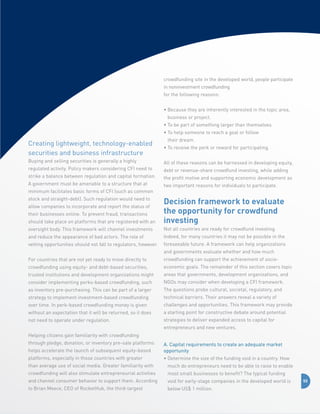
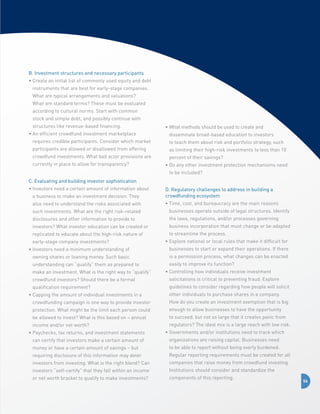
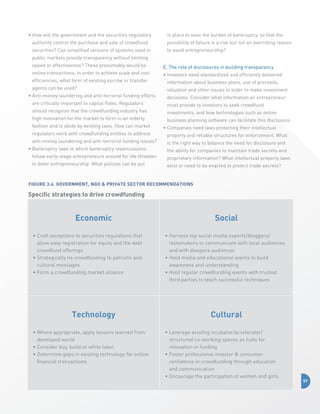
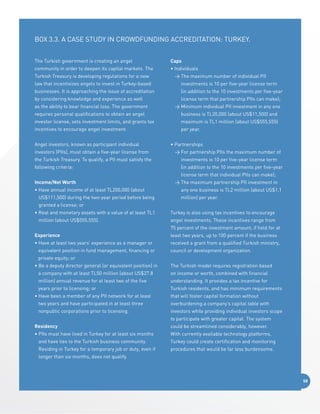
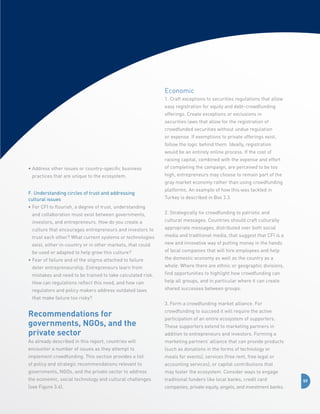
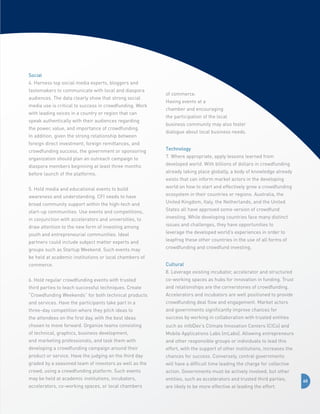
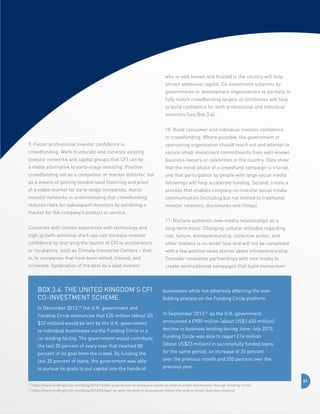
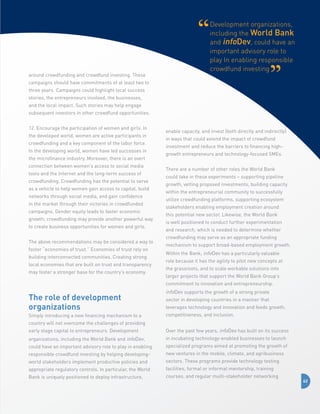
the Developing World
Copyright
© 2013 Information for Development Program (infoDev)/The World Bank
1818 H Street NW
Washington DC 20433
Internet: www.infoDev.org
Email: info@infoDev.org
All rights reserved
Disclaimers

infoDev/The World Bank: The findings, interpretations and conclusions expressed herein are entirely those of the
author(s) and do not necessarily reflect the view of infoDev, the Donors of infoDev, the International Bank for Reconstruction and Development/The World Bank and its affiliated organizations, the Board of Executive Directors of the
World Bank or the governments they represent. The World Bank cannot guarantee the accuracy of the data included in
this work. The boundaries, colors, denominations, and other information shown on any map in this work do not imply
on the part of the World Bank any judgment of the legal status of any territory or the endorsement or acceptance of
such boundaries.
Rights and Permissions
The material in this publication is copyrighted. Copying and/or transmitting portions or all of this work without permission may be a violation of applicable law. The International Bank for Reconstruction and Development/The World Bank
encourages dissemination of its work and will normally grant permission to reproduce portions of the work promptly.
To cite this publication:

Crowdfunding’s Potential for the Developing World. 2013. infoDev, Finance and Private Sector Development Department. Washington, DC: World Bank.
Table of

Contents
Foreword	


Acknowledgements	


4


6


7


8

Abbreviations and Acronyms	


Executive Summary	


1. The State of Crowdfunding Today							

14


Introduction		


14


Crowdfunding models	


20


Crowdfund investing platforms	


22


The benefits of crowdfunding	 	


26


Enabling factors and constraints	


27

2. Crowdfunding and the Opportunity in the Developing World				

31


Status	


31


Opportunities for crowdfunding in the developing world	 	


34


Crowdfunding risks – fraud, failure and fulfillment	


44

3. Policy and Recommendations to Enable Crowdfunding					

50


An opportunity to leapfrog the developed world		


50


Decision framework to evaluate the opportunity for crowdfund investing	 	


56


Recommendations for governments, NGOs and the private sector	


60


The role of development organizations		


65

4. Crowdfunding Readiness – A Self-Assessment Tool					


66


Self-assessment	


66


Readiness ranking	


68


Individual category recommendations	 	


69

5. Case Study: Crowdfunding Opportunities in Climate and Clean Energy Innovation		

73


Introduction		


73


Harnessing embedded community knowledge	 	


75


Examples of successfully crowdfunded climate innovation initiatives	


76


Attractiveness and viability of crowdfunding for Climate Innovation Centers	


77


Critical success factors and execution considerations	 	


79


Criteria for projects and companies seeking to participate in crowdfunding	


83


Strategic recommendations for the Kenya Climate Innovation Center	


84


Recommendations for business models	


86


Conclusion	 	


91

Appendix A: Research Discussion								

93


Appendix B: Crowdfunding in China: Risks and Legal Constraints			

100

References									

102

3
Foreword
Crowdfunding is an innovation in entrepreneurial finance that can fuel	
“the Rise of the Rest” globally
What would the world look like if there were Silicon Valleys everywhere? While I am happy for innovative
entrepreneurs in Silicon Valley, I am passionately focused on helping to create “the Rise of the Rest” so that
entrepreneurs globally can build successful businesses. This initiative is to create focus and action in cities and
towns of all sizes, to form entrepreneurial ecosystems that can ignite innovation, create jobs and grow economies.
In the past, because of the high cost of technology development, lack of mobile/web infrastructure and restrictive
financial regulations, entrepreneurs had to travel to places like San Francisco or Boston to find the technologies
and investors to build their companies. For most, this was cost prohibitive and logistically impossible.
Entrepreneurs had a more challenging time executing their plans and potential investors were scarce.
Today, technology development costs are plummeting and tools are available to build software more rapidly and
cheaply than ever before:
•  ne third of the world’s population has access to the Internet and, according to the United Nations,
O
approximately 85 percent have access to a mobile phone.
•  ased on the adoption curve of feature phones in Africa, it is possible that 40 percent of people living in Africa
B
will have access to a smartphone within five years.
•  nnovative new broadband solutions are becoming available and smartphone penetration is growing as costs
I
decline and demand increases.
•  ith an increase in connectivity, new and larger markets for goods and services are now available and we need
W
talented entrepreneurs to create innovative solutions to customer needs, to create jobs, and drive economic and
social stability.
Now we are ready to address the lack of capital for entrepreneurs through innovation in the financial markets that
leverages these technical advances.
I believe that equity, debt, and rewards-based crowdfunding open new possibilities for funding more
entrepreneurs in more places around the world. These changes enable entrepreneurs to utilize social media and
the web to offer rewards, ownership of a shared vision, or even equity stakes to potential investors. Crowdfunding
websites are creating transparency and more open communication by enabling investors to engage with these
companies over time to monitor their progress and continue to support their success as the company grows.
This technology makes it possible for an entrepreneur in Kenya to more easily engage investors and customers
anywhere; whether that be locally, the diaspora, or with others anywhere in the world.

4
Now is the time for leaders in the developing world to engage in a spirited discussion and analysis regarding
crowdfunding and how it should be utilized to benefit businesses and communities while providing prudent
safeguards and investor protections. It may be possible for developing nations to use this new funding mechanism
as a means to spur domestic innovation and create a larger number of high-growth entrepreneurs. Innovative
policies, technology, education and safeguards will be important in determining if this new financial tool can
deliver on its promise. I appreciate infoDev’s early participation in this conversation via this research and I hope
they and leaders of countries and institutions will use this report as a starting point in creating and testing
appropriate, country-specific approaches to crowdfunding across the developing world.
I believe that crowdfunding may have the potential to help catalyze existing efforts to create entrepreneurial
cultures and ecosystems in developing nations. Development organizations like the World Bank and other
institutions will play an ongoing role to act as “trusted third parties” in creating these new models of funding and
providing mentorship, capacity building as well as ongoing monitoring and reporting.
This research is also demonstrating the important role that academia must play in building deeper, more robust
bodies of knowledge in this arena. Major research institutions and other multilateral development banks can
use this infoDev report as a platform for additional research in this exciting new nexus of finance, technology,
and entrepreneurship. This report, and the research that follows it, can help to shape global best practice. I hope
this report can provide new opportunities for multilateral organizations and academia to collaborate to provide
appropriate measures and tools for the development of this new form of finance.
This confluence of developments in public policy, technological innovation, academia and economic trends can
alter the playing field in developing countries to enable businesses to start, scale, and succeed outside of Silicon
Valley. If successful, crowdfunding can support ”the Rise of the Rest” and will play a key role in sparking economic
growth, innovation, and jobs. We have seen how technology has revolutionized many sectors of the global
economy, however to date, the way that entrepreneurs are funded has either remained unchanged or become even
more challenging. Crowdfunding is not a panacea and there are still risks and unanswered questions remaining.
Nevertheless, I have faith that through ingenuity and technology, appropriate regulation and investor protections
can be built. I believe that crowdfunding has the potential to enable innovative developing economies to leverage
the explosion of social media to leapfrog forward to build a network of vibrant entrepreneurial ecosystems.
Steve Case
Chairman and CEO, Revolution
Co-Founder, America Online
Chairman, The Case Foundation

5
Acknowledgments
This study, Crowdfunding’s Potential for the Developing World, was commissioned by infoDev, a global technology
and innovation program at the World Bank. The study was carried out under the supervision of Anthony Lambkin
and Sam Raymond of infoDev, and prepared by Crowdfund Capital Advisors (CCA).
The main text was written by CCA’s Jason Best, Sherwood Neiss and Richard Swart. Colin Blackman (Camford
Associates) was responsible for editing. A special thanks goes to Steve Case for the valuable contribution of
the foreword to this report. Thanks also for the contributions of a number of individuals who provided research,
insight and contributions: Doug Ellenoff (Ellenoff, Grossman  Schole), Austin Lee, Robert Wuebker, Judy
Robinett, Robert Mitchell, Ilona Major (CCA), Michael Every and Ben Simpfendorfer (Silk Road Associates).
The study benefited from the comments provided by a group of experts who participated in the peer review
process. The peer reviewers include: Dr. Lee Fleming, Director of the Fung Institute, University of California,
Berkeley; Esperanza Lasagabaster, Service Line Manager of Innovation, Technology  Entrepreneurship Global
Practice, World Bank; Drew von Glahn, Program Coordinator, World Bank Institute’s Development Marketplace
Program; Reinhard Reichel, Senior Investment Officer, Financial Markets, IFC; and Anna Lerner, Energy Specialist,
LAC Energy, World Bank.

6
Abbreviations and Acronyms
ACH	

automated clearing house

AML	

anti-money laundering

ASSOB	 Australian Small Scale Offerings Board
CAGR	 compound annual growth rate
CEO	

chief executive officer

CF	crowdfunding
CFI	

crowdfund investing

CFP	

crowdfunding platform

CIC	

Climate Innovation Center

EACVF	 East Africa Climate Venture Facility
FATF	

Financial Action Task Force

GDP	

gross domestic product

ICT	

information and communication technology

IPO	

initial public offering

JOBS	 Jumpstart Our Business Startups Act
KCIC	

Kenya Climate Innovation Center

LED	

light-emitting diode

MENA	 Middle East and North Africa (World Bank regional vice presidency)
mLab	 mobile application lab
NGO	

nongovernmental organization

PII	

participant individual investor

PoC	

Proof of Concept

PPP	

purchasing power parity

SME	

small and medium enterprises

SPV	

special purpose vehicle

TED	

Technology, Entertainment, Design

USB	

Universal Serial Bus

USD	

U.S. dollar

VC	

venture capital or venture capitalist

7
Executive

Summary
Crowdfunding takes advantage of crowd-based
decision-making and innovation, and applies it to
the funding of projects or businesses. Using social
networks, social profiles, and the viral nature of webbased communication, individuals and companies have
raised billions of dollars in debt, equity, and donations
for projects over the past five years. Kickstarter, for
instance, the market leader in pledge or donation-based
crowdfunding, has channeled over US$815 million from
4.9 million backers (29 percent of which have invested
in more than one project) to nearly 50,000 projects
throughout the world since 2009.

Building a crowdfunding ecosystem
depends on key enablers to build trust
Credible crowdfunding systems require more than
Crowdfunding is an Internetenabled way for businesses or other
organizations to raise money in the form
of either donations or investments from
multiple individuals. This new form of
capital formation emerged in an organized
way in the wake of the 2008 financial crisis
largely because of the difficulties faced by

entrepreneurs and willing investors. They also need a
supportive ecosystem and enabling factors, including
forward-thinking regulations, effective technological
solutions, and cultures that can adapt to this new
investment vehicle. This includes the concept of
a “constellation of trust” that enables all parties
to participate. The key factors that have facilitated
crowdfunding in developed countries include:

artisans, entrepreneurs and early-stage
enterprises in raising funds. With traditional
banks less willing to lend, entrepreneurs
started to look elsewhere for capital.

•  regulatory framework that leverages the
A
transparency, speed, and scale that advances in
technology and the Internet can deliver to early-stage
funding marketplaces.

Crowdfunding began as an online extension

•  trong social media market penetration and Internet
S

of traditional financing by friends and family:

usage, which is necessary to harness demographic

communities pool money to fund members

and technology trends to drive collaboration and

with business ideas. In less than a decade,
crowdfunding has gained traction in a number

cultural shifts.
•  regulated online marketplace that facilitates capital
A

of developed economies, including Australia,

formation while providing prudent investor protections

the United Kingdom, the Netherlands, Italy, and

through education and training.

the United States. This exciting phenomenon is

•  ollaboration with other entrepreneurial events and
C

spreading across the developed world and is now

hubs including business plan competitions, incubators,

attracting considerable interest in the developing

accelerators, universities and co-working spaces to

world as well.

create a channel for opportunity and oversight.

8
All of these factors are necessary to build the culture of
trust which is essential for the funding of companies,
projects and causes mediated primarily through webbased interactions. Sometimes crowdfunding project
backers have no pre-existing relationship to the company
or project being funded – they may be hundreds or
thousands of miles away. Nevertheless, this trust often
flows through some form of community, whether based
on geography, culture, ethnicity, or shared interests. Some
crowdfunding platforms are successfully raising money
from diaspora communities and managing north–south
and south–north monetary flows.
Trust does not just happen – it is a socially mediated
phenomenon which relies in great part on the intrinsic
trust people place in shared connections on social
networks, community affinities, and the ratings of others
on trusted, mainstream websites. This group behavior of
trusting others based on presented information and social
signals (and sometimes including first person knowledge)
is only possible in a highly transparent system with near
real-time feedback mechanisms, that is, on the web.

The developing world has the potential to
leapfrog developed countries

While many developing
economies may have the
potential to capitalize on this new
funding mechanism, those that wish to
implement crowdfunding ecosystems need to
learn from the initial developed world experience
to understand how crowdfunding functions, the “light
touch” role that government and regulation should
play, and the technological infrastructure requirements
involved. Developing countries that manage this process
successfully may be able to leapfrog the developed
world, in both a regulatory and economic sense, by
creating frameworks for early-stage finance that
facilitate entrepreneurship, the fostering of innovative
technology enterprises and the emergence of new
competitive industries.
It may be possible for developing nations to use emerging
technology and business processes – including mobile
technology, social media, lean-start-up methods of
company formation, and crowdfund investing – to

With support from governments and development

implement more efficient and effective entrepreneurial

organizations, crowdfunding could become a useful tool

funding systems that are more advanced than the

in the developing world as well. Crowdfunding is still

legacy systems prevalent in the developed world. This

largely a developed-world phenomenon but its potential

may influence more active angel investors and open

to stimulate innovation and create jobs in the developing

up deal flow to a much wider audience that can more

world has not gone unnoticed. Substantial reservoirs of

efficiently review broader investment opportunities. By

entrepreneurial talent, activity, and capital lay dormant

allowing capital to be efficiently pooled around credible

in many emerging economies, even as traditional

entrepreneurs, it may provide different venture capital

attitudes toward risk, entrepreneurship, and finance stifle

structures that reach larger numbers of potential

potential economic growth and innovation. Developing

investors. A developing country’s ability to leapfrog

economies have the potential to drive growth by employing

developed nations will depends in part on the speed and

crowdfunding to leapfrog the traditional capital market

commitment with which its stakeholders embrace these

structures and financial regulatory regimes of the

new technologies and methodologies for both capital

developed world.

formation and enabling trust.
9
Like any investment activity, crowdfunding comes
with risk to the investor. CFI is not unique in this
regard, but it does have characteristics that require
regulatory protection and robust investor education
for crowdfunding to contribute meaningfully and
successfully to a country’s economy.
Crowdfunding markets have been operating in many
countries for several years with few reported instances
Countries that want to adopt crowdfunding must not
only create enabling policy, but also, in some cases,
address policies and regulations that currently make it
burdensome to enter into, conduct, and end business
operations. For example, incorporation or dissolution of
a business entity in many developing nations is overly
bureaucratic, time-consuming, and costly.
The crowdfunding market is in its infancy, especially
in developing countries, but the potential market is
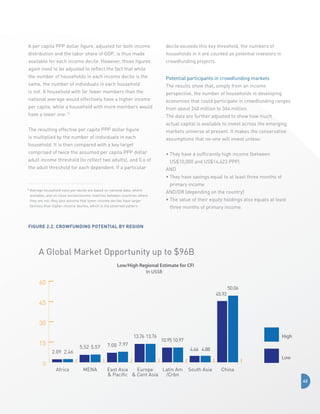
significant. It is estimated that there are up to 344 million
households in the developing world able to make small
crowdfund investments in community businesses.
These households have an income of at least US$10,000
a year, and at least three months of savings or three
months savings in equity holdings. Together, they have
the ability to deploy up to US$96 billion a year by 2025 in
crowdfunding investments. The greatest potential lies
in China, which accounts for up to US$50 billion of that
figure, followed by the rest of East Asia, Central Europe,
Latin America/the Caribbean, and the MENA region.

The risks in crowdfunding and how to 	
mitigate them
While Asia represents a huge opportunity, there may be
reasons to believe that Central Europe, Latin America

of fraud. However, as the market expands, there will
inevitably be attempts to circumvent regulations and
defraud investors. Despite this, the biggest concerns
regarding risk are business failure and execution
or fulfillment challenges. Failure may result from
poor management decisions, lack of funds, or
miscalculations of market demand. Execution or
fulfillment challenges may occur in some successful
crowdfunding campaigns when a company is not
ready with, for instance, the necessary logistics and
manufacturing capacity to meet the demand generated
by their campaign.
These risks may be mitigated through regulation,
technology, and social and cultural approaches:
•  egulation: Governments should review and update
R
small business regulation from incorporation to
bankruptcy. Regulations should balance the need for
investor protection with capital formation. A countryspecific framework for crowdfund investing should
be created to encourage investment in startups and
small businesses and attract diaspora remittances.
It is important to enact regulation that is not too
burdensome, which might otherwise drive companies
into the gray economy.
•  echnology: In order for crowdfunding to work,
T

and the Caribbean, the Middle East and North Africa may

individuals must have access to reliable broadband

effectively deploy crowdfund investing sooner. These

Internet or mobile data networks. Technology to

factors may include a greater transparency, willingness

facilitate ongoing communication between investors

to take risks, support for free market innovation, strong

and entrepreneurs and enabling tools to systematize

diaspora communities, early stage entrepreneurial

and streamline the business lifecycle must also be

activity, and well-functioning educational systems.

employed and allowed to operate freely.

10
•  ocial: Individuals within a country must be actively
S

This should

engaged in online social networks as this is the

include the

main driver of crowdfunding activity. The network

creation and utilization

should be engaged in vetting opportunities to allow

of co-working spaces,

crowd wisdom to emerge. Communities should

incubators, and accelerators. By

leverage startup events and community-backed

providing physical space, mentorship,

finance to support entrepreneurs and develop

peer learning opportunities and formalized

circles of trust.

product market fit experimentation,

•  ultural: The private sector should be engaged
C

crowdfunding, venture creation and other support

to help create channels of viable businesses that

services, the private sector can significantly enhance

can become potential investment opportunities.

the creation of a culture of entrepreneurship.

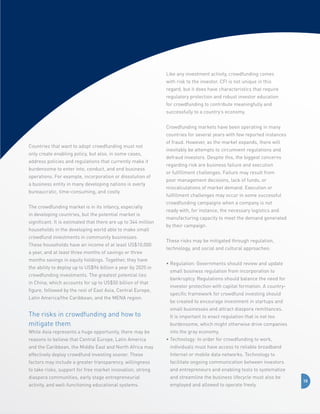
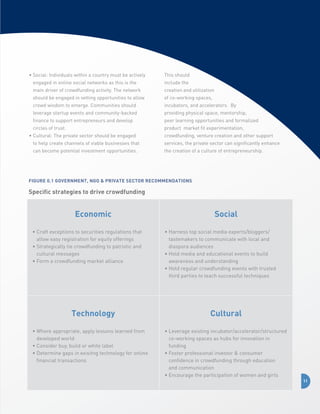
Figure 0.1 Government, NGO  Private Sector Recommendations

Specific strategies to drive crowdfunding

Economic
•  raft exceptions to securities regulations that
C
allow easy registration for equity offerings
•  trategically tie crowdfunding to patriotic and
S
cultural messages
•  orm a crowdfunding market alliance
F

Technology
•  here appropriate, apply lessons learned from
W
developed world
•  onsider buy, build or white label
C
•  etermine gaps in exisitng technology for online
D
financial transactions

Social
•  arness top social media experts/bloggers/
H
tastemakers to communicate with local and
diaspora audiences
•  old media and educational events to build
H
awareness and understanding
•  old regular crowdfunding events with trusted
H
third parties to teach successful techniques

Cultural
•  everage existing incubator/accelerator/structured
L
co-working spaces as hubs for innovation in
funding
•  oster professional investor  consumer
F
confidence in crowdfunding through education
and communication
•  ncourage the participation of women and girls
E
11
Crowdfunding has
emerged as a

multibillion-dollar
global industry
Development organizations, including the World Bank and

infoDev, could have an important role to play in enabling
responsible crowdfund investing by helping developingworld stakeholders implement productive policies and
appropriate regulatory controls. In particular, the World
Bank is uniquely positioned to deploy infrastructure,
enable capacity, and invest (both directly and indirectly)
in ways that could extend the impact of crowdfund
investment and reduce the barriers to financing highgrowth entrepreneurs and technology-focused SMEs.
While each of these risk controls can operate alone,
together they offer a reinforcing framework to protect
investors and decrease the risk of failure.

Governments, development organizations
and others have a role to play in fostering
crowdfunding
Crowdfunding offers the potential for a radical evolution
of our largely institutional framework for allocating

Within the Bank, infoDev has a particularly valuable role
because it has the agility to pilot new concepts at the
grassroots, and to scale workable solutions into larger
projects that support the World Bank Group’s commitment
to innovation and entrepreneurship. infoDev is well
positioned to play a similar role in testing crowdfunding
initiatives in developing economies to promote economic
growth, competitiveness, and inclusion.

capital, through foundations, funds, and banks to a more

infoDev’s approach to crowdfunding emerges from its

individually driven and direct investment framework.

focus on incubating technology-enabled new ventures

Governments around the world as well as development

in the mobile, climate, and agribusiness sectors. These

organizations, venture capital funds, and NGOs are

programs provide technology testing facilities, formal

watching crowdfunding closely to see whether it has

or informal mentorship, training courses, and regular

the potential to solve the “last mile funding problem”

multi-stakeholder networking opportunities, as well as

faced by many start-up companies. The question is

traditional business incubation services. When linked with

whether crowdfunding and crowdfund investing offer

infoDev’s ongoing efforts, the crowdfunding phenomenon

a more efficient mechanism to deliver capital to local

may present an important resource for the entrepreneurs

entrepreneurs in a way that leverages the existing

as they attempt to grow their business from “mind

infrastructure and community resources to support

to market”.

those entrepreneurs.

infoDev’s exploration of crowdfunding may be pursued in
Policies and strategic recommendations for government,

the following ways:

NGOs and the private sector should help support the
emergence of crowdfunding ecosystems by addressing

•  acilitating skills training for entrepreneurs which
F

the economic, social, technology, and cultural

overviews main tenets of crowdfunding and adapts “pitch

challenges, as illustrated in Figure 0.1.

training” to ensure online offerings are compelling.

12
•  everaging the infoDev brand, through Climate
L
Innovation Centers, mLabs, Agribusiness Innovation
Centers and other partners to verify company quality
standards and establish trust with the crowd.
•  upporting angel investors or accelerators to serve as
S
anchor investors for the larger crowd.
•  ffering Proof of Concept grants to companies to
O
develop their crowdfunding campaign.
•  oordinating local pools of trusted service providers
C
to assist entrepreneurs with development of their
crowdfunding campaigns.
•  ontinuing to provide business development services
C
to entrepreneurs to ensure business models are
globally competitive.
•  ocumenting learning from crowdfunding initiatives
D
to positively impact the crowdfunding enabling
environment.
•  howcasing crowdfunding success stories and failures
S
from across the infoDev global network to positively
influence the global innovation and technology
entrepreneurship status quo.

Conclusion

a more distributed way to form capital is aligned with
the changes in the flow and distribution of information
(via the Internet) and the creation and distribution
of manufacturing capabilities (maker spaces and
fabrication centers). Existing securities regulations
were not crafted for the social web. Governments and
policy experts worldwide are considering the possible
impact of crowdfunding and crowdfund investing
and trying to fashion new regulations, empower new
technologies, and equip entrepreneurs with sufficient
information to decide if crowdfunding is a viable
funding or investment vehicle for these enterprises.

The closed and private nature of investing in small

The rate of growth of crowdfunding, and its emergence

businesses and start-ups will change rapidly as the

in developing and developed countries, suggests that

social web affects the flow of both information and

this phenomenon can become a tool in the innovation

capital to these companies. The rise of crowdfunding as

ecosystems of most countries.

13
1. The State of
Crowdfunding
Today
Key points:
•  rowdfunding emerged after the 2008 financial crisis
C
in response to the difficulties faced by early-stage
enterprises attempting to generate funding.
•  rowdfunding is an online extension of financing by
C
friends and family: communities pool money to fund
members with business ideas.
•  urrently it is predominantly a developed world
C
phenomenon, but the potential exists for developing
countries to capitalize on this new form of funding.
•  hat is the current status of crowdfunding as it has
W
grown in the developed world and the forces that have
led to its rapid rise?
•  rovides examples and describes the different models
P
and platforms that have emerged, and the benefits
that crowdfunding is bringing to both investors and
recipients.
•  escribes the enabling factors and constraints to
D
building a successful crowdfunding ecosystem.

Introduction
Crowdfunding is an Internet-enabled way for businesses
or other organizations to raise money – typically from
about US$1,000 to US$1 million – in the form of either
donations or investments from multiple individuals. This
new form of capital formation emerged in the wake of
the 2008 financial crisis in response to the difficulties
faced by early-stage enterprises1 in generating funding.
In less than a decade, crowdfunding has spread across
the developed world, and is now attracting considerable
interest in the developing world as well.
Crowdfunding began as an online extension of financing
by friends and family: communities pool money to fund
members with business ideas. During crowdfunding’s
early stages, capital came in the form of donations, but
increasingly it takes the form of debt or equity investments
targeting high-growth entrepreneurs – only one of many
ways the model is evolving as awareness spreads.
Crowdfunding uses web-based technology and the
knowledge and wisdom in communities to determine
which projects should receive funding and how much

1

T
 here are many definitions of SMEs and early-stage enterprises. These
definitions vary depending on the number of employees, annual sales,
assets, and even sector. In this report early-stage businesses are defined
as those with fewer than 50 employees and with revenue of less than US$3
million, in line with the World Bank’s definition of Small Enterprise (http://
www.infodev.org/infodev-files/resource/InfodevDocuments_614.pdf).

funding they should receive, as well as providing realtime feedback on start-ups and small businesses. It
leverages the power of technology, particularly social
media, to market the idea, raise funds, and hold
entrepreneurs accountable.

14
Developing economies may have the potential to

the developing

capitalize on this new funding mechanism. Countries

world is explored

wishing to implement crowdfunding ecosystems need

in Chapter 5 through

to understand how crowdfunding works, the role

a detailed case study of

that government and regulation should play and the

crowdfunding in the climate

technological infrastructure requirements involved.

and clean energy sector.

Developing countries that manage this process
successfully may be able to leapfrog the developed world
in delivering capital to businesses, in both a regulatory
and economic sense, by creating frameworks for earlystage finance that facilitate entrepreneurship, the
fostering of innovative technology enterprises and the
emergence of new competitive industries. As with other
disruptive technologies, it is not possible to accurately
gauge the potential impact of this evolving market,
especially where there is little available data from
developing countries.
This report reviews the potential opportunities and
challenges associated with implementing crowdfunding
within a market, as well as crowdfunding’s connection to
capital markets in general. The rest of Chapter 1 outlines
the current status of crowdfunding as it has grown in the
developed world and the forces that have led to its rapid
rise. It gives examples and describes the different models
and platforms that have emerged, and the benefits that
crowdfunding is bringing to both investors and recipients.
The chapter ends with an overview of the enabling factors
and constraints to building a successful crowdfunding
ecosystem.
Chapter 2 addresses the ways that crowdfunding
could improve access to capital for high-growth
entrepreneurs in the developing world, while Chapter
3 analyses the policy and regulatory aspects, makes
recommendations on how to encourage and support
crowdfunding, and considers the role that development
organizations such as The World Bank and infoDev can
play. A tool to help countries assess their readiness

The global emergence of crowdfunding
Crowdfunding based initially on soliciting pledges or
donations has emerged as a multibillion-dollar global
industry. It channels money to individuals or organizations
for seed finance, product development, and social causes.
Crowdfunding sometimes extends or complements social
lending (peer-to-peer) platforms. Crowdfund investing
(CFI) is the investment alternative to pledge-based
crowdfunding. This term, which describes securitiesbased equity and debt fundraising through crowdfunding
platforms, has recently emerged as an alternative to
more traditional funding tools such as bank loans,
angel or venture capital (VC) investments for financing
entrepreneurs and small and medium-sized enterprises
(SMEs). Projections for the size of the crowdfund investing
market range from US$3.98 billion (Best, Neiss, Stralser,
and Fleming 2013) to as much as US$300 billion over
the coming years depending on the level of enabling
regulation adopted by governments (Huessner 2012).
The large-scale adoption of information and
communication technology, coupled with the broad
acceptance of social networks, has given rise to webenabled crowdfunding. Web-based platforms provide
scale and scope, and help overcome many of the
challenges to entrepreneurial finance that have hindered
economic development and growth in the developing
world. These challenges include:
•  roviding SMEs with access to capital.
P
•  ultivating high-growth entrepreneurs in developing
C
countries.

for crowdfunding is described in Chapter 4. Finally, the

•  upporting access to export markets.
S

opportunity that the World Bank and infoDev has to

•  atalyzing flows of capital within and between
C

support entrepreneurship-driven economic growth in

communities, irrespective of distance.

15
Use and segmentation of crowdfunding platforms
Crowdfund investing is suitable for many types of
enterprise, most notably high-growth start-ups, often
in the technology sector, research institutions as well
as more traditional small businesses. The way in
which crowdfunding fits into the funding lifecycle of
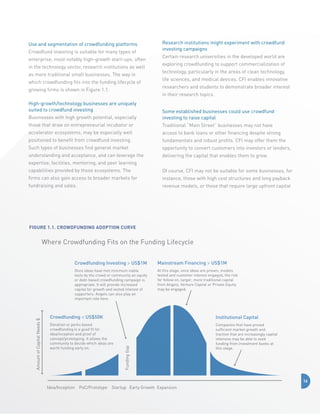
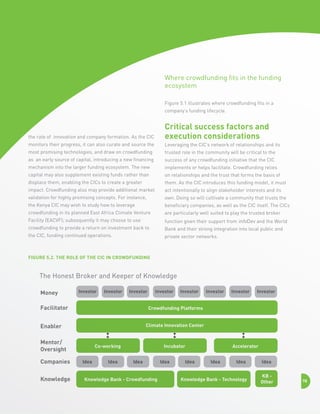
growing firms is shown in Figure 1.1.

Research institutions might experiment with crowdfund
investing campaigns
Certain research universities in the developed world are
exploring crowdfunding to support commercialization of
technology, particularly in the areas of clean technology,
life sciences, and medical devices. CFI enables innovative
researchers and students to demonstrate broader interest
in their research topics.

High-growth/technology businesses are uniquely
suited to crowdfund investing
Businesses with high growth potential, especially

Some established businesses could use crowdfund
investing to raise capital

those that draw on entrepreneurial incubator or

Traditional “Main Street” businesses may not have

accelerator ecosystems, may be especially well

access to bank loans or other financing despite strong

positioned to benefit from crowdfund investing.

fundamentals and robust profits. CFI may offer them the

Such types of businesses find general market

opportunity to convert customers into investors or lenders,

understanding and acceptance, and can leverage the

delivering the capital that enables them to grow.

expertise, facilities, mentoring, and peer learning
capabilities provided by those ecosystems. The

Of course, CFI may not be suitable for some businesses, for

firms can also gain access to broader markets for

instance, those with high cost structures and long payback

fundraising and sales.

revenue models, or those that require large upfront capital

Figure 1.1. Crowdfunding Adoption Curve

Where Crowdfunding Fits on the Funding Lifecycle
Mainstream Financing  US$1M

Once ideas have met minimum viable
tests by the crowd or community an equity
or debt-based crowdfunding campaign is
appropriate. It will provide increased
capital for growth and vested interest of
supporters. Angels can also play an
important role here.

At this stage, once ideas are proven, models
tested and customer interest engaged, the risk
for follow on, larger, more traditional capital
from Angels, Venture Capital or Private Equity
may be engaged.

Crowdfunding  US$50K

Institutional Capital

Donation or perks based
crowdfunding is a good fit for
idea/inception and proof of
concept/prototyping. It allows the
community to decide which ideas are
worth funding early on.

Companies that have proved
sufficient market growth and
traction that are increasingly capital
intensive may be able to seek
funding from investment banks at
this stage.

Funding Gap

Amount of Capital Needs $

Crowdfunding Investing  US$1M

16

Idea/Inception PoC/Prototype Startup Early Growth Expansion
As crowdfunding grows in size and becomes widely
accepted, professional investors are likely to start
allocating portions of their portfolios to crowdfund
investing. Crowdfunding is attracting the interest of
angel investors and venture capital because CFI can
provide proof of market interest in a start-up, and also
because it allows them to assess potential investment
expenditures such as large-scale infrastructure projects.
These kinds of companies may be limited by the caps on
the amount of money that can be raised through CFI, or
by a payback time horizon that is too far in the future to
appeal to crowdfunding investors.

Forces enabling the rise of crowdfunding
Crowdfunding draws inspiration from concepts like
microfinance (Morduch 1999) and crowdsourcing (Poetz
and Schreier 2012), but it represents a unique category of
fundraising, with different vehicles, processes, and goals.

opportunities privately and efficiently. Angel groups and
networks can use the technology platforms that have
been developed for crowdfunding to increase deal flow,
improve communication, decrease time to complete
transactions, and improve syndication. Venture capital
typically is risk averse which leaves a funding gap
for innovative, early-stage companies, especially in
developing countries. Crowdfunding is starting to
bridge that gap but is also highlighting opportunities
for VC investment.

widespread adoption of information and communication

Emerging platforms built for specific
communities

technology (ICT) has provided the infrastructure to reach

Certain well-organized online communities have begun

millions of investors. At the same time, the general social

exploring crowdfunding for targeted funding and capital

acceptance of technology-enabled social networks allows

formation.

Two major forces make crowdfunding possible. First, the

investors to interact online and build trust among people
with whom they may have few traditional connections.

•  everal recently launched or announced portals
S

Together these forces are enabling crowdfunding to

focus on particular groups. These include religious

emerge on a large scale, connecting would-be investors

affiliations, industries, race-specific business

with potential investments.

organizations (such as Hispanic Chambers of
Commerce), gender-based organizations (such as

Today more than 80 percent of the world’s online
population interacts with social networks on a regular

SpringBoard), and university alumni networks.
•  latforms are organizing around physical
P

basis, despite the fact that 65 percent of the world’s

communities to fund community development

population – 4.6 billion people – still lack Internet access

projects, recreational facilities, school programs, and

(McKinsey Global Institute 2012). Technology-enabled

so on.

communities, that is, online social platforms that bring

•  ortals are forming for the purpose of investing
P

the speed, scale, and economies of the Internet to

in industries, technologies, or sectors such as

social interactions, have grown to more than 1.5 billion

the travel industry, solar implementations, and

members globally (Curtis, Conover and Chui 2012).

real estate.
17
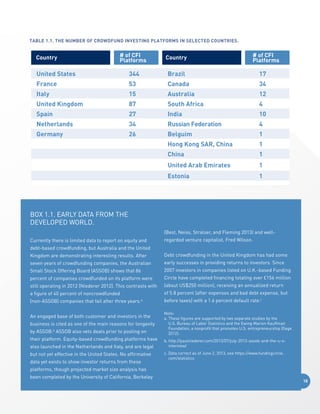
Table 1.1. The Number of Crowdfund Investing Platforms in Selected Countries.

# of CFI
Platforms

Country

United States

344

Brazil

17

France

53

Canada

34

Italy

15

Australia

12

United Kingdom

87

South Africa

4

Spain

27

India

10

Netherlands

34

Russian Federation

4

Germany

26

Belguim

1

Hong Kong SAR, China

1

China

1

United Arab Emirates

1

Estonia

1

Country

# of CFI
Platforms

BOX 1.1. Early Data from the 
Developed World.
(Best, Neiss, Stralser, and Fleming 2013) and wellCurrently there is limited data to report on equity and

regarded venture capitalist, Fred Wilson.

debt-based crowdfunding, but Australia and the United
Kingdom are demonstrating interesting results. After

Debt crowdfunding in the United Kingdom has had some

seven years of crowdfunding companies, the Australian

early successes in providing returns to investors. Since

Small Stock Offering Board (ASSOB) shows that 86

2007 investors in companies listed on U.K.-based Funding

percent of companies crowdfunded on its platform were

Circle have completed financing totaling over £156 million

still operating in 2012 (Niederer 2012). This contrasts with

(about US$250 million), receiving an annualized return

a figure of 40 percent of noncrowdfunded

of 5.8 percent (after expenses and bad debt expense, but

(non-ASSOB) companies that fail after three years.

a

An engaged base of both customer and investors in the
business is cited as one of the main reasons for longevity
by ASSOB.b ASSOB also vets deals prior to posting on
their platform. Equity-based crowdfunding platforms have
also launched in the Netherlands and Italy, and are legal
but not yet effective in the United States. No affirmative
data yet exists to show investor returns from these

before taxes) with a 1.6 percent default rate.c
Note:
a. These figures are supported by two separate studies by the
U.S. Bureau of Labor Statistics and the Ewing Marion Kauffman
Foundation, a nonprofit that promotes U.S. entrepreneurship (Gage
2012).
b. http://paulniederer.com/2013/07/july-2013-assob-and-the-u-sinterview/
c. Data correct as of June 2, 2013, see https://www.fundingcircle.
com/statistics

platforms, though projected market size analysis has
been completed by the University of California, Berkeley

18
Market size and growth
Crowdfunding has expanded rapidly since its inception
only six years ago. Crowdfund investing (CFI), which grew
out of the crowdfunding movement, began in Australia,

in July 2012 and is starting

followed by the United Kingdom, and is now spreading

to generate substantial activity

across the world. Today, 45 nations in North America,

with more than 15 platforms now in

Latin America, Europe, the Middle East and North Africa,

operation. The Italian government recently

Sub-Saharan Africa, and Asia have active crowdfunding

passed a modified version of CFI, which allows

platforms (see Table 1.1).

for companies that receive the designation of a
“start-up” to raise money via crowdfund investing.3

Campaigns across the globe raised nearly US$2.7 billion
•  atin America: Colombia has recognized CFI as a key
L

in 2012 through all crowdfunding business models and
platform types: US$1.6 billion in North America, US$945

area of study to allow for early-stage capital expansion.

million in Europe and US$110 million in the rest of the

Brazil has been a leader in South America in the

world. Europe and the United States have seen rapid

crowdfunding space. It has more than 15 rewards-

growth in all types of crowdfunding platforms since

based platforms, and the country’s first merger of

2009. Across all regions, crowdfunding expanded at a 63

crowdfunding platforms took place in 2012. Chile now

percent compound annual growth rate (CAGR) from 2009

also has a CFI platform with a successful campaign to

through 2012. Equity-based platforms exhibited a CAGR

fund a large regional brewery.

2

of 114 percent, lending-based platforms 78 percent,
•  sia: Rewards-based portals are being developed in
A

donation-based 43 percent, and reward-based 524

Singapore and there is interest from other growing

percent.

economies, including the Republic of Korea, Brunei and
Malaysia.

The passage of the Jumpstart Our Business Startups
(JOBS) Act in 2012 in the United States has generated

•  ub-Saharan Africa: This region is beginning to
S

considerable interest in expanding the reach of
crowdfund investing throughout North America. The CFI

observe donation-based crowdfunding activity and early

market in the United States was forecast to reach US$3

development of equity-based platforms, including some

billion in 2013 (Deloitte 2013). Canada is fully engaged

in development, or launched in Kenya, Ghana, and

in developing crowdfunding-related legislation, and in

South Africa.

Mexico, the government is consulting with business angel
•  iddle East/North Africa (MENA): Donation-based
M

and venture capital groups about a crowdfund investing

crowdfunding activity is beginning with the emergence

regulatory framework.

of equity-based platforms in the United Arab Emirates
(UAE), Jordan, and Lebanon. A crowdfunding platform

Other notable global developments include:

combined with a technology incubator has recently
launched in the Arab Republic of Egypt and its first

•  urope: The European Crowdfunding Network was
E
launched in 2012 with the goal of creating a regulatory

cohort of companies entered the accelerator in the

model for Europe. CFI was launched in the Netherlands

summer of 2013.

Massolution 2013CF Crowdfunding Industry Report http://crowdsourcing.
org/l/20898

19

2

3

The Italian model also requires the participation of a lead angel Investor.
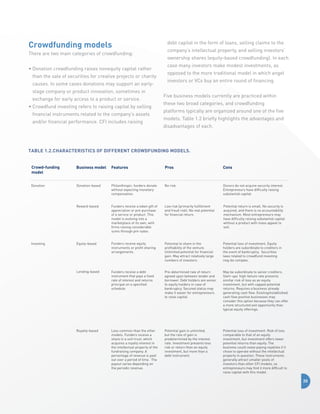
Crowdfunding models
There are two main categories of crowdfunding:
•  onation crowdfunding raises nonequity capital rather
D
than the sale of securities for creative projects or charity
causes. In some cases donations may support an earlystage company or product innovation, sometimes in
exchange for early access to a product or service.
•  rowdfund investing refers to raising capital by selling
C
financial instruments related to the company’s assets
and/or financial performance. CFI includes raising

debt capital in the form of loans, selling claims to the
company’s intellectual property, and selling investors’
ownership shares (equity-based crowdfunding). In each
case many investors make modest investments, as
opposed to the more traditional model in which angel
investors or VCs buy an entire round of financing.
Five business models currently are practiced within
these two broad categories, and crowdfunding
platforms typically are organized around one of the five
models. Table 1.2 briefly highlights the advantages and
disadvantages of each.

Table 1.2.Characteristics of Different Crowdfunding Models.
Crowd-funding
model

Business model

Features

Pros

Cons

Donation

Donation-based

Philanthropic: funders donate
without expecting monetary
compensation.

No risk.

Donors do not acquire security interest.
Entrepreneurs have difficulty raising
substantial capital.

Reward-based

Funders receive a token gift of
appreciation or pre-purchase
of a service or product. This
model is evolving into a
marketplace of its own, with
firms raising considerable
sums through pre-sales.

Low risk (primarily fulfillment
and fraud risk). No real potential
for financial return.

Potential return is small. No security is
acquired, and there is no accountability
mechanism. Most entrepreneurs may
have difficulty raising substantial capital
without a product with mass appeal to
sell.

Equity-based

Funders receive equity
instruments or profit sharing
arrangements.

Potential to share in the
profitability of the venture.
Unlimited potential for financial
gain. May attract relatively large
numbers of investors.

Potential loss of investment. Equity
holders are subordinate to creditors in
the event of bankruptcy. Securities
laws related to crowdfund investing
may be complex.

Lending-based

Funders receive a debt
instrument that pays a fixed
rate of interest and returns
principal on a specified
schedule.

Pre-determined rate of return
agreed upon between lender and
borrower. Debt holders are senior
to equity holders in case of
bankruptcy. Secured status may
make it easier for entrepreneurs
to raise capital.

May be subordinate to senior creditors.
Start-ups’ high-failure rate presents
similar risk of loss as an equity
investment, but with capped potential
returns. Requires a business already
generating cash flow. Existing/established,
cash flow positive businesses may
consider this option because they can offer
a more structured exit opportunity than
typical equity offerings.

Royalty-based

Less common than the other
models. Funders receive a
share in a unit trust, which
acquires a royalty interest in
the intellectual property of the
fundraising company. A
percentage of revenue is paid
out over a period of time. The
payout varies depending on
the periodic revenue.

Potential gain is unlimited,
but the rate of gain is
predetermined by the interest
rate. Investment presents less
risk or return than an equity
investment, but more than a
debt instrument.

Potential loss of investment. Risk of loss
comparable to that of an equity
investment, but investment offers lower
potential returns than equity. The
business could cease paying royalties if it
chose to operate without the intellectual
property in question. These instruments
generally attract smaller pools of
investors than other CFI models, so
entrepreneurs may find it more difficult to
raise capital with this model.

Investing

20
Keep-what-you-raise financing, in contrast, allows
a pitching entity to retain whatever funds it raises by
the time the campaign ends. Such funds typically are
transmitted immediately at the end of the fundraising
campaign, typically which lasts between 30 and 90 days.
Indiegogo offers a keep-what-you-raise approach in
addition to an all-or-nothing option. Indiegogo reports

	
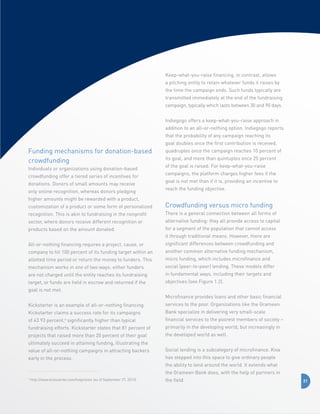
Funding mechanisms for donation-based
crowdfunding
Individuals or organizations using donation-based
crowdfunding offer a tiered series of incentives for
donations. Donors of small amounts may receive
only online recognition, whereas donors pledging
higher amounts might be rewarded with a product,

that the probability of any campaign reaching its
goal doubles once the first contribution is received,
quadruples once the campaign reaches 10 percent of
its goal, and more than quintuples once 25 percent
of the goal is raised. For keep-what-you-raise
campaigns, the platform charges higher fees if the
goal is not met than if it is, providing an incentive to
reach the funding objective.

customization of a product or some form of personalized

Crowdfunding versus micro funding

recognition. This is akin to fundraising in the nonprofit

There is a general connection between all forms of

sector, where donors receive different recognition or

alternative funding: they all provide access to capital

products based on the amount donated.

for a segment of the population that cannot access
it through traditional means. However, there are

All-or-nothing financing requires a project, cause, or

significant differences between crowdfunding and

company to hit 100 percent of its funding target within an

another common alternative funding mechanism,

allotted time period or return the money to funders. This

micro funding, which includes microfinance and

mechanism works in one of two ways: either funders

social (peer-to-peer) lending. These models differ

are not charged until the entity reaches its fundraising

in fundamental ways, including their targets and

target, or funds are held in escrow and returned if the

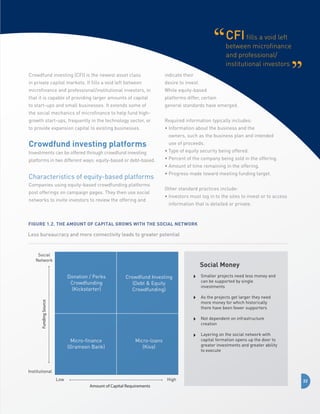
objectives (see Figure 1.2).

goal is not met.
Microfinance provides loans and other basic financial
Kickstarter is an example of all-or-nothing financing.

services to the poor. Organizations like the Grameen

Kickstarter claims a success rate for its campaigns

Bank specialize in delivering very small-scale

of 43.93 percent,4 significantly higher than typical

financial services to the poorest members of society –

fundraising efforts. Kickstarter states that 81 percent of

primarily in the developing world, but increasingly in

projects that raised more than 20 percent of their goal

the developed world as well.

ultimately succeed in attaining funding, illustrating the
value of all-or-nothing campaigns in attracting backers

Social lending is a subcategory of microfinance. Kiva

early in the process.

has stepped into this space to give ordinary people
the ability to lend around the world. It extends what
the Grameen Bank does, with the help of partners in

4

http://www.kickstarter.com/help/stats (as of September 27, 2013)

the field.

21
CFI fills a void left

between microfinance
and professional/
institutional investors

Crowdfund investing (CFI) is the newest asset class

indicate their

in private capital markets. It fills a void left between

desire to invest.

microfinance and professional/institutional investors, in

While equity-based

that it is capable of providing larger amounts of capital

platforms differ, certain

to start-ups and small businesses. It extends some of

general standards have emerged.

the social mechanics of microfinance to help fund highgrowth start-ups, frequently in the technology sector, or

Required information typically includes:

to provide expansion capital to existing businesses.

•  nformation about the business and the
I

Crowdfund investing platforms
Investments can be offered through crowdfund investing

owners, such as the business plan and intended
use of proceeds.
•  ype of equity security being offered.
T

platforms in two different ways: equity-based or debt-based.

• Percent of the company being sold in the offering.

Characteristics of equity-based platforms

• Progress made toward meeting funding target.

Companies using equity-based crowdfunding platforms
post offerings on campaign pages. They then use social
networks to invite investors to review the offering and

• Amount of time remaining in the offering.

Other standard practices include:
•  nvestors must log in to the sites to invest or to access
I
information that is detailed or private.

Figure 1.2. The Amount of Capital Grows with the Social Network

Less bureaucracy and more connectivity leads to greater potential

Social
Network

Social Money
Donation / Perks
Crowdfunding
(Kickstarter)

Crowdfund Investing
(Debt  Equity
Crowdfunding)

Smaller projects need less money and
can be supported by single
investments

Funding Source

As the projects get larger they need
more money for which historically
there have been fewer supporters
Not dependent on infrastructure
creation

Micro-finance
(Grameen Bank)

Layering on the social network with
capital formation opens up the door to
greater investments and greater ability
to execute

Micro-loans
(Kiva)

Institutional
Low

High
Amount of Capital Requirements

22
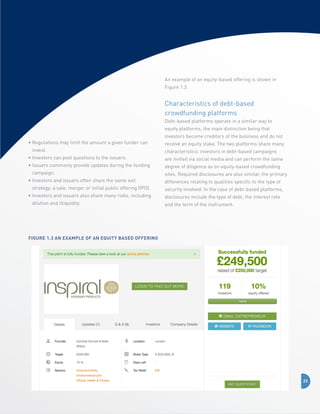
An example of an equity-based offering is shown in
Figure 1.3.

Characteristics of debt-based
crowdfunding platforms
Debt-based platforms operate in a similar way to
equity platforms, the main distinction being that
•  egulations may limit the amount a given funder can
R
invest.
• Investors can post questions to the issuers.
•  ssuers commonly provide updates during the funding
I
campaign.
•  nvestors and issuers often share the same exit
I
strategy: a sale, merger or initial public offering (IPO).
•  nvestors and issuers also share many risks, including
I
dilution and illiquidity.

investors become creditors of the business and do not
receive an equity stake. The two platforms share many
characteristics: investors in debt-based campaigns
are invited via social media and can perform the same
degree of diligence as on equity-based crowdfunding
sites. Required disclosures are also similar, the primary
differences relating to qualities specific to the type of
security involved. In the case of debt-based platforms,
disclosures include the type of debt, the interest rate
and the term of the instrument.

Figure 1.3 An Example of an Equity Based Offering

23
The current pre-sale or
donation model gives firms
and opportunity to explore
demand for their products
Debt platforms facilitate the aggregation of loans
for the business, fund transfers to the business and
repayment of the loans from the business back to
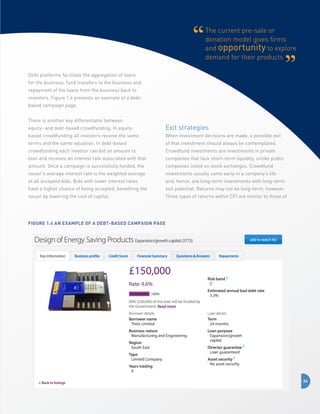
investors. Figure 1.4 presents an example of a debtbased campaign page.
There is another key differentiator between
equity- and debt-based crowdfunding. In equity-

Exit strategies

based crowdfunding all investors receive the same

When investment decisions are made, a possible exit

terms and the same valuation. In debt-based

of that investment should always be contemplated.

crowdfunding each investor can bid an amount to

Crowdfund investments are investments in private

loan and receives an interest rate associated with that

companies that lack short-term liquidity, unlike public

amount. Once a campaign is successfully funded, the

companies listed on stock exchanges. Crowdfund

issuer’s average interest rate is the weighted average

investments usually come early in a company’s life

of all accepted bids. Bids with lower interest rates

and, hence, are long-term investments with long-term

have a higher chance of being accepted, benefiting the

exit potential. Returns may not be long-term, however.

issuer by lowering the cost of capital.

Three types of returns within CFI are similar to those of

Figure 1.4 An example of a debt-based campaign page

24
Dividend or revenue-based finance
Dividend or income distributions are an alternative
option, depending on the corporate structure of the
crowdfunded company. The crowdfund proceeds can
be invested into the business, and distributions are
made only if there are sufficient profits. For an investor,
this model offers the potential to earn a return each
year. That return is dependent on company operations,
however, and investors may not receive dividends in
years with poor performance.
more traditional investment vehicles: interest payments;
income or dividend distribution; or exit through a sale,

Sale, merger or IPO

merger, or public offering. These are outlined below:

The maximum benefit to crowdfunding investors comes
in the less likely scenario of a sale or merger to another

Interest and principal payments
Many companies that will be looking for crowdfund
capital are small businesses that are producing revenue
but need additional short-term financing for working
capital or expansion. This kind of finance was traditionally
provided by banks or other local financial institutions but,
after the world economic crisis in 2008, banks tightened
their lending requirements. The net effect was to further
constrain businesses. Crowdfunding may help fill this
gap by allowing customers of businesses to loan money

company or an IPO. Statistically, the majority of wealth is
made in the early stages of a company, but whether an
exit will occur, at what time, and for what valuation are
all unpredictable and unknowable to investors.
While an IPO might be the most lucrative exit for a
CF investor, the likelihood of a company going public
is small in developed countries and even smaller in
developing countries. Most companies never achieve
such exits and are usually acquired long before they

to the companies they support.

sell shares. Reporting and filing regulations on public

These kinds of companies typically do not possess the

going public.

companies are considered onerous and a deterrent to

elements for an equity offering. For instance, there
market demand for the company’s products or services

A straightforward solution: simple debt or common
stock instruments

is limited – the overall market might be modest or

To foster an exit, the most logical model for a

only of local interest. Culturally appropriate debt is a

crowdfund offering would be straight debt or common

worthwhile option for these types of businesses. As

stock. Common stock could come with anti-dilution

an investment, debt provides a degree of exit certainty

preferences that consist of a) buyout of crowdfund

in that the time period for the loan and the interest

shareholders in subsequent rounds at the current price

rate are predetermined. For the business owner, it

offering, b) ability of crowdfund shareholders to buy in

has the benefits of keeping ownership centralized and

at the price of subsequent rounds or c) an option for

does not require the company to take on additional

crowdfund shareholder to suffer dilution but maintain

shareholders and the responsibilities and reporting

their shares. Straight debt and common stock are easily

requirements they represent.

understood by investors and offer clearly defined exits.

may be no potential for a public offering because

25
By leveraging technology,
crowdfunding can serve
as an enabling mechanism
for new venture formation,
job creation and inclusive
economic growth

The benefits of crowdfunding
In providing a new source of early-stage venture
capital primarily to previously underserved

ICT now give early-stage

businesses and sectors of society, CFI promises to

and high-growth enterprises

democratize and expand the access to capital by

globally the ability to leapfrog

enabling the community – the crowd – to determine

the venture investor boardroom by

which entrepreneurs or small- and medium-sized

posting their offering to a larger set of

enterprises obtain funds for growth. By leveraging

investors in their social network. Validation

technology to broaden the base of potential investors,

from other investors may lower the perceived risk,

this increased access to finance can serve as an

and possibly the actual risk, of early-stage investment.

enabling mechanism for new venture formation, job

This is discussed in more detail in Chapter 2. However,

creation, and inclusive economic growth. The benefits

crowdfunding does not displace the role of the angel or

include:

VC in providing later-stage or larger-scale funding.
•  rowdfunding may expand the geographic range of
C
angel investment: Established micro-lending practices

•  erging the social web with entrepreneurial
M
finance: Crowdfunding is largely a substitute for

take “localness” as a given; participants need to be able

other institutions and actors when they do not

to tap into geographically proximate social networks

exist or are not active enough within a country’s

for monitoring, governance, and social sanction.

capital market, rather than a complement to

Crowdfunding overturns this traditional approach in

those actors. Traditional financing models require

several ways. First, it demonstrates that networks

companies to hold dozens or hundreds of meetings

need not be tied to geography. While there is some

to seek capital, which is labor and capital intensive

evidence of local bias in some segments of donation-

and highly inefficient. By centralizing access

based crowdfund investing (Agrawal, Catalini, and

to data on available investment opportunities,

Goldfarb 2011) geography plays a less significant role

crowdfund-investing portals can facilitate the flow

in the funding of promising projects.5 It is unknown

of information from early-stage enterprises to

whether the discrepancy is due to different cultural

potential investors more rapidly than has ever been

standards for trust, verification, deal curation methods,

possible before.

the smaller amounts of capital in play for individual
contributors, other factors or some combination.

•  rowdfunding also can be efficient for investors:
C
It allows them to investigate numerous potential

The trend toward a boundary-less approach to

investments online at one time and determine

investment is evident, however.

quickly whether the company fits their portfolio

•  roduct validation, support networks, and
P

strategy, risk appetite, or other criteria. In the

partnerships: Early-stage companies may use

developing world a trend is emerging of investors

crowdfunding to explore a product’s viability and

monitoring donation-based crowdfunding platforms

to engage early adopters at low costs and with low

to look for innovative companies and products.

barriers to entry. Crowdfunding offers marketing
benefits as well: one of the key advantages of online

•  rowdfunding disrupts the funding cycle: Business
C
angels and venture capitalists (VC) traditionally have

crowdfunding campaigns is the exposure it creates for

served as the funders of early-stage enterprises in

the business.

the developed world. In the developing world earlystage funding has come mainly in the form of friends
and family financing. Advances in the social web and

26
5

E.g, IndieGogo, Kickstarter, (Mollick 2013).
regarding product ideas, business concepts, and
intended markets dramatically increases market
efficiencies. The end result of successful crowdfunding
campaigns is increased visibility and credibility among
the investing audience. Companies that receive funding
are supported by an engaged investor base that may
also be their future customers and marketing agents. A
good example of this is Kone, a coffee and filter brewing
•  arket testing and demand measurement: The current
M
pre-sale or donation model gives firms an opportunity
to explore demand for their products or services. If the
firms meet their funding goals, they have access to the
capital needed for their initial product launches. From
the investor perspective, the crowd’s validation reduces
investment risk by demonstrating demand for the
product. In fact, some large U.S. business angel groups,
such as Chicago-based Heartland Angels, are creating
their own crowdfunding portals with the expectation
that firms seeking capital prove market acceptance
through a successful crowdfunding campaign.
•  ccess to support networks: Companies offering
A
a crowdfunding campaign can engage a highly
motivated group of customers that acts both as
product evangelists and as a rich and detailed source
of feedback. Expanding into CFI gives companies an
early-stage support network of investors who have a
vested interest in the success of the business, many of
whom may have skills from which entrepreneurs can
benefit. These early investors may work in many ways
as advisors and evangelists, and may help the business
forge valuable connections to other influential actors,
activities that can help support firms through the
challenges of early growth.
•  arkets and partnerships: Entrepreneurs also receive
M
early feedback on the viability of their intended market
and marketing. Extensive feedback from customers
and investors may lead to a revision of the planned
business model. It can give firms the information
they need to change their focus to a new market as
necessary, or to seek strategic partnerships with new
suppliers or vendors. The open exchange of information

system that initially wanted to raise US$5,000 and
within 90 days, because of a well-executed campaign,
raised more than US$155,000 through Kickstarter.
During the company’s campaign and product evolution,
it received critical feedback from sponsors, including
suggestions to develop a better handle that prevented
burning and a seal on the lid to stop it from rattling.
Kone was able to fine-tune its product prior to going to
market, and sponsors felt they had contributed to the
company’s success.

Enabling factors and constraints
Building a crowdfunding ecosystem
Credible crowdfunding systems require more than
entrepreneurs and willing investors. They also need
supportive ecosystems and enabling initiatives and
actions, including forward-thinking regulations, effective
technological solutions and cultures that can adapt to
this new investment vehicle. The concept of the formation
of a new ecosystem around a technology platform is not
new. Social networking platforms and online advertising
platforms are examples of this concept. In both cases,
following creation of the platform, an ecosystem was
developed around them by entrepreneurs and existing
businesses in order to maximize their value.
In the case of social media, after Facebook gained
traction, hundreds of companies formed to create ways
to, among other things, monitor, analyze, and sell goods
and services based on social media usage. These
innovative companies created thousands of jobs and new
products and services. In the case of online advertising,
while the traditional advertising business was well

27
understood, with the rise of online ad platforms, for

given an

the first time, businesses had the opportunity to have

array of new

far more visibility and control of their advertising than

tools that now are

they ever had in the offline world. This has given rise

available with the rise

to companies that can control creative, marketing, and

of the Internet and the social

accounting/traffic of online advertising. These companies

web. Protecting investors is critically

have developed innovations that have built billions of

important because if crowdfunding

dollars in market value.

becomes rife with fraud, the market will
collapse. By working with technology companies

Although these examples are from the developed world,

and innovators on new ways to both protect against

they may be helpful from a structural perspective when

fraud as well as to monitor crowdfunding companies

looking at how the creation of new disruptive platforms

over time (for example, require annual reporting that

can spur development not only of new businesses

tracks top level sales, costs, and job creation numbers)

that utilize the platform, but also new businesses that

regulators may gain additional insights that were not

can support the creation of a robust ecosystem for

available before.

the platform.

•  trong social media market penetration and Internet
S

Key factors facilitating the development of a functioning
crowdfunding ecosystem (see Figure 1.5) include:

usage necessary to harness demographic and
technology trends to drive collaboration and cultural
shifts: As has been mentioned before, the primary
difference between what has been termed “traditional

•  regulatory framework that leverages the
A

friends and family finance” and crowdfunding is the

transparency, speed, and scale that advances in

ability to effectively leverage social media to broaden

technology and the Internet can deliver to early-stage

the reach of these fundraising campaigns, provide

funding marketplaces: In the case of crowdfunding, it

better measurement tools, and reduce the friction in

is important that regulators rethink investor protection

the process of raising capital. Social media adoption
is increasing dramatically in most countries in the

Figure 1.5. The Crowdfunding Ecosystem

developing world and this also has the potential to
support and encourage changes in some of the cultural

Expanded community via social web

norms around risk taking and potentially even failure
that have persisted in many traditional cultures.
•  regulated marketplace that facilitates capital
A

Community

Transparency
= Trust

formation while providing prudent investor protections
through education and training as well as regulation:

Capital

Regulators have the opportunity to utilize equityFuture return on capital
Crowdfunding
Infrastructure

New
Venture

Regulation for
common
standards creates
transparency

and debt-based crowdfunding to provide better
protection to investors than they could have ever
done in an offline world. Driving capital formation
online creates the opportunity to monitor and report
on what both entrepreneurs and investors are doing
on these online platforms in ways never before
possible. It also harnesses the power of the crowd

28
Crowdfund investing
platforms also need
rules on who may
participate
involved, and how to leverage this technology to both
drive innovation and create jobs. Developing countries
that manage this process successfully may be able to
leapfrog the developed world, in both a regulatory and
economic sense, by creating frameworks for early-stage
finance that facilitate entrepreneurship, the fostering of
innovative technology enterprises, and the emergence
of new competitive industries. Adding crowdfunding to
for additional diligence and real-time monitoring of

existing entrepreneurial ecosystem development efforts

campaigns. Online tools also exist today and can be

may have a beneficial effect on these broader efforts.

harnessed by traditional investors and regulators to

As with other disruptive technologies, it is not possible

reduce friction in the investing process and provide

to accurately gauge the potential impact of this evolving

better communication that may lead to increased

market, especially where there is little available data

levels of trust among both traditional angel investors

from developing countries. Nevertheless, the leapfrogging

and (smaller) crowdfund investors. This trust will

opportunity is worth serious consideration by policy and

come as a direct result of making quality education

academic experts.

available so that both traditional and new investors can
build a strong understanding of this new asset class.
Regulators should look at these new technologies as
supporting their role in both investor protection and
capital formation.
•  ollaboration with other entrepreneurial events and
C

Limits on participation
Crowdfund investing platforms also need rules on who
may participate. In the United States, for instance,
investors’ pledges will be limited by their net worth
and income.6 Under the Italian model, any investor may

hubs such as business plan competitions, incubators,

participate, but only in conjunction with a professional

accelerators, and co-working spaces to create a funnel

investor. Several portals, such as Angelist.com and

for opportunity and prudent oversight once funded: It is

Shekra.com, limit investing only to screened and approved

important to understand that while crowdfunding may

high net-worth investors (known in some countries as

be a disruptive technology, it can be an effective catalyst

“accredited investors”).

for current efforts in the entrepreneurial ecosystem
including competitions, incubators, and accelerators.
There is an opportunity to look at new ways to structure
these entities and their activities to take advantage
of the ways that crowdfunding can support these
processes, including issues such as product market fit,
entrepreneurial execution, and fundraising execution.
There is every reason to believe that developing economies
have the potential to capitalize on this new funding

Investor accreditation
Accredited investors are wealthy investors who are
assumed to have a sophisticated understanding of
financial markets and the ability to bear financial losses.
Accredited investors usually are exempt from investor
limits where they exist. The investment decisions of
the majority of investors, by contrast, are more heavily
regulated because they are more vulnerable and most

mechanism. However, countries wishing to implement
crowdfunding ecosystems need to understand the
mechanics of how crowdfunding functions, the appropriate
“light touch” role that government and regulation should
play, the technological infrastructure requirements

6

U
 nder Title III of the JOBS Act, so-called defined unaccredited investors will be
able to invest in private companies. According to the legislation, these investors
will be able to invest up to a certain amount based on net income or worth
thresholds. While the Act has been signed into law, the SEC has yet to publish
the final rules and hence unaccredited investors cannot yet participate.

29
governments believe that their lower net worth or income
merits additional protection. Businesses in the developed
world that raise capital may be tasked with requiring
investors to certify accreditation status.
Depending on the country, individuals may either
self-certify that they meet minimum requirements or
must have a third party, such as an accountant, certify
accreditation based on personal income or tax records.
Accredited investors play an important role in business
financing because they are usually located in the vicinity
of the companies in which they invest, and in the best
cases provide oversight, experience, knowledge, and
introductions in addition to capital. In many cases these
are the wealthy family members that make up the friends
and family financing that takes place globally.

protection in a
tiered regulatory
model that could include:
•  igh net-worth individuals: Based
H
on in-country economic data, construct
an income or wealth threshold that allows
the top earners, who can afford to deploy more
risk capital, to invest freely in crowdfunded securities.
•  iddle-income individuals: Allowing middle-income
M
investors to participate in private company offerings
through CFI can support economic growth. Each
country should determine an appropriate cap to place
on the amount such individuals can invest in crowdfund
investing in a given period of time. Educational
materials and technology solutions can support the

High net-worth does not always guarantee financial
sophistication
The biggest challenge surrounding accreditation is that
high income and net worth do not necessarily equate to
financial sophistication or knowledge of capital markets.
Consider a movie star and a finance professor: the star
probably has far greater net worth and income but a far
inferior understanding of capital markets. Nonetheless,
when it comes to letting unaccredited investors
diversify into crowdfund securities, it is important to set
guidelines so that they have an understanding of what
are reasonable limits. Models of accreditation should
include a consideration of education, to test the investor’s
understanding of investment risks, as well as disclosure
of experience in investing in general.

enforcement of these limits.
•  ower-income individuals: Given the inherently high
L
risk of failure of start-ups, governments may wish
to consider some minimal income requirements and
maximum investment for participation, unless the
individual is a family member of one of the founders.
Also, using web-based technology platforms for
crowdfunding and crowdfund investing enables
financial authorities to restrict access to individuals
who do not possess any financial or technology literacy.
The long-term goal would be to create pathways of
education that would enable all individuals to build
financial literacy so they can participate in markets.
To streamline bureaucracy and protect private

Who should be allowed to invest?

information, individuals should be allowed to self-certify

Each country must find an appropriate balance between

their income or net worth brackets on funding platforms

protecting investors and ensuring the flow of capital to

and allow the technology to limit them from going

early-stage companies. Modest and balanced regulatory

over their investment allocations. This digital footprint

schemes are more likely to accelerate formation of high-

enables the platform to warn investors if they exceed

growth companies and crowdfunding ecosystems than

investment limits. If they choose to proceed, the platform

heavily regulated systems. This is not to say that there

can certify that they understand they are exceeding their

should be no investor limits. Rather, financial authorities

limits, and if they sustain losses this certification can be

should consider leveraging technology to provide investor

used as documentation.

30
2. Crowdfunding and
the Opportunity in the
Developing World

Key points:
•  rowdfunding is still relatively new and, so far, has
C
mostly been a developed country phenomenon.
•  rowdfunding is beginning to spread globally and the
C
potential for using crowdfunding in the developing
world could be significant for the support of innovation,
growth and jobs.
•  apitalizing on this opportunity will require learning
C
from the early experience in the developed world about
the factors for successful crowdfunding.
•  his chapter describes the current status of
T
crowdfunding in developing countries and highlights the
factors that are either missing or require development.
•  he opportunities that exist are described in detail as
T
well as various potential risks.

Status

in many emerging economies, while traditional attitudes
toward risk, entrepreneurship, and finance stifle potential
economic growth and innovation. These economies
have the potential to drive growth by leapfrogging the
traditional capital markets and financial regulatory
regimes of the developed world and neighboring
developing countries. Doing so successfully will require
ongoing education on entrepreneurship and access to
new financial tools, including crowdfunding.
Crowdfunding and crowdfund investing each have
the potential to play several important roles in the
developing world’s entrepreneurial and venture finance
ecosystem. However, compared with the developed
world, many developing countries are challenged by a
number of cultural, economic, and institutional forces
that have suppressed entrepreneurial activity and

Crowdfunding is already gathering momentum globally.

funding. Nevertheless, there is considerable potential for

Although still in its infancy, there are early trends that

crowdfund investment platforms to channel individual

can be identified as crowdfunding platforms begin to gain

savings in developing countries to projects within their

traction. These trends indicate the potential that lies in

own city, country, or region. CFI has also shown some

the developing world.

early success in creating capital and product flows
between northern and southern countries. Crowdfund

While crowdfunding is still largely a developed-world

investment platforms therefore have the potential to

phenomenon, with the support of governments and

provide returns to individual investors, change societal

development organizations it could become a useful tool

norms, return capital to a home country, and provide

in the developing world as well. Substantial reservoirs of

investment opportunities to channel savings as well as

entrepreneurial talent, activity, and capital lay dormant

generate wealth, innovation, and jobs.

31
Crowdfunding relies on, and draws inspiration from,
other innovations that have helped shape enterprise in
the developing world. Several examples demonstrate the
potential for new technology and models to be adapted to
foster innovation and enterprise despite the developing
world’s challenges. Many of these initiatives leapfrogged
the developed world – that is, they installed a newer
or better model than existed in the developed world.

Some regionally focused examples include:

Examples include mobile payments in East Africa, lowcost drip irrigation in India and alternative fuel adoption

•	 Sub-Saharan Africa has seen steady growth over
the past three years with the number of platforms

(ethanol) in Brazil.

doubling each year. Factors fueling this growth may
In the developed world, most platforms are donation

include a rise in the middle class, rapid adoption of

and perks-based. The early success of platforms,

mobile technology and real market need.

such as Kickstarter, has brought annual growth in the

•	 One example platform that is conducting

number of platforms of 60% CAGR. With equity- and

infrastructure project based crowdfunding is

debt-crowdfunding beginning in earnest, there has been

Homestrings (www.homestrings.com). According

a recent acceleration in the number of crowdfunding

to its CEO Eric Guichard, between its launch

platforms, particularly in North America, with a 91%

in 2011 and February 2013, Homestrings has

increase in 2012.

mobilized about US$25 million in funds, covering
13 countries in Africa, and has a growing range

The developing world, while just beginning to engage

of products, projects, funds, bonds, and public-

in crowdfunding, is also showing encouraging signs of

private partnership opportunities including branded

early adoption. The rise in the number of crowdfunding

products to be rolled out. This platform is targeted

platforms and utilization of those platforms is related

at institutions and individuals and their investment

to a number of factors that vary by region. Because of

opportunities include the government of Kenya,

the embryonic status of the industry in the developing

First Quantum Minerals, Ghana, Nigeria, and Afren

world, most of the early campaign successes are not

plc.7

found in high-growth technology-focused entrepreneurial

•	 Another example of early traction with more

ventures. Early campaigns have tended (with some

traditional entreprenuers is Startme (www.startme.

exceptions) to be focused on raising money for artistic

co.za), which funds both entrepreneurial and

and cause-related issues. This initial activity may be

cause related campaigns. Currently there are 20

the early “green shoots” that lead to entrepreneurial

entrepreneurial focused campaigns on the site

engagement in crowdfunding. This is similar to how

with four that have surpassed their funding goals

crowdfunding began in the developed world – at first

totaling US$45,000 raised.

artistic and cause campaigns used crowdfunding and
then entrepreneurs began to understand how they could
effectively utilize this new channel to sell inventory and
raise equity and debt capital.

7

http://www.howwemadeitinafrica.com/how-homestrings-is-allowing-theafrican-diaspora-to-invest-in-projects-back-home/24491/

32
•	 The Lebanon-based Zoomaal (www.zoomaal.com)
has a mix of cause-related and entrepreneurial
campaigns and in less than six months of operation,
has four successful campaigns that have collectively
raised about US$100,000 (one entrepreneurial, one
music-related and two cause-related campaigns).
•	 On the equity crowdfunding market, one platform
that has demonstrated early success is Eureeca
(www.eureeca.com).9 Their first campaign raised

•	 Latin America and the Caribbean has seen early hyper

US$100,000 from 23 investors. Shekra (www.shekra.

growth that exceeds all other regions going from five

com) is an Islamic finance-compliant site that has

platforms to 41 since 2010. This is a positive sign for

created an incubator-based model that deeply

the potential of crowdfunding in the region as platforms

embeds crowdfunding to accredited investors and

expand quickly to meet the capacity demands in an area

does not release specific data.

where traditional capital formation has been difficult.
Two of the most active and successful platforms in this
region are Catarse and Ideame:

•	 In South Asia, between 2006 and 2010, one platform
was launched a year but seven were launched in 2011,

•	 In Brazil, Catarse (http://catarse.me) has raised over

followed by a number of recent additions in 2013. So

US$4.1 million for over 1000 campaigns from over

far, these recent platforms have not demonstrated

40,000 supporters on its rewards-based platform.

significant activity. However, three of these new

To demonstrate the acceleration of this platform’s

platforms are more focused on entrepreneurial

growth, it took 10 months to first surpass fundraising

endeavors:

equivalent to R$1 million (about US$450,000). Most

•	 Ignite Intent (www.igniteintent.com) which has had

recently in 2013, it was able to fund that same

two successful technology entrepreneur campaigns

amount in just 45 days.8

totaling US$1300;

•	 Ideame (http://idea.me/) was also founded in 2011

•	 The Hot Start (www.thehotstart.com), which is still in

and has campaigns in six countries in the region

beta mode; and

(Argentina, Mexico, Chile, Brazil, Colombia, and

•	 Ideasplatform (www.ideasplatform.in) that has listed

Uruguay). There are a wide range of campaigns

five technology-based campaigns.

on the site in 19 categories including 56 in
Entrepreneur, 25 in Pre-Sale, and five in Technology.
Over US$150,000 has been raised for ventures in
these three categories.

It is noteworthy that the first significant crowdfunding
platform in the developed world was founded in 2008, just
two to three years before developing nations began to
develop crowdfunding platforms. Given such a short head

•	 The Middle East and North Africa (MENA) region has

start, innovators and entrepreneurs in developing nations

posted higher than average growth with seven new

are moving quickly to both adapt existing models as well

platforms launching in the region in 2012, and four in

as create new models to utilize the processes and game

2011, while there were no active platforms in 2010:

mechanics of crowdfunding and crowdfund investing.

8

http://blog.catarse.me/10-milhoes/#more-23554579612

9

http://blog.catarse.me/10-milhoes/#more-23554579612

33
Opportunities for crowdfunding
in the developing world
Crowdfunding models for the developing
world
As in the developed world, the suitability of crowdfunding
for projects or high-growth entrepreneurs will depend
on the project or business type, geographic presence,
and the funding required. The type of crowdfunding that
will be appropriate for a given project will depend on
the type of project and its capital needs (see Table 2.1).
Donation-based crowdfunding is most applicable to artor community-related projects, microfinance to micro
development, social lending to cash flow-positive small
enterprises, and crowdfund investing to high-growth and
technology-focused entrepreneurs. Equity crowdfunding
is applicable to businesses that have a sale, merger, or
IPO strategy. Debt crowdfunding is more applicable to
businesses that do not have a sale strategy, need shortterm cash and have cash flow to pay off the debt.

Capital flows and markets
Much research has been done on remittances as a
major source of development financing, the scale of
which reaches into billions of dollars. These fund flows
traditionally are person-to-person, so they are well
aligned within the framework of crowdfunding. There
may well be a relationship between crowdfunding and
foreign capital flows but data is currently only available
for a small sample of countries and is insufficient to
show correlation. Future research may reveal a positive
relationship once data exists. The relevant factors are
discussed below.

Table 2.1. Suitability of Crowdfunding Models for the Developing World.
Most suitable
project type

Average funding
sought (US$)

Suitable for exploration in
developing world?

Suitable for high-growth,
innovative start-ups?

Donation-Based
Crowdfunding

Arts

 $10,000

Yes

No, if capital requirements
are  $10,000

Reward/Pre-sale
Crowdfunding

Project,
Product

 $100,000

Yes

Yes, as a testing ground for
proof of concepts

Microfinance

Micro
development

 $1000

Yes

No if capital requirements
are  $1000

Social Lending

Micro
development

 $50,000

Yes

Only if capital requirements
are  $50,000

Crowdfund
Investing/Equity

Technology
Innovation

 $250,000

Yes with the right
infrastructure

Yes

34
Sites such as

homestrings.com
have demonstrated the
ability for web-based
donor platforms to channel
diaspora investment back
to a country

Sites such as HomeStrings.com have demonstrated
the ability for web-based donor platforms to channel
diaspora investments back to a country. The growth
of crowdfunding in the developing world may amplify
these dynamics, and could give rise to regionally
specific crowdfunding platforms that attract donations
or investments from the diaspora community. Indeed,
crowdfunding in the developing world provides an
opportunity to study remittance and diaspora capital

Foreign direct investment and remittances
The level of foreign direct investment appears to be
related to the launch of crowdfunding in a country. A
second related variable is the amount of remittances
flowing into a country coming from its citizens living
outside the parent country. Though additional research
is needed, early findings indicate that crowdfunding may
both reflect the interest of the international community to
invest in a given country, and also serve as a mechanism
for remittance capital to be deployed into high-growthpotential companies to further economic expansion in
a country.
Crowdfunding and the diaspora
The term diaspora refers to the dispersion of people
who share a common ethnicity from their homeland.
Membership of a particular diaspora group typically is
based on original nation-state, religious, regional, ethnolinguistic, or other identifying criteria, to which members
have retained their emotional, cultural, and spiritual
links. Belonging to a diaspora entails a consciousness of,
and emotional attachment to, commonly claimed origins
and cultural attributes.
Concerns for home country developments and the plight
of co-diaspora members in other parts of the world flow
from this consciousness and emotional attachment.
Crowdfunding may provide a financial outlet for diaspora

flows with the goal of discovering best practice and
encouraging greater investment from former citizens
or residents. Governments may consider the benefits
of remittance dollars flowing through crowdfunding
platforms, which provide a digital footprint of the
money flows. These digital footprints can help
governments understand more about the financial
health and level of commitment to their country among
members of the country’s diaspora. Crowdfunding
platforms can identify the current country of residence
of a funder, the types of companies/entrepreneurs
that diaspora investors are funding and the level of
commitments from those funders.

Developing the crowdfunding ecosystem
Market opportunity research process
Research was carried out to discover which factors
are most important for crowdfunding to gain strong
acceptance in a country, to help understand in which
countries and under what conditions crowdfunding
might succeed. Data for the study was aggregated
from a number of published sources in entrepreneurial
finance, economics, and international development,
including data from the World Bank’s World
Development Indicators.10 The aggregate data included
variables that measure regulatory factors, social media
engagement, cultural variables, remittance inflows,
informal investor rates and venture capital flows. The

members’ emotional desires to strengthen their country
or population of origin.

10

http://data.worldbank.org/data-catalog/world-development-indicators

35
data was organized by country and year and analyzed
using a series of regression models, with the number of
crowdfunding platforms in a country as the dependent
variable. The model is limited by low observations
owing to the global nature of the research and the
limited availability of detailed country information. A
full discussion of the results with detailed statistical
information is provided in Appendix A.
The model used the number of crowdfunding platforms
in a country in a given year as the dependent variable
to compare how social, cultural, economic, and
technological norms can influence crowdfunding
ecosystems. The research considers all forms of
crowdfunding – donation, perks, debt, and equity –
because all forms fill a void where funding previously
was unavailable. This study does not attempt to track
crowdfunding transaction flows across platforms
or countries, a subject for future research. Thus the
findings are limited to an analysis of factors related to
the emergence of crowdfunding platforms within a given
country, not their use or transaction volume.
Limitations and assumptions
The minimal overlap between the various databases used
in the model introduces limits on the conclusions that
can be drawn from the data. In the final comprehensive
model, variables are drawn from eight different
databases or sources. The collective use of these
databases limits the number of observations for all
the regressions run. The use of country-level data
further limits the number of observations because
of the sporadic coverage and collection of data. This
conglomeration of databases severely limited the number
of observations for all regressions that were run. This is
further exacerbated by the use of country level data, the
coverage and collection of which is sporadic at best for
any given year.
In addition to the overlap problem, the model was also
subject to the following assumptions, any of which might
introduce bias:

•Crowdfunding platform count (CFP
count), the dependent variable is a reasonable
proxy for level of crowdfunding engagement in a
given country. Crowdfunding platforms are started
by entrepreneurs in response to perceived market
opportunities; thus the evidence of demand can be
inferred by the creation of supply. In effect, this study
assumes that demand drives supply in this market.
•  he dependent variable (CFP count) is a
T
comprehensive representation of all crowdfunding
platforms in existence. Because crowdfunding sites
have to publicize themselves, it is not unreasonable
to believe that the list of crowdfunding platforms
compiled is close to comprehensive. That being said,
the approach used was unavoidably ethnocentric in
nature, with a disproportionate emphasis placed on
English speaking platforms and/or platforms located
in North America and Western Europe. If platforms
were missed, they are most likely based outside of
this area, leading to the overweighting of western
attributes in the models.
•  ll platforms have approximately equal transaction
A
volume. Owing to the lack of transaction data, the
assumption that the transaction volume of platforms
averages out is necessary. Future research and more
data will make this assumption unnecessary. Until
then, this leads to potential for an unbalanced model,
where small nascent platforms and large established
sites are weighted equally. This may slightly skew the
results towards small countries that may have several
platforms but little engagement in crowdfunding.

36
•  ognitive variables measure perception. Perception
C
can be influenced by education, with more exposure
leading to broader acceptance and understanding of
entrepreneurship, so the model used the percentage of
the labor force with a secondary or tertiary education
respectively. There was a small positive correlation
between educational variables and the launch of
crowdfunding. This association between the proportion
of the population with secondary or tertiary education
and the rise of crowdfunding suggests that societies
• Number of Facebook users is an appropriate proxy
for Facebook engagement/use. This assumption
is used because of the difficulty of finding reliable,
comprehensive data about social media engagement.
The ratio of fake to real profiles differs between
countries but no way to ascertain this ratio was found.
• Facebook penetration is a strong proxy for social
media engagement. Facebook is the largest social
network in all but ten countries. If the number of
Facebook users is a strong proxy for engagement
or use of Facebook, and more people use Facebook
than any other social network, then it follows that it
is a good proxy for total social media engagement.
This assumption is necessary because of the paucity
of data.

with more educated populations are more likely to
have crowdfunding portals. Education can foster an
ecosystem of entrepreneurship based on learning,
giving businesses the knowledge necessary to succeed,
and can address misperceptions or fears related to
entrepreneurship.
•  ormative variables measure social norms. The
N
analysis shows a moderately negative correlation
between face-saving, uncertainty avoidance and ingroup collectivism and the launch of crowdfunding
platforms, perhaps because all factors are related
to risk aversion. For example, the more people are
concerned with saving face, the more important they
will consider other people’s perceptions of them to
be and the less likely they are to take risks. A similar
dynamic occurs in cultures with a high degree of ingroup collectivism or uncertainty avoidance. In societies

Identifying the key variables

with a strong groupthink mentality, crowds exert

A limited number of variables were identified that

powerful influence on people’s decisions and behaviors,

appeared to be moderately to strongly correlated

making individuals less likely to branch out. Conversely,

with the launch of crowdfunding platforms. These

crowdfunding ecosystems may flourish in environments

variables were grouped into cognitive, normative,

in which people do not fear losing face or experience

regulatory and infrastructure-related (technology and

group backlash against risk-taking. There was a

entrepreneurship, and capital markets) factors, each of

positive correlation between a society’s performance

which was analyzed using various regressions with the

orientation and number of crowdfunding platforms

dependent variable, controls (either total population in

– suggesting that the more a culture emphasizes

tens of millions or nominal GDP), and related variables.

performance, the more likely it will be to support the

Each group of variables is discussed below:

launch of crowdfunding platforms.
37
•  egulatory variables consider the rigidity and efficiency
R
of local regulation. This study used the following
variables to model regulatory factors: cost of starting
a business (percent of income/capita), cost of resolving
insolvency (percent of estate), and the strength of
investor protection index. CFP count – by country, by

is not to suggest that regulation is

year and country population – was once again used as

not an important part of a crowdfund

the dependent and control variables. The regulatory

investing ecosystem, as demonstrated between

variables were nearly all significant, with the exception

the positive correlation between platform count

of resolving insolvency. There was a small negative

and strength of investor protection. Data seem to

correlation between the cost of starting a business and

suggest that crowdfunding platforms are more likely to

CFP, and a slightly positive correlation with resolving

emerge in economies with low market entry costs and

insolvency. An analysis of the regression model

adequate investor protection. In order to encourage the

suggests that highly regulated economies and those

development of crowdfunding, policy makers should seek

with overly burdensome barriers to market entry are

to enact legislation that encourages the development of

less likely to benefit from crowdfund investing. This

these attributes.

Figure 2.1. Factors Enabling or Deterring a Crowdfunding Ecosystem

Propensity to Launch Crowdfunding Platform
What factors enable or deter a crowdfunding ecosystem?

5

Social Media Penetration

Findings

Domestic Credit Avail
Internet Users

Postive Factors

Early Stage Entrep Activity

Strong social media usage

Certainty of Correlation

Informal Investor Rate

High degree of early stage
entrepeneurial activity

Education

Strong friends and family funding
network

Face Saving

inGroup Collectivism

Performance Orientation

Access to education
Negative Factors
More focus on saving face

Hiring  Firing

Overly burdensome hiring  firing
Investor Protection

-5
Low

High

Overburdened investor
regulations/protection

Ability for Crowdfunding

38
funders. There is also a positive correlation between
Internet adoption as a percentage of the population
and the rate of social media penetration. The data
strongly suggest that how the Internet is used is much
more important than just having access. Contrary to
expectations, the informal investor rate negatively
correlated with crowdfund platform count; this warrants
further investigation and attempts at explanations fall
outside of the scope of this report. Hiring and firing
practices were also negatively correlated with the
dependent variable.
I
 nfrastructure-related variables:
•  apital markets variables were also examined. A
C
•  echnology and entrepreneurship variables tracked
T

positive correlation exists between the launch of

levels of informal investing, analyzed Internet access

crowdfunding platforms, the amount of capital being

and social media penetration as well as hiring and

invested directly in the country by foreign entities, and

firing efficiency. The data show that social media

formal domestic credit. Remittance inflows and amount

penetration is far more strongly correlated with

of venture capital transactions were both slightly

crowdfunding platforms, and predictive of their

negatively correlated with crowdfunding platform count.

launch, than is overall access to the Internet. This

These results could be further scrutinized if sufficient

finding is consistent with the highly social nature of

data, especially information about total transaction

crowdfunding. Crowdfunding depends upon individuals

volumes, could be obtained and then regressions run

using their social networks to raise capital for their

against each category of crowdfunding platform. Future

businesses. Without the social network, there is

research may focus on the relationship between equity-

no mechanism for reaching the crowd of potential

based crowdfunding and capital market variables;

BOX 2.1. Why Social Media?
CFI amplifies friends and family financing by bringing
technology to the process of fundraising to make it
more scalable and transparent. The entire CFI model is
predicated upon the availability of the Internet, social
media, and the ability to transfer funds in a “standardsbased” way such as mobile payments and online
funds transfers. Countries wishing to implement a CFI
ecosystem must have a technology infrastructure that
supports and enables these capabilities. Governments
must first evaluate whether their citizens have access to
uncensored and reliable social media, whether through
fixed, wireless or mobile networks. Crowdfunding

can succeed if robust telecommunication and cellular
infrastructure is in place, regardless of the depth of wired
Internet connections.
Many technological solutions in the crowdfunding space
already exist with options to buy, build or white-label
(re-brand) the platforms. Governments’ challenges
concerning which technology platform to implement are
relatively easy to resolve, compared with the far greater
challenges of fostering a culture with crowdfundingfriendly attitudes toward risk, investment and failure,
building a legal framework for the securities transactions
and ensuring electronic payment facilitation.
39
The single most
predictive factor for
the rate of Crowdfund
emergence is social
media penetration

equity-based crowdfunding is more likely motivated
by the desire for monetary returns and is thus
linked with other capital market devices. The small
number of observations for this group of variables
makes any results tenuous at best.

mobile technology has leapfrogged

Key indicators for the rise of
crowdfunding ecosystems
When these variables are grouped into a regression
model, a few variables seem to be especially pertinent
(see Figure 2.1). The single most predictive factor for
the rate of crowdfund emergence is the rate of social
media penetration. It is strongly positively correlated
with the rise of crowdfunding platforms in a country
(see Box 2.1). Similarly, performance orientation is
strongly correlated (if not nearly as strongly as social
media penetration) with the number of platforms in a
country. Next, uncertainty avoidance is a moderately
strong negative predictor, as is face-saving orientation
and in-group collectivism. Remittance inflows and
informal investor rate are both negatively correlated,
confirming our earlier analysis.
The most relevant interaction was found among the
normative variables (in-group collectivism, facesaving, uncertainty avoidance, and performance

Internet connectivity and consumers
are interacting in social networks over mobile
devices. Facebook is the dominant social media
platform in all but ten countries of the world, so it
serves as a good measure of social media utilization.
The next most significant variable is performance
orientation, followed by a negative correlation with
uncertainty avoidance.
There are large regional differences that affect both the
number of reports from the United States and Europe
and also the differences in technology penetration. With
crowdfunding being relatively new, there is a highly
asymmetrical distribution of platforms across the globe.
Although platforms are emerging in South America,
Africa, Asia, and the Middle East, about 95 percent of all
platforms are currently based in either North America
or Europe.

collapses the model as much as the removal of all

Estimating the size of the crowdfunding
market in the developing world

normative variables. This demonstrates a high degree

The crowdfunding market is in its infancy. As a result, any

of interdependence between these variables and thus

attempt to assess the potential intermediate-term size

the dependence of CFP count on the combination of

of the market in the developing world is speculative. This

all normative factors together and not necessarily on

study developed a framework to derive projections based

any individual normative variable.

on estimates of:

Facebook penetration was by the far the single most

•  he number of households capable of making
T

orientation). The exclusion of any single variable

important variable in the model. Its statistical effect
dwarfed all other variables. This can be explained
in several ways. First, crowdfunding is inherently
a socially mediated transaction and utilizes social
media platforms for marketing, communication,
and outreach. Second, in many countries, social and

crowdfund investments;
•  he amount in U.S. dollar equivalents (using
T
purchasing power parity) available to invest in
securities-based crowdfunding; and
•  he amount of money investors will reallocate from
T
both savings and their equity holdings.

40
From an income
perspective, 240-344
million developing
country households
could participate in

crowdfunding

Assumption and purchasing power parity
The U.S. household income threshold, of course, cannot
be applied directly to emerging markets. To better capture
the potential total available for investment in developing
economies, this research translated each country’s GDP
into U.S. dollars in terms of purchasing power parity (PPP).
The key income threshold is based on a PPP dollar per
capita range between US$10,000 and US$14,423. This
US$10,000 figure is considered as the threshold for being a
middle-class consumer with significant disposable income
in most emerging markets, while US$14,423 is half of the

The framework was constructed on the basis of

equivalent “one-adult” share of the U.S. household figure.

reasonable hypotheses. First, what household income
level is required to enable more than 80 percent of a

One method for deriving a per capita GDP figure would be

population to own financial securities such as stocks,

simply to divide each country’s GDP in PPP dollars by its

bonds and mutual funds? This “line in the sand”

population. However, this method is not accurate enough:

functions as a proxy to establish the point at which

it fails to capture the fact that upper income deciles in the

a given population has at least an understanding

developing world have a far higher share of GDP than in

of the principles of investments, risk, and portfolio

the developed world, while lower income deciles have a far

construction. This ability to understand the basics of

smaller share. The World Bank’s PovcalNet database was

investing has a critical correlation with crowdfunding. In

used to assess the skews for each income decile within

the United States, according to U.S. government data, the

emerging market economies.12

annual household income threshold at which 80 percent
of households own securities is US$75,000.11

A further adjustment needs to be made to the per capita
PPP dollar income decile figures to account for how

The average U.S. household size is 2.6 people which,

much of GDP is actually captured by households: this

for the purposes of this projection, one could assume

is the so-called “labor share”. Assessing this is also

comprises two adults and 0.6 dependents. This might

problematic, because not all countries provide accurate

imply that the average income per adult in the relevant

data. However, academic research show that when

population is US$75,000 divided by two, or US$37,500.

adjusting for involuntary self-employment, which is far

Alternatively, we can distribute total income within the

more prevalent in emerging markets than in developed

household, assigning dependents a 60 percent income

economies, the labor share generally falls in a range of

share of an adult: in that case average adult GDP per

between 60 percent and 70 percent of the GDP captured

capita is US$28,846, with US$17,308 for a dependent.

by those households. We have taken this level as a base,

With this approach the child effectively becomes a cost

while assuming that lower income deciles have a lower

that the model factors in to assess a family’s capacity to

labor share, and higher income deciles command a greater

participate in crowdfunding.

premium from employers.

11

http://www.census.gov/prod/2011pubs/12statab/income.pdf

12

h
 ttp://iresearch.worldbank.org/PovcalNet/index.htm. PovcalNet is an online
tool used for poverty calculations. PovcalNet data are based on national
statistics measuring either income or consumption patterns by households
across the income spectrum.

41
A per capita PPP dollar figure, adjusted for both income

decile exceeds this key threshold, the numbers of

distribution and the labor share of GDP, is thus made

households in it are counted as potential investors in

available for each income decile. However, those figures

crowdfunding projects.

again need to be adjusted to reflect the fact that while
the number of households in each income decile is the
same, the number of individuals in each household
is not. A household with far fewer members than the
national average would effectively have a higher income
per capita, while a household with more members would
have a lower one.13

Potential participants in crowdfunding markets
The results show that, simply from an income
perspective, the number of households in developing
economies that could participate in crowdfunding ranges
from about 240 million to 344 million.
The data are further adjusted to show how much

The resulting effective per capita PPP dollar figure
is multiplied by the number of individuals in each
household. It is then compared with a key target
comprised of twice the assumed per capita PPP dollar
adult income threshold (to reflect two adults), and 0.6 of
the adult threshold for each dependent. If a particular

actual capital is available to invest across the emerging
markets universe at present. It makes the conservative
assumptions that no-one will invest unless:
•  hey have a sufficiently high income (between
T
US$10,000 and US$14,423 PPP)
AND
•  hey have savings equal to at least three months of
T
primary income

Average household sizes per decile are based on national data, where
available, and on close socioeconomic matches between countries where
they are not; they also assume that lower-income deciles have larger
families than higher-income deciles, which is the observed pattern.

13 

AND/OR (depending on the country)
•  he value of their equity holdings also equals at least
T
three months of primary income.

Figure 2.2. Crowfunding Potential by Region

A Global Market Opportunity up to $96B
Low/High Regional Estimate for CFI
In US$B

60
45.92

50.06

45
30
13.76 13.76

15
2.09 2.46

0

Africa

5.52 5.57

7.00 7.97

High

10.95 10.97
4.66 4.88

Low
MENA

East Asia
Europe
Latin Am
 Pacific  Cent Asia
/Crbn

South Asia

China
42
We assume total household savings for each country

countries with higher social media penetration are

are 50 percent of M2, a broad measure of money in

more likely to participate in crowdfunding: high-band

circulation in a county. Few developing countries

countries have more than 50 percent of their population

release data on household deposits as a share of total

using social media; medium-band countries have 25-49

deposits with the exception of China (44 percent in

percent; and low-band countries have 0-24 percent.14

2012) and India (58 percent in 2013). We assume these
two countries are representative of a large spectrum of

Given these assumptions and the existence of

emerging market countries and so assume a 50 percent

supportive regulation and other enabling factors

figure as representing the midway range for most

described in section 1.5, the total market potential

emerging economies.

by 2025 is estimated to be up to US$90-96 billion per
year (see Figure 2.2). The greatest potential lies in

Countries were then separated into three categories on

China, which accounts for US$46 to US$50 billion of

the basis of their social media penetration rate. Given

that figure, followed by the rest of East Asia, Central

that Facebook is the dominant social media platform in

Europe and Latin America/the Caribbean (see Figure

all but 10 countries, the percentage of the population

2.3). Based solely on economic data, China appears to

with Facebook accounts is used. Using social media

have significant potential in this new form of finance.

penetration instead of Internet penetration is consistent

However, there are significant issues with intellectual

with the regression model used in the research, and

property, user expectations, and limitations on securities

also recognizes that in many countries citizens have
leapfrogged Internet connections and access social
media via mobile technology. The model assumes that

14

D
 ata on social media penetration are for 2012 and were compiled from
Internet World Stats. Note that 1:1 correspondence between a person and
a Facebook account is assumed. Also, alternative social media sites have
significant user bases in Asia and Eastern Europe.

Figure 2.3. Market Potential for Crowdfunding Across the Regions

Market Potential

% is Social Media Penetration
by Region - Size of Circle is $ Potential

43
At US$93 billion, the
potential size of developing
world crowdfunding
would represent 1.8 times
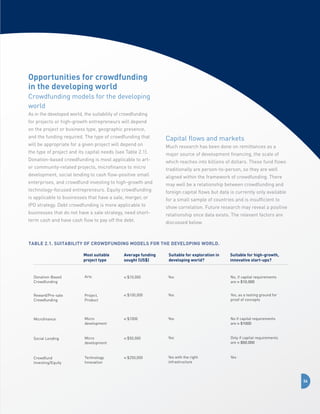
global venture capital
investments
•  lobal venture capital funds deployed: total venture
G
capital funding deployed globally in 2012 was US$51.7
billion (Ernst  Young 2013). Almost 58 percent
was deployed in the United States alone, leaving
about US$21 billion in VC funds invested in the rest
of the world. At US$93 billion, the potential size of
developing world crowdfunding would represent 1.8
times the total 2012 global VC figure.
markets that may suggest China’s potential size is much
smaller than this estimate. A more in-depth discussion of
crowdfunding in China can be found in Appendix B.

Crowdfunding risks: fraud,
failure and fulfillment
Both donation-based and equity-based crowdfund

Comparisons

investing campaigns present perceived and actual risks

Three data points (global savings, remittances, and venture

to investors. These risks broadly fall into

capital funds deployed) may help to provide basic points of

the categories of failure, fulfillment, fraud, and

comparison for the relatively conservative market estimate

money laundering.

of US$93 billion. These data points are included to compare
recent data on the volume of investment capital utilization
with the estimated size of the crowdfund investing market
over the next 20 years:
•  eveloping world savings: total savings in the developing
D
world was US$6,304 billion in 2010.15 At US$93 billion, the
estimate for crowdfund investments would represent 1.5
percent of the total developing world savings rate.
•  iaspora remittances: diaspora remittances to developing
D
countries were estimated to be US$372 billion in 2011.16
Research by the World Bank17 indicates that remittances
typically are used for “financial defense” measures, such as
keeping children in school or staying in a home. More study
will be required to determine if crowdfund investing can
or will cause remittances to be deployed in different ways
to help individuals build greater financial security through
the growth of their own businesses. If so, at a US$93 billion
market potential, crowdfund investing could deliver an
additional 25 percent more capital to developing countries
than that currently received through diaspora remittances.
http://www.econstats.com/weo/CEmer200.htm
http://web.worldbank.org/WBSITE/EXTERNAL/TOPICS/0,,contentMDK:219
4020~pagePK:5105988~piPK:360975~theSitePK:214971,00.html
17
http://web.worldbank.org/WBSITE/EXTERNAL/NEWS/0,,contentMDK:20648
762~pagePK:64257043~piPK:437376~theSitePK:4607,00.html
15
16

Donation-based crowdfunding risks
Data from the major existing platforms show no
successful fraud has been perpetrated through pledgebased crowdfunding platforms. Attempts at fraud have
been made but were thwarted by the transparency
inherent in crowdfunding: would-be investors asked
questions and challenged the fraudulent postings,
revealing the frauds and resulting in their removal from
funding platforms within 24 hours.
The primary risk to consumers from donation-based
crowdfunding is fulfillment risk. Some companies
raise funds through crowdfunding without having
thought through production, shipping, tax issues, and
other essentials of their business model. There have
also been examples of technical failure risk, usually
involving the presale of software. In these cases
companies received funds for products they intended
to build, but technical problems prevented them
from shipping the product. It is difficult for donors to
differentiate “intention to produce” from “capability to
produce”, so platforms’ policies should be reviewed
to determine who is responsible for handling partial
refunds or alternative gifts.

44
The key lessons fundraising entities can learn from past
fulfillment delays include the importance of periodic
updates to supporters that alert them to any problems
and explain what the firm’s principals are doing to
address them. In the case of Kone, the company
experienced severe delays, but managed the process to
a successful conclusion by engaging with sponsors and
providing updates about the bottlenecks, efforts taken
to address them, and updated times to delivery. It is
likely that Kone would have faced the same problems no
matter how it was funded, but without the support of the
crowd, it probably would not have confronted and fixed

be less qualified to make informed decisions about
investments in private companies. While these investors

the challenges as quickly.

may not actually lack sufficient sophistication, platforms

Crowdfund investing risks

guaranteed.

Any sale of securities comes with risk to the investor.
CFI is not unique in this regard, but it does have
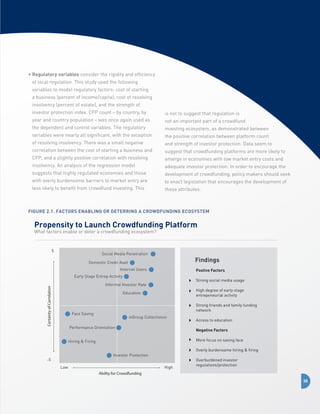
characteristics that require regulatory protection and
robust investor education for crowdfunding to contribute
meaningfully and successfully to a country’s economy.
The most common risk to investors is perhaps the
primary risk they face in any corporate investment:
business failure risk. Experienced investors know
that investing in early-stage companies is riskier than
investing in later-stage companies with revenue history,
mature management teams, and adequate structure.
Publicly available data from the developed world shows
that up to 50 percent of start-ups fail within five years.18
Potential investors need disclosure documents to help
them understand these risks, the lack of guarantees,
liquidity limitations and other potential pitfalls. In
addition to disclosure, CFI portals and trusted third
parties should provide robust, easily understood
investor educational tools.
Another possible risk relates to a lack of investor
sophistication. CFI primarily is targeted at
nonaccredited, nonprofessional investors, who may
18

http://www.sba.gov/sites/default/files/sbfaq.pdf

should communicate clearly that investments are not

Fraud is a legitimate concern. Successful fraud with
crowdfunding has been relatively rare, however. While
most fraud is perpetrated on a one-to-one basis (for
example, an identity meme solicits personal information
via e-mail), fraud in the context of the social media
and CFI in particular would have to occur on a manyto-many basis: a potential fraudster would have to
stand up to the wisdom, queries, and insights of the
entire crowd. For this reason the most likely scenario
for successful fraud involves criminals creating fake
crowdfunding platforms and fake companies to attract
investors’ money.
Money laundering is another legitimate concern, but
the risk of it occurring does not appear greater with
CFI than with other investing systems. Regulatory and
statutory schemes currently in place in the developed
world enforce anti-money laundering compliance
mechanisms, and the three largest donation platforms
– Kickstarter, Indiegogo and RocketHub – are fully
compliant with international and U.S. anti-money
laundering laws. The mechanisms used by electronic
payment processors and clearinghouses also contain
protection against money laundering.
45
Seven years, very little fraud

Of the 43,193 projects funded through Kickstarter, there

Despite the rapid expansion of crowdfunding platforms,

are four documented cases of attempted fraud (Mims

there has been little evidence of any fraud on current

2013). One was a campaign to raise capital for a video

standards-based crowdfunding platforms. Australia

game. The campaign received numerous questions

presents an illustrative case study. The Australian Small

and accusations on the Kickstarter comments page

Scale Offerings Board (ASSOB) was founded in 2007 and

that the game developer was unable to address. This

is now the largest investment crowdfunding platform

response, combined with the revelation that many of

in Australia and one of the largest in the world. It is an

the images and content in their pitch were taken from

equity-crowdfunding platform that has successfully served

other companies, was seen as an indicator of potentially

both accredited and unaccredited investors, raising more

fraudulent activity and the campaign was quickly shut

than US$130 million for issuers since its inception. Some

down without any donor losing money.

176 companies have been funded to date and not a single
case of fraud has been reported. ASSOB operates within

Because no case has been filed, it can be hard to tell

the current securities structure in Australia.

the difference between a fraud and a well-intentioned
project whose creators failed to fulfill on their promise.

Further, Crowdcube, the largest equity-based

The most notorious example was a Kickstarter project

crowdfunding platform in the United Kingdom, has

called ZionEyez, which claimed to stream video directly

been operating since February 2011 and has funded

from a pair of eyeglasses to a person’s Facebook

29 companies with more than US$6.75 million, with no

stream. The project netted US$343,415 in 2011, and the

reported fraud. Crowdcube operates within the current

creators have yet to deliver its product (Gibbs 2012). The

securities framework in the United Kingdom and allows

company, which has since changed its name, still claims

issuers to raise equity capital using an online portal.

it intends to deliver and is seeking outside capital.

Figure 2.4. Risk Mitigation Techniques

Chances for Fraud

Higher

Lower
No Risk
Mitigator

Crowdfunding
Regulation

Goverment
Oversight

Regulated
Crowdfunding
Portals

Background
Checks

Mandated
Disclosures

Social
Network

Investor
Caps 
Education

Mandated
Reporting

46
Fund transfers in crowdfunding
A crowdfunding investor must deposit investment
funds directly through an electronic automated
clearing house (ACH) transfer into an escrow agent
on behalf of the funding portal. The funding portal
may not handle such funds. The use of escrow agents,

Anti-money laundering laws19

registered banks, and regulated ACHs provides a
robust framework for compliance and auditing.

Anti-money laundering (AML) is a term mainly used
in the financial and legal industries to describe the

As governments evaluate how to enact appropriate

legal controls that require financial institutions and

regulation of this new asset class, they must carefully

other regulated entities to prevent, detect and report

balance twin goals: to provide an open enough

money-laundering activities. AML guidelines came into

market for businesses to raise capital in efficient

prominence globally as a result of the formation of the

ways, while creating enough structure so investors

Financial Action Task Force (FATF) and the promulgation

are appropriately protected. Much of this balance will

of an international framework of AML standards. These

be informed by the specific cultures involved, which

standards began to have more relevance in 2000 and

may introduce very different models for success in

2001 after FATF began a process of publicly identifying

different regions.

countries that were deficient in their AML laws and
international cooperation, a process colloquially known
as “name and shame.” An effective AML program
requires a jurisdiction:
• To have criminalized money laundering.
•  o have given the relevant regulators and police the
T
powers and tools to investigate.
• o be able to share information with other countries as
T
appropriate.
•  o require financial institutions to identify their
T
customers, establish risk-based controls, keep records,
and report suspicious activities.
This section was based on information and guidance from Doug Ellenoff,
securities attorney with Ellenoff, Grossman  Schole LLP.

19 

Possible risk mitigation tactics
There are steps governments can take to reduce the
opportunities for fraud to occur. These techniques
may be considered in totality rather than individual
recommendations as a means to deter bad actors.
By creating a process that comprises of number of
techniques it may be possible to significantly reduce
the risks to investors and entrepreneurs
(see Figure 2.4).
A series of protective mechanisms have been enacted
internationally to mitigate potential fraud, as outlined
in Table 2.2.

47
Table 2.2. Protective Mechanism against Potential Fraud.

Type

Risk

Rationale

Mitigation Tactic

Business

Fraud

The securities markets have
examples of fraud

• Background checks for issuers
• Mandatory auditing, financial disclosures and
business reviews
• Requiring all-or-nothing financing (prevents
fraudsters from raising money and then
disappearing when donors ask difficult questions)
• Restricting or monitoring social media
communication about offerings
• Requiring all crowdfund raising to take place on
portals that are registered with a national regulatory
body that oversees securities
• Providing investor education to learn how fraud has
been perpetrated in the past so that investors can
identify it in future
• Mandatory holding periods to prevent
pump-and-dump schemes

Business

Failure

Crowdfund investments offer
no guarantee of return

• Educating investors about portfolio diversification as a
means to prevent total loss of investment(s)

Business

Anti-money
laundering

Using businesses as a cover
for illegal money transfers

• Placing caps on amounts that may be raised in specific
time periods
• A “cooling off period” between reaching the funding
target and funds transfer to allow for further diligence
by investors and regulators

Business

Sector risk

Crowdfunding has had the
most traction in consumer
products and extensions of
popular brands or games

• Build on small successes in areas like science and
energy
• Raise small amounts of capital to show market interest
and customer validation
• Consider leveraging the crowd for only a small part of
the overall capital raise to identify interest and de-risk
the bigger investment

Business

Subsequent funding
failure

Bringing on crowdfund
investors creates a more
complicated investor table
that may deter subsequent
investors

• Consider the use of a Special Purpose Vehicle (SPV) to
group all crowdfund investors into one voting group to
ease communication and voice
• Offer to buy out crowdfund investors at subsequent
rounds of financing at the current price

Investor

Investor liquidity and
losses

Crowdfunded stocks are not
liquid, businesses do fail and
investor can lose their
investments

• Investment limits for nonaccredited investors
• Allowing for crowd vetting and crowd diligence to
discuss the merits/risks of the offering in a public
manner
• Promote the creation of secondary markets after a
12-month holding period where shares may be traded
based on supply and demand

48
Table 2.2. Protective Mechanism against Potential Fraud. (CONT.)

Type

Risk

Rationale

Mitigation Tactic

Entrepreneur

Lack of issuer
experience

Entrepreneurs do not always
have all the experience
needed to build, run, and
raise capital for a business

• Create education programs about how to build a
business
• Create education programs about how to raise money
from the crowd and follow through with a plan once
funded
• Requiring the participation of either a securities
broker/dealer, an attorney or accountant

Regulatory

Regulatory and
compliance risk

Regulatory bodies may resist
or reject the argument that
crowdfunding is an
appropriate and effective
method of financing
early-stage companies

• Work with local governments prior to offering
crowdfund investing
• Engage with local regulatory and policy constituents to
build crowdfunding frameworks

Industry

Market rejection

Investor community might not
have an appetite for this new
emerging asset class

• Leverage the media to share success stories of
businesses that have been successful with
crowdfunding investing and jobs that have been
created
• Share early financial engagement stories of investors
who have backed crowdfunded companies and why
• Offer crowdfund investments in tandem with more
traditional investments to act as an honest broker

49
3. Policy and
Recommendations to
Enable Crowdfunding
Key points:
•  eveloping nations could use emerging technology
D
and business processes to implement crowdfunding
systems more advanced than those in the developed
world.
•  ighlights the key elements of a robust crowdfunding
H
ecosystem - entrepreneurial culture, economic
regulation, community engagement, and technology –
highlighting trust as the key enabling factor.
•  utlines a framework so that policy makers, NGOs,
O
and the private sector can begin to evaluate their own
country’s readiness for crowdfunding.
•  ffers a distilled set of recommendations for policy
O
makers and development organizations considering
supporting crowdfunding in the developing world,
including a checklist of focus areas for countries
evaluating crowdfund investing.

An opportunity to leapfrog the
developed world

A healthy business climate requires the right mix of
government infrastructure, entrepreneurial culture,
and community engagement. Successful businesses
operate within a sphere of trust that includes
customers, community, and government. Businesses
look to governments to create regulatory regimes that
provide structure and predictability but do not overly
impinge upon businesses’ ability to grow. Businesses
also must have access to financial and human capital.
Many developed nations have succeeded in aligning
these variables in ways that facilitate the formation of
businesses, trust, orderly markets, and economic growth.
Some developing countries, however, are lagging behind.
It may be possible for developing nations to use emerging
technology and business processes – including mobile
technology, social media, lean-start-up methods of
company formation, and crowdfund investing – to
implement entrepreneurial funding systems that are
more advanced than the legacy systems prevalent in the

Crowdfund Investing (CFI) may offer a new path for

developed world. A developing country’s ability to leapfrog

developing countries that wish to support early stage,

developed nations depends in part on the speed and

high-growth entrepreneurship and innovation. Countries

commitment with which its stakeholders embrace these

in different stages of development will need different

new technologies and methodologies.

strategies to tailor their paths to success to social,
cultural, economic, and technological norms. Aggregated

This chapter provides explanation for this initial model,

global data on these norms was used to develop a

providing policy makers, NGOs, and the private sector a

model to study countries where crowdfunding has been

framework with which they can begin to evaluate their

launched successfully.

own country’s readiness for crowdfunding. It also offers

50
a distilled set of recommendations for policy makers
and development organizations considering supporting
crowdfunding in the developing world, including a checklist
of focus areas for countries evaluating crowdfund investing.

Entrepreneurial culture
Crowdfunding depends on the existence of an
entrepreneurial culture within a country. The
literature demonstrates that issues such as
culture, legal environment and economic incentives

Elements of a robust crowdfund 	
investing ecosystem

influence the development of industries and the
success of entrepreneurial firms. These factors

The literature on strategy, science and technology studies,

can either constrain or enable entrepreneurial

and economics substantiates the hypothesis that the right

activity. Governments should therefore encourage

blend of social, cultural, economic and technological norms

entrepreneurial culture by supporting initiatives for

can foster crowdfunding ecosystems around the world (see,

co-working spaces, incubators and accelerators,

for instance, Aldrich and Fiol 1994). In order for a crowdfund

mentorship, and so on. Regulatory institutions may

investing ecosystem to grow in a country, policy makers

promote or hinder entrepreneurship by shaping the

must focus on the key enablers that have been identified

level of risk involved in the formation and incorporation

in this study. There are four key interlinked elements:

of a business. Likewise, entrepreneurial behavior

entrepreneurial culture, economic regulation, community

is influenced by the rules and their enforcement.

engagement, and technology, as shown in Figure 3.1, and

An example of how the linked factors may influence

described in detail below.

innovation is described in Box 3.1.

Figure 3.1. Four Elements of a Robust Crowdfunding Investing Ecosystem

Policy makers must focus on key enablers

Economic Regulations
Enabling policy from
incorporation to bankruptcy, a
regulatory framework for
crowdfund investing, policy to
enable North-South flows

Entrepreneurial Culture
Co-working spaces,
incubators and accelerators,
peer-to-peer mentorship,
oversight, investor
relations/reporting

Economic
Cultural

Technology
Internet access, regulated
portals to facilitate the
process, technology to
facilitate the ongoing
communication and new
services to facilitate
transactions

trust
relationships,
economic
predictability
and execution

Technology
Social

Community engagement
Social network, social
vetting, startup events 
culture of trust

51
BOX 3.1. E*Trade: a Regulatory
Change that Created an Online 
Investing Industry.

The rise of online trading altered the market 	

One example of the interplay between these 	

untrained, has the ability to conduct extensive 	

institutional arrangements and technological 	
progress can be observed in the United States, 	
where changes in the regulatory arrangements 	
for online investing drove technology innovation 	
and market acceptance. For decades prior to the 	
mid-1990s, investors had to contact a broker by 	
phone or in person to perform a stock or bond 	
trade. The launch of E*Trade transformed this 	
process. For the first time, individuals could 	
perform online transactions that previously 	
were limited to individuals with specific training 	
located in central offices.

landscape, permitting untrained investors to engage
in the market on their own terms, from anywhere. 	
It created a new class of investor that, while 	
research, collaborate with colleagues, and execute
trades. Regulators also benefited, as systematized 	
procedures, greater transparency and improved 	
timeliness of information has enabled better tracking
and enforcement of securities laws.
At the time of E*Trade’s launch, skeptics suggested
that most consumers were unable to understand or
conduct securities transactions, and that online trading
would not catch on. Nearly 20 years and hundreds of
billions of dollars in transactions have demonstrated
that those predictions were inaccurate.

BOX 3.2. Nurturing 
Entrepreneurship in Nairobi’s 
high-growth start-up
ecosystem.

Innovation Center (CIC) and mLab, have created

Entrepreneurship is part of the Kenyan culture, with

funds in the country, hopefully paving the way for

the majority of the economy in Kenya made up of
small business owners. Yet three years ago there
were virtually no co-working spaces, incubators
or accelerators. TEDx recently held its first event
there, and entrepreneurship was barely studied at
academic institutions. Over the past three years,
the political and economic environment started
to improve. Collaboration and communication
among aspiring entrepreneurs has grown. Start-up
Weekend celebrated its second anniversary, meetups have expanded (there had been 13 by September
2013), co-working spaces have popped up (30 by
September 2013) and Nairobi saw the launch of a new
accelerator, 88mph. In addition, programs supported
by the World Bank and infoDev, such as the Climate

a center of gravity for innovators, entrepreneurs,
and investors in specific sectors. The launch of
the CIC’s Seed Capital Fund will be one of the first
public–private blended early-stage investment
continued sub-US$ 1 million investments in Kenya’s
technology sector.
Such programs are encouraging more expatriates to
return to Kenya to start businesses, prompted by the
relative political stability and a growing awareness
of capital markets. The Kenyan government is
striving to increase the freedom of markets, and an
ecosystem of entrepreneurship is starting to flourish.
As crowdfunding begins to occur in Kenya, it might
present new ways to find funding for entrepreneurial
pursuits, potentially stimulating additional interest
in starting new ventures. If this trend does stimulate
entrepreneurial activity, more innovation and job
creation might follow.

52
Crowdfund investing is
unlikely to thrive if social
networks do not exist
or communities lack
constellations of trust
looking for solutions to problems, knowledge, experience,
and strategies to create sustainable businesses and
jobs. Governments can support these activities through
education campaigns about the value of entrepreneurship,
creation of spaces for co-working, direct sponsorships,
offering prizes to contestants, and providing physical
support for their activities. Governments and NGOs could
engage marketing partners with capital ranging from local
law and accounting firms to consulting firms to major
Technology
Using technology to facilitate and streamline the
incorporation process can help to address this problem.
Technology can help governments improve oversight
of the business ecosystem and derive more accurate
figures for hiring, profits, and taxes. Governments can
provide greater access to capital for companies that
register, potentially motivating entrepreneurs to create
additional businesses or existing businesses to join the
official economy.

consumer goods companies. They may look to engage
partners that want to position themselves as supportive of
entrepreneurship, innovation, and jobs. An example of how
this has been done in Kenya is briefly explained in Box 3.2.
All of this contributes to building a community of trust, the
key enabling factor. This is explored in more detail below.
Trust: the enabling factor
The single most important element supporting a
healthy entrepreneurial ecosystem is trust – between
entrepreneurs, funders, and customers. Trust is a belief

Economic regulation
Countries seeking to create the conditions for crowdfund
investing must address policies and regulations that make
it burdensome to enter into, conduct, and end business
operations. For example, incorporation in many developing
nations is overly bureaucratic, time-consuming and costly.
Countries also need to ensure that bankruptcy procedures
are not so onerous that entrepreneurs cannot risk the
possibility of business failure. Likewise, they may need to
manage important cultural issues, in particular to create
an atmosphere in which it is possible for entrepreneurs to
fail honorably.

system based on an individual’s perception of another
individual, group, company, government, or institution. It
is based in relationships: the closer the relationship, the
higher the degree of trust or distrust. Trust is a factor
that is typically evaluated by institutions at the national,
regional, or cultural level. But given the global footprint
of crowdfund investing, participants’ trust in it must
either transcend geographical or cultural borders or
operate within specific niches, as in diaspora investments,
relational investment, or investment curation efforts.
Crowdfund investment is based on seeking capital from
one’s social network to start or grow a business. Social

Community engagement

networks generally are “opt-in”, so the parties involved

As perks-based crowdfunding gains momentum,

already have a degree of trust between them. This trust

governments and development organizations might use

helps members of those communities feel that they can

it to strengthen the culture of entrepreneurship. This

share information safely. Crowdfund investing is unlikely

culture could encourage entrepreneurs to assemble and

to thrive if social networks do not exist or communities

collaborate at events like Start-up Weekends, meet-

lack “constellations of trust” between members of the

ups, co-working spaces, TED events, and business plan

community, because investors will not be able to trust that

competitions. Such events facilitate the free and flexible

founders will fulfill their promises and create a return on

exchange of ideas, and engage local communities that are

that investment (see Figure 3.2).

53
Examples of circles of trust include angel investment
groups and networks, which curate early-stage start-ups
and help them prepare for additional rounds of growth
financing. Where this kind of trusted community exists,
implementing a crowdfund investment ecosystem can
provide parallel capital from the broader community.
Investments from the crowd demonstrate the
community’s trust in the business and the entrepreneur,
and create a class of customer-investors who share a
vested interest in the success of the business and can act

offline identities with their online profiles. This allows

as a marketing engine.

an investor/potential investor who knows the company/
entrepreneur offline, to advocate via online channels for

As online communities have become more sophisticated,

them. Already, new reputation systems and transparency

it has been noted that while some types of community

tools are being created to help increase the speed and

engagement may occur in an anonymous fashion (for

depth of online trust in financial transactions.

example, blog comments or news article comments
in open online forums), where the stakes are higher

Once a functioning constellation of trust has been

and trust is required for transactions to be completed,

created, the ecosystem for crowdfunding can function

individuals must reveal their identities and connect those

effectively (see Figure 3.3).

Figure 3.3. Communities and Circles of Trust

The social web can now connect communities of interest, origin, geography and diaspora, providing
infrastructure for them to invest capital in entrepreneurs, companies and industries they believe in.

Traditional friends 
family financing
Crowdfunding provides the
infrastructure to reach your network
of people who would invest in you,
but also to draw upon their
networks to invest.
Crowdfunding within trust network/third party network

54
crowdfunding site in the developed world, people participate
in noninvestment crowdfunding
for the following reasons:
•  ecause they are inherently interested in the topic area,
B
business or project.
• To be part of something larger than themselves.
•  o help someone to reach a goal or follow
T
their dream.

Creating lightweight, technology-enabled
securities and business infrastructure

• To receive the perk or reward for participating.

Buying and selling securities is generally a highly

All of these reasons can be harnessed in developing equity,

regulated activity. Policy makers considering CFI need to
strike a balance between regulation and capital formation.
A government must be amenable to a structure that at
minimum facilitates basic forms of CFI (such as common
stock and straight-debt). Such regulation would need to

debt or revenue-share crowdfund investing, while adding
the profit motive and supporting economic development as
two important reasons for individuals to participate.

should take place on platforms that are registered with an

Decision framework to evaluate
the opportunity for crowdfund
investing

oversight body. This framework will channel investments

Not all countries are ready for crowdfund investing.

and reduce the appearance of bad actors. The role of

Indeed, for many countries it may not be possible in the

vetting opportunities should not fall to regulators, however.

foreseeable future. A framework can help organizations

allow companies to incorporate and report the status of
their businesses online. To prevent fraud, transactions

and governments evaluate whether and how much
For countries that are not yet ready to move directly to

crowdfunding can support the achievement of socio-

crowdfunding using equity- and debt-based securities,

economic goals. The remainder of this section covers topic

trusted institutions and development organizations might

areas that governments, development organizations, and

consider implementing perks-based crowdfunding, such

NGOs may consider when developing a CFI framework.

as inventory pre-purchasing. This can be part of a larger

The questions probe cultural, societal, regulatory, and

strategy to implement investment-based crowdfunding

technical barriers. Their answers reveal a variety of

over time. In perk-based crowdfunding money is given

challenges and opportunities. This framework may provide

without an expectation that it will be returned, so it does

a starting point for constructive debate around potential

not need to operate under regulation.

strategies to deliver expanded access to capital for
entrepreneurs and new ventures.

Helping citizens gain familiarity with crowdfunding
through pledge, donation, or inventory pre-sale platforms
helps accelerate the launch of subsequent equity-based

A. Capital requirements to create an adequate market
opportunity

platforms, especially in those countries with greater

•  etermine the size of the funding void in a country. How
D

than average use of social media. Greater familiarity with

much do entrepreneurs need to be able to raise to enable

crowdfunding will also stimulate entrepreneurial activities

most small businesses to benefit? The typical funding

and channel consumer behavior to support them. According

void for early-stage companies in the developed world is

to Brian Meece, CEO of RocketHub, the third-largest

below US$ 1 million.

55
B. Investment structures and necessary participants
•  reate an initial list of commonly used equity and debt
C
instruments that are best for early-stage companies.
What are typical arrangements and valuations?
What are standard terms? These must be evaluated
according to cultural norms. Start with common
stock and simple debt, and possibly continue with
structures like revenue-based financing.
•  n efficient crowdfund investment marketplace
A

•  hat methods should be used to create and
W
disseminate broad-based education to investors

requires credible participants. Consider which market

to teach them about risk and portfolio strategy, such

participants are allowed or disallowed from offering

as limiting their high-risk investments to less than 10

crowdfund investments. What bad actor provisions are
currently in place to allow for transparency?

percent of their savings?
•  o any other investment protection mechanisms need
D
to be included?

C. Evaluating and building investor sophistication
•  nvestors need a certain amount of information about
I
a business to make an investment decision. They

D. Regulatory challenges to address in building a
crowdfunding ecosystem

also need to understand the risks associated with

•  ime, cost, and bureaucracy are the main reasons
T

such investments. What are the right risk-related

businesses operate outside of legal structures. Identify

disclosures and other information to provide to

the laws, regulations, and/or processes governing

investors? What investor education can be created or

business incorporation that must change or be adapted

replicated to educate about the high-risk nature of

to streamline the process.

early-stage company investments?

•  xplore national or local rules that make it difficult for
E

•  nvestors need a minimum understanding of
I

businesses to start or expand their operations. If there

owning shares or loaning money. Such basic

is a permission process, what changes can be enacted

understanding can “qualify” them as prepared to
make an investment. What is the right way to “qualify”

easily to improve its function?
•  ontrolling how individuals receive investment
C

crowdfund investors? Should there be a formal

solicitations is critical to preventing fraud. Explore

qualification requirement?

guidelines to consider regarding how people will solicit

•  apping the amount of individual investments in a
C

other individuals to purchase shares in a company.

crowdfunding campaign is one way to provide investor

How do you create an investment exemption that is big

protection. What might be the limit each person could

enough to allow businesses to have the opportunity

be allowed to invest? What is this based on – annual

to succeed, but not so large that it creates panic from

income and/or net worth?

regulators? The ideal mix is a large reach with low risk.

•  aychecks, tax returns, and investment statements
P

•  overnments and/or institutions need to track which
G

can certify that investors make a certain amount of

organizations are raising capital. Businesses need

money or have a certain amount of savings – but

to be able to report without being overly burdened.

requiring disclosure of this information may deter

Regular reporting requirements must be created for all

investors from investing. What is the right blend? Can

companies that raise money from crowdfund investing.

investors “self-certify” that they fall within an income

Institutions should consider and standardize the

or net worth bracket to qualify to make investments?

components of this reporting.

56
•  ow will the government and the securities regulatory
H

in place to ease the burden of bankruptcy, so that the

authority control the purchase and sale of crowdfund

possibility of failure is a risk but not an overriding reason

securities? Can simplified versions of systems used in

to avoid entrepreneurship?

public markets provide transparency without limiting
speed or effectiveness? These presumably would be
online transactions, in order to achieve scale and cost
efficiencies; what form of existing escrow or transfer
agents can be used?
•  nti-money laundering and anti-terrorist funding efforts
A
are critically important to capital flows. Regulators
should recognize that the crowdfunding industry has
high motivation for the market to form in an orderly
fashion and to abide by existing laws. How can market
regulators work with crowdfunding entities to address
anti-money laundering and anti-terrorist funding issues?
•  ankruptcy laws in which bankruptcy repercussions
B
follow early-stage entrepreneurs around for life threaten
to deter entrepreneurship. What policies can be put

E. The role of disclosures in building transparency
•  nvestors need standardized and efficiently delivered
I
information about business plans, use of proceeds,
valuation and other issues in order to make investment
decisions. Consider what information an entrepreneur
must provide to investors to seek crowdfund
investments, and how technologies such as online
business planning software can facilitate this disclosure.
•  ompanies need laws protecting their intellectual
C
property and reliable structures for enforcement. What
is the right way to balance the need for disclosure and
the ability for companies to maintain trade secrets and
proprietary information? What intellectual property laws
exist or need to be enacted to protect trade secrets?

Figure 3.4. Government, NGO  Private Sector Recommendations

Specific strategies to drive crowdfunding

Economic
•  raft exceptions to securities regulations that
C
allow easy registration for equity and the debt
crowdfund offerings
•  trategically tie crowdfunding to patriotic and
S
cultural messages
•  orm a crowdfunding market alliance
F

Technology
•  here appropriate, apply lessons learned from
W
developed world
•  onsider buy, build or white label
C
•  etermine gaps in exisitng technology for online
D
financial transactions

Social
•  arness top social media experts/bloggers/
H
tastemakers to communicate with local audiences
and with diaspora audiences
•  old media and educational events to build
H
awareness and understanding
•  old regular crowdfunding events with trusted
H
third parties to teach successful techniques

Cultural
•  everage exisitng incubator/accelerator/
L
structured co-working spaces as hubs for
innovation in funding
•  oster professional investor  consumer
F
confidence in crowdfunding through education
and communication
•  ncourage the participation of women and girls
E

57
BOX 3.3. A Case Study in Crowdfunding Accreditation: Turkey.
The Turkish government is creating an angel

Caps

community in order to deepen its capital markets. The

• Individuals

Turkish Treasury is developing regulations for a new

	The maximum number of individual PII

law that incentivizes angels to invest in Turkey-based

investments is 10 per five-year license term

businesses. It is approaching the issue of accreditation

(in addition to the 10 investments per five-year

by considering knowledge and experience as well
as the ability to bear financial loss. The government

license term that partnership PIIs can make);
	Minimum individual PII investment in any one

requires personal qualifications to obtain an angel

business is TL20,000 (about US$11,500) and

investor license, sets investment limits, and grants tax

maximum is TL1 million (about US$555,555)

incentives to encourage angel investment.

per year.

Angel investors, known as participant individual

• Partnerships

investors (PIIs), must obtain a five-year license from

	For partnership PIIs the maximum number of

the Turkish Treasury. To qualify, a PII must satisfy the

investments is 10 per five-year license term

following criteria:

(in addition to the 10 investments per five-year
license term that individual PIIs can make);

Income/Net Worth
•  ave annual income of at least TL200,000 (about
H
US$111,500) during the two-year period before being

	The maximum partnership PII investment in
any one business is TL2 million (about US$1.1
million) per year.

granted a license; or
•  eal and monetary assets with a value of at least TL1
R
million (about US$555,555).

Turkey is also using tax incentives to encourage
angel investments. These incentives range from
75 percent of the investment amount, if held for at

Experience

least two years, up to 100 percent if the business

• Have at least two years’ experience as a manager or

received a grant from a qualified Turkish ministry,

equivalent position in fund management, financing or

council or development organization.  

private equity; or
• Be a deputy director general (or equivalent position) in

The Turkish model requires registration based

a company with at least TL50 million (about US$27.8

on income or worth, combined with financial

million) annual revenue for at least two of the five

understanding. It provides a tax incentive for

years prior to licensing; or

Turkish residents, and has minimum requirements

• Have been a member of any PII network for at least

that will foster capital formation without

two years and have participated in at least three

overburdening a company’s capital table with

nonpublic corporations prior to licensing.

investors while providing individual investors scope
to participate with greater capital. The system

Residency

could be streamlined considerably, however.

• PIIs must have lived in Turkey for at least six months

With currently available technology platforms,

and have ties to the Turkish business community.

Turkey could create certification and monitoring

Residing in Turkey for a temporary job or duty, even if

procedures that would be far less burdensome.  

longer than six months, does not qualify.

58
Economic
1. Craft exceptions to securities regulations that allow
easy registration for equity and debt-crowdfunding
offerings. Create exceptions or exclusions in
securities laws that allow for the registration of
crowdfunded securities without undue regulation
or expense. If exemptions to private offerings exist,
follow the logic behind them. Ideally, registration
would be an entirely online process. If the cost of
raising capital, combined with the expense and effort
•  ddress other issues or country-specific business
A
practices that are unique to the ecosystem.
F. Understanding circles of trust and addressing 	
cultural issues
•  or CFI to flourish, a degree of trust, understanding
F
and collaboration must exist between governments,
investors, and entrepreneurs. How do you create a
culture that encourages entrepreneurs and investors to
trust each other? What current systems or technologies
exist, either in-country or in other markets, that could
be used or adapted to help grow this culture?
•  ear of failure and of the stigma attached to failure
F
deter entrepreneurship. Entrepreneurs learn from
mistakes and need to be trained to take calculated risk.
How can regulations reflect this need, and how can
regulators and policy makers address outdated laws
that make failure too risky?

of completing the campaign, are perceived to be too
high, entrepreneurs may choose to remain part of the
gray market economy rather than using crowdfunding
platforms. An example of how this was tackled in
Turkey is described in Box 3.3.
2. Strategically tie crowdfunding to patriotic and
cultural messages. Countries should craft culturally
appropriate messages, distributed over both social
media and traditional media, that suggest that CFI is a
new and innovative way of putting money in the hands
of local companies that will hire employees and help
the domestic economy as well as the country as a
whole. Where there are ethnic or geographic divisions,
find opportunities to highlight how crowdfunding can
help all groups, and in particular where it can create
shared successes between groups.
3. Form a crowdfunding market alliance. For

Recommendations for
governments, NGOs, and the
private sector

crowdfunding to succeed it will require the active

As already described in this report, countries will

marketing partners’ alliance that can provide products

encounter a number of issues as they attempt to

(such as donations in the forms of technology or

implement crowdfunding. This section provides a list

meals for events), services (free rent, free legal or

of policy and strategic recommendations relevant to

accounting services), or capital contributions that

governments, NGOs, and the private sector to address

may foster the ecosystem. Consider ways to engage

the economic, social technology and cultural challenges

traditional funders like local banks, credit card

(see Figure 3.4).

companies, private equity, angels, and investment banks.

participation of an entire ecosystem of supporters.
These supporters extend to marketing partners in
addition to entrepreneurs and investors. Forming a

59
Social
4. Harness top social media experts, bloggers and
tastemakers to communicate with local and diaspora
audiences. The data clearly show that strong social
media use is critical to success in crowdfunding. Work
with leading voices in a country or region that can
speak authentically with their audiences regarding
the power, value, and importance of crowdfunding.
In addition, given the strong relationship between
foreign direct investment, foreign remittances, and
crowdfunding success, the government or sponsoring
organization should plan an outreach campaign to
diaspora members beginning at least three months

of commerce.
Having events at a
chamber and encouraging
the participation of the local
business community may also foster
dialogue about local business needs.
Technology
7. Where appropriate, apply lessons learned from
developed world. With billions of dollars in crowdfunding

before launch of the platforms.

already taking place globally, a body of knowledge already

5. Hold media and educational events to build

world on how to start and effectively grow a crowdfunding

awareness and understanding. CFI needs to have
broad community support within the high-tech and
start-up communities. Use events and competitions,
in conjunction with accelerators and universities, to
draw attention to the new form of investing among
youth and entrepreneurial communities. Ideal
partners could include subject matter experts and
groups such as Startup Weekend. Such events may

exists that can inform market actors in the developing
ecosystem in their countries or regions. Australia, the
United Kingdom, Italy, the Netherlands, and the United
States all have approved some version of crowdfund
investing. While developing countries face many distinct
issues and challenges, they have opportunities to
leverage the developed world’s experiences in order to
leapfrog these other countries in the use of all forms of
crowdfunding and crowdfund investing.

be held at academic institutions or local chambers of
commerce.

Cultural
8. Leverage existing incubator, accelerator and structured

6. Hold regular crowdfunding events with trusted

co-working spaces as hubs for innovation in funding. Trust

third parties to teach successful techniques. Create

and relationships are the cornerstones of crowdfunding.

“Crowdfunding Weekends” for both technical products

Accelerators and incubators are well positioned to provide

and services. Have the participants take part in a

crowdfunding deal flow and engagement. Market actors

three-day competition where they pitch ideas to

and governments significantly improve chances for

the attendees on the first day, with the best ideas

success by working in collaboration with trusted entities

chosen to move forward. Organize teams consisting

such as infoDev’s Climate Innovation Centers (CICs) and

of technical, graphics, business development,

Mobile Applications Labs (mLabs). Allowing entrepreneurs

and marketing professionals, and task them with

and other responsible groups or individuals to lead this

developing a crowdfunding campaign around their

effort, with the support of other institutions, increases the

product or service. Have the judging on the third day

chances for success. Conversely, central governments

graded by a seasoned team of investors as well as the

will have a difficult time leading the charge for collective

crowd, using a crowdfunding platform. Such events

action. Governments must be actively involved, but other

may be held at academic institutions, incubators,

entities, such as accelerators and trusted third parties,

accelerators, co-working spaces, or local chambers

are likely to be more effective at leading the effort.

60
who is well known and trusted in the country will help
attract additional capital. Co-investment schemes by
governments or development organizations to partially or
fully match crowdfunding targets of companies will help
to build confidence for both professional and individual
investors (see Box 3.4).
10. Build consumer and individual investor confidence
in crowdfunding. Where possible, the government or
9. Foster professional investor confidence in

sponsoring organization should reach out and attempt to

crowdfunding. Work to educate and convince existing

secure small investment commitments from well-known

investor networks and capital groups that CFI can be

business owners or celebrities in the country. Data show

a viable alternative to early-stage investing. Position

that the initial phase of a crowdfund campaign is crucial,

crowdfunding not as a competitor or market distorter, but

and that participation by people with large social media

as a means of gaining needed seed financing and proof

followings will help accelerate funding. Second, create a

of a viable market for early-stage companies. Assist

process that enables company-to-investor social media

investor networks in understanding that crowdfunding

communication (including but not limited to traditional

reduces risks for subsequent investors by exhibiting a

investor relations, disclosures and filings).

market for the company’s product or service.
11. Nurture authentic new-media relationships on a
Countries with limited experience with technology and

long-term basis. Changing cultural attitudes regarding

high-growth-potential start-ups can increase investor

risk, failure, entrepreneurship, collective action, and

confidence by marrying the launch of CFI to accelerators

other matters is no small task and will not be completed

or incubators, such as Climate Innovation Centers – that

with a few positive news stories about entrepreneurship.

is, to companies that have been vetted, trained, and

Consider innovative partnerships with new media to

screened. Syndication of the deal by a lead investor

create nontraditional campaigns that build momentum

BOX 3.4. The United Kingdom’s CFI
co-investment scheme.
In December 2012,20 the U.K. government and
Funding Circle announced that £20 million (about US
$32 million) would be lent by the U.K. government
to individual businesses via the Funding Circle in a
co-lending facility. The government would contribute
the last 20 percent of every loan that reached 80
percent of its goal from the crowd. By funding the
last 20 percent of loans, the government was able
to pursue its goals to put capital into the hands of

businesses while not adversely affecting the loan
bidding process on the Funding Circle platform.
In September 2013,21 as the U.K. government
announced a £900 million (about US$1,455 million)
decline in business lending during June-July 2013,
Funding Circle was able to report £14 million 	
(about US$23 million) in successfully funded loans 	
for the same period, an increase of 20 percent	
over the previous month and 250 percent over the 	
previous year.

https://www.fundingcircle.com/blog/2012/12/the-government-to-announce-plans-to-lend-to-small-businesses-through-funding-circle/
21
https://www.fundingcircle.com/blog/2013/09/peer-to-peer-lending-to-businesses-filling-the-void-in-small-business-finance/
20

61
around crowdfunding and crowdfund investing. These

Development organizations,
including the World Bank
and infoDev, could have an
important advisory role to
play In enabling responsible
crowdfund investing

campaigns should have commitments of at least two to
three years. Campaigns could highlight local success
stories, the entrepreneurs involved, the businesses,
and the local impact. Such stories may help engage
subsequent investors in other crowdfund opportunities.
12. Encourage the participation of women and girls. In
the developed world, women are active participants in
crowdfunding and a key component of the labor force.
In the developing world, women have led successes in
the microfinance industry. Moreover, there is an overt
connection between women’s access to social media
tools and the Internet and the long-term success of
crowdfunding. Crowdfunding has the potential to serve
as a vehicle to help women gain access to capital, build
networks through social media, and gain confidence
in the market through their victories in crowdfunded
campaigns. Gender equity leads to faster economic
growth; crowdfunding may provide another powerful way
to create business opportunities for women and girls.
The above recommendations may be considered a way to
foster “economies of trust.” Economies of trust rely on
building interconnected communities. Creating strong
local economies that are built on trust and transparency
may foster a stronger base for the country’s economy.

enable capacity, and invest (both directly and indirectly)
in ways that could extend the impact of crowdfund
investment and reduce the barriers to financing highgrowth entrepreneurs and technology-focused SMEs.
There are a number of other roles the World Bank
could take in these experiments – supporting pipeline
growth, vetting proposed investments, building capacity
within the entrepreneurial community to successfully
utilize crowdfunding platforms, supporting ecosystem
stakeholders enabling employment creation around
this potential new sector. Likewise, the World Bank
is well positioned to conduct further experimentation
and research, which is needed to determine whether
crowdfunding may serve as an appropriate funding
mechanism to support broad-based employment growth.
Within the Bank, infoDev has a particularly valuable
role because it has the agility to pilot new concepts at
the grassroots, and to scale workable solutions into
larger projects that support the World Bank Group’s
commitment to innovation and entrepreneurship.

The role of development
organizations
Simply introducing a new financing mechanism to a

infoDev supports the growth of a strong private
sector in developing countries in a manner that
leverages technology and innovation and feeds growth,
competitiveness, and inclusion.

country will not overcome the challenges of providing
early stage capital to entrepreneurs. Development

Over the past few years, infoDev has built on its success

organizations, including the World Bank and infoDev,

in incubating technology-enabled businesses to launch

could have an important advisory role to play in enabling

specialized programs aimed at promoting the growth of

responsible crowdfund investing by helping developing-

new ventures in the mobile, climate, and agribusiness

world stakeholders implement productive policies and

sectors. These programs provide technology testing

appropriate regulatory controls. In particular, the World

facilities, formal or informal mentorship, training

Bank is uniquely positioned to deploy infrastructure,

courses, and regular multi-stakeholder networking

62
infoDev has a particularly
valuable role because
it has the agility to pilot
new concepts at the
grassroots, and to scale
workable solutions.
infoDev’s unique grassroots network of business support
centers allows the program to crystallize that knowledge,
share it, and use it to set up cutting-edge innovation
centers across the globe. Crowdfunding may offer an
additional opportunity for capacity building that supports
the execution of infoDev’s existing mission. Options for

infoDev include:
opportunities, as well as traditional business incubation

•  acilitating skills training for entrepreneurs which
F

services. Supporting these strategic sectors contributes

overviews main tenets of crowdfunding and adapts

to growth and competitiveness and leads to the

“pitch training” to ensure online offerings are

development of value-adding jobs suited to the new

compelling;

knowledge economy.

•  everaging the infoDev brand, through Climate
L
Innovation Centers, mLabs, Agribusiness Innovation

In addition to its incubators, labs, and innovation centers,

Centers and other partners to verify company quality

infoDev is piloting acceleration approaches designed

standards and establish trust with the crowd;

to allow a new venture with particularly high potential

•  upporting angel investors or accelerators to serve as
S
anchor investors for the larger crowd;

for growth to increase its investability quickly. Through
intensive mentoring, re-evaluation of business strategy

•  ffering Proof of Concept grants to companies to
O
develop their crowdfunding campaign;

and, sometimes, a reconfiguration of service and product
offerings, they can help start-ups move from idea to

•  oordinating local pools of trusted service providers
C
to assist entrepreneurs with development of their

prototype in just a few weeks, and go to market in as little

crowdfunding campaigns;

as two months. Testing out these market concepts in
the crowdfunding space may serve to prove or disprove

•  ontinuing to provide business development services to
C

market validation and acceptance as well as interest in

entrepreneurs to ensure business models are globally
competitive;

funding. As such, infoDev is uniquely positioned to act
as an “honest broker” that assists in curating promising

•  ocumenting learning from crowdfunding initiatives to
D
positively impact crowdfunding enabling environment

companies, training founding teams, and providing
both monitoring and value-additive services related to

•  howcasing crowdfunding success stories and failures
S
from across the infoDev global network to positively

crowdfunding.

influence the global innovation and technology
entrepreneurship status quo.

Multiple parties – entrepreneurs, business support
centers, investors, technology leaders, regulators,


academia, development partners, and others – have

A guide for development organizations on how to engage

developed granular solutions and insights with currency

with relevant stakeholders in developing a crowdfunding

across sectors, countries, and stages of growth.

initiative is described in Box 3.5.

63
Box 3.5. A Guide for Development 
Organizations to Launch a 
Crowdfunding Initiative.
Launching a crowdfunding initiative in a developing
country requires careful engagement with relevant
stakeholders and a process to identify necessary steps.
A working group might follow a process such as the one

•  eveloping an entrepreneurial ecosystem by creating
D
co-working and incubator crowdfunding spaces as well
as education and training programs, and implementing a
peer mentorship system that reinforces collaboration.
•  reating a framework for oversight, regulation and
C
accountability for this new capital market.
•  dentifying key global crowdfunding players with
I

described below to launch a crowdfunding initiative:

technology that can be easily deployed. Preview leading

(1) Identification of key stakeholders. Identify key

determine potential paths forward, for example, whether

stakeholders in the country and convene preliminary
roundtable meetings focused on early-stage capital
formation, entrepreneurship, innovation, and jobs. At
these events, the conversation could be built around CFI
as one strategy to address the funding gap. Promote
the technological solution that may allow the country
to leapfrog other countries, and discuss the way it may
foster innovation and flexible financing despite current
regulatory frameworks. The facilitator may suggest that
the group must assume that CFI is, or will be, permitted
and it is up to them to think of how it will be implemented.
This approach might challenge common assumptions
about what can and cannot be done, and enable

technologies, platforms and ecosystem players to
to buy, build or partner with platforms.
•  reating programs to address context-specific
C
ways to cultivate a culture that can support risk,
entrepreneurship, and honorable failure, and to build
strategies to create a path forward.
•  ostering the creation of a regional crowdfunding
F
trade association or group to be associated with one
of the global crowdfunding organizations, such as the
Crowdfunding Professional Association (CfPA), in order
to benefit from shared knowledge.
(4) Framework for a pilot program:
•  dentify two to five business opportunities that would
I

participants to think in new ways.

qualify for perks-based, simple debt or common

(2) Ecosystem education. Provide a demonstration of

partnerships with accelerators, Startup Weekends or

current crowdfunding and crowdfund investing platforms
and ecosystems to provide a clear understanding of
how they operate. Lead a discussion about the gaps that
may exist between components in current crowdfunding
platforms and ecosystems and what exists in the target
country. Identify the country’s readiness for CFI (see
Chapter 4) and what new capacity, regulation, and cultural
shifts may be needed to create enabling environments.
(3) Analysis of country’s potential for crowdfunding.
Working in conjunction with key stakeholders and
development organizations, address the country’s
capacity for:
• Securities reform and process.
• Technological capacity.

stock crowdfunding. Consider sourcing them through
other programs.
•  erform due diligence on the business opportunities and
P
the entrepreneurs to weed out bad ideas/actors. Aim for
manageable funding targets. For the pilot, use target
amounts of less than US$50,000 equivalence in
local currency.
•  dentify perks-based, debt- and equity-crowdfunding
I
platforms that are compliant with local regulations.
•  un campaigns on platforms, curating the process
R
alongside the entrepreneur to identify problems
and bottlenecks.
•  fter the campaign, provide a written description
A
of the events and a summary of recommendations.
•  rovide co-investment opportunities from development
P
organizations and/or other third parties to
reward success.

• Social media engagement.
64
4. Crowdfunding
Readiness
A Self-Assessment Tool

This chapter comprises a high-level self-assessment tool
that can provide help in assessing a country’s readiness

Self-assessment

for crowdfunding. This is one possible tool to gauge

A.  echnology: Technology and education are necessary
T
components.

cultural perception from individuals regarding key factors

1.  hat is the level of Internet and/or mobile smartphone
W

identified as important in the applicability of crowdfunding
within a culture or country. This tool is currently in

penetration in your country? (1 = low, 10 = high)
2.  hat is the most readily available speed of mobile
W

its validation phase and will be updated as more data

connectivity in urban areas in your country? (1= no

becomes available. While individuals can complete

connectivity, 4 = 2G connectivity, 7 = 3G connectivity, 10

the self-assessment to gauge their own perceptions,
it is suggested that more than 20 market participants/

= 4G connectivity)
3.  ow engaged is the population via social media
H

actors including policy makers, NGOs, investors, and

including LinkedIn, Facebook, Twitter, other local

entrepreneurs complete the self-assessment to gain a

social networks? (1 = very low utilization, 10 = very high

wider range of opinions.

utilization)
4.  hat is the average education level reached in the
W

Instructions
1.  ach question should be scored from 1 to 10, where 1
E
indicates “lowest/not many” and 10 indicates
“highest/many.”
2.  um up the scores for individual categories and the
S
overall total and calculate the Readiness Ranking.
3.  lot the scores on the four-quadrant graph template
P
(see Figures 4.1 and 4.2).
4.  ompare the results with third party data sources
C
and local market experts and subject matter experts

country? (1 = less than 4 years, 10 = over 12 years of
education)
5.  usiness skills (accounting, marketing, and so on) are
B
learned? (1 = on the job, 10 = in education or formal
training)
6.  he banking system uses and supports electronic
T
funds transfers, or are other Internet or mobilemoney transaction enabled services available? (1 = not
common, 10 = very common)

improve the potential success of crowdfunding. This

B.  ulture: Does a culture of entrepreneurship exist and
C
is entrepreneurship considered a reputable career
path?

may be particularly valuable for developing nations

7.  s a career path, how favorably do people view
A

to begin to identify gaps and areas of opportunity to

to understand the opportunity and potential paths to

entrepreneurship in your country? (1 = not very

success with crowdfunding.

favorably, 10 = very favorably)

65
8.  n making investments, how risk-tolerant are people
I

17.  ow comfortable are people using online rating
H

in your country? (1 = people don’t take risks with their

mechanisms (for example, the like button, feedback,

investments, 10 = people understand risk and include a

star ratings, and so on) on websites? (1 = not

small portion of high risk investments as part of their

comfortable using online ratings systems, 10 = very

investment strategy/portfolio)

comfortable using online ratings systems)

9.  ow risk-tolerant are people in your country to
H
changing jobs? (1 = people don’t take risks with their
changing jobs as part of their career advancement

C.  egulation: Regulation can both enable and deter
R
entrepreneurship and crowdfunding depending on 	
its structure and scope.

strategy)

18.  hat is the level of regulation/process complexity
W

careers, 10 = people understand risk and include

10.  n general, are actions more driven by more
I
individualistic goals or group goals? (1 = people act
individually, 10 = people makes decisions based on
group dynamics)
11.  ow would you describe the general level of trust
H
between individuals within the society/culture? (1 =
building trusting relationship between individuals
takes a great deal of time and experience, 10 =
trusting relationships form quickly)
12.How much trust do individuals have in the businesses

involved in starting a business today? (1 = very
burdensome, 10 = very easy)
19.  hat is the level of regulation/process/expense
W
around hiring and firing employees? (1 = very
burdensome, 10 = very easy)
20.  hat is the level of regulation around going out of
W
business/closing a business? (1 = very burdensome,
10 = very easy)
21.  n evaluating financial regulation, to what degree
I
does investor protection take precedence over the

they have relationships with? (1 = it is unusual for

ability of businesses to raise money to start or grow?

businesses to build trust with their customers, 10 =

(1 = government is focused primarily on investor

brands/businesses can build strong bonds of trust)

protection, 10 = government is focused primarily on

13.  ow much trust is there between individuals and their
H

access to capital for businesses)

government? (1 = low levels of trust, 10 = high levels
of trust)
14.  ncubators/accelerators in my country are actively
I
teaching entrepreneurship? (1 = Incubators/
accelerators are physical spaces with no educational
programming, 10 = incubators/accelerators are
physical spaces with active training curriculum on
how to successfully start and grow a business.
15.  ntrepreneurship in my country is fostered by the
E
government and/or NGOs? (1 = Not at all, 10 = Very
much so)
16.  eople are accustomed to buying and selling goods
P
and services online? (1 = buying and selling online is
not common, 10 = buying and selling online is very
common)

D.  apital: The availability of capital is usually one of the
C
most prominent missing elements when attempting to
build a successful entrepreneurial ecosystem.
22.  inancing for start-up is mainly provided by (1 =
F
governments/banks, 10 = friends and family)
23.  inancing for small businesses is mainly provided by
F
(1 = governments/banks, 10 = friends and family)
24.  anks are active in lending to small businesses and
B
start-ups (1 = yes, 10 = no)
25.  ngel investors are actively making investments in
A
early stage businesses in my country (1 = no, 10 = yes)
26.  arly-stage venture capital funds are actively making
E
investments in start-ups and small businesses in my
country (1 = no, 10 = yes)

66
Readiness ranking
Sum the total number of points from the assessment and divide by 26 to determine the overall Readiness Ranking:

Rank

Meaning

Countries falling into this category …

0-2

Not ready for CFI

Are missing the major variables required for a robust
crowdfunding ecosystem. They must look at addressing
key variables starting with technology and then focusing on
culture and regulation.

2-4

Needs to address
specific issues before
being ready for CFI

Some or all the variables may be limiting the overall
readiness for a country to succeed. Stakeholders should
look at the individual category recommendations below for
potential ways to increase score.

4-6

Good possibility for
CFI success

There is a good chance crowdfunding can be successfully
implemented. Rewards-based crowdfunding should be
fostered as a first step towards crowdfund investing.

6

Well positioned for
CFI

With enabling policy in place, market participants can
consider technology platforms they can buy, build or
white-label to deploy a credible crowdfunding ecosystem.
Government should engage in crowdfunding educational
outreach, training and hold crowdfunding events.

67
Individual category recommendations
For each section, sum the number of points and divide by 6 (for Technology), 11 (for Culture), 4 (for Regulation),
and 5 (for Capital) to determine the Readiness Ranking for each category:

1. Technology
Rank

Meaning

Countries falling into this category …

0-2

Lacking all
infrastructure

Might first work on enabling/expanding Internet/mobile
web access and promoting social media adoption.

2-4

Needs more focus on
infrastructure

Might promote education as a means for helping citizens
understand the benefits of technology and social media.

4-6

Web/mobile technology is
seen by a plurality of
citizens as a mechanism for
communication,
collaboration, etc.

Might start using these tools to build communities of
engaged entrepreneurs and investors so that as the
industry starts to develop they can be connected.

6

Technology is readily
available and used.

Engage in events and use technology and social media to
promote crowdfunding and crowdfund investing as a
mechanism for promoting entrepreneurship, innovation
and jobs.

68
2. Culture
Rank

Meaning

Countries falling into this category …

0-2

The country is highly risk
averse and does not have any
broad understanding of
entrepreneurship or risk

Should focus on building cultural understanding of these
issues through education, demonstrations and marketing.

2-4

Limited understanding of risk
capital and entrepreneurship

Create/find early examples of success and build programs
around them. Build capacity through mentorship and
training.

4-6

Moderately developed
entrepreneurial capacity and
some investment risk
tolerance – may include
diaspora investors

Continue training and mentorship programs, launch
broader initiatives that engage early success stories in
actively building the ecosystem, create external linkages
for additional capacity.

6

This country has a deep
culture of entrepreneurship
and some financial risk
tolerance

This county is ready for crowdfund investing as well as
rewards-based crowdfunding.

3. Regulation
Rank

Meaning

Countries falling into this category …

0-2

Bureaucracy and regulation
rule the game

The country needs to consider if their regulations are
standing in the way of entrepreneurship.

2-4

There is a fair amount of
regulation

Government might analyze securities laws for ways to
enable business and capital formation.

4-6

There is regulation to
encourage investment

Governments should encourage the use of donation and
perks-based crowdfunding and promote a framework for
crowdfund investing.

6

The country has a good blend
of regulation to promote
capital formation while
protecting investors

The country is ready for crowdfund investing.
Governments and private sector should look at buy, build
or white-label options for crowdfund investing platforms.

69
4. Capital
Rank

Meaning

Countries falling into this category …

0-2

Private capital markets are
nonexistent

Governments should consider ways in which private capital
markets can enable entrepreneurship and innovation
within their borders.

2-4

Private capital markets exist
but are not robust

Governments should consider why the private capital
markets are not bigger. Is there too much regulation,
bureaucracy, costs?

4-6

Private capital markets are
growing

Governments should understand what changes have
taken place to encourage capital formation in the private
sector and further foster that.

6

Capital is efficiently flowing in
the private capital markets

The country is ready for crowdfund investing.
Governments and private sector should look at buy, build
or white-label options for crowdfund investing platforms.

As an aid to visualization, using the four-quadrant graph template shown in Figures 4.1, plot the scores for the
four categories.
A completed example is shown in Figure 4.2.

70
Figure 4.1. Self-assessment Visualization Template

For each category draw a dot on each axis in the middle.
The following depicts a perfect score.
10

Regulation

Capital

0

10

Technology

10

Culture

1

10

Figure 4.2. An Example of a Completed Self-assessment Visualization

This chart shows scores for a fictitious country. In this case,
attention should focus on regulation and capital.
10

Regulation

Capital
2
7

4

10

Technology

8

10

Culture
71

10
5. Case Study:
Crowdfunding
Opportunities in
Climate and Clean
Energy Innovation

Key points:

including uneven access to reliable energy, high costs

•  xamines the opportunities for crowdfunding in the
E

of conventional energy, persistent water shortages,

climate and clean energy sector.
•  xplains the aims and objectives of infoDev’s Climate
E
Innovation Centers (CICs).
• Describes examples of successfully crowdfunded

climate innovation initiatives and draws out the

and increasing pressures on agricultural production
owing to high climate variability. It will be critical to
empower entrepreneurs in Kenya (and in future CICs)
as they work to develop innovative solutions to address
these challenges.

critical success factors and execution considerations,
especially the need for clear regulation for formation of

Crowdfunding may help the CICs provide an additional,

an orderly market for crowdfunding.

flexible investment mechanism that also builds local

• The criteria for projects and companies seeking to


and regional collaboration between entrepreneurs,

participate in crowdfunding are examined with specific

investors, and the community. In addition, experience

strategic recommendations for infoDev’s Kenya

with existing crowdfunding platforms has indicated that

Climate Innovation Center

these campaigns may increase consumer awareness

• Recommendations for business models are


and increase demand for products and services, which

given, to help ensure the long-term viability of

could help ensure the viability of companies in the CICs

crowdfunded projects.

working on clean and climate projects.

Introduction
This chapter explores the opportunities for crowdfunding
through a detailed case study of the climate and clean
energy sector. The development of innovative models
to fund companies working to solve climate and energy
challenges is a core component of infoDev’s Climate
Innovation Centers (CICs), the purpose and features
of which are outlined in Box 5.1. The developing world
faces severe climate- and energy-related problems,

CIC staff and companies
may wish to incorporate

crowdfunding
options into the flexible
financing tools they already
have created
72
BOX 5.1. Climate Innovation Centers 
– Who, What, How, and Why?

and facilities they provide, centers act as a repository

The CICs are designed as locally owned and run

community, universities, and industry resources that

institutions that provide a suite of services and venture
financing to address the specific needs of local climate
innovators and companies. Firms can receive financing
through Proof of Concept grants (up to US$50,000) and
seed investments (US$100,000-1 million). CICs also offer
venture acceleration through mentorship, networks,
seminars, and other services that build professional
expertise. To improve the competitiveness of local firms,
technology information, market intelligence, and access to
business/technical facilities is also provided. The CICs will
also conduct policy advocacy through hosting roundtable
discussions with governments, researching policy trends,
and documenting best practice for climate innovation
regulation. CICs are rolling out in a number of countries
with the first launched in Kenya in 2012. Others, including
Ethiopia, the Caribbean, Vietnam, India, Ghana, South
Africa, and Morocco, are launching in 2013 and 2014.
The CICs act more broadly than traditional incubators
to ensure company success. In addition to the education

BOX 5.2. What is crowdfunding?
Crowdfunding is a relatively old practice commonly
known as “friends and family financing.” Recently, with
the addition of the transparency and scalability of Web
2.0 technology, crowdfunding has emerged as a social

and clearinghouse for resources. They track the progress
of client companies and actively connect them with the
can provide assistance both on concrete projects and
on iterations of their business models. As a company’s
technology matures, the centers shift roles to serve as
a marketing agent, helping promote and highlight the
success of the founders and their technology.
The mentors in the CIC work with a company to identify
milestones that suggest it is ready for additional funding.
The CIC will actively cultivate relationships with existing
investor communities, and syndicate rounds as needed 	
to help the company achieve their next milestones. 	
This approach is iterative, involved, and ongoing, unlike
the “prepare and pitch” model used in most accelerators.
CICs also should actively engage in marketing the
success of their centers in incubating, accelerating and
crowdfunding companies. Such marketing may lead
to a stronger pipeline of entrepreneurs interested in
acceptance into the center, potentially improving the
quality of deal flow into the CIC over the long term.

and the founders and receive rich and detailed feedback
from potential investors and customers. The radical
transparency required by crowdfunding enables these
platforms to function as a new, powerful mechanism for
investment selection and deal-sourcing.

media-based funding mechanism, operating on more
than 600 platforms worldwide, that provides capital to

Expanded community via social web

early-stage companies and functions as a new asset class.
More than US$2.7 billion in donations and pledges went

Community

to crowdfunded companies in 2012, and nearly US$1.3
billion of debt- and equity-based crowdfund investing has
taken place with no reported instances of successful fraud

Transparency
= Trust

Capital

worldwide.

Crowdfunding
Infrastructure

The mechanisms of crowdfund investing disrupt the
traditional communication patterns between founders,
investors, and customers. Companies post information on
crowdfunding portals about technologies, business plans,

Future return on capital

New
Venture

Regulation for
common
standards creates
transparency

73
Climate and clean 
technologies defined 
Climate technologies fall into two categories:
mitigation and adaptation. Mitigation technologies
reduce greenhouse gas emissions. Examples
include new fertilizers, renewable energy, fuelefficient engines, and more efficient buildings
and materials. Adaptation technologies provide

Harnessing embedded
community knowledge

ways to cope with climate change. They include

Companies involved with climate and clean energy

surge barriers.

rainwater harvesting, new agricultural practices,
and strengthening of infrastructure such as

technologies share business fundamentals with any
technology enterprise – they need access to capital;
they pursue a standard business planning process; they
iterate from idea to prototype through testing and early
product development. Clean technologies are uniquely
challenging, but crowdfunding mechanisms may present
opportunities to mitigate certain difficulties by lowering
investment risk and increasing the viability of companies
and their connections to their communities.

Studies of successful projects show that crowdfunding
also creates and energizes a community around
companies post-funding, which subsequently can help
sustain the companies.

Crowdfunding harnesses the embedded knowledge of

Matching the right ideas to the right
capital

a community to help select start-ups appropriate to

Certain economic, technological, and social dynamics

particular cultures and situations. Communities may be

distinguish clean technologies from other technology

geographic (residents of a particular area), related to

sectors. Climate-related sectors require substantial

origin (racial, ethnic or historic communities), connected

investments in research and development, prototyping,

by specific interests (such as investors and proponents

and manufacturing, in many cases more than in

of small-scale solar technologies) or linked by diaspora

traditional technology sectors. Yet venture capital

(potential investors with strong cultural ties to their

investors are reluctant to invest in technologies

home country or community and a vested interest in that

that may be unproven and that may present more

community’s success).

distant return on investment than other sectors, such
as information technology.

Companies that use crowdfunding receive early feedback
from their community before significant capital has

Investors also need a degree of sophistication to

been invested in scaling the company, so the company

understand innovative technologies – for example, why

learns earlier if the product does not fit the market or

a particular localized solar panel project differs from

community. This feedback process can be facilitated

other solar companies and their products. Less-

through participation in accelerator programs like the

technological solutions may require a great deal

CICs that have strong relationships with the communities

of embedded knowledge about the community and

in which they operate.

technology’s capacity to solve its problems.

74
These sectors also offer benefits relative to other
technologies. Clean technologies often have strong

333 percent

advocates who will be highly invested in outcomes and in

of its original

the local community. Climate and clean technologies also

goal, with donations from

attract investors who are interested in social as well as

284 backers totaling US$83,286.23

financial returns, making them similar in motivation to
social impact investors.

Fenix International makes a renewable
energy system called the ReadySet. It

These dynamics require that a company attempting

uses smart electronics and firmware to allow

to introduce climate and clean energy technologies,

individuals to power many types of devices through

identify, engage, and sell into a specialized market of

two standard 12-volt car lighter adapter ports and

potential customers and investors. Crowdfunding portals

two 5-volt USB ports, using energy from virtually any

provide the mechanism to identify, communicate with

source, including solar panels, bicycle generators, and

and receive funding from precisely those investors and

micro wind turbines. The company’s initial campaign was

potential customers. Follow-up research could compare

fully funded in August 2012 by 522 backers contributing

projects that are crowdfunded with those that receive only

US$112,362 – 561 percent of the original goal.

traditional forms of capital to review any differences in
outcomes and returns.

The ReadySet was originally designed for Africa.
Fenix has been selling the unit through African

Examples of successfully
crowdfunded climate innovation
initiatives

telecommunications firm MTN in Uganda and Rwanda

A number of private sector-led climate and clean energy

creation of a developer community that will develop new

innovation projects have used crowdfunding successfully,

applications such as micro wind and water generation.

including the examples highlighted below:

Fenix has plans to launch commercial implementation

and is developing pilot projects in Kenya and Tanzania.
The company currently is using crowdfunding to test
the waters for the U.S. market and to encourage the

and raise next funding rounds via VC funding.24
Peppermint Energy developed a product called Forty2
that collects, stores, and distributes solar power. It

Kenya Stoves is a six-month pilot project to produce

combines power generation, lithium ion battery power

efficient wood and gas cooking stoves in Kenya for

storage, power cord-ready inversion, and energy

less than US$5. Manufacturing uses locally available,

efficiency into one mobile unit. Forty2 delivers up to 200

inexpensive materials, leading to a cost about one-third

watts – powerful enough to run small appliances, power

the price of imported stoves. The stove design is open-

numerous LED lights, or charge several laptops or two

sourced; project developers will work with local artisans

dozen cell phones – and the lithium ion battery has the

to manufacture 1,000 units, contributing to job growth and

capacity for 500 watt-hours.

capacity building. Project developers partnered with the
Kenya Agricultural Research Institute to supply the

The company raised money to fund the production of

wood source.

the first 250 units through a donation-based Kickstarter
campaign. It intends to work with nonprofits and NGOs to
distribute the Forty2 on a large scale in both developed
and developing nations. The campaign was funded at

As of September 12, 2012. http://www.kickstarter.com/projects/1408708524/
the-forty2?ref=search
24 
http://www.kickstarter.com/projects/mikelin/readyset-solar-kit-for-ipadiphone-android-and-mor?ref=live
23 

75
Mosaic sold out its first four solar projects in less
than 24 hours, attracting more than 400 investors and
raising more than US$313,000. The securities sold
provide a 4.5 percent annual return, net of service fees,
with initial terms of approximately nine years. This
project demonstrated the ability of crowdfunding to
attract investors for clean energy projects in a short
period of time without requiring steep incentives.26

The Kenya Stove is designed to use mesquite, a highly
invasive species that has spread through nearly 125,000
acres in Kenya and could double its range every five years.
The average tree is estimated to provide 100 pounds of
wood. At 300 trees per acre, the species provides 30,000
pounds of firewood per acre – enough fuel for 30,000
families per day. Developers have designed and fabricated
special machinery to aid the process of harvesting and
processing the mesquite and simultaneously to provide an
income for residents whose livelihoods otherwise would be
displaced by the mesquite plant.
The aim of the Kenya Stove project is to reduce
deforestation, improve urban health, and lower the typical
family food preparation budget. Capacity building funds
are being used for materials to produce the initial 1,000
units, to demonstrate the technology and train Nairobi
artisans to build and sell the Kenya Stoves, and to fund
travel expenses. The campaign was funded at 125 percent
of its original goal, with total funding from 287 backers
amounting to US$18,869 in September 2012.25
Mosaic, Inc. connects investors to solar projects. The
company installs solar projects on affordable housing
apartments for low-income residents. In January 2013,

Attractiveness and viability
of crowdfunding for Climate
Innovation Centers
Crowdfunding enables early stage companies to raise
specific amounts of money for either targeted projects
or expansion. It can provide a valuable complement
to participation in accelerators, and ties the timing
of investment rounds to company progress and
milestones rather than revenue goals.
Climate and clean energy innovations may be well
suited for crowdfunding because they are universally
needed, local in nature, dependent on local market
acceptance and relatively challenging to fund through
traditional mechanisms. Crowdfunding helps address
both social and economic factors, making clean energy
appropriate in many communities. Locally based
campaigns build community and social cohesion,
while the social feedback built into crowdfunding
platforms improve transparency, communication and
accountability from founders to investors.

Addressing needs from the ground up
Clean energy problems are rarely solely technical; they
also involve cultural factors. Effective technologies
can fail to work when imported into a community
without acknowledgement of the cultural context, in

http://www.kickstarter.com/projects/627536440/kenya-stoverevolutionizing-how-people-cook?ref=live
26 
http://grist.org/news/crowdfunding-project-solar-mosaic-sells-out-inunder-24-hours/
25 

part because climate and clean energy solutions may
depend on embedding solutions in local practices and
social structures.
76
Climate and clean
energy innovation
may be particularly well
suited to crowdfunding
Crowdfunding could be an effective mechanism to identify
technically effective and culturally appropriate solutions.
Using a crowdfunding platform could provide access to
the intended community, helping address concerns about
social and cultural suitability. Community engagement
also may give the founder the insight necessary to
commercialize the technology based on the community’s
interest. The Kenya Stove Kickstarter project described

absence of local funding opportunities. Being located

earlier offers an example of this dynamic; the knowledge

in the community, and acting as an active and visible

and input from Kenyan communities enabled a cook stove

partner in the local ecosystem around entrepreneurship

to be designed to address the problems in a locally

and climate innovation, positions CICs as enablers of

relevant manner.

local innovation rather than outside agents attempting to
dictate solutions.

Climate and clean energy innovation may be particularly
well suited to crowdfunding in conjunction with the

Through the range of services they provide, CICs can

support of CICs. These technologies must be locally

harness the latent creativity, technical capability, and

developed, at least in part, to address local problems.

energy of local entrepreneurs. Providing entrepreneurs

CICs can support local entrepreneurs in their efforts to

a space where they can work together and receive ample

produce innovative climate and clean energy projects in

physical resources, mentoring, and training can increase

Figure 5.1. Crowdfunding Adoption Curve

Where Crowdfunding Fits on the Funding Lifecycle
Mainstream Financing  US$1M

Once ideas have met minimum viable
tests by the crowd or community an equity
or debt-based crowdfunding campaign is
appropriate. It will provide increased
capital for growth and vested interest of
supporters. Angels can also play an
important role here.

At this stage, once ideas are proven, models
tested and customer interest engaged, the risk
for follow on, larger, more traditional capital
from Angels, Venture Capital or Private Equity
may be engaged.

Crowdfunding  US$50K

Institutional Capital

Donation or perks based
crowdfunding is a good fit for
idea/inception and proof of
concept/prototyping. It allows the
community to decide which ideas are
worth funding early on.

Companies that have proved
sufficient market growth and
traction that are increasingly capital
intensive may be able to seek
funding from investment banks at
this stage.

Funding Gap

Amount of Capital Needs $

Crowdfunding Investing  US$1M

Idea/Inception PoC/Prototype Startup Early Growth Expansion

77
Where crowdfunding fits in the funding
ecosystem
Figure 5.1 illustrates where crowdfunding fits in a
company’s funding lifecycle.

the rate of innovation and company formation. As the CIC

Critical success factors and
execution considerations

monitors their progress, it can also curate and source the

Leveraging the CIC’s network of relationships and its

most promising technologies, and draw on crowdfunding

trusted role in the community will be critical to the

as an early source of capital, introducing a new financing

success of any crowdfunding initiative that the CIC

mechanism into the larger funding ecosystem. The new

implements or helps facilitate. Crowdfunding relies

capital may also supplement existing funds rather than

on relationships and the trust that forms the basis of

displace them, enabling the CICs to create a greater

them. As the CIC introduces this funding model, it must

impact. Crowdfunding also may provide additional market

act intentionally to align stakeholder interests and its

validation for highly promising concepts. For instance,

own. Doing so will cultivate a community that trusts the

the Kenya CIC may wish to study how to leverage

beneficiary companies, as well as the CIC itself. The CICs

crowdfunding in its planned East Africa Climate Venture

are particularly well suited to play the trusted broker

Facility (EACVF); subsequently it may choose to use

function given their support from infoDev and the World

crowdfunding to provide a return on investment back to

Bank and their strong integration into local public and

the CIC, funding continued operations.

private sector networks.

Figure 5.2. The Role of the CIC in Crowdfunding

The Honest Broker and Keeper of Knowledge
Money

Investor

Investor

Investor

Facilitator

Investor

Investor

Investor

Climate Innovation Center

Mentor/
Oversight

Knowledge

Investor

Crowdfunding Platforms

Enabler

Companies

Investor

Co-working
Idea

Idea

Incubator
Idea

Knowledge Bank - Crowdfunding

Idea

Idea

Accelerator
Idea

Idea

Knowledge Bank - Technology

Idea
KB Other

78
The role of CICs in crowdfunding
Should the CICs enter crowdfunding, there are a number
of potential roles they could play in the crowdfunding
ecosystem (see also Figure 5.2):

crowdfunding
at different stages
of companies’ lifecycles,
with both early and later stage
investments involving debt, equity, or

•  oster relationships to find and vet business
F

revenue sharing arrangements.

opportunities.
•  ost and curate these opportunities in co-working,
H
incubator, and accelerator spaces.
• 
Promote the best opportunities on pre-approved

As companies grow, the CIC may be able to support
companies requiring medium to large capital infusions by
acting as a trusted lead investor in a syndicate of investors.

crowdfund investing platforms where investors can

The CICs’ seed capital funding and Proof of Concept (PoC)

review the companies’ pitches.

investments in crowdfunding projects could be treated as

•  rovide a circle of trust for participating companies,
P
given the CIC’s status as an honest broker that is putting

a portfolio of investments that will bring returns to the CIC
within a five-year to eight-year window of investments.

up its own capital.
•  or companies that are funded, act as the overseer,
F

The centers may need to provide the initial money for

mentor, and facilitator to the business to make sure it

a project in order to galvanize the investor community

is accountable with the investor’s capital and provides

and show confidence in both the CIC approach and the

investors with updates.

company being considered for crowdfunding. As the

•  acilitate sharing of experience and wisdom between
F

company grows beyond the PoC stage, the CIC could

businesses with the CICs, in part by maintaining

act as a lead investor for the seed round. It could also

knowledge or information databases.

set a percentage of the campaign target that should be
completed via crowdfunding, and subsequently provide the

Critical factors to successful crowdfunding
in CICs

additional financing needed to reach the full target.
The CICs may also engage with diaspora platforms such
as Homestrings to bundle opportunities for co-investment.

Five factors are essential to successful crowdfunding via
the CICs:

Homestrings provides a vehicle for the African diaspora

•  flexible approach to financing;
A

as national development banks. Such bundling could

•  he availability of a reliable, scalable method to process
T
payments and investments;
• Ongoing corporate monitoring and governance; and
•  he creation of a knowledge network based on
T
peer learning; and
• Building understanding and collaboration in the broader
business environment

to make co-investments with trusted third parties such
help channel funds allocated to the donor’s or investor’s
country of origin into CIC companies. Impact investing
platforms such as Gate Global Impact, which provides
access to high-quality investment opportunities for global
impact investors, could plan a similar role.
The use of a reliable, scalable payment mechanism
The CICs could choose to either build or partner with

A flexible approach to financing

payment platforms to provide a reliable, flexible payment

CIC staff and companies may wish to incorporate

mechanism. Such platforms need to be compliant with

crowdfunding options into the flexible financing tools they

anti-money laundering, anti-terrorist funding and other

already have created. They can use various methods of

cross-border monetary policy requirements. The first few

79
experiments and successes in crowdfunding by client
companies. Over time, a best-practice database could be
built up from which new client companies could learn.
As both a new marketing approach and new capital
markets actor, crowdfund investing has the potential to
be both dynamic and disruptive. Embedding tools for
collaboration and peer learning may help companies to
crowdfunding rounds may be able to leverage accepted

adapt quickly, learn from the experiences of others and

platforms such as PayPal, 2Checkout, or Authorize.net,

reduce mistakes. This knowledge bank could then be

but each CIC would have to identify a more cost-efficient,

shared with other CICs and infoDev projects. The policies

regionally embedded payment gateway for long-term

governing this initiative would have to be tailored to the

success. Future considerations could include virtual

broader business environment.

currency, that is, currency that can be translated from
local to virtual currency, transmitted online and redeemed
in the currency of the recipient. Virtual currency remains
in its infancy, however.

Building understanding and collaboration in the broader
business environment
The health and viability of the broader business
environment is a critical success factor that each CIC

Ongoing monitoring  governance

can influence but cannot control. The CICs’ long-term

A regulatory regime should be in place to provide the

success, in part, depends on educating and explaining the

framework for monitoring the buying and selling of

nature of start-ups and the process of entrepreneurship

securities. This framework provides a structure for the

to the broader business community. Many countries

transfer of securities and the protection of investors.

have risk-averse cultures and negative attitudes
toward risk taking and entrepreneurship itself. By tying

Clear and transparent governance and monitoring are

entrepreneurship to the process of technology innovation,

likely to stimulate investor confidence for projects and

the CICs could help nurture a business climate that is

companies that are part of a CIC. They may facilitate

willing to support entrepreneurs. The CIC could consider

the due diligence capacity and investor relations that

working with funding agents and financial institutions to

many investors expect at the angel or seed stage, while

provide education regarding the ways that crowdfunding

demonstrating that companies have passed minimum

could operate in parallel with traditional investment

requirements and fully intend to follow through on their

vehicles and institutions and how it could benefit those

claims. Investors may look to the CICs to perform effective

institutions. Education materials could be based on

monitoring and to support companies’ communication

experiences in crowdfunding globally, success stories,

with investors. Centers may want to evaluate new and

lessons from failures, and step-by-step guides for before,

existing tools that will support this kind of communication.

during, and after crowdfunding campaigns.

The creation of a knowledge network based on 	
peer learning

Clear regulation supports formation of an
orderly market for crowdfunding

The CICs could create a peer-learning based community.

The degree to which a regulatory regime can reduce

It can support sharing of best practice by developing a

uncertainty and support transparency will be critically

“learning laboratory” and rigorously documenting early

important in determining whether crowdfunding can

80
be applied to other parts of a country’s economy. Each
CIC, in collaboration with crowdfunding and securities
experts, could work with national governments and
security administrations to provide information, data, and
experience that can help to inform decisions regarding

near term, two criteria are critical

the broader use of crowdfunding. Governments could

to determining whether a technology is

draw on these insights as they draft policy to enable

suitable for crowdfunding:

capital to flow to entrepreneurs more easily and
transparently. CICs might elect to begin with perks-based

•  echnology that is understandable to the average
T

crowdfunding in countries where regulatory structures

intended customer and private investor. Highly

regarding investments are being clarified.

complex technologies that do not create easily

Preliminary sector-specific
recommendations for a crowdfunding
mechanism

understandable benefits may not be easily socially
sharable.
•  community of interest or geography must be able
A
to see

The CICs will see a wide range of innovative climate

a near-term impact from adoption of the technology.

technologies, but only a subset of these will be

This requirement facilitates social media

appropriate for crowdfunding mechanisms. In the

engagement and sharing (see Figure 5.3).

Figure 5.3 Where Crowdfunding Projects Succeed

Three Key Variables to CFI Success for CIC Technologies

Early Keys
Easily
understood
technology/
opportunity

CF
Success

An engaged
community of
supporters

Preference of less than 12 months
from investment to demonstration
of product/service/outcome
Small to moderate capital needs
for development
Not dependent on infrastructure
creation
Technical complexity must
be accompanied by easily
understood benefits

Capital

Setting and meeting investor
expectations

81
Appropriate projects will have
a near-term time horizon
for delivery, technology
understandable to the average
potential investor and small to
moderate capital needs

Business model: The business model must be sufficiently
scalable to provide returns to investors. Mentors and
CIC staff will have to assess the company’s operations,
marketing strategy, and research, and must believe the
company has a high likelihood of rapid market penetration
and revenue growth. CIC staff could also vet the founder’s
team to make sure its members possess the knowledge
and experience to deliver the business plan and have the

Given the above requirements, CICs could potentially

initiative and drive to see it through.

undertake pilot projects in the following sectors:
Product-market fit: Energy and climate technology must
•  istributed renewable energy systems, including offD
grid, bio-energy and micro-hydro.
• Energy efficient household lighting and appliances.

be able to operate successfully in the intended market,
region and ecosystem – not simply import ideas employed
elsewhere that have not been validated by the local market.

• Consumer battery and storage products.
•  ater filtration and sanitation devices.
W

Monitoring and documentation: Supported companies may

•  echnologies focused on climate adaptation.
T

have to be willing to participate in iterative learning and

•  rganic or sustainable agriculture products.
O

monitoring processes. These companies will have the tacit

Appropriate projects will have a near-term time horizon

which heightens the importance of compliance with all

for delivery, technology understandable to the average

governance, monitoring, and reporting processes.

imprimatur of infoDev and the World Bank behind them,

potential investor, and small to moderate capital needs
for initial development. Examples of projects not suitable

Founders’ comfort with crowdfunding and social

for crowdfunding via CICs could include large-scale

networking: Founders must embrace crowdfunding

hydroelectric or wind power projects, original research in

business models and demonstrate an ability (after

solar cell technology, genetic research-based projects,

receiving education and training) to engage an online

or complex engineering projects with either significant

community. Likewise, they must be willing to use

up-front capital outlays and/or execution time horizons

alternative funding mechanisms to achieve their objectives.

that present no tangible results for more than two years

Crowdfund investors expect regular, predictable, and

following investment. Projects that are highly dependent

accurate communication and project status updates from

on infrastructure creation (such as power plants

the founders. This level of transparency and accountability

requiring roads and power lines) are also not ideal

initially may be uncomfortable for some founders, but

candidates for crowdfunding.

entrepreneurs who want to increase their chances of
success will incorporate these practices in ways that

Criteria for projects and
companies seeking to participate
in crowdfunding

maintain and possibly strengthen their competitive

The CIC will need a methodology to select appropriate

project via one of the CICs, would offer additional insight

candidates for crowdfunding. The following initial criteria

into success factors for crowdfunding climate clean energy

could be considered as the basis for including a given

companies, coupled with a growing understanding of the

company in the crowdfunding program:

local business environment.

advantages.
Further research and analysis, possibly including a pilot

82
The KCIC can contribute
to the creation of global best
practice – guiding the ways
accelerators tap new sources of
capital for their companies

Strategic recommendations for
the Kenya Climate Innovation
Center
The Kenya Climate Innovation Center (KCIC) has a
unique opportunity to build a locally driven model
for climate innovation infrastructure, training, and
mentoring that leverages crowdfunding to increase the
rate and amount of capital flowing to client companies.
The KCIC can contribute to the creation of global best
practice – guiding the ways accelerators tap new
sources of capital for their companies.
This section presents a minimum set of infrastructure
requirements to facilitate successfully crowdfunded
companies’ emergence from the KCIC. In addition to
the physical infrastructure and resources provided
by the center, the Kenya CIC could become a “living
laboratory,” discovering best practice for using social
media and crowdfunding platforms in locally and
culturally appropriate ways. To ensure the continued
success of this ongoing learning project, a peerlearning model and knowledge bank should be
incorporated from the beginning of any crowdfunding
pilot activities. This model has been shown to be highly
effective in boosting start-up success and to accelerate
growth within start-ups.27

Positioning crowdfunding within
the KCIC
infoDev can support the KCIC staff members’ and
stakeholders’ understanding of common methods for
raising money, including the role friends and family
financing plays in most countries. Crowdfunding
initially could be positioned as a more scalable and
transparent way to raise money from family, friends,
and communities.

This approach will help entrepreneurs connect
the crowdfunding platform to the family and friends
fundraising with which they are familiar. It also highlights
the business value of the social web by translating
tweets, likes, and fans into individuals who may become
investors and brand or company ambassadors.

Minimum infrastructure
To attract and keep talented entrepreneurs, the
Kenya CIC must leverage its modern computing and
telecommunication equipment and stable power supplies
to provide access to prototyping space to allow rapid
development and testing of products. This prototyping
space could provide access to modern 3D printers,
such as those commonly used in “maker spaces,” so
entrepreneurs can produce test products quickly on
site and use these prototypes for customer validation.
Based on the highly social, video-based nature of product
launches and crowdfunding, entrepreneurs will also need
access to video production and editing facilities.

Minimum training
The KCIC may consider offering at least three tracks
of training to companies entering a crowdfunding
program. The curricula provide a minimum set of
knowledge, skills, and abilities to facilitate successful
company launches.
Track 1: Entrepreneurial training – This includes courses
that address customer discovery, customer validation,
company creation, and company building. Such training
can be encompassed within a learning and knowledge
management system in which all iterations, experiments,

27

Interview with Dr. Robert Wubeker, uSpark Foundry, April 3, 2013.

and validation are recorded and documented, enabling

83
Training materials should also address tactics and
information to help entrepreneurs explain crowdfunding
and its value within their communities. To that end the
KCIC should develop material that can be used on an
ongoing basis to educate local and regional government
officials, media, financial institutions, and other important
constituencies on the structure, value, risks, and potential
rewards of the various forms of crowdfund investing.

Partnerships
companies to learn from each other. This track also might

Relationships should be explored with a number of

experiment with peer-to-peer group mentoring

crowdfunding platforms that can create easy connectivity

of entrepreneurs. While expert mentoring is valuable,

with existing social media networks (whether global

carefully crafted peer-to-peer interactions can build

brands like Facebook and Twitter or dominant local or

capacity and the ability to execute and succeed. Existing

regional players). These relationships will facilitate early

training methodologies such as Lean Start-up or

crowdfunding campaigns without requiring that KCIC staff

Growth Wheel29 could be leveraged by the KCIC team

to have expertise in crowdfunding. Several crowdfunding

and mentors to reduce the cost of developing materials

platforms have experience in science, and climate and

in-house.

clean energy campaigns that can be used to guide the

28

first few projects.
Track 2: Business operations – Once companies have
validated their product, they would ideally receive specific

Curation and deal sourcing

training in business operations, accounting, compliance,

One of the Kenya CIC team’s key role is to curate the best

cost management, and other domains of knowledge that

deals and projects among the beneficiary companies.

are important for launching and sustaining business

To build trust, the KCIC should lead with a handful of

operations. These include country-specific accounting

highly fundable projects – not just the projects that

rules and/or training in regional online accounting and

have the greatest technical potential for climate impact.

reporting tools. Local mentors, universities, and other

Building investor confidence through ongoing curation of

sources of expertise may connect through the reach of

these deals will build trust in the processes of the KCIC

infoDev and provide opportunities for partnerships.

and lead to an early track record of success, which will
amplify the potential for crowdfunding on future projects.

Track 3: Crowdfunding-specific training – This includes

(Later sections of this chapter address a framework for

training firms on how to create and engage a social media

co-investing, lead investing, or deal syndication by CICs.)

audience, how to use video-based marketing, the phases
of a crowdfunding campaign, how to structure rewards or

At least the first ten companies using crowdfunding

donations for crowdfunding, and how to structure term

should be treated as test cases, and could receive

sheets and debt instruments for crowdfund investing.

incentives or matching funds from the Kenya CIC. These
funds could provide an incentive for early companies to

28
29

See Ries, 2011; http://theleanstartup.com
http://www.growthwheel.com

experiment with crowdfunding, helping to validate the
market and process.

84
As platforms with traction in
Africa emerge, the CICs could
perform A/B testing to compare
results of regional versus
international platforms
Deal structuring
Some companies may seek equity-based crowdfund
investments. The Kenya CIC can facilitate the structures
and models for these deals based on the evolving domestic
legal framework and international best practice. The
KCIC’s crowdfunding activities should be coordinated with
its Proof of Concept fund and the EACVF to leverage wellvetted term sheets for the companies seeking crowdfund
investments. As discussed in the section on partnership
models below, in many cases the Kenya CIC may need to
act as lead investor to ensure investor confidence. Doing so
will result in better deal terms, more-realistic valuations for

an international debt-based platform, and/or a regional

the firms, and a structure for subsequent financing.

platform. This mix would allow each CIC to compare
outcomes from various crowdfunding options. Criteria

Recommendations for business
models
The CICs should consider the business model behind
crowdfunding from multiple perspectives to ensure the
long-term viability of crowdfunded projects supported by
each center. The proposals in this section are designed
with the sustainability of the CICs in mind and to allow
revenues to support continued operations of the centers
after infoDev’s first phase of funding.

Buy, build, or partner crowdfunding
platforms
Over time CICs might build and deploy their own

will include international experience, technology
commercialization experience, education support,
industry feedback on performance of deals, interaction
with founders, and other variables.
Educational components for both investors and
entrepreneurs will be important to set expectations and
provide training, supporting the formation of a stable
market of buyers and sellers of crowdfunding
campaigns. As platforms with traction in Africa emerge,
the CICs could perform A/B testing to compare results
of regional versus international platforms. Platforms
should agree to a revenue-share structure with the CICs
to help offset costs related to this program.

crowdfunding platforms, but this may be a longer-term
approach. The centers should not allocate resources on

Equity-based crowdfunding models

such an effort until:

The decision about the most appropriate crowdfunding
model for a given company should be based on several

•  here is greater clarity around the legal issues related to
T
crowdfunding;
•  asier money transfer platforms and services emerge;
E
and
•  he CIC has a successful track record in supporting
T
client companies.

factors, with particular emphasis on access to funding,
cultural appropriateness, and cash flow. Equity-based
crowdfunding is a new channel for a well-established
practice of soliciting investments, backed by securities,
which is a well-understood model. One of the most
important considerations for an equity offering is the
ability for investors to exit, so companies interested in

Each CIC could initially partner a number of platforms.

structuring equity deals must have either the potential

This could include; an international pledge- or donation-

for significant growth in future revenues or a list of

based platform, an international equity-based platform,

potential buyers.

85
subsequent funding rounds if they initially use either a
debt instrument or a type of convertible note that allows
early stage equity investors to be converted to debt. Third,
debt deals can more easily be structured so that the CIC
buys out the first investors in the event of a subsequent
funding round. This approach might also provide a
structure that would establish the CICs as “first loss
lenders,” using its proceeds to repay investors who made
Equity-based offerings may be preferable where

loans to unsuccessful companies.

religious and cultural norms preclude debt offerings.
For example, equity-based crowdfund investing is

Platform match and data needs

Sharia-law compliant, potentially making it attractive

Companies must approach their fundraising process

for CICs in the MENA region and other parts of

with a coherent strategy for not only their first raise, but

Africa and Asia. Moreover, equity offerings can be

for when and where they will seek subsequent raises

issued early in a company’s evolution, when capital

as they reach developmental milestones. CICs and their

is needed for expansion but before cash flows could

client companies should consider matching project

support debt finance.

types to funding sites and investors based on successful
results on a given platform within the past 120 days. For

The majority of offerings in the developed world use

example, if a CIC were looking to raise money for an off-

equity-based security transactions. To date, many of

grid technology, it would consider which platforms had

the platforms emerging in the developing world are

recent success with those kinds of projects.

debt-based or an extension of microfinance lending. It
is too early to predict the rate of penetration of equity-

Emerging data show fluctuations in funding patterns on

based platforms in the developing world but, given their

existing portals, so historical data is less relevant than

rapid growth, they appear likely to become important

recent funding data. Furthermore, communities that have

players over time. Major platforms are expanding into

supported one off-grid technology during the past few

international markets and are proving viable and are

months may be predisposed to make another investment

likely to be joined by emerging regional platforms.

in the same space. The CICs will need ongoing access to
comparative data and tools to continually select the most

Debt-based crowdfunding

relevant platforms and partners for their projects.

While platforms and other players are expending
tremendous energy and resources to create equity-based

Staging and timing of investments

crowdfunding offerings, strong arguments can be made

For the CICs to pilot crowdfunding for client companies,

for the value of the debt-based model for CICs.

they should curate and select the companies that are best
suited to use crowdfunding. Each center could employ

A debt-based offering can make sense for established

a staged investment model with subsequent tranches

companies with sufficient cash flow. In some regions

and campaigns tied to performance and milestones.

there may not be a secondary market for the trading of

This model lowers risk for investors and the CICs

crowdfunding securities, so debt-based securities may be

while providing the company with the funding it needs

easier to sell than equity-based securities. Second, CIC

as it progresses in technology through various stages

companies may experience less friction when seeking

of development.

86
Figure 5.4. Decision Framework for Investing

Investment Decision Approaches for CICs
High

Crowdfund on larger

investor and syndicates

platforms with matching

with exisitng investor

funds from CIC’s Seed

networks - Crowdfunding
Capital intensity

CIC acts as lead

Capital Facility

•  rowdfunding should be used to test
C
market validation

probably not appropriate

•  se crowdfunding to pre-sell inventory
U
prior to investing into expanding
Crowdfunding should

CIC provides seed

take place through a

funding before

local targeted platform

crowdfund

operations
• Leveraging crowdfunding as a
mechanism to test ability of company to

first followed by Climate

execute plan

Innovation Center’s
Low

Findings

•  onsider synidication of larger rounds to
C

seed funding
Low

offset risk
Project certainty

Role of infoDev and CICs in building
investor confidence
The successful implementation of crowdfunding for CIC
companies relies on its ability to build the trust of the
investment community. The CICs will use their resources
to identify, screen, mentor, and present companies to
investors. Much of investors’ willingness to place money
into these companies depends on their belief in the
commitment of the CIC to its beneficiaries and

High

returns – another reason the CICs should carefully
screen and curate the initial companies presented for
crowdfunding. The returns generated also can help
offset costs and fund operations. Existing accelerator
models take between a five percent and an eight percent
stake in their firms; the CICs could consider asking for
as much as a 10 percent stake if they successfully assist
companies in raising money through crowdfunding.

the community.

Reporting and investor relations

Therefore centers should participate as an active investor

itself and its companies. They can cultivate trust through

in funding rounds, including crowdfund investing. Its
involvement will demonstrate to the broader investor
community that the CIC is monetarily committed to the
firm being presented. Initial funding of the crowdfunding
campaign by the CIC also helps solve the first money
challenge, and generates momentum that will draw
attention from potential investors. This in turn could
accelerate the funding of companies through traditional
investment vehicles, including angel investors, venture

The CICs should be able to maintain investors’ trust in
effective and transparent post-funding reporting to
investors. This reporting communicates the meaningful
developments that have transpired at a company, how
proceeds of the fundraising round have been spent,
milestones the company has met, and obstacles it faces.
It may also include financial and tax reporting and
reporting to regulatory bodies.
There is no standard methodology in place for managing
investor relations in crowdfunding, and it is highly

funds, and targeted-impact investing funds.

unlikely that a legislative or administrative code will

The CIC must demonstrate to the investment community

center will need to develop a set of best practices for

that its portfolio of investments are providing compelling

dictate these practices in CIC host countries. Each
investor relations. Its methodology should leverage the

87
same social networks used to generate interest in the
companies. In the absence of a regulatory framework,
the CICs should provide transparency, trust, and a high
degree of engagement with early investors.

Timing of crowdfunding versus traditional
investment rounds
While every company is unique, the following suggestions
should help the CICs determine when to partner with
existing investor networks instead of leading with
crowdfunding (see Figure 5.4).

Technology versus business model innovation
The CIC will see two types of innovative companies. In

Low capital intensity projects
Companies with products that have low capital intensity
and are likely to provide solutions in particular economic,
social, and geographical systems may make good
candidates for seed funding followed by crowdfunding.
The Kenyan Stove project described above offers an
example of this type of company. A CIC may elect to
fund the entire Proof of Concept (PoC) to enable the
entrepreneur to create and test the product. It may then
require the entrepreneur to fund a certain percentage of
the seed capital round through crowdfunding – possibly
with a product pre-sale or equity-based model.
The CIC and the entrepreneur should collaborate on

the first, engineering and science drive novel solutions.
These firms will depend on CIC funding through PoC.
These firms may not be suited to crowdfunding until their
products are developed and tested.
The second type of innovative company adapts a
technology to a new region or uses it to solve a novel set
of problems through innovations in the business model.
These companies are creating innovation in the productmarket fit and scale of a product or service, not in the
underlying technology. These projects are more likely to
receive crowdfunding if they replicate existing solutions
and match them to a particular environment.

the best way to execute this type of investment. One

Software and technology implications

possibility is to use product pre-sales to fill an initial

Improved data networks, widespread access to mobile

production run; once the company has achieved that

devices and access to social media sites are embedding

level of funding, the CIC can provide additional funding to

the social graph – the web of connections linking Internet

expand operations through its seed capital facility.

users – in the day-to-day activities of people around the
globe. Increasing comfort with e-commerce

Higher capital intensity and highly replicable projects
In cases where a company has an especially strong
business model or its technology has been demonstrated
elsewhere, the CICs can provide seed capital matching
funds for a crowdfunding round, or syndicate an angel
investment that is tied to the company successfully
executing a crowdfunding round. These approaches
place the burden of raising capital on the company,
and the CICs do not risk losing capital if the company
is unsuccessful.

and mobile banking is removing barriers to
crowdfunding platforms.
Moreover, the technology running existing crowdfunding
platforms is constantly evolving. As platforms emerge
across the developing and developed world,
cross-pollination will enhance existing and future
models. New tools for investor relations will be created
that leverage the social web and enable entrepreneurs
to communicate easily and in a scalable way with their

88
stage finance in the developing world is entirely
consistent with the mission of the CICs, but it is not
without significant risk. Risks include:
•  ailure risk: Crowdfund investments offer no guarantee
F
of return. Any investment in a crowdfunded company
could be lost because of company failure.
•  raud risk: Opponents to crowdfunding fear that it
F
will become rife with fraud. While there has been no
investors. The widespread adoption of web-based
accounting and reporting software used to facilitate
business processes is already driving down costs and
increasing adoption of these tools by small businesses
and start-ups. Several technology trends will support the
development of web-based funding mechanisms. The
CICs must track and monitor these trends as they evolve.

Regulatory and legal implications

reported successfully executed fraud in crowdfunding
to date in the developed world, the securities markets
have been replete with examples of successful
securities fraud during the past decade. Investor
education and CIC staff education will be critically
important in mitigating this risk.
•  ector risks: Crowdfunding has had the most traction
S
in consumer products and extensions of popular brands
or games. Although science and energy projects have
been successfully funded multiple times on existing
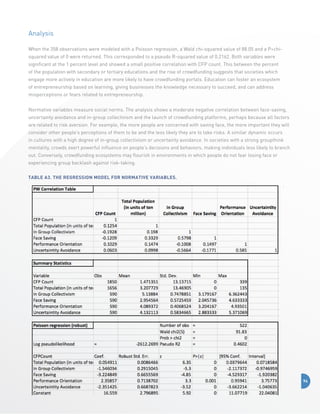
Each CIC must study the securities regulations in the host

platforms, it is not possible to extrapolate data from

country and in the region to determine what regulatory

“typical” crowdfunding projects to climate and clean

changes may be needed to facilitate equity- and debt-

energy technologies. Technology-related projects

crowdfunding mechanisms.

often are complex in nature and not easily explained to
investors. Since crowdfunding requires investors that

The lack of regulation that allows for CICs to help create

understand both solutions and offerings, it is possible

new market dynamics provides another “leapfrogging”

that crowdfund investors will not understand technology

opportunity for developing countries. Without the

offerings and as such deals may not find financing.

constraints of the legacy structure, they can create new

•  nvestor relations risk: Although the CICs will employ
I

technology-enabled regulatory structures that are more

best practice in investor communication, it is possible

nimble, transparent, and lightweight than those in the

that interactions with investors in crowdfunded projects

developed world.

will reveal unrealistic expectations among companies
or investors. If so, companies may not be able to actively

As a trusted intermediary, infoDev can work with

run a business while staying engaged with investors to

stakeholders to advocate a framework that eases access

the degree required. Likewise, a lack of communication

to capital while still providing investor protection. One

may lead to a backlash against companies and this

possibility is a tax holiday and free trade zone exemption

funding model, and entrepreneurs may not use social

for CIC businesses that are generating employment after

media tools effectively to communicate with investors.

a specific period of time.

This risk will be magnified for investors from outside
the country in which the CIC is located. International

Risk factors
Using a new and potentially disruptive model of early

investors will bring additional needs for transparency
and communication, along with the additional risk

89
associated with those needs.
•  egulatory and compliance risk: The securities
R
industry is among the most regulated in the world, yet
there is no case law or guidance from the courts to
resolve questions about the boundaries of appropriate
crowdfund investing. Regulatory bodies may resist or
reject the arguments of the CICs that crowdfunding
is an appropriate and effective method of financing
early-stage companies. If CICs do not engage with
local regulatory and policy constituents to build
crowdfunding frameworks, actions that companies and
the CICs believe to be legal may subject the centers
and founders to regulatory action. CICs should work
with local governments prior to offering crowdfund
investing. Pre-sales and revenue-based crowdfunding
will also have risks associated when these models are
not well understood or have not been contemplated by
current regulatory regimes.
•  nfrastructure risks: Further study is required to
I
determine what role existing funding and macro-level
economic development infrastructure will play in
crowdfund investing. Certainly, leveraging some existing
infrastructure would seem logical and appropriate.
What is unknown is how much, which areas are critical,
and where or how crowdfund investing can create
new market infrastructure that could fill new gaps or
potentially even address pre-existing gaps in the ability
of infrastructure to achieve its goals.
•  arket rejection: Crowdfund investing is an emerging
M
asset class. It is also a high-risk investment. It is not
known what appetite the investor community will
have for the proposed financing models, or if they will
extend their portfolios to this asset class. Media stories
about potential fraud or losses experienced by other
crowdfund investors may deter future investors.
•  arket rejection of co-investment: Early financial
M
engagement by the supporters of crowdfund offerings
is important for follow-on financing. CICs should take
the lead in early- or seed-stage investing, and offer
crowdfunding in tandem or subsequently. Investors
may not follow the CICs’ lead, however. The market may
reject the company or co-investing, particularly if the

CIC is not perceived as an honest broker.
•  nherent risk of technology projects: All technology
I
projects bear inherent risk. While the CICs can mitigate
some of those risks, some projects are likely to fail.
Failure may result from poor management decisions,
lack of funds, or miscalculation of market demand.
Technological projects can be capital intensive or
difficult for investors to understand. In either case,
inability to raise capital from investors can lead to
failure. Adding a crowdfunding component magnifies
this risk by involving community and/or international
investors in the fundraising process.
•  ubsequent funding failure: Bringing on crowdfund
S
investors creates a more complicated investor table
(or capitalization table). Dealing with many investors
can be a problem for early-stage companies that
lack the necessary communications discipline.
Subsequent investors may recognize this risk and
choose not to invest if they find the capitalization table
too complicated. Currently, there are no commonly
used structures to simplify capitalization tables of
crowdfunded companies, although the industry is
working to address this issue.
•  iquidity risk: There is no public market for private
L
shares; as a result, these investments present limited
liquidity. Some crowdfunding frameworks have a oneyear holding period, after which the equities may be
traded on secondary markets; even on such markets,
however, there is no assurance of demand for the equity.
Investors in crowdfunded offerings need to understand
that these are long-term investments with liquidity that
is limited and dependent on market demand.

90
The Kenya CIC, in its role as the first operational CIC,
provides a unique opportunity to pilot crowdfunding
programs in the near term. Initial steps could include:
•  ngaging entrepreneurs and investors to understand
E
the need for capital and the appetite for crowdfunding.

Conclusion
Many strategies have the potential to build long-term

•  roviding crowdfunding education.
P
•  orking with two or three entrepreneurs on test
W
projects.

success and community integration into infoDev’s

•  onducting surveys and interviews of the community to
C

CICs, and into the Kenya CIC in particular, given its

see if it is aligned with the companies that are part of

advanced stage of operations. Finding ways to create

the Kenya CIC.

social and financial connections may help foster such

•  etermining if community interest is focused on other
D

long-term success. Crowdfund investing can

products or services and finding a path to introduce

become a key component of the CICs’ mission to

them into the Kenya CIC.

provide innovative and flexible finance to early-stage

•  eviewing Kenyan law to understand to what extent
R

companies developing climate and clean energy

rules currently exist governing investments in private

technologies. It enables these companies to identify

companies, and building a Kenya crowdfunding

and exploit new market opportunities, leverages

framework along the lines of other working frameworks

the existing financing provided by the CICs, and

globally.

helps aggregate demand while building capacity and

•  nalyzing and recommending technology options and
A

community in-country. It also can serve as a strategy

select platform(s) for debt-, equity-, and perks-based

to more deeply integrate a CIC into the local and

crowdfunding.

regional community, for instance, creating a truly
Kenyan center rather than an infoDev center.

•  eviewing technology options and paths for how
R
money will be transferred from investors to trusted
third parties, such as escrow agents, and then to

It is important to recognize that crowdfunding and

entrepreneurs following successful crowdfunding

crowdfund investing are not tools just for start-ups.

campaigns

Crowdfunding also provides funding options for early

•  esigning country-specific training programs for
D

and mid-stage companies seeking capital to start,

entrepreneurs and the community at large to build

test, expand, and scale operations, either through a

understanding of crowdfunding and how it will operate.

stand-alone round of financing or as part of a funding

Leveraging existing materials and education in the

syndicate of professional investors.

crowdfunding marketplace will reduce time and costs.

91
Appendix A: Research Discussion
This appendix presents the research methods, models, and
results contained in the body of the report.
The authors identified a limited number of variables that
were moderately to strongly correlated with the launch
of crowdfunding platforms. The analysis utilized Nobel
Laureate Douglass North’s institutional framework to
break the discussion into cognitive, normative, regulatory
and infrastructure-related factors. Each of these was
analyzed using various regressions with the dependent
variable, controls (either total population in tens of millions
or nominal GDP), and related variables. Each group of
variables is discussed below.

Table A1. The Complete Regression Model.

92
Cognitive variables measure perception. Perception can be influenced by education, with more exposure leading
to broader acceptance and understanding of entrepreneurship, so the model used percent of the labor force with a
secondary or tertiary education respectively.
	
Table A2. The Cognitive Variables Regression Analysis.

93
Analysis
When the 358 observations were modeled with a Poisson regression, a Wald chi-squared value of 88.05 and a Pchisquared value of 0 were returned. This corresponded to a pseudo R-squared value of 0.2162. Both variables were
significant at the 1 percent level and showed a small positive correlation with CFP count. This between the percent
of the population with secondary or tertiary educations and the rise of crowdfunding suggests that societies which
engage more actively in education are more likely to have crowdfunding portals. Education can foster an ecosystem
of entrepreneurship based on learning, giving businesses the knowledge necessary to succeed, and can address
misperceptions or fears related to entrepreneurship.
Normative variables measure social norms. The analysis shows a moderate negative correlation between face-saving,
uncertainty avoidance and in-group collectivism and the launch of crowdfunding platforms, perhaps because all factors
are related to risk aversion. For example, the more people are concerned with saving face, the more important they will
consider other people’s perceptions of them to be and the less likely they are to take risks. A similar dynamic occurs
in cultures with a high degree of in-group collectivism or uncertainty avoidance. In societies with a strong groupthink
mentality, crowds exert powerful influence on people’s decisions and behaviors, making individuals less likely to branch
out. Conversely, crowdfunding ecosystems may flourish in environments in which people do not fear losing face or
experiencing group backlash against risk-taking.
Table A3. The Regression Model for Normative Variables.

.

94
Analysis
There was a positive correlation between a society’s performance orientation and number of crowdfunding platforms
– suggesting that the more a culture emphasizes performance, the more likely it will be to support the launch of
crowdfunding platforms. The variables were modeled using a robust Poisson regression, with 522 observations, a pseudo
R-squared value of 0.4602, and a Wald chi-squared value of 91.83 with five degrees of freedom. All variables were highly
significant when evaluated using a two-tailed test with an alpha value of 1 percent.
Regulatory variables consider the rigidity and efficiency of local regulation. This study used the following variables to
model regulative factors: cost of starting a business ( percent of income/capita), cost of resolving insolvency ( percent
of estate), and the strength of investor protection index. CFP count by country by year and country population were once
again used as the dependent and control variables.
Table A4. The Regression Model for Regulatory Variables.

.

95
Analysis
A Poisson regression, with 1159 observations – the highest out of any regression ran – returned a Wald chi-squared
value of 126.16 (4 degrees of freedom), a pchi-squared value of 0, and a pseudo R-squared value of 0.4845. The
regulative coefficients were almost all significant, the exception being resolving insolvency, with a P|z| about 6 percent
which is just outside the typical 5 percent alpha value used to test significance. However, resolving insolvency cost
had the greatest effect out of all variables modeled (positively correlated). Starting business cost had a small negative
correlation and strength of investor protection had an approximately equally small positive correlation with CFP count.
The positive correlation between insolvency cost and CFP count is most likely an artifact of the study’s methodology,
as it is unlikely that increasing the cost of failure encourages the creation of crowdfunding platforms. The negative
correlation between starting business cost ( percent income per capita) and crowdfund platform creation suggests that
highly regulated economies and those with overly burdensome barriers to market entry are less likely to benefit from
crowdfund investing. This is not to suggest that regulation is not an important part of a crowdfund investing ecosystem,
as demonstrated between the positive correlation between platform count and strength of investor protection Data
seems to suggest that crowdfunding platforms are more likely to emerge in economies with low market entry costs and
adequate investor protection. In order to encourage the development of crowdfunding, policy makers should seek to
enact legislation that encourages the development of these attributes.
Infrastructure - technology and entrepreneurship variables tracked levels of informal investing, analyzed Internet
access and social media penetration as well as hiring and firing efficiency. The data show that social media penetration
is far more strongly correlated with crowdfunding platforms, and predictive of their launch, than is overall access to
the Internet. This finding is consistent with the highly social nature of crowdfunding. Crowdfunding depends upon
individuals using their social networks to raise capital for their businesses. Without the social network, there is no
mechanism for reaching the crowd of potential funders.

96
Table A5. The Infrastructure (Technology and Entrepreneurship) Variables Regression Model.

97
Table A6. The Infrastructure (Capital Markets) Variables Regression Model.

98
Appendix B: Crowdfunding in China: Risks and Legal Constraints
Crowdfunding was introduced into China in July 2011 by the website Demohour, now the largest crowdfunding website
in the country. In the two years since it started, the total amount of funds raised through Demohour is estimated to be
around Y6.5 million (about US$1 million). Kickstarter, the most popular crowdfunding site in the United States, raised
US$319 million in 2012 alone.
The largest amount raised for a single project at Demohour was Y1.6 million (about US$260,000), 131 percent of the
target, for a cartoon movie named Big Fish and Chinese Flowering Crabapple. 3596 users backed the project. The
most supported project, also a movie called A Hundred Thousand Bad Jokes, raised Y1.3 million (about US$210,000)
from 5,533 users. In the two years since the website started, it received more than 7000 proposals and published an
estimated 900 of them. More than 400 projects were successfully funded, among which 12 raised more than Y100,000
(about US$16,000) and another 73 more than Y10,000 (about US$1,600). But the majority of projects ended up with less
than Y10,000. Note, however, that the funding period for both record-breaking projects that raised over Y1 million ended
in August 2013, which might suggest an upward trend in this industry.
Initially, Demohour took 10 percent of the funds raised, compared with 5 percent for Kickstarter. However, the fee was
cancelled in July 2013 to gain more popularity. The website now is a completely free platform.
Projects on Demohour are limited to technology, design, film and video, music, publishing, games, and photography.
Film and video is the top category, followed by publishing. Food, cosmetics, medicine, infant care products, and
personal care products are not supported. The website also requires that rewards must be relevant to the project and
cannot be an equity stake, bond, interest returns, or cash returns of any kind.
Other crowdfunding websites in China have adopted similar rules but they are usually not comparable with Demohour
in terms of the number of projects offered or the amount of funds raised. Dreamore, another Chinese crowdfunding
website and Demohour’s closest rival, lists 251 projects on its website, both ongoing and ended. Three projects raised
more than Y100,000 (about US$16,000), with the highest being Y164,000 (about US$27,000) for a documentary. However,
contrary to Demohour’s decision to drop its commission fee, in 2013 Dreamore started charging 6 percent of funds
raised, after trying out other business models unsuccessfully. Similar websites include Tmeng, Jue.so, and Emie.

Challenges for the industry
Illegal fundraising
China’s crowdfunding websites all emphasize that reward of a project must be “physical,” as any purchase of equity
stakes or promise of future monetary returns might be tantamount to illegal fundraising under Chinese law, which
does not allow unregistered companies or individuals to sell stakes to the public. In late 2012, Meiwei Media, a startup company raised Y380,000 (about US$62,000) through selling membership cards with 100 of the company’s shares
attached at its Taobao store. Its Taobao account was frozen two months later and it was ordered by the Securities
Regulatory Commission to return the money in early 2013.
Consequently, websites like Demohour are regarded as more of a channel for pre-sale and marketing, rather than
actual fundraising. According to Dong Zhiling, the producer of A Hundred Thousand Bad Jokes, the money raised
through Demohour accounted for only about 10 percent of the movie’s total production cost. Likewise, the Y10,000
(about US$1,600) goal listed on Demohour for a wireless socket, a star project on the website and 479 percent funded,
was less than 1 percent of its total financing and the website was mainly used as a platform to promote the product and
attract manufacturers and venture capitalists (successfully), according to Zhou Zhigang, a member of the team that
developed the product.

99
For Chai Ke, an inventor and investor active on Demohour, the website is an ideal place to meet other young entrepreneurs
like himself. He has invested Y300,000 (about US$50,000) on Demohour.
User mentality
Chinese users are more accustomed to the role of buyer rather than investor. They tend to be more interested in the
physical products and benefits such as early delivery of the good or discount prices, rather than showing support for the
entrepreneurial and inventive spirit, which has been an important element for crowdfunding’s popularity in the US.
Project quality
Weak intellectual property protection in China prevents people from posting their ideas online at an early stage. At the same
time, innovative ideas, especially in the technology category, trails far behind the United States in terms of both quality and
quantity. The situation is sometimes likened to be too many ships chasing for too few fish in the river.
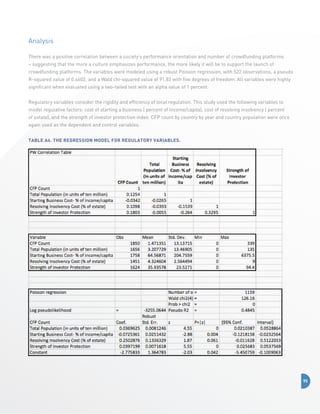
100
References
Agrawal, A., C. Catalini, and A. Goldfarb. 2011. Offline Relationships, Distance, and the Internet: The Geography of

Crowdfunding. Cambridge, MA: National Bureau of Economic Research.
Aldrich, Howard E., and C. Marlene Fiol. 1994. “Fools Rush in? The Institutional Context of Industry Creation.” The

Academy of Management Review 19 (4): 645-670. http://www.jstor.org/stable/258740
Best, Jason, Sherwood Neiss, Steven Stralser, and Lee Fleming. 2013. “How Big Will the Debt and Equity Crowdfunding
Investment Market Be?: Comparisons, Assumptions, and Estimates.” Fung Technical Report No. 2013.01.15, College
of Engineering, University of California, Berkeley. www.funginstitute.berkeley.edu/sites/default/files/Crowdfund_
Investment_Paper.pdf
Curtis, Mary B., Teresa L. Conover, and Lawrence C. Chui. 2012. “A Cross-Cultural Study of the Influence of Country of
Origin, Justice, Power Distance, and Gender on Ethical Decision Making.” Journal of International Accounting Research
11:1, 5-34.
Deloitte. 2013. “Let’s Get Together: Crowdfunding Portals Bring in the Bucks.” http://www.deloitte.com/assets/DcomShared%20Assets/Documents/TMT%20Predictions%202013%20PDFs/dttl_TMT_Predictions2013_LetsGetTogeather.pdf
Ernst  Young. 2013. “Turning the Corner: Global Venture Capital Insights and Trends.” http://www.ey.com/Publication/
vwLUAssets/Global_VC_insights_and_trends_report_2012/$FILE/Turning_the_corner_VC_insights_2013_LoRes.pdf
Gage, Deborah. 2012. “The Venture Capital Secret: 3 Out of 4 Start-Ups Fail.” The Wall Street Journal, September 19.
http://online.wsj.com/article/SB10000872396390443720204578004980476429190.html
Gibbs, Mark. 2012. “The Truth About Kickstarter and ZionEyez.” Forbes. August 220. http://www.forbes.com/sites/
markgibbs/2012/08/20/the-truth-about-kickstarter-and-zioneyez/
Heussner, Ki Mae. 2012. “Fred Wilson: What Crowdfunding Means for the VC Business.” GIGAOM, May 8. http://gigaom.
com/2012/05/08/fred-wilson-what-crowdfunding-means-for-the-vc-business/
Mims, Christopher. 2013. “Kickstarter Almost Enabled a $120,000 Fraud, and It’s Not the First.” QUARTZ, June 14. http://
qz.com/94597/kickstarter-almost-enabled-a-120000-fraud-and-its-not-the-first/
Morduch, Jonathan.1999. “The Microfinance Promise.” Journal of Economic Literature 37 (4): 1569-1614.
Niederer, Paul. 2012. “Thoughts on a $130 Million Investor Crowdfunding Model.” November 25. http://paulniederer.
com/2012/11/thoughts-on-a-130-million-crowdfunding-model/
Poetz, Marion K., and Martin Schreier. 2012. “The Value of Crowdsourcing: Can Users Really Compete with Professionals
in Generating New Product Ideas?” Journal of Product Innovation Management 29 (2): 245-256.
Ries, Eric. 2011. The Lean Startup: How Today’s Entrepreneurs Use Continuous Innovation to Create Radically Successful

Businesses. New York: Crown Publishing.
101
About infoDev
infoDev is a global partnership program within the World Bank Group which works at the intersection of innovation,
technology, and entrepreneurship to create opportunities for inclusive growth, job creation and poverty reduction. infoDev
assists governments and technology-focused small and medium sized enterprises (SMEs) to grow jobs, improve capacity
and skills, increase access to finance and markets, ensure the appropriate enabling policy and regulatory environment
for business to flourish, and test out innovative solutions in developing country markets. We do this in partnership with
other development programs, with World Bank/IFC colleagues, and with stakeholders from the public, private and civil
society sectors in the developing world.
For more information visit www.infoDev.org or send an email to infoDev@worldbank.org.

About Crowdfund Capital Advisors
Crowdfund Capital Advisors (CCA) is a consulting and advisory firm working with professional investors, governments,
development organizations, and NGOs, corporations and chambers of commerce to help them best position themselves
to leverage crowdfund investing (CFI) for the benefit of their organizations.
For more information visit www.crowdfundcapitaladvisors.com or send an email to info@theccagroup.com.
This study was made possible thanks to the support of the Ministry for Foreign Affairs
of the Republic of Korea.
©2012 info Dev / The World Bank | 1818 H Street, NW | Washington DC, 20433
Email: info@infoDev.org | Tel + 1 202 458 8831 | Twitter: @infoDev
www.infodev.org

Crowdfunding's Potential for the Developing World

  • 1.
  • 2.
    Copyright © 2013 Informationfor Development Program (infoDev)/The World Bank 1818 H Street NW Washington DC 20433 Internet: www.infoDev.org Email: info@infoDev.org All rights reserved Disclaimers infoDev/The World Bank: The findings, interpretations and conclusions expressed herein are entirely those of the author(s) and do not necessarily reflect the view of infoDev, the Donors of infoDev, the International Bank for Reconstruction and Development/The World Bank and its affiliated organizations, the Board of Executive Directors of the World Bank or the governments they represent. The World Bank cannot guarantee the accuracy of the data included in this work. The boundaries, colors, denominations, and other information shown on any map in this work do not imply on the part of the World Bank any judgment of the legal status of any territory or the endorsement or acceptance of such boundaries. Rights and Permissions The material in this publication is copyrighted. Copying and/or transmitting portions or all of this work without permission may be a violation of applicable law. The International Bank for Reconstruction and Development/The World Bank encourages dissemination of its work and will normally grant permission to reproduce portions of the work promptly. To cite this publication: Crowdfunding’s Potential for the Developing World. 2013. infoDev, Finance and Private Sector Development Department. Washington, DC: World Bank.
  • 3.
    Table of Contents Foreword Acknowledgements 4 6 7 8 Abbreviations andAcronyms Executive Summary 1. The State of Crowdfunding Today 14 Introduction 14 Crowdfunding models 20 Crowdfund investing platforms 22 The benefits of crowdfunding 26 Enabling factors and constraints 27 2. Crowdfunding and the Opportunity in the Developing World 31 Status 31 Opportunities for crowdfunding in the developing world 34 Crowdfunding risks – fraud, failure and fulfillment 44 3. Policy and Recommendations to Enable Crowdfunding 50 An opportunity to leapfrog the developed world 50 Decision framework to evaluate the opportunity for crowdfund investing 56 Recommendations for governments, NGOs and the private sector 60 The role of development organizations 65 4. Crowdfunding Readiness – A Self-Assessment Tool 66 Self-assessment 66 Readiness ranking 68 Individual category recommendations 69 5. Case Study: Crowdfunding Opportunities in Climate and Clean Energy Innovation 73 Introduction 73 Harnessing embedded community knowledge 75 Examples of successfully crowdfunded climate innovation initiatives 76 Attractiveness and viability of crowdfunding for Climate Innovation Centers 77 Critical success factors and execution considerations 79 Criteria for projects and companies seeking to participate in crowdfunding 83 Strategic recommendations for the Kenya Climate Innovation Center 84 Recommendations for business models 86 Conclusion 91 Appendix A: Research Discussion 93 Appendix B: Crowdfunding in China: Risks and Legal Constraints 100 References 102 3
  • 4.
    Foreword Crowdfunding is aninnovation in entrepreneurial finance that can fuel “the Rise of the Rest” globally What would the world look like if there were Silicon Valleys everywhere? While I am happy for innovative entrepreneurs in Silicon Valley, I am passionately focused on helping to create “the Rise of the Rest” so that entrepreneurs globally can build successful businesses. This initiative is to create focus and action in cities and towns of all sizes, to form entrepreneurial ecosystems that can ignite innovation, create jobs and grow economies. In the past, because of the high cost of technology development, lack of mobile/web infrastructure and restrictive financial regulations, entrepreneurs had to travel to places like San Francisco or Boston to find the technologies and investors to build their companies. For most, this was cost prohibitive and logistically impossible. Entrepreneurs had a more challenging time executing their plans and potential investors were scarce. Today, technology development costs are plummeting and tools are available to build software more rapidly and cheaply than ever before: • ne third of the world’s population has access to the Internet and, according to the United Nations, O approximately 85 percent have access to a mobile phone. • ased on the adoption curve of feature phones in Africa, it is possible that 40 percent of people living in Africa B will have access to a smartphone within five years. • nnovative new broadband solutions are becoming available and smartphone penetration is growing as costs I decline and demand increases. • ith an increase in connectivity, new and larger markets for goods and services are now available and we need W talented entrepreneurs to create innovative solutions to customer needs, to create jobs, and drive economic and social stability. Now we are ready to address the lack of capital for entrepreneurs through innovation in the financial markets that leverages these technical advances. I believe that equity, debt, and rewards-based crowdfunding open new possibilities for funding more entrepreneurs in more places around the world. These changes enable entrepreneurs to utilize social media and the web to offer rewards, ownership of a shared vision, or even equity stakes to potential investors. Crowdfunding websites are creating transparency and more open communication by enabling investors to engage with these companies over time to monitor their progress and continue to support their success as the company grows. This technology makes it possible for an entrepreneur in Kenya to more easily engage investors and customers anywhere; whether that be locally, the diaspora, or with others anywhere in the world. 4
  • 5.
    Now is thetime for leaders in the developing world to engage in a spirited discussion and analysis regarding crowdfunding and how it should be utilized to benefit businesses and communities while providing prudent safeguards and investor protections. It may be possible for developing nations to use this new funding mechanism as a means to spur domestic innovation and create a larger number of high-growth entrepreneurs. Innovative policies, technology, education and safeguards will be important in determining if this new financial tool can deliver on its promise. I appreciate infoDev’s early participation in this conversation via this research and I hope they and leaders of countries and institutions will use this report as a starting point in creating and testing appropriate, country-specific approaches to crowdfunding across the developing world. I believe that crowdfunding may have the potential to help catalyze existing efforts to create entrepreneurial cultures and ecosystems in developing nations. Development organizations like the World Bank and other institutions will play an ongoing role to act as “trusted third parties” in creating these new models of funding and providing mentorship, capacity building as well as ongoing monitoring and reporting. This research is also demonstrating the important role that academia must play in building deeper, more robust bodies of knowledge in this arena. Major research institutions and other multilateral development banks can use this infoDev report as a platform for additional research in this exciting new nexus of finance, technology, and entrepreneurship. This report, and the research that follows it, can help to shape global best practice. I hope this report can provide new opportunities for multilateral organizations and academia to collaborate to provide appropriate measures and tools for the development of this new form of finance. This confluence of developments in public policy, technological innovation, academia and economic trends can alter the playing field in developing countries to enable businesses to start, scale, and succeed outside of Silicon Valley. If successful, crowdfunding can support ”the Rise of the Rest” and will play a key role in sparking economic growth, innovation, and jobs. We have seen how technology has revolutionized many sectors of the global economy, however to date, the way that entrepreneurs are funded has either remained unchanged or become even more challenging. Crowdfunding is not a panacea and there are still risks and unanswered questions remaining. Nevertheless, I have faith that through ingenuity and technology, appropriate regulation and investor protections can be built. I believe that crowdfunding has the potential to enable innovative developing economies to leverage the explosion of social media to leapfrog forward to build a network of vibrant entrepreneurial ecosystems. Steve Case Chairman and CEO, Revolution Co-Founder, America Online Chairman, The Case Foundation 5
  • 6.
    Acknowledgments This study, Crowdfunding’sPotential for the Developing World, was commissioned by infoDev, a global technology and innovation program at the World Bank. The study was carried out under the supervision of Anthony Lambkin and Sam Raymond of infoDev, and prepared by Crowdfund Capital Advisors (CCA). The main text was written by CCA’s Jason Best, Sherwood Neiss and Richard Swart. Colin Blackman (Camford Associates) was responsible for editing. A special thanks goes to Steve Case for the valuable contribution of the foreword to this report. Thanks also for the contributions of a number of individuals who provided research, insight and contributions: Doug Ellenoff (Ellenoff, Grossman Schole), Austin Lee, Robert Wuebker, Judy Robinett, Robert Mitchell, Ilona Major (CCA), Michael Every and Ben Simpfendorfer (Silk Road Associates). The study benefited from the comments provided by a group of experts who participated in the peer review process. The peer reviewers include: Dr. Lee Fleming, Director of the Fung Institute, University of California, Berkeley; Esperanza Lasagabaster, Service Line Manager of Innovation, Technology Entrepreneurship Global Practice, World Bank; Drew von Glahn, Program Coordinator, World Bank Institute’s Development Marketplace Program; Reinhard Reichel, Senior Investment Officer, Financial Markets, IFC; and Anna Lerner, Energy Specialist, LAC Energy, World Bank. 6
  • 7.
    Abbreviations and Acronyms ACH automatedclearing house AML anti-money laundering ASSOB Australian Small Scale Offerings Board CAGR compound annual growth rate CEO chief executive officer CF crowdfunding CFI crowdfund investing CFP crowdfunding platform CIC Climate Innovation Center EACVF East Africa Climate Venture Facility FATF Financial Action Task Force GDP gross domestic product ICT information and communication technology IPO initial public offering JOBS Jumpstart Our Business Startups Act KCIC Kenya Climate Innovation Center LED light-emitting diode MENA Middle East and North Africa (World Bank regional vice presidency) mLab mobile application lab NGO nongovernmental organization PII participant individual investor PoC Proof of Concept PPP purchasing power parity SME small and medium enterprises SPV special purpose vehicle TED Technology, Entertainment, Design USB Universal Serial Bus USD U.S. dollar VC venture capital or venture capitalist 7
  • 8.
    Executive Summary Crowdfunding takes advantageof crowd-based decision-making and innovation, and applies it to the funding of projects or businesses. Using social networks, social profiles, and the viral nature of webbased communication, individuals and companies have raised billions of dollars in debt, equity, and donations for projects over the past five years. Kickstarter, for instance, the market leader in pledge or donation-based crowdfunding, has channeled over US$815 million from 4.9 million backers (29 percent of which have invested in more than one project) to nearly 50,000 projects throughout the world since 2009. Building a crowdfunding ecosystem depends on key enablers to build trust Credible crowdfunding systems require more than Crowdfunding is an Internetenabled way for businesses or other organizations to raise money in the form of either donations or investments from multiple individuals. This new form of capital formation emerged in an organized way in the wake of the 2008 financial crisis largely because of the difficulties faced by entrepreneurs and willing investors. They also need a supportive ecosystem and enabling factors, including forward-thinking regulations, effective technological solutions, and cultures that can adapt to this new investment vehicle. This includes the concept of a “constellation of trust” that enables all parties to participate. The key factors that have facilitated crowdfunding in developed countries include: artisans, entrepreneurs and early-stage enterprises in raising funds. With traditional banks less willing to lend, entrepreneurs started to look elsewhere for capital. • regulatory framework that leverages the A transparency, speed, and scale that advances in technology and the Internet can deliver to early-stage funding marketplaces. Crowdfunding began as an online extension • trong social media market penetration and Internet S of traditional financing by friends and family: usage, which is necessary to harness demographic communities pool money to fund members and technology trends to drive collaboration and with business ideas. In less than a decade, crowdfunding has gained traction in a number cultural shifts. • regulated online marketplace that facilitates capital A of developed economies, including Australia, formation while providing prudent investor protections the United Kingdom, the Netherlands, Italy, and through education and training. the United States. This exciting phenomenon is • ollaboration with other entrepreneurial events and C spreading across the developed world and is now hubs including business plan competitions, incubators, attracting considerable interest in the developing accelerators, universities and co-working spaces to world as well. create a channel for opportunity and oversight. 8
  • 9.
    All of thesefactors are necessary to build the culture of trust which is essential for the funding of companies, projects and causes mediated primarily through webbased interactions. Sometimes crowdfunding project backers have no pre-existing relationship to the company or project being funded – they may be hundreds or thousands of miles away. Nevertheless, this trust often flows through some form of community, whether based on geography, culture, ethnicity, or shared interests. Some crowdfunding platforms are successfully raising money from diaspora communities and managing north–south and south–north monetary flows. Trust does not just happen – it is a socially mediated phenomenon which relies in great part on the intrinsic trust people place in shared connections on social networks, community affinities, and the ratings of others on trusted, mainstream websites. This group behavior of trusting others based on presented information and social signals (and sometimes including first person knowledge) is only possible in a highly transparent system with near real-time feedback mechanisms, that is, on the web. The developing world has the potential to leapfrog developed countries While many developing economies may have the potential to capitalize on this new funding mechanism, those that wish to implement crowdfunding ecosystems need to learn from the initial developed world experience to understand how crowdfunding functions, the “light touch” role that government and regulation should play, and the technological infrastructure requirements involved. Developing countries that manage this process successfully may be able to leapfrog the developed world, in both a regulatory and economic sense, by creating frameworks for early-stage finance that facilitate entrepreneurship, the fostering of innovative technology enterprises and the emergence of new competitive industries. It may be possible for developing nations to use emerging technology and business processes – including mobile technology, social media, lean-start-up methods of company formation, and crowdfund investing – to With support from governments and development implement more efficient and effective entrepreneurial organizations, crowdfunding could become a useful tool funding systems that are more advanced than the in the developing world as well. Crowdfunding is still legacy systems prevalent in the developed world. This largely a developed-world phenomenon but its potential may influence more active angel investors and open to stimulate innovation and create jobs in the developing up deal flow to a much wider audience that can more world has not gone unnoticed. Substantial reservoirs of efficiently review broader investment opportunities. By entrepreneurial talent, activity, and capital lay dormant allowing capital to be efficiently pooled around credible in many emerging economies, even as traditional entrepreneurs, it may provide different venture capital attitudes toward risk, entrepreneurship, and finance stifle structures that reach larger numbers of potential potential economic growth and innovation. Developing investors. A developing country’s ability to leapfrog economies have the potential to drive growth by employing developed nations will depends in part on the speed and crowdfunding to leapfrog the traditional capital market commitment with which its stakeholders embrace these structures and financial regulatory regimes of the new technologies and methodologies for both capital developed world. formation and enabling trust. 9
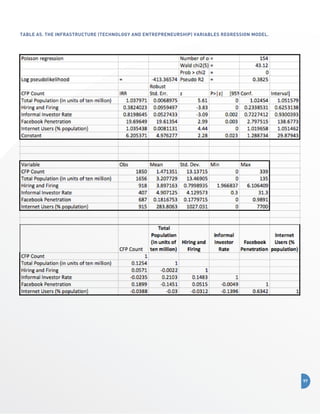
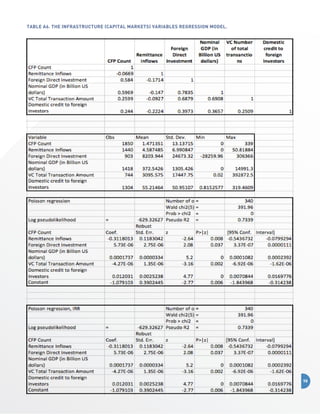
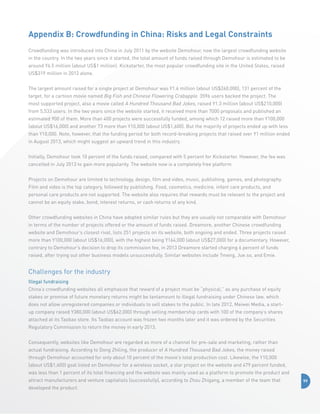
  • 10.
    Like any investmentactivity, crowdfunding comes with risk to the investor. CFI is not unique in this regard, but it does have characteristics that require regulatory protection and robust investor education for crowdfunding to contribute meaningfully and successfully to a country’s economy. Crowdfunding markets have been operating in many countries for several years with few reported instances Countries that want to adopt crowdfunding must not only create enabling policy, but also, in some cases, address policies and regulations that currently make it burdensome to enter into, conduct, and end business operations. For example, incorporation or dissolution of a business entity in many developing nations is overly bureaucratic, time-consuming, and costly. The crowdfunding market is in its infancy, especially in developing countries, but the potential market is significant. It is estimated that there are up to 344 million households in the developing world able to make small crowdfund investments in community businesses. These households have an income of at least US$10,000 a year, and at least three months of savings or three months savings in equity holdings. Together, they have the ability to deploy up to US$96 billion a year by 2025 in crowdfunding investments. The greatest potential lies in China, which accounts for up to US$50 billion of that figure, followed by the rest of East Asia, Central Europe, Latin America/the Caribbean, and the MENA region. The risks in crowdfunding and how to mitigate them While Asia represents a huge opportunity, there may be reasons to believe that Central Europe, Latin America of fraud. However, as the market expands, there will inevitably be attempts to circumvent regulations and defraud investors. Despite this, the biggest concerns regarding risk are business failure and execution or fulfillment challenges. Failure may result from poor management decisions, lack of funds, or miscalculations of market demand. Execution or fulfillment challenges may occur in some successful crowdfunding campaigns when a company is not ready with, for instance, the necessary logistics and manufacturing capacity to meet the demand generated by their campaign. These risks may be mitigated through regulation, technology, and social and cultural approaches: • egulation: Governments should review and update R small business regulation from incorporation to bankruptcy. Regulations should balance the need for investor protection with capital formation. A countryspecific framework for crowdfund investing should be created to encourage investment in startups and small businesses and attract diaspora remittances. It is important to enact regulation that is not too burdensome, which might otherwise drive companies into the gray economy. • echnology: In order for crowdfunding to work, T and the Caribbean, the Middle East and North Africa may individuals must have access to reliable broadband effectively deploy crowdfund investing sooner. These Internet or mobile data networks. Technology to factors may include a greater transparency, willingness facilitate ongoing communication between investors to take risks, support for free market innovation, strong and entrepreneurs and enabling tools to systematize diaspora communities, early stage entrepreneurial and streamline the business lifecycle must also be activity, and well-functioning educational systems. employed and allowed to operate freely. 10
  • 11.
    • ocial:Individuals within a country must be actively S This should engaged in online social networks as this is the include the main driver of crowdfunding activity. The network creation and utilization should be engaged in vetting opportunities to allow of co-working spaces, crowd wisdom to emerge. Communities should incubators, and accelerators. By leverage startup events and community-backed providing physical space, mentorship, finance to support entrepreneurs and develop peer learning opportunities and formalized circles of trust. product market fit experimentation, • ultural: The private sector should be engaged C crowdfunding, venture creation and other support to help create channels of viable businesses that services, the private sector can significantly enhance can become potential investment opportunities. the creation of a culture of entrepreneurship. Figure 0.1 Government, NGO Private Sector Recommendations Specific strategies to drive crowdfunding Economic • raft exceptions to securities regulations that C allow easy registration for equity offerings • trategically tie crowdfunding to patriotic and S cultural messages • orm a crowdfunding market alliance F Technology • here appropriate, apply lessons learned from W developed world • onsider buy, build or white label C • etermine gaps in exisitng technology for online D financial transactions Social • arness top social media experts/bloggers/ H tastemakers to communicate with local and diaspora audiences • old media and educational events to build H awareness and understanding • old regular crowdfunding events with trusted H third parties to teach successful techniques Cultural • everage existing incubator/accelerator/structured L co-working spaces as hubs for innovation in funding • oster professional investor consumer F confidence in crowdfunding through education and communication • ncourage the participation of women and girls E 11
  • 12.
    Crowdfunding has emerged asa multibillion-dollar global industry Development organizations, including the World Bank and infoDev, could have an important role to play in enabling responsible crowdfund investing by helping developingworld stakeholders implement productive policies and appropriate regulatory controls. In particular, the World Bank is uniquely positioned to deploy infrastructure, enable capacity, and invest (both directly and indirectly) in ways that could extend the impact of crowdfund investment and reduce the barriers to financing highgrowth entrepreneurs and technology-focused SMEs. While each of these risk controls can operate alone, together they offer a reinforcing framework to protect investors and decrease the risk of failure. Governments, development organizations and others have a role to play in fostering crowdfunding Crowdfunding offers the potential for a radical evolution of our largely institutional framework for allocating Within the Bank, infoDev has a particularly valuable role because it has the agility to pilot new concepts at the grassroots, and to scale workable solutions into larger projects that support the World Bank Group’s commitment to innovation and entrepreneurship. infoDev is well positioned to play a similar role in testing crowdfunding initiatives in developing economies to promote economic growth, competitiveness, and inclusion. capital, through foundations, funds, and banks to a more infoDev’s approach to crowdfunding emerges from its individually driven and direct investment framework. focus on incubating technology-enabled new ventures Governments around the world as well as development in the mobile, climate, and agribusiness sectors. These organizations, venture capital funds, and NGOs are programs provide technology testing facilities, formal watching crowdfunding closely to see whether it has or informal mentorship, training courses, and regular the potential to solve the “last mile funding problem” multi-stakeholder networking opportunities, as well as faced by many start-up companies. The question is traditional business incubation services. When linked with whether crowdfunding and crowdfund investing offer infoDev’s ongoing efforts, the crowdfunding phenomenon a more efficient mechanism to deliver capital to local may present an important resource for the entrepreneurs entrepreneurs in a way that leverages the existing as they attempt to grow their business from “mind infrastructure and community resources to support to market”. those entrepreneurs. infoDev’s exploration of crowdfunding may be pursued in Policies and strategic recommendations for government, the following ways: NGOs and the private sector should help support the emergence of crowdfunding ecosystems by addressing • acilitating skills training for entrepreneurs which F the economic, social, technology, and cultural overviews main tenets of crowdfunding and adapts “pitch challenges, as illustrated in Figure 0.1. training” to ensure online offerings are compelling. 12
  • 13.
    • everagingthe infoDev brand, through Climate L Innovation Centers, mLabs, Agribusiness Innovation Centers and other partners to verify company quality standards and establish trust with the crowd. • upporting angel investors or accelerators to serve as S anchor investors for the larger crowd. • ffering Proof of Concept grants to companies to O develop their crowdfunding campaign. • oordinating local pools of trusted service providers C to assist entrepreneurs with development of their crowdfunding campaigns. • ontinuing to provide business development services C to entrepreneurs to ensure business models are globally competitive. • ocumenting learning from crowdfunding initiatives D to positively impact the crowdfunding enabling environment. • howcasing crowdfunding success stories and failures S from across the infoDev global network to positively influence the global innovation and technology entrepreneurship status quo. Conclusion a more distributed way to form capital is aligned with the changes in the flow and distribution of information (via the Internet) and the creation and distribution of manufacturing capabilities (maker spaces and fabrication centers). Existing securities regulations were not crafted for the social web. Governments and policy experts worldwide are considering the possible impact of crowdfunding and crowdfund investing and trying to fashion new regulations, empower new technologies, and equip entrepreneurs with sufficient information to decide if crowdfunding is a viable funding or investment vehicle for these enterprises. The closed and private nature of investing in small The rate of growth of crowdfunding, and its emergence businesses and start-ups will change rapidly as the in developing and developed countries, suggests that social web affects the flow of both information and this phenomenon can become a tool in the innovation capital to these companies. The rise of crowdfunding as ecosystems of most countries. 13
  • 14.
    1. The Stateof Crowdfunding Today Key points: • rowdfunding emerged after the 2008 financial crisis C in response to the difficulties faced by early-stage enterprises attempting to generate funding. • rowdfunding is an online extension of financing by C friends and family: communities pool money to fund members with business ideas. • urrently it is predominantly a developed world C phenomenon, but the potential exists for developing countries to capitalize on this new form of funding. • hat is the current status of crowdfunding as it has W grown in the developed world and the forces that have led to its rapid rise? • rovides examples and describes the different models P and platforms that have emerged, and the benefits that crowdfunding is bringing to both investors and recipients. • escribes the enabling factors and constraints to D building a successful crowdfunding ecosystem. Introduction Crowdfunding is an Internet-enabled way for businesses or other organizations to raise money – typically from about US$1,000 to US$1 million – in the form of either donations or investments from multiple individuals. This new form of capital formation emerged in the wake of the 2008 financial crisis in response to the difficulties faced by early-stage enterprises1 in generating funding. In less than a decade, crowdfunding has spread across the developed world, and is now attracting considerable interest in the developing world as well. Crowdfunding began as an online extension of financing by friends and family: communities pool money to fund members with business ideas. During crowdfunding’s early stages, capital came in the form of donations, but increasingly it takes the form of debt or equity investments targeting high-growth entrepreneurs – only one of many ways the model is evolving as awareness spreads. Crowdfunding uses web-based technology and the knowledge and wisdom in communities to determine which projects should receive funding and how much 1 T here are many definitions of SMEs and early-stage enterprises. These definitions vary depending on the number of employees, annual sales, assets, and even sector. In this report early-stage businesses are defined as those with fewer than 50 employees and with revenue of less than US$3 million, in line with the World Bank’s definition of Small Enterprise (http:// www.infodev.org/infodev-files/resource/InfodevDocuments_614.pdf). funding they should receive, as well as providing realtime feedback on start-ups and small businesses. It leverages the power of technology, particularly social media, to market the idea, raise funds, and hold entrepreneurs accountable. 14
  • 15.
    Developing economies mayhave the potential to the developing capitalize on this new funding mechanism. Countries world is explored wishing to implement crowdfunding ecosystems need in Chapter 5 through to understand how crowdfunding works, the role a detailed case study of that government and regulation should play and the crowdfunding in the climate technological infrastructure requirements involved. and clean energy sector. Developing countries that manage this process successfully may be able to leapfrog the developed world in delivering capital to businesses, in both a regulatory and economic sense, by creating frameworks for earlystage finance that facilitate entrepreneurship, the fostering of innovative technology enterprises and the emergence of new competitive industries. As with other disruptive technologies, it is not possible to accurately gauge the potential impact of this evolving market, especially where there is little available data from developing countries. This report reviews the potential opportunities and challenges associated with implementing crowdfunding within a market, as well as crowdfunding’s connection to capital markets in general. The rest of Chapter 1 outlines the current status of crowdfunding as it has grown in the developed world and the forces that have led to its rapid rise. It gives examples and describes the different models and platforms that have emerged, and the benefits that crowdfunding is bringing to both investors and recipients. The chapter ends with an overview of the enabling factors and constraints to building a successful crowdfunding ecosystem. Chapter 2 addresses the ways that crowdfunding could improve access to capital for high-growth entrepreneurs in the developing world, while Chapter 3 analyses the policy and regulatory aspects, makes recommendations on how to encourage and support crowdfunding, and considers the role that development organizations such as The World Bank and infoDev can play. A tool to help countries assess their readiness The global emergence of crowdfunding Crowdfunding based initially on soliciting pledges or donations has emerged as a multibillion-dollar global industry. It channels money to individuals or organizations for seed finance, product development, and social causes. Crowdfunding sometimes extends or complements social lending (peer-to-peer) platforms. Crowdfund investing (CFI) is the investment alternative to pledge-based crowdfunding. This term, which describes securitiesbased equity and debt fundraising through crowdfunding platforms, has recently emerged as an alternative to more traditional funding tools such as bank loans, angel or venture capital (VC) investments for financing entrepreneurs and small and medium-sized enterprises (SMEs). Projections for the size of the crowdfund investing market range from US$3.98 billion (Best, Neiss, Stralser, and Fleming 2013) to as much as US$300 billion over the coming years depending on the level of enabling regulation adopted by governments (Huessner 2012). The large-scale adoption of information and communication technology, coupled with the broad acceptance of social networks, has given rise to webenabled crowdfunding. Web-based platforms provide scale and scope, and help overcome many of the challenges to entrepreneurial finance that have hindered economic development and growth in the developing world. These challenges include: • roviding SMEs with access to capital. P • ultivating high-growth entrepreneurs in developing C countries. for crowdfunding is described in Chapter 4. Finally, the • upporting access to export markets. S opportunity that the World Bank and infoDev has to • atalyzing flows of capital within and between C support entrepreneurship-driven economic growth in communities, irrespective of distance. 15
  • 16.
    Use and segmentationof crowdfunding platforms Crowdfund investing is suitable for many types of enterprise, most notably high-growth start-ups, often in the technology sector, research institutions as well as more traditional small businesses. The way in which crowdfunding fits into the funding lifecycle of growing firms is shown in Figure 1.1. Research institutions might experiment with crowdfund investing campaigns Certain research universities in the developed world are exploring crowdfunding to support commercialization of technology, particularly in the areas of clean technology, life sciences, and medical devices. CFI enables innovative researchers and students to demonstrate broader interest in their research topics. High-growth/technology businesses are uniquely suited to crowdfund investing Businesses with high growth potential, especially Some established businesses could use crowdfund investing to raise capital those that draw on entrepreneurial incubator or Traditional “Main Street” businesses may not have accelerator ecosystems, may be especially well access to bank loans or other financing despite strong positioned to benefit from crowdfund investing. fundamentals and robust profits. CFI may offer them the Such types of businesses find general market opportunity to convert customers into investors or lenders, understanding and acceptance, and can leverage the delivering the capital that enables them to grow. expertise, facilities, mentoring, and peer learning capabilities provided by those ecosystems. The Of course, CFI may not be suitable for some businesses, for firms can also gain access to broader markets for instance, those with high cost structures and long payback fundraising and sales. revenue models, or those that require large upfront capital Figure 1.1. Crowdfunding Adoption Curve Where Crowdfunding Fits on the Funding Lifecycle Mainstream Financing US$1M Once ideas have met minimum viable tests by the crowd or community an equity or debt-based crowdfunding campaign is appropriate. It will provide increased capital for growth and vested interest of supporters. Angels can also play an important role here. At this stage, once ideas are proven, models tested and customer interest engaged, the risk for follow on, larger, more traditional capital from Angels, Venture Capital or Private Equity may be engaged. Crowdfunding US$50K Institutional Capital Donation or perks based crowdfunding is a good fit for idea/inception and proof of concept/prototyping. It allows the community to decide which ideas are worth funding early on. Companies that have proved sufficient market growth and traction that are increasingly capital intensive may be able to seek funding from investment banks at this stage. Funding Gap Amount of Capital Needs $ Crowdfunding Investing US$1M 16 Idea/Inception PoC/Prototype Startup Early Growth Expansion
  • 17.
    As crowdfunding growsin size and becomes widely accepted, professional investors are likely to start allocating portions of their portfolios to crowdfund investing. Crowdfunding is attracting the interest of angel investors and venture capital because CFI can provide proof of market interest in a start-up, and also because it allows them to assess potential investment expenditures such as large-scale infrastructure projects. These kinds of companies may be limited by the caps on the amount of money that can be raised through CFI, or by a payback time horizon that is too far in the future to appeal to crowdfunding investors. Forces enabling the rise of crowdfunding Crowdfunding draws inspiration from concepts like microfinance (Morduch 1999) and crowdsourcing (Poetz and Schreier 2012), but it represents a unique category of fundraising, with different vehicles, processes, and goals. opportunities privately and efficiently. Angel groups and networks can use the technology platforms that have been developed for crowdfunding to increase deal flow, improve communication, decrease time to complete transactions, and improve syndication. Venture capital typically is risk averse which leaves a funding gap for innovative, early-stage companies, especially in developing countries. Crowdfunding is starting to bridge that gap but is also highlighting opportunities for VC investment. widespread adoption of information and communication Emerging platforms built for specific communities technology (ICT) has provided the infrastructure to reach Certain well-organized online communities have begun millions of investors. At the same time, the general social exploring crowdfunding for targeted funding and capital acceptance of technology-enabled social networks allows formation. Two major forces make crowdfunding possible. First, the investors to interact online and build trust among people with whom they may have few traditional connections. • everal recently launched or announced portals S Together these forces are enabling crowdfunding to focus on particular groups. These include religious emerge on a large scale, connecting would-be investors affiliations, industries, race-specific business with potential investments. organizations (such as Hispanic Chambers of Commerce), gender-based organizations (such as Today more than 80 percent of the world’s online population interacts with social networks on a regular SpringBoard), and university alumni networks. • latforms are organizing around physical P basis, despite the fact that 65 percent of the world’s communities to fund community development population – 4.6 billion people – still lack Internet access projects, recreational facilities, school programs, and (McKinsey Global Institute 2012). Technology-enabled so on. communities, that is, online social platforms that bring • ortals are forming for the purpose of investing P the speed, scale, and economies of the Internet to in industries, technologies, or sectors such as social interactions, have grown to more than 1.5 billion the travel industry, solar implementations, and members globally (Curtis, Conover and Chui 2012). real estate. 17
  • 18.
    Table 1.1. TheNumber of Crowdfund Investing Platforms in Selected Countries. # of CFI Platforms Country United States 344 Brazil 17 France 53 Canada 34 Italy 15 Australia 12 United Kingdom 87 South Africa 4 Spain 27 India 10 Netherlands 34 Russian Federation 4 Germany 26 Belguim 1 Hong Kong SAR, China 1 China 1 United Arab Emirates 1 Estonia 1 Country # of CFI Platforms BOX 1.1. Early Data from the Developed World. (Best, Neiss, Stralser, and Fleming 2013) and wellCurrently there is limited data to report on equity and regarded venture capitalist, Fred Wilson. debt-based crowdfunding, but Australia and the United Kingdom are demonstrating interesting results. After Debt crowdfunding in the United Kingdom has had some seven years of crowdfunding companies, the Australian early successes in providing returns to investors. Since Small Stock Offering Board (ASSOB) shows that 86 2007 investors in companies listed on U.K.-based Funding percent of companies crowdfunded on its platform were Circle have completed financing totaling over £156 million still operating in 2012 (Niederer 2012). This contrasts with (about US$250 million), receiving an annualized return a figure of 40 percent of noncrowdfunded of 5.8 percent (after expenses and bad debt expense, but (non-ASSOB) companies that fail after three years. a An engaged base of both customer and investors in the business is cited as one of the main reasons for longevity by ASSOB.b ASSOB also vets deals prior to posting on their platform. Equity-based crowdfunding platforms have also launched in the Netherlands and Italy, and are legal but not yet effective in the United States. No affirmative data yet exists to show investor returns from these before taxes) with a 1.6 percent default rate.c Note: a. These figures are supported by two separate studies by the U.S. Bureau of Labor Statistics and the Ewing Marion Kauffman Foundation, a nonprofit that promotes U.S. entrepreneurship (Gage 2012). b. http://paulniederer.com/2013/07/july-2013-assob-and-the-u-sinterview/ c. Data correct as of June 2, 2013, see https://www.fundingcircle. com/statistics platforms, though projected market size analysis has been completed by the University of California, Berkeley 18
  • 19.
    Market size andgrowth Crowdfunding has expanded rapidly since its inception only six years ago. Crowdfund investing (CFI), which grew out of the crowdfunding movement, began in Australia, in July 2012 and is starting followed by the United Kingdom, and is now spreading to generate substantial activity across the world. Today, 45 nations in North America, with more than 15 platforms now in Latin America, Europe, the Middle East and North Africa, operation. The Italian government recently Sub-Saharan Africa, and Asia have active crowdfunding passed a modified version of CFI, which allows platforms (see Table 1.1). for companies that receive the designation of a “start-up” to raise money via crowdfund investing.3 Campaigns across the globe raised nearly US$2.7 billion • atin America: Colombia has recognized CFI as a key L in 2012 through all crowdfunding business models and platform types: US$1.6 billion in North America, US$945 area of study to allow for early-stage capital expansion. million in Europe and US$110 million in the rest of the Brazil has been a leader in South America in the world. Europe and the United States have seen rapid crowdfunding space. It has more than 15 rewards- growth in all types of crowdfunding platforms since based platforms, and the country’s first merger of 2009. Across all regions, crowdfunding expanded at a 63 crowdfunding platforms took place in 2012. Chile now percent compound annual growth rate (CAGR) from 2009 also has a CFI platform with a successful campaign to through 2012. Equity-based platforms exhibited a CAGR fund a large regional brewery. 2 of 114 percent, lending-based platforms 78 percent, • sia: Rewards-based portals are being developed in A donation-based 43 percent, and reward-based 524 Singapore and there is interest from other growing percent. economies, including the Republic of Korea, Brunei and Malaysia. The passage of the Jumpstart Our Business Startups (JOBS) Act in 2012 in the United States has generated • ub-Saharan Africa: This region is beginning to S considerable interest in expanding the reach of crowdfund investing throughout North America. The CFI observe donation-based crowdfunding activity and early market in the United States was forecast to reach US$3 development of equity-based platforms, including some billion in 2013 (Deloitte 2013). Canada is fully engaged in development, or launched in Kenya, Ghana, and in developing crowdfunding-related legislation, and in South Africa. Mexico, the government is consulting with business angel • iddle East/North Africa (MENA): Donation-based M and venture capital groups about a crowdfund investing crowdfunding activity is beginning with the emergence regulatory framework. of equity-based platforms in the United Arab Emirates (UAE), Jordan, and Lebanon. A crowdfunding platform Other notable global developments include: combined with a technology incubator has recently launched in the Arab Republic of Egypt and its first • urope: The European Crowdfunding Network was E launched in 2012 with the goal of creating a regulatory cohort of companies entered the accelerator in the model for Europe. CFI was launched in the Netherlands summer of 2013. Massolution 2013CF Crowdfunding Industry Report http://crowdsourcing. org/l/20898 19 2 3 The Italian model also requires the participation of a lead angel Investor.
  • 20.
    Crowdfunding models There aretwo main categories of crowdfunding: • onation crowdfunding raises nonequity capital rather D than the sale of securities for creative projects or charity causes. In some cases donations may support an earlystage company or product innovation, sometimes in exchange for early access to a product or service. • rowdfund investing refers to raising capital by selling C financial instruments related to the company’s assets and/or financial performance. CFI includes raising debt capital in the form of loans, selling claims to the company’s intellectual property, and selling investors’ ownership shares (equity-based crowdfunding). In each case many investors make modest investments, as opposed to the more traditional model in which angel investors or VCs buy an entire round of financing. Five business models currently are practiced within these two broad categories, and crowdfunding platforms typically are organized around one of the five models. Table 1.2 briefly highlights the advantages and disadvantages of each. Table 1.2.Characteristics of Different Crowdfunding Models. Crowd-funding model Business model Features Pros Cons Donation Donation-based Philanthropic: funders donate without expecting monetary compensation. No risk. Donors do not acquire security interest. Entrepreneurs have difficulty raising substantial capital. Reward-based Funders receive a token gift of appreciation or pre-purchase of a service or product. This model is evolving into a marketplace of its own, with firms raising considerable sums through pre-sales. Low risk (primarily fulfillment and fraud risk). No real potential for financial return. Potential return is small. No security is acquired, and there is no accountability mechanism. Most entrepreneurs may have difficulty raising substantial capital without a product with mass appeal to sell. Equity-based Funders receive equity instruments or profit sharing arrangements. Potential to share in the profitability of the venture. Unlimited potential for financial gain. May attract relatively large numbers of investors. Potential loss of investment. Equity holders are subordinate to creditors in the event of bankruptcy. Securities laws related to crowdfund investing may be complex. Lending-based Funders receive a debt instrument that pays a fixed rate of interest and returns principal on a specified schedule. Pre-determined rate of return agreed upon between lender and borrower. Debt holders are senior to equity holders in case of bankruptcy. Secured status may make it easier for entrepreneurs to raise capital. May be subordinate to senior creditors. Start-ups’ high-failure rate presents similar risk of loss as an equity investment, but with capped potential returns. Requires a business already generating cash flow. Existing/established, cash flow positive businesses may consider this option because they can offer a more structured exit opportunity than typical equity offerings. Royalty-based Less common than the other models. Funders receive a share in a unit trust, which acquires a royalty interest in the intellectual property of the fundraising company. A percentage of revenue is paid out over a period of time. The payout varies depending on the periodic revenue. Potential gain is unlimited, but the rate of gain is predetermined by the interest rate. Investment presents less risk or return than an equity investment, but more than a debt instrument. Potential loss of investment. Risk of loss comparable to that of an equity investment, but investment offers lower potential returns than equity. The business could cease paying royalties if it chose to operate without the intellectual property in question. These instruments generally attract smaller pools of investors than other CFI models, so entrepreneurs may find it more difficult to raise capital with this model. Investing 20
  • 21.
    Keep-what-you-raise financing, incontrast, allows a pitching entity to retain whatever funds it raises by the time the campaign ends. Such funds typically are transmitted immediately at the end of the fundraising campaign, typically which lasts between 30 and 90 days. Indiegogo offers a keep-what-you-raise approach in addition to an all-or-nothing option. Indiegogo reports Funding mechanisms for donation-based crowdfunding Individuals or organizations using donation-based crowdfunding offer a tiered series of incentives for donations. Donors of small amounts may receive only online recognition, whereas donors pledging higher amounts might be rewarded with a product, that the probability of any campaign reaching its goal doubles once the first contribution is received, quadruples once the campaign reaches 10 percent of its goal, and more than quintuples once 25 percent of the goal is raised. For keep-what-you-raise campaigns, the platform charges higher fees if the goal is not met than if it is, providing an incentive to reach the funding objective. customization of a product or some form of personalized Crowdfunding versus micro funding recognition. This is akin to fundraising in the nonprofit There is a general connection between all forms of sector, where donors receive different recognition or alternative funding: they all provide access to capital products based on the amount donated. for a segment of the population that cannot access it through traditional means. However, there are All-or-nothing financing requires a project, cause, or significant differences between crowdfunding and company to hit 100 percent of its funding target within an another common alternative funding mechanism, allotted time period or return the money to funders. This micro funding, which includes microfinance and mechanism works in one of two ways: either funders social (peer-to-peer) lending. These models differ are not charged until the entity reaches its fundraising in fundamental ways, including their targets and target, or funds are held in escrow and returned if the objectives (see Figure 1.2). goal is not met. Microfinance provides loans and other basic financial Kickstarter is an example of all-or-nothing financing. services to the poor. Organizations like the Grameen Kickstarter claims a success rate for its campaigns Bank specialize in delivering very small-scale of 43.93 percent,4 significantly higher than typical financial services to the poorest members of society – fundraising efforts. Kickstarter states that 81 percent of primarily in the developing world, but increasingly in projects that raised more than 20 percent of their goal the developed world as well. ultimately succeed in attaining funding, illustrating the value of all-or-nothing campaigns in attracting backers Social lending is a subcategory of microfinance. Kiva early in the process. has stepped into this space to give ordinary people the ability to lend around the world. It extends what the Grameen Bank does, with the help of partners in 4 http://www.kickstarter.com/help/stats (as of September 27, 2013) the field. 21
  • 22.
    CFI fills avoid left between microfinance and professional/ institutional investors Crowdfund investing (CFI) is the newest asset class indicate their in private capital markets. It fills a void left between desire to invest. microfinance and professional/institutional investors, in While equity-based that it is capable of providing larger amounts of capital platforms differ, certain to start-ups and small businesses. It extends some of general standards have emerged. the social mechanics of microfinance to help fund highgrowth start-ups, frequently in the technology sector, or Required information typically includes: to provide expansion capital to existing businesses. • nformation about the business and the I Crowdfund investing platforms Investments can be offered through crowdfund investing owners, such as the business plan and intended use of proceeds. • ype of equity security being offered. T platforms in two different ways: equity-based or debt-based. • Percent of the company being sold in the offering. Characteristics of equity-based platforms • Progress made toward meeting funding target. Companies using equity-based crowdfunding platforms post offerings on campaign pages. They then use social networks to invite investors to review the offering and • Amount of time remaining in the offering. Other standard practices include: • nvestors must log in to the sites to invest or to access I information that is detailed or private. Figure 1.2. The Amount of Capital Grows with the Social Network Less bureaucracy and more connectivity leads to greater potential Social Network Social Money Donation / Perks Crowdfunding (Kickstarter) Crowdfund Investing (Debt Equity Crowdfunding) Smaller projects need less money and can be supported by single investments Funding Source As the projects get larger they need more money for which historically there have been fewer supporters Not dependent on infrastructure creation Micro-finance (Grameen Bank) Layering on the social network with capital formation opens up the door to greater investments and greater ability to execute Micro-loans (Kiva) Institutional Low High Amount of Capital Requirements 22
  • 23.
    An example ofan equity-based offering is shown in Figure 1.3. Characteristics of debt-based crowdfunding platforms Debt-based platforms operate in a similar way to equity platforms, the main distinction being that • egulations may limit the amount a given funder can R invest. • Investors can post questions to the issuers. • ssuers commonly provide updates during the funding I campaign. • nvestors and issuers often share the same exit I strategy: a sale, merger or initial public offering (IPO). • nvestors and issuers also share many risks, including I dilution and illiquidity. investors become creditors of the business and do not receive an equity stake. The two platforms share many characteristics: investors in debt-based campaigns are invited via social media and can perform the same degree of diligence as on equity-based crowdfunding sites. Required disclosures are also similar, the primary differences relating to qualities specific to the type of security involved. In the case of debt-based platforms, disclosures include the type of debt, the interest rate and the term of the instrument. Figure 1.3 An Example of an Equity Based Offering 23
  • 24.
    The current pre-saleor donation model gives firms and opportunity to explore demand for their products Debt platforms facilitate the aggregation of loans for the business, fund transfers to the business and repayment of the loans from the business back to investors. Figure 1.4 presents an example of a debtbased campaign page. There is another key differentiator between equity- and debt-based crowdfunding. In equity- Exit strategies based crowdfunding all investors receive the same When investment decisions are made, a possible exit terms and the same valuation. In debt-based of that investment should always be contemplated. crowdfunding each investor can bid an amount to Crowdfund investments are investments in private loan and receives an interest rate associated with that companies that lack short-term liquidity, unlike public amount. Once a campaign is successfully funded, the companies listed on stock exchanges. Crowdfund issuer’s average interest rate is the weighted average investments usually come early in a company’s life of all accepted bids. Bids with lower interest rates and, hence, are long-term investments with long-term have a higher chance of being accepted, benefiting the exit potential. Returns may not be long-term, however. issuer by lowering the cost of capital. Three types of returns within CFI are similar to those of Figure 1.4 An example of a debt-based campaign page 24
  • 25.
    Dividend or revenue-basedfinance Dividend or income distributions are an alternative option, depending on the corporate structure of the crowdfunded company. The crowdfund proceeds can be invested into the business, and distributions are made only if there are sufficient profits. For an investor, this model offers the potential to earn a return each year. That return is dependent on company operations, however, and investors may not receive dividends in years with poor performance. more traditional investment vehicles: interest payments; income or dividend distribution; or exit through a sale, Sale, merger or IPO merger, or public offering. These are outlined below: The maximum benefit to crowdfunding investors comes in the less likely scenario of a sale or merger to another Interest and principal payments Many companies that will be looking for crowdfund capital are small businesses that are producing revenue but need additional short-term financing for working capital or expansion. This kind of finance was traditionally provided by banks or other local financial institutions but, after the world economic crisis in 2008, banks tightened their lending requirements. The net effect was to further constrain businesses. Crowdfunding may help fill this gap by allowing customers of businesses to loan money company or an IPO. Statistically, the majority of wealth is made in the early stages of a company, but whether an exit will occur, at what time, and for what valuation are all unpredictable and unknowable to investors. While an IPO might be the most lucrative exit for a CF investor, the likelihood of a company going public is small in developed countries and even smaller in developing countries. Most companies never achieve such exits and are usually acquired long before they to the companies they support. sell shares. Reporting and filing regulations on public These kinds of companies typically do not possess the going public. companies are considered onerous and a deterrent to elements for an equity offering. For instance, there market demand for the company’s products or services A straightforward solution: simple debt or common stock instruments is limited – the overall market might be modest or To foster an exit, the most logical model for a only of local interest. Culturally appropriate debt is a crowdfund offering would be straight debt or common worthwhile option for these types of businesses. As stock. Common stock could come with anti-dilution an investment, debt provides a degree of exit certainty preferences that consist of a) buyout of crowdfund in that the time period for the loan and the interest shareholders in subsequent rounds at the current price rate are predetermined. For the business owner, it offering, b) ability of crowdfund shareholders to buy in has the benefits of keeping ownership centralized and at the price of subsequent rounds or c) an option for does not require the company to take on additional crowdfund shareholder to suffer dilution but maintain shareholders and the responsibilities and reporting their shares. Straight debt and common stock are easily requirements they represent. understood by investors and offer clearly defined exits. may be no potential for a public offering because 25
  • 26.
    By leveraging technology, crowdfundingcan serve as an enabling mechanism for new venture formation, job creation and inclusive economic growth The benefits of crowdfunding In providing a new source of early-stage venture capital primarily to previously underserved ICT now give early-stage businesses and sectors of society, CFI promises to and high-growth enterprises democratize and expand the access to capital by globally the ability to leapfrog enabling the community – the crowd – to determine the venture investor boardroom by which entrepreneurs or small- and medium-sized posting their offering to a larger set of enterprises obtain funds for growth. By leveraging investors in their social network. Validation technology to broaden the base of potential investors, from other investors may lower the perceived risk, this increased access to finance can serve as an and possibly the actual risk, of early-stage investment. enabling mechanism for new venture formation, job This is discussed in more detail in Chapter 2. However, creation, and inclusive economic growth. The benefits crowdfunding does not displace the role of the angel or include: VC in providing later-stage or larger-scale funding. • rowdfunding may expand the geographic range of C angel investment: Established micro-lending practices • erging the social web with entrepreneurial M finance: Crowdfunding is largely a substitute for take “localness” as a given; participants need to be able other institutions and actors when they do not to tap into geographically proximate social networks exist or are not active enough within a country’s for monitoring, governance, and social sanction. capital market, rather than a complement to Crowdfunding overturns this traditional approach in those actors. Traditional financing models require several ways. First, it demonstrates that networks companies to hold dozens or hundreds of meetings need not be tied to geography. While there is some to seek capital, which is labor and capital intensive evidence of local bias in some segments of donation- and highly inefficient. By centralizing access based crowdfund investing (Agrawal, Catalini, and to data on available investment opportunities, Goldfarb 2011) geography plays a less significant role crowdfund-investing portals can facilitate the flow in the funding of promising projects.5 It is unknown of information from early-stage enterprises to whether the discrepancy is due to different cultural potential investors more rapidly than has ever been standards for trust, verification, deal curation methods, possible before. the smaller amounts of capital in play for individual contributors, other factors or some combination. • rowdfunding also can be efficient for investors: C It allows them to investigate numerous potential The trend toward a boundary-less approach to investments online at one time and determine investment is evident, however. quickly whether the company fits their portfolio • roduct validation, support networks, and P strategy, risk appetite, or other criteria. In the partnerships: Early-stage companies may use developing world a trend is emerging of investors crowdfunding to explore a product’s viability and monitoring donation-based crowdfunding platforms to engage early adopters at low costs and with low to look for innovative companies and products. barriers to entry. Crowdfunding offers marketing benefits as well: one of the key advantages of online • rowdfunding disrupts the funding cycle: Business C angels and venture capitalists (VC) traditionally have crowdfunding campaigns is the exposure it creates for served as the funders of early-stage enterprises in the business. the developed world. In the developing world earlystage funding has come mainly in the form of friends and family financing. Advances in the social web and 26 5 E.g, IndieGogo, Kickstarter, (Mollick 2013).
  • 27.
    regarding product ideas,business concepts, and intended markets dramatically increases market efficiencies. The end result of successful crowdfunding campaigns is increased visibility and credibility among the investing audience. Companies that receive funding are supported by an engaged investor base that may also be their future customers and marketing agents. A good example of this is Kone, a coffee and filter brewing • arket testing and demand measurement: The current M pre-sale or donation model gives firms an opportunity to explore demand for their products or services. If the firms meet their funding goals, they have access to the capital needed for their initial product launches. From the investor perspective, the crowd’s validation reduces investment risk by demonstrating demand for the product. In fact, some large U.S. business angel groups, such as Chicago-based Heartland Angels, are creating their own crowdfunding portals with the expectation that firms seeking capital prove market acceptance through a successful crowdfunding campaign. • ccess to support networks: Companies offering A a crowdfunding campaign can engage a highly motivated group of customers that acts both as product evangelists and as a rich and detailed source of feedback. Expanding into CFI gives companies an early-stage support network of investors who have a vested interest in the success of the business, many of whom may have skills from which entrepreneurs can benefit. These early investors may work in many ways as advisors and evangelists, and may help the business forge valuable connections to other influential actors, activities that can help support firms through the challenges of early growth. • arkets and partnerships: Entrepreneurs also receive M early feedback on the viability of their intended market and marketing. Extensive feedback from customers and investors may lead to a revision of the planned business model. It can give firms the information they need to change their focus to a new market as necessary, or to seek strategic partnerships with new suppliers or vendors. The open exchange of information system that initially wanted to raise US$5,000 and within 90 days, because of a well-executed campaign, raised more than US$155,000 through Kickstarter. During the company’s campaign and product evolution, it received critical feedback from sponsors, including suggestions to develop a better handle that prevented burning and a seal on the lid to stop it from rattling. Kone was able to fine-tune its product prior to going to market, and sponsors felt they had contributed to the company’s success. Enabling factors and constraints Building a crowdfunding ecosystem Credible crowdfunding systems require more than entrepreneurs and willing investors. They also need supportive ecosystems and enabling initiatives and actions, including forward-thinking regulations, effective technological solutions and cultures that can adapt to this new investment vehicle. The concept of the formation of a new ecosystem around a technology platform is not new. Social networking platforms and online advertising platforms are examples of this concept. In both cases, following creation of the platform, an ecosystem was developed around them by entrepreneurs and existing businesses in order to maximize their value. In the case of social media, after Facebook gained traction, hundreds of companies formed to create ways to, among other things, monitor, analyze, and sell goods and services based on social media usage. These innovative companies created thousands of jobs and new products and services. In the case of online advertising, while the traditional advertising business was well 27
  • 28.
    understood, with therise of online ad platforms, for given an the first time, businesses had the opportunity to have array of new far more visibility and control of their advertising than tools that now are they ever had in the offline world. This has given rise available with the rise to companies that can control creative, marketing, and of the Internet and the social accounting/traffic of online advertising. These companies web. Protecting investors is critically have developed innovations that have built billions of important because if crowdfunding dollars in market value. becomes rife with fraud, the market will collapse. By working with technology companies Although these examples are from the developed world, and innovators on new ways to both protect against they may be helpful from a structural perspective when fraud as well as to monitor crowdfunding companies looking at how the creation of new disruptive platforms over time (for example, require annual reporting that can spur development not only of new businesses tracks top level sales, costs, and job creation numbers) that utilize the platform, but also new businesses that regulators may gain additional insights that were not can support the creation of a robust ecosystem for available before. the platform. • trong social media market penetration and Internet S Key factors facilitating the development of a functioning crowdfunding ecosystem (see Figure 1.5) include: usage necessary to harness demographic and technology trends to drive collaboration and cultural shifts: As has been mentioned before, the primary difference between what has been termed “traditional • regulatory framework that leverages the A friends and family finance” and crowdfunding is the transparency, speed, and scale that advances in ability to effectively leverage social media to broaden technology and the Internet can deliver to early-stage the reach of these fundraising campaigns, provide funding marketplaces: In the case of crowdfunding, it better measurement tools, and reduce the friction in is important that regulators rethink investor protection the process of raising capital. Social media adoption is increasing dramatically in most countries in the Figure 1.5. The Crowdfunding Ecosystem developing world and this also has the potential to support and encourage changes in some of the cultural Expanded community via social web norms around risk taking and potentially even failure that have persisted in many traditional cultures. • regulated marketplace that facilitates capital A Community Transparency = Trust formation while providing prudent investor protections through education and training as well as regulation: Capital Regulators have the opportunity to utilize equityFuture return on capital Crowdfunding Infrastructure New Venture Regulation for common standards creates transparency and debt-based crowdfunding to provide better protection to investors than they could have ever done in an offline world. Driving capital formation online creates the opportunity to monitor and report on what both entrepreneurs and investors are doing on these online platforms in ways never before possible. It also harnesses the power of the crowd 28
  • 29.
    Crowdfund investing platforms alsoneed rules on who may participate involved, and how to leverage this technology to both drive innovation and create jobs. Developing countries that manage this process successfully may be able to leapfrog the developed world, in both a regulatory and economic sense, by creating frameworks for early-stage finance that facilitate entrepreneurship, the fostering of innovative technology enterprises, and the emergence of new competitive industries. Adding crowdfunding to for additional diligence and real-time monitoring of existing entrepreneurial ecosystem development efforts campaigns. Online tools also exist today and can be may have a beneficial effect on these broader efforts. harnessed by traditional investors and regulators to As with other disruptive technologies, it is not possible reduce friction in the investing process and provide to accurately gauge the potential impact of this evolving better communication that may lead to increased market, especially where there is little available data levels of trust among both traditional angel investors from developing countries. Nevertheless, the leapfrogging and (smaller) crowdfund investors. This trust will opportunity is worth serious consideration by policy and come as a direct result of making quality education academic experts. available so that both traditional and new investors can build a strong understanding of this new asset class. Regulators should look at these new technologies as supporting their role in both investor protection and capital formation. • ollaboration with other entrepreneurial events and C Limits on participation Crowdfund investing platforms also need rules on who may participate. In the United States, for instance, investors’ pledges will be limited by their net worth and income.6 Under the Italian model, any investor may hubs such as business plan competitions, incubators, participate, but only in conjunction with a professional accelerators, and co-working spaces to create a funnel investor. Several portals, such as Angelist.com and for opportunity and prudent oversight once funded: It is Shekra.com, limit investing only to screened and approved important to understand that while crowdfunding may high net-worth investors (known in some countries as be a disruptive technology, it can be an effective catalyst “accredited investors”). for current efforts in the entrepreneurial ecosystem including competitions, incubators, and accelerators. There is an opportunity to look at new ways to structure these entities and their activities to take advantage of the ways that crowdfunding can support these processes, including issues such as product market fit, entrepreneurial execution, and fundraising execution. There is every reason to believe that developing economies have the potential to capitalize on this new funding Investor accreditation Accredited investors are wealthy investors who are assumed to have a sophisticated understanding of financial markets and the ability to bear financial losses. Accredited investors usually are exempt from investor limits where they exist. The investment decisions of the majority of investors, by contrast, are more heavily regulated because they are more vulnerable and most mechanism. However, countries wishing to implement crowdfunding ecosystems need to understand the mechanics of how crowdfunding functions, the appropriate “light touch” role that government and regulation should play, the technological infrastructure requirements 6 U nder Title III of the JOBS Act, so-called defined unaccredited investors will be able to invest in private companies. According to the legislation, these investors will be able to invest up to a certain amount based on net income or worth thresholds. While the Act has been signed into law, the SEC has yet to publish the final rules and hence unaccredited investors cannot yet participate. 29
  • 30.
    governments believe thattheir lower net worth or income merits additional protection. Businesses in the developed world that raise capital may be tasked with requiring investors to certify accreditation status. Depending on the country, individuals may either self-certify that they meet minimum requirements or must have a third party, such as an accountant, certify accreditation based on personal income or tax records. Accredited investors play an important role in business financing because they are usually located in the vicinity of the companies in which they invest, and in the best cases provide oversight, experience, knowledge, and introductions in addition to capital. In many cases these are the wealthy family members that make up the friends and family financing that takes place globally. protection in a tiered regulatory model that could include: • igh net-worth individuals: Based H on in-country economic data, construct an income or wealth threshold that allows the top earners, who can afford to deploy more risk capital, to invest freely in crowdfunded securities. • iddle-income individuals: Allowing middle-income M investors to participate in private company offerings through CFI can support economic growth. Each country should determine an appropriate cap to place on the amount such individuals can invest in crowdfund investing in a given period of time. Educational materials and technology solutions can support the High net-worth does not always guarantee financial sophistication The biggest challenge surrounding accreditation is that high income and net worth do not necessarily equate to financial sophistication or knowledge of capital markets. Consider a movie star and a finance professor: the star probably has far greater net worth and income but a far inferior understanding of capital markets. Nonetheless, when it comes to letting unaccredited investors diversify into crowdfund securities, it is important to set guidelines so that they have an understanding of what are reasonable limits. Models of accreditation should include a consideration of education, to test the investor’s understanding of investment risks, as well as disclosure of experience in investing in general. enforcement of these limits. • ower-income individuals: Given the inherently high L risk of failure of start-ups, governments may wish to consider some minimal income requirements and maximum investment for participation, unless the individual is a family member of one of the founders. Also, using web-based technology platforms for crowdfunding and crowdfund investing enables financial authorities to restrict access to individuals who do not possess any financial or technology literacy. The long-term goal would be to create pathways of education that would enable all individuals to build financial literacy so they can participate in markets. To streamline bureaucracy and protect private Who should be allowed to invest? information, individuals should be allowed to self-certify Each country must find an appropriate balance between their income or net worth brackets on funding platforms protecting investors and ensuring the flow of capital to and allow the technology to limit them from going early-stage companies. Modest and balanced regulatory over their investment allocations. This digital footprint schemes are more likely to accelerate formation of high- enables the platform to warn investors if they exceed growth companies and crowdfunding ecosystems than investment limits. If they choose to proceed, the platform heavily regulated systems. This is not to say that there can certify that they understand they are exceeding their should be no investor limits. Rather, financial authorities limits, and if they sustain losses this certification can be should consider leveraging technology to provide investor used as documentation. 30
  • 31.
    2. Crowdfunding and theOpportunity in the Developing World Key points: • rowdfunding is still relatively new and, so far, has C mostly been a developed country phenomenon. • rowdfunding is beginning to spread globally and the C potential for using crowdfunding in the developing world could be significant for the support of innovation, growth and jobs. • apitalizing on this opportunity will require learning C from the early experience in the developed world about the factors for successful crowdfunding. • his chapter describes the current status of T crowdfunding in developing countries and highlights the factors that are either missing or require development. • he opportunities that exist are described in detail as T well as various potential risks. Status in many emerging economies, while traditional attitudes toward risk, entrepreneurship, and finance stifle potential economic growth and innovation. These economies have the potential to drive growth by leapfrogging the traditional capital markets and financial regulatory regimes of the developed world and neighboring developing countries. Doing so successfully will require ongoing education on entrepreneurship and access to new financial tools, including crowdfunding. Crowdfunding and crowdfund investing each have the potential to play several important roles in the developing world’s entrepreneurial and venture finance ecosystem. However, compared with the developed world, many developing countries are challenged by a number of cultural, economic, and institutional forces that have suppressed entrepreneurial activity and Crowdfunding is already gathering momentum globally. funding. Nevertheless, there is considerable potential for Although still in its infancy, there are early trends that crowdfund investment platforms to channel individual can be identified as crowdfunding platforms begin to gain savings in developing countries to projects within their traction. These trends indicate the potential that lies in own city, country, or region. CFI has also shown some the developing world. early success in creating capital and product flows between northern and southern countries. Crowdfund While crowdfunding is still largely a developed-world investment platforms therefore have the potential to phenomenon, with the support of governments and provide returns to individual investors, change societal development organizations it could become a useful tool norms, return capital to a home country, and provide in the developing world as well. Substantial reservoirs of investment opportunities to channel savings as well as entrepreneurial talent, activity, and capital lay dormant generate wealth, innovation, and jobs. 31
  • 32.
    Crowdfunding relies on,and draws inspiration from, other innovations that have helped shape enterprise in the developing world. Several examples demonstrate the potential for new technology and models to be adapted to foster innovation and enterprise despite the developing world’s challenges. Many of these initiatives leapfrogged the developed world – that is, they installed a newer or better model than existed in the developed world. Some regionally focused examples include: Examples include mobile payments in East Africa, lowcost drip irrigation in India and alternative fuel adoption • Sub-Saharan Africa has seen steady growth over the past three years with the number of platforms (ethanol) in Brazil. doubling each year. Factors fueling this growth may In the developed world, most platforms are donation include a rise in the middle class, rapid adoption of and perks-based. The early success of platforms, mobile technology and real market need. such as Kickstarter, has brought annual growth in the • One example platform that is conducting number of platforms of 60% CAGR. With equity- and infrastructure project based crowdfunding is debt-crowdfunding beginning in earnest, there has been Homestrings (www.homestrings.com). According a recent acceleration in the number of crowdfunding to its CEO Eric Guichard, between its launch platforms, particularly in North America, with a 91% in 2011 and February 2013, Homestrings has increase in 2012. mobilized about US$25 million in funds, covering 13 countries in Africa, and has a growing range The developing world, while just beginning to engage of products, projects, funds, bonds, and public- in crowdfunding, is also showing encouraging signs of private partnership opportunities including branded early adoption. The rise in the number of crowdfunding products to be rolled out. This platform is targeted platforms and utilization of those platforms is related at institutions and individuals and their investment to a number of factors that vary by region. Because of opportunities include the government of Kenya, the embryonic status of the industry in the developing First Quantum Minerals, Ghana, Nigeria, and Afren world, most of the early campaign successes are not plc.7 found in high-growth technology-focused entrepreneurial • Another example of early traction with more ventures. Early campaigns have tended (with some traditional entreprenuers is Startme (www.startme. exceptions) to be focused on raising money for artistic co.za), which funds both entrepreneurial and and cause-related issues. This initial activity may be cause related campaigns. Currently there are 20 the early “green shoots” that lead to entrepreneurial entrepreneurial focused campaigns on the site engagement in crowdfunding. This is similar to how with four that have surpassed their funding goals crowdfunding began in the developed world – at first totaling US$45,000 raised. artistic and cause campaigns used crowdfunding and then entrepreneurs began to understand how they could effectively utilize this new channel to sell inventory and raise equity and debt capital. 7 http://www.howwemadeitinafrica.com/how-homestrings-is-allowing-theafrican-diaspora-to-invest-in-projects-back-home/24491/ 32
  • 33.
    • The Lebanon-basedZoomaal (www.zoomaal.com) has a mix of cause-related and entrepreneurial campaigns and in less than six months of operation, has four successful campaigns that have collectively raised about US$100,000 (one entrepreneurial, one music-related and two cause-related campaigns). • On the equity crowdfunding market, one platform that has demonstrated early success is Eureeca (www.eureeca.com).9 Their first campaign raised • Latin America and the Caribbean has seen early hyper US$100,000 from 23 investors. Shekra (www.shekra. growth that exceeds all other regions going from five com) is an Islamic finance-compliant site that has platforms to 41 since 2010. This is a positive sign for created an incubator-based model that deeply the potential of crowdfunding in the region as platforms embeds crowdfunding to accredited investors and expand quickly to meet the capacity demands in an area does not release specific data. where traditional capital formation has been difficult. Two of the most active and successful platforms in this region are Catarse and Ideame: • In South Asia, between 2006 and 2010, one platform was launched a year but seven were launched in 2011, • In Brazil, Catarse (http://catarse.me) has raised over followed by a number of recent additions in 2013. So US$4.1 million for over 1000 campaigns from over far, these recent platforms have not demonstrated 40,000 supporters on its rewards-based platform. significant activity. However, three of these new To demonstrate the acceleration of this platform’s platforms are more focused on entrepreneurial growth, it took 10 months to first surpass fundraising endeavors: equivalent to R$1 million (about US$450,000). Most • Ignite Intent (www.igniteintent.com) which has had recently in 2013, it was able to fund that same two successful technology entrepreneur campaigns amount in just 45 days.8 totaling US$1300; • Ideame (http://idea.me/) was also founded in 2011 • The Hot Start (www.thehotstart.com), which is still in and has campaigns in six countries in the region beta mode; and (Argentina, Mexico, Chile, Brazil, Colombia, and • Ideasplatform (www.ideasplatform.in) that has listed Uruguay). There are a wide range of campaigns five technology-based campaigns. on the site in 19 categories including 56 in Entrepreneur, 25 in Pre-Sale, and five in Technology. Over US$150,000 has been raised for ventures in these three categories. It is noteworthy that the first significant crowdfunding platform in the developed world was founded in 2008, just two to three years before developing nations began to develop crowdfunding platforms. Given such a short head • The Middle East and North Africa (MENA) region has start, innovators and entrepreneurs in developing nations posted higher than average growth with seven new are moving quickly to both adapt existing models as well platforms launching in the region in 2012, and four in as create new models to utilize the processes and game 2011, while there were no active platforms in 2010: mechanics of crowdfunding and crowdfund investing. 8 http://blog.catarse.me/10-milhoes/#more-23554579612 9 http://blog.catarse.me/10-milhoes/#more-23554579612 33
  • 34.
    Opportunities for crowdfunding inthe developing world Crowdfunding models for the developing world As in the developed world, the suitability of crowdfunding for projects or high-growth entrepreneurs will depend on the project or business type, geographic presence, and the funding required. The type of crowdfunding that will be appropriate for a given project will depend on the type of project and its capital needs (see Table 2.1). Donation-based crowdfunding is most applicable to artor community-related projects, microfinance to micro development, social lending to cash flow-positive small enterprises, and crowdfund investing to high-growth and technology-focused entrepreneurs. Equity crowdfunding is applicable to businesses that have a sale, merger, or IPO strategy. Debt crowdfunding is more applicable to businesses that do not have a sale strategy, need shortterm cash and have cash flow to pay off the debt. Capital flows and markets Much research has been done on remittances as a major source of development financing, the scale of which reaches into billions of dollars. These fund flows traditionally are person-to-person, so they are well aligned within the framework of crowdfunding. There may well be a relationship between crowdfunding and foreign capital flows but data is currently only available for a small sample of countries and is insufficient to show correlation. Future research may reveal a positive relationship once data exists. The relevant factors are discussed below. Table 2.1. Suitability of Crowdfunding Models for the Developing World. Most suitable project type Average funding sought (US$) Suitable for exploration in developing world? Suitable for high-growth, innovative start-ups? Donation-Based Crowdfunding Arts $10,000 Yes No, if capital requirements are $10,000 Reward/Pre-sale Crowdfunding Project, Product $100,000 Yes Yes, as a testing ground for proof of concepts Microfinance Micro development $1000 Yes No if capital requirements are $1000 Social Lending Micro development $50,000 Yes Only if capital requirements are $50,000 Crowdfund Investing/Equity Technology Innovation $250,000 Yes with the right infrastructure Yes 34
  • 35.
    Sites such as homestrings.com havedemonstrated the ability for web-based donor platforms to channel diaspora investment back to a country Sites such as HomeStrings.com have demonstrated the ability for web-based donor platforms to channel diaspora investments back to a country. The growth of crowdfunding in the developing world may amplify these dynamics, and could give rise to regionally specific crowdfunding platforms that attract donations or investments from the diaspora community. Indeed, crowdfunding in the developing world provides an opportunity to study remittance and diaspora capital Foreign direct investment and remittances The level of foreign direct investment appears to be related to the launch of crowdfunding in a country. A second related variable is the amount of remittances flowing into a country coming from its citizens living outside the parent country. Though additional research is needed, early findings indicate that crowdfunding may both reflect the interest of the international community to invest in a given country, and also serve as a mechanism for remittance capital to be deployed into high-growthpotential companies to further economic expansion in a country. Crowdfunding and the diaspora The term diaspora refers to the dispersion of people who share a common ethnicity from their homeland. Membership of a particular diaspora group typically is based on original nation-state, religious, regional, ethnolinguistic, or other identifying criteria, to which members have retained their emotional, cultural, and spiritual links. Belonging to a diaspora entails a consciousness of, and emotional attachment to, commonly claimed origins and cultural attributes. Concerns for home country developments and the plight of co-diaspora members in other parts of the world flow from this consciousness and emotional attachment. Crowdfunding may provide a financial outlet for diaspora flows with the goal of discovering best practice and encouraging greater investment from former citizens or residents. Governments may consider the benefits of remittance dollars flowing through crowdfunding platforms, which provide a digital footprint of the money flows. These digital footprints can help governments understand more about the financial health and level of commitment to their country among members of the country’s diaspora. Crowdfunding platforms can identify the current country of residence of a funder, the types of companies/entrepreneurs that diaspora investors are funding and the level of commitments from those funders. Developing the crowdfunding ecosystem Market opportunity research process Research was carried out to discover which factors are most important for crowdfunding to gain strong acceptance in a country, to help understand in which countries and under what conditions crowdfunding might succeed. Data for the study was aggregated from a number of published sources in entrepreneurial finance, economics, and international development, including data from the World Bank’s World Development Indicators.10 The aggregate data included variables that measure regulatory factors, social media engagement, cultural variables, remittance inflows, informal investor rates and venture capital flows. The members’ emotional desires to strengthen their country or population of origin. 10 http://data.worldbank.org/data-catalog/world-development-indicators 35
  • 36.
    data was organizedby country and year and analyzed using a series of regression models, with the number of crowdfunding platforms in a country as the dependent variable. The model is limited by low observations owing to the global nature of the research and the limited availability of detailed country information. A full discussion of the results with detailed statistical information is provided in Appendix A. The model used the number of crowdfunding platforms in a country in a given year as the dependent variable to compare how social, cultural, economic, and technological norms can influence crowdfunding ecosystems. The research considers all forms of crowdfunding – donation, perks, debt, and equity – because all forms fill a void where funding previously was unavailable. This study does not attempt to track crowdfunding transaction flows across platforms or countries, a subject for future research. Thus the findings are limited to an analysis of factors related to the emergence of crowdfunding platforms within a given country, not their use or transaction volume. Limitations and assumptions The minimal overlap between the various databases used in the model introduces limits on the conclusions that can be drawn from the data. In the final comprehensive model, variables are drawn from eight different databases or sources. The collective use of these databases limits the number of observations for all the regressions run. The use of country-level data further limits the number of observations because of the sporadic coverage and collection of data. This conglomeration of databases severely limited the number of observations for all regressions that were run. This is further exacerbated by the use of country level data, the coverage and collection of which is sporadic at best for any given year. In addition to the overlap problem, the model was also subject to the following assumptions, any of which might introduce bias: •Crowdfunding platform count (CFP count), the dependent variable is a reasonable proxy for level of crowdfunding engagement in a given country. Crowdfunding platforms are started by entrepreneurs in response to perceived market opportunities; thus the evidence of demand can be inferred by the creation of supply. In effect, this study assumes that demand drives supply in this market. • he dependent variable (CFP count) is a T comprehensive representation of all crowdfunding platforms in existence. Because crowdfunding sites have to publicize themselves, it is not unreasonable to believe that the list of crowdfunding platforms compiled is close to comprehensive. That being said, the approach used was unavoidably ethnocentric in nature, with a disproportionate emphasis placed on English speaking platforms and/or platforms located in North America and Western Europe. If platforms were missed, they are most likely based outside of this area, leading to the overweighting of western attributes in the models. • ll platforms have approximately equal transaction A volume. Owing to the lack of transaction data, the assumption that the transaction volume of platforms averages out is necessary. Future research and more data will make this assumption unnecessary. Until then, this leads to potential for an unbalanced model, where small nascent platforms and large established sites are weighted equally. This may slightly skew the results towards small countries that may have several platforms but little engagement in crowdfunding. 36
  • 37.
    • ognitivevariables measure perception. Perception C can be influenced by education, with more exposure leading to broader acceptance and understanding of entrepreneurship, so the model used the percentage of the labor force with a secondary or tertiary education respectively. There was a small positive correlation between educational variables and the launch of crowdfunding. This association between the proportion of the population with secondary or tertiary education and the rise of crowdfunding suggests that societies • Number of Facebook users is an appropriate proxy for Facebook engagement/use. This assumption is used because of the difficulty of finding reliable, comprehensive data about social media engagement. The ratio of fake to real profiles differs between countries but no way to ascertain this ratio was found. • Facebook penetration is a strong proxy for social media engagement. Facebook is the largest social network in all but ten countries. If the number of Facebook users is a strong proxy for engagement or use of Facebook, and more people use Facebook than any other social network, then it follows that it is a good proxy for total social media engagement. This assumption is necessary because of the paucity of data. with more educated populations are more likely to have crowdfunding portals. Education can foster an ecosystem of entrepreneurship based on learning, giving businesses the knowledge necessary to succeed, and can address misperceptions or fears related to entrepreneurship. • ormative variables measure social norms. The N analysis shows a moderately negative correlation between face-saving, uncertainty avoidance and ingroup collectivism and the launch of crowdfunding platforms, perhaps because all factors are related to risk aversion. For example, the more people are concerned with saving face, the more important they will consider other people’s perceptions of them to be and the less likely they are to take risks. A similar dynamic occurs in cultures with a high degree of ingroup collectivism or uncertainty avoidance. In societies Identifying the key variables with a strong groupthink mentality, crowds exert A limited number of variables were identified that powerful influence on people’s decisions and behaviors, appeared to be moderately to strongly correlated making individuals less likely to branch out. Conversely, with the launch of crowdfunding platforms. These crowdfunding ecosystems may flourish in environments variables were grouped into cognitive, normative, in which people do not fear losing face or experience regulatory and infrastructure-related (technology and group backlash against risk-taking. There was a entrepreneurship, and capital markets) factors, each of positive correlation between a society’s performance which was analyzed using various regressions with the orientation and number of crowdfunding platforms dependent variable, controls (either total population in – suggesting that the more a culture emphasizes tens of millions or nominal GDP), and related variables. performance, the more likely it will be to support the Each group of variables is discussed below: launch of crowdfunding platforms. 37
  • 38.
    • egulatoryvariables consider the rigidity and efficiency R of local regulation. This study used the following variables to model regulatory factors: cost of starting a business (percent of income/capita), cost of resolving insolvency (percent of estate), and the strength of investor protection index. CFP count – by country, by is not to suggest that regulation is year and country population – was once again used as not an important part of a crowdfund the dependent and control variables. The regulatory investing ecosystem, as demonstrated between variables were nearly all significant, with the exception the positive correlation between platform count of resolving insolvency. There was a small negative and strength of investor protection. Data seem to correlation between the cost of starting a business and suggest that crowdfunding platforms are more likely to CFP, and a slightly positive correlation with resolving emerge in economies with low market entry costs and insolvency. An analysis of the regression model adequate investor protection. In order to encourage the suggests that highly regulated economies and those development of crowdfunding, policy makers should seek with overly burdensome barriers to market entry are to enact legislation that encourages the development of less likely to benefit from crowdfund investing. This these attributes. Figure 2.1. Factors Enabling or Deterring a Crowdfunding Ecosystem Propensity to Launch Crowdfunding Platform What factors enable or deter a crowdfunding ecosystem? 5 Social Media Penetration Findings Domestic Credit Avail Internet Users Postive Factors Early Stage Entrep Activity Strong social media usage Certainty of Correlation Informal Investor Rate High degree of early stage entrepeneurial activity Education Strong friends and family funding network Face Saving inGroup Collectivism Performance Orientation Access to education Negative Factors More focus on saving face Hiring Firing Overly burdensome hiring firing Investor Protection -5 Low High Overburdened investor regulations/protection Ability for Crowdfunding 38
  • 39.
    funders. There isalso a positive correlation between Internet adoption as a percentage of the population and the rate of social media penetration. The data strongly suggest that how the Internet is used is much more important than just having access. Contrary to expectations, the informal investor rate negatively correlated with crowdfund platform count; this warrants further investigation and attempts at explanations fall outside of the scope of this report. Hiring and firing practices were also negatively correlated with the dependent variable. I nfrastructure-related variables: • apital markets variables were also examined. A C • echnology and entrepreneurship variables tracked T positive correlation exists between the launch of levels of informal investing, analyzed Internet access crowdfunding platforms, the amount of capital being and social media penetration as well as hiring and invested directly in the country by foreign entities, and firing efficiency. The data show that social media formal domestic credit. Remittance inflows and amount penetration is far more strongly correlated with of venture capital transactions were both slightly crowdfunding platforms, and predictive of their negatively correlated with crowdfunding platform count. launch, than is overall access to the Internet. This These results could be further scrutinized if sufficient finding is consistent with the highly social nature of data, especially information about total transaction crowdfunding. Crowdfunding depends upon individuals volumes, could be obtained and then regressions run using their social networks to raise capital for their against each category of crowdfunding platform. Future businesses. Without the social network, there is research may focus on the relationship between equity- no mechanism for reaching the crowd of potential based crowdfunding and capital market variables; BOX 2.1. Why Social Media? CFI amplifies friends and family financing by bringing technology to the process of fundraising to make it more scalable and transparent. The entire CFI model is predicated upon the availability of the Internet, social media, and the ability to transfer funds in a “standardsbased” way such as mobile payments and online funds transfers. Countries wishing to implement a CFI ecosystem must have a technology infrastructure that supports and enables these capabilities. Governments must first evaluate whether their citizens have access to uncensored and reliable social media, whether through fixed, wireless or mobile networks. Crowdfunding can succeed if robust telecommunication and cellular infrastructure is in place, regardless of the depth of wired Internet connections. Many technological solutions in the crowdfunding space already exist with options to buy, build or white-label (re-brand) the platforms. Governments’ challenges concerning which technology platform to implement are relatively easy to resolve, compared with the far greater challenges of fostering a culture with crowdfundingfriendly attitudes toward risk, investment and failure, building a legal framework for the securities transactions and ensuring electronic payment facilitation. 39
  • 40.
    The single most predictivefactor for the rate of Crowdfund emergence is social media penetration equity-based crowdfunding is more likely motivated by the desire for monetary returns and is thus linked with other capital market devices. The small number of observations for this group of variables makes any results tenuous at best. mobile technology has leapfrogged Key indicators for the rise of crowdfunding ecosystems When these variables are grouped into a regression model, a few variables seem to be especially pertinent (see Figure 2.1). The single most predictive factor for the rate of crowdfund emergence is the rate of social media penetration. It is strongly positively correlated with the rise of crowdfunding platforms in a country (see Box 2.1). Similarly, performance orientation is strongly correlated (if not nearly as strongly as social media penetration) with the number of platforms in a country. Next, uncertainty avoidance is a moderately strong negative predictor, as is face-saving orientation and in-group collectivism. Remittance inflows and informal investor rate are both negatively correlated, confirming our earlier analysis. The most relevant interaction was found among the normative variables (in-group collectivism, facesaving, uncertainty avoidance, and performance Internet connectivity and consumers are interacting in social networks over mobile devices. Facebook is the dominant social media platform in all but ten countries of the world, so it serves as a good measure of social media utilization. The next most significant variable is performance orientation, followed by a negative correlation with uncertainty avoidance. There are large regional differences that affect both the number of reports from the United States and Europe and also the differences in technology penetration. With crowdfunding being relatively new, there is a highly asymmetrical distribution of platforms across the globe. Although platforms are emerging in South America, Africa, Asia, and the Middle East, about 95 percent of all platforms are currently based in either North America or Europe. collapses the model as much as the removal of all Estimating the size of the crowdfunding market in the developing world normative variables. This demonstrates a high degree The crowdfunding market is in its infancy. As a result, any of interdependence between these variables and thus attempt to assess the potential intermediate-term size the dependence of CFP count on the combination of of the market in the developing world is speculative. This all normative factors together and not necessarily on study developed a framework to derive projections based any individual normative variable. on estimates of: Facebook penetration was by the far the single most • he number of households capable of making T orientation). The exclusion of any single variable important variable in the model. Its statistical effect dwarfed all other variables. This can be explained in several ways. First, crowdfunding is inherently a socially mediated transaction and utilizes social media platforms for marketing, communication, and outreach. Second, in many countries, social and crowdfund investments; • he amount in U.S. dollar equivalents (using T purchasing power parity) available to invest in securities-based crowdfunding; and • he amount of money investors will reallocate from T both savings and their equity holdings. 40
  • 41.
    From an income perspective,240-344 million developing country households could participate in crowdfunding Assumption and purchasing power parity The U.S. household income threshold, of course, cannot be applied directly to emerging markets. To better capture the potential total available for investment in developing economies, this research translated each country’s GDP into U.S. dollars in terms of purchasing power parity (PPP). The key income threshold is based on a PPP dollar per capita range between US$10,000 and US$14,423. This US$10,000 figure is considered as the threshold for being a middle-class consumer with significant disposable income in most emerging markets, while US$14,423 is half of the The framework was constructed on the basis of equivalent “one-adult” share of the U.S. household figure. reasonable hypotheses. First, what household income level is required to enable more than 80 percent of a One method for deriving a per capita GDP figure would be population to own financial securities such as stocks, simply to divide each country’s GDP in PPP dollars by its bonds and mutual funds? This “line in the sand” population. However, this method is not accurate enough: functions as a proxy to establish the point at which it fails to capture the fact that upper income deciles in the a given population has at least an understanding developing world have a far higher share of GDP than in of the principles of investments, risk, and portfolio the developed world, while lower income deciles have a far construction. This ability to understand the basics of smaller share. The World Bank’s PovcalNet database was investing has a critical correlation with crowdfunding. In used to assess the skews for each income decile within the United States, according to U.S. government data, the emerging market economies.12 annual household income threshold at which 80 percent of households own securities is US$75,000.11 A further adjustment needs to be made to the per capita PPP dollar income decile figures to account for how The average U.S. household size is 2.6 people which, much of GDP is actually captured by households: this for the purposes of this projection, one could assume is the so-called “labor share”. Assessing this is also comprises two adults and 0.6 dependents. This might problematic, because not all countries provide accurate imply that the average income per adult in the relevant data. However, academic research show that when population is US$75,000 divided by two, or US$37,500. adjusting for involuntary self-employment, which is far Alternatively, we can distribute total income within the more prevalent in emerging markets than in developed household, assigning dependents a 60 percent income economies, the labor share generally falls in a range of share of an adult: in that case average adult GDP per between 60 percent and 70 percent of the GDP captured capita is US$28,846, with US$17,308 for a dependent. by those households. We have taken this level as a base, With this approach the child effectively becomes a cost while assuming that lower income deciles have a lower that the model factors in to assess a family’s capacity to labor share, and higher income deciles command a greater participate in crowdfunding. premium from employers. 11 http://www.census.gov/prod/2011pubs/12statab/income.pdf 12 h ttp://iresearch.worldbank.org/PovcalNet/index.htm. PovcalNet is an online tool used for poverty calculations. PovcalNet data are based on national statistics measuring either income or consumption patterns by households across the income spectrum. 41
  • 42.
    A per capitaPPP dollar figure, adjusted for both income decile exceeds this key threshold, the numbers of distribution and the labor share of GDP, is thus made households in it are counted as potential investors in available for each income decile. However, those figures crowdfunding projects. again need to be adjusted to reflect the fact that while the number of households in each income decile is the same, the number of individuals in each household is not. A household with far fewer members than the national average would effectively have a higher income per capita, while a household with more members would have a lower one.13 Potential participants in crowdfunding markets The results show that, simply from an income perspective, the number of households in developing economies that could participate in crowdfunding ranges from about 240 million to 344 million. The data are further adjusted to show how much The resulting effective per capita PPP dollar figure is multiplied by the number of individuals in each household. It is then compared with a key target comprised of twice the assumed per capita PPP dollar adult income threshold (to reflect two adults), and 0.6 of the adult threshold for each dependent. If a particular actual capital is available to invest across the emerging markets universe at present. It makes the conservative assumptions that no-one will invest unless: • hey have a sufficiently high income (between T US$10,000 and US$14,423 PPP) AND • hey have savings equal to at least three months of T primary income Average household sizes per decile are based on national data, where available, and on close socioeconomic matches between countries where they are not; they also assume that lower-income deciles have larger families than higher-income deciles, which is the observed pattern. 13 AND/OR (depending on the country) • he value of their equity holdings also equals at least T three months of primary income. Figure 2.2. Crowfunding Potential by Region A Global Market Opportunity up to $96B Low/High Regional Estimate for CFI In US$B 60 45.92 50.06 45 30 13.76 13.76 15 2.09 2.46 0 Africa 5.52 5.57 7.00 7.97 High 10.95 10.97 4.66 4.88 Low MENA East Asia Europe Latin Am Pacific Cent Asia /Crbn South Asia China 42
  • 43.
    We assume totalhousehold savings for each country countries with higher social media penetration are are 50 percent of M2, a broad measure of money in more likely to participate in crowdfunding: high-band circulation in a county. Few developing countries countries have more than 50 percent of their population release data on household deposits as a share of total using social media; medium-band countries have 25-49 deposits with the exception of China (44 percent in percent; and low-band countries have 0-24 percent.14 2012) and India (58 percent in 2013). We assume these two countries are representative of a large spectrum of Given these assumptions and the existence of emerging market countries and so assume a 50 percent supportive regulation and other enabling factors figure as representing the midway range for most described in section 1.5, the total market potential emerging economies. by 2025 is estimated to be up to US$90-96 billion per year (see Figure 2.2). The greatest potential lies in Countries were then separated into three categories on China, which accounts for US$46 to US$50 billion of the basis of their social media penetration rate. Given that figure, followed by the rest of East Asia, Central that Facebook is the dominant social media platform in Europe and Latin America/the Caribbean (see Figure all but 10 countries, the percentage of the population 2.3). Based solely on economic data, China appears to with Facebook accounts is used. Using social media have significant potential in this new form of finance. penetration instead of Internet penetration is consistent However, there are significant issues with intellectual with the regression model used in the research, and property, user expectations, and limitations on securities also recognizes that in many countries citizens have leapfrogged Internet connections and access social media via mobile technology. The model assumes that 14 D ata on social media penetration are for 2012 and were compiled from Internet World Stats. Note that 1:1 correspondence between a person and a Facebook account is assumed. Also, alternative social media sites have significant user bases in Asia and Eastern Europe. Figure 2.3. Market Potential for Crowdfunding Across the Regions Market Potential % is Social Media Penetration by Region - Size of Circle is $ Potential 43
  • 44.
    At US$93 billion,the potential size of developing world crowdfunding would represent 1.8 times global venture capital investments • lobal venture capital funds deployed: total venture G capital funding deployed globally in 2012 was US$51.7 billion (Ernst Young 2013). Almost 58 percent was deployed in the United States alone, leaving about US$21 billion in VC funds invested in the rest of the world. At US$93 billion, the potential size of developing world crowdfunding would represent 1.8 times the total 2012 global VC figure. markets that may suggest China’s potential size is much smaller than this estimate. A more in-depth discussion of crowdfunding in China can be found in Appendix B. Crowdfunding risks: fraud, failure and fulfillment Both donation-based and equity-based crowdfund Comparisons investing campaigns present perceived and actual risks Three data points (global savings, remittances, and venture to investors. These risks broadly fall into capital funds deployed) may help to provide basic points of the categories of failure, fulfillment, fraud, and comparison for the relatively conservative market estimate money laundering. of US$93 billion. These data points are included to compare recent data on the volume of investment capital utilization with the estimated size of the crowdfund investing market over the next 20 years: • eveloping world savings: total savings in the developing D world was US$6,304 billion in 2010.15 At US$93 billion, the estimate for crowdfund investments would represent 1.5 percent of the total developing world savings rate. • iaspora remittances: diaspora remittances to developing D countries were estimated to be US$372 billion in 2011.16 Research by the World Bank17 indicates that remittances typically are used for “financial defense” measures, such as keeping children in school or staying in a home. More study will be required to determine if crowdfund investing can or will cause remittances to be deployed in different ways to help individuals build greater financial security through the growth of their own businesses. If so, at a US$93 billion market potential, crowdfund investing could deliver an additional 25 percent more capital to developing countries than that currently received through diaspora remittances. http://www.econstats.com/weo/CEmer200.htm http://web.worldbank.org/WBSITE/EXTERNAL/TOPICS/0,,contentMDK:219 4020~pagePK:5105988~piPK:360975~theSitePK:214971,00.html 17 http://web.worldbank.org/WBSITE/EXTERNAL/NEWS/0,,contentMDK:20648 762~pagePK:64257043~piPK:437376~theSitePK:4607,00.html 15 16 Donation-based crowdfunding risks Data from the major existing platforms show no successful fraud has been perpetrated through pledgebased crowdfunding platforms. Attempts at fraud have been made but were thwarted by the transparency inherent in crowdfunding: would-be investors asked questions and challenged the fraudulent postings, revealing the frauds and resulting in their removal from funding platforms within 24 hours. The primary risk to consumers from donation-based crowdfunding is fulfillment risk. Some companies raise funds through crowdfunding without having thought through production, shipping, tax issues, and other essentials of their business model. There have also been examples of technical failure risk, usually involving the presale of software. In these cases companies received funds for products they intended to build, but technical problems prevented them from shipping the product. It is difficult for donors to differentiate “intention to produce” from “capability to produce”, so platforms’ policies should be reviewed to determine who is responsible for handling partial refunds or alternative gifts. 44
  • 45.
    The key lessonsfundraising entities can learn from past fulfillment delays include the importance of periodic updates to supporters that alert them to any problems and explain what the firm’s principals are doing to address them. In the case of Kone, the company experienced severe delays, but managed the process to a successful conclusion by engaging with sponsors and providing updates about the bottlenecks, efforts taken to address them, and updated times to delivery. It is likely that Kone would have faced the same problems no matter how it was funded, but without the support of the crowd, it probably would not have confronted and fixed be less qualified to make informed decisions about investments in private companies. While these investors the challenges as quickly. may not actually lack sufficient sophistication, platforms Crowdfund investing risks guaranteed. Any sale of securities comes with risk to the investor. CFI is not unique in this regard, but it does have characteristics that require regulatory protection and robust investor education for crowdfunding to contribute meaningfully and successfully to a country’s economy. The most common risk to investors is perhaps the primary risk they face in any corporate investment: business failure risk. Experienced investors know that investing in early-stage companies is riskier than investing in later-stage companies with revenue history, mature management teams, and adequate structure. Publicly available data from the developed world shows that up to 50 percent of start-ups fail within five years.18 Potential investors need disclosure documents to help them understand these risks, the lack of guarantees, liquidity limitations and other potential pitfalls. In addition to disclosure, CFI portals and trusted third parties should provide robust, easily understood investor educational tools. Another possible risk relates to a lack of investor sophistication. CFI primarily is targeted at nonaccredited, nonprofessional investors, who may 18 http://www.sba.gov/sites/default/files/sbfaq.pdf should communicate clearly that investments are not Fraud is a legitimate concern. Successful fraud with crowdfunding has been relatively rare, however. While most fraud is perpetrated on a one-to-one basis (for example, an identity meme solicits personal information via e-mail), fraud in the context of the social media and CFI in particular would have to occur on a manyto-many basis: a potential fraudster would have to stand up to the wisdom, queries, and insights of the entire crowd. For this reason the most likely scenario for successful fraud involves criminals creating fake crowdfunding platforms and fake companies to attract investors’ money. Money laundering is another legitimate concern, but the risk of it occurring does not appear greater with CFI than with other investing systems. Regulatory and statutory schemes currently in place in the developed world enforce anti-money laundering compliance mechanisms, and the three largest donation platforms – Kickstarter, Indiegogo and RocketHub – are fully compliant with international and U.S. anti-money laundering laws. The mechanisms used by electronic payment processors and clearinghouses also contain protection against money laundering. 45
  • 46.
    Seven years, verylittle fraud Of the 43,193 projects funded through Kickstarter, there Despite the rapid expansion of crowdfunding platforms, are four documented cases of attempted fraud (Mims there has been little evidence of any fraud on current 2013). One was a campaign to raise capital for a video standards-based crowdfunding platforms. Australia game. The campaign received numerous questions presents an illustrative case study. The Australian Small and accusations on the Kickstarter comments page Scale Offerings Board (ASSOB) was founded in 2007 and that the game developer was unable to address. This is now the largest investment crowdfunding platform response, combined with the revelation that many of in Australia and one of the largest in the world. It is an the images and content in their pitch were taken from equity-crowdfunding platform that has successfully served other companies, was seen as an indicator of potentially both accredited and unaccredited investors, raising more fraudulent activity and the campaign was quickly shut than US$130 million for issuers since its inception. Some down without any donor losing money. 176 companies have been funded to date and not a single case of fraud has been reported. ASSOB operates within Because no case has been filed, it can be hard to tell the current securities structure in Australia. the difference between a fraud and a well-intentioned project whose creators failed to fulfill on their promise. Further, Crowdcube, the largest equity-based The most notorious example was a Kickstarter project crowdfunding platform in the United Kingdom, has called ZionEyez, which claimed to stream video directly been operating since February 2011 and has funded from a pair of eyeglasses to a person’s Facebook 29 companies with more than US$6.75 million, with no stream. The project netted US$343,415 in 2011, and the reported fraud. Crowdcube operates within the current creators have yet to deliver its product (Gibbs 2012). The securities framework in the United Kingdom and allows company, which has since changed its name, still claims issuers to raise equity capital using an online portal. it intends to deliver and is seeking outside capital. Figure 2.4. Risk Mitigation Techniques Chances for Fraud Higher Lower No Risk Mitigator Crowdfunding Regulation Goverment Oversight Regulated Crowdfunding Portals Background Checks Mandated Disclosures Social Network Investor Caps Education Mandated Reporting 46
  • 47.
    Fund transfers incrowdfunding A crowdfunding investor must deposit investment funds directly through an electronic automated clearing house (ACH) transfer into an escrow agent on behalf of the funding portal. The funding portal may not handle such funds. The use of escrow agents, Anti-money laundering laws19 registered banks, and regulated ACHs provides a robust framework for compliance and auditing. Anti-money laundering (AML) is a term mainly used in the financial and legal industries to describe the As governments evaluate how to enact appropriate legal controls that require financial institutions and regulation of this new asset class, they must carefully other regulated entities to prevent, detect and report balance twin goals: to provide an open enough money-laundering activities. AML guidelines came into market for businesses to raise capital in efficient prominence globally as a result of the formation of the ways, while creating enough structure so investors Financial Action Task Force (FATF) and the promulgation are appropriately protected. Much of this balance will of an international framework of AML standards. These be informed by the specific cultures involved, which standards began to have more relevance in 2000 and may introduce very different models for success in 2001 after FATF began a process of publicly identifying different regions. countries that were deficient in their AML laws and international cooperation, a process colloquially known as “name and shame.” An effective AML program requires a jurisdiction: • To have criminalized money laundering. • o have given the relevant regulators and police the T powers and tools to investigate. • o be able to share information with other countries as T appropriate. • o require financial institutions to identify their T customers, establish risk-based controls, keep records, and report suspicious activities. This section was based on information and guidance from Doug Ellenoff, securities attorney with Ellenoff, Grossman Schole LLP. 19 Possible risk mitigation tactics There are steps governments can take to reduce the opportunities for fraud to occur. These techniques may be considered in totality rather than individual recommendations as a means to deter bad actors. By creating a process that comprises of number of techniques it may be possible to significantly reduce the risks to investors and entrepreneurs (see Figure 2.4). A series of protective mechanisms have been enacted internationally to mitigate potential fraud, as outlined in Table 2.2. 47
  • 48.
    Table 2.2. ProtectiveMechanism against Potential Fraud. Type Risk Rationale Mitigation Tactic Business Fraud The securities markets have examples of fraud • Background checks for issuers • Mandatory auditing, financial disclosures and business reviews • Requiring all-or-nothing financing (prevents fraudsters from raising money and then disappearing when donors ask difficult questions) • Restricting or monitoring social media communication about offerings • Requiring all crowdfund raising to take place on portals that are registered with a national regulatory body that oversees securities • Providing investor education to learn how fraud has been perpetrated in the past so that investors can identify it in future • Mandatory holding periods to prevent pump-and-dump schemes Business Failure Crowdfund investments offer no guarantee of return • Educating investors about portfolio diversification as a means to prevent total loss of investment(s) Business Anti-money laundering Using businesses as a cover for illegal money transfers • Placing caps on amounts that may be raised in specific time periods • A “cooling off period” between reaching the funding target and funds transfer to allow for further diligence by investors and regulators Business Sector risk Crowdfunding has had the most traction in consumer products and extensions of popular brands or games • Build on small successes in areas like science and energy • Raise small amounts of capital to show market interest and customer validation • Consider leveraging the crowd for only a small part of the overall capital raise to identify interest and de-risk the bigger investment Business Subsequent funding failure Bringing on crowdfund investors creates a more complicated investor table that may deter subsequent investors • Consider the use of a Special Purpose Vehicle (SPV) to group all crowdfund investors into one voting group to ease communication and voice • Offer to buy out crowdfund investors at subsequent rounds of financing at the current price Investor Investor liquidity and losses Crowdfunded stocks are not liquid, businesses do fail and investor can lose their investments • Investment limits for nonaccredited investors • Allowing for crowd vetting and crowd diligence to discuss the merits/risks of the offering in a public manner • Promote the creation of secondary markets after a 12-month holding period where shares may be traded based on supply and demand 48
  • 49.
    Table 2.2. ProtectiveMechanism against Potential Fraud. (CONT.) Type Risk Rationale Mitigation Tactic Entrepreneur Lack of issuer experience Entrepreneurs do not always have all the experience needed to build, run, and raise capital for a business • Create education programs about how to build a business • Create education programs about how to raise money from the crowd and follow through with a plan once funded • Requiring the participation of either a securities broker/dealer, an attorney or accountant Regulatory Regulatory and compliance risk Regulatory bodies may resist or reject the argument that crowdfunding is an appropriate and effective method of financing early-stage companies • Work with local governments prior to offering crowdfund investing • Engage with local regulatory and policy constituents to build crowdfunding frameworks Industry Market rejection Investor community might not have an appetite for this new emerging asset class • Leverage the media to share success stories of businesses that have been successful with crowdfunding investing and jobs that have been created • Share early financial engagement stories of investors who have backed crowdfunded companies and why • Offer crowdfund investments in tandem with more traditional investments to act as an honest broker 49
  • 50.
    3. Policy and Recommendationsto Enable Crowdfunding Key points: • eveloping nations could use emerging technology D and business processes to implement crowdfunding systems more advanced than those in the developed world. • ighlights the key elements of a robust crowdfunding H ecosystem - entrepreneurial culture, economic regulation, community engagement, and technology – highlighting trust as the key enabling factor. • utlines a framework so that policy makers, NGOs, O and the private sector can begin to evaluate their own country’s readiness for crowdfunding. • ffers a distilled set of recommendations for policy O makers and development organizations considering supporting crowdfunding in the developing world, including a checklist of focus areas for countries evaluating crowdfund investing. An opportunity to leapfrog the developed world A healthy business climate requires the right mix of government infrastructure, entrepreneurial culture, and community engagement. Successful businesses operate within a sphere of trust that includes customers, community, and government. Businesses look to governments to create regulatory regimes that provide structure and predictability but do not overly impinge upon businesses’ ability to grow. Businesses also must have access to financial and human capital. Many developed nations have succeeded in aligning these variables in ways that facilitate the formation of businesses, trust, orderly markets, and economic growth. Some developing countries, however, are lagging behind. It may be possible for developing nations to use emerging technology and business processes – including mobile technology, social media, lean-start-up methods of company formation, and crowdfund investing – to implement entrepreneurial funding systems that are more advanced than the legacy systems prevalent in the Crowdfund Investing (CFI) may offer a new path for developed world. A developing country’s ability to leapfrog developing countries that wish to support early stage, developed nations depends in part on the speed and high-growth entrepreneurship and innovation. Countries commitment with which its stakeholders embrace these in different stages of development will need different new technologies and methodologies. strategies to tailor their paths to success to social, cultural, economic, and technological norms. Aggregated This chapter provides explanation for this initial model, global data on these norms was used to develop a providing policy makers, NGOs, and the private sector a model to study countries where crowdfunding has been framework with which they can begin to evaluate their launched successfully. own country’s readiness for crowdfunding. It also offers 50
  • 51.
    a distilled setof recommendations for policy makers and development organizations considering supporting crowdfunding in the developing world, including a checklist of focus areas for countries evaluating crowdfund investing. Entrepreneurial culture Crowdfunding depends on the existence of an entrepreneurial culture within a country. The literature demonstrates that issues such as culture, legal environment and economic incentives Elements of a robust crowdfund investing ecosystem influence the development of industries and the success of entrepreneurial firms. These factors The literature on strategy, science and technology studies, can either constrain or enable entrepreneurial and economics substantiates the hypothesis that the right activity. Governments should therefore encourage blend of social, cultural, economic and technological norms entrepreneurial culture by supporting initiatives for can foster crowdfunding ecosystems around the world (see, co-working spaces, incubators and accelerators, for instance, Aldrich and Fiol 1994). In order for a crowdfund mentorship, and so on. Regulatory institutions may investing ecosystem to grow in a country, policy makers promote or hinder entrepreneurship by shaping the must focus on the key enablers that have been identified level of risk involved in the formation and incorporation in this study. There are four key interlinked elements: of a business. Likewise, entrepreneurial behavior entrepreneurial culture, economic regulation, community is influenced by the rules and their enforcement. engagement, and technology, as shown in Figure 3.1, and An example of how the linked factors may influence described in detail below. innovation is described in Box 3.1. Figure 3.1. Four Elements of a Robust Crowdfunding Investing Ecosystem Policy makers must focus on key enablers Economic Regulations Enabling policy from incorporation to bankruptcy, a regulatory framework for crowdfund investing, policy to enable North-South flows Entrepreneurial Culture Co-working spaces, incubators and accelerators, peer-to-peer mentorship, oversight, investor relations/reporting Economic Cultural Technology Internet access, regulated portals to facilitate the process, technology to facilitate the ongoing communication and new services to facilitate transactions trust relationships, economic predictability and execution Technology Social Community engagement Social network, social vetting, startup events culture of trust 51
  • 52.
    BOX 3.1. E*Trade:a Regulatory Change that Created an Online Investing Industry. The rise of online trading altered the market One example of the interplay between these untrained, has the ability to conduct extensive institutional arrangements and technological progress can be observed in the United States, where changes in the regulatory arrangements for online investing drove technology innovation and market acceptance. For decades prior to the mid-1990s, investors had to contact a broker by phone or in person to perform a stock or bond trade. The launch of E*Trade transformed this process. For the first time, individuals could perform online transactions that previously were limited to individuals with specific training located in central offices. landscape, permitting untrained investors to engage in the market on their own terms, from anywhere. It created a new class of investor that, while research, collaborate with colleagues, and execute trades. Regulators also benefited, as systematized procedures, greater transparency and improved timeliness of information has enabled better tracking and enforcement of securities laws. At the time of E*Trade’s launch, skeptics suggested that most consumers were unable to understand or conduct securities transactions, and that online trading would not catch on. Nearly 20 years and hundreds of billions of dollars in transactions have demonstrated that those predictions were inaccurate. BOX 3.2. Nurturing Entrepreneurship in Nairobi’s high-growth start-up ecosystem. Innovation Center (CIC) and mLab, have created Entrepreneurship is part of the Kenyan culture, with funds in the country, hopefully paving the way for the majority of the economy in Kenya made up of small business owners. Yet three years ago there were virtually no co-working spaces, incubators or accelerators. TEDx recently held its first event there, and entrepreneurship was barely studied at academic institutions. Over the past three years, the political and economic environment started to improve. Collaboration and communication among aspiring entrepreneurs has grown. Start-up Weekend celebrated its second anniversary, meetups have expanded (there had been 13 by September 2013), co-working spaces have popped up (30 by September 2013) and Nairobi saw the launch of a new accelerator, 88mph. In addition, programs supported by the World Bank and infoDev, such as the Climate a center of gravity for innovators, entrepreneurs, and investors in specific sectors. The launch of the CIC’s Seed Capital Fund will be one of the first public–private blended early-stage investment continued sub-US$ 1 million investments in Kenya’s technology sector. Such programs are encouraging more expatriates to return to Kenya to start businesses, prompted by the relative political stability and a growing awareness of capital markets. The Kenyan government is striving to increase the freedom of markets, and an ecosystem of entrepreneurship is starting to flourish. As crowdfunding begins to occur in Kenya, it might present new ways to find funding for entrepreneurial pursuits, potentially stimulating additional interest in starting new ventures. If this trend does stimulate entrepreneurial activity, more innovation and job creation might follow. 52
  • 53.
    Crowdfund investing is unlikelyto thrive if social networks do not exist or communities lack constellations of trust looking for solutions to problems, knowledge, experience, and strategies to create sustainable businesses and jobs. Governments can support these activities through education campaigns about the value of entrepreneurship, creation of spaces for co-working, direct sponsorships, offering prizes to contestants, and providing physical support for their activities. Governments and NGOs could engage marketing partners with capital ranging from local law and accounting firms to consulting firms to major Technology Using technology to facilitate and streamline the incorporation process can help to address this problem. Technology can help governments improve oversight of the business ecosystem and derive more accurate figures for hiring, profits, and taxes. Governments can provide greater access to capital for companies that register, potentially motivating entrepreneurs to create additional businesses or existing businesses to join the official economy. consumer goods companies. They may look to engage partners that want to position themselves as supportive of entrepreneurship, innovation, and jobs. An example of how this has been done in Kenya is briefly explained in Box 3.2. All of this contributes to building a community of trust, the key enabling factor. This is explored in more detail below. Trust: the enabling factor The single most important element supporting a healthy entrepreneurial ecosystem is trust – between entrepreneurs, funders, and customers. Trust is a belief Economic regulation Countries seeking to create the conditions for crowdfund investing must address policies and regulations that make it burdensome to enter into, conduct, and end business operations. For example, incorporation in many developing nations is overly bureaucratic, time-consuming and costly. Countries also need to ensure that bankruptcy procedures are not so onerous that entrepreneurs cannot risk the possibility of business failure. Likewise, they may need to manage important cultural issues, in particular to create an atmosphere in which it is possible for entrepreneurs to fail honorably. system based on an individual’s perception of another individual, group, company, government, or institution. It is based in relationships: the closer the relationship, the higher the degree of trust or distrust. Trust is a factor that is typically evaluated by institutions at the national, regional, or cultural level. But given the global footprint of crowdfund investing, participants’ trust in it must either transcend geographical or cultural borders or operate within specific niches, as in diaspora investments, relational investment, or investment curation efforts. Crowdfund investment is based on seeking capital from one’s social network to start or grow a business. Social Community engagement networks generally are “opt-in”, so the parties involved As perks-based crowdfunding gains momentum, already have a degree of trust between them. This trust governments and development organizations might use helps members of those communities feel that they can it to strengthen the culture of entrepreneurship. This share information safely. Crowdfund investing is unlikely culture could encourage entrepreneurs to assemble and to thrive if social networks do not exist or communities collaborate at events like Start-up Weekends, meet- lack “constellations of trust” between members of the ups, co-working spaces, TED events, and business plan community, because investors will not be able to trust that competitions. Such events facilitate the free and flexible founders will fulfill their promises and create a return on exchange of ideas, and engage local communities that are that investment (see Figure 3.2). 53
  • 54.
    Examples of circlesof trust include angel investment groups and networks, which curate early-stage start-ups and help them prepare for additional rounds of growth financing. Where this kind of trusted community exists, implementing a crowdfund investment ecosystem can provide parallel capital from the broader community. Investments from the crowd demonstrate the community’s trust in the business and the entrepreneur, and create a class of customer-investors who share a vested interest in the success of the business and can act offline identities with their online profiles. This allows as a marketing engine. an investor/potential investor who knows the company/ entrepreneur offline, to advocate via online channels for As online communities have become more sophisticated, them. Already, new reputation systems and transparency it has been noted that while some types of community tools are being created to help increase the speed and engagement may occur in an anonymous fashion (for depth of online trust in financial transactions. example, blog comments or news article comments in open online forums), where the stakes are higher Once a functioning constellation of trust has been and trust is required for transactions to be completed, created, the ecosystem for crowdfunding can function individuals must reveal their identities and connect those effectively (see Figure 3.3). Figure 3.3. Communities and Circles of Trust The social web can now connect communities of interest, origin, geography and diaspora, providing infrastructure for them to invest capital in entrepreneurs, companies and industries they believe in. Traditional friends family financing Crowdfunding provides the infrastructure to reach your network of people who would invest in you, but also to draw upon their networks to invest. Crowdfunding within trust network/third party network 54
  • 55.
    crowdfunding site inthe developed world, people participate in noninvestment crowdfunding for the following reasons: • ecause they are inherently interested in the topic area, B business or project. • To be part of something larger than themselves. • o help someone to reach a goal or follow T their dream. Creating lightweight, technology-enabled securities and business infrastructure • To receive the perk or reward for participating. Buying and selling securities is generally a highly All of these reasons can be harnessed in developing equity, regulated activity. Policy makers considering CFI need to strike a balance between regulation and capital formation. A government must be amenable to a structure that at minimum facilitates basic forms of CFI (such as common stock and straight-debt). Such regulation would need to debt or revenue-share crowdfund investing, while adding the profit motive and supporting economic development as two important reasons for individuals to participate. should take place on platforms that are registered with an Decision framework to evaluate the opportunity for crowdfund investing oversight body. This framework will channel investments Not all countries are ready for crowdfund investing. and reduce the appearance of bad actors. The role of Indeed, for many countries it may not be possible in the vetting opportunities should not fall to regulators, however. foreseeable future. A framework can help organizations allow companies to incorporate and report the status of their businesses online. To prevent fraud, transactions and governments evaluate whether and how much For countries that are not yet ready to move directly to crowdfunding can support the achievement of socio- crowdfunding using equity- and debt-based securities, economic goals. The remainder of this section covers topic trusted institutions and development organizations might areas that governments, development organizations, and consider implementing perks-based crowdfunding, such NGOs may consider when developing a CFI framework. as inventory pre-purchasing. This can be part of a larger The questions probe cultural, societal, regulatory, and strategy to implement investment-based crowdfunding technical barriers. Their answers reveal a variety of over time. In perk-based crowdfunding money is given challenges and opportunities. This framework may provide without an expectation that it will be returned, so it does a starting point for constructive debate around potential not need to operate under regulation. strategies to deliver expanded access to capital for entrepreneurs and new ventures. Helping citizens gain familiarity with crowdfunding through pledge, donation, or inventory pre-sale platforms helps accelerate the launch of subsequent equity-based A. Capital requirements to create an adequate market opportunity platforms, especially in those countries with greater • etermine the size of the funding void in a country. How D than average use of social media. Greater familiarity with much do entrepreneurs need to be able to raise to enable crowdfunding will also stimulate entrepreneurial activities most small businesses to benefit? The typical funding and channel consumer behavior to support them. According void for early-stage companies in the developed world is to Brian Meece, CEO of RocketHub, the third-largest below US$ 1 million. 55
  • 56.
    B. Investment structuresand necessary participants • reate an initial list of commonly used equity and debt C instruments that are best for early-stage companies. What are typical arrangements and valuations? What are standard terms? These must be evaluated according to cultural norms. Start with common stock and simple debt, and possibly continue with structures like revenue-based financing. • n efficient crowdfund investment marketplace A • hat methods should be used to create and W disseminate broad-based education to investors requires credible participants. Consider which market to teach them about risk and portfolio strategy, such participants are allowed or disallowed from offering as limiting their high-risk investments to less than 10 crowdfund investments. What bad actor provisions are currently in place to allow for transparency? percent of their savings? • o any other investment protection mechanisms need D to be included? C. Evaluating and building investor sophistication • nvestors need a certain amount of information about I a business to make an investment decision. They D. Regulatory challenges to address in building a crowdfunding ecosystem also need to understand the risks associated with • ime, cost, and bureaucracy are the main reasons T such investments. What are the right risk-related businesses operate outside of legal structures. Identify disclosures and other information to provide to the laws, regulations, and/or processes governing investors? What investor education can be created or business incorporation that must change or be adapted replicated to educate about the high-risk nature of to streamline the process. early-stage company investments? • xplore national or local rules that make it difficult for E • nvestors need a minimum understanding of I businesses to start or expand their operations. If there owning shares or loaning money. Such basic is a permission process, what changes can be enacted understanding can “qualify” them as prepared to make an investment. What is the right way to “qualify” easily to improve its function? • ontrolling how individuals receive investment C crowdfund investors? Should there be a formal solicitations is critical to preventing fraud. Explore qualification requirement? guidelines to consider regarding how people will solicit • apping the amount of individual investments in a C other individuals to purchase shares in a company. crowdfunding campaign is one way to provide investor How do you create an investment exemption that is big protection. What might be the limit each person could enough to allow businesses to have the opportunity be allowed to invest? What is this based on – annual to succeed, but not so large that it creates panic from income and/or net worth? regulators? The ideal mix is a large reach with low risk. • aychecks, tax returns, and investment statements P • overnments and/or institutions need to track which G can certify that investors make a certain amount of organizations are raising capital. Businesses need money or have a certain amount of savings – but to be able to report without being overly burdened. requiring disclosure of this information may deter Regular reporting requirements must be created for all investors from investing. What is the right blend? Can companies that raise money from crowdfund investing. investors “self-certify” that they fall within an income Institutions should consider and standardize the or net worth bracket to qualify to make investments? components of this reporting. 56
  • 57.
    • owwill the government and the securities regulatory H in place to ease the burden of bankruptcy, so that the authority control the purchase and sale of crowdfund possibility of failure is a risk but not an overriding reason securities? Can simplified versions of systems used in to avoid entrepreneurship? public markets provide transparency without limiting speed or effectiveness? These presumably would be online transactions, in order to achieve scale and cost efficiencies; what form of existing escrow or transfer agents can be used? • nti-money laundering and anti-terrorist funding efforts A are critically important to capital flows. Regulators should recognize that the crowdfunding industry has high motivation for the market to form in an orderly fashion and to abide by existing laws. How can market regulators work with crowdfunding entities to address anti-money laundering and anti-terrorist funding issues? • ankruptcy laws in which bankruptcy repercussions B follow early-stage entrepreneurs around for life threaten to deter entrepreneurship. What policies can be put E. The role of disclosures in building transparency • nvestors need standardized and efficiently delivered I information about business plans, use of proceeds, valuation and other issues in order to make investment decisions. Consider what information an entrepreneur must provide to investors to seek crowdfund investments, and how technologies such as online business planning software can facilitate this disclosure. • ompanies need laws protecting their intellectual C property and reliable structures for enforcement. What is the right way to balance the need for disclosure and the ability for companies to maintain trade secrets and proprietary information? What intellectual property laws exist or need to be enacted to protect trade secrets? Figure 3.4. Government, NGO Private Sector Recommendations Specific strategies to drive crowdfunding Economic • raft exceptions to securities regulations that C allow easy registration for equity and the debt crowdfund offerings • trategically tie crowdfunding to patriotic and S cultural messages • orm a crowdfunding market alliance F Technology • here appropriate, apply lessons learned from W developed world • onsider buy, build or white label C • etermine gaps in exisitng technology for online D financial transactions Social • arness top social media experts/bloggers/ H tastemakers to communicate with local audiences and with diaspora audiences • old media and educational events to build H awareness and understanding • old regular crowdfunding events with trusted H third parties to teach successful techniques Cultural • everage exisitng incubator/accelerator/ L structured co-working spaces as hubs for innovation in funding • oster professional investor consumer F confidence in crowdfunding through education and communication • ncourage the participation of women and girls E 57
  • 58.
    BOX 3.3. ACase Study in Crowdfunding Accreditation: Turkey. The Turkish government is creating an angel Caps community in order to deepen its capital markets. The • Individuals Turkish Treasury is developing regulations for a new The maximum number of individual PII law that incentivizes angels to invest in Turkey-based investments is 10 per five-year license term businesses. It is approaching the issue of accreditation (in addition to the 10 investments per five-year by considering knowledge and experience as well as the ability to bear financial loss. The government license term that partnership PIIs can make); Minimum individual PII investment in any one requires personal qualifications to obtain an angel business is TL20,000 (about US$11,500) and investor license, sets investment limits, and grants tax maximum is TL1 million (about US$555,555) incentives to encourage angel investment. per year. Angel investors, known as participant individual • Partnerships investors (PIIs), must obtain a five-year license from For partnership PIIs the maximum number of the Turkish Treasury. To qualify, a PII must satisfy the investments is 10 per five-year license term following criteria: (in addition to the 10 investments per five-year license term that individual PIIs can make); Income/Net Worth • ave annual income of at least TL200,000 (about H US$111,500) during the two-year period before being The maximum partnership PII investment in any one business is TL2 million (about US$1.1 million) per year. granted a license; or • eal and monetary assets with a value of at least TL1 R million (about US$555,555). Turkey is also using tax incentives to encourage angel investments. These incentives range from 75 percent of the investment amount, if held for at Experience least two years, up to 100 percent if the business • Have at least two years’ experience as a manager or received a grant from a qualified Turkish ministry, equivalent position in fund management, financing or council or development organization. private equity; or • Be a deputy director general (or equivalent position) in The Turkish model requires registration based a company with at least TL50 million (about US$27.8 on income or worth, combined with financial million) annual revenue for at least two of the five understanding. It provides a tax incentive for years prior to licensing; or Turkish residents, and has minimum requirements • Have been a member of any PII network for at least that will foster capital formation without two years and have participated in at least three overburdening a company’s capital table with nonpublic corporations prior to licensing. investors while providing individual investors scope to participate with greater capital. The system Residency could be streamlined considerably, however. • PIIs must have lived in Turkey for at least six months With currently available technology platforms, and have ties to the Turkish business community. Turkey could create certification and monitoring Residing in Turkey for a temporary job or duty, even if procedures that would be far less burdensome. longer than six months, does not qualify. 58
  • 59.
    Economic 1. Craft exceptionsto securities regulations that allow easy registration for equity and debt-crowdfunding offerings. Create exceptions or exclusions in securities laws that allow for the registration of crowdfunded securities without undue regulation or expense. If exemptions to private offerings exist, follow the logic behind them. Ideally, registration would be an entirely online process. If the cost of raising capital, combined with the expense and effort • ddress other issues or country-specific business A practices that are unique to the ecosystem. F. Understanding circles of trust and addressing cultural issues • or CFI to flourish, a degree of trust, understanding F and collaboration must exist between governments, investors, and entrepreneurs. How do you create a culture that encourages entrepreneurs and investors to trust each other? What current systems or technologies exist, either in-country or in other markets, that could be used or adapted to help grow this culture? • ear of failure and of the stigma attached to failure F deter entrepreneurship. Entrepreneurs learn from mistakes and need to be trained to take calculated risk. How can regulations reflect this need, and how can regulators and policy makers address outdated laws that make failure too risky? of completing the campaign, are perceived to be too high, entrepreneurs may choose to remain part of the gray market economy rather than using crowdfunding platforms. An example of how this was tackled in Turkey is described in Box 3.3. 2. Strategically tie crowdfunding to patriotic and cultural messages. Countries should craft culturally appropriate messages, distributed over both social media and traditional media, that suggest that CFI is a new and innovative way of putting money in the hands of local companies that will hire employees and help the domestic economy as well as the country as a whole. Where there are ethnic or geographic divisions, find opportunities to highlight how crowdfunding can help all groups, and in particular where it can create shared successes between groups. 3. Form a crowdfunding market alliance. For Recommendations for governments, NGOs, and the private sector crowdfunding to succeed it will require the active As already described in this report, countries will marketing partners’ alliance that can provide products encounter a number of issues as they attempt to (such as donations in the forms of technology or implement crowdfunding. This section provides a list meals for events), services (free rent, free legal or of policy and strategic recommendations relevant to accounting services), or capital contributions that governments, NGOs, and the private sector to address may foster the ecosystem. Consider ways to engage the economic, social technology and cultural challenges traditional funders like local banks, credit card (see Figure 3.4). companies, private equity, angels, and investment banks. participation of an entire ecosystem of supporters. These supporters extend to marketing partners in addition to entrepreneurs and investors. Forming a 59
  • 60.
    Social 4. Harness topsocial media experts, bloggers and tastemakers to communicate with local and diaspora audiences. The data clearly show that strong social media use is critical to success in crowdfunding. Work with leading voices in a country or region that can speak authentically with their audiences regarding the power, value, and importance of crowdfunding. In addition, given the strong relationship between foreign direct investment, foreign remittances, and crowdfunding success, the government or sponsoring organization should plan an outreach campaign to diaspora members beginning at least three months of commerce. Having events at a chamber and encouraging the participation of the local business community may also foster dialogue about local business needs. Technology 7. Where appropriate, apply lessons learned from developed world. With billions of dollars in crowdfunding before launch of the platforms. already taking place globally, a body of knowledge already 5. Hold media and educational events to build world on how to start and effectively grow a crowdfunding awareness and understanding. CFI needs to have broad community support within the high-tech and start-up communities. Use events and competitions, in conjunction with accelerators and universities, to draw attention to the new form of investing among youth and entrepreneurial communities. Ideal partners could include subject matter experts and groups such as Startup Weekend. Such events may exists that can inform market actors in the developing ecosystem in their countries or regions. Australia, the United Kingdom, Italy, the Netherlands, and the United States all have approved some version of crowdfund investing. While developing countries face many distinct issues and challenges, they have opportunities to leverage the developed world’s experiences in order to leapfrog these other countries in the use of all forms of crowdfunding and crowdfund investing. be held at academic institutions or local chambers of commerce. Cultural 8. Leverage existing incubator, accelerator and structured 6. Hold regular crowdfunding events with trusted co-working spaces as hubs for innovation in funding. Trust third parties to teach successful techniques. Create and relationships are the cornerstones of crowdfunding. “Crowdfunding Weekends” for both technical products Accelerators and incubators are well positioned to provide and services. Have the participants take part in a crowdfunding deal flow and engagement. Market actors three-day competition where they pitch ideas to and governments significantly improve chances for the attendees on the first day, with the best ideas success by working in collaboration with trusted entities chosen to move forward. Organize teams consisting such as infoDev’s Climate Innovation Centers (CICs) and of technical, graphics, business development, Mobile Applications Labs (mLabs). Allowing entrepreneurs and marketing professionals, and task them with and other responsible groups or individuals to lead this developing a crowdfunding campaign around their effort, with the support of other institutions, increases the product or service. Have the judging on the third day chances for success. Conversely, central governments graded by a seasoned team of investors as well as the will have a difficult time leading the charge for collective crowd, using a crowdfunding platform. Such events action. Governments must be actively involved, but other may be held at academic institutions, incubators, entities, such as accelerators and trusted third parties, accelerators, co-working spaces, or local chambers are likely to be more effective at leading the effort. 60
  • 61.
    who is wellknown and trusted in the country will help attract additional capital. Co-investment schemes by governments or development organizations to partially or fully match crowdfunding targets of companies will help to build confidence for both professional and individual investors (see Box 3.4). 10. Build consumer and individual investor confidence in crowdfunding. Where possible, the government or 9. Foster professional investor confidence in sponsoring organization should reach out and attempt to crowdfunding. Work to educate and convince existing secure small investment commitments from well-known investor networks and capital groups that CFI can be business owners or celebrities in the country. Data show a viable alternative to early-stage investing. Position that the initial phase of a crowdfund campaign is crucial, crowdfunding not as a competitor or market distorter, but and that participation by people with large social media as a means of gaining needed seed financing and proof followings will help accelerate funding. Second, create a of a viable market for early-stage companies. Assist process that enables company-to-investor social media investor networks in understanding that crowdfunding communication (including but not limited to traditional reduces risks for subsequent investors by exhibiting a investor relations, disclosures and filings). market for the company’s product or service. 11. Nurture authentic new-media relationships on a Countries with limited experience with technology and long-term basis. Changing cultural attitudes regarding high-growth-potential start-ups can increase investor risk, failure, entrepreneurship, collective action, and confidence by marrying the launch of CFI to accelerators other matters is no small task and will not be completed or incubators, such as Climate Innovation Centers – that with a few positive news stories about entrepreneurship. is, to companies that have been vetted, trained, and Consider innovative partnerships with new media to screened. Syndication of the deal by a lead investor create nontraditional campaigns that build momentum BOX 3.4. The United Kingdom’s CFI co-investment scheme. In December 2012,20 the U.K. government and Funding Circle announced that £20 million (about US $32 million) would be lent by the U.K. government to individual businesses via the Funding Circle in a co-lending facility. The government would contribute the last 20 percent of every loan that reached 80 percent of its goal from the crowd. By funding the last 20 percent of loans, the government was able to pursue its goals to put capital into the hands of businesses while not adversely affecting the loan bidding process on the Funding Circle platform. In September 2013,21 as the U.K. government announced a £900 million (about US$1,455 million) decline in business lending during June-July 2013, Funding Circle was able to report £14 million (about US$23 million) in successfully funded loans for the same period, an increase of 20 percent over the previous month and 250 percent over the previous year. https://www.fundingcircle.com/blog/2012/12/the-government-to-announce-plans-to-lend-to-small-businesses-through-funding-circle/ 21 https://www.fundingcircle.com/blog/2013/09/peer-to-peer-lending-to-businesses-filling-the-void-in-small-business-finance/ 20 61
  • 62.
    around crowdfunding andcrowdfund investing. These Development organizations, including the World Bank and infoDev, could have an important advisory role to play In enabling responsible crowdfund investing campaigns should have commitments of at least two to three years. Campaigns could highlight local success stories, the entrepreneurs involved, the businesses, and the local impact. Such stories may help engage subsequent investors in other crowdfund opportunities. 12. Encourage the participation of women and girls. In the developed world, women are active participants in crowdfunding and a key component of the labor force. In the developing world, women have led successes in the microfinance industry. Moreover, there is an overt connection between women’s access to social media tools and the Internet and the long-term success of crowdfunding. Crowdfunding has the potential to serve as a vehicle to help women gain access to capital, build networks through social media, and gain confidence in the market through their victories in crowdfunded campaigns. Gender equity leads to faster economic growth; crowdfunding may provide another powerful way to create business opportunities for women and girls. The above recommendations may be considered a way to foster “economies of trust.” Economies of trust rely on building interconnected communities. Creating strong local economies that are built on trust and transparency may foster a stronger base for the country’s economy. enable capacity, and invest (both directly and indirectly) in ways that could extend the impact of crowdfund investment and reduce the barriers to financing highgrowth entrepreneurs and technology-focused SMEs. There are a number of other roles the World Bank could take in these experiments – supporting pipeline growth, vetting proposed investments, building capacity within the entrepreneurial community to successfully utilize crowdfunding platforms, supporting ecosystem stakeholders enabling employment creation around this potential new sector. Likewise, the World Bank is well positioned to conduct further experimentation and research, which is needed to determine whether crowdfunding may serve as an appropriate funding mechanism to support broad-based employment growth. Within the Bank, infoDev has a particularly valuable role because it has the agility to pilot new concepts at the grassroots, and to scale workable solutions into larger projects that support the World Bank Group’s commitment to innovation and entrepreneurship. The role of development organizations Simply introducing a new financing mechanism to a infoDev supports the growth of a strong private sector in developing countries in a manner that leverages technology and innovation and feeds growth, competitiveness, and inclusion. country will not overcome the challenges of providing early stage capital to entrepreneurs. Development Over the past few years, infoDev has built on its success organizations, including the World Bank and infoDev, in incubating technology-enabled businesses to launch could have an important advisory role to play in enabling specialized programs aimed at promoting the growth of responsible crowdfund investing by helping developing- new ventures in the mobile, climate, and agribusiness world stakeholders implement productive policies and sectors. These programs provide technology testing appropriate regulatory controls. In particular, the World facilities, formal or informal mentorship, training Bank is uniquely positioned to deploy infrastructure, courses, and regular multi-stakeholder networking 62
  • 63.
    infoDev has aparticularly valuable role because it has the agility to pilot new concepts at the grassroots, and to scale workable solutions. infoDev’s unique grassroots network of business support centers allows the program to crystallize that knowledge, share it, and use it to set up cutting-edge innovation centers across the globe. Crowdfunding may offer an additional opportunity for capacity building that supports the execution of infoDev’s existing mission. Options for infoDev include: opportunities, as well as traditional business incubation • acilitating skills training for entrepreneurs which F services. Supporting these strategic sectors contributes overviews main tenets of crowdfunding and adapts to growth and competitiveness and leads to the “pitch training” to ensure online offerings are development of value-adding jobs suited to the new compelling; knowledge economy. • everaging the infoDev brand, through Climate L Innovation Centers, mLabs, Agribusiness Innovation In addition to its incubators, labs, and innovation centers, Centers and other partners to verify company quality infoDev is piloting acceleration approaches designed standards and establish trust with the crowd; to allow a new venture with particularly high potential • upporting angel investors or accelerators to serve as S anchor investors for the larger crowd; for growth to increase its investability quickly. Through intensive mentoring, re-evaluation of business strategy • ffering Proof of Concept grants to companies to O develop their crowdfunding campaign; and, sometimes, a reconfiguration of service and product offerings, they can help start-ups move from idea to • oordinating local pools of trusted service providers C to assist entrepreneurs with development of their prototype in just a few weeks, and go to market in as little crowdfunding campaigns; as two months. Testing out these market concepts in the crowdfunding space may serve to prove or disprove • ontinuing to provide business development services to C market validation and acceptance as well as interest in entrepreneurs to ensure business models are globally competitive; funding. As such, infoDev is uniquely positioned to act as an “honest broker” that assists in curating promising • ocumenting learning from crowdfunding initiatives to D positively impact crowdfunding enabling environment companies, training founding teams, and providing both monitoring and value-additive services related to • howcasing crowdfunding success stories and failures S from across the infoDev global network to positively crowdfunding. influence the global innovation and technology entrepreneurship status quo. Multiple parties – entrepreneurs, business support centers, investors, technology leaders, regulators, academia, development partners, and others – have A guide for development organizations on how to engage developed granular solutions and insights with currency with relevant stakeholders in developing a crowdfunding across sectors, countries, and stages of growth. initiative is described in Box 3.5. 63
  • 64.
    Box 3.5. AGuide for Development Organizations to Launch a Crowdfunding Initiative. Launching a crowdfunding initiative in a developing country requires careful engagement with relevant stakeholders and a process to identify necessary steps. A working group might follow a process such as the one • eveloping an entrepreneurial ecosystem by creating D co-working and incubator crowdfunding spaces as well as education and training programs, and implementing a peer mentorship system that reinforces collaboration. • reating a framework for oversight, regulation and C accountability for this new capital market. • dentifying key global crowdfunding players with I described below to launch a crowdfunding initiative: technology that can be easily deployed. Preview leading (1) Identification of key stakeholders. Identify key determine potential paths forward, for example, whether stakeholders in the country and convene preliminary roundtable meetings focused on early-stage capital formation, entrepreneurship, innovation, and jobs. At these events, the conversation could be built around CFI as one strategy to address the funding gap. Promote the technological solution that may allow the country to leapfrog other countries, and discuss the way it may foster innovation and flexible financing despite current regulatory frameworks. The facilitator may suggest that the group must assume that CFI is, or will be, permitted and it is up to them to think of how it will be implemented. This approach might challenge common assumptions about what can and cannot be done, and enable technologies, platforms and ecosystem players to to buy, build or partner with platforms. • reating programs to address context-specific C ways to cultivate a culture that can support risk, entrepreneurship, and honorable failure, and to build strategies to create a path forward. • ostering the creation of a regional crowdfunding F trade association or group to be associated with one of the global crowdfunding organizations, such as the Crowdfunding Professional Association (CfPA), in order to benefit from shared knowledge. (4) Framework for a pilot program: • dentify two to five business opportunities that would I participants to think in new ways. qualify for perks-based, simple debt or common (2) Ecosystem education. Provide a demonstration of partnerships with accelerators, Startup Weekends or current crowdfunding and crowdfund investing platforms and ecosystems to provide a clear understanding of how they operate. Lead a discussion about the gaps that may exist between components in current crowdfunding platforms and ecosystems and what exists in the target country. Identify the country’s readiness for CFI (see Chapter 4) and what new capacity, regulation, and cultural shifts may be needed to create enabling environments. (3) Analysis of country’s potential for crowdfunding. Working in conjunction with key stakeholders and development organizations, address the country’s capacity for: • Securities reform and process. • Technological capacity. stock crowdfunding. Consider sourcing them through other programs. • erform due diligence on the business opportunities and P the entrepreneurs to weed out bad ideas/actors. Aim for manageable funding targets. For the pilot, use target amounts of less than US$50,000 equivalence in local currency. • dentify perks-based, debt- and equity-crowdfunding I platforms that are compliant with local regulations. • un campaigns on platforms, curating the process R alongside the entrepreneur to identify problems and bottlenecks. • fter the campaign, provide a written description A of the events and a summary of recommendations. • rovide co-investment opportunities from development P organizations and/or other third parties to reward success. • Social media engagement. 64
  • 65.
    4. Crowdfunding Readiness A Self-AssessmentTool This chapter comprises a high-level self-assessment tool that can provide help in assessing a country’s readiness Self-assessment for crowdfunding. This is one possible tool to gauge A. echnology: Technology and education are necessary T components. cultural perception from individuals regarding key factors 1. hat is the level of Internet and/or mobile smartphone W identified as important in the applicability of crowdfunding within a culture or country. This tool is currently in penetration in your country? (1 = low, 10 = high) 2. hat is the most readily available speed of mobile W its validation phase and will be updated as more data connectivity in urban areas in your country? (1= no becomes available. While individuals can complete connectivity, 4 = 2G connectivity, 7 = 3G connectivity, 10 the self-assessment to gauge their own perceptions, it is suggested that more than 20 market participants/ = 4G connectivity) 3. ow engaged is the population via social media H actors including policy makers, NGOs, investors, and including LinkedIn, Facebook, Twitter, other local entrepreneurs complete the self-assessment to gain a social networks? (1 = very low utilization, 10 = very high wider range of opinions. utilization) 4. hat is the average education level reached in the W Instructions 1. ach question should be scored from 1 to 10, where 1 E indicates “lowest/not many” and 10 indicates “highest/many.” 2. um up the scores for individual categories and the S overall total and calculate the Readiness Ranking. 3. lot the scores on the four-quadrant graph template P (see Figures 4.1 and 4.2). 4. ompare the results with third party data sources C and local market experts and subject matter experts country? (1 = less than 4 years, 10 = over 12 years of education) 5. usiness skills (accounting, marketing, and so on) are B learned? (1 = on the job, 10 = in education or formal training) 6. he banking system uses and supports electronic T funds transfers, or are other Internet or mobilemoney transaction enabled services available? (1 = not common, 10 = very common) improve the potential success of crowdfunding. This B. ulture: Does a culture of entrepreneurship exist and C is entrepreneurship considered a reputable career path? may be particularly valuable for developing nations 7. s a career path, how favorably do people view A to begin to identify gaps and areas of opportunity to to understand the opportunity and potential paths to entrepreneurship in your country? (1 = not very success with crowdfunding. favorably, 10 = very favorably) 65
  • 66.
    8. nmaking investments, how risk-tolerant are people I 17. ow comfortable are people using online rating H in your country? (1 = people don’t take risks with their mechanisms (for example, the like button, feedback, investments, 10 = people understand risk and include a star ratings, and so on) on websites? (1 = not small portion of high risk investments as part of their comfortable using online ratings systems, 10 = very investment strategy/portfolio) comfortable using online ratings systems) 9. ow risk-tolerant are people in your country to H changing jobs? (1 = people don’t take risks with their changing jobs as part of their career advancement C. egulation: Regulation can both enable and deter R entrepreneurship and crowdfunding depending on its structure and scope. strategy) 18. hat is the level of regulation/process complexity W careers, 10 = people understand risk and include 10. n general, are actions more driven by more I individualistic goals or group goals? (1 = people act individually, 10 = people makes decisions based on group dynamics) 11. ow would you describe the general level of trust H between individuals within the society/culture? (1 = building trusting relationship between individuals takes a great deal of time and experience, 10 = trusting relationships form quickly) 12.How much trust do individuals have in the businesses involved in starting a business today? (1 = very burdensome, 10 = very easy) 19. hat is the level of regulation/process/expense W around hiring and firing employees? (1 = very burdensome, 10 = very easy) 20. hat is the level of regulation around going out of W business/closing a business? (1 = very burdensome, 10 = very easy) 21. n evaluating financial regulation, to what degree I does investor protection take precedence over the they have relationships with? (1 = it is unusual for ability of businesses to raise money to start or grow? businesses to build trust with their customers, 10 = (1 = government is focused primarily on investor brands/businesses can build strong bonds of trust) protection, 10 = government is focused primarily on 13. ow much trust is there between individuals and their H access to capital for businesses) government? (1 = low levels of trust, 10 = high levels of trust) 14. ncubators/accelerators in my country are actively I teaching entrepreneurship? (1 = Incubators/ accelerators are physical spaces with no educational programming, 10 = incubators/accelerators are physical spaces with active training curriculum on how to successfully start and grow a business. 15. ntrepreneurship in my country is fostered by the E government and/or NGOs? (1 = Not at all, 10 = Very much so) 16. eople are accustomed to buying and selling goods P and services online? (1 = buying and selling online is not common, 10 = buying and selling online is very common) D. apital: The availability of capital is usually one of the C most prominent missing elements when attempting to build a successful entrepreneurial ecosystem. 22. inancing for start-up is mainly provided by (1 = F governments/banks, 10 = friends and family) 23. inancing for small businesses is mainly provided by F (1 = governments/banks, 10 = friends and family) 24. anks are active in lending to small businesses and B start-ups (1 = yes, 10 = no) 25. ngel investors are actively making investments in A early stage businesses in my country (1 = no, 10 = yes) 26. arly-stage venture capital funds are actively making E investments in start-ups and small businesses in my country (1 = no, 10 = yes) 66
  • 67.
    Readiness ranking Sum thetotal number of points from the assessment and divide by 26 to determine the overall Readiness Ranking: Rank Meaning Countries falling into this category … 0-2 Not ready for CFI Are missing the major variables required for a robust crowdfunding ecosystem. They must look at addressing key variables starting with technology and then focusing on culture and regulation. 2-4 Needs to address specific issues before being ready for CFI Some or all the variables may be limiting the overall readiness for a country to succeed. Stakeholders should look at the individual category recommendations below for potential ways to increase score. 4-6 Good possibility for CFI success There is a good chance crowdfunding can be successfully implemented. Rewards-based crowdfunding should be fostered as a first step towards crowdfund investing. 6 Well positioned for CFI With enabling policy in place, market participants can consider technology platforms they can buy, build or white-label to deploy a credible crowdfunding ecosystem. Government should engage in crowdfunding educational outreach, training and hold crowdfunding events. 67
  • 68.
    Individual category recommendations Foreach section, sum the number of points and divide by 6 (for Technology), 11 (for Culture), 4 (for Regulation), and 5 (for Capital) to determine the Readiness Ranking for each category: 1. Technology Rank Meaning Countries falling into this category … 0-2 Lacking all infrastructure Might first work on enabling/expanding Internet/mobile web access and promoting social media adoption. 2-4 Needs more focus on infrastructure Might promote education as a means for helping citizens understand the benefits of technology and social media. 4-6 Web/mobile technology is seen by a plurality of citizens as a mechanism for communication, collaboration, etc. Might start using these tools to build communities of engaged entrepreneurs and investors so that as the industry starts to develop they can be connected. 6 Technology is readily available and used. Engage in events and use technology and social media to promote crowdfunding and crowdfund investing as a mechanism for promoting entrepreneurship, innovation and jobs. 68
  • 69.
    2. Culture Rank Meaning Countries fallinginto this category … 0-2 The country is highly risk averse and does not have any broad understanding of entrepreneurship or risk Should focus on building cultural understanding of these issues through education, demonstrations and marketing. 2-4 Limited understanding of risk capital and entrepreneurship Create/find early examples of success and build programs around them. Build capacity through mentorship and training. 4-6 Moderately developed entrepreneurial capacity and some investment risk tolerance – may include diaspora investors Continue training and mentorship programs, launch broader initiatives that engage early success stories in actively building the ecosystem, create external linkages for additional capacity. 6 This country has a deep culture of entrepreneurship and some financial risk tolerance This county is ready for crowdfund investing as well as rewards-based crowdfunding. 3. Regulation Rank Meaning Countries falling into this category … 0-2 Bureaucracy and regulation rule the game The country needs to consider if their regulations are standing in the way of entrepreneurship. 2-4 There is a fair amount of regulation Government might analyze securities laws for ways to enable business and capital formation. 4-6 There is regulation to encourage investment Governments should encourage the use of donation and perks-based crowdfunding and promote a framework for crowdfund investing. 6 The country has a good blend of regulation to promote capital formation while protecting investors The country is ready for crowdfund investing. Governments and private sector should look at buy, build or white-label options for crowdfund investing platforms. 69
  • 70.
    4. Capital Rank Meaning Countries fallinginto this category … 0-2 Private capital markets are nonexistent Governments should consider ways in which private capital markets can enable entrepreneurship and innovation within their borders. 2-4 Private capital markets exist but are not robust Governments should consider why the private capital markets are not bigger. Is there too much regulation, bureaucracy, costs? 4-6 Private capital markets are growing Governments should understand what changes have taken place to encourage capital formation in the private sector and further foster that. 6 Capital is efficiently flowing in the private capital markets The country is ready for crowdfund investing. Governments and private sector should look at buy, build or white-label options for crowdfund investing platforms. As an aid to visualization, using the four-quadrant graph template shown in Figures 4.1, plot the scores for the four categories. A completed example is shown in Figure 4.2. 70
  • 71.
    Figure 4.1. Self-assessmentVisualization Template For each category draw a dot on each axis in the middle. The following depicts a perfect score. 10 Regulation Capital 0 10 Technology 10 Culture 1 10 Figure 4.2. An Example of a Completed Self-assessment Visualization This chart shows scores for a fictitious country. In this case, attention should focus on regulation and capital. 10 Regulation Capital 2 7 4 10 Technology 8 10 Culture 71 10
  • 72.
    5. Case Study: Crowdfunding Opportunitiesin Climate and Clean Energy Innovation Key points: including uneven access to reliable energy, high costs • xamines the opportunities for crowdfunding in the E of conventional energy, persistent water shortages, climate and clean energy sector. • xplains the aims and objectives of infoDev’s Climate E Innovation Centers (CICs). • Describes examples of successfully crowdfunded climate innovation initiatives and draws out the and increasing pressures on agricultural production owing to high climate variability. It will be critical to empower entrepreneurs in Kenya (and in future CICs) as they work to develop innovative solutions to address these challenges. critical success factors and execution considerations, especially the need for clear regulation for formation of Crowdfunding may help the CICs provide an additional, an orderly market for crowdfunding. flexible investment mechanism that also builds local • The criteria for projects and companies seeking to and regional collaboration between entrepreneurs, participate in crowdfunding are examined with specific investors, and the community. In addition, experience strategic recommendations for infoDev’s Kenya with existing crowdfunding platforms has indicated that Climate Innovation Center these campaigns may increase consumer awareness • Recommendations for business models are and increase demand for products and services, which given, to help ensure the long-term viability of could help ensure the viability of companies in the CICs crowdfunded projects. working on clean and climate projects. Introduction This chapter explores the opportunities for crowdfunding through a detailed case study of the climate and clean energy sector. The development of innovative models to fund companies working to solve climate and energy challenges is a core component of infoDev’s Climate Innovation Centers (CICs), the purpose and features of which are outlined in Box 5.1. The developing world faces severe climate- and energy-related problems, CIC staff and companies may wish to incorporate crowdfunding options into the flexible financing tools they already have created 72
  • 73.
    BOX 5.1. ClimateInnovation Centers – Who, What, How, and Why? and facilities they provide, centers act as a repository The CICs are designed as locally owned and run community, universities, and industry resources that institutions that provide a suite of services and venture financing to address the specific needs of local climate innovators and companies. Firms can receive financing through Proof of Concept grants (up to US$50,000) and seed investments (US$100,000-1 million). CICs also offer venture acceleration through mentorship, networks, seminars, and other services that build professional expertise. To improve the competitiveness of local firms, technology information, market intelligence, and access to business/technical facilities is also provided. The CICs will also conduct policy advocacy through hosting roundtable discussions with governments, researching policy trends, and documenting best practice for climate innovation regulation. CICs are rolling out in a number of countries with the first launched in Kenya in 2012. Others, including Ethiopia, the Caribbean, Vietnam, India, Ghana, South Africa, and Morocco, are launching in 2013 and 2014. The CICs act more broadly than traditional incubators to ensure company success. In addition to the education BOX 5.2. What is crowdfunding? Crowdfunding is a relatively old practice commonly known as “friends and family financing.” Recently, with the addition of the transparency and scalability of Web 2.0 technology, crowdfunding has emerged as a social and clearinghouse for resources. They track the progress of client companies and actively connect them with the can provide assistance both on concrete projects and on iterations of their business models. As a company’s technology matures, the centers shift roles to serve as a marketing agent, helping promote and highlight the success of the founders and their technology. The mentors in the CIC work with a company to identify milestones that suggest it is ready for additional funding. The CIC will actively cultivate relationships with existing investor communities, and syndicate rounds as needed to help the company achieve their next milestones. This approach is iterative, involved, and ongoing, unlike the “prepare and pitch” model used in most accelerators. CICs also should actively engage in marketing the success of their centers in incubating, accelerating and crowdfunding companies. Such marketing may lead to a stronger pipeline of entrepreneurs interested in acceptance into the center, potentially improving the quality of deal flow into the CIC over the long term. and the founders and receive rich and detailed feedback from potential investors and customers. The radical transparency required by crowdfunding enables these platforms to function as a new, powerful mechanism for investment selection and deal-sourcing. media-based funding mechanism, operating on more than 600 platforms worldwide, that provides capital to Expanded community via social web early-stage companies and functions as a new asset class. More than US$2.7 billion in donations and pledges went Community to crowdfunded companies in 2012, and nearly US$1.3 billion of debt- and equity-based crowdfund investing has taken place with no reported instances of successful fraud Transparency = Trust Capital worldwide. Crowdfunding Infrastructure The mechanisms of crowdfund investing disrupt the traditional communication patterns between founders, investors, and customers. Companies post information on crowdfunding portals about technologies, business plans, Future return on capital New Venture Regulation for common standards creates transparency 73
  • 74.
    Climate and clean technologies defined Climate technologies fall into two categories: mitigation and adaptation. Mitigation technologies reduce greenhouse gas emissions. Examples include new fertilizers, renewable energy, fuelefficient engines, and more efficient buildings and materials. Adaptation technologies provide Harnessing embedded community knowledge ways to cope with climate change. They include Companies involved with climate and clean energy surge barriers. rainwater harvesting, new agricultural practices, and strengthening of infrastructure such as technologies share business fundamentals with any technology enterprise – they need access to capital; they pursue a standard business planning process; they iterate from idea to prototype through testing and early product development. Clean technologies are uniquely challenging, but crowdfunding mechanisms may present opportunities to mitigate certain difficulties by lowering investment risk and increasing the viability of companies and their connections to their communities. Studies of successful projects show that crowdfunding also creates and energizes a community around companies post-funding, which subsequently can help sustain the companies. Crowdfunding harnesses the embedded knowledge of Matching the right ideas to the right capital a community to help select start-ups appropriate to Certain economic, technological, and social dynamics particular cultures and situations. Communities may be distinguish clean technologies from other technology geographic (residents of a particular area), related to sectors. Climate-related sectors require substantial origin (racial, ethnic or historic communities), connected investments in research and development, prototyping, by specific interests (such as investors and proponents and manufacturing, in many cases more than in of small-scale solar technologies) or linked by diaspora traditional technology sectors. Yet venture capital (potential investors with strong cultural ties to their investors are reluctant to invest in technologies home country or community and a vested interest in that that may be unproven and that may present more community’s success). distant return on investment than other sectors, such as information technology. Companies that use crowdfunding receive early feedback from their community before significant capital has Investors also need a degree of sophistication to been invested in scaling the company, so the company understand innovative technologies – for example, why learns earlier if the product does not fit the market or a particular localized solar panel project differs from community. This feedback process can be facilitated other solar companies and their products. Less- through participation in accelerator programs like the technological solutions may require a great deal CICs that have strong relationships with the communities of embedded knowledge about the community and in which they operate. technology’s capacity to solve its problems. 74
  • 75.
    These sectors alsooffer benefits relative to other technologies. Clean technologies often have strong 333 percent advocates who will be highly invested in outcomes and in of its original the local community. Climate and clean technologies also goal, with donations from attract investors who are interested in social as well as 284 backers totaling US$83,286.23 financial returns, making them similar in motivation to social impact investors. Fenix International makes a renewable energy system called the ReadySet. It These dynamics require that a company attempting uses smart electronics and firmware to allow to introduce climate and clean energy technologies, individuals to power many types of devices through identify, engage, and sell into a specialized market of two standard 12-volt car lighter adapter ports and potential customers and investors. Crowdfunding portals two 5-volt USB ports, using energy from virtually any provide the mechanism to identify, communicate with source, including solar panels, bicycle generators, and and receive funding from precisely those investors and micro wind turbines. The company’s initial campaign was potential customers. Follow-up research could compare fully funded in August 2012 by 522 backers contributing projects that are crowdfunded with those that receive only US$112,362 – 561 percent of the original goal. traditional forms of capital to review any differences in outcomes and returns. The ReadySet was originally designed for Africa. Fenix has been selling the unit through African Examples of successfully crowdfunded climate innovation initiatives telecommunications firm MTN in Uganda and Rwanda A number of private sector-led climate and clean energy creation of a developer community that will develop new innovation projects have used crowdfunding successfully, applications such as micro wind and water generation. including the examples highlighted below: Fenix has plans to launch commercial implementation and is developing pilot projects in Kenya and Tanzania. The company currently is using crowdfunding to test the waters for the U.S. market and to encourage the and raise next funding rounds via VC funding.24 Peppermint Energy developed a product called Forty2 that collects, stores, and distributes solar power. It Kenya Stoves is a six-month pilot project to produce combines power generation, lithium ion battery power efficient wood and gas cooking stoves in Kenya for storage, power cord-ready inversion, and energy less than US$5. Manufacturing uses locally available, efficiency into one mobile unit. Forty2 delivers up to 200 inexpensive materials, leading to a cost about one-third watts – powerful enough to run small appliances, power the price of imported stoves. The stove design is open- numerous LED lights, or charge several laptops or two sourced; project developers will work with local artisans dozen cell phones – and the lithium ion battery has the to manufacture 1,000 units, contributing to job growth and capacity for 500 watt-hours. capacity building. Project developers partnered with the Kenya Agricultural Research Institute to supply the The company raised money to fund the production of wood source. the first 250 units through a donation-based Kickstarter campaign. It intends to work with nonprofits and NGOs to distribute the Forty2 on a large scale in both developed and developing nations. The campaign was funded at As of September 12, 2012. http://www.kickstarter.com/projects/1408708524/ the-forty2?ref=search 24 http://www.kickstarter.com/projects/mikelin/readyset-solar-kit-for-ipadiphone-android-and-mor?ref=live 23 75
  • 76.
    Mosaic sold outits first four solar projects in less than 24 hours, attracting more than 400 investors and raising more than US$313,000. The securities sold provide a 4.5 percent annual return, net of service fees, with initial terms of approximately nine years. This project demonstrated the ability of crowdfunding to attract investors for clean energy projects in a short period of time without requiring steep incentives.26 The Kenya Stove is designed to use mesquite, a highly invasive species that has spread through nearly 125,000 acres in Kenya and could double its range every five years. The average tree is estimated to provide 100 pounds of wood. At 300 trees per acre, the species provides 30,000 pounds of firewood per acre – enough fuel for 30,000 families per day. Developers have designed and fabricated special machinery to aid the process of harvesting and processing the mesquite and simultaneously to provide an income for residents whose livelihoods otherwise would be displaced by the mesquite plant. The aim of the Kenya Stove project is to reduce deforestation, improve urban health, and lower the typical family food preparation budget. Capacity building funds are being used for materials to produce the initial 1,000 units, to demonstrate the technology and train Nairobi artisans to build and sell the Kenya Stoves, and to fund travel expenses. The campaign was funded at 125 percent of its original goal, with total funding from 287 backers amounting to US$18,869 in September 2012.25 Mosaic, Inc. connects investors to solar projects. The company installs solar projects on affordable housing apartments for low-income residents. In January 2013, Attractiveness and viability of crowdfunding for Climate Innovation Centers Crowdfunding enables early stage companies to raise specific amounts of money for either targeted projects or expansion. It can provide a valuable complement to participation in accelerators, and ties the timing of investment rounds to company progress and milestones rather than revenue goals. Climate and clean energy innovations may be well suited for crowdfunding because they are universally needed, local in nature, dependent on local market acceptance and relatively challenging to fund through traditional mechanisms. Crowdfunding helps address both social and economic factors, making clean energy appropriate in many communities. Locally based campaigns build community and social cohesion, while the social feedback built into crowdfunding platforms improve transparency, communication and accountability from founders to investors. Addressing needs from the ground up Clean energy problems are rarely solely technical; they also involve cultural factors. Effective technologies can fail to work when imported into a community without acknowledgement of the cultural context, in http://www.kickstarter.com/projects/627536440/kenya-stoverevolutionizing-how-people-cook?ref=live 26 http://grist.org/news/crowdfunding-project-solar-mosaic-sells-out-inunder-24-hours/ 25 part because climate and clean energy solutions may depend on embedding solutions in local practices and social structures. 76
  • 77.
    Climate and clean energyinnovation may be particularly well suited to crowdfunding Crowdfunding could be an effective mechanism to identify technically effective and culturally appropriate solutions. Using a crowdfunding platform could provide access to the intended community, helping address concerns about social and cultural suitability. Community engagement also may give the founder the insight necessary to commercialize the technology based on the community’s interest. The Kenya Stove Kickstarter project described absence of local funding opportunities. Being located earlier offers an example of this dynamic; the knowledge in the community, and acting as an active and visible and input from Kenyan communities enabled a cook stove partner in the local ecosystem around entrepreneurship to be designed to address the problems in a locally and climate innovation, positions CICs as enablers of relevant manner. local innovation rather than outside agents attempting to dictate solutions. Climate and clean energy innovation may be particularly well suited to crowdfunding in conjunction with the Through the range of services they provide, CICs can support of CICs. These technologies must be locally harness the latent creativity, technical capability, and developed, at least in part, to address local problems. energy of local entrepreneurs. Providing entrepreneurs CICs can support local entrepreneurs in their efforts to a space where they can work together and receive ample produce innovative climate and clean energy projects in physical resources, mentoring, and training can increase Figure 5.1. Crowdfunding Adoption Curve Where Crowdfunding Fits on the Funding Lifecycle Mainstream Financing US$1M Once ideas have met minimum viable tests by the crowd or community an equity or debt-based crowdfunding campaign is appropriate. It will provide increased capital for growth and vested interest of supporters. Angels can also play an important role here. At this stage, once ideas are proven, models tested and customer interest engaged, the risk for follow on, larger, more traditional capital from Angels, Venture Capital or Private Equity may be engaged. Crowdfunding US$50K Institutional Capital Donation or perks based crowdfunding is a good fit for idea/inception and proof of concept/prototyping. It allows the community to decide which ideas are worth funding early on. Companies that have proved sufficient market growth and traction that are increasingly capital intensive may be able to seek funding from investment banks at this stage. Funding Gap Amount of Capital Needs $ Crowdfunding Investing US$1M Idea/Inception PoC/Prototype Startup Early Growth Expansion 77
  • 78.
    Where crowdfunding fitsin the funding ecosystem Figure 5.1 illustrates where crowdfunding fits in a company’s funding lifecycle. the rate of innovation and company formation. As the CIC Critical success factors and execution considerations monitors their progress, it can also curate and source the Leveraging the CIC’s network of relationships and its most promising technologies, and draw on crowdfunding trusted role in the community will be critical to the as an early source of capital, introducing a new financing success of any crowdfunding initiative that the CIC mechanism into the larger funding ecosystem. The new implements or helps facilitate. Crowdfunding relies capital may also supplement existing funds rather than on relationships and the trust that forms the basis of displace them, enabling the CICs to create a greater them. As the CIC introduces this funding model, it must impact. Crowdfunding also may provide additional market act intentionally to align stakeholder interests and its validation for highly promising concepts. For instance, own. Doing so will cultivate a community that trusts the the Kenya CIC may wish to study how to leverage beneficiary companies, as well as the CIC itself. The CICs crowdfunding in its planned East Africa Climate Venture are particularly well suited to play the trusted broker Facility (EACVF); subsequently it may choose to use function given their support from infoDev and the World crowdfunding to provide a return on investment back to Bank and their strong integration into local public and the CIC, funding continued operations. private sector networks. Figure 5.2. The Role of the CIC in Crowdfunding The Honest Broker and Keeper of Knowledge Money Investor Investor Investor Facilitator Investor Investor Investor Climate Innovation Center Mentor/ Oversight Knowledge Investor Crowdfunding Platforms Enabler Companies Investor Co-working Idea Idea Incubator Idea Knowledge Bank - Crowdfunding Idea Idea Accelerator Idea Idea Knowledge Bank - Technology Idea KB Other 78
  • 79.
    The role ofCICs in crowdfunding Should the CICs enter crowdfunding, there are a number of potential roles they could play in the crowdfunding ecosystem (see also Figure 5.2): crowdfunding at different stages of companies’ lifecycles, with both early and later stage investments involving debt, equity, or • oster relationships to find and vet business F revenue sharing arrangements. opportunities. • ost and curate these opportunities in co-working, H incubator, and accelerator spaces. • Promote the best opportunities on pre-approved As companies grow, the CIC may be able to support companies requiring medium to large capital infusions by acting as a trusted lead investor in a syndicate of investors. crowdfund investing platforms where investors can The CICs’ seed capital funding and Proof of Concept (PoC) review the companies’ pitches. investments in crowdfunding projects could be treated as • rovide a circle of trust for participating companies, P given the CIC’s status as an honest broker that is putting a portfolio of investments that will bring returns to the CIC within a five-year to eight-year window of investments. up its own capital. • or companies that are funded, act as the overseer, F The centers may need to provide the initial money for mentor, and facilitator to the business to make sure it a project in order to galvanize the investor community is accountable with the investor’s capital and provides and show confidence in both the CIC approach and the investors with updates. company being considered for crowdfunding. As the • acilitate sharing of experience and wisdom between F company grows beyond the PoC stage, the CIC could businesses with the CICs, in part by maintaining act as a lead investor for the seed round. It could also knowledge or information databases. set a percentage of the campaign target that should be completed via crowdfunding, and subsequently provide the Critical factors to successful crowdfunding in CICs additional financing needed to reach the full target. The CICs may also engage with diaspora platforms such as Homestrings to bundle opportunities for co-investment. Five factors are essential to successful crowdfunding via the CICs: Homestrings provides a vehicle for the African diaspora • flexible approach to financing; A as national development banks. Such bundling could • he availability of a reliable, scalable method to process T payments and investments; • Ongoing corporate monitoring and governance; and • he creation of a knowledge network based on T peer learning; and • Building understanding and collaboration in the broader business environment to make co-investments with trusted third parties such help channel funds allocated to the donor’s or investor’s country of origin into CIC companies. Impact investing platforms such as Gate Global Impact, which provides access to high-quality investment opportunities for global impact investors, could plan a similar role. The use of a reliable, scalable payment mechanism The CICs could choose to either build or partner with A flexible approach to financing payment platforms to provide a reliable, flexible payment CIC staff and companies may wish to incorporate mechanism. Such platforms need to be compliant with crowdfunding options into the flexible financing tools they anti-money laundering, anti-terrorist funding and other already have created. They can use various methods of cross-border monetary policy requirements. The first few 79
  • 80.
    experiments and successesin crowdfunding by client companies. Over time, a best-practice database could be built up from which new client companies could learn. As both a new marketing approach and new capital markets actor, crowdfund investing has the potential to be both dynamic and disruptive. Embedding tools for collaboration and peer learning may help companies to crowdfunding rounds may be able to leverage accepted adapt quickly, learn from the experiences of others and platforms such as PayPal, 2Checkout, or Authorize.net, reduce mistakes. This knowledge bank could then be but each CIC would have to identify a more cost-efficient, shared with other CICs and infoDev projects. The policies regionally embedded payment gateway for long-term governing this initiative would have to be tailored to the success. Future considerations could include virtual broader business environment. currency, that is, currency that can be translated from local to virtual currency, transmitted online and redeemed in the currency of the recipient. Virtual currency remains in its infancy, however. Building understanding and collaboration in the broader business environment The health and viability of the broader business environment is a critical success factor that each CIC Ongoing monitoring governance can influence but cannot control. The CICs’ long-term A regulatory regime should be in place to provide the success, in part, depends on educating and explaining the framework for monitoring the buying and selling of nature of start-ups and the process of entrepreneurship securities. This framework provides a structure for the to the broader business community. Many countries transfer of securities and the protection of investors. have risk-averse cultures and negative attitudes toward risk taking and entrepreneurship itself. By tying Clear and transparent governance and monitoring are entrepreneurship to the process of technology innovation, likely to stimulate investor confidence for projects and the CICs could help nurture a business climate that is companies that are part of a CIC. They may facilitate willing to support entrepreneurs. The CIC could consider the due diligence capacity and investor relations that working with funding agents and financial institutions to many investors expect at the angel or seed stage, while provide education regarding the ways that crowdfunding demonstrating that companies have passed minimum could operate in parallel with traditional investment requirements and fully intend to follow through on their vehicles and institutions and how it could benefit those claims. Investors may look to the CICs to perform effective institutions. Education materials could be based on monitoring and to support companies’ communication experiences in crowdfunding globally, success stories, with investors. Centers may want to evaluate new and lessons from failures, and step-by-step guides for before, existing tools that will support this kind of communication. during, and after crowdfunding campaigns. The creation of a knowledge network based on peer learning Clear regulation supports formation of an orderly market for crowdfunding The CICs could create a peer-learning based community. The degree to which a regulatory regime can reduce It can support sharing of best practice by developing a uncertainty and support transparency will be critically “learning laboratory” and rigorously documenting early important in determining whether crowdfunding can 80
  • 81.
    be applied toother parts of a country’s economy. Each CIC, in collaboration with crowdfunding and securities experts, could work with national governments and security administrations to provide information, data, and experience that can help to inform decisions regarding near term, two criteria are critical the broader use of crowdfunding. Governments could to determining whether a technology is draw on these insights as they draft policy to enable suitable for crowdfunding: capital to flow to entrepreneurs more easily and transparently. CICs might elect to begin with perks-based • echnology that is understandable to the average T crowdfunding in countries where regulatory structures intended customer and private investor. Highly regarding investments are being clarified. complex technologies that do not create easily Preliminary sector-specific recommendations for a crowdfunding mechanism understandable benefits may not be easily socially sharable. • community of interest or geography must be able A to see The CICs will see a wide range of innovative climate a near-term impact from adoption of the technology. technologies, but only a subset of these will be This requirement facilitates social media appropriate for crowdfunding mechanisms. In the engagement and sharing (see Figure 5.3). Figure 5.3 Where Crowdfunding Projects Succeed Three Key Variables to CFI Success for CIC Technologies Early Keys Easily understood technology/ opportunity CF Success An engaged community of supporters Preference of less than 12 months from investment to demonstration of product/service/outcome Small to moderate capital needs for development Not dependent on infrastructure creation Technical complexity must be accompanied by easily understood benefits Capital Setting and meeting investor expectations 81
  • 82.
    Appropriate projects willhave a near-term time horizon for delivery, technology understandable to the average potential investor and small to moderate capital needs Business model: The business model must be sufficiently scalable to provide returns to investors. Mentors and CIC staff will have to assess the company’s operations, marketing strategy, and research, and must believe the company has a high likelihood of rapid market penetration and revenue growth. CIC staff could also vet the founder’s team to make sure its members possess the knowledge and experience to deliver the business plan and have the Given the above requirements, CICs could potentially initiative and drive to see it through. undertake pilot projects in the following sectors: Product-market fit: Energy and climate technology must • istributed renewable energy systems, including offD grid, bio-energy and micro-hydro. • Energy efficient household lighting and appliances. be able to operate successfully in the intended market, region and ecosystem – not simply import ideas employed elsewhere that have not been validated by the local market. • Consumer battery and storage products. • ater filtration and sanitation devices. W Monitoring and documentation: Supported companies may • echnologies focused on climate adaptation. T have to be willing to participate in iterative learning and • rganic or sustainable agriculture products. O monitoring processes. These companies will have the tacit Appropriate projects will have a near-term time horizon which heightens the importance of compliance with all for delivery, technology understandable to the average governance, monitoring, and reporting processes. imprimatur of infoDev and the World Bank behind them, potential investor, and small to moderate capital needs for initial development. Examples of projects not suitable Founders’ comfort with crowdfunding and social for crowdfunding via CICs could include large-scale networking: Founders must embrace crowdfunding hydroelectric or wind power projects, original research in business models and demonstrate an ability (after solar cell technology, genetic research-based projects, receiving education and training) to engage an online or complex engineering projects with either significant community. Likewise, they must be willing to use up-front capital outlays and/or execution time horizons alternative funding mechanisms to achieve their objectives. that present no tangible results for more than two years Crowdfund investors expect regular, predictable, and following investment. Projects that are highly dependent accurate communication and project status updates from on infrastructure creation (such as power plants the founders. This level of transparency and accountability requiring roads and power lines) are also not ideal initially may be uncomfortable for some founders, but candidates for crowdfunding. entrepreneurs who want to increase their chances of success will incorporate these practices in ways that Criteria for projects and companies seeking to participate in crowdfunding maintain and possibly strengthen their competitive The CIC will need a methodology to select appropriate project via one of the CICs, would offer additional insight candidates for crowdfunding. The following initial criteria into success factors for crowdfunding climate clean energy could be considered as the basis for including a given companies, coupled with a growing understanding of the company in the crowdfunding program: local business environment. advantages. Further research and analysis, possibly including a pilot 82
  • 83.
    The KCIC cancontribute to the creation of global best practice – guiding the ways accelerators tap new sources of capital for their companies Strategic recommendations for the Kenya Climate Innovation Center The Kenya Climate Innovation Center (KCIC) has a unique opportunity to build a locally driven model for climate innovation infrastructure, training, and mentoring that leverages crowdfunding to increase the rate and amount of capital flowing to client companies. The KCIC can contribute to the creation of global best practice – guiding the ways accelerators tap new sources of capital for their companies. This section presents a minimum set of infrastructure requirements to facilitate successfully crowdfunded companies’ emergence from the KCIC. In addition to the physical infrastructure and resources provided by the center, the Kenya CIC could become a “living laboratory,” discovering best practice for using social media and crowdfunding platforms in locally and culturally appropriate ways. To ensure the continued success of this ongoing learning project, a peerlearning model and knowledge bank should be incorporated from the beginning of any crowdfunding pilot activities. This model has been shown to be highly effective in boosting start-up success and to accelerate growth within start-ups.27 Positioning crowdfunding within the KCIC infoDev can support the KCIC staff members’ and stakeholders’ understanding of common methods for raising money, including the role friends and family financing plays in most countries. Crowdfunding initially could be positioned as a more scalable and transparent way to raise money from family, friends, and communities. This approach will help entrepreneurs connect the crowdfunding platform to the family and friends fundraising with which they are familiar. It also highlights the business value of the social web by translating tweets, likes, and fans into individuals who may become investors and brand or company ambassadors. Minimum infrastructure To attract and keep talented entrepreneurs, the Kenya CIC must leverage its modern computing and telecommunication equipment and stable power supplies to provide access to prototyping space to allow rapid development and testing of products. This prototyping space could provide access to modern 3D printers, such as those commonly used in “maker spaces,” so entrepreneurs can produce test products quickly on site and use these prototypes for customer validation. Based on the highly social, video-based nature of product launches and crowdfunding, entrepreneurs will also need access to video production and editing facilities. Minimum training The KCIC may consider offering at least three tracks of training to companies entering a crowdfunding program. The curricula provide a minimum set of knowledge, skills, and abilities to facilitate successful company launches. Track 1: Entrepreneurial training – This includes courses that address customer discovery, customer validation, company creation, and company building. Such training can be encompassed within a learning and knowledge management system in which all iterations, experiments, 27 Interview with Dr. Robert Wubeker, uSpark Foundry, April 3, 2013. and validation are recorded and documented, enabling 83
  • 84.
    Training materials shouldalso address tactics and information to help entrepreneurs explain crowdfunding and its value within their communities. To that end the KCIC should develop material that can be used on an ongoing basis to educate local and regional government officials, media, financial institutions, and other important constituencies on the structure, value, risks, and potential rewards of the various forms of crowdfund investing. Partnerships companies to learn from each other. This track also might Relationships should be explored with a number of experiment with peer-to-peer group mentoring crowdfunding platforms that can create easy connectivity of entrepreneurs. While expert mentoring is valuable, with existing social media networks (whether global carefully crafted peer-to-peer interactions can build brands like Facebook and Twitter or dominant local or capacity and the ability to execute and succeed. Existing regional players). These relationships will facilitate early training methodologies such as Lean Start-up or crowdfunding campaigns without requiring that KCIC staff Growth Wheel29 could be leveraged by the KCIC team to have expertise in crowdfunding. Several crowdfunding and mentors to reduce the cost of developing materials platforms have experience in science, and climate and in-house. clean energy campaigns that can be used to guide the 28 first few projects. Track 2: Business operations – Once companies have validated their product, they would ideally receive specific Curation and deal sourcing training in business operations, accounting, compliance, One of the Kenya CIC team’s key role is to curate the best cost management, and other domains of knowledge that deals and projects among the beneficiary companies. are important for launching and sustaining business To build trust, the KCIC should lead with a handful of operations. These include country-specific accounting highly fundable projects – not just the projects that rules and/or training in regional online accounting and have the greatest technical potential for climate impact. reporting tools. Local mentors, universities, and other Building investor confidence through ongoing curation of sources of expertise may connect through the reach of these deals will build trust in the processes of the KCIC infoDev and provide opportunities for partnerships. and lead to an early track record of success, which will amplify the potential for crowdfunding on future projects. Track 3: Crowdfunding-specific training – This includes (Later sections of this chapter address a framework for training firms on how to create and engage a social media co-investing, lead investing, or deal syndication by CICs.) audience, how to use video-based marketing, the phases of a crowdfunding campaign, how to structure rewards or At least the first ten companies using crowdfunding donations for crowdfunding, and how to structure term should be treated as test cases, and could receive sheets and debt instruments for crowdfund investing. incentives or matching funds from the Kenya CIC. These funds could provide an incentive for early companies to 28 29 See Ries, 2011; http://theleanstartup.com http://www.growthwheel.com experiment with crowdfunding, helping to validate the market and process. 84
  • 85.
    As platforms withtraction in Africa emerge, the CICs could perform A/B testing to compare results of regional versus international platforms Deal structuring Some companies may seek equity-based crowdfund investments. The Kenya CIC can facilitate the structures and models for these deals based on the evolving domestic legal framework and international best practice. The KCIC’s crowdfunding activities should be coordinated with its Proof of Concept fund and the EACVF to leverage wellvetted term sheets for the companies seeking crowdfund investments. As discussed in the section on partnership models below, in many cases the Kenya CIC may need to act as lead investor to ensure investor confidence. Doing so will result in better deal terms, more-realistic valuations for an international debt-based platform, and/or a regional the firms, and a structure for subsequent financing. platform. This mix would allow each CIC to compare outcomes from various crowdfunding options. Criteria Recommendations for business models The CICs should consider the business model behind crowdfunding from multiple perspectives to ensure the long-term viability of crowdfunded projects supported by each center. The proposals in this section are designed with the sustainability of the CICs in mind and to allow revenues to support continued operations of the centers after infoDev’s first phase of funding. Buy, build, or partner crowdfunding platforms Over time CICs might build and deploy their own will include international experience, technology commercialization experience, education support, industry feedback on performance of deals, interaction with founders, and other variables. Educational components for both investors and entrepreneurs will be important to set expectations and provide training, supporting the formation of a stable market of buyers and sellers of crowdfunding campaigns. As platforms with traction in Africa emerge, the CICs could perform A/B testing to compare results of regional versus international platforms. Platforms should agree to a revenue-share structure with the CICs to help offset costs related to this program. crowdfunding platforms, but this may be a longer-term approach. The centers should not allocate resources on Equity-based crowdfunding models such an effort until: The decision about the most appropriate crowdfunding model for a given company should be based on several • here is greater clarity around the legal issues related to T crowdfunding; • asier money transfer platforms and services emerge; E and • he CIC has a successful track record in supporting T client companies. factors, with particular emphasis on access to funding, cultural appropriateness, and cash flow. Equity-based crowdfunding is a new channel for a well-established practice of soliciting investments, backed by securities, which is a well-understood model. One of the most important considerations for an equity offering is the ability for investors to exit, so companies interested in Each CIC could initially partner a number of platforms. structuring equity deals must have either the potential This could include; an international pledge- or donation- for significant growth in future revenues or a list of based platform, an international equity-based platform, potential buyers. 85
  • 86.
    subsequent funding roundsif they initially use either a debt instrument or a type of convertible note that allows early stage equity investors to be converted to debt. Third, debt deals can more easily be structured so that the CIC buys out the first investors in the event of a subsequent funding round. This approach might also provide a structure that would establish the CICs as “first loss lenders,” using its proceeds to repay investors who made Equity-based offerings may be preferable where loans to unsuccessful companies. religious and cultural norms preclude debt offerings. For example, equity-based crowdfund investing is Platform match and data needs Sharia-law compliant, potentially making it attractive Companies must approach their fundraising process for CICs in the MENA region and other parts of with a coherent strategy for not only their first raise, but Africa and Asia. Moreover, equity offerings can be for when and where they will seek subsequent raises issued early in a company’s evolution, when capital as they reach developmental milestones. CICs and their is needed for expansion but before cash flows could client companies should consider matching project support debt finance. types to funding sites and investors based on successful results on a given platform within the past 120 days. For The majority of offerings in the developed world use example, if a CIC were looking to raise money for an off- equity-based security transactions. To date, many of grid technology, it would consider which platforms had the platforms emerging in the developing world are recent success with those kinds of projects. debt-based or an extension of microfinance lending. It is too early to predict the rate of penetration of equity- Emerging data show fluctuations in funding patterns on based platforms in the developing world but, given their existing portals, so historical data is less relevant than rapid growth, they appear likely to become important recent funding data. Furthermore, communities that have players over time. Major platforms are expanding into supported one off-grid technology during the past few international markets and are proving viable and are months may be predisposed to make another investment likely to be joined by emerging regional platforms. in the same space. The CICs will need ongoing access to comparative data and tools to continually select the most Debt-based crowdfunding relevant platforms and partners for their projects. While platforms and other players are expending tremendous energy and resources to create equity-based Staging and timing of investments crowdfunding offerings, strong arguments can be made For the CICs to pilot crowdfunding for client companies, for the value of the debt-based model for CICs. they should curate and select the companies that are best suited to use crowdfunding. Each center could employ A debt-based offering can make sense for established a staged investment model with subsequent tranches companies with sufficient cash flow. In some regions and campaigns tied to performance and milestones. there may not be a secondary market for the trading of This model lowers risk for investors and the CICs crowdfunding securities, so debt-based securities may be while providing the company with the funding it needs easier to sell than equity-based securities. Second, CIC as it progresses in technology through various stages companies may experience less friction when seeking of development. 86
  • 87.
    Figure 5.4. DecisionFramework for Investing Investment Decision Approaches for CICs High Crowdfund on larger investor and syndicates platforms with matching with exisitng investor funds from CIC’s Seed networks - Crowdfunding Capital intensity CIC acts as lead Capital Facility • rowdfunding should be used to test C market validation probably not appropriate • se crowdfunding to pre-sell inventory U prior to investing into expanding Crowdfunding should CIC provides seed take place through a funding before local targeted platform crowdfund operations • Leveraging crowdfunding as a mechanism to test ability of company to first followed by Climate execute plan Innovation Center’s Low Findings • onsider synidication of larger rounds to C seed funding Low offset risk Project certainty Role of infoDev and CICs in building investor confidence The successful implementation of crowdfunding for CIC companies relies on its ability to build the trust of the investment community. The CICs will use their resources to identify, screen, mentor, and present companies to investors. Much of investors’ willingness to place money into these companies depends on their belief in the commitment of the CIC to its beneficiaries and High returns – another reason the CICs should carefully screen and curate the initial companies presented for crowdfunding. The returns generated also can help offset costs and fund operations. Existing accelerator models take between a five percent and an eight percent stake in their firms; the CICs could consider asking for as much as a 10 percent stake if they successfully assist companies in raising money through crowdfunding. the community. Reporting and investor relations Therefore centers should participate as an active investor itself and its companies. They can cultivate trust through in funding rounds, including crowdfund investing. Its involvement will demonstrate to the broader investor community that the CIC is monetarily committed to the firm being presented. Initial funding of the crowdfunding campaign by the CIC also helps solve the first money challenge, and generates momentum that will draw attention from potential investors. This in turn could accelerate the funding of companies through traditional investment vehicles, including angel investors, venture The CICs should be able to maintain investors’ trust in effective and transparent post-funding reporting to investors. This reporting communicates the meaningful developments that have transpired at a company, how proceeds of the fundraising round have been spent, milestones the company has met, and obstacles it faces. It may also include financial and tax reporting and reporting to regulatory bodies. There is no standard methodology in place for managing investor relations in crowdfunding, and it is highly funds, and targeted-impact investing funds. unlikely that a legislative or administrative code will The CIC must demonstrate to the investment community center will need to develop a set of best practices for that its portfolio of investments are providing compelling dictate these practices in CIC host countries. Each investor relations. Its methodology should leverage the 87
  • 88.
    same social networksused to generate interest in the companies. In the absence of a regulatory framework, the CICs should provide transparency, trust, and a high degree of engagement with early investors. Timing of crowdfunding versus traditional investment rounds While every company is unique, the following suggestions should help the CICs determine when to partner with existing investor networks instead of leading with crowdfunding (see Figure 5.4). Technology versus business model innovation The CIC will see two types of innovative companies. In Low capital intensity projects Companies with products that have low capital intensity and are likely to provide solutions in particular economic, social, and geographical systems may make good candidates for seed funding followed by crowdfunding. The Kenyan Stove project described above offers an example of this type of company. A CIC may elect to fund the entire Proof of Concept (PoC) to enable the entrepreneur to create and test the product. It may then require the entrepreneur to fund a certain percentage of the seed capital round through crowdfunding – possibly with a product pre-sale or equity-based model. The CIC and the entrepreneur should collaborate on the first, engineering and science drive novel solutions. These firms will depend on CIC funding through PoC. These firms may not be suited to crowdfunding until their products are developed and tested. The second type of innovative company adapts a technology to a new region or uses it to solve a novel set of problems through innovations in the business model. These companies are creating innovation in the productmarket fit and scale of a product or service, not in the underlying technology. These projects are more likely to receive crowdfunding if they replicate existing solutions and match them to a particular environment. the best way to execute this type of investment. One Software and technology implications possibility is to use product pre-sales to fill an initial Improved data networks, widespread access to mobile production run; once the company has achieved that devices and access to social media sites are embedding level of funding, the CIC can provide additional funding to the social graph – the web of connections linking Internet expand operations through its seed capital facility. users – in the day-to-day activities of people around the globe. Increasing comfort with e-commerce Higher capital intensity and highly replicable projects In cases where a company has an especially strong business model or its technology has been demonstrated elsewhere, the CICs can provide seed capital matching funds for a crowdfunding round, or syndicate an angel investment that is tied to the company successfully executing a crowdfunding round. These approaches place the burden of raising capital on the company, and the CICs do not risk losing capital if the company is unsuccessful. and mobile banking is removing barriers to crowdfunding platforms. Moreover, the technology running existing crowdfunding platforms is constantly evolving. As platforms emerge across the developing and developed world, cross-pollination will enhance existing and future models. New tools for investor relations will be created that leverage the social web and enable entrepreneurs to communicate easily and in a scalable way with their 88
  • 89.
    stage finance inthe developing world is entirely consistent with the mission of the CICs, but it is not without significant risk. Risks include: • ailure risk: Crowdfund investments offer no guarantee F of return. Any investment in a crowdfunded company could be lost because of company failure. • raud risk: Opponents to crowdfunding fear that it F will become rife with fraud. While there has been no investors. The widespread adoption of web-based accounting and reporting software used to facilitate business processes is already driving down costs and increasing adoption of these tools by small businesses and start-ups. Several technology trends will support the development of web-based funding mechanisms. The CICs must track and monitor these trends as they evolve. Regulatory and legal implications reported successfully executed fraud in crowdfunding to date in the developed world, the securities markets have been replete with examples of successful securities fraud during the past decade. Investor education and CIC staff education will be critically important in mitigating this risk. • ector risks: Crowdfunding has had the most traction S in consumer products and extensions of popular brands or games. Although science and energy projects have been successfully funded multiple times on existing Each CIC must study the securities regulations in the host platforms, it is not possible to extrapolate data from country and in the region to determine what regulatory “typical” crowdfunding projects to climate and clean changes may be needed to facilitate equity- and debt- energy technologies. Technology-related projects crowdfunding mechanisms. often are complex in nature and not easily explained to investors. Since crowdfunding requires investors that The lack of regulation that allows for CICs to help create understand both solutions and offerings, it is possible new market dynamics provides another “leapfrogging” that crowdfund investors will not understand technology opportunity for developing countries. Without the offerings and as such deals may not find financing. constraints of the legacy structure, they can create new • nvestor relations risk: Although the CICs will employ I technology-enabled regulatory structures that are more best practice in investor communication, it is possible nimble, transparent, and lightweight than those in the that interactions with investors in crowdfunded projects developed world. will reveal unrealistic expectations among companies or investors. If so, companies may not be able to actively As a trusted intermediary, infoDev can work with run a business while staying engaged with investors to stakeholders to advocate a framework that eases access the degree required. Likewise, a lack of communication to capital while still providing investor protection. One may lead to a backlash against companies and this possibility is a tax holiday and free trade zone exemption funding model, and entrepreneurs may not use social for CIC businesses that are generating employment after media tools effectively to communicate with investors. a specific period of time. This risk will be magnified for investors from outside the country in which the CIC is located. International Risk factors Using a new and potentially disruptive model of early investors will bring additional needs for transparency and communication, along with the additional risk 89
  • 90.
    associated with thoseneeds. • egulatory and compliance risk: The securities R industry is among the most regulated in the world, yet there is no case law or guidance from the courts to resolve questions about the boundaries of appropriate crowdfund investing. Regulatory bodies may resist or reject the arguments of the CICs that crowdfunding is an appropriate and effective method of financing early-stage companies. If CICs do not engage with local regulatory and policy constituents to build crowdfunding frameworks, actions that companies and the CICs believe to be legal may subject the centers and founders to regulatory action. CICs should work with local governments prior to offering crowdfund investing. Pre-sales and revenue-based crowdfunding will also have risks associated when these models are not well understood or have not been contemplated by current regulatory regimes. • nfrastructure risks: Further study is required to I determine what role existing funding and macro-level economic development infrastructure will play in crowdfund investing. Certainly, leveraging some existing infrastructure would seem logical and appropriate. What is unknown is how much, which areas are critical, and where or how crowdfund investing can create new market infrastructure that could fill new gaps or potentially even address pre-existing gaps in the ability of infrastructure to achieve its goals. • arket rejection: Crowdfund investing is an emerging M asset class. It is also a high-risk investment. It is not known what appetite the investor community will have for the proposed financing models, or if they will extend their portfolios to this asset class. Media stories about potential fraud or losses experienced by other crowdfund investors may deter future investors. • arket rejection of co-investment: Early financial M engagement by the supporters of crowdfund offerings is important for follow-on financing. CICs should take the lead in early- or seed-stage investing, and offer crowdfunding in tandem or subsequently. Investors may not follow the CICs’ lead, however. The market may reject the company or co-investing, particularly if the CIC is not perceived as an honest broker. • nherent risk of technology projects: All technology I projects bear inherent risk. While the CICs can mitigate some of those risks, some projects are likely to fail. Failure may result from poor management decisions, lack of funds, or miscalculation of market demand. Technological projects can be capital intensive or difficult for investors to understand. In either case, inability to raise capital from investors can lead to failure. Adding a crowdfunding component magnifies this risk by involving community and/or international investors in the fundraising process. • ubsequent funding failure: Bringing on crowdfund S investors creates a more complicated investor table (or capitalization table). Dealing with many investors can be a problem for early-stage companies that lack the necessary communications discipline. Subsequent investors may recognize this risk and choose not to invest if they find the capitalization table too complicated. Currently, there are no commonly used structures to simplify capitalization tables of crowdfunded companies, although the industry is working to address this issue. • iquidity risk: There is no public market for private L shares; as a result, these investments present limited liquidity. Some crowdfunding frameworks have a oneyear holding period, after which the equities may be traded on secondary markets; even on such markets, however, there is no assurance of demand for the equity. Investors in crowdfunded offerings need to understand that these are long-term investments with liquidity that is limited and dependent on market demand. 90
  • 91.
    The Kenya CIC,in its role as the first operational CIC, provides a unique opportunity to pilot crowdfunding programs in the near term. Initial steps could include: • ngaging entrepreneurs and investors to understand E the need for capital and the appetite for crowdfunding. Conclusion Many strategies have the potential to build long-term • roviding crowdfunding education. P • orking with two or three entrepreneurs on test W projects. success and community integration into infoDev’s • onducting surveys and interviews of the community to C CICs, and into the Kenya CIC in particular, given its see if it is aligned with the companies that are part of advanced stage of operations. Finding ways to create the Kenya CIC. social and financial connections may help foster such • etermining if community interest is focused on other D long-term success. Crowdfund investing can products or services and finding a path to introduce become a key component of the CICs’ mission to them into the Kenya CIC. provide innovative and flexible finance to early-stage • eviewing Kenyan law to understand to what extent R companies developing climate and clean energy rules currently exist governing investments in private technologies. It enables these companies to identify companies, and building a Kenya crowdfunding and exploit new market opportunities, leverages framework along the lines of other working frameworks the existing financing provided by the CICs, and globally. helps aggregate demand while building capacity and • nalyzing and recommending technology options and A community in-country. It also can serve as a strategy select platform(s) for debt-, equity-, and perks-based to more deeply integrate a CIC into the local and crowdfunding. regional community, for instance, creating a truly Kenyan center rather than an infoDev center. • eviewing technology options and paths for how R money will be transferred from investors to trusted third parties, such as escrow agents, and then to It is important to recognize that crowdfunding and entrepreneurs following successful crowdfunding crowdfund investing are not tools just for start-ups. campaigns Crowdfunding also provides funding options for early • esigning country-specific training programs for D and mid-stage companies seeking capital to start, entrepreneurs and the community at large to build test, expand, and scale operations, either through a understanding of crowdfunding and how it will operate. stand-alone round of financing or as part of a funding Leveraging existing materials and education in the syndicate of professional investors. crowdfunding marketplace will reduce time and costs. 91
  • 92.
    Appendix A: ResearchDiscussion This appendix presents the research methods, models, and results contained in the body of the report. The authors identified a limited number of variables that were moderately to strongly correlated with the launch of crowdfunding platforms. The analysis utilized Nobel Laureate Douglass North’s institutional framework to break the discussion into cognitive, normative, regulatory and infrastructure-related factors. Each of these was analyzed using various regressions with the dependent variable, controls (either total population in tens of millions or nominal GDP), and related variables. Each group of variables is discussed below. Table A1. The Complete Regression Model. 92
  • 93.
    Cognitive variables measureperception. Perception can be influenced by education, with more exposure leading to broader acceptance and understanding of entrepreneurship, so the model used percent of the labor force with a secondary or tertiary education respectively. Table A2. The Cognitive Variables Regression Analysis. 93
  • 94.
    Analysis When the 358observations were modeled with a Poisson regression, a Wald chi-squared value of 88.05 and a Pchisquared value of 0 were returned. This corresponded to a pseudo R-squared value of 0.2162. Both variables were significant at the 1 percent level and showed a small positive correlation with CFP count. This between the percent of the population with secondary or tertiary educations and the rise of crowdfunding suggests that societies which engage more actively in education are more likely to have crowdfunding portals. Education can foster an ecosystem of entrepreneurship based on learning, giving businesses the knowledge necessary to succeed, and can address misperceptions or fears related to entrepreneurship. Normative variables measure social norms. The analysis shows a moderate negative correlation between face-saving, uncertainty avoidance and in-group collectivism and the launch of crowdfunding platforms, perhaps because all factors are related to risk aversion. For example, the more people are concerned with saving face, the more important they will consider other people’s perceptions of them to be and the less likely they are to take risks. A similar dynamic occurs in cultures with a high degree of in-group collectivism or uncertainty avoidance. In societies with a strong groupthink mentality, crowds exert powerful influence on people’s decisions and behaviors, making individuals less likely to branch out. Conversely, crowdfunding ecosystems may flourish in environments in which people do not fear losing face or experiencing group backlash against risk-taking. Table A3. The Regression Model for Normative Variables. . 94
  • 95.
    Analysis There was apositive correlation between a society’s performance orientation and number of crowdfunding platforms – suggesting that the more a culture emphasizes performance, the more likely it will be to support the launch of crowdfunding platforms. The variables were modeled using a robust Poisson regression, with 522 observations, a pseudo R-squared value of 0.4602, and a Wald chi-squared value of 91.83 with five degrees of freedom. All variables were highly significant when evaluated using a two-tailed test with an alpha value of 1 percent. Regulatory variables consider the rigidity and efficiency of local regulation. This study used the following variables to model regulative factors: cost of starting a business ( percent of income/capita), cost of resolving insolvency ( percent of estate), and the strength of investor protection index. CFP count by country by year and country population were once again used as the dependent and control variables. Table A4. The Regression Model for Regulatory Variables. . 95
  • 96.
    Analysis A Poisson regression,with 1159 observations – the highest out of any regression ran – returned a Wald chi-squared value of 126.16 (4 degrees of freedom), a pchi-squared value of 0, and a pseudo R-squared value of 0.4845. The regulative coefficients were almost all significant, the exception being resolving insolvency, with a P|z| about 6 percent which is just outside the typical 5 percent alpha value used to test significance. However, resolving insolvency cost had the greatest effect out of all variables modeled (positively correlated). Starting business cost had a small negative correlation and strength of investor protection had an approximately equally small positive correlation with CFP count. The positive correlation between insolvency cost and CFP count is most likely an artifact of the study’s methodology, as it is unlikely that increasing the cost of failure encourages the creation of crowdfunding platforms. The negative correlation between starting business cost ( percent income per capita) and crowdfund platform creation suggests that highly regulated economies and those with overly burdensome barriers to market entry are less likely to benefit from crowdfund investing. This is not to suggest that regulation is not an important part of a crowdfund investing ecosystem, as demonstrated between the positive correlation between platform count and strength of investor protection Data seems to suggest that crowdfunding platforms are more likely to emerge in economies with low market entry costs and adequate investor protection. In order to encourage the development of crowdfunding, policy makers should seek to enact legislation that encourages the development of these attributes. Infrastructure - technology and entrepreneurship variables tracked levels of informal investing, analyzed Internet access and social media penetration as well as hiring and firing efficiency. The data show that social media penetration is far more strongly correlated with crowdfunding platforms, and predictive of their launch, than is overall access to the Internet. This finding is consistent with the highly social nature of crowdfunding. Crowdfunding depends upon individuals using their social networks to raise capital for their businesses. Without the social network, there is no mechanism for reaching the crowd of potential funders. 96
  • 97.
    Table A5. TheInfrastructure (Technology and Entrepreneurship) Variables Regression Model. 97
  • 98.
    Table A6. TheInfrastructure (Capital Markets) Variables Regression Model. 98
  • 99.
    Appendix B: Crowdfundingin China: Risks and Legal Constraints Crowdfunding was introduced into China in July 2011 by the website Demohour, now the largest crowdfunding website in the country. In the two years since it started, the total amount of funds raised through Demohour is estimated to be around Y6.5 million (about US$1 million). Kickstarter, the most popular crowdfunding site in the United States, raised US$319 million in 2012 alone. The largest amount raised for a single project at Demohour was Y1.6 million (about US$260,000), 131 percent of the target, for a cartoon movie named Big Fish and Chinese Flowering Crabapple. 3596 users backed the project. The most supported project, also a movie called A Hundred Thousand Bad Jokes, raised Y1.3 million (about US$210,000) from 5,533 users. In the two years since the website started, it received more than 7000 proposals and published an estimated 900 of them. More than 400 projects were successfully funded, among which 12 raised more than Y100,000 (about US$16,000) and another 73 more than Y10,000 (about US$1,600). But the majority of projects ended up with less than Y10,000. Note, however, that the funding period for both record-breaking projects that raised over Y1 million ended in August 2013, which might suggest an upward trend in this industry. Initially, Demohour took 10 percent of the funds raised, compared with 5 percent for Kickstarter. However, the fee was cancelled in July 2013 to gain more popularity. The website now is a completely free platform. Projects on Demohour are limited to technology, design, film and video, music, publishing, games, and photography. Film and video is the top category, followed by publishing. Food, cosmetics, medicine, infant care products, and personal care products are not supported. The website also requires that rewards must be relevant to the project and cannot be an equity stake, bond, interest returns, or cash returns of any kind. Other crowdfunding websites in China have adopted similar rules but they are usually not comparable with Demohour in terms of the number of projects offered or the amount of funds raised. Dreamore, another Chinese crowdfunding website and Demohour’s closest rival, lists 251 projects on its website, both ongoing and ended. Three projects raised more than Y100,000 (about US$16,000), with the highest being Y164,000 (about US$27,000) for a documentary. However, contrary to Demohour’s decision to drop its commission fee, in 2013 Dreamore started charging 6 percent of funds raised, after trying out other business models unsuccessfully. Similar websites include Tmeng, Jue.so, and Emie. Challenges for the industry Illegal fundraising China’s crowdfunding websites all emphasize that reward of a project must be “physical,” as any purchase of equity stakes or promise of future monetary returns might be tantamount to illegal fundraising under Chinese law, which does not allow unregistered companies or individuals to sell stakes to the public. In late 2012, Meiwei Media, a startup company raised Y380,000 (about US$62,000) through selling membership cards with 100 of the company’s shares attached at its Taobao store. Its Taobao account was frozen two months later and it was ordered by the Securities Regulatory Commission to return the money in early 2013. Consequently, websites like Demohour are regarded as more of a channel for pre-sale and marketing, rather than actual fundraising. According to Dong Zhiling, the producer of A Hundred Thousand Bad Jokes, the money raised through Demohour accounted for only about 10 percent of the movie’s total production cost. Likewise, the Y10,000 (about US$1,600) goal listed on Demohour for a wireless socket, a star project on the website and 479 percent funded, was less than 1 percent of its total financing and the website was mainly used as a platform to promote the product and attract manufacturers and venture capitalists (successfully), according to Zhou Zhigang, a member of the team that developed the product. 99
  • 100.
    For Chai Ke,an inventor and investor active on Demohour, the website is an ideal place to meet other young entrepreneurs like himself. He has invested Y300,000 (about US$50,000) on Demohour. User mentality Chinese users are more accustomed to the role of buyer rather than investor. They tend to be more interested in the physical products and benefits such as early delivery of the good or discount prices, rather than showing support for the entrepreneurial and inventive spirit, which has been an important element for crowdfunding’s popularity in the US. Project quality Weak intellectual property protection in China prevents people from posting their ideas online at an early stage. At the same time, innovative ideas, especially in the technology category, trails far behind the United States in terms of both quality and quantity. The situation is sometimes likened to be too many ships chasing for too few fish in the river. 100
  • 101.
    References Agrawal, A., C.Catalini, and A. Goldfarb. 2011. Offline Relationships, Distance, and the Internet: The Geography of Crowdfunding. Cambridge, MA: National Bureau of Economic Research. Aldrich, Howard E., and C. Marlene Fiol. 1994. “Fools Rush in? The Institutional Context of Industry Creation.” The Academy of Management Review 19 (4): 645-670. http://www.jstor.org/stable/258740 Best, Jason, Sherwood Neiss, Steven Stralser, and Lee Fleming. 2013. “How Big Will the Debt and Equity Crowdfunding Investment Market Be?: Comparisons, Assumptions, and Estimates.” Fung Technical Report No. 2013.01.15, College of Engineering, University of California, Berkeley. www.funginstitute.berkeley.edu/sites/default/files/Crowdfund_ Investment_Paper.pdf Curtis, Mary B., Teresa L. Conover, and Lawrence C. Chui. 2012. “A Cross-Cultural Study of the Influence of Country of Origin, Justice, Power Distance, and Gender on Ethical Decision Making.” Journal of International Accounting Research 11:1, 5-34. Deloitte. 2013. “Let’s Get Together: Crowdfunding Portals Bring in the Bucks.” http://www.deloitte.com/assets/DcomShared%20Assets/Documents/TMT%20Predictions%202013%20PDFs/dttl_TMT_Predictions2013_LetsGetTogeather.pdf Ernst Young. 2013. “Turning the Corner: Global Venture Capital Insights and Trends.” http://www.ey.com/Publication/ vwLUAssets/Global_VC_insights_and_trends_report_2012/$FILE/Turning_the_corner_VC_insights_2013_LoRes.pdf Gage, Deborah. 2012. “The Venture Capital Secret: 3 Out of 4 Start-Ups Fail.” The Wall Street Journal, September 19. http://online.wsj.com/article/SB10000872396390443720204578004980476429190.html Gibbs, Mark. 2012. “The Truth About Kickstarter and ZionEyez.” Forbes. August 220. http://www.forbes.com/sites/ markgibbs/2012/08/20/the-truth-about-kickstarter-and-zioneyez/ Heussner, Ki Mae. 2012. “Fred Wilson: What Crowdfunding Means for the VC Business.” GIGAOM, May 8. http://gigaom. com/2012/05/08/fred-wilson-what-crowdfunding-means-for-the-vc-business/ Mims, Christopher. 2013. “Kickstarter Almost Enabled a $120,000 Fraud, and It’s Not the First.” QUARTZ, June 14. http:// qz.com/94597/kickstarter-almost-enabled-a-120000-fraud-and-its-not-the-first/ Morduch, Jonathan.1999. “The Microfinance Promise.” Journal of Economic Literature 37 (4): 1569-1614. Niederer, Paul. 2012. “Thoughts on a $130 Million Investor Crowdfunding Model.” November 25. http://paulniederer. com/2012/11/thoughts-on-a-130-million-crowdfunding-model/ Poetz, Marion K., and Martin Schreier. 2012. “The Value of Crowdsourcing: Can Users Really Compete with Professionals in Generating New Product Ideas?” Journal of Product Innovation Management 29 (2): 245-256. Ries, Eric. 2011. The Lean Startup: How Today’s Entrepreneurs Use Continuous Innovation to Create Radically Successful Businesses. New York: Crown Publishing. 101
  • 102.
    About infoDev infoDev isa global partnership program within the World Bank Group which works at the intersection of innovation, technology, and entrepreneurship to create opportunities for inclusive growth, job creation and poverty reduction. infoDev assists governments and technology-focused small and medium sized enterprises (SMEs) to grow jobs, improve capacity and skills, increase access to finance and markets, ensure the appropriate enabling policy and regulatory environment for business to flourish, and test out innovative solutions in developing country markets. We do this in partnership with other development programs, with World Bank/IFC colleagues, and with stakeholders from the public, private and civil society sectors in the developing world. For more information visit www.infoDev.org or send an email to infoDev@worldbank.org. About Crowdfund Capital Advisors Crowdfund Capital Advisors (CCA) is a consulting and advisory firm working with professional investors, governments, development organizations, and NGOs, corporations and chambers of commerce to help them best position themselves to leverage crowdfund investing (CFI) for the benefit of their organizations. For more information visit www.crowdfundcapitaladvisors.com or send an email to info@theccagroup.com. This study was made possible thanks to the support of the Ministry for Foreign Affairs of the Republic of Korea.
  • 103.
    ©2012 info Dev/ The World Bank | 1818 H Street, NW | Washington DC, 20433 Email: info@infoDev.org | Tel + 1 202 458 8831 | Twitter: @infoDev www.infodev.org