Search Engines Architecture
Chapter - 2
Book: Search Engines – Information Retrieval in Practice
Lecturer: Zeeshan Bhatti
All slides ©Addison Wesley, 2008
INFO-2402
INFORMATION RETRIEVAL TECHNOLOGIES
Lecture 2: 9th February, 2015
Types of Search Engines
• Search engines come in a number of configuration that reflect the
applications that are designed for.
• Web Search engines: such as Google and Yahoo, which are able to capture and
crawl data and provides responses in million of queries.
• Enterprise search Engines: like Autonomy.com, able to process variety of
information sources in a company and use company specific knowledge as part of
search and related tasks.
• Data Mining: Refers to automatic discovery of interesting structures in data and
includes techniques such as clustering.
• Desktop Search engines: such as Microsoft search, are able to rapidly incorporate
new documents, web pages, files, and email as the person creates and views
them.
• Open Source search engines are another important class of system, like Wikipedia
for information retrieval, Lucene , Lemur, Galago.
Search Engine Architecture
• A software architecture consists of software
components, the interfaces provided by those
components, and the relationships between
them
– describes a system at a particular level of abstraction
• Architecture of a search engine determined by 2
requirements
– effectiveness (quality of results) and efficiency
(response time and throughput)
Basic building Blocks
• Search engine components support two major
functions, which are
– Indexing process
– Query Process
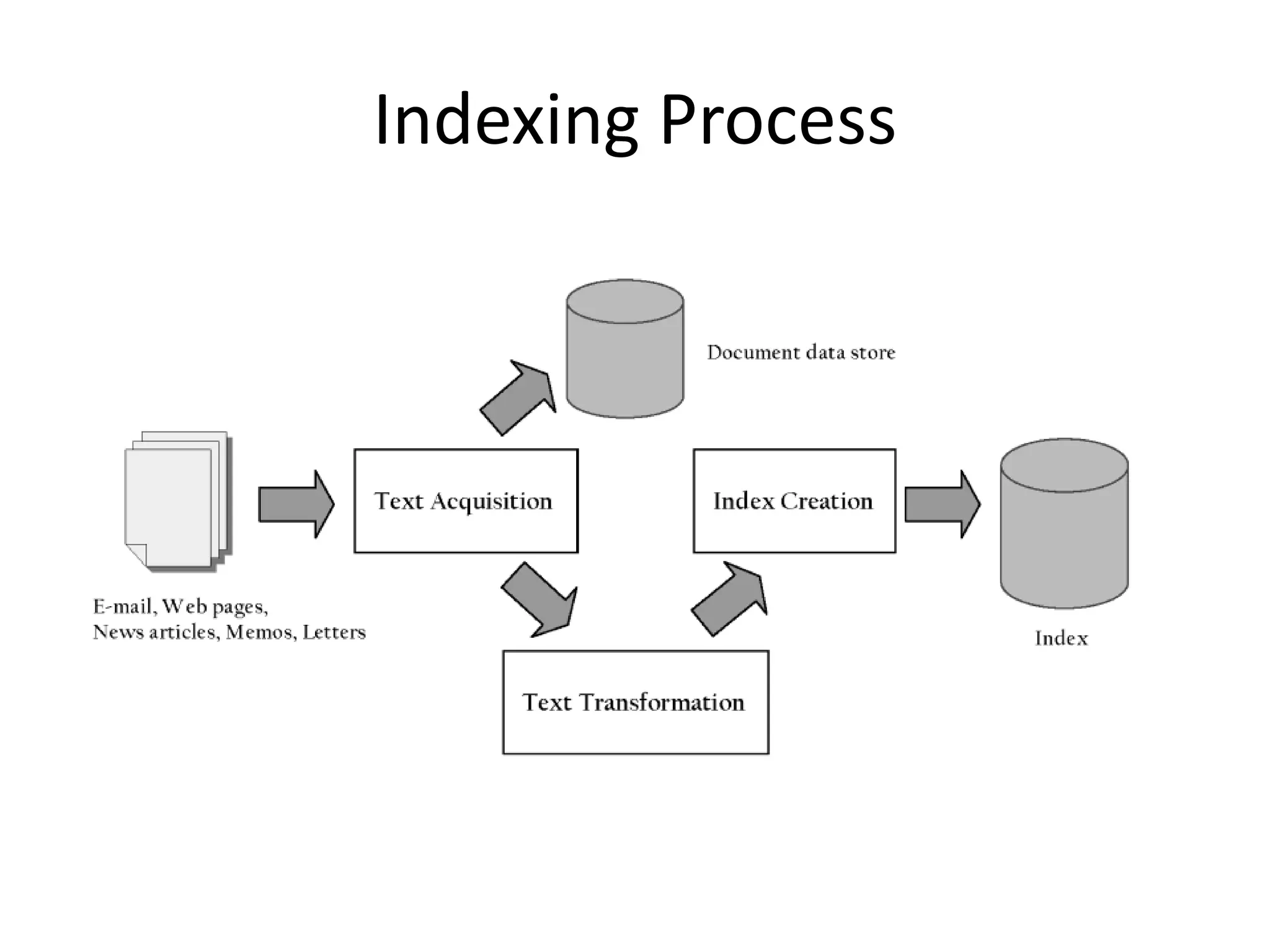
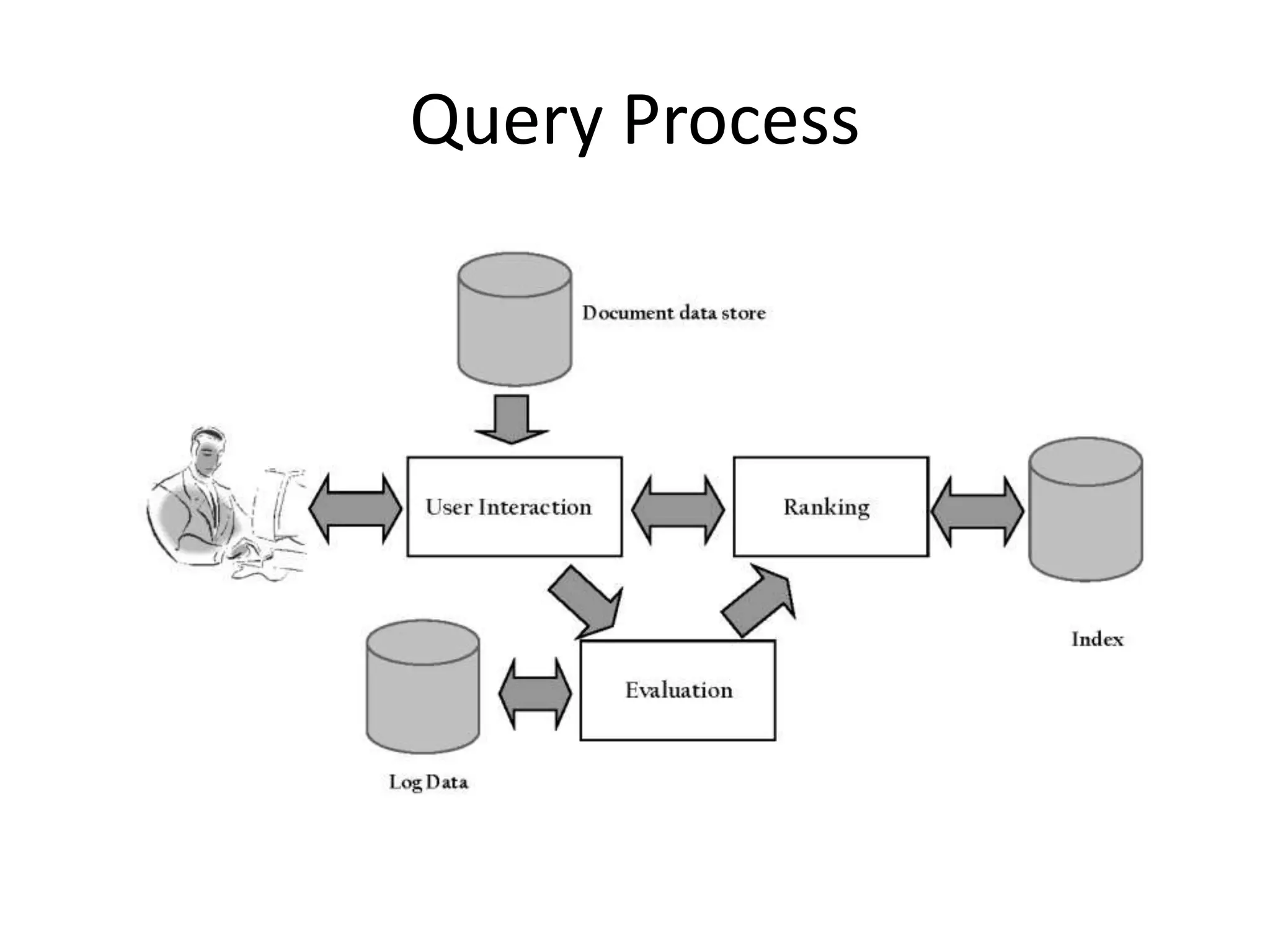
Indexing process builds the structures that
enable searching, and the query process uses
those structures and a person’s query to
produce a ranked list of documents.
Indexing Process
Indexing Process
• Text acquisition
– identifies and stores documents for indexing
• Text transformation
– transforms documents into index terms or
features
• Index creation
– takes index terms and creates data structures
(indexes) to support fast searching
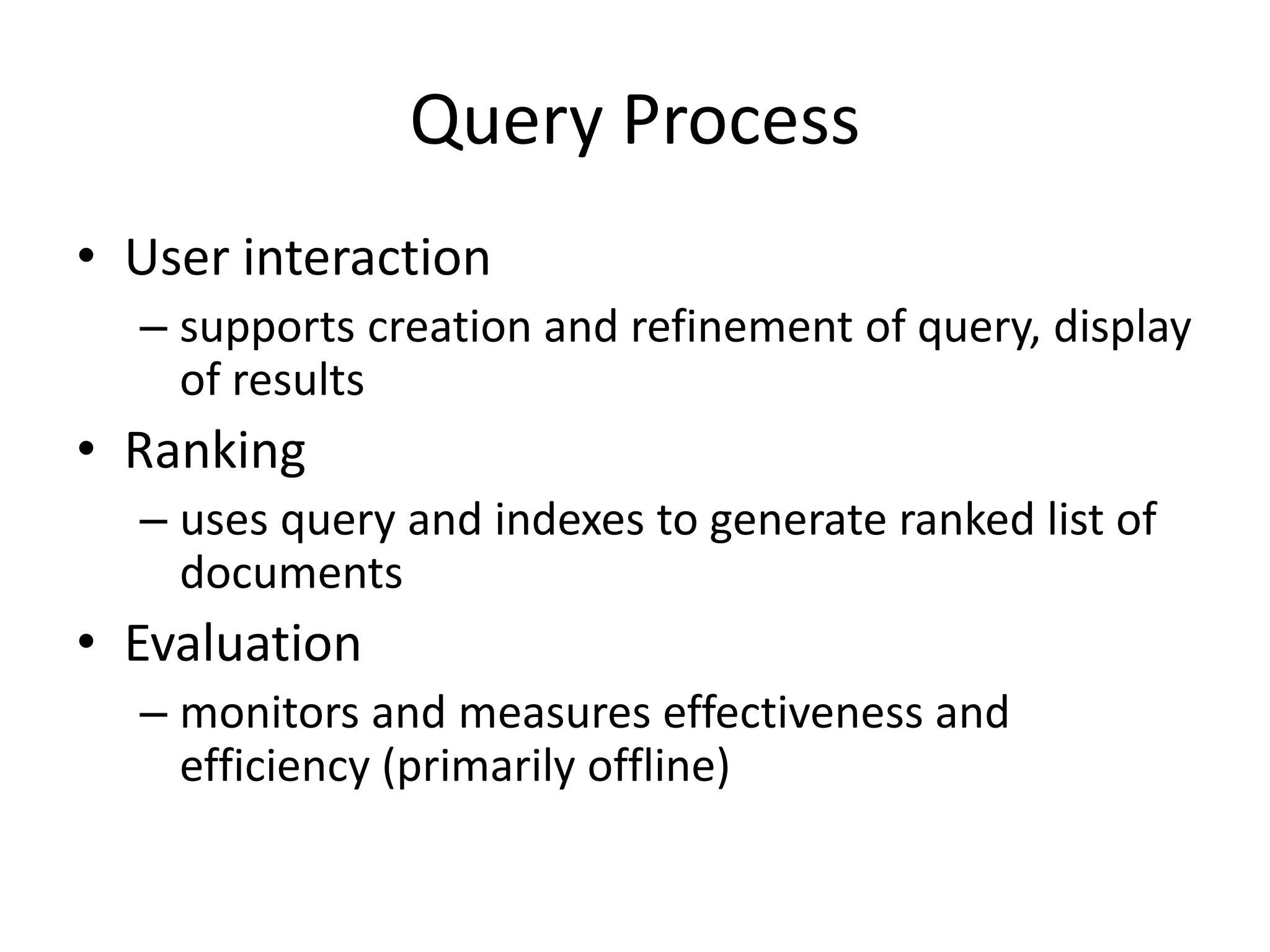
Query Process
Query Process
• User interaction
– supports creation and refinement of query, display
of results
• Ranking
– uses query and indexes to generate ranked list of
documents
• Evaluation
– monitors and measures effectiveness and
efficiency (primarily offline)
Details: Text Acquisition
• Crawler
– Identifies and acquires documents for search
engine
– Many types – web, enterprise, desktop
– Web crawlers follow links to find documents
• Must efficiently find huge numbers of web pages
(coverage) and keep them up-to-date (freshness)
• Single site crawlers for site search
• Topical or focused crawlers for vertical search
– Document crawlers for enterprise and desktop
search
• Follow links and scan directories
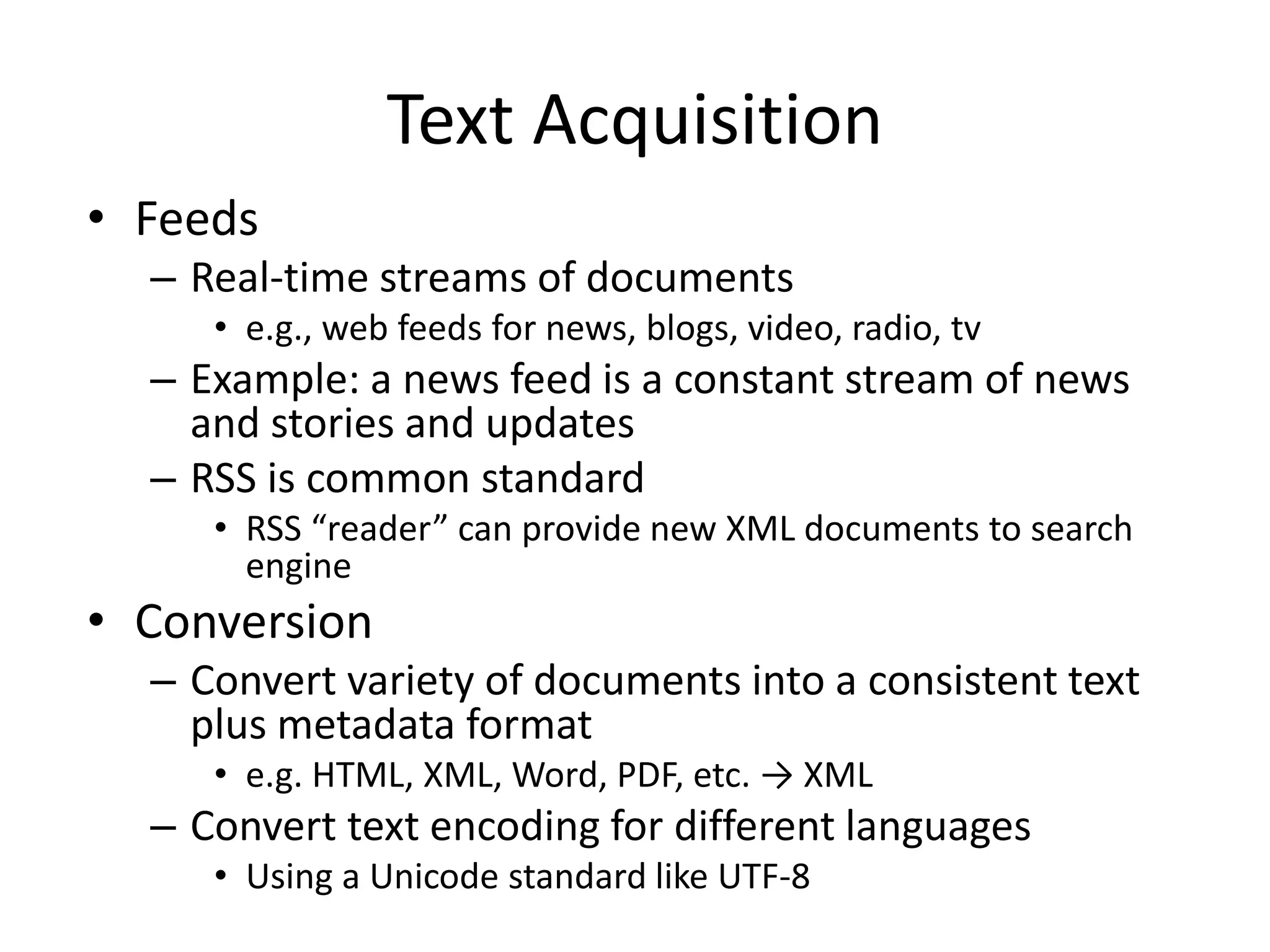
Text Acquisition
• Feeds
– Real-time streams of documents
• e.g., web feeds for news, blogs, video, radio, tv
– Example: a news feed is a constant stream of news
and stories and updates
– RSS is common standard
• RSS “reader” can provide new XML documents to search
engine
• Conversion
– Convert variety of documents into a consistent text
plus metadata format
• e.g. HTML, XML, Word, PDF, etc. → XML
– Convert text encoding for different languages
• Using a Unicode standard like UTF-8
Text Acquisition
• Document data store
– Stores text, metadata, and other related content
for documents
• Metadata is information about document such as type
and creation date
• Other content includes links, anchor text
– Provides fast access to document contents for
search engine components
• e.g. result list generation
– Could use relational database system
• More typically, a simpler, more efficient storage system
is used due to huge numbers of documents
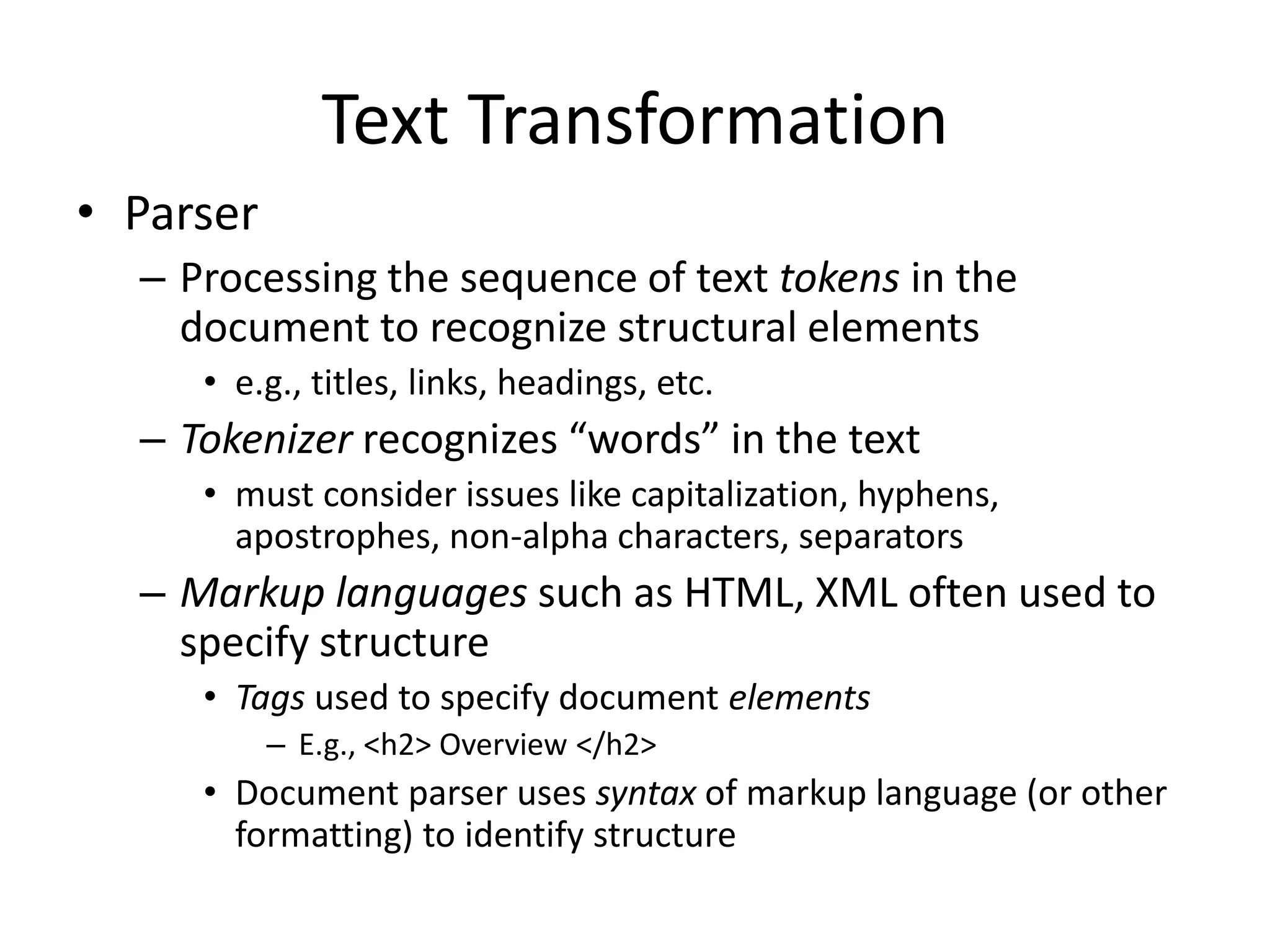
Text Transformation
• Parser
– Processing the sequence of text tokens in the
document to recognize structural elements
• e.g., titles, links, headings, etc.
– Tokenizer recognizes “words” in the text
• must consider issues like capitalization, hyphens,
apostrophes, non-alpha characters, separators
– Markup languages such as HTML, XML often used to
specify structure
• Tags used to specify document elements
– E.g., <h2> Overview </h2>
• Document parser uses syntax of markup language (or other
formatting) to identify structure
Text Transformation
• Stopping
– Remove common words
• e.g., “and”, “or”, “the”, “in”
– Some impact on efficiency and effectiveness
– Can be a problem for some queries
• Stemming
– Group words derived from a common stem
• e.g., “computer”, “computers”, “computing”, “compute”
– Usually effective, but not for all queries
– Benefits vary for different languages
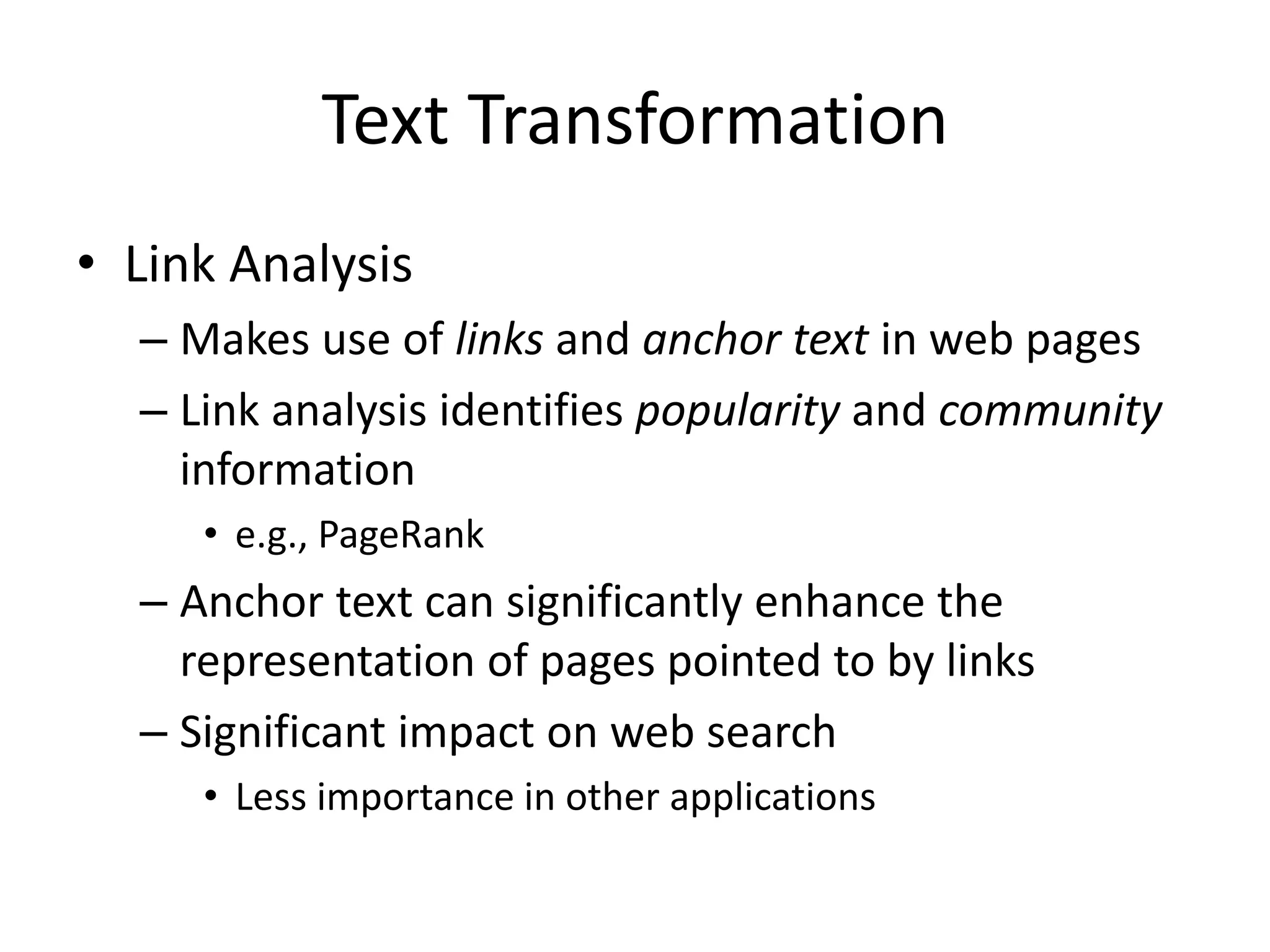
Text Transformation
• Link Analysis
– Makes use of links and anchor text in web pages
– Link analysis identifies popularity and community
information
• e.g., PageRank
– Anchor text can significantly enhance the
representation of pages pointed to by links
– Significant impact on web search
• Less importance in other applications
Text Transformation
• Information Extraction
– Identify classes of index terms that are important
for some applications
– e.g., named entity recognizers identify classes
such as people, locations, companies, dates, etc.
• Classifier
– Identifies class-related metadata for documents
• i.e., assigns labels to documents
• e.g., topics, reading levels, sentiment, genre
– Use depends on application
Index Creation
• Document Statistics
– Gathers counts and positions of words and other
features
– Used in ranking algorithm
• Weighting
– Computes weights for index terms
– Used in ranking algorithm
– e.g., tf.idf weight
• Combination of term frequency in document and
inverse document frequency in the collection
Index Creation
• Inversion
– Core of indexing process
– Converts document-term information to term-
document for indexing
• Difficult for very large numbers of documents
– Format of inverted file is designed for fast query
processing
• Must also handle updates
• Compression used for efficiency
Index Creation
• Index Distribution
– Distributes indexes across multiple computers
and/or multiple sites
– Essential for fast query processing with large
numbers of documents
– Many variations
• Document distribution, term distribution, replication
– P2P and distributed IR involve search across
multiple sites
User Interaction
• Query input
– Provides interface and parser for query language
– Most web queries are very simple, other
applications may use forms
– Query language used to describe more complex
queries and results of query transformation
• e.g., Boolean queries, Indri and Galago query languages
• similar to SQL language used in database applications
• IR query languages also allow content and structure
specifications, but focus on content
User Interaction
• Query transformation
– Improves initial query, both before and after initial
search
– Includes text transformation techniques used for
documents
– Spell checking and query suggestion provide
alternatives to original query
– Query expansion and relevance feedback modify
the original query with additional terms
User Interaction
• Results output
– Constructs the display of ranked documents for a
query
– Generates snippets to show how queries match
documents
– Highlights important words and passages
– Retrieves appropriate advertising in many
applications
– May provide clustering and other visualization
tools
Ranking
• Scoring
– Calculates scores for documents using a ranking
algorithm
– Core component of search engine
– Basic form of score is  qi di
• qi and di are query and document term weights for
term i
– Many variations of ranking algorithms and
retrieval models
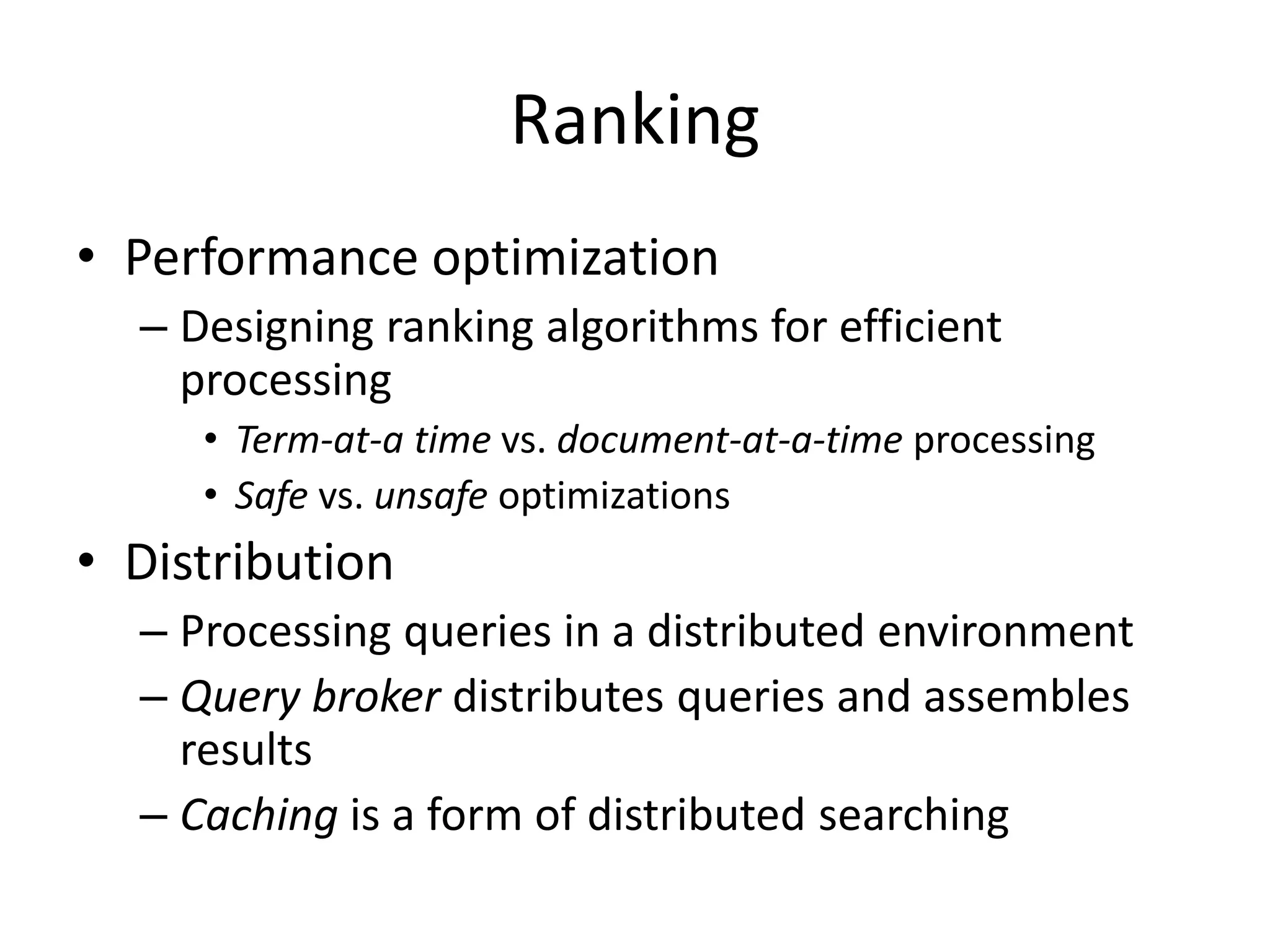
Ranking
• Performance optimization
– Designing ranking algorithms for efficient
processing
• Term-at-a time vs. document-at-a-time processing
• Safe vs. unsafe optimizations
• Distribution
– Processing queries in a distributed environment
– Query broker distributes queries and assembles
results
– Caching is a form of distributed searching
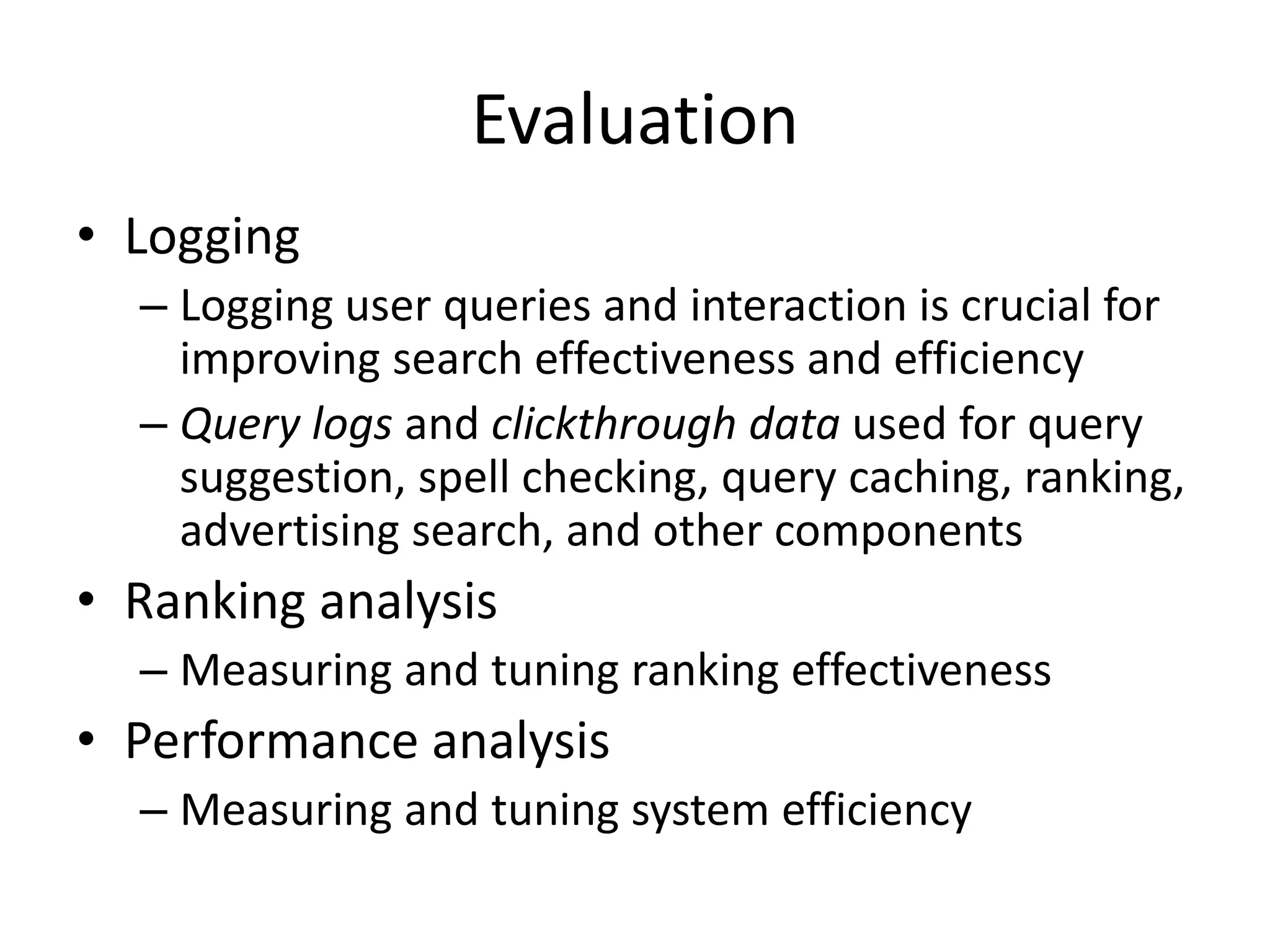
Evaluation
• Logging
– Logging user queries and interaction is crucial for
improving search effectiveness and efficiency
– Query logs and clickthrough data used for query
suggestion, spell checking, query caching, ranking,
advertising search, and other components
• Ranking analysis
– Measuring and tuning ranking effectiveness
• Performance analysis
– Measuring and tuning system efficiency
How Does It Really Work?
• This course explains these components of a
search engine in more detail
• Often many possible approaches and techniques
for a given component
– Focus is on the most important alternatives
– i.e., explain a small number of approaches in detail
rather than many approaches
– “Importance” based on research results and use in
actual search engines
– Alternatives described in references

Info 2402 irt-chapter_2

  • 1.
    Search Engines Architecture Chapter- 2 Book: Search Engines – Information Retrieval in Practice Lecturer: Zeeshan Bhatti All slides ©Addison Wesley, 2008 INFO-2402 INFORMATION RETRIEVAL TECHNOLOGIES Lecture 2: 9th February, 2015
  • 2.
    Types of SearchEngines • Search engines come in a number of configuration that reflect the applications that are designed for. • Web Search engines: such as Google and Yahoo, which are able to capture and crawl data and provides responses in million of queries. • Enterprise search Engines: like Autonomy.com, able to process variety of information sources in a company and use company specific knowledge as part of search and related tasks. • Data Mining: Refers to automatic discovery of interesting structures in data and includes techniques such as clustering. • Desktop Search engines: such as Microsoft search, are able to rapidly incorporate new documents, web pages, files, and email as the person creates and views them. • Open Source search engines are another important class of system, like Wikipedia for information retrieval, Lucene , Lemur, Galago.
  • 3.
    Search Engine Architecture •A software architecture consists of software components, the interfaces provided by those components, and the relationships between them – describes a system at a particular level of abstraction • Architecture of a search engine determined by 2 requirements – effectiveness (quality of results) and efficiency (response time and throughput)
  • 4.
    Basic building Blocks •Search engine components support two major functions, which are – Indexing process – Query Process Indexing process builds the structures that enable searching, and the query process uses those structures and a person’s query to produce a ranked list of documents.
  • 5.
  • 6.
    Indexing Process • Textacquisition – identifies and stores documents for indexing • Text transformation – transforms documents into index terms or features • Index creation – takes index terms and creates data structures (indexes) to support fast searching
  • 7.
  • 8.
    Query Process • Userinteraction – supports creation and refinement of query, display of results • Ranking – uses query and indexes to generate ranked list of documents • Evaluation – monitors and measures effectiveness and efficiency (primarily offline)
  • 9.
    Details: Text Acquisition •Crawler – Identifies and acquires documents for search engine – Many types – web, enterprise, desktop – Web crawlers follow links to find documents • Must efficiently find huge numbers of web pages (coverage) and keep them up-to-date (freshness) • Single site crawlers for site search • Topical or focused crawlers for vertical search – Document crawlers for enterprise and desktop search • Follow links and scan directories
  • 10.
    Text Acquisition • Feeds –Real-time streams of documents • e.g., web feeds for news, blogs, video, radio, tv – Example: a news feed is a constant stream of news and stories and updates – RSS is common standard • RSS “reader” can provide new XML documents to search engine • Conversion – Convert variety of documents into a consistent text plus metadata format • e.g. HTML, XML, Word, PDF, etc. → XML – Convert text encoding for different languages • Using a Unicode standard like UTF-8
  • 11.
    Text Acquisition • Documentdata store – Stores text, metadata, and other related content for documents • Metadata is information about document such as type and creation date • Other content includes links, anchor text – Provides fast access to document contents for search engine components • e.g. result list generation – Could use relational database system • More typically, a simpler, more efficient storage system is used due to huge numbers of documents
  • 12.
    Text Transformation • Parser –Processing the sequence of text tokens in the document to recognize structural elements • e.g., titles, links, headings, etc. – Tokenizer recognizes “words” in the text • must consider issues like capitalization, hyphens, apostrophes, non-alpha characters, separators – Markup languages such as HTML, XML often used to specify structure • Tags used to specify document elements – E.g., <h2> Overview </h2> • Document parser uses syntax of markup language (or other formatting) to identify structure
  • 13.
    Text Transformation • Stopping –Remove common words • e.g., “and”, “or”, “the”, “in” – Some impact on efficiency and effectiveness – Can be a problem for some queries • Stemming – Group words derived from a common stem • e.g., “computer”, “computers”, “computing”, “compute” – Usually effective, but not for all queries – Benefits vary for different languages
  • 14.
    Text Transformation • LinkAnalysis – Makes use of links and anchor text in web pages – Link analysis identifies popularity and community information • e.g., PageRank – Anchor text can significantly enhance the representation of pages pointed to by links – Significant impact on web search • Less importance in other applications
  • 15.
    Text Transformation • InformationExtraction – Identify classes of index terms that are important for some applications – e.g., named entity recognizers identify classes such as people, locations, companies, dates, etc. • Classifier – Identifies class-related metadata for documents • i.e., assigns labels to documents • e.g., topics, reading levels, sentiment, genre – Use depends on application
  • 16.
    Index Creation • DocumentStatistics – Gathers counts and positions of words and other features – Used in ranking algorithm • Weighting – Computes weights for index terms – Used in ranking algorithm – e.g., tf.idf weight • Combination of term frequency in document and inverse document frequency in the collection
  • 17.
    Index Creation • Inversion –Core of indexing process – Converts document-term information to term- document for indexing • Difficult for very large numbers of documents – Format of inverted file is designed for fast query processing • Must also handle updates • Compression used for efficiency
  • 18.
    Index Creation • IndexDistribution – Distributes indexes across multiple computers and/or multiple sites – Essential for fast query processing with large numbers of documents – Many variations • Document distribution, term distribution, replication – P2P and distributed IR involve search across multiple sites
  • 19.
    User Interaction • Queryinput – Provides interface and parser for query language – Most web queries are very simple, other applications may use forms – Query language used to describe more complex queries and results of query transformation • e.g., Boolean queries, Indri and Galago query languages • similar to SQL language used in database applications • IR query languages also allow content and structure specifications, but focus on content
  • 20.
    User Interaction • Querytransformation – Improves initial query, both before and after initial search – Includes text transformation techniques used for documents – Spell checking and query suggestion provide alternatives to original query – Query expansion and relevance feedback modify the original query with additional terms
  • 21.
    User Interaction • Resultsoutput – Constructs the display of ranked documents for a query – Generates snippets to show how queries match documents – Highlights important words and passages – Retrieves appropriate advertising in many applications – May provide clustering and other visualization tools
  • 22.
    Ranking • Scoring – Calculatesscores for documents using a ranking algorithm – Core component of search engine – Basic form of score is  qi di • qi and di are query and document term weights for term i – Many variations of ranking algorithms and retrieval models
  • 23.
    Ranking • Performance optimization –Designing ranking algorithms for efficient processing • Term-at-a time vs. document-at-a-time processing • Safe vs. unsafe optimizations • Distribution – Processing queries in a distributed environment – Query broker distributes queries and assembles results – Caching is a form of distributed searching
  • 24.
    Evaluation • Logging – Logginguser queries and interaction is crucial for improving search effectiveness and efficiency – Query logs and clickthrough data used for query suggestion, spell checking, query caching, ranking, advertising search, and other components • Ranking analysis – Measuring and tuning ranking effectiveness • Performance analysis – Measuring and tuning system efficiency
  • 25.
    How Does ItReally Work? • This course explains these components of a search engine in more detail • Often many possible approaches and techniques for a given component – Focus is on the most important alternatives – i.e., explain a small number of approaches in detail rather than many approaches – “Importance” based on research results and use in actual search engines – Alternatives described in references