Summary week 4Malak saleh : ) Influenza
Key factsSpreads easily from person to person Influenza circulates worldwide and can affect anybody in any age group.It causes annual epidemics that peak during winter in temperature regions. Is a serious public health problem that causes severe illnesses and deathsAn epidemic can take an economic too through lost workforce productivityVaccination is the most effective way to prevent infection
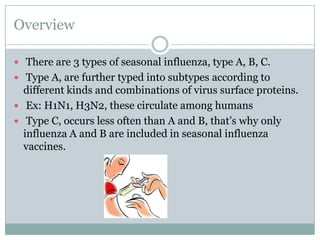
Overview There are 3 types of seasonal influenza, type A, B, C.Type A, are further typed into subtypes according to different kinds and combinations of virus surface proteins.Ex: H1N1, H3N2, these circulate among humansType C, occurs less often than A and B, that’s why only influenza A and B are included in seasonal influenza vaccines.
Signs and symptomsIt is characterized by a sudden onset of high fever, cough (usually dry), headache, muscle and joint pain, severe malaise (feeling unwell), sore throat and runny nose.The period of incubation is about 2 days.
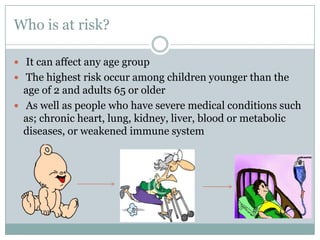
Who is at risk?It can affect any age groupThe highest risk occur among children younger than the age of 2 and adults 65 or older As well as people who have severe medical conditions such as; chronic heart, lung, kidney, liver, blood or metabolic diseases, or weakened immune system
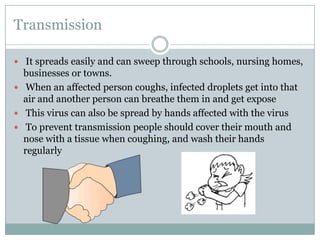
Transmission It spreads easily and can sweep through schools, nursing homes, businesses or towns.When an affected person coughs, infected droplets get into that air and another person can breathe them in and get expose This virus can also be spread by hands affected with the virus To prevent transmission people should cover their mouth and nose with a tissue when coughing, and wash their hands regularly
Treatment Antiviral drugs for influenza are available in some countries and effectively prevent and treat the illnessThere are 2 classes of such medicines 1) adamantanes  2) inhibitors of influenza neuraminidase
Seasonal epidemicsThey occur yearly during autumn and winter in temperature regionsIllnesses result in hospitalizations and deaths mainly among high risk groups.Worldwide, these annual epidemics result in about three to five million cases of severe illness, and about 250,000 to 500,000 deaths.
Disease effectsInfluenza can cause serious public health and economic problems.In communities, clinics and hospitals can be overwhelmed when large numbers of sick people appear for treatment during peak illness periods.Little is known about the effects of influenza epidemics in developing countries
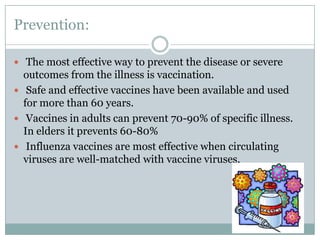
Prevention: The most effective way to prevent the disease or severe outcomes from the illness is vaccination. Safe and effective vaccines have been available and used for more than 60 years.Vaccines in adults can prevent 70-90% of specific illness. In elders it prevents 60-80%Influenza vaccines are most effective when circulating viruses are well-matched with vaccine viruses.
Avian influenza (in birds)It is an infectious disease of birds caused by type A strains of the influenza virus. The virus can cause 2 distinctly different forms of disease- one common and mild, the other rare and highly lethal.In the mild outbreaks can be so mild they escape detection unless regular testing for viruses is in place.In the second you cannot miss the symptoms and the bird is classified straight away. Highly pathogenic viruses can survive for long periods in the environment, especially when temperatures are low.The logistics are usually very straightforward when applied to large commercial farms, where birds are housed indoors.The use of poor quality vaccines or vaccines that poorly match the circulating virus strain may accelerate mutation of the virus. During 2005 scientists are increasingly convinced that at least some migratory waterfowl are now carrying H5N1 in its high pathogenic formTo date, 9 Asian countries have reported outbreaks of the disease: Korea, Viet Nam, Japan, Thailand, Cambodia, Indonesia, China, and Malaysia.
The disease in Humans Influenza viruses are normally highly species-specific Of the hundreds of strains of avian influenza only 4 are known to have caused human infection: H5N1, H7N3, H9N2, H7N7 The virus of H5N1 transmissibility can improve among 2 principal mechanisms 1)  Reassortment: in which the genetic material is exchanged. 2)  Adaptive mutation: small clusters of human cases with some evidence to human –to-human transmission. The incubation period is different than that of a normal influenza.Ranging from 2-8 days and sometimes as long as 17 days.
10 concerns if the disease became a pandemicPandemic influenza is different than avian influenzaInfluenza pandemics are recurring eventsThe world may be on the brink of another pandemicAll countries will be affectedWidespread illness will occurMedical supplied will be inadequateLarge numbers of deaths will occurEconomic and social disruption will be greatEvery country must be preparedWHO will alert the world when the pandemic threat increases

Influenza

  • 1.
    Summary week 4Malaksaleh : ) Influenza
  • 2.
    Key factsSpreads easilyfrom person to person Influenza circulates worldwide and can affect anybody in any age group.It causes annual epidemics that peak during winter in temperature regions. Is a serious public health problem that causes severe illnesses and deathsAn epidemic can take an economic too through lost workforce productivityVaccination is the most effective way to prevent infection
  • 3.
    Overview There are3 types of seasonal influenza, type A, B, C.Type A, are further typed into subtypes according to different kinds and combinations of virus surface proteins.Ex: H1N1, H3N2, these circulate among humansType C, occurs less often than A and B, that’s why only influenza A and B are included in seasonal influenza vaccines.
  • 4.
    Signs and symptomsItis characterized by a sudden onset of high fever, cough (usually dry), headache, muscle and joint pain, severe malaise (feeling unwell), sore throat and runny nose.The period of incubation is about 2 days.
  • 5.
    Who is atrisk?It can affect any age groupThe highest risk occur among children younger than the age of 2 and adults 65 or older As well as people who have severe medical conditions such as; chronic heart, lung, kidney, liver, blood or metabolic diseases, or weakened immune system
  • 6.
    Transmission It spreadseasily and can sweep through schools, nursing homes, businesses or towns.When an affected person coughs, infected droplets get into that air and another person can breathe them in and get expose This virus can also be spread by hands affected with the virus To prevent transmission people should cover their mouth and nose with a tissue when coughing, and wash their hands regularly
  • 7.
    Treatment Antiviral drugsfor influenza are available in some countries and effectively prevent and treat the illnessThere are 2 classes of such medicines 1) adamantanes 2) inhibitors of influenza neuraminidase
  • 8.
    Seasonal epidemicsThey occuryearly during autumn and winter in temperature regionsIllnesses result in hospitalizations and deaths mainly among high risk groups.Worldwide, these annual epidemics result in about three to five million cases of severe illness, and about 250,000 to 500,000 deaths.
  • 9.
    Disease effectsInfluenza cancause serious public health and economic problems.In communities, clinics and hospitals can be overwhelmed when large numbers of sick people appear for treatment during peak illness periods.Little is known about the effects of influenza epidemics in developing countries
  • 10.
    Prevention: The mosteffective way to prevent the disease or severe outcomes from the illness is vaccination. Safe and effective vaccines have been available and used for more than 60 years.Vaccines in adults can prevent 70-90% of specific illness. In elders it prevents 60-80%Influenza vaccines are most effective when circulating viruses are well-matched with vaccine viruses.
  • 11.
    Avian influenza (inbirds)It is an infectious disease of birds caused by type A strains of the influenza virus. The virus can cause 2 distinctly different forms of disease- one common and mild, the other rare and highly lethal.In the mild outbreaks can be so mild they escape detection unless regular testing for viruses is in place.In the second you cannot miss the symptoms and the bird is classified straight away. Highly pathogenic viruses can survive for long periods in the environment, especially when temperatures are low.The logistics are usually very straightforward when applied to large commercial farms, where birds are housed indoors.The use of poor quality vaccines or vaccines that poorly match the circulating virus strain may accelerate mutation of the virus. During 2005 scientists are increasingly convinced that at least some migratory waterfowl are now carrying H5N1 in its high pathogenic formTo date, 9 Asian countries have reported outbreaks of the disease: Korea, Viet Nam, Japan, Thailand, Cambodia, Indonesia, China, and Malaysia.
  • 12.
    The disease inHumans Influenza viruses are normally highly species-specific Of the hundreds of strains of avian influenza only 4 are known to have caused human infection: H5N1, H7N3, H9N2, H7N7 The virus of H5N1 transmissibility can improve among 2 principal mechanisms 1) Reassortment: in which the genetic material is exchanged. 2) Adaptive mutation: small clusters of human cases with some evidence to human –to-human transmission. The incubation period is different than that of a normal influenza.Ranging from 2-8 days and sometimes as long as 17 days.
  • 13.
    10 concerns ifthe disease became a pandemicPandemic influenza is different than avian influenzaInfluenza pandemics are recurring eventsThe world may be on the brink of another pandemicAll countries will be affectedWidespread illness will occurMedical supplied will be inadequateLarge numbers of deaths will occurEconomic and social disruption will be greatEvery country must be preparedWHO will alert the world when the pandemic threat increases