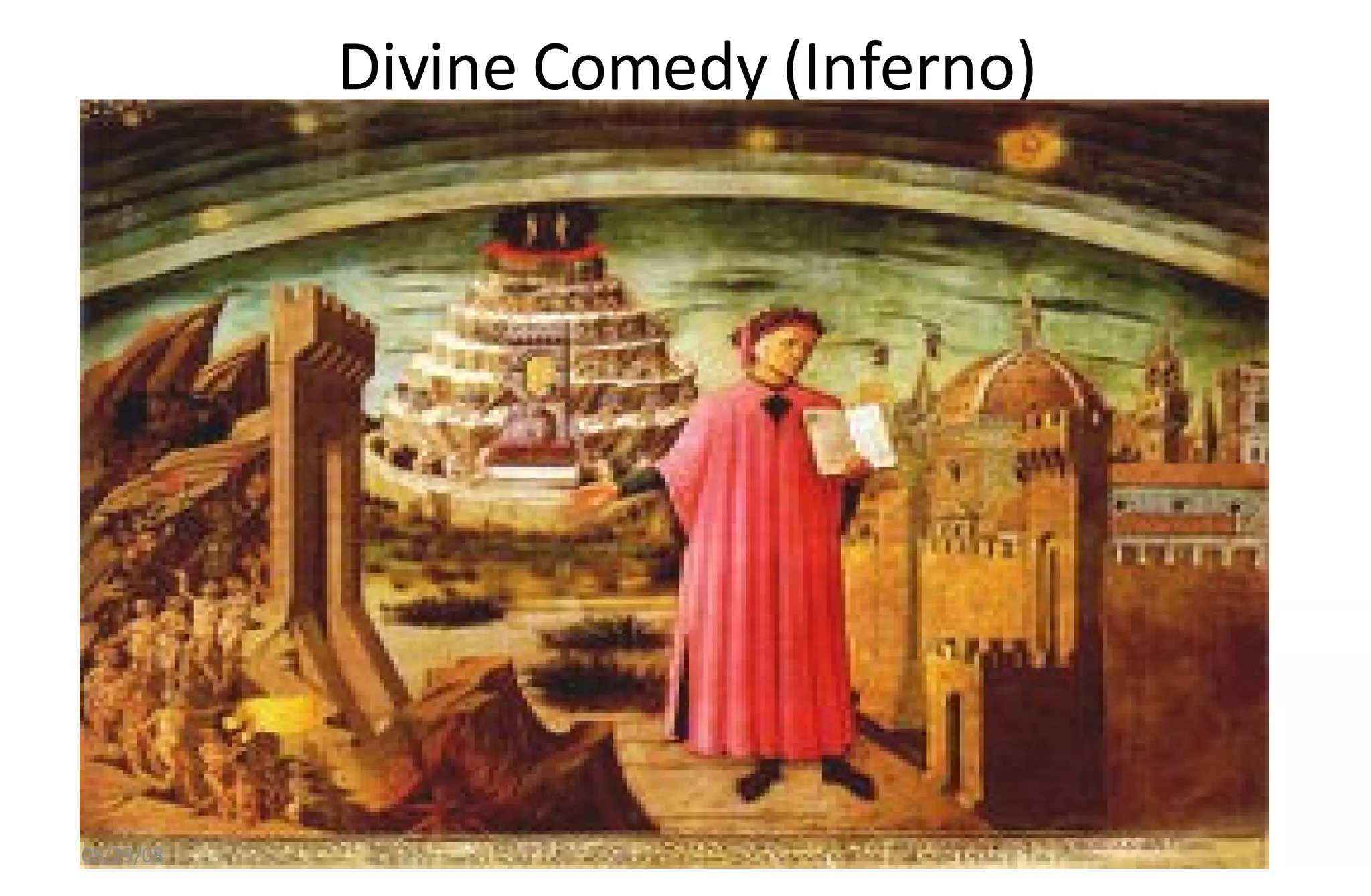
Divine Comedy (Inferno) 06/04/09
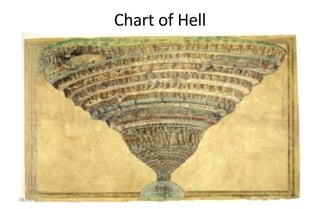
Chart of Hell 06/04/09
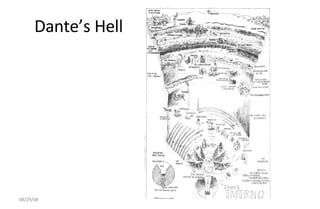
Dante’s Hell 06/04/09
Structure The Divine Comedy  is composed of three  canticas  —  Inferno  ( Hell ),  Purgatorio  ( Purgatory ), and  Paradiso  ( Paradise ) composed each of 33  cantos  (or "canti"). The very first  canto  serves as an introduction to the poem and is generally not considered to be part of the first  cantica , bringing the total number of cantos to 100.  The number 3 is prominent in the work, represented here by the length of each  cantica . The verse scheme used,  terza rima , with the lines composing  tercets  according to the  rhyme scheme  ABA BCB CDC . . . YZY Z. hendecasyllable  (line of eleven syllables),  These are structured according to the classical (Aristotelian) conception of virtue and vice, so that they are grouped into the sins of incontinence, violence, and fraud (which for many commentators are represented by the leopard, lion, and she-wolf). The sins of incontinence — weakness in controlling one's desires and natural urges — are the mildest among them, and, correspondingly, appear first: 06/04/09
Synopsis Dante Pilgrim has not been a good boy.  His dead love Beatrice asks the Virgin Mary to help him see the error of his ways.  Mary accepts and Dante is sent on a three-day trip through Hell, and on up Mount Purgatory on the other side of the world, and finally to Heaven in the sky.  He is spiritually lost at the beginning of the story, so he needs guides to help him along the path.  His first guide, through Hell and Purgatory is  Virgil  (author of the Aeneid).  They encounter many interesting sinners on the way. Dante learns to hate sin.  His second guide is  Beatrice , the woman he adored while she lived.  His final guide is  Saint Bernard  (namesake of the loyal dog), who takes him to see God. 06/04/09
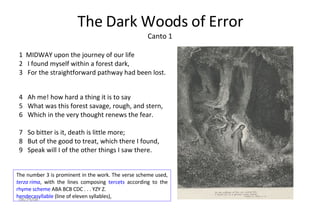
The Dark Woods of Error Canto 1 1  MIDWAY upon the journey of our life  2   I found myself within a forest dark,  3   For the straightforward pathway had been lost.    4   Ah me! how hard a thing it is to say 5   What was this forest savage, rough, and stern,  6   Which in the very thought renews the fear.   7   So bitter is it, death is little more;  8   But of the good to treat, which there I found, 9   Speak will I of the other things I saw there. The number 3 is prominent in the work. The verse scheme used,  terza rima , with the lines composing  tercets  according to the  rhyme scheme  ABA BCB CDC . . . YZY Z. hendecasyllable  (line of eleven syllables),  06/04/09
Canto 1 The poet tells in the first person his travel through the three realms of the dead,  The poem begins on  Good Friday  of the year  1300 , "In the middle of our life's journey" ( Nel mezzo del cammin di nostra vita ), and so opens  in medias res .  Dante is thirty-five years old, half of the biblically allotted age of 70 ( Psalm  90:10), lost in a dark wood (perhaps, allegorically, contemplating  suicide —as "wood" is figured in Canto XIII, and also the mention of suicide is made in Canto I of  Purgatorio  with "This man has not yet seen his last evening; But, through his madness, was so close to it,  That there was hardly time to turn about" implying that when Virgil came to him he was on the verge of suicide or morally passing the point of no return), assailed by beasts (a  lion , a  leopard , and a  she-wolf ; allegorical depictions of temptations towards sin) he cannot evade, and unable to find the "straight way" ( diritta via ) to salvation (symbolized by the sun behind the mountain).  Conscious that he is ruining himself, that he is falling into a "deep place" ( basso loco ) where the sun is silent (' l sol tace ), The Roman poet  Virgil  guides him through Hell and Purgatory;  Beatrice , Dante's ideal woman, guides him through Heaven. 06/04/09
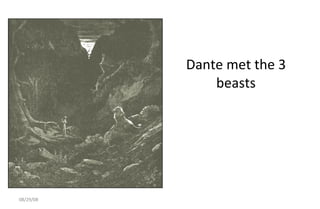
Dante met the 3 beasts 06/04/09
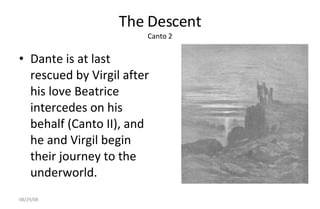
The Descent Canto 2 Dante is at last rescued by Virgil after his love Beatrice intercedes on his behalf (Canto II), and he and Virgil begin their journey to the underworld. 06/04/09
The Opportunists (Gate) Canto 3 Dante passes through the gate of hell, on which is inscribed the famous phrase " Lasciate ogne speranza, voi ch'intrate ", or "Abandon all hope, ye who enter here” Before entering Hell completely, Dante and his guide see the Opportunists, souls of people who in life did nothing, neither for good nor evil (among these Dante recognizes either  Pope Celestine V , or  Pontius Pilate ; the text is ambiguous).  Mixed with them are the outcasts, who took no side in the  Rebellion of Angels . These souls are neither in  Hell  nor out of it, but reside on the shores of the  Acheron , their punishment to eternally pursue a banner, and be pursued by  wasps  and  hornets  that continually sting them while  maggots  and other such insects drink their blood and tears.  This symbolizes the sting of their  conscience  and the repugnance of sin. Then Dante and Virgil reach the ferry that will take them across the river Acheron and to Hell proper. The ferry is piloted by  Charon , who does not want to let Dante enter, for he is a living being. Virgil forces Charon to take them, but their passage across is undescribed since Dante faints and does not awake until he is on the other side. 06/04/09
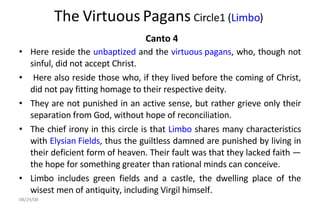
The Virtuous Pagans  Circle1 ( Limbo )    Canto 4 Here reside the  unbaptized  and the  virtuous pagans , who, though not sinful, did not accept Christ. Here also reside those who, if they lived before the coming of Christ, did not pay fitting homage to their respective deity.  They are not punished in an active sense, but rather grieve only their separation from God, without hope of reconciliation.  The chief irony in this circle is that  Limbo  shares many characteristics with  Elysian Fields , thus the guiltless damned are punished by living in their deficient form of heaven. Their fault was that they lacked faith — the hope for something greater than rational minds can conceive.  Limbo includes green fields and a castle, the dwelling place of the wisest men of antiquity, including Virgil himself.  06/04/09
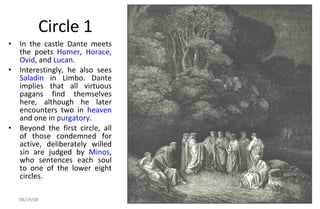
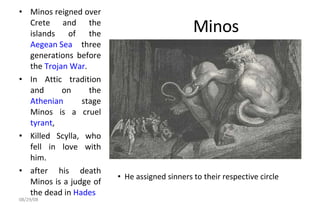
Circle 1 In the castle Dante meets the poets  Homer ,  Horace ,  Ovid , and  Lucan .  Interestingly, he also sees  Saladin  in Limbo. Dante implies that all virtuous pagans find themselves here, although he later encounters two in  heaven  and one in  purgatory .  Beyond the first circle, all of those condemned for active, deliberately willed sin are judged by  Minos , who sentences each soul to one of the lower eight circles.  06/04/09
Minos Minos reigned over Crete and the islands of the  Aegean Sea  three generations before the  Trojan War . In Attic tradition and on the  Athenian  stage Minos is a cruel  tyrant ,  Killed Scylla, who fell in love with him.  after his death Minos is a judge of the dead in  Hades   He assigned sinners to their respective circle 06/04/09
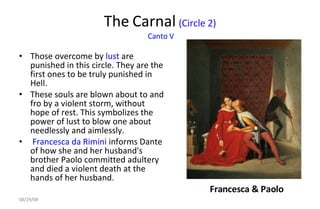
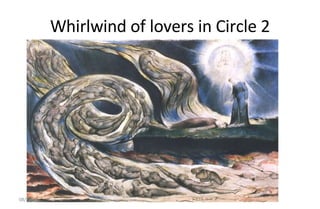
The Carnal  (Circle 2)  Canto V Those overcome by  lust  are punished in this circle. They are the first ones to be truly punished in Hell.  These souls are blown about to and fro by a violent storm, without hope of rest. This symbolizes the power of lust to blow one about needlessly and aimlessly. Francesca da Rimini  informs Dante of how she and her husband's brother Paolo committed adultery and died a violent death at the hands of her husband.  Francesca & Paolo 06/04/09
Whirlwind of lovers in Circle 2 06/04/09
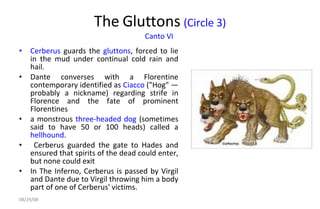
The Gluttons  (Circle 3) Canto VI   Cerberus  guards the  gluttons , forced to lie in the mud under continual cold rain and hail.  Dante converses with a Florentine contemporary identified as  Ciacco  ("Hog" — probably a nickname) regarding strife in Florence and the fate of prominent Florentines a monstrous  three-headed   dog  (sometimes said to have 50 or 100 heads) called a  hellhound . Cerberus guarded the gate to Hades and ensured that spirits of the dead could enter, but none could exit In The Inferno, Cerberus is passed by Virgil and Dante due to Virgil throwing him a body part of one of Cerberus' victims.  06/04/09
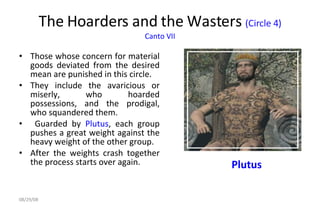
The Hoarders and the Wasters  (Circle 4)  Canto VII   Those whose concern for material goods deviated from the desired mean are punished in this circle.  They include the avaricious or miserly, who hoarded possessions, and the prodigal, who squandered them. Guarded by  Plutus , each group pushes a great weight against the heavy weight of the other group.  After the weights crash together the process starts over again. Plutus 06/04/09
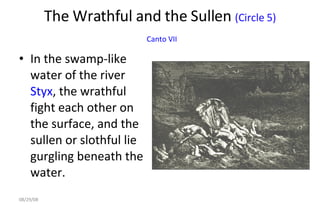
The Wrathful and the Sullen  (Circle 5)   Canto VII In the swamp-like water of the river  Styx , the wrathful fight each other on the surface, and the sullen or slothful lie gurgling beneath the water.  06/04/09
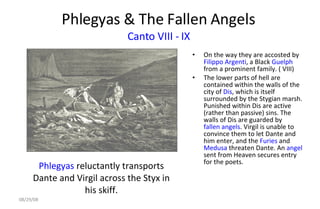
Phlegyas & The Fallen Angels  Canto VIII - IX  On the way they are accosted by  Filippo Argenti , a Black  Guelph  from a prominent family. ( VIII)  The lower parts of hell are contained within the walls of the city of  Dis , which is itself surrounded by the Stygian marsh. Punished within Dis are active (rather than passive) sins. The walls of Dis are guarded by  fallen angels . Virgil is unable to convince them to let Dante and him enter, and the  Furies  and  Medusa  threaten Dante. An  angel  sent from Heaven secures entry for the poets. Phlegyas  reluctantly transports Dante and Virgil across the Styx in his skiff. 06/04/09
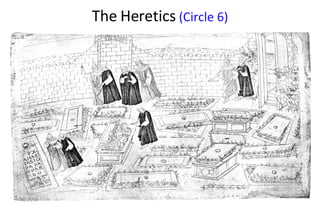
The Heretics  (Circle 6)   Canto IX  -  XI 06/04/09
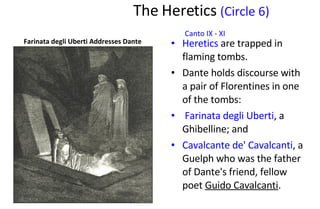
The Heretics  (Circle 6)   Canto IX  -  XI Heretics  are trapped in flaming tombs.  Dante holds discourse with a pair of Florentines in one of the tombs:   Farinata  degli Uberti , a Ghibelline; and  Cavalcante  de' Cavalcanti , a Guelph who was the father of Dante's friend, fellow poet  Guido Cavalcanti .  Farinata degli Uberti Addresses Dante 06/04/09
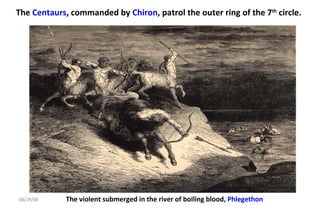
The Violent Against Neighbors  (Circle 7)  (Canto XII)  This circle houses the violent. Its entry is guarded by the  Minotaur ,  it is divided into three rings:  Outer ring , housing the violent against people and property, who are immersed in  Phlegethon , a river of boiling blood, to a level commensurate with their sins. The centaur  Nessus  guides the poets along Phlegethon and across a ford in the river. (Canto XII)  06/04/09
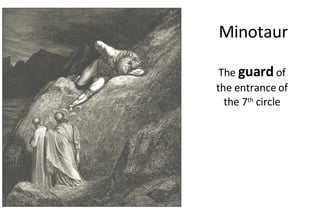
Minotaur The  guard  of the entrance of  the 7 th  circle 06/04/09
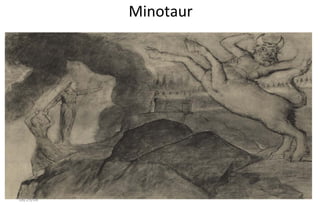
Minotaur 06/04/09
The  Centaurs , commanded by  Chiron , patrol the outer ring of the 7 th  circle. The violent submerged in the river of boiling blood,  Phlegethon   06/04/09
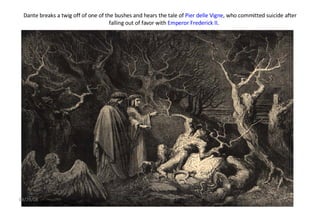
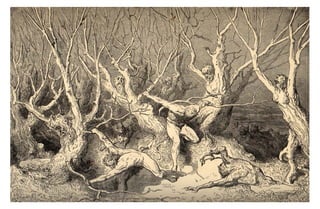
7 th  Circle middle ring Middle ring: In this ring are the suicides, who are transformed into gnarled thorny bushes and trees.  They are torn at by the  Harpies . Unique among the dead, the suicides will not be bodily resurrected after the final judgment. Instead they will maintain their bushy form, with their own corpses hanging from the limbs.  06/04/09
Dante breaks a twig off of one of the bushes and hears the tale of  Pier delle Vigne , who committed suicide after falling out of favor with  Emperor Frederick II .  06/04/09
Middle ring of the 7 th  circle The other residents of this ring are the profligates, who destroyed their lives by destroying the means by which life is sustained (i.e. money and property).  They are perpetually chased by ferocious dogs through the thorny undergrowth. (Canto XIII)  The trees are a metaphor; in life the only way of the relief of suffering was through pain (i.e. suicide) and in Hell, the only form of relief of the suffering is through pain (breaking of the limbs to bleed).  06/04/09
06/04/09
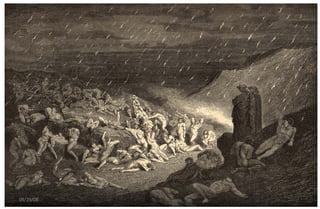
7 th  Circle inner ring Inner ring: The violent against God ( blasphemers ), the violent against nature ( sodomites ), and the violent against art ( usurers ),  all reside in a desert of flaming sand with fiery flakes raining from the sky.  Those punished here for usury include  Florentines   Catello di Rosso Gianfigliazzi ,  Ciappo Ubriachi , and  Giovanni di Buiamonte , and  Paduans   Reginaldo degli Scrovegni  and  Vitaliano di Iacopo Vitaliani .  06/04/09
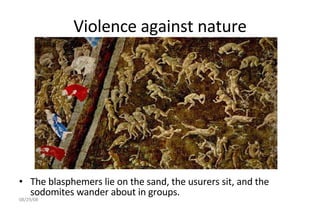
Violence against nature The blasphemers lie on the sand, the usurers sit, and the sodomites wander about in groups.  06/04/09
06/04/09
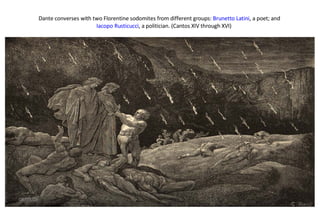
Dante converses with two Florentine sodomites from different groups:  Brunetto Latini , a poet; and  Iacopo Rusticucci , a politician. (Cantos XIV through XVI)  06/04/09
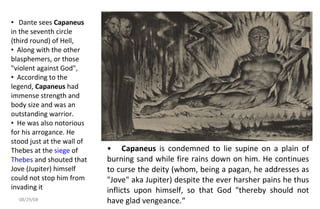
Capaneus  is condemned to lie supine on a plain of burning sand while fire rains down on him. He continues to curse the deity (whom, being a pagan, he addresses as "Jove" aka Jupiter) despite the ever harsher pains he thus inflicts upon himself, so that God "thereby should not have glad vengeance.“ Dante sees  Capaneus  in the seventh circle (third round) of Hell,  Along with the other blasphemers, or those "violent against God",  According to the legend,  Capaneus  had immense strength and body size and was an outstanding warrior.  He was also notorious for his arrogance. He stood just at the wall of Thebes at the  siege  of  Thebes  and shouted that Jove (Jupiter) himself could not stop him from invading it 06/04/09
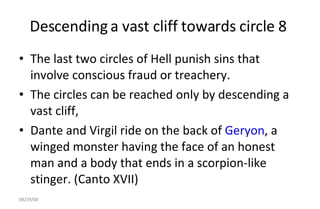
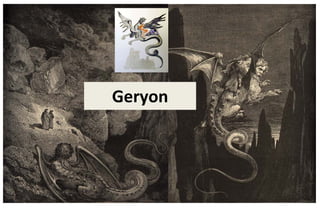
Descending a vast cliff towards circle 8  The last two circles of Hell punish sins that involve conscious fraud or treachery.  The circles can be reached only by descending a vast cliff,  Dante and Virgil ride on the back of  Geryon , a winged monster having the face of an honest man and a body that ends in a scorpion-like stinger. (Canto XVII) 06/04/09
Geryon 06/04/09
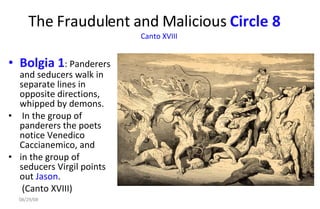
The Fraudulent and Malicious  Circle 8   Canto XVIII   Bolgia 1 : Panderers and seducers walk in separate lines in opposite directions, whipped by demons. In the group of panderers the poets notice Venedico Caccianemico, and  in the group of seducers Virgil points out  Jason . (Canto XVIII)  06/04/09
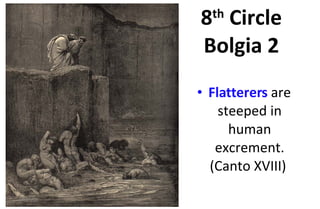
8 th  Circle Bolgia 2 Flatterers  are steeped in human excrement. (Canto XVIII)  06/04/09
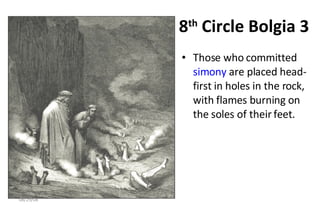
8 th  Circle Bolgia 3 Those who committed  simony  are placed head-first in holes in the rock, with flames burning on the soles of their feet. 06/04/09
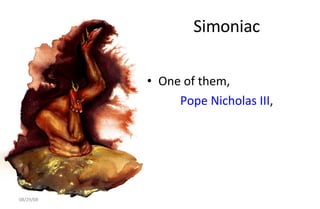
Simoniac One of them,  Pope Nicholas III , 06/04/09
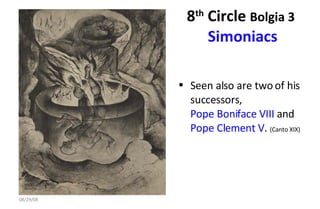
8 th  Circle  Bolgia 3   Simoniacs Seen also are two of his successors,  Pope Boniface VIII  and  Pope Clement V .  (Canto XIX)  06/04/09
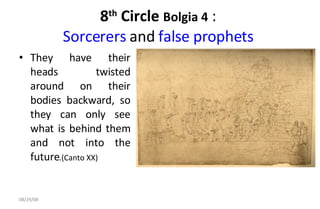
8 th  Circle  Bolgia 4   :  Sorcerers  and  false prophets   They have their heads twisted around on their bodies backward, so they can only see what is behind them and not into the future .(Canto XX)  06/04/09
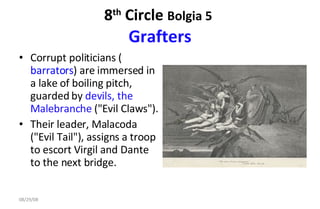
8 th  Circle  Bolgia 5   Grafters Corrupt politicians ( barrators ) are immersed in a lake of boiling pitch, guarded by  devils, the Malebranche  ("Evil Claws").  Their leader, Malacoda ("Evil Tail"), assigns a troop to escort Virgil and Dante to the next bridge. 06/04/09
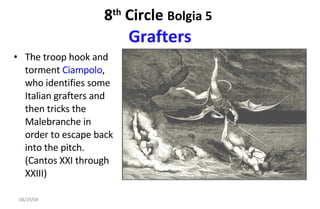
8 th  Circle  Bolgia 5   Grafters The troop hook and torment  Ciampolo , who identifies some Italian grafters and then tricks the Malebranche in order to escape back into the pitch. (Cantos XXI through XXIII)  06/04/09
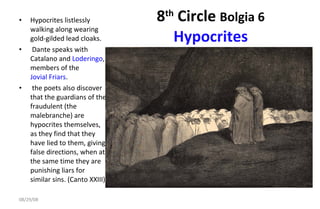
8 th  Circle  Bolgia 6 Hypocrites Hypocrites listlessly walking along wearing gold-gilded lead cloaks. Dante speaks with Catalano and  Loderingo , members of the  Jovial Friars . the poets also discover that the guardians of the fraudulent (the malebranche) are hypocrites themselves, as they find that they have lied to them, giving false directions, when at the same time they are punishing liars for similar sins. (Canto XXIII)  06/04/09
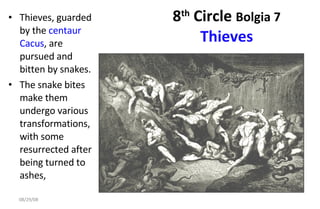
8 th  Circle  Bolgia 7 Thieves Thieves, guarded by the  centaur   Cacus , are pursued and bitten by snakes. The snake bites make them undergo various transformations, with some resurrected after being turned to ashes, 06/04/09
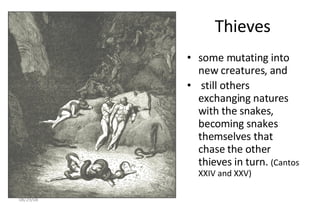
Thieves some mutating into new creatures, and still others exchanging natures with the snakes, becoming snakes themselves that chase the other thieves in turn.  (Cantos XXIV and XXV)  06/04/09
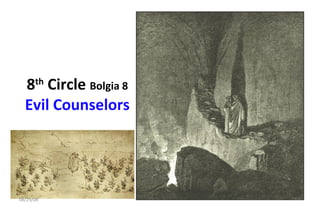
8 th  Circle  Bolgia 8 Evil Counselors Fraudulent advisors are encased in individual flames. Dante includes  Ulysses  and  Diomedes  together here for their role in the  Trojan War .  Ulysses tells the tale of his fatal final voyage, where he left his home and family to sail to the end of the Earth.  He equated life as a pursuit of knowledge that humanity can attain through effort, and in his search God sank his ship outside of Mount Purgatory.  This symbolizes the inability of the individual to carve out one's own salvation. Instead, one must be totally subservient to the will of God and realize the inability of one to be a God unto oneself.  Guido da Montefeltro  recounts how his advice to  Pope Boniface VIII  resulted in his damnation, despite Boniface's promise of absolution. (Cantos XXVI and XXVII) 06/04/09
8 th  Circle  Bolgia 8 Evil Counselors 06/04/09
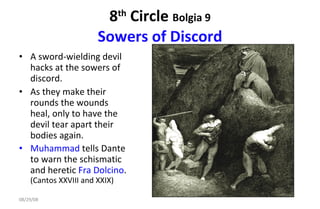
8 th  Circle  Bolgia 9 Sowers of Discord A sword-wielding devil hacks at the sowers of discord.  As they make their rounds the wounds heal, only to have the devil tear apart their bodies again.  Muhammad  tells Dante to warn the schismatic and heretic  Fra Dolcino .  (Cantos XXVIII and XXIX)  06/04/09
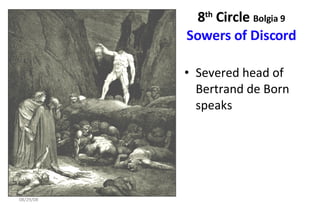
8 th  Circle  Bolgia 9 Sowers of Discord Severed head of Bertrand de Born speaks 06/04/09
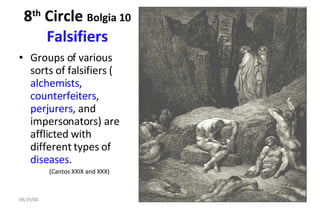
8 th  Circle  Bolgia 10 Falsifiers Groups of various sorts of falsifiers ( alchemists ,  counterfeiters ,  perjurers , and impersonators) are afflicted with different types of  diseases .  (Cantos XXIX and XXX)  06/04/09
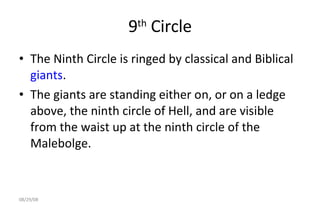
9 th  Circle The Ninth Circle is ringed by classical and Biblical  giants .  The giants are standing either on, or on a ledge above, the ninth circle of Hell, and are visible from the waist up at the ninth circle of the Malebolge.  06/04/09
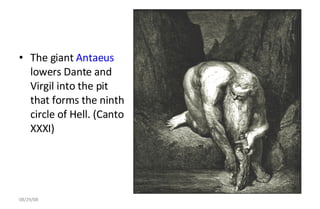
The giant  Antaeus  lowers Dante and Virgil into the pit that forms the ninth circle of Hell. (Canto XXXI) 06/04/09
9 th  Circle Traitors Traitors, distinguished from the "merely" fraudulent in that their acts involve betraying one in a special relationship to the betrayer, are frozen in a lake of ice known as  Cocytus .  Each group of traitors is encased in ice to a different depth, ranging from only the waist down to complete immersion.  The circle is divided into four concentric zones:  06/04/09
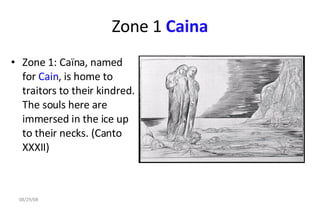
Zone 1  Caina Zone 1: Caïna, named for  Cain , is home to traitors to their kindred. The souls here are immersed in the ice up to their necks. (Canto XXXII)  06/04/09
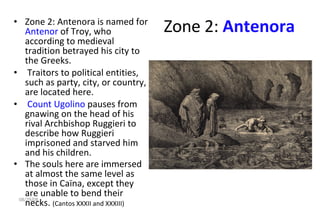
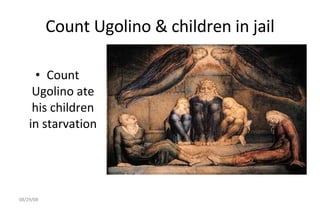
Zone 2:  Antenora Zone 2: Antenora is named for  Antenor  of Troy, who according to medieval tradition betrayed his city to the Greeks. Traitors to political entities, such as party, city, or country, are located here. Count Ugolino  pauses from gnawing on the head of his rival Archbishop Ruggieri to describe how Ruggieri imprisoned and starved him and his children.  The souls here are immersed at almost the same level as those in Caïna, except they are unable to bend their necks.  (Cantos XXXII and XXXIII)  06/04/09
Count Ugolino & children in jail Count Ugolino ate his children in starvation 06/04/09
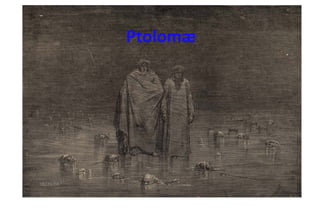
Zone 3:  Ptolomæa Zone 3: Ptolomæa is probably named for Ptolemy, the captain of Jericho, who invited  Simon Maccabaeus  and his sons to a banquet and there killed them. Traitors to their guests are punished here.  Fra Alberigo  explains that sometimes a soul falls here before the time that  Atropos  (the  Fate  who cuts the thread of life) should send it.  Their bodies on Earth are immediately possessed by a fiend. The souls here are immersed so much that only half of their faces are visible. As they cry, their tears freeze and seal their eyes shut- they are denied even the comfort of tears. (Canto XXXIII)  06/04/09
Ptolomæ 06/04/09
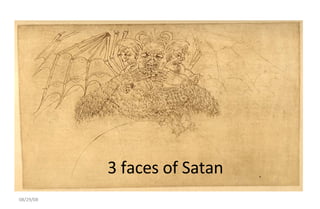
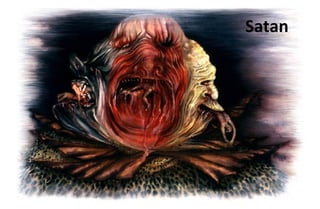
Zone 4:  Judecca Zone 4: Judecca, named for Judas the Iscariot, Biblical betrayer of Christ, is for traitors to their lords and benefactors.  All of the sinners punished within are completely encapsulated in ice, distorted to all conceivable positions.  Dante and Virgil, with no one to talk to, quickly move on to the center of hell.  Condemned to the very center of hell for committing the ultimate sin(Treachery against God) is  Satan ,  He has three faces, one red, one black, and one a pale yellow, each having a mouth that chews on a prominent traitor.  Satan himself is represented as a giant, terrifying beast, weeping tears from his six eyes, which mix with the traitors' blood sickeningly.  He is waist deep in ice, and beats his six wings as if trying to escape, but the icy wind that emanates only further ensures his imprisonment (as well as that of the others in the ring).  06/04/09
3 faces of Satan 06/04/09
The sinners in the mouths of Satan are  Brutus  and  Cassius  in the left and right mouths, respectively, who were involved in the assassination of  Julius Caesar  (an act which, to Dante, represented the destruction of a unified  Italy ), and  Judas Iscariot  (the namesake of this zone) in the central, most vicious mouth, who betrayed  Jesus .  Judas is being administered the most horrifying torture of the three traitors, his head in the mouth of Lucifer, and his back being forever skinned by the claws of Lucifer. (Canto XXXIV)  What is seen here is a perverted trinity. Satan is impotent, ignorant, and evil while God can be attributed as the opposite: all powerful, all knowing, and good.
06/04/09 Satan
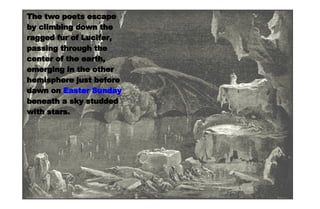
Satan The two poets escape by climbing down the ragged fur of Lucifer, passing through the center of the earth, emerging in the other hemisphere just before dawn on  Easter Sunday  beneath a sky studded with stars.
Prepared by Dr. Arlene S. Opina 06/04/09

Divine Comedy

  • 1.
  • 2.
    Chart of Hell06/04/09
  • 3.
  • 4.
    Structure The DivineComedy is composed of three canticas — Inferno ( Hell ), Purgatorio ( Purgatory ), and Paradiso ( Paradise ) composed each of 33 cantos (or "canti"). The very first canto serves as an introduction to the poem and is generally not considered to be part of the first cantica , bringing the total number of cantos to 100. The number 3 is prominent in the work, represented here by the length of each cantica . The verse scheme used, terza rima , with the lines composing tercets according to the rhyme scheme ABA BCB CDC . . . YZY Z. hendecasyllable (line of eleven syllables), These are structured according to the classical (Aristotelian) conception of virtue and vice, so that they are grouped into the sins of incontinence, violence, and fraud (which for many commentators are represented by the leopard, lion, and she-wolf). The sins of incontinence — weakness in controlling one's desires and natural urges — are the mildest among them, and, correspondingly, appear first: 06/04/09
  • 5.
    Synopsis Dante Pilgrimhas not been a good boy. His dead love Beatrice asks the Virgin Mary to help him see the error of his ways. Mary accepts and Dante is sent on a three-day trip through Hell, and on up Mount Purgatory on the other side of the world, and finally to Heaven in the sky. He is spiritually lost at the beginning of the story, so he needs guides to help him along the path. His first guide, through Hell and Purgatory is Virgil (author of the Aeneid). They encounter many interesting sinners on the way. Dante learns to hate sin. His second guide is Beatrice , the woman he adored while she lived. His final guide is Saint Bernard (namesake of the loyal dog), who takes him to see God. 06/04/09
  • 6.
    The Dark Woodsof Error Canto 1 1 MIDWAY upon the journey of our life 2   I found myself within a forest dark, 3   For the straightforward pathway had been lost.   4   Ah me! how hard a thing it is to say 5   What was this forest savage, rough, and stern, 6   Which in the very thought renews the fear.   7   So bitter is it, death is little more; 8   But of the good to treat, which there I found, 9   Speak will I of the other things I saw there. The number 3 is prominent in the work. The verse scheme used, terza rima , with the lines composing tercets according to the rhyme scheme ABA BCB CDC . . . YZY Z. hendecasyllable (line of eleven syllables), 06/04/09
  • 7.
    Canto 1 Thepoet tells in the first person his travel through the three realms of the dead, The poem begins on Good Friday of the year 1300 , "In the middle of our life's journey" ( Nel mezzo del cammin di nostra vita ), and so opens in medias res . Dante is thirty-five years old, half of the biblically allotted age of 70 ( Psalm 90:10), lost in a dark wood (perhaps, allegorically, contemplating suicide —as "wood" is figured in Canto XIII, and also the mention of suicide is made in Canto I of Purgatorio with "This man has not yet seen his last evening; But, through his madness, was so close to it, That there was hardly time to turn about" implying that when Virgil came to him he was on the verge of suicide or morally passing the point of no return), assailed by beasts (a lion , a leopard , and a she-wolf ; allegorical depictions of temptations towards sin) he cannot evade, and unable to find the "straight way" ( diritta via ) to salvation (symbolized by the sun behind the mountain). Conscious that he is ruining himself, that he is falling into a "deep place" ( basso loco ) where the sun is silent (' l sol tace ), The Roman poet Virgil guides him through Hell and Purgatory; Beatrice , Dante's ideal woman, guides him through Heaven. 06/04/09
  • 8.
    Dante met the3 beasts 06/04/09
  • 9.
    The Descent Canto2 Dante is at last rescued by Virgil after his love Beatrice intercedes on his behalf (Canto II), and he and Virgil begin their journey to the underworld. 06/04/09
  • 10.
    The Opportunists (Gate)Canto 3 Dante passes through the gate of hell, on which is inscribed the famous phrase " Lasciate ogne speranza, voi ch'intrate ", or "Abandon all hope, ye who enter here” Before entering Hell completely, Dante and his guide see the Opportunists, souls of people who in life did nothing, neither for good nor evil (among these Dante recognizes either Pope Celestine V , or Pontius Pilate ; the text is ambiguous). Mixed with them are the outcasts, who took no side in the Rebellion of Angels . These souls are neither in Hell nor out of it, but reside on the shores of the Acheron , their punishment to eternally pursue a banner, and be pursued by wasps and hornets that continually sting them while maggots and other such insects drink their blood and tears. This symbolizes the sting of their conscience and the repugnance of sin. Then Dante and Virgil reach the ferry that will take them across the river Acheron and to Hell proper. The ferry is piloted by Charon , who does not want to let Dante enter, for he is a living being. Virgil forces Charon to take them, but their passage across is undescribed since Dante faints and does not awake until he is on the other side. 06/04/09
  • 11.
    The Virtuous Pagans Circle1 ( Limbo ) Canto 4 Here reside the unbaptized and the virtuous pagans , who, though not sinful, did not accept Christ. Here also reside those who, if they lived before the coming of Christ, did not pay fitting homage to their respective deity. They are not punished in an active sense, but rather grieve only their separation from God, without hope of reconciliation. The chief irony in this circle is that Limbo shares many characteristics with Elysian Fields , thus the guiltless damned are punished by living in their deficient form of heaven. Their fault was that they lacked faith — the hope for something greater than rational minds can conceive. Limbo includes green fields and a castle, the dwelling place of the wisest men of antiquity, including Virgil himself. 06/04/09
  • 12.
    Circle 1 Inthe castle Dante meets the poets Homer , Horace , Ovid , and Lucan . Interestingly, he also sees Saladin in Limbo. Dante implies that all virtuous pagans find themselves here, although he later encounters two in heaven and one in purgatory . Beyond the first circle, all of those condemned for active, deliberately willed sin are judged by Minos , who sentences each soul to one of the lower eight circles. 06/04/09
  • 13.
    Minos Minos reignedover Crete and the islands of the Aegean Sea three generations before the Trojan War . In Attic tradition and on the Athenian stage Minos is a cruel tyrant , Killed Scylla, who fell in love with him. after his death Minos is a judge of the dead in Hades He assigned sinners to their respective circle 06/04/09
  • 14.
    The Carnal (Circle 2) Canto V Those overcome by lust are punished in this circle. They are the first ones to be truly punished in Hell. These souls are blown about to and fro by a violent storm, without hope of rest. This symbolizes the power of lust to blow one about needlessly and aimlessly. Francesca da Rimini informs Dante of how she and her husband's brother Paolo committed adultery and died a violent death at the hands of her husband. Francesca & Paolo 06/04/09
  • 15.
    Whirlwind of loversin Circle 2 06/04/09
  • 16.
    The Gluttons (Circle 3) Canto VI Cerberus guards the gluttons , forced to lie in the mud under continual cold rain and hail. Dante converses with a Florentine contemporary identified as Ciacco ("Hog" — probably a nickname) regarding strife in Florence and the fate of prominent Florentines a monstrous three-headed dog (sometimes said to have 50 or 100 heads) called a hellhound . Cerberus guarded the gate to Hades and ensured that spirits of the dead could enter, but none could exit In The Inferno, Cerberus is passed by Virgil and Dante due to Virgil throwing him a body part of one of Cerberus' victims. 06/04/09
  • 17.
    The Hoarders andthe Wasters (Circle 4) Canto VII Those whose concern for material goods deviated from the desired mean are punished in this circle. They include the avaricious or miserly, who hoarded possessions, and the prodigal, who squandered them. Guarded by Plutus , each group pushes a great weight against the heavy weight of the other group. After the weights crash together the process starts over again. Plutus 06/04/09
  • 18.
    The Wrathful andthe Sullen (Circle 5) Canto VII In the swamp-like water of the river Styx , the wrathful fight each other on the surface, and the sullen or slothful lie gurgling beneath the water. 06/04/09
  • 19.
    Phlegyas & TheFallen Angels Canto VIII - IX On the way they are accosted by Filippo Argenti , a Black Guelph from a prominent family. ( VIII) The lower parts of hell are contained within the walls of the city of Dis , which is itself surrounded by the Stygian marsh. Punished within Dis are active (rather than passive) sins. The walls of Dis are guarded by fallen angels . Virgil is unable to convince them to let Dante and him enter, and the Furies and Medusa threaten Dante. An angel sent from Heaven secures entry for the poets. Phlegyas reluctantly transports Dante and Virgil across the Styx in his skiff. 06/04/09
  • 20.
    The Heretics (Circle 6) Canto IX - XI 06/04/09
  • 21.
    The Heretics (Circle 6) Canto IX - XI Heretics are trapped in flaming tombs. Dante holds discourse with a pair of Florentines in one of the tombs: Farinata degli Uberti , a Ghibelline; and Cavalcante de' Cavalcanti , a Guelph who was the father of Dante's friend, fellow poet Guido Cavalcanti . Farinata degli Uberti Addresses Dante 06/04/09
  • 22.
    The Violent AgainstNeighbors (Circle 7) (Canto XII) This circle houses the violent. Its entry is guarded by the Minotaur , it is divided into three rings: Outer ring , housing the violent against people and property, who are immersed in Phlegethon , a river of boiling blood, to a level commensurate with their sins. The centaur Nessus guides the poets along Phlegethon and across a ford in the river. (Canto XII) 06/04/09
  • 23.
    Minotaur The guard of the entrance of the 7 th circle 06/04/09
  • 24.
  • 25.
    The Centaurs, commanded by Chiron , patrol the outer ring of the 7 th circle. The violent submerged in the river of boiling blood, Phlegethon 06/04/09
  • 26.
    7 th Circle middle ring Middle ring: In this ring are the suicides, who are transformed into gnarled thorny bushes and trees. They are torn at by the Harpies . Unique among the dead, the suicides will not be bodily resurrected after the final judgment. Instead they will maintain their bushy form, with their own corpses hanging from the limbs. 06/04/09
  • 27.
    Dante breaks atwig off of one of the bushes and hears the tale of Pier delle Vigne , who committed suicide after falling out of favor with Emperor Frederick II . 06/04/09
  • 28.
    Middle ring ofthe 7 th circle The other residents of this ring are the profligates, who destroyed their lives by destroying the means by which life is sustained (i.e. money and property). They are perpetually chased by ferocious dogs through the thorny undergrowth. (Canto XIII) The trees are a metaphor; in life the only way of the relief of suffering was through pain (i.e. suicide) and in Hell, the only form of relief of the suffering is through pain (breaking of the limbs to bleed). 06/04/09
  • 29.
  • 30.
    7 th Circle inner ring Inner ring: The violent against God ( blasphemers ), the violent against nature ( sodomites ), and the violent against art ( usurers ), all reside in a desert of flaming sand with fiery flakes raining from the sky. Those punished here for usury include Florentines Catello di Rosso Gianfigliazzi , Ciappo Ubriachi , and Giovanni di Buiamonte , and Paduans Reginaldo degli Scrovegni and Vitaliano di Iacopo Vitaliani . 06/04/09
  • 31.
    Violence against natureThe blasphemers lie on the sand, the usurers sit, and the sodomites wander about in groups. 06/04/09
  • 32.
  • 33.
    Dante converses withtwo Florentine sodomites from different groups: Brunetto Latini , a poet; and Iacopo Rusticucci , a politician. (Cantos XIV through XVI) 06/04/09
  • 34.
    Capaneus iscondemned to lie supine on a plain of burning sand while fire rains down on him. He continues to curse the deity (whom, being a pagan, he addresses as "Jove" aka Jupiter) despite the ever harsher pains he thus inflicts upon himself, so that God "thereby should not have glad vengeance.“ Dante sees Capaneus in the seventh circle (third round) of Hell, Along with the other blasphemers, or those "violent against God", According to the legend, Capaneus had immense strength and body size and was an outstanding warrior. He was also notorious for his arrogance. He stood just at the wall of Thebes at the siege of Thebes and shouted that Jove (Jupiter) himself could not stop him from invading it 06/04/09
  • 35.
    Descending a vastcliff towards circle 8 The last two circles of Hell punish sins that involve conscious fraud or treachery. The circles can be reached only by descending a vast cliff, Dante and Virgil ride on the back of Geryon , a winged monster having the face of an honest man and a body that ends in a scorpion-like stinger. (Canto XVII) 06/04/09
  • 36.
  • 37.
    The Fraudulent andMalicious Circle 8 Canto XVIII Bolgia 1 : Panderers and seducers walk in separate lines in opposite directions, whipped by demons. In the group of panderers the poets notice Venedico Caccianemico, and in the group of seducers Virgil points out Jason . (Canto XVIII) 06/04/09
  • 38.
    8 th Circle Bolgia 2 Flatterers are steeped in human excrement. (Canto XVIII) 06/04/09
  • 39.
    8 th Circle Bolgia 3 Those who committed simony are placed head-first in holes in the rock, with flames burning on the soles of their feet. 06/04/09
  • 40.
    Simoniac One ofthem, Pope Nicholas III , 06/04/09
  • 41.
    8 th Circle Bolgia 3 Simoniacs Seen also are two of his successors, Pope Boniface VIII and Pope Clement V . (Canto XIX) 06/04/09
  • 42.
    8 th Circle Bolgia 4 : Sorcerers and false prophets They have their heads twisted around on their bodies backward, so they can only see what is behind them and not into the future .(Canto XX) 06/04/09
  • 43.
    8 th Circle Bolgia 5 Grafters Corrupt politicians ( barrators ) are immersed in a lake of boiling pitch, guarded by devils, the Malebranche ("Evil Claws"). Their leader, Malacoda ("Evil Tail"), assigns a troop to escort Virgil and Dante to the next bridge. 06/04/09
  • 44.
    8 th Circle Bolgia 5 Grafters The troop hook and torment Ciampolo , who identifies some Italian grafters and then tricks the Malebranche in order to escape back into the pitch. (Cantos XXI through XXIII) 06/04/09
  • 45.
    8 th Circle Bolgia 6 Hypocrites Hypocrites listlessly walking along wearing gold-gilded lead cloaks. Dante speaks with Catalano and Loderingo , members of the Jovial Friars . the poets also discover that the guardians of the fraudulent (the malebranche) are hypocrites themselves, as they find that they have lied to them, giving false directions, when at the same time they are punishing liars for similar sins. (Canto XXIII) 06/04/09
  • 46.
    8 th Circle Bolgia 7 Thieves Thieves, guarded by the centaur Cacus , are pursued and bitten by snakes. The snake bites make them undergo various transformations, with some resurrected after being turned to ashes, 06/04/09
  • 47.
    Thieves some mutatinginto new creatures, and still others exchanging natures with the snakes, becoming snakes themselves that chase the other thieves in turn. (Cantos XXIV and XXV) 06/04/09
  • 48.
    8 th Circle Bolgia 8 Evil Counselors Fraudulent advisors are encased in individual flames. Dante includes Ulysses and Diomedes together here for their role in the Trojan War . Ulysses tells the tale of his fatal final voyage, where he left his home and family to sail to the end of the Earth. He equated life as a pursuit of knowledge that humanity can attain through effort, and in his search God sank his ship outside of Mount Purgatory. This symbolizes the inability of the individual to carve out one's own salvation. Instead, one must be totally subservient to the will of God and realize the inability of one to be a God unto oneself. Guido da Montefeltro recounts how his advice to Pope Boniface VIII resulted in his damnation, despite Boniface's promise of absolution. (Cantos XXVI and XXVII) 06/04/09
  • 49.
    8 th Circle Bolgia 8 Evil Counselors 06/04/09
  • 50.
    8 th Circle Bolgia 9 Sowers of Discord A sword-wielding devil hacks at the sowers of discord. As they make their rounds the wounds heal, only to have the devil tear apart their bodies again. Muhammad tells Dante to warn the schismatic and heretic Fra Dolcino . (Cantos XXVIII and XXIX) 06/04/09
  • 51.
    8 th Circle Bolgia 9 Sowers of Discord Severed head of Bertrand de Born speaks 06/04/09
  • 52.
    8 th Circle Bolgia 10 Falsifiers Groups of various sorts of falsifiers ( alchemists , counterfeiters , perjurers , and impersonators) are afflicted with different types of diseases . (Cantos XXIX and XXX) 06/04/09
  • 53.
    9 th Circle The Ninth Circle is ringed by classical and Biblical giants . The giants are standing either on, or on a ledge above, the ninth circle of Hell, and are visible from the waist up at the ninth circle of the Malebolge. 06/04/09
  • 54.
    The giant Antaeus lowers Dante and Virgil into the pit that forms the ninth circle of Hell. (Canto XXXI) 06/04/09
  • 55.
    9 th Circle Traitors Traitors, distinguished from the "merely" fraudulent in that their acts involve betraying one in a special relationship to the betrayer, are frozen in a lake of ice known as Cocytus . Each group of traitors is encased in ice to a different depth, ranging from only the waist down to complete immersion. The circle is divided into four concentric zones: 06/04/09
  • 56.
    Zone 1 Caina Zone 1: Caïna, named for Cain , is home to traitors to their kindred. The souls here are immersed in the ice up to their necks. (Canto XXXII) 06/04/09
  • 57.
    Zone 2: Antenora Zone 2: Antenora is named for Antenor of Troy, who according to medieval tradition betrayed his city to the Greeks. Traitors to political entities, such as party, city, or country, are located here. Count Ugolino pauses from gnawing on the head of his rival Archbishop Ruggieri to describe how Ruggieri imprisoned and starved him and his children. The souls here are immersed at almost the same level as those in Caïna, except they are unable to bend their necks. (Cantos XXXII and XXXIII) 06/04/09
  • 58.
    Count Ugolino &children in jail Count Ugolino ate his children in starvation 06/04/09
  • 59.
    Zone 3: Ptolomæa Zone 3: Ptolomæa is probably named for Ptolemy, the captain of Jericho, who invited Simon Maccabaeus and his sons to a banquet and there killed them. Traitors to their guests are punished here. Fra Alberigo explains that sometimes a soul falls here before the time that Atropos (the Fate who cuts the thread of life) should send it. Their bodies on Earth are immediately possessed by a fiend. The souls here are immersed so much that only half of their faces are visible. As they cry, their tears freeze and seal their eyes shut- they are denied even the comfort of tears. (Canto XXXIII) 06/04/09
  • 60.
  • 61.
    Zone 4: Judecca Zone 4: Judecca, named for Judas the Iscariot, Biblical betrayer of Christ, is for traitors to their lords and benefactors. All of the sinners punished within are completely encapsulated in ice, distorted to all conceivable positions. Dante and Virgil, with no one to talk to, quickly move on to the center of hell. Condemned to the very center of hell for committing the ultimate sin(Treachery against God) is Satan , He has three faces, one red, one black, and one a pale yellow, each having a mouth that chews on a prominent traitor. Satan himself is represented as a giant, terrifying beast, weeping tears from his six eyes, which mix with the traitors' blood sickeningly. He is waist deep in ice, and beats his six wings as if trying to escape, but the icy wind that emanates only further ensures his imprisonment (as well as that of the others in the ring). 06/04/09
  • 62.
    3 faces ofSatan 06/04/09
  • 63.
    The sinners inthe mouths of Satan are Brutus and Cassius in the left and right mouths, respectively, who were involved in the assassination of Julius Caesar (an act which, to Dante, represented the destruction of a unified Italy ), and Judas Iscariot (the namesake of this zone) in the central, most vicious mouth, who betrayed Jesus . Judas is being administered the most horrifying torture of the three traitors, his head in the mouth of Lucifer, and his back being forever skinned by the claws of Lucifer. (Canto XXXIV) What is seen here is a perverted trinity. Satan is impotent, ignorant, and evil while God can be attributed as the opposite: all powerful, all knowing, and good.
  • 64.
  • 65.
    Satan The twopoets escape by climbing down the ragged fur of Lucifer, passing through the center of the earth, emerging in the other hemisphere just before dawn on Easter Sunday beneath a sky studded with stars.
  • 66.
    Prepared by Dr.Arlene S. Opina 06/04/09

Editor's Notes