Inference
• Inference is the process of drawing conclusions based on facts and
evidence. Inference is a crucial process in artificial intelligence (AI)
that involves reasoning and making decisions based on available
information. Inference is used in many AI applications, including
natural language processing, computer vision, robotics, and expert
systems.
• In AI, inference can be categorized into two types: deductive
inference and inductive inference. Deductive inference involves
reasoning from general principles to specific conclusions, while
inductive inference involves inferring general principles or rules based
on specific observations or data.
• Examples of Inference in AI
• Rules of inference in AI refer to formal logical rules that allow machines
to make deductions and draw conclusions based on available
information or knowledge. These rules provide a structured framework
for reasoning and automated decision-making in AI systems.
• By using rules of inference, machines can analyze complex data and
draw conclusions based on logical relationships between pieces of
information. These rules are an important component of many AI
systems, including expert systems, natural language processing, and
computer vision. They provide a foundation for automated reasoning
and form a critical part of the AI toolkit for solving real-world problems.
• Different Types of Inference Rules in AI
• Inference rules in AI are used to make logical deductions from given
premises. Here are the different types of inference rules in AI:
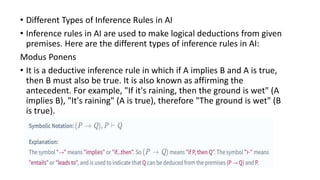
Modus Ponens
• It is a deductive inference rule in which if A implies B and A is true,
then B must also be true. It is also known as affirming the
antecedent. For example, "If it's raining, then the ground is wet" (A
implies B), "It's raining" (A is true), therefore "The ground is wet" (B
is true).
Inference rules in artificial intelligence

Inference rules in artificial intelligence

  • 1.
  • 2.
    • Inference isthe process of drawing conclusions based on facts and evidence. Inference is a crucial process in artificial intelligence (AI) that involves reasoning and making decisions based on available information. Inference is used in many AI applications, including natural language processing, computer vision, robotics, and expert systems. • In AI, inference can be categorized into two types: deductive inference and inductive inference. Deductive inference involves reasoning from general principles to specific conclusions, while inductive inference involves inferring general principles or rules based on specific observations or data.
  • 3.
    • Examples ofInference in AI • Rules of inference in AI refer to formal logical rules that allow machines to make deductions and draw conclusions based on available information or knowledge. These rules provide a structured framework for reasoning and automated decision-making in AI systems. • By using rules of inference, machines can analyze complex data and draw conclusions based on logical relationships between pieces of information. These rules are an important component of many AI systems, including expert systems, natural language processing, and computer vision. They provide a foundation for automated reasoning and form a critical part of the AI toolkit for solving real-world problems.
  • 4.
    • Different Typesof Inference Rules in AI • Inference rules in AI are used to make logical deductions from given premises. Here are the different types of inference rules in AI: Modus Ponens • It is a deductive inference rule in which if A implies B and A is true, then B must also be true. It is also known as affirming the antecedent. For example, "If it's raining, then the ground is wet" (A implies B), "It's raining" (A is true), therefore "The ground is wet" (B is true).