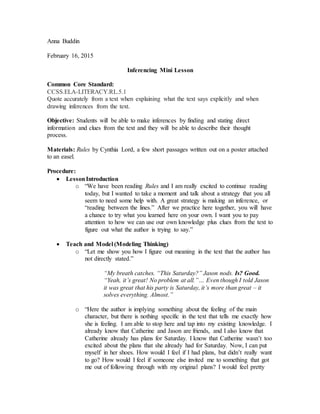
Anna Buddin
February 16, 2015
Inferencing Mini Lesson
Common Core Standard:
CCSS.ELA-LITERACY.RL.5.1
Quote accurately from a text when explaining what the text says explicitly and when
drawing inferences from the text.
Objective: Students will be able to make inferences by finding and stating direct
information and clues from the text and they will be able to describe their thought
process.
Materials: Rules by Cynthia Lord, a few short passages written out on a poster attached
to an easel.
Procedure:
 LessonIntroduction
o “We have been reading Rules and I am really excited to continue reading
today, but I wanted to take a moment and talk about a strategy that you all
seem to need some help with. A great strategy is making an inference, or
“reading between the lines.” After we practice here together, you will have
a chance to try what you learned here on your own. I want you to pay
attention to how we can use our own knowledge plus clues from the text to
figure out what the author is trying to say.”
 Teach and Model (Modeling Thinking)
o “Let me show you how I figure out meaning in the text that the author has
not directly stated.”
“My breath catches. “This Saturday?” Jason nods. Is? Good.
“Yeah, it’s great! No problem at all.”… Even though I told Jason
it was great that his party is Saturday, it’s more than great – it
solves everything. Almost.”
o “Here the author is implying something about the feeling of the main
character, but there is nothing specific in the text that tells me exactly how
she is feeling. I am able to stop here and tap into my existing knowledge. I
already know that Catherine and Jason are friends, and I also know that
Catherine already has plans for Saturday. I know that Catherine wasn’t too
excited about the plans that she already had for Saturday. Now, I can put
myself in her shoes. How would I feel if I had plans, but didn’t really want
to go? How would I feel if someone else invited me to something that got
me out of following through with my original plans? I would feel pretty
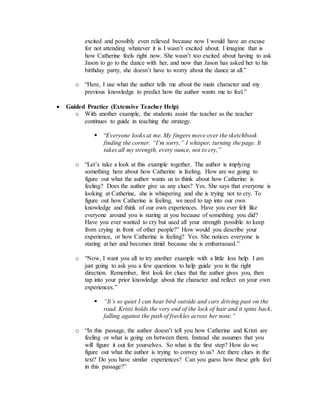
excited and possibly even relieved because now I would have an excuse
for not attending whatever it is I wasn’t excited about. I imagine that is
how Catherine feels right now. She wasn’t too excited about having to ask
Jason to go to the dance with her, and now that Jason has asked her to his
birthday party, she doesn’t have to worry about the dance at all.”
o “Here, I use what the author tells me about the main character and my
previous knowledge to predict how the author wants me to feel.”
 Guided Practice (Extensive Teacher Help)
o With another example, the students assist the teacher as the teacher
continues to guide in teaching the strategy.
 “Everyone looks at me. My fingers move over the sketchbook
finding the corner. “I’m sorry,” I whisper, turning the page. It
takes all my strength, every ounce, not to cry,”
o “Let’s take a look at this example together. The author is implying
something here about how Catherine is feeling. How are we going to
figure out what the author wants us to think about how Catherine is
feeling? Does the author give us any clues? Yes. She says that everyone is
looking at Catherine, she is whispering and she is trying not to cry. To
figure out how Catherine is feeling, we need to tap into our own
knowledge and think of our own experiences. Have you ever felt like
everyone around you is staring at you because of something you did?
Have you ever wanted to cry but used all your strength possible to keep
from crying in front of other people?” How would you describe your
experience, or how Catherine is feeling? Yes. She notices everyone is
staring at her and becomes timid because she is embarrassed.”
o “Now, I want you all to try another example with a little less help. I am
just going to ask you a few questions to help guide you in the right
direction. Remember, first look for clues that the author gives you, then
tap into your prior knowledge about the character and reflect on your own
experiences.”
 “It’s so quiet I can hear bird outside and cars driving past on the
road. Kristi holds the very end of the lock of hair and it spins back,
falling against the path of freckles across her nose.”
o “In this passage, the author doesn’t tell you how Catherine and Kristi are
feeling or what is going on between them. Instead she assumes that you
will figure it out for yourselves. So what is the first step? How do we
figure out what the author is trying to convey to us? Are there clues in the
text? Do you have similar experiences? Can you guess how these girls feel
in this passage?”
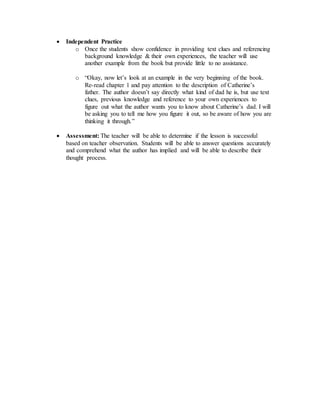
 Independent Practice
o Once the students show confidence in providing text clues and referencing
background knowledge & their own experiences, the teacher will use
another example from the book but provide little to no assistance.
o “Okay, now let’s look at an example in the very beginning of the book.
Re-read chapter 1 and pay attention to the description of Catherine’s
father. The author doesn’t say directly what kind of dad he is, but use text
clues, previous knowledge and reference to your own experiences to
figure out what the author wants you to know about Catherine’s dad. I will
be asking you to tell me how you figure it out, so be aware of how you are
thinking it through.”
 Assessment: The teacher will be able to determine if the lesson is successful
based on teacher observation. Students will be able to answer questions accurately
and comprehend what the author has implied and will be able to describe their
thought process.

Inference Mini Lesson

  • 1.
    Anna Buddin February 16,2015 Inferencing Mini Lesson Common Core Standard: CCSS.ELA-LITERACY.RL.5.1 Quote accurately from a text when explaining what the text says explicitly and when drawing inferences from the text. Objective: Students will be able to make inferences by finding and stating direct information and clues from the text and they will be able to describe their thought process. Materials: Rules by Cynthia Lord, a few short passages written out on a poster attached to an easel. Procedure:  LessonIntroduction o “We have been reading Rules and I am really excited to continue reading today, but I wanted to take a moment and talk about a strategy that you all seem to need some help with. A great strategy is making an inference, or “reading between the lines.” After we practice here together, you will have a chance to try what you learned here on your own. I want you to pay attention to how we can use our own knowledge plus clues from the text to figure out what the author is trying to say.”  Teach and Model (Modeling Thinking) o “Let me show you how I figure out meaning in the text that the author has not directly stated.” “My breath catches. “This Saturday?” Jason nods. Is? Good. “Yeah, it’s great! No problem at all.”… Even though I told Jason it was great that his party is Saturday, it’s more than great – it solves everything. Almost.” o “Here the author is implying something about the feeling of the main character, but there is nothing specific in the text that tells me exactly how she is feeling. I am able to stop here and tap into my existing knowledge. I already know that Catherine and Jason are friends, and I also know that Catherine already has plans for Saturday. I know that Catherine wasn’t too excited about the plans that she already had for Saturday. Now, I can put myself in her shoes. How would I feel if I had plans, but didn’t really want to go? How would I feel if someone else invited me to something that got me out of following through with my original plans? I would feel pretty
  • 2.
    excited and possiblyeven relieved because now I would have an excuse for not attending whatever it is I wasn’t excited about. I imagine that is how Catherine feels right now. She wasn’t too excited about having to ask Jason to go to the dance with her, and now that Jason has asked her to his birthday party, she doesn’t have to worry about the dance at all.” o “Here, I use what the author tells me about the main character and my previous knowledge to predict how the author wants me to feel.”  Guided Practice (Extensive Teacher Help) o With another example, the students assist the teacher as the teacher continues to guide in teaching the strategy.  “Everyone looks at me. My fingers move over the sketchbook finding the corner. “I’m sorry,” I whisper, turning the page. It takes all my strength, every ounce, not to cry,” o “Let’s take a look at this example together. The author is implying something here about how Catherine is feeling. How are we going to figure out what the author wants us to think about how Catherine is feeling? Does the author give us any clues? Yes. She says that everyone is looking at Catherine, she is whispering and she is trying not to cry. To figure out how Catherine is feeling, we need to tap into our own knowledge and think of our own experiences. Have you ever felt like everyone around you is staring at you because of something you did? Have you ever wanted to cry but used all your strength possible to keep from crying in front of other people?” How would you describe your experience, or how Catherine is feeling? Yes. She notices everyone is staring at her and becomes timid because she is embarrassed.” o “Now, I want you all to try another example with a little less help. I am just going to ask you a few questions to help guide you in the right direction. Remember, first look for clues that the author gives you, then tap into your prior knowledge about the character and reflect on your own experiences.”  “It’s so quiet I can hear bird outside and cars driving past on the road. Kristi holds the very end of the lock of hair and it spins back, falling against the path of freckles across her nose.” o “In this passage, the author doesn’t tell you how Catherine and Kristi are feeling or what is going on between them. Instead she assumes that you will figure it out for yourselves. So what is the first step? How do we figure out what the author is trying to convey to us? Are there clues in the text? Do you have similar experiences? Can you guess how these girls feel in this passage?”
  • 3.
     Independent Practice oOnce the students show confidence in providing text clues and referencing background knowledge & their own experiences, the teacher will use another example from the book but provide little to no assistance. o “Okay, now let’s look at an example in the very beginning of the book. Re-read chapter 1 and pay attention to the description of Catherine’s father. The author doesn’t say directly what kind of dad he is, but use text clues, previous knowledge and reference to your own experiences to figure out what the author wants you to know about Catherine’s dad. I will be asking you to tell me how you figure it out, so be aware of how you are thinking it through.”  Assessment: The teacher will be able to determine if the lesson is successful based on teacher observation. Students will be able to answer questions accurately and comprehend what the author has implied and will be able to describe their thought process.