Test Prep ActivitiesNJ ASK Grades 3-41
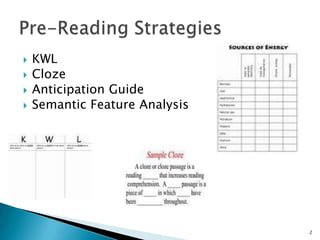
KWLClozeAnticipation GuideSemantic Feature Analysis2Pre-Reading Strategies
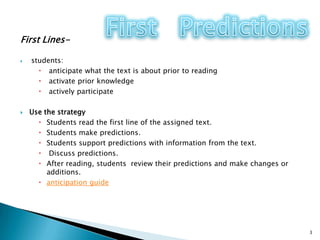
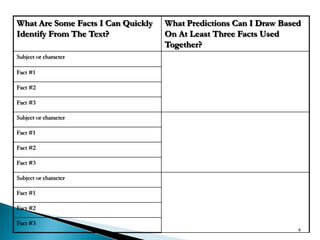
First Lines-students:  anticipate what the text is about prior to readingactivate prior knowledge  actively participateUse the strategyStudents read the first line of the assigned text.Students make predictions. Students support predictions with information from the text.  Discuss predictions.After reading, students  review their predictions and make changes or additions. anticipation guide3First   Predictions
4
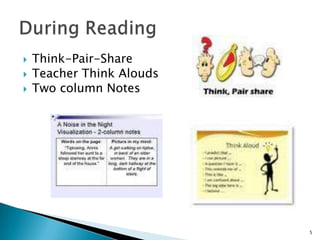
Think-Pair-ShareTeacher Think AloudsTwo column Notes5During Reading
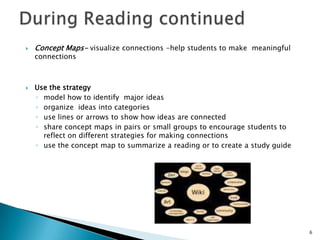
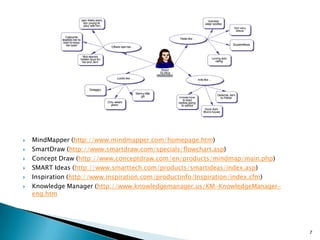
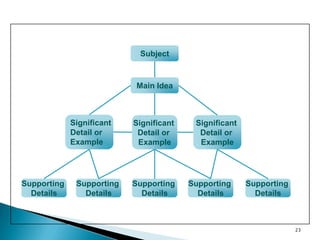
Concept Maps- visualize connections -help students to make  meaningful connections Use the strategymodel how to identify major ideasorganize  ideas into categoriesuse lines or arrows to show how ideas are connectedshare concept maps in pairs or small groups to encourage students to reflect on different strategies for making connectionsuse the concept map to summarize a reading or to create a study guide 6During Reading continued
MindMapper (http://www.mindmapper.com/homepage.htm) SmartDraw (http://www.smartdraw.com/specials/flowchart.asp) Concept Draw (http://www.conceptdraw.com/en/products/mindmap/main.php) SMART Ideas (http://www.smarttech.com/products/smartideas/index.asp) Inspiration (http://www.inspiration.com/productinfo/Inspiration/index.cfm) Knowledge Manager (http://www.knowledgemanager.us/KM-KnowledgeManager-eng.htm7
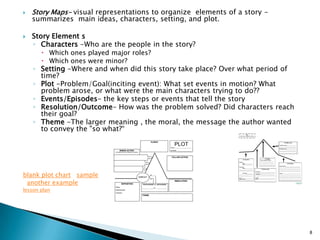
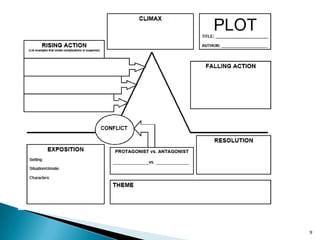
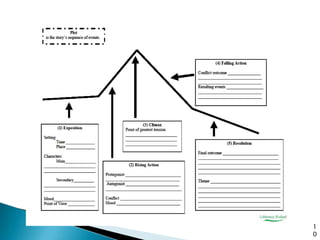
Story Maps- visual representations to organize elements of a story -summarizes  main ideas, characters, setting, and plot.Story ElementsCharacters -Who are the people in the story?Which ones played major roles?Which ones were minor?Setting -Where and when did this story take place? Over what period of time?Plot -Problem/Goal(inciting event): What set events in motion? What problem arose, or what were the main characters trying to do??Events/Episodes- the key steps or events that tell the storyResolution/Outcome- How was the problem solved? Did characters reach their goal? Theme -The larger meaning , the moral, the message the author wanted to convey the "so what?“blank plot chartsampleanother examplelesson plan8
9
10
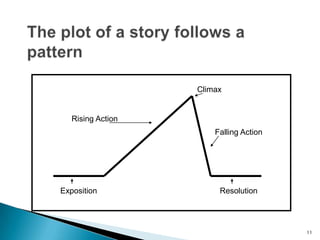
The plot of a story follows a pattern11ClimaxRising ActionFalling ActionExpositionResolution
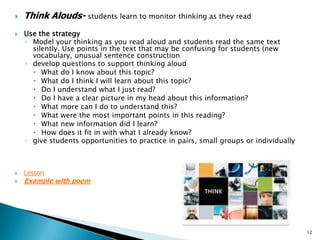
Think Alouds- students learn to monitor thinking as they readUse the strategyModel your thinking as you read aloud and students read the same text silently. Use points in the text that may be confusing for students (new vocabulary, unusual sentence constructiondevelop questions to support thinking aloud What do I know about this topic? What do I think I will learn about this topic? Do I understand what I just read? Do I have a clear picture in my head about this information? What more can I do to understand this? What were the most important points in this reading? What new information did I learn? How does it fit in with what I already know? give students opportunities to practice in pairs, small groups or individually LessonExample with poem12
Paragraph Shrinking- main ideaUse the strategyCreate pairsModel the activityEach member of the pair takes turns being "Coach" and "Player."Each student reads aloud for five minutes. After each paragraph, students summarize the main points:the who or what of the paragraph; the most important information about who or what; and the main idea If a "Player" gives a wrong answer, the "Coach" asks the "Player" to skim the paragraph and try again. Students state the main idea in ten words or less. 13
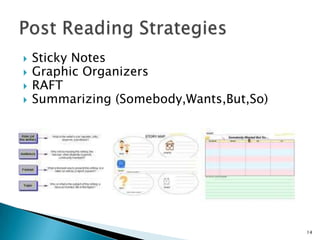
Sticky NotesGraphic OrganizersRAFTSummarizing (Somebody,Wants,But,So)14Post Reading Strategies
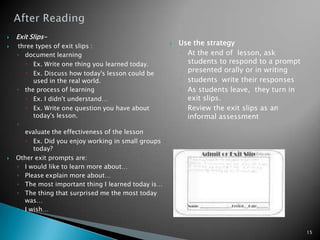
After ReadingUse the strategyAt the end of  lesson, ask students to respond to a prompt presented orally or in writingstudents write their responsesAs students leave,  they turn in exit slips.Review the exit slips as an informal assessmentExit Slips- three types of exit slips :document learningEx. Write one thing you learned today.Ex. Discuss how today's lesson could be used in the real world.the process of learning Ex. I didn't understand…Ex. Write one question you have about today's lesson.evaluate the effectiveness of the lessonEx. Did you enjoy working in small groups today?Other exit prompts are:I would like to learn more about…Please explain more about…The most important thing I learned today is…The thing that surprised me the most today was…I wish…15
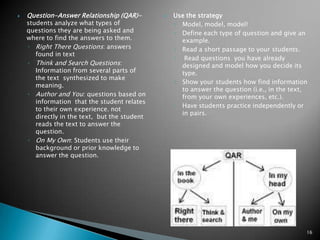
Question-Answer Relationship (QAR)-  students analyze what types of questions they are being asked and where to find the answers to them.Right There Questions: answers found in textThink and Search Questions:  Information from several parts of the text  synthesized to make meaning. Author and You: questions based on information  that the student relates  to their own experience. not  directly in the text,  but the student reads the text to answer the question.On My Own: Students use their background or prior knowledge to answer the question.Use the strategyModel, model, model!Define each type of question and give an example.Read a short passage to your students. Read questions  you have already designed and model how you decide its type.Show your students how find information to answer the question (i.e., in the text, from your own experiences, etc.).Have students practice independently or in pairs.16
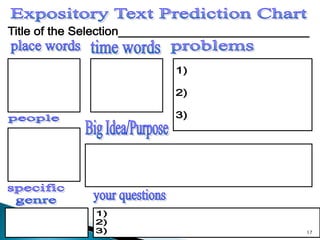
Expository Text Prediction ChartTitle of the Selection____________________________place wordstime wordsproblems1)2)3)peopleBig Idea/Purposespecificgenreyour questions1)2)3)17
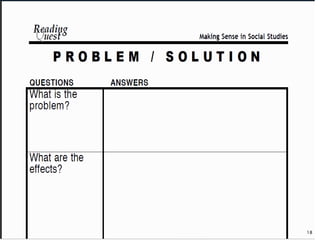
18
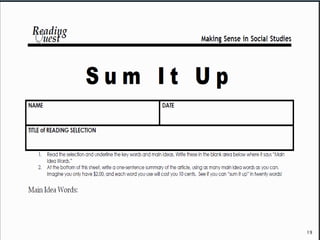
19
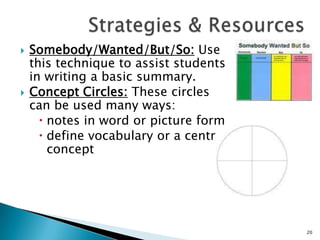
Somebody/Wanted/But/So: Use this technique to assist students in writing a basic summary.Concept Circles: These circles can be used many ways:notes in word or picture formdefine vocabulary or a central concept20Strategies & Resources
Fat & Skinny Questions:(or Thick & Thin Questions) Encourage  students to ask “FAT” questions that begin with phrases such as: What if? Why did?What would happen if?How would you feel if?Laura Candler’s web-site  provides resources and lesson ideas for every subject area.21STRATEGIES continued:
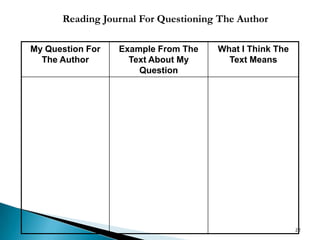
22Reading Journal For Questioning The Author
23
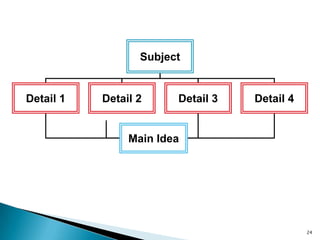
24
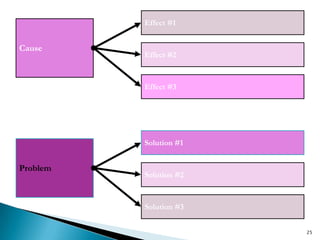
25Effect #1CauseEffect #2Effect #3Solution #1ProblemSolution #2Solution #3
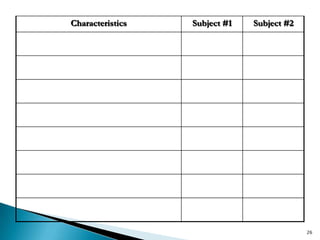
26
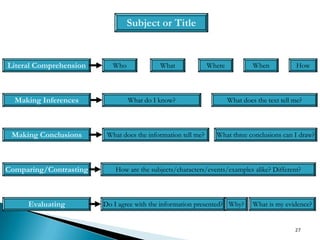
27Subject or TitleWhoWhatWhereWhenHowLiteral ComprehensionMaking InferencesWhat do I know?What does the text tell me?Making ConclusionsWhat does the information tell me?What three conclusions can I draw?Comparing/ContrastingHow are the subjects/characters/events/examples alike? Different?EvaluatingDo I agree with the information presented?Why?What is my evidence?
28Finding Clues In A Story	Tommy and Sarah just got off the school bus. Sarah said, “I smell smoke.” Tommy pointed and yelled, “Sarah, look at the smoke coming out of that house!”	In a moment they both heard what sounded like a fire engine siren. The passage suggests that –The house is on fire, and someone called to report it.The house is on fire, and no one called to report it.Someone was burning leaves in the back yard.This was a fire drill.
29Drawing Conclusions	Pretend you are at Wal Mart. As you are walking down the candy aisle, you notice a little boy crying and pulling on his mom’s skirt as she pushes her cart towards the front of the store. The closer she gets towards the front of the store, the louder the little boy screams.	Lots of things could be wrong with the little boy, BUT we can probably conclude that—	What do you conclude? Click on the speaker below to hear what I think. Of course, I could be wrong.
30Another Crying Little Boy	Pretend you are at the doctor’s office to get a shot. That same little boy you saw at Wal Mart is sitting there screaming his head off just like he did in the candy aisle.	What can you conclude this time?F. He is still angry about not getting the candy.G. He has an ear ache. H. He is scared because he is there for a shot.J.  He just cries a lot.
31More Clues 	Pretend you are at the doctor’s office to get a shot. That same little boy you saw at Wal Mart is sitting there screaming his head off just like he did in the candy aisle. His mom is rocking him in her arms.  He keeps pulling at his right ear	What can you conclude this time?F. He is still angry about not getting the candy.G. He has an ear ache. H. He is scared because he is there for a shot.J.  He just cries a lot.
32Finding Clues In A Story.	Maria was on the flag squad that performed at half time during football games. It was the first game that her grandparents and uncle Luigi attended. Maria waved her flag while looking for her family in the large crowd. Just as she spotted her grandmother, her greatest fear came true. She lost her grip on the flag, and it started to fall. Even though she caught it quickly, Maria’s face became red. She felt as if she had made a horrible mistake and everyone were staring at her.The passage suggests that Maria almost dropped her flag partly because she -- A  was thinking about the football gameB  wasn’t strong enoughC  was looking for her familyD  was frightened by a loud noise
33Finding Clues In A Story.	Maria was on the flag squad that performed at half time during football games. It was the first game that her grandparents and uncle Luigi attended. Maria waved her flag while looking for her family in the large crowd. Just as she spotted her grandmother, her greatest fear came true. She lost her grip on the flag, and it started to fall. Even though she caught it quickly, Maria’s face became red. She felt as if she had made a horrible mistake and everyone were staring at her.The passage suggests that Maria almost dropped her flag partly because she -- A  was thinking about the football gameB  wasn’t strong enoughC  was looking for her familyD  was frightened by a loud noise
34The Tasmanian Devil	One of the rarest animals in the world is the Tasmanian Devil. I’m not talking about the one you see in cartoons, but the real wolf-like animal that lives on the island of Tasmania. 	Every few years someone claims to see one, but they never have proof. A few years ago, some scientists who were studying plants found a skeleton, teeth and some skin in a remote area of Tasmania. They were excited as they believed they had found the remains of the rare Tasmanian Devil. They drew a picture of what they thought the animal may have looked like when it was alive. The scientists then sent the picture along with the skeleton, teeth and skin to Washington D.C.What did the scientists probably do with the skeleton, teeth and bones?F  Sent them to a country with more experienced scientists.G  Made clothing, jewelry, and other ornaments out of themH  Studied them carefully and compared them to other animalsJ  Sold them to museums that displayed them
Inferring settingSometimes the author doesn’t come out and explain the setting. Can you make an inference with the paragraph below? Anna sighed. She hated having to do so many chores. Her mother was always telling her to fetch the water from the well, watch her brothers and sisters, and fetch wood for the fire. “I wish that I could go to school,” she sighed, looking at her bare feet. But with her father in the Union Army, she had to help her mother.35
    Anna sighed. She hated having to do so many chores. Her mother was always telling her to fetch the water from the well, watch her brothers and sisters, and fetch wood for the fire. “I wish that I could go to school,” she sighed, looking at her bare feet. But with her father in the Union Army, she had to help her mother.36Inferring settingThe clues tell us that this happens in the past. Can you guess the exact time period? There is a clue!
        Pennsylvania has many historic sites. You can visit Revolutionary war sites, like Valley Forge. You can also visit important locations from the Civil War, like Gettysburg. Finally, you can also see the site of the first oil well in Titusville. Pennsylvania has many neat places to visit!Through the ages, Pennsylvania has seen many interesting events. The state was founded in 1681 by William Penn. Later, Pennsylvania was the site of important Revolutionary War battles. After that, Pennsylvania was home to new factories during the Industrial Revolution. Today, Pennsylvania continues to make history.37Which paragraph is in chronological order?
Through the ages, Pennsylvania has seen many interesting events. The state was founded in 1681 by William Penn. Later, Pennsylvania was the site of important Revolutionary War battles. After that, Pennsylvania was home to new factories during the Industrial Revolution. Today, Pennsylvania continues to make history.38Which paragraph is in chronological order?This is the paragraph in chronological order. Can you find the clue words that show this order?
The night’s snowstorm had many effects. People were out shoveling snow from their sidewalks. The power lines were draped with ice. Snow plows drove down every street. Children were the happiest of all. The unexpected snow caused school to be cancelled!39Can you find the clue words?
The night’s snowstorm had many effects. People were out shoveling snow from their sidewalks. The power lines were draped with ice. Snow plows drove down every street. Children were the happiest of all. The unexpected snow caused school to be cancelled!40Can you find the clue words?
Park School had a terrible problem. Every day at recess, students would argue over the slides. Teachers had to spend time every day taking care of the arguments. Finally, one teacher came up with a great solution. They bought another set of slides that everyone could enjoy.Can you find the problem and the solution in this paragraph?41An example of problem and solution
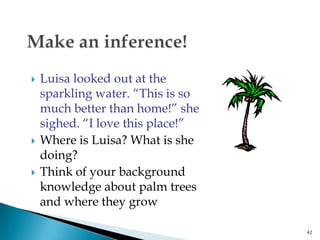
Make an inference!Luisa looked out at the sparkling water. “This is so much better than home!” she sighed. “I love this place!”Where is Luisa? What is she doing?Think of your background knowledge about palm trees and where they grow42
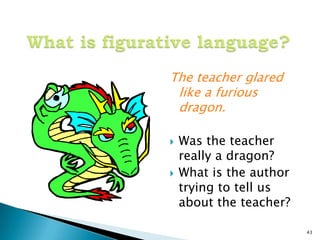
What is figurative language?The teacher glared like a furious dragon.Was the teacher really a dragon?What is the author trying to tell us about the teacher?43
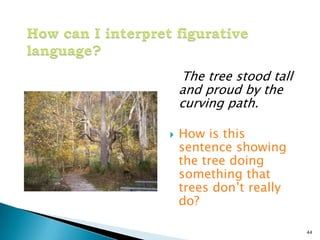
How can I interpret figurative language?The tree stood tall and proud by the curving path.How is this sentence showing the tree doing something that trees don’t really do?44
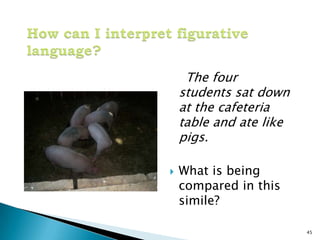
How can I interpret figurative language?The four students sat down at the cafeteria table and ate like pigs.What is being compared in this simile?45
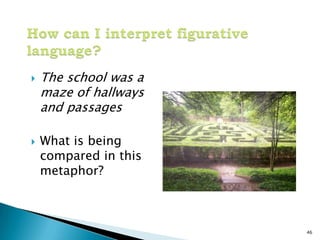
How can I interpret figurative language?The school was a maze of hallways and passagesWhat is being compared in this metaphor?46
47
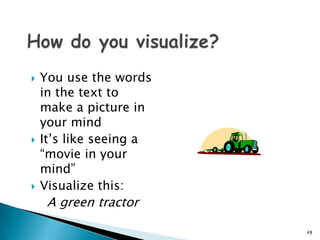
How do you visualize?You use the words in the text to make a picture in your mindIt’s like seeing a “movie in your mind”Visualize this: A green tractor48
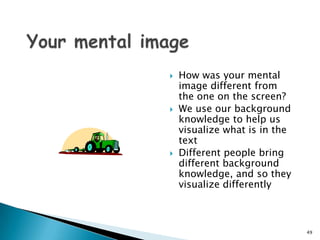
Your mental imageHow was your mental image different from the one on the screen?We use our background knowledge to help us visualize what is in the textDifferent people bring different background knowledge, and so they visualize differently49
The purple flowers bloomed, lifting their petals up to the sun. They were surrounded by the bright green lily pads that covered the surface of the pond.Can you picture this scene in your mind?50Try this:
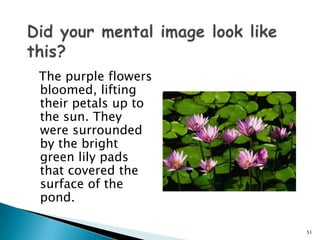
Did your mental image look like this?  The purple flowers bloomed, lifting their petals up to the sun. They were surrounded by the bright green lily pads that covered the surface of the pond.51
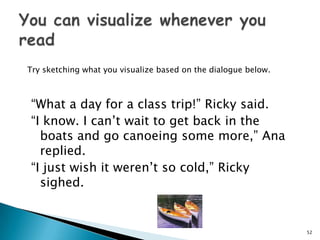
“What a day for a class trip!” Ricky said.“I know. I can’t wait to get back in the boats and go canoeing some more,” Ana replied.“I just wish it weren’t so cold,” Ricky sighed.52You can visualize whenever you readTry sketching what you visualize based on the dialogue below.
Reading test practiceNAEP question databasereading strategiesinteractive activitiesparaphrasing informational text25 reading strategies4th grade links:describing solutions to problemscause and effectmain ideainferences about character traitsauthor's purposecomparisons and contrastsinteractive persuasive writing/53Online Test Prep
read write think3rd grade interactive activitiesinteractivie writing toolsPromptsinternet writing activitieswriting prompts by grade level54Resources
Patricia HuttonCMSCEhttp://cmsce.rutgers.edupjhutton@aol.comtikap@aol.com55
56

Hackensack strat

  • 1.
    Test Prep ActivitiesNJASK Grades 3-41
  • 2.
    KWLClozeAnticipation GuideSemantic FeatureAnalysis2Pre-Reading Strategies
  • 3.
    First Lines-students: anticipate what the text is about prior to readingactivate prior knowledge actively participateUse the strategyStudents read the first line of the assigned text.Students make predictions. Students support predictions with information from the text. Discuss predictions.After reading, students review their predictions and make changes or additions. anticipation guide3First Predictions
  • 4.
  • 5.
    Think-Pair-ShareTeacher Think AloudsTwocolumn Notes5During Reading
  • 6.
    Concept Maps- visualizeconnections -help students to make meaningful connections Use the strategymodel how to identify major ideasorganize ideas into categoriesuse lines or arrows to show how ideas are connectedshare concept maps in pairs or small groups to encourage students to reflect on different strategies for making connectionsuse the concept map to summarize a reading or to create a study guide 6During Reading continued
  • 7.
    MindMapper (http://www.mindmapper.com/homepage.htm) SmartDraw(http://www.smartdraw.com/specials/flowchart.asp) Concept Draw (http://www.conceptdraw.com/en/products/mindmap/main.php) SMART Ideas (http://www.smarttech.com/products/smartideas/index.asp) Inspiration (http://www.inspiration.com/productinfo/Inspiration/index.cfm) Knowledge Manager (http://www.knowledgemanager.us/KM-KnowledgeManager-eng.htm7
  • 8.
    Story Maps- visualrepresentations to organize elements of a story -summarizes main ideas, characters, setting, and plot.Story ElementsCharacters -Who are the people in the story?Which ones played major roles?Which ones were minor?Setting -Where and when did this story take place? Over what period of time?Plot -Problem/Goal(inciting event): What set events in motion? What problem arose, or what were the main characters trying to do??Events/Episodes- the key steps or events that tell the storyResolution/Outcome- How was the problem solved? Did characters reach their goal? Theme -The larger meaning , the moral, the message the author wanted to convey the "so what?“blank plot chartsampleanother examplelesson plan8
  • 9.
  • 10.
  • 11.
    The plot ofa story follows a pattern11ClimaxRising ActionFalling ActionExpositionResolution
  • 12.
    Think Alouds- studentslearn to monitor thinking as they readUse the strategyModel your thinking as you read aloud and students read the same text silently. Use points in the text that may be confusing for students (new vocabulary, unusual sentence constructiondevelop questions to support thinking aloud What do I know about this topic? What do I think I will learn about this topic? Do I understand what I just read? Do I have a clear picture in my head about this information? What more can I do to understand this? What were the most important points in this reading? What new information did I learn? How does it fit in with what I already know? give students opportunities to practice in pairs, small groups or individually LessonExample with poem12
  • 13.
    Paragraph Shrinking- mainideaUse the strategyCreate pairsModel the activityEach member of the pair takes turns being "Coach" and "Player."Each student reads aloud for five minutes. After each paragraph, students summarize the main points:the who or what of the paragraph; the most important information about who or what; and the main idea If a "Player" gives a wrong answer, the "Coach" asks the "Player" to skim the paragraph and try again. Students state the main idea in ten words or less. 13
  • 14.
    Sticky NotesGraphic OrganizersRAFTSummarizing(Somebody,Wants,But,So)14Post Reading Strategies
  • 15.
    After ReadingUse thestrategyAt the end of lesson, ask students to respond to a prompt presented orally or in writingstudents write their responsesAs students leave, they turn in exit slips.Review the exit slips as an informal assessmentExit Slips- three types of exit slips :document learningEx. Write one thing you learned today.Ex. Discuss how today's lesson could be used in the real world.the process of learning Ex. I didn't understand…Ex. Write one question you have about today's lesson.evaluate the effectiveness of the lessonEx. Did you enjoy working in small groups today?Other exit prompts are:I would like to learn more about…Please explain more about…The most important thing I learned today is…The thing that surprised me the most today was…I wish…15
  • 16.
    Question-Answer Relationship (QAR)- students analyze what types of questions they are being asked and where to find the answers to them.Right There Questions: answers found in textThink and Search Questions: Information from several parts of the text synthesized to make meaning. Author and You: questions based on information that the student relates to their own experience. not directly in the text, but the student reads the text to answer the question.On My Own: Students use their background or prior knowledge to answer the question.Use the strategyModel, model, model!Define each type of question and give an example.Read a short passage to your students. Read questions you have already designed and model how you decide its type.Show your students how find information to answer the question (i.e., in the text, from your own experiences, etc.).Have students practice independently or in pairs.16
  • 17.
    Expository Text PredictionChartTitle of the Selection____________________________place wordstime wordsproblems1)2)3)peopleBig Idea/Purposespecificgenreyour questions1)2)3)17
  • 18.
  • 19.
  • 20.
    Somebody/Wanted/But/So: Use thistechnique to assist students in writing a basic summary.Concept Circles: These circles can be used many ways:notes in word or picture formdefine vocabulary or a central concept20Strategies & Resources
  • 21.
    Fat & SkinnyQuestions:(or Thick & Thin Questions) Encourage students to ask “FAT” questions that begin with phrases such as: What if? Why did?What would happen if?How would you feel if?Laura Candler’s web-site provides resources and lesson ideas for every subject area.21STRATEGIES continued:
  • 22.
    22Reading Journal ForQuestioning The Author
  • 23.
  • 24.
  • 25.
    25Effect #1CauseEffect #2Effect#3Solution #1ProblemSolution #2Solution #3
  • 26.
  • 27.
    27Subject or TitleWhoWhatWhereWhenHowLiteralComprehensionMaking InferencesWhat do I know?What does the text tell me?Making ConclusionsWhat does the information tell me?What three conclusions can I draw?Comparing/ContrastingHow are the subjects/characters/events/examples alike? Different?EvaluatingDo I agree with the information presented?Why?What is my evidence?
  • 28.
    28Finding Clues InA Story Tommy and Sarah just got off the school bus. Sarah said, “I smell smoke.” Tommy pointed and yelled, “Sarah, look at the smoke coming out of that house!” In a moment they both heard what sounded like a fire engine siren. The passage suggests that –The house is on fire, and someone called to report it.The house is on fire, and no one called to report it.Someone was burning leaves in the back yard.This was a fire drill.
  • 29.
    29Drawing Conclusions Pretend youare at Wal Mart. As you are walking down the candy aisle, you notice a little boy crying and pulling on his mom’s skirt as she pushes her cart towards the front of the store. The closer she gets towards the front of the store, the louder the little boy screams. Lots of things could be wrong with the little boy, BUT we can probably conclude that— What do you conclude? Click on the speaker below to hear what I think. Of course, I could be wrong.
  • 30.
    30Another Crying LittleBoy Pretend you are at the doctor’s office to get a shot. That same little boy you saw at Wal Mart is sitting there screaming his head off just like he did in the candy aisle. What can you conclude this time?F. He is still angry about not getting the candy.G. He has an ear ache. H. He is scared because he is there for a shot.J. He just cries a lot.
  • 31.
    31More Clues Pretendyou are at the doctor’s office to get a shot. That same little boy you saw at Wal Mart is sitting there screaming his head off just like he did in the candy aisle. His mom is rocking him in her arms. He keeps pulling at his right ear What can you conclude this time?F. He is still angry about not getting the candy.G. He has an ear ache. H. He is scared because he is there for a shot.J. He just cries a lot.
  • 32.
    32Finding Clues InA Story. Maria was on the flag squad that performed at half time during football games. It was the first game that her grandparents and uncle Luigi attended. Maria waved her flag while looking for her family in the large crowd. Just as she spotted her grandmother, her greatest fear came true. She lost her grip on the flag, and it started to fall. Even though she caught it quickly, Maria’s face became red. She felt as if she had made a horrible mistake and everyone were staring at her.The passage suggests that Maria almost dropped her flag partly because she -- A was thinking about the football gameB wasn’t strong enoughC was looking for her familyD was frightened by a loud noise
  • 33.
    33Finding Clues InA Story. Maria was on the flag squad that performed at half time during football games. It was the first game that her grandparents and uncle Luigi attended. Maria waved her flag while looking for her family in the large crowd. Just as she spotted her grandmother, her greatest fear came true. She lost her grip on the flag, and it started to fall. Even though she caught it quickly, Maria’s face became red. She felt as if she had made a horrible mistake and everyone were staring at her.The passage suggests that Maria almost dropped her flag partly because she -- A was thinking about the football gameB wasn’t strong enoughC was looking for her familyD was frightened by a loud noise
  • 34.
    34The Tasmanian Devil Oneof the rarest animals in the world is the Tasmanian Devil. I’m not talking about the one you see in cartoons, but the real wolf-like animal that lives on the island of Tasmania. Every few years someone claims to see one, but they never have proof. A few years ago, some scientists who were studying plants found a skeleton, teeth and some skin in a remote area of Tasmania. They were excited as they believed they had found the remains of the rare Tasmanian Devil. They drew a picture of what they thought the animal may have looked like when it was alive. The scientists then sent the picture along with the skeleton, teeth and skin to Washington D.C.What did the scientists probably do with the skeleton, teeth and bones?F Sent them to a country with more experienced scientists.G Made clothing, jewelry, and other ornaments out of themH Studied them carefully and compared them to other animalsJ Sold them to museums that displayed them
  • 35.
    Inferring settingSometimes theauthor doesn’t come out and explain the setting. Can you make an inference with the paragraph below? Anna sighed. She hated having to do so many chores. Her mother was always telling her to fetch the water from the well, watch her brothers and sisters, and fetch wood for the fire. “I wish that I could go to school,” she sighed, looking at her bare feet. But with her father in the Union Army, she had to help her mother.35
  • 36.
    Anna sighed. She hated having to do so many chores. Her mother was always telling her to fetch the water from the well, watch her brothers and sisters, and fetch wood for the fire. “I wish that I could go to school,” she sighed, looking at her bare feet. But with her father in the Union Army, she had to help her mother.36Inferring settingThe clues tell us that this happens in the past. Can you guess the exact time period? There is a clue!
  • 37.
    Pennsylvania has many historic sites. You can visit Revolutionary war sites, like Valley Forge. You can also visit important locations from the Civil War, like Gettysburg. Finally, you can also see the site of the first oil well in Titusville. Pennsylvania has many neat places to visit!Through the ages, Pennsylvania has seen many interesting events. The state was founded in 1681 by William Penn. Later, Pennsylvania was the site of important Revolutionary War battles. After that, Pennsylvania was home to new factories during the Industrial Revolution. Today, Pennsylvania continues to make history.37Which paragraph is in chronological order?
  • 38.
    Through the ages,Pennsylvania has seen many interesting events. The state was founded in 1681 by William Penn. Later, Pennsylvania was the site of important Revolutionary War battles. After that, Pennsylvania was home to new factories during the Industrial Revolution. Today, Pennsylvania continues to make history.38Which paragraph is in chronological order?This is the paragraph in chronological order. Can you find the clue words that show this order?
  • 39.
    The night’s snowstormhad many effects. People were out shoveling snow from their sidewalks. The power lines were draped with ice. Snow plows drove down every street. Children were the happiest of all. The unexpected snow caused school to be cancelled!39Can you find the clue words?
  • 40.
    The night’s snowstormhad many effects. People were out shoveling snow from their sidewalks. The power lines were draped with ice. Snow plows drove down every street. Children were the happiest of all. The unexpected snow caused school to be cancelled!40Can you find the clue words?
  • 41.
    Park School hada terrible problem. Every day at recess, students would argue over the slides. Teachers had to spend time every day taking care of the arguments. Finally, one teacher came up with a great solution. They bought another set of slides that everyone could enjoy.Can you find the problem and the solution in this paragraph?41An example of problem and solution
  • 42.
    Make an inference!Luisalooked out at the sparkling water. “This is so much better than home!” she sighed. “I love this place!”Where is Luisa? What is she doing?Think of your background knowledge about palm trees and where they grow42
  • 43.
    What is figurativelanguage?The teacher glared like a furious dragon.Was the teacher really a dragon?What is the author trying to tell us about the teacher?43
  • 44.
    How can Iinterpret figurative language?The tree stood tall and proud by the curving path.How is this sentence showing the tree doing something that trees don’t really do?44
  • 45.
    How can Iinterpret figurative language?The four students sat down at the cafeteria table and ate like pigs.What is being compared in this simile?45
  • 46.
    How can Iinterpret figurative language?The school was a maze of hallways and passagesWhat is being compared in this metaphor?46
  • 47.
  • 48.
    How do youvisualize?You use the words in the text to make a picture in your mindIt’s like seeing a “movie in your mind”Visualize this: A green tractor48
  • 49.
    Your mental imageHowwas your mental image different from the one on the screen?We use our background knowledge to help us visualize what is in the textDifferent people bring different background knowledge, and so they visualize differently49
  • 50.
    The purple flowersbloomed, lifting their petals up to the sun. They were surrounded by the bright green lily pads that covered the surface of the pond.Can you picture this scene in your mind?50Try this:
  • 51.
    Did your mentalimage look like this? The purple flowers bloomed, lifting their petals up to the sun. They were surrounded by the bright green lily pads that covered the surface of the pond.51
  • 52.
    “What a dayfor a class trip!” Ricky said.“I know. I can’t wait to get back in the boats and go canoeing some more,” Ana replied.“I just wish it weren’t so cold,” Ricky sighed.52You can visualize whenever you readTry sketching what you visualize based on the dialogue below.
  • 53.
    Reading test practiceNAEPquestion databasereading strategiesinteractive activitiesparaphrasing informational text25 reading strategies4th grade links:describing solutions to problemscause and effectmain ideainferences about character traitsauthor's purposecomparisons and contrastsinteractive persuasive writing/53Online Test Prep
  • 54.
    read write think3rdgrade interactive activitiesinteractivie writing toolsPromptsinternet writing activitieswriting prompts by grade level54Resources
  • 55.
  • 56.