INFECTION CONTROL
LEARNING OBJECTIVES:
At the end of the discussion, the learner will be able to:
1. Explain the relationship between the infection chain and
transmission of infection.
2. Identify the normal defenses of the body against infection.
3. Identify patients most at risk for infection.
4. Describe the signs/symptoms of localized infections and those
of a systemic infection.
5. Explain the difference between medical and surgical asepsis
6. Explain the rationale for standard precautions.
7. Perform proper procedures for hand hygiene.
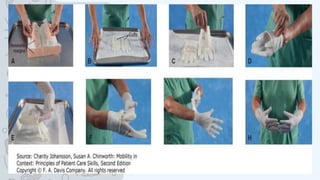
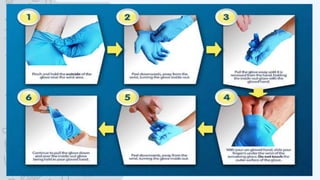
8. Properly apply a sterile gloves appropriately.
By: GAMELA KATE T. MOSTERO, RN
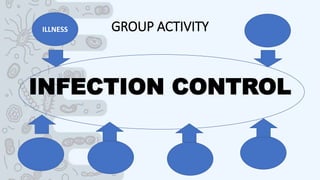
GROUP ACTIVITY
INFECTION CONTROL
ILLNESS
INTRODUCTION:
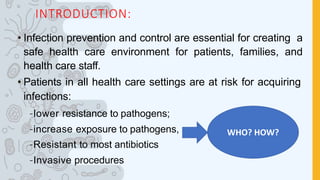
• Infection prevention and control are essential for creating a
safe health care environment for patients, families, and
health care staff.
• Patients in all health care settings are at risk for acquiring
infections:
–lower resistance to pathogens;
–increase exposure to pathogens,
–Resistant to most antibiotics
–Invasive procedures
WHO? HOW?
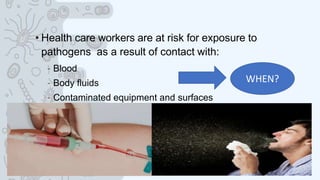
• Health care workers are at risk for exposure to
pathogens as a result of contact with:
– Blood
– Body fluids
– Contaminated equipment and surfaces
WHEN?
DEFINITION
•Infection
- is the invasion of a host organism's bodily
tissues by disease-causing organisms, their
multiplication, and the reaction of host
tissues to these organisms and the toxins they
produce.
- Infections are caused by microorganisms such as
viruses, prions, bacteria, and viroids, and larger
organisms like macroparasites and fungi.
PRINCIPLES OF INFECTION CONTROL
1. Proper hand washing removes many of the microorganisms that
would be transferred by the hands form one item to another-
perform hand washing before and after any procedure.
2. Microorganisms move through space on air currents- avoid
shaking or tossing linens.
3. Microorganisms are transferred from one surface to another
whenever objects touch, a clean item touching a less item
becomes “dirty”- keep hands away form face, keep linens away
from uniforms, an item dropped on the floor is considered dirty.
4. Microorganisms are transferred by gravity when one item is held
above another; avoid passing dirty items over clean items.
5. Microorganisms are released into the air on droplet nuclei
whenever a person breathes or speaks- avoid breathing directly in
someone’s face.
6. Microorganisms move slowly on dry surfaces, but very quickly
through moisture.
PRINCIPLES OF INFECTION CONTROL
INFECTION
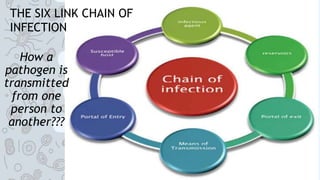
THE SIX LINK CHAIN OF
INFECTION
How a
pathogen is
transmitted
from one
person to
another???
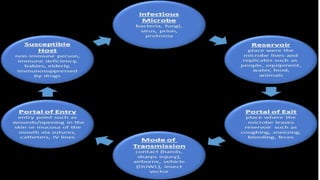
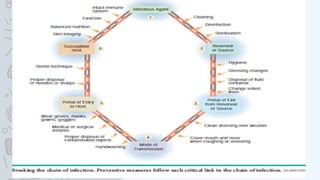
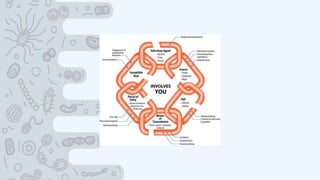
CHAIN OF INFECTION
Model used to understand the infection
process.
Each link represents step in transmission of
infection.
Each link has to be present and in order for an
infection to occur.
•
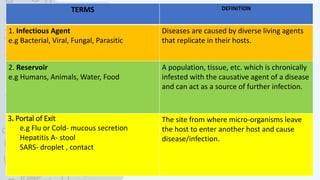
TERMS DEFINITION
1. Infectious Agent
e.g Bacterial, Viral, Fungal, Parasitic
Diseases are caused by diverse living agents
that replicate in their hosts.
2. Reservoir
e.g Humans, Animals, Water, Food
A population, tissue, etc. which is chronically
infested with the causative agent of a disease
and can act as a source of further infection.
3. Portal of Exit
e.g Flu or Cold- mucous secretion
Hepatitis A- stool
SARS- droplet , contact
The site from where micro-organisms leave
the host to enter another host and cause
disease/infection.
4. Route of Transmission
4.1 CONTACT
Direct- person to person
Indirect- involves transfer through contaminated
intermediate object or person.
4.2 DROPLET
From respiratory tract, secretions of infected
person.
Can spread germs directly or indirectly.
Does not circulate in air for long time or travel far
(mostly < 3 feet).
4.3AIRBORNE
Germs stay suspended in air on small particles.
Uncommon method of transmission.
Only occurs for certain germs, such as
tuberculosis.
Less common for flu, SARS
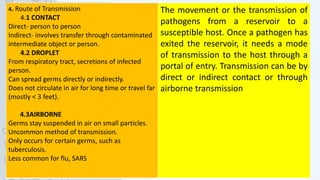
The movement or the transmission of
pathogens from a reservoir to a
susceptible host. Once a pathogen has
exited the reservoir, it needs a mode
of transmission to the host through a
portal of entry. Transmission can be by
direct or indirect contact or through
airborne transmission
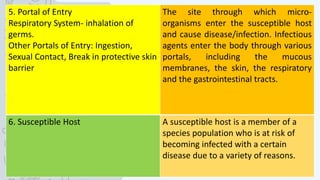
5. Portal of Entry
Respiratory System- inhalation of
germs.
Other Portals of Entry: Ingestion,
Sexual Contact, Break in protective skin
barrier
The site through which micro-
organisms enter the susceptible host
and cause disease/infection. Infectious
agents enter the body through various
portals, including the mucous
membranes, the skin, the respiratory
and the gastrointestinal tracts.
6. Susceptible Host A susceptible host is a member of a
species population who is at risk of
becoming infected with a certain
disease due to a variety of reasons.
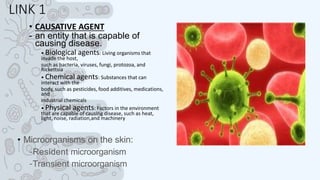
LINK 1
• CAUSATIVE AGENT
- an entity that is capable of
causing disease.
• Biological agents: Living organisms that
invade the host,
such as bacteria, viruses, fungi, protozoa, and
Rickettsia
• Chemical agents: Substances that can
interact with the
body, such as pesticides, food additives, medications,
and
industrial chemicals
• Physical agents: Factors in the environment
that are capable of causing disease, such as heat,
light, noise, radiation,and machinery
• Microorganisms on the skin:
–Resident microorganism
–Transient microorganism
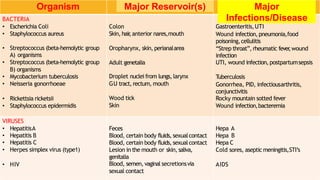
Organism Major Reservoir(s) Major
Infections/Disease
BACTERIA
• Escherichia Coli
• Staphylococcus aureus
• Streptococcus (beta-hemolytic group
A) organisms
• Streptococcus (beta-hemolytic group
B) organisms
• Mycobacterium tuberculosis
• Neisseria gonorrhoeae
• Rickettsia ricketsii
• Staphylococcus epidermidis
Colon
Skin, hair
,anterior nares,mouth
Oropharynx, skin, perianalarea
Adult genetalia
Droplet nuclei from lungs, larynx
GU tract, rectum, mouth
Wood tick
Skin
Gastroenteritis,UTI
Wound infection,pneumonia,food
poisoning,cellulitis
“Strep throat”, rheumatic fever
,wound
infection
UTI, wound infection,postpartumsepsis
Tuberculosis
Gonorrhea, PID, infectiousarthritis,
conjunctivitis
Rocky mountain sotted fever
Wound infection,bacteremia
VIRUSES
• HepatitisA
• Hepatitis B
• Hepatitis C
• Herpes simplex virus (type1)
• HIV
Feces
Blood, certain body fluids,sexualcontact
Lesion in the mouth or skin, saliva,
genitalia
Blood, semen, vaginal secretionsvia
sexual contact
Hepa A
Hepa B
Hepa C
Cold sores, aseptic meningitis,STI’s
AIDS
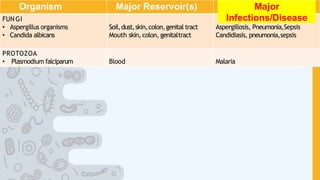
Organism Major Reservoir(s) Major
Infections/Disease
FUNGI
• Aspergillus organisms
• Candida albicans
Soil,dust,skin,colon,genital tract
Mouth skin, colon, genitaltract
Aspergillosis, Pneumonia,Sepsis
Candidiasis, pneumonia,sepsis
PROTOZOA
• Plasmodium falciparum Blood Malaria
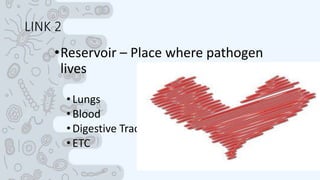
LINK 2
•Reservoir – Place where pathogen
lives
•Lungs
•Blood
•Digestive Tract
•ETC
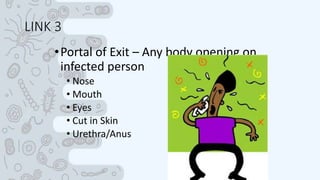
LINK 3
•Portal of Exit – Any body opening on
infected person
• Nose
• Mouth
• Eyes
• Cut in Skin
• Urethra/Anus
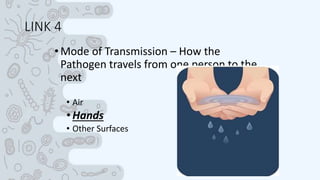
LINK 4
•Mode of Transmission – How the
Pathogen travels from one person to the
next
• Air
•Hands
• Other Surfaces
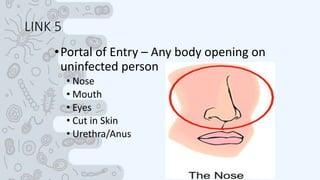
LINK 5
•Portal of Entry – Any body opening on
uninfected person
• Nose
• Mouth
• Eyes
• Cut in Skin
• Urethra/Anus
LINK 6
• A host is a simple or complex organism
that can be affected by an agent.
Generally, a human being is considered a
host.
• A susceptible host is a person who
lacks resistance to an agent and is thus
vulnerable to disease.
• A compromised host is a person
whose normal defense mechanisms are
impaired and who is therefore susceptible
to infection.
HOW DO
WE STOP
IT?
•
•
ASEP
SIS
Absence from any disease-causing microorganisms
the state of being free from disease- causing contaminants (such as bacteria, viruses,
fungi, and parasites) or, preventing contact with microorganisms.
1. MEDICAL ASEPSIS- (clean technique) includes procedures used to
reduce the number of microorganisms and prevent their spread.
-examining patients ,
-minor procedures like I.V cannula insertion..etc
2. SURGICAL ASEPSIS (Sterile Technique)- refers to practices that keep an
area or object free form all microorganisms, it includes practices that
destroy all microorganism spores.
3. ASEPTIC TECHNIQUE- methods used to make the environment, worker
and as germ free as possible.
• Antisepsis is the use of chemical solutions for disinfection.
HAN D
HYGIEN E
1. Inspect surface of your hands for breaks or
cuts. Cover any skin lesions with a
dressing before providing care.
2. Inspect hands for visible soiling.
3. Inspect conditions of nails push wristwatch
and long uniform sleeves above wrists.
Avoid wearing rings.
4. Antiseptic hand rub
5. Handwashing with antiseptic soap
a. Stand in front of sink, keeping hands and uniform
away from the sink surface.
b. Turn on water. Turn faucet on or push knee
pedals laterally or press pedals with foot.
c. Avoid water splashing water against uniform
d. Wet hands wrist thoroughly under running water.
Keep hands and forearms lower than elbows
during washing.
e. Apply 3-5ml of antiseptic soap and rub hands
together vigorously, lathering thoroughly.
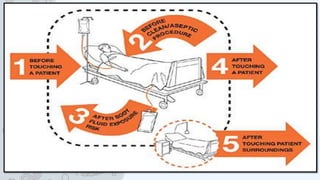
FIVE MOMENTS OF HAND HYGIENE
Protect patients against acquiring infectious agents
from the hands of the healthcare worker.
Help protect patients form infectious agents (including
their own) entering their bodies during procedures.
Protect healthcare workers and the healthcare
surroundings form acquiring patients’ infectious agents.
Developed by the World Health Organization.
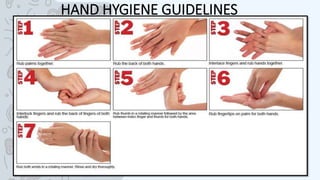
HAND HYGIENE GUIDELINES
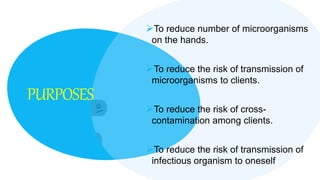
•
PURPOSES
To reduce number of microorganisms
on the hands.
To reduce the risk of transmission of
microorganisms to clients.
To reduce the risk of cross-
contamination among clients.
To reduce the risk of transmission of
infectious organism to oneself.
INDICATI
ON
Routine client care
Before and after client contact
When hands are visibly soiled
After contact with source of
microorganisms
Before and after removing gloves
Before and after performing
invasive procedures
Materia
ls
Soap
Running water
Towels
PROCEDUR
E
1. REMOVE JEWELRY. A PLAIN WEDDING
BAND MAY REMAIN IN PLACE.
 Rationale: rough places/edges in jewelry an harbor
organisms.
2. STAND IN FRONT OF THE SINK AND AVOID
LEANING AGAINST IT.
 Rationale: avoids the transfer of contamination from sink
to the nurse’s uniform.
PROCEDUR
E
3. TURN ON THE WATER AND REGULATE ITS
FLOW AND TEMPERATURE. KNEE OR FOOT
PEDALS MAY BE AVAILABLE ON SOME
SINKS. IN SOME FACILITIES, WATER
AUTOMATICALLY FLOWS WHEN PLACING
THE HANDS UNDER THE FAUCET.
 Rationale: controlling the force of flow limits splashing. Warm water
in more comfortable and less irritating to the skin. It is much safer not
to touch faucet handles.
4. WET YOUR HANDS AND FOREARMS WITH
WATER, KEEPING THE HANDS LOWER THAN
THE ELBOWS.
 Rationale: this action allows water to flow the least
contaminated area toward hands, which are the most
contaminated area.
PROCEDUR
E
5. APPLY AN ANTIBACTERIAL LIQUID SOAP,
IF YOU MUST PRESS LEVER TO DISPENSE
THE SOAP, DO SO WITH A PAPER TOWEL.
LIQUID SOAP WITH A FOOT-OR-KNEE
OPERATED DISPENSER IS THE MOST
SANITARY.
 Rationale: the dispenser may be contaminated. Using
paper towel or foot operated dispenser is most important
to prevent further contamination.
6. WASH YOUR HANDS, WRISTS AND LOWER
FOREARMS FOR A MINIMUM OF 40-60 SEC.
USING SCRUBBING MOTION. INTERLACE
FINGERS AND RUB THE HANDS BACK AND
FORTH.
 Rationale: Friction loosens dirt and bacteria on all
surfaces.
PROCEDUR
E
7. INSERT THE FINGER NAILS FROM ONE
HAND UNDER THOSE OF THE OTHER HAND
USING SWEEPING MOTION. REPEAT WITH
OTHER HAND.
 Rationale: bacteria tend to accumulate under the
fingernails.
8. RINSE THOROUGHLY, KEEPING THE
HANDS LOWER THAN THE FOREARMS.
 Rationale: Keeping the hands lower than the forearms
prevent soap lather from recontaminating clean areas.
PROCEDUR
E
9. REPEAT THE PROCEDURES, IF THE
HANDS ARE VERY SOILED.
 Rationale: this ensures a thoroughly cleaning.
10. DRY HANDS THOROUGHLY WITH A
PAPER TOWEL. DISCARD THE TOWEL.
 Rationale: Drying thoroughly prevents chapping. Using
paper towel helps prevent spread of microorganisms.
11. USE A PAPER CLEAN TOWEL TO TURN
OFF THE FAUCETS.
 Rationale: a dry clean towel prevents recontamination of the hands
with organisms on faucet. A wet towel would allow the passage of
microorganisms back to the hands.
PURPOSE
1. It is considered one of the most effective infection control
measurement.
2. Important in every setting.
3. It is important to both nurses’ and the clients’ hands to prevent the
spread of microorganisms.
4. Failure to perform appropriate hand hygiene is considered to be the
leading cause of hospital acquired infections and the spread of multi-
resistant microorganisms and has been recognized as a significant
contributor to outbreaks.
5. Hands are the main pathways of germ transmission during health
care.
TIME: Major obstacle for hand Hygiene
Adequate hand washing with water and soap
requires 40- 60 seconds.
Alcohol- based hand rubbing requires 20 -30
seconds (WHO, 2012).
• The World Health Organization (WHO) recommends hand washing
under streaming of water for at least 40 seconds using plain granule
soap, soap-filled sheets, or liquid soap when:
1. Hands are visibly soiled.
2. After using restroom.
3. After removing gloves.
4. Before handling invasive devices.
5. After contact with medical equipment or furniture.
Controlling the Spread of Infections
1. Sterilization- make free from all living organisms.
2. Disinfection- process of freeing form
microorganisms by physical or chemical means.
3. Autoclaves- sterilizers which use steam under
pressure to kill all organisms.
•
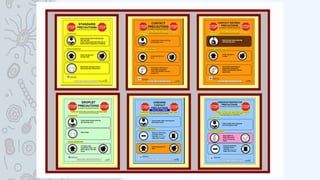
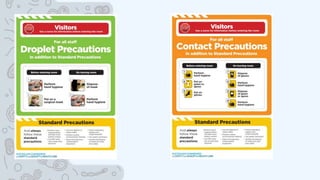
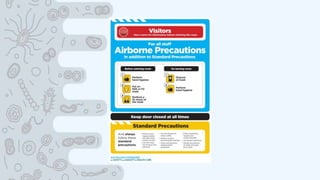
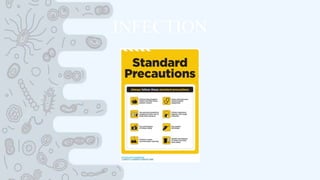
Standard Precautions vs. Transmission Based
Precautions
The use of standard precautions is the primary strategy for
minimizing the transmission of healthcare- associated
infections.
Transmission-based precautions are used in addition to
standard precautions for clients with known or suspected
infections that are spread in one of three ways: by airborne
transmission, by droplet transmission, or by contact.
STANDARD PRECAUTIONS
Precautions that protect the patient or client, co-workers, and the
community from infection.
Guidelines for preventing exposure to blood, body fluids, secretions,
excretions, broken skin or mucous membranes
Based on the concept that body fluids form any patient can be
infectious.
Use necessary Personal Protective Equipment (PPE) for protection.
STANDARD PRECAUTIONS TECHNIQUES
Wear gloves when:
 Touching blood
 Touching mucous membranes
 Performing venipuncture
 Touching body fluids of any kind
Body fluids:
 Vaginal fluids or semen
 Cerebrospinal fluid
 Pleural fluid
 Pericardial fluid
 Synovial fluid
 Amniotic fluid
 Placenta Tissue
 Wash hands after glove removal
 Protect clothing with apron or gown when
splashing of blood or body fluids is possible.
 Discard needles or other sharps in puncture-
resistant container.
 Do not recap needles or work with needles
before disposal.
 Waste and soiled linen must be handled with
care.
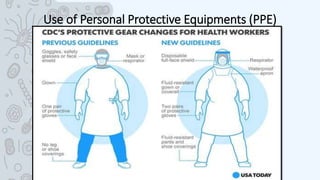
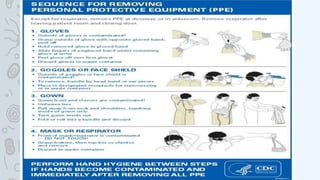
Use of Personal Protective Equipments (PPE)
PARTS:
1. Gloves- protect hands
2. Gowns/ Aprons- protect skin and or clothing
3. Masks and respirators- protect mouth or nose
4. Respirators (N95)- protect respiratory tract form airborne
infectious agents (e.g TB)
5. Goggles- protects eyes
6. Face shields- protects face, mouth, nose, and eyes.
•
GUIDELINES
1. Don before contact with the patient generally before
entering the room.
2. Use carefully- don’t spread contamination.
3. Remove and discard carefully either at the doorway or
immediately outside patient room; remove respirator
outside room.
4. Immediately perform hand hygiene.
How to safely use PPE
1.Keep gloved hands away from face.
2.Avoid touching or adjusting other PPE.
3.Remove gloves if they become torn; perform
hand hygiene before donning new gloves.
4.Limit surfaces and items touched
```````
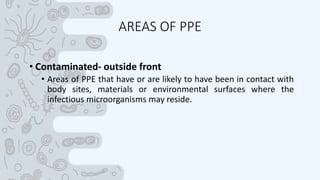
AREAS OF PPE
• Contaminated- outside front
• Areas of PPE that have or are likely to have been in contact with
body sites, materials or environmental surfaces where the
infectious microorganisms may reside.
• Clean- inside, outside back, ties on head and back.
• Areas of PPE that is not likely to have been in contact with
the infectious organism.
Handling Patient Care Equipment
1. Handle patient care equipment soiled with blood, other body fluids,
secretions, or excretions in a way that prevents contact with skin
and mucous membranes.
2. Handle patient care equipment in a way that prevents
contamination of clothing and the spread of microorganisms to
other patients.
3. Appropriately dispose of single use equipment
4. Clean and disinfect reusable equipment. Place clean instruments in
biohazard bag for transport to Central Sterile Supply and Re-
sterilization.
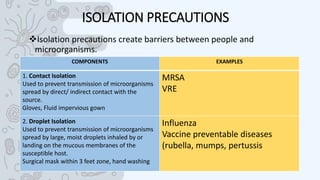
ISOLATION PRECAUTIONS
Isolation precautions create barriers between people and
microorganisms.
COMPONENTS EXAMPLES
1. Contact Isolation
Used to prevent transmission of microorganisms
spread by direct/ indirect contact with the
source.
Gloves, Fluid impervious gown
MRSA
VRE
2. Droplet Isolation
Used to prevent transmission of microorganisms
spread by large, moist droplets inhaled by or
landing on the mucous membranes of the
susceptible host.
Surgical mask within 3 feet zone, hand washing
Influenza
Vaccine preventable diseases
(rubella, mumps, pertussis
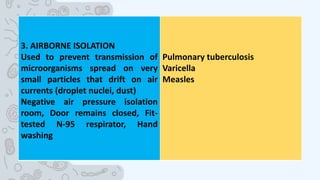
3. AIRBORNE ISOLATION
Used to prevent transmission of
microorganisms spread on very
small particles that drift on air
currents (droplet nuclei, dust)
Negative air pressure isolation
room, Door remains closed, Fit-
tested N-95 respirator, Hand
washing
Pulmonary tuberculosis
Varicella
Measles
INFECTION
``
•

INFECTION_CONTROL FOR NURSING STUDENTS.pptx

  • 1.
  • 2.
    LEARNING OBJECTIVES: At theend of the discussion, the learner will be able to: 1. Explain the relationship between the infection chain and transmission of infection. 2. Identify the normal defenses of the body against infection. 3. Identify patients most at risk for infection. 4. Describe the signs/symptoms of localized infections and those of a systemic infection. 5. Explain the difference between medical and surgical asepsis 6. Explain the rationale for standard precautions. 7. Perform proper procedures for hand hygiene. 8. Properly apply a sterile gloves appropriately.
  • 3.
    By: GAMELA KATET. MOSTERO, RN
  • 4.
  • 5.
    INTRODUCTION: • Infection preventionand control are essential for creating a safe health care environment for patients, families, and health care staff. • Patients in all health care settings are at risk for acquiring infections: –lower resistance to pathogens; –increase exposure to pathogens, –Resistant to most antibiotics –Invasive procedures WHO? HOW?
  • 6.
    • Health careworkers are at risk for exposure to pathogens as a result of contact with: – Blood – Body fluids – Contaminated equipment and surfaces WHEN?
  • 7.
    DEFINITION •Infection - is theinvasion of a host organism's bodily tissues by disease-causing organisms, their multiplication, and the reaction of host tissues to these organisms and the toxins they produce. - Infections are caused by microorganisms such as viruses, prions, bacteria, and viroids, and larger organisms like macroparasites and fungi.
  • 8.
    PRINCIPLES OF INFECTIONCONTROL 1. Proper hand washing removes many of the microorganisms that would be transferred by the hands form one item to another- perform hand washing before and after any procedure. 2. Microorganisms move through space on air currents- avoid shaking or tossing linens. 3. Microorganisms are transferred from one surface to another whenever objects touch, a clean item touching a less item becomes “dirty”- keep hands away form face, keep linens away from uniforms, an item dropped on the floor is considered dirty.
  • 9.
    4. Microorganisms aretransferred by gravity when one item is held above another; avoid passing dirty items over clean items. 5. Microorganisms are released into the air on droplet nuclei whenever a person breathes or speaks- avoid breathing directly in someone’s face. 6. Microorganisms move slowly on dry surfaces, but very quickly through moisture. PRINCIPLES OF INFECTION CONTROL
  • 10.
    INFECTION THE SIX LINKCHAIN OF INFECTION How a pathogen is transmitted from one person to another???
  • 11.
    CHAIN OF INFECTION Modelused to understand the infection process. Each link represents step in transmission of infection. Each link has to be present and in order for an infection to occur. •
  • 12.
    TERMS DEFINITION 1. InfectiousAgent e.g Bacterial, Viral, Fungal, Parasitic Diseases are caused by diverse living agents that replicate in their hosts. 2. Reservoir e.g Humans, Animals, Water, Food A population, tissue, etc. which is chronically infested with the causative agent of a disease and can act as a source of further infection. 3. Portal of Exit e.g Flu or Cold- mucous secretion Hepatitis A- stool SARS- droplet , contact The site from where micro-organisms leave the host to enter another host and cause disease/infection.
  • 13.
    4. Route ofTransmission 4.1 CONTACT Direct- person to person Indirect- involves transfer through contaminated intermediate object or person. 4.2 DROPLET From respiratory tract, secretions of infected person. Can spread germs directly or indirectly. Does not circulate in air for long time or travel far (mostly < 3 feet). 4.3AIRBORNE Germs stay suspended in air on small particles. Uncommon method of transmission. Only occurs for certain germs, such as tuberculosis. Less common for flu, SARS The movement or the transmission of pathogens from a reservoir to a susceptible host. Once a pathogen has exited the reservoir, it needs a mode of transmission to the host through a portal of entry. Transmission can be by direct or indirect contact or through airborne transmission
  • 14.
    5. Portal ofEntry Respiratory System- inhalation of germs. Other Portals of Entry: Ingestion, Sexual Contact, Break in protective skin barrier The site through which micro- organisms enter the susceptible host and cause disease/infection. Infectious agents enter the body through various portals, including the mucous membranes, the skin, the respiratory and the gastrointestinal tracts. 6. Susceptible Host A susceptible host is a member of a species population who is at risk of becoming infected with a certain disease due to a variety of reasons.
  • 16.
    LINK 1 • CAUSATIVEAGENT - an entity that is capable of causing disease. • Biological agents: Living organisms that invade the host, such as bacteria, viruses, fungi, protozoa, and Rickettsia • Chemical agents: Substances that can interact with the body, such as pesticides, food additives, medications, and industrial chemicals • Physical agents: Factors in the environment that are capable of causing disease, such as heat, light, noise, radiation,and machinery • Microorganisms on the skin: –Resident microorganism –Transient microorganism
  • 17.
    Organism Major Reservoir(s)Major Infections/Disease BACTERIA • Escherichia Coli • Staphylococcus aureus • Streptococcus (beta-hemolytic group A) organisms • Streptococcus (beta-hemolytic group B) organisms • Mycobacterium tuberculosis • Neisseria gonorrhoeae • Rickettsia ricketsii • Staphylococcus epidermidis Colon Skin, hair ,anterior nares,mouth Oropharynx, skin, perianalarea Adult genetalia Droplet nuclei from lungs, larynx GU tract, rectum, mouth Wood tick Skin Gastroenteritis,UTI Wound infection,pneumonia,food poisoning,cellulitis “Strep throat”, rheumatic fever ,wound infection UTI, wound infection,postpartumsepsis Tuberculosis Gonorrhea, PID, infectiousarthritis, conjunctivitis Rocky mountain sotted fever Wound infection,bacteremia VIRUSES • HepatitisA • Hepatitis B • Hepatitis C • Herpes simplex virus (type1) • HIV Feces Blood, certain body fluids,sexualcontact Blood, certain body fluids,sexualcontact Lesion in the mouth or skin, saliva, genitalia Blood, semen, vaginal secretionsvia sexual contact Hepa A Hepa B Hepa C Cold sores, aseptic meningitis,STI’s AIDS
  • 18.
    Organism Major Reservoir(s)Major Infections/Disease FUNGI • Aspergillus organisms • Candida albicans Soil,dust,skin,colon,genital tract Mouth skin, colon, genitaltract Aspergillosis, Pneumonia,Sepsis Candidiasis, pneumonia,sepsis PROTOZOA • Plasmodium falciparum Blood Malaria
  • 19.
    LINK 2 •Reservoir –Place where pathogen lives •Lungs •Blood •Digestive Tract •ETC
  • 20.
    LINK 3 •Portal ofExit – Any body opening on infected person • Nose • Mouth • Eyes • Cut in Skin • Urethra/Anus
  • 21.
    LINK 4 •Mode ofTransmission – How the Pathogen travels from one person to the next • Air •Hands • Other Surfaces
  • 22.
    LINK 5 •Portal ofEntry – Any body opening on uninfected person • Nose • Mouth • Eyes • Cut in Skin • Urethra/Anus
  • 23.
    LINK 6 • Ahost is a simple or complex organism that can be affected by an agent. Generally, a human being is considered a host. • A susceptible host is a person who lacks resistance to an agent and is thus vulnerable to disease. • A compromised host is a person whose normal defense mechanisms are impaired and who is therefore susceptible to infection.
  • 24.
  • 25.
  • 26.
    ASEP SIS Absence from anydisease-causing microorganisms the state of being free from disease- causing contaminants (such as bacteria, viruses, fungi, and parasites) or, preventing contact with microorganisms. 1. MEDICAL ASEPSIS- (clean technique) includes procedures used to reduce the number of microorganisms and prevent their spread. -examining patients , -minor procedures like I.V cannula insertion..etc 2. SURGICAL ASEPSIS (Sterile Technique)- refers to practices that keep an area or object free form all microorganisms, it includes practices that destroy all microorganism spores. 3. ASEPTIC TECHNIQUE- methods used to make the environment, worker and as germ free as possible. • Antisepsis is the use of chemical solutions for disinfection.
  • 27.
    HAN D HYGIEN E 1.Inspect surface of your hands for breaks or cuts. Cover any skin lesions with a dressing before providing care. 2. Inspect hands for visible soiling. 3. Inspect conditions of nails push wristwatch and long uniform sleeves above wrists. Avoid wearing rings. 4. Antiseptic hand rub 5. Handwashing with antiseptic soap a. Stand in front of sink, keeping hands and uniform away from the sink surface. b. Turn on water. Turn faucet on or push knee pedals laterally or press pedals with foot. c. Avoid water splashing water against uniform d. Wet hands wrist thoroughly under running water. Keep hands and forearms lower than elbows during washing. e. Apply 3-5ml of antiseptic soap and rub hands together vigorously, lathering thoroughly.
  • 28.
    FIVE MOMENTS OFHAND HYGIENE Protect patients against acquiring infectious agents from the hands of the healthcare worker. Help protect patients form infectious agents (including their own) entering their bodies during procedures. Protect healthcare workers and the healthcare surroundings form acquiring patients’ infectious agents. Developed by the World Health Organization.
  • 30.
  • 31.
    PURPOSES To reduce numberof microorganisms on the hands. To reduce the risk of transmission of microorganisms to clients. To reduce the risk of cross- contamination among clients. To reduce the risk of transmission of infectious organism to oneself.
  • 32.
    INDICATI ON Routine client care Beforeand after client contact When hands are visibly soiled After contact with source of microorganisms Before and after removing gloves Before and after performing invasive procedures
  • 33.
  • 34.
    PROCEDUR E 1. REMOVE JEWELRY.A PLAIN WEDDING BAND MAY REMAIN IN PLACE.  Rationale: rough places/edges in jewelry an harbor organisms. 2. STAND IN FRONT OF THE SINK AND AVOID LEANING AGAINST IT.  Rationale: avoids the transfer of contamination from sink to the nurse’s uniform.
  • 35.
    PROCEDUR E 3. TURN ONTHE WATER AND REGULATE ITS FLOW AND TEMPERATURE. KNEE OR FOOT PEDALS MAY BE AVAILABLE ON SOME SINKS. IN SOME FACILITIES, WATER AUTOMATICALLY FLOWS WHEN PLACING THE HANDS UNDER THE FAUCET.  Rationale: controlling the force of flow limits splashing. Warm water in more comfortable and less irritating to the skin. It is much safer not to touch faucet handles. 4. WET YOUR HANDS AND FOREARMS WITH WATER, KEEPING THE HANDS LOWER THAN THE ELBOWS.  Rationale: this action allows water to flow the least contaminated area toward hands, which are the most contaminated area.
  • 36.
    PROCEDUR E 5. APPLY ANANTIBACTERIAL LIQUID SOAP, IF YOU MUST PRESS LEVER TO DISPENSE THE SOAP, DO SO WITH A PAPER TOWEL. LIQUID SOAP WITH A FOOT-OR-KNEE OPERATED DISPENSER IS THE MOST SANITARY.  Rationale: the dispenser may be contaminated. Using paper towel or foot operated dispenser is most important to prevent further contamination. 6. WASH YOUR HANDS, WRISTS AND LOWER FOREARMS FOR A MINIMUM OF 40-60 SEC. USING SCRUBBING MOTION. INTERLACE FINGERS AND RUB THE HANDS BACK AND FORTH.  Rationale: Friction loosens dirt and bacteria on all surfaces.
  • 37.
    PROCEDUR E 7. INSERT THEFINGER NAILS FROM ONE HAND UNDER THOSE OF THE OTHER HAND USING SWEEPING MOTION. REPEAT WITH OTHER HAND.  Rationale: bacteria tend to accumulate under the fingernails. 8. RINSE THOROUGHLY, KEEPING THE HANDS LOWER THAN THE FOREARMS.  Rationale: Keeping the hands lower than the forearms prevent soap lather from recontaminating clean areas.
  • 38.
    PROCEDUR E 9. REPEAT THEPROCEDURES, IF THE HANDS ARE VERY SOILED.  Rationale: this ensures a thoroughly cleaning. 10. DRY HANDS THOROUGHLY WITH A PAPER TOWEL. DISCARD THE TOWEL.  Rationale: Drying thoroughly prevents chapping. Using paper towel helps prevent spread of microorganisms. 11. USE A PAPER CLEAN TOWEL TO TURN OFF THE FAUCETS.  Rationale: a dry clean towel prevents recontamination of the hands with organisms on faucet. A wet towel would allow the passage of microorganisms back to the hands.
  • 39.
    PURPOSE 1. It isconsidered one of the most effective infection control measurement. 2. Important in every setting. 3. It is important to both nurses’ and the clients’ hands to prevent the spread of microorganisms. 4. Failure to perform appropriate hand hygiene is considered to be the leading cause of hospital acquired infections and the spread of multi- resistant microorganisms and has been recognized as a significant contributor to outbreaks. 5. Hands are the main pathways of germ transmission during health care.
  • 40.
    TIME: Major obstaclefor hand Hygiene Adequate hand washing with water and soap requires 40- 60 seconds. Alcohol- based hand rubbing requires 20 -30 seconds (WHO, 2012).
  • 41.
    • The WorldHealth Organization (WHO) recommends hand washing under streaming of water for at least 40 seconds using plain granule soap, soap-filled sheets, or liquid soap when: 1. Hands are visibly soiled. 2. After using restroom. 3. After removing gloves. 4. Before handling invasive devices. 5. After contact with medical equipment or furniture.
  • 42.
    Controlling the Spreadof Infections 1. Sterilization- make free from all living organisms. 2. Disinfection- process of freeing form microorganisms by physical or chemical means. 3. Autoclaves- sterilizers which use steam under pressure to kill all organisms. •
  • 43.
    Standard Precautions vs.Transmission Based Precautions The use of standard precautions is the primary strategy for minimizing the transmission of healthcare- associated infections. Transmission-based precautions are used in addition to standard precautions for clients with known or suspected infections that are spread in one of three ways: by airborne transmission, by droplet transmission, or by contact.
  • 44.
    STANDARD PRECAUTIONS Precautions thatprotect the patient or client, co-workers, and the community from infection. Guidelines for preventing exposure to blood, body fluids, secretions, excretions, broken skin or mucous membranes Based on the concept that body fluids form any patient can be infectious. Use necessary Personal Protective Equipment (PPE) for protection.
  • 45.
    STANDARD PRECAUTIONS TECHNIQUES Weargloves when:  Touching blood  Touching mucous membranes  Performing venipuncture  Touching body fluids of any kind Body fluids:  Vaginal fluids or semen  Cerebrospinal fluid  Pleural fluid  Pericardial fluid  Synovial fluid  Amniotic fluid  Placenta Tissue  Wash hands after glove removal  Protect clothing with apron or gown when splashing of blood or body fluids is possible.  Discard needles or other sharps in puncture- resistant container.  Do not recap needles or work with needles before disposal.  Waste and soiled linen must be handled with care.
  • 46.
    Use of PersonalProtective Equipments (PPE)
  • 47.
    PARTS: 1. Gloves- protecthands 2. Gowns/ Aprons- protect skin and or clothing 3. Masks and respirators- protect mouth or nose 4. Respirators (N95)- protect respiratory tract form airborne infectious agents (e.g TB) 5. Goggles- protects eyes 6. Face shields- protects face, mouth, nose, and eyes. •
  • 48.
    GUIDELINES 1. Don beforecontact with the patient generally before entering the room. 2. Use carefully- don’t spread contamination. 3. Remove and discard carefully either at the doorway or immediately outside patient room; remove respirator outside room. 4. Immediately perform hand hygiene.
  • 49.
    How to safelyuse PPE 1.Keep gloved hands away from face. 2.Avoid touching or adjusting other PPE. 3.Remove gloves if they become torn; perform hand hygiene before donning new gloves. 4.Limit surfaces and items touched
  • 50.
  • 51.
    AREAS OF PPE •Contaminated- outside front • Areas of PPE that have or are likely to have been in contact with body sites, materials or environmental surfaces where the infectious microorganisms may reside.
  • 52.
    • Clean- inside,outside back, ties on head and back. • Areas of PPE that is not likely to have been in contact with the infectious organism.
  • 53.
    Handling Patient CareEquipment 1. Handle patient care equipment soiled with blood, other body fluids, secretions, or excretions in a way that prevents contact with skin and mucous membranes. 2. Handle patient care equipment in a way that prevents contamination of clothing and the spread of microorganisms to other patients. 3. Appropriately dispose of single use equipment 4. Clean and disinfect reusable equipment. Place clean instruments in biohazard bag for transport to Central Sterile Supply and Re- sterilization.
  • 54.
    ISOLATION PRECAUTIONS Isolation precautionscreate barriers between people and microorganisms. COMPONENTS EXAMPLES 1. Contact Isolation Used to prevent transmission of microorganisms spread by direct/ indirect contact with the source. Gloves, Fluid impervious gown MRSA VRE 2. Droplet Isolation Used to prevent transmission of microorganisms spread by large, moist droplets inhaled by or landing on the mucous membranes of the susceptible host. Surgical mask within 3 feet zone, hand washing Influenza Vaccine preventable diseases (rubella, mumps, pertussis
  • 55.
    3. AIRBORNE ISOLATION Usedto prevent transmission of microorganisms spread on very small particles that drift on air currents (droplet nuclei, dust) Negative air pressure isolation room, Door remains closed, Fit- tested N-95 respirator, Hand washing Pulmonary tuberculosis Varicella Measles
  • 63.
  • 64.
  • 65.

Editor's Notes

  • #17  The first link in the chain of infection is the infectious agent. This microorganism may be a bacteria, virus, mold, or fungus.
  • #20 The 2nd link is the Reservoir – this is where the infectious agent lives. A reservoir can be a person, an animal, a plant, soil or any substance where the infectious agent lives. For ex: food can be a reservoir for bacteria. If reservoirs of infection are not controlled properly, then the pathogens multiply.
  • #21 The 3rd Link is the Portal of exit from the reservoir. It could be through the nose, mouth, eyes, or a cut in the skin. If a person ate some bad food that had a bacteria agent in it, and became sick and had vomiting and diarrhea, then the reservoir would be the GI tract, and the portal of exit would be the mouth or the rectum.
  • #22 The 4th link in the chain of infection is the mode of transmission – which is how the infection travels from one person to the next. It could be by direct contact such as touching, biting, kissing, or sexual contact. It could be by indirect contact which includes water, blood, doorknobs, mosquitoes or ticks. Another mode of transmission is airborne. This could be form coughing or sneezing.
  • #23 The 5th link is the portal of entry – which is any body opening on an uninfected person. this is the gate through which an organism enters the body. It could be through the nose, mouth, eyes, sexual organs or a cut in the skin. Entry portals also include IV’s and urinary catheters.
  • #24 And the 6th link is the person who is at risk for infection….this could be you, our residents, our children or family…..