<< Evaluating Complex Sources >> THE DECISION-MAKING EXERCISE
What  is  the Decision-Making Exercise? The  Decision-Making Exercise  (or DME)  is an exercise which tests your skill in  EVALUATING  complex source materials. It makes up  Paper 2  of your Higher Grade Exam. It is also tested as a  NAB  for the Social Issues module during the course.  You  MUST  pass this to ensure a  full qualification  in your Higher Grade course.  The DME relates to STUDY THEME 2 of the course –  ‘Wealth and Health Inequalities in the United Kingdom’.
The DME has 2 assessable parts: Part 1  -  Evaluating Questions  (worth 10 marks) Part 2  -  A Written Report  (worth 20 marks) Total 30 marks . You will have 1 hour and 15 minutes to complete the paper The DME in the SQA Exam The DME as a NAB Your Prelim Exam may be set up to  include the DME  (Paper 2) as a  NAB . If you pass the  REPORT  part of Paper 2, you have passed your NAB! If you  fail  the  report  part of Paper 2, you will complete your NAB re-assessment  in class time  – you will get a maximum time of  1 hour  to complete it.
How to tackle the DME – SQA Exam (1)  STEP 1 Answering the Evaluating Questions (Part 1)  Tackle these first!  By doing this, it gives you the opportunity  to read through each source  carefully before attempting the more difficult report. There are  3 main sources  – Sources  A  and  B  (opposing views) and Source  C  (Statistical Info.) Spend no more than  20 minutes on the evaluating   questions ; keep your answers short and relevant to what you have been asked. No prior personal knowledge is required –  use only the sources  you are directed to in the question. This exercise gives you an opportunity to  pick up marks easily.
How to tackle the DME – SQA Exam (2)  Answering the Evaluating Questions (cont.)  The questions are based on  source material  provided  within the exam paper . These resources might be newspaper articles, viewpoints, statistical tables etc. You will be required to be able to: detect and explain examples of bias, exaggeration, selective use of facts etc.; make comparisons between and within sources; use evidence to support a given point of   view.
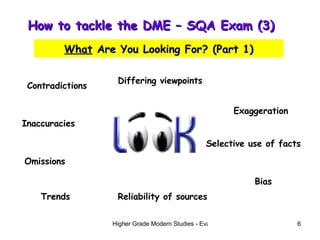
How to tackle the DME – SQA Exam (3)  What  Are You Looking For? (Part 1) Contradictions Inaccuracies Omissions Trends Differing viewpoints Exaggeration Selective use of facts Bias Reliability of sources
How to tackle the DME – SQA Exam (4)  REMEMBER! Use  only  the sources you are directed to in the question Use  ALL  the sources you are directed to. Do not add  any personal KU . You do  not  have to write a great deal! Get through these quickly and efficiently -  a maximum of 20 minutes!
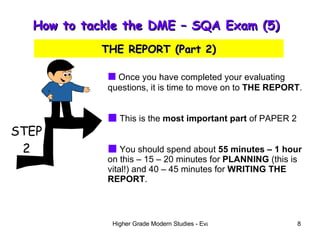
How to tackle the DME – SQA Exam (5)  THE REPORT (Part 2) STEP 2 Once you have completed your evaluating questions, it is time to move on to  THE REPORT . This is the  most important part  of PAPER 2 You should spend about  55 minutes – 1 hour  on this – 15 – 20 minutes for  PLANNING  (this is vital!) and 40 – 45 minutes for  WRITING THE REPORT .
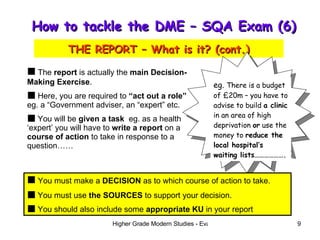
How to tackle the DME – SQA Exam (6)  THE REPORT – What is it? (cont.) The  report  is actually the  main Decision-Making Exercise . Here, you are required to  “act out a role”  eg. a “Government adviser, an “expert” etc. You will be  given a task  eg. as a health ‘expert’ you will have to  write a report  on a  course of action  to take in response to a question…… eg.  There is a budget of £20m – you have to advise to build  a clinic  in an area of high deprivation  or  use the money to  reduce the local hospital’s waiting lists………………. You must make a  DECISION  as to which course of action to take. You must use  the SOURCES  to support your decision. You should also include some  appropriate KU  in your report
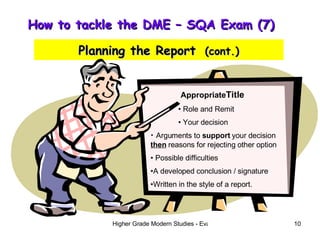
How to tackle the DME – SQA Exam (7)  Planning the Report   (cont.) Appropriate Title Role and Remit Your decision Arguments to  support  your decision  then  reasons for rejecting other option Possible difficulties A developed conclusion / signature Written in the style of a report.
How to tackle the DME – SQA Exam (8)  Tackling the Sources  (cont.) Read the question over again carefully, making sure that you know what to do. Pick the option you are going to  support   - then  make your decision . Take  TWO HIGHLIGHTER PENS . Use  one  colour to highlight on your source booklet all the points that  AGREE  with your decision.  Then highlight all the  OPPOSING ARGUMENTS  a  different colour. On your plan ,  summarise briefly  the main points  that  support your decision  and the  sources they are from .  Do the same for the points that present the  other side  of the argument. Look to see if points made in  Sources A  and  B  are backed up by statistics in  Source C. Look for  flaws in the opposing arguments  that you can exploit. Look for opportunities for inserting  any personal KU and abbreviate these into your plan.
How to tackle the DME – SQA Exam (9)  Writing the Report   You  MUST  demonstrate an  awareness of your role  when writing the report. You  MUST quote the sources  you are getting your arguments/ information from eg. “ As can be seen from SOURCE A………” Quote supporting statistics  or key phrases if you can. Try to cross-reference sources .  For example, if you support the arguments for  SOURCE A , try to see if any of the statistics from  SOURCE C  back up your evidence from  SOURCE A.  Try to see  Sources A  and  B  as the  MAIN  sources and  SOURCE C  (statistics) as the  supporting sources. Make use of  ALL  the sources, not just one or two!  DO NOT LIST POINTS   without further explanation .
How to tackle the DME – SQA Exam (9)  Writing the Report  (cont.) Look for opportunities to  put in relevant background knowledge   (ie. KU)   It does not have to be a lot (eg. some key pieces of information, the name of a key report and what it dealt with etc). But you  MUST  include  some  background knowledge (KU) if you want a good pass! Your report must have a  GOOD STRUCTURE  (eg. written under appropriate sub-headings etc.) – This is where  planning  is important! Finally, your conclusion should re-state your decision. Also  briefly re-state the main argument  that helped you reach your decision and perhaps a  brief secondary supporting point .  Sign your report  with your professional title underneath.
How to tackle the DME – SQA Exam (10)  Finally…Some Common Mistakes!   Structuring the report poorly  - for example, like an essay.  (Remember, reports have titles, sub-headings etc.)  Writing over-long,  rambling introductions Not using  ALL  the sources Not  cross-referencing  sources. Not putting  in any background knowledge . Putting in  too much  background knowledge!  Remember that, first and foremost, it is an exercise which tests your ability to evaluate complex sources! Listing points rather than explaining arguments . Being  over-repetitive  (result of bad planning!). Writing  vague, over-simple conclusions . Failing to sign  your report!
The End!

DME

  • 1.
    << Evaluating ComplexSources >> THE DECISION-MAKING EXERCISE
  • 2.
    What is the Decision-Making Exercise? The Decision-Making Exercise (or DME) is an exercise which tests your skill in EVALUATING complex source materials. It makes up Paper 2 of your Higher Grade Exam. It is also tested as a NAB for the Social Issues module during the course. You MUST pass this to ensure a full qualification in your Higher Grade course. The DME relates to STUDY THEME 2 of the course – ‘Wealth and Health Inequalities in the United Kingdom’.
  • 3.
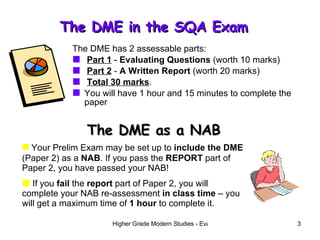
    The DME has2 assessable parts: Part 1 - Evaluating Questions (worth 10 marks) Part 2 - A Written Report (worth 20 marks) Total 30 marks . You will have 1 hour and 15 minutes to complete the paper The DME in the SQA Exam The DME as a NAB Your Prelim Exam may be set up to include the DME (Paper 2) as a NAB . If you pass the REPORT part of Paper 2, you have passed your NAB! If you fail the report part of Paper 2, you will complete your NAB re-assessment in class time – you will get a maximum time of 1 hour to complete it.
  • 4.
    How to tacklethe DME – SQA Exam (1) STEP 1 Answering the Evaluating Questions (Part 1) Tackle these first! By doing this, it gives you the opportunity to read through each source carefully before attempting the more difficult report. There are 3 main sources – Sources A and B (opposing views) and Source C (Statistical Info.) Spend no more than 20 minutes on the evaluating questions ; keep your answers short and relevant to what you have been asked. No prior personal knowledge is required – use only the sources you are directed to in the question. This exercise gives you an opportunity to pick up marks easily.
  • 5.
    How to tacklethe DME – SQA Exam (2) Answering the Evaluating Questions (cont.) The questions are based on source material provided within the exam paper . These resources might be newspaper articles, viewpoints, statistical tables etc. You will be required to be able to: detect and explain examples of bias, exaggeration, selective use of facts etc.; make comparisons between and within sources; use evidence to support a given point of view.
  • 6.
    How to tacklethe DME – SQA Exam (3) What Are You Looking For? (Part 1) Contradictions Inaccuracies Omissions Trends Differing viewpoints Exaggeration Selective use of facts Bias Reliability of sources
  • 7.
    How to tacklethe DME – SQA Exam (4) REMEMBER! Use only the sources you are directed to in the question Use ALL the sources you are directed to. Do not add any personal KU . You do not have to write a great deal! Get through these quickly and efficiently - a maximum of 20 minutes!
  • 8.
    How to tacklethe DME – SQA Exam (5) THE REPORT (Part 2) STEP 2 Once you have completed your evaluating questions, it is time to move on to THE REPORT . This is the most important part of PAPER 2 You should spend about 55 minutes – 1 hour on this – 15 – 20 minutes for PLANNING (this is vital!) and 40 – 45 minutes for WRITING THE REPORT .
  • 9.
    How to tacklethe DME – SQA Exam (6) THE REPORT – What is it? (cont.) The report is actually the main Decision-Making Exercise . Here, you are required to “act out a role” eg. a “Government adviser, an “expert” etc. You will be given a task eg. as a health ‘expert’ you will have to write a report on a course of action to take in response to a question…… eg. There is a budget of £20m – you have to advise to build a clinic in an area of high deprivation or use the money to reduce the local hospital’s waiting lists………………. You must make a DECISION as to which course of action to take. You must use the SOURCES to support your decision. You should also include some appropriate KU in your report
  • 10.
    How to tacklethe DME – SQA Exam (7) Planning the Report (cont.) Appropriate Title Role and Remit Your decision Arguments to support your decision then reasons for rejecting other option Possible difficulties A developed conclusion / signature Written in the style of a report.
  • 11.
    How to tacklethe DME – SQA Exam (8) Tackling the Sources (cont.) Read the question over again carefully, making sure that you know what to do. Pick the option you are going to support - then make your decision . Take TWO HIGHLIGHTER PENS . Use one colour to highlight on your source booklet all the points that AGREE with your decision. Then highlight all the OPPOSING ARGUMENTS a different colour. On your plan , summarise briefly the main points that support your decision and the sources they are from . Do the same for the points that present the other side of the argument. Look to see if points made in Sources A and B are backed up by statistics in Source C. Look for flaws in the opposing arguments that you can exploit. Look for opportunities for inserting any personal KU and abbreviate these into your plan.
  • 12.
    How to tacklethe DME – SQA Exam (9) Writing the Report You MUST demonstrate an awareness of your role when writing the report. You MUST quote the sources you are getting your arguments/ information from eg. “ As can be seen from SOURCE A………” Quote supporting statistics or key phrases if you can. Try to cross-reference sources . For example, if you support the arguments for SOURCE A , try to see if any of the statistics from SOURCE C back up your evidence from SOURCE A. Try to see Sources A and B as the MAIN sources and SOURCE C (statistics) as the supporting sources. Make use of ALL the sources, not just one or two! DO NOT LIST POINTS without further explanation .
  • 13.
    How to tacklethe DME – SQA Exam (9) Writing the Report (cont.) Look for opportunities to put in relevant background knowledge (ie. KU) It does not have to be a lot (eg. some key pieces of information, the name of a key report and what it dealt with etc). But you MUST include some background knowledge (KU) if you want a good pass! Your report must have a GOOD STRUCTURE (eg. written under appropriate sub-headings etc.) – This is where planning is important! Finally, your conclusion should re-state your decision. Also briefly re-state the main argument that helped you reach your decision and perhaps a brief secondary supporting point . Sign your report with your professional title underneath.
  • 14.
    How to tacklethe DME – SQA Exam (10) Finally…Some Common Mistakes! Structuring the report poorly - for example, like an essay. (Remember, reports have titles, sub-headings etc.) Writing over-long, rambling introductions Not using ALL the sources Not cross-referencing sources. Not putting in any background knowledge . Putting in too much background knowledge! Remember that, first and foremost, it is an exercise which tests your ability to evaluate complex sources! Listing points rather than explaining arguments . Being over-repetitive (result of bad planning!). Writing vague, over-simple conclusions . Failing to sign your report!
  • 15.