1
ENERGY EXPERTISE BOOKLET
2
TABLE OF CONTENTS
Innovate Calgary ............................................................................................................................................................3
Our Strategic Energy Focus ............................................................................................................................................4
Energy Researchers list by Expertise..............................................................................................................................5
Oil and gas: ................................................................................................................................................................5
Renewable .................................................................................................................................................................7
Research Profiles Based on Alphabetical order..............................................................................................................9
3
INNOVATE CALGARY
Accelerating, Facilitating, and Supporting Innovation
Mission
Innovate Calgary is the technology transfer and business incubation centre for the University of Calgary.
Our mission is to accelerate, facilitate, and support innovation in the technology sector.
Innovate Calgary is dedicated to the growth of southern Alberta’s technology transfer sector. We
provide a wide variety of technology transfer, company creation, entrepreneur and investor
development programs and services for our clients. These include: entrepreneurs, businesses, investors
and university researchers.
Business Units
INTELLECTUAL PROPERTY MANAGEMENT
 Analyze innovative technologies for commercial potential
 Develop intellectual property protection strategy
 Actively market innovative technologies to potential licensees
 License technologies to new markets
 Manage intellectual property, license agreements and sponsored research agreements
COMPANY CREATION
 Opportunity to create a successful, sustainable, “investor ready” technology company
 Establish an experienced executive management team
 In-house support with business and product planning
 Access to funding and capital for technology and corporate development
INVESTMENT & MARKET DEVELOPMENT
 Business coaching and mentoring
 Seminars and workshops
 Consultation on business plan development and execution
 Access to angel investor network
ALASTAIR ROSS TECHNOLOGY CENTRE
 120,000 sq ft technology business incubator and office space
 The Inc.: new affordable co-working space for startup businesses
 Access to business resources – meeting and conference rooms, secure wireless internet, atrium
and cafeteria, ample parking
 Virtual office space – enroll as Corporate ID client
4
OUR STRATEGIC ENERGY FOCUS
Kinetica Ventures
Accelerating world-class, game-changing energy technology that will transform the industry:
 Partnering with industry to commercialize technology that meets their proven needs
 Bridging the gap between industry and technology development start-ups
 Translating industry challenges into de-risked technologies
 Leveraging the best that Alberta has to offer to accelerate commercialization of some of the
world’s most promising energy tech start-ups
Focus Areas
Focus on Alberta energy sector’s core competencies including oil sands/heavy oil, tight oil/shale gas,
pipelines and environmental efficiencies.
 Hydrocarbon Recovery: efficiencies, resource management, waste disposal, product quality
(conventional, oil sands, nat gas, etc)
 Carbon: capture, re-use, disposal
 Energy Transport: monitoring, efficiency, safety alternative materials
Renewable: reduced cost, grid interconnection & storage
5
ENERGY RESEARCHERS LIST BY EXPERTISE
OIL AND GAS:
EXPLORATION:
IMAGING, MODELING AND SIMULATION:
• Ian Gates*1
• Mario Costa Sousa
• Xin Wang*
• Zhangxing (John) Chen *
RESERVOIR CHARACTERIZATION:
• Christopher Clarkson*
• Don Lawton
• Jeffrey Priest
• Stephen M. Hubbard
NEW RESERVOIR:
 Casey Hubert*
PRODUCTION:
FRACING:
 David Eaton*
 Shengnan (Nancy) Chen *
DRILLING:
 Maen Husein*
 Martin Mintchev*
 Simon Park*
 Sudarshan (Raj) Mehta
ENHANCED OIL RECOVERY:
 Brij Maini
1
* Researcher profile is available
6
 Gerrit Voordouw*
 Gordon Moore
 Jalal Abedi
 Richard Wan
 Shengnan (Nancy) Chen*
SAGD:
 Ian Gates*
 Jalal Abedi
 Nashaat N. Nassar
 Shengnan (Nancy) Chen*
TRANSPORTATION (PIPELINE):
CORROSION:
 Elise Fear
 Frank Cheng
 Gerrit Voordouw*
 Simon Park*
SOLID DEPOSITION:
 Anil Mehrotra
REFINING, UPGRADING AND CATALYST:
 Gordon Moore
 Hua Song*
 Josephine Hill
 Maen Husein
 Pedro Pereira-Almao*
STOCKHOLDER RELATIONSHIP, MARKET AND SOCIAL
LICENSING:
 Chui-ling Tam*
 Craig Gerlach*
 Harrie Vredenburg
 Saulesh Yessenova
 Anatoliy Swishchuk*
7
ENVIRONMENTAL RESEARCH:
CCS:
 Ann-Lise Norman
 David Eaton*
 Don Lawton
 Marc Strous
 Steve Larter*
WATER TREATMENT:
 Gopal Achari
 Gordon Chua
 Marc Strous
 Nashaat N. Nassar
 Raymond Tuner
 Ted Robert*
EMISSION:
 Bernard Mayer*
 George Shimizu*
 Nader Mahinpey *
 Peter Dunfield
SOIL CONTAMINATION:
 Anil Mehrotra
 Gopal Achari
RENEWABLE
FUEL CELLS:
 Deyi Xue
 Josephine Hill
 Kunal Karan
 Thomas Ziegler*
 Venkataraman (VT) Thangadurai*
 Viola Birss*
8
WIND AND SOLAR:
 David Wood
 Hamid Zareipour
 Thomas Baumgartner*
 Todd Sutherland
SMART GRID:
 Andy Knight
BIO FUELS:
 Hector De la Hoz Siegler
 Nader Mahinpey*
9
RESEARCH PROFILES BASED ON
ALPHABETICAL ORDER
BAUMGARTNER GROUP FOR ADVANCED ORGANIC
MATERIALS
Department of Chemistry and Centre for Advanced Solar Materials,
University of Calgary
PROFILE
Semiconductor materials used in consumer electronics, power
generation, computers, displays and lighting are typically based on
inorganic materials that require a high level of purity and expensive
fabrication processes. When properly designed, organic molecules
can exhibit similar semiconductor properties at fractions of the cost
to produce. In addition to the raw material cost benefits, these
organic semiconductors have additional benefits such as: solution
processability and flexibility. Both of these features are amenable
to high-throughput, mass fabrication technologies (e.g., roll-to-roll
and ink-jet printing) to create cheap, flexible electronics for niche
applications where solid semiconductors are not suitable.
The Baumgartner group is focused on developing smart
functional materials
for a variety of
electronics
applications such as
Organic Light
Emitting Diodes
(OLEDs), Organic
Photovoltaic (solar)
Cells (OPV), and
Organic Batteries.
These smart
molecules have the
potential to displace
traditional solid
state materials in a
number of
applications.
Acute control of the properties of the materials (e.g., colour,
luminescence, stability, etc.) is achieved through judicious synthetic
design. The Baumgartner group has more than ten years of
experience in developing novel materials that take advantage of the
unique properties imparted by cyclic
organophosphorus building blocks embedded in
extended hydrocarbon-based frameworks.
KEY AREAS OF RESEARCH
Organophosphorus materials for Organic
Batteries
Given the reliance on on-demand energy to
power our mobile electronics, there is a constant
effort to increase the storable amount of energy
while concurrently decreasing the size of
batteries. The Baumgartner group has developed
several unique molecular classes which display
the ability to store electrical energy. Preliminary
proof of concept studies with these redox-stable
molecules have demonstrated that the air/water
stable and the high charge/discharge cyclability.
Organophosphorus materials for Organic
Lighting
The smart molecules developed in the
Baumgartner group are readily modified to tune
emitted light colour. These molecules can be
blended together to create white light in a highly
efficient manner for organic lighting applications
(Figure 1).
Organophosphorus materials for Solar Cells
The same smart molecules that can be used for
Organic Lighting applications can also be used in
applications for ‘next-generation’ organic solar
cells. These molecules possess two critical
features of utmost importance for solar energy
conversion applications: broad and intense light
absorption, and the ability to transfer charges.
By tuning the optoelectronic properties, acute
control over the power conversion efficiencies is
achieved.
WEBSITE
http://www.chem.ucalgary.ca/research/groups/t
tbaumga/
Figure 1. Four organophosphorus
materials with finely tuned emission
colours.
BAUMGARTNER GROUP FOR ADVANCED ORGANIC
MATERIALS
Department of Chemistry and Centre for Advanced Solar Materials,
University of Calgary
OPPORTUNITIES FOR PARTNERSHIPS
The Baumgartner group is actively looking for partnerships for the
development of all research areas. Working towards advanced
material applications for energy storage and lighting, industrial
partners have the opportunity to focus the research to tailor the
end results for their specific application(s). In addition to tailored
IP, a new conduit for highly trained personnel will be created.
Ideally, industrial partners will offer insight into their challenges and
provide valuable feedback to help guide research goals.
OPPORTUNITIES FOR CONSULTING
As experts in the synthesis and design of materials for organic
electronic applications, the Baumgartner group is able to offer
guidance in materials design for emerging organic energy
technologies.
SPECIALIZED INSTRUMENTATION AVAILABLE
1. Gel permeation chromatography
2. Inert atmosphere thin film fabrication glove box
3. Thermal evaporator for depositing thin metal layers
4. Advanced Thermogravimetric Analysis/Differential Scanning
Calorimetry
NOTABLE GRANTS/PARTNERSHIPS
- Alberta Ingenuity New Faculty Award ($300K)
- Bessel Research Award (Humboldt Foundation; €45K)
CONTACT
Kiyoshi Robson, Ph.D.
Technology Analyst
Innovate Calgary
Phone: (403) 270-2441
Email: krobson@innovatecalgary.com
SELECT PUBLICATIONS
 "Organic n-Type Materials for Charge Transport
and Charge Storage Applications" M. Stolar, T.
Baumgartner, Phys. Chem. Chem. Phys. 2013, 15,
9007-9024
 “3,7-Diazadibenzophosphole Oxide: A
Phosphorus-Bridged Viologen Analogue with
Significantly Lowered Reduction Threshold” S.
Durben, T. Baumgartner, Angew. Chem. Int. Ed.
34, 7948-7952
 “Insights on the Design and Electron-Acceptor
Properties of Conjugated Organophosphorus
Materials” T. Baumgartner, Acc. Chem. Res.
2014, 47, 1613-1622
 “Phosphorus-Containing Materials for Organic
Electronics” M. Stolar, T. Baumgartner, Chem.
Asian J. 2014, 9, 1212-1225
 “Molecular Engineering of “Click”-Phospholes
Towards Self-Assembled Luminescent Soft
Materials” X.-M. He, J.-B. Lin, W. H. Kan, P.
Dong, S. Trudel, T. Baumgartner, Adv. Funct.
Mater. 2014, 24, 897-906
 “Halochromic Generation of White Light Emission
Using a Single Dithienophosphole Luminophore"
H. V. Huynh, X.-M. He, T. Baumgartner, Chem.
Commun. 2013, 49, 4899-4901
 “Simple and Efficient Generation of White Light-
Emission From Organophosphorus Building
Blocks” C. Romero-Nieto, S. Durben, I. M.
Kormos, T. Baumgartner Adv. Funct. Mater.
2009, 19, 3625-3631
 “Toward Low-Band Gap Dithienophosphole
Copolymers for Application in Organic Solar Cells"
S. Durben, D. Nickel, R. A. Krüger, T. C.
Sutherland, T. Baumgartner, J. Polym. Sci. Part
A: Polym. Chem. 2008, 46, 8179-8190
BIRSS GROUP FOR ADVANCED ELECTROCHEMICAL
MATERIALS AND METHODS
Department of Chemistry, University of Calgary
PROFILE
The Birss group is working on a wide variety of research
topics related to energy storage and conversion, protection
of metals from corrosion and wear, and electrochemical
biosensors. Using state of the art materials and surface
chemistry, they are able to form advanced materials such as:
 thin films (sub-monolayer to microns)
 nanoporous membranes
 nanoparticles and nanoparticle arrays
 nanotubes
The nanomaterials can be deposited on surfaces or into
porous structures using electrochemical, colloidal, sol-gel
methods, and vapor deposition techniques to produce
materials with tailored properties.
These advanced materials have applications in a variety of
industries, including oil and gas, clean tech, and medical
industries, amongst others. Depending on the nature of the
materials, the desired properties can be dramatically altered
to produce more durable, efficient, and cheaper products.
KEY AREAS OF RESEARCH
Protection of Metals from Corrosion and Wear
The Birss group is working on:
 Prevention of aqueous corrosion of metals
 Corrosion inhibitors
 Oxide film formation
 Coatings for enhanced wear resistance
 Polymer coatings on metals
 Understanding and overcoming high
temperature corrosion processes
 Understanding and preventing carbon
corrosion.
Energy Conversion and Storage
Research is focused on the development of novel
materials to improve the performance and
stability of fuel cells and electrolysis cells. With
applications to proton-exchange membrane fuel
cells, solid oxide fuel cells, and capacitors, these
materials show enhanced: stability to sour feeds;
catalytic activity, and; corrosion resistance.
Nanomaterials
Carbon represents a cheap, electrically conductive
alternative to metal electrode materials. Recent
work has led to the development of highly
ordered nanoporous carbon powers and free-
standing films. The Birss group is also actively
researching:
 Nano-dimpled metal surfaces
 Ordered nanoparticles arrays
 Core/shell nanoparticles
 Metal oxide/nitride nanotubes
Biosensor Development
Research is aimed at developing biocompatible,
highly sensitive, stable sensors for monitoring of
biomarkers, including glucose and sepsis-causing
bacteria.
WEBSITE
http://www.ucalgary.ca/birss/node/19t/index.htm
Figure 1. An example of the advanced materials produced in the
Birss labs. Shown here are highly-ordered, flexible, free-standing
nanoporous carbon films (pore size is variable from 10-100 nm).
BIRSS GROUP FOR ADVANCED ELECTROCHEMICAL
MATERIALS AND METHODS
Department of Chemistry, University of Calgary
OPPORTUNITIES FOR PARTNERSHIPS AND CONSULTING
The Birss group will actively collaborate with companies
interested in research and development for advanced materials.
In addition to access cutting-edge research outcomes, partners
will have access to novel materials and know-how. Potential
industry partners are sought who can provide industry-relevant
feedback and contribute to the training of highly qualified
personnel.
SPECIALIZED CAPABILITIES
As experts in electrochemistry, the Birss group has specialized
capabilities and equipment in the areas of:
Electrochemistry and Related Techniques including:
 Electrocatalysis and electrochemistry of thin films
 Electrode surface modification
 Electrochemical impedance spectroscopy
 In situ mass measurements using the quartz crystal
microbalance (QCMB) technique,
 In situ ellipsometry,
 In operando mass and electrochemical measurements in a
thermogravimetric analysis instrument
Surface Chemistry and Surface Analysis including:
 Adsorption and monolayer formation
 Spectroscopies (SEM, 3D-TEM, Auger, XPS)
 Atomic probe microscopies
 Ellipsometry
NOTABLE RECENT/CURRENT PARTNERSHIPS
BIOGRAPHY
Dr. Viola Birss is an internationally celebrated
researcher, the Director of the Calgary Advanced
Energy Conversion and Storage (CAESR) group
and a Tier I Canada Research Chair in Fuel Cells
and Related Energy Applications. Her excellence
has been recognized through many awards,
including: as a Fellow of the Royal Society of
Canada, the Electrochemical Society and the
Canadian Society for Chemistry. She has
published over 200 papers and a number of
patent applications.
CONTACT
Kiyoshi Robson, Ph.D.
Technology Analyst
Innovate Calgary
Phone: (403) 270-2441
ipm@innovatecalgary.com
 Ballard Power Systems
 Honeywell Aerospace
 Nova Chemicals
 Versa Power Systems
 Enbridge
 Shell Canada
 Alberta Innovates -
Technology Futures
 Carbon Management
Canada
 Department of Defense
 International Universities
SELECT PUBLICATIONS
 L. Deleebeck, M. Shiskin, P. Addo, H. Molero, S.
Paulson, T. Ziegler, V. Birss, 2014, “Activation of
H2 oxidation at Sulfur-decorated Ni under low
temperature SOFC conditions”, Phys. Chem.
Chem. Phys, 16, 9383-9393
 D. Banham, F. Feng, K. Pei, S. Ye, V. Birss, 2013,
“Effect of Pt-loaded carbon support
nanostructure on oxygen reduction catalysis”, J.
Mater. Chem. A (1) 2812-2820.
 B. Campbell, H. Elzanowska, V. Birss, 2013
“Towards a reliable, high sensity O2-independent
glucose sensor based on Ir oxide nanoparticles”,
Biosens. & Bioelectroana.. 42(1), 563-569.
 E. Alsrayheen, E. McLeod, R. Rateick, H. Molero
and V. Birss, 2011, “Impact of ac/dc Spark
Anodizing on the Corrosion Resistance of Al-Cu
Alloys.” Electrochim. Acta, 56(17), 6041-6048.
CHEN GROUP FOR ENHANCED OIL RECOVERY
Department of Chemical and Petroleum Engineering, University of Calgary
PROFILE
The Chen research group has a proven track record and expertise
in developing strategies that enhance oil recovery in
unconventional reservoirs. Led by Dr. Shengnan (Nancy) Chen, the
group has published over 30 peer-reviewed journal and conference
papers on oil recovery applications such as:
 Production forecast for simulated horizontal wells with
multi-stage hydraulic fractures in tight oil and shale gas
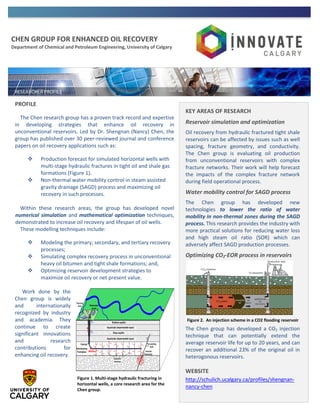
formations (Figure 1).
 Non-thermal water mobility control in steam assisted
gravity drainage (SAGD) process and maximizing oil
recovery in such processes.
Within these research areas, the group has developed novel
numerical simulation and mathematical optimization techniques,
demonstrated to increase oil recovery and lifespan of oil wells.
These modelling techniques include:
 Modeling the primary, secondary, and tertiary recovery
processes;
 Simulating complex recovery process in unconventional
heavy oil bitumen and tight shale formations; and,
 Optimizing reservoir development strategies to
maximize oil recovery or net present value.
Work done by the
Chen group is widely
and internationally
recognized by industry
and academia. They
continue to create
significant innovations
and research
contributions for
enhancing oil recovery.
KEY AREAS OF RESEARCH
Reservoir simulation and optimization
Oil recovery from hydraulic fractured tight shale
reservoirs can be affected by issues such as well
spacing, fracture geometry, and conductivity.
The Chen group is evaluating oil production
from unconventional reservoirs with complex
fracture networks. Their work will help forecast
the impacts of the complex fracture network
during field operational process.
Water mobility control for SAGD process
The Chen group has developed new
technologies to lower the ratio of water
mobility in non-thermal zones during the SAGD
process. This research provides the industry with
more practical solutions for reducing water loss
and high steam oil ratio (SOR) which can
adversely affect SAGD production processes.
Optimizing CO2-EOR process in reservoirs
The Chen group has developed a CO2 injection
technique that can potentially extend the
average reservoir life for up to 20 years, and can
recover an additional 23% of the original oil in
heterogonous reservoirs.
WEBSITE
http://schulich.ucalgary.ca/profiles/shengnan-
nancy-chen
Figure 1. Multi-stage hydraulic fracturing in
horizontal wells, a core research area for the
Chen group.
Figure 2. An injection scheme in a CO2 flooding reservoir
CHEN GROUP FOR ENHANCED OIL RECOVERY
Department of Chemical and Petroleum Engineering, University of Calgary
OPPORTUNITIES FOR PARTNERSHIPS
The Chen group has cutting-edge laboratory equipment;
comprehensive set of simulation software, and highly qualified
personnel. The group can collaborate with upstream oil and gas
companies, operators, and service companies interested in:
 Analyzing well-logging data for field operations;
 Analyzing core and fluid samples for field operations.
The group can also conduct experiments and provide companies
with tailored solutions on specific reservoir problems such as:
 Water mobility in the non-thermal zone in SAGD process;
 Impact of complex fractures on well production;
 Reservoir optimization in the hydraulic fractured reservoirs;
 EOR in hydraulic fractured reservoirs to further increase oil
recovery.
SPECIALIZED TECHNIQUES / INSTRUMENTATION
 Core flooding system.
 CMG IMEX, GEM, STARS, CMOST, WINPROP.
 PETREL, ECLIPSE.
 ACCUMAP.
 Well Completions & Fracture Database (WCFD).
NOTABLE PARTNERSHIPS/AWARDS/GRANTS
 NSERC Discovery Grant
 University of Calgary Post Doctoral Fund
 Seven Generations Energy Ltd Seed grant
CONTACT
Kiyoshi Robson, Ph.D.
Technology Analyst
Innovate Calgary
Phone: (403) 270-2441
Email: ipm@innovatecalgary.com
BIOGRAPHY
Dr. Shengnan (Nancy) Chen is an Assistant
Professor in the Department of Chemical and
Petroleum Engineering, University of Calgary. She
had previously worked as Reservoir Engineering
Consultant with Enhanced Hydrocarbon Recovery
Inc. Dr. Chen currently leads a research group of
one Postdoctoral fellow, five PhD students, and
four MSc students.
SELECT PUBLICATIONS
 Shu, G., Dong, M., Chen, S., & Luo, P. (2014).
Improvement of CO2 EOR performance in
water-wet Reservoirs by adding active
carbonated water. Journal of Petroleum Science
and Engineering.
 Chen, S., Li, H., Yang, D., & Tontiwachwuthikul, P.
(2012). An Efficient Methodology for
Performance Optimization and Uncertainty
Analysis in a CO2 EOR Process. Petroleum
Science and Technology, 30(12), 1195-1209.
 Chen, S., Li, H., Yang, D., & Tontiwachwuthikul, P.
(2010). Optimal parametric design for water-
alternating-gas (WAG) process in a CO2-
miscible flooding reservoir. Journal of Canadian
Petroleum Technology, 49(10), 75-
82.Technology, Vol. 49, No. 10, pp. 75-82, 2010.
CHEN GROUP FOR RESERVOIR SIMULATION,
MODELING AND VISUALIZATION
Department of Chemical and Petroleum Engineering, University of Calgary
PROFILE
Dr. Chen’s group is focused on optimizing industry capacity to
extract energy resources. Specifically, the group focuses on
modeling and simulation of advanced energy recovery processes,
such as:
 Carbon Capture and Storage (CCS)
 Cyclic Steam Stimulation (CSS)
 Steam-Assisted Gravity Drainage (SAGD)
 Expanding Solvent Steam-Assisted Gravity Drainage (ES-
SAGD);
 Vapor Extraction Process (VAPEX) for Heavy Oil and
Bitumen Reservoirs;
 Hydraulic Fracturing; and,
 Underground Coal Gasification (UCG).
The group uses available data to forecast the production
behavior of oil and gas fields. Using interactive visualization
techniques they can also optimize reservoir development schemes
and evaluate the distribution of remaining oil deposits.
With thirty years of research experience, the Chen group is well
poised to develop more state-of-the-art tools for faster and more
accurate reservoir modeling and simulation in the recovery of
conventional and non-conventional oil and gas.
KEY AREAS OF RESEARCH
Development of Reservoir Models
Dr. Chen’s group has developed realistic models
that accurately represent reservoirs from the
pore scale to the kilometer-scale. The models
are designed to reflect the real physics and
chemistry of reservoirs, taking into account:
 Thermal effects
 Composition
 Geomechanics
 Wellbore
Accurate and Fast Solution Schemes
Dr. Chen’s group has developed a novel self-
adaptive solution scheme that solves multi-
component, multi-phase, multi-dimensional
compositional thermal flow models. Their faster
parallel reservoir simulators contribute to
enhanced heavy oil and bitumen recovery.
Visualization and Post-Processing
Dr. Chen’s group has developed visualization
software to display flow streamline maps,
reservoir layers, and oil distribution in real-time.
This enables reservoir engineers to construct
more accurate geological and flow models, and
perform more realistic simulations.
Well bore and Grid modeling methods
The group has also developed a unique control
volume function approximation method which
can be applied to local grid refinement,
optimization and history matching. This method
has been successfully used to model horizontal
wells, faults, fractures, flux continuity, and to
reduce grid orientation effects.
WEBSITE
http://www.ucalgary.ca/reservoir_simulation/
Figure 1. A water and chemical flooding reservoir visualization model
designed by the group.
CHEN GROUP FOR RESERVOIR SIMULATION,
MODELING AND VISUALIZATION
Department of Chemical and Petroleum Engineering, University of Calgary
OPPORTUNITIES FOR PARTNERSHIPS
Dr. Chen Group’s research group consists of over 70 students
and 15 postdoctoral researchers with expertise in reservoir
modeling and simulation. The group can collaborate with industry
and academic partners on specific projects that address the
challenges facing the petroleum industry. Potential partners can
have access to cutting edge research facilities and infrastructure.
OPPORTUNITIES FOR CONSULTING
 Oil and gas development
 Petroleum production
SPECIALIZED TECHNIQUES/INSTRUMENTATION
 Advanced Enhanced Oil Recovery Labs
 Advanced Reservoir Simulators and Visualization
NOTABLE PARTNERS/SUPPORTERS/GRANTS
 Alberta Innovates
 Brion Energy
 Foundation CMG
 ConocoPhillips
 Devon
 Husky Energy Ltd.
 IBM Alberta Centre for Advanced Studies
 Imperial Oil
 Laricina Energy Ltd.
 Nexen
 NSERC
 Shell
 Statoil
 Suncor
CONTACT
Nima Najand
Technology Analyst
Innovate Calgary, Phone: (403) 775-1855
ipm@innovatecalgary.com
BIOGRAPHY
Dr. Zhangxing (John) Chen is the University of
Calgary NSERC/AIEES/Foundation CMG Chair in
Reservoir Simulation. He also holds the AITF
(iCORE) Industrial Chair in Reservoir Modeling. As
a director of the iCentre Simulation &
Visualization, he has published over 300 peer-
reviewed articles and 11 books. Dr. Chen holds
professorships at several universities worldwide,
and has chaired 31 international conferences.
SELECT PUBLICATIONS
 Chen, Z., et al., “Influence of nanoparticles on
the dynamics of miscible Hele-Shaw flows”,
Journal of Applied Physics, 109 (2011), 104907-
104915.
 Chen, Z., et al., “Experimental and numerical
study of initial water mobility in bitumen
reservoirs and its effect on SAGD”, Journal of
Petroleum Science and Engineering, 92-93
(2012), 30-39.
 Chen, Z., et al., “Modeling the interface
resistance in low soluble gaseous solvents-
heavy oil systems”, Fuel, 105 (2013), 672-687.
 Chen, Z., et al., “Measurement of Gas Storage
Processes in Shale and Molecular Diffusion
Coefficient in Kerogen”, International Journal of
Coal Geology, 123 (2014), 10-19.
CLARKSON GROUP UNCONVENTIONAL GAS AND
LIGHT OIL RESEARCH
Department of Geosciences, University of Calgary
PROFILE
The Clarkson Research Group is focused on advanced reservoir
characterization of unconventional gas (UG) and light oil (ULO)
reservoirs from the laboratory scale through to the field scale.
Particular emphasis has been on low permeability oil and gas
condensate reservoirs. The group has developed novel tools to
improve:
 Core analysis of shale reservoirs and tight rock
 Production analysis of multi-fractured horizontal wells
completed in shale
 Completions optimization
 Forecasting rates and recoveries.
Currently, the major focus of the research group has been on:
 Advancement of Rate-transient (Production data)
 Analysis methods for UG and ULO reservoirs
 Advanced reservoir characterization using core data from
UG/ULO reservoirs
 Simulation of primary and enhanced recovery in UG/ULO
reservoirs
The Clarkson group is well-positioned to be key players in the
race to increase hydrocarbon production rates from tight reservoirs
in Western Canada.
KEY RESEARCH INNOVATIONS
Advanced Rate Transient Analysis
The Clarkson research group has successfully
adapted rate-transient analysis techniques to
account for the complex reservoir properties of
unconventional gas and light oil reservoirs. The
new RTA techniques have greatly assisted
engineers in extracting meaningful reservoir
and stimulation information from well
production and flow pressure data.
Advanced Core Analysis
The Clarkson group has developed novel
methods for characterizing the complex pore
structure and measuring rock permeability and
mechanical properties in tight reservoirs. They
have integrated multiple methods for pore size
distribution estimation, with non-steady-state
permeability measurements for a complete
characterization of tight rock in the laboratory.
This integration of methods will prove useful for
flow-unit and mechanical stratigraphy
characterization tight reservoirs.
Figure 2. Reservoir properties estimate from a tight oil reservoir
core slab using combined CT scan and profile permeability.
WEBSITE
http://www.ucalgary.ca/clarkson/
Figure 1. UG and ULO field development optimization workflow. Historical and continuing
(H&C) areas of Clarkson Research Group are indicated as well as future (F) areas.
CLARKSON GROUP UNCONVENTIONAL GAS AND
LIGHT OIL RESEARCH
Department of Geosciences, University of Calgary
OPPORTUNITIES FOR PARTNERSHIPS
The Clarkson group will actively collaborate with companies
interested in research and development for unconventional light oil
reservoirs in Western Canada. In addition to access cutting-edge
research outcomes, partners will have access to novel Rate-
transient methods for higher accuracy estimations of reservoir and
fracture properties. Potential industry partners are sought who
provide relevant data and feedback, and contribute to the training
of highly qualified personnel.
OPPORTUNITIES FOR CONSULTATION
Dr. Clarkson is the president of UROC Consulting Inc. – a consulting
firm that offers training and consulting services in rate-transient
analysis and core analysis.
SPECIALIZED TECHNIQUES/INSTRUMENTATION
 Pressure-decay profile permeability, pulse-decay
permeability, crushed-rock permeability, low-pressure
adsorption (pore-size distribution and surface area), helium
pycnometry (grain density for porosity estimation),
microhardness measurements.
 Matrix and unpropped fracture permeability estimation for
cores, porosity and pore size distribution measurements,
microscale geomechanical property estimation, cuttings
permeability and porosity.
NOTABLE SUPPORTERS
Shell Canada, Talisman, ConocoPhillips, CNRL, ARC Resources,
PennWest, Lightstream Resources, Black Swan Energy, Encana, BHP
Billiton, SM Energy, Total, BP, TAQA North, Seven Generations
Energy, Geological Survey of Canada, Alberta Innovates Technology
Futures, Alberta Innovates Energy and Environment Solutions
CONTACT
Kiyoshi Robson, Ph.D.
Technology Analyst
Innovate Calgary
Phone: (403) 270-2441
Email: ipm@innovatecalgary.com
BIOGRAPHY
Dr. Christopher R. Clarkson is a professor and the
Encana-AITF Chair in Unconventional Gas and
Light Oil research in the Department of
Geoscience. He is also an adjunct professor with
the Department of Chemical and Petroleum
Engineering at the University. Dr. Clarkson leads
an industry-focused consortium, Tight Oil
Consortium. He is the author of numerous
articles in peer-reviewed scientific and
engineering journals. Dr. Clarkson received the
Rossiter W. Raymond Memorial Award from
AIME, and the Alfred Noble Prize from ASCE for
his paper “Application of a New Multicomponent
Adsorption Model to Coal Gas Adsorption
Systems” published in the September 2003 SPE
Journal. Clarkson was also a SPE Distinguished
Lecturer for the 2009/2010 lecture season.
SELECT PUBLICATIONS
 Clarkson, C.R., et al., 2013. Pore Structure
Characterization of North American Shale Gas
Reservoirs Using SANS/USANS, Gas Adsorption,
and Mercury Intrusion. Fuel 103 (1): 606-616.
 Clarkson, C.R., et al. 2012. Production Analysis
of Tight-Gas and Shale-Gas Reservoirs Using the
Dynamic-Slippage Concept. SPE Journal 17 (1):
230-242.
 Clarkson, C.R., et al. 2012. Innovative Methods
for Flow-Unit and Pore-Structure Analysis in a
Tight Siltstone and Shale Gas Reservoir. AAPG
Bulletin 96 (2): 355-374.
DIMITROV GROUP FOR INFORMATION SECURITY AND
CRYPTOGRAPHY
Department of Electrical Engineering, University of Calgary
PROFILE
The Dimitrov group is focused on developing Very-large-scale
integration (VLSI) algorithms and architectures for digital signal
processing, information security, and image compression
applications. VLSI design is the process of creating an integrated
circuit by combining thousands of transistors into a single chip.
The group works closely with industry and academic research
groups to develop industry relevant telecommunication systems,
prototypes and expertise including innovative design concepts for:
 seismic and medical imaging applications
 gene ranking
 reservoir simulation
 computer tomography
 social networks
 optical computing
 motion sensing
 incident alert systems
Their current research activities explore large-scale optimization
problems, cryptography algorithms, and parallel algorithms for
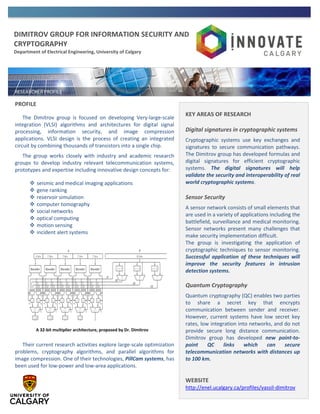
image compression. One of their technologies, PillCam systems, has
been used for low-power and low-area applications.
KEY AREAS OF RESEARCH
Digital signatures in cryptographic systems
Cryptographic systems use key exchanges and
signatures to secure communication pathways.
The Dimitrov group has developed formulas and
digital signatures for efficient cryptographic
systems. The digital signatures will help
validate the security and interoperability of real
world cryptographic systems.
Sensor Security
A sensor network consists of small elements that
are used in a variety of applications including the
battlefield, surveillance and medical monitoring.
Sensor networks present many challenges that
make security implementation difficult.
The group is investigating the application of
cryptographic techniques to sensor monitoring.
Successful application of these techniques will
improve the security features in intrusion
detection systems.
Quantum Cryptography
Quantum cryptography (QC) enables two parties
to share a secret key that encrypts
communication between sender and receiver.
However, current systems have low secret key
rates, low integration into networks, and do not
provide secure long distance communication.
Dimitrov group has developed new point-to-
point QC links which can secure
telecommunication networks with distances up
to 100 km.
WEBSITE
http://enel.ucalgary.ca/profiles/vassil-dimitrov
A A 32-bit multiplier architecture, proposed by Dr. Dimitrov
DIMITROV GROUP FOR INFORMATION SECURITY AND
CRYPTOGRAPHY
Department of Electrical Engineering, University of Calgary
OPPORTUNITIES FOR PARTNERSHIPS
VLSI Technologies designed by the Dimitrov group are very
flexible and suitable for different types of hardware accelerators.
The Dimitrov group can work with industry partners to develop
hardware implementation of cryptographic algorithms, image
compression algorithms and digital watermarking algorithms, which
can be applied in the following domains:
 page and gene ranking
 Information security systems
 seismic and medical imaging
 reservoir simulation
 computer tomography
 faster numerical solution of PDE
 social networking
 optical computing
 low-power applications
SPECIALIZED TECHNIQUES/INSTRUMENTATION
 Fast Linear Algebra for Multi-Core Systems
 Cryptographic Techniques
 Image Compression Techniques
 DSP Algorithms
NOTABLE PARTNERS/SUPPORTERS AND GRANT(S)
 NSERC
 Varian Corporation
 Computer Modelling Group
CONTACT
Nima Najand
Technology Analyst
Innovate Calgary
Phone: (403) 775-1855
ipm@innovatecalgary.com
BIOGRAPHY
Dr. Vassil Dimitrov is a Professor in the
Department of Electrical and Computer
Engineering, University of Calgary. He was
formerly an associate professor at the University
of Windsor. He has published 100 articles in peer-
reviewed journals and 3 book chapters.
SELECT PUBLICATIONS
 Dimitrov, Vassil, and Kimmo Jarvinen. "Another
look at inversions over binary fields." Computer
Arithmetic (ARITH), 2013 21st IEEE Symposium
on. IEEE, 2013. “Proton Conduction with Metal
Organic Frameworks” Shimizu, G.K.H.; Taylor,
J.M.; Kim, S. Science, 2013, 341, 354-355.
 Adikari, Jithra, Vassil S. Dimitrov, and Kimmo U.
Jarvinen. "A Fast Hardware Architecture for
Integer to tauNAF Conversion for Koblitz
Curves." Computers, IEEE Transactions on 61.5
(2012): 732-737.
 Edirisuriya, Amila, et al. "VLSI architecture for 8-
point AI-based Arai DCT having low area-time
complexity and power at improved accuracy."
Journal of Low Power Electronics and
Applications 2.2 (2012): 127-142.
EATON GROUP FOR MICROSEISMIC MONITORING
Department of Geosciences, University of Calgary
PROFILE
Dr. Eaton leads an applied research team dedicated to the
advancement of research and technological innovations in
microseismic methods and their practical applications for resource
development. Specifically, Dr. Eaton’s group primarily specializes in
the monitoring and analysis of microseismic events that occur
during the hydraulic fracturing, including induced seismicity.
The work done by the Eaton group is built on years of technical
expertise and can been applied in a variety of reservoir
development processes, including:
 Determining fracture geometry and azimuth
 Identifying of out-of-zone events
 Evaluating fracture complexity and intensity
 Optimizing injection strategies and staging
 Estimating stimulated reservoir volume (SRV)
 Observing caprock integrity
 Optimizing ground control and mine design
 Increasing safety of reservoir
 Optimizing production
KEY AREAS OF RESEARCH
Analyzing microseismic events during
hydraulic fracturing
Researchers in Dr. Eaton’s group are using
borehole and surface geophone systems for
microseismic monitoring. They are developing
innovative approaches to process and interpret
microseismic data, including integration with
geomechanical modelling. These studies are
providing operators with improved methods to
optimize hydraulic fracture design and
incorporate microseismic observations into
reservoir models.
Understanding and mitigating induced
seismicity hazards
The group is also making use of passive seismic
observations and computer simulations to
better understand risks from induced seismicity
due to hydraulic fracturing and wastewater
injection. This work includes field observations
with broadband seismograph observatories,
coupled with development of improved
numerical models for triggered fault slip.
Microseismic source analysis and links to
geomechanical modelling
Research by Dr. Eaton’s group and
collaborators is providing fundamental new
insights into the nature of microseismic
deformation - especially the expression of
tensile crack opening, as well as the response of
natural fracture systems to changes in stress
and fluid conditions.
WEBSITE
http://www.microseismic-research.ca/
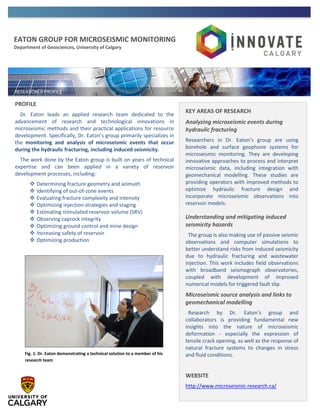
Fig. 1: Dr. Eaton demonstrating a technical solution to a member of his
research team
EATON GROUP FOR MICROSEISMIC MONITORING
Department of Geosciences, University of Calgary
OPPORTUNITIES FOR PARTNERSHIPS
 Strategic partnerships within the microseismic service
industry and the unconventional oil and gas sector.
 Access to microseismic data, opportunities for deployment of
university field equipment and collaboration with industry
specialists.
 Partnerships will provide access to new ideas and highly
qualified personnel within Dr. Eaton’s group.
 Development of cost-effective technology for surface
monitoring of ground motion.
OPPORTUNITIES FOR TEACHING
 Dr. Eaton teaches a 2-5 day course called “Introduction to
Microseismic Methods” that draws on his unique academic
expertise along with extensive practical experience.
SPECIALIZED TECHNIQUES/ INSTRUMENTATION
 Downhole microseismic system
 Portable broadband seismograph systems
 Access to a large pool of geophysical instruments
NOTABLE PARTNERSHIPS/AWARDS/ GRANTS
 Microseismic Industry Consortium (~ 30 industry sponsors).
 NSERC CRD project “Towards Improved Microseismic
Monitoring Technology”, $1.5 M.
 CFI project “Laboratory for Passive Seismic Imaging of Earth
Processes”, $0.8M.
CONTACT
Nima Najand
Technology Analyst, Innovate Calgary
Phone: (403) 775-1855
nnajand@innovatecalgary.com
BIOGRAPHY
Dr. David Eaton is Professor of Geophysics at the
University of Calgary. He served as Head of the
Geoscience Department from 2007-2012. He is a
former president of the Canadian Geophysical
Union and is the Canada national representative
to the International Association of Seismology
and Physics of the Earth’s Interior. He is also a
founding member of POLARIS (Portable
Observatories for Lithospheric Analysis and
Research Investigating Seismicity).
SELECT PUBLICATIONS
 Eaton D. W., Van der Baan M., Birkelo B. and
Tary J-B. (2014) Scaling relations and spectral
characteristics of tensile microseisms: Evidence
for opening/closing cracks during hydraulic
fracturing. Geophysical Journal International,
196(3), 1844-1857.
 Eaton, D.W., Davidsen, J., Pedersen, P. and
Boroumand*, N., (2014). Breakdown of the
Gutenberg-Richter relation for
microearthquakes induced by hydraulic
fracturing: influence of stratabound fractures.
Geophys. Prosp. 62: 806-818.
 Eaton, D., Rafiq, A., Pedersen, P. and van der
Baan, M., 2014. Microseismic expression of
natural fracture activation in a tight sand
reservoir. DFNE 2014 – 265.
GATES GROUP FOR OIL SANDS INNOVATION
Department of Chemical and Petroleum Engineering, University of Calgary
PROFILE
The Gates Research Group is involved in design and modelling
research to stimulate innovative technologies for oil sands.
The group has initiated several research projects in key areas aimed
at advancing responsible development of oil sands and improved
environmental performance. These include:
 thermal (CSS, SAGD, SF) and thermal-solvent (ES-SAGD,
SA-CSS, VAPEX, N-Solv) methods for heavy oil recovery
 inflow control devices for improved steam conformance in
steam-based recovery processes (CSS and SAGD)
 automated control of thermal recovery processes
 reactive thermal reservoir simulation: aquathermolysis
(H2S and CO2) in CSS and SAGD, in situ gasification, in situ
combustion of heavy oil and oil sands
 well-wormhole for modelling Cold Heavy Oil Production
with Sand (CHOPS) operations
 pilot and commercial field data analysis
Based on their research, the Gates Research Group has developed
operational strategies, well placement strategies, and completion
designs that improve steam conformance, lower greenhouse gas
emissions and water use than that of conventional SAGD.
KEY AREAS OF RESEARCH
Thermal Recovery Processes in Ultra-refined
Geological Models
A key uncertainty of heavy oil and oil sands recovery
processes arise from the underlying geology of the
formation. Researchers in the Gates Research
Group have developed ultra-refined reservoir
models to understand the impact of heterogeneity
on thermal and thermal-solvent recovery processes.
These models reveal optimal wel placement within
the reservoirs to improve process performance.
Accurate Imaging of Oil and gas reservoirs
Heterogeneity in reservoirs leads difficulty in
identifying rock and fluid properties, which affects
traditional imaging. This, in turn, leads to long
processing times and highly subjective results.
Researchers in the Gates group have developed a
new, highly efficient imaging system for oil and gas
reservoirs – PULSAR (Pulse Sequencing, Acquisition
and Ranging). The patented PULSAR technology can
operate in a continuous, real-time environment
while recovery equipment is still active, and
provides much higher resolution imaging compared
to traditional reservoir imaging methods.
Exploring socio-technical factors to stimulate oil
sands innovation
Impediments to oil sands industry projects often
have technical and social aspects. As such, it is
important to find solutions that are acceptable to
all stakeholders. The Gates Group are using a
holistic approach to investigate the socio-technical
dimensions of oil sands innovation. The innovative
research would lead to a wider deployment of
sustainable techniques in oil sands operations, and
can potentially increase the volume of production
and reduce the aggregate environmental footprint
of the oil sands industry.
WEBSITE
http://schulich.ucalgary.ca/chemical/IanGates
Figure 1. Visualization of the SAGD process, a key research area for the
Gates group.
GATES GROUP FOR OIL SANDS INNOVATION
Department of Chemical and Petroleum Engineering, University of Calgary
OPPORTUNITIES FOR PARTNERSHIPS
The Gates Research Group is an applied research group seeking to find
value from the research that is conducted in the group. Thus, we
enjoy and encourage partnerships with industry to develop and
establish value-added, new technology.
OPPORTUNITIES FOR CONSULTING
Dr. Gates has consulted for many companies both domestic and
internationally (e.g., Canada, U.S., China, Venezuela, U.K., S. Korea,
Mexico) various aspects including: heavy oil and oil sands recovery
technologies; short courses on heavy oil and oil sands technology;
horizontal wells; thermal and thermal-solvent technology; thermal
reservoir simulation; heavy oil carbonate systems; and reservoir
engineering.
SPECIALIZED TECHNIQUES / INSTRUMENTATION
 Reactive thermal reservoir simulation
 Core steam-flooding with deformation analysis unit
 Multiphase flow in fracture flow apparatus
 Low pressure oil sands physical model apparatus
 Texture analyzer, viscometers (Brookfield and Anton Parr),
ultrasonic horns
NOTABLE PARTNERSHIPS/AWARDS/GRANTS
 Killam Innovation in Teaching Award
 Achievement in Innovation Award
 Bill and Melinda Gates Foundation Grant
 Schulich School of Engineering Teaching Excellence
 ASTECH Outstanding Commercial Achievement in Alberta
Science and Technology
CONTACT
Kiyoshi Robson, Ph.D.
Technology Analyst
Innovate Calgary
Phone: (403) 270-2441
Email: ipm@innovatecalgary.com
SELECT PATENTS & PUBLICATIONS
 Gates, I.D. and Bunio, G. In Situ Process to
Recover Heavy Oil and Bitumen. Canadian Patent
2,553,297 Issued 2013.
 Bunio, G.L., Gates, I.D., Sudlow, P., Anderson, R.E.,
Propp, M.E., Zero Emission Steam Generation
Process. Canadian Patent 2,751,186 Issued 2013.
 Larter, S.R., Jiang, C., Oldenburg, T., Adams, J.J.,
Noke, K., Bennett, B., and Gates, I.D. Method and
Apparatus for Obtaining Heavy Oil Samples from a
Reservoir Sample. U.S. Patent 8,495,921 Issued
2013.
 Larter, S.R., Bennett, B., Snowdon, L.R., Jiang, C.,
Adams, J.J., Gates, I.D., Noke, K.J. Method for
determining a value of a property of oil extracted
from a sample. Canadian Patent 2,666,148 Issued
2013.
BIOGRAPHY
Dr. Ian D. Gates is Professor and Head of the
Department of Chemical and Petroleum
Engineering in the Schulich School of Engineering
at the University of Calgary. He worked for seven
years in industry prior to joining the University of
Calgary. He is a consultant for many small and
large energy companies both in Canada and
internationally. Dr. Gates has published over 67
peer-reviewed articles and has 29 patents (13
awarded, 16 pending). He is a registered
professional engineer in Alberta.
GERLACH GROUP FOR FOOD SYSTEMS INNOVATION
Department of Anthropology & Archeology, University of Calgary
PROFILE
The Gerlach group is focused on developing location-based
solutions that can be used to strengthen the synergies between
food systems, water systems, ecosystems and energy security.
The group has been w mechanisms to integrate sustainability
objectives into energy resource development. Part of their work
includes collaboration with small scale farmers, industry
professionals, and local communities to develop frameworks for
energy systems, environmental security, water security, and food
security to co-exist.
Complimentary research by the Gerlach group focuses on
measures taken by rural farmers to cope with climate changes
while increasing their crop yields. Altogether, these research
activities promote partnerships that foster effective placed-based
solutions from both western and indigenous perspectives.
KEY AREAS OF RESEARCH
Sustainability of energy systems
The Gerlach group is looking at how climate
changes are affecting both the existing
ecosystem structures and the normal operations
of rural communities. The group is developing
new and effective tools to visualize and
communicate these changes to energy
companies and affected communities.
Access to water systems in villages
The Gerlach group is developing innovative
location-based solutions to facilitate water
system delivery in villages. Part of these
solutions includes local infrastructural
development and training of Indigenous
personnel. The study will help improve sanitary
conditions, minimize impact on the
environment, and improve the overall quality
of life in rural communities.
Vulnerability assessment of hydro plants
Many operators of hydropower facilities
manage their water resources with little
information about the volumes of water stored
in the stream flows that feed the reservoirs.
The Gerlach group is working to identify
critical data and analyses needed for climate
vulnerability assessment on hydropower
facilities. The research will help the industry to
increase the capacity to make use of real-time
environmental monitoring and seasonal
forecasts.
WEBSITE
http://anth.ucalgary.ca/manageprofile/profiles/
1-4584890
Figure 1. Schematic showing the interconnectivity of the themes that
Gerlach group explores.
GERLACH GROUP FOR FOOD SYSTEMS INNOVATION
Department of Anthropology & Archeology, University of Calgary
OPPORTUNITIES FOR PARTNERSHIPS
 The Gerlach group are experts in analyzing the
interconnectivities of systems. They can leverage their expertise to
help oil and gas companies understand the best approach to
engage with aboriginal communities.
 Researchers in the group have vast experience in engaging
with aboriginal communities in Alaska and Northern Canadian
territories. They can provide valuable insight for both companies
and government agencies on proposed off shore oil and gas
development projects.
 The group can also provide advice to First Nations
communities interested in taking advantage of the economic
opportunities that accrue from energy-related resources.
 The group is also interested in working with work with
federal and state agencies for a wider dissemination of weather
events and changes in seasonality that affects food and ecosystems.
NOTABLE PARTNERSHIPS/AWARDS/GRANTS
 National Oceanic and Atmospheric Administration (NOAA)
 U.S. Department of Agriculture (USDA)
 National Science Foundation Grant for Sustainable Futures
 Alaska Center for Climate Assessment and Policy (ACCAP)
CONTACT
Kiyoshi Robson, Ph.D.
Technology Analyst
Innovate Calgary
Phone: (403) 270-2441
ipm@innovatecalgary.com
BIOGRAPHY
Dr. Craig Gerlach is a professor in the
department of Anthropology and Archeology,
University of Calgary. He is also an Adjunct
Professor in the department of Geography. He
has garnered substantial experience from
serving on coastal response advisory boards.
Notably, the National Academy of Science Panel
on Cumulative Effects of North Slope Oil and Gas
Development. In 2013, he was appointed to
Chair the University of Calgary Academic
Committee for Sustainability.
SELECT PUBLICATIONS
 Loring, P., Gerlach, S., & Huntington, H. (2013).
The new environmental security: linking food,
water and energy for integrative and diagnostic
social-ecological research. J Agric Food Syst
Community Dev, 3, 55-61.
 Loring, P. A., Harrison, H. L., & Gerlach, S. C.
(2014). Local perceptions of the sustainability of
Alaska’s highly contested cook inlet salmon
fisheries. Society & Natural Resources, 27(2),
185-199.
 Gerlach, S. C., & Loring, P. A. (2013). Rebuilding
northern foodsheds, sustainable food systems,
community well-being, and food security.
International journal of circumpolar health.
HUBERT GROUP FOR GEOMICROBIOLOGY
Department of Biological Sciences, University of Calgary
PROFILE
The Hubert Geomicrobiology Research Group focuses on
applications in subsurface microbiology and bioengineering. Using
extremophiles—bacteria that grow in the physically extreme
environments of deep subsurface reservoirs—Dr. Hubert’s team is
developing methods to increase the probability of detecting
petroleum deposits and enhancing recovery.
Natural leakage of
hydrocarbons from
subsurface reservoirs,
transport bacteria to
the surface where
they can be mapped
as markers in oil
exploration. The
research group is
developing novel ways
to quantify the
concentrations of
extremophiles in
marine environments.
This cutting-edge
approach promises to help increase confidence in oil reservoir
identification and reduce the risk associated with exploratory wells.
Dr. Hubert is also interested in developing techniques to recover
residual oil and hard to access oil reserves by tapping into
bioprocesses taking place in situ. This has the potential to extend
production lifetimes and volumes while reducing
detrimental effects such as the souring of
reservoirs in response to water injection–based
secondary oil recovery.
Figure 1: Extremophiles living in petroleum
reservoirs being transported to the surface
by migrating oil and gas, and then settling in
the seabed above the reservoir. Mapping the
concentrations of these bacteria could aid in
locating new reservoirs.
KEY AREAS OF RESEARCH
Offshore oil exploration
Problem: Offshore exploration wells are
expensive and high risk.
Solution: Quantify specialized bacteria in surface
environments to increase confidence prior to
exploratory drilling into the subsurface.
Subsurface biogeochemistry
Problem: Abandoned oil fields typically contain
residual resource that is difficult to recover.
Solution: Utilize subsurface microbes to
promote further mobilization of oil, or convert
residual liquids into more accessible products
like natural gas.
Oil reservoir souring
Problem: Bacterial sulfate reduction to
hydrogen sulfide (H2S) leads to souring and
corrosion of production infrastructure.
Solution: Divert bacterial metabolism away from
harmful accumulation of H2S through the
injection of nitrate.
WEBSITE
www.ncl.ac.uk/ceg/staff/profile/casey.hubert
Dr. Hubert will join the U of C in July 2014
HUBERT GROUP FOR GEOMICROBIOLOGY
Department of Biological Sciences, University of Calgary
OPPORTUNITIES FOR PARTNERSHIPS
Dr. Hubert is interested in meeting with prospective
partners that would benefit from collaborative R&D in the
areas of offshore oil exploration and recovery. In particular,
companies that are able to provide subsurface drill core or
marine sediment samples obtained during exploration and
production activities. Samples will be analyzed by members of
the Geomicrobiology Research Group at the U of C using
microbial genomics, anaerobic bacteriology and
environmental geochemistry. Combining geomicrobiology
with metadata provided by energy companies offers the best
opportunities for taking advantage of subsurface microbiology
for innovative and exciting bioengineering applications in the
geoenergy sector.
SPECIALIZED LABORATORY METHODS
1. Microbial Genomics
2. Anaerobic Bacteriology
3. Molecular Microbiology
4. Environmental Geochemistry
5. Analysis of Bacterial Endospores
6. Radiometric Sulfate Reduction
CONTACT
Nima Najand
Technology Analyst
Innovate Calgary
Phone: (403) 775-1855
nnajand@innovatecalgary.com
SELECTED PUBLICATIONS
 Hubert C, et al. 2009 A Constant Flux of Diverse
Thermophilic Bacteria into the Cold Arctic Seabed.
Science 325: 1541-1544.
 Müller AL, de Rezende JR, Hubert CRJ, Kjeldsen KU,
Lagkouvardos I, Berry D, Jørgensen BB, Loy A. 2014
Endospores of thermophilic bacteria as tracers of
microbial dispersal by ocean currents. ISME Journal
8: 1153-1165.
 de Rezende JR, Kjeldsen KU, Hubert CRJ, Finster K,
Loy A, Jørgensen BB. 2013 Dispersal of
thermophilic Desulfotomaculum endospores into
Baltic Sea sediments over thousands of years. ISME
Journal 7: 72-84.
 Hubert C, Judd A. 2010 Using micro-organisms as
prospecting agents in oil and gas exploration. In:
Timmis, KN, ed. Handbook of Hydrocarbon and Lipid
Microbiology: Springer, pp. 2711-2725.
 Hubert C. Microbial ecology of oil reservoir souring
control by nitrate injection. 2010 In: Timmis, KN,
ed. Handbook of Hydrocarbon and Lipid
Microbiology: Springer, pp. 2753-2766.
 Gray ND, Sherry A, Hubert C, Dolfing J, Head IM.
2010 Methanogenic degradation of petroleum
hydrocarbons in subsurface environments:
remediation, heavy oil formation, and energy
recovery. Advances in Applied Microbiology 72:
137-161.
 Hubert C, Voordouw G, Mayer B. 2009 Elucidating
microbial processes in nitrate- and sulfate-reducing
systems using sulfur and oxygen isotope ratios: the
example of oil reservoir souring control.
HUSEIN GROUP FOR NANO TECHNOLOGY FOR
ENERGY AND ENVIRONMENT
Department of Chemical and Petroleum Engineering, University of Calgary
PROFILE
The Husein group focuses on applying nanotechnology to
minimize the environmental footprint of current activities in the
oil and gas sector such as:
 Exploration
 Production
 Extraction
 Refining and Upgrading
Nanoscale materials exhibit unique properties that radically
change the conventional chemical behaviour of petroleum
processes. With a deep understanding of nanomaterials, the Husein
group seeks to exploit their properties to improve process
productivity and energy efficiency. Nanomaterials have applications
in heavy oil upgrading, water treatment and drilling fluids.
Drilling fluids are an integral component of down-hole
operations. They are used to cool the drill bit, remove cuttings,
lubricate the wellbore and provide hydrostatic pressure to balance
reservoir pressure. The loss of drilling fluids into cracks and pores is
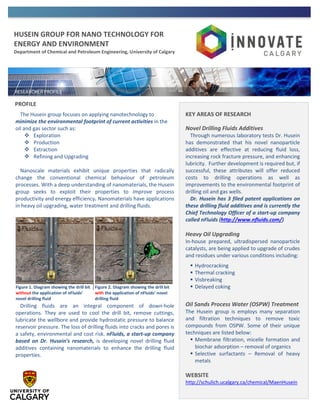
a safety, environmental and cost risk. nFluids, a start-up company
based on Dr. Husein’s research, is developing novel drilling fluid
additives containing nanomaterials to enhance the drilling fluid
properties.
KEY AREAS OF RESEARCH
Novel Drilling Fluids Additives
Through numerous laboratory tests Dr. Husein
has demonstrated that his novel nanoparticle
additives are effective at reducing fluid loss,
increasing rock fracture pressure, and enhancing
lubricity. Further development is required but, if
successful, these attributes will offer reduced
costs to drilling operations as well as
improvements to the environmental footprint of
drilling oil and gas wells.
Dr. Husein has 3 filed patent applications on
these drilling fluid additives and is currently the
Chief Technology Officer of a start-up company
called nFluids (http://www.nfluids.com/)
Heavy Oil Upgrading
In-house prepared, ultradispersed nanoparticle
catalysts, are being applied to upgrade of crudes
and residues under various conditions including:
 Hydrocracking
 Thermal cracking
 Visbreaking
 Delayed coking
Oil Sands Process Water (OSPW) Treatment
The Husein group is employs many separation
and filtration techniques to remove toxic
compounds from OSPW. Some of their unique
techniques are listed below:
 Membrane filtration, micelle formation and
biochar adsorption – removal of organics
 Selective surfactants – Removal of heavy
metals
WEBSITE
http://schulich.ucalgary.ca/chemical/MaenHusein
Figure 1. Diagram showing the drill bit
without the application of nFluids’
novel drilling fluid
Figure 2. Diagram showing the drill bit
with the application of nFluids’ novel
drilling fluid
HUSEIN GROUP FOR NANO TECHNOLOGY FOR
ENERGY AND ENVIRONMENT
Department of Chemical and Petroleum Engineering, University of Calgary
OPPORTUNITIES FOR PARTNERSHIPS AND CONSULTING
The Husein Group is seeking partnerships with oil and gas
exploration, production, refining and upgrading companies, who
would like to work on out-of-the-box solutions to industry-relevant
problems. They would like to build long-standing collaborative
relationships, where companies can share their problems and
provide feedback on research. Industry partners can maximize the
working relationship by supplying samples and open dialogue to
expedite research results.
Industrial partners will have access to a wealth of knowledge and
expertise in applied sciences and benefit from the researcher’s
innovative and effective nanotechnology approaches to solving oil
and gas problems. In addition, Dr. Husein’s laboratories have a
variety of analytical and synthesizing equipment available for use.
SPECIALIZED TECHNIQUES/INSTRUMENTATION
 Inductively couple plasma (ICP)
 Small and wide angle X-ray diffraction
 Parr reactor (500o
C, 5000 psig)
 Total organic carbon (TOC) analyzer
 UV-vis spectroscopy
 Stopped flow instrument
NOTABLE PARTNERSHIPS/AWARDS/GRANTS
 Canada Foundation for Innovation Grants
 NSERC Discovery and I2I Grants
 Blackstone, Drilling specialities
CONTACT
Kiyoshi Robson, Ph.D.
Technology Analyst
Innovate Calgary
Phone: (403) 270-2441
ipm@innovatecalgary.com
BIOGRAPHY
Dr. Maen Husein, Ph.D.
Dr. Husein is currently a Professor in the
Department of Chemical and Petroleum
Engineering. His expertise in nanomaterials for
energy and environment applications is
highlighted through over 45 publications, 4 filed
patents and many technical talks and also a start-
up company nFluids.
SELECT PUBLICATIONS
 Z. Ouled Ameur, and M. Husein “Electrochemical
Behavior of Potassium Ferricyanide in Aqueous
and (w/o) Microemulsion Systems in the
Presence of Dispersed Nickel Nanoparticles”
Separation Science and Technology (2013), 48,
681-689
 T. Abu, J. Bela, and M. Husein “Oxidation of
asphaltenes adsorbed onto NiO nanoparticles”
Applied Catalysis A – General (2012), 445, 166-
171
 T. Abu, J. Bela, and M. Husein “Adsorption of
asphaltenes from heavy oil onto in situ prepared
NiO nanoparticles” Journal of Colloid and
Interface Science (2012), 378, 64-69
PETROLEUM RESERVOIR GROUP (PRG)
Department of Geosciences, University of Calgary
PROFILE
The Petroleum Reservoir Group (PRG) investigates ways to
develop geochemical compounds and advanced analytical methods
for minimizing CO2 emissions and water contamination issues
associated with natural resource extraction and use.
The group has published leading scientific research that provides
real solutions in a wide range of subjects, including:
 Organic carbon in the earth’s crust
 Petroleum geochemistry
 Directly dating and assessing oil charge histories
 Biogeochemistry of contaminated waters
 Corrosion
 Bioactive compounds
 Subsurface storage of CO2 and other wastes
 Deep submarine oil spills (C-IMAGE project)
 Novel analytical methods (FTICRMS and 2DGCMS)
 Renewable energy from petroleum reservoirs and
 Renewable energy from coal seams
 Mega-scale social and technological innovation studies
Further to their research work, PRG has created some spin out
companies that develop technologies for application in different
problem areas in the oil and gas industry, notably:
 Heavy oil characterization and
technology (Gushor Inc.)
 Bioconversion of heavy oil to
methane and hydrogen
(Profero Energy Inc.)
 Analysis of high resolution mass
spectral data (Aphorist Inc.)
INDICATIVE AREAS OF RESEARCH
Dating oil charge histories
PRG is working on several projects to solve the
challenge of how to date the time of
emplacement or leakage in oil and gas
reservoirs. Some of their research projects that
focus on oil charge history assessment include:
 The Rip Van Winkle method
 Developing chemical proxies for oil
residence
 Identifying caprock leakage history
 Mass fraction maturity (MFM) method
Novel analytical methods
PRG has pioneered cutting-edge analytical
methodologies for laboratory and field
investigations. The application areas include:
 Contaminated lands and waters
 Microbial influenced corrosion
 The search for bioactive compounds in
fossil fuels
 High pressure deep submarine spillage
 Peats
The fossil fuel energy transition
PRG is conducting research to accelerate the
transition to renewable energy. Their work is
focused on developing the technological and
socio-political resources for carbon neutral
fuel production. Their research in this area is
focused on:
 Adapting microbial processes for cleaner
energy production from fossil fuel
resources;
 Improving methods to monitor CO2
injected into carbon capture storage
sites.
WEBSITE
http://www.ucalgary.ca/prg/
PETROLEUM RESERVOIR GROUP (PRG)
Department of Geosciences, University of Calgary
OPPORTUNITIES FOR PARTNERSHIPS
PRG has a long history of working with industry and government
on applied and fundamental research topics. The group is currently
looking for partners who can collaborate with its spin out
companies, specifically in the area of environmental and analytical
technologies. PRG also welcomes partners who can support their
research to bring practical solutions to real problems in the oil and
gas industry.
OPPORTUNITIES FOR CONSULTING
Among other areas of expertise, PRG can offer consulting services
on contaminated water issues. They can provide data analysis
services based on their Fourier transform mass spectrometry
software through their company, Aphorist Inc.
SPECIALIZED INSTRUMENTATION
 The PRG lab is equipped with a gas chromatography-mass
spectrometry analytic tool.
 Fourier transform ion cyclotron resonance mass spectrometry
 12 Tesla, Bruker, FT ICR MS system
NOTABLE PARTNERS AND PROFILE
 Fellow of the Royal Society
 Fellow of the Royal Society of Canada
 Geochemical Society's Alfred Treibs Award
 William Smith Medal of the Geological Society
 Scientific Director Carbon Management Canada
CONTACT
Kiyoshi Robson, Ph.D. Susan Dooley
Technology Analyst Administrative Assistant
Innovate Calgary Petroleum Reservoir Group
Phone: (403) 270-2441 Phone: (403) 220-7484
Email: ipm@innovatecalgary.com Email: sdooley@ucalgary.ca
SELECT PUBLICATIONS
 Thomas B.P. Oldenburg, Melisa Brown, Barry
Bennett, Stephen R. Larter, The impact of
thermal maturity level on the composition of
crude oils, assessed using ultra-high resolution
mass spectrometry, Organic Geochemistry,
Volume 75, October 2014, Pages 151-168
 Jones, D.M., Head, I.M., Gray, N.D., Adams, J.J.,
Rowan, A.K., Aitken, C.M., Bennett, B., Huang,
H., Brown, A., Bowler, B.F.J., Oldenburg, T.,
Erdmann, M., Larter, S.R., (2008) Crude-oil
biodegradation via methanogenesis in
subsurface petroleum reservoirs. Nature,
451(7175), 176-180.
 Head, I.M., Jones, D.M., Larter, S.R., (2003)
Biological activity in the deep subsurface and
the origin of heavy oil. Nature, 426(6964), 344-
352
BIOGRAPHY
Dr. Steve Larter is a professor in the
department of Geoscience, University of
Calgary. He holds the Canada Research Chair in
Petroleum Geology. He is also the former CEO
of Gushor Inc. (now part of Schlumberger), and
the Scientific Director of Carbon Management
Canada Inc. He has published over 160 peer-
reviewed articles and has over a dozen patents.
Dr. Larter is a fellow of Royal Society of Canada,
and a foreign member of the Norwegian
Academy of Sciences and Arts.
LING GROUP FOR CARBOHYDRATE BIOORGANIC
CHEMISTRY
Department of Chemistry, University of Calgary
PROFILE
The Ling Group specializes in the development and application of
synthetic chemical molecules to solve biological problems. Their
primary focus is in the area of carbohydrate chemistry.
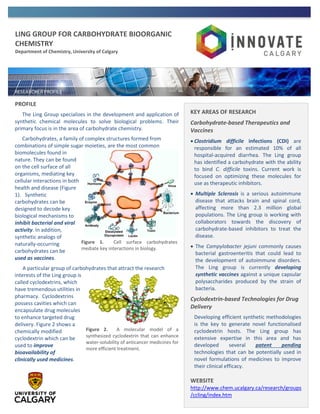
Carbohydrates, a family of complex structures formed from
combinations of simple sugar moieties, are the most common
biomolecules found in
nature. They can be found
on the cell surface of all
organisms, mediating key
cellular interactions in both
health and disease (Figure
1). Synthetic
carbohydrates can be
designed to decode key
biological mechanisms to
inhibit bacterial and viral
activity. In addition,
synthetic analogs of
naturally-occurring
carbohydrates can be
used as vaccines.
A particular group of carbohydrates that attract the research
interests of the Ling group is
called cyclodextrins, which
have tremendous utilities in
pharmacy. Cyclodextrins
possess cavities which can
encapsulate drug molecules
to enhance targeted drug
delivery. Figure 2 shows a
chemically modified
cyclodextrin which can be
used to improve
bioavailability of
clinically used medicines.
KEY AREAS OF RESEARCH
Carbohydrate-based Therapeutics and
Vaccines
 Clostridium difficile infections (CDI) are
responsible for an estimated 10% of all
hospital-acquired diarrhea. The Ling group
has identified a carbohydrate with the ability
to bind C. difficile toxins. Current work is
focused on optimizing these molecules for
use as therapeutic inhibitors.
 Multiple Sclerosis is a serious autoimmune
disease that attacks brain and spinal cord,
affecting more than 2.3 million global
populations. The Ling group is working with
collaborators towards the discovery of
carbohydrate-based inhibitors to treat the
disease.
 The Campylobacter jejuni commonly causes
bacterial gastroenteritis that could lead to
the development of autoimmune disorders.
The Ling group is currently developing
synthetic vaccines against a unique capsular
polysaccharides produced by the strain of
bacteria.
Cyclodextrin-based Technologies for Drug
Delivery
Developing efficient synthetic methodologies
is the key to generate novel functionalised
cyclodextrin hosts. The Ling group has
extensive expertise in this area and has
developed several patent pending
technologies that can be potentially used in
novel formulations of medicines to improve
their clinical efficacy.
WEBSITE
http://www.chem.ucalgary.ca/research/groups
/ccling/index.htm
Figure 1. Cell surface carbohydrates
mediate key interactions in biology.
Figure 2. A molecular model of a
synthesized cyclodextrin that can enhance
water-solubility of anticancer medicines for
more efficient treatment.
LING GROUP FOR CARBOHYDRATE BIOORGANIC
CHEMISTRY
Department of Chemistry, University of Calgary
OPPORTUNITIES FOR PARTNERSHIPS
Based on existing technologies and expertise in fields of
carbohydrate chemistry, glycobiology and cyclodextrin chemistry,
future collaborative or partnership opportunities exist in the
following areas:
 Development of new drug formulations based on patent
pending cyclodextrin derivatives;
 Optimization of carbohydrate-based lead compounds to treat
infectious diseases, autoimmune conditions and others;
 Development of glycoconjugation chemistries to generate
new vaccines;
 Establishment of in vitro and in vivo models to test
therapeutic efficacy of new drug formulations and delivery
technologies;
 Evaluation of carbohydrate toxicities.
OPPORTUNITIES FOR CONSULTING
As experts in carbohydrate chemistry and glycobiology, the Ling
Group is able to offer guidance in design of carbohydrate-based
therapeutics, vaccines, and cyclodextrin-based drug-delivery
vehicles.
SPECIALIZED INSTRUMENTATION
 Microwave reactor
 Flow cell cytometry
 Multimode plate readers
NOTABLE GRANTS/PARTNERSHIPS
 Alberta Glycomics Centre
 Alberta Innovates/Pfizer Translational Research Fund
 NSERC Discovery Grant
CONTACT
Kiyoshi Robson, Ph.D.
Technology Analyst
Innovate Calgary
Phone: (403) 270-2441
Email: ipm@innovatecalgary.com
BIOGRAPHY
Dr. Ling is an Associate Professor at the
Department of Chemistry, University of Calgary
and a Principal Investigator with the Alberta
Glycomics Centre. Dr. Ling has published over
65 peer-reviewed articles surrounding
carbohydrate chemistry and 4 patent
applications.
SELECT PUBLICATIONS
 Amphiphilic Cyclodextrin-based Glycodendri-
mers.” Ling C-C, Cui L, Ghosh R, Zhang P, Wang
AX, US Provisional Patent Appl. No. 61/885,151,
2013.
 “Cyclodextrin-Based Polycationic And Poly-
anionic Dendrimers.” Ling C-C, Zhang P, Gu J, US
Provisional Patent Appl. No. 62/004,364, 2014.
 “Diisobutylaluminum Hydride-Mediated
Regioselective O-Desilylations as a Novel Route
to Access Multisubstituted Cyclodextrins.”
Ghosh R, Zhang P, Wang A, Ling C-C. Angew.
Chem. Int. Ed. 2012, 51, 1548 – 1552.
 “Efficient synthesis of LeA-LacNAc
pentasaccharide as a ligand for Clostridium
difficile toxin A.” Zhang P, Ng K, Ling C-C. Org.
Biomol. Chem. 2010, 8, 128 – 136.
 “Probing a sialyltransferase's recognition
domain to prepare (2,8)-linked oligosialosides
and analogs.” Zhang P, Zuccolo AJ, Li W, Zheng
RB, Ling C-C, Chem. Commun. 2009, 4233-4235.
MAHINPEY GROUP FOR ENERGY AND
ENVIRONMENT RESEARCH (EERG)
Department of Chemical and Petroleum Engineering, University of Calgary
PROFILE
Dr. Mahinpey’s Energy and Environment Research group (EERG)
applies reaction engineering and design principles to find energy
and environment solutions. Their research is inspired by the idea of
promoting green and cost-effective processes for energy
production with a specific focus on:
 Greenhouse gas regulation technologies for oil-sand and
refinery operations
 Biofuel and biogas production from renewable sources
 Utilization of municipal solid and industrial waste
Chemical reaction engineering is based on using the
thermodynamics and kinetics of chemical reactions to design
reactors and reactor configurations, develop catalysts, and optimize
the yield and quality of products. The EERG uses these tools to solve
a diverse group of energy and environment problems present in
industry.
KEY AREAS OF RESEARCH
Greenhouse Gas Regulation Technologies
Dr. Mahinpey’s group researches novel CO2-
capture technologies for special applications such
as SAGD operations and steam methane
reforming (SMR). Their research involves the
development of highly efficient and inexpensive
solid sorbents and precipitation solvents for a
wide range of flue gases.
Bioenergy Production
The EERG is using pyrolysis and gasification to
produce oil, char, and gas from various biomass
feedstocks. They have applied innovative
techniques such as the use of subcritical water
treatment and catalysts to enhance bioenergy
recovery.
Process Modelling
The EERG creates accurate process models
(VMGSim, ASPEN HYSYS, CFD-FLUENT) for
integrated gasification and sorbent-based CO2
capture and the production of bioenergy. These
models assist industry partners in design,
development, optimization and economic
analysis of their processes.
Industrial and Municipal Waste Utilization
In partnership with ECCO Recycling and Energy
Corporation, the EERG is creating cost effective,
fire resistant and environmentally-friendly oil
spill adsorbents from industrial waste. Strategies
to convert municipal solid waste into other
valuable products are also being explored.
WEBSITE
http://www.ucalgary.ca/ENCH/AEG/home.html
Figure 1: The EERG develops and designs novel processes to produce syngas and
energy by integrated gasification and looping CO2 capture.
MAHINPEY GROUP FOR ENERGY AND
ENVIRONMENT RESEARCH (EERG)
Department of Chemical and Petroleum Engineering, University of Calgary
OPPORTUNITIES FOR PARTNERSHIPS
The Mahinpey group is looking to build long-term strategic
relationships to enhance their industry-driven research. The group
is seeking to partner with companies and organizations
specializing in chemical process development to improve process
efficiencies and reduce their environmental footprint.
Dr. Mahinpey’s industry partners will have access to a wide range
of analytical instrumentation and personnel qualified in process
design, modeling and simulation, and economic analysis. Dr.
Mahinpey would like his research to benefit from challenging
problems, relevant data and industry feedback.
SPECIALIZED TECHNIQUES/INSTRUMENTATION
 (High Pressure) Thermogravimetric Analysis ((HP)-TGA)
 Surface Area and Porosimetry Analysis (BET, DR, DA)
 Elemental Analyzer (CHNS/O)
 Gas Chromatography & Gas Analysis (GC-MS/FID/TCD)
 Several horizontal and vertical fixed bed tubular reactors
 Subcritical Water System
 Fluidized bed reactor
NOTABLE PARTNERSHIPS/AWARDS/GRANTS
 NSERC – Strategic Project Grant in CO2 Capture
 Carbon Management Canada (CMC)
 Petroleum Technology Research Centre (PTRC)
 Alberta Innovates Energy and Environment Solutions
 ECCO Recycling and Energy Corporation
 Whitefox Technologies Canada Limited
CONTACT
Nima Najand
Technology Analyst
Innovate Calgary
Phone: (403) 775-1855
nnajand@innovatecalgary.com
BIOGRAPHY
Dr. Nader Mahinpey, Ph.D. P.Eng.
Dr. Mahinpey is currently an Associate Professor
in the Department of Chemical and Petroleum
Engineering. He is also on the editorial board of
the Canadian Journal of Chemical Engineering.
His research expertise focuses on using kinetics
and reaction engineering to solve energy and
environment problems.
SELECT PUBLICATIONS
 “A novel development of mixed catalyst–sorbent
pellets for steam gasification of coal chars with in
situ CO2 capture”, Mostafavi, E., Mahinpey N.,
Manovic V., Catalysis Today, 237, pp 111-117
(2014).
 “Novel synthetic sol–gel CaO based pellets using
porous mesostructured silica in cyclic CO2 capture
processs”, Sedghkerdar, M. H. et al., Fuel, 127,
pp. 101-108, (2014).
 "Pyrolysis of oat straw and the comparison of
product yield with wheat and flax straw pyrolysis",
Mani, T., Murugan, P. and Mahinpey, N., Energy &
Fuels, 25 (7), pp. 2803-2807, (2011).
MAYER GROUP FOR APPLIED GEOCHEMISTRY
Department of Geoscience, University of Calgary
PROFILE
The Mayer research group employs a wide variety of chemical,
isotopic, mineralogical and modeling techniques to study the
movement of water, carbon, nitrogen, sulphur and phosphorus in
surface and subsurface environments. The Applied Geochemistry
group’s research focuses on:
 Environmental research;
 Sustainable energy supplies including conventional and
unconventional oil and gas; and,
 The interface between energy and the environment.
The overall goal of the Applied Geochemistry group is to enhance
sustainable practices in energy production while minimizing the
impact on terrestrial and aquatic environments.
The Mayer group is
renowned for
conducting field
investigations;
using sophisticated
laboratory-based
chemical and
isotopic
fingerprinting tools;
and performing
advanced
geochemical
modeling.
Their work provides insight about sources, movement and mixing of
water, gas, and contaminants in surface and subsurface
environments. These approaches are highly applicable to solving
problems in the development of unconventional oil and gas
resources, and associated with CO2 sequestration among others.
KEY AREAS OF RESEARCH
Isotopic Tracers for Hydraulic Fracturing
The Mayer group is using novel and established
chemical and isotopic tracers to assess the
environmental impacts of shale gas and shale
oil development on shallow aquatic systems.
This innovative research will help energy
companies minimize the environmental impact
of unconventional energy resource
development.
Isotopic Tracers for CO2 Sequestration
The group is using chemical, isotopic and
modeling techniques to trace the movement
and fate of CO2 injected into deep saline
aquifers or mature oilfields. These approaches
are important for verifying containment of CO2
in the storage reservoirs, thereby contributing
to Canada’s CO2 emissions reductions.
Isotopic Tracers for Oil Sands Development
The Mayer group is using chemical and isotopic
techniques to identify the cross-formational
flow of water and gas in oil sands. The insights
obtained from these unique tracer approaches
provide invaluable information for assessing
potential environmental risks of oil sands
development.
WEBSITE
http://earth.geo.ucalgary.ca/wiki/index.php/Main_Page
Figure 1. Researchers from the Mayer group in the field.
Figure 2. Schematic showing a CO2 sequestration process.
MAYER GROUP FOR APPLIED GEOCHEMISTRY
Department of Geoscience, University of Calgary
OPPORTUNITIES FOR PARTNERSHIPS
The Mayer group would like to collaborate with:
 Industry partners experiencing problems with mixing and
migration of gas or fluids
 Partners seeking to identify sources of stray gas leakage,
cross-formational flow, or scaling.
 Partners that could benefit from a comprehensive analysis
and interpretation of data gathered from extraction of
conventional and unconventional oil and gas, CO2 storage in
saline aquifers or during EOR, and oil sands development.
OPPORTUNITIES FOR CONSULTING
 Chemical and isotopic characterization of water, gas, and
solid samples;
 Identification of water and gas sources and processes;
 Predictive geochemical modeling.
SPECIALIZED TECHNIQUES/INSTRUMENTATION
 Fully equipped water chemistry laboratory
 Gas chemistry analysis facilities
 Large stable isotope laboratory offering a wide range of
services
 Advanced geochemical modeling
NOTABLE PARTNERSHIPS/AWARDS/GRANTS
 NSERC Discovery, Accelerator & CRD awards
 Networks of Canadian Centres of Excellence (NCE) researcher
 Several Canada Foundation of Innovation (CFI) awards
CONTACT
Nima Najand
Technology Analyst
Innovate Calgary
Phone: (403) 775-1855
ipm@innovatecalgary.com
SELECT PUBLICATIONS
 Cowie, B. R., James, B. & Mayer, B. (2014): Distribution
of total dissolved solids in McMurray Formation water
in the Athabasca oil sands region, Alberta, Canada:
Implications for regional hydrogeology and resource
development. – AAPG Bulletin, available on-line
September 2014.
 Jackson, R. E., Gorody, A. W., Mayer, B., Roy, J. W.,
Ryan, M. C. & Van Stempvoort, D. R. (2013):
Groundwater protection and unconventional gas
extraction: the critical need for field-based
hydrogeological research. – Ground Water, 51(4): 488-
510.
 Mayer, B. et al. (2013): Tracing the movement and the
fate of injected CO2 at the IEA GHG Weyburn-Midale
CO2 Monitoring and Storage project (Saskatchewan,
Canada) using carbon isotope ratios. – International
Journal on Greenhouse Gas Technology, 16S: S177-
S184.
BIOGRAPHY
Dr. Bernhard Mayer is a Professor of
Geochemistry in the Department of Geoscience
at the University of Calgary. Dr. Mayer has
published more than 120 papers in international
peer-reviewed journals and 15 book chapters. His
innovative research has contributed to various
provincial, national, and international research
programs, including the Alberta Ingenuity Center
for Water Research (AICWR), the Canadian Water
Network (CWN), and Carbon Management
Canada (CMC).
MINTCHEV GROUP FOR BIOMEDICAL AND OILFIELD
INSTRUMENTATION
Department of Electrical and Computer Engineering, University of Calgary
PROFILE
The Mintchev group is involved in research and development of
revolutionary technologies which are applicable to:
 Electronic instrumentation;
 Biomedical engineering,
 Gastrointestinal motility and stimulation;
 Oilfield applications; and,
 Embedded electronic microsystems.
A major component of the Mintchev research is to create
implantable microsystems which can restore the functionality of
faulty organs in the human body. The research team has
successfully demonstrated the use of microsystems that can
artificially induce the gastrointestinal system to transport food.
Their research has now expanded to include work on the colon – a
complex organ in the digestive tract.
The group also has over 10 issued or pending patents, most of
which are licensed to major companies. Their work on the
validation and quantification of electrogastrograms (E.G.G.) was the
first application of the E.G.G. technique in a clinical environment in
Canada.
KEY RESEARCH INNOVATIONS
Managing Gastrointestinal Motility
The Mintchev group has been investigating the
use of controlled electrical stimulation
techniques to manage gastrointestinal motility.
They have patented a device that uses Neural
Gastric Electrical Stimulation (NGES) to control
movement of content in the gastrointestinal
tract. The technique can be used to treat
gastroparesis, obesity, chronic constipation, and
other debilitating stomach diseases.
Self-stabilizing capsule endoscopy
The Mintchev group has been studying the
applicability of ingestible capsule endoscopes for
minimally-invasive monitoring of the human
colon for early diagnosis of colonic polyps. Two
patents have been issued on utilizing self-
expandable add-on to a traditional capsule
endoscope facilitating its stabilization in the
large lumen of the colon, and magnetically
steering the capsule for controlled examination.
In-drilling alignment (IDA) for inertial
downhole navigation in oil drilling
The Mintchev group has developed and
patented a novel IDA method to limit errors and
improve inertial navigation performance during
Horizontal Directional Drilling. The Mintchev
method can facilitate more accurate location
and azimuth measurements for oil and gas
drilling processes.
WEBSITE
http://www.researchgate.net/profile/Martin_Mi
ntchev
Figure 1. The Mintchev group is working to recreate the
functionality of the human gastrointestinal system
MINTCHEV GROUP FOR BIOMEDICAL AND OILFIELD
INSTRUMENTATION
Department of Electrical and Computer Engineering, University of Calgary
OPPORTUNITIES FOR PARTNERSHIPS
As experts in the field of biomedical research, the Mintchev group
can:
 provide support for research, development, and testing of
prototype devices.
 work with collaborators to conduct experimental surgery for
evaluation trials on humans and animals.
 facilitate product development for seed funding and faster
market penetration.
OPPORTUNITIES FOR CONSULTING
 Biomedical and Oilfield Instrumentation
SPECIALIZED TECHNIQUES/ INSTRUMENTATION
 Embedded design
 Electronic microsystems
 Inertial navigation
 Gastrointestinal research
 Experimental surgery
NOTABLE PARTNERSHIPS/AWARDS/GRANTS
 Alberta Ingenuity Fund
 Sandhill Scientific (U.S.A.)
 Whitaker Foundation (U.S.A.)
 Canada Foundation for Innovation
 Natural Sciences and Engineering Research Council (Canada)
 International Downhole Equipment, Inc. (Edmonton)
 Petro Canada
 Gastrointestinal Motility Laboratory (Edmonton)
CONTACT
Kiyoshi Robson, Ph.D.
Technology Analyst
Innovate Calgary
Phone: (403) 270-2441
Email: ipm@innovatecalgary.com
BIOGRAPHY
Dr. Martin Mintchev has extensive research
experience in biomedical engineering, electronic
design and instrumentation. He was recently
elected Fellow of the American Institute of
Medical and Biological Engineering for
outstanding contributions to biomedical
instrumentation. He is currently a professor in
the department of Electrical and Computer
Engineering, University of Calgary.
SELECT PUBLICATIONS
 Mintchev, M. P. (2013). Gastric electrical
stimulation for the treatment of obesity: from
entrainment to bezoars—a functional review.
International Scholarly Research Notices
Gastroenterology, 2013.
 Wang, Z., Poscente, M., Filip, D., Dimanchev,
M., & Mintchev, M. P. (2013). Rotary in-drilling
alignment using an autonomous MEMS-based
inertial measurement unit for measurement-
while-drilling processes. IEEE Instrumentation
& Measurement Magazine, 16(6), 26-34.
 Filip, D., Yadid-Pecht, O., Muench, G.,
Mintchev, M. P., & Andrews, C. N. (2013).
Suture marker lesion detection in the colon by
self-stabilizing and unmodified capsule
endoscopes: pilot study in acute canine
models. Gastrointestinal endoscopy, 77(2),
272-279.
PARK GROUP FOR MICRO MECHANICAL
ENGINEERING
Department of Mechanical and Manufacturing Engineering University of Calgary
PROFILE
The Park group are experts in the design and manufacturing of
Nano/Micro-Electro-Mechanical Systems (NMEMS) and
nanocomposites. Their research focuses on creating NMEMS by the
means of machining and molding and development of various
sensors.
Highly accurate electro-mechanical miniature components are
becoming increasingly
important for high-tech
industries such aerospace,
biomedical, environmental,
and oil and gas. The
efficiency of these devices is
important to bettering the
dynamics of machines in
terms of quicker response
times, higher sensitivity
and flexibility, and lower
cost.
Listed below are some of Dr. Park’s key application projects:
 Nanocomposites for electromagnetic interference shielding
and sensor networks (pressure, strain, temperature, and
chemicals)
 Nanocomposite coatings for pipelines and packaging
 Micro and nano-machining and molding
 Flexible electronics
 Subsurface hydraulic fracing and CCS monitoring system
 Alternative energy applications - direct methanol fuel cells –
use methanol as liquid fuel in replacement of hydrogen
 Micro pumps – liquid pumps for use in fuel cells and precise
delivery of liquids on microchips
Experimental modal analysis and vibration suppressions
KEY AREAS OF RESEARCH
Nano/Micro Mechanical Machining
Micro mechanical machining is conventionally
based on semi-conductor techniques such as
photo-etching silicon materials. Photo-etching
limits NMEMS to 2-D (planar) structures. Dr.
Park’s research group is using subtractive ultra-
precision nano/micro machining to fabricate 3-D
structures from metal alloys, polymers and
ceramics for use in NMEMS.
Figure 1. "Lab-on-chip" is a complex and widely used
NMEMS application.
Micro-Molding
Micro-molding tackles the same challenges as
micro-machining at a fraction of the time and
cost. Moulds are designed using CAD/CAM
software and the integration of micro machining
produces a high aspect-ratio of micro features.
The Park group focuses on the micro-moulds
of carbon nanotubes and graphene
nanocomposites. Their unique mechanical,
electrical and thermal properties have
applications in sensor technology and
electromagnetic shielding.
WEBSITE
http://www.ucalgary.ca/medal/
Figure 2. A nano/micro tungsten-carbide
drill used by the Park group for
nano/micro machining
PARK GROUP FOR MICRO MECHANICAL
ENGINEERING
Department of Mechanical and Manufacturing Engineering University of Calgary
OPPORTUNITIES FOR PARTNERSHIPS
The Park group would like to provide their industry partners
solutions to improve oil and gas processes through the application
of nano/micro tools. Specifically their expertise can be applied to
problems associated with hydraulic fracturing & Carbon Capture
and Storage (CCS) monitoring, and directional drilling.
Companies are sought, who specialize in drilling, hydraulic
fracturing and other subsurface technology, and are interested
implementing innovative sensing and monitoring tools. Dr. Park
seeks industry-relevant challenges with access to logged data,
samples and feedback on the group’s research.
SPECIALIZED TECHNIQUES/INSTRUMENTATION
 Atomic Force Microscope (AFM)
 Kern Micro System for Micro machining
 Boy Micro Injection Molding Machine
 Various sensor systems
 Raman Spectroscopy
 Various coating systems
 Potentiostat/Electrochemical Impedance Spectroscopy (EIS)
 Experimental modal analysis and vibration tools
 Tribology test setup
 Design and analysis tools (FEA, etc.)
NOTABLE PARTNERSHIPS/AWARDS/GRANTS
 AITF iCORE Strategic chair in Sensing and Monitoring
 Schulich School of Engineering Research Award 2013
 Partnerships: Nanobridge, KIGAM (Korea)
 NSERC Strategic Network - CANRIMT
CONTACT
Kiyoshi Robson, Ph.D.
Technology Analyst
Innovate Calgary
Phone: (403) 270-2441
ipm@innovatecalgary.com
BIOGRAPHY
Dr. Simon Park, Ph.D., P.Eng.
Dr. Park has extensive research experience in
the area of micro/nano systems. His expertise
has been highlighted by 43 journal publications
in 10 years, teaching and research awards such
as the University of Calgary Young Innovator
Award. He currently belongs to the International
Academy of Production Engineering at an
Associate Member and holds the AITF iCore
Strategic Research Chair.
SELECT PUBLICATIONS
 “Effect of CNT alignment on the strain sensing
capability of carbon nanotube composites” Parmar,
K., Mahmoodi, M., Park, C.I., Park, S.S., (2013) Smart
Materials and Structures
 “An innovative method to reduce the energy loss of
conductive filler/polymer composites for charge
storage applications” Arjmand, M., Mahmoodi, M.,
Park, S.S., Sundararaj, U.T.,(2013), Composites
Science and Technology, 78, pp. 24-29
 “The Electrical Conductivity and Electromagnetic
Interference Shielding of Injection Moulded Multi-
walled Carbon Nanotube/polystyrene Composites”
Mahmoodi, M., Arjmand, M., Sundararaj, U., Park,
S., (2013) Carbon, 50, 1455-1464

PEREIRA GROUP FOR CATALYTIC UPSTREAM BITUMEN
UPGRADING
Department of Chemical and Petroleum Engineering, University of Calgary
PROFILE
Upgrading bitumen and heavy crude oils is a challenging and
energy intensive activity. The Pereira group is composed of a group
of skilled Scientists, Chemists, Physicists and Engineers that has
gained years of experience in the Oil and Gas Industry in upstream
and downstream operations. They are focused on developing novel
upgrading processes and catalysts. Key aspects of their research
include:
 Evaluation of field and in situ upgrading paths
 Synthesis and development of upgrading catalysts from
nano to conventional size
 Monitoring of process variables
 Evaluation of upgrading schemes
 Conceptual engineering to process heavy crude oils
The Pereira group designs novel catalysts and processes tailored
to the specific application, based on a fundamental knowledge of
the complex chemical reactions that occur during the upgrading
process. The group has
the capabilities to
monitor reaction
mechanisms and catalyst
properties over the
course of the upgrading
reactions both in
reservoir and surface
conditions. This data
enables refinement of the
catalyst composition to
improve the catalyst
performance and extend
its activity and lifetime.
Research done by the group contributes to ongoing efforts to
address the chemical and engineering challenges to bitumen and
heavy oil upgrading for both upstream and downstream processes.
Their work has led to:
 Significant reductions in greenhouse gas emissions.
 Cost-effective conversion processes.
 Smooth conversion of bitumen and heavy oil reserves.
KEY AREAS OF RESEARCH
Catalysts Formulation
Research on reliable methods to assess the
nature of catalyst formulation is currently
underway in the Pereira group. Their
investigations cover the fundamental catalyst
design, through formulation and the interaction
with heavy oils. Results from these studies
contribute to In-Situ Catalytic Upgrading of
Heavy Crude and Bitumen.
Catalyst Dispersion Methods
Researchers in the group are conducting studies
on the dispersion methods of catalysts in order
maximize catalytic activities while minimizing
catalyst loadings. Their investigations cover,
amongst others:
 the particle size (microns to nanometers)
 the activity and cost of the formula
 the type of active phases generated.
In Reactor Hydrogen Generation
Research in the Pereira group is focused on
generation of hydrogen from water splitting - in
reaction zone. This research results in an
upstream process to regenerate catalysts from
the high carbon content fractions of hydrogen
and to return or use waste hydrocarbons back
into the reservoir.
WEBSITE
http://www.ucalgary.ca/catalysis/
http://www.pc-cups.com/
Figure 1. The Pereira group are experts
in in-situ upgrading using nano catalysts.
PEREIRA GROUP FOR CATALYTIC UPSTREAM BITUMEN
UPGRADING
Department of Chemical and Petroleum Engineering, University of Calgary
OPPORTUNITIES FOR PARTNERSHIPS
The Pereira group offers laboratory services, specialized testing
equipment and engineering consultancy and has provided its
services to several of the world's largest national and independent
oil companies. For more details on the Engineering Capabilities,
Engineering Tools, Technical Assistance and Technical Process
Services available, visit:
http://www.ucalgary.ca/catalysis/technical_support
OPPORTUNITIES FOR CONSULTING
The Pedro group can conduct stability test analysis for petroleum
crude oils and fuel oils. They can conduct adsorption studies and
molecular characterization for academic and industry clients. They
can also provide personnel training for interested partners.
SPECIALIZED TECHNIQUES/INSTRUMENTATION
Examples of some of the instrumentation available include:
 Catalyst Preparation unit
 Catalytic Steam Cracking unit
 Hydrocracking unit
 Reactivity test units
 Fixed bed and moving bed reactor units
 Iatroscan MK-6
For a detailed list visit: http://www.ucalgary.ca/catalysis/facilities
NOTABLE PARTNERSHIPS/AWARDS/GRANTS
 NSERC/NEXEN Research partnership
 Canada Foundation for Innovation Award (2005 and 2008)
CONTACT
Kiyoshi Robson, Ph.D.
Technology Analyst
Innovate Calgary
Phone: (403) 270-2441
ipm@innovatecalgary.com
BIOGRAPHY
Dr. Pedro Pereira-Almao is a Professor of
Chemical and Petroleum Engineering at the
University of Calgary. He holds the
NSERC/Nexen/AI-EES Industrial Research Chair in
Catalysis for Bitumen Upgrading. Dr. Pereira-
Almao worked as a Research and Development
Leader for over 14 years for a major national
petroleum company. He is the founder of two
companies that leverage the scientific and
engineering expertise: Process & Chemistry-
Consulting for Upgrading Solutions (PC-CUPS;
http://www.pc-cups.com/) and In-Situ
Upgrading Technologies Inc.
SELECT PUBLICATIONS
 P. Pereira-Almao (2012). In situ upgrading of
bitumen and heavy oils via nanocatalysis.
Volume 90, Issue 2, pages 320–329, April 2012.
The Canadian Journal of Chemical Engineering
 Hashemi, R., Nassar, N. N., & Pereira Almao, P.
(2013). In Situ Upgrading of Athabasca Bitumen
Using Multimetallic Ultradispersed Nanocatalysts
in an Oil Sands Packed-Bed Column. Energy &
Fuels, 28(2), 1338-1350.
 Fathi, M. M., & Pereira Almao, P. (2011).
Catalytic Aquaprocessing of Arab Light Vacuum
Residue via Short Space Times. Energy & Fuels,
25(11), 4867-4877.
ROBERTS GROUP FOR WATER TREATMENT AND
ENERGY STORAGE
Department of Chemical and Petroleum Engineering, University of Calgary
PROFILE
The oil industry typically processes around 2 to 6 gallons of water
for each gallon of oil produced. Costly processing is required to
handle the complex mixture of contaminants present in the water
and there is a need to reduce fresh water make-up. There is a need
for low cost treatment technologies which can remove these
contaminants and minimize secondary waste streams.
The Roberts group is
focusing on using
environmentally friendly
electrochemical techniques
for simultaneous removal
of various contaminants
including: suspended solids
such as fine clay particles,
emulsified oil, dissolved
organics, silica and heavy
metals from oil sands
produced water.
Dr. Ted Roberts is an internationally recognized expert and
innovator in the field of electrochemical technology. He has a track
record of taking laboratory research to industrial application and his
work has been recognized through several international awards for
innovation (the IChemE Water Innovation Award, the IET
Innovation Award, and the ACES European Academic Enterprise
Award). He is the holder of 16 granted patents, has a further 25
patent applications pending and has published more than 60
papers in international journals. Before moving to Calgary in 2012,
he was a professor at the University of Manchester in the UK, and
he is a founder shareholder of successful spin-out company Arvia
Technology Ltd. Arvia Technology have raised over $9M of
investment and are commercializing the adsorption /
electrochemical regeneration process invented by Dr Roberts and
his collaborators. The technology is currently being applied to the
treatment of radioactive oily wastes (Fig. 1) and is
being evaluated for the treatment of wastes at
Fukishima.
KEY AREAS OF RESEARCH
Process Intensification and Innovation for
Water Treatment by Electrocoagulation
Typical electrocoagulation (EC) units utilise
conventional, parallel-plate, flow-through
designs. The Roberts Group has identified a
novel cell design which enhances the transport
conditions and reduces the power requirements.
Proof of principle studies with unoptimized
conditions has demonstrated a 40% reduction in
the required time for the removal of suspended
solids which could translate to faster remediation
of tailings and produced waters.
Integration of EC with Chemical Treatment
and Adsorption
The Roberts group is looking to reduce the overall
treatment time and capital costs associated with
EC through the addition of chemical additives and
adsorbents. Powdered / colloidal adsorbents are
introduced for the targeted removal of persistent
contaminants. Collectively these modifications
are targeting enhanced recovery / recycling of
the contaminated water stream and reduced
energy consumption.
Redox Flow Batteries for Energy Storage
Flow batteries can store energy in liquid
electrolytes and are well suited to large (utility)
scale energy storage applications, including
renewable energy generation and network
management. The Roberts group is exploring the
use of new materials and cell designs to develop
flow batteries that are able to operate more
efficiently to improve the economic viability.
WEBSITE
http://schulich.ucalgary.ca/chemical/TedRoberts
Fig. 1. Arvia electrochemical unit for
treatment of radioactive oil.
ROBERTS GROUP FOR WATER TREATMENT AND
ENERGY STORAGE
Department of Chemical and Petroleum Engineering, University of Calgary
OPPORTUNITIES FOR PARTNERSHIPS
The Roberts’ group is actively looking for partnerships for the
development of all research areas, but in particular in the waste
water remediation space. Working towards a self-contained, high-
throughput waste water treatment unit for tailings pond and
SAGD produced water, industrial partners have the opportunity to
focus the research to tailor the end results for their specific
application(s). Ideally industrial partners will offer insight into
their treatment challenges and access to samples for laboratory
testing and future potential for on-site trials of pilot plant systems.
SPECIALIZED INSTRUMENTATION AVAILABLE
1. Water analysis: High performance Liquid Chromatography,
Total organic carbon, Chemical Oxygen Demand, Turbidity,
and conductivity.
2. Potentiostats for electrochemical studies.
3. Electrochemical quartz crystal microbalance
4. Rotating disc electrode
5. Adsorbent and suspended solids characterisation: particle
size analyser, helium pycnometer (porosity)
GRANT AND PARTNERS/SUPPORTERS
- NSERC Discovery Grant ($140,000)
- NSERC Research Tools and Instruments Grant ($150,000)
- Canadian Foundation for Innovation Leaders Opportunity Fund
($148,000)
CONTACT
Kiyoshi Robson, Ph.D.
Technology Analyst
Innovate Calgary
Phone: (403) 270-2441
Email: krobson@innovatecalgary.com
SELECT PUBLICATIONS
 US7,790,024 - Apparatus for the electrochemical
regeneration of absorbents.
 EP2,442,950 - Adsorbents for Treating
Contaminated Liquids.
 GB2,475,168 - Method for the treatment of
liquids using regeneratable adsorbent material.
 GB2,486,130 - Treatment of liquids with oily
contaminants.
 Combining adsorption with anodic oxidation as
an innovative technique for removal and
destruction of organics. Water Science &
Technology 68 (2013), 1216
 Breakdown products formed due to oxidation of
adsorbed phenol by electrochemical
regeneration of a graphite adsorbent.
Electrochimica Acta 110 (2013), 550.
 On-site destruction of radioactive oily wastes
using adsorption coupled with electrochemical
regeneration. Chemical Engineering Research
and Design 91 (2013), 713.
 Continuous water treatment by adsorption and
electrochemical regeneration. Water Research
45 (2011), 3065.
 Nafion® / Mordenite composite membranes for
improved direct methanol fuel cell performance.
Journal of Membrane Science 369 (2011), 367.
 Numerical modelling of a bromide-polysulphide
redox flow battery. Part 1: Modelling approach
and validation for a pilot scale system; Part 2:
Evaluation of a utility scale system. Journal of
Power Sources 189 (2009), 1220.
SHIMIZU GROUP FOR SUPRAMOLECULAR MATERIALS
Department of Chemistry, University of Calgary
PROFILE
The Shimizu Group does research in Inorganic Materials
chemistry, in particular, metal organic frameworks (MOFs).
A MOF is an infinite network of metal ions or metal ion clusters
bridged by organic linkers into a microporous structure. These can
be thought of as hybrids of zeolites and porous carbons. The range
of potential structures with different pore sizes and shapes
encompassed by MOFs is vast. A key feature of MOFs is that they
are crystalline (ordered) so X-ray diffraction experiments can be
performed to give structural information and insights to
designing/improving the material (Figure 1).
The Shimizu group has focused their recent efforts on making
MOFs that are highly robust and water stable for industrial
applications such as CO2 capture, natural gas storage and as proton
conducting membranes in hydrogen fuel cells.
KEY AREAS OF RESEARCH
MOFs as solid sorbents for CO2 capture
Conventional CO2 capture is achieved using an
aqueous amine solution that requires large
energy costs to release the CO2. According to
the International Energy Agency, the release
step represents approx. a third of the total
energy produced by the plant. Consequently,
costs are ~$55 and ~$80/tonne CO2 captured
from coal-fired and natural gas-fired power
plants, respectively. Gas uptake by solid MOFs,
on the other hand, requires substantially lower
energy costs for CO2 release (and a lower
$/tonne CO2 captured). Research in this field is
focused on separation of CO2 using patent
pending MOFs designed to have a high affinity
for CO2 in the presence of other gas impurities.
These MOFs can also be used to purify other gas
streams.
MOFs as solid sorbents for gas storage
MOFs can be tailored to enhance gas uptake.
This remarkable property can be used to
increase gas storage capacity (e.g., natural gas
or hydrogen) while also improving their safety.
MOFs for fuel cell membranes
Proton exchange membrane fuel cells (PEMFCs)
would operate at a higher efficiency at
temperatures above 100°C. Unfortunately,
present state-of-the-art PEMFC technologies
require water to maximize performance thereby
limiting temperatures to ~80 °C. The Shimizu
group has developed a proton conducting
membrane that uses MOFs resulting in proton
conducting MOFs capable of conduction at
150˚C in an anhydrous atmosphere.
WEBSITE
http://wapsrv2.acs.ucalgary.ca/~shimizu/
Figure 1. Example of a MOF synthesized in the Shimizu Group
which is well-suited for selective CO2 separation.
SHIMIZU GROUP FOR SUPRAMOLECULAR MATERIALS
Department of Chemistry, University of Calgary
OPPORTUNITIES FOR PARTNERSHIPS
Industrial partners have the opportunity to focus the research to
tailor the technologies for their specific applications.
CO2 capture: The Shimizu group have developed a class of world
record holding materials for high capacity and selectivity for CO2 for
easy release. These materials are suitable for integration with
existing CO2 capture technologies (e.g., fluidized beds).
Gas Separations and Storage: Partners are sought who are
interested in specific gas or liquid separations and/or in improving
gaseous storage capacities at lower (35 bar) pressures.
Proton Conductors: MOFs, with conductivities over 10-1
S cm-1
,
have been developed with potential applications as additives to
existing fuel cell membranes. Inclusion of these MOFs would
improve the performance/robustness over a wider range of
operating conditions.
SPECIALIZED INSTRUMENTATION
1. Gas sorption analysis
2. Variable humidity/temperature proton conductivity
3. Thermogravimetry/Differential Scanning Calorimetry
4. Powder X-ray Diffraction
NOTABLE PARTNERS/SUPPORTERS AND GRANT(S)
- Carbon Management Canada
- NSERC Discovery and Accelerator Grants
- Canada School of Energy and Environment
CONTACT
Kiyoshi Robson, Ph.D.
Technology Analyst
Innovate Calgary
Phone: (403) 270-2441
Email: krobson@innovatecalgary.com
SELECT PUBLICATIONS
 “Metal Organic Framework, Production and Use
Thereof” Shimizu, G.K.H.; Vaidhyananthan, R.;
Iremonger, S.S.; Deakin, K. US Provisional Patent
Application (US 61/776,223)
 “Proton Conduction with Metal Organic
Frameworks” Shimizu, G.K.H.; Taylor, J.M.; Kim,
S. Science, 2013, 341, 354-355.
 “A Water-Stable Metal−Organic Framework with
Highly Acidic Pores for Proton-Conducting
Applications” Taylor, J.M.; Dawson, K.W.;
Shimizu, G.K.H., J. Am. Chem. Soc. 2013, 135,
1193-1196.
 “Enhancing Water Stability of Metal-Organic
Frameworks via Phosphonate Monoester Linkers”
Taylor, J.M.; Vaidhyanathan, R.; Iremonger, S.S.;
Shimizu, G.K.H., J. Am. Chem. Soc. 2012,
134,14338-14340
 “Competition and cooperativity in CO2 binding by
amine-modified metal organic frameworks”
Vaidhyanathan, R.; Iremonger, S. S.; Shimizu, G.
K. H.; Boyd, P. G.; Alavi, S.; Woo, T. K. Angew.
Chem. 2012, 51, 1826.
 “Direct observation and quantification of CO2
binding in an amine modified nanoporous solid”
Vaidhyanathan, R.*; Iremonger, S. S.; Shimizu, G.
K. H.; Boyd, P. G.; Alavi, S.; Woo, T. K. Science,
2010, 330, 650-653.
 “Mechanical Gas Capture and Release in a
Network Solid via Multiple Single Crystalline
Transformations” Chandler, B. D.; Enright, G. D.;
Pawsey, S.; Ripmeester, J. A.; Cramb, D. T.;
Shimizu, G. K. H., Nature Mater. 2008, 7, 229-
235.
SMITS GROUP FOR HEALTH IMPACTS OF OIL SANDS-
RELATED CONTAMINANTS
Faculty of Veterinary Medicine, University of Calgary
PROFILE
Toxicology research in the oil and gas industry has historically
entailed invasive sampling requiring the death of animals to find
trace contaminants deposits. These post-mortem studies, however,
are not always an accurate representation of how organisms are
affected by contaminants.
The Smits group focuses on developing novel, non-invasive
techniques for a more reliable monitoring of environmental
contaminants associated with the energy industry development.
Using naturally exposed,
native wildlife as bio-indicators,
the effects of air and water
borne contaminants from oil
and gas production and use are
being investigated. A variety of
physiological and toxicological
responses are evaluated to
measure the overall species
health including:
 reproductive success;
 immunological changes;
 free radical damage; and
 hormonal status.
Collectively, the data generated
from these studies can provide
an early warning system of
potential health impacts to
other exposed species
including humans, living in
the same areas.
A new endeavour, supported by Grand Challenges Canada,
involves clinical studies to mitigate arsenic-related health problems
of people in developing nations through dietary supplementation
with legumes from western Canada.
KEY AREAS OF RESEARCH
Effectiveness of reclamation techniques
Remediation of the contaminated water
represents a major challenge in the natural
resource extraction industry.
By monitoring the reproduction, growth and
development of tree swallows, the Smits group is
investigating the effectiveness of different
reclamation techniques used to detoxify oil
sands process material. Results suggest that
current wet lands reclamation strategies can be
improved to minimize the impact on wild
species.
Effects of Exposure to Air Contaminants
Smits and her group are studying the effects
of exposure to air contaminants using birds as
sentinels reflecting the health of the ecosystem.
Correlations between the contaminant levels
and development after hatch, immune function,
and stress levels of the birds lead to a better
understanding of health impacts. This important
information empowers companies to make
informed changes to minimize their
environmental impacts.
Reducing Arsenic Poisoning
Millions of people worldwide have health
problems related to high levels of arsenic in their
drinking water. Ongoing clinical trials in
Bangladesh by the Smits group are evaluating
the effects of selenium-rich lentils as protective
against arsenic poisoning. The substitution of
locally produced lentils with selenium-rich lentils
from Western Canada is expected to guard
against the health effects of arsenic poisoning.
WEBSITE
http://vet.ucalgary.ca/profiles/judit-smits
Figure 1. Non-invasive monitoring of
local bird species is used to establish
the toxicological effects of oil sands
operations.
SMITS GROUP FOR HEALTH IMPACTS OF OIL SANDS-
RELATED CONTAMINANTS
Faculty of Veterinary Medicine, University of Calgary
OPPORTUNITIES FOR PARTNERSHIPS
The Smits group evaluates the impacts of contaminants on the
health of biological systems, rather than simply quantifying
contaminant levels. With this unique approach, the group can
provide customized health impact assessments for interested
companies, government agencies, private and academic
laboratories. The information from the assessments can shed
valuable insight to help mitigate some of the energy industry’s
related issues that impede the social license of companies to
operate.
OPPORTUNITIES FOR CONSULTING
As experts in toxicological studies and the health-related impacts of
contaminant exposure, the Smits group is able to offer industry-
focused courses and workshops to promote ecosystem solutions,
environmental stewardship, and social responsibility.
NOTABLE PARTNERS AND GRANTS
 Canadian Natural Resources Ltd. (CNRL)
 Suncor
 Alberta Health Services (AHS)
 Alberta Environment and Sustainable Resource Development
(AESRD)
 Grand Challenges Canada grant
CONTACT
Kiyoshi Robson, Ph.D.
Technology Analyst
Innovate Calgary
Phone: (403) 270-2441
Email: krobson@innovatecalgary.com
BIOGRAPHY
Dr. Judit Smits has a degree in veterinary
medicine from the Ontario Veterinary College,
with a Masters Degree and Ph.D. from the
University of Saskatchewan. Her research
spans wide geographic areas including sites
across Canada, Spain, Italy, Bangladesh and
South Africa.
SELECT PUBLICATIONS
 Smits, J.E. and Fernie, K.J. "Avian wildlife as
sentinels of ecosystem health." Comparative
immunology, microbiology and infectious
diseases 36.3 (2013): 333-342.
 Hersikorn, B.D., and Smits, J.E. "Compromised
metamorphosis and thyroid hormone changes
in wood frogs (Lithobates sylvaticus) raised on
reclaimed wetlands on the Athabasca oil
sands." Environmental Pollution 159.2 (2011):
596-601.
 Harms, N.J., et al. "Variation in immune
function, body condition, and feather
corticosterone in nestling Tree Swallows
(Tachycineta bicolor) on reclaimed wetlands in
the Athabasca oil sands, Alberta, Canada."
Environmental pollution 158.3 (2010): 841-
848.
 Smits, J. E., et al. "Skeletal pathology in white
storks (Ciconia ciconia) associated with heavy
metal contamination in southwestern Spain."
Toxicologic pathology 33.4 (2005): 441-448.
SONG GROUP FOR GREEN CATALYSTS
Department of Chemical and Petroleum Engineering, University of Calgary
PROFILE
Recent shale discoveries have lead to an abundance of natural
gas around the world, making natural gas inexpensive and usable.
The Song group develops novel catalysts to improve existing
chemical processes to convert natural gas to high-value products.
Catalysts are an integral part of green chemistry and increase
the reaction rate of chemical reactions. Catalyzed reactions are
performed at lower temperatures and pressures and often enable
difficult reactions to proceed.
The industry driven
research explores the
many non-combustion
uses of natural gas
through the development
and employment of novel
catalysts. These uses
include catalytic
upgrading for conversion
to liquid fuel and
chemicals (Figure 1).
Dr. Hua Song has many international university collaborations
for his research projects such as the Research Institute of Tsinghua
in Shenzhen, China. To improve the feasibility of their research,
they also have many industry partners such as Imperial Oil and
MEG Energy, and continue to seek more partnership opportunities.
KEY AREAS OF RESEARCH
Catalytic Upgrading using Natural Gas
Conventional upgrading technology usually
includes a separate unit of steam reforming for
hydrogenation. Using specialized catalysts, the
researchers aim to combine the methane
cracking and hydrogenation processes.
Similar strategies are also being employed in
the upgrading of bio-oil to produce liquid fuels
and chemicals.
Catalytic Conversion of Natural Gas
The Song group focuses on the conversion of
natural gas into valuable liquid products and the
conversion of methanol into hydrogen for fuel
cell applications.
Catalytic conversion of Municipal Waste
Novel processes are being researched at the
Green Catalysis Research Group, where
municipal waste and CO2 will be simultaneously
converted to valuable liquid chemicals or fuels.
Natural Gas Solid Sorbent Development
Researchers are developing a carbon-based
solid sorbent to store large quantities of natural
gas at low pressure for natural gas vehicles.
Low Temperature Catalytic NOx Control
The removal of NOx at low temperatures in
flue gas from high sulphur coal-fired power
plants is also being researched.
WEBSITE
https://www.ucalgary.ca/gcrg/research
Figure 1. Catalytic upgrading of CH4 for
liquid fuel.
SONG GROUP FOR GREEN CATALYSTS
Department of Chemical and Petroleum Engineering, University of Calgary
OPPORTUNITIES FOR PARTNERSHIPS AND CONSULTING
The Song group has highly-qualified personnel with innovative,
problem-driven minds. They are keen to apply their expertise in
green catalysis to help their industry partners in more efficient and
greener energy utilization. The companies will have access to a
variety of specialized analytical instrumentation (listed below).
Companies are sought, who major in clean energy and
environmental control, and are open to implementing new
solutions. The Song group focuses on industry-relevant challenges
and seeks feedback from their partners to expedite the research.
SPECIALIZED INSTRUMENTATION
 Multifunctional reactor system coupled with micro-GC
 High pressure, high temperature stirred/non-stirred Parr reactor
 CHNS/O Elemental Analyzer
 TGA/DSC coupled with GC/MS
 Karl-Fischer Titrator/ Total Acid Number (TAN) Titrator
 Gas displacement density meter/Viscosity meter
 Versatile catalyst (material) synthesis apparatuses
NOTABLE GRANTS/PARTNERSHIPS
 Imperial Oil
 MEG Energy
 Alberta Innovates
 Canada Foundation for Innovation
 NSERC
CONTACT
Kiyoshi Robson, Ph.D.
Technology Analyst
Innovate Calgary
Phone: (403) 270-2441
Email: ipm@innovatecalgary.com
SELECT PATENTS
 CN 201410149235 – A novel municipal solid waste
gasification catalyst and its synthesis method
 U.S. 8,092,766 B2 – A novel Redox method for
capture of total gaseous mercury by wet FGD
SELECT PUBLICATIONS
 "Separation of Toluene-insoluble Solids in the
Slurry Oil from an RFCC Unit: Determination of
Solid Content and Sequential Selective Separation
of Solid Components", Guo, A., Wei, Z., Zhao, B.,
Chen K., Liu, D., Wang, Z., Song, H.*, Energy &
Fuels, (2014) 28 (5), 3053-3065
 “Economic Analysis of Hydrogen Production
through a Bio-ethanol Steam Reforming Process:
Sensitivity Analyses and Cost Estimations”, Song,
H., Ozkan, U.S., International Journal of Hydrogen
Energy (2010) 35, 127-134
BIOGRAPHY
Dr. Hua Song, Ph.D. , P.Eng.
Dr. Song is the principle investigator for the Green
Catalysis Research Group at the Schulich School of
Engineering. He has extensive experience in
developing novel heterogeneous catalysts for
environmental applications and has applied for 4
patents in this field.
http://ww.linkedin.com/pub/hua-song/9/443/132
SWISHCHUK GROUP FOR MATHEMATICAL AND
COMPUTATIONAL FINANCE
Department of Mathematics and Statistics, University of Calgary
PROFILE
Research done by the Swishchuk group is primarily focused on
the formulation, analysis and estimation of advanced models of
mathematical finance and their interplay with Probability Theory.
Their work aims to provide resolutions for various problems in new
areas of mathematical finance including:
 Biomathematics
 Insurance Mathematics
 Environmental finance
 Carbon trading finance
 Weather derivatives
 Energy finance
Research contributions from the Swishchuk group help address
the demand in the financial services industry for advanced
quantitative computational finance competencies and next
generation risk management tools. The impact of these
contributions has been recognized worldwide. Dr. Anatoliy
Swishchuk is a frequent guest at both academic and industry
conferences, and has published his findings in numerous books and
peer-reviewed journals.
KEY AREAS OF RESEARCH
Modelling of Energy Markets with
Stochastic Volatilities
The Swishchuk group has developed a novel
method of modelling and pricing of various kinds
of swaps, such as those for energy markets with
different stochastic volatilities. The proposed
approach is designed to understand and
reproduce the price dynamics of energy market,
specifically:
 variance,
 volatility,
 covariance, and
 correlation
With this model, it is possible to numerically
characterize the swap option volatilities and
delays for energy markets.
Modelling of Currency Trading Markets and
Pricing their Derivatives in Markov-
modulated Environments
This research is devoted to the modelling of
currency trading markets and their derivatives. It
includes the development of the domestic and
foreign equity and commodity markets, their
prices of risk in a Markov-modulated
environment, and the possible creation
proprietary algorithm trading software with
underlying EUR/USD trading models.
WEBSITE
http://people.ucalgary.ca/~aswish/
SWISHCHUK GROUP FOR MATHEMATICAL AND
COMPUTATIONAL FINANCE
Department of Mathematics and Statistics, University of Calgary
OPPORTUNITIES FOR PARTNERSHIPS
The Swishchuk group can collaborate with industry partners to
develop innovative techniques and methods for solving industry
problems on such practical problems as:
 volatility and skew analysis
 forward and swap price representation
 hedging energy derivatives
 weather derivatives
 modelling and pricing swaps in financial and energy markets
OPPORTUNITIES FOR CONSULTING
The Swishchuk group can provide consultancy services for:
 modelling and pricing swaps;
 modelling and pricing currency derivatives and interest
rates;
 hedging energy and financial derivatives;
 storage and insurance problems.
SPECIALIZED TECHNIQUES/INSTRUMENTATION
 Specialized techniques: stochastic calculus; Monte Carlo; Fast
Fourier transform; GARCH estimations; regime-switching
techniques; biomathematics techniques in finance.
 Specialized models: stochastic model; models with stochastic
volatilities; credit risk stochastic models.
NOTABLE PARTNERSHIPS/AWARDS/GRANTS
 Grants: NSERC, NCE, MITACS
 Awards: gold medal for research in random evolutions and their
applications.
 Partnerships: DirectEnergy, Auspice Capital, Nexen, BP Canada.
BIOGRAPHY
Dr. Anatoliy Swishchuk is a Professor in the
Department of Mathematics and Statistics,
University of Calgary. He is a holder of two
doctorate degrees in Mathematics and Physics
from the prestigious National Academy of
Sciences, Ukraine. Dr. Swishchuk is a steering
committee member of the Professional Risk
Managers’ International Association (PRMIA)
Canada. He is the author of 10 books and 79
articles in peer-reviewed journals.
SELECT PUBLICATIONS
 Swishchuk A.V. Modeling and Pricing of Swaps
for Financial and Energy Markets with Stochastic
Volatilities. World Sci. Publ. Co., Singapore. 2013
 Swishchuk, A. and Limnios, N. Discrete-time
semi-Markov random evolutions and their
applications. Advances in Applied Probab., 45(2),
214-241, 2013.
 Swishchuk, A. and Cui, K. Weather derivatives
with application to Canadian data. J. Mathem.
Finance, 3, 1-13, 2013.
 Elliott, R., Limnios, N. and Swishchuk, A. Filtering
hidden semi-Markov chains. Stat. Probab.
Letters, 83, 2007-2014, 2013.
 Swishchuk, A. Variance and volatility swaps in
energy markets. J. Energy Markets, 6, 33-49,
2013.

CONTACT
Nima Najand
Technology Analyst
Innovate Calgary
ipm@innovatecalgary.com
TAM GROUP FOR SOCIAL SUSTAINABILITY &
RESOURCE MANAGEMENT
Department of Geography, University of Calgary
PROFILE
The Tam research group focuses on how social sustainability
and environmental management issues are communicated in
local communities that play host to marine and natural resource
development.
Within this context, their research crosses boundaries to
develop practical tools that can enhance information flow
between different groups. The group also conducts research on
factors that affect the context of communication between
stakeholders, including:
 Relationship networks
 Quality of information
 Quality of participation
A key aspect of their research is to evaluate the propensity of
stakeholders or management systems to establish
communication ties between participants with dissimilar
knowledge and values. Collectively, their work can help
companies forge a more constructive engagement with host
communities in areas where natural resources are being
extracted.
KEY AREAS OF RESEARCH
The Tam group considers the following research
themes to arrive at recommendations on how
sustainability issues can be integrated to
minimize social issues connected to natural
resource development.
 The values and valuation of environmental
resources (e.g. biodiversity, fisheries, soil
and forest products).
 Natural resource and environmental
management in developing countries (e.g.
conservation incentives, community-based
management of resources, and protected
areas).
 Social impact analysis looks at how people
in areas with natural resources are able to
live sustainably, maintain relationships and
coherence in their communities.
 Low-technology multidisciplinary
approaches to conservation and
development (e.g.in Peruvian Amazon and
Sulawesi, Indonesia).
 Benchmarks for participation and
environmental communication of natural
resources issues in developing and
developed countries (e.g. tourism in
Indonesia, oil sands development in
Canadian indigenous communities,
communication cultures within
organizations).
WEBSITE
https://geog.ucalgary.ca/profiles/chui-ling-tam
Figure 1. As an expert in indigenous and community
engagement, Dr. Tam is able to easily interact with locals,
as shown here with a sea grass farmer in Indonesia.
TAM GROUP FOR SOCIAL SUSTAINABILITY &
RESOURCE MANAGEMENT
Department of Geography, University of Calgary
OPPORTUNITIES FOR PARTNERSHIPS AND CONSULTING
As experts in social sustainability and community engagement,
the Tam group is seeking opportunities to offer their experience
in:
 the creation of strategies that allow for effective
internal communication and transfer of information to
external bodies;
 providing ‘best practices’ workshops for industry
professionals interested in understanding ways of
engaging host communities in natural resource
development areas;
 critical and tailored analyses of sustainable approaches
to natural resource development for companies; and
 guiding oil and gas companies in designing a
participatory process for stakeholder engagement
.
NOTABLE PARTNERSHIPS/AWARDS/GRANTS
 Conservation Management Scholar with Operation
Wallacea
CONTACT
Kiyoshi Robson, Ph.D.
Technology Analyst
Innovate Calgary
Phone: (403) 270-2441
ipm@innovatecalgary.com
BIOGRAPHY
Dr. Chui-Ling Tam is a professor in the
department of Geography, University of Calgary.
She has published numerous articles in peer-
reviewed journals and four book chapters. Prior
to her research career, she was a veteran
journalist, with 12 years experience working at
daily newspapers and international news
agencies in Canada, the United Kingdom, and
Singapore.
SELECT PUBLICATIONS
 Tam, Chui-Ling. “Canada’s role in global
sustainability: Successes, failures and
opportunities.” In B Mitchell, ed. Resource and
Environmental Management in Canada:
Addressing Conflict and Uncertainty, 5
th
edition.
Toronto: Oxford University Press (forthcoming).
 Tam, Chui-Ling. "Harmony hurts: participation
and silent conflict at an Indonesian fish pond."
Environmental management 38.1 (2006): 1-15.
 Tam, Chui-Ling, and Conny Davidsen. "Low-
technology Multidisciplinary teaching in the
Amazon: Challenging Epistemologies and
Learning Patterns." International Journal of
Technology, Knowledge & Society 6.6 (2010).
 Lorem ipsum dolor sit amet, consectetur
adipisicing elit, sed do eiusmod tempor
incididunt ut labore et dolore magna aliqua. Ut
THANGADURAI GROUP FOR SOLID-STATE CHEMISTRY
Department of Chemistry, University of Calgary
PROFILE
Electrochemical devices such as batteries, sensors and fuel cells,
are all composed of similar elements: an anode, a cathode, and an
electrolyte. In a conventional battery, the electrodes are separated
by an organic polymer electrolyte. These liquid-based electrolyte
devices, however, face significant safety issues such as leakage,
poor chemical stability, low energy and power densities, and
flammability.
The Thangadurai group are experts in the synthesis of novel solid-
state conductive ceramic materials that can be used as electrolytes
and electrodes in wide range of electrochemical devices, including
all-solid-state batteries, solid oxide fuel cells (SOFCs), proton
conducting SOFCs and gas sensors (Figure 1). The materials
produced by the Thangadurai group show promise in creating
safer, more stable and efficient electrochemical storage and
conversion devices.
Fuel cells have the ability to efficiently mass produce electricity
on demand. Both high energy density solid-state Li ion batteries
and SOFCs can be used to balance the intermittency of renewable
energy sources to stabilize the electrical grid. The novel gas sensors
can be used to detect toxic gases in industrial workplaces to
increase worker’s safety.
KEY AREAS OF RESEARCH
All-Solid-State Li-ion Battery
Research has lead to the development of a
wide range of solid ceramic electrolytes, with
high voltage stability of 6 V that are able to
conduct lithium ions, for all-solid state lithium
ion batteries. Replacing the liquid-based
electrolyte will lead to higher chemical stability,
high power and energy densities, and without
susceptibility to leakage.
Solid Oxide Fuel Cells (SOFCs)
SOFCs are able to generate electrical power
with efficiency around 60% - two times higher
than fossil fuel combustion power plants. Their
high-temperature exhaust gases can also be
incorporated into co-generation for steam
production or heating. These two key
advantages of SOFCs make them attractive for
use in decentralized energy systems.
Using advanced solid-state and soft chemical
synthesis methods, the Thangadurai group has
developed innovative ceramic proton, and oxide
ions, and mixed ion and electron conductors
that display high conductivities and stabilities at
low temperatures and are able to work under
impure fuels, containing minute levels of H2S.
Gas Sensors
The Thangadurai group researches novel
ceramic materials to utilize in gas sensing
technology. Improving gas sensors is essential
to quickening environmental and safety hazard
responses in industrial workplaces.
WEBSITE
http://www.ucalgary.ca/vthangad/
Figure 1. The Thangadurai group is advancing the forefront in solid
state ionic devices focused mainly in applications to all-solid-state Li
ion battery, advanced solid oxide fuel cells and CO2 and SOx sensors
THANGADURAI GROUP FOR SOLID-STATE CHEMISTRY
Department of Chemistry, University of Calgary
OPPORTUNITIES FOR PARTNERSHIPS
The Thangadurai group has expert personnel and state-of-the-art
laboratory equipment specializing in solid-state ionic
technologies. They are keen to aid their partners through
collaboration on industry-relevant challenges.
Industrial partners have the opportunity to focus the research to
tailor the technologies for their specific applications. Companies
are sought who major in energy conversion and storage
technologies and are interested in improving batteries, fuel cells
and gas sensors through an application of solid-state materials
chemistry. Ideally, industrial partners will offer insight into their
challenges and provide relevant feedback to help guide the
research to an industry-ready solution.
SPECIALIZED TECHNIQUES/INSTRUMENTATION
 Variable temperature and atmosphere powder X-ray
Diffraction
 Electrochemical measurements
 Ceramic preparation and processing equipment
 Nano-micron sized materials preparation and
characterization
NOTABLE PARTNERSHIPS/AWARDS/GRANTS
 NOVA Chemicals
 University of Maryland, College Park, USA
 University of Birmingham, UK
 Department of Energy, USA
 University of Sydney (part of Australian Network on Oxide
Semiconductors for Solar Energy Conversion)
CONTACT
Kiyoshi Robson, Ph.D.
Technology Analyst
Innovate Calgary
Phone: (403) 270-2441
ipm@innovatecalgary.com
BIOGRAPHY
Dr. Venkataraman (VT) Thangadurai, Ph.D.
Dr. Thangadurai is an Associate Professor in the
Department of Chemistry. His 22 years of experience
in solid-state chemistry is showcased by his 130
international publications and two patents
applications. Dr. Thangadurai has won many awards
for this research including the NSERC Discovery
Grant, Carbon Management Canada CCS Award and
the Canada Foundation for Innovation New
Opportunities Grant.
SELECT PATENTS
 “Chemically stable solid lithium ion conductor”
Werner Weppner, Venkataraman Thangadurai
US7901658 B2 (Grant published: March 8th 2011)
SELECT PUBLICATIONS
 “Tailor-made development of fast Li ion
conducting garnet-like solid electrolytes” Adam
Ramzy, Venkataraman Thangadurai (2010), ACS
Applied Materials Interfaces 2 (2), 385-390
 “First total H+/Li+ ion exchange in garnet-type
Li5La3Nb2O12 using organic acids and studies on
the effect of Li stuffing” Lina Truong,
Venkataraman Thangadurai (2012), Inorganic
Chemistry 51 (3). 1222-4
VOORDOUW GROUP FOR PETROLEUM
MICROBIOLOGY
Department of Biological Sciences, University of Calgary
PROFILE
A key step towards to a achieving sustainable energy future is
greening the fossil fuels industry through innovate technology
developments and exploring research such as petroleum
microbiology. Research in Dr. Voordouw’s group is finding new
ways to improve oil production by addressing problems such as
sulphur poisoning, corrosion and enhanced oil recovery. Their
research is primarily focused on sulphur-reducing bacteria (SRB)
and the applications of nitrate injections in conventional and heavy
oil reservoirs.
Problems with SRB: SRB oxidize degradable oil organics causing
severe souring of wells, which in turn causes corrosion on oilfield
equipment and pipelines. The Voordouw group is using nitrate
injections, commonly used in older offshore operations, to inhibit
SRB activity in an environmentally friendly way.
KEY AREAS OF RESEARCH
Sulphur Cycle Management
The Voordouw group is proposing the
application nitrate injections to onshore
applications, particularly in the Western Canada
Sedimentary Basin to mitigate the souring of
wells. Through analyzing microbes and sulphur
concentrations, and using STARS reservoir
simulation tools, they aim to understand the
feasibility of nitrate injections in Canadian oil
reservoirs.
Corrosion Control
In oilfield facilities, high sulphate
concentrations enhance corrosion risks due to
the presence of SRB. Biocides and nitrites
together are highly synergistic in their inhibition
of SRB activity. Dr. Voordouw and his team are
researching the effect of long-term nitrate
injections in oilfields and their impact on
corrosion inhibition.
Microbially Enhanced Oil Recovery (MEOR)
Continuous nitrate injections have been
shown to microbially enhance oil recovery by in-
situ production of biosurfactants, which further
mobilize the oil. In an extension to their research
on microbes in oil reservoirs, the Voordouw
group seeks to better understand the
implications of nitrate injections on MEOR.
WEBSITE
http://www.bio.ucalgary.ca/contact/faculty/voo
rdouw.html
http://www.hydrocarbonmetagenomics.com/
Figure 1. The Voordouw research group on a sample collection trip to a
Southern Alberta oil field.
VOORDOUW GROUP FOR PETROLEUM
MICROBIOLOGY
Department of Biological Sciences, University of Calgary
OPPORTUNITIES FOR PARTNERSHIPS
Industry partners are sought, who specialize in petroleum
facilities, production and transport, and are interested in the
many applications of microbiology. The Voordouw group can
aid their partners to improve corrosion control, sulphur
management and production through an application of
microbiology-based research. They are also able to advise their
partners on existing problems within their research areas.
Companies will have access to a wide range of expertise and
techniques (as shown below). Dr. Voordouw would like the
partnership to benefit his research group through challenging
problems, samples and industry-relevant feedback.
SPECIALIZED TECHNIQUES/INSTRUMENTATION
 Anaerobic cultivation
 Analytical techniques (GC, HPLC, GC-MS)
 Microbial community analysis by advanced DNA sequencing,
corrosion and microbially-enhanced oil recovery evaluations.
NOTABLE PARTNERSHIPS/AWARDS/GRANTS
 NSERC and AIEES
 The Industrial Research Chair in Petroleum Microbiology
program is currently supported by Baker Hughes, BP,
Computer Modelling Group Limited, ConocoPhillips
Company, Intertek, Dow Microbial Control, Enbridge,
Enerplus Corporation, Oil Search Limited, Shell Global
Solutions International BV, Suncor Energy Inc. and Yara Norge
AS.
CONTACT
Kiyoshi Robson, Ph.D.
Technology Analyst
Innovate Calgary
Phone: (403) 270-2441
Email: ipm@innovatecalgary.com
BIOGRAPHY
Dr. Gerrit Voordouw, Ph.D.
Dr. Voordouw has over 39 years of expertise in
the field of microbiology and biochemistry. He
currently serves as the NSERC Industrial
Research Chair in Petroleum Microbiology (since
October 2007) and was also a Project Leader of
the Hydrocarbon Metagenomics Project. His
extensive research has been highlighted by over
267 publications and 2 patents.
SELECT PATENTS
 US7833551 – Inhibition of Biogenic Sulfide
Production via Biocide and Metabolic Inhibitor
Combination
SELECT PUBLICATIONS
 “Comparison of microbial communities involved
in souring and corrosion in offshore and onshore
oil production facilities in Nigeria.” Okoro, C.,
Smith, S., Chiejina, L., Lumactud, R., An, D., Park,
H.S., Voordouw, J., Lomans, B.P. and G.
Voordouw. 2014. J. Indust. Microbiol. Biotechnol.
41: 665-678.
 “Sulfate-reducing bacteria lower sulfur-mediated
pitting corrosion under conditions of oxygen
ingress.” Johnston, S. J. and Voordouw, G. 2012.
Environ. Sci. Technol. 46: 9183-9190.
WANG GROUP FOR INTELLIGENT GEOSPATIAL DATA
MINING
Department of Geomatics Engineering, University of Calgary
Figure 1. A classification example for well drilling depth
PROFILE
Dr. Wang’s research is to develop and apply data mining
methods for various engineering applications. Her group
focuses on developing new algorithms and methodologies
for the analysis and visualization of geospatial data.
Data mining is the principal method for sorting through
large amounts of data to extract hidden relationships and
influences. It includes data selection, cleaning,
transformation, and visualization. The Wang group applies
data mining techniques to gather hidden information in a
variety of geospatial applications.
Dr. Wang’s intelligent data mining methods include:
 Fuzzy ranking and neural networks – for
characterization of oil reservoirs
 Cluster analysis – for finding groups from large
amount of geospatial data
 Association rule mining and visualization – for
uncovering interesting association and correlations
among geospatial data and association rules
 Big data handling – for efficiently finding patterns and
making recommendations among big data
KEY AREAS OF RESEARCH
Spatial Data Mining for Oil and Gas
Applications
The Wang group uses spatial data mining to
sort and analyse the vast amounts of data
obtained from operations. For example, they are
using data from SAGD operations to find new
correlations between productivity and other
parameters.
In another project, the Wang group used a
two-step fuzzy ranking system to characterize
reservoirs using well-log data and reduce the
need for costly core samples.
Web GIS
Dr. Wang’s group is developing internet-
deployable systems for geospatial data analysis
and visualization. These tools will address the
rapidly growing geospatial data gathered from
diverse applications such as tracking customer
demographics to identifying crime patterns.
WEBSITE
http://www.ucalgary.ca/wangx/
Figure 2. Knowledge Discovery Process
WANG GROUP FOR INTELLIGENT GEOSPATIAL DATA
MINING
Department of Geomatics Engineering, University of Calgary
OPPORTUNITIES FOR PARTNERSHIPS
The Wang group is looking to partner with service and E&P
companies in the oil and gas industry. Their expertise in
geospatial data mining can help their industry partners
thoroughly analyze injection, production, reservoir,
geomechanics and operational data.
Dr. Wang would like her partners to provide data for
analysis, and assist her in testing and validating her methods
and models. She also provides consulting services for
improving existing characterization and modeling software,
and developing methods for optimization of specific
parameters.
SPECIALIZED TECHNIQUES/INSTRUMENTATION
 Data mining
 Machine Learning
 Big data analytics
NOTABLE PARTNERSHIPS/AWARDS/GRANTS
 Husky
 Devon
 Divestco
 Computer Modelling Group (CMG)
CONTACT
Nima Najand
Technology Analyst
Innovate Calgary
Phone: (403) 775-1855
ipm@innovatecalgary.com
BIOGRAPHY
Dr. Xin Wang, Ph.D.
Dr. Xin Wang is an Associate Professor in the
Schulich School of Engineering, Department of
Geomatics Engineering. Her expertise in GIS
applications has been highlighted by over 68
published papers, books and technical reports.
She has developed a set of intelligent methods
integrating data mining and visualization for
reservoir characterization, SAGD well placement
and perforation, and CHOPS modeling.
SELECT PUBLICATIONS
 “A Data Mining Approach to Finding Relationships
between Reservoir Properties and Oil Production for
CHOPS” Cai, Y., Wang, X., Hu, K., and Dong, M.,
Computers and Geoscience, 2014.
 “A Hybrid Framework for Reservoir Characterization
Using Fuzzy Ranking and an Artificial Neural
Network.” Wang, B.J., Wang, X., and Chen, Z.X.,
Computers & Geosciences, Vol. 57, August 2013, pp.
1–10.
 “A Density-Based Spatial Clustering for Physical
Constraints” Wang, X., Rostoker, C., and Hamilton,
H., Journal of Intelligent Information Systems. Vol.
38, No.1, 2012, pp. 269-297.
 “An Ontology-Based Framework for Geospatial
Clustering” Wang, X., Gu, W., Ziébelin, D. and
Hamilton, H., International Journal of Geographical
Information Science, Vol. 24, Issue 1, November
2010, pp. 1601-1630.
YONG GROUP FOR NEUROIMMUNOLOGY
Departments of Clinical Neuroscience and Oncology, University of Calgary
PROFILE
The Yong Research Group is interested in the role of inflammation
in the central nervous system (CNS). During CNS injury,
inflammation causes neuronal cells to release molecules that
allow infiltration of white blood cells into the CNS. Although the
neuroinflammatory response originates as a protective measure,
sustained inflammation is often detrimental and is associated
with numerous diseases including multiple sclerosis and
Alzheimer’s disease. The Yong group focuses on understanding
and modulating this immune response to tip the balance of
inflammation towards one of neuroprotection and repair. They
aim to develop novel treatments for neuroinflammatory diseases.
By using a combination of in vitro cell culture platforms, in vivo
animal models and human brain tissues, the Yong Research
Group is able to dissect the cellular and molecular pathways that
regulate neuroinflammation. Their primary cell culture-based
platforms, including unique systems to test microglial activity, are
also used to screen potential therapeutic compounds. Guided by
insight from these studies, treatment strategies can be further
tested in several available inflammatory disease animal models.
KEY AREAS OF RESEARCH
Multiple Sclerosis
Multiple Sclerosis (MS) is a debilitating chronic
disease for which there is no cure. It is
characterized by progressive demyelination in the
CNS that leads to nerve injury and loss. An
overactive autoimmune response is thought to
contribute to this disease. The Yong group is
exploring several novel treatment therapies which
include blocking immune cell infiltration into MS
lesions, identifying new inhibitors to dampen the
immune response, and strategies to promote
nerve axon remyelination.
Spinal Cord Injury
Trauma-induced spinal cord injuries (SCI) disrupt
transmission of brain-to-body nerve signals. While
acute neuroinflammation accompanies SCI, its role
in further injury or repair is not well understood.
By using animal models of SCI, the Yong group
hopes to identify mechanisms that enhance the
protective aspects of an immune response and
improve patient prognosis after injury.
Brain Tumors
Gliomas are the most common primary tumours
that arise in the adult CNS. The most malignant
form is glioblastoma multiforme (GBM). The ability
of GBM tumours to suppress immune cell activity
is thought to play a role in the severity of the
disease. The Yong group seeks to reactivate the
compromised immune system and thus develop
novel cancer treatments.
WEBSITEhttp://www.vweeyong.com
Figure 1. An aim of the Yong laboratory is to tip the
dichotomy of neuroinflammation to outcomes that are
beneficial to the central nervous system.
YONG GROUP FOR NEUROIMMUNOLOGY
Departments of Clinical Neuroscience and Oncology, University of Calgary
OPPORTUNITIES FOR PARTNERSHIPS
Provide opportunities to screen pharmaceuticals using the
specialty techniques and unique models available to the Yong
group
- Jointly develop novel pharmaceuticals that confer
neuroprotection and promote remyelination
- Utilize human and animal models to further characterize
specific neuro-inflammation processes that may be of interest
to industry partners
SPECIALIZED INSTRUMENTATION/TECHNIQUES
1. Human and murine brain and immune cell cultures
2. Animal models of multiple sclerosis and gliomas
3. Models of neuroprotection and remyelination
4. Rapid screening methods for microglia activity
5. High resolution imaging techniques including confocal
microscopy and small animal MRI
NOTABLE AWARDS/GRANTS/PARTNERSHIPS
 Order of the University of Calgary
 Co-director, Multiple Sclerosis program, Hotchkiss Brain
Institute
 President-elect, International Society of
Neuroimmunology
 Canada Research Chair in Neuroimmunology
 Awarded the Queen’s Golden Jubilee Year Medallion
CONTACT
Nima Najand
Technology Analyst
Innovate Calgary
Phone: (403) 775-1855
nnajand@innovatecalgary.com
SELECT PUBLICATIONS
 “Toll-like receptor 2-mediated alternative
activation of microglia is protective after spinal
cord injury”. Stirling DP, Cummins K, Mishra M,
Teo W, Yong VW, Stys P. Brain. 2014 Mar;137(Pt
3):707-23.
 “Therapeutic activation of macrophages and
microglia to suppress brain tumor-initiating cells”.
Sarkar S, Döring A, Zemp FJ, Silva C, Lun X, Wang X,
Kelly J, Hader W, Hamilton M, Mercier P, Dunn JF,
Kinniburgh D, van Rooijen N, Robbins S, Forsyth P,
Cairncross G, Weiss S, Yong VW. Nat. Neurosci.
2014 Jan;17(1):46-55.
 “Screening for inhibitors of microglia to reduce
neuroinflammation”. Samanani S, Mishra M, Silva
C, Verhaeghe B, Wang J, Tong J, Yong VW. CNS
Neurol Disord Drug Targets. 2013 Sep;12(6):741-9.
 “Reduction of microglial activity in a model of
multiple sclerosis by dipyridamole”. Sloka S, Metz
LM, Hader W, Starreveld Y, Yong VW. J
Neuroinflammation. 2013 Jul 18;10:89.
 “A novel anti-EMMPRIN function-blocking antibody
reduces T cell proliferation and neurotoxicity:
relevance to multiple sclerosis”. Agrawal SM, Silva
C, Wang J, Tong JP, Yong VW. J
Neuroinflammation. 2012 Apr 5;9:64.
 “Results of a phase II placebo-controlled
randomized trial of minocycline in acute spinal
cord injury”. Casha S, Zygun D, McGowan MD,
Bains I, Yong VW, Hurlbert RJ. Brain. 2012 Apr;135
(Pt 4):1224-36.
 “Chondroitin sulfate proteoglycans in
demyelinated lesions impair remyelination”. Lau L,
Keough MB, Haylock-Jacobs S, Cua R, Doring A,
Sloka S, Stirling DP, Rivest S, Yong VW. Annals
Neurol. 2012 72:419-432, 2012
ZIEGLER GROUP FOR THEORETICAL INORGANIC
CHEMISTRY
Department of Chemistry, University of Calgary
PROFILE
Catalysts are an integral part of chemical and biochemical
processes. They facilitate difficult chemical reactions at lower
temperatures and fast reaction rates. The Ziegler group uses
advanced computer modelling to study and design catalysts with
specific desired properties. Their theoretical inferences and
conclusions inspire new technologies and aid the improvement of
chemical processes.
The Ziegler group uses computational theoretical chemistry to
study a variety of different catalysts including:
 Heterogenous catalysts – used in petro/chemicals industry
 Enantioselective catalysts – used in pharmaceuticals
 Enzymatic catalysts – used in biotechnology
Dr. Ziegler co-owns a software company, Scientific Computer
Modelling (http://www.scm.com/), in the Netherlands. With his
students, he continues to develop modelling packages and provide
technical support to SCM. The commercialization of his models has
been popular in the chemicals and petrochemicals
industry.
KEY RESEARCH PROJECTS
Solid Oxide Fuel Cells
Solid Oxide Fuel Cells (SOFC) are a clean
energy conversion technology used in high
power applications.
The Ziegler group examines mechanistic
processes taking place on SOFC anodes to
explore the impact of sulphur and carbon
deposition on stability. Their work guides
experimental researcher partners to overcome
the disadvantages currently associated with
SOFC (e.g. high temperature and anode
sintering).
Olefin Polymerization
By gaining a deeper understanding of
established catalytic mechanisms, the
researchers are able to model novel catalysts
with many desired properties. The Ziegler group
has previously collaborated with many industry
partners to design and implement new target
catalysts.
Developing Predictive Tools
The Ziegler group studies transition metals
complexes to develop predictive tools such as:
 Nuclear Magnetic Resonance (NMR)
 Electron Magnetic Resonance (EPR)
 Magnetic Circular Dichroism (MCD)
Many of these tools have applications in the
chemicals and pharmaceuticals industry.
WEBSITE
http://www.cobalt.chem.ucalgary.ca/group/mas
ter.html
Figure 1. A catalyzed reaction takes a different path (red), which requires
less energy to produce the same end-products. The Ziegler group studies
catalytic mechanisms and their applications.
ZIEGLER GROUP FOR THEORETICAL INORGANIC
CHEMISTRY
Department of Chemistry, University of Calgary
OPPORTUNITIES FOR PARTNERSHIPS
The Ziegler group is looking to partner with companies in the
petrochemical and electrochemical industry for industry-relevant
and challenging research. Their expertise in catalysis and computer
modelling will aid their partners to better understand catalytic
mechanisms, reaction kinetics and advanced inorganic chemistry
concepts.
Dr. Ziegler’s current partnership interests lie in advancing catalysts
for olefin polymerization, solid oxide fuel cells, coal gasification,
Fischer-Tropsch reactions and energy storage.
OPPORTUNITIES FOR CONSULTING
Dr. Ziegler can provide excellent technical support with computer
modelling software for theoretical chemistry.
NOTABLE PAST PARTNERSHIPS
 Nova Chemicals
 TOTAL Canada
 Bayer
 BASF – The Chemical Company
 Procter and Gamble
 Mitsui
CONTACT
Kiyoshi Robson, Ph.D.
Technology Analyst
Innovate Calgary
Phone: (403) 270-2441
Email: krobson@innovatecalgary.com
SELECT PUBLICATIONS
 “Direct modeling of the electrochemistry in the
three-phase boundary of solid oxide fuel cell
anodes by density functional theory: a critical
overview.” M. Shishkin M, Ziegler T. Phys Chem
Chem Phys. 16, 1798 7 Feb 2014
 "Activation of H2 oxidation at sulphur-exposed Ni
surfaces under low temperature SOFC conditions"
Deleebeeck, Lisa; Shishkin, Maxim; Addo, Paul;
Birss, Viola; Paulsen, Scott; Ziegler,Tom Physical
chemistry chemical physics : PCCP Volume: 16
Issue: 20 Pages: 9383-93 Published: 2014-Apr-23
 “First-Principles Investigation of Selective
Oxidation of Propane on Clean and Sulfided V2O5
(010) Surfaces” John M. H. Lo, Zahra A. Premji,
Tom Ziegler, and Peter D. Clark J. Phys. Chem. C,
2013, 117 (21), pp 11258–11274
BIOGRAPHY
Dr. Thomas Ziegler, Ph.D.
Dr. Ziegler is currently a Tier 1 Canada Research Chair
in Theoretical Inorganic Chemistry. He has over 33
years of research experience in the field of
theoretical inorganic chemistry and has won many
awards in the field including: the Chemical Institute
of Canada Medal in 2010, the Schroedinger Medal,
and the Steacie Award. Dr. Ziegler has published over
450 original articles in various international journals.

Industry Day Brochure

  • 1.
  • 2.
    2 TABLE OF CONTENTS InnovateCalgary ............................................................................................................................................................3 Our Strategic Energy Focus ............................................................................................................................................4 Energy Researchers list by Expertise..............................................................................................................................5 Oil and gas: ................................................................................................................................................................5 Renewable .................................................................................................................................................................7 Research Profiles Based on Alphabetical order..............................................................................................................9
  • 3.
    3 INNOVATE CALGARY Accelerating, Facilitating,and Supporting Innovation Mission Innovate Calgary is the technology transfer and business incubation centre for the University of Calgary. Our mission is to accelerate, facilitate, and support innovation in the technology sector. Innovate Calgary is dedicated to the growth of southern Alberta’s technology transfer sector. We provide a wide variety of technology transfer, company creation, entrepreneur and investor development programs and services for our clients. These include: entrepreneurs, businesses, investors and university researchers. Business Units INTELLECTUAL PROPERTY MANAGEMENT  Analyze innovative technologies for commercial potential  Develop intellectual property protection strategy  Actively market innovative technologies to potential licensees  License technologies to new markets  Manage intellectual property, license agreements and sponsored research agreements COMPANY CREATION  Opportunity to create a successful, sustainable, “investor ready” technology company  Establish an experienced executive management team  In-house support with business and product planning  Access to funding and capital for technology and corporate development INVESTMENT & MARKET DEVELOPMENT  Business coaching and mentoring  Seminars and workshops  Consultation on business plan development and execution  Access to angel investor network ALASTAIR ROSS TECHNOLOGY CENTRE  120,000 sq ft technology business incubator and office space  The Inc.: new affordable co-working space for startup businesses  Access to business resources – meeting and conference rooms, secure wireless internet, atrium and cafeteria, ample parking  Virtual office space – enroll as Corporate ID client
  • 4.
    4 OUR STRATEGIC ENERGYFOCUS Kinetica Ventures Accelerating world-class, game-changing energy technology that will transform the industry:  Partnering with industry to commercialize technology that meets their proven needs  Bridging the gap between industry and technology development start-ups  Translating industry challenges into de-risked technologies  Leveraging the best that Alberta has to offer to accelerate commercialization of some of the world’s most promising energy tech start-ups Focus Areas Focus on Alberta energy sector’s core competencies including oil sands/heavy oil, tight oil/shale gas, pipelines and environmental efficiencies.  Hydrocarbon Recovery: efficiencies, resource management, waste disposal, product quality (conventional, oil sands, nat gas, etc)  Carbon: capture, re-use, disposal  Energy Transport: monitoring, efficiency, safety alternative materials Renewable: reduced cost, grid interconnection & storage
  • 5.
    5 ENERGY RESEARCHERS LISTBY EXPERTISE OIL AND GAS: EXPLORATION: IMAGING, MODELING AND SIMULATION: • Ian Gates*1 • Mario Costa Sousa • Xin Wang* • Zhangxing (John) Chen * RESERVOIR CHARACTERIZATION: • Christopher Clarkson* • Don Lawton • Jeffrey Priest • Stephen M. Hubbard NEW RESERVOIR:  Casey Hubert* PRODUCTION: FRACING:  David Eaton*  Shengnan (Nancy) Chen * DRILLING:  Maen Husein*  Martin Mintchev*  Simon Park*  Sudarshan (Raj) Mehta ENHANCED OIL RECOVERY:  Brij Maini 1 * Researcher profile is available
  • 6.
    6  Gerrit Voordouw* Gordon Moore  Jalal Abedi  Richard Wan  Shengnan (Nancy) Chen* SAGD:  Ian Gates*  Jalal Abedi  Nashaat N. Nassar  Shengnan (Nancy) Chen* TRANSPORTATION (PIPELINE): CORROSION:  Elise Fear  Frank Cheng  Gerrit Voordouw*  Simon Park* SOLID DEPOSITION:  Anil Mehrotra REFINING, UPGRADING AND CATALYST:  Gordon Moore  Hua Song*  Josephine Hill  Maen Husein  Pedro Pereira-Almao* STOCKHOLDER RELATIONSHIP, MARKET AND SOCIAL LICENSING:  Chui-ling Tam*  Craig Gerlach*  Harrie Vredenburg  Saulesh Yessenova  Anatoliy Swishchuk*
  • 7.
    7 ENVIRONMENTAL RESEARCH: CCS:  Ann-LiseNorman  David Eaton*  Don Lawton  Marc Strous  Steve Larter* WATER TREATMENT:  Gopal Achari  Gordon Chua  Marc Strous  Nashaat N. Nassar  Raymond Tuner  Ted Robert* EMISSION:  Bernard Mayer*  George Shimizu*  Nader Mahinpey *  Peter Dunfield SOIL CONTAMINATION:  Anil Mehrotra  Gopal Achari RENEWABLE FUEL CELLS:  Deyi Xue  Josephine Hill  Kunal Karan  Thomas Ziegler*  Venkataraman (VT) Thangadurai*  Viola Birss*
  • 8.
    8 WIND AND SOLAR: David Wood  Hamid Zareipour  Thomas Baumgartner*  Todd Sutherland SMART GRID:  Andy Knight BIO FUELS:  Hector De la Hoz Siegler  Nader Mahinpey*
  • 9.
    9 RESEARCH PROFILES BASEDON ALPHABETICAL ORDER
  • 10.
    BAUMGARTNER GROUP FORADVANCED ORGANIC MATERIALS Department of Chemistry and Centre for Advanced Solar Materials, University of Calgary PROFILE Semiconductor materials used in consumer electronics, power generation, computers, displays and lighting are typically based on inorganic materials that require a high level of purity and expensive fabrication processes. When properly designed, organic molecules can exhibit similar semiconductor properties at fractions of the cost to produce. In addition to the raw material cost benefits, these organic semiconductors have additional benefits such as: solution processability and flexibility. Both of these features are amenable to high-throughput, mass fabrication technologies (e.g., roll-to-roll and ink-jet printing) to create cheap, flexible electronics for niche applications where solid semiconductors are not suitable. The Baumgartner group is focused on developing smart functional materials for a variety of electronics applications such as Organic Light Emitting Diodes (OLEDs), Organic Photovoltaic (solar) Cells (OPV), and Organic Batteries. These smart molecules have the potential to displace traditional solid state materials in a number of applications. Acute control of the properties of the materials (e.g., colour, luminescence, stability, etc.) is achieved through judicious synthetic design. The Baumgartner group has more than ten years of experience in developing novel materials that take advantage of the unique properties imparted by cyclic organophosphorus building blocks embedded in extended hydrocarbon-based frameworks. KEY AREAS OF RESEARCH Organophosphorus materials for Organic Batteries Given the reliance on on-demand energy to power our mobile electronics, there is a constant effort to increase the storable amount of energy while concurrently decreasing the size of batteries. The Baumgartner group has developed several unique molecular classes which display the ability to store electrical energy. Preliminary proof of concept studies with these redox-stable molecules have demonstrated that the air/water stable and the high charge/discharge cyclability. Organophosphorus materials for Organic Lighting The smart molecules developed in the Baumgartner group are readily modified to tune emitted light colour. These molecules can be blended together to create white light in a highly efficient manner for organic lighting applications (Figure 1). Organophosphorus materials for Solar Cells The same smart molecules that can be used for Organic Lighting applications can also be used in applications for ‘next-generation’ organic solar cells. These molecules possess two critical features of utmost importance for solar energy conversion applications: broad and intense light absorption, and the ability to transfer charges. By tuning the optoelectronic properties, acute control over the power conversion efficiencies is achieved. WEBSITE http://www.chem.ucalgary.ca/research/groups/t tbaumga/ Figure 1. Four organophosphorus materials with finely tuned emission colours.
  • 11.
    BAUMGARTNER GROUP FORADVANCED ORGANIC MATERIALS Department of Chemistry and Centre for Advanced Solar Materials, University of Calgary OPPORTUNITIES FOR PARTNERSHIPS The Baumgartner group is actively looking for partnerships for the development of all research areas. Working towards advanced material applications for energy storage and lighting, industrial partners have the opportunity to focus the research to tailor the end results for their specific application(s). In addition to tailored IP, a new conduit for highly trained personnel will be created. Ideally, industrial partners will offer insight into their challenges and provide valuable feedback to help guide research goals. OPPORTUNITIES FOR CONSULTING As experts in the synthesis and design of materials for organic electronic applications, the Baumgartner group is able to offer guidance in materials design for emerging organic energy technologies. SPECIALIZED INSTRUMENTATION AVAILABLE 1. Gel permeation chromatography 2. Inert atmosphere thin film fabrication glove box 3. Thermal evaporator for depositing thin metal layers 4. Advanced Thermogravimetric Analysis/Differential Scanning Calorimetry NOTABLE GRANTS/PARTNERSHIPS - Alberta Ingenuity New Faculty Award ($300K) - Bessel Research Award (Humboldt Foundation; €45K) CONTACT Kiyoshi Robson, Ph.D. Technology Analyst Innovate Calgary Phone: (403) 270-2441 Email: krobson@innovatecalgary.com SELECT PUBLICATIONS  "Organic n-Type Materials for Charge Transport and Charge Storage Applications" M. Stolar, T. Baumgartner, Phys. Chem. Chem. Phys. 2013, 15, 9007-9024  “3,7-Diazadibenzophosphole Oxide: A Phosphorus-Bridged Viologen Analogue with Significantly Lowered Reduction Threshold” S. Durben, T. Baumgartner, Angew. Chem. Int. Ed. 34, 7948-7952  “Insights on the Design and Electron-Acceptor Properties of Conjugated Organophosphorus Materials” T. Baumgartner, Acc. Chem. Res. 2014, 47, 1613-1622  “Phosphorus-Containing Materials for Organic Electronics” M. Stolar, T. Baumgartner, Chem. Asian J. 2014, 9, 1212-1225  “Molecular Engineering of “Click”-Phospholes Towards Self-Assembled Luminescent Soft Materials” X.-M. He, J.-B. Lin, W. H. Kan, P. Dong, S. Trudel, T. Baumgartner, Adv. Funct. Mater. 2014, 24, 897-906  “Halochromic Generation of White Light Emission Using a Single Dithienophosphole Luminophore" H. V. Huynh, X.-M. He, T. Baumgartner, Chem. Commun. 2013, 49, 4899-4901  “Simple and Efficient Generation of White Light- Emission From Organophosphorus Building Blocks” C. Romero-Nieto, S. Durben, I. M. Kormos, T. Baumgartner Adv. Funct. Mater. 2009, 19, 3625-3631  “Toward Low-Band Gap Dithienophosphole Copolymers for Application in Organic Solar Cells" S. Durben, D. Nickel, R. A. Krüger, T. C. Sutherland, T. Baumgartner, J. Polym. Sci. Part A: Polym. Chem. 2008, 46, 8179-8190
  • 12.
    BIRSS GROUP FORADVANCED ELECTROCHEMICAL MATERIALS AND METHODS Department of Chemistry, University of Calgary PROFILE The Birss group is working on a wide variety of research topics related to energy storage and conversion, protection of metals from corrosion and wear, and electrochemical biosensors. Using state of the art materials and surface chemistry, they are able to form advanced materials such as:  thin films (sub-monolayer to microns)  nanoporous membranes  nanoparticles and nanoparticle arrays  nanotubes The nanomaterials can be deposited on surfaces or into porous structures using electrochemical, colloidal, sol-gel methods, and vapor deposition techniques to produce materials with tailored properties. These advanced materials have applications in a variety of industries, including oil and gas, clean tech, and medical industries, amongst others. Depending on the nature of the materials, the desired properties can be dramatically altered to produce more durable, efficient, and cheaper products. KEY AREAS OF RESEARCH Protection of Metals from Corrosion and Wear The Birss group is working on:  Prevention of aqueous corrosion of metals  Corrosion inhibitors  Oxide film formation  Coatings for enhanced wear resistance  Polymer coatings on metals  Understanding and overcoming high temperature corrosion processes  Understanding and preventing carbon corrosion. Energy Conversion and Storage Research is focused on the development of novel materials to improve the performance and stability of fuel cells and electrolysis cells. With applications to proton-exchange membrane fuel cells, solid oxide fuel cells, and capacitors, these materials show enhanced: stability to sour feeds; catalytic activity, and; corrosion resistance. Nanomaterials Carbon represents a cheap, electrically conductive alternative to metal electrode materials. Recent work has led to the development of highly ordered nanoporous carbon powers and free- standing films. The Birss group is also actively researching:  Nano-dimpled metal surfaces  Ordered nanoparticles arrays  Core/shell nanoparticles  Metal oxide/nitride nanotubes Biosensor Development Research is aimed at developing biocompatible, highly sensitive, stable sensors for monitoring of biomarkers, including glucose and sepsis-causing bacteria. WEBSITE http://www.ucalgary.ca/birss/node/19t/index.htm Figure 1. An example of the advanced materials produced in the Birss labs. Shown here are highly-ordered, flexible, free-standing nanoporous carbon films (pore size is variable from 10-100 nm).
  • 13.
    BIRSS GROUP FORADVANCED ELECTROCHEMICAL MATERIALS AND METHODS Department of Chemistry, University of Calgary OPPORTUNITIES FOR PARTNERSHIPS AND CONSULTING The Birss group will actively collaborate with companies interested in research and development for advanced materials. In addition to access cutting-edge research outcomes, partners will have access to novel materials and know-how. Potential industry partners are sought who can provide industry-relevant feedback and contribute to the training of highly qualified personnel. SPECIALIZED CAPABILITIES As experts in electrochemistry, the Birss group has specialized capabilities and equipment in the areas of: Electrochemistry and Related Techniques including:  Electrocatalysis and electrochemistry of thin films  Electrode surface modification  Electrochemical impedance spectroscopy  In situ mass measurements using the quartz crystal microbalance (QCMB) technique,  In situ ellipsometry,  In operando mass and electrochemical measurements in a thermogravimetric analysis instrument Surface Chemistry and Surface Analysis including:  Adsorption and monolayer formation  Spectroscopies (SEM, 3D-TEM, Auger, XPS)  Atomic probe microscopies  Ellipsometry NOTABLE RECENT/CURRENT PARTNERSHIPS BIOGRAPHY Dr. Viola Birss is an internationally celebrated researcher, the Director of the Calgary Advanced Energy Conversion and Storage (CAESR) group and a Tier I Canada Research Chair in Fuel Cells and Related Energy Applications. Her excellence has been recognized through many awards, including: as a Fellow of the Royal Society of Canada, the Electrochemical Society and the Canadian Society for Chemistry. She has published over 200 papers and a number of patent applications. CONTACT Kiyoshi Robson, Ph.D. Technology Analyst Innovate Calgary Phone: (403) 270-2441 ipm@innovatecalgary.com  Ballard Power Systems  Honeywell Aerospace  Nova Chemicals  Versa Power Systems  Enbridge  Shell Canada  Alberta Innovates - Technology Futures  Carbon Management Canada  Department of Defense  International Universities SELECT PUBLICATIONS  L. Deleebeck, M. Shiskin, P. Addo, H. Molero, S. Paulson, T. Ziegler, V. Birss, 2014, “Activation of H2 oxidation at Sulfur-decorated Ni under low temperature SOFC conditions”, Phys. Chem. Chem. Phys, 16, 9383-9393  D. Banham, F. Feng, K. Pei, S. Ye, V. Birss, 2013, “Effect of Pt-loaded carbon support nanostructure on oxygen reduction catalysis”, J. Mater. Chem. A (1) 2812-2820.  B. Campbell, H. Elzanowska, V. Birss, 2013 “Towards a reliable, high sensity O2-independent glucose sensor based on Ir oxide nanoparticles”, Biosens. & Bioelectroana.. 42(1), 563-569.  E. Alsrayheen, E. McLeod, R. Rateick, H. Molero and V. Birss, 2011, “Impact of ac/dc Spark Anodizing on the Corrosion Resistance of Al-Cu Alloys.” Electrochim. Acta, 56(17), 6041-6048.
  • 14.
    CHEN GROUP FORENHANCED OIL RECOVERY Department of Chemical and Petroleum Engineering, University of Calgary PROFILE The Chen research group has a proven track record and expertise in developing strategies that enhance oil recovery in unconventional reservoirs. Led by Dr. Shengnan (Nancy) Chen, the group has published over 30 peer-reviewed journal and conference papers on oil recovery applications such as:  Production forecast for simulated horizontal wells with multi-stage hydraulic fractures in tight oil and shale gas formations (Figure 1).  Non-thermal water mobility control in steam assisted gravity drainage (SAGD) process and maximizing oil recovery in such processes. Within these research areas, the group has developed novel numerical simulation and mathematical optimization techniques, demonstrated to increase oil recovery and lifespan of oil wells. These modelling techniques include:  Modeling the primary, secondary, and tertiary recovery processes;  Simulating complex recovery process in unconventional heavy oil bitumen and tight shale formations; and,  Optimizing reservoir development strategies to maximize oil recovery or net present value. Work done by the Chen group is widely and internationally recognized by industry and academia. They continue to create significant innovations and research contributions for enhancing oil recovery. KEY AREAS OF RESEARCH Reservoir simulation and optimization Oil recovery from hydraulic fractured tight shale reservoirs can be affected by issues such as well spacing, fracture geometry, and conductivity. The Chen group is evaluating oil production from unconventional reservoirs with complex fracture networks. Their work will help forecast the impacts of the complex fracture network during field operational process. Water mobility control for SAGD process The Chen group has developed new technologies to lower the ratio of water mobility in non-thermal zones during the SAGD process. This research provides the industry with more practical solutions for reducing water loss and high steam oil ratio (SOR) which can adversely affect SAGD production processes. Optimizing CO2-EOR process in reservoirs The Chen group has developed a CO2 injection technique that can potentially extend the average reservoir life for up to 20 years, and can recover an additional 23% of the original oil in heterogonous reservoirs. WEBSITE http://schulich.ucalgary.ca/profiles/shengnan- nancy-chen Figure 1. Multi-stage hydraulic fracturing in horizontal wells, a core research area for the Chen group. Figure 2. An injection scheme in a CO2 flooding reservoir
  • 15.
    CHEN GROUP FORENHANCED OIL RECOVERY Department of Chemical and Petroleum Engineering, University of Calgary OPPORTUNITIES FOR PARTNERSHIPS The Chen group has cutting-edge laboratory equipment; comprehensive set of simulation software, and highly qualified personnel. The group can collaborate with upstream oil and gas companies, operators, and service companies interested in:  Analyzing well-logging data for field operations;  Analyzing core and fluid samples for field operations. The group can also conduct experiments and provide companies with tailored solutions on specific reservoir problems such as:  Water mobility in the non-thermal zone in SAGD process;  Impact of complex fractures on well production;  Reservoir optimization in the hydraulic fractured reservoirs;  EOR in hydraulic fractured reservoirs to further increase oil recovery. SPECIALIZED TECHNIQUES / INSTRUMENTATION  Core flooding system.  CMG IMEX, GEM, STARS, CMOST, WINPROP.  PETREL, ECLIPSE.  ACCUMAP.  Well Completions & Fracture Database (WCFD). NOTABLE PARTNERSHIPS/AWARDS/GRANTS  NSERC Discovery Grant  University of Calgary Post Doctoral Fund  Seven Generations Energy Ltd Seed grant CONTACT Kiyoshi Robson, Ph.D. Technology Analyst Innovate Calgary Phone: (403) 270-2441 Email: ipm@innovatecalgary.com BIOGRAPHY Dr. Shengnan (Nancy) Chen is an Assistant Professor in the Department of Chemical and Petroleum Engineering, University of Calgary. She had previously worked as Reservoir Engineering Consultant with Enhanced Hydrocarbon Recovery Inc. Dr. Chen currently leads a research group of one Postdoctoral fellow, five PhD students, and four MSc students. SELECT PUBLICATIONS  Shu, G., Dong, M., Chen, S., & Luo, P. (2014). Improvement of CO2 EOR performance in water-wet Reservoirs by adding active carbonated water. Journal of Petroleum Science and Engineering.  Chen, S., Li, H., Yang, D., & Tontiwachwuthikul, P. (2012). An Efficient Methodology for Performance Optimization and Uncertainty Analysis in a CO2 EOR Process. Petroleum Science and Technology, 30(12), 1195-1209.  Chen, S., Li, H., Yang, D., & Tontiwachwuthikul, P. (2010). Optimal parametric design for water- alternating-gas (WAG) process in a CO2- miscible flooding reservoir. Journal of Canadian Petroleum Technology, 49(10), 75- 82.Technology, Vol. 49, No. 10, pp. 75-82, 2010.
  • 16.
    CHEN GROUP FORRESERVOIR SIMULATION, MODELING AND VISUALIZATION Department of Chemical and Petroleum Engineering, University of Calgary PROFILE Dr. Chen’s group is focused on optimizing industry capacity to extract energy resources. Specifically, the group focuses on modeling and simulation of advanced energy recovery processes, such as:  Carbon Capture and Storage (CCS)  Cyclic Steam Stimulation (CSS)  Steam-Assisted Gravity Drainage (SAGD)  Expanding Solvent Steam-Assisted Gravity Drainage (ES- SAGD);  Vapor Extraction Process (VAPEX) for Heavy Oil and Bitumen Reservoirs;  Hydraulic Fracturing; and,  Underground Coal Gasification (UCG). The group uses available data to forecast the production behavior of oil and gas fields. Using interactive visualization techniques they can also optimize reservoir development schemes and evaluate the distribution of remaining oil deposits. With thirty years of research experience, the Chen group is well poised to develop more state-of-the-art tools for faster and more accurate reservoir modeling and simulation in the recovery of conventional and non-conventional oil and gas. KEY AREAS OF RESEARCH Development of Reservoir Models Dr. Chen’s group has developed realistic models that accurately represent reservoirs from the pore scale to the kilometer-scale. The models are designed to reflect the real physics and chemistry of reservoirs, taking into account:  Thermal effects  Composition  Geomechanics  Wellbore Accurate and Fast Solution Schemes Dr. Chen’s group has developed a novel self- adaptive solution scheme that solves multi- component, multi-phase, multi-dimensional compositional thermal flow models. Their faster parallel reservoir simulators contribute to enhanced heavy oil and bitumen recovery. Visualization and Post-Processing Dr. Chen’s group has developed visualization software to display flow streamline maps, reservoir layers, and oil distribution in real-time. This enables reservoir engineers to construct more accurate geological and flow models, and perform more realistic simulations. Well bore and Grid modeling methods The group has also developed a unique control volume function approximation method which can be applied to local grid refinement, optimization and history matching. This method has been successfully used to model horizontal wells, faults, fractures, flux continuity, and to reduce grid orientation effects. WEBSITE http://www.ucalgary.ca/reservoir_simulation/ Figure 1. A water and chemical flooding reservoir visualization model designed by the group.
  • 17.
    CHEN GROUP FORRESERVOIR SIMULATION, MODELING AND VISUALIZATION Department of Chemical and Petroleum Engineering, University of Calgary OPPORTUNITIES FOR PARTNERSHIPS Dr. Chen Group’s research group consists of over 70 students and 15 postdoctoral researchers with expertise in reservoir modeling and simulation. The group can collaborate with industry and academic partners on specific projects that address the challenges facing the petroleum industry. Potential partners can have access to cutting edge research facilities and infrastructure. OPPORTUNITIES FOR CONSULTING  Oil and gas development  Petroleum production SPECIALIZED TECHNIQUES/INSTRUMENTATION  Advanced Enhanced Oil Recovery Labs  Advanced Reservoir Simulators and Visualization NOTABLE PARTNERS/SUPPORTERS/GRANTS  Alberta Innovates  Brion Energy  Foundation CMG  ConocoPhillips  Devon  Husky Energy Ltd.  IBM Alberta Centre for Advanced Studies  Imperial Oil  Laricina Energy Ltd.  Nexen  NSERC  Shell  Statoil  Suncor CONTACT Nima Najand Technology Analyst Innovate Calgary, Phone: (403) 775-1855 ipm@innovatecalgary.com BIOGRAPHY Dr. Zhangxing (John) Chen is the University of Calgary NSERC/AIEES/Foundation CMG Chair in Reservoir Simulation. He also holds the AITF (iCORE) Industrial Chair in Reservoir Modeling. As a director of the iCentre Simulation & Visualization, he has published over 300 peer- reviewed articles and 11 books. Dr. Chen holds professorships at several universities worldwide, and has chaired 31 international conferences. SELECT PUBLICATIONS  Chen, Z., et al., “Influence of nanoparticles on the dynamics of miscible Hele-Shaw flows”, Journal of Applied Physics, 109 (2011), 104907- 104915.  Chen, Z., et al., “Experimental and numerical study of initial water mobility in bitumen reservoirs and its effect on SAGD”, Journal of Petroleum Science and Engineering, 92-93 (2012), 30-39.  Chen, Z., et al., “Modeling the interface resistance in low soluble gaseous solvents- heavy oil systems”, Fuel, 105 (2013), 672-687.  Chen, Z., et al., “Measurement of Gas Storage Processes in Shale and Molecular Diffusion Coefficient in Kerogen”, International Journal of Coal Geology, 123 (2014), 10-19.
  • 18.
    CLARKSON GROUP UNCONVENTIONALGAS AND LIGHT OIL RESEARCH Department of Geosciences, University of Calgary PROFILE The Clarkson Research Group is focused on advanced reservoir characterization of unconventional gas (UG) and light oil (ULO) reservoirs from the laboratory scale through to the field scale. Particular emphasis has been on low permeability oil and gas condensate reservoirs. The group has developed novel tools to improve:  Core analysis of shale reservoirs and tight rock  Production analysis of multi-fractured horizontal wells completed in shale  Completions optimization  Forecasting rates and recoveries. Currently, the major focus of the research group has been on:  Advancement of Rate-transient (Production data)  Analysis methods for UG and ULO reservoirs  Advanced reservoir characterization using core data from UG/ULO reservoirs  Simulation of primary and enhanced recovery in UG/ULO reservoirs The Clarkson group is well-positioned to be key players in the race to increase hydrocarbon production rates from tight reservoirs in Western Canada. KEY RESEARCH INNOVATIONS Advanced Rate Transient Analysis The Clarkson research group has successfully adapted rate-transient analysis techniques to account for the complex reservoir properties of unconventional gas and light oil reservoirs. The new RTA techniques have greatly assisted engineers in extracting meaningful reservoir and stimulation information from well production and flow pressure data. Advanced Core Analysis The Clarkson group has developed novel methods for characterizing the complex pore structure and measuring rock permeability and mechanical properties in tight reservoirs. They have integrated multiple methods for pore size distribution estimation, with non-steady-state permeability measurements for a complete characterization of tight rock in the laboratory. This integration of methods will prove useful for flow-unit and mechanical stratigraphy characterization tight reservoirs. Figure 2. Reservoir properties estimate from a tight oil reservoir core slab using combined CT scan and profile permeability. WEBSITE http://www.ucalgary.ca/clarkson/ Figure 1. UG and ULO field development optimization workflow. Historical and continuing (H&C) areas of Clarkson Research Group are indicated as well as future (F) areas.
  • 19.
    CLARKSON GROUP UNCONVENTIONALGAS AND LIGHT OIL RESEARCH Department of Geosciences, University of Calgary OPPORTUNITIES FOR PARTNERSHIPS The Clarkson group will actively collaborate with companies interested in research and development for unconventional light oil reservoirs in Western Canada. In addition to access cutting-edge research outcomes, partners will have access to novel Rate- transient methods for higher accuracy estimations of reservoir and fracture properties. Potential industry partners are sought who provide relevant data and feedback, and contribute to the training of highly qualified personnel. OPPORTUNITIES FOR CONSULTATION Dr. Clarkson is the president of UROC Consulting Inc. – a consulting firm that offers training and consulting services in rate-transient analysis and core analysis. SPECIALIZED TECHNIQUES/INSTRUMENTATION  Pressure-decay profile permeability, pulse-decay permeability, crushed-rock permeability, low-pressure adsorption (pore-size distribution and surface area), helium pycnometry (grain density for porosity estimation), microhardness measurements.  Matrix and unpropped fracture permeability estimation for cores, porosity and pore size distribution measurements, microscale geomechanical property estimation, cuttings permeability and porosity. NOTABLE SUPPORTERS Shell Canada, Talisman, ConocoPhillips, CNRL, ARC Resources, PennWest, Lightstream Resources, Black Swan Energy, Encana, BHP Billiton, SM Energy, Total, BP, TAQA North, Seven Generations Energy, Geological Survey of Canada, Alberta Innovates Technology Futures, Alberta Innovates Energy and Environment Solutions CONTACT Kiyoshi Robson, Ph.D. Technology Analyst Innovate Calgary Phone: (403) 270-2441 Email: ipm@innovatecalgary.com BIOGRAPHY Dr. Christopher R. Clarkson is a professor and the Encana-AITF Chair in Unconventional Gas and Light Oil research in the Department of Geoscience. He is also an adjunct professor with the Department of Chemical and Petroleum Engineering at the University. Dr. Clarkson leads an industry-focused consortium, Tight Oil Consortium. He is the author of numerous articles in peer-reviewed scientific and engineering journals. Dr. Clarkson received the Rossiter W. Raymond Memorial Award from AIME, and the Alfred Noble Prize from ASCE for his paper “Application of a New Multicomponent Adsorption Model to Coal Gas Adsorption Systems” published in the September 2003 SPE Journal. Clarkson was also a SPE Distinguished Lecturer for the 2009/2010 lecture season. SELECT PUBLICATIONS  Clarkson, C.R., et al., 2013. Pore Structure Characterization of North American Shale Gas Reservoirs Using SANS/USANS, Gas Adsorption, and Mercury Intrusion. Fuel 103 (1): 606-616.  Clarkson, C.R., et al. 2012. Production Analysis of Tight-Gas and Shale-Gas Reservoirs Using the Dynamic-Slippage Concept. SPE Journal 17 (1): 230-242.  Clarkson, C.R., et al. 2012. Innovative Methods for Flow-Unit and Pore-Structure Analysis in a Tight Siltstone and Shale Gas Reservoir. AAPG Bulletin 96 (2): 355-374.
  • 20.
    DIMITROV GROUP FORINFORMATION SECURITY AND CRYPTOGRAPHY Department of Electrical Engineering, University of Calgary PROFILE The Dimitrov group is focused on developing Very-large-scale integration (VLSI) algorithms and architectures for digital signal processing, information security, and image compression applications. VLSI design is the process of creating an integrated circuit by combining thousands of transistors into a single chip. The group works closely with industry and academic research groups to develop industry relevant telecommunication systems, prototypes and expertise including innovative design concepts for:  seismic and medical imaging applications  gene ranking  reservoir simulation  computer tomography  social networks  optical computing  motion sensing  incident alert systems Their current research activities explore large-scale optimization problems, cryptography algorithms, and parallel algorithms for image compression. One of their technologies, PillCam systems, has been used for low-power and low-area applications. KEY AREAS OF RESEARCH Digital signatures in cryptographic systems Cryptographic systems use key exchanges and signatures to secure communication pathways. The Dimitrov group has developed formulas and digital signatures for efficient cryptographic systems. The digital signatures will help validate the security and interoperability of real world cryptographic systems. Sensor Security A sensor network consists of small elements that are used in a variety of applications including the battlefield, surveillance and medical monitoring. Sensor networks present many challenges that make security implementation difficult. The group is investigating the application of cryptographic techniques to sensor monitoring. Successful application of these techniques will improve the security features in intrusion detection systems. Quantum Cryptography Quantum cryptography (QC) enables two parties to share a secret key that encrypts communication between sender and receiver. However, current systems have low secret key rates, low integration into networks, and do not provide secure long distance communication. Dimitrov group has developed new point-to- point QC links which can secure telecommunication networks with distances up to 100 km. WEBSITE http://enel.ucalgary.ca/profiles/vassil-dimitrov A A 32-bit multiplier architecture, proposed by Dr. Dimitrov
  • 21.
    DIMITROV GROUP FORINFORMATION SECURITY AND CRYPTOGRAPHY Department of Electrical Engineering, University of Calgary OPPORTUNITIES FOR PARTNERSHIPS VLSI Technologies designed by the Dimitrov group are very flexible and suitable for different types of hardware accelerators. The Dimitrov group can work with industry partners to develop hardware implementation of cryptographic algorithms, image compression algorithms and digital watermarking algorithms, which can be applied in the following domains:  page and gene ranking  Information security systems  seismic and medical imaging  reservoir simulation  computer tomography  faster numerical solution of PDE  social networking  optical computing  low-power applications SPECIALIZED TECHNIQUES/INSTRUMENTATION  Fast Linear Algebra for Multi-Core Systems  Cryptographic Techniques  Image Compression Techniques  DSP Algorithms NOTABLE PARTNERS/SUPPORTERS AND GRANT(S)  NSERC  Varian Corporation  Computer Modelling Group CONTACT Nima Najand Technology Analyst Innovate Calgary Phone: (403) 775-1855 ipm@innovatecalgary.com BIOGRAPHY Dr. Vassil Dimitrov is a Professor in the Department of Electrical and Computer Engineering, University of Calgary. He was formerly an associate professor at the University of Windsor. He has published 100 articles in peer- reviewed journals and 3 book chapters. SELECT PUBLICATIONS  Dimitrov, Vassil, and Kimmo Jarvinen. "Another look at inversions over binary fields." Computer Arithmetic (ARITH), 2013 21st IEEE Symposium on. IEEE, 2013. “Proton Conduction with Metal Organic Frameworks” Shimizu, G.K.H.; Taylor, J.M.; Kim, S. Science, 2013, 341, 354-355.  Adikari, Jithra, Vassil S. Dimitrov, and Kimmo U. Jarvinen. "A Fast Hardware Architecture for Integer to tauNAF Conversion for Koblitz Curves." Computers, IEEE Transactions on 61.5 (2012): 732-737.  Edirisuriya, Amila, et al. "VLSI architecture for 8- point AI-based Arai DCT having low area-time complexity and power at improved accuracy." Journal of Low Power Electronics and Applications 2.2 (2012): 127-142.
  • 22.
    EATON GROUP FORMICROSEISMIC MONITORING Department of Geosciences, University of Calgary PROFILE Dr. Eaton leads an applied research team dedicated to the advancement of research and technological innovations in microseismic methods and their practical applications for resource development. Specifically, Dr. Eaton’s group primarily specializes in the monitoring and analysis of microseismic events that occur during the hydraulic fracturing, including induced seismicity. The work done by the Eaton group is built on years of technical expertise and can been applied in a variety of reservoir development processes, including:  Determining fracture geometry and azimuth  Identifying of out-of-zone events  Evaluating fracture complexity and intensity  Optimizing injection strategies and staging  Estimating stimulated reservoir volume (SRV)  Observing caprock integrity  Optimizing ground control and mine design  Increasing safety of reservoir  Optimizing production KEY AREAS OF RESEARCH Analyzing microseismic events during hydraulic fracturing Researchers in Dr. Eaton’s group are using borehole and surface geophone systems for microseismic monitoring. They are developing innovative approaches to process and interpret microseismic data, including integration with geomechanical modelling. These studies are providing operators with improved methods to optimize hydraulic fracture design and incorporate microseismic observations into reservoir models. Understanding and mitigating induced seismicity hazards The group is also making use of passive seismic observations and computer simulations to better understand risks from induced seismicity due to hydraulic fracturing and wastewater injection. This work includes field observations with broadband seismograph observatories, coupled with development of improved numerical models for triggered fault slip. Microseismic source analysis and links to geomechanical modelling Research by Dr. Eaton’s group and collaborators is providing fundamental new insights into the nature of microseismic deformation - especially the expression of tensile crack opening, as well as the response of natural fracture systems to changes in stress and fluid conditions. WEBSITE http://www.microseismic-research.ca/ Fig. 1: Dr. Eaton demonstrating a technical solution to a member of his research team
  • 23.
    EATON GROUP FORMICROSEISMIC MONITORING Department of Geosciences, University of Calgary OPPORTUNITIES FOR PARTNERSHIPS  Strategic partnerships within the microseismic service industry and the unconventional oil and gas sector.  Access to microseismic data, opportunities for deployment of university field equipment and collaboration with industry specialists.  Partnerships will provide access to new ideas and highly qualified personnel within Dr. Eaton’s group.  Development of cost-effective technology for surface monitoring of ground motion. OPPORTUNITIES FOR TEACHING  Dr. Eaton teaches a 2-5 day course called “Introduction to Microseismic Methods” that draws on his unique academic expertise along with extensive practical experience. SPECIALIZED TECHNIQUES/ INSTRUMENTATION  Downhole microseismic system  Portable broadband seismograph systems  Access to a large pool of geophysical instruments NOTABLE PARTNERSHIPS/AWARDS/ GRANTS  Microseismic Industry Consortium (~ 30 industry sponsors).  NSERC CRD project “Towards Improved Microseismic Monitoring Technology”, $1.5 M.  CFI project “Laboratory for Passive Seismic Imaging of Earth Processes”, $0.8M. CONTACT Nima Najand Technology Analyst, Innovate Calgary Phone: (403) 775-1855 nnajand@innovatecalgary.com BIOGRAPHY Dr. David Eaton is Professor of Geophysics at the University of Calgary. He served as Head of the Geoscience Department from 2007-2012. He is a former president of the Canadian Geophysical Union and is the Canada national representative to the International Association of Seismology and Physics of the Earth’s Interior. He is also a founding member of POLARIS (Portable Observatories for Lithospheric Analysis and Research Investigating Seismicity). SELECT PUBLICATIONS  Eaton D. W., Van der Baan M., Birkelo B. and Tary J-B. (2014) Scaling relations and spectral characteristics of tensile microseisms: Evidence for opening/closing cracks during hydraulic fracturing. Geophysical Journal International, 196(3), 1844-1857.  Eaton, D.W., Davidsen, J., Pedersen, P. and Boroumand*, N., (2014). Breakdown of the Gutenberg-Richter relation for microearthquakes induced by hydraulic fracturing: influence of stratabound fractures. Geophys. Prosp. 62: 806-818.  Eaton, D., Rafiq, A., Pedersen, P. and van der Baan, M., 2014. Microseismic expression of natural fracture activation in a tight sand reservoir. DFNE 2014 – 265.
  • 24.
    GATES GROUP FOROIL SANDS INNOVATION Department of Chemical and Petroleum Engineering, University of Calgary PROFILE The Gates Research Group is involved in design and modelling research to stimulate innovative technologies for oil sands. The group has initiated several research projects in key areas aimed at advancing responsible development of oil sands and improved environmental performance. These include:  thermal (CSS, SAGD, SF) and thermal-solvent (ES-SAGD, SA-CSS, VAPEX, N-Solv) methods for heavy oil recovery  inflow control devices for improved steam conformance in steam-based recovery processes (CSS and SAGD)  automated control of thermal recovery processes  reactive thermal reservoir simulation: aquathermolysis (H2S and CO2) in CSS and SAGD, in situ gasification, in situ combustion of heavy oil and oil sands  well-wormhole for modelling Cold Heavy Oil Production with Sand (CHOPS) operations  pilot and commercial field data analysis Based on their research, the Gates Research Group has developed operational strategies, well placement strategies, and completion designs that improve steam conformance, lower greenhouse gas emissions and water use than that of conventional SAGD. KEY AREAS OF RESEARCH Thermal Recovery Processes in Ultra-refined Geological Models A key uncertainty of heavy oil and oil sands recovery processes arise from the underlying geology of the formation. Researchers in the Gates Research Group have developed ultra-refined reservoir models to understand the impact of heterogeneity on thermal and thermal-solvent recovery processes. These models reveal optimal wel placement within the reservoirs to improve process performance. Accurate Imaging of Oil and gas reservoirs Heterogeneity in reservoirs leads difficulty in identifying rock and fluid properties, which affects traditional imaging. This, in turn, leads to long processing times and highly subjective results. Researchers in the Gates group have developed a new, highly efficient imaging system for oil and gas reservoirs – PULSAR (Pulse Sequencing, Acquisition and Ranging). The patented PULSAR technology can operate in a continuous, real-time environment while recovery equipment is still active, and provides much higher resolution imaging compared to traditional reservoir imaging methods. Exploring socio-technical factors to stimulate oil sands innovation Impediments to oil sands industry projects often have technical and social aspects. As such, it is important to find solutions that are acceptable to all stakeholders. The Gates Group are using a holistic approach to investigate the socio-technical dimensions of oil sands innovation. The innovative research would lead to a wider deployment of sustainable techniques in oil sands operations, and can potentially increase the volume of production and reduce the aggregate environmental footprint of the oil sands industry. WEBSITE http://schulich.ucalgary.ca/chemical/IanGates Figure 1. Visualization of the SAGD process, a key research area for the Gates group.
  • 25.
    GATES GROUP FOROIL SANDS INNOVATION Department of Chemical and Petroleum Engineering, University of Calgary OPPORTUNITIES FOR PARTNERSHIPS The Gates Research Group is an applied research group seeking to find value from the research that is conducted in the group. Thus, we enjoy and encourage partnerships with industry to develop and establish value-added, new technology. OPPORTUNITIES FOR CONSULTING Dr. Gates has consulted for many companies both domestic and internationally (e.g., Canada, U.S., China, Venezuela, U.K., S. Korea, Mexico) various aspects including: heavy oil and oil sands recovery technologies; short courses on heavy oil and oil sands technology; horizontal wells; thermal and thermal-solvent technology; thermal reservoir simulation; heavy oil carbonate systems; and reservoir engineering. SPECIALIZED TECHNIQUES / INSTRUMENTATION  Reactive thermal reservoir simulation  Core steam-flooding with deformation analysis unit  Multiphase flow in fracture flow apparatus  Low pressure oil sands physical model apparatus  Texture analyzer, viscometers (Brookfield and Anton Parr), ultrasonic horns NOTABLE PARTNERSHIPS/AWARDS/GRANTS  Killam Innovation in Teaching Award  Achievement in Innovation Award  Bill and Melinda Gates Foundation Grant  Schulich School of Engineering Teaching Excellence  ASTECH Outstanding Commercial Achievement in Alberta Science and Technology CONTACT Kiyoshi Robson, Ph.D. Technology Analyst Innovate Calgary Phone: (403) 270-2441 Email: ipm@innovatecalgary.com SELECT PATENTS & PUBLICATIONS  Gates, I.D. and Bunio, G. In Situ Process to Recover Heavy Oil and Bitumen. Canadian Patent 2,553,297 Issued 2013.  Bunio, G.L., Gates, I.D., Sudlow, P., Anderson, R.E., Propp, M.E., Zero Emission Steam Generation Process. Canadian Patent 2,751,186 Issued 2013.  Larter, S.R., Jiang, C., Oldenburg, T., Adams, J.J., Noke, K., Bennett, B., and Gates, I.D. Method and Apparatus for Obtaining Heavy Oil Samples from a Reservoir Sample. U.S. Patent 8,495,921 Issued 2013.  Larter, S.R., Bennett, B., Snowdon, L.R., Jiang, C., Adams, J.J., Gates, I.D., Noke, K.J. Method for determining a value of a property of oil extracted from a sample. Canadian Patent 2,666,148 Issued 2013. BIOGRAPHY Dr. Ian D. Gates is Professor and Head of the Department of Chemical and Petroleum Engineering in the Schulich School of Engineering at the University of Calgary. He worked for seven years in industry prior to joining the University of Calgary. He is a consultant for many small and large energy companies both in Canada and internationally. Dr. Gates has published over 67 peer-reviewed articles and has 29 patents (13 awarded, 16 pending). He is a registered professional engineer in Alberta.
  • 26.
    GERLACH GROUP FORFOOD SYSTEMS INNOVATION Department of Anthropology & Archeology, University of Calgary PROFILE The Gerlach group is focused on developing location-based solutions that can be used to strengthen the synergies between food systems, water systems, ecosystems and energy security. The group has been w mechanisms to integrate sustainability objectives into energy resource development. Part of their work includes collaboration with small scale farmers, industry professionals, and local communities to develop frameworks for energy systems, environmental security, water security, and food security to co-exist. Complimentary research by the Gerlach group focuses on measures taken by rural farmers to cope with climate changes while increasing their crop yields. Altogether, these research activities promote partnerships that foster effective placed-based solutions from both western and indigenous perspectives. KEY AREAS OF RESEARCH Sustainability of energy systems The Gerlach group is looking at how climate changes are affecting both the existing ecosystem structures and the normal operations of rural communities. The group is developing new and effective tools to visualize and communicate these changes to energy companies and affected communities. Access to water systems in villages The Gerlach group is developing innovative location-based solutions to facilitate water system delivery in villages. Part of these solutions includes local infrastructural development and training of Indigenous personnel. The study will help improve sanitary conditions, minimize impact on the environment, and improve the overall quality of life in rural communities. Vulnerability assessment of hydro plants Many operators of hydropower facilities manage their water resources with little information about the volumes of water stored in the stream flows that feed the reservoirs. The Gerlach group is working to identify critical data and analyses needed for climate vulnerability assessment on hydropower facilities. The research will help the industry to increase the capacity to make use of real-time environmental monitoring and seasonal forecasts. WEBSITE http://anth.ucalgary.ca/manageprofile/profiles/ 1-4584890 Figure 1. Schematic showing the interconnectivity of the themes that Gerlach group explores.
  • 27.
    GERLACH GROUP FORFOOD SYSTEMS INNOVATION Department of Anthropology & Archeology, University of Calgary OPPORTUNITIES FOR PARTNERSHIPS  The Gerlach group are experts in analyzing the interconnectivities of systems. They can leverage their expertise to help oil and gas companies understand the best approach to engage with aboriginal communities.  Researchers in the group have vast experience in engaging with aboriginal communities in Alaska and Northern Canadian territories. They can provide valuable insight for both companies and government agencies on proposed off shore oil and gas development projects.  The group can also provide advice to First Nations communities interested in taking advantage of the economic opportunities that accrue from energy-related resources.  The group is also interested in working with work with federal and state agencies for a wider dissemination of weather events and changes in seasonality that affects food and ecosystems. NOTABLE PARTNERSHIPS/AWARDS/GRANTS  National Oceanic and Atmospheric Administration (NOAA)  U.S. Department of Agriculture (USDA)  National Science Foundation Grant for Sustainable Futures  Alaska Center for Climate Assessment and Policy (ACCAP) CONTACT Kiyoshi Robson, Ph.D. Technology Analyst Innovate Calgary Phone: (403) 270-2441 ipm@innovatecalgary.com BIOGRAPHY Dr. Craig Gerlach is a professor in the department of Anthropology and Archeology, University of Calgary. He is also an Adjunct Professor in the department of Geography. He has garnered substantial experience from serving on coastal response advisory boards. Notably, the National Academy of Science Panel on Cumulative Effects of North Slope Oil and Gas Development. In 2013, he was appointed to Chair the University of Calgary Academic Committee for Sustainability. SELECT PUBLICATIONS  Loring, P., Gerlach, S., & Huntington, H. (2013). The new environmental security: linking food, water and energy for integrative and diagnostic social-ecological research. J Agric Food Syst Community Dev, 3, 55-61.  Loring, P. A., Harrison, H. L., & Gerlach, S. C. (2014). Local perceptions of the sustainability of Alaska’s highly contested cook inlet salmon fisheries. Society & Natural Resources, 27(2), 185-199.  Gerlach, S. C., & Loring, P. A. (2013). Rebuilding northern foodsheds, sustainable food systems, community well-being, and food security. International journal of circumpolar health.
  • 28.
    HUBERT GROUP FORGEOMICROBIOLOGY Department of Biological Sciences, University of Calgary PROFILE The Hubert Geomicrobiology Research Group focuses on applications in subsurface microbiology and bioengineering. Using extremophiles—bacteria that grow in the physically extreme environments of deep subsurface reservoirs—Dr. Hubert’s team is developing methods to increase the probability of detecting petroleum deposits and enhancing recovery. Natural leakage of hydrocarbons from subsurface reservoirs, transport bacteria to the surface where they can be mapped as markers in oil exploration. The research group is developing novel ways to quantify the concentrations of extremophiles in marine environments. This cutting-edge approach promises to help increase confidence in oil reservoir identification and reduce the risk associated with exploratory wells. Dr. Hubert is also interested in developing techniques to recover residual oil and hard to access oil reserves by tapping into bioprocesses taking place in situ. This has the potential to extend production lifetimes and volumes while reducing detrimental effects such as the souring of reservoirs in response to water injection–based secondary oil recovery. Figure 1: Extremophiles living in petroleum reservoirs being transported to the surface by migrating oil and gas, and then settling in the seabed above the reservoir. Mapping the concentrations of these bacteria could aid in locating new reservoirs. KEY AREAS OF RESEARCH Offshore oil exploration Problem: Offshore exploration wells are expensive and high risk. Solution: Quantify specialized bacteria in surface environments to increase confidence prior to exploratory drilling into the subsurface. Subsurface biogeochemistry Problem: Abandoned oil fields typically contain residual resource that is difficult to recover. Solution: Utilize subsurface microbes to promote further mobilization of oil, or convert residual liquids into more accessible products like natural gas. Oil reservoir souring Problem: Bacterial sulfate reduction to hydrogen sulfide (H2S) leads to souring and corrosion of production infrastructure. Solution: Divert bacterial metabolism away from harmful accumulation of H2S through the injection of nitrate. WEBSITE www.ncl.ac.uk/ceg/staff/profile/casey.hubert Dr. Hubert will join the U of C in July 2014
  • 29.
    HUBERT GROUP FORGEOMICROBIOLOGY Department of Biological Sciences, University of Calgary OPPORTUNITIES FOR PARTNERSHIPS Dr. Hubert is interested in meeting with prospective partners that would benefit from collaborative R&D in the areas of offshore oil exploration and recovery. In particular, companies that are able to provide subsurface drill core or marine sediment samples obtained during exploration and production activities. Samples will be analyzed by members of the Geomicrobiology Research Group at the U of C using microbial genomics, anaerobic bacteriology and environmental geochemistry. Combining geomicrobiology with metadata provided by energy companies offers the best opportunities for taking advantage of subsurface microbiology for innovative and exciting bioengineering applications in the geoenergy sector. SPECIALIZED LABORATORY METHODS 1. Microbial Genomics 2. Anaerobic Bacteriology 3. Molecular Microbiology 4. Environmental Geochemistry 5. Analysis of Bacterial Endospores 6. Radiometric Sulfate Reduction CONTACT Nima Najand Technology Analyst Innovate Calgary Phone: (403) 775-1855 nnajand@innovatecalgary.com SELECTED PUBLICATIONS  Hubert C, et al. 2009 A Constant Flux of Diverse Thermophilic Bacteria into the Cold Arctic Seabed. Science 325: 1541-1544.  Müller AL, de Rezende JR, Hubert CRJ, Kjeldsen KU, Lagkouvardos I, Berry D, Jørgensen BB, Loy A. 2014 Endospores of thermophilic bacteria as tracers of microbial dispersal by ocean currents. ISME Journal 8: 1153-1165.  de Rezende JR, Kjeldsen KU, Hubert CRJ, Finster K, Loy A, Jørgensen BB. 2013 Dispersal of thermophilic Desulfotomaculum endospores into Baltic Sea sediments over thousands of years. ISME Journal 7: 72-84.  Hubert C, Judd A. 2010 Using micro-organisms as prospecting agents in oil and gas exploration. In: Timmis, KN, ed. Handbook of Hydrocarbon and Lipid Microbiology: Springer, pp. 2711-2725.  Hubert C. Microbial ecology of oil reservoir souring control by nitrate injection. 2010 In: Timmis, KN, ed. Handbook of Hydrocarbon and Lipid Microbiology: Springer, pp. 2753-2766.  Gray ND, Sherry A, Hubert C, Dolfing J, Head IM. 2010 Methanogenic degradation of petroleum hydrocarbons in subsurface environments: remediation, heavy oil formation, and energy recovery. Advances in Applied Microbiology 72: 137-161.  Hubert C, Voordouw G, Mayer B. 2009 Elucidating microbial processes in nitrate- and sulfate-reducing systems using sulfur and oxygen isotope ratios: the example of oil reservoir souring control.
  • 30.
    HUSEIN GROUP FORNANO TECHNOLOGY FOR ENERGY AND ENVIRONMENT Department of Chemical and Petroleum Engineering, University of Calgary PROFILE The Husein group focuses on applying nanotechnology to minimize the environmental footprint of current activities in the oil and gas sector such as:  Exploration  Production  Extraction  Refining and Upgrading Nanoscale materials exhibit unique properties that radically change the conventional chemical behaviour of petroleum processes. With a deep understanding of nanomaterials, the Husein group seeks to exploit their properties to improve process productivity and energy efficiency. Nanomaterials have applications in heavy oil upgrading, water treatment and drilling fluids. Drilling fluids are an integral component of down-hole operations. They are used to cool the drill bit, remove cuttings, lubricate the wellbore and provide hydrostatic pressure to balance reservoir pressure. The loss of drilling fluids into cracks and pores is a safety, environmental and cost risk. nFluids, a start-up company based on Dr. Husein’s research, is developing novel drilling fluid additives containing nanomaterials to enhance the drilling fluid properties. KEY AREAS OF RESEARCH Novel Drilling Fluids Additives Through numerous laboratory tests Dr. Husein has demonstrated that his novel nanoparticle additives are effective at reducing fluid loss, increasing rock fracture pressure, and enhancing lubricity. Further development is required but, if successful, these attributes will offer reduced costs to drilling operations as well as improvements to the environmental footprint of drilling oil and gas wells. Dr. Husein has 3 filed patent applications on these drilling fluid additives and is currently the Chief Technology Officer of a start-up company called nFluids (http://www.nfluids.com/) Heavy Oil Upgrading In-house prepared, ultradispersed nanoparticle catalysts, are being applied to upgrade of crudes and residues under various conditions including:  Hydrocracking  Thermal cracking  Visbreaking  Delayed coking Oil Sands Process Water (OSPW) Treatment The Husein group is employs many separation and filtration techniques to remove toxic compounds from OSPW. Some of their unique techniques are listed below:  Membrane filtration, micelle formation and biochar adsorption – removal of organics  Selective surfactants – Removal of heavy metals WEBSITE http://schulich.ucalgary.ca/chemical/MaenHusein Figure 1. Diagram showing the drill bit without the application of nFluids’ novel drilling fluid Figure 2. Diagram showing the drill bit with the application of nFluids’ novel drilling fluid
  • 31.
    HUSEIN GROUP FORNANO TECHNOLOGY FOR ENERGY AND ENVIRONMENT Department of Chemical and Petroleum Engineering, University of Calgary OPPORTUNITIES FOR PARTNERSHIPS AND CONSULTING The Husein Group is seeking partnerships with oil and gas exploration, production, refining and upgrading companies, who would like to work on out-of-the-box solutions to industry-relevant problems. They would like to build long-standing collaborative relationships, where companies can share their problems and provide feedback on research. Industry partners can maximize the working relationship by supplying samples and open dialogue to expedite research results. Industrial partners will have access to a wealth of knowledge and expertise in applied sciences and benefit from the researcher’s innovative and effective nanotechnology approaches to solving oil and gas problems. In addition, Dr. Husein’s laboratories have a variety of analytical and synthesizing equipment available for use. SPECIALIZED TECHNIQUES/INSTRUMENTATION  Inductively couple plasma (ICP)  Small and wide angle X-ray diffraction  Parr reactor (500o C, 5000 psig)  Total organic carbon (TOC) analyzer  UV-vis spectroscopy  Stopped flow instrument NOTABLE PARTNERSHIPS/AWARDS/GRANTS  Canada Foundation for Innovation Grants  NSERC Discovery and I2I Grants  Blackstone, Drilling specialities CONTACT Kiyoshi Robson, Ph.D. Technology Analyst Innovate Calgary Phone: (403) 270-2441 ipm@innovatecalgary.com BIOGRAPHY Dr. Maen Husein, Ph.D. Dr. Husein is currently a Professor in the Department of Chemical and Petroleum Engineering. His expertise in nanomaterials for energy and environment applications is highlighted through over 45 publications, 4 filed patents and many technical talks and also a start- up company nFluids. SELECT PUBLICATIONS  Z. Ouled Ameur, and M. Husein “Electrochemical Behavior of Potassium Ferricyanide in Aqueous and (w/o) Microemulsion Systems in the Presence of Dispersed Nickel Nanoparticles” Separation Science and Technology (2013), 48, 681-689  T. Abu, J. Bela, and M. Husein “Oxidation of asphaltenes adsorbed onto NiO nanoparticles” Applied Catalysis A – General (2012), 445, 166- 171  T. Abu, J. Bela, and M. Husein “Adsorption of asphaltenes from heavy oil onto in situ prepared NiO nanoparticles” Journal of Colloid and Interface Science (2012), 378, 64-69
  • 32.
    PETROLEUM RESERVOIR GROUP(PRG) Department of Geosciences, University of Calgary PROFILE The Petroleum Reservoir Group (PRG) investigates ways to develop geochemical compounds and advanced analytical methods for minimizing CO2 emissions and water contamination issues associated with natural resource extraction and use. The group has published leading scientific research that provides real solutions in a wide range of subjects, including:  Organic carbon in the earth’s crust  Petroleum geochemistry  Directly dating and assessing oil charge histories  Biogeochemistry of contaminated waters  Corrosion  Bioactive compounds  Subsurface storage of CO2 and other wastes  Deep submarine oil spills (C-IMAGE project)  Novel analytical methods (FTICRMS and 2DGCMS)  Renewable energy from petroleum reservoirs and  Renewable energy from coal seams  Mega-scale social and technological innovation studies Further to their research work, PRG has created some spin out companies that develop technologies for application in different problem areas in the oil and gas industry, notably:  Heavy oil characterization and technology (Gushor Inc.)  Bioconversion of heavy oil to methane and hydrogen (Profero Energy Inc.)  Analysis of high resolution mass spectral data (Aphorist Inc.) INDICATIVE AREAS OF RESEARCH Dating oil charge histories PRG is working on several projects to solve the challenge of how to date the time of emplacement or leakage in oil and gas reservoirs. Some of their research projects that focus on oil charge history assessment include:  The Rip Van Winkle method  Developing chemical proxies for oil residence  Identifying caprock leakage history  Mass fraction maturity (MFM) method Novel analytical methods PRG has pioneered cutting-edge analytical methodologies for laboratory and field investigations. The application areas include:  Contaminated lands and waters  Microbial influenced corrosion  The search for bioactive compounds in fossil fuels  High pressure deep submarine spillage  Peats The fossil fuel energy transition PRG is conducting research to accelerate the transition to renewable energy. Their work is focused on developing the technological and socio-political resources for carbon neutral fuel production. Their research in this area is focused on:  Adapting microbial processes for cleaner energy production from fossil fuel resources;  Improving methods to monitor CO2 injected into carbon capture storage sites. WEBSITE http://www.ucalgary.ca/prg/
  • 33.
    PETROLEUM RESERVOIR GROUP(PRG) Department of Geosciences, University of Calgary OPPORTUNITIES FOR PARTNERSHIPS PRG has a long history of working with industry and government on applied and fundamental research topics. The group is currently looking for partners who can collaborate with its spin out companies, specifically in the area of environmental and analytical technologies. PRG also welcomes partners who can support their research to bring practical solutions to real problems in the oil and gas industry. OPPORTUNITIES FOR CONSULTING Among other areas of expertise, PRG can offer consulting services on contaminated water issues. They can provide data analysis services based on their Fourier transform mass spectrometry software through their company, Aphorist Inc. SPECIALIZED INSTRUMENTATION  The PRG lab is equipped with a gas chromatography-mass spectrometry analytic tool.  Fourier transform ion cyclotron resonance mass spectrometry  12 Tesla, Bruker, FT ICR MS system NOTABLE PARTNERS AND PROFILE  Fellow of the Royal Society  Fellow of the Royal Society of Canada  Geochemical Society's Alfred Treibs Award  William Smith Medal of the Geological Society  Scientific Director Carbon Management Canada CONTACT Kiyoshi Robson, Ph.D. Susan Dooley Technology Analyst Administrative Assistant Innovate Calgary Petroleum Reservoir Group Phone: (403) 270-2441 Phone: (403) 220-7484 Email: ipm@innovatecalgary.com Email: sdooley@ucalgary.ca SELECT PUBLICATIONS  Thomas B.P. Oldenburg, Melisa Brown, Barry Bennett, Stephen R. Larter, The impact of thermal maturity level on the composition of crude oils, assessed using ultra-high resolution mass spectrometry, Organic Geochemistry, Volume 75, October 2014, Pages 151-168  Jones, D.M., Head, I.M., Gray, N.D., Adams, J.J., Rowan, A.K., Aitken, C.M., Bennett, B., Huang, H., Brown, A., Bowler, B.F.J., Oldenburg, T., Erdmann, M., Larter, S.R., (2008) Crude-oil biodegradation via methanogenesis in subsurface petroleum reservoirs. Nature, 451(7175), 176-180.  Head, I.M., Jones, D.M., Larter, S.R., (2003) Biological activity in the deep subsurface and the origin of heavy oil. Nature, 426(6964), 344- 352 BIOGRAPHY Dr. Steve Larter is a professor in the department of Geoscience, University of Calgary. He holds the Canada Research Chair in Petroleum Geology. He is also the former CEO of Gushor Inc. (now part of Schlumberger), and the Scientific Director of Carbon Management Canada Inc. He has published over 160 peer- reviewed articles and has over a dozen patents. Dr. Larter is a fellow of Royal Society of Canada, and a foreign member of the Norwegian Academy of Sciences and Arts.
  • 34.
    LING GROUP FORCARBOHYDRATE BIOORGANIC CHEMISTRY Department of Chemistry, University of Calgary PROFILE The Ling Group specializes in the development and application of synthetic chemical molecules to solve biological problems. Their primary focus is in the area of carbohydrate chemistry. Carbohydrates, a family of complex structures formed from combinations of simple sugar moieties, are the most common biomolecules found in nature. They can be found on the cell surface of all organisms, mediating key cellular interactions in both health and disease (Figure 1). Synthetic carbohydrates can be designed to decode key biological mechanisms to inhibit bacterial and viral activity. In addition, synthetic analogs of naturally-occurring carbohydrates can be used as vaccines. A particular group of carbohydrates that attract the research interests of the Ling group is called cyclodextrins, which have tremendous utilities in pharmacy. Cyclodextrins possess cavities which can encapsulate drug molecules to enhance targeted drug delivery. Figure 2 shows a chemically modified cyclodextrin which can be used to improve bioavailability of clinically used medicines. KEY AREAS OF RESEARCH Carbohydrate-based Therapeutics and Vaccines  Clostridium difficile infections (CDI) are responsible for an estimated 10% of all hospital-acquired diarrhea. The Ling group has identified a carbohydrate with the ability to bind C. difficile toxins. Current work is focused on optimizing these molecules for use as therapeutic inhibitors.  Multiple Sclerosis is a serious autoimmune disease that attacks brain and spinal cord, affecting more than 2.3 million global populations. The Ling group is working with collaborators towards the discovery of carbohydrate-based inhibitors to treat the disease.  The Campylobacter jejuni commonly causes bacterial gastroenteritis that could lead to the development of autoimmune disorders. The Ling group is currently developing synthetic vaccines against a unique capsular polysaccharides produced by the strain of bacteria. Cyclodextrin-based Technologies for Drug Delivery Developing efficient synthetic methodologies is the key to generate novel functionalised cyclodextrin hosts. The Ling group has extensive expertise in this area and has developed several patent pending technologies that can be potentially used in novel formulations of medicines to improve their clinical efficacy. WEBSITE http://www.chem.ucalgary.ca/research/groups /ccling/index.htm Figure 1. Cell surface carbohydrates mediate key interactions in biology. Figure 2. A molecular model of a synthesized cyclodextrin that can enhance water-solubility of anticancer medicines for more efficient treatment.
  • 35.
    LING GROUP FORCARBOHYDRATE BIOORGANIC CHEMISTRY Department of Chemistry, University of Calgary OPPORTUNITIES FOR PARTNERSHIPS Based on existing technologies and expertise in fields of carbohydrate chemistry, glycobiology and cyclodextrin chemistry, future collaborative or partnership opportunities exist in the following areas:  Development of new drug formulations based on patent pending cyclodextrin derivatives;  Optimization of carbohydrate-based lead compounds to treat infectious diseases, autoimmune conditions and others;  Development of glycoconjugation chemistries to generate new vaccines;  Establishment of in vitro and in vivo models to test therapeutic efficacy of new drug formulations and delivery technologies;  Evaluation of carbohydrate toxicities. OPPORTUNITIES FOR CONSULTING As experts in carbohydrate chemistry and glycobiology, the Ling Group is able to offer guidance in design of carbohydrate-based therapeutics, vaccines, and cyclodextrin-based drug-delivery vehicles. SPECIALIZED INSTRUMENTATION  Microwave reactor  Flow cell cytometry  Multimode plate readers NOTABLE GRANTS/PARTNERSHIPS  Alberta Glycomics Centre  Alberta Innovates/Pfizer Translational Research Fund  NSERC Discovery Grant CONTACT Kiyoshi Robson, Ph.D. Technology Analyst Innovate Calgary Phone: (403) 270-2441 Email: ipm@innovatecalgary.com BIOGRAPHY Dr. Ling is an Associate Professor at the Department of Chemistry, University of Calgary and a Principal Investigator with the Alberta Glycomics Centre. Dr. Ling has published over 65 peer-reviewed articles surrounding carbohydrate chemistry and 4 patent applications. SELECT PUBLICATIONS  Amphiphilic Cyclodextrin-based Glycodendri- mers.” Ling C-C, Cui L, Ghosh R, Zhang P, Wang AX, US Provisional Patent Appl. No. 61/885,151, 2013.  “Cyclodextrin-Based Polycationic And Poly- anionic Dendrimers.” Ling C-C, Zhang P, Gu J, US Provisional Patent Appl. No. 62/004,364, 2014.  “Diisobutylaluminum Hydride-Mediated Regioselective O-Desilylations as a Novel Route to Access Multisubstituted Cyclodextrins.” Ghosh R, Zhang P, Wang A, Ling C-C. Angew. Chem. Int. Ed. 2012, 51, 1548 – 1552.  “Efficient synthesis of LeA-LacNAc pentasaccharide as a ligand for Clostridium difficile toxin A.” Zhang P, Ng K, Ling C-C. Org. Biomol. Chem. 2010, 8, 128 – 136.  “Probing a sialyltransferase's recognition domain to prepare (2,8)-linked oligosialosides and analogs.” Zhang P, Zuccolo AJ, Li W, Zheng RB, Ling C-C, Chem. Commun. 2009, 4233-4235.
  • 36.
    MAHINPEY GROUP FORENERGY AND ENVIRONMENT RESEARCH (EERG) Department of Chemical and Petroleum Engineering, University of Calgary PROFILE Dr. Mahinpey’s Energy and Environment Research group (EERG) applies reaction engineering and design principles to find energy and environment solutions. Their research is inspired by the idea of promoting green and cost-effective processes for energy production with a specific focus on:  Greenhouse gas regulation technologies for oil-sand and refinery operations  Biofuel and biogas production from renewable sources  Utilization of municipal solid and industrial waste Chemical reaction engineering is based on using the thermodynamics and kinetics of chemical reactions to design reactors and reactor configurations, develop catalysts, and optimize the yield and quality of products. The EERG uses these tools to solve a diverse group of energy and environment problems present in industry. KEY AREAS OF RESEARCH Greenhouse Gas Regulation Technologies Dr. Mahinpey’s group researches novel CO2- capture technologies for special applications such as SAGD operations and steam methane reforming (SMR). Their research involves the development of highly efficient and inexpensive solid sorbents and precipitation solvents for a wide range of flue gases. Bioenergy Production The EERG is using pyrolysis and gasification to produce oil, char, and gas from various biomass feedstocks. They have applied innovative techniques such as the use of subcritical water treatment and catalysts to enhance bioenergy recovery. Process Modelling The EERG creates accurate process models (VMGSim, ASPEN HYSYS, CFD-FLUENT) for integrated gasification and sorbent-based CO2 capture and the production of bioenergy. These models assist industry partners in design, development, optimization and economic analysis of their processes. Industrial and Municipal Waste Utilization In partnership with ECCO Recycling and Energy Corporation, the EERG is creating cost effective, fire resistant and environmentally-friendly oil spill adsorbents from industrial waste. Strategies to convert municipal solid waste into other valuable products are also being explored. WEBSITE http://www.ucalgary.ca/ENCH/AEG/home.html Figure 1: The EERG develops and designs novel processes to produce syngas and energy by integrated gasification and looping CO2 capture.
  • 37.
    MAHINPEY GROUP FORENERGY AND ENVIRONMENT RESEARCH (EERG) Department of Chemical and Petroleum Engineering, University of Calgary OPPORTUNITIES FOR PARTNERSHIPS The Mahinpey group is looking to build long-term strategic relationships to enhance their industry-driven research. The group is seeking to partner with companies and organizations specializing in chemical process development to improve process efficiencies and reduce their environmental footprint. Dr. Mahinpey’s industry partners will have access to a wide range of analytical instrumentation and personnel qualified in process design, modeling and simulation, and economic analysis. Dr. Mahinpey would like his research to benefit from challenging problems, relevant data and industry feedback. SPECIALIZED TECHNIQUES/INSTRUMENTATION  (High Pressure) Thermogravimetric Analysis ((HP)-TGA)  Surface Area and Porosimetry Analysis (BET, DR, DA)  Elemental Analyzer (CHNS/O)  Gas Chromatography & Gas Analysis (GC-MS/FID/TCD)  Several horizontal and vertical fixed bed tubular reactors  Subcritical Water System  Fluidized bed reactor NOTABLE PARTNERSHIPS/AWARDS/GRANTS  NSERC – Strategic Project Grant in CO2 Capture  Carbon Management Canada (CMC)  Petroleum Technology Research Centre (PTRC)  Alberta Innovates Energy and Environment Solutions  ECCO Recycling and Energy Corporation  Whitefox Technologies Canada Limited CONTACT Nima Najand Technology Analyst Innovate Calgary Phone: (403) 775-1855 nnajand@innovatecalgary.com BIOGRAPHY Dr. Nader Mahinpey, Ph.D. P.Eng. Dr. Mahinpey is currently an Associate Professor in the Department of Chemical and Petroleum Engineering. He is also on the editorial board of the Canadian Journal of Chemical Engineering. His research expertise focuses on using kinetics and reaction engineering to solve energy and environment problems. SELECT PUBLICATIONS  “A novel development of mixed catalyst–sorbent pellets for steam gasification of coal chars with in situ CO2 capture”, Mostafavi, E., Mahinpey N., Manovic V., Catalysis Today, 237, pp 111-117 (2014).  “Novel synthetic sol–gel CaO based pellets using porous mesostructured silica in cyclic CO2 capture processs”, Sedghkerdar, M. H. et al., Fuel, 127, pp. 101-108, (2014).  "Pyrolysis of oat straw and the comparison of product yield with wheat and flax straw pyrolysis", Mani, T., Murugan, P. and Mahinpey, N., Energy & Fuels, 25 (7), pp. 2803-2807, (2011).
  • 38.
    MAYER GROUP FORAPPLIED GEOCHEMISTRY Department of Geoscience, University of Calgary PROFILE The Mayer research group employs a wide variety of chemical, isotopic, mineralogical and modeling techniques to study the movement of water, carbon, nitrogen, sulphur and phosphorus in surface and subsurface environments. The Applied Geochemistry group’s research focuses on:  Environmental research;  Sustainable energy supplies including conventional and unconventional oil and gas; and,  The interface between energy and the environment. The overall goal of the Applied Geochemistry group is to enhance sustainable practices in energy production while minimizing the impact on terrestrial and aquatic environments. The Mayer group is renowned for conducting field investigations; using sophisticated laboratory-based chemical and isotopic fingerprinting tools; and performing advanced geochemical modeling. Their work provides insight about sources, movement and mixing of water, gas, and contaminants in surface and subsurface environments. These approaches are highly applicable to solving problems in the development of unconventional oil and gas resources, and associated with CO2 sequestration among others. KEY AREAS OF RESEARCH Isotopic Tracers for Hydraulic Fracturing The Mayer group is using novel and established chemical and isotopic tracers to assess the environmental impacts of shale gas and shale oil development on shallow aquatic systems. This innovative research will help energy companies minimize the environmental impact of unconventional energy resource development. Isotopic Tracers for CO2 Sequestration The group is using chemical, isotopic and modeling techniques to trace the movement and fate of CO2 injected into deep saline aquifers or mature oilfields. These approaches are important for verifying containment of CO2 in the storage reservoirs, thereby contributing to Canada’s CO2 emissions reductions. Isotopic Tracers for Oil Sands Development The Mayer group is using chemical and isotopic techniques to identify the cross-formational flow of water and gas in oil sands. The insights obtained from these unique tracer approaches provide invaluable information for assessing potential environmental risks of oil sands development. WEBSITE http://earth.geo.ucalgary.ca/wiki/index.php/Main_Page Figure 1. Researchers from the Mayer group in the field. Figure 2. Schematic showing a CO2 sequestration process.
  • 39.
    MAYER GROUP FORAPPLIED GEOCHEMISTRY Department of Geoscience, University of Calgary OPPORTUNITIES FOR PARTNERSHIPS The Mayer group would like to collaborate with:  Industry partners experiencing problems with mixing and migration of gas or fluids  Partners seeking to identify sources of stray gas leakage, cross-formational flow, or scaling.  Partners that could benefit from a comprehensive analysis and interpretation of data gathered from extraction of conventional and unconventional oil and gas, CO2 storage in saline aquifers or during EOR, and oil sands development. OPPORTUNITIES FOR CONSULTING  Chemical and isotopic characterization of water, gas, and solid samples;  Identification of water and gas sources and processes;  Predictive geochemical modeling. SPECIALIZED TECHNIQUES/INSTRUMENTATION  Fully equipped water chemistry laboratory  Gas chemistry analysis facilities  Large stable isotope laboratory offering a wide range of services  Advanced geochemical modeling NOTABLE PARTNERSHIPS/AWARDS/GRANTS  NSERC Discovery, Accelerator & CRD awards  Networks of Canadian Centres of Excellence (NCE) researcher  Several Canada Foundation of Innovation (CFI) awards CONTACT Nima Najand Technology Analyst Innovate Calgary Phone: (403) 775-1855 ipm@innovatecalgary.com SELECT PUBLICATIONS  Cowie, B. R., James, B. & Mayer, B. (2014): Distribution of total dissolved solids in McMurray Formation water in the Athabasca oil sands region, Alberta, Canada: Implications for regional hydrogeology and resource development. – AAPG Bulletin, available on-line September 2014.  Jackson, R. E., Gorody, A. W., Mayer, B., Roy, J. W., Ryan, M. C. & Van Stempvoort, D. R. (2013): Groundwater protection and unconventional gas extraction: the critical need for field-based hydrogeological research. – Ground Water, 51(4): 488- 510.  Mayer, B. et al. (2013): Tracing the movement and the fate of injected CO2 at the IEA GHG Weyburn-Midale CO2 Monitoring and Storage project (Saskatchewan, Canada) using carbon isotope ratios. – International Journal on Greenhouse Gas Technology, 16S: S177- S184. BIOGRAPHY Dr. Bernhard Mayer is a Professor of Geochemistry in the Department of Geoscience at the University of Calgary. Dr. Mayer has published more than 120 papers in international peer-reviewed journals and 15 book chapters. His innovative research has contributed to various provincial, national, and international research programs, including the Alberta Ingenuity Center for Water Research (AICWR), the Canadian Water Network (CWN), and Carbon Management Canada (CMC).
  • 40.
    MINTCHEV GROUP FORBIOMEDICAL AND OILFIELD INSTRUMENTATION Department of Electrical and Computer Engineering, University of Calgary PROFILE The Mintchev group is involved in research and development of revolutionary technologies which are applicable to:  Electronic instrumentation;  Biomedical engineering,  Gastrointestinal motility and stimulation;  Oilfield applications; and,  Embedded electronic microsystems. A major component of the Mintchev research is to create implantable microsystems which can restore the functionality of faulty organs in the human body. The research team has successfully demonstrated the use of microsystems that can artificially induce the gastrointestinal system to transport food. Their research has now expanded to include work on the colon – a complex organ in the digestive tract. The group also has over 10 issued or pending patents, most of which are licensed to major companies. Their work on the validation and quantification of electrogastrograms (E.G.G.) was the first application of the E.G.G. technique in a clinical environment in Canada. KEY RESEARCH INNOVATIONS Managing Gastrointestinal Motility The Mintchev group has been investigating the use of controlled electrical stimulation techniques to manage gastrointestinal motility. They have patented a device that uses Neural Gastric Electrical Stimulation (NGES) to control movement of content in the gastrointestinal tract. The technique can be used to treat gastroparesis, obesity, chronic constipation, and other debilitating stomach diseases. Self-stabilizing capsule endoscopy The Mintchev group has been studying the applicability of ingestible capsule endoscopes for minimally-invasive monitoring of the human colon for early diagnosis of colonic polyps. Two patents have been issued on utilizing self- expandable add-on to a traditional capsule endoscope facilitating its stabilization in the large lumen of the colon, and magnetically steering the capsule for controlled examination. In-drilling alignment (IDA) for inertial downhole navigation in oil drilling The Mintchev group has developed and patented a novel IDA method to limit errors and improve inertial navigation performance during Horizontal Directional Drilling. The Mintchev method can facilitate more accurate location and azimuth measurements for oil and gas drilling processes. WEBSITE http://www.researchgate.net/profile/Martin_Mi ntchev Figure 1. The Mintchev group is working to recreate the functionality of the human gastrointestinal system
  • 41.
    MINTCHEV GROUP FORBIOMEDICAL AND OILFIELD INSTRUMENTATION Department of Electrical and Computer Engineering, University of Calgary OPPORTUNITIES FOR PARTNERSHIPS As experts in the field of biomedical research, the Mintchev group can:  provide support for research, development, and testing of prototype devices.  work with collaborators to conduct experimental surgery for evaluation trials on humans and animals.  facilitate product development for seed funding and faster market penetration. OPPORTUNITIES FOR CONSULTING  Biomedical and Oilfield Instrumentation SPECIALIZED TECHNIQUES/ INSTRUMENTATION  Embedded design  Electronic microsystems  Inertial navigation  Gastrointestinal research  Experimental surgery NOTABLE PARTNERSHIPS/AWARDS/GRANTS  Alberta Ingenuity Fund  Sandhill Scientific (U.S.A.)  Whitaker Foundation (U.S.A.)  Canada Foundation for Innovation  Natural Sciences and Engineering Research Council (Canada)  International Downhole Equipment, Inc. (Edmonton)  Petro Canada  Gastrointestinal Motility Laboratory (Edmonton) CONTACT Kiyoshi Robson, Ph.D. Technology Analyst Innovate Calgary Phone: (403) 270-2441 Email: ipm@innovatecalgary.com BIOGRAPHY Dr. Martin Mintchev has extensive research experience in biomedical engineering, electronic design and instrumentation. He was recently elected Fellow of the American Institute of Medical and Biological Engineering for outstanding contributions to biomedical instrumentation. He is currently a professor in the department of Electrical and Computer Engineering, University of Calgary. SELECT PUBLICATIONS  Mintchev, M. P. (2013). Gastric electrical stimulation for the treatment of obesity: from entrainment to bezoars—a functional review. International Scholarly Research Notices Gastroenterology, 2013.  Wang, Z., Poscente, M., Filip, D., Dimanchev, M., & Mintchev, M. P. (2013). Rotary in-drilling alignment using an autonomous MEMS-based inertial measurement unit for measurement- while-drilling processes. IEEE Instrumentation & Measurement Magazine, 16(6), 26-34.  Filip, D., Yadid-Pecht, O., Muench, G., Mintchev, M. P., & Andrews, C. N. (2013). Suture marker lesion detection in the colon by self-stabilizing and unmodified capsule endoscopes: pilot study in acute canine models. Gastrointestinal endoscopy, 77(2), 272-279.
  • 42.
    PARK GROUP FORMICRO MECHANICAL ENGINEERING Department of Mechanical and Manufacturing Engineering University of Calgary PROFILE The Park group are experts in the design and manufacturing of Nano/Micro-Electro-Mechanical Systems (NMEMS) and nanocomposites. Their research focuses on creating NMEMS by the means of machining and molding and development of various sensors. Highly accurate electro-mechanical miniature components are becoming increasingly important for high-tech industries such aerospace, biomedical, environmental, and oil and gas. The efficiency of these devices is important to bettering the dynamics of machines in terms of quicker response times, higher sensitivity and flexibility, and lower cost. Listed below are some of Dr. Park’s key application projects:  Nanocomposites for electromagnetic interference shielding and sensor networks (pressure, strain, temperature, and chemicals)  Nanocomposite coatings for pipelines and packaging  Micro and nano-machining and molding  Flexible electronics  Subsurface hydraulic fracing and CCS monitoring system  Alternative energy applications - direct methanol fuel cells – use methanol as liquid fuel in replacement of hydrogen  Micro pumps – liquid pumps for use in fuel cells and precise delivery of liquids on microchips Experimental modal analysis and vibration suppressions KEY AREAS OF RESEARCH Nano/Micro Mechanical Machining Micro mechanical machining is conventionally based on semi-conductor techniques such as photo-etching silicon materials. Photo-etching limits NMEMS to 2-D (planar) structures. Dr. Park’s research group is using subtractive ultra- precision nano/micro machining to fabricate 3-D structures from metal alloys, polymers and ceramics for use in NMEMS. Figure 1. "Lab-on-chip" is a complex and widely used NMEMS application. Micro-Molding Micro-molding tackles the same challenges as micro-machining at a fraction of the time and cost. Moulds are designed using CAD/CAM software and the integration of micro machining produces a high aspect-ratio of micro features. The Park group focuses on the micro-moulds of carbon nanotubes and graphene nanocomposites. Their unique mechanical, electrical and thermal properties have applications in sensor technology and electromagnetic shielding. WEBSITE http://www.ucalgary.ca/medal/ Figure 2. A nano/micro tungsten-carbide drill used by the Park group for nano/micro machining
  • 43.
    PARK GROUP FORMICRO MECHANICAL ENGINEERING Department of Mechanical and Manufacturing Engineering University of Calgary OPPORTUNITIES FOR PARTNERSHIPS The Park group would like to provide their industry partners solutions to improve oil and gas processes through the application of nano/micro tools. Specifically their expertise can be applied to problems associated with hydraulic fracturing & Carbon Capture and Storage (CCS) monitoring, and directional drilling. Companies are sought, who specialize in drilling, hydraulic fracturing and other subsurface technology, and are interested implementing innovative sensing and monitoring tools. Dr. Park seeks industry-relevant challenges with access to logged data, samples and feedback on the group’s research. SPECIALIZED TECHNIQUES/INSTRUMENTATION  Atomic Force Microscope (AFM)  Kern Micro System for Micro machining  Boy Micro Injection Molding Machine  Various sensor systems  Raman Spectroscopy  Various coating systems  Potentiostat/Electrochemical Impedance Spectroscopy (EIS)  Experimental modal analysis and vibration tools  Tribology test setup  Design and analysis tools (FEA, etc.) NOTABLE PARTNERSHIPS/AWARDS/GRANTS  AITF iCORE Strategic chair in Sensing and Monitoring  Schulich School of Engineering Research Award 2013  Partnerships: Nanobridge, KIGAM (Korea)  NSERC Strategic Network - CANRIMT CONTACT Kiyoshi Robson, Ph.D. Technology Analyst Innovate Calgary Phone: (403) 270-2441 ipm@innovatecalgary.com BIOGRAPHY Dr. Simon Park, Ph.D., P.Eng. Dr. Park has extensive research experience in the area of micro/nano systems. His expertise has been highlighted by 43 journal publications in 10 years, teaching and research awards such as the University of Calgary Young Innovator Award. He currently belongs to the International Academy of Production Engineering at an Associate Member and holds the AITF iCore Strategic Research Chair. SELECT PUBLICATIONS  “Effect of CNT alignment on the strain sensing capability of carbon nanotube composites” Parmar, K., Mahmoodi, M., Park, C.I., Park, S.S., (2013) Smart Materials and Structures  “An innovative method to reduce the energy loss of conductive filler/polymer composites for charge storage applications” Arjmand, M., Mahmoodi, M., Park, S.S., Sundararaj, U.T.,(2013), Composites Science and Technology, 78, pp. 24-29  “The Electrical Conductivity and Electromagnetic Interference Shielding of Injection Moulded Multi- walled Carbon Nanotube/polystyrene Composites” Mahmoodi, M., Arjmand, M., Sundararaj, U., Park, S., (2013) Carbon, 50, 1455-1464 
  • 44.
    PEREIRA GROUP FORCATALYTIC UPSTREAM BITUMEN UPGRADING Department of Chemical and Petroleum Engineering, University of Calgary PROFILE Upgrading bitumen and heavy crude oils is a challenging and energy intensive activity. The Pereira group is composed of a group of skilled Scientists, Chemists, Physicists and Engineers that has gained years of experience in the Oil and Gas Industry in upstream and downstream operations. They are focused on developing novel upgrading processes and catalysts. Key aspects of their research include:  Evaluation of field and in situ upgrading paths  Synthesis and development of upgrading catalysts from nano to conventional size  Monitoring of process variables  Evaluation of upgrading schemes  Conceptual engineering to process heavy crude oils The Pereira group designs novel catalysts and processes tailored to the specific application, based on a fundamental knowledge of the complex chemical reactions that occur during the upgrading process. The group has the capabilities to monitor reaction mechanisms and catalyst properties over the course of the upgrading reactions both in reservoir and surface conditions. This data enables refinement of the catalyst composition to improve the catalyst performance and extend its activity and lifetime. Research done by the group contributes to ongoing efforts to address the chemical and engineering challenges to bitumen and heavy oil upgrading for both upstream and downstream processes. Their work has led to:  Significant reductions in greenhouse gas emissions.  Cost-effective conversion processes.  Smooth conversion of bitumen and heavy oil reserves. KEY AREAS OF RESEARCH Catalysts Formulation Research on reliable methods to assess the nature of catalyst formulation is currently underway in the Pereira group. Their investigations cover the fundamental catalyst design, through formulation and the interaction with heavy oils. Results from these studies contribute to In-Situ Catalytic Upgrading of Heavy Crude and Bitumen. Catalyst Dispersion Methods Researchers in the group are conducting studies on the dispersion methods of catalysts in order maximize catalytic activities while minimizing catalyst loadings. Their investigations cover, amongst others:  the particle size (microns to nanometers)  the activity and cost of the formula  the type of active phases generated. In Reactor Hydrogen Generation Research in the Pereira group is focused on generation of hydrogen from water splitting - in reaction zone. This research results in an upstream process to regenerate catalysts from the high carbon content fractions of hydrogen and to return or use waste hydrocarbons back into the reservoir. WEBSITE http://www.ucalgary.ca/catalysis/ http://www.pc-cups.com/ Figure 1. The Pereira group are experts in in-situ upgrading using nano catalysts.
  • 45.
    PEREIRA GROUP FORCATALYTIC UPSTREAM BITUMEN UPGRADING Department of Chemical and Petroleum Engineering, University of Calgary OPPORTUNITIES FOR PARTNERSHIPS The Pereira group offers laboratory services, specialized testing equipment and engineering consultancy and has provided its services to several of the world's largest national and independent oil companies. For more details on the Engineering Capabilities, Engineering Tools, Technical Assistance and Technical Process Services available, visit: http://www.ucalgary.ca/catalysis/technical_support OPPORTUNITIES FOR CONSULTING The Pedro group can conduct stability test analysis for petroleum crude oils and fuel oils. They can conduct adsorption studies and molecular characterization for academic and industry clients. They can also provide personnel training for interested partners. SPECIALIZED TECHNIQUES/INSTRUMENTATION Examples of some of the instrumentation available include:  Catalyst Preparation unit  Catalytic Steam Cracking unit  Hydrocracking unit  Reactivity test units  Fixed bed and moving bed reactor units  Iatroscan MK-6 For a detailed list visit: http://www.ucalgary.ca/catalysis/facilities NOTABLE PARTNERSHIPS/AWARDS/GRANTS  NSERC/NEXEN Research partnership  Canada Foundation for Innovation Award (2005 and 2008) CONTACT Kiyoshi Robson, Ph.D. Technology Analyst Innovate Calgary Phone: (403) 270-2441 ipm@innovatecalgary.com BIOGRAPHY Dr. Pedro Pereira-Almao is a Professor of Chemical and Petroleum Engineering at the University of Calgary. He holds the NSERC/Nexen/AI-EES Industrial Research Chair in Catalysis for Bitumen Upgrading. Dr. Pereira- Almao worked as a Research and Development Leader for over 14 years for a major national petroleum company. He is the founder of two companies that leverage the scientific and engineering expertise: Process & Chemistry- Consulting for Upgrading Solutions (PC-CUPS; http://www.pc-cups.com/) and In-Situ Upgrading Technologies Inc. SELECT PUBLICATIONS  P. Pereira-Almao (2012). In situ upgrading of bitumen and heavy oils via nanocatalysis. Volume 90, Issue 2, pages 320–329, April 2012. The Canadian Journal of Chemical Engineering  Hashemi, R., Nassar, N. N., & Pereira Almao, P. (2013). In Situ Upgrading of Athabasca Bitumen Using Multimetallic Ultradispersed Nanocatalysts in an Oil Sands Packed-Bed Column. Energy & Fuels, 28(2), 1338-1350.  Fathi, M. M., & Pereira Almao, P. (2011). Catalytic Aquaprocessing of Arab Light Vacuum Residue via Short Space Times. Energy & Fuels, 25(11), 4867-4877.
  • 46.
    ROBERTS GROUP FORWATER TREATMENT AND ENERGY STORAGE Department of Chemical and Petroleum Engineering, University of Calgary PROFILE The oil industry typically processes around 2 to 6 gallons of water for each gallon of oil produced. Costly processing is required to handle the complex mixture of contaminants present in the water and there is a need to reduce fresh water make-up. There is a need for low cost treatment technologies which can remove these contaminants and minimize secondary waste streams. The Roberts group is focusing on using environmentally friendly electrochemical techniques for simultaneous removal of various contaminants including: suspended solids such as fine clay particles, emulsified oil, dissolved organics, silica and heavy metals from oil sands produced water. Dr. Ted Roberts is an internationally recognized expert and innovator in the field of electrochemical technology. He has a track record of taking laboratory research to industrial application and his work has been recognized through several international awards for innovation (the IChemE Water Innovation Award, the IET Innovation Award, and the ACES European Academic Enterprise Award). He is the holder of 16 granted patents, has a further 25 patent applications pending and has published more than 60 papers in international journals. Before moving to Calgary in 2012, he was a professor at the University of Manchester in the UK, and he is a founder shareholder of successful spin-out company Arvia Technology Ltd. Arvia Technology have raised over $9M of investment and are commercializing the adsorption / electrochemical regeneration process invented by Dr Roberts and his collaborators. The technology is currently being applied to the treatment of radioactive oily wastes (Fig. 1) and is being evaluated for the treatment of wastes at Fukishima. KEY AREAS OF RESEARCH Process Intensification and Innovation for Water Treatment by Electrocoagulation Typical electrocoagulation (EC) units utilise conventional, parallel-plate, flow-through designs. The Roberts Group has identified a novel cell design which enhances the transport conditions and reduces the power requirements. Proof of principle studies with unoptimized conditions has demonstrated a 40% reduction in the required time for the removal of suspended solids which could translate to faster remediation of tailings and produced waters. Integration of EC with Chemical Treatment and Adsorption The Roberts group is looking to reduce the overall treatment time and capital costs associated with EC through the addition of chemical additives and adsorbents. Powdered / colloidal adsorbents are introduced for the targeted removal of persistent contaminants. Collectively these modifications are targeting enhanced recovery / recycling of the contaminated water stream and reduced energy consumption. Redox Flow Batteries for Energy Storage Flow batteries can store energy in liquid electrolytes and are well suited to large (utility) scale energy storage applications, including renewable energy generation and network management. The Roberts group is exploring the use of new materials and cell designs to develop flow batteries that are able to operate more efficiently to improve the economic viability. WEBSITE http://schulich.ucalgary.ca/chemical/TedRoberts Fig. 1. Arvia electrochemical unit for treatment of radioactive oil.
  • 47.
    ROBERTS GROUP FORWATER TREATMENT AND ENERGY STORAGE Department of Chemical and Petroleum Engineering, University of Calgary OPPORTUNITIES FOR PARTNERSHIPS The Roberts’ group is actively looking for partnerships for the development of all research areas, but in particular in the waste water remediation space. Working towards a self-contained, high- throughput waste water treatment unit for tailings pond and SAGD produced water, industrial partners have the opportunity to focus the research to tailor the end results for their specific application(s). Ideally industrial partners will offer insight into their treatment challenges and access to samples for laboratory testing and future potential for on-site trials of pilot plant systems. SPECIALIZED INSTRUMENTATION AVAILABLE 1. Water analysis: High performance Liquid Chromatography, Total organic carbon, Chemical Oxygen Demand, Turbidity, and conductivity. 2. Potentiostats for electrochemical studies. 3. Electrochemical quartz crystal microbalance 4. Rotating disc electrode 5. Adsorbent and suspended solids characterisation: particle size analyser, helium pycnometer (porosity) GRANT AND PARTNERS/SUPPORTERS - NSERC Discovery Grant ($140,000) - NSERC Research Tools and Instruments Grant ($150,000) - Canadian Foundation for Innovation Leaders Opportunity Fund ($148,000) CONTACT Kiyoshi Robson, Ph.D. Technology Analyst Innovate Calgary Phone: (403) 270-2441 Email: krobson@innovatecalgary.com SELECT PUBLICATIONS  US7,790,024 - Apparatus for the electrochemical regeneration of absorbents.  EP2,442,950 - Adsorbents for Treating Contaminated Liquids.  GB2,475,168 - Method for the treatment of liquids using regeneratable adsorbent material.  GB2,486,130 - Treatment of liquids with oily contaminants.  Combining adsorption with anodic oxidation as an innovative technique for removal and destruction of organics. Water Science & Technology 68 (2013), 1216  Breakdown products formed due to oxidation of adsorbed phenol by electrochemical regeneration of a graphite adsorbent. Electrochimica Acta 110 (2013), 550.  On-site destruction of radioactive oily wastes using adsorption coupled with electrochemical regeneration. Chemical Engineering Research and Design 91 (2013), 713.  Continuous water treatment by adsorption and electrochemical regeneration. Water Research 45 (2011), 3065.  Nafion® / Mordenite composite membranes for improved direct methanol fuel cell performance. Journal of Membrane Science 369 (2011), 367.  Numerical modelling of a bromide-polysulphide redox flow battery. Part 1: Modelling approach and validation for a pilot scale system; Part 2: Evaluation of a utility scale system. Journal of Power Sources 189 (2009), 1220.
  • 48.
    SHIMIZU GROUP FORSUPRAMOLECULAR MATERIALS Department of Chemistry, University of Calgary PROFILE The Shimizu Group does research in Inorganic Materials chemistry, in particular, metal organic frameworks (MOFs). A MOF is an infinite network of metal ions or metal ion clusters bridged by organic linkers into a microporous structure. These can be thought of as hybrids of zeolites and porous carbons. The range of potential structures with different pore sizes and shapes encompassed by MOFs is vast. A key feature of MOFs is that they are crystalline (ordered) so X-ray diffraction experiments can be performed to give structural information and insights to designing/improving the material (Figure 1). The Shimizu group has focused their recent efforts on making MOFs that are highly robust and water stable for industrial applications such as CO2 capture, natural gas storage and as proton conducting membranes in hydrogen fuel cells. KEY AREAS OF RESEARCH MOFs as solid sorbents for CO2 capture Conventional CO2 capture is achieved using an aqueous amine solution that requires large energy costs to release the CO2. According to the International Energy Agency, the release step represents approx. a third of the total energy produced by the plant. Consequently, costs are ~$55 and ~$80/tonne CO2 captured from coal-fired and natural gas-fired power plants, respectively. Gas uptake by solid MOFs, on the other hand, requires substantially lower energy costs for CO2 release (and a lower $/tonne CO2 captured). Research in this field is focused on separation of CO2 using patent pending MOFs designed to have a high affinity for CO2 in the presence of other gas impurities. These MOFs can also be used to purify other gas streams. MOFs as solid sorbents for gas storage MOFs can be tailored to enhance gas uptake. This remarkable property can be used to increase gas storage capacity (e.g., natural gas or hydrogen) while also improving their safety. MOFs for fuel cell membranes Proton exchange membrane fuel cells (PEMFCs) would operate at a higher efficiency at temperatures above 100°C. Unfortunately, present state-of-the-art PEMFC technologies require water to maximize performance thereby limiting temperatures to ~80 °C. The Shimizu group has developed a proton conducting membrane that uses MOFs resulting in proton conducting MOFs capable of conduction at 150˚C in an anhydrous atmosphere. WEBSITE http://wapsrv2.acs.ucalgary.ca/~shimizu/ Figure 1. Example of a MOF synthesized in the Shimizu Group which is well-suited for selective CO2 separation.
  • 49.
    SHIMIZU GROUP FORSUPRAMOLECULAR MATERIALS Department of Chemistry, University of Calgary OPPORTUNITIES FOR PARTNERSHIPS Industrial partners have the opportunity to focus the research to tailor the technologies for their specific applications. CO2 capture: The Shimizu group have developed a class of world record holding materials for high capacity and selectivity for CO2 for easy release. These materials are suitable for integration with existing CO2 capture technologies (e.g., fluidized beds). Gas Separations and Storage: Partners are sought who are interested in specific gas or liquid separations and/or in improving gaseous storage capacities at lower (35 bar) pressures. Proton Conductors: MOFs, with conductivities over 10-1 S cm-1 , have been developed with potential applications as additives to existing fuel cell membranes. Inclusion of these MOFs would improve the performance/robustness over a wider range of operating conditions. SPECIALIZED INSTRUMENTATION 1. Gas sorption analysis 2. Variable humidity/temperature proton conductivity 3. Thermogravimetry/Differential Scanning Calorimetry 4. Powder X-ray Diffraction NOTABLE PARTNERS/SUPPORTERS AND GRANT(S) - Carbon Management Canada - NSERC Discovery and Accelerator Grants - Canada School of Energy and Environment CONTACT Kiyoshi Robson, Ph.D. Technology Analyst Innovate Calgary Phone: (403) 270-2441 Email: krobson@innovatecalgary.com SELECT PUBLICATIONS  “Metal Organic Framework, Production and Use Thereof” Shimizu, G.K.H.; Vaidhyananthan, R.; Iremonger, S.S.; Deakin, K. US Provisional Patent Application (US 61/776,223)  “Proton Conduction with Metal Organic Frameworks” Shimizu, G.K.H.; Taylor, J.M.; Kim, S. Science, 2013, 341, 354-355.  “A Water-Stable Metal−Organic Framework with Highly Acidic Pores for Proton-Conducting Applications” Taylor, J.M.; Dawson, K.W.; Shimizu, G.K.H., J. Am. Chem. Soc. 2013, 135, 1193-1196.  “Enhancing Water Stability of Metal-Organic Frameworks via Phosphonate Monoester Linkers” Taylor, J.M.; Vaidhyanathan, R.; Iremonger, S.S.; Shimizu, G.K.H., J. Am. Chem. Soc. 2012, 134,14338-14340  “Competition and cooperativity in CO2 binding by amine-modified metal organic frameworks” Vaidhyanathan, R.; Iremonger, S. S.; Shimizu, G. K. H.; Boyd, P. G.; Alavi, S.; Woo, T. K. Angew. Chem. 2012, 51, 1826.  “Direct observation and quantification of CO2 binding in an amine modified nanoporous solid” Vaidhyanathan, R.*; Iremonger, S. S.; Shimizu, G. K. H.; Boyd, P. G.; Alavi, S.; Woo, T. K. Science, 2010, 330, 650-653.  “Mechanical Gas Capture and Release in a Network Solid via Multiple Single Crystalline Transformations” Chandler, B. D.; Enright, G. D.; Pawsey, S.; Ripmeester, J. A.; Cramb, D. T.; Shimizu, G. K. H., Nature Mater. 2008, 7, 229- 235.
  • 50.
    SMITS GROUP FORHEALTH IMPACTS OF OIL SANDS- RELATED CONTAMINANTS Faculty of Veterinary Medicine, University of Calgary PROFILE Toxicology research in the oil and gas industry has historically entailed invasive sampling requiring the death of animals to find trace contaminants deposits. These post-mortem studies, however, are not always an accurate representation of how organisms are affected by contaminants. The Smits group focuses on developing novel, non-invasive techniques for a more reliable monitoring of environmental contaminants associated with the energy industry development. Using naturally exposed, native wildlife as bio-indicators, the effects of air and water borne contaminants from oil and gas production and use are being investigated. A variety of physiological and toxicological responses are evaluated to measure the overall species health including:  reproductive success;  immunological changes;  free radical damage; and  hormonal status. Collectively, the data generated from these studies can provide an early warning system of potential health impacts to other exposed species including humans, living in the same areas. A new endeavour, supported by Grand Challenges Canada, involves clinical studies to mitigate arsenic-related health problems of people in developing nations through dietary supplementation with legumes from western Canada. KEY AREAS OF RESEARCH Effectiveness of reclamation techniques Remediation of the contaminated water represents a major challenge in the natural resource extraction industry. By monitoring the reproduction, growth and development of tree swallows, the Smits group is investigating the effectiveness of different reclamation techniques used to detoxify oil sands process material. Results suggest that current wet lands reclamation strategies can be improved to minimize the impact on wild species. Effects of Exposure to Air Contaminants Smits and her group are studying the effects of exposure to air contaminants using birds as sentinels reflecting the health of the ecosystem. Correlations between the contaminant levels and development after hatch, immune function, and stress levels of the birds lead to a better understanding of health impacts. This important information empowers companies to make informed changes to minimize their environmental impacts. Reducing Arsenic Poisoning Millions of people worldwide have health problems related to high levels of arsenic in their drinking water. Ongoing clinical trials in Bangladesh by the Smits group are evaluating the effects of selenium-rich lentils as protective against arsenic poisoning. The substitution of locally produced lentils with selenium-rich lentils from Western Canada is expected to guard against the health effects of arsenic poisoning. WEBSITE http://vet.ucalgary.ca/profiles/judit-smits Figure 1. Non-invasive monitoring of local bird species is used to establish the toxicological effects of oil sands operations.
  • 51.
    SMITS GROUP FORHEALTH IMPACTS OF OIL SANDS- RELATED CONTAMINANTS Faculty of Veterinary Medicine, University of Calgary OPPORTUNITIES FOR PARTNERSHIPS The Smits group evaluates the impacts of contaminants on the health of biological systems, rather than simply quantifying contaminant levels. With this unique approach, the group can provide customized health impact assessments for interested companies, government agencies, private and academic laboratories. The information from the assessments can shed valuable insight to help mitigate some of the energy industry’s related issues that impede the social license of companies to operate. OPPORTUNITIES FOR CONSULTING As experts in toxicological studies and the health-related impacts of contaminant exposure, the Smits group is able to offer industry- focused courses and workshops to promote ecosystem solutions, environmental stewardship, and social responsibility. NOTABLE PARTNERS AND GRANTS  Canadian Natural Resources Ltd. (CNRL)  Suncor  Alberta Health Services (AHS)  Alberta Environment and Sustainable Resource Development (AESRD)  Grand Challenges Canada grant CONTACT Kiyoshi Robson, Ph.D. Technology Analyst Innovate Calgary Phone: (403) 270-2441 Email: krobson@innovatecalgary.com BIOGRAPHY Dr. Judit Smits has a degree in veterinary medicine from the Ontario Veterinary College, with a Masters Degree and Ph.D. from the University of Saskatchewan. Her research spans wide geographic areas including sites across Canada, Spain, Italy, Bangladesh and South Africa. SELECT PUBLICATIONS  Smits, J.E. and Fernie, K.J. "Avian wildlife as sentinels of ecosystem health." Comparative immunology, microbiology and infectious diseases 36.3 (2013): 333-342.  Hersikorn, B.D., and Smits, J.E. "Compromised metamorphosis and thyroid hormone changes in wood frogs (Lithobates sylvaticus) raised on reclaimed wetlands on the Athabasca oil sands." Environmental Pollution 159.2 (2011): 596-601.  Harms, N.J., et al. "Variation in immune function, body condition, and feather corticosterone in nestling Tree Swallows (Tachycineta bicolor) on reclaimed wetlands in the Athabasca oil sands, Alberta, Canada." Environmental pollution 158.3 (2010): 841- 848.  Smits, J. E., et al. "Skeletal pathology in white storks (Ciconia ciconia) associated with heavy metal contamination in southwestern Spain." Toxicologic pathology 33.4 (2005): 441-448.
  • 52.
    SONG GROUP FORGREEN CATALYSTS Department of Chemical and Petroleum Engineering, University of Calgary PROFILE Recent shale discoveries have lead to an abundance of natural gas around the world, making natural gas inexpensive and usable. The Song group develops novel catalysts to improve existing chemical processes to convert natural gas to high-value products. Catalysts are an integral part of green chemistry and increase the reaction rate of chemical reactions. Catalyzed reactions are performed at lower temperatures and pressures and often enable difficult reactions to proceed. The industry driven research explores the many non-combustion uses of natural gas through the development and employment of novel catalysts. These uses include catalytic upgrading for conversion to liquid fuel and chemicals (Figure 1). Dr. Hua Song has many international university collaborations for his research projects such as the Research Institute of Tsinghua in Shenzhen, China. To improve the feasibility of their research, they also have many industry partners such as Imperial Oil and MEG Energy, and continue to seek more partnership opportunities. KEY AREAS OF RESEARCH Catalytic Upgrading using Natural Gas Conventional upgrading technology usually includes a separate unit of steam reforming for hydrogenation. Using specialized catalysts, the researchers aim to combine the methane cracking and hydrogenation processes. Similar strategies are also being employed in the upgrading of bio-oil to produce liquid fuels and chemicals. Catalytic Conversion of Natural Gas The Song group focuses on the conversion of natural gas into valuable liquid products and the conversion of methanol into hydrogen for fuel cell applications. Catalytic conversion of Municipal Waste Novel processes are being researched at the Green Catalysis Research Group, where municipal waste and CO2 will be simultaneously converted to valuable liquid chemicals or fuels. Natural Gas Solid Sorbent Development Researchers are developing a carbon-based solid sorbent to store large quantities of natural gas at low pressure for natural gas vehicles. Low Temperature Catalytic NOx Control The removal of NOx at low temperatures in flue gas from high sulphur coal-fired power plants is also being researched. WEBSITE https://www.ucalgary.ca/gcrg/research Figure 1. Catalytic upgrading of CH4 for liquid fuel.
  • 53.
    SONG GROUP FORGREEN CATALYSTS Department of Chemical and Petroleum Engineering, University of Calgary OPPORTUNITIES FOR PARTNERSHIPS AND CONSULTING The Song group has highly-qualified personnel with innovative, problem-driven minds. They are keen to apply their expertise in green catalysis to help their industry partners in more efficient and greener energy utilization. The companies will have access to a variety of specialized analytical instrumentation (listed below). Companies are sought, who major in clean energy and environmental control, and are open to implementing new solutions. The Song group focuses on industry-relevant challenges and seeks feedback from their partners to expedite the research. SPECIALIZED INSTRUMENTATION  Multifunctional reactor system coupled with micro-GC  High pressure, high temperature stirred/non-stirred Parr reactor  CHNS/O Elemental Analyzer  TGA/DSC coupled with GC/MS  Karl-Fischer Titrator/ Total Acid Number (TAN) Titrator  Gas displacement density meter/Viscosity meter  Versatile catalyst (material) synthesis apparatuses NOTABLE GRANTS/PARTNERSHIPS  Imperial Oil  MEG Energy  Alberta Innovates  Canada Foundation for Innovation  NSERC CONTACT Kiyoshi Robson, Ph.D. Technology Analyst Innovate Calgary Phone: (403) 270-2441 Email: ipm@innovatecalgary.com SELECT PATENTS  CN 201410149235 – A novel municipal solid waste gasification catalyst and its synthesis method  U.S. 8,092,766 B2 – A novel Redox method for capture of total gaseous mercury by wet FGD SELECT PUBLICATIONS  "Separation of Toluene-insoluble Solids in the Slurry Oil from an RFCC Unit: Determination of Solid Content and Sequential Selective Separation of Solid Components", Guo, A., Wei, Z., Zhao, B., Chen K., Liu, D., Wang, Z., Song, H.*, Energy & Fuels, (2014) 28 (5), 3053-3065  “Economic Analysis of Hydrogen Production through a Bio-ethanol Steam Reforming Process: Sensitivity Analyses and Cost Estimations”, Song, H., Ozkan, U.S., International Journal of Hydrogen Energy (2010) 35, 127-134 BIOGRAPHY Dr. Hua Song, Ph.D. , P.Eng. Dr. Song is the principle investigator for the Green Catalysis Research Group at the Schulich School of Engineering. He has extensive experience in developing novel heterogeneous catalysts for environmental applications and has applied for 4 patents in this field. http://ww.linkedin.com/pub/hua-song/9/443/132
  • 54.
    SWISHCHUK GROUP FORMATHEMATICAL AND COMPUTATIONAL FINANCE Department of Mathematics and Statistics, University of Calgary PROFILE Research done by the Swishchuk group is primarily focused on the formulation, analysis and estimation of advanced models of mathematical finance and their interplay with Probability Theory. Their work aims to provide resolutions for various problems in new areas of mathematical finance including:  Biomathematics  Insurance Mathematics  Environmental finance  Carbon trading finance  Weather derivatives  Energy finance Research contributions from the Swishchuk group help address the demand in the financial services industry for advanced quantitative computational finance competencies and next generation risk management tools. The impact of these contributions has been recognized worldwide. Dr. Anatoliy Swishchuk is a frequent guest at both academic and industry conferences, and has published his findings in numerous books and peer-reviewed journals. KEY AREAS OF RESEARCH Modelling of Energy Markets with Stochastic Volatilities The Swishchuk group has developed a novel method of modelling and pricing of various kinds of swaps, such as those for energy markets with different stochastic volatilities. The proposed approach is designed to understand and reproduce the price dynamics of energy market, specifically:  variance,  volatility,  covariance, and  correlation With this model, it is possible to numerically characterize the swap option volatilities and delays for energy markets. Modelling of Currency Trading Markets and Pricing their Derivatives in Markov- modulated Environments This research is devoted to the modelling of currency trading markets and their derivatives. It includes the development of the domestic and foreign equity and commodity markets, their prices of risk in a Markov-modulated environment, and the possible creation proprietary algorithm trading software with underlying EUR/USD trading models. WEBSITE http://people.ucalgary.ca/~aswish/
  • 55.
    SWISHCHUK GROUP FORMATHEMATICAL AND COMPUTATIONAL FINANCE Department of Mathematics and Statistics, University of Calgary OPPORTUNITIES FOR PARTNERSHIPS The Swishchuk group can collaborate with industry partners to develop innovative techniques and methods for solving industry problems on such practical problems as:  volatility and skew analysis  forward and swap price representation  hedging energy derivatives  weather derivatives  modelling and pricing swaps in financial and energy markets OPPORTUNITIES FOR CONSULTING The Swishchuk group can provide consultancy services for:  modelling and pricing swaps;  modelling and pricing currency derivatives and interest rates;  hedging energy and financial derivatives;  storage and insurance problems. SPECIALIZED TECHNIQUES/INSTRUMENTATION  Specialized techniques: stochastic calculus; Monte Carlo; Fast Fourier transform; GARCH estimations; regime-switching techniques; biomathematics techniques in finance.  Specialized models: stochastic model; models with stochastic volatilities; credit risk stochastic models. NOTABLE PARTNERSHIPS/AWARDS/GRANTS  Grants: NSERC, NCE, MITACS  Awards: gold medal for research in random evolutions and their applications.  Partnerships: DirectEnergy, Auspice Capital, Nexen, BP Canada. BIOGRAPHY Dr. Anatoliy Swishchuk is a Professor in the Department of Mathematics and Statistics, University of Calgary. He is a holder of two doctorate degrees in Mathematics and Physics from the prestigious National Academy of Sciences, Ukraine. Dr. Swishchuk is a steering committee member of the Professional Risk Managers’ International Association (PRMIA) Canada. He is the author of 10 books and 79 articles in peer-reviewed journals. SELECT PUBLICATIONS  Swishchuk A.V. Modeling and Pricing of Swaps for Financial and Energy Markets with Stochastic Volatilities. World Sci. Publ. Co., Singapore. 2013  Swishchuk, A. and Limnios, N. Discrete-time semi-Markov random evolutions and their applications. Advances in Applied Probab., 45(2), 214-241, 2013.  Swishchuk, A. and Cui, K. Weather derivatives with application to Canadian data. J. Mathem. Finance, 3, 1-13, 2013.  Elliott, R., Limnios, N. and Swishchuk, A. Filtering hidden semi-Markov chains. Stat. Probab. Letters, 83, 2007-2014, 2013.  Swishchuk, A. Variance and volatility swaps in energy markets. J. Energy Markets, 6, 33-49, 2013.  CONTACT Nima Najand Technology Analyst Innovate Calgary ipm@innovatecalgary.com
  • 56.
    TAM GROUP FORSOCIAL SUSTAINABILITY & RESOURCE MANAGEMENT Department of Geography, University of Calgary PROFILE The Tam research group focuses on how social sustainability and environmental management issues are communicated in local communities that play host to marine and natural resource development. Within this context, their research crosses boundaries to develop practical tools that can enhance information flow between different groups. The group also conducts research on factors that affect the context of communication between stakeholders, including:  Relationship networks  Quality of information  Quality of participation A key aspect of their research is to evaluate the propensity of stakeholders or management systems to establish communication ties between participants with dissimilar knowledge and values. Collectively, their work can help companies forge a more constructive engagement with host communities in areas where natural resources are being extracted. KEY AREAS OF RESEARCH The Tam group considers the following research themes to arrive at recommendations on how sustainability issues can be integrated to minimize social issues connected to natural resource development.  The values and valuation of environmental resources (e.g. biodiversity, fisheries, soil and forest products).  Natural resource and environmental management in developing countries (e.g. conservation incentives, community-based management of resources, and protected areas).  Social impact analysis looks at how people in areas with natural resources are able to live sustainably, maintain relationships and coherence in their communities.  Low-technology multidisciplinary approaches to conservation and development (e.g.in Peruvian Amazon and Sulawesi, Indonesia).  Benchmarks for participation and environmental communication of natural resources issues in developing and developed countries (e.g. tourism in Indonesia, oil sands development in Canadian indigenous communities, communication cultures within organizations). WEBSITE https://geog.ucalgary.ca/profiles/chui-ling-tam Figure 1. As an expert in indigenous and community engagement, Dr. Tam is able to easily interact with locals, as shown here with a sea grass farmer in Indonesia.
  • 57.
    TAM GROUP FORSOCIAL SUSTAINABILITY & RESOURCE MANAGEMENT Department of Geography, University of Calgary OPPORTUNITIES FOR PARTNERSHIPS AND CONSULTING As experts in social sustainability and community engagement, the Tam group is seeking opportunities to offer their experience in:  the creation of strategies that allow for effective internal communication and transfer of information to external bodies;  providing ‘best practices’ workshops for industry professionals interested in understanding ways of engaging host communities in natural resource development areas;  critical and tailored analyses of sustainable approaches to natural resource development for companies; and  guiding oil and gas companies in designing a participatory process for stakeholder engagement . NOTABLE PARTNERSHIPS/AWARDS/GRANTS  Conservation Management Scholar with Operation Wallacea CONTACT Kiyoshi Robson, Ph.D. Technology Analyst Innovate Calgary Phone: (403) 270-2441 ipm@innovatecalgary.com BIOGRAPHY Dr. Chui-Ling Tam is a professor in the department of Geography, University of Calgary. She has published numerous articles in peer- reviewed journals and four book chapters. Prior to her research career, she was a veteran journalist, with 12 years experience working at daily newspapers and international news agencies in Canada, the United Kingdom, and Singapore. SELECT PUBLICATIONS  Tam, Chui-Ling. “Canada’s role in global sustainability: Successes, failures and opportunities.” In B Mitchell, ed. Resource and Environmental Management in Canada: Addressing Conflict and Uncertainty, 5 th edition. Toronto: Oxford University Press (forthcoming).  Tam, Chui-Ling. "Harmony hurts: participation and silent conflict at an Indonesian fish pond." Environmental management 38.1 (2006): 1-15.  Tam, Chui-Ling, and Conny Davidsen. "Low- technology Multidisciplinary teaching in the Amazon: Challenging Epistemologies and Learning Patterns." International Journal of Technology, Knowledge & Society 6.6 (2010).  Lorem ipsum dolor sit amet, consectetur adipisicing elit, sed do eiusmod tempor incididunt ut labore et dolore magna aliqua. Ut
  • 58.
    THANGADURAI GROUP FORSOLID-STATE CHEMISTRY Department of Chemistry, University of Calgary PROFILE Electrochemical devices such as batteries, sensors and fuel cells, are all composed of similar elements: an anode, a cathode, and an electrolyte. In a conventional battery, the electrodes are separated by an organic polymer electrolyte. These liquid-based electrolyte devices, however, face significant safety issues such as leakage, poor chemical stability, low energy and power densities, and flammability. The Thangadurai group are experts in the synthesis of novel solid- state conductive ceramic materials that can be used as electrolytes and electrodes in wide range of electrochemical devices, including all-solid-state batteries, solid oxide fuel cells (SOFCs), proton conducting SOFCs and gas sensors (Figure 1). The materials produced by the Thangadurai group show promise in creating safer, more stable and efficient electrochemical storage and conversion devices. Fuel cells have the ability to efficiently mass produce electricity on demand. Both high energy density solid-state Li ion batteries and SOFCs can be used to balance the intermittency of renewable energy sources to stabilize the electrical grid. The novel gas sensors can be used to detect toxic gases in industrial workplaces to increase worker’s safety. KEY AREAS OF RESEARCH All-Solid-State Li-ion Battery Research has lead to the development of a wide range of solid ceramic electrolytes, with high voltage stability of 6 V that are able to conduct lithium ions, for all-solid state lithium ion batteries. Replacing the liquid-based electrolyte will lead to higher chemical stability, high power and energy densities, and without susceptibility to leakage. Solid Oxide Fuel Cells (SOFCs) SOFCs are able to generate electrical power with efficiency around 60% - two times higher than fossil fuel combustion power plants. Their high-temperature exhaust gases can also be incorporated into co-generation for steam production or heating. These two key advantages of SOFCs make them attractive for use in decentralized energy systems. Using advanced solid-state and soft chemical synthesis methods, the Thangadurai group has developed innovative ceramic proton, and oxide ions, and mixed ion and electron conductors that display high conductivities and stabilities at low temperatures and are able to work under impure fuels, containing minute levels of H2S. Gas Sensors The Thangadurai group researches novel ceramic materials to utilize in gas sensing technology. Improving gas sensors is essential to quickening environmental and safety hazard responses in industrial workplaces. WEBSITE http://www.ucalgary.ca/vthangad/ Figure 1. The Thangadurai group is advancing the forefront in solid state ionic devices focused mainly in applications to all-solid-state Li ion battery, advanced solid oxide fuel cells and CO2 and SOx sensors
  • 59.
    THANGADURAI GROUP FORSOLID-STATE CHEMISTRY Department of Chemistry, University of Calgary OPPORTUNITIES FOR PARTNERSHIPS The Thangadurai group has expert personnel and state-of-the-art laboratory equipment specializing in solid-state ionic technologies. They are keen to aid their partners through collaboration on industry-relevant challenges. Industrial partners have the opportunity to focus the research to tailor the technologies for their specific applications. Companies are sought who major in energy conversion and storage technologies and are interested in improving batteries, fuel cells and gas sensors through an application of solid-state materials chemistry. Ideally, industrial partners will offer insight into their challenges and provide relevant feedback to help guide the research to an industry-ready solution. SPECIALIZED TECHNIQUES/INSTRUMENTATION  Variable temperature and atmosphere powder X-ray Diffraction  Electrochemical measurements  Ceramic preparation and processing equipment  Nano-micron sized materials preparation and characterization NOTABLE PARTNERSHIPS/AWARDS/GRANTS  NOVA Chemicals  University of Maryland, College Park, USA  University of Birmingham, UK  Department of Energy, USA  University of Sydney (part of Australian Network on Oxide Semiconductors for Solar Energy Conversion) CONTACT Kiyoshi Robson, Ph.D. Technology Analyst Innovate Calgary Phone: (403) 270-2441 ipm@innovatecalgary.com BIOGRAPHY Dr. Venkataraman (VT) Thangadurai, Ph.D. Dr. Thangadurai is an Associate Professor in the Department of Chemistry. His 22 years of experience in solid-state chemistry is showcased by his 130 international publications and two patents applications. Dr. Thangadurai has won many awards for this research including the NSERC Discovery Grant, Carbon Management Canada CCS Award and the Canada Foundation for Innovation New Opportunities Grant. SELECT PATENTS  “Chemically stable solid lithium ion conductor” Werner Weppner, Venkataraman Thangadurai US7901658 B2 (Grant published: March 8th 2011) SELECT PUBLICATIONS  “Tailor-made development of fast Li ion conducting garnet-like solid electrolytes” Adam Ramzy, Venkataraman Thangadurai (2010), ACS Applied Materials Interfaces 2 (2), 385-390  “First total H+/Li+ ion exchange in garnet-type Li5La3Nb2O12 using organic acids and studies on the effect of Li stuffing” Lina Truong, Venkataraman Thangadurai (2012), Inorganic Chemistry 51 (3). 1222-4
  • 60.
    VOORDOUW GROUP FORPETROLEUM MICROBIOLOGY Department of Biological Sciences, University of Calgary PROFILE A key step towards to a achieving sustainable energy future is greening the fossil fuels industry through innovate technology developments and exploring research such as petroleum microbiology. Research in Dr. Voordouw’s group is finding new ways to improve oil production by addressing problems such as sulphur poisoning, corrosion and enhanced oil recovery. Their research is primarily focused on sulphur-reducing bacteria (SRB) and the applications of nitrate injections in conventional and heavy oil reservoirs. Problems with SRB: SRB oxidize degradable oil organics causing severe souring of wells, which in turn causes corrosion on oilfield equipment and pipelines. The Voordouw group is using nitrate injections, commonly used in older offshore operations, to inhibit SRB activity in an environmentally friendly way. KEY AREAS OF RESEARCH Sulphur Cycle Management The Voordouw group is proposing the application nitrate injections to onshore applications, particularly in the Western Canada Sedimentary Basin to mitigate the souring of wells. Through analyzing microbes and sulphur concentrations, and using STARS reservoir simulation tools, they aim to understand the feasibility of nitrate injections in Canadian oil reservoirs. Corrosion Control In oilfield facilities, high sulphate concentrations enhance corrosion risks due to the presence of SRB. Biocides and nitrites together are highly synergistic in their inhibition of SRB activity. Dr. Voordouw and his team are researching the effect of long-term nitrate injections in oilfields and their impact on corrosion inhibition. Microbially Enhanced Oil Recovery (MEOR) Continuous nitrate injections have been shown to microbially enhance oil recovery by in- situ production of biosurfactants, which further mobilize the oil. In an extension to their research on microbes in oil reservoirs, the Voordouw group seeks to better understand the implications of nitrate injections on MEOR. WEBSITE http://www.bio.ucalgary.ca/contact/faculty/voo rdouw.html http://www.hydrocarbonmetagenomics.com/ Figure 1. The Voordouw research group on a sample collection trip to a Southern Alberta oil field.
  • 61.
    VOORDOUW GROUP FORPETROLEUM MICROBIOLOGY Department of Biological Sciences, University of Calgary OPPORTUNITIES FOR PARTNERSHIPS Industry partners are sought, who specialize in petroleum facilities, production and transport, and are interested in the many applications of microbiology. The Voordouw group can aid their partners to improve corrosion control, sulphur management and production through an application of microbiology-based research. They are also able to advise their partners on existing problems within their research areas. Companies will have access to a wide range of expertise and techniques (as shown below). Dr. Voordouw would like the partnership to benefit his research group through challenging problems, samples and industry-relevant feedback. SPECIALIZED TECHNIQUES/INSTRUMENTATION  Anaerobic cultivation  Analytical techniques (GC, HPLC, GC-MS)  Microbial community analysis by advanced DNA sequencing, corrosion and microbially-enhanced oil recovery evaluations. NOTABLE PARTNERSHIPS/AWARDS/GRANTS  NSERC and AIEES  The Industrial Research Chair in Petroleum Microbiology program is currently supported by Baker Hughes, BP, Computer Modelling Group Limited, ConocoPhillips Company, Intertek, Dow Microbial Control, Enbridge, Enerplus Corporation, Oil Search Limited, Shell Global Solutions International BV, Suncor Energy Inc. and Yara Norge AS. CONTACT Kiyoshi Robson, Ph.D. Technology Analyst Innovate Calgary Phone: (403) 270-2441 Email: ipm@innovatecalgary.com BIOGRAPHY Dr. Gerrit Voordouw, Ph.D. Dr. Voordouw has over 39 years of expertise in the field of microbiology and biochemistry. He currently serves as the NSERC Industrial Research Chair in Petroleum Microbiology (since October 2007) and was also a Project Leader of the Hydrocarbon Metagenomics Project. His extensive research has been highlighted by over 267 publications and 2 patents. SELECT PATENTS  US7833551 – Inhibition of Biogenic Sulfide Production via Biocide and Metabolic Inhibitor Combination SELECT PUBLICATIONS  “Comparison of microbial communities involved in souring and corrosion in offshore and onshore oil production facilities in Nigeria.” Okoro, C., Smith, S., Chiejina, L., Lumactud, R., An, D., Park, H.S., Voordouw, J., Lomans, B.P. and G. Voordouw. 2014. J. Indust. Microbiol. Biotechnol. 41: 665-678.  “Sulfate-reducing bacteria lower sulfur-mediated pitting corrosion under conditions of oxygen ingress.” Johnston, S. J. and Voordouw, G. 2012. Environ. Sci. Technol. 46: 9183-9190.
  • 62.
    WANG GROUP FORINTELLIGENT GEOSPATIAL DATA MINING Department of Geomatics Engineering, University of Calgary Figure 1. A classification example for well drilling depth PROFILE Dr. Wang’s research is to develop and apply data mining methods for various engineering applications. Her group focuses on developing new algorithms and methodologies for the analysis and visualization of geospatial data. Data mining is the principal method for sorting through large amounts of data to extract hidden relationships and influences. It includes data selection, cleaning, transformation, and visualization. The Wang group applies data mining techniques to gather hidden information in a variety of geospatial applications. Dr. Wang’s intelligent data mining methods include:  Fuzzy ranking and neural networks – for characterization of oil reservoirs  Cluster analysis – for finding groups from large amount of geospatial data  Association rule mining and visualization – for uncovering interesting association and correlations among geospatial data and association rules  Big data handling – for efficiently finding patterns and making recommendations among big data KEY AREAS OF RESEARCH Spatial Data Mining for Oil and Gas Applications The Wang group uses spatial data mining to sort and analyse the vast amounts of data obtained from operations. For example, they are using data from SAGD operations to find new correlations between productivity and other parameters. In another project, the Wang group used a two-step fuzzy ranking system to characterize reservoirs using well-log data and reduce the need for costly core samples. Web GIS Dr. Wang’s group is developing internet- deployable systems for geospatial data analysis and visualization. These tools will address the rapidly growing geospatial data gathered from diverse applications such as tracking customer demographics to identifying crime patterns. WEBSITE http://www.ucalgary.ca/wangx/ Figure 2. Knowledge Discovery Process
  • 63.
    WANG GROUP FORINTELLIGENT GEOSPATIAL DATA MINING Department of Geomatics Engineering, University of Calgary OPPORTUNITIES FOR PARTNERSHIPS The Wang group is looking to partner with service and E&P companies in the oil and gas industry. Their expertise in geospatial data mining can help their industry partners thoroughly analyze injection, production, reservoir, geomechanics and operational data. Dr. Wang would like her partners to provide data for analysis, and assist her in testing and validating her methods and models. She also provides consulting services for improving existing characterization and modeling software, and developing methods for optimization of specific parameters. SPECIALIZED TECHNIQUES/INSTRUMENTATION  Data mining  Machine Learning  Big data analytics NOTABLE PARTNERSHIPS/AWARDS/GRANTS  Husky  Devon  Divestco  Computer Modelling Group (CMG) CONTACT Nima Najand Technology Analyst Innovate Calgary Phone: (403) 775-1855 ipm@innovatecalgary.com BIOGRAPHY Dr. Xin Wang, Ph.D. Dr. Xin Wang is an Associate Professor in the Schulich School of Engineering, Department of Geomatics Engineering. Her expertise in GIS applications has been highlighted by over 68 published papers, books and technical reports. She has developed a set of intelligent methods integrating data mining and visualization for reservoir characterization, SAGD well placement and perforation, and CHOPS modeling. SELECT PUBLICATIONS  “A Data Mining Approach to Finding Relationships between Reservoir Properties and Oil Production for CHOPS” Cai, Y., Wang, X., Hu, K., and Dong, M., Computers and Geoscience, 2014.  “A Hybrid Framework for Reservoir Characterization Using Fuzzy Ranking and an Artificial Neural Network.” Wang, B.J., Wang, X., and Chen, Z.X., Computers & Geosciences, Vol. 57, August 2013, pp. 1–10.  “A Density-Based Spatial Clustering for Physical Constraints” Wang, X., Rostoker, C., and Hamilton, H., Journal of Intelligent Information Systems. Vol. 38, No.1, 2012, pp. 269-297.  “An Ontology-Based Framework for Geospatial Clustering” Wang, X., Gu, W., Ziébelin, D. and Hamilton, H., International Journal of Geographical Information Science, Vol. 24, Issue 1, November 2010, pp. 1601-1630.
  • 64.
    YONG GROUP FORNEUROIMMUNOLOGY Departments of Clinical Neuroscience and Oncology, University of Calgary PROFILE The Yong Research Group is interested in the role of inflammation in the central nervous system (CNS). During CNS injury, inflammation causes neuronal cells to release molecules that allow infiltration of white blood cells into the CNS. Although the neuroinflammatory response originates as a protective measure, sustained inflammation is often detrimental and is associated with numerous diseases including multiple sclerosis and Alzheimer’s disease. The Yong group focuses on understanding and modulating this immune response to tip the balance of inflammation towards one of neuroprotection and repair. They aim to develop novel treatments for neuroinflammatory diseases. By using a combination of in vitro cell culture platforms, in vivo animal models and human brain tissues, the Yong Research Group is able to dissect the cellular and molecular pathways that regulate neuroinflammation. Their primary cell culture-based platforms, including unique systems to test microglial activity, are also used to screen potential therapeutic compounds. Guided by insight from these studies, treatment strategies can be further tested in several available inflammatory disease animal models. KEY AREAS OF RESEARCH Multiple Sclerosis Multiple Sclerosis (MS) is a debilitating chronic disease for which there is no cure. It is characterized by progressive demyelination in the CNS that leads to nerve injury and loss. An overactive autoimmune response is thought to contribute to this disease. The Yong group is exploring several novel treatment therapies which include blocking immune cell infiltration into MS lesions, identifying new inhibitors to dampen the immune response, and strategies to promote nerve axon remyelination. Spinal Cord Injury Trauma-induced spinal cord injuries (SCI) disrupt transmission of brain-to-body nerve signals. While acute neuroinflammation accompanies SCI, its role in further injury or repair is not well understood. By using animal models of SCI, the Yong group hopes to identify mechanisms that enhance the protective aspects of an immune response and improve patient prognosis after injury. Brain Tumors Gliomas are the most common primary tumours that arise in the adult CNS. The most malignant form is glioblastoma multiforme (GBM). The ability of GBM tumours to suppress immune cell activity is thought to play a role in the severity of the disease. The Yong group seeks to reactivate the compromised immune system and thus develop novel cancer treatments. WEBSITEhttp://www.vweeyong.com Figure 1. An aim of the Yong laboratory is to tip the dichotomy of neuroinflammation to outcomes that are beneficial to the central nervous system.
  • 65.
    YONG GROUP FORNEUROIMMUNOLOGY Departments of Clinical Neuroscience and Oncology, University of Calgary OPPORTUNITIES FOR PARTNERSHIPS Provide opportunities to screen pharmaceuticals using the specialty techniques and unique models available to the Yong group - Jointly develop novel pharmaceuticals that confer neuroprotection and promote remyelination - Utilize human and animal models to further characterize specific neuro-inflammation processes that may be of interest to industry partners SPECIALIZED INSTRUMENTATION/TECHNIQUES 1. Human and murine brain and immune cell cultures 2. Animal models of multiple sclerosis and gliomas 3. Models of neuroprotection and remyelination 4. Rapid screening methods for microglia activity 5. High resolution imaging techniques including confocal microscopy and small animal MRI NOTABLE AWARDS/GRANTS/PARTNERSHIPS  Order of the University of Calgary  Co-director, Multiple Sclerosis program, Hotchkiss Brain Institute  President-elect, International Society of Neuroimmunology  Canada Research Chair in Neuroimmunology  Awarded the Queen’s Golden Jubilee Year Medallion CONTACT Nima Najand Technology Analyst Innovate Calgary Phone: (403) 775-1855 nnajand@innovatecalgary.com SELECT PUBLICATIONS  “Toll-like receptor 2-mediated alternative activation of microglia is protective after spinal cord injury”. Stirling DP, Cummins K, Mishra M, Teo W, Yong VW, Stys P. Brain. 2014 Mar;137(Pt 3):707-23.  “Therapeutic activation of macrophages and microglia to suppress brain tumor-initiating cells”. Sarkar S, Döring A, Zemp FJ, Silva C, Lun X, Wang X, Kelly J, Hader W, Hamilton M, Mercier P, Dunn JF, Kinniburgh D, van Rooijen N, Robbins S, Forsyth P, Cairncross G, Weiss S, Yong VW. Nat. Neurosci. 2014 Jan;17(1):46-55.  “Screening for inhibitors of microglia to reduce neuroinflammation”. Samanani S, Mishra M, Silva C, Verhaeghe B, Wang J, Tong J, Yong VW. CNS Neurol Disord Drug Targets. 2013 Sep;12(6):741-9.  “Reduction of microglial activity in a model of multiple sclerosis by dipyridamole”. Sloka S, Metz LM, Hader W, Starreveld Y, Yong VW. J Neuroinflammation. 2013 Jul 18;10:89.  “A novel anti-EMMPRIN function-blocking antibody reduces T cell proliferation and neurotoxicity: relevance to multiple sclerosis”. Agrawal SM, Silva C, Wang J, Tong JP, Yong VW. J Neuroinflammation. 2012 Apr 5;9:64.  “Results of a phase II placebo-controlled randomized trial of minocycline in acute spinal cord injury”. Casha S, Zygun D, McGowan MD, Bains I, Yong VW, Hurlbert RJ. Brain. 2012 Apr;135 (Pt 4):1224-36.  “Chondroitin sulfate proteoglycans in demyelinated lesions impair remyelination”. Lau L, Keough MB, Haylock-Jacobs S, Cua R, Doring A, Sloka S, Stirling DP, Rivest S, Yong VW. Annals Neurol. 2012 72:419-432, 2012
  • 66.
    ZIEGLER GROUP FORTHEORETICAL INORGANIC CHEMISTRY Department of Chemistry, University of Calgary PROFILE Catalysts are an integral part of chemical and biochemical processes. They facilitate difficult chemical reactions at lower temperatures and fast reaction rates. The Ziegler group uses advanced computer modelling to study and design catalysts with specific desired properties. Their theoretical inferences and conclusions inspire new technologies and aid the improvement of chemical processes. The Ziegler group uses computational theoretical chemistry to study a variety of different catalysts including:  Heterogenous catalysts – used in petro/chemicals industry  Enantioselective catalysts – used in pharmaceuticals  Enzymatic catalysts – used in biotechnology Dr. Ziegler co-owns a software company, Scientific Computer Modelling (http://www.scm.com/), in the Netherlands. With his students, he continues to develop modelling packages and provide technical support to SCM. The commercialization of his models has been popular in the chemicals and petrochemicals industry. KEY RESEARCH PROJECTS Solid Oxide Fuel Cells Solid Oxide Fuel Cells (SOFC) are a clean energy conversion technology used in high power applications. The Ziegler group examines mechanistic processes taking place on SOFC anodes to explore the impact of sulphur and carbon deposition on stability. Their work guides experimental researcher partners to overcome the disadvantages currently associated with SOFC (e.g. high temperature and anode sintering). Olefin Polymerization By gaining a deeper understanding of established catalytic mechanisms, the researchers are able to model novel catalysts with many desired properties. The Ziegler group has previously collaborated with many industry partners to design and implement new target catalysts. Developing Predictive Tools The Ziegler group studies transition metals complexes to develop predictive tools such as:  Nuclear Magnetic Resonance (NMR)  Electron Magnetic Resonance (EPR)  Magnetic Circular Dichroism (MCD) Many of these tools have applications in the chemicals and pharmaceuticals industry. WEBSITE http://www.cobalt.chem.ucalgary.ca/group/mas ter.html Figure 1. A catalyzed reaction takes a different path (red), which requires less energy to produce the same end-products. The Ziegler group studies catalytic mechanisms and their applications.
  • 67.
    ZIEGLER GROUP FORTHEORETICAL INORGANIC CHEMISTRY Department of Chemistry, University of Calgary OPPORTUNITIES FOR PARTNERSHIPS The Ziegler group is looking to partner with companies in the petrochemical and electrochemical industry for industry-relevant and challenging research. Their expertise in catalysis and computer modelling will aid their partners to better understand catalytic mechanisms, reaction kinetics and advanced inorganic chemistry concepts. Dr. Ziegler’s current partnership interests lie in advancing catalysts for olefin polymerization, solid oxide fuel cells, coal gasification, Fischer-Tropsch reactions and energy storage. OPPORTUNITIES FOR CONSULTING Dr. Ziegler can provide excellent technical support with computer modelling software for theoretical chemistry. NOTABLE PAST PARTNERSHIPS  Nova Chemicals  TOTAL Canada  Bayer  BASF – The Chemical Company  Procter and Gamble  Mitsui CONTACT Kiyoshi Robson, Ph.D. Technology Analyst Innovate Calgary Phone: (403) 270-2441 Email: krobson@innovatecalgary.com SELECT PUBLICATIONS  “Direct modeling of the electrochemistry in the three-phase boundary of solid oxide fuel cell anodes by density functional theory: a critical overview.” M. Shishkin M, Ziegler T. Phys Chem Chem Phys. 16, 1798 7 Feb 2014  "Activation of H2 oxidation at sulphur-exposed Ni surfaces under low temperature SOFC conditions" Deleebeeck, Lisa; Shishkin, Maxim; Addo, Paul; Birss, Viola; Paulsen, Scott; Ziegler,Tom Physical chemistry chemical physics : PCCP Volume: 16 Issue: 20 Pages: 9383-93 Published: 2014-Apr-23  “First-Principles Investigation of Selective Oxidation of Propane on Clean and Sulfided V2O5 (010) Surfaces” John M. H. Lo, Zahra A. Premji, Tom Ziegler, and Peter D. Clark J. Phys. Chem. C, 2013, 117 (21), pp 11258–11274 BIOGRAPHY Dr. Thomas Ziegler, Ph.D. Dr. Ziegler is currently a Tier 1 Canada Research Chair in Theoretical Inorganic Chemistry. He has over 33 years of research experience in the field of theoretical inorganic chemistry and has won many awards in the field including: the Chemical Institute of Canada Medal in 2010, the Schroedinger Medal, and the Steacie Award. Dr. Ziegler has published over 450 original articles in various international journals.