BUSINESS ETHICS
 Ethics is a set of rules that define right and wrong
  conduct.
 Business ethics can be defined as written and
  unwritten codes of principles and values that
  govern decisions and actions within a
  company.
 In the business world, the organizations culture
  sets standards for determining the difference
  between good and bad decision making and
  behavior.
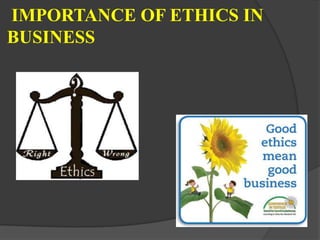
IMPORTANCE OF ETHICS IN
BUSINESS
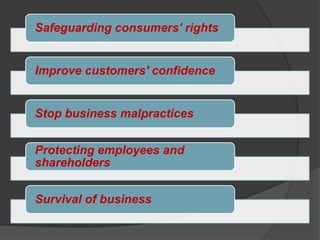
Safeguarding consumers' rights


Improve customers' confidence


Stop business malpractices


Protecting employees and
shareholders


Survival of business
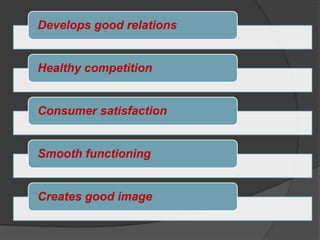
Develops good relations


Healthy competition


Consumer satisfaction


Smooth functioning


Creates good image
WHAT IS ETHICAL BEHAVIOUR?
    One way of dealing with ethical dilemmas is by
     using the four way test to evaluate decisions. This
     test involves asking four questions :
1.   Is my decision a truthful one?
2.   Is my decision fair to everyone affected?
3.   Will it build goodwill for the organization?
4.   Is the decision beneficial to all parties who have avested
     interest in the outcome?
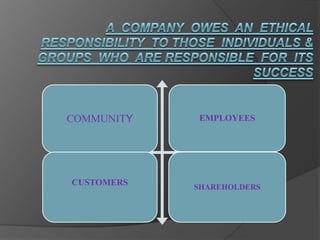
COMMUNITY   EMPLOYEES


CUSTOMERS   SHAREHOLDERS
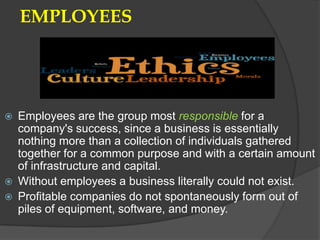
EMPLOYEES


   Employees are the group most responsible for a
    company's success, since a business is essentially
    nothing more than a collection of individuals gathered
    together for a common purpose and with a certain amount
    of infrastructure and capital.
   Without employees a business literally could not exist.
   Profitable companies do not spontaneously form out of
    piles of equipment, software, and money.
ETHICAL OBLIGATIONS OF AN
EMPLOYEE
 Ethics, or moral obligation, guide human
  decisions in many arenas, including within the
  workplace.
 When an individual is acting as an employee,
  there are certain ethical obligations he has
  towards his employer that should guide his
  decision making and impact his actions.
EMPLOYEE RIGHTS IN THE
 WORKPLACE
1.   Right to be free from discrimination: based on
     age, gender, race, national origin, or religion.
2.   Employees have a right to privacy in the workplace:
    This right to privacy applies to the employee's personal
     possessions, including handbags or briefcases, storage
     lockers accessible only by the employee, and private mail
     addressed only to employee.
    However, employees have very limited rights to privacy in
     their e-mail messages and Internet usage while using the
     employer's computer system.
FUNDAMENTAL EMPLOYEE
RIGHTS.
 Employees have the right to affiliate with or
  become a member of a recognized labor union or
  employee organization.
 Employees have the right to work in a safe
  environment.
 Employees have the right to file legal complaints
  against their employer without being punished
  in any way by their employer.
RIGHTS AND RESPONSIBILITIES
   Employers expect employees to:
    • meet the terms of their contracts;
    • co-operate in meeting the objectives of the
    business;
    • follow health and safety regulations.

   Employees expect to be:
    • paid according to their contract;
    • provided with a safe working environment;
    • appropriately trained;
    • permitted to join trade unions or staff associations;
    • allowed access to any confidential computer
    records kept on them as employees.
THE RELATIONSHIP BETWEEN
EMPLOYERS AND EMPLOYEES
   Much of the employer/employee relationship now
    consists of them working together. In 1978 in the UK
    the Advisory, Conciliation and Arbitration Service
    (ACAS) was set up to try and create good and
    harmonious working relationships.
   For employer/employee relationships to be successful there
    has to be a balance of interests:
   the employer wants to plan for the future of the
    business, make profits and keep employees motivated;
   the employee wants the best possible conditions and
    living standards.
 So if you think you can run your business
  without being ethical towards your employees
  then you are completely wrong.
 There is a small line between being ethical and
  unethical.
 Employers and entrepreneur need to be aware
  from the fact that if they would fail to
  comprehend the needs of employees or the
  society then they are really running a blind race
  without weapons.
CONCLUSION
 Ethics are important not only in business but in
  all aspects of life because it is an essential part of
  the foundation on which of a civilized society is
  build.
 Companies owe an ethical responsibility to
  employees only insofar as the employees
  contribute to the success of the company.
 It is not unethical to fire an underperforming
  employee.
 It is also important to keep in mind that
  changing industry or economic conditions may
  force a company to do things (like lay people
  off) which hurt employees, but are necessary to
  the survival of the business.
THANKS

Business ethics

  • 1.
    BUSINESS ETHICS  Ethicsis a set of rules that define right and wrong conduct.  Business ethics can be defined as written and unwritten codes of principles and values that govern decisions and actions within a company.  In the business world, the organizations culture sets standards for determining the difference between good and bad decision making and behavior.
  • 2.
  • 3.
    Safeguarding consumers' rights Improvecustomers' confidence Stop business malpractices Protecting employees and shareholders Survival of business
  • 4.
    Develops good relations Healthycompetition Consumer satisfaction Smooth functioning Creates good image
  • 5.
    WHAT IS ETHICALBEHAVIOUR?  One way of dealing with ethical dilemmas is by using the four way test to evaluate decisions. This test involves asking four questions : 1. Is my decision a truthful one? 2. Is my decision fair to everyone affected? 3. Will it build goodwill for the organization? 4. Is the decision beneficial to all parties who have avested interest in the outcome?
  • 6.
    COMMUNITY EMPLOYEES CUSTOMERS SHAREHOLDERS
  • 7.
    EMPLOYEES  Employees are the group most responsible for a company's success, since a business is essentially nothing more than a collection of individuals gathered together for a common purpose and with a certain amount of infrastructure and capital.  Without employees a business literally could not exist.  Profitable companies do not spontaneously form out of piles of equipment, software, and money.
  • 8.
    ETHICAL OBLIGATIONS OFAN EMPLOYEE  Ethics, or moral obligation, guide human decisions in many arenas, including within the workplace.  When an individual is acting as an employee, there are certain ethical obligations he has towards his employer that should guide his decision making and impact his actions.
  • 9.
    EMPLOYEE RIGHTS INTHE WORKPLACE 1. Right to be free from discrimination: based on age, gender, race, national origin, or religion. 2. Employees have a right to privacy in the workplace:  This right to privacy applies to the employee's personal possessions, including handbags or briefcases, storage lockers accessible only by the employee, and private mail addressed only to employee.  However, employees have very limited rights to privacy in their e-mail messages and Internet usage while using the employer's computer system.
  • 10.
    FUNDAMENTAL EMPLOYEE RIGHTS.  Employeeshave the right to affiliate with or become a member of a recognized labor union or employee organization.  Employees have the right to work in a safe environment.  Employees have the right to file legal complaints against their employer without being punished in any way by their employer.
  • 11.
    RIGHTS AND RESPONSIBILITIES  Employers expect employees to: • meet the terms of their contracts; • co-operate in meeting the objectives of the business; • follow health and safety regulations.  Employees expect to be: • paid according to their contract; • provided with a safe working environment; • appropriately trained; • permitted to join trade unions or staff associations; • allowed access to any confidential computer records kept on them as employees.
  • 12.
    THE RELATIONSHIP BETWEEN EMPLOYERSAND EMPLOYEES  Much of the employer/employee relationship now consists of them working together. In 1978 in the UK the Advisory, Conciliation and Arbitration Service (ACAS) was set up to try and create good and harmonious working relationships.  For employer/employee relationships to be successful there has to be a balance of interests:  the employer wants to plan for the future of the business, make profits and keep employees motivated;  the employee wants the best possible conditions and living standards.
  • 13.
     So ifyou think you can run your business without being ethical towards your employees then you are completely wrong.  There is a small line between being ethical and unethical.  Employers and entrepreneur need to be aware from the fact that if they would fail to comprehend the needs of employees or the society then they are really running a blind race without weapons.
  • 14.
    CONCLUSION  Ethics areimportant not only in business but in all aspects of life because it is an essential part of the foundation on which of a civilized society is build.  Companies owe an ethical responsibility to employees only insofar as the employees contribute to the success of the company.  It is not unethical to fire an underperforming employee.  It is also important to keep in mind that changing industry or economic conditions may force a company to do things (like lay people off) which hurt employees, but are necessary to the survival of the business.
  • 15.