FUTURE TRENDS IN LIS
Wahid Ullah
M.Phil Research Scholar
University of Peshawar
Sarhadiwahid222@gmail.com
WHAT IS TREND?
• A trend is what's hip or popular at a certain point in
time.
• Trend is defined as to go in a general direction or to
have a tendency to go in a certain way.
• A trend is a general direction into which something is
changing, developing, or veering toward.
Wahid Ullah M.Phil Research Scholar at UOP 2
.
• A general direction in which a situation is changing or
developing. social/economic/political/demographic
(statistical characteristics of human population) trends.
fashion/market trends.
Wahid Ullah M.Phil Research Scholar at UOP 3
FUTURE TRENDS IN LIS
• Information technology (IT) is plying vital role for
developing the libraries and information centers.
• Technology has reshaped the manner with which
information is accessed , retrieved ,utilized , and
managed for educational purposes.
Wahid Ullah M.Phil Research Scholar at UOP 4
.
Technology provides a tool for the delivery of library
service.
Technology also shapes and limits how service can
delivered.
The effective library building supports changing services
patterns ,changing modes of services delivery and
changing technological supports
Wahid Ullah M.Phil Research Scholar at UOP 5
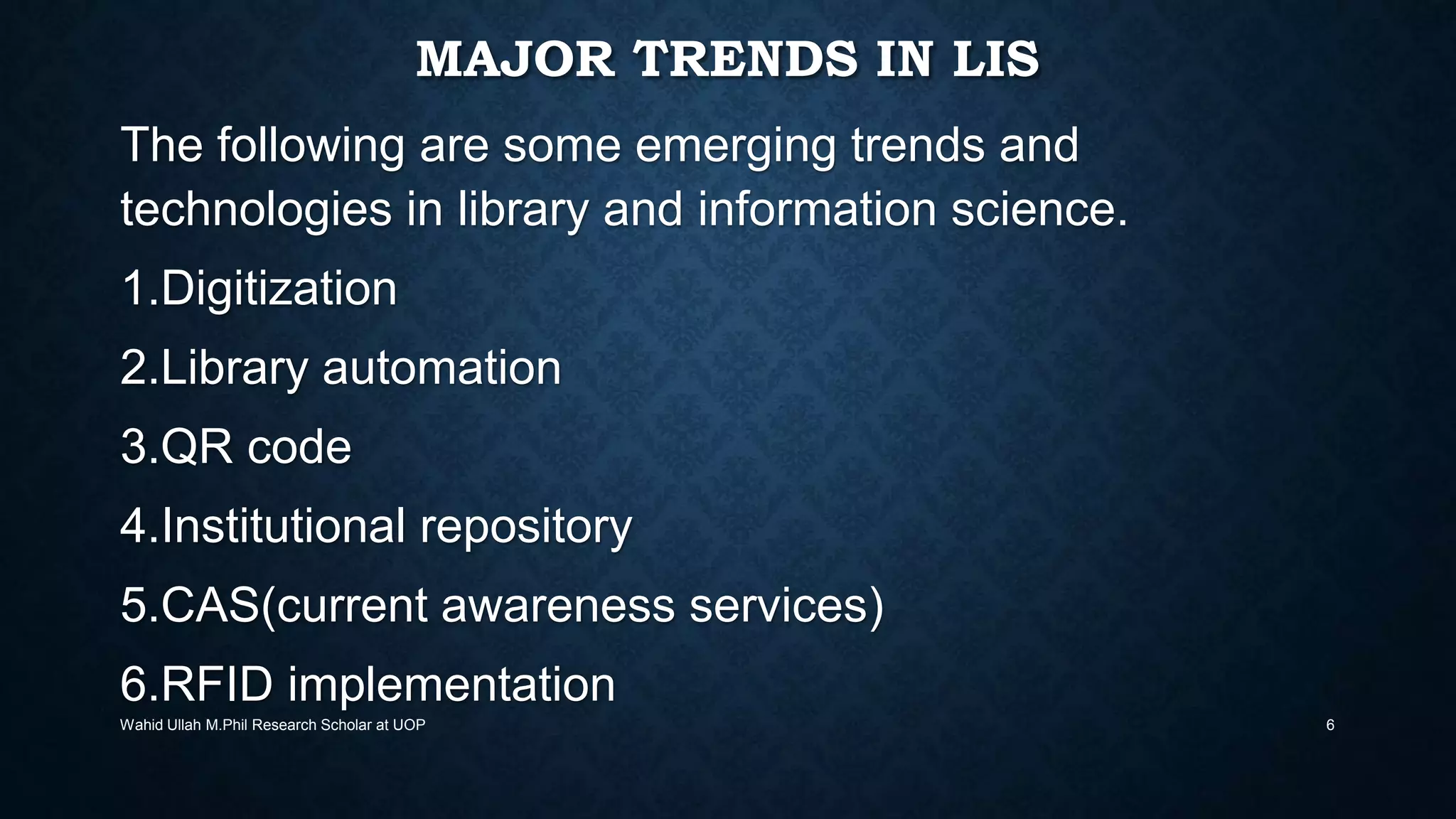
MAJOR TRENDS IN LIS
The following are some emerging trends and
technologies in library and information science.
1.Digitization
2.Library automation
3.QR code
4.Institutional repository
5.CAS(current awareness services)
6.RFID implementation
Wahid Ullah M.Phil Research Scholar at UOP 6
.
7.SDI (selective dissemination of information)
8.Green library concept
Wahid Ullah M.Phil Research Scholar at UOP 7
1. DIGITIZATION
• The conversion of text , pictures, or sound into digital
form that can be processed by computer.
• Digitization is a process in which materials are
converted from the hard copies to electronic copies.
The major purposes of digitalization are: to enhance
access and improve preservation of library materials.
Wahid Ullah M.Phil Research Scholar at UOP 8
.
Wahid Ullah M.Phil Research Scholar at UOP 9
LIBRARY AUTOMATION
• Library automation is the conversion of
a library's procedures from manual to computerized,
such as from a card catalog to an OPAC, or from
manual circulation cards to an
integrated library system. Automation is a process of
using machinery for easily working and saving human
power and time
Wahid Ullah M.Phil Research Scholar at UOP 10
Wahid Ullah M.Phil Research Scholar at UOP 11
.
Wahid Ullah M.Phil Research Scholar at UOP
12
QR CODE
• A QR code (quick response code) is a type of matrix
barcode invented in 1994 by the Japanese automotive
company( Denso Wave). A barcode is a machine-
readable optical label that contains information about
the item to which it is attached.
Wahid Ullah M.Phil Research Scholar at UOP 13
.
• It is use by libraries for the purpose of promoting
there services and for providing quickly access
to there resources/documents.
Wahid Ullah M.Phil Research Scholar at UOP 14
.
Wahid Ullah M.Phil Research Scholar at UOP 15
INSTITUTIONAL REPOSITORY
• An institutional repository is an archive for collecting,
preserving, and disseminating digital copies of the
intellectual output of an institution, particularly a
research institution.
Wahid Ullah M.Phil Research Scholar at UOP 16
.
• This includes materials such as research journals
articles, peer reviews ,and digital versions of theses
and dissertation.
Wahid Ullah M.Phil Research Scholar at UOP 17
CURRENT AWARENESS SERVICE
• The purpose of a current-awareness service is to
inform the users about new acquisitions in
their libraries. Public libraries in particular have used
display boards and shelves to draw attention to recent
additions, and many libraries produce complete or
selective lists for circulation.
Wahid Ullah M.Phil Research Scholar at UOP 18
RFID IMPLMENTATION
RFID (radio frequency identification) is a form of wireless
communication .
It comprise of two components .
1.Tages(microchip)
2.Readers(radio frequency technology)
Wahid Ullah M.Phil Research Scholar at UOP 19
.
The readers has a device that has one or more
antennas that emit radio waves and receive signals
back from RFID tag. the information contained on
microchip is fixed to library materials.
examples are RFID gate at library exit.
Wahid Ullah M.Phil Research Scholar at UOP 20
.
Wahid Ullah M.Phil Research Scholar at UOP 21
SELECTIVE DISSEMINATION OF
INFORMATION
SDI refers to tools and resources used to keep a user
informed of new resources on specified topics, including
the current-awareness services used to inform about
new library acquisitions.
Wahid Ullah M.Phil Research Scholar at UOP 22
Wahid Ullah M.Phil Research Scholar at UOP
23
GREEN LIBRARY CONCEPT
Green Libraries are “designed to minimize negative
impact on the natural environment and maximize indoor
environmental quality by means of careful site selection,
use of natural construction materials and biodegradable
products, conservation of resources (water, energy,
paper), and waste disposal (recycling, etc.)”
Wahid Ullah M.Phil Research Scholar at UOP 24
.
Wahid Ullah M.Phil Research Scholar at UOP 25
Wahid Ullah M.Phil Research Scholar at UOP 26
THANKS
27

Future trends in Lis.pptx

  • 1.
    FUTURE TRENDS INLIS Wahid Ullah M.Phil Research Scholar University of Peshawar Sarhadiwahid222@gmail.com
  • 2.
    WHAT IS TREND? •A trend is what's hip or popular at a certain point in time. • Trend is defined as to go in a general direction or to have a tendency to go in a certain way. • A trend is a general direction into which something is changing, developing, or veering toward. Wahid Ullah M.Phil Research Scholar at UOP 2
  • 3.
    . • A generaldirection in which a situation is changing or developing. social/economic/political/demographic (statistical characteristics of human population) trends. fashion/market trends. Wahid Ullah M.Phil Research Scholar at UOP 3
  • 4.
    FUTURE TRENDS INLIS • Information technology (IT) is plying vital role for developing the libraries and information centers. • Technology has reshaped the manner with which information is accessed , retrieved ,utilized , and managed for educational purposes. Wahid Ullah M.Phil Research Scholar at UOP 4
  • 5.
    . Technology provides atool for the delivery of library service. Technology also shapes and limits how service can delivered. The effective library building supports changing services patterns ,changing modes of services delivery and changing technological supports Wahid Ullah M.Phil Research Scholar at UOP 5
  • 6.
    MAJOR TRENDS INLIS The following are some emerging trends and technologies in library and information science. 1.Digitization 2.Library automation 3.QR code 4.Institutional repository 5.CAS(current awareness services) 6.RFID implementation Wahid Ullah M.Phil Research Scholar at UOP 6
  • 7.
    . 7.SDI (selective disseminationof information) 8.Green library concept Wahid Ullah M.Phil Research Scholar at UOP 7
  • 8.
    1. DIGITIZATION • Theconversion of text , pictures, or sound into digital form that can be processed by computer. • Digitization is a process in which materials are converted from the hard copies to electronic copies. The major purposes of digitalization are: to enhance access and improve preservation of library materials. Wahid Ullah M.Phil Research Scholar at UOP 8
  • 9.
    . Wahid Ullah M.PhilResearch Scholar at UOP 9
  • 10.
    LIBRARY AUTOMATION • Libraryautomation is the conversion of a library's procedures from manual to computerized, such as from a card catalog to an OPAC, or from manual circulation cards to an integrated library system. Automation is a process of using machinery for easily working and saving human power and time Wahid Ullah M.Phil Research Scholar at UOP 10
  • 11.
    Wahid Ullah M.PhilResearch Scholar at UOP 11
  • 12.
    . Wahid Ullah M.PhilResearch Scholar at UOP 12
  • 13.
    QR CODE • AQR code (quick response code) is a type of matrix barcode invented in 1994 by the Japanese automotive company( Denso Wave). A barcode is a machine- readable optical label that contains information about the item to which it is attached. Wahid Ullah M.Phil Research Scholar at UOP 13
  • 14.
    . • It isuse by libraries for the purpose of promoting there services and for providing quickly access to there resources/documents. Wahid Ullah M.Phil Research Scholar at UOP 14
  • 15.
    . Wahid Ullah M.PhilResearch Scholar at UOP 15
  • 16.
    INSTITUTIONAL REPOSITORY • Aninstitutional repository is an archive for collecting, preserving, and disseminating digital copies of the intellectual output of an institution, particularly a research institution. Wahid Ullah M.Phil Research Scholar at UOP 16
  • 17.
    . • This includesmaterials such as research journals articles, peer reviews ,and digital versions of theses and dissertation. Wahid Ullah M.Phil Research Scholar at UOP 17
  • 18.
    CURRENT AWARENESS SERVICE •The purpose of a current-awareness service is to inform the users about new acquisitions in their libraries. Public libraries in particular have used display boards and shelves to draw attention to recent additions, and many libraries produce complete or selective lists for circulation. Wahid Ullah M.Phil Research Scholar at UOP 18
  • 19.
    RFID IMPLMENTATION RFID (radiofrequency identification) is a form of wireless communication . It comprise of two components . 1.Tages(microchip) 2.Readers(radio frequency technology) Wahid Ullah M.Phil Research Scholar at UOP 19
  • 20.
    . The readers hasa device that has one or more antennas that emit radio waves and receive signals back from RFID tag. the information contained on microchip is fixed to library materials. examples are RFID gate at library exit. Wahid Ullah M.Phil Research Scholar at UOP 20
  • 21.
    . Wahid Ullah M.PhilResearch Scholar at UOP 21
  • 22.
    SELECTIVE DISSEMINATION OF INFORMATION SDIrefers to tools and resources used to keep a user informed of new resources on specified topics, including the current-awareness services used to inform about new library acquisitions. Wahid Ullah M.Phil Research Scholar at UOP 22
  • 23.
    Wahid Ullah M.PhilResearch Scholar at UOP 23
  • 24.
    GREEN LIBRARY CONCEPT GreenLibraries are “designed to minimize negative impact on the natural environment and maximize indoor environmental quality by means of careful site selection, use of natural construction materials and biodegradable products, conservation of resources (water, energy, paper), and waste disposal (recycling, etc.)” Wahid Ullah M.Phil Research Scholar at UOP 24
  • 25.
    . Wahid Ullah M.PhilResearch Scholar at UOP 25
  • 26.
    Wahid Ullah M.PhilResearch Scholar at UOP 26
  • 27.