1 
PREPARED BY: MIROLA AFROZE 
Scientific Officer 
Designated Reference Institute for Chemical 
Measurements (DRICM), BCSIR, Dhaka 
Batch: PGDIM-2014
INTRODUCTION 
Before the Industrial Revolution, people worked 
with hand tools, manufacturing articles in their own 
homes or in small shops. In the third quarter of the 
18th century steam power was applied to machinery, 
and people and machines were brought together 
under one roof in factories, where the manufacturing 
process could be supervised. This was the beginning 
of shop management. In the next hundred years 
factories grew rapidly in size, in degree of 
mechanization, and in complexity of operation. The 
growth, however, was accompanied by much waste 
and inefficiency. In the United States many 
engineers, spurred by the increased competition of 
the post–Civil War era, began to seek ways of 
improving plant efficiency. 
2
INDUSTRIAL MANAGEMENT 
Industrial management is the performance of the 
task of designing, predicting the results of, 
providing the resources for, and controlling an 
integrated human- group activity, the related 
physical facilities, and the interrelationships 
between these two when the activity concerns 
the creation and distribution of goods or 
services to meet an external objective. 
3
Industrial Management deals with the 
development, improvement, implementation and 
evaluation of integrated systems of people, 
money, knowledge, information, equipment, 
energy, materials and/or processes. It also deals 
with designing new product prototypes more 
efficiently. It incorporates the principle and 
methods of engineering analysis and synthesis 
with the mathematical, physical and social 
sciences together to specify, predict, and 
evaluate the results of systems or processes. 
4
CONCEPT OF INDUSTRIAL MANAGEMENT 
Industrial management term applied to 
highly organize modern methods of carrying 
on industrial, especially manufacturing and 
operations. Industrial management is a 
process of planning, organizing, directing, 
controlling and managing the activities of 
any industry. It combines and transforms 
various resources used in the system and 
subsystem of the organization into value 
added product in a controlled manner. 
Industrial management includes following 
for the effective management. 
5
Industrial Engineering and Management 
aims to uncover and solve organizational 
issues by attempting to establish a desirable 
allocation of management resources through 
the use of technologies. In an area where 
reactions to continuous changes are needed, 
the field of Industrial Engineering and 
Management utilizes “technology on 
technology”, including a variety of 
management technologies and history and 
philosophy of science and technology. 
6
EVOLUTION OF INDDUSTRIAL MANAGEEMENT 
Industrial management has been recognized 
as an important factor in country’s 
economic growth from last two centuries. 
The industrial management began in 
eighteenth century when 
Adam Smith recognizes the economis 
benefits of specialization of labor. 
He recommended breaking of jobs down into 
subtasks and recognizes workers to specialized 
tasks in which they would become highly 
skilled and efficient. In the early twentieth 
century, F.W. Taylor implemented Smith’s 
theories and developed scientific management. 
7
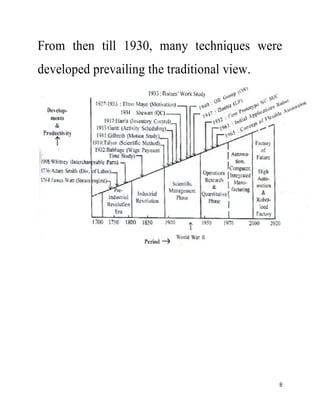
From then till 1930, many techniques were 
developed prevailing the traditional view. 
8
SCOPE OF INDUSTRIAL MANAGEMENT 
As far as the scope of industrial 
management is concerned it is applicable in 
all segments of industry as well as in daily 
life. As in daily life, we plan our activities; 
we coordinate available resources and 
control our activities to achieve certain goals 
in the most economic way. In the same way 
any organization must follow the Principles 
of Management for its survival and growth 
and to be economically viable. These 
management principles are applicable to all 
activities in industry also. 
9
Reading and learning Industrial Management 
will enable one to be capable of solving the 
problems of the organization, may be in a 
Production Shop, Hospital, Departmental 
shop, an Educational Institution or even a 
coffee shop. The problems a manager faces in 
various organizations are more or less similar 
to that of Production department but smaller 
in magnitude. Hence the knowledge of 
Industrial Management will help anybody 
managing business activities, tackle the 
problems encountered. Principles of 
management are helpful in achieving these 
objectives most efficiently and economically. 
10
Similarly, these principles are equally 
applicable to the service providing 
organizations so that these are able to 
provide best of services at minimal cost, 
most effectively and efficiently. Scope of 
Industrial Management encompasses all 
industrial and human activities. 
11
APPLICATION OF INDUSTRIAL MANAGEMENT 
Applications of industrial management are 
summarized in the following departments of 
industry: 
1.Managing and arranging the location of 
facilities 
2.Design of Plant layouts 
3.Management of material handling systems 
4.Supply chain management. 
5.Production and Planning control 
6.Quality control & Total quality management 
7.Inventory & Materials management 
8.Maintenance management 
9.Operations management 
10. Labor management 
12
BENEFITS DERIVED FROM EFFICIENT 
INDUSTRIAL MANAGEMENT 
The efficient Industrial Management will give 
benefits to the various sections of the society. 
They are: 
(i) Consumer benefits from improved 
industrial Productivity, increased use value 
in the product. Products are available to 
him at right place, at right price, at right 
time, in desired quantity and of desired 
quality. 
(ii) Investors: They get increased security for 
their investments, adequate market returns, 
and creditability and good image in the 
society. 
13
(iii) Employee gets adequate Wages, Job 
security, improved working conditions 
and increased Personal and Job 
satisfaction. 
(iv) Suppliers will get confidence in 
management and their bills can be 
realized without any delay. 
(v) Community: community enjoys 
Benefits from economic and social 
stability. 
(vi) The Nation will achieve prospects 
and security because of increased 
Productivity and healthy industrial 
atmosphere. 
14
CONCLUSION 
The industrial management modes of 
thinking will be valuable in the challenging 
strategy and positioning work of the 
organizations of the future and in creating 
optimal conditions for success. A 
perspective built on systems thinking is 
ideally suited for the type of planning and 
analysis required as organizations work to 
enhance positioning and strategy and 
creating positive internal conditions in the 
ever changing markets. 
15

Industrial management by mirola

  • 1.
    1 PREPARED BY:MIROLA AFROZE Scientific Officer Designated Reference Institute for Chemical Measurements (DRICM), BCSIR, Dhaka Batch: PGDIM-2014
  • 2.
    INTRODUCTION Before theIndustrial Revolution, people worked with hand tools, manufacturing articles in their own homes or in small shops. In the third quarter of the 18th century steam power was applied to machinery, and people and machines were brought together under one roof in factories, where the manufacturing process could be supervised. This was the beginning of shop management. In the next hundred years factories grew rapidly in size, in degree of mechanization, and in complexity of operation. The growth, however, was accompanied by much waste and inefficiency. In the United States many engineers, spurred by the increased competition of the post–Civil War era, began to seek ways of improving plant efficiency. 2
  • 3.
    INDUSTRIAL MANAGEMENT Industrialmanagement is the performance of the task of designing, predicting the results of, providing the resources for, and controlling an integrated human- group activity, the related physical facilities, and the interrelationships between these two when the activity concerns the creation and distribution of goods or services to meet an external objective. 3
  • 4.
    Industrial Management dealswith the development, improvement, implementation and evaluation of integrated systems of people, money, knowledge, information, equipment, energy, materials and/or processes. It also deals with designing new product prototypes more efficiently. It incorporates the principle and methods of engineering analysis and synthesis with the mathematical, physical and social sciences together to specify, predict, and evaluate the results of systems or processes. 4
  • 5.
    CONCEPT OF INDUSTRIALMANAGEMENT Industrial management term applied to highly organize modern methods of carrying on industrial, especially manufacturing and operations. Industrial management is a process of planning, organizing, directing, controlling and managing the activities of any industry. It combines and transforms various resources used in the system and subsystem of the organization into value added product in a controlled manner. Industrial management includes following for the effective management. 5
  • 6.
    Industrial Engineering andManagement aims to uncover and solve organizational issues by attempting to establish a desirable allocation of management resources through the use of technologies. In an area where reactions to continuous changes are needed, the field of Industrial Engineering and Management utilizes “technology on technology”, including a variety of management technologies and history and philosophy of science and technology. 6
  • 7.
    EVOLUTION OF INDDUSTRIALMANAGEEMENT Industrial management has been recognized as an important factor in country’s economic growth from last two centuries. The industrial management began in eighteenth century when Adam Smith recognizes the economis benefits of specialization of labor. He recommended breaking of jobs down into subtasks and recognizes workers to specialized tasks in which they would become highly skilled and efficient. In the early twentieth century, F.W. Taylor implemented Smith’s theories and developed scientific management. 7
  • 8.
    From then till1930, many techniques were developed prevailing the traditional view. 8
  • 9.
    SCOPE OF INDUSTRIALMANAGEMENT As far as the scope of industrial management is concerned it is applicable in all segments of industry as well as in daily life. As in daily life, we plan our activities; we coordinate available resources and control our activities to achieve certain goals in the most economic way. In the same way any organization must follow the Principles of Management for its survival and growth and to be economically viable. These management principles are applicable to all activities in industry also. 9
  • 10.
    Reading and learningIndustrial Management will enable one to be capable of solving the problems of the organization, may be in a Production Shop, Hospital, Departmental shop, an Educational Institution or even a coffee shop. The problems a manager faces in various organizations are more or less similar to that of Production department but smaller in magnitude. Hence the knowledge of Industrial Management will help anybody managing business activities, tackle the problems encountered. Principles of management are helpful in achieving these objectives most efficiently and economically. 10
  • 11.
    Similarly, these principlesare equally applicable to the service providing organizations so that these are able to provide best of services at minimal cost, most effectively and efficiently. Scope of Industrial Management encompasses all industrial and human activities. 11
  • 12.
    APPLICATION OF INDUSTRIALMANAGEMENT Applications of industrial management are summarized in the following departments of industry: 1.Managing and arranging the location of facilities 2.Design of Plant layouts 3.Management of material handling systems 4.Supply chain management. 5.Production and Planning control 6.Quality control & Total quality management 7.Inventory & Materials management 8.Maintenance management 9.Operations management 10. Labor management 12
  • 13.
    BENEFITS DERIVED FROMEFFICIENT INDUSTRIAL MANAGEMENT The efficient Industrial Management will give benefits to the various sections of the society. They are: (i) Consumer benefits from improved industrial Productivity, increased use value in the product. Products are available to him at right place, at right price, at right time, in desired quantity and of desired quality. (ii) Investors: They get increased security for their investments, adequate market returns, and creditability and good image in the society. 13
  • 14.
    (iii) Employee getsadequate Wages, Job security, improved working conditions and increased Personal and Job satisfaction. (iv) Suppliers will get confidence in management and their bills can be realized without any delay. (v) Community: community enjoys Benefits from economic and social stability. (vi) The Nation will achieve prospects and security because of increased Productivity and healthy industrial atmosphere. 14
  • 15.
    CONCLUSION The industrialmanagement modes of thinking will be valuable in the challenging strategy and positioning work of the organizations of the future and in creating optimal conditions for success. A perspective built on systems thinking is ideally suited for the type of planning and analysis required as organizations work to enhance positioning and strategy and creating positive internal conditions in the ever changing markets. 15