INDONESIAN
THEATER
SHADOW PUPPET is a
well-known Indonesian
Theater popular not only in
their own country but
spread in several countries
around the world.
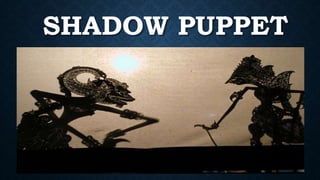
SHADOW PUPPET
WAYANG KULIT
WAYANG KULIT in Central Java is one of
the oldest continuous traditions of
storytelling in the world which includes the
use of puppet materials and background
musical accompaniment to make it
interesting audience.
WAYANG is an
Indonesian and Malay
word for “Theater”.
Puppet itself is called
wayang.
KULIT means skin and refers
to the leather construction of
the puppets that are carefully
cut into fine tools and
supported with carefully
shaped buffalo horn handles
THE
PERFORMANCE
•Audience is the most important person in Wayang
Kulit performance.
•The Dalang prepares all the materials used like cloth
and the light for shadow.
•The puppet on the right side signifies good character.
On the left side signifies the bad.
•The open space between them about 2 meters
represents the stage.
THE DALANG
• The puppeteer
• Characterized by his being creative, humorous, and
flexible.
• He manipulates the puppets, sings, and taps out the
signals to the orchestra.
• He speaks the parts of all the characters.
• The use of voice interchangeably is the main ability
of a dalang to give more life to a different character.
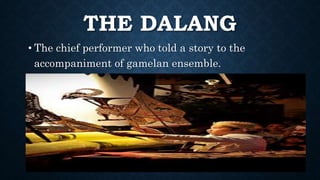
THE DALANG
• The chief performer who told a story to the
accompaniment of gamelan ensemble.
•WAYANG KULIT was performed
in royal court and widely
performed in public on religious
occasions so that knowledge of
wayang became widespread among
classes in JAVA.
THE MUSIC OF GAMELAN
•A Gamelan ensemble is compromised
mainly by bronze percussion
instruments augmented by other
percussion intruments, string, and a
flute.
JAVANESE GAMELAN
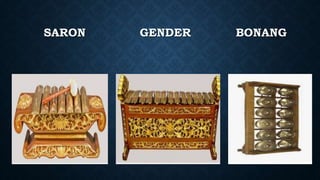
•SARON – Xylophone of heavy bronze
bars
•GENDER – bronze xylophone with
resonance chambers beneath
•BONANG – set of bronze bowls
SARON GENDER BONANG
JAVANESE GAMELAN
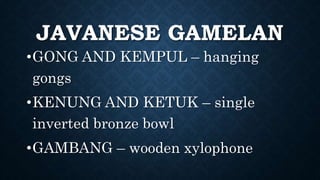
•GONG AND KEMPUL – hanging
gongs
•KENUNG AND KETUK – single
inverted bronze bowl
•GAMBANG – wooden xylophone
GONG & KEMPUL GAMBANG
KENONG & KETUNG
JAVANESE GAMELAN
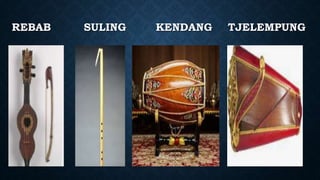
•REBAB– Two-stringed fiddle
•SULING– flute
•KENDANG– horizontal drum beat
with the fingers on both ends.
•TJELEMPUNG – a zither of thirteen
double strings.
REBAB SULING KENDANG TJELEMPUNG
SULUK
• The dalang sings the mood songs (Suluk) at
regular intervals during the performance
• Suluk are never accompanied by the full
gamelan ensemble.
• Often a single instrument accompanies the
singer, never more than three or four.
WAYANG KULIT

Indonesian theater.pptx

  • 1.
  • 2.
    SHADOW PUPPET isa well-known Indonesian Theater popular not only in their own country but spread in several countries around the world.
  • 3.
  • 4.
    WAYANG KULIT WAYANG KULITin Central Java is one of the oldest continuous traditions of storytelling in the world which includes the use of puppet materials and background musical accompaniment to make it interesting audience.
  • 5.
    WAYANG is an Indonesianand Malay word for “Theater”. Puppet itself is called wayang.
  • 6.
    KULIT means skinand refers to the leather construction of the puppets that are carefully cut into fine tools and supported with carefully shaped buffalo horn handles
  • 7.
  • 8.
    •Audience is themost important person in Wayang Kulit performance. •The Dalang prepares all the materials used like cloth and the light for shadow. •The puppet on the right side signifies good character. On the left side signifies the bad. •The open space between them about 2 meters represents the stage.
  • 9.
    THE DALANG • Thepuppeteer • Characterized by his being creative, humorous, and flexible. • He manipulates the puppets, sings, and taps out the signals to the orchestra. • He speaks the parts of all the characters. • The use of voice interchangeably is the main ability of a dalang to give more life to a different character.
  • 10.
    THE DALANG • Thechief performer who told a story to the accompaniment of gamelan ensemble.
  • 11.
    •WAYANG KULIT wasperformed in royal court and widely performed in public on religious occasions so that knowledge of wayang became widespread among classes in JAVA.
  • 12.
    THE MUSIC OFGAMELAN •A Gamelan ensemble is compromised mainly by bronze percussion instruments augmented by other percussion intruments, string, and a flute.
  • 13.
    JAVANESE GAMELAN •SARON –Xylophone of heavy bronze bars •GENDER – bronze xylophone with resonance chambers beneath •BONANG – set of bronze bowls
  • 14.
  • 15.
    JAVANESE GAMELAN •GONG ANDKEMPUL – hanging gongs •KENUNG AND KETUK – single inverted bronze bowl •GAMBANG – wooden xylophone
  • 16.
    GONG & KEMPULGAMBANG KENONG & KETUNG
  • 17.
    JAVANESE GAMELAN •REBAB– Two-stringedfiddle •SULING– flute •KENDANG– horizontal drum beat with the fingers on both ends. •TJELEMPUNG – a zither of thirteen double strings.
  • 18.
  • 19.
    SULUK • The dalangsings the mood songs (Suluk) at regular intervals during the performance • Suluk are never accompanied by the full gamelan ensemble. • Often a single instrument accompanies the singer, never more than three or four.
  • 20.