MUSIC OF
SOUTH, CENTRAL AND
WEST ASIA
INSTRUMENTAL MUSIC
OF INDIA
1. Ghan – described as a non-
membranous percussive
instrument but with solid
resonators. It is one of the oldest
classes of instrument in India. It
may also be a melodic instrument
or instruments to keep tal.
CLASSIFICATION OF INSTRUMENTS IN
INDIA
GHATAM AND KARTA
MANJIRA AND NOUT
2. Avanaddh - described as
a membranous percussive
instrument. This class of
instruments typically
comprise the drums.
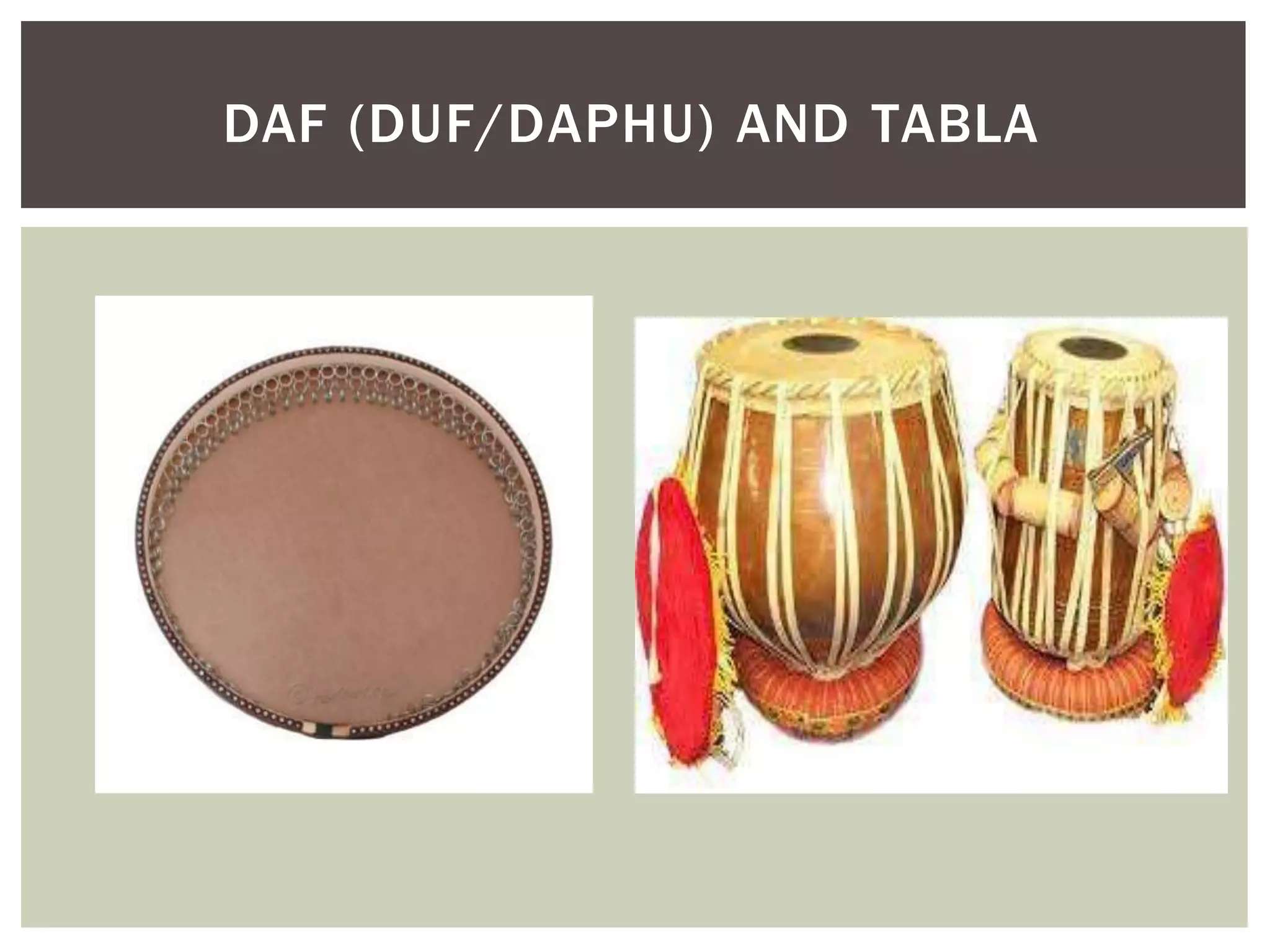
DAF (DUF/DAPHU) AND TABLA
DHOL
3. Sushir – also known as
blown air. It is
characterized by the use
of air to excite the various
resonators.
SHEHNAI AND SHANKH
SURPETI
4. Tat – referred to as
vina during the old
civilization. Instruments
in this class are plucked
(stringed instruments).
SITAR AND EKTAR
GOTUVADYAM
GOPICHAND AND RABAB
5. Vitat – described as bowed
stringed instruments. This is of
the oldest classifications of
instruments and yet did not
occupy a place in classical
Indian music until the last few
centuries.
BANAM AND ESRAJ
SARANGI AND CHIKARA
◾occupies an important position in the
Indian system of music
◾literally meaning „clap;‟variously
transliterated as “tal”, “taal” or “taala”
◾is a regular, repeating rhythmic
phrase, particularly as rendered on a
percussive instrument with an ebb and flow of
various intonations represented as a ''theka''
◾is the common Indian system of rhythm
TALA
◾Theka - a sequence of drum-syllables or
''bol''
- in Indian classical music, both
Hindustani classical music and Carnatic music
use complex rules to create elaborate patterns
of rhythm
◾Tabla - most common instrument for keeping
rhythm in Hindustani music
◾Mridangam - most common instrument
for keeping rhythm in Carnatic music
- also transliterated as “mridang”
TALA (CONTINUATION)
◾Khyal
◾Temple Music
◾Unified
◾Northern
◾Krti
◾Southern
◾Nasal Singing
◾Lyrical
◾Persian
Influence
◾Imagination
CARNAT
IC
MUSIC
HINDUSTA
NI
MUSIC
ACTIVITY: WHICH IS WHICH?
1. 2.
ACTIVITY: NAME IT!
3. 4.
5. 6.
7. 8.
9. 10.
MUSIC OF PAKISTAN
◾Though Pakistan is part of South Asia, its
western part is considered as an extension of
Central Asia.
◾Pakistan is known for its unique vocals.
◾The distinctive Pakistani sound was formed
with multiple influences not only from various
parts of South Asia but it also includes diverse
elements from Central
Asia, Persia, Turkey, and the Arab world.
PAKISTAN
1. Ghazal
◾traditional expressions of love,
separation, and loneliness; It
tells about both the pain of loss
of the lover and the beauty of
love in spite of that pain.
◾its structural requirements are
more strict than those of most
poetic forms traditionally
written in English
◾is considered by many to be
one of the principal poetic
forms in the Persian civilization
◾can be sung by both men
and women
VOCAL
MUSIC OF
PAKISTAN
TWO
VOCAL
STYLE
S IN
SINGING
◾2. Qawwali
◾the devotional music of
the Chishti Order
◾a vibrant musical
tradition that stretches
back more than 700
years
◾originally performed
mainly at Sufi shrines
throughout the
subcontinent and gained
mainstream popularity
VOCAL
MUSIC OF
PAKISTAN
TWO
VOCAL
STYLE
S IN
SINGING
◾Punjabi music strengthens the
importance of musical instruments in
Pakistan.
◾Punjab is a region in South Asia which
is divided into West Punjab, Pakistan
and East Punjab, India. Bhangra, one of
the most recognized forms of Punjab, is
based on the drum rhythm of dhol.
INSTRUMENTAL MUSIC OF PAKISTAN
SIGNIFICANT INSTRUMENTS OF PAKISTAN
Tabla Dholak Harmonium Rubab
MUSIC OF ISRAEL (WEST
ASIA)
◾In general, the music of West Asia is modal.
◾Harmony is not emphasized but rather includes
salient features such as melodic complexity and
ornamentation, including ¼ tones and rigorous
rhythmic development.
◾West Asian music is commonly used during:
-Communal worship (in Mosque, Synagogue and
Church)
- Mystic rituals (Sufis, Hassidic)
-Life passage events (Weddings, Bar Mitzvas, Bat
Mitzvas, Anniversaries)
- Entertainment (Belly Dancing, Folk Dancing)
MUSIC OF WEST ASIA
◾Israeli Music
Israeli singers have a
distinctive vocal style. They
sing with guttural and
throaty enunciation.
VOCAL MUSIC OF ISRAEL
1. Devotional
◾almost entirely vocal
◾featured during Sabbath and other holy days
◾the art of Hazan (leader of prayer in synagogue) has always
been evident in the culture
◾shofar is a special call to prayer and repentance; it is sounded
on the High Holidays (the Jewish New Year and Day of
Atonement)
2. Secular
◾instruments and voice are used
◾played during life passage events
◾context lies outside the religious domain
◾very rhythmic and have popular and romantic texts
TWO DIVISIONS OF JEWISH MUSIC
◾The lute which is similar to the Philippine
banduria and the laud, traces its origins to the
Middle Eastern Oud and Indian sitar.
◾Goblet drum, darbuk, the tambourine and
other instruments associated with Middle
Eastern music are used as accompaniment.
◾One of the dances where accompaniment is
used is Hora, a dance that often has strong off
beats and asymmetric meters.
INTRUMENTAL MUSIC OF ISRAEL
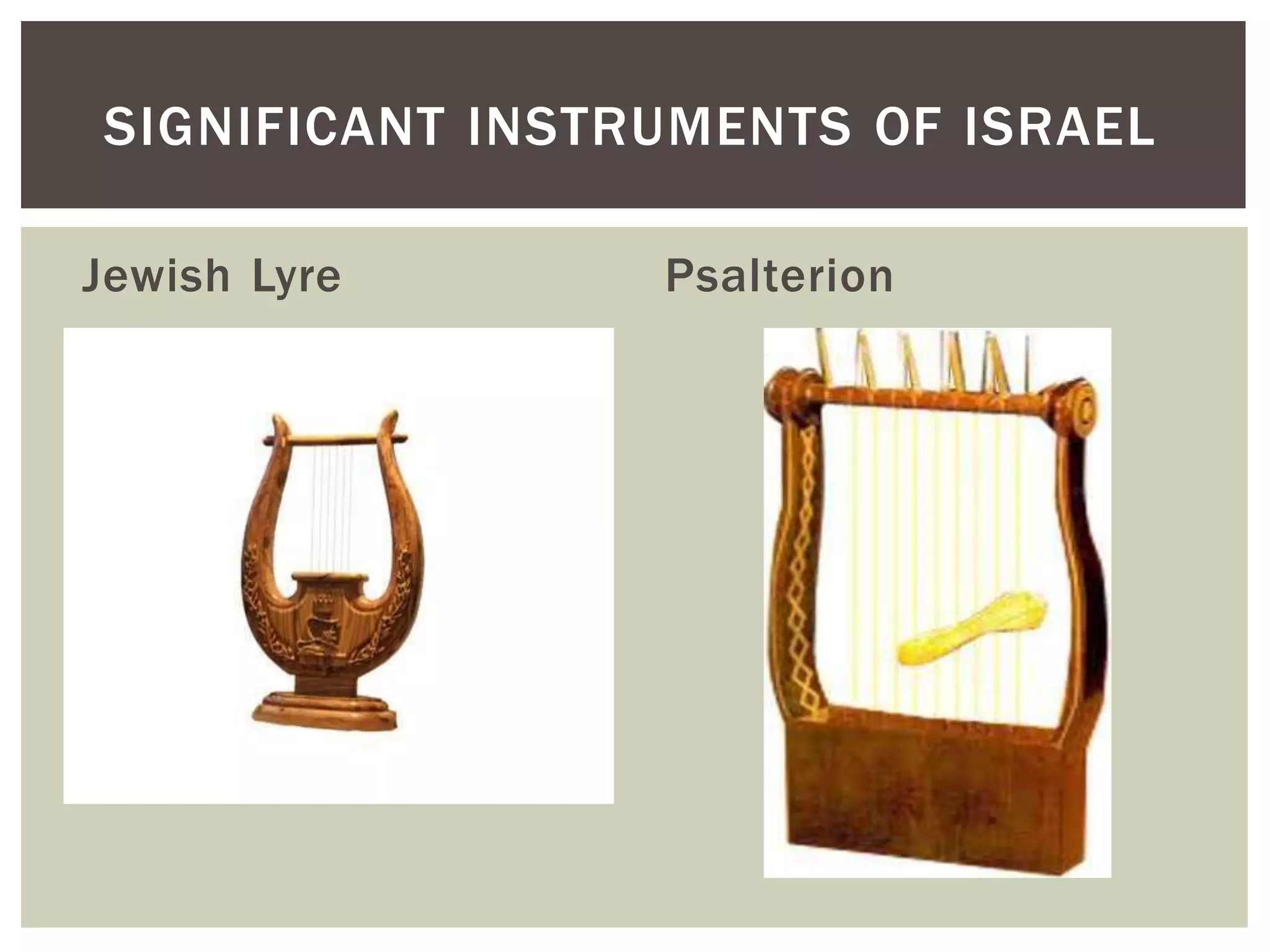
Jewish Lyre Psalterion
SIGNIFICANT INSTRUMENTS OF ISRAEL
SHOFAR
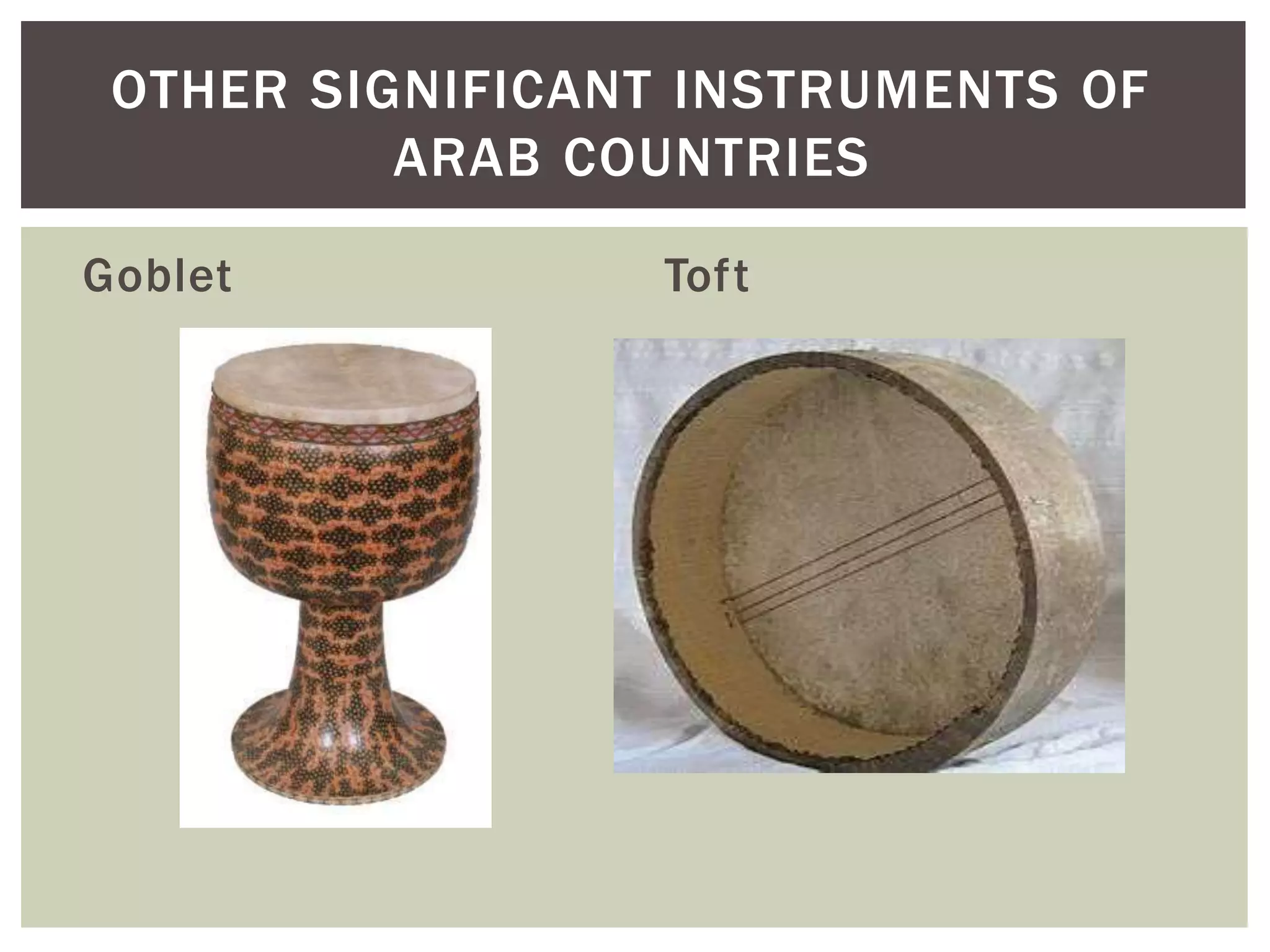
Goblet Toft
OTHER SIGNIFICANT INSTRUMENTS OF
ARAB COUNTRIES
Oud Darbuk
OTHER SIGNIFICANT MIDDLE EASTERN
INSTRUMENTS
O U D J M A G A M Q T
Q M B P D M A Q A M S
A D W S T Q P D T R T
M Z Q A W W A L I T A
I D S L G T E Z R Z L
T W A T Z J E W I S A
Z G Z E Q L L W I V L
V A D R B G O B L E T
A T B I U O Z M A L T
S G A O H P I Q A Q M
L J O N E F R D K Q R
M H O R A Z N W A Z N
ACTIVITY: WORD SEARCH

MUSIC GRADE 8 3RD QUARTER.pptx

  • 1.
  • 2.
  • 3.
    1. Ghan –described as a non- membranous percussive instrument but with solid resonators. It is one of the oldest classes of instrument in India. It may also be a melodic instrument or instruments to keep tal. CLASSIFICATION OF INSTRUMENTS IN INDIA
  • 4.
  • 5.
  • 6.
    2. Avanaddh -described as a membranous percussive instrument. This class of instruments typically comprise the drums.
  • 7.
  • 8.
  • 9.
    3. Sushir –also known as blown air. It is characterized by the use of air to excite the various resonators.
  • 10.
  • 11.
  • 12.
    4. Tat –referred to as vina during the old civilization. Instruments in this class are plucked (stringed instruments).
  • 13.
  • 14.
  • 15.
  • 16.
    5. Vitat –described as bowed stringed instruments. This is of the oldest classifications of instruments and yet did not occupy a place in classical Indian music until the last few centuries.
  • 17.
  • 18.
  • 19.
    ◾occupies an importantposition in the Indian system of music ◾literally meaning „clap;‟variously transliterated as “tal”, “taal” or “taala” ◾is a regular, repeating rhythmic phrase, particularly as rendered on a percussive instrument with an ebb and flow of various intonations represented as a ''theka'' ◾is the common Indian system of rhythm TALA
  • 20.
    ◾Theka - asequence of drum-syllables or ''bol'' - in Indian classical music, both Hindustani classical music and Carnatic music use complex rules to create elaborate patterns of rhythm ◾Tabla - most common instrument for keeping rhythm in Hindustani music ◾Mridangam - most common instrument for keeping rhythm in Carnatic music - also transliterated as “mridang” TALA (CONTINUATION)
  • 21.
  • 22.
  • 23.
  • 24.
  • 25.
  • 26.
  • 27.
  • 28.
    ◾Though Pakistan ispart of South Asia, its western part is considered as an extension of Central Asia. ◾Pakistan is known for its unique vocals. ◾The distinctive Pakistani sound was formed with multiple influences not only from various parts of South Asia but it also includes diverse elements from Central Asia, Persia, Turkey, and the Arab world. PAKISTAN
  • 29.
    1. Ghazal ◾traditional expressionsof love, separation, and loneliness; It tells about both the pain of loss of the lover and the beauty of love in spite of that pain. ◾its structural requirements are more strict than those of most poetic forms traditionally written in English ◾is considered by many to be one of the principal poetic forms in the Persian civilization ◾can be sung by both men and women VOCAL MUSIC OF PAKISTAN TWO VOCAL STYLE S IN SINGING
  • 30.
    ◾2. Qawwali ◾the devotionalmusic of the Chishti Order ◾a vibrant musical tradition that stretches back more than 700 years ◾originally performed mainly at Sufi shrines throughout the subcontinent and gained mainstream popularity VOCAL MUSIC OF PAKISTAN TWO VOCAL STYLE S IN SINGING
  • 31.
    ◾Punjabi music strengthensthe importance of musical instruments in Pakistan. ◾Punjab is a region in South Asia which is divided into West Punjab, Pakistan and East Punjab, India. Bhangra, one of the most recognized forms of Punjab, is based on the drum rhythm of dhol. INSTRUMENTAL MUSIC OF PAKISTAN
  • 32.
    SIGNIFICANT INSTRUMENTS OFPAKISTAN Tabla Dholak Harmonium Rubab
  • 33.
    MUSIC OF ISRAEL(WEST ASIA)
  • 34.
    ◾In general, themusic of West Asia is modal. ◾Harmony is not emphasized but rather includes salient features such as melodic complexity and ornamentation, including ¼ tones and rigorous rhythmic development. ◾West Asian music is commonly used during: -Communal worship (in Mosque, Synagogue and Church) - Mystic rituals (Sufis, Hassidic) -Life passage events (Weddings, Bar Mitzvas, Bat Mitzvas, Anniversaries) - Entertainment (Belly Dancing, Folk Dancing) MUSIC OF WEST ASIA
  • 35.
    ◾Israeli Music Israeli singershave a distinctive vocal style. They sing with guttural and throaty enunciation. VOCAL MUSIC OF ISRAEL
  • 36.
    1. Devotional ◾almost entirelyvocal ◾featured during Sabbath and other holy days ◾the art of Hazan (leader of prayer in synagogue) has always been evident in the culture ◾shofar is a special call to prayer and repentance; it is sounded on the High Holidays (the Jewish New Year and Day of Atonement) 2. Secular ◾instruments and voice are used ◾played during life passage events ◾context lies outside the religious domain ◾very rhythmic and have popular and romantic texts TWO DIVISIONS OF JEWISH MUSIC
  • 37.
    ◾The lute whichis similar to the Philippine banduria and the laud, traces its origins to the Middle Eastern Oud and Indian sitar. ◾Goblet drum, darbuk, the tambourine and other instruments associated with Middle Eastern music are used as accompaniment. ◾One of the dances where accompaniment is used is Hora, a dance that often has strong off beats and asymmetric meters. INTRUMENTAL MUSIC OF ISRAEL
  • 38.
  • 39.
  • 40.
    Goblet Toft OTHER SIGNIFICANTINSTRUMENTS OF ARAB COUNTRIES
  • 41.
    Oud Darbuk OTHER SIGNIFICANTMIDDLE EASTERN INSTRUMENTS
  • 42.
    O U DJ M A G A M Q T Q M B P D M A Q A M S A D W S T Q P D T R T M Z Q A W W A L I T A I D S L G T E Z R Z L T W A T Z J E W I S A Z G Z E Q L L W I V L V A D R B G O B L E T A T B I U O Z M A L T S G A O H P I Q A Q M L J O N E F R D K Q R M H O R A Z N W A Z N ACTIVITY: WORD SEARCH