National Anthem of Cambodia
National Anthem of Indonesia
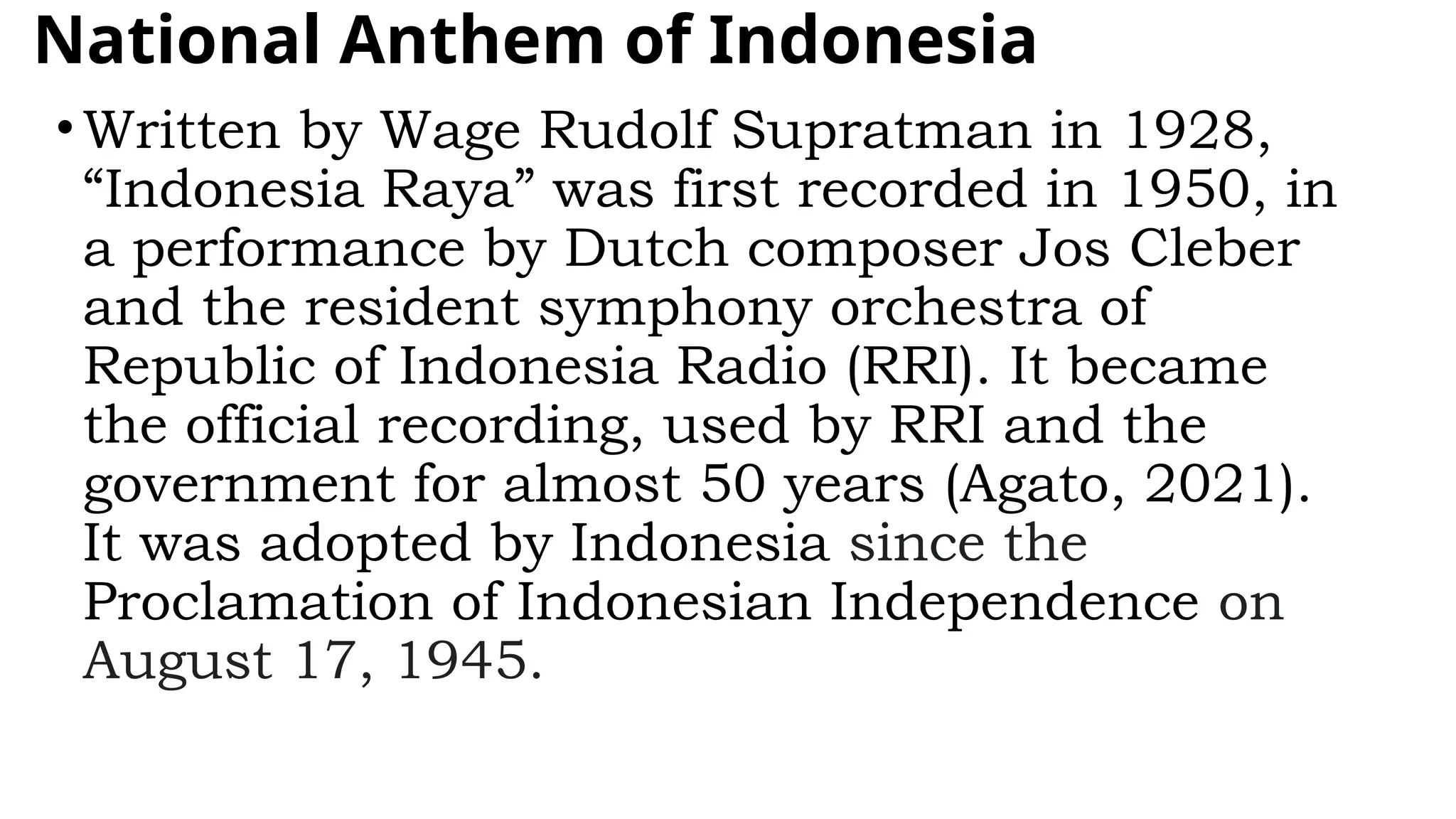
•Written by Wage Rudolf Supratman in 1928,
“Indonesia Raya” was first recorded in 1950, in
a performance by Dutch composer Jos Cleber
and the resident symphony orchestra of
Republic of Indonesia Radio (RRI). It became
the official recording, used by RRI and the
government for almost 50 years (Agato, 2021).
It was adopted by Indonesia since the
Proclamation of Indonesian Independence on
August 17, 1945.
National Anthem of Indonesia
•Indonesia Raya, as a national anthem is full of optimism.
Indonesia’s founding president, Soekarno, was involved in the
musical arrangement of “Indonesia Raya”. “During the pre-
chorus or bridge, it turns soft. While the previous part is tutti
[all instruments playing], Soekarno wanted the bridge to be
calmer and more textured, less monotonous so that when it hits
the chorus, it soars (Agato, 2021).
•For legendary composer and conductor Addie Muljadi
Sumaatmadja, better known as Addie M.S., the Indonesian
national anthem is uniquely memorable for its directness.
History of Indonesia
Everybody please sing….National
Anthem of Indonesia
•During the rendition or singing of
the national anthem, everyone
should stand, face toward the music,
and pay respect. Those who are
members of the Armed Forces, and
other persons in uniform must
render the military salute.
What is the difference and similarities
of Lupang Hinirang and Indonesia
Raya
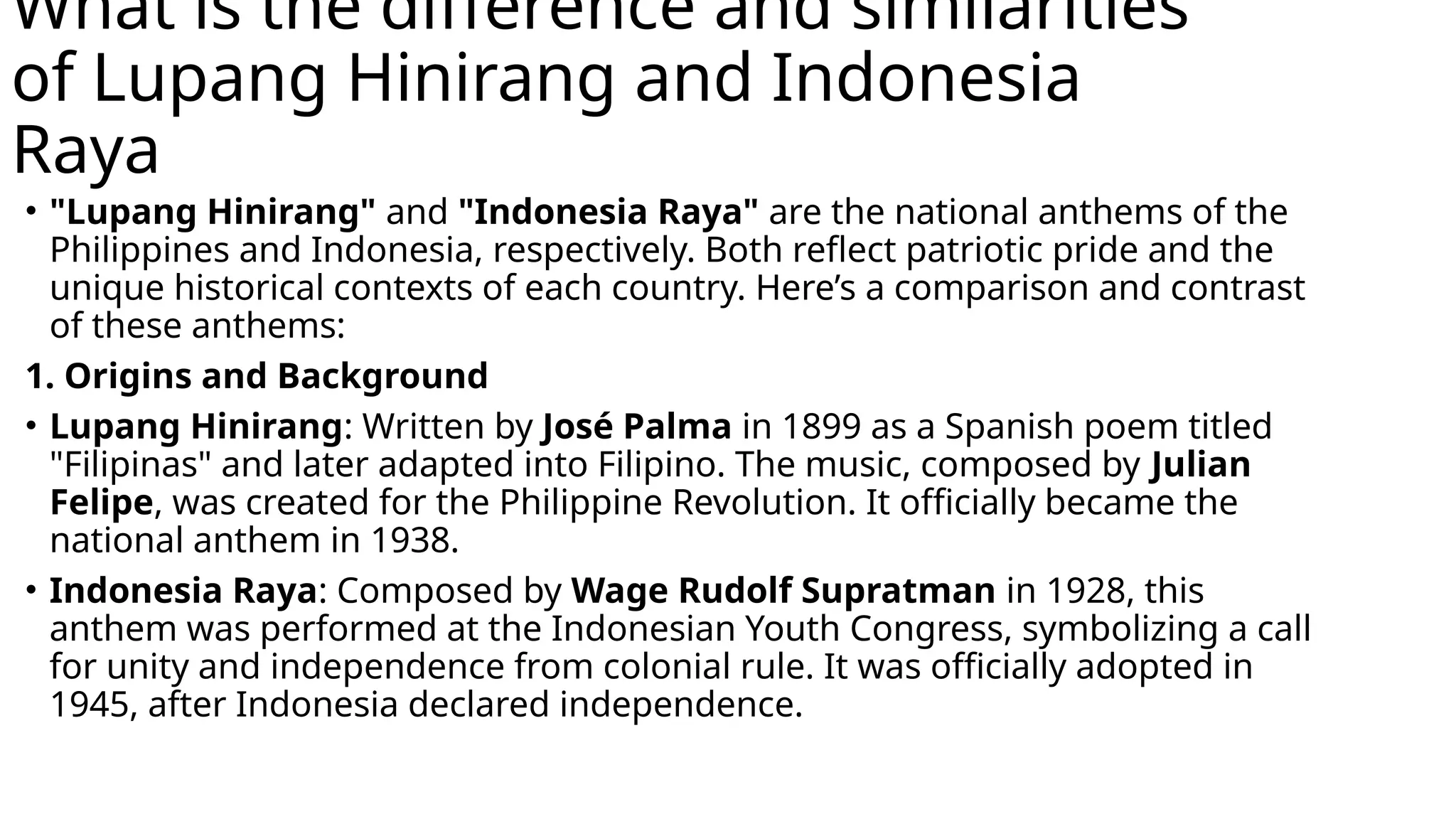
• "Lupang Hinirang" and "Indonesia Raya" are the national anthems of the
Philippines and Indonesia, respectively. Both reflect patriotic pride and the
unique historical contexts of each country. Here’s a comparison and contrast
of these anthems:
1. Origins and Background
• Lupang Hinirang: Written by José Palma in 1899 as a Spanish poem titled
"Filipinas" and later adapted into Filipino. The music, composed by Julian
Felipe, was created for the Philippine Revolution. It officially became the
national anthem in 1938.
• Indonesia Raya: Composed by Wage Rudolf Supratman in 1928, this
anthem was performed at the Indonesian Youth Congress, symbolizing a call
for unity and independence from colonial rule. It was officially adopted in
1945, after Indonesia declared independence.
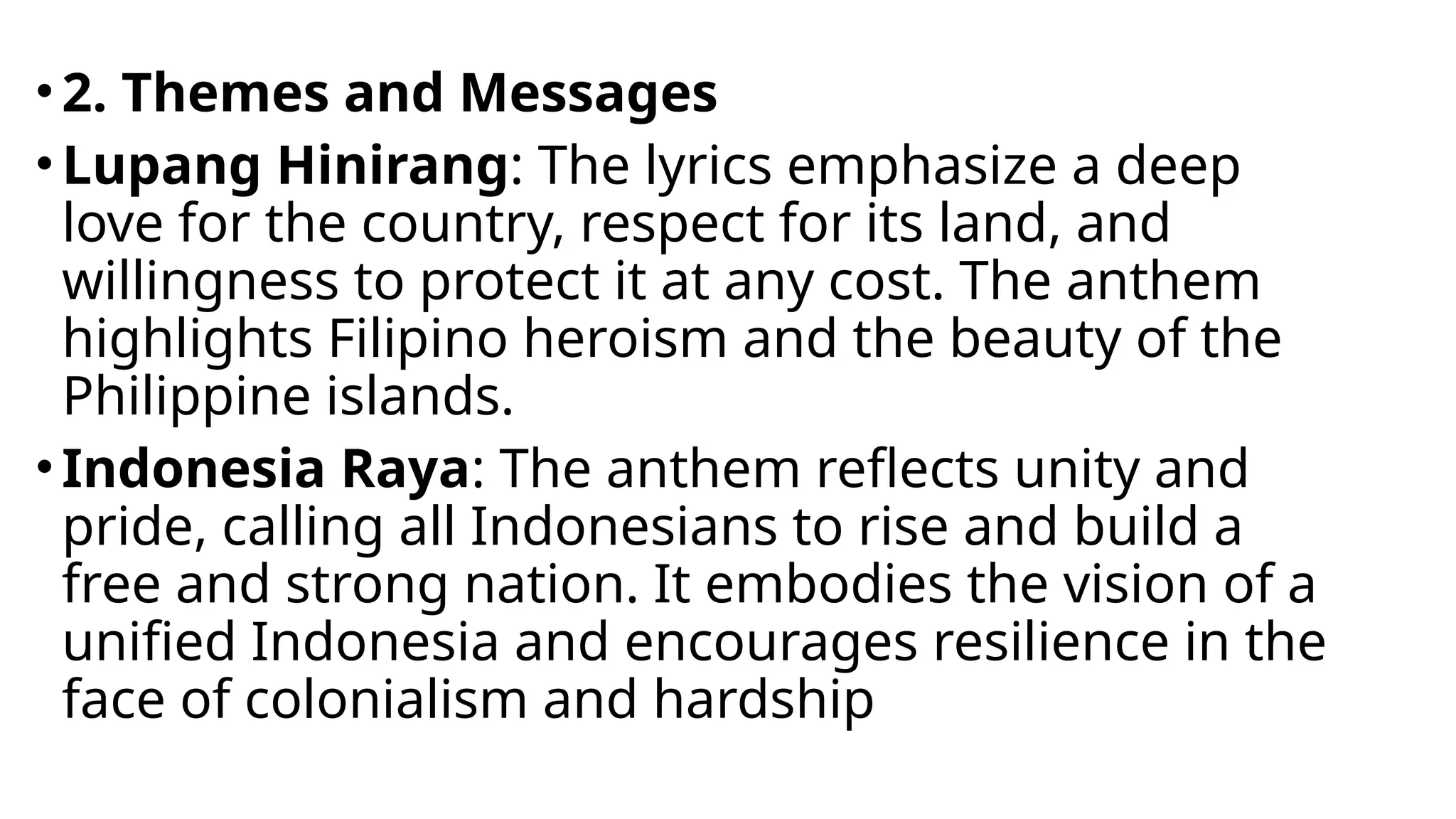
•2. Themes and Messages
•Lupang Hinirang: The lyrics emphasize a deep
love for the country, respect for its land, and
willingness to protect it at any cost. The anthem
highlights Filipino heroism and the beauty of the
Philippine islands.
•Indonesia Raya: The anthem reflects unity and
pride, calling all Indonesians to rise and build a
free and strong nation. It embodies the vision of a
unified Indonesia and encourages resilience in the
face of colonialism and hardship
•3. Musical Style and Structure
•Lupang Hinirang: Originally composed in a march
style, it has a solemn, almost military tone,
befitting a period of revolution. It is typically
performed with a steady, reverent tempo,
emphasizing respect and strength.
•Indonesia Raya: Has a majestic and uplifting
style, starting slowly and building up into a
triumphant march. Its melody is more varied,
reflecting joy and celebration as well as strength
•4. Language
•Lupang Hinirang: The anthem is sung in Filipino,
the national language of the Philippines. It was
originally in Spanish and later translated to
Tagalog, and it now reflects the Philippines’ identity
and cultural pride.
•Indonesia Raya: Sung in Indonesian, it represents
Indonesia’s identity and commitment to unity
despite its linguistic diversity. The anthem played a
role in promoting the use of the Indonesian
language as a symbol of national unity
•5. Historical Significance
•Lupang Hinirang: It is rooted in the Philippine
Revolution against Spain, representing a long history
of resistance against colonization (Spanish and later
American). It symbolizes the heroism of Filipinos who
fought for independence.
•Indonesia Raya: Linked to the Indonesian
independence movement against Dutch colonialism,
it symbolizes a united stance against foreign rule. Its
debut marked the beginning of a national movement
for Indonesian unity and self-determination

Indonesia National Anthem FOR GRADE 7 CLASS

  • 2.
  • 3.
  • 4.
    National Anthem ofIndonesia •Written by Wage Rudolf Supratman in 1928, “Indonesia Raya” was first recorded in 1950, in a performance by Dutch composer Jos Cleber and the resident symphony orchestra of Republic of Indonesia Radio (RRI). It became the official recording, used by RRI and the government for almost 50 years (Agato, 2021). It was adopted by Indonesia since the Proclamation of Indonesian Independence on August 17, 1945.
  • 5.
    National Anthem ofIndonesia •Indonesia Raya, as a national anthem is full of optimism. Indonesia’s founding president, Soekarno, was involved in the musical arrangement of “Indonesia Raya”. “During the pre- chorus or bridge, it turns soft. While the previous part is tutti [all instruments playing], Soekarno wanted the bridge to be calmer and more textured, less monotonous so that when it hits the chorus, it soars (Agato, 2021). •For legendary composer and conductor Addie Muljadi Sumaatmadja, better known as Addie M.S., the Indonesian national anthem is uniquely memorable for its directness.
  • 6.
  • 7.
  • 8.
    •During the renditionor singing of the national anthem, everyone should stand, face toward the music, and pay respect. Those who are members of the Armed Forces, and other persons in uniform must render the military salute.
  • 9.
    What is thedifference and similarities of Lupang Hinirang and Indonesia Raya • "Lupang Hinirang" and "Indonesia Raya" are the national anthems of the Philippines and Indonesia, respectively. Both reflect patriotic pride and the unique historical contexts of each country. Here’s a comparison and contrast of these anthems: 1. Origins and Background • Lupang Hinirang: Written by José Palma in 1899 as a Spanish poem titled "Filipinas" and later adapted into Filipino. The music, composed by Julian Felipe, was created for the Philippine Revolution. It officially became the national anthem in 1938. • Indonesia Raya: Composed by Wage Rudolf Supratman in 1928, this anthem was performed at the Indonesian Youth Congress, symbolizing a call for unity and independence from colonial rule. It was officially adopted in 1945, after Indonesia declared independence.
  • 10.
    •2. Themes andMessages •Lupang Hinirang: The lyrics emphasize a deep love for the country, respect for its land, and willingness to protect it at any cost. The anthem highlights Filipino heroism and the beauty of the Philippine islands. •Indonesia Raya: The anthem reflects unity and pride, calling all Indonesians to rise and build a free and strong nation. It embodies the vision of a unified Indonesia and encourages resilience in the face of colonialism and hardship
  • 11.
    •3. Musical Styleand Structure •Lupang Hinirang: Originally composed in a march style, it has a solemn, almost military tone, befitting a period of revolution. It is typically performed with a steady, reverent tempo, emphasizing respect and strength. •Indonesia Raya: Has a majestic and uplifting style, starting slowly and building up into a triumphant march. Its melody is more varied, reflecting joy and celebration as well as strength
  • 12.
    •4. Language •Lupang Hinirang:The anthem is sung in Filipino, the national language of the Philippines. It was originally in Spanish and later translated to Tagalog, and it now reflects the Philippines’ identity and cultural pride. •Indonesia Raya: Sung in Indonesian, it represents Indonesia’s identity and commitment to unity despite its linguistic diversity. The anthem played a role in promoting the use of the Indonesian language as a symbol of national unity
  • 13.
    •5. Historical Significance •LupangHinirang: It is rooted in the Philippine Revolution against Spain, representing a long history of resistance against colonization (Spanish and later American). It symbolizes the heroism of Filipinos who fought for independence. •Indonesia Raya: Linked to the Indonesian independence movement against Dutch colonialism, it symbolizes a united stance against foreign rule. Its debut marked the beginning of a national movement for Indonesian unity and self-determination