Indigenous Knowledge Systems
• Course Code: MS 5208 (02:30/00)
• Saturday 3.30 pm – 5.30 pm
• P.B. Dharmasena
• 0777 - 613234, 0717 – 613234
• dharmasenapb@ymail.com , dharmasenapb@gmail.com
• Links to publications:
https://independent.academia.edu/PunchiBandageDharmasena
https://www.researchgate.net/profile/Punchi_Bandage_Dharmasena/contributions
http://www.slideshare.net/DharmasenaPb
https://www.youtube.com/channel/UC_PFqwl0OqsrxH1wTm_jZeg
Indigenous Knowledge Systems
2. Fundamental features of Sri Lankan Agriculture; climate, Soil, Genetic resources, agro
biodiversity (2 hrs)
3. History and the culture of Sri Lankan agriculture sector development (1 hr)
4. Green revolution and its impact on Sri Lankan traditional agricultural system (biodiversity
deterioration, inorganic substances for pest and disease controlling, development of hybrid
varieties etc.) (1hr)
5. Indigenous soil management practices (2hrs)
6. Indigenous Irrigation systems (cascade system, water harvesting concepts) (2hrs)
9. Traditional practices for, weather forecasting, plant nutrient supplementing, pest and
disease control and indigenous agricultural machines and tools (2hrs)
13. Cultural dimensions of Agricultural rituals in Sri Lanka (1 hr)
14. Climate change and Indigenous Agricultural knowledge in Sri Lanka(1 hr)
Total: 12 hours)
List of lectures by P.B. Dharmasena
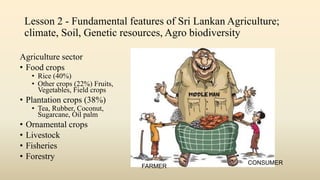
Agriculture sector
• Food crops
• Rice (40%)
• Other crops (22%) Fruits,
Vegetables, Field crops
• Plantation crops (38%)
• Tea, Rubber, Coconut,
Sugarcane, Oil palm
• Ornamental crops
• Livestock
• Fisheries
• Forestry
Lesson 2 - Fundamental features of Sri Lankan Agriculture;
climate, Soil, Genetic resources, Agro biodiversity
FARMER
CONSUMER
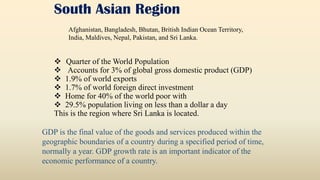
South Asian Region
 Quarter of the World Population
 Accounts for 3% of global gross domestic product (GDP)
 1.9% of world exports
 1.7% of world foreign direct investment
 Home for 40% of the world poor with
 29.5% population living on less than a dollar a day
This is the region where Sri Lanka is located.
GDP is the final value of the goods and services produced within the
geographic boundaries of a country during a specified period of time,
normally a year. GDP growth rate is an important indicator of the
economic performance of a country.
Afghanistan, Bangladesh, Bhutan, British Indian Ocean Territory,
India, Maldives, Nepal, Pakistan, and Sri Lanka.
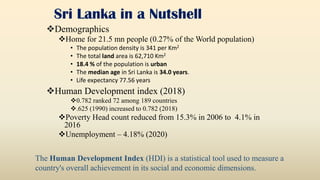
Sri Lanka in a Nutshell
Demographics
Home for 21.5 mn people (0.27% of the World population)
• The population density is 341 per Km2
• The total land area is 62,710 Km2
• 18.4 % of the population is urban
• The median age in Sri Lanka is 34.0 years.
• Life expectancy 77.56 years
Human Development index (2018)
0.782 ranked 72 among 189 countries
.625 (1990) increased to 0.782 (2018)
Poverty Head count reduced from 15.3% in 2006 to 4.1% in
2016
Unemployment – 4.18% (2020)
The Human Development Index (HDI) is a statistical tool used to measure a
country's overall achievement in its social and economic dimensions.
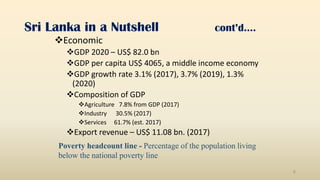
Sri Lanka in a Nutshell cont’d….
Economic
GDP 2020 – US$ 82.0 bn
GDP per capita US$ 4065, a middle income economy
GDP growth rate 3.1% (2017), 3.7% (2019), 1.3%
(2020)
Composition of GDP
Agriculture 7.8% from GDP (2017)
Industry 30.5% (2017)
Services 61.7% (est. 2017)
Export revenue – US$ 11.08 bn. (2017)
6
Poverty headcount line - Percentage of the population living
below the national poverty line
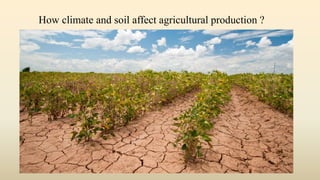
How climate and soil affect agricultural production ?
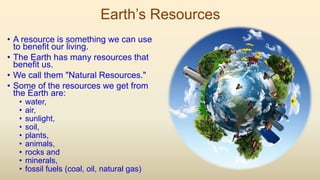
Earth’s Resources
• A resource is something we can use
to benefit our living.
• The Earth has many resources that
benefit us.
• We call them "Natural Resources."
• Some of the resources we get from
the Earth are:
• water,
• air,
• sunlight,
• soil,
• plants,
• animals,
• rocks and
• minerals,
• fossil fuels (coal, oil, natural gas)
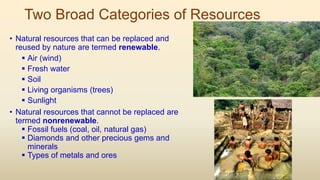
Two Broad Categories of Resources
• Natural resources that can be replaced and
reused by nature are termed renewable.
 Air (wind)
 Fresh water
 Soil
 Living organisms (trees)
 Sunlight
• Natural resources that cannot be replaced are
termed nonrenewable.
 Fossil fuels (coal, oil, natural gas)
 Diamonds and other precious gems and
minerals
 Types of metals and ores
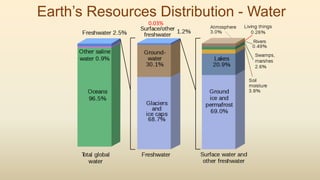
Earth’s Resources Distribution - Water
0.03%
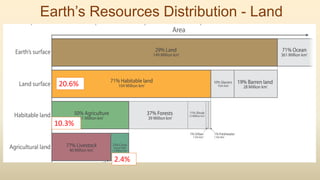
Earth’s Resources Distribution - Land
20.6%
10.3%
2.4%
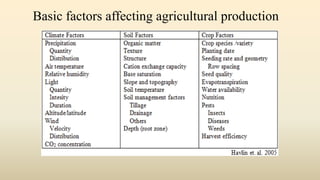
Basic factors affecting agricultural production
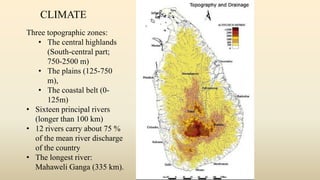
Three topographic zones:
• The central highlands
(South-central part;
750-2500 m)
• The plains (125-750
m),
• The coastal belt (0-
125m)
• Sixteen principal rivers
(longer than 100 km)
• 12 rivers carry about 75 %
of the mean river discharge
of the country
• The longest river:
Mahaweli Ganga (335 km).
CLIMATE
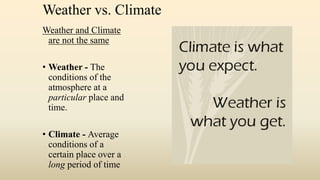
Weather vs. Climate
Weather and Climate
are not the same
• Weather - The
conditions of the
atmosphere at a
particular place and
time.
• Climate - Average
conditions of a
certain place over a
long period of time
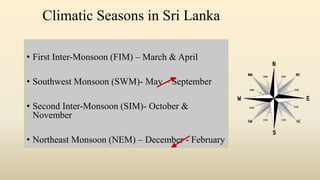
Climatic Seasons in Sri Lanka
• First Inter-Monsoon (FIM) – March & April
• Southwest Monsoon (SWM)- May – September
• Second Inter-Monsoon (SIM)- October &
November
• Northeast Monsoon (NEM) – December - February
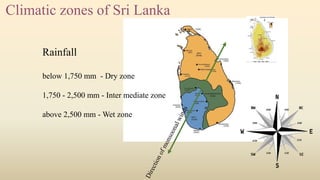
Climatic zones of Sri Lanka
Rainfall
below 1,750 mm - Dry zone
1,750 - 2,500 mm - Inter mediate zone
above 2,500 mm - Wet zone
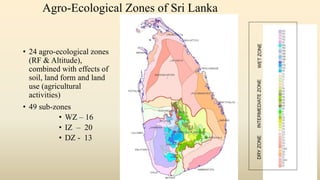
Agro-Ecological Zones of Sri Lanka
• 24 agro-ecological zones
(RF & Altitude),
combined with effects of
soil, land form and land
use (agricultural
activities)
• 49 sub-zones
• WZ – 16
• IZ – 20
• DZ - 13
DRY
ZONE
INTERMEDIATE
ZONE
WET
ZONE
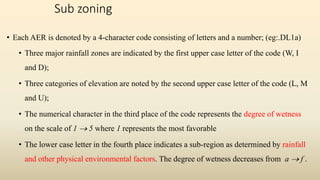
Sub zoning
• Each AER is denoted by a 4-character code consisting of letters and a number; (eg:.DL1a)
• Three major rainfall zones are indicated by the first upper case letter of the code (W, I
and D);
• Three categories of elevation are noted by the second upper case letter of the code (L, M
and U);
• The numerical character in the third place of the code represents the degree of wetness
on the scale of 1  5 where 1 represents the most favorable
• The lower case letter in the fourth place indicates a sub-region as determined by rainfall
and other physical environmental factors. The degree of wetness decreases from a  f .
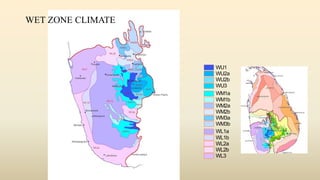
WL1a
WL1b
WL2a
WL2b
WL3
WM1a
WM1b
WM2a
WM2b
WM3a
WM3b
WU1
WU2a
WU2b
WU3
WET ZONE CLIMATE
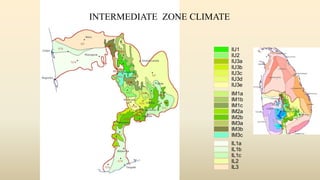
IL1a
IL1b
IL1c
IL2
IL3
IM1a
IM1b
IM1c
IM2a
IM2b
IM3a
IM3b
IM3c
IU1
IU2
IU3a
IU3b
IU3c
IU3d
IU3e
INTERMEDIATE ZONE CLIMATE
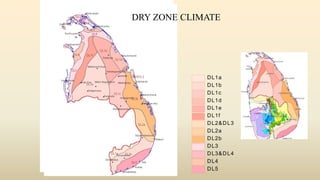
DL1a
DL1b
DL1c
DL1d
DL1e
DL1f
DL2&DL3
DL2a
DL2b
DL3
DL3&DL4
DL4
DL5
DRY ZONE CLIMATE
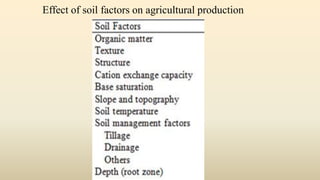
Effect of soil factors on agricultural production
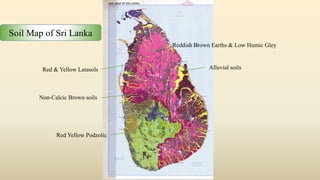
Reddish Brown Earths & Low Humic Gley
Red Yellow Podzolic
Alluvial soils
Red & Yellow Latasols
Soil Map of Sri Lanka
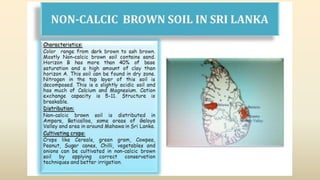
Non-Calcic Brown soils
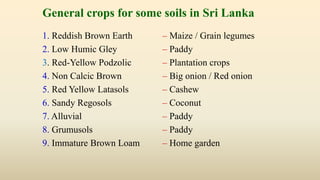
General crops for some soils in Sri Lanka
1. Reddish Brown Earth – Maize / Grain legumes
2. Low Humic Gley – Paddy
3. Red-Yellow Podzolic – Plantation crops
4. Non Calcic Brown – Big onion / Red onion
5. Red Yellow Latasols – Cashew
6. Sandy Regosols – Coconut
7. Alluvial – Paddy
8. Grumusols – Paddy
9. Immature Brown Loam – Home garden
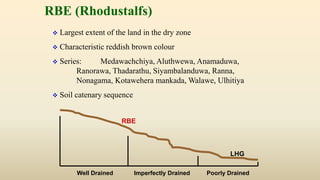
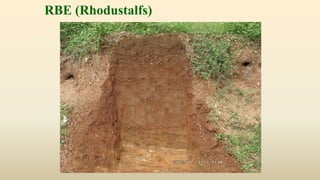
RBE (Rhodustalfs)
 Largest extent of the land in the dry zone
 Characteristic reddish brown colour
 Series: Medawachchiya, Aluthwewa, Anamaduwa,
Ranorawa, Thadarathu, Siyambalanduwa, Ranna,
Nonagama, Kotawehera mankada, Walawe, Ulhitiya
 Soil catenary sequence
Well Drained Imperfectly Drained Poorly Drained
RBE
LHG
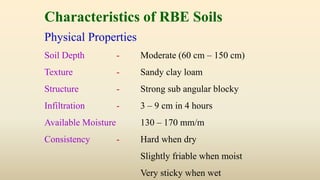
Characteristics of RBE Soils
Physical Properties
Soil Depth - Moderate (60 cm – 150 cm)
Texture - Sandy clay loam
Structure - Strong sub angular blocky
Infiltration - 3 – 9 cm in 4 hours
Available Moisture 130 – 170 mm/m
Consistency - Hard when dry
Slightly friable when moist
Very sticky when wet
RBE (Rhodustalfs)
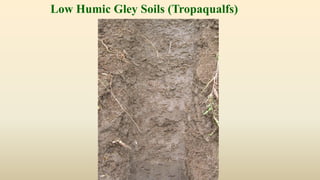
Low Humic Gley Soils (Tropaqualfs)
 Third most extensive soil group in Sri Lanka
 Located at the foot slopes of the undulating landscape
 Characterized by the wetness or gleying through the
profile
 Availability of calcite concretions
Physical Properties
Texture - Sandy clay to clay
Structure - Sub angular blocky to massive
WHC - Fairly good
Low Humic Gley Soils (Tropaqualfs)
Red – Yellow Podzolic soils (Tropudult)
 Second most extensive soil group in Sri Lanka
 Modal soil of the wet zone of Sri Lanka
 Mostly known as Lateritic soils
 Majority found in the hilly part of the country
 Colour varies from strong brown to yellowish brown
 Series: Minuwangoda, Galigamuwa, Pallegoda, Homagama,
Boralu, Agalawatta, Dodangoda, malaboda, Mattakele, Horton,
Nuwara Eliya, Maskeliya, Weddagala
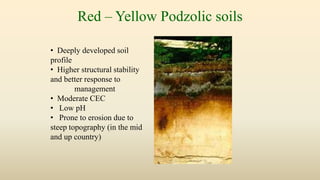
Red – Yellow Podzolic soils
• Deeply developed soil
profile
• Higher structural stability
and better response to
management
• Moderate CEC
• Low pH
• Prone to erosion due to
steep topography (in the mid
and up country)
Land Resource
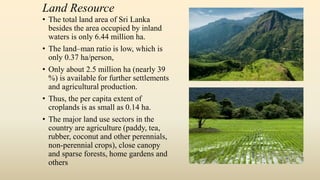
• The total land area of Sri Lanka
besides the area occupied by inland
waters is only 6.44 million ha.
• The land–man ratio is low, which is
only 0.37 ha/person,
• Only about 2.5 million ha (nearly 39
%) is available for further settlements
and agricultural production.
• Thus, the per capita extent of
croplands is as small as 0.14 ha.
• The major land use sectors in the
country are agriculture (paddy, tea,
rubber, coconut and other perennials,
non-perennial crops), close canopy
and sparse forests, home gardens and
others
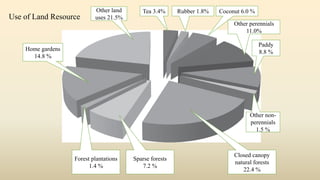
Tea 3.4% Rubber 1.8% Coconut 6.0 %
Other perennials
11.0%
Paddy
8.8 %
Other non-
perennials
1.5 %
Closed canopy
natural forests
22.4 %
Sparse forests
7.2 %
Forest plantations
1.4 %
Other land
uses 21.5%
Home gardens
14.8 %
Use of Land Resource
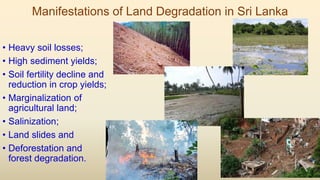
Manifestations of Land Degradation in Sri Lanka
• Heavy soil losses;
• High sediment yields;
• Soil fertility decline and
reduction in crop yields;
• Marginalization of
agricultural land;
• Salinization;
• Land slides and
• Deforestation and
forest degradation.
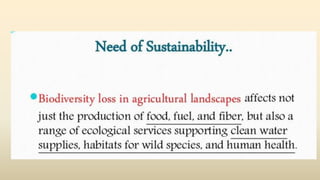
Land degradation & Sustainable Land Management
• Land degradation is the depletion of its physical, chemical and biological
productivity
• To maintain the long-term productivity of land sustainable land
management is required
• Sustainable land management means ‘use of the land to meet human
needs, while ensuring long-term production potential and maintaining
ecological functions’
• Here the land includes soil, water, flora and fauna
• Therefore, the land means the whole ecosystem in more practical way
• That means ‘land degradation is long-term depletion of the production
potential and function of the ecosystem’
• So, sustainable land management is maintenance of production potential
and functions of the ecosystem
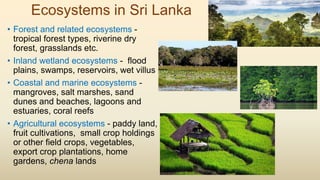
Ecosystems in Sri Lanka
• Forest and related ecosystems -
tropical forest types, riverine dry
forest, grasslands etc.
• Inland wetland ecosystems - flood
plains, swamps, reservoirs, wet villus
• Coastal and marine ecosystems -
mangroves, salt marshes, sand
dunes and beaches, lagoons and
estuaries, coral reefs
• Agricultural ecosystems - paddy land,
fruit cultivations, small crop holdings
or other field crops, vegetables,
export crop plantations, home
gardens, chena lands
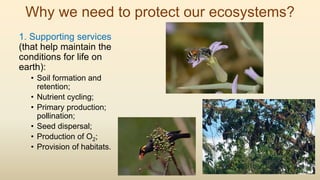
Why we need to protect our ecosystems?
1. Supporting services
(that help maintain the
conditions for life on
earth):
• Soil formation and
retention;
• Nutrient cycling;
• Primary production;
pollination;
• Seed dispersal;
• Production of O2;
• Provision of habitats.
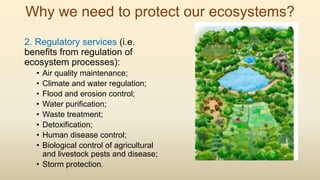
Why we need to protect our ecosystems?
2. Regulatory services (i.e.
benefits from regulation of
ecosystem processes):
• Air quality maintenance;
• Climate and water regulation;
• Flood and erosion control;
• Water purification;
• Waste treatment;
• Detoxification;
• Human disease control;
• Biological control of agricultural
and livestock pests and disease;
• Storm protection.
Why we need to protect our ecosystems?
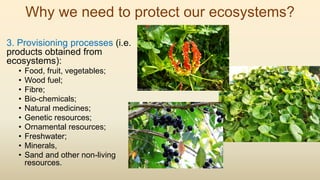
3. Provisioning processes (i.e.
products obtained from
ecosystems):
• Food, fruit, vegetables;
• Wood fuel;
• Fibre;
• Bio-chemicals;
• Natural medicines;
• Genetic resources;
• Ornamental resources;
• Freshwater;
• Minerals,
• Sand and other non-living
resources.
Why we need to protect our ecosystems?
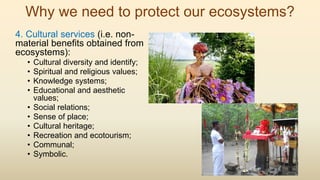
4. Cultural services (i.e. non-
material benefits obtained from
ecosystems):
• Cultural diversity and identify;
• Spiritual and religious values;
• Knowledge systems;
• Educational and aesthetic
values;
• Social relations;
• Sense of place;
• Cultural heritage;
• Recreation and ecotourism;
• Communal;
• Symbolic.
Plant genetic resource of Sri Lanka
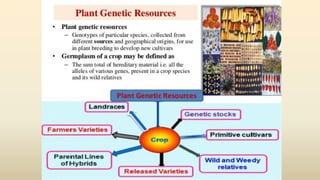
• About 7 500 plant species constitute the flora of Sri Lanka.
• Flowering plants constituted about 3 360 species, belonged
to 1 350 genera and 200 families.
• The flora contains by about 830 endemic species.
• The low-country wet zone and mountainous areas in
Southwest harbour 90 percent of endemic species.
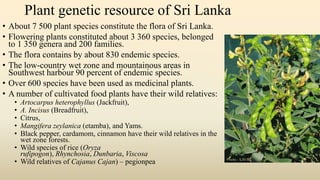
• Over 600 species have been used as medicinal plants.
• A number of cultivated food plants have their wild relatives:
• Artocarpus heterophyllus (Jackfruit),
• A. Incisus (Breadfruit),
• Citrus,
• Mangifera zeylanica (etamba), and Yams.
• Black pepper, cardamom, cinnamon have their wild relatives in the
wet zone forests.
• Wild species of rice (Oryza
rufipogon), Rhynchosia, Dunbaria, Viscosa
• Wild relatives of Cajanus Cajan) – pegionpea
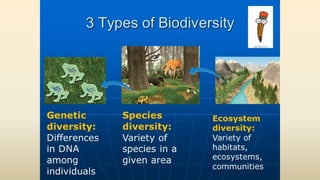
Biodiversity
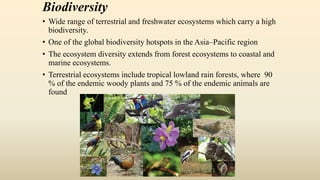
• Wide range of terrestrial and freshwater ecosystems which carry a high
biodiversity.
• One of the global biodiversity hotspots in the Asia–Pacific region
• The ecosystem diversity extends from forest ecosystems to coastal and
marine ecosystems.
• Terrestrial ecosystems include tropical lowland rain forests, where 90
% of the endemic woody plants and 75 % of the endemic animals are
found
Biodiversity
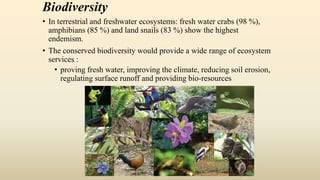
• In terrestrial and freshwater ecosystems: fresh water crabs (98 %),
amphibians (85 %) and land snails (83 %) show the highest
endemism.
• The conserved biodiversity would provide a wide range of ecosystem
services :
• proving fresh water, improving the climate, reducing soil erosion,
regulating surface runoff and providing bio-resources
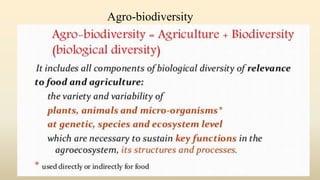
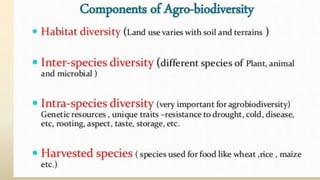
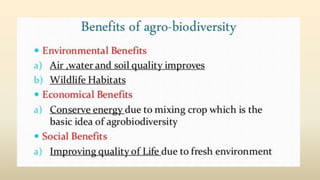
Agro-biodiversity
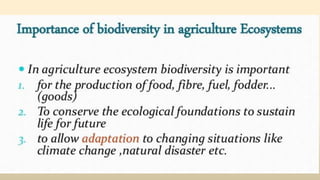
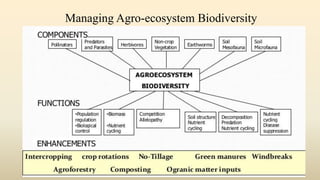
Managing Agro-ecosystem Biodiversity

Indigenous Knowledge Systems - 1

  • 1.
    Indigenous Knowledge Systems •Course Code: MS 5208 (02:30/00) • Saturday 3.30 pm – 5.30 pm • P.B. Dharmasena • 0777 - 613234, 0717 – 613234 • dharmasenapb@ymail.com , dharmasenapb@gmail.com • Links to publications: https://independent.academia.edu/PunchiBandageDharmasena https://www.researchgate.net/profile/Punchi_Bandage_Dharmasena/contributions http://www.slideshare.net/DharmasenaPb https://www.youtube.com/channel/UC_PFqwl0OqsrxH1wTm_jZeg
  • 2.
    Indigenous Knowledge Systems 2.Fundamental features of Sri Lankan Agriculture; climate, Soil, Genetic resources, agro biodiversity (2 hrs) 3. History and the culture of Sri Lankan agriculture sector development (1 hr) 4. Green revolution and its impact on Sri Lankan traditional agricultural system (biodiversity deterioration, inorganic substances for pest and disease controlling, development of hybrid varieties etc.) (1hr) 5. Indigenous soil management practices (2hrs) 6. Indigenous Irrigation systems (cascade system, water harvesting concepts) (2hrs) 9. Traditional practices for, weather forecasting, plant nutrient supplementing, pest and disease control and indigenous agricultural machines and tools (2hrs) 13. Cultural dimensions of Agricultural rituals in Sri Lanka (1 hr) 14. Climate change and Indigenous Agricultural knowledge in Sri Lanka(1 hr) Total: 12 hours) List of lectures by P.B. Dharmasena
  • 3.
    Agriculture sector • Foodcrops • Rice (40%) • Other crops (22%) Fruits, Vegetables, Field crops • Plantation crops (38%) • Tea, Rubber, Coconut, Sugarcane, Oil palm • Ornamental crops • Livestock • Fisheries • Forestry Lesson 2 - Fundamental features of Sri Lankan Agriculture; climate, Soil, Genetic resources, Agro biodiversity FARMER CONSUMER
  • 4.
    South Asian Region Quarter of the World Population  Accounts for 3% of global gross domestic product (GDP)  1.9% of world exports  1.7% of world foreign direct investment  Home for 40% of the world poor with  29.5% population living on less than a dollar a day This is the region where Sri Lanka is located. GDP is the final value of the goods and services produced within the geographic boundaries of a country during a specified period of time, normally a year. GDP growth rate is an important indicator of the economic performance of a country. Afghanistan, Bangladesh, Bhutan, British Indian Ocean Territory, India, Maldives, Nepal, Pakistan, and Sri Lanka.
  • 5.
    Sri Lanka ina Nutshell Demographics Home for 21.5 mn people (0.27% of the World population) • The population density is 341 per Km2 • The total land area is 62,710 Km2 • 18.4 % of the population is urban • The median age in Sri Lanka is 34.0 years. • Life expectancy 77.56 years Human Development index (2018) 0.782 ranked 72 among 189 countries .625 (1990) increased to 0.782 (2018) Poverty Head count reduced from 15.3% in 2006 to 4.1% in 2016 Unemployment – 4.18% (2020) The Human Development Index (HDI) is a statistical tool used to measure a country's overall achievement in its social and economic dimensions.
  • 6.
    Sri Lanka ina Nutshell cont’d…. Economic GDP 2020 – US$ 82.0 bn GDP per capita US$ 4065, a middle income economy GDP growth rate 3.1% (2017), 3.7% (2019), 1.3% (2020) Composition of GDP Agriculture 7.8% from GDP (2017) Industry 30.5% (2017) Services 61.7% (est. 2017) Export revenue – US$ 11.08 bn. (2017) 6 Poverty headcount line - Percentage of the population living below the national poverty line
  • 7.
    How climate andsoil affect agricultural production ?
  • 8.
    Earth’s Resources • Aresource is something we can use to benefit our living. • The Earth has many resources that benefit us. • We call them "Natural Resources." • Some of the resources we get from the Earth are: • water, • air, • sunlight, • soil, • plants, • animals, • rocks and • minerals, • fossil fuels (coal, oil, natural gas)
  • 9.
    Two Broad Categoriesof Resources • Natural resources that can be replaced and reused by nature are termed renewable.  Air (wind)  Fresh water  Soil  Living organisms (trees)  Sunlight • Natural resources that cannot be replaced are termed nonrenewable.  Fossil fuels (coal, oil, natural gas)  Diamonds and other precious gems and minerals  Types of metals and ores
  • 10.
  • 11.
    Earth’s Resources Distribution- Land 20.6% 10.3% 2.4%
  • 12.
    Basic factors affectingagricultural production
  • 13.
    Three topographic zones: •The central highlands (South-central part; 750-2500 m) • The plains (125-750 m), • The coastal belt (0- 125m) • Sixteen principal rivers (longer than 100 km) • 12 rivers carry about 75 % of the mean river discharge of the country • The longest river: Mahaweli Ganga (335 km). CLIMATE
  • 14.
    Weather vs. Climate Weatherand Climate are not the same • Weather - The conditions of the atmosphere at a particular place and time. • Climate - Average conditions of a certain place over a long period of time
  • 15.
    Climatic Seasons inSri Lanka • First Inter-Monsoon (FIM) – March & April • Southwest Monsoon (SWM)- May – September • Second Inter-Monsoon (SIM)- October & November • Northeast Monsoon (NEM) – December - February
  • 16.
    Climatic zones ofSri Lanka Rainfall below 1,750 mm - Dry zone 1,750 - 2,500 mm - Inter mediate zone above 2,500 mm - Wet zone
  • 17.
    Agro-Ecological Zones ofSri Lanka • 24 agro-ecological zones (RF & Altitude), combined with effects of soil, land form and land use (agricultural activities) • 49 sub-zones • WZ – 16 • IZ – 20 • DZ - 13 DRY ZONE INTERMEDIATE ZONE WET ZONE
  • 18.
    Sub zoning • EachAER is denoted by a 4-character code consisting of letters and a number; (eg:.DL1a) • Three major rainfall zones are indicated by the first upper case letter of the code (W, I and D); • Three categories of elevation are noted by the second upper case letter of the code (L, M and U); • The numerical character in the third place of the code represents the degree of wetness on the scale of 1  5 where 1 represents the most favorable • The lower case letter in the fourth place indicates a sub-region as determined by rainfall and other physical environmental factors. The degree of wetness decreases from a  f .
  • 19.
  • 20.
  • 21.
  • 22.
    Effect of soilfactors on agricultural production
  • 23.
    Reddish Brown Earths& Low Humic Gley Red Yellow Podzolic Alluvial soils Red & Yellow Latasols Soil Map of Sri Lanka Non-Calcic Brown soils
  • 24.
    General crops forsome soils in Sri Lanka 1. Reddish Brown Earth – Maize / Grain legumes 2. Low Humic Gley – Paddy 3. Red-Yellow Podzolic – Plantation crops 4. Non Calcic Brown – Big onion / Red onion 5. Red Yellow Latasols – Cashew 6. Sandy Regosols – Coconut 7. Alluvial – Paddy 8. Grumusols – Paddy 9. Immature Brown Loam – Home garden
  • 25.
    RBE (Rhodustalfs)  Largestextent of the land in the dry zone  Characteristic reddish brown colour  Series: Medawachchiya, Aluthwewa, Anamaduwa, Ranorawa, Thadarathu, Siyambalanduwa, Ranna, Nonagama, Kotawehera mankada, Walawe, Ulhitiya  Soil catenary sequence Well Drained Imperfectly Drained Poorly Drained RBE LHG
  • 26.
    Characteristics of RBESoils Physical Properties Soil Depth - Moderate (60 cm – 150 cm) Texture - Sandy clay loam Structure - Strong sub angular blocky Infiltration - 3 – 9 cm in 4 hours Available Moisture 130 – 170 mm/m Consistency - Hard when dry Slightly friable when moist Very sticky when wet
  • 27.
  • 28.
    Low Humic GleySoils (Tropaqualfs)  Third most extensive soil group in Sri Lanka  Located at the foot slopes of the undulating landscape  Characterized by the wetness or gleying through the profile  Availability of calcite concretions Physical Properties Texture - Sandy clay to clay Structure - Sub angular blocky to massive WHC - Fairly good
  • 29.
    Low Humic GleySoils (Tropaqualfs)
  • 30.
    Red – YellowPodzolic soils (Tropudult)  Second most extensive soil group in Sri Lanka  Modal soil of the wet zone of Sri Lanka  Mostly known as Lateritic soils  Majority found in the hilly part of the country  Colour varies from strong brown to yellowish brown  Series: Minuwangoda, Galigamuwa, Pallegoda, Homagama, Boralu, Agalawatta, Dodangoda, malaboda, Mattakele, Horton, Nuwara Eliya, Maskeliya, Weddagala
  • 31.
    Red – YellowPodzolic soils • Deeply developed soil profile • Higher structural stability and better response to management • Moderate CEC • Low pH • Prone to erosion due to steep topography (in the mid and up country)
  • 33.
    Land Resource • Thetotal land area of Sri Lanka besides the area occupied by inland waters is only 6.44 million ha. • The land–man ratio is low, which is only 0.37 ha/person, • Only about 2.5 million ha (nearly 39 %) is available for further settlements and agricultural production. • Thus, the per capita extent of croplands is as small as 0.14 ha. • The major land use sectors in the country are agriculture (paddy, tea, rubber, coconut and other perennials, non-perennial crops), close canopy and sparse forests, home gardens and others
  • 34.
    Tea 3.4% Rubber1.8% Coconut 6.0 % Other perennials 11.0% Paddy 8.8 % Other non- perennials 1.5 % Closed canopy natural forests 22.4 % Sparse forests 7.2 % Forest plantations 1.4 % Other land uses 21.5% Home gardens 14.8 % Use of Land Resource
  • 35.
    Manifestations of LandDegradation in Sri Lanka • Heavy soil losses; • High sediment yields; • Soil fertility decline and reduction in crop yields; • Marginalization of agricultural land; • Salinization; • Land slides and • Deforestation and forest degradation.
  • 36.
    Land degradation &Sustainable Land Management • Land degradation is the depletion of its physical, chemical and biological productivity • To maintain the long-term productivity of land sustainable land management is required • Sustainable land management means ‘use of the land to meet human needs, while ensuring long-term production potential and maintaining ecological functions’ • Here the land includes soil, water, flora and fauna • Therefore, the land means the whole ecosystem in more practical way • That means ‘land degradation is long-term depletion of the production potential and function of the ecosystem’ • So, sustainable land management is maintenance of production potential and functions of the ecosystem
  • 37.
    Ecosystems in SriLanka • Forest and related ecosystems - tropical forest types, riverine dry forest, grasslands etc. • Inland wetland ecosystems - flood plains, swamps, reservoirs, wet villus • Coastal and marine ecosystems - mangroves, salt marshes, sand dunes and beaches, lagoons and estuaries, coral reefs • Agricultural ecosystems - paddy land, fruit cultivations, small crop holdings or other field crops, vegetables, export crop plantations, home gardens, chena lands
  • 38.
    Why we needto protect our ecosystems? 1. Supporting services (that help maintain the conditions for life on earth): • Soil formation and retention; • Nutrient cycling; • Primary production; pollination; • Seed dispersal; • Production of O2; • Provision of habitats.
  • 39.
    Why we needto protect our ecosystems? 2. Regulatory services (i.e. benefits from regulation of ecosystem processes): • Air quality maintenance; • Climate and water regulation; • Flood and erosion control; • Water purification; • Waste treatment; • Detoxification; • Human disease control; • Biological control of agricultural and livestock pests and disease; • Storm protection.
  • 40.
    Why we needto protect our ecosystems? 3. Provisioning processes (i.e. products obtained from ecosystems): • Food, fruit, vegetables; • Wood fuel; • Fibre; • Bio-chemicals; • Natural medicines; • Genetic resources; • Ornamental resources; • Freshwater; • Minerals, • Sand and other non-living resources.
  • 41.
    Why we needto protect our ecosystems? 4. Cultural services (i.e. non- material benefits obtained from ecosystems): • Cultural diversity and identify; • Spiritual and religious values; • Knowledge systems; • Educational and aesthetic values; • Social relations; • Sense of place; • Cultural heritage; • Recreation and ecotourism; • Communal; • Symbolic.
  • 43.
    Plant genetic resourceof Sri Lanka • About 7 500 plant species constitute the flora of Sri Lanka. • Flowering plants constituted about 3 360 species, belonged to 1 350 genera and 200 families. • The flora contains by about 830 endemic species. • The low-country wet zone and mountainous areas in Southwest harbour 90 percent of endemic species. • Over 600 species have been used as medicinal plants. • A number of cultivated food plants have their wild relatives: • Artocarpus heterophyllus (Jackfruit), • A. Incisus (Breadfruit), • Citrus, • Mangifera zeylanica (etamba), and Yams. • Black pepper, cardamom, cinnamon have their wild relatives in the wet zone forests. • Wild species of rice (Oryza rufipogon), Rhynchosia, Dunbaria, Viscosa • Wild relatives of Cajanus Cajan) – pegionpea
  • 44.
    Biodiversity • Wide rangeof terrestrial and freshwater ecosystems which carry a high biodiversity. • One of the global biodiversity hotspots in the Asia–Pacific region • The ecosystem diversity extends from forest ecosystems to coastal and marine ecosystems. • Terrestrial ecosystems include tropical lowland rain forests, where 90 % of the endemic woody plants and 75 % of the endemic animals are found
  • 45.
    Biodiversity • In terrestrialand freshwater ecosystems: fresh water crabs (98 %), amphibians (85 %) and land snails (83 %) show the highest endemism. • The conserved biodiversity would provide a wide range of ecosystem services : • proving fresh water, improving the climate, reducing soil erosion, regulating surface runoff and providing bio-resources
  • 46.
  • 52.