TOURISM SECTOR 
PRESENTED BY: 
ABDUL QADIR KHAN 
ANUPAM SINGH 
AYUSH SRIVASTAVA 
ASHIQUE ANISH 
BRITTO SELVAM 
DATTARAJ P BORKAR
TOURISM IN INDIA 
 According to World Travel & Tourism Council, tourism generated 
INR6.4 trillion or 6.6% of the nation's GDP in 2012. 
 It supported 39.5 million jobs, 7.7% of its total employment. 
 The sector is predicted to grow at an average annual rate of 7.9% 
from 2013 to 2023. 
 India attracted 6.85 million international tourist arrivals and $18.4 
billion in foreign exchange earnings from tourism receipts in 
2013. 
 India counted as the 38th-most visited nation according the 
United Nations
IMPORTANT FACTS 
 Share of India in International tourist arrivals = 0.64% 
 India’s rank in world tourist arrivals = 42 
 India’s rank in World Tourism receipts = 16 
 Share of India in tourist arrivals to Asia & the Pacific region 
= 2.81% 
 India’s rank in Tourist Arrivals to Asia & The Pacific Region = 
11 
 India’s rank in Tourism Receipts of Asia & The Pacific 
Region = 8
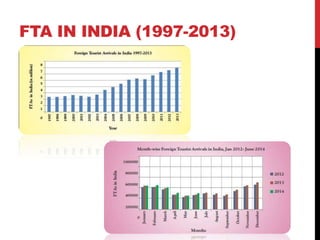
FTA IN INDIA (1997-2013)
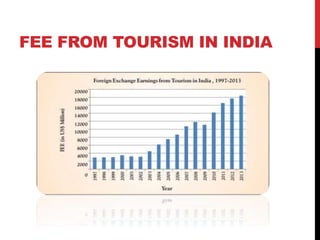
FEE FROM TOURISM IN INDIA
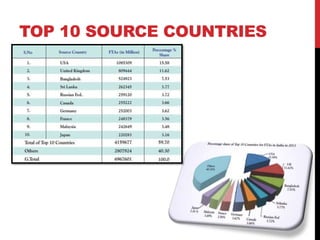
TOP 10 SOURCE COUNTRIES
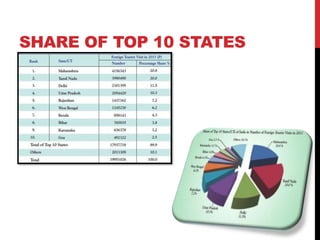
SHARE OF TOP 10 STATES
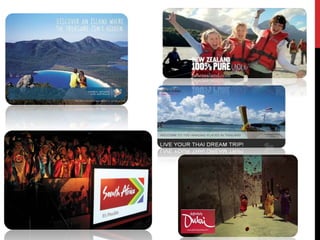
BRANDING 
“The marketing practice of creating a name, symbol or design that 
identifies and differentiates a product from other products”
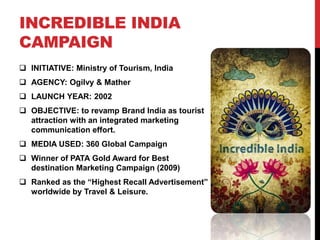
INCREDIBLE INDIA 
CAMPAIGN 
 INITIATIVE: Ministry of Tourism, India 
 AGENCY: Ogilvy & Mather 
 LAUNCH YEAR: 2002 
 OBJECTIVE: to revamp Brand India as tourist 
attraction with an integrated marketing 
communication effort. 
 MEDIA USED: 360 Global Campaign 
 Winner of PATA Gold Award for Best 
destination Marketing Campaign (2009) 
 Ranked as the “Highest Recall Advertisement” 
worldwide by Travel & Leisure.
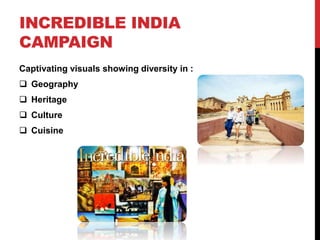
INCREDIBLE INDIA 
CAMPAIGN 
Captivating visuals showing diversity in : 
 Geography 
 Heritage 
 Culture 
 Cuisine
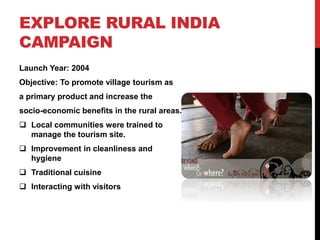
EXPLORE RURAL INDIA 
CAMPAIGN 
Launch Year: 2004 
Objective: To promote village tourism as 
a primary product and increase the 
socio-economic benefits in the rural areas. 
 Local communities were trained to 
manage the tourism site. 
 Improvement in cleanliness and 
hygiene 
 Traditional cuisine 
 Interacting with visitors
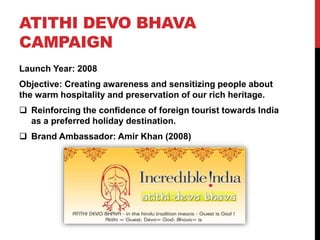
ATITHI DEVO BHAVA 
CAMPAIGN 
Launch Year: 2008 
Objective: Creating awareness and sensitizing people about 
the warm hospitality and preservation of our rich heritage. 
 Reinforcing the confidence of foreign tourist towards India 
as a preferred holiday destination. 
 Brand Ambassador: Amir Khan (2008)
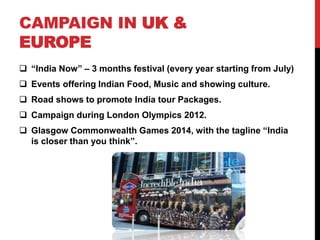
CAMPAIGN IN UK & 
EUROPE 
 “India Now” – 3 months festival (every year starting from July) 
 Events offering Indian Food, Music and showing culture. 
 Road shows to promote India tour Packages. 
 Campaign during London Olympics 2012. 
 Glasgow Commonwealth Games 2014, with the tagline “India 
is closer than you think”.
INCREDIBLE !NDIA - 
USA 
 Celebrations commemorating India’s Independence. 
 Music and Dance concerts, Handicraft exhibitions. 
 Outdoor Ads: 
 Billboard 
 Super Markets 
 Buses & Taxis 
 Giant Screens 
 Tagline – India’s time has come
OTHER PROMOTIONAL 
MEDIA USED 
 DVD AD Inserts 
 Incredible India Postcards 
 TVC Videos on YouTube 
 In flight Campaign (Singapore Airlines, Etihad, Virgin 
Airlines, British Airways)
BRAND ASSOCIATION 
“Brand association is anything which is deep seated in 
customer’s mind about the brand”
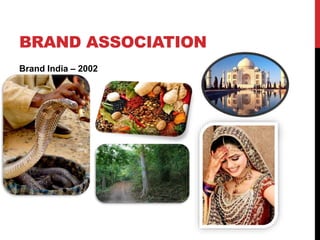
BRAND ASSOCIATION 
Brand India – 2002
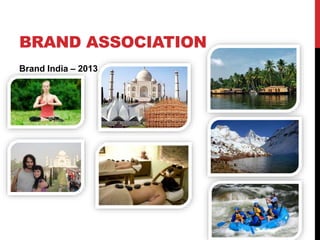
BRAND ASSOCIATION 
Brand India – 2013
BRAND POSITIONING 
“Brand positioning describes how a brand is different from its 
competitors and where, or how, it sits in a particular market.”
BRAND POSITIONING 
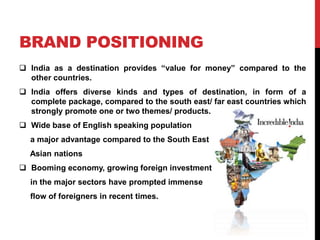
 India as a destination provides “value for money” compared to the 
other countries. 
 India offers diverse kinds and types of destination, in form of a 
complete package, compared to the south east/ far east countries which 
strongly promote one or two themes/ products. 
 Wide base of English speaking population 
a major advantage compared to the South East 
Asian nations 
 Booming economy, growing foreign investment 
in the major sectors have prompted immense 
flow of foreigners in recent times.
BRAND EQUITY 
“The value premium that a company realizes from a product 
with a recognizable name as compared to its generic 
equivalent.” 
Companies can create brand equity for their products by 
making them memorable, easily recognizable and superior in 
quality and reliability.
BRAND EQUITY 
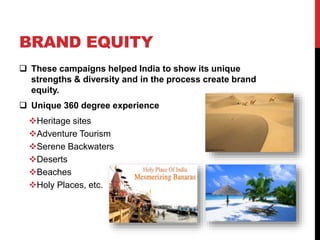
 These campaigns helped India to show its unique 
strengths & diversity and in the process create brand 
equity. 
 Unique 360 degree experience 
Heritage sites 
Adventure Tourism 
Serene Backwaters 
Deserts 
Beaches 
Holy Places, etc.
INCREDIBLE INDIA: AN 
INCREDIBLE SUCCESS 
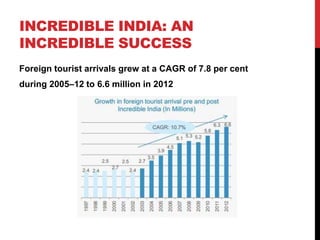
Foreign tourist arrivals grew at a CAGR of 7.8 per cent 
during 2005–12 to 6.6 million in 2012
WHAT CAN BE DONE TO 
PROMOTE TOURISM 
FURTHER?
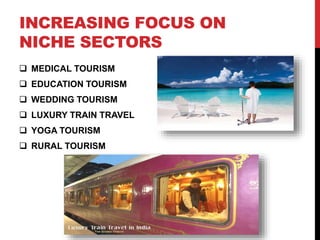
INCREASING FOCUS ON 
NICHE SECTORS 
 MEDICAL TOURISM 
 EDUCATION TOURISM 
 WEDDING TOURISM 
 LUXURY TRAIN TRAVEL 
 YOGA TOURISM 
 RURAL TOURISM
TO EXTEND VISA ON 
ARRIVAL SCHEME 
 The “Visa on Arrival” Scheme has been popular among tourists 
 In January 2010, the government launched the “Visa on Arrival” Scheme for citizens of five 
countries – Finland, Japan, Luxembourg and New Zealand – to attract additional foreign 
tourists 
 In January 2012, the government further extended this 
scheme to the citizens of six countries: Cambodia, 
Indonesia, Vietnam, the Philippines, Laos and 
Myanmar. 
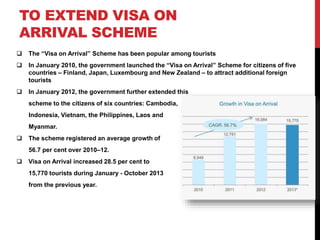
 The scheme registered an average growth of 
56.7 per cent over 2010–12. 
 Visa on Arrival increased 28.5 per cent to 
15,770 tourists during January - October 2013 
from the previous year.
OTHER FACTORS 
PROMOTING POLICIES LIKE: 
 Accelerated development of transport infrastructure. 
 2 destinations in each state to be developed as a model. 
 Reduction of Luxury taxes on Hotels. 
 Tourism Police (The Ministry in consultation with state/UT 
administrations has proposed to employ tourist police at 
prominent tourist spots) 
 Promoting North Eastern regions aggressively. 
 Develop India as a 365-day tourism destination by 
marketing alternative tourism products. 
(Jammu & Kashmir snow festival, agriculture tourism, 
Uttaranchal ecological tours and school camps, Madhya 
Pradesh education tourism are some examples)
THANK YOU

Indian Tourism Branding

  • 1.
    TOURISM SECTOR PRESENTEDBY: ABDUL QADIR KHAN ANUPAM SINGH AYUSH SRIVASTAVA ASHIQUE ANISH BRITTO SELVAM DATTARAJ P BORKAR
  • 2.
    TOURISM IN INDIA  According to World Travel & Tourism Council, tourism generated INR6.4 trillion or 6.6% of the nation's GDP in 2012.  It supported 39.5 million jobs, 7.7% of its total employment.  The sector is predicted to grow at an average annual rate of 7.9% from 2013 to 2023.  India attracted 6.85 million international tourist arrivals and $18.4 billion in foreign exchange earnings from tourism receipts in 2013.  India counted as the 38th-most visited nation according the United Nations
  • 3.
    IMPORTANT FACTS Share of India in International tourist arrivals = 0.64%  India’s rank in world tourist arrivals = 42  India’s rank in World Tourism receipts = 16  Share of India in tourist arrivals to Asia & the Pacific region = 2.81%  India’s rank in Tourist Arrivals to Asia & The Pacific Region = 11  India’s rank in Tourism Receipts of Asia & The Pacific Region = 8
  • 4.
    FTA IN INDIA(1997-2013)
  • 5.
  • 6.
    TOP 10 SOURCECOUNTRIES
  • 7.
    SHARE OF TOP10 STATES
  • 8.
    BRANDING “The marketingpractice of creating a name, symbol or design that identifies and differentiates a product from other products”
  • 10.
    INCREDIBLE INDIA CAMPAIGN  INITIATIVE: Ministry of Tourism, India  AGENCY: Ogilvy & Mather  LAUNCH YEAR: 2002  OBJECTIVE: to revamp Brand India as tourist attraction with an integrated marketing communication effort.  MEDIA USED: 360 Global Campaign  Winner of PATA Gold Award for Best destination Marketing Campaign (2009)  Ranked as the “Highest Recall Advertisement” worldwide by Travel & Leisure.
  • 11.
    INCREDIBLE INDIA CAMPAIGN Captivating visuals showing diversity in :  Geography  Heritage  Culture  Cuisine
  • 12.
    EXPLORE RURAL INDIA CAMPAIGN Launch Year: 2004 Objective: To promote village tourism as a primary product and increase the socio-economic benefits in the rural areas.  Local communities were trained to manage the tourism site.  Improvement in cleanliness and hygiene  Traditional cuisine  Interacting with visitors
  • 13.
    ATITHI DEVO BHAVA CAMPAIGN Launch Year: 2008 Objective: Creating awareness and sensitizing people about the warm hospitality and preservation of our rich heritage.  Reinforcing the confidence of foreign tourist towards India as a preferred holiday destination.  Brand Ambassador: Amir Khan (2008)
  • 14.
    CAMPAIGN IN UK& EUROPE  “India Now” – 3 months festival (every year starting from July)  Events offering Indian Food, Music and showing culture.  Road shows to promote India tour Packages.  Campaign during London Olympics 2012.  Glasgow Commonwealth Games 2014, with the tagline “India is closer than you think”.
  • 15.
    INCREDIBLE !NDIA - USA  Celebrations commemorating India’s Independence.  Music and Dance concerts, Handicraft exhibitions.  Outdoor Ads:  Billboard  Super Markets  Buses & Taxis  Giant Screens  Tagline – India’s time has come
  • 16.
    OTHER PROMOTIONAL MEDIAUSED  DVD AD Inserts  Incredible India Postcards  TVC Videos on YouTube  In flight Campaign (Singapore Airlines, Etihad, Virgin Airlines, British Airways)
  • 17.
    BRAND ASSOCIATION “Brandassociation is anything which is deep seated in customer’s mind about the brand”
  • 18.
  • 19.
  • 20.
    BRAND POSITIONING “Brandpositioning describes how a brand is different from its competitors and where, or how, it sits in a particular market.”
  • 21.
    BRAND POSITIONING India as a destination provides “value for money” compared to the other countries.  India offers diverse kinds and types of destination, in form of a complete package, compared to the south east/ far east countries which strongly promote one or two themes/ products.  Wide base of English speaking population a major advantage compared to the South East Asian nations  Booming economy, growing foreign investment in the major sectors have prompted immense flow of foreigners in recent times.
  • 22.
    BRAND EQUITY “Thevalue premium that a company realizes from a product with a recognizable name as compared to its generic equivalent.” Companies can create brand equity for their products by making them memorable, easily recognizable and superior in quality and reliability.
  • 23.
    BRAND EQUITY These campaigns helped India to show its unique strengths & diversity and in the process create brand equity.  Unique 360 degree experience Heritage sites Adventure Tourism Serene Backwaters Deserts Beaches Holy Places, etc.
  • 24.
    INCREDIBLE INDIA: AN INCREDIBLE SUCCESS Foreign tourist arrivals grew at a CAGR of 7.8 per cent during 2005–12 to 6.6 million in 2012
  • 25.
    WHAT CAN BEDONE TO PROMOTE TOURISM FURTHER?
  • 26.
    INCREASING FOCUS ON NICHE SECTORS  MEDICAL TOURISM  EDUCATION TOURISM  WEDDING TOURISM  LUXURY TRAIN TRAVEL  YOGA TOURISM  RURAL TOURISM
  • 27.
    TO EXTEND VISAON ARRIVAL SCHEME  The “Visa on Arrival” Scheme has been popular among tourists  In January 2010, the government launched the “Visa on Arrival” Scheme for citizens of five countries – Finland, Japan, Luxembourg and New Zealand – to attract additional foreign tourists  In January 2012, the government further extended this scheme to the citizens of six countries: Cambodia, Indonesia, Vietnam, the Philippines, Laos and Myanmar.  The scheme registered an average growth of 56.7 per cent over 2010–12.  Visa on Arrival increased 28.5 per cent to 15,770 tourists during January - October 2013 from the previous year.
  • 28.
    OTHER FACTORS PROMOTINGPOLICIES LIKE:  Accelerated development of transport infrastructure.  2 destinations in each state to be developed as a model.  Reduction of Luxury taxes on Hotels.  Tourism Police (The Ministry in consultation with state/UT administrations has proposed to employ tourist police at prominent tourist spots)  Promoting North Eastern regions aggressively.  Develop India as a 365-day tourism destination by marketing alternative tourism products. (Jammu & Kashmir snow festival, agriculture tourism, Uttaranchal ecological tours and school camps, Madhya Pradesh education tourism are some examples)
  • 29.