INDI
AInstruments)
(Musical
CLASSIFICATION:
Stringed Instruments
Wind Instruments
Percussion Instruments
Ghana Vadya [idiophones]
Tantu Vadya [chordophones]
Sushir Vadya [aerophones]
Avanaddha Vadya [membranophones]
Tantu Vadya:
Plucked Instruments
Stringed musical instruments played by
quickly pulling and releasing strings
with a finger or plectrum (pick)
Bowed Instruments
Stringed musical instruments played
with a wooden rod with horsehair
tightly stretched between the two ends
Tantu Vadya:
Veena
Sitar
Sarod
Tanpura
Ektara
Santoor
Plucked
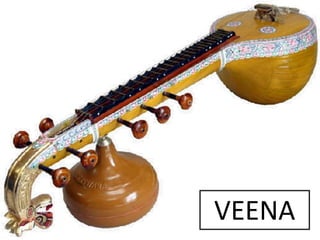
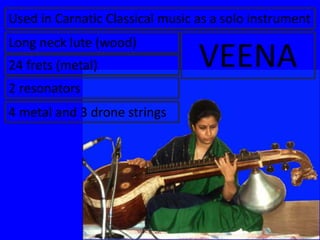
VEENA
Long neck lute (wood)
24 frets (metal)
2 resonators
4 metal and 3 drone strings
Used in Carnatic Classical music as a solo instrument
VEENA
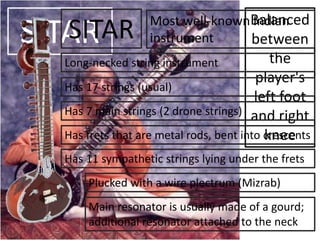
SITAR
Balanced
between
the
player's
left foot
and right
knee
SITAR
Long-necked string instrument
Has 7 main strings (2 drone strings)
Most well-known Indian
instrument
Has 17 strings (usual)
Plucked with a wire plectrum (Mizrab)
Has 11 sympathetic strings lying under the frets
Has frets that are metal rods, bent into crescents
Main resonator is usually made of a gourd;
additional resonator attached to the neck
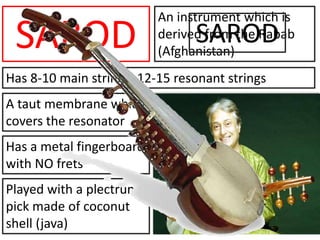
SAROD
An instrument which is
derived from the Rabab
(Afghanistan)
Has a metal fingerboard
with NO frets
A taut membrane which
covers the resonator
Has 8-10 main strings; 12-15 resonant strings
Played with a plectrum/
pick made of coconut
shell (java)
SAROD
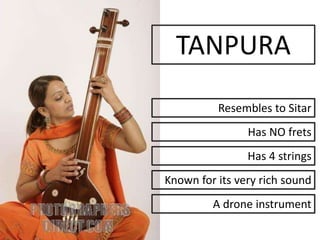
TANPURA
Resembles to Sitar
Has NO frets
Has 4 strings
Known for its very rich sound
A drone instrument
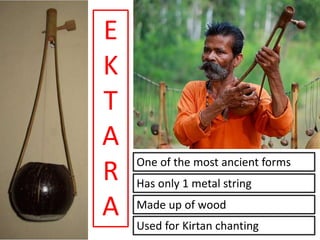
One of the most ancient forms
Has only 1 metal string
Made up of wood
Used for Kirtan chanting
E
K
T
A
R
A
S
A
N
T
O
O
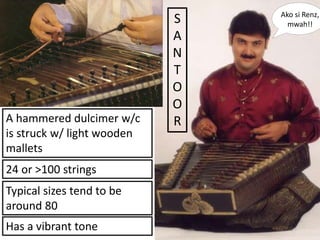
RA hammered dulcimer w/c
is struck w/ light wooden
mallets
24 or >100 strings
Typical sizes tend to be
around 80
Has a vibrant tone
Ako si Renz,
mwah!!
Tantu Vadya:
Esraj (Dilruba)
Sarangi
Bowed
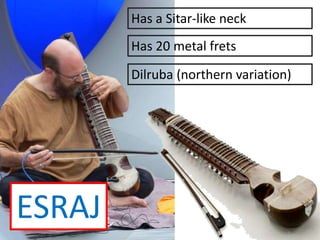
Has a Sitar-like neck
Has 20 metal frets
Dilruba (northern variation)
ESRAJ
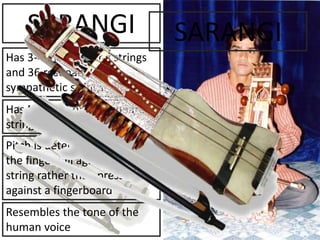
SARANGI
Has 3-4 main playing strings
and 36 resonant/
sympathetic strings
Has NO frets or fingerboard;
strings float in the air
Pitch is determined by sliding
the fingernail against the
string rather than pressing it
against a fingerboard
Resembles the tone of the
human voice
SARANGI
Sushir Vadya:
Shehnai
Harmonium
Bamboo Flute
Bansuri – 6-hole bamboo flute
Venu – 8-hole bamboo flute
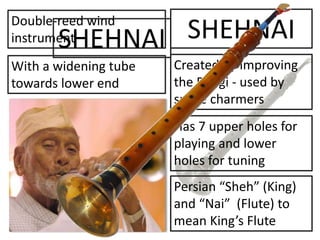
SHEHNAIDouble-reed wind
instrument
With a widening tube
towards lower end
Has 7 upper holes for
playing and lower
holes for tuning
Persian “Sheh” (King)
and “Nai” (Flute) to
mean King’s Flute
Created by improving
the Pungi - used by
snake charmers
SHEHNAI
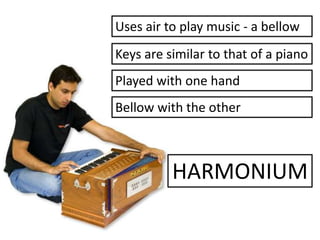
Uses air to play music - a bellow
Keys are similar to that of a piano
Played with one hand
HARMONIUM
Bellow with the other
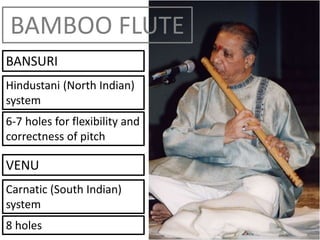
BAMBOO FLUTE
BANSURI
Hindustani (North Indian)
system
6-7 holes for flexibility and
correctness of pitch
VENU
Carnatic (South Indian)
system
8 holes
Avanaddha Vadya:
Tabla
Dhol(ak)
Pakhawaj (Mridangam)
Sreekhol (Khol)
Dhak
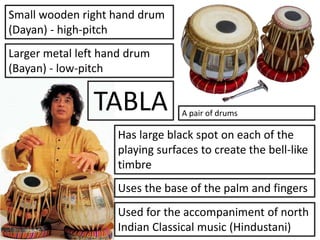
TABLA
Small wooden right hand drum
(Dayan) - high-pitch
Larger metal left hand drum
(Bayan) - low-pitch
Has large black spot on each of the
playing surfaces to create the bell-like
timbre
Uses the base of the palm and fingers
Used for the accompaniment of north
Indian Classical music (Hindustani)
A pair of drums
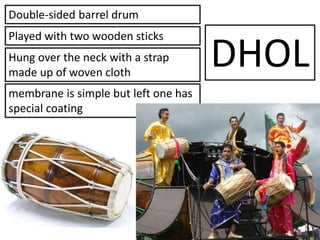
Double-sided barrel drum
Played with two wooden sticks
Hung over the neck with a strap
made up of woven cloth
DHOL
membrane is simple but left one has
special coating
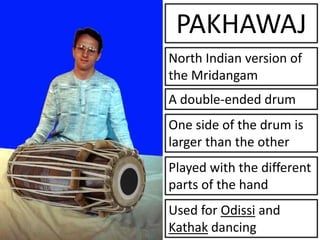
North Indian version of
the Mridangam
One side of the drum is
larger than the other
A double-ended drum
Used for Odissi and
Kathak dancing
Played with the different
parts of the hand
PAKHAWAJ
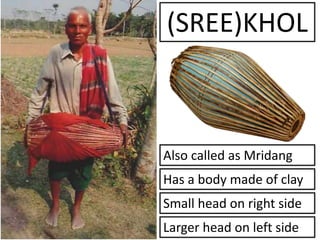
(SREE)KHOL
Also called as Mridang
Has a body made of clay
Small head on right side
Larger head on left side
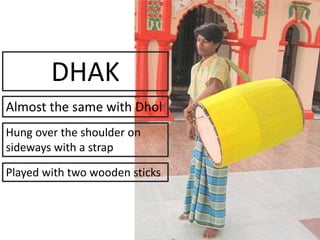
Almost the same with Dhol
DHAK
Hung over the shoulder on
sideways with a strap
Played with two wooden sticks
Ghana Vadya:
Manjira
Jaltarang(am)
Ghungroo
Ghatam
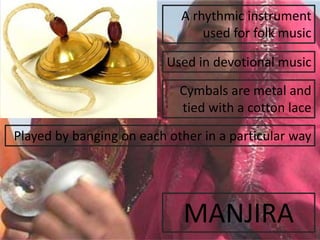
MANJIRA
A rhythmic instrument
used for folk music
Cymbals are metal and
tied with a cotton lace
Played by banging on each other in a particular way
Used in devotional music
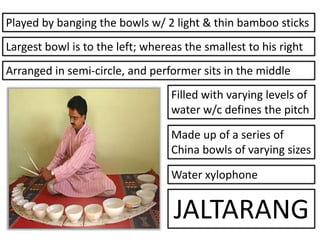
Made up of a series of
China bowls of varying sizes
Arranged in semi-circle, and performer sits in the middle
Filled with varying levels of
water w/c defines the pitch
Water xylophone
JALTARANG
Largest bowl is to the left; whereas the smallest to his right
Played by banging the bowls w/ 2 light & thin bamboo sticks
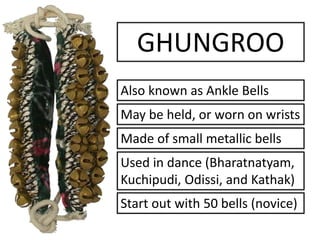
Also known as Ankle Bells
May be held, or worn on wrists
Made of small metallic bells
Used in dance (Bharatnatyam,
Kuchipudi, Odissi, and Kathak)
Start out with 50 bells (novice)
GHUNGROO
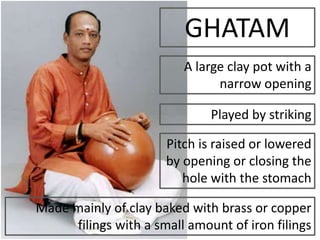
GHATAM
A large clay pot with a
narrow opening
Played by striking
Pitch is raised or lowered
by opening or closing the
hole with the stomach
Made mainly of clay baked with brass or copper
filings with a small amount of iron filings
Tamang
emowt lang…
Ba-bye na!

Indian Musical Instruments

  • 1.
  • 2.
    CLASSIFICATION: Stringed Instruments Wind Instruments PercussionInstruments Ghana Vadya [idiophones] Tantu Vadya [chordophones] Sushir Vadya [aerophones] Avanaddha Vadya [membranophones]
  • 3.
    Tantu Vadya: Plucked Instruments Stringedmusical instruments played by quickly pulling and releasing strings with a finger or plectrum (pick) Bowed Instruments Stringed musical instruments played with a wooden rod with horsehair tightly stretched between the two ends
  • 4.
  • 5.
  • 6.
    Long neck lute(wood) 24 frets (metal) 2 resonators 4 metal and 3 drone strings Used in Carnatic Classical music as a solo instrument VEENA
  • 7.
    SITAR Balanced between the player's left foot and right knee SITAR Long-neckedstring instrument Has 7 main strings (2 drone strings) Most well-known Indian instrument Has 17 strings (usual) Plucked with a wire plectrum (Mizrab) Has 11 sympathetic strings lying under the frets Has frets that are metal rods, bent into crescents Main resonator is usually made of a gourd; additional resonator attached to the neck
  • 8.
    SAROD An instrument whichis derived from the Rabab (Afghanistan) Has a metal fingerboard with NO frets A taut membrane which covers the resonator Has 8-10 main strings; 12-15 resonant strings Played with a plectrum/ pick made of coconut shell (java) SAROD
  • 9.
    TANPURA Resembles to Sitar HasNO frets Has 4 strings Known for its very rich sound A drone instrument
  • 10.
    One of themost ancient forms Has only 1 metal string Made up of wood Used for Kirtan chanting E K T A R A
  • 11.
    S A N T O O RA hammered dulcimerw/c is struck w/ light wooden mallets 24 or >100 strings Typical sizes tend to be around 80 Has a vibrant tone Ako si Renz, mwah!!
  • 12.
  • 13.
    Has a Sitar-likeneck Has 20 metal frets Dilruba (northern variation) ESRAJ
  • 14.
    SARANGI Has 3-4 mainplaying strings and 36 resonant/ sympathetic strings Has NO frets or fingerboard; strings float in the air Pitch is determined by sliding the fingernail against the string rather than pressing it against a fingerboard Resembles the tone of the human voice SARANGI
  • 15.
    Sushir Vadya: Shehnai Harmonium Bamboo Flute Bansuri– 6-hole bamboo flute Venu – 8-hole bamboo flute
  • 16.
    SHEHNAIDouble-reed wind instrument With awidening tube towards lower end Has 7 upper holes for playing and lower holes for tuning Persian “Sheh” (King) and “Nai” (Flute) to mean King’s Flute Created by improving the Pungi - used by snake charmers SHEHNAI
  • 17.
    Uses air toplay music - a bellow Keys are similar to that of a piano Played with one hand HARMONIUM Bellow with the other
  • 18.
    BAMBOO FLUTE BANSURI Hindustani (NorthIndian) system 6-7 holes for flexibility and correctness of pitch VENU Carnatic (South Indian) system 8 holes
  • 19.
  • 20.
    TABLA Small wooden righthand drum (Dayan) - high-pitch Larger metal left hand drum (Bayan) - low-pitch Has large black spot on each of the playing surfaces to create the bell-like timbre Uses the base of the palm and fingers Used for the accompaniment of north Indian Classical music (Hindustani) A pair of drums
  • 21.
    Double-sided barrel drum Playedwith two wooden sticks Hung over the neck with a strap made up of woven cloth DHOL membrane is simple but left one has special coating
  • 22.
    North Indian versionof the Mridangam One side of the drum is larger than the other A double-ended drum Used for Odissi and Kathak dancing Played with the different parts of the hand PAKHAWAJ
  • 23.
    (SREE)KHOL Also called asMridang Has a body made of clay Small head on right side Larger head on left side
  • 24.
    Almost the samewith Dhol DHAK Hung over the shoulder on sideways with a strap Played with two wooden sticks
  • 25.
  • 26.
    MANJIRA A rhythmic instrument usedfor folk music Cymbals are metal and tied with a cotton lace Played by banging on each other in a particular way Used in devotional music
  • 27.
    Made up ofa series of China bowls of varying sizes Arranged in semi-circle, and performer sits in the middle Filled with varying levels of water w/c defines the pitch Water xylophone JALTARANG Largest bowl is to the left; whereas the smallest to his right Played by banging the bowls w/ 2 light & thin bamboo sticks
  • 28.
    Also known asAnkle Bells May be held, or worn on wrists Made of small metallic bells Used in dance (Bharatnatyam, Kuchipudi, Odissi, and Kathak) Start out with 50 bells (novice) GHUNGROO
  • 29.
    GHATAM A large claypot with a narrow opening Played by striking Pitch is raised or lowered by opening or closing the hole with the stomach Made mainly of clay baked with brass or copper filings with a small amount of iron filings
  • 30.