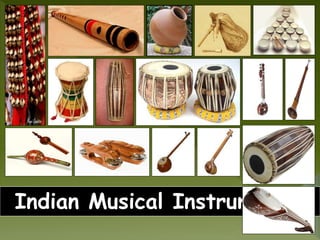
Indian Musical Instruments
AEROPHONES
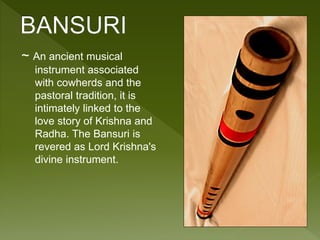
~ An ancient musical 
instrument associated 
with cowherds and the 
pastoral tradition, it is 
intimately linked to the 
love story of Krishna and 
Radha. The Bansuri is 
revered as Lord Krishna's 
divine instrument.
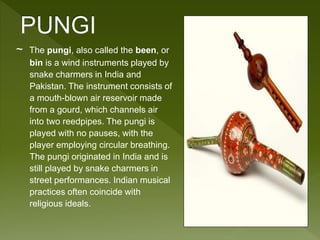
~ The pungi, also called the been, or 
bin is a wind instruments played by 
snake charmers in India and 
Pakistan. The instrument consists of 
a mouth-blown air reservoir made 
from a gourd, which channels air 
into two reedpipes. The pungi is 
played with no pauses, with the 
player employing circular breathing. 
The pungi originated in India and is 
still played by snake charmers in 
street performances. Indian musical 
practices often coincide with 
religious ideals.
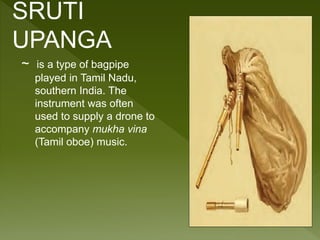
SRUTI 
UPANGA 
~ is a type of bagpipe 
played in Tamil Nadu, 
southern India. The 
instrument was often 
used to supply a drone to 
accompany mukha vina 
(Tamil oboe) music.
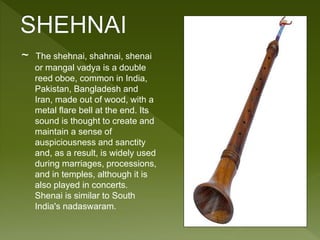
~ The shehnai, shahnai, shenai 
or mangal vadya is a double 
reed oboe, common in India, 
Pakistan, Bangladesh and 
Iran, made out of wood, with a 
metal flare bell at the end. Its 
sound is thought to create and 
maintain a sense of 
auspiciousness and sanctity 
and, as a result, is widely used 
during marriages, processions, 
and in temples, although it is 
also played in concerts. 
Shenai is similar to South 
India's nadaswaram.
IDIOPHONES
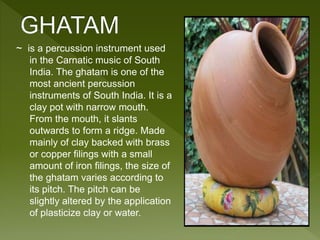
~ is a percussion instrument used 
in the Carnatic music of South 
India. The ghatam is one of the 
most ancient percussion 
instruments of South India. It is a 
clay pot with narrow mouth. 
From the mouth, it slants 
outwards to form a ridge. Made 
mainly of clay backed with brass 
or copper filings with a small 
amount of iron filings, the size of 
the ghatam varies according to 
its pitch. The pitch can be 
slightly altered by the application 
of plasticize clay or water.
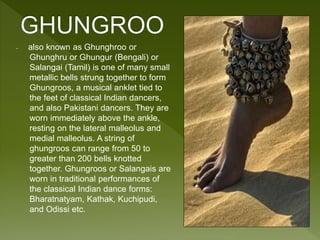
~ also known as Ghunghroo or 
Ghunghru or Ghungur (Bengali) or 
Salangai (Tamil) is one of many small 
metallic bells strung together to form 
Ghungroos, a musical anklet tied to 
the feet of classical Indian dancers, 
and also Pakistani dancers. They are 
worn immediately above the ankle, 
resting on the lateral malleolus and 
medial malleolus. A string of 
ghungroos can range from 50 to 
greater than 200 bells knotted 
together. Ghungroos or Salangais are 
worn in traditional performances of 
the classical Indian dance forms: 
Bharatnatyam, Kathak, Kuchipudi, 
and Odissi etc.
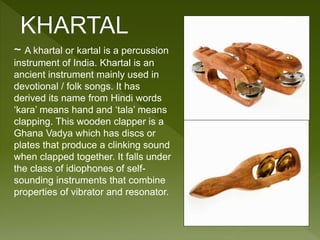
~ A khartal or kartal is a percussion 
instrument of India. Khartal is an 
ancient instrument mainly used in 
devotional / folk songs. It has 
derived its name from Hindi words 
‘kara’ means hand and ‘tala’ means 
clapping. This wooden clapper is a 
Ghana Vadya which has discs or 
plates that produce a clinking sound 
when clapped together. It falls under 
the class of idiophones of self-sounding 
instruments that combine 
properties of vibrator and resonator.
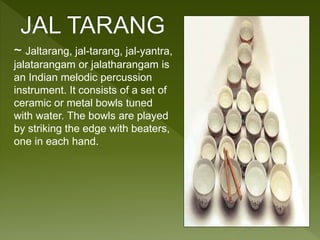
~ Jaltarang, jal-tarang, jal-yantra, 
jalatarangam or jalatharangam is 
an Indian melodic percussion 
instrument. It consists of a set of 
ceramic or metal bowls tuned 
with water. The bowls are played 
by striking the edge with beaters, 
one in each hand.
MEMBRANOPHONE 
S
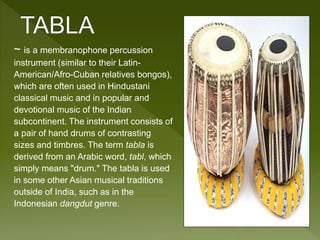
~ is a membranophone percussion 
instrument (similar to their Latin- 
American/Afro-Cuban relatives bongos), 
which are often used in Hindustani 
classical music and in popular and 
devotional music of the Indian 
subcontinent. The instrument consists of 
a pair of hand drums of contrasting 
sizes and timbres. The term tabla is 
derived from an Arabic word, tabl, which 
simply means "drum." The tabla is used 
in some other Asian musical traditions 
outside of India, such as in the 
Indonesian dangdut genre.
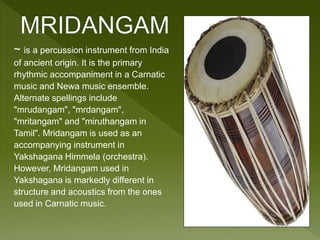
~ is a percussion instrument from India 
of ancient origin. It is the primary 
rhythmic accompaniment in a Carnatic 
music and Newa music ensemble. 
Alternate spellings include 
"mrudangam", "mrdangam", 
"mritangam" and "miruthangam in 
Tamil". Mridangam is used as an 
accompanying instrument in 
Yakshagana Himmela (orchestra). 
However, Mridangam used in 
Yakshagana is markedly different in 
structure and acoustics from the ones 
used in Carnatic music.
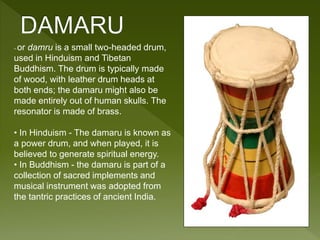
~or damru is a small two-headed drum, 
used in Hinduism and Tibetan 
Buddhism. The drum is typically made 
of wood, with leather drum heads at 
both ends; the damaru might also be 
made entirely out of human skulls. The 
resonator is made of brass. 
• In Hinduism - The damaru is known as 
a power drum, and when played, it is 
believed to generate spiritual energy. 
• In Buddhism - the damaru is part of a 
collection of sacred implements and 
musical instrument was adopted from 
the tantric practices of ancient India.
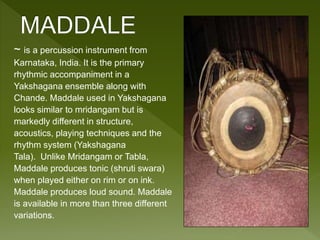
~ is a percussion instrument from 
Karnataka, India. It is the primary 
rhythmic accompaniment in a 
Yakshagana ensemble along with 
Chande. Maddale used in Yakshagana 
looks similar to mridangam but is 
markedly different in structure, 
acoustics, playing techniques and the 
rhythm system (Yakshagana 
Tala). Unlike Mridangam or Tabla, 
Maddale produces tonic (shruti swara) 
when played either on rim or on ink. 
Maddale produces loud sound. Maddale 
is available in more than three different 
variations.
CHORDOPHONES
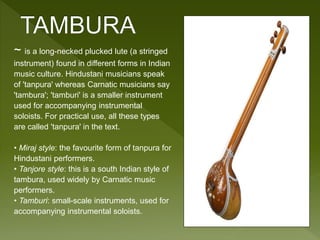
~ is a long-necked plucked lute (a stringed 
instrument) found in different forms in Indian 
music culture. Hindustani musicians speak 
of 'tanpura' whereas Carnatic musicians say 
'tambura'; 'tamburi' is a smaller instrument 
used for accompanying instrumental 
soloists. For practical use, all these types 
are called 'tanpura' in the text. 
• Miraj style: the favourite form of tanpura for 
Hindustani performers. 
• Tanjore style: this is a south Indian style of 
tambura, used widely by Carnatic music 
performers. 
• Tamburi: small-scale instruments, used for 
accompanying instrumental soloists.
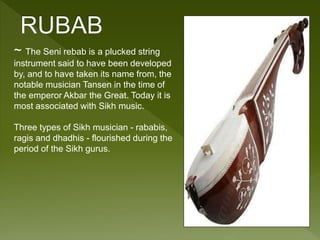
~ The Seni rebab is a plucked string 
instrument said to have been developed 
by, and to have taken its name from, the 
notable musician Tansen in the time of 
the emperor Akbar the Great. Today it is 
most associated with Sikh music. 
Three types of Sikh musician - rababis, 
ragis and dhadhis - flourished during the 
period of the Sikh gurus.
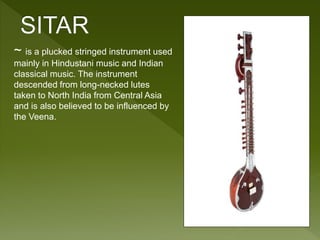
~ is a plucked stringed instrument used 
mainly in Hindustani music and Indian 
classical music. The instrument 
descended from long-necked lutes 
taken to North India from Central Asia 
and is also believed to be influenced by 
the Veena.
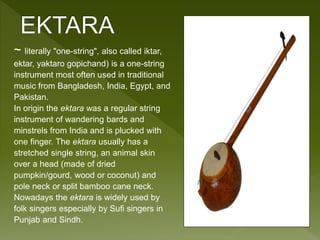
~ literally "one-string", also called iktar, 
ektar, yaktaro gopichand) is a one-string 
instrument most often used in traditional 
music from Bangladesh, India, Egypt, and 
Pakistan. 
In origin the ektara was a regular string 
instrument of wandering bards and 
minstrels from India and is plucked with 
one finger. The ektara usually has a 
stretched single string, an animal skin 
over a head (made of dried 
pumpkin/gourd, wood or coconut) and 
pole neck or split bamboo cane neck. 
Nowadays the ektara is widely used by 
folk singers especially by Sufi singers in 
Punjab and Sindh.

Indian Musical Instruments

  • 1.
  • 2.
  • 3.
    ~ An ancientmusical instrument associated with cowherds and the pastoral tradition, it is intimately linked to the love story of Krishna and Radha. The Bansuri is revered as Lord Krishna's divine instrument.
  • 4.
    ~ The pungi,also called the been, or bin is a wind instruments played by snake charmers in India and Pakistan. The instrument consists of a mouth-blown air reservoir made from a gourd, which channels air into two reedpipes. The pungi is played with no pauses, with the player employing circular breathing. The pungi originated in India and is still played by snake charmers in street performances. Indian musical practices often coincide with religious ideals.
  • 5.
    SRUTI UPANGA ~is a type of bagpipe played in Tamil Nadu, southern India. The instrument was often used to supply a drone to accompany mukha vina (Tamil oboe) music.
  • 6.
    ~ The shehnai,shahnai, shenai or mangal vadya is a double reed oboe, common in India, Pakistan, Bangladesh and Iran, made out of wood, with a metal flare bell at the end. Its sound is thought to create and maintain a sense of auspiciousness and sanctity and, as a result, is widely used during marriages, processions, and in temples, although it is also played in concerts. Shenai is similar to South India's nadaswaram.
  • 7.
  • 8.
    ~ is apercussion instrument used in the Carnatic music of South India. The ghatam is one of the most ancient percussion instruments of South India. It is a clay pot with narrow mouth. From the mouth, it slants outwards to form a ridge. Made mainly of clay backed with brass or copper filings with a small amount of iron filings, the size of the ghatam varies according to its pitch. The pitch can be slightly altered by the application of plasticize clay or water.
  • 9.
    ~ also knownas Ghunghroo or Ghunghru or Ghungur (Bengali) or Salangai (Tamil) is one of many small metallic bells strung together to form Ghungroos, a musical anklet tied to the feet of classical Indian dancers, and also Pakistani dancers. They are worn immediately above the ankle, resting on the lateral malleolus and medial malleolus. A string of ghungroos can range from 50 to greater than 200 bells knotted together. Ghungroos or Salangais are worn in traditional performances of the classical Indian dance forms: Bharatnatyam, Kathak, Kuchipudi, and Odissi etc.
  • 10.
    ~ A khartalor kartal is a percussion instrument of India. Khartal is an ancient instrument mainly used in devotional / folk songs. It has derived its name from Hindi words ‘kara’ means hand and ‘tala’ means clapping. This wooden clapper is a Ghana Vadya which has discs or plates that produce a clinking sound when clapped together. It falls under the class of idiophones of self-sounding instruments that combine properties of vibrator and resonator.
  • 11.
    ~ Jaltarang, jal-tarang,jal-yantra, jalatarangam or jalatharangam is an Indian melodic percussion instrument. It consists of a set of ceramic or metal bowls tuned with water. The bowls are played by striking the edge with beaters, one in each hand.
  • 12.
  • 13.
    ~ is amembranophone percussion instrument (similar to their Latin- American/Afro-Cuban relatives bongos), which are often used in Hindustani classical music and in popular and devotional music of the Indian subcontinent. The instrument consists of a pair of hand drums of contrasting sizes and timbres. The term tabla is derived from an Arabic word, tabl, which simply means "drum." The tabla is used in some other Asian musical traditions outside of India, such as in the Indonesian dangdut genre.
  • 14.
    ~ is apercussion instrument from India of ancient origin. It is the primary rhythmic accompaniment in a Carnatic music and Newa music ensemble. Alternate spellings include "mrudangam", "mrdangam", "mritangam" and "miruthangam in Tamil". Mridangam is used as an accompanying instrument in Yakshagana Himmela (orchestra). However, Mridangam used in Yakshagana is markedly different in structure and acoustics from the ones used in Carnatic music.
  • 15.
    ~or damru isa small two-headed drum, used in Hinduism and Tibetan Buddhism. The drum is typically made of wood, with leather drum heads at both ends; the damaru might also be made entirely out of human skulls. The resonator is made of brass. • In Hinduism - The damaru is known as a power drum, and when played, it is believed to generate spiritual energy. • In Buddhism - the damaru is part of a collection of sacred implements and musical instrument was adopted from the tantric practices of ancient India.
  • 16.
    ~ is apercussion instrument from Karnataka, India. It is the primary rhythmic accompaniment in a Yakshagana ensemble along with Chande. Maddale used in Yakshagana looks similar to mridangam but is markedly different in structure, acoustics, playing techniques and the rhythm system (Yakshagana Tala). Unlike Mridangam or Tabla, Maddale produces tonic (shruti swara) when played either on rim or on ink. Maddale produces loud sound. Maddale is available in more than three different variations.
  • 17.
  • 18.
    ~ is along-necked plucked lute (a stringed instrument) found in different forms in Indian music culture. Hindustani musicians speak of 'tanpura' whereas Carnatic musicians say 'tambura'; 'tamburi' is a smaller instrument used for accompanying instrumental soloists. For practical use, all these types are called 'tanpura' in the text. • Miraj style: the favourite form of tanpura for Hindustani performers. • Tanjore style: this is a south Indian style of tambura, used widely by Carnatic music performers. • Tamburi: small-scale instruments, used for accompanying instrumental soloists.
  • 19.
    ~ The Senirebab is a plucked string instrument said to have been developed by, and to have taken its name from, the notable musician Tansen in the time of the emperor Akbar the Great. Today it is most associated with Sikh music. Three types of Sikh musician - rababis, ragis and dhadhis - flourished during the period of the Sikh gurus.
  • 20.
    ~ is aplucked stringed instrument used mainly in Hindustani music and Indian classical music. The instrument descended from long-necked lutes taken to North India from Central Asia and is also believed to be influenced by the Veena.
  • 21.
    ~ literally "one-string",also called iktar, ektar, yaktaro gopichand) is a one-string instrument most often used in traditional music from Bangladesh, India, Egypt, and Pakistan. In origin the ektara was a regular string instrument of wandering bards and minstrels from India and is plucked with one finger. The ektara usually has a stretched single string, an animal skin over a head (made of dried pumpkin/gourd, wood or coconut) and pole neck or split bamboo cane neck. Nowadays the ektara is widely used by folk singers especially by Sufi singers in Punjab and Sindh.