 Indian musical instruments like any other
attribute represents India’s diversity. Most of the
Indian musical instruments have evolved over
centuries and has a unique history behind their
evolution. Some instruments were developed in
the country while some others came from foreign
lands but, transformed and developed by skilled
Indian artists with the passage of time.
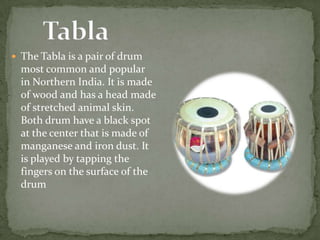
 The Tabla is a pair of drum
most common and popular
in Northern India. It is made
of wood and has a head made
of stretched animal skin.
Both drum have a black spot
at the center that is made of
manganese and iron dust. It
is played by tapping the
fingers on the surface of the
drum
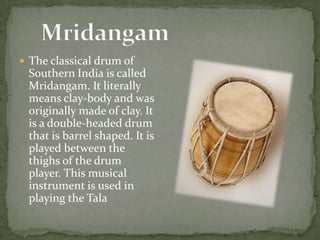
 The classical drum of
Southern India is called
Mridangam. It literally
means clay-body and was
originally made of clay. It
is a double-headed drum
that is barrel shaped. It is
played between the
thighs of the drum
player. This musical
instrument is used in
playing the Tala
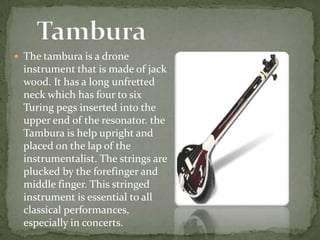
 The tambura is a drone
instrument that is made of jack
wood. It has a long unfretted
neck which has four to six
Turing pegs inserted into the
upper end of the resonator. the
Tambura is help upright and
placed on the lap of the
instrumentalist. The strings are
plucked by the forefinger and
middle finger. This stringed
instrument is essential to all
classical performances,
especially in concerts.
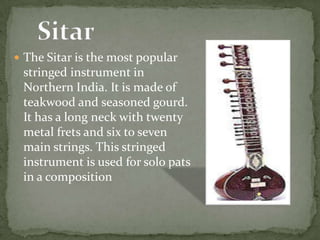
 The Sitar is the most popular
stringed instrument in
Northern India. It is made of
teakwood and seasoned gourd.
It has a long neck with twenty
metal frets and six to seven
main strings. This stringed
instrument is used for solo pats
in a composition
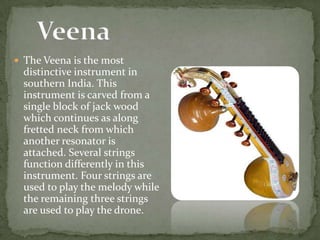
 The Veena is the most
distinctive instrument in
southern India. This
instrument is carved from a
single block of jack wood
which continues as along
fretted neck from which
another resonator is
attached. Several strings
function differently in this
instrument. Four strings are
used to play the melody while
the remaining three strings
are used to play the drone.
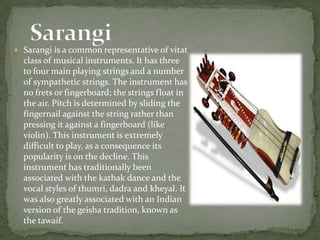
 Sarangi is a common representative of vitat
class of musical instruments. It has three
to four main playing strings and a number
of sympathetic strings. The instrument has
no frets or fingerboard; the strings float in
the air. Pitch is determined by sliding the
fingernail against the string rather than
pressing it against a fingerboard (like
violin). This instrument is extremely
difficult to play, as a consequence its
popularity is on the decline. This
instrument has traditionally been
associated with the kathak dance and the
vocal styles of thumri, dadra and kheyal. It
was also greatly associated with an Indian
version of the geisha tradition, known as
the tawaif.
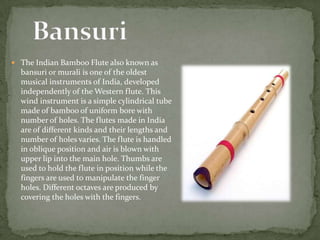
 The Indian Bamboo Flute also known as
bansuri or murali is one of the oldest
musical instruments of India, developed
independently of the Western flute. This
wind instrument is a simple cylindrical tube
made of bamboo of uniform bore with
number of holes. The flutes made in India
are of different kinds and their lengths and
number of holes varies. The flute is handled
in oblique position and air is blown with
upper lip into the main hole. Thumbs are
used to hold the flute in position while the
fingers are used to manipulate the finger
holes. Different octaves are produced by
covering the holes with the fingers.
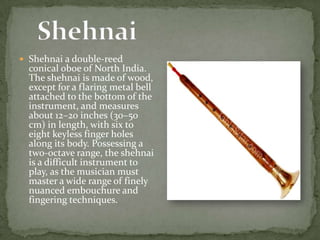
 Shehnai a double-reed
conical oboe of North India.
The shehnai is made of wood,
except for a flaring metal bell
attached to the bottom of the
instrument, and measures
about 12–20 inches (30–50
cm) in length, with six to
eight keyless finger holes
along its body. Possessing a
two-octave range, the shehnai
is a difficult instrument to
play, as the musician must
master a wide range of finely
nuanced embouchure and
fingering techniques.

Indian musical instrument's

  • 3.
     Indian musicalinstruments like any other attribute represents India’s diversity. Most of the Indian musical instruments have evolved over centuries and has a unique history behind their evolution. Some instruments were developed in the country while some others came from foreign lands but, transformed and developed by skilled Indian artists with the passage of time.
  • 4.
     The Tablais a pair of drum most common and popular in Northern India. It is made of wood and has a head made of stretched animal skin. Both drum have a black spot at the center that is made of manganese and iron dust. It is played by tapping the fingers on the surface of the drum
  • 5.
     The classicaldrum of Southern India is called Mridangam. It literally means clay-body and was originally made of clay. It is a double-headed drum that is barrel shaped. It is played between the thighs of the drum player. This musical instrument is used in playing the Tala
  • 6.
     The tamburais a drone instrument that is made of jack wood. It has a long unfretted neck which has four to six Turing pegs inserted into the upper end of the resonator. the Tambura is help upright and placed on the lap of the instrumentalist. The strings are plucked by the forefinger and middle finger. This stringed instrument is essential to all classical performances, especially in concerts.
  • 7.
     The Sitaris the most popular stringed instrument in Northern India. It is made of teakwood and seasoned gourd. It has a long neck with twenty metal frets and six to seven main strings. This stringed instrument is used for solo pats in a composition
  • 8.
     The Veenais the most distinctive instrument in southern India. This instrument is carved from a single block of jack wood which continues as along fretted neck from which another resonator is attached. Several strings function differently in this instrument. Four strings are used to play the melody while the remaining three strings are used to play the drone.
  • 9.
     Sarangi isa common representative of vitat class of musical instruments. It has three to four main playing strings and a number of sympathetic strings. The instrument has no frets or fingerboard; the strings float in the air. Pitch is determined by sliding the fingernail against the string rather than pressing it against a fingerboard (like violin). This instrument is extremely difficult to play, as a consequence its popularity is on the decline. This instrument has traditionally been associated with the kathak dance and the vocal styles of thumri, dadra and kheyal. It was also greatly associated with an Indian version of the geisha tradition, known as the tawaif.
  • 10.
     The IndianBamboo Flute also known as bansuri or murali is one of the oldest musical instruments of India, developed independently of the Western flute. This wind instrument is a simple cylindrical tube made of bamboo of uniform bore with number of holes. The flutes made in India are of different kinds and their lengths and number of holes varies. The flute is handled in oblique position and air is blown with upper lip into the main hole. Thumbs are used to hold the flute in position while the fingers are used to manipulate the finger holes. Different octaves are produced by covering the holes with the fingers.
  • 11.
     Shehnai adouble-reed conical oboe of North India. The shehnai is made of wood, except for a flaring metal bell attached to the bottom of the instrument, and measures about 12–20 inches (30–50 cm) in length, with six to eight keyless finger holes along its body. Possessing a two-octave range, the shehnai is a difficult instrument to play, as the musician must master a wide range of finely nuanced embouchure and fingering techniques.

Editor's Notes

  • #2 Good morning to all of you I waill be report the Indian musical instrument