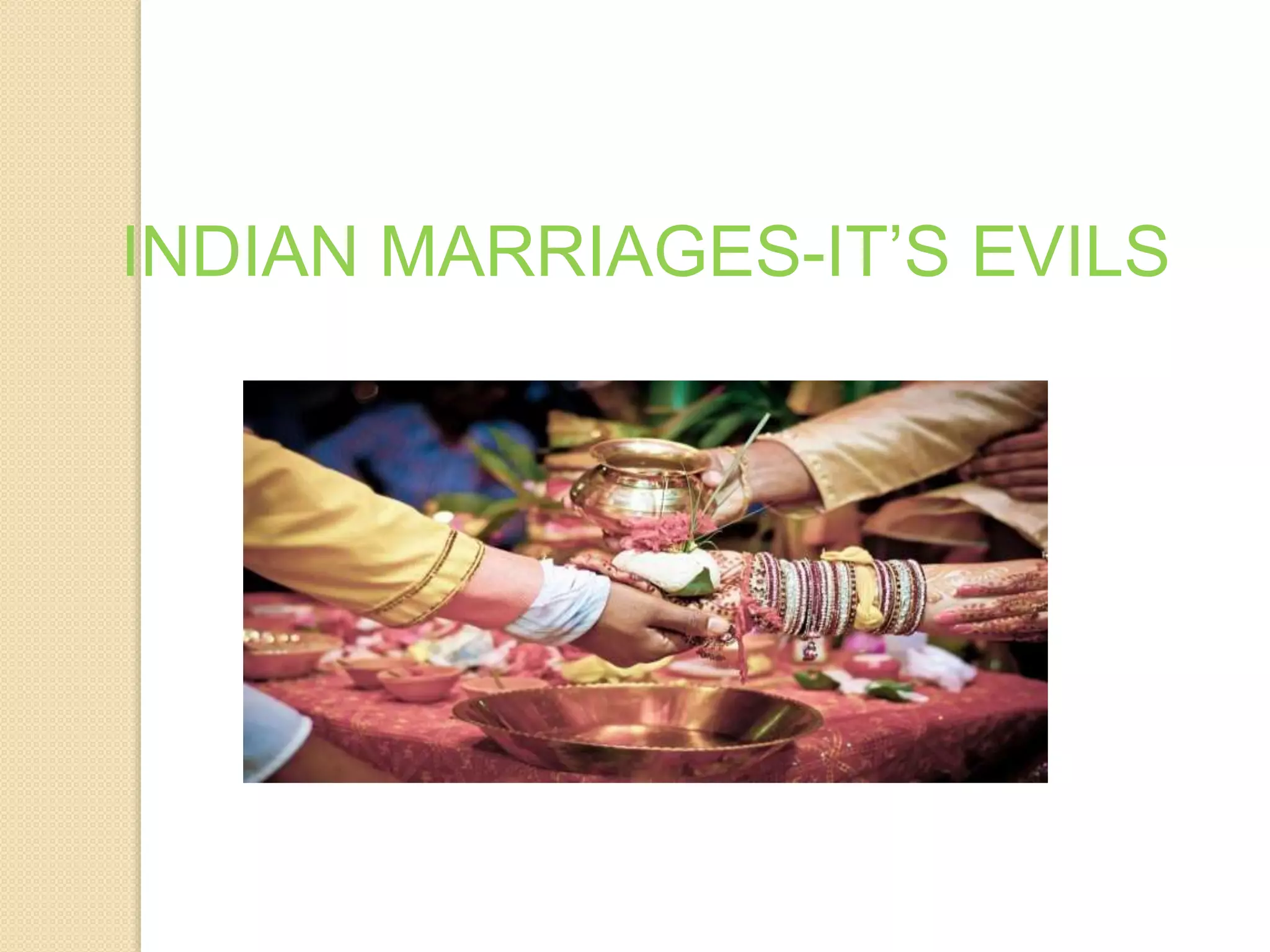
INDIAN MARRIAGES-IT’S EVILS
o Name :-Sounak Pramanik
o Department :- BCA
o Semester :- 2nd
o Year :- 1st
o Subject :- English Language and Communication
o Subject Code :- HU291
o Registration No. :- 152641010045
o Roll No. :- 26401215043
o College Name :- Swami Vivekananda Institute Of Modern
Science
o College Code :- 264
Presented by:-
ACKNOWLEDGEMENT:
Peoples I am thankful to, for helping me making this
project on, “INDIAN MARRIAGE-IT’S EVILS” is as
follows :-
•Dr. Nandan Gupta
Director, Swami Vivekananda Institute Of Modern
Science
•Prof. Gargi Gupta
Vice Principal, Swami Vivekananda Institute Of
Modern Science
•Prof. Suvo Chakraborty (HOD)
Assistant Professor, Swami Vivekananda Institute Of
Modern Science
•Prof. S Majumder (Subject Teacher)
Assistant Professor, Swami Vivekananda Institute Of
CONTENTS
Indian marriage
“kanyadan”-a vital thing of Indian Marriage
“kashiyatra”-A South Indian marriage Rituals
Feet washing-a tradition of Indian Marriage
Name change-First Name-a North Indian
Marriage Rituals
Marrying a peepul tree/dog-a funny rituals
Mother banned from the wedding-a bengali
marriage rituals
Conclusion
Bibliography
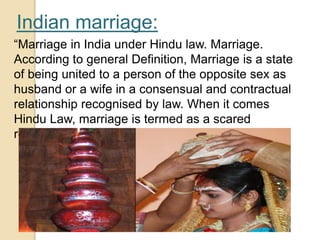
“Marriage in India under Hindu law. Marriage.
According to general Definition, Marriage is a state
of being united to a person of the opposite sex as
husband or a wife in a consensual and contractual
relationship recognised by law. When it comes
Hindu Law, marriage is termed as a scared
relationship.”
Indian marriage:
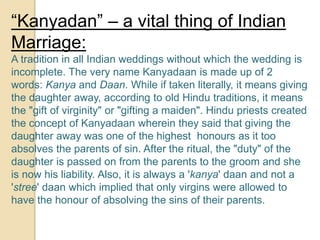
“Kanyadan” – a vital thing of Indian
Marriage:
A tradition in all Indian weddings without which the wedding is
incomplete. The very name Kanyadaan is made up of 2
words: Kanya and Daan. While if taken literally, it means giving
the daughter away, according to old Hindu traditions, it means
the "gift of virginity" or "gifting a maiden". Hindu priests created
the concept of Kanyadaan wherein they said that giving the
daughter away was one of the highest honours as it too
absolves the parents of sin. After the ritual, the "duty" of the
daughter is passed on from the parents to the groom and she
is now his liability. Also, it is always a 'kanya' daan and not a
'stree' daan which implied that only virgins were allowed to
have the honour of absolving the sins of their parents.
“kashiyatra”-A south indian marriage
Ritual:
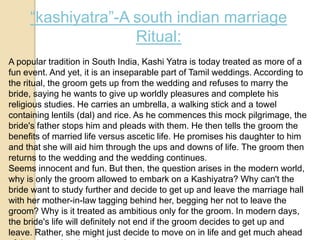
A popular tradition in South India, Kashi Yatra is today treated as more of a
fun event. And yet, it is an inseparable part of Tamil weddings. According to
the ritual, the groom gets up from the wedding and refuses to marry the
bride, saying he wants to give up worldly pleasures and complete his
religious studies. He carries an umbrella, a walking stick and a towel
containing lentils (dal) and rice. As he commences this mock pilgrimage, the
bride's father stops him and pleads with them. He then tells the groom the
benefits of married life versus ascetic life. He promises his daughter to him
and that she will aid him through the ups and downs of life. The groom then
returns to the wedding and the wedding continues.
Seems innocent and fun. But then, the question arises in the modern world,
why is only the groom allowed to embark on a Kashiyatra? Why can't the
bride want to study further and decide to get up and leave the marriage hall
with her mother-in-law tagging behind her, begging her not to leave the
groom? Why is it treated as ambitious only for the groom. In modern days,
the bride's life will definitely not end if the groom decides to get up and
leave. Rather, she might just decide to move on in life and get much ahead
Feet Washing - a tradition in Indian
marriage:
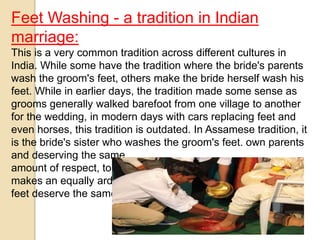
This is a very common tradition across different cultures in
India. While some have the tradition where the bride's parents
wash the groom's feet, others make the bride herself wash his
feet. While in earlier days, the tradition made some sense as
grooms generally walked barefoot from one village to another
for the wedding, in modern days with cars replacing feet and
even horses, this tradition is outdated. In Assamese tradition, it
is the bride's sister who washes the groom's feet. own parents
and deserving the same
amount of respect, to wash the feet of the groom.The bride
makes an equally arduous journey back home. Why don't her
feet deserve the same treatment?
Name change - first name-North Indian
Rituals:
This is a tradition peculiar to North India and parts of the West
where the bride changes her first name as well as her last
name post marriage. The new first name is calculated on her
and her husband's combined astrological chart and the last
name is the same as her husband's last name. Also, the bride
alters her middle name from that of her father's name to her
husband's name. The practice is common not just in rural
areas but even in urban areas. While a lot of women now
retain their last names and add their husband's surname too,
the tradition of making the bride change her first name is
wrong. A name is quite a person's identity and making them
change it is akin to stripping the complete identity away.
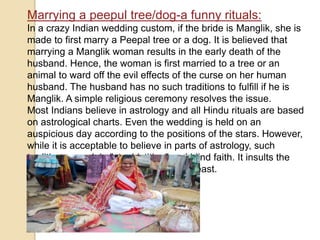
Marrying a peepul tree/dog-a funny rituals:
In a crazy Indian wedding custom, if the bride is Manglik, she is
made to first marry a Peepal tree or a dog. It is believed that
marrying a Manglik woman results in the early death of the
husband. Hence, the woman is first married to a tree or an
animal to ward off the evil effects of the curse on her human
husband. The husband has no such traditions to fulfill if he is
Manglik. A simple religious ceremony resolves the issue.
Most Indians believe in astrology and all Hindu rituals are based
on astrological charts. Even the wedding is held on an
auspicious day according to the positions of the stars. However,
while it is acceptable to believe in parts of astrology, such
traditions are plain "stupidstition" and blind faith. It insults the
woman and are demeaning to say the least.
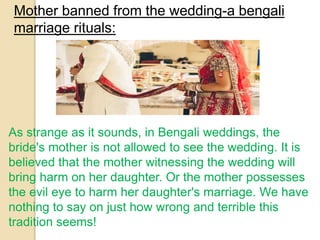
Mother banned from the wedding-a bengali
marriage rituals:
As strange as it sounds, in Bengali weddings, the
bride's mother is not allowed to see the wedding. It is
believed that the mother witnessing the wedding will
bring harm on her daughter. Or the mother possesses
the evil eye to harm her daughter's marriage. We have
nothing to say on just how wrong and terrible this
tradition seems!
Conclusion
It is really a heart touching project. I am happy to do this
project.
By Indian Marriage rituals ladies get too much bad
conditions. Really it is painful.
After marriage girls have to leave her own house. Why
boys don’t leave him house?
After marriage girls have to change her title/last name. why
boys don’t change his surname?
GOOGLE
WIKIPEDIA

Indian marriage

  • 1.
  • 2.
    o Name :-SounakPramanik o Department :- BCA o Semester :- 2nd o Year :- 1st o Subject :- English Language and Communication o Subject Code :- HU291 o Registration No. :- 152641010045 o Roll No. :- 26401215043 o College Name :- Swami Vivekananda Institute Of Modern Science o College Code :- 264 Presented by:-
  • 3.
    ACKNOWLEDGEMENT: Peoples I amthankful to, for helping me making this project on, “INDIAN MARRIAGE-IT’S EVILS” is as follows :- •Dr. Nandan Gupta Director, Swami Vivekananda Institute Of Modern Science •Prof. Gargi Gupta Vice Principal, Swami Vivekananda Institute Of Modern Science •Prof. Suvo Chakraborty (HOD) Assistant Professor, Swami Vivekananda Institute Of Modern Science •Prof. S Majumder (Subject Teacher) Assistant Professor, Swami Vivekananda Institute Of
  • 4.
    CONTENTS Indian marriage “kanyadan”-a vitalthing of Indian Marriage “kashiyatra”-A South Indian marriage Rituals Feet washing-a tradition of Indian Marriage Name change-First Name-a North Indian Marriage Rituals Marrying a peepul tree/dog-a funny rituals Mother banned from the wedding-a bengali marriage rituals Conclusion Bibliography
  • 5.
    “Marriage in Indiaunder Hindu law. Marriage. According to general Definition, Marriage is a state of being united to a person of the opposite sex as husband or a wife in a consensual and contractual relationship recognised by law. When it comes Hindu Law, marriage is termed as a scared relationship.” Indian marriage:
  • 6.
    “Kanyadan” – avital thing of Indian Marriage: A tradition in all Indian weddings without which the wedding is incomplete. The very name Kanyadaan is made up of 2 words: Kanya and Daan. While if taken literally, it means giving the daughter away, according to old Hindu traditions, it means the "gift of virginity" or "gifting a maiden". Hindu priests created the concept of Kanyadaan wherein they said that giving the daughter away was one of the highest honours as it too absolves the parents of sin. After the ritual, the "duty" of the daughter is passed on from the parents to the groom and she is now his liability. Also, it is always a 'kanya' daan and not a 'stree' daan which implied that only virgins were allowed to have the honour of absolving the sins of their parents.
  • 7.
    “kashiyatra”-A south indianmarriage Ritual: A popular tradition in South India, Kashi Yatra is today treated as more of a fun event. And yet, it is an inseparable part of Tamil weddings. According to the ritual, the groom gets up from the wedding and refuses to marry the bride, saying he wants to give up worldly pleasures and complete his religious studies. He carries an umbrella, a walking stick and a towel containing lentils (dal) and rice. As he commences this mock pilgrimage, the bride's father stops him and pleads with them. He then tells the groom the benefits of married life versus ascetic life. He promises his daughter to him and that she will aid him through the ups and downs of life. The groom then returns to the wedding and the wedding continues. Seems innocent and fun. But then, the question arises in the modern world, why is only the groom allowed to embark on a Kashiyatra? Why can't the bride want to study further and decide to get up and leave the marriage hall with her mother-in-law tagging behind her, begging her not to leave the groom? Why is it treated as ambitious only for the groom. In modern days, the bride's life will definitely not end if the groom decides to get up and leave. Rather, she might just decide to move on in life and get much ahead
  • 8.
    Feet Washing -a tradition in Indian marriage: This is a very common tradition across different cultures in India. While some have the tradition where the bride's parents wash the groom's feet, others make the bride herself wash his feet. While in earlier days, the tradition made some sense as grooms generally walked barefoot from one village to another for the wedding, in modern days with cars replacing feet and even horses, this tradition is outdated. In Assamese tradition, it is the bride's sister who washes the groom's feet. own parents and deserving the same amount of respect, to wash the feet of the groom.The bride makes an equally arduous journey back home. Why don't her feet deserve the same treatment?
  • 9.
    Name change -first name-North Indian Rituals: This is a tradition peculiar to North India and parts of the West where the bride changes her first name as well as her last name post marriage. The new first name is calculated on her and her husband's combined astrological chart and the last name is the same as her husband's last name. Also, the bride alters her middle name from that of her father's name to her husband's name. The practice is common not just in rural areas but even in urban areas. While a lot of women now retain their last names and add their husband's surname too, the tradition of making the bride change her first name is wrong. A name is quite a person's identity and making them change it is akin to stripping the complete identity away.
  • 10.
    Marrying a peepultree/dog-a funny rituals: In a crazy Indian wedding custom, if the bride is Manglik, she is made to first marry a Peepal tree or a dog. It is believed that marrying a Manglik woman results in the early death of the husband. Hence, the woman is first married to a tree or an animal to ward off the evil effects of the curse on her human husband. The husband has no such traditions to fulfill if he is Manglik. A simple religious ceremony resolves the issue. Most Indians believe in astrology and all Hindu rituals are based on astrological charts. Even the wedding is held on an auspicious day according to the positions of the stars. However, while it is acceptable to believe in parts of astrology, such traditions are plain "stupidstition" and blind faith. It insults the woman and are demeaning to say the least.
  • 11.
    Mother banned fromthe wedding-a bengali marriage rituals: As strange as it sounds, in Bengali weddings, the bride's mother is not allowed to see the wedding. It is believed that the mother witnessing the wedding will bring harm on her daughter. Or the mother possesses the evil eye to harm her daughter's marriage. We have nothing to say on just how wrong and terrible this tradition seems!
  • 12.
    Conclusion It is reallya heart touching project. I am happy to do this project. By Indian Marriage rituals ladies get too much bad conditions. Really it is painful. After marriage girls have to leave her own house. Why boys don’t leave him house? After marriage girls have to change her title/last name. why boys don’t change his surname?
  • 13.