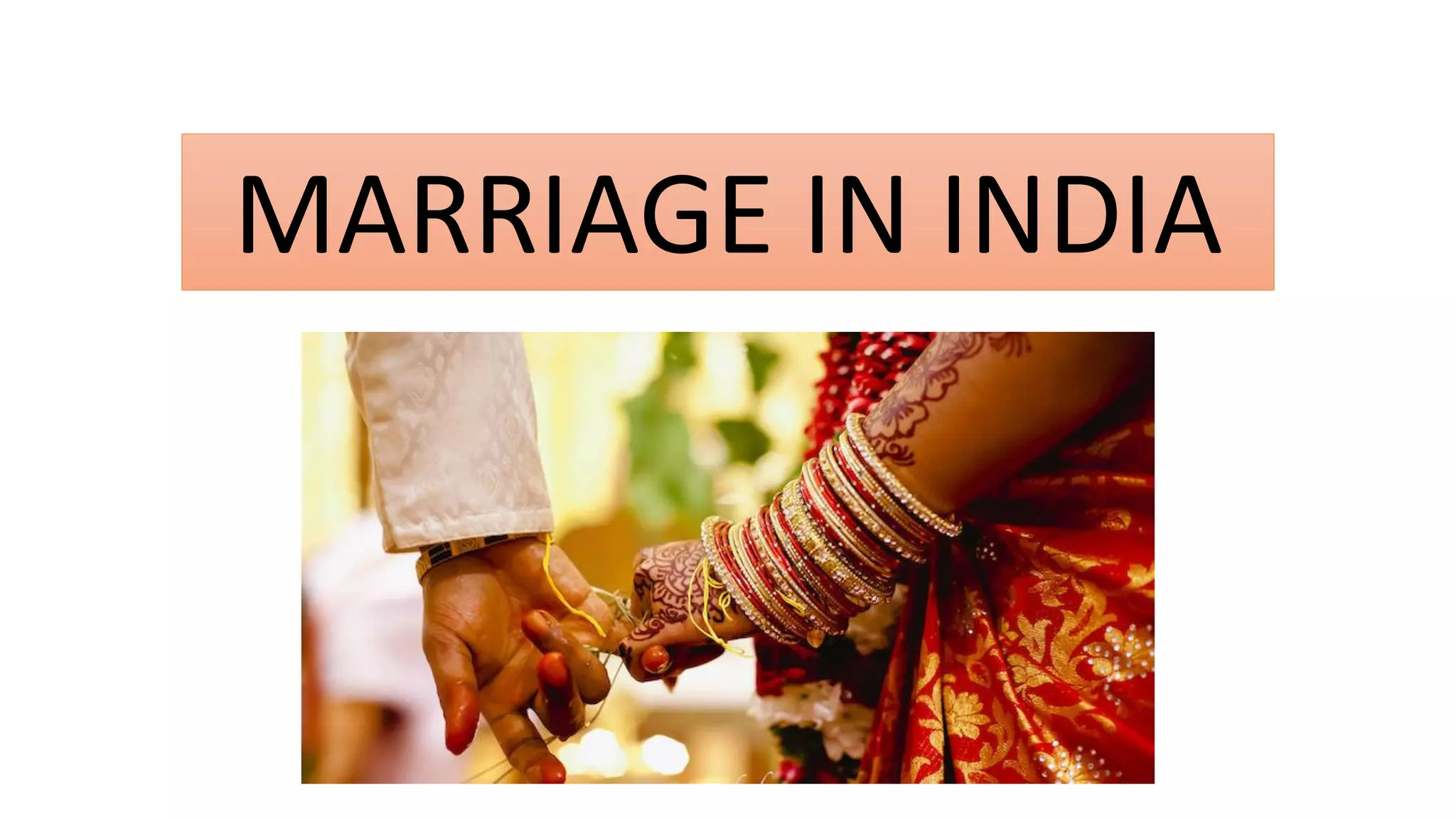
MARRIAGE IN INDIA
•Marriage: A sacrament:
• In India, according to traditional Hindu Law, marriage is a sacrament and
not a civil contract. It is a 'Sanskara' or purificatory ceremony obligatory
for every Hindu.
• The Hindu religious books have enjoined marriage as a duty because an
unmarried man cannot perform some of the most important religious
rites. Accordingly, marriage in India is a holy performance of religious
duties.
• The union is sacred and indissoluble in life and continues even after the
death of the husband. The parents are morally obliged to find mates for
their children and the children to accept the parental choice.
• The marriage is considered a union between two joint families rather
than between two young people.
• Second marriages are especially for women are abhorred.
•FORMS OF MARRIAGE:
• In India, marriage regulations existed from the very beginning. In
Mahabharata, we have a reference for the promiscuity of sexual
license which seems to be imaginary. In Vedic times marriage was
left to the choice of the persons concerned. There was the practice
of giving dowry in marriages. In later Samhitas, there is clear
evidence of giving a bride price. In smriti eight kinds of marriages are
recognized but only four are said to have a religious character. Out of
the eight forms of marriage, 'Brahma' marriage is the best form of
marriage.
• A marriage in Brahma marriage if the father or the guardian of the
girl does not receive any consideration from the bridegroom for
giving the girl in marriage.
• It differs from Asura form inasmuch as the latter there is always
some consideration given by the bridegroom to the kinsmen of the
bride or tot the bride herself.
• Both these forms of marriage are open to Hindus belonging to any
caste. "Rakasa Vivah" was not allowed to the higher caste Hindus.
Under it, the man forcibly abducted the maiden from her home
while she kept on crying and weeping after slaying or wounding her
kinsmen.
• This form of marriage was permitted to the warrior caste.
'Swayamvara' as a form of marriage came at a later stage.
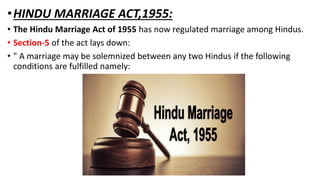
•HINDU MARRIAGE ACT,1955:
• The Hindu Marriage Act of 1955 has now regulated marriage among Hindus.
• Section-5 of the act lays down:
• " A marriage may be solemnized between any two Hindus if the following
conditions are fulfilled namely:
• 1. Neither party has a spouse living at the time of the marriage.
• 2. Neither party is an idiot or a lunatic at the time of the marriage.
• 3. The bridegroom has completed the age of 21 years and the
bride the age of 18 years at the time of the marriage.
• 4. The parties are not within the degrees of prohibited
relationship unless the custom or usage governing each of them
permits of a marriage between the two.
• 5. The parties are not ‘Sapindas’ of each other unless the custom
or usage governing each of them permits of a marriage between
the two.
• 6. Where the bride has not completed the age of 18 years, the
consent of her guardians in marriage, if any, has been obtained for
the marriage.
•HINDU MARRIAGE BASED ON EXOGAMY:
• Under the usage and custom of Hindu Law, no two persons tracing their
common ascendancy through their father within seven degrees of ascendency
can at all marry among themselves. While on the mother's side the restrictions
extend up to the fifth degree.
• Under the Hindu Marriage Act, the degrees have been reduced to five on the
father's side and there on the mother's side. From the Brahmins to the tribes
of the Nilagiri Hills and Assam, the system of exogamy is prevalent. Among the
Brahmins and Vaishyas, the name of the exogamous unit is known as 'gotra'.
Among the Rajput’s, the name is 'nukh', while in Northern India it is 'kul'.
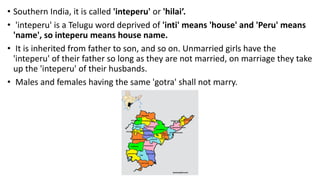
• Southern India, it is called 'inteperu' or 'hilai’.
• 'inteperu' is a Telugu word deprived of 'inti' means 'house' and 'Peru' means
'name', so inteperu means house name.
• It is inherited from father to son, and so on. Unmarried girls have the
'inteperu' of their father so long as they are not married, on marriage they take
up the 'inteperu' of their husbands.
• Males and females having the same 'gotra' shall not marry.
•MARRIAGE RITES:
• Before a marriage takes legal effect certain ceremonies are required to be
observed. These ceremonies differ from community to community and from
place to place. Sometimes some of these ceremonies may look ridiculous and
playful, nevertheless, they are regarded indispensable are well as highly
religious and significant.
• Among the Hindus, the marriage rites are said to be most complicated. The
important ceremony in Hindu marriages is 'Saptapadi' which means taking
seven steps by the bride and the bridegroom jointly round the consecrated
fire. When the seventh step has been taken the marriage becomes under law
complete and binding. Before the seventh step is taken marriage is incomplete
and may be revoked. Thus the performance of 'Saptapadi' is an essential
condition of Hindu marriage.
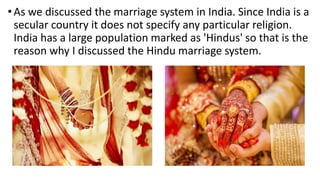
• As we discussed the marriage system in India. Since India is a
secular country it does not specify any particular religion.
India has a large population marked as 'Hindus' so that is the
reason why I discussed the Hindu marriage system.
Marriage in India ( notes)

Marriage in India ( notes)

  • 1.
  • 2.
    •Marriage: A sacrament: •In India, according to traditional Hindu Law, marriage is a sacrament and not a civil contract. It is a 'Sanskara' or purificatory ceremony obligatory for every Hindu. • The Hindu religious books have enjoined marriage as a duty because an unmarried man cannot perform some of the most important religious rites. Accordingly, marriage in India is a holy performance of religious duties. • The union is sacred and indissoluble in life and continues even after the death of the husband. The parents are morally obliged to find mates for their children and the children to accept the parental choice. • The marriage is considered a union between two joint families rather than between two young people. • Second marriages are especially for women are abhorred.
  • 3.
    •FORMS OF MARRIAGE: •In India, marriage regulations existed from the very beginning. In Mahabharata, we have a reference for the promiscuity of sexual license which seems to be imaginary. In Vedic times marriage was left to the choice of the persons concerned. There was the practice of giving dowry in marriages. In later Samhitas, there is clear evidence of giving a bride price. In smriti eight kinds of marriages are recognized but only four are said to have a religious character. Out of the eight forms of marriage, 'Brahma' marriage is the best form of marriage.
  • 4.
    • A marriagein Brahma marriage if the father or the guardian of the girl does not receive any consideration from the bridegroom for giving the girl in marriage. • It differs from Asura form inasmuch as the latter there is always some consideration given by the bridegroom to the kinsmen of the bride or tot the bride herself. • Both these forms of marriage are open to Hindus belonging to any caste. "Rakasa Vivah" was not allowed to the higher caste Hindus. Under it, the man forcibly abducted the maiden from her home while she kept on crying and weeping after slaying or wounding her kinsmen. • This form of marriage was permitted to the warrior caste. 'Swayamvara' as a form of marriage came at a later stage.
  • 5.
    •HINDU MARRIAGE ACT,1955: •The Hindu Marriage Act of 1955 has now regulated marriage among Hindus. • Section-5 of the act lays down: • " A marriage may be solemnized between any two Hindus if the following conditions are fulfilled namely:
  • 6.
    • 1. Neitherparty has a spouse living at the time of the marriage. • 2. Neither party is an idiot or a lunatic at the time of the marriage. • 3. The bridegroom has completed the age of 21 years and the bride the age of 18 years at the time of the marriage. • 4. The parties are not within the degrees of prohibited relationship unless the custom or usage governing each of them permits of a marriage between the two. • 5. The parties are not ‘Sapindas’ of each other unless the custom or usage governing each of them permits of a marriage between the two. • 6. Where the bride has not completed the age of 18 years, the consent of her guardians in marriage, if any, has been obtained for the marriage.
  • 7.
    •HINDU MARRIAGE BASEDON EXOGAMY: • Under the usage and custom of Hindu Law, no two persons tracing their common ascendancy through their father within seven degrees of ascendency can at all marry among themselves. While on the mother's side the restrictions extend up to the fifth degree. • Under the Hindu Marriage Act, the degrees have been reduced to five on the father's side and there on the mother's side. From the Brahmins to the tribes of the Nilagiri Hills and Assam, the system of exogamy is prevalent. Among the Brahmins and Vaishyas, the name of the exogamous unit is known as 'gotra'. Among the Rajput’s, the name is 'nukh', while in Northern India it is 'kul'.
  • 8.
    • Southern India,it is called 'inteperu' or 'hilai’. • 'inteperu' is a Telugu word deprived of 'inti' means 'house' and 'Peru' means 'name', so inteperu means house name. • It is inherited from father to son, and so on. Unmarried girls have the 'inteperu' of their father so long as they are not married, on marriage they take up the 'inteperu' of their husbands. • Males and females having the same 'gotra' shall not marry.
  • 9.
    •MARRIAGE RITES: • Beforea marriage takes legal effect certain ceremonies are required to be observed. These ceremonies differ from community to community and from place to place. Sometimes some of these ceremonies may look ridiculous and playful, nevertheless, they are regarded indispensable are well as highly religious and significant. • Among the Hindus, the marriage rites are said to be most complicated. The important ceremony in Hindu marriages is 'Saptapadi' which means taking seven steps by the bride and the bridegroom jointly round the consecrated fire. When the seventh step has been taken the marriage becomes under law complete and binding. Before the seventh step is taken marriage is incomplete and may be revoked. Thus the performance of 'Saptapadi' is an essential condition of Hindu marriage.
  • 10.
    • As wediscussed the marriage system in India. Since India is a secular country it does not specify any particular religion. India has a large population marked as 'Hindus' so that is the reason why I discussed the Hindu marriage system.