Analysis of Indian
Industries
Prof. Ashwin Malshe
Marketing Department – ESSEC
Agenda


• Study four Indian industries
  •   Luxury
  •   Pharmaceutical
  •   Cosmetics
  •   Processed food
• Mobile banking (if time permits)
• Case study on HUL Pureit water purifier
Source of Data


• Most figures in this presentations are taken from
  multiple sources. A primary source has been
  industry reports published by consulting firms. I
  attribute data to the sources wherever applicable.
Luxury Market
• Indian luxury market size - $5.7 billion in 2010
• Growth at estimated 20% per year
  • By 2015, the market size will be close to $15 billion
• Six cities dominate –
  Delhi, Mumbai, Bangalore, Chennai, Hyderabad, an
  d Pune
• Traditional ‘low margin, high volume’ model is
  restrictive for luxury penetration
• Presence of multiple brands
  • Hermes, Paul & Shark, Diesel, Canali, Tumi, Aston
    Martin, Ferrari, Harley
    Davidson, Ducati, Kiehl’s, L'Occitane, Hakkasan, etc.
                                     Source – AT Kearney
Luxury


• Indian consumer
  • Many Indians became rich recently (post 1990)
  • The typical luxury customer may be labeled ‘Parvenu’
    • Wants to associate with other ‘haves’ and wants to
      disassociate from ‘have-nots.’ Uses loud signals
  • Price sensitivity remains high
    • Mercedes diesel sells much more than petrol version
    • Discounts are considered as entitlements by the
      Parvenus.
Luxury


• Trademark laws
  • Counterfeits are common
    • Less than China, however
  • Poseurs are more likely to use them
  • PC Mallappa vs McDonald’s case
  • Delay in courts
• Sales culture
  • Incentives are variable in most cases
  • High fixed as well as variable pay
Hermes India
Hermes Saris


• Priced at $6,100 to $8,400 (€4,700 - €6,500)
• Limited edition
Hermes India
Hermes India


• 3 outlets: Delhi, Pune, and Mumbai
• Low advertising budgets
• No difference in product or store design as
  compared to Paris
• Excellent sales staff
Pharmaceuticals
Indian Market


• Indian pharma market size was $11.6 billion in 2009
  and growing at average rate of 14% annually
  • $20 billion by 2015
  • Currently ranks between 10-14 in the world by size
• Produces simple headache pills to sophisticated
  antibiotics
  • Almost every type of medicine is now made in India
• 250 large companies control 70% market
                     McKinsey and Corporate Catalyst India
Nature of Pharma Industry


• From 1970 to 2005, Indian law recognized only
  ‘process patents’ and not ‘product patent’
  • Many Indian companies started producing top notch
    drugs by changing process
  • This stopped with WTO adoption in 2005
• Strong R&D base and low labor cost
• Reaching the consumer through physicians
  • Direct to consumer advertising is relatively low
Emerging Trends

• Global pharma companies are investing directly in
  India
  • Latest regulatory changes have created some
    challenges
• Contract R&D
  • Drug discovery and development
  • Clinical trial organization
• Contract manufacturing
• Contract co-marketing alliances
Beauty Care
Indian Market
3,000.0

2,500.0

2,000.0

1,500.0
                                                      2011
                                                      2012
1,000.0
                                                      2013
 500.0

    0.0
           Hair     Bath    Skin    Oral     Men's
          Care     and     Care    Care    Grooming
                  Shower
Whitening Cream


• Largest selling beauty product in India

• Women
  • Commercial
  • Pond’s series
• Men
  • Commercial
al India


• Entered India in 1993
• Presence in 100 top cities and towns
• Four divisions
  •   Consumer products (Garnier)
  •   Professional products
  •   Active cosmetics (Vichy)
  •   Luxury (Lancôme)
• Own manufacturing in Pune for hair and skin care
al India


                       Value Share   Rank
Beauty and personal
care                     3.50%        6
Color cosmetics           13%         3
Hair care                  8%         4
Skin care                6.50%        2
Men's grooming           0.90%        14
Processed Food


• Mumbai Dabbawalas
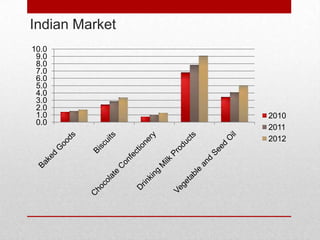
Indian Market
10.0
 9.0
 8.0
 7.0
 6.0
 5.0
 4.0
 3.0
 2.0
 1.0            2010
 0.0
                2011
                2012
Packaged Wheat Flour


• Pillsbury

Analysis of Indian industries

  • 1.
    Analysis of Indian Industries Prof.Ashwin Malshe Marketing Department – ESSEC
  • 2.
    Agenda • Study fourIndian industries • Luxury • Pharmaceutical • Cosmetics • Processed food • Mobile banking (if time permits) • Case study on HUL Pureit water purifier
  • 3.
    Source of Data •Most figures in this presentations are taken from multiple sources. A primary source has been industry reports published by consulting firms. I attribute data to the sources wherever applicable.
  • 4.
    Luxury Market • Indianluxury market size - $5.7 billion in 2010 • Growth at estimated 20% per year • By 2015, the market size will be close to $15 billion • Six cities dominate – Delhi, Mumbai, Bangalore, Chennai, Hyderabad, an d Pune • Traditional ‘low margin, high volume’ model is restrictive for luxury penetration • Presence of multiple brands • Hermes, Paul & Shark, Diesel, Canali, Tumi, Aston Martin, Ferrari, Harley Davidson, Ducati, Kiehl’s, L'Occitane, Hakkasan, etc. Source – AT Kearney
  • 5.
    Luxury • Indian consumer • Many Indians became rich recently (post 1990) • The typical luxury customer may be labeled ‘Parvenu’ • Wants to associate with other ‘haves’ and wants to disassociate from ‘have-nots.’ Uses loud signals • Price sensitivity remains high • Mercedes diesel sells much more than petrol version • Discounts are considered as entitlements by the Parvenus.
  • 6.
    Luxury • Trademark laws • Counterfeits are common • Less than China, however • Poseurs are more likely to use them • PC Mallappa vs McDonald’s case • Delay in courts • Sales culture • Incentives are variable in most cases • High fixed as well as variable pay
  • 7.
  • 8.
    Hermes Saris • Pricedat $6,100 to $8,400 (€4,700 - €6,500) • Limited edition
  • 9.
  • 10.
    Hermes India • 3outlets: Delhi, Pune, and Mumbai • Low advertising budgets • No difference in product or store design as compared to Paris • Excellent sales staff
  • 11.
  • 12.
    Indian Market • Indianpharma market size was $11.6 billion in 2009 and growing at average rate of 14% annually • $20 billion by 2015 • Currently ranks between 10-14 in the world by size • Produces simple headache pills to sophisticated antibiotics • Almost every type of medicine is now made in India • 250 large companies control 70% market McKinsey and Corporate Catalyst India
  • 13.
    Nature of PharmaIndustry • From 1970 to 2005, Indian law recognized only ‘process patents’ and not ‘product patent’ • Many Indian companies started producing top notch drugs by changing process • This stopped with WTO adoption in 2005 • Strong R&D base and low labor cost • Reaching the consumer through physicians • Direct to consumer advertising is relatively low
  • 14.
    Emerging Trends • Globalpharma companies are investing directly in India • Latest regulatory changes have created some challenges • Contract R&D • Drug discovery and development • Clinical trial organization • Contract manufacturing • Contract co-marketing alliances
  • 15.
  • 16.
    Indian Market 3,000.0 2,500.0 2,000.0 1,500.0 2011 2012 1,000.0 2013 500.0 0.0 Hair Bath Skin Oral Men's Care and Care Care Grooming Shower
  • 17.
    Whitening Cream • Largestselling beauty product in India • Women • Commercial • Pond’s series • Men • Commercial
  • 18.
    al India • EnteredIndia in 1993 • Presence in 100 top cities and towns • Four divisions • Consumer products (Garnier) • Professional products • Active cosmetics (Vichy) • Luxury (Lancôme) • Own manufacturing in Pune for hair and skin care
  • 19.
    al India Value Share Rank Beauty and personal care 3.50% 6 Color cosmetics 13% 3 Hair care 8% 4 Skin care 6.50% 2 Men's grooming 0.90% 14
  • 20.
  • 21.
    Indian Market 10.0 9.0 8.0 7.0 6.0 5.0 4.0 3.0 2.0 1.0 2010 0.0 2011 2012
  • 22.