Budapest University of Technology and Economics
Department of Measurement and Information Systems
Budapest University of
Technology and Economics
Fault Tolerant Systems
Research Group
McGill University
Department of Mechanical
and Electrical Engineering
MTA-BME Cyber-Physical
Systems Research Group
Incremental View Model Synchronization
Using Partial Models
Kristóf Marussy, Oszkár Semeráth, Dániel Varró
1
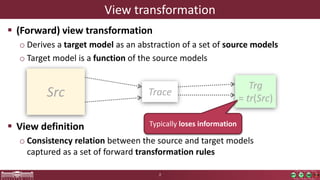
View transformation
 (Forward) view transformation
o Derives a target model as an abstraction of a set of source models
o Target model is a function of the source models
 View definition
o Consistency relation between the source and target models
captured as a set of forward transformation rules
2
Src
Trg
= tr(Src)
Trace
Typically loses information
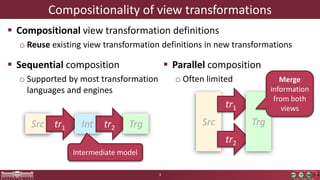
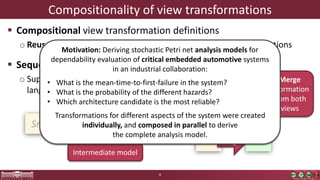
Compositionality of view transformations
 Compositional view transformation definitions
o Reuse existing view transformation definitions in new transformations
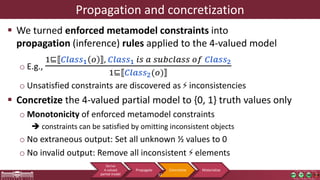
3
 Sequential composition
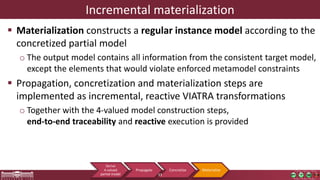
o Supported by most transformation
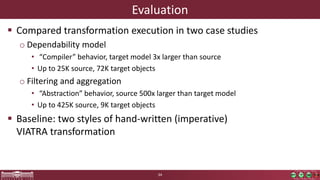
languages and engines
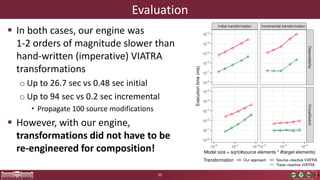
 Parallel composition
o Often limited
Src tr1 Int tr2 Trg Src
tr1
tr2
Trg
Merge
information
from both
views
Intermediate model
Compositionality of view transformations
 Compositional view transformation definitions
o Reuse existing view transformation definitions in new transformations
4
 Sequential composition
o Supported by most transformation
languages and engines
 Parallel composition
o Often limited
Src tr1 Int tr2 Trg Src
tr1
tr2
Trg
Merge
information
from both
views
Intermediate model
Motivation: Deriving stochastic Petri net analysis models for
dependability evaluation of critical embedded automotive systems
in an industrial collaboration:
• What is the mean-time-to-first-failure in the system?
• What is the probability of the different hazards?
• Which architecture candidate is the most reliable?
Transformations for different aspects of the system were created
individually, and composed in parallel to derive
the complete analysis model.
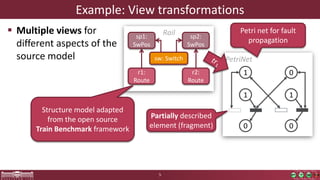
Example: View transformations
 Multiple views for
different aspects of the
source model
5
sp1:
SwPos
sp2:
SwPos
r1:
Route
r2:
Route
sw: Switch
1
1
0
0
1
0
Rail
PetriNet
Partially described
element (fragment)
Petri net for fault
propagation
Structure model adapted
from the open source
Train Benchmark framework
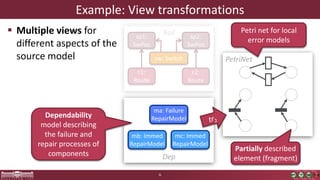
Example: View transformations
sp1:
SwPos
sp2:
SwPos
r1:
Route
r2:
Route
sw: Switch
Rail
6
ma: Failure
RepairModel
mb: Immed
RepairModel
mc: Immed
RepairModel
Dep
PetriNet
Partially described
element (fragment)
Petri net for local
error models
Dependability
model describing
the failure and
repair processes of
components
 Multiple views for
different aspects of the
source model
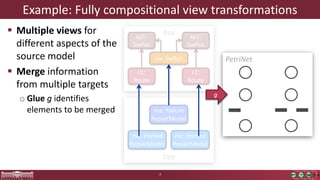
Example: Fully compositional view transformations
7
sp1:
SwPos
sp2:
SwPos
r1:
Route
r2:
Route
sw: Switch
ma: Failure
RepairModel
Rail
mb: Immed
RepairModel
mc: Immed
RepairModel
Dep
PetriNet
g
 Multiple views for
different aspects of the
source model
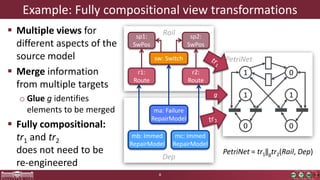
 Merge information
from multiple targets
o Glue g identifies
elements to be merged
Example: Fully compositional view transformations
 Multiple views for
different aspects of the
source model
 Merge information
from multiple targets
o Glue g identifies
elements to be merged
 Fully compositional:
tr1 and tr2
does not need to be
re-engineered
8
sp1:
SwPos
sp2:
SwPos
r1:
Route
r2:
Route
sw: Switch
ma: Failure
RepairModel
1
1
0
0
1
0
Rail
mb: Immed
RepairModel
mc: Immed
RepairModel
Dep
PetriNet
g
PetriNet = tr1‖gtr2(Rail, Dep)
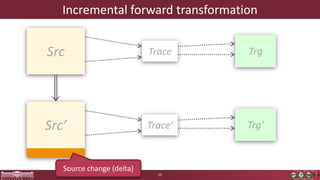
Overview
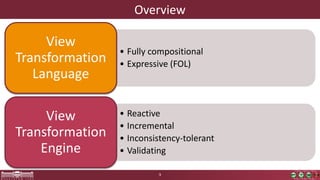
• Fully compositional
• Expressive (FOL)
View
Transformation
Language
• Reactive
• Incremental
• Inconsistency-tolerant
• Validating
View
Transformation
Engine
9
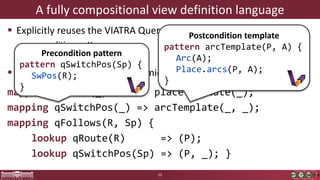
A fully compositional view definition language
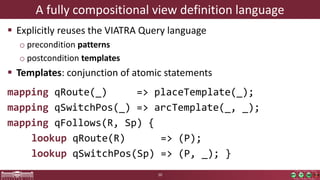
 Explicitly reuses the VIATRA Query language
o precondition patterns
o postcondition templates
 Templates: conjunction of atomic statements
mapping qRoute(_) => placeTemplate(_);
mapping qSwitchPos(_) => arcTemplate(_, _);
mapping qFollows(R, Sp) {
lookup qRoute(R) => (P);
lookup qSwitchPos(Sp) => (P, _); }
10
A fully compositional view definition language
 Explicitly reuses the VIATRA Query language
o precondition patterns
o postcondition templates
 Templates: conjunction of atomic statements
mapping qRoute(_) => placeTemplate(_);
mapping qSwitchPos(_) => arcTemplate(_, _);
mapping qFollows(R, Sp) {
lookup qRoute(R) => (P);
lookup qSwitchPos(Sp) => (P, _); }
11
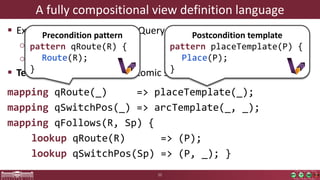
Precondition pattern
pattern qRoute(R) {
Route(R);
}
Postcondition template
pattern placeTemplate(P) {
Place(P);
}
A fully compositional view definition language
 Explicitly reuses the VIATRA Query language
o precondition patterns
o postcondition templates
 Templates: conjunction of atomic statements
mapping qRoute(_) => placeTemplate(_);
mapping qSwitchPos(_) => arcTemplate(_, _);
mapping qFollows(R, Sp) {
lookup qRoute(R) => (P);
lookup qSwitchPos(Sp) => (P, _); }
12
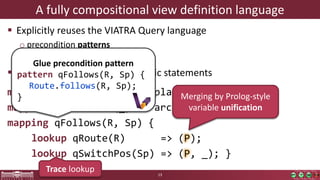
Precondition pattern
pattern qSwitchPos(Sp) {
SwPos(R);
}
Postcondition template
pattern arcTemplate(P, A) {
Arc(A);
Place.arcs(P, A);
}
A fully compositional view definition language
 Explicitly reuses the VIATRA Query language
o precondition patterns
o postcondition templates
 Templates: conjunction of atomic statements
mapping qRoute(_) => placeTemplate(_);
mapping qSwitchPos(_) => arcTemplate(_, _);
mapping qFollows(R, Sp) {
lookup qRoute(R) => (P);
lookup qSwitchPos(Sp) => (P, _); }
13
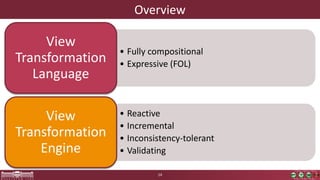
Glue precondition pattern
pattern qFollows(R, Sp) {
Route.follows(R, Sp);
} Merging by Prolog-style
variable unification
Trace lookup
Overview
• Fully compositional
• Expressive (FOL)
View
Transformation
Language
• Reactive
• Incremental
• Inconsistency-tolerant
• Validating
View
Transformation
Engine
14
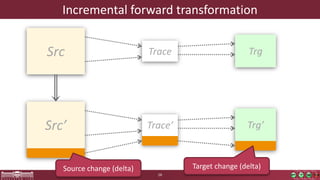
Incremental forward transformation
15
Src TrgTrace
Src’ Trg’Trace’
Source change (delta)
Incremental forward transformation
16
Src TrgTrace
Src’ Trg’Trace’
Source change (delta) Target change (delta)
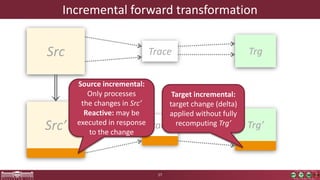
Incremental forward transformation
17
Src TrgTrace
Src’ Trg’Trace’
Source incremental:
Only processes
the changes in Src’
Reactive: may be
executed in response
to the change
Target incremental:
target change (delta)
applied without fully
recomputing Trg’
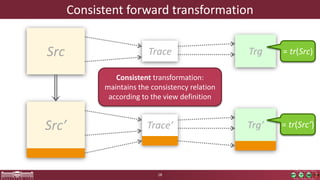
Consistent forward transformation
18
Src TrgTrace
Src’ Trg’Trace’
Consistent transformation:
maintains the consistency relation
according to the view definition
= tr(Src)
= tr(Src’)
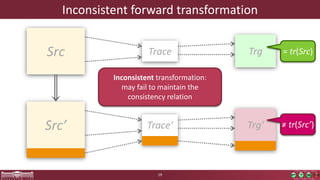
Inconsistent forward transformation
19
Src TrgTrace
Src’ Trg’Trace’
Inconsistent transformation:
may fail to maintain the
consistency relation
= tr(Src)
≠ tr(Src’)
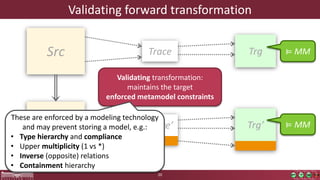
Validating forward transformation
20
Src TrgTrace
Src’ Trg’Trace’
Validating transformation:
maintains the target
enforced metamodel constraints
⊨ MM
⊨ MM
These are enforced by a modeling technology
and may prevent storing a model, e.g.:
• Type hierarchy and compliance
• Upper multiplicity (1 vs *)
• Inverse (opposite) relations
• Containment hierarchy
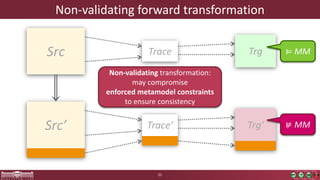
Non-validating forward transformation
21
Src TrgTrace
Src’ Trg’Trace’
Non-validating transformation:
may compromise
enforced metamodel constraints
to ensure consistency
⊨ MM
⊭ MM
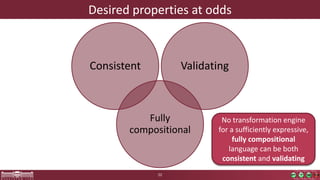
Desired properties at odds
22
Consistent
Fully
compositional
Validating
No transformation engine
for a sufficiently expressive,
fully compositional
language can be both
consistent and validating
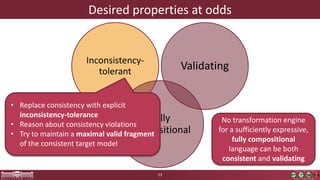
Desired properties at odds
23
Inconsistency-
tolerant
Fully
compositional
Validating
No transformation engine
for a sufficiently expressive,
fully compositional
language can be both
consistent and validating
• Replace consistency with explicit
inconsistency-tolerance
• Reason about consistency violations
• Try to maintain a maximal valid fragment
of the consistent target model
Inconsistency-tolerant models: Belnap-Dunn logic
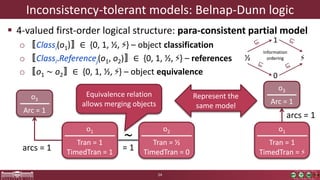
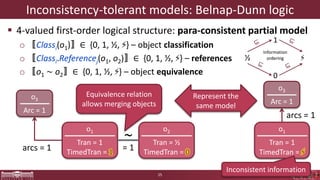
 4-valued first-order logical structure: para-consistent partial model
o 〚Classi(o1)〛∈ {0, 1, ½, ⚡} – object classification
o 〚Classi.Referencej(o1, o2)〛∈ {0, 1, ½, ⚡} – references
o 〚o1 ∼ o2〛∈ {0, 1, ½, ⚡} – object equivalence
24
o1
Tran = 1
TimedTran = 1
o2
Tran = ½
TimedTran = 0
∼
= 1
o3
Arc = 1
arcs = 1
Equivalence relation
allows merging objects
o1
Tran = 1
TimedTran = ⚡
o3
Arc = 1
Represent the
same model
arcs = 1
Inconsistency-tolerant models: Belnap-Dunn logic
 4-valued first-order logical structure: para-consistent partial model
o 〚Classi(o1)〛∈ {0, 1, ½, ⚡} – object classification
o 〚Classi.Referencej(o1, o2)〛∈ {0, 1, ½, ⚡} – references
o 〚o1 ∼ o2〛∈ {0, 1, ½, ⚡} – object equivalence
25
o1
Tran = 1
TimedTran = 1
o2
Tran = ½
TimedTran = 0
∼
= 1
o3
Arc = 1
arcs = 1
Equivalence relation
allows merging objects
Represent the
same model
o1
Tran = 1
TimedTran = ⚡
o3
Arc = 1
Inconsistent information
arcs = 1
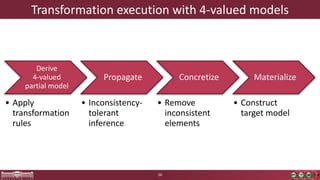
Transformation execution with 4-valued models
Derive
4-valued
partial model
• Apply
transformation
rules
Propagate
• Inconsistency-
tolerant
inference
Concretize
• Remove
inconsistent
elements
Materialize
• Construct
target model
26
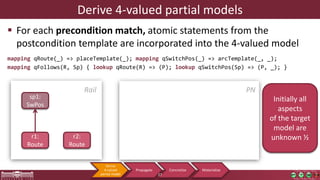
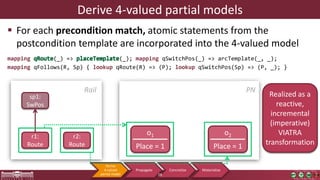
Derive 4-valued partial models
 For each precondition match, atomic statements from the
postcondition template are incorporated into the 4-valued model
mapping qRoute(_) => placeTemplate(_); mapping qSwitchPos(_) => arcTemplate(_, _);
mapping qFollows(R, Sp) { lookup qRoute(R) => (P); lookup qSwitchPos(Sp) => (P, _); }
sp1:
SwPos
r1:
Route
r2:
Route
Rail PN
Initially all
aspects
of the target
model are
unknown ½
Derive
4-valued
partial model
Propagate Concretize Materialize
27
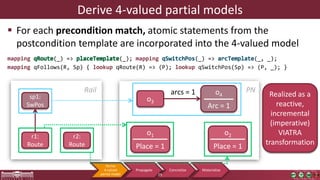
Derive 4-valued partial models
 For each precondition match, atomic statements from the
postcondition template are incorporated into the 4-valued model
mapping qRoute(_) => placeTemplate(_); mapping qSwitchPos(_) => arcTemplate(_, _);
mapping qFollows(R, Sp) { lookup qRoute(R) => (P); lookup qSwitchPos(Sp) => (P, _); }
sp1:
SwPos
r1:
Route
r2:
Route
Rail
o1
Place = 1
o2
Place = 1
PN
Realized as a
reactive,
incremental
(imperative)
VIATRA
transformation
Derive
4-valued
partial model
Propagate Concretize Materialize
28
Derive 4-valued partial models
 For each precondition match, atomic statements from the
postcondition template are incorporated into the 4-valued model
mapping qRoute(_) => placeTemplate(_); mapping qSwitchPos(_) => arcTemplate(_, _);
mapping qFollows(R, Sp) { lookup qRoute(R) => (P); lookup qSwitchPos(Sp) => (P, _); }
sp1:
SwPos
r1:
Route
r2:
Route
Rail o4
Arc = 1
o1
Place = 1
o2
Place = 1
o3
arcs = 1 PN
Realized as a
reactive,
incremental
(imperative)
VIATRA
transformation
Derive
4-valued
partial model
Propagate Concretize Materialize
29
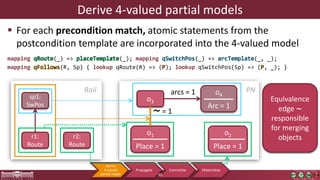
Derive 4-valued partial models
 For each precondition match, atomic statements from the
postcondition template are incorporated into the 4-valued model
mapping qRoute(_) => placeTemplate(_); mapping qSwitchPos(_) => arcTemplate(_, _);
mapping qFollows(R, Sp) { lookup qRoute(R) => (P); lookup qSwitchPos(Sp) => (P, _); }
sp1:
SwPos
r1:
Route
r2:
Route
Rail o4
Arc = 1
o1
Place = 1
o2
Place = 1
o3
arcs = 1
∼ = 1
PN
Equivalence
edge ∼
responsible
for merging
objects
Derive
4-valued
partial model
Propagate Concretize Materialize
30
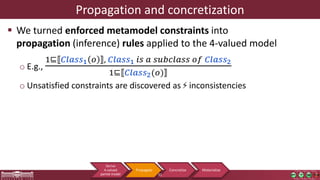
Propagation and concretization
 We turned enforced metamodel constraints into
propagation (inference) rules applied to the 4-valued model
o E.g.,
1⊑ 𝐶𝑙𝑎𝑠𝑠1 𝑜 , 𝐶𝑙𝑎𝑠𝑠1 𝑖𝑠 𝑎 𝑠𝑢𝑏𝑐𝑙𝑎𝑠𝑠 𝑜𝑓 𝐶𝑙𝑎𝑠𝑠2
1⊑ 𝐶𝑙𝑎𝑠𝑠2(𝑜)
o Unsatisfied constraints are discovered as ⚡ inconsistencies
Derive
4-valued
partial model
Propagate Concretize Materialize
31
Propagation and concretization
 We turned enforced metamodel constraints into
propagation (inference) rules applied to the 4-valued model
o E.g.,
1⊑ 𝐶𝑙𝑎𝑠𝑠1 𝑜 , 𝐶𝑙𝑎𝑠𝑠1 𝑖𝑠 𝑎 𝑠𝑢𝑏𝑐𝑙𝑎𝑠𝑠 𝑜𝑓 𝐶𝑙𝑎𝑠𝑠2
1⊑ 𝐶𝑙𝑎𝑠𝑠2(𝑜)
o Unsatisfied constraints are discovered as ⚡ inconsistencies
 Concretize the 4-valued partial model to {0, 1} truth values only
o Monotonicity of enforced metamodel constraints
 constraints can be satisfied by omitting inconsistent objects
o No extraneous output: Set all unknown ½ values to 0
o No invalid output: Remove all inconsistent ⚡ elements
Derive
4-valued
partial model
Propagate Concretize Materialize
32
Incremental materialization
 Materialization constructs a regular instance model according to the
concretized partial model
o The output model contains all information from the consistent target model,
except the elements that would violate enforced metamodel constraints
 Propagation, concretization and materialization steps are
implemented as incremental, reactive VIATRA transformations
o Together with the 4-valued model construction steps,
end-to-end traceability and reactive execution is provided
Derive
4-valued
partial model
Propagate Concretize Materialize
33
Evaluation
 Compared transformation execution in two case studies
o Dependability model
• “Compiler” behavior, target model 3x larger than source
• Up to 25K source, 72K target objects
o Filtering and aggregation
• “Abstraction” behavior, source 500x larger than target model
• Up to 425K source, 9K target objects
 Baseline: two styles of hand-written (imperative)
VIATRA transformation
34
Evaluation
 In both cases, our engine was
1-2 orders of magnitude slower than
hand-written (imperative) VIATRA
transformations
o Up to 26.7 sec vs 0.48 sec initial
o Up to 94 sec vs 0.2 sec incremental
• Propagate 100 source modifications
 However, with our engine,
transformations did not have to be
re-engineered for composition!
35
Summary
36
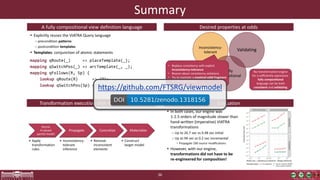
https://github.com/FTSRG/viewmodel

Incremental View Model Synchronization Using Partial Models

  • 1.
    Budapest University ofTechnology and Economics Department of Measurement and Information Systems Budapest University of Technology and Economics Fault Tolerant Systems Research Group McGill University Department of Mechanical and Electrical Engineering MTA-BME Cyber-Physical Systems Research Group Incremental View Model Synchronization Using Partial Models Kristóf Marussy, Oszkár Semeráth, Dániel Varró 1
  • 2.
    View transformation  (Forward)view transformation o Derives a target model as an abstraction of a set of source models o Target model is a function of the source models  View definition o Consistency relation between the source and target models captured as a set of forward transformation rules 2 Src Trg = tr(Src) Trace Typically loses information
  • 3.
    Compositionality of viewtransformations  Compositional view transformation definitions o Reuse existing view transformation definitions in new transformations 3  Sequential composition o Supported by most transformation languages and engines  Parallel composition o Often limited Src tr1 Int tr2 Trg Src tr1 tr2 Trg Merge information from both views Intermediate model
  • 4.
    Compositionality of viewtransformations  Compositional view transformation definitions o Reuse existing view transformation definitions in new transformations 4  Sequential composition o Supported by most transformation languages and engines  Parallel composition o Often limited Src tr1 Int tr2 Trg Src tr1 tr2 Trg Merge information from both views Intermediate model Motivation: Deriving stochastic Petri net analysis models for dependability evaluation of critical embedded automotive systems in an industrial collaboration: • What is the mean-time-to-first-failure in the system? • What is the probability of the different hazards? • Which architecture candidate is the most reliable? Transformations for different aspects of the system were created individually, and composed in parallel to derive the complete analysis model.
  • 5.
    Example: View transformations Multiple views for different aspects of the source model 5 sp1: SwPos sp2: SwPos r1: Route r2: Route sw: Switch 1 1 0 0 1 0 Rail PetriNet Partially described element (fragment) Petri net for fault propagation Structure model adapted from the open source Train Benchmark framework
  • 6.
    Example: View transformations sp1: SwPos sp2: SwPos r1: Route r2: Route sw:Switch Rail 6 ma: Failure RepairModel mb: Immed RepairModel mc: Immed RepairModel Dep PetriNet Partially described element (fragment) Petri net for local error models Dependability model describing the failure and repair processes of components  Multiple views for different aspects of the source model
  • 7.
    Example: Fully compositionalview transformations 7 sp1: SwPos sp2: SwPos r1: Route r2: Route sw: Switch ma: Failure RepairModel Rail mb: Immed RepairModel mc: Immed RepairModel Dep PetriNet g  Multiple views for different aspects of the source model  Merge information from multiple targets o Glue g identifies elements to be merged
  • 8.
    Example: Fully compositionalview transformations  Multiple views for different aspects of the source model  Merge information from multiple targets o Glue g identifies elements to be merged  Fully compositional: tr1 and tr2 does not need to be re-engineered 8 sp1: SwPos sp2: SwPos r1: Route r2: Route sw: Switch ma: Failure RepairModel 1 1 0 0 1 0 Rail mb: Immed RepairModel mc: Immed RepairModel Dep PetriNet g PetriNet = tr1‖gtr2(Rail, Dep)
  • 9.
    Overview • Fully compositional •Expressive (FOL) View Transformation Language • Reactive • Incremental • Inconsistency-tolerant • Validating View Transformation Engine 9
  • 10.
    A fully compositionalview definition language  Explicitly reuses the VIATRA Query language o precondition patterns o postcondition templates  Templates: conjunction of atomic statements mapping qRoute(_) => placeTemplate(_); mapping qSwitchPos(_) => arcTemplate(_, _); mapping qFollows(R, Sp) { lookup qRoute(R) => (P); lookup qSwitchPos(Sp) => (P, _); } 10
  • 11.
    A fully compositionalview definition language  Explicitly reuses the VIATRA Query language o precondition patterns o postcondition templates  Templates: conjunction of atomic statements mapping qRoute(_) => placeTemplate(_); mapping qSwitchPos(_) => arcTemplate(_, _); mapping qFollows(R, Sp) { lookup qRoute(R) => (P); lookup qSwitchPos(Sp) => (P, _); } 11 Precondition pattern pattern qRoute(R) { Route(R); } Postcondition template pattern placeTemplate(P) { Place(P); }
  • 12.
    A fully compositionalview definition language  Explicitly reuses the VIATRA Query language o precondition patterns o postcondition templates  Templates: conjunction of atomic statements mapping qRoute(_) => placeTemplate(_); mapping qSwitchPos(_) => arcTemplate(_, _); mapping qFollows(R, Sp) { lookup qRoute(R) => (P); lookup qSwitchPos(Sp) => (P, _); } 12 Precondition pattern pattern qSwitchPos(Sp) { SwPos(R); } Postcondition template pattern arcTemplate(P, A) { Arc(A); Place.arcs(P, A); }
  • 13.
    A fully compositionalview definition language  Explicitly reuses the VIATRA Query language o precondition patterns o postcondition templates  Templates: conjunction of atomic statements mapping qRoute(_) => placeTemplate(_); mapping qSwitchPos(_) => arcTemplate(_, _); mapping qFollows(R, Sp) { lookup qRoute(R) => (P); lookup qSwitchPos(Sp) => (P, _); } 13 Glue precondition pattern pattern qFollows(R, Sp) { Route.follows(R, Sp); } Merging by Prolog-style variable unification Trace lookup
  • 14.
    Overview • Fully compositional •Expressive (FOL) View Transformation Language • Reactive • Incremental • Inconsistency-tolerant • Validating View Transformation Engine 14
  • 15.
    Incremental forward transformation 15 SrcTrgTrace Src’ Trg’Trace’ Source change (delta)
  • 16.
    Incremental forward transformation 16 SrcTrgTrace Src’ Trg’Trace’ Source change (delta) Target change (delta)
  • 17.
    Incremental forward transformation 17 SrcTrgTrace Src’ Trg’Trace’ Source incremental: Only processes the changes in Src’ Reactive: may be executed in response to the change Target incremental: target change (delta) applied without fully recomputing Trg’
  • 18.
    Consistent forward transformation 18 SrcTrgTrace Src’ Trg’Trace’ Consistent transformation: maintains the consistency relation according to the view definition = tr(Src) = tr(Src’)
  • 19.
    Inconsistent forward transformation 19 SrcTrgTrace Src’ Trg’Trace’ Inconsistent transformation: may fail to maintain the consistency relation = tr(Src) ≠ tr(Src’)
  • 20.
    Validating forward transformation 20 SrcTrgTrace Src’ Trg’Trace’ Validating transformation: maintains the target enforced metamodel constraints ⊨ MM ⊨ MM These are enforced by a modeling technology and may prevent storing a model, e.g.: • Type hierarchy and compliance • Upper multiplicity (1 vs *) • Inverse (opposite) relations • Containment hierarchy
  • 21.
    Non-validating forward transformation 21 SrcTrgTrace Src’ Trg’Trace’ Non-validating transformation: may compromise enforced metamodel constraints to ensure consistency ⊨ MM ⊭ MM
  • 22.
    Desired properties atodds 22 Consistent Fully compositional Validating No transformation engine for a sufficiently expressive, fully compositional language can be both consistent and validating
  • 23.
    Desired properties atodds 23 Inconsistency- tolerant Fully compositional Validating No transformation engine for a sufficiently expressive, fully compositional language can be both consistent and validating • Replace consistency with explicit inconsistency-tolerance • Reason about consistency violations • Try to maintain a maximal valid fragment of the consistent target model
  • 24.
    Inconsistency-tolerant models: Belnap-Dunnlogic  4-valued first-order logical structure: para-consistent partial model o 〚Classi(o1)〛∈ {0, 1, ½, ⚡} – object classification o 〚Classi.Referencej(o1, o2)〛∈ {0, 1, ½, ⚡} – references o 〚o1 ∼ o2〛∈ {0, 1, ½, ⚡} – object equivalence 24 o1 Tran = 1 TimedTran = 1 o2 Tran = ½ TimedTran = 0 ∼ = 1 o3 Arc = 1 arcs = 1 Equivalence relation allows merging objects o1 Tran = 1 TimedTran = ⚡ o3 Arc = 1 Represent the same model arcs = 1
  • 25.
    Inconsistency-tolerant models: Belnap-Dunnlogic  4-valued first-order logical structure: para-consistent partial model o 〚Classi(o1)〛∈ {0, 1, ½, ⚡} – object classification o 〚Classi.Referencej(o1, o2)〛∈ {0, 1, ½, ⚡} – references o 〚o1 ∼ o2〛∈ {0, 1, ½, ⚡} – object equivalence 25 o1 Tran = 1 TimedTran = 1 o2 Tran = ½ TimedTran = 0 ∼ = 1 o3 Arc = 1 arcs = 1 Equivalence relation allows merging objects Represent the same model o1 Tran = 1 TimedTran = ⚡ o3 Arc = 1 Inconsistent information arcs = 1
  • 26.
    Transformation execution with4-valued models Derive 4-valued partial model • Apply transformation rules Propagate • Inconsistency- tolerant inference Concretize • Remove inconsistent elements Materialize • Construct target model 26
  • 27.
    Derive 4-valued partialmodels  For each precondition match, atomic statements from the postcondition template are incorporated into the 4-valued model mapping qRoute(_) => placeTemplate(_); mapping qSwitchPos(_) => arcTemplate(_, _); mapping qFollows(R, Sp) { lookup qRoute(R) => (P); lookup qSwitchPos(Sp) => (P, _); } sp1: SwPos r1: Route r2: Route Rail PN Initially all aspects of the target model are unknown ½ Derive 4-valued partial model Propagate Concretize Materialize 27
  • 28.
    Derive 4-valued partialmodels  For each precondition match, atomic statements from the postcondition template are incorporated into the 4-valued model mapping qRoute(_) => placeTemplate(_); mapping qSwitchPos(_) => arcTemplate(_, _); mapping qFollows(R, Sp) { lookup qRoute(R) => (P); lookup qSwitchPos(Sp) => (P, _); } sp1: SwPos r1: Route r2: Route Rail o1 Place = 1 o2 Place = 1 PN Realized as a reactive, incremental (imperative) VIATRA transformation Derive 4-valued partial model Propagate Concretize Materialize 28
  • 29.
    Derive 4-valued partialmodels  For each precondition match, atomic statements from the postcondition template are incorporated into the 4-valued model mapping qRoute(_) => placeTemplate(_); mapping qSwitchPos(_) => arcTemplate(_, _); mapping qFollows(R, Sp) { lookup qRoute(R) => (P); lookup qSwitchPos(Sp) => (P, _); } sp1: SwPos r1: Route r2: Route Rail o4 Arc = 1 o1 Place = 1 o2 Place = 1 o3 arcs = 1 PN Realized as a reactive, incremental (imperative) VIATRA transformation Derive 4-valued partial model Propagate Concretize Materialize 29
  • 30.
    Derive 4-valued partialmodels  For each precondition match, atomic statements from the postcondition template are incorporated into the 4-valued model mapping qRoute(_) => placeTemplate(_); mapping qSwitchPos(_) => arcTemplate(_, _); mapping qFollows(R, Sp) { lookup qRoute(R) => (P); lookup qSwitchPos(Sp) => (P, _); } sp1: SwPos r1: Route r2: Route Rail o4 Arc = 1 o1 Place = 1 o2 Place = 1 o3 arcs = 1 ∼ = 1 PN Equivalence edge ∼ responsible for merging objects Derive 4-valued partial model Propagate Concretize Materialize 30
  • 31.
    Propagation and concretization We turned enforced metamodel constraints into propagation (inference) rules applied to the 4-valued model o E.g., 1⊑ 𝐶𝑙𝑎𝑠𝑠1 𝑜 , 𝐶𝑙𝑎𝑠𝑠1 𝑖𝑠 𝑎 𝑠𝑢𝑏𝑐𝑙𝑎𝑠𝑠 𝑜𝑓 𝐶𝑙𝑎𝑠𝑠2 1⊑ 𝐶𝑙𝑎𝑠𝑠2(𝑜) o Unsatisfied constraints are discovered as ⚡ inconsistencies Derive 4-valued partial model Propagate Concretize Materialize 31
  • 32.
    Propagation and concretization We turned enforced metamodel constraints into propagation (inference) rules applied to the 4-valued model o E.g., 1⊑ 𝐶𝑙𝑎𝑠𝑠1 𝑜 , 𝐶𝑙𝑎𝑠𝑠1 𝑖𝑠 𝑎 𝑠𝑢𝑏𝑐𝑙𝑎𝑠𝑠 𝑜𝑓 𝐶𝑙𝑎𝑠𝑠2 1⊑ 𝐶𝑙𝑎𝑠𝑠2(𝑜) o Unsatisfied constraints are discovered as ⚡ inconsistencies  Concretize the 4-valued partial model to {0, 1} truth values only o Monotonicity of enforced metamodel constraints  constraints can be satisfied by omitting inconsistent objects o No extraneous output: Set all unknown ½ values to 0 o No invalid output: Remove all inconsistent ⚡ elements Derive 4-valued partial model Propagate Concretize Materialize 32
  • 33.
    Incremental materialization  Materializationconstructs a regular instance model according to the concretized partial model o The output model contains all information from the consistent target model, except the elements that would violate enforced metamodel constraints  Propagation, concretization and materialization steps are implemented as incremental, reactive VIATRA transformations o Together with the 4-valued model construction steps, end-to-end traceability and reactive execution is provided Derive 4-valued partial model Propagate Concretize Materialize 33
  • 34.
    Evaluation  Compared transformationexecution in two case studies o Dependability model • “Compiler” behavior, target model 3x larger than source • Up to 25K source, 72K target objects o Filtering and aggregation • “Abstraction” behavior, source 500x larger than target model • Up to 425K source, 9K target objects  Baseline: two styles of hand-written (imperative) VIATRA transformation 34
  • 35.
    Evaluation  In bothcases, our engine was 1-2 orders of magnitude slower than hand-written (imperative) VIATRA transformations o Up to 26.7 sec vs 0.48 sec initial o Up to 94 sec vs 0.2 sec incremental • Propagate 100 source modifications  However, with our engine, transformations did not have to be re-engineered for composition! 35
  • 36.