INCREASING EFFICIENCY OF ROCK
PHOSPHATE IN PROBLEMATIC
SOILS
PRESENTED BY:
Samanyita Mohanty
INTRODUCTION
PHOSPHATE ROCK-
• Phosphate rock denotes the product obtained from
the mining and subsequent metallurgical processing
of P-bearing ores.
• PRs can be used-
1. as raw materials in the industrial manufacture of
WSP fertilizers,or
2. as P sources for direct application in agriculture.
Phosphate rocks as raw materials for P-fertilizer
manufacturing
• Sulphuric acid and PR are the raw materials used in the
production of single superphosphate (SSP) and phosphoric
acid.
• Phosphoric acid is an important intermediate by-product that
is used to make triple superphosphate (TSP) and ammonium
phosphate.
• It is used for industrial purposes and for the production of
animal feed supplements and food products.
• used in the manufacture of elemental P and its derivatives, in
particular sodium tri-polyphosphate(a major component of
heavy-duty laundry detergents).
Rock phosphate for direct application
• As mentioned above, PRs mainly of sedimentary origin
are suitable for direct application because they consist of
fairly open, loosely consolidated aggregates of micro
crystals with a relatively large specific surface area.
• They show a considerable proportion of isomorphic
substitution in the crystal lattice and contain a variable
proportion and amounts of accessory minerals and
impurities.
• Advantages – less expensive
slow and steady supply of P
More P restoration capacity
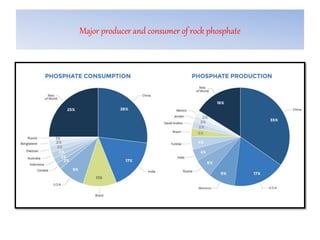
Major producer and consumer of rock phosphate
Phosphate concentrates
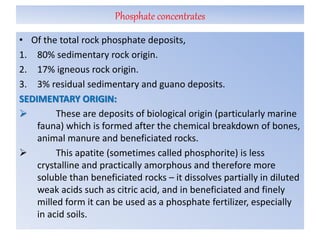
• Of the total rock phosphate deposits,
1. 80% sedimentary rock origin.
2. 17% igneous rock origin.
3. 3% residual sedimentary and guano deposits.
SEDIMENTARY ORIGIN:
 These are deposits of biological origin (particularly marine
fauna) which is formed after the chemical breakdown of bones,
animal manure and beneficiated rocks.
 This apatite (sometimes called phosphorite) is less
crystalline and practically amorphous and therefore more
soluble than beneficiated rocks – it dissolves partially in diluted
weak acids such as citric acid, and in beneficiated and finely
milled form it can be used as a phosphate fertilizer, especially
in acid soils.
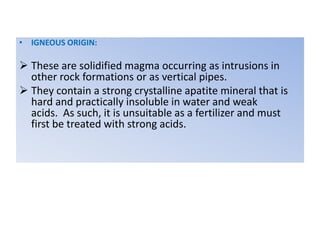
• IGNEOUS ORIGIN:
 These are solidified magma occurring as intrusions in
other rock formations or as vertical pipes.
 They contain a strong crystalline apatite mineral that is
hard and practically insoluble in water and weak
acids. As such, it is unsuitable as a fertilizer and must
first be treated with strong acids.
Factors affecting the effectiveness of rock phosphate
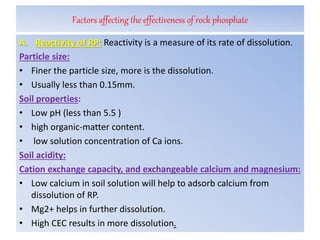
A. Reactivity of RP: Reactivity is a measure of its rate of dissolution.
Particle size:
• Finer the particle size, more is the dissolution.
• Usually less than 0.15mm.
Soil properties:
• Low pH (less than 5.5 )
• high organic-matter content.
• low solution concentration of Ca ions.
Soil acidity:
Cation exchange capacity, and exchangeable calcium and magnesium:
• Low calcium in soil solution will help to adsorb calcium from
dissolution of RP.
• Mg2+ helps in further dissolution.
• High CEC results in more dissolution.
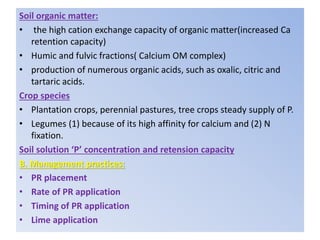
Soil organic matter:
• the high cation exchange capacity of organic matter(increased Ca
retention capacity)
• Humic and fulvic fractions( Calcium OM complex)
• production of numerous organic acids, such as oxalic, citric and
tartaric acids.
Crop species
• Plantation crops, perennial pastures, tree crops steady supply of P.
• Legumes (1) because of its high affinity for calcium and (2) N
fixation.
Soil solution ‘P’ concentration and retension capacity
B. Management practices:
• PR placement
• Rate of PR application
• Timing of PR application
• Lime application
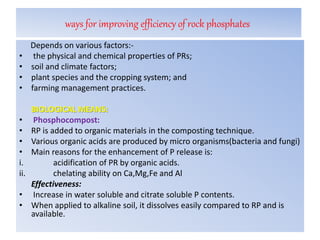
ways for improving efficiency of rock phosphates
Depends on various factors:-
• the physical and chemical properties of PRs;
• soil and climate factors;
• plant species and the cropping system; and
• farming management practices.
BIOLOGICAL MEANS:
• Phosphocompost:
• RP is added to organic materials in the composting technique.
• Various organic acids are produced by micro organisms(bacteria and fungi)
• Main reasons for the enhancement of P release is:
i. acidification of PR by organic acids.
ii. chelating ability on Ca,Mg,Fe and Al
Effectiveness:
• Increase in water soluble and citrate soluble P contents.
• When applied to alkaline soil, it dissolves easily compared to RP and is
available.
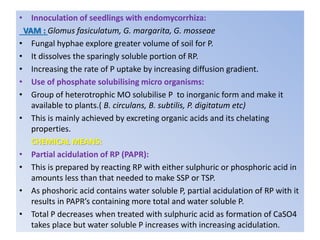
• Innoculation of seedlings with endomycorrhiza:
VAM : Glomus fasiculatum, G. margarita, G. mosseae
• Fungal hyphae explore greater volume of soil for P.
• It dissolves the sparingly soluble portion of RP.
• Increasing the rate of P uptake by increasing diffusion gradient.
• Use of phosphate solubilising micro organisms:
• Group of heterotrophic MO solubilise P to inorganic form and make it
available to plants.( B. circulans, B. subtilis, P. digitatum etc)
• This is mainly achieved by excreting organic acids and its chelating
properties.
CHEMICAL MEANS:
• Partial acidulation of RP (PAPR):
• This is prepared by reacting RP with either sulphuric or phosphoric acid in
amounts less than that needed to make SSP or TSP.
• As phoshoric acid contains water soluble P, partial acidulation of RP with it
results in PAPR’s containing more total and water soluble P.
• Total P decreases when treated with sulphuric acid as formation of CaSO4
takes place but water soluble P increases with increasing acidulation.
• Major components of PAPR products are water soluble monocalcium
phosphate and sparingly soluble acid unreacted RP.
• PAPR are traded in the name of ‘longlife super ‘ and are mainly
manufactured in New Zealand.
PHYSICAL MEANS:
• Compacted RP with water soluble phosphate products.
Fertilizers similar to PAPR can be prepared indirectly by compacting dry PR
with soluble phosphatic fertilizers such as SSP and TSP under pressure.
• Dry mixtures of with RP with water soluble phosphate fertiliser.
• Phosphate rock elemental sulphur assemblages
Efficiency can be increased when RP are applied after admixing or
cogranulating with sulphur ( sometimes are innoculated with S oxidising
bacteria Thiobacillus spp. ) and the product is referred to as ‘biosuper’.
References:
• Anderson, D.L., Kussow, W.R. & Corey, R.B. 1985. Phosphate rock
dissolution in soil: indications from plant growth studies. Soil Sci. Soc. Am.
J., 49: 918–925
• Attoe, O.J. & Olson, R.A. 1966. Factors affecting rate of oxidation in soils
of elemental sulphur and that added in rock phosphate-sulphur fusions.
Soil Sci., 101: 317–324.
• Bolland, M.D.A. & Gilkes, R.J. 1997. The agronomic effectiveness of
reactive phosphate rocks, 2. Effect of phosphate rock reactivity. Aus. J. Exp.
Agric., 37: 937–946.
• British Sulphur Corporation Limited. 1987. World survey of phosphate
deposits. London. 247 pp
• Chien, S.H. & Menon, R.G. 1995a. Agronomic evaluation of modified
phosphate rock products: IFDC’s experience. Fert. Res., 41: 197–209.
THANK YOU

Increasing efficiency of ROCK PHOSPHATE on problematic soils

  • 1.
    INCREASING EFFICIENCY OFROCK PHOSPHATE IN PROBLEMATIC SOILS PRESENTED BY: Samanyita Mohanty
  • 2.
    INTRODUCTION PHOSPHATE ROCK- • Phosphaterock denotes the product obtained from the mining and subsequent metallurgical processing of P-bearing ores. • PRs can be used- 1. as raw materials in the industrial manufacture of WSP fertilizers,or 2. as P sources for direct application in agriculture.
  • 3.
    Phosphate rocks asraw materials for P-fertilizer manufacturing • Sulphuric acid and PR are the raw materials used in the production of single superphosphate (SSP) and phosphoric acid. • Phosphoric acid is an important intermediate by-product that is used to make triple superphosphate (TSP) and ammonium phosphate. • It is used for industrial purposes and for the production of animal feed supplements and food products. • used in the manufacture of elemental P and its derivatives, in particular sodium tri-polyphosphate(a major component of heavy-duty laundry detergents).
  • 4.
    Rock phosphate fordirect application • As mentioned above, PRs mainly of sedimentary origin are suitable for direct application because they consist of fairly open, loosely consolidated aggregates of micro crystals with a relatively large specific surface area. • They show a considerable proportion of isomorphic substitution in the crystal lattice and contain a variable proportion and amounts of accessory minerals and impurities. • Advantages – less expensive slow and steady supply of P More P restoration capacity
  • 5.
    Major producer andconsumer of rock phosphate
  • 7.
    Phosphate concentrates • Ofthe total rock phosphate deposits, 1. 80% sedimentary rock origin. 2. 17% igneous rock origin. 3. 3% residual sedimentary and guano deposits. SEDIMENTARY ORIGIN:  These are deposits of biological origin (particularly marine fauna) which is formed after the chemical breakdown of bones, animal manure and beneficiated rocks.  This apatite (sometimes called phosphorite) is less crystalline and practically amorphous and therefore more soluble than beneficiated rocks – it dissolves partially in diluted weak acids such as citric acid, and in beneficiated and finely milled form it can be used as a phosphate fertilizer, especially in acid soils.
  • 8.
    • IGNEOUS ORIGIN: These are solidified magma occurring as intrusions in other rock formations or as vertical pipes.  They contain a strong crystalline apatite mineral that is hard and practically insoluble in water and weak acids. As such, it is unsuitable as a fertilizer and must first be treated with strong acids.
  • 9.
    Factors affecting theeffectiveness of rock phosphate A. Reactivity of RP: Reactivity is a measure of its rate of dissolution. Particle size: • Finer the particle size, more is the dissolution. • Usually less than 0.15mm. Soil properties: • Low pH (less than 5.5 ) • high organic-matter content. • low solution concentration of Ca ions. Soil acidity: Cation exchange capacity, and exchangeable calcium and magnesium: • Low calcium in soil solution will help to adsorb calcium from dissolution of RP. • Mg2+ helps in further dissolution. • High CEC results in more dissolution.
  • 10.
    Soil organic matter: •the high cation exchange capacity of organic matter(increased Ca retention capacity) • Humic and fulvic fractions( Calcium OM complex) • production of numerous organic acids, such as oxalic, citric and tartaric acids. Crop species • Plantation crops, perennial pastures, tree crops steady supply of P. • Legumes (1) because of its high affinity for calcium and (2) N fixation. Soil solution ‘P’ concentration and retension capacity B. Management practices: • PR placement • Rate of PR application • Timing of PR application • Lime application
  • 11.
    ways for improvingefficiency of rock phosphates Depends on various factors:- • the physical and chemical properties of PRs; • soil and climate factors; • plant species and the cropping system; and • farming management practices. BIOLOGICAL MEANS: • Phosphocompost: • RP is added to organic materials in the composting technique. • Various organic acids are produced by micro organisms(bacteria and fungi) • Main reasons for the enhancement of P release is: i. acidification of PR by organic acids. ii. chelating ability on Ca,Mg,Fe and Al Effectiveness: • Increase in water soluble and citrate soluble P contents. • When applied to alkaline soil, it dissolves easily compared to RP and is available.
  • 12.
    • Innoculation ofseedlings with endomycorrhiza: VAM : Glomus fasiculatum, G. margarita, G. mosseae • Fungal hyphae explore greater volume of soil for P. • It dissolves the sparingly soluble portion of RP. • Increasing the rate of P uptake by increasing diffusion gradient. • Use of phosphate solubilising micro organisms: • Group of heterotrophic MO solubilise P to inorganic form and make it available to plants.( B. circulans, B. subtilis, P. digitatum etc) • This is mainly achieved by excreting organic acids and its chelating properties. CHEMICAL MEANS: • Partial acidulation of RP (PAPR): • This is prepared by reacting RP with either sulphuric or phosphoric acid in amounts less than that needed to make SSP or TSP. • As phoshoric acid contains water soluble P, partial acidulation of RP with it results in PAPR’s containing more total and water soluble P. • Total P decreases when treated with sulphuric acid as formation of CaSO4 takes place but water soluble P increases with increasing acidulation.
  • 13.
    • Major componentsof PAPR products are water soluble monocalcium phosphate and sparingly soluble acid unreacted RP. • PAPR are traded in the name of ‘longlife super ‘ and are mainly manufactured in New Zealand. PHYSICAL MEANS: • Compacted RP with water soluble phosphate products. Fertilizers similar to PAPR can be prepared indirectly by compacting dry PR with soluble phosphatic fertilizers such as SSP and TSP under pressure. • Dry mixtures of with RP with water soluble phosphate fertiliser. • Phosphate rock elemental sulphur assemblages Efficiency can be increased when RP are applied after admixing or cogranulating with sulphur ( sometimes are innoculated with S oxidising bacteria Thiobacillus spp. ) and the product is referred to as ‘biosuper’.
  • 15.
    References: • Anderson, D.L.,Kussow, W.R. & Corey, R.B. 1985. Phosphate rock dissolution in soil: indications from plant growth studies. Soil Sci. Soc. Am. J., 49: 918–925 • Attoe, O.J. & Olson, R.A. 1966. Factors affecting rate of oxidation in soils of elemental sulphur and that added in rock phosphate-sulphur fusions. Soil Sci., 101: 317–324. • Bolland, M.D.A. & Gilkes, R.J. 1997. The agronomic effectiveness of reactive phosphate rocks, 2. Effect of phosphate rock reactivity. Aus. J. Exp. Agric., 37: 937–946. • British Sulphur Corporation Limited. 1987. World survey of phosphate deposits. London. 247 pp • Chien, S.H. & Menon, R.G. 1995a. Agronomic evaluation of modified phosphate rock products: IFDC’s experience. Fert. Res., 41: 197–209.
  • 16.