Chapter 1: Introduction
• We begin with a brief, introductory look at the
components in a computer system
• We will then consider the evolution of computer
hardware
• We end this chapter by considering the structure of the
typical computer, known as a Von Neumann computer
• Its noteworthy that anything that can be done in
software can also be done in hardware and vice versa
– This is known as the principle of equivalence of Hardware
and Software
• general-purpose computers allow the instructions to be stored in
memory and executed through a decoding process
• we could take any program and “hard-wire” it to be executed directly
without the decoding – this is faster, but not flexible
The Main Components
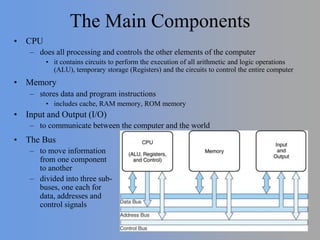
• CPU
– does all processing and controls the other elements of the computer
• it contains circuits to perform the execution of all arithmetic and logic operations
(ALU), temporary storage (Registers) and the circuits to control the entire computer
• Memory
– stores data and program instructions
• includes cache, RAM memory, ROM memory
• Input and Output (I/O)
– to communicate between the computer and the world
• The Bus
– to move information
from one component
to another
– divided into three sub-
buses, one each for
data, addresses and
control signals
A History Lesson
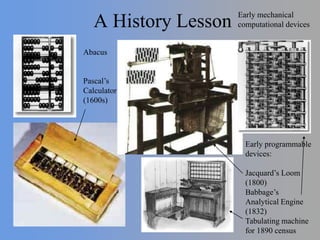
Early mechanical
computational devices
Abacus
Pascal’s
Calculator
(1600s)
Early programmable
devices:
Jacquard’s Loom
(1800)
Babbage’s
Analytical Engine
(1832)
Tabulating machine
for 1890 census
1st Generation Computers
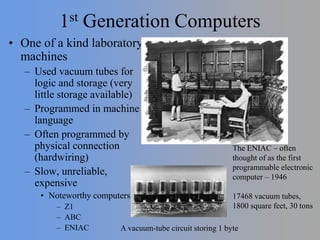
• One of a kind laboratory
machines
– Used vacuum tubes for
logic and storage (very
little storage available)
– Programmed in machine
language
– Often programmed by
physical connection
(hardwiring)
– Slow, unreliable,
expensive
• Noteworthy computers:
– Z1
– ABC
– ENIAC
The ENIAC – often
thought of as the first
programmable electronic
computer – 1946
17468 vacuum tubes,
1800 square feet, 30 tons
A vacuum-tube circuit storing 1 byte
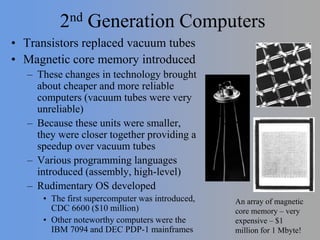
2nd Generation Computers
• Transistors replaced vacuum tubes
• Magnetic core memory introduced
– These changes in technology brought
about cheaper and more reliable
computers (vacuum tubes were very
unreliable)
– Because these units were smaller,
they were closer together providing a
speedup over vacuum tubes
– Various programming languages
introduced (assembly, high-level)
– Rudimentary OS developed
• The first supercomputer was introduced,
CDC 6600 ($10 million)
• Other noteworthy computers were the
IBM 7094 and DEC PDP-1 mainframes
An array of magnetic
core memory – very
expensive – $1
million for 1 Mbyte!
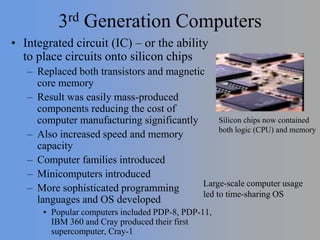
3rd Generation Computers
• Integrated circuit (IC) – or the ability
to place circuits onto silicon chips
– Replaced both transistors and magnetic
core memory
– Result was easily mass-produced
components reducing the cost of
computer manufacturing significantly
– Also increased speed and memory
capacity
– Computer families introduced
– Minicomputers introduced
– More sophisticated programming
languages and OS developed
• Popular computers included PDP-8, PDP-11,
IBM 360 and Cray produced their first
supercomputer, Cray-1
Silicon chips now contained
both logic (CPU) and memory
Large-scale computer usage
led to time-sharing OS
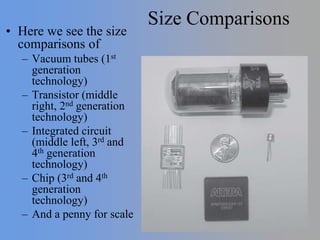
Size Comparisons
• Here we see the size
comparisons of
– Vacuum tubes (1st
generation
technology)
– Transistor (middle
right, 2nd generation
technology)
– Integrated circuit
(middle left, 3rd and
4th generation
technology)
– Chip (3rd and 4th
generation
technology)
– And a penny for scale
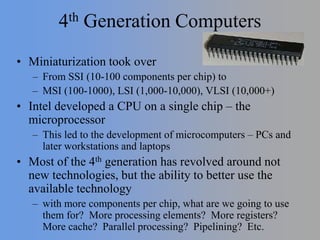
4th Generation Computers
• Miniaturization took over
– From SSI (10-100 components per chip) to
– MSI (100-1000), LSI (1,000-10,000), VLSI (10,000+)
• Intel developed a CPU on a single chip – the
microprocessor
– This led to the development of microcomputers – PCs and
later workstations and laptops
• Most of the 4th generation has revolved around not
new technologies, but the ability to better use the
available technology
– with more components per chip, what are we going to use
them for? More processing elements? More registers?
More cache? Parallel processing? Pipelining? Etc.
The PC Market
• The impact on miniaturization was not predicted
– Who would have thought that a personal computer would be of
any interest?
– Early PCs were hobbyist toys and included Radio Shack,
Commodore, Apple, Texas Instruments, and Altair
– In 1981, IBM introduced their first PC
• they decided to publish their architecture which led to clones or
compatible computers
• Microsoft wrote business software for the IBM platform thus making
the machine more appealing
– These two situations allowed IBM to capture a large part of the
PC marketplace
– Over the years since 1981, PC development has been one of
the biggest concerns of the computer industry
• More memory, faster processors, better I/O devices and interfaces, more
sophisticated OS and software
Other Computer Developments
• During the 4th generation, we have seen
improvements to other platforms as well
– Mainframe and minicomputers much faster with
substantially larger main memories
– Workstations introduced to provide multitasking for
scientific applications
– Supercomputers reaching 10s or 100s of trillions of
instructions per second speed
– Massive parallel processing machines
– Servers for networking
– Architectural innovations have included
• Floating point and multimedia hardware, parallel processing,
pipelining, superscalar pipelines, speculative hardware, cache,
RISC
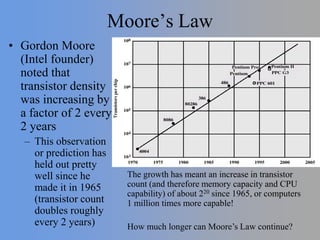
Moore’s Law
• Gordon Moore
(Intel founder)
noted that
transistor density
was increasing by
a factor of 2 every
2 years
– This observation
or prediction has
held out pretty
well since he
made it in 1965
(transistor count
doubles roughly
every 2 years)
The growth has meant an increase in transistor
count (and therefore memory capacity and CPU
capability) of about 220 since 1965, or computers
1 million times more capable!
How much longer can Moore’s Law continue?
View of
Computing
Through
Abstraction
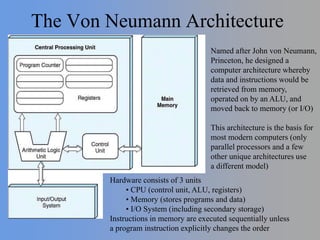
The Von Neumann Architecture
Named after John von Neumann,
Princeton, he designed a
computer architecture whereby
data and instructions would be
retrieved from memory,
operated on by an ALU, and
moved back to memory (or I/O)
This architecture is the basis for
most modern computers (only
parallel processors and a few
other unique architectures use
a different model)
Hardware consists of 3 units
• CPU (control unit, ALU, registers)
• Memory (stores programs and data)
• I/O System (including secondary storage)
Instructions in memory are executed sequentially unless
a program instruction explicitly changes the order
More on Von Neumann Architectures
• There is a single pathway used to
move both data and instructions
between memory, I/O and CPU
– the pathway is implemented as a bus
– the single pathway creates a
bottleneck
• known as the von Neumann
bottleneck
– A variation of this architecture is the
Harvard architecture which
separates data and instructions into
two pathways
– Another variation, used in most
computers, is the system bus version
in which there are different buses
between CPU and memory and
memory and I/O
• The von Neumann
architecture operates on
the fetch-execute cycle
– Fetch an instruction from
memory as indicated by the
Program Counter register
– Decode the instruction in
the control unit
– Data operands needed for
the instruction are fetched
from memory
– Execute the instruction in
the ALU storing the result
in a register
– Move the result back to
memory if needed

Cpu architecture

  • 1.
    Chapter 1: Introduction •We begin with a brief, introductory look at the components in a computer system • We will then consider the evolution of computer hardware • We end this chapter by considering the structure of the typical computer, known as a Von Neumann computer • Its noteworthy that anything that can be done in software can also be done in hardware and vice versa – This is known as the principle of equivalence of Hardware and Software • general-purpose computers allow the instructions to be stored in memory and executed through a decoding process • we could take any program and “hard-wire” it to be executed directly without the decoding – this is faster, but not flexible
  • 2.
    The Main Components •CPU – does all processing and controls the other elements of the computer • it contains circuits to perform the execution of all arithmetic and logic operations (ALU), temporary storage (Registers) and the circuits to control the entire computer • Memory – stores data and program instructions • includes cache, RAM memory, ROM memory • Input and Output (I/O) – to communicate between the computer and the world • The Bus – to move information from one component to another – divided into three sub- buses, one each for data, addresses and control signals
  • 3.
    A History Lesson Earlymechanical computational devices Abacus Pascal’s Calculator (1600s) Early programmable devices: Jacquard’s Loom (1800) Babbage’s Analytical Engine (1832) Tabulating machine for 1890 census
  • 4.
    1st Generation Computers •One of a kind laboratory machines – Used vacuum tubes for logic and storage (very little storage available) – Programmed in machine language – Often programmed by physical connection (hardwiring) – Slow, unreliable, expensive • Noteworthy computers: – Z1 – ABC – ENIAC The ENIAC – often thought of as the first programmable electronic computer – 1946 17468 vacuum tubes, 1800 square feet, 30 tons A vacuum-tube circuit storing 1 byte
  • 5.
    2nd Generation Computers •Transistors replaced vacuum tubes • Magnetic core memory introduced – These changes in technology brought about cheaper and more reliable computers (vacuum tubes were very unreliable) – Because these units were smaller, they were closer together providing a speedup over vacuum tubes – Various programming languages introduced (assembly, high-level) – Rudimentary OS developed • The first supercomputer was introduced, CDC 6600 ($10 million) • Other noteworthy computers were the IBM 7094 and DEC PDP-1 mainframes An array of magnetic core memory – very expensive – $1 million for 1 Mbyte!
  • 6.
    3rd Generation Computers •Integrated circuit (IC) – or the ability to place circuits onto silicon chips – Replaced both transistors and magnetic core memory – Result was easily mass-produced components reducing the cost of computer manufacturing significantly – Also increased speed and memory capacity – Computer families introduced – Minicomputers introduced – More sophisticated programming languages and OS developed • Popular computers included PDP-8, PDP-11, IBM 360 and Cray produced their first supercomputer, Cray-1 Silicon chips now contained both logic (CPU) and memory Large-scale computer usage led to time-sharing OS
  • 7.
    Size Comparisons • Herewe see the size comparisons of – Vacuum tubes (1st generation technology) – Transistor (middle right, 2nd generation technology) – Integrated circuit (middle left, 3rd and 4th generation technology) – Chip (3rd and 4th generation technology) – And a penny for scale
  • 8.
    4th Generation Computers •Miniaturization took over – From SSI (10-100 components per chip) to – MSI (100-1000), LSI (1,000-10,000), VLSI (10,000+) • Intel developed a CPU on a single chip – the microprocessor – This led to the development of microcomputers – PCs and later workstations and laptops • Most of the 4th generation has revolved around not new technologies, but the ability to better use the available technology – with more components per chip, what are we going to use them for? More processing elements? More registers? More cache? Parallel processing? Pipelining? Etc.
  • 9.
    The PC Market •The impact on miniaturization was not predicted – Who would have thought that a personal computer would be of any interest? – Early PCs were hobbyist toys and included Radio Shack, Commodore, Apple, Texas Instruments, and Altair – In 1981, IBM introduced their first PC • they decided to publish their architecture which led to clones or compatible computers • Microsoft wrote business software for the IBM platform thus making the machine more appealing – These two situations allowed IBM to capture a large part of the PC marketplace – Over the years since 1981, PC development has been one of the biggest concerns of the computer industry • More memory, faster processors, better I/O devices and interfaces, more sophisticated OS and software
  • 10.
    Other Computer Developments •During the 4th generation, we have seen improvements to other platforms as well – Mainframe and minicomputers much faster with substantially larger main memories – Workstations introduced to provide multitasking for scientific applications – Supercomputers reaching 10s or 100s of trillions of instructions per second speed – Massive parallel processing machines – Servers for networking – Architectural innovations have included • Floating point and multimedia hardware, parallel processing, pipelining, superscalar pipelines, speculative hardware, cache, RISC
  • 11.
    Moore’s Law • GordonMoore (Intel founder) noted that transistor density was increasing by a factor of 2 every 2 years – This observation or prediction has held out pretty well since he made it in 1965 (transistor count doubles roughly every 2 years) The growth has meant an increase in transistor count (and therefore memory capacity and CPU capability) of about 220 since 1965, or computers 1 million times more capable! How much longer can Moore’s Law continue?
  • 12.
  • 13.
    The Von NeumannArchitecture Named after John von Neumann, Princeton, he designed a computer architecture whereby data and instructions would be retrieved from memory, operated on by an ALU, and moved back to memory (or I/O) This architecture is the basis for most modern computers (only parallel processors and a few other unique architectures use a different model) Hardware consists of 3 units • CPU (control unit, ALU, registers) • Memory (stores programs and data) • I/O System (including secondary storage) Instructions in memory are executed sequentially unless a program instruction explicitly changes the order
  • 14.
    More on VonNeumann Architectures • There is a single pathway used to move both data and instructions between memory, I/O and CPU – the pathway is implemented as a bus – the single pathway creates a bottleneck • known as the von Neumann bottleneck – A variation of this architecture is the Harvard architecture which separates data and instructions into two pathways – Another variation, used in most computers, is the system bus version in which there are different buses between CPU and memory and memory and I/O • The von Neumann architecture operates on the fetch-execute cycle – Fetch an instruction from memory as indicated by the Program Counter register – Decode the instruction in the control unit – Data operands needed for the instruction are fetched from memory – Execute the instruction in the ALU storing the result in a register – Move the result back to memory if needed