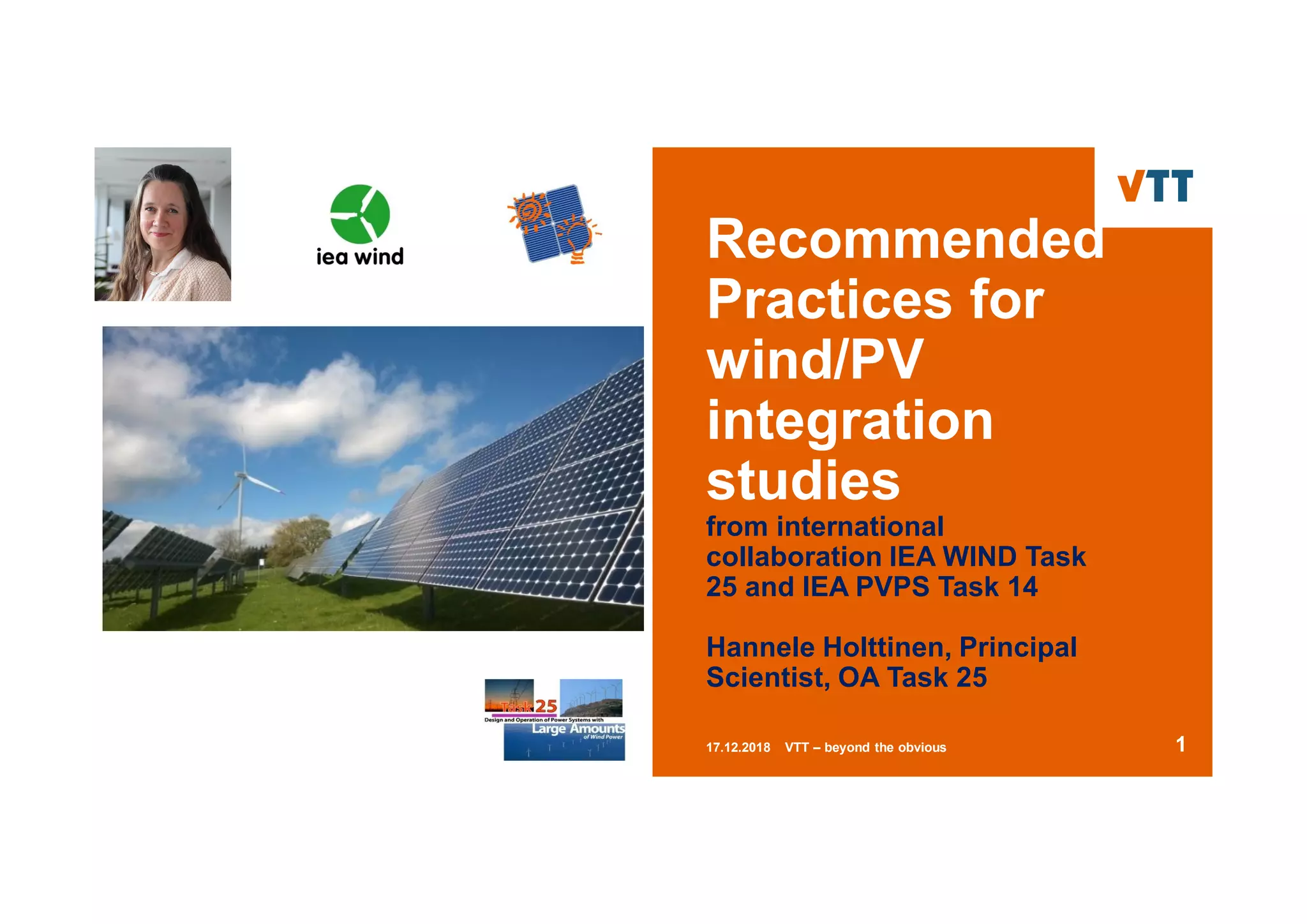
Recommended
Practices for
wind/PV
integration
studies
from international
collaboration IEA WIND Task
25 and IEA PVPS Task 14
Hannele Holttinen, Principal
Scientist, OA Task 25
17.12.2018 VTT – beyond the obvious 1
Contents
§ Introduction: On Task 25/Task14 work
§ Recommendations for how to perform
integration studies
• Impact on balancing
• Impact on generation adequacy
• Impact on grid adequacy and resiliency
• Damian Flynn, UCD: Transmission systems
• Markus Kraiczy, Fraunhofer IEE: Distribution
system
VTT 2018 2
IEA INTERNATIONAL ENERGY AGENCY
PHOTOVOLTAIC POWER SYSTEMS PROGRAMME
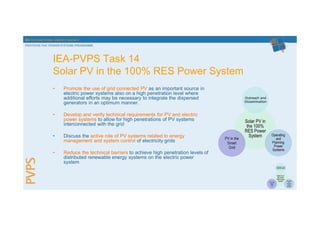
IEA-PVPS Task 14
Solar PV in the 100% RES Power System
• Promote the use of grid connected PV as an important source in
electric power systems also on a high penetration level where
additional efforts may be necessary to integrate the dispersed
generators in an optimum manner.
• Develop and verify technical requirements for PV and electric
power systems to allow for high penetrations of PV systems
interconnected with the grid
• Discuss the active role of PV systems related to energy
management and system control of electricity grids
• Reduce the technical barriers to achieve high penetration levels of
distributed renewable energy systems on the electric power
system
IEA INTERNATIONAL ENERGY AGENCY
PHOTOVOLTAIC POWER SYSTEMS PROGRAMME
IEA-PVPS Task 14:
Outcomes
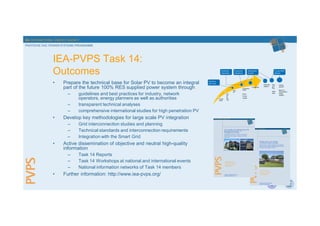
• Prepare the technical base for Solar PV to become an integral
part of the future 100% RES supplied power system through
– guidelines and best practices for industry, network
operators, energy planners as well as authorities
– transparent technical analyses
– comprehensive international studies for high penetration PV
• Develop key methodologies for large scale PV integration
– Grid interconnection studies and planning
– Technical standards and interconnection requirements
– Integration with the Smart Grid
• Active dissemination of objective and neutral high-quality
information
– Task 14 Reports
– Task 14 Workshops at national and international events
– National information networks of Task 14 members
• Further information: http://www.iea-pvps.org/
5VTT 2018
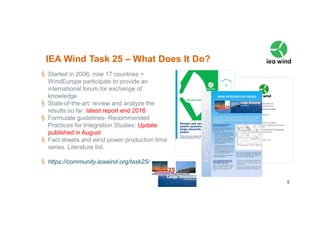
§ Started in 2006, now 17 countries +
WindEurope participate to provide an
international forum for exchange of
knowledge
§ State-of-the-art: review and analyze the
results so far: latest report end 2018
§ Formulate guidelines- Recommended
Practices for Integration Studies: Update
published in August
§ Fact sheets and wind power production time
series. Literature list.
§ https://community.ieawind.org/task25/
IEA Wind Task 25 – What Does It Do?
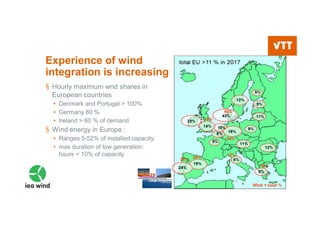
Experience of wind
integration is increasing
§ Hourly maximum wnd shares in
European countries
• Denmark and Portugal > 100%
• Germany 80 %
• Ireland > 60 % of demand
§ Wind energy in Europe :
• Ranges 5-52% of installed capacity,
• max duration of low generation:
hours < 10% of capacity
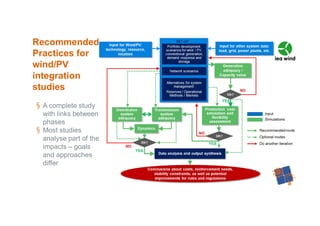
§ A complete study
with links between
phases
§ Most studies
analyse part of the
impacts – goals
and approaches
differ
Recommended
Practices for
wind/PV
integration
studies
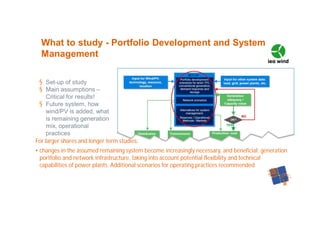
§ Set-up of study
§ Main assumptions –
Critical for results!
§ Future system, how
wind/PV is added, what
is remaining generation
mix, operational
practices
What to study - Portfolio Development and System
Management
For larger shares and longer term studies:
• changes in the assumed remaining system become increasingly necessary, and beneficial: generation
portfolio and network infrastructure, taking into account potential flexibility and technical
capabilities of power plants. Additional scenarios for operating practices recommended
9VTT 2018
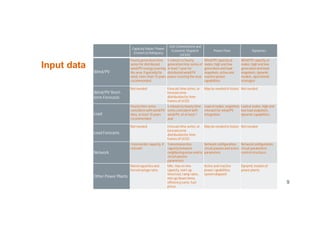
Input data
Capacity Value/ Power
(resource) Adequacy
Unit Commitment and
Economic Dispatch
(UCED)
Power Flow Dynamics
Wind/PV
Hourly generation time
series for distributed
wind/PV energy covering
the area. Especially for
wind, more than 10 years
recommended
5-minuteto hourly
generationtime series of
at least 1 year for
distributed wind/PV
power covering the area
Wind/PV capacity at
nodes, high and low
generation and load
snapshots,active and
reactive power
capabilities
Wind/PV capacity at
nodes, high and low
generation and load
snapshots, dynamic
models, operational
strategies
Wind/PV Short-
term Forecasts
Not needed Forecast time series, or
forecast error
distributionfor time
frames of UCED
May be needed in future Not needed
Load
Hourly time series
coincident with wind/PV
data, at least 10 years
recommended
5-minuteto hourly time
series coincident with
wind/PV,of at least 1
year
Load at nodes, snapshots
relevant for wind/PV
integration
Load at nodes, high and
low load snapshots,
dynamic capabilities
Load Forecasts
Not needed Forecast time series, or
forecast error
distributionfor time
frames of UCED
May be needed in future Not needed
Network
Cross border capacity,if
relevant
Transmissionline
capacity between
neighboring areas and/or
circuit passive
parameters
Network configuration,
circuit passive and active
parameters
Networkconfiguration,
circuit parameters,
control structures
Other Power Plants
Rated capacities and
forced outage rates
Min, max on-line
capacity, start-up
time/cost,ramp rates,
min up/down times.
efficiency curve, fuel
prices
Active and reactive
power capabilities,
system dispatch
Dynamic models of
power plants
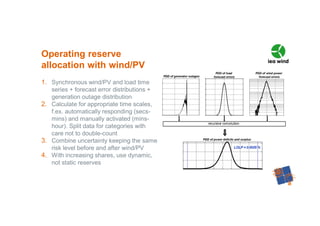
1. Synchronous wind/PV and load time
series + forecast error distributions +
generation outage distribution
2. Calculate for appropriate time scales,
f.ex. automatically responding (secs-
mins) and manually activated (mins-
hour). Split data for categories with
care not to double-count
3. Combine uncertainty keeping the same
risk level before and after wind/PV
4. With increasing shares, use dynamic,
not static reserves
Operating reserve
allocation with wind/PV
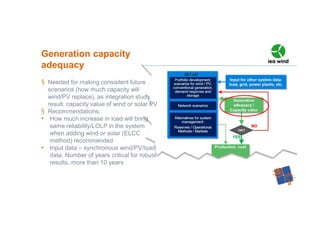
§ Needed for making consistent future
scenarios (how much capacity will
wind/PV replace), as integration study
result: capacity value of wind or solar PV
§ Recommendations:
• How much increase in load will bring
same reliability/LOLP in the system
when adding wind or solar (ELCC
method) recommended
• Input data – synchronous wind/PV/load
data. Number of years critical for robust
results, more than 10 years
Generation capacity
adequacy
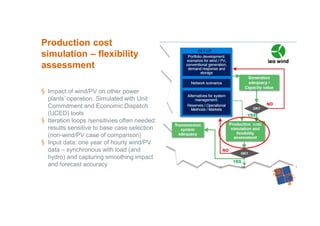
§ Impact of wind/PV on other power
plants’ operation. Simulated with Unit
Commitment and Economic Dispatch
(UCED) tools
§ Iteration loops /sensitivies often needed:
results sensitive to base case selection
(non-wind/PV case of comparison)
§ Input data: one year of hourly wind/PV
data – synchronous with load (and
hydro) and capturing smoothing impact
and forecast accuracy
Production cost
simulation – flexibility
assessment
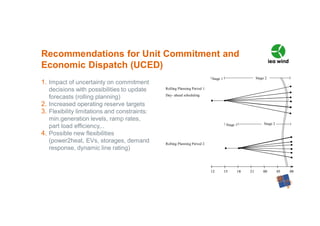
1. Impact of uncertainty on commitment
decisions with possibilities to update
forecasts (rolling planning)
2. Increased operating reserve targets
3. Flexibility limitations and constraints:
min.generation levels, ramp rates,
part load efficiency,..
4. Possible new flexibilities
(power2heat, EVs, storages, demand
response, dynamic line rating)
Recommendations for Unit Commitment and
Economic Dispatch (UCED)
12 15 18 21 00 03 0012 15 18 21 00 03 00
Rolling Planning Period 1:
Day- ahead scheduling
Rolling Planning Period 2
Stage 2Stage 1
Stage 2Stage 1
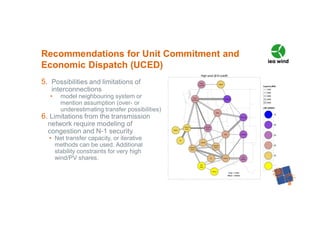
5. Possibilities and limitations of
interconnections
• model neighbouring system or
mention assumption (over- or
underestimating transfer possibilities)
6. Limitations from the transmission
network require modeling of
congestion and N-1 security
• Net transfer capacity, or iterative
methods can be used. Additional
stability constraints for very high
wind/PV shares.
Recommendations for Unit Commitment and
Economic Dispatch (UCED)
Transmission Grid and System Dynamics
Recommended Practices for
Wind / PV Integration Studies
Damian Flynn, University College Dublin
High Wind / PV Share Concerns
• Displacement of synchronous machines
– Low online inertia levels / regional inertia? ≈ frequency stability
• Reduced fault levels ≈ system strength
– Impact on voltage stability / PE controls performance / power quality / ...
• Reduced synchronising torque ≈ rotor angle stability
– Exchange of surplus wind / PV power across wide areas
• Reduced Q / voltage regulation capability (static & dynamic)
– Negative effect on voltage and transient stability
• Harmonic injections introduced by PE converters
– Resonance amplification introduced by the new HV/EHV cables
– Harmonic distortion at PoC, and wider network, within planning levels?
Locational Shift in Generation
• Large share of PE generation connected to Dx network
– Voltage regulation capability from dx connected generation?
– Operating at leading pf? Voltage profile on long + low X/R lines?
– Reactive power requirements at TSO / DSO interface?
• Loss of mains protection for distributed generation
– RoCoF relays for low inertia systems?
• Spatial distribution of old / new generation relative to load
– Old generation near high capacity transmission circuits
– New generation in remote, electrically weak locations?
• Buildout of network much slower than wind / PV growth
– Network congestion / stability issues / …
– Real-time operational challenges?
Growth of PE based Loads
• Voltage & frequency dependent behaviour of evolving load
– Constant power loads ≈ frequency stability?
• Proximity of load to distributed generation
• Growth of large data centre connections
– Short project delivery times
– Strict power quality and reliability requirements
– Limited knowledge of dynamic behaviour (+ protection)
– Limited knowledge of harmonics emissions
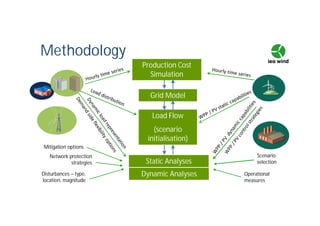
Methodology
Production Cost
Simulation
Load Flow
(scenario
initialisation)
Grid Model
Static Analyses
Dynamic AnalysesDisturbances – type,
location, magnitude
Scenario
selection
Mitigation options
Operational
measures
Network protection
strategies
Stability Analysis
• Transient stability (i.e. angle stability)
– ability to maintain generator synchronism when subjected to a severe transient
disturbance
• Small-signal (oscillatory) stability
– ability to maintain steady-state conditions on voltage, current, and power
magnitudes after being subject to a small disturbance
• Frequency stability
– ability to maintain the system frequency following a major imbalance between
generation and load
• Voltage stability
– ability to maintain an acceptable voltage profile after being subjected to a
disturbance
Scenario Selection
• High / low demand – winter/ summer
– Extracted from production cost simulations
• High / low wind and / or solar power output
• High/ low import/ export
• Recognise correlation between inputs
• Multi-year evaluation of wind/ PV scenarios
• Static scenarios ¹ dynamic scenarios
• Likelihood of scenario occurrence
Scenario Selection
• Reverse power flows
• Full / empty (energy) storage
• High / low (synchronous) inertia
• High / low online headroom (P & Q)
• Displacement of stabilising controls
• …
• Revisit scenario selection as results emerge
– High-level scanning ð in-depth focus
– Selection of before vs. after scenarios?
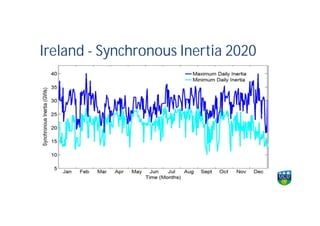
Ireland - Synchronous Inertia 2020
Loadflow Assessment
• Modified unit commitment / economic dispatch
– Incorporation of must run and locational plant constraints?
– Inclusion of DC network + assessment of N-1 security?
• Network expansion / reinforcement
– Dynamic line rating + High temperature low sag conductors
– Power flow controllers / line compensation
– SVC / STATCOM / FACTS devices / ...
• Probabilistic assessment of event occurrence and consideration
of severity of outcomes
– Time series loadflow – switching operations
Dynamic Modelling
• Increasing array of (bespoke) PE control structures
– Modelling assumptions + Grid code compliance?
– Utilisation of generic wind / PV models
• Offshore HVDC connected wind
– Power control and system frequency support ð represent HVDC
controls, individual turbine controls and overall plant controller
• Assess existing (conventional) generator models
• Assess (regional) dynamic load models
• Inclusion of protection devices … potentially larger
frequency & voltage variations
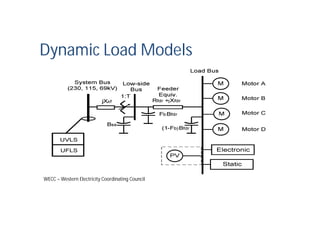
Dynamic Load Models
WECC – Western Electricity Coordinating Council
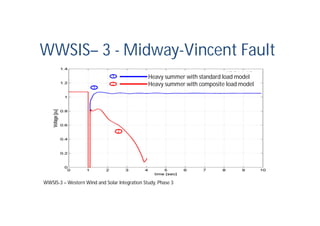
Heavy summer with standard load model
Heavy summer with composite load model
1
2
2
1
WWSIS-3 – Western Wind and Solar Integration Study, Phase 3
WWSIS– 3 - Midway-Vincent Fault
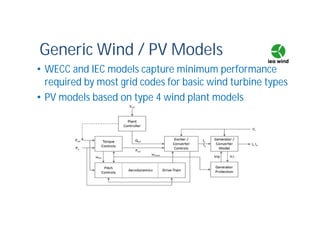
Generic Wind / PV Models
• WECC and IEC models capture minimum performance
required by most grid codes for basic wind turbine types
• PV models based on type 4 wind plant models
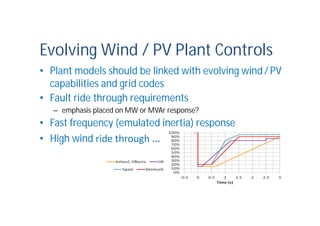
Evolving Wind / PV Plant Controls
• Plant models should be linked with evolving wind/ PV
capabilities and grid codes
• Fault ride through requirements
– emphasis placed on MW or MVAr response?
• Fast frequency (emulated inertia) response
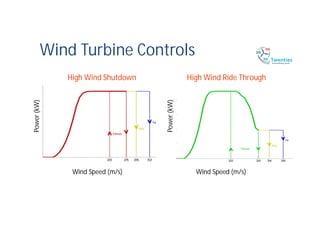
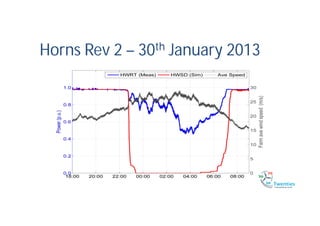
• High wind ride through …
Wind Turbine Controls
Power(kW)
Wind Speed (m/s) Wind Speed (m/s)Power(kW)
High Wind Shutdown High Wind Ride Through
Horns Rev 2 – 30th January 2013
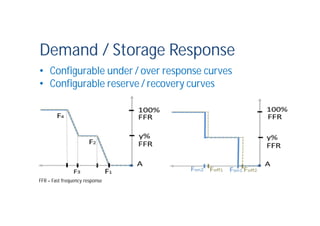
Demand / Storage Response
• Configurable under / over response curves
• Configurable reserve/ recovery curves
FFR – Fast frequency response
Stability Analysis – Additional Options
• Distribution of generation across network
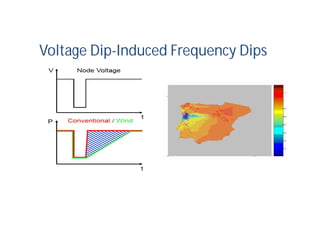
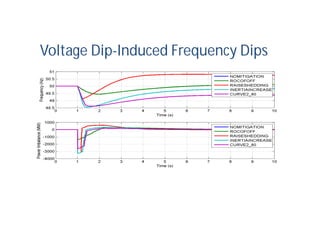
• Voltage dip induced frequency dips
• Sympathy (distribution) tripping due to transmission-
level events
– Voltage trip vs. voltage ride through settings
• Sub-synchronous interactions
– Sub-synchronous resonance, sub-synchronous torsional
interactions and sub-synchronous control interactions
Voltage Dip-Induced Frequency Dips
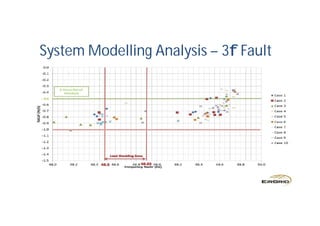
System Modelling Analysis – 3f Fault
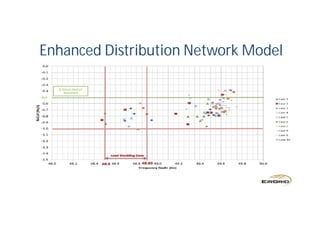
Enhanced Distribution Network Model
Concluding Comments
• Trade-off with transmission planning and operational policies
requires multiple studies
• At higher wind / PV shares, stability issues can take precedence over
UC / flexibility / market issues / …
• Accurate assessment requires validated wind turbine / PV / load /
generator models + proposal of control strategies
• Relative importance of voltage / transient / small-signal / frequency
stability issues can be system dependent
– Network topology, underlying plant portfolio including renewables,
e.g. solar, wind turbine types + location, grid code requirements
– Studies should evolve from ”what are my problems?” to ”how can I take advantage
of my new control options?”
39
Contributors: B. Mather (NREL), M. Kraiczy, C. Ma, M. Braun (Fraunhofer IEE) and S.
Meinecke (University of Kassel)
Distribution integration studies
• Challenge: Scarce input data, high complexity and regional diversity of distribution level
• Example - Grid modelling in state-wide/ system-wide distribution integration studies:
1. Analysis of representative grids in detail, i.e. via clustering/ taxonomy
2. Automated (simplified) analysis techniques, possibly with assumptions of simplified
distribution grid data
à Reduce complexity of distribution level, but preserve diversity and relevant characteristics of
distribution level
• Best-practice of distribution grid modelling depends on detailed study objective and available
input data.
Distribution grid
Distribution grid modelling
Data acquisition, data handling and distribution grid modelling is still a major challenge for distribution
integration studies. For comprehensive system-wide distribution grid studies, a high degree of automation for
data handling and analysis is required.
41
• DER integration and other impact factors (e.g. digitalization) are main drivers for the development
of new planning procedures and tools in the distribution level
• Selected objectives of distribution integration studies:
• Hosting capacity analysis
• Distribution network reinforcement analysis
• Voltage variability analysis and test of control algorithms
• Grid losses analysis
• Further objectives, e.g.: protection and unintentional islanding studies, flicker and harmonics
studies, development of dynamic DER and distribution grid equivalents and several more.
Distribution grid
Objectives of distribution integration studies
42VTT 2018
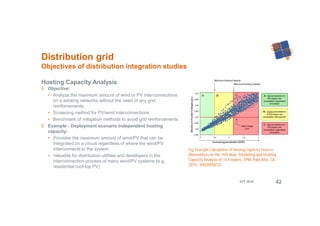
Hosting Capacity Analysis
§ Objective:
• Analyze the maximum amount of wind or PV interconnections
on a existing networks without the need of any grid
reinforcements.
• Screening method for PV/wind interconnections
• Benchmark of mitigation methods to avoid grid reinforcements
§ Example - Deployment scenario independent hosting
capacity:
• Provides the maximum amount of wind/PV that can be
integrated on a circuit regardless of where the wind/PV
interconnects to the system
• Valuable for distribution utilities and developers in the
interconnection process of many wind/PV systems (e.g.
residential roof-top PV)
Distribution grid
Objectives of distribution integration studies
Fig: Example Calculation of Hosting Capacity (Source:
Alternatives to the 15% Rule: Modeling and Hosting
Capacity Analysis of 16 Feeders. EPRI, Palo Alto, CA:
2015. 3002005812)
43
Distribution grid reinforcement analysis
§ Objective:
• Estimate the DER grid integration costs in the distribution level
• Benchmark of different grid integration measures
§ Best practice example/ recommendation:
• A comprehensive catalogue of grid planning measures should
be considered, i.e. grid optimization before grid reinforcement
before grid expansion (e.g. [1]).
• Based on available input data and the scope of the study, the
analyses can either be performed using representative or actual
grid data.
• Presentation of results: important to put the wind/PV integration
driven reinforcement costs in contrast with generally necessary
reinforcements, such as replacing outdated grid assets.
Distribution grid
Objectives of distribution integration studies
Fig.: Simplifiedflow chart for system-wide distribution grid
reinforcement studies
[1] Scheidler, A., L. Thurner, M. Braun (2018),“Heuristic Optimizationfor Automated Distribution System Planning in Network IntegrationStudies”, IET Renewable
Power Generation,Volume 12, Issue 5, April 2018
44
Variability analysis and test of control algorithms
§ Objective:
• Analyse the impact of wind and PV interconnections on
the operation of voltage regulators in the distribution level
• Test and benchmark of voltage regulator and DER control
strategies
§ Best practice example:
• Variability analysis can be completed through the full-scale
quasi-static timeseries simulation of a distribution circuit
over an entire year with relatively high temporal resolution
(e.g. [3])
• Simplified methods available (e.g. [2])
Distribution grid
Objectives of distribution integration studies
Fig.: Example variability analysis (Source: IEA PVPS Task 14 Report,
High penetration PV in local distribution grids, 2015)
[2] Mather, B. et al.: “NREL/SCEHigh Penetration PV IntegrationProject:FY13 Annual Report,” NRELTechnical Report TP-5D00-61269.
[3] Reno, M.J.; Deboever, J.; Mather, B.: “Motivation and Requirementsfor Quasi-StaticTime-Series (QSTS)for Distribution System Analysis,” Proc. IEEE
PES Power & Energy Society General Meeting, July 2017, Chicago, IL, USA.
45
Grid losses analyses
§ Objective/ Motivation:
• Interconnection of wind/PV and other DER can have a significant impact on the distribution grid
losses
• Grid losses are often a key efficiency indicator of DSO by regulators in different countries
§ Best practice example/ Recommendation:
• Conventional methods for loss estimation are usually not suitable for power systems with DER
• Consideration of PV/Wind location and generation pattern important for grid loss analysis
• A detailed study of the grid losses for a certain number of representative distribution grids,
combined with statistical analysis or data-driven methods, is recommended to recognize the
large variation in the network characteristics of distribution grids
Distribution grid
Objectives of distribution integration studies
46
§ Modelling and data handling
• Best-practice of distribution grid modelling depends on detailed study objective and available input
data.
• Data acquisition, data handling and appropriate distribution grid modelling still a major challenge for
distribution integration studies. For comprehensive state-wide and system-wide distribution grid
studies, a high degree of automation for data handling is required.
§ Scope and Methodologies
• Scope, tools and methodologies for distribution integration studies will continue to expand and
develop.
• Well established best-practice examples and advanced planning procedures for distributed Wind/PV
integration studies partly still required.
§ Transmission-Distribution coordination
• Stronger coordination of transmission and distribution grid studies will be required with higher shares
of wind/PV to access the full capabilities and flexibilities of distributed resources.
Distribution grid
Summary distribution integration studies
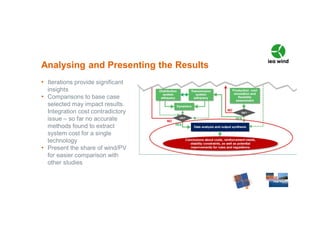
• Iterations provide significant
insights
• Comparisons to base case
selected may impact results.
Integration cost contradictory
issue – so far no accurate
methods found to extract
system cost for a single
technology
• Present the share of wind/PV
for easier comparison with
other studies
Analysing and Presenting the Results
§ Metrics and tools for flexibility needs of the power system, and ways to achieve
flexibility
§ Simulation tools that consider uncertainty of wind in different time scales, and
combine network constraints with UCED constraints
§ Ways to set up simulation cases to efficiently extract impacts and system costs –
from cost of integration to cost of inflexibility
§ Stability issues with very high penetration cases. Future grids with more DC
transmission.
§ Implications of market design and/or regulatory processes for wind/PV integration.
Future work: integration studies are still evolving,
towards 100% renewable studies
Link to report RP16 Ed.2 at Recommended Practices site: https://community.ieawind.org/publications/rp
Questions/experience in using the bullet point lists: hannele.holttinen@recognis.fi
Transmission part: damian.flynn@ucd.ie Distribution part: Markus.Kraiczy@iee.fraunhofer.de
49VTT 2018
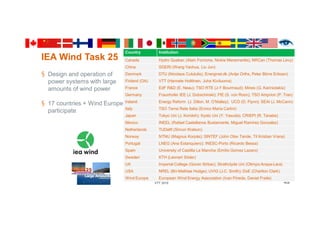
§ Design and operation of
power systems with large
amounts of wind power
§ 17 countries + Wind Europe
participate
IEA Wind Task 25
Country Institution
Canada Hydro Quebec (Alain Forcione, Nickie Menemenlis); NRCan (Thomas Levy)
China SGERI (Wang Yaohua, Liu Jun)
Denmark DTU (Nicolaos Cutululis); Energinet.dk (Antje Orths, Peter Börre Eriksen)
Finland (OA) VTT (Hannele Holttinen, Juha Kiviluoma)
France EdF R&D (E. Neau); TSO RTE (J-Y Bourmaud); Mines (G. Kariniotakis)
Germany Fraunhofer IEE (J. Dobschinski); FfE (S. von Roon); TSO Amprion (P. Tran)
Ireland Energy Reform (J. Dillon, M. O’Malley); UCD (D. Flynn); SEAI (J. McCann)
Italy TSO Terna Rete Italia (Enrico Maria Carlini)
Japan Tokyo Uni (J. Kondoh); Kyoto Uni (Y. Yasuda); CRIEPI (R. Tanabe)
Mexico INEEL (Rafael Castellanos Bustamante, Miguel Ramirez Gonzalez)
Netherlands TUDelft (Simon Watson)
Norway NTNU (Magnus Korpås); SINTEF (John Olav Tande, Til Kristian Vrana)
Portugal LNEG (Ana Estanquiero); INESC-Porto (Ricardo Bessa)
Spain University of Castilla La Mancha (Emilio Gomez Lazaro)
Sweden KTH (Lennart Söder)
UK Imperial College (Goran Strbac); Strathclyde Uni (Olimpo Anaya-Lara)
USA NREL (Bri-Mathias Hodge); UVIG (J.C. Smith); DoE (Charlton Clark)
Wind Europe European Wind Energy Association (Ivan Pineda, Daniel Fraile)

Best practices for Solar and Wind power system case studies

  • 1.
    Recommended Practices for wind/PV integration studies from international collaborationIEA WIND Task 25 and IEA PVPS Task 14 Hannele Holttinen, Principal Scientist, OA Task 25 17.12.2018 VTT – beyond the obvious 1
  • 2.
    Contents § Introduction: OnTask 25/Task14 work § Recommendations for how to perform integration studies • Impact on balancing • Impact on generation adequacy • Impact on grid adequacy and resiliency • Damian Flynn, UCD: Transmission systems • Markus Kraiczy, Fraunhofer IEE: Distribution system VTT 2018 2
  • 3.
    IEA INTERNATIONAL ENERGYAGENCY PHOTOVOLTAIC POWER SYSTEMS PROGRAMME IEA-PVPS Task 14 Solar PV in the 100% RES Power System • Promote the use of grid connected PV as an important source in electric power systems also on a high penetration level where additional efforts may be necessary to integrate the dispersed generators in an optimum manner. • Develop and verify technical requirements for PV and electric power systems to allow for high penetrations of PV systems interconnected with the grid • Discuss the active role of PV systems related to energy management and system control of electricity grids • Reduce the technical barriers to achieve high penetration levels of distributed renewable energy systems on the electric power system
  • 4.
    IEA INTERNATIONAL ENERGYAGENCY PHOTOVOLTAIC POWER SYSTEMS PROGRAMME IEA-PVPS Task 14: Outcomes • Prepare the technical base for Solar PV to become an integral part of the future 100% RES supplied power system through – guidelines and best practices for industry, network operators, energy planners as well as authorities – transparent technical analyses – comprehensive international studies for high penetration PV • Develop key methodologies for large scale PV integration – Grid interconnection studies and planning – Technical standards and interconnection requirements – Integration with the Smart Grid • Active dissemination of objective and neutral high-quality information – Task 14 Reports – Task 14 Workshops at national and international events – National information networks of Task 14 members • Further information: http://www.iea-pvps.org/
  • 5.
    5VTT 2018 § Startedin 2006, now 17 countries + WindEurope participate to provide an international forum for exchange of knowledge § State-of-the-art: review and analyze the results so far: latest report end 2018 § Formulate guidelines- Recommended Practices for Integration Studies: Update published in August § Fact sheets and wind power production time series. Literature list. § https://community.ieawind.org/task25/ IEA Wind Task 25 – What Does It Do?
  • 6.
    Experience of wind integrationis increasing § Hourly maximum wnd shares in European countries • Denmark and Portugal > 100% • Germany 80 % • Ireland > 60 % of demand § Wind energy in Europe : • Ranges 5-52% of installed capacity, • max duration of low generation: hours < 10% of capacity
  • 7.
    § A completestudy with links between phases § Most studies analyse part of the impacts – goals and approaches differ Recommended Practices for wind/PV integration studies
  • 8.
    § Set-up ofstudy § Main assumptions – Critical for results! § Future system, how wind/PV is added, what is remaining generation mix, operational practices What to study - Portfolio Development and System Management For larger shares and longer term studies: • changes in the assumed remaining system become increasingly necessary, and beneficial: generation portfolio and network infrastructure, taking into account potential flexibility and technical capabilities of power plants. Additional scenarios for operating practices recommended
  • 9.
    9VTT 2018 Input data CapacityValue/ Power (resource) Adequacy Unit Commitment and Economic Dispatch (UCED) Power Flow Dynamics Wind/PV Hourly generation time series for distributed wind/PV energy covering the area. Especially for wind, more than 10 years recommended 5-minuteto hourly generationtime series of at least 1 year for distributed wind/PV power covering the area Wind/PV capacity at nodes, high and low generation and load snapshots,active and reactive power capabilities Wind/PV capacity at nodes, high and low generation and load snapshots, dynamic models, operational strategies Wind/PV Short- term Forecasts Not needed Forecast time series, or forecast error distributionfor time frames of UCED May be needed in future Not needed Load Hourly time series coincident with wind/PV data, at least 10 years recommended 5-minuteto hourly time series coincident with wind/PV,of at least 1 year Load at nodes, snapshots relevant for wind/PV integration Load at nodes, high and low load snapshots, dynamic capabilities Load Forecasts Not needed Forecast time series, or forecast error distributionfor time frames of UCED May be needed in future Not needed Network Cross border capacity,if relevant Transmissionline capacity between neighboring areas and/or circuit passive parameters Network configuration, circuit passive and active parameters Networkconfiguration, circuit parameters, control structures Other Power Plants Rated capacities and forced outage rates Min, max on-line capacity, start-up time/cost,ramp rates, min up/down times. efficiency curve, fuel prices Active and reactive power capabilities, system dispatch Dynamic models of power plants
  • 10.
    1. Synchronous wind/PVand load time series + forecast error distributions + generation outage distribution 2. Calculate for appropriate time scales, f.ex. automatically responding (secs- mins) and manually activated (mins- hour). Split data for categories with care not to double-count 3. Combine uncertainty keeping the same risk level before and after wind/PV 4. With increasing shares, use dynamic, not static reserves Operating reserve allocation with wind/PV
  • 11.
    § Needed formaking consistent future scenarios (how much capacity will wind/PV replace), as integration study result: capacity value of wind or solar PV § Recommendations: • How much increase in load will bring same reliability/LOLP in the system when adding wind or solar (ELCC method) recommended • Input data – synchronous wind/PV/load data. Number of years critical for robust results, more than 10 years Generation capacity adequacy
  • 12.
    § Impact ofwind/PV on other power plants’ operation. Simulated with Unit Commitment and Economic Dispatch (UCED) tools § Iteration loops /sensitivies often needed: results sensitive to base case selection (non-wind/PV case of comparison) § Input data: one year of hourly wind/PV data – synchronous with load (and hydro) and capturing smoothing impact and forecast accuracy Production cost simulation – flexibility assessment
  • 13.
    1. Impact ofuncertainty on commitment decisions with possibilities to update forecasts (rolling planning) 2. Increased operating reserve targets 3. Flexibility limitations and constraints: min.generation levels, ramp rates, part load efficiency,.. 4. Possible new flexibilities (power2heat, EVs, storages, demand response, dynamic line rating) Recommendations for Unit Commitment and Economic Dispatch (UCED) 12 15 18 21 00 03 0012 15 18 21 00 03 00 Rolling Planning Period 1: Day- ahead scheduling Rolling Planning Period 2 Stage 2Stage 1 Stage 2Stage 1
  • 14.
    5. Possibilities andlimitations of interconnections • model neighbouring system or mention assumption (over- or underestimating transfer possibilities) 6. Limitations from the transmission network require modeling of congestion and N-1 security • Net transfer capacity, or iterative methods can be used. Additional stability constraints for very high wind/PV shares. Recommendations for Unit Commitment and Economic Dispatch (UCED)
  • 15.
    Transmission Grid andSystem Dynamics Recommended Practices for Wind / PV Integration Studies Damian Flynn, University College Dublin
  • 16.
    High Wind /PV Share Concerns • Displacement of synchronous machines – Low online inertia levels / regional inertia? ≈ frequency stability • Reduced fault levels ≈ system strength – Impact on voltage stability / PE controls performance / power quality / ... • Reduced synchronising torque ≈ rotor angle stability – Exchange of surplus wind / PV power across wide areas • Reduced Q / voltage regulation capability (static & dynamic) – Negative effect on voltage and transient stability • Harmonic injections introduced by PE converters – Resonance amplification introduced by the new HV/EHV cables – Harmonic distortion at PoC, and wider network, within planning levels?
  • 17.
    Locational Shift inGeneration • Large share of PE generation connected to Dx network – Voltage regulation capability from dx connected generation? – Operating at leading pf? Voltage profile on long + low X/R lines? – Reactive power requirements at TSO / DSO interface? • Loss of mains protection for distributed generation – RoCoF relays for low inertia systems? • Spatial distribution of old / new generation relative to load – Old generation near high capacity transmission circuits – New generation in remote, electrically weak locations? • Buildout of network much slower than wind / PV growth – Network congestion / stability issues / … – Real-time operational challenges?
  • 18.
    Growth of PEbased Loads • Voltage & frequency dependent behaviour of evolving load – Constant power loads ≈ frequency stability? • Proximity of load to distributed generation • Growth of large data centre connections – Short project delivery times – Strict power quality and reliability requirements – Limited knowledge of dynamic behaviour (+ protection) – Limited knowledge of harmonics emissions
  • 19.
    Methodology Production Cost Simulation Load Flow (scenario initialisation) GridModel Static Analyses Dynamic AnalysesDisturbances – type, location, magnitude Scenario selection Mitigation options Operational measures Network protection strategies
  • 20.
    Stability Analysis • Transientstability (i.e. angle stability) – ability to maintain generator synchronism when subjected to a severe transient disturbance • Small-signal (oscillatory) stability – ability to maintain steady-state conditions on voltage, current, and power magnitudes after being subject to a small disturbance • Frequency stability – ability to maintain the system frequency following a major imbalance between generation and load • Voltage stability – ability to maintain an acceptable voltage profile after being subjected to a disturbance
  • 21.
    Scenario Selection • High/ low demand – winter/ summer – Extracted from production cost simulations • High / low wind and / or solar power output • High/ low import/ export • Recognise correlation between inputs • Multi-year evaluation of wind/ PV scenarios • Static scenarios ¹ dynamic scenarios • Likelihood of scenario occurrence
  • 22.
    Scenario Selection • Reversepower flows • Full / empty (energy) storage • High / low (synchronous) inertia • High / low online headroom (P & Q) • Displacement of stabilising controls • … • Revisit scenario selection as results emerge – High-level scanning ð in-depth focus – Selection of before vs. after scenarios?
  • 23.
  • 24.
    Loadflow Assessment • Modifiedunit commitment / economic dispatch – Incorporation of must run and locational plant constraints? – Inclusion of DC network + assessment of N-1 security? • Network expansion / reinforcement – Dynamic line rating + High temperature low sag conductors – Power flow controllers / line compensation – SVC / STATCOM / FACTS devices / ... • Probabilistic assessment of event occurrence and consideration of severity of outcomes – Time series loadflow – switching operations
  • 25.
    Dynamic Modelling • Increasingarray of (bespoke) PE control structures – Modelling assumptions + Grid code compliance? – Utilisation of generic wind / PV models • Offshore HVDC connected wind – Power control and system frequency support ð represent HVDC controls, individual turbine controls and overall plant controller • Assess existing (conventional) generator models • Assess (regional) dynamic load models • Inclusion of protection devices … potentially larger frequency & voltage variations
  • 26.
    Dynamic Load Models WECC– Western Electricity Coordinating Council
  • 27.
    Heavy summer withstandard load model Heavy summer with composite load model 1 2 2 1 WWSIS-3 – Western Wind and Solar Integration Study, Phase 3 WWSIS– 3 - Midway-Vincent Fault
  • 28.
    Generic Wind /PV Models • WECC and IEC models capture minimum performance required by most grid codes for basic wind turbine types • PV models based on type 4 wind plant models
  • 29.
    Evolving Wind /PV Plant Controls • Plant models should be linked with evolving wind/ PV capabilities and grid codes • Fault ride through requirements – emphasis placed on MW or MVAr response? • Fast frequency (emulated inertia) response • High wind ride through …
  • 30.
    Wind Turbine Controls Power(kW) WindSpeed (m/s) Wind Speed (m/s)Power(kW) High Wind Shutdown High Wind Ride Through
  • 31.
    Horns Rev 2– 30th January 2013
  • 32.
    Demand / StorageResponse • Configurable under / over response curves • Configurable reserve/ recovery curves FFR – Fast frequency response
  • 33.
    Stability Analysis –Additional Options • Distribution of generation across network • Voltage dip induced frequency dips • Sympathy (distribution) tripping due to transmission- level events – Voltage trip vs. voltage ride through settings • Sub-synchronous interactions – Sub-synchronous resonance, sub-synchronous torsional interactions and sub-synchronous control interactions
  • 34.
  • 35.
  • 36.
  • 37.
  • 38.
    Concluding Comments • Trade-offwith transmission planning and operational policies requires multiple studies • At higher wind / PV shares, stability issues can take precedence over UC / flexibility / market issues / … • Accurate assessment requires validated wind turbine / PV / load / generator models + proposal of control strategies • Relative importance of voltage / transient / small-signal / frequency stability issues can be system dependent – Network topology, underlying plant portfolio including renewables, e.g. solar, wind turbine types + location, grid code requirements – Studies should evolve from ”what are my problems?” to ”how can I take advantage of my new control options?”
  • 39.
    39 Contributors: B. Mather(NREL), M. Kraiczy, C. Ma, M. Braun (Fraunhofer IEE) and S. Meinecke (University of Kassel) Distribution integration studies
  • 40.
    • Challenge: Scarceinput data, high complexity and regional diversity of distribution level • Example - Grid modelling in state-wide/ system-wide distribution integration studies: 1. Analysis of representative grids in detail, i.e. via clustering/ taxonomy 2. Automated (simplified) analysis techniques, possibly with assumptions of simplified distribution grid data à Reduce complexity of distribution level, but preserve diversity and relevant characteristics of distribution level • Best-practice of distribution grid modelling depends on detailed study objective and available input data. Distribution grid Distribution grid modelling Data acquisition, data handling and distribution grid modelling is still a major challenge for distribution integration studies. For comprehensive system-wide distribution grid studies, a high degree of automation for data handling and analysis is required.
  • 41.
    41 • DER integrationand other impact factors (e.g. digitalization) are main drivers for the development of new planning procedures and tools in the distribution level • Selected objectives of distribution integration studies: • Hosting capacity analysis • Distribution network reinforcement analysis • Voltage variability analysis and test of control algorithms • Grid losses analysis • Further objectives, e.g.: protection and unintentional islanding studies, flicker and harmonics studies, development of dynamic DER and distribution grid equivalents and several more. Distribution grid Objectives of distribution integration studies
  • 42.
    42VTT 2018 Hosting CapacityAnalysis § Objective: • Analyze the maximum amount of wind or PV interconnections on a existing networks without the need of any grid reinforcements. • Screening method for PV/wind interconnections • Benchmark of mitigation methods to avoid grid reinforcements § Example - Deployment scenario independent hosting capacity: • Provides the maximum amount of wind/PV that can be integrated on a circuit regardless of where the wind/PV interconnects to the system • Valuable for distribution utilities and developers in the interconnection process of many wind/PV systems (e.g. residential roof-top PV) Distribution grid Objectives of distribution integration studies Fig: Example Calculation of Hosting Capacity (Source: Alternatives to the 15% Rule: Modeling and Hosting Capacity Analysis of 16 Feeders. EPRI, Palo Alto, CA: 2015. 3002005812)
  • 43.
    43 Distribution grid reinforcementanalysis § Objective: • Estimate the DER grid integration costs in the distribution level • Benchmark of different grid integration measures § Best practice example/ recommendation: • A comprehensive catalogue of grid planning measures should be considered, i.e. grid optimization before grid reinforcement before grid expansion (e.g. [1]). • Based on available input data and the scope of the study, the analyses can either be performed using representative or actual grid data. • Presentation of results: important to put the wind/PV integration driven reinforcement costs in contrast with generally necessary reinforcements, such as replacing outdated grid assets. Distribution grid Objectives of distribution integration studies Fig.: Simplifiedflow chart for system-wide distribution grid reinforcement studies [1] Scheidler, A., L. Thurner, M. Braun (2018),“Heuristic Optimizationfor Automated Distribution System Planning in Network IntegrationStudies”, IET Renewable Power Generation,Volume 12, Issue 5, April 2018
  • 44.
    44 Variability analysis andtest of control algorithms § Objective: • Analyse the impact of wind and PV interconnections on the operation of voltage regulators in the distribution level • Test and benchmark of voltage regulator and DER control strategies § Best practice example: • Variability analysis can be completed through the full-scale quasi-static timeseries simulation of a distribution circuit over an entire year with relatively high temporal resolution (e.g. [3]) • Simplified methods available (e.g. [2]) Distribution grid Objectives of distribution integration studies Fig.: Example variability analysis (Source: IEA PVPS Task 14 Report, High penetration PV in local distribution grids, 2015) [2] Mather, B. et al.: “NREL/SCEHigh Penetration PV IntegrationProject:FY13 Annual Report,” NRELTechnical Report TP-5D00-61269. [3] Reno, M.J.; Deboever, J.; Mather, B.: “Motivation and Requirementsfor Quasi-StaticTime-Series (QSTS)for Distribution System Analysis,” Proc. IEEE PES Power & Energy Society General Meeting, July 2017, Chicago, IL, USA.
  • 45.
    45 Grid losses analyses §Objective/ Motivation: • Interconnection of wind/PV and other DER can have a significant impact on the distribution grid losses • Grid losses are often a key efficiency indicator of DSO by regulators in different countries § Best practice example/ Recommendation: • Conventional methods for loss estimation are usually not suitable for power systems with DER • Consideration of PV/Wind location and generation pattern important for grid loss analysis • A detailed study of the grid losses for a certain number of representative distribution grids, combined with statistical analysis or data-driven methods, is recommended to recognize the large variation in the network characteristics of distribution grids Distribution grid Objectives of distribution integration studies
  • 46.
    46 § Modelling anddata handling • Best-practice of distribution grid modelling depends on detailed study objective and available input data. • Data acquisition, data handling and appropriate distribution grid modelling still a major challenge for distribution integration studies. For comprehensive state-wide and system-wide distribution grid studies, a high degree of automation for data handling is required. § Scope and Methodologies • Scope, tools and methodologies for distribution integration studies will continue to expand and develop. • Well established best-practice examples and advanced planning procedures for distributed Wind/PV integration studies partly still required. § Transmission-Distribution coordination • Stronger coordination of transmission and distribution grid studies will be required with higher shares of wind/PV to access the full capabilities and flexibilities of distributed resources. Distribution grid Summary distribution integration studies
  • 47.
    • Iterations providesignificant insights • Comparisons to base case selected may impact results. Integration cost contradictory issue – so far no accurate methods found to extract system cost for a single technology • Present the share of wind/PV for easier comparison with other studies Analysing and Presenting the Results
  • 48.
    § Metrics andtools for flexibility needs of the power system, and ways to achieve flexibility § Simulation tools that consider uncertainty of wind in different time scales, and combine network constraints with UCED constraints § Ways to set up simulation cases to efficiently extract impacts and system costs – from cost of integration to cost of inflexibility § Stability issues with very high penetration cases. Future grids with more DC transmission. § Implications of market design and/or regulatory processes for wind/PV integration. Future work: integration studies are still evolving, towards 100% renewable studies Link to report RP16 Ed.2 at Recommended Practices site: https://community.ieawind.org/publications/rp Questions/experience in using the bullet point lists: hannele.holttinen@recognis.fi Transmission part: damian.flynn@ucd.ie Distribution part: Markus.Kraiczy@iee.fraunhofer.de
  • 49.
    49VTT 2018 § Designand operation of power systems with large amounts of wind power § 17 countries + Wind Europe participate IEA Wind Task 25 Country Institution Canada Hydro Quebec (Alain Forcione, Nickie Menemenlis); NRCan (Thomas Levy) China SGERI (Wang Yaohua, Liu Jun) Denmark DTU (Nicolaos Cutululis); Energinet.dk (Antje Orths, Peter Börre Eriksen) Finland (OA) VTT (Hannele Holttinen, Juha Kiviluoma) France EdF R&D (E. Neau); TSO RTE (J-Y Bourmaud); Mines (G. Kariniotakis) Germany Fraunhofer IEE (J. Dobschinski); FfE (S. von Roon); TSO Amprion (P. Tran) Ireland Energy Reform (J. Dillon, M. O’Malley); UCD (D. Flynn); SEAI (J. McCann) Italy TSO Terna Rete Italia (Enrico Maria Carlini) Japan Tokyo Uni (J. Kondoh); Kyoto Uni (Y. Yasuda); CRIEPI (R. Tanabe) Mexico INEEL (Rafael Castellanos Bustamante, Miguel Ramirez Gonzalez) Netherlands TUDelft (Simon Watson) Norway NTNU (Magnus Korpås); SINTEF (John Olav Tande, Til Kristian Vrana) Portugal LNEG (Ana Estanquiero); INESC-Porto (Ricardo Bessa) Spain University of Castilla La Mancha (Emilio Gomez Lazaro) Sweden KTH (Lennart Söder) UK Imperial College (Goran Strbac); Strathclyde Uni (Olimpo Anaya-Lara) USA NREL (Bri-Mathias Hodge); UVIG (J.C. Smith); DoE (Charlton Clark) Wind Europe European Wind Energy Association (Ivan Pineda, Daniel Fraile)