OUR PHILOSOPHY
• We follow the practices of universal
design for learning in order to provide
a meaningful academic curriculum that
is inclusive to all learning types
• Working together to create a positive
and safe differentiated learning
environment accessible to all types of
learners in order to support student
achievement based on identified
individualized needs
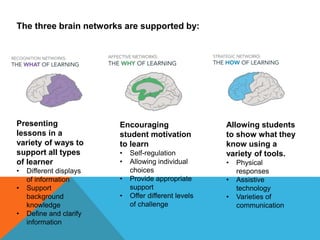
The three brain networks are supported by:
Presenting
lessons in a
variety of ways to
support all types
of learner
• Different displays
of information
• Support
background
knowledge
• Define and clarify
information
Encouraging
student motivation
to learn
• Self-regulation
• Allowing individual
choices
• Provide appropriate
support
• Offer different levels
of challenge
Allowing students
to show what they
know using a
variety of tools.
• Physical
responses
• Assistive
technology
• Varieties of
communication
STRUCTURE
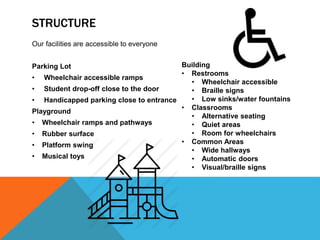
Our facilities are accessible to everyone
Parking Lot
• Wheelchair accessible ramps
• Student drop-off close to the door
• Handicapped parking close to entrance
Playground
• Wheelchair ramps and pathways
• Rubber surface
• Platform swing
• Musical toys
Building
• Restrooms
• Wheelchair accessible
• Braille signs
• Low sinks/water fountains
• Classrooms
• Alternative seating
• Quiet areas
• Room for wheelchairs
• Common Areas
• Wide hallways
• Automatic doors
• Visual/braille signs
CLASSES
• Grouped by grade level
• Flexible grouping
• Based on ongoing assessments
• Grouped by current academic needs
• Groups constantly changing based on immediate needs
• Keep in mind student communication skills, cultural backgrounds,
and learning styles
• Teachers
• Two in each classroom
• General education
• Special education or
paraprofessional
PERSONNEL
• Principal
• Assistant Principals
• Counselor
• Offer social skills groups
• Diagnostician
• Nurse
• Trained to handle students with
problematic behaviors
• Sensory sensitive techniques
• Use visuals
•General Education teachers
•Special Education teachers
•Paraprofessionals
•Front office staff
INSTRUCTION
Our teachers provide access to the general curriculum by:
• Using different mediums to present information
• Allowing students options to complete assignments and show
knowledge
• Complete ongoing assessments to evaluate student learning
• Provide accommodations to students
• Determining clear goals for learning
• Support student background knowledge
• Provide multiple means of recognition, representation, and
engagement
GENERAL CURRICULUM
General curriculum for all grade levels
• Individual needs identified through ongoing assessments
• Identify clear learning goals
• Broad enough to accommodate different styles of learning
• Lessons presented with a variety of technological mediums
• Text
• Computer
• Video
• Modeling
• Students allowed to show what they have learned in a variety of ways
TECHNOLOGY
Smartboards
• Touch screen for hands on technology
• Use as a projector for videos and presentations
iPads
• Watching videos
• Playing educational games to support learning
• Researching topics
Computers
• Creating presentations
• Research projects
• Watching videos
Visual aids
• To support learning and communication
ASSESSMENTS
Ongoing weekly assessments in order to evaluate student learning
• Helps with classroom grouping according to current skill level
• With each new lesson/topic to determine if extra support is needed
Teacher observations
Project based learning
Formative and summative assessments
• Paper and pencil
• Computer based
• Text to speech
• Visuals

UDL

  • 2.
    OUR PHILOSOPHY • Wefollow the practices of universal design for learning in order to provide a meaningful academic curriculum that is inclusive to all learning types • Working together to create a positive and safe differentiated learning environment accessible to all types of learners in order to support student achievement based on identified individualized needs
  • 3.
    The three brainnetworks are supported by: Presenting lessons in a variety of ways to support all types of learner • Different displays of information • Support background knowledge • Define and clarify information Encouraging student motivation to learn • Self-regulation • Allowing individual choices • Provide appropriate support • Offer different levels of challenge Allowing students to show what they know using a variety of tools. • Physical responses • Assistive technology • Varieties of communication
  • 4.
    STRUCTURE Our facilities areaccessible to everyone Parking Lot • Wheelchair accessible ramps • Student drop-off close to the door • Handicapped parking close to entrance Playground • Wheelchair ramps and pathways • Rubber surface • Platform swing • Musical toys Building • Restrooms • Wheelchair accessible • Braille signs • Low sinks/water fountains • Classrooms • Alternative seating • Quiet areas • Room for wheelchairs • Common Areas • Wide hallways • Automatic doors • Visual/braille signs
  • 5.
    CLASSES • Grouped bygrade level • Flexible grouping • Based on ongoing assessments • Grouped by current academic needs • Groups constantly changing based on immediate needs • Keep in mind student communication skills, cultural backgrounds, and learning styles • Teachers • Two in each classroom • General education • Special education or paraprofessional
  • 6.
    PERSONNEL • Principal • AssistantPrincipals • Counselor • Offer social skills groups • Diagnostician • Nurse • Trained to handle students with problematic behaviors • Sensory sensitive techniques • Use visuals •General Education teachers •Special Education teachers •Paraprofessionals •Front office staff
  • 7.
    INSTRUCTION Our teachers provideaccess to the general curriculum by: • Using different mediums to present information • Allowing students options to complete assignments and show knowledge • Complete ongoing assessments to evaluate student learning • Provide accommodations to students • Determining clear goals for learning • Support student background knowledge • Provide multiple means of recognition, representation, and engagement
  • 8.
    GENERAL CURRICULUM General curriculumfor all grade levels • Individual needs identified through ongoing assessments • Identify clear learning goals • Broad enough to accommodate different styles of learning • Lessons presented with a variety of technological mediums • Text • Computer • Video • Modeling • Students allowed to show what they have learned in a variety of ways
  • 9.
    TECHNOLOGY Smartboards • Touch screenfor hands on technology • Use as a projector for videos and presentations iPads • Watching videos • Playing educational games to support learning • Researching topics Computers • Creating presentations • Research projects • Watching videos Visual aids • To support learning and communication
  • 10.
    ASSESSMENTS Ongoing weekly assessmentsin order to evaluate student learning • Helps with classroom grouping according to current skill level • With each new lesson/topic to determine if extra support is needed Teacher observations Project based learning Formative and summative assessments • Paper and pencil • Computer based • Text to speech • Visuals