In our Garden
Pacific Baza
Appearance
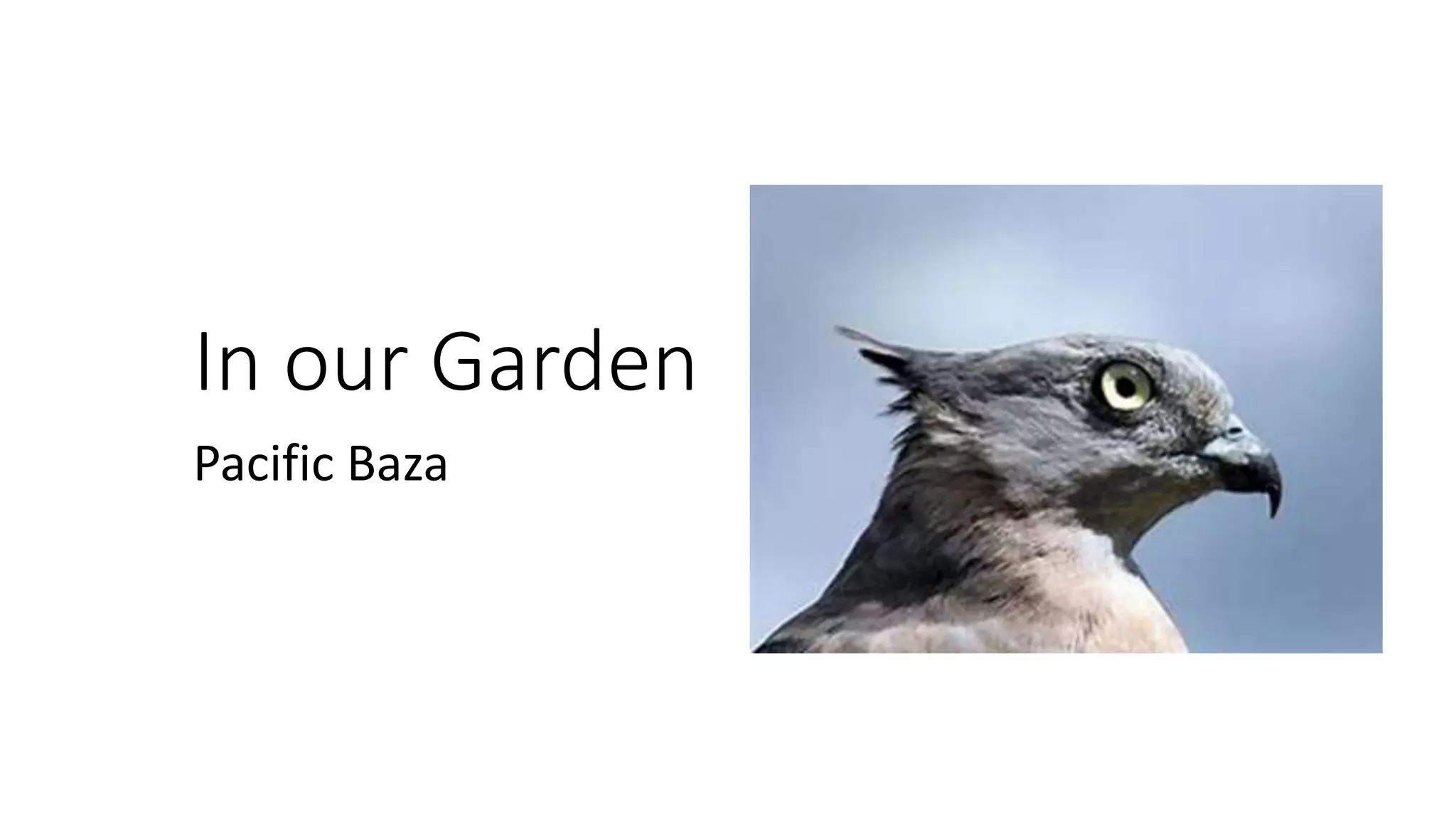
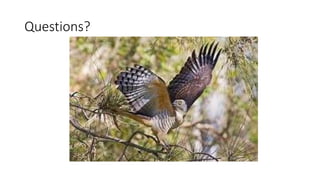
The Pacific Baza is a medium-sized, long-tailed hawk with a prominent
crest.
The wings are paddle-shaped, well-rounded and deeply 'fingered'.
The head, neck and breast are grey and the underparts are white with
bold dark banding. The legs are short with weak toes.
The eyes are golden-yellow and domed, placed well on the side of the
head, giving a slightly 'pop-eyed' look.
The female is heavier and browner on the crown than the male.
It is also known as the Crested Hawk or Baza, or the Pacific Cuckoo-
Falcon.
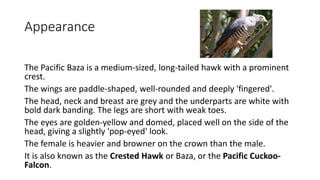
The Pacific Baza is found in tropical and subtropical forest and
woodland in northern and eastern Australia, but rarely south of Sydney.
They prefer well-watered areas.
Where does it live?
Food of Choice
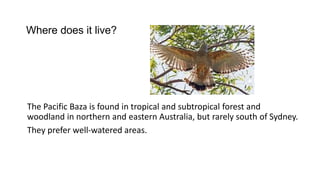
The Pacific Baza's favourite prey is large insects, particularly stick
insects, mantids, and frogs. They sometimes eat fruit as well.
Bazas will move through the canopy, or perch and watch, then make
short dives, with feet extended, to snatch prey from the foliage or from
the air.
Cont.
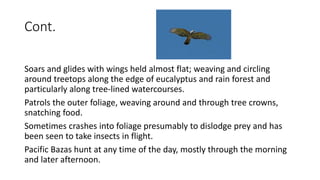
Soars and glides with wings held almost flat; weaving and circling
around treetops along the edge of eucalyptus and rain forest and
particularly along tree-lined watercourses.
Patrols the outer foliage, weaving around and through tree crowns,
snatching food.
Sometimes crashes into foliage presumably to dislodge prey and has
been seen to take insects in flight.
Pacific Bazas hunt at any time of the day, mostly through the morning
and later afternoon.
Nesting
Breeds from September to March, usually October to December.
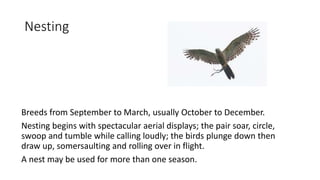
Nesting begins with spectacular aerial displays; the pair soar, circle,
swoop and tumble while calling loudly; the birds plunge down then
draw up, somersaulting and rolling over in flight.
A nest may be used for more than one season.
Cont.
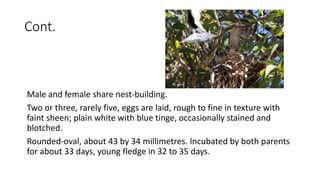
Male and female share nest-building.
Two or three, rarely five, eggs are laid, rough to fine in texture with
faint sheen; plain white with blue tinge, occasionally stained and
blotched.
Rounded-oval, about 43 by 34 millimetres. Incubated by both parents
for about 33 days, young fledge in 32 to 35 days.
Babies
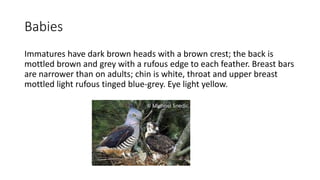
Immatures have dark brown heads with a brown crest; the back is
mottled brown and grey with a rufous edge to each feather. Breast bars
are narrower than on adults; chin is white, throat and upper breast
mottled light rufous tinged blue-grey. Eye light yellow.
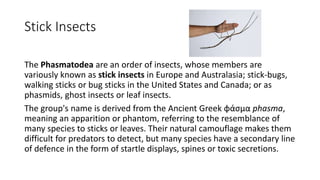
Stick Insects
The Phasmatodea are an order of insects, whose members are
variously known as stick insects in Europe and Australasia; stick-bugs,
walking sticks or bug sticks in the United States and Canada; or as
phasmids, ghost insects or leaf insects.
The group's name is derived from the Ancient Greek φάσμα phasma,
meaning an apparition or phantom, referring to the resemblance of
many species to sticks or leaves. Their natural camouflage makes them
difficult for predators to detect, but many species have a secondary line
of defence in the form of startle displays, spines or toxic secretions.
Cont.
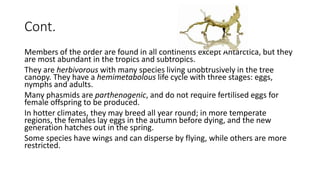
Members of the order are found in all continents except Antarctica, but they
are most abundant in the tropics and subtropics.
They are herbivorous with many species living unobtrusively in the tree
canopy. They have a hemimetabolous life cycle with three stages: eggs,
nymphs and adults.
Many phasmids are parthenogenic, and do not require fertilised eggs for
female offspring to be produced.
In hotter climates, they may breed all year round; in more temperate
regions, the females lay eggs in the autumn before dying, and the new
generation hatches out in the spring.
Some species have wings and can disperse by flying, while others are more
restricted.
Are they a Problem???
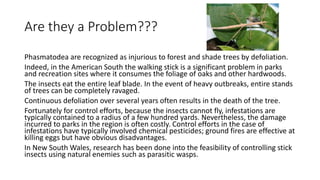
Phasmatodea are recognized as injurious to forest and shade trees by defoliation.
Indeed, in the American South the walking stick is a significant problem in parks
and recreation sites where it consumes the foliage of oaks and other hardwoods.
The insects eat the entire leaf blade. In the event of heavy outbreaks, entire stands
of trees can be completely ravaged.
Continuous defoliation over several years often results in the death of the tree.
Fortunately for control efforts, because the insects cannot fly, infestations are
typically contained to a radius of a few hundred yards. Nevertheless, the damage
incurred to parks in the region is often costly. Control efforts in the case of
infestations have typically involved chemical pesticides; ground fires are effective at
killing eggs but have obvious disadvantages.
In New South Wales, research has been done into the feasibility of controlling stick
insects using natural enemies such as parasitic wasps.
Questions?
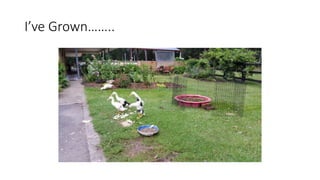
I’ve Grown……..

In our garden

  • 1.
  • 2.
    Appearance The Pacific Bazais a medium-sized, long-tailed hawk with a prominent crest. The wings are paddle-shaped, well-rounded and deeply 'fingered'. The head, neck and breast are grey and the underparts are white with bold dark banding. The legs are short with weak toes. The eyes are golden-yellow and domed, placed well on the side of the head, giving a slightly 'pop-eyed' look. The female is heavier and browner on the crown than the male. It is also known as the Crested Hawk or Baza, or the Pacific Cuckoo- Falcon.
  • 3.
    The Pacific Bazais found in tropical and subtropical forest and woodland in northern and eastern Australia, but rarely south of Sydney. They prefer well-watered areas. Where does it live?
  • 4.
    Food of Choice ThePacific Baza's favourite prey is large insects, particularly stick insects, mantids, and frogs. They sometimes eat fruit as well. Bazas will move through the canopy, or perch and watch, then make short dives, with feet extended, to snatch prey from the foliage or from the air.
  • 5.
    Cont. Soars and glideswith wings held almost flat; weaving and circling around treetops along the edge of eucalyptus and rain forest and particularly along tree-lined watercourses. Patrols the outer foliage, weaving around and through tree crowns, snatching food. Sometimes crashes into foliage presumably to dislodge prey and has been seen to take insects in flight. Pacific Bazas hunt at any time of the day, mostly through the morning and later afternoon.
  • 6.
    Nesting Breeds from Septemberto March, usually October to December. Nesting begins with spectacular aerial displays; the pair soar, circle, swoop and tumble while calling loudly; the birds plunge down then draw up, somersaulting and rolling over in flight. A nest may be used for more than one season.
  • 7.
    Cont. Male and femaleshare nest-building. Two or three, rarely five, eggs are laid, rough to fine in texture with faint sheen; plain white with blue tinge, occasionally stained and blotched. Rounded-oval, about 43 by 34 millimetres. Incubated by both parents for about 33 days, young fledge in 32 to 35 days.
  • 8.
    Babies Immatures have darkbrown heads with a brown crest; the back is mottled brown and grey with a rufous edge to each feather. Breast bars are narrower than on adults; chin is white, throat and upper breast mottled light rufous tinged blue-grey. Eye light yellow.
  • 9.
    Stick Insects The Phasmatodeaare an order of insects, whose members are variously known as stick insects in Europe and Australasia; stick-bugs, walking sticks or bug sticks in the United States and Canada; or as phasmids, ghost insects or leaf insects. The group's name is derived from the Ancient Greek φάσμα phasma, meaning an apparition or phantom, referring to the resemblance of many species to sticks or leaves. Their natural camouflage makes them difficult for predators to detect, but many species have a secondary line of defence in the form of startle displays, spines or toxic secretions.
  • 10.
    Cont. Members of theorder are found in all continents except Antarctica, but they are most abundant in the tropics and subtropics. They are herbivorous with many species living unobtrusively in the tree canopy. They have a hemimetabolous life cycle with three stages: eggs, nymphs and adults. Many phasmids are parthenogenic, and do not require fertilised eggs for female offspring to be produced. In hotter climates, they may breed all year round; in more temperate regions, the females lay eggs in the autumn before dying, and the new generation hatches out in the spring. Some species have wings and can disperse by flying, while others are more restricted.
  • 11.
    Are they aProblem??? Phasmatodea are recognized as injurious to forest and shade trees by defoliation. Indeed, in the American South the walking stick is a significant problem in parks and recreation sites where it consumes the foliage of oaks and other hardwoods. The insects eat the entire leaf blade. In the event of heavy outbreaks, entire stands of trees can be completely ravaged. Continuous defoliation over several years often results in the death of the tree. Fortunately for control efforts, because the insects cannot fly, infestations are typically contained to a radius of a few hundred yards. Nevertheless, the damage incurred to parks in the region is often costly. Control efforts in the case of infestations have typically involved chemical pesticides; ground fires are effective at killing eggs but have obvious disadvantages. In New South Wales, research has been done into the feasibility of controlling stick insects using natural enemies such as parasitic wasps.
  • 12.
  • 13.