Flying Animals
 They are around 10,000 living species of birds around the
  glob.
 Modern birds are characterized by:
   Feathers
   a beak without teeth .
   the laying of hard-shelled eggs.
   a high metabolic rate.
   a four-chambered heart.
   a lightweight but strong skeleton.
Flying Animals continue
 All living species of birds have wings—the now extinct
  flightless Moa of New Zealand was the only exception.
 most bird species can fly, with some exceptions, including
  ratites, penguins, and a number of diverse endemic island
  species.
 Birds also have unique digestive and respiratory systems
  that are highly adapted for flight.
 Many species take on long distance annual migrations,
  and many more perform shorter irregular movements.
Flying Animals continue
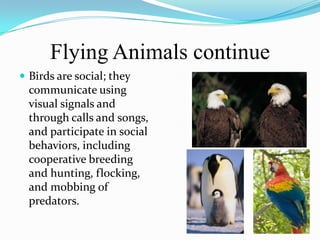
 Birds are social; they
  communicate using
  visual signals and
  through calls and songs,
  and participate in social
  behaviors, including
  cooperative breeding
  and hunting, flocking,
  and mobbing of
  predators.
Flying Animals continue
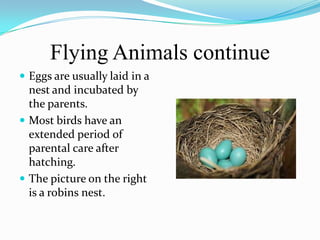
 Eggs are usually laid in a
  nest and incubated by
  the parents.
 Most birds have an
  extended period of
  parental care after
  hatching.
 The picture on the right
  is a robins nest.
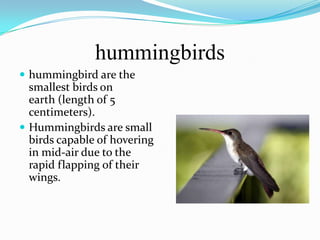
hummingbirds
 hummingbird are the
  smallest birds on
  earth (length of 5
  centimeters).
 Hummingbirds are small
  birds capable of hovering
  in mid-air due to the
  rapid flapping of their
  wings.
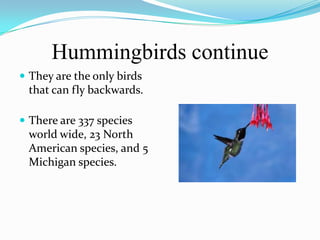
Hummingbirds continue
 They are the only birds
 that can fly backwards.

 There are 337 species
 world wide, 23 North
 American species, and 5
 Michigan species.
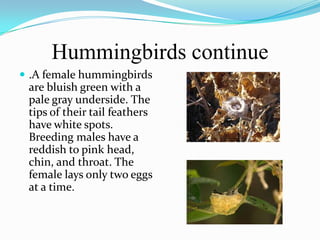
Hummingbirds continue
 .A female hummingbirds
 are bluish green with a
 pale gray underside. The
 tips of their tail feathers
 have white spots.
 Breeding males have a
 reddish to pink head,
 chin, and throat. The
 female lays only two eggs
 at a time.
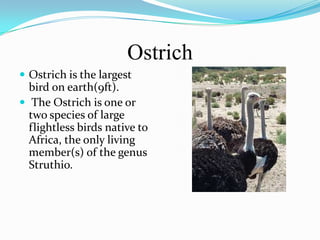
Ostrich
 Ostrich is the largest
  bird on earth(9ft).
 The Ostrich is one or
  two species of large
  flightless birds native to
  Africa, the only living
  member(s) of the genus
  Struthio.
Ostrich continue
 Some analyses indicate
  that the Somali Ostrich
  may be better considered a
  full species apart from the
  Common Ostrich, but
  most taxonomists consider
  it to be a subspecies.
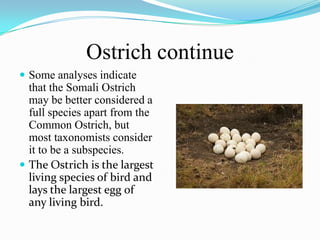
 The Ostrich is the largest
  living species of bird and
  lays the largest egg of
  any living bird.
North American Robin
 The American Robin or North American Robin (Turdus
  migratorius) is a migratory songbird of the thrush family.
 It is named after the European Robin because of its
  reddish-orange breast, though the two species are not
  closely related, with the European robin belonging to the
  flycatcher family.
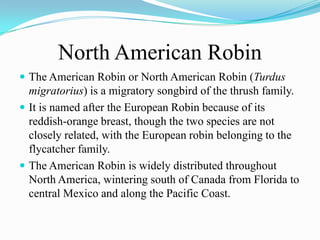
 The American Robin is widely distributed throughout
  North America, wintering south of Canada from Florida to
  central Mexico and along the Pacific Coast.
North American Robin continue
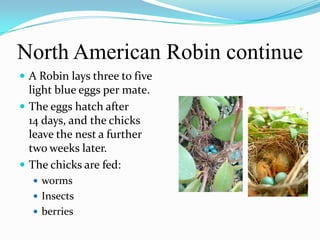
 A Robin lays three to five
  light blue eggs per mate.
 The eggs hatch after
  14 days, and the chicks
  leave the nest a further
  two weeks later.
 The chicks are fed:
   worms
   Insects
   berries
Bird Eggs
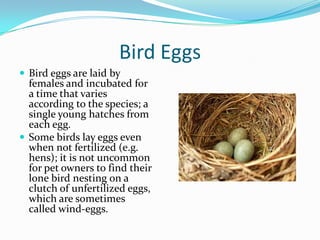
 Bird eggs are laid by
  females and incubated for
  a time that varies
  according to the species; a
  single young hatches from
  each egg.
 Some birds lay eggs even
  when not fertilized (e.g.
  hens); it is not uncommon
  for pet owners to find their
  lone bird nesting on a
  clutch of unfertilized eggs,
  which are sometimes
  called wind-eggs.

Flying animals

  • 1.
    Flying Animals  Theyare around 10,000 living species of birds around the glob.  Modern birds are characterized by:  Feathers  a beak without teeth .  the laying of hard-shelled eggs.  a high metabolic rate.  a four-chambered heart.  a lightweight but strong skeleton.
  • 2.
    Flying Animals continue All living species of birds have wings—the now extinct flightless Moa of New Zealand was the only exception.  most bird species can fly, with some exceptions, including ratites, penguins, and a number of diverse endemic island species.  Birds also have unique digestive and respiratory systems that are highly adapted for flight.  Many species take on long distance annual migrations, and many more perform shorter irregular movements.
  • 3.
    Flying Animals continue Birds are social; they communicate using visual signals and through calls and songs, and participate in social behaviors, including cooperative breeding and hunting, flocking, and mobbing of predators.
  • 4.
    Flying Animals continue Eggs are usually laid in a nest and incubated by the parents.  Most birds have an extended period of parental care after hatching.  The picture on the right is a robins nest.
  • 5.
    hummingbirds  hummingbird arethe smallest birds on earth (length of 5 centimeters).  Hummingbirds are small birds capable of hovering in mid-air due to the rapid flapping of their wings.
  • 6.
    Hummingbirds continue  Theyare the only birds that can fly backwards.  There are 337 species world wide, 23 North American species, and 5 Michigan species.
  • 7.
    Hummingbirds continue  .Afemale hummingbirds are bluish green with a pale gray underside. The tips of their tail feathers have white spots. Breeding males have a reddish to pink head, chin, and throat. The female lays only two eggs at a time.
  • 8.
    Ostrich  Ostrich isthe largest bird on earth(9ft).  The Ostrich is one or two species of large flightless birds native to Africa, the only living member(s) of the genus Struthio.
  • 9.
    Ostrich continue  Someanalyses indicate that the Somali Ostrich may be better considered a full species apart from the Common Ostrich, but most taxonomists consider it to be a subspecies.  The Ostrich is the largest living species of bird and lays the largest egg of any living bird.
  • 10.
    North American Robin The American Robin or North American Robin (Turdus migratorius) is a migratory songbird of the thrush family.  It is named after the European Robin because of its reddish-orange breast, though the two species are not closely related, with the European robin belonging to the flycatcher family.  The American Robin is widely distributed throughout North America, wintering south of Canada from Florida to central Mexico and along the Pacific Coast.
  • 11.
    North American Robincontinue  A Robin lays three to five light blue eggs per mate.  The eggs hatch after 14 days, and the chicks leave the nest a further two weeks later.  The chicks are fed:  worms  Insects  berries
  • 12.
    Bird Eggs  Birdeggs are laid by females and incubated for a time that varies according to the species; a single young hatches from each egg.  Some birds lay eggs even when not fertilized (e.g. hens); it is not uncommon for pet owners to find their lone bird nesting on a clutch of unfertilized eggs, which are sometimes called wind-eggs.