IN HOUSE
TRAINING
HIP REMEDIAL INSTRUCTION YEAR
4
BY: SYAZWANA BT NAJMIN
ON
Remedial Instruction is one of the initiatives
stipulated in the MEB and the English
Language Roadmap. The programme is
a follow up and follow through of the LINUS
2.0 and PLaN programme which is aimed
at addressing the problem of English literacy
among lower primary school students
without learning problems.
HIP is a programme under the
MBMMBI policy and Remedial
Instruction aims to expose students to
extensive use of the English Language
and to create an immersive English
Language environment in schools
Remedial Instruction through HIP with
the focus on the in-class component
1 of the 7 cores of KPM, Core 4 : Focus
on drop out of education and literacy
problems and to close the educational
gap.
PROGRAMME OBJECTIVES
Help Year Four students to master
basic skills of
Listening, Speaking, Reading
and Writing in English to improve
student performance in English to
achieve the aspired CEFR level.
Enable Year Four English teachers
to master the techniques and
remedial teaching strategies to
help Improve students' English
language skills and outcomes.
As a continuous professional
development training for Year Four
English teachers to master English
language remedial teaching
methods and techniques
IMPLEMENTATIO
N
Training Needs
Analysis (2020-
2021)
• Conducted an analysis of training needs by obtaining
information related to the needs of Year 4 students from 800
selected schools (2020 PLaN)
Training
Materials (2023)
• Provide training modules – Teachers, EL Panel Heads, SISCs+
• Provide Year 4 Remedial Instruction Toolkit
Implementati
on of Training
• Remedial Instruction for English language Teachers Phase 1-
Phase 5 (January-March 2023)
IMPLEMENTATIO
N
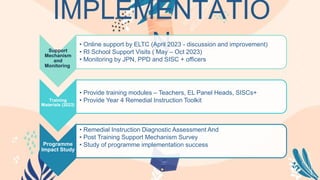
Support
Mechanism
and
Monitoring
• Online support by ELTC (April 2023 - discussion and improvement)
• RI School Support Visits ( May – Oct 2023)
• Monitoring by JPN, PPD and SISC + officers
Training
Materials (2023)
• Provide training modules – Teachers, EL Panel Heads, SISCs+
• Provide Year 4 Remedial Instruction Toolkit
Programme
Impact Study
• Remedial Instruction Diagnostic Assessment And
• Post Training Support Mechanism Survey
• Study of programme implementation success
WHAT IS REMEDIAL INSTRUCTION?
•that starts
immediately
after identifying
a learning
challenge to
help a student
to catch up in
the studies
•arranged for
students who have
temporarily fallen
behind in their
studies offered to
students in need of
special assistance
MIXED ABILITY
CLASSROOM
7 Remedial Instruction Strategies
1.Provide clear instruction of literacy components
Support learners to explicitly develop their communicative competence
Embed visual and verbal resources in lessons, to support student learning
Encourage peer-assisted learning opportunities
Build on students’ home language, culture, and social experiences
Assess language and literacy challenges, and monitor progress
Encourage collaborative small-group learning opportunities
Root Cause Analysis Process​
Sample Free Writing –
Pre Diagnostic Assessment
Maybe You Need to Divide the Content
Mercury is the closest planet to
the Sun and the smallest one
Mercury
Venus has a beautiful name
and is the second planet
Venus
You Could Use Three Columns, Why Not?
Despite being red,
Mars is actually a cold
place. It’s full of iron
dust
Mars
It’s a gas giant and
also the biggest planet
in the Solar System
Jupiter
Mercury is the closest
planet to the Sun and
the smallest one
Mercury
A Picture Always
Reinforces the
Concept
Images reveal large amounts of
data, so remember: use an image
instead of long texts. Your audience
will appreciate that
REMEDIAL
INSTRUCTION
TOOLKIT
Section
This makes your title
comprehensible
02
EFFECTIVE ASSESSMENT FOR LEARNING
STARTEGIES
Integrate
feedback
Use summative
assessments for
formative purposes
(RI 6)
Clarify
learning goals
and success
criteria (RI 1)
Give students
time to revise a
piece of work
once they have
received
feedback
Engage students
as owners of their
own learning (RI
4)
Teach students
how to use
assessment
information to
improve their
work(RI6)
Build students'
skills through
peer
assessment
opportunities
(RI4, 7)
Create occasions
for students to
showcase their
work to other
audiences(RI 7)
Provide
opportunities,
and support,
for students to
engage in self-
assessment

in house training.pptx

  • 1.
    IN HOUSE TRAINING HIP REMEDIALINSTRUCTION YEAR 4 BY: SYAZWANA BT NAJMIN
  • 2.
    ON Remedial Instruction isone of the initiatives stipulated in the MEB and the English Language Roadmap. The programme is a follow up and follow through of the LINUS 2.0 and PLaN programme which is aimed at addressing the problem of English literacy among lower primary school students without learning problems. HIP is a programme under the MBMMBI policy and Remedial Instruction aims to expose students to extensive use of the English Language and to create an immersive English Language environment in schools Remedial Instruction through HIP with the focus on the in-class component 1 of the 7 cores of KPM, Core 4 : Focus on drop out of education and literacy problems and to close the educational gap.
  • 3.
    PROGRAMME OBJECTIVES Help YearFour students to master basic skills of Listening, Speaking, Reading and Writing in English to improve student performance in English to achieve the aspired CEFR level. Enable Year Four English teachers to master the techniques and remedial teaching strategies to help Improve students' English language skills and outcomes. As a continuous professional development training for Year Four English teachers to master English language remedial teaching methods and techniques
  • 4.
    IMPLEMENTATIO N Training Needs Analysis (2020- 2021) •Conducted an analysis of training needs by obtaining information related to the needs of Year 4 students from 800 selected schools (2020 PLaN) Training Materials (2023) • Provide training modules – Teachers, EL Panel Heads, SISCs+ • Provide Year 4 Remedial Instruction Toolkit Implementati on of Training • Remedial Instruction for English language Teachers Phase 1- Phase 5 (January-March 2023)
  • 5.
    IMPLEMENTATIO N Support Mechanism and Monitoring • Online supportby ELTC (April 2023 - discussion and improvement) • RI School Support Visits ( May – Oct 2023) • Monitoring by JPN, PPD and SISC + officers Training Materials (2023) • Provide training modules – Teachers, EL Panel Heads, SISCs+ • Provide Year 4 Remedial Instruction Toolkit Programme Impact Study • Remedial Instruction Diagnostic Assessment And • Post Training Support Mechanism Survey • Study of programme implementation success
  • 6.
    WHAT IS REMEDIALINSTRUCTION? •that starts immediately after identifying a learning challenge to help a student to catch up in the studies •arranged for students who have temporarily fallen behind in their studies offered to students in need of special assistance
  • 7.
  • 8.
    7 Remedial InstructionStrategies 1.Provide clear instruction of literacy components Support learners to explicitly develop their communicative competence Embed visual and verbal resources in lessons, to support student learning Encourage peer-assisted learning opportunities Build on students’ home language, culture, and social experiences Assess language and literacy challenges, and monitor progress Encourage collaborative small-group learning opportunities
  • 9.
  • 10.
    Sample Free Writing– Pre Diagnostic Assessment
  • 11.
    Maybe You Needto Divide the Content Mercury is the closest planet to the Sun and the smallest one Mercury Venus has a beautiful name and is the second planet Venus
  • 12.
    You Could UseThree Columns, Why Not? Despite being red, Mars is actually a cold place. It’s full of iron dust Mars It’s a gas giant and also the biggest planet in the Solar System Jupiter Mercury is the closest planet to the Sun and the smallest one Mercury
  • 13.
    A Picture Always Reinforcesthe Concept Images reveal large amounts of data, so remember: use an image instead of long texts. Your audience will appreciate that
  • 14.
  • 15.
    Section This makes yourtitle comprehensible 02
  • 16.
    EFFECTIVE ASSESSMENT FORLEARNING STARTEGIES Integrate feedback Use summative assessments for formative purposes (RI 6) Clarify learning goals and success criteria (RI 1) Give students time to revise a piece of work once they have received feedback Engage students as owners of their own learning (RI 4) Teach students how to use assessment information to improve their work(RI6) Build students' skills through peer assessment opportunities (RI4, 7) Create occasions for students to showcase their work to other audiences(RI 7) Provide opportunities, and support, for students to engage in self- assessment