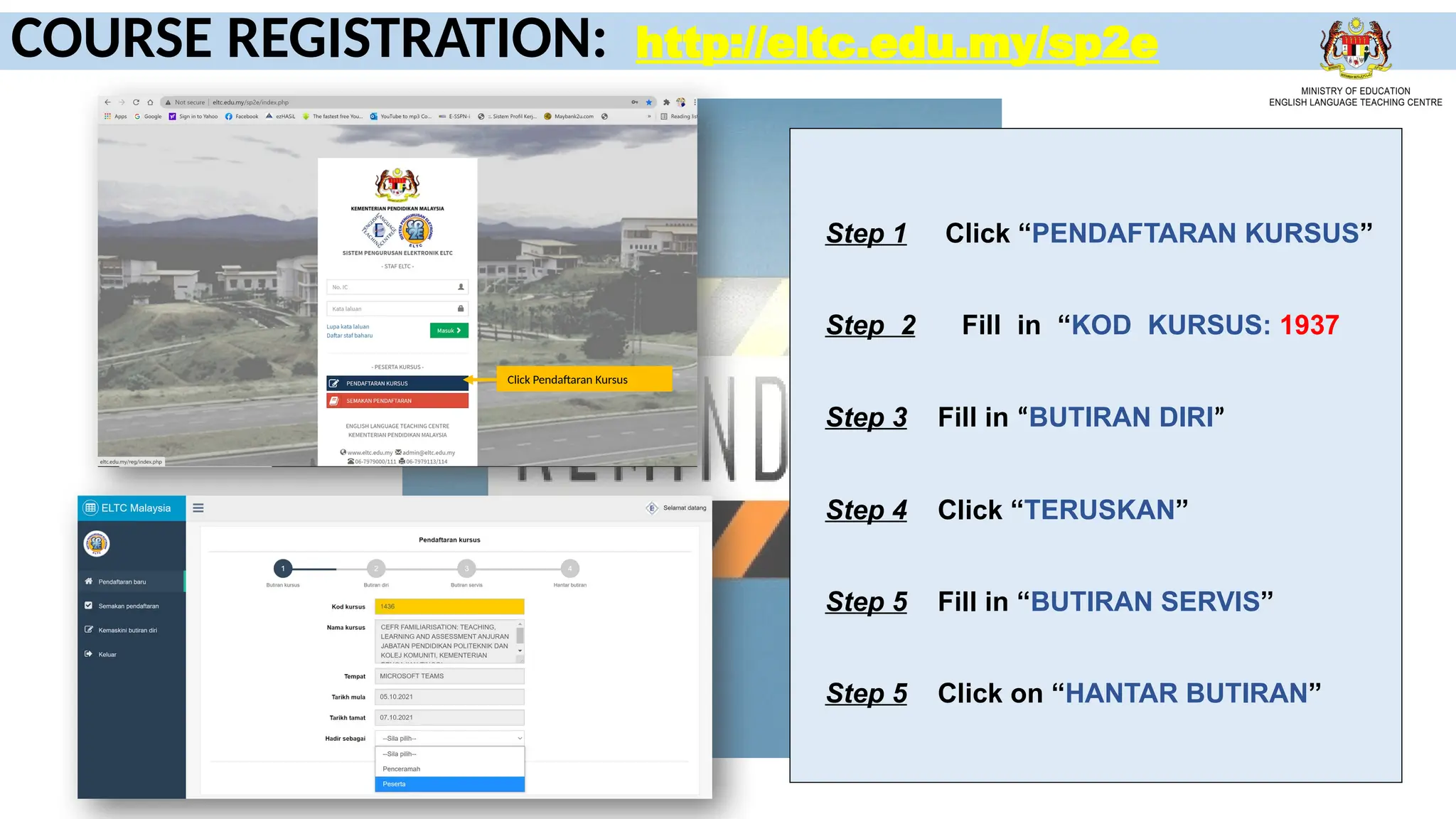
COURSE REGISTRATION: http://eltc.edu.my/sp2e
Step1 Click “PENDAFTARAN KURSUS”
Step 2 Fill in “KOD KURSUS: 1937
Step 3 Fill in “BUTIRAN DIRI”
Step 4 Click “TERUSKAN”
Step 5 Fill in “BUTIRAN SERVIS”
Step 5 Click on “HANTAR BUTIRAN”
Click Pendaftaran Kursus
3.
Housekeeping
:
• This sessionis being recorded
• Attendance
• Community of Practice
• Training Schedule
• End of Training Questionnaire
4.
Whole Class Sharing-Say Hello!
Share one new thing that you
learnt yesterday, one thing that still
puzzles you and one thing that you
anticipate in today's sessions.
5.
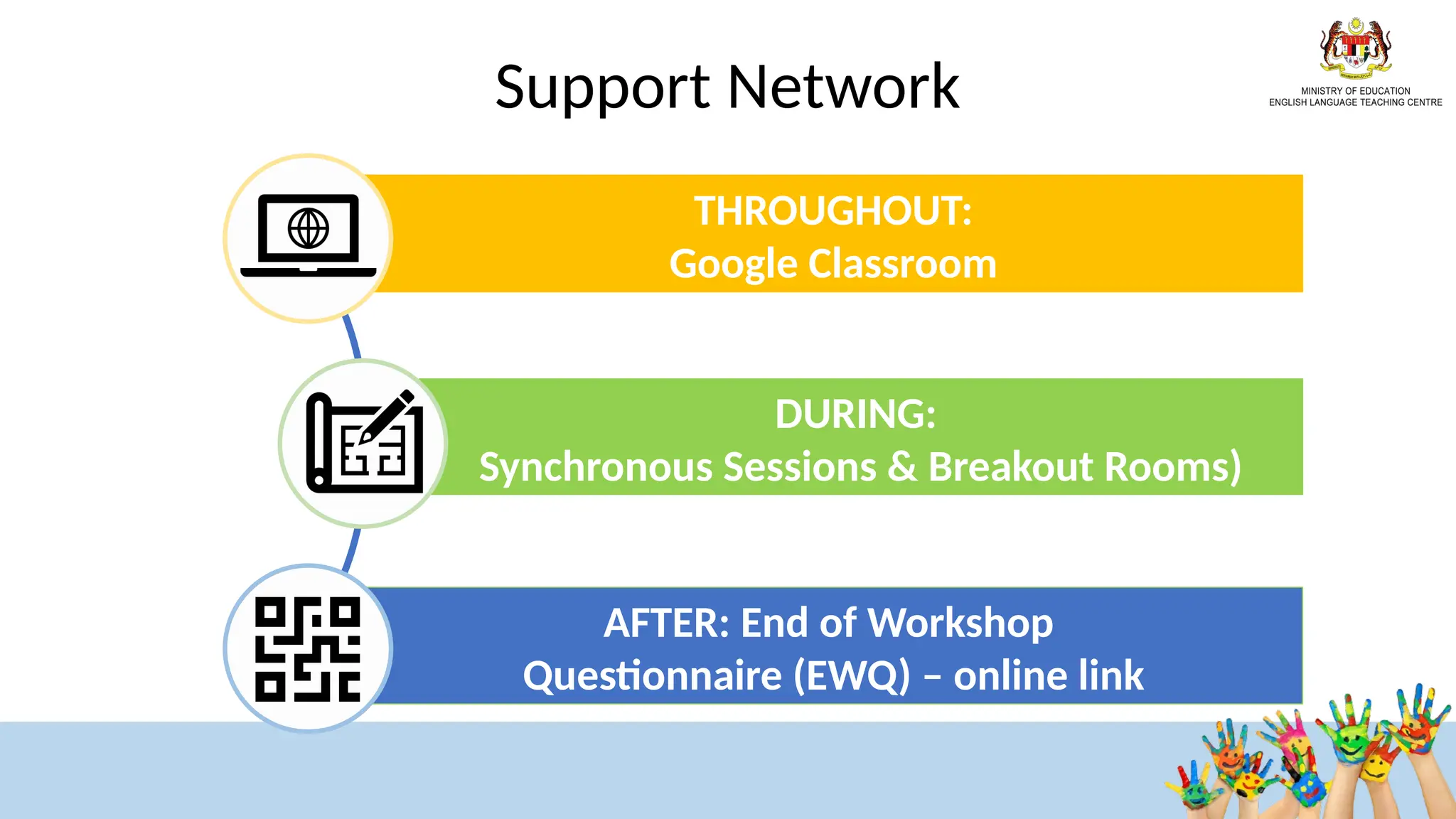
Support Network
AFTER: Endof Workshop
Questionnaire (EWQ) – online link
DURING:
Synchronous Sessions & Breakout Rooms)
THROUGHOUT:
Google Classroom
6.
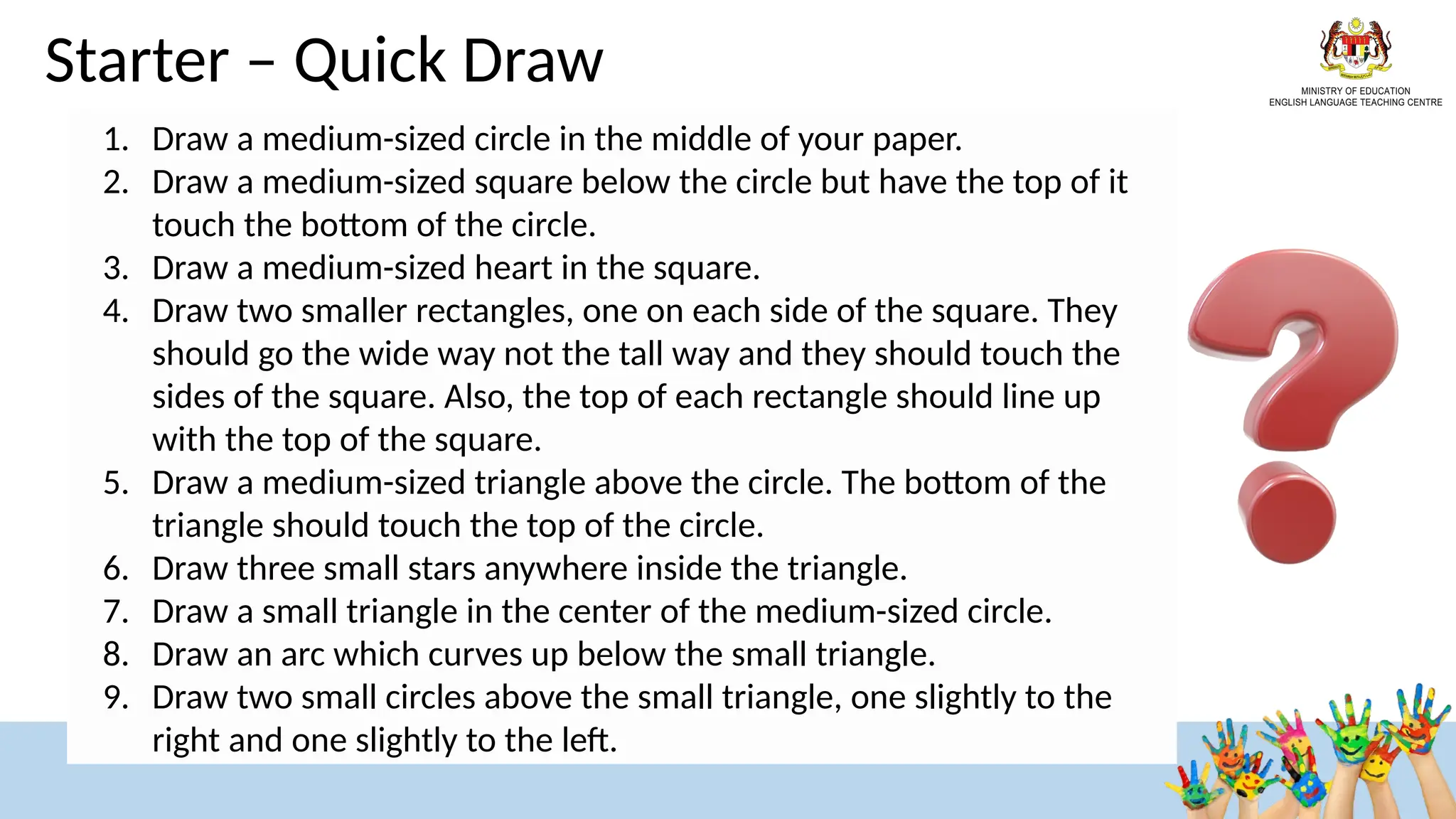
Starter – QuickDraw
1. Draw a medium-sized circle in the middle of your paper.
2. Draw a medium-sized square below the circle but have the top of it
touch the bottom of the circle.
3. Draw a medium-sized heart in the square.
4. Draw two smaller rectangles, one on each side of the square. They
should go the wide way not the tall way and they should touch the
sides of the square. Also, the top of each rectangle should line up
with the top of the square.
5. Draw a medium-sized triangle above the circle. The bottom of the
triangle should touch the top of the circle.
6. Draw three small stars anywhere inside the triangle.
7. Draw a small triangle in the center of the medium-sized circle.
8. Draw an arc which curves up below the small triangle.
9. Draw two small circles above the small triangle, one slightly to the
right and one slightly to the left.
By the endof today’s sessions, you will be able to:
9.
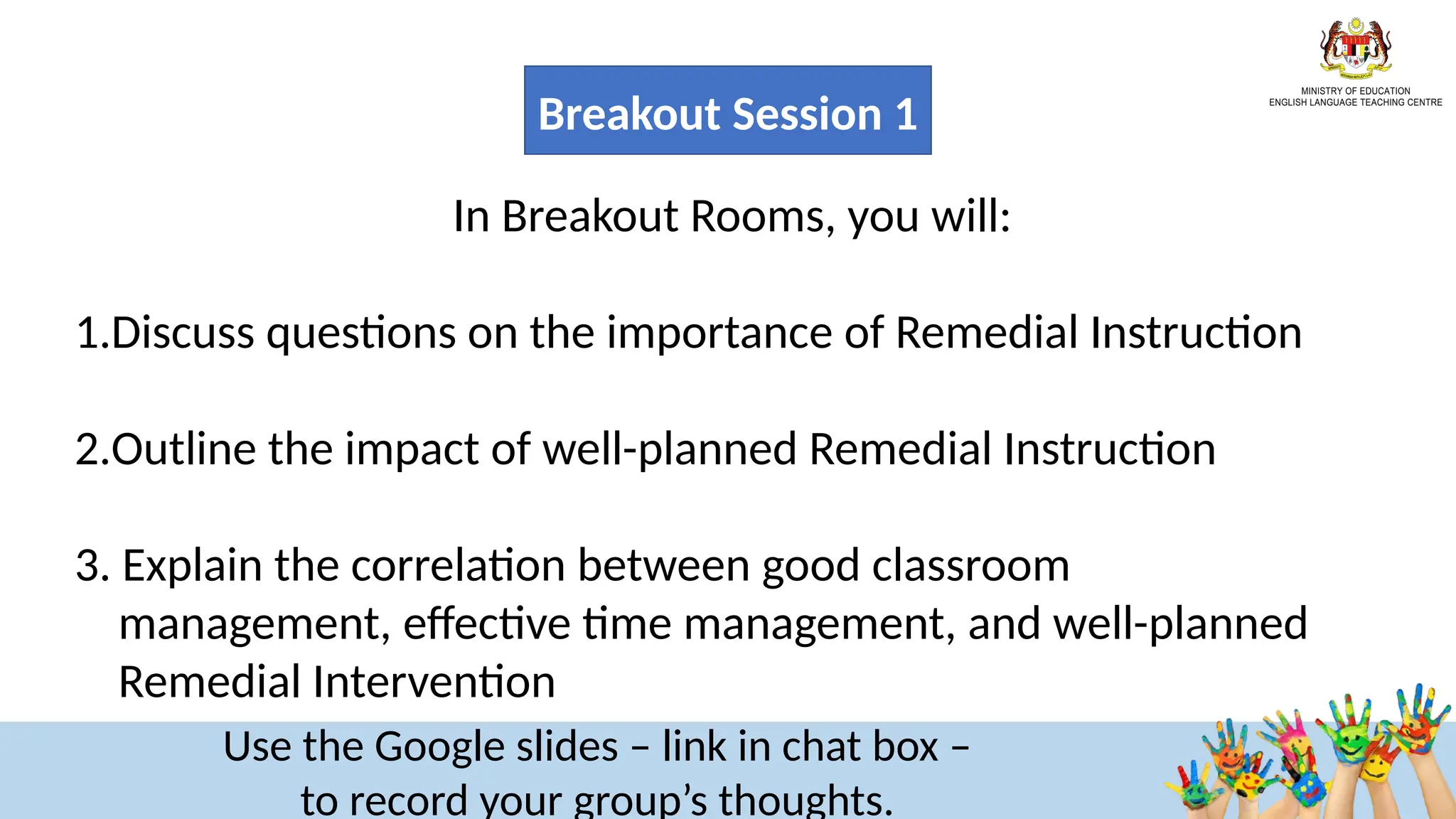
In Breakout Rooms,you will:
1.Discuss questions on the importance of Remedial Instruction
2.Outline the impact of well-planned Remedial Instruction
3. Explain the correlation between good classroom
management, effective time management, and well-planned
Remedial Intervention
Use the Google slides – link in chat box –
to record your group’s thoughts.
Breakout Session 1
10.
By the endof today’s sessions, you will be able to:
11.
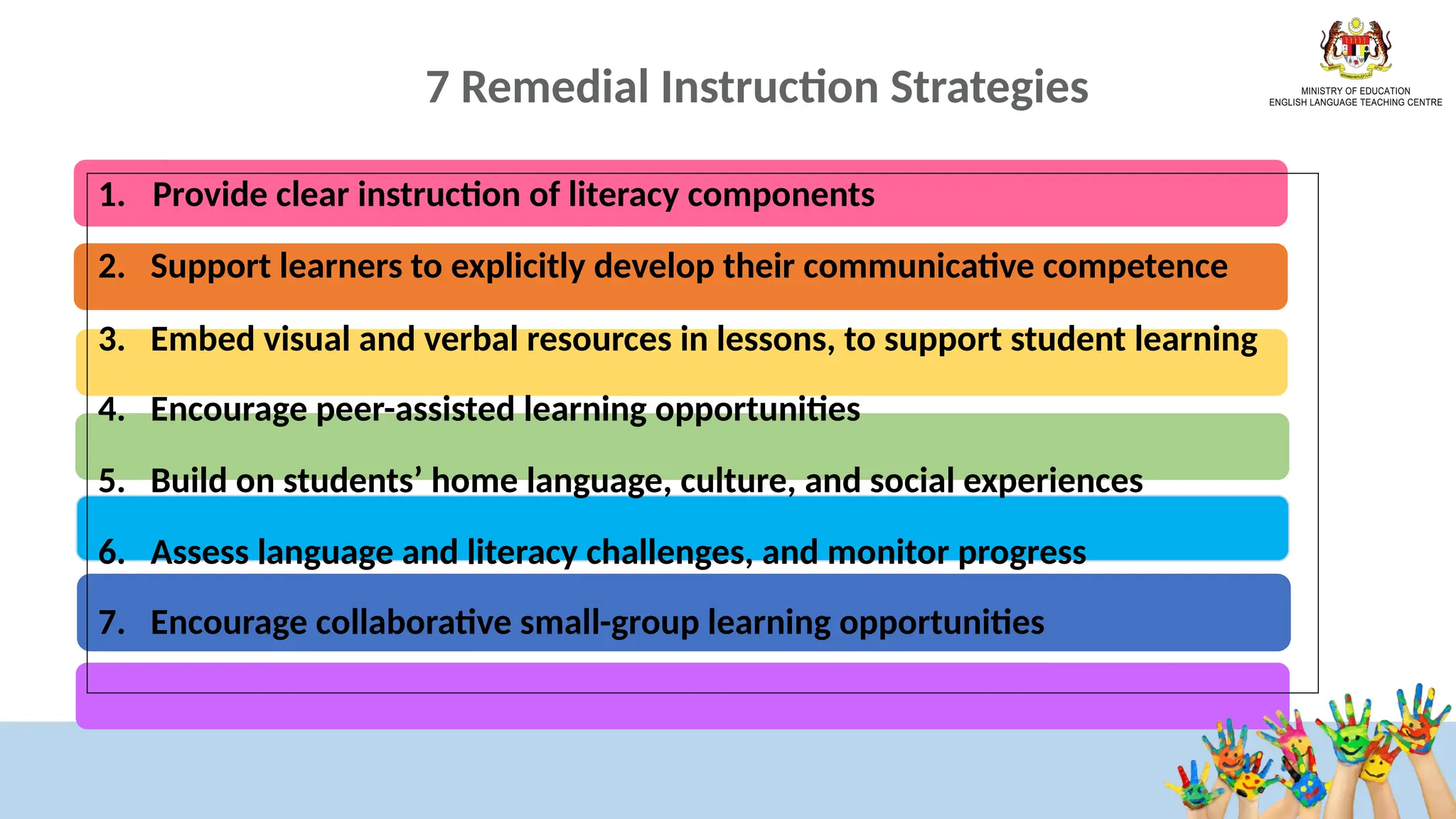
7 Remedial InstructionStrategies
1. Provide clear instruction of literacy components
2. Support learners to explicitly develop their communicative competence
3. Embed visual and verbal resources in lessons, to support student learning
4. Encourage peer-assisted learning opportunities
5. Build on students’ home language, culture, and social experiences
6. Assess language and literacy challenges, and monitor progress
7. Encourage collaborative small-group learning opportunities
12.
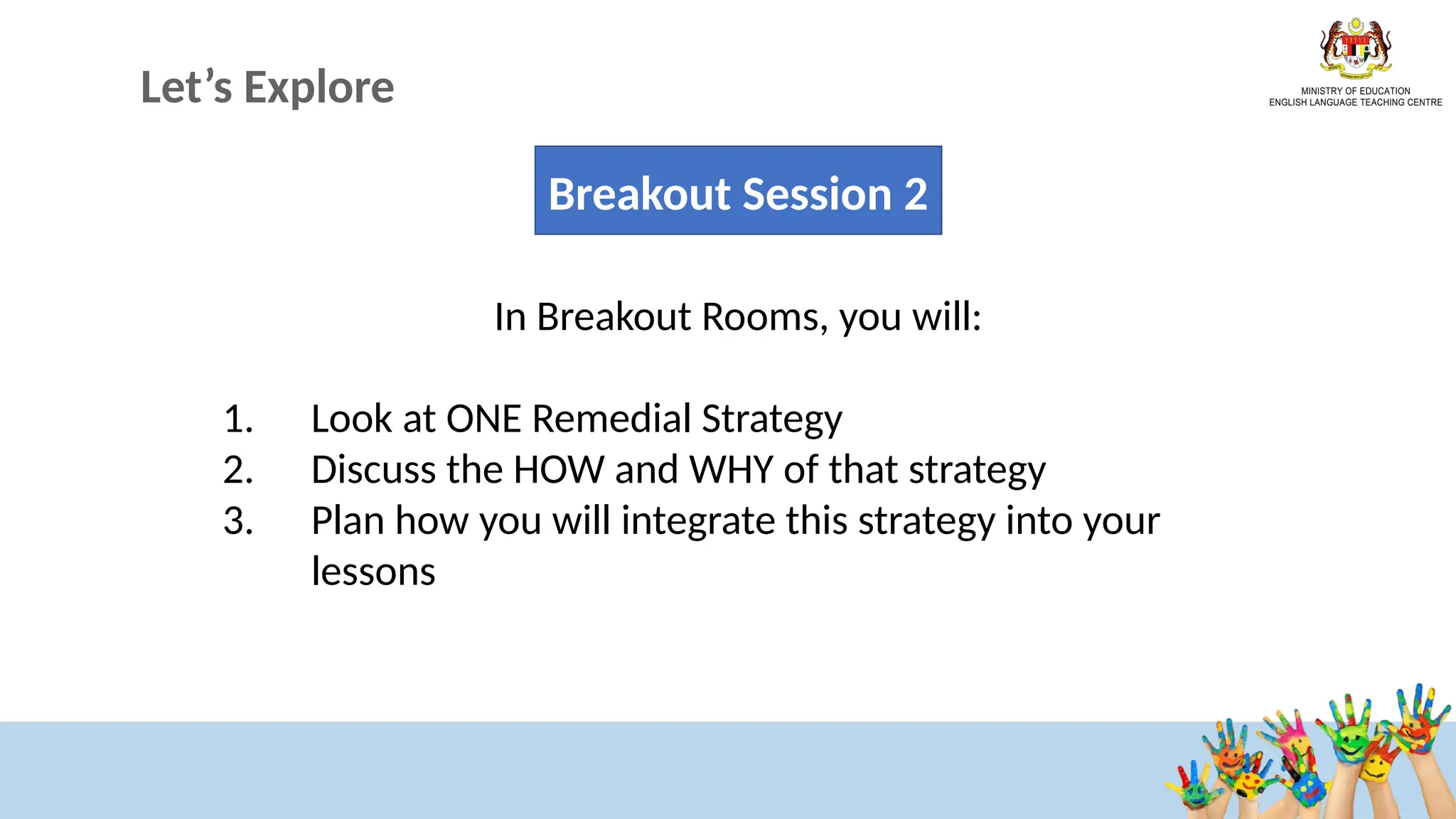
Let’s Explore
Breakout Session2
In Breakout Rooms, you will:
1. Look at ONE Remedial Strategy
2. Discuss the HOW and WHY of that strategy
3. Plan how you will integrate this strategy into your
lessons
13.
13
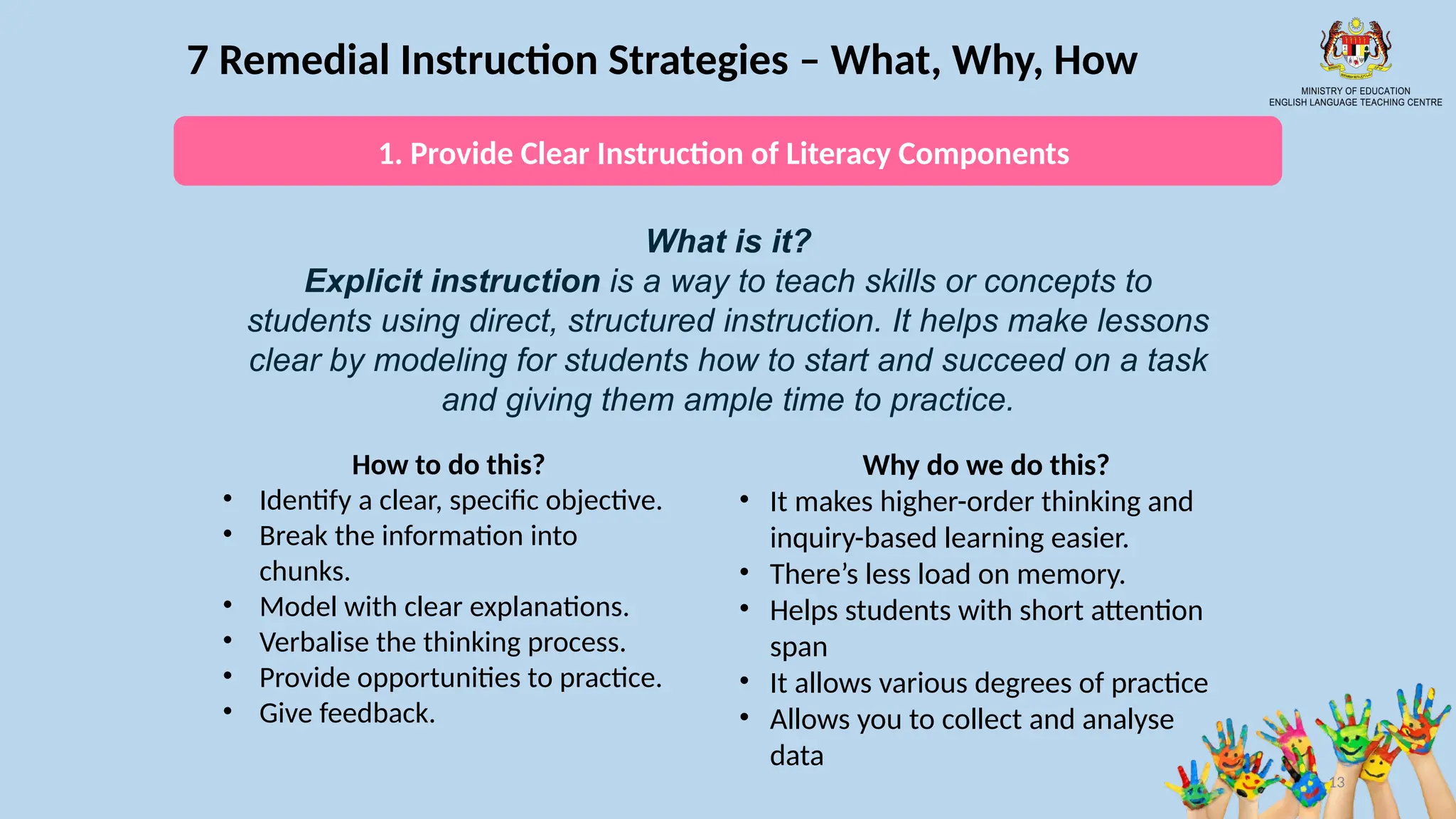
7 Remedial InstructionStrategies – What, Why, How
What is it?
Explicit instruction is a way to teach skills or concepts to
students using direct, structured instruction. It helps make lessons
clear by modeling for students how to start and succeed on a task
and giving them ample time to practice.
How to do this?
• Identify a clear, specific objective.
• Break the information into
chunks.
• Model with clear explanations.
• Verbalise the thinking process.
• Provide opportunities to practice.
• Give feedback.
Why do we do this?
• It makes higher-order thinking and
inquiry-based learning easier.
• There’s less load on memory.
• Helps students with short attention
span
• It allows various degrees of practice
• Allows you to collect and analyse
data
1. Provide Clear Instruction of Literacy Components
14.
14
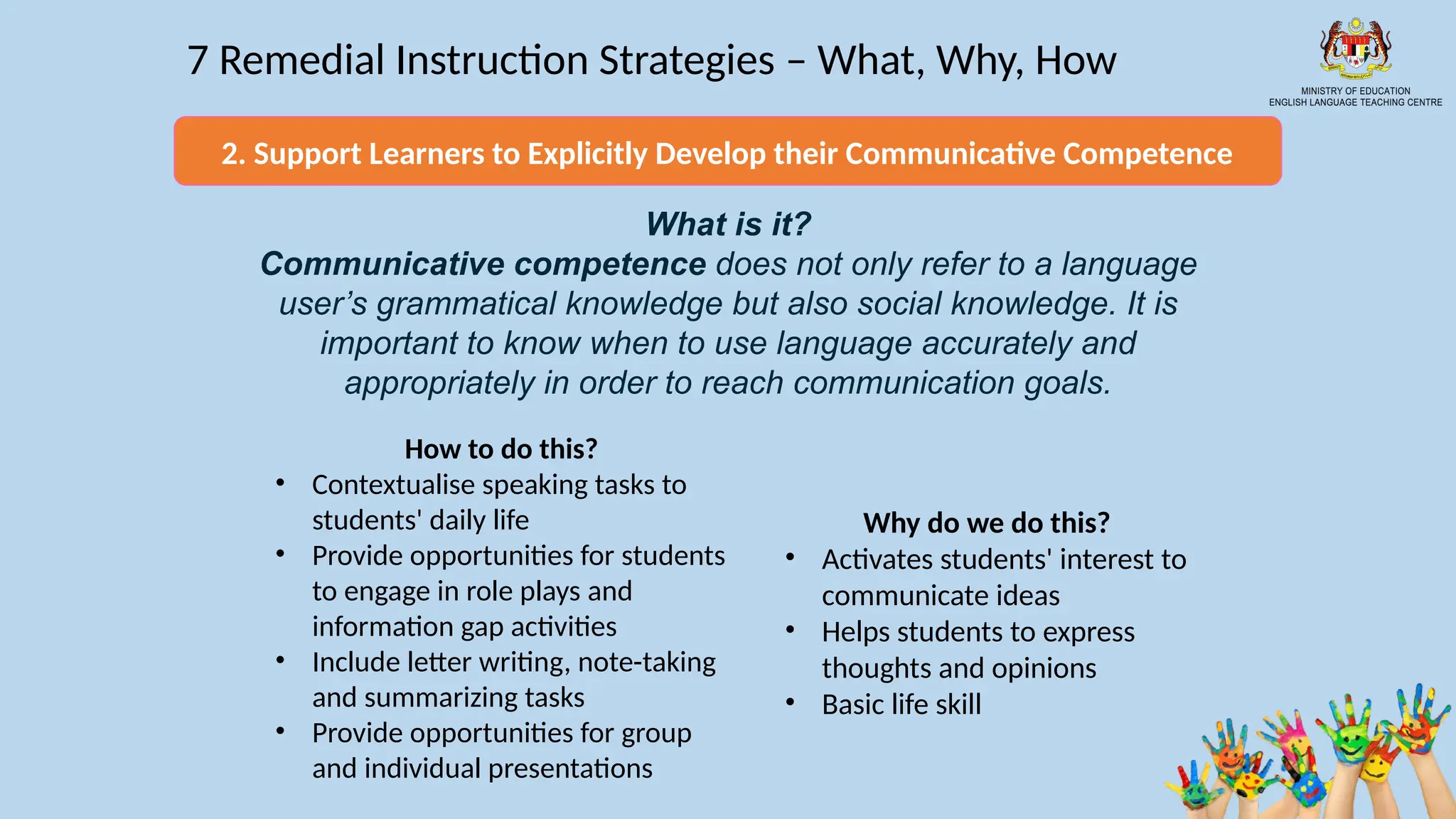
7 Remedial InstructionStrategies – What, Why, How
What is it?
Communicative competence does not only refer to a language
user’s grammatical knowledge but also social knowledge. It is
important to know when to use language accurately and
appropriately in order to reach communication goals.
How to do this?
• Contextualise speaking tasks to
students' daily life
• Provide opportunities for students
to engage in role plays and
information gap activities
• Include letter writing, note-taking
and summarizing tasks
• Provide opportunities for group
and individual presentations
Why do we do this?
• Activates students' interest to
communicate ideas
• Helps students to express
thoughts and opinions
• Basic life skill
2. Support Learners to Explicitly Develop their Communicative Competence
15.
15
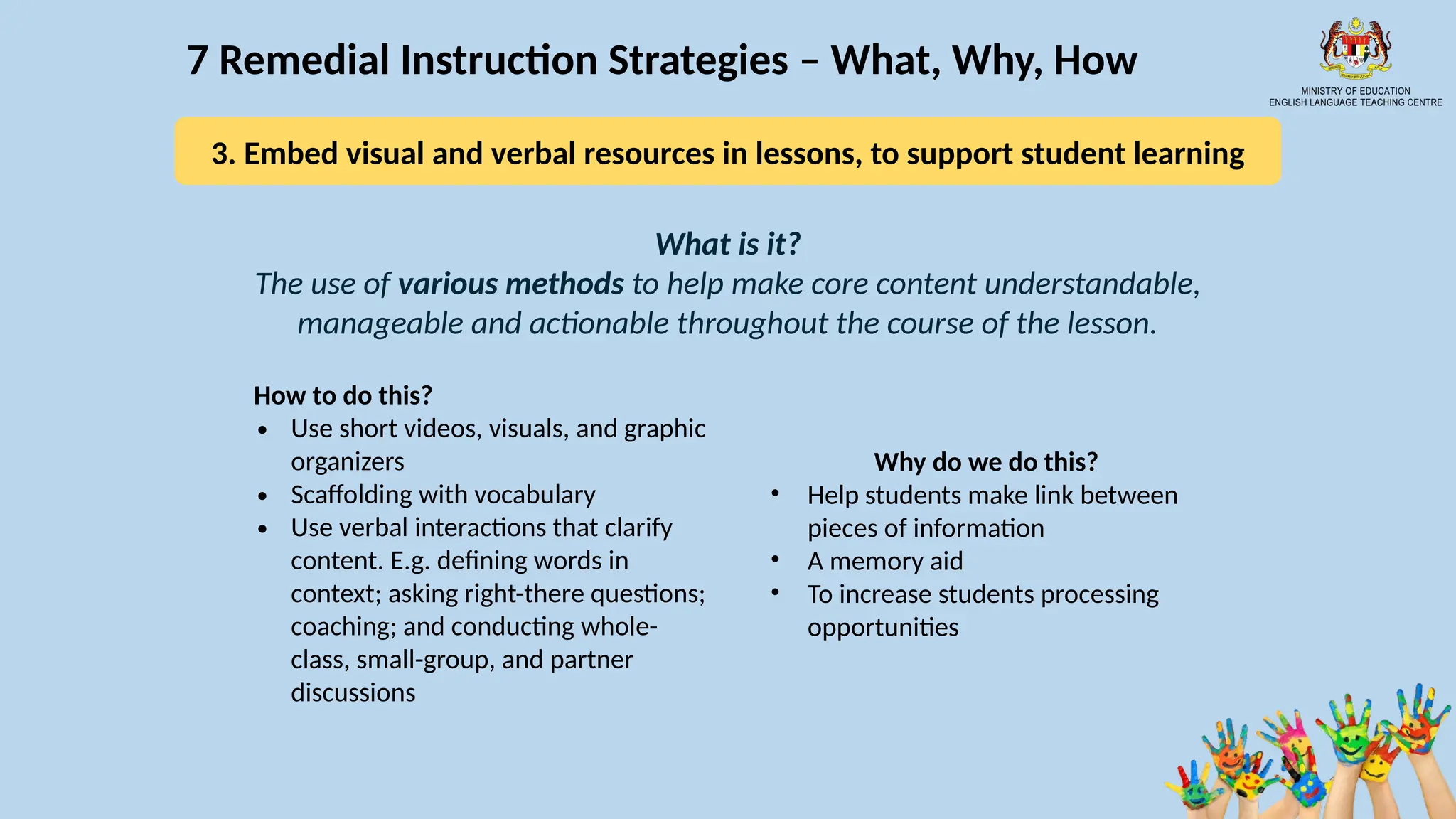
7 Remedial InstructionStrategies – What, Why, How
What is it?
The use of various methods to help make core content understandable,
manageable and actionable throughout the course of the lesson.
How to do this?
∙ Use short videos, visuals, and graphic
organizers
∙ Scaffolding with vocabulary
∙ Use verbal interactions that clarify
content. E.g. defining words in
context; asking right-there questions;
coaching; and conducting whole-
class, small-group, and partner
discussions
Why do we do this?
• Help students make link between
pieces of information
• A memory aid
• To increase students processing
opportunities
3. Embed visual and verbal resources in lessons, to support student learning
16.
16
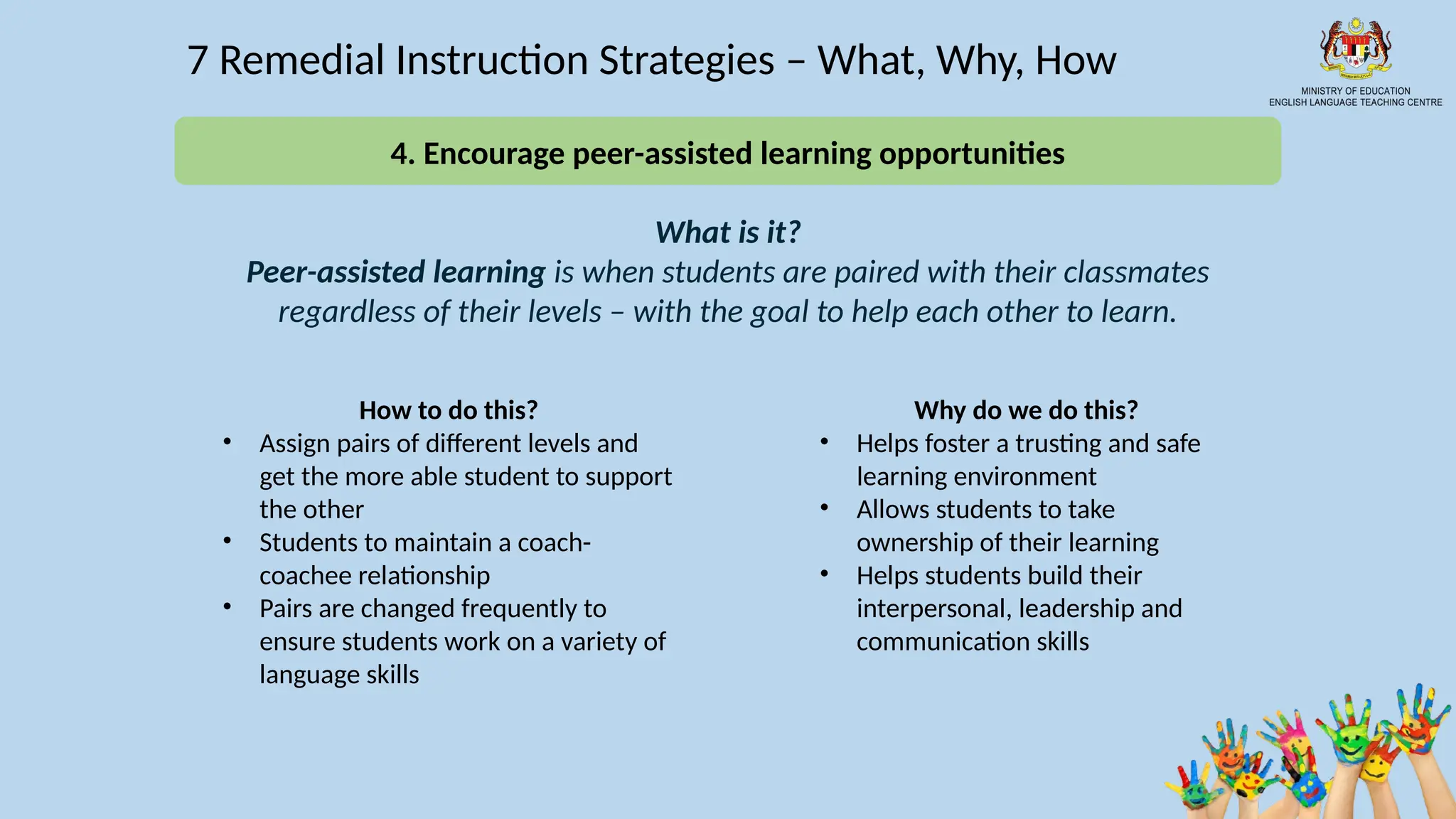
7 Remedial InstructionStrategies – What, Why, How
What is it?
Peer-assisted learning is when students are paired with their classmates
regardless of their levels – with the goal to help each other to learn.
How to do this?
• Assign pairs of different levels and
get the more able student to support
the other
• Students to maintain a coach-
coachee relationship
• Pairs are changed frequently to
ensure students work on a variety of
language skills
Why do we do this?
• Helps foster a trusting and safe
learning environment
• Allows students to take
ownership of their learning
• Helps students build their
interpersonal, leadership and
communication skills
4. Encourage peer-assisted learning opportunities
17.
17
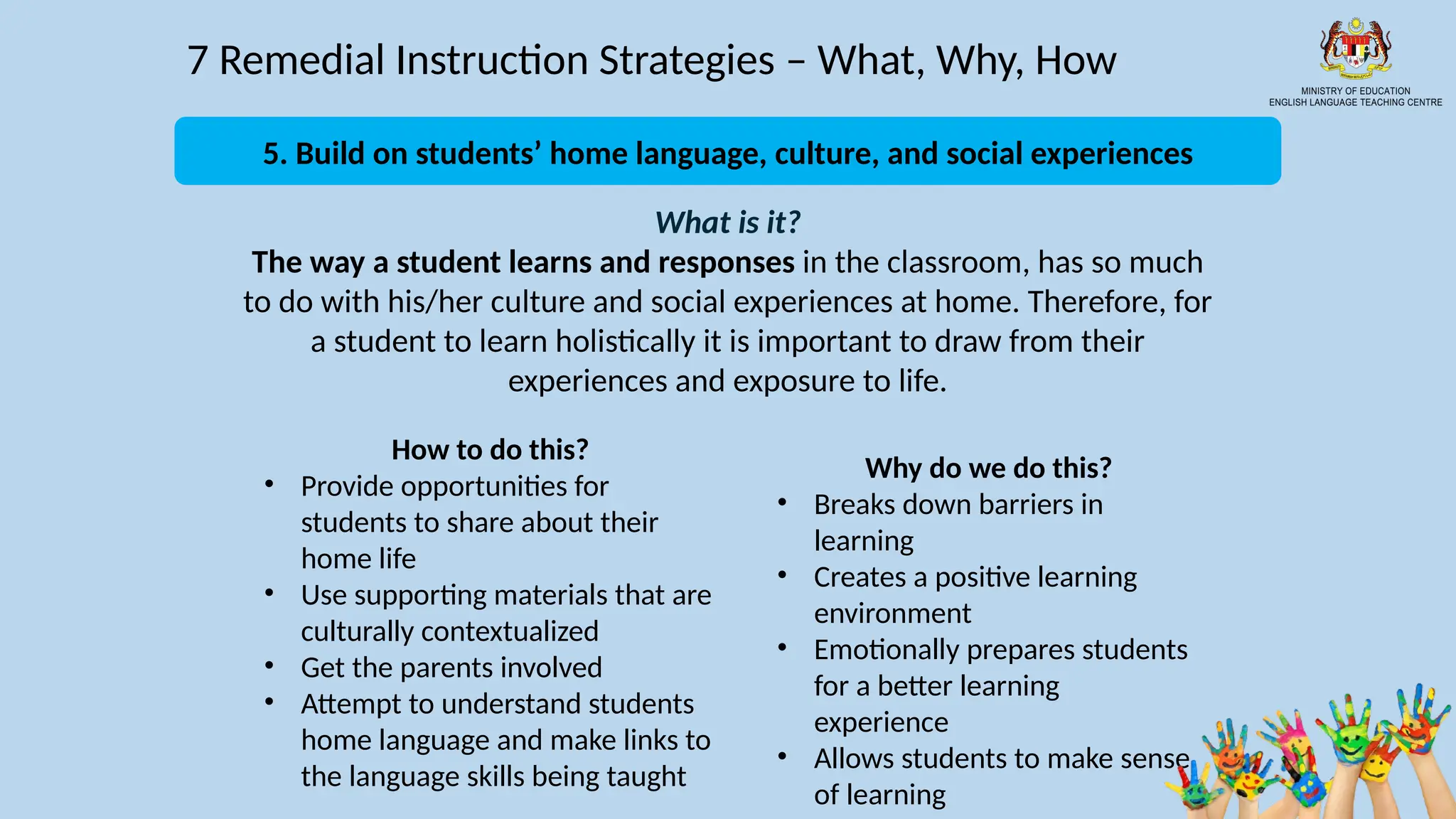
7 Remedial InstructionStrategies – What, Why, How
What is it?
The way a student learns and responses in the classroom, has so much
to do with his/her culture and social experiences at home. Therefore, for
a student to learn holistically it is important to draw from their
experiences and exposure to life.
How to do this?
• Provide opportunities for
students to share about their
home life
• Use supporting materials that are
culturally contextualized
• Get the parents involved
• Attempt to understand students
home language and make links to
the language skills being taught
Why do we do this?
• Breaks down barriers in
learning
• Creates a positive learning
environment
• Emotionally prepares students
for a better learning
experience
• Allows students to make sense
of learning
5. Build on students’ home language, culture, and social experiences
18.
18
7 Remedial InstructionStrategies – What, Why, How
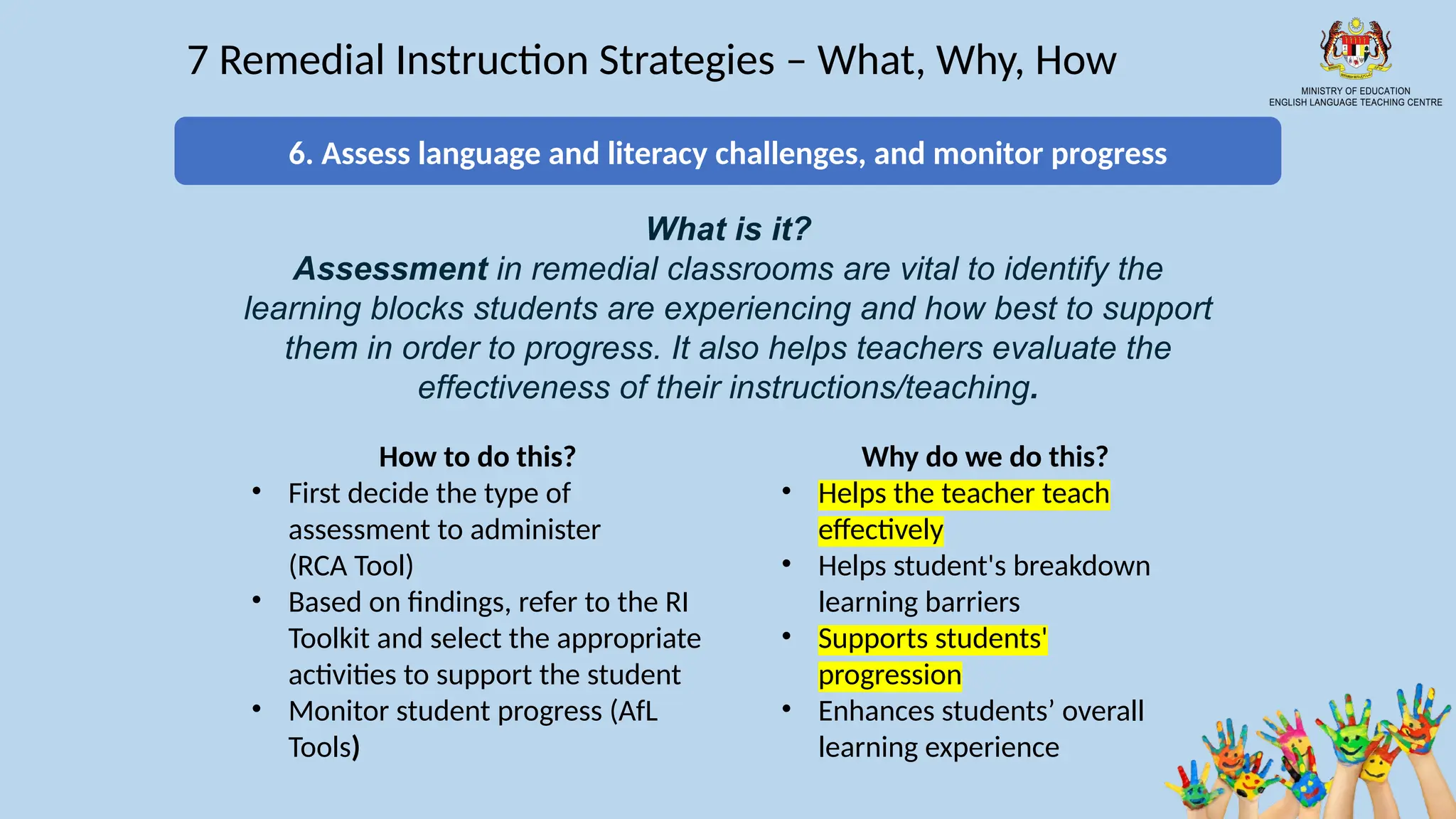
What is it?
Assessment in remedial classrooms are vital to identify the
learning blocks students are experiencing and how best to support
them in order to progress. It also helps teachers evaluate the
effectiveness of their instructions/teaching.
How to do this?
• First decide the type of
assessment to administer
(RCA Tool)
• Based on findings, refer to the RI
Toolkit and select the appropriate
activities to support the student
• Monitor student progress (AfL
Tools)
Why do we do this?
• Helps the teacher teach
effectively
• Helps student's breakdown
learning barriers
• Supports students'
progression
• Enhances students’ overall
learning experience
6. Assess language and literacy challenges, and monitor progress
19.
19
7 Remedial InstructionStrategies – What, Why, How
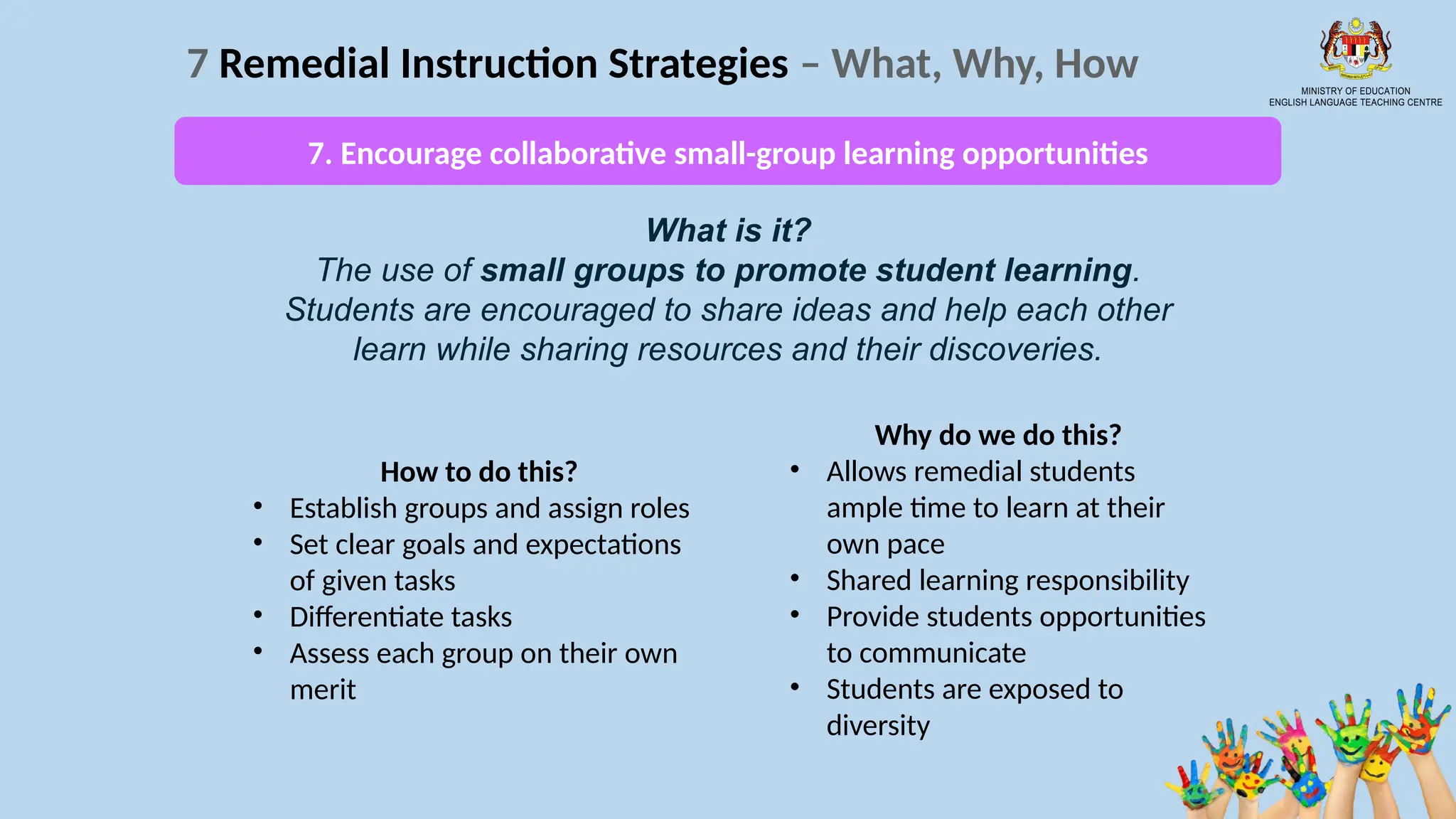
What is it?
The use of small groups to promote student learning.
Students are encouraged to share ideas and help each other
learn while sharing resources and their discoveries.
How to do this?
• Establish groups and assign roles
• Set clear goals and expectations
of given tasks
• Differentiate tasks
• Assess each group on their own
merit
Why do we do this?
• Allows remedial students
ample time to learn at their
own pace
• Shared learning responsibility
• Provide students opportunities
to communicate
• Students are exposed to
diversity
7. Encourage collaborative small-group learning opportunities
20.
By the endof today’s sessions, you will be able to:
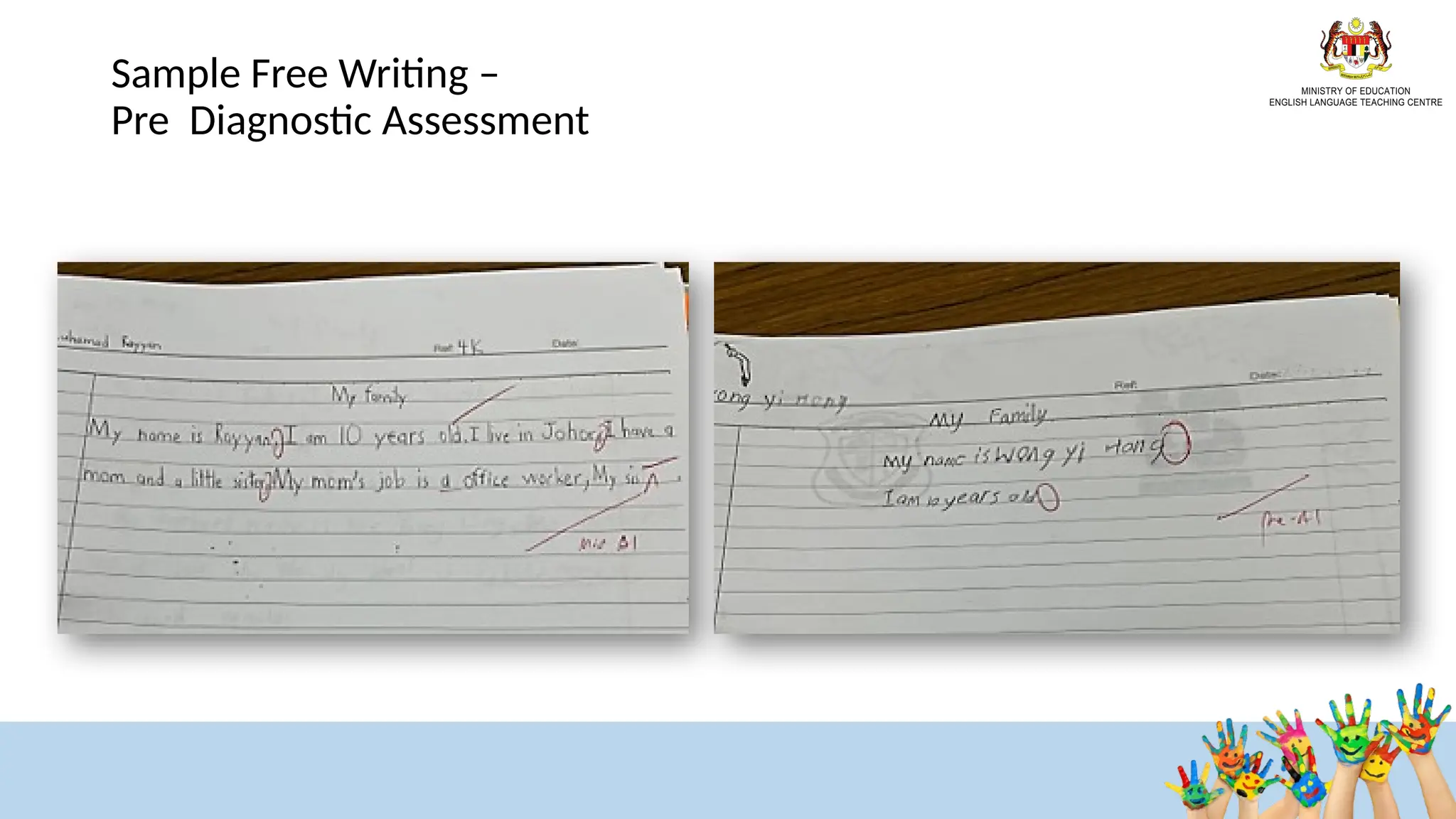
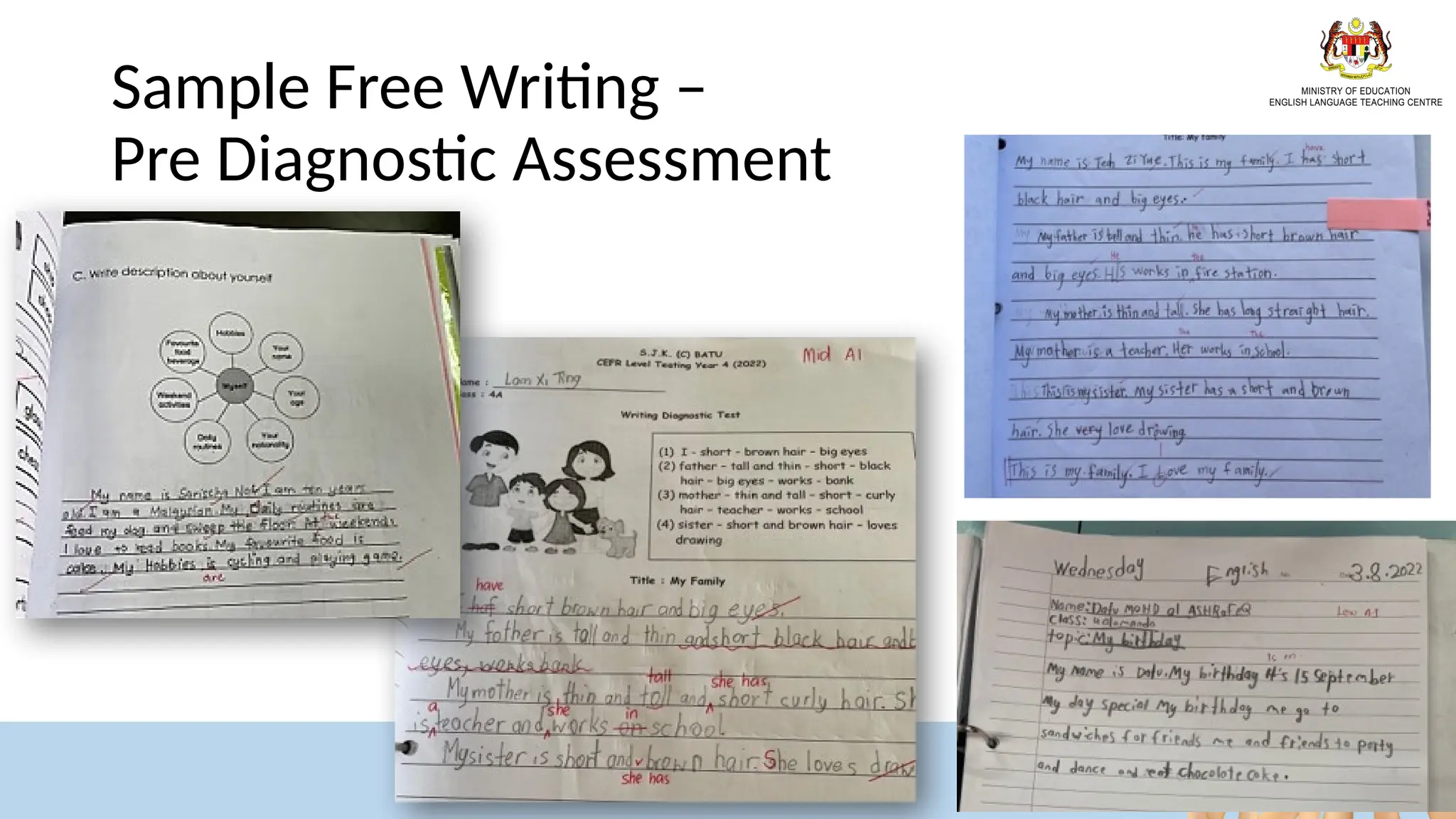
1. Conduct afree writing or guided writing activity(only pictures with keywords or
phrases) with your students on the first day of your class ( take five to ten minutes) and
use the Writing Rubric (appendix 1) to identify their CEFR level.
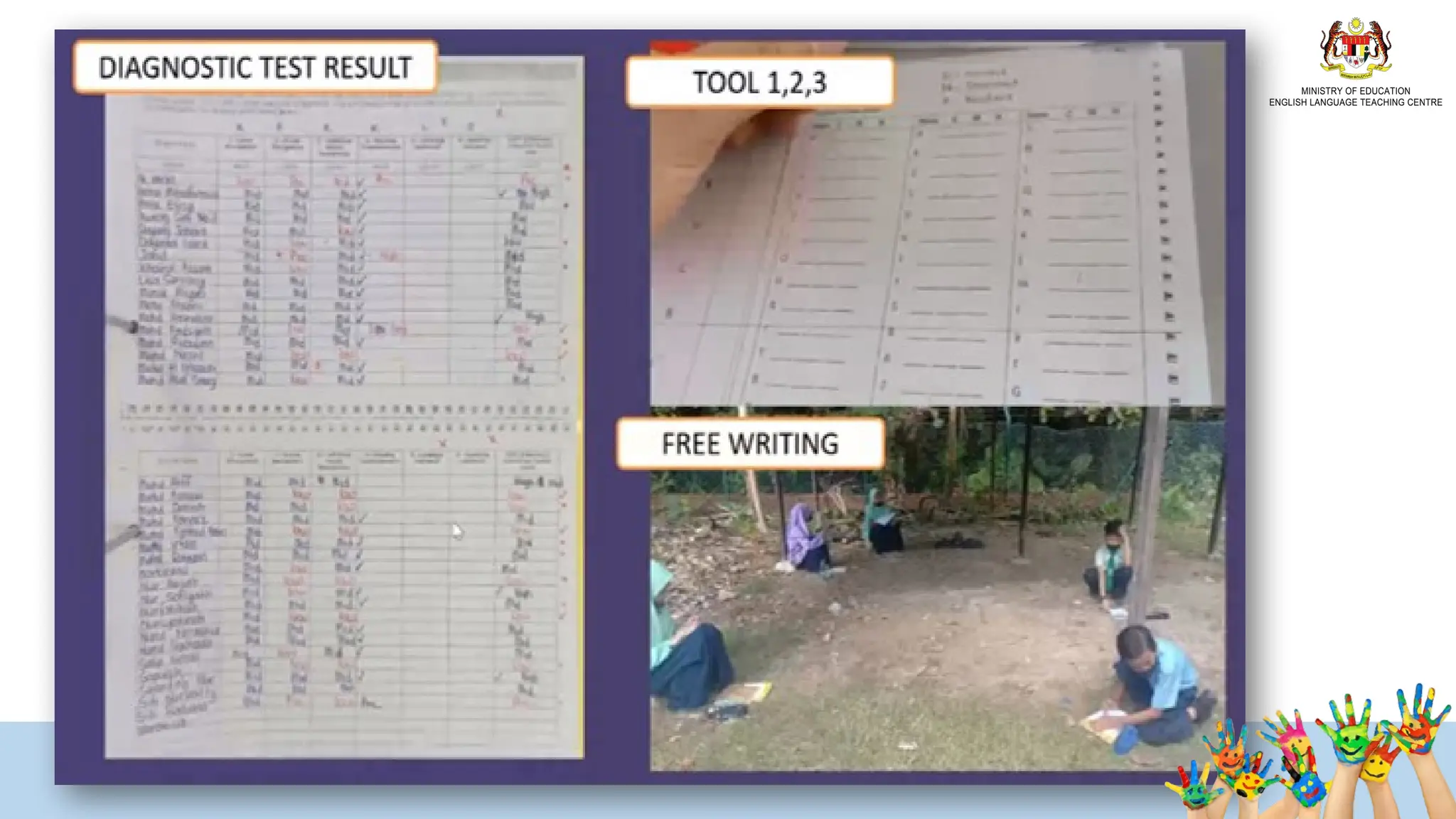
2. Students who are at Pre-A1 and Low A1 based on the writing task take Reading
Diagnostic test (Tool 1-4)
3. Use the Reading Diagnostic Tool (start with Tool 1, 2 then 3; see CEFR Level Testing
Section)
4. Use the Speaking and Listening Rubrics to further understand your remedial students’
CEFR levels (appendix 1)
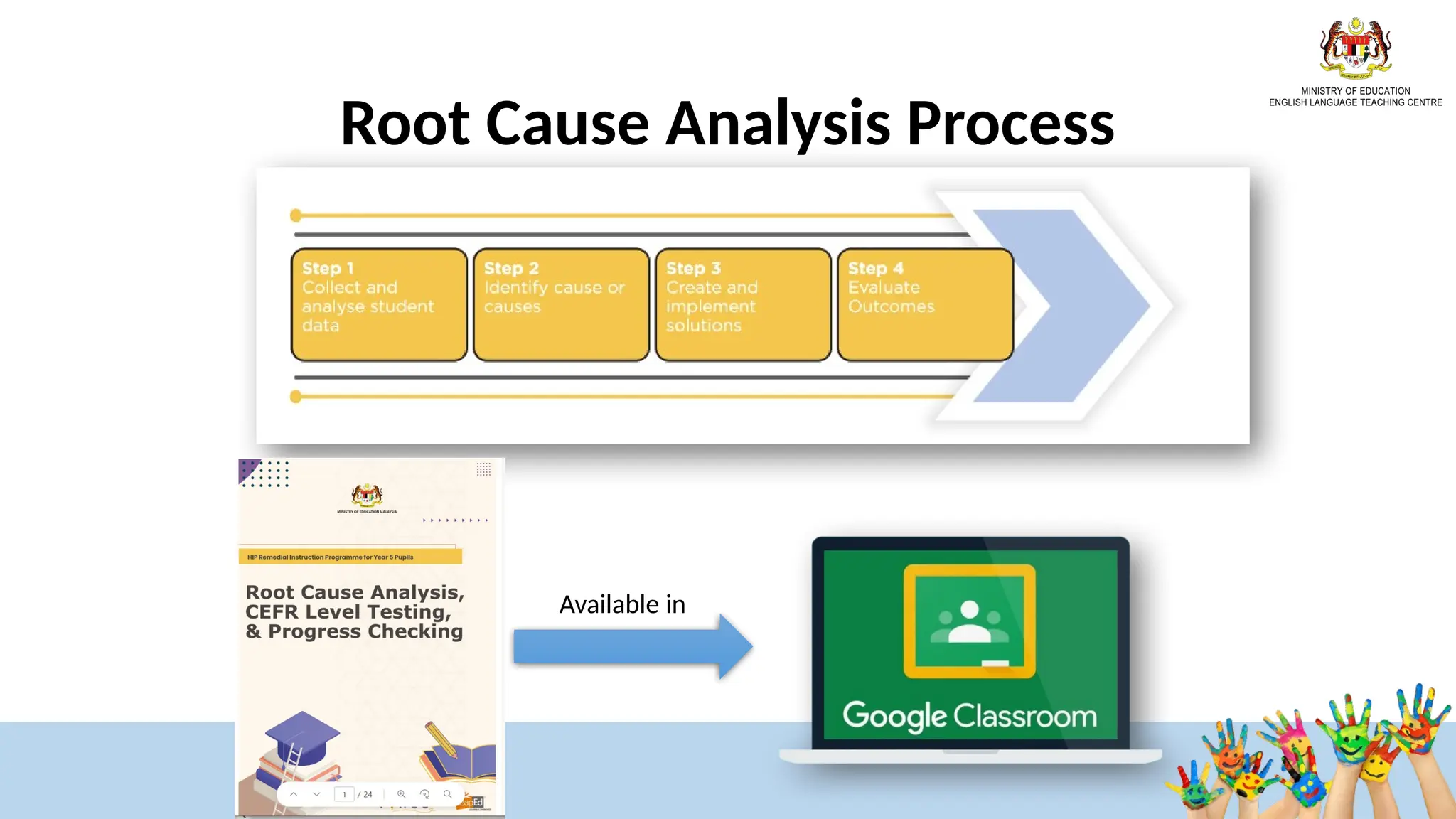
STEP 1 : Collect and Analyse Students Data
23.
STEP 2: Identifycause or causes
1. Once you have collected samples of student work, use the writing rubric (appendix
1), to establish approximately which CEFR level your students are at for writing.
2. Try to arrange your students into 4 levels according to the writing rubric (Pre-A1, Low
A1, Mid A1, and High A1).
3. Students who seem to be writing at Mid A1 and High A1 level, are on track to be able
to follow the Year 4 curriculum with limited challenges. These are most likely not
your remedial students.
4. For students who are Pre-A1 and Low A1, proceed to use the Reading Diagnostic
Tools (see CEFR Level Testing Section) to further drill down into which CEFR level
these students are at.
24.
STEP 3: Createand Implement Solutions
1. Understand what extra support your students need to be able to progress (do they
need support in phonics, phonemic awareness, reading comprehension,
vocabulary, grammar, speaking practice, listening practice, etc.?)
2. Approximate your student’s CEFR level using all data sources from Step 2
3. Explore the Toolkit and know which level of activities students should do from it.
25.
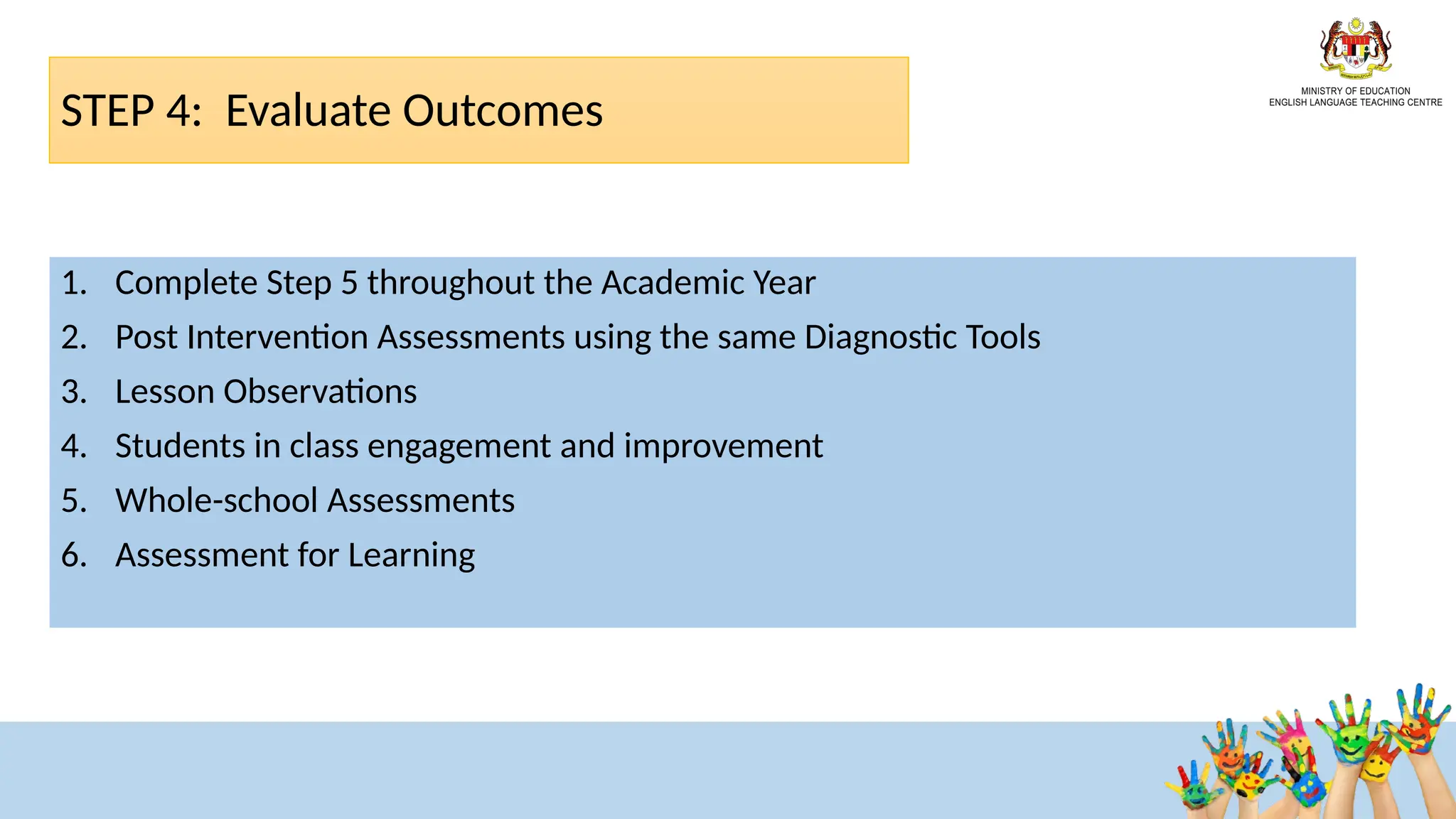
STEP 4: EvaluateOutcomes
1. Complete Step 5 throughout the Academic Year
2. Post Intervention Assessments using the same Diagnostic Tools
3. Lesson Observations
4. Students in class engagement and improvement
5. Whole-school Assessments
6. Assessment for Learning
26.
26
Acknowledgements and References
AdLit,n.d. Peer-Assisted Learning Strategy. [online] AdLit. Available at:
<https://www.adlit.org/in-the-classroom/strategies/peer-assisted-learning-strategy>
[Accessed 18 October 2021].
Assessment Reform Group (2002) Assessment for Learning: Beyond the Black Box. Cambridge:
University of Cambridge School of Education
Bilash, O. (2011) Triangulation in Assessment [Internet] Available from:
<http://www.educ.ualberta.ca/staff/olenka.bilash/best%20of%20bilash/
Triangulation.html> [Accessed: 13 March 2015]
Carnegie Mellon: Enhancing Education (n.d.) Whys and Hows of Assessment [Internet].
Available from: <http://www.cmu.edu/teaching/assessment/howto/basics/formative-
summative.html> [Accessed: 11 March 2015]
Clarke, S. (2008) Active Learning Through Formative Assessment. Hodder and Stoughton:
London, UK.
Council for the Curriculum, Examinations and Assessment (CCEA) (2001) Assessment for
Learning for Key Stage 1 and 2 [Internet].Available from:
<http://www.nicurriculum.org.uk/docs/assessment_for_learning/training/afl-guidance-
ks12.pdf> [Accessed: 11 March 2015]
Goode, K. et al (2010) Assessment for Learning [Internet] Available from:
<http://www.etfo.ca/Resources/ForTeachers/Documents/Assessment%20for
%20Learning.pdf> [Accessed: 20 March 2015]
Great Leaps. (2020) 14 Characteristics of Good Remedial Teaching [Internet] Available from:
<https://greatleaps.com/blogs/the-academic-success-blog/14-characteristics-of-good-
remedial-teaching> [Accessed: 15 Oct 2021]
i-to-i TEFL. (n.d) How to Teach Mixed Ability Classes [Internet] Available from: <https://www.i-
to-i.com/tefl-blog/tefl-classroom-and-expert-advice/how-to-teach-mixed-ability-
classes/> [Accessed: 15 Oct 2021]
Jasno, n.d. Communicative Competence in Teaching Speaking. [ebook] Riau. Available at:
<https://media.neliti.com/media/publications/243559-communicative-competence-in-
teaching-spe-1c140184.pdf> [Accessed 18 October 2021].
Lindberry, S. (n.d.) Writing Across the Curriculum at UW-Madison [Internet] Available from:
<http://writing.wisc.edu/wac/node/68> [Accessed: 20 March 2015]
Moss, D., 2005. Teaching for Communicative Competence. [online] Ncsall.net. Available at:
<http://www.ncsall.net/index.php@id=739.html> [Accessed 18 October 2021].
National Academies of Sciences, Engineering, and Medicine (2017) Promoting the Educational
Success of Children and Youth Learning English: Promising Futures. Washington, DC: The
National Academies Press
Self and Peer Assessment (n.d.). [Internet] Available from:
<http://Sydney.edu.au/education_social_work/groupwork/docs/SelfPeerAssessment.pd
f> [Accessed: 20 March 2015]
Smith, I. (2008) Making Feedback Count: A practical guide for primary teachers.
William, D. (2010) Embedding formative assessment with teacher learning communities
[Internet] Available from:
<http://www.dylanwiliam.org/Dylan_Wiliams_website/Presentations_files/NEEC
%20breakout.ppt> [Accessed: 20 March 2015]
Images:
BLEPT Self Review. (n.d) The Remedial Classroom: Organization and Management [Internet]
Available from: <https://www.bleptselfreview.ph/courses/remedial-instruction-in-
english-english-major-free/lessons/the-remedial-classroom-organization-and-
management> [Accessed: 15 Oct 2021]
Johnson, P., 2010. Example of Learning Goal With Success Criteria. [image] Available at:
<https://bit.ly/slideshare_3f5Ey8j> [Accessed 7 July 2020].
Kit8.net, n.d. Man Studying With Laptop. [image] Available at:
<https://bit.ly/shutterstock_2C6VuMV> [Accessed 7 July 2020].
Macrovector, n.d. Online Adult Education. [image] Available at:
<https://bit.ly/dreamstime_3fiWLzn> [Accessed 7 July 2020].
Matt Anderson Photography, n.d. Majestic Hot Air Balloon. [image] Available at:
<https://bit.ly/gettyimages_2VNH8In> [Accessed 7 July 2020].
Pinterest, n.d. Learning Goal & Success Criteria. [image] Available at:
<https://bit.ly/pinterest_3f5DjWH> [Accessed 7 July 2020].
Pinterest, n.d. Success Criteria Stories. [image] Available at:
<https://bit.ly/pinterest_31UhbKW> [Accessed 7 July 2020].
Tenor, 2014. Cat Epic Wiggle GIF. [image] Available at: <https://bit.ly/tenor_2Z6iYuQ>
[Accessed 7 July 2020].
Understood.org, n.d. Students and Teacher. [image] Available at:
<https://www.understood.org/articles/en/remedial-programs-what-you-need-to-know>
[Accessed 18 October 2021].
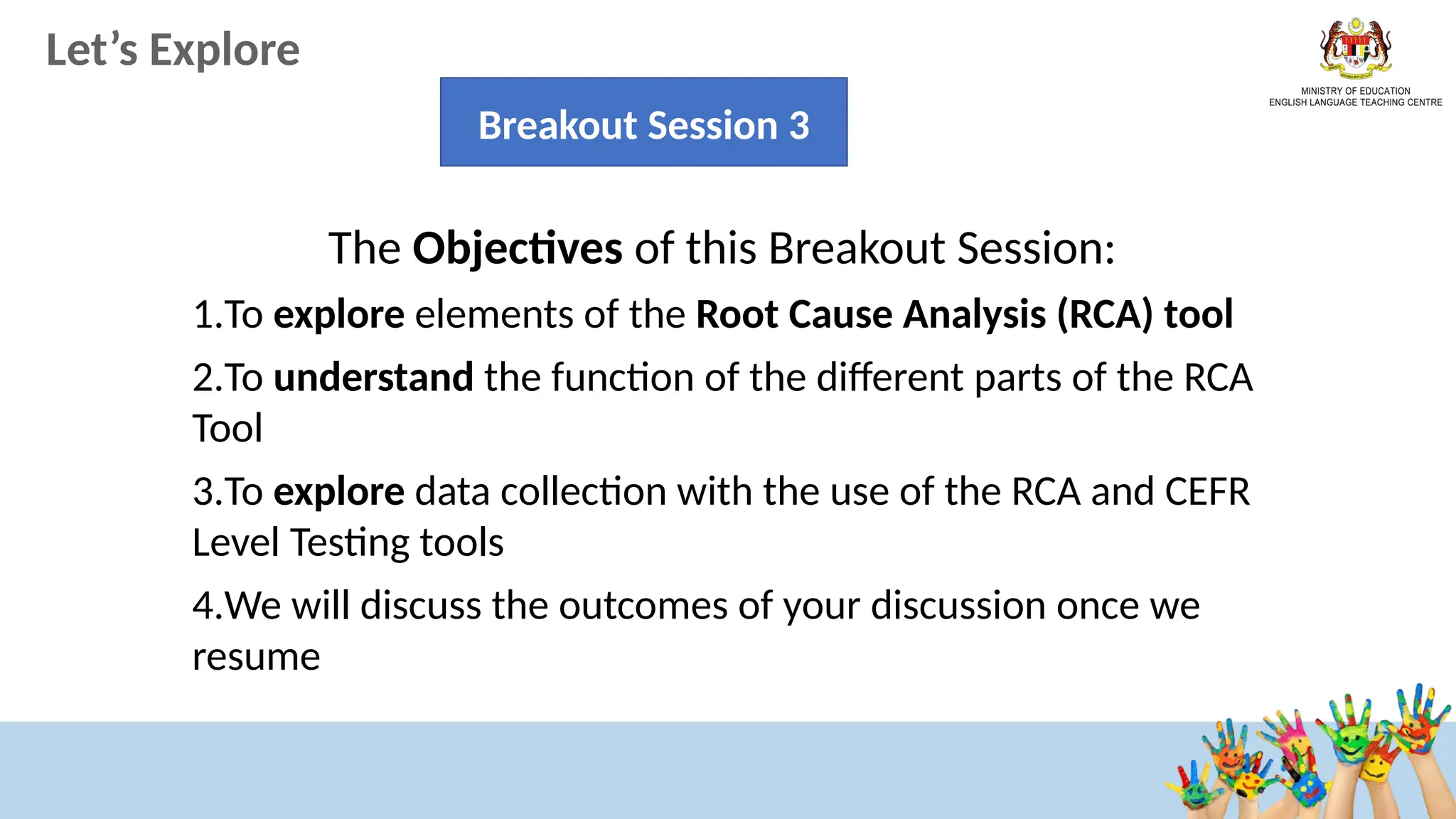
Let’s Explore
Breakout Session3
The Objectives of this Breakout Session:
1.To explore elements of the Root Cause Analysis (RCA) tool
2.To understand the function of the different parts of the RCA
Tool
3.To explore data collection with the use of the RCA and CEFR
Level Testing tools
4.We will discuss the outcomes of your discussion once we
resume
33.
33
33
The Objective ofthis Breakout Session:
1.To practice using the RCA Tool to analyse a sample student work
We want you as Teachers to practice using the RCA so that you
can BETTER use it in your Year 4 Classrooms!
Breakout Session 4
34.
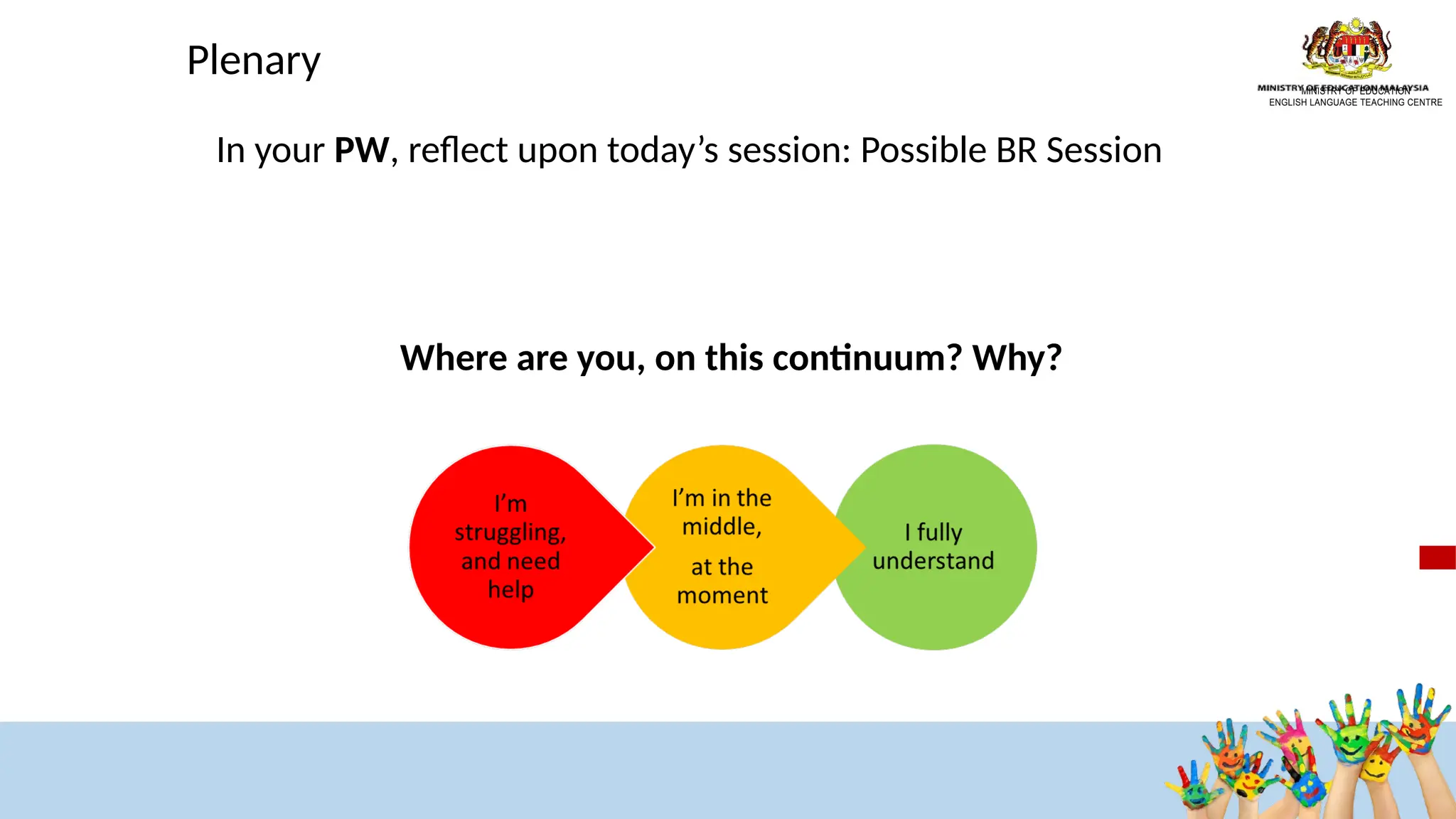
In your PW,reflect upon today’s session: Possible BR Session
Where are you, on this continuum? Why?
*Link to PW
34
Plenary
Editor's Notes
#7 VIEW IN SLIDESHOW
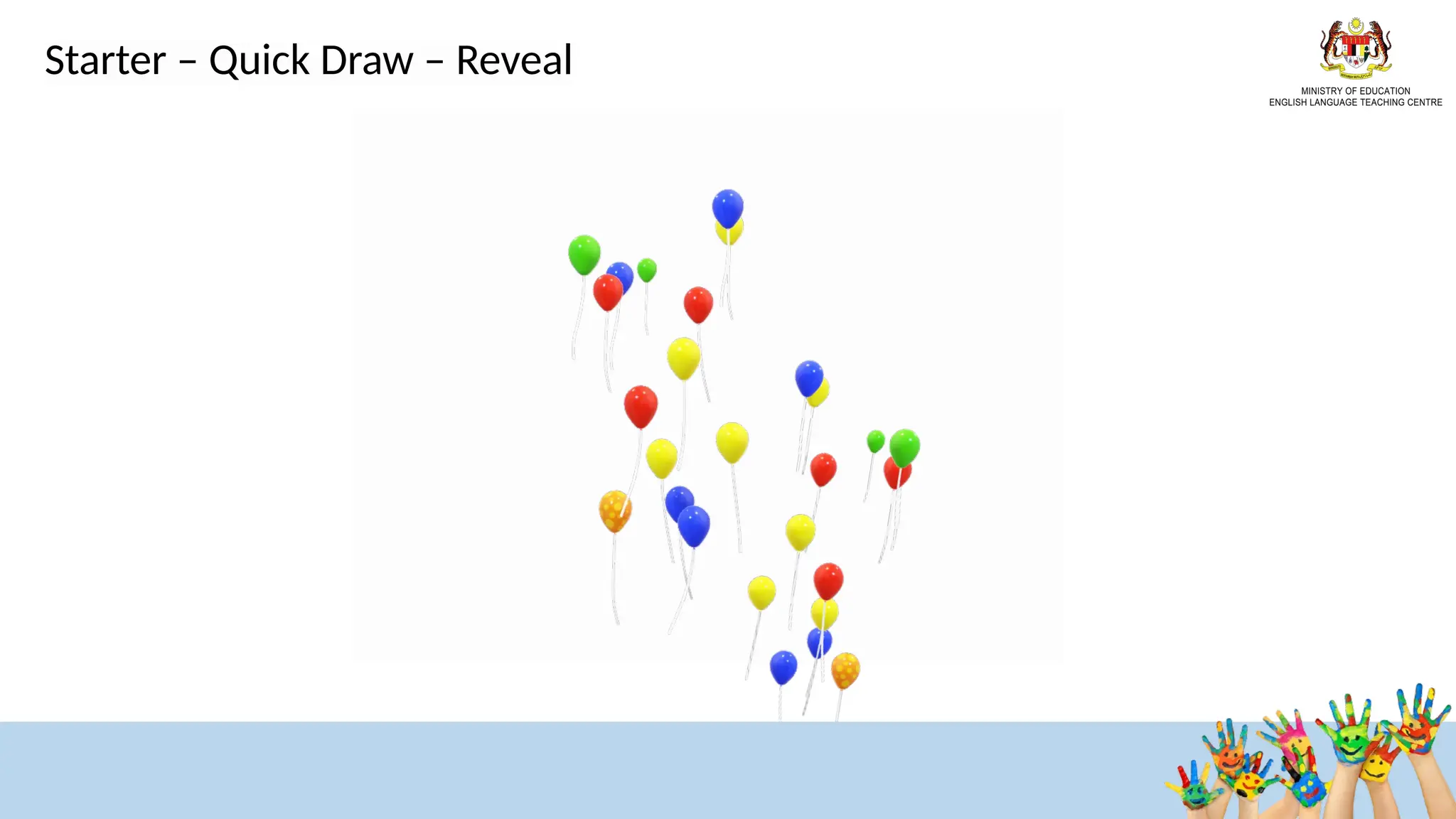
Reveal the answer and commend on their effort in getting the image right. Next, ask PS the following questions:
How many of you gave up trying to draw after instruction No.4 or 5? Why?
How did this activity make you feel?
Explain to PS: A simple activity like this still requires multiple language skills like Reading, Comprehension, Understanding instructions, Decoding, Vocabulary, Prepositions (under, beside, above etc.), Listening, Shape names etc. Being able to read and understand a language as complex as English is a vital life skill. So the question here is, imagine how your remedial students feel in your class if they are not able to partake and have fun when you conduct something like this in class? Imagine how your teachers feel if they are not able to support these students as well?
Link to Day 2: and this brings us to Day 2! Today we will explore 7 Remedial Instruction strategies that will support you and your teachers to do exactly this!
Key Message/Links: Importance of language skills in daily life – A simple activity like this still requires multiple language skills eg Reading, Comprehension, Understanding instructions, Decoding, Vocabulary, Prepositions (under, beside, above etc.), Listening, Shape names etc. Being able to read and understand a language as complex as English is a vital life skill.
#13 Master Trainer Note: Use this slide as an example to model the activity in the breakout room.
Take some time and explain the How and Why?
F to ask PS the following questions:
Have you done any of this?
Why or why not?
What is the biggest challenge you will face in putting this into practice? (If it is time, then suggest to teachers to do group lesson plans – everyone plan one unit each and exchange)
Explain to PS that in the next Breakout Session they will we brainstorming the How and Why for ONE selected strategy! TIP: "How to do this" - translates very easily into steps. Think of instructions that you will give yourself in your own lesson plan.
#14 Take some time and explain the How and Why?
Ask PS the following questions:
Have you done any of this?
Why or why not? (If done, care to share some examples?)
What is the biggest challenge you foresee you will face? (Could probably make links to Classroom Management from Day 1)
#15 Take some time and explain the How and Why?
Ask PS the following questions:
Have you done any of this?
Why or why not?
What is the biggest challenge you foresee you will face?
#16 Take some time and explain the How and Why?
Ask PS the following questions:
Have you done any of this?
Why or why not?
What is the best way to do this?
#17 Take some time and explain the How and Why?
Ask PS the following questions:
Have you done any of this?
Why or why not?
Which of the “How’s” you think you will be able to do in your next class? Why?
#18 Take some time and explain the How and Why?
Ask PS the following questions:
What are you currently doing to monitor your student's progress? Is it working? Why or why not?
Highlight that we are going to have a look at the Root Cause Analysis tool in depth later as this is an integral part in ensuring the 7 Remedial Instruction Strategies are integrated effectively.
#19 Take some time and explain the How and Why?
Ask PS the following questions:
Have you done any of this?
Why or why not?
What is the biggest challenge you foresee you will face?
#34 Get PS to use the traffic light cards to show their understanding of today’s session.
This Plenary also gives room for PS to write down any other challenges they are facing and F can build it into the upcoming sessions on how to overcome them.
![26
Acknowledgements and References
AdLit, n.d. Peer-Assisted Learning Strategy. [online] AdLit. Available at:
<https://www.adlit.org/in-the-classroom/strategies/peer-assisted-learning-strategy>
[Accessed 18 October 2021].
Assessment Reform Group (2002) Assessment for Learning: Beyond the Black Box. Cambridge:
University of Cambridge School of Education
Bilash, O. (2011) Triangulation in Assessment [Internet] Available from:
<http://www.educ.ualberta.ca/staff/olenka.bilash/best%20of%20bilash/
Triangulation.html> [Accessed: 13 March 2015]
Carnegie Mellon: Enhancing Education (n.d.) Whys and Hows of Assessment [Internet].
Available from: <http://www.cmu.edu/teaching/assessment/howto/basics/formative-
summative.html> [Accessed: 11 March 2015]
Clarke, S. (2008) Active Learning Through Formative Assessment. Hodder and Stoughton:
London, UK.
Council for the Curriculum, Examinations and Assessment (CCEA) (2001) Assessment for
Learning for Key Stage 1 and 2 [Internet].Available from:
<http://www.nicurriculum.org.uk/docs/assessment_for_learning/training/afl-guidance-
ks12.pdf> [Accessed: 11 March 2015]
Goode, K. et al (2010) Assessment for Learning [Internet] Available from:
<http://www.etfo.ca/Resources/ForTeachers/Documents/Assessment%20for
%20Learning.pdf> [Accessed: 20 March 2015]
Great Leaps. (2020) 14 Characteristics of Good Remedial Teaching [Internet] Available from:
<https://greatleaps.com/blogs/the-academic-success-blog/14-characteristics-of-good-
remedial-teaching> [Accessed: 15 Oct 2021]
i-to-i TEFL. (n.d) How to Teach Mixed Ability Classes [Internet] Available from: <https://www.i-
to-i.com/tefl-blog/tefl-classroom-and-expert-advice/how-to-teach-mixed-ability-
classes/> [Accessed: 15 Oct 2021]
Jasno, n.d. Communicative Competence in Teaching Speaking. [ebook] Riau. Available at:
<https://media.neliti.com/media/publications/243559-communicative-competence-in-
teaching-spe-1c140184.pdf> [Accessed 18 October 2021].
Lindberry, S. (n.d.) Writing Across the Curriculum at UW-Madison [Internet] Available from:
<http://writing.wisc.edu/wac/node/68> [Accessed: 20 March 2015]
Moss, D., 2005. Teaching for Communicative Competence. [online] Ncsall.net. Available at:
<http://www.ncsall.net/index.php@id=739.html> [Accessed 18 October 2021].
National Academies of Sciences, Engineering, and Medicine (2017) Promoting the Educational
Success of Children and Youth Learning English: Promising Futures. Washington, DC: The
National Academies Press
Self and Peer Assessment (n.d.). [Internet] Available from:
<http://Sydney.edu.au/education_social_work/groupwork/docs/SelfPeerAssessment.pd
f> [Accessed: 20 March 2015]
Smith, I. (2008) Making Feedback Count: A practical guide for primary teachers.
William, D. (2010) Embedding formative assessment with teacher learning communities
[Internet] Available from:
<http://www.dylanwiliam.org/Dylan_Wiliams_website/Presentations_files/NEEC
%20breakout.ppt> [Accessed: 20 March 2015]
Images:
BLEPT Self Review. (n.d) The Remedial Classroom: Organization and Management [Internet]
Available from: <https://www.bleptselfreview.ph/courses/remedial-instruction-in-
english-english-major-free/lessons/the-remedial-classroom-organization-and-
management> [Accessed: 15 Oct 2021]
Johnson, P., 2010. Example of Learning Goal With Success Criteria. [image] Available at:
<https://bit.ly/slideshare_3f5Ey8j> [Accessed 7 July 2020].
Kit8.net, n.d. Man Studying With Laptop. [image] Available at:
<https://bit.ly/shutterstock_2C6VuMV> [Accessed 7 July 2020].
Macrovector, n.d. Online Adult Education. [image] Available at:
<https://bit.ly/dreamstime_3fiWLzn> [Accessed 7 July 2020].
Matt Anderson Photography, n.d. Majestic Hot Air Balloon. [image] Available at:
<https://bit.ly/gettyimages_2VNH8In> [Accessed 7 July 2020].
Pinterest, n.d. Learning Goal & Success Criteria. [image] Available at:
<https://bit.ly/pinterest_3f5DjWH> [Accessed 7 July 2020].
Pinterest, n.d. Success Criteria Stories. [image] Available at:
<https://bit.ly/pinterest_31UhbKW> [Accessed 7 July 2020].
Tenor, 2014. Cat Epic Wiggle GIF. [image] Available at: <https://bit.ly/tenor_2Z6iYuQ>
[Accessed 7 July 2020].
Understood.org, n.d. Students and Teacher. [image] Available at:
<https://www.understood.org/articles/en/remedial-programs-what-you-need-to-know>
[Accessed 18 October 2021].](https://image.slidesharecdn.com/day2hipremedialinstruction-250320022322-b87afbf7/75/DAY-2-HIP-REMEDIAL-INSTRUCTION-pptx-26-2048.jpg)



![AKTIVITI MINGGU TRANSISI 2025 [1].docx](https://cdn.slidesharecdn.com/ss_thumbnails/aktivitiminggutransisi20251-250320022211-8feec964-thumbnail.jpg?width=640&height=640&fit=bounds)


