Improving the Nutritional Profile of Your
        Confectionery Products

             Geoff O’Sullivan
               CMA 2008
Agenda

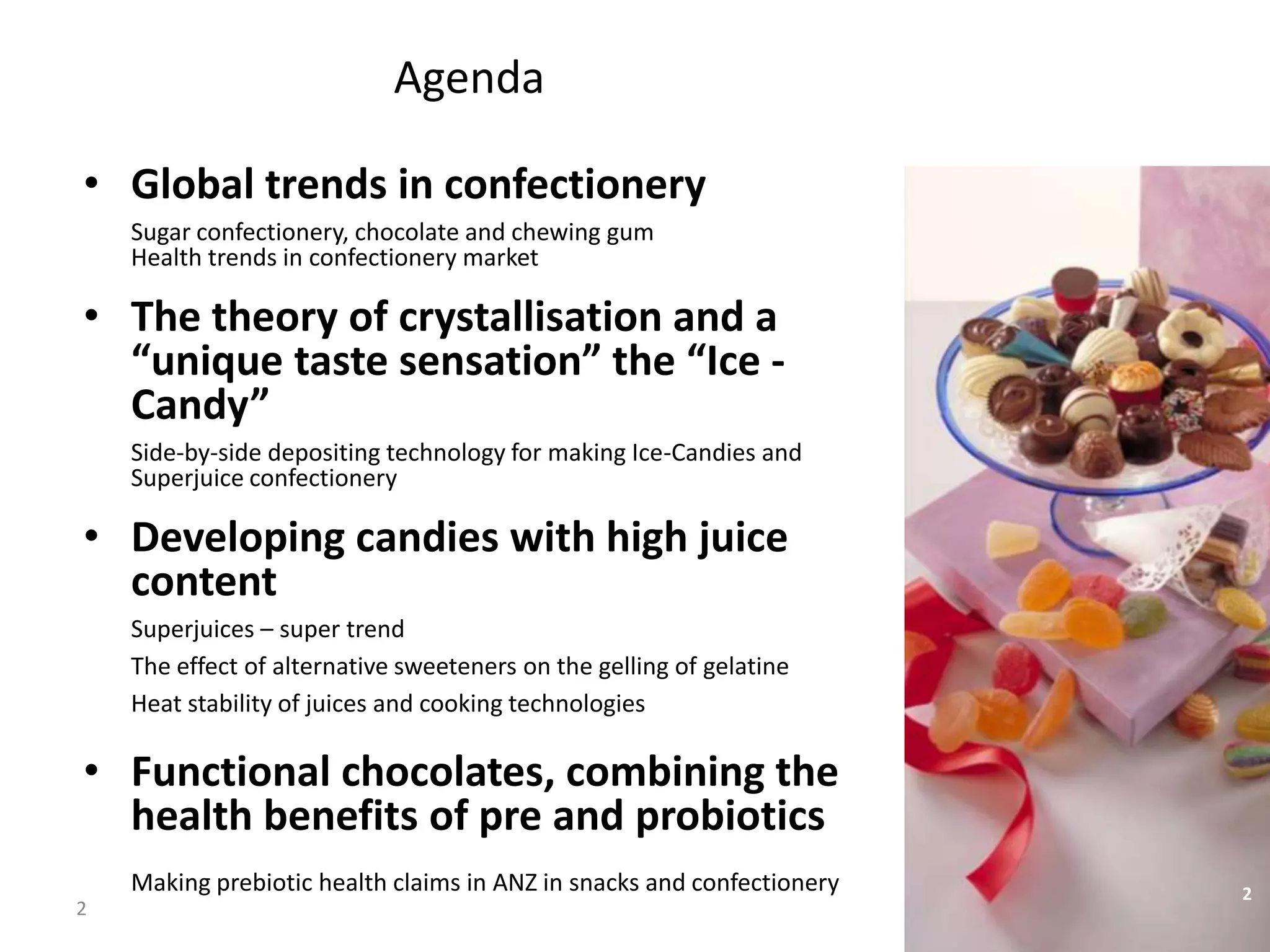
• Global trends in confectionery
    Sugar confectionery, chocolate and chewing gum
    Health trends in confectionery market

• The theory of crystallisation and a
  “unique taste sensation” the “Ice -
  Candy”
    Side-by-side depositing technology for making Ice-Candies and
    Superjuice confectionery

• Developing candies with high juice
  content
    Superjuices – super trend
    The effect of alternative sweeteners on the gelling of gelatine
    Heat stability of juices and cooking technologies

• Functional chocolates, combining the
  health benefits of pre and probiotics
    Making prebiotic health claims in ANZ in snacks and confectionery   2
2
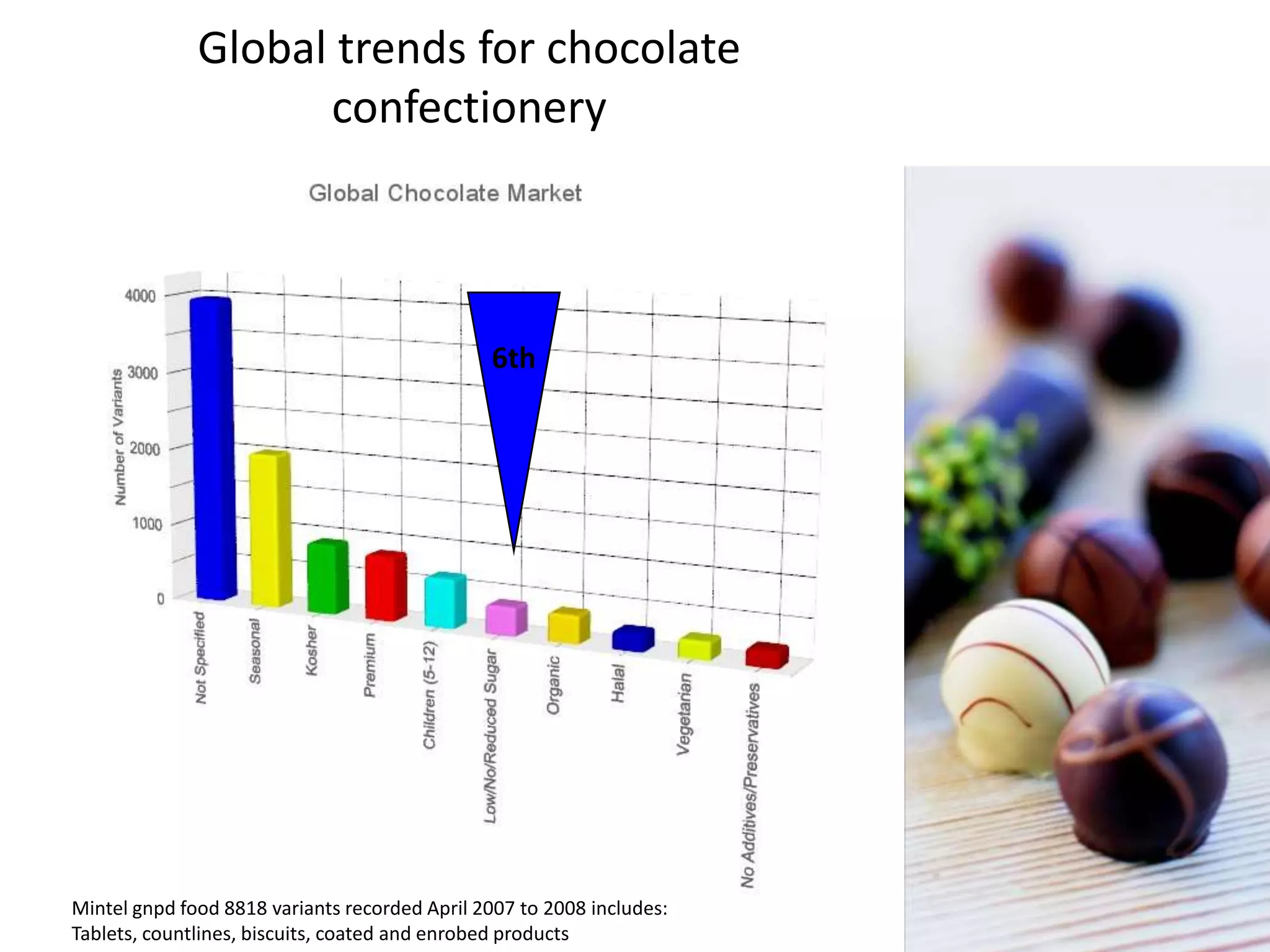
Global trends for chocolate
                    confectionery


                                               6th


Mintel gnpd food 8818 variants recorded April 2007 to 2008 includes:
 3
Tablets, countlines, biscuits, coated and enrobed products
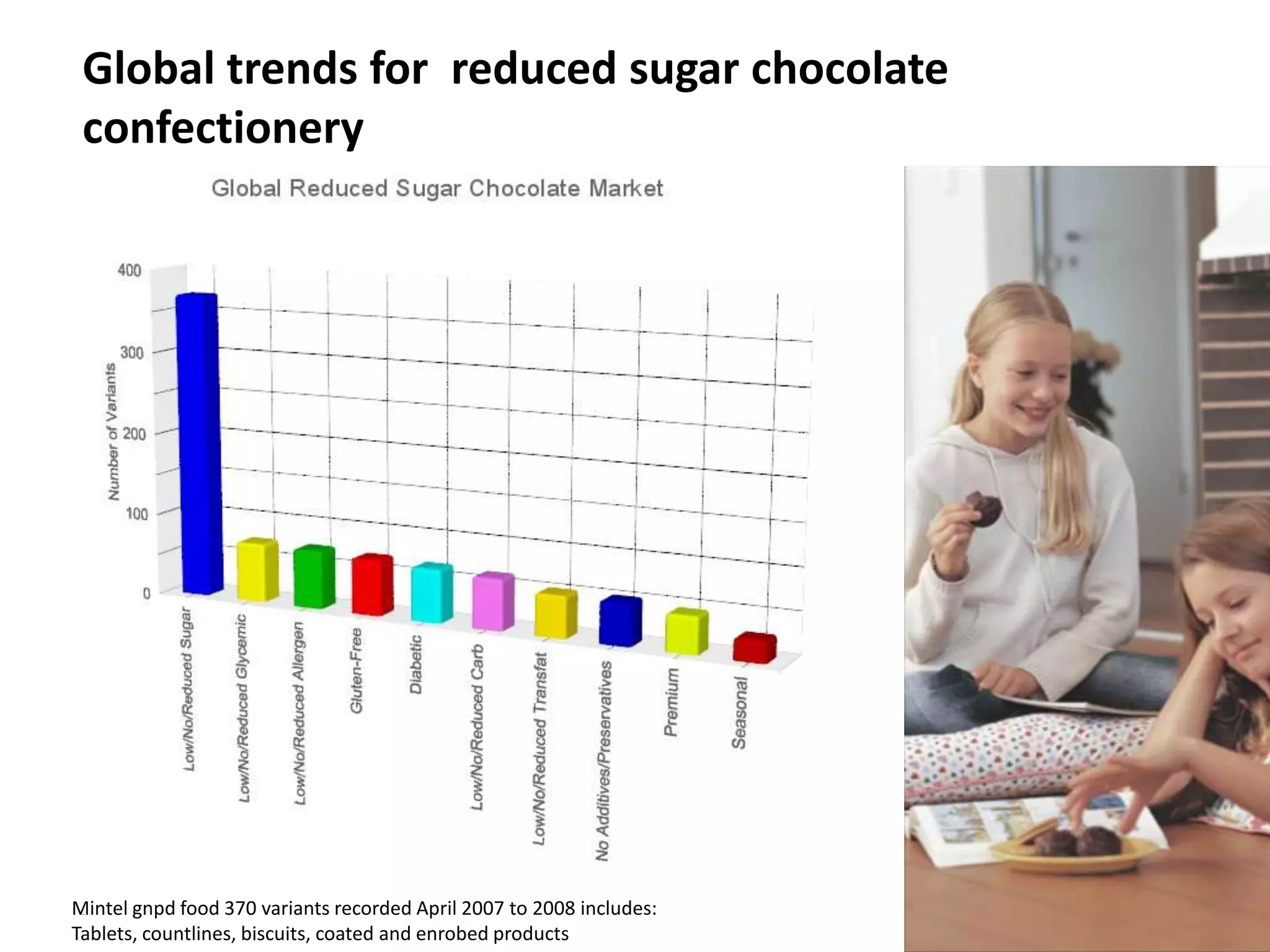
Global trends for reduced sugar chocolate
 confectionery


Mintel gnpd food 370 variants recorded April 2007 to 2008 includes:
 4
Tablets, countlines, biscuits, coated and enrobed products            4
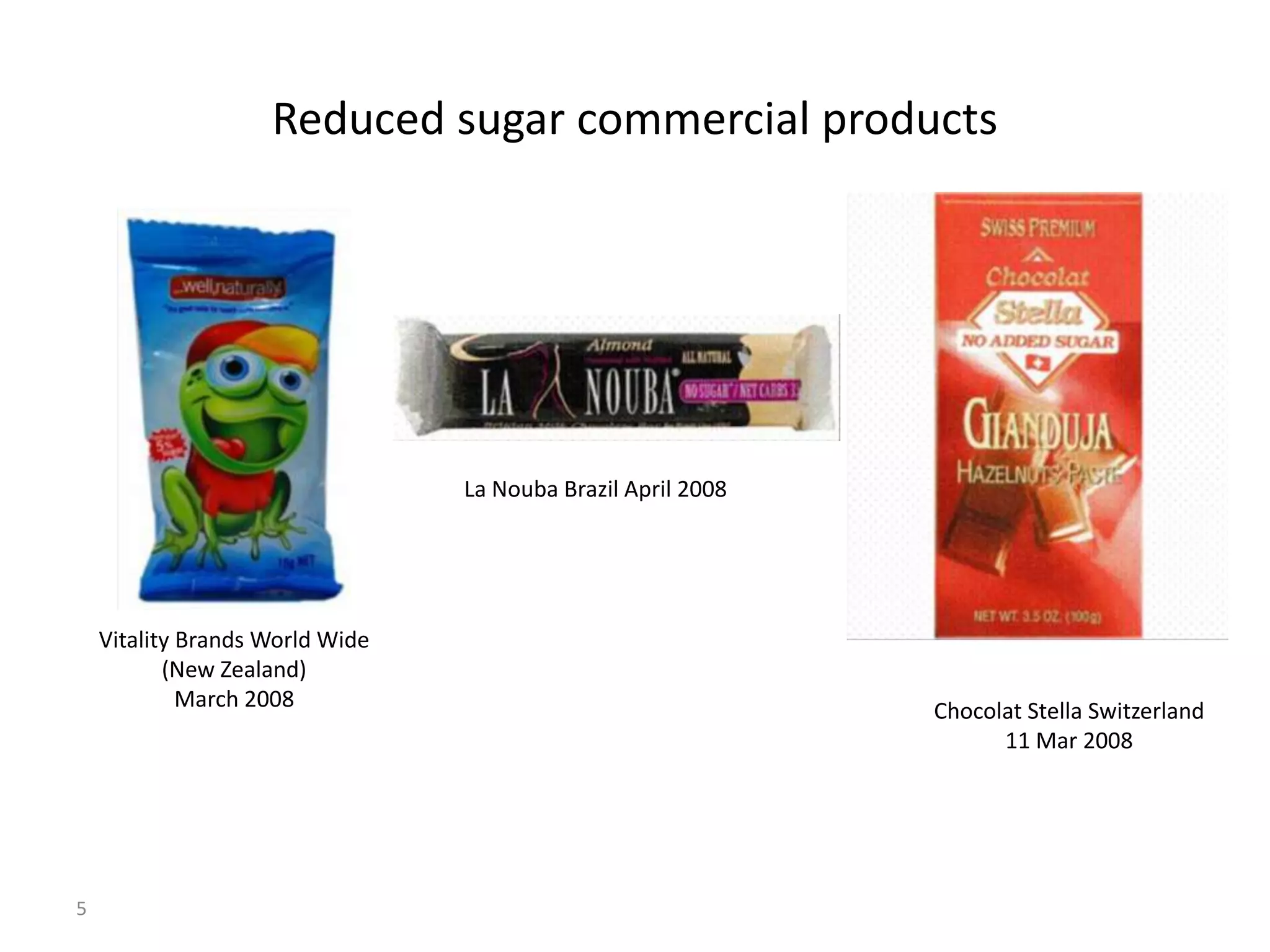
Reduced sugar commercial products


                                 La Nouba Brazil April 2008


    Vitality Brands World Wide
           (New Zealand)
             March 2008                                       Chocolat Stella Switzerland
                                                                    11 Mar 2008


5
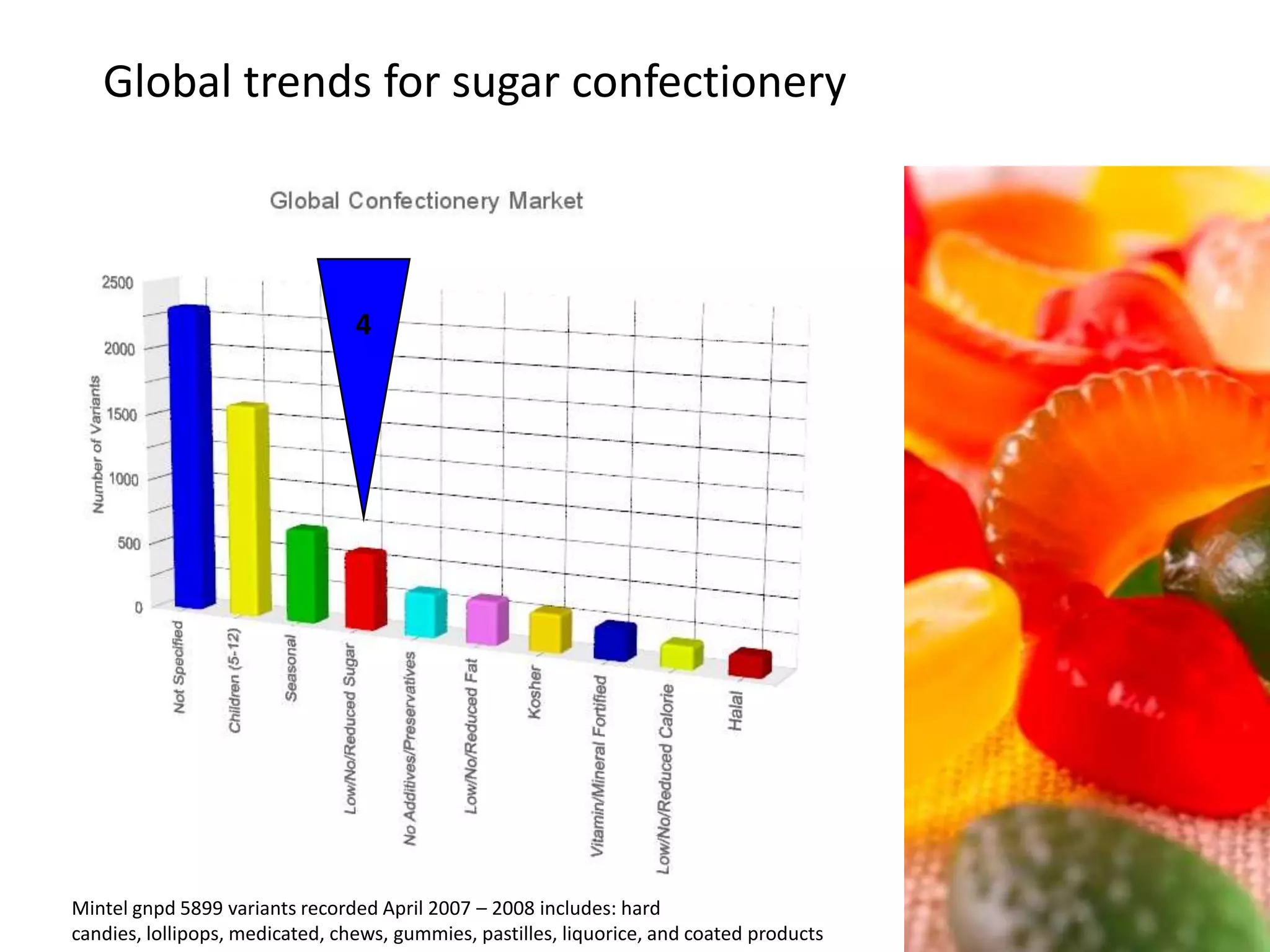
Global trends for sugar confectionery


                                 4


Mintel gnpd 5899 variants recorded April 2007 – 2008 includes: hard
 6
candies, lollipops, medicated, chews, gummies, pastilles, liquorice, and coated products   6
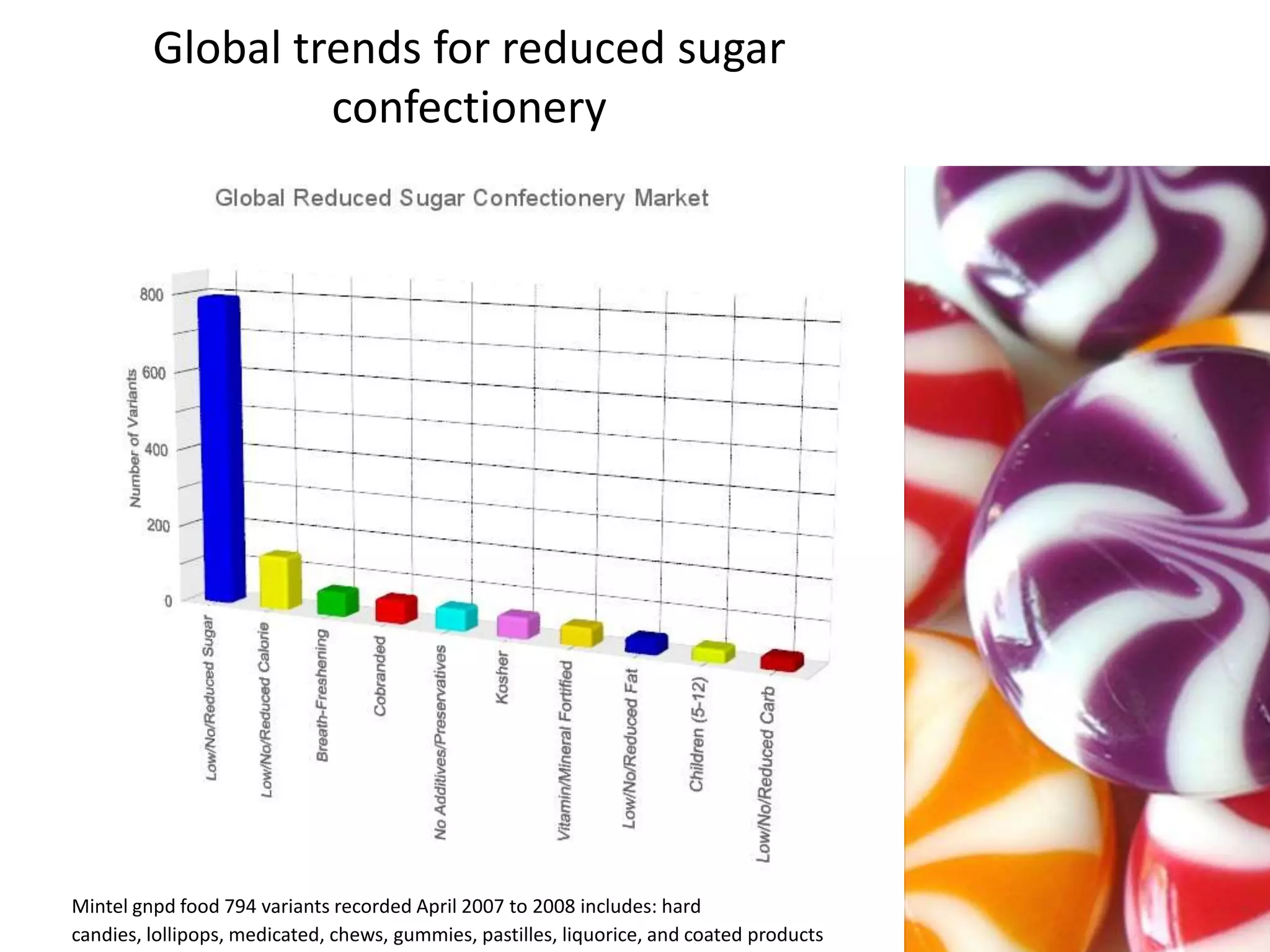
Global trends for reduced sugar
                  confectionery


Mintel gnpd food 794 variants recorded April 2007 to 2008 includes: hard
 7
candies, lollipops, medicated, chews, gummies, pastilles, liquorice, and coated products
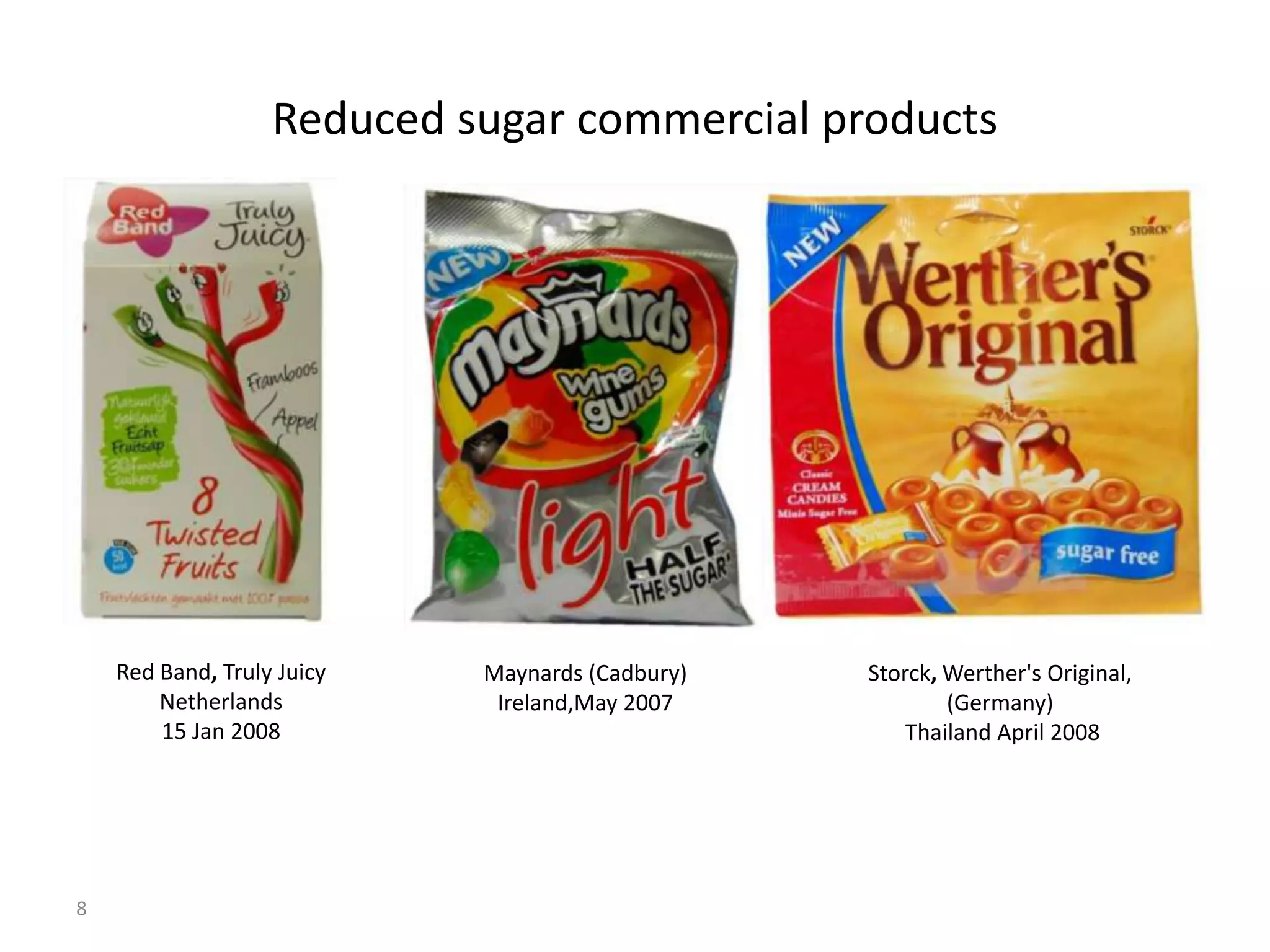
Reduced sugar commercial products


    Red Band, Truly Juicy   Maynards (Cadbury)   Storck, Werther's Original,
        Netherlands          Ireland,May 2007            (Germany)
        15 Jan 2008                                  Thailand April 2008


8
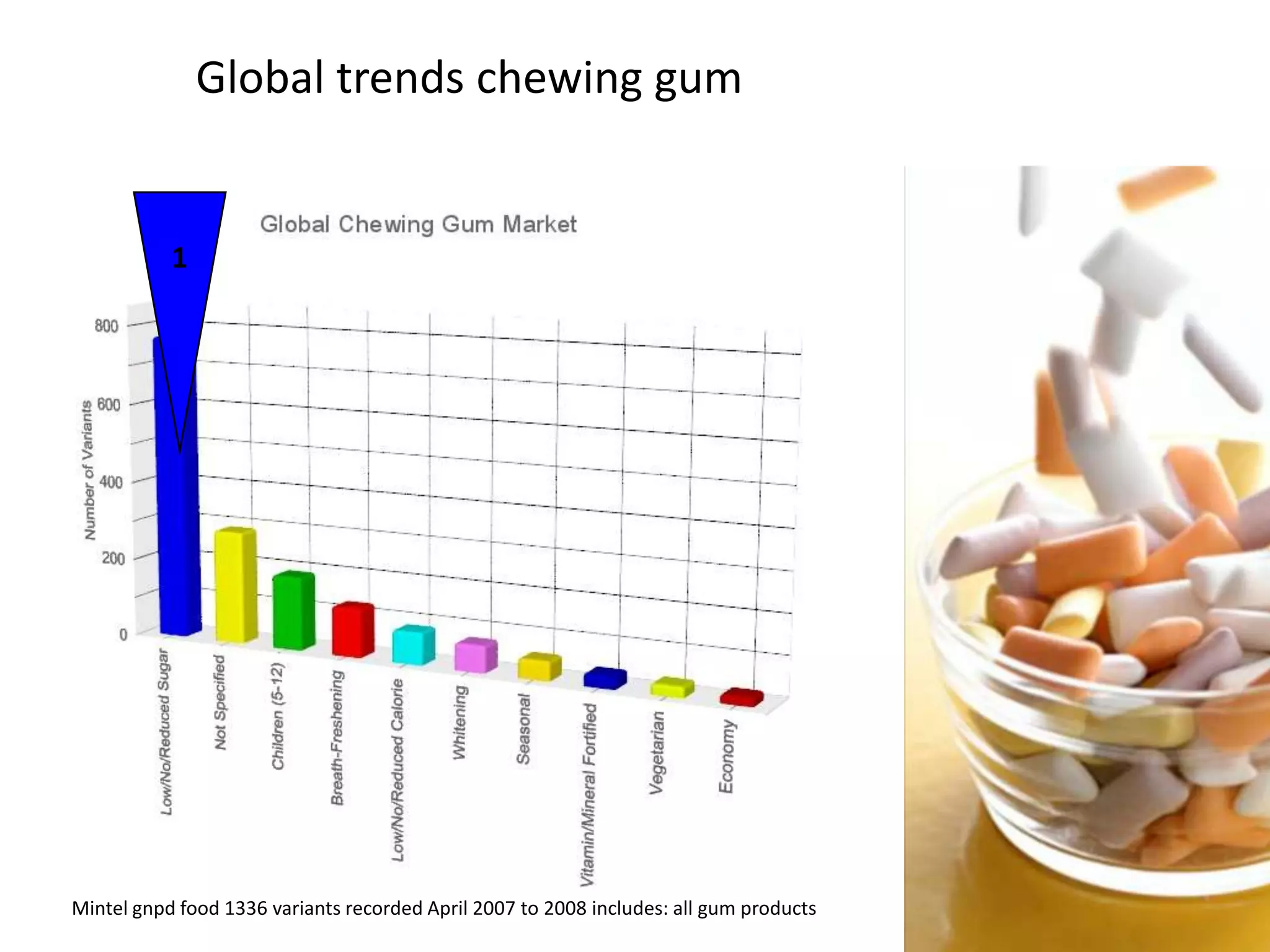
Global trends chewing gum


           1


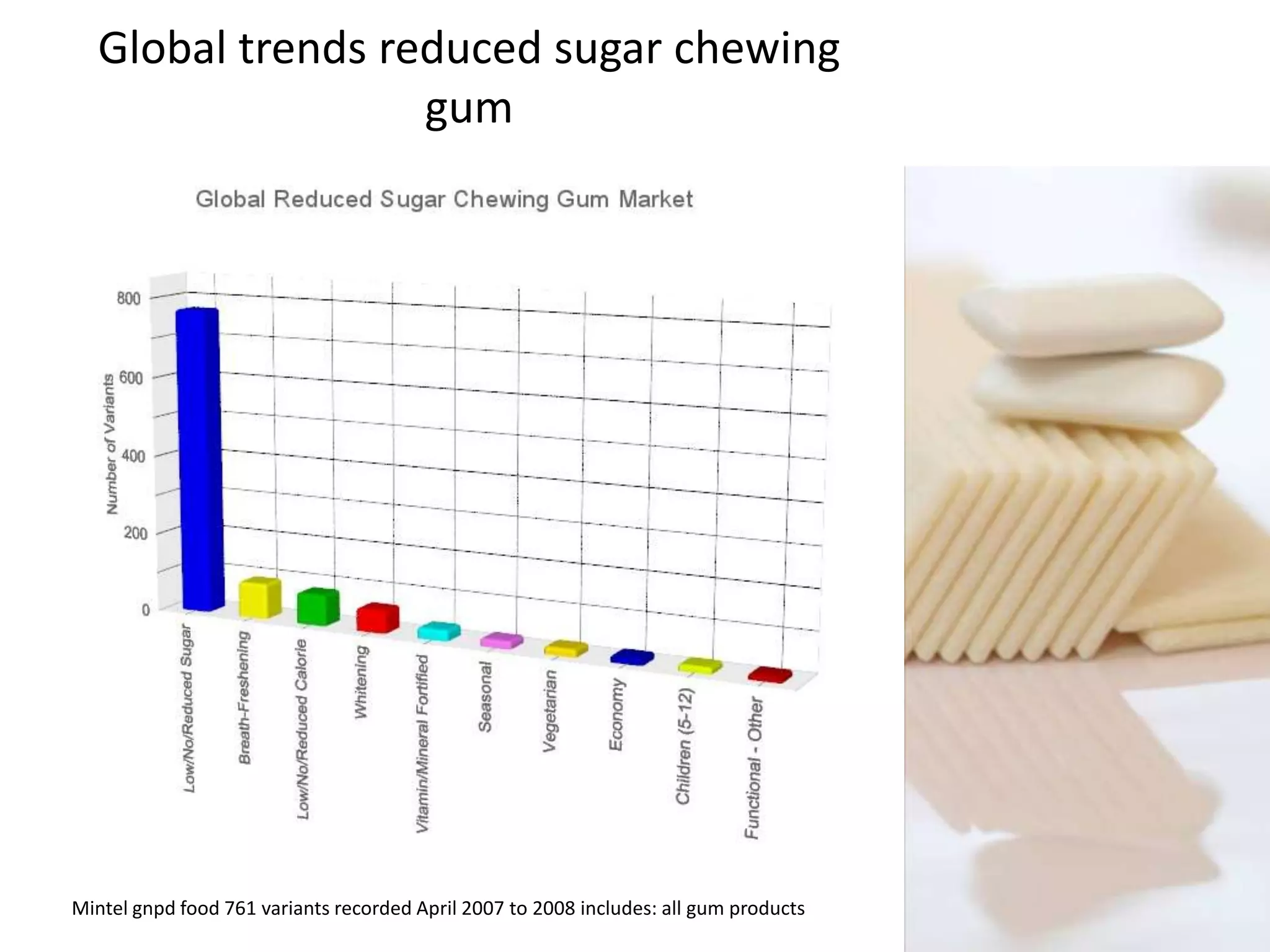
Mintel gnpd food 1336 variants recorded April 2007 to 2008 includes: all gum products
9
                                                                                        9
Global trends reduced sugar chewing
                   gum


Mintel gnpd food 761 variants recorded April 2007 to 2008 includes: all gum products
10
                                                                                       10
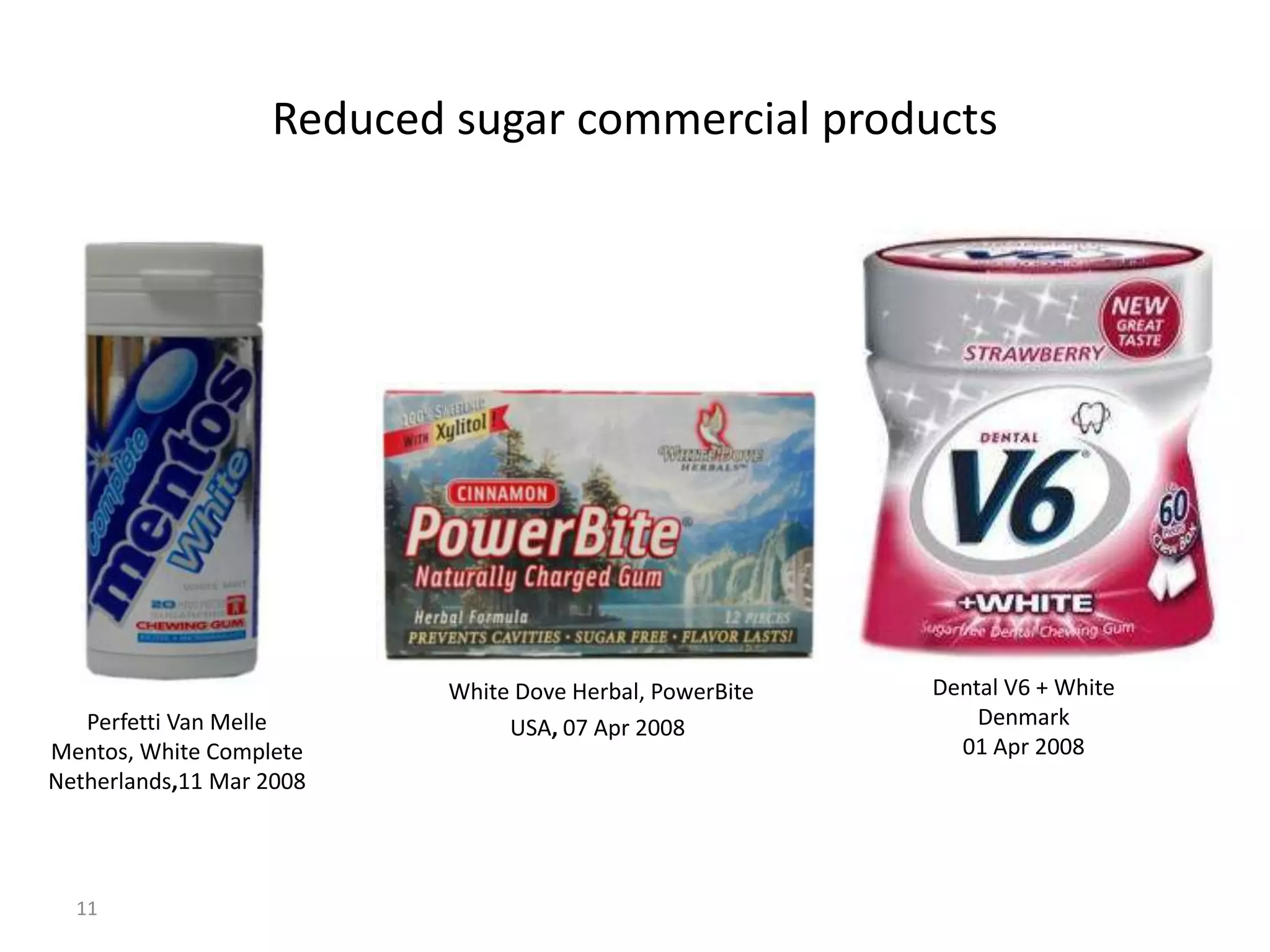
Reduced sugar commercial products


                           White Dove Herbal, PowerBite   Dental V6 + White
   Perfetti Van Melle           USA, 07 Apr 2008              Denmark
Mentos, White Complete                                      01 Apr 2008
Netherlands,11 Mar 2008


  11
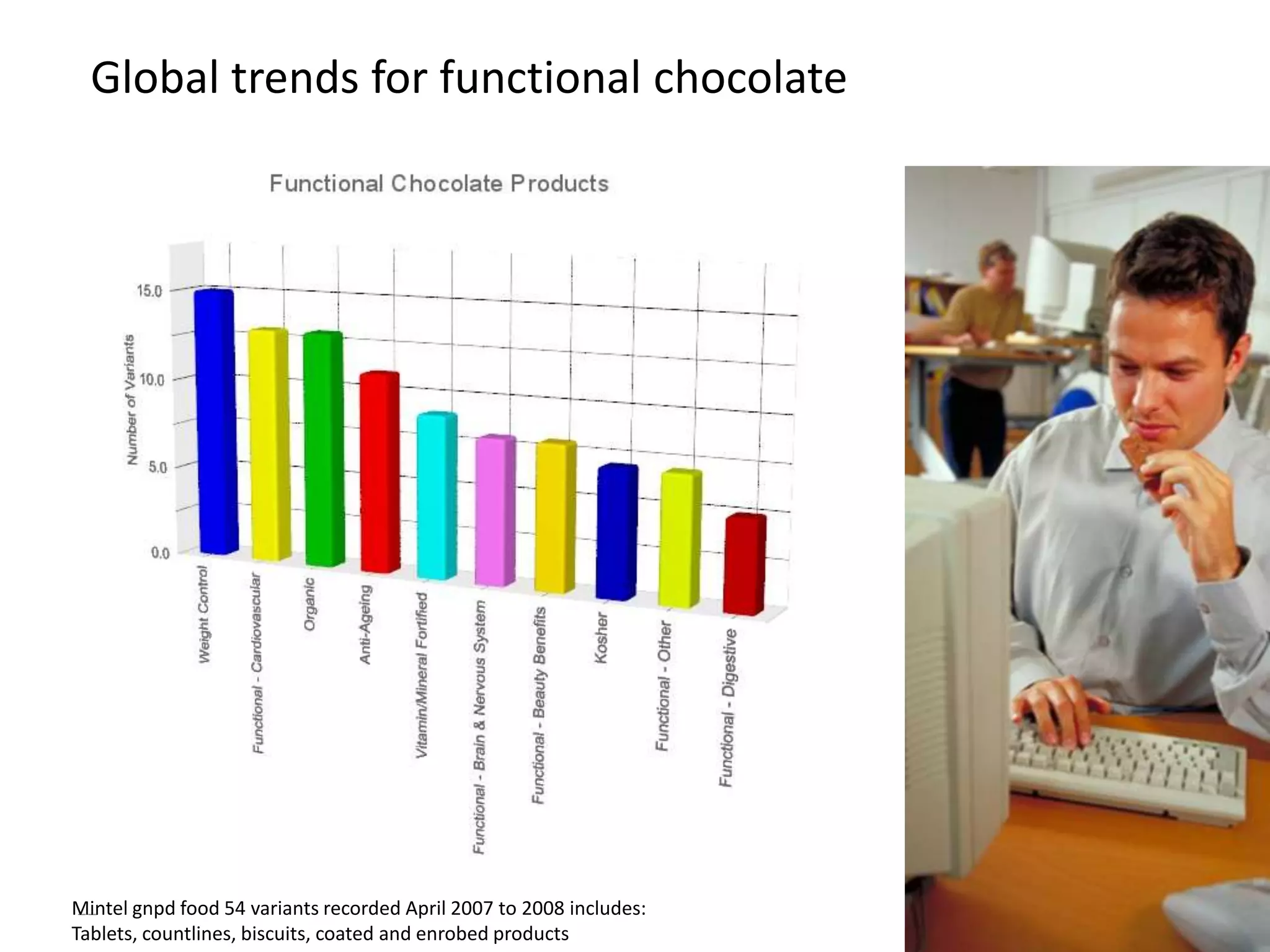
Global trends for functional chocolate


Mintel gnpd food 54 variants recorded April 2007 to 2008 includes:
 12
Tablets, countlines, biscuits, coated and enrobed products           12
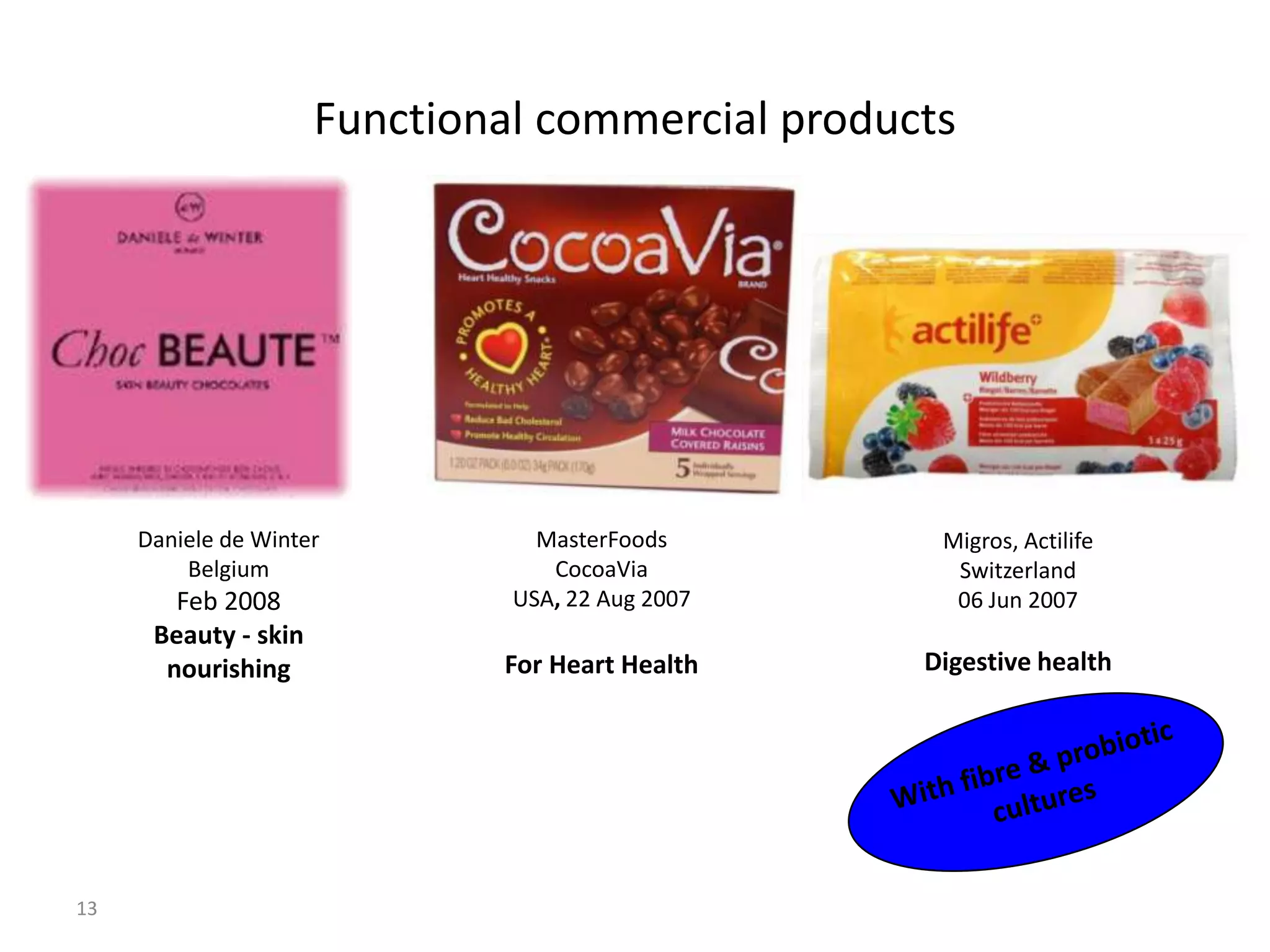
Functional commercial products


     Daniele de Winter           MasterFoods       Migros, Actilife
         Belgium                  CocoaVia          Switzerland
        Feb 2008               USA, 22 Aug 2007     06 Jun 2007
      Beauty - skin
       nourishing             For Heart Health    Digestive health


13
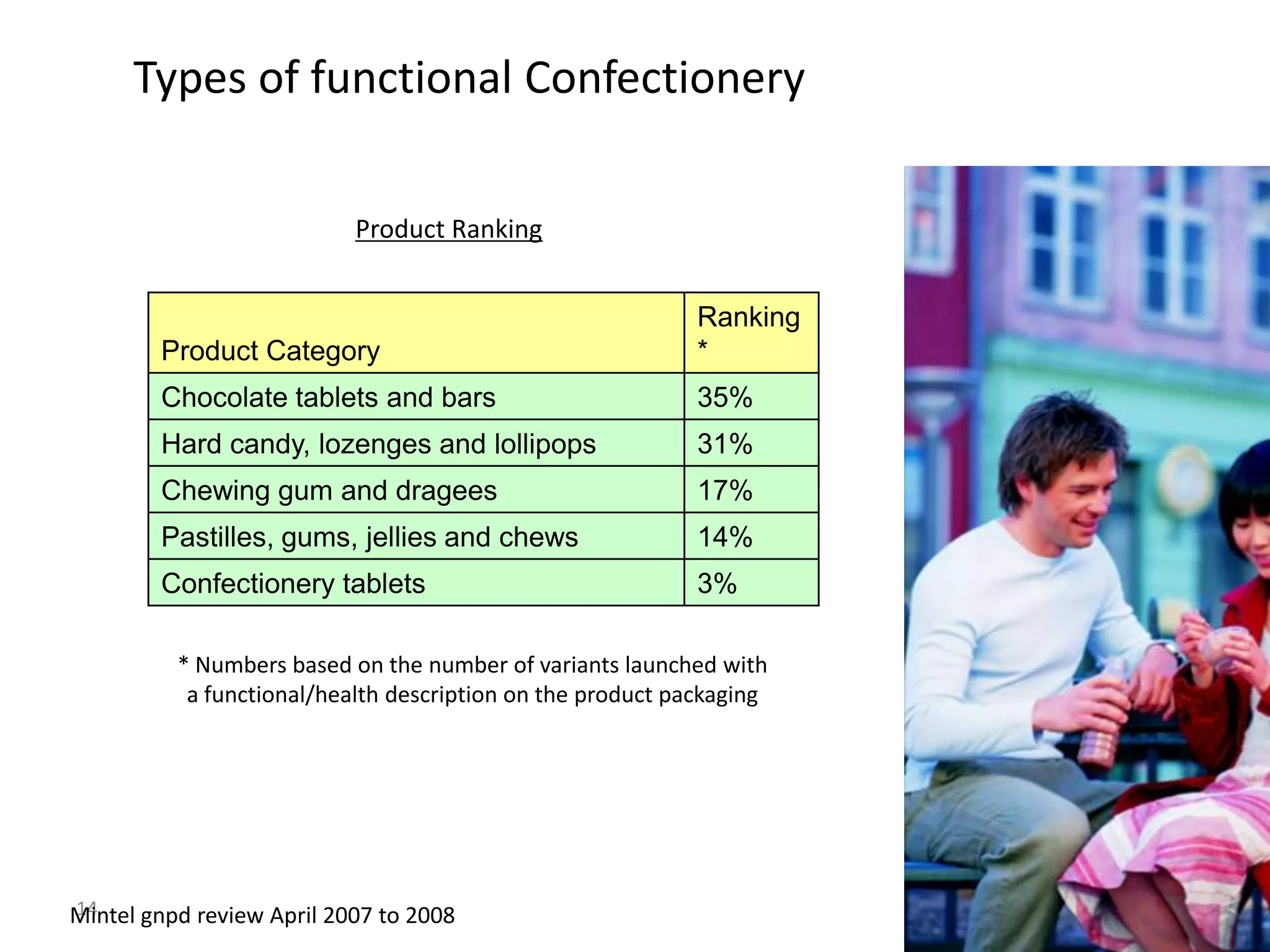
Types of functional Confectionery

                           Product Ranking


                                                            Ranking
        Product Category                                    *
        Chocolate tablets and bars                          35%
        Hard candy, lozenges and lollipops                  31%
        Chewing gum and dragees                             17%
        Pastilles, gums, jellies and chews                  14%
        Confectionery tablets                               3%

          * Numbers based on the number of variants launched with
           a functional/health description on the product packaging


14
Mintel gnpd review April 2007 to 2008
                                                                      14
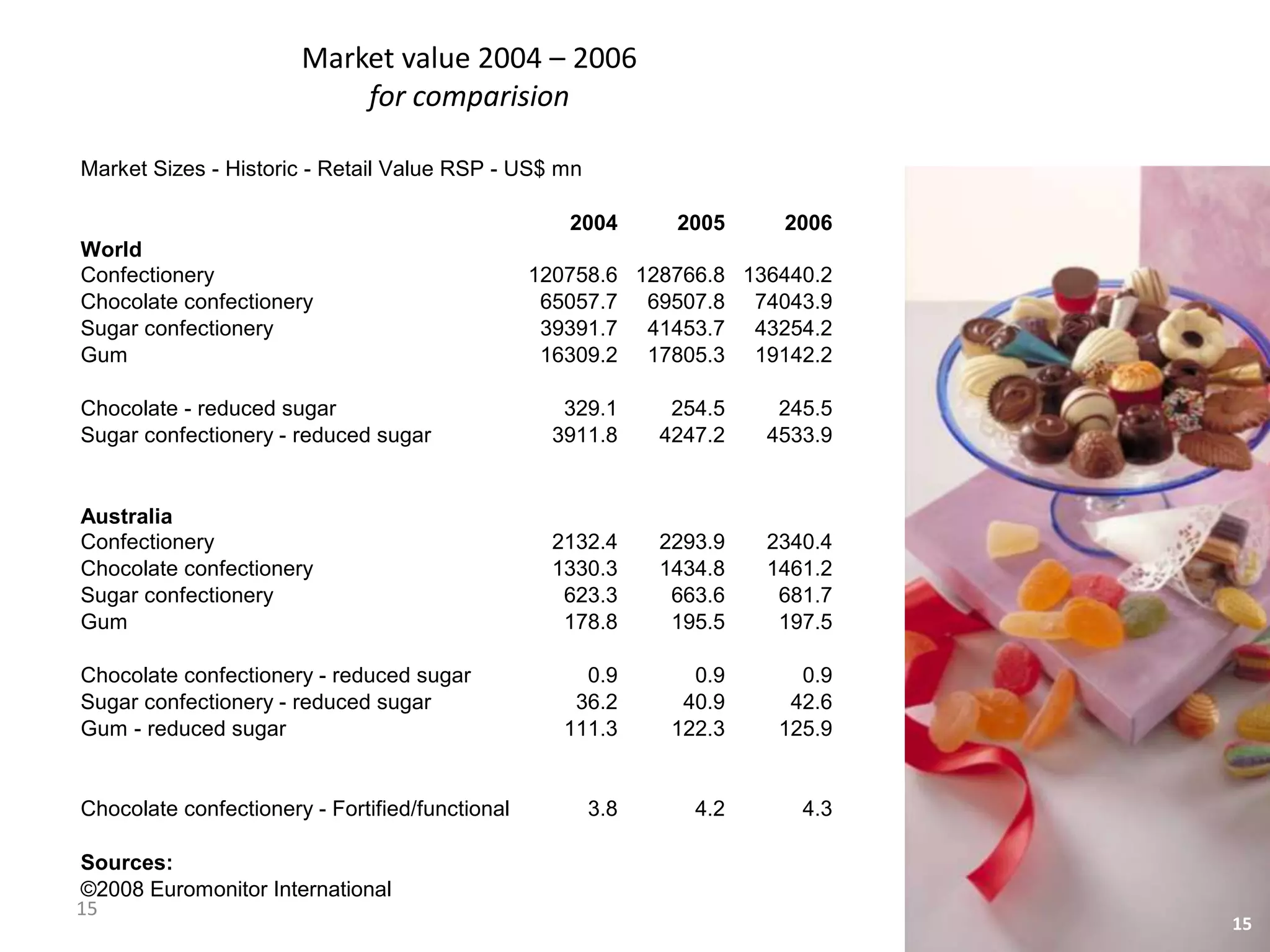
Market value 2004 – 2006
                           for comparision

Market Sizes - Historic - Retail Value RSP - US$ mn

                                                    2004     2005     2006
World
Confectionery                                    120758.6 128766.8 136440.2
Chocolate confectionery                           65057.7 69507.8 74043.9
Sugar confectionery                               39391.7 41453.7 43254.2
Gum                                               16309.2 17805.3 19142.2

Chocolate - reduced sugar                           329.1    254.5    245.5
Sugar confectionery - reduced sugar                3911.8   4247.2   4533.9
Gum - BFY Reduced sugar                            6351.9   7138.1   7773.5

Australia
Confectionery                                      2132.4   2293.9   2340.4
Chocolate confectionery                            1330.3   1434.8   1461.2
Sugar confectionery                                 623.3    663.6    681.7
Gum                                                 178.8    195.5    197.5

Chocolate confectionery - reduced sugar               0.9      0.9      0.9
Sugar confectionery - reduced sugar                  36.2     40.9     42.6
Gum - reduced sugar                                 111.3    122.3    125.9


Chocolate confectionery - Fortified/functional        3.8      4.2      4.3

Sources:
©2008 Euromonitor International
15
                                                                              15
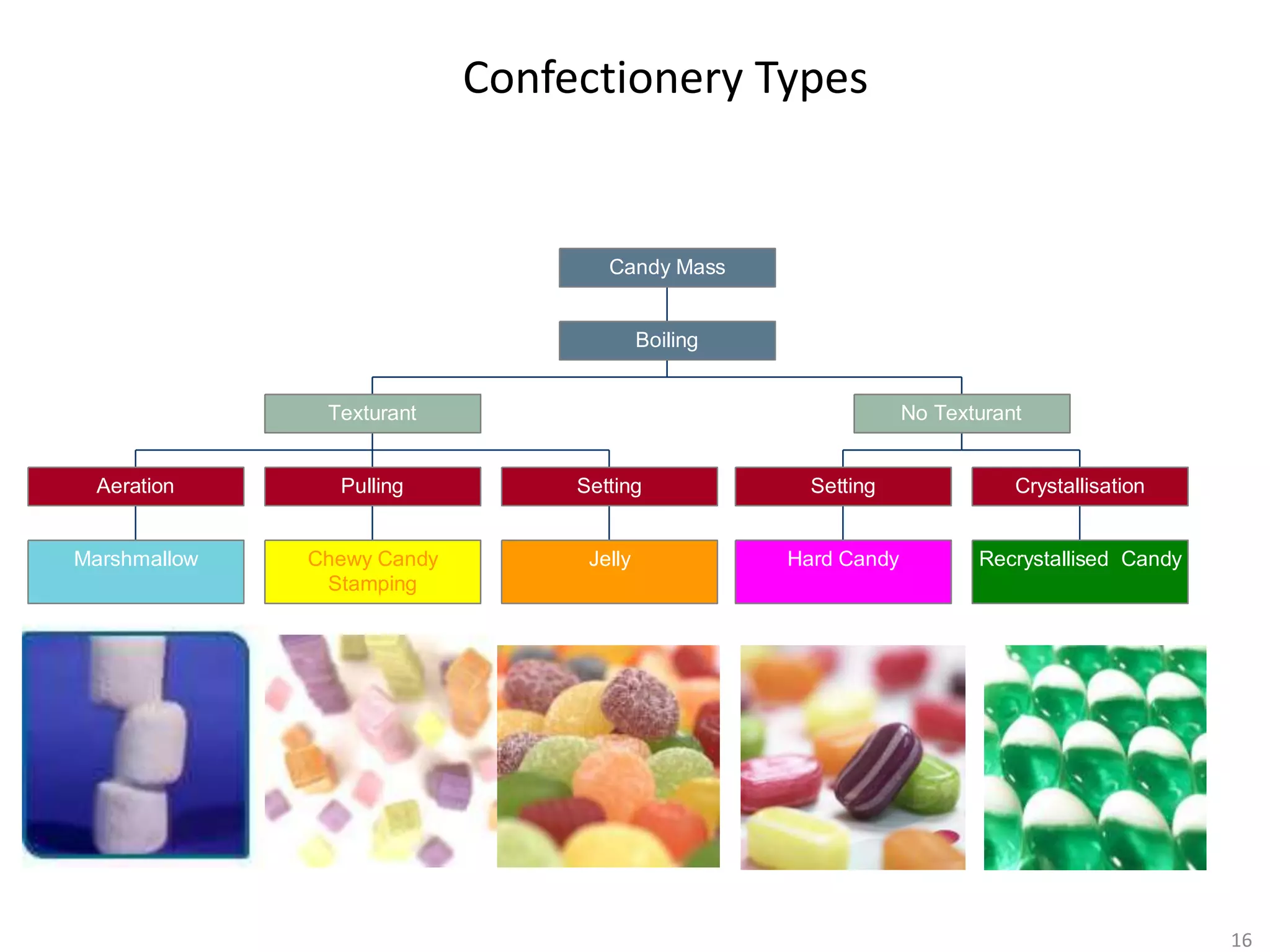
Confectionery Types


                                    Candy Mass


                                          Boiling


               Texturant                                         No Texturant


 Aeration       Pulling          Setting              Setting               Crystallisation


Marshmallow   Chewy Candy         Jelly             Hard Candy          Recrystallised Candy
               Stamping


                                                                                               16
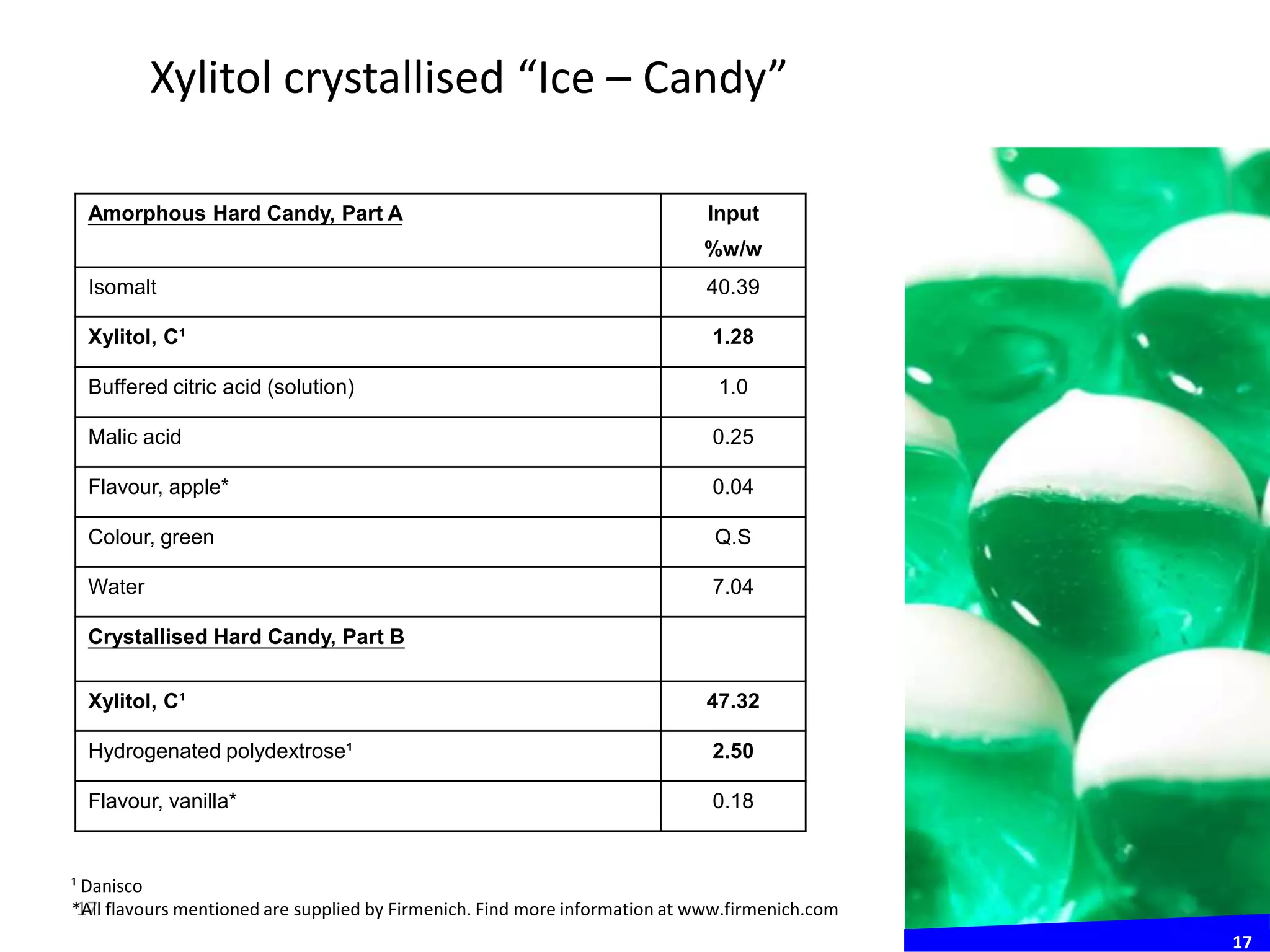
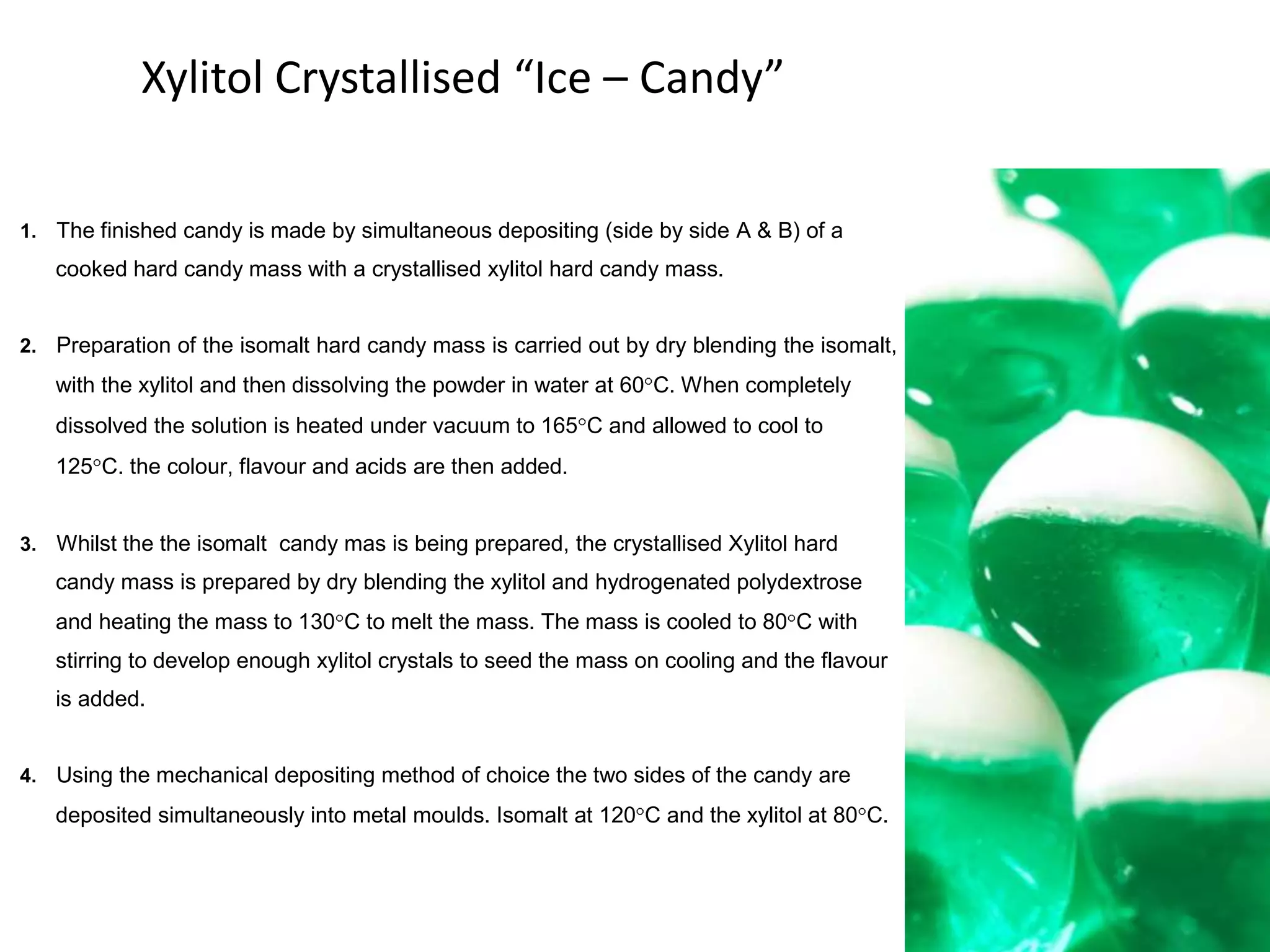
Xylitol crystallised “Ice – Candy”

  Amorphous Hard Candy, Part A                                               Input
                                                                            %w/w
  Isomalt                                                                   40.39

  Xylitol, C¹                                                                1.28

  Buffered citric acid (solution)                                             1.0

  Malic acid                                                                 0.25

  Flavour, apple*                                                            0.04

  Colour, green                                                              Q.S                Insert image/object
  Water                                                                      7.04

  Crystallised Hard Candy, Part B


  Xylitol, C¹                                                               47.32

  Hydrogenated polydextrose¹                                                 2.50

  Flavour, vanilla*                                                          0.18


¹ Danisco
 17
*All flavours mentioned are supplied by Firmenich. Find more information at www.firmenich.com
                                                                                                                      17
Xylitol Crystallised “Ice – Candy”

1. The finished candy is made by simultaneous depositing (side by side A & B) of a
   cooked hard candy mass with a crystallised xylitol hard candy mass.


2. Preparation of the isomalt hard candy mass is carried out by dry blending the isomalt,
   with the xylitol and then dissolving the powder in water at 60 C. When completely
   dissolved the solution is heated under vacuum to 165 C and allowed to cool to
   125 C. the colour, flavour and acids are then added.


3. Whilst the the isomalt candy mas is being prepared, the crystallised Xylitol hard
   candy mass is prepared by dry blending the xylitol and hydrogenated polydextrose
   and heating the mass to 130 C to melt the mass. The mass is cooled to 80 C with
   stirring to develop enough xylitol crystals to seed the mass on cooling and the flavour
   is added.


4. Using the mechanical depositing method of choice the two sides of the candy are

   deposited simultaneously into metal moulds. Isomalt at 120 C and the xylitol at 80 C.


                                                                                             18
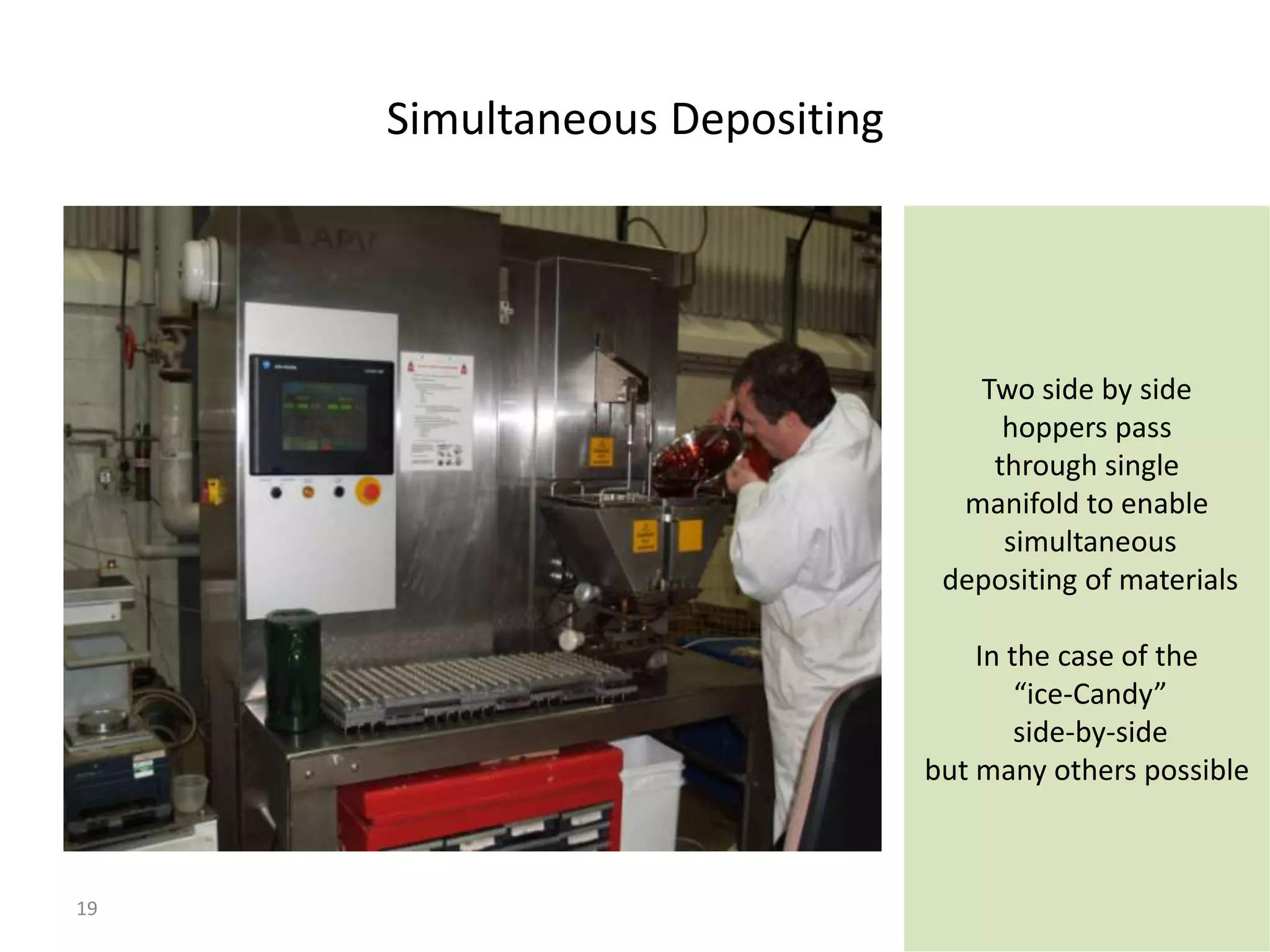
Simultaneous Depositing


                                  Two side by side
                                    hoppers pass
                                   through single
                                 manifold to enable
                                    simultaneous
                                depositing of materials

                                   In the case of the
                                       “ice-Candy”
                                       side-by-side
                               but many others possible


19
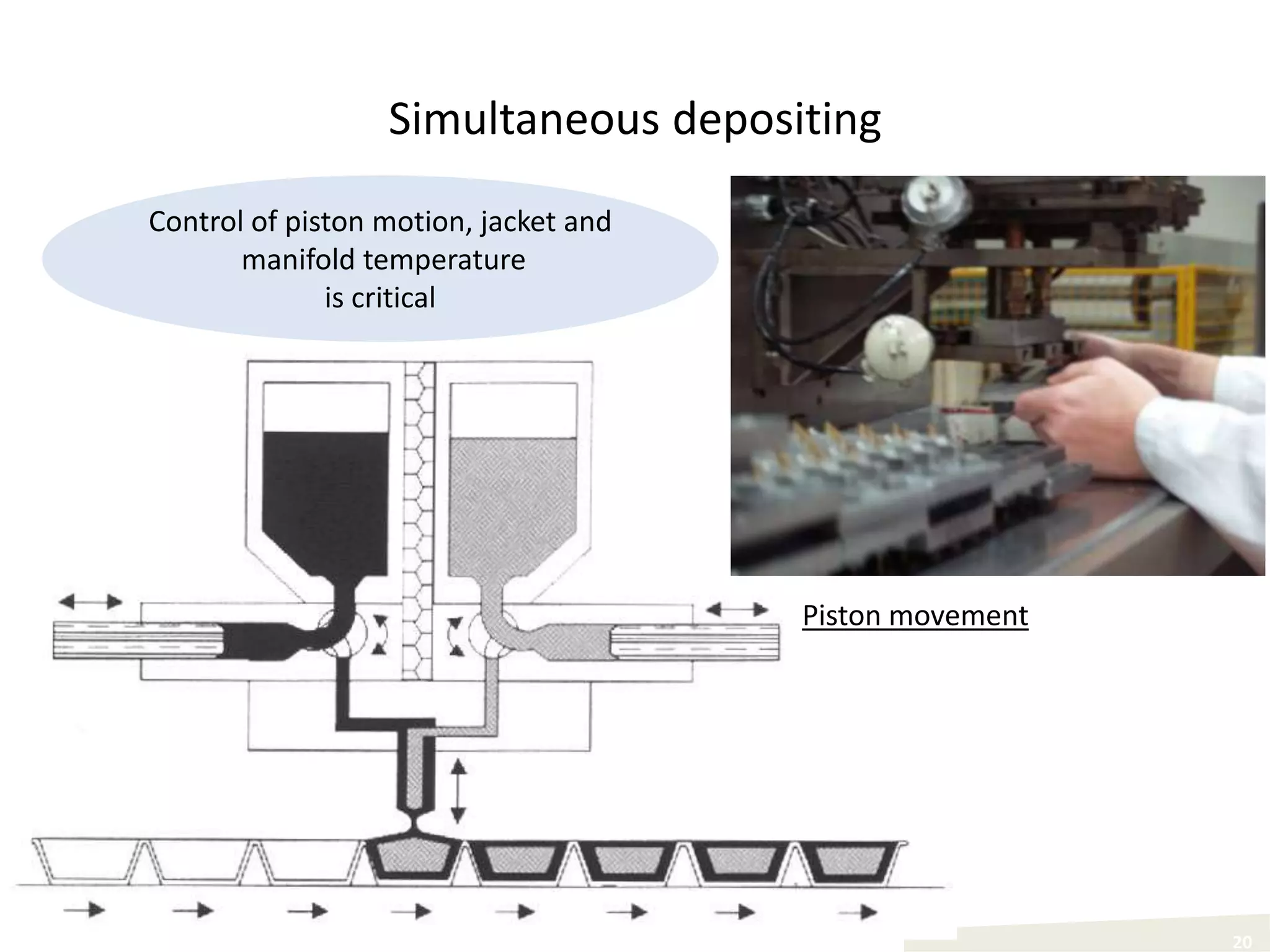
Simultaneous depositing
     Control of piston motion, jacket and
            manifold temperature
                   is critical


                                            Piston movement


20
                                                              20
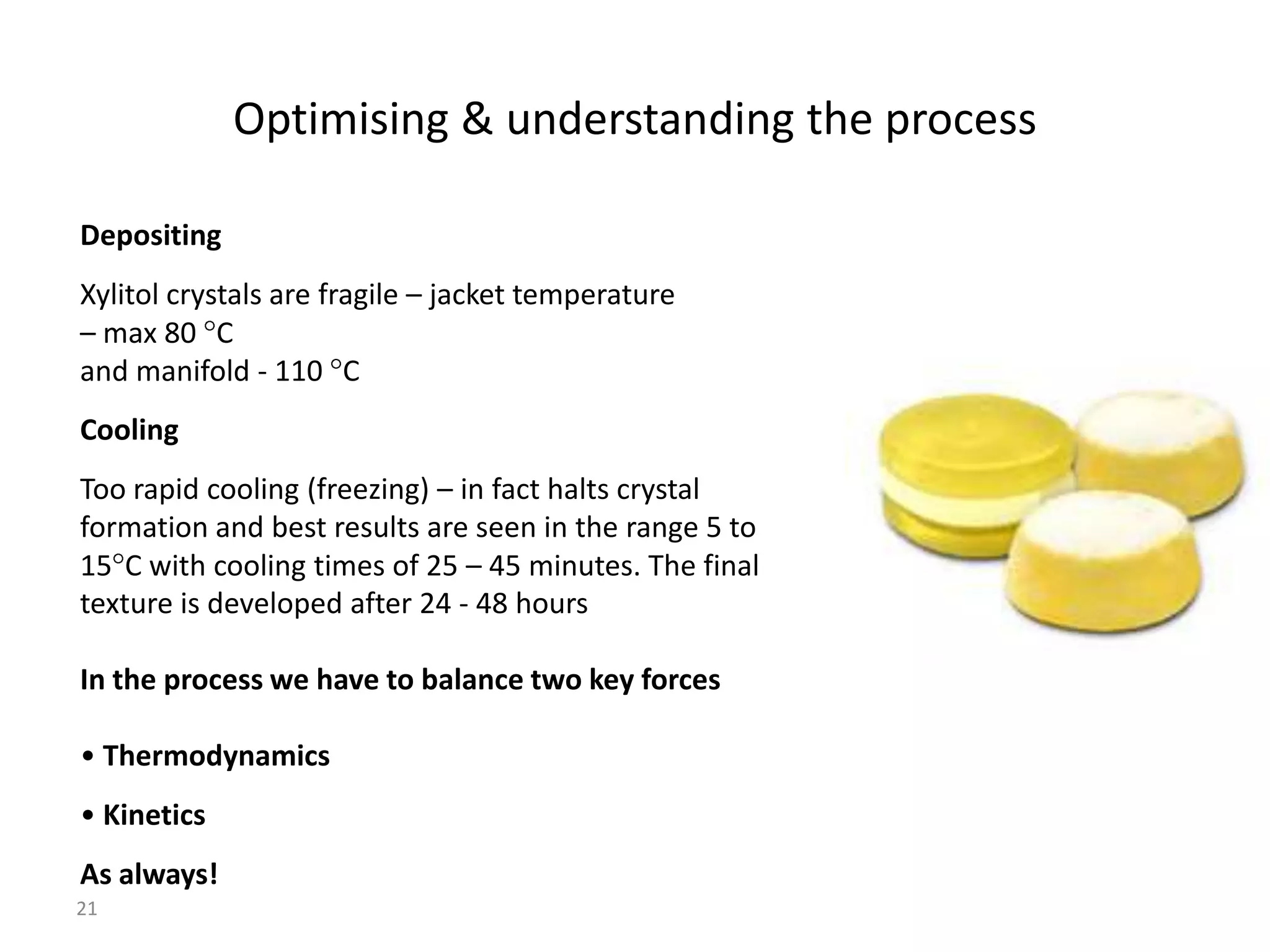
Optimising & understanding the process

Depositing
Xylitol crystals are fragile – jacket temperature
– max 80 C
and manifold - 110 C
Cooling
Too rapid cooling (freezing) – in fact halts crystal
formation and best results are seen in the range 5 to
15 C with cooling times of 25 – 45 minutes. The final
texture is developed after 24 - 48 hours

In the process we have to balance two key forces

• Thermodynamics
• Kinetics
As always!
21
Optimising & understanding the process

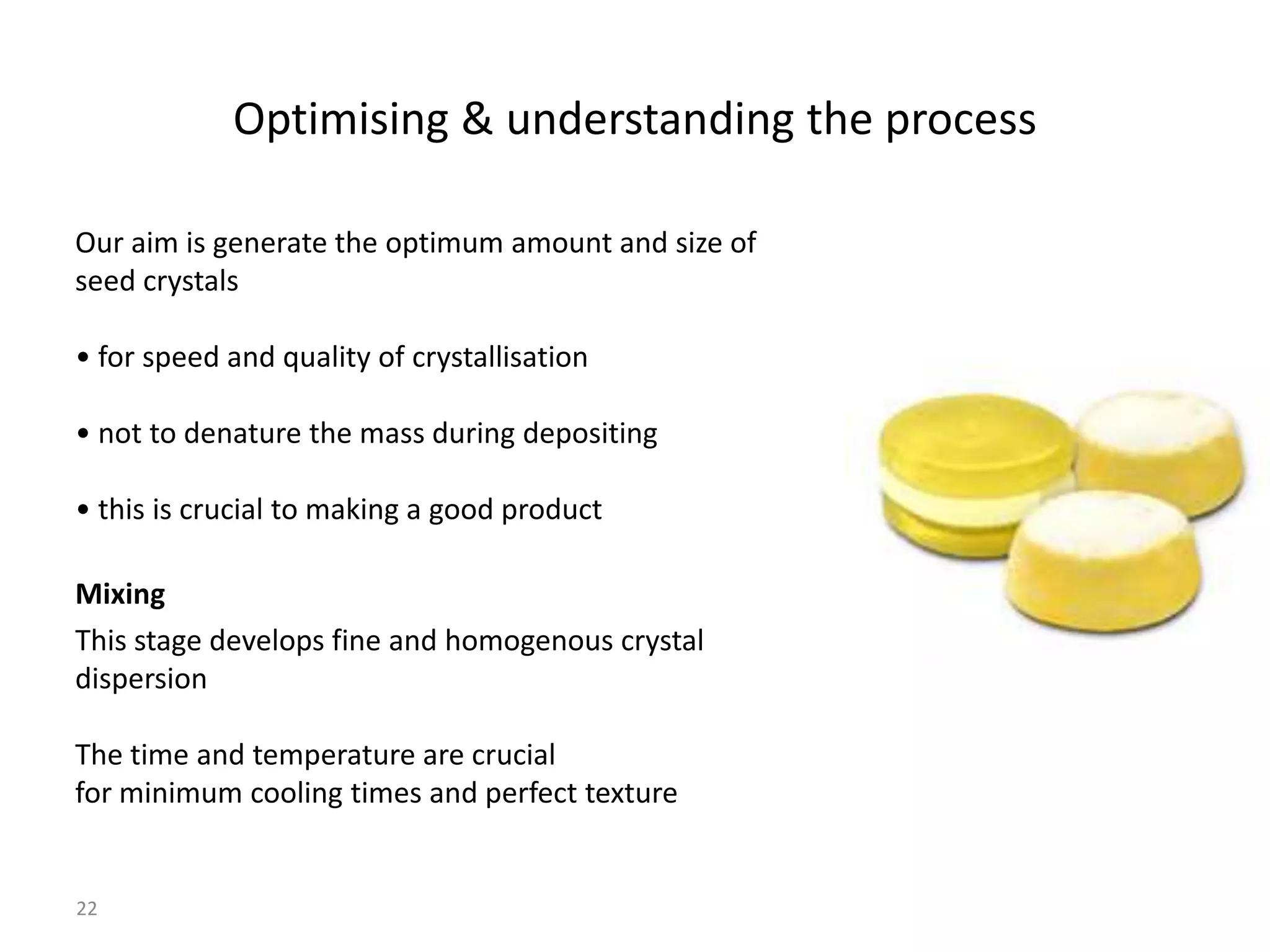
Our aim is generate the optimum amount and size of
seed crystals

• for speed and quality of crystallisation

• not to denature the mass during depositing

• this is crucial to making a good product

Mixing
This stage develops fine and homogenous crystal
dispersion

The time and temperature are crucial
for minimum cooling times and perfect texture


22
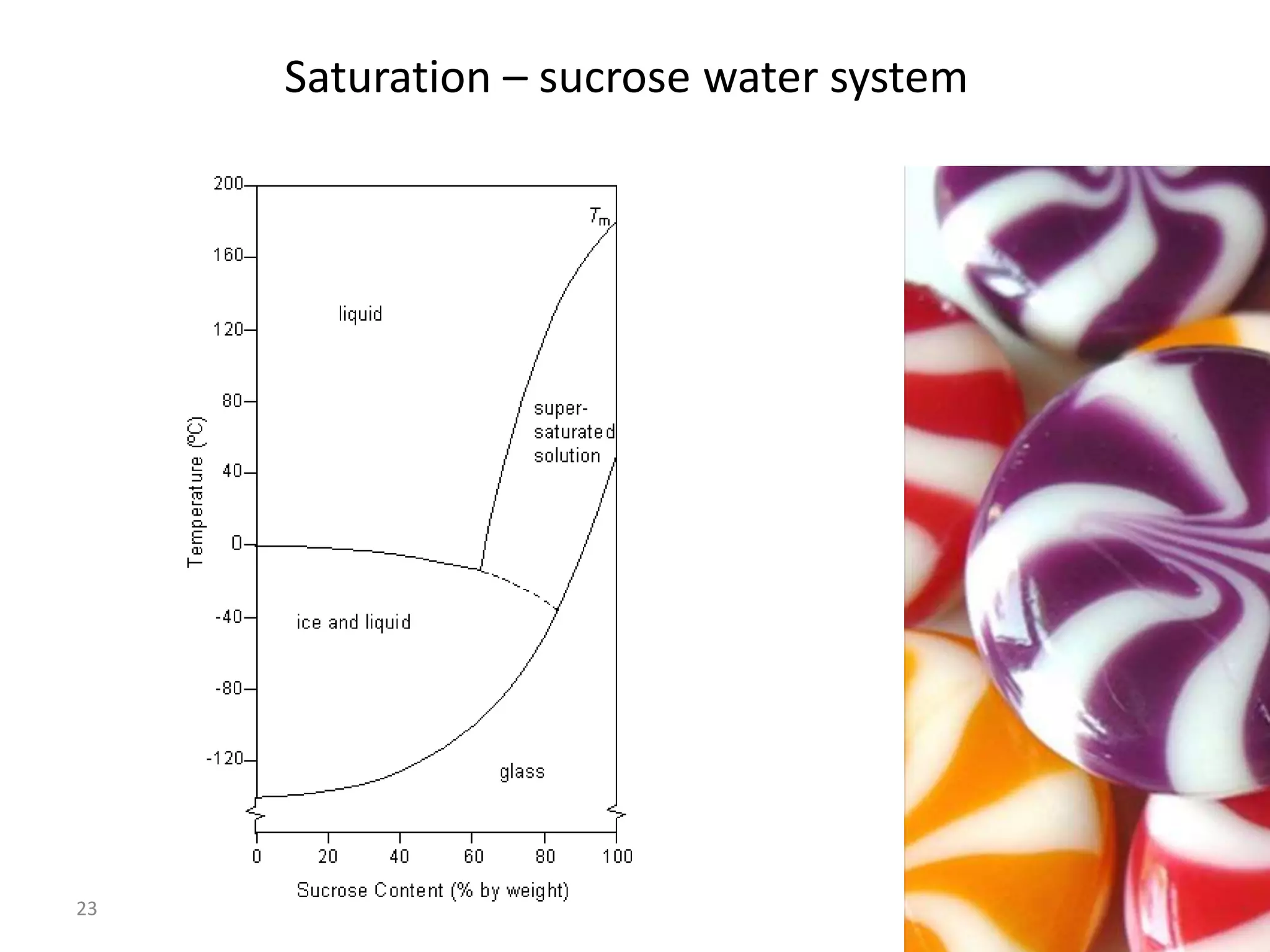
Saturation – sucrose water system


23
                                         23
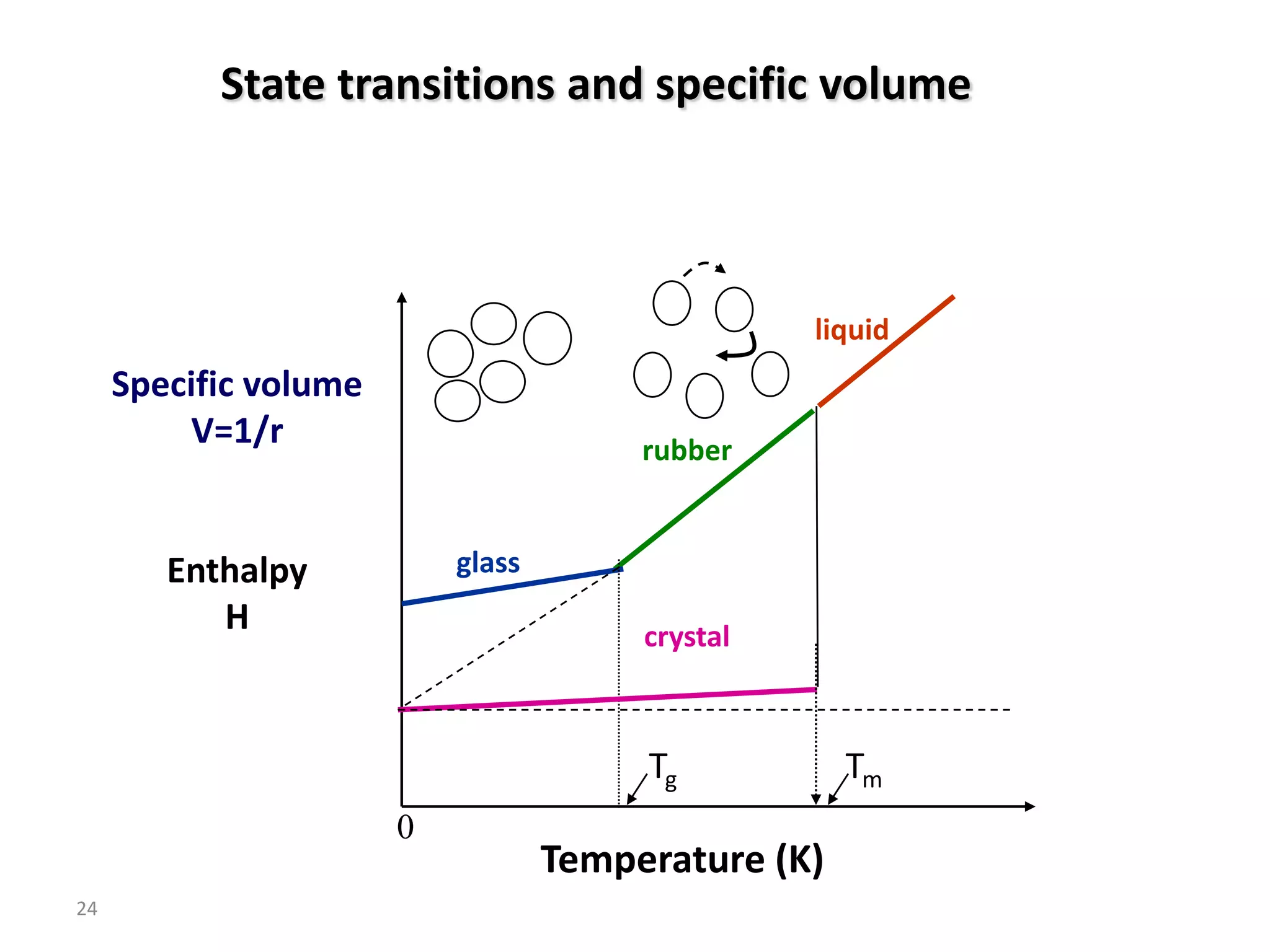
State transitions and specific volume


                                                  liquid
     Specific volume
         V=1/r                          rubber


        Enthalpy           glass
           H                            crystal


                                        Tg           Tm
                       0
                                   Temperature (K)
24
Glassy state

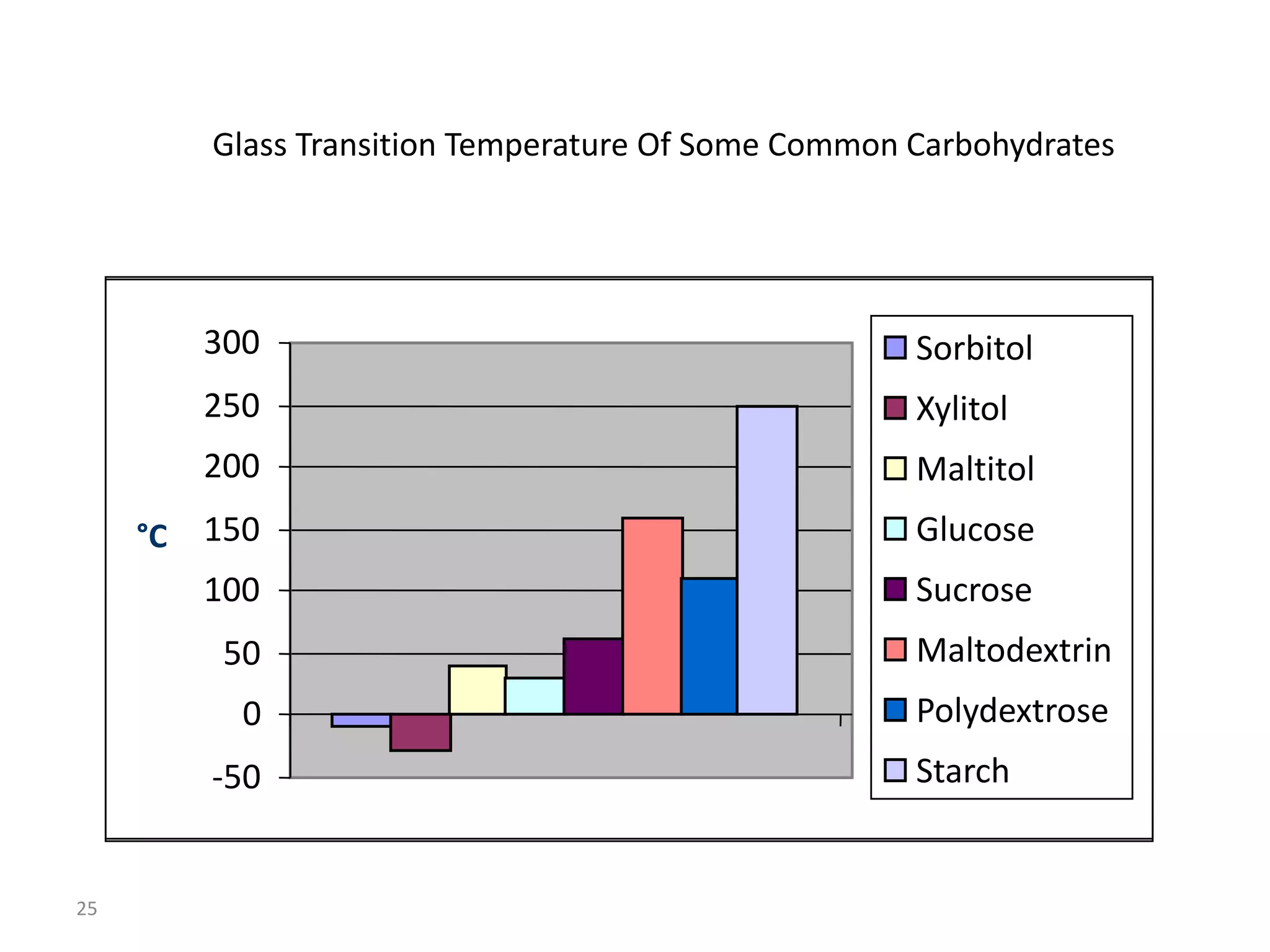
          Glass Transition Temperature Of Some Common Carbohydrates


          300                                         Sorbitol
          250                                         Xylitol
          200                                         Maltitol
     °C   150                                         Glucose
          100                                         Sucrose
           50                                         Maltodextrin
            0                                         Polydextrose
          -50                                         Starch


25
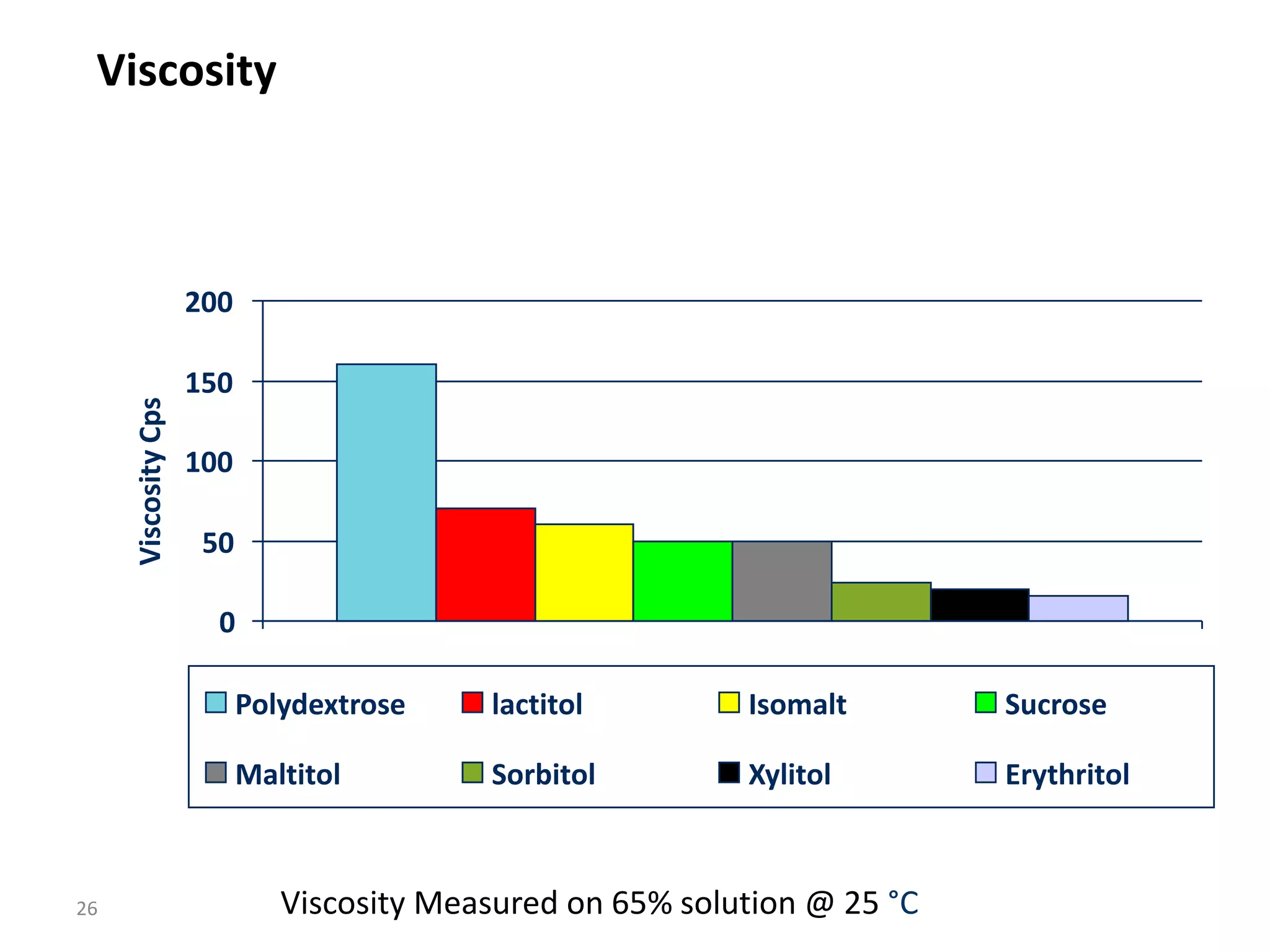
Viscosity


                     200

                     150
     Viscosity Cps


                     100

                      50

                       0

                           Polydextrose    lactitol         Isomalt        Sucrose

                           Maltitol        Sorbitol         Xylitol        Erythritol


26                            Viscosity Measured on 65% solution @ 25 °C
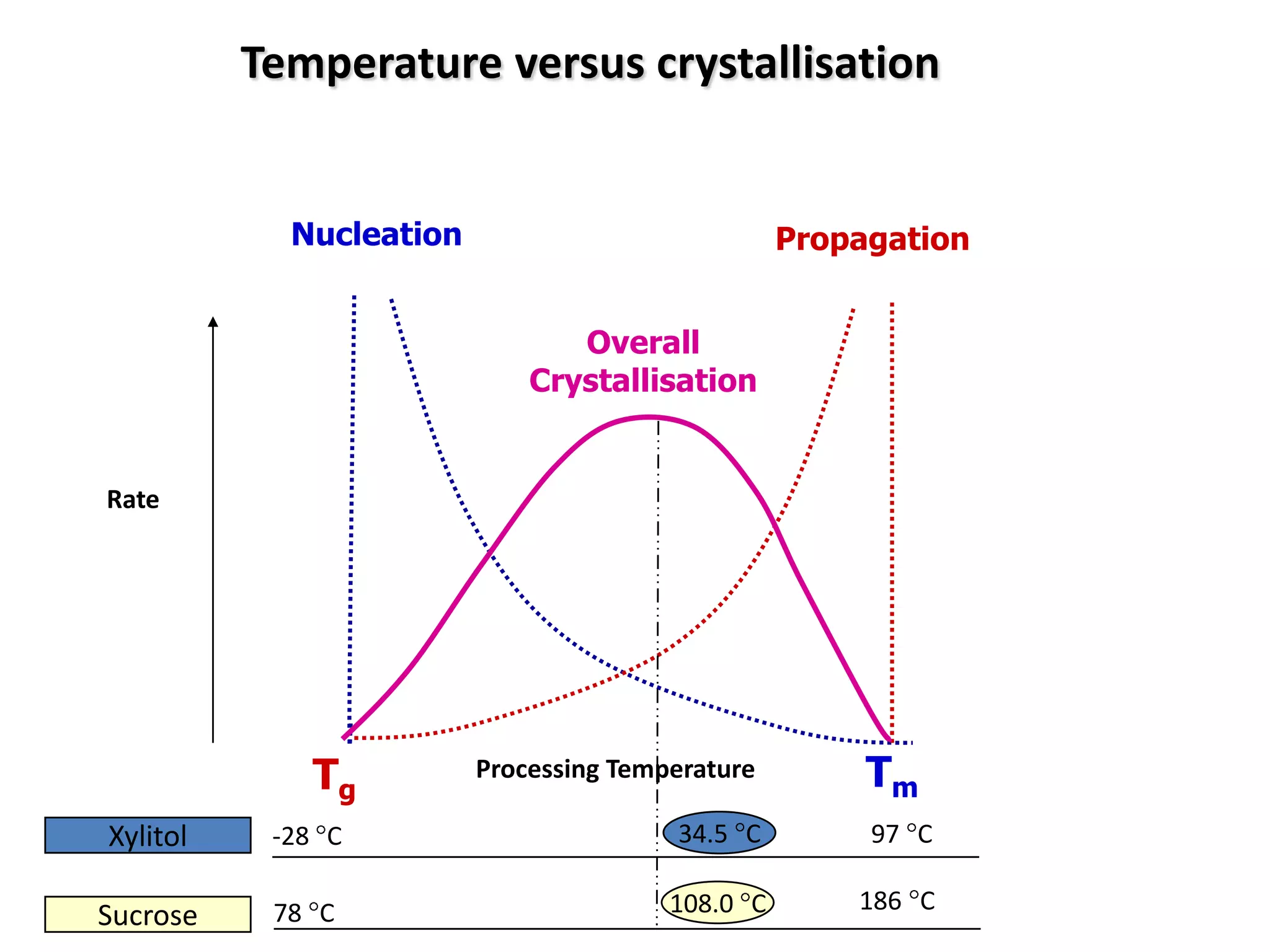
Temperature versus crystallisation


              Nucleation                            Propagation


                                  Overall
                               Crystallisation


  Rate


               Tg          Processing Temperature        Tm
  Xylitol    -28 C                        34.5 C         97 C

27Sucrose    78 C                         108.0 C       186 C
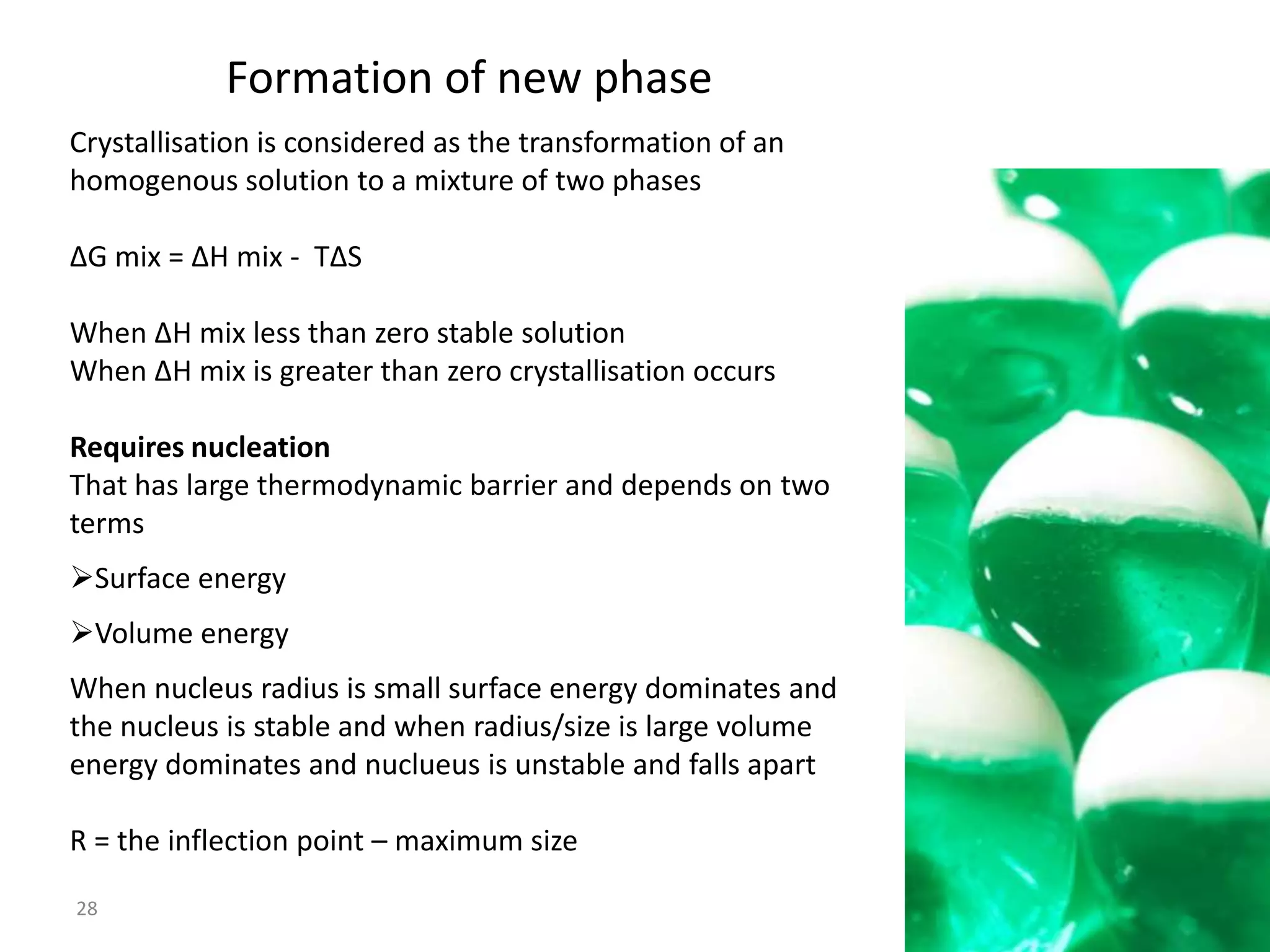
Formation of new phase
Crystallisation is considered as the transformation of an
homogenous solution to a mixture of two phases

∆G mix = ∆H mix - T∆S

When ∆H mix less than zero stable solution
When ∆H mix is greater than zero crystallisation occurs

Requires nucleation
That has large thermodynamic barrier and depends on two
terms
Surface energy
Volume energy
When nucleus radius is small surface energy dominates and
the nucleus is stable and when radius/size is large volume
energy dominates and nuclueus is unstable and falls apart

R = the inflection point – maximum size

28
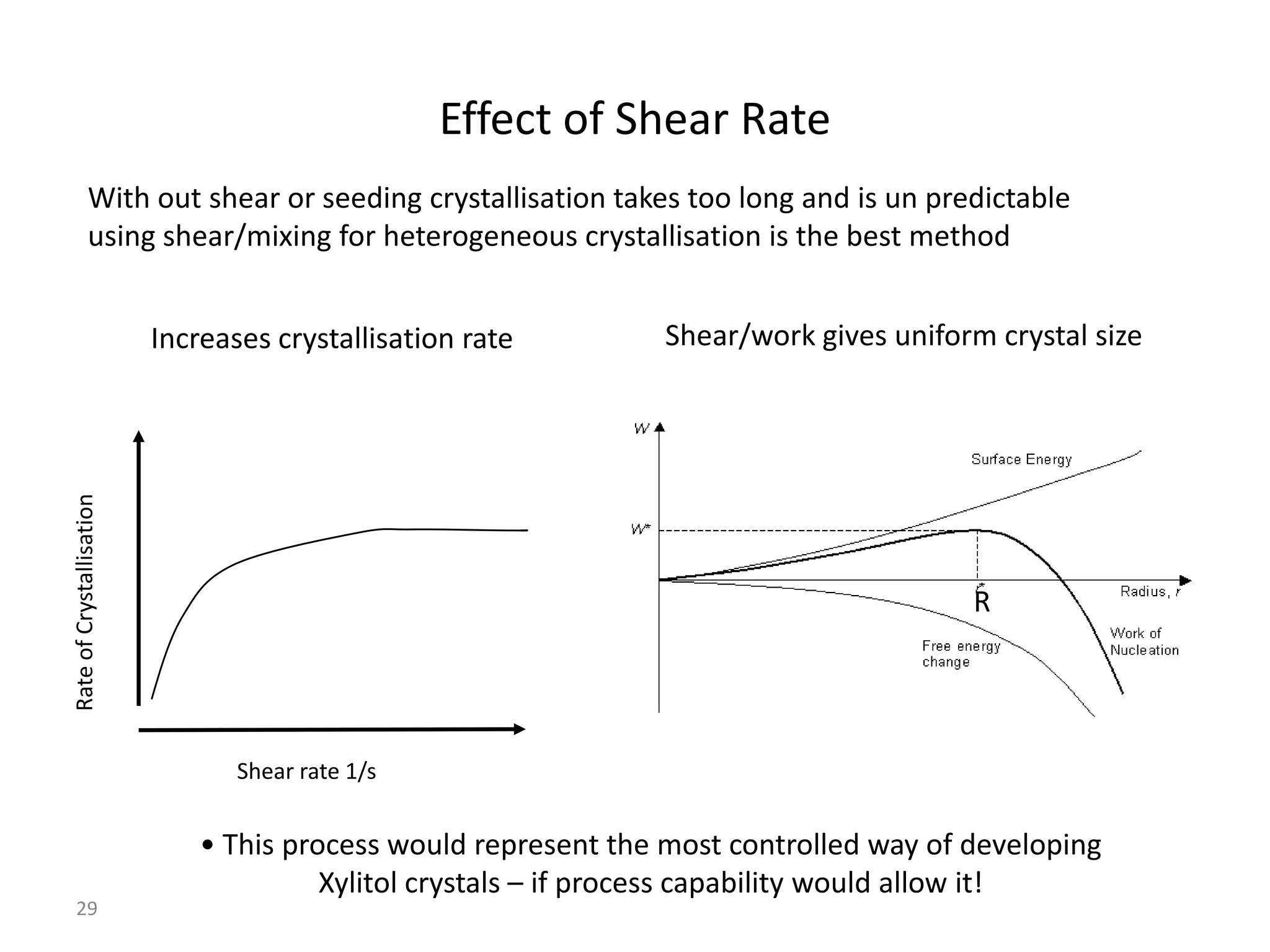
Effect of Shear Rate
             With out shear or seeding crystallisation takes too long and is un predictable
             using shear/mixing for heterogeneous crystallisation is the best method


                          Increases crystallisation rate         Shear/work gives uniform crystal size
Rate of Crystallisation


                                                                                        R


                                 Shear rate 1/s


                              • This process would represent the most controlled way of developing
                                        Xylitol crystals – if process capability would allow it!
  29
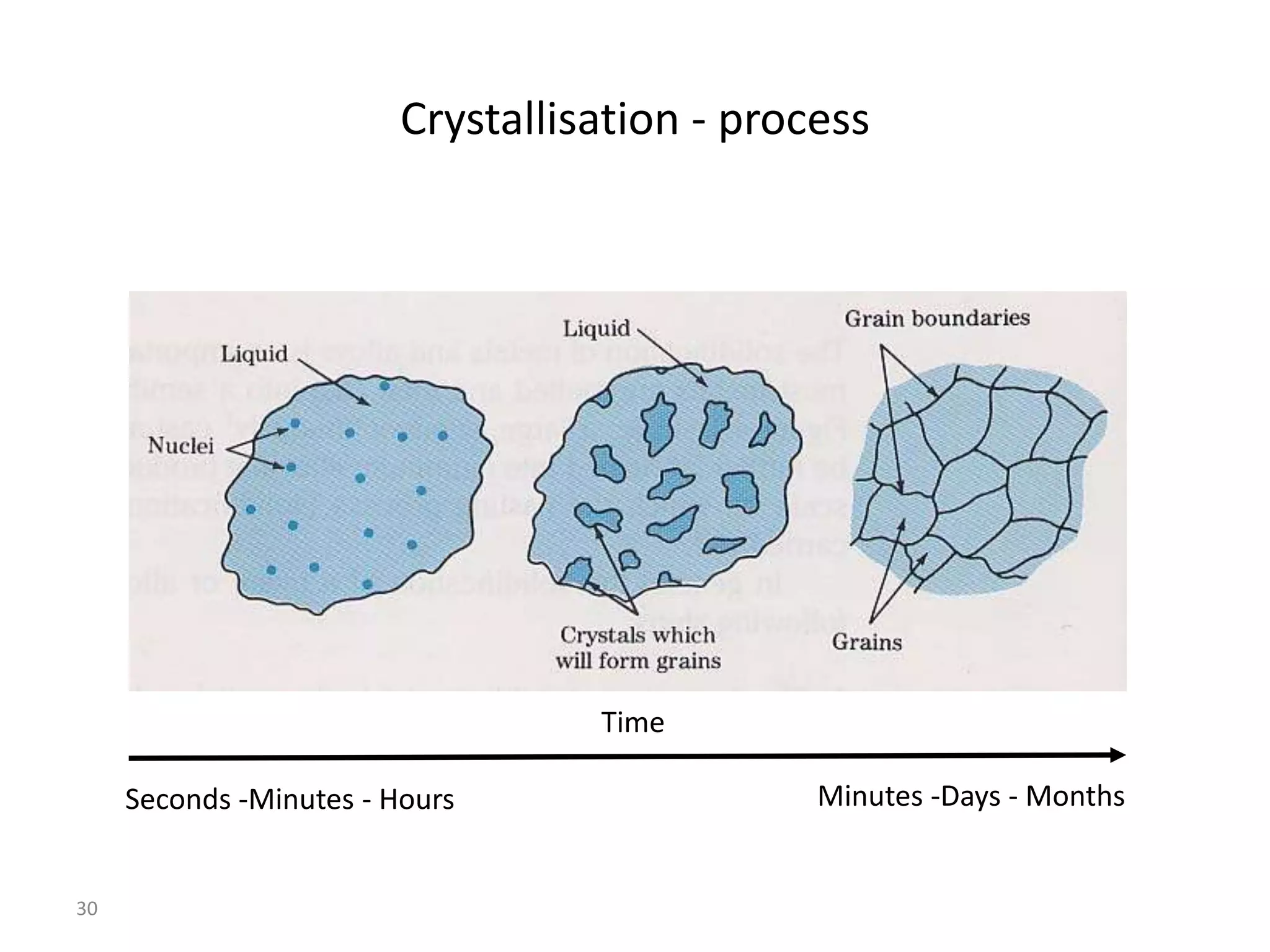
Crystallisation - process


                                   Time

     Seconds -Minutes - Hours                  Minutes -Days - Months


30
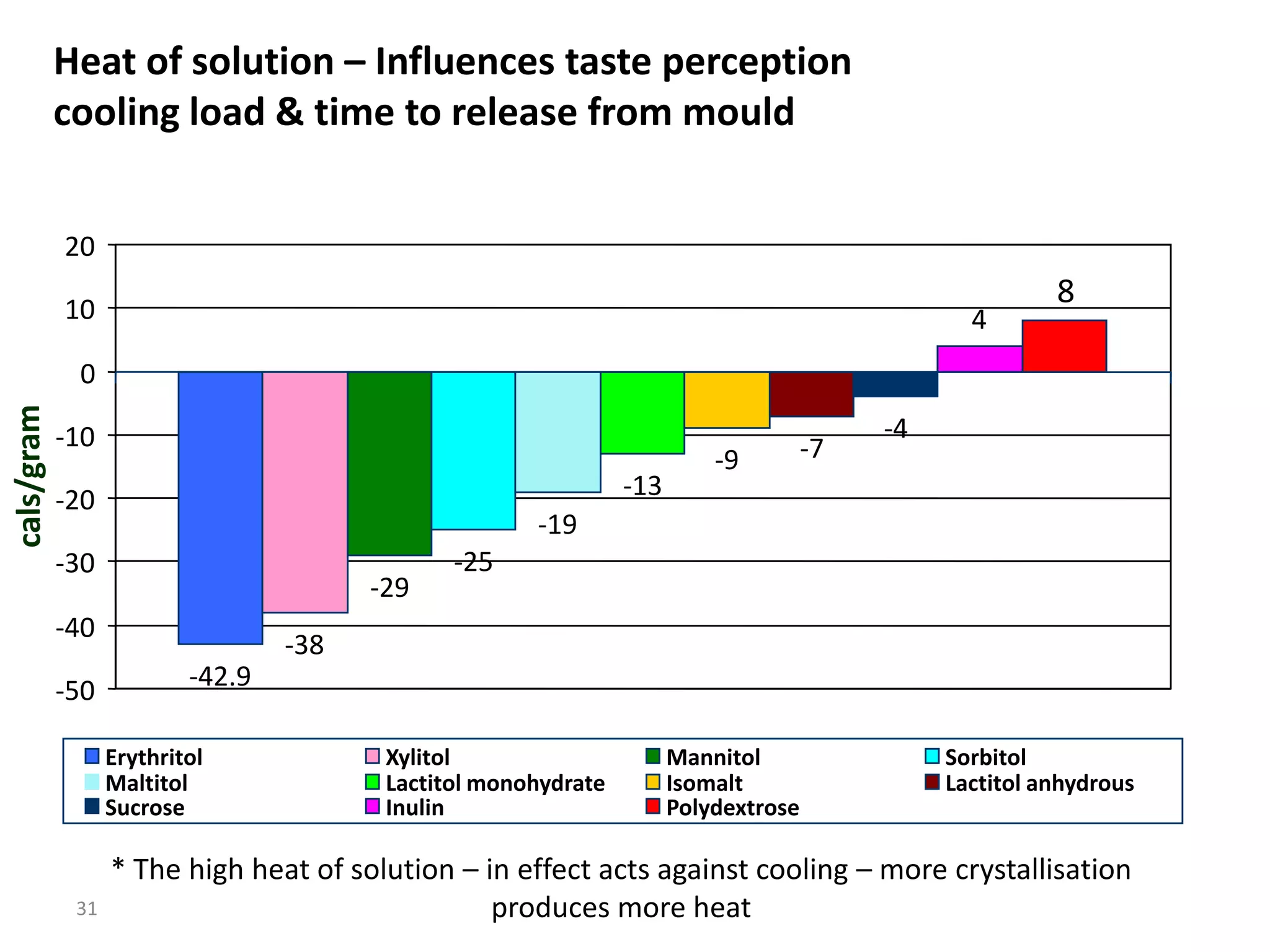
Heat of solution – Influences taste perception
cooling load & time to release from mould


20

10
                                                                                             8
                                                                                     4
 0

-10                                                                           -4
                                                              -9         -7
-20                                                 -13
                                          -19
-30                                -25
                            -29
-40
                      -38
-50           -42.9

      Erythritol             Xylitol                      Mannitol                 Sorbitol
      Maltitol               Lactitol monohydrate         Isomalt                  Lactitol anhydrous
      Sucrose                Inulin                       Polydextrose

      * The high heat of solution – in effect acts against cooling – more crystallisation
 31                                  produces more heat
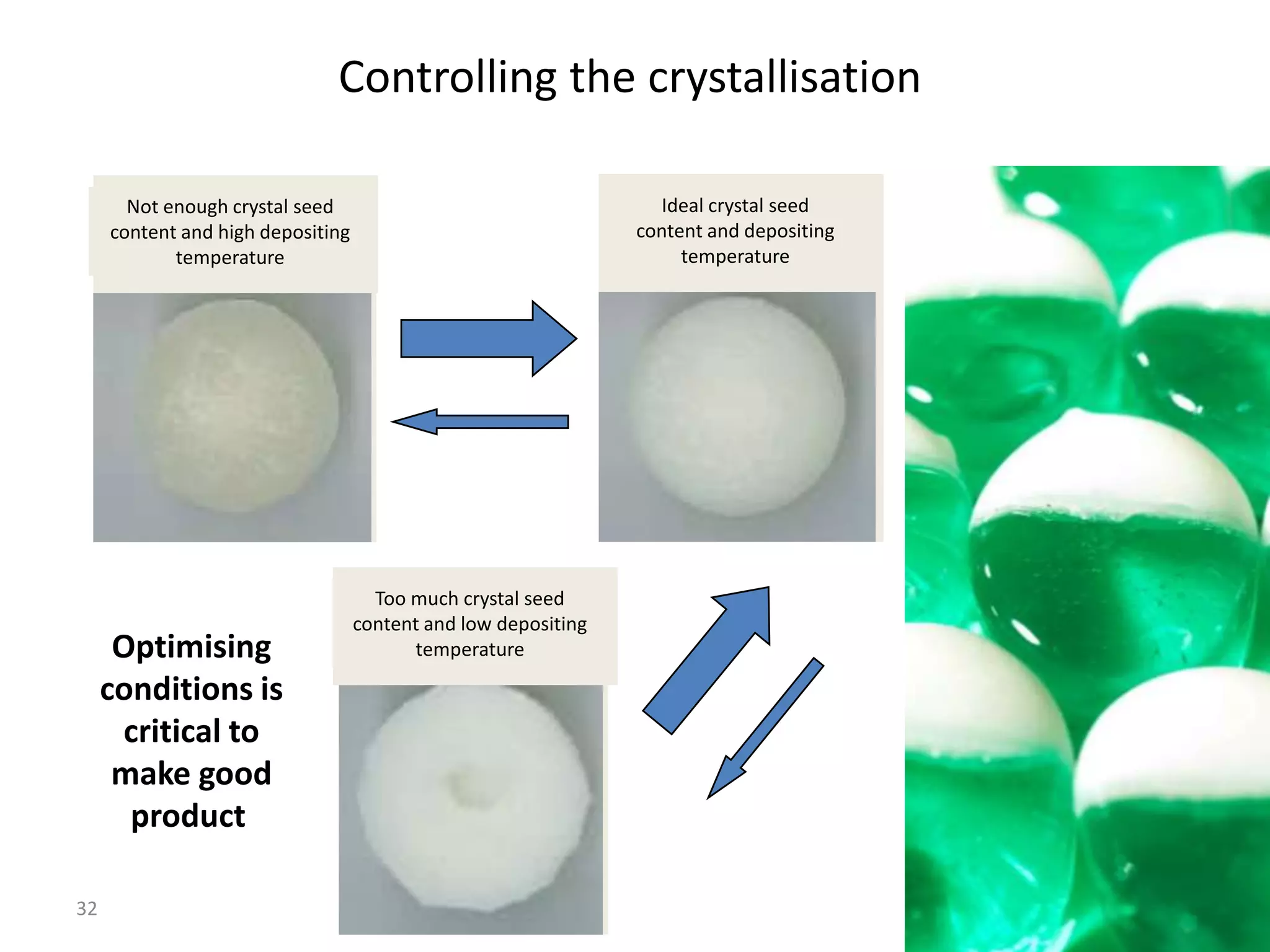
Controlling the crystallisation

       Not enough crystal seed                                     Ideal crystal seed
     content and high depositing                                content and depositing
            temperature                                              temperature


                                     Too much crystal seed
                                   content and low depositing
      Optimising                         temperature

     conditions is
      critical to
      make good
       product

32
                                                                                         32
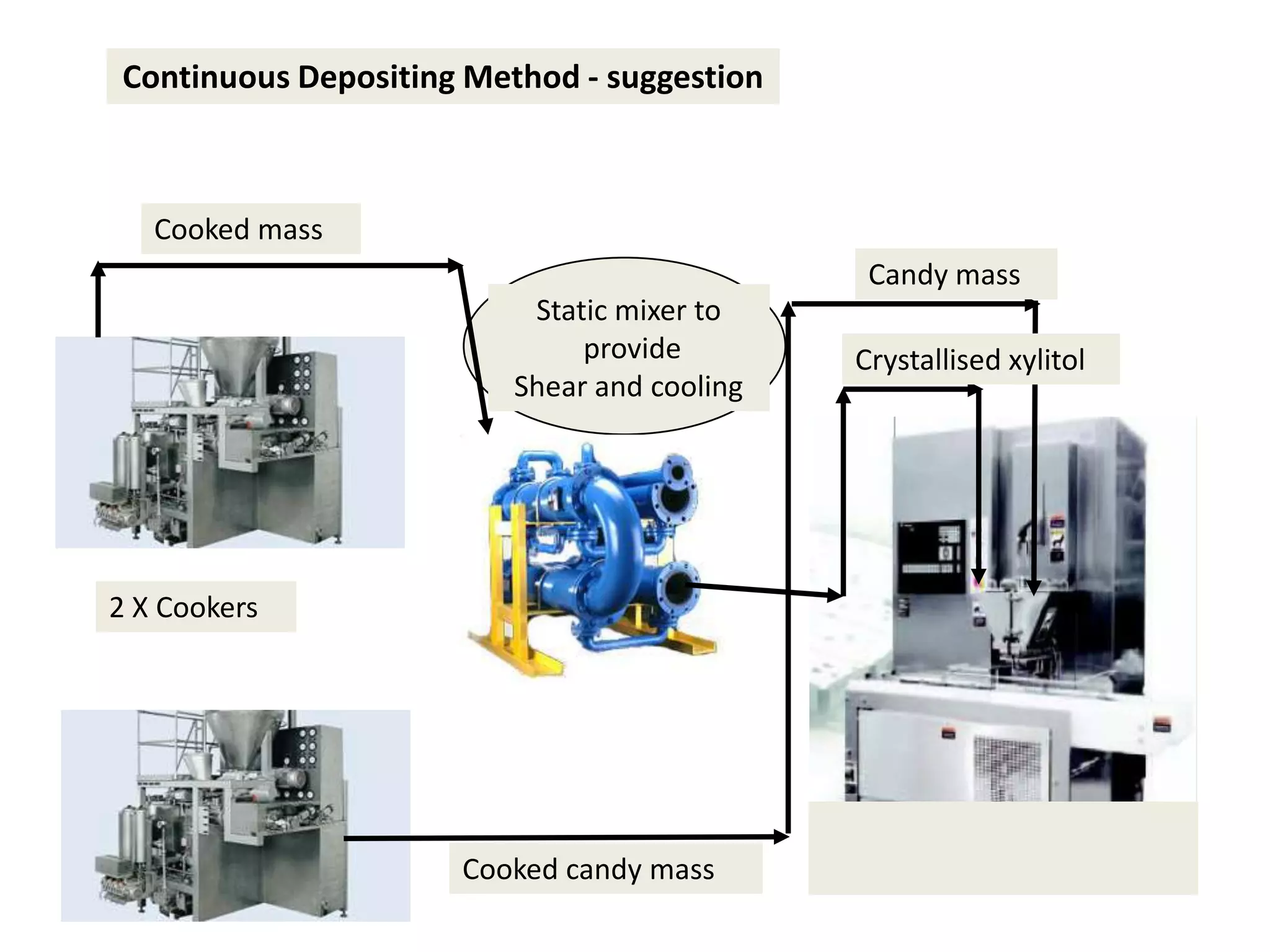
Continuous Depositing Method - suggestion


        Cooked mass
                                                    Candy mass
                                Static mixer to
                                    provide        Crystallised xylitol
                               Shear and cooling


     2 X Cookers


                           Cooked candy mass
33
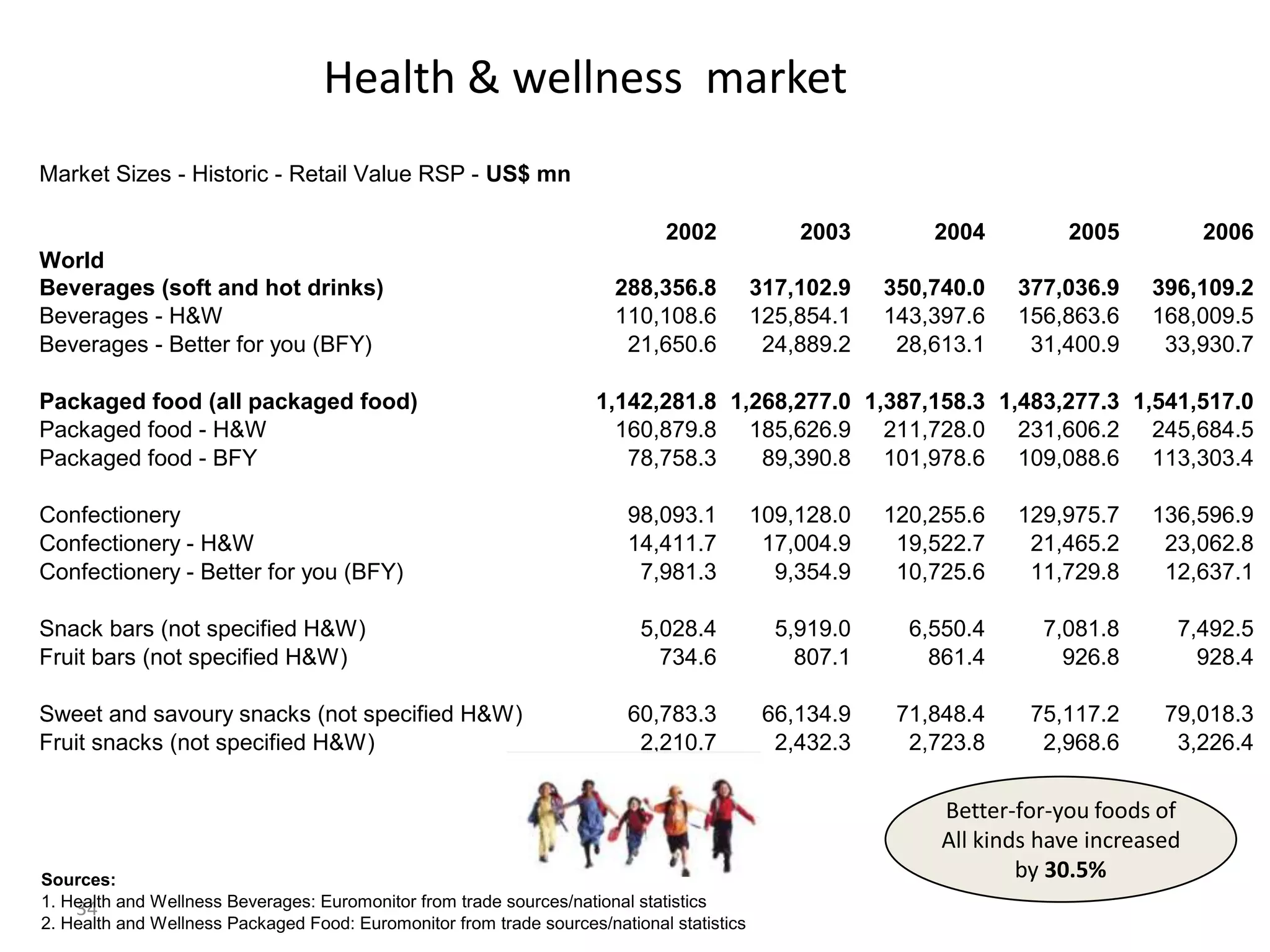
Health & wellness market
Market Sizes - Historic - Retail Value RSP - US$ mn

                                                                             2002              2003        2004         2005           2006
World
Beverages (soft and hot drinks)                                        288,356.8           317,102.9   350,740.0   377,036.9     396,109.2
Beverages - H&W                                                        110,108.6           125,854.1   143,397.6   156,863.6     168,009.5
Beverages - Better for you (BFY)                                        21,650.6            24,889.2    28,613.1    31,400.9      33,930.7

Packaged food (all packaged food)                                    1,142,281.8 1,268,277.0 1,387,158.3 1,483,277.3 1,541,517.0
Packaged food - H&W                                                    160,879.8 185,626.9 211,728.0 231,606.2 245,684.5
Packaged food - BFY                                                     78,758.3    89,390.8 101,978.6 109,088.6 113,303.4

Confectionery                                                            98,093.1          109,128.0   120,255.6   129,975.7     136,596.9
Confectionery - H&W                                                      14,411.7           17,004.9    19,522.7    21,465.2      23,062.8
Confectionery - Better for you (BFY)                                      7,981.3            9,354.9    10,725.6    11,729.8      12,637.1

Snack bars (not specified H&W)                                            5,028.4            5,919.0     6,550.4      7,081.8      7,492.5
Fruit bars (not specified H&W)                                              734.6              807.1       861.4        926.8        928.4

Sweet and savoury snacks (not specified H&W)                             60,783.3           66,134.9    71,848.4    75,117.2      79,018.3
Fruit snacks (not specified H&W)                                          2,210.7            2,432.3     2,723.8     2,968.6       3,226.4

                                                                                                            Better-for-you foods of
                                                                                                            All kinds have increased
Sources:                                                                                                            by 30.5%
1. Health and Wellness Beverages: Euromonitor from trade sources/national statistics
    34
2. Health and Wellness Packaged Food: Euromonitor from trade sources/national statistics
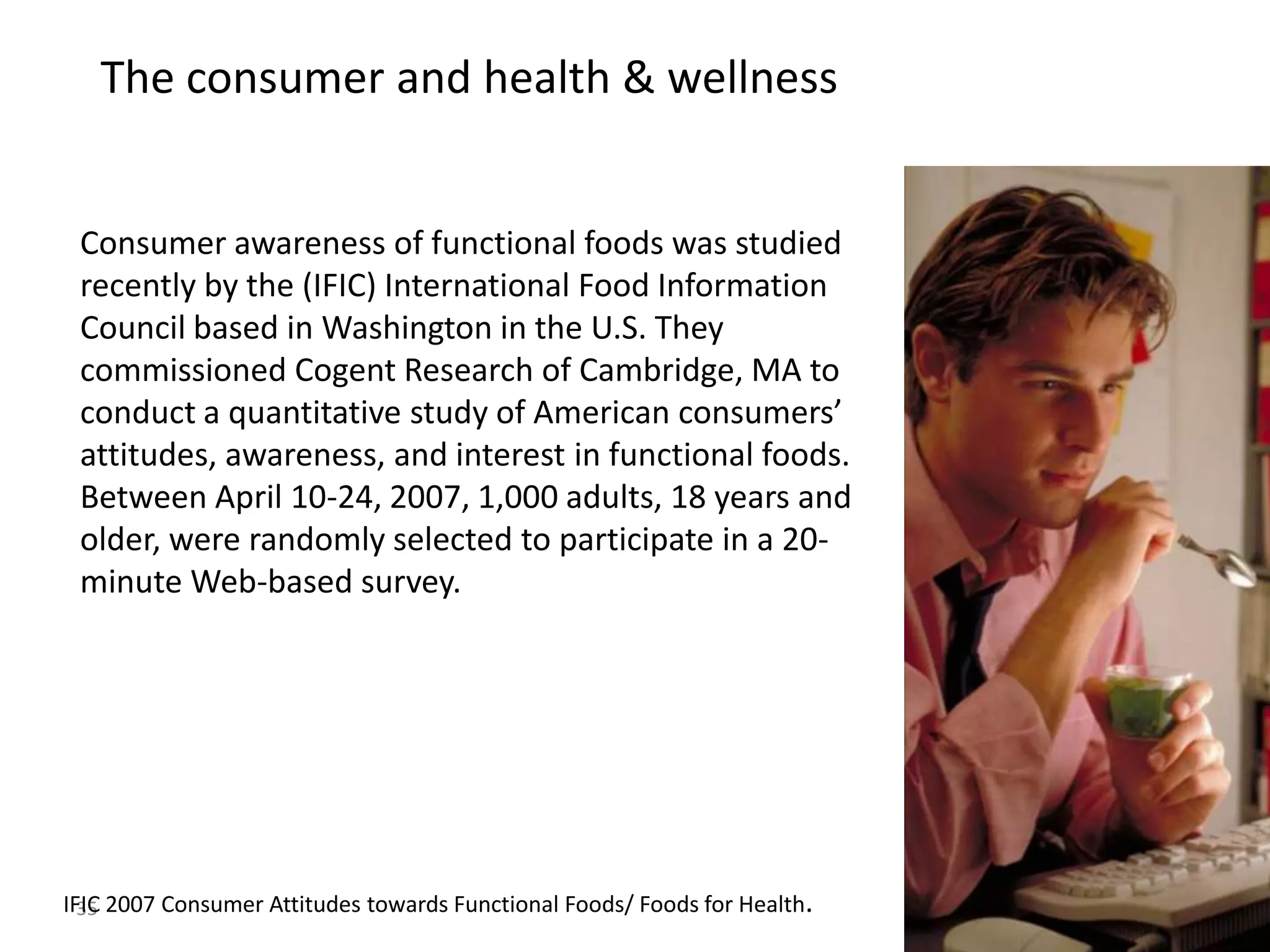
The consumer and health & wellness


 Consumer awareness of functional foods was studied
 recently by the (IFIC) International Food Information
 Council based in Washington in the U.S. They
 commissioned Cogent Research of Cambridge, MA to
 conduct a quantitative study of American consumers’
 attitudes, awareness, and interest in functional foods.
 Between April 10-24, 2007, 1,000 adults, 18 years and
 older, were randomly selected to participate in a 20-
 minute Web-based survey.


IFIC 2007 Consumer Attitudes towards Functional Foods/ Foods for Health.
  35
                                                                           35
The consumer and health & wellness

When asked about their belief in functional foods, the
vast majority of consumers agree that certain foods have
health benefits that go beyond basic nutrition and may
reduce the risk of disease or other health concerns

The table below lists the top health concerns


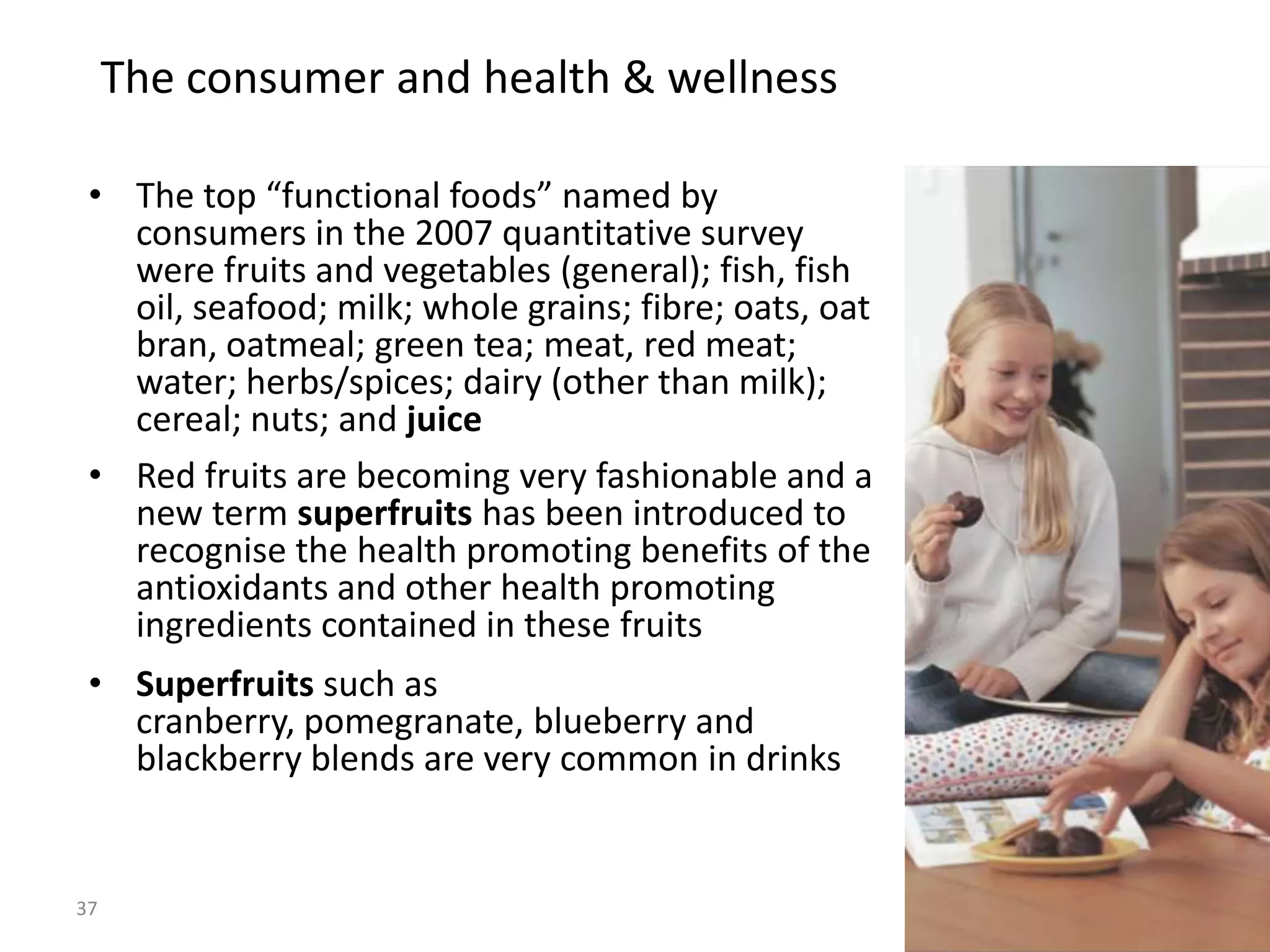
                    Health Concern               Ranking
                    Heart & Circulatory issues   53%
                    Weight                       33%
                    Cancer                       24%
                    Diabetes                     17%
                    Nutrition & Diet             16%
                    Exercise                     11%
                    Lung & Respiratory           7%
                    Arthritis                    5%


36 2007 Consumer Attitudes towards Functional Foods/ Foods for Health.
 IFIC
                                                                         36
The consumer and health & wellness

 • The top “functional foods” named by
   consumers in the 2007 quantitative survey
   were fruits and vegetables (general); fish, fish
   oil, seafood; milk; whole grains; fibre; oats, oat
   bran, oatmeal; green tea; meat, red meat;
   water; herbs/spices; dairy (other than milk);
   cereal; nuts; and juice
 • Red fruits are becoming very fashionable and a
   new term superfruits has been introduced to
   recognise the health promoting benefits of the
   antioxidants and other health promoting
   ingredients contained in these fruits
 • Superfruits such as
   cranberry, pomegranate, blueberry and
   blackberry blends are very common in drinks


37
                                                        37
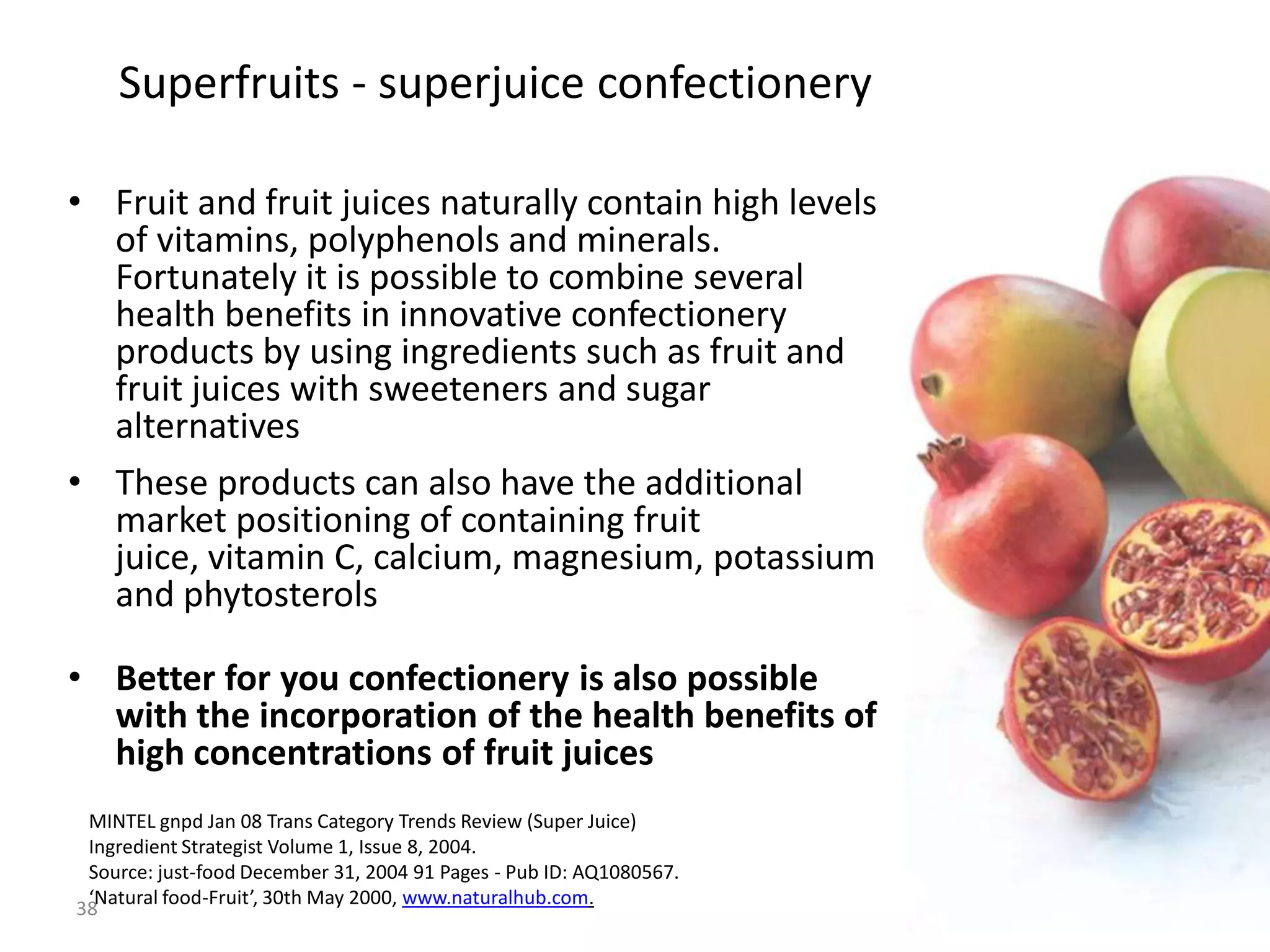
Superfruits - superjuice confectionery

• Fruit and fruit juices naturally contain high levels
  of vitamins, polyphenols and minerals.
  Fortunately it is possible to combine several
  health benefits in innovative confectionery
  products by using ingredients such as fruit and
  fruit juices with sweeteners and sugar
  alternatives
• These products can also have the additional
  market positioning of containing fruit
  juice, vitamin C, calcium, magnesium, potassium
  and phytosterols

• Better for you confectionery is also possible
  with the incorporation of the health benefits of
  high concentrations of fruit juices
 MINTEL gnpd Jan 08 Trans Category Trends Review (Super Juice)
 Ingredient Strategist Volume 1, Issue 8, 2004.
 Source: just-food December 31, 2004 91 Pages - Pub ID: AQ1080567.
 ‘Natural food-Fruit’, 30th May 2000, www.naturalhub.com.
38
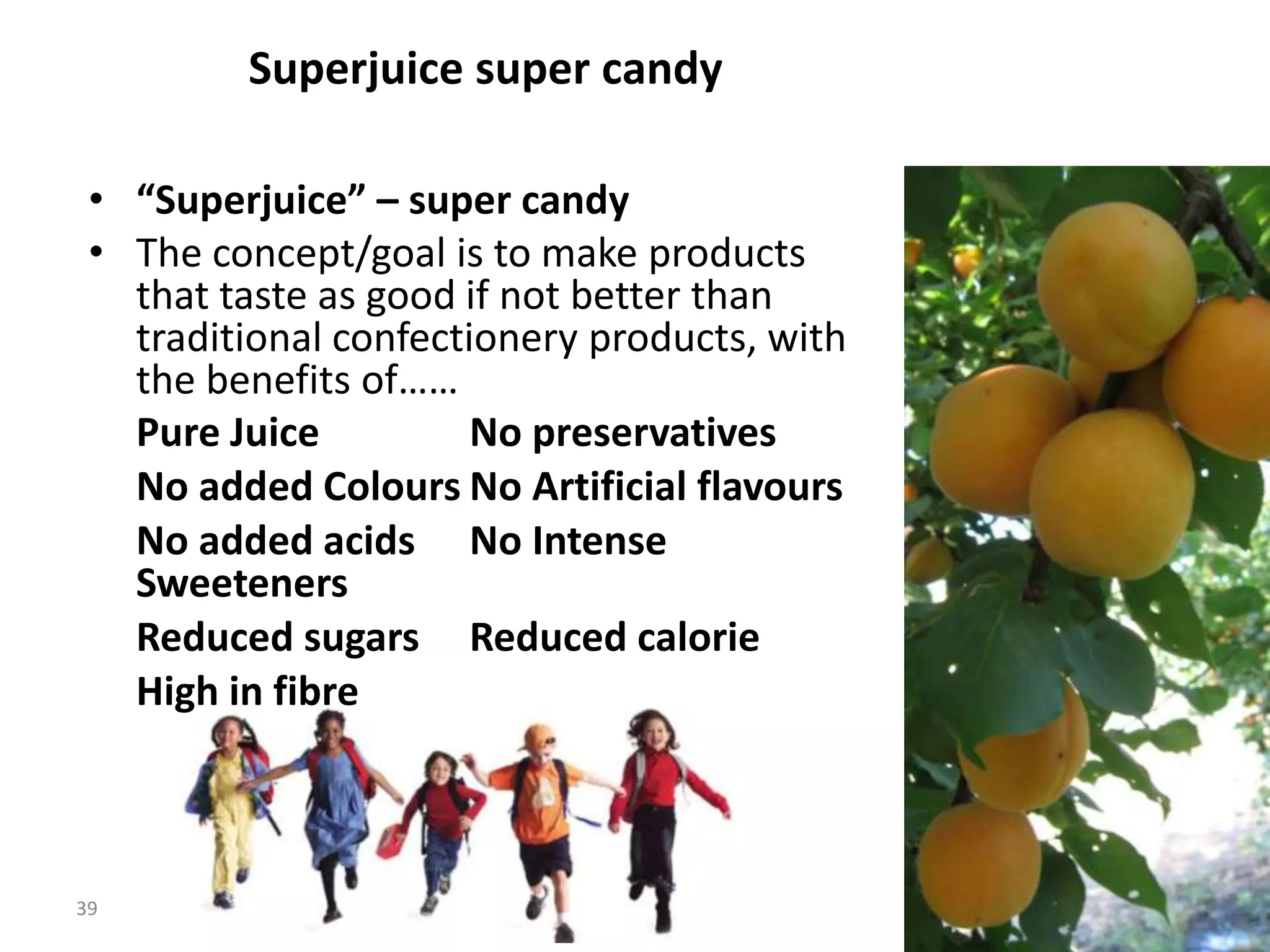
Superjuice super candy

 • “Superjuice” – super candy
 • The concept/goal is to make products
   that taste as good if not better than
   traditional confectionery products, with
   the benefits of……
   Pure Juice          No preservatives
   No added Colours No Artificial flavours
   No added acids No Intense
   Sweeteners
   Reduced sugars Reduced calorie
   High in fibre


39
                                              39
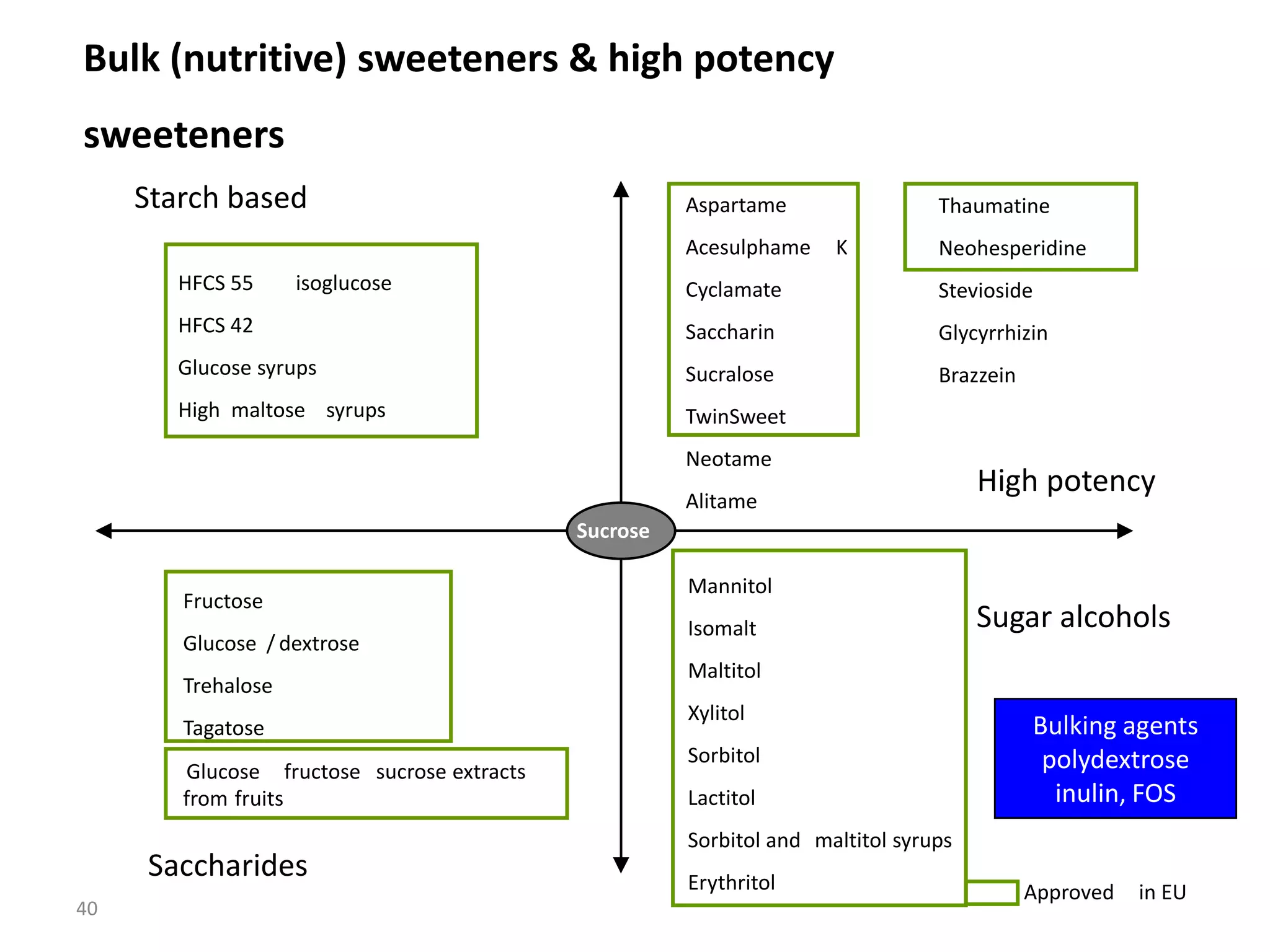
Bulk (nutritive) sweeteners & high potency
sweeteners
     Starch based                                     Aspartame                 Thaumatine
                                                      Acesulphame    K          Neohesperidine
        HFCS 55     isoglucose                        Cyclamate                 Stevioside
        HFCS 42                                       Saccharin                 Glycyrrhizin
        Glucose syrups                                Sucralose                 Brazzein
        High maltose syrups                           TwinSweet
                                                      Neotame
                                                                                     High potency
                                                      Alitame
                                            Sucrose

                                                      Mannitol
        Fructose
                                                      Isomalt                        Sugar alcohols
        Glucose / dextrose
                                                      Maltitol
        Trehalose
                                                      Xylitol
        Tagatose                                                                           Bulking agents
                                                      Sorbitol                              polydextrose
        Glucose fructose sucrose extracts
        from fruits                                   Lactitol                               inulin, FOS
                                                      Sorbitol and maltitol syrups
     Saccharides                                      Erythritol                           Approved   in EU
40
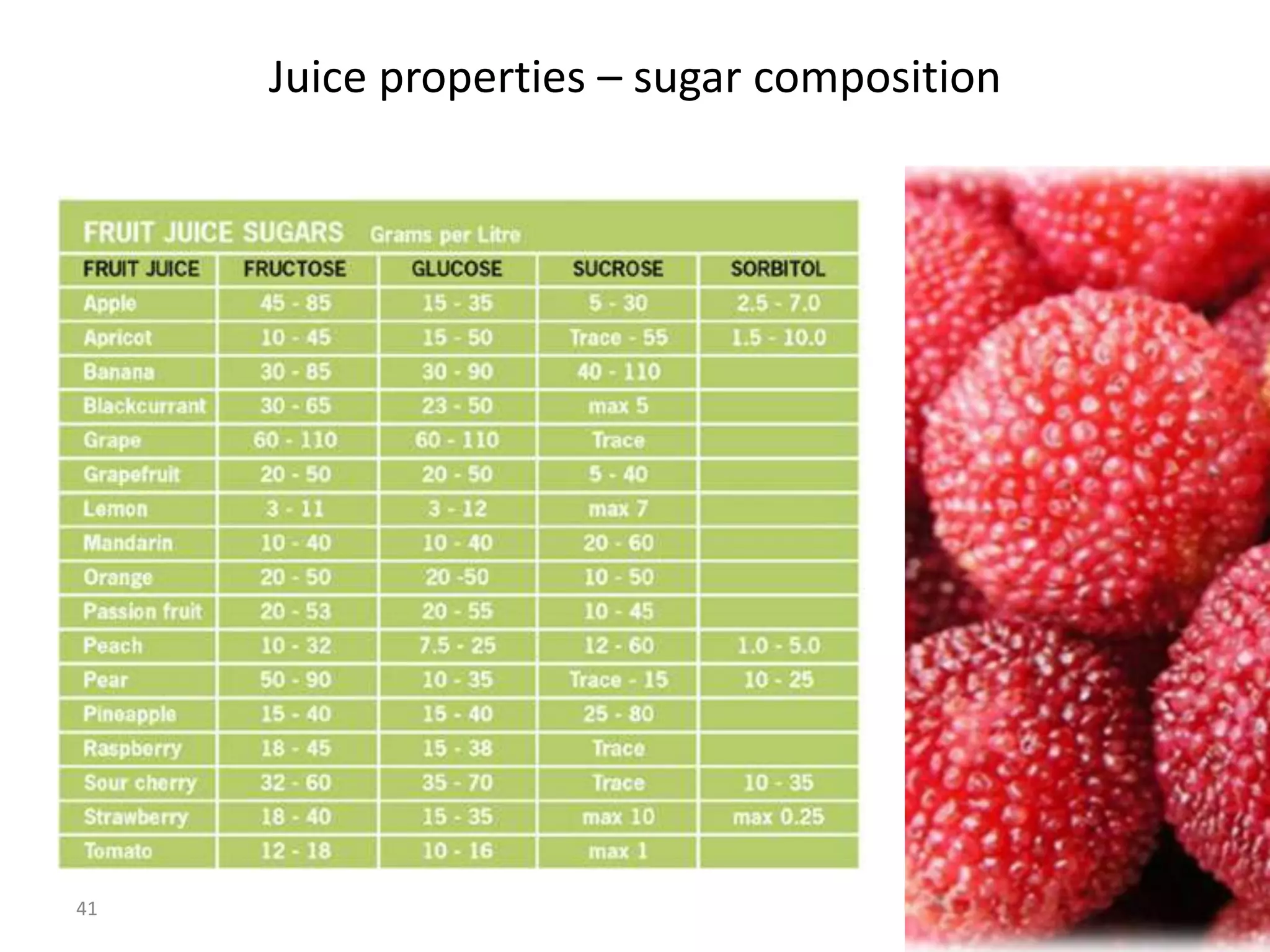
Juice properties – sugar composition


41                                          41
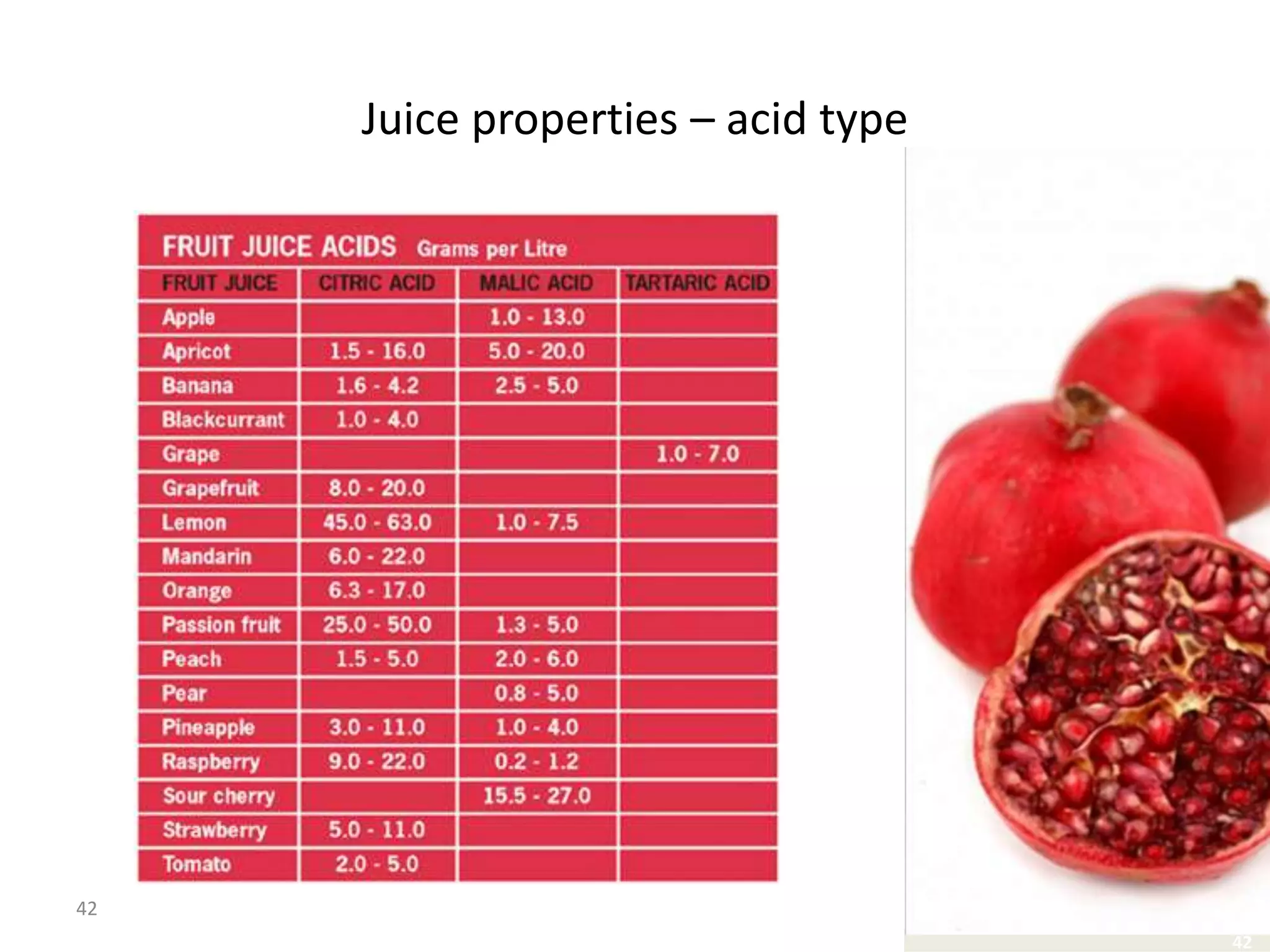
Juice properties – acid type


42
                                    42
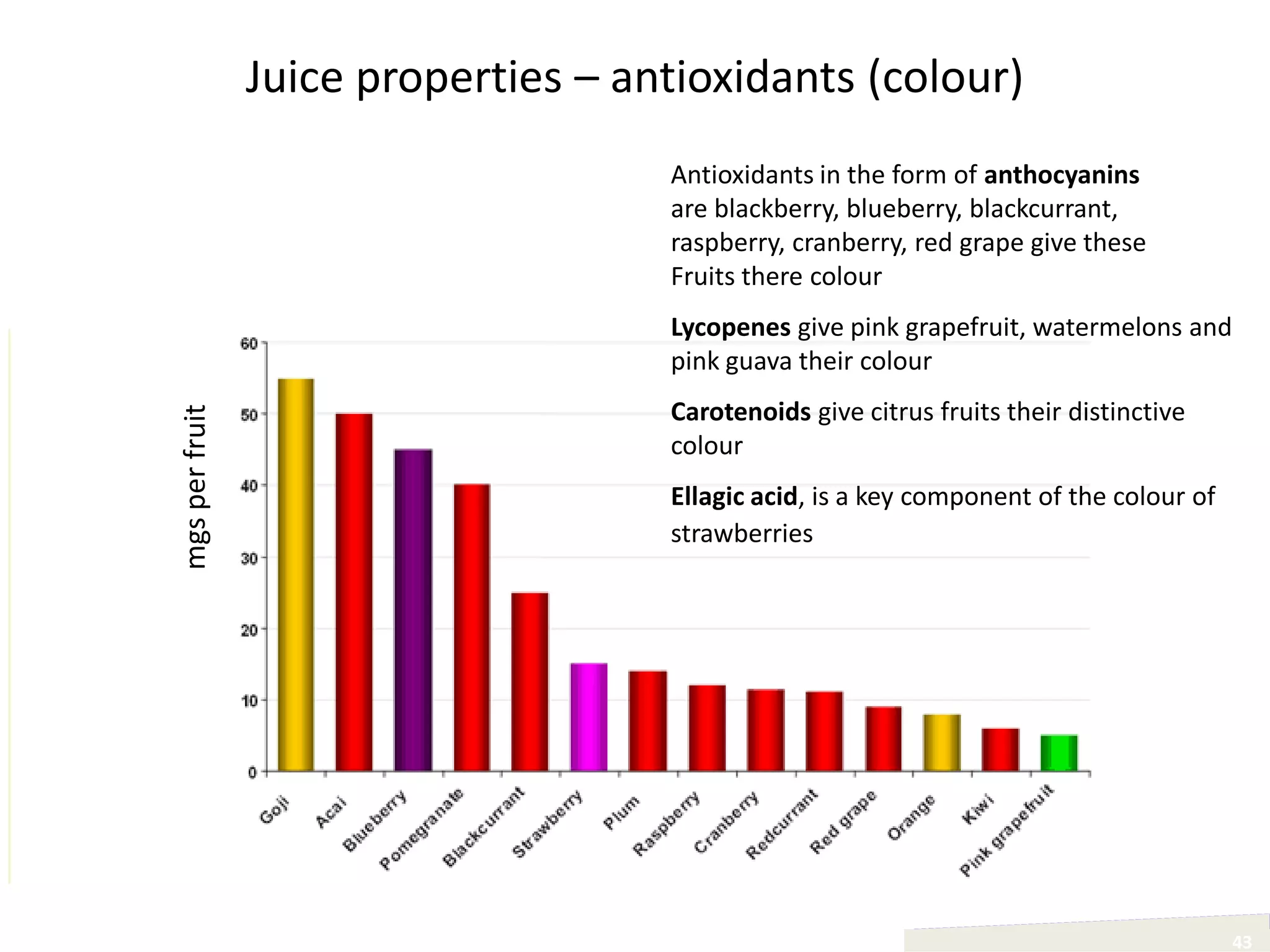
Juice properties – antioxidants (colour)
                                          Antioxidants in the form of anthocyanins
                                          are blackberry, blueberry, blackcurrant,
                                          raspberry, cranberry, red grape give these
                                          Fruits there colour
                                          Lycopenes give pink grapefruit, watermelons and
                                          pink guava their colour
                                          Carotenoids give citrus fruits their distinctive
     mgs per fruit


                                          colour
                                          Ellagic acid, is a key component of the colour of
                                          strawberries


43
                                                                                              43
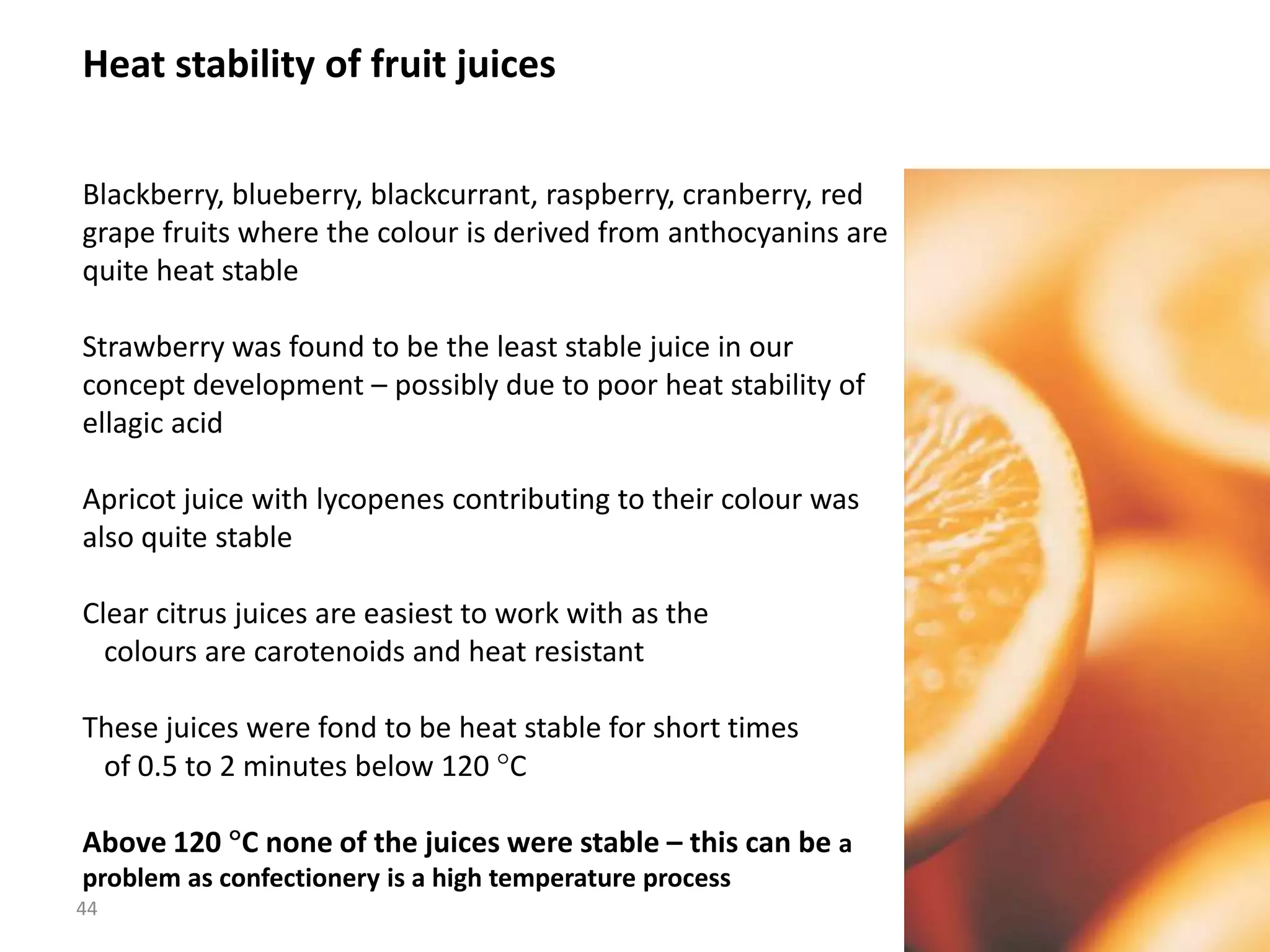
Heat stability of fruit juices


Blackberry, blueberry, blackcurrant, raspberry, cranberry, red
grape fruits where the colour is derived from anthocyanins are
quite heat stable

Strawberry was found to be the least stable juice in our
concept development – possibly due to poor heat stability of
ellagic acid

Apricot juice with lycopenes contributing to their colour was
also quite stable

Clear citrus juices are easiest to work with as the
  colours are carotenoids and heat resistant

These juices were fond to be heat stable for short times
 of 0.5 to 2 minutes below 120 C

Above 120 C none of the juices were stable – this can be a
problem as confectionery is a high temperature process
44
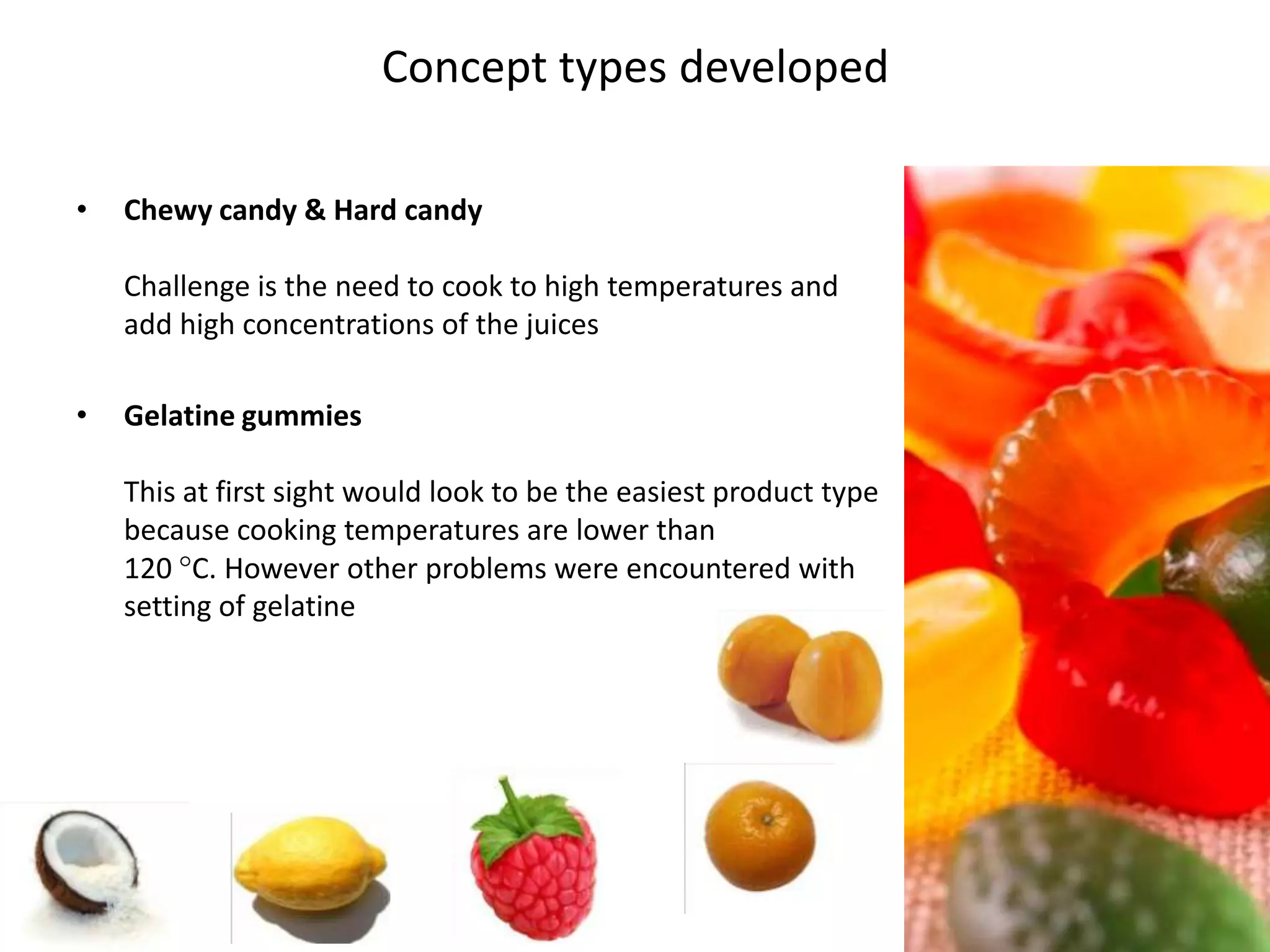
Concept types developed

•    Chewy candy & Hard candy

     Challenge is the need to cook to high temperatures and
     add high concentrations of the juices

•    Gelatine gummies

     This at first sight would look to be the easiest product type
     because cooking temperatures are lower than
     120 C. However other problems were encountered with
     setting of gelatine


45
                                                                     45
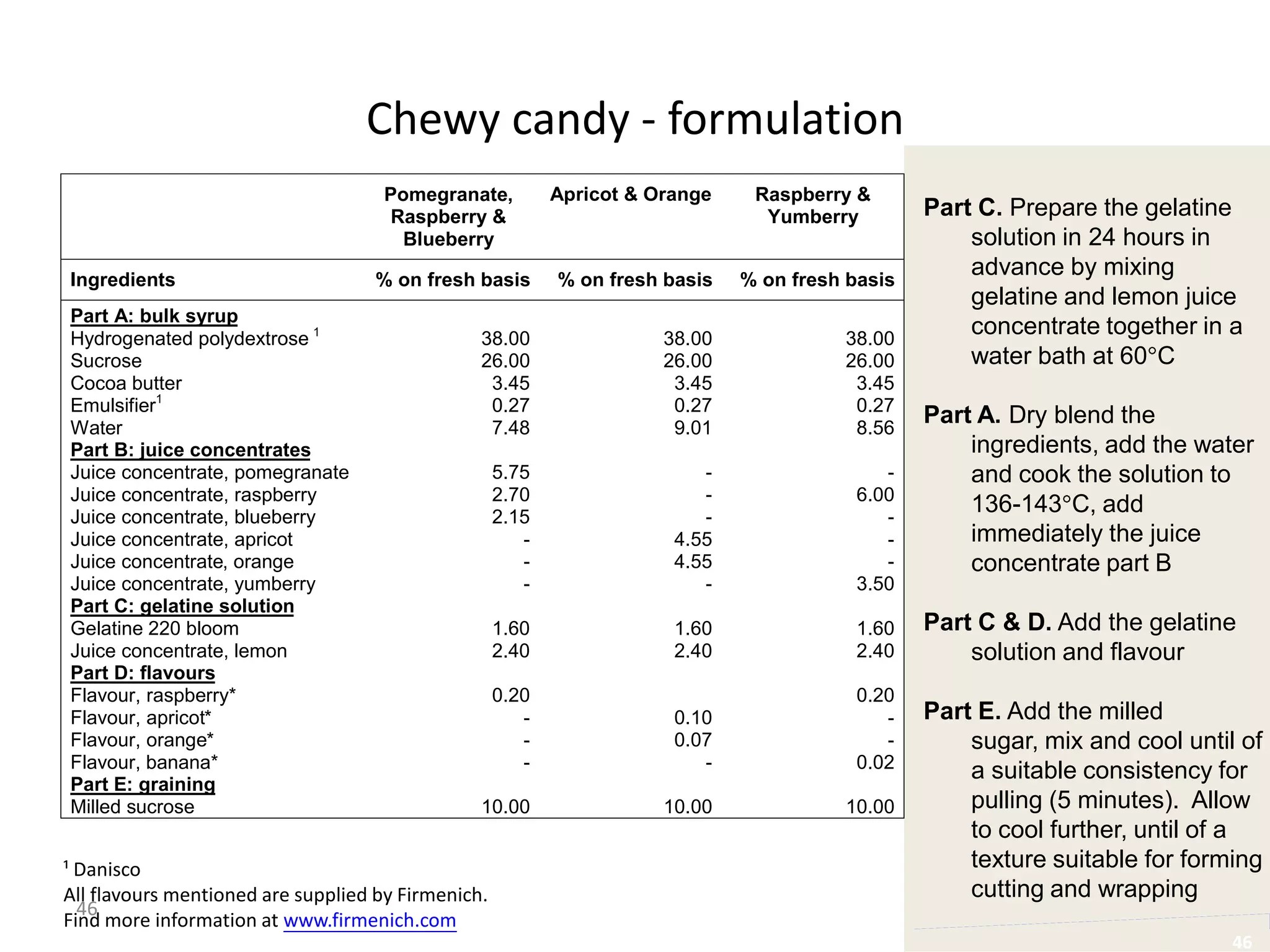
Chewy candy - formulation
                                     Pomegranate,          Apricot & Orange    Raspberry &
                                      Raspberry &                               Yumberry         Part C. Prepare the gelatine
                                       Blueberry                                                     solution in 24 hours in
Ingredients                         % on fresh basis       % on fresh basis   % on fresh basis
                                                                                                     advance by mixing
                                                                                                     gelatine and lemon juice
Part A: bulk syrup
Hydrogenated polydextrose 1                     38.00                 38.00             38.00
                                                                                                     concentrate together in a
Sucrose                                         26.00                 26.00             26.00        water bath at 60 C
Cocoa butter                                     3.45                  3.45              3.45
Emulsifier1                                      0.27                  0.27              0.27
Water                                            7.48                  9.01              8.56
                                                                                                 Part A. Dry blend the
Part B: juice concentrates                                                                           ingredients, add the water
Juice concentrate, pomegranate                      5.75                  -                  -       and cook the solution to
Juice concentrate, raspberry                        2.70                  -               6.00
Juice concentrate, blueberry                        2.15                  -                  -
                                                                                                     136-143 C, add
Juice concentrate, apricot                             -               4.55                  -       immediately the juice
Juice concentrate, orange                              -               4.55                  -       concentrate part B
Juice concentrate, yumberry                            -                  -               3.50
Part C: gelatine solution
Gelatine 220 bloom                                  1.60               1.60               1.60   Part C & D. Add the gelatine
Juice concentrate, lemon                            2.40               2.40               2.40       solution and flavour
Part D: flavours
Flavour, raspberry*                                 0.20                                  0.20
Flavour, apricot*                                      -               0.10                  -   Part E. Add the milled
Flavour, orange*                                       -               0.07                  -       sugar, mix and cool until of
Flavour, banana*                                       -                  -               0.02       a suitable consistency for
Part E: graining
Milled sucrose                                  10.00                 10.00             10.00        pulling (5 minutes). Allow
                                                                                                     to cool further, until of a
¹ Danisco                                                                                            texture suitable for forming
All flavours mentioned are supplied by Firmenich.                                                    cutting and wrapping
  46
Find more information at www.firmenich.com
                                                                                                                              46
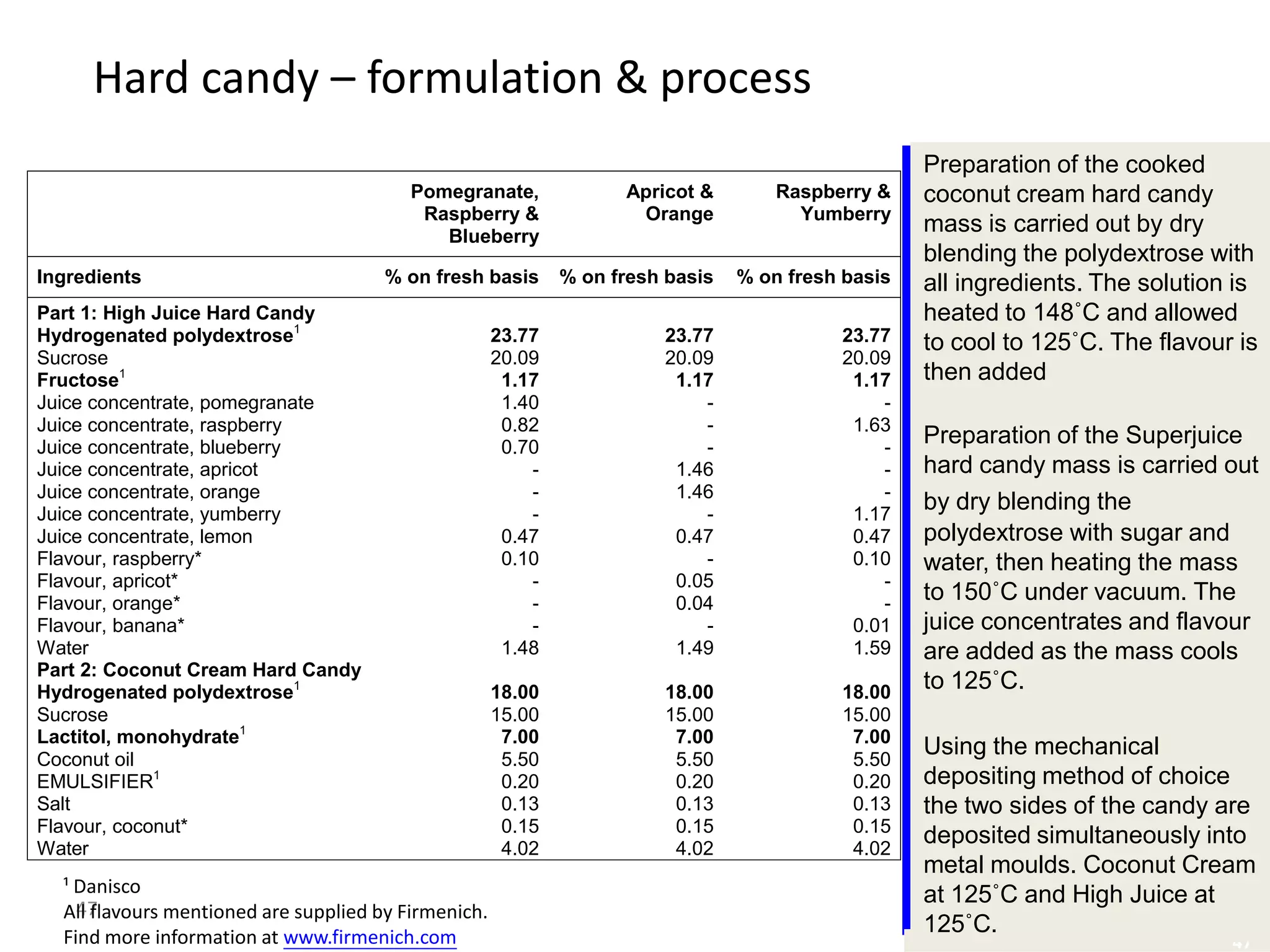
Hard candy – formulation & process
                                                                                                    Preparation of the cooked
                                          Pomegranate,              Apricot &        Raspberry &    coconut cream hard candy
                                           Raspberry &               Orange            Yumberry
                                             Blueberry
                                                                                                    mass is carried out by dry
                                                                                                    blending the polydextrose with
Ingredients                            % on fresh basis       % on fresh basis   % on fresh basis   all ingredients. The solution is
Part 1: High Juice Hard Candy                                                                       heated to 148˚C and allowed
Hydrogenated polydextrose1                            23.77             23.77              23.77    to cool to 125˚C. The flavour is
Sucrose                                               20.09             20.09              20.09
Fructose1                                              1.17              1.17               1.17    then added
Juice concentrate, pomegranate                         1.40                 -                  -
Juice concentrate, raspberry                           0.82                 -               1.63
Juice concentrate, blueberry                           0.70                 -                  -
                                                                                                    Preparation of the Superjuice
Juice concentrate, apricot                                -              1.46                  -    hard candy mass is carried out
Juice concentrate, orange                                 -              1.46                  -
Juice concentrate, yumberry                               -                 -               1.17
                                                                                                    by dry blending the
Juice concentrate, lemon                               0.47              0.47               0.47    polydextrose with sugar and
Flavour, raspberry*                                    0.10                 -               0.10    water, then heating the mass
Flavour, apricot*                                         -              0.05                  -
Flavour, orange*                                          -              0.04                  -
                                                                                                    to 150˚C under vacuum. The
Flavour, banana*                                          -                 -               0.01    juice concentrates and flavour
Water                                                  1.48              1.49               1.59    are added as the mass cools
Part 2: Coconut Cream Hard Candy
Hydrogenated polydextrose1                            18.00             18.00              18.00
                                                                                                    to 125˚C.
Sucrose                                               15.00             15.00              15.00
Lactitol, monohydrate1                                 7.00              7.00               7.00
Coconut oil                                            5.50              5.50               5.50
                                                                                                    Using the mechanical
EMULSIFIER1                                            0.20              0.20               0.20    depositing method of choice
Salt                                                   0.13              0.13               0.13    the two sides of the candy are
Flavour, coconut*                                      0.15              0.15               0.15
Water                                                  4.02              4.02               4.02
                                                                                                    deposited simultaneously into
                                                                                                    metal moulds. Coconut Cream
  ¹ Danisco                                                                                         at 125˚C and High Juice at
    47
  All flavours mentioned are supplied by Firmenich.
  Find more information at www.firmenich.com
                                                                                                    125˚C.
                                                                                                                                 47
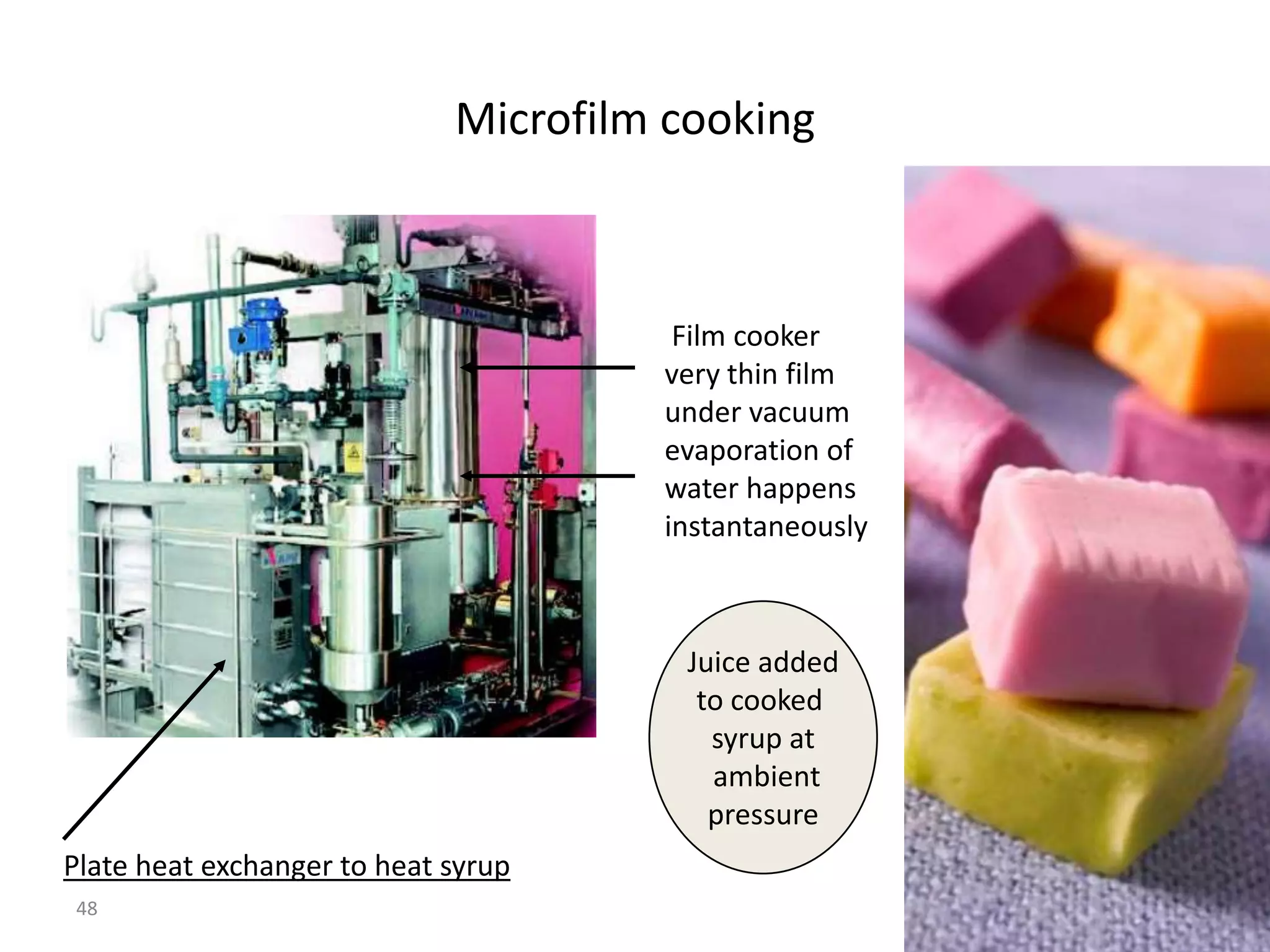
Microfilm cooking


                                       Film cooker
                                      very thin film
                                      under vacuum
                                      evaporation of
                                      water happens
                                      instantaneously


                                       Juice added
                                        to cooked
                                         syrup at
                                         ambient
                                         pressure
Plate heat exchanger to heat syrup
48
                                                        48
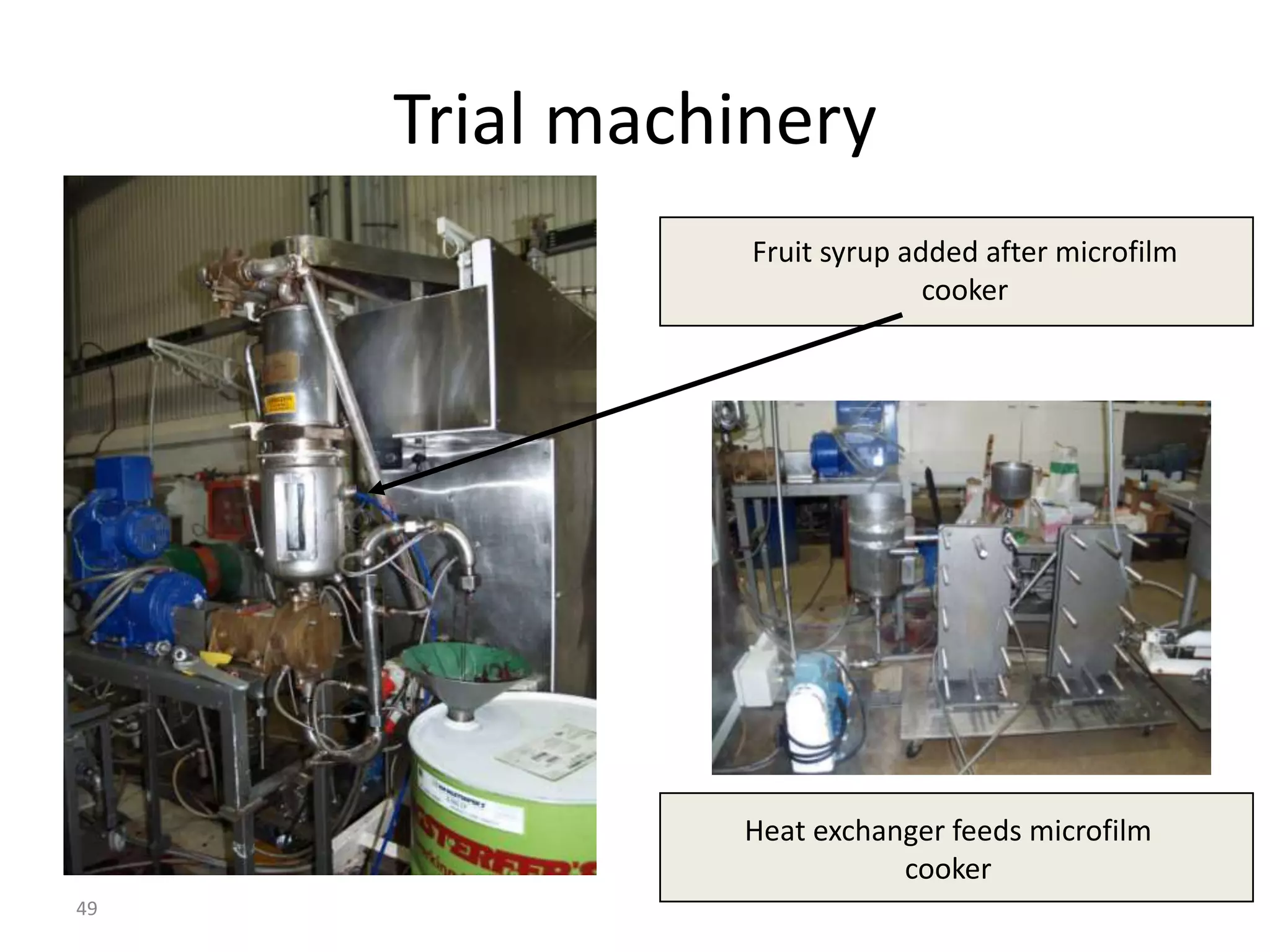
Trial machinery
                Fruit syrup added after microfilm
                              cooker


               Heat exchanger feeds microfilm
                          cooker
49
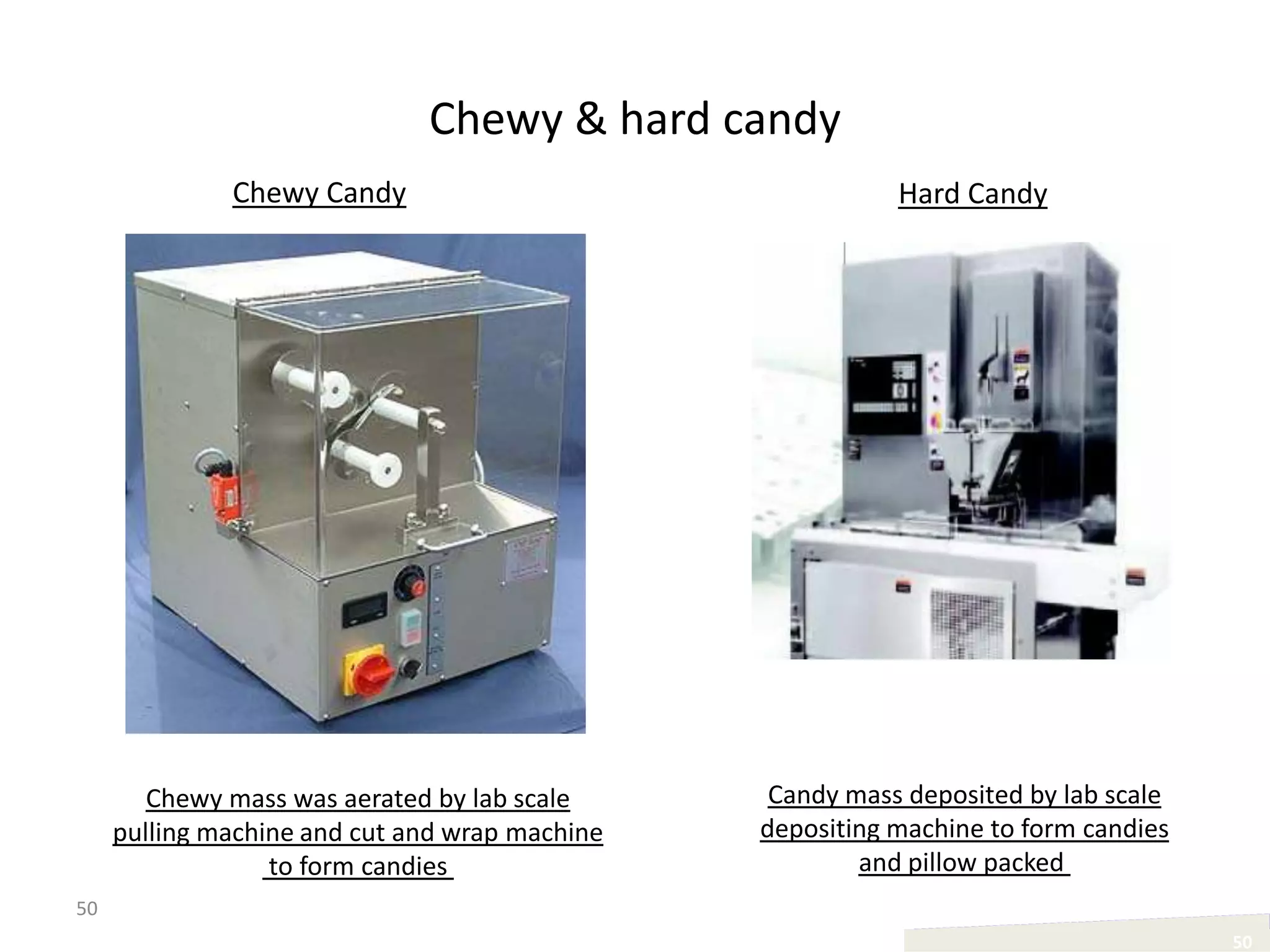
Chewy & hard candy
              Chewy Candy                                  Hard Candy


        Chewy mass was aerated by lab scale      Candy mass deposited by lab scale
     pulling machine and cut and wrap machine   depositing machine to form candies
                  to form candies                       and pillow packed
50
                                                                                     50
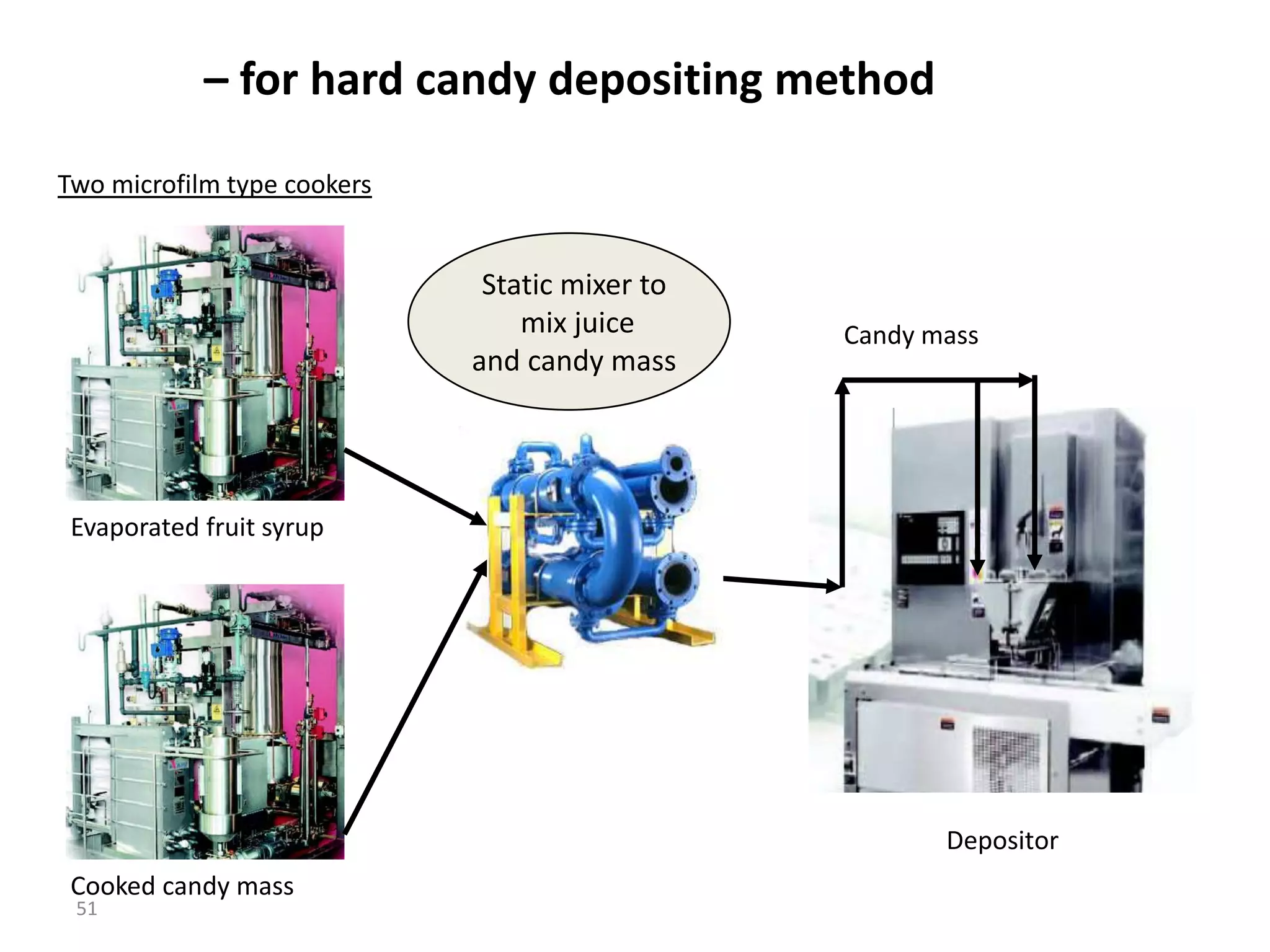
Idea –   for hard candy depositing method

Two microfilm type cookers


                              Static mixer to
                                 mix juice      Candy mass
                             and candy mass


 Evaporated fruit syrup


                                                       Depositor
                                                 2 X Cookers
 Cooked candy mass
 51
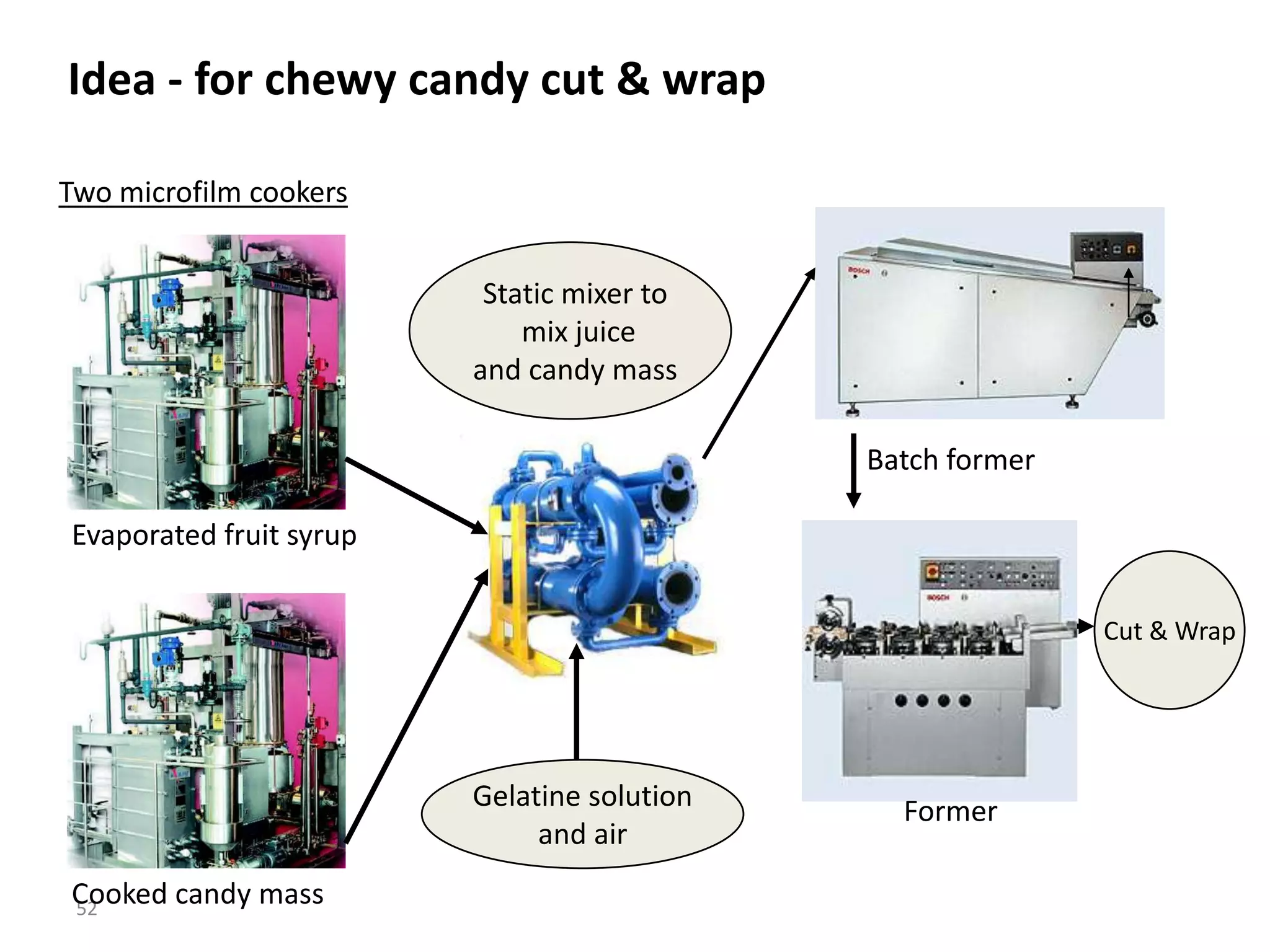
Idea - for chewy candy cut & wrap

Two microfilm cookers


                          Static mixer to
                             mix juice
                         and candy mass

                                             Batch former

Evaporated fruit syrup

                                                            Cut & Wrap


                         Gelatine solution     Former
                              and air
Cooked candy mass
52
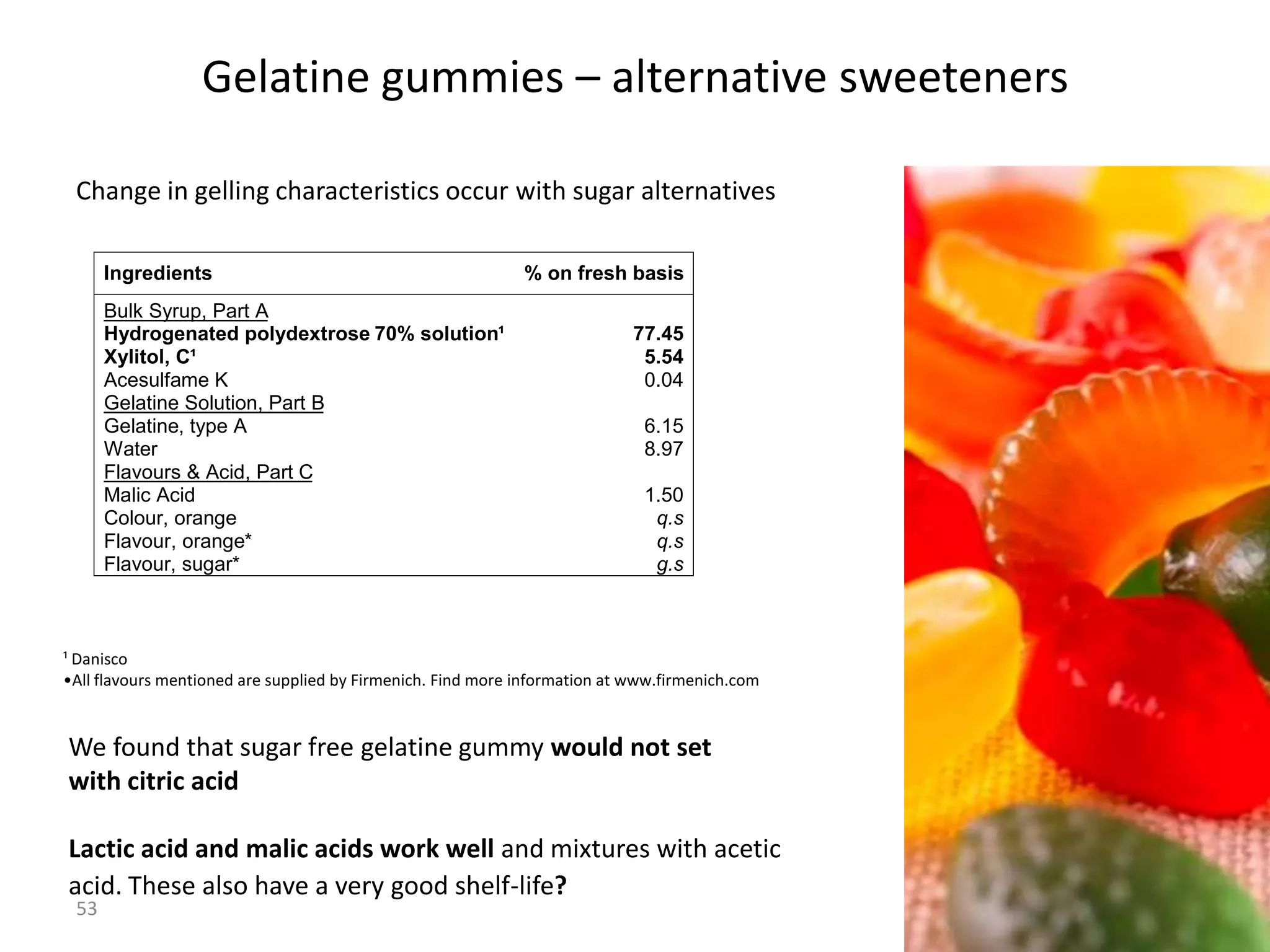
Gelatine gummies – alternative sweeteners

 Change in gelling characteristics occur with sugar alternatives

      Ingredients                                            % on fresh basis
      Bulk Syrup, Part A
      Hydrogenated polydextrose 70% solution¹                               77.45
      Xylitol, C¹                                                            5.54
      Acesulfame K                                                           0.04
      Gelatine Solution, Part B
      Gelatine, type A                                                       6.15
      Water                                                                  8.97
      Flavours & Acid, Part C
      Malic Acid                                                             1.50
      Colour, orange                                                          q.s
      Flavour, orange*                                                        q.s
      Flavour, sugar*                                                         g.s


¹ Danisco
•All flavours mentioned are supplied by Firmenich. Find more information at www.firmenich.com


We found that sugar free gelatine gummy would not set
with citric acid

Lactic acid and malic acids work well and mixtures with acetic
acid. These also have a very good shelf-life?
 53
                                                                                                53
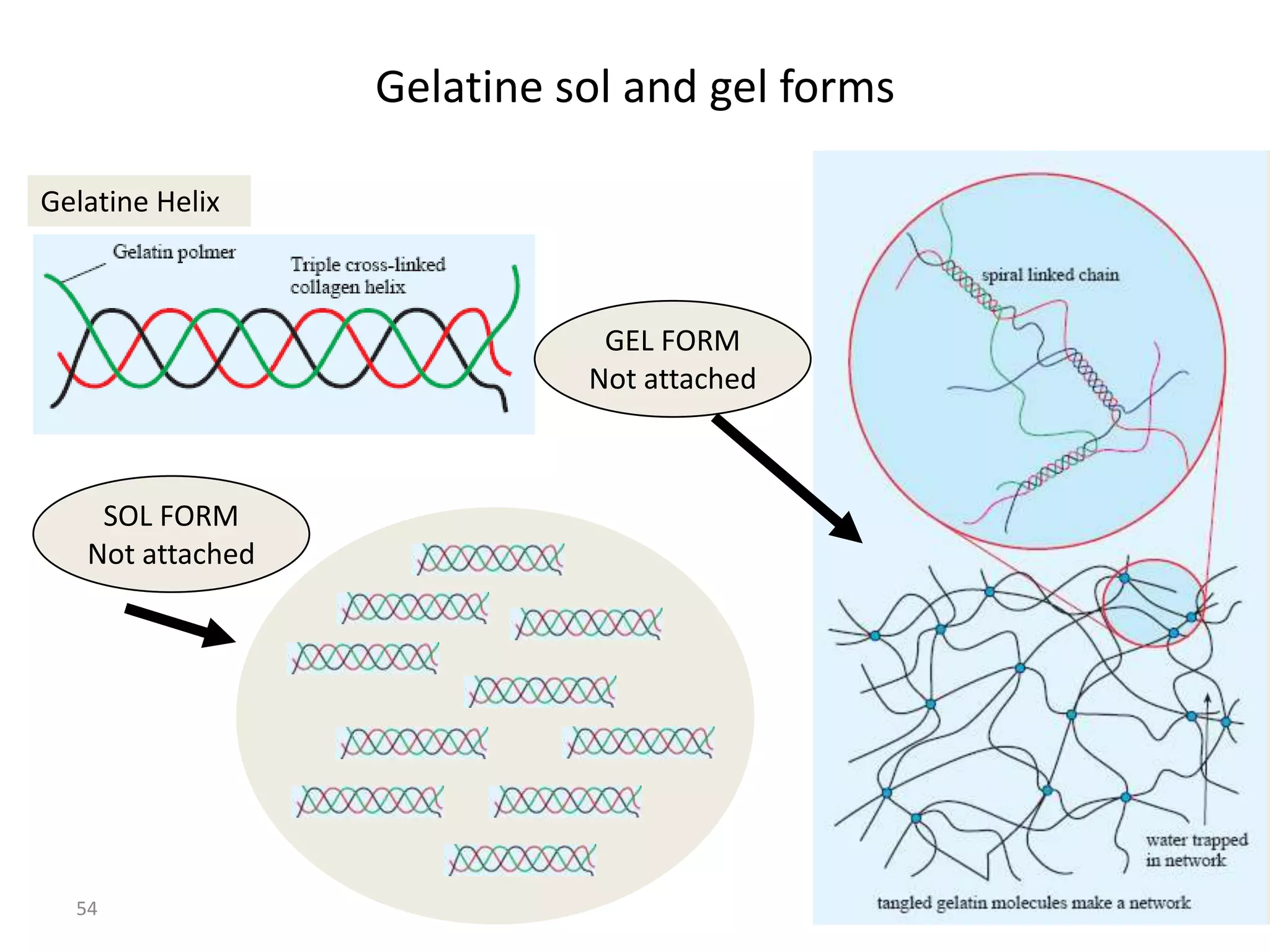
Gelatine sol and gel forms

Gelatine Helix


                             GEL FORM
                            Not attached


    SOL FORM
   Not attached


  54
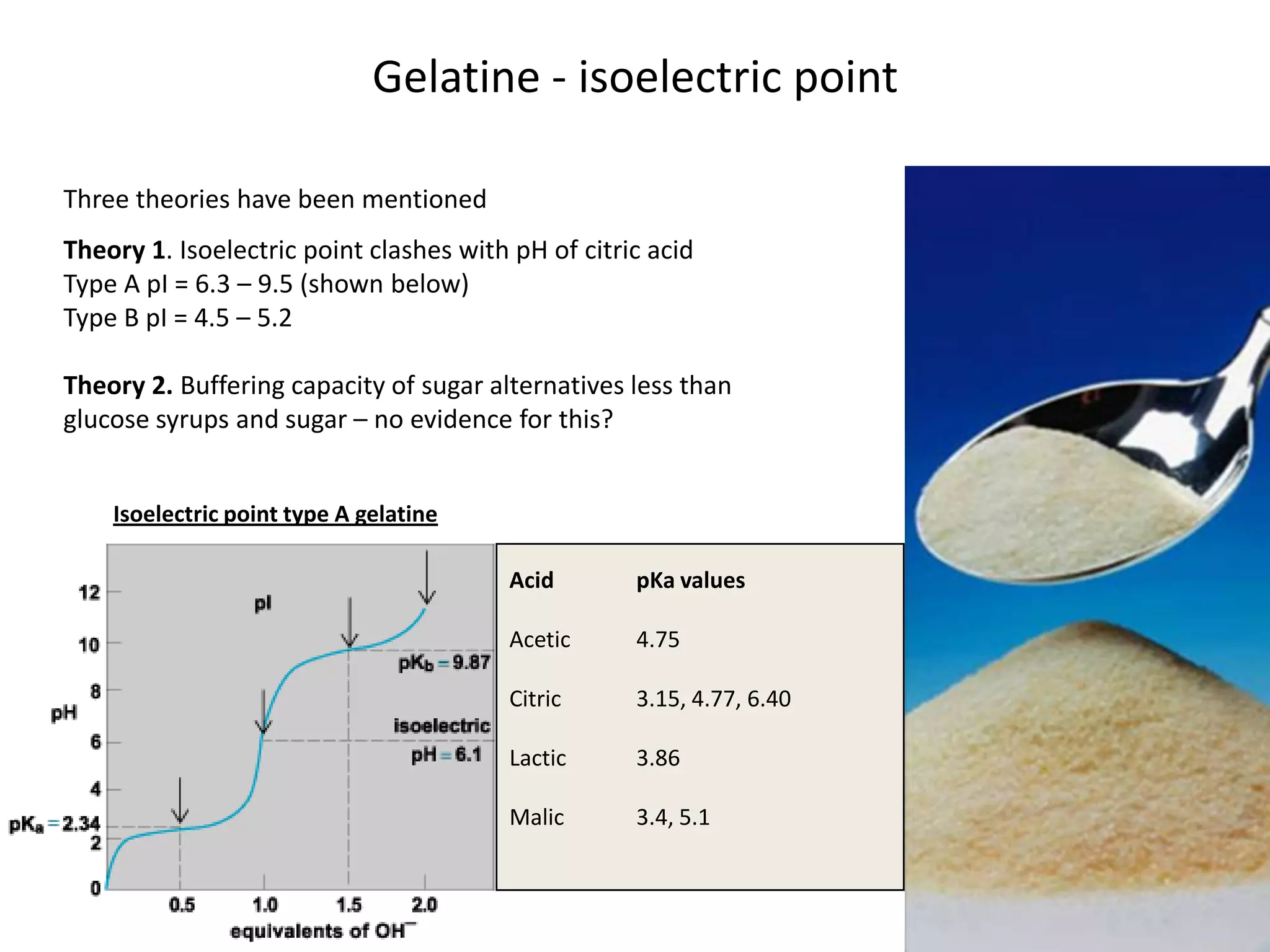
Gelatine - isoelectric point

Three theories have been mentioned
Theory 1. Isoelectric point clashes with pH of citric acid
Type A pI = 6.3 – 9.5 (shown below)
Type B pI = 4.5 – 5.2

Theory 2. Buffering capacity of sugar alternatives less than
glucose syrups and sugar – no evidence for this?


      Isoelectric point type A gelatine

                                          Acid      pKa values

                                          Acetic    4.75

                                          Citric    3.15, 4.77, 6.40

                                          Lactic    3.86

                                          Malic     3.4, 5.1


 55
                                                                       55
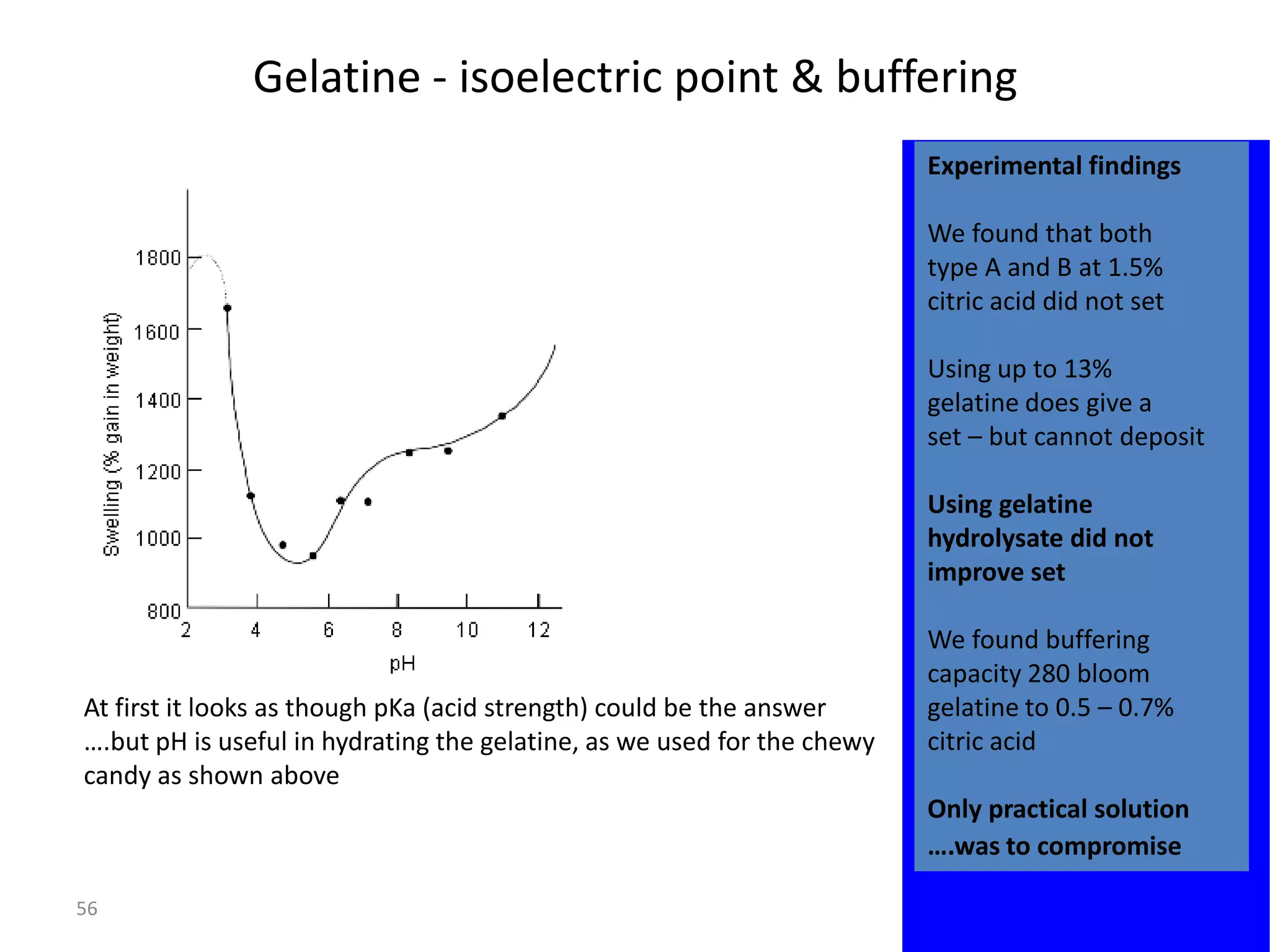
Gelatine - isoelectric point & buffering
                                                                         Experimental findings

                                                                         We found that both
                                                                         type A and B at 1.5%
                                                                         citric acid did not set

                                                                         Using up to 13%
                                                                         gelatine does give a
                                                                         set – but cannot deposit

                                                                         Using gelatine
                                                                         hydrolysate did not
                                                                         improve set

                                                                         We found buffering
                                                                         capacity 280 bloom
At first it looks as though pKa (acid strength) could be the answer      gelatine to 0.5 – 0.7%
….but pH is useful in hydrating the gelatine, as we used for the chewy   citric acid
candy as shown above
                                                                         Only practical solution
                                                                         ….was to compromise

56
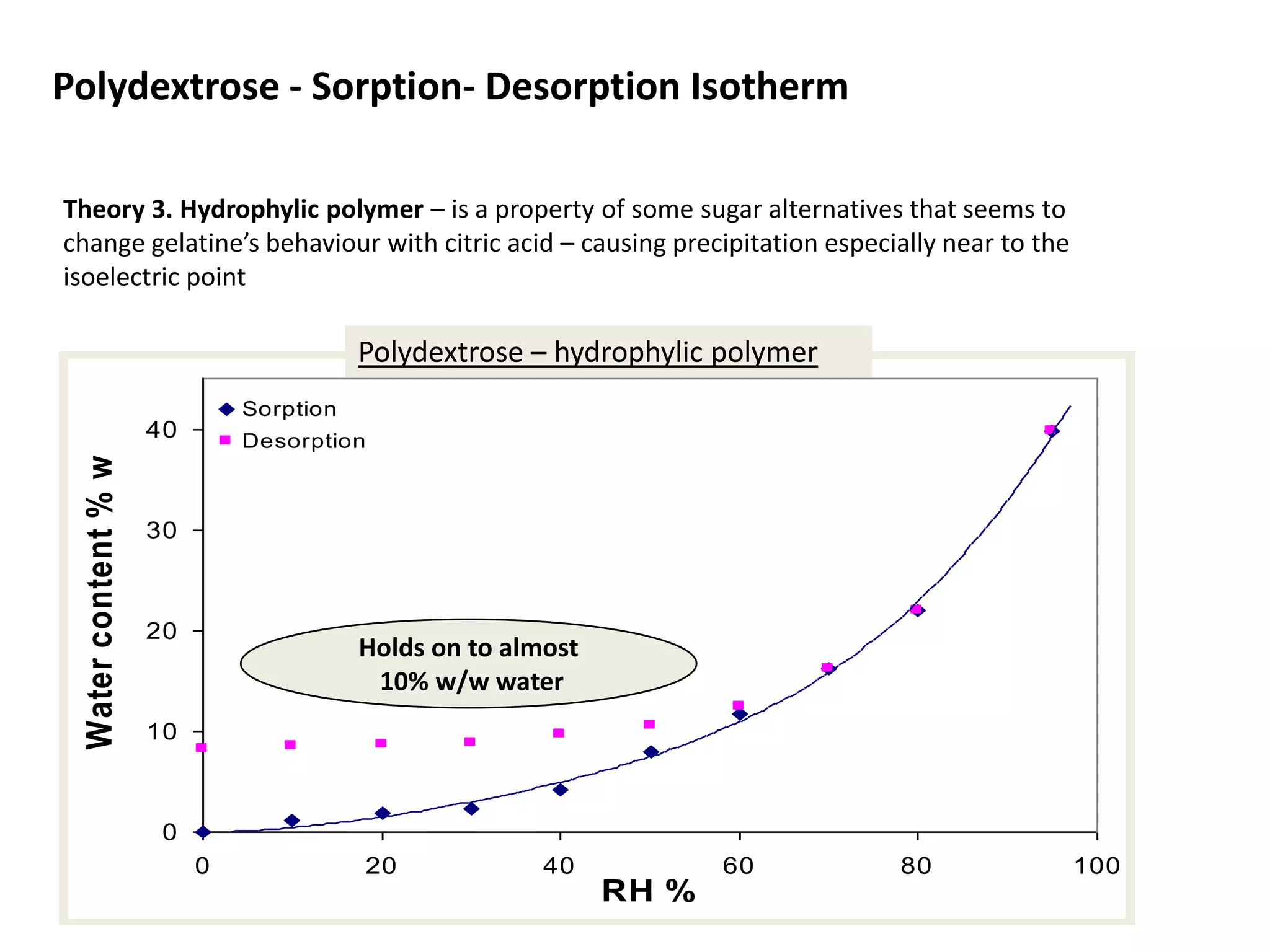
Polydextrose - Sorption- Desorption Isotherm

Theory 3. Hydrophylic polymer – is a property of some sugar alternatives that seems to
change gelatine’s behaviour with citric acid – causing precipitation especially near to the
isoelectric point

                                           Polydextrose – hydrophylic polymer
                                Sorption
                       40       Desorption
  Water content % wb


                       30


                       20
                                           Holds on to almost
                                            10% w/w water
                       10


                        0
                            0              20             40           60       80            100
 57
                                                                RH %
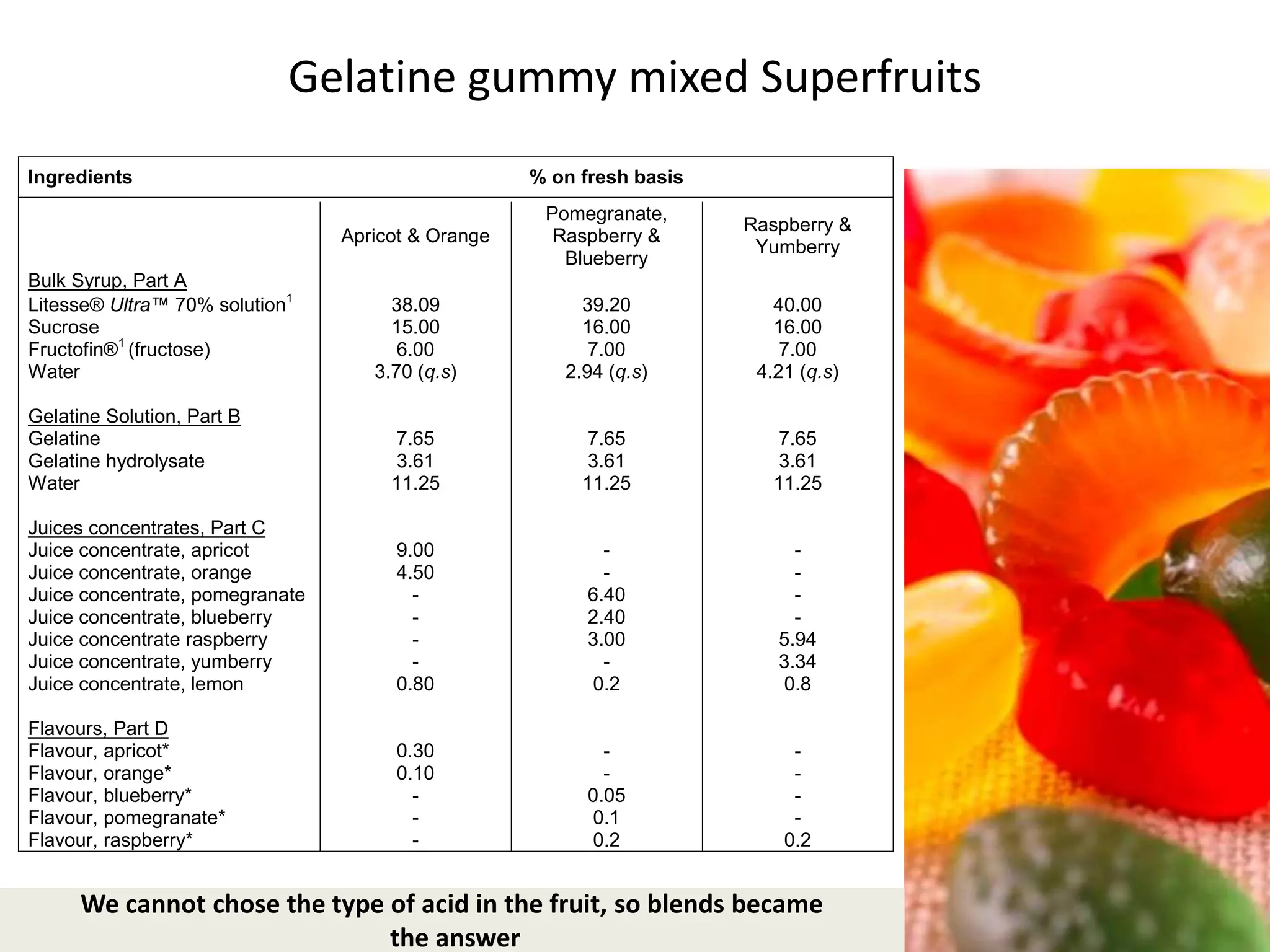
Gelatine gummy mixed Superfruits
Ingredients                                         % on fresh basis
                                                     Pomegranate,
                                                                       Raspberry &
                                 Apricot & Orange     Raspberry &
                                                                        Yumberry
                                                       Blueberry
Bulk Syrup, Part A
Litesse® Ultra™ 70% solution1         38.09              39.20            40.00
Sucrose                               15.00              16.00            16.00
Fructofin®1 (fructose)                 6.00               7.00             7.00
Water                               3.70 (q.s)         2.94 (q.s)       4.21 (q.s)

Gelatine Solution, Part B
Gelatine                              7.65                7.65             7.65
Gelatine hydrolysate                  3.61                3.61             3.61
Water                                 11.25              11.25            11.25

Juices concentrates, Part C
Juice concentrate, apricot            9.00                  -               -
Juice concentrate, orange             4.50                  -               -
Juice concentrate, pomegranate          -                 6.40              -
Juice concentrate, blueberry            -                 2.40              -
Juice concentrate raspberry             -                 3.00            5.94
Juice concentrate, yumberry             -                   -             3.34
Juice concentrate, lemon              0.80                0.2             0.8

Flavours, Part D
Flavour, apricot*                     0.30                  -               -
Flavour, orange*                      0.10                  -               -
Flavour, blueberry*                     -                 0.05              -
Flavour, pomegranate*                   -                 0.1               -
Flavour, raspberry*                     -                 0.2              0.2


     58 cannot
     We              chose the type of acid in the fruit, so blends became
                                    the answer                                       58
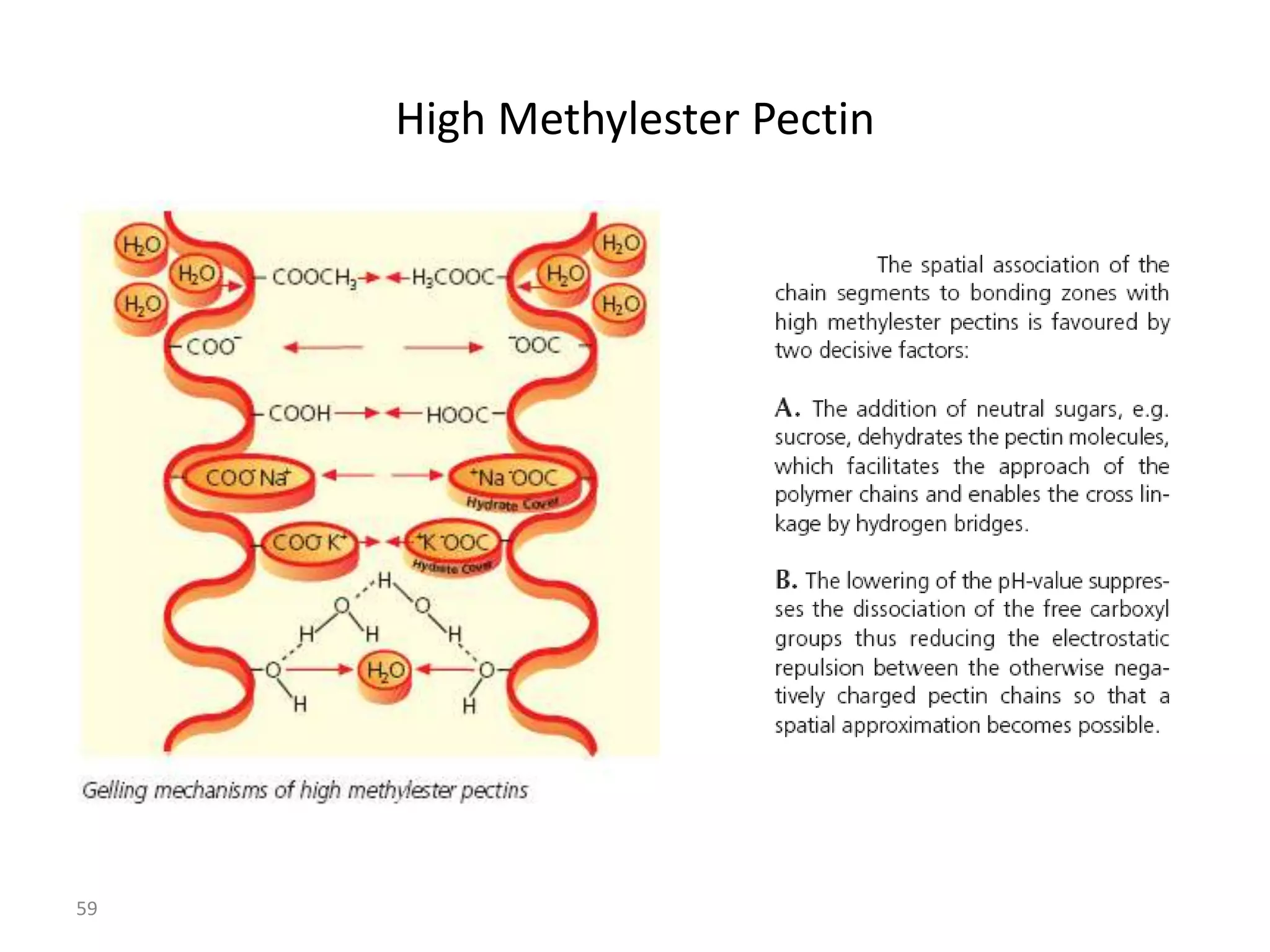
High Methylester Pectin


59
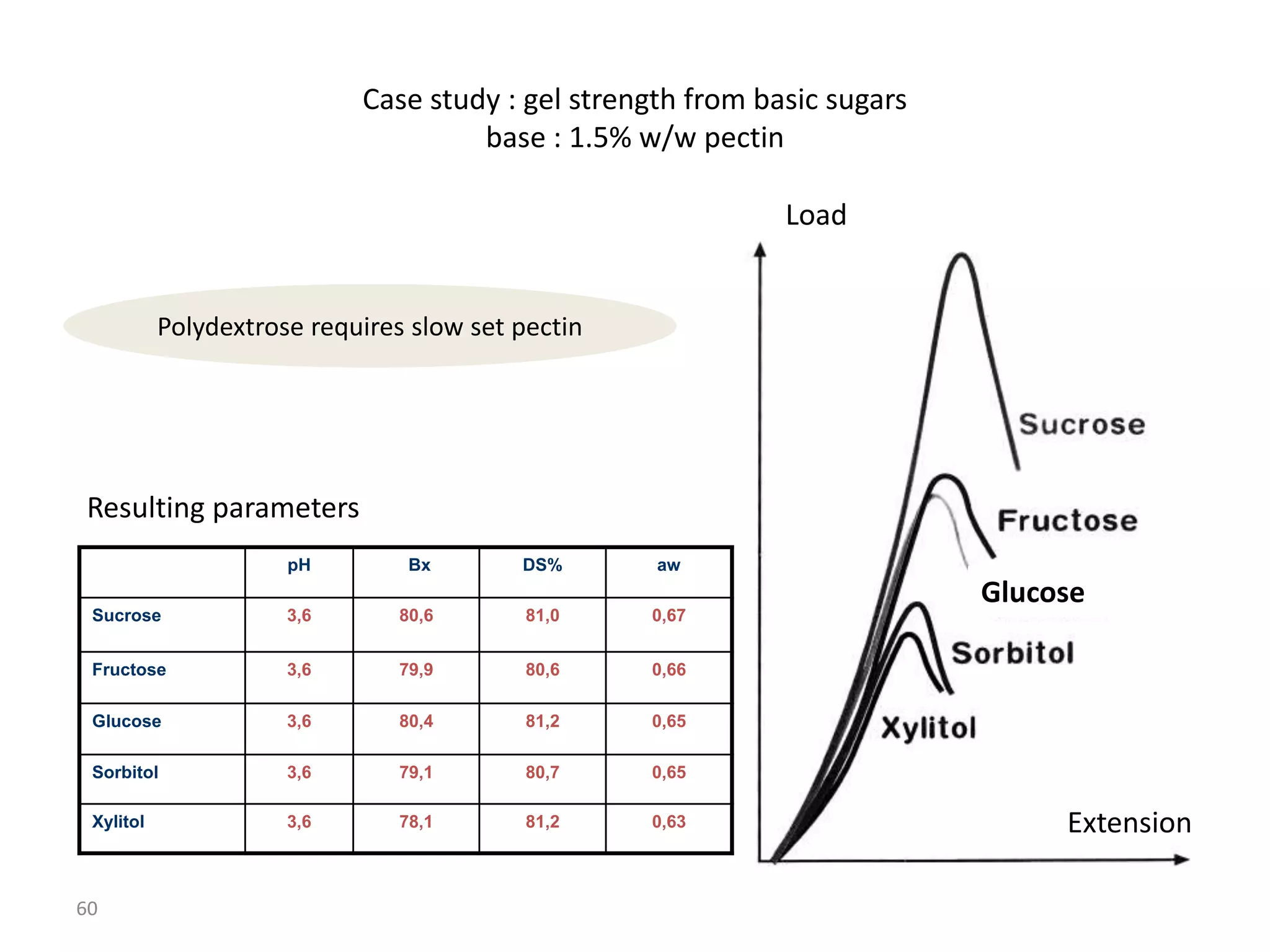
Case study : gel strength from basic sugars
                                     base : 1.5% w/w pectin

                                                             Load


           Polydextrose requires slow set pectin


Resulting parameters
                      pH         Bx       DS%      aw
                                                                          Glucose
 Sucrose              3,6       80,6       81,0    0,67


 Fructose             3,6       79,9       80,6    0,66

 Glucose              3,6       80,4       81,2    0,65

 Sorbitol             3,6       79,1       80,7    0,65

 Xylitol              3,6       78,1       81,2    0,63                        Extension

60
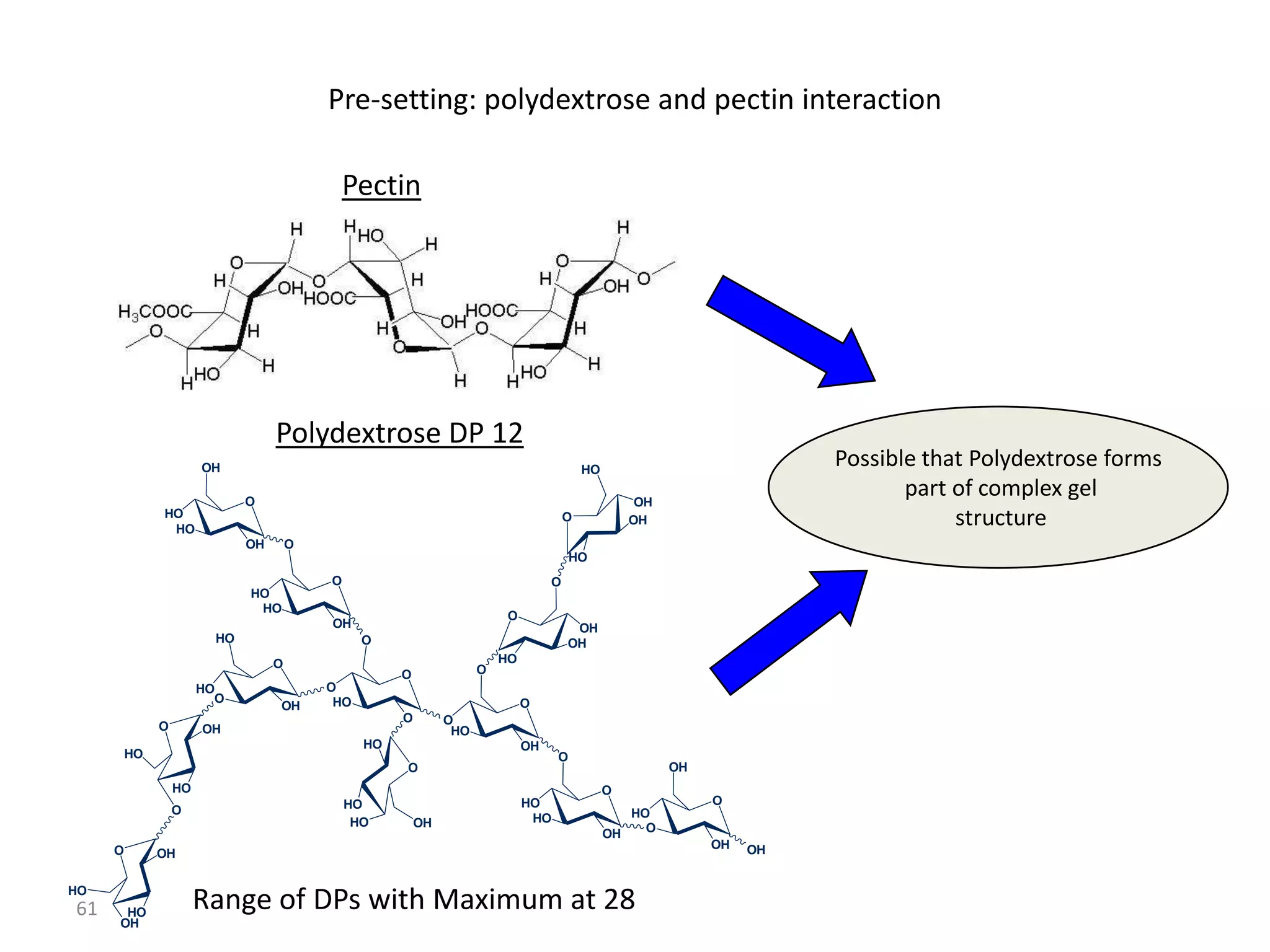
Pre-setting: polydextrose and pectin interaction

                                               Pectin


                                   Polydextrose DP 12
                       OH                                                                  HO
                                                                                                                         Possible that Polydextrose forms
                              O                                                                      OH
                                                                                                                                part of complex gel
              HO
               HO
                                                                                       O            OH                               structure
                              OH       O
                                                                                        HO
                                           O                                       O
                              HO
                               HO
                                                                          O
                                           OH                                           OH
                         HO                      O                                     OH
                                   O                                     HO
                                                      O              O
                       HO                  O
                         O                  HO                                O
                                   OH
                                                      O        O
              O        OH                                       HO
                                                 HO                           OH
         HO                                                                         O
                                                      O                                                   OH
                  HO                                                                            O
                                               HO                             HO                               O
                  O                                                                                HO
                                                HO        OH                   HO
                                                                                                OH   O
     O                                                                                                         OH   OH
              OH

HO
61    HO
                       Range of DPs with Maximum at 28
     OH
Functional chocolate with pre &
                probiotics
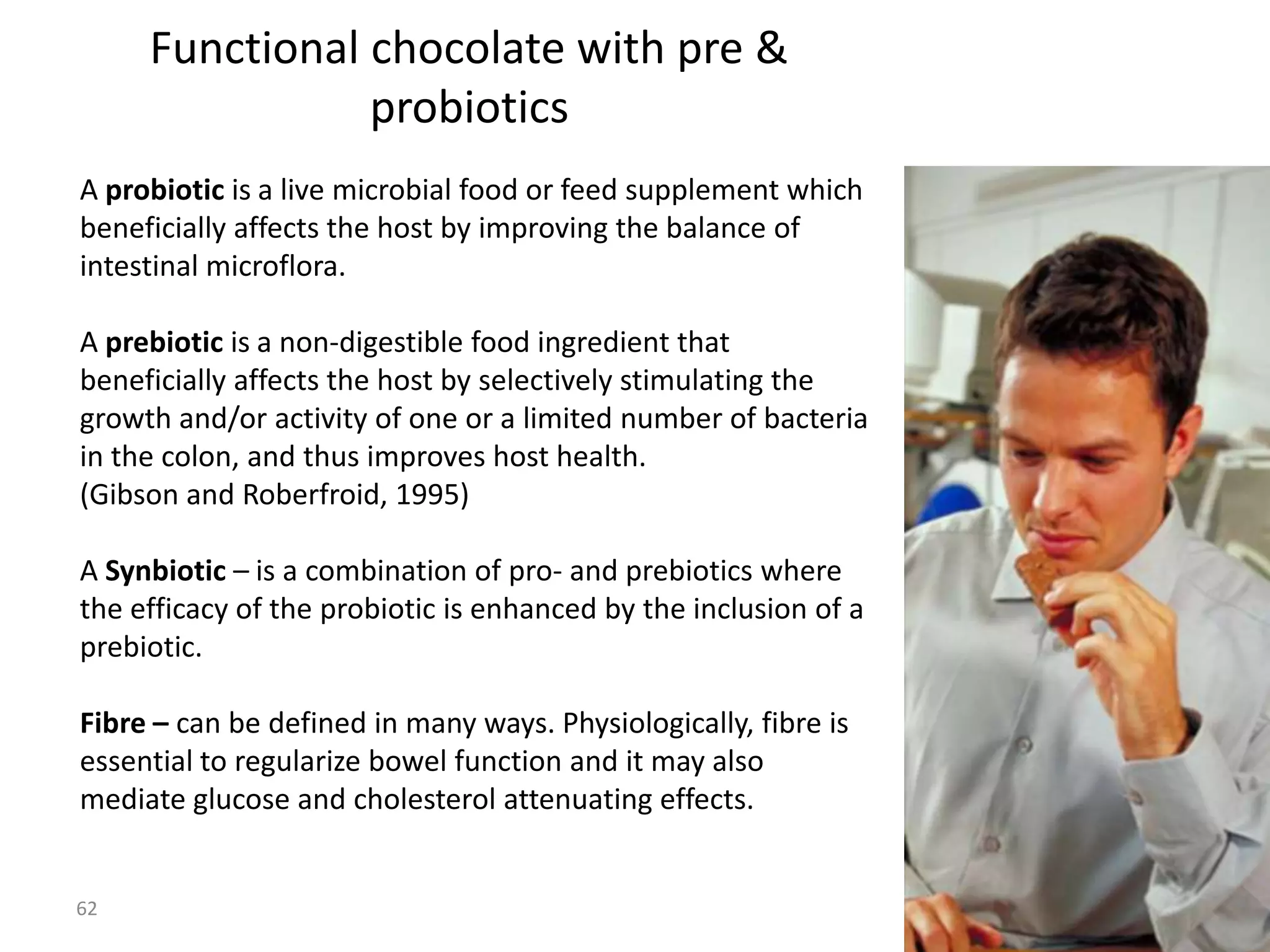
A probiotic is a live microbial food or feed supplement which
beneficially affects the host by improving the balance of
intestinal microflora.

A prebiotic is a non-digestible food ingredient that
beneficially affects the host by selectively stimulating the
growth and/or activity of one or a limited number of bacteria
in the colon, and thus improves host health.
(Gibson and Roberfroid, 1995)

A Synbiotic – is a combination of pro- and prebiotics where
the efficacy of the probiotic is enhanced by the inclusion of a
prebiotic.

Fibre – can be defined in many ways. Physiologically, fibre is
essential to regularize bowel function and it may also
mediate glucose and cholesterol attenuating effects.

62
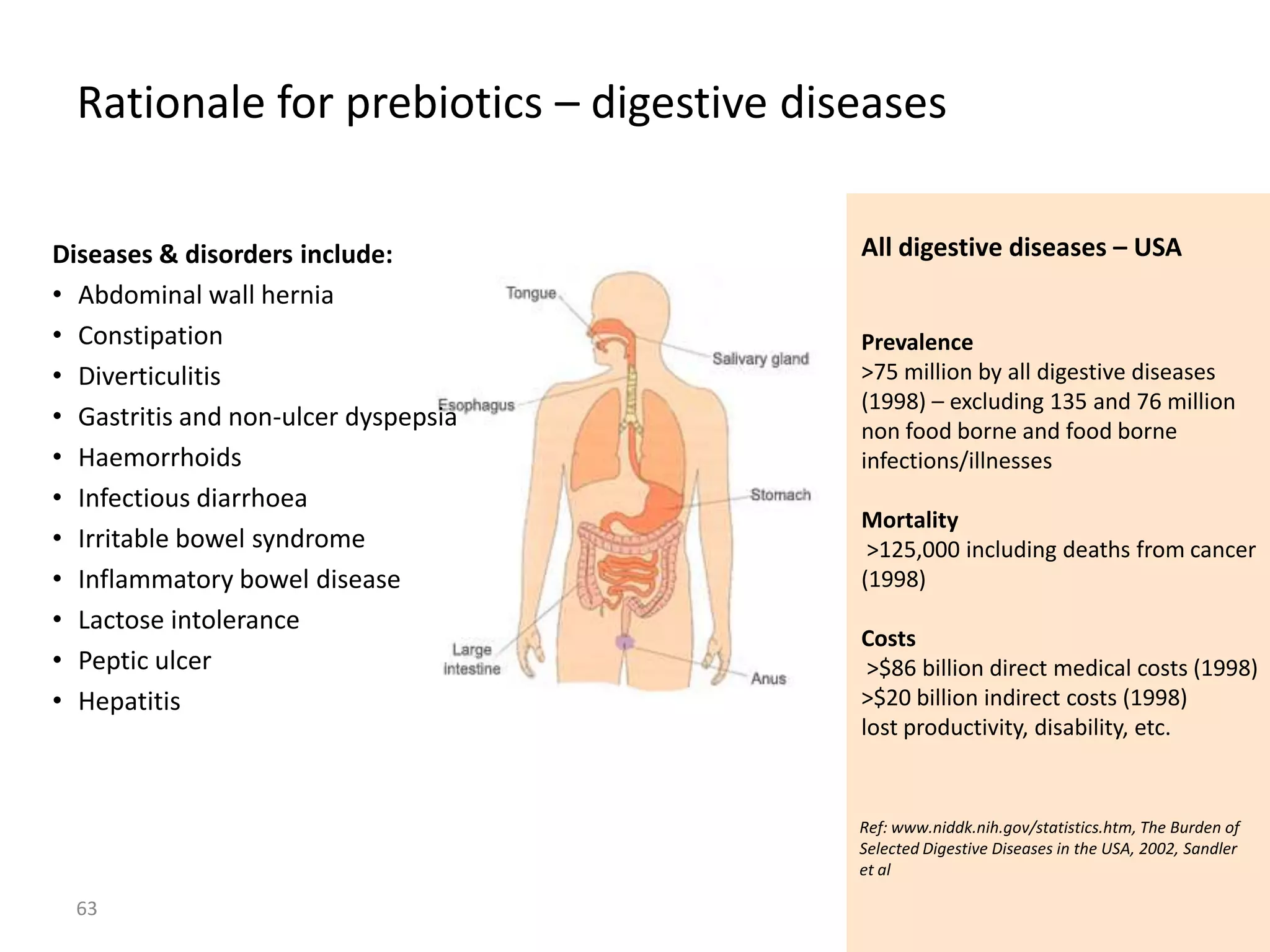
Rationale for prebiotics – digestive diseases

Diseases & disorders include:             All digestive diseases – USA
• Abdominal wall hernia
• Constipation                            Prevalence
• Diverticulitis                          >75 million by all digestive diseases
                                          (1998) – excluding 135 and 76 million
• Gastritis and non-ulcer dyspepsia       non food borne and food borne
• Haemorrhoids                            infections/illnesses
• Infectious diarrhoea
                                          Mortality
• Irritable bowel syndrome                 >125,000 including deaths from cancer
• Inflammatory bowel disease              (1998)
• Lactose intolerance
                                          Costs
• Peptic ulcer                             >$86 billion direct medical costs (1998)
• Hepatitis                               >$20 billion indirect costs (1998)
                                          lost productivity, disability, etc.


                                          Ref: www.niddk.nih.gov/statistics.htm, The Burden of
                                          Selected Digestive Diseases in the USA, 2002, Sandler
                                          et al

  63
Rationale for prebiotics – a balanced
                      microflora

• Molecular studies indicate that the intestinal microflora
   consists of 1014 microbes from more than 1000 species.
• Little is known about the role played by many of the
   dominant bacteria in the gut that are believed to be benign
   such as Bacteroides, Eubacterium spp., Ruminococcus spp.,
   Butyrovibrio spp.
• Bifidobacteria and lactobacilli are two species with known
   positive contributions to human health.
• As the microflora protect against incoming pathogenic
   microbes and modulate immune response, a balanced
   microflora increases well-being of the gastrointestinal tract.
 Prebiotics can contribute to human digestive health by
   specifically stimulating growth of bifidobacteria and
   lactobacilli, two microbial species accepted to exhibit
 Ouwehand AC, Makelainen H, Tiihonen K and Rautonen, N (2006) - Digestive Health, pages 44-51, Part I
 Sweeteners and Sugareffects. in Food Technology, Edited by Helen Mitchell, Blackwell Publishing, UK.
   beneficial Alternatives
  64
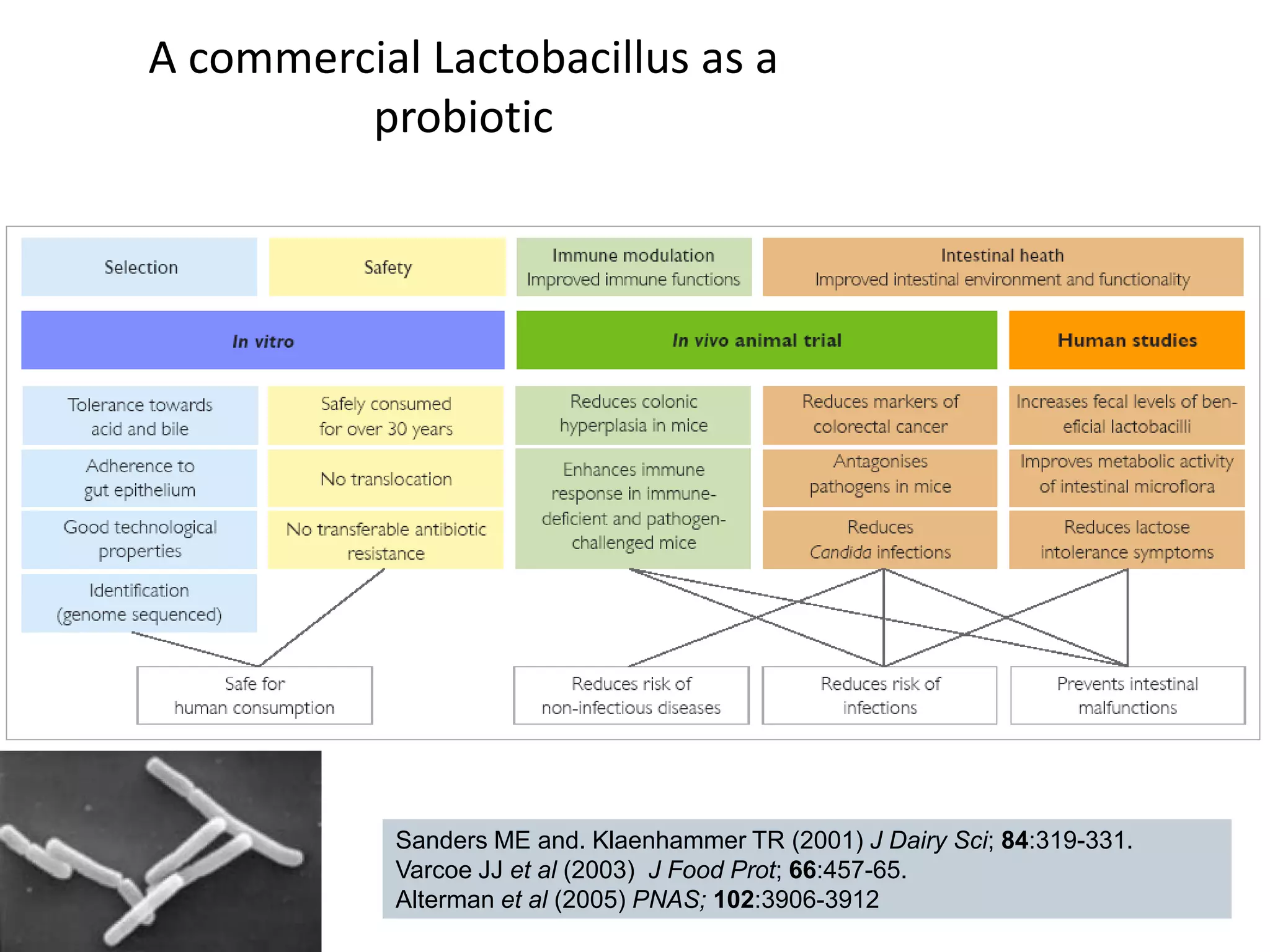
A commercial Lactobacillus as a
              probiotic


                 Sanders ME and. Klaenhammer TR (2001) J Dairy Sci; 84:319-331.
                 Varcoe JJ et al (2003) J Food Prot; 66:457-65.
65               Alterman et al (2005) PNAS; 102:3906-3912
Functional chocolate with pre &
                  probiotics
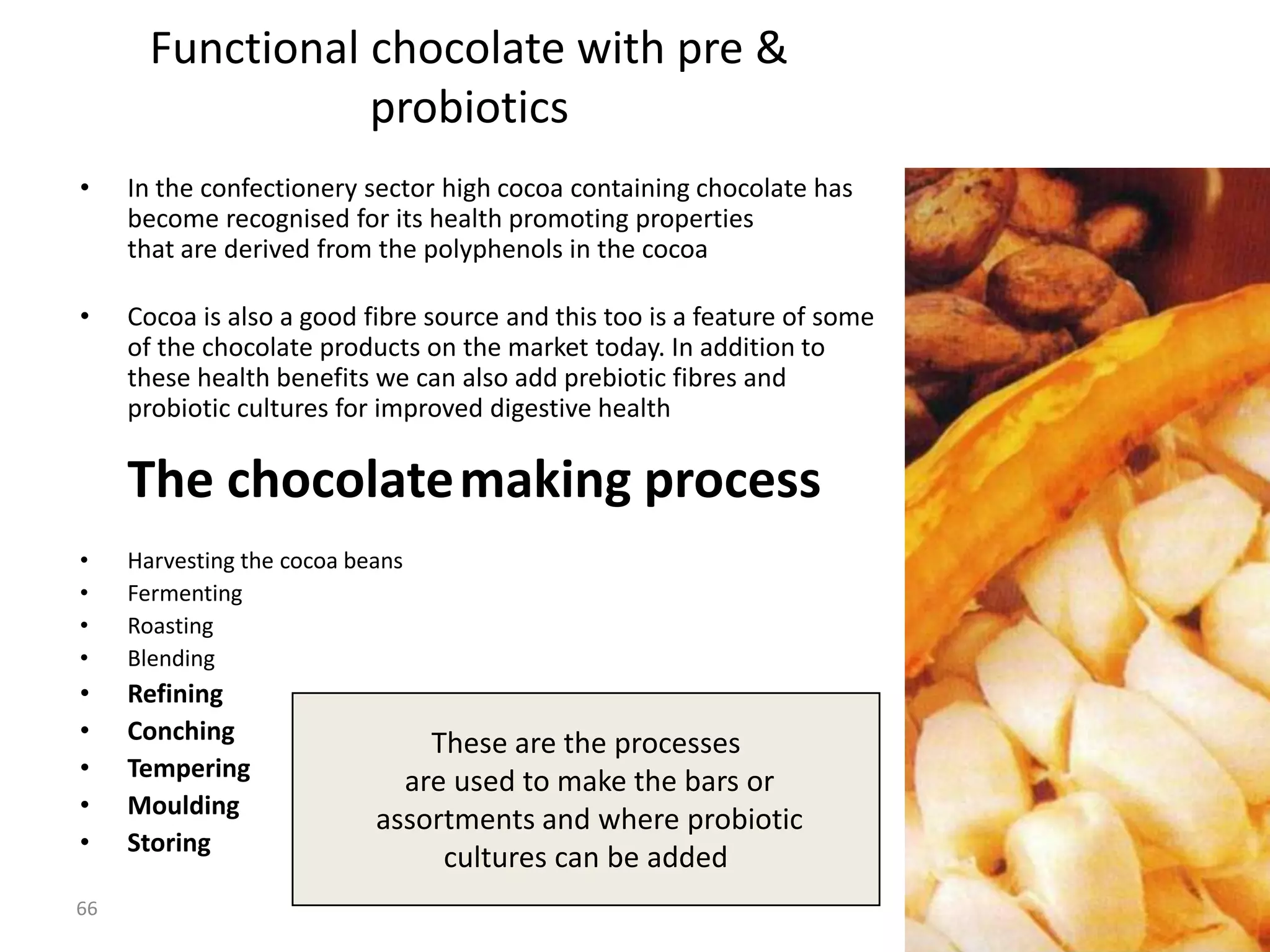
•    In the confectionery sector high cocoa containing chocolate has
     become recognised for its health promoting properties
     that are derived from the polyphenols in the cocoa

•    Cocoa is also a good fibre source and this too is a feature of some
     of the chocolate products on the market today. In addition to
     these health benefits we can also add prebiotic fibres and
     probiotic cultures for improved digestive health

     The chocolatemaking process
•    Harvesting the cocoa beans
•    Fermenting
•    Roasting
•    Blending
•    Refining
•    Conching                   These are the processes
•    Tempering                are used to make the bars or
•    Moulding
                            assortments and where probiotic
•    Storing
                                 cultures can be added
66
Pre & Probiotic chocolate Concept
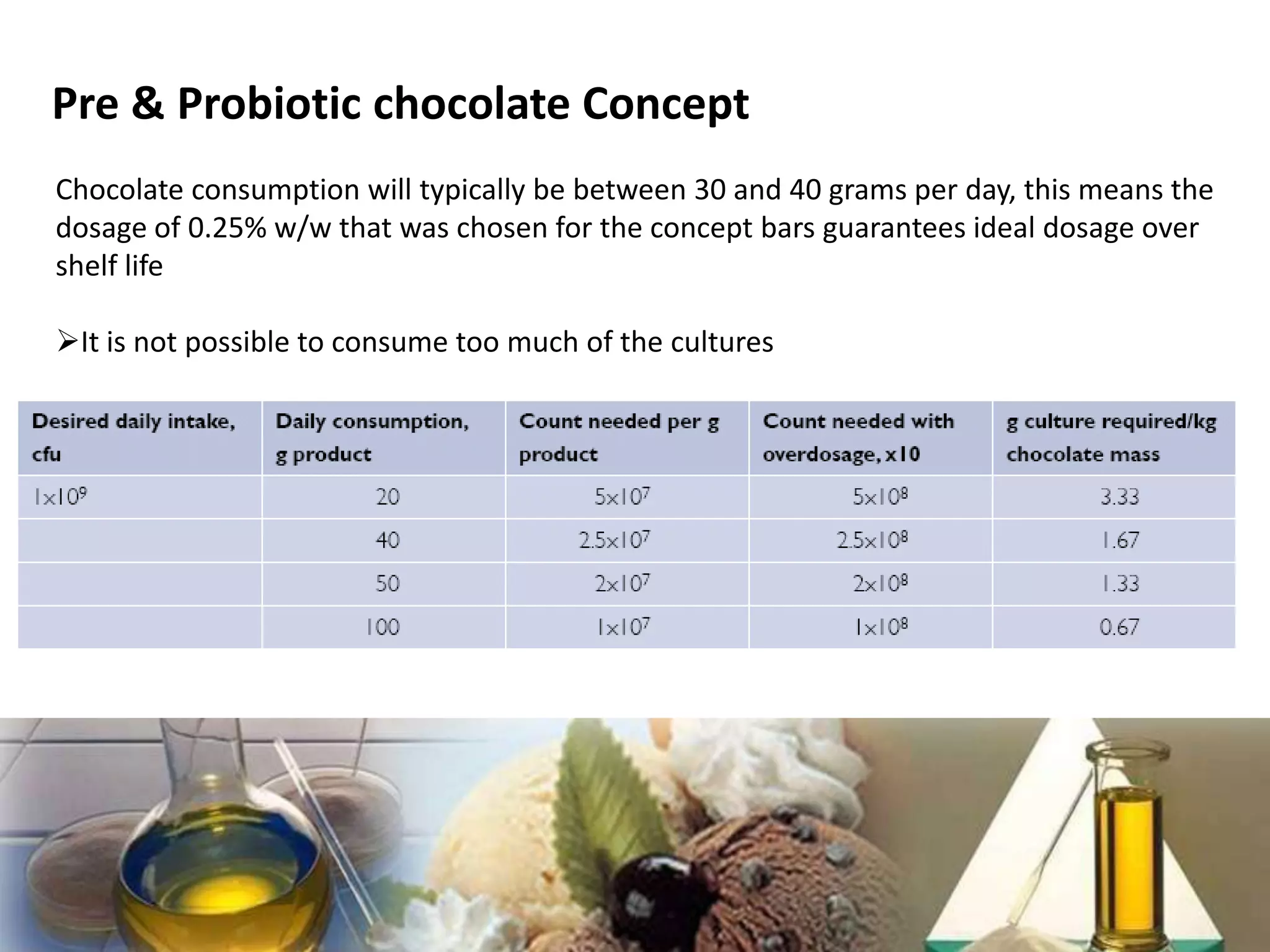
Chocolate consumption will typically be between 30 and 40 grams per day, this means the
dosage of 0.25% w/w that was chosen for the concept bars guarantees ideal dosage over
shelf life

It is not possible to consume too much of the cultures


 67
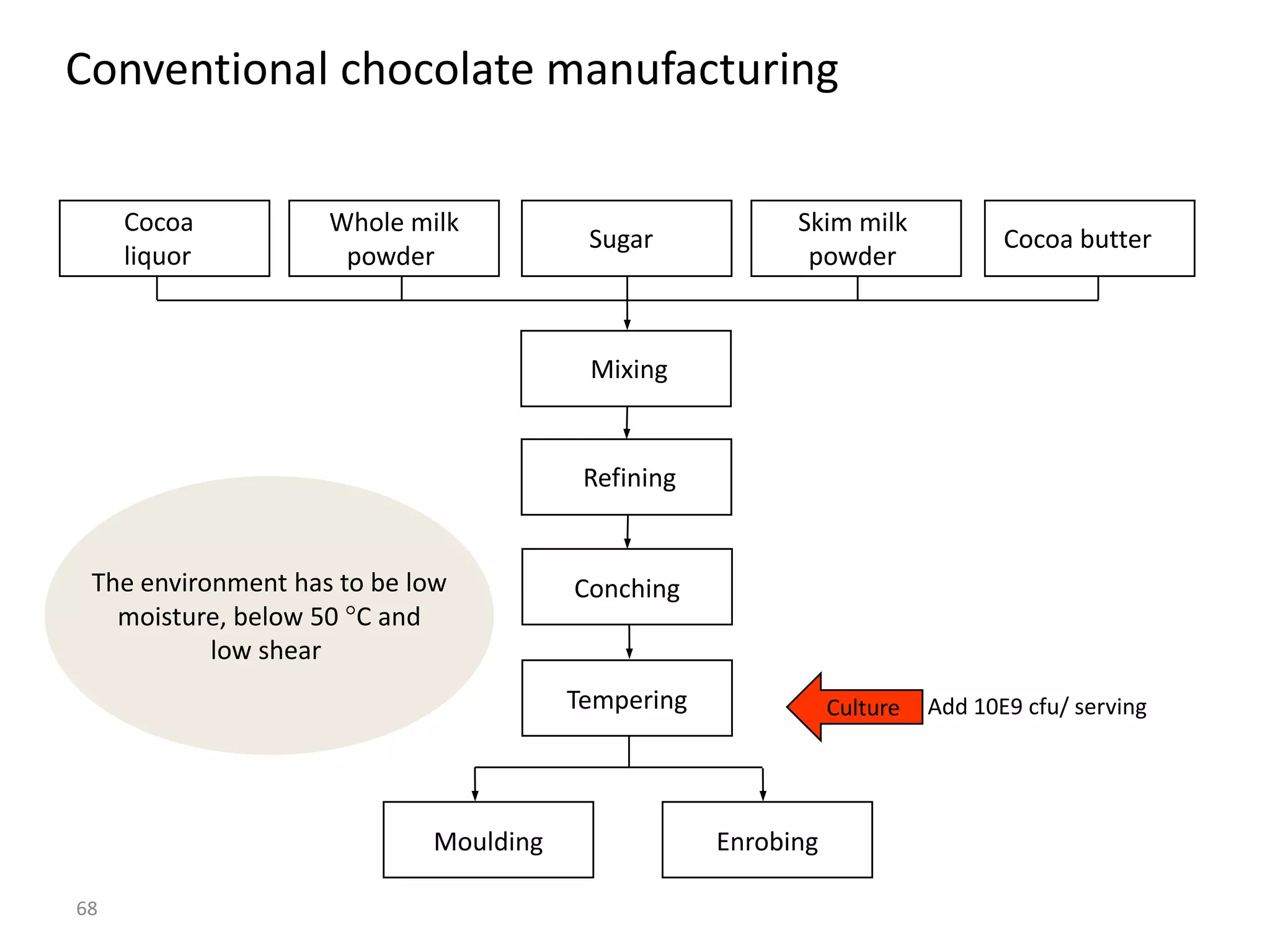
Conventional chocolate manufacturing

     Cocoa          Whole milk                           Skim milk
                                        Sugar                                  Cocoa butter
     liquor          powder                               powder


                                        Mixing


                                        Refining


 The environment has to be low         Conching
   moisture, below 50 C and
           low shear
                                       Tempering              Culture   Add 10E9 cfu/ serving


                            Moulding               Enrobing

68
Conching

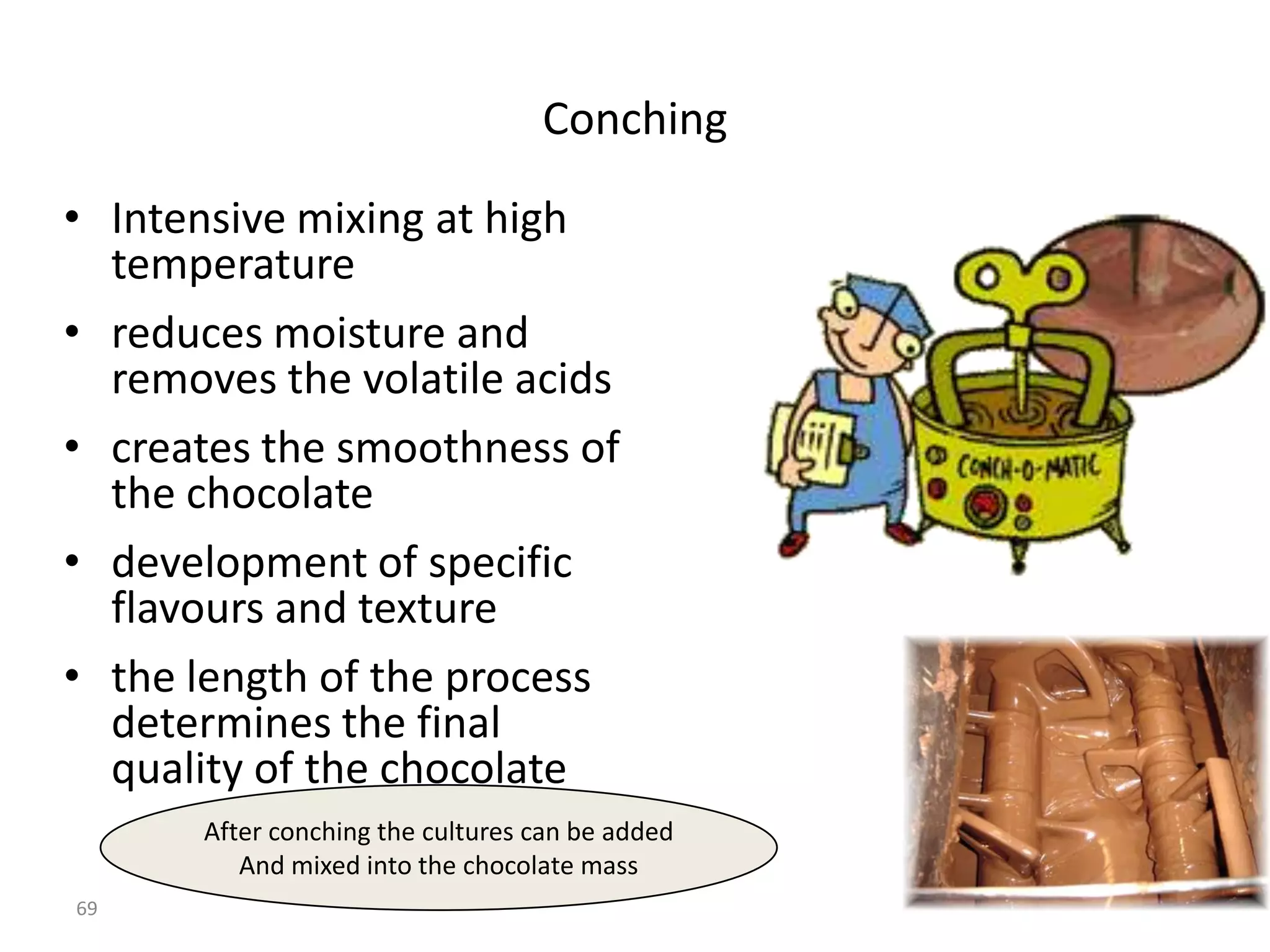
• Intensive mixing at high
  temperature
• reduces moisture and
  removes the volatile acids
• creates the smoothness of
  the chocolate
• development of specific
  flavours and texture
• the length of the process
  determines the final
  quality of the chocolate
       After conching the cultures can be added
          And mixed into the chocolate mass
69
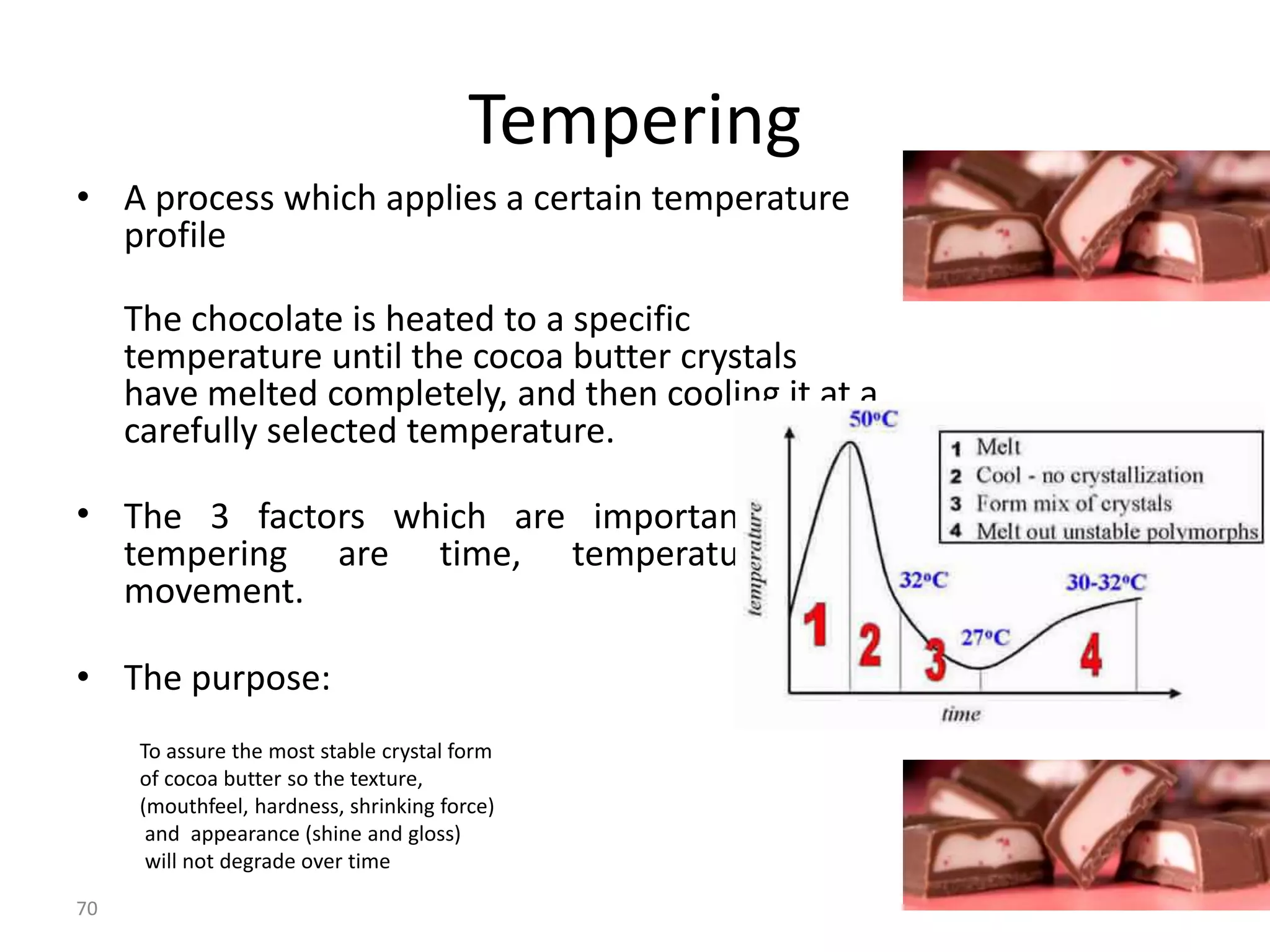
Tempering
• A process which applies a certain temperature
  profile

     The chocolate is heated to a specific
     temperature until the cocoa butter crystals
     have melted completely, and then cooling it at a
     carefully selected temperature.

• The 3 factors which are important during
  tempering are time, temperature and
  movement.

• The purpose:
      To assure the most stable crystal form
      of cocoa butter so the texture,
      (mouthfeel, hardness, shrinking force)
       and appearance (shine and gloss)
       will not degrade over time

70
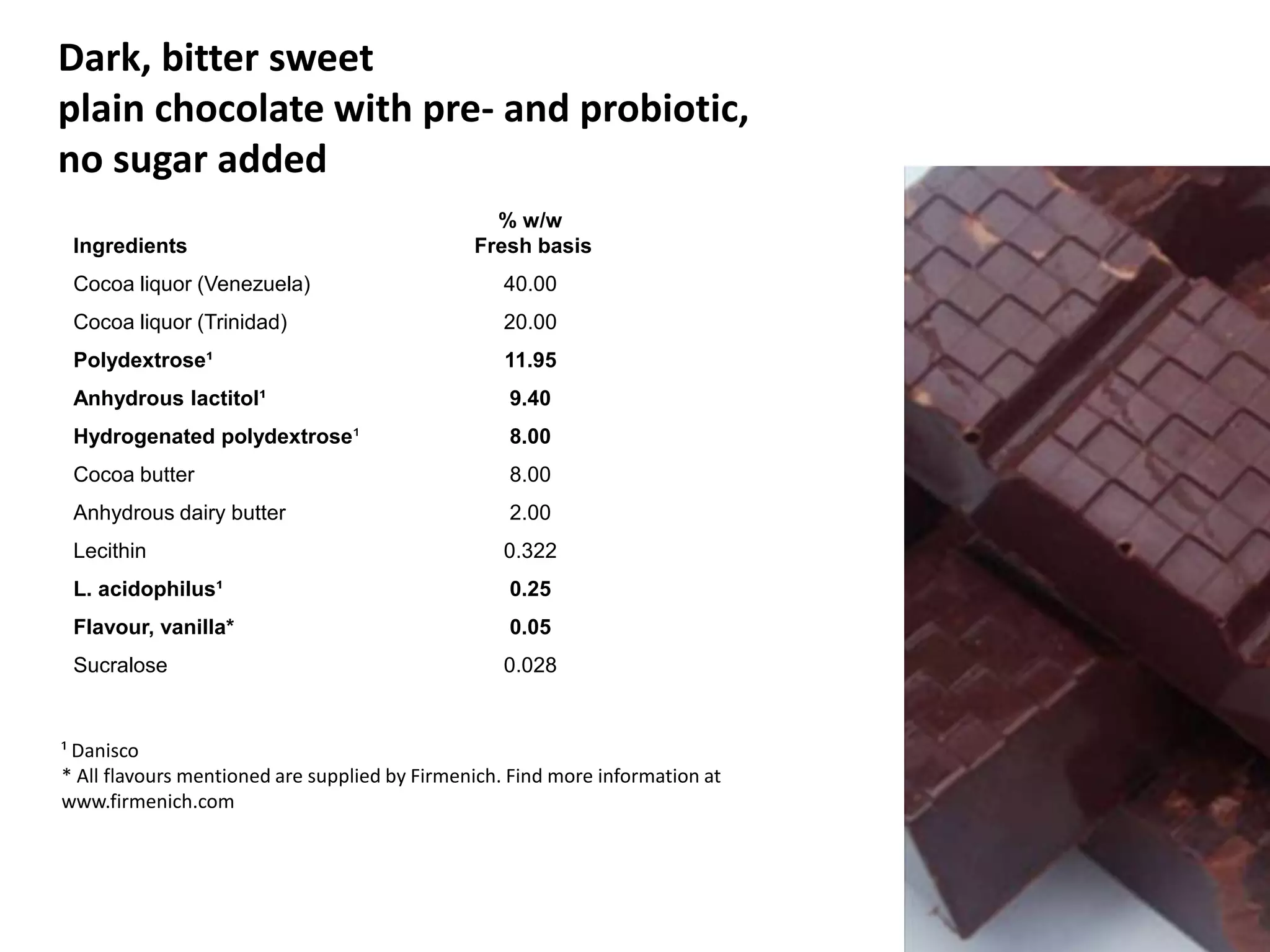
Dark, bitter sweet
plain chocolate with pre- and probiotic,
no sugar added
                                                 % w/w
 Ingredients                                   Fresh basis
 Cocoa liquor (Venezuela)                         40.00
 Cocoa liquor (Trinidad)                          20.00
 Polydextrose¹                                     11.95
 Anhydrous lactitol¹                               9.40
 Hydrogenated polydextrose¹                        8.00
 Cocoa butter                                      8.00
 Anhydrous dairy butter                            2.00
 Lecithin                                         0.322
 L. acidophilus¹                                   0.25
 Flavour, vanilla*                                 0.05
 Sucralose                                        0.028


¹ Danisco
* All flavours mentioned are supplied by Firmenich. Find more information at
www.firmenich.com


                                                                               71
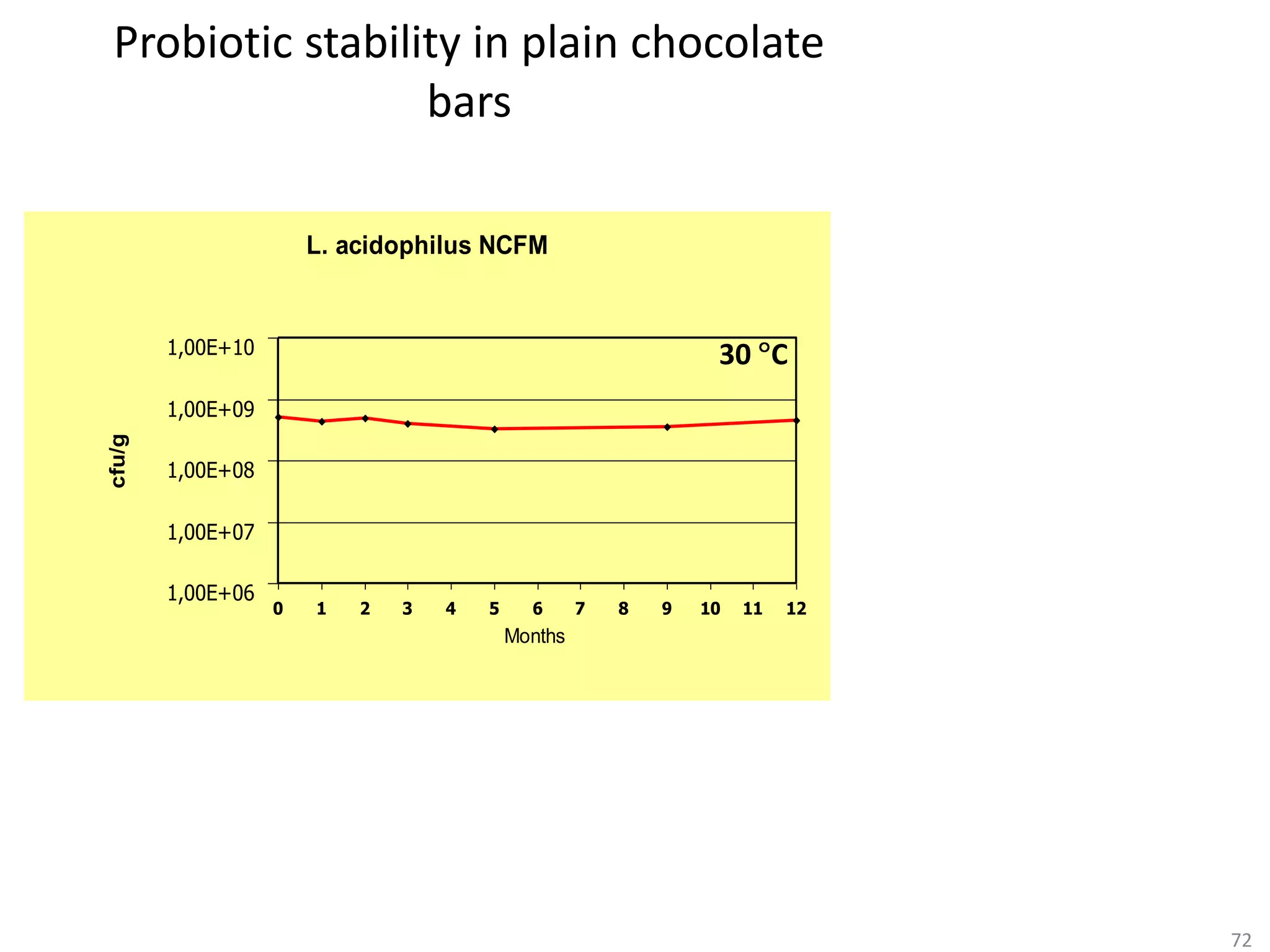
Probiotic stability in plain chocolate
                  bars

                       L. acidophilus NCFM


        1,00E+10                                                 30 C
        1,00E+09
cfu/g


        1,00E+08

        1,00E+07

        1,00E+06
                   0   1   2   3   4   5     6      7   8   9   10   11   12
                                           Months


                                                                               72
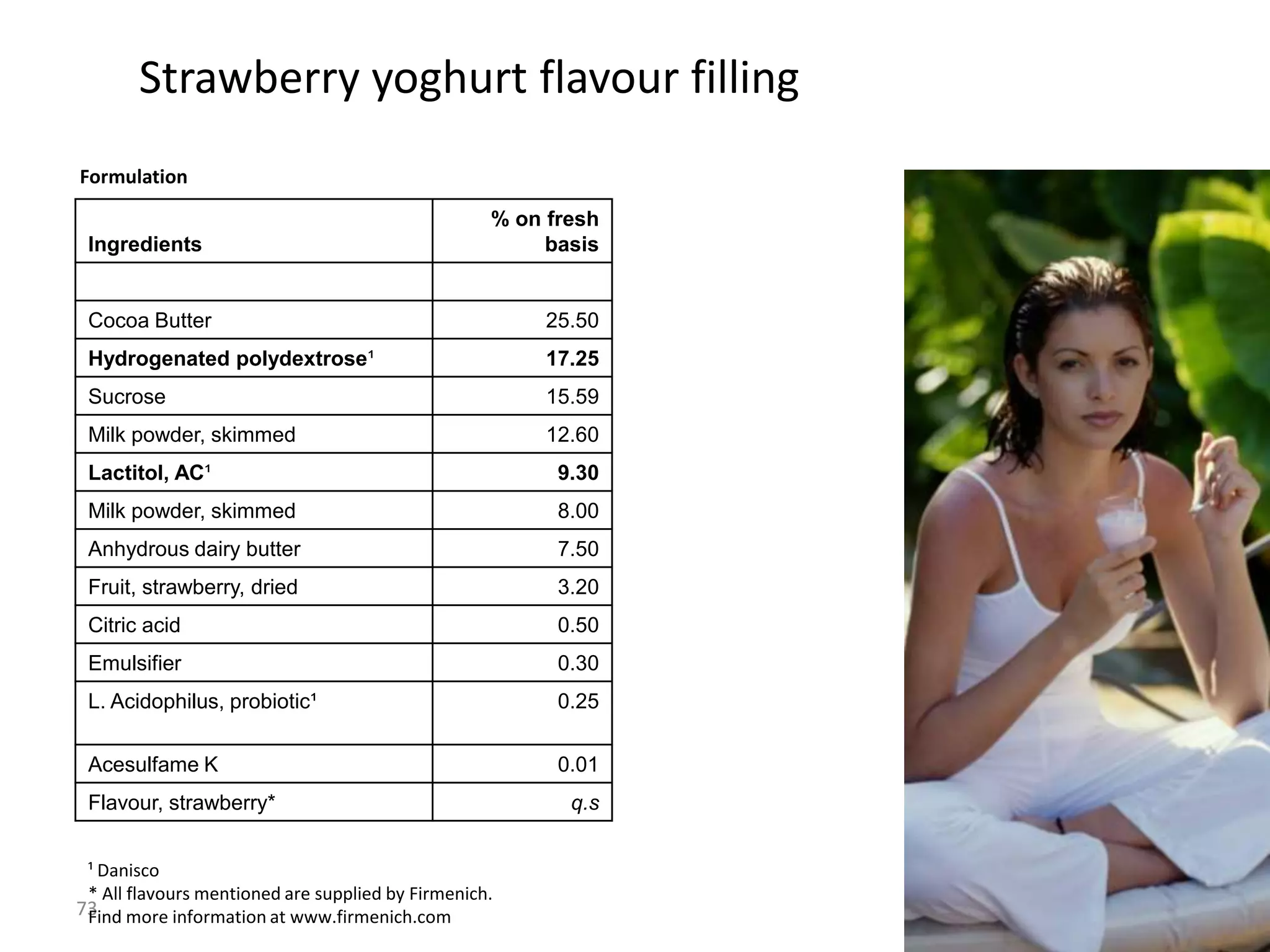
Strawberry yoghurt flavour filling
Formulation

                                                   % on fresh
 Ingredients                                            basis


 Cocoa Butter                                           25.50
 Hydrogenated polydextrose¹                             17.25
 Sucrose                                                15.59
 Milk powder, skimmed                                   12.60
 Lactitol, AC¹                                           9.30
 Milk powder, skimmed                                    8.00
 Anhydrous dairy butter                                  7.50
 Fruit, strawberry, dried                                3.20
 Citric acid                                             0.50
 Emulsifier                                              0.30
 L. Acidophilus, probiotic¹                              0.25

 Acesulfame K                                            0.01
 Flavour, strawberry*                                     q.s


 ¹ Danisco
 * All flavours mentioned are supplied by Firmenich.
73 more information at www.firmenich.com
 Find
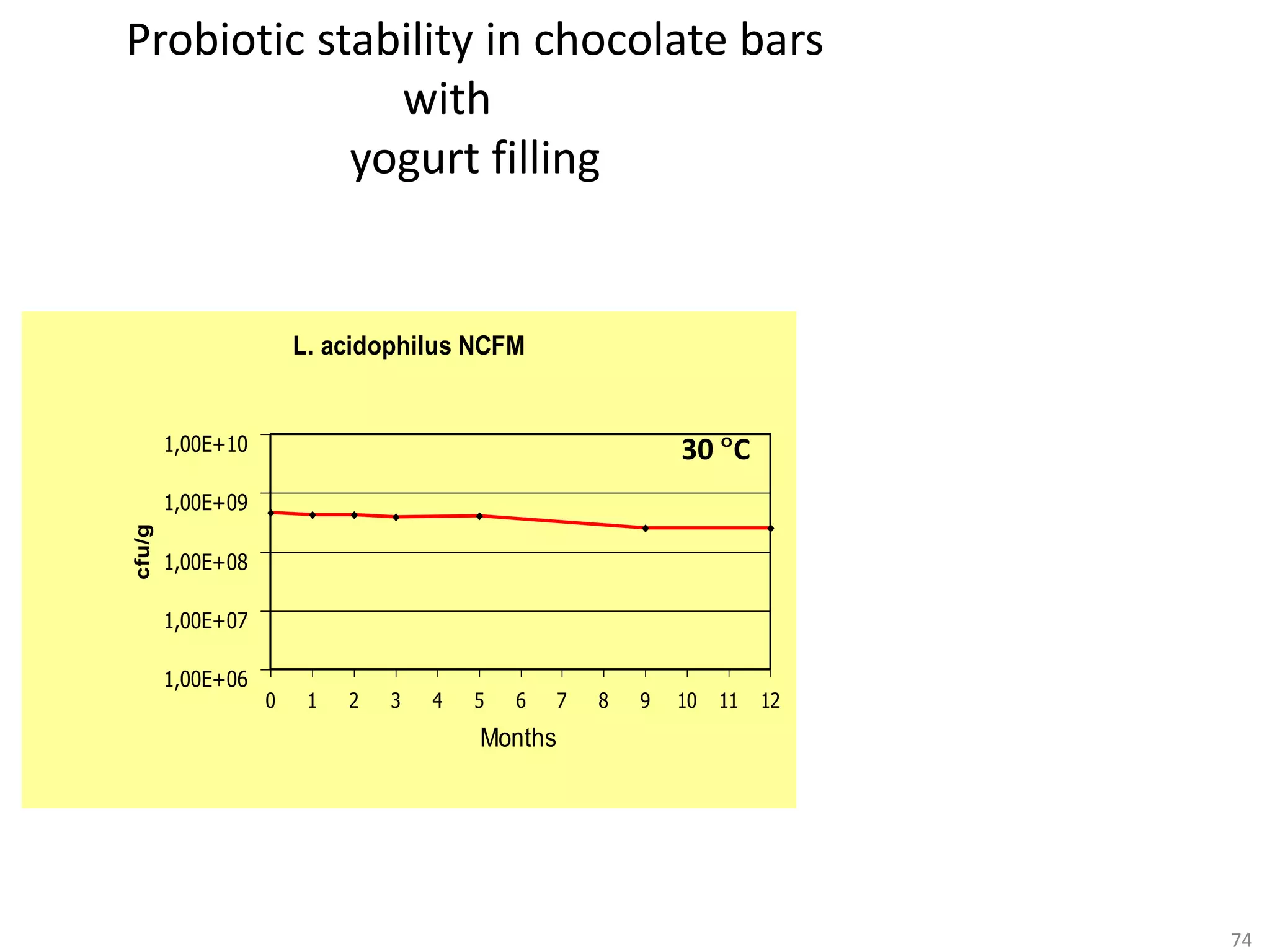
Probiotic stability in chocolate bars
              with
            yogurt filling


                       L. acidophilus NCFM


        1,00E+10                                             30 C
        1,00E+09
cfu/g


        1,00E+08

        1,00E+07

        1,00E+06
                   0    1   2   3   4   5   6    7   8   9   10   11   12
                                        Months


                                                                            74
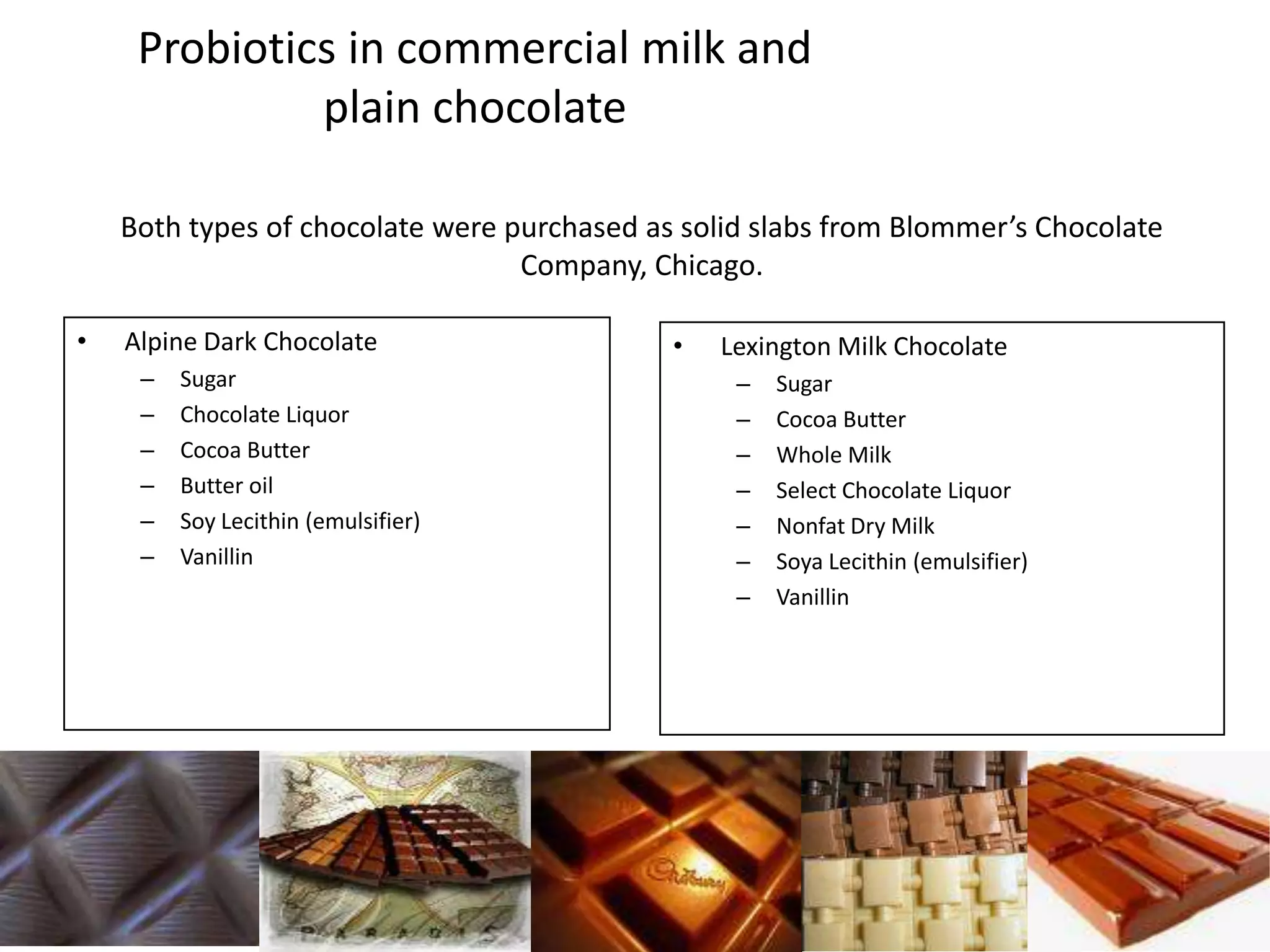
Probiotics in commercial milk and
               plain chocolate

     Both types of chocolate were purchased as solid slabs from Blommer’s Chocolate
                                   Company, Chicago.

•    Alpine Dark Chocolate                    •   Lexington Milk Chocolate
      –   Sugar                                    –   Sugar
      –   Chocolate Liquor                         –   Cocoa Butter
      –   Cocoa Butter                             –   Whole Milk
      –   Butter oil                               –   Select Chocolate Liquor
      –   Soy Lecithin (emulsifier)                –   Nonfat Dry Milk
      –   Vanillin                                 –   Soya Lecithin (emulsifier)
                                                   –   Vanillin


75
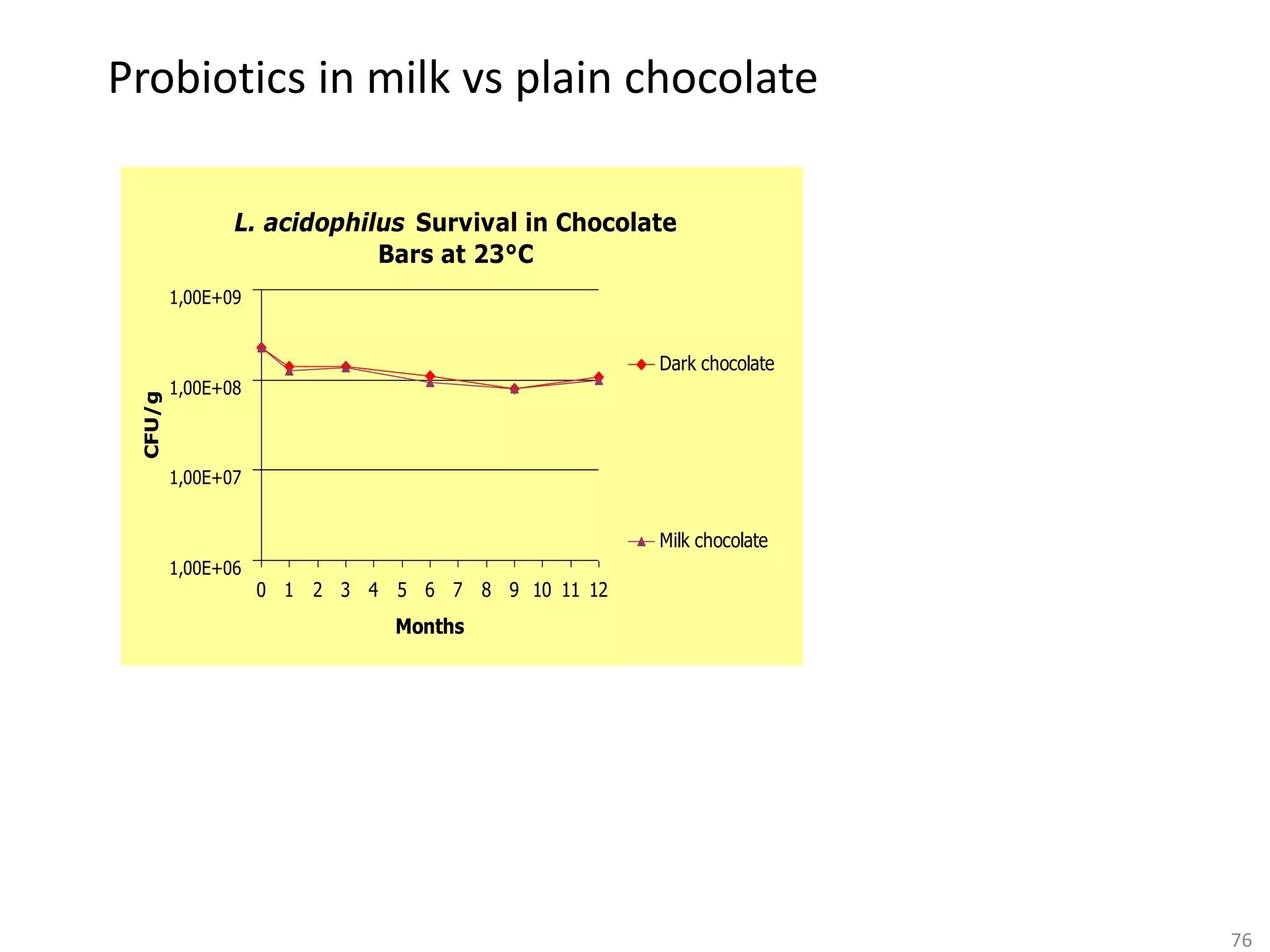
Probiotics in milk vs plain chocolate

                L. acidophilus Survival in Chocolate
                            Bars at 23°C
         1,00E+09


                                                   Dark chocolate
         1,00E+08
 CFU/g


         1,00E+07


                                                   Milk chocolate
         1,00E+06
                    0 1 2 3 4 5 6 7 8 9 10 11 12
                               Months


                                                                    76
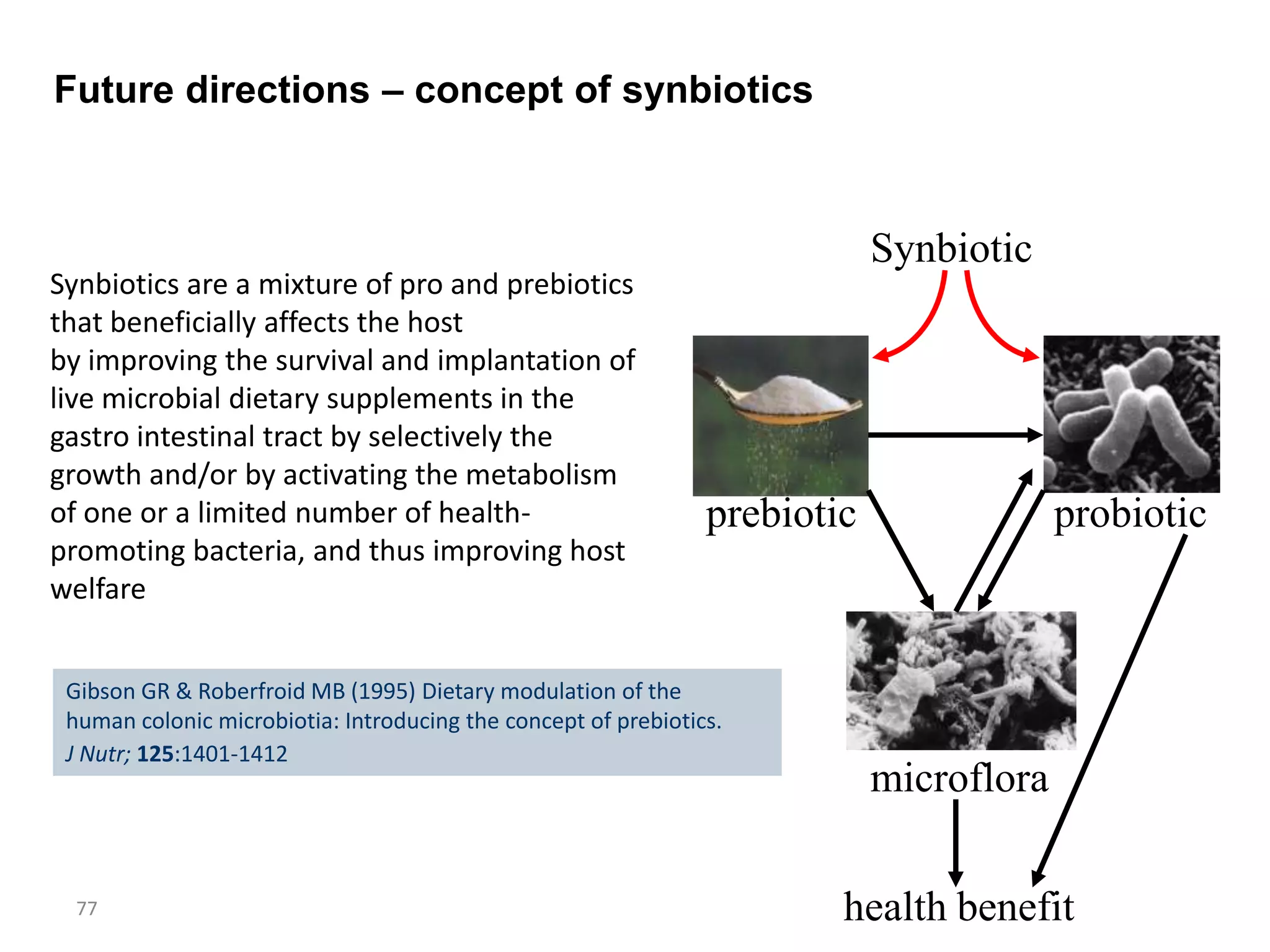
Future directions – concept of synbiotics


                                                                            Synbiotic
Synbiotics are a mixture of pro and prebiotics
that beneficially affects the host
by improving the survival and implantation of
live microbial dietary supplements in the
gastro intestinal tract by selectively the
growth and/or by activating the metabolism
of one or a limited number of health-                           prebiotic                probiotic
promoting bacteria, and thus improving host
welfare


 Gibson GR & Roberfroid MB (1995) Dietary modulation of the
 human colonic microbiotia: Introducing the concept of prebiotics.
 J Nutr; 125:1401-1412
                                                                            microflora

  77                                                                    health benefit
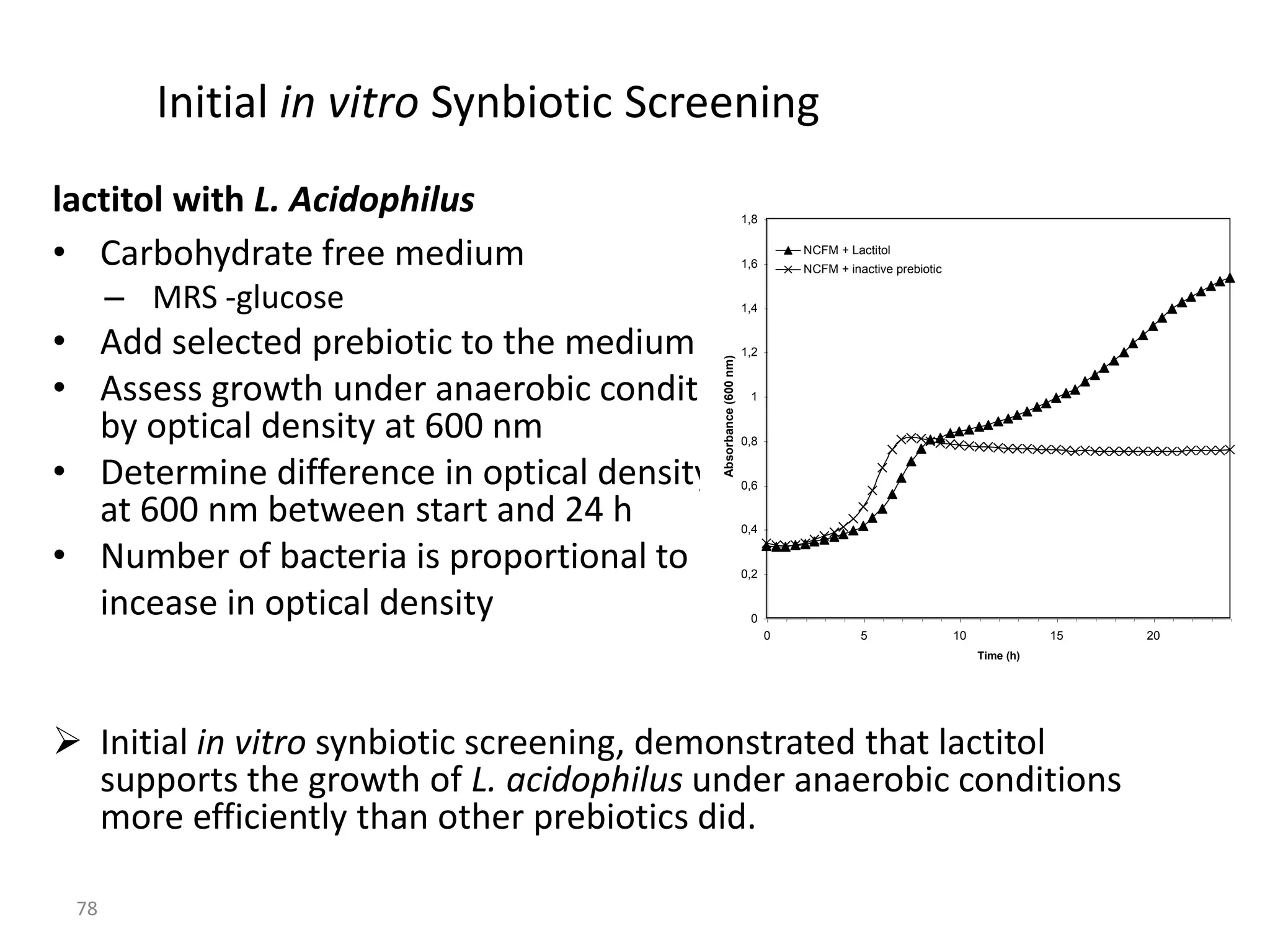
Initial in vitro Synbiotic Screening
lactitol with L. Acidophilus                                   1,8

• Carbohydrate free medium                                     1,6
                                                                         NCFM + Lactitol
                                                                         NCFM + inactive prebiotic

      – MRS -glucose                                           1,4


• Add selected prebiotic to the medium                         1,2


                                         Absorbance (600 nm)
• Assess growth under anaerobic conditions                      1


  by optical density at 600 nm                                 0,8


• Determine difference in optical density                      0,6

  at 600 nm between start and 24 h                             0,4

• Number of bacteria is proportional to                        0,2


  incease in optical density                                    0
                                                                     0             5                 10              15   20
                                                                                                          Time (h)


 Initial in vitro synbiotic screening, demonstrated that lactitol
  supports the growth of L. acidophilus under anaerobic conditions
  more efficiently than other prebiotics did.

 78
Health Claims

• The National Centre of Excellence in Functional Foods NCEF
• The regulations governing the use of health claims in Aus/NZ has
  not been finalised
• For high level claims to be approved by FSANZ, they will most
  likely require convincing evidence
• There is convincing or probable evidence for the substantiation
  for four distinct general level health claims with polydextrose
  which should satisfy the criteria set out by FSANZ
     –   Polydextrose helps maintain a healthy digestive system
     –   Polydextrose improves/enhances digestive health
     –   Polydextrose helps maintain a balanced digestive system
     –   Polydextrose enhances the prevalence of harmful bacteria in the
         gut, such as Lactobacillus and Bifidobacteria
• These claims can be made within the framework of the current
  Nutrient Claims regulations and when the new standards are
  implemented (P293 – Nutrition, Health and Related Claims)


79
Improving the Nutritional Profile of Your
        Confectionery Products

             Geoff O’Sullivan
               CMA 2008

Improving The Nutritional Profile Of Your Confectionery Products

  • 1.
    Improving the NutritionalProfile of Your Confectionery Products Geoff O’Sullivan CMA 2008
  • 2.
    Agenda • Global trendsin confectionery Sugar confectionery, chocolate and chewing gum Health trends in confectionery market • The theory of crystallisation and a “unique taste sensation” the “Ice - Candy” Side-by-side depositing technology for making Ice-Candies and Superjuice confectionery • Developing candies with high juice content Superjuices – super trend The effect of alternative sweeteners on the gelling of gelatine Heat stability of juices and cooking technologies • Functional chocolates, combining the health benefits of pre and probiotics Making prebiotic health claims in ANZ in snacks and confectionery 2 2
  • 3.
    Global trends forchocolate confectionery 6th Mintel gnpd food 8818 variants recorded April 2007 to 2008 includes: 3 Tablets, countlines, biscuits, coated and enrobed products
  • 4.
    Global trends forreduced sugar chocolate confectionery Mintel gnpd food 370 variants recorded April 2007 to 2008 includes: 4 Tablets, countlines, biscuits, coated and enrobed products 4
  • 5.
    Reduced sugar commercialproducts La Nouba Brazil April 2008 Vitality Brands World Wide (New Zealand) March 2008 Chocolat Stella Switzerland 11 Mar 2008 5
  • 6.
    Global trends forsugar confectionery 4 Mintel gnpd 5899 variants recorded April 2007 – 2008 includes: hard 6 candies, lollipops, medicated, chews, gummies, pastilles, liquorice, and coated products 6
  • 7.
    Global trends forreduced sugar confectionery Mintel gnpd food 794 variants recorded April 2007 to 2008 includes: hard 7 candies, lollipops, medicated, chews, gummies, pastilles, liquorice, and coated products
  • 8.
    Reduced sugar commercialproducts Red Band, Truly Juicy Maynards (Cadbury) Storck, Werther's Original, Netherlands Ireland,May 2007 (Germany) 15 Jan 2008 Thailand April 2008 8
  • 9.
    Global trends chewinggum 1 Mintel gnpd food 1336 variants recorded April 2007 to 2008 includes: all gum products 9 9
  • 10.
    Global trends reducedsugar chewing gum Mintel gnpd food 761 variants recorded April 2007 to 2008 includes: all gum products 10 10
  • 11.
    Reduced sugar commercialproducts White Dove Herbal, PowerBite Dental V6 + White Perfetti Van Melle USA, 07 Apr 2008 Denmark Mentos, White Complete 01 Apr 2008 Netherlands,11 Mar 2008 11
  • 12.
    Global trends forfunctional chocolate Mintel gnpd food 54 variants recorded April 2007 to 2008 includes: 12 Tablets, countlines, biscuits, coated and enrobed products 12
  • 13.
    Functional commercial products Daniele de Winter MasterFoods Migros, Actilife Belgium CocoaVia Switzerland Feb 2008 USA, 22 Aug 2007 06 Jun 2007 Beauty - skin nourishing For Heart Health Digestive health 13
  • 14.
    Types of functionalConfectionery Product Ranking Ranking Product Category * Chocolate tablets and bars 35% Hard candy, lozenges and lollipops 31% Chewing gum and dragees 17% Pastilles, gums, jellies and chews 14% Confectionery tablets 3% * Numbers based on the number of variants launched with a functional/health description on the product packaging 14 Mintel gnpd review April 2007 to 2008 14
  • 15.
    Market value 2004– 2006 for comparision Market Sizes - Historic - Retail Value RSP - US$ mn 2004 2005 2006 World Confectionery 120758.6 128766.8 136440.2 Chocolate confectionery 65057.7 69507.8 74043.9 Sugar confectionery 39391.7 41453.7 43254.2 Gum 16309.2 17805.3 19142.2 Chocolate - reduced sugar 329.1 254.5 245.5 Sugar confectionery - reduced sugar 3911.8 4247.2 4533.9 Gum - BFY Reduced sugar 6351.9 7138.1 7773.5 Australia Confectionery 2132.4 2293.9 2340.4 Chocolate confectionery 1330.3 1434.8 1461.2 Sugar confectionery 623.3 663.6 681.7 Gum 178.8 195.5 197.5 Chocolate confectionery - reduced sugar 0.9 0.9 0.9 Sugar confectionery - reduced sugar 36.2 40.9 42.6 Gum - reduced sugar 111.3 122.3 125.9 Chocolate confectionery - Fortified/functional 3.8 4.2 4.3 Sources: ©2008 Euromonitor International 15 15
  • 16.
    Confectionery Types Candy Mass Boiling Texturant No Texturant Aeration Pulling Setting Setting Crystallisation Marshmallow Chewy Candy Jelly Hard Candy Recrystallised Candy Stamping 16
  • 17.
    Xylitol crystallised “Ice– Candy” Amorphous Hard Candy, Part A Input %w/w Isomalt 40.39 Xylitol, C¹ 1.28 Buffered citric acid (solution) 1.0 Malic acid 0.25 Flavour, apple* 0.04 Colour, green Q.S Insert image/object Water 7.04 Crystallised Hard Candy, Part B Xylitol, C¹ 47.32 Hydrogenated polydextrose¹ 2.50 Flavour, vanilla* 0.18 ¹ Danisco 17 *All flavours mentioned are supplied by Firmenich. Find more information at www.firmenich.com 17
  • 18.
    Xylitol Crystallised “Ice– Candy” 1. The finished candy is made by simultaneous depositing (side by side A & B) of a cooked hard candy mass with a crystallised xylitol hard candy mass. 2. Preparation of the isomalt hard candy mass is carried out by dry blending the isomalt, with the xylitol and then dissolving the powder in water at 60 C. When completely dissolved the solution is heated under vacuum to 165 C and allowed to cool to 125 C. the colour, flavour and acids are then added. 3. Whilst the the isomalt candy mas is being prepared, the crystallised Xylitol hard candy mass is prepared by dry blending the xylitol and hydrogenated polydextrose and heating the mass to 130 C to melt the mass. The mass is cooled to 80 C with stirring to develop enough xylitol crystals to seed the mass on cooling and the flavour is added. 4. Using the mechanical depositing method of choice the two sides of the candy are deposited simultaneously into metal moulds. Isomalt at 120 C and the xylitol at 80 C. 18
  • 19.
    Simultaneous Depositing Two side by side hoppers pass through single manifold to enable simultaneous depositing of materials In the case of the “ice-Candy” side-by-side but many others possible 19
  • 20.
    Simultaneous depositing Control of piston motion, jacket and manifold temperature is critical Piston movement 20 20
  • 21.
    Optimising & understandingthe process Depositing Xylitol crystals are fragile – jacket temperature – max 80 C and manifold - 110 C Cooling Too rapid cooling (freezing) – in fact halts crystal formation and best results are seen in the range 5 to 15 C with cooling times of 25 – 45 minutes. The final texture is developed after 24 - 48 hours In the process we have to balance two key forces • Thermodynamics • Kinetics As always! 21
  • 22.
    Optimising & understandingthe process Our aim is generate the optimum amount and size of seed crystals • for speed and quality of crystallisation • not to denature the mass during depositing • this is crucial to making a good product Mixing This stage develops fine and homogenous crystal dispersion The time and temperature are crucial for minimum cooling times and perfect texture 22
  • 23.
    Saturation – sucrosewater system 23 23
  • 24.
    State transitions andspecific volume liquid Specific volume V=1/r rubber Enthalpy glass H crystal Tg Tm 0 Temperature (K) 24
  • 25.
    Glassy state Glass Transition Temperature Of Some Common Carbohydrates 300 Sorbitol 250 Xylitol 200 Maltitol °C 150 Glucose 100 Sucrose 50 Maltodextrin 0 Polydextrose -50 Starch 25
  • 26.
    Viscosity 200 150 Viscosity Cps 100 50 0 Polydextrose lactitol Isomalt Sucrose Maltitol Sorbitol Xylitol Erythritol 26 Viscosity Measured on 65% solution @ 25 °C
  • 27.
    Temperature versus crystallisation Nucleation Propagation Overall Crystallisation Rate Tg Processing Temperature Tm Xylitol -28 C 34.5 C 97 C 27Sucrose 78 C 108.0 C 186 C
  • 28.
    Formation of newphase Crystallisation is considered as the transformation of an homogenous solution to a mixture of two phases ∆G mix = ∆H mix - T∆S When ∆H mix less than zero stable solution When ∆H mix is greater than zero crystallisation occurs Requires nucleation That has large thermodynamic barrier and depends on two terms Surface energy Volume energy When nucleus radius is small surface energy dominates and the nucleus is stable and when radius/size is large volume energy dominates and nuclueus is unstable and falls apart R = the inflection point – maximum size 28
  • 29.
    Effect of ShearRate With out shear or seeding crystallisation takes too long and is un predictable using shear/mixing for heterogeneous crystallisation is the best method Increases crystallisation rate Shear/work gives uniform crystal size Rate of Crystallisation R Shear rate 1/s • This process would represent the most controlled way of developing Xylitol crystals – if process capability would allow it! 29
  • 30.
    Crystallisation - process Time Seconds -Minutes - Hours Minutes -Days - Months 30
  • 31.
    Heat of solution– Influences taste perception cooling load & time to release from mould 20 10 8 4 0 -10 -4 -9 -7 -20 -13 -19 -30 -25 -29 -40 -38 -50 -42.9 Erythritol Xylitol Mannitol Sorbitol Maltitol Lactitol monohydrate Isomalt Lactitol anhydrous Sucrose Inulin Polydextrose * The high heat of solution – in effect acts against cooling – more crystallisation 31 produces more heat
  • 32.
    Controlling the crystallisation Not enough crystal seed Ideal crystal seed content and high depositing content and depositing temperature temperature Too much crystal seed content and low depositing Optimising temperature conditions is critical to make good product 32 32
  • 33.
    Continuous Depositing Method- suggestion Cooked mass Candy mass Static mixer to provide Crystallised xylitol Shear and cooling 2 X Cookers Cooked candy mass 33
  • 34.
    Health & wellnessmarket Market Sizes - Historic - Retail Value RSP - US$ mn 2002 2003 2004 2005 2006 World Beverages (soft and hot drinks) 288,356.8 317,102.9 350,740.0 377,036.9 396,109.2 Beverages - H&W 110,108.6 125,854.1 143,397.6 156,863.6 168,009.5 Beverages - Better for you (BFY) 21,650.6 24,889.2 28,613.1 31,400.9 33,930.7 Packaged food (all packaged food) 1,142,281.8 1,268,277.0 1,387,158.3 1,483,277.3 1,541,517.0 Packaged food - H&W 160,879.8 185,626.9 211,728.0 231,606.2 245,684.5 Packaged food - BFY 78,758.3 89,390.8 101,978.6 109,088.6 113,303.4 Confectionery 98,093.1 109,128.0 120,255.6 129,975.7 136,596.9 Confectionery - H&W 14,411.7 17,004.9 19,522.7 21,465.2 23,062.8 Confectionery - Better for you (BFY) 7,981.3 9,354.9 10,725.6 11,729.8 12,637.1 Snack bars (not specified H&W) 5,028.4 5,919.0 6,550.4 7,081.8 7,492.5 Fruit bars (not specified H&W) 734.6 807.1 861.4 926.8 928.4 Sweet and savoury snacks (not specified H&W) 60,783.3 66,134.9 71,848.4 75,117.2 79,018.3 Fruit snacks (not specified H&W) 2,210.7 2,432.3 2,723.8 2,968.6 3,226.4 Better-for-you foods of All kinds have increased Sources: by 30.5% 1. Health and Wellness Beverages: Euromonitor from trade sources/national statistics 34 2. Health and Wellness Packaged Food: Euromonitor from trade sources/national statistics
  • 35.
    The consumer andhealth & wellness Consumer awareness of functional foods was studied recently by the (IFIC) International Food Information Council based in Washington in the U.S. They commissioned Cogent Research of Cambridge, MA to conduct a quantitative study of American consumers’ attitudes, awareness, and interest in functional foods. Between April 10-24, 2007, 1,000 adults, 18 years and older, were randomly selected to participate in a 20- minute Web-based survey. IFIC 2007 Consumer Attitudes towards Functional Foods/ Foods for Health. 35 35
  • 36.
    The consumer andhealth & wellness When asked about their belief in functional foods, the vast majority of consumers agree that certain foods have health benefits that go beyond basic nutrition and may reduce the risk of disease or other health concerns The table below lists the top health concerns Health Concern Ranking Heart & Circulatory issues 53% Weight 33% Cancer 24% Diabetes 17% Nutrition & Diet 16% Exercise 11% Lung & Respiratory 7% Arthritis 5% 36 2007 Consumer Attitudes towards Functional Foods/ Foods for Health. IFIC 36
  • 37.
    The consumer andhealth & wellness • The top “functional foods” named by consumers in the 2007 quantitative survey were fruits and vegetables (general); fish, fish oil, seafood; milk; whole grains; fibre; oats, oat bran, oatmeal; green tea; meat, red meat; water; herbs/spices; dairy (other than milk); cereal; nuts; and juice • Red fruits are becoming very fashionable and a new term superfruits has been introduced to recognise the health promoting benefits of the antioxidants and other health promoting ingredients contained in these fruits • Superfruits such as cranberry, pomegranate, blueberry and blackberry blends are very common in drinks 37 37
  • 38.
    Superfruits - superjuiceconfectionery • Fruit and fruit juices naturally contain high levels of vitamins, polyphenols and minerals. Fortunately it is possible to combine several health benefits in innovative confectionery products by using ingredients such as fruit and fruit juices with sweeteners and sugar alternatives • These products can also have the additional market positioning of containing fruit juice, vitamin C, calcium, magnesium, potassium and phytosterols • Better for you confectionery is also possible with the incorporation of the health benefits of high concentrations of fruit juices MINTEL gnpd Jan 08 Trans Category Trends Review (Super Juice) Ingredient Strategist Volume 1, Issue 8, 2004. Source: just-food December 31, 2004 91 Pages - Pub ID: AQ1080567. ‘Natural food-Fruit’, 30th May 2000, www.naturalhub.com. 38
  • 39.
    Superjuice super candy • “Superjuice” – super candy • The concept/goal is to make products that taste as good if not better than traditional confectionery products, with the benefits of…… Pure Juice No preservatives No added Colours No Artificial flavours No added acids No Intense Sweeteners Reduced sugars Reduced calorie High in fibre 39 39
  • 40.
    Bulk (nutritive) sweeteners& high potency sweeteners Starch based Aspartame Thaumatine Acesulphame K Neohesperidine HFCS 55 isoglucose Cyclamate Stevioside HFCS 42 Saccharin Glycyrrhizin Glucose syrups Sucralose Brazzein High maltose syrups TwinSweet Neotame High potency Alitame Sucrose Mannitol Fructose Isomalt Sugar alcohols Glucose / dextrose Maltitol Trehalose Xylitol Tagatose Bulking agents Sorbitol polydextrose Glucose fructose sucrose extracts from fruits Lactitol inulin, FOS Sorbitol and maltitol syrups Saccharides Erythritol Approved in EU 40
  • 41.
    Juice properties –sugar composition 41 41
  • 42.
    Juice properties –acid type 42 42
  • 43.
    Juice properties –antioxidants (colour) Antioxidants in the form of anthocyanins are blackberry, blueberry, blackcurrant, raspberry, cranberry, red grape give these Fruits there colour Lycopenes give pink grapefruit, watermelons and pink guava their colour Carotenoids give citrus fruits their distinctive mgs per fruit colour Ellagic acid, is a key component of the colour of strawberries 43 43
  • 44.
    Heat stability offruit juices Blackberry, blueberry, blackcurrant, raspberry, cranberry, red grape fruits where the colour is derived from anthocyanins are quite heat stable Strawberry was found to be the least stable juice in our concept development – possibly due to poor heat stability of ellagic acid Apricot juice with lycopenes contributing to their colour was also quite stable Clear citrus juices are easiest to work with as the colours are carotenoids and heat resistant These juices were fond to be heat stable for short times of 0.5 to 2 minutes below 120 C Above 120 C none of the juices were stable – this can be a problem as confectionery is a high temperature process 44
  • 45.
    Concept types developed • Chewy candy & Hard candy Challenge is the need to cook to high temperatures and add high concentrations of the juices • Gelatine gummies This at first sight would look to be the easiest product type because cooking temperatures are lower than 120 C. However other problems were encountered with setting of gelatine 45 45
  • 46.
    Chewy candy -formulation Pomegranate, Apricot & Orange Raspberry & Raspberry & Yumberry Part C. Prepare the gelatine Blueberry solution in 24 hours in Ingredients % on fresh basis % on fresh basis % on fresh basis advance by mixing gelatine and lemon juice Part A: bulk syrup Hydrogenated polydextrose 1 38.00 38.00 38.00 concentrate together in a Sucrose 26.00 26.00 26.00 water bath at 60 C Cocoa butter 3.45 3.45 3.45 Emulsifier1 0.27 0.27 0.27 Water 7.48 9.01 8.56 Part A. Dry blend the Part B: juice concentrates ingredients, add the water Juice concentrate, pomegranate 5.75 - - and cook the solution to Juice concentrate, raspberry 2.70 - 6.00 Juice concentrate, blueberry 2.15 - - 136-143 C, add Juice concentrate, apricot - 4.55 - immediately the juice Juice concentrate, orange - 4.55 - concentrate part B Juice concentrate, yumberry - - 3.50 Part C: gelatine solution Gelatine 220 bloom 1.60 1.60 1.60 Part C & D. Add the gelatine Juice concentrate, lemon 2.40 2.40 2.40 solution and flavour Part D: flavours Flavour, raspberry* 0.20 0.20 Flavour, apricot* - 0.10 - Part E. Add the milled Flavour, orange* - 0.07 - sugar, mix and cool until of Flavour, banana* - - 0.02 a suitable consistency for Part E: graining Milled sucrose 10.00 10.00 10.00 pulling (5 minutes). Allow to cool further, until of a ¹ Danisco texture suitable for forming All flavours mentioned are supplied by Firmenich. cutting and wrapping 46 Find more information at www.firmenich.com 46
  • 47.
    Hard candy –formulation & process Preparation of the cooked Pomegranate, Apricot & Raspberry & coconut cream hard candy Raspberry & Orange Yumberry Blueberry mass is carried out by dry blending the polydextrose with Ingredients % on fresh basis % on fresh basis % on fresh basis all ingredients. The solution is Part 1: High Juice Hard Candy heated to 148˚C and allowed Hydrogenated polydextrose1 23.77 23.77 23.77 to cool to 125˚C. The flavour is Sucrose 20.09 20.09 20.09 Fructose1 1.17 1.17 1.17 then added Juice concentrate, pomegranate 1.40 - - Juice concentrate, raspberry 0.82 - 1.63 Juice concentrate, blueberry 0.70 - - Preparation of the Superjuice Juice concentrate, apricot - 1.46 - hard candy mass is carried out Juice concentrate, orange - 1.46 - Juice concentrate, yumberry - - 1.17 by dry blending the Juice concentrate, lemon 0.47 0.47 0.47 polydextrose with sugar and Flavour, raspberry* 0.10 - 0.10 water, then heating the mass Flavour, apricot* - 0.05 - Flavour, orange* - 0.04 - to 150˚C under vacuum. The Flavour, banana* - - 0.01 juice concentrates and flavour Water 1.48 1.49 1.59 are added as the mass cools Part 2: Coconut Cream Hard Candy Hydrogenated polydextrose1 18.00 18.00 18.00 to 125˚C. Sucrose 15.00 15.00 15.00 Lactitol, monohydrate1 7.00 7.00 7.00 Coconut oil 5.50 5.50 5.50 Using the mechanical EMULSIFIER1 0.20 0.20 0.20 depositing method of choice Salt 0.13 0.13 0.13 the two sides of the candy are Flavour, coconut* 0.15 0.15 0.15 Water 4.02 4.02 4.02 deposited simultaneously into metal moulds. Coconut Cream ¹ Danisco at 125˚C and High Juice at 47 All flavours mentioned are supplied by Firmenich. Find more information at www.firmenich.com 125˚C. 47
  • 48.
    Microfilm cooking Film cooker very thin film under vacuum evaporation of water happens instantaneously Juice added to cooked syrup at ambient pressure Plate heat exchanger to heat syrup 48 48
  • 49.
    Trial machinery Fruit syrup added after microfilm cooker Heat exchanger feeds microfilm cooker 49
  • 50.
    Chewy & hardcandy Chewy Candy Hard Candy Chewy mass was aerated by lab scale Candy mass deposited by lab scale pulling machine and cut and wrap machine depositing machine to form candies to form candies and pillow packed 50 50
  • 51.
    Idea – for hard candy depositing method Two microfilm type cookers Static mixer to mix juice Candy mass and candy mass Evaporated fruit syrup Depositor 2 X Cookers Cooked candy mass 51
  • 52.
    Idea - forchewy candy cut & wrap Two microfilm cookers Static mixer to mix juice and candy mass Batch former Evaporated fruit syrup Cut & Wrap Gelatine solution Former and air Cooked candy mass 52
  • 53.
    Gelatine gummies –alternative sweeteners Change in gelling characteristics occur with sugar alternatives Ingredients % on fresh basis Bulk Syrup, Part A Hydrogenated polydextrose 70% solution¹ 77.45 Xylitol, C¹ 5.54 Acesulfame K 0.04 Gelatine Solution, Part B Gelatine, type A 6.15 Water 8.97 Flavours & Acid, Part C Malic Acid 1.50 Colour, orange q.s Flavour, orange* q.s Flavour, sugar* g.s ¹ Danisco •All flavours mentioned are supplied by Firmenich. Find more information at www.firmenich.com We found that sugar free gelatine gummy would not set with citric acid Lactic acid and malic acids work well and mixtures with acetic acid. These also have a very good shelf-life? 53 53
  • 54.
    Gelatine sol andgel forms Gelatine Helix GEL FORM Not attached SOL FORM Not attached 54
  • 55.
    Gelatine - isoelectricpoint Three theories have been mentioned Theory 1. Isoelectric point clashes with pH of citric acid Type A pI = 6.3 – 9.5 (shown below) Type B pI = 4.5 – 5.2 Theory 2. Buffering capacity of sugar alternatives less than glucose syrups and sugar – no evidence for this? Isoelectric point type A gelatine Acid pKa values Acetic 4.75 Citric 3.15, 4.77, 6.40 Lactic 3.86 Malic 3.4, 5.1 55 55
  • 56.
    Gelatine - isoelectricpoint & buffering Experimental findings We found that both type A and B at 1.5% citric acid did not set Using up to 13% gelatine does give a set – but cannot deposit Using gelatine hydrolysate did not improve set We found buffering capacity 280 bloom At first it looks as though pKa (acid strength) could be the answer gelatine to 0.5 – 0.7% ….but pH is useful in hydrating the gelatine, as we used for the chewy citric acid candy as shown above Only practical solution ….was to compromise 56
  • 57.
    Polydextrose - Sorption-Desorption Isotherm Theory 3. Hydrophylic polymer – is a property of some sugar alternatives that seems to change gelatine’s behaviour with citric acid – causing precipitation especially near to the isoelectric point Polydextrose – hydrophylic polymer Sorption 40 Desorption Water content % wb 30 20 Holds on to almost 10% w/w water 10 0 0 20 40 60 80 100 57 RH %
  • 58.
    Gelatine gummy mixedSuperfruits Ingredients % on fresh basis Pomegranate, Raspberry & Apricot & Orange Raspberry & Yumberry Blueberry Bulk Syrup, Part A Litesse® Ultra™ 70% solution1 38.09 39.20 40.00 Sucrose 15.00 16.00 16.00 Fructofin®1 (fructose) 6.00 7.00 7.00 Water 3.70 (q.s) 2.94 (q.s) 4.21 (q.s) Gelatine Solution, Part B Gelatine 7.65 7.65 7.65 Gelatine hydrolysate 3.61 3.61 3.61 Water 11.25 11.25 11.25 Juices concentrates, Part C Juice concentrate, apricot 9.00 - - Juice concentrate, orange 4.50 - - Juice concentrate, pomegranate - 6.40 - Juice concentrate, blueberry - 2.40 - Juice concentrate raspberry - 3.00 5.94 Juice concentrate, yumberry - - 3.34 Juice concentrate, lemon 0.80 0.2 0.8 Flavours, Part D Flavour, apricot* 0.30 - - Flavour, orange* 0.10 - - Flavour, blueberry* - 0.05 - Flavour, pomegranate* - 0.1 - Flavour, raspberry* - 0.2 0.2 58 cannot We chose the type of acid in the fruit, so blends became the answer 58
  • 59.
  • 60.
    Case study :gel strength from basic sugars base : 1.5% w/w pectin Load Polydextrose requires slow set pectin Resulting parameters pH Bx DS% aw Glucose Sucrose 3,6 80,6 81,0 0,67 Fructose 3,6 79,9 80,6 0,66 Glucose 3,6 80,4 81,2 0,65 Sorbitol 3,6 79,1 80,7 0,65 Xylitol 3,6 78,1 81,2 0,63 Extension 60
  • 61.
    Pre-setting: polydextrose andpectin interaction Pectin Polydextrose DP 12 OH HO Possible that Polydextrose forms O OH part of complex gel HO HO O OH structure OH O HO O O HO HO O OH OH HO O OH O HO O O HO O O HO O OH O O O OH HO HO OH HO O O OH HO O HO HO O O HO HO OH HO OH O O OH OH OH HO 61 HO Range of DPs with Maximum at 28 OH
  • 62.
    Functional chocolate withpre & probiotics A probiotic is a live microbial food or feed supplement which beneficially affects the host by improving the balance of intestinal microflora. A prebiotic is a non-digestible food ingredient that beneficially affects the host by selectively stimulating the growth and/or activity of one or a limited number of bacteria in the colon, and thus improves host health. (Gibson and Roberfroid, 1995) A Synbiotic – is a combination of pro- and prebiotics where the efficacy of the probiotic is enhanced by the inclusion of a prebiotic. Fibre – can be defined in many ways. Physiologically, fibre is essential to regularize bowel function and it may also mediate glucose and cholesterol attenuating effects. 62
  • 63.
    Rationale for prebiotics– digestive diseases Diseases & disorders include: All digestive diseases – USA • Abdominal wall hernia • Constipation Prevalence • Diverticulitis >75 million by all digestive diseases (1998) – excluding 135 and 76 million • Gastritis and non-ulcer dyspepsia non food borne and food borne • Haemorrhoids infections/illnesses • Infectious diarrhoea Mortality • Irritable bowel syndrome >125,000 including deaths from cancer • Inflammatory bowel disease (1998) • Lactose intolerance Costs • Peptic ulcer >$86 billion direct medical costs (1998) • Hepatitis >$20 billion indirect costs (1998) lost productivity, disability, etc. Ref: www.niddk.nih.gov/statistics.htm, The Burden of Selected Digestive Diseases in the USA, 2002, Sandler et al 63
  • 64.
    Rationale for prebiotics– a balanced microflora • Molecular studies indicate that the intestinal microflora consists of 1014 microbes from more than 1000 species. • Little is known about the role played by many of the dominant bacteria in the gut that are believed to be benign such as Bacteroides, Eubacterium spp., Ruminococcus spp., Butyrovibrio spp. • Bifidobacteria and lactobacilli are two species with known positive contributions to human health. • As the microflora protect against incoming pathogenic microbes and modulate immune response, a balanced microflora increases well-being of the gastrointestinal tract.  Prebiotics can contribute to human digestive health by specifically stimulating growth of bifidobacteria and lactobacilli, two microbial species accepted to exhibit Ouwehand AC, Makelainen H, Tiihonen K and Rautonen, N (2006) - Digestive Health, pages 44-51, Part I Sweeteners and Sugareffects. in Food Technology, Edited by Helen Mitchell, Blackwell Publishing, UK. beneficial Alternatives 64
  • 65.
    A commercial Lactobacillusas a probiotic Sanders ME and. Klaenhammer TR (2001) J Dairy Sci; 84:319-331. Varcoe JJ et al (2003) J Food Prot; 66:457-65. 65 Alterman et al (2005) PNAS; 102:3906-3912
  • 66.
    Functional chocolate withpre & probiotics • In the confectionery sector high cocoa containing chocolate has become recognised for its health promoting properties that are derived from the polyphenols in the cocoa • Cocoa is also a good fibre source and this too is a feature of some of the chocolate products on the market today. In addition to these health benefits we can also add prebiotic fibres and probiotic cultures for improved digestive health The chocolatemaking process • Harvesting the cocoa beans • Fermenting • Roasting • Blending • Refining • Conching These are the processes • Tempering are used to make the bars or • Moulding assortments and where probiotic • Storing cultures can be added 66
  • 67.
    Pre & Probioticchocolate Concept Chocolate consumption will typically be between 30 and 40 grams per day, this means the dosage of 0.25% w/w that was chosen for the concept bars guarantees ideal dosage over shelf life It is not possible to consume too much of the cultures 67
  • 68.
    Conventional chocolate manufacturing Cocoa Whole milk Skim milk Sugar Cocoa butter liquor powder powder Mixing Refining The environment has to be low Conching moisture, below 50 C and low shear Tempering Culture Add 10E9 cfu/ serving Moulding Enrobing 68
  • 69.
    Conching • Intensive mixingat high temperature • reduces moisture and removes the volatile acids • creates the smoothness of the chocolate • development of specific flavours and texture • the length of the process determines the final quality of the chocolate After conching the cultures can be added And mixed into the chocolate mass 69
  • 70.
    Tempering • A processwhich applies a certain temperature profile The chocolate is heated to a specific temperature until the cocoa butter crystals have melted completely, and then cooling it at a carefully selected temperature. • The 3 factors which are important during tempering are time, temperature and movement. • The purpose: To assure the most stable crystal form of cocoa butter so the texture, (mouthfeel, hardness, shrinking force) and appearance (shine and gloss) will not degrade over time 70
  • 71.
    Dark, bitter sweet plainchocolate with pre- and probiotic, no sugar added % w/w Ingredients Fresh basis Cocoa liquor (Venezuela) 40.00 Cocoa liquor (Trinidad) 20.00 Polydextrose¹ 11.95 Anhydrous lactitol¹ 9.40 Hydrogenated polydextrose¹ 8.00 Cocoa butter 8.00 Anhydrous dairy butter 2.00 Lecithin 0.322 L. acidophilus¹ 0.25 Flavour, vanilla* 0.05 Sucralose 0.028 ¹ Danisco * All flavours mentioned are supplied by Firmenich. Find more information at www.firmenich.com 71
  • 72.
    Probiotic stability inplain chocolate bars L. acidophilus NCFM 1,00E+10 30 C 1,00E+09 cfu/g 1,00E+08 1,00E+07 1,00E+06 0 1 2 3 4 5 6 7 8 9 10 11 12 Months 72
  • 73.
    Strawberry yoghurt flavourfilling Formulation % on fresh Ingredients basis Cocoa Butter 25.50 Hydrogenated polydextrose¹ 17.25 Sucrose 15.59 Milk powder, skimmed 12.60 Lactitol, AC¹ 9.30 Milk powder, skimmed 8.00 Anhydrous dairy butter 7.50 Fruit, strawberry, dried 3.20 Citric acid 0.50 Emulsifier 0.30 L. Acidophilus, probiotic¹ 0.25 Acesulfame K 0.01 Flavour, strawberry* q.s ¹ Danisco * All flavours mentioned are supplied by Firmenich. 73 more information at www.firmenich.com Find
  • 74.
    Probiotic stability inchocolate bars with yogurt filling L. acidophilus NCFM 1,00E+10 30 C 1,00E+09 cfu/g 1,00E+08 1,00E+07 1,00E+06 0 1 2 3 4 5 6 7 8 9 10 11 12 Months 74
  • 75.
    Probiotics in commercialmilk and plain chocolate Both types of chocolate were purchased as solid slabs from Blommer’s Chocolate Company, Chicago. • Alpine Dark Chocolate • Lexington Milk Chocolate – Sugar – Sugar – Chocolate Liquor – Cocoa Butter – Cocoa Butter – Whole Milk – Butter oil – Select Chocolate Liquor – Soy Lecithin (emulsifier) – Nonfat Dry Milk – Vanillin – Soya Lecithin (emulsifier) – Vanillin 75
  • 76.
    Probiotics in milkvs plain chocolate L. acidophilus Survival in Chocolate Bars at 23°C 1,00E+09 Dark chocolate 1,00E+08 CFU/g 1,00E+07 Milk chocolate 1,00E+06 0 1 2 3 4 5 6 7 8 9 10 11 12 Months 76
  • 77.
    Future directions –concept of synbiotics Synbiotic Synbiotics are a mixture of pro and prebiotics that beneficially affects the host by improving the survival and implantation of live microbial dietary supplements in the gastro intestinal tract by selectively the growth and/or by activating the metabolism of one or a limited number of health- prebiotic probiotic promoting bacteria, and thus improving host welfare Gibson GR & Roberfroid MB (1995) Dietary modulation of the human colonic microbiotia: Introducing the concept of prebiotics. J Nutr; 125:1401-1412 microflora 77 health benefit
  • 78.
    Initial in vitroSynbiotic Screening lactitol with L. Acidophilus 1,8 • Carbohydrate free medium 1,6 NCFM + Lactitol NCFM + inactive prebiotic – MRS -glucose 1,4 • Add selected prebiotic to the medium 1,2 Absorbance (600 nm) • Assess growth under anaerobic conditions 1 by optical density at 600 nm 0,8 • Determine difference in optical density 0,6 at 600 nm between start and 24 h 0,4 • Number of bacteria is proportional to 0,2 incease in optical density 0 0 5 10 15 20 Time (h)  Initial in vitro synbiotic screening, demonstrated that lactitol supports the growth of L. acidophilus under anaerobic conditions more efficiently than other prebiotics did. 78
  • 79.
    Health Claims • TheNational Centre of Excellence in Functional Foods NCEF • The regulations governing the use of health claims in Aus/NZ has not been finalised • For high level claims to be approved by FSANZ, they will most likely require convincing evidence • There is convincing or probable evidence for the substantiation for four distinct general level health claims with polydextrose which should satisfy the criteria set out by FSANZ – Polydextrose helps maintain a healthy digestive system – Polydextrose improves/enhances digestive health – Polydextrose helps maintain a balanced digestive system – Polydextrose enhances the prevalence of harmful bacteria in the gut, such as Lactobacillus and Bifidobacteria • These claims can be made within the framework of the current Nutrient Claims regulations and when the new standards are implemented (P293 – Nutrition, Health and Related Claims) 79
  • 80.
    Improving the NutritionalProfile of Your Confectionery Products Geoff O’Sullivan CMA 2008