Improving PFM The need for a Global PFM profession Alan Edwards, International Director, CIPFA
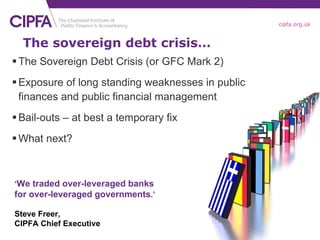
The sovereign debt crisis… The Sovereign Debt Crisis (or GFC Mark 2) Exposure of long standing weaknesses in public finances and public financial management Bail-outs – at best a temporary fix What next? ‘ We traded over-leveraged banks for over-leveraged governments .’ Steve Freer, CIPFA Chief Executive
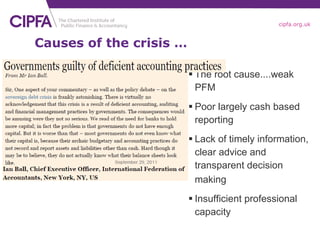
The root cause....weak PFM Poor largely cash based reporting Lack of timely information, clear advice and transparent decision making   Insufficient professional capacity Causes of the crisis …
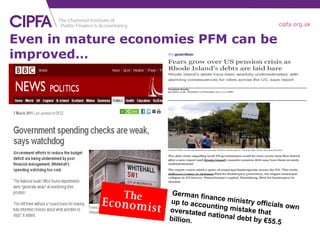
It’s not as though we were not aware … “ It was an error because Greece entered with false [economic] figures … it was not ready. ”   President Sarkozy
We should have seen it coming … “ We’ve never had this kind of accumulation of debt in world history” said Bass.  Critically, the big banks were no longer treated as private enterprises but as extensions of their governments, sure to be bailed out.  “ The first thing we tried to figure out was how big these banking systems were,” said Bass, “in relation to government revenues. We took about four months to gather the data. No one had it.” The numbers added up to astonishing totals: Ireland had debts of more than 25 times its annual tax revenues, Spain and France of more than 10 times their annual revenues. Historically, such levels of government indebtedness had led to government default. Summer 2011 I returned to see Kyle Bass, Greek credit default swaps were up from the 11 basis points he had paid to 2,300.  Michael Lewis describing Hedge Fund Manager  Kyle Bass The man who sold the world The Texan investor who made a fortune in the sub-prime chaos. Now gambling big money on the collapse of entire countries
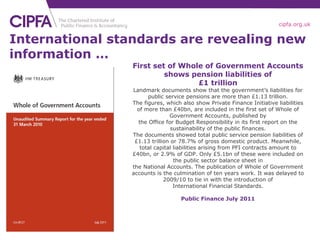
Even in mature economies PFM can be improved… German finance ministry officials own up to accounting mistake that overstated national debt by €55.5 billion.
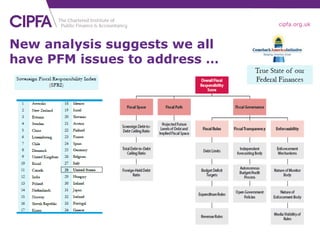
International standards are revealing new information … First set of Whole of Government Accounts shows pension liabilities of £1 trillion Landmark documents show that the government’s liabilities for public service pensions are more than £1.13 trillion. The figures, which also show Private Finance Initiative liabilities of more than £40bn, are included in the first set of Whole of Government Accounts, published by the Office for Budget Responsibility in its first report on the sustainability of the public finances. The documents showed total public service pension liabilities of £1.13 trillion or 78.7% of gross domestic product. Meanwhile, total capital liabilities arising from PFI contracts amount to £40bn, or 2.9% of GDP. Only £5.1bn of these were included on the public sector balance sheet in the National Accounts. The publication of Whole of Government accounts is the culmination of ten years work. It was delayed to 2009/10 to tie in with the introduction of International Financial Standards. Public Finance July 2011
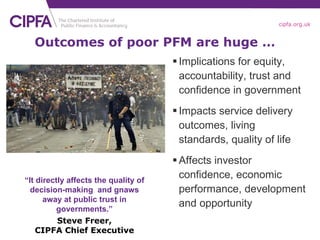
New analysis suggests we all have PFM issues to address …
Implications for equity, accountability, trust and confidence in government Impacts service delivery outcomes, living standards, quality of life Affects investor confidence, economic performance, development and opportunity Outcomes of poor PFM are huge … “ It directly affects the quality of decision-making  and gnaws away at public trust in governments.” Steve Freer, CIPFA Chief Executive
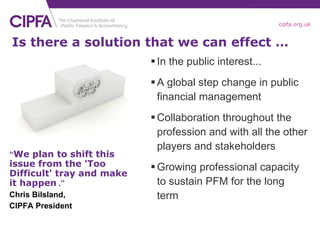
In the public interest... A global step change in public financial management Collaboration throughout the profession and with all the other players and stakeholders Growing professional capacity to sustain PFM for the long term Is there a solution that we can effect … “ We plan to shift this issue from the 'Too Difficult' tray and make it happen   .” Chris Bilsland, CIPFA President
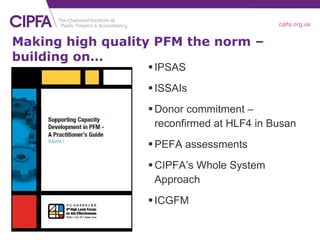
Making high quality PFM the norm – building on… IPSAS ISSAIs Donor commitment – reconfirmed at HLF4 in Busan PEFA assessments CIPFA’s Whole System Approach ICGFM
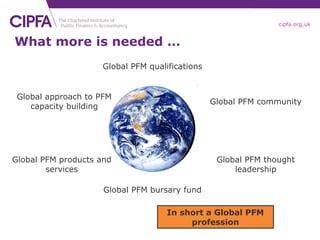
What more is needed … Global PFM qualifications Global PFM community Global PFM thought leadership In short a Global PFM profession Global PFM bursary fund Global approach to PFM capacity building Global PFM products and services
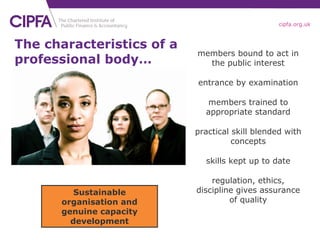
The characteristics of a professional body… Sustainable organisation and genuine capacity development members bound to act in the public interest entrance by examination practical skill blended with concepts members trained to appropriate standard skills kept up to date regulation, ethics, discipline gives assurance of quality
Outputs from PFM professionals… Quality accounts and unqualified audits prepare budgets and financial statements design PFM systems give assurance provide advice certify accuracy and integrity monitor compliance
Outcomes from PFM professionals… better quality decision making more effective targeting of resources stronger accountability more efficient use of resources greater comparability Donor/ lender confidence in country systems improved transparency
CIPFA’s experience of professionalisation… South Africa Lesotho Egypt Tanzania Eastern Europe Canada Australia New Zealand Nigeria Different approaches different results
CIPFA cannot do this alone. We want global alliances… International agencies National governments Multi lateral development banks Charitable foundations Professional accountancy institutes Accountancy and other firms Academic institutions Representative international bodies
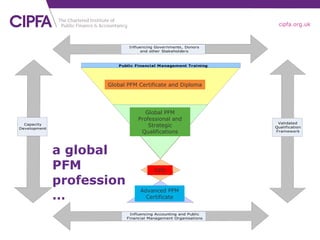
a global PFM profession … Global PFM Certificate and Diploma Global PFM Professional and Strategic Qualifications Advanced PFM Certificate CPD
We know partnerships work eg Nigeria… The Accountant General of the Federation The Auditor General for the Federation The Federal Treasury Academy The World Bank The Institute of Chartered Accountants of Nigeria
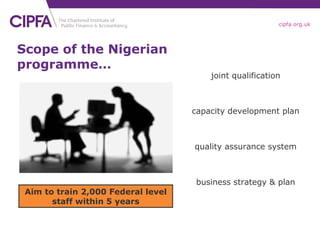
Scope of the Nigerian programme… Aim to train 2,000 Federal level staff within 5 years joint qualification capacity development plan quality assurance system business strategy & plan
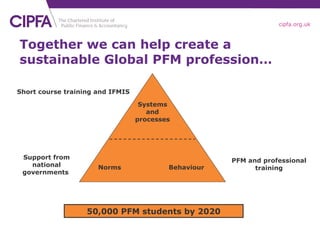
Together we can help create a sustainable Global PFM profession… PFM and professional training Systems and processes Behaviour Norms Short course training and IFMIS Support from national governments  50,000 PFM students by 2020
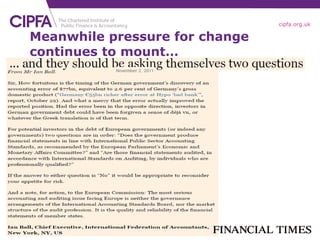
Meanwhile pressure for change continues to mount…
improving PFM The need for a global PFM profession Alan Edwards International Director CIPFA [email_address] Tel +44 207 543 5690

Improving PFM: The need for a Global PFM profession

  • 1.
    Improving PFM Theneed for a Global PFM profession Alan Edwards, International Director, CIPFA
  • 2.
    The sovereign debtcrisis… The Sovereign Debt Crisis (or GFC Mark 2) Exposure of long standing weaknesses in public finances and public financial management Bail-outs – at best a temporary fix What next? ‘ We traded over-leveraged banks for over-leveraged governments .’ Steve Freer, CIPFA Chief Executive
  • 3.
    The root cause....weakPFM Poor largely cash based reporting Lack of timely information, clear advice and transparent decision making Insufficient professional capacity Causes of the crisis …
  • 4.
    It’s not asthough we were not aware … “ It was an error because Greece entered with false [economic] figures … it was not ready. ” President Sarkozy
  • 5.
    We should haveseen it coming … “ We’ve never had this kind of accumulation of debt in world history” said Bass. Critically, the big banks were no longer treated as private enterprises but as extensions of their governments, sure to be bailed out. “ The first thing we tried to figure out was how big these banking systems were,” said Bass, “in relation to government revenues. We took about four months to gather the data. No one had it.” The numbers added up to astonishing totals: Ireland had debts of more than 25 times its annual tax revenues, Spain and France of more than 10 times their annual revenues. Historically, such levels of government indebtedness had led to government default. Summer 2011 I returned to see Kyle Bass, Greek credit default swaps were up from the 11 basis points he had paid to 2,300. Michael Lewis describing Hedge Fund Manager Kyle Bass The man who sold the world The Texan investor who made a fortune in the sub-prime chaos. Now gambling big money on the collapse of entire countries
  • 6.
    Even in matureeconomies PFM can be improved… German finance ministry officials own up to accounting mistake that overstated national debt by €55.5 billion.
  • 7.
    International standards arerevealing new information … First set of Whole of Government Accounts shows pension liabilities of £1 trillion Landmark documents show that the government’s liabilities for public service pensions are more than £1.13 trillion. The figures, which also show Private Finance Initiative liabilities of more than £40bn, are included in the first set of Whole of Government Accounts, published by the Office for Budget Responsibility in its first report on the sustainability of the public finances. The documents showed total public service pension liabilities of £1.13 trillion or 78.7% of gross domestic product. Meanwhile, total capital liabilities arising from PFI contracts amount to £40bn, or 2.9% of GDP. Only £5.1bn of these were included on the public sector balance sheet in the National Accounts. The publication of Whole of Government accounts is the culmination of ten years work. It was delayed to 2009/10 to tie in with the introduction of International Financial Standards. Public Finance July 2011
  • 8.
    New analysis suggestswe all have PFM issues to address …
  • 9.
    Implications for equity,accountability, trust and confidence in government Impacts service delivery outcomes, living standards, quality of life Affects investor confidence, economic performance, development and opportunity Outcomes of poor PFM are huge … “ It directly affects the quality of decision-making and gnaws away at public trust in governments.” Steve Freer, CIPFA Chief Executive
  • 10.
    In the publicinterest... A global step change in public financial management Collaboration throughout the profession and with all the other players and stakeholders Growing professional capacity to sustain PFM for the long term Is there a solution that we can effect … “ We plan to shift this issue from the 'Too Difficult' tray and make it happen .” Chris Bilsland, CIPFA President
  • 11.
    Making high qualityPFM the norm – building on… IPSAS ISSAIs Donor commitment – reconfirmed at HLF4 in Busan PEFA assessments CIPFA’s Whole System Approach ICGFM
  • 12.
    What more isneeded … Global PFM qualifications Global PFM community Global PFM thought leadership In short a Global PFM profession Global PFM bursary fund Global approach to PFM capacity building Global PFM products and services
  • 13.
    The characteristics ofa professional body… Sustainable organisation and genuine capacity development members bound to act in the public interest entrance by examination practical skill blended with concepts members trained to appropriate standard skills kept up to date regulation, ethics, discipline gives assurance of quality
  • 14.
    Outputs from PFMprofessionals… Quality accounts and unqualified audits prepare budgets and financial statements design PFM systems give assurance provide advice certify accuracy and integrity monitor compliance
  • 15.
    Outcomes from PFMprofessionals… better quality decision making more effective targeting of resources stronger accountability more efficient use of resources greater comparability Donor/ lender confidence in country systems improved transparency
  • 16.
    CIPFA’s experience ofprofessionalisation… South Africa Lesotho Egypt Tanzania Eastern Europe Canada Australia New Zealand Nigeria Different approaches different results
  • 17.
    CIPFA cannot dothis alone. We want global alliances… International agencies National governments Multi lateral development banks Charitable foundations Professional accountancy institutes Accountancy and other firms Academic institutions Representative international bodies
  • 18.
    a global PFMprofession … Global PFM Certificate and Diploma Global PFM Professional and Strategic Qualifications Advanced PFM Certificate CPD
  • 19.
    We know partnershipswork eg Nigeria… The Accountant General of the Federation The Auditor General for the Federation The Federal Treasury Academy The World Bank The Institute of Chartered Accountants of Nigeria
  • 20.
    Scope of theNigerian programme… Aim to train 2,000 Federal level staff within 5 years joint qualification capacity development plan quality assurance system business strategy & plan
  • 21.
    Together we canhelp create a sustainable Global PFM profession… PFM and professional training Systems and processes Behaviour Norms Short course training and IFMIS Support from national governments 50,000 PFM students by 2020
  • 22.
    Meanwhile pressure forchange continues to mount…
  • 23.
    improving PFM Theneed for a global PFM profession Alan Edwards International Director CIPFA [email_address] Tel +44 207 543 5690

Editor's Notes

  • #13 [show slide 3] Our current work in Nigeria has us working in partnership with four major stakeholders in PFM reform in the country. [transition]. The government, in particular the Accountant General of the Federation and the Auditor General for the Federation; [transition] The Institute of Chartered Accountants of Nigeria, ICAN; [transition] The Federal Treasury Academy; and [transition] the World Bank. Although all stakeholder share some high level objectives, in particular to help improve PFM in Nigeria, each has its own particular aims. The government wishes to place the FTA on a more robust and long lasting footing, and to ensure that it has the capacity to achieve its mission over the long term. ICAN want to extend their influence in Nigeria more deeply and firmly into the public sector. FTA wants to improve its skills base and to revitalise itself as an important provider of public finance training in the country. The World Bank wants to advance its Africa Staff Capacity Development Initiative in Nigeria, and in particular to see capacity developed for improving PFM. [transition] Our professionalisation agenda is the glue that can help to bind together these various aims and intentions.
  • #14 [show slide 3] Our current work in Nigeria has us working in partnership with four major stakeholders in PFM reform in the country. [transition]. The government, in particular the Accountant General of the Federation and the Auditor General for the Federation; [transition] The Institute of Chartered Accountants of Nigeria, ICAN; [transition] The Federal Treasury Academy; and [transition] the World Bank. Although all stakeholder share some high level objectives, in particular to help improve PFM in Nigeria, each has its own particular aims. The government wishes to place the FTA on a more robust and long lasting footing, and to ensure that it has the capacity to achieve its mission over the long term. ICAN want to extend their influence in Nigeria more deeply and firmly into the public sector. FTA wants to improve its skills base and to revitalise itself as an important provider of public finance training in the country. The World Bank wants to advance its Africa Staff Capacity Development Initiative in Nigeria, and in particular to see capacity developed for improving PFM. [transition] Our professionalisation agenda is the glue that can help to bind together these various aims and intentions.
  • #15 [show slide 3] Our current work in Nigeria has us working in partnership with four major stakeholders in PFM reform in the country. [transition]. The government, in particular the Accountant General of the Federation and the Auditor General for the Federation; [transition] The Institute of Chartered Accountants of Nigeria, ICAN; [transition] The Federal Treasury Academy; and [transition] the World Bank. Although all stakeholder share some high level objectives, in particular to help improve PFM in Nigeria, each has its own particular aims. The government wishes to place the FTA on a more robust and long lasting footing, and to ensure that it has the capacity to achieve its mission over the long term. ICAN want to extend their influence in Nigeria more deeply and firmly into the public sector. FTA wants to improve its skills base and to revitalise itself as an important provider of public finance training in the country. The World Bank wants to advance its Africa Staff Capacity Development Initiative in Nigeria, and in particular to see capacity developed for improving PFM. [transition] Our professionalisation agenda is the glue that can help to bind together these various aims and intentions.
  • #16 [show slide 3] Our current work in Nigeria has us working in partnership with four major stakeholders in PFM reform in the country. [transition]. The government, in particular the Accountant General of the Federation and the Auditor General for the Federation; [transition] The Institute of Chartered Accountants of Nigeria, ICAN; [transition] The Federal Treasury Academy; and [transition] the World Bank. Although all stakeholder share some high level objectives, in particular to help improve PFM in Nigeria, each has its own particular aims. The government wishes to place the FTA on a more robust and long lasting footing, and to ensure that it has the capacity to achieve its mission over the long term. ICAN want to extend their influence in Nigeria more deeply and firmly into the public sector. FTA wants to improve its skills base and to revitalise itself as an important provider of public finance training in the country. The World Bank wants to advance its Africa Staff Capacity Development Initiative in Nigeria, and in particular to see capacity developed for improving PFM. [transition] Our professionalisation agenda is the glue that can help to bind together these various aims and intentions.
  • #17 [show slide 3] Our current work in Nigeria has us working in partnership with four major stakeholders in PFM reform in the country. [transition]. The government, in particular the Accountant General of the Federation and the Auditor General for the Federation; [transition] The Institute of Chartered Accountants of Nigeria, ICAN; [transition] The Federal Treasury Academy; and [transition] the World Bank. Although all stakeholder share some high level objectives, in particular to help improve PFM in Nigeria, each has its own particular aims. The government wishes to place the FTA on a more robust and long lasting footing, and to ensure that it has the capacity to achieve its mission over the long term. ICAN want to extend their influence in Nigeria more deeply and firmly into the public sector. FTA wants to improve its skills base and to revitalise itself as an important provider of public finance training in the country. The World Bank wants to advance its Africa Staff Capacity Development Initiative in Nigeria, and in particular to see capacity developed for improving PFM. [transition] Our professionalisation agenda is the glue that can help to bind together these various aims and intentions.
  • #20 [show slide 3] Our current work in Nigeria has us working in partnership with four major stakeholders in PFM reform in the country. [transition]. The government, in particular the Accountant General of the Federation and the Auditor General for the Federation; [transition] The Institute of Chartered Accountants of Nigeria, ICAN; [transition] The Federal Treasury Academy; and [transition] the World Bank. Although all stakeholder share some high level objectives, in particular to help improve PFM in Nigeria, each has its own particular aims. The government wishes to place the FTA on a more robust and long lasting footing, and to ensure that it has the capacity to achieve its mission over the long term. ICAN want to extend their influence in Nigeria more deeply and firmly into the public sector. FTA wants to improve its skills base and to revitalise itself as an important provider of public finance training in the country. The World Bank wants to advance its Africa Staff Capacity Development Initiative in Nigeria, and in particular to see capacity developed for improving PFM. [transition] Our professionalisation agenda is the glue that can help to bind together these various aims and intentions.
  • #21 [show slide 4] We are currently contracted to do four things in Nigeria: [transition] to develop a qualification, to be awarded jointly with ICAN, based on our own ICD; [transition] to design and begin to implement a capacity development plan for staff of the FTA, and to carry out some initial training; [transition] to design a system of quality assurance of the FTA’s work; and, most significantly, [transition] to produce a business strategy and plan for the future of PFM in Nigeria. We started the work on the ground in December last year, and expect to produce the final draft of our strategy and plan towards the end of May.