INTRODUCTION TO
PUBLIC FINANCE
MANAGEMENT (PFM)
Module 1.1
Definitions , objectives of PFM and its
context
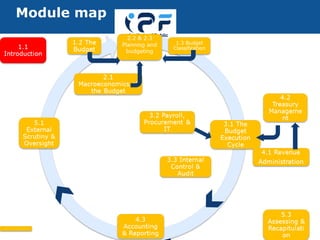
Module map
Why is PFM important?
New EU Budget Support Guidelines 2012
Continued importance of budget support instrument
Stronger link with fundamental values of the EU
Greater differentiation of budget support operations,
Strengthened eligibility criteria
More rigorous assessment
• Some definitions
• Implementing public policies
• The specific objectives of PFM
• The limits of technical approaches to PFM
Module outline
4
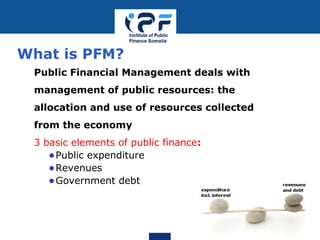
What is PFM?
Public Financial Management deals with
management of public resources: the
allocation and use of resources collected
from the economy
3 basic elements of public finance:
•Public expenditure
•Revenues
•Government debt
OECD DAC 2009 Definition:
“ It includes all components of a country’s
budget process… including strategic
planning, medium-term expenditure
framework, annual budgeting and also
revenue management, procurement,
control, accounting, reporting, monitoring
and evaluation, audit and oversight.“
The scope of this course
6
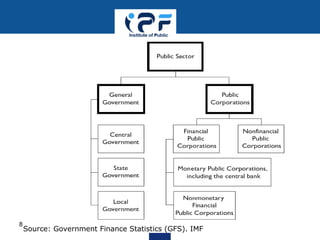
• General government comprises all government
units
• Central government
• State government, in federal countries
• Local government
Social security funds are sometimes combined into a separate subsector
• Public sector also includes,
• corporations and quasi-corporations controlled by
the government units
What is the Government?
7
8
Source: Government Finance Statistics (GFS). IMF
• Some definitions
• Implementing public policies
• The specific objectives of PFM
• The limits of technical approaches to PFM
Module outline
9
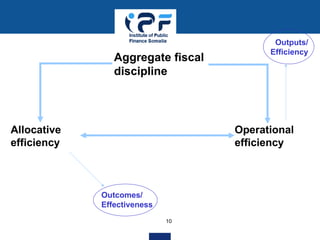
Three objectives of PFM
10
Aggregate fiscal
discipline
Operational
efficiency
Allocative
efficiency
Outcomes/
Effectiveness
Outputs/
Efficiency
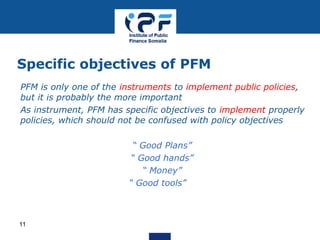
• PFM is only one of the instruments to implement public policies,
but it is probably the more important
• As instrument, PFM has specific objectives to implement properly
policies, which should not be confused with policy objectives
• “ Good Plans”
• “ Good hands”
• “ Money”
• “ Good tools”
11
Specific objectives of PFM
Aggregrate fiscal discipline
Fiscal discipline refers to:
• maintaining a sustainable balance between
revenues, expenditures and the level of
public debts
• respecting the expenditures ceilings at all
levels and by all actors of the Government
administration
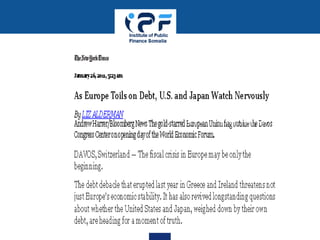
New York times
Allocative Efficiency
Definition
Allocate and spend public resources in such a way that that
attainment of the government objectives is maximised
Preconditions for optimising allocative efficiency:
• Clearly defined national objectives and priorities
• Existence of effective sector programmes
• Capacity and willingness to re-allocate if needed
• Information on programme outcomes
Definition
Ability to make efficient and effective use of resources in the
implementation of strategic priorities
Key elements
•Use of liquidity (loans, cash management)
•Support to service delivery units
•Reduce leakage
Key players
Treasury, Line ministries, service delivery units
Operational Efficiency
16
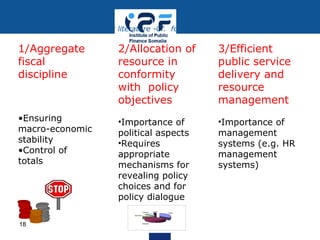
1/Aggregate
fiscal
discipline
•Ensuring
macro-economic
stability
•Control of
totals
2/Allocation of
resource in
conformity
with policy
objectives
•Importance of
political aspects
•Requires
appropriate
mechanisms for
revealing policy
choices and for
policy dialogue
3/Efficient
public service
delivery and
resource
management
•Importance of
management
systems (e.g. HR
management
systems)
Health
Education
Agriculture
Defence Justice
18
As defined in the recent budget literature -Cf. for example PEFA
19
 A societal dimension of PFM must be taken into
account
 “Traditional” PFM values: regularity, compliance,
etc. remain very important
 Role of Parliament in democratic society
 Accountability (Be Answerable and held responsible)
 Transparency
Completing the 3 PFM objectives
20
Accountability
• The budget as key accountability instrument
• Plans expenditures and revenues
• Operationalizes the policies
• Voted by Parliament
• Scrutiny by parliament
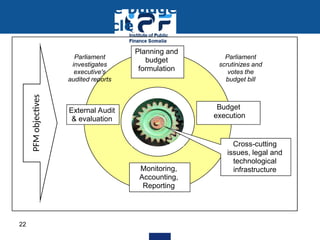
The budget
cycle
Planning and
budget
formulation
Budget
execution
Monitoring,
Accounting,
Reporting
External Audit
& evaluation
Cross-cutting
issues, legal and
technological
infrastructure
Parliament
scrutinizes and
votes the
budget bill
Parliament
investigates
executive's
audited reports
PFM
objectives
22
Accountability ‘versus’ PFM objectives?
• The challenges
• Constraints may be required for fiscal discipline
but some degree of flexibility is required for
performance
• The role of Parliament is crucial in democratic
society.
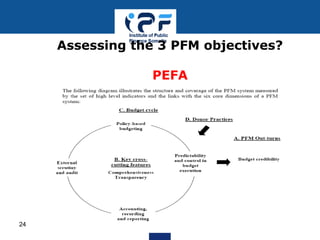
Assessing the 3 PFM objectives?
PEFA
24
• Some definitions
• The specific objectives of PFM
• Implementing public policies
• The limits of technical approaches to PFM
Module outline
25
• PFM is an instrument to implement public
policies;
• Public finance policies
• Tax policy
• Public expenditure policy
• Debt policy
National and sector policies
• Poverty Reduction Strategy
• Sector plans, etc
Public policies and PFM
26
• Some definitions
• Implementing public policies
• The specific objectives of PFM
• The limits of technical approaches to PFM
Module outline
27
• PFM compliance was high in the 50s/60s.
Performance dropped in late 70s/80s, when
salaries plummeted.
• Gap between the fiction of formal systems and
the reality of informal processes.
The limits of technical approaches
28
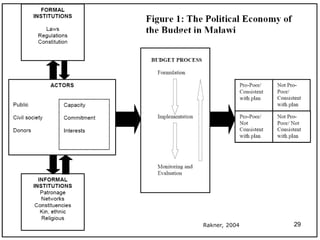
Rakner, 2004 29
• Can PFM reform fight Corruption?
• NO
• but it helps in identifying where there are
failings
• Strengthening PFM systems in an adequate
manner will help in curbing administrative
corruption
• However, fighting grand corruption, which
involves powerful politicians is largely a political
and societal matter
The limits of technical approaches
30
• Lessons learned?
• Modest; realistic expectations
• PFM in its political context
• PFM processes should be aimed at making
informal rules visible
• Transparency is crucial
• Attention should be paid to external (to the
executive) control
The limits of technical approaches
31
• PFM is an important instrument to implement
government policies
• The main tasks of PFM are to ensure aggregate
fiscal discipline, resource allocation in conformity
with policy objectives and efficient public service
delivery
• Budget management is a core component of PFM
• Political aspects of PFM must be taken into account
and informalities must be made visible.
Key messages
32
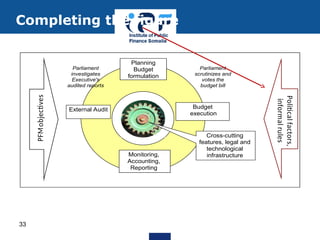
Completing the figure
Planning
Budget
formulation
Budget
execution
Monitoring,
Accounting,
Reporting
External Audit
Cross-cutting
features, legal and
technological
infrastructure
Parliament
scrutinizes and
votes the
budget bill
Parliament
investigates
Executive's
audited reports
PFM
objectives
Political
factors,
informal
rules
33

Module 1.1 - Introductfion for PFM GFM.ppt

  • 1.
    INTRODUCTION TO PUBLIC FINANCE MANAGEMENT(PFM) Module 1.1 Definitions , objectives of PFM and its context
  • 2.
  • 3.
    Why is PFMimportant? New EU Budget Support Guidelines 2012 Continued importance of budget support instrument Stronger link with fundamental values of the EU Greater differentiation of budget support operations, Strengthened eligibility criteria More rigorous assessment
  • 4.
    • Some definitions •Implementing public policies • The specific objectives of PFM • The limits of technical approaches to PFM Module outline 4
  • 5.
    What is PFM? PublicFinancial Management deals with management of public resources: the allocation and use of resources collected from the economy 3 basic elements of public finance: •Public expenditure •Revenues •Government debt
  • 6.
    OECD DAC 2009Definition: “ It includes all components of a country’s budget process… including strategic planning, medium-term expenditure framework, annual budgeting and also revenue management, procurement, control, accounting, reporting, monitoring and evaluation, audit and oversight.“ The scope of this course 6
  • 7.
    • General governmentcomprises all government units • Central government • State government, in federal countries • Local government Social security funds are sometimes combined into a separate subsector • Public sector also includes, • corporations and quasi-corporations controlled by the government units What is the Government? 7
  • 8.
    8 Source: Government FinanceStatistics (GFS). IMF
  • 9.
    • Some definitions •Implementing public policies • The specific objectives of PFM • The limits of technical approaches to PFM Module outline 9
  • 10.
    Three objectives ofPFM 10 Aggregate fiscal discipline Operational efficiency Allocative efficiency Outcomes/ Effectiveness Outputs/ Efficiency
  • 11.
    • PFM isonly one of the instruments to implement public policies, but it is probably the more important • As instrument, PFM has specific objectives to implement properly policies, which should not be confused with policy objectives • “ Good Plans” • “ Good hands” • “ Money” • “ Good tools” 11 Specific objectives of PFM
  • 12.
    Aggregrate fiscal discipline Fiscaldiscipline refers to: • maintaining a sustainable balance between revenues, expenditures and the level of public debts • respecting the expenditures ceilings at all levels and by all actors of the Government administration
  • 13.
  • 14.
    Allocative Efficiency Definition Allocate andspend public resources in such a way that that attainment of the government objectives is maximised Preconditions for optimising allocative efficiency: • Clearly defined national objectives and priorities • Existence of effective sector programmes • Capacity and willingness to re-allocate if needed • Information on programme outcomes
  • 16.
    Definition Ability to makeefficient and effective use of resources in the implementation of strategic priorities Key elements •Use of liquidity (loans, cash management) •Support to service delivery units •Reduce leakage Key players Treasury, Line ministries, service delivery units Operational Efficiency 16
  • 18.
    1/Aggregate fiscal discipline •Ensuring macro-economic stability •Control of totals 2/Allocation of resourcein conformity with policy objectives •Importance of political aspects •Requires appropriate mechanisms for revealing policy choices and for policy dialogue 3/Efficient public service delivery and resource management •Importance of management systems (e.g. HR management systems) Health Education Agriculture Defence Justice 18 As defined in the recent budget literature -Cf. for example PEFA
  • 19.
  • 20.
     A societaldimension of PFM must be taken into account  “Traditional” PFM values: regularity, compliance, etc. remain very important  Role of Parliament in democratic society  Accountability (Be Answerable and held responsible)  Transparency Completing the 3 PFM objectives 20
  • 21.
    Accountability • The budgetas key accountability instrument • Plans expenditures and revenues • Operationalizes the policies • Voted by Parliament • Scrutiny by parliament
  • 22.
    The budget cycle Planning and budget formulation Budget execution Monitoring, Accounting, Reporting ExternalAudit & evaluation Cross-cutting issues, legal and technological infrastructure Parliament scrutinizes and votes the budget bill Parliament investigates executive's audited reports PFM objectives 22
  • 23.
    Accountability ‘versus’ PFMobjectives? • The challenges • Constraints may be required for fiscal discipline but some degree of flexibility is required for performance • The role of Parliament is crucial in democratic society.
  • 24.
    Assessing the 3PFM objectives? PEFA 24
  • 25.
    • Some definitions •The specific objectives of PFM • Implementing public policies • The limits of technical approaches to PFM Module outline 25
  • 26.
    • PFM isan instrument to implement public policies; • Public finance policies • Tax policy • Public expenditure policy • Debt policy National and sector policies • Poverty Reduction Strategy • Sector plans, etc Public policies and PFM 26
  • 27.
    • Some definitions •Implementing public policies • The specific objectives of PFM • The limits of technical approaches to PFM Module outline 27
  • 28.
    • PFM compliancewas high in the 50s/60s. Performance dropped in late 70s/80s, when salaries plummeted. • Gap between the fiction of formal systems and the reality of informal processes. The limits of technical approaches 28
  • 29.
  • 30.
    • Can PFMreform fight Corruption? • NO • but it helps in identifying where there are failings • Strengthening PFM systems in an adequate manner will help in curbing administrative corruption • However, fighting grand corruption, which involves powerful politicians is largely a political and societal matter The limits of technical approaches 30
  • 31.
    • Lessons learned? •Modest; realistic expectations • PFM in its political context • PFM processes should be aimed at making informal rules visible • Transparency is crucial • Attention should be paid to external (to the executive) control The limits of technical approaches 31
  • 32.
    • PFM isan important instrument to implement government policies • The main tasks of PFM are to ensure aggregate fiscal discipline, resource allocation in conformity with policy objectives and efficient public service delivery • Budget management is a core component of PFM • Political aspects of PFM must be taken into account and informalities must be made visible. Key messages 32
  • 33.
    Completing the figure Planning Budget formulation Budget execution Monitoring, Accounting, Reporting ExternalAudit Cross-cutting features, legal and technological infrastructure Parliament scrutinizes and votes the budget bill Parliament investigates Executive's audited reports PFM objectives Political factors, informal rules 33

Editor's Notes

  • #3 (human rights, democracy and rule of law allowing the EU to respond better to the political, economic and social context of the partner country
  • #5 What is PFM? Public Finance Management deals with the management of public resources, but Public Expenditure Management or Public Finance Management (PFM) also stands for a concept for sound management of the public finance. PFM is the key government policy instrument for giving effect to a country’s economic and social priorities. It aims at allocating the scarce resources that are available for government expenditure in a more responsive, effective and efficient way.
  • #7 Government units have legislative, judicial, or executive authority ; provides goods and services on a nonmarket basis redistribute income and wealth finance their activities mainly by means of taxes and other compulsory transfers The course will deal with the finance of the general government. With a focus on the central government, but there is a module on decentralisation
  • #8 Public sector comprises Public administrations Central, state, local collectivities, social security) These public administrations have legislative, judiciary of executive powers. They provide non merchant goods and services, raise taxes, redistribute income (cf. IMF/GFS) Corporations and quasi-corporatoins controlled by the public administration NB This course deals mainly with the central government.
  • #10 Traditionally, an emphasis been placed on regularity, probity and due process. Development of a control culture and adequate procedures Good control procedures, due processes are required by they do not necessarily lead to good outcomes. The three specific objectives of PFM formulated in the recent budget literature place en emphasis on policies and efficiency of spending Objectives of PFM There three backbones of a sound Public Finance Management System are: Aggregate Fiscal Discipline, Allocative and Operational Efficiency. These are also called the 3 levels of PFM. Aggregate Fiscal Discipline: pertains to effective controls of budget totals throughout the policy, planning and budget cycle, by setting hard ceilings on expenditures that are binding both at the aggregate level and on individual spending entities. Allocative Efficiency: refers to the capacity to establish priorities within the budget. It includes allocating resources in accordance with government priorities and the effectiveness of policy program (i.e. not incremental). Allocating resources efficiently also means shifting resources from old priorities to new ones or from less to more effective ones. In practice govts have limited room of maneuver to change priorities within a year, therefore also MTEFs have been developed. Operational Efficiency: aims at the better use of budgeted resources for implementing government programs and delivering public services in such a way that costs per unit of output are minimized. The focus is on service delivery. Refer also to the arrows which are on this slide: e.g. without discipline the others do not make sense.
  • #12 Aggregate Fiscal Discipline (1) Linked to Macroeconomic stability The aim of Aggregate Fiscal Discipline is to establish effective controls of budget totals throughout the policy, planning and budget cycle by setting hard expenditure ceilings. Without fiscal discipline, it is impossible to achieve effective prioritisation and implementation of policy priorities and programs. And achieving operational efficiency is not credible without a hard budget constraint.
  • #13 Graph refers to federal US revenues and debt.
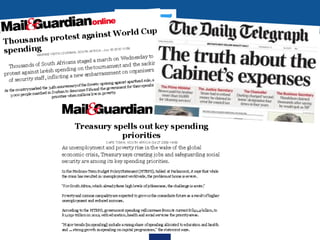
  • #15 Mail & Guardian is South-African newspaper. The UK’s Daily Telegraph revealed UK’s MPs’ expenses claims in 2009.
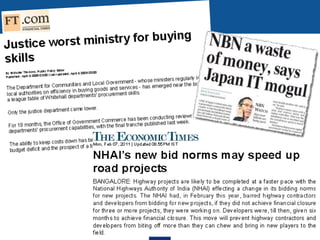
  • #17 FT.com: article points to UK Ministry of Justice. NBN a waste of money: NBN = Australia's $43 billion National Broadband Network. Article appeared in The Australian, Oct30 2010, by Tokyo correspondent. The Economic Times = The India Economic Times.
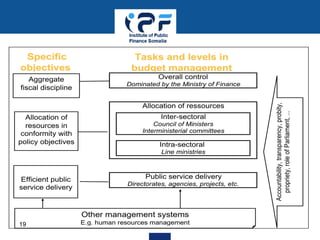
  • #19 The Ministry of Finance (MOF) is responsible for ensuring fiscal discipline and the technical supervision of PFM processes The Prime Minister ensures overall supervision of policy formulation and implementation Decisions on the inter-sectoral resource allocation should involve all ministers “Ministries, departments, agencies (MDA)” (or line ministries” or “main budget holders”) are responsible for allocating resource and supervising budget implementation within their sectors Their subordinate units implement the budget. These units play a key role for efficient service delivery, provided that adequate incentives and institutional arrangements are in place
  • #20 Accountability (Be Answerable and held responsible) Transparency, including according to the IMF code Clarity of roles and responsibilities Public availability of information Open budget preparation, execution and reporting Independent assurance of integrity
  • #23 Ensuring that budget processes contribute to achieve the PFM specific objectives at the different stages of the budget cycle These objectives should be achieved in a balanced manner, e.g.
  • #24 The performance of a budget system is its capacity of achieving the three PFM specific objectives completed or specified by the “societal dimension” The PEFA gives a framework to measure the performance of a budget system. This will be reviewed in detail on Friday!
  • #28 Are the right incentives provided? Compliance was not always poor. There was a period after independence when civil servants dominated the political class. Deterioration seems to have set in during the crisis of the late 70s/ early 80s, when staff salaries plummeted Mike Stevens institutional and incentive issues in public financial management reform in poor countries. World Bank/PEFA secretariat 2004 DFID studies of the politics of the budget in Ghana, Malawi and Mozambique highlight an important gap between the fiction of formal systems and the reality of informal processes. They emphasize that the budget is a political process, rather than a purely technical one. "The budget as theatre - the formal and informal institutional makings of the budget process in Malawi" (L. Rakner and al.). 2004.
  • #31 We will need to be modest PFM should be always placed in its political context PFM processes should be aimed at making informal rules visible Transparency is crucial Attention should be paid to external (to the executive) control